EP3824601B1 - Steuerung eines fahrzeuggetragenen warnsystems über controller area network (can)-kommunikation von globalen variablen, die als operanden von verhaltensgleichungen verarbeitet werden - Google Patents
Steuerung eines fahrzeuggetragenen warnsystems über controller area network (can)-kommunikation von globalen variablen, die als operanden von verhaltensgleichungen verarbeitet werden Download PDFInfo
- Publication number
- EP3824601B1 EP3824601B1 EP19837224.5A EP19837224A EP3824601B1 EP 3824601 B1 EP3824601 B1 EP 3824601B1 EP 19837224 A EP19837224 A EP 19837224A EP 3824601 B1 EP3824601 B1 EP 3824601B1
- Authority
- EP
- European Patent Office
- Prior art keywords
- status
- input
- output
- node
- equation
- Prior art date
- Legal status (The legal status is an assumption and is not a legal conclusion. Google has not performed a legal analysis and makes no representation as to the accuracy of the status listed.)
- Active
Links
Images











Classifications
-
- H—ELECTRICITY
- H04—ELECTRIC COMMUNICATION TECHNIQUE
- H04L—TRANSMISSION OF DIGITAL INFORMATION, e.g. TELEGRAPHIC COMMUNICATION
- H04L41/00—Arrangements for maintenance, administration or management of data switching networks, e.g. of packet switching networks
- H04L41/06—Management of faults, events, alarms or notifications
- H04L41/0681—Configuration of triggering conditions
-
- B—PERFORMING OPERATIONS; TRANSPORTING
- B60—VEHICLES IN GENERAL
- B60W—CONJOINT CONTROL OF VEHICLE SUB-UNITS OF DIFFERENT TYPE OR DIFFERENT FUNCTION; CONTROL SYSTEMS SPECIALLY ADAPTED FOR HYBRID VEHICLES; ROAD VEHICLE DRIVE CONTROL SYSTEMS FOR PURPOSES NOT RELATED TO THE CONTROL OF A PARTICULAR SUB-UNIT
- B60W40/00—Estimation or calculation of non-directly measurable driving parameters for road vehicle drive control systems not related to the control of a particular sub unit, e.g. by using mathematical models
- B60W40/08—Estimation or calculation of non-directly measurable driving parameters for road vehicle drive control systems not related to the control of a particular sub unit, e.g. by using mathematical models related to drivers or passengers
- B60W40/09—Driving style or behaviour
-
- B—PERFORMING OPERATIONS; TRANSPORTING
- B60—VEHICLES IN GENERAL
- B60W—CONJOINT CONTROL OF VEHICLE SUB-UNITS OF DIFFERENT TYPE OR DIFFERENT FUNCTION; CONTROL SYSTEMS SPECIALLY ADAPTED FOR HYBRID VEHICLES; ROAD VEHICLE DRIVE CONTROL SYSTEMS FOR PURPOSES NOT RELATED TO THE CONTROL OF A PARTICULAR SUB-UNIT
- B60W50/00—Details of control systems for road vehicle drive control not related to the control of a particular sub-unit, e.g. process diagnostic or vehicle driver interfaces
- B60W50/08—Interaction between the driver and the control system
- B60W50/10—Interpretation of driver requests or demands
-
- B—PERFORMING OPERATIONS; TRANSPORTING
- B60—VEHICLES IN GENERAL
- B60W—CONJOINT CONTROL OF VEHICLE SUB-UNITS OF DIFFERENT TYPE OR DIFFERENT FUNCTION; CONTROL SYSTEMS SPECIALLY ADAPTED FOR HYBRID VEHICLES; ROAD VEHICLE DRIVE CONTROL SYSTEMS FOR PURPOSES NOT RELATED TO THE CONTROL OF A PARTICULAR SUB-UNIT
- B60W50/00—Details of control systems for road vehicle drive control not related to the control of a particular sub-unit, e.g. process diagnostic or vehicle driver interfaces
- B60W50/08—Interaction between the driver and the control system
- B60W50/14—Means for informing the driver, warning the driver or prompting a driver intervention
-
- H—ELECTRICITY
- H04—ELECTRIC COMMUNICATION TECHNIQUE
- H04L—TRANSMISSION OF DIGITAL INFORMATION, e.g. TELEGRAPHIC COMMUNICATION
- H04L12/00—Data switching networks
- H04L12/28—Data switching networks characterised by path configuration, e.g. LAN [Local Area Networks] or WAN [Wide Area Networks]
- H04L12/40—Bus networks
-
- H—ELECTRICITY
- H04—ELECTRIC COMMUNICATION TECHNIQUE
- H04L—TRANSMISSION OF DIGITAL INFORMATION, e.g. TELEGRAPHIC COMMUNICATION
- H04L41/00—Arrangements for maintenance, administration or management of data switching networks, e.g. of packet switching networks
- H04L41/06—Management of faults, events, alarms or notifications
- H04L41/0631—Management of faults, events, alarms or notifications using root cause analysis; using analysis of correlation between notifications, alarms or events based on decision criteria, e.g. hierarchy, tree or time analysis
- H04L41/065—Management of faults, events, alarms or notifications using root cause analysis; using analysis of correlation between notifications, alarms or events based on decision criteria, e.g. hierarchy, tree or time analysis involving logical or physical relationship, e.g. grouping and hierarchies
-
- H—ELECTRICITY
- H04—ELECTRIC COMMUNICATION TECHNIQUE
- H04L—TRANSMISSION OF DIGITAL INFORMATION, e.g. TELEGRAPHIC COMMUNICATION
- H04L43/00—Arrangements for monitoring or testing data switching networks
- H04L43/08—Monitoring or testing based on specific metrics, e.g. QoS, energy consumption or environmental parameters
- H04L43/0805—Monitoring or testing based on specific metrics, e.g. QoS, energy consumption or environmental parameters by checking availability
- H04L43/0817—Monitoring or testing based on specific metrics, e.g. QoS, energy consumption or environmental parameters by checking availability by checking functioning
-
- H—ELECTRICITY
- H04—ELECTRIC COMMUNICATION TECHNIQUE
- H04M—TELEPHONIC COMMUNICATION
- H04M1/00—Substation equipment, e.g. for use by subscribers
- H04M1/247—Telephone sets including user guidance or feature selection means facilitating their use
- H04M1/2477—Telephone sets including user guidance or feature selection means facilitating their use for selecting a function from a menu display
-
- H—ELECTRICITY
- H04—ELECTRIC COMMUNICATION TECHNIQUE
- H04L—TRANSMISSION OF DIGITAL INFORMATION, e.g. TELEGRAPHIC COMMUNICATION
- H04L12/00—Data switching networks
- H04L12/28—Data switching networks characterised by path configuration, e.g. LAN [Local Area Networks] or WAN [Wide Area Networks]
- H04L12/40—Bus networks
- H04L2012/40208—Bus networks characterized by the use of a particular bus standard
- H04L2012/40215—Controller Area Network CAN
-
- H—ELECTRICITY
- H04—ELECTRIC COMMUNICATION TECHNIQUE
- H04L—TRANSMISSION OF DIGITAL INFORMATION, e.g. TELEGRAPHIC COMMUNICATION
- H04L12/00—Data switching networks
- H04L12/28—Data switching networks characterised by path configuration, e.g. LAN [Local Area Networks] or WAN [Wide Area Networks]
- H04L12/40—Bus networks
- H04L2012/40267—Bus for use in transportation systems
- H04L2012/40273—Bus for use in transportation systems the transportation system being a vehicle
-
- H—ELECTRICITY
- H04—ELECTRIC COMMUNICATION TECHNIQUE
- H04L—TRANSMISSION OF DIGITAL INFORMATION, e.g. TELEGRAPHIC COMMUNICATION
- H04L41/00—Arrangements for maintenance, administration or management of data switching networks, e.g. of packet switching networks
- H04L41/22—Arrangements for maintenance, administration or management of data switching networks, e.g. of packet switching networks comprising specially adapted graphical user interfaces [GUI]
Definitions
- this disclosure relates to a vehicle-carried warning system including serially connected warning devices such as sirens, lightbars, light modules (also called light engines and-according to the Society of Automotive Engineers (SAE)-light heads) or another class-one type of directional flashing optical warning devices for authorized emergency, maintenance, and service vehicles.
- serially connected warning devices such as sirens, lightbars, light modules (also called light engines and-according to the Society of Automotive Engineers (SAE)-light heads) or another class-one type of directional flashing optical warning devices for authorized emergency, maintenance, and service vehicles.
- SAE Society of Automotive Engineers
- ESG Electronic Controls Company
- CAN controller area network
- ECU Electronic Control Unit
- CAN is a multi-master serial bus standard for connecting two or more nodes for serial communications.
- part A describes a so-called standard format for a CAN message having an 11-bit identifier field
- part B describes the so-called extended format having a 29-bit identifier.
- a CAN device employing standard format 11-bit identifiers is commonly called a CAN 2.0A (compliant) device
- a CAN device employing extended format 29-bit identifiers is commonly called a CAN 2.0B device.
- ISO International Organization for Standardization
- ISO 11898-1 which specifies the data link layer
- ISO 11898-2 which specifies the CAN physical layer for high-speed CAN implementations
- ISO 11898-3 which specifies the CAN physical layer for low-speed, fault-tolerant CAN implementations.
- US20160369761A1 relates to the operation of a DC power plant.
- US20180167212A1 describes the updating and distribution of secret keys in a distributed network.
- the Matrix ® (or simply, Matrix) is a software communications protocol and set of associated software libraries for a CAN serial data bus that provides a flexible, standardized means of interoperation between vehicle safety equipment controllers and devices, such as lightbars, warning signs, sirens, and other devices. Matrix allows the various ESG products to cooperate as peers, in the absence of a central controller or specific foreknowledge of peer functionality. In other words, the Matrix system need not employ a dedicated central controller, and if a Matrix node is removed or otherwise not communicating, then the communications and associated system behaviors of the remaining nodes are uninterrupted.
- the protocol and associated libraries improve system performance in at least the following five ways.
- a method per claim 11 is also provided.
- Advantageous features are in the dependent claims.
- Matrix is analogous to an ESG safety system operating as a monolithic object-oriented computer program that is actually realized by multiple CAN nodes.
- a node on a CAN serial data bus (CAN bus, or simply CAN) is a device that communicates over the CAN bus, which is also referred to as a network.
- Such devices can be generally thought of as input devices, output devices, or hybrid devices (such as translators to other networks).
- An input device refers to keypads having dedicated keys, touchscreens, or both; an on-board diagnostics (OBD) controller; wire inputs from a SIB or junction box (J-Box); or other such devices shown in and described later with reference to FIGS. 3 and 5 .
- OBD on-board diagnostics
- An output device refers to lightbars, beacons, message signs, sirens, speakers, or wire outputs available from a J-Box and the like.
- Each device acting as a CAN node-a keypad, lightbar, siren, or other device- is analogous to a virtual object sharing global variables with the other virtual objects.
- Each device therefore, regularly checks its set of behavioral equations that binds its resources-i.e., the operative states of inputs or outputs-to global variables maintained among the nodes.
- behavioral equations can employ both math and logic operations to update variables and thereby tailor the desired system behavior as the updates are propagated to other nodes.
- Matrix Configurator ad-hoc system state synchronization (i.e., a master device need not control the system) and, among other things, a drag-and-drop GUI configuration of devices (called Matrix Configurator).
- FIG. 1 shows an example implementation of a high-speed network 10 formed by a linear CAN serial data bus 12 including multiple CAN nodes 14 connected to one another through two wires 20 terminated at each end with 120 ohm ( ⁇ ) resistors 22 equal to the characteristic impedance of the line (to prevent signal reflections).
- Wires 20 are 120 ⁇ nominal twisted pair cable, according to one embodiment, consistent with the ISO 11898-2 standard specifying the interconnect to be a twisted-pair cable (shielded or unshielded) with 120- ⁇ characteristic impedance (ZO). Termination may be on a cable or in a node as shown at, respectively, the left- and right-hand sides of FIG. 1 .
- CAN 12 supports up to 40 meters (m) total bus length, up to 120 nodes, extended frame format B with 29-bit identifier, up to one megabit per second (Mbit/s or Mb/s, often abbreviated "Mbps") also capable of operating at the 125 kilobits per second (kbit/s or kb/s, often abbreviated "kbps”) baud rate for the extended frame format, eight quanta per bit, sample point 75% (six quanta before and two quanta after), and a re-sync jump that is two quanta.
- Mbit/s or Mb/s often abbreviated "Mbps”
- kbps kilobits per second
- FIG. 1 also shows that each one of nodes 14 includes a CAN controller 26 and a CAN transceiver 28.
- CAN controller 26 includes, for example, embedded logic implementing the CAN protocol.
- CAN transceiver 28 provides a circuitry interface to the physical CAN bus.
- IC integrated circuit
- DSP digital signal processor
- CPU central processing unit
- RISC reduced instruction set computing
- CISC complex instruction set computing
- GPU graphics processing unit
- ASIC application specific integrated circuit
- circuitry and processor circuitry refer to, may be part of, or include an ASIC, an electronic circuit, a processor (shared, dedicated, or group), or memory (shared, dedicated, or group) that executes one or more software or firmware programs, a combinational logic circuit, or other suitable hardware components that provide the described functionality.
- the circuitry may be implemented in, or functions associated with the circuitry may be implemented by, one or more software or firmware modules.
- circuitry may include logic, at least partially realized in hardware.
- IC 30 controls a lightbar (see, e.g., FIG. 3 ) and is a member of the Programmable System-on-Chip (PSoC ® ) 4200-L product family of programmable embedded system microcontrollers available from Cypress Semiconductor Corporation of San Jose, California.
- the PSoC ® 4200-L product family is based on a scalable and reconfigurable platform architecture including an ARM ® Cortex ® -M0 CPU.
- the product family is characterized by its combination of microcontroller with digital programmable logic, and including programmable analog, programmable interconnect, secure expansion of memory off-chip, analog-to-digital converters (ADCs), operational amplifiers with a comparator mode, and standard communication and timing peripherals.
- the microcontroller includes four independent run-time reconfigurable serial communication blocks (SCBs) with reconfigurable I 2 C, SPI, or universal asynchronous receiver/transmitter (UART) functionality; USB Full-Speed device interface at 12 Mbps with Battery Charger Detect capability; and two internal CAN 2.0B node circuitry components, each of which includes independently controllable CAN controllers for industrial and automotive networking.
- IC 30 controls a light head and is an ATmega16M1 automotive 8-bit AVR ® microcontroller available from Atmel Corporation of San Jose, California.
- This type of microcontroller includes, among other things, 16 kilobytes of in-system memory; internal CAN node circuitry (e.g., a CAN 2.0A/B controller); a 10-bit ADC having up to 11 single ended channels; and an on-chip temperature sensor for communicating temperature information.
- CAN node 14 includes one or more microcontrollers 34, one or more memory/storage devices 36, and one or more communication resources 38, all of which are communicatively coupled via a bus or other circuitry 40.
- Microcontroller(s) 34 may include, for example, a processor 42 (shared, dedicated, or group), an optional processor (or additional processor core) 44, an ASIC or other controller to execute one or more software or firmware programs, a combinational logic circuit, or other suitable components that provide the described functionality.
- Memory/storage devices 36 may include main memory, cache, flash storage, or any suitable combination thereof. Additional examples are shown in FIG. 10 .
- a memory device 36 may also include any combination of various levels of non-transitory machine-readable memory including, but not limited to, electrically erasable programmable read-only memory (EEPROM) having embedded software instructions (e.g., firmware), dynamic random-access memory (e.g., DRAM), cache, buffers, or other memory devices.
- EEPROM electrically erasable programmable read-only memory
- firmware embedded software instructions
- DRAM dynamic random-access memory
- cache buffers, or other memory devices.
- memory may be shared among the various processors or dedicated to particular processors.
- Communication resources 38 include physical and network interface components or other suitable devices to communicate via a network 10 with one or more peripheral devices 50 (see, e.g., programming workstation of FIG. 13 ) or one or more other devices collectively storing global variables 52 that are described later.
- Communication resources 38 may also include wired communication components (e.g., for coupling via a Universal Serial Bus (USB)), cellular communication components, Near Field Communication (NFC) components, Bluetooth ® components (e.g., Bluetooth ® Low Energy), Wi-Fi ® components, and other communication components.
- wired communication components e.g., for coupling via a Universal Serial Bus (USB)
- USB Universal Serial Bus
- NFC Near Field Communication
- Bluetooth ® components e.g., Bluetooth ® Low Energy
- Wi-Fi ® components and other communication components.
- Instructions 54 may comprise software, a program, an application, an applet, an app, or other executable code for causing at least any of microcontroller(s) 34 to perform any one or more of the methods discussed herein. Instructions 54 may reside, completely or partially, within at least one of microcontroller(s) 34 (e.g., within a processor's cache memory), memory/storage devices 36, or any suitable combination thereof. Furthermore, any portion of instructions 54 may be transferred to CAN node 14 from any combination of peripheral devices 50 or the other devices storing global variables 52. Accordingly, memory of microcontroller(s) 34, memory/storage devices 36, peripheral devices 50, and the other devices are examples of computer-readable and machine-readable media.
- Instructions 54 may also, for instance, comprise one or more physical or logical blocks of computer instructions, which may be organized as a routine, program, object, component, data structure, text file, or other instruction set facilitating one or more tasks or implementing particular data structures or software modules.
- a software module, component, or library may include any type of computer instruction or computer-executable code located within or on a non-transitory computer-readable storage medium.
- a particular software module, component, or programmable rule may comprise disparate instructions stored in different locations of a computer-readable storage medium, which together implement the described functionality.
- a software module, component, or programmable rule may comprise a single instruction or many instructions, and may be distributed over several different code segments, among different programs, and across several computer-readable storage media.
- Instructions 54 include .Net and C libraries providing machine-readable instructions that, when executed by a processor, cause processors of the nodes to perform Matrix features, including automatically maintaining a set of global variables in synchronism across the network.
- such libraries implement file transfer protocol, flash file system, behavioral equation processor, and multichannel pattern sequencer.
- Matrix is a general term used as shorthand when referring to the communications protocol, underlying standards for enumeration of global variables and patterns, or the various formats and syntax for behavioral equations, pattern tables, product identification, and product assembly models.
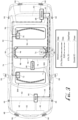
- FIG. 3 shows an overhead view of an outline of an emergency vehicle 60 having an embedded serial network (or bus) 62 of external warning systems and associated controllers including distributed nodes and light heads arranged about the perimeter of vehicle 60.
- Embedded serial network 62 implements CAN serial data bus 12 ( FIG. 1 ) of Matrix, according to one embodiment.
- the underlying physical wiring employed in Matrix includes a variety of wiring options such as, for example, two-pin data wires 64 between a signal distribution node 66 and a SIB 68; a data cable 70 connection between SIB 68 and three array controllers (ACs) 72, 74, 76 having 8 position, 8 contact (8P8C) plug connectors (not shown) commonly referred to as RJ45 modular connectors in the context of Ethernet-type cables; a four-pin, five volt (V) data and power line 78 between a keypad 80 for selecting illumination settings (e.g., dim level, flash pattern, and other settings) and SIB 68; and discrete I/O (e.g., power on-off cycling) cables 82 to non-serially connected light heads 84 actuated by signal distribution node 66.
- two-pin data wires 64 between a signal distribution node 66 and a SIB 68 includes a variety of wiring options such as, for example, two-pin data wires 64 between a
- SIB 68 is a dedicated controller node having a personal computer (PC) interface that, as explained later with reference to FIGS. 13-19 , enables end users to readily reconfigure their system. SIB 68 also includes dedicated memory space by which to maintain network-level status logs. SIB 68 communicatively couples several different Matrix nodes that employ the aforementioned different cable connections while also providing optional auxiliary features, such as an interface for discrete I/O or a siren.
- PC personal computer
- Matrix operates without a SIB, at the discretion of the end user weighing cost, complexity, and desired functionality.
- any combination of two or more Matrix nodes could form an autonomous system. This is so because priority functions and system synchronization are accomplished via the CAN message structure of the bus itself.
- CAN differs from other common embedded networks in that it operates with a multi-master structure. There is no host controller per se, such as in a USB, and no master-slave relationship per se, such as in a Serial Peripheral Interface (SPI) bus.
- SPI Serial Peripheral Interface
- Any CAN nodes communicatively coupled through bus 62 may be provided by a different original equipment manufacturer (OEM). And the complexity of a CAN node can range from a simple I/O device to a complex embedded computer having an integrated CAN controller and relatively sophisticated software.
- a node may also be a gateway allowing a standard computer (see, e.g., FIG. 13 ) to communicate over a USB, Ethernet, or other port to the devices on a CAN network. Accordingly, bus 62 facilitates interoperability between products independently developed by OEMs and partners.
- a rooftop array 86 of light heads 88 (i.e., multiple light engines in a lightbar 90) includes, among other things, an alley left light 92 and an alley right light 94, which will serve as the basis for several later-described examples of the Matrix control paradigm established through global variables and behavioral equations.
- Vehicle 60 and bus 62 also accommodate other types of arrays in lieu of or in addition to rooftop array 86.
- FIG. 3 shows several such arrays, although in practice most emergency vehicles will either have one rooftop array, front- and rear-facing arrays (e.g., for so-called slick-top vehicles), or some combination of rooftop and front- and rear-facing arrays.
- a rear-facing rooftop external array 96 (known as a Safety Director TM configuration) includes array controller 76 and multiple light heads 98.
- a lower front windshield interior array 100 includes array controller 72 and multiple light heads 102. Additional slick-top embodiments (not shown) of arrays having a nested CAN bus available from Code 3, Inc.
- a single array controller maintains multiple spaced-apart arrays.
- An input or output event is a change to an input or output status, and that information (conveyed in the form of variables) is broadcast over the CAN bus for consumption by other nodes that each evaluate a set of behavioral equations using variables as operands.
- each node periodically broadcasts the status for its full set of inputs or outputs.
- an operative state of an input (or output) device is also referred to as input (or output) status.
- an event depending on the context, is an actual physical or logical event or the resulting event message, which is also referred to as an input (or output) status event.
- variables and tokens are sometimes used interchangeably, yet there are some distinctions.
- a token is a container for communicating a variable and other optional data-such as an address-used to update variables communicated between application modules (i.e., a library resource, such as a sequencer or equation processor as shown in FIG. 10 ) and across the bus.
- a token includes a key-value pair, in which the number of the key represents a particular variable and the value is a new value for that particular variable.
- Tokens thereby encapsulate variables for transport within the operating system and across the network, thereby serving as a transport wrapper around a key-value pair.
- a token's key field represents a variable's 16-bit enumeration (explained later), and the token's value field stores new value of the variable in 32 bits.
- an amplifier volume knob is a volume control (key) that has a current rotation (value).
- a remotely located amplifier may then input the variable into its equations and set the volume accordingly.
- a token also includes fields for addresses and special processing flags described later.
- Behavioral equations provide a mapping between system inputs and outputs using global and local variables that represent the operative state of components and features of the system.
- a Matrix device has a built-in equation processor including three primary functions: receive tokens from the bus and application layer so as to keep equation results up to date; broadcast a token over the Matrix bus whenever a result of an equation changes the value of a global variable; and periodically broadcast all global variable equations (e.g., about once per second) as a set of compressed tokens to maintain synchronization among the other nodes.
- Equations are typically defined in an "equations.h” header file so as to take advantage of color parsing in an integrated development environment (IDE).
- IDE integrated development environment
- a DevTool program compiles source code text into bytecode for fast execution on a target device.
- the bytecode compiler understands C-language preprocessor symbols including #defines and #include for filenames in quotes but will ignore ⁇ system> files.
- Whitespace and hex numbers are acceptable to use in behavioral equations.
- syntactical mistakes are identified by an equation compiler, which compiles the human read-readable equation text into the machine-readable bytecode.
- a preprocessor converts preprocessor symbols and enumerations to plain numbers.
- the programming terms private and public are synonymous with, respectively, local and global. Specifically, local variables can represent intermediate values that are useful to simplify the behavioral equations. Local variables are sometimes used at the discretion of the product designer and are not visible to other devices on the network. Global variables are classified into three general types: command variables, input status, and output status.
- Command variables bypass behavioral equations and directly control device outputs and token sequencers. Commands need not be used during normal operation and are typically used for diagnostics.
- Input status variables indicate the state of inputs such as wires, buttons and other sensors. During normal operation, global variables maintain control of the system.
- An input status variable represents the state of a certain input, e.g., a voltage level of a green wire in a SIB, a button, or an OBD-II status code.
- the device increments its global event order (to resolve which event occurred latest and thereby address situations that might otherwise be in conflict), and an input status event token is broadcast over the bus.
- Output status variables indicate the state of outputs such as lights and sirens.
- An output status variable represents the state of an output, such as a LED or sequencer (described later). When an output changes, an output status token is broadcast over the bus.
- Output status variables are typically informative in nature, unless a system designer intends to use them for closed-loop control feedback.
- System designers may choose how to best represent a user control state, either with a LED indicator or on graphic displays having different state images. In the case of a single LED per user control, designers must decide whether the LED represents the state of the control, or the state of the output device.
- a system has been programmed to use two inputs to enable an alley light: a toggle button input and a door-not-closed switch. The designer might want the button indicator to be lit when the feature is on and ready, or the designer might want it to be lit when the alley light is actually on. This choice is subjective, as explained in the following examples of FIGS. 4 and 5 . Implementation details in terms of the actual data structures, syntax, and other details are described later with reference to FIGS. 6-12 .
- a system 104 includes two lightbars: a Lightbar A 90 ( FIG. 3 ) and Lightbar B 108.
- a system designer might intend for a LED indicator of button 110 to provide conclusive feedback that lightbars 90 and 108 are indeed running a flash pattern.
- Another designer might not want the LED indicator to be lit if just one lightbar is responding.
- Matrix ensures that all devices are capable of either topology and various different desired behaviors.
- a user pressing button 110 causes a processor (not shown) of keypad 80 to increment its event counter and generate a Light_AI ley Left input status event token broadcast in a message 120 communicated over CAN bus 12 to three other devices including a Keypad B 122, lightbar 90, and lightbar 108.
- An illumination state of an Alley Left Button 124 is changed to match that of keypad 80 upon evaluation of a behavioral equation mapping the input state (e.g., a button press) to a desired output state (e.g., indicator light illuminated).
- lightbar 90 has an Alley Left LED 126 that illuminates in response to message 120, but an Alley Left LED 128 of lightbar 108 is broken.
- Each lightbar device responds with differing output status event tokens in output status messages 130 and 132 to indicate actual states of LEDs 126 and 128.
- Indicator LEDs in keypads 80 and 122 could then be controlled by behavioral equations that account for the output status event tokens of messages 130 and 132, thereby providing actual feedback from lightbars 90 and 108.
- so-called smart light heads are capable of producing a component failure warning and issue output status tokens (with the corresponding enumerations for the failed light) and an eight-bit failure code. Such tokens are issued when a failure occurs and no more often than once per second, according to some embodiments.
- behavioral equations can be configured such that each keypad 80 and 122 can be configured to separately control and respond to, respectively, lightbar 90 and 108. In that case, lightbar 108 would illuminate in response to a message 140 and not message 120.
- Cooperative mode is an optional method that allows both a physical and virtual control to use the same global variable. This mode works by letting the most recent input event control the global variable's value. For example, if both a wire input and a virtual switch control the Alley Left light, then the most recent user-caused input prevails. Cooperative mode allows a customer to not wire up inputs that are already controlled by other devices, such as the OBD-II input or keypads. Or a customer can choose to use both, similar to a three-way light switch in a home. Alternatively, a customer can just use a single input, which acts as the customer would expect.
- message 120 also includes an incremented event number, which is used to reject subsequent and stale periodic status messages (e.g., stale messages that may have been built and queued for transmit prior to the button press event).
- a node's periodic status message may be slightly delayed from being built and queued by a minimum delay of about 15 ms. This delay inhibits a node from generating an event, incrementing the index, and-during a 1 ms period in which the event is being transmitted over the CAN bus-building and queuing a periodic status message with the same new index.
- nodes may also generate event messages having the same event index during that 1 ms period. With the 15 ms delay, any such concurrent events will have the opportunity to be broadcast before the next periodic status messages are built. Accordingly, when keypad 122 later receives such a period message, it compares its local event counter to the event number of the message so as to determine whether there is actually a new event.
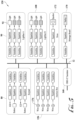
- FIG. 5 shows another Matrix system 150 having CAN bus 12 for communication between keypad 80, a J-box (similar to SIB 68, FIG. 3 ) 156, an OBD-II translator 160 (mapping vehicle speed and other diagnostic messages to system outputs), a message board 170, a siren 172, and lightbar 90 and lightbar 108.
- a J-box similar to SIB 68, FIG. 3
- OBD-II translator 160 mapping vehicle speed and other diagnostic messages to system outputs
- message board 170 a message board 170
- siren 172 siren
- lightbar 90 and lightbar 108 the following green-wire example also demonstrates how behavioral equations configure the behavior of the system 150 by mapping inputs and outputs using a shared data structure, i.e., global variables.
- J-box 156 When a dedicated (e.g., green) wire 176 of J-box 156 carries a high voltage signal, then that voltage signal indicates that a light (e.g., alley left light 92, FIG. 3 ) should be illuminated.
- a behavioral equation shown in Table 1 allows J-box 156 (i.e., its processor) to copy a logic value of a local Boolean variable representing the voltage signal on green wire 176 to a global variable named Light_AlleyLeft (an equation's left-hand expression is evaluated to produce the right-hand result).
- incoming tokens are used to update left-hand variables in a set of equations on a device.
- Global input status tokens are used to update both left-hand and right-hand variables. This is done to keep all system inputs in synchronism.
- left-hand expression public variables are synchronized to the same-named right-hand expression variables from other devices. Private variables are not synchronized.
- Right-hand expression public variables that are categorized as input status are synchronized to the same-named right-hand expression variables from other devices. This facilitates the synchronization of user controls. Additional discussion of Matrix message types that facilitate synchronism (e.g., event broadcasts, periodic status broadcasts, and device commands) are described in later passages.
- Equations on a device are typically evaluated sequentially on a round-robin basis, distributing processing across multiple library clocks. Evaluation occurs regardless of whether new tokens arrive, to support some the time-logic functions discussed below.
- an equation processor of J-box 156 processes an internal green-wire token provided by an internal software application that monitors the status of wire 176; updates the value of local_var_green_wire; reevaluates the equation of Table 1; and, since the value of Light_AlleyLeft has changed, generates an event token to be broadcast on CAN bus 12.
- Lightbar 90 or 108 has an equation processor that evaluates the equation of Table 2 as follows: process the event token from CAN bus 12 and updated the Light_AlleyLeft variable; reevaluate the equation; and since the value of local_var_LED1 changed, generate a local token for a lightbar software application controlling the alley left light.
- green-wire logic may be implemented in many different ways that do not include behavioral equations. For example, some updatable C source code could achieve a similar outcome in terms of controlling behavior. But, as the green-wire example suggests, defining global variables in behavioral equations allows Matrix to automatically keep such variables in synchronism across all devices on a bus. Behavioral equations can also be automatically generated based on a GUI for custom configurations, which would be burdensome if not for the behavioral equations defining device behavior. Moreover, behavioral equations may be used to logically combine several inputs into a single pattern trigger output, to scale output intensity based on a system state, and perform other functions.
- behavioral equations provide for sophisticated functionality, such as establishing priorities in connection with use of a particular input or output resource, allowing combinations of inputs to turn on a common output, or setting an output intensity based on a secondary input, such as a light sensor scalar value (e.g., local_var_DIM in a range from 0-100), as shown in Table 3.
- a light sensor scalar value e.g., local_var_DIM in a range from 0-100
- a variable is fully enumerated by a fixed 13-bit base enumeration and a 3-bit prefix of the variable type: command as 0b000, output status as 0b001, and input status as 0b010, for example.
- the prefix allows one "base" variable name to be used for input, output, or command.
- the base and prefix form a 16-bit unsigned enumeration conveyed in lieu of strings so as to improve network efficiency.
- SIB equations of Table 4 show that "IS" is a mask providing the aforementioned most-significant 3-bit prefix to resolve complete enumerations of global variables.
- the fifth SIB input (pKeyPinlnput5) maps to an alley left input status, e.g. 0x4000
- equations have the name KeyLight_AlleyLeft instead of just Light_AlleyLeft. That is because those are enumerations from a file named "tokens.h,” which uses the "Key” prefix to distinguish enumerated token keys from other general labels in the C language program.
- a designer may also include a separate file for local variables, with a name such as "private_keys.h.”
- local app variables which can be freely assigned in a region 1-199 of Table 6, are prefixed with a 'p,' as shown in Table 4 and FIG. 6 .
- Table 6 shows how base enumerations are organized into regions. Each region is associated with a set of either named or indexed variables, and value size of 0-4 bytes. The regions starting at 1,000 (i.e., the start of the Lights region) and ending at 8,159 (i.e., the end of the Misc. Zero-Byte region) are named variables, according to some embodiments.
- a file named "token_regions.h” describes the detailed working regions and sub-regions. The aforementioned file named “tokens.h” specifies variable value size, range, and structure.
- a penultimate column of Table 6 shows example value sizes for one byte Boolean information, 8- and 16-bit analog values (e.g., for an analog value range of light or acoustic normalized intensity percentages between 0 and 100), and other sizes up to four bytes.
- Table 6 Base Enumeration Regions Region Start Region Size Value Size Note Local Variables 1 199 Varies for private local variables, may be used for any purpose Indexed Inputs 200 300 unsigned 8 bits (u8) often a Boolean value for public indexed arrays of non-descript 8-bit inputs, e.g., graphics-based input device having arrays of user controls Indexed Outputs 500 500 u8 for public indexed arrays of non-descript 8-bit outputs, e.g., an array of light heads, responsive to commands tokens Lights 1,000 400 u8 named variables Sounds 1,400 400 u8 named variables Messages 1,800 200 u8 named variables OBD-II 2,000 1,000 u8 named variables Misc.
- Indexed Inputs 200 300 unsigned 8 bits (u8) often a Boolean value for public indexed arrays of non-descript 8-bit inputs, e.g., graphics-based input device having arrays of user controls Indexed Outputs 500 500 u8 for
- FIG. 6 Additional syntax that is shown in FIG. 6 is also available for behavioral equations.
- behavioral equations are written in a syntax that is similar to that of standard C computer programming language but with some other features.
- a first feature mentioned above, is that the left-hand expression with one or more variables is evaluated and the result is stored in a single variable in the right-hand expression.
- a second feature is that variables are expressed as "[nnn]” where nnn is the variable enumeration.
- the "100” is a constant (since it is not enclosed by square brackets) but "499” is a variable enumeration bitwise-OR'ed with the input status prefix defined in Table 5.
- Equations begin with one or more of the following evaluation control characters: "$$" means evaluate an equation that follows once per library clock cycle. '$' means evaluate sequentially with other '$' equations, one per library clock cycle. "+$" means evaluate when the preceding equation is evaluated.
- the logic operations of the equations end with the ';' character, and may be followed with post-processing options prefixed with the '-' character.
- the variables of an equation may be addressed to a device's network address by using the -a option.
- specifying a network address in an equation is useful if static addresses have been programmed for certain devices. If the address is specified, then the variable is bound to a corresponding variable of the device having the specified address.
- a CAN message includes the node source and destination addresses in the CAN ID field (see e.g., FIG. 12 , described later).
- the token(s) within the message need not include an address field, which saves bandwidth.
- All devices self-assign a virtual bus address in the range of 1-120. Default and alternate addresses are derived from the device's GUID. The address algorithm is defined in file "can_address.c.”
- a device Upon power-up or reset, a device broadcasts an address reservation message to reserve its default address. If a second device has already claimed the address, it responds immediately with an address in use broadcast (AIU). If the first device receives a corresponding AIU within 100 ms of address reservation, it picks the next alternate address and restarts its address assignment. If the first device does not receive the AIU, then it claims the address and broadcasts its own AIU. As a failsafe, a device will restart its address assignment if it ever receives a message from its own address.
- Matrix need not employ a special method for device discovery. For example, all online devices transmit their status every 1120 ms maximum. Any device may query another discovered device for specific device information.
- tokens sent from the library to the app layer include the source address of the resource that generated the token, such as the equation processor or token sequencer.
- tokens received by the library from the app layer contain the destination address, which routes the token to a library resource or the CAN bus.
- Table 11 Device Internal Address 128-255 #define EQUATION_PROCESSOR_NETWORK_ADDRESS 132 #define TOKEN_SEQUENCER_0_NETWORK_ADDRESS 133 #define TOKEN_SEQUENCER_1_NETWORK_ADDRESS 134 #define TOKEN_SEQUENCER_2_NETWORK_ADDRESS 135 #define TOKEN_SEQUENCER_3_NETWORK_ADDRESS 136 #define TOKEN_SEQUENCER_4_NETWORK_ADDRESS 137 #define TOKEN_SEQUENCER_5_NETWORK_ADDRESS 138
- the token address is copied to the ID field destination address.
- the sending node's address is copied to the ID field source address.
- Multi-token CAN message are sent for the periodic (i.e., about one-second) status updates (i.e., synchronization), in which case the ID field destination address is always 0 (broadcast).
- Received CAN messages are first filtered to accept either broadcast messages or those whose destination address match the receiver node address. Messages that pass that filter copy the CAN ID field source address back to the token(s) for internal consumption.
- Tables 12-14 show logic operators, delineations, and math operators.
- FIG. 6 builds on the previous green-wire example by providing a dimming example 178 employing additional syntax.
- a SIB microcontroller 180 has an equation processor that evaluates SIB equations that include as operands local "wire" variables called pAlleyLeftlnput and pNightDimInput. These operands are used to establish values for global input status variables called KeyLight_AlleyLeft and KeyModeNight, which are communicated over CAN bus 12.
- a lightbar microcontroller 184 has an equation processor that evaluates BAR equations.
- the BAR equations include a ternary operator (shown in Table 12 as "Conditional” question and separator) that is evaluated to set intensity of a local "light” variable called pAlleyLeftOutput, which ultimately controls alley left light 92.
- pAlleyLeftOutput is set to 30 (i.e., 30% of max light intensity) if KeyLight_AlleyLeft and KeyModeNight variables are "1"; 100% of max if the KeyLight_AlleyLeft variable is "1" and the KeyModeNight variable is "0"; or 0 (off) if the KeyLight_AlleyLeft variable is "0" (in which case it does not matter whether the KeyModeNight variable is "1" or "0").
- FIG. 7 shows an example block diagram representing how some embodiments of equations include a time-logic unit 190, which affords an ability to implement timing features, such as a "door ajar" timer. These features are implemented via output options.
- output options allow a designer to specify the time-logic unit configuration, and whether an equation result change will be shared with the local application and system network.
- the output option @ specifies that the local application and system network will be notified of an equation result change since global input or output variable changes are broadcast over the network.
- a designer may elect to not send a token, such as if the result changes by some value that is below a threshold. Accordingly, several output options are set forth in Table 15.
- Tables 16-26 show time and logic functions that can be specified in the output options. Please note that one time-logic option may be followed by one (optional) system event option per equation, with the exception that -rskt, -fskt, -rc and -fc may also be used as secondary time-logic options in the same equation.
- the first one, the activity monitor is unique because it tracks how often a token arrives. Since all devices output a status once per second, the activity monitor can be used to detect the presence of another device on the bus.
- the next set of special functions are the up-counters with rollover. They count when the left-hand expression is evaluated to change from zero to non-zero (rising edge), or vice versa (falling edge) depending on the type.
- the skip-increment functions work with the up-counters, forcing them to skip the next increment that would have occurred when their left-hand expression is evaluated to change from zero to non-zero (rising edge), or vice versa (falling edge) depending on the type.
- the skip-increment is activated when its own left-hand expression is evaluated to change from zero to non-zero (rising edge), or vice versa (falling edge) depending on the type.
- variable clear functions clear a variable when its left-hand expression is evaluated to change from zero to non-zero (rising edge), or vice versa (falling edge) depending on the type.
- Table 23: -rc[n] Rising-Edge Clear $[32] [7654];-rc[4567] //where [4567] is variable to clear
- Table 24: -fc[n] Falling-Edge Clear $[32] [7654];-fc[4567]
- the last two special functions are an equation input-to-output delay.
- the output variable of the delay is a Boolean value.
- Rising edge delay is a Boolean output that changes from 0 to 1 n milliseconds after the left-hand evaluation changes from zero to non-zero. When the left-hand evaluation changes from non-zero back to zero, the output changes from 1 to 0 immediately.
- falling edge delay is a Boolean output that changes from 1 to 0 n milliseconds after the left-hand evaluation changes from non-zero to zero. When the left-hand evaluation changes from zero back to non-zero, the output changes from 0 to 1 immediately.
- Output sequences are a set of flashing lights, warning sounds, or both, and include a steady pattern (a set of lights that remain illuminated) and cut pattern (a set of lights that remain unilluminated).
- a steady or a cut pattern might seem static (i.e., not a repeating flash or sound pattern)
- tokens are continuously generated in the actuation of lights and sirens used to produce these patterns, and these tokens are sent from an internal software function called a token sequencer (or simply, a sequencer). It is called a sequencer because the software function generates a predetermined sequence of tokens that establish the desired output sequence. Additional information on sequencers is provided after the data structures for output sequences are described.
- Table 27 shows how output sequences are identified by enumerations divided into regions for lightbars, Safety Director, and so on.
- Enumeration zero (0) is reserved to stop a token sequencer. The first 25% of each region is reserved for nondescript indexed patterns that are typically created by a GUI.
- a file e.g., "patterns.h,” describes the detailed working regions and sub-regions.
- Output sequence enumerations are conveyed in the value fields of certain global variables. Like the previously described global variables, some output sequences are named, whereas others are indexed. Those which have been named are typically industry-standard regulatory patterns or patterns common in ESG circles. Any non-named output sequences, including user-defined ones, use the indexed region.
- the output sequence enumerations are 13-bit, in the range 1 through 8191. Enumeration zero is pattern stop.
- Table 27 Pattern Regions Region Start Size Indexed Lightbar 1 1,023 Named Lightbar 1,024 3,072 Indexed Safety Dir. 4,096 128 Named Safety Dir. 4,224 384 Indexed Sound 4,608 128 Named Sound 4,736 384 Reserved 5,120 2,560 Misc. Indexed 7,680 128 Misc. Named 7,808 384
- FIGS. 8 and 9 show that patterns of an output sequence are defined by tables of numbers. In general, all pattern tables start with a 16-bit value (not shown) indicating the number of patterns in the table.
- FIG. 8 shows a standard pattern table format, which is read by a sequencer to generate a sequence of one or more variables to actuate lights and sounds.
- a pattern start field indicates the enumeration for an output sequence and the number of times the pattern repeats. If the value of "repeats" is zero, then steps and output sequence are repeated until otherwise stopped.
- the pattern start field is followed by an all-off, or a pattern step with the same function.
- Pattern step tokens may be variables of 0-4 bytes, and may be compressed using a token codec (shown in FIG. 10 ).
- a pattern is terminated asynchronously, at a time when outputs may be on.
- the "All-Off" table entry informs the sequencer which outputs participated in the pattern to turn them all off.
- the "All-Off” entry is not a pattern step. To save memory, the "All-Off" entry may be omitted, provided that the first pattern step turns off all the outputs which participate in the pattern.
- FIG. 9 shows the single-variable pattern table format, which efficiently sequences light engine dictionary keys and LED Matrix keys.
- the LED Matrix is an electronic billboard and each sequenced token is used to communicate things such as "scroll message 4 left" or the like.
- Dictionary keys are used for communications with individual light heads (engines) for a type of light bar having a secondary CAN bus, as described in International Patent Application No. PCT/US2017/037506, filed June 14, 2017 , and naming Code 3, Inc. as applicant.
- each light head is preprogrammed with its portion of the patterns for which it participates, using a dictionary of key-value pairs.
- the token sequencer therefore, outputs a dictionary key per pattern step, as opposed to a set of tokens to control individual outputs.
- the 0xx pattern enumeration prefix of FIG. 9 indicates the variable enumeration to sequence.
- Sequencers have two properties that are set: the intensity and the output sequencer enumeration.
- the intensity is in the range 0-100 and scales the illumination output for dimming in a night mode.
- the C library includes six sequencers that all share the same pattern table, according to one embodiment. This allows a user to run six separate output sequences at the same time, each with its own output priority.
- Table 28 is an example of a lightbar using the SIB input 24 to control a sequencer.
- Pattern_Lightbar_Double_75_FPM Pattern_Stop
- KeyModeNight] ? 30 : 100) ⁇ 16 // intensity [OS
- the first line of the equation of Table 28 essentially means that if the SIB input 24 is set, then the Double 75 FPM pattern is run, or else the sequencer is stopped. Note that when the Pattern_Stop (zero) enumeration is sent to a sequencer, it sets all the lights to their default pattern value (normally zero), and then stops.
- the second line means that if dimming is enabled, the sequencer is set to 30% brightness, or else it is set to 100% brightness.
- the KeyModeNight is the dim input status from pin 12 on the SIB. Note that the ternary result is shifted to the third most significant byte. Equation values are treated as signed 32-bit.
- the third line is the result, with output status KeylndexedSequencer plus the sequencer index.
- the option -c@ causes the equation to send a token to the sequencer when the equation output changes. Since [OS
- Matrix supports both input and output priorities. To understand input priorities, an example is provided in Table 29, which assumes that green, brown, and red wires are each assigned to a different pattern. Accordingly, a lightbar equation in Table 29 provides the green wire the highest input priority for sequencer 2.
- Table 29 Resource Priority Examples // un-assigned indexed SIB inputs, their indices do not set priority #define GREEN_WIRE 493 #define RED_WIRE 494 #define BROWN_WIRE 495 #define BLUE_WIRE 496 #define ORANGE_WIRE 497 #define YELLOW_WIRE 498 // sequencer indices are zero-based #define SEQUENCER_1_INDEX 0 #define SEQUENCER_2_INDEX 1 // etc. for more sequencers // run sequencer 2 $([IS
- KeyModeNight] ? 30 : 100) ⁇ 16 // intensity [OS
- Pattern_Lightbar_Reg_65_Single_150_FPM //2nd highest : [IS
- KeyModeNight] ? 30 : 100) ⁇ 16 // intensity [OS
- the first ternary has the highest input priority, and therefore the green wire wins. Skilled persons will appreciate that there may be other approaches to setting input priorities.
- the priority equations in Table 29 used seven operands and seven operators.
- the equation processor runs, it uses a calculator stack of opcodes and operands for each equation. Each time an equation is evaluated, the stacks are reset. Since the devices are typically small microcontrollers, their memory is constrained, and their default stack depth is limited to 20 operands and 20 operators.
- the DevTool bytecode compiler reports the maximum calculator stack depth used for any one equation. When the stack depth for an equation exceeds the available stack, a developer may instead use intermediate local variables to break up the equation into several sub-equations.
- Output priorities have a range of 1-6, with six being the highest.
- Outputs are prioritized with one of two methods, depending on the device.
- Devices using the standard pattern tables FIG. 8
- use the sequencer index to know the priority (e.g., the local sequencer address).
- sequencer 3 has output priority over sequencer 2.
- devices using the single-token pattern tables with output dictionaries FIG. 9
- embed the output priority in the dictionaries So, in Table 29 above, sequencer 3 does not have output priority over sequencer 2. The output priority just depends on the pattern being sequenced. Thus, for either method there is no priority embedded in the pattern table. All sequencers share the same pattern table.
- FIG. 10 shows an example of modules of a C99 library 220 provided for Matrix implementation.
- Library 220 includes the following modules: a protocol message composer with CAN frame output buffer 222; a protocol message decomposer with CAN frame input buffer 224; a token compressor/decompressor (codec) 230 for messages and light patterns; an FTP server and client 232; a flash drive file system 234; an equation processor 236; and six token pattern sequencers 240 with the ability to sequence any kind of token, including nested patterns.
- codec token compressor/decompressor
- Library 220 is loosely coupled to a device's application 244 via a constant table of method callbacks for, e.g., software access of a CAN port 246, and it need not have direct interface to device hardware.
- Application 244 first resets library 220, and then clocks library 220 with the current system time in milliseconds.
- Library 220 is compatible with cooperative multitasking. It is also compatible with preemptive multitasking if each clock call runs to completion. It should be clocked as often as possible to ensure smooth pattern sequencing, and as often as necessary to ensure that received CAN frames are processed before filling the receiver's asynchronous buffer.
- Library 220 uses a stack that is at least 512 bytes deep, according to one embodiment.
- Equation processor 236 complies with the equation specifications described previously, and it continuously updates all equation outputs. In addition to the equation-specified token output options, equation processor 236 synchronizes public variables, as described previously, approximately once per second. Equation processor 236 processes behavioral equations obtained from a file named "equation.btc" stored in flash drive volume zero 248.
- Codec 230 compresses and decompresses message tokens. Token compression is desirable for the network traffic, and is desirable for minimizing token pattern code space. Codec 230 is used by token sequencers 240 in case the token pattern tables were compressed at compile time.
- Each sequencer of token sequencers 240 runs independently, and all share a common pattern file named "patterns.tbl" located on flash drive volume zero 248.
- Designers have two methods to control output priorities, such that one running pattern may have priority over the same outputs used by another running pattern.
- the application is responsible for tracking the priorities and implementing a failsafe timer should an error occur when a priority did not get reset (however unlikely).
- Second, for single-variable pattern tables the priorities are embedded in the dictionary(ies). Thus the sequencer address is not associated with the priority, and any sequencer can run any priority of pattern.
- FTP server and client 232 facilitates a file transfer protocol optimized for CAN bus 12 using RPC protocols.
- FTP server and client 232 are both capable of getting file info, reading, and writing named files in device flash memory.
- the client portion allows a smart controller to read the files of a lightbar, providing the capability for an adaptable field control GUI.
- the CAN receiver of message decomposer 224 filters only those messages related to the file transfer, plus events.
- Both the client and server 232 have a no-response timeout, and the decomposer filter has a timeout as well.
- the FTP server optionally routes file read requests through the application, thus providing a means to make a remote procedure call.
- Application 244 may handle the call by examining the file name and providing the requested data, or return null and let the FTP server look for the data in the file system.
- Flash drive file system 234 includes up to three separate drive volumes including volume zero 248 and volume one 250.
- System files such as behavioral equation files and pattern files are stored in application execution memory region volume zero 248.
- Flash drive file system 234 makes API calls back into application 244 for 234 reads and writes, and to get the volume for a given file name.
- File system 234 attempts to level-wear the flash memory. Files that are rewritten are marked as erased, and the flash continues to fill top-down and bottom-up. When the flash is full, the file system defragments the volume and erases unused space. An application designer may wish to automatically cache flash writes for a few hundred milliseconds, or until a sector boundary is crossed. This caching would prevent unneeded flash wear during defragmentation.
- Matrix uses a cryptographic server access code for FTP and RPC transactions.
- a confidential algorithm is used to create the access code that is based on each device's GUID; thus no two device access keys are the same.
- the client may read the device file's information (as opposed to the full file) to acquire the device's GUID without first needing the access code.
- the access code is hashed with additional fixed keys for critical system commands such as KeyRequestSystemReboot, as defined in "tokens.h.”
- the server access code is unique to every device with a unique GUID, thus making an attack on a group of devices more difficult.
- Protocol message composer 222 and decomposer 224 each have separate buffers.
- Message composer 222 has a 40-frame buffer
- decomposer 224 has a 20-frame asynchronous buffer and 72-frame synchronous buffer. These buffers may be increased as needed.
- Decomposer 224 sorts out-of-order packets and interleaved packet streams from multiple sources, and reproduces coherent messages. Decomposer 224 then routes the messages to FTP server or client 232 or codec 230.
- Composer 222 and decomposer 224 cooperate to manage the system event index that is used (e.g., incremented) to ensure that the most recent input event prevails when there are conflicting messages.
- the first data byte off all Matrix messages is an 8-bit event order variable. All devices keep a local copy of this variable. The event order is incremented prior to the broadcast of a global input status change event. Upon receiving a Matrix message, all devices update their local copy when the incoming event order is newer and non-zero. The event order is used to filter certain messages. Input or output status events, pattern sync, FTP requests and responses, and messages with event order zero are always accepted. All other message types must have the same or newer event order as the local copy to be accepted.
- the Matrix C99 library manages the event order variable and related filtering of messages.
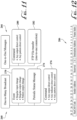
- FIG. 11 shows different types of messages available in Matrix.
- Matrix nodes most frequently use one-to-many broadcasts 260 and sometimes use one-to-one messages 266.
- Matrix one-to-many and one-to-one protocols use UDP and TCP, respectively.
- One-to-many messages 260 include event broadcasts 270, periodic status broadcasts 274, and device commands 276.
- the broadcast rate formula for a device is as follows: 1/ 1 s + bus address ⁇ 60 * 1 ms
- Device commands 276 provide direct unconditional control of a device's components, such as message signs, sirens, individual lights, token pattern sequencers and indicators. Device commands are useful for production and test, and for third party OEMs.
- One-to-one messages 266 are used to send a command 280 to a single device and to respond to a query for specific device information.
- One-to-one connections 282 are also used to transfer files to and from the system devices.
- FIG. 12 shows a CAN ID field 286.
- a data field (not shown) includes the previously described event index and key-value (token) information.
- HazCAN Code 0x0C is used for single-frame messages.
- Code 0x0D is used for the frames of multi-frame messages, except for the last such frame, which uses 0x0E.
- the sender and destination address are seven bits to encompass addresses 0-127. Normal self-assigned addresses are 1-120. Broadcast destination address is zero. Sender address zero is used during address negotiation. Fixed dedicated addresses 121-127 are defined in the file "lib interface. h.”
- the E Flag bit 12 is set to indicate a global input or output status event frame. Such events are single-frame messages with HazCAN code 0x0C, and thus have priority over other Matrix messages during CAN frame arbitration. The E flag informs the software receiver message re-constructor that the message has priority.
- the frame index includes a five-bit rollover up-counter that informs the software receiver message re-constructor of the packet sequence.
- all ESG devices on a CAN bus transmit compressed token messages, and are capable of receiving both compressed and uncompressed messages. Compression helps address bus traffic congestion arising from the relatively low bitrates and small payload sizes of the CAN transport.
- the ESG key database is preloaded with common sequential assignments.
- a binary repeat and an analog repeat token both work by specifying a base key and a number of repeats, and then incrementing the key for each subsequent value symbol.
- sequential keys are to be used whenever possible.
- the compression algorithm presorts the keys if necessary.
- a binary repeat uses binary flags to confer either a zero or a common value to the resulting uncompressed token.
- the common value may be any type of value; a binary value or 1-4 byte value based on the token key.
- An analog repeat applies individual scaler values to a series of sequential keys. This is useful for certain lighting pattern sequences and still provides good key compression. System designers are strongly encouraged to keep compression in mind when adding new key ranges to the database.
- Matrix provides values of 0-4 bytes. During normal operation, assuming a data rate of 125 kbps with extended frame format, and 14 live nodes each sending 4-packet status messages once per second, basic bus utilization is 5.7%. The standard API for Matrix performs the compression and decompression, alleviating designers from implementation details.
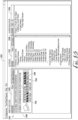
- FIG. 13 shows a computer device (e.g., a configuration workstation) 288 in communication with lightbar 90.
- Computer device 288- which may be a laptop, portable smart device (e.g., tablet), or any other programmable electronic user equipment device-includes a display panel 290 that presents to a user a GUI 292 shown in FIGS. 14-19 , which provides configuration menus for different inputs and outputs of devices communicatively coupled to CAN bus 12.
- GUI is also used as a shorthand for referring to underlying software algorithms that, e.g., automatically generate behavioral equations based on a desired configuration established with, and presented by, GUI 292.
- FIG. 13 also shows two arrangements for connecting computer device 288 to CAN bus 12.
- computer device 288 connects to SIB 68 (or other Matrix node) through a USB-to-CAN interface 296.
- computer device 288 connects directly to array controller 74 through a serial connection 298.
- wireless connectivity e.g., Bluetooth ® personal area networking
- GUI 292 which is referred to as the Matrix Configurator
- computer device 288 facilitates user-initiated (i.e., dragging and dropping) configuration of system behaviors established by mapping desired actions (i.e., outputs) onto one or more selected inputs (or vice versa, in other embodiments), automatically generating corresponding behavioral equations, optionally compiling them to bytecode, and updating the appropriate configuration files (e.g., bytecode files) to the network devices.
- FIG. 14 shows a device selection menu 306.
- a list 310 of devices available for a user to add to an overall system configuration On a right side of device selection menu 306 is a list 312 of devices that the user has added or established a communication connection to (devices detected by) computer device 288.
- GUI 292 offers an option to configure any device irrespective of whether it is detected by computer device 288.
- a user may select "add device” 314 to add a virtual device of his/her choice to list 312. The user can then manage such virtual devices in the same way as those that are physically connected to computer device 288.
- an emulation mode allows a customer to view how selected devices act without the device being present.
- users click on an input e.g., any set of buttons 320 ( FIGS. 15-18 ) representing wired inputs of SIB 68, to observe a virtual presentation showing the behavior of configured output devices (i.e., lightbars and sirens).
- Configuration menu 326 includes three main sections for facilitating the process of configuring a device: selecting available device input(s), selecting device action(s), and reviewing and propagating the results.
- An Input Devices column 328 presents input devices previously included in list 312 ( FIG. 14 ) that a user seeks to configure. Accordingly, Input Devices column 328 allows users to select certain inputs, i.e., Z3 siren pushbutton controller buttons, sliders, and input wires that will have associated actions.
- An Actions column 332 lists the available actions to be performed in response to selected inputs.
- a Configuration column 336 shows the selected inputs and allows a user to drag actions from Actions column 332 to establish the desired behaviors.
- Input Devices column 328 is a collapsed menu that may be optionally expanded for configuring certain system-wide states and conditions.
- these so-called global input states and conditions include vehicle alert levels, which may be separately configured with actions (just like any other selected inputs), but then act as scripts of one or more actions assignable to selected inputs, e.g., a wire input.
- a so-called Alert Level 3 is configured with multiple discrete actions, such as a siren and a flash pattern, and then Alert Level 3 is available in Actions column 332 for a user to drag and drop in Configuration column 336 (see, e.g., FIG. 19 ) for configuring a selected input with the group of actions previously associated with this Alert Level 3.
- Configuration column 336 of FIG. 15 shows examples of both single (“Input 9 !) and multiple input (“Input 9 ... Input 10") configuration.
- FIGS. 16-18 show a slightly simpler example of how a user configures a single input (“Input 2 !) by clicking on its visual representation.
- a hierarchical tree menu 338 describes that a "High" voltage level of a purple wire of SIB 68 is the selected input to be configured because a user previously selected a purple box 340 and "Wire High” radio button 346 from a SIB input selection menu 348 presented in Input Devices column 328.
- Hierarchical tree menu 338 shows that the currently configured action for the selected input is that, when a purple wire has a high voltage, lightbar 90 actuates its alley left light 92.
- SIB 68 does not have its equation file updated because it is not an output devices have equation changes.
- FIG. 17 shows that a user drags a different action (“Takedowns Steady") 350 from Actions column 332 and drops it anywhere in hierarchical tree menu 338.
- GUI 292 is intelligent such that the user is not required to drop the input/action combination at a specific place in Configuration column 336. The user simply drops the desired action anywhere and the underlying software locates and places the action under a correct branch of hierarchical tree menu 338. In other words, GUI 292 automatically adds or replaces the newly dropped action for the user, which alleviates the user from having to know where the action should reside within hierarchical tree menu 338.
- Hierarchical tree menu 338 is updated, as shown in FIG. 18 , to indicate that the new configuration will now actuate a takedown light (i.e., a forward-facing spotlight in a center of a lightbar).
- the user may now initiate an export of the new configuration.
- GUI 292 Preparatory to export, GUI 292 generates behavioral equation files mapping selected inputs and outputs to global variables, as described previously. The files are optionally compiled for target devices' flash memory. Logic used to generate behavioral equations and configure each device using GUI 292 is located within a software plugin for each particular device. This separates a device's configuration logic from its main software application. As new devices are launched, a device plugin is downloaded to a customer's configuration software.
- a standard .Net C# communications stack is provided for communications between GUI 292 and Matrix C99 library 220 ( FIG. 10 ).
- the communications stack implements the aforementioned FTP client protocol and USB-to-CAN interface.
- the communications stack also provides an API for reading and writing files to devices at known addresses.
- the stack also provides a list of online devices and their CAN addresses.
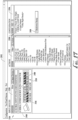
- FIG. 19 is final example showing two input device menus including a Z3 Siren Pushbutton Controller menu 360 (functionally akin to keypad 80, FIG. 3 ) and a z3 Siren menu 366 (functionally akin to SIB/Siren 68, FIG. 3 ).
- a Z3 Siren Pushbutton Controller menu 360 functionally akin to keypad 80, FIG. 3
- a z3 Siren menu 366 functionally akin to SIB/Siren 68, FIG. 3
- Prior attempts to configure different devices relied on separate applications. For example, to configure a siren, the user downloaded and installed Z3 Siren configuration software. And to configure a keypad, the user downloaded and installed a separate program. Learning and maintaining multiple applications for each device was inefficient since each piece of software was completely unique. With the Matrix Configurator software, the user is presented with one central application that uses the drag-and-drop method to configure any current and future Matrix-compatible device, concurrently and in an intuitive manner.
Landscapes
- Engineering & Computer Science (AREA)
- Signal Processing (AREA)
- Automation & Control Theory (AREA)
- Computer Networks & Wireless Communication (AREA)
- Mechanical Engineering (AREA)
- Transportation (AREA)
- Human Computer Interaction (AREA)
- Physics & Mathematics (AREA)
- Mathematical Physics (AREA)
- Computer Vision & Pattern Recognition (AREA)
- Environmental & Geological Engineering (AREA)
- Small-Scale Networks (AREA)
- Alarm Systems (AREA)
- Circuit Arrangement For Electric Light Sources In General (AREA)
Claims (15)
- Ein Controller-Area-Network-Knoten, CAN-Knoten (14), zum Kommunizieren über einen CAN-Bus (12) als ein Element einer Menge von kommunikativ gekoppelten CAN-Knoten (14), die in einem Kraftfahrzeug mit einem fahrzeuggetragenen Warnsystem (86) eingesetzt werden, wobei das fahrzeuggetragene Warnsystem eine Ausgabevorrichtung (90, 108, 126, 128) und eine Eingabevorrichtung (80, 122) umfasst, wobei die Ausgabevorrichtung konfiguriert ist, um einen Ausgabestatus, der einen Zustand einer Leuchte oder einer Sirene für das fahrzeuggetragene Warnsystem darstellt, zu ändern, wobei die Eingabevorrichtung konfiguriert ist, um einen Eingabestatus als Reaktion auf einen Zustand eines Benutzers oder einer Kraftfahrzeugeingabe zu ändern, wobei jedes Element der Menge Eingabe- und/oder Ausgabevorrichtungen zum Herstellen des fahrzeuggetragenen Warnsystems aufweist und konfiguriert ist, um den Status der Eingabe- und/oder Ausgabevorrichtungen zu überwachen, wobei der CAN-Knoten Folgendes beinhaltet:eine nichtflüchtige maschinenlesbare Speichervorrichtung, die konfiguriert ist, um maschinenlesbare Anweisungen (54) zu speichern, die eine Verhaltensgleichung, die eine konfigurierbare Beziehung zwischen einer globalen Variable und einem Vorrichtungsstatus des CAN-Knotens definiert, darstellen, wobei die globale Variable als eine gemeinsam genutzte Datenstruktur dient, die von der Menge von kommunikativ gekoppelten CAN-Knoten zum Darstellen von einem von dem Eingabestatus oder dem Ausgabestatus aufrechterhalten wird; undeine Prozessorschaltung (30, 34, 26, 28), die als Reaktion auf die Ausführung der maschinenlesbaren Anweisungen die Verhaltensgleichung auswertet und als Reaktion auf ein Ereignis, das den mit der Eingabevorrichtung assoziierten Eingabestatus ändert, eine CAN-Nachricht generiert, wobei die CAN-Nachricht konfiguriert ist, um über den CAN-Bus ausgesendet zu werden, um den mit der Ausgabevorrichtung assoziierten Ausgabestatus zu aktualisieren, wobei die CAN-Nachricht einen aus der Auswertung der Verhaltensgleichung erhaltenen Wert und einen Schlüssel umfasst, der die von anderen Elementen der Menge von kommunikativ gekoppelten CAN-Knoten zu aktualisierende globale Variable identifiziert.
- CAN-Knoten gemäß Anspruch 1, wobei die Prozessorschaltung konfiguriert ist, um eine aktualisierte Version der Verhaltensgleichung zu verarbeiten und dadurch die konfigurierbare Beziehung zwischen der globalen Variable und dem Vorrichtungsstatus zu modifizieren.
- CAN-Knoten gemäß Anspruch 1, wobei die CAN-Nachricht Ereignisreihenfolgeinformationen zum Identifizieren von nicht mehr gültigen Versuchen einer Aktualisierung der globalen Variable umfasst.
- CAN-Knoten gemäß Anspruch 1, der in einer Lichtleiste oder einer Sirene umfasst ist.
- CAN-Knoten gemäß Anspruch 1, wobei der Vorrichtungsstatus der Eingabestatus ist.
- CAN-Knoten gemäß Anspruch 5, wobei der Eingabestatus einem Spannungspegel in einer Drahteingabe des CAN-Knotens entspricht.
- CAN-Knoten gemäß Anspruch 1, wobei der Vorrichtungsstatus der Ausgabestatus ist.
- CAN-Knoten gemäß Anspruch 7, wobei der Ausgabestatus einem Beleuchtungszustand eines Lichtkopfes des CAN-Knotens entspricht.
- CAN-Knoten gemäß Anspruch 1, wobei die Prozessorschaltung konfiguriert ist, um Nachrichten zum Synchronisieren der globalen Variable unter den anderen Elementen der Menge von kommunikativ gekoppelten CAN-Knoten periodisch auszusenden.
- CAN-Knoten gemäß Anspruch 1, wobei die Verhaltensgleichung als einen Operanden eine lokale Variable, die den Vorrichtungsstatus steuert, umfasst.
- Ein Verfahren, das durch einen Konfigurationsarbeitsplatzrechner, der eine grafische Benutzerschnittstelle umfasst, zum Steuern des Verhaltens von Controller-Area-Network-Knoten (CAN-Knoten), die in einem Kraftfahrzeug mit einem fahrzeuggetragenen Warnsystem einzusetzen sind, durchgeführt wird, wobei das fahrzeuggetragene Warnsystem eine Ausgabevorrichtung und eine Eingabevorrichtung umfasst, wobei die Ausgabevorrichtung konfiguriert ist, um einen Ausgabestatus, der einen Zustand einer Leuchte oder einer Sirene für das fahrzeuggetragene Warnsystem darstellt, zu ändern, wobei die Eingabevorrichtung konfiguriert ist, um einen Eingabestatus als Reaktion auf einen Zustand eines Benutzers oder einer Kraftfahrzeugeingabe zu ändern, wobei das Verfahren Folgendes beinhaltet:Präsentieren, für einen Benutzer, eines Konfigurationsmenüs, das den Eingabestatus und eine Liste von Aktionen, zu deren Durchführung die CAN-Knoten fähig sind,darstellt; undals Reaktion darauf, dass der Benutzer eine der Aktionen aus der Liste auswählt und in das Konfigurationsmenü zieht, Generieren einer Verhaltensgleichungszuordnung, die eine mit dem Eingabestatus assoziierte globale Variable der mit dem Ausgabestatus assoziierten ausgewählten Aktion zuordnet, wobei die globale Variable als eine von den CAN-Knoten aufrechterhaltene gemeinsam genutzte Datenstruktur dient, in der die Menge globaler Variablen den Eingabestatus und den Ausgabestatus darstellt.
- Verfahren gemäß Anspruch 11, das ferner das Kompilieren eines Bytecodes, der die Verhaltensgleichungen darstellt, und das Bereitstellen des Bytecodes über eine CAN-Busverbindung beinhaltet.
- Verfahren gemäß Anspruch 11, wobei die Verhaltensgleichung Dimmoperationen für Beleuchtungsvorrichtungen definiert.
- Verfahren gemäß Anspruch 11, wobei die Verhaltensgleichung einen Zustand einer Sirene oder einer Lichtleiste als Reaktion auf den Eingabestatus definiert.
- Ein oder mehrere computerlesbare Speichermedien mit darin gespeicherten Anweisungen, die, wenn sie in einer Vorrichtung ausgeführt werden, die Vorrichtung zum Durchführen des Verfahrens gemäß einem der Ansprüche 11-14 konfigurieren.
Applications Claiming Priority (2)
| Application Number | Priority Date | Filing Date | Title |
|---|---|---|---|
| US201862700724P | 2018-07-19 | 2018-07-19 | |
| PCT/US2019/020132 WO2020018151A1 (en) | 2018-07-19 | 2019-02-28 | Control of vehicle-carried warning system through controller area network (can) communications of global variables processed as operands of behavioral equations |
Publications (3)
| Publication Number | Publication Date |
|---|---|
| EP3824601A1 EP3824601A1 (de) | 2021-05-26 |
| EP3824601A4 EP3824601A4 (de) | 2022-06-29 |
| EP3824601B1 true EP3824601B1 (de) | 2024-08-14 |
Family
ID=69164615
Family Applications (1)
| Application Number | Title | Priority Date | Filing Date |
|---|---|---|---|
| EP19837224.5A Active EP3824601B1 (de) | 2018-07-19 | 2019-02-28 | Steuerung eines fahrzeuggetragenen warnsystems über controller area network (can)-kommunikation von globalen variablen, die als operanden von verhaltensgleichungen verarbeitet werden |
Country Status (4)
| Country | Link |
|---|---|
| US (1) | US12143239B2 (de) |
| EP (1) | EP3824601B1 (de) |
| AU (2) | AU2019308467B2 (de) |
| WO (1) | WO2020018151A1 (de) |
Families Citing this family (6)
| Publication number | Priority date | Publication date | Assignee | Title |
|---|---|---|---|---|
| US11323548B2 (en) * | 2019-01-20 | 2022-05-03 | Arilou Information Security Technologies Ltd. | System and method for data compression based on data position in frames structure |
| KR20220001350A (ko) * | 2020-06-29 | 2022-01-05 | 주식회사 엘지에너지솔루션 | 네트워크 라우팅 장치 및 방법 |
| CN115442172B (zh) * | 2021-08-23 | 2024-04-12 | 北京车和家信息技术有限公司 | 测试报文发送方法、装置、介质、设备及测试系统 |
| JP2024538682A (ja) * | 2021-10-11 | 2024-10-23 | アティエヴァ、インコーポレイテッド | イーサネット(登録商標)リングトポロジを有する自動車用通信システム |
| CN114553911B (zh) * | 2022-01-24 | 2024-06-04 | 深圳市麦谷科技有限公司 | 一种车联网控制系统、方法、电子设备和可读存储介质 |
| FR3140690B1 (fr) * | 2022-10-07 | 2025-01-10 | F B I | boîtier CAN BUS pour véhicules professionnels |
Family Cites Families (28)
| Publication number | Priority date | Publication date | Assignee | Title |
|---|---|---|---|---|
| US6208955B1 (en) * | 1998-06-12 | 2001-03-27 | Rockwell Science Center, Llc | Distributed maintenance system based on causal networks |
| GB201008710D0 (en) * | 2010-05-25 | 2010-07-07 | Jaguar Cars | Vehicle communications |
| US10215146B2 (en) * | 2011-04-15 | 2019-02-26 | Deka Products Limited Partnership | Direct current power plant |
| US9602358B2 (en) * | 2011-08-25 | 2017-03-21 | Vmware, Inc. | Extensible infrastructure for representing networks including virtual machines |
| US20140143839A1 (en) * | 2011-11-16 | 2014-05-22 | Flextronics Ap, Llc. | On board vehicle remote control module |
| US9043073B2 (en) * | 2011-11-16 | 2015-05-26 | Flextronics Ap, Llc | On board vehicle diagnostic module |
| US20130282238A1 (en) * | 2011-11-16 | 2013-10-24 | Flextronics Ap, Llc | Monitoring state-of-health of processing modules in vehicles |
| US8949823B2 (en) * | 2011-11-16 | 2015-02-03 | Flextronics Ap, Llc | On board vehicle installation supervisor |
| US9116786B2 (en) * | 2011-11-16 | 2015-08-25 | Flextronics Ap, Llc | On board vehicle networking module |
| US20130200991A1 (en) * | 2011-11-16 | 2013-08-08 | Flextronics Ap, Llc | On board vehicle media controller |
| US20130203400A1 (en) * | 2011-11-16 | 2013-08-08 | Flextronics Ap, Llc | On board vehicle presence reporting module |
| US9088572B2 (en) * | 2011-11-16 | 2015-07-21 | Flextronics Ap, Llc | On board vehicle media controller |
| US9173100B2 (en) * | 2011-11-16 | 2015-10-27 | Autoconnect Holdings Llc | On board vehicle network security |
| US9081653B2 (en) * | 2011-11-16 | 2015-07-14 | Flextronics Ap, Llc | Duplicated processing in vehicles |
| US20130205026A1 (en) * | 2011-11-16 | 2013-08-08 | Flextronics Ap, Llc | Media filter in a vehicle infotainment system |
| US20130205412A1 (en) * | 2011-11-16 | 2013-08-08 | Flextronics Ap, Llc | On board vehicle media controller |
| US9055022B2 (en) * | 2011-11-16 | 2015-06-09 | Flextronics Ap, Llc | On board vehicle networking module |
| US9008906B2 (en) * | 2011-11-16 | 2015-04-14 | Flextronics Ap, Llc | Occupant sharing of displayed content in vehicles |
| US20130219039A1 (en) * | 2011-11-16 | 2013-08-22 | Flextronics Ap, Llc | Network selector in a vehicle infotainment system |
| US20150149912A1 (en) * | 2013-11-22 | 2015-05-28 | Raytheon Company | Interactive multimedia process flow chart analysis |
| WO2016046819A1 (en) * | 2014-09-25 | 2016-03-31 | Tower-Sec Ltd. | Vehicle correlation system for cyber attacks detection and method thereof |
| US9705597B2 (en) * | 2015-08-12 | 2017-07-11 | Electronic Controls Company | Modular light bar messaging system |
| US10650621B1 (en) * | 2016-09-13 | 2020-05-12 | Iocurrents, Inc. | Interfacing with a vehicular controller area network |
| US9875078B1 (en) * | 2016-12-07 | 2018-01-23 | Metra Electronics Corporation | External amplifier interface |
| EP3337119B1 (de) * | 2016-12-13 | 2019-09-11 | Nxp B.V. | Aktualisierung und verteilung geheimer schlüssel in einem verteilten netzwerk |
| EP3337120B1 (de) * | 2016-12-14 | 2021-04-21 | Nxp B.V. | Netzwerk-nachrichtenauthentifizierung und verifizierung |
| US10878103B2 (en) * | 2017-06-05 | 2020-12-29 | Karamba Security Ltd. | In-memory protection for controller security |
| EP3638540B1 (de) | 2017-06-14 | 2023-12-27 | Code 3, Inc. | Verschachtelte serielle netzwerkkonfiguration für eine anordnung aus seriell verbundenen scheinwerfern |
-
2019
- 2019-02-28 US US17/259,902 patent/US12143239B2/en active Active
- 2019-02-28 EP EP19837224.5A patent/EP3824601B1/de active Active
- 2019-02-28 WO PCT/US2019/020132 patent/WO2020018151A1/en not_active Ceased
- 2019-02-28 AU AU2019308467A patent/AU2019308467B2/en active Active
-
2023
- 2023-04-28 AU AU2023202626A patent/AU2023202626B2/en active Active
Also Published As
| Publication number | Publication date |
|---|---|
| AU2019308467A1 (en) | 2021-01-21 |
| US12143239B2 (en) | 2024-11-12 |
| EP3824601A4 (de) | 2022-06-29 |
| AU2019308467B2 (en) | 2023-05-11 |
| EP3824601A1 (de) | 2021-05-26 |
| WO2020018151A1 (en) | 2020-01-23 |
| AU2023202626B2 (en) | 2024-07-18 |
| AU2023202626A1 (en) | 2023-05-18 |
| US20210203526A1 (en) | 2021-07-01 |
Similar Documents
| Publication | Publication Date | Title |
|---|---|---|
| AU2023202626B2 (en) | Control of vehicle-carried warning system through controller area network (CAN) communications of global variables processed as operands of behavioral equations | |
| EP2087697B1 (de) | Kontroller mit dynamischer wechselbarer schnittstelle | |
| US7870232B2 (en) | Messaging in a home automation data transfer system | |
| US7640351B2 (en) | Application updating in a home automation data transfer system | |
| CN111786862B (zh) | 控制系统及其控制方法、全地形车 | |
| US7914172B2 (en) | Light control system | |
| CN110995578B (zh) | 一种汽车网关的设计方法、装置、设备和存储介质 | |
| US20070255856A1 (en) | Proxy commands and devices for a home automation data transfer system | |
| US20070109975A1 (en) | Remote device management in a home automation data transfer system | |
| US20070256085A1 (en) | Device types and units for a home automation data transfer system | |
| CN113347273B (zh) | 一种车载以太网数据转换方法、装置、设备及介质 | |
| CN110225026A (zh) | 协议转换器仪表远程配置方法 | |
| CN108347807A (zh) | 照明控制方法及灯具 | |
| WO2024234720A1 (zh) | 资源分配方法、装置、系统及运载工具 | |
| CN102693641A (zh) | 交通信号加载平台 | |
| EP4092971B1 (de) | Busgesteuertes beleuchtungssystem | |
| CN104052528B (zh) | 在智能穿戴设备中与多个终端进行通信的装置和方法 | |
| US20070121653A1 (en) | Protocol independent application layer for an automation network | |
| KR101361502B1 (ko) | 이더넷 스위치 | |
| CN111752575A (zh) | 一种车载应用更新方法、装置、设备及存储介质 | |
| US20210294663A1 (en) | Information processing apparatus | |
| CN119336726B (zh) | 一种控制器免升级的灯具芯片设置方法及装置 | |
| CN210860847U (zh) | 一种灯具 | |
| CN121879237A (zh) | 控制开关的控制方法、控制开关、系统、设备和介质 | |
| US7103891B1 (en) | Method and apparatus for establishing a profile table for host bus adapters |
Legal Events
| Date | Code | Title | Description |
|---|---|---|---|
| STAA | Information on the status of an ep patent application or granted ep patent |
Free format text: STATUS: THE INTERNATIONAL PUBLICATION HAS BEEN MADE |
|
| PUAI | Public reference made under article 153(3) epc to a published international application that has entered the european phase |
Free format text: ORIGINAL CODE: 0009012 |
|
| STAA | Information on the status of an ep patent application or granted ep patent |
Free format text: STATUS: REQUEST FOR EXAMINATION WAS MADE |
|
| 17P | Request for examination filed |
Effective date: 20210105 |
|
| AK | Designated contracting states |
Kind code of ref document: A1 Designated state(s): AL AT BE BG CH CY CZ DE DK EE ES FI FR GB GR HR HU IE IS IT LI LT LU LV MC MK MT NL NO PL PT RO RS SE SI SK SM TR |
|
| DAV | Request for validation of the european patent (deleted) | ||
| DAX | Request for extension of the european patent (deleted) | ||
| RIC1 | Information provided on ipc code assigned before grant |
Ipc: H04L 41/22 20220101ALN20220220BHEP Ipc: H04L 43/0817 20220101ALN20220220BHEP Ipc: H04L 41/0681 20220101ALN20220220BHEP Ipc: H04L 41/0631 20220101ALN20220220BHEP Ipc: H04L 12/40 20060101AFI20220220BHEP |
|
| A4 | Supplementary search report drawn up and despatched |
Effective date: 20220527 |
|
| RIC1 | Information provided on ipc code assigned before grant |
Ipc: H04L 41/22 20220101ALN20220520BHEP Ipc: H04L 43/0817 20220101ALN20220520BHEP Ipc: H04L 41/0681 20220101ALN20220520BHEP Ipc: H04L 41/0631 20220101ALN20220520BHEP Ipc: H04L 12/40 20060101AFI20220520BHEP |
|
| GRAP | Despatch of communication of intention to grant a patent |
Free format text: ORIGINAL CODE: EPIDOSNIGR1 |
|
| STAA | Information on the status of an ep patent application or granted ep patent |
Free format text: STATUS: GRANT OF PATENT IS INTENDED |
|
| INTG | Intention to grant announced |
Effective date: 20240315 |
|
| RIC1 | Information provided on ipc code assigned before grant |
Ipc: H04L 41/22 20220101ALN20240305BHEP Ipc: H04L 43/0817 20220101ALN20240305BHEP Ipc: H04L 41/0681 20220101ALN20240305BHEP Ipc: H04L 41/0631 20220101ALN20240305BHEP Ipc: H04L 12/40 20060101AFI20240305BHEP |
|
| GRAS | Grant fee paid |
Free format text: ORIGINAL CODE: EPIDOSNIGR3 |
|
| GRAA | (expected) grant |
Free format text: ORIGINAL CODE: 0009210 |
|
| STAA | Information on the status of an ep patent application or granted ep patent |
Free format text: STATUS: THE PATENT HAS BEEN GRANTED |
|
| AK | Designated contracting states |
Kind code of ref document: B1 Designated state(s): AL AT BE BG CH CY CZ DE DK EE ES FI FR GB GR HR HU IE IS IT LI LT LU LV MC MK MT NL NO PL PT RO RS SE SI SK SM TR |
|
| REG | Reference to a national code |
Ref country code: GB Ref legal event code: FG4D |
|
| REG | Reference to a national code |
Ref country code: CH Ref legal event code: EP |
|
| REG | Reference to a national code |
Ref country code: DE Ref legal event code: R096 Ref document number: 602019057122 Country of ref document: DE |
|
| REG | Reference to a national code |
Ref country code: IE Ref legal event code: FG4D |
|
| REG | Reference to a national code |
Ref country code: LT Ref legal event code: MG9D |
|
| REG | Reference to a national code |
Ref country code: NL Ref legal event code: MP Effective date: 20240814 |
|
| PG25 | Lapsed in a contracting state [announced via postgrant information from national office to epo] |
Ref country code: NO Free format text: LAPSE BECAUSE OF FAILURE TO SUBMIT A TRANSLATION OF THE DESCRIPTION OR TO PAY THE FEE WITHIN THE PRESCRIBED TIME-LIMIT Effective date: 20241114 |
|
| REG | Reference to a national code |
Ref country code: AT Ref legal event code: MK05 Ref document number: 1714286 Country of ref document: AT Kind code of ref document: T Effective date: 20240814 |
|
| PG25 | Lapsed in a contracting state [announced via postgrant information from national office to epo] |
Ref country code: FI Free format text: LAPSE BECAUSE OF FAILURE TO SUBMIT A TRANSLATION OF THE DESCRIPTION OR TO PAY THE FEE WITHIN THE PRESCRIBED TIME-LIMIT Effective date: 20240814 Ref country code: NL Free format text: LAPSE BECAUSE OF FAILURE TO SUBMIT A TRANSLATION OF THE DESCRIPTION OR TO PAY THE FEE WITHIN THE PRESCRIBED TIME-LIMIT Effective date: 20240814 Ref country code: GR Free format text: LAPSE BECAUSE OF FAILURE TO SUBMIT A TRANSLATION OF THE DESCRIPTION OR TO PAY THE FEE WITHIN THE PRESCRIBED TIME-LIMIT Effective date: 20241115 Ref country code: PL Free format text: LAPSE BECAUSE OF FAILURE TO SUBMIT A TRANSLATION OF THE DESCRIPTION OR TO PAY THE FEE WITHIN THE PRESCRIBED TIME-LIMIT Effective date: 20240814 Ref country code: PT Free format text: LAPSE BECAUSE OF FAILURE TO SUBMIT A TRANSLATION OF THE DESCRIPTION OR TO PAY THE FEE WITHIN THE PRESCRIBED TIME-LIMIT Effective date: 20241216 |
|
| PG25 | Lapsed in a contracting state [announced via postgrant information from national office to epo] |
Ref country code: BG Free format text: LAPSE BECAUSE OF FAILURE TO SUBMIT A TRANSLATION OF THE DESCRIPTION OR TO PAY THE FEE WITHIN THE PRESCRIBED TIME-LIMIT Effective date: 20240814 |
|
| PG25 | Lapsed in a contracting state [announced via postgrant information from national office to epo] |
Ref country code: LV Free format text: LAPSE BECAUSE OF FAILURE TO SUBMIT A TRANSLATION OF THE DESCRIPTION OR TO PAY THE FEE WITHIN THE PRESCRIBED TIME-LIMIT Effective date: 20240814 |
|
| PG25 | Lapsed in a contracting state [announced via postgrant information from national office to epo] |
Ref country code: IS Free format text: LAPSE BECAUSE OF FAILURE TO SUBMIT A TRANSLATION OF THE DESCRIPTION OR TO PAY THE FEE WITHIN THE PRESCRIBED TIME-LIMIT Effective date: 20241214 Ref country code: AT Free format text: LAPSE BECAUSE OF FAILURE TO SUBMIT A TRANSLATION OF THE DESCRIPTION OR TO PAY THE FEE WITHIN THE PRESCRIBED TIME-LIMIT Effective date: 20240814 |
|
| PG25 | Lapsed in a contracting state [announced via postgrant information from national office to epo] |
Ref country code: HR Free format text: LAPSE BECAUSE OF FAILURE TO SUBMIT A TRANSLATION OF THE DESCRIPTION OR TO PAY THE FEE WITHIN THE PRESCRIBED TIME-LIMIT Effective date: 20240814 |
|
| PG25 | Lapsed in a contracting state [announced via postgrant information from national office to epo] |
Ref country code: RS Free format text: LAPSE BECAUSE OF FAILURE TO SUBMIT A TRANSLATION OF THE DESCRIPTION OR TO PAY THE FEE WITHIN THE PRESCRIBED TIME-LIMIT Effective date: 20241114 Ref country code: ES Free format text: LAPSE BECAUSE OF FAILURE TO SUBMIT A TRANSLATION OF THE DESCRIPTION OR TO PAY THE FEE WITHIN THE PRESCRIBED TIME-LIMIT Effective date: 20240814 |
|
| PG25 | Lapsed in a contracting state [announced via postgrant information from national office to epo] |
Ref country code: RS Free format text: LAPSE BECAUSE OF FAILURE TO SUBMIT A TRANSLATION OF THE DESCRIPTION OR TO PAY THE FEE WITHIN THE PRESCRIBED TIME-LIMIT Effective date: 20241114 Ref country code: PT Free format text: LAPSE BECAUSE OF FAILURE TO SUBMIT A TRANSLATION OF THE DESCRIPTION OR TO PAY THE FEE WITHIN THE PRESCRIBED TIME-LIMIT Effective date: 20241216 Ref country code: PL Free format text: LAPSE BECAUSE OF FAILURE TO SUBMIT A TRANSLATION OF THE DESCRIPTION OR TO PAY THE FEE WITHIN THE PRESCRIBED TIME-LIMIT Effective date: 20240814 Ref country code: NO Free format text: LAPSE BECAUSE OF FAILURE TO SUBMIT A TRANSLATION OF THE DESCRIPTION OR TO PAY THE FEE WITHIN THE PRESCRIBED TIME-LIMIT Effective date: 20241114 Ref country code: NL Free format text: LAPSE BECAUSE OF FAILURE TO SUBMIT A TRANSLATION OF THE DESCRIPTION OR TO PAY THE FEE WITHIN THE PRESCRIBED TIME-LIMIT Effective date: 20240814 Ref country code: LV Free format text: LAPSE BECAUSE OF FAILURE TO SUBMIT A TRANSLATION OF THE DESCRIPTION OR TO PAY THE FEE WITHIN THE PRESCRIBED TIME-LIMIT Effective date: 20240814 Ref country code: IS Free format text: LAPSE BECAUSE OF FAILURE TO SUBMIT A TRANSLATION OF THE DESCRIPTION OR TO PAY THE FEE WITHIN THE PRESCRIBED TIME-LIMIT Effective date: 20241214 Ref country code: HR Free format text: LAPSE BECAUSE OF FAILURE TO SUBMIT A TRANSLATION OF THE DESCRIPTION OR TO PAY THE FEE WITHIN THE PRESCRIBED TIME-LIMIT Effective date: 20240814 Ref country code: GR Free format text: LAPSE BECAUSE OF FAILURE TO SUBMIT A TRANSLATION OF THE DESCRIPTION OR TO PAY THE FEE WITHIN THE PRESCRIBED TIME-LIMIT Effective date: 20241115 Ref country code: FI Free format text: LAPSE BECAUSE OF FAILURE TO SUBMIT A TRANSLATION OF THE DESCRIPTION OR TO PAY THE FEE WITHIN THE PRESCRIBED TIME-LIMIT Effective date: 20240814 Ref country code: ES Free format text: LAPSE BECAUSE OF FAILURE TO SUBMIT A TRANSLATION OF THE DESCRIPTION OR TO PAY THE FEE WITHIN THE PRESCRIBED TIME-LIMIT Effective date: 20240814 Ref country code: BG Free format text: LAPSE BECAUSE OF FAILURE TO SUBMIT A TRANSLATION OF THE DESCRIPTION OR TO PAY THE FEE WITHIN THE PRESCRIBED TIME-LIMIT Effective date: 20240814 Ref country code: AT Free format text: LAPSE BECAUSE OF FAILURE TO SUBMIT A TRANSLATION OF THE DESCRIPTION OR TO PAY THE FEE WITHIN THE PRESCRIBED TIME-LIMIT Effective date: 20240814 |
|
| PG25 | Lapsed in a contracting state [announced via postgrant information from national office to epo] |
Ref country code: SM Free format text: LAPSE BECAUSE OF FAILURE TO SUBMIT A TRANSLATION OF THE DESCRIPTION OR TO PAY THE FEE WITHIN THE PRESCRIBED TIME-LIMIT Effective date: 20240814 Ref country code: DK Free format text: LAPSE BECAUSE OF FAILURE TO SUBMIT A TRANSLATION OF THE DESCRIPTION OR TO PAY THE FEE WITHIN THE PRESCRIBED TIME-LIMIT Effective date: 20240814 Ref country code: RO Free format text: LAPSE BECAUSE OF FAILURE TO SUBMIT A TRANSLATION OF THE DESCRIPTION OR TO PAY THE FEE WITHIN THE PRESCRIBED TIME-LIMIT Effective date: 20240814 |
|
| PG25 | Lapsed in a contracting state [announced via postgrant information from national office to epo] |
Ref country code: EE Free format text: LAPSE BECAUSE OF FAILURE TO SUBMIT A TRANSLATION OF THE DESCRIPTION OR TO PAY THE FEE WITHIN THE PRESCRIBED TIME-LIMIT Effective date: 20240814 |
|
| PG25 | Lapsed in a contracting state [announced via postgrant information from national office to epo] |
Ref country code: CZ Free format text: LAPSE BECAUSE OF FAILURE TO SUBMIT A TRANSLATION OF THE DESCRIPTION OR TO PAY THE FEE WITHIN THE PRESCRIBED TIME-LIMIT Effective date: 20240814 |
|
| PG25 | Lapsed in a contracting state [announced via postgrant information from national office to epo] |
Ref country code: IT Free format text: LAPSE BECAUSE OF FAILURE TO SUBMIT A TRANSLATION OF THE DESCRIPTION OR TO PAY THE FEE WITHIN THE PRESCRIBED TIME-LIMIT Effective date: 20240814 Ref country code: SK Free format text: LAPSE BECAUSE OF FAILURE TO SUBMIT A TRANSLATION OF THE DESCRIPTION OR TO PAY THE FEE WITHIN THE PRESCRIBED TIME-LIMIT Effective date: 20240814 |
|
| REG | Reference to a national code |
Ref country code: DE Ref legal event code: R097 Ref document number: 602019057122 Country of ref document: DE |
|
| PLBE | No opposition filed within time limit |
Free format text: ORIGINAL CODE: 0009261 |
|
| STAA | Information on the status of an ep patent application or granted ep patent |
Free format text: STATUS: NO OPPOSITION FILED WITHIN TIME LIMIT |
|
| 26N | No opposition filed |
Effective date: 20250515 |
|
| PG25 | Lapsed in a contracting state [announced via postgrant information from national office to epo] |
Ref country code: SE Free format text: LAPSE BECAUSE OF FAILURE TO SUBMIT A TRANSLATION OF THE DESCRIPTION OR TO PAY THE FEE WITHIN THE PRESCRIBED TIME-LIMIT Effective date: 20240814 |
|
| PG25 | Lapsed in a contracting state [announced via postgrant information from national office to epo] |
Ref country code: MC Free format text: LAPSE BECAUSE OF FAILURE TO SUBMIT A TRANSLATION OF THE DESCRIPTION OR TO PAY THE FEE WITHIN THE PRESCRIBED TIME-LIMIT Effective date: 20240814 |
|
| REG | Reference to a national code |
Ref country code: CH Ref legal event code: PL |
|
| PG25 | Lapsed in a contracting state [announced via postgrant information from national office to epo] |
Ref country code: LU Free format text: LAPSE BECAUSE OF NON-PAYMENT OF DUE FEES Effective date: 20250228 |
|
| PG25 | Lapsed in a contracting state [announced via postgrant information from national office to epo] |
Ref country code: CH Free format text: LAPSE BECAUSE OF NON-PAYMENT OF DUE FEES Effective date: 20250228 |
|
| REG | Reference to a national code |
Ref country code: BE Ref legal event code: MM Effective date: 20250228 |
|
| PGFP | Annual fee paid to national office [announced via postgrant information from national office to epo] |
Ref country code: FR Payment date: 20251231 Year of fee payment: 8 |
|
| PG25 | Lapsed in a contracting state [announced via postgrant information from national office to epo] |
Ref country code: BE Free format text: LAPSE BECAUSE OF NON-PAYMENT OF DUE FEES Effective date: 20250228 |
|
| PG25 | Lapsed in a contracting state [announced via postgrant information from national office to epo] |
Ref country code: IE Free format text: LAPSE BECAUSE OF NON-PAYMENT OF DUE FEES Effective date: 20250228 |
|
| PGFP | Annual fee paid to national office [announced via postgrant information from national office to epo] |
Ref country code: GB Payment date: 20260106 Year of fee payment: 8 |
|
| PGFP | Annual fee paid to national office [announced via postgrant information from national office to epo] |
Ref country code: DE Payment date: 20260102 Year of fee payment: 8 |