EP3822856A1 - Object sorting method and system - Google Patents
Object sorting method and system Download PDFInfo
- Publication number
- EP3822856A1 EP3822856A1 EP19834275.0A EP19834275A EP3822856A1 EP 3822856 A1 EP3822856 A1 EP 3822856A1 EP 19834275 A EP19834275 A EP 19834275A EP 3822856 A1 EP3822856 A1 EP 3822856A1
- Authority
- EP
- European Patent Office
- Prior art keywords
- objects
- colors
- object information
- production line
- different destinations
- Prior art date
- Legal status (The legal status is an assumption and is not a legal conclusion. Google has not performed a legal analysis and makes no representation as to the accuracy of the status listed.)
- Granted
Links
Images

Classifications
-
- G—PHYSICS
- G06—COMPUTING OR CALCULATING; COUNTING
- G06V—IMAGE OR VIDEO RECOGNITION OR UNDERSTANDING
- G06V20/00—Scenes; Scene-specific elements
- G06V20/50—Context or environment of the image
- G06V20/52—Surveillance or monitoring of activities, e.g. for recognising suspicious objects
-
- G—PHYSICS
- G06—COMPUTING OR CALCULATING; COUNTING
- G06K—GRAPHICAL DATA READING; PRESENTATION OF DATA; RECORD CARRIERS; HANDLING RECORD CARRIERS
- G06K7/00—Methods or arrangements for sensing record carriers, e.g. for reading patterns
- G06K7/10—Methods or arrangements for sensing record carriers, e.g. for reading patterns by electromagnetic radiation, e.g. optical sensing; by corpuscular radiation
- G06K7/10544—Methods or arrangements for sensing record carriers, e.g. for reading patterns by electromagnetic radiation, e.g. optical sensing; by corpuscular radiation by scanning of the records by radiation in the optical part of the electromagnetic spectrum
- G06K7/10821—Methods or arrangements for sensing record carriers, e.g. for reading patterns by electromagnetic radiation, e.g. optical sensing; by corpuscular radiation by scanning of the records by radiation in the optical part of the electromagnetic spectrum further details of bar or optical code scanning devices
- G06K7/10861—Methods or arrangements for sensing record carriers, e.g. for reading patterns by electromagnetic radiation, e.g. optical sensing; by corpuscular radiation by scanning of the records by radiation in the optical part of the electromagnetic spectrum further details of bar or optical code scanning devices sensing of data fields affixed to objects or articles, e.g. coded labels
-
- G—PHYSICS
- G06—COMPUTING OR CALCULATING; COUNTING
- G06K—GRAPHICAL DATA READING; PRESENTATION OF DATA; RECORD CARRIERS; HANDLING RECORD CARRIERS
- G06K7/00—Methods or arrangements for sensing record carriers, e.g. for reading patterns
- G06K7/10—Methods or arrangements for sensing record carriers, e.g. for reading patterns by electromagnetic radiation, e.g. optical sensing; by corpuscular radiation
- G06K7/12—Methods or arrangements for sensing record carriers, e.g. for reading patterns by electromagnetic radiation, e.g. optical sensing; by corpuscular radiation using a selected wavelength, e.g. to sense red marks and ignore blue marks
-
- G—PHYSICS
- G06—COMPUTING OR CALCULATING; COUNTING
- G06K—GRAPHICAL DATA READING; PRESENTATION OF DATA; RECORD CARRIERS; HANDLING RECORD CARRIERS
- G06K7/00—Methods or arrangements for sensing record carriers, e.g. for reading patterns
- G06K7/10—Methods or arrangements for sensing record carriers, e.g. for reading patterns by electromagnetic radiation, e.g. optical sensing; by corpuscular radiation
- G06K7/14—Methods or arrangements for sensing record carriers, e.g. for reading patterns by electromagnetic radiation, e.g. optical sensing; by corpuscular radiation using light without selection of wavelength, e.g. sensing reflected white light
- G06K7/1404—Methods for optical code recognition
- G06K7/1408—Methods for optical code recognition the method being specifically adapted for the type of code
- G06K7/1413—1D bar codes
-
- G—PHYSICS
- G06—COMPUTING OR CALCULATING; COUNTING
- G06Q—INFORMATION AND COMMUNICATION TECHNOLOGY [ICT] SPECIALLY ADAPTED FOR ADMINISTRATIVE, COMMERCIAL, FINANCIAL, MANAGERIAL OR SUPERVISORY PURPOSES; SYSTEMS OR METHODS SPECIALLY ADAPTED FOR ADMINISTRATIVE, COMMERCIAL, FINANCIAL, MANAGERIAL OR SUPERVISORY PURPOSES, NOT OTHERWISE PROVIDED FOR
- G06Q10/00—Administration; Management
- G06Q10/08—Logistics, e.g. warehousing, loading or distribution; Inventory or stock management
- G06Q10/083—Shipping
-
- G—PHYSICS
- G06—COMPUTING OR CALCULATING; COUNTING
- G06V—IMAGE OR VIDEO RECOGNITION OR UNDERSTANDING
- G06V10/00—Arrangements for image or video recognition or understanding
- G06V10/40—Extraction of image or video features
- G06V10/56—Extraction of image or video features relating to colour
-
- G—PHYSICS
- G06—COMPUTING OR CALCULATING; COUNTING
- G06V—IMAGE OR VIDEO RECOGNITION OR UNDERSTANDING
- G06V30/00—Character recognition; Recognising digital ink; Document-oriented image-based pattern recognition
- G06V30/40—Document-oriented image-based pattern recognition
- G06V30/42—Document-oriented image-based pattern recognition based on the type of document
- G06V30/424—Postal images, e.g. labels or addresses on parcels or postal envelopes
-
- G—PHYSICS
- G06—COMPUTING OR CALCULATING; COUNTING
- G06K—GRAPHICAL DATA READING; PRESENTATION OF DATA; RECORD CARRIERS; HANDLING RECORD CARRIERS
- G06K19/00—Record carriers for use with machines and with at least a part designed to carry digital markings
- G06K19/06—Record carriers for use with machines and with at least a part designed to carry digital markings characterised by the kind of the digital marking, e.g. shape, nature, code
- G06K2019/06215—Aspects not covered by other subgroups
- G06K2019/06225—Aspects not covered by other subgroups using wavelength selection, e.g. colour code
-
- G—PHYSICS
- G06—COMPUTING OR CALCULATING; COUNTING
- G06V—IMAGE OR VIDEO RECOGNITION OR UNDERSTANDING
- G06V2201/00—Indexing scheme relating to image or video recognition or understanding
- G06V2201/06—Recognition of objects for industrial automation
Definitions
- This application relates to, but is not limited to, information management technologies, and in particular, to a method and system for object sorting.
- Sorting at a distribution center is to sort logistic objects such as goods according to goods transportation routes, that is, destination flow directions (which usually are codes formed by letters and numbers).
- this application provides a method and system for object sorting, to efficiently complete sorting with low costs.
- this application provides a method for object sorting, including: recognizing object information of objects in motion; determining colors corresponding to the objects according to the recognized object information, where the colors are used for identifying different destinations; and distinguishing objects with different destinations by using the determined colors, to sort the objects in motion according to the colors.
- the method further includes: setting correspondences between different colors and different destinations.
- the determining colors corresponding to the objects according to the recognized object information includes:
- the distinguishing objects with different destinations by using the determined colors includes:
- This application further provides a system for object sorting, including a recognition unit, a processing and control unit, and an execution unit, where the recognition unit is configured to recognize object information of objects in motion; the processing and control unit is configured to: determine colors corresponding to the objects according to the recognized object information, where the colors are used for identifying different destinations; and output a control signal to the execution unit, to control the execution unit to distinguish objects with different destinations by using the determined colors; and the execution unit is configured to distinguish the objects with different destinations according to the control signal of the processing and control unit by using different colors.
- the recognition unit is configured to recognize object information of objects in motion
- the processing and control unit is configured to: determine colors corresponding to the objects according to the recognized object information, where the colors are used for identifying different destinations; and output a control signal to the execution unit, to control the execution unit to distinguish objects with different destinations by using the determined colors
- the execution unit is configured to distinguish the objects with different destinations according to the control signal of the processing and control unit by using different colors.
- the processing and control unit is further configured to set correspondences between different colors and different destinations, and in the processing and control unit, the determining colors corresponding to the objects according to the recognized object information includes:
- the recognition unit includes a camera or a code reading device.
- the camera is a high-definition camera.
- a distance between the recognition unit and an object on a production line is adjustable.
- the recognition unit is disposed on a top portion of the production line or disposed on a side portion of the production line.
- the execution unit includes one or more groups of projection light sources.
- the execution unit includes two or three groups of projection light sources.
- a group of projection light sources includes two or more light sources of different colors.
- the projection light source is disposed on a top portion of the production line or disposed on a side portion of the production line.
- the system further includes a sensor, where the execution unit includes light strips disposed on a side portion of the production line; and when the pre-installed sensor senses the objects, the processing and control unit is further configured to turn light strips whose locations correspond to the objects to the colors corresponding to the destination information.
- the technical solution of this application includes: recognizing object information of objects in motion; determining colors corresponding to the objects according to the recognized object information, where the colors are used for identifying different destinations; and distinguishing objects with different destinations by using the determined colors, to sort the objects in motion according to the colors.
- this application instead of gray site shortcodes representing different destinations, different colors are used to identify objects, and objects in motion are sorted according to colors. Because the naked-eye recognition rate of colors is far higher than the naked-eye recognition rate of codes formed by letters and numbers, the efficiency of completing sorting is greatly improved.
- this application adopts a combination of automation and manual labor, thereby greatly reducing costs. It can be seen that efficient and low-cost sorting is achieved in this application.
- a computing device includes one or more processors (CPUs), an input/output interface, a network interface, and an internal memory.
- processors CPUs
- input/output interface input/output interface
- network interface network interface
- internal memory internal memory
- the internal memory may include the following forms of computer-readable media: a non-persistent memory, a random access memory (RAM), and/or a non-volatile internal memory, for example, a read-only memory (ROM) or a flash memory (flash RAM).
- ROM read-only memory
- flash RAM flash memory
- the computer-readable medium includes a persistent medium and a non-persistent medium, a removable medium and a non-removable medium, which may implement storage of information by using any method or technology.
- the information may be computer-readable instructions, a data structure, a module of a program or other data.
- Examples of computer storage media include, but are not limited to, a phase change memory (PRAM), a static random access memory (SRAM), a dynamic random access memory (DRAM), another type of random access memory (RAM), a read-only memory (ROM), an electrically erasable programmable read-only memory (EEPROM), a flash memory or another memory technology, a compact disc read-only memory (CD-ROM), a digital versatile disc (DVD) or another optical storage, a cassette magnetic tape, tape and disk storage or another magnetic storage device or any other non-transmission media that may be configured to store information that a computing device can access.
- the computer-readable medium does not include non-transitory computer-readable media (transitory media), such as a modulated data signal and a carrier.
- a distribution center mainly has two forms: a manual warehouse and an automated warehouse. Considering factors of order quantities and costs, the coverage rate of the automated warehouse is currently limited.
- a distribution line in a distribution center may be subdivided into links.
- a sorting worker needs to perform a sorting job on goods according to goods transportation routes, that is, destination flow directions (which usually are codes formed by letters and numbers, also referred to as gray site shortcodes).
- a sorting worker usually performs subdivision operations by watching the gray site shortcode, and one person averagely needs to memorize four to six codes each with up to six digits, for example, S 16783.
- sorting workers at the distribution line work in a standing state for 10 to 12 hours on average. Investigation shows that standing and looking at moving codes for a long time tend to cause problems such as dizziness, easily resulting in incorrect sorting. Particularly, in a scenario with an increasing speed, the naked-eye recognition rate of numbers and letters is greatly reduced, which is more prone to incorrect sorting.
- This application provides a method for object sorting. As shown in FIG. 1 , the method includes: Step 100. recognizing object information of objects in motion.
- a recognition device may be disposed on a top portion of a production line, to recognize object information of objects in motion, such as barcode information on package waybills.
- the recognition device may be disposed on the top portion of the production line.
- the recognition device may be disposed on a side portion of the production line, to adapt to a scenario in which a package waybill faces the sorting worker.
- the recognition device configured to recognize object information of objects in motion may be a camera such as a high-definition camera or may be any code reading device such as an infrared code reading portal frame, a fixed high-speed code reader or an industrial-grade personal digital assistant (PDA).
- the industrial-grade PDA is mainly applied to the industrial fields. Commonly used barcode scanners, radio frequency identification (RFID) readers/writers, point of sale (POS) machines (also referred to as point of sale information management systems), and the like may all be referred to as PDAs.
- a distance between the recognition device and an object on the production line is adjustable.
- the recognition rate may be improved by further reducing a distance between the recognition device and to-be-recognized objects.
- the method further includes: marking a position of an object such as a package to be placed on a conveyor belt of the production line , to prompt a sorting worker to place the object such as a package at the right position, to prevent the object such as a package from being randomly knocked out of a pre-determined range, thereby ensuring the calculation accuracy of the displacement of the object such as a package after code reading and identification are performed for the first time.
- Step 101 determining colors corresponding to the objects according to the recognized object information, where the colors are used for identifying different destinations.
- the method further includes: setting correspondences between different colors and different destinations.
- different destinations are represented by using different colors in advance.
- Object information such as barcode information on a package waybill corresponds to package flow direction information.
- object information such as barcode information on a package waybill
- destination information may be obtained, and a color corresponding to the recognized object information may be determined according to the pre-installed correspondences between different colors and different destinations.
- one site represents one subdivided flow direction and has a corresponding code.
- a site flow direction is used as a unit to divide the production line into work stations.
- a work station with a width of 1.8 m is used as a unit, and one site code corresponds to one color.
- different destination sites may be distinguished by using three colors e.g., red, green, and blue.
- Step 102 distinguishing objects with different destinations by using the determined colors, to sort the objects in motion according to the colors.
- projection light sources may be disposed on a top or side portion of the production line to project spotlight beams of corresponding colors onto corresponding objects such as packages; and/or light strips may be alternatively disposed on a side portion of the production line.
- a pre-installed sensor senses the passage of an object such as a package, a light strip whose location corresponds to the object is turned to a color corresponding to the destination of the package.
- the color of a pallet or another container corresponding to a destination flow direction of an object such as a package is the same as a color projected onto the object such as a package.
- objects such as packages are in a one-to-one correspondence to containers carrying the objects such as packages, and the objects and the containers are clearly distinguished by using the same color.
- a spotlight system may generate spotlight having an angle ranging from 15 degrees to 35 degrees.
- two or three groups of projection light sources may be included, to adapt to the incoming objects such as packages, thereby avoiding the problem that a next package has entered a projection region but cannot be spotlighted because the projection of a first light beam onto a current package is not completed.
- each group of projection light sources may include all light sources that have different colors and are used for identifying different destinations.
- each group of projection light sources includes light sources having three colors, e.g., red, green, and blue.
- different groups of projection light sources respectively correspond to light sources of colors representing different destinations. Assuming that two groups of projection light sources are disposed, one group of projection light sources includes light sources of two colors, e.g., red and green, and the other group of projection light sources includes light sources of two colors, e.g., blue and yellow.
- a sorting worker working at the production line may sort packages for which the sorting worker is responsible by recognizing colors.
- the naked-eye recognition rate of colors is far higher than the naked-eye recognition rate of codes formed by letters and numbers.
- one work station requires two sorting workers.
- only one sorting worker is required to efficiently complete the sorting work.
- the other sorting worker may be responsible for a sorting job in other flow directions.
- the projection light source may be disposed on the top portion of the production line.
- the projection light source may be disposed on the side portion of the production line.
- a barcode on the surface of a package may be recognized by using a high-definition camera, and the barcode is then matched against existing goods flow direction data, to learn a destination flow direction corresponding to the package.
- the specific coordinates of a location at which the package may arrive in N seconds may be determined through calculation by using the initial coordinates of the package that are read by a camera on a portal frame and the flow speed of the production line. In this way, when the package moves past a sensor in a work station region of a worker responsible for the flow direction, the projection light source is triggered to emit light to track the package.
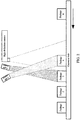
- FIG. 2 is a schematic diagram of a scenario of a first embodiment of implementing object sorting, according to this application.
- the projection light source is disposed on the top portion of the production line.
- objects are packages on a distribution line in a distribution center, and the packages are delivered to two different destinations.
- the destinations are a destination A and a destination B in the first embodiment, and it is assumed that a red spotlight is projected onto packages delivered to the destination A, and a green spotlight is projected onto packages delivered to the destination B.
- a high-definition camera is disposed on the top portion of the production line, and is configured to recognize barcode information on waybills of packages moving on the conveyor belt, to obtain destination flow direction information of the packages. It is assumed that through the recognition of the high-definition camera, a package 3 is delivered to the destination A and a package 4 is delivered to the destination B. As shown in FIG. 2 , a red spotlight shown by oblique square shades is projected onto the package 3, and a green spotlight shown by dot pixel shades is projected onto the package 4. In this way, a sorting worker working at the production line may easily sort the packages in motion according to different colors.
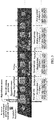
- FIG. 3 is a schematic diagram of a scenario of a second embodiment of implementing object sorting, according to this application.
- the projection light source is disposed on the side portion of the production line.
- a high-definition camera is disposed on the top portion of the production line, such as a three-side scanning portal frame, and is configured to recognize barcode information on waybills of packages moving on the conveyor belt, to obtain destination flow direction information of the packages.
- a light strip (which is a segment of light strip whose location corresponds to the package with the conveyance of the package, for example, a segment of light strip whose width is the same as that of the package) is turned to a color corresponding to the destination of the package.
- the segment of light strip moves as the package moves, and stops until a work station region is reached for which a picking worker corresponding to the destination is responsible. In this way, the picking worker may perform picking according to the observed color of the light strip.
- the sorting worker may further place the packages at a pallet of a corresponding color for goods stacking. In this way, a sorting worker working at the production line may easily sort the packages in motion according to different colors.
- the projection light sources disposed on the side portion of the production line include red, blue, and green light strips.
- a picking worker 1 is responsible for a region 1, in a range of the region 1 of the picking worker 1, the picking worker 1 is responsible for picking packages whose destinations are a flow direction 1, a flow direction 2, a flow direction 3, and a flow direction 4. It is set that a package of the flow direction 1 is tracked by correspondingly turning on a red light strip, a package of the flow direction 2 is tracked by correspondingly turning on a green light strip, a package of the flow direction 3 is tracked by correspondingly turning on a blue light strip, and a package of the flow direction 4 is tracked by correspondingly turning on a yellow light strip.
- a picking worker 2 is responsible for a region 2, and in a range of the region 2 of the picking worker 2, the picking worker 2 is responsible for picking packages whose destinations are a flow direction 5, a flow direction 6, a flow direction 7, and a flow direction 8. It is set that a package of the flow direction 5 is tracked by correspondingly turning on a red light strip, a package of the flow direction 6 is tracked by correspondingly turning on a green light strip, a package of the flow direction 7 is tracked by correspondingly turning on a blue light strip, and a package of the flow direction 8 is tracked by correspondingly turning on a yellow light strip.
- a picking worker 3 is responsible for a region 3, and in a range of the region 3 of the picking worker 3, the picking worker 3 is responsible for picking packages whose destinations are a flow direction 9, a flow direction 10, a flow direction 11, and a flow direction 12. It is set that a package of the flow direction 9 is tracked by correspondingly turning on a red light strip, a package of the flow direction 10 is tracked by correspondingly turning on a green light strip, a package of the flow direction 11 is tracked by correspondingly turning on a blue light strip, and a package of the flow direction 12 is tracked by correspondingly turning on a yellow light strip.
- a picking worker 4 is responsible for a region 4, and in a range of the region 4 of the picking worker 4, the picking worker 4 is responsible for picking packages whose destinations are a flow direction 13, a flow direction 14, a flow direction 15, and the like. It is set that a package of the flow direction 13 is tracked by correspondingly turning on a red light strip, a package of the flow direction 14 is tracked by correspondingly turning on a green light strip, a package of the flow direction 15 is tracked by correspondingly turning on a blue light strip, and the like. Details are not described one by one herein again.
- the colors of light strips corresponding to flow directions of packages that different picking workers are responsible for picking may be the same or may be different.
- a package 1 is passing through a three-side scanning portal frame, and a high-definition camera disposed on the three-side scanning portal frame is obtaining destination information of the package 1 through scanning.
- a destination address of a package 2 corresponds to the flow direction 3. Therefore, in the region 1, a segment of blue light strip is turned on at a position on the light strip corresponding to the width of the package, and with the movement of the package 2.
- a destination address of a package 3 corresponds to the flow direction 1. Therefore, in the region 1, a segment of red light strip is turned on at a position on the light strip corresponding to the width of the package and with the movement of the package 3.
- a segment of red light strip corresponding to a package 4 moves with the package 4.
- a flow direction corresponding to the destination of the package 4 is the flow direction 5 for which the picking worker 2 is responsible.
- a plurality of picking workers responsible for the same flow direction may be arranged, to better avoid the problem of picking misses.
- re-scanning may be performed by using a hand-held wireless RF to obtain destination flow direction information of the piece.
- irregularly-shaped packages in motion may also be sorted by using the projection light sources shown in FIG. 2 or FIG. 3 according to different colors.
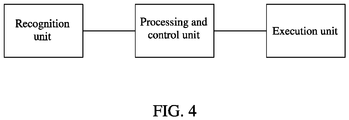
- FIG. 4 is a schematic diagram of an architecture of a system for object sorting, according to this application. As shown in FIG. 4 , the system includes a recognition unit, a processing and control unit, and an execution unit.
- the recognition unit is configured to recognize object information of objects in motion.
- the processing and control unit is configured to: determine colors corresponding to the objects according to the recognized object information, where the colors are used for identifying different destinations; and output a control signal to the execution unit, to control the execution unit to distinguish objects with different destinations by using the determined colors.
- the execution unit is configured to distinguish the objects with different destinations according to the control signal of the processing and control unit by using different colors.
- the recognition unit may include a camera such as a high-definition camera or may include any code reading device, such as an infrared code reading portal frame, a fixed high-speed code reader, or a PDA.
- a camera such as a high-definition camera
- any code reading device such as an infrared code reading portal frame, a fixed high-speed code reader, or a PDA.
- the recognition unit may be disposed on a top portion of a production line or disposed on a side portion of the production line.
- a distance between the recognition unit and an object on a production line is adjustable.
- processing and control unit is further configured to set correspondences between different colors and different destinations.
- processing and control unit may be implemented by using a control chip such as a single-chip microcomputer.
- a control chip such as a single-chip microcomputer.
- the execution unit may include one or more groups of projection light sources.
- two or three groups of projection light sources may be included, to adapt to the incoming objects such as packages, thereby avoiding the problem that a next package has entered a projection region but cannot be spotlighted because the projection of a first light beam onto a current package is not completed.
- a group of projection light sources includes two or more light sources of different colors.
- the projection light source may be disposed on a top portion of the production line or disposed on a side portion of the production line.
- the system for object sorting in this application further includes a sensor, where the execution unit includes light strips disposed on a side portion of the production line; and when the pre-installed sensor senses the passage of objects, the processing and control unit is further configured to turn light strips to the colors corresponding to the destination information of the objects.
Landscapes
- Engineering & Computer Science (AREA)
- Physics & Mathematics (AREA)
- General Physics & Mathematics (AREA)
- Theoretical Computer Science (AREA)
- Business, Economics & Management (AREA)
- Computer Vision & Pattern Recognition (AREA)
- Economics (AREA)
- Artificial Intelligence (AREA)
- Multimedia (AREA)
- Electromagnetism (AREA)
- Entrepreneurship & Innovation (AREA)
- Human Resources & Organizations (AREA)
- Marketing (AREA)
- Operations Research (AREA)
- Quality & Reliability (AREA)
- Strategic Management (AREA)
- Tourism & Hospitality (AREA)
- General Business, Economics & Management (AREA)
- Health & Medical Sciences (AREA)
- Development Economics (AREA)
- General Health & Medical Sciences (AREA)
- Toxicology (AREA)
- Sorting Of Articles (AREA)
Abstract
Description
- This application claims priority to Chinese Patent Application No.
201810745001.7, filed on July 9, 2018 - This application relates to, but is not limited to, information management technologies, and in particular, to a method and system for object sorting.
- Sorting at a distribution center is to sort logistic objects such as goods according to goods transportation routes, that is, destination flow directions (which usually are codes formed by letters and numbers).
- With the rapid development of logistics, there is an urgent need for an efficient sorting method with low costs.
- To resolve the foregoing technical problems, this application provides a method and system for object sorting, to efficiently complete sorting with low costs.
- To achieve the objective of this application, this application provides a method for object sorting, including: recognizing object information of objects in motion;
determining colors corresponding to the objects according to the recognized object information, where the colors are used for identifying different destinations; and
distinguishing objects with different destinations by using the determined colors, to sort the objects in motion according to the colors. - Optionally, before the method, the method further includes: setting correspondences between different colors and different destinations.
- Optionally, the determining colors corresponding to the objects according to the recognized object information includes:
- obtaining destination information according to the object information; and
- determining colors corresponding to the object information according to the correspondences and the obtained destination information.
- Optionally, the distinguishing objects with different destinations by using the determined colors includes:
- projecting spotlight beams of the determined colors onto corresponding objects by using pre-installed projection light sources; and/or
- when the passage of the objects is sensed, setting colors of pre-installed light strips whose locations correspond to the objects to the determined colors.
- This application further provides a system for object sorting, including a recognition unit, a processing and control unit, and an execution unit, where
the recognition unit is configured to recognize object information of objects in motion;
the processing and control unit is configured to: determine colors corresponding to the objects according to the recognized object information, where the colors are used for identifying different destinations; and output a control signal to the execution unit, to control the execution unit to distinguish objects with different destinations by using the determined colors; and
the execution unit is configured to distinguish the objects with different destinations according to the control signal of the processing and control unit by using different colors. - Optionally, the processing and control unit is further configured to set correspondences between different colors and different destinations, and in the processing and control unit, the determining colors corresponding to the objects according to the recognized object information includes:
- obtaining destination information according to the object information; and
- determining colors corresponding to the object information according to the correspondences and the obtained destination information.
- Optionally, the recognition unit includes a camera or a code reading device.
- Optionally, the camera is a high-definition camera.
- Optionally, a distance between the recognition unit and an object on a production line is adjustable.
- Optionally, the recognition unit is disposed on a top portion of the production line or disposed on a side portion of the production line.
- Optionally, the execution unit includes one or more groups of projection light sources.
- Optionally, the execution unit includes two or three groups of projection light sources.
- Optionally, a group of projection light sources includes two or more light sources of different colors.
- Optionally, the projection light source is disposed on a top portion of the production line or disposed on a side portion of the production line.
- Optionally, the system further includes a sensor, where
the execution unit includes light strips disposed on a side portion of the production line; and
when the pre-installed sensor senses the objects, the processing and control unit is further configured to turn light strips whose locations correspond to the objects to the colors corresponding to the destination information. - The technical solution of this application includes: recognizing object information of objects in motion; determining colors corresponding to the objects according to the recognized object information, where the colors are used for identifying different destinations; and distinguishing objects with different destinations by using the determined colors, to sort the objects in motion according to the colors. In this application, instead of gray site shortcodes representing different destinations, different colors are used to identify objects, and objects in motion are sorted according to colors. Because the naked-eye recognition rate of colors is far higher than the naked-eye recognition rate of codes formed by letters and numbers, the efficiency of completing sorting is greatly improved. In addition, this application adopts a combination of automation and manual labor, thereby greatly reducing costs. It can be seen that efficient and low-cost sorting is achieved in this application.
- Other features and advantages of this application will be described in the following specification, and partially become apparent from the specification, or be understood through implementation of this application. Objectives and other advantages of this application may be achieved and obtained by using the structures particularly mentioned in the specification, the claims, and the accompanying drawings.
- The accompanying drawings are used to provide further understanding of the technical solutions of this application, and constitute a part of the specification, which are used to explain the technical solutions of this application in combination with the embodiments of this application, and do not constitute a limitation to the technical solutions of this application.
-
FIG. 1 is a flowchart of a method for object sorting, according to this application; -
FIG. 2 is a schematic diagram of a scenario of a first embodiment of implementing object sorting, according to this application; -
FIG. 3 is a schematic diagram of a scenario of a first embodiment of implementing object sorting, according to this application; and -
FIG. 4 is a schematic diagram of an architecture of a system for object sorting, according to this application. - To make the objectives, technical solutions, and advantages of this application clearer, the following describes the embodiments of this application in detail with reference to the accompanying drawings. It should be noted that, provided that no conflict is caused, the embodiments in this application or the features in the embodiments may be mutually combined.
- In a typical configuration of this application, a computing device includes one or more processors (CPUs), an input/output interface, a network interface, and an internal memory.
- The internal memory may include the following forms of computer-readable media: a non-persistent memory, a random access memory (RAM), and/or a non-volatile internal memory, for example, a read-only memory (ROM) or a flash memory (flash RAM). The internal memory is an example of the computer-readable medium.
- The computer-readable medium includes a persistent medium and a non-persistent medium, a removable medium and a non-removable medium, which may implement storage of information by using any method or technology. The information may be computer-readable instructions, a data structure, a module of a program or other data. Examples of computer storage media include, but are not limited to, a phase change memory (PRAM), a static random access memory (SRAM), a dynamic random access memory (DRAM), another type of random access memory (RAM), a read-only memory (ROM), an electrically erasable programmable read-only memory (EEPROM), a flash memory or another memory technology, a compact disc read-only memory (CD-ROM), a digital versatile disc (DVD) or another optical storage, a cassette magnetic tape, tape and disk storage or another magnetic storage device or any other non-transmission media that may be configured to store information that a computing device can access. Based on the definition in the specification, the computer-readable medium does not include non-transitory computer-readable media (transitory media), such as a modulated data signal and a carrier.
- The steps shown in the flowcharts in the accompanying drawings may be performed in, for example, a computer system having a group of computer-executable instructions. In addition, although a logic order is shown in the flowcharts, in some events, the shown or described steps may be performed in an order different from the order herein.
- In the related art, a distribution center mainly has two forms: a manual warehouse and an automated warehouse. Considering factors of order quantities and costs, the coverage rate of the automated warehouse is currently limited.
- For the manual warehouse, a distribution line in a distribution center may be subdivided into links. A sorting worker needs to perform a sorting job on goods according to goods transportation routes, that is, destination flow directions (which usually are codes formed by letters and numbers, also referred to as gray site shortcodes). In other words, on the one hand, a sorting worker usually performs subdivision operations by watching the gray site shortcode, and one person averagely needs to memorize four to six codes each with up to six digits, for example, S 16783. On the other hand, sorting workers at the distribution line work in a standing state for 10 to 12 hours on average. Investigation shows that standing and looking at moving codes for a long time tend to cause problems such as dizziness, easily resulting in incorrect sorting. Particularly, in a scenario with an increasing speed, the naked-eye recognition rate of numbers and letters is greatly reduced, which is more prone to incorrect sorting.
- For the automated warehouse, that is, a fully-automated distribution system, although waybill information is read through fully-automated scanning, and destinations of packages are distinguished by using a fully-automated system, the costs of the distribution lines in the distribution center are inevitably increased, and in particular, the costs of the entire automated distribution system cannot be offset in scenarios where a specific daily order quantity (which is a large order quantity) is not reached. In addition, an irregularly-shaped piece such as an oil drum still cannot be automatically recognized by the automated distribution system, but needs to be sorted in another manual sorting line in the automated warehouse.
- This application provides a method for object sorting. As shown in
FIG. 1 , the method includes:
Step 100. recognizing object information of objects in motion. - Optionally, a recognition device may be disposed on a top portion of a production line, to recognize object information of objects in motion, such as barcode information on package waybills.
- Optionally, the recognition device may be disposed on the top portion of the production line. Alternatively, the recognition device may be disposed on a side portion of the production line, to adapt to a scenario in which a package waybill faces the sorting worker.
- Optionally, the recognition device configured to recognize object information of objects in motion may be a camera such as a high-definition camera or may be any code reading device such as an infrared code reading portal frame, a fixed high-speed code reader or an industrial-grade personal digital assistant (PDA). Herein, the industrial-grade PDA is mainly applied to the industrial fields. Commonly used barcode scanners, radio frequency identification (RFID) readers/writers, point of sale (POS) machines (also referred to as point of sale information management systems), and the like may all be referred to as PDAs.
- Optionally, a distance between the recognition device and an object on the production line is adjustable. In this way, the recognition rate may be improved by further reducing a distance between the recognition device and to-be-recognized objects.
- Optionally, before the method, the method further includes:
marking a position of an object such as a package to be placed on a conveyor belt of the production line , to prompt a sorting worker to place the object such as a package at the right position, to prevent the object such as a package from being randomly knocked out of a pre-determined range, thereby ensuring the calculation accuracy of the displacement of the object such as a package after code reading and identification are performed for the first time. -
Step 101. determining colors corresponding to the objects according to the recognized object information, where the colors are used for identifying different destinations. - Before this step, the method further includes: setting correspondences between different colors and different destinations. In other words, different destinations are represented by using different colors in advance.
- Object information such as barcode information on a package waybill corresponds to package flow direction information. In other words, if object information such as barcode information on a package waybill is obtained, destination information may be obtained, and a color corresponding to the recognized object information may be determined according to the pre-installed correspondences between different colors and different destinations.
- For example, one site represents one subdivided flow direction and has a corresponding code. On subdivided links of the production line, a site flow direction is used as a unit to divide the production line into work stations. A work station with a width of 1.8 m is used as a unit, and one site code corresponds to one color. For example, different destination sites may be distinguished by using three colors e.g., red, green, and blue.
- In this application, instead of gray site shortcodes representing different destinations, different colors are used to identify objects. Experiments show that when an object moves, the naked-eye recognition rate of colors is far higher than the naked-eye recognition rate of codes formed by letters and numbers.
-
Step 102. distinguishing objects with different destinations by using the determined colors, to sort the objects in motion according to the colors. - Optionally, projection light sources may be disposed on a top or side portion of the production line to project spotlight beams of corresponding colors onto corresponding objects such as packages; and/or light strips may be alternatively disposed on a side portion of the production line. When a pre-installed sensor senses the passage of an object such as a package, a light strip whose location corresponds to the object is turned to a color corresponding to the destination of the package.
- Optionally, the color of a pallet or another container corresponding to a destination flow direction of an object such as a package is the same as a color projected onto the object such as a package. In this way, objects such as packages are in a one-to-one correspondence to containers carrying the objects such as packages, and the objects and the containers are clearly distinguished by using the same color.
- Optionally, a spotlight system may generate spotlight having an angle ranging from 15 degrees to 35 degrees.
- Optionally, there may be one or more groups of projection light sources disposed on the top portion of the production line. Preferably, two or three groups of projection light sources may be included, to adapt to the incoming objects such as packages, thereby avoiding the problem that a next package has entered a projection region but cannot be spotlighted because the projection of a first light beam onto a current package is not completed.
- Optionally, each group of projection light sources may include all light sources that have different colors and are used for identifying different destinations. For example, each group of projection light sources includes light sources having three colors, e.g., red, green, and blue. Alternatively, different groups of projection light sources respectively correspond to light sources of colors representing different destinations. Assuming that two groups of projection light sources are disposed, one group of projection light sources includes light sources of two colors, e.g., red and green, and the other group of projection light sources includes light sources of two colors, e.g., blue and yellow.
- In this way, a sorting worker working at the production line may sort packages for which the sorting worker is responsible by recognizing colors. In addition, the naked-eye recognition rate of colors is far higher than the naked-eye recognition rate of codes formed by letters and numbers. Conventionally, one work station requires two sorting workers. However, in the embodiments of implementing object sorting by using different colors in this application, only one sorting worker is required to efficiently complete the sorting work. The other sorting worker may be responsible for a sorting job in other flow directions.
- Optionally, in a first embodiment shown in
FIG. 2 , the projection light source may be disposed on the top portion of the production line. Alternatively, in a second embodiment shown inFIG. 3 , the projection light source may be disposed on the side portion of the production line. - During practical application, at the beginning of the production line, a barcode on the surface of a package may be recognized by using a high-definition camera, and the barcode is then matched against existing goods flow direction data, to learn a destination flow direction corresponding to the package. The specific coordinates of a location at which the package may arrive in N seconds may be determined through calculation by using the initial coordinates of the package that are read by a camera on a portal frame and the flow speed of the production line. In this way, when the package moves past a sensor in a work station region of a worker responsible for the flow direction, the projection light source is triggered to emit light to track the package.
- In the method for object sorting provided in this application, instead of gray site shortcodes representing different destinations, different colors are used to identify objects, and objects in motion are sorted according to colors. Because the naked-eye recognition rate of colors is far higher than the naked-eye recognition rate of codes formed by letters and numbers, the efficiency of completing sorting is greatly improved. In addition, this application adopts a combination of automation and manual labor, thereby greatly reducing costs. It can be seen that efficient and low-cost sorting is implemented in this application.
-
FIG. 2 is a schematic diagram of a scenario of a first embodiment of implementing object sorting, according to this application. In the first embodiment, the projection light source is disposed on the top portion of the production line. As shown inFIG. 2 , in the first embodiment, it is assumed that objects are packages on a distribution line in a distribution center, and the packages are delivered to two different destinations. It is assumed that the destinations are a destination A and a destination B in the first embodiment, and it is assumed that a red spotlight is projected onto packages delivered to the destination A, and a green spotlight is projected onto packages delivered to the destination B. - In the first embodiment, a high-definition camera is disposed on the top portion of the production line, and is configured to recognize barcode information on waybills of packages moving on the conveyor belt, to obtain destination flow direction information of the packages. It is assumed that through the recognition of the high-definition camera, a
package 3 is delivered to the destination A and apackage 4 is delivered to the destination B. As shown inFIG. 2 , a red spotlight shown by oblique square shades is projected onto thepackage 3, and a green spotlight shown by dot pixel shades is projected onto thepackage 4. In this way, a sorting worker working at the production line may easily sort the packages in motion according to different colors. -
FIG. 3 is a schematic diagram of a scenario of a second embodiment of implementing object sorting, according to this application. In the second embodiment, the projection light source is disposed on the side portion of the production line. As shown inFIG. 3 , a high-definition camera is disposed on the top portion of the production line, such as a three-side scanning portal frame, and is configured to recognize barcode information on waybills of packages moving on the conveyor belt, to obtain destination flow direction information of the packages. When a sensor (or a plurality of sensors) such as a photoelectric sensor disposed on the production line senses that a package passes, a light strip (which is a segment of light strip whose location corresponds to the package with the conveyance of the package, for example, a segment of light strip whose width is the same as that of the package) is turned to a color corresponding to the destination of the package. Visually observed, the segment of light strip moves as the package moves, and stops until a work station region is reached for which a picking worker corresponding to the destination is responsible. In this way, the picking worker may perform picking according to the observed color of the light strip. Next, the sorting worker may further place the packages at a pallet of a corresponding color for goods stacking. In this way, a sorting worker working at the production line may easily sort the packages in motion according to different colors. As shown inFIG. 3 , the projection light sources disposed on the side portion of the production line include red, blue, and green light strips. - In the second embodiment shown in
FIG. 3 , assuming that a pickingworker 1 is responsible for aregion 1, in a range of theregion 1 of the pickingworker 1, the pickingworker 1 is responsible for picking packages whose destinations are aflow direction 1, aflow direction 2, aflow direction 3, and aflow direction 4. It is set that a package of theflow direction 1 is tracked by correspondingly turning on a red light strip, a package of theflow direction 2 is tracked by correspondingly turning on a green light strip, a package of theflow direction 3 is tracked by correspondingly turning on a blue light strip, and a package of theflow direction 4 is tracked by correspondingly turning on a yellow light strip. - A picking
worker 2 is responsible for aregion 2, and in a range of theregion 2 of the pickingworker 2, the pickingworker 2 is responsible for picking packages whose destinations are a flow direction 5, a flow direction 6, aflow direction 7, and aflow direction 8. It is set that a package of the flow direction 5 is tracked by correspondingly turning on a red light strip, a package of the flow direction 6 is tracked by correspondingly turning on a green light strip, a package of theflow direction 7 is tracked by correspondingly turning on a blue light strip, and a package of theflow direction 8 is tracked by correspondingly turning on a yellow light strip. - A picking
worker 3 is responsible for aregion 3, and in a range of theregion 3 of the pickingworker 3, the pickingworker 3 is responsible for picking packages whose destinations are aflow direction 9, aflow direction 10, aflow direction 11, and aflow direction 12. It is set that a package of theflow direction 9 is tracked by correspondingly turning on a red light strip, a package of theflow direction 10 is tracked by correspondingly turning on a green light strip, a package of theflow direction 11 is tracked by correspondingly turning on a blue light strip, and a package of theflow direction 12 is tracked by correspondingly turning on a yellow light strip. - A picking
worker 4 is responsible for aregion 4, and in a range of theregion 4 of the pickingworker 4, the pickingworker 4 is responsible for picking packages whose destinations are aflow direction 13, aflow direction 14, aflow direction 15, and the like. It is set that a package of theflow direction 13 is tracked by correspondingly turning on a red light strip, a package of theflow direction 14 is tracked by correspondingly turning on a green light strip, a package of theflow direction 15 is tracked by correspondingly turning on a blue light strip, and the like. Details are not described one by one herein again. - It should be noted that the colors of light strips corresponding to flow directions of packages that different picking workers are responsible for picking may be the same or may be different.
- As shown in
FIG. 3 , apackage 1 is passing through a three-side scanning portal frame, and a high-definition camera disposed on the three-side scanning portal frame is obtaining destination information of thepackage 1 through scanning. In this embodiment, a destination address of apackage 2 corresponds to theflow direction 3. Therefore, in theregion 1, a segment of blue light strip is turned on at a position on the light strip corresponding to the width of the package, and with the movement of thepackage 2. Similarly, in this embodiment, a destination address of apackage 3 corresponds to theflow direction 1. Therefore, in theregion 1, a segment of red light strip is turned on at a position on the light strip corresponding to the width of the package and with the movement of thepackage 3. In this embodiment, in theregion 2, a segment of red light strip corresponding to apackage 4 moves with thepackage 4. However, in this situation, because it is in theregion 2 that a light strip corresponding to thepackage 4 is turned on, a flow direction corresponding to the destination of thepackage 4 is the flow direction 5 for which thepicking worker 2 is responsible. - It should be noted that, in the implementation shown in the second embodiment, assuming that when the
package 3 is conveyed in theregion 1, although a light strip of a corresponding color is turned on, for some reason, the package fails to be picked by the pickingworker 1, that is, a picking miss occurs. Therefore, in the following regions through which thepackage 3 passes, no corresponding light strip is turned on, and after the conveyance of thepackage 3 is finished on the production line, the package is placed on the production line again to be recognized and picked again. - Optionally, a plurality of picking workers responsible for the same flow direction may be arranged, to better avoid the problem of picking misses.
- It should be noted that, in this application, for an irregularly-shaped piece such as an oil drum, as shown in
FIG. 3 , re-scanning may be performed by using a hand-held wireless RF to obtain destination flow direction information of the piece. In this way, irregularly-shaped packages in motion may also be sorted by using the projection light sources shown inFIG. 2 orFIG. 3 according to different colors. -
FIG. 4 is a schematic diagram of an architecture of a system for object sorting, according to this application. As shown inFIG. 4 , the system includes a recognition unit, a processing and control unit, and an execution unit. - The recognition unit is configured to recognize object information of objects in motion.
- The processing and control unit is configured to: determine colors corresponding to the objects according to the recognized object information, where the colors are used for identifying different destinations; and output a control signal to the execution unit, to control the execution unit to distinguish objects with different destinations by using the determined colors.
- The execution unit is configured to distinguish the objects with different destinations according to the control signal of the processing and control unit by using different colors.
- Optionally, the recognition unit may include a camera such as a high-definition camera or may include any code reading device, such as an infrared code reading portal frame, a fixed high-speed code reader, or a PDA.
- Optionally, the recognition unit may be disposed on a top portion of a production line or disposed on a side portion of the production line.
- Optionally, a distance between the recognition unit and an object on a production line is adjustable.
- Optionally, the processing and control unit is further configured to set correspondences between different colors and different destinations.
- Optionally, the processing and control unit may be implemented by using a control chip such as a single-chip microcomputer. There are many specific implementations, which are not limited herein.
- Optionally, the execution unit may include one or more groups of projection light sources. Preferably, two or three groups of projection light sources may be included, to adapt to the incoming objects such as packages, thereby avoiding the problem that a next package has entered a projection region but cannot be spotlighted because the projection of a first light beam onto a current package is not completed.
- Optionally, a group of projection light sources includes two or more light sources of different colors.
- Optionally, the projection light source may be disposed on a top portion of the production line or disposed on a side portion of the production line.
- Optionally, the system for object sorting in this application further includes a sensor, where
the execution unit includes light strips disposed on a side portion of the production line; and
when the pre-installed sensor senses the passage of objects, the processing and control unit is further configured to turn light strips to the colors corresponding to the destination information of the objects. - In the system for object sorting provided in this application, instead of gray site shortcodes representing different destinations, different colors are used to identify objects, and objects in motion are sorted according to colors. Because the naked-eye recognition rate of colors is far higher than the naked-eye recognition rate of codes formed by letters and numbers, the efficiency of completing sorting is greatly improved. In addition, this application adopts a combination of automation and manual labor, thereby greatly reducing costs. It can be seen that efficient and low-cost sorting is implemented in this application.
- Although the implementations of this application have been disclosed as above, the described content is only implementations used for ease of understanding this application and is not intended to limit this application. Any person skilled in the field of this application can make any modification and change in the forms and details of the implementation without departing from the spirit and scope of this application. However, the protection scope of this application should still be subject to the scope defined by the appended claims.
Claims (15)
- A method for object sorting, comprising:recognizing object information of objects in motion;determining colors corresponding to the objects according to the recognized object information, wherein the colors are used for identifying different destinations; anddistinguishing objects with different destinations by using the determined colors, to sort the objects in motion according to the colors.
- The method according to claim 1, wherein before the method, the method further comprises: setting correspondences between different colors and different destinations.
- The method according to claim 2, wherein the determining colors corresponding to the objects according to the recognized object information comprises:obtaining destination information according to the object information; anddetermining colors corresponding to the object information according to the correspondences and the obtained destination information.
- The method according to claim 1, wherein the distinguishing objects with different destinations by using the determined colors comprises:projecting spotlight beams of the determined colors onto corresponding objects by using pre-installed projection light sources; and/orwhen the passage of the objects is sensed, setting colors of pre-installed light strips whose locations correspond to the objects to the determined colors.
- A system for object sorting, comprising a recognition unit, a processing and control unit, and an execution unit, wherein
the recognition unit is configured to recognize object information of objects in motion;
the processing and control unit is configured to: determine colors corresponding to the objects according to the recognized object information, wherein the colors are used for identifying different destinations; and output a control signal to the execution unit, to control the execution unit to distinguish objects with different destinations by using the determined colors; and
the execution unit is configured to distinguish the objects with different destinations according to the control signal of the processing and control unit by using different colors. - The system according to claim 5, wherein the processing and control unit is further configured to set correspondences between different colors and different destinations, and in the processing and control unit, the determining colors corresponding to the objects according to the recognized object information comprises:obtaining destination information according to the object information; anddetermining colors corresponding to the object information according to the correspondences and the obtained destination information.
- The system according to claim 5 or 6, wherein the recognition unit comprises a camera or a code reading device.
- The system according to claim 7, wherein the camera is a high-definition camera.
- The system according to claim 5 or 6, wherein a distance between the recognition unit and an object on a production line is adjustable.
- The system according to claim 5 or 6, wherein the recognition unit is disposed on a top portion of the production line or disposed on a side portion of the production line.
- The system according to claim 5 or 6, wherein the execution unit comprises one or more groups of projection light sources.
- The system according to claim 11, wherein the execution unit comprises two or three groups of projection light sources.
- The system according to claim 11, wherein a group of projection light sources comprises two or more light sources of different colors.
- The system according to claim 11, wherein the projection light source is disposed on a top portion of the production line or disposed on a side portion of the production line.
- The system according to claim 5 or 6, further comprising a sensor, wherein
the execution unit comprises light strips disposed on a side portion of the production line; and
when the pre-installed sensor senses the objects, the processing and control unit is further configured to turn light strips whose locations correspond to the objects to the colors corresponding to the destination information.
Applications Claiming Priority (2)
| Application Number | Priority Date | Filing Date | Title |
|---|---|---|---|
| CN201810745001.7A CN110705561A (en) | 2018-07-09 | 2018-07-09 | Method and system for realizing object allocation and sorting |
| PCT/CN2019/094156 WO2020011042A1 (en) | 2018-07-09 | 2019-07-01 | Object sorting method and system |
Publications (3)
| Publication Number | Publication Date |
|---|---|
| EP3822856A1 true EP3822856A1 (en) | 2021-05-19 |
| EP3822856A4 EP3822856A4 (en) | 2022-03-23 |
| EP3822856B1 EP3822856B1 (en) | 2026-01-28 |
Family
ID=69143111
Family Applications (1)
| Application Number | Title | Priority Date | Filing Date |
|---|---|---|---|
| EP19834275.0A Active EP3822856B1 (en) | 2018-07-09 | 2019-07-01 | Object sorting method and system |
Country Status (6)
| Country | Link |
|---|---|
| US (1) | US12183080B2 (en) |
| EP (1) | EP3822856B1 (en) |
| JP (1) | JP7451487B2 (en) |
| CN (1) | CN110705561A (en) |
| TW (1) | TW202005721A (en) |
| WO (1) | WO2020011042A1 (en) |
Families Citing this family (2)
| Publication number | Priority date | Publication date | Assignee | Title |
|---|---|---|---|---|
| CN112958490A (en) * | 2021-02-01 | 2021-06-15 | 广州市兴世机械制造有限公司 | Defective product tracking system and method on automatic production line |
| CN115608623A (en) * | 2022-10-18 | 2023-01-17 | 北京京东乾石科技有限公司 | Method and device for determining picking information |
Family Cites Families (34)
| Publication number | Priority date | Publication date | Assignee | Title |
|---|---|---|---|---|
| FI906017A7 (en) * | 1990-12-05 | 1992-06-06 | Halton Oy | FOERFARANDE FOER ANORDNING VID SORTERING AV RETURFOERBACKNINGAR AV RETURFLASKOR, BURKAR M.M. |
| US5770841A (en) * | 1995-09-29 | 1998-06-23 | United Parcel Service Of America, Inc. | System and method for reading package information |
| AU5686299A (en) | 1998-08-20 | 2000-03-14 | Raycer, Inc. | Method and apparatus for generating texture |
| JP4365950B2 (en) | 1998-09-11 | 2009-11-18 | キヤノン株式会社 | Graphic object processing method and apparatus for high-speed raster format rendering |
| US7487112B2 (en) | 2000-06-29 | 2009-02-03 | Barnes Jr Melvin L | System, method, and computer program product for providing location based services and mobile e-commerce |
| US7969306B2 (en) | 2002-01-11 | 2011-06-28 | Sap Aktiengesellschaft | Context-aware and real-time item tracking system architecture and scenarios |
| US8611919B2 (en) | 2002-05-23 | 2013-12-17 | Wounder Gmbh., Llc | System, method, and computer program product for providing location based services and mobile e-commerce |
| US8200775B2 (en) | 2005-02-01 | 2012-06-12 | Newsilike Media Group, Inc | Enhanced syndication |
| US7516848B1 (en) | 2005-03-10 | 2009-04-14 | Amazon Technologies, Inc. | Method and apparatus for sensing correct item placement for multi-destination picking |
| US8731708B2 (en) | 2005-03-10 | 2014-05-20 | Amazon Technologies, Inc. | Method and apparatus for multi-destination item selection using motes |
| JP4855899B2 (en) | 2006-11-10 | 2012-01-18 | トッパン・フォームズ株式会社 | Sorting system |
| US7775431B2 (en) | 2007-01-17 | 2010-08-17 | Metrologic Instruments, Inc. | Method of and apparatus for shipping, tracking and delivering a shipment of packages employing the capture of shipping document images and recognition-processing thereof initiated from the point of shipment pickup and completed while the shipment is being transported to its first scanning point to facilitate early customs clearance processing and shorten the delivery time of packages to point of destination |
| US8571298B2 (en) * | 2008-12-23 | 2013-10-29 | Datalogic ADC, Inc. | Method and apparatus for identifying and tallying objects |
| DE102010013220A1 (en) | 2010-03-29 | 2011-09-29 | Siemens Aktiengesellschaft | Method and device for transporting an object to be printed |
| JP5600465B2 (en) * | 2010-04-02 | 2014-10-01 | トーヨーカネツソリューションズ株式会社 | Picking system |
| CN102161040A (en) * | 2011-01-14 | 2011-08-24 | 北京交通大学 | Logistic sorting system based on color sensor |
| US9922096B2 (en) | 2011-07-08 | 2018-03-20 | Yahoo Holdings, Inc. | Automated presentation of information using infographics |
| US10510084B2 (en) | 2011-07-21 | 2019-12-17 | United States Postal Service | System and method for retrieving content associated with distribution items |
| US8943071B2 (en) | 2011-08-23 | 2015-01-27 | At&T Intellectual Property I, L.P. | Automatic sort and propagation associated with electronic documents |
| US9367770B2 (en) * | 2011-08-30 | 2016-06-14 | Digimarc Corporation | Methods and arrangements for identifying objects |
| US8843231B2 (en) * | 2011-09-13 | 2014-09-23 | United Parcel Service Of America, Inc. | Sort systems and methods |
| CA2888153C (en) * | 2012-10-19 | 2021-04-27 | Digimarc Corporation | Methods and arrangements for identifying objects |
| JP5904097B2 (en) | 2012-11-02 | 2016-04-13 | 株式会社ダイフク | Article information display device |
| CN106132843A (en) * | 2014-03-28 | 2016-11-16 | 日本电气株式会社 | Messaging device, information processing system, logistics system, information processing method and program recorded medium |
| US9875503B2 (en) | 2015-03-06 | 2018-01-23 | Wal-Mart Stores, Inc. | Method and apparatus for transporting a plurality of stacked motorized transport units |
| JP6646854B2 (en) * | 2016-03-23 | 2020-02-14 | パナソニックIpマネジメント株式会社 | Projection instruction device, luggage sorting system and projection instruction method |
| JP6367255B2 (en) * | 2016-04-01 | 2018-08-01 | 株式会社東芝 | Delivery support device and delivery support program |
| CN205628657U (en) * | 2016-06-01 | 2016-10-12 | 中邮科技有限责任公司 | Self -service system of posting of receiving of parcel |
| JP6653511B2 (en) * | 2016-07-15 | 2020-02-26 | 国立研究開発法人産業技術総合研究所 | LIBS type object sorting device |
| US11436553B2 (en) * | 2016-09-08 | 2022-09-06 | Position Imaging, Inc. | System and method of object tracking using weight confirmation |
| CN106886877A (en) * | 2017-03-31 | 2017-06-23 | 刘政 | Logistics distribution method, device and server |
| CN107292358A (en) * | 2017-05-04 | 2017-10-24 | 顺丰科技有限公司 | Method for sorting, sorting service end, sorting equipment and sorting system |
| CN206864075U (en) * | 2017-07-03 | 2018-01-09 | 西安工业大学 | A kind of smart electronicses express delivery list |
| US20200290093A1 (en) * | 2017-09-27 | 2020-09-17 | Panasonic Intellectual Property Management Co., Ltd. | Projection instruction device, package sorting system, and projection instruction method |
-
2018
- 2018-07-09 CN CN201810745001.7A patent/CN110705561A/en active Pending
-
2019
- 2019-06-11 TW TW108120049A patent/TW202005721A/en unknown
- 2019-07-01 EP EP19834275.0A patent/EP3822856B1/en active Active
- 2019-07-01 JP JP2021500616A patent/JP7451487B2/en active Active
- 2019-07-01 WO PCT/CN2019/094156 patent/WO2020011042A1/en not_active Ceased
-
2021
- 2021-01-08 US US17/144,391 patent/US12183080B2/en active Active
Also Published As
| Publication number | Publication date |
|---|---|
| US20210125137A1 (en) | 2021-04-29 |
| CN110705561A (en) | 2020-01-17 |
| TW202005721A (en) | 2020-02-01 |
| US12183080B2 (en) | 2024-12-31 |
| EP3822856A4 (en) | 2022-03-23 |
| EP3822856B1 (en) | 2026-01-28 |
| JP2021524427A (en) | 2021-09-13 |
| WO2020011042A1 (en) | 2020-01-16 |
| JP7451487B2 (en) | 2024-03-18 |
Similar Documents
| Publication | Publication Date | Title |
|---|---|---|
| US11295163B1 (en) | Recognition of optical patterns in images acquired by a robotic device | |
| CN108416412B (en) | A logistics compound code recognition method based on multi-task deep learning | |
| CA3058895C (en) | Improved conveyor belt assembly for identifying an asset sort location and methods of utilizing the same | |
| US9171278B1 (en) | Item illumination based on image recognition | |
| CN205230118U (en) | Intelligence warehouse system based on multirobot | |
| US20120191272A1 (en) | Inferential load tracking | |
| US20170066597A1 (en) | Information processing device, information processing system, distribution system, information processing method, and program storage medium | |
| WO2021249571A1 (en) | Warehouse inventory method and warehousing system | |
| CA3138243A1 (en) | Tracking vehicles in a warehouse environment | |
| US12183080B2 (en) | Object sorting method and system | |
| Naumann et al. | Literature review: Computer vision applications in transportation logistics and warehousing | |
| US20260035224A1 (en) | Industrial vehicle distance and range measurement device calibration | |
| KR20210067661A (en) | Automatic home delivery sorter using line tracer and RFID | |
| KR20180085324A (en) | The line trace transfer robot using RFID | |
| CN106779537A (en) | Transit depot wraps up bar code recognition of unloading | |
| US20200290093A1 (en) | Projection instruction device, package sorting system, and projection instruction method | |
| KR20140014522A (en) | System and method for managing warehouse based on rfid tag information | |
| Castaño-Amoros et al. | Visual monitoring intelligent system for cardboard packaging lines | |
| AG | WHITEPAPER | |
| EP3916618A1 (en) | A method of reading a tag located on an object using a model and an industrial device therefor | |
| CA3122643A1 (en) | Rapid location-based association of carriers and items | |
| EP4716601A1 (en) | Systems and methods for sorting objects | |
| Astafiev et al. | Development of an algorithm for determining the movement of products between racks based on data from their radio frequency tags | |
| Khalid et al. | AI-POWERED AUTOMATION IN LOGISTICS AND WAREHOUSING | |
| Wu et al. | Overview of RFID Technology Based on Green Logistics in China |
Legal Events
| Date | Code | Title | Description |
|---|---|---|---|
| STAA | Information on the status of an ep patent application or granted ep patent |
Free format text: STATUS: THE INTERNATIONAL PUBLICATION HAS BEEN MADE |
|
| PUAI | Public reference made under article 153(3) epc to a published international application that has entered the european phase |
Free format text: ORIGINAL CODE: 0009012 |
|
| STAA | Information on the status of an ep patent application or granted ep patent |
Free format text: STATUS: REQUEST FOR EXAMINATION WAS MADE |
|
| 17P | Request for examination filed |
Effective date: 20210112 |
|
| AK | Designated contracting states |
Kind code of ref document: A1 Designated state(s): AL AT BE BG CH CY CZ DE DK EE ES FI FR GB GR HR HU IE IS IT LI LT LU LV MC MK MT NL NO PL PT RO RS SE SI SK SM TR |
|
| DAV | Request for validation of the european patent (deleted) | ||
| DAX | Request for extension of the european patent (deleted) | ||
| REG | Reference to a national code |
Ref country code: DE Ref legal event code: R079 Free format text: PREVIOUS MAIN CLASS: G06K0009460000 Ipc: G06V0020520000 Ref country code: DE Ref legal event code: R079 Ref document number: 602019080842 Country of ref document: DE Free format text: PREVIOUS MAIN CLASS: G06K0009460000 Ipc: G06V0020520000 |
|
| A4 | Supplementary search report drawn up and despatched |
Effective date: 20220222 |
|
| RIC1 | Information provided on ipc code assigned before grant |
Ipc: G06V 20/52 20220101AFI20220216BHEP |
|
| P01 | Opt-out of the competence of the unified patent court (upc) registered |
Effective date: 20230418 |
|
| STAA | Information on the status of an ep patent application or granted ep patent |
Free format text: STATUS: EXAMINATION IS IN PROGRESS |
|
| 17Q | First examination report despatched |
Effective date: 20240215 |
|
| REG | Reference to a national code |
Ref country code: DE Ref legal event code: R079 Free format text: PREVIOUS MAIN CLASS: G06V0020520000 Ipc: G06K0007100000 Ref country code: DE Ref legal event code: R079 Ref document number: 602019080842 Country of ref document: DE Free format text: PREVIOUS MAIN CLASS: G06V0020520000 Ipc: G06K0007100000 |
|
| GRAP | Despatch of communication of intention to grant a patent |
Free format text: ORIGINAL CODE: EPIDOSNIGR1 |
|
| STAA | Information on the status of an ep patent application or granted ep patent |
Free format text: STATUS: GRANT OF PATENT IS INTENDED |
|
| RIC1 | Information provided on ipc code assigned before grant |
Ipc: G06K 7/10 20060101AFI20250731BHEP Ipc: G06K 7/12 20060101ALI20250731BHEP Ipc: G06K 19/06 20060101ALI20250731BHEP Ipc: G06Q 10/083 20240101ALI20250731BHEP Ipc: G06V 30/424 20220101ALI20250731BHEP Ipc: G06V 20/52 20220101ALI20250731BHEP |
|
| INTG | Intention to grant announced |
Effective date: 20250903 |
|
| GRAS | Grant fee paid |
Free format text: ORIGINAL CODE: EPIDOSNIGR3 |
|
| GRAA | (expected) grant |
Free format text: ORIGINAL CODE: 0009210 |
|
| STAA | Information on the status of an ep patent application or granted ep patent |
Free format text: STATUS: THE PATENT HAS BEEN GRANTED |
|
| AK | Designated contracting states |
Kind code of ref document: B1 Designated state(s): AL AT BE BG CH CY CZ DE DK EE ES FI FR GB GR HR HU IE IS IT LI LT LU LV MC MK MT NL NO PL PT RO RS SE SI SK SM TR |
|
| REG | Reference to a national code |
Ref country code: CH Ref legal event code: F10 Free format text: ST27 STATUS EVENT CODE: U-0-0-F10-F00 (AS PROVIDED BY THE NATIONAL OFFICE) Effective date: 20260128 Ref country code: GB Ref legal event code: FG4D |
|
| REG | Reference to a national code |
Ref country code: DE Ref legal event code: R096 Ref document number: 602019080842 Country of ref document: DE |
|
| REG | Reference to a national code |
Ref country code: IE Ref legal event code: FG4D |