EP3822096B1 - Tires with noise-reducing main grooves - Google Patents
Tires with noise-reducing main grooves Download PDFInfo
- Publication number
- EP3822096B1 EP3822096B1 EP20206989.4A EP20206989A EP3822096B1 EP 3822096 B1 EP3822096 B1 EP 3822096B1 EP 20206989 A EP20206989 A EP 20206989A EP 3822096 B1 EP3822096 B1 EP 3822096B1
- Authority
- EP
- European Patent Office
- Prior art keywords
- protrusion
- noise
- tire
- knurled
- groove portion
- Prior art date
- Legal status (The legal status is an assumption and is not a legal conclusion. Google has not performed a legal analysis and makes no representation as to the accuracy of the status listed.)
- Active
Links
Images



Classifications
-
- B—PERFORMING OPERATIONS; TRANSPORTING
- B60—VEHICLES IN GENERAL
- B60C—VEHICLE TYRES; TYRE INFLATION; TYRE CHANGING; CONNECTING VALVES TO INFLATABLE ELASTIC BODIES IN GENERAL; DEVICES OR ARRANGEMENTS RELATED TO TYRES
- B60C11/00—Tyre tread bands; Tread patterns; Anti-skid inserts
- B60C11/03—Tread patterns
- B60C11/13—Tread patterns characterised by the groove cross-section, e.g. for buttressing or preventing stone-trapping
- B60C11/1369—Tie bars for linking block elements and bridging the groove
-
- B—PERFORMING OPERATIONS; TRANSPORTING
- B60—VEHICLES IN GENERAL
- B60C—VEHICLE TYRES; TYRE INFLATION; TYRE CHANGING; CONNECTING VALVES TO INFLATABLE ELASTIC BODIES IN GENERAL; DEVICES OR ARRANGEMENTS RELATED TO TYRES
- B60C19/00—Tyre parts or constructions not otherwise provided for
- B60C19/002—Noise damping elements provided in the tyre structure or attached thereto, e.g. in the tyre interior
-
- B—PERFORMING OPERATIONS; TRANSPORTING
- B60—VEHICLES IN GENERAL
- B60C—VEHICLE TYRES; TYRE INFLATION; TYRE CHANGING; CONNECTING VALVES TO INFLATABLE ELASTIC BODIES IN GENERAL; DEVICES OR ARRANGEMENTS RELATED TO TYRES
- B60C11/00—Tyre tread bands; Tread patterns; Anti-skid inserts
- B60C11/03—Tread patterns
- B60C11/13—Tread patterns characterised by the groove cross-section, e.g. for buttressing or preventing stone-trapping
- B60C11/1353—Tread patterns characterised by the groove cross-section, e.g. for buttressing or preventing stone-trapping with special features of the groove bottom
-
- B—PERFORMING OPERATIONS; TRANSPORTING
- B60—VEHICLES IN GENERAL
- B60C—VEHICLE TYRES; TYRE INFLATION; TYRE CHANGING; CONNECTING VALVES TO INFLATABLE ELASTIC BODIES IN GENERAL; DEVICES OR ARRANGEMENTS RELATED TO TYRES
- B60C11/00—Tyre tread bands; Tread patterns; Anti-skid inserts
- B60C11/03—Tread patterns
- B60C11/12—Tread patterns characterised by the use of narrow slits or incisions, e.g. sipes
- B60C11/1204—Tread patterns characterised by the use of narrow slits or incisions, e.g. sipes with special shape of the sipe
-
- B—PERFORMING OPERATIONS; TRANSPORTING
- B60—VEHICLES IN GENERAL
- B60C—VEHICLE TYRES; TYRE INFLATION; TYRE CHANGING; CONNECTING VALVES TO INFLATABLE ELASTIC BODIES IN GENERAL; DEVICES OR ARRANGEMENTS RELATED TO TYRES
- B60C11/00—Tyre tread bands; Tread patterns; Anti-skid inserts
- B60C11/03—Tread patterns
-
- B—PERFORMING OPERATIONS; TRANSPORTING
- B60—VEHICLES IN GENERAL
- B60C—VEHICLE TYRES; TYRE INFLATION; TYRE CHANGING; CONNECTING VALVES TO INFLATABLE ELASTIC BODIES IN GENERAL; DEVICES OR ARRANGEMENTS RELATED TO TYRES
- B60C11/00—Tyre tread bands; Tread patterns; Anti-skid inserts
- B60C11/03—Tread patterns
- B60C11/0304—Asymmetric patterns
-
- B—PERFORMING OPERATIONS; TRANSPORTING
- B60—VEHICLES IN GENERAL
- B60C—VEHICLE TYRES; TYRE INFLATION; TYRE CHANGING; CONNECTING VALVES TO INFLATABLE ELASTIC BODIES IN GENERAL; DEVICES OR ARRANGEMENTS RELATED TO TYRES
- B60C11/00—Tyre tread bands; Tread patterns; Anti-skid inserts
- B60C11/03—Tread patterns
- B60C11/13—Tread patterns characterised by the groove cross-section, e.g. for buttressing or preventing stone-trapping
-
- G—PHYSICS
- G10—MUSICAL INSTRUMENTS; ACOUSTICS
- G10K—SOUND-PRODUCING DEVICES; METHODS OR DEVICES FOR PROTECTING AGAINST, OR FOR DAMPING, NOISE OR OTHER ACOUSTIC WAVES IN GENERAL; ACOUSTICS NOT OTHERWISE PROVIDED FOR
- G10K11/00—Methods or devices for transmitting, conducting or directing sound in general; Methods or devices for protecting against, or for damping, noise or other acoustic waves in general
- G10K11/16—Methods or devices for protecting against, or for damping, noise or other acoustic waves in general
- G10K11/172—Methods or devices for protecting against, or for damping, noise or other acoustic waves in general using resonance effects
-
- B—PERFORMING OPERATIONS; TRANSPORTING
- B60—VEHICLES IN GENERAL
- B60B—VEHICLE WHEELS; CASTORS; AXLES FOR WHEELS OR CASTORS; INCREASING WHEEL ADHESION
- B60B2900/00—Purpose of invention
- B60B2900/10—Reduction of
- B60B2900/133—Noise
-
- B—PERFORMING OPERATIONS; TRANSPORTING
- B60—VEHICLES IN GENERAL
- B60C—VEHICLE TYRES; TYRE INFLATION; TYRE CHANGING; CONNECTING VALVES TO INFLATABLE ELASTIC BODIES IN GENERAL; DEVICES OR ARRANGEMENTS RELATED TO TYRES
- B60C11/00—Tyre tread bands; Tread patterns; Anti-skid inserts
- B60C11/03—Tread patterns
- B60C11/0306—Patterns comprising block rows or discontinuous ribs
- B60C11/0309—Patterns comprising block rows or discontinuous ribs further characterised by the groove cross-section
-
- B—PERFORMING OPERATIONS; TRANSPORTING
- B60—VEHICLES IN GENERAL
- B60C—VEHICLE TYRES; TYRE INFLATION; TYRE CHANGING; CONNECTING VALVES TO INFLATABLE ELASTIC BODIES IN GENERAL; DEVICES OR ARRANGEMENTS RELATED TO TYRES
- B60C11/00—Tyre tread bands; Tread patterns; Anti-skid inserts
- B60C11/03—Tread patterns
- B60C11/04—Tread patterns in which the raised area of the pattern consists only of continuous circumferential ribs, e.g. zig-zag
- B60C11/042—Tread patterns in which the raised area of the pattern consists only of continuous circumferential ribs, e.g. zig-zag further characterised by the groove cross-section
-
- B—PERFORMING OPERATIONS; TRANSPORTING
- B60—VEHICLES IN GENERAL
- B60C—VEHICLE TYRES; TYRE INFLATION; TYRE CHANGING; CONNECTING VALVES TO INFLATABLE ELASTIC BODIES IN GENERAL; DEVICES OR ARRANGEMENTS RELATED TO TYRES
- B60C11/00—Tyre tread bands; Tread patterns; Anti-skid inserts
- B60C11/03—Tread patterns
- B60C2011/0337—Tread patterns characterised by particular design features of the pattern
- B60C2011/0339—Grooves
- B60C2011/0341—Circumferential grooves
-
- B—PERFORMING OPERATIONS; TRANSPORTING
- B60—VEHICLES IN GENERAL
- B60C—VEHICLE TYRES; TYRE INFLATION; TYRE CHANGING; CONNECTING VALVES TO INFLATABLE ELASTIC BODIES IN GENERAL; DEVICES OR ARRANGEMENTS RELATED TO TYRES
- B60C11/00—Tyre tread bands; Tread patterns; Anti-skid inserts
- B60C11/03—Tread patterns
- B60C11/13—Tread patterns characterised by the groove cross-section, e.g. for buttressing or preventing stone-trapping
- B60C11/1353—Tread patterns characterised by the groove cross-section, e.g. for buttressing or preventing stone-trapping with special features of the groove bottom
- B60C2011/1361—Tread patterns characterised by the groove cross-section, e.g. for buttressing or preventing stone-trapping with special features of the groove bottom with protrusions extending from the groove bottom
-
- B—PERFORMING OPERATIONS; TRANSPORTING
- B60—VEHICLES IN GENERAL
- B60Y—INDEXING SCHEME RELATING TO ASPECTS CROSS-CUTTING VEHICLE TECHNOLOGY
- B60Y2306/00—Other features of vehicle sub-units
- B60Y2306/09—Reducing noise
-
- G—PHYSICS
- G10—MUSICAL INSTRUMENTS; ACOUSTICS
- G10K—SOUND-PRODUCING DEVICES; METHODS OR DEVICES FOR PROTECTING AGAINST, OR FOR DAMPING, NOISE OR OTHER ACOUSTIC WAVES IN GENERAL; ACOUSTICS NOT OTHERWISE PROVIDED FOR
- G10K2210/00—Details of active noise control [ANC] covered by G10K11/178 but not provided for in any of its subgroups
- G10K2210/30—Means
- G10K2210/321—Physical
- G10K2210/3227—Resonators
Definitions
- the present invention relates to a tire with noise-reducing main grooves and more particularly to a tire with noise-reducing main grooves for reducing resonance noise of the tire.
- a vehicle which goes forward by rolling wheels is inherently has no choice but to make noise.
- noise such as engine sound coming from inside and outside the vehicle, wind noise (sound of wind), etc.
- wind noise sound of wind
- tires for electric vehicles whose market share is rapidly increasing in recent years, are required to have noise characteristics different from those of an Internal Combustion Engine (ICE) vehicle.
- ICE Internal Combustion Engine
- the noise from the engine causes the largest noise over the entire range of indoor noise.
- the electric vehicle does not have an engine, it has an overall low noise level and the largest noise generated from the tire. Therefore, recently, a low noise tire becomes gradually more important.
- a peak due to pipe resonance occurs in a range of 1 kHz in tire noise, and the resulting effect occupies a very large proportion of the overall noise.
- the ground and the main groove form a pipe shape.
- pipe resonance noise in a 1 kHz band is generated due to pipe-shaped flow inside the main groove.
- JP 2006 182299 A discloses a tire according to the preamble of claim 1.
- the present invention provides a tire with noise-reducing main grooves.
- the tire includes: a groove portion which is formed to extend circumferentially along a circumference of a tire tread; and a plurality of knurled portions which are formed on bottom and side surfaces of the groove portion.
- the plurality of knurled portion are configured to reduce noise energy by narrowing an air path formed when the groove portion and the ground contact each other.
- Each of the knurled portion includes: a first protrusion which is formed on the bottom surface of the groove portion and extends in a width direction of the groove portion and extends in a diagonal direction; a second protrusion which is formed to extend in a height direction of one side of the groove portion and extends from one side of the first protrusion in the same direction as that of the first protrusion; and a third protrusion which is formed to extend in a height direction of the other side of the groove portion and extends from the other side of the first protrusion in the same direction as that of the first protrusion.
- the plurality of the knurled portions are formed to extend in zigzags in a longitudinal direction of the groove portion and are directly connected to each other.
- Protrusion heights of the second protrusion and the third protrusion decreases gradually toward the upper portions thereof.
- one side of the second protrusion extends with the first protrusion, and the other side of the second protrusion extends with the second protrusion of an adjacent knurled portion.
- One side of the third protrusion extends with the first protrusion, and the other side of the third protrusion extends with the third protrusion of an adjacent knurled portion.
- a protrusion height of the knurled portion is greater than 0 and less than or equal to 0.8 mm.
- a thickness of the knurled portion is from 0.6 mm to 1.2 mm.
- the knurled portion is connected in zigzags such that a pitch interval is from 10 mm to 30 mm.
- the peak of the pipe resonance noise is reduced by forming a predetermined shape on the groove of the tire, so that noise generated from the tire during the driving is reduced.
- the drainage function of the groove is not decreased.
- a portion is “connected (accessed, contacted, combined)" to another portion, it includes not only “is directly connected” but also “indirectly connected” with another member placed therebetween. Additionally, when it is mentioned that a portion "includes” a component, it means that the portion does not exclude but further includes other components unless there is a special opposite mention.
- Fig. 1 is a perspective view of a tire with noise-reducing main grooves according to the embodiment of the present invention.
- Fig. 2 is a cross sectional view of the noise-reducing main groove according to the embodiment of the present invention.
- Fig. 3 is a top view of a knurled portion according to the embodiment of the present invention.
- Fig. 4 shows a picture of the tire with the noise-reducing main grooves according to the embodiment of the present invention.
- a tire 1000 with the noise-reducing main grooves includes a plurality of the noise-reducing main grooves 100, 200, 300, and 400.
- the tire 1000 with the noise-reducing main grooves includes the first noise-reducing main groove 100, the second noise-reducing main groove 200, the third noise-reducing main groove 300, and the fourth noise-reducing main groove 400.
- the first noise-reducing main groove 100 includes a groove portion 110 and a knurled portion 120.
- the groove portion 110 extends circumferentially along the circumference of a tire tread. That is, the groove portion 110 may be a main groove formed along the traveling direction of the tire.
- the knurled portion 120 is formed to protrude from the bottom and side surfaces of the groove portion 110 and narrows an air path formed when the groove portion 110 contacts the ground, thereby reducing noise energy.
- the knurled portion 120 includes a first protrusion 121, a second protrusion 122, and a third protrusion 123.
- the plurality of knurled portions 120 are formed in zigzags along the longitudinal direction of the groove portion 110 and are extended mutually.
- the first protrusion 121 in formed on the bottom surface of the groove portion 110 and extends in the width direction of the groove portion 110.
- the first protrusion 121 extends from the bottom surface of the groove portion 110 in the width direction of the groove portion 110 and is formed to extend in a diagonal direction.
- the second protrusion 122 is formed to extend in a height direction of one side of the groove portion 110 and is formed to extend from one side of the first protrusion 121.
- the second protrusion 122 is formed to extend in the same direction as that of the first protrusion 121 formed to extend in the diagonal direction.
- the third protrusion 123 is formed to extend in a height direction of the other side of the groove portion 110 and is formed to extend from the other side of the first protrusion 121.
- the third protrusion 123 is formed to extend in the same direction as that of the first protrusion 121 formed to extend in the diagonal direction.
- one side of the second protrusion 122 may extend with the first protrusion 121, and the other side of the second protrusion 122 may extend with the second protrusion of an adjacent knurled portion.
- an adjacent knurled portion is formed in a direction facing each other. That is, the second protrusion of the adjacent knurled portion, which extends with the second protrusion 122, has a 'V' shape.
- One side of the third protrusion 123 may extend with the first protrusion 121, and the other side of the third protrusion 123 may extend with the third protrusion of an adjacent knurled portion. That is, the third protrusion of the adjacent knurled portion, which extends with the third protrusion 123, has a 'V' shape.
- the knurled portions 120 are directly connected to each other.
- a defect may occur in the drainage function of the tread portion required when driving on rainy or snowy roads.
- the protrusion height of the knurled portion 120 may be greater than 0 and less than or equal to 0.8 mm.
- the second protrusion 122 and the third protrusion 123 of the knurled portion 120 may be provided to extend to the uppermost ends of both sidewalls of the groove portion 110. The protrusion heights of the second protrusion 122 and the third protrusion 123 decrease gradually toward the upper portions thereof.
- the thickness of the knurled portion 120 may be formed to be 0.6 mm to 1.2 mm.
- a radius of a connection portion between the first protrusion 121 and the second protrusion 122 and a radius of a connection portion between the first protrusion 121 and the third protrusion 123 are from full radii forming a circular shape to 2.5 mm.
- a pitch interval of the knurled portion 120 formed in zigzags may be from 10 mm to 30 mm.
- the second noise-reducing main groove 200, the third noise-reducing main groove 300, and the fourth noise-reducing main groove 400 have the same configuration as the aforementioned configuration of the first noise-reducing main groove 100.
- the protrusion height, thickness, and radius of the knurled portion 120 of each of the noise-reducing main grooves may correspond to those of the shape of the groove portion 110 within the above range.
- the shapes of the groove portions 110, 210, and 310 of the first noise-reducing main groove 100, the second noise-reducing main groove 200, and the third noise-reducing main groove 300 are the same as each other.
- the width of a groove portion 410 of the fourth noise-reducing main groove 400 is formed to be narrower. Therefore, the protrusion height, thickness, and radius of a knurled portion 420 may be formed differently.
- Fig. 5 is a graph showing an area where pipe resonance noise occurs as a peak.
- the tire 1000 having the noise-reducing main groove is provided such that the pipe resonance noise can be reduced by applying the embossed knurled portion 120 to the wall surface and the bottom surface of the groove portion 110.
- the knurled portion 120 of the embodiment of the present invention is provided such that air flow is brought into contact with as much surface area of the groove portion 110 as possible, so that great Visco-thermal effects are produced.
- the height of the knurled portion 120 is controlled to be 0.8 mm or less, so that the knurled portion 120 is applied to the wall surface and the bottom surface without significantly affecting the drainage performance, thereby increasing the flow contact surface and attenuating the noise.
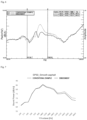
- Fig. 6 is a graph showing a comparison result between a conventional example and the pipe resonance noise of a mock-up structure of the present invention.
- a mock-up in which the knurled portion 120 is applied to the groove portion 110 is used.
- a Q-source that is a shaker, and a microphone for noise measurement are used to measure the noise generated in the mock-up. More specifically, the frequency response function between the Q-source and the mock-up is measured, and a smooth main groove shape of a general tire and the noise-reducing main groove of the present invention are manufactured as a mock-up and are used for verification of the pipe resonance reduction.
- Fig. 6 shows the result
- the conventional example shows a groove in which the knurled portion is not formed
- the embodiment of the present invention shows a signal of the tire with the noise-reducing main grooves.
- the pipe resonance peak has been significantly reduced, and the pipe resonance peak has been reduced by about 2.47 dB, that is to say, from 106.88 dB to 104.41 dB based on RMS in a band of 900 Hz to 1300 Hz.
- Fig. 7 is a graph showing a comparison result between a conventional example and the pipe resonance noise of an actual product of the present invention.
- the tire 1000 with the noise-reducing main grooves has been manufactured to measure noise when driving at 60 km/h with a single tire by using a dynamo in an anechoic chamber.
- 0.6 dB reduction effect was shown in a band of 1 kHz, and noise reduction effect was shown in the entire band after 800 Hz. Therefore, 0.6 dB reduction effect was shown not only in the pipe resonance noise band but also in the total value of noise.
- Figs. 8 and 9 are graphs showing the pipe resonance noise according to the shape of the knurled portion according to the embodiment of the present invention.
- a mock-up experiment has been performed by changing the height, width, and spacing factors of the protrusions in order to limit the numerical value of the knurled portion 120 of the tire.
- the protrusion height of the protrusion refers to a height of the embossed protrusion from the bottom surface of the groove portion 110, and has been changed to two levels of 0.6 mm and 1.2 mm.
- the width refers to a width of the protrusion, and has been changed to two levels of 0.6 mm and 1.2 mm.
- the spacing refers to a spacing between the ends of the groove wall. If the spacing is narrow, the protrusions are densely arranged. The spacing has been changed to two levels of 10 mm and 30 mm.
- the peak of the pipe resonance noise is reduced by forming the knurled portion 120 in the groove portion 110 of the tire according to the embodiment of the present invention, so that noise generated from the tire during the driving can be reduced.
- the drainage function of the groove portion 110 may not be deteriorated.
Landscapes
- Engineering & Computer Science (AREA)
- Mechanical Engineering (AREA)
- Physics & Mathematics (AREA)
- Acoustics & Sound (AREA)
- Multimedia (AREA)
- Tires In General (AREA)
Description
- The present invention relates to a tire with noise-reducing main grooves and more particularly to a tire with noise-reducing main grooves for reducing resonance noise of the tire.
- A vehicle which goes forward by rolling wheels is inherently has no choice but to make noise. However, noise such as engine sound coming from inside and outside the vehicle, wind noise (sound of wind), etc., while driving, always annoys the driver and passengers. For this reason, it is common to block the noise by using a soundproofing material, a sound-absorbing material, etc.
- However, the Ministry of Environment has recently announced that it will introduce "tire noise insulation performance indication system" which is being carried out in European Union (EU) from 2019. In response to this, technology developments to reduce noise are being made ahead of enforcement of the system. Particularly, while, in the past, the focus was on reducing the generation of noise inside the vehicle such as the engine, there are increasing cases of applying a new low noise technology from the early stage of tire product development in order to minimize the noise generated outside the vehicle such as from a tire.
- In particular, tires for electric vehicles, whose market share is rapidly increasing in recent years, are required to have noise characteristics different from those of an Internal Combustion Engine (ICE) vehicle.
- For example, in the case of an ICE vehicle, the noise from the engine causes the largest noise over the entire range of indoor noise. However, since the electric vehicle does not have an engine, it has an overall low noise level and the largest noise generated from the tire. Therefore, recently, a low noise tire becomes gradually more important.
- A peak due to pipe resonance occurs in a range of 1 kHz in tire noise, and the resulting effect occupies a very large proportion of the overall noise. Specifically, when the main groove in the traveling direction of the tire contacts the ground, the ground and the main groove form a pipe shape. Here, pipe resonance noise in a 1 kHz band is generated due to pipe-shaped flow inside the main groove.
- Therefore, there is a necessity of a technology for reducing the pipe resonance noise generated in the main groove of the tire.
- Noise reduction tires are described, e.g., in
KR 10-1957640 B1 EP 2 502 757 A1 and inJP 2006 182299 A JP 2006 182299 A - It is the object of the present invention to solve the aforementioned problems and provide a tire with noise-reducing main grooves for reducing resonance noise of the tire.
- This object is achieved by a tire according to claim 1.
- The present invention provides a tire with noise-reducing main grooves. The tire includes: a groove portion which is formed to extend circumferentially along a circumference of a tire tread; and a plurality of knurled portions which are formed on bottom and side surfaces of the groove portion. The plurality of knurled portion are configured to reduce noise energy by narrowing an air path formed when the groove portion and the ground contact each other.
- Each of the knurled portion includes: a first protrusion which is formed on the bottom surface of the groove portion and extends in a width direction of the groove portion and extends in a diagonal direction; a second protrusion which is formed to extend in a height direction of one side of the groove portion and extends from one side of the first protrusion in the same direction as that of the first protrusion; and a third protrusion which is formed to extend in a height direction of the other side of the groove portion and extends from the other side of the first protrusion in the same direction as that of the first protrusion.
- The plurality of the knurled portions are formed to extend in zigzags in a longitudinal direction of the groove portion and are directly connected to each other.
- Protrusion heights of the second protrusion and the third protrusion decreases gradually toward the upper portions thereof.
- According to a preferred embodiment of the present invention, one side of the second protrusion extends with the first protrusion, and the other side of the second protrusion extends with the second protrusion of an adjacent knurled portion. One side of the third protrusion extends with the first protrusion, and the other side of the third protrusion extends with the third protrusion of an adjacent knurled portion.
- According to another preferred embodiment of the present invention, a protrusion height of the knurled portion is greater than 0 and less than or equal to 0.8 mm.
- According to a further preferred embodiment of the present invention, a thickness of the knurled portion is from 0.6 mm to 1.2 mm.
- According to another preferred embodiment of the present invention, the knurled portion is connected in zigzags such that a pitch interval is from 10 mm to 30 mm.
- According the present invention, which has the above configuration, the peak of the pipe resonance noise is reduced by forming a predetermined shape on the groove of the tire, so that noise generated from the tire during the driving is reduced.
- Also, according to the present invention, even though the knurled portion is formed in the groove of the tire for the purpose of reducing the peak of the pipe resonance noise, the drainage function of the groove is not decreased.
- The effect of the present invention is not limited to the above effects and should be construed as including all the effects that can be inferred from the configuration of the present invention disclosed in the detailed description or claims of the present invention.
-
-
Fig. 1 is a perspective view of a tire with noise-reducing main grooves according to an embodiment of the present invention; -
Fig. 2 is a cross sectional view of the noise-reducing main groove according to the embodiment of the present invention; -
Fig. 3 is a top view of a knurled portion according to the embodiment of the present invention; -
Fig. 4 shows a picture of the tire with the noise-reducing main grooves according to the embodiment of the present invention; -
Fig. 5 is a graph showing an area where pipe resonance noise occurs as a peak; -
Fig. 6 is a graph showing a comparison result between a conventional example and the pipe resonance noise of a mock-up structure of the present invention; -
Fig. 7 is a graph showing a comparison result between a conventional example and the pipe resonance noise of an actual product of the present invention; and -
Figs. 8 and 9 are graphs showing the pipe resonance noise according to the shape of the knurled portion according to the embodiment of the present invention. - Hereinafter, the present invention will be described with reference to the accompanying drawings. However, the present invention may be embodied in various forms and is not limited to the embodiment described in the present specification. In the drawings, parts irrelevant to the description will be omitted for a clear description of the present disclosure. Similar reference numerals will be assigned to similar parts throughout this patent document.
- Throughout the specification, when it is mentioned that a portion is "connected (accessed, contacted, combined)" to another portion, it includes not only "is directly connected" but also "indirectly connected" with another member placed therebetween. Additionally, when it is mentioned that a portion "includes" a component, it means that the portion does not exclude but further includes other components unless there is a special opposite mention.
- Terms used in the present specification are provided for description of only specific embodiments of the present invention, and not intended to be limiting. An expression of a singular form includes the expression of plural form thereof unless otherwise explicitly mentioned in the context. In the present specification, it should be understood that the term "include" or "comprise" and the like is intended to specify characteristics, numbers, steps, operations, components, parts or any combination thereof which are mentioned in the specification, and intended not to previously exclude the possibility of existence or addition of at least one another characteristics, numbers, steps, operations, components, parts or any combination thereof.
- Hereinafter, the embodiments of the present invention will be described in detail with reference to the accompanying drawings.
-
Fig. 1 is a perspective view of a tire with noise-reducing main grooves according to the embodiment of the present invention.Fig. 2 is a cross sectional view of the noise-reducing main groove according to the embodiment of the present invention. -
Fig. 3 is a top view of a knurled portion according to the embodiment of the present invention.Fig. 4 shows a picture of the tire with the noise-reducing main grooves according to the embodiment of the present invention. - As shown in
Figs. 1 to 4 , atire 1000 with the noise-reducing main grooves includes a plurality of the noise-reducingmain grooves - Specifically, the
tire 1000 with the noise-reducing main grooves includes the first noise-reducingmain groove 100, the second noise-reducingmain groove 200, the third noise-reducingmain groove 300, and the fourth noise-reducingmain groove 400. - The first noise-reducing
main groove 100 includes agroove portion 110 and a knurledportion 120. - The
groove portion 110 extends circumferentially along the circumference of a tire tread. That is, thegroove portion 110 may be a main groove formed along the traveling direction of the tire. - The
knurled portion 120 is formed to protrude from the bottom and side surfaces of thegroove portion 110 and narrows an air path formed when thegroove portion 110 contacts the ground, thereby reducing noise energy. - The
knurled portion 120 includes afirst protrusion 121, asecond protrusion 122, and athird protrusion 123. - Also, there is provided a plurality of the
knurled portions 120. The plurality ofknurled portions 120 are formed in zigzags along the longitudinal direction of thegroove portion 110 and are extended mutually. - The
first protrusion 121 in formed on the bottom surface of thegroove portion 110 and extends in the width direction of thegroove portion 110. - More specifically, the
first protrusion 121 extends from the bottom surface of thegroove portion 110 in the width direction of thegroove portion 110 and is formed to extend in a diagonal direction. - The
second protrusion 122 is formed to extend in a height direction of one side of thegroove portion 110 and is formed to extend from one side of thefirst protrusion 121. - The
second protrusion 122 is formed to extend in the same direction as that of thefirst protrusion 121 formed to extend in the diagonal direction. - The
third protrusion 123 is formed to extend in a height direction of the other side of thegroove portion 110 and is formed to extend from the other side of thefirst protrusion 121. - As with the
second protrusion 122, thethird protrusion 123 is formed to extend in the same direction as that of thefirst protrusion 121 formed to extend in the diagonal direction. - More specifically, one side of the
second protrusion 122 may extend with thefirst protrusion 121, and the other side of thesecond protrusion 122 may extend with the second protrusion of an adjacent knurled portion. - Here, in order that the
knurling portion 120 is formed to have a zigzag shape, an adjacent knurled portion is formed in a direction facing each other. That is, the second protrusion of the adjacent knurled portion, which extends with thesecond protrusion 122, has a 'V' shape. One side of thethird protrusion 123 may extend with thefirst protrusion 121, and the other side of thethird protrusion 123 may extend with the third protrusion of an adjacent knurled portion. That is, the third protrusion of the adjacent knurled portion, which extends with thethird protrusion 123, has a 'V' shape. - Here, the
knurled portions 120 are directly connected to each other. - When a protrusion height of the
knurled portion 120 from the bottom surface exceeds 0.8 mm, a defect may occur in the drainage function of the tread portion required when driving on rainy or snowy roads. The protrusion height of theknurled portion 120 may be greater than 0 and less than or equal to 0.8 mm. Also, thesecond protrusion 122 and thethird protrusion 123 of theknurled portion 120 may be provided to extend to the uppermost ends of both sidewalls of thegroove portion 110. The protrusion heights of thesecond protrusion 122 and thethird protrusion 123 decrease gradually toward the upper portions thereof. - The thickness of the
knurled portion 120 may be formed to be 0.6 mm to 1.2 mm. - A radius of a connection portion between the
first protrusion 121 and thesecond protrusion 122 and a radius of a connection portion between thefirst protrusion 121 and thethird protrusion 123 are from full radii forming a circular shape to 2.5 mm. - Also, as shown in
Fig. 3 , a pitch interval of theknurled portion 120 formed in zigzags may be from 10 mm to 30 mm. - The second noise-reducing
main groove 200, the third noise-reducingmain groove 300, and the fourth noise-reducingmain groove 400 have the same configuration as the aforementioned configuration of the first noise-reducingmain groove 100. - However, the protrusion height, thickness, and radius of the
knurled portion 120 of each of the noise-reducing main grooves may correspond to those of the shape of thegroove portion 110 within the above range. - Specifically, as shown in
Figs. 1 and2 , the shapes of thegroove portions main groove 100, the second noise-reducingmain groove 200, and the third noise-reducingmain groove 300 are the same as each other. However, the width of agroove portion 410 of the fourth noise-reducingmain groove 400 is formed to be narrower. Therefore, the protrusion height, thickness, and radius of aknurled portion 420 may be formed differently. -
Fig. 5 is a graph showing an area where pipe resonance noise occurs as a peak. - As shown in
Fig. 5 , in the case of a conventional tire has a tubular shape when the main groove contacts the ground. Due to this tubular shape, noise is generated by the pipe resonance noise. This is related to the size of the tire and a ground field on the ground, and the noise has a band of about 800 to 1200 Hz. The noise in this band has a great influence on the overall tire rolling noise. - Accordingly, the
tire 1000 having the noise-reducing main groove is provided such that the pipe resonance noise can be reduced by applying the embossedknurled portion 120 to the wall surface and the bottom surface of thegroove portion 110. - Specifically, in consideration of Visco-thermal effects, which is the most important noise attenuation mechanism in the tube, the
knurled portion 120 of the embodiment of the present invention is provided such that air flow is brought into contact with as much surface area of thegroove portion 110 as possible, so that great Visco-thermal effects are produced. - Also, according to the embodiment of the present invention, the height of the
knurled portion 120 is controlled to be 0.8 mm or less, so that theknurled portion 120 is applied to the wall surface and the bottom surface without significantly affecting the drainage performance, thereby increasing the flow contact surface and attenuating the noise. -
Fig. 6 is a graph showing a comparison result between a conventional example and the pipe resonance noise of a mock-up structure of the present invention. - Referring to
Fig. 6 , in order to verify the pipe resonance reduction effect of the present invention, first, a mock-up in which theknurled portion 120 is applied to thegroove portion 110 is used. A Q-source, that is a shaker, and a microphone for noise measurement are used to measure the noise generated in the mock-up. More specifically, the frequency response function between the Q-source and the mock-up is measured, and a smooth main groove shape of a general tire and the noise-reducing main groove of the present invention are manufactured as a mock-up and are used for verification of the pipe resonance reduction. -
Fig. 6 shows the result, the conventional example shows a groove in which the knurled portion is not formed, and the embodiment of the present invention shows a signal of the tire with the noise-reducing main grooves. As a result of the verification, it can be seen that the pipe resonance peak has been significantly reduced, and the pipe resonance peak has been reduced by about 2.47 dB, that is to say, from 106.88 dB to 104.41 dB based on RMS in a band of 900 Hz to 1300 Hz. -
Fig. 7 is a graph showing a comparison result between a conventional example and the pipe resonance noise of an actual product of the present invention. - Referring to
Fig. 7 , thetire 1000 with the noise-reducing main grooves has been manufactured to measure noise when driving at 60 km/h with a single tire by using a dynamo in an anechoic chamber. As a result, as shown inFig. 7 , 0.6 dB reduction effect was shown in a band of 1 kHz, and noise reduction effect was shown in the entire band after 800 Hz. Therefore, 0.6 dB reduction effect was shown not only in the pipe resonance noise band but also in the total value of noise. -
Figs. 8 and 9 are graphs showing the pipe resonance noise according to the shape of the knurled portion according to the embodiment of the present invention. - Also, referring to
Figs. 8 and 9 , a mock-up experiment has been performed by changing the height, width, and spacing factors of the protrusions in order to limit the numerical value of theknurled portion 120 of the tire. - The protrusion height of the protrusion refers to a height of the embossed protrusion from the bottom surface of the
groove portion 110, and has been changed to two levels of 0.6 mm and 1.2 mm. The width refers to a width of the protrusion, and has been changed to two levels of 0.6 mm and 1.2 mm. The spacing refers to a spacing between the ends of the groove wall. If the spacing is narrow, the protrusions are densely arranged. The spacing has been changed to two levels of 10 mm and 30 mm. - In the experiment, a frequency response function between the Q-source, that is a shaker, and the microphone has been observed in the same manner as in the previous experiment. As a result of the experiment, as shown in
Fig. 8 , when the height, thickness, and spacing of the protrusion are 0.6 mm, 1.2 mm, and 10 mm, respectively, the greatest reduction effect in the pipe resonance noise band can be obtained. The conventional example shows a simple groove mock-up without knurling portion applied, and the embodiment of the present invention shows a mock-up of a tire with the noise-reducing main grooves having theknurled portion 120 to which the corresponding dimensions have been applied. As shown, according to the embodiment compared to the conventional example, the noise has been reduced by about 3.5 dB based on the RMS in a band of 900 Hz to 1350 Hz. - Also, referring to
Fig. 9 , according to the embodiment in which minimum numerical values applied to the protrusion height, thickness, and spacing of theknurled portion 120 are the height of 0.6 mm, thickness of 0.6 mm, and 30 mm of spacing, noise of about 1.3 dB has been reduced compared to the conventional example. - As described above, the peak of the pipe resonance noise is reduced by forming the
knurled portion 120 in thegroove portion 110 of the tire according to the embodiment of the present invention, so that noise generated from the tire during the driving can be reduced. - Further, according to the present invention, even if the
knurling portion 120 is formed in thegroove portion 110 of the tire to reduce the peak of the host resonance sound, the drainage function of thegroove portion 110 may not be deteriorated. - The above descriptions of the embodiment of the present invention are illustrative only.
- The foregoing embodiments and advantages are merely exemplary and are not to be construed as limiting the present invention. For example, each component described as a single type may be embodied in a distributed manner, and likewise, components described in a distributed manner may also be embodied in a coupled form.
- The scope of the present invention is described by the following claims, and all alternatives, modifications, and variations which are derived from the meaning and scope of the claims should be construed as being included in the scope of the present invention.
-
- 1000: tire with noise-reducing main grooves
- 100: first noise-reducing main groove
- 200: second noise-reducing main groove
- 300: third noise-reducing main groove
- 400: fourth noise-reducing main groove
- 110, 210, 310, 410: groove portions
- 120, 220, 320, 420: knurled portions
- 121, 221, 321, 421: first protrusions
- 122, 222, 322, 422: second protrusions
- 123, 223, 323, 423: third protrusions
Claims (5)
- A tire (1000) with noise-reducing main grooves (100, 200, 300, 400), the tire (1000) comprising:a groove portion (110. 120, 130, 140) which is formed to extend circumferentially along a circumference of a tire tread; anda plurality of knurled portions (120, 220, 320, 420) which are formed on bottom and side surfaces of the groove portion (110. 120, 130, 140),wherein the plurality of knurled portions (120, 220, 320, 420) are configured to reduce noise energy by narrowing an air path formed when the groove portion (110. 120, 130, 140) and the ground contact each other,wherein each of the knurled portions (120, 220, 320, 420) comprises:a first protrusion (121, 221, 321, 421) which is formed on the bottom surface of the groove portion (110. 120, 130, 140) and extends in a width direction of the groove portion (110. 120, 130, 140) and extends in a diagonal direction;a second protrusion (122, 222, 322, 422) which is formed to extend in a height direction of one side of the groove portion (110. 120, 130, 140) and extends from one side of the first protrusion (121, 221, 321, 421) in the same direction as that of the first protrusion (121, 221, 321, 421); anda third protrusion (123, 223, 323, 423) which is formed to extend in a height direction of the other side of the groove portion (110. 120, 130, 140) and extends from the other side of the first protrusion (121, 221, 321, 421) in the same direction as that of the first protrusion (121, 221, 321, 421),wherein the plurality of the knurled portions (120, 220, 320, 420) are formed to extend in zigzags in a longitudinal direction of the groove portion (110. 120, 130, 140), and are directly connected to each other,characterized in thatprotrusion heights of the second protrusion (122, 222, 322, 422) and the third protrusion (123, 223, 323, 423) decrease gradually toward upper portions thereof.
- The tire of claim 1,
wherein one side of the second protrusion (122, 222, 322, 422) extends with the first protrusion (121, 221, 321, 421), and the other side of the second protrusion (122, 222, 322, 422) extends with the second protrusion (122, 222, 322, 422) of a first adjacent knurled portion (120, 220, 320, 420), and
wherein one side of the third protrusion (123, 223, 323, 423) extends with the first protrusion (121, 221, 321, 421), and the other side of the third protrusion (123, 223, 323, 423) extends with the third protrusion (123, 223, 323, 423) of a second adjacent knurled portion (120, 220, 320, 420). - The tire (1000) of claim 1, wherein a protrusion height of the knurled portion (120, 220, 320, 420) is greater than 0 and less than or equal to 0.8 mm.
- The tire (1000) of claim 1, wherein a thickness of the knurled portion (120, 220, 320, 420) is from 0.6 mm to 1.2 mm.
- The tire (1000) of claim 1, wherein the knurled portions (120, 220, 320, 420) are connected in zigzags such that a pitch interval is from 10 mm to 30 mm.
Applications Claiming Priority (1)
| Application Number | Priority Date | Filing Date | Title |
|---|---|---|---|
| KR1020190143901A KR102283846B1 (en) | 2019-11-12 | 2019-11-12 | Tires with noise-reducing main grooves |
Publications (2)
| Publication Number | Publication Date |
|---|---|
| EP3822096A1 EP3822096A1 (en) | 2021-05-19 |
| EP3822096B1 true EP3822096B1 (en) | 2024-01-24 |
Family
ID=73343954
Family Applications (1)
| Application Number | Title | Priority Date | Filing Date |
|---|---|---|---|
| EP20206989.4A Active EP3822096B1 (en) | 2019-11-12 | 2020-11-11 | Tires with noise-reducing main grooves |
Country Status (8)
| Country | Link |
|---|---|
| US (2) | US20210138844A1 (en) |
| EP (1) | EP3822096B1 (en) |
| JP (1) | JP7123107B2 (en) |
| KR (1) | KR102283846B1 (en) |
| CN (1) | CN112848809B (en) |
| AU (1) | AU2020267241B2 (en) |
| CA (1) | CA3098547C (en) |
| RU (1) | RU2750241C1 (en) |
Families Citing this family (5)
| Publication number | Priority date | Publication date | Assignee | Title |
|---|---|---|---|---|
| CN111619292B (en) * | 2020-06-05 | 2022-03-15 | 合肥工业大学 | Low-noise pneumatic tire tread pattern |
| KR102566646B1 (en) * | 2021-06-18 | 2023-08-14 | 한국타이어앤테크놀로지 주식회사 | Low noise tire |
| KR102681858B1 (en) * | 2022-04-05 | 2024-07-04 | 한국타이어앤테크놀로지 주식회사 | Pneumatic tire with improved noise performance |
| CN117183627A (en) * | 2023-10-12 | 2023-12-08 | 山东玲珑轮胎股份有限公司 | A low noise tire |
| DE102024208971A1 (en) * | 2024-09-19 | 2026-03-19 | Continental Reifen Deutschland Gmbh | Vehicle pneumatic tires |
Citations (1)
| Publication number | Priority date | Publication date | Assignee | Title |
|---|---|---|---|---|
| JP2006182299A (en) * | 2004-12-28 | 2006-07-13 | Yokohama Rubber Co Ltd:The | Pneumatic tire |
Family Cites Families (33)
| Publication number | Priority date | Publication date | Assignee | Title |
|---|---|---|---|---|
| LU58968A1 (en) * | 1968-06-27 | 1969-11-11 | ||
| AU581490B2 (en) * | 1986-01-22 | 1989-02-23 | Sumitomo Rubber Industries, Ltd. | A pneumatic tire having reduced noise sound level |
| JP2613997B2 (en) * | 1992-06-04 | 1997-05-28 | 住友ゴム工業株式会社 | Heavy duty tire |
| CA2244198C (en) * | 1996-01-25 | 2006-05-09 | The Goodyear Tire & Rubber Company | An on/off road radial pneumatic light truck or automobile tire |
| JP3910001B2 (en) * | 1999-05-27 | 2007-04-25 | トピー工業株式会社 | Wheel with damper for automobile and manufacturing method thereof |
| US6415835B1 (en) * | 2000-06-08 | 2002-07-09 | The Goodyear Tire & Rubber Company | Pneumatic tire tread having groove with peaks and valleys |
| CA2502827C (en) * | 2002-11-26 | 2011-02-01 | The Yokohama Rubber Co., Ltd. | Pneumatic tire |
| US7004216B2 (en) * | 2003-12-11 | 2006-02-28 | The Goodyear Tire & Rubber Company | Tire tread including spaced projections in base of groove |
| JP2006151314A (en) * | 2004-12-01 | 2006-06-15 | Bridgestone Corp | Pneumatic tire |
| JP4639974B2 (en) * | 2005-06-07 | 2011-02-23 | 横浜ゴム株式会社 | Pneumatic tire |
| JP4710556B2 (en) * | 2005-11-11 | 2011-06-29 | 横浜ゴム株式会社 | Pneumatic tire |
| JP2007210568A (en) * | 2006-02-13 | 2007-08-23 | Bridgestone Corp | Pneumatic tire |
| JP2007237816A (en) * | 2006-03-06 | 2007-09-20 | Bridgestone Corp | Pneumatic tire |
| JP5160870B2 (en) * | 2007-12-10 | 2013-03-13 | 東洋ゴム工業株式会社 | Pneumatic tire |
| EP2502757B1 (en) * | 2009-11-18 | 2015-07-15 | Bridgestone Corporation | Tire |
| JP5400581B2 (en) * | 2009-11-18 | 2014-01-29 | 株式会社ブリヂストン | tire |
| KR101042309B1 (en) * | 2009-12-02 | 2011-06-17 | 한국타이어 주식회사 | Groove pattern structure of tire tread for noise reduction |
| JP5615680B2 (en) * | 2010-12-01 | 2014-10-29 | 株式会社ブリヂストン | tire |
| WO2013015410A1 (en) * | 2011-07-27 | 2013-01-31 | 株式会社ブリヂストン | Tyre |
| KR101302548B1 (en) * | 2011-10-27 | 2013-09-03 | 한국타이어 주식회사 | Pneumatic tire improved hydro-planning performance |
| JP2013151240A (en) * | 2012-01-25 | 2013-08-08 | Bridgestone Corp | Vehicle tire |
| JP6006549B2 (en) * | 2012-07-04 | 2016-10-12 | 株式会社ブリヂストン | tire |
| JP6124667B2 (en) * | 2013-04-25 | 2017-05-10 | 東洋ゴム工業株式会社 | Pneumatic tire |
| FR3013260A1 (en) * | 2013-11-21 | 2015-05-22 | Michelin & Cie | IMPROVED ANTI-NOISE DEVICE FOR TIRE |
| CN203567481U (en) * | 2013-11-25 | 2014-04-30 | 山东龙跃橡胶有限公司 | High-drainage low-noise semi steel car tire |
| KR101601670B1 (en) * | 2014-10-21 | 2016-03-21 | 금호타이어 주식회사 | Heavy duty pneumatic tire with stone holding block layer in groove |
| JP2016159857A (en) * | 2015-03-04 | 2016-09-05 | 横浜ゴム株式会社 | Pneumatic tire |
| EP3393827B1 (en) * | 2015-12-22 | 2022-05-11 | Bridgestone Americas Tire Operations, LLC | Tire having exposed three dimensional sipe patterns |
| JP6763706B2 (en) * | 2016-06-30 | 2020-09-30 | Toyo Tire株式会社 | Pneumatic tires |
| JP6790664B2 (en) * | 2016-09-26 | 2020-11-25 | 住友ゴム工業株式会社 | tire |
| JP7027873B2 (en) * | 2017-12-20 | 2022-03-02 | 住友ゴム工業株式会社 | tire |
| JP7027908B2 (en) * | 2018-01-23 | 2022-03-02 | 住友ゴム工業株式会社 | tire |
| KR101957640B1 (en) | 2018-08-13 | 2019-03-12 | 한국타이어 주식회사 | Noise reduction tire |
-
2019
- 2019-11-12 KR KR1020190143901A patent/KR102283846B1/en active Active
-
2020
- 2020-11-09 CA CA3098547A patent/CA3098547C/en active Active
- 2020-11-10 US US17/094,486 patent/US20210138844A1/en not_active Abandoned
- 2020-11-11 RU RU2020136943A patent/RU2750241C1/en active
- 2020-11-11 EP EP20206989.4A patent/EP3822096B1/en active Active
- 2020-11-12 JP JP2020188663A patent/JP7123107B2/en active Active
- 2020-11-12 CN CN202011262134.2A patent/CN112848809B/en active Active
- 2020-11-12 AU AU2020267241A patent/AU2020267241B2/en active Active
-
2024
- 2024-09-11 US US18/882,262 patent/US20250001811A1/en active Pending
Patent Citations (1)
| Publication number | Priority date | Publication date | Assignee | Title |
|---|---|---|---|---|
| JP2006182299A (en) * | 2004-12-28 | 2006-07-13 | Yokohama Rubber Co Ltd:The | Pneumatic tire |
Also Published As
| Publication number | Publication date |
|---|---|
| US20250001811A1 (en) | 2025-01-02 |
| AU2020267241A1 (en) | 2021-05-27 |
| EP3822096A1 (en) | 2021-05-19 |
| CA3098547A1 (en) | 2021-05-12 |
| RU2750241C1 (en) | 2021-06-24 |
| CN112848809B (en) | 2023-03-10 |
| JP7123107B2 (en) | 2022-08-22 |
| CN112848809A (en) | 2021-05-28 |
| AU2020267241B2 (en) | 2022-12-08 |
| KR102283846B1 (en) | 2021-08-03 |
| JP2021075273A (en) | 2021-05-20 |
| US20210138844A1 (en) | 2021-05-13 |
| CA3098547C (en) | 2023-03-14 |
| KR20210057841A (en) | 2021-05-24 |
Similar Documents
| Publication | Publication Date | Title |
|---|---|---|
| EP3822096B1 (en) | Tires with noise-reducing main grooves | |
| US11117425B2 (en) | Tire with reduced noise | |
| CN1322991C (en) | pneumatic tire | |
| JP5060790B2 (en) | Pneumatic tire | |
| JP5134879B2 (en) | Pneumatic tire | |
| EP3858642B1 (en) | Tire with resonators for noise reduction | |
| US9327556B2 (en) | Pneumatic tire | |
| KR102681858B1 (en) | Pneumatic tire with improved noise performance | |
| JP2009029259A (en) | Pneumatic tire | |
| JP2007168597A (en) | Tire | |
| JP5350854B2 (en) | Pneumatic tire | |
| US12545057B2 (en) | Noise-reducing tire | |
| JP2009029263A (en) | Pneumatic tire | |
| JP5250219B2 (en) | Pneumatic tire | |
| JP2010254212A (en) | Pneumatic tire | |
| JP2009006967A (en) | Pneumatic tire |
Legal Events
| Date | Code | Title | Description |
|---|---|---|---|
| PUAI | Public reference made under article 153(3) epc to a published international application that has entered the european phase |
Free format text: ORIGINAL CODE: 0009012 |
|
| STAA | Information on the status of an ep patent application or granted ep patent |
Free format text: STATUS: REQUEST FOR EXAMINATION WAS MADE |
|
| 17P | Request for examination filed |
Effective date: 20201111 |
|
| AK | Designated contracting states |
Kind code of ref document: A1 Designated state(s): AL AT BE BG CH CY CZ DE DK EE ES FI FR GB GR HR HU IE IS IT LI LT LU LV MC MK MT NL NO PL PT RO RS SE SI SK SM TR |
|
| STAA | Information on the status of an ep patent application or granted ep patent |
Free format text: STATUS: EXAMINATION IS IN PROGRESS |
|
| 17Q | First examination report despatched |
Effective date: 20221122 |
|
| GRAP | Despatch of communication of intention to grant a patent |
Free format text: ORIGINAL CODE: EPIDOSNIGR1 |
|
| STAA | Information on the status of an ep patent application or granted ep patent |
Free format text: STATUS: GRANT OF PATENT IS INTENDED |
|
| RIC1 | Information provided on ipc code assigned before grant |
Ipc: B60C 11/03 20060101ALN20230630BHEP Ipc: B60C 19/00 20060101ALI20230630BHEP Ipc: B60C 11/13 20060101AFI20230630BHEP |
|
| INTG | Intention to grant announced |
Effective date: 20230807 |
|
| GRAS | Grant fee paid |
Free format text: ORIGINAL CODE: EPIDOSNIGR3 |
|
| GRAA | (expected) grant |
Free format text: ORIGINAL CODE: 0009210 |
|
| STAA | Information on the status of an ep patent application or granted ep patent |
Free format text: STATUS: THE PATENT HAS BEEN GRANTED |
|
| AK | Designated contracting states |
Kind code of ref document: B1 Designated state(s): AL AT BE BG CH CY CZ DE DK EE ES FI FR GB GR HR HU IE IS IT LI LT LU LV MC MK MT NL NO PL PT RO RS SE SI SK SM TR |
|
| REG | Reference to a national code |
Ref country code: GB Ref legal event code: FG4D |
|
| REG | Reference to a national code |
Ref country code: CH Ref legal event code: EP |
|
| REG | Reference to a national code |
Ref country code: IE Ref legal event code: FG4D |
|
| REG | Reference to a national code |
Ref country code: DE Ref legal event code: R096 Ref document number: 602020024763 Country of ref document: DE |
|
| REG | Reference to a national code |
Ref country code: LT Ref legal event code: MG9D |
|
| REG | Reference to a national code |
Ref country code: NL Ref legal event code: MP Effective date: 20240124 |
|
| PG25 | Lapsed in a contracting state [announced via postgrant information from national office to epo] |
Ref country code: NL Free format text: LAPSE BECAUSE OF FAILURE TO SUBMIT A TRANSLATION OF THE DESCRIPTION OR TO PAY THE FEE WITHIN THE PRESCRIBED TIME-LIMIT Effective date: 20240124 |
|
| PG25 | Lapsed in a contracting state [announced via postgrant information from national office to epo] |
Ref country code: NL Free format text: LAPSE BECAUSE OF FAILURE TO SUBMIT A TRANSLATION OF THE DESCRIPTION OR TO PAY THE FEE WITHIN THE PRESCRIBED TIME-LIMIT Effective date: 20240124 |
|
| PG25 | Lapsed in a contracting state [announced via postgrant information from national office to epo] |
Ref country code: IS Free format text: LAPSE BECAUSE OF FAILURE TO SUBMIT A TRANSLATION OF THE DESCRIPTION OR TO PAY THE FEE WITHIN THE PRESCRIBED TIME-LIMIT Effective date: 20240524 |
|
| PG25 | Lapsed in a contracting state [announced via postgrant information from national office to epo] |
Ref country code: LT Free format text: LAPSE BECAUSE OF FAILURE TO SUBMIT A TRANSLATION OF THE DESCRIPTION OR TO PAY THE FEE WITHIN THE PRESCRIBED TIME-LIMIT Effective date: 20240124 |
|
| PG25 | Lapsed in a contracting state [announced via postgrant information from national office to epo] |
Ref country code: GR Free format text: LAPSE BECAUSE OF FAILURE TO SUBMIT A TRANSLATION OF THE DESCRIPTION OR TO PAY THE FEE WITHIN THE PRESCRIBED TIME-LIMIT Effective date: 20240425 |
|
| REG | Reference to a national code |
Ref country code: AT Ref legal event code: MK05 Ref document number: 1651905 Country of ref document: AT Kind code of ref document: T Effective date: 20240124 |
|
| PG25 | Lapsed in a contracting state [announced via postgrant information from national office to epo] |
Ref country code: RS Free format text: LAPSE BECAUSE OF FAILURE TO SUBMIT A TRANSLATION OF THE DESCRIPTION OR TO PAY THE FEE WITHIN THE PRESCRIBED TIME-LIMIT Effective date: 20240424 Ref country code: HR Free format text: LAPSE BECAUSE OF FAILURE TO SUBMIT A TRANSLATION OF THE DESCRIPTION OR TO PAY THE FEE WITHIN THE PRESCRIBED TIME-LIMIT Effective date: 20240124 |
|
| PG25 | Lapsed in a contracting state [announced via postgrant information from national office to epo] |
Ref country code: ES Free format text: LAPSE BECAUSE OF FAILURE TO SUBMIT A TRANSLATION OF THE DESCRIPTION OR TO PAY THE FEE WITHIN THE PRESCRIBED TIME-LIMIT Effective date: 20240124 |
|
| PG25 | Lapsed in a contracting state [announced via postgrant information from national office to epo] |
Ref country code: AT Free format text: LAPSE BECAUSE OF FAILURE TO SUBMIT A TRANSLATION OF THE DESCRIPTION OR TO PAY THE FEE WITHIN THE PRESCRIBED TIME-LIMIT Effective date: 20240124 |
|
| PG25 | Lapsed in a contracting state [announced via postgrant information from national office to epo] |
Ref country code: RS Free format text: LAPSE BECAUSE OF FAILURE TO SUBMIT A TRANSLATION OF THE DESCRIPTION OR TO PAY THE FEE WITHIN THE PRESCRIBED TIME-LIMIT Effective date: 20240424 Ref country code: NO Free format text: LAPSE BECAUSE OF FAILURE TO SUBMIT A TRANSLATION OF THE DESCRIPTION OR TO PAY THE FEE WITHIN THE PRESCRIBED TIME-LIMIT Effective date: 20240424 Ref country code: LT Free format text: LAPSE BECAUSE OF FAILURE TO SUBMIT A TRANSLATION OF THE DESCRIPTION OR TO PAY THE FEE WITHIN THE PRESCRIBED TIME-LIMIT Effective date: 20240124 Ref country code: IS Free format text: LAPSE BECAUSE OF FAILURE TO SUBMIT A TRANSLATION OF THE DESCRIPTION OR TO PAY THE FEE WITHIN THE PRESCRIBED TIME-LIMIT Effective date: 20240524 Ref country code: HR Free format text: LAPSE BECAUSE OF FAILURE TO SUBMIT A TRANSLATION OF THE DESCRIPTION OR TO PAY THE FEE WITHIN THE PRESCRIBED TIME-LIMIT Effective date: 20240124 Ref country code: GR Free format text: LAPSE BECAUSE OF FAILURE TO SUBMIT A TRANSLATION OF THE DESCRIPTION OR TO PAY THE FEE WITHIN THE PRESCRIBED TIME-LIMIT Effective date: 20240425 Ref country code: FI Free format text: LAPSE BECAUSE OF FAILURE TO SUBMIT A TRANSLATION OF THE DESCRIPTION OR TO PAY THE FEE WITHIN THE PRESCRIBED TIME-LIMIT Effective date: 20240124 Ref country code: ES Free format text: LAPSE BECAUSE OF FAILURE TO SUBMIT A TRANSLATION OF THE DESCRIPTION OR TO PAY THE FEE WITHIN THE PRESCRIBED TIME-LIMIT Effective date: 20240124 Ref country code: BG Free format text: LAPSE BECAUSE OF FAILURE TO SUBMIT A TRANSLATION OF THE DESCRIPTION OR TO PAY THE FEE WITHIN THE PRESCRIBED TIME-LIMIT Effective date: 20240124 Ref country code: AT Free format text: LAPSE BECAUSE OF FAILURE TO SUBMIT A TRANSLATION OF THE DESCRIPTION OR TO PAY THE FEE WITHIN THE PRESCRIBED TIME-LIMIT Effective date: 20240124 |
|
| PG25 | Lapsed in a contracting state [announced via postgrant information from national office to epo] |
Ref country code: PT Free format text: LAPSE BECAUSE OF FAILURE TO SUBMIT A TRANSLATION OF THE DESCRIPTION OR TO PAY THE FEE WITHIN THE PRESCRIBED TIME-LIMIT Effective date: 20240524 Ref country code: PL Free format text: LAPSE BECAUSE OF FAILURE TO SUBMIT A TRANSLATION OF THE DESCRIPTION OR TO PAY THE FEE WITHIN THE PRESCRIBED TIME-LIMIT Effective date: 20240124 |
|
| PG25 | Lapsed in a contracting state [announced via postgrant information from national office to epo] |
Ref country code: SE Free format text: LAPSE BECAUSE OF FAILURE TO SUBMIT A TRANSLATION OF THE DESCRIPTION OR TO PAY THE FEE WITHIN THE PRESCRIBED TIME-LIMIT Effective date: 20240124 Ref country code: PT Free format text: LAPSE BECAUSE OF FAILURE TO SUBMIT A TRANSLATION OF THE DESCRIPTION OR TO PAY THE FEE WITHIN THE PRESCRIBED TIME-LIMIT Effective date: 20240524 Ref country code: PL Free format text: LAPSE BECAUSE OF FAILURE TO SUBMIT A TRANSLATION OF THE DESCRIPTION OR TO PAY THE FEE WITHIN THE PRESCRIBED TIME-LIMIT Effective date: 20240124 Ref country code: LV Free format text: LAPSE BECAUSE OF FAILURE TO SUBMIT A TRANSLATION OF THE DESCRIPTION OR TO PAY THE FEE WITHIN THE PRESCRIBED TIME-LIMIT Effective date: 20240124 |
|
| PG25 | Lapsed in a contracting state [announced via postgrant information from national office to epo] |
Ref country code: DK Free format text: LAPSE BECAUSE OF FAILURE TO SUBMIT A TRANSLATION OF THE DESCRIPTION OR TO PAY THE FEE WITHIN THE PRESCRIBED TIME-LIMIT Effective date: 20240124 |
|
| PG25 | Lapsed in a contracting state [announced via postgrant information from national office to epo] |
Ref country code: SM Free format text: LAPSE BECAUSE OF FAILURE TO SUBMIT A TRANSLATION OF THE DESCRIPTION OR TO PAY THE FEE WITHIN THE PRESCRIBED TIME-LIMIT Effective date: 20240124 |
|
| PG25 | Lapsed in a contracting state [announced via postgrant information from national office to epo] |
Ref country code: CZ Free format text: LAPSE BECAUSE OF FAILURE TO SUBMIT A TRANSLATION OF THE DESCRIPTION OR TO PAY THE FEE WITHIN THE PRESCRIBED TIME-LIMIT Effective date: 20240124 Ref country code: EE Free format text: LAPSE BECAUSE OF FAILURE TO SUBMIT A TRANSLATION OF THE DESCRIPTION OR TO PAY THE FEE WITHIN THE PRESCRIBED TIME-LIMIT Effective date: 20240124 |
|
| REG | Reference to a national code |
Ref country code: DE Ref legal event code: R097 Ref document number: 602020024763 Country of ref document: DE |
|
| PG25 | Lapsed in a contracting state [announced via postgrant information from national office to epo] |
Ref country code: SK Free format text: LAPSE BECAUSE OF FAILURE TO SUBMIT A TRANSLATION OF THE DESCRIPTION OR TO PAY THE FEE WITHIN THE PRESCRIBED TIME-LIMIT Effective date: 20240124 |
|
| PG25 | Lapsed in a contracting state [announced via postgrant information from national office to epo] |
Ref country code: SM Free format text: LAPSE BECAUSE OF FAILURE TO SUBMIT A TRANSLATION OF THE DESCRIPTION OR TO PAY THE FEE WITHIN THE PRESCRIBED TIME-LIMIT Effective date: 20240124 Ref country code: SK Free format text: LAPSE BECAUSE OF FAILURE TO SUBMIT A TRANSLATION OF THE DESCRIPTION OR TO PAY THE FEE WITHIN THE PRESCRIBED TIME-LIMIT Effective date: 20240124 Ref country code: EE Free format text: LAPSE BECAUSE OF FAILURE TO SUBMIT A TRANSLATION OF THE DESCRIPTION OR TO PAY THE FEE WITHIN THE PRESCRIBED TIME-LIMIT Effective date: 20240124 Ref country code: DK Free format text: LAPSE BECAUSE OF FAILURE TO SUBMIT A TRANSLATION OF THE DESCRIPTION OR TO PAY THE FEE WITHIN THE PRESCRIBED TIME-LIMIT Effective date: 20240124 Ref country code: CZ Free format text: LAPSE BECAUSE OF FAILURE TO SUBMIT A TRANSLATION OF THE DESCRIPTION OR TO PAY THE FEE WITHIN THE PRESCRIBED TIME-LIMIT Effective date: 20240124 |
|
| PLBE | No opposition filed within time limit |
Free format text: ORIGINAL CODE: 0009261 |
|
| STAA | Information on the status of an ep patent application or granted ep patent |
Free format text: STATUS: NO OPPOSITION FILED WITHIN TIME LIMIT |
|
| PG25 | Lapsed in a contracting state [announced via postgrant information from national office to epo] |
Ref country code: IT Free format text: LAPSE BECAUSE OF FAILURE TO SUBMIT A TRANSLATION OF THE DESCRIPTION OR TO PAY THE FEE WITHIN THE PRESCRIBED TIME-LIMIT Effective date: 20240124 |
|
| PG25 | Lapsed in a contracting state [announced via postgrant information from national office to epo] |
Ref country code: IT Free format text: LAPSE BECAUSE OF FAILURE TO SUBMIT A TRANSLATION OF THE DESCRIPTION OR TO PAY THE FEE WITHIN THE PRESCRIBED TIME-LIMIT Effective date: 20240124 |
|
| 26N | No opposition filed |
Effective date: 20241025 |
|
| PG25 | Lapsed in a contracting state [announced via postgrant information from national office to epo] |
Ref country code: SI Free format text: LAPSE BECAUSE OF FAILURE TO SUBMIT A TRANSLATION OF THE DESCRIPTION OR TO PAY THE FEE WITHIN THE PRESCRIBED TIME-LIMIT Effective date: 20240124 |
|
| REG | Reference to a national code |
Ref country code: CH Ref legal event code: PL |
|
| PG25 | Lapsed in a contracting state [announced via postgrant information from national office to epo] |
Ref country code: MC Free format text: LAPSE BECAUSE OF FAILURE TO SUBMIT A TRANSLATION OF THE DESCRIPTION OR TO PAY THE FEE WITHIN THE PRESCRIBED TIME-LIMIT Effective date: 20240124 |
|
| PG25 | Lapsed in a contracting state [announced via postgrant information from national office to epo] |
Ref country code: LU Free format text: LAPSE BECAUSE OF NON-PAYMENT OF DUE FEES Effective date: 20241111 |
|
| REG | Reference to a national code |
Ref country code: CH Ref legal event code: PL |
|
| GBPC | Gb: european patent ceased through non-payment of renewal fee |
Effective date: 20241111 |
|
| PG25 | Lapsed in a contracting state [announced via postgrant information from national office to epo] |
Ref country code: CH Free format text: LAPSE BECAUSE OF NON-PAYMENT OF DUE FEES Effective date: 20241130 |
|
| REG | Reference to a national code |
Ref country code: BE Ref legal event code: MM Effective date: 20241130 |
|
| PG25 | Lapsed in a contracting state [announced via postgrant information from national office to epo] |
Ref country code: GB Free format text: LAPSE BECAUSE OF NON-PAYMENT OF DUE FEES Effective date: 20241111 Ref country code: BE Free format text: LAPSE BECAUSE OF NON-PAYMENT OF DUE FEES Effective date: 20241130 |
|
| PG25 | Lapsed in a contracting state [announced via postgrant information from national office to epo] |
Ref country code: IE Free format text: LAPSE BECAUSE OF NON-PAYMENT OF DUE FEES Effective date: 20241111 |
|
| PG25 | Lapsed in a contracting state [announced via postgrant information from national office to epo] |
Ref country code: RO Free format text: LAPSE BECAUSE OF FAILURE TO SUBMIT A TRANSLATION OF THE DESCRIPTION OR TO PAY THE FEE WITHIN THE PRESCRIBED TIME-LIMIT Effective date: 20240124 |
|
| PGFP | Annual fee paid to national office [announced via postgrant information from national office to epo] |
Ref country code: DE Payment date: 20251020 Year of fee payment: 6 |
|
| PGFP | Annual fee paid to national office [announced via postgrant information from national office to epo] |
Ref country code: FR Payment date: 20251021 Year of fee payment: 6 |
|
| PG25 | Lapsed in a contracting state [announced via postgrant information from national office to epo] |
Ref country code: HU Free format text: LAPSE BECAUSE OF FAILURE TO SUBMIT A TRANSLATION OF THE DESCRIPTION OR TO PAY THE FEE WITHIN THE PRESCRIBED TIME-LIMIT; INVALID AB INITIO Effective date: 20201111 |
|
| PG25 | Lapsed in a contracting state [announced via postgrant information from national office to epo] |
Ref country code: CY Free format text: LAPSE BECAUSE OF FAILURE TO SUBMIT A TRANSLATION OF THE DESCRIPTION OR TO PAY THE FEE WITHIN THE PRESCRIBED TIME-LIMIT; INVALID AB INITIO Effective date: 20201111 |