EP3821981A1 - Substrate for nucleic acid amplification, and method for manufacturing same - Google Patents
Substrate for nucleic acid amplification, and method for manufacturing same Download PDFInfo
- Publication number
- EP3821981A1 EP3821981A1 EP19834182.8A EP19834182A EP3821981A1 EP 3821981 A1 EP3821981 A1 EP 3821981A1 EP 19834182 A EP19834182 A EP 19834182A EP 3821981 A1 EP3821981 A1 EP 3821981A1
- Authority
- EP
- European Patent Office
- Prior art keywords
- carbon atoms
- substrate
- nucleic acid
- acid amplification
- metal layer
- Prior art date
- Legal status (The legal status is an assumption and is not a legal conclusion. Google has not performed a legal analysis and makes no representation as to the accuracy of the status listed.)
- Granted
Links
- 0 *C1=C(*)N(*)CN1* Chemical compound *C1=C(*)N(*)CN1* 0.000 description 4
Images












Classifications
-
- C—CHEMISTRY; METALLURGY
- C12—BIOCHEMISTRY; BEER; SPIRITS; WINE; VINEGAR; MICROBIOLOGY; ENZYMOLOGY; MUTATION OR GENETIC ENGINEERING
- C12Q—MEASURING OR TESTING PROCESSES INVOLVING ENZYMES, NUCLEIC ACIDS OR MICROORGANISMS; COMPOSITIONS OR TEST PAPERS THEREFOR; PROCESSES OF PREPARING SUCH COMPOSITIONS; CONDITION-RESPONSIVE CONTROL IN MICROBIOLOGICAL OR ENZYMOLOGICAL PROCESSES
- C12Q1/00—Measuring or testing processes involving enzymes, nucleic acids or microorganisms; Compositions therefor; Processes of preparing such compositions
- C12Q1/68—Measuring or testing processes involving enzymes, nucleic acids or microorganisms; Compositions therefor; Processes of preparing such compositions involving nucleic acids
- C12Q1/6813—Hybridisation assays
- C12Q1/6834—Enzymatic or biochemical coupling of nucleic acids to a solid phase
-
- B—PERFORMING OPERATIONS; TRANSPORTING
- B01—PHYSICAL OR CHEMICAL PROCESSES OR APPARATUS IN GENERAL
- B01L—CHEMICAL OR PHYSICAL LABORATORY APPARATUS FOR GENERAL USE
- B01L7/00—Heating or cooling apparatus; Heat insulating devices
- B01L7/52—Heating or cooling apparatus; Heat insulating devices with provision for submitting samples to a predetermined sequence of different temperatures, e.g. for treating nucleic acid samples
-
- B—PERFORMING OPERATIONS; TRANSPORTING
- B01—PHYSICAL OR CHEMICAL PROCESSES OR APPARATUS IN GENERAL
- B01J—CHEMICAL OR PHYSICAL PROCESSES, e.g. CATALYSIS OR COLLOID CHEMISTRY; THEIR RELEVANT APPARATUS
- B01J19/00—Chemical, physical or physico-chemical processes in general; Their relevant apparatus
- B01J19/0046—Sequential or parallel reactions, e.g. for the synthesis of polypeptides or polynucleotides; Apparatus and devices for combinatorial chemistry or for making molecular arrays
-
- B—PERFORMING OPERATIONS; TRANSPORTING
- B01—PHYSICAL OR CHEMICAL PROCESSES OR APPARATUS IN GENERAL
- B01J—CHEMICAL OR PHYSICAL PROCESSES, e.g. CATALYSIS OR COLLOID CHEMISTRY; THEIR RELEVANT APPARATUS
- B01J2219/00—Chemical, physical or physico-chemical processes in general; Their relevant apparatus
- B01J2219/00274—Sequential or parallel reactions; Apparatus and devices for combinatorial chemistry or for making arrays; Chemical library technology
- B01J2219/00277—Apparatus
- B01J2219/00279—Features relating to reactor vessels
- B01J2219/00306—Reactor vessels in a multiple arrangement
- B01J2219/00308—Reactor vessels in a multiple arrangement interchangeably mounted in racks or blocks
- B01J2219/0031—Reactor vessels in a multiple arrangement interchangeably mounted in racks or blocks the racks or blocks being mounted in stacked arrangements
-
- B—PERFORMING OPERATIONS; TRANSPORTING
- B01—PHYSICAL OR CHEMICAL PROCESSES OR APPARATUS IN GENERAL
- B01J—CHEMICAL OR PHYSICAL PROCESSES, e.g. CATALYSIS OR COLLOID CHEMISTRY; THEIR RELEVANT APPARATUS
- B01J2219/00—Chemical, physical or physico-chemical processes in general; Their relevant apparatus
- B01J2219/00274—Sequential or parallel reactions; Apparatus and devices for combinatorial chemistry or for making arrays; Chemical library technology
- B01J2219/00277—Apparatus
- B01J2219/00279—Features relating to reactor vessels
- B01J2219/00331—Details of the reactor vessels
-
- B—PERFORMING OPERATIONS; TRANSPORTING
- B01—PHYSICAL OR CHEMICAL PROCESSES OR APPARATUS IN GENERAL
- B01J—CHEMICAL OR PHYSICAL PROCESSES, e.g. CATALYSIS OR COLLOID CHEMISTRY; THEIR RELEVANT APPARATUS
- B01J2219/00—Chemical, physical or physico-chemical processes in general; Their relevant apparatus
- B01J2219/00274—Sequential or parallel reactions; Apparatus and devices for combinatorial chemistry or for making arrays; Chemical library technology
- B01J2219/00277—Apparatus
- B01J2219/00497—Features relating to the solid phase supports
-
- B—PERFORMING OPERATIONS; TRANSPORTING
- B01—PHYSICAL OR CHEMICAL PROCESSES OR APPARATUS IN GENERAL
- B01J—CHEMICAL OR PHYSICAL PROCESSES, e.g. CATALYSIS OR COLLOID CHEMISTRY; THEIR RELEVANT APPARATUS
- B01J2219/00—Chemical, physical or physico-chemical processes in general; Their relevant apparatus
- B01J2219/00274—Sequential or parallel reactions; Apparatus and devices for combinatorial chemistry or for making arrays; Chemical library technology
- B01J2219/00718—Type of compounds synthesised
- B01J2219/0072—Organic compounds
- B01J2219/00722—Nucleotides
-
- B—PERFORMING OPERATIONS; TRANSPORTING
- B01—PHYSICAL OR CHEMICAL PROCESSES OR APPARATUS IN GENERAL
- B01L—CHEMICAL OR PHYSICAL LABORATORY APPARATUS FOR GENERAL USE
- B01L2200/00—Solutions for specific problems relating to chemical or physical laboratory apparatus
- B01L2200/06—Fluid handling related problems
- B01L2200/0647—Handling flowable solids, e.g. microscopic beads, cells, particles
- B01L2200/0663—Stretching or orienting elongated molecules or particles
-
- B—PERFORMING OPERATIONS; TRANSPORTING
- B01—PHYSICAL OR CHEMICAL PROCESSES OR APPARATUS IN GENERAL
- B01L—CHEMICAL OR PHYSICAL LABORATORY APPARATUS FOR GENERAL USE
- B01L2300/00—Additional constructional details
- B01L2300/08—Geometry, shape and general structure
- B01L2300/0809—Geometry, shape and general structure rectangular shaped
- B01L2300/0819—Microarrays; Biochips
-
- B—PERFORMING OPERATIONS; TRANSPORTING
- B01—PHYSICAL OR CHEMICAL PROCESSES OR APPARATUS IN GENERAL
- B01L—CHEMICAL OR PHYSICAL LABORATORY APPARATUS FOR GENERAL USE
- B01L2300/00—Additional constructional details
- B01L2300/12—Specific details about materials
-
- B—PERFORMING OPERATIONS; TRANSPORTING
- B01—PHYSICAL OR CHEMICAL PROCESSES OR APPARATUS IN GENERAL
- B01L—CHEMICAL OR PHYSICAL LABORATORY APPARATUS FOR GENERAL USE
- B01L2300/00—Additional constructional details
- B01L2300/12—Specific details about materials
- B01L2300/123—Flexible; Elastomeric
-
- B—PERFORMING OPERATIONS; TRANSPORTING
- B01—PHYSICAL OR CHEMICAL PROCESSES OR APPARATUS IN GENERAL
- B01L—CHEMICAL OR PHYSICAL LABORATORY APPARATUS FOR GENERAL USE
- B01L2300/00—Additional constructional details
- B01L2300/16—Surface properties and coatings
-
- B—PERFORMING OPERATIONS; TRANSPORTING
- B01—PHYSICAL OR CHEMICAL PROCESSES OR APPARATUS IN GENERAL
- B01L—CHEMICAL OR PHYSICAL LABORATORY APPARATUS FOR GENERAL USE
- B01L2300/00—Additional constructional details
- B01L2300/18—Means for temperature control
- B01L2300/1861—Means for temperature control using radiation
Definitions
- the present invention relates to a substrate for nucleic acid amplification, and a method for manufacturing same.
- a polymerase chain reaction (PCR) method is technique allowing amplification of a specific region of DNA or RNA to a large amount in vitro.
- a PCR machine using such technique is used for the amplification of a small amount of DNA included in blood in hospitals, research centers, etc., and the PCR machine is also used for diagnosing various diseases including malaria, tuberculosis, hepatitis, etc.
- PCR is conducted through one cycle of three steps including denaturation, annealing and elongation, and the rapid rise and drop of temperature in line with the temperature suitable for each step is very important for reducing PCR reaction time. That is, PCR requires the instant shift of the temperature in line with the temperature set for each step, but if time delay is generated during the process for changing the temperature to the preset temperature, a reaction rate is degraded, total PCR reaction time increases, and there are problems of arising unnecessary reactions to produce by-products. Particularly, the decrease of the PCR time enables prompt diagnosis on the spot of infectious diseases which are recently spread rapidly, and plays an important role of serving early disinfection.
- Korean Laid-open Patent Publication No. 2017-0106995 discloses a light energy-based PCR system, but there are problems in that PCR is performed in a liquid phase, multiple diagnoses in one chamber is impossible, and the recovery of a used primer is impossible. Particularly, due to a high price, the enlargement of the apparatus and long detection time (1 hour or more), the conventional PCR machine is inconvenient to carry, and immediate diagnosis on the spot is limited.
- Patent Document 1 Korean Laid-open Patent Publication No. 2017-0106995
- the present invention has been devised to solve the above-described problems and provides a substrate for nucleic acid amplification serving stable at high temperature and rapid multiple PCR reactions by immobilizing a primer on the surface of a micro-patterned metal layer using an N-heterocyclic carbene compound as a linker, while amplifying nucleic acid using thermal energy generated by irradiating light energy. Further, according to the micro-patterning of the metal layer, PCR reaction with even quicker and even higher accuracy may be performed.
- the present invention provides a substrate for nucleic acid amplification including a transparent matrix, a micro-patterned metal layer formed on the transparent matrix, an N-heterocyclic carbene compound having one end bonded to the surface of the micro-patterned metal layer and a primer immobilized on the other end of the N-heterocyclic carbene compound.
- the present invention provides a method for manufacturing a substrate for nucleic acid amplification, including forming a micro-patterned metal layer on a transparent matrix, introducing one end of an N-heterocyclic carbene compound onto the surface of the micro-patterned metal layer, and immobilizing a primer on the other end of the N-heterocyclic carbene compound.
- PCR reaction may be more stable at high temperature and completed in a very short time when compared with a case of using a linker by the bond between a metal and thiol (-SH).
- the temperature control of the micro-patterned metal layer may be achieved even faster, and thus, PCR reaction time may be further reduced.
- the recovery of a primer after the PCR reaction is easy, and various types of primers could be immobilized on the N-heterocyclic carbene compound at the surface of each micro-patterned metal layer, and thus, the simultaneous amplification of diverse nucleic acids is possible, and there are advantages of performing multiple PCR reactions and finally, serving more precise diagnosis.
- the present invention provides a substrate for nucleic acid amplification including: a transparent matrix; a micro-patterned metal layer formed on the transparent matrix; an N-heterocyclic carbene compound having one end bonded to the surface of the micro-patterned metal layer; and a primer immobilized on the other end of the N-heterocyclic carbene compound.
- the substrate for nucleic acid amplification may be used in polymerase chain reaction (PCR) which is molecular biological technique for duplicating and amplifying a desired segment of DNA or RNA.
- PCR polymerase chain reaction
- the first step of PCR is a step for denaturing DNA (or RNA). Two strands of DNA may be separated by heating, and each separated DNA plays the role of a template.
- the denaturation temperature is generally 90°C to 96°C, but is changed according to the amount of bases G+C in DNA and the length of DNA.
- the second step of PCR is a step of annealing. In this step, two types of primers are annealed to each complementary template DNA.
- the annealing temperature is an important factor for determining the accuracy of reaction, and if the temperature is too high, the primer may be annealed on DNA too weakly, and the product of amplified DNA may be very small.
- the primer may be non-specifically annealed, and undesired DNA may be amplified.
- General annealing temperature is 50°C to 65°C.
- the third step of PCR is a step of elongation. In this step, DNA polymerase resistant to heat produces new DNA in template DNA. In this case, the elongation temperature is 70°C to 75°C. As described above, there are a series of three steps in the PCR reaction, and if the three steps are set to 1 cycle, the PCR reaction is performed by about 30 to 40 cycles.
- the substrate for nucleic acid amplification may be used in light-based PCR using thermal energy produced by the irradiation of light energy during the above-described PCR.
- the light-based PCR may use plasmonic photothermal conversion by the interaction of photons, electrons and phonons at the surface of a metal. Particularly, if photons reach the surface of a metal layer from an excited energy source, light-absorption occurs, and electrons around the surface are excited to a higher state to form electrons of high temperature. According to the rapid diffusion and uniform distribution of such electrons of high temperature to the whole metal layer, a metal layer of high temperature may heat surrounding solutions. In addition, the electrons of high temperature may be cooled again by energy exchange with lattice phonons.
- the temperature of the metal layer in which plasmons are excited as described above may be elevated to maximum 500°C, and a PCR specimen solution around the metal layer may be heated to 150°C or more in a short time.
- the transparent matrix may be manufactured so that light irradiated from a light source positioned under a counter surface to the micro-patterned metal layer formed is transferred to the micro-patterned metal layer without loss, and adhesiveness with the micro-patterned metal layer is excellent.
- the light source is not limited only if generating ultraviolet rays, visible rays or infrared rays, and may use a halogen lamp, an LED lamp, a fluorescent lamp, an incandescent lamp, an arc source lamp, an infrared lamp, an HMI lamp, a UV lamp, etc., preferably, an LED lamp considering power efficiency and economic feasibility.
- the transparent matrix may be formed using a transparent material so as to transmit light irradiated, and may be formed using a material which is hardly deformed by light or heat.
- a transparent material so as to transmit light irradiated
- a material which is hardly deformed by light or heat Preferably, a glass matrix, a plastic matrix, a silicon matrix, etc., may be used, but is not limited thereto.
- the transparent matrix has a constant thickness, and the thickness of the transparent matrix may be from 0.1 mm to 10 mm, preferably, from 0.5 mm to 5 mm, more preferably, from 0.5 mm to 1.5 mm. If the thickness of the transparent matrix satisfies the above-described range, thermal energy by light energy irradiated from a light source may be efficiently transferred, and a PCR reaction cycle may be optimized.
- the transparent matrix may include a two-dimensional matrix of a planar type; a three-dimensional matrix selected from a spherical type, a hemispherical type, a polyhedral type, a polyprism type, or a cylindrical type; or a mixture type thereof.
- the transparent matrix may include a matrix of a mixture type of a three-dimensional matrix in which at least one partial surface of the polyhedral type matrix includes a hemispherical type matrix.
- the transparent matrix includes the three-dimensional matrix as described above, PCR reaction may be performed at many faces, and there are advantages in that diverse nucleic acids may be amplified simultaneously, and multiple diagnosis may be possible.
- the substrate for nucleic acid amplification may utilize a micro-patterned metal layer for utilizing thermal energy by the irradiation of light energy.
- the temperature may be instantly elevated to maximum 500°C, and the temperature change in the temperature range (from about 50°C to 95°C) of the PCR cycle may be promptly conducted.
- the metal layer may include a metal thin film.
- the metal layer may further include a metal mesh.
- the metal mesh may be formed first on the transparent matrix, and then the metal layer may be formed on the metal mesh.
- prompt heating and cooling may be possible when compared with a case of using only a metal layer, the temperature change of a PCR cycle may be promptly conducted, and more efficient PCR reaction may be performed.
- the temperature change in the temperature range (from about 50°C to 95°C) of the PCR cycle may be promptly conducted, and as in FIG. 27 , it could be confirmed that the time required for performing 40 cycles of the PCR reaction is significantly short and about 7 minutes.
- the metal layer may be formed on at least one face of the transparent matrix.
- the metal layer may be formed on the whole face of the at least one face of the transparent matrix, or may be partially formed on the at least one face of the transparent matrix. That is, on the transparent matrix, one metal layer may be formed, or multiple metal layers may be formed.
- the metal mesh may have a two-dimensional or three-dimensional structure, and in this case, the mesh may include a polygonal pattern including a triangle, a tetragon, a pentagon and hexagon, or a circular pattern, but is not limited thereto.
- the length of one side of the mesh may be from 50 to 200 ⁇ m, and in case where the mesh includes a circular pattern, the diameter of the mesh may be from 50 to 200 ⁇ m.
- the spacing of the mesh may be from 1 to 5 ⁇ m, particularly, 1 to 2 ⁇ m.
- the thickness of the metal mesh may be from 10 nm to 200 nm, particularly, from 100 to 200 nm. In case where the thickness of the metal mesh and the size of the mesh satisfy the above-described ranges, prompt heating and cooling may become possible, and the temperature change of the PCR cycle may be promptly conducted when compared with a case of using only a metal layer.
- the temperature of the micro-patterned part may be rapidly elevated, and the temperature between non-patterned parts in the pattern may be relatively lowered, and vortex phenomenon may be generated due to a temperature difference.
- the spacing of the micro-pattern the size and shape of the pattern, the degree of vortex phenomenon due to heat transfer is determined.
- the vortex phenomenon according to the heat transfer generated at the surface of the micro-patterned gold (Au) layer according to an embodiment of the present invention is shown in FIG. 13 .
- the micro-pattern may have a circle or a polygonal shape such as a triangle, a tetragon, a pentagon and hexagon.
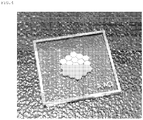
- the micro-pattern may have a honeycomb pattern as shown in FIG. 3 and FIG. 4 .
- the size of the micro-pattern may be such that an average diameter or the radius of a circumscribed circle is from 1 ⁇ m to 20 ⁇ m.
- the average diameter, or in case where the micro-pattern is a polygonal shape the radius of a circumscribed circle may be from 1 ⁇ m to 20 ⁇ m.
- the average spacing of the micro-pattern may be from 3 ⁇ m to 5 ⁇ m.
- the metal layer may include any one selected from the group consisting of copper (Cu), silver (Ag), gold (Au), palladium (Pd), platinum (Pt), rhodium (Rh) and combinations thereof (for example, bimetallic nanoparticles).
- gold (Au) which has excellent bonding properties with an N-heterocyclic carbene compound and stability, may be included.
- the method of coating the micro-patterned metal layer on one side of the transparent matrix may use any coating or deposition technique without limitation, and the transparent matrix may be formed into a uniform thickness by a method of chemical vapor deposition (CVD), physical vapor deposition (PVD), thermal evaporation deposition, sputtering deposition or atomic layer deposition (ALD).
- CVD chemical vapor deposition
- PVD physical vapor deposition
- ALD atomic layer deposition
- any methods may be used as long as it is patterning technique, and among the methods, double exposure lithography, nano imprint lithography (NIL), electron beam lithography (EBL), focused ion beam (FIB), soft lithography (SL), self-assembly of block copolymers, etc., may be used for patterning the metal layer.
- NIL nano imprint lithography
- EBL electron beam lithography
- FIB focused ion beam
- SL soft lithography
- self-assembly of block copolymers, etc. may be used for patterning the metal layer.
- the micro-patterning into a more uniform and clearer shape may be achieved through patterning by the double exposure lithography rather than the conventional single exposure lithography.
- the patterning of the micro-pattern with the spacing of from 3 ⁇ m to 5 ⁇ m is difficult by the single exposure lithography, but the patterning of the micro-pattern with the spacing of from 3 ⁇ m to 5 ⁇ m is possible by the double exposure lithography.
- the thickness of the micro-patterned metal layer may be from 10 nm to 200 nm. If the thickness of the micro-patterned metal layer is greater than the range, there are problems in that the metal layer may be damaged during the step of immobilizing a linker, or a linker may be non-uniformly formed.
- an N-heterocyclic carbene compound may be used as a linker for immobilizing the primer on the surface of the micro-patterned metal layer.
- the N-heterocyclic carbene compound may be introduced onto the surface of the micro-patterned metal layer through a metal-carbene bond.
- the N-heterocyclic carbene compound may be represented by Chemical Formula 1 or 2 below.
- R1, R2, R5 and R6 are the same or different, and are each independently hydrogen, an alkyl group of 1 to 20 carbon atoms, a cycloalkyl group of 3 to 20 carbon atoms, an aryl group of 6 to 30 carbon atoms or a heteroaryl group of 2 to 30 carbon atoms
- R3, R4, R7, R8, R9 and R10 are the same or different, and are each independently hydrogen, an alkyl group of 1 to 20 carbon atoms, a cycloalkyl group of 3 to 20 carbon atoms, an aryl group of 6 to 30 carbon atoms, a heteroaryl group of 2 to 30 carbon atoms or a structure represented by Chemical Formula 3 below, where adjacent two or more substituents among R7 to R10 are bonded to form a hydrocarbon ring, at least one of R3 and R4 is the structure represented by Chemical Formula 3 below, and at least one of R7 to R10 is substituted with the structure represented by Chemical Formula 3 below, or
- R1, R2, R5 and R6 may be the same or different, and may be each independently hydrogen, an alkyl group of 1 to 20 carbon atoms or an aryl group of 6 to 30 carbon atoms.
- R1, R2, R5 and R6 may be the same or different, and may be each independently hydrogen, an alkyl group of 1 to 10 carbon atoms or an aryl group of 6 to 10 carbon atoms.
- R1, R2, R5 and R6 may be the same or different, and may be each independently hydrogen or an alkyl group of 1 to 10 carbon atoms.
- R1, R2, R5 and R6 may be the same or different, and may be each independently hydrogen, isopropyl or benzyl.
- At least one of R1 and R2 and at least one of R5 and R6 may be the same or different, and may be each independently an alkyl group of 1 to 20 carbon atoms or an aryl group of 6 to 30 carbon atoms.
- At least one of R1 and R2 and at least one of R5 and R6 may be the same or different, and may be each independently isopropyl or benzyl.
- R3, R4, R7, R8, R9 and R10 may be the same or different, and may be each independently hydrogen, an alkyl group of 1 to 20 carbon atoms, a cycloalkyl group of 3 to 20 carbon atoms, an aryl group of 6 to 30 carbon atoms, a heteroaryl group of 2 to 30 carbon atoms or the structure represented by Chemical Formula 3, or two or more adjacent substituents among R7 to R10 may be bonded to form a hydrocarbon ring.
- R3, R4, R7, R8, R9 and R10 may be the same or different, and may be each independently hydrogen or the structure represented by Chemical Formula 3, or two or more adjacent substituents among R7 to R10 may be bonded to form a hydrocarbon ring.
- At least one carbon forming the hydrocarbon ring may be substituted with the structure represented by Chemical Formula 3.
- At least one of R3 and R4 may be the structure represented by Chemical Formula 3.
- at least one of R7 to R10 may be the structure represented by Chemical Formula 3.
- n is a repeating number of the unit in parenthesis and may be an integer of 1 to 30, preferably, 1 to 10. More preferably, 1 to 3.
- the A is a nitrogen (N)-containing alkyl group of 1 to 20 carbon atoms, or a nitrogen (N)-containing heteroaryl group of 2 to 30 carbon atoms.
- A may be azide, phthalimide, or amine.
- an "adjacent" group may mean a substituent directly coupled with an element at which a corresponding substituent is substituted, a sterically most nearly positioned substituent to the corresponding substituent, or another substituent substituted at an element at which the corresponding substituent is substituted.
- two substituents substituted at ortho position in a benzene ring, and two substituents substituted at the same carbon in an aliphatic ring may be interpreted as the "adjacent" group.
- the alkyl group may be a linear chain or a branched chain, and the carbon number may be 1 to 20, preferably, 1 to 10. More preferably, the carbon number may be 1 to 6.
- Particular examples of the alkyl group may include methyl, ethyl, propyl, n-propyl, isopropyl, butyl, n-butyl, isobutyl, tert-butyl, sec-butyl, 1-methylbutyl, 1-ethylbutyl, pentyl, n-pentyl, isopentyl, neopentyl, tert-pentyl, hexyl, n-hexyl, 1-methylpentyl, 2-methylpentyl, 4-methyl-2-pentyl, 3,3-dimethyl butyl, 2-ethylbutyl, heptyl, n-heptyl, 1-methylhexyl, cyclopentylmethyl, cyclo
- the cycloalkyl group may have 3 to 20 carbon atoms, preferably, 3 to 10 carbon atoms.
- Particular examples of the cycloalkyl group may include cyclopropyl, cyclobutyl, cyclopentyl, 3-methylcyclopentyl, 2,3-dimethylcyclopentyl, cyclohexyl, 3-methylcyclohexyl, 4-methylcyclohexyl, 2,3-dimethylcyclohexyl, 3,4,5-trimethylcyclohexyl, 4-tert-butylcyclohexyl, cycloheptyl, cyclooctyl, etc., but is not limited thereto.
- the aryl group may have 6 to 30 carbon atoms, preferably, 6 to 10 carbon atoms.
- the aryl group may be a monocyclic aryl group or a polycyclic aryl group.
- Particular examples of the monocyclic aryl group may include a phenyl group, a biphenyl group, a terphenyl group, etc.
- particular examples of the polycyclic aryl group may include a naphthyl group, an anthracenyl group, a phenanthryl group, a pyrenyl group, a perylenyl group, a chrysenyl group, a fluorenyl group, a triphenylene group, etc., but is not limited thereto.
- the heteroaryl group is an aromatic ring group including one or more selected from N, O, P, S, Si and Se as heteroatoms, and the carbon number may be 2 to 30, preferably, 2 to 20.
- Particular examples of the heteroaryl group may include a thiophene group, a furan group, a pyrrole group, an imidazole group, a thiazole group, an oxazole group, an oxadiazole group, a triazole group, a pyridyl group, a pyrimidyl group, a triazine group, a triazole group, an acridyl group, a quinolinyl group, a quinazoline group, a quinoxalinyl group, a phthalazinyl group, an isoquinoline group, an indole group, a carbazole group, a benzoxazole group, a benzimidazole group, a benzothiazole group,
- alkyl group, the cycloalkyl group, the aryl group, the heteroaryl group or the hydrocarbon ring may be further substituted or unsubstituted with an alkyl group, a cycloalkyl group, an aryl group or a heteroaryl group.
- a metal-carbene bond may be formed by a method of chemical vapor deposition (CVD), physical vapor deposition (PVD), thermal evaporation deposition, sputtering deposition, atomic layer deposition (ALD) or chemical-bath deposition (CBD).
- CVD chemical vapor deposition
- PVD physical vapor deposition
- PVD physical vapor deposition
- CVD chemical vapor deposition
- ALD atomic layer deposition
- CBD chemical-bath deposition
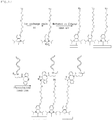
- FIG. 16 a series of mechanism of bonding one end of the N-heterocyclic carbene compound on the surface of the micro-patterned metal layer by a chemical vapor deposition method is shown in FIG. 16
- FIG. 17 a series of mechanism of bonding one end of the N-heterocyclic carbene compound on the surface of the micro-patterned metal layer by a chemical-bath deposition method is shown in FIG. 17 .
- a primer may be bonded and immobilized.
- the other end of the N-heterocyclic carbene compound may be functionalized with azide, phthalimide, or amine.
- a primer may be bonded to the azide, phthalimide, or amine using click reaction as shown in FIGS. 16 and 17 . Accordingly, in contrast to the general bonding of the primer with the micro-patterned metal layer by an electrostatic attraction, the primer may be immobilized onto the micro-patterned metal layer through a stronger chemical bond, and if used in the PCR reaction of a solid phase of high temperature, effects of excellent stability, and improved storability and ease of storage may be achieved.
- the primer may be a primer of at least one type.
- the primer of at least one type may mean any one selected from primers which may make complementary bond with different amplification target template DNA (or RNA).
- the primer may be a primer of two or more different types.
- the primer is the primer of two or more different types, any one among a pair of primers which may make complementary bond with a first template DNA (or RNA) to be amplified, and any one among a pair of primers which may make complementary bond with a second template DNA (or RNA) to be amplified.
- the first template DNA (or RNA) and the second template DNA (or RNA) may mean DNA (or RNA) having different base sequences.
- the present invention also provides a method for manufacturing a substrate for nucleic acid amplification, including: forming a micro-patterned metal layer on a transparent matrix; introducing one end of an N-heterocyclic carbene compound onto the surface of the micro-patterned metal layer; and immobilizing a primer on the other end of the N-heterocyclic carbene compound.
- FIG. 1 is a diagram schematically showing a series of a process of light-based PCR reaction using the substrate for nucleic acid amplification of the present invention.
- the schematic explanation on a process for performing the light energy-based PCR reaction using the substrate for nucleic acid amplification of the present invention is as follows, but the PCR reaction is not limited only to the method described below.
- a PCR specimen including amplification target template DNA, dNTP, Taq polymerase, etc. is prepared.
- Two types of primers (forward primer, reverse primer) making complementary bond with the template DNA are prepared.
- a portion of the forward primer is immobilized by bonding with the end of the transparent matrix/micro-patterned metal layer/N-heterocyclic carbene compound linker, which is the substrate for nucleic acid amplification of the present invention, and the remaining forward primer and reverse primer are included in the PCR reaction specimen.
- light energy is irradiated by a light source (LED, etc.) positioned under the transparent matrix, and PCR reaction is performed.
- LED light source
- the N-heterocyclic carbene compound is attached onto the surface (solid phase) of the micro-patterned metal layer as a linker, and then the primer is immobilized, and accordingly, stability at high temperature is better in contrast to a linker by the bonding of the metal and thiol (-SH), and thus, the application to a PCR machine using thermal energy converted from light energy is possible, prompt temperature control of the micro-patterned metal layer by the irradiation of light energy is possible due to the above-described vortex phenomenon, and the PCR reaction may be completed within a very short time with about 8 minutes to 10 minutes for performing 40 cycles for the PCR reaction.
- the primer of at least one type (or a primer of different two types)
- different from PCR which is performed only in a liquid phase the substrate for nucleic acid amplification may be easily recovered after the PCR reaction, and the storage of the primer is easy, and the regeneration thereof is possible.
- N-heterocyclic carbene compound 1 was prepared.
- N-heterocyclic carbene compound 2 was prepared.
- FIG. 8 the 1 H-NMR spectrum of N-heterocyclic carbene compound 2 is shown.
- N-heterocyclic carbene compound 3 was prepared.
- N-heterocyclic carbene compound 4 was prepared.
- N-heterocyclic carbene compound 5 was prepared.
- a lung cancer cell line As template DNA, a lung cancer cell line, cDNA of A549 was used, and a PCR reactant of a liquid phase including dNTP, Taq polymerase, a reverse primer below and a forward primer below was prepared.
- a micro-patterned gold (Au) layer into a honeycomb pattern as shown in FIG. 3 and FIG. 4 was prepared.
- N-heterocyclic carbene compound 4 prepared in Preparation Example 4 a forward primer below was immobilized on the surface of a micro-patterned gold (Au) layer.
- the substrate on which the forward primer was immobilized was put in a PCR reactant of a liquid phase, which included a relatively small amount of the forward primer, and by using the machine of FIG. 2 , PCR reaction of 40 cycles was performed. The time required for performing 40 cycles of the PCR reaction is shown in FIG.
- Example 1 PCR reaction was performed by the same method in Example 1 except for using a mutated lung cancer cell line, cDNA of NCI-H-1975 instead of the lung cancer cell line, cDNA of A549, as the template DNA.
- Example 1 PCR reaction was performed by the same method in Example 1 except for using a hexahedral glass matrix as in FIG. 18 and FIG. 19 instead of the planar type glass matrix.
- the time required for performing 40 cycles of the PCR reaction is shown in FIG. 20 .
- PCR reaction was performed by the same method in Example 1 except for performing the PCR reaction without the template DNA.
- Example 3 which used the hexahedral glass matrix, a sufficient PCR product was produced within about 8 to 9 minutes, and the generation of fluorescence was confirmed.
Landscapes
- Chemical & Material Sciences (AREA)
- Organic Chemistry (AREA)
- Health & Medical Sciences (AREA)
- Life Sciences & Earth Sciences (AREA)
- Chemical Kinetics & Catalysis (AREA)
- General Health & Medical Sciences (AREA)
- Biochemistry (AREA)
- Molecular Biology (AREA)
- Clinical Laboratory Science (AREA)
- Wood Science & Technology (AREA)
- Engineering & Computer Science (AREA)
- Zoology (AREA)
- Proteomics, Peptides & Aminoacids (AREA)
- Bioinformatics & Cheminformatics (AREA)
- Biotechnology (AREA)
- Immunology (AREA)
- Microbiology (AREA)
- General Engineering & Computer Science (AREA)
- Physics & Mathematics (AREA)
- Genetics & Genomics (AREA)
- Analytical Chemistry (AREA)
- Biophysics (AREA)
- Measuring Or Testing Involving Enzymes Or Micro-Organisms (AREA)
- Apparatus Associated With Microorganisms And Enzymes (AREA)
Abstract
Description
- The present invention relates to a substrate for nucleic acid amplification, and a method for manufacturing same.
- A polymerase chain reaction (PCR) method is technique allowing amplification of a specific region of DNA or RNA to a large amount in vitro. A PCR machine using such technique is used for the amplification of a small amount of DNA included in blood in hospitals, research centers, etc., and the PCR machine is also used for diagnosing various diseases including malaria, tuberculosis, hepatitis, etc.
- PCR is conducted through one cycle of three steps including denaturation, annealing and elongation, and the rapid rise and drop of temperature in line with the temperature suitable for each step is very important for reducing PCR reaction time. That is, PCR requires the instant shift of the temperature in line with the temperature set for each step, but if time delay is generated during the process for changing the temperature to the preset temperature, a reaction rate is degraded, total PCR reaction time increases, and there are problems of arising unnecessary reactions to produce by-products. Particularly, the decrease of the PCR time enables prompt diagnosis on the spot of infectious diseases which are recently spread rapidly, and plays an important role of serving early disinfection.
- However, the conventionally used PCR machine uses electrical energy as a thermal energy source, and a long time of about 1 hour or more is required for completing nucleic acid amplification reaction, and since accessories including a heating instrument and a heat sink are necessary, there are problems of inconvenience in that the apparatuses occupy much space. Accordingly, the application on the spot requiring the prompt diagnosis of diseases is a little bit inconvenient. In addition, Korean Laid-open Patent Publication No.
2017-0106995 - Therefore, research on PCR for stable, rapid and precise diagnosis irrespective of high temperature and rapid change of the temperature, is steadily being conducted.
- (Patent Document 1) Korean Laid-open Patent Publication No.
2017-0106995 - The present invention has been devised to solve the above-described problems and provides a substrate for nucleic acid amplification serving stable at high temperature and rapid multiple PCR reactions by immobilizing a primer on the surface of a micro-patterned metal layer using an N-heterocyclic carbene compound as a linker, while amplifying nucleic acid using thermal energy generated by irradiating light energy. Further, according to the micro-patterning of the metal layer, PCR reaction with even quicker and even higher accuracy may be performed.
- The present invention provides a substrate for nucleic acid amplification including a transparent matrix, a micro-patterned metal layer formed on the transparent matrix, an N-heterocyclic carbene compound having one end bonded to the surface of the micro-patterned metal layer and a primer immobilized on the other end of the N-heterocyclic carbene compound.
- In addition, the present invention provides a method for manufacturing a substrate for nucleic acid amplification, including forming a micro-patterned metal layer on a transparent matrix, introducing one end of an N-heterocyclic carbene compound onto the surface of the micro-patterned metal layer, and immobilizing a primer on the other end of the N-heterocyclic carbene compound.
- In case of using the substrate for nucleic acid amplification of the present invention in polymerase chain reaction (PCR), by immobilizing a primer after annealing an N-heterocyclic carbene compound on the surface (solid phase) of a micro-patterned metal layer, PCR reaction may be more stable at high temperature and completed in a very short time when compared with a case of using a linker by the bond between a metal and thiol (-SH).
- In addition, according to the micro-patterning of the metal layer, and according to vortex phenomenon by heat transfer generated by the temperature difference between micro-patterned parts and non-micro-patterned parts, the temperature control of the micro-patterned metal layer may be achieved even faster, and thus, PCR reaction time may be further reduced.
- Further, according to the PCR reaction on a solid phase (transparent matrix/micro-patterned metal layer), the recovery of a primer after the PCR reaction is easy, and various types of primers could be immobilized on the N-heterocyclic carbene compound at the surface of each micro-patterned metal layer, and thus, the simultaneous amplification of diverse nucleic acids is possible, and there are advantages of performing multiple PCR reactions and finally, serving more precise diagnosis.
-
-
FIG. 1 is a diagram schematically showing a series of light-based PCR reaction using the substrate for nucleic acid amplification of the present invention. -
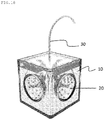
FIG. 2 is a diagram schematically showing a light-based PCR machine on a solid phase using the substrate for nucleic acid amplification of the present invention. -
FIG. 3 is a diagram showing a honeycomb pattern according to an embodiment of the present invention. -
FIG. 4 is a diagram showing a micro-patterned gold (Au) layer formed into a honeycomb pattern on a transparent matrix included in the substrate for nucleic acid amplification of the present invention. -
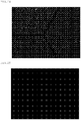
FIG. 5(A) shows an exposed pattern of a photoresist by a double exposure lithography method according to an embodiment of the present invention, andFIG. 5(B) is shows an exposed pattern of a photoresist by a double exposure lithography method after depositing a gold (Au) layer. -
FIG. 6 shows an exposed pattern of a photoresist by the conventional single exposure lithography method. -
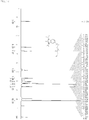
FIG. 7 is a diagram showing 1H-NMR spectrum of N-heterocyclic carbene compound 1 prepared according to Preparation Example 1 of the present invention. -
FIG. 8 is a diagram showing 1H-NMR spectrum of N-heterocyclic carbene compound 2 prepared according to Preparation Example 2 of the present invention. -
FIG. 9 is a diagram showing 1H-NMR spectrum of N-heterocyclic carbene compound 3 prepared according to Preparation Example 3 of the present invention. -
FIG. 10 is a diagram showing 1H-NMR spectrum of N-heterocyclic carbene compound 4 prepared according to Preparation Example 4 of the present invention. -
FIG. 11 is a diagram showing 1H-NMR spectrum of N-heterocyclic carbene compound 5 prepared according to Preparation Example 5 of the present invention. -
FIG. 12 is a diagram showing time required for performing 40 cycles of PCR reaction according to Examples 1 and 2 of the present invention. -
FIG. 13 is a diagram showing vortex phenomenon according to heat transfer at the surface of the micro-patterned gold (Au) layer according to an embodiment of the present invention. -
FIG. 14 is a diagram showing temperature distribution at the surface of the micro-patterned gold (Au) layer according to an embodiment of the present invention. -
FIG. 15 is a diagram showing XPS elemental analysis results of a gold (Au) layer on which N-heterocyclic carbene compound 4 bonded according to Example 1 of the present invention. -
FIG. 16 is a diagram schematically showing a series of processes for immobilizing a primer on a gold (Au) layer using N-heterocyclic carbene compound 4 according to the present invention. -
FIG. 17 is a diagram schematically showing a series of processes for immobilizing a primer on a gold (Au) layer using N-heterocyclic carbene compound 4 of the present invention. -
FIG. 18 is a diagram showing a transparent matrix and a metal layer formed on the transparent matrix according to an embodiment of the present invention. -
FIG. 19 is a diagram showing a transparent matrix and a metal layer formed on the transparent matrix according to an embodiment of the present invention. -
FIG. 20 is a diagram showing time required for performing 40 cycles of PCR reaction according to Example 3 of the present invention. -
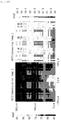
FIG. 21 is a diagram showing observed results using a fluorescence microscope according to the Experimental Example of the present invention. -
FIG. 22 is a diagram showing detection results using a fluorescence material after performing PCR reaction according to Example 1 of the present invention. -
FIG. 23 is a diagram showing detection results using a fluorescence material after performing PCR reaction according to Example 2 of the present invention. -
FIG. 24 is a diagram showing detection results using a fluorescence material after performing PCR reaction according to Example 3 of the present invention. -
FIG. 25 is a diagram showing detection results using a fluorescence material after performing PCR reaction according to Comparative Example 1 of the present invention. -
FIG. 26 is a diagram showing a transparent matrix including a gold mesh according to an embodiment of the present invention. -
FIG. 27 is a diagram showing time required for performing 40 cycles of PCR reaction in case of including a metal mesh as inFIG. 26 . -
FIG. 28 is a diagram showing electrophoretic results confirming the completion of PCR reaction after performing PCR reaction according to Example 1 of the present invention. -
- 10: transparent matrix
- 20: metal layer
- 30: thermocouple
- Hereinafter, the present invention will be explained in detail.
- The present invention provides a substrate for nucleic acid amplification including: a transparent matrix; a micro-patterned metal layer formed on the transparent matrix; an N-heterocyclic carbene compound having one end bonded to the surface of the micro-patterned metal layer; and a primer immobilized on the other end of the N-heterocyclic carbene compound.
- The substrate for nucleic acid amplification may be used in polymerase chain reaction (PCR) which is molecular biological technique for duplicating and amplifying a desired segment of DNA or RNA.
- The first step of PCR is a step for denaturing DNA (or RNA). Two strands of DNA may be separated by heating, and each separated DNA plays the role of a template. The denaturation temperature is generally 90°C to 96°C, but is changed according to the amount of bases G+C in DNA and the length of DNA. The second step of PCR is a step of annealing. In this step, two types of primers are annealed to each complementary template DNA. The annealing temperature is an important factor for determining the accuracy of reaction, and if the temperature is too high, the primer may be annealed on DNA too weakly, and the product of amplified DNA may be very small. If the temperature is too low, the primer may be non-specifically annealed, and undesired DNA may be amplified. General annealing temperature is 50°C to 65°C. The third step of PCR is a step of elongation. In this step, DNA polymerase resistant to heat produces new DNA in template DNA. In this case, the elongation temperature is 70°C to 75°C. As described above, there are a series of three steps in the PCR reaction, and if the three steps are set to 1 cycle, the PCR reaction is performed by about 30 to 40 cycles.
- The substrate for nucleic acid amplification may be used in light-based PCR using thermal energy produced by the irradiation of light energy during the above-described PCR.
- The light-based PCR may use plasmonic photothermal conversion by the interaction of photons, electrons and phonons at the surface of a metal. Particularly, if photons reach the surface of a metal layer from an excited energy source, light-absorption occurs, and electrons around the surface are excited to a higher state to form electrons of high temperature. According to the rapid diffusion and uniform distribution of such electrons of high temperature to the whole metal layer, a metal layer of high temperature may heat surrounding solutions. In addition, the electrons of high temperature may be cooled again by energy exchange with lattice phonons.
- The temperature of the metal layer in which plasmons are excited as described above may be elevated to maximum 500°C, and a PCR specimen solution around the metal layer may be heated to 150°C or more in a short time.
- The transparent matrix may be manufactured so that light irradiated from a light source positioned under a counter surface to the micro-patterned metal layer formed is transferred to the micro-patterned metal layer without loss, and adhesiveness with the micro-patterned metal layer is excellent.
- The light source is not limited only if generating ultraviolet rays, visible rays or infrared rays, and may use a halogen lamp, an LED lamp, a fluorescent lamp, an incandescent lamp, an arc source lamp, an infrared lamp, an HMI lamp, a UV lamp, etc., preferably, an LED lamp considering power efficiency and economic feasibility.
- The transparent matrix may be formed using a transparent material so as to transmit light irradiated, and may be formed using a material which is hardly deformed by light or heat. Preferably, a glass matrix, a plastic matrix, a silicon matrix, etc., may be used, but is not limited thereto.
- The transparent matrix has a constant thickness, and the thickness of the transparent matrix may be from 0.1 mm to 10 mm, preferably, from 0.5 mm to 5 mm, more preferably, from 0.5 mm to 1.5 mm. If the thickness of the transparent matrix satisfies the above-described range, thermal energy by light energy irradiated from a light source may be efficiently transferred, and a PCR reaction cycle may be optimized.
- The transparent matrix may include a two-dimensional matrix of a planar type; a three-dimensional matrix selected from a spherical type, a hemispherical type, a polyhedral type, a polyprism type, or a cylindrical type; or a mixture type thereof. For example, as in
FIG. 18 andFIG. 19 , the transparent matrix may include a matrix of a mixture type of a three-dimensional matrix in which at least one partial surface of the polyhedral type matrix includes a hemispherical type matrix. - In case where the transparent matrix includes the three-dimensional matrix as described above, PCR reaction may be performed at many faces, and there are advantages in that diverse nucleic acids may be amplified simultaneously, and multiple diagnosis may be possible.
- The substrate for nucleic acid amplification may utilize a micro-patterned metal layer for utilizing thermal energy by the irradiation of light energy. In case of using the micro-patterned metal layer, the temperature may be instantly elevated to maximum 500°C, and the temperature change in the temperature range (from about 50°C to 95°C) of the PCR cycle may be promptly conducted.
- The metal layer may include a metal thin film.
- The metal layer may further include a metal mesh. In case where the metal layer further includes a metal mesh, the metal mesh may be formed first on the transparent matrix, and then the metal layer may be formed on the metal mesh. In case where the metal layer further includes the metal mesh, prompt heating and cooling may be possible when compared with a case of using only a metal layer, the temperature change of a PCR cycle may be promptly conducted, and more efficient PCR reaction may be performed.
- As in
FIG. 26 , if a metal mesh is provided, the temperature change in the temperature range (from about 50°C to 95°C) of the PCR cycle may be promptly conducted, and as inFIG. 27 , it could be confirmed that the time required for performing 40 cycles of the PCR reaction is significantly short and about 7 minutes. - In case where the metal layer is formed on the transparent matrix, the metal layer may be formed on at least one face of the transparent matrix. In this case, the metal layer may be formed on the whole face of the at least one face of the transparent matrix, or may be partially formed on the at least one face of the transparent matrix. That is, on the transparent matrix, one metal layer may be formed, or multiple metal layers may be formed.
- The metal mesh may have a two-dimensional or three-dimensional structure, and in this case, the mesh may include a polygonal pattern including a triangle, a tetragon, a pentagon and hexagon, or a circular pattern, but is not limited thereto.
- In case where the mesh includes a polygonal pattern, the length of one side of the mesh may be from 50 to 200 µm, and in case where the mesh includes a circular pattern, the diameter of the mesh may be from 50 to 200 µm. In addition, the spacing of the mesh may be from 1 to 5 µm, particularly, 1 to 2 µm. The thickness of the metal mesh may be from 10 nm to 200 nm, particularly, from 100 to 200 nm. In case where the thickness of the metal mesh and the size of the mesh satisfy the above-described ranges, prompt heating and cooling may become possible, and the temperature change of the PCR cycle may be promptly conducted when compared with a case of using only a metal layer.
- Particularly, in case of micro-patterning the metal layer, the temperature of the micro-patterned part may be rapidly elevated, and the temperature between non-patterned parts in the pattern may be relatively lowered, and vortex phenomenon may be generated due to a temperature difference. In this case, according to the spacing of the micro-pattern, the size and shape of the pattern, the degree of vortex phenomenon due to heat transfer is determined. The vortex phenomenon according to the heat transfer generated at the surface of the micro-patterned gold (Au) layer according to an embodiment of the present invention is shown in
FIG. 13 . - The micro-pattern may have a circle or a polygonal shape such as a triangle, a tetragon, a pentagon and hexagon. Preferably, the micro-pattern may have a honeycomb pattern as shown in
FIG. 3 andFIG. 4 . - The size of the micro-pattern may be such that an average diameter or the radius of a circumscribed circle is from 1 µm to 20 µm. For example, in case where the micro-pattern is a circle, the average diameter, or in case where the micro-pattern is a polygonal shape, the radius of a circumscribed circle may be from 1 µm to 20 µm.
- The average spacing of the micro-pattern may be from 3 µm to 5 µm.
- The metal layer may include any one selected from the group consisting of copper (Cu), silver (Ag), gold (Au), palladium (Pd), platinum (Pt), rhodium (Rh) and combinations thereof (for example, bimetallic nanoparticles). Preferably, gold (Au) which has excellent bonding properties with an N-heterocyclic carbene compound and stability, may be included.
- The method of coating the micro-patterned metal layer on one side of the transparent matrix may use any coating or deposition technique without limitation, and the transparent matrix may be formed into a uniform thickness by a method of chemical vapor deposition (CVD), physical vapor deposition (PVD), thermal evaporation deposition, sputtering deposition or atomic layer deposition (ALD).
- As a method for micro-patterning the metal layer, any methods may be used as long as it is patterning technique, and among the methods, double exposure lithography, nano imprint lithography (NIL), electron beam lithography (EBL), focused ion beam (FIB), soft lithography (SL), self-assembly of block copolymers, etc., may be used for patterning the metal layer.
- Preferably, the micro-patterning into a more uniform and clearer shape may be achieved through patterning by the double exposure lithography rather than the conventional single exposure lithography. In addition, as shown in
FIG. 5 andFIG. 6 , the patterning of the micro-pattern with the spacing of from 3 µm to 5 µm is difficult by the single exposure lithography, but the patterning of the micro-pattern with the spacing of from 3 µm to 5 µm is possible by the double exposure lithography. - The thickness of the micro-patterned metal layer may be from 10 nm to 200 nm. If the thickness of the micro-patterned metal layer is greater than the range, there are problems in that the metal layer may be damaged during the step of immobilizing a linker, or a linker may be non-uniformly formed.
- As a linker for immobilizing the primer on the surface of the micro-patterned metal layer, an N-heterocyclic carbene compound may be used. The N-heterocyclic carbene compound may be introduced onto the surface of the micro-patterned metal layer through a metal-carbene bond.
- Particularly, in case of a linker having a thiol (-SH) group used in the conventional solid phase PCR, there are problems of degrading the reproducibility of PCR reaction results due to the unstability (cleaving of a metal-sulfur bond) of a metal-sulfur bond at high temperature (about 90°C). In contrast, in case of using the N-heterocyclic carbene compound as a linker for immobilizing the primer onto the micro-patterned metal layer, though the surface temperature of the micro-patterned metal layer temporarily rises to maximum 500°C by a light source, stability at high temperature may be achieved due to a metal-carbene bond, and the application thereof to a PCR machine using light energy is possible.
- The N-heterocyclic carbene compound may be represented by
Chemical Formula 

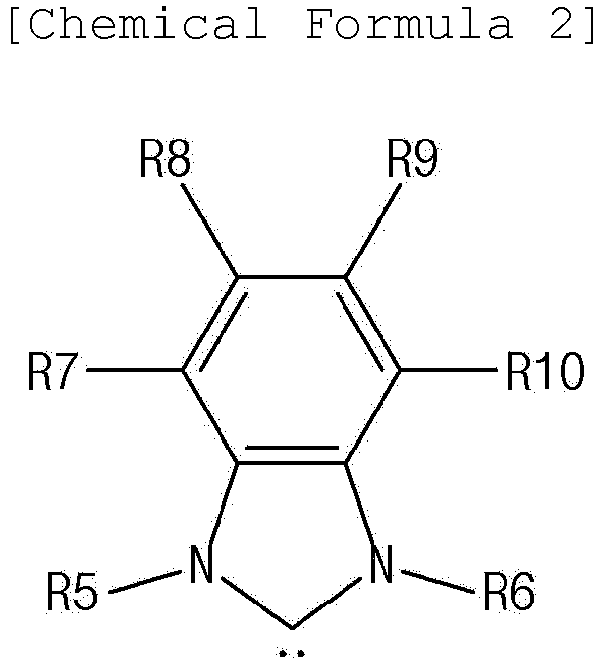
- In
Chemical Formulae
R1, R2, R5 and R6 are the same or different, and are each independently hydrogen, an alkyl group of 1 to 20 carbon atoms, a cycloalkyl group of 3 to 20 carbon atoms, an aryl group of 6 to 30 carbon atoms or a heteroaryl group of 2 to 30 carbon atoms,
R3, R4, R7, R8, R9 and R10 are the same or different, and are each independently hydrogen, an alkyl group of 1 to 20 carbon atoms, a cycloalkyl group of 3 to 20 carbon atoms, an aryl group of 6 to 30 carbon atoms, a heteroaryl group of 2 to 30 carbon atoms or a structure represented byChemical Formula 3 below, where adjacent two or more substituents among R7 to R10 are bonded to form a hydrocarbon ring,
at least one of R3 and R4 is the structure represented byChemical Formula 3 below, and
at least one of R7 to R10 is substituted with the structure represented byChemical Formula 3 below, or in case where adjacent two or more substituents among R7 to R10 are bonded to form a hydrocarbon ring, at least one of carbon atoms forming the hydrocarbon ring is substituted with the structure represented byChemical Formula 3 below,
Chemical Formula 3, - n is a repeating number of a unit in parenthesis and an integer of 1 to 30, and
- A is a nitrogen (N)-containing alkyl group of 1 to 20 carbon atoms or a nitrogen (N)-containing heteroaryl group of 2 to 30 carbon atoms.
- R1, R2, R5 and R6 may be the same or different, and may be each independently hydrogen, an alkyl group of 1 to 20 carbon atoms or an aryl group of 6 to 30 carbon atoms.
- R1, R2, R5 and R6 may be the same or different, and may be each independently hydrogen, an alkyl group of 1 to 10 carbon atoms or an aryl group of 6 to 10 carbon atoms.
- R1, R2, R5 and R6 may be the same or different, and may be each independently hydrogen or an alkyl group of 1 to 10 carbon atoms.
- R1, R2, R5 and R6 may be the same or different, and may be each independently hydrogen, isopropyl or benzyl.
- At least one of R1 and R2 and at least one of R5 and R6 may be the same or different, and may be each independently an alkyl group of 1 to 20 carbon atoms or an aryl group of 6 to 30 carbon atoms.
- At least one of R1 and R2 and at least one of R5 and R6 may be the same or different, and may be each independently isopropyl or benzyl.
- R3, R4, R7, R8, R9 and R10 may be the same or different, and may be each independently hydrogen, an alkyl group of 1 to 20 carbon atoms, a cycloalkyl group of 3 to 20 carbon atoms, an aryl group of 6 to 30 carbon atoms, a heteroaryl group of 2 to 30 carbon atoms or the structure represented by
Chemical Formula 3, or two or more adjacent substituents among R7 to R10 may be bonded to form a hydrocarbon ring. - R3, R4, R7, R8, R9 and R10 may be the same or different, and may be each independently hydrogen or the structure represented by
Chemical Formula 3, or two or more adjacent substituents among R7 to R10 may be bonded to form a hydrocarbon ring. - In case where two or more adjacent substituents among R7 to R10 are bonded to form a hydrocarbon ring, at least one carbon forming the hydrocarbon ring may be substituted with the structure represented by
Chemical Formula 3. - At least one of R3 and R4 may be the structure represented by
Chemical Formula 3. In addition, at least one of R7 to R10 may be the structure represented byChemical Formula 3. - The n is a repeating number of the unit in parenthesis and may be an integer of 1 to 30, preferably, 1 to 10. More preferably, 1 to 3.
- The A is a nitrogen (N)-containing alkyl group of 1 to 20 carbon atoms, or a nitrogen (N)-containing heteroaryl group of 2 to 30 carbon atoms. Particularly, A may be azide, phthalimide, or amine.
- In the present invention, an "adjacent" group may mean a substituent directly coupled with an element at which a corresponding substituent is substituted, a sterically most nearly positioned substituent to the corresponding substituent, or another substituent substituted at an element at which the corresponding substituent is substituted. For example, two substituents substituted at ortho position in a benzene ring, and two substituents substituted at the same carbon in an aliphatic ring may be interpreted as the "adjacent" group.
- The alkyl group may be a linear chain or a branched chain, and the carbon number may be 1 to 20, preferably, 1 to 10. More preferably, the carbon number may be 1 to 6. Particular examples of the alkyl group may include methyl, ethyl, propyl, n-propyl, isopropyl, butyl, n-butyl, isobutyl, tert-butyl, sec-butyl, 1-methylbutyl, 1-ethylbutyl, pentyl, n-pentyl, isopentyl, neopentyl, tert-pentyl, hexyl, n-hexyl, 1-methylpentyl, 2-methylpentyl, 4-methyl-2-pentyl, 3,3-dimethyl butyl, 2-ethylbutyl, heptyl, n-heptyl, 1-methylhexyl, cyclopentylmethyl, cyclohexylmethyl, octyl, n-octyl, tert-octyl, 1-methylheptyl, 2-ethylhexyl, 2-propylpentyl, n-nonyl, 2,2-dimethylheptyl, 1-ethylpropyl, 1,1-dimethylpropyl, isohexyl, 4-methylhexyl, 5-methylhexyl, benzyl, etc., but is not limited thereto.
- The cycloalkyl group may have 3 to 20 carbon atoms, preferably, 3 to 10 carbon atoms. Particular examples of the cycloalkyl group may include cyclopropyl, cyclobutyl, cyclopentyl, 3-methylcyclopentyl, 2,3-dimethylcyclopentyl, cyclohexyl, 3-methylcyclohexyl, 4-methylcyclohexyl, 2,3-dimethylcyclohexyl, 3,4,5-trimethylcyclohexyl, 4-tert-butylcyclohexyl, cycloheptyl, cyclooctyl, etc., but is not limited thereto.
- The aryl group may have 6 to 30 carbon atoms, preferably, 6 to 10 carbon atoms. The aryl group may be a monocyclic aryl group or a polycyclic aryl group. Particular examples of the monocyclic aryl group may include a phenyl group, a biphenyl group, a terphenyl group, etc., and particular examples of the polycyclic aryl group may include a naphthyl group, an anthracenyl group, a phenanthryl group, a pyrenyl group, a perylenyl group, a chrysenyl group, a fluorenyl group, a triphenylene group, etc., but is not limited thereto.
- The heteroaryl group is an aromatic ring group including one or more selected from N, O, P, S, Si and Se as heteroatoms, and the carbon number may be 2 to 30, preferably, 2 to 20. Particular examples of the heteroaryl group may include a thiophene group, a furan group, a pyrrole group, an imidazole group, a thiazole group, an oxazole group, an oxadiazole group, a triazole group, a pyridyl group, a pyrimidyl group, a triazine group, a triazole group, an acridyl group, a quinolinyl group, a quinazoline group, a quinoxalinyl group, a phthalazinyl group, an isoquinoline group, an indole group, a carbazole group, a benzoxazole group, a benzimidazole group, a benzothiazole group, a benzocarbazole group, a benzothiophene group, a dibenzothiophene group, a benzofuranyl group, etc., but is not limited thereto.
- In addition, the alkyl group, the cycloalkyl group, the aryl group, the heteroaryl group or the hydrocarbon ring may be further substituted or unsubstituted with an alkyl group, a cycloalkyl group, an aryl group or a heteroaryl group.
- On the surface of the micro-patterned metal layer, one end of the N-heterocyclic carbene compound may be bonded, an in this case, a metal-carbene bond may be formed by a method of chemical vapor deposition (CVD), physical vapor deposition (PVD), thermal evaporation deposition, sputtering deposition, atomic layer deposition (ALD) or chemical-bath deposition (CBD).
- According to an embodiment of the present invention, a series of mechanism of bonding one end of the N-heterocyclic carbene compound on the surface of the micro-patterned metal layer by a chemical vapor deposition method is shown in
FIG. 16 , and a series of mechanism of bonding one end of the N-heterocyclic carbene compound on the surface of the micro-patterned metal layer by a chemical-bath deposition method is shown inFIG. 17 . - At the other end of the N-heterocyclic carbene compound, a primer may be bonded and immobilized.
- The other end of the N-heterocyclic carbene compound may be functionalized with azide, phthalimide, or amine.
- If the other end of the N-heterocyclic carbene compound is functionalized with azide, phthalimide, or amine, a primer may be bonded to the azide, phthalimide, or amine using click reaction as shown in
FIGS. 16 and17 . Accordingly, in contrast to the general bonding of the primer with the micro-patterned metal layer by an electrostatic attraction, the primer may be immobilized onto the micro-patterned metal layer through a stronger chemical bond, and if used in the PCR reaction of a solid phase of high temperature, effects of excellent stability, and improved storability and ease of storage may be achieved. - The primer may be a primer of at least one type. The primer of at least one type may mean any one selected from primers which may make complementary bond with different amplification target template DNA (or RNA).
- The primer may be a primer of two or more different types. In case where the primer is the primer of two or more different types, any one among a pair of primers which may make complementary bond with a first template DNA (or RNA) to be amplified, and any one among a pair of primers which may make complementary bond with a second template DNA (or RNA) to be amplified. Here, the first template DNA (or RNA) and the second template DNA (or RNA) may mean DNA (or RNA) having different base sequences.
- As described above, by immobilizing a primer capable of elongating different template DNA (or RNA) onto the other end of the N-heterocyclic carbene compound which is bonded onto the surface of the micro-patterned metal layer, diverse DNA (or RNA) may be amplified at the same time, and the diagnosis by multiple PCR reactions may be possible in one chamber.
- The present invention also provides a method for manufacturing a substrate for nucleic acid amplification, including: forming a micro-patterned metal layer on a transparent matrix; introducing one end of an N-heterocyclic carbene compound onto the surface of the micro-patterned metal layer; and immobilizing a primer on the other end of the N-heterocyclic carbene compound.
-
FIG. 1 is a diagram schematically showing a series of a process of light-based PCR reaction using the substrate for nucleic acid amplification of the present invention. - The schematic explanation on a process for performing the light energy-based PCR reaction using the substrate for nucleic acid amplification of the present invention is as follows, but the PCR reaction is not limited only to the method described below.
- A PCR specimen including amplification target template DNA, dNTP, Taq polymerase, etc., is prepared. Two types of primers (forward primer, reverse primer) making complementary bond with the template DNA are prepared. A portion of the forward primer is immobilized by bonding with the end of the transparent matrix/micro-patterned metal layer/N-heterocyclic carbene compound linker, which is the substrate for nucleic acid amplification of the present invention, and the remaining forward primer and reverse primer are included in the PCR reaction specimen. Then, light energy is irradiated by a light source (LED, etc.) positioned under the transparent matrix, and PCR reaction is performed.
- In the conventional PCR substrate in which a primer is immobilized on the surface of a micro-patterned metal layer by a metal-sulfur bond using a thiol (-SH) group as a linker, there are problems in that the metal-sulfur bond is liable at high temperature (about 90°C or more), and the linker is easily separated. Accordingly, the application thereof to light energy-based PCR by which the surface temperature by the light energy is elevated to 500°C, is impossible, and the application thereof is possible only to a PCR machine using thermal energy converted from electrical energy.
- However, in case of performing PCR reaction using the substrate for nucleic acid amplification of the present invention, the N-heterocyclic carbene compound is attached onto the surface (solid phase) of the micro-patterned metal layer as a linker, and then the primer is immobilized, and accordingly, stability at high temperature is better in contrast to a linker by the bonding of the metal and thiol (-SH), and thus, the application to a PCR machine using thermal energy converted from light energy is possible, prompt temperature control of the micro-patterned metal layer by the irradiation of light energy is possible due to the above-described vortex phenomenon, and the PCR reaction may be completed within a very short time with about 8 minutes to 10 minutes for performing 40 cycles for the PCR reaction.
- In addition, as described above, since the amplification of diverse nucleic acids at the same time is possible by using the primer of at least one type (or a primer of different two types), there are advantages in that multiple PCR reactions may be performed and more precise diagnosis may be served. In addition, different from PCR which is performed only in a liquid phase, the substrate for nucleic acid amplification may be easily recovered after the PCR reaction, and the storage of the primer is easy, and the regeneration thereof is possible.
- Hereinafter, the present invention will be explained in more detail referring to preferred embodiments.
- However, these embodiments are for explaining the present invention more particularly, and the scope of the present invention is not limited thereto.
-

- According to the reaction above, N-
heterocyclic carbene compound 1 was prepared. - In
FIG. 7 , the 1H-NMR spectrum of N-heterocyclic carbene compound 1 is shown. -

- According to the reaction above, N-
heterocyclic carbene compound 2 was prepared. - In
FIG. 8 , the 1H-NMR spectrum of N-heterocyclic carbene compound 2 is shown. -

- According to the reaction above, N-
heterocyclic carbene compound 3 was prepared. - In
FIG. 9 , the 1H-NMR spectrum of N-heterocyclic carbene compound 3 is shown. -

- According to the reaction above, N-
heterocyclic carbene compound 4 was prepared. - In
FIG. 10 , the 1H-NMR spectrum of N-heterocyclic carbene compound 4 is shown. -

- According to the reaction above, N-
heterocyclic carbene compound 5 was prepared. - In
FIG. 11 , the 1H-NMR spectrum of N-heterocyclic carbene compound 5 is shown. - On a micro-patterned gold (Au) layer into a honeycomb pattern, a primer (Geno Tech Corp.) with a fluorescence material (Cy5) attached thereto was immobilized using N-
heterocyclic carbene compound 1 prepared in Preparation Example 1 as a linker, and observed results using a fluorescence microscope are shown inFIG. 18 . - According to
FIG. 18 , it was confirmed that the primer was bonded well with the N-heterocyclic carbene compound. - As template DNA, a lung cancer cell line, cDNA of A549 was used, and a PCR reactant of a liquid phase including dNTP, Taq polymerase, a reverse primer below and a forward primer below was prepared.
- On a planar type glass matrix, a micro-patterned gold (Au) layer into a honeycomb pattern as shown in
FIG. 3 andFIG. 4 was prepared. By using N-heterocyclic carbene compound 4 prepared in Preparation Example 4, a forward primer below was immobilized on the surface of a micro-patterned gold (Au) layer. The substrate on which the forward primer was immobilized was put in a PCR reactant of a liquid phase, which included a relatively small amount of the forward primer, and by using the machine ofFIG. 2 , PCR reaction of 40 cycles was performed. The time required for performing 40 cycles of the PCR reaction is shown inFIG. 12 , and5 µl of the PCR reaction resultant was loaded on 1 wt% of an agarose gel, and electrophoresis (Mupid 2Plus of GenomicBase Co.) was performed under conditions of 100 V and 20 minutes. In comparison to the conventional RT PCR reaction resultant, the completion of the PCR reaction using the PCR substrate of the present invention was confirmed throughFIG. 28 . -
- Forward primer: 5'-Amino(C12)-TTTTTTTTTTGACCCAATCATGAGCACTGCTTT-3'
-
- Forward primer: 5'-GACCCAATCATGAGCACTG-3'
- Reverse primer: 5'-TGAAGCGACCCTCTGATG-3'
- In Example 1, PCR reaction was performed by the same method in Example 1 except for using a mutated lung cancer cell line, cDNA of NCI-H-1975 instead of the lung cancer cell line, cDNA of A549, as the template DNA.
- In Example 1, PCR reaction was performed by the same method in Example 1 except for using a hexahedral glass matrix as in
FIG. 18 andFIG. 19 instead of the planar type glass matrix. The time required for performing 40 cycles of the PCR reaction is shown inFIG. 20 . - PCR reaction was performed by the same method in Example 1 except for performing the PCR reaction without the template DNA.
- The PCR products of Examples 1 to 3 and Comparative Example 1 were treated with SYBR (chelating dye), fluorescence was measured, and the results are shown in
FIG. 22 to FIG. 25 . - According to
FIG. 25 , in Comparative Example 1 in which the template DNA was not used, and the PCR reaction was not performed, fluorescence was not generated. In contrast, according toFIG. 12 ,FIG. 22 and FIG. 23 , in Examples 1 and 2 which used the cDNA of A549 cell line and NCI-H-1975 cell line as the templates, sufficient PCR products were produced within a short time of about 10 minutes in both Examples 1 and 2, and the generation of fluorescence was confirmed. - In addition, according to
FIG. 20 andFIG. 24 , in Example 3 which used the hexahedral glass matrix, a sufficient PCR product was produced within about 8 to 9 minutes, and the generation of fluorescence was confirmed. - In the above, only given embodiments of the present invention have been explained in detail, but various variations and modifications are apparent to a person in this art within the technical scope of the present invention, and such variations and modifications are certainly included in the appended claims.
Claims (18)
- A substrate for nucleic acid amplification, comprising:a transparent matrix;a micro-patterned metal layer formed on the transparent matrix;an N-heterocyclic carbene compound having one end bonded to the surface of the micro-patterned metal layer; anda primer immobilized on the other end of the N-heterocyclic carbene compound.
- The substrate for nucleic acid amplification according to claim 1, wherein the micro-pattern is a honeycomb pattern.
- The substrate for nucleic acid amplification according to claim 1, wherein the transparent matrix comprises at least one matrix selected from a two-dimensional matrix of a planar type; at least one three-dimensional matrix selected from a spherical type, a hemispherical type, a polyhedral type, a polyprism type, and a cylindrical type; and a mixture type thereof.
- The substrate for nucleic acid amplification according to claim 1, wherein the metal layer further comprises a metal mesh.
- The substrate for nucleic acid amplification according to claim 1, wherein the metal layer comprises gold (Au) .
- The substrate for nucleic acid amplification according to claim 1, wherein the other end of the N-heterocyclic carbene compound is functionalized with azide, phthalimide, or amine.
- The substrate for nucleic acid amplification according to claim 1, wherein the N-heterocyclic carbene compound is represented by the following Chemical Formula 1 or 2:

 R1, R2, R5 and R6 are the same or different, and are each independently hydrogen, an alkyl group of 1 to 20 carbon atoms, a cycloalkyl group of 3 to 20 carbon atoms, an aryl group of 6 to 30 carbon atoms or a heteroaryl group of 2 to 30 carbon atoms,R3, R4, R7, R8, R9 and R10 are the same or different, and are each independently, hydrogen, an alkyl group of 1 to 20 carbon atoms, a cycloalkyl group of 3 to 20 carbon atoms, an aryl group of 6 to 30 carbon atoms, a heteroaryl group of 2 to 30 carbon atoms or a structure represented by the following Chemical Formula 3, where adjacent two or more substituents among R7 to R10 are bonded to form a hydrocarbon ring,at least one of R3 and R4 is the structure represented by the following Chemical Formula 3, andat least one of R7 to R10 is substituted with the structure represented by the following Formula 3, or in case where adjacent two or more substituents among R7 to R10 are bonded to form a hydrocarbon ring, at least one of carbon atoms forming the hydrocarbon ring is substituted with the structure represented by the following Chemical Formula 3:in Chemical Formula 3,
 n is a repeating number of a unit in parenthesis and an integer of 1 to 30, andA is a nitrogen (N)-containing alkyl group of 1 to 20 carbon atoms or a nitrogen (N)-containing heteroaryl group of 2 to 30 carbon atoms.
 - The substrate for nucleic acid amplification according to claim 1, wherein the primer is a primer of at least one type.
- A method for manufacturing a substrate for nucleic acid amplification, the method comprising:forming a micro-patterned metal layer on a transparent matrix;introducing one end of an N-heterocyclic carbene compound onto the surface of the micro-patterned metal layer; andimmobilizing a primer on the other end of the N-heterocyclic carbene compound.
- The method for manufacturing a substrate for nucleic acid amplification according to claim 9, wherein the micro-pattern is a honeycomb pattern.
- The method for manufacturing a substrate for nucleic acid amplification according to claim 9, wherein the transparent matrix comprises at least one matrix selected from a two-dimensional matrix of a planar type; at least one three-dimensional matrix selected from a spherical type, a hemispherical type, a polyhedral type, a polyprism type, and a cylindrical type; and a mixture type thereof.
- The method for manufacturing a substrate for nucleic acid amplification according to claim 9, wherein the metal layer further comprises a metal mesh.
- The method for manufacturing a substrate for nucleic acid amplification according to claim 9, wherein the one end of the N-heterocyclic carbene compound is introduced onto the surface of the micro-patterned metal layer through a metal-carbene bond.
- The method for manufacturing a substrate for nucleic acid amplification according to claim 9, wherein the other end of the N-heterocyclic carbene compound is functionalized with azide, phthalimide, or amine.
- The method for manufacturing a substrate for nucleic acid amplification according to claim 9, wherein the primer is immobilized on the other end of the N-heterocyclic carbene compound by click reaction.
- The method for manufacturing a substrate for nucleic acid amplification according to claim 9, wherein the metal layer comprises gold (Au).
- The method for manufacturing a substrate for nucleic acid amplification according to claim 9, wherein the N-heterocyclic carbene compound is represented by the following Chemical Formula 1 or 2:


 R1, R2, R5 and R6 are the same or different, and are each independently hydrogen, an alkyl group of 1 to 20 carbon atoms, a cycloalkyl group of 3 to 20 carbon atoms, an aryl group of 6 to 30 carbon atoms or a heteroaryl group or 2 to 30 carbon atoms,R3, R4, R7, R8, R9 and R10 are the same or different, and are each independently hydrogen, an alkyl group of 1 to 20 carbon atoms, a cycloalkyl group of 3 to 20 carbon atoms, an aryl group of 6 to 30 carbon atoms, a heteroaryl group of 2 to 30 carbon atoms or a structure represented by the following Chemical Formula 3, where adjacent two or more substituents among R7 to R10 are bonded to form a hydrocarbon ring,at least one of R3 and R4 is the structure represented by the following Chemical Formula 3, andat least one of R7 to R10 is substituted with the structure represented by the following Chemical Formula 3, or in case where adjacent two or more substituents among R7 to R10 are bonded to form a hydrocarbon ring, at least one of carbon atoms forming the hydrocarbon ring is substituted with the structure represented by the following Chemical Formula 3:in Chemical Formula 3,
 n is a repeating number of a unit in parenthesis and an integer of 1 to 30, andA is a nitrogen (N)-containing alkyl group of 1 to 20 carbon atoms or a nitrogen (N)-containing heteroaryl group of 2 to 30 carbon atoms.
 - The method for manufacturing a substrate for nucleic acid amplification according to claim 9, wherein the primer is a primer of at least one type.
Applications Claiming Priority (2)
| Application Number | Priority Date | Filing Date | Title |
|---|---|---|---|
| KR20180081089 | 2018-07-12 | ||
| PCT/KR2019/008671 WO2020013668A1 (en) | 2018-07-12 | 2019-07-12 | Substrate for nucleic acid amplification, and method for manufacturing same |
Publications (3)
| Publication Number | Publication Date |
|---|---|
| EP3821981A1 true EP3821981A1 (en) | 2021-05-19 |
| EP3821981A4 EP3821981A4 (en) | 2021-08-11 |
| EP3821981B1 EP3821981B1 (en) | 2024-07-10 |
Family
ID=69142751
Family Applications (1)
| Application Number | Title | Priority Date | Filing Date |
|---|---|---|---|
| EP19834182.8A Active EP3821981B1 (en) | 2018-07-12 | 2019-07-12 | Substrate for nucleic acid amplification, and method for manufacturing same |
Country Status (4)
| Country | Link |
|---|---|
| US (1) | US12263485B2 (en) |
| EP (1) | EP3821981B1 (en) |
| KR (1) | KR102348159B1 (en) |
| WO (1) | WO2020013668A1 (en) |
Families Citing this family (3)
| Publication number | Priority date | Publication date | Assignee | Title |
|---|---|---|---|---|
| KR102348158B1 (en) | 2018-07-12 | 2022-01-10 | 한국생명공학연구원 | Substrate for Nucleic Acid Amplification and Method for Manufacturing Thereof |
| KR102492974B1 (en) * | 2020-08-31 | 2023-01-30 | 성균관대학교산학협력단 | Photonic PCR system using surface plasmon resonance by conductive polymer and real-time detection of target nucleic acid using the same |
| WO2026121788A1 (en) * | 2024-12-02 | 2026-06-11 | 삼성전자 주식회사 | Nucleic acid sequencing method |
Family Cites Families (20)
| Publication number | Priority date | Publication date | Assignee | Title |
|---|---|---|---|---|
| US5364790A (en) | 1993-02-16 | 1994-11-15 | The Perkin-Elmer Corporation | In situ PCR amplification system |
| DE69429038T2 (en) | 1993-07-28 | 2002-03-21 | Pe Corporation (Ny), Norwalk | Device and method for nucleic acid amplification |
| JP2001299346A (en) | 2000-04-19 | 2001-10-30 | Hiroyuki Naba | Solid-phase PCR with immobilized primers |
| CN100485032C (en) | 2001-05-11 | 2009-05-06 | 松下电器产业株式会社 | Biomolecule substrate, and inspection and diagnosis method and apparatus using the same |
| CN101627044A (en) | 2006-09-29 | 2010-01-13 | 艾登尼克斯药业公司 | Enantiomerically pure phosphonindoles as HIV inhibitors |
| KR100873640B1 (en) | 2007-04-02 | 2008-12-12 | 삼성전자주식회사 | DCS-DNA detection compound of PCR product, DCS-DNA detection chip of PCR product, and method for detecting dX-DNA of PCR product using the chip |
| GB0720038D0 (en) | 2007-10-12 | 2007-11-21 | Astex Therapeutics Ltd | New compounds |
| JP2010041985A (en) * | 2008-08-18 | 2010-02-25 | Hitachi Plant Technologies Ltd | Method for amplifying nucleic acid sequence, method for detecting nucleic acid sequence and substrate for nucleic acid amplification and detection |
| JP2013519687A (en) * | 2010-02-12 | 2013-05-30 | ザ レジェンツ オブ ザ ユニヴァースティ オブ カリフォルニア | Organometallic skeleton derived from carbene affinity metal and method for producing the same |
| KR20120020528A (en) | 2010-08-30 | 2012-03-08 | 삼성전자주식회사 | Polymerase chain reaction apparatus |
| US8900654B2 (en) | 2011-07-29 | 2014-12-02 | Thin Film Electronics, Inc. | Methods of polymerizing silanes and cyclosilanes using N-heterocyclic carbenes, metal complexes having N-heterocyclic carbene ligands, and lanthanide compounds |
| EP3670523B1 (en) | 2011-09-13 | 2021-08-11 | Agilent Technologies, Inc. | 3'-oh unblocked, fast photocleavable terminating nucleotides and their use in methods for nucleic acid sequencing |
| WO2013105679A1 (en) * | 2012-01-11 | 2013-07-18 | 엘지전자 주식회사 | Apparatus for amplifying nucleic acids comprising primer, method for manufacturing same, and method for amplifying nucleic acids using apparatus comprising primer for amplifying nucleic acids |
| KR20150131147A (en) | 2013-03-12 | 2015-11-24 | 네스텍 소시에테아노님 | Assays and methods for selecting a treatment regimen for a subject with depression |
| CN105189601A (en) | 2013-03-13 | 2015-12-23 | 麻省理工学院 | Stabilized Carbenes and Related Compositions |
| WO2016004324A1 (en) | 2014-07-02 | 2016-01-07 | University Of Florida Research Foundation, Inc. | Aptamer conjugates with n-heterocyclic carbene metal complexes for targeted drug delivery |
| EP3245283B1 (en) | 2015-01-16 | 2020-09-23 | The Regents of The University of California | Led driven plasmonic heating apparatus for nucleic acids amplification |
| GB201512372D0 (en) | 2015-07-15 | 2015-08-19 | Nuclera Nucleics Ltd | Novel method |
| WO2017019768A1 (en) * | 2015-07-30 | 2017-02-02 | The Regents Of The University Of California | Optical cavity pcr |
| KR102348158B1 (en) | 2018-07-12 | 2022-01-10 | 한국생명공학연구원 | Substrate for Nucleic Acid Amplification and Method for Manufacturing Thereof |
-
2019
- 2019-07-12 KR KR1020190084699A patent/KR102348159B1/en active Active
- 2019-07-12 US US17/259,689 patent/US12263485B2/en active Active
- 2019-07-12 WO PCT/KR2019/008671 patent/WO2020013668A1/en not_active Ceased
- 2019-07-12 EP EP19834182.8A patent/EP3821981B1/en active Active
Also Published As
| Publication number | Publication date |
|---|---|
| US20210229104A1 (en) | 2021-07-29 |
| WO2020013668A1 (en) | 2020-01-16 |
| KR102348159B1 (en) | 2022-01-10 |
| KR20200007741A (en) | 2020-01-22 |
| EP3821981A4 (en) | 2021-08-11 |
| EP3821981B1 (en) | 2024-07-10 |
| US12263485B2 (en) | 2025-04-01 |
Similar Documents
| Publication | Publication Date | Title |
|---|---|---|
| EP3821981B1 (en) | Substrate for nucleic acid amplification, and method for manufacturing same | |
| Lee et al. | Nanoplasmonic on-chip PCR for rapid precision molecular diagnostics | |
| Ma et al. | Fluorescent biosensors based on single-molecule counting | |
| Obliosca et al. | A complementary palette of NanoCluster Beacons | |
| JP2955759B2 (en) | Methods for amplifying and detecting nucleic acid sequences | |
| Yin et al. | Signal-on fluorescence biosensor for microRNA-21 detection based on DNA strand displacement reaction and Mg2+-dependent DNAzyme cleavage | |
| CN103717752B (en) | Nucleic acid analysis method | |
| EP2774978B1 (en) | Nucleic acid amplification method | |
| MX2007013296A (en) | New labelling strategies for the sensitive detection of analytes. | |
| JP7158079B2 (en) | Optical-digital PCR chamber and optical-digital PCR equipment using the same | |
| JP3591653B2 (en) | Methods for processing nucleic acids | |
| EP3821982B1 (en) | Substrate for nucleic acid amplification, and method for manufacturing same | |
| Kovaliov et al. | Synthesis and evaluation of a photoresponsive quencher for fluorescent hybridization probes | |
| WO2007058326A1 (en) | Method for detecting target nucleic acid with specific base sequence and set of nucleic acids for detection | |
| US6855419B2 (en) | Polymer thin film, its production method, binder for bio chip, bio chip, and its production method | |
| JP5842339B2 (en) | RNA containing a nucleoside compound and method for controlling the amount of protein produced from the RNA | |
| JP4554110B2 (en) | Binder for DNA chip, DNA chip, and method for producing DNA chip | |
| JP2003116581A (en) | Labeled nucleic acid and method for producing the same | |
| KR20250028645A (en) | Mirror-based photothermal conversion efficiency improvement and gene amplification method using the same | |
| Richardson | Novel DNA probes for sensitive DNA detection | |
| WO2006014437A2 (en) | Methods and systems for nanoparticle enhancement of signals | |
| JP2004354137A (en) | Dna label |
Legal Events
| Date | Code | Title | Description |
|---|---|---|---|
| STAA | Information on the status of an ep patent application or granted ep patent |
Free format text: STATUS: THE INTERNATIONAL PUBLICATION HAS BEEN MADE |
|
| PUAI | Public reference made under article 153(3) epc to a published international application that has entered the european phase |
Free format text: ORIGINAL CODE: 0009012 |
|
| STAA | Information on the status of an ep patent application or granted ep patent |
Free format text: STATUS: REQUEST FOR EXAMINATION WAS MADE |
|
| 17P | Request for examination filed |
Effective date: 20210203 |
|
| AK | Designated contracting states |
Kind code of ref document: A1 Designated state(s): AL AT BE BG CH CY CZ DE DK EE ES FI FR GB GR HR HU IE IS IT LI LT LU LV MC MK MT NL NO PL PT RO RS SE SI SK SM TR |
|
| A4 | Supplementary search report drawn up and despatched |
Effective date: 20210712 |
|
| RIC1 | Information provided on ipc code assigned before grant |
Ipc: B01L 7/00 20060101AFI20210706BHEP Ipc: B01J 19/00 20060101ALI20210706BHEP Ipc: C12Q 1/6834 20180101ALI20210706BHEP Ipc: C07H 21/00 20060101ALI20210706BHEP Ipc: C12N 15/115 20100101ALI20210706BHEP |
|
| DAV | Request for validation of the european patent (deleted) | ||
| DAX | Request for extension of the european patent (deleted) | ||
| GRAP | Despatch of communication of intention to grant a patent |
Free format text: ORIGINAL CODE: EPIDOSNIGR1 |
|
| STAA | Information on the status of an ep patent application or granted ep patent |
Free format text: STATUS: GRANT OF PATENT IS INTENDED |
|
| INTG | Intention to grant announced |
Effective date: 20240404 |
|
| GRAS | Grant fee paid |
Free format text: ORIGINAL CODE: EPIDOSNIGR3 |
|
| GRAA | (expected) grant |
Free format text: ORIGINAL CODE: 0009210 |
|
| STAA | Information on the status of an ep patent application or granted ep patent |
Free format text: STATUS: THE PATENT HAS BEEN GRANTED |
|
| AK | Designated contracting states |
Kind code of ref document: B1 Designated state(s): AL AT BE BG CH CY CZ DE DK EE ES FI FR GB GR HR HU IE IS IT LI LT LU LV MC MK MT NL NO PL PT RO RS SE SI SK SM TR |
|
| REG | Reference to a national code |
Ref country code: CH Ref legal event code: EP |
|
| REG | Reference to a national code |
Ref country code: DE Ref legal event code: R096 Ref document number: 602019055083 Country of ref document: DE |
|
| REG | Reference to a national code |
Ref country code: LT Ref legal event code: MG9D |
|
| REG | Reference to a national code |
Ref country code: NL Ref legal event code: MP Effective date: 20240710 |
|
| PG25 | Lapsed in a contracting state [announced via postgrant information from national office to epo] |
Ref country code: PT Free format text: LAPSE BECAUSE OF FAILURE TO SUBMIT A TRANSLATION OF THE DESCRIPTION OR TO PAY THE FEE WITHIN THE PRESCRIBED TIME-LIMIT Effective date: 20241111 |
|
| REG | Reference to a national code |
Ref country code: AT Ref legal event code: MK05 Ref document number: 1701595 Country of ref document: AT Kind code of ref document: T Effective date: 20240710 |
|
| PG25 | Lapsed in a contracting state [announced via postgrant information from national office to epo] |
Ref country code: NL Free format text: LAPSE BECAUSE OF FAILURE TO SUBMIT A TRANSLATION OF THE DESCRIPTION OR TO PAY THE FEE WITHIN THE PRESCRIBED TIME-LIMIT Effective date: 20240710 |
|
| PG25 | Lapsed in a contracting state [announced via postgrant information from national office to epo] |
Ref country code: PT Free format text: LAPSE BECAUSE OF FAILURE TO SUBMIT A TRANSLATION OF THE DESCRIPTION OR TO PAY THE FEE WITHIN THE PRESCRIBED TIME-LIMIT Effective date: 20241111 Ref country code: NL Free format text: LAPSE BECAUSE OF FAILURE TO SUBMIT A TRANSLATION OF THE DESCRIPTION OR TO PAY THE FEE WITHIN THE PRESCRIBED TIME-LIMIT Effective date: 20240710 |
|
| PG25 | Lapsed in a contracting state [announced via postgrant information from national office to epo] |
Ref country code: NO Free format text: LAPSE BECAUSE OF FAILURE TO SUBMIT A TRANSLATION OF THE DESCRIPTION OR TO PAY THE FEE WITHIN THE PRESCRIBED TIME-LIMIT Effective date: 20241010 |
|
| PG25 | Lapsed in a contracting state [announced via postgrant information from national office to epo] |
Ref country code: GR Free format text: LAPSE BECAUSE OF FAILURE TO SUBMIT A TRANSLATION OF THE DESCRIPTION OR TO PAY THE FEE WITHIN THE PRESCRIBED TIME-LIMIT Effective date: 20241011 Ref country code: FI Free format text: LAPSE BECAUSE OF FAILURE TO SUBMIT A TRANSLATION OF THE DESCRIPTION OR TO PAY THE FEE WITHIN THE PRESCRIBED TIME-LIMIT Effective date: 20240710 Ref country code: PL Free format text: LAPSE BECAUSE OF FAILURE TO SUBMIT A TRANSLATION OF THE DESCRIPTION OR TO PAY THE FEE WITHIN THE PRESCRIBED TIME-LIMIT Effective date: 20240710 |
|
| PG25 | Lapsed in a contracting state [announced via postgrant information from national office to epo] |
Ref country code: BG Free format text: LAPSE BECAUSE OF FAILURE TO SUBMIT A TRANSLATION OF THE DESCRIPTION OR TO PAY THE FEE WITHIN THE PRESCRIBED TIME-LIMIT Effective date: 20240710 |
|
| PG25 | Lapsed in a contracting state [announced via postgrant information from national office to epo] |
Ref country code: LV Free format text: LAPSE BECAUSE OF FAILURE TO SUBMIT A TRANSLATION OF THE DESCRIPTION OR TO PAY THE FEE WITHIN THE PRESCRIBED TIME-LIMIT Effective date: 20240710 |
|
| PG25 | Lapsed in a contracting state [announced via postgrant information from national office to epo] |
Ref country code: IS Free format text: LAPSE BECAUSE OF FAILURE TO SUBMIT A TRANSLATION OF THE DESCRIPTION OR TO PAY THE FEE WITHIN THE PRESCRIBED TIME-LIMIT Effective date: 20241110 Ref country code: AT Free format text: LAPSE BECAUSE OF FAILURE TO SUBMIT A TRANSLATION OF THE DESCRIPTION OR TO PAY THE FEE WITHIN THE PRESCRIBED TIME-LIMIT Effective date: 20240710 |
|
| PG25 | Lapsed in a contracting state [announced via postgrant information from national office to epo] |
Ref country code: HR Free format text: LAPSE BECAUSE OF FAILURE TO SUBMIT A TRANSLATION OF THE DESCRIPTION OR TO PAY THE FEE WITHIN THE PRESCRIBED TIME-LIMIT Effective date: 20240710 |
|
| PG25 | Lapsed in a contracting state [announced via postgrant information from national office to epo] |
Ref country code: ES Free format text: LAPSE BECAUSE OF FAILURE TO SUBMIT A TRANSLATION OF THE DESCRIPTION OR TO PAY THE FEE WITHIN THE PRESCRIBED TIME-LIMIT Effective date: 20240710 Ref country code: RS Free format text: LAPSE BECAUSE OF FAILURE TO SUBMIT A TRANSLATION OF THE DESCRIPTION OR TO PAY THE FEE WITHIN THE PRESCRIBED TIME-LIMIT Effective date: 20241010 |
|
| PG25 | Lapsed in a contracting state [announced via postgrant information from national office to epo] |
Ref country code: RS Free format text: LAPSE BECAUSE OF FAILURE TO SUBMIT A TRANSLATION OF THE DESCRIPTION OR TO PAY THE FEE WITHIN THE PRESCRIBED TIME-LIMIT Effective date: 20241010 Ref country code: PL Free format text: LAPSE BECAUSE OF FAILURE TO SUBMIT A TRANSLATION OF THE DESCRIPTION OR TO PAY THE FEE WITHIN THE PRESCRIBED TIME-LIMIT Effective date: 20240710 Ref country code: NO Free format text: LAPSE BECAUSE OF FAILURE TO SUBMIT A TRANSLATION OF THE DESCRIPTION OR TO PAY THE FEE WITHIN THE PRESCRIBED TIME-LIMIT Effective date: 20241010 Ref country code: LV Free format text: LAPSE BECAUSE OF FAILURE TO SUBMIT A TRANSLATION OF THE DESCRIPTION OR TO PAY THE FEE WITHIN THE PRESCRIBED TIME-LIMIT Effective date: 20240710 Ref country code: IS Free format text: LAPSE BECAUSE OF FAILURE TO SUBMIT A TRANSLATION OF THE DESCRIPTION OR TO PAY THE FEE WITHIN THE PRESCRIBED TIME-LIMIT Effective date: 20241110 Ref country code: HR Free format text: LAPSE BECAUSE OF FAILURE TO SUBMIT A TRANSLATION OF THE DESCRIPTION OR TO PAY THE FEE WITHIN THE PRESCRIBED TIME-LIMIT Effective date: 20240710 Ref country code: GR Free format text: LAPSE BECAUSE OF FAILURE TO SUBMIT A TRANSLATION OF THE DESCRIPTION OR TO PAY THE FEE WITHIN THE PRESCRIBED TIME-LIMIT Effective date: 20241011 Ref country code: FI Free format text: LAPSE BECAUSE OF FAILURE TO SUBMIT A TRANSLATION OF THE DESCRIPTION OR TO PAY THE FEE WITHIN THE PRESCRIBED TIME-LIMIT Effective date: 20240710 Ref country code: ES Free format text: LAPSE BECAUSE OF FAILURE TO SUBMIT A TRANSLATION OF THE DESCRIPTION OR TO PAY THE FEE WITHIN THE PRESCRIBED TIME-LIMIT Effective date: 20240710 Ref country code: BG Free format text: LAPSE BECAUSE OF FAILURE TO SUBMIT A TRANSLATION OF THE DESCRIPTION OR TO PAY THE FEE WITHIN THE PRESCRIBED TIME-LIMIT Effective date: 20240710 Ref country code: AT Free format text: LAPSE BECAUSE OF FAILURE TO SUBMIT A TRANSLATION OF THE DESCRIPTION OR TO PAY THE FEE WITHIN THE PRESCRIBED TIME-LIMIT Effective date: 20240710 |
|
| REG | Reference to a national code |
Ref country code: CH Ref legal event code: PL |
|
| PG25 | Lapsed in a contracting state [announced via postgrant information from national office to epo] |
Ref country code: LU Free format text: LAPSE BECAUSE OF NON-PAYMENT OF DUE FEES Effective date: 20240712 |
|
| PG25 | Lapsed in a contracting state [announced via postgrant information from national office to epo] |
Ref country code: LU Free format text: LAPSE BECAUSE OF NON-PAYMENT OF DUE FEES Effective date: 20240712 |
|
| REG | Reference to a national code |
Ref country code: DE Ref legal event code: R097 Ref document number: 602019055083 Country of ref document: DE |
|
| PG25 | Lapsed in a contracting state [announced via postgrant information from national office to epo] |
Ref country code: RO Free format text: LAPSE BECAUSE OF FAILURE TO SUBMIT A TRANSLATION OF THE DESCRIPTION OR TO PAY THE FEE WITHIN THE PRESCRIBED TIME-LIMIT Effective date: 20240710 Ref country code: SM Free format text: LAPSE BECAUSE OF FAILURE TO SUBMIT A TRANSLATION OF THE DESCRIPTION OR TO PAY THE FEE WITHIN THE PRESCRIBED TIME-LIMIT Effective date: 20240710 Ref country code: DK Free format text: LAPSE BECAUSE OF FAILURE TO SUBMIT A TRANSLATION OF THE DESCRIPTION OR TO PAY THE FEE WITHIN THE PRESCRIBED TIME-LIMIT Effective date: 20240710 |
|
| PG25 | Lapsed in a contracting state [announced via postgrant information from national office to epo] |
Ref country code: CH Free format text: LAPSE BECAUSE OF NON-PAYMENT OF DUE FEES Effective date: 20240731 Ref country code: MC Free format text: LAPSE BECAUSE OF FAILURE TO SUBMIT A TRANSLATION OF THE DESCRIPTION OR TO PAY THE FEE WITHIN THE PRESCRIBED TIME-LIMIT Effective date: 20240710 Ref country code: EE Free format text: LAPSE BECAUSE OF FAILURE TO SUBMIT A TRANSLATION OF THE DESCRIPTION OR TO PAY THE FEE WITHIN THE PRESCRIBED TIME-LIMIT Effective date: 20240710 Ref country code: BE Free format text: LAPSE BECAUSE OF NON-PAYMENT OF DUE FEES Effective date: 20240731 |
|
| PG25 | Lapsed in a contracting state [announced via postgrant information from national office to epo] |
Ref country code: CZ Free format text: LAPSE BECAUSE OF FAILURE TO SUBMIT A TRANSLATION OF THE DESCRIPTION OR TO PAY THE FEE WITHIN THE PRESCRIBED TIME-LIMIT Effective date: 20240710 |
|
| PG25 | Lapsed in a contracting state [announced via postgrant information from national office to epo] |
Ref country code: SK Free format text: LAPSE BECAUSE OF FAILURE TO SUBMIT A TRANSLATION OF THE DESCRIPTION OR TO PAY THE FEE WITHIN THE PRESCRIBED TIME-LIMIT Effective date: 20240710 Ref country code: IT Free format text: LAPSE BECAUSE OF FAILURE TO SUBMIT A TRANSLATION OF THE DESCRIPTION OR TO PAY THE FEE WITHIN THE PRESCRIBED TIME-LIMIT Effective date: 20240710 |
|
| PLBE | No opposition filed within time limit |
Free format text: ORIGINAL CODE: 0009261 |
|
| STAA | Information on the status of an ep patent application or granted ep patent |
Free format text: STATUS: NO OPPOSITION FILED WITHIN TIME LIMIT |
|
| REG | Reference to a national code |
Ref country code: BE Ref legal event code: MM Effective date: 20240731 |
|
| 26N | No opposition filed |
Effective date: 20250411 |
|
| PG25 | Lapsed in a contracting state [announced via postgrant information from national office to epo] |
Ref country code: IE Free format text: LAPSE BECAUSE OF NON-PAYMENT OF DUE FEES Effective date: 20240712 |
|
| PG25 | Lapsed in a contracting state [announced via postgrant information from national office to epo] |
Ref country code: SE Free format text: LAPSE BECAUSE OF FAILURE TO SUBMIT A TRANSLATION OF THE DESCRIPTION OR TO PAY THE FEE WITHIN THE PRESCRIBED TIME-LIMIT Effective date: 20240710 |
|
| PGFP | Annual fee paid to national office [announced via postgrant information from national office to epo] |
Ref country code: DE Payment date: 20250604 Year of fee payment: 7 |
|
| PG25 | Lapsed in a contracting state [announced via postgrant information from national office to epo] |
Ref country code: CY Free format text: LAPSE BECAUSE OF FAILURE TO SUBMIT A TRANSLATION OF THE DESCRIPTION OR TO PAY THE FEE WITHIN THE PRESCRIBED TIME-LIMIT; INVALID AB INITIO Effective date: 20190712 |
|
| PG25 | Lapsed in a contracting state [announced via postgrant information from national office to epo] |
Ref country code: HU Free format text: LAPSE BECAUSE OF FAILURE TO SUBMIT A TRANSLATION OF THE DESCRIPTION OR TO PAY THE FEE WITHIN THE PRESCRIBED TIME-LIMIT; INVALID AB INITIO Effective date: 20190712 |
|
| PG25 | Lapsed in a contracting state [announced via postgrant information from national office to epo] |
Ref country code: TR Free format text: LAPSE BECAUSE OF FAILURE TO SUBMIT A TRANSLATION OF THE DESCRIPTION OR TO PAY THE FEE WITHIN THE PRESCRIBED TIME-LIMIT Effective date: 20240710 |
|
| PG25 | Lapsed in a contracting state [announced via postgrant information from national office to epo] |
Ref country code: SI Free format text: LAPSE BECAUSE OF FAILURE TO SUBMIT A TRANSLATION OF THE DESCRIPTION OR TO PAY THE FEE WITHIN THE PRESCRIBED TIME-LIMIT Effective date: 20240710 |
|
| PG25 | Lapsed in a contracting state [announced via postgrant information from national office to epo] |
Ref country code: LT Free format text: LAPSE BECAUSE OF FAILURE TO SUBMIT A TRANSLATION OF THE DESCRIPTION OR TO PAY THE FEE WITHIN THE PRESCRIBED TIME-LIMIT Effective date: 20240710 |
|
| PGFP | Annual fee paid to national office [announced via postgrant information from national office to epo] |
Ref country code: GB Payment date: 20260608 Year of fee payment: 8 |
|
| PGFP | Annual fee paid to national office [announced via postgrant information from national office to epo] |
Ref country code: FR Payment date: 20260608 Year of fee payment: 8 |