EP3818844A1 - Aerosol-generating rod comprising tabacco strands arranged in parallel - Google Patents
Aerosol-generating rod comprising tabacco strands arranged in parallel Download PDFInfo
- Publication number
- EP3818844A1 EP3818844A1 EP19865116.8A EP19865116A EP3818844A1 EP 3818844 A1 EP3818844 A1 EP 3818844A1 EP 19865116 A EP19865116 A EP 19865116A EP 3818844 A1 EP3818844 A1 EP 3818844A1
- Authority
- EP
- European Patent Office
- Prior art keywords
- aerosol
- strands
- generating rod
- medium portion
- tobacco
- Prior art date
- Legal status (The legal status is an assumption and is not a legal conclusion. Google has not performed a legal analysis and makes no representation as to the accuracy of the status listed.)
- Pending
Links
Images


Classifications
-
- A—HUMAN NECESSITIES
- A24—TOBACCO; CIGARS; CIGARETTES; SIMULATED SMOKING DEVICES; SMOKERS' REQUISITES
- A24D—CIGARS; CIGARETTES; TOBACCO SMOKE FILTERS; MOUTHPIECES OF CIGARS OR CIGARETTES; MANUFACTURE OF TOBACCO SMOKE FILTERS OR MOUTHPIECES
- A24D1/00—Cigars; Cigarettes
- A24D1/20—Cigarettes specially adapted for simulated smoking devices
-
- A—HUMAN NECESSITIES
- A24—TOBACCO; CIGARS; CIGARETTES; SIMULATED SMOKING DEVICES; SMOKERS' REQUISITES
- A24D—CIGARS; CIGARETTES; TOBACCO SMOKE FILTERS; MOUTHPIECES OF CIGARS OR CIGARETTES; MANUFACTURE OF TOBACCO SMOKE FILTERS OR MOUTHPIECES
- A24D1/00—Cigars; Cigarettes
- A24D1/04—Cigars; Cigarettes with mouthpieces or filter-tips
-
- A—HUMAN NECESSITIES
- A24—TOBACCO; CIGARS; CIGARETTES; SIMULATED SMOKING DEVICES; SMOKERS' REQUISITES
- A24B—MANUFACTURE OR PREPARATION OF TOBACCO FOR SMOKING OR CHEWING; TOBACCO; SNUFF
- A24B15/00—Chemical features or treatment of tobacco; Tobacco substitutes, e.g. in liquid form
- A24B15/18—Treatment of tobacco products or tobacco substitutes
- A24B15/28—Treatment of tobacco products or tobacco substitutes by chemical substances
-
- A—HUMAN NECESSITIES
- A24—TOBACCO; CIGARS; CIGARETTES; SIMULATED SMOKING DEVICES; SMOKERS' REQUISITES
- A24B—MANUFACTURE OR PREPARATION OF TOBACCO FOR SMOKING OR CHEWING; TOBACCO; SNUFF
- A24B3/00—Preparing tobacco in the factory
- A24B3/14—Forming reconstituted tobacco products, e.g. wrapper materials, sheets, imitation leaves, rods, cakes; Forms of such products
-
- A—HUMAN NECESSITIES
- A24—TOBACCO; CIGARS; CIGARETTES; SIMULATED SMOKING DEVICES; SMOKERS' REQUISITES
- A24C—MACHINES FOR MAKING CIGARS OR CIGARETTES
- A24C5/00—Making cigarettes; Making tipping materials for, or attaching filters or mouthpieces to, cigars or cigarettes
- A24C5/01—Making cigarettes for simulated smoking devices
-
- A—HUMAN NECESSITIES
- A24—TOBACCO; CIGARS; CIGARETTES; SIMULATED SMOKING DEVICES; SMOKERS' REQUISITES
- A24D—CIGARS; CIGARETTES; TOBACCO SMOKE FILTERS; MOUTHPIECES OF CIGARS OR CIGARETTES; MANUFACTURE OF TOBACCO SMOKE FILTERS OR MOUTHPIECES
- A24D3/00—Tobacco smoke filters, e.g. filter tips or filtering inserts; Filters specially adapted for simulated smoking devices; Mouthpieces of cigars or cigarettes
- A24D3/06—Use of materials for tobacco smoke filters
- A24D3/061—Use of materials for tobacco smoke filters containing additives entrapped within capsules, sponge-like material or the like, for further release upon smoking
-
- A—HUMAN NECESSITIES
- A24—TOBACCO; CIGARS; CIGARETTES; SIMULATED SMOKING DEVICES; SMOKERS' REQUISITES
- A24D—CIGARS; CIGARETTES; TOBACCO SMOKE FILTERS; MOUTHPIECES OF CIGARS OR CIGARETTES; MANUFACTURE OF TOBACCO SMOKE FILTERS OR MOUTHPIECES
- A24D3/00—Tobacco smoke filters, e.g. filter tips or filtering inserts; Filters specially adapted for simulated smoking devices; Mouthpieces of cigars or cigarettes
- A24D3/17—Filters specially adapted for simulated smoking devices
Definitions
- the present disclosure relates to an aerosol-generating rod including tobacco strands arranged in parallel.
- a medium portion of a heating-type cigarette or heating-type aerosol-generating rod may be filled with reconstituted tobacco sheets, shredded tobacco which is finely cut from a reconstituted tobacco sheet, or tobacco strands cut elongatedly from a reconstituted tobacco sheet.
- the medium portion is filled with the tobacco strands
- problems such as quality deviation due to a random arrangement, non-uniformity of an amount of atomization, and deterioration of a cigarette taste quality may occur.
- the aerosol-generating rod may include a medium portion including at least one aerosol-generating material; and a filter portion connected in a longitudinal direction to one end of the medium portion, wherein the medium portion includes a plurality of strands, and the plurality of strands may be arranged parallel to each other in the longitudinal direction.
- the medium portion may include 100 or more of the plurality of strands, and a mass of the medium portion may be 200 mg or more.
- a length of each of the plurality of strands may correspond to a length of the medium portion.
- a density of each of the plurality of strands may be greater than or equal to 900 mg/cm 3 and less than 1100 mg/cm 3 .
- a ratio of a mass to a surface area of each of the plurality of strands may be greater than or equal to 0.05 mg/mm 2 and less than 0.09 g/mm 2 .
- each of the plurality of strands may have a width of 0.6 mm to 1.2 mm in the direction perpendicular to the longitudinal direction, and a thickness of 180 ⁇ m to 225 ⁇ m.
- each of the plurality of strands may include an aerosol-generating material in an amount of 15 % to 25 % by weight.
- each of the plurality of strands may further include at least one flavoring agent in an amount of 0 % to 10 % by weight.
- a density of the medium portion may be 500 mg/cm 3 to 600 mg/cm 3 .
- the method of manufacturing an aerosol-generating rod may include shredding a reconstituted tobacco sheet to produce a plurality of strands; forming a medium portion by supplying the plurality of strands onto a wrapper and wrapping the plurality of strands with the wrapper; and connecting one end of the medium portion to a filter portion in a longitudinal direction of the aerosol-generating rod, wherein the plurality of strands may be arranged parallel to each other in the longitudinal direction.
- Embodiments according to the present disclosure may provide an aerosol-generating rod including tobacco strands arranged in parallel.
- a plurality of tobacco strands included in a medium portion of the aerosol-generating rod may be arranged parallel to each other in the longitudinal direction of the aerosol-generating rod. Accordingly, the airflow path may be sufficiently formed such that the aerosol may be generated more sufficiently and uniformly, compared with the case where the tobacco strands are randomly arranged.
- a surface carbonization phenomenon of the tobacco strands by the heat source of a heating type aerosol-generating device may be reduced, thereby improving a quality of a taste of cigarettes.
- the aerosol-generating rod may include a medium portion including at least one aerosol-generating material; and a filter portion connected in a longitudinal direction to one end of the medium portion, wherein the medium portion may include a plurality of strands, and the plurality of strands are arranged parallel to each other in the longitudinal direction.
- the general terms which are currently and widely used are selected in consideration of functions of structural elements in the various embodiments of the present disclosure.
- meanings of the terms can be changed according to intention, a judicial precedence, the appearance of a new technology, and the like.
- a term which is not commonly used can be selected. In such a case, the meaning of the term will be described in detail at the corresponding portion in the description of the present disclosure. Therefore, the terms used in the various embodiments of the present disclosure should be defined based on the meanings of the terms and the descriptions provided herein.
- FIG.1 is a diagram showing an example of an aerosol-generating rod.
- the aerosol-generating rod 100 includes a medium portion 110 and a filter portion 120.
- the filter portion 120 is illustrated as a single segment, but is not limited thereto.
- the filter portion 120 may include a plurality of segments.
- the filter portion 120 may include a first segment for cooling an aerosol and a second segment for filtering a predetermined component included in the aerosol.
- the filter portion 120 may further include at least one segment that performs other functions.
- the aerosol-generating rod 100 may be packaged by at least one wrapper 140.
- the wrapper 140 may have at least one hole through which external air flows or internal gas flows out.
- the aerosol-generating rod 100 may be packaged by one wrapper 140.
- the aerosol-generating rod 100 may be packaged by overlapping two or more wrappers 140.
- the medium portion 110 may be packaged by a first wrapper, and the filter portion 120 may be packaged by a second wrapper.
- the medium portion 110 and the filter portion 120 packaged by individual wrappers are combined, and the entire aerosol-generating rod 100 may be repackaged by a third wrapper.
- each segment may be packaged by the individual wrapper.
- the entire aerosol-generating rod 100 in which segments packaged by the individual wrappers are combined may be repackaged by another wrapper.
- the medium portion 110 may include an aerosol-generating material.
- the aerosol-generating material may include at least one of glycerin, propylene glycol, ethylene glycol, dipropylene glycol, diethylene glycol, triethylene glycol, tetraethylene glycol, and oleyl alcohol, but is not limited thereto.
- the medium portion110 may contain other additives, such as flavors, wetting agents and/or organic acids.
- a flavoring liquid such as menthol or moisturizer may be added to the medium portion 110 by being sprayed on the medium portion 110.
- the medium 110 may be manufactured in various ways.
- the medium portion 110 may be made of a sheet, or may be made of strands.
- the medium portion 110 may be made of shredded tobacco which is finely cut from a tobacco sheet.
- the medium portion 110 may be surrounded by a heat-conducting material.
- the heat-conducting material may be a metal foil such as aluminum foil, but is not limited thereto.
- the heat-conducting material surrounding the medium portion 110 may disperse heat transferred to the medium portion 110 to improve the thermal conductivity of the medium portion, thereby improving the taste of tobacco.
- the heat-conducting material surrounding the medium portion 110 may function as a susceptor heated by an induction heating type heater.
- the medium portion 110 may further include an additional susceptor in addition to the heat conducting material surrounding the outside thereof.
- the filter portion 120 may be a cellulose acetate filter.
- the shape of the filter unit 120 is not limited.
- the filter portion 120 may be a cylindrical type rod or a tube type rod including a hollow inside.
- the filter portion 120 may be a recess type rod.
- the filter portion 120 is composed of a plurality of segments, at least one of the plurality of segments may be manufactured in a different shape.
- the filter portion 120 may be manufactured to produce flavor.
- the flavoring liquid may be sprayed on the filter portion 120, or a separate fiber coated with the flavoring liquid may be inserted into the filter portion 120.
- the filter portion 120 may include at least one capsule 130.
- the capsule 130 may perform a function of generating flavor or a function of generating an aerosol.
- the capsule 130 may be a structure in which a liquid containing a flavor is wrapped with a film.
- the capsule 130 may have a spherical or cylindrical shape, but is not limited thereto.
- the cooling segment may be made of a polymer material or a biodegradable polymer material.
- the cooling segment may be made of pure polylactic acid, but is not limited thereto.
- the cooling segment may be made of a cellulose acetate filter with a plurality of perforations.
- the cooling segment is not limited to the above-described example, and may be applied without limitation as long as the aerosol may perform a cooling function.
- FIG.2 is a diagram for explaining an example of a medium portion including a plurality of tobacco strands arranged parallel to each other in the longitudinal direction of an aerosol-generating rod.
- a medium portion 110 including a plurality of tobacco strands 200 is illustrated.
- the tobacco strands 200 in the medium portion 110 may be arranged parallel to each other in the longitudinal direction.
- the longitudinal direction means the longitudinal axis direction of the aerosol-generating rod 100 of FIG.1 .
- the tobacco strands 200 may be arranged parallel to each other in the longitudinal direction to which the medium portion 110 and the filter portion 120 are connected.
- the medium portion 110 may include a larger number of tobacco strands 200 than when the plurality of tobacco strands 200 are filled in a random arrangement. Consequently, with the same amount of heat transferred to the medium portion 110, a greater amount of atomization may be generated when the plurality of tobacco strands 200 are filled in parallel to each other in the longitudinal direction of the aerosol-generating rod 100, compared with the case of a random filling arrangement.
- the airflow path in the longitudinal direction in the medium portion 110 may be sufficiently secured.
- the amount of atomization and a quality of a taste of cigarettes may be improved during smoking.
- the heater may be smoothly inserted into the aerosol-generating rod 100, and breakage of the heater and deformation or damage of the aerosol-generating rod 100 may be prevented.
- a change in frictional resistance according to the shape of the heater which may occur when the plurality of tobacco strands 200 are randomly arranged, may be prevented.
- the medium portion 110 may have a long elongated cylindrical shape having a circular or elliptical cross section, and the length and diameter of the medium portion 110 may vary.
- the length of the medium portion 110 may be 7 to 15 mm, and preferably 12 mm.
- the diameter of the medium portion 110 may be 5 to 9 mm, and preferably 7 mm.
- the length and diameter of the medium portion 110 are not limited to the above-described range.
- the plurality of tobacco strands 200 may be manufactured by cutting a reconstituted tobacco sheet.
- the tobacco strand 200 may be manufactured by the following process. First, a tobacco raw material is crushed to generate a slurry in which an aerosol-generating substance (for example, glycerin, propylene glycol, etc.), a flavoring liquid, a binder (for example, guar gum, xanthan gum, Carboxymethyl cellulose (CMC), etc.), and water are mixed, and then a reconstituted tobacco sheet may be formed using the slurry.
- an aerosol-generating substance for example, glycerin, propylene glycol, etc.
- a binder for example, guar gum, xanthan gum, Carboxymethyl cellulose (CMC), etc.
- a reconstituted tobacco sheet may be formed using the slurry.
- natural pulp or cellulose may be added, and one or more binders may be mixed and used.
- the tobacco strand 200 may be generated by cutting or sh
- the tobacco raw material may be fragments of tobacco leaf, tobacco stems, and/or fine tobacco powder generated during tobacco processing.
- the reconstituted tobacco sheet may contain other additives such as wood cellulose fiber.
- the medium portion 110 may be composed of about 80 to 160 tobacco strands 200, preferably 100 to 140 tobacco strands 200. More preferably, the medium portion 110 may be composed of 120 to 140 tobacco strands 200. However, the number of the tobacco strands 200 constituting the medium portion 110 is not limited to the above-described range.
- a mass of the medium portion 110 may be 200 mg or more, and preferably may be 200 mg to 300 mg.
- the density of the medium portion 110 may be 400 mg/cm 3 to 700 mg/cm 3 , preferably 500 mg/cm 3 to 600 mg/cm 3 .
- the mass and density of the medium portion 110 are not limited to the above-described numerical range.
- a cuboid shape having a rectangular cross-section and having a predetermined width (W), thickness (T), and length (L) is shown.
- W width
- T thickness
- L length
- the shape of the tobacco strand 200 is not limited thereto, and the cross section of the tobacco strand 200 may be various shapes such as a circle.
- the width W may be 0.5 mm to 1.5 mm, preferably 0.6 mm to 1.2 mm.
- the thickness (T) of the tobacco strand 200 may be 150 ⁇ m to 600 ⁇ m, preferably 180 ⁇ m to 225 ⁇ m.
- the length (L) of the tobacco strand 200 may be 2 mm to 15 mm, preferably 10 mm to 14 mm.
- the numerical ranges of the width (W), the thickness (T), and the length (L) of the tobacco strand 200 are not limited to those described above.
- the length of the tobacco strand 200 may correspond to the length of the medium portion in the direction in which the air flows in the aerosol-generating rod 100.
- an air flow path may be secured from the upstream end to the downstream end of the medium portion 110 in the longitudinal direction of the aerosol-generating rod 100.
- upstream means a direction away from the mouth of the user who inhales the aerosol generated from the aerosol-generating rod 100 and
- downstream means a direction toward the mouth of a user who inhales the aerosol generated from the aerosol-generating rod 100. Therefore, the hot air moves through the air flow path formed from the upstream end to the downstream end of the medium portion 110, so that heat may be uniformly and efficiently transferred.
- the density of the tobacco strand 200 may be 800 mg/cm 3 to 1200 mg/cm 3 , preferably 900 mg/cm3 or more and less than 1100 mg/cm 3 .
- the density of the tobacco strand 200 is not limited to the above-described range.
- the ratio of the mass to the surface area of the tobacco strand 200 may be determined by the shape and density of the tobacco strand 200, and the tobacco strand 200 of the present invention may have a ratio of mass to surface area of 0.05 mg/mm 2 to 0.15 mg/mm 2 . More preferably, the tobacco strand 200 may have a ratio of mass to surface area of 0.05 mg/mm 2 or more and less than 0.09 mg/mm 2 . However, the ratio of the mass to the surface area of the tobacco strand 200 is not limited to the above-described range.
- the ratio of the mass to the high surface area of the tobacco strands 200 according to the present invention may reduce the local temperature increase phenomenon of the tobacco strands 200 due to hot air heated by a heat source or a heat conducting element.
- the tobacco strand 200 may include an aerosol-generating material in an amount of 10 % to 30 % by weight, and more preferably 15 % to 25 % by weight.
- the tobacco strands 200 may contain other additives, such as flavoring agents, wetting agents and / or organic acids.
- flavoring agents are licorice, sucrose, fructose syrup, isosweet, cocoa, lavender, cinnamon, cardamom, celery, fenugreek, cascarilla, sandalwood, bergamot, geranium, honey essence, rose oil, vanilla, lemon oil, orange oil, mint oil, cinnamon, caraway, cognac, jasmine, chamomile, menthol, cinnamon, ylang-ylang, sage, spearmint, ginger, coriander or coffee.
- the wetting agent may include glycerin or propylene glycol.
- the tobacco strand 200 may include one or more flavoring agents in an amount of 0 to 10 % by weight.
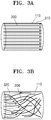
- FIG.3 is a diagram for explaining an example of an air flow path formed in a medium portion including a plurality of tobacco strands.
- FIG.3A is a diagram showing an example of the air flow path formed when a plurality of tobacco strands 200 are arranged parallel to each other in the longitudinal direction of the aerosol-generating rod 100 within the medium portion 110
- FIG.3B is a diagram illustrating an example of the airflow path formed when a plurality of tobacco strands 200 are arranged in a random direction within the medium portion 110.
- a airflow path may be sufficiently formed in the longitudinal direction of the aerosol-generating rod 100. Accordingly, the aerosol may be generated sufficiently and uniformly, during smoking.
- the amount of atomization may be small or non-uniform compared with the aerosol-generating rod including the medium portion of FIG.3A , and the quality deviation between the aerosol-generating rods may be large.
- the aerosol-generating rod 100 may be heated by a conductive heat transfer, heat dissipative heat transfer or convective heat transfer from a heat source (e.g., a heater) or a heat conducting element.
- a heat source e.g., a heater
- a heat conducting element e.g., a heat conducting element
- the airflow path 310 is formed in the longitudinal direction of the aerosol-generating rod 100. Consequently, since hot air is less likely to be trapped between the tobacco strands 200, surface carbonization due to a heat source such as a hot spot may be reduced.
- the aerosol may not pass the air flow path 320 smoothly. Therefore, it is highly likely that the aerosol generated in the medium portion 110 will be trapped between the tobacco strands 200 arranged in a random direction. As a result, combustion or thermal decomposition occurs in some of the tobacco strands 200, and thus a quality of a taste of cigarettes may be deteriorated.
- a heater may be inserted into the aerosol-generating rod 100 to heat the aerosol-generating rod 100.
- the direction in which the tobacco strands 200 are arranged and the direction in which the heater is inserted are the same. Therefore, the heater may be smoothly inserted into the aerosol-generating rod 100, and damage to the heater and deformation of or damage to the aerosol-generating rod 100 may be prevented.
- FIG.3 (b) when a plurality of tobacco strands 200 are randomly arranged, the direction in which the tobacco strands 200 are arranged may not be the same as the direction in which the heater is inserted. Accordingly, when the heater is inserted into the aerosol-generating rod 100, it is likely that the heater may be damaged or the aerosol-generating rod 100 may be deformed or damaged.
- FIG.3A when a plurality of tobacco strands 200 are arranged in parallel to each other in the medium portion 110, a frictional resistance of the heater is low regardless of the shape of the heater. Therefore, the heater may be smoothly inserted into the aerosol-generating rod 100.
- FIG.3B when a plurality of tobacco strands 200 are randomly arranged, the frictional resistance may differ depending on the shape of the heater. Therefore, the heater may not be smoothly inserted into the aerosol-generating rod 100.
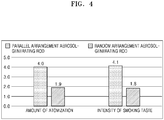
- FIG.4 is a diagram for explaining an example of an amount of atomization and intensity of a smoking taste when a plurality of tobacco strands are arranged parallel to each other in the longitudinal direction of the aerosol-generating rod.
- FIG.4 is a graph showing the average value of the amount of atomization and the intensity of smoking taste for each of the parallel arrangement aerosol-generating rod 100 and random arrangement aerosol-generating rod 100, according to Table 1 below.
- [Table 1] amount of atomization intensity of smoking taste parallel arrangement aerosol-generating rod random arrangement aerosol-generating rod parallel arrangement aerosol-generating rod random arrangement aerosol-generating rod 1 4 1.5 4.2 1.5 2 3.7 2 3.8 2 3 4 1.5 4.5 1.5 4 4.5 2 4 1.5 5 3.7 2.3 4 2 6 4 1.8 4.2 2 7 4.2 2 4 1.5 8 4 2.5 4.5 2 9 3.8 1.5 3.8 1.8 10 4.5 1.7 4 2 11 4 1.8 4.2 2 12 4.2 2 4 1.5 13 4 2.5 4.5 2 14 3.8 1.5 3.8 1.8 15 4 1.7 4.5 2 ...
- Table 1 is a table showing a sensory evaluation results of the amount of atomization and intensity of smoking taste of the aerosol-generating rod 100 (hereinafter referred to as 'parallel arrangement aerosol-generating rod') in which the tobacco strands 200 are arranged parallel to each other in the longitudinal direction in the medium portion 110 and the aerosol-generating rod (hereinafter referred to as 'random arrangement aerosol-generating rod') in which the tobacco strands 200 are arranged in a random direction in 110.
- the results shown in Table 1 are some of the sensory evaluation results for smokers using heating type cigarettes or heating type aerosol-generating devices.
- the amount of atomization and intensity of the smoking taste are respectively evaluated with different arrangements of the plurality of tobacco strands 200 constituting the medium portion 110.
- the smokers who participated in the sensory evaluation visually observed the amount of atomization that has occurred, and evaluated the amount of atomization as a value between 0 and 5.
- the smokers participated in the sensory evaluation evaluated the taste of cigarettes based on the smell and taste, and rated the intensity of smoking taste with a value between 0 and 5.
- the average value of the sensory evaluation for the amount of atomization is 4.0 in the parallel arrangement aerosol-generating rod 100, and 1.9 in the random arrangement aerosol-generating rod.
- the parallel arrangement aerosol-generating rod 100 generates two times or more the amount of atomization generated by the random arrangement aerosol-generating rod.
- the average value of the sensory evaluation for the intensity of the smoking taste is 4.1 in the parallel arrangement aerosol-generating rod 100, and 1.8 in the random arrangement aerosol-generating rod.
- the parallel arrangement aerosol-generating rod 100 has two times or more the intensity of the smoking taste of the random arrangement aerosol-generating rod. Therefore, it may be seen that the parallel arrangement aerosol-generating rod 100 has an improved quality of a taste of cigarettes than the random arrangement aerosol-generating rod.
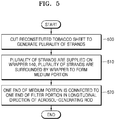
- FIG.5 is a flowchart illustrating an example of a method of manufacturing an aerosol-generating rod including a plurality of tobacco strands arranged parallel to each other in the longitudinal direction of the aerosol-generating rod.
- the reconstituted tobacco sheet may be cut elongatedly to produce a plurality of strands.
- a plurality of tobacco strands 200 may be generated by cutting the reconstituted tobacco sheet formed from a slurry which is generated by crushing the tobacco raw material and then mixing with aerosol-generating substances (for example, glycerin, propylene glycol, etc.), flavoring liquids, binders (for example, guar gum, xanthan gum, carboxymethyl cellulose (CMC), etc.), and water.
- aerosol-generating substances for example, glycerin, propylene glycol, etc.
- flavoring liquids for example, glycerin, propylene glycol, etc.
- binders for example, guar gum, xanthan gum, carboxymethyl cellulose (CMC), etc.
- a plurality of strands may be supplied on a wrapper 140, and the plurality of strands may be surrounded by a wrapper to form the medium portion 110.
- the generated plurality of tobacco strands 200 may be wrapped by a porous wrapper or a non-porous wrapper to form the medium portion 110.
- the plurality of tobacco strands 200 may be arranged parallel to each other in the longitudinal direction of the aerosol-generating rod 100, and wrapped by the wrapper 140.
- the longitudinal direction means the longitudinal direction of the aerosol-generating rod 100.
- the medium portion 110 and the filter portion 120 constituting the aerosol-generating rod 100 are connected in the longitudinal direction, and the plurality of tobacco strands 200 may be arranged in the longitudinal direction as well.
- one end of the medium portion 110 may be connected to one end of the filter portion 120 in the longitudinal direction of the aerosol-generating rod 100.
- the medium portion 110 and the filter portion 120 connected to each other may be wrapped by the wrapper 140.
Landscapes
- Chemical & Material Sciences (AREA)
- Engineering & Computer Science (AREA)
- Materials Engineering (AREA)
- Health & Medical Sciences (AREA)
- General Health & Medical Sciences (AREA)
- Toxicology (AREA)
- Chemical Kinetics & Catalysis (AREA)
- General Chemical & Material Sciences (AREA)
- Cigarettes, Filters, And Manufacturing Of Filters (AREA)
- Manufacture Of Tobacco Products (AREA)
Abstract
Description
- The present disclosure relates to an aerosol-generating rod including tobacco strands arranged in parallel.
- Recently, the demand for alternative methods to overcome the shortcomings of general cigarettes has increased. For example, there is growing demand for a method of generating aerosol by heating an aerosol generating material in cigarettes, rather than by combusting cigarettes. Accordingly, studies on a heating-type cigarette and a heating-type aerosol generating device have been actively conducted.
- In general, a medium portion of a heating-type cigarette or heating-type aerosol-generating rod may be filled with reconstituted tobacco sheets, shredded tobacco which is finely cut from a reconstituted tobacco sheet, or tobacco strands cut elongatedly from a reconstituted tobacco sheet.
- In the case where the medium portion is filled with the tobacco strands, when the tobacco strands are arranged in a random direction, problems such as quality deviation due to a random arrangement, non-uniformity of an amount of atomization, and deterioration of a cigarette taste quality may occur.
- Various embodiments provide an aerosol-generating rod including tobacco strands arranged in parallel. Meanwhile, technical problems to be achieved by the present disclosure are not limited to the technical problems as described above, and other technical problems may be inferred from the following embodiments.
- In an aerosol-generating rod according to one aspect, the aerosol-generating rod may include a medium portion including at least one aerosol-generating material; and a filter portion connected in a longitudinal direction to one end of the medium portion, wherein the medium portion includes a plurality of strands, and the plurality of strands may be arranged parallel to each other in the longitudinal direction.
- In the aerosol-generating rod, the medium portion may include 100 or more of the plurality of strands, and a mass of the medium portion may be 200 mg or more.
- In the aerosol-generating rod, a length of each of the plurality of strands may correspond to a length of the medium portion.
- In the aerosol-generating rod, a density of each of the plurality of strands may be greater than or equal to 900 mg/cm3 and less than 1100 mg/cm3.
- In the aerosol-generating rod, a ratio of a mass to a surface area of each of the plurality of strands may be greater than or equal to 0.05 mg/mm2 and less than 0.09 g/mm2.
- In the aerosol-generating rod, each of the plurality of strands may have a width of 0.6 mm to 1.2 mm in the direction perpendicular to the longitudinal direction, and a thickness of 180 µm to 225 µm.
- In the aerosol-generating rod, each of the plurality of strands may include an aerosol-generating material in an amount of 15 % to 25 % by weight.
- In the aerosol-generating rod, each of the plurality of strands may further include at least one flavoring agent in an amount of 0 % to 10 % by weight.
- In the aerosol-generating rod, a density of the medium portion may be 500 mg/cm3 to 600 mg/cm3.
- In a method of manufacturing an aerosol-generating rod according to another aspect, the method of manufacturing an aerosol-generating rod may include shredding a reconstituted tobacco sheet to produce a plurality of strands; forming a medium portion by supplying the plurality of strands onto a wrapper and wrapping the plurality of strands with the wrapper; and connecting one end of the medium portion to a filter portion in a longitudinal direction of the aerosol-generating rod, wherein the plurality of strands may be arranged parallel to each other in the longitudinal direction.
- Embodiments according to the present disclosure may provide an aerosol-generating rod including tobacco strands arranged in parallel. In detail, a plurality of tobacco strands included in a medium portion of the aerosol-generating rod may be arranged parallel to each other in the longitudinal direction of the aerosol-generating rod. Accordingly, the airflow path may be sufficiently formed such that the aerosol may be generated more sufficiently and uniformly, compared with the case where the tobacco strands are randomly arranged. In addition, a surface carbonization phenomenon of the tobacco strands by the heat source of a heating type aerosol-generating device may be reduced, thereby improving a quality of a taste of cigarettes.
-
-
FIG. 1 is a diagram showing an example of an aerosol-generating rod. -
FIG.2 is a diagram for explaining an example of a medium portion including a plurality of tobacco strands arranged parallel to each other in the longitudinal direction of an aerosol-generating rod. -
FIG.3 is a diagram for explaining an example of an air flow path formed in a medium portion including a plurality of tobacco strands. -
FIG.4 is a diagram for explaining an example of an amount of atomization and an intensity of a smoking taste when a plurality of tobacco strands are arranged parallel to each other in the longitudinal direction of an aerosol-generating rod. -
FIG.5 is a flowchart illustrating an example of a method of manufacturing an aerosol-generating rod including a plurality of tobacco strands arranged parallel to each other in the longitudinal direction of an aerosol-generating rod. - In an aerosol-generating rod according to one aspect, the aerosol-generating rod may include a medium portion including at least one aerosol-generating material; and a filter portion connected in a longitudinal direction to one end of the medium portion, wherein the medium portion may include a plurality of strands, and the plurality of strands are arranged parallel to each other in the longitudinal direction.
- With respect to the terms in the various embodiments, the general terms which are currently and widely used are selected in consideration of functions of structural elements in the various embodiments of the present disclosure. However, meanings of the terms can be changed according to intention, a judicial precedence, the appearance of a new technology, and the like. In addition, in certain cases, a term which is not commonly used can be selected. In such a case, the meaning of the term will be described in detail at the corresponding portion in the description of the present disclosure. Therefore, the terms used in the various embodiments of the present disclosure should be defined based on the meanings of the terms and the descriptions provided herein.
- In addition, unless explicitly described to the contrary, the word "comprise" and variations such as "comprises" or "comprising" will be understood to imply the inclusion of stated elements but not the exclusion of any other elements.
- Hereinafter, the present disclosure will now be described more fully with reference to the accompanying drawings, in which exemplary embodiments of the present disclosure are shown such that one of ordinary skill in the art may easily work the present disclosure. The disclosure may, however, be embodied in many different forms and should not be construed as being limited to the embodiments set forth herein.
- Hereinafter, embodiments of the present invention will be described in detail with reference to the drawings.
-
FIG.1 is a diagram showing an example of an aerosol-generating rod. - Referring to
FIG.1 , the aerosol-generatingrod 100 includes amedium portion 110 and afilter portion 120. - In
FIG.1 , thefilter portion 120 is illustrated as a single segment, but is not limited thereto. In other words, thefilter portion 120 may include a plurality of segments. For example, thefilter portion 120 may include a first segment for cooling an aerosol and a second segment for filtering a predetermined component included in the aerosol. In addition, if necessary, thefilter portion 120 may further include at least one segment that performs other functions. - The aerosol-generating
rod 100 may be packaged by at least onewrapper 140. Thewrapper 140 may have at least one hole through which external air flows or internal gas flows out. As an example, the aerosol-generatingrod 100 may be packaged by onewrapper 140. As another example, the aerosol-generatingrod 100 may be packaged by overlapping two ormore wrappers 140. For example, themedium portion 110 may be packaged by a first wrapper, and thefilter portion 120 may be packaged by a second wrapper. Also, themedium portion 110 and thefilter portion 120 packaged by individual wrappers are combined, and the entire aerosol-generatingrod 100 may be repackaged by a third wrapper. When each of themedium portion 110 or thefilter portion 120 is composed of a plurality of segments, each segment may be packaged by the individual wrapper. In addition, the entire aerosol-generatingrod 100 in which segments packaged by the individual wrappers are combined may be repackaged by another wrapper. - The
medium portion 110 may include an aerosol-generating material. For example, the aerosol-generating material may include at least one of glycerin, propylene glycol, ethylene glycol, dipropylene glycol, diethylene glycol, triethylene glycol, tetraethylene glycol, and oleyl alcohol, but is not limited thereto. Also, the medium portion110 may contain other additives, such as flavors, wetting agents and/or organic acids. In addition, a flavoring liquid such as menthol or moisturizer may be added to themedium portion 110 by being sprayed on themedium portion 110. - The
medium 110 may be manufactured in various ways. For example, themedium portion 110 may be made of a sheet, or may be made of strands. In addition, themedium portion 110 may be made of shredded tobacco which is finely cut from a tobacco sheet. Also, themedium portion 110 may be surrounded by a heat-conducting material. For example, the heat-conducting material may be a metal foil such as aluminum foil, but is not limited thereto. For example, the heat-conducting material surrounding themedium portion 110 may disperse heat transferred to themedium portion 110 to improve the thermal conductivity of the medium portion, thereby improving the taste of tobacco.. In addition, the heat-conducting material surrounding themedium portion 110 may function as a susceptor heated by an induction heating type heater. Although not shown in the drawing, themedium portion 110 may further include an additional susceptor in addition to the heat conducting material surrounding the outside thereof. - The
filter portion 120 may be a cellulose acetate filter. Moreover, the shape of thefilter unit 120 is not limited. For example, thefilter portion 120 may be a cylindrical type rod or a tube type rod including a hollow inside. Also, thefilter portion 120 may be a recess type rod. When thefilter portion 120 is composed of a plurality of segments, at least one of the plurality of segments may be manufactured in a different shape. - The
filter portion 120 may be manufactured to produce flavor. As an example, the flavoring liquid may be sprayed on thefilter portion 120, or a separate fiber coated with the flavoring liquid may be inserted into thefilter portion 120. - In addition, the
filter portion 120 may include at least onecapsule 130. Here, thecapsule 130 may perform a function of generating flavor or a function of generating an aerosol. For example, thecapsule 130 may be a structure in which a liquid containing a flavor is wrapped with a film. Thecapsule 130 may have a spherical or cylindrical shape, but is not limited thereto. - In the case where the
filter portion 120 includes a segment for cooling the aerosol, the cooling segment may be made of a polymer material or a biodegradable polymer material. For example, the cooling segment may be made of pure polylactic acid, but is not limited thereto. Alternatively, the cooling segment may be made of a cellulose acetate filter with a plurality of perforations. However, the cooling segment is not limited to the above-described example, and may be applied without limitation as long as the aerosol may perform a cooling function. -
FIG.2 is a diagram for explaining an example of a medium portion including a plurality of tobacco strands arranged parallel to each other in the longitudinal direction of an aerosol-generating rod. - Referring to
FIG.2 , amedium portion 110 including a plurality oftobacco strands 200 is illustrated. Thetobacco strands 200 in themedium portion 110 may be arranged parallel to each other in the longitudinal direction. Here, the longitudinal direction means the longitudinal axis direction of the aerosol-generatingrod 100 ofFIG.1 . In other words, thetobacco strands 200 may be arranged parallel to each other in the longitudinal direction to which themedium portion 110 and thefilter portion 120 are connected. - Assuming that the
medium portion 110 has the same length and the same diameter, when the plurality oftobacco strands 200 are filled in parallel to each other in the longitudinal direction of the aerosol-generatingrod 100, themedium portion 110 may include a larger number oftobacco strands 200 than when the plurality oftobacco strands 200 are filled in a random arrangement. Consequently, with the same amount of heat transferred to themedium portion 110, a greater amount of atomization may be generated when the plurality oftobacco strands 200 are filled in parallel to each other in the longitudinal direction of the aerosol-generatingrod 100, compared with the case of a random filling arrangement. - In addition, when the plurality of
tobacco strands 200 are arranged in the longitudinal direction of the aerosol-generatingrod 100, the airflow path in the longitudinal direction in themedium portion 110 may be sufficiently secured. As such, the amount of atomization and a quality of a taste of cigarettes may be improved during smoking. - In addition, compared with the case where the plurality of
tobacco strands 200 are filled in a random arrangement, when the plurality oftobacco strands 200 are arranged in the longitudinal direction of the aerosol-generatingrod 100, the heater may be smoothly inserted into the aerosol-generatingrod 100, and breakage of the heater and deformation or damage of the aerosol-generatingrod 100 may be prevented. In addition, a change in frictional resistance according to the shape of the heater, which may occur when the plurality oftobacco strands 200 are randomly arranged, may be prevented. - The effect of the
tobacco strands 200 being arranged in parallel in the longitudinal direction will be described in more detail with reference toFIGS. 3 and4 . - The
medium portion 110 may have a long elongated cylindrical shape having a circular or elliptical cross section, and the length and diameter of themedium portion 110 may vary. For example, the length of themedium portion 110 may be 7 to 15 mm, and preferably 12 mm. The diameter of themedium portion 110 may be 5 to 9 mm, and preferably 7 mm. However, the length and diameter of themedium portion 110 are not limited to the above-described range. - The plurality of
tobacco strands 200 may be manufactured by cutting a reconstituted tobacco sheet. In detail, thetobacco strand 200 may be manufactured by the following process. First, a tobacco raw material is crushed to generate a slurry in which an aerosol-generating substance (for example, glycerin, propylene glycol, etc.), a flavoring liquid, a binder (for example, guar gum, xanthan gum, Carboxymethyl cellulose (CMC), etc.), and water are mixed, and then a reconstituted tobacco sheet may be formed using the slurry. When making a slurry, natural pulp or cellulose may be added, and one or more binders may be mixed and used. Finally, after drying the formed reconstituted tobacco sheet, thetobacco strand 200 may be generated by cutting or shredding the dried reconstituted tobacco sheet - The tobacco raw material may be fragments of tobacco leaf, tobacco stems, and/or fine tobacco powder generated during tobacco processing. Also, the reconstituted tobacco sheet may contain other additives such as wood cellulose fiber.
- On the other hand, the
medium portion 110 may be composed of about 80 to 160tobacco strands 200, preferably 100 to 140tobacco strands 200. More preferably, themedium portion 110 may be composed of 120 to 140tobacco strands 200. However, the number of thetobacco strands 200 constituting themedium portion 110 is not limited to the above-described range. - A mass of the
medium portion 110 may be 200 mg or more, and preferably may be 200 mg to 300 mg. In addition, the density of themedium portion 110 may be 400 mg/cm3 to 700 mg/cm3, preferably 500 mg/cm3 to 600 mg/cm3. Meanwhile, the mass and density of themedium portion 110 are not limited to the above-described numerical range. - In
FIG.2 , as an example of thetobacco strand 200, a cuboid shape having a rectangular cross-section and having a predetermined width (W), thickness (T), and length (L) is shown. However, the shape of thetobacco strand 200 is not limited thereto, and the cross section of thetobacco strand 200 may be various shapes such as a circle. - When the
tobacco strand 200 is a shape of a cuboid, the width W may be 0.5 mm to 1.5 mm, preferably 0.6 mm to 1.2 mm. In addition, the thickness (T) of thetobacco strand 200 may be 150 µm to 600 µm, preferably 180 µm to 225 µm. In addition, the length (L) of thetobacco strand 200 may be 2 mm to 15 mm, preferably 10 mm to 14 mm. Meanwhile, the numerical ranges of the width (W), the thickness (T), and the length (L) of thetobacco strand 200 are not limited to those described above. - For example, the length of the
tobacco strand 200 according to an embodiment may correspond to the length of the medium portion in the direction in which the air flows in the aerosol-generatingrod 100. When the length of thetobacco strand 200 and the length of themedium portion 110 are the same, an air flow path may be secured from the upstream end to the downstream end of themedium portion 110 in the longitudinal direction of the aerosol-generatingrod 100. The term "upstream" means a direction away from the mouth of the user who inhales the aerosol generated from the aerosol-generatingrod 100 and The term "downstream" means a direction toward the mouth of a user who inhales the aerosol generated from the aerosol-generatingrod 100. Therefore, the hot air moves through the air flow path formed from the upstream end to the downstream end of themedium portion 110, so that heat may be uniformly and efficiently transferred. - In addition, the density of the
tobacco strand 200 may be 800 mg/cm3 to 1200 mg/cm3, preferably 900 mg/cm3 or more and less than 1100 mg/cm3. However, the density of thetobacco strand 200 is not limited to the above-described range. - On the other hand, the ratio of the mass to the surface area of the
tobacco strand 200 may be determined by the shape and density of thetobacco strand 200, and thetobacco strand 200 of the present invention may have a ratio of mass to surface area of 0.05 mg/mm2 to 0.15 mg/mm2. More preferably, thetobacco strand 200 may have a ratio of mass to surface area of 0.05 mg/mm2 or more and less than 0.09 mg/mm2. However, the ratio of the mass to the surface area of thetobacco strand 200 is not limited to the above-described range. - The ratio of the mass to the high surface area of the
tobacco strands 200 according to the present invention may reduce the local temperature increase phenomenon of thetobacco strands 200 due to hot air heated by a heat source or a heat conducting element. - The
tobacco strand 200 may include an aerosol-generating material in an amount of 10 % to 30 % by weight, and more preferably 15 % to 25 % by weight. - In addition, the
tobacco strands 200 may contain other additives, such as flavoring agents, wetting agents and / or organic acids. For example, flavoring agents are licorice, sucrose, fructose syrup, isosweet, cocoa, lavender, cinnamon, cardamom, celery, fenugreek, cascarilla, sandalwood, bergamot, geranium, honey essence, rose oil, vanilla, lemon oil, orange oil, mint oil, cinnamon, caraway, cognac, jasmine, chamomile, menthol, cinnamon, ylang-ylang, sage, spearmint, ginger, coriander or coffee. In addition, the wetting agent may include glycerin or propylene glycol. - The
tobacco strand 200 may include one or more flavoring agents in an amount of 0 to 10 % by weight. -
FIG.3 is a diagram for explaining an example of an air flow path formed in a medium portion including a plurality of tobacco strands. -
FIG.3A is a diagram showing an example of the air flow path formed when a plurality oftobacco strands 200 are arranged parallel to each other in the longitudinal direction of the aerosol-generatingrod 100 within themedium portion 110, andFIG.3B is a diagram illustrating an example of the airflow path formed when a plurality oftobacco strands 200 are arranged in a random direction within themedium portion 110. - Referring to
FIG.3A , as the plurality oftobacco strands 200 are arranged parallel to each other in the longitudinal direction of the aerosol-generatingrod 100, a airflow path may be sufficiently formed in the longitudinal direction of the aerosol-generatingrod 100. Accordingly, the aerosol may be generated sufficiently and uniformly, during smoking. - On the other hand, referring to
FIG.3B , as the plurality oftobacco strands 200 are arranged in a random direction, it is difficult to secure the airflow path and the direction of the airflow path may be formed in a random direction. Therefore, the amount of atomization may be small or non-uniform compared with the aerosol-generating rod including the medium portion ofFIG.3A , and the quality deviation between the aerosol-generating rods may be large. - On the other hand, the aerosol-generating
rod 100 may be heated by a conductive heat transfer, heat dissipative heat transfer or convective heat transfer from a heat source (e.g., a heater) or a heat conducting element. When hot air heated by the heat source or the heat-conducting element moves through the air flow path in themedium portion 110 and convective heat transfer occurs, there is a possibility that the plurality oftobacco strands 200 are locally overheated. Such local overheating may cause combustion or thermal decomposition of a portion of thetobacco strands 200, which may result in hot spots. - As shown in
FIG.3A , when the plurality oftobacco strands 200 in themedium portion 110 are arranged parallel to each other in the longitudinal direction of the aerosol-generatingrod 100, theairflow path 310 is formed in the longitudinal direction of the aerosol-generatingrod 100. Consequently, since hot air is less likely to be trapped between thetobacco strands 200, surface carbonization due to a heat source such as a hot spot may be reduced. - On the other hand, in the case of
FIG.3B , since the plurality oftobacco strands 200 within themedium portion 110 are randomly arranged, the aerosol may not pass theair flow path 320 smoothly. Therefore, it is highly likely that the aerosol generated in themedium portion 110 will be trapped between thetobacco strands 200 arranged in a random direction. As a result, combustion or thermal decomposition occurs in some of thetobacco strands 200, and thus a quality of a taste of cigarettes may be deteriorated. - Meanwhile, a heater may be inserted into the aerosol-generating
rod 100 to heat the aerosol-generatingrod 100. In this case, as shown inFIG.3A , when a plurality oftobacco strands 200 are arranged parallel to each other in themedium portion 110, the direction in which thetobacco strands 200 are arranged and the direction in which the heater is inserted are the same. Therefore, the heater may be smoothly inserted into the aerosol-generatingrod 100, and damage to the heater and deformation of or damage to the aerosol-generatingrod 100 may be prevented. Conversely, as shown inFIG.3 (b) , when a plurality oftobacco strands 200 are randomly arranged, the direction in which thetobacco strands 200 are arranged may not be the same as the direction in which the heater is inserted. Accordingly, when the heater is inserted into the aerosol-generatingrod 100, it is likely that the heater may be damaged or the aerosol-generatingrod 100 may be deformed or damaged. - In addition, as shown in
FIG.3A , when a plurality oftobacco strands 200 are arranged in parallel to each other in themedium portion 110, a frictional resistance of the heater is low regardless of the shape of the heater. Therefore, the heater may be smoothly inserted into the aerosol-generatingrod 100. However, as shown inFIG.3B , when a plurality oftobacco strands 200 are randomly arranged, the frictional resistance may differ depending on the shape of the heater. Therefore, the heater may not be smoothly inserted into the aerosol-generatingrod 100. -
FIG.4 is a diagram for explaining an example of an amount of atomization and intensity of a smoking taste when a plurality of tobacco strands are arranged parallel to each other in the longitudinal direction of the aerosol-generating rod. -
FIG.4 is a graph showing the average value of the amount of atomization and the intensity of smoking taste for each of the parallel arrangement aerosol-generatingrod 100 and random arrangement aerosol-generatingrod 100, according to Table 1 below.[Table 1] amount of atomization intensity of smoking taste parallel arrangement aerosol-generating rod random arrangement aerosol-generating rod parallel arrangement aerosol-generating rod random arrangement aerosol-generating rod 1 4 1.5 4.2 1.5 2 3.7 2 3.8 2 3 4 1.5 4.5 1.5 4 4.5 2 4 1.5 5 3.7 2.3 4 2 6 4 1.8 4.2 2 7 4.2 2 4 1.5 8 4 2.5 4.5 2 9 3.8 1.5 3.8 1.8 10 4.5 1.7 4 2 11 4 1.8 4.2 2 12 4.2 2 4 1.5 13 4 2.5 4.5 2 14 3.8 1.5 3.8 1.8 15 4 1.7 4.5 2 ... Average 4.0 1.9 4.1 1.8 - Table 1 is a table showing a sensory evaluation results of the amount of atomization and intensity of smoking taste of the aerosol-generating rod 100 (hereinafter referred to as 'parallel arrangement aerosol-generating rod') in which the
tobacco strands 200 are arranged parallel to each other in the longitudinal direction in themedium portion 110 and the aerosol-generating rod (hereinafter referred to as 'random arrangement aerosol-generating rod') in which thetobacco strands 200 are arranged in a random direction in 110. The results shown in Table 1 are some of the sensory evaluation results for smokers using heating type cigarettes or heating type aerosol-generating devices. In the above-described sensory evaluation, under the condition that the elements of the aerosol-generatingrod 100 are the same, except for the heating type aerosol-generating device, the temperature of the heater, and themedium portion 110, the amount of atomization and intensity of the smoking taste are respectively evaluated with different arrangements of the plurality oftobacco strands 200 constituting themedium portion 110. - The smokers who participated in the sensory evaluation visually observed the amount of atomization that has occurred, and evaluated the amount of atomization as a value between 0 and 5. In addition, the smokers participated in the sensory evaluation evaluated the taste of cigarettes based on the smell and taste, and rated the intensity of smoking taste with a value between 0 and 5.
- Referring to
FIG.4 and Table 1, the average value of the sensory evaluation for the amount of atomization is 4.0 in the parallel arrangement aerosol-generatingrod 100, and 1.9 in the random arrangement aerosol-generating rod. Thus, it may be seen that the parallel arrangement aerosol-generatingrod 100 generates two times or more the amount of atomization generated by the random arrangement aerosol-generating rod. - Likewise, the average value of the sensory evaluation for the intensity of the smoking taste is 4.1 in the parallel arrangement aerosol-generating
rod 100, and 1.8 in the random arrangement aerosol-generating rod. Thus, the parallel arrangement aerosol-generatingrod 100 has two times or more the intensity of the smoking taste of the random arrangement aerosol-generating rod. Therefore, it may be seen that the parallel arrangement aerosol-generatingrod 100 has an improved quality of a taste of cigarettes than the random arrangement aerosol-generating rod. -
FIG.5 is a flowchart illustrating an example of a method of manufacturing an aerosol-generating rod including a plurality of tobacco strands arranged parallel to each other in the longitudinal direction of the aerosol-generating rod. - In
step 500, the reconstituted tobacco sheet may be cut elongatedly to produce a plurality of strands. In detail, a plurality oftobacco strands 200 may be generated by cutting the reconstituted tobacco sheet formed from a slurry which is generated by crushing the tobacco raw material and then mixing with aerosol-generating substances (for example, glycerin, propylene glycol, etc.), flavoring liquids, binders (for example, guar gum, xanthan gum, carboxymethyl cellulose (CMC), etc.), and water. - In
step 510, a plurality of strands may be supplied on awrapper 140, and the plurality of strands may be surrounded by a wrapper to form themedium portion 110. In detail, the generated plurality oftobacco strands 200 may be wrapped by a porous wrapper or a non-porous wrapper to form themedium portion 110. - The plurality of
tobacco strands 200 may be arranged parallel to each other in the longitudinal direction of the aerosol-generatingrod 100, and wrapped by thewrapper 140. Here, the longitudinal direction means the longitudinal direction of the aerosol-generatingrod 100. In other words, themedium portion 110 and thefilter portion 120 constituting the aerosol-generatingrod 100 are connected in the longitudinal direction, and the plurality oftobacco strands 200 may be arranged in the longitudinal direction as well. - In
step 520, one end of themedium portion 110 may be connected to one end of thefilter portion 120 in the longitudinal direction of the aerosol-generatingrod 100. In addition, although not shown inFIG.5 , themedium portion 110 and thefilter portion 120 connected to each other may be wrapped by thewrapper 140.
Those of ordinary skill in the art related to the present embodiments may understand that various changes in form and details can be made therein without departing from the scope of the characteristics described above. The disclosed methods should be considered in descriptive sense only and not for purposes of limitation. The scope of the present disclosure is defined by the appended claims rather than by the foregoing description, and all differences within the scope of equivalents thereof should be construed as being included in the present disclosure.
Claims (10)
- An aerosol-generating rod comprising:a medium portion including at least one aerosol-generating material; anda filter portion connected in a longitudinal direction to one end of the medium portion,wherein the medium portion includes a plurality of strands, and the plurality of strands are arranged parallel to each other in the longitudinal direction.
- The aerosol-generating rod of claim 1, wherein the medium portion includes 100 or more of the plurality of strands, and a mass of the medium portion is 200 mg or more.
- The aerosol-generating rod of claim 1, wherein a length of each of the plurality of strands corresponds to a length of the medium portion.
- The aerosol-generating rod of claim 1, wherein a density of each of the plurality of strands is greater than or equal to 900 mg/cm3 and less than 1100 mg/cm3.
- The aerosol-generating rod of claim 1, wherein a ratio of a mass to a surface area of each of the plurality of strands is greater than or equal to 0.05 mg/mm2 and less than 0.09 g/mm2.
- The aerosol-generating rod of claim 1, wherein each of the plurality of strands has a width of 0.6 mm to 1.2 mm in a direction perpendicular to the longitudinal direction, and a thickness of 180 µm to 225 µm.
- The aerosol-generating rod of claim 1, wherein each of the plurality of strands includes an aerosol-generating material in an amount of 15 % to 25 % by weight.
- The aerosol-generating rod of claim 1, wherein each of the plurality of strands further includes at least one flavoring agent in an amount of 0 % to 10 % by weight.
- The aerosol-generating rod of claim 1, wherein a density of the medium portion is 500 mg/cm3 to 600 mg/cm3.
- A method of manufacturing an aerosol-generating rod, the method comprising:shredding a reconstituted tobacco sheet to produce a plurality of strands;forming a medium portion by supplying the plurality of strands onto a wrapper and wrapping the plurality of strands with the wrapper; andconnecting one end of the medium portion to a filter portion in a longitudinal direction of the aerosol-generating rod,wherein the plurality of strands are arranged parallel to each other in the longitudinal direction.
Applications Claiming Priority (2)
| Application Number | Priority Date | Filing Date | Title |
|---|---|---|---|
| KR1020180116578A KR102501726B1 (en) | 2018-09-28 | 2018-09-28 | An aerosol generating rod comprising cigarette strands which are arranged in parallel |
| PCT/KR2019/012586 WO2020067766A1 (en) | 2018-09-28 | 2019-09-27 | Aerosol-generating rod comprising tabacco strands arranged in parallel |
Publications (2)
| Publication Number | Publication Date |
|---|---|
| EP3818844A1 true EP3818844A1 (en) | 2021-05-12 |
| EP3818844A4 EP3818844A4 (en) | 2021-09-01 |
Family
ID=69953190
Family Applications (1)
| Application Number | Title | Priority Date | Filing Date |
|---|---|---|---|
| EP19865116.8A Pending EP3818844A4 (en) | 2018-09-28 | 2019-09-27 | AEROSOL GENERATING STICK WITH TOBACCO STRANDS ARRANGED IN PARALLEL |
Country Status (6)
| Country | Link |
|---|---|
| US (1) | US20210092990A1 (en) |
| EP (1) | EP3818844A4 (en) |
| JP (1) | JP7078318B2 (en) |
| KR (2) | KR102501726B1 (en) |
| CN (1) | CN112040794A (en) |
| WO (1) | WO2020067766A1 (en) |
Families Citing this family (7)
| Publication number | Priority date | Publication date | Assignee | Title |
|---|---|---|---|---|
| GB202009163D0 (en) * | 2020-06-16 | 2020-07-29 | Nicoventures Trading Ltd | Article for use in non-combustible aerosol provision system |
| GB202011092D0 (en) * | 2020-07-17 | 2020-09-02 | Nicoventures Trading Ltd | Consumable |
| CN112869226B (en) * | 2021-02-01 | 2023-11-24 | 南通烟滤嘴有限责任公司 | A smoking medium with a three-dimensional structure |
| KR102838716B1 (en) * | 2022-05-04 | 2025-07-29 | 주식회사 케이티앤지 | Smoking article and aerosol-generating systems comprising thereof |
| KR20250040942A (en) * | 2022-07-20 | 2025-03-25 | 필립모리스 프로덕츠 에스.에이. | Aerosol-generating articles having thick wrappers and dense substrates |
| CN115530418B (en) * | 2022-10-12 | 2024-11-15 | 湖北中烟工业有限责任公司 | Tobacco segment and cigarette product thereof, and preparation method thereof |
| CN120694432A (en) * | 2024-03-14 | 2025-09-26 | 思摩尔国际控股有限公司 | An aerosol generating product |
Family Cites Families (19)
| Publication number | Priority date | Publication date | Assignee | Title |
|---|---|---|---|---|
| DE2849061C2 (en) * | 1977-11-17 | 1986-09-25 | Hollingsworth (U.K.) Ltd., Accrington, Lancashire | Method for stopping an OE rotor spinning machine and an OE rotor spinning machine |
| US4889143A (en) * | 1986-05-14 | 1989-12-26 | R. J. Reynolds Tobacco Company | Cigarette rods and filters containing strands provided from sheet-like materials |
| US4981522A (en) * | 1988-07-22 | 1991-01-01 | Philip Morris Incorporated | Thermally releasable flavor source for smoking articles |
| US8061361B2 (en) * | 2007-08-10 | 2011-11-22 | Philip Morris Usa Inc. | Distillation-based smoking article |
| US20110108042A1 (en) | 2009-11-10 | 2011-05-12 | Philip Morris Usa Inc. | Registered banded cigarette paper, cigarettes, and method of manufacture |
| EP2361516A1 (en) | 2010-02-19 | 2011-08-31 | Philip Morris Products S.A. | Aerosol-generating substrate for smoking articles |
| RS54739B1 (en) * | 2011-05-31 | 2016-10-31 | Philip Morris Products Sa | STAPLES FOR USE IN SMOKING PRODUCTS |
| UA118858C2 (en) * | 2013-12-05 | 2019-03-25 | Філіп Морріс Продактс С.А. | Aerosol Generating Product with a Rigid Empty Tip |
| TWI664918B (en) * | 2014-05-21 | 2019-07-11 | 瑞士商菲利浦莫里斯製品股份有限公司 | Inductively heatable tobacco product |
| TWI703936B (en) * | 2015-03-27 | 2020-09-11 | 瑞士商菲利浦莫里斯製品股份有限公司 | A paper wrapper for an electrically heated aerosol-generating article |
| CA2986648A1 (en) * | 2015-08-07 | 2017-02-16 | Philip Morris Products S.A. | An aerosol-generating system with enhanced airflow management |
| US20170055576A1 (en) | 2015-08-31 | 2017-03-02 | R. J. Reynolds Tobacco Company | Smoking article |
| CN106136305B (en) * | 2016-07-26 | 2018-07-06 | 上海烟草集团有限责任公司 | A kind of heating tobacco product and preparation method thereof |
| RU2749137C2 (en) * | 2016-12-16 | 2021-06-04 | Кей Ти Энд Джи Корпорейшн | Device and method for aerosol generation |
| CN207836767U (en) * | 2016-12-16 | 2018-09-11 | 韩国烟草人参公社 | Aerosol generates equipment |
| CN207604513U (en) * | 2016-12-16 | 2018-07-13 | 韩国烟草人参公社 | Aerosol product product |
| KR20250159277A (en) * | 2017-08-09 | 2025-11-10 | 필립모리스 프로덕츠 에스.에이. | Aerosol-generating article having rod with multiple longitudinal elongate elements of non-tobacco material |
| GB201715380D0 (en) * | 2017-09-22 | 2017-11-08 | British American Tobacco Investments Ltd | Aerosol-generating material rod |
| CN112165869B (en) * | 2018-06-22 | 2024-08-16 | 菲利普莫里斯生产公司 | Aerosol-generating article comprising a hollow rod of aerosol-generating substrate |
-
2018
- 2018-09-28 KR KR1020180116578A patent/KR102501726B1/en active Active
-
2019
- 2019-09-27 CN CN201980028712.5A patent/CN112040794A/en active Pending
- 2019-09-27 JP JP2020556937A patent/JP7078318B2/en active Active
- 2019-09-27 WO PCT/KR2019/012586 patent/WO2020067766A1/en not_active Ceased
- 2019-09-27 EP EP19865116.8A patent/EP3818844A4/en active Pending
- 2019-09-27 US US17/051,357 patent/US20210092990A1/en active Pending
-
2023
- 2023-02-14 KR KR1020230019598A patent/KR102608370B1/en active Active
Also Published As
| Publication number | Publication date |
|---|---|
| US20210092990A1 (en) | 2021-04-01 |
| KR102501726B1 (en) | 2023-02-20 |
| CN112040794A (en) | 2020-12-04 |
| EP3818844A4 (en) | 2021-09-01 |
| JP2021517823A (en) | 2021-07-29 |
| KR20200036658A (en) | 2020-04-07 |
| KR20230028736A (en) | 2023-03-02 |
| JP7078318B2 (en) | 2022-05-31 |
| KR102608370B1 (en) | 2023-11-30 |
| WO2020067766A1 (en) | 2020-04-02 |
Similar Documents
| Publication | Publication Date | Title |
|---|---|---|
| US20250359586A1 (en) | Method and apparatus for manufacturing aerosol-forming rod | |
| US20210092990A1 (en) | Aerosol-generating rod comprising tabacco strands arranged in parallel | |
| EP3965600B1 (en) | A cooling structure and a smoking article including the same | |
| CN112423607B (en) | cigarette | |
| US11744276B2 (en) | Method of making a nicotine containing sheet | |
| US12167745B2 (en) | Cigarette | |
| CN111343874A (en) | Aerosol-generating article with aerosol-generating substrate with double plug | |
| CN120391729A (en) | Hybrid aerosol generating element and method for making a hybrid aerosol generating element | |
| US12102119B2 (en) | Aerosol generating article and aerosol generating system | |
| CN116419684A (en) | Aerosol-generating articles with heterogeneous tobacco substrates | |
| CN116528699A (en) | Aerosol-generating article with low resistance to draw and improved flavor delivery | |
| JP2023544039A (en) | Aerosol-generating articles with low withdrawal resistance and improved flavor delivery | |
| US20230292812A1 (en) | Aerosol-generating article including thermally conductive material | |
| KR102330289B1 (en) | Aerosol Generating Article and Method of Producing the same | |
| KR102356641B1 (en) | Method and apparatus for making a rod of aerosol-forming substrate | |
| JP2023544746A (en) | Aerosol-generating articles with ventilation | |
| EP4230062A1 (en) | Aerosol-generating product | |
| KR102725605B1 (en) | Reconsituted tabacco improved swellability and manufacturing method thereof | |
| JP2023544040A (en) | Aerosol generating article with front end plug | |
| JP7860971B2 (en) | Aerosol-generating articles with ventilation | |
| JP2023544745A (en) | Aerosol-generating articles with ventilation |
Legal Events
| Date | Code | Title | Description |
|---|---|---|---|
| STAA | Information on the status of an ep patent application or granted ep patent |
Free format text: STATUS: THE INTERNATIONAL PUBLICATION HAS BEEN MADE |
|
| PUAI | Public reference made under article 153(3) epc to a published international application that has entered the european phase |
Free format text: ORIGINAL CODE: 0009012 |
|
| STAA | Information on the status of an ep patent application or granted ep patent |
Free format text: STATUS: REQUEST FOR EXAMINATION WAS MADE |
|
| 17P | Request for examination filed |
Effective date: 20201116 |
|
| AK | Designated contracting states |
Kind code of ref document: A1 Designated state(s): AL AT BE BG CH CY CZ DE DK EE ES FI FR GB GR HR HU IE IS IT LI LT LU LV MC MK MT NL NO PL PT RO RS SE SI SK SM TR |
|
| REG | Reference to a national code |
Ref country code: DE Ref legal event code: R079 Free format text: PREVIOUS MAIN CLASS: A24D0001040000 Ipc: A24D0001200000 |
|
| A4 | Supplementary search report drawn up and despatched |
Effective date: 20210804 |
|
| RIC1 | Information provided on ipc code assigned before grant |
Ipc: A24D 1/20 20200101AFI20210729BHEP Ipc: A24C 5/01 20200101ALI20210729BHEP |
|
| DAV | Request for validation of the european patent (deleted) | ||
| DAX | Request for extension of the european patent (deleted) | ||
| P01 | Opt-out of the competence of the unified patent court (upc) registered |
Effective date: 20230526 |
|
| STAA | Information on the status of an ep patent application or granted ep patent |
Free format text: STATUS: EXAMINATION IS IN PROGRESS |
|
| 17Q | First examination report despatched |
Effective date: 20240731 |