EP3818796B1 - Verschleissanzeige eines kugelkopfs einer anhängerkupplung - Google Patents
Verschleissanzeige eines kugelkopfs einer anhängerkupplung Download PDFInfo
- Publication number
- EP3818796B1 EP3818796B1 EP20194792.6A EP20194792A EP3818796B1 EP 3818796 B1 EP3818796 B1 EP 3818796B1 EP 20194792 A EP20194792 A EP 20194792A EP 3818796 B1 EP3818796 B1 EP 3818796B1
- Authority
- EP
- European Patent Office
- Prior art keywords
- ball head
- wear
- ball
- diameter
- trailer coupling
- Prior art date
- Legal status (The legal status is an assumption and is not a legal conclusion. Google has not performed a legal analysis and makes no representation as to the accuracy of the status listed.)
- Active
Links
Images
Classifications
-
- B—PERFORMING OPERATIONS; TRANSPORTING
- B60—VEHICLES IN GENERAL
- B60D—VEHICLE CONNECTIONS
- B60D1/00—Traction couplings; Hitches; Draw-gear; Towing devices
- B60D1/01—Traction couplings or hitches characterised by their type
- B60D1/06—Ball-and-socket hitches
-
- B—PERFORMING OPERATIONS; TRANSPORTING
- B60—VEHICLES IN GENERAL
- B60D—VEHICLE CONNECTIONS
- B60D1/00—Traction couplings; Hitches; Draw-gear; Towing devices
- B60D1/58—Auxiliary devices
-
- A—HUMAN NECESSITIES
- A01—AGRICULTURE; FORESTRY; ANIMAL HUSBANDRY; HUNTING; TRAPPING; FISHING
- A01B—SOIL WORKING IN AGRICULTURE OR FORESTRY; PARTS, DETAILS, OR ACCESSORIES OF AGRICULTURAL MACHINES OR IMPLEMENTS, IN GENERAL
- A01B59/00—Devices specially adapted for connection between animals or tractors and agricultural machines or implements
- A01B59/002—Details, component parts
- A01B59/008—Link connectors with spherical surfaces
-
- B—PERFORMING OPERATIONS; TRANSPORTING
- B60—VEHICLES IN GENERAL
- B60D—VEHICLE CONNECTIONS
- B60D1/00—Traction couplings; Hitches; Draw-gear; Towing devices
- B60D2001/001—Traction couplings; Hitches; Draw-gear; Towing devices specially adapted for use on vehicles other than cars
- B60D2001/008—Traction couplings; Hitches; Draw-gear; Towing devices specially adapted for use on vehicles other than cars specially adapted for implements, e.g. towed tools
Definitions
- the present invention relates to a ball head of a trailer coupling of an agricultural vehicle, with an indicator for the ball head wear according to the preamble of claim 1.
- Ball hitches are commonly used to connect a trailer to an agricultural or road transport vehicle. Pins or standardized balls with a diameter of mostly 80 mm in the agricultural sector are arranged by means of a bracket on the towing vehicle and serve as a towing device.
- the trailer drawbar has a ball socket with a lock as a counterpart.
- the ball socket In the coupled state, the ball socket is rotatably mounted on the ball head, the ball socket being secured against lifting off the ball head.
- the coupling transmits tensile and compressive forces between the towing vehicle and the trailer. This leads to wear on the ball head and on the ball socket, which is caused in particular by friction. With increasing wear, the load-bearing capacity of the ball head decreases and securing the ball socket against lifting off the ball head becomes increasingly difficult. For this reason, ball head couplings often have displays that signal the degree of wear to the operator in order to draw his attention to an impermissible degree of wear on the ball head coupling in good time.
- a ball head hitch with a ball head wear indicator is from the EP 0 695 654 B1 known. This has a coupling housing with a substantially hemispherical cap, which is placed on the ball head. A coupling shell is provided for clamping the ball head, which is rotatably mounted on an axis in the coupling housing and is pressed into the open position by means of a spring. The clutch shell is actuated and pressed on by a clutch handle with a locking part. A wear indicator signals the mutual rotational position between the locking part and the coupling shell and thus the wear occurring between these two parts and the ball head.
- the EP 0 176 825 A1 discloses a generic ball head of a trailer hitch.
- a disadvantage of such a wear indicator is that the clutch housing and ball head must be in a coupled state in order to reduce the wear on the components read from the wear indicator. Furthermore, the wear shown on the display always includes the wear on the coupling shell and the cap, so that it is not possible to determine only the wear on the ball head. As a rule, the ball head is used with different coupling elements, although not every coupling element has a wear indicator. However, simply recognizing the wear of the ball head is particularly helpful in order to avoid improper use of the ball head.
- the invention is based on the object of eliminating the disadvantages of the prior art and, in particular, of providing a display for a ball head that enables the state of wear of the ball head to be easily recognized.
- a ball head of a trailer coupling of an agricultural vehicle comprising an indicator for the ball head wear, the indicator being designed in one piece with the ball head according to the invention.
- the display is designed as at least one indentation on a spherical surface of the spherical head.
- Such a design allows for a simple one-piece design of the display with the ball head.
- the attachment of a recess is associated with low cost.
- the recess is formed essentially as a groove on the spherical surface of the ball head.
- An elongate indentation designed as a groove has the advantage that it can extend over an area that is particularly badly affected by wear.
- the ball head can have a maximum diameter and a minimum diameter, with the maximum diameter corresponding to the initial diameter of the ball head when new and the minimum diameter is the minimum diameter allowable for use.
- An advantageous development provides that at least one indentation extends from the ball surface to the minimum diameter in the ball head, with the indentation signaling a maximum permissible state of wear. The operator can thus see when the maximum permissible state of wear has been reached.
- At least one indentation extends from the ball surface up to a third diameter into the ball head, with the third diameter signaling a defined state of wear.
- the ball surface it is possible for the ball surface to wear to different degrees in different areas, so that the abrasion of two opposite areas, which together have a common diameter of the ball head, is pronounced differently. Accordingly, if the diameter falls below the minimum permissible diameter on one side in an area particularly affected by wear, the area opposite this area can only show slight signs of wear, so that the spherical surface as a whole does not fall below the minimum permissible diameter.
- indentations which reach up to a third diameter into the ball head, differently pronounced signs of wear of two opposite areas can be taken into account and thus a minimum permissible state of wear of the entire ball surface can be identified particularly well.
- the recess is at least partially filled with a first material, the color and/or structure of the first material being different from the rest of the spherical surface. Filling the at least one depression prevents dirt from accumulating in the depression. Due to the color differences between the two materials, the operator can also see when the wear, in particular abrasion, has worn the ball head down to the depth of the at least one indentation.
- the wear resistance of the first material is substantially equivalent to that of a second material, with the ball head being formed substantially from the second material, typically steel.
- the materials wear out evenly, so that sharp edges on the spherical surface, which are caused by friction between ball head and ball socket which can lead to increased wear must be avoided.
- At least one indentation is arranged in a front area of the spherical surface facing the towing vehicle, since due to the driving dynamics, for example braking and acceleration processes, this front area is particularly affected by wear and there is therefore an increased probability that the minimum wear state will be reached.
- At least one indentation is arranged in a rear area of the spherical surface facing away from the towing vehicle, since due to the driving dynamics, for example braking and acceleration processes, this rear area is also particularly affected by wear and there is therefore an increased probability that the minimum wear state will be reached .
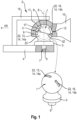
- a ball head 1 shows a ball head 1 according to the invention of a trailer hitch 2.
- This is essentially spherical and has a cylindrical contact element 3 in a lower region, with which the ball head 1 is formed on the underside.
- the ball head 1 and the contact element 3 can be designed in two parts and connected to one another in a stationary manner, for example welded.
- the contact element 3 rests on a holder 4 on a side facing away from the ball head 1 .
- a bolt 5 is arranged on the contact element 3 and is formed in one piece with the contact element 3 .
- the bolt 5 and the contact element 3 can be designed in two parts and connected in a stationary manner, for example welded.
- the spherical head 1, the contact element 3 and the bolt 5 are rotationally symmetrical to an axis 6 in the embodiment described here.
- the bracket 4 has a receiving bore 7 in which the bolt 5 is inserted.
- a press fit for the bolt 5 and the mounting hole 7 can be provided.
- a welding of the contact element 3 with the holder 4 is also possible.
- the holder 4 is connected to an agricultural vehicle (not shown), for example a tractor.
- a ball socket 9 is rotatably mounted on a spherical surface 8 of the ball head 1 and forms the counterpart to the ball head 1 of the trailer hitch 2 .
- the ball socket 9 is formed in one piece with a drawbar 10, which connects the ball socket 9 to a trailer or an agricultural machine, not shown.
- a closure 15 is fastened to the holder 4, which secures the ball socket 9 from lifting off the ball head 1 in the vertical direction.
- Tensile forces are transferred from the towing vehicle via the trailer hitch 2 to the trailer or the agricultural working machine.
- the spherical surface 8 wears out here.
- the main causes of the wear on the spherical surface 1 are frictional forces that are transmitted between the towing vehicle and the trailer as a result of the driving dynamics.
- a front area 11, which faces the towing vehicle when driving in the forward direction VR, and a rear area 12 of the spherical surface 8 opposite this, which is located on a side 12 of the spherical surface 8 facing away from the towing vehicle when driving in the forward direction VR, are in particular Dimensions affected by signs of wear. The reason for this is that in these areas 11, 12, the tensile and compressive forces arising from braking and acceleration processes are transmitted to a particular extent.
- the ball head 1 When new, the ball head 1 often has a diameter d1 of 80 mm in the agricultural sector.
- the permissible minimum diameter d2 of such a ball head 1 is usually 79 mm.
- the ball head 1 has an indicator 22 for the wear of the ball head 1, which is a recess 14 designed as a groove 13, which signals the operator a state of wear.
- a depression 14a designed as a first groove 13 is arranged on the front area 11 and a depression 14b designed as a second groove 16 is arranged opposite this on the rear area 12 .
- Both grooves 13, 16 are designed in such a way that their depth 17 extends to the minimum permissible diameter d2 of the ball head 1 .
- the respective groove 13, 16 no longer stands out from the spherical surface 8, and the respective groove 13, 16 is therefore no longer visible to the operator and a critical state of wear is reached. This signals to the operator that a review of the usability of the ball head 1 is required.
- both grooves 13, 16 are no longer visible, this signals to the operator that the state of wear has reached or already fallen below the minimum permissible diameter d2. In this case, the operator is signaled that the ball head 1 needs to be replaced.
- the grooves 13, 16 are filled with a first material (not shown), for example a hardened plastic, so that a flat spherical surface 8 is formed. Sharp edges, which cause additional wear when the ball socket 9 rotates relative to the ball head 1, are avoided as a result.
- the first material has a wear resistance comparable to a second material 23 used for the ball head 1, which is usually steel. The color of the first material differs from that of the second material 23, so that it stands out visually from the spherical surface 8 and the operator can see as soon as abrasion of the spherical surface 8 has penetrated to a diameter d1 or d2, up to which the Groove 13, 16 projects into the ball head 1 in its depth 17.
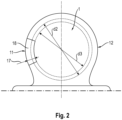
- a third groove 18 is designed in such a way that its depth 17 extends to a diameter d3 of the ball head 1 .
- This diameter D3 is smaller than the minimum allowable diameter d2.
- the positioning of the third groove 18 takes into account signs of wear distributed over the surface of the ball head to different extents.
- the third groove 18 is arranged in the front area 11 of the ball head 1, which faces the towing vehicle when driving in the forward direction VR.
- This front area 11 is particularly affected by signs of wear and, in this alternative embodiment, shows more pronounced abrasion than a rear area 12 of the ball head 1 opposite it, with the front and rear area 11, 12 having a common diameter (not shown) of the ball head 1 exhibit.
- the third diameter d3, up to which the third groove 18 protrudes into the ball head 1, is chosen such that as soon as the abrasion of the ball head 1 in the front area 11 has penetrated to the third diameter d3, the common diameter of the front and rear area 11, 12 corresponds to the length of the minimum permissible diameter d2. It is thus easy for the operator to recognize as soon as the minimum permissible state of wear has been reached.
- the position of the third groove 18 and the dimensions of the third diameter d3 can be determined, for example, by means of iterative tests.
Landscapes
- Engineering & Computer Science (AREA)
- Transportation (AREA)
- Mechanical Engineering (AREA)
- Pivots And Pivotal Connections (AREA)
Description
- Die vorliegende Erfindung betrifft einen Kugelkopf einer Anhängerkupplung eines landwirtschaftlichen Fahrzeugs, mit einer Anzeige für den Kugelkopfverschleiß gemäß dem Oberbegriff des Anspruchs 1.
- Kugelkopfkupplungen werden standardmäßig zur Verbindung eines Anhängers mit einem landwirtschaftlichen Fahrzeug oder Fahrzeugen im Straßentransport verwendet. Zapfen oder genormte Kugeln mit im landwirtschaftlichen Bereich meistens 80 mm Durchmesser sind mittels einer Halterung am Zugfahrzeug angeordnet und dienen als Anhängevorrichtung. Die Deichsel des Anhängers weist als Gegenstück eine Kugelpfanne mit Verschluss auf. Im gekoppelten Zustand ist die Kugelpfanne drehbar auf dem Kugelkopf gelagert, wobei die Kugelpfanne gegen ein Abheben vom Kugelkopf gesichert ist. In diesem Zustand überträgt die Kupplung Zugkräfte und Druckkräfte zwischen dem Zugfahrzeug und dem Anhänger. Dies führt zu Verschleiß am Kugelkopf sowie an der Kugelpfanne, der insbesondere durch Reibung verursacht wird. Mit steigendem Verschleiß nimmt die Tragfähigkeit des Kugelkopfes ab und eine Sicherung gegen ein Abheben der Kugelpfanne vom Kugelkopf wird zunehmend schwieriger. Aus diesem Grund weisen Kugelkopfkupplungen häufig Anzeigen auf, die dem Bediener den Verschleißgrad signalisieren, um diesen rechtzeitig auf einen nicht zulässigen Verschleißgrad der Kugelkopfkupplung aufmerksam zu machen.
- Eine Kugelkopf-Anhängerkupplung mit einer Anzeige für den Kugelkopfverschleiß ist aus der
EP 0 695 654 B1 bekannt. Diese besitzt ein Kupplungsgehäuse mit einer im wesentlichen halbkugelförmigen Kalotte, die auf den Kugelkopf aufgesetzt wird. Zum Festspannen des Kugelkopfes ist eine Kupplungsschale vorgesehen, die drehbar über eine Achse im Kupplungsgehäuse gelagert ist und mittels einer Feder in Öffnungsstellung gedrückt wird. Die Kupplungsschale wird durch einen Kupplungsgriff mit einem Sperrteil betätigt und angepresst. Eine Verschleißanzeige signalisiert die gegenseitige Drehstellung zwischen dem Sperrteil und der Kupplungsschale und damit den zwischen diesen beiden Teilen und den am Kugelkopf auftretenden Verschleiß. DieEP 0 176 825 A1 offenbart einen gattungsgemäßen Kugelkopf einer Anhängerkupplung. - Nachteilig an einer derartigen Verschleißanzeige ist, dass ein eingekuppelter Zustand zwischen Kupplungsgehäuse und Kugelkopf vorliegen muss, um den Verschleiß der Bauteile an der Verschleißanzeige abzulesen. Weiterhin ist in dem angezeigten Verschleiß der Anzeige stets der Verschleiß der Kupplungsschale sowie der Kalotte enthalten, so dass eine ausschließliche Ermittlung des Verschleißes des Kugelkopfes nicht möglich ist. In der Regel wird der Kugelkopf mit verschiedenen Kupplungselementen verwendet, wobei ebenfalls nicht jedes Kupplungselement eine Verschleißanzeige aufweist. Ein einfaches Erkennen des Verschleißes des Kugelkopfes ist jedoch besonders Hilfreich, um eine unzulässige Verwendung des Kugelkopfs zu vermeiden.
- Der Erfindung liegt die Aufgabe zugrunde, die Nachteile des Stands der Technik zu beheben und insbesondere eine Anzeige für einen Kugelkopf bereit zu stellen, der ein einfaches Erkennen des Verschleißzustands des Kugelkopfes ermöglicht.
- Die genannten Probleme werden bei einem Kugelkopf nach dem Oberbegriff des Anspruchs 1 durch die Merkmale des kennzeichnenden Teils von Anspruch 1 gelöst.
- Gemäß dem Anspruch 1 wird ein Kugelkopf einer Anhängerkupplung eines landwirtschaftlichen Fahrzeugs, umfassend eine Anzeige für den Kugelkopfverschleiß vorgeschlagen, wobei die Anzeige erfindungsgemäß einteilig mit dem Kugelkopf ausgebildet ist. Hieraus resultiert der besondere Vorteil, dass der Verschleißzustand ohne weitere Hilfsmittel direkt am Kugelkopf erkenntlich ist. Kosten für zusätzliche Messeinrichtungen und zeitlicher Aufwand für einen Messervorgang werden vermieden. Weiterhin ist der Verschleißzustand im entkuppelten Zustand jederzeit ersichtlich, so dass kritische Verschleißzustände unmittelbar von einem Bediener erkannt werden können.
- Erfindungsgemäß ist die Anzeige als zumindest eine Vertiefung an einer Kugeloberfläche des Kugelkopfs ausgebildet. Eine derartige Ausgestaltung ermöglicht eine einfache einteilige Ausbildung der Anzeige mit dem Kugelkopf. Weiterhin ist das Anbringen einer Vertiefung mit geringem Kostenaufwand verbunden.
- Vorteilhafterweise ist die Vertiefung im Wesentlichen als Nut an der Kugeloberfläche des Kugelkopfs ausgebildet. Eine als Nut ausgebildete längliche Vertiefung hat den Vorteil, dass diese sich über einen Bereich erstrecken kann, welcher besonders stark von dem Verschleiß betroffen ist.
- Insbesondere kann der Kugelkopf einen maximalen Durchmesser und einen minimalen Durchmesser aufweisen, wobei der maximale Durchmesser dem Ausgangsdurchemesser des Kugelkopfs im Neuzustand entspricht und der minimale Durchmesser der minimal für den Gebrauch zulässige Durchmesser ist.
- Eine vorteilhafte Weiterbildung sieht vor, dass zumindest eine Vertiefung von der Kugeloberfläche bis zu dem minimalen Durchmesser in den Kugelkopf hineinreicht, wobei die Vertiefung einen maximal zulässigen Verschleißzustand signalisiert. Dem Bediener ist somit ersichtlich, wann der maximal zulässige Verschleißzustand erreicht ist.
- Vorteilhaft ist es, wenn zumindest eine Vertiefung von der Kugeloberfläche bis zu einem dritten Durchmesser in den Kugelkopf hineinreicht, wobei der dritte Durchmesser einen definierten Verschleißzustand signalisiert. Hierdurch können weitere Verschleißzustände dem Bediener erkenntlich gemacht werden. Weiterhin ist es möglich, dass die Kugeloberfläche an verschiedenen Bereichen unterschiedlich stark verschleißt, sodass der Abrieb zweier sich gegenüberliegender Bereiche, die zusammen einen gemeinsamen Durchmesser des Kugelkopfs aufweisen, unterschiedlich ausgeprägt ist. Dementsprechend kann bei einem einseitigen unterschreiten des minimal zulässigen Durchmessers an einem vom Verschleiß besonders betroffenen Bereich, der diesen gegenüberliegende Bereich lediglich geringfügige Verschleißerscheinungen aufweisen, so dass in der Gesamtheit die Kugeloberfläche den minimal zulässigen Durchmesser nicht unterschreitet. Mittels derartiger Vertiefungen, die bis zu einem dritten Durchmesser in den Kugelkopf hineinreichen, können unterschiedlich ausgeprägte Verschleißerscheinungen zweier sich gegenüberliegender Bereiche berücksichtigt werden und somit ein minimal zulässiger Verschleißzustand der Gesamtheit der Kugeloberfläche besonders gut gekennzeichnet werden.
- In einer vorteilhaften Ausgestaltung ist die Vertiefung zumindest teilweise mit einem ersten Material befüllt, wobei das erste Material sich in seiner Farbe und/oder Struktur von der übrigen Kugeloberfläche unterscheidet. Das Befüllen der zumindest einen Vertiefung vermeidet ein Ansammeln von Schmutz in der Vertiefung. Auf Grund der farblichen Unterschiede zwischen den beiden Materialien, ist weiterhin für den Bediener ersichtlich, sobald der Verschleiß, insbesondere Abrieb, den Kugelkopf bis zu der Tiefe der zumindest einen Vertiefung abgenutzt hat.
- Insbesondere ist die Verschleißfestigkeit des ersten Materials im Wesentlichen äquivalent zu einem zweiten Material, wobei der Kugelkopf im Wesentlichen aus dem zweiten Material, in der Regel Stahl, ausgebildet ist. Bei einer derartigen Ausgestaltung verschleißen die Materialen gleichmäßig, so dass scharfe Kanten an der Kugeloberfläche, die bei Reibung zwischen Kugelkopf und Kugelpfanne zu erhöhten Verschleiß führen können, vermieden werden.
- Vorteilhafterweise ist zumindest eine Vertiefung an einen dem Zugfahrzeug zugewandten vorderen Bereich der Kugeloberfläche angeordnet, da auf Grund der Fahrdynamik, beispielsweise Brems- und Beschleunigungsvorgänge, dieser vordere Bereich besonders stark von Verschleiß betroffen ist und hier somit ein Erreichen des minimalen Verschleißzustands mit erhöhter Wahrscheinlichkeit auftritt.
- Vorteilhafterweise ist zumindest eine Vertiefung an einen dem Zugfahrzeug abgewandten hinteren Bereich der Kugeloberfläche angeordnet, da auf Grund der Fahrdynamik, beispielsweise Brems- und Beschleunigungsvorgänge, dieser hintere Bereich ebenfalls besonders stark von Verschleiß betroffen ist und hier somit ein Erreichen des minimalen Verschleißzustands mit erhöhter Wahrscheinlichkeit auftritt.
- Weitere vorteilhafte Ausgestaltungen sind Gegenstand weiterer Unteransprüche und werden nachfolgend an Hand eines in mehreren Figuren dargestellten Ausführungsbeispiels beschrieben. Es zeigen:
- Figur 1
- zeigt schematisch eine 3D- und Seitenansicht einer Kugelkopfkupplung mit einem Kugelkopf und einer drehbar an diesem gelagerten Kugelpfanne;
- Figur 2
- zeigt schematisch eine weitere Ausgestaltungsvariante eines Kugelkopfes einer Kugelkopfkupplung;
-
Fig. 1 zeigt einen erfindungsgemäßen Kugelkopf 1 einer Anhängerkupplung 2. Dieser ist im Wesentlichen kugelförmig ausgebildet und weist in einem unteren Bereich ein zylinderförmiges Kontaktelement 3 auf, mit welchem der Kugelkopf 1 untenseitig angeformt ist. In einer alternativen Ausführung können der Kugelkopf 1 und das Kontaktelement 3 zweiteilig ausgeführt und ortsfest miteinander verbunden sein, beispielsweise verschweißt. Das Kontaktelement 3 liegt auf einer dem Kugelkopf 1 abgewandten Seite an einer Halterung 4 an. Am Kontaktelement 3 ist ein Bolzen 5 angeordnet welcher einteilig mit dem Kontaktelement 3 ausgebildet ist. Alternativ können der Bolzen 5 und das Kontaktelement 3 zweiteilig ausgebildet und ortsfest verbunden sein, beispielsweise verschweißt. Der Kugelkopf 1, das Kontaktelement 3 sowie der Bolzen 5 sind in der hier beschriebenen Ausführungsform rotationssymmetrisch zu einer Achse 6 ausgebildet. Die Halterung 4 weist eine Aufnahmebohrung 7 auf, in der der Bolzen 5 eingesetzt wird. Um eine stabile Verbindung zwischen der Halterung 4 und dem Bolzen 5 zu gewährleisten, kann eine Presspassung für den Bolzen 5 und der Aufnahmebohrung 7 vorgesehen sein. Ein Verschweißen des Kontaktelements 3 mit der Halterung 4 ist ebenfalls möglich. Die Halterung 4 ist mit einem nicht dargestellten landwirtschaftlichen Fahrzeug, beispielsweise einem Traktor, verbunden. - An einer Kugeloberfläche 8 des Kugelkopfs 1 ist eine Kugelpfanne 9 drehbar gelagert, welche das Gegenstück zum Kugelkopf 1 der Anhängerkupplung 2 bildet. Die Kugelpfanne 9 ist einteilig mit einer Deichsel 10 ausgebildet, welche die Kugelpfanne 9 mit einem nicht dargestellten Anhänger oder einer landwirtschaftlichen Arbeitsmaschine verbindet.
- Zusätzlich ist im Ausführungsbeispiel ein Verschluss 15 an der Halterung 4 befestigt, welcher die Kugelpfanne 9 vor einem Abheben vom Kugelkopf 1 in vertikaler Richtung sichert.
- Zugkräfte werden vom Zugfahrzeug über die Anhängerkupplung 2 auf den Anhänger bzw. die landwirtschaftliche Arbeitsmaschine übertragen.
- Hierbei verschleißt die Kugeloberfläche 8. Hauptverursacher für den Verschleiß der Kugeloberfläche 1 sind Reibkräfte, die infolge der Fahrdynamik zwischen Zugfahrzeug und Anhänger übertragen werden.
- Ein vorderer Bereich 11, welcher bei einer Fahrt in Vorwärtsrichtung VR dem Zugfahrzeug zugewandt ist sowie ein dieser gegenüberliegender hinterer Bereich 12 der Kugeloberfläche 8, welcher sich bei der Fahrt in Vorwärtsrichtung VR auf einer dem Zugfahrzeug abgewandten Seite 12 der Kugeloberfläche 8 befindet, sind im besonderen Maße von Verschleißerscheinungen betroffen. Als Ursache hierfür ist zu nennen, dass in diesen Bereichen 11, 12 die durch Brems- und Beschleunigungsvorgänge entstehenden Zug- bzw. Druckkräfte im besonderen Maße übertragen werden.
- Im Neuzustand weist der Kugelkopf 1 im landwirtschaftlichen Bereich häufig einen Durchmesser d1 von 80 mm auf. Der zulässige minimale Durchmesser d2 eines derartigen Kugelkopfs 1 beträgt in der Regel 79 mm. Erfindungsgemäß weist der Kugelkopf 1 eine Anzeige 22 für den Verschleiß des Kugelkopfs 1 auf, welche eine als Nut 13 ausgebildete Vertiefung 14 ist, die dem Bediener einen Verschleißzustand signalisiert.
- In der gezeigten Ausführung ist eine als erste Nut 13 ausgebildete Vertiefung 14a an dem vorderen Bereich 11 und eine als zweite Nut 16 ausgebildete Vertiefung 14b diesen gegenüberliegend an dem hinteren Bereich 12 angeordnet. Beide Nuten 13, 16
sind derart ausgestaltet, dass sie in ihrer Tiefe 17 bis auf den minimal zulässigen Durchmesser d2 des Kugelkopfes 1 hineinragen. Sobald die Kugeloberfläche 8 bis zu der Tiefe 17 einer der Nuten 13, 16 verschlissen ist, hebt sich die jeweilige Nut 13, 16 nicht mehr von der Kugeloberfläche 8 ab, die jeweilige Nut 13, 16 ist somit nicht mehr für den Bediener ersichtlich und ein kritischer Verschleißzustand ist erreicht. Dies signalisiert dem Bediener, dass eine Überprüfung der Verwendbarkeit des Kugelkopfs 1 erforderlich ist. Sobald beide Nuten 13, 16 nicht mehr ersichtlich sind, wird hierdurch dem Bediener signalisiert, dass der Verschleißzustand den minimal zulässigen Durchmesser d2 erreicht oder bereits unterschritten hat. In diesem Fall wird dem Bediener signalisiert, dass ein Austausch des Kugelkopfes 1 erforderlich ist. - Weiterhin werden die Nuten 13, 16 mit einem ersten Material (nicht gezeigt), beispielsweise ein gehärteter Kunststoff, befüllt, sodass eine ebene Kugeloberfläche 8 entsteht. Scharfe Kanten, die bei einer Drehbewegung der Kugelpfanne 9 relativ zum Kugelkopf 1 zusätzlichen Verschleiß verursachen, werden hierdurch vermieden. Hierfür weist das erste Material eine mit einem für den Kugelkopf 1 verwendeten zweiten Material 23, bei dem es sich in der Regel um Stahl handelt, vergleichbare Verschleißfestigkeit auf. Das erste Material unterscheidet sich in seiner Farbe von dem zweiten Material 23, sodass sich dieses optisch von der Kugeloberfläche 8 abhebt und dem Bediener hierdurch ersichtlich ist, sobald ein Abrieb der Kugeloberfläche 8 bis zu einem Durchmesser d1 oder d2 vorgedrungen ist, bis zu welchem die Nut 13, 16 in ihrer Tiefe 17 in den Kugelkopf 1 hineinragt.
- In einer alternativen Ausführung gemäß
Figur 2 ist eine dritte Nut 18 derart ausgestaltet, dass diese in ihrer Tiefe 17 bis auf einen Durchmesser d3 des Kugelkopfs 1 hineinragt. Dieser Durchmesser D3 ist kleiner als der minimal zulässige Durchmesser d2. Die Positionierung der dritten Nut 18 berücksichtigt unterschiedlich stark über die Oberfläche des Kugelkopfs verteilte Verschleißerscheinungen. In dieser alternativen Ausführungsform ist die dritte Nut 18 im vorderen Bereich 11 des Kugelkopfs 1 angeordnet, welcher bei einer Fahrt in Vorwärtsrichtung VR dem Zugfahrzeug zugewandt ist. Dieser vordere Bereich 11 ist besonders stark von Verschleißerscheinungen betroffen und weist in dieser alternativen Ausführung einen ausgeprägteren Abrieb als ein dieser gegenüberliegender hinterer Bereich 12 des Kugelkopfs 1 auf, wobei der vordere und hintere Bereich 11, 12 einen gemeinsamen Durchmesser (nicht gezeigt) des Kugelkopfs 1 aufweisen. Der dritte Durchmesser d3, bis zu dem die dritte Nut 18 in den Kugelkopf 1 hineinragt, ist derart gewählt, sodass sobald der Abrieb des Kugelkopf 1 im vorderen Bereich 11 bis zu dem dritten Durchmesser d3 vorgedrungen ist, der gemeinsame Durchmesser des vorderen und hinteren Bereichs 11, 12 der Länge des minimal zulässigen Durchmessers d2 entspricht. Somit ist für den Bediener leicht erkenntlich, sobald der minimal zulässige Verschleißzustand erreicht ist. Die Position der dritten Nut 18 sowie die Ausmaße des dritten Durchmessers d3 können beispielsweise mittels iterativer Versuche ermittelt werden.Bezugszeichenliste: 1 Kugelkopf VR Vorwärtsrichtung 2 Anhängerkupplung d1 Maximaler Durchmesser 3 Kontaktelement d2 Minimaler zulässiger Durchmesser 4 Halterung d3 Dritter Durchmesser 5 Bolzen 6 Achse 7 Aufnahmebohrung 8 Kugeloberfläche 9 Kugelpfanne 10 Deichsel 11 Vorderer Bereich 12 Hinterer Bereich 13 Erste Nut 14 Vertiefung 14a Vertiefung 14b Vertiefung 15 Verschluss 16 Zweite Nut 17 Tiefe 18 Dritte Nut 22 Anzeige 23 Zweites Material
Claims (9)
- Kugelkopf (1) einer Anhängerkupplung (2) eines landwirtschaftlichen Fahrzeugs umfassendeine Anzeige (22) für den Kugelkopfverschleiß, die einteilig mit dem Kugelkopf (1) ausgebildet ist,dadurch gekennzeichnet, dassdie Anzeige (22) als zumindest eine Vertiefung (14) an einer Kugeloberfläche (8) des Kugelkopfs (1) ausgebildet ist.
- Kugelkopf (1) einer Anhängerkupplung (2) nach Anspruch 1, dadurch gekennzeichnet, dass die Vertiefung (14) im Wesentlichen als Nut (13, 16, 18, 19) an der Kugeloberfläche (8) des Kugelkopfs (1) ausgebildet ist.
- Kugelkopf (1) einer Anhängerkupplung (2) nach Anspruch 1 oder 2, dadurch gekennzeichnet, dass der Kugelkopf (1) einen maximalen Durchmesser (d1) und einen minimalen Durchmesser (d2) aufweist, wobei der maximale Durchmesser (d1) dem Ausgangsdurchemesser des Kugelkopfs (1) im Neuzustand entspricht und der minimale Durchmesser (d2) der minimal für den Gebrauch zulässige Durchmesser (d2) ist.
- Kugelkopf (1) einer Anhängerkupplung (2) nach einem der Ansprüche 1 bis 3, dadurch gekennzeichnet, dass zumindest eine Vertiefung (14a) von der Kugeloberfläche (8) bis zu dem minimalen Durchmesser (d2) in den Kugelkopf (1) hineinreicht, wobei die Vertiefung (14) einen maximal zulässigen Verschleißzustand signalisiert.
- Kugelkopf (1) einer Anhängerkupplung (2) nach einem der Ansprüche 1 bis 3, dadurch gekennzeichnet, dass zumindest eine Vertiefung (14b) von der Kugeloberfläche (8) bis zu einem dritten Durchmesser (d3) in den Kugelkopf (1) hineinreicht, wobei der dritte Durchmesser (d3) einen definierten Verschleißzustand signalisiert.
- Kugelkopf (1) einer Anhängerkupplung (2) nach einem der Ansprüche 1 bis 5, dadurch gekennzeichnet, dass die Vertiefung (14, 14a, 14b) zumindest teilweise mit einem ersten Material befüllt ist, wobei das erste Material sich in seiner Farbe und/oder Struktur von der übrigen Kugeloberfläche (8) unterscheidet.
- Kugelkopf (1) einer Anhängerkupplung (2) nach Anspruch 6, dadurch gekennzeichnet, dass die Verschleißfestigkeit des ersten Materials im Wesentlichen äquivalent zu einem zweiten Material (23) ist, wobei der Kugelkopf (1) aus dem zweiten Material (23) ausgebildet ist.
- Kugelkopf (1) einer Anhängerkupplung (2) nach einem der Ansprüche 1 bis 7, dadurch gekennzeichnet, dass zumindest eine Vertiefung (14, 14a, 14b) an einen dem Zugfahrzeug zugewandten vorderen Bereich (11) der Kugeloberfläche (8) angeordnet ist.
- Kugelkopf (1) einer Anhängerkupplung (2) nach einem der Ansprüche 1 bis 8, dadurch gekennzeichnet, dass zumindest eine Vertiefung (14, 14a, 14b) an einen dem Zugfahrzeug abgewandten hinteren Bereich (12) der Kugeloberfläche (8) angeordnet ist.
Applications Claiming Priority (1)
| Application Number | Priority Date | Filing Date | Title |
|---|---|---|---|
| DE102019130214.5A DE102019130214A1 (de) | 2019-11-08 | 2019-11-08 | Verschleißanzeige eines Kugelkopfs einer Anhängerkupplung |
Publications (2)
| Publication Number | Publication Date |
|---|---|
| EP3818796A1 EP3818796A1 (de) | 2021-05-12 |
| EP3818796B1 true EP3818796B1 (de) | 2023-09-06 |
Family
ID=72422121
Family Applications (1)
| Application Number | Title | Priority Date | Filing Date |
|---|---|---|---|
| EP20194792.6A Active EP3818796B1 (de) | 2019-11-08 | 2020-09-07 | Verschleissanzeige eines kugelkopfs einer anhängerkupplung |
Country Status (2)
| Country | Link |
|---|---|
| EP (1) | EP3818796B1 (de) |
| DE (1) | DE102019130214A1 (de) |
Families Citing this family (2)
| Publication number | Priority date | Publication date | Assignee | Title |
|---|---|---|---|---|
| DE102021109070A1 (de) * | 2021-04-12 | 2022-10-13 | Rühlicke GmbH | Kugelkopfkupplung für ein Zugfahrzeug eines Fahrzeugverbundes |
| CN116830843A (zh) * | 2023-06-06 | 2023-10-03 | 中国热带农业科学院农业机械研究所 | 一种农机具快速连接设备及连接方法 |
Family Cites Families (7)
| Publication number | Priority date | Publication date | Assignee | Title |
|---|---|---|---|---|
| US3679234A (en) * | 1969-09-17 | 1972-07-25 | Frank Colliau | Reflective plastic coated trailer hitch ball |
| US3858907A (en) * | 1973-06-21 | 1975-01-07 | Raden Leslie T Van | Ball and socket mechanical and electrical trailer hitch |
| DE8429103U1 (de) * | 1984-10-04 | 1985-01-10 | Westfalia-Werke Franz Knöbel & Söhne KG, 4840 Rheda-Wiedenbrück | Kugelkopfkupplung fuer anhaenger |
| DE9412514U1 (de) | 1994-08-03 | 1995-06-14 | AL-KO Kober AG, 89359 Kötz | Kugelkopf-Anhängerkupplung |
| EP2650148B1 (de) * | 2012-04-12 | 2019-03-20 | Brink Towing Systems B.V. | Kugelsegment einer Zughakenanordnung für ein Fahrzeug |
| US10226976B2 (en) * | 2016-06-30 | 2019-03-12 | Kenneth Amaral | Ball hitch cover |
| DE102019106223A1 (de) * | 2018-12-12 | 2020-06-18 | Westfalia-Automotive Gmbh | Anhängekupplung sowie Verfahren zu deren Herstellung |
-
2019
- 2019-11-08 DE DE102019130214.5A patent/DE102019130214A1/de not_active Withdrawn
-
2020
- 2020-09-07 EP EP20194792.6A patent/EP3818796B1/de active Active
Also Published As
| Publication number | Publication date |
|---|---|
| DE102019130214A1 (de) | 2021-05-12 |
| EP3818796A1 (de) | 2021-05-12 |
Similar Documents
| Publication | Publication Date | Title |
|---|---|---|
| EP3047986B1 (de) | Kupplungssensor | |
| DE102011078329B4 (de) | Anhängevorrichtung für ein Zugfahrzeug | |
| DE602005000945T2 (de) | Aufprallerfassungsanordnung für Fahrzeug | |
| EP0428890A2 (de) | Anhängerkupplung mit Kraftmessdose | |
| EP3818796B1 (de) | Verschleissanzeige eines kugelkopfs einer anhängerkupplung | |
| EP3915838B1 (de) | Fahrerassistenzsystem und verfahren zum ankuppeln eines anhängers an ein zugfahrzeug | |
| EP1216856B2 (de) | Anhängevorrichtung für ein Arbeitsfahrzeug | |
| DE102017126503A1 (de) | Kugelkopfvorrichtung mit Drehwinkelsensoreinrichtung | |
| EP1251016B1 (de) | Anhängerkupplung für ein Fahrzeug, insbesondere für einen Ackerschlepper | |
| AT412961B (de) | Hochlast-zugöse | |
| DE602006000600T2 (de) | Anhängerkupplung | |
| DE102021109066B4 (de) | Kupplungsvorrichtung für ein in Zugrichtung hinteres Fahrzeug eines Fahrzeugverbundes | |
| DE102021109064B4 (de) | Zugsattelzapfen für einen Sattelauflieger eines Sattelkraftfahrzeugs | |
| DE202007019600U1 (de) | Scheibenbremse | |
| EP0319766A2 (de) | Kupplungseinrichtung | |
| EP2475895A1 (de) | Kraftaufnehmende verbindung und verfahren zur herstellung einer solchen verbindung | |
| EP2983926B1 (de) | Hochlastzugöse | |
| EP0319765A2 (de) | Kupplungseinrichtung | |
| EP1302341B1 (de) | Anhängerkupplung | |
| DE102021208912B3 (de) | Hubbrille für Fahrzeuge | |
| EP2997804B1 (de) | Hubstrebe für einen dreipunktgeräteanbau eines landwirtschaftlichen traktors | |
| DE102004012483B4 (de) | Kupplungseinrichtung zum Verbinden eines Zugfahrzeuges mit einem Anhänger | |
| DE102018208805A1 (de) | Verbindungsanordnung mit kraftübertragender Hülse, Kraftfahrzeugrahmen und Kraftfahrzeug mit einer solchen Verbindungsanordnung | |
| DE3144986A1 (de) | Vorrichtung zum messen der stuetzlast eines einachsigen anhaengers | |
| DE10251395B3 (de) | Anhängerkupplung zum Ziehen eines Anhängers mit einem Zugfahrzeug |
Legal Events
| Date | Code | Title | Description |
|---|---|---|---|
| PUAI | Public reference made under article 153(3) epc to a published international application that has entered the european phase |
Free format text: ORIGINAL CODE: 0009012 |
|
| STAA | Information on the status of an ep patent application or granted ep patent |
Free format text: STATUS: THE APPLICATION HAS BEEN PUBLISHED |
|
| AK | Designated contracting states |
Kind code of ref document: A1 Designated state(s): AL AT BE BG CH CY CZ DE DK EE ES FI FR GB GR HR HU IE IS IT LI LT LU LV MC MK MT NL NO PL PT RO RS SE SI SK SM TR |
|
| STAA | Information on the status of an ep patent application or granted ep patent |
Free format text: STATUS: REQUEST FOR EXAMINATION WAS MADE |
|
| 17P | Request for examination filed |
Effective date: 20211112 |
|
| RBV | Designated contracting states (corrected) |
Designated state(s): AL AT BE BG CH CY CZ DE DK EE ES FI FR GB GR HR HU IE IS IT LI LT LU LV MC MK MT NL NO PL PT RO RS SE SI SK SM TR |
|
| GRAP | Despatch of communication of intention to grant a patent |
Free format text: ORIGINAL CODE: EPIDOSNIGR1 |
|
| STAA | Information on the status of an ep patent application or granted ep patent |
Free format text: STATUS: GRANT OF PATENT IS INTENDED |
|
| INTG | Intention to grant announced |
Effective date: 20230420 |
|
| P01 | Opt-out of the competence of the unified patent court (upc) registered |
Effective date: 20230516 |
|
| GRAS | Grant fee paid |
Free format text: ORIGINAL CODE: EPIDOSNIGR3 |
|
| GRAA | (expected) grant |
Free format text: ORIGINAL CODE: 0009210 |
|
| STAA | Information on the status of an ep patent application or granted ep patent |
Free format text: STATUS: THE PATENT HAS BEEN GRANTED |
|
| AK | Designated contracting states |
Kind code of ref document: B1 Designated state(s): AL AT BE BG CH CY CZ DE DK EE ES FI FR GB GR HR HU IE IS IT LI LT LU LV MC MK MT NL NO PL PT RO RS SE SI SK SM TR |
|
| REG | Reference to a national code |
Ref country code: GB Ref legal event code: FG4D Free format text: NOT ENGLISH |
|
| REG | Reference to a national code |
Ref country code: CH Ref legal event code: EP |
|
| REG | Reference to a national code |
Ref country code: DE Ref legal event code: R096 Ref document number: 502020005093 Country of ref document: DE |
|
| REG | Reference to a national code |
Ref country code: IE Ref legal event code: FG4D Free format text: LANGUAGE OF EP DOCUMENT: GERMAN |
|
| REG | Reference to a national code |
Ref country code: LT Ref legal event code: MG9D |
|
| REG | Reference to a national code |
Ref country code: NL Ref legal event code: MP Effective date: 20230906 |
|
| PG25 | Lapsed in a contracting state [announced via postgrant information from national office to epo] |
Ref country code: GR Free format text: LAPSE BECAUSE OF FAILURE TO SUBMIT A TRANSLATION OF THE DESCRIPTION OR TO PAY THE FEE WITHIN THE PRESCRIBED TIME-LIMIT Effective date: 20231207 |
|
| PG25 | Lapsed in a contracting state [announced via postgrant information from national office to epo] |
Ref country code: SE Free format text: LAPSE BECAUSE OF FAILURE TO SUBMIT A TRANSLATION OF THE DESCRIPTION OR TO PAY THE FEE WITHIN THE PRESCRIBED TIME-LIMIT Effective date: 20230906 Ref country code: RS Free format text: LAPSE BECAUSE OF FAILURE TO SUBMIT A TRANSLATION OF THE DESCRIPTION OR TO PAY THE FEE WITHIN THE PRESCRIBED TIME-LIMIT Effective date: 20230906 Ref country code: NO Free format text: LAPSE BECAUSE OF FAILURE TO SUBMIT A TRANSLATION OF THE DESCRIPTION OR TO PAY THE FEE WITHIN THE PRESCRIBED TIME-LIMIT Effective date: 20231206 Ref country code: LV Free format text: LAPSE BECAUSE OF FAILURE TO SUBMIT A TRANSLATION OF THE DESCRIPTION OR TO PAY THE FEE WITHIN THE PRESCRIBED TIME-LIMIT Effective date: 20230906 Ref country code: LT Free format text: LAPSE BECAUSE OF FAILURE TO SUBMIT A TRANSLATION OF THE DESCRIPTION OR TO PAY THE FEE WITHIN THE PRESCRIBED TIME-LIMIT Effective date: 20230906 Ref country code: HR Free format text: LAPSE BECAUSE OF FAILURE TO SUBMIT A TRANSLATION OF THE DESCRIPTION OR TO PAY THE FEE WITHIN THE PRESCRIBED TIME-LIMIT Effective date: 20230906 Ref country code: GR Free format text: LAPSE BECAUSE OF FAILURE TO SUBMIT A TRANSLATION OF THE DESCRIPTION OR TO PAY THE FEE WITHIN THE PRESCRIBED TIME-LIMIT Effective date: 20231207 Ref country code: FI Free format text: LAPSE BECAUSE OF FAILURE TO SUBMIT A TRANSLATION OF THE DESCRIPTION OR TO PAY THE FEE WITHIN THE PRESCRIBED TIME-LIMIT Effective date: 20230906 |
|
| PG25 | Lapsed in a contracting state [announced via postgrant information from national office to epo] |
Ref country code: NL Free format text: LAPSE BECAUSE OF FAILURE TO SUBMIT A TRANSLATION OF THE DESCRIPTION OR TO PAY THE FEE WITHIN THE PRESCRIBED TIME-LIMIT Effective date: 20230906 |
|
| PG25 | Lapsed in a contracting state [announced via postgrant information from national office to epo] |
Ref country code: IS Free format text: LAPSE BECAUSE OF FAILURE TO SUBMIT A TRANSLATION OF THE DESCRIPTION OR TO PAY THE FEE WITHIN THE PRESCRIBED TIME-LIMIT Effective date: 20240106 |
|
| PG25 | Lapsed in a contracting state [announced via postgrant information from national office to epo] |
Ref country code: ES Free format text: LAPSE BECAUSE OF FAILURE TO SUBMIT A TRANSLATION OF THE DESCRIPTION OR TO PAY THE FEE WITHIN THE PRESCRIBED TIME-LIMIT Effective date: 20230906 |
|
| PG25 | Lapsed in a contracting state [announced via postgrant information from national office to epo] |
Ref country code: SM Free format text: LAPSE BECAUSE OF FAILURE TO SUBMIT A TRANSLATION OF THE DESCRIPTION OR TO PAY THE FEE WITHIN THE PRESCRIBED TIME-LIMIT Effective date: 20230906 Ref country code: RO Free format text: LAPSE BECAUSE OF FAILURE TO SUBMIT A TRANSLATION OF THE DESCRIPTION OR TO PAY THE FEE WITHIN THE PRESCRIBED TIME-LIMIT Effective date: 20230906 Ref country code: IS Free format text: LAPSE BECAUSE OF FAILURE TO SUBMIT A TRANSLATION OF THE DESCRIPTION OR TO PAY THE FEE WITHIN THE PRESCRIBED TIME-LIMIT Effective date: 20240106 Ref country code: ES Free format text: LAPSE BECAUSE OF FAILURE TO SUBMIT A TRANSLATION OF THE DESCRIPTION OR TO PAY THE FEE WITHIN THE PRESCRIBED TIME-LIMIT Effective date: 20230906 Ref country code: EE Free format text: LAPSE BECAUSE OF FAILURE TO SUBMIT A TRANSLATION OF THE DESCRIPTION OR TO PAY THE FEE WITHIN THE PRESCRIBED TIME-LIMIT Effective date: 20230906 Ref country code: CZ Free format text: LAPSE BECAUSE OF FAILURE TO SUBMIT A TRANSLATION OF THE DESCRIPTION OR TO PAY THE FEE WITHIN THE PRESCRIBED TIME-LIMIT Effective date: 20230906 Ref country code: SK Free format text: LAPSE BECAUSE OF FAILURE TO SUBMIT A TRANSLATION OF THE DESCRIPTION OR TO PAY THE FEE WITHIN THE PRESCRIBED TIME-LIMIT Effective date: 20230906 Ref country code: PT Free format text: LAPSE BECAUSE OF FAILURE TO SUBMIT A TRANSLATION OF THE DESCRIPTION OR TO PAY THE FEE WITHIN THE PRESCRIBED TIME-LIMIT Effective date: 20240108 |
|
| REG | Reference to a national code |
Ref country code: CH Ref legal event code: PL |
|
| PG25 | Lapsed in a contracting state [announced via postgrant information from national office to epo] |
Ref country code: LU Free format text: LAPSE BECAUSE OF NON-PAYMENT OF DUE FEES Effective date: 20230907 |
|
| REG | Reference to a national code |
Ref country code: BE Ref legal event code: MM Effective date: 20230930 |
|
| PG25 | Lapsed in a contracting state [announced via postgrant information from national office to epo] |
Ref country code: PL Free format text: LAPSE BECAUSE OF FAILURE TO SUBMIT A TRANSLATION OF THE DESCRIPTION OR TO PAY THE FEE WITHIN THE PRESCRIBED TIME-LIMIT Effective date: 20230906 Ref country code: LU Free format text: LAPSE BECAUSE OF NON-PAYMENT OF DUE FEES Effective date: 20230907 Ref country code: IT Free format text: LAPSE BECAUSE OF FAILURE TO SUBMIT A TRANSLATION OF THE DESCRIPTION OR TO PAY THE FEE WITHIN THE PRESCRIBED TIME-LIMIT Effective date: 20230906 |
|
| REG | Reference to a national code |
Ref country code: DE Ref legal event code: R097 Ref document number: 502020005093 Country of ref document: DE |
|
| PG25 | Lapsed in a contracting state [announced via postgrant information from national office to epo] |
Ref country code: MC Free format text: LAPSE BECAUSE OF FAILURE TO SUBMIT A TRANSLATION OF THE DESCRIPTION OR TO PAY THE FEE WITHIN THE PRESCRIBED TIME-LIMIT Effective date: 20230906 |
|
| REG | Reference to a national code |
Ref country code: IE Ref legal event code: MM4A |
|
| PG25 | Lapsed in a contracting state [announced via postgrant information from national office to epo] |
Ref country code: IE Free format text: LAPSE BECAUSE OF NON-PAYMENT OF DUE FEES Effective date: 20230907 |
|
| PG25 | Lapsed in a contracting state [announced via postgrant information from national office to epo] |
Ref country code: DK Free format text: LAPSE BECAUSE OF FAILURE TO SUBMIT A TRANSLATION OF THE DESCRIPTION OR TO PAY THE FEE WITHIN THE PRESCRIBED TIME-LIMIT Effective date: 20230906 |
|
| PLBE | No opposition filed within time limit |
Free format text: ORIGINAL CODE: 0009261 |
|
| STAA | Information on the status of an ep patent application or granted ep patent |
Free format text: STATUS: NO OPPOSITION FILED WITHIN TIME LIMIT |
|
| PG25 | Lapsed in a contracting state [announced via postgrant information from national office to epo] |
Ref country code: CH Free format text: LAPSE BECAUSE OF NON-PAYMENT OF DUE FEES Effective date: 20230930 |
|
| PG25 | Lapsed in a contracting state [announced via postgrant information from national office to epo] |
Ref country code: MC Free format text: LAPSE BECAUSE OF FAILURE TO SUBMIT A TRANSLATION OF THE DESCRIPTION OR TO PAY THE FEE WITHIN THE PRESCRIBED TIME-LIMIT Effective date: 20230906 Ref country code: IE Free format text: LAPSE BECAUSE OF NON-PAYMENT OF DUE FEES Effective date: 20230907 Ref country code: DK Free format text: LAPSE BECAUSE OF FAILURE TO SUBMIT A TRANSLATION OF THE DESCRIPTION OR TO PAY THE FEE WITHIN THE PRESCRIBED TIME-LIMIT Effective date: 20230906 Ref country code: CH Free format text: LAPSE BECAUSE OF NON-PAYMENT OF DUE FEES Effective date: 20230930 Ref country code: SI Free format text: LAPSE BECAUSE OF FAILURE TO SUBMIT A TRANSLATION OF THE DESCRIPTION OR TO PAY THE FEE WITHIN THE PRESCRIBED TIME-LIMIT Effective date: 20230906 |
|
| 26N | No opposition filed |
Effective date: 20240607 |
|
| PG25 | Lapsed in a contracting state [announced via postgrant information from national office to epo] |
Ref country code: BE Free format text: LAPSE BECAUSE OF NON-PAYMENT OF DUE FEES Effective date: 20230930 |
|
| PG25 | Lapsed in a contracting state [announced via postgrant information from national office to epo] |
Ref country code: BG Free format text: LAPSE BECAUSE OF FAILURE TO SUBMIT A TRANSLATION OF THE DESCRIPTION OR TO PAY THE FEE WITHIN THE PRESCRIBED TIME-LIMIT Effective date: 20230906 |
|
| PG25 | Lapsed in a contracting state [announced via postgrant information from national office to epo] |
Ref country code: BG Free format text: LAPSE BECAUSE OF FAILURE TO SUBMIT A TRANSLATION OF THE DESCRIPTION OR TO PAY THE FEE WITHIN THE PRESCRIBED TIME-LIMIT Effective date: 20230906 |
|
| GBPC | Gb: european patent ceased through non-payment of renewal fee |
Effective date: 20240907 |
|
| PG25 | Lapsed in a contracting state [announced via postgrant information from national office to epo] |
Ref country code: GB Free format text: LAPSE BECAUSE OF NON-PAYMENT OF DUE FEES Effective date: 20240907 |
|
| PG25 | Lapsed in a contracting state [announced via postgrant information from national office to epo] |
Ref country code: CY Free format text: LAPSE BECAUSE OF FAILURE TO SUBMIT A TRANSLATION OF THE DESCRIPTION OR TO PAY THE FEE WITHIN THE PRESCRIBED TIME-LIMIT; INVALID AB INITIO Effective date: 20200907 |
|
| PG25 | Lapsed in a contracting state [announced via postgrant information from national office to epo] |
Ref country code: HU Free format text: LAPSE BECAUSE OF FAILURE TO SUBMIT A TRANSLATION OF THE DESCRIPTION OR TO PAY THE FEE WITHIN THE PRESCRIBED TIME-LIMIT; INVALID AB INITIO Effective date: 20200907 |
|
| PGFP | Annual fee paid to national office [announced via postgrant information from national office to epo] |
Ref country code: DE Payment date: 20250919 Year of fee payment: 6 |
|
| PGFP | Annual fee paid to national office [announced via postgrant information from national office to epo] |
Ref country code: AT Payment date: 20251020 Year of fee payment: 5 Ref country code: FR Payment date: 20250922 Year of fee payment: 6 |
|
| PG25 | Lapsed in a contracting state [announced via postgrant information from national office to epo] |
Ref country code: TR Free format text: LAPSE BECAUSE OF FAILURE TO SUBMIT A TRANSLATION OF THE DESCRIPTION OR TO PAY THE FEE WITHIN THE PRESCRIBED TIME-LIMIT Effective date: 20230906 |