EP3818486B1 - Wiedergewinnen eines ursprünglichen kartensicherungscodes, der in einer kartenbasierten transaktion verwendet wird - Google Patents
Wiedergewinnen eines ursprünglichen kartensicherungscodes, der in einer kartenbasierten transaktion verwendet wird Download PDFInfo
- Publication number
- EP3818486B1 EP3818486B1 EP19735228.9A EP19735228A EP3818486B1 EP 3818486 B1 EP3818486 B1 EP 3818486B1 EP 19735228 A EP19735228 A EP 19735228A EP 3818486 B1 EP3818486 B1 EP 3818486B1
- Authority
- EP
- European Patent Office
- Prior art keywords
- csc
- data seed
- mobile terminal
- card
- temporary
- Prior art date
- Legal status (The legal status is an assumption and is not a legal conclusion. Google has not performed a legal analysis and makes no representation as to the accuracy of the status listed.)
- Active
Links
Images




Classifications
-
- G—PHYSICS
- G06—COMPUTING OR CALCULATING; COUNTING
- G06Q—INFORMATION AND COMMUNICATION TECHNOLOGY [ICT] SPECIALLY ADAPTED FOR ADMINISTRATIVE, COMMERCIAL, FINANCIAL, MANAGERIAL OR SUPERVISORY PURPOSES; SYSTEMS OR METHODS SPECIALLY ADAPTED FOR ADMINISTRATIVE, COMMERCIAL, FINANCIAL, MANAGERIAL OR SUPERVISORY PURPOSES, NOT OTHERWISE PROVIDED FOR
- G06Q20/00—Payment architectures, schemes or protocols
- G06Q20/38—Payment protocols; Details thereof
- G06Q20/382—Payment protocols; Details thereof insuring higher security of transaction
- G06Q20/3827—Use of message hashing
-
- G—PHYSICS
- G06—COMPUTING OR CALCULATING; COUNTING
- G06Q—INFORMATION AND COMMUNICATION TECHNOLOGY [ICT] SPECIALLY ADAPTED FOR ADMINISTRATIVE, COMMERCIAL, FINANCIAL, MANAGERIAL OR SUPERVISORY PURPOSES; SYSTEMS OR METHODS SPECIALLY ADAPTED FOR ADMINISTRATIVE, COMMERCIAL, FINANCIAL, MANAGERIAL OR SUPERVISORY PURPOSES, NOT OTHERWISE PROVIDED FOR
- G06Q20/00—Payment architectures, schemes or protocols
- G06Q20/38—Payment protocols; Details thereof
- G06Q20/385—Payment protocols; Details thereof using an alias or single-use codes
-
- G—PHYSICS
- G06—COMPUTING OR CALCULATING; COUNTING
- G06Q—INFORMATION AND COMMUNICATION TECHNOLOGY [ICT] SPECIALLY ADAPTED FOR ADMINISTRATIVE, COMMERCIAL, FINANCIAL, MANAGERIAL OR SUPERVISORY PURPOSES; SYSTEMS OR METHODS SPECIALLY ADAPTED FOR ADMINISTRATIVE, COMMERCIAL, FINANCIAL, MANAGERIAL OR SUPERVISORY PURPOSES, NOT OTHERWISE PROVIDED FOR
- G06Q20/00—Payment architectures, schemes or protocols
- G06Q20/38—Payment protocols; Details thereof
- G06Q20/40—Authorisation, e.g. identification of payer or payee, verification of customer or shop credentials; Review and approval of payers, e.g. check credit lines or negative lists
- G06Q20/401—Transaction verification
- G06Q20/4018—Transaction verification using the card verification value [CVV] associated with the card
-
- G—PHYSICS
- G06—COMPUTING OR CALCULATING; COUNTING
- G06Q—INFORMATION AND COMMUNICATION TECHNOLOGY [ICT] SPECIALLY ADAPTED FOR ADMINISTRATIVE, COMMERCIAL, FINANCIAL, MANAGERIAL OR SUPERVISORY PURPOSES; SYSTEMS OR METHODS SPECIALLY ADAPTED FOR ADMINISTRATIVE, COMMERCIAL, FINANCIAL, MANAGERIAL OR SUPERVISORY PURPOSES, NOT OTHERWISE PROVIDED FOR
- G06Q2220/00—Business processing using cryptography
Definitions
- the present disclosure generally relates to the field of card based transactions. In more detail, the present disclosure relates to a further development of the technology that is disclosed in SE1651165-1 and PCT/SE2017/050858 .
- the embodiments described herein relate to methods and server systems (e.g., including one or more computer servers) for regaining the original CSC from a temporary CSC, e.g. used in a card based transaction.
- the original CSC may, for example, be a Card Verification Value (CVV), a CVV2, a Card Verification Code (CVC), a CVC2, a Card Validation Number (CVN), a CVN2, or a Card Identification Number (CID).
- CVV Card Verification Value
- CVV2 Card Verification Code
- CVC2 Card Verification Code
- CVC2 Card Verification Code
- CVN Card Validation Number
- CVN Card Validation Number
- CVN Card Identification Number
- the banking industry has developed a type of "password” for use with cards such as credit cards and debit cards.
- This password typically takes the form of an authentication code (sometimes referred to as CSC) and is commonly referred to in the industry as a “card verification value” or "CVV".
- CSC authentication code
- CVV card verification value
- the CVV is formatted and used according to accepted industry standards. Initially, the CVV was an extra numeric string encoded on the magnetic stripe of credit and debit cards.
- an additional three-digit code has been printed on the backs, or rear side, of credit and debit cards.
- This printed code is commonly referred within the banking industry to as a "CVV2" code and the magnetically stored code is commonly referred to as a "CVV1" code.
- the printed code can, e.g., be requested and verified by merchants in transactions where the merchant has no other way of actually verifying that the customer has possession of the physical card.
- CVV2 code may provide some assurance that the consumer has possession of the physical credit or debit card, and has not simply obtained the card number and expiration date fraudulently.
- a printed CVV code is sometimes also referred to by consumers and on-line vendors as a "3-digit security code", "security code” or as "check digits”.
- SE1651165-1 inter alia describes a method of generating a temporary CSC performed by a mobile terminal (e.g., a mobile telephone). The method is suitably for use in a card based transaction with a server system having one or several computer servers.
- the proposed method includes: obtaining a CSC from a card, such as a credit card or a debit card; obtaining a data seed, the data seed including a mobile terminal identifier and a time stamp; and generating, or otherwise calculating, a total sum of the data seed and the CSC and, thereafter, applying a minimal perfect hash function to the thus generated total sum to generate the temporary CSC.
- this disclosure concerns a method of regaining an original Card Security Code (CSC) from a temporary CSC used in a card based transaction.
- the method comprises obtaining a temporary CSC, wherein the temporary CSC has been generated by previously applying a minimal perfect hash function to the CSC as well as a first data seed; obtaining or otherwise producing a second data seed; and applying a same minimal perfect hash function to the obtained second data seed together with each one of several CSCs from a stored list of available CSCs until a match is found between the obtained temporary CSC and one CSC from the stored list of available CSCs, thereby regaining the original CSC.
- CSC Card Security Code
- the method may be performed by a server system comprising one or several computers, or computer servers.
- the method may be performed by any one or a combination of i) a service provider system having one or several computer servers and ii) a credit issuer system having one or several computer servers.
- the temporary CSC may have been generated by previously applying a minimal perfect hash function to an original CSC as well as a data seed in accordance with the teachings of SE1651165-1 (or, PCT/SE2017/050858 ), see also the Background section hereinabove.
- obtaining the temporary CSC may comprise receiving a signal from a remote device or a remote server system, wherein the signal comprises the temporary CSC.
- temporary CSC may be received from a mobile terminal.
- the temporary CSC may be received from the mobile terminal that generated the temporary CSC.
- the temporary CSC may be received from the mobile terminal that generated the temporary CSC during a card-based transaction.
- the second data seed may be obtained or otherwise produced in various ways, as will be appreciated by those skilled in the art to which this patent application relates.
- obtaining the second data seed i.e., typically the same data seed that was used during the generation of the temporary CSC as described hereinabove
- may be achieved by receiving or determining non-static parts of that data seed e.g. a time stamp associated with a current (e.g., ongoing) card-based transaction
- receiving or retrieving from storage static parts of that data seed e.g. a mobile terminal identifier, as an IMSI.
- the mobile terminal identifier (e.g.., IMSI) of the second data seed may be obtained by receiving the mobile terminal identifier from the mobile terminal (e.g., during a card-based transaction) that generated the temporary CSC.
- the mobile terminal identifier (e.g., IMSI) of the second data seed may be obtained by fetching the mobile terminal identifier from an internal or external storage.
- a time stamp of the second data seed e.g., the time stamp associated with a current (possibly ongoing) card-based transaction
- the time stamp of the second data seed may be determined or otherwise established by the server system.
- SE1651165-1 and PCT/SE2017/050858 have proposed a method and a system for a card based transaction between a mobile terminal (e.g., a mobile telephone or a tablet computer) and a service provider system having one or several computer servers.
- the mobile terminal may obtain a CSC from a card, such as a credit card or a debit card.
- the mobile terminal may obtain a data seed, which, in some embodiments, may include a time stamp and/or an identifier such as a mobile terminal identifier (e.g., an IMSI).
- the mobile terminal may apply a minimal perfect hash function to the CSC as well as the data seed to generate a temporary CSC.
- the mobile terminal may initiate a card based transaction with the service provider system utilizing the thus generated temporary CSC.
- the service provider system may obtain said temporary CSC (e.g., by receiving the generated temporary CSC from the mobile terminal).
- the service provider system may also apply the same minimal perfect hash function to the temporary CSC at its end until a match is found between the obtained temporary CSC and one CSC from a stored list of available CSCs.
- the service provider system may also continue the initiated card based transaction with the mobile terminal.
- a method and a server system for regaining an original CSC from a temporary CSC e.g. used in a card based transaction.
- the temporary CSC may have been generated by previously applying a minimal perfect hash function to an original CSC as well as a data seed in accordance with the teachings of SE1651165-1 (or, PCT/SE2017/050858 ), see also the Background section hereinabove.
- a server system e.g.
- a service provider system having one or several computer servers, may obtain a temporary CSC, wherein the temporary CSC has been generated by previously applying a minimal perfect hash function to the CSC as well as a first data seed; obtaining a second data seed, the second data seed being a same data seed as the first data seed; and applying the same minimal perfect hash function to the obtained second data seed together with each one of several CSCs from a stored list of available CSCs until a match is found between the obtained temporary CSC and one CSC from the stored list of available CSCs.
- the service provider system may then also include continuing an initiated card based transaction.
- the server system may obtain the earlier-mentioned temporary CSC (e.g., by receiving the generated temporary CSC from the mobile terminal) as well as the same data seed that was used in generation of the temporary CSC (e.g., by using the time stamp of the already initiated card-based transaction together with a stored mobile terminal identifier (e.g.an IMSI) to obtain or otherwise produce the second data seed, e.g. in a same or similar way that the mobile terminal would otherwise do it.
- a stored mobile terminal identifier e.g.an IMSI
- the CSC from the back of the card is required as an added security measure to reduce fraud. Nevertheless, this CSC could e.g. be obtained fraudulently by an entity, process, or individual which/who is wrongly in possession of the card.
- a minimal perfect hash function to the original, or normal, CSC as well as a data seed, it is made possible to generate a temporary CSC which is comparatively more difficult to obtain fraudulently. Since the temporary CSC is more difficult to obtain fraudulently, this temporary CSC may also be more secure to use in a subsequent card based transaction, such as a mobile or on-line purchase transaction.
- a hash function may allow one to easily verify that some input data maps to a given hash value, but if the input data is unknown, it is deliberately difficult to reconstruct it (or equivalent alternatives) by knowing the stored hash value. This may be used for assuring integrity of transmitted data.
- a perfect hash function for a set S is a hash function that maps distinct elements in S to a set of integers, with no collisions.
- a perfect hash function has many of the same applications as other hash functions, but with the advantage that no collision resolution has to be implemented. In mathematical terms, it is a total injective function.
- a perfect hash function is generally order preserving if the keys in the key set are arranged in some given order and the hash function typically preserves this order in the hash table.
- the card 1 may be a plastic card having the size and shape of a conventional credit/debit card. Many conventional credit/debit cards are approximately 85.60 ⁇ 53.98 millimeters in size and are defined by the ISO / IEC 7810 standard as "ID-1".
- the card may be provided with raised card numbers 2, raised letters for a card holder name 3, raised numbers indicating the expiration date 4 (typically in the format MM/YY, where MM stands for month and YY stands for year).
- the card 1 also may include issuer information such as bank name 5, or bank logo.
- the card 1 may also include information or a brand 6 of the payment provider, such as VISA, MASTERCARD or AMERICAN EXPRESS.
- the card 1 may also include a chip 7 as is known and conventional in the existing art.
- the card 1 may include a magnetic stripe 8 encoded with information about the card as is known in the art.
- a signature block 9 may typically be provided. Note that in this example, the signature block 9 further includes a printed CSC, here exemplified by a 3-digit CVV2 code "123".
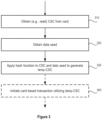
- FIG. 3 is a flowchart that schematically illustrates a method of generating a temporary CSC (such as a CVV or CVV2) for use in a card based transaction in accordance with the teachings of SE1651165-1 .
- the method may be performed by means of a mobile terminal, e.g. a mobile telephone.
- the CSC is obtained 310 from the card 1.
- this CSC may be obtained by reading the printed CSC from the card.
- the CSC may be obtained non-automatically, or manually, from the card 1.
- the CSC may be obtained automatically from the card 1.
- the CSC may be optically read from the card 1.
- a data seed is obtained 320.
- the data seed may include any one or a combination of the following attributes:
- the data seed may comprise, or represent, an identifier which is common to a cardholder associated with the card 1 and a service provider system.
- the data seed may be obtained 320 in different ways, e.g., depending on characteristics of the intended based transaction.
- the data seed may be obtained in a way where the user (typically, but not necessarily, the cardholder) provides the data seed to the mobile terminal executing the method.
- obtaining 320 the data seed may comprise receiving a signal including the data seed from the service provider system having one or several computer servers.
- an installation-ID may be included in a signal received from the service provider system.
- obtaining 320 the data seed comprises receiving a signal including the data seed from a card issuer system having one or several computer servers.
- a bank account number may be included in a signal received from the card issuer system.
- obtaining 320 the data seed may comprise retrieving the data seed from a SIM associated with the mobile terminal. For example, an IMSI may be retrieved from said SIM.
- a minimal perfect hash function may be applied 330 to the CSC as well as the data seed to generate a temporary CSC.
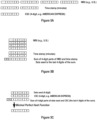
- FIG. 4A schematically illustrates an example minimal perfect hash function.
- Minimal perfect hash functions may avoid challenges of wasted space and time as is sometimes involved in other hash functions.
- each key in the key set has one and only one corresponding hashed key in the Hash Table.
- FIG. 4B An example is given in FIG. 4B .
- the exact hash function, or hash algorithm, to be used in a certain implementation or application may be arbitrarily, or randomly, determined or chosen. More specifically, the exact hash function, or hash algorithm, to be used in a certain implementation may be arbitrarily determined or chosen as long as it fulfills the requirements of a preferably non-order preserving, minimal perfect hash function. As will be appreciated, the exact hash function, or hash algorithm, to be used should also be tested and evaluated in dependence of user needs and system requirements for the intended card based transactions.
- the data seed comprises a combination of i) a mobile phone identifier, here exemplified by an IMSI; and ii) a time stamp.
- FIG. 5A illustrates the following:
- time stamp may be expressed in various ways. For example, it is possible to express the time using a time stamp as publicly available here: http: // www.timestampconvert.com. That is, the timestamp, may use a system for describing points in time, defined as the number of seconds elapsed since midnight Coordinated Universal Time (UTC) of January 1, 1970, not counting leap seconds. This way of expressing time is commonly used not only on Unix-like operating systems but also in many other computing systems.
- UTC Coordinated Universal Time
- the exact hash function, or hash algorithm, to be used in action 330 in a certain implementation may be arbitrarily, or randomly, determined or chosen. More specifically, the exact hash function, or hash algorithm, to be used in a certain implementation may be arbitrarily determined or chosen as long as it fulfills the requirements of a preferably non-order preserving, minimal perfect hash function. As will be appreciated, the exact hash function, or hash algorithm, to be used should also be tested and evaluated in dependence of user needs and system requirements for the intended card based transactions.
- CHD function abbreviation for Compress, Hash and Displace
- the CHD function is described in detail in the paper "Hash, displace, and compress” by Djamal Belazzougui, Fabiano C. Botelho, and Martin Dietzfelbinger, which can be downloaded here: http: // cmph.sourceforge.net / papers / esa09.pdf.
- a card based transaction may optionally also be initiated utilizing the generated temporary CSC.
- the card based transaction may be initiated between the mobile terminal performing the method steps, or actions, 310-330 and a service provider system.
- FIG. 6 is a flowchart that schematically illustrates an example embodiment of a method for regaining an original CSC from a temporary CSC (such as a CVV or CVV2) used in a card based transaction.
- the method is performed by means of a server system.
- the server system may comprise one single computer server or several computer servers.
- the server system may e.g. be a service provider system (i.e. a server system hosted by a service provider) including one or several computer servers.
- the server system may e.g. instead be a credit issuer system (i.e. a server system hosted by a credit issuer) including one or several computer servers.
- Other static (non-changing) parts of the second data seed may either be stored in advance at the server system 720 or be communicated, e.g. during the initiation of a card based transaction. If the second data seed comprises a time stamp or other parts that change, e.g. a sequence number, this could either be calculated by means of the server system 720 or be communicated, e.g. during the initiation of a card based transaction. For example, as foreshadowed in FIG.
- an IMSI may be stored by the server system 720, while the time stamp may be sent from the generating side (i.e., the mobile terminal 710 in this example) as part of or in connection with a card based transaction; these two parts would then be combined to produce or otherwise form the second data seed, as appreciated by FIG. 5B and further described below.
- parts of the above information may originate from the server system 720 and will thus be communicated to the CSC generating side 330 (i.e. the mobile terminal 710 in this example), e.g. during the initiation of a card based transaction.
- the CSC generating side 330 i.e. the mobile terminal 710 in this example
- FIG. 5 illustrates an example of applying 330 a minimal perfect hash function to a combination of a CSC value and the data seed in accordance with some embodiments.
- the CSC is a 4-digit number, e.g. as used by AMERICAN EXPRESS. Reference is now made to Fig. 5 again.
- the second data seed may comprise a combination of i) a mobile terminal identifier such as a mobile phone identifier, here exemplified by an IMSI; and ii) a time stamp.
- a mobile terminal identifier such as a mobile phone identifier, here exemplified by an IMSI
- ii) a time stamp e.g., a time stamp
- time stamp may be expressed in various ways. For example, it is possible to express the time using a time stamp as publicly available here: http: // www.timestampconvert.com. That is, the timestamp may use a system for describing points in time, defined as the number of seconds elapsed since midnight Coordinated Universal Time (UTC) of January 1, 1970, not counting leap seconds. This way of expressing time is commonly used not only on Unix-like operating systems but also in many other computing systems.
- UTC Coordinated Universal Time
- a second data seed may be determined, or generated, from the IMSI and the time stamp.
- the second data seed is generated as a total sum of the IMSI and the time stamp:
- the second data seed corresponds to the last four digits of the total sum of the IMSI and the time stamp.
- a same minimal perfect hash function is then applied 630 (see Fig. 6 ) to the second data seed together with each CSC from a list of available CSCs to generate a result to compare to the temporary CSC that has been obtained 610; when these two (i.e. the result and the temporary CSC) are equal, the original CSC that was used to produce the temporary CSC will be equal to the CSC from the list of available CSCs that was just used to produce the result that corresponded to the temporary CSC. Thus, the original CSC is regained.
- this sum of the earlier-generated data seed and the CSC may be referred to as an intermediate key set.
- a total sum of the earlier-generated data seed and the CSC may be produced: 8080 + 6482 14562
- the last four digits of the total sum of the earlier-generated data seed and the CSC form the intermediate key set 4562.
- applying 630 a minimal perfect hash function to the intermediate key set 4562 in this example may render, or generate, a result 6719, which would then be compared with the temporary CSC, sometimes denoted temp-CSC, produced in 330.
- FIG. 7A schematically illustrates a possible environment, wherein embodiments described hitherto may be applied.
- the environment 700 comprises a mobile terminal 710, such as a mobile telephone, as an example of a device that is capable of generating a temporary CSC, and a server system here exemplified as a service provider system 720, which is to regain an original CSC from said temporary CSC.
- FIG. 7B is a signaling diagram illustrating various actions that may be performed as well as signaling between the mobile terminal 710 and the service provider system 720 shown in FIG. 7A .
- the service provider server 720 may also obtain 620 a same data seed that was used during the generation of the temporary CSC and further apply 630 the same minimal perfect hash function to the thus obtained data seed together with, or along with, each one of several CSCs from a stored list of available CSCs until a match is found between the obtained temporary CSC and one CSC from the stored list of available CSCs.
- the service provider service is capable of regaining the original CSC from the obtained temporary CSC.
- An initiated card-based transaction between the mobile terminal 710 and a service provider system 720 may thereafter be continued 640.
- the service provider system 720 may optionally comprise a UI 721. Furthermore, the service provider system 720 comprises hardware resources. For example, the service provider system 720 may comprise one or more processors 722 and one or more memories 723. Also, a communications interface 724, or a communications circuitry, may be provided in order to allow the service provider system 720 to communicate with other devices such as a mobile terminal 710.
- the communications interface 724 may comprise a transmitter (Tx) and a receiver (Rx).
- the communications interface 724 may comprise a transceiver (Tx/Rx) combining both transmission and reception capabilities.
- the communications interface 724 may include a radio frequency (RF) interface allowing the service provider system 720 to communicate with other computer servers and/or devices such as the mobile terminal 710 through a radio frequency band through the use of different radio frequency technologies such as 5G NR (5G New Radio), LTE (Long Term Evolution), WCDMA (Wideband Code Division Multiple Access), any other cellular network standardized by the 3rd Generation Partnership Project (3GPP), or any other wireless technology such as Wi-Fi, Bluetooth ® , etcetera.
- 5G NR 5G New Radio
- LTE Long Term Evolution
- WCDMA Wideband Code Division Multiple Access
- 3GPP 3rd Generation Partnership Project
- FIG. 9 shows an example of a computer-readable medium, in this example in the form of a data disc 900.
- the data disc 900 is a magnetic data storage disc.
- the data disc 900 is configured to carry instructions 910 that can be loaded into a memory of an apparatus, e.g. a service provider system 720 including one or several computer servers. Upon execution of said instructions by a processor of the apparatus, the apparatus is caused to execute a method or procedure according to any one of the embodiments described herein, e.g. in conjunction with Figs. 6 and 7 .
- the data disc 900 is arranged to be connected to or within and read by a reading device (not shown), for loading the instructions into the processor.
- a reading device in combination with one (or several) data disc(s) 900 is a hard drive.
- the functions of the various elements including functional blocks may be provided through the use of hardware such as circuit hardware and/or hardware capable of executing software in the form of coded instructions stored on the above-mentioned computer readable medium.
- the functional blocks may include or encompass, without limitation, digital signal processor (DSP) hardware, reduced instruction set processor, hardware (e.g., digital or analog) circuitry including but not limited to application specific integrated circuit(s) [ASIC], and/or field programmable gate array(s) (FPGA(s)), and (where appropriate) state machines capable of performing such functions.
- DSP digital signal processor
- ASIC application specific integrated circuit
- FPGA field programmable gate array
- a computer is generally understood to comprise one or more processors or one or more controllers.
- the functions may be provided by a single dedicated computer or processor or controller, by a single shared computer or processor or controller, or by a plurality of individual computers or processors or controllers, some of which may be shared or distributed.
- processor or “controller” may also be construed to refer to other hardware capable of performing such functions and/or executing software, such as the example hardware recited above.
Landscapes
- Business, Economics & Management (AREA)
- Accounting & Taxation (AREA)
- Engineering & Computer Science (AREA)
- Finance (AREA)
- Strategic Management (AREA)
- Physics & Mathematics (AREA)
- General Business, Economics & Management (AREA)
- General Physics & Mathematics (AREA)
- Theoretical Computer Science (AREA)
- Computer Security & Cryptography (AREA)
- Financial Or Insurance-Related Operations Such As Payment And Settlement (AREA)
- Mobile Radio Communication Systems (AREA)
Claims (6)
- Verfahren zum Wiedererlangen eines ursprünglichen Kartensicherheitscodes, CSC, aus einem temporären CSC, der in einer kartenbasierten Transaktion verwendet wird, wobei das Verfahren von einem Serversystem mit einem oder mehreren Computerservern ausgeführt wird und das Verfahren Folgendes aufweist:Erhalten (610) eines temporären CSC, wobei der temporäre CSC durch vorheriges Anlegen einer minimalen perfekten Hash-Funktion an einen ursprünglichen CSC sowie einen ersten Datensatz oder Seed-Daten erzeugt wurde, wobei der erste Datensatz einen Mobilterminal-Identifikator eines Mobilterminals und einen von dem Mobilterminal erzeugten Zeitstempel aufweist; undErhalten (620) eines zweiten Datensatzes, wobei der zweite Datensatz derselbe Datensatz wie der erste Datensatz ist und denselben Mobilterminal-Identifikator und denselben Zeitstempel wie der erste Datensatz enthält, wobei zumindest der Mobilterminal-Identifikator im Voraus im Serversystem gespeichert wurde, so dass das Erhalten (620) des zweiten Datensatzes das lokale Erhalten des Mobilterminal-Identifizierers vom Serversystem aufweist;Anlegen (630) einer gleichen minimalen perfekten Hash-Funktion an den erhaltenen zweiten Datensatz zusammen mit jedem von mehreren CSCs aus einer gespeicherten Liste verfügbarer CSCs, bis eine Übereinstimmung zwischen dem erhaltenen temporären CSC und einem CSC aus der gespeicherten Liste verfügbarer CSCs gefunden wird; und ansprechend darauf, dass eine Übereinstimmung gefunden wurde:
Fortsetzen (640) einer eingeleiteten kartenbasierten Transaktion - Verfahren gemäß Anspruch 1, wobei der Zeitstempel während der Einleitung der kartenbasierten Transaktion übermittelt wurde, so dass das Erhalten (620) des zweiten Datensatzes das Empfangen des Zeitstempels von dem mobilen Endgerät aufweist, das den Zeitstempel erzeugt.
- Verfahren nach Anspruch 1 oder 2, wobei das Verfahren durchgeführt wird durch i) ein Dienstanbietersystem mit einem oder mehreren Computerservern und/oder ii) ein Kreditausgebersystem mit einem oder mehreren Computerservern.
- Computerprogramm mit Anweisungen (1110), die bei Ausführung auf einem Prozessor bewirken, dass der Prozessor das Verfahren gemäß einem der Ansprüche 1 bis 3 ausführt.
- Träger mit dem Computerprogramm gemäß Anspruch 4, wobei der Träger eines der folgenden ist ein elektronisches Signal, ein optisches Signal, ein Funksignal oder ein computerlesbares Speichermedium (1100).
- Ein Serversystem (720) mit einem oder mehreren Computerservern, aufweisend:eine Kommunikationsschnittstelle (724);einen oder mehrere Prozessoren (722); undeinen Speicher (723), der Anweisungen speichert, die von dem einen oder den mehreren Prozessoren ausführbar sind, wobei der Dienstanbieter-Server betriebsmäßig geeignet ist, das Verfahren gemäß einem der Ansprüche 1 bis 5 auszuführen.
Applications Claiming Priority (2)
| Application Number | Priority Date | Filing Date | Title |
|---|---|---|---|
| SE1850858 | 2018-07-06 | ||
| PCT/EP2019/066274 WO2020007618A1 (en) | 2018-07-06 | 2019-06-19 | Regaining an original card security code used in a card based transaction |
Publications (3)
| Publication Number | Publication Date |
|---|---|
| EP3818486A1 EP3818486A1 (de) | 2021-05-12 |
| EP3818486C0 EP3818486C0 (de) | 2025-03-19 |
| EP3818486B1 true EP3818486B1 (de) | 2025-03-19 |
Family
ID=67139692
Family Applications (1)
| Application Number | Title | Priority Date | Filing Date |
|---|---|---|---|
| EP19735228.9A Active EP3818486B1 (de) | 2018-07-06 | 2019-06-19 | Wiedergewinnen eines ursprünglichen kartensicherungscodes, der in einer kartenbasierten transaktion verwendet wird |
Country Status (5)
| Country | Link |
|---|---|
| US (1) | US20210295323A1 (de) |
| EP (1) | EP3818486B1 (de) |
| CN (1) | CN112534454B (de) |
| ES (1) | ES3015231T3 (de) |
| WO (1) | WO2020007618A1 (de) |
Families Citing this family (1)
| Publication number | Priority date | Publication date | Assignee | Title |
|---|---|---|---|---|
| SE545872C2 (en) * | 2019-09-27 | 2024-02-27 | No Common Payment Ab | Generation and verification of a temporary authentication value for use in a secure transmission |
Family Cites Families (5)
| Publication number | Priority date | Publication date | Assignee | Title |
|---|---|---|---|---|
| CN101686223B (zh) * | 2008-09-26 | 2013-11-06 | 华为技术有限公司 | 一种内容过滤的反馈方法和装置 |
| WO2011127177A2 (en) * | 2010-04-09 | 2011-10-13 | Visa International Service Association | System and method for securely validating transactions |
| US20120143754A1 (en) * | 2010-12-03 | 2012-06-07 | Narendra Patel | Enhanced credit card security apparatus and method |
| US9033218B1 (en) * | 2012-05-15 | 2015-05-19 | Dynamics Inc. | Cards, devices, systems, methods and dynamic security codes |
| SE540668C2 (en) * | 2016-08-30 | 2018-10-09 | No Common Payment Ab | Generation and verification of a temporary card security code for use in card based transactions |
-
2019
- 2019-06-19 ES ES19735228T patent/ES3015231T3/es active Active
- 2019-06-19 WO PCT/EP2019/066274 patent/WO2020007618A1/en not_active Ceased
- 2019-06-19 US US17/257,826 patent/US20210295323A1/en not_active Abandoned
- 2019-06-19 CN CN201980045481.9A patent/CN112534454B/zh active Active
- 2019-06-19 EP EP19735228.9A patent/EP3818486B1/de active Active
Also Published As
| Publication number | Publication date |
|---|---|
| US20210295323A1 (en) | 2021-09-23 |
| EP3818486C0 (de) | 2025-03-19 |
| CN112534454B (zh) | 2024-12-13 |
| WO2020007618A1 (en) | 2020-01-09 |
| CN112534454A (zh) | 2021-03-19 |
| EP3818486A1 (de) | 2021-05-12 |
| ES3015231T3 (en) | 2025-04-30 |
Similar Documents
| Publication | Publication Date | Title |
|---|---|---|
| US8469277B2 (en) | Methods, systems and computer program products for wireless payment transactions | |
| US10262378B2 (en) | Transaction identification and recognition | |
| MX2008016206A (es) | Sistema de verificacion de reduccion de error. | |
| CN112308555B (zh) | 远程交易系统、方法和销售点终端 | |
| US11216817B2 (en) | Generation and verification of a temporary card security code for use in card based transactions | |
| CN108140184A (zh) | 自适应消息接发 | |
| US10108947B2 (en) | Smart card reader with public key index on host device | |
| EP3818486B1 (de) | Wiedergewinnen eines ursprünglichen kartensicherungscodes, der in einer kartenbasierten transaktion verwendet wird | |
| US11620623B2 (en) | Merchant transaction mirroring for personal point of sale (pPOS) for card present e-commerce and in vehicle transaction | |
| CN105427102A (zh) | 基于金融ic卡的认证方法及其相应的设备和系统 | |
| HK40046200B (zh) | 重新取得基於卡片的交易中使用的原始卡片安全码 | |
| HK40046200A (en) | Regaining an original card security code used in a card based transaction | |
| HK40011721B (en) | Generation and verification of a temporary card security code for use in card based transactions | |
| HK40011721A (en) | Generation and verification of a temporary card security code for use in card based transactions | |
| US20140236821A1 (en) | Method and system for the transmission of authenticated authorization requests | |
| CN104320422A (zh) | 一种密码管理方法,相关设备及系统 | |
| US10504113B2 (en) | Method and apparatus for providing pre-certification for chip card mobile merchant payments | |
| US11863548B2 (en) | Generation and verification of a temporary authentication value for use in a secure transmission | |
| KR101843746B1 (ko) | 대표카드 인증서버 | |
| CN116205645A (zh) | 针对交易终端的报文数据的认证方法、认证后台以及pos终端 |
Legal Events
| Date | Code | Title | Description |
|---|---|---|---|
| STAA | Information on the status of an ep patent application or granted ep patent |
Free format text: STATUS: UNKNOWN |
|
| STAA | Information on the status of an ep patent application or granted ep patent |
Free format text: STATUS: THE INTERNATIONAL PUBLICATION HAS BEEN MADE |
|
| PUAI | Public reference made under article 153(3) epc to a published international application that has entered the european phase |
Free format text: ORIGINAL CODE: 0009012 |
|
| STAA | Information on the status of an ep patent application or granted ep patent |
Free format text: STATUS: REQUEST FOR EXAMINATION WAS MADE |
|
| 17P | Request for examination filed |
Effective date: 20210113 |
|
| AK | Designated contracting states |
Kind code of ref document: A1 Designated state(s): AL AT BE BG CH CY CZ DE DK EE ES FI FR GB GR HR HU IE IS IT LI LT LU LV MC MK MT NL NO PL PT RO RS SE SI SK SM TR |
|
| DAV | Request for validation of the european patent (deleted) | ||
| DAX | Request for extension of the european patent (deleted) | ||
| STAA | Information on the status of an ep patent application or granted ep patent |
Free format text: STATUS: EXAMINATION IS IN PROGRESS |
|
| 17Q | First examination report despatched |
Effective date: 20230302 |
|
| GRAP | Despatch of communication of intention to grant a patent |
Free format text: ORIGINAL CODE: EPIDOSNIGR1 |
|
| STAA | Information on the status of an ep patent application or granted ep patent |
Free format text: STATUS: GRANT OF PATENT IS INTENDED |
|
| INTG | Intention to grant announced |
Effective date: 20241017 |
|
| GRAS | Grant fee paid |
Free format text: ORIGINAL CODE: EPIDOSNIGR3 |
|
| GRAA | (expected) grant |
Free format text: ORIGINAL CODE: 0009210 |
|
| STAA | Information on the status of an ep patent application or granted ep patent |
Free format text: STATUS: THE PATENT HAS BEEN GRANTED |
|
| AK | Designated contracting states |
Kind code of ref document: B1 Designated state(s): AL AT BE BG CH CY CZ DE DK EE ES FI FR GB GR HR HU IE IS IT LI LT LU LV MC MK MT NL NO PL PT RO RS SE SI SK SM TR |
|
| REG | Reference to a national code |
Ref country code: GB Ref legal event code: FG4D |
|
| REG | Reference to a national code |
Ref country code: CH Ref legal event code: EP |
|
| REG | Reference to a national code |
Ref country code: IE Ref legal event code: FG4D |
|
| REG | Reference to a national code |
Ref country code: DE Ref legal event code: R096 Ref document number: 602019067472 Country of ref document: DE |
|
| U01 | Request for unitary effect filed |
Effective date: 20250319 |
|
| REG | Reference to a national code |
Ref country code: ES Ref legal event code: FG2A Ref document number: 3015231 Country of ref document: ES Kind code of ref document: T3 Effective date: 20250430 |
|
| U07 | Unitary effect registered |
Designated state(s): AT BE BG DE DK EE FI FR IT LT LU LV MT NL PT RO SE SI Effective date: 20250326 |
|
| PG25 | Lapsed in a contracting state [announced via postgrant information from national office to epo] |
Ref country code: RS Free format text: LAPSE BECAUSE OF FAILURE TO SUBMIT A TRANSLATION OF THE DESCRIPTION OR TO PAY THE FEE WITHIN THE PRESCRIBED TIME-LIMIT Effective date: 20250619 |
|
| PGFP | Annual fee paid to national office [announced via postgrant information from national office to epo] |
Ref country code: GB Payment date: 20250610 Year of fee payment: 7 |
|
| PG25 | Lapsed in a contracting state [announced via postgrant information from national office to epo] |
Ref country code: NO Free format text: LAPSE BECAUSE OF FAILURE TO SUBMIT A TRANSLATION OF THE DESCRIPTION OR TO PAY THE FEE WITHIN THE PRESCRIBED TIME-LIMIT Effective date: 20250619 |
|
| PG25 | Lapsed in a contracting state [announced via postgrant information from national office to epo] |
Ref country code: HR Free format text: LAPSE BECAUSE OF FAILURE TO SUBMIT A TRANSLATION OF THE DESCRIPTION OR TO PAY THE FEE WITHIN THE PRESCRIBED TIME-LIMIT Effective date: 20250319 |
|
| U20 | Renewal fee for the european patent with unitary effect paid |
Year of fee payment: 7 Effective date: 20250612 |
|
| PG25 | Lapsed in a contracting state [announced via postgrant information from national office to epo] |
Ref country code: GR Free format text: LAPSE BECAUSE OF FAILURE TO SUBMIT A TRANSLATION OF THE DESCRIPTION OR TO PAY THE FEE WITHIN THE PRESCRIBED TIME-LIMIT Effective date: 20250620 |
|
| PGFP | Annual fee paid to national office [announced via postgrant information from national office to epo] |
Ref country code: IE Payment date: 20250610 Year of fee payment: 7 |
|
| PG25 | Lapsed in a contracting state [announced via postgrant information from national office to epo] |
Ref country code: SM Free format text: LAPSE BECAUSE OF FAILURE TO SUBMIT A TRANSLATION OF THE DESCRIPTION OR TO PAY THE FEE WITHIN THE PRESCRIBED TIME-LIMIT Effective date: 20250319 |
|
| PGFP | Annual fee paid to national office [announced via postgrant information from national office to epo] |
Ref country code: ES Payment date: 20250702 Year of fee payment: 7 |
|
| PG25 | Lapsed in a contracting state [announced via postgrant information from national office to epo] |
Ref country code: PL Free format text: LAPSE BECAUSE OF FAILURE TO SUBMIT A TRANSLATION OF THE DESCRIPTION OR TO PAY THE FEE WITHIN THE PRESCRIBED TIME-LIMIT Effective date: 20250319 |
|
| PGFP | Annual fee paid to national office [announced via postgrant information from national office to epo] |
Ref country code: CH Payment date: 20250701 Year of fee payment: 7 |
|
| PG25 | Lapsed in a contracting state [announced via postgrant information from national office to epo] |
Ref country code: CZ Free format text: LAPSE BECAUSE OF FAILURE TO SUBMIT A TRANSLATION OF THE DESCRIPTION OR TO PAY THE FEE WITHIN THE PRESCRIBED TIME-LIMIT Effective date: 20250319 |
|
| PG25 | Lapsed in a contracting state [announced via postgrant information from national office to epo] |
Ref country code: SK Free format text: LAPSE BECAUSE OF FAILURE TO SUBMIT A TRANSLATION OF THE DESCRIPTION OR TO PAY THE FEE WITHIN THE PRESCRIBED TIME-LIMIT Effective date: 20250319 |
|
| PG25 | Lapsed in a contracting state [announced via postgrant information from national office to epo] |
Ref country code: IS Free format text: LAPSE BECAUSE OF FAILURE TO SUBMIT A TRANSLATION OF THE DESCRIPTION OR TO PAY THE FEE WITHIN THE PRESCRIBED TIME-LIMIT Effective date: 20250719 |
|
| PLBE | No opposition filed within time limit |
Free format text: ORIGINAL CODE: 0009261 |
|
| STAA | Information on the status of an ep patent application or granted ep patent |
Free format text: STATUS: NO OPPOSITION FILED WITHIN TIME LIMIT |
|
| REG | Reference to a national code |
Ref country code: CH Ref legal event code: L10 Free format text: ST27 STATUS EVENT CODE: U-0-0-L10-L00 (AS PROVIDED BY THE NATIONAL OFFICE) Effective date: 20260128 |
|
| PG25 | Lapsed in a contracting state [announced via postgrant information from national office to epo] |
Ref country code: MC Free format text: LAPSE BECAUSE OF FAILURE TO SUBMIT A TRANSLATION OF THE DESCRIPTION OR TO PAY THE FEE WITHIN THE PRESCRIBED TIME-LIMIT Effective date: 20250319 |