EP3817953B1 - A retro-fittable vehicle lock - Google Patents
A retro-fittable vehicle lock Download PDFInfo
- Publication number
- EP3817953B1 EP3817953B1 EP18925279.4A EP18925279A EP3817953B1 EP 3817953 B1 EP3817953 B1 EP 3817953B1 EP 18925279 A EP18925279 A EP 18925279A EP 3817953 B1 EP3817953 B1 EP 3817953B1
- Authority
- EP
- European Patent Office
- Prior art keywords
- rotor
- drive flange
- locking member
- driveshaft
- lock
- Prior art date
- Legal status (The legal status is an assumption and is not a legal conclusion. Google has not performed a legal analysis and makes no representation as to the accuracy of the status listed.)
- Active
Links
Images


Classifications
-
- B—PERFORMING OPERATIONS; TRANSPORTING
- B60—VEHICLES IN GENERAL
- B60R—VEHICLES, VEHICLE FITTINGS, OR VEHICLE PARTS, NOT OTHERWISE PROVIDED FOR
- B60R25/00—Fittings or systems for preventing or indicating unauthorised use or theft of vehicles
- B60R25/01—Fittings or systems for preventing or indicating unauthorised use or theft of vehicles operating on vehicle systems or fittings, e.g. on doors, seats or windscreens
- B60R25/04—Fittings or systems for preventing or indicating unauthorised use or theft of vehicles operating on vehicle systems or fittings, e.g. on doors, seats or windscreens operating on the propulsion system, e.g. engine or drive motor
-
- B—PERFORMING OPERATIONS; TRANSPORTING
- B60—VEHICLES IN GENERAL
- B60R—VEHICLES, VEHICLE FITTINGS, OR VEHICLE PARTS, NOT OTHERWISE PROVIDED FOR
- B60R25/00—Fittings or systems for preventing or indicating unauthorised use or theft of vehicles
- B60R25/01—Fittings or systems for preventing or indicating unauthorised use or theft of vehicles operating on vehicle systems or fittings, e.g. on doors, seats or windscreens
- B60R25/04—Fittings or systems for preventing or indicating unauthorised use or theft of vehicles operating on vehicle systems or fittings, e.g. on doors, seats or windscreens operating on the propulsion system, e.g. engine or drive motor
- B60R25/06—Fittings or systems for preventing or indicating unauthorised use or theft of vehicles operating on vehicle systems or fittings, e.g. on doors, seats or windscreens operating on the propulsion system, e.g. engine or drive motor operating on the vehicle transmission
-
- F—MECHANICAL ENGINEERING; LIGHTING; HEATING; WEAPONS; BLASTING
- F16—ENGINEERING ELEMENTS AND UNITS; GENERAL MEASURES FOR PRODUCING AND MAINTAINING EFFECTIVE FUNCTIONING OF MACHINES OR INSTALLATIONS; THERMAL INSULATION IN GENERAL
- F16H—GEARING
- F16H63/00—Control outputs from the control unit to change-speed- or reversing-gearings for conveying rotary motion or to other devices than the final output mechanism
- F16H63/02—Final output mechanisms therefor; Actuating means for the final output mechanisms
- F16H63/30—Constructional features of the final output mechanisms
- F16H63/34—Locking or disabling mechanisms
-
- F—MECHANICAL ENGINEERING; LIGHTING; HEATING; WEAPONS; BLASTING
- F16—ENGINEERING ELEMENTS AND UNITS; GENERAL MEASURES FOR PRODUCING AND MAINTAINING EFFECTIVE FUNCTIONING OF MACHINES OR INSTALLATIONS; THERMAL INSULATION IN GENERAL
- F16H—GEARING
- F16H63/00—Control outputs from the control unit to change-speed- or reversing-gearings for conveying rotary motion or to other devices than the final output mechanism
- F16H63/02—Final output mechanisms therefor; Actuating means for the final output mechanisms
- F16H63/30—Constructional features of the final output mechanisms
- F16H63/34—Locking or disabling mechanisms
- F16H63/3408—Locking or disabling mechanisms the locking mechanism being moved by the final actuating mechanism
-
- F—MECHANICAL ENGINEERING; LIGHTING; HEATING; WEAPONS; BLASTING
- F16—ENGINEERING ELEMENTS AND UNITS; GENERAL MEASURES FOR PRODUCING AND MAINTAINING EFFECTIVE FUNCTIONING OF MACHINES OR INSTALLATIONS; THERMAL INSULATION IN GENERAL
- F16H—GEARING
- F16H63/00—Control outputs from the control unit to change-speed- or reversing-gearings for conveying rotary motion or to other devices than the final output mechanism
- F16H63/02—Final output mechanisms therefor; Actuating means for the final output mechanisms
- F16H63/30—Constructional features of the final output mechanisms
- F16H63/34—Locking or disabling mechanisms
- F16H63/36—Interlocking devices
-
- B—PERFORMING OPERATIONS; TRANSPORTING
- B60—VEHICLES IN GENERAL
- B60R—VEHICLES, VEHICLE FITTINGS, OR VEHICLE PARTS, NOT OTHERWISE PROVIDED FOR
- B60R25/00—Fittings or systems for preventing or indicating unauthorised use or theft of vehicles
- B60R25/01—Fittings or systems for preventing or indicating unauthorised use or theft of vehicles operating on vehicle systems or fittings, e.g. on doors, seats or windscreens
- B60R25/04—Fittings or systems for preventing or indicating unauthorised use or theft of vehicles operating on vehicle systems or fittings, e.g. on doors, seats or windscreens operating on the propulsion system, e.g. engine or drive motor
- B60R2025/0415—Fittings or systems for preventing or indicating unauthorised use or theft of vehicles operating on vehicle systems or fittings, e.g. on doors, seats or windscreens operating on the propulsion system, e.g. engine or drive motor with safe immobilisation
Definitions
- This invention relates to vehicle security. More specifically, it relates to a vehicle driveshaft lock which is configured to be retrofitted to a vehicle.
- Document WO 2018/042236 discloses a method of retrofitting a drive shaft lock to a vehicle.
- Document WO 2018/001476 discloses a drive shaft lock rotor including a body defining a central aperture which is configured to receive a circular, peripheral profile of a drive shaft there through, the body further defining a plurality of mounting formations for securing the rotor to the drive shaft, once the rotor has passed over the drive shaft, for rotation together with the drive shaft, the central aperture and mounting formations rendering the rotor retrofittable to the drive shaft of a vehicle, wherein the body is configured to mate with a locking member in a locked position in which the locking member prevents angular displacement of the rotor.
- weaknesses with these devices are identified and exploited by thieves.
- weaknesses associated with existing devices may include ease of tampering with the device, ability to interrupt power to the device, ability to bypass the device completely, or, in worst case scenarios, ability to tow away the vehicle, despite the presence of a properly functioning security device to a remote location where the device can be effectively disarmed and/or removed.
- a driveshaft lock to a vehicle, the driveshaft lock including:
- the method may include the prior step of disconnecting a driveshaft coupling from the drive flange.
- the method may include mounting the locking member adjacent to the rotor, the driveshaft lock further including an actuator which is configured to displace the locking member relative to the rotor between an open position in which the locking member is spaced away from the rotor and the rotor is permitted to rotate freely about the drive axis and a locked position in which the locking member engages the rotor and prevents rotation of the rotor about the drive axis.
- the method may include mounting a tamperproof casing to a transmission housing of the vehicle and enclosing the locking member and actuator within the tamperproof casing.
- the aligning step may include coaxially and angularly aligning the rotor with the drive flange such that the non-circular peripheral profile of the drive flange is in register with the central aperture of the rotor.
- the passing over step may include axially displacing the rotor relative to and over the drive flange such that the drive flange passes through the central aperture.
- the rotating step may include angularly displacing the rotor relative to the drive flange until mounting formations of the rotor are in register with corresponding mounting holes of the drive flange. Furthermore, the rotating step may include angularly displacing the rotor relative to the drive flange by 45°.
- the method may include at least partially enclosing the rotor which a guard.
- the central aperture may be star-shaped.
- a driveshaft lock rotor which includes: a body defining a central aperture which is configured to receive a non-circular, peripheral profile of a drive flange therethrough, the body further defining a plurality of mounting formations for securing the rotor to the drive flange, once the rotor has passed over the drive flange and has been angularly displaced relative to the drive flange, for rotation together with the drive flange, the central aperture and mounting formations rendering the rotor retrofittable to a driveshaft of a vehicle, piggyback-style, wherein the body is configured to mate with a locking member in a locked position in which the locking member prevents angular displacement of the rotor.
- the mounting formations may be configured such that the body of the rotor is coaxially secured to the drive flange.
- the rotor body may be disc-shaped.
- An outer periphery of the body may resemble a toothed gear.
- the central aperture may be substantially star-shaped.
- the plurality of mounting formations may include four circular openings which are equiangularly spaced apart and correspond to mounting holes of the drive flange.
- a driveshaft lock which is retrofittable to a driveshaft of a vehicle, the driveshaft lock including:
- the locking member may include a locking pawl which is pivotally connected to the vehicle and is configured to engage a toothed outer peripheral profile of the body of the rotor when in its locked position.
- the actuator may include a motor and an extendable actuating arm. The motor may be connected to the actuating arm.
- the actuating arm may include:
- the actuating arm may further include at least one biasing member connected between the screw-follower and the sleeve, the biasing member being configured to bias the locking member to one of its open or locked positions.
- the actuating arm may include two biasing members connected between the sleeve and the screw-follower, one biasing member being connected either side of the screw-follower and being configured to bias the locking member to one of its open or locked positions.
- the locking member and actuator may be housed within a tamperproof casing which is retro-fitted to the vehicle.
- reference numeral 10 refers generally to a driveshaft lock in accordance with one aspect of the invention.
- the driveshaft lock 10 is configured to be retrofitted to a factory-assembled driveshaft of a vehicle in order to lock the driveshaft in position by preventing rotation of the driveshaft, and hence, preventing unauthorised use of the vehicle, e.g. vehicle theft.
- Part of the driveshaft which has been illustrated includes a transmission housing 12 and a drive flange 13 which protrudes axially from the transmission housing 12 by means of a shaft 14 (see figure 2 ) and is configured for rotation about a drive axis X when power is transmitted to the driveshaft from a powerplant or engine (not shown).
- a propeller shaft is connected to the drive flange 13 and, in this example embodiment, includes a universal joint 15, as shown in the figures, which is operatively secured to the drive flange 13 using conventional fasteners such as bolts and nuts or screws (not shown).
- a flange yoke 16 of the universal joint 15 has four mounting holes 18 which correspond with mounting holes 9 formed on the drive flange 13 to ensure that the flange yoke 16 is secured to the drive flange 13 for rotation about the drive axis X.
- the driveshaft lock 10 includes a rotor 17, in accordance with another aspect of the invention, which includes a disc-shaped body which defines a central, substantially star-shaped aperture 20 which is configured to receive the non-circular, peripheral profile of the drive flange 13 therethrough.
- the drive flange 13 has an outer peripheral profile which corresponds substantially with the central aperture 20.
- the body of the rotor 17 further defines a plurality of mounting formations 22 in the form of four equiangularly spaced apart circular openings for securing the rotor 17 to the drive flange 13 for rotation together with the drive flange about the drive axis X.
- the central aperture 20 and mounting formations 22 of the rotor 17 render the rotor retrofittable to the driveshaft, piggyback-style, as will be explained below.
- the driveshaft lock 10 further includes a locking member 21 which is operatively spaced from the transmission casing 12 through use of a spacer 8 and is pivotally mounted to the spacer 8, adjacent to the rotor 17, by way of a pin 40 which screws into the spacer 8.
- the locking member 21 When in a locked position, the locking member 21 is configured to engage the rotor 17 and to prevent rotation of the rotor 17 and hence the driveshaft.
- the lock 10 further includes an actuator 25 which is drivingly connected to the locking member 21 and is configured pivotally to displace the locking member 21 about the pin 40 between an open position ( figure 6 ), in which the locking member 21 is spaced away from the rotor 17 and the rotor 17 is free to rotate together with the drive flange 13 about the drive axis X, and the locked position ( figure 5 ), in which the locking member 21 engages the rotor 17 and prevents angular displacement of the rotor 17 about the drive axis X.
- an actuator 25 which is drivingly connected to the locking member 21 and is configured pivotally to displace the locking member 21 about the pin 40 between an open position ( figure 6 ), in which the locking member 21 is spaced away from the rotor 17 and the rotor 17 is free to rotate together with the drive flange 13 about the drive axis X, and the locked position ( figure 5 ), in which the locking member 21 engages the rotor 17 and prevents angular displacement of the rotor 17 about the drive axis
- the locking member 21 includes a locking pawl 26 and a control arm 27 which protrudes from the locking pawl 26 and is operatively pivotally connected to an extendable actuating arm 28 of the actuator 25 by way of a pin 42.
- the locking pawl 26 is roughly L-shaped and is configured to engage or mate with a toothed, outer peripheral profile of the body of the rotor 17, when in its locked position (see figure 5 ).
- the actuator 25 includes an electric motor which is drivingly connected to the actuating arm 28.
- the actuating arm 28 includes a screw rod 29 which is connected to the electric motor via a universal joint coupling 30, a sleeve 31 which is pivotally connected to the control arm 27 of the locking member 21 via the pin 42, and a screw-follower 32 which is screw-threadingly mounted to the screw rod 29.
- the screw-follower 32 includes a protruding key 33 which is received in a keyway 34 of the sleeve 31 such that rotation of the screw rod 29 is translated into linear displacement of the screw-follower 32, and hence, linear displacement of the sleeve 31 which, in turn, results in pivotal displacement of the locking member 21 about pin 40.
- the actuating arm 28 further includes two biasing members in the form of coil springs 36 connected between ends of the sleeve 31 and the screw-follower 32, one coil spring 36 being connected either side of the screw-follower 32. As the screw-follower translates up and down the screw rod 29, each coil spring serves to bias the sleeve 31 and hence the locking member 21 to one of its open or locked positions.
- FIG 10 shows a method 50 of retrofitting the driveshaft lock 10, and more specifically the driveshaft lock rotor 17, to the vehicle driveshaft.
- the rotor 17 is configured to piggyback on the drive flange 13. Accordingly, in order to mount the lock 10 and retrofit the rotor 17, an installer disconnects 51 a driveshaft coupling, i.e. the universal joint 15 from the drive flange 13 and withdraws the universal joint 15. This leaves the drive flange 13 exposed as shown in figure 4 .
- the tamperproof casing 23 which houses the actuator 25 and locking member 21, amongst other components, and has an L-shaped body in side view, is then mounted 52 to the transmission housing 12 via the two bolts 24 which pass through openings in the spacer 8 and the L-shaped body and screw into screw-threaded holes in the housing 12.
- the casing 23 also has a lid or cover 44 which is secured to the L-shaped body in order to close an open end of the L-shaped body.
- a circular cylindrical rotor guard 45 is irrotationally joined to the casing 23.
- the installer then coaxially aligns 53 the central aperture 20 of the rotor 17 such that it is in register with the star-shaped profile of the drive flange 13.
- the rotor 17 is then axially slid 54 over the drive flange 13 by allowing the drive flange 13 to pass through the central aperture 20.
- the rotor 17 is then angularly displaced 55 relative to the drive flange 13 through 45 degrees (see figure 5 ) until the mounting formations 22 of the rotor 17 are in register with the mounting holes 9 of the drive flange 13.
- the installer then replaces the flange yoke 16 of the universal joint 15 in position over the drive flange 13 and secures 56 the rotor 17 to the drive flange 13 for rotation together with the drive flange 13, piggyback-style, about the drive axis X by securing the fasteners through the registering holes of the flange yoke, drive flange 13 and rotor 17.
- Special lock nuts (not shown) that require the use of a key to undo are used to prevent unauthorised disassembly of the lock 10.
- a remote-control device (not shown) and/or a mobile communication device such as a mobile phone (not shown) are used to lock/unlock the driveshaft lock 10 by actuating the actuator 25 in order to displace the locking member 21 between its open and locked positions.
- a mobile communication device such as a mobile phone
- the Applicant believes that the driveshaft lock 10 will provide an effective solution to curb vehicle theft and retrofitting the lock 10 is relatively easy to do with almost no modification required to be made to the vehicle itself. Because the lock 10 engages the driveshaft directly and is enclosed in a tamperproof casing, it cannot be easily bypassed or tampered with.
Landscapes
- Engineering & Computer Science (AREA)
- General Engineering & Computer Science (AREA)
- Mechanical Engineering (AREA)
- Motor Power Transmission Devices (AREA)
Description
- This invention relates to vehicle security. More specifically, it relates to a vehicle driveshaft lock which is configured to be retrofitted to a vehicle.
- Document
WO 2018/042236 discloses a method of retrofitting a drive shaft lock to a vehicle. DocumentWO 2018/001476 discloses a drive shaft lock rotor including a body defining a central aperture which is configured to receive a circular, peripheral profile of a drive shaft there through, the body further defining a plurality of mounting formations for securing the rotor to the drive shaft, once the rotor has passed over the drive shaft, for rotation together with the drive shaft, the central aperture and mounting formations rendering the rotor retrofittable to the drive shaft of a vehicle, wherein the body is configured to mate with a locking member in a locked position in which the locking member prevents angular displacement of the rotor. - All new vehicles come standard with some form of vehicle security or alarm system which usually comprises a central door locking system operated using a remote control. Modern vehicles usually also include some form of electronic immobiliser which disables certain functions of the vehicle in order to prevent unauthorised use of the vehicle. Despite these measures being in place, thieves often still manage to find ways of bypassing or circumventing these standard, manufacturer-specified vehicle safety measures.
- Accordingly, innovators have tried to come up with innovative after-market security solutions in order to fortify vehicles against theft. These innovations include gear locks, steering or pedal locks, tracking devices, and electronic immobilisers, just to name a few. A drawback associated with after-market innovations is that, in many instances, fairly drastic or significant alterations have to be made to the vehicle in order to retrofit these security devices.
- Inevitably, as time passes, weaknesses with these devices are identified and exploited by thieves. For example, weaknesses associated with existing devices may include ease of tampering with the device, ability to interrupt power to the device, ability to bypass the device completely, or, in worst case scenarios, ability to tow away the vehicle, despite the presence of a properly functioning security device to a remote location where the device can be effectively disarmed and/or removed.
- It is an object of the invention to provide a vehicle lock and a method of retrofitting a vehicle lock which address or at least alleviate the drawbacks discussed above.
- In accordance with a first aspect of the invention, there is provided a method of retrofitting a driveshaft lock to a vehicle, the driveshaft lock including:
- a rotor which defines a central aperture which is configured to receive a non-circular, peripheral profile of a drive flange of a driveshaft therethrough such that the rotor is configured to piggyback on the drive flange;
- a locking member which is configured selectively to engage the rotor in order to lock the rotor in position and prevent angular displacement thereof;
- the method including:
- aligning the central aperture of the rotor with the non-circular peripheral profile of the drive flange;
- passing the rotor over the drive flange;
- rotating the rotor relative to the drive flange so that the central aperture is out of register with the non-circular peripheral profile of the drive flange; and
- securing the rotor to the drive flange for rotation together with the drive flange, piggyback-style, about a drive axis.
- The method may include the prior step of disconnecting a driveshaft coupling from the drive flange.
- The method may include mounting the locking member adjacent to the rotor, the driveshaft lock further including an actuator which is configured to displace the locking member relative to the rotor between an open position in which the locking member is spaced away from the rotor and the rotor is permitted to rotate freely about the drive axis and a locked position in which the locking member engages the rotor and prevents rotation of the rotor about the drive axis.
- The method may include mounting a tamperproof casing to a transmission housing of the vehicle and enclosing the locking member and actuator within the tamperproof casing.
- The aligning step may include coaxially and angularly aligning the rotor with the drive flange such that the non-circular peripheral profile of the drive flange is in register with the central aperture of the rotor.
- The passing over step may include axially displacing the rotor relative to and over the drive flange such that the drive flange passes through the central aperture.
- The rotating step may include angularly displacing the rotor relative to the drive flange until mounting formations of the rotor are in register with corresponding mounting holes of the drive flange. Furthermore, the rotating step may include angularly displacing the rotor relative to the drive flange by 45°.
- The method may include at least partially enclosing the rotor which a guard.
- The central aperture may be star-shaped.
- In accordance with a second aspect of the invention, there is provided a driveshaft lock rotor which includes:
a body defining a central aperture which is configured to receive a non-circular, peripheral profile of a drive flange therethrough, the body further defining a plurality of mounting formations for securing the rotor to the drive flange, once the rotor has passed over the drive flange and has been angularly displaced relative to the drive flange, for rotation together with the drive flange, the central aperture and mounting formations rendering the rotor retrofittable to a driveshaft of a vehicle, piggyback-style, wherein the body is configured to mate with a locking member in a locked position in which the locking member prevents angular displacement of the rotor. - The mounting formations may be configured such that the body of the rotor is coaxially secured to the drive flange. The rotor body may be disc-shaped. An outer periphery of the body may resemble a toothed gear. The central aperture may be substantially star-shaped.
- The plurality of mounting formations may include four circular openings which are equiangularly spaced apart and correspond to mounting holes of the drive flange.
- In accordance with another aspect of the invention, there is provided a driveshaft lock which is retrofittable to a driveshaft of a vehicle, the driveshaft lock including:
- a rotor which includes a body which defines a central aperture which is configured to receive a non-circular, peripheral profile of a drive flange therethrough, the body further defining a plurality of mounting formations for securing the rotor to the drive flange, once the rotor has passed over the drive flange and has been angularly displaced relative to the drive flange, for rotation together with the drive flange, the central aperture and mounting formations rendering the rotor retrofittable to the driveshaft, piggyback-style;
- a locking member operatively mounted adjacent to the rotor and configured to engage the rotor, when in a locked position; and
- an actuator which is drivingly connected to the locking member and is configured to displace the locking member between an open position, in which the rotor is free to rotate together with the drive flange about a drive axis, and the locked position, in which the locking member engages the rotor and prevents angular displacement of the rotor about the drive axis.
- The locking member may include a locking pawl which is pivotally connected to the vehicle and is configured to engage a toothed outer peripheral profile of the body of the rotor when in its locked position. The actuator may include a motor and an extendable actuating arm. The motor may be connected to the actuating arm.
- The actuating arm may include:
- a screw rod which is connected to the motor;
- a sleeve which is connected to the locking member; and
- a screw-follower which is screw-threadingly mounted to the screw rod, the screw-follower including a key which is received in a keyway of the sleeve such that rotation of the screw rod is translated into linear displacement of the screw-follower, and hence, linear displacement of the sleeve, which, in turn, results in pivotal displacement of the locking member.
- The actuating arm may further include at least one biasing member connected between the screw-follower and the sleeve, the biasing member being configured to bias the locking member to one of its open or locked positions.
- More specifically, the actuating arm may include two biasing members connected between the sleeve and the screw-follower, one biasing member being connected either side of the screw-follower and being configured to bias the locking member to one of its open or locked positions.
- The locking member and actuator may be housed within a tamperproof casing which is retro-fitted to the vehicle.
- The invention will now be further described, by way of example, with reference to the accompanying drawings.
- In the drawings:
-
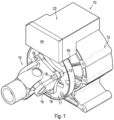
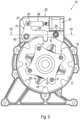
Figure 1 shows a three-dimensional view of a driveshaft lock, in accordance with one aspect of the invention, mounted to a driveshaft of a vehicle; -
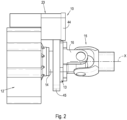
Figure 2 shows a left side view of the driveshaft lock offigure 1 ; -
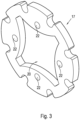
Figure 3 shows a three-dimensional view of a driveshaft lock rotor, in accordance with another aspect of the invention, which forms part of the driveshaft lock; -
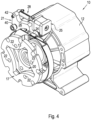
Figure 4 shows a three-dimensional view of a partially assembled driveshaft lock, the rotor being disconnected; -
Figure 5 shows an axial end view of the driveshaft lock offigure 4 with the rotor connected and a locking pawl in its locked position; -
Figure 6 shows the driveshaft lock offigure 5 with the locking pawl in its open position; -
Figure 7 shows an axial cross-sectional view of the driveshaft lock offigure 5 taken along lines VII-VII; -
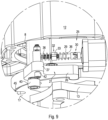
Figures 8 and9 show detailed views of an actuator and locking member of the driveshaft lock; and -
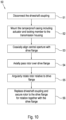
Figure 10 shows a flow diagram of a method of retrofitting the driveshaft lock to the vehicle in accordance with another aspect of the invention. - The following description of the invention is provided as an enabling teaching of the invention. Those skilled in the relevant art will recognise that many changes can be made to the embodiments described, while still attaining the beneficial results of the present invention. It will also be apparent that some of the desired benefits of the present invention can be attained by selecting some of the features of the present invention without utilising other features. Accordingly, those skilled in the art will recognise that modifications and adaptations to the present invention are possible and can even be desirable in certain circumstances, and are a part of the present invention. Thus, the following description is provided as illustrative of the principles of the present invention and not a limitation thereof.
- In the figures,
reference numeral 10 refers generally to a driveshaft lock in accordance with one aspect of the invention. Thedriveshaft lock 10 is configured to be retrofitted to a factory-assembled driveshaft of a vehicle in order to lock the driveshaft in position by preventing rotation of the driveshaft, and hence, preventing unauthorised use of the vehicle, e.g. vehicle theft. In the figures, only part of the existing vehicle driveshaft has been illustrated. Part of the driveshaft which has been illustrated includes atransmission housing 12 and adrive flange 13 which protrudes axially from thetransmission housing 12 by means of a shaft 14 (seefigure 2 ) and is configured for rotation about a drive axis X when power is transmitted to the driveshaft from a powerplant or engine (not shown). A propeller shaft is connected to thedrive flange 13 and, in this example embodiment, includes auniversal joint 15, as shown in the figures, which is operatively secured to thedrive flange 13 using conventional fasteners such as bolts and nuts or screws (not shown). To this end, aflange yoke 16 of theuniversal joint 15 has four mountingholes 18 which correspond with mountingholes 9 formed on thedrive flange 13 to ensure that theflange yoke 16 is secured to thedrive flange 13 for rotation about the drive axis X. - Naturally, in order to retrofit the
driveshaft lock 10, parts of thedriveshaft lock 10 have to be mounted to, or at least mounted adjacent to, the driveshaft of the vehicle. If a component, or part of thedriveshaft lock 10 were to be introduced to the driveshaft in in-line fashion, it would effectively result in lengthening of the driveshaft which would necessitate modification to the existing driveshaft in order to shorten it to its prior length to ensure correct installation and operation. For this reason, it will be appreciated that it is undesirable to introduce parts to the driveshaft in in-line fashion, for example, by sandwiching a part between theflange yoke 16 of theuniversal joint 15 and thedrive flange 13, because it will result in lengthening of the driveshaft. Therefore, the Applicant has designed a piggyback-styleretrofittable driveshaft lock 10. - The
driveshaft lock 10 includes arotor 17, in accordance with another aspect of the invention, which includes a disc-shaped body which defines a central, substantially star-shapedaperture 20 which is configured to receive the non-circular, peripheral profile of thedrive flange 13 therethrough. As can be seen from the figures, particularlyfigure 4 , thedrive flange 13 has an outer peripheral profile which corresponds substantially with thecentral aperture 20. With reference tofigure 3 , the body of therotor 17 further defines a plurality of mountingformations 22 in the form of four equiangularly spaced apart circular openings for securing therotor 17 to thedrive flange 13 for rotation together with the drive flange about the drive axis X. Thecentral aperture 20 and mountingformations 22 of therotor 17 render the rotor retrofittable to the driveshaft, piggyback-style, as will be explained below. - With reference to
figures 4 to 6 , thedriveshaft lock 10 further includes a lockingmember 21 which is operatively spaced from thetransmission casing 12 through use of aspacer 8 and is pivotally mounted to thespacer 8, adjacent to therotor 17, by way of apin 40 which screws into thespacer 8. When in a locked position, the lockingmember 21 is configured to engage therotor 17 and to prevent rotation of therotor 17 and hence the driveshaft. Thelock 10 further includes anactuator 25 which is drivingly connected to the lockingmember 21 and is configured pivotally to displace the lockingmember 21 about thepin 40 between an open position (figure 6 ), in which the lockingmember 21 is spaced away from therotor 17 and therotor 17 is free to rotate together with thedrive flange 13 about the drive axis X, and the locked position (figure 5 ), in which the lockingmember 21 engages therotor 17 and prevents angular displacement of therotor 17 about the drive axis X. - The locking
member 21 andactuator 25, amongst other components which have not all been illustrated in the figures and which include a central processing unit, a wireless communication module, a tracking device, a GSM modem and a battery as back-up power source to power thedriveshaft lock 10, are housed within atamperproof casing 23 which is operatively mounted to thetransmission housing 12 using two bolts 24 (seeFigure 7 ) which pass through thespacer 8 and screw into thetransmission housing 12. The lockingmember 21 includes a lockingpawl 26 and acontrol arm 27 which protrudes from the lockingpawl 26 and is operatively pivotally connected to anextendable actuating arm 28 of theactuator 25 by way of apin 42. The lockingpawl 26 is roughly L-shaped and is configured to engage or mate with a toothed, outer peripheral profile of the body of therotor 17, when in its locked position (seefigure 5 ). - Referring now to
figures 8 and9 , theactuator 25 includes an electric motor which is drivingly connected to theactuating arm 28. Theactuating arm 28 includes ascrew rod 29 which is connected to the electric motor via a universaljoint coupling 30, asleeve 31 which is pivotally connected to thecontrol arm 27 of the lockingmember 21 via thepin 42, and a screw-follower 32 which is screw-threadingly mounted to thescrew rod 29. The screw-follower 32 includes a protrudingkey 33 which is received in akeyway 34 of thesleeve 31 such that rotation of thescrew rod 29 is translated into linear displacement of the screw-follower 32, and hence, linear displacement of thesleeve 31 which, in turn, results in pivotal displacement of the lockingmember 21 aboutpin 40. - The
actuating arm 28 further includes two biasing members in the form ofcoil springs 36 connected between ends of thesleeve 31 and the screw-follower 32, onecoil spring 36 being connected either side of the screw-follower 32. As the screw-follower translates up and down thescrew rod 29, each coil spring serves to bias thesleeve 31 and hence the lockingmember 21 to one of its open or locked positions. - Reference is now made to
figure 10 which shows amethod 50 of retrofitting thedriveshaft lock 10, and more specifically thedriveshaft lock rotor 17, to the vehicle driveshaft. As explained above, due to the star-shapedcentral aperture 20, therotor 17 is configured to piggyback on thedrive flange 13. Accordingly, in order to mount thelock 10 and retrofit therotor 17, an installer disconnects 51 a driveshaft coupling, i.e. the universal joint 15 from thedrive flange 13 and withdraws theuniversal joint 15. This leaves thedrive flange 13 exposed as shown infigure 4 . Thetamperproof casing 23 which houses theactuator 25 and lockingmember 21, amongst other components, and has an L-shaped body in side view, is then mounted 52 to thetransmission housing 12 via the twobolts 24 which pass through openings in thespacer 8 and the L-shaped body and screw into screw-threaded holes in thehousing 12. Thecasing 23 also has a lid or cover 44 which is secured to the L-shaped body in order to close an open end of the L-shaped body. Furthermore, a circularcylindrical rotor guard 45 is irrotationally joined to thecasing 23. - With the
tamperproof casing 23 androtor guard 45 in place, the installer then coaxially aligns 53 thecentral aperture 20 of therotor 17 such that it is in register with the star-shaped profile of thedrive flange 13. Therotor 17 is then axially slid 54 over thedrive flange 13 by allowing thedrive flange 13 to pass through thecentral aperture 20. Therotor 17 is then angularly displaced 55 relative to thedrive flange 13 through 45 degrees (seefigure 5 ) until the mountingformations 22 of therotor 17 are in register with the mountingholes 9 of thedrive flange 13. The installer then replaces theflange yoke 16 of the universal joint 15 in position over thedrive flange 13 and secures 56 therotor 17 to thedrive flange 13 for rotation together with thedrive flange 13, piggyback-style, about the drive axis X by securing the fasteners through the registering holes of the flange yoke, driveflange 13 androtor 17. Special lock nuts (not shown) that require the use of a key to undo are used to prevent unauthorised disassembly of thelock 10. - Once fitted as explained above, a remote-control device (not shown) and/or a mobile communication device such as a mobile phone (not shown) are used to lock/unlock the
driveshaft lock 10 by actuating theactuator 25 in order to displace the lockingmember 21 between its open and locked positions. The Applicant believes that thedriveshaft lock 10 will provide an effective solution to curb vehicle theft and retrofitting thelock 10 is relatively easy to do with almost no modification required to be made to the vehicle itself. Because thelock 10 engages the driveshaft directly and is enclosed in a tamperproof casing, it cannot be easily bypassed or tampered with.
Claims (16)
- A method (50) of retrofitting a driveshaft lock (10) to a vehicle, characterized in that the driveshaft lock (10) includes:a rotor (17) which defines a central aperture (20) which is configured to receive a non-circular, peripheral profile of a drive flange (13) of a driveshaft therethrough such that the rotor (17) is configured to piggyback on the drive flange (13);a locking member (21) which is configured selectively to engage the rotor (17) in order to lock the rotor (17) in position and prevent angular displacement thereof;the method (50) including:aligning (53) the central aperture (20) of the rotor (17) with the non-circular peripheral profile of the drive flange (13);passing (54) the rotor (17) over the drive flange (13);rotating (55) the rotor (17) relative to the drive flange (13) so that the central aperture (20) is out of register with the non-circular peripheral profile of the drive flange (13); andsecuring the rotor (17) to the drive flange (13) for rotation together with the drive flange (13), piggyback-style, about a drive axis (X).
- The method (50) as claimed in claim 1, characterized in that it includes the prior step of disconnecting (51) a driveshaft coupling from the drive flange (13).
- The method (50) as claimed in claim 1 or 2, characterized in that it includes mounting the locking member (21) adjacent to the rotor (17), the driveshaft lock (10) further including an actuator (25) which is configured to displace the locking member (21) relative to the rotor (17) between an open position in which the locking member (21) is spaced away from the rotor (17) and the rotor (17) is permitted to rotate freely about the drive axis (X) and a locked position in which the locking member (21) engages the rotor (17) and prevents rotation of the rotor (17) about the drive axis (X).
- The method (50) as claimed in claim 3, characterized in that it includes mounting a tamperproof casing (23) to a transmission housing (12) of the vehicle and enclosing the locking member (21) and actuator (25) within the tamperproof casing (23).
- The method (50) as claimed in any one of the preceding claims, characterized in that the aligning step (53) includes coaxially and angularly aligning the rotor (17) with the drive flange (13) such that the non-circular peripheral profile of the drive flange (13) is in register with the central aperture (20) of the rotor.
- The method (50) as claimed in claim 5, characterized in that the passing over step (54) includes axially displacing the rotor (17) relative to and over the drive flange (13) such that the drive flange (13) passes through the central aperture (20).
- The method (50) as claimed in claim 6, characterized in that the rotating step (55) includes angularly displacing the rotor (17) relative to the drive flange (13) until mounting formations (22) of the rotor (17) are in register with corresponding mounting holes (9) of the drive flange (13).
- The method (50) as claimed in any one of the preceding claims, characterized in that it includes at least partially enclosing the rotor (17) which a guard (45) and wherein the central aperture (20) is star-shaped.
- A driveshaft lock rotor (17) chcharacterized in that it includes:
a body defining a central aperture (20) which is configured to receive a non-circular, peripheral profile of a drive flange (13) therethrough, the body further defining a plurality of mounting formations (22) for securing the rotor (17) to the drive flange (13), once the rotor (17) has passed over the drive flange (13) and has been angularly displaced relative to the drive flange (13), for rotation together with the drive flange (13), the central aperture (20) and mounting formations (22) rendering the rotor (17) retrofittable to the drive flange (13) of a vehicle, piggyback-style, wherein the body is configured to mate with a locking member (21) in a locked position in which the locking member (21) prevents angular displacement of the rotor (17). - The driveshaft lock rotor (17) as claimed in claim 9, characterized in that the mounting formations (22) are configured such that the body of the rotor (17) is coaxially secured to the drive flange (13).
- The driveshaft lock rotor (17) as claimed in claim 9 or 10, characterized in that the body is disc-shaped, an outer periphery of the body resembles a toothed gear and the central aperture (20) is substantially star-shaped and wherein the plurality of mounting formations (22) includes four circular openings which are equiangularly spaced apart and correspond to mounting holes (9) of the drive flange (13).
- A driveshaft lock (10) which is retrofittable to a driveshaft of a vehicle, characterized in that the driveshaft lock (10) includes:a rotor (17) as claimed in any one of claims 9 to 11;a locking member (21) operatively mounted adjacent to the rotor (17) and configured to engage the rotor (17), when in a locked position; andan actuator (25) which is drivingly connected to the locking member (21) and is configured to displace the locking member (21) between an open position, in which the rotor (17) is free to rotate together with the drive flange (13) about a drive axis (X), and the locked position, in which the locking member (21) engages the rotor (17) and prevents angular displacement of the rotor (17) about the drive axis (X).
- A driveshaft lock (10) as claimed in claim 12, characterized in that the locking member (21) includes a locking pawl (26) which is pivotally connected to the vehicle and is configured to engage a toothed outer peripheral profile of the body of the rotor (17) when in its locked position, and wherein the actuator (25) includes a motor and an extendable actuating arm (28), the motor being connected to the actuating arm (28).
- A driveshaft lock (10) as claimed in claim 13, characterized in that the actuating arm (28) includes:a screw rod (29) which is connected to the motor;a sleeve (31) which is connected to the locking member (21); anda screw-follower (32) which is screw-threadingly mounted to the screw rod (29), the screw-follower (32) including a key (33) which is received in a keyway (34) of the sleeve (31) such that rotation of the screw rod (29) is translated into linear displacement of the screw-follower (32), and hence, linear displacement of the sleeve (31), which, in turn, results in pivotal displacement of the locking member (21),further characterized in that the actuating arm (28) includes at least one biasing member connected between the screw-follower (32) and the sleeve (31), the biasing member being configured to bias the locking member (21) to one of its open or locked positions.
- A driveshaft lock (10) as claimed in claim 14, characterized in that the actuating arm (28) includes two biasing members connected between the sleeve (31) and the screw-follower (32), one biasing member being connected either side of the screw-follower (32) and being configured to bias the locking member (21) to one of its open or locked positions.
- A driveshaft lock (10) as claimed in any one of claims 12 to 15, characterized in that the locking member (21) and actuator (25) are housed within a tamperproof casing (23) which is retro-fitted to the vehicle.
Applications Claiming Priority (1)
| Application Number | Priority Date | Filing Date | Title |
|---|---|---|---|
| PCT/IB2018/054959 WO2020008234A1 (en) | 2018-07-05 | 2018-07-05 | A retro-fittable vehicle lock |
Publications (3)
| Publication Number | Publication Date |
|---|---|
| EP3817953A1 EP3817953A1 (en) | 2021-05-12 |
| EP3817953A4 EP3817953A4 (en) | 2021-07-28 |
| EP3817953B1 true EP3817953B1 (en) | 2024-08-21 |
Family
ID=67686584
Family Applications (1)
| Application Number | Title | Priority Date | Filing Date |
|---|---|---|---|
| EP18925279.4A Active EP3817953B1 (en) | 2018-07-05 | 2018-07-05 | A retro-fittable vehicle lock |
Country Status (7)
| Country | Link |
|---|---|
| US (1) | US11840195B2 (en) |
| EP (1) | EP3817953B1 (en) |
| AU (1) | AU2018430802B2 (en) |
| CA (1) | CA3104933A1 (en) |
| ES (1) | ES2994287T3 (en) |
| WO (1) | WO2020008234A1 (en) |
| ZA (1) | ZA201807119B (en) |
Families Citing this family (2)
| Publication number | Priority date | Publication date | Assignee | Title |
|---|---|---|---|---|
| US11840292B2 (en) * | 2018-10-12 | 2023-12-12 | New Heights, Llc | Locking mechanism for self-propelled tandem axle trailer |
| US12595007B2 (en) * | 2023-05-05 | 2026-04-07 | New Heights, Llc | Locking mechanism for self-propelled tandem axle trailer |
Citations (2)
| Publication number | Priority date | Publication date | Assignee | Title |
|---|---|---|---|---|
| US20190202398A1 (en) * | 2016-09-02 | 2019-07-04 | Hardcore Automotive Locking Technologies (Pty) Ltd | A vehicle anti-theft device |
| US20210070249A1 (en) * | 2018-01-07 | 2021-03-11 | Nahav 2017 Ltd. | Vehicle anti-theft device |
Family Cites Families (10)
| Publication number | Priority date | Publication date | Assignee | Title |
|---|---|---|---|---|
| US2992693A (en) * | 1957-11-04 | 1961-07-18 | Harvey E F Peyton | Drive shaft lock for automotive vehicles |
| US5020344A (en) * | 1983-09-26 | 1991-06-04 | Garcia Gervasio B | Automobile anti-theft device |
| GB2234477A (en) * | 1989-04-28 | 1991-02-06 | Brian Henry Emmett | Vehicle security apparatus |
| US6581986B2 (en) * | 2000-11-21 | 2003-06-24 | Tri Teq Lock And Security, L.L.C. | Bayonet locking system and method for vending machines and the like |
| US6945366B2 (en) * | 2002-08-16 | 2005-09-20 | Gatekeeper Systems, Llc. | Anti-theft vehicle system |
| US8132480B2 (en) * | 2009-05-06 | 2012-03-13 | Hamilton Sundstrand Corporation | Pump gear and pump assembly for a generator |
| CN107206907B (en) * | 2014-11-24 | 2020-02-14 | 极步公司 | Apparatus and method for a motor vehicle wheel |
| FR3038685B1 (en) | 2015-07-07 | 2018-06-22 | Renault Sas | PARKING BRAKE CONTROL DEVICE |
| US10876628B2 (en) * | 2016-06-29 | 2020-12-29 | Gkn Driveline Bruneck Ag | Parking lock unit and electric drive assembly having a parking lock |
| US10502318B2 (en) * | 2016-11-29 | 2019-12-10 | Nio Usa, Inc. | Remote locking system for an autonomous vehicle |
-
2018
- 2018-07-05 US US17/257,647 patent/US11840195B2/en active Active
- 2018-07-05 AU AU2018430802A patent/AU2018430802B2/en active Active
- 2018-07-05 CA CA3104933A patent/CA3104933A1/en not_active Abandoned
- 2018-07-05 EP EP18925279.4A patent/EP3817953B1/en active Active
- 2018-07-05 WO PCT/IB2018/054959 patent/WO2020008234A1/en not_active Ceased
- 2018-07-05 ES ES18925279T patent/ES2994287T3/en active Active
- 2018-10-25 ZA ZA2018/07119A patent/ZA201807119B/en unknown
Patent Citations (2)
| Publication number | Priority date | Publication date | Assignee | Title |
|---|---|---|---|---|
| US20190202398A1 (en) * | 2016-09-02 | 2019-07-04 | Hardcore Automotive Locking Technologies (Pty) Ltd | A vehicle anti-theft device |
| US20210070249A1 (en) * | 2018-01-07 | 2021-03-11 | Nahav 2017 Ltd. | Vehicle anti-theft device |
Also Published As
| Publication number | Publication date |
|---|---|
| CA3104933A1 (en) | 2020-01-09 |
| EP3817953A1 (en) | 2021-05-12 |
| US11840195B2 (en) | 2023-12-12 |
| ES2994287T3 (en) | 2025-01-21 |
| EP3817953A4 (en) | 2021-07-28 |
| AU2018430802B2 (en) | 2022-12-22 |
| ZA201807119B (en) | 2019-08-28 |
| WO2020008234A1 (en) | 2020-01-09 |
| AU2018430802A1 (en) | 2021-02-25 |
| US20210122331A1 (en) | 2021-04-29 |
Similar Documents
| Publication | Publication Date | Title |
|---|---|---|
| AU2016421657B2 (en) | A vehicle anti-theft device | |
| JP2550309B2 (en) | Unauthorized driving prevention device for automobile | |
| EP4182523A1 (en) | Rotary knob for a lock cylinder and a method of sensing and actuating the lock cylinder | |
| EP3817953B1 (en) | A retro-fittable vehicle lock | |
| US4907427A (en) | Steering wheel shaft lock assembly | |
| US6499324B2 (en) | Automobile anti-theft system | |
| CN118220381A (en) | Lock closing control method for sharing bicycle | |
| US20190211590A1 (en) | Wirelessly controlled vehicle hood latch lock system | |
| CN107355133B (en) | Adjustable intelligent lock can idle | |
| US20070284943A1 (en) | RF-immobilizer and contactless ignition for a motor vehicle | |
| AU642452B2 (en) | Improvements in steering locks | |
| WO2019229269A1 (en) | Authentication system and security procedure therefor | |
| US7339472B2 (en) | Self-adjusting cam assembly | |
| CN114562162A (en) | Oil tank cover lock and oil tank cover lock monitoring system | |
| CN210439820U (en) | Double-control lock with built-in electronic actuating mechanism and mechanical emergency mechanism | |
| KR20140113970A (en) | Anti-theft device for a steering column of a motor vehicle and method for the assembly thereof | |
| EP1690760B1 (en) | Lock mechanism | |
| CA2808699C (en) | Self-adjusting cam assembly | |
| KR100501377B1 (en) | Vehicle burglarproof device | |
| JPH06137012A (en) | Crescent for window | |
| JPH074218U (en) | Ignition key device for vehicle | |
| GB2303174A (en) | Vehicle anti-theft starter motor | |
| WO2005007469A1 (en) | An anti-theft system for automative vehicles equipped with mechanical transmission |
Legal Events
| Date | Code | Title | Description |
|---|---|---|---|
| STAA | Information on the status of an ep patent application or granted ep patent |
Free format text: STATUS: THE INTERNATIONAL PUBLICATION HAS BEEN MADE |
|
| PUAI | Public reference made under article 153(3) epc to a published international application that has entered the european phase |
Free format text: ORIGINAL CODE: 0009012 |
|
| STAA | Information on the status of an ep patent application or granted ep patent |
Free format text: STATUS: REQUEST FOR EXAMINATION WAS MADE |
|
| 17P | Request for examination filed |
Effective date: 20210204 |
|
| AK | Designated contracting states |
Kind code of ref document: A1 Designated state(s): AL AT BE BG CH CY CZ DE DK EE ES FI FR GB GR HR HU IE IS IT LI LT LU LV MC MK MT NL NO PL PT RO RS SE SI SK SM TR |
|
| A4 | Supplementary search report drawn up and despatched |
Effective date: 20210625 |
|
| RIC1 | Information provided on ipc code assigned before grant |
Ipc: B60R 25/00 20130101AFI20210621BHEP Ipc: B60R 25/06 20060101ALI20210621BHEP Ipc: F16H 63/34 20060101ALI20210621BHEP |
|
| DAV | Request for validation of the european patent (deleted) | ||
| DAX | Request for extension of the european patent (deleted) | ||
| GRAP | Despatch of communication of intention to grant a patent |
Free format text: ORIGINAL CODE: EPIDOSNIGR1 |
|
| STAA | Information on the status of an ep patent application or granted ep patent |
Free format text: STATUS: GRANT OF PATENT IS INTENDED |
|
| INTG | Intention to grant announced |
Effective date: 20231205 |
|
| GRAJ | Information related to disapproval of communication of intention to grant by the applicant or resumption of examination proceedings by the epo deleted |
Free format text: ORIGINAL CODE: EPIDOSDIGR1 |
|
| STAA | Information on the status of an ep patent application or granted ep patent |
Free format text: STATUS: REQUEST FOR EXAMINATION WAS MADE |
|
| INTC | Intention to grant announced (deleted) | ||
| GRAP | Despatch of communication of intention to grant a patent |
Free format text: ORIGINAL CODE: EPIDOSNIGR1 |
|
| STAA | Information on the status of an ep patent application or granted ep patent |
Free format text: STATUS: GRANT OF PATENT IS INTENDED |
|
| INTG | Intention to grant announced |
Effective date: 20240508 |
|
| GRAS | Grant fee paid |
Free format text: ORIGINAL CODE: EPIDOSNIGR3 |
|
| GRAA | (expected) grant |
Free format text: ORIGINAL CODE: 0009210 |
|
| STAA | Information on the status of an ep patent application or granted ep patent |
Free format text: STATUS: THE PATENT HAS BEEN GRANTED |
|
| AK | Designated contracting states |
Kind code of ref document: B1 Designated state(s): AL AT BE BG CH CY CZ DE DK EE ES FI FR GB GR HR HU IE IS IT LI LT LU LV MC MK MT NL NO PL PT RO RS SE SI SK SM TR |
|
| REG | Reference to a national code |
Ref country code: GB Ref legal event code: FG4D |
|
| REG | Reference to a national code |
Ref country code: CH Ref legal event code: EP |
|
| REG | Reference to a national code |
Ref country code: DE Ref legal event code: R096 Ref document number: 602018073506 Country of ref document: DE |
|
| REG | Reference to a national code |
Ref country code: IE Ref legal event code: FG4D |
|
| REG | Reference to a national code |
Ref country code: SE Ref legal event code: TRGR |
|
| REG | Reference to a national code |
Ref country code: LT Ref legal event code: MG9D |
|
| REG | Reference to a national code |
Ref country code: NL Ref legal event code: MP Effective date: 20240821 |
|
| PG25 | Lapsed in a contracting state [announced via postgrant information from national office to epo] |
Ref country code: NO Free format text: LAPSE BECAUSE OF FAILURE TO SUBMIT A TRANSLATION OF THE DESCRIPTION OR TO PAY THE FEE WITHIN THE PRESCRIBED TIME-LIMIT Effective date: 20241121 |
|
| REG | Reference to a national code |
Ref country code: AT Ref legal event code: MK05 Ref document number: 1715230 Country of ref document: AT Kind code of ref document: T Effective date: 20240821 |
|
| PG25 | Lapsed in a contracting state [announced via postgrant information from national office to epo] |
Ref country code: NL Free format text: LAPSE BECAUSE OF FAILURE TO SUBMIT A TRANSLATION OF THE DESCRIPTION OR TO PAY THE FEE WITHIN THE PRESCRIBED TIME-LIMIT Effective date: 20240821 Ref country code: PT Free format text: LAPSE BECAUSE OF FAILURE TO SUBMIT A TRANSLATION OF THE DESCRIPTION OR TO PAY THE FEE WITHIN THE PRESCRIBED TIME-LIMIT Effective date: 20241223 Ref country code: FI Free format text: LAPSE BECAUSE OF FAILURE TO SUBMIT A TRANSLATION OF THE DESCRIPTION OR TO PAY THE FEE WITHIN THE PRESCRIBED TIME-LIMIT Effective date: 20240821 Ref country code: GR Free format text: LAPSE BECAUSE OF FAILURE TO SUBMIT A TRANSLATION OF THE DESCRIPTION OR TO PAY THE FEE WITHIN THE PRESCRIBED TIME-LIMIT Effective date: 20241122 Ref country code: PL Free format text: LAPSE BECAUSE OF FAILURE TO SUBMIT A TRANSLATION OF THE DESCRIPTION OR TO PAY THE FEE WITHIN THE PRESCRIBED TIME-LIMIT Effective date: 20240821 |
|
| PG25 | Lapsed in a contracting state [announced via postgrant information from national office to epo] |
Ref country code: BG Free format text: LAPSE BECAUSE OF FAILURE TO SUBMIT A TRANSLATION OF THE DESCRIPTION OR TO PAY THE FEE WITHIN THE PRESCRIBED TIME-LIMIT Effective date: 20240821 |
|
| PG25 | Lapsed in a contracting state [announced via postgrant information from national office to epo] |
Ref country code: LV Free format text: LAPSE BECAUSE OF FAILURE TO SUBMIT A TRANSLATION OF THE DESCRIPTION OR TO PAY THE FEE WITHIN THE PRESCRIBED TIME-LIMIT Effective date: 20240821 |
|
| REG | Reference to a national code |
Ref country code: ES Ref legal event code: FG2A Ref document number: 2994287 Country of ref document: ES Kind code of ref document: T3 Effective date: 20250121 |
|
| PG25 | Lapsed in a contracting state [announced via postgrant information from national office to epo] |
Ref country code: AT Free format text: LAPSE BECAUSE OF FAILURE TO SUBMIT A TRANSLATION OF THE DESCRIPTION OR TO PAY THE FEE WITHIN THE PRESCRIBED TIME-LIMIT Effective date: 20240821 Ref country code: IS Free format text: LAPSE BECAUSE OF FAILURE TO SUBMIT A TRANSLATION OF THE DESCRIPTION OR TO PAY THE FEE WITHIN THE PRESCRIBED TIME-LIMIT Effective date: 20241221 |
|
| PG25 | Lapsed in a contracting state [announced via postgrant information from national office to epo] |
Ref country code: HR Free format text: LAPSE BECAUSE OF FAILURE TO SUBMIT A TRANSLATION OF THE DESCRIPTION OR TO PAY THE FEE WITHIN THE PRESCRIBED TIME-LIMIT Effective date: 20240821 |
|
| PG25 | Lapsed in a contracting state [announced via postgrant information from national office to epo] |
Ref country code: RS Free format text: LAPSE BECAUSE OF FAILURE TO SUBMIT A TRANSLATION OF THE DESCRIPTION OR TO PAY THE FEE WITHIN THE PRESCRIBED TIME-LIMIT Effective date: 20241121 |
|
| PG25 | Lapsed in a contracting state [announced via postgrant information from national office to epo] |
Ref country code: RS Free format text: LAPSE BECAUSE OF FAILURE TO SUBMIT A TRANSLATION OF THE DESCRIPTION OR TO PAY THE FEE WITHIN THE PRESCRIBED TIME-LIMIT Effective date: 20241121 Ref country code: PT Free format text: LAPSE BECAUSE OF FAILURE TO SUBMIT A TRANSLATION OF THE DESCRIPTION OR TO PAY THE FEE WITHIN THE PRESCRIBED TIME-LIMIT Effective date: 20241223 Ref country code: PL Free format text: LAPSE BECAUSE OF FAILURE TO SUBMIT A TRANSLATION OF THE DESCRIPTION OR TO PAY THE FEE WITHIN THE PRESCRIBED TIME-LIMIT Effective date: 20240821 Ref country code: NO Free format text: LAPSE BECAUSE OF FAILURE TO SUBMIT A TRANSLATION OF THE DESCRIPTION OR TO PAY THE FEE WITHIN THE PRESCRIBED TIME-LIMIT Effective date: 20241121 Ref country code: NL Free format text: LAPSE BECAUSE OF FAILURE TO SUBMIT A TRANSLATION OF THE DESCRIPTION OR TO PAY THE FEE WITHIN THE PRESCRIBED TIME-LIMIT Effective date: 20240821 Ref country code: LV Free format text: LAPSE BECAUSE OF FAILURE TO SUBMIT A TRANSLATION OF THE DESCRIPTION OR TO PAY THE FEE WITHIN THE PRESCRIBED TIME-LIMIT Effective date: 20240821 Ref country code: IS Free format text: LAPSE BECAUSE OF FAILURE TO SUBMIT A TRANSLATION OF THE DESCRIPTION OR TO PAY THE FEE WITHIN THE PRESCRIBED TIME-LIMIT Effective date: 20241221 Ref country code: HR Free format text: LAPSE BECAUSE OF FAILURE TO SUBMIT A TRANSLATION OF THE DESCRIPTION OR TO PAY THE FEE WITHIN THE PRESCRIBED TIME-LIMIT Effective date: 20240821 Ref country code: GR Free format text: LAPSE BECAUSE OF FAILURE TO SUBMIT A TRANSLATION OF THE DESCRIPTION OR TO PAY THE FEE WITHIN THE PRESCRIBED TIME-LIMIT Effective date: 20241122 Ref country code: FI Free format text: LAPSE BECAUSE OF FAILURE TO SUBMIT A TRANSLATION OF THE DESCRIPTION OR TO PAY THE FEE WITHIN THE PRESCRIBED TIME-LIMIT Effective date: 20240821 Ref country code: BG Free format text: LAPSE BECAUSE OF FAILURE TO SUBMIT A TRANSLATION OF THE DESCRIPTION OR TO PAY THE FEE WITHIN THE PRESCRIBED TIME-LIMIT Effective date: 20240821 Ref country code: AT Free format text: LAPSE BECAUSE OF FAILURE TO SUBMIT A TRANSLATION OF THE DESCRIPTION OR TO PAY THE FEE WITHIN THE PRESCRIBED TIME-LIMIT Effective date: 20240821 |
|
| PG25 | Lapsed in a contracting state [announced via postgrant information from national office to epo] |
Ref country code: RO Free format text: LAPSE BECAUSE OF FAILURE TO SUBMIT A TRANSLATION OF THE DESCRIPTION OR TO PAY THE FEE WITHIN THE PRESCRIBED TIME-LIMIT Effective date: 20240821 Ref country code: SM Free format text: LAPSE BECAUSE OF FAILURE TO SUBMIT A TRANSLATION OF THE DESCRIPTION OR TO PAY THE FEE WITHIN THE PRESCRIBED TIME-LIMIT Effective date: 20240821 Ref country code: DK Free format text: LAPSE BECAUSE OF FAILURE TO SUBMIT A TRANSLATION OF THE DESCRIPTION OR TO PAY THE FEE WITHIN THE PRESCRIBED TIME-LIMIT Effective date: 20240821 |
|
| PG25 | Lapsed in a contracting state [announced via postgrant information from national office to epo] |
Ref country code: EE Free format text: LAPSE BECAUSE OF FAILURE TO SUBMIT A TRANSLATION OF THE DESCRIPTION OR TO PAY THE FEE WITHIN THE PRESCRIBED TIME-LIMIT Effective date: 20240821 |
|
| PG25 | Lapsed in a contracting state [announced via postgrant information from national office to epo] |
Ref country code: CZ Free format text: LAPSE BECAUSE OF FAILURE TO SUBMIT A TRANSLATION OF THE DESCRIPTION OR TO PAY THE FEE WITHIN THE PRESCRIBED TIME-LIMIT Effective date: 20240821 |
|
| PG25 | Lapsed in a contracting state [announced via postgrant information from national office to epo] |
Ref country code: SK Free format text: LAPSE BECAUSE OF FAILURE TO SUBMIT A TRANSLATION OF THE DESCRIPTION OR TO PAY THE FEE WITHIN THE PRESCRIBED TIME-LIMIT Effective date: 20240821 |
|
| REG | Reference to a national code |
Ref country code: DE Ref legal event code: R097 Ref document number: 602018073506 Country of ref document: DE |
|
| PLBE | No opposition filed within time limit |
Free format text: ORIGINAL CODE: 0009261 |
|
| STAA | Information on the status of an ep patent application or granted ep patent |
Free format text: STATUS: NO OPPOSITION FILED WITHIN TIME LIMIT |
|
| PGFP | Annual fee paid to national office [announced via postgrant information from national office to epo] |
Ref country code: GB Payment date: 20250612 Year of fee payment: 8 |
|
| PGFP | Annual fee paid to national office [announced via postgrant information from national office to epo] |
Ref country code: FR Payment date: 20250623 Year of fee payment: 8 |
|
| 26N | No opposition filed |
Effective date: 20250522 |
|
| PGFP | Annual fee paid to national office [announced via postgrant information from national office to epo] |
Ref country code: SE Payment date: 20250610 Year of fee payment: 8 |
|
| PGFP | Annual fee paid to national office [announced via postgrant information from national office to epo] |
Ref country code: ES Payment date: 20250805 Year of fee payment: 8 |
|
| PGFP | Annual fee paid to national office [announced via postgrant information from national office to epo] |
Ref country code: DE Payment date: 20250611 Year of fee payment: 8 |
|
| PGFP | Annual fee paid to national office [announced via postgrant information from national office to epo] |
Ref country code: IT Payment date: 20250626 Year of fee payment: 8 |
|
| REG | Reference to a national code |
Ref country code: CH Ref legal event code: H13 Free format text: ST27 STATUS EVENT CODE: U-0-0-H10-H13 (AS PROVIDED BY THE NATIONAL OFFICE) Effective date: 20260224 |
|
| PG25 | Lapsed in a contracting state [announced via postgrant information from national office to epo] |
Ref country code: LU Free format text: LAPSE BECAUSE OF NON-PAYMENT OF DUE FEES Effective date: 20250705 |
|
| REG | Reference to a national code |
Ref country code: BE Ref legal event code: MM Effective date: 20250731 |
|
| PG25 | Lapsed in a contracting state [announced via postgrant information from national office to epo] |
Ref country code: BE Free format text: LAPSE BECAUSE OF NON-PAYMENT OF DUE FEES Effective date: 20250731 |
|
| PG25 | Lapsed in a contracting state [announced via postgrant information from national office to epo] |
Ref country code: CH Free format text: LAPSE BECAUSE OF NON-PAYMENT OF DUE FEES Effective date: 20250731 |