EP3815869A1 - Thermoplastic liquid-crystal polymer film, method for producing same, and flexible copper-clad laminate - Google Patents
Thermoplastic liquid-crystal polymer film, method for producing same, and flexible copper-clad laminate Download PDFInfo
- Publication number
- EP3815869A1 EP3815869A1 EP19834878.1A EP19834878A EP3815869A1 EP 3815869 A1 EP3815869 A1 EP 3815869A1 EP 19834878 A EP19834878 A EP 19834878A EP 3815869 A1 EP3815869 A1 EP 3815869A1
- Authority
- EP
- European Patent Office
- Prior art keywords
- crystal polymer
- thermoplastic liquid
- polymer film
- film
- plane
- Prior art date
- Legal status (The legal status is an assumption and is not a legal conclusion. Google has not performed a legal analysis and makes no representation as to the accuracy of the status listed.)
- Granted
Links
Images
Classifications
-
- B—PERFORMING OPERATIONS; TRANSPORTING
- B29—WORKING OF PLASTICS; WORKING OF SUBSTANCES IN A PLASTIC STATE IN GENERAL
- B29C—SHAPING OR JOINING OF PLASTICS; SHAPING OF MATERIAL IN A PLASTIC STATE, NOT OTHERWISE PROVIDED FOR; AFTER-TREATMENT OF THE SHAPED PRODUCTS, e.g. REPAIRING
- B29C71/00—After-treatment of articles without altering their shape; Apparatus therefor
- B29C71/02—Thermal after-treatment
-
- B—PERFORMING OPERATIONS; TRANSPORTING
- B29—WORKING OF PLASTICS; WORKING OF SUBSTANCES IN A PLASTIC STATE IN GENERAL
- B29C—SHAPING OR JOINING OF PLASTICS; SHAPING OF MATERIAL IN A PLASTIC STATE, NOT OTHERWISE PROVIDED FOR; AFTER-TREATMENT OF THE SHAPED PRODUCTS, e.g. REPAIRING
- B29C48/00—Extrusion moulding, i.e. expressing the moulding material through a die or nozzle which imparts the desired form; Apparatus therefor
- B29C48/001—Combinations of extrusion moulding with other shaping operations
- B29C48/0011—Combinations of extrusion moulding with other shaping operations combined with compression moulding
-
- B—PERFORMING OPERATIONS; TRANSPORTING
- B29—WORKING OF PLASTICS; WORKING OF SUBSTANCES IN A PLASTIC STATE IN GENERAL
- B29C—SHAPING OR JOINING OF PLASTICS; SHAPING OF MATERIAL IN A PLASTIC STATE, NOT OTHERWISE PROVIDED FOR; AFTER-TREATMENT OF THE SHAPED PRODUCTS, e.g. REPAIRING
- B29C35/00—Heating, cooling or curing, e.g. crosslinking or vulcanising; Apparatus therefor
- B29C35/02—Heating or curing, e.g. crosslinking or vulcanizing during moulding, e.g. in a mould
-
- B—PERFORMING OPERATIONS; TRANSPORTING
- B29—WORKING OF PLASTICS; WORKING OF SUBSTANCES IN A PLASTIC STATE IN GENERAL
- B29C—SHAPING OR JOINING OF PLASTICS; SHAPING OF MATERIAL IN A PLASTIC STATE, NOT OTHERWISE PROVIDED FOR; AFTER-TREATMENT OF THE SHAPED PRODUCTS, e.g. REPAIRING
- B29C35/00—Heating, cooling or curing, e.g. crosslinking or vulcanising; Apparatus therefor
- B29C35/16—Cooling
-
- B—PERFORMING OPERATIONS; TRANSPORTING
- B29—WORKING OF PLASTICS; WORKING OF SUBSTANCES IN A PLASTIC STATE IN GENERAL
- B29C—SHAPING OR JOINING OF PLASTICS; SHAPING OF MATERIAL IN A PLASTIC STATE, NOT OTHERWISE PROVIDED FOR; AFTER-TREATMENT OF THE SHAPED PRODUCTS, e.g. REPAIRING
- B29C48/00—Extrusion moulding, i.e. expressing the moulding material through a die or nozzle which imparts the desired form; Apparatus therefor
- B29C48/001—Combinations of extrusion moulding with other shaping operations
- B29C48/0017—Combinations of extrusion moulding with other shaping operations combined with blow-moulding or thermoforming
-
- B—PERFORMING OPERATIONS; TRANSPORTING
- B29—WORKING OF PLASTICS; WORKING OF SUBSTANCES IN A PLASTIC STATE IN GENERAL
- B29C—SHAPING OR JOINING OF PLASTICS; SHAPING OF MATERIAL IN A PLASTIC STATE, NOT OTHERWISE PROVIDED FOR; AFTER-TREATMENT OF THE SHAPED PRODUCTS, e.g. REPAIRING
- B29C48/00—Extrusion moulding, i.e. expressing the moulding material through a die or nozzle which imparts the desired form; Apparatus therefor
- B29C48/001—Combinations of extrusion moulding with other shaping operations
- B29C48/0021—Combinations of extrusion moulding with other shaping operations combined with joining, lining or laminating
-
- B—PERFORMING OPERATIONS; TRANSPORTING
- B29—WORKING OF PLASTICS; WORKING OF SUBSTANCES IN A PLASTIC STATE IN GENERAL
- B29C—SHAPING OR JOINING OF PLASTICS; SHAPING OF MATERIAL IN A PLASTIC STATE, NOT OTHERWISE PROVIDED FOR; AFTER-TREATMENT OF THE SHAPED PRODUCTS, e.g. REPAIRING
- B29C48/00—Extrusion moulding, i.e. expressing the moulding material through a die or nozzle which imparts the desired form; Apparatus therefor
- B29C48/03—Extrusion moulding, i.e. expressing the moulding material through a die or nozzle which imparts the desired form; Apparatus therefor characterised by the shape of the extruded material at extrusion
- B29C48/07—Flat, e.g. panels
- B29C48/08—Flat, e.g. panels flexible, e.g. films
-
- B—PERFORMING OPERATIONS; TRANSPORTING
- B29—WORKING OF PLASTICS; WORKING OF SUBSTANCES IN A PLASTIC STATE IN GENERAL
- B29C—SHAPING OR JOINING OF PLASTICS; SHAPING OF MATERIAL IN A PLASTIC STATE, NOT OTHERWISE PROVIDED FOR; AFTER-TREATMENT OF THE SHAPED PRODUCTS, e.g. REPAIRING
- B29C48/00—Extrusion moulding, i.e. expressing the moulding material through a die or nozzle which imparts the desired form; Apparatus therefor
- B29C48/25—Component parts, details or accessories; Auxiliary operations
- B29C48/88—Thermal treatment of the stream of extruded material, e.g. cooling
- B29C48/91—Heating, e.g. for cross linking
-
- B—PERFORMING OPERATIONS; TRANSPORTING
- B29—WORKING OF PLASTICS; WORKING OF SUBSTANCES IN A PLASTIC STATE IN GENERAL
- B29C—SHAPING OR JOINING OF PLASTICS; SHAPING OF MATERIAL IN A PLASTIC STATE, NOT OTHERWISE PROVIDED FOR; AFTER-TREATMENT OF THE SHAPED PRODUCTS, e.g. REPAIRING
- B29C48/00—Extrusion moulding, i.e. expressing the moulding material through a die or nozzle which imparts the desired form; Apparatus therefor
- B29C48/25—Component parts, details or accessories; Auxiliary operations
- B29C48/88—Thermal treatment of the stream of extruded material, e.g. cooling
- B29C48/911—Cooling
- B29C48/9135—Cooling of flat articles, e.g. using specially adapted supporting means
-
- B—PERFORMING OPERATIONS; TRANSPORTING
- B29—WORKING OF PLASTICS; WORKING OF SUBSTANCES IN A PLASTIC STATE IN GENERAL
- B29D—PRODUCING PARTICULAR ARTICLES FROM PLASTICS OR FROM SUBSTANCES IN A PLASTIC STATE
- B29D7/00—Producing flat articles, e.g. films or sheets
- B29D7/01—Films or sheets
-
- B—PERFORMING OPERATIONS; TRANSPORTING
- B32—LAYERED PRODUCTS
- B32B—LAYERED PRODUCTS, i.e. PRODUCTS BUILT-UP OF STRATA OF FLAT OR NON-FLAT, e.g. CELLULAR OR HONEYCOMB, FORM
- B32B15/00—Layered products comprising a layer of metal
- B32B15/04—Layered products comprising a layer of metal comprising metal as the main or only constituent of a layer, which is next to another layer of the same or of a different material
- B32B15/08—Layered products comprising a layer of metal comprising metal as the main or only constituent of a layer, which is next to another layer of the same or of a different material of synthetic resin
-
- B—PERFORMING OPERATIONS; TRANSPORTING
- B32—LAYERED PRODUCTS
- B32B—LAYERED PRODUCTS, i.e. PRODUCTS BUILT-UP OF STRATA OF FLAT OR NON-FLAT, e.g. CELLULAR OR HONEYCOMB, FORM
- B32B15/00—Layered products comprising a layer of metal
- B32B15/20—Layered products comprising a layer of metal comprising aluminium or copper
-
- C—CHEMISTRY; METALLURGY
- C08—ORGANIC MACROMOLECULAR COMPOUNDS; THEIR PREPARATION OR CHEMICAL WORKING-UP; COMPOSITIONS BASED THEREON
- C08J—WORKING-UP; GENERAL PROCESSES OF COMPOUNDING; AFTER-TREATMENT NOT COVERED BY SUBCLASSES C08B, C08C, C08F, C08G or C08H
- C08J5/00—Manufacture of articles or shaped materials containing macromolecular substances
- C08J5/18—Manufacture of films or sheets
-
- H—ELECTRICITY
- H05—ELECTRIC TECHNIQUES NOT OTHERWISE PROVIDED FOR
- H05K—PRINTED CIRCUITS; CASINGS OR CONSTRUCTIONAL DETAILS OF ELECTRIC APPARATUS; MANUFACTURE OF ASSEMBLAGES OF ELECTRICAL COMPONENTS
- H05K1/00—Printed circuits
- H05K1/02—Details
- H05K1/03—Use of materials for the substrate
-
- H—ELECTRICITY
- H05—ELECTRIC TECHNIQUES NOT OTHERWISE PROVIDED FOR
- H05K—PRINTED CIRCUITS; CASINGS OR CONSTRUCTIONAL DETAILS OF ELECTRIC APPARATUS; MANUFACTURE OF ASSEMBLAGES OF ELECTRICAL COMPONENTS
- H05K1/00—Printed circuits
- H05K1/02—Details
- H05K1/03—Use of materials for the substrate
- H05K1/0313—Organic insulating material
- H05K1/032—Organic insulating material consisting of one material
-
- H—ELECTRICITY
- H05—ELECTRIC TECHNIQUES NOT OTHERWISE PROVIDED FOR
- H05K—PRINTED CIRCUITS; CASINGS OR CONSTRUCTIONAL DETAILS OF ELECTRIC APPARATUS; MANUFACTURE OF ASSEMBLAGES OF ELECTRICAL COMPONENTS
- H05K1/00—Printed circuits
- H05K1/02—Details
- H05K1/03—Use of materials for the substrate
- H05K1/0393—Flexible materials
-
- H—ELECTRICITY
- H05—ELECTRIC TECHNIQUES NOT OTHERWISE PROVIDED FOR
- H05K—PRINTED CIRCUITS; CASINGS OR CONSTRUCTIONAL DETAILS OF ELECTRIC APPARATUS; MANUFACTURE OF ASSEMBLAGES OF ELECTRICAL COMPONENTS
- H05K3/00—Apparatus or processes for manufacturing printed circuits
- H05K3/0011—Working of insulating substrates or insulating layers
- H05K3/0014—Shaping of the substrate, e.g. by moulding
-
- B—PERFORMING OPERATIONS; TRANSPORTING
- B29—WORKING OF PLASTICS; WORKING OF SUBSTANCES IN A PLASTIC STATE IN GENERAL
- B29C—SHAPING OR JOINING OF PLASTICS; SHAPING OF MATERIAL IN A PLASTIC STATE, NOT OTHERWISE PROVIDED FOR; AFTER-TREATMENT OF THE SHAPED PRODUCTS, e.g. REPAIRING
- B29C71/00—After-treatment of articles without altering their shape; Apparatus therefor
- B29C71/02—Thermal after-treatment
- B29C2071/022—Annealing
-
- B—PERFORMING OPERATIONS; TRANSPORTING
- B29—WORKING OF PLASTICS; WORKING OF SUBSTANCES IN A PLASTIC STATE IN GENERAL
- B29C—SHAPING OR JOINING OF PLASTICS; SHAPING OF MATERIAL IN A PLASTIC STATE, NOT OTHERWISE PROVIDED FOR; AFTER-TREATMENT OF THE SHAPED PRODUCTS, e.g. REPAIRING
- B29C71/00—After-treatment of articles without altering their shape; Apparatus therefor
- B29C71/02—Thermal after-treatment
- B29C2071/025—Quenching, i.e. rapid cooling of an object
-
- B—PERFORMING OPERATIONS; TRANSPORTING
- B29—WORKING OF PLASTICS; WORKING OF SUBSTANCES IN A PLASTIC STATE IN GENERAL
- B29C—SHAPING OR JOINING OF PLASTICS; SHAPING OF MATERIAL IN A PLASTIC STATE, NOT OTHERWISE PROVIDED FOR; AFTER-TREATMENT OF THE SHAPED PRODUCTS, e.g. REPAIRING
- B29C41/00—Shaping by coating a mould, core or other substrate, i.e. by depositing material and stripping-off the shaped article; Apparatus therefor
- B29C41/24—Shaping by coating a mould, core or other substrate, i.e. by depositing material and stripping-off the shaped article; Apparatus therefor for making articles of indefinite length
- B29C41/30—Shaping by coating a mould, core or other substrate, i.e. by depositing material and stripping-off the shaped article; Apparatus therefor for making articles of indefinite length incorporating preformed parts or layers, e.g. moulding around inserts or for coating articles
-
- B—PERFORMING OPERATIONS; TRANSPORTING
- B29—WORKING OF PLASTICS; WORKING OF SUBSTANCES IN A PLASTIC STATE IN GENERAL
- B29K—INDEXING SCHEME ASSOCIATED WITH SUBCLASSES B29B, B29C OR B29D, RELATING TO MOULDING MATERIALS OR TO MATERIALS FOR MOULDS, REINFORCEMENTS, FILLERS OR PREFORMED PARTS, e.g. INSERTS
- B29K2079/00—Use of polymers having nitrogen, with or without oxygen or carbon only, in the main chain, not provided for in groups B29K2061/00 - B29K2077/00, as moulding material
- B29K2079/08—PI, i.e. polyimides or derivatives thereof
-
- B—PERFORMING OPERATIONS; TRANSPORTING
- B29—WORKING OF PLASTICS; WORKING OF SUBSTANCES IN A PLASTIC STATE IN GENERAL
- B29K—INDEXING SCHEME ASSOCIATED WITH SUBCLASSES B29B, B29C OR B29D, RELATING TO MOULDING MATERIALS OR TO MATERIALS FOR MOULDS, REINFORCEMENTS, FILLERS OR PREFORMED PARTS, e.g. INSERTS
- B29K2101/00—Use of unspecified macromolecular compounds as moulding material
- B29K2101/12—Thermoplastic materials
-
- B—PERFORMING OPERATIONS; TRANSPORTING
- B29—WORKING OF PLASTICS; WORKING OF SUBSTANCES IN A PLASTIC STATE IN GENERAL
- B29K—INDEXING SCHEME ASSOCIATED WITH SUBCLASSES B29B, B29C OR B29D, RELATING TO MOULDING MATERIALS OR TO MATERIALS FOR MOULDS, REINFORCEMENTS, FILLERS OR PREFORMED PARTS, e.g. INSERTS
- B29K2105/00—Condition, form or state of moulded material or of the material to be shaped
- B29K2105/0079—Liquid crystals
-
- B—PERFORMING OPERATIONS; TRANSPORTING
- B32—LAYERED PRODUCTS
- B32B—LAYERED PRODUCTS, i.e. PRODUCTS BUILT-UP OF STRATA OF FLAT OR NON-FLAT, e.g. CELLULAR OR HONEYCOMB, FORM
- B32B2250/00—Layers arrangement
- B32B2250/02—2 layers
-
- B—PERFORMING OPERATIONS; TRANSPORTING
- B32—LAYERED PRODUCTS
- B32B—LAYERED PRODUCTS, i.e. PRODUCTS BUILT-UP OF STRATA OF FLAT OR NON-FLAT, e.g. CELLULAR OR HONEYCOMB, FORM
- B32B38/00—Ancillary operations in connection with laminating processes
- B32B38/10—Removing layers, or parts of layers, mechanically or chemically
-
- H—ELECTRICITY
- H05—ELECTRIC TECHNIQUES NOT OTHERWISE PROVIDED FOR
- H05K—PRINTED CIRCUITS; CASINGS OR CONSTRUCTIONAL DETAILS OF ELECTRIC APPARATUS; MANUFACTURE OF ASSEMBLAGES OF ELECTRICAL COMPONENTS
- H05K2201/00—Indexing scheme relating to printed circuits covered by H05K1/00
- H05K2201/01—Dielectrics
- H05K2201/0104—Properties and characteristics in general
- H05K2201/0129—Thermoplastic polymer, e.g. auto-adhesive layer; Shaping of thermoplastic polymer
-
- H—ELECTRICITY
- H05—ELECTRIC TECHNIQUES NOT OTHERWISE PROVIDED FOR
- H05K—PRINTED CIRCUITS; CASINGS OR CONSTRUCTIONAL DETAILS OF ELECTRIC APPARATUS; MANUFACTURE OF ASSEMBLAGES OF ELECTRICAL COMPONENTS
- H05K2201/00—Indexing scheme relating to printed circuits covered by H05K1/00
- H05K2201/01—Dielectrics
- H05K2201/0137—Materials
- H05K2201/0141—Liquid crystal polymer [LCP]
-
- H—ELECTRICITY
- H05—ELECTRIC TECHNIQUES NOT OTHERWISE PROVIDED FOR
- H05K—PRINTED CIRCUITS; CASINGS OR CONSTRUCTIONAL DETAILS OF ELECTRIC APPARATUS; MANUFACTURE OF ASSEMBLAGES OF ELECTRICAL COMPONENTS
- H05K2203/00—Indexing scheme relating to apparatus or processes for manufacturing printed circuits covered by H05K3/00
- H05K2203/15—Position of the PCB during processing
- H05K2203/1545—Continuous processing, i.e. involving rolls moving a band-like or solid carrier along a continuous production path
-
- H—ELECTRICITY
- H05—ELECTRIC TECHNIQUES NOT OTHERWISE PROVIDED FOR
- H05K—PRINTED CIRCUITS; CASINGS OR CONSTRUCTIONAL DETAILS OF ELECTRIC APPARATUS; MANUFACTURE OF ASSEMBLAGES OF ELECTRICAL COMPONENTS
- H05K3/00—Apparatus or processes for manufacturing printed circuits
- H05K3/02—Apparatus or processes for manufacturing printed circuits in which the conductive material is applied to the surface of the insulating support and is thereafter removed from such areas of the surface which are not intended for current conducting or shielding
- H05K3/022—Processes for manufacturing precursors of printed circuits, i.e. copper-clad substrates
Definitions
- the present invention relates to a thermoplastic liquid-crystal polymer film, a method of producing the same, and a flexible copper-clad laminate.
- thermoplastic liquid-crystal polymer film is excellent in heat resistance, mechanical strength, electric properties, and so forth and has therefore been widely used as base films for circuit boards and the like in the electric and electronic field as well as in the field of in-vehicle components.
- thermoplastic liquid-crystal polymer film takes on a structure in which straight-chain rigid molecular chains are orderly arranged, and is therefore likely to cause anisotropy.
- a film obtained by extruding a thermoplastic liquid-crystal polymer generally causes a high degree of molecular orientation in an extruding direction within a plane, and is therefore formed into a film that has high strength in the extruding direction but tears easily in a width direction.
- Patent Literature 1 discloses a processing method designed to heat a thermoplastic liquid-crystal polymer film in a state of contact with a support to a predetermined temperature and then to separate the film from the support after cooling and solidifying the film.
- Patent Literature 2 discloses a thermal treatment method for a thermoplastic liquid-crystal polymer film that uses a metal foil having a prescribed degree of maximum roughness and being coated with a silicon-based polymer as a support for a thermal treatment. In this method, a film in a state of being brought into contact with this support is subjected to a thermal treatment, then cooled for solidification, and separated thereafter.
- thermoplastic liquid-crystal polymer film An attempt to improve the anisotropy of the thermoplastic liquid-crystal polymer film becomes more difficult as its film thickness grows larger due to the following reason. Specifically, while a thick film is usually formed by extrusion molding, the extrusion molding is apt to apply shearing force during passage of a T-die and thus to develop the anisotropy.
- the anisotropy of the thermoplastic liquid-crystal polymer film can be evaluated based on a degree of plane orientation in a direction of a film plane and by thermal expansion coefficients in a planar direction and a thickness direction.
- thermoplastic liquid-crystal polymer film may also develop a defect in appearance such as undulation and warp stipes attributed to a variation in thermal history and the like in the process of conducting heating and cooling treatments.
- a defect in appearance of the film can be evaluated based on a brightness difference between locations within the film plane.
- an object of the present invention is to provide a thermoplastic liquid-crystal polymer film having a low degree of anisotropy in the degree of plane orientation and thermal expansion coefficient and having excellent appearance even when the thermoplastic liquid-crystal polymer film is thick, and to provide a method for producing the same.
- the inventors of the present invention have found out that the above issue can be solved by heating and melting a thermoplastic liquid-crystal polymer film in a state where opposite surfaces of the film are brought into contact with two support sheets so as to rearrange molecular arrangement in the film, and then fixing the molecular arrangement by quenching the film at a predetermined cooling rate.
- the inventors have successfully arrived at the present invention based on the above-described findings.
- the present invention has the following configurations.
- thermoplastic liquid-crystal polymer film of the present invention it is possible to obtain a thermoplastic liquid-crystal polymer film having a low degree of anisotropy in the degree of plane orientation and thermal expansion coefficient, and having excellent appearance.
- thermoplastic liquid-crystal polymer film having the low degree of anisotropy and excellent appearance even in a case of a thickness of 100 ⁇ m or higher which cannot be handled by a conventional inflation method.
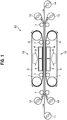
- FIG. 1 is a schematic cross-sectional view of production equipment for a thermoplastic liquid-crystal polymer film used in a heating and melting step, a cooling step, and a separating step.
- thermoplastic liquid-crystal polymer (Thermoplastic liquid-crystal polymer)
- a liquid-crystal polymer means a polymer that takes on a liquid crystal state or an optical birefringence property when melted, examples of which generally include a lyotropic liquid crystal polymer that exhibits a liquid crystal property in a state of a solution, and a thermotropic liquid crystal polymer that exhibits a liquid crystal property when melted.
- Such liquid crystal polymers are categorized into types I, II, and III based on heat distortion temperatures thereof. Any types of liquid crystal polymers are applicable.
- thermoplastic liquid-crystal polymer examples include thermoplastic aromatic liquid-crystal polyester, thermoplastic aromatic liquid-crystal polyesteramide formed by introducing an amide bond to this polymer, and the like.
- thermoplastic liquid-crystal polymer may be any of polymers obtained by further introducing an imide bond, a carbonate bond, a carbodiimide bond, an isocyanate-derived bond such as an isocyanurate bond, and the like to aromatic polyester or aromatic polyesteramide.
- thermoplastic liquid-crystal polymer has a rigid rod-like structure and the molecules are solidified in a state of being aligned in a direction of a molding flow during the molding. Accordingly, a molded product is excellent in dimensional stability but is predisposed to develop anisotropy. Meanwhile, the thermoplastic liquid-crystal polymer is also excellent in heat resistance, stiffness, chemical resistance, and so forth, and is therefore used as base films for circuit boards and the like in the electric and electronic field as well as in the field of in-vehicle components.
- thermoplastic liquid-crystal polymer causes little entanglement of high molecules and has high fluidity in a melted state. For this reason, the anisotropy of the thermoplastic liquid-crystal polymer film molded once is relaxed by heating the thermoplastic liquid-crystal polymer again to its melting point or above so as to break the orientation of the molecules formed at the time of the molding.
- FIG. 1 is a schematic cross-sectional view of production equipment 20 for a thermoplastic liquid-crystal polymer film used in a heating and melting step, a cooling step, and a separating step of this embodiment.
- the thermoplastic liquid-crystal polymer film production equipment 20 is hydraulic double belt press production equipment, which is capable of continuously processing a thermoplastic liquid-crystal polymer film and is excellent in productivity.
- thermoplastic liquid-crystal polymer film formed in a film forming step and rolls 12 of two lengthy support sheets to be laminated on opposite surfaces of the thermoplastic liquid-crystal polymer film are installed in the production equipment 20.
- the thermoplastic liquid-crystal polymer film drawn out of the roll 11 is sandwiched between the two support sheets drawn out of the rolls 12 and supplied to a space between two conveyor apparatuses 15.
- the production equipment 20 includes two conveyor apparatuses 15 arranged vertically. Each conveyor apparatus 15 drives an endless belt 3 by using two endless belt rollers 1 and 2. Inside the conveyor apparatus 15, there is provided a pressure block 4 that includes a built-in heater block 5 and a built-in cooling block 6. The two conveyor apparatuses 15 can heat and then cool the thermoplastic liquid-crystal polymer film and the two support sheets put through the two conveyor apparatuses 15 while holding the thermoplastic liquid-crystal polymer film and the support sheets between the two endless belts 3 and continuously applying a prescribed pressure thereto.
- the material of the endless belts 3 is not limited to a particular material and a metal, a resin, a rubber, and the like are applicable. However, a metal is preferred in light of its heat resistance and low thermal expansion.
- the pressure block 4 has a capability of applying the prescribed pressure to the thermoplastic liquid-crystal polymer film and the support sheets.
- the inside of the pressure block 4 is filled with an oil so that the pressure block 4 can apply a hydraulic pressure.
- the capability of applying the hydraulic pressure makes it possible to apply uniform pressure to a film plane and therefore reduces the chance of occurrence of a defect in appearance.
- the heater block 5 has a function with which it is possible to heat the thermoplastic liquid-crystal polymer film and the support sheets to a predetermined temperature equal to or above the melting point of the thermoplastic liquid-crystal polymer.
- the cooling block 6 has a function with which it is possible to cool the thermoplastic liquid-crystal polymer film and the support sheets to a temperature equal to or below a crystallization temperature of the thermoplastic liquid-crystal polymer at a predetermined cooling rate.
- the production equipment 20 includes multiple guide rollers 7 for conveying the thermoplastic liquid-crystal polymer film and the support sheets. Moreover, the production equipment 20 can separate the thermoplastic liquid-crystal polymer film from the support sheets after being processed with the two conveyor apparatuses 15 and reel them in as a roll 14 of the thermoplastic liquid-crystal polymer film and rolls 13 of the support sheets, respectively.
- the support sheets are used in a stacked state in contact with opposite surfaces of the thermoplastic liquid-crystal polymer film.
- Each support sheet has a function to hold and protect the thermoplastic liquid-crystal polymer film when pressurizing, heating, and cooling the thermoplastic liquid-crystal polymer film.
- the support sheet may have a thermal behavior such as a heating dimensional change rate, which is close to that of the thermoplastic liquid-crystal polymer film.
- a resin sheet or a metal sheet having excellent heat resistance is used as the support sheet.
- the resin sheet having excellent heat resistance include a polyimide film, a PTFE film, and the like.
- the polyimide film is preferable because of ease of separation from the metallic endless belt, excellent heat resistance, and a small heating dimensional change.
- Kapton (registered trademark) manufactured by Du Pont-Toray Co., Ltd. and Apical (registered trademark) manufactured by Kaneka Corporation have been known as commercially available resin sheet products that are excellent in heat resistance.
- the metal sheet include an aluminum foil, a copper foil, a stainless steel foil, and the like.
- a thickness of each support sheet is in a range from 25 to 200 ⁇ m or in a range from 50 to 125 ⁇ m. If the thickness of the support sheet exceeds 200 ⁇ m, the thermoplastic liquid-crystal polymer film is prone to be heated and melted insufficiently due to a reason related to heat conduction. Meanwhile, in some embodiments, the support sheet is a sheet with a surface subjected to mold releasing treatment. As for a method of the mold releasing treatment, a publicly known method can be used as appropriate. Moreover, the support sheets can be repeatedly used after the separation from the thermoplastic liquid-crystal polymer film.
- thermoplastic liquid-crystal polymer film [Method of producing thermoplastic liquid-crystal polymer film]
- a method of producing a thermoplastic liquid-crystal polymer film of this embodiment includes (1) a film production step of forming a thermoplastic liquid-crystal polymer film, (2) a heating and melting step of melting the thermoplastic liquid-crystal polymer film, (3) a cooling step of cooling the thermoplastic liquid-crystal polymer film, and (4) a separation step of separating the thermoplastic liquid-crystal polymer film from support sheets.
- the heating and melting step, the cooling step, and the separation step may be carried out by using the hydraulic double belt press production equipment 20 in FIG. 1 .
- the respective steps of the method of producing a thermoplastic liquid-crystal polymer film can be carried out as a batch method, these steps may be carried out as a continuous method from the viewpoint of productivity. Now, the respective steps will be described below.
- thermoplastic liquid-crystal polymer film is formed by molding the thermoplastic liquid-crystal polymer.
- a film production method of forming the thermoplastic liquid-crystal polymer film is not limited to a particular method and a publicly known method can be used.
- examples of the production method for the thermoplastic liquid-crystal polymer film include extrusion molding methods such as an inflation method and a T-die method, a casting method, a colander method, and the like.
- the T-die method is most versatile. In the case of molding in accordance with the T-die method, shearing force is applied during passage of a T-die whereby the molecules are apt to be oriented and to develop the anisotropy.
- thermoplastic liquid-crystal polymer film As described earlier, the anisotropy of the thermoplastic liquid-crystal polymer once molded is relaxed by heating the thermoplastic liquid-crystal polymer again to its melting point or above so as to break the orientation of the molecules formed at the time of the molding.
- the thermoplastic liquid-crystal polymer film with the reduced anisotropy can be obtained by fixing this state of the relaxed anisotropy.
- thermoplastic liquid-crystal polymer film with the improved anisotropy by heating and melting the thermoplastic liquid-crystal polymer film again at the temperature of the melting point or above under application of a prescribed pressure, and then quenching the film at a predetermined cooling rate so as to solidify the film in the state of the relaxed anisotropy.
- the heating and melting step is a step of heating and melting the thermoplastic liquid-crystal polymer film, in a state where opposite surfaces thereof are brought into in contact with the two support sheets, at a temperature equal to or greater than the melting point of the thermoplastic liquid-crystal polymer and equal to or less than a temperature 70°C above the melting point.
- the temperature of the thermoplastic liquid-crystal polymer film itself and a heating rate were measured by inserting a thermocouple between the two support sheets and then putting them through the two endless belts 3 together with the film.
- the heating temperature of the thermoplastic liquid-crystal polymer film needs to be set equal to or above the melting point of the thermoplastic liquid-crystal polymer.
- the heating temperature of the thermoplastic liquid-crystal polymer film is set at a temperature equal to or greater than the melting point of the thermoplastic liquid-crystal polymer and equal to or less than a temperature 50°C above the melting point.
- a time period for heating at the temperature equal to or greater than the melting point of the thermoplastic liquid-crystal polymer and equal to or less than the temperature 70°C above the melting point may be set in a range from 1 to 900 seconds or in a range from 5 to 600 seconds. Meanwhile, in some embodiments, the heating in the heating and melting step is conducted in such a way as to heat evenly from opposite surfaces of the thermoplastic liquid-crystal polymer.
- the cooling step is a step of cooling the melted thermoplastic liquid-crystal polymer film at a cooling rate in a range of 3°C to 7°C per second to a temperature equal to or less than the crystallization temperature of the thermoplastic liquid-crystal polymer.
- the temperature of the thermoplastic liquid-crystal polymer film itself and a cooling rate were measured by inserting the thermocouple between the two support sheets and then putting them through the two endless belts 3 together with the film.
- thermoplastic liquid-crystal polymer film falls below 3°C per second, the polymer is liable to cause a variation and to develop a defect in appearance. Since sufficient cooling is required for preventing the defect in appearance, either a line speed needs to be slowed down or a line length needs to be extended in order to prevent the defect in appearance in the case where the cooling rate of the thermoplastic liquid-crystal polymer film falls below 3°C per second.
- the former results in deterioration in productivity while the latter increases costs of the production equipment. Therefore, neither is preferable.
- the cooling rate of the thermoplastic liquid-crystal polymer film in excess of 7°C per second leads to a state where a molding strain remains due to the quenching, which is liable to increase the anisotropy of the degree of plane orientation or of the linear expansion coefficient.
- the cooling in the cooling step is conducted in such a way as to cool evenly from opposite surfaces of the thermoplastic liquid-crystal polymer in order to reduce the chance of developing defects such as warpage.
- thermoplastic liquid-crystal polymer film needs to be cooled down below the crystallization temperature of the thermoplastic liquid-crystal polymer.
- the state of the relaxed anisotropy in the thermoplastic liquid-crystal polymer film is fixed whereby the form of the thermoplastic liquid-crystal polymer film is stabilized.
- the cooling temperature is equal to or above the crystallization temperature
- the pressure is released before the thermoplastic liquid-crystal polymer is solidified.
- the thermoplastic liquid-crystal polymer is liable to cause free deformation that may lead to the defect in appearance.
- the thermoplastic liquid-crystal polymer is quenched down below a temperature that is 70°C below the crystallization temperature, there is a risk of an increase in molding strain that may lead to an increase in heating dimensional change.
- the heating and melting step and the cooling step may be carried out in a state of intervening the thermoplastic liquid-crystal polymer film and the support sheets between the two endless belts 3. Moreover, in some embodiments, the heating and melting step and the cooling step are carried out under application of a pressure. When the heating and melting step and the cooling step are carried out under application of the pressure, it is possible to suppress deformation of the thermoplastic liquid-crystal polymer film during the process, so that the occurrence of the defect in appearance such as undulation and warp stipes can be suppressed by evening out a variation in thermal history.
- a pressing force in the heating and melting step and the cooling step may be set in a range from 1 to 7 MPa or in a range from 1 to 3 MPa.
- the separation step is a step of separating the cooled thermoplastic liquid-crystal polymer film from the support sheets.
- the form of the thermoplastic liquid-crystal polymer film is stable since the film is cooled down to the crystallization temperature of the thermoplastic liquid-crystal polymer or below this temperature, so that the thermoplastic liquid-crystal polymer film can be separated from the support sheets.
- thermoplastic liquid-crystal polymer film which is excellent in anisotropy of the degree of plane orientation and the linear expansion coefficient and is also excellent in appearance can be continuously obtained by conducting the respective steps described above under appropriate conditions by using the hydraulic double belt press production equipment 20 in FIG. 1 .
- the line speed of the production equipment 20 can be changed as appropriate so as to satisfy the heating and cooling temperature conditions and the cooling rate of the present invention. Nonetheless, in some embodiments, from the economical perspective, the line speed is set in a range from 0.1 to 10 m/min or in a range from 0.7 to 10 m/min.
- thermoplastic liquid-crystal polymer film which is excellent in anisotropy of the degree of plane orientation and the linear expansion coefficient with fewer defects in appearance can be obtained by the production in accordance with the above-described production method of this embodiment. Characteristics of the thermoplastic liquid-crystal polymer film obtained in accordance with the above-described production method of this embodiment will be discussed below.
- thermoplastic liquid-crystal polymer film may have a thickness in a range from 100 to 500 ⁇ m or in a range from 200 to 400 ⁇ m.
- the thermoplastic liquid-crystal polymer film has the plane orientation degree below 65%, which represents a scale of in-plane anisotropy.
- the degree of plane orientation (%) may be below 60%.
- the thermoplastic liquid-crystal polymer film has the following mean coefficient of thermal expansion at a temperature in a range from 23°C to 200°C, namely, a value in a range from 20 to 60 ppm/K in an MD direction, a value in a range from 40 to 90 ppm/K in a TD direction, and a value in a range from 0 to 300 ppm/K in the thickness direction.
- the mean coefficient of thermal expansion is obtained by using TMA in accordance with JIS K7197.
- the mean coefficient of thermal expansion at a temperature in the range from 23°C to 200°C may be a value in a range from 30 to 50 ppm/K in the MD direction, a value in a range from 50 to 80 ppm/K in the TD direction, and a value in a range from 0 to 140 ppm/K in the thickness direction.
- the MD direction is a direction of a molding flow (a machine direction) within the film plane while the TD direction is a direction perpendicular to the MD direction within the film plane.
- the thermoplastic liquid-crystal polymer film has a brightness difference ⁇ L* within the film plane equal to or below 0.5, which is measured in accordance with JIS K7105.
- the brightness difference ⁇ L* within the film plane measured in accordance with JIS K7105 represents a difference between a maximum value and a minimum value of brightness L* in a case where the brightness L* is measured at ten locations picked up at random within the film plane.
- the brightness difference ⁇ L* within the film plane is used as a scale of defects in appearance such as undulation and warp stipes on the film.
- the brightness difference ⁇ L* within the film plane may be equal to or below 0.3.
- thermoplastic liquid-crystal polymer film examples include a high heat resistance flexible printed board, a solar panel board, a high frequency wiring board, and so forth.
- thermoplastic liquid-crystal polymer film is suitable for a flexible copper-clad laminate that uses the thermoplastic liquid-crystal polymer film as its baseplate.
- thermoplastic liquid-crystal polymer films The heating and melting step, the cooling step, and the separation step were carried out on the above-mentioned commercially available thermoplastic liquid-crystal polymer films by using the production equipment 20 shown in FIG. 1 under various conditions described in Table 1 while bringing opposite surfaces of each film into contact with the two support sheets.
- thermoplastic liquid-crystal polymer films thus obtained were evaluated in accordance with methods described below. Results of evaluation are shown in Table 1.
- the brightness L* was measured at ten locations picked up at random within the film plane, and a difference between the maximum value and the minimum value of brightness L* was obtained. A value equal to or below 0.5 was judged to be acceptable.
- the mean coefficient of thermal expansion at a temperature in the range from 23°C to 200°C in the MD direction, the TD direction, and the thickness direction were obtained by using TMA in accordance with JIS K7197.
- the linear expansion coefficient in the MD direction in the range from 20 to 60 ppm/K was judged to be acceptable.
- the linear expansion coefficient in the TD direction in the range from 40 to 90 ppm/K was judged to be acceptable.
- the linear expansion coefficient in the thickness direction in the range from 0 to 300 ppm/K was judged to be acceptable.
- the heating dimensional change rates in the MD direction and the TD direction at 150°C were measured by using a method in accordance with JIS K7133.
- a value in a range from -0.10% to 0.30% was judged to be acceptable regarding the MD direction while a value in a range from 0% to 0.50% was judged to be acceptable regarding the TD direction.
Landscapes
- Engineering & Computer Science (AREA)
- Mechanical Engineering (AREA)
- Physics & Mathematics (AREA)
- Thermal Sciences (AREA)
- Microelectronics & Electronic Packaging (AREA)
- Chemical & Material Sciences (AREA)
- Health & Medical Sciences (AREA)
- Manufacturing & Machinery (AREA)
- Oral & Maxillofacial Surgery (AREA)
- Polymers & Plastics (AREA)
- Organic Chemistry (AREA)
- Medicinal Chemistry (AREA)
- Chemical Kinetics & Catalysis (AREA)
- Materials Engineering (AREA)
- Manufacture Of Macromolecular Shaped Articles (AREA)
- Moulding By Coating Moulds (AREA)
- Laminated Bodies (AREA)
- Extrusion Moulding Of Plastics Or The Like (AREA)
Abstract
Description
- The present invention relates to a thermoplastic liquid-crystal polymer film, a method of producing the same, and a flexible copper-clad laminate.
- A thermoplastic liquid-crystal polymer film is excellent in heat resistance, mechanical strength, electric properties, and so forth and has therefore been widely used as base films for circuit boards and the like in the electric and electronic field as well as in the field of in-vehicle components.
- A thermoplastic liquid-crystal polymer film takes on a structure in which straight-chain rigid molecular chains are orderly arranged, and is therefore likely to cause anisotropy. As a consequence, a film obtained by extruding a thermoplastic liquid-crystal polymer generally causes a high degree of molecular orientation in an extruding direction within a plane, and is therefore formed into a film that has high strength in the extruding direction but tears easily in a width direction.
- Several technologies for improving the anisotropy of such a thermoplastic liquid-crystal polymer film are known. Patent Literature 1 discloses a processing method designed to heat a thermoplastic liquid-crystal polymer film in a state of contact with a support to a predetermined temperature and then to separate the film from the support after cooling and solidifying the film. Meanwhile,
Patent Literature 2 discloses a thermal treatment method for a thermoplastic liquid-crystal polymer film that uses a metal foil having a prescribed degree of maximum roughness and being coated with a silicon-based polymer as a support for a thermal treatment. In this method, a film in a state of being brought into contact with this support is subjected to a thermal treatment, then cooled for solidification, and separated thereafter. -
- Patent Literature 1: Japanese Patent Publication No.
3882213 - Patent Literature 2: Japanese Patent Application Publication No.
2000-264987 - However, in the processing method disclosed in Patent Literature 1, temperature control at the time of the processing is not always appropriate. Accordingly, this method has room for further improvement in light of improvement in anisotropy. Meanwhile, the thermal treatment method disclosed in
Patent Literature 2 can improve the anisotropy of a mechanical property but is designed to carry out the thermal treatment by using a hot-air drying machine. Hence, this has been a method difficult for an industrial use. - An attempt to improve the anisotropy of the thermoplastic liquid-crystal polymer film becomes more difficult as its film thickness grows larger due to the following reason. Specifically, while a thick film is usually formed by extrusion molding, the extrusion molding is apt to apply shearing force during passage of a T-die and thus to develop the anisotropy. The anisotropy of the thermoplastic liquid-crystal polymer film can be evaluated based on a degree of plane orientation in a direction of a film plane and by thermal expansion coefficients in a planar direction and a thickness direction. In the meantime, the thermoplastic liquid-crystal polymer film may also develop a defect in appearance such as undulation and warp stipes attributed to a variation in thermal history and the like in the process of conducting heating and cooling treatments. Such a defect in appearance of the film can be evaluated based on a brightness difference between locations within the film plane.
- The present invention has been made in response to the above issue. That is to say, an object of the present invention is to provide a thermoplastic liquid-crystal polymer film having a low degree of anisotropy in the degree of plane orientation and thermal expansion coefficient and having excellent appearance even when the thermoplastic liquid-crystal polymer film is thick, and to provide a method for producing the same.
- The inventors of the present invention have found out that the above issue can be solved by heating and melting a thermoplastic liquid-crystal polymer film in a state where opposite surfaces of the film are brought into contact with two support sheets so as to rearrange molecular arrangement in the film, and then fixing the molecular arrangement by quenching the film at a predetermined cooling rate. The inventors have successfully arrived at the present invention based on the above-described findings. Specifically, the present invention has the following configurations.
- (1) A method of producing a thermoplastic liquid-crystal polymer film includes forming a thermoplastic liquid-crystal polymer film having opposite surfaces by molding a thermoplastic liquid-crystal polymer, melting the thermoplastic liquid-crystal polymer film by heating the thermoplastic liquid-crystal polymer film with the opposite surfaces being in contact with two support sheets at a temperature of from a melting point of the thermoplastic liquid-crystal polymer to a temperature higher than the melting point by 70 °C, cooling the melted thermoplastic liquid-crystal polymer film to a temperature equal to or less than a crystallization temperature of the thermoplastic liquid-crystal polymer at a cooling rate of from 3°C per second to 7°C per second, and separating the cooled thermoplastic liquid-crystal polymer film from the support sheets.
- (2) In some embodiments, the melting by the heating and the cooling are carried out under a predetermined pressure.
- (3) In some embodiments, the support sheets are a polyimide film subjected to mold releasing treatment.
- (4) In some embodiments, the melting by the heating and the cooling are carried out with the thermoplastic liquid-crystal polymer film and the two support sheets being intervening between two metallic endless belts.
- (5) A thermoplastic liquid-crystal polymer film having a film plane, the thermoplastic liquid-crystal polymer film has a thickness of from 100 µm to 500 µm, a plane orientation degree less than 65%, the plane operation degree being calculated by the following formula

- (6) A flexible copper-clad laminate includes the above-described thermoplastic liquid-crystal polymer film.
- According to the method of producing a thermoplastic liquid-crystal polymer film of the present invention, it is possible to obtain a thermoplastic liquid-crystal polymer film having a low degree of anisotropy in the degree of plane orientation and thermal expansion coefficient, and having excellent appearance. In particular, it is possible to obtain a thermoplastic liquid-crystal polymer film having the low degree of anisotropy and excellent appearance even in a case of a thickness of 100 µm or higher which cannot be handled by a conventional inflation method.
-
FIG. 1 is a schematic cross-sectional view of production equipment for a thermoplastic liquid-crystal polymer film used in a heating and melting step, a cooling step, and a separating step. - An embodiment of the present invention will be described below in detail. It is to be noted, however, that the technical scope of the present invention is not limited to the embodiment described below as a specific example.
- A liquid-crystal polymer means a polymer that takes on a liquid crystal state or an optical birefringence property when melted, examples of which generally include a lyotropic liquid crystal polymer that exhibits a liquid crystal property in a state of a solution, and a thermotropic liquid crystal polymer that exhibits a liquid crystal property when melted. Such liquid crystal polymers are categorized into types I, II, and III based on heat distortion temperatures thereof. Any types of liquid crystal polymers are applicable.
- Examples of a thermoplastic liquid-crystal polymer include thermoplastic aromatic liquid-crystal polyester, thermoplastic aromatic liquid-crystal polyesteramide formed by introducing an amide bond to this polymer, and the like. Meanwhile, the thermoplastic liquid-crystal polymer may be any of polymers obtained by further introducing an imide bond, a carbonate bond, a carbodiimide bond, an isocyanate-derived bond such as an isocyanurate bond, and the like to aromatic polyester or aromatic polyesteramide.
- Each of molecules of the thermoplastic liquid-crystal polymer has a rigid rod-like structure and the molecules are solidified in a state of being aligned in a direction of a molding flow during the molding. Accordingly, a molded product is excellent in dimensional stability but is predisposed to develop anisotropy. Meanwhile, the thermoplastic liquid-crystal polymer is also excellent in heat resistance, stiffness, chemical resistance, and so forth, and is therefore used as base films for circuit boards and the like in the electric and electronic field as well as in the field of in-vehicle components.
- The thermoplastic liquid-crystal polymer causes little entanglement of high molecules and has high fluidity in a melted state. For this reason, the anisotropy of the thermoplastic liquid-crystal polymer film molded once is relaxed by heating the thermoplastic liquid-crystal polymer again to its melting point or above so as to break the orientation of the molecules formed at the time of the molding.
-
FIG. 1 is a schematic cross-sectional view ofproduction equipment 20 for a thermoplastic liquid-crystal polymer film used in a heating and melting step, a cooling step, and a separating step of this embodiment. The thermoplastic liquid-crystal polymerfilm production equipment 20 is hydraulic double belt press production equipment, which is capable of continuously processing a thermoplastic liquid-crystal polymer film and is excellent in productivity. - A
roll 11 of a lengthy thermoplastic liquid-crystal polymer film formed in a film forming step androlls 12 of two lengthy support sheets to be laminated on opposite surfaces of the thermoplastic liquid-crystal polymer film are installed in theproduction equipment 20. The thermoplastic liquid-crystal polymer film drawn out of theroll 11 is sandwiched between the two support sheets drawn out of therolls 12 and supplied to a space between twoconveyor apparatuses 15. - The
production equipment 20 includes twoconveyor apparatuses 15 arranged vertically. Eachconveyor apparatus 15 drives anendless belt 3 by using twoendless belt rollers 1 and 2. Inside theconveyor apparatus 15, there is provided apressure block 4 that includes a built-inheater block 5 and a built-incooling block 6. The twoconveyor apparatuses 15 can heat and then cool the thermoplastic liquid-crystal polymer film and the two support sheets put through the twoconveyor apparatuses 15 while holding the thermoplastic liquid-crystal polymer film and the support sheets between the twoendless belts 3 and continuously applying a prescribed pressure thereto. The material of theendless belts 3 is not limited to a particular material and a metal, a resin, a rubber, and the like are applicable. However, a metal is preferred in light of its heat resistance and low thermal expansion. - The
pressure block 4 has a capability of applying the prescribed pressure to the thermoplastic liquid-crystal polymer film and the support sheets. The inside of thepressure block 4 is filled with an oil so that thepressure block 4 can apply a hydraulic pressure. The capability of applying the hydraulic pressure makes it possible to apply uniform pressure to a film plane and therefore reduces the chance of occurrence of a defect in appearance. Theheater block 5 has a function with which it is possible to heat the thermoplastic liquid-crystal polymer film and the support sheets to a predetermined temperature equal to or above the melting point of the thermoplastic liquid-crystal polymer. Thecooling block 6 has a function with which it is possible to cool the thermoplastic liquid-crystal polymer film and the support sheets to a temperature equal to or below a crystallization temperature of the thermoplastic liquid-crystal polymer at a predetermined cooling rate. - The
production equipment 20 includesmultiple guide rollers 7 for conveying the thermoplastic liquid-crystal polymer film and the support sheets. Moreover, theproduction equipment 20 can separate the thermoplastic liquid-crystal polymer film from the support sheets after being processed with the twoconveyor apparatuses 15 and reel them in as aroll 14 of the thermoplastic liquid-crystal polymer film and rolls 13 of the support sheets, respectively. - The support sheets are used in a stacked state in contact with opposite surfaces of the thermoplastic liquid-crystal polymer film. Each support sheet has a function to hold and protect the thermoplastic liquid-crystal polymer film when pressurizing, heating, and cooling the thermoplastic liquid-crystal polymer film. In order to avoid displacement from the thermoplastic liquid-crystal polymer film that adheres to the support sheet during the heating, the support sheet may have a thermal behavior such as a heating dimensional change rate, which is close to that of the thermoplastic liquid-crystal polymer film.
- A resin sheet or a metal sheet having excellent heat resistance is used as the support sheet. Examples of the resin sheet having excellent heat resistance include a polyimide film, a PTFE film, and the like. The polyimide film is preferable because of ease of separation from the metallic endless belt, excellent heat resistance, and a small heating dimensional change. Kapton (registered trademark) manufactured by Du Pont-Toray Co., Ltd. and Apical (registered trademark) manufactured by Kaneka Corporation have been known as commercially available resin sheet products that are excellent in heat resistance. Examples of the metal sheet include an aluminum foil, a copper foil, a stainless steel foil, and the like.
- In some embodiments, a thickness of each support sheet is in a range from 25 to 200 µm or in a range from 50 to 125 µm. If the thickness of the support sheet exceeds 200 µm, the thermoplastic liquid-crystal polymer film is prone to be heated and melted insufficiently due to a reason related to heat conduction. Meanwhile, in some embodiments, the support sheet is a sheet with a surface subjected to mold releasing treatment. As for a method of the mold releasing treatment, a publicly known method can be used as appropriate. Moreover, the support sheets can be repeatedly used after the separation from the thermoplastic liquid-crystal polymer film.
- A method of producing a thermoplastic liquid-crystal polymer film of this embodiment includes (1) a film production step of forming a thermoplastic liquid-crystal polymer film, (2) a heating and melting step of melting the thermoplastic liquid-crystal polymer film, (3) a cooling step of cooling the thermoplastic liquid-crystal polymer film, and (4) a separation step of separating the thermoplastic liquid-crystal polymer film from support sheets. Among these steps, the heating and melting step, the cooling step, and the separation step may be carried out by using the hydraulic double belt
press production equipment 20 inFIG. 1 . While the respective steps of the method of producing a thermoplastic liquid-crystal polymer film can be carried out as a batch method, these steps may be carried out as a continuous method from the viewpoint of productivity. Now, the respective steps will be described below. - In the film production step, the thermoplastic liquid-crystal polymer film is formed by molding the thermoplastic liquid-crystal polymer. A film production method of forming the thermoplastic liquid-crystal polymer film is not limited to a particular method and a publicly known method can be used. Specifically, examples of the production method for the thermoplastic liquid-crystal polymer film include extrusion molding methods such as an inflation method and a T-die method, a casting method, a colander method, and the like. Among them, the T-die method is most versatile. In the case of molding in accordance with the T-die method, shearing force is applied during passage of a T-die whereby the molecules are apt to be oriented and to develop the anisotropy.
- Given the circumstances, the inventors have investigated a method for reducing the anisotropy of the thermoplastic liquid-crystal polymer film. As described earlier, the anisotropy of the thermoplastic liquid-crystal polymer once molded is relaxed by heating the thermoplastic liquid-crystal polymer again to its melting point or above so as to break the orientation of the molecules formed at the time of the molding. The thermoplastic liquid-crystal polymer film with the reduced anisotropy can be obtained by fixing this state of the relaxed anisotropy. The inventors have succeeded in obtaining the thermoplastic liquid-crystal polymer film with the improved anisotropy by heating and melting the thermoplastic liquid-crystal polymer film again at the temperature of the melting point or above under application of a prescribed pressure, and then quenching the film at a predetermined cooling rate so as to solidify the film in the state of the relaxed anisotropy.
- The heating and melting step is a step of heating and melting the thermoplastic liquid-crystal polymer film, in a state where opposite surfaces thereof are brought into in contact with the two support sheets, at a temperature equal to or greater than the melting point of the thermoplastic liquid-crystal polymer and equal to or less than a temperature 70°C above the melting point. The temperature of the thermoplastic liquid-crystal polymer film itself and a heating rate were measured by inserting a thermocouple between the two support sheets and then putting them through the two
endless belts 3 together with the film. By heating and melting the thermoplastic liquid-crystal polymer film to the melting point or above, it is possible to disentangle the high molecules, thereby breaking the orientation of the molecules and relaxing the anisotropy. For this reason, the heating temperature of the thermoplastic liquid-crystal polymer film needs to be set equal to or above the melting point of the thermoplastic liquid-crystal polymer. On the other hand, it is not desirable to set the heating temperature of the thermoplastic liquid-crystal polymer film in excess of the temperature 70°C above the melting point because the polymer will be deteriorated by this heat. In some embodiments, the heating temperature of the thermoplastic liquid-crystal polymer film is set at a temperature equal to or greater than the melting point of the thermoplastic liquid-crystal polymer and equal to or less than a temperature 50°C above the melting point. - In the heating and melting step, a time period for heating at the temperature equal to or greater than the melting point of the thermoplastic liquid-crystal polymer and equal to or less than the temperature 70°C above the melting point may be set in a range from 1 to 900 seconds or in a range from 5 to 600 seconds. Meanwhile, in some embodiments, the heating in the heating and melting step is conducted in such a way as to heat evenly from opposite surfaces of the thermoplastic liquid-crystal polymer.
- The cooling step is a step of cooling the melted thermoplastic liquid-crystal polymer film at a cooling rate in a range of 3°C to 7°C per second to a temperature equal to or less than the crystallization temperature of the thermoplastic liquid-crystal polymer. The temperature of the thermoplastic liquid-crystal polymer film itself and a cooling rate were measured by inserting the thermocouple between the two support sheets and then putting them through the two
endless belts 3 together with the film. By quenching the thermoplastic liquid-crystal polymer film heated to its melting point or above, in the heating and melting step, at the cooling rate in the range of 3°C to 7°C per second, the thermoplastic liquid-crystal polymer film is solidified in the state of the relaxed anisotropy. If the cooling rate of the thermoplastic liquid-crystal polymer film falls below 3°C per second, the polymer is liable to cause a variation and to develop a defect in appearance. Since sufficient cooling is required for preventing the defect in appearance, either a line speed needs to be slowed down or a line length needs to be extended in order to prevent the defect in appearance in the case where the cooling rate of the thermoplastic liquid-crystal polymer film falls below 3°C per second. The former results in deterioration in productivity while the latter increases costs of the production equipment. Therefore, neither is preferable. On the other hand, the cooling rate of the thermoplastic liquid-crystal polymer film in excess of 7°C per second leads to a state where a molding strain remains due to the quenching, which is liable to increase the anisotropy of the degree of plane orientation or of the linear expansion coefficient. Meanwhile, in some embodiments, the cooling in the cooling step is conducted in such a way as to cool evenly from opposite surfaces of the thermoplastic liquid-crystal polymer in order to reduce the chance of developing defects such as warpage. - In the cooling step, the thermoplastic liquid-crystal polymer film needs to be cooled down below the crystallization temperature of the thermoplastic liquid-crystal polymer. By cooling the thermoplastic liquid-crystal polymer film to the temperature equal to or below the crystallization temperature of the thermoplastic liquid-crystal polymer as the cooling temperature, the state of the relaxed anisotropy in the thermoplastic liquid-crystal polymer film is fixed whereby the form of the thermoplastic liquid-crystal polymer film is stabilized. If the cooling temperature is equal to or above the crystallization temperature, the pressure is released before the thermoplastic liquid-crystal polymer is solidified. Hence, the thermoplastic liquid-crystal polymer is liable to cause free deformation that may lead to the defect in appearance. On the other hand, if the thermoplastic liquid-crystal polymer is quenched down below a temperature that is 70°C below the crystallization temperature, there is a risk of an increase in molding strain that may lead to an increase in heating dimensional change.
- The heating and melting step and the cooling step may be carried out in a state of intervening the thermoplastic liquid-crystal polymer film and the support sheets between the two
endless belts 3. Moreover, in some embodiments, the heating and melting step and the cooling step are carried out under application of a pressure. When the heating and melting step and the cooling step are carried out under application of the pressure, it is possible to suppress deformation of the thermoplastic liquid-crystal polymer film during the process, so that the occurrence of the defect in appearance such as undulation and warp stipes can be suppressed by evening out a variation in thermal history. A pressing force in the heating and melting step and the cooling step may be set in a range from 1 to 7 MPa or in a range from 1 to 3 MPa. - The separation step is a step of separating the cooled thermoplastic liquid-crystal polymer film from the support sheets. The form of the thermoplastic liquid-crystal polymer film is stable since the film is cooled down to the crystallization temperature of the thermoplastic liquid-crystal polymer or below this temperature, so that the thermoplastic liquid-crystal polymer film can be separated from the support sheets.
- The thermoplastic liquid-crystal polymer film which is excellent in anisotropy of the degree of plane orientation and the linear expansion coefficient and is also excellent in appearance can be continuously obtained by conducting the respective steps described above under appropriate conditions by using the hydraulic double belt
press production equipment 20 inFIG. 1 . In this instance, the line speed of theproduction equipment 20 can be changed as appropriate so as to satisfy the heating and cooling temperature conditions and the cooling rate of the present invention. Nonetheless, in some embodiments, from the economical perspective, the line speed is set in a range from 0.1 to 10 m/min or in a range from 0.7 to 10 m/min. - The thermoplastic liquid-crystal polymer film which is excellent in anisotropy of the degree of plane orientation and the linear expansion coefficient with fewer defects in appearance can be obtained by the production in accordance with the above-described production method of this embodiment. Characteristics of the thermoplastic liquid-crystal polymer film obtained in accordance with the above-described production method of this embodiment will be discussed below.
- The thermoplastic liquid-crystal polymer film may have a thickness in a range from 100 to 500 µm or in a range from 200 to 400 µm.
- The thermoplastic liquid-crystal polymer film has the plane orientation degree below 65%, which represents a scale of in-plane anisotropy. The plane orientation degree is calculated by the following formula from a half width φ1 (degrees) of a diffraction intensity curve corresponding to a [006] plane obtained by irradiation of a film plane with X-rays in a direction perpendicular to the film plane by using a wide-angle X-ray diffraction apparatus:

- As the scale of anisotropy in the in-plane and thickness directions, the thermoplastic liquid-crystal polymer film has the following mean coefficient of thermal expansion at a temperature in a range from 23°C to 200°C, namely, a value in a range from 20 to 60 ppm/K in an MD direction, a value in a range from 40 to 90 ppm/K in a TD direction, and a value in a range from 0 to 300 ppm/K in the thickness direction. Here, the mean coefficient of thermal expansion is obtained by using TMA in accordance with JIS K7197. The mean coefficient of thermal expansion at a temperature in the range from 23°C to 200°C may be a value in a range from 30 to 50 ppm/K in the MD direction, a value in a range from 50 to 80 ppm/K in the TD direction, and a value in a range from 0 to 140 ppm/K in the thickness direction. Here, the MD direction is a direction of a molding flow (a machine direction) within the film plane while the TD direction is a direction perpendicular to the MD direction within the film plane.
- The thermoplastic liquid-crystal polymer film has a brightness difference ΔL* within the film plane equal to or below 0.5, which is measured in accordance with JIS K7105. Here, the brightness difference ΔL* within the film plane measured in accordance with JIS K7105 represents a difference between a maximum value and a minimum value of brightness L* in a case where the brightness L* is measured at ten locations picked up at random within the film plane. The brightness difference ΔL* within the film plane is used as a scale of defects in appearance such as undulation and warp stipes on the film. The brightness difference ΔL* within the film plane may be equal to or below 0.3.
- Examples of applications of the thermoplastic liquid-crystal polymer film in the electric and electronic field as well as in the field of in-vehicle components include a high heat resistance flexible printed board, a solar panel board, a high frequency wiring board, and so forth. In particular, the thermoplastic liquid-crystal polymer film is suitable for a flexible copper-clad laminate that uses the thermoplastic liquid-crystal polymer film as its baseplate.
- The embodiment of the present invention will be more specifically discussed below by using examples and comparative examples. It is to be noted, however, that the present invention is not limited only to these examples.
- The following are the materials used in the examples and the comparative examples.
- (1) Thermoplastic liquid-crystal polymer film thermoplastic liquid-crystal polymer film: product number A-5000, manufactured by Ueno Fine Chemical Industry, Ltd., melting point 280°C, crystallization temperature 230°C, thicknesses 100, 250, 500 µm, and
- (2) Support sheets
polyimide film subjected to mold releasing treatment: product number 200 EN, manufactured by Du Pont-Toray Co., Ltd., thickness 50 µm. - The heating and melting step, the cooling step, and the separation step were carried out on the above-mentioned commercially available thermoplastic liquid-crystal polymer films by using the
production equipment 20 shown inFIG. 1 under various conditions described in Table 1 while bringing opposite surfaces of each film into contact with the two support sheets. - Various performances of the respective thermoplastic liquid-crystal polymer films thus obtained were evaluated in accordance with methods described below. Results of evaluation are shown in Table 1.
- In accordance with JIS K7105, the brightness L* was measured at ten locations picked up at random within the film plane, and a difference between the maximum value and the minimum value of brightness L* was obtained. A value equal to or below 0.5 was judged to be acceptable.
- The degree of plane orientation was calculated by using the following formula from the half width φ1 (degrees) of the diffraction intensity curve corresponding to the [006] plane obtained by irradiation of each film plane with X-rays from the direction perpendicular to the film plane by using the wide-angle X-ray diffraction apparatus:

- A value below 65% was judged to be acceptable.
- The mean coefficient of thermal expansion at a temperature in the range from 23°C to 200°C in the MD direction, the TD direction, and the thickness direction were obtained by using TMA in accordance with JIS K7197.
- As for judgment criteria, the linear expansion coefficient in the MD direction in the range from 20 to 60 ppm/K was judged to be acceptable. Meanwhile, the linear expansion coefficient in the TD direction in the range from 40 to 90 ppm/K was judged to be acceptable. Moreover, the linear expansion coefficient in the thickness direction in the range from 0 to 300 ppm/K was judged to be acceptable.
- The heating dimensional change rates in the MD direction and the TD direction at 150°C were measured by using a method in accordance with JIS K7133.
- As for judgment criteria, a value in a range from -0.10% to 0.30% was judged to be acceptable regarding the MD direction while a value in a range from 0% to 0.50% was judged to be acceptable regarding the TD direction.


- The results of evaluation in Table 1 reveal that each of Examples 1 to 9 showed favorable performances in light of the brightness difference, the degree of plane orientation, the linear expansion coefficients, and the heating dimensional change rate. Regarding each of Comparative Example 1, Comparative Example 3, and Comparative Example 5, the brightness difference ΔL* was large and the appearance was poor because the cooling temperature was higher than the crystallization temperature of the thermoplastic liquid-crystal polymer and the cooling rate was below 3°C/sec. Regarding each of Comparative Example 2, Comparative Example 4, and Comparative Example 6, the cooling rate exceeded 7°C/sec. For this reason, the degree of plane orientation exceeded 65%, the thermal expansion coefficient in the MD direction was small, and the thermal expansion coefficient in the TD direction was large. Thus, the anisotropy within the film plane and the heating dimensional change rate were poor in each case.
-
- 1, 2
- endless belt roller
- 3
- endless belt
- 4
- pressure block
- 5
- heater block
- 6
- cooling block
- 7
- guide roll
- 11, 12, 13, 14
- roll
- 15
- conveyor apparatus
- 20
- production equipment
Claims (6)
- A method of producing a thermoplastic liquid-crystal polymer film comprising:forming a thermoplastic liquid-crystal polymer film having opposite surfaces by molding a thermoplastic liquid-crystal polymer;melting the thermoplastic liquid-crystal polymer film by heating the thermoplastic liquid-crystal polymer film with the opposite surfaces being in contact with two support sheets at a temperature of from a melting point of the thermoplastic liquid-crystal polymer to a temperature higher than the melting point by 70 °C;cooling the melted thermoplastic liquid-crystal polymer film to a temperature equal to or less than a crystallization temperature of the thermoplastic liquid-crystal polymer at a cooling rate of from 3°C per second to 7°C per second; andseparating the cooled thermoplastic liquid-crystal polymer film from the support sheets.
- The method of claim 1, wherein the melting by the heating and the cooling are carried out under a predetermined pressure.
- The method of claim 1 or 2, wherein the support sheets are a polyimide film subjected to mold releasing treatment.
- The method of any one of claims 1 to 3, wherein the melting by the heating and the cooling are carried out with the thermoplastic liquid-crystal polymer film and the two support sheets being intervening between two metallic endless belts.
- A thermoplastic liquid-crystal polymer film having a film plane, the thermoplastic liquid-crystal polymer film comprising:a thickness of from 100 µm to 500 µm;a plane orientation degree less than 65%, the plane operation degree being calculated by the following formula plane orientation degree (%) = [(180-φ1)/180]×100 where φ1 is a half width (degree) of a diffraction intensity curve corresponding to a [006] plane obtained by irradiating the film plane with X-rays in a direction perpendicular to the film plane by using a wide-angle X-ray diffraction apparatus;a mean coefficient of thermal expansion at a temperature of from 23°C to 200°C of from 20 ppm/K to 60 ppm/K in the MD direction, of from 40 ppm/K to 90 ppm/K in the TD direction, and of from 0 ppm/K to 300 ppm/K in a thickness direction, the mean coefficient of thermal expansion being obtained by using TMA in accordance with JIS K7197; anda brightness difference ΔL* within the film plane equal to or less than 0.5, the brightness difference being measured in accordance with JIS K7105.
- A flexible copper-clad laminate comprising the thermoplastic liquid-crystal polymer film of claim 5.
Applications Claiming Priority (2)
| Application Number | Priority Date | Filing Date | Title |
|---|---|---|---|
| JP2018130892 | 2018-07-10 | ||
| PCT/JP2019/026928 WO2020013106A1 (en) | 2018-07-10 | 2019-07-08 | Thermoplastic liquid-crystal polymer film, method for producing same, and flexible copper-clad laminate |
Publications (3)
| Publication Number | Publication Date |
|---|---|
| EP3815869A1 true EP3815869A1 (en) | 2021-05-05 |
| EP3815869A4 EP3815869A4 (en) | 2021-07-14 |
| EP3815869B1 EP3815869B1 (en) | 2023-09-13 |
Family
ID=69141856
Family Applications (1)
| Application Number | Title | Priority Date | Filing Date |
|---|---|---|---|
| EP19834878.1A Active EP3815869B1 (en) | 2018-07-10 | 2019-07-08 | Method for producing thermoplastic liquid-crystal polymer film |
Country Status (7)
| Country | Link |
|---|---|
| US (1) | US20210268695A1 (en) |
| EP (1) | EP3815869B1 (en) |
| JP (1) | JP7330968B2 (en) |
| KR (1) | KR20210028607A (en) |
| CN (1) | CN112313057A (en) |
| TW (1) | TWI822814B (en) |
| WO (1) | WO2020013106A1 (en) |
Cited By (1)
| Publication number | Priority date | Publication date | Assignee | Title |
|---|---|---|---|---|
| EP3915779A4 (en) * | 2019-01-25 | 2022-10-19 | Denka Company Limited | LAMINATE CLADDED WITH METAL ON BOTH SIDES AND ITS PRODUCTION METHOD, INSULATING FILM AND ELECTRONIC CIRCUIT BASE BOARD |
Families Citing this family (15)
| Publication number | Priority date | Publication date | Assignee | Title |
|---|---|---|---|---|
| KR20230070205A (en) * | 2020-09-23 | 2023-05-22 | 덴카 주식회사 | Insulation materials and metal foil clad laminates for circuit boards |
| JP2022091688A (en) * | 2020-12-09 | 2022-06-21 | デンカ株式会社 | Lcp extruded film, lcp stretched film, insulating material for circuit board, and metal foil-clad laminate |
| KR20230119162A (en) | 2020-12-09 | 2023-08-16 | 덴카 주식회사 | LCP extruded film and its manufacturing method, LCP extruded film for stretching treatment, LCP stretched film, heat-shrinkable LCP stretched film, insulating material for circuit board, and metal foil-clad laminate |
| JP7630264B2 (en) * | 2020-12-09 | 2025-02-17 | デンカ株式会社 | Manufacturing method of LCP extrusion film |
| JP2023070392A (en) * | 2021-11-09 | 2023-05-19 | デンカ株式会社 | Lcp extruded film for stretching, heat-shrinkable lcp stretched film, insulating material for circuit board, and metal foil-clad laminate |
| JP7638689B2 (en) * | 2020-12-09 | 2025-03-04 | デンカ株式会社 | Manufacturing method of LCP extrusion film |
| JP2022091687A (en) * | 2020-12-09 | 2022-06-21 | デンカ株式会社 | Lcp extruded film, lcp stretched film, insulating material for circuit board, and metal foil-clad laminate |
| KR102557822B1 (en) * | 2021-03-17 | 2023-07-21 | (주)나노테크 | Lamination apparatus for manufacturing a secondary cell battery |
| JP7722451B2 (en) | 2021-06-09 | 2025-08-13 | 株式会社村田製作所 | Resin film with conductor layer, laminated substrate, and method for manufacturing resin film with conductor layer |
| CN113427880A (en) * | 2021-06-28 | 2021-09-24 | 苏州固泰新材股份有限公司 | LCP film heat treatment process and application thereof |
| EP4397487A4 (en) * | 2021-09-03 | 2024-12-11 | Denka Company Limited | PCL EXTRUDED FILM, INSULATING MATERIAL FOR PRINTED CIRCUIT BOARD, AND METAL FOIL CLAD LAMINATE |
| CN114131821A (en) * | 2021-11-17 | 2022-03-04 | 常州贝弗勒机械有限公司 | Hot-pressed sheet cooling and setting device |
| CN118369372A (en) * | 2022-01-21 | 2024-07-19 | 电化株式会社 | Liquid crystal polymer film, and insulating material for circuit board and metal foil-clad laminate using the same |
| JP7121212B1 (en) | 2022-03-15 | 2022-08-17 | 株式会社ノリタケカンパニーリミテド | RESIN FILM HEAT TREATMENT APPARATUS AND RESIN FILM HEAT TREATMENT METHOD |
| WO2024166776A1 (en) * | 2023-02-09 | 2024-08-15 | デンカ株式会社 | Lcp film |
Family Cites Families (8)
| Publication number | Priority date | Publication date | Assignee | Title |
|---|---|---|---|---|
| JPH07251438A (en) * | 1994-03-15 | 1995-10-03 | Japan Gore Tex Inc | Liquid crystal polymer film and method for producing the same |
| JP3501241B2 (en) * | 1994-08-12 | 2004-03-02 | 新日本石油化学株式会社 | Thermotropic liquid crystal polymer film and method for producing the same |
| US5529740A (en) * | 1994-09-16 | 1996-06-25 | Jester; Randy D. | Process for treating liquid crystal polymer film |
| JPH10307208A (en) * | 1997-05-09 | 1998-11-17 | Nippon Oil Co Ltd | Optical film manufacturing method |
| JP2000264987A (en) | 1999-03-11 | 2000-09-26 | Kuraray Co Ltd | Heat treatment method of thermoplastic liquid crystal polymer film |
| WO2009028572A1 (en) * | 2007-08-31 | 2009-03-05 | Asahi Glass Company, Limited | Method for producing liquid crystal polymer multilayer structure |
| JP6182856B2 (en) * | 2012-12-05 | 2017-08-23 | 株式会社村田製作所 | Method for producing liquid crystal polymer film |
| CN107079594B (en) * | 2014-11-07 | 2019-08-23 | 株式会社可乐丽 | Circuit board and manufacturing method thereof |
-
2019
- 2019-07-08 WO PCT/JP2019/026928 patent/WO2020013106A1/en not_active Ceased
- 2019-07-08 CN CN201980042495.5A patent/CN112313057A/en active Pending
- 2019-07-08 EP EP19834878.1A patent/EP3815869B1/en active Active
- 2019-07-08 KR KR1020207037373A patent/KR20210028607A/en not_active Ceased
- 2019-07-08 JP JP2020530159A patent/JP7330968B2/en active Active
- 2019-07-08 US US17/259,155 patent/US20210268695A1/en not_active Abandoned
- 2019-07-10 TW TW108124284A patent/TWI822814B/en active
Cited By (1)
| Publication number | Priority date | Publication date | Assignee | Title |
|---|---|---|---|---|
| EP3915779A4 (en) * | 2019-01-25 | 2022-10-19 | Denka Company Limited | LAMINATE CLADDED WITH METAL ON BOTH SIDES AND ITS PRODUCTION METHOD, INSULATING FILM AND ELECTRONIC CIRCUIT BASE BOARD |
Also Published As
| Publication number | Publication date |
|---|---|
| WO2020013106A1 (en) | 2020-01-16 |
| JPWO2020013106A1 (en) | 2021-08-19 |
| CN112313057A (en) | 2021-02-02 |
| EP3815869B1 (en) | 2023-09-13 |
| US20210268695A1 (en) | 2021-09-02 |
| TW202012513A (en) | 2020-04-01 |
| KR20210028607A (en) | 2021-03-12 |
| JP7330968B2 (en) | 2023-08-22 |
| EP3815869A4 (en) | 2021-07-14 |
| TWI822814B (en) | 2023-11-21 |
Similar Documents
| Publication | Publication Date | Title |
|---|---|---|
| EP3815869B1 (en) | Method for producing thermoplastic liquid-crystal polymer film | |
| US6274242B1 (en) | Liquid crystal polymer film, laminate, method of making them and multi-layered parts-mounted circuit board | |
| US9096049B2 (en) | Metal-clad laminate and method for production thereof | |
| US5529740A (en) | Process for treating liquid crystal polymer film | |
| EP1044800B1 (en) | Metal laminate for a circuit board | |
| JP2005103989A (en) | Method for producing liquid crystal polymer film | |
| JP5254901B2 (en) | LIQUID CRYSTAL POLYMER FILM AND LAMINATE, PROCESS FOR PRODUCING THEM, AND MULTILAYER MOUNTED CIRCUIT BOARD | |
| US20220105707A1 (en) | Double-sided metal-clad laminate and production method therefor, insulating film, and electronic circuit base board | |
| JP7182747B2 (en) | METHOD FOR MANUFACTURING METAL-CLAD LAMINATED BODY | |
| EP1238800A2 (en) | Method for producing metal laminate | |
| CN114007832B (en) | Method for producing metal-clad laminate | |
| TW202600358A (en) | Method for producing metal clad laminate | |
| JP2001081215A (en) | High heat resistant film and method for producing the same | |
| WO2026038482A1 (en) | Liquid crystal polymer film, method for producing same, method for producing metal-clad laminate, and method for producing circuit board | |
| WO2024176916A1 (en) | Metal-clad laminate, method for manufacturing same, and circuit board | |
| HK1023256B (en) | Liquid crystal polymer film, laminate, method of making them and multi-layered parts mounted circuit board | |
| HK1030398B (en) | Metal laminate for a circuit board |
Legal Events
| Date | Code | Title | Description |
|---|---|---|---|
| STAA | Information on the status of an ep patent application or granted ep patent |
Free format text: STATUS: THE INTERNATIONAL PUBLICATION HAS BEEN MADE |
|
| PUAI | Public reference made under article 153(3) epc to a published international application that has entered the european phase |
Free format text: ORIGINAL CODE: 0009012 |
|
| STAA | Information on the status of an ep patent application or granted ep patent |
Free format text: STATUS: REQUEST FOR EXAMINATION WAS MADE |
|
| 17P | Request for examination filed |
Effective date: 20210127 |
|
| AK | Designated contracting states |
Kind code of ref document: A1 Designated state(s): AL AT BE BG CH CY CZ DE DK EE ES FI FR GB GR HR HU IE IS IT LI LT LU LV MC MK MT NL NO PL PT RO RS SE SI SK SM TR |
|
| A4 | Supplementary search report drawn up and despatched |
Effective date: 20210614 |
|
| RIC1 | Information provided on ipc code assigned before grant |
Ipc: B29C 41/24 20060101AFI20210608BHEP Ipc: B29C 48/08 20190101ALI20210608BHEP Ipc: B29C 48/88 20190101ALI20210608BHEP Ipc: H05K 1/03 20060101ALI20210608BHEP Ipc: B29L 7/00 20060101ALI20210608BHEP Ipc: B29L 31/34 20060101ALI20210608BHEP Ipc: B32B 37/02 20060101ALI20210608BHEP |
|
| DAV | Request for validation of the european patent (deleted) | ||
| DAX | Request for extension of the european patent (deleted) | ||
| STAA | Information on the status of an ep patent application or granted ep patent |
Free format text: STATUS: EXAMINATION IS IN PROGRESS |
|
| 17Q | First examination report despatched |
Effective date: 20221111 |
|
| REG | Reference to a national code |
Ref country code: DE Ref legal event code: R079 Free format text: PREVIOUS MAIN CLASS: B29C0041240000 Ipc: B29D0007010000 Ref country code: DE Ref legal event code: R079 Ref document number: 602019037543 Country of ref document: DE Free format text: PREVIOUS MAIN CLASS: B29C0041240000 Ipc: B29D0007010000 |
|
| GRAP | Despatch of communication of intention to grant a patent |
Free format text: ORIGINAL CODE: EPIDOSNIGR1 |
|
| STAA | Information on the status of an ep patent application or granted ep patent |
Free format text: STATUS: GRANT OF PATENT IS INTENDED |
|
| RIC1 | Information provided on ipc code assigned before grant |
Ipc: H05K 3/00 20060101ALI20230315BHEP Ipc: H05K 1/03 20060101ALI20230315BHEP Ipc: B29C 48/08 20190101ALI20230315BHEP Ipc: B29D 7/01 20060101AFI20230315BHEP |
|
| INTG | Intention to grant announced |
Effective date: 20230405 |
|
| GRAS | Grant fee paid |
Free format text: ORIGINAL CODE: EPIDOSNIGR3 |
|
| GRAA | (expected) grant |
Free format text: ORIGINAL CODE: 0009210 |
|
| STAA | Information on the status of an ep patent application or granted ep patent |
Free format text: STATUS: THE PATENT HAS BEEN GRANTED |
|
| P01 | Opt-out of the competence of the unified patent court (upc) registered |
Effective date: 20230802 |
|
| AK | Designated contracting states |
Kind code of ref document: B1 Designated state(s): AL AT BE BG CH CY CZ DE DK EE ES FI FR GB GR HR HU IE IS IT LI LT LU LV MC MK MT NL NO PL PT RO RS SE SI SK SM TR |
|
| REG | Reference to a national code |
Ref country code: CH Ref legal event code: EP |
|
| REG | Reference to a national code |
Ref country code: DE Ref legal event code: R096 Ref document number: 602019037543 Country of ref document: DE |
|
| REG | Reference to a national code |
Ref country code: IE Ref legal event code: FG4D |
|
| REG | Reference to a national code |
Ref country code: LT Ref legal event code: MG9D |
|
| REG | Reference to a national code |
Ref country code: NL Ref legal event code: MP Effective date: 20230913 |
|
| PG25 | Lapsed in a contracting state [announced via postgrant information from national office to epo] |
Ref country code: GR Free format text: LAPSE BECAUSE OF FAILURE TO SUBMIT A TRANSLATION OF THE DESCRIPTION OR TO PAY THE FEE WITHIN THE PRESCRIBED TIME-LIMIT Effective date: 20231214 |
|
| PG25 | Lapsed in a contracting state [announced via postgrant information from national office to epo] |
Ref country code: SE Free format text: LAPSE BECAUSE OF FAILURE TO SUBMIT A TRANSLATION OF THE DESCRIPTION OR TO PAY THE FEE WITHIN THE PRESCRIBED TIME-LIMIT Effective date: 20230913 Ref country code: RS Free format text: LAPSE BECAUSE OF FAILURE TO SUBMIT A TRANSLATION OF THE DESCRIPTION OR TO PAY THE FEE WITHIN THE PRESCRIBED TIME-LIMIT Effective date: 20230913 Ref country code: NO Free format text: LAPSE BECAUSE OF FAILURE TO SUBMIT A TRANSLATION OF THE DESCRIPTION OR TO PAY THE FEE WITHIN THE PRESCRIBED TIME-LIMIT Effective date: 20231213 Ref country code: LV Free format text: LAPSE BECAUSE OF FAILURE TO SUBMIT A TRANSLATION OF THE DESCRIPTION OR TO PAY THE FEE WITHIN THE PRESCRIBED TIME-LIMIT Effective date: 20230913 Ref country code: LT Free format text: LAPSE BECAUSE OF FAILURE TO SUBMIT A TRANSLATION OF THE DESCRIPTION OR TO PAY THE FEE WITHIN THE PRESCRIBED TIME-LIMIT Effective date: 20230913 Ref country code: HR Free format text: LAPSE BECAUSE OF FAILURE TO SUBMIT A TRANSLATION OF THE DESCRIPTION OR TO PAY THE FEE WITHIN THE PRESCRIBED TIME-LIMIT Effective date: 20230913 Ref country code: GR Free format text: LAPSE BECAUSE OF FAILURE TO SUBMIT A TRANSLATION OF THE DESCRIPTION OR TO PAY THE FEE WITHIN THE PRESCRIBED TIME-LIMIT Effective date: 20231214 Ref country code: FI Free format text: LAPSE BECAUSE OF FAILURE TO SUBMIT A TRANSLATION OF THE DESCRIPTION OR TO PAY THE FEE WITHIN THE PRESCRIBED TIME-LIMIT Effective date: 20230913 |
|
| REG | Reference to a national code |
Ref country code: AT Ref legal event code: MK05 Ref document number: 1610848 Country of ref document: AT Kind code of ref document: T Effective date: 20230913 |
|
| PG25 | Lapsed in a contracting state [announced via postgrant information from national office to epo] |
Ref country code: NL Free format text: LAPSE BECAUSE OF FAILURE TO SUBMIT A TRANSLATION OF THE DESCRIPTION OR TO PAY THE FEE WITHIN THE PRESCRIBED TIME-LIMIT Effective date: 20230913 |
|
| PG25 | Lapsed in a contracting state [announced via postgrant information from national office to epo] |
Ref country code: IS Free format text: LAPSE BECAUSE OF FAILURE TO SUBMIT A TRANSLATION OF THE DESCRIPTION OR TO PAY THE FEE WITHIN THE PRESCRIBED TIME-LIMIT Effective date: 20240113 |
|
| PG25 | Lapsed in a contracting state [announced via postgrant information from national office to epo] |
Ref country code: AT Free format text: LAPSE BECAUSE OF FAILURE TO SUBMIT A TRANSLATION OF THE DESCRIPTION OR TO PAY THE FEE WITHIN THE PRESCRIBED TIME-LIMIT Effective date: 20230913 |
|
| PG25 | Lapsed in a contracting state [announced via postgrant information from national office to epo] |
Ref country code: ES Free format text: LAPSE BECAUSE OF FAILURE TO SUBMIT A TRANSLATION OF THE DESCRIPTION OR TO PAY THE FEE WITHIN THE PRESCRIBED TIME-LIMIT Effective date: 20230913 |
|
| PG25 | Lapsed in a contracting state [announced via postgrant information from national office to epo] |
Ref country code: SM Free format text: LAPSE BECAUSE OF FAILURE TO SUBMIT A TRANSLATION OF THE DESCRIPTION OR TO PAY THE FEE WITHIN THE PRESCRIBED TIME-LIMIT Effective date: 20230913 Ref country code: RO Free format text: LAPSE BECAUSE OF FAILURE TO SUBMIT A TRANSLATION OF THE DESCRIPTION OR TO PAY THE FEE WITHIN THE PRESCRIBED TIME-LIMIT Effective date: 20230913 Ref country code: IS Free format text: LAPSE BECAUSE OF FAILURE TO SUBMIT A TRANSLATION OF THE DESCRIPTION OR TO PAY THE FEE WITHIN THE PRESCRIBED TIME-LIMIT Effective date: 20240113 Ref country code: ES Free format text: LAPSE BECAUSE OF FAILURE TO SUBMIT A TRANSLATION OF THE DESCRIPTION OR TO PAY THE FEE WITHIN THE PRESCRIBED TIME-LIMIT Effective date: 20230913 Ref country code: EE Free format text: LAPSE BECAUSE OF FAILURE TO SUBMIT A TRANSLATION OF THE DESCRIPTION OR TO PAY THE FEE WITHIN THE PRESCRIBED TIME-LIMIT Effective date: 20230913 Ref country code: CZ Free format text: LAPSE BECAUSE OF FAILURE TO SUBMIT A TRANSLATION OF THE DESCRIPTION OR TO PAY THE FEE WITHIN THE PRESCRIBED TIME-LIMIT Effective date: 20230913 Ref country code: AT Free format text: LAPSE BECAUSE OF FAILURE TO SUBMIT A TRANSLATION OF THE DESCRIPTION OR TO PAY THE FEE WITHIN THE PRESCRIBED TIME-LIMIT Effective date: 20230913 Ref country code: SK Free format text: LAPSE BECAUSE OF FAILURE TO SUBMIT A TRANSLATION OF THE DESCRIPTION OR TO PAY THE FEE WITHIN THE PRESCRIBED TIME-LIMIT Effective date: 20230913 Ref country code: PT Free format text: LAPSE BECAUSE OF FAILURE TO SUBMIT A TRANSLATION OF THE DESCRIPTION OR TO PAY THE FEE WITHIN THE PRESCRIBED TIME-LIMIT Effective date: 20240115 |
|
| PG25 | Lapsed in a contracting state [announced via postgrant information from national office to epo] |
Ref country code: PL Free format text: LAPSE BECAUSE OF FAILURE TO SUBMIT A TRANSLATION OF THE DESCRIPTION OR TO PAY THE FEE WITHIN THE PRESCRIBED TIME-LIMIT Effective date: 20230913 Ref country code: IT Free format text: LAPSE BECAUSE OF FAILURE TO SUBMIT A TRANSLATION OF THE DESCRIPTION OR TO PAY THE FEE WITHIN THE PRESCRIBED TIME-LIMIT Effective date: 20230913 |
|
| REG | Reference to a national code |
Ref country code: DE Ref legal event code: R097 Ref document number: 602019037543 Country of ref document: DE |
|
| PG25 | Lapsed in a contracting state [announced via postgrant information from national office to epo] |
Ref country code: DK Free format text: LAPSE BECAUSE OF FAILURE TO SUBMIT A TRANSLATION OF THE DESCRIPTION OR TO PAY THE FEE WITHIN THE PRESCRIBED TIME-LIMIT Effective date: 20230913 |
|
| PLBE | No opposition filed within time limit |
Free format text: ORIGINAL CODE: 0009261 |
|
| STAA | Information on the status of an ep patent application or granted ep patent |
Free format text: STATUS: NO OPPOSITION FILED WITHIN TIME LIMIT |
|
| PG25 | Lapsed in a contracting state [announced via postgrant information from national office to epo] |
Ref country code: DK Free format text: LAPSE BECAUSE OF FAILURE TO SUBMIT A TRANSLATION OF THE DESCRIPTION OR TO PAY THE FEE WITHIN THE PRESCRIBED TIME-LIMIT Effective date: 20230913 |
|
| 26N | No opposition filed |
Effective date: 20240614 |
|
| PGFP | Annual fee paid to national office [announced via postgrant information from national office to epo] |
Ref country code: DE Payment date: 20240529 Year of fee payment: 6 |
|
| PG25 | Lapsed in a contracting state [announced via postgrant information from national office to epo] |
Ref country code: SI Free format text: LAPSE BECAUSE OF FAILURE TO SUBMIT A TRANSLATION OF THE DESCRIPTION OR TO PAY THE FEE WITHIN THE PRESCRIBED TIME-LIMIT Effective date: 20230913 |
|
| PG25 | Lapsed in a contracting state [announced via postgrant information from national office to epo] |
Ref country code: SI Free format text: LAPSE BECAUSE OF FAILURE TO SUBMIT A TRANSLATION OF THE DESCRIPTION OR TO PAY THE FEE WITHIN THE PRESCRIBED TIME-LIMIT Effective date: 20230913 |
|
| PG25 | Lapsed in a contracting state [announced via postgrant information from national office to epo] |
Ref country code: BG Free format text: LAPSE BECAUSE OF FAILURE TO SUBMIT A TRANSLATION OF THE DESCRIPTION OR TO PAY THE FEE WITHIN THE PRESCRIBED TIME-LIMIT Effective date: 20230913 |
|
| PG25 | Lapsed in a contracting state [announced via postgrant information from national office to epo] |
Ref country code: BG Free format text: LAPSE BECAUSE OF FAILURE TO SUBMIT A TRANSLATION OF THE DESCRIPTION OR TO PAY THE FEE WITHIN THE PRESCRIBED TIME-LIMIT Effective date: 20230913 |
|
| PG25 | Lapsed in a contracting state [announced via postgrant information from national office to epo] |
Ref country code: MC Free format text: LAPSE BECAUSE OF FAILURE TO SUBMIT A TRANSLATION OF THE DESCRIPTION OR TO PAY THE FEE WITHIN THE PRESCRIBED TIME-LIMIT Effective date: 20230913 |
|
| REG | Reference to a national code |
Ref country code: CH Ref legal event code: PL |
|
| PG25 | Lapsed in a contracting state [announced via postgrant information from national office to epo] |
Ref country code: LU Free format text: LAPSE BECAUSE OF NON-PAYMENT OF DUE FEES Effective date: 20240708 |
|
| GBPC | Gb: european patent ceased through non-payment of renewal fee |
Effective date: 20240708 |
|
| PG25 | Lapsed in a contracting state [announced via postgrant information from national office to epo] |
Ref country code: LU Free format text: LAPSE BECAUSE OF NON-PAYMENT OF DUE FEES Effective date: 20240708 |
|
| PG25 | Lapsed in a contracting state [announced via postgrant information from national office to epo] |
Ref country code: BE Free format text: LAPSE BECAUSE OF NON-PAYMENT OF DUE FEES Effective date: 20240731 Ref country code: CH Free format text: LAPSE BECAUSE OF NON-PAYMENT OF DUE FEES Effective date: 20240731 |
|
| PG25 | Lapsed in a contracting state [announced via postgrant information from national office to epo] |
Ref country code: FR Free format text: LAPSE BECAUSE OF NON-PAYMENT OF DUE FEES Effective date: 20240731 |
|
| PG25 | Lapsed in a contracting state [announced via postgrant information from national office to epo] |
Ref country code: GB Free format text: LAPSE BECAUSE OF NON-PAYMENT OF DUE FEES Effective date: 20240708 |
|
| REG | Reference to a national code |
Ref country code: BE Ref legal event code: MM Effective date: 20240731 |
|
| PG25 | Lapsed in a contracting state [announced via postgrant information from national office to epo] |
Ref country code: IE Free format text: LAPSE BECAUSE OF NON-PAYMENT OF DUE FEES Effective date: 20240708 |
|
| PG25 | Lapsed in a contracting state [announced via postgrant information from national office to epo] |
Ref country code: CY Free format text: LAPSE BECAUSE OF FAILURE TO SUBMIT A TRANSLATION OF THE DESCRIPTION OR TO PAY THE FEE WITHIN THE PRESCRIBED TIME-LIMIT; INVALID AB INITIO Effective date: 20190708 |
|
| REG | Reference to a national code |
Ref country code: DE Ref legal event code: R119 Ref document number: 602019037543 Country of ref document: DE |
|
| PG25 | Lapsed in a contracting state [announced via postgrant information from national office to epo] |
Ref country code: HU Free format text: LAPSE BECAUSE OF FAILURE TO SUBMIT A TRANSLATION OF THE DESCRIPTION OR TO PAY THE FEE WITHIN THE PRESCRIBED TIME-LIMIT; INVALID AB INITIO Effective date: 20190708 |
|
| PG25 | Lapsed in a contracting state [announced via postgrant information from national office to epo] |
Ref country code: DE Free format text: LAPSE BECAUSE OF NON-PAYMENT OF DUE FEES Effective date: 20260203 |