EP3815515A1 - Mulching sheet for crops - Google Patents
Mulching sheet for crops Download PDFInfo
- Publication number
- EP3815515A1 EP3815515A1 EP19825889.9A EP19825889A EP3815515A1 EP 3815515 A1 EP3815515 A1 EP 3815515A1 EP 19825889 A EP19825889 A EP 19825889A EP 3815515 A1 EP3815515 A1 EP 3815515A1
- Authority
- EP
- European Patent Office
- Prior art keywords
- film
- crops
- sheet
- soil
- covering
- Prior art date
- Legal status (The legal status is an assumption and is not a legal conclusion. Google has not performed a legal analysis and makes no representation as to the accuracy of the status listed.)
- Withdrawn
Links
Images
Classifications
-
- A—HUMAN NECESSITIES
- A01—AGRICULTURE; FORESTRY; ANIMAL HUSBANDRY; HUNTING; TRAPPING; FISHING
- A01G—HORTICULTURE; CULTIVATION OF VEGETABLES, FLOWERS, RICE, FRUIT, VINES, HOPS OR SEAWEED; FORESTRY; WATERING
- A01G13/00—Protection of plants
- A01G13/30—Ground coverings
- A01G13/32—Mats; Nets; Sheets or films
- A01G13/33—Sheets or films
Definitions
- the present invention refers to a film for covering crops of the type used for preventing weeds from growing among the produce to be cultivated, and for retaining the heat in the soil.
- the object of the invention is to provide a covering film that is completely biodegradable, that contributes to enrich and improve the quality of the soil for future crops, that is effective as a thermal barrier and a weed barrier, and that has the necessary resistance to be used comfortably without risking breakage.
- the technique known as "mulching”, which is known in the field of the practical application of the invention, consists of placing a protective covering on the terrain to be cultivated in order to retain the heat of the soil, which makes it possible to sow and transplant certain harvests early, and it also stimulates faster growth.
- the mulch has different effects on the ground: it stabilises the temperature by preventing heat fluctuations during variable summer conditions; it stabilises humidity by reducing evaporation; it helps control blights by preventing weeds from germinating due to the lack of sunlight, etc.
- Plastic films are used for this purpose, which represent a significant environmental problem as is commonly known, and therefore their usage is undesirable since they are also very expensive to remove, in addition to the damage they cause to the environment due to being products that cannot be recycled.
- the film of the invention is made of virgin wood fibre from pine trees, which results in a type of kraft paper.
- the film Since this material can be too delicate to handle, the film has been designed to be produced as crumpled paper subjected to a treatment of surface deformation in order to provide the film with certain elasticity and deformability, which makes it possible to install the film without risking breakages.
- the vegetable nature of the film means it is not only biodegradable, but also acts as compost during said process of biodegradation, contributing to enrich and improve the quality of the soil for future crops.
- the film of the invention will be supplied in rolls so it can be easily applied on the necessary cultivation surfaces in a completely analogous way as with conventional plastic films, providing an equivalent thermal barrier as well as a weed barrier, in addition to providing the aforementioned environmental advantages.
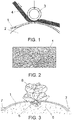
- the film for covering crops is obtained from paper sheet (1) that is subjected to a process of crumpling, so that during the process for obtaining said sheet, that is, when it still has a certain level of humidity around 63%, it is fed through a pair of rollers, more specifically a drying roller (2) and a pressure roller (3), with the particularity that the paper sheet (1) is fed through a rubber sheet (4) located between said rollers, and said rubber sheet (4) is significantly thicker than the space defined between the rollers (2 and 3), which causes the rubber band (4) to suffer elastic deformation affecting the movement of the paper sheet (1), so that said sheet is subjected to a process of crumpling, obtaining in this way a sheet with a similar aspect to the one shown in Figure 2 , so that said sheet comprises a series of folds that make it possible to stretch the sheet to a certain extent, which provides it with enough flexibility in order to use said sheet without breaking it whilst handling the sheet.
- the sheet (1) can be adapted to the width of the rows (5) of the produce (6) to be cultivated, burying the sheet on the lateral ends (7) thereof, and making it possible create windows (8), as is common practice in this type of cultivation, providing the aforementioned advantages since it is a completely biodegradable material, which, in addition to the benefits provided by conventional films for covering crops, such as being a thermal barrier and a weed barrier, it also acts as compost when it breaks down naturally, thus improving the quality of the soil where it is installed and therefore producing a positive effect for the environment, as opposed to what happens with conventional films for covering crops.
Landscapes
- Health & Medical Sciences (AREA)
- General Health & Medical Sciences (AREA)
- Toxicology (AREA)
- Life Sciences & Earth Sciences (AREA)
- Environmental Sciences (AREA)
- Protection Of Plants (AREA)
- Biological Depolymerization Polymers (AREA)
Abstract
Description
- The present invention refers to a film for covering crops of the type used for preventing weeds from growing among the produce to be cultivated, and for retaining the heat in the soil.
- The object of the invention is to provide a covering film that is completely biodegradable, that contributes to enrich and improve the quality of the soil for future crops, that is effective as a thermal barrier and a weed barrier, and that has the necessary resistance to be used comfortably without risking breakage.
- The technique known as "mulching", which is known in the field of the practical application of the invention, consists of placing a protective covering on the terrain to be cultivated in order to retain the heat of the soil, which makes it possible to sow and transplant certain harvests early, and it also stimulates faster growth.
- As the season progresses, the mulch has different effects on the ground: it stabilises the temperature by preventing heat fluctuations during variable summer conditions; it stabilises humidity by reducing evaporation; it helps control blights by preventing weeds from germinating due to the lack of sunlight, etc.
- Plastic films are used for this purpose, which represent a significant environmental problem as is commonly known, and therefore their usage is undesirable since they are also very expensive to remove, in addition to the damage they cause to the environment due to being products that cannot be recycled.
- The film for covering crops described completely solves the drawback mentioned above with a simple but effective solution.
- In order to do so, instead of being made of plastic as is the common the practice, the film of the invention is made of virgin wood fibre from pine trees, which results in a type of kraft paper.
- Since this material can be too delicate to handle, the film has been designed to be produced as crumpled paper subjected to a treatment of surface deformation in order to provide the film with certain elasticity and deformability, which makes it possible to install the film without risking breakages.
- The vegetable nature of the film means it is not only biodegradable, but also acts as compost during said process of biodegradation, contributing to enrich and improve the quality of the soil for future crops.
- The film of the invention will be supplied in rolls so it can be easily applied on the necessary cultivation surfaces in a completely analogous way as with conventional plastic films, providing an equivalent thermal barrier as well as a weed barrier, in addition to providing the aforementioned environmental advantages.
- To complete the invention described below and in order to give a better understanding of the characteristics of the invention, according to a preferred embodiment thereof, this description is accompanied by a set of drawings in which the figures described below have been represented, for purely illustrative purposes and should not be construed as limiting:
-
Figure 1 .- Shows a schematic view of the process for obtaining a film for covering crops designed according to the object of the present invention. -
Figure 2 .- Shows a plan view of a film obtained using the process of the previous drawing. -
Figure 3 .- Shows a cross-section view of a crop where the film of the previous drawing is applied. - In light of the drawings described above, it can be observed how the film for covering crops is obtained from paper sheet (1) that is subjected to a process of crumpling, so that during the process for obtaining said sheet, that is, when it still has a certain level of humidity around 63%, it is fed through a pair of rollers, more specifically a drying roller (2) and a pressure roller (3), with the particularity that the paper sheet (1) is fed through a rubber sheet (4) located between said rollers, and said rubber sheet (4) is significantly thicker than the space defined between the rollers (2 and 3), which causes the rubber band (4) to suffer elastic deformation affecting the movement of the paper sheet (1), so that said sheet is subjected to a process of crumpling, obtaining in this way a sheet with a similar aspect to the one shown in
Figure 2 , so that said sheet comprises a series of folds that make it possible to stretch the sheet to a certain extent, which provides it with enough flexibility in order to use said sheet without breaking it whilst handling the sheet. - In this way, and according to
Figure 3 , the sheet (1) can be adapted to the width of the rows (5) of the produce (6) to be cultivated, burying the sheet on the lateral ends (7) thereof, and making it possible create windows (8), as is common practice in this type of cultivation, providing the aforementioned advantages since it is a completely biodegradable material, which, in addition to the benefits provided by conventional films for covering crops, such as being a thermal barrier and a weed barrier, it also acts as compost when it breaks down naturally, thus improving the quality of the soil where it is installed and therefore producing a positive effect for the environment, as opposed to what happens with conventional films for covering crops.
Claims (2)
- Film for covering crops of the type comprised of a laminar body arranged on the soil of a crop, operating as a thermal barrier and a weed barrier, characterised in that it is made of crumpled long fibre kraft paper.
- Film for covering crops, according to claim 1, characterised in that the kraft paper is obtained from virgin wood fibre from pine trees.
Applications Claiming Priority (2)
| Application Number | Priority Date | Filing Date | Title |
|---|---|---|---|
| ES201831010U ES1215966Y (en) | 2018-06-29 | 2018-06-29 | SHEET COVER FOR CROPS |
| PCT/ES2019/070421 WO2020002728A1 (en) | 2018-06-29 | 2019-06-18 | Mulching sheet for crops |
Publications (2)
| Publication Number | Publication Date |
|---|---|
| EP3815515A1 true EP3815515A1 (en) | 2021-05-05 |
| EP3815515A4 EP3815515A4 (en) | 2021-08-04 |
Family
ID=62948708
Family Applications (1)
| Application Number | Title | Priority Date | Filing Date |
|---|---|---|---|
| EP19825889.9A Withdrawn EP3815515A4 (en) | 2018-06-29 | 2019-06-18 | COVER SHEET FOR CROPS |
Country Status (3)
| Country | Link |
|---|---|
| EP (1) | EP3815515A4 (en) |
| ES (1) | ES1215966Y (en) |
| WO (1) | WO2020002728A1 (en) |
Family Cites Families (12)
| Publication number | Priority date | Publication date | Assignee | Title |
|---|---|---|---|---|
| FR2501006A1 (en) * | 1981-03-04 | 1982-09-10 | Rochette Cenpa | PEST CONTROL PAPER AND MANUFACTURING METHOD THEREOF |
| US4782626A (en) * | 1984-04-23 | 1988-11-08 | Keuffel & Esser Company | Degradable agricultural mulch sheeting |
| JPH05103553A (en) * | 1991-10-18 | 1993-04-27 | Honshu Paper Co Ltd | Mulching sheet |
| JP3073418B2 (en) * | 1995-02-01 | 2000-08-07 | 王子製紙株式会社 | Paper multi-sheet and method for manufacturing paper multi-sheet |
| JPH08205693A (en) * | 1995-02-02 | 1996-08-13 | New Oji Paper Co Ltd | Paper multi sheet |
| MX9702251A (en) * | 1995-08-10 | 1997-08-30 | Appleton Paper Inc | MIXED MATERIAL OF MOISTURE RETAINING COVER. |
| US7452316B2 (en) * | 2000-05-24 | 2008-11-18 | Ranpak Corp. | Packing product and apparatus and method for manufacturing same |
| JP2010239954A (en) * | 2009-04-06 | 2010-10-28 | Univ Of Miyazaki | Agricultural paper multi-sheet |
| HK1218146A1 (en) * | 2013-07-18 | 2017-02-03 | 日本制纸株式会社 | Clupak paper |
| KR20160043859A (en) * | 2014-10-14 | 2016-04-22 | 김종옥 | Agricultural mulching paper and a method of manufacturing |
| SE540204C2 (en) * | 2015-11-27 | 2018-05-02 | Stora Enso Oyj | Use of a ground cover impregnated with supercritical fluid comprising a colorant |
| SE540197C2 (en) * | 2015-11-27 | 2018-04-24 | Stora Enso Oyj | Use of a ground cover in the form of a paper mulch comprising minerals and functional agents |
-
2018
- 2018-06-29 ES ES201831010U patent/ES1215966Y/en active Active
-
2019
- 2019-06-18 EP EP19825889.9A patent/EP3815515A4/en not_active Withdrawn
- 2019-06-18 WO PCT/ES2019/070421 patent/WO2020002728A1/en not_active Ceased
Also Published As
| Publication number | Publication date |
|---|---|
| ES1215966Y (en) | 2018-10-23 |
| WO2020002728A1 (en) | 2020-01-02 |
| ES1215966U8 (en) | 2020-12-11 |
| EP3815515A4 (en) | 2021-08-04 |
| ES1215966U (en) | 2018-07-30 |
Similar Documents
| Publication | Publication Date | Title |
|---|---|---|
| Haapala et al. | Feasibility of paper mulches in crop production—a review | |
| Haapala et al. | Effects of different paper mulches on soil temperature and yield of cucumber (Cucumis sativus L.) in the temperate zone | |
| RU2032299C1 (en) | Mulching cover formation method | |
| Coolong | Mulches for weed management in vegetable production | |
| KR100456812B1 (en) | Stretched plastic film for agricultural use | |
| Červenski et al. | Agroclimatic conditions for cabbage production | |
| Martín-Closas et al. | Biodegradable mulching in an organic tomato production system | |
| Jenni et al. | Degradable mulch as an alternative for weed control in lettuce produced on organic soils | |
| Zawiska et al. | The effects of PLA biodegradable and polypropylene nonwoven crop mulches on selected components of tomato grown in the field | |
| Ray et al. | Impact of mulching on crop production: A review | |
| KR200485926Y1 (en) | Mulching Vinyl with Aeration Slit and Water Slit for Hot Pepper Cultivation | |
| Andrade et al. | Biodegradable mulch films performance for autumn-winter strawberry production | |
| US4047327A (en) | Ground covering material | |
| EP3815515A1 (en) | Mulching sheet for crops | |
| KR101680328B1 (en) | Friendly Environment Mulching Sheet that has a Net Structure and Preparation Method Thereof | |
| KR100248939B1 (en) | The non-woven textile for antiacidifing soil and regulating weeds | |
| KR102683989B1 (en) | Soil covering type eco-friendly mulching paper, manufacturing method for that and mulching method using that | |
| Shinde et al. | Effect of different mulches on flowering and flower characters in marigold under Konkan Agroclimatic conditions | |
| US20180295793A1 (en) | Mulch film with stretching guide and method of use | |
| JP2886486B2 (en) | Perforated mulching paper for agriculture | |
| Marihonnappanavara et al. | Performance evaluation of tractor operated plastic mulch laying equipment for black and silver colored plastic mulches | |
| Namdeo et al. | Mulch laying technology for horticulture in India: a review | |
| JP4077686B2 (en) | Cultivation method using biodegradable multifilm | |
| KR102220254B1 (en) | Functional paper manufacturing apparatus for mulching | |
| Sharma et al. | A review on effect of mulching practices on crop production |
Legal Events
| Date | Code | Title | Description |
|---|---|---|---|
| STAA | Information on the status of an ep patent application or granted ep patent |
Free format text: STATUS: THE INTERNATIONAL PUBLICATION HAS BEEN MADE |
|
| PUAI | Public reference made under article 153(3) epc to a published international application that has entered the european phase |
Free format text: ORIGINAL CODE: 0009012 |
|
| STAA | Information on the status of an ep patent application or granted ep patent |
Free format text: STATUS: REQUEST FOR EXAMINATION WAS MADE |
|
| 17P | Request for examination filed |
Effective date: 20210128 |
|
| AK | Designated contracting states |
Kind code of ref document: A1 Designated state(s): AL AT BE BG CH CY CZ DE DK EE ES FI FR GB GR HR HU IE IS IT LI LT LU LV MC MK MT NL NO PL PT RO RS SE SI SK SM TR |
|
| A4 | Supplementary search report drawn up and despatched |
Effective date: 20210706 |
|
| RIC1 | Information provided on ipc code assigned before grant |
Ipc: A01G 13/02 20060101AFI20210630BHEP |
|
| DAV | Request for validation of the european patent (deleted) | ||
| DAX | Request for extension of the european patent (deleted) | ||
| STAA | Information on the status of an ep patent application or granted ep patent |
Free format text: STATUS: THE APPLICATION IS DEEMED TO BE WITHDRAWN |
|
| 18D | Application deemed to be withdrawn |
Effective date: 20230103 |