EP3815458B1 - Apparatus and method of wireless communication of same - Google Patents
Apparatus and method of wireless communication of same Download PDFInfo
- Publication number
- EP3815458B1 EP3815458B1 EP19834895.5A EP19834895A EP3815458B1 EP 3815458 B1 EP3815458 B1 EP 3815458B1 EP 19834895 A EP19834895 A EP 19834895A EP 3815458 B1 EP3815458 B1 EP 3815458B1
- Authority
- EP
- European Patent Office
- Prior art keywords
- mode
- covered
- sensing
- resource
- user equipment
- Prior art date
- Legal status (The legal status is an assumption and is not a legal conclusion. Google has not performed a legal analysis and makes no representation as to the accuracy of the status listed.)
- Active
Links
Images



Classifications
-
- H—ELECTRICITY
- H04—ELECTRIC COMMUNICATION TECHNIQUE
- H04W—WIRELESS COMMUNICATION NETWORKS
- H04W76/00—Connection management
- H04W76/10—Connection setup
- H04W76/14—Direct-mode setup
-
- H—ELECTRICITY
- H04—ELECTRIC COMMUNICATION TECHNIQUE
- H04W—WIRELESS COMMUNICATION NETWORKS
- H04W72/00—Local resource management
- H04W72/12—Wireless traffic scheduling
-
- H—ELECTRICITY
- H04—ELECTRIC COMMUNICATION TECHNIQUE
- H04W—WIRELESS COMMUNICATION NETWORKS
- H04W72/00—Local resource management
- H04W72/20—Control channels or signalling for resource management
- H04W72/25—Control channels or signalling for resource management between terminals via a wireless link, e.g. sidelink
-
- H—ELECTRICITY
- H04—ELECTRIC COMMUNICATION TECHNIQUE
- H04W—WIRELESS COMMUNICATION NETWORKS
- H04W4/00—Services specially adapted for wireless communication networks; Facilities therefor
- H04W4/30—Services specially adapted for particular environments, situations or purposes
- H04W4/40—Services specially adapted for particular environments, situations or purposes for vehicles, e.g. vehicle-to-pedestrians [V2P]
-
- H—ELECTRICITY
- H04—ELECTRIC COMMUNICATION TECHNIQUE
- H04W—WIRELESS COMMUNICATION NETWORKS
- H04W72/00—Local resource management
- H04W72/02—Selection of wireless resources by user or terminal
-
- H—ELECTRICITY
- H04—ELECTRIC COMMUNICATION TECHNIQUE
- H04W—WIRELESS COMMUNICATION NETWORKS
- H04W72/00—Local resource management
- H04W72/04—Wireless resource allocation
- H04W72/044—Wireless resource allocation based on the type of the allocated resource
- H04W72/0453—Resources in frequency domain, e.g. a carrier in FDMA
-
- H—ELECTRICITY
- H04—ELECTRIC COMMUNICATION TECHNIQUE
- H04W—WIRELESS COMMUNICATION NETWORKS
- H04W72/00—Local resource management
- H04W72/12—Wireless traffic scheduling
- H04W72/1263—Mapping of traffic onto schedule, e.g. scheduled allocation or multiplexing of flows
-
- H—ELECTRICITY
- H04—ELECTRIC COMMUNICATION TECHNIQUE
- H04W—WIRELESS COMMUNICATION NETWORKS
- H04W72/00—Local resource management
- H04W72/50—Allocation or scheduling criteria for wireless resources
- H04W72/51—Allocation or scheduling criteria for wireless resources based on terminal or device properties
-
- H—ELECTRICITY
- H04—ELECTRIC COMMUNICATION TECHNIQUE
- H04W—WIRELESS COMMUNICATION NETWORKS
- H04W72/00—Local resource management
- H04W72/50—Allocation or scheduling criteria for wireless resources
- H04W72/54—Allocation or scheduling criteria for wireless resources based on quality criteria
- H04W72/542—Allocation or scheduling criteria for wireless resources based on quality criteria using measured or perceived quality
-
- H—ELECTRICITY
- H04—ELECTRIC COMMUNICATION TECHNIQUE
- H04W—WIRELESS COMMUNICATION NETWORKS
- H04W72/00—Local resource management
- H04W72/50—Allocation or scheduling criteria for wireless resources
- H04W72/56—Allocation or scheduling criteria for wireless resources based on priority criteria
- H04W72/566—Allocation or scheduling criteria for wireless resources based on priority criteria of the information or information source or recipient
- H04W72/569—Allocation or scheduling criteria for wireless resources based on priority criteria of the information or information source or recipient of the traffic information
-
- H—ELECTRICITY
- H04—ELECTRIC COMMUNICATION TECHNIQUE
- H04W—WIRELESS COMMUNICATION NETWORKS
- H04W76/00—Connection management
- H04W76/20—Manipulation of established connections
- H04W76/27—Transitions between radio resource control [RRC] states
-
- H—ELECTRICITY
- H04—ELECTRIC COMMUNICATION TECHNIQUE
- H04W—WIRELESS COMMUNICATION NETWORKS
- H04W92/00—Interfaces specially adapted for wireless communication networks
- H04W92/16—Interfaces between hierarchically similar devices
- H04W92/18—Interfaces between hierarchically similar devices between terminal devices
-
- H—ELECTRICITY
- H04—ELECTRIC COMMUNICATION TECHNIQUE
- H04W—WIRELESS COMMUNICATION NETWORKS
- H04W84/00—Network topologies
- H04W84/02—Hierarchically pre-organised networks, e.g. paging networks, cellular networks, WLAN [Wireless Local Area Network] or WLL [Wireless Local Loop]
- H04W84/04—Large scale networks; Deep hierarchical networks
Definitions
- the present disclosure relates to the field of communication systems, and more particularly, to methods of wireless communication, a terminal device and a base station.
- a user equipment In current sidelink (SL) technologies designed for cellular vehicle-to-everything (V2X) communication as part of 3rd generation partnership project (3GPP) release 14 long term evolution (LTE) specification, a user equipment (UE) is allowed to operate in one of two pre-defined modes of communication, namely mode 3 and mode 4, for transmitting (Tx) and receiving (Rx) V2X data messages.
- mode 3 which is also commonly known as a network scheduled resource allocation mode
- RRC radio resource control
- a mode 3 UE Within a provided mode 3 pool, usages of sidelink resources are fully managed by the serving network BS and any specific resources that are required for data transmission are individually assigned to each UE. Hence, the serving network BS has full knowledge and is always in control of all resources and usages are within the allocated mode 3 pool.
- a mode 3 UE When a mode 3 UE has V2X data to transmit, it needs to first send a scheduling request along with priority, latency, and periodicity details associated with a data message to the serving network BS requesting for assignment of sidelink resources. Based on the above information, the serving network BS then selects appropriate sidelink resources that would meet required time latency and periodicity within the allocated mode 3 pool and assigns the sidelink resources to the UE for transmitting its data.
- the UE When the UE is operating under the mode 4, which is also known as a UE autonomous resource selection mode, it is allocated with one or multiple pools of sidelink resources that is common to all V2X UEs by RRC signaling from the serving network BS or by pre-configuration if the UE is not within a signal coverage of the serving network BS. Since the serving network BS configured or pre-configured mode 4 resource pool(s) are shared by all mode 4 UEs and the UEs are to autonomously select their own resources for transmission, there is a risk of more than one UEs selecting the same time and frequency sidelink resource(s) to transmit their data and thus causing Tx collision. In order to minimize this potential risk, it is required that mode 4 UEs are to first perform sensing of sidelink resource usage within mode 4 pools and monitor a resource reservation status before selecting appropriate resources for its own transmission to avoid Tx collision with other UEs.
- mode 4 UEs In order to minimize this potential risk, it is required that mode 4 UEs are to first perform sensing
- mode 3 and mode 4 resource pools on the same carrier can be separated to avoid cross-mode interference as these two modes of operation in terms of resource allocation and selection are fundamentally different from each other as described previously.
- overlapping mode 3 and mode 4 pools in terms of resource sharing cannot be avoided.
- sidelink resources of a network BS configured mode 3 pool could overlap with sidelink resources of a pre-configured mode 4 pool on the same carrier.
- a network BS could choose to configure mode 3 pool resources to fully or partially overlap with mode 4 pools in the same serving cell to minimize amount of resources that is necessary for sidelink operation.
- serving BS assigned resources can be known and make available to other UEs operating in the overlapped pools by indicating resource reservation information in all mode 3 transmissions so to prevent mode 4 UEs from selecting same resources and causing Tx collisions.
- a serving BS could avoid assigning resources to mode 3 UEs in overlapped pools that would collide with other UE's transmissions.
- ZTE "Consideration on resource pool sharing between UEs using mode 3 and mode 4", 3GPP DRAFT; R2-1801961, 3RD GENERATION PARTNERSHIP PROJECT, (3GPP), MOBILE COMPETENCE CENTRE; 650, ROUTE DES LUCIOLES; F-06921 SOPHIA-ANTIPOLIS CEDEX; FRANCE, vol. RAN WG2, no. Athens, Greece; 20180226 - 20180302 14 February 2018 (2018-02-14 ), discusses resource pool configuration and resource allocation and presents some considerations and some potential solutions.
- ZTE "Discussion on mode-3 UE sensing report for resource pool sharing", 3GPP DRAFT; R2-1806754 CONSIDERATION ON RESOURCE POOL SHARING, 3RD GENERATION PARTNERSHIP PROJECT (3GPP), MOBILE COMPETENCE CENTRE; 650, ROUTE DES LUCIOLES; F-06921 SOPHIA-ANTIPOLIS CEDEX; FRANCE, vol. RAN WG2, no. Busan, Korea; 20180521 - 20180525 11 May 2'018 (2018-05-11 ), discusses FFS issue and presents some considerations and some potential solutions
- An object of the present disclosure is to propose methods of wireless communication, a terminal device and a base station to solve issues of the prior art in user equipment (UE) sensing and reporting of sidelink resources when mode 3 and mode 4 pools are overlapped in sidelink communication.
- UE user equipment
- a method of wireless communication of a user equipment is defined in claim 1.
- a method of wireless communication of a base station is defined in claim 6.
- a terminal device is defined in claim 10.
- a base station is defined in claim 11.
- mode 3 UEs can perform a resource sensing procedure for a certain period of time and then report resource usage findings to the network (e.g., channel busy ratio per measurement period, subframe, or sub-channel), so that a serving base station (BS) could base on these resource usage indications and select resources from subframes or regions of resource pool that are less occupied and assign the selected resources to the mode 3 UE.
- resource usage findings e.g., channel busy ratio per measurement period, subframe, or sub-channel
- BS serving base station
- this concept approach may guide the serving BS to select resources from less utilized regions and help to reduce probability of transmitting (Tx) collision to some extent, but it lacks timing information about the usage and reservation status of overlapped resources for the future. Thus, the risk of Tx collision remains high.
- mode 3 UEs are to report to its serving BS only available future resources that have not been reserved by other UEs based on mode 3 UE's sensing and resource exclusion results.
- mode 3 UE's sensing and resource exclusion results it is unclear how a new resource sensing and reporting is triggered and how often the report is sent to the serving BS.
- the reporting payload would be very large and causing inefficiency in uplink (UL) resources utilization and unnecessary delay for the resource assignment.
- FIG. 1 illustrates that, in some embodiments being covered by the claimed invention, a user equipment (UE) 10 and a base station (BS) 20 for wireless communication according to an embodiment being covered by the claimed invention are provided.
- the UE 10 includes a processor 11 and a memory 12, and may include a transceiver 13.
- the base station 20 includes a processor 21 and a memory 22, and may include a transceiver 23.
- the processor 11 or 21 may be configured to implement proposed functions, procedures and/or methods described in this description. Layers of radio interface protocol may be implemented in the processor 11 or 21.
- the memory 12 or 22 is operatively coupled with the processor 11 or 21 and stores a variety of information to operate the processor 11 or 21.
- the transceiver 13 or 23 is operatively coupled with the processor 11 or 21, and the transceiver 13 or 23 transmits and/or receives a radio signal.
- the processor 11 or 21 may include an application-specific integrated circuit (ASIC), other chipsets, logic circuit and/or data processing devices.
- the memory 12 or 22 may include a read-only memory (ROM), a random access memory (RAM), a flash memory, a memory card, a storage medium and/or other storage devices.
- the transceiver 13 or 23 may include baseband circuitry to process radio frequency signals.
- modules e.g., procedures, functions, and so on
- the modules can be stored in the memory 12 or 22 and executed by the processor 11 or 21.
- the memory 12 or 22 can be implemented within the processor 11 or 21 or external to the processor 11 or 21, in which those can be communicatively coupled to the processor 11 or 21 via various means are known in the art.
- the communication between UEs relates to vehicle-to-everything (V2X) communication including vehicle-to-vehicle (V2V), vehicle-to-pedestrian (V2P), and vehicle-to-infrastructure/network (V2I/N) according to a sidelink technology developed under 3rd generation partnership project (3GPP) release 14, 15, 16, and beyond.
- UEs communicate with each other directly via a sidelink interface such as a PC5 interface.
- 3GPP 3rd generation partnership project
- some embodiments being covered by the claimed invention relate to V2X communication technology in 3GPP long term evolution (LTE) release 14, 15, and beyond.
- LTE long term evolution
- the processor 11 is configured to control the transceiver 13 to receive configuration information of a scheduled mode sidelink resource pool from the base station 20, perform sensing on the scheduled mode sidelink resource pool and report the sensing result, wherein the sensing result is associated with a set of available resources of the scheduled mode sidelink resource pool.
- the processor 11 is requested by the base station 20 to perform sensing on the scheduled mode sidelink resource pool and report the sensing result. In some embodiments being covered by the claimed invention, the processor 11 is configured to periodically report the sensing result. In some embodiments being covered by the claimed invention, the user equipment 20 is in a radio resource control (RRC) connected mode. In some embodiments being covered by the claimed invention, the processor 11 is further configured by the base station 20 or self-triggered to perform sensing on the scheduled mode sidelink resource pool.
- RRC radio resource control
- the processor 11 is configured to perform sensing on the scheduled mode sidelink resource pool by retrieving resource reservation information from a physical sidelink control channel (PSCCH) and measuring a reference signal received power (RSRP) level on a physical sidelink shared channel (PSSCH) associated to the PSCCH within a sensing window.
- a period of the sensing window ranges between 100 ms and 1000 ms.
- the processor 11 is configured to control the transceiver 13 to send, to the base station 20, user equipment assistance information as request for a sidelink scheduling grant from the base station 20.
- the user equipment assistance information includes at least one of a message size, a packet priority, a timing offset value, and a periodicity.
- the configuration information from the base station 20 includes a resource reservation interval and a length of contiguous sub-channels.
- the processor 11 is configured to select the set of available sidelink resources according to the sensing result parameters provided by the base station 20.
- the processor 11 is configured to determine the set of available resources. In some embodiments being covered by the claimed invention, the processor 11 is configured to report the determined set of available resources to the base station 20. In some embodiments being covered by the claimed invention, the processor 11 is configured to control the transceiver 13 to receive an assignment from the base station 20, and the assignment is associated with selected sidelink resources in the scheduled mode sidelink resource pool. In some embodiments being covered by the claimed invention, the scheduled mode resource pool is overlapping with a user equipment autonomous resource selection mode resource pool.
- the processor 21 is configured to control the transceiver to send configuration information of a scheduled mode sidelink resource pool to the user equipment 10, and receive a sensing result from the user equipment 10, wherein the sensing result is associated with a set of available resources of the scheduled mode sidelink resource pool.
- the processor 21 is configured to request the user equipment 10 to perform sensing on the scheduled mode sidelink resource pool and report the sensing result.
- the transceiver 23 is configured to periodically receive the sensing result.
- the base station 20 has a radio resource control (RRC) connection with the user equipment 10.
- the processor 21 is further configured to request the user equipment to perform sensing on the scheduled mode sidelink resource pool by retrieving resource reservation information from a physical sidelink control channel (PSCCH) and measuring a reference signal received power (RSRP) level on a physical sidelink shared channel (PSSCH) associated to the PSCCH within a sensing window.
- PSCCH physical sidelink control channel
- RSRP reference signal received power
- a period of the sensing window ranges between 100 ms and 1000 ms.
- the processor 21 is configured to control the transceiver 23 to receive, from the user equipment 10, user equipment assistance information as request for a sidelink scheduling grant by the processor 21.
- the user equipment assistance information includes at least one of a message size, a packet priority, a timing offset value, and a periodicity.
- configuration information from the base station 20 includes a resource reservation interval and a length of contiguous sub-channels.
- the processor 21 is configured to control the transceiver 23 to receive a report of a determined set of available resources from the user equipment 10. In some embodiments being covered by the claimed invention, the processor 21 is configured to assign, to the user equipment 10, selected sidelink resources in the scheduled mode sidelink resource pool. In some embodiments being covered by the claimed invention, the scheduled mode resource pool is overlapping with a user equipment autonomous resource selection mode resource pool.
- FIG. 2 illustrates a method 200 of wireless communication of a user equipment according to an embodiment being covered by the claimed invention.
- the method 200 includes: a block 202, receiving configuration information of a scheduled mode sidelink resource pool from a base station, and a block 204, performing sensing on the scheduled mode sidelink resource pool and reporting the sensing result, wherein the sensing result is associated with a set of available resources of the scheduled mode sidelink resource pool.
- the user equipment is requested by the base station to perform sensing on the scheduled mode sidelink resource pool and report the sensing result. In some embodiments being covered by the claimed invention, the method further includes periodically reporting the sensing result. In some embodiments being covered by the claimed invention, the user equipment is in a radio resource control (RRC) connected mode. In some embodiments being covered by the claimed invention, the user equipment is further configured by the base station or self-triggered to perform sensing on the scheduled mode sidelink resource pool.
- RRC radio resource control
- perform sensing on the scheduled mode sidelink resource pool is by retrieving resource reservation information from a physical sidelink control channel (PSCCH) and measuring a reference signal received power (RSRP) level on a physical sidelink shared channel (PSSCH) associated to the PSCCH within a sensing window.
- RSRP reference signal received power
- a period of the sensing window ranges between 100 ms and 1000 ms.
- the method further includes sending, to the base station, user equipment assistance information as request for a sidelink scheduling grant from the base station.
- the user equipment assistance information includes at least one of a message size, a packet priority, a timing offset value, and a periodicity.
- the configuration information from the base station includes a resource reservation interval and a length of contiguous sub-channels.
- the method further includes selecting the set of available sidelink resources according to the sensing result parameters provided by the base station. In some embodiments being covered by the claimed invention, the method further includes determining the set of available resources. In some embodiments being covered by the claimed invention, the method further includes reporting the determined set of available resources to the base station. In some embodiments being covered by the claimed invention, the method further includes receiving an assignment from the base station, and the assignment is associated with selected sidelink resources in the scheduled mode sidelink resource pool. In some embodiments being covered by the claimed invention, the scheduled mode resource pool is overlapping with a user equipment autonomous resource selection mode resource pool.
- FIG. 3 illustrates a method 300 of wireless communication of a base station according to an embodiment being covered by the claimed invention.
- the method 300 includes: a block 302, sending configuration information of a scheduled mode sidelink resource pool to a user equipment, and a block 304, receiving a sensing result from the user equipment, wherein the sensing result is associated with a set of available resources of the scheduled mode sidelink resource pool.
- the method further includes requesting the user equipment to perform sensing on the scheduled mode sidelink resource pool and report the sensing result. In some embodiments being covered by the claimed invention, the method further includes periodically receiving the sensing result. In some embodiments being covered by the claimed invention, the base station has a radio resource control (RRC) connection with the user equipment.
- RRC radio resource control
- the method further includes requesting the user equipment to perform sensing on the scheduled mode sidelink resource pool by retrieving resource reservation information from a physical sidelink control channel (PSCCH) and measuring a reference signal received power (RSRP) level on a physical sidelink shared channel (PSSCH) associated to the PSCCH within a sensing window.
- PSCCH physical sidelink control channel
- RSRP reference signal received power
- a period of the sensing window ranges between 100 ms and 1000 ms.
- the method further includes receiving, from the user equipment, user equipment assistance information as request for a sidelink scheduling grant by the base station.
- the user equipment assistance information includes at least one of a message size, a packet priority, a timing offset value, and a periodicity.
- configuration information from the base station includes a resource reservation interval and a length of contiguous sub-channels.
- the method further includes receiving a report of a determined set of available resources from the user equipment.
- the method further includes assigning, to the user equipment, selected sidelink resources in the scheduled mode sidelink resource pool.
- the scheduled mode resource pool is overlapping with a user equipment autonomous resource selection mode resource pool.
- FIG. 4 illustrates an exemplary illustration of a UE sensing and reporting sequence according to an embodiment being covered by the claimed invention.
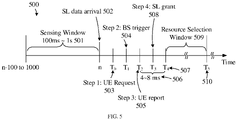
- FIG. 5 illustrates an exemplary illustration of a time line for UE sensing and reporting according to an embodiment being covered by the claimed invention.
- FIGs. 4 and 5 illustrate that, for a proposed method of BS scheduling of sidelink resources to avoid Tx collision when resources are shared by both mode 3 and mode 4 pools and potentially being used or already reserved by mode 4 UE(s), a detailed sensing and reporting procedure sequence for mode 3 UE and associated timeline diagrams are exemplarily illustrated in FIGs. 4 and 5 , respectively.
- a serving network BS 401 may have one or multiple UEs having an RRC connection to a cellular network for V2X services.
- a mode 3 e.g., a network scheduled resource allocation mode
- UE self-triggered it may be further instructed by the serving network BS 401 or UE self-triggered to perform a sensing operation continuously on the configured mode 3 pool at an operation 403.
- the serving network BS 401 may trigger the UE 402 to perform sensing on the configured mode 3 resource pool at the same time when the pool is being configured to the UE 402. And such a sensing trigger is only necessary when the configured mode 3 pool has partial or fully overlapping resources with at least one mode 4 pool. If triggered, the serving network BS 401 may further indicate a region of overlapped resources that the UE 402 needs to perform sensing. If this is not indicated, the sensing needs to be done on all mode 3 resources that are overlapping with other mode 4 pool(s).
- the UE 402 may base on its knowledge and self-detection of its configured mode 3 pool is being partially or fully overlapped with at least one mode 4 resource pool which could be an in-coverage network configured pool or a pre-configured pool for out-of-coverage operation on the same carrier. Furthermore, the sensing is only necessary to be performed on mode 3 resources that are overlapping with other mode 4 pool(s).
- the sensing of overlapped mode 3 resources is performed by decoding PSCCH's received within a sensing window and retrieving information relating to reservation of future resources.
- the UE 402 also needs to measure reference signal received power (RSRP) level on PSSCH associated to each received and decoded PSCCH (namely PSSCH-RSRP).
- RSRP reference signal received power
- the sensing needs to be performed over a period of window of at least 100 ms to 1 s (1000 ms) as illustrated by an operation 501 in FIG. 5 .
- the UE 402 as a step 1 404 Upon arrival of sidelink (SL) data packet(s) from UE's upper layer at subframe timing n in a step 1 502, the UE 402 as a step 1 404 sends a request to the serving network BS 401 for sidelink scheduling grant, along with at least one of message size, packet priority (which is related to latency requirement of the packet), a timing offset to the next packet arrival, and a periodicity relating to the sidelink data as part of UE assistance information at subframe T 0 at an operation 503.
- SL sidelink
- the serving network BS 401 at subframe timing T 1 at a step 2 504 triggers the UE 402 to report a set of available mode 3 resources that are overlapping with a mode 4 pool and at the same time provide an UL grant for the UE to provide at subframe timing T 2 in a step 3 505 of such report.
- the BS triggering could be performed by a media access control-control element (MAC-CE) or a new downlink control information (DCI).
- MAC-CE media access control-control element
- DCI new downlink control information
- the serving network BS 401 may activate the UE 402 to report a set of available sidelink resources from the configured mode 3 pool if it is determined that the pool and/or a certain resource zone/region of the pool overlaps with other mode 4 pool(s).
- the serving network BS 401 may deactivate this UE reporting if it is determined that the operating resource zone/region of the configured mode 3 pool no longer overlaps with other mode 4 pool(s) due to change of UE geographical location.
- Resource reservation interval and/or counter When this parameter is set to a non-zero value, the UE 402 periodically reports an updated set of available resources based on UE's latest sensing results when the resource reservation interval and/or counter reaches zero. Once the counter reaches zero, the UE 402 resets it back to the non-zero value which is given by the serving network BS 401. Furthermore, the UE 402 can be triggered by the serving network BS 401 to report an updated set of available resources at any time before an expiry of reservation interval and/or counter based on UE's latest reporting of a geographical location. In this case, the BS triggering of such a report will include a new resource zone of the mode 3 pool for which the UE report needs to be confined to. When this parameter is not set or it is set to a zero value, the UE 402 needs to report a set of available resources just once for one-shot SL transmission (i.e., no periodic reporting).
- Time gap between T 2 and T 4 at an operation 506 is the subframe where the UE 402 needs to report a set of available resources to the serving network BS 401.
- subframe timing T 4 at an operation 507 is then the earliest subframe timing where the UE 402 can possibly start transmitting its SL data packet.
- T 4 at the operation 507 is at least 4 subframes (4 ms) after the UE reporting timing T 2 in the step 3 505 or after the SL grant timing T 3 in a step 4 508.
- time gap between the UE reporting and SL grant are also taken into account, then additional 1 ms to 4 ms could be added to the 4 subframes. As such, the time gap between T 2 and T 4 at the operation 506 ranges between 4 ms and 8 ms.
- the serving network BS 401 may choose to set a particular zone of SL resources within the configured mode 3 pool that the selection of available resources is restricted to. This could be due to a UE reported geographical location and may further restrict the time period for which the UE 402 selects the set of available resources. If this parameter is not set or it is set to zero, which may be due to the UE 402 is not configured to periodically report its geographical location, then the set of available resources are selected from the areas/regions of resources that are shared between the configured mode 3 pool and a mode 4 pool.
- Length of contiguous sub-channels ( L subCH ): Based on UE's indication of a message size, the serving network BS 401 sets a length of a number of sub-channels contiguous in the frequency domain for UE's selection of the set of available resources.
- Target size of reporting resource set For the set of available resources that the UE 402 needs to report, target size of the reporting set could be limited by the serving network BS 401 to 3, 4, 5, 6, ..., or 10 for reducing UE report payload size, minimizing UE reporting delay and as well as improving decoding reliability for the serving network BS 401.
- the target set size could be based on 20% of total number of resources within the resource zone (if provided to the UE 402) and within a resource selection window T 4 -T 5 at an operation 509, where T 5 at an operation 510 is the latest subframe timing by which the SL data packet needs to be transmitted in order to satisfy its latency requirement.
- the UE 402 needs to base on its sensing results obtained over the sensing window at an operation 501 and triggering parameters received in the step 2 405 to perform selection of resources to be reported to the serving network BS 401 at the operation 406. In details, the UE 402 needs to perform the following functions to determine the set of available resources.
- the UE 402 Based on resource reservation information and associated PSSCH-RSRP measurements obtained from the outcome of resource sensing at the operation 403, the UE 402 first excludes any sub-channel within the resource selection window at the operation 509 that has been reserved by other UE with a measured PSSCH-RSRP level above a configured threshold.
- the UE 402 randomly selects with equal probability a number of resources equal to the target reporting set size and satisfy the following criteria, if they are indicated by the serving network BS 401 in the step 2 405. Further confined within the indicated resource zone is provided. Length of contiguous sub-channels ( L subCH ) is provided.
- the UE 402 needs to compile a report containing the set of selected resources from an operation 406 to be feedback to the network BS in a step 3 407 at subframe timing T 2 in the step 3 505 using the provided UL grant.
- the compilation of the set of selected resources contains only the starting sub-channel index for each selected resource when the length of contiguous sub-channels ( L subCH ) is more than one to save reporting payload size. Indexing of the starting sub-channel n subCH start can be done by using 5 bits to indicate its frequency position and 10 bits to indicate its time position within the resource selection window at the operation 509. In total, 15 bits would be sufficient to represent any sub-channel within a 20 MHz carrier and a resource selection window of 1024 ms.
- the final selection of SL mode 3 resource(s) to be assigned to the UE 402 is not necessarily restricted by the UE reported set from the step 3 407, since the configured mode 3 (network scheduled resource allocation mode, or scheduled mode for short) resource pool may not be fully overlapped with other mode 4 pool(s). Therefore, the final selection of SL resource(s) may still be chosen by the serving network BS 401 from a non-overlapping region of the mode 3 resource pool.
- the serving network BS 401 provides the final selection of Mode 3 resource(s) in a sidelink grant to the UE at subframe T 3 in the step 508, for UE transmission of its data packet between T 4 and T 5 at the operation 509.
- the UE 402 may repeat the entire UE sensing and reporting procedure again from the step 1 404 with its latest sensing results at an operation 411.
- scheduled mode is equivalent to the term “network scheduled resource allocation mode” or “Mode 3.”
- sensing is equivalent to the term “sensing measurement.”
- quested is equivalent to the term “triggered,” “instructed,” or “indicated.”
- FIG. 6 is a block diagram of an example system 700 for wireless communication according to an embodiment being covered by the claimed invention. Embodiments described herein may be implemented into the system using any suitably configured hardware and/or software.
- FIG. 6 illustrates the system 700 including a radio frequency (RF) circuitry 710, a baseband circuitry 720, an application circuitry 730, a memory/storage 740, a display 750, a camera 760, a sensor 770, and an input/output (I/O) interface 780, coupled with each other at least as illustrated.
- RF radio frequency
- the application circuitry 730 may include a circuitry such as, but not limited to, one or more single-core or multi-core processors.
- the processors may include any combination of general-purpose processors and dedicated processors, such as graphics processors, application processors.
- the processors may be coupled with the memory/storage and configured to execute instructions stored in the memory/storage to enable various applications and/or operating systems running on the system.
- the baseband circuitry 720 may include circuitry such as, but not limited to, one or more single-core or multi-core processors.
- the processors may include a baseband processor.
- the baseband circuitry may handle various radio control functions that enables communication with one or more radio networks via the RF circuitry.
- the radio control functions may include, but are not limited to, signal modulation, encoding, decoding, radio frequency shifting, etc.
- the baseband circuitry may provide for communication compatible with one or more radio technologies.
- the baseband circuitry may support communication with an evolved universal terrestrial radio access network (EUTRAN) and/or other wireless metropolitan area networks (WMAN), a wireless local area network (WLAN), a wireless personal area network (WPAN).
- EUTRAN evolved universal terrestrial radio access network
- WMAN wireless metropolitan area networks
- WLAN wireless local area network
- WPAN wireless personal area network
- multi-mode baseband circuitry Embodiments in which the baseband circuitry is configured to support radio communications of more than one wireless protocol.
- the baseband circuitry 720 may include circuitry to operate with signals that are not strictly considered as being in a baseband frequency.
- baseband circuitry may include circuitry to operate with signals having an intermediate frequency, which is between a baseband frequency and a radio frequency.
- the RF circuitry 710 may enable communication with wireless networks using modulated electromagnetic radiation through a non-solid medium.
- the RF circuitry may include switches, filters, amplifiers, etc. to facilitate the communication with the wireless network.
- the RF circuitry 710 may include circuitry to operate with signals that are not strictly considered as being in a radio frequency.
- RF circuitry may include circuitry to operate with signals having an intermediate frequency, which is between a baseband frequency and a radio frequency.
- the transmitter circuitry, control circuitry, or receiver circuitry discussed above with respect to the user equipment, eNB, or gNB may be embodied in whole or in part in one or more of the RF circuitry, the baseband circuitry, and/or the application circuitry.
- circuitry may refer to, be part of, or include an application specific integrated circuit (ASIC), an electronic circuit, a processor (shared, dedicated, or group), and/or a memory (shared, dedicated, or group) that execute one or more software or firmware programs, a combinational logic circuit, and/or other suitable hardware components that provide the described functionality.
- the electronic device circuitry may be implemented in, or functions associated with the circuitry may be implemented by, one or more software or firmware modules.
- some or all of the constituent components of the baseband circuitry, the application circuitry, and/or the memory/storage may be implemented together on a system on a chip (SOC).
- SOC system on a chip
- the memory/storage 740 may be used to load and store data and/or instructions, for example, for system.
- the memory/storage for one embodiment being covered by the claimed invention may include any combination of suitable volatile memory, such as dynamic random access memory (DRAM)), and/or non-volatile memory, such as flash memory.
- DRAM dynamic random access memory
- the I/O interface 780 may include one or more user interfaces designed to enable user interaction with the system and/or peripheral component interfaces designed to enable peripheral component interaction with the system.
- User interfaces may include, but are not limited to a physical keyboard or keypad, a touchpad, a speaker, a microphone, etc.
- Peripheral component interfaces may include, but are not limited to, a non-volatile memory port, a universal serial bus (USB) port, an audio jack, and a power supply interface.
- USB universal serial bus
- the senor 770 may include one or more sensing devices to determine environmental conditions and/or location information related to the system.
- the sensors may include, but are not limited to, a gyro sensor, an accelerometer, a proximity sensor, an ambient light sensor, and a positioning unit.
- the positioning unit may also be part of, or interact with, the baseband circuitry and/or RF circuitry to communicate with components of a positioning network, e.g., a global positioning system (GPS) satellite.
- GPS global positioning system
- the display 750 may include a display, such as a liquid crystal display and a touch screen display.
- the system 700 may be a mobile computing device such as, but not limited to, a laptop computing device, a tablet computing device, a netbook, an ultrabook, a smartphone, etc.
- system may have more or less components, and/or different architectures.
- methods described herein may be implemented as a computer program.
- the computer program may be stored on a storage medium, such as a non-transitory storage medium.
- Resource sensing which includes PSCCH decoding and PSSCH-RSRP measurement of mode 3 resource can be triggered either by BS indication or UE self-detection. If triggered by BS indication, it may further include region(s) of overlapped resources that the UE needs to perform sensing. If UE self-triggered, the sensing operation is performed only on mode 3 resources that are overlapping with other mode 4 pool(s).
- Aspect 2 BS triggering and stopping for the UE to report a set of available resources could be performed by a MAC-CE or DCI.
- the triggering includes at least one of the following information.
- the following information includes activation and/or deactivation, resource reservation interval and/or counter, time gap between UE report timing and beginning of resource selection window, resource zone, length of contiguous sub-channels, and/or target size of reporting resource set.
- Aspect 3 UE selection of available resources within a resource selection window is performed based on resource sensing results by first excluding any resources that have been reserved by other UEs and then selecting a set of available resources that satisfy all criteria set by the BS.
- Compilation of UE report includes only a sub-set of total available resources, where the sub-set size could be limited to max 10 resources or 20% of total available resources.
- the reporting of each of the selected resource includes only the starting sub-channel position, which can be represented by a combination of two indices.
- the frequency location of a starting sub-channel can be represented by max of 5 bits and the time location can be represented by max of 10 bits.
- Aspect 5 UE autonomous restart and/or reinitiate the whole sensing and reporting procedure to avoid transmission collision when it is detected.
- Some embodiments being covered by the claimed invention aim to solve the above described issues in UE sensing and reporting of sidelink resources when mode 3 and mode 4 pools are overlapped in sidelink communication. Some embodiments being covered by the claimed invention of the new sensing and reporting method of sidelink resources have at least one of following benefits.
- the embodiment being covered by the claimed invention is a combination of techniques/processes that can be adopted in 3GPP specification to create an end product.
- the embodiment being covered by the claimed invention has at least one of following benefits.
- the units as separating components for explanation are or are not physically separated.
- the units for display are or are not physical units, that is, located in one place or distributed on a plurality of network units. Some or all of the units are used according to the purposes of the embodiments.
- each of the functional units in each of the embodiments being covered by the claimed invention can be integrated in one processing unit, physically independent, or integrated in one processing unit with two or more than two units.
- the software function unit is realized and used and sold as a product, it can be stored in a readable storage medium in a computer.
- the technical plan proposed by the present disclosure can be essentially or partially realized as the form of a software product.
- one part of the technical plan beneficial to the conventional technology can be realized as the form of a software product.
- the software product in the computer is stored in a storage medium, including a plurality of commands for a computational device (such as a personal computer, a server, or a network device) to run all or some of the steps disclosed by the embodiments being covered by the claimed invention.
- the storage medium includes a USB disk, a mobile hard disk, a read-only memory (ROM), a random access memory (RAM), a floppy disk, or other kinds of media capable of storing program codes.
Landscapes
- Engineering & Computer Science (AREA)
- Computer Networks & Wireless Communication (AREA)
- Signal Processing (AREA)
- Quality & Reliability (AREA)
- Mobile Radio Communication Systems (AREA)
- Developing Agents For Electrophotography (AREA)
Applications Claiming Priority (2)
| Application Number | Priority Date | Filing Date | Title |
|---|---|---|---|
| US201862696589P | 2018-07-11 | 2018-07-11 | |
| PCT/CN2019/095584 WO2020011229A1 (en) | 2018-07-11 | 2019-07-11 | Apparatus and method of wireless communication of same |
Publications (3)
| Publication Number | Publication Date |
|---|---|
| EP3815458A1 EP3815458A1 (en) | 2021-05-05 |
| EP3815458A4 EP3815458A4 (en) | 2021-07-07 |
| EP3815458B1 true EP3815458B1 (en) | 2023-01-18 |
Family
ID=69142113
Family Applications (1)
| Application Number | Title | Priority Date | Filing Date |
|---|---|---|---|
| EP19834895.5A Active EP3815458B1 (en) | 2018-07-11 | 2019-07-11 | Apparatus and method of wireless communication of same |
Country Status (8)
| Country | Link |
|---|---|
| US (2) | US11147084B2 (https=) |
| EP (1) | EP3815458B1 (https=) |
| JP (1) | JP7437373B2 (https=) |
| KR (1) | KR102857266B1 (https=) |
| CN (2) | CN112399639B (https=) |
| AU (1) | AU2019302596B2 (https=) |
| ES (1) | ES2940701T3 (https=) |
| WO (1) | WO2020011229A1 (https=) |
Families Citing this family (22)
| Publication number | Priority date | Publication date | Assignee | Title |
|---|---|---|---|---|
| EP3665996A4 (en) * | 2017-08-11 | 2020-07-29 | ZTE Corporation | SYSTEMS AND METHODS FOR SHARING A RESOURCE POOL IN SIDELINK COMMUNICATIONS |
| JP7437373B2 (ja) * | 2018-07-11 | 2024-02-22 | オッポ広東移動通信有限公司 | 無線通信用の機器および当該機器の無線通信方法 |
| JP7419358B2 (ja) | 2018-09-26 | 2024-01-22 | フラウンホーファー-ゲゼルシャフト・ツール・フェルデルング・デル・アンゲヴァンテン・フォルシュング・アインゲトラーゲネル・フェライン | グループ通信のためのリソースプールの設計 |
| EP3858011B1 (en) * | 2018-09-26 | 2025-12-17 | Fraunhofer-Gesellschaft zur Förderung der angewandten Forschung e.V. | V2x dynamic groupcast resource allocation |
| US10833818B2 (en) * | 2018-11-13 | 2020-11-10 | Qualcomm Incorporated | Resource exclusion in a half duplex based wireless communication system |
| CN111385885B (zh) * | 2018-12-29 | 2023-08-01 | 大唐移动通信设备有限公司 | 一种资源分配模式的确定方法、终端及网络设备 |
| EP3915311A4 (en) * | 2019-01-21 | 2022-08-10 | ZTE Corporation | RESOURCE DISPLAY AND SELECTION SCHEMES IN WIRELESS COMMUNICATIONS |
| US12262352B2 (en) * | 2019-09-29 | 2025-03-25 | Apple Inc. | Dual-mode sidelink operation |
| CA3095199A1 (en) * | 2019-10-03 | 2021-04-03 | Comcast Cable Communications, Llc | Sidelink bearer mode selection |
| EP4039019A1 (en) * | 2020-01-16 | 2022-08-10 | Shanghai Langbo Communication Technology Company Limited | Method and device used for wireless communication with discontinuous reception |
| US12294999B2 (en) * | 2020-02-13 | 2025-05-06 | Lenovo (Beijing) Ltd. | Method and apparatus for beam-based transmission for sidelink |
| CN115211170A (zh) * | 2020-03-17 | 2022-10-18 | 中兴通讯股份有限公司 | 用于侧链路配置的系统和方法 |
| KR20220124735A (ko) * | 2020-03-18 | 2022-09-14 | 지티이 코포레이션 | 무선 사이드링크 통신에서의 전력 절감 방법 및 디바이스 |
| EP4108020A4 (en) | 2020-03-18 | 2023-03-22 | ZTE Corporation | Method and device for power-saving in wireless sidelink communication |
| CN113498087B (zh) * | 2020-04-08 | 2023-07-04 | 维沃移动通信有限公司 | 资源确定方法及终端 |
| JP7578796B2 (ja) * | 2020-07-30 | 2024-11-06 | 華為技術有限公司 | 通信方法および装置 |
| WO2022061752A1 (zh) | 2020-09-25 | 2022-03-31 | Oppo广东移动通信有限公司 | 通信方法、装置及设备 |
| WO2022087204A1 (en) * | 2020-10-21 | 2022-04-28 | Ofinno, Llc | Triggering resource re-evaluation for sidelink |
| CN118199837A (zh) * | 2020-12-28 | 2024-06-14 | 上海朗帛通信技术有限公司 | 一种被用于无线通信的节点中的方法和装置 |
| CN116724596A (zh) * | 2021-01-14 | 2023-09-08 | 苹果公司 | 使用资源再评估和资源抢占的用于减少感测ue的功率节省感测 |
| US12432755B2 (en) | 2021-09-24 | 2025-09-30 | Apple Inc. | Procedures of sidelink resource pool resource use with reduced sensing |
| US12335960B2 (en) * | 2021-10-05 | 2025-06-17 | Qualcomm Incorporated | Soft grant for resource pool sharing in new radio (NR) sidelink |
Family Cites Families (6)
| Publication number | Priority date | Publication date | Assignee | Title |
|---|---|---|---|---|
| US6731936B2 (en) | 2001-08-20 | 2004-05-04 | Qualcomm Incorporated | Method and system for a handoff in a broadcast communication system |
| EP2536232A4 (en) * | 2010-02-12 | 2016-11-23 | Mitsubishi Electric Corp | MOBILE COMMUNICATION SYSTEM |
| US10425915B2 (en) * | 2014-06-27 | 2019-09-24 | Sharp Kabushiki Kaisha | Resource pool access for device to device communications |
| EP3456144B1 (en) | 2016-05-12 | 2020-10-21 | Sharp Kabushiki Kaisha | Method and apparatus for selecting radio resources for vehicle (v2x) communications from an overlapping resource pool |
| US11284387B2 (en) | 2016-09-26 | 2022-03-22 | Nec Corporation | Methods and system for device-to-device communication |
| JP7437373B2 (ja) * | 2018-07-11 | 2024-02-22 | オッポ広東移動通信有限公司 | 無線通信用の機器および当該機器の無線通信方法 |
-
2019
- 2019-07-11 JP JP2021500094A patent/JP7437373B2/ja active Active
- 2019-07-11 KR KR1020217000114A patent/KR102857266B1/ko active Active
- 2019-07-11 AU AU2019302596A patent/AU2019302596B2/en active Active
- 2019-07-11 CN CN202011204787.5A patent/CN112399639B/zh active Active
- 2019-07-11 CN CN201980014929.0A patent/CN111972028A/zh active Pending
- 2019-07-11 EP EP19834895.5A patent/EP3815458B1/en active Active
- 2019-07-11 WO PCT/CN2019/095584 patent/WO2020011229A1/en not_active Ceased
- 2019-07-11 ES ES19834895T patent/ES2940701T3/es active Active
-
2020
- 2020-11-17 US US16/950,840 patent/US11147084B2/en active Active
-
2021
- 2021-08-31 US US17/463,363 patent/US11844058B2/en active Active
Also Published As
| Publication number | Publication date |
|---|---|
| CN111972028A (zh) | 2020-11-20 |
| US11147084B2 (en) | 2021-10-12 |
| ES2940701T3 (es) | 2023-05-10 |
| CN112399639B (zh) | 2023-04-18 |
| US11844058B2 (en) | 2023-12-12 |
| KR20210029188A (ko) | 2021-03-15 |
| WO2020011229A1 (en) | 2020-01-16 |
| JP7437373B2 (ja) | 2024-02-22 |
| US20210068125A1 (en) | 2021-03-04 |
| EP3815458A4 (en) | 2021-07-07 |
| US20210392654A1 (en) | 2021-12-16 |
| AU2019302596A1 (en) | 2021-01-21 |
| CN112399639A (zh) | 2021-02-23 |
| KR102857266B1 (ko) | 2025-09-08 |
| JP2021531683A (ja) | 2021-11-18 |
| AU2019302596B2 (en) | 2024-04-04 |
| EP3815458A1 (en) | 2021-05-05 |
Similar Documents
| Publication | Publication Date | Title |
|---|---|---|
| EP3815458B1 (en) | Apparatus and method of wireless communication of same | |
| US12363683B2 (en) | User equipment and method of resource allocation of same | |
| US20250344188A1 (en) | Partial sensing method and device for device-to-device communication in wireless communication system | |
| US20210204284A1 (en) | Apparatus and method of vehicle-to-everything communication of same | |
| WO2020233189A1 (en) | User equipment and method for resource selection of same | |
| US20230112171A1 (en) | Apparatus and method of wireless communication | |
| WO2020087437A1 (en) | User equipment and method of wireless communication of same | |
| WO2022001973A1 (en) | Apparatus and method of wireless communication | |
| EP4124136A1 (en) | Data transmission method and apparatus | |
| US20250274959A1 (en) | Utilizing multiple resource pools for sidelink positioning | |
| WO2022007666A1 (en) | Apparatus and method of wireless communication | |
| EP4432592B1 (en) | Resource selection method and apparatus | |
| JP7771437B2 (ja) | サイドリンク通信方法および装置 | |
| CN116456498B (zh) | 资源选择方法及装置 | |
| CN120358617A (zh) | 通信方法及通信装置 | |
| CN119893715A (zh) | 通信方法及装置 |
Legal Events
| Date | Code | Title | Description |
|---|---|---|---|
| STAA | Information on the status of an ep patent application or granted ep patent |
Free format text: STATUS: THE INTERNATIONAL PUBLICATION HAS BEEN MADE |
|
| PUAI | Public reference made under article 153(3) epc to a published international application that has entered the european phase |
Free format text: ORIGINAL CODE: 0009012 |
|
| STAA | Information on the status of an ep patent application or granted ep patent |
Free format text: STATUS: REQUEST FOR EXAMINATION WAS MADE |
|
| 17P | Request for examination filed |
Effective date: 20201207 |
|
| AK | Designated contracting states |
Kind code of ref document: A1 Designated state(s): AL AT BE BG CH CY CZ DE DK EE ES FI FR GB GR HR HU IE IS IT LI LT LU LV MC MK MT NL NO PL PT RO RS SE SI SK SM TR |
|
| A4 | Supplementary search report drawn up and despatched |
Effective date: 20210609 |
|
| RIC1 | Information provided on ipc code assigned before grant |
Ipc: H04W 76/14 20180101AFI20210603BHEP |
|
| DAV | Request for validation of the european patent (deleted) | ||
| DAX | Request for extension of the european patent (deleted) | ||
| STAA | Information on the status of an ep patent application or granted ep patent |
Free format text: STATUS: EXAMINATION IS IN PROGRESS |
|
| 17Q | First examination report despatched |
Effective date: 20220215 |
|
| REG | Reference to a national code |
Ref country code: DE Ref legal event code: R079 Ref document number: 602019024630 Country of ref document: DE Free format text: PREVIOUS MAIN CLASS: H04W0076000000 Ipc: H04W0076140000 |
|
| GRAP | Despatch of communication of intention to grant a patent |
Free format text: ORIGINAL CODE: EPIDOSNIGR1 |
|
| STAA | Information on the status of an ep patent application or granted ep patent |
Free format text: STATUS: GRANT OF PATENT IS INTENDED |
|
| RIC1 | Information provided on ipc code assigned before grant |
Ipc: H04W 84/04 20090101ALN20220824BHEP Ipc: H04W 76/14 20180101AFI20220824BHEP |
|
| INTG | Intention to grant announced |
Effective date: 20220923 |
|
| GRAS | Grant fee paid |
Free format text: ORIGINAL CODE: EPIDOSNIGR3 |
|
| GRAA | (expected) grant |
Free format text: ORIGINAL CODE: 0009210 |
|
| STAA | Information on the status of an ep patent application or granted ep patent |
Free format text: STATUS: THE PATENT HAS BEEN GRANTED |
|
| AK | Designated contracting states |
Kind code of ref document: B1 Designated state(s): AL AT BE BG CH CY CZ DE DK EE ES FI FR GB GR HR HU IE IS IT LI LT LU LV MC MK MT NL NO PL PT RO RS SE SI SK SM TR |
|
| REG | Reference to a national code |
Ref country code: GB Ref legal event code: FG4D |
|
| REG | Reference to a national code |
Ref country code: CH Ref legal event code: EP |
|
| REG | Reference to a national code |
Ref country code: DE Ref legal event code: R096 Ref document number: 602019024630 Country of ref document: DE |
|
| REG | Reference to a national code |
Ref country code: AT Ref legal event code: REF Ref document number: 1545328 Country of ref document: AT Kind code of ref document: T Effective date: 20230215 Ref country code: IE Ref legal event code: FG4D |
|
| REG | Reference to a national code |
Ref country code: NL Ref legal event code: FP |
|
| REG | Reference to a national code |
Ref country code: LT Ref legal event code: MG9D Ref country code: ES Ref legal event code: FG2A Ref document number: 2940701 Country of ref document: ES Kind code of ref document: T3 Effective date: 20230510 |
|
| P01 | Opt-out of the competence of the unified patent court (upc) registered |
Effective date: 20230412 |
|
| REG | Reference to a national code |
Ref country code: AT Ref legal event code: MK05 Ref document number: 1545328 Country of ref document: AT Kind code of ref document: T Effective date: 20230118 |
|
| PG25 | Lapsed in a contracting state [announced via postgrant information from national office to epo] |
Ref country code: RS Free format text: LAPSE BECAUSE OF FAILURE TO SUBMIT A TRANSLATION OF THE DESCRIPTION OR TO PAY THE FEE WITHIN THE PRESCRIBED TIME-LIMIT Effective date: 20230118 Ref country code: PT Free format text: LAPSE BECAUSE OF FAILURE TO SUBMIT A TRANSLATION OF THE DESCRIPTION OR TO PAY THE FEE WITHIN THE PRESCRIBED TIME-LIMIT Effective date: 20230518 Ref country code: NO Free format text: LAPSE BECAUSE OF FAILURE TO SUBMIT A TRANSLATION OF THE DESCRIPTION OR TO PAY THE FEE WITHIN THE PRESCRIBED TIME-LIMIT Effective date: 20230418 Ref country code: LV Free format text: LAPSE BECAUSE OF FAILURE TO SUBMIT A TRANSLATION OF THE DESCRIPTION OR TO PAY THE FEE WITHIN THE PRESCRIBED TIME-LIMIT Effective date: 20230118 Ref country code: LT Free format text: LAPSE BECAUSE OF FAILURE TO SUBMIT A TRANSLATION OF THE DESCRIPTION OR TO PAY THE FEE WITHIN THE PRESCRIBED TIME-LIMIT Effective date: 20230118 Ref country code: HR Free format text: LAPSE BECAUSE OF FAILURE TO SUBMIT A TRANSLATION OF THE DESCRIPTION OR TO PAY THE FEE WITHIN THE PRESCRIBED TIME-LIMIT Effective date: 20230118 Ref country code: AT Free format text: LAPSE BECAUSE OF FAILURE TO SUBMIT A TRANSLATION OF THE DESCRIPTION OR TO PAY THE FEE WITHIN THE PRESCRIBED TIME-LIMIT Effective date: 20230118 |
|
| PG25 | Lapsed in a contracting state [announced via postgrant information from national office to epo] |
Ref country code: SE Free format text: LAPSE BECAUSE OF FAILURE TO SUBMIT A TRANSLATION OF THE DESCRIPTION OR TO PAY THE FEE WITHIN THE PRESCRIBED TIME-LIMIT Effective date: 20230118 Ref country code: PL Free format text: LAPSE BECAUSE OF FAILURE TO SUBMIT A TRANSLATION OF THE DESCRIPTION OR TO PAY THE FEE WITHIN THE PRESCRIBED TIME-LIMIT Effective date: 20230118 Ref country code: IS Free format text: LAPSE BECAUSE OF FAILURE TO SUBMIT A TRANSLATION OF THE DESCRIPTION OR TO PAY THE FEE WITHIN THE PRESCRIBED TIME-LIMIT Effective date: 20230518 Ref country code: GR Free format text: LAPSE BECAUSE OF FAILURE TO SUBMIT A TRANSLATION OF THE DESCRIPTION OR TO PAY THE FEE WITHIN THE PRESCRIBED TIME-LIMIT Effective date: 20230419 Ref country code: FI Free format text: LAPSE BECAUSE OF FAILURE TO SUBMIT A TRANSLATION OF THE DESCRIPTION OR TO PAY THE FEE WITHIN THE PRESCRIBED TIME-LIMIT Effective date: 20230118 |
|
| REG | Reference to a national code |
Ref country code: DE Ref legal event code: R097 Ref document number: 602019024630 Country of ref document: DE |
|
| PG25 | Lapsed in a contracting state [announced via postgrant information from national office to epo] |
Ref country code: SM Free format text: LAPSE BECAUSE OF FAILURE TO SUBMIT A TRANSLATION OF THE DESCRIPTION OR TO PAY THE FEE WITHIN THE PRESCRIBED TIME-LIMIT Effective date: 20230118 Ref country code: RO Free format text: LAPSE BECAUSE OF FAILURE TO SUBMIT A TRANSLATION OF THE DESCRIPTION OR TO PAY THE FEE WITHIN THE PRESCRIBED TIME-LIMIT Effective date: 20230118 Ref country code: EE Free format text: LAPSE BECAUSE OF FAILURE TO SUBMIT A TRANSLATION OF THE DESCRIPTION OR TO PAY THE FEE WITHIN THE PRESCRIBED TIME-LIMIT Effective date: 20230118 Ref country code: DK Free format text: LAPSE BECAUSE OF FAILURE TO SUBMIT A TRANSLATION OF THE DESCRIPTION OR TO PAY THE FEE WITHIN THE PRESCRIBED TIME-LIMIT Effective date: 20230118 Ref country code: CZ Free format text: LAPSE BECAUSE OF FAILURE TO SUBMIT A TRANSLATION OF THE DESCRIPTION OR TO PAY THE FEE WITHIN THE PRESCRIBED TIME-LIMIT Effective date: 20230118 |
|
| PLBE | No opposition filed within time limit |
Free format text: ORIGINAL CODE: 0009261 |
|
| STAA | Information on the status of an ep patent application or granted ep patent |
Free format text: STATUS: NO OPPOSITION FILED WITHIN TIME LIMIT |
|
| PG25 | Lapsed in a contracting state [announced via postgrant information from national office to epo] |
Ref country code: SK Free format text: LAPSE BECAUSE OF FAILURE TO SUBMIT A TRANSLATION OF THE DESCRIPTION OR TO PAY THE FEE WITHIN THE PRESCRIBED TIME-LIMIT Effective date: 20230118 |
|
| 26N | No opposition filed |
Effective date: 20231019 |
|
| PG25 | Lapsed in a contracting state [announced via postgrant information from national office to epo] |
Ref country code: SI Free format text: LAPSE BECAUSE OF FAILURE TO SUBMIT A TRANSLATION OF THE DESCRIPTION OR TO PAY THE FEE WITHIN THE PRESCRIBED TIME-LIMIT Effective date: 20230118 |
|
| PG25 | Lapsed in a contracting state [announced via postgrant information from national office to epo] |
Ref country code: MC Free format text: LAPSE BECAUSE OF FAILURE TO SUBMIT A TRANSLATION OF THE DESCRIPTION OR TO PAY THE FEE WITHIN THE PRESCRIBED TIME-LIMIT Effective date: 20230118 |
|
| PG25 | Lapsed in a contracting state [announced via postgrant information from national office to epo] |
Ref country code: MC Free format text: LAPSE BECAUSE OF FAILURE TO SUBMIT A TRANSLATION OF THE DESCRIPTION OR TO PAY THE FEE WITHIN THE PRESCRIBED TIME-LIMIT Effective date: 20230118 |
|
| REG | Reference to a national code |
Ref country code: CH Ref legal event code: PL |
|
| REG | Reference to a national code |
Ref country code: BE Ref legal event code: MM Effective date: 20230731 |
|
| PG25 | Lapsed in a contracting state [announced via postgrant information from national office to epo] |
Ref country code: LU Free format text: LAPSE BECAUSE OF NON-PAYMENT OF DUE FEES Effective date: 20230711 |
|
| PG25 | Lapsed in a contracting state [announced via postgrant information from national office to epo] |
Ref country code: LU Free format text: LAPSE BECAUSE OF NON-PAYMENT OF DUE FEES Effective date: 20230711 |
|
| REG | Reference to a national code |
Ref country code: IE Ref legal event code: MM4A |
|
| PG25 | Lapsed in a contracting state [announced via postgrant information from national office to epo] |
Ref country code: CH Free format text: LAPSE BECAUSE OF NON-PAYMENT OF DUE FEES Effective date: 20230731 |
|
| PG25 | Lapsed in a contracting state [announced via postgrant information from national office to epo] |
Ref country code: BE Free format text: LAPSE BECAUSE OF NON-PAYMENT OF DUE FEES Effective date: 20230731 |
|
| PG25 | Lapsed in a contracting state [announced via postgrant information from national office to epo] |
Ref country code: IE Free format text: LAPSE BECAUSE OF NON-PAYMENT OF DUE FEES Effective date: 20230711 |
|
| PG25 | Lapsed in a contracting state [announced via postgrant information from national office to epo] |
Ref country code: IE Free format text: LAPSE BECAUSE OF NON-PAYMENT OF DUE FEES Effective date: 20230711 |
|
| PG25 | Lapsed in a contracting state [announced via postgrant information from national office to epo] |
Ref country code: BG Free format text: LAPSE BECAUSE OF FAILURE TO SUBMIT A TRANSLATION OF THE DESCRIPTION OR TO PAY THE FEE WITHIN THE PRESCRIBED TIME-LIMIT Effective date: 20230118 |
|
| PG25 | Lapsed in a contracting state [announced via postgrant information from national office to epo] |
Ref country code: BG Free format text: LAPSE BECAUSE OF FAILURE TO SUBMIT A TRANSLATION OF THE DESCRIPTION OR TO PAY THE FEE WITHIN THE PRESCRIBED TIME-LIMIT Effective date: 20230118 |
|
| PG25 | Lapsed in a contracting state [announced via postgrant information from national office to epo] |
Ref country code: CY Free format text: LAPSE BECAUSE OF FAILURE TO SUBMIT A TRANSLATION OF THE DESCRIPTION OR TO PAY THE FEE WITHIN THE PRESCRIBED TIME-LIMIT; INVALID AB INITIO Effective date: 20190711 |
|
| PG25 | Lapsed in a contracting state [announced via postgrant information from national office to epo] |
Ref country code: HU Free format text: LAPSE BECAUSE OF FAILURE TO SUBMIT A TRANSLATION OF THE DESCRIPTION OR TO PAY THE FEE WITHIN THE PRESCRIBED TIME-LIMIT; INVALID AB INITIO Effective date: 20190711 |
|
| PGFP | Annual fee paid to national office [announced via postgrant information from national office to epo] |
Ref country code: NL Payment date: 20250722 Year of fee payment: 7 |
|
| PGFP | Annual fee paid to national office [announced via postgrant information from national office to epo] |
Ref country code: ES Payment date: 20250801 Year of fee payment: 7 |
|
| PGFP | Annual fee paid to national office [announced via postgrant information from national office to epo] |
Ref country code: DE Payment date: 20250724 Year of fee payment: 7 |
|
| PGFP | Annual fee paid to national office [announced via postgrant information from national office to epo] |
Ref country code: IT Payment date: 20250722 Year of fee payment: 7 |
|
| PGFP | Annual fee paid to national office [announced via postgrant information from national office to epo] |
Ref country code: GB Payment date: 20250722 Year of fee payment: 7 |
|
| PGFP | Annual fee paid to national office [announced via postgrant information from national office to epo] |
Ref country code: FR Payment date: 20250722 Year of fee payment: 7 |
|
| PG25 | Lapsed in a contracting state [announced via postgrant information from national office to epo] |
Ref country code: TR Free format text: LAPSE BECAUSE OF FAILURE TO SUBMIT A TRANSLATION OF THE DESCRIPTION OR TO PAY THE FEE WITHIN THE PRESCRIBED TIME-LIMIT Effective date: 20230118 |