EP3815399B1 - Verfolgungssensoranordnung zur detektion einer verfolgungseinheit und vorrichtung und verfahren dafür - Google Patents
Verfolgungssensoranordnung zur detektion einer verfolgungseinheit und vorrichtung und verfahren dafür Download PDFInfo
- Publication number
- EP3815399B1 EP3815399B1 EP19735547.2A EP19735547A EP3815399B1 EP 3815399 B1 EP3815399 B1 EP 3815399B1 EP 19735547 A EP19735547 A EP 19735547A EP 3815399 B1 EP3815399 B1 EP 3815399B1
- Authority
- EP
- European Patent Office
- Prior art keywords
- movement
- gateway device
- detected
- tracking
- range
- Prior art date
- Legal status (The legal status is an assumption and is not a legal conclusion. Google has not performed a legal analysis and makes no representation as to the accuracy of the status listed.)
- Active
Links
Images

Classifications
-
- G—PHYSICS
- G01—MEASURING; TESTING
- G01S—RADIO DIRECTION-FINDING; RADIO NAVIGATION; DETERMINING DISTANCE OR VELOCITY BY USE OF RADIO WAVES; LOCATING OR PRESENCE-DETECTING BY USE OF THE REFLECTION OR RERADIATION OF RADIO WAVES; ANALOGOUS ARRANGEMENTS USING OTHER WAVES
- G01S1/00—Beacons or beacon systems transmitting signals having a characteristic or characteristics capable of being detected by non-directional receivers and defining directions, positions, or position lines fixed relatively to the beacon transmitters; Receivers co-operating therewith
- G01S1/02—Beacons or beacon systems transmitting signals having a characteristic or characteristics capable of being detected by non-directional receivers and defining directions, positions, or position lines fixed relatively to the beacon transmitters; Receivers co-operating therewith using radio waves
- G01S1/68—Marker, boundary, call-sign, or like beacons transmitting signals not carrying directional information
-
- G—PHYSICS
- G01—MEASURING; TESTING
- G01S—RADIO DIRECTION-FINDING; RADIO NAVIGATION; DETERMINING DISTANCE OR VELOCITY BY USE OF RADIO WAVES; LOCATING OR PRESENCE-DETECTING BY USE OF THE REFLECTION OR RERADIATION OF RADIO WAVES; ANALOGOUS ARRANGEMENTS USING OTHER WAVES
- G01S5/00—Position-fixing by co-ordinating two or more direction or position line determinations; Position-fixing by co-ordinating two or more distance determinations
- G01S5/02—Position-fixing by co-ordinating two or more direction or position line determinations; Position-fixing by co-ordinating two or more distance determinations using radio waves
- G01S5/0284—Relative positioning
-
- G—PHYSICS
- G06—COMPUTING OR CALCULATING; COUNTING
- G06K—GRAPHICAL DATA READING; PRESENTATION OF DATA; RECORD CARRIERS; HANDLING RECORD CARRIERS
- G06K7/00—Methods or arrangements for sensing record carriers, e.g. for reading patterns
- G06K7/10—Methods or arrangements for sensing record carriers, e.g. for reading patterns by electromagnetic radiation, e.g. optical sensing; by corpuscular radiation
- G06K7/10009—Methods or arrangements for sensing record carriers, e.g. for reading patterns by electromagnetic radiation, e.g. optical sensing; by corpuscular radiation sensing by radiation using wavelengths larger than 0.1 mm, e.g. radio-waves or microwaves
- G06K7/10297—Methods or arrangements for sensing record carriers, e.g. for reading patterns by electromagnetic radiation, e.g. optical sensing; by corpuscular radiation sensing by radiation using wavelengths larger than 0.1 mm, e.g. radio-waves or microwaves arrangements for handling protocols designed for non-contact record carriers such as RFIDs NFCs, e.g. ISO/IEC 14443 and 18092
-
- G—PHYSICS
- G06—COMPUTING OR CALCULATING; COUNTING
- G06K—GRAPHICAL DATA READING; PRESENTATION OF DATA; RECORD CARRIERS; HANDLING RECORD CARRIERS
- G06K7/00—Methods or arrangements for sensing record carriers, e.g. for reading patterns
- G06K7/10—Methods or arrangements for sensing record carriers, e.g. for reading patterns by electromagnetic radiation, e.g. optical sensing; by corpuscular radiation
- G06K7/10009—Methods or arrangements for sensing record carriers, e.g. for reading patterns by electromagnetic radiation, e.g. optical sensing; by corpuscular radiation sensing by radiation using wavelengths larger than 0.1 mm, e.g. radio-waves or microwaves
- G06K7/10366—Methods or arrangements for sensing record carriers, e.g. for reading patterns by electromagnetic radiation, e.g. optical sensing; by corpuscular radiation sensing by radiation using wavelengths larger than 0.1 mm, e.g. radio-waves or microwaves the interrogation device being adapted for miscellaneous applications
- G06K7/10415—Methods or arrangements for sensing record carriers, e.g. for reading patterns by electromagnetic radiation, e.g. optical sensing; by corpuscular radiation sensing by radiation using wavelengths larger than 0.1 mm, e.g. radio-waves or microwaves the interrogation device being adapted for miscellaneous applications the interrogation device being fixed in its position, such as an access control device for reading wireless access cards, or a wireless ATM
- G06K7/10425—Methods or arrangements for sensing record carriers, e.g. for reading patterns by electromagnetic radiation, e.g. optical sensing; by corpuscular radiation sensing by radiation using wavelengths larger than 0.1 mm, e.g. radio-waves or microwaves the interrogation device being adapted for miscellaneous applications the interrogation device being fixed in its position, such as an access control device for reading wireless access cards, or a wireless ATM the interrogation device being arranged for interrogation of record carriers passing by the interrogation device
-
- G—PHYSICS
- G06—COMPUTING OR CALCULATING; COUNTING
- G06Q—INFORMATION AND COMMUNICATION TECHNOLOGY [ICT] SPECIALLY ADAPTED FOR ADMINISTRATIVE, COMMERCIAL, FINANCIAL, MANAGERIAL OR SUPERVISORY PURPOSES; SYSTEMS OR METHODS SPECIALLY ADAPTED FOR ADMINISTRATIVE, COMMERCIAL, FINANCIAL, MANAGERIAL OR SUPERVISORY PURPOSES, NOT OTHERWISE PROVIDED FOR
- G06Q10/00—Administration; Management
- G06Q10/08—Logistics, e.g. warehousing, loading or distribution; Inventory or stock management
-
- G—PHYSICS
- G06—COMPUTING OR CALCULATING; COUNTING
- G06Q—INFORMATION AND COMMUNICATION TECHNOLOGY [ICT] SPECIALLY ADAPTED FOR ADMINISTRATIVE, COMMERCIAL, FINANCIAL, MANAGERIAL OR SUPERVISORY PURPOSES; SYSTEMS OR METHODS SPECIALLY ADAPTED FOR ADMINISTRATIVE, COMMERCIAL, FINANCIAL, MANAGERIAL OR SUPERVISORY PURPOSES, NOT OTHERWISE PROVIDED FOR
- G06Q10/00—Administration; Management
- G06Q10/08—Logistics, e.g. warehousing, loading or distribution; Inventory or stock management
- G06Q10/083—Shipping
- G06Q10/0833—Tracking
-
- G—PHYSICS
- G06—COMPUTING OR CALCULATING; COUNTING
- G06Q—INFORMATION AND COMMUNICATION TECHNOLOGY [ICT] SPECIALLY ADAPTED FOR ADMINISTRATIVE, COMMERCIAL, FINANCIAL, MANAGERIAL OR SUPERVISORY PURPOSES; SYSTEMS OR METHODS SPECIALLY ADAPTED FOR ADMINISTRATIVE, COMMERCIAL, FINANCIAL, MANAGERIAL OR SUPERVISORY PURPOSES, NOT OTHERWISE PROVIDED FOR
- G06Q50/00—Information and communication technology [ICT] specially adapted for implementation of business processes of specific business sectors, e.g. utilities or tourism
- G06Q50/40—Business processes related to the transportation industry
-
- H—ELECTRICITY
- H04—ELECTRIC COMMUNICATION TECHNIQUE
- H04W—WIRELESS COMMUNICATION NETWORKS
- H04W4/00—Services specially adapted for wireless communication networks; Facilities therefor
- H04W4/02—Services making use of location information
- H04W4/021—Services related to particular areas, e.g. point of interest [POI] services, venue services or geofences
-
- H—ELECTRICITY
- H04—ELECTRIC COMMUNICATION TECHNIQUE
- H04W—WIRELESS COMMUNICATION NETWORKS
- H04W4/00—Services specially adapted for wireless communication networks; Facilities therefor
- H04W4/02—Services making use of location information
- H04W4/023—Services making use of location information using mutual or relative location information between multiple location based services [LBS] targets or of distance thresholds
-
- H—ELECTRICITY
- H04—ELECTRIC COMMUNICATION TECHNIQUE
- H04W—WIRELESS COMMUNICATION NETWORKS
- H04W4/00—Services specially adapted for wireless communication networks; Facilities therefor
- H04W4/80—Services using short range communication, e.g. near-field communication [NFC], radio-frequency identification [RFID] or low energy communication
-
- B—PERFORMING OPERATIONS; TRANSPORTING
- B60—VEHICLES IN GENERAL
- B60P—VEHICLES ADAPTED FOR LOAD TRANSPORTATION OR TO TRANSPORT, TO CARRY, OR TO COMPRISE SPECIAL LOADS OR OBJECTS
- B60P1/00—Vehicles predominantly for transporting loads and modified to facilitate loading, consolidating the load, or unloading
- B60P1/64—Vehicles predominantly for transporting loads and modified to facilitate loading, consolidating the load, or unloading the load supporting or containing element being readily removable
- B60P1/6418—Vehicles predominantly for transporting loads and modified to facilitate loading, consolidating the load, or unloading the load supporting or containing element being readily removable the load-transporting element being a container or similar
-
- H—ELECTRICITY
- H04—ELECTRIC COMMUNICATION TECHNIQUE
- H04W—WIRELESS COMMUNICATION NETWORKS
- H04W4/00—Services specially adapted for wireless communication networks; Facilities therefor
- H04W4/02—Services making use of location information
- H04W4/029—Location-based management or tracking services
-
- H—ELECTRICITY
- H04—ELECTRIC COMMUNICATION TECHNIQUE
- H04W—WIRELESS COMMUNICATION NETWORKS
- H04W84/00—Network topologies
- H04W84/18—Self-organising networks, e.g. ad-hoc networks or sensor networks
-
- H—ELECTRICITY
- H04—ELECTRIC COMMUNICATION TECHNIQUE
- H04W—WIRELESS COMMUNICATION NETWORKS
- H04W88/00—Devices specially adapted for wireless communication networks, e.g. terminals, base stations or access point devices
- H04W88/16—Gateway arrangements
Definitions
- the present invention relates to electronic devices and sensor arrangements in cargo tracking. Particularly, however not exclusively, the invention pertains to a gateway device, arrangement and method for tracking cargo and associating tracking sensors with a cargo unit.
- tracking sensors used today comprise little amount of communication means and in large system with multitudes of tracking sensors it is often difficult to remotely identify individual tracking sensors. Moreover, in such systems it is even more difficult to corresponds them with certain different transport units.
- Transmitting data during transit is however many a time as an important aspect of achieving real-time and intelligent tracking arrangements as is placing the tracking data with certain transport units. Knowing the state of the cargo may not only be approached from the viewpoint of disposing or using the cargo once the whole transit is done but also to make certain actions during the transit if changes in the state of the cargo is detected.
- the objective of the embodiments of the present invention is to at least alleviate one or more of the aforementioned drawbacks evident in the prior art arrangements particularly in the context of cargo tracking arrangements.
- the objective is generally achieved with a gateway device and sensor network arrangement in accordance with the present invention.
- the present solution offers an intelligent and automatized arrangement and method for determining sensors pertaining to certain cargo unit.
- a gateway device for associating the gateway device and tracking sensors as single a cargo unit:
- an arrangement for associating tracking sensors with a cargo unit comprising:
- the short-range communication means comprise IEEE 802.11, IEEE 802.15.1 and/or such ISM/SRD band communication means.
- the means to detect position or movement comprise satellite navigation means.
- movement is detected in accordance with predetermined geofences, such as that movement is detected only when moving in or out of geofences.
- the cargo unit is a mobile cargo transport, such as aircraft, rail, ship or truck transport.
- a method for associating tracking sensors with a cargo unit comprising:
- movement or position change are detected only when a predetermined threshold is met.
- the threshold for detecting movement or position change is moving in or out of a geofence.
- the expression “a number of” may herein refer to any positive integer starting from one (1).
- the expression “a plurality of” may refer to any positive integer starting from two (2), respectively.
- exemplary refers herein to an example or example-like feature, not the sole or only preferable option.
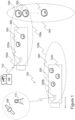
- Fig. 1 illustrates an arrangement and some associated aspects thereof in accordance with an embodiment of the present invention.
- the illustrated arrangement (100) comprises gateway devices (200a, 200b) associable with cargo units (106a, 106b) in two trucks (102a, 102b) and tracking sensor nodes (300) in the trucks (102a, 102b) and at another zone (104), such as a loading dock wherein other tracking sensor nodes connected to packages await for transportation.
- the first truck (102a) is shown to be at the loading dock zone (104) and therein its gateway device (200a) sends a beacon signal and connects with nearby nodes that include both the nodes in the truck and some nodes in the loading dock.
- the second truck (102b) is shown to be in move and its gateway device (200b) can detect the nearby nodes, which are the nodes that are in the truck. In this case the movement is detected either from a remote base station (110) or via satellite positioning means (108) and after the movement the nodes that are still detected to be in connection with the gateway device (200b) are determined to form the cargo unit (106b).
- a threshold is preferably arranged to indicate sufficient movement after which it is determined which nodes are still in connection with the gateway device (200a, 200b). This way movement in general or short-range movement e.g. by moving inside a loading dock or terminal area may not yet constitute such movement which would determine the cargo unit (106a, 106b). This way e.g. truck moving around a loading area may not yet trigger the gateway device (200a, 200b) to determine the actual cargo unit (106a, 106b), which would constitute the final cargo unit (106a, 106b) leaving for transport.
- This threshold may be achieved e.g.
- a gateway device (200a, 200b) may be arranged as geofences and only leaving such geofence may be arranged to constitute movement or location change such as that the gateway device (200a, 200b) is triggered to determine the cargo unit (106a, 106b) by detecting nodes (300) in its short-range network range at the moment of leaving such geofence.
- a gateway device (200a, 200b) may be arranged to trigger movement or location change such that entering a geofence triggers the gateway device (200a, 200b) to determine the cargo unit (106a, 106b).
- the arrangement may further comprise a remote server arrangement or cloud computing means (212) for collecting tracking sensor data via the gateway devices (200a, 200b) or directly from the tracking sensor nodes (300).
- the processing of data in the arrangement may utilize Edge computing means and/or the data may be processed at the cloud. Part of the tracking sensor data may be processed at the gateway devices (200a, 200b) or at the tracking sensor nodes (300).
- the remote server or cloud server (212) may comprise at least means for processing, storing and provisioning of data.
- the data may be provided via a mobile app or web application provided on a user device.
- sensor data from the cargo units (106a, 106b) and location of the cargo units (106a, 106b) may be monitored remotely via or from the remote server or cloud.
- At least parts of the arrangement software may be also controlled and/or updated remotely from the remote server or cloud.
- Some exemplary applications of the arrangement comprise intermodal containers and shipping containers in general, cargo spaces, trailers, and any such spaces that benefit from essentially real-time monitoring, positioning and recognition of certain tracking sensor nodes in certain cargo units.
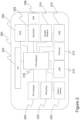
- Fig. 2 illustrates a block diagram of the gateway device (200) in accordance with an embodiment of the present invention.
- the gateway device (200) comprises means to detect the gateway device (200) location.
- some feasible positioning systems comprise e.g. GPS, A-GPS, GLONASS, GNSS, IRNSS, SBAS and BeiDou satellite systems.
- the gateway device (200) may comprise a chip, antenna or other such positioning components, such as a GPS chip (202).
- Another feasible means to detect the gateway device (200) location or gateway device movement (change of location) comprises Cell-ID or triangulation via connection with a number of base stations (110).
- the gateway device (200) further comprises an RF-interface (204) with at least wireless UHF short-range transmission means and preferably also receiving means, such as IEEE 802.11, IEEE 802.15.1 and/or such ISM/SRD band communication means for at least connecting with wireless nodes and optionally also for receiving tracking data from the tracking sensor nodes (300).
- RF-interface (204) with at least wireless UHF short-range transmission means and preferably also receiving means, such as IEEE 802.11, IEEE 802.15.1 and/or such ISM/SRD band communication means for at least connecting with wireless nodes and optionally also for receiving tracking data from the tracking sensor nodes (300).
- the gateway device (200) may also comprise long-range communication means (206) to form an uplink via NB-IoT, LTE Cat-M1 and 2G/3G/4G/5G communication techniques.
- the gateway device (200) may also comprise a card SIM or a chip/software based E-SIM (208) for long-range communications via cellular means.
- the gateway device (200) may be connected to a cargo unit, such as a truck, train or boat positioning or communications system, via a USB (210), Ethernet (212), Modbus or RS485 (214) or other cargo unit communication bus to receive information of movement or change in location.
- a cargo unit such as a truck, train or boat positioning or communications system
- the gateway device (200) may comprise also other essential components or circuits such as a memory (216) for storing information about RF frequency limitations associable with different locations and for storing tracking sensor data collected from tracking sensor nodes in the sensor network.
- the memory (216) may be used for retrieving information about RF frequency limitations associable with certain locations, which may be used when said information cannot be, or is not preferred to be, retrieved from a remote server (112) or such e.g. due to lack of cellular or WAN network coverage. This way tracking sensor data and information about which sensor belong to the cargo unit of the gateway may be stored even when there isn't communications networks coverage to send the information towards a base station (114).
- the memory (216) may be accessed and controlled by a CPU module (218), which may also carry various other tasks of the gateway device (200), such as controlling the transmission and receiving of data as well as positioning of the gateway device (200).
- the CPU module (218) may also be part of a RF SoC (System on a Chip).
- the CPU module (218) may comprise a FPU (Floating Point Unit), Flash memory and RAM (Random Access Memory).
- the gateway device (200) may further comprise a battery and power management means (220).
- the gateway device (200) may also comprise a watchdog timer (222) connected to the CPU module (218) for error detection.
- the gateway device (200) may also comprise a number of I/O ports (224) for connecting the gateway device (200) with peripheral devices.
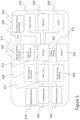
- Fig. 3 illustrates a block diagram of a tracking sensor node (300) in accordance with an embodiment of the present invention.
- the tracking sensor node (300) comprises at least an UHF transmitter, receiver and/or transceiver arranged to at least receive beacon signals from the gateway device (200) and to transmit signals to the gateway device (200) via short-range communications means.
- the UHF transmitter, receiver and/or transceiver may comprise one or more circuits and components pertaining to RFID, NFC, IEEE 802.11 a/b/g/n, IEEE 802.15.1, IEEE 802.15.4 and/or such ISM/RSD band communication techniques and may be provided with a RF SoC (302).
- the RF SoC (302) may be connected to a 2.4GHz antenna connector (304) with an amplifier (306) for facilitating a transceiver for short-range communications.
- the RF SoC (302) may be also connected to an NFC chip (308) and NFC antenna connector (310) for facilitating a transceiver for near-field communications.
- the UHF tracking node sensor (300) receiver and/or transceiver is preferably essentially constantly on so that the presence of a gateway device (200) is detected via the beacon signals received from the gateway device (200) and hence that the tracking node sensor (300) may connect with the gateway device (200) in the short-range sensor network zone.
- the tracking sensor nodes (300) may comprise also long-range transmission means for transmitting data to a base station.
- the long-range transmission means may comprise one or more circuits, chips (312), antenna connectors (314), antennas and amplification means pertaining NB-IoT, LTE Cat-M1 and 2G/3G/4G/5G communication techniques.
- the tracking sensor nodes (300) preferably comprise active tracking sensors, which include active sensing means of a number of preferred parameters for detecting the parameter with a sensor, and transmitting at least the sensor tracking data, such as measurement data, alerts, and/or metadata pertaining to measurements or the node functioning, to the gateway device (200) and/or to a base station wherefrom it may be delivered to a cloud database.
- active tracking sensors include active sensing means of a number of preferred parameters for detecting the parameter with a sensor, and transmitting at least the sensor tracking data, such as measurement data, alerts, and/or metadata pertaining to measurements or the node functioning, to the gateway device (200) and/or to a base station wherefrom it may be delivered to a cloud database.
- the tracking sensor nodes (300) may comprise one or more sensing means such as a number of ambient temperature sensors (316), magnetic sensors (318), accelerometers (320), pressure sensors (322) and gyroscope. These sensors may be used to detect ambient pressure, temperature, changes in velocity and rotation of the cargo, which may be further used to determine and monitor the conditions of the cargo that is transported. Clearly, other such sensing means for detecting events or changes in the ambient or internal conditions of the tracking sensor node (300) may be also utilized.
- the tracking sensor nodes (300) may comprise also other essential components or circuits such as a memory (324) for at least for collecting tracking sensor data, such as sensing means measurements.
- the memory (324) may be used to store the sensor data also for longer periods of time when data transmission from the node (300) is disabled or otherwise limited.
- the tracking sensor node (300) may also comprise a real-time clock (RTC) or a real-time clock and calendar (RTCC) circuit (326) e.g. for executing a sleep/wake up scheme.
- the tracking sensor node (300) may also comprise a programming interface (328) connected to the RF SoC (302) as well as typical battery and power management means (330, 332).
- Fig. 4 illustrates a flow chart of a method in accordance with an embodiment of the present invention.
- a transport unit such as a truck is at least associated with a gateway device.
- the gateway device may also be connected with the transport unit communications or such internal system e.g. for receiving information of the transport unit location.
- the transport unit may for example drive to a zone where the truck may be loaded with cargo comprising tracking sensor nodes.
- the gateway device associated with the transport unit sends a beacon signal via short-range communication means.
- the beacon signal may be sent continuously such that new nodes entering the coverage of the gateway device network may connect and register with the gateway device.
- the gateway device detects and registers the nodes in the coverage area of the gateway device.
- the gateway device checks again which nodes are still connected to it and forms a sensor network with the nodes in its short-range network coverage.
- the gateway device may detect which nodes are not anymore in its coverage and therefore not part of the cargo unit to which the gateway device pertains.
- the gateway device detects which nodes are still in its coverage after surpassing the movement threshold.
- the gateway device may record and/or transmit the information about which nodes are still in its coverage after surpassing the movement threshold as to pertain to that particular transport unit to a remote server or cloud, which server or cloud may further record said information of a cargo unit with the information of the gateway device and identified tracking sensor nodes in the particular cargo unit. This way the arrangement may remotely recognize the location of certain nodes and cargo thereof using only the location and/or positioning information of the gateway device.
- the arrangement allows for large-scale utilization and scalability for a number of nodes which may be monitored essentially real-time during the transit.
- the nodes may comprise essentially any kind of tracking or other wireless sensors that may connect with a gateway device via short-range communications means.
Landscapes
- Engineering & Computer Science (AREA)
- Physics & Mathematics (AREA)
- Business, Economics & Management (AREA)
- Computer Networks & Wireless Communication (AREA)
- General Physics & Mathematics (AREA)
- Economics (AREA)
- Signal Processing (AREA)
- Theoretical Computer Science (AREA)
- Health & Medical Sciences (AREA)
- Toxicology (AREA)
- Tourism & Hospitality (AREA)
- Strategic Management (AREA)
- General Business, Economics & Management (AREA)
- Marketing (AREA)
- Human Resources & Organizations (AREA)
- General Health & Medical Sciences (AREA)
- Operations Research (AREA)
- Quality & Reliability (AREA)
- Entrepreneurship & Innovation (AREA)
- Development Economics (AREA)
- Electromagnetism (AREA)
- Artificial Intelligence (AREA)
- Computer Vision & Pattern Recognition (AREA)
- Radar, Positioning & Navigation (AREA)
- Remote Sensing (AREA)
- Computer Security & Cryptography (AREA)
- Primary Health Care (AREA)
- Mobile Radio Communication Systems (AREA)
- Position Fixing By Use Of Radio Waves (AREA)
Claims (8)
- Gateway-Vorrichtung (200) zum Zuordnen der Gateway-Vorrichtung (200) und der Verfolgungssensoren (300) als eine einzige Frachteinheit (106a, 106b);- wobei die Gateway-Einheit (200) einer Frachteinheit (106a, 106b) zuordnungsfähig ist, wobei die Gateway-Einheit (200) umfasst:- Mittel zum Detektieren von Position oder Bewegung, und- drahtlose Kommunikationsmittel für kurze Entfernungen, um ein Bakensignal auszusenden und mit Knoten (300) verbunden zu werden,dadurch gekennzeichnet, dass die Gateway-Vorrichtung (200) vorgesehen ist, um zu detektieren, welche Knoten (300) sich noch innerhalb des Kommunikationsbereichs für kurze Entfernungen befinden, wenn Bewegung detektiert wird, und Zuordnen der Knoten (300), die noch innerhalb des Bereichs sind, als Teil derselben Frachteinheit (106a, 106b) wie die Gateway-Vorrichtung (200), wobei die Bewegung gemäß vorbestimmten Geofences detektiert wird, wie dass Bewegung durch Bewegung in Geofences hinein oder aus diesen heraus detektiert wird.
- Anordnung (100) zum Zuordnen von Verfolgungssensoren zu einer Frachteinheit (106a, 106b), umfassend:- eine Gateway-Vorrichtung (200), die einer Frachteinheit (106a, 106b) zuordnungsfähig ist, umfassend Mittel zum Detektieren von Position oder Bewegung, und drahtlose Kommunikationsmittel für kurze Entfernungen, um ein Bakensignal auszusenden,- Verfolgungssensoren, die vorgesehen sind, um das Bakensignal zu empfangen, wenn sie sich in der Nähe der Kommunikationen für kurze Entfernungen befinden,dadurch gekennzeichnet, dass die Gateway-Vorrichtung (200) vorgesehen ist, um zu detektieren, welche Verfolgungssensoren sich noch innerhalb des Kommunikationsbereichs für kurze Entfernungen befinden, wenn Bewegung detektiert wird, und Zuordnen der Sensoren, die noch innerhalb des Bereichs sind, als Teil derselben Frachteinheit (106a, 106b) wie die Gateway-Vorrichtung (200), wobei Bewegung gemäß vorbestimmten Geofences detektiert wird, wie dass Bewegung durch Bewegung in Geofences hinein oder aus diesen heraus detektiert wird.
- Anordnung nach Anspruch 2, wobei die Kommunikationsmittel für kurze Entfernungen IEEE 802.11, IEEE 802.15.1 und/oder Kommunikationsmittel im ISM/SRD-Band umfassen.
- Anordnung nach einem der Ansprüche 2 bis 3, wobei die Mittel zum Detektieren von Position oder Bewegung Satellit-, Triangulierungs- oder Mobilfunkzelldaten-(Zell-ID)-Positionierungsmittel umfassen.
- Anordnung nach einem der Ansprüche 2 bis 5, wobei die Frachteinheit (106a, 106b) ein mobiler Frachttransport ist, wie Luftfahrt-, Bahn-, Schiff- oder LKW-Transport.
- Verfahren zum Zuordnen von Verfolgungssensoren zu einer Frachteinheit, umfassend:- Aussenden eines Bakensignals von einer Gateway-Vorrichtung zu Verfolgungssensorknoten über Kommunikationsmittel für kurze Entfernungen,- Detektieren von Verfolgungssensorknoten, die das Bakensignal empfangen,- Detektieren von Bewegung oder Positionsänderung an der Gateway-Vorrichtung,- Detektieren, welche Verfolgungssensorknoten noch mit der Gateway-Vorrichtung verbunden sind, wenn Bewegung detektiert wird, wobei die Bewegung entsprechend vorbestimmten Geofences detektiert wird, wie dass Bewegung durch Bewegung in Geofences hinein oder aus diesen heraus detektiert wird,- Bewirken, dass die Gateway-Vorrichtung und der Verfolgungssensorknoten, die nach der detektierten Bewegung oder Positionsänderung noch mit der Gateway-Vorrichtung verbunden sind, der Einstufung als in einer einzigen Frachteinheit befindlich entsprechen.
- Verfahren nach Anspruch 7, wobei Bewegung oder Positionsänderung nur detektiert werden, wenn ein vorbestimmter Schwellenwert erfüllt ist.
- Verfahren nach einem der Ansprüche 7 bis 8, wobei der Schwellenwert zum Detektieren von Bewegung oder Positionsänderung Bewegen in einen Geofence hinein oder aus diesem heraus ist.
Applications Claiming Priority (2)
| Application Number | Priority Date | Filing Date | Title |
|---|---|---|---|
| US201862691769P | 2018-06-29 | 2018-06-29 | |
| PCT/EP2019/067608 WO2020002708A1 (en) | 2018-06-29 | 2019-07-01 | Tracking sensor arrangement for detection of a tracking unit, and device and method thereof |
Publications (3)
| Publication Number | Publication Date |
|---|---|
| EP3815399A1 EP3815399A1 (de) | 2021-05-05 |
| EP3815399C0 EP3815399C0 (de) | 2025-06-04 |
| EP3815399B1 true EP3815399B1 (de) | 2025-06-04 |
Family
ID=67145801
Family Applications (1)
| Application Number | Title | Priority Date | Filing Date |
|---|---|---|---|
| EP19735547.2A Active EP3815399B1 (de) | 2018-06-29 | 2019-07-01 | Verfolgungssensoranordnung zur detektion einer verfolgungseinheit und vorrichtung und verfahren dafür |
Country Status (3)
| Country | Link |
|---|---|
| US (1) | US11956694B2 (de) |
| EP (1) | EP3815399B1 (de) |
| WO (1) | WO2020002708A1 (de) |
Families Citing this family (3)
| Publication number | Priority date | Publication date | Assignee | Title |
|---|---|---|---|---|
| US11062344B2 (en) | 2015-05-13 | 2021-07-13 | Abl Ip Holding, Llc | Systems and methods for POP display and wireless beacon execution with wireless network gateways |
| US11170409B2 (en) * | 2017-05-19 | 2021-11-09 | Abl Ip Holding, Llc | Wireless beacon based systems utilizing printable circuits |
| US11368925B2 (en) * | 2019-04-18 | 2022-06-21 | Battle Sight Technologies, LLC | Tracking device |
Family Cites Families (10)
| Publication number | Priority date | Publication date | Assignee | Title |
|---|---|---|---|---|
| US20070216542A1 (en) | 2003-12-12 | 2007-09-20 | Jay Brosius | System and method for remotely tracking and monitoring a container and its contents |
| US20070079012A1 (en) * | 2005-02-14 | 2007-04-05 | Walker Richard C | Universal electronic payment system: to include "PS1 & PFN Connect TM", and the same technology to provide wireless interoperability for first responder communications in a national security program |
| US7667573B2 (en) * | 2005-03-01 | 2010-02-23 | I.D. Systems, Inc. | Mobile portal for RFID applications |
| CA2843287C (en) * | 2013-02-21 | 2021-02-23 | Applied Telemetrics Inc. | Method of using virtual gantries to optimize the charging performance of in-vehicle parking systems |
| US11062255B2 (en) | 2015-06-24 | 2021-07-13 | Intel Corporation | Technologies for managing the security and custody of assets in transit |
| WO2018013435A1 (en) * | 2016-07-10 | 2018-01-18 | Global Net Solutions, Inc. | System and method for tracking individuals |
| US20180075670A1 (en) * | 2016-09-09 | 2018-03-15 | Laird Technologies, Inc. | Dedicated short-range communication vehicle management apparatuses, systems and methods |
| KR101797231B1 (ko) * | 2017-05-10 | 2017-11-13 | 아이티플래닛 주식회사 | Ble 비콘 기반 출입 관리 시스템 및 방법 |
| US10082554B1 (en) * | 2017-07-01 | 2018-09-25 | Tile, Inc. | Dynamic selection and modification of tracking device behavior models |
| US11637754B2 (en) * | 2021-01-15 | 2023-04-25 | Ford Global Technologies, Llc | Roadside infrastructure deployment |
-
2019
- 2019-07-01 EP EP19735547.2A patent/EP3815399B1/de active Active
- 2019-07-01 WO PCT/EP2019/067608 patent/WO2020002708A1/en not_active Ceased
- 2019-07-01 US US17/256,068 patent/US11956694B2/en active Active
Also Published As
| Publication number | Publication date |
|---|---|
| US20210274316A1 (en) | 2021-09-02 |
| WO2020002708A1 (en) | 2020-01-02 |
| EP3815399A1 (de) | 2021-05-05 |
| EP3815399C0 (de) | 2025-06-04 |
| US11956694B2 (en) | 2024-04-09 |
Similar Documents
| Publication | Publication Date | Title |
|---|---|---|
| US12165100B1 (en) | Continuous inventory management | |
| US7484662B2 (en) | Recording of location event information in RFID tags | |
| EP3588143B1 (de) | Verfahren und system zur bestandsverfolgung | |
| US20190235092A1 (en) | Asset tracking system | |
| CN101443826B (zh) | 扩展了兼容性的射频识别标签 | |
| US9436853B1 (en) | Methods and apparatus for combining temperature data from separate segments of handling | |
| CN114199258B (zh) | 多式联运集装箱数字化关联与高精度定位追踪系统 | |
| CN101855932A (zh) | 用来跟踪和监视集装箱的方法和设备 | |
| CN104737184B (zh) | 综合跟踪系统和方法 | |
| EP3815399B1 (de) | Verfolgungssensoranordnung zur detektion einer verfolgungseinheit und vorrichtung und verfahren dafür | |
| US20100164686A1 (en) | Method for monitoring a package, sentinel indicator system and logistics system | |
| KR20110036436A (ko) | 센서태그 및 그를 이용한 항공과 육상을 연계 처리하는 물류 관리시스템 | |
| Barro-Torres et al. | Maritime freight container management system using RFID | |
| US11785424B1 (en) | System and method for asset tracking for waste and recycling containers | |
| KR20100128694A (ko) | 저온유통을 위한 알에프아이디/유에스엔 통합 장치 | |
| KR20130065824A (ko) | Rfid 태그의 위치 정보를 이용한 재고 관리 방법 및 그 장치 | |
| US20210223350A1 (en) | Gateway device for a location based sensor network, and arrangement and method thereof | |
| US20230009721A1 (en) | Wireless sensor network system, and device and method thereof | |
| KR20200005180A (ko) | IoT 기반 국가간 물류 배송 추적 시스템 및 방법 | |
| US12093771B1 (en) | Asset identification using RFID powered by movement of a transport platform | |
| Wei | A novel real time monitoring system based on WSNs and RFID for logistics | |
| JP2009002935A (ja) | 事業所内空間座標位置判定システム(SiteCubicPositioningSystem(SCPS)) |
Legal Events
| Date | Code | Title | Description |
|---|---|---|---|
| STAA | Information on the status of an ep patent application or granted ep patent |
Free format text: STATUS: UNKNOWN |
|
| STAA | Information on the status of an ep patent application or granted ep patent |
Free format text: STATUS: THE INTERNATIONAL PUBLICATION HAS BEEN MADE |
|
| PUAI | Public reference made under article 153(3) epc to a published international application that has entered the european phase |
Free format text: ORIGINAL CODE: 0009012 |
|
| STAA | Information on the status of an ep patent application or granted ep patent |
Free format text: STATUS: REQUEST FOR EXAMINATION WAS MADE |
|
| 17P | Request for examination filed |
Effective date: 20210120 |
|
| AK | Designated contracting states |
Kind code of ref document: A1 Designated state(s): AL AT BE BG CH CY CZ DE DK EE ES FI FR GB GR HR HU IE IS IT LI LT LU LV MC MK MT NL NO PL PT RO RS SE SI SK SM TR |
|
| DAV | Request for validation of the european patent (deleted) | ||
| DAX | Request for extension of the european patent (deleted) | ||
| STAA | Information on the status of an ep patent application or granted ep patent |
Free format text: STATUS: EXAMINATION IS IN PROGRESS |
|
| 17Q | First examination report despatched |
Effective date: 20230116 |
|
| P01 | Opt-out of the competence of the unified patent court (upc) registered |
Effective date: 20230526 |
|
| REG | Reference to a national code |
Ref country code: DE Ref legal event code: R079 Free format text: PREVIOUS MAIN CLASS: H04W0004021000 Ipc: G06Q0010083300 Ref document number: 602019070746 Country of ref document: DE |
|
| GRAP | Despatch of communication of intention to grant a patent |
Free format text: ORIGINAL CODE: EPIDOSNIGR1 |
|
| STAA | Information on the status of an ep patent application or granted ep patent |
Free format text: STATUS: GRANT OF PATENT IS INTENDED |
|
| RIC1 | Information provided on ipc code assigned before grant |
Ipc: H04W 84/18 20090101ALN20250214BHEP Ipc: G06Q 50/40 20240101ALI20250214BHEP Ipc: G06Q 10/08 20120101ALI20250214BHEP Ipc: H04W 4/80 20180101ALI20250214BHEP Ipc: H04W 4/02 20180101ALI20250214BHEP Ipc: H04W 4/021 20180101ALI20250214BHEP Ipc: G06Q 10/0833 20230101AFI20250214BHEP |
|
| INTG | Intention to grant announced |
Effective date: 20250228 |
|
| GRAS | Grant fee paid |
Free format text: ORIGINAL CODE: EPIDOSNIGR3 |
|
| GRAA | (expected) grant |
Free format text: ORIGINAL CODE: 0009210 |
|
| STAA | Information on the status of an ep patent application or granted ep patent |
Free format text: STATUS: THE PATENT HAS BEEN GRANTED |
|
| AK | Designated contracting states |
Kind code of ref document: B1 Designated state(s): AL AT BE BG CH CY CZ DE DK EE ES FI FR GB GR HR HU IE IS IT LI LT LU LV MC MK MT NL NO PL PT RO RS SE SI SK SM TR |
|
| RAP3 | Party data changed (applicant data changed or rights of an application transferred) |
Owner name: SENSIRE OY |
|
| REG | Reference to a national code |
Ref country code: GB Ref legal event code: FG4D |
|
| REG | Reference to a national code |
Ref country code: CH Ref legal event code: EP |
|
| REG | Reference to a national code |
Ref country code: DE Ref legal event code: R096 Ref document number: 602019070746 Country of ref document: DE |
|
| REG | Reference to a national code |
Ref country code: IE Ref legal event code: FG4D |
|
| U01 | Request for unitary effect filed |
Effective date: 20250618 |
|
| P04 | Withdrawal of opt-out of the competence of the unified patent court (upc) registered |
Free format text: CASE NUMBER: APP_30304/2025 Effective date: 20250625 |
|
| U07 | Unitary effect registered |
Designated state(s): AT BE BG DE DK EE FI FR IT LT LU LV MT NL PT RO SE SI Effective date: 20250627 |
|
| U20 | Renewal fee for the european patent with unitary effect paid |
Year of fee payment: 7 Effective date: 20250714 |
|
| PG25 | Lapsed in a contracting state [announced via postgrant information from national office to epo] |
Ref country code: ES Free format text: LAPSE BECAUSE OF FAILURE TO SUBMIT A TRANSLATION OF THE DESCRIPTION OR TO PAY THE FEE WITHIN THE PRESCRIBED TIME-LIMIT Effective date: 20250604 |
|
| PG25 | Lapsed in a contracting state [announced via postgrant information from national office to epo] |
Ref country code: NO Free format text: LAPSE BECAUSE OF FAILURE TO SUBMIT A TRANSLATION OF THE DESCRIPTION OR TO PAY THE FEE WITHIN THE PRESCRIBED TIME-LIMIT Effective date: 20250904 Ref country code: GR Free format text: LAPSE BECAUSE OF FAILURE TO SUBMIT A TRANSLATION OF THE DESCRIPTION OR TO PAY THE FEE WITHIN THE PRESCRIBED TIME-LIMIT Effective date: 20250905 |
|
| PG25 | Lapsed in a contracting state [announced via postgrant information from national office to epo] |
Ref country code: PL Free format text: LAPSE BECAUSE OF FAILURE TO SUBMIT A TRANSLATION OF THE DESCRIPTION OR TO PAY THE FEE WITHIN THE PRESCRIBED TIME-LIMIT Effective date: 20250604 |
|
| PGFP | Annual fee paid to national office [announced via postgrant information from national office to epo] |
Ref country code: GB Payment date: 20250822 Year of fee payment: 7 |
|
| PG25 | Lapsed in a contracting state [announced via postgrant information from national office to epo] |
Ref country code: HR Free format text: LAPSE BECAUSE OF FAILURE TO SUBMIT A TRANSLATION OF THE DESCRIPTION OR TO PAY THE FEE WITHIN THE PRESCRIBED TIME-LIMIT Effective date: 20250604 |
|
| PG25 | Lapsed in a contracting state [announced via postgrant information from national office to epo] |
Ref country code: RS Free format text: LAPSE BECAUSE OF FAILURE TO SUBMIT A TRANSLATION OF THE DESCRIPTION OR TO PAY THE FEE WITHIN THE PRESCRIBED TIME-LIMIT Effective date: 20250904 |