EP3812705A1 - Mems sensor with configuration to reduce non-linear motion - Google Patents
Mems sensor with configuration to reduce non-linear motion Download PDFInfo
- Publication number
- EP3812705A1 EP3812705A1 EP20209488.4A EP20209488A EP3812705A1 EP 3812705 A1 EP3812705 A1 EP 3812705A1 EP 20209488 A EP20209488 A EP 20209488A EP 3812705 A1 EP3812705 A1 EP 3812705A1
- Authority
- EP
- European Patent Office
- Prior art keywords
- travelling
- mass
- motion
- pair
- proof
- Prior art date
- Legal status (The legal status is an assumption and is not a legal conclusion. Google has not performed a legal analysis and makes no representation as to the accuracy of the status listed.)
- Pending
Links
Images




Classifications
-
- G—PHYSICS
- G01—MEASURING; TESTING
- G01C—MEASURING DISTANCES, LEVELS OR BEARINGS; SURVEYING; NAVIGATION; GYROSCOPIC INSTRUMENTS; PHOTOGRAMMETRY OR VIDEOGRAMMETRY
- G01C19/00—Gyroscopes; Turn-sensitive devices using vibrating masses; Turn-sensitive devices without moving masses; Measuring angular rate using gyroscopic effects
- G01C19/56—Turn-sensitive devices using vibrating masses, e.g. vibratory angular rate sensors based on Coriolis forces
- G01C19/5719—Turn-sensitive devices using vibrating masses, e.g. vibratory angular rate sensors based on Coriolis forces using planar vibrating masses driven in a translation vibration along an axis
- G01C19/5733—Structural details or topology
- G01C19/5755—Structural details or topology the devices having a single sensing mass
- G01C19/5762—Structural details or topology the devices having a single sensing mass the sensing mass being connected to a driving mass, e.g. driving frames
-
- G—PHYSICS
- G01—MEASURING; TESTING
- G01C—MEASURING DISTANCES, LEVELS OR BEARINGS; SURVEYING; NAVIGATION; GYROSCOPIC INSTRUMENTS; PHOTOGRAMMETRY OR VIDEOGRAMMETRY
- G01C19/00—Gyroscopes; Turn-sensitive devices using vibrating masses; Turn-sensitive devices without moving masses; Measuring angular rate using gyroscopic effects
- G01C19/56—Turn-sensitive devices using vibrating masses, e.g. vibratory angular rate sensors based on Coriolis forces
- G01C19/5705—Turn-sensitive devices using vibrating masses, e.g. vibratory angular rate sensors based on Coriolis forces using masses driven in reciprocating rotary motion about an axis
- G01C19/5712—Turn-sensitive devices using vibrating masses, e.g. vibratory angular rate sensors based on Coriolis forces using masses driven in reciprocating rotary motion about an axis the devices involving a micromechanical structure
-
- B—PERFORMING OPERATIONS; TRANSPORTING
- B81—MICROSTRUCTURAL TECHNOLOGY
- B81B—MICROSTRUCTURAL DEVICES OR SYSTEMS, e.g. MICROMECHANICAL DEVICES
- B81B3/00—Devices comprising flexible or deformable elements, e.g. comprising elastic tongues or membranes
- B81B3/0035—Constitution or structural means for controlling the movement of the flexible or deformable elements
- B81B3/0051—For defining the movement, i.e. structures that guide or limit the movement of an element
-
- B—PERFORMING OPERATIONS; TRANSPORTING
- B81—MICROSTRUCTURAL TECHNOLOGY
- B81B—MICROSTRUCTURAL DEVICES OR SYSTEMS, e.g. MICROMECHANICAL DEVICES
- B81B7/00—Microstructural systems ; Auxiliary parts of microstructural devices or systems
- B81B7/02—Microstructural systems ; Auxiliary parts of microstructural devices or systems containing distinct electrical or optical devices of particular relevance for their function, e.g. microelectro-mechanical systems [MEMS]
-
- G—PHYSICS
- G01—MEASURING; TESTING
- G01C—MEASURING DISTANCES, LEVELS OR BEARINGS; SURVEYING; NAVIGATION; GYROSCOPIC INSTRUMENTS; PHOTOGRAMMETRY OR VIDEOGRAMMETRY
- G01C19/00—Gyroscopes; Turn-sensitive devices using vibrating masses; Turn-sensitive devices without moving masses; Measuring angular rate using gyroscopic effects
- G01C19/56—Turn-sensitive devices using vibrating masses, e.g. vibratory angular rate sensors based on Coriolis forces
- G01C19/5719—Turn-sensitive devices using vibrating masses, e.g. vibratory angular rate sensors based on Coriolis forces using planar vibrating masses driven in a translation vibration along an axis
- G01C19/5733—Structural details or topology
-
- G—PHYSICS
- G01—MEASURING; TESTING
- G01C—MEASURING DISTANCES, LEVELS OR BEARINGS; SURVEYING; NAVIGATION; GYROSCOPIC INSTRUMENTS; PHOTOGRAMMETRY OR VIDEOGRAMMETRY
- G01C19/00—Gyroscopes; Turn-sensitive devices using vibrating masses; Turn-sensitive devices without moving masses; Measuring angular rate using gyroscopic effects
- G01C19/56—Turn-sensitive devices using vibrating masses, e.g. vibratory angular rate sensors based on Coriolis forces
- G01C19/5719—Turn-sensitive devices using vibrating masses, e.g. vibratory angular rate sensors based on Coriolis forces using planar vibrating masses driven in a translation vibration along an axis
- G01C19/5733—Structural details or topology
- G01C19/574—Structural details or topology the devices having two sensing masses in anti-phase motion
- G01C19/5747—Structural details or topology the devices having two sensing masses in anti-phase motion each sensing mass being connected to a driving mass, e.g. driving frames
-
- G—PHYSICS
- G01—MEASURING; TESTING
- G01P—MEASURING LINEAR OR ANGULAR SPEED, ACCELERATION, DECELERATION, OR SHOCK; INDICATING PRESENCE, ABSENCE, OR DIRECTION, OF MOVEMENT
- G01P15/00—Measuring acceleration; Measuring deceleration; Measuring shock, i.e. sudden change of acceleration
- G01P15/02—Measuring acceleration; Measuring deceleration; Measuring shock, i.e. sudden change of acceleration by making use of inertia forces using solid seismic masses
- G01P15/08—Measuring acceleration; Measuring deceleration; Measuring shock, i.e. sudden change of acceleration by making use of inertia forces using solid seismic masses with conversion into electric or magnetic values
- G01P15/0802—Details
-
- B—PERFORMING OPERATIONS; TRANSPORTING
- B81—MICROSTRUCTURAL TECHNOLOGY
- B81B—MICROSTRUCTURAL DEVICES OR SYSTEMS, e.g. MICROMECHANICAL DEVICES
- B81B2201/00—Specific applications of microelectromechanical systems
- B81B2201/02—Sensors
- B81B2201/0228—Inertial sensors
- B81B2201/0242—Gyroscopes
-
- B—PERFORMING OPERATIONS; TRANSPORTING
- B81—MICROSTRUCTURAL TECHNOLOGY
- B81B—MICROSTRUCTURAL DEVICES OR SYSTEMS, e.g. MICROMECHANICAL DEVICES
- B81B2203/00—Basic microelectromechanical structures
- B81B2203/01—Suspended structures, i.e. structures allowing a movement
- B81B2203/0145—Flexible holders
- B81B2203/0163—Spring holders
Definitions
- the present invention relates generally to angular velocity sensors and more particularly relates to angular velocity sensors that include guided mass systems.
- Vibratory rate gyroscopes broadly function by driving the sensor into a first motion and measuring a second motion of the sensor that is responsive to both the first motion and the angular velocity to be sensed.
- a mass within the sensor is driven into oscillation by an actuator.
- Rotation of the sensor imparts a Coriolis force to the oscillating mass that is proportional to the angular velocity (or rotation rate), and depends on the orientation of the angular velocity vector with respect to the velocity vector of the proof mass.
- the Coriolis force, the angular velocity vector, and the proof-mass velocity vector are mutually orthogonal. For example, a proof-mass moving in an X-direction within a sensor rotating about a Y-axis experiences a Z directed Coriolis force.
- a proof-mass moving in an X-direction within a sensor rotating about a Z-axis experiences a Y directed Coriolis force.
- a proof-mass moving in an X-direction within a sensor rotating about the X-axis experiences no Coriolis force.
- Coriolis forces imparted to the proof-mass are usually sensed indirectly by measuring motions within the sensor that are responsive to the Coriolis forces.
- electrostatic actuators of the parallel-plate type are used to drive the proof-mass out-of-plane.
- the actuators are formed between the proof-mass and the substrate.
- the electrostatic force depends on the gap between the proof-mass and the substrate. Because the proof-mass oscillates out-of-plane, the electrostatic force is nonlinear which tends to limit the device performance. Additionally, the electrostatic force is reduced because of the requirement to have large vertical gaps or a cavity under the proof-mass. Achieving large amplitude oscillation requires large force and that might require high-voltage actuation. Adding high-voltage actuation increases the fabrication cost and complexity of the integrated circuits.
- a conventional multi-axis gyroscope might use multiple structures that oscillate at independent frequencies to sense angular rates. Each structure requires a separate drive circuit to oscillate the respective proof-masses. Having more than one drive circuit increases cost and power consumption.
- Embodiments for modifying a spring mass configuration are disclosed that minimize the effects of unwanted nonlinear motion on a Micro-Electro-Mechanical Systems (MEMS) sensor.
- the modifications include any or any combination of providing a rigid element between rotating structures of the spring mass configuration, tuning a spring system between the rotating structures and coupling an electrical cancellation system to the rotating structures. In so doing unwanted nonlinear motion such as unwanted 2 nd harmonic motion is minimized.
- MEMS sensor in an aspect, includes a first and second rotating arm. The first and second rotating arms are coupled to each other and the first and second rotating arms are configured to counter rotate when driven into oscillation.
- the MEMS sensor also includes at least one travelling system. The at least one travelling system is coupled to the first and second rotating arms.
- the MEMS sensor includes at least one actuator for driving the at least one travelling system into oscillation. The at least one travelling system moves in a first direction when driven into oscillation.
- the present invention relates generally to angular velocity sensors and more particularly relates to angular velocity sensors that include guided mass systems.
- the following description is presented to enable one of ordinary skill in the art to make and use the invention and is provided in the context of a patent application and its requirements.
- Various modifications to the preferred embodiments and the generic principles and features described herein will be readily apparent to those skilled in the art.
- the present invention is not intended to be limited to the embodiments shown, but is to be accorded the widest scope consistent with the principles and features described herein.
- MEMS Micro-Electro-Mechanical Systems
- a MEMS device may refer to a semiconductor device implemented as a Microelectromechanical system.
- a MEMS device includes mechanical elements and optionally includes electronics for sensing.
- MEMS devices include but are not limited to gyroscopes, accelerometers, magnetometers, and pressure sensors.
- FIG. 1 illustrates four different spring-mass configurations 10, 11, 12 and 13, that could be utilized in a MEMS sensor, respectively.
- a first spring-mass configuration 10 includes a spring-mass system 10A.
- the spring mass system 10A includes a lever arm 20A, a proof mass 30A, a linear spring 40A, and a hinge 50A attached to a stable point 60A.
- the proof mass, 30A, in the spring mass system 10A has three degrees of freedom.
- the proof mass 30A can rotate by an angle ⁇ about an axis passing from the center of the hinge 50A and normal to a first plane in this embodiment, the XY plane, and it can translate in X and Y direction as it rotates in the X-Y plane.
- hinge 50A has a finite translational compliance
- linear spring 40A has a finite rotational compliance. If it is assumed that the length of the spring 40A is negligible and the length of the lever arm 20A is L.
- ⁇ d which is named as drive frequency
- the drive frequency can be the natural frequency of the spring mass system 10A
- X-direction motion of the proof mass 30A at the drive frequency can be given as: X d ⁇ L ⁇ sin ⁇ d t
- the Y direction motion of the mass 30A is at two times the drive frequency. This behavior is due to the nonlinearity of the rotational movement of the proof mass 30A. If the mass is driven in the X direction with the use of a lever arm 20A at the drive frequency, there is always a Y direction vibration which is at two times the drive frequency, which is referred to as 2 nd Harmonic vibration.
- the 2 nd Harmonic vibration can be non-ideal for MEMS sensors that are driven in one direction and the sensing motion is in-plane and orthogonal to the drive direction.
- the sensing direction is the Y direction
- an erroneous signal in Y direction with a frequency that is two times the drive frequency is generated by the nonlinear motion of the lever arms. So, for those cases, it is needed to eliminate the Y direction component of the nonlinear motion by the use of specific structures and elements which may be added to the spring-mass system 10A.
- FIG. 2A illustrates an embodiment of a single axis gyroscope comprising a guided mass system 500.
- the guided mass system 500 is disposed in an X-Y plane parallel to a substrate 101 and comprises a guided mass system 100 coupled to a yaw proof mass 518a.
- the guided mass system 100 includes guiding arms 104a and 104b that are flexibly coupled via springs 108a and 108b to the substrate 101 via at least one anchoring point 106a.
- the two guiding arms 104a and 104b are flexibly coupled to one proof-mass 102a via springs 103a and 103b.
- the yaw proof mass 518a is flexibly connected to the proof mass 102a via yaw-springs 520a-520d.
- the proof mass 102a and yaw proof mass 518a, guiding arms 104a and 104b, anchoring point 106a, and springs 103a, 103b, 108a, and 108b form a planar four-bar linkage.
- the springs 103a, 103b, 108a, and 108b are compliant in-plane about an axis in the Z-direction so that each guiding arm 104a and 104b can rotate in-plane while the proof-mass 102a translates in an X-direction, as shown in Figure 2B .
- Yaw-springs 520a-520d are stiff in the X-direction such that when the guided mass system 100 translates in the X-direction, the yaw proof-mass 518a also translates with the proof mass 102a.
- Electrostatic actuators such as comb drives 109a and 109b, are connected to the proof mass 102a to drive the guided mass system 100. In this embodiment, two electrostatic actuators are utilized.
- electrostatic actuator can be provided and the use of one electrostatic actuator would be within the spirit and scope of the present invention.
- electrostatic actuators will be described throughout this specification as the actuators being used to drive the guided mass systems, one of ordinary skill in the art recognizes that a variety of actuators could be utilized for this function and that use would be within the spirit and scope of the present invention.
- the actuators could be piezoelectric, thermal or electromagnetic or the like.
- the guided mass system 500 can be driven at a drive frequency by a single drive circuit coupled to the actuators 109a and 109b.
- the drive frequency can be a resonant frequency of the guided mass system 500.
- Angular velocity about a yaw-input axis in the Z-direction will cause a Coriolis force to act on the yaw proof-mass 518a in the Y-direction resulting in motion of the yaw proof-mass 518a in the Y-direction.
- a capacitive electrode 522a is used to sense the motion of the yaw proof-mass 518a in the Y-direction which provides a measure of the angular velocity about the yaw-input axis.
- transducers could be utilized in a system and method in accordance with the present invention.
- capacitive electrode 522a instead of using the capacitive electrode 522a, one can also use a piezoelectric or optical or the like transducer and its use would be within the spirit and scope of the present invention.
- the guided mass system 500 can be simply represented by the spring mass system 10A that is shown in Figure 1 .
- the lever arms 104a-104b are similar to the lever arm 20A, the springs 103a-103b, 108a-108b and 520a-520d of the guided mass system 500 are compliant in the Y direction.
- the spring 40A can be a representation of y direction compliance of the springs 103a-103b, 108a-108b and 520a-520d.
- the proof mass 102a and the yaw proof-mass 518a are attached to the springs 103a-103b and 520a-520d, respectively, as the proof mass 30A is attached to the spring 40A.
- in-plane rotational compliance of the springs 108a-108b that are attached to the anchor 106a can be represented by the hinge 50A and the stable point 60A.
- the motion of the center of mass of proof mass 102a has a non-linear motion.
- the proof mass 102a and yaw proof-mass 518a are driven in the X direction, there is also a motion in Y direction that is at two times the drive frequency which is due to the nonlinearity of the drive motion as it has been explained in Figure 1 for the spring-mass configuration 10.
- the motion at two times the drive frequency can also be called the 2 nd harmonic motion of the guided mass system 500.
- the 2 nd Harmonic motion is sensed by the capacitive electrode 522a as an erroneous signal and it may corrupt the readings or saturate the front end electronics.
- guided mass system 500 can also be used as a dual axis gyroscope. If the springs 108a and 108b are compliant about a first roll-sense axis in the X-direction then the guiding arms 104a and 104b can rotate out-of-plane, whereby out-of-plane rotation of the guiding arms 104a and 104b causes the proof mass 102a and the yaw proof mass 518a move out-of-plane with the guiding arms 104a and 104b.
- an angular velocity about a roll-input axis in the Y-direction that is in the plane of the substrate and orthogonal to the X-direction will cause a Coriolis force to act on the proof-mass 102a and the yaw proof-mass 518a in the Z-direction.
- the Coriolis force causes the guided mass system 500 to rotate out-of-plane about the first roll-sense axis.
- the guided mass system 500 rotates out-of-plane
- the guiding arms 104a and 104b and the proof mass 102a and yaw proof mass 518a rotate out-of-plane about the first roll-sense axis.
- the amplitude of the rotation of the guided mass system 500 is proportional to the angular velocity about the roll-input axis.
- a capacitive electrode 112a under the proof mass 102a is used to detect the rotation of the guided mass system 500 about the first roll-sense axis.
- the rotation provides a measure of the angular velocity about the roll-input axis.
- a variety of types of transducers could be utilized in the present invention.
- the capacitive electrode 112a could be also piezoelectric or optical or the like and its use would be within the spirit and scope of the present invention.
- the guided mass system 500 of Figure 2A can be modified to eliminate the 2 nd harmonic motion by using the methods that are introduced in one or more of the spring mass configurations 11, 12 and 13 shown in Figure 1 .
- a second spring-mass configuration 11 is shown in Figure 1 that has components similar to the spring-mass configuration 10.
- Spring mass configuration 11 includes two spring mass systems 11A-11B.
- Each of the two spring mass systems 11A-11B comprise lever arms 21A-21B, and a traveling system 101A comprising traveling masses 31A-31B and connection element 21, linear springs 41A-41B, hinges 51A-51B attached to stable points 61A-61B.
- connection element 21 that connects two spring-mass systems 11A and 11B.
- connection element 21 that connects two spring-mass systems 11A and 11B.
- both 11A and 11B move in the same X direction during the drive operation. But, the Y direction motion of 11A and 11B are opposing each other. If those two spring-mass systems 11A-11B are rigidly connected by the connection element 21, then the spring elements 41A and 41B stretches in opposite directions to accommodate the nonlinear motion due to the rotation of the lever arms 21A and 21B.
- Spring mass configuration 12 includes two spring mass systems 12A-12B which comprise lever arms 22A-22B, a traveling system 101B comprising traveling masses 32A-32B and spring element 22, linear springs 42A-42B, and hinges 52A-52B attached to stable points 62A-62B.
- the springs 42A and 42B have different spring stiffness values.
- an additional component of spring-mass configuration 12 compared to spring mass configuration 10 is the spring element 22 coupled between traveling masses 32A and 32B. Spring element 22 is used to eliminate the unwanted 2 nd harmonic Y direction motion of the traveling masses 32A or 32B.
- Compliance of the spring 22 can be designed such a way that the 2nd harmonic motion of one of the spring-mass system 12B can be used to compensate for the 2 nd harmonic motion of the other spring-mass system 12A, or vice versa.
- the 2 nd harmonic motion of the traveling mass 32A can be eliminated due to the balance of the opposing forces as in the spring mass configuration 11. In this scenario, traveling mass 32B would still have an unwanted 2 nd harmonic motion.
- Spring mass configuration 13 includes two spring-mass systems 13A-13B which are composed of lever arms 23A-23B, and a traveling system 101C comprising traveling masses 33A-33B, spring element 23, transducers 73A-73B and 74A-74B, linear springs 43A-43B, and hinges 53A-53B attached to stable points 63A-63B.
- spring-mass configuration 13 compared to spring mass configuration 10 are spring element 23 and transducers 73A-73B and 74A-74B.
- both of the traveling masses 33A and 33B can be resonated in the drive direction at a natural drive frequency.
- the proof masses 33A and 33B can also resonate in the Y direction at another natural frequency.
- Transducers 73A-73B and 74A-74B are used to sense the motion of the traveling masses 33A-33B in Y direction.
- Transducers in an embodiment could be capacitive, piezoresistive or the like, although one of ordinary skill in the art readily recognizes that the transducers could a variety of types and that would be within the spirit and scope of the present invention.
- the sensing direction of the transducers 73A-73B and 74A-74B can be selected such a way that the 2 nd harmonic component of the drive motion in Y direction can be rejected, but the signals that are useful can be preserved.
- the spring-mass configuration 13 if it is assumed that the common mode motion in the Y direction is the sensor response, as in the case of a yaw gyroscope undergoing Z-axis rotation, the Y direction 2 nd harmonic motion is rejected since the electrodes cancels the opposing (differential) motions in Y direction.
- the spring-mass configuration 13 is given as an example for the electrical cancellation of unwanted 2 nd Harmonic motion in Y direction; however, there may be different sensing and rejection schemes of transducers, depending on the proof mass and electrode configurations. In other configurations, the common mode motion can be rejected but the differential motion can be detected.
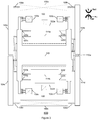
- FIG. 3 illustrates an embodiment of a single axis gyroscope comprising a guided mass system in accordance with the present invention.
- the guided mass system 600 is disposed in an X-Y plane.
- the guided mass system 600 includes guiding arms 104a, 104b, 104c and 104d that are flexibly coupled via springs 108a, 108b, 108c and 108d to the substrate 100 via the anchoring points 106a and 106b.
- Four guiding arms 104a, 104b, 104c and 104d are flexibly coupled to one traveling mass 105 via springs 103a, 103b, 103c and 103d.
- Each spring 103a-103d, 108a-108d is compliant in-plane about an axis in the Z-direction so that each guiding arm 104a-104b and 104 c-104d can rotate anti-phase in the plane while the traveling mass 105 translates in an X-direction.
- the yaw proof-masses 518a and 518b are flexibly connected to the traveling mass 105 via yaw-springs 520a-520d and 520e-520h, respectively.
- the guided mass system 600 can be driven at a drive frequency by a single drive circuit coupled to the actuators 109a-109d.
- the drive frequency can be a resonant frequency of the guided mass system 600.
- the guiding arms 104a-104b and 104c-104d rotate anti-phase in-plane and the traveling-mass 105 translates in-plane in the X-direction.
- Yaw-springs 520a-520d and 520e-520h are stiff in the X-direction such that when the guided mass system is driven, the yaw proof-masses 518a-b also translate with the traveling mass 105 in the X-direction.
- Angular velocity about a yaw-input axis in the Z-direction will cause a Coriolis force to act on the yaw proof-masses 518a-518b in the Y-direction resulting in a common mode motion of the yaw proof-masses 518a and 518b.
- the capacitive electrodes 522a and 522b are used to sense the motion of the yaw proof-masses 518a and 518b in the Y-direction which provides a measure of the angular velocity about the yaw-input axis.
- the configuration shown in Figure 3 can be represented as the spring mass configuration 11 of Figure 1 .
- guided mass system 600 eliminates the second harmonic motion by combining two guided mass systems by a rigid traveling mass 105. Since the motion of the lever arms 104a-104b and 104c-104d are anti-phase with respect to each other, the travelling mass 105 that is connected to the lever arms 104a-104d balances the opposing 2 nd harmonic motion and eliminates the unwanted non-linear component of the drive motion, and the y direction compliance of the spring elements 108a-108b, 103a-103b and 108c-108d, 103c-103d accommodates the 2 nd Harmonic motion by stretching in y direction similar to the spring mass configuration 12.
- guided mass system 500 can also be used as a dual axis gyroscope. If we assume that the springs 108a-108b and 108c-108d are compliant about a first and second roll-sense axis, respectively, where the first and second roll sense axes are parallel to each other and they are in the X-direction, then the guiding arms 104a-104b and 104c-104d can rotate anti-phase out-of-plane, whereby out-of-plane rotation of the guiding arms 104a-104d causes the traveling mass 105 to move out-of-plane with the guiding arms 104a-104d.
- Angular velocity about a roll-input axis in the Y-direction that is in the plane of the substrate and orthogonal to the X-direction will cause a Coriolis force to act on the traveling mass 105 in the Z-direction.
- the Coriolis force causes the lever arms 104a-104b and lever arms 104c-104d rotate anti-phase out-of-plane about the first and second roll-sense axes and the traveling mass 105 moves in the Z direction.
- the amplitude of the motion of the roll-travelling mass 105 is proportional to the angular velocity about the roll-input axis.
- a capacitive electrode 112a under the traveling mass 105 is used to detect the motion of the proof-mass. This motion provides a measure of the angular velocity about the roll-input axis.
- Figure 4 illustrates a second embodiment of a single axis gyroscope comprising a guided mass system 700 in accordance with the present invention which minimizes a 2nd Harmonic component of the drive motion.
- the guided mass system 700 comprises two guided mass systems 700A and 700B, which are same as the guided mass system 500.
- the proof masses 102a and 102b, consequently two guided mass systems 700A and 700B, are connected by a coupling spring 151.
- the yaw proof-masses 518a and 518b are flexibly connected to the proof-masses 102a and 102b, respectively.
- the coupling spring 151 is torsionally compliant about an axis in the X-direction so that the symmetric guided mass systems 700A and 700B can rotate anti-phase out-of-plane about the first and second roll-sense axes.
- the coupling spring 151 is stiff in the Z-direction which prevents the guided mass systems 700A and 700B from rotating in-phase out-of-plane.
- the coupling spring 151 is stiff in the X-direction such that the proof-mass 102a and 102b move together in the X-direction. In this way the two guided mass systems 700A and 700B are driven together at a drive frequency by a single drive circuit coupled to the actuators 109a-109d.
- the configuration given in Figure 4 can be represented by the spring mass configuration 13 given in Figure 1 .
- two guided mass systems 700A and 700B are connected by a coupling spring 151, so that the proof masses 102a-102b and 518a-518b can also resonate in the Y direction at a certain natural frequency.
- Capacitive electrodes 522a and 522b are used to sense the motion of the proof-masses 518a and 518b in Y direction, respectively.
- the sensitive direction of the capacitive electrodes 522a-522b can be selected such a way that the 2 nd harmonic motion in the Y direction is rejected but the Coriolis motion in the Y direction is detected.
- the proof masses 518a and 518b move in the same direction in the drive motion.
- an angular velocity about a yaw-input axis in the Z-direction will impart a Coriolis force on the yaw proof-masses 518a-b in the same Y-direction (common mode motion).
- the capacitance of the electrodes 522a and 522b changes in opposite directions while the proof masses 518a-518b move in the same direction.
- the 2 nd harmonic motions of the proof masses 518a-518b in the Y direction are in opposite directions, because the guiding arms 104a-104b and 104c-104d are rotating around opposite directions. Consequently, the 2 nd harmonic motion of the proof masses 518a-518b will be cancelled due to the configuration of the electrodes 522a-522b.
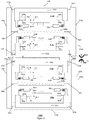
- FIG. 5 illustrates another embodiment of a single axis gyroscope comprising a balanced guided mass system 1000 in accordance with an embodiment of the present invention.
- the guided mass system 1000 includes two symmetric guided mass systems 900a and 900b which are connected by a coupling spring 302.
- the coupling between the guided mass systems 900a and 900b doesn't have to be only a single coupling spring 302; the coupling may include various springs and spring-mass systems.
- the two symmetric guided mass systems 900a and 900b are arranged so that the proof-masses 102a-102d all move in the X-direction. Hence, the two guided mass systems 900a and 900b are driven together at a drive frequency by a single drive circuit coupled to the actuators 109a-109h.
- the proof-masses 102b and 102c move together in the same X-direction, since the coupling spring 302 is stiff in the X-direction.
- the proof masses 102a and 102d move in the opposite X-direction compared to the proof masses 102b and 102c.
- Angular velocity about the yaw-input axis will cause Coriolis forces to act on the yaw proof-masses 518a-518d resulting in motion of the yaw proof-masses 518a-518d along the Y-direction.
- the amplitude of the motions of the yaw proof-masses 518a-518d is proportional to the angular velocity about the yaw-input axis.
- the schematic provided in Figure 5 is a different embodiment of the spring-mass configuration 13 shown in Figure 1 .
- the balanced guided mass system 1000 eliminates the unwanted 2nd harmonic motion of the yaw proof masses 518a-518d by electrical cancellation.
- the imparted Coriolis forces on the proof masses 518a and 518d are in the opposite direction of the imparted Coriolis forces on the proof masses 518a and 518d.
- the Coriolis response motion of the proof masses 518b and 518c vs. the proof masses 518a and 518d are differential.
- the capacitance change of the electrodes 522a and 522b due to the Coriolis motion of the proof masses 518a-518b can be summed up.
- the capacitance change of the electrodes 522c and 522d can also be summed up.
- the detected capacitance change from the electrode pair 522c-522d can be subtracted from the detected capacitance change of the electrode pair 522a-522b.
- the Coriolis motion is detected.
- the 2nd harmonic motion direction of the each proof mass 518a-518d is illustrated by the arrows 541a-541d which are shown side by side by the arrows 540a-540d that are showing the Coriolis force direction of the proof masses 518a-518d.
- the given arrow configuration shows that the Coriolis force and the 2nd harmonic motion are in the same direction for the guided mass system 900b but they are in the opposite directions for the guided mass system 900a. As a result, the 2nd harmonic motion will be cancelled due to the electrode scheme given above.
- the balanced guided mass system 1000 can also be used as a dual axis gyroscope with a condition where the symmetric guided mass system 900a is able to rotate out-of-plane about a first roll-sense axis and the symmetric guided mass system 900b is able to rotate out-of-plane about a second roll-sense axis in-plane and parallel to the first roll-sense axis.
- the coupling spring 302 is connected to proof-masses 102b and 102c.
- the coupling spring 302 is torsionally compliant about an axis in the X-direction so that the symmetric guided mass systems 900a and 900b can rotate anti-phase out-of-plane about the first and second roll-sense axes.
- the coupling spring 302 is stiff in the Z-direction which prevents the symmetric guided mass systems 900a and 900b from rotating in-phase out-of-plane.
- Angular velocity about the roll-input axis will cause Coriolis forces to act on the proof-masses 102a-102d in the Z-direction.
- the Coriolis forces cause the symmetric guided mass systems 900a and 900b to rotate anti-phase out-of-plane about the first and second roll-sense axes.
- the amplitudes of the rotations of the symmetric guided mass systems 900a and 900b are proportional to the angular velocity.
- Capacitive electrodes 112a-112c under the proof masses 102a-102d are used to detect the rotations of the symmetric guided mass systems 900a and 900b.
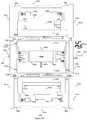
- Figure 6a illustrates an embodiment of a tri-axis gyroscope comprising a multiple guided mass system 1100 in accordance with the present invention.
- the multiple guided mass system 1100 includes two guided mass systems 500a and 500b coupled to a guided mass system 800 by coupling springs 302a and 302b, respectively.
- the guided mass systems 500a, 500b and 800 are arranged so that yaw proof-masses 518a and 518b coupled to roll proof masses 102a-102d all move anti-phase in the X-direction, the pitch proof-mass 650a rotates about an axis in the Z-direction.
- the guided mass system 500a rotates out-of-plane about a first roll-sense axis.
- the symmetric guided mass system 800 rotates out-of-plane about a second roll-sense axis parallel to the first roll-sense axis.
- the guided mass system 500b rotates out-of-plane about a third roll-sense axis parallel to the first and second roll-sense axes.
- the first coupling spring 302a is connected to proof-masses 102a and 102b.
- the coupling spring 302a is stiff in the X-direction such that proof-mass 102a and 102b move together in the X-direction.
- the second coupling spring 302b is connected to proof-masses 102c and 102d.
- the coupling spring 302b is stiff in the X-direction such that proof-mass 102c and 102d move together in the X-direction.
- the guided mass systems 500a, 500b, and 800 are driven together at a drive frequency by a single drive circuit coupled to the actuators 109a-109h.
- folded flexures are used as coupling springs 302a-b.
- the coupling spring 302a is torsionally compliant about an axis in the X-direction so that the guided mass systems 500a and 800 can rotate out-of-plane about the first and second roll-sense axes anti-phase.
- the coupling spring 302a prevents the symmetric guided mass systems 500a and 800 from rotating out-of-plane in-phase.
- the coupling spring 302b is also torsionally compliant about an axis in the X-direction so that the guided mass systems 500b and 800 can rotate out-of-plane about the second and third roll-sense axes anti-phase.
- the coupling spring 302b prevents the symmetric guided mass systems 500b and 800 from rotating out-of-plane in-phase.
- Angular velocity about the pitch-input axis will cause Coriolis forces to act on the pitch proof-mass 650a resulting in a torque that rotates the pitch proof-mass 650a about the pitch-sense axis.
- the amplitude of the rotation of the pitch proof-mass 650a is proportional to the angular velocity about the pitch-input axis.
- the capacitive electrodes 660a and 660b are disposed on opposite sides along the X-direction under the pitch proof-mass 650a and detect the rotation of the pitch proof-mass about the pitch-sense axis. The rotation provides a measure of the angular velocity about the pitch-input axis.
- Angular velocity about the roll-input axis will cause Coriolis forces to act on the proof-masses 102a and 102b in a Z-direction and on proof-masses 102c and 102d in the opposite Z-direction.
- the Coriolis forces cause the guided mass systems 500a, 800, and 500b to rotate out-of-plane about the first, second, and third roll-sense axis respectively.
- the capacitive electrode 112b under the proof masses 102a and 102b and the capacitive electrode 112a under the proof masses 102c and 102d are used to detect the rotation of the guided mass system 1100. This rotation provides a measure of the angular velocity about the roll-input axis.
- Angular velocity about the yaw-input axis will cause Coriolis forces to act on the yaw proof-masses 518a and 518b resulting in motion of the yaw proof-masses 518a and 518b anti-phase along the Y-direction.
- the amplitude of the motion of the yaw proof-masses along the Y-direction is proportional to the angular velocity.
- the capacitive electrodes 522a and 522b are used to sense the motion of the respective yaw proof masses 518a and 518b along the Y-direction.
- the multiple guided mass system 1100 of Figure 6a can be represented by the spring mass configuration 12 shown in Figure 1 .
- the spring-mass system 12A is a representation of one of the guided mass systems 500a or 500b
- the spring-mass system 12B is a representation of the guided mass system 800.
- the springs 103c-103f and 108c-108d are compliant in y direction and their compliance can be modeled by an equivalent spring as 42B, which is given in spring mass system configuration 12 in Figure 1 .
- the springs 108a-108b, 103g-103h and 520a-520d can be modeled by the spring 42A.
- the coupling spring 302a that connects 500a and 800 can be modeled as spring 22.
- the lever arms 104c-104d can be modeled as the lever arm 22B, and the lever arms 104a-104b can be represented as 22A.
- Y direction spring stiffness of the guided mass system 800 is much higher than the y direction spring stiffness of the guided mass system 500a or 500b. The reason is that the springs sets 103c-103d and 103e-103f have been equally spread in the guided mass system 800, and also the springs 652a and 652b are very stiff in Y direction.
- the y direction spring stiffness of the springs 103c-103f, 108c-108d, and 652a-652b can be made equal to the sum of the spring stiffness of the coupling spring 302a and the springs 108a-108b, 103g-103h and 520a-520d.
- the net nonlinear motion in y direction of the yaw-proof masses 518a-518b can be eliminated by the help of the balance of the opposing forces in y direction.
- a folded flexure is used as coupling spring 302a.
- the main benefit of using a folded flexure is to increase the y direction translational stiffness of coupling spring 302a, while maintaining its out-of plane torsional compliance within the given area.
- a two-fold folded flexure is used in embodiment 1100, folded flexure with many folds can also be used to increase the y direction translational stiffness.
- Figure 6b illustrates another embodiment of a tri-axis gyroscope comprising a multiple guided mass system 1110 in accordance with the present invention.
- Multiple guided mass system is same as multiple guided mass system 1100, except new coupling springs 303a and 303b are added in between proof masses 102a-b and 102c-d respectively.
- Main benefit of adding springs 303a and 303b in multiple guided system 1110 is to increase the y direction translational stiffness.
- springs 303a-b improves x direction stiffness.
- rigidity of multiple guided mass system 1110 during the drive motion increases and proof masses 102a-b and 102c-d move together in the x direction.
- Embodiments for modifying a spring mass configuration are disclosed that minimize the effects of unwanted nonlinear motion on a MEMS sensor.
- the modifications include any or any combination of providing a rigid element between rotating structures of the spring mass configuration, tuning a spring system between the rotating structures and coupling an electrical cancellation system to the rotating structures. In so doing unwanted nonlinear motion such as unwanted 2 nd harmonic motion is minimized.
Landscapes
- Engineering & Computer Science (AREA)
- Physics & Mathematics (AREA)
- General Physics & Mathematics (AREA)
- Radar, Positioning & Navigation (AREA)
- Remote Sensing (AREA)
- Computer Hardware Design (AREA)
- Microelectronics & Electronic Packaging (AREA)
- Gyroscopes (AREA)
Abstract
Description
- This application claims benefit under 35 USC 119(e) of
U.S. Provisional Patent Application No. 61/929,838, filed on January 21, 2014 - The present invention relates generally to angular velocity sensors and more particularly relates to angular velocity sensors that include guided mass systems.
- Sensing of angular velocity is frequently performed using vibratory rate gyroscopes. Vibratory rate gyroscopes broadly function by driving the sensor into a first motion and measuring a second motion of the sensor that is responsive to both the first motion and the angular velocity to be sensed.
- Frequently, a mass, usually referred to as a proof mass, within the sensor is driven into oscillation by an actuator. Rotation of the sensor imparts a Coriolis force to the oscillating mass that is proportional to the angular velocity (or rotation rate), and depends on the orientation of the angular velocity vector with respect to the velocity vector of the proof mass. The Coriolis force, the angular velocity vector, and the proof-mass velocity vector are mutually orthogonal. For example, a proof-mass moving in an X-direction within a sensor rotating about a Y-axis experiences a Z directed Coriolis force. Similarly, a proof-mass moving in an X-direction within a sensor rotating about a Z-axis experiences a Y directed Coriolis force. Finally, a proof-mass moving in an X-direction within a sensor rotating about the X-axis experiences no Coriolis force. Coriolis forces imparted to the proof-mass are usually sensed indirectly by measuring motions within the sensor that are responsive to the Coriolis forces.
- Conventional gyroscopes that sense angular velocity about an in-plane axis (i.e. X-axis or Y-axis) can be driven out-of-plane, and the Coriolis response is sensed in-plane or vice versa. Out-of-plane drive tends to be less efficient than in-plane drive, requires additional fabrication steps, and is limited by nonlinearities. For example, driving the proof-mass out-of-plane might require a large vertical gap or a cavity underneath the proof-mass to provide sufficient room for the proof-mass to oscillate. Forming a cavity under the proof-mass requires additional fabrication steps and increases cost. Typically electrostatic actuators of the parallel-plate type are used to drive the proof-mass out-of-plane. The actuators are formed between the proof-mass and the substrate. The electrostatic force depends on the gap between the proof-mass and the substrate. Because the proof-mass oscillates out-of-plane, the electrostatic force is nonlinear which tends to limit the device performance. Additionally, the electrostatic force is reduced because of the requirement to have large vertical gaps or a cavity under the proof-mass. Achieving large amplitude oscillation requires large force and that might require high-voltage actuation. Adding high-voltage actuation increases the fabrication cost and complexity of the integrated circuits.
- Furthermore a conventional multi-axis gyroscope might use multiple structures that oscillate at independent frequencies to sense angular rates. Each structure requires a separate drive circuit to oscillate the respective proof-masses. Having more than one drive circuit increases cost and power consumption.
- Accordingly, what is desired is to provide a system and method that overcomes the above issues. The present invention addresses such a need.
- Embodiments for modifying a spring mass configuration are disclosed that minimize the effects of unwanted nonlinear motion on a Micro-Electro-Mechanical Systems (MEMS) sensor. The modifications include any or any combination of providing a rigid element between rotating structures of the spring mass configuration, tuning a spring system between the rotating structures and coupling an electrical cancellation system to the rotating structures. In so doing unwanted nonlinear motion such as unwanted 2nd harmonic motion is minimized.
- In an aspect, MEMS sensor is disclosed. The MEMS sensor includes a first and second rotating arm. The first and second rotating arms are coupled to each other and the first and second rotating arms are configured to counter rotate when driven into oscillation. The MEMS sensor also includes at least one travelling system. The at least one travelling system is coupled to the first and second rotating arms. Finally, the MEMS sensor includes at least one actuator for driving the at least one travelling system into oscillation. The at least one travelling system moves in a first direction when driven into oscillation.
-
-
Figure 1 illustrates four different spring-mass configurations -
Figures 2A and 2B illustrate an embodiment of a single axis gyroscope comprising a guided mass system. -
Figure 3 illustrates an embodiment of a single axis gyroscope comprising a guided mass system in accordance with the present invention. -
Figure 4 shows a modification of a guided mass system to eliminate the 2nd harmonic component of the drive motion. -
Figure 5 illustrates another embodiment of a single axis gyroscope comprising a balanced guided mass system in accordance with an embodiment of the present invention. -
Figure 6a and6b illustrates an embodiment of a tri-axis gyroscope comprising a multiple guided mass system in accordance with the present invention. - The present invention relates generally to angular velocity sensors and more particularly relates to angular velocity sensors that include guided mass systems. The following description is presented to enable one of ordinary skill in the art to make and use the invention and is provided in the context of a patent application and its requirements. Various modifications to the preferred embodiments and the generic principles and features described herein will be readily apparent to those skilled in the art. Thus, the present invention is not intended to be limited to the embodiments shown, but is to be accorded the widest scope consistent with the principles and features described herein.
- Micro-Electro-Mechanical Systems (MEMS) refers to a class of devices fabricated using semiconductor-like processes and exhibiting mechanical characteristics such as the ability to move or deform. MEMS often, but not always, interact with electrical signals. A MEMS device may refer to a semiconductor device implemented as a Microelectromechanical system. A MEMS device includes mechanical elements and optionally includes electronics for sensing. MEMS devices include but are not limited to gyroscopes, accelerometers, magnetometers, and pressure sensors.
-
Figure 1 illustrates four different spring-mass configurations mass system 10A. Thespring mass system 10A includes alever arm 20A, aproof mass 30A, alinear spring 40A, and ahinge 50A attached to astable point 60A. The proof mass, 30A, in thespring mass system 10A has three degrees of freedom. Theproof mass 30A can rotate by an angle θ about an axis passing from the center of thehinge 50A and normal to a first plane in this embodiment, the XY plane, and it can translate in X and Y direction as it rotates in the X-Y plane. Although it is not shown in Figure-1 in detail,hinge 50A has a finite translational compliance, andlinear spring 40A has a finite rotational compliance. If it is assumed that the length of thespring 40A is negligible and the length of thelever arm 20A is L. The X direction motion of themass 30A is given by the equation:
proof mass 30A. Since the motion of theproof mass 30A is rotational, there is also Y direction component of the motion of theproof mass 30A which can be represented as in the equation given below:
- If the
mass 30A is driven at a frequency ωd which is named as drive frequency, where the drive frequency can be the natural frequency of thespring mass system 10A, the governing equation for the rotational drive motion of themass 30A can be given as:
proof mass 30A at the drive frequency can be given as:
proof mass 30A can be represented by the following equation:
- As it can be seen in the equations 4 and 5, the Y direction motion of the
mass 30A is at two times the drive frequency. This behavior is due to the nonlinearity of the rotational movement of theproof mass 30A. If the mass is driven in the X direction with the use of alever arm 20A at the drive frequency, there is always a Y direction vibration which is at two times the drive frequency, which is referred to as 2nd Harmonic vibration. - The 2nd Harmonic vibration can be non-ideal for MEMS sensors that are driven in one direction and the sensing motion is in-plane and orthogonal to the drive direction. As an example, if the X direction is the drive direction and the sensing direction is the Y direction, an erroneous signal in Y direction with a frequency that is two times the drive frequency is generated by the nonlinear motion of the lever arms. So, for those cases, it is needed to eliminate the Y direction component of the nonlinear motion by the use of specific structures and elements which may be added to the spring-
mass system 10A. To describe the issues with a guided mass configuration 10, refer now to the following discussion in conjunction with the accompanying figures. -
Figure 2A illustrates an embodiment of a single axis gyroscope comprising a guidedmass system 500. The guidedmass system 500 is disposed in an X-Y plane parallel to asubstrate 101 and comprises a guidedmass system 100 coupled to ayaw proof mass 518a. The guidedmass system 100 includes guidingarms springs substrate 101 via at least oneanchoring point 106a. The two guidingarms mass 102a viasprings yaw proof mass 518a is flexibly connected to theproof mass 102a via yaw-springs 520a-520d. - The
proof mass 102a and yawproof mass 518a, guidingarms point 106a, andsprings springs arm mass 102a translates in an X-direction, as shown inFigure 2B . Yaw-springs 520a-520d are stiff in the X-direction such that when the guidedmass system 100 translates in the X-direction, the yaw proof-mass 518a also translates with theproof mass 102a. - Electrostatic actuators, such as comb drives 109a and 109b, are connected to the
proof mass 102a to drive the guidedmass system 100. In this embodiment, two electrostatic actuators are utilized. - However, one of ordinary skill in the art readily recognizes that one electrostatic actuator can be provided and the use of one electrostatic actuator would be within the spirit and scope of the present invention. In addition, although electrostatic actuators will be described throughout this specification as the actuators being used to drive the guided mass systems, one of ordinary skill in the art recognizes that a variety of actuators could be utilized for this function and that use would be within the spirit and scope of the present invention. For example, the actuators could be piezoelectric, thermal or electromagnetic or the like.
- The guided
mass system 500 can be driven at a drive frequency by a single drive circuit coupled to theactuators mass system 500. When the guidedmass system 500 is driven, the guidingarms mass 102a and yawproof mass 518a translate in-plane in the X-direction. - Angular velocity about a yaw-input axis in the Z-direction will cause a Coriolis force to act on the yaw proof-
mass 518a in the Y-direction resulting in motion of the yaw proof-mass 518a in the Y-direction. Acapacitive electrode 522a is used to sense the motion of the yaw proof-mass 518a in the Y-direction which provides a measure of the angular velocity about the yaw-input axis. - A variety of types of transducers could be utilized in a system and method in accordance with the present invention. For example, instead of using the
capacitive electrode 522a, one can also use a piezoelectric or optical or the like transducer and its use would be within the spirit and scope of the present invention. - The guided
mass system 500 can be simply represented by thespring mass system 10A that is shown inFigure 1 . Thelever arms 104a-104b are similar to thelever arm 20A, thesprings 103a-103b, 108a-108b and 520a-520d of the guidedmass system 500 are compliant in the Y direction. As a result, thespring 40A can be a representation of y direction compliance of thesprings 103a-103b, 108a-108b and 520a-520d. Theproof mass 102a and the yaw proof-mass 518a are attached to thesprings 103a-103b and 520a-520d, respectively, as theproof mass 30A is attached to thespring 40A. Finally, in-plane rotational compliance of thesprings 108a-108b that are attached to theanchor 106a can be represented by thehinge 50A and thestable point 60A. - As it is shown in
Figure 2B , the motion of the center of mass ofproof mass 102a has a non-linear motion. When theproof mass 102a and yaw proof-mass 518a are driven in the X direction, there is also a motion in Y direction that is at two times the drive frequency which is due to the nonlinearity of the drive motion as it has been explained inFigure 1 for the spring-mass configuration 10. The motion at two times the drive frequency can also be called the 2nd harmonic motion of the guidedmass system 500. In the single axis gyroscope shown inFigure 2A , the 2nd Harmonic motion is sensed by thecapacitive electrode 522a as an erroneous signal and it may corrupt the readings or saturate the front end electronics. - In certain conditions, guided
mass system 500 can also be used as a dual axis gyroscope. If thesprings arms arms proof mass 102a and theyaw proof mass 518a move out-of-plane with the guidingarms - While the guided
mass system 500 is driven, an angular velocity about a roll-input axis in the Y-direction that is in the plane of the substrate and orthogonal to the X-direction will cause a Coriolis force to act on the proof-mass 102a and the yaw proof-mass 518a in the Z-direction. The Coriolis force causes the guidedmass system 500 to rotate out-of-plane about the first roll-sense axis. When the guidedmass system 500 rotates out-of-plane, the guidingarms proof mass 102a and yawproof mass 518a rotate out-of-plane about the first roll-sense axis. The amplitude of the rotation of the guidedmass system 500 is proportional to the angular velocity about the roll-input axis. - A
capacitive electrode 112a under theproof mass 102a is used to detect the rotation of the guidedmass system 500 about the first roll-sense axis. The rotation provides a measure of the angular velocity about the roll-input axis. A variety of types of transducers could be utilized in the present invention. For example, thecapacitive electrode 112a could be also piezoelectric or optical or the like and its use would be within the spirit and scope of the present invention. - The guided
mass system 500 ofFigure 2A can be modified to eliminate the 2nd harmonic motion by using the methods that are introduced in one or more of thespring mass configurations Figure 1 . To describe these configurations and methods in more detail refer now to the following description in conjunction with the accompanying Figures. - A second spring-
mass configuration 11 is shown inFigure 1 that has components similar to the spring-mass configuration 10.Spring mass configuration 11 includes twospring mass systems 11A-11B. Each of the twospring mass systems 11A-11Bcomprise lever arms 21A-21B, and a travelingsystem 101A comprising travelingmasses 31A-31B andconnection element 21,linear springs 41A-41B, hinges 51A-51B attached tostable points 61A-61B. - The difference between spring-
mass configuration 11 and the spring mass configuration 10 isconnection element 21 that connects two spring-mass systems mass configuration 11, while two spring-mass systems 11A-11B are operated side by side, they are also connected by theconnection element 21. Both 11A and 11B move in the same X direction during the drive operation. But, the Y direction motion of 11A and 11B are opposing each other. If those two spring-mass systems 11A-11B are rigidly connected by theconnection element 21, then thespring elements lever arms spring elements masses masses -
Spring mass configuration 12 includes twospring mass systems 12A-12B which compriselever arms 22A-22B, a travelingsystem 101B comprising travelingmasses 32A-32B andspring element 22,linear springs 42A-42B, and hinges 52A-52B attached tostable points 62A-62B. In contrast to spring mass configuration element 10, thesprings mass configuration 12 compared to spring mass configuration 10 is thespring element 22 coupled between travelingmasses Spring element 22 is used to eliminate the unwanted 2nd harmonic Y direction motion of the travelingmasses spring 22 can be designed such a way that the 2nd harmonic motion of one of the spring-mass system 12B can be used to compensate for the 2nd harmonic motion of the other spring-mass system 12A, or vice versa. For example, by ensuring that the spring stiffness thespring 42B is equal to the combined stiffness of thespring 22 and thespring 42A, the 2nd harmonic motion of the travelingmass 32A can be eliminated due to the balance of the opposing forces as in thespring mass configuration 11. In this scenario, travelingmass 32B would still have an unwanted 2nd harmonic motion. - A third modification to the spring-mass configuration 10 is shown as the spring-
mass configuration 13.Spring mass configuration 13 includes two spring-mass systems 13A-13B which are composed oflever arms 23A-23B, and a travelingsystem 101C comprising travelingmasses 33A-33B,spring element 23,transducers 73A-73B and 74A-74B,linear springs 43A-43B, and hinges 53A-53B attached tostable points 63A-63B. - The additional components of spring-
mass configuration 13 compared to spring mass configuration 10 arespring element 23 andtransducers 73A-73B and 74A-74B. By coupling twospring mass systems masses masses spring 23, theproof masses Transducers 73A-73B and 74A-74B are used to sense the motion of the travelingmasses 33A-33B in Y direction. Transducers in an embodiment could be capacitive, piezoresistive or the like, although one of ordinary skill in the art readily recognizes that the transducers could a variety of types and that would be within the spirit and scope of the present invention. - The sensing direction of the
transducers 73A-73B and 74A-74B can be selected such a way that the 2nd harmonic component of the drive motion in Y direction can be rejected, but the signals that are useful can be preserved. As an example, in the spring-mass configuration 13, if it is assumed that the common mode motion in the Y direction is the sensor response, as in the case of a yaw gyroscope undergoing Z-axis rotation, the Y direction 2nd harmonic motion is rejected since the electrodes cancels the opposing (differential) motions in Y direction. - The spring-
mass configuration 13 is given as an example for the electrical cancellation of unwanted 2nd Harmonic motion in Y direction; however, there may be different sensing and rejection schemes of transducers, depending on the proof mass and electrode configurations. In other configurations, the common mode motion can be rejected but the differential motion can be detected. - The following description will describe different guided mass systems that incorporate on or more of the spring mass configurations 11-14 described above.
-
Figure 3 illustrates an embodiment of a single axis gyroscope comprising a guided mass system in accordance with the present invention. The guidedmass system 600 is disposed in an X-Y plane. The guidedmass system 600 includes guidingarms springs substrate 100 via the anchoring points 106a and 106b. Four guidingarms mass 105 viasprings - Each
spring 103a-103d, 108a-108d is compliant in-plane about an axis in the Z-direction so that each guidingarm 104a-104b and 104 c-104d can rotate anti-phase in the plane while the travelingmass 105 translates in an X-direction. The yaw proof-masses mass 105 via yaw-springs 520a-520d and 520e-520h, respectively. The guidedmass system 600 can be driven at a drive frequency by a single drive circuit coupled to theactuators 109a-109d. The drive frequency can be a resonant frequency of the guidedmass system 600. When the guidedmass system 600 is driven, the guidingarms 104a-104b and 104c-104d rotate anti-phase in-plane and the traveling-mass 105 translates in-plane in the X-direction. Yaw-springs 520a-520d and 520e-520h are stiff in the X-direction such that when the guided mass system is driven, the yaw proof-masses 518a-b also translate with the travelingmass 105 in the X-direction. - Angular velocity about a yaw-input axis in the Z-direction will cause a Coriolis force to act on the yaw proof-
masses 518a-518b in the Y-direction resulting in a common mode motion of the yaw proof-masses capacitive electrodes masses - The configuration shown in
Figure 3 can be represented as thespring mass configuration 11 ofFigure 1 . As in thespring mass configuration 11, guidedmass system 600 eliminates the second harmonic motion by combining two guided mass systems by a rigid travelingmass 105. Since the motion of thelever arms 104a-104b and 104c-104d are anti-phase with respect to each other, the travellingmass 105 that is connected to thelever arms 104a-104d balances the opposing 2nd harmonic motion and eliminates the unwanted non-linear component of the drive motion, and the y direction compliance of thespring elements 108a-108b, 103a-103b and 108c-108d, 103c-103d accommodates the 2nd Harmonic motion by stretching in y direction similar to thespring mass configuration 12. - In certain conditions, guided
mass system 500 can also be used as a dual axis gyroscope. If we assume that thesprings 108a-108b and 108c-108d are compliant about a first and second roll-sense axis, respectively, where the first and second roll sense axes are parallel to each other and they are in the X-direction, then the guidingarms 104a-104b and 104c-104d can rotate anti-phase out-of-plane, whereby out-of-plane rotation of the guidingarms 104a-104d causes the travelingmass 105 to move out-of-plane with the guidingarms 104a-104d. - Angular velocity about a roll-input axis in the Y-direction that is in the plane of the substrate and orthogonal to the X-direction will cause a Coriolis force to act on the traveling
mass 105 in the Z-direction. The Coriolis force causes thelever arms 104a-104b and leverarms 104c-104d rotate anti-phase out-of-plane about the first and second roll-sense axes and the travelingmass 105 moves in the Z direction. The amplitude of the motion of the roll-travellingmass 105 is proportional to the angular velocity about the roll-input axis. Acapacitive electrode 112a under the travelingmass 105 is used to detect the motion of the proof-mass. This motion provides a measure of the angular velocity about the roll-input axis. -
Figure 4 illustrates a second embodiment of a single axis gyroscope comprising a guidedmass system 700 in accordance with the present invention which minimizes a 2nd Harmonic component of the drive motion. - The guided
mass system 700 comprises two guidedmass systems mass system 500. Theproof masses mass systems coupling spring 151. The yaw proof-masses masses coupling spring 151 is torsionally compliant about an axis in the X-direction so that the symmetric guidedmass systems coupling spring 151 is stiff in the Z-direction which prevents the guidedmass systems - The
coupling spring 151 is stiff in the X-direction such that the proof-mass mass systems actuators 109a-109d. - The configuration given in
Figure 4 can be represented by thespring mass configuration 13 given inFigure 1 . As in thespring mass configuration 13, two guidedmass systems coupling spring 151, so that theproof masses 102a-102b and 518a-518b can also resonate in the Y direction at a certain natural frequency.Capacitive electrodes masses capacitive electrodes 522a-522b can be selected such a way that the 2nd harmonic motion in the Y direction is rejected but the Coriolis motion in the Y direction is detected. - In the guided
mass system 700, theproof masses masses 518a-b in the same Y-direction (common mode motion). - Due to the placement of the
electrodes mass system 700, the capacitance of theelectrodes proof masses 518a-518b move in the same direction. - If the capacitance change on the electrodes is subtracted from each other, the common mode Coriolis response of the
proof masses - On the other hand, the 2nd harmonic motions of the
proof masses 518a-518b in the Y direction are in opposite directions, because the guidingarms 104a-104b and 104c-104d are rotating around opposite directions. Consequently, the 2nd harmonic motion of theproof masses 518a-518b will be cancelled due to the configuration of theelectrodes 522a-522b. -
Figure 5 illustrates another embodiment of a single axis gyroscope comprising a balanced guided mass system 1000 in accordance with an embodiment of the present invention. The guided mass system 1000 includes two symmetric guidedmass systems coupling spring 302. However, the coupling between the guidedmass systems single coupling spring 302; the coupling may include various springs and spring-mass systems. - The two symmetric guided
mass systems masses 102a-102d all move in the X-direction. Hence, the two guidedmass systems actuators 109a-109h. - In the drive motion of the guided mass system 1000, the proof-
masses coupling spring 302 is stiff in the X-direction. On the other hand, theproof masses proof masses - Angular velocity about the yaw-input axis will cause Coriolis forces to act on the yaw proof-
masses 518a-518d resulting in motion of the yaw proof-masses 518a-518d along the Y-direction. The amplitude of the motions of the yaw proof-masses 518a-518d is proportional to the angular velocity about the yaw-input axis. - The schematic provided in
Figure 5 is a different embodiment of the spring-mass configuration 13 shown inFigure 1 . The balanced guided mass system 1000 eliminates the unwanted 2nd harmonic motion of theyaw proof masses 518a-518d by electrical cancellation. - Due to the nature of the drive motion explained above, the imparted Coriolis forces on the
proof masses proof masses proof masses proof masses Figure 5 , the capacitance change of theelectrodes proof masses 518a-518b can be summed up. The capacitance change of theelectrodes electrode pair 522c-522d can be subtracted from the detected capacitance change of theelectrode pair 522a-522b. As a result of the electrode configuration, the Coriolis motion is detected. - The 2nd harmonic motion direction of the each
proof mass 518a-518d is illustrated by thearrows 541a-541d which are shown side by side by thearrows 540a-540d that are showing the Coriolis force direction of theproof masses 518a-518d. The given arrow configuration shows that the Coriolis force and the 2nd harmonic motion are in the same direction for the guidedmass system 900b but they are in the opposite directions for the guidedmass system 900a. As a result, the 2nd harmonic motion will be cancelled due to the electrode scheme given above. - The balanced guided mass system 1000 can also be used as a dual axis gyroscope with a condition where the symmetric guided
mass system 900a is able to rotate out-of-plane about a first roll-sense axis and the symmetric guidedmass system 900b is able to rotate out-of-plane about a second roll-sense axis in-plane and parallel to the first roll-sense axis. - The
coupling spring 302 is connected to proof-masses coupling spring 302 is torsionally compliant about an axis in the X-direction so that the symmetric guidedmass systems coupling spring 302 is stiff in the Z-direction which prevents the symmetric guidedmass systems - Angular velocity about the roll-input axis will cause Coriolis forces to act on the proof-
masses 102a-102d in the Z-direction. The Coriolis forces cause the symmetric guidedmass systems mass systems Capacitive electrodes 112a-112c under theproof masses 102a-102d are used to detect the rotations of the symmetric guidedmass systems -
Figure 6a illustrates an embodiment of a tri-axis gyroscope comprising a multiple guidedmass system 1100 in accordance with the present invention. The multiple guidedmass system 1100 includes two guidedmass systems mass system 800 bycoupling springs - The guided
mass systems masses proof masses 102a-102d all move anti-phase in the X-direction, the pitch proof-mass 650a rotates about an axis in the Z-direction. The guidedmass system 500a rotates out-of-plane about a first roll-sense axis. The symmetric guidedmass system 800 rotates out-of-plane about a second roll-sense axis parallel to the first roll-sense axis. The guidedmass system 500b rotates out-of-plane about a third roll-sense axis parallel to the first and second roll-sense axes. Thefirst coupling spring 302a is connected to proof-masses coupling spring 302a is stiff in the X-direction such that proof-mass second coupling spring 302b is connected to proof-masses coupling spring 302b is stiff in the X-direction such that proof-mass mass systems actuators 109a-109h. Moreover, as it can be seen in Figure-6a, folded flexures are used as coupling springs 302a-b. - The
coupling spring 302a is torsionally compliant about an axis in the X-direction so that the guidedmass systems coupling spring 302a prevents the symmetric guidedmass systems - The
coupling spring 302b is also torsionally compliant about an axis in the X-direction so that the guidedmass systems coupling spring 302b prevents the symmetric guidedmass systems - Angular velocity about the pitch-input axis will cause Coriolis forces to act on the pitch proof-
mass 650a resulting in a torque that rotates the pitch proof-mass 650a about the pitch-sense axis. The amplitude of the rotation of the pitch proof-mass 650a is proportional to the angular velocity about the pitch-input axis. Thecapacitive electrodes mass 650a and detect the rotation of the pitch proof-mass about the pitch-sense axis. The rotation provides a measure of the angular velocity about the pitch-input axis. - Angular velocity about the roll-input axis will cause Coriolis forces to act on the proof-
masses masses mass systems capacitive electrode 112b under theproof masses capacitive electrode 112a under theproof masses mass system 1100. This rotation provides a measure of the angular velocity about the roll-input axis. - Angular velocity about the yaw-input axis will cause Coriolis forces to act on the yaw proof-
masses masses capacitive electrodes yaw proof masses - The multiple guided
mass system 1100 ofFigure 6a can be represented by thespring mass configuration 12 shown inFigure 1 . The spring-mass system 12A is a representation of one of the guidedmass systems mass system 12B is a representation of the guidedmass system 800. - The
springs 103c-103f and 108c-108d are compliant in y direction and their compliance can be modeled by an equivalent spring as 42B, which is given in springmass system configuration 12 inFigure 1 . In the guidedmass system 500a, thesprings 108a-108b, 103g-103h and 520a-520d can be modeled by thespring 42A. Thecoupling spring 302a that connects 500a and 800 can be modeled asspring 22. Thelever arms 104c-104d can be modeled as thelever arm 22B, and thelever arms 104a-104b can be represented as 22A. - Y direction spring stiffness of the guided
mass system 800 is much higher than the y direction spring stiffness of the guidedmass system mass system 800, and also thesprings - By using the same 2nd harmonic motion elimination illustrated by spring-
mass configuration 12 ofFigure 1 , the y direction spring stiffness of thesprings 103c-103f, 108c-108d, and 652a-652b can be made equal to the sum of the spring stiffness of thecoupling spring 302a and thesprings 108a-108b, 103g-103h and 520a-520d. As a result, the net nonlinear motion in y direction of the yaw-proof masses 518a-518b can be eliminated by the help of the balance of the opposing forces in y direction. As it was mentioned before a folded flexure is used ascoupling spring 302a. The main benefit of using a folded flexure is to increase the y direction translational stiffness ofcoupling spring 302a, while maintaining its out-of plane torsional compliance within the given area. Although, a two-fold folded flexure is used inembodiment 1100, folded flexure with many folds can also be used to increase the y direction translational stiffness. -
Figure 6b illustrates another embodiment of a tri-axis gyroscope comprising a multiple guidedmass system 1110 in accordance with the present invention. Multiple guided mass system is same as multiple guidedmass system 1100, exceptnew coupling springs proof masses 102a-b and 102c-d respectively. Main benefit of addingsprings system 1110 is to increase the y direction translational stiffness. Moreover, springs 303a-b improves x direction stiffness. As a result, rigidity of multiple guidedmass system 1110 during the drive motion increases andproof masses 102a-b and 102c-d move together in the x direction. - Embodiments for modifying a spring mass configuration are disclosed that minimize the effects of unwanted nonlinear motion on a MEMS sensor. The modifications include any or any combination of providing a rigid element between rotating structures of the spring mass configuration, tuning a spring system between the rotating structures and coupling an electrical cancellation system to the rotating structures. In so doing unwanted nonlinear motion such as unwanted 2nd harmonic motion is minimized.
- Although the present invention has been described in accordance with the embodiments shown, one of ordinary skill in the art will readily recognize that there could be variations to the embodiments and those variations would be within the spirit and scope of the present invention. Accordingly, many modifications may be made by one of ordinary skill in the art without departing from the spirit and scope of the present invention. The following is a list of further embodiments of the invention:
-
Embodiment 1. A MEMS sensor comprising;- a first and second rotating arms, wherein the first and second rotating arms are coupled to each other and the first and second rotating arms are configured to counter rotate when driven into oscillation;
- at least one travelling system, where in the at least one travelling system is coupled to the first and second rotating arms;
- at least one actuator for driving the at least one travelling system into oscillation; and
- a substrate;
- wherein the at least one travelling system moves in a first direction when driven into oscillation.
- Embodiment 2. The MEMS sensor of
embodiment 1, wherein the travelling system moves in a plane parallel to the substrate. - Embodiment 3. The MEMS sensor of
embodiment 1, wherein the first and second rotating arms are coupled to an anchor on the substrate by a set of flexible elements. - Embodiment 4. The MEMS sensor of
embodiment 1, wherein the at least one travelling system comprises at least one traveling mass and at least one flexible element. - Embodiment 5. The MEMS sensor of
embodiment 1, further including at least one transducer for sensing motion of a portion of the at least one travelling system. - Embodiment 6. The MEMS sensor of embodiment 5, wherein the at least one transducer can be any of a capacitive transducer, an optical transducer or a piezoelectric transducer.
- Embodiment 7. The MEMS sensor of embodiment 5, wherein the at least one transducer senses motion of a portion of the travelling system in a second direction which is in plane and orthogonal to the first direction.
- Embodiment 8. The MEMS sensor of embodiment 7, wherein the at least one travelling system is coupled to the first rotating arm by a first flexible element and the travelling system is coupled to the second rotating arm by a second flexible element.
- Embodiment 9. The MEMS sensor of embodiment 7, wherein the at least one travelling system includes at least one travelling mass and at least one proof mass coupled to each other;
wherein the at least one travelling mass and the at least one proof mass move in the first direction when driven into oscillation. - Embodiment 10. The MEMS sensor of embodiment 9, wherein the at least one proof mass rotates less than the rotating arm.
-
Embodiment 11. The MEMS sensor of embodiment 8, wherein the first and second flexible elements are compliant to in plane rotation. -
Embodiment 12. The MEMS sensor of embodiment 8, wherein the travelling system comprises a travelling mass and the travelling mass is coupled to the first and second flexible elements. -
Embodiment 13. The MEMS sensor of embodiment 4, wherein at least one proof mass is flexibly coupled to the travelling mass and can move relative to the travelling mass in the second direction. -
Embodiment 14. The MEMS sensors ofembodiment 12, wherein the first and second rotating arms are disposed symmetrically with respect to the travelling system. - Embodiment 15. The MEMS sensor of
embodiment 1, wherein the travelling system comprises a first travelling mass and a second travelling mass; wherein the first travelling mass is coupled to the first rotating arm by the first flexible element and the second travelling mass is coupled to the second rotating arm by the second flexible element; wherein first and second travelling masses are coupled to each other with a third flexible element. - Embodiment 16. The MEMS sensor of embodiment 15, wherein the first travelling mass is flexibly coupled to at least one proof mass, and the at least one proof mass is able to move in the second direction relative to the travelling mass.
- Embodiment 17. The MEMS sensor of embodiment 15, wherein the first travelling mass is flexibly coupled to at least one first proof mass, wherein the second travelling mass is flexibly coupled to at least one second proof mass; at least one first proof mass and at least one second proof mass are able to move in the second direction relative to the first travelling mass and the second travelling mass, respectively.
- Embodiment 18. The MEMS sensor of embodiment 15, wherein a first transducer senses motion of a portion of the first travelling mass in the second direction and a second transducer senses motion of a portion of the second travelling mass in the second direction.
- Embodiment 19. The MEMS sensor of embodiment 15, wherein a first transducer senses motion of a portion of the at least one first proof mass in the second direction, wherein a second transducer senses motion of a portion of the at least one second proof mass in the second direction.
- Embodiment 20. The MEMS sensor of embodiment 9 including at least one transducer for detecting motion of at least a portion of the at least one proof mass in response to angular velocity.
Claims (15)
- A Micro-Electro-Mechanical Systems, MEMS, sensor comprising;
first and second rotating arms, wherein the first and second rotating arms are coupled to each other and the first and second rotating arms are configured to counter rotate when driven into oscillation;
a first travelling system comprising a first travelling mass and a first proof mass coupled to each other;
a second travelling system comprising a second travelling mass and a second proof mass coupled to each other;
a plurality of actuators for driving the first travelling system and the second travelling system into oscillation in a first direction and causing the first and second rotating arms to counter rotate in a plane that includes the first direction;
wherein the first travelling system is coupled to the first rotating arm by a first flexible element system and the second travelling system is coupled to the second rotating arm by a second flexible element system, and wherein the first travelling mass is coupled to the second travelling mass by a third flexible element system;
a first plurality of transducers associated with the first travelling system and configured to sense a first motion associated with at least a portion of the first travelling system and associated with the second travelling system and configured to sense a second motion associated with at least a portion of the second travelling system;
wherein the first motion and the second motion each comprise a first component of motion in a second direction and a second component of motion in the second direction that is in plane with and orthogonal to the first direction, and wherein the first component of motion comprises Coriolis motion as a result of angular velocity applied to the MEMS sensor orthogonal to the first direction and the second direction and the second component of motion comprises a second harmonic motion; and
wherein the first plurality of transducers are electrically coupled such that, for a combination of signals associated with the first motion and the second motion, when combined, signals associated with the second harmonic motion are cancelled from the combination of signals. - The MEMS sensor of claim 1, wherein the first travelling system and the second travelling system move in a plane parallel to a substrate.
- The MEMS sensor of claim 2, wherein the first and second rotating arms are coupled to an anchor system on the substrate by a set of flexible elements.
- The MEMS sensor of claim 1, wherein the first plurality of transducers are further configured to sense the first motion and the second motion associate with at least a portion of each of the first proof mass and the second proof mass.
- MEMS sensor of claim 1, further comprising:the first travelling system comprising a first pair of travelling masses and a first pair of proof masses coupled to each other;the second travelling system comprising a second pair of travelling masses and a second pair of proof masses coupled to each other;wherein one of the first pair of travelling masses comprising the first travelling mass is coupled to one of the second pair of travelling masses comprising the second travelling mass by the third flexible element system;wherein ones of the first pair of travelling masses and ones of the first pair of proof masses move in opposite directions that are parallel to the first direction, and wherein ones of the second pair of travelling masses and ones of the second pair of proof masses move in opposite directions that are parallel to the first direction, when driven into oscillation; andwherein the ones of the first pair of proof masses move in opposite directions that are parallel to the second direction that is orthogonal to the first direction, and wherein ones of the second pair of proof masses move in opposite directions that are parallel to the second direction, when driven into oscillation, and as a result of the angular velocity applied to the MEMS sensor orthogonal to the first direction and the second direction.
- The MEMS sensor of claim 5, further comprising:
a second plurality of transducers configured to sense motion of at least a portion of at least one of the first pair of proof masses or the second pair of proof masses. - The MEMS sensor of claim 6, wherein the second plurality of transducers are configured to sense motion of at least another portion of the first travelling system and the second traveling system in the second direction.
- The MEMS sensor of claim 6, wherein the second plurality of transducers are further configured to provide a first set of differential signals associated with motion of the first pair of proof masses and are configured to provide a second set of differential signals associated with motion of the second pair of proof masses.
- The MEMS sensor of claim 8, wherein the first set of differential signals and the second set of differential signals are provided by the second plurality of transducers as a result of motion of the first pair of proof masses and the second pair of proof masses that is parallel to the second direction.
- The MEMS sensor of claim 6, wherein the at least the portion of each of the first travelling system and the second traveling system are configured to allow an out-of-plane rotation of the at least the portion of each of the first travelling system and the second traveling system about a roll axis that is in plane with and orthogonal to the first direction.
- The MEMS sensor of claim 10, wherein the second plurality of transducers are further configured to sense at least a portion of the out-of-plane rotation of the at least the portion of each of the first travelling system and the second traveling system; or
wherein the third flexible element system is configured to allow the out-of-plane rotation of the at least the portion of each of the first travelling system and the second traveling system; or
wherein the third flexible element system is torsionally compliant about an axis parallel to the first direction to allow the out-of-plane rotation of the at least the portion of each of the first travelling system and the second traveling system to be anti-phase. - The MEMS sensor of claim 5, further comprising:a first pair of transducers configured to sense a first differential motion of the ones of the first pair of proof masses; anda second pair of transducers configured to sense second differential motion of the ones of the second pair of proof masses; and/oranother set of transducers configured to sense differential rotation associated with the ones of the first pair of travelling masses and the ones of the second pair of travelling masses.
- The MEMS sensor of claim 1, wherein the first plurality of transducers comprises at least a first electrode associated with the first travelling system and configured to sense the first motion associated with the at least the portion of the first travelling system and at least a second electrode associated with the second travelling system and configured to sense the second motion associated with the at least the portion of the second travelling system; or
wherein the first plurality of transducers comprise at least one of a capacitive transducer, an optical transducer, or a piezoelectric transducer; or
wherein the first flexible element system, the second flexible element system, and the third flexible element system are configured to allow rotation of the first and second rotating arms in plane with and orthogonal to the first direction; or
wherein the third flexible element system comprises a folded spring; and/or
wherein the third flexible element system comprises at least the folded spring and at least one of another folded spring, another proof mass, or a rigid coupling element. - The MEMS sensor of claim 5, wherein the MEMS sensor is configured to sense force imparted on the first pair of proof masses and the second pair of proof masses in response to the angular velocity applied to the MEMS sensor about a yaw input axis orthogonal to the first direction and the second direction.
- The MEMS sensor of claim 14, wherein the MEMS sensor is configured to sense rotational force imparted on the first pair of travelling masses and the second pair of travelling masses in response to another angular velocity applied to the MEMS sensor about a roll-input axis that is in plane with and orthogonal to the first direction and the yaw input axis.
Applications Claiming Priority (3)
| Application Number | Priority Date | Filing Date | Title |
|---|---|---|---|
| US201461929838P | 2014-01-21 | 2014-01-21 | |
| US14/495,786 US9958271B2 (en) | 2014-01-21 | 2014-09-24 | Configuration to reduce non-linear motion |
| EP15152031.9A EP2899503B1 (en) | 2014-01-21 | 2015-01-21 | MEMS sensor with configuration to reduce non-linear motion |
Related Parent Applications (1)
| Application Number | Title | Priority Date | Filing Date |
|---|---|---|---|
| EP15152031.9A Division EP2899503B1 (en) | 2014-01-21 | 2015-01-21 | MEMS sensor with configuration to reduce non-linear motion |
Publications (1)
| Publication Number | Publication Date |
|---|---|
| EP3812705A1 true EP3812705A1 (en) | 2021-04-28 |
Family
ID=52465183
Family Applications (2)
| Application Number | Title | Priority Date | Filing Date |
|---|---|---|---|
| EP15152031.9A Active EP2899503B1 (en) | 2014-01-21 | 2015-01-21 | MEMS sensor with configuration to reduce non-linear motion |
| EP20209488.4A Pending EP3812705A1 (en) | 2014-01-21 | 2015-01-21 | Mems sensor with configuration to reduce non-linear motion |
Family Applications Before (1)
| Application Number | Title | Priority Date | Filing Date |
|---|---|---|---|
| EP15152031.9A Active EP2899503B1 (en) | 2014-01-21 | 2015-01-21 | MEMS sensor with configuration to reduce non-linear motion |
Country Status (4)
| Country | Link |
|---|---|
| US (3) | US9958271B2 (en) |
| EP (2) | EP2899503B1 (en) |
| KR (1) | KR101835932B1 (en) |
| CN (2) | CN104964678B (en) |
Families Citing this family (27)
| Publication number | Priority date | Publication date | Assignee | Title |
|---|---|---|---|---|
| US10914584B2 (en) | 2011-09-16 | 2021-02-09 | Invensense, Inc. | Drive and sense balanced, semi-coupled 3-axis gyroscope |
| US9958271B2 (en) * | 2014-01-21 | 2018-05-01 | Invensense, Inc. | Configuration to reduce non-linear motion |
| TWI632345B (en) * | 2016-05-27 | 2018-08-11 | 日商村田製作所股份有限公司 | Continuous monitoring of drive amplitude in vibrating microelectromechanical gyroscopes and associated method |
| US10126129B2 (en) * | 2016-07-11 | 2018-11-13 | Nxp Usa, Inc. | Vibration and shock robust gyroscope |
| US10466053B2 (en) | 2017-04-04 | 2019-11-05 | Invensense, Inc. | Out-of-plane sensing gyroscope robust to external acceleration and rotation |
| JP6627911B2 (en) | 2017-05-24 | 2020-01-08 | 株式会社村田製作所 | Piezoelectric rotating MEMS resonator |
| JP6610706B2 (en) | 2017-05-24 | 2019-11-27 | 株式会社村田製作所 | Piezoelectric gyroscope with lateral drive transducer |
| JP6627912B2 (en) | 2017-05-24 | 2020-01-08 | 株式会社村田製作所 | Piezoelectric rotating MEMS resonator |
| JP6696530B2 (en) | 2017-05-24 | 2020-05-20 | 株式会社村田製作所 | Coupling suspension in a piezoelectric gyroscope |
| JP6514804B1 (en) | 2017-07-06 | 2019-05-15 | 浜松ホトニクス株式会社 | Optical device |
| JP6503149B1 (en) | 2017-07-06 | 2019-04-17 | 浜松ホトニクス株式会社 | Optical device and method of manufacturing the same |
| WO2019009397A1 (en) | 2017-07-06 | 2019-01-10 | 浜松ホトニクス株式会社 | Optical device |
| TWI784023B (en) | 2017-07-06 | 2022-11-21 | 日商濱松赫德尼古斯股份有限公司 | optical device |
| JP7112876B2 (en) | 2017-07-06 | 2022-08-04 | 浜松ホトニクス株式会社 | optical device |
| CN111065888B (en) * | 2017-07-06 | 2023-10-13 | 应美盛公司 | Driving and sensing balanced, semi-coupled three-axis gyroscopes |
| TWI822686B (en) * | 2017-07-06 | 2023-11-21 | 日商濱松赫德尼古斯股份有限公司 | Optical device |
| CN110799884B (en) | 2017-07-06 | 2022-03-01 | 浜松光子学株式会社 | Optical device |
| CN115657297A (en) | 2017-11-15 | 2023-01-31 | 浜松光子学株式会社 | Method for manufacturing optical device |
| CN109935223B (en) * | 2017-12-19 | 2021-04-20 | 北京长城电子装备有限责任公司 | Ultra-small-size low-frequency transmitting transducer |
| EP3598146B1 (en) * | 2018-07-16 | 2022-05-11 | Murata Manufacturing Co., Ltd. | Microelectromechanical device for out-of-plane motion detection |
| JP7188311B2 (en) | 2019-07-31 | 2022-12-13 | セイコーエプソン株式会社 | Gyro sensors, electronic devices, and mobile objects |
| US11193771B1 (en) | 2020-06-05 | 2021-12-07 | Analog Devices, Inc. | 3-axis gyroscope with rotational vibration rejection |
| US11619492B2 (en) | 2021-06-10 | 2023-04-04 | Invensense, Inc. | Sensor linearization based upon correction of static and frequency-dependent non-linearities |
| IT202100020504A1 (en) * | 2021-07-30 | 2023-01-30 | St Microelectronics Srl | MEMS GYROSCOPE HAVING IMPROVED SQUARE ERROR REJECTION |
| CN114487480B (en) * | 2022-01-14 | 2025-09-16 | 瑞声开泰科技(武汉)有限公司 | Micro-electromechanical system accelerometer |
| US12504283B2 (en) * | 2022-05-17 | 2025-12-23 | Murata Manufacturing Co., Ltd. | MEMS gyroscope sensing in-plane rotations |
| US20240003685A1 (en) * | 2022-07-01 | 2024-01-04 | Stmicroelectronics S.R.L. | Mems gyroscope with enhanced robustness against vibrations and reduced dimensions |
Citations (5)
| Publication number | Priority date | Publication date | Assignee | Title |
|---|---|---|---|---|
| US20030200807A1 (en) * | 2002-04-29 | 2003-10-30 | Hulsing Rand H. | Closed loop analog gyro rate sensor |
| US20050072231A1 (en) * | 2003-09-25 | 2005-04-07 | Kionix, Inc. | Z-axis angular rate sensor |
| US20070234803A1 (en) * | 2003-10-27 | 2007-10-11 | Udo-Martin Gomez | Yaw Rate Sensor |
| EP1978331A2 (en) * | 2007-04-02 | 2008-10-08 | Honeywell International Inc. | Methods and systems for driver noise reduction in a mems gyro |
| US20100313657A1 (en) * | 2009-06-12 | 2010-12-16 | The Regents Of The University Of California | Micromachined tuning fork gyroscopes with ultra-high sensitivity and shock rejection |
Family Cites Families (61)
| Publication number | Priority date | Publication date | Assignee | Title |
|---|---|---|---|---|
| US4510802A (en) | 1983-09-02 | 1985-04-16 | Sundstrand Data Control, Inc. | Angular rate sensor utilizing two vibrating accelerometers secured to a parallelogram linkage |
| US5349855A (en) | 1992-04-07 | 1994-09-27 | The Charles Stark Draper Laboratory, Inc. | Comb drive micromechanical tuning fork gyro |
| US5481914A (en) | 1994-03-28 | 1996-01-09 | The Charles Stark Draper Laboratory, Inc. | Electronics for coriolis force and other sensors |
| DE4414237A1 (en) | 1994-04-23 | 1995-10-26 | Bosch Gmbh Robert | Micromechanical vibrator of an oscillation gyrometer |
| US6250156B1 (en) * | 1996-05-31 | 2001-06-26 | The Regents Of The University Of California | Dual-mass micromachined vibratory rate gyroscope |
| US5992233A (en) | 1996-05-31 | 1999-11-30 | The Regents Of The University Of California | Micromachined Z-axis vibratory rate gyroscope |
| US6230563B1 (en) | 1998-06-09 | 2001-05-15 | Integrated Micro Instruments, Inc. | Dual-mass vibratory rate gyroscope with suppressed translational acceleration response and quadrature-error correction capability |
| DE19938206A1 (en) | 1999-08-12 | 2001-02-15 | Bosch Gmbh Robert | Micro-mechanical rotational acceleration sensor has an oscillating mass fixed at its center with an array of differential measurement capacitors for determination of acceleration directly rather than using time differentiation |
| US6508122B1 (en) | 1999-09-16 | 2003-01-21 | American Gnc Corporation | Microelectromechanical system for measuring angular rate |
| WO2002088631A2 (en) | 2001-05-02 | 2002-11-07 | The Regents Of The University Of California | Non-resonant four degrees-of-freedom micromachined gyroscope |
| US6862934B2 (en) | 2001-10-05 | 2005-03-08 | The Charles Stark Draper Laboratory, Inc. | Tuning fork gyroscope |
| US6715353B2 (en) | 2002-04-25 | 2004-04-06 | Honeywell International, Inc. | MEMS gyroscope with parametric gain |
| US6848304B2 (en) | 2003-04-28 | 2005-02-01 | Analog Devices, Inc. | Six degree-of-freedom micro-machined multi-sensor |
| US20050066728A1 (en) | 2003-09-25 | 2005-03-31 | Kionix, Inc. | Z-axis angular rate micro electro-mechanical systems (MEMS) sensor |
| US6939473B2 (en) | 2003-10-20 | 2005-09-06 | Invensense Inc. | Method of making an X-Y axis dual-mass tuning fork gyroscope with vertically integrated electronics and wafer-scale hermetic packaging |
| US7458263B2 (en) | 2003-10-20 | 2008-12-02 | Invensense Inc. | Method of making an X-Y axis dual-mass tuning fork gyroscope with vertically integrated electronics and wafer-scale hermetic packaging |
| US6892575B2 (en) | 2003-10-20 | 2005-05-17 | Invensense Inc. | X-Y axis dual-mass tuning fork gyroscope with vertically integrated electronics and wafer-scale hermetic packaging |
| US7377167B2 (en) | 2004-02-27 | 2008-05-27 | The Regents Of The University Of California | Nonresonant micromachined gyroscopes with structural mode-decoupling |
| EP1617178B1 (en) | 2004-07-12 | 2017-04-12 | STMicroelectronics Srl | Micro-electro-mechanical structure having electrically insulated regions and manufacturing process thereof |
| JP4353087B2 (en) | 2004-12-01 | 2009-10-28 | 株式会社デンソー | Rotational vibration type angular velocity sensor |
| US7284430B2 (en) | 2005-08-15 | 2007-10-23 | The Regents Of The University Of California | Robust micromachined gyroscopes with two degrees of freedom sense-mode oscillator |
| US7621183B2 (en) | 2005-11-18 | 2009-11-24 | Invensense Inc. | X-Y axis dual-mass tuning fork gyroscope with vertically integrated electronics and wafer-scale hermetic packaging |
| EP1832841B1 (en) | 2006-03-10 | 2015-12-30 | STMicroelectronics Srl | Microelectromechanical integrated sensor structure with rotary driving motion |
| US7526957B2 (en) | 2006-04-18 | 2009-05-05 | Watson Industries, Inc. | Vibrating inertial rate sensor utilizing skewed drive or sense elements |
| US7444868B2 (en) | 2006-06-29 | 2008-11-04 | Honeywell International Inc. | Force rebalancing for MEMS inertial sensors using time-varying voltages |
| US8141424B2 (en) | 2008-09-12 | 2012-03-27 | Invensense, Inc. | Low inertia frame for detecting coriolis acceleration |
| US20100071467A1 (en) | 2008-09-24 | 2010-03-25 | Invensense | Integrated multiaxis motion sensor |
| US8020441B2 (en) | 2008-02-05 | 2011-09-20 | Invensense, Inc. | Dual mode sensing for vibratory gyroscope |
| DE102007030120B4 (en) * | 2007-06-29 | 2010-04-08 | Litef Gmbh | Yaw rate sensor |
| KR100885416B1 (en) | 2007-07-19 | 2009-02-24 | 건국대학교 산학협력단 | Integrated accelerometer and angular accelerometer drive system |
| DE102007035806B4 (en) | 2007-07-31 | 2011-03-17 | Sensordynamics Ag | Micromechanical rotation rate sensor |
| US8042394B2 (en) | 2007-09-11 | 2011-10-25 | Stmicroelectronics S.R.L. | High sensitivity microelectromechanical sensor with rotary driving motion |
| US7677099B2 (en) * | 2007-11-05 | 2010-03-16 | Invensense Inc. | Integrated microelectromechanical systems (MEMS) vibrating mass Z-axis rate sensor |
| JP5450451B2 (en) * | 2008-02-05 | 2014-03-26 | インベンセンス,インク. | XY Axis Dual Mass Tuning Fork Gyroscope with Vertically Integrated Electronic Circuits and Wafer Scale Sealed Packaging |
| FI122397B (en) | 2008-04-16 | 2011-12-30 | Vti Technologies Oy | A vibrating micromechanical angular velocity sensor |
| RU2388999C1 (en) * | 2008-09-01 | 2010-05-10 | Открытое акционерное общество "Концерн "Центральный научно-исследовательский институт "Электроприбор" | Micromechanical gyroscope (versions) and adjustment methods thereof, based on using amplitude-modulated quadrature testing effect |
| CN102301214A (en) * | 2009-01-27 | 2011-12-28 | 通用电气公司 | MEMS devices and remote sensing systems utilizing the same |
| US8210038B2 (en) * | 2009-02-17 | 2012-07-03 | Robert Bosch Gmbh | Drive frequency tunable MEMS gyroscope |
| FI20095201A0 (en) | 2009-03-02 | 2009-03-02 | Vti Technologies Oy | Oscillating micromechanical angular velocity sensor |
| US8646308B2 (en) | 2009-04-03 | 2014-02-11 | Analog Devices, Inc. | Robust self testing of a motion sensor system |
| ITTO20090597A1 (en) | 2009-07-31 | 2011-02-01 | St Microelectronics Srl | Z AXIS MICROELETTROMECHANICAL DETECTION STRUCTURE WITH REDUCED THERMAL DERIVATIONS |
| CN102483328B (en) * | 2009-09-09 | 2015-08-05 | 大陆-特韦斯贸易合伙股份公司及两合公司 | There is linear and rotation earthquake element twin shaft, antidetonation rotation rate sensor |
| US8534127B2 (en) * | 2009-09-11 | 2013-09-17 | Invensense, Inc. | Extension-mode angular velocity sensor |
| US9097524B2 (en) * | 2009-09-11 | 2015-08-04 | Invensense, Inc. | MEMS device with improved spring system |
| ITTO20091042A1 (en) | 2009-12-24 | 2011-06-25 | St Microelectronics Srl | MICROELETTROMECHANICAL INTEGRATED GYROSCOPE WITH IMPROVED DRIVE STRUCTURE |
| EP2378246A1 (en) | 2010-04-16 | 2011-10-19 | SensoNor Technologies AS | MEMS Structure for an Angular Rate Sensor |
| FI124020B (en) | 2011-03-04 | 2014-02-14 | Murata Electronics Oy | Spring structure, resonator, resonator array and sensor |
| US8726717B2 (en) | 2011-04-27 | 2014-05-20 | Honeywell International Inc. | Adjusting a MEMS gyroscope to reduce thermally varying bias |
| JP5822177B2 (en) | 2011-05-20 | 2015-11-24 | セイコーエプソン株式会社 | Gyro sensor, electronic equipment |
| EP2570770B1 (en) | 2011-09-13 | 2021-06-23 | IMEC vzw | Three-mass coupled oscillation technique for mechanically robust micromachined gyroscopes |
| US9714842B2 (en) | 2011-09-16 | 2017-07-25 | Invensense, Inc. | Gyroscope self test by applying rotation on coriolis sense mass |
| US8833162B2 (en) * | 2011-09-16 | 2014-09-16 | Invensense, Inc. | Micromachined gyroscope including a guided mass system |
| US9170107B2 (en) * | 2011-09-16 | 2015-10-27 | Invensense, Inc. | Micromachined gyroscope including a guided mass system |
| US8448513B2 (en) | 2011-10-05 | 2013-05-28 | Freescale Semiconductor, Inc. | Rotary disk gyroscope |
| US8739627B2 (en) | 2011-10-26 | 2014-06-03 | Freescale Semiconductor, Inc. | Inertial sensor with off-axis spring system |
| KR101371149B1 (en) | 2012-01-18 | 2014-03-06 | 주식회사 에스알파워 | MEMS Based Gyroscope |
| US9759563B2 (en) * | 2012-01-31 | 2017-09-12 | Nxp Usa, Inc. | Vibration robust x-axis ring gyro transducer |
| CN103245340B (en) | 2012-02-01 | 2016-07-13 | 苏州敏芯微电子技术股份有限公司 | A kind of single-chip tri-axial gyroscope |
| US8680926B2 (en) * | 2012-05-01 | 2014-03-25 | Invensense, Inc. | Amplification circuit comprising input signal limiting network |
| CN103234536B (en) * | 2013-04-15 | 2017-02-08 | 北方工业大学 | Design method of piezoelectric actuation three freedom degrees torsional vibration MEMS gyro |
| US9958271B2 (en) | 2014-01-21 | 2018-05-01 | Invensense, Inc. | Configuration to reduce non-linear motion |
-
2014
- 2014-09-24 US US14/495,786 patent/US9958271B2/en active Active
-
2015
- 2015-01-21 EP EP15152031.9A patent/EP2899503B1/en active Active
- 2015-01-21 CN CN201510030426.6A patent/CN104964678B/en active Active
- 2015-01-21 CN CN201811189802.6A patent/CN109520489B/en active Active
- 2015-01-21 EP EP20209488.4A patent/EP3812705A1/en active Pending
- 2015-01-21 KR KR1020150009691A patent/KR101835932B1/en active Active
-
2017
- 2017-11-15 US US15/814,373 patent/US10527421B2/en active Active
-
2020
- 2020-01-06 US US16/735,351 patent/US11047685B2/en active Active
Patent Citations (5)
| Publication number | Priority date | Publication date | Assignee | Title |
|---|---|---|---|---|
| US20030200807A1 (en) * | 2002-04-29 | 2003-10-30 | Hulsing Rand H. | Closed loop analog gyro rate sensor |
| US20050072231A1 (en) * | 2003-09-25 | 2005-04-07 | Kionix, Inc. | Z-axis angular rate sensor |
| US20070234803A1 (en) * | 2003-10-27 | 2007-10-11 | Udo-Martin Gomez | Yaw Rate Sensor |
| EP1978331A2 (en) * | 2007-04-02 | 2008-10-08 | Honeywell International Inc. | Methods and systems for driver noise reduction in a mems gyro |
| US20100313657A1 (en) * | 2009-06-12 | 2010-12-16 | The Regents Of The University Of California | Micromachined tuning fork gyroscopes with ultra-high sensitivity and shock rejection |
Also Published As
| Publication number | Publication date |
|---|---|
| US20200225038A1 (en) | 2020-07-16 |
| EP2899503A1 (en) | 2015-07-29 |
| KR101835932B1 (en) | 2018-03-08 |
| CN109520489B (en) | 2022-10-18 |
| US9958271B2 (en) | 2018-05-01 |
| EP2899503B1 (en) | 2020-11-25 |
| US20180073875A1 (en) | 2018-03-15 |
| US20160363445A1 (en) | 2016-12-15 |
| US11047685B2 (en) | 2021-06-29 |
| KR20150087136A (en) | 2015-07-29 |
| US10527421B2 (en) | 2020-01-07 |
| CN104964678A (en) | 2015-10-07 |
| CN109520489A (en) | 2019-03-26 |
| CN104964678B (en) | 2018-11-06 |
Similar Documents
| Publication | Publication Date | Title |
|---|---|---|
| EP2899503B1 (en) | MEMS sensor with configuration to reduce non-linear motion | |
| US12228404B2 (en) | Drive and sense balanced, semi-coupled 3-axis gyroscope | |
| EP2748559B1 (en) | Micromachined gyroscope including a guided mass system | |
| US9170107B2 (en) | Micromachined gyroscope including a guided mass system | |
| US9863769B2 (en) | MEMS sensor with decoupled drive system | |
| EP2884229B1 (en) | Micromachined gyroscope including a guided mass system | |
| EP2955480B1 (en) | Mems sensor with decoupled drive system | |
| CN111065888B (en) | Driving and sensing balanced, semi-coupled three-axis gyroscopes | |
| US9581445B2 (en) | Torsional rate measuring gyroscope |
Legal Events
| Date | Code | Title | Description |
|---|---|---|---|
| PUAI | Public reference made under article 153(3) epc to a published international application that has entered the european phase |
Free format text: ORIGINAL CODE: 0009012 |
|
| STAA | Information on the status of an ep patent application or granted ep patent |
Free format text: STATUS: THE APPLICATION HAS BEEN PUBLISHED |
|
| AC | Divisional application: reference to earlier application |
Ref document number: 2899503 Country of ref document: EP Kind code of ref document: P |
|
| AK | Designated contracting states |
Kind code of ref document: A1 Designated state(s): AL AT BE BG CH CY CZ DE DK EE ES FI FR GB GR HR HU IE IS IT LI LT LU LV MC MK MT NL NO PL PT RO RS SE SI SK SM TR |
|
| STAA | Information on the status of an ep patent application or granted ep patent |
Free format text: STATUS: REQUEST FOR EXAMINATION WAS MADE |
|
| 17P | Request for examination filed |
Effective date: 20211028 |
|
| RBV | Designated contracting states (corrected) |
Designated state(s): AL AT BE BG CH CY CZ DE DK EE ES FI FR GB GR HR HU IE IS IT LI LT LU LV MC MK MT NL NO PL PT RO RS SE SI SK SM TR |
|
| STAA | Information on the status of an ep patent application or granted ep patent |
Free format text: STATUS: EXAMINATION IS IN PROGRESS |
|
| 17Q | First examination report despatched |
Effective date: 20230530 |