EP3805536B1 - Internal combustion engine provided with a water-based operating liquid feeding system having a heating device - Google Patents
Internal combustion engine provided with a water-based operating liquid feeding system having a heating device Download PDFInfo
- Publication number
- EP3805536B1 EP3805536B1 EP20200704.3A EP20200704A EP3805536B1 EP 3805536 B1 EP3805536 B1 EP 3805536B1 EP 20200704 A EP20200704 A EP 20200704A EP 3805536 B1 EP3805536 B1 EP 3805536B1
- Authority
- EP
- European Patent Office
- Prior art keywords
- heated air
- tank
- internal combustion
- heat exchanger
- combustion engine
- Prior art date
- Legal status (The legal status is an assumption and is not a legal conclusion. Google has not performed a legal analysis and makes no representation as to the accuracy of the status listed.)
- Active
Links
Images


Classifications
-
- F—MECHANICAL ENGINEERING; LIGHTING; HEATING; WEAPONS; BLASTING
- F02—COMBUSTION ENGINES; HOT-GAS OR COMBUSTION-PRODUCT ENGINE PLANTS
- F02M—SUPPLYING COMBUSTION ENGINES IN GENERAL WITH COMBUSTIBLE MIXTURES OR CONSTITUENTS THEREOF
- F02M31/00—Apparatus for thermally treating combustion-air, fuel, or fuel-air mixture
- F02M31/02—Apparatus for thermally treating combustion-air, fuel, or fuel-air mixture for heating
- F02M31/04—Apparatus for thermally treating combustion-air, fuel, or fuel-air mixture for heating combustion-air or fuel-air mixture
- F02M31/10—Apparatus for thermally treating combustion-air, fuel, or fuel-air mixture for heating combustion-air or fuel-air mixture by hot liquids, e.g. lubricants or cooling water
-
- F—MECHANICAL ENGINEERING; LIGHTING; HEATING; WEAPONS; BLASTING
- F02—COMBUSTION ENGINES; HOT-GAS OR COMBUSTION-PRODUCT ENGINE PLANTS
- F02M—SUPPLYING COMBUSTION ENGINES IN GENERAL WITH COMBUSTIBLE MIXTURES OR CONSTITUENTS THEREOF
- F02M25/00—Engine-pertinent apparatus for adding non-fuel substances or small quantities of secondary fuel to combustion-air, main fuel or fuel-air mixture
- F02M25/022—Adding fuel and water emulsion, water or steam
- F02M25/0221—Details of the water supply system, e.g. pumps or arrangement of valves
- F02M25/0224—Water treatment or cleaning
-
- F—MECHANICAL ENGINEERING; LIGHTING; HEATING; WEAPONS; BLASTING
- F02—COMBUSTION ENGINES; HOT-GAS OR COMBUSTION-PRODUCT ENGINE PLANTS
- F02B—INTERNAL-COMBUSTION PISTON ENGINES; COMBUSTION ENGINES IN GENERAL
- F02B47/00—Methods of operating engines involving adding non-fuel substances or anti-knock agents to combustion air, fuel, or fuel-air mixtures of engines
- F02B47/02—Methods of operating engines involving adding non-fuel substances or anti-knock agents to combustion air, fuel, or fuel-air mixtures of engines the substances being water or steam
-
- F—MECHANICAL ENGINEERING; LIGHTING; HEATING; WEAPONS; BLASTING
- F01—MACHINES OR ENGINES IN GENERAL; ENGINE PLANTS IN GENERAL; STEAM ENGINES
- F01N—GAS-FLOW SILENCERS OR EXHAUST APPARATUS FOR MACHINES OR ENGINES IN GENERAL; GAS-FLOW SILENCERS OR EXHAUST APPARATUS FOR INTERNAL-COMBUSTION ENGINES
- F01N13/00—Exhaust or silencing apparatus characterised by constructional features
- F01N13/08—Other arrangements or adaptations of exhaust conduits
- F01N13/10—Other arrangements or adaptations of exhaust conduits of exhaust manifolds
-
- F—MECHANICAL ENGINEERING; LIGHTING; HEATING; WEAPONS; BLASTING
- F01—MACHINES OR ENGINES IN GENERAL; ENGINE PLANTS IN GENERAL; STEAM ENGINES
- F01N—GAS-FLOW SILENCERS OR EXHAUST APPARATUS FOR MACHINES OR ENGINES IN GENERAL; GAS-FLOW SILENCERS OR EXHAUST APPARATUS FOR INTERNAL-COMBUSTION ENGINES
- F01N5/00—Exhaust or silencing apparatus combined or associated with devices profiting by exhaust energy
- F01N5/02—Exhaust or silencing apparatus combined or associated with devices profiting by exhaust energy the devices using heat
-
- F—MECHANICAL ENGINEERING; LIGHTING; HEATING; WEAPONS; BLASTING
- F02—COMBUSTION ENGINES; HOT-GAS OR COMBUSTION-PRODUCT ENGINE PLANTS
- F02M—SUPPLYING COMBUSTION ENGINES IN GENERAL WITH COMBUSTIBLE MIXTURES OR CONSTITUENTS THEREOF
- F02M25/00—Engine-pertinent apparatus for adding non-fuel substances or small quantities of secondary fuel to combustion-air, main fuel or fuel-air mixture
- F02M25/022—Adding fuel and water emulsion, water or steam
- F02M25/0221—Details of the water supply system, e.g. pumps or arrangement of valves
- F02M25/0222—Water recovery or storage
-
- F—MECHANICAL ENGINEERING; LIGHTING; HEATING; WEAPONS; BLASTING
- F02—COMBUSTION ENGINES; HOT-GAS OR COMBUSTION-PRODUCT ENGINE PLANTS
- F02M—SUPPLYING COMBUSTION ENGINES IN GENERAL WITH COMBUSTIBLE MIXTURES OR CONSTITUENTS THEREOF
- F02M25/00—Engine-pertinent apparatus for adding non-fuel substances or small quantities of secondary fuel to combustion-air, main fuel or fuel-air mixture
- F02M25/022—Adding fuel and water emulsion, water or steam
- F02M25/0227—Control aspects; Arrangement of sensors; Diagnostics; Actuators
-
- F—MECHANICAL ENGINEERING; LIGHTING; HEATING; WEAPONS; BLASTING
- F02—COMBUSTION ENGINES; HOT-GAS OR COMBUSTION-PRODUCT ENGINE PLANTS
- F02M—SUPPLYING COMBUSTION ENGINES IN GENERAL WITH COMBUSTIBLE MIXTURES OR CONSTITUENTS THEREOF
- F02M25/00—Engine-pertinent apparatus for adding non-fuel substances or small quantities of secondary fuel to combustion-air, main fuel or fuel-air mixture
- F02M25/022—Adding fuel and water emulsion, water or steam
- F02M25/025—Adding water
-
- F—MECHANICAL ENGINEERING; LIGHTING; HEATING; WEAPONS; BLASTING
- F02—COMBUSTION ENGINES; HOT-GAS OR COMBUSTION-PRODUCT ENGINE PLANTS
- F02M—SUPPLYING COMBUSTION ENGINES IN GENERAL WITH COMBUSTIBLE MIXTURES OR CONSTITUENTS THEREOF
- F02M25/00—Engine-pertinent apparatus for adding non-fuel substances or small quantities of secondary fuel to combustion-air, main fuel or fuel-air mixture
- F02M25/022—Adding fuel and water emulsion, water or steam
- F02M25/025—Adding water
- F02M25/03—Adding water into the cylinder or the pre-combustion chamber
-
- F—MECHANICAL ENGINEERING; LIGHTING; HEATING; WEAPONS; BLASTING
- F28—HEAT EXCHANGE IN GENERAL
- F28F—DETAILS OF HEAT-EXCHANGE AND HEAT-TRANSFER APPARATUS, OF GENERAL APPLICATION
- F28F13/00—Arrangements for modifying heat-transfer, e.g. increasing, decreasing
- F28F13/06—Arrangements for modifying heat-transfer, e.g. increasing, decreasing by affecting the pattern of flow of the heat-exchange media
-
- F—MECHANICAL ENGINEERING; LIGHTING; HEATING; WEAPONS; BLASTING
- F01—MACHINES OR ENGINES IN GENERAL; ENGINE PLANTS IN GENERAL; STEAM ENGINES
- F01N—GAS-FLOW SILENCERS OR EXHAUST APPARATUS FOR MACHINES OR ENGINES IN GENERAL; GAS-FLOW SILENCERS OR EXHAUST APPARATUS FOR INTERNAL-COMBUSTION ENGINES
- F01N2240/00—Combination or association of two or more different exhaust treating devices, or of at least one such device with an auxiliary device, not covered by indexing codes F01N2230/00 or F01N2250/00, one of the devices being
- F01N2240/02—Combination or association of two or more different exhaust treating devices, or of at least one such device with an auxiliary device, not covered by indexing codes F01N2230/00 or F01N2250/00, one of the devices being a heat exchanger
-
- Y—GENERAL TAGGING OF NEW TECHNOLOGICAL DEVELOPMENTS; GENERAL TAGGING OF CROSS-SECTIONAL TECHNOLOGIES SPANNING OVER SEVERAL SECTIONS OF THE IPC; TECHNICAL SUBJECTS COVERED BY FORMER USPC CROSS-REFERENCE ART COLLECTIONS [XRACs] AND DIGESTS
- Y02—TECHNOLOGIES OR APPLICATIONS FOR MITIGATION OR ADAPTATION AGAINST CLIMATE CHANGE
- Y02T—CLIMATE CHANGE MITIGATION TECHNOLOGIES RELATED TO TRANSPORTATION
- Y02T10/00—Road transport of goods or passengers
- Y02T10/10—Internal combustion engine [ICE] based vehicles
- Y02T10/12—Improving ICE efficiencies
Definitions
- the invention relates to an internal combustion engine provided with a feeding system having a heating device.
- the invention finds advantageous application in an internal combustion engine provided with a system feeding demineralised water to be injected into the combustion chambers, to which explicit reference will be made in the description below without because of this losing in generality.
- the water injection system consists of introducing water into the engine through the intake duct, in the form of spray or mixed with fuel, or directly into a combustion chamber, so as to cool the air/fuel mixture, thus increasing the resistance to knock phenomena.
- Water has a high latent heat of vaporization; in other words, it requires a lot of energy to shift from the liquid state to the gaseous state.
- water at ambient temperature is injected into the intake duct, it absorbs heat from the air flowing in and from the metal walls, evaporating, thus cooling the substance flowing in.
- the engine takes in fresher air, in other words thicker air, the volumetric efficiency is improved and the knock possibility is reduced, furthermore more fuel can be injected.
- the water present in very small drops evaporates and absorbs heat from the air being compressed, cooling it down and lowering the pressure thereof.
- the water feeding system comprises a tank, which is filled with demineralised water (in order to avoid the formation of scaling).
- the tank is normally filled from the outside of the vehicle or it could be filled using the condensate of the air conditioning system, exploiting the condensate of the exhaust or also conveying rain water.
- the tank is generally provided with an electric heating device (namely, provided with a resistance generating heat through Joule effect when it is flown through by an electric current), which is used to melt possible ice when the temperature on the outside is particularly low.
- a heating device is needed, which is simple and economic to be manufactured and is efficient in terms of energy (namely, ensures energy consumptions that are as low as possible).
- the object of the invention is to provide an internal combustion engine provided with a water-based operating liquid feeding system having a heating device, which is efficient in terms of energy and, at the same time, is simple and economic to be manufactured.
- an internal combustion engine provided with a water-based operating liquid feeding system having a heating device according to the appended claims.
- number 1 indicates, as a whole, a system for feeding a water-based operating liquid 10 (in particular, demineralised water) in an internal combustion heat engine 2; the water-based operating liquid 10 is intended to reach the combustion chambers obtained in the cylinders of the internal combustion heat engine 2 in order to increase the efficiency of the combustion and/or increase the power generated.
- a water-based operating liquid 10 in particular, demineralised water
- exhaust gases 11 are generated, which are conveyed through an exhaust duct 3 (which is partially and schematically shown in figures 2-4 ) so as to be released into the atmosphere after having been properly treated (for example in a catalytic converter).
- the feeding system 1 comprises a tank 4 containing a mass of the water-based operating liquid 10 and a pump 5, which draws the water-based operating liquid 10 from the inside of the tank 4 and transfers it, under pressure, to a feeding duct 6.
- a plurality of injectors 7 are connected to an end portion of the feeding duct 6 and inject the water-based operating liquid 10 at a low pressure into corresponding intake ducts, through which fresh air is conveyed towards the cylinders.
- the injectors 6 could inject the water-based operating liquid 10 at a high pressure directly into the cylinders (in this case, a further high-pressure pump is generally provided).
- the water-based operating liquid 10 fed by the feeding system 1 is mixed with the fuel injected into the cylinders.
- a maximum pressure valve 8 namely a valve that opens in order to re-introduce the excess water-based operating liquid 10 into the tank 4 when the pressure inside the feeding duct 6 exceeds a predetermined threshold value; basically, the maximum pressure valve 8 operates like a pressure regulator so as to prevent the pressure inside the feeding duct 6 from exceeding the predetermined threshold value.
- a pressure sensor (not shown) is arranged downstream of the pump 5 (for example in a common rail to which the injectors 7 are connected) and the flow rate of the pump 5 is adjusted with a feedback control so as keep the pressure downstream of the pump 5 in the neighbourhood of a desired value (which can also be variable based on the engine point); in this embodiment, the maximum pressure valve 8 is absent or is present only because of safety reasons (namely, it starts acting only in case of control errors or in case of faults).
- the feeding system 1 comprises a heating device 9, which is coupled to the tank 4 as well as to the exhaust duct 3 and operates in the ways described below in detail.
- the heating device 9 comprises a heating chamber 12, which surrounds a portion of the exhaust duct 3 and comprises an inlet opening 13, which is designed to receive air from the outside, and an outlet opening 14, which is arranged higher than the inlet opening 13.
- the circulation of air through the heating chamber 12 can be obtained through a simple convective motion, also exploiting the pressure generated by the motion of the vehicle, and/or with the aid of a fan or of a motor-driven aspirator.
- the heating chamber 12 is normally made of a metal material, so that it can bear the temperatures of the exhaust duct 3.
- the portion of the exhaust duct 3 located inside the heating chamber 12 heats the air flowing through the heating chamber 12; besides, the exhaust duct 3 is made of a metal material, hence having a high heat conductivity, and, as a consequence, there is a high transmission of heat from the walls of the exhaust duct 3 to the air flowing through the heating chamber 12. The air heated by so doing is caused to flow towards the outlet opening 14 of the heating chamber 1.
- the heating device 9 further comprises a heat exchanger 15, which is connected to the outlet opening 14 f the heating chamber 12 by means of a feeding duct 16 and is thermally coupled to the tank 4 (namely, is capable of releasing heat to the tank 4).
- the heat exchanger 15 comprises a wrapping body 17, which is hollow on the inside so as to contain, on the inside, the tank 4; namely, the wrapping body 17 comprises a cavity 17A housing the tank 4.
- the wrapping body 17 has a lower surface 18 and an upper surface 19, the latter being opposite and arranged higher than the lower surface 18.
- the lower surface 18 is inclined at an angle ⁇ , for example equal to 10-20°; furthermore, the lower surface 18 has an area 18A, which is connected to the feeding duct 16 by means of an inlet opening 25, and an area 18B, which is distal from the inlet opening 25 and is arranged lower than the area 18A.
- the wrapping body 17 completely wraps the tank 4 and is configured to receive the heated air in the area of the inlet opening 25.
- the wrapping body 17 receives the heated air; in this way and thanks to the fact that the tank 4 is arranged inside the wrapping body 17, the heated air hits the tank 4 and, therefore, there is a heat exchange between the heated air (which cools down) and the water-based operating liquid 10 (which heats up) contained in the tank 4.
- the area 18B of the lower surface 18 is arranged lower than the area 18A of the lower surface 18 and, hence, possible condensate water generated during the heat exchange between the heated air and the water-based operating liquid 10 gathers, through gravity, in the area 18B of the lower surface 18 (which, thus, acts as condensate water collecting area, keeping the condensate water away from an inlet opening 25 located in the area 18A of the lower surface 18).
- the lower surface 18 preferably comprises a plurality of through holes (not shown), which are configured to cause possible condensate water to flow away.
- the heating device 9 further comprises an adjustment valve 20, which is interposed between the heating chamber 12 (in particular, the outlet opening 14) and the heat exchanger 15 (in particular, the inlet opening 25) along the feeding duct 16 and is designed to adjust the flow of heated air between the heating chamber 12 and the heat exchanger 15.
- the opening and the closing of the adjustment valve 20 are regulated by a control unit 28 (which is schematically shown in figure 1 ) in the ways described in detail below.
- the heating device 9 further comprises a temperature sensor 21, which is arranged inside the wrapping body 17 and is configured to detect the temperature of the heated air present inside the wrapping body 17 after having flown in through the inlet opening 25.
- the temperature sensor 21 is preferably arranged close to the inlet opening 25.
- the heating device 9 further comprises a temperature sensor 23, which is arranged in the tank 4 in contact with the water-based operating liquid 10 and is configured to determine the temperature of the water-based operating liquid 10.
- the control unit 28 adjusts a degree of opening of the feeding valve 20 based on the temperature measured by the temperature sensor 23, both to prevent ice from forming or to melt possible ice present in the tank 4 and to subject the water-based operating liquid 10 contained in the tank 4 to a thermal treatment aimed at avoiding the proliferation of micro-organisms (as described more in detail below).
- the control unit 28 avoids heating the water-based operating liquid 10 in the tank 4 at temperatures above 85-90°C (so as not to damage the components of the tank 4, which are generally made of a plastic material).
- control unit 28 operates a feedback control acting upon the degree of opening of the feeding valve 20 based on the difference between a desired temperature of the water contained in the tank 4 and an actual temperature (measured by the temperature sensor 23) of the water-based operating liquid 10 in the tank 4.
- the control unit 28 adjusts a degree of opening of the feeding vale 20 (also) based on the temperature measured by the temperature sensor 21 so as to optimize the heating of the water-based operating liquid 10 contained in the tank 4, namely in order to speed up the heating of the water-based operating liquid 10 contained in the tank 4, though without risking damaging the tank 4 or components of the tank 4.
- the control unit 28 operates a feedback control, which acts upon the degree of opening of the feeding valve 20 based on the difference between a desired temperature of the heated air in the wrapping body 17 (which is needed to optimized the heating of the water-based operating liquid 10 contained in the tank 4) and an actual temperature (measured by the temperature sensor 21) of the air flowing in the wrapping body 17.
- the water-based operating liquid 10 contained in the tank 4 could contain micro-organisms (for example bacteria or spores), namely living organisms having dimensions that are such that they are not visible to the naked eye (typically smaller than 0.1 mm). These micro-organisms can proliferate over time inside the tank 4, thus generating colonies that can, for example, (partially or completely) obstruct the intake of water-based operating liquid 10 of the pump 5 or can be sucked by the pump 5 and, hence, be sent to the injectors 7 with the risk of clogging the pump 5, possible filters arranged downstream of the pump 5, the injectors 7 or, if they reach the combustion chambers obtained in the cylinders of the internal combustion heat engine 2, jeopardize the combustion with a potential degradation of performances and/or a potential increase in the generation of polluting substances.
- micro-organisms for example bacteria or spores
- the micro-organisms present in the water-based operating liquid 10 contained in the tank 4 can proliferate and increase in number, causing, for example, the formation of algae or biofilms on the walls of the tank 4; said algae or biofilms, by detaching from the walls, can obstruct the intake of the pump 5 or can be sucked by the pump 5 and, hence, reach the injectors 7 and/or the combustion chambers obtained in the cylinders.
- control unit 28 is configured to also control the heating device 9 so as to heat the water contained in the tank 4 at a temperature above 60°C (preferably 70°C) in order to obtain a thermal treatment (namely, a sort of sterilization/pasteurization) of the operating liquid 10 contained in the tank 4 (namely, in order to obtain, due to the heat, a reduction in the concentration of micro-organisms present in the water-based operating liquid 10 contained in the tank 4).
- a thermal treatment namely, a sort of sterilization/pasteurization
- the thermal treatment carried out using the heating device 9 is a sort of sterilization (namely, a partial, incomplete sterilization), because, since high temperatures (above 100 °C) should not be reached in order not to damage the tank 4 or the components housed in the tank 4, at the end of the thermal treatment the water contained in the tank 4 is not " sterile " in a medical sense, but it has anyway significantly reduced the presence of micro-organisms.
- control unit 28 uses (any time the internal combustion engine 2 is turned on) the heating device 9 (initially designed only for an anti-ice function) to subject the water-based operating liquid 10 contained in the tank 4 to a thermal treatment aimed at reducing (as much as possible) micro-organisms in vegetative form, germs and, with a prolonged action, also some bacterial spores.
- Experimental tests have shown that, by heating the water contained in the tank 4 at 70°C - 75 °C for at least 2-5 minutes, it is possible to obtain a 90-98% reduction of the total bacterial concentration.
- the wrapping body 17 further comprises an outlet opening 26, which is obtained in the area of the upper surface 19, is arranged higher than the inlet opening 25 and is configured to allow the heated air to flow outwards.
- a filter 27 is provided, which engages the heated air outlet opening 26 and is configured to filter the heated air flowing out of the heat exchanger 15.
- a filter could be provided, which engages the inlet opening 13 or is arranged upstream of the inlet opening 13 and is configured to filter the air flowing into the heating chamber 12.
- the heating device 9 could further comprise an aspirator 29, which is arranged in the wrapping body 17, engages the outlet opening 26 of the wrapping body 17 and is configured to create a forced circulation of the heated air inside the wrapping body 17; alternatively or in addition to the aspirator 29 (as shown in the embodiment of figure 2 ), the heating device 9 can comprise a blower 30, which is also arranged inside the wrapping body 17, engages the inlet opening 25 of the wrapping body 17 and is configured to create, instead of or in collaboration with the aspirator 29, the aforesaid forced circulation of the heated air in the wrapping body 17.
- the aspirator 29 and/or the blower 30 are configured to enable the circulation of the heated air in the wrapping body 17, for example in order to allow for a uniform heating of the tank 4 (and, hence, of the water-based operating liquid 10).
- the heating device 9 operates in the ways described below.
- the temperature sensor 23 detects the temperature of the water-based operating liquid 10 contained in the tank 4 and generates a corresponding electrical signal, which is transmitted to the control unit 28; in case the electrical signal indicates that a temperature of the water-based operating liquid 10 is close to the freezing temperature (for water 0° or below, for a mixture of water and urea -11°C or below), the control unit 28 detects that the water-based operating liquid 10 is about to freeze and, therefore, controls the feeding valve 20 so as to open it.
- the air flowing into the inlet opening 13 of the heating chamber 12 is heated by the exhaust gas 11 flowing in the exhaust duct 3 in the ways described above. In this way, the air contained in the heating chamber 12 is heated and conveyed towards the outlet opening 14 through convection.
- the heated air is capable of flowing towards the wrapping body 17, in particular through the inlet opening 25 thereof, since the feeding valve 20 is in the opening position; in this way, the heated air flows into the wrapping body 17 and exchanges heat with the water-based operating liquid 10 in the tank 4 in the ways described above. In other words, the heated air releases part of its heat to the water-based operating liquid 10, so as to heat and defrost it.
- the heated air which at least partly released its heat to the water-based operating liquid 10 is conveyed towards the outlet opening 26 of the wrapping body 17 and through the filter 27, so as to flow out of the heat exchanger 15.
- the aspirator 29 and/or the blower 30 help the heated air flow into and out of the wrapping body 17.
- the control unit 28 can close the feeding valve 20 in at least two cases.
- the temperature sensor 21 detects the temperature of the heated air and generates the corresponding electrical signal, which is transmitted to the control unit 28; if said electrical signal indicates that the temperature of the heated air is high (above 85-90°C), the control unit 28 controls the feeding valve 20 so as to close it, since, in this case, the temperature is too high for the tank 4 to be capable of bearing it. In other words, the control unit 28 controls the closing of the feeding valve 20 so as to preserve the integrity of the tank 4.
- control unit 28 causes the feeding valve 20 to close if the temperature sensor 23 detects a temperature of the water-based operating liquid 10 (significantly) above the freezing temperature.
- control unit 28 establishes that the water-based operating liquid 10 was defrosted and, therefore, the feeding system 1 can operate correctly.
- FIG 3 shows another embodiment of the heating device 9, which is different from the embodiment shown in figure 2 because of the conformation of the heat exchanger 15.
- the heat exchanger 15 comprises, instead of the wrapping body 17, a flat diffuser 32, which is arranged under the tank 4 at a distance d from the tank 4 (in particular, from a lower surface 24 of the tank 4); in particular, the flat diffuser 32 has a plurality of outlet openings 33, which face upwards (in particular, face the lower surface 24 of the tank 4) and are configured to convey the heated air towards the tank 4 through convection.
- the heat exchanger 9 shown in figure 3 operates in a similar way to the one described with reference to figure 2 .
- the heated air is conveyed towards the flat diffuser 32 (in particular, through the inlet opening 25 of the heat exchanger 15) by means of the feeding duct 16 and, subsequently, it flows out through said plurality of outlet openings 33; in this way, the heated air is diffused by the flat diffuser 32 towards the tank 4 and, exploiting the upward motion of the heated air, the tank 4 (and, hence, the water-based operating liquid 10 contained in the tank 4) is heated in a similar way to the one discussed for the embodiment of figure 2 .
- the opening and the closing of the feeding valve 20 are solely regulated by the temperature detection carried out by the temperature sensor 23; therefore, the control unit 28 controls the feeding valve 20 based on electrical signals sent by the temperature sensor 23 and concerning the temperature of the water-based operating liquid 10, similarly to what described with reference to the embodiment of figure 2 .
- FIG 4 shows a further embodiment of the heating device 9, which is different from the embodiment shown in figure 2 because of the conformation of the heat exchanger 15.
- the heat exchanger 15 comprises, instead of the wrapping body 17, a tubular body 36, which is wound in a coil shape around the tank 4 (and, therefore, partially in contact with the latter) and is configured to receive, in the area of the inlet opening 25, the heated air coming from the heating chamber 12.
- the heating device 9 of figure 4 operates in a similar way to the one discussed with reference to the heating device 9 of the embodiment of figure 2 .
- the tank 4 contains, as water-based operating liquid 10, demineralised water, which is injected into the combustion chambers obtained in the cylinders of the internal combustion heat engine 2 so as to increase the efficiency of the combustion and/or increase the power generated.
- water-based operating liquid 10 demineralised water
- the tank 4 contains, as water-based operating liquid 10, a water solution of urea (namely, a water-based operating liquid containing urea), which is injected along the exhaust duct 3 upstream of an SCR catalytic converter.
- a water solution of urea namely, a water-based operating liquid containing urea
- the heating device 9 according to the invention has different advantages.
- the heating device 9 described above prevents the water-based operating liquid 10 from freezing using the heat provided by the exhaust gases 11 flowing in the exhaust duct 3; indeed, the heat exchange between the exhaust gases 11 and the air flowing into the heating chamber 12 leads to a heating of the air, which, in turn, after having flow to the heat exchanger 15, heats the water-based operating liquid 10, thus increasing the temperature thereof.
- the heating device 9 according to the invention allows the heat of the exhaust gases 11 to be effectively used to ensure the correct operation of the feeding system 1 and, hence, of the internal combustion heat engine 2.
- the heating device 9 according to the invention is simple and economic to be manufactured.
Landscapes
- Engineering & Computer Science (AREA)
- Mechanical Engineering (AREA)
- General Engineering & Computer Science (AREA)
- Chemical & Material Sciences (AREA)
- Combustion & Propulsion (AREA)
- Water Supply & Treatment (AREA)
- Health & Medical Sciences (AREA)
- Public Health (AREA)
- Physics & Mathematics (AREA)
- Thermal Sciences (AREA)
- Exhaust Gas After Treatment (AREA)
- Air-Conditioning For Vehicles (AREA)
- Output Control And Ontrol Of Special Type Engine (AREA)
Description
- This Patent Application claims priority from
Italian Patent Application No. 102019000018542 filed on October 11, 2019 - The invention relates to an internal combustion engine provided with a feeding system having a heating device.
- The invention finds advantageous application in an internal combustion engine provided with a system feeding demineralised water to be injected into the combustion chambers, to which explicit reference will be made in the description below without because of this losing in generality.
- As it is known, when dealing with internal combustion engines, manufacturers suggested feeding demineralised water, in addition to fuel, into the combustion chambers defined inside the cylinders. Such a system is disclosed in
CN 109 322 729 A as well as inWO 208/006608 A1 - In an internal combustion engine, the water injection system consists of introducing water into the engine through the intake duct, in the form of spray or mixed with fuel, or directly into a combustion chamber, so as to cool the air/fuel mixture, thus increasing the resistance to knock phenomena. Water has a high latent heat of vaporization; in other words, it requires a lot of energy to shift from the liquid state to the gaseous state. When water at ambient temperature is injected into the intake duct, it absorbs heat from the air flowing in and from the metal walls, evaporating, thus cooling the substance flowing in. Hence, the engine takes in fresher air, in other words thicker air, the volumetric efficiency is improved and the knock possibility is reduced, furthermore more fuel can be injected.
- During the compression, the water present in very small drops evaporates and absorbs heat from the air being compressed, cooling it down and lowering the pressure thereof.
- After the compression, the combustion takes place and there is a further beneficial effect: during the combustion, a lot of heat develops, which is absorbed by the water, reducing the peak temperature of the cycle and reducing, as a consequence, the formation of Nox and the heat to be absorbed by the walls of the engine. This evaporation further transforms part of the heat of the engine (which would otherwise be wasted) into pressure, resulting from the vapour that was formed, thus increasing the thrust upon the piston and also increasing the flow of energy into a possible turbine of the exhaust (the turbine, furthermore, would benefit from the decrease in the temperature of the exhaust gases due to the absorption of heat by the additional water) .
- The water feeding system comprises a tank, which is filled with demineralised water (in order to avoid the formation of scaling). The tank is normally filled from the outside of the vehicle or it could be filled using the condensate of the air conditioning system, exploiting the condensate of the exhaust or also conveying rain water. Furthermore, the tank is generally provided with an electric heating device (namely, provided with a resistance generating heat through Joule effect when it is flown through by an electric current), which is used to melt possible ice when the temperature on the outside is particularly low.
- A heating device is needed, which is simple and economic to be manufactured and is efficient in terms of energy (namely, ensures energy consumptions that are as low as possible).
- The object of the invention is to provide an internal combustion engine provided with a water-based operating liquid feeding system having a heating device, which is efficient in terms of energy and, at the same time, is simple and economic to be manufactured.
- According to the invention, there is provided an internal combustion engine provided with a water-based operating liquid feeding system having a heating device according to the appended claims.
- The appended claims describe embodiments of the invention and form an integral part of the description.
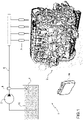
- The invention will now be described with reference to the accompanying drawings, showing a non-limiting embodiment thereof, wherein:
-
figure 1 is a schematic view of an internal combustion engine provided with a system feeding water to at least one combustion chamber; -
figure 2 is a schematic view of a heating device of the feeding system offigure 1 ; -
figure 3 is a schematic view of an alternative embodiment of the heating device offigure 2 ; and -
figure 4 is a schematic view of a further embodiment of the heating device offigure 2 . - In
figure 1 ,number 1 indicates, as a whole, a system for feeding a water-based operating liquid 10 (in particular, demineralised water) in an internalcombustion heat engine 2; the water-basedoperating liquid 10 is intended to reach the combustion chambers obtained in the cylinders of the internalcombustion heat engine 2 in order to increase the efficiency of the combustion and/or increase the power generated. - In the combustion chamber of each cylinder, following the combustion,
exhaust gases 11 are generated, which are conveyed through an exhaust duct 3 (which is partially and schematically shown infigures 2-4 ) so as to be released into the atmosphere after having been properly treated (for example in a catalytic converter). - The
feeding system 1 comprises atank 4 containing a mass of the water-basedoperating liquid 10 and apump 5, which draws the water-basedoperating liquid 10 from the inside of thetank 4 and transfers it, under pressure, to afeeding duct 6. A plurality ofinjectors 7 are connected to an end portion of thefeeding duct 6 and inject the water-basedoperating liquid 10 at a low pressure into corresponding intake ducts, through which fresh air is conveyed towards the cylinders. According to another embodiment, theinjectors 6 could inject the water-based operatingliquid 10 at a high pressure directly into the cylinders (in this case, a further high-pressure pump is generally provided). - According to a further embodiment, the water-based
operating liquid 10 fed by thefeeding system 1 is mixed with the fuel injected into the cylinders. - Along the
feeding duct 6 and immediately downstream of thepump 5 there is amaximum pressure valve 8, namely a valve that opens in order to re-introduce the excess water-basedoperating liquid 10 into thetank 4 when the pressure inside thefeeding duct 6 exceeds a predetermined threshold value; basically, themaximum pressure valve 8 operates like a pressure regulator so as to prevent the pressure inside thefeeding duct 6 from exceeding the predetermined threshold value. According to an alternative an perfectly equivalent embodiment, a pressure sensor (not shown) is arranged downstream of the pump 5 (for example in a common rail to which theinjectors 7 are connected) and the flow rate of thepump 5 is adjusted with a feedback control so as keep the pressure downstream of thepump 5 in the neighbourhood of a desired value (which can also be variable based on the engine point); in this embodiment, themaximum pressure valve 8 is absent or is present only because of safety reasons (namely, it starts acting only in case of control errors or in case of faults). - According to
figure 2 , thefeeding system 1 comprises aheating device 9, which is coupled to thetank 4 as well as to theexhaust duct 3 and operates in the ways described below in detail. - The
heating device 9 comprises aheating chamber 12, which surrounds a portion of theexhaust duct 3 and comprises an inlet opening 13, which is designed to receive air from the outside, and an outlet opening 14, which is arranged higher than the inlet opening 13. The circulation of air through theheating chamber 12 can be obtained through a simple convective motion, also exploiting the pressure generated by the motion of the vehicle, and/or with the aid of a fan or of a motor-driven aspirator. Theheating chamber 12 is normally made of a metal material, so that it can bear the temperatures of theexhaust duct 3. - The portion of the
exhaust duct 3 located inside theheating chamber 12 heats the air flowing through theheating chamber 12; besides, theexhaust duct 3 is made of a metal material, hence having a high heat conductivity, and, as a consequence, there is a high transmission of heat from the walls of theexhaust duct 3 to the air flowing through theheating chamber 12. The air heated by so doing is caused to flow towards the outlet opening 14 of theheating chamber 1. - The
heating device 9 further comprises aheat exchanger 15, which is connected to the outlet opening 14 f theheating chamber 12 by means of afeeding duct 16 and is thermally coupled to the tank 4 (namely, is capable of releasing heat to the tank 4). - According to the embodiment shown in
figure 2 , theheat exchanger 15 comprises a wrappingbody 17, which is hollow on the inside so as to contain, on the inside, thetank 4; namely, thewrapping body 17 comprises acavity 17A housing thetank 4. In particular, the wrappingbody 17 has alower surface 18 and anupper surface 19, the latter being opposite and arranged higher than thelower surface 18. Thelower surface 18 is inclined at an angle α, for example equal to 10-20°; furthermore, thelower surface 18 has anarea 18A, which is connected to thefeeding duct 16 by means of an inlet opening 25, and anarea 18B, which is distal from the inlet opening 25 and is arranged lower than thearea 18A. - The wrapping
body 17 completely wraps thetank 4 and is configured to receive the heated air in the area of the inlet opening 25. In other words, in use, by exploiting the upward motion (in particular, from theheating chamber 12 to the wrapping body 17) of the heated air through thefeeding duct 16, the wrappingbody 17 receives the heated air; in this way and thanks to the fact that thetank 4 is arranged inside the wrappingbody 17, the heated air hits thetank 4 and, therefore, there is a heat exchange between the heated air (which cools down) and the water-based operating liquid 10 (which heats up) contained in thetank 4. - The
area 18B of thelower surface 18 is arranged lower than thearea 18A of thelower surface 18 and, hence, possible condensate water generated during the heat exchange between the heated air and the water-basedoperating liquid 10 gathers, through gravity, in thearea 18B of the lower surface 18 (which, thus, acts as condensate water collecting area, keeping the condensate water away from an inlet opening 25 located in thearea 18A of the lower surface 18). - The
lower surface 18 preferably comprises a plurality of through holes (not shown), which are configured to cause possible condensate water to flow away. - The
heating device 9 further comprises anadjustment valve 20, which is interposed between the heating chamber 12 (in particular, the outlet opening 14) and the heat exchanger 15 (in particular, the inlet opening 25) along thefeeding duct 16 and is designed to adjust the flow of heated air between theheating chamber 12 and theheat exchanger 15. In particular, the opening and the closing of theadjustment valve 20 are regulated by a control unit 28 (which is schematically shown infigure 1 ) in the ways described in detail below. - The
heating device 9 further comprises atemperature sensor 21, which is arranged inside the wrappingbody 17 and is configured to detect the temperature of the heated air present inside the wrappingbody 17 after having flown in through the inlet opening 25. Thetemperature sensor 21 is preferably arranged close to the inlet opening 25. - The
heating device 9 further comprises atemperature sensor 23, which is arranged in thetank 4 in contact with the water-basedoperating liquid 10 and is configured to determine the temperature of the water-basedoperating liquid 10. - According to an embodiment, in use, the
control unit 28 adjusts a degree of opening of thefeeding valve 20 based on the temperature measured by thetemperature sensor 23, both to prevent ice from forming or to melt possible ice present in thetank 4 and to subject the water-basedoperating liquid 10 contained in thetank 4 to a thermal treatment aimed at avoiding the proliferation of micro-organisms (as described more in detail below). Generally speaking, thecontrol unit 28 avoids heating the water-basedoperating liquid 10 in thetank 4 at temperatures above 85-90°C (so as not to damage the components of thetank 4, which are generally made of a plastic material). In other words, in use, thecontrol unit 28 operates a feedback control acting upon the degree of opening of thefeeding valve 20 based on the difference between a desired temperature of the water contained in thetank 4 and an actual temperature (measured by the temperature sensor 23) of the water-basedoperating liquid 10 in thetank 4. - According to another embodiment, which is alternative or additional to the previous one, the
control unit 28 adjusts a degree of opening of the feeding vale 20 (also) based on the temperature measured by thetemperature sensor 21 so as to optimize the heating of the water-basedoperating liquid 10 contained in thetank 4, namely in order to speed up the heating of the water-basedoperating liquid 10 contained in thetank 4, though without risking damaging thetank 4 or components of thetank 4. In particular, in use, thecontrol unit 28 operates a feedback control, which acts upon the degree of opening of thefeeding valve 20 based on the difference between a desired temperature of the heated air in the wrapping body 17 (which is needed to optimized the heating of the water-basedoperating liquid 10 contained in the tank 4) and an actual temperature (measured by the temperature sensor 21) of the air flowing in thewrapping body 17. - The water-based
operating liquid 10 contained in thetank 4 could contain micro-organisms (for example bacteria or spores), namely living organisms having dimensions that are such that they are not visible to the naked eye (typically smaller than 0.1 mm). These micro-organisms can proliferate over time inside thetank 4, thus generating colonies that can, for example, (partially or completely) obstruct the intake of water-basedoperating liquid 10 of thepump 5 or can be sucked by thepump 5 and, hence, be sent to theinjectors 7 with the risk of clogging thepump 5, possible filters arranged downstream of thepump 5, theinjectors 7 or, if they reach the combustion chambers obtained in the cylinders of the internalcombustion heat engine 2, jeopardize the combustion with a potential degradation of performances and/or a potential increase in the generation of polluting substances. In other words, the micro-organisms present in the water-basedoperating liquid 10 contained in thetank 4, over time, can proliferate and increase in number, causing, for example, the formation of algae or biofilms on the walls of thetank 4; said algae or biofilms, by detaching from the walls, can obstruct the intake of thepump 5 or can be sucked by thepump 5 and, hence, reach theinjectors 7 and/or the combustion chambers obtained in the cylinders. - According to this embodiment, in use, the
control unit 28 is configured to also control theheating device 9 so as to heat the water contained in thetank 4 at a temperature above 60°C (preferably 70°C) in order to obtain a thermal treatment (namely, a sort of sterilization/pasteurization) of the operatingliquid 10 contained in the tank 4 (namely, in order to obtain, due to the heat, a reduction in the concentration of micro-organisms present in the water-basedoperating liquid 10 contained in the tank 4). It should be pointed out that the thermal treatment carried out using theheating device 9 is a sort of sterilization (namely, a partial, incomplete sterilization), because, since high temperatures (above 100 °C) should not be reached in order not to damage thetank 4 or the components housed in thetank 4, at the end of the thermal treatment the water contained in thetank 4 is not "sterile" in a medical sense, but it has anyway significantly reduced the presence of micro-organisms. - In other words, the
control unit 28 uses (any time theinternal combustion engine 2 is turned on) the heating device 9 (initially designed only for an anti-ice function) to subject the water-basedoperating liquid 10 contained in thetank 4 to a thermal treatment aimed at reducing (as much as possible) micro-organisms in vegetative form, germs and, with a prolonged action, also some bacterial spores. Experimental tests have shown that, by heating the water contained in thetank 4 at 70°C - 75 °C for at least 2-5 minutes, it is possible to obtain a 90-98% reduction of the total bacterial concentration. - The wrapping
body 17 further comprises anoutlet opening 26, which is obtained in the area of theupper surface 19, is arranged higher than theinlet opening 25 and is configured to allow the heated air to flow outwards. - Furthermore, a
filter 27 is provided, which engages the heatedair outlet opening 26 and is configured to filter the heated air flowing out of theheat exchanger 15. Similarly, a filter could be provided, which engages the inlet opening 13 or is arranged upstream of theinlet opening 13 and is configured to filter the air flowing into theheating chamber 12. - The
heating device 9 could further comprise anaspirator 29, which is arranged in the wrappingbody 17, engages the outlet opening 26 of the wrappingbody 17 and is configured to create a forced circulation of the heated air inside the wrappingbody 17; alternatively or in addition to the aspirator 29 (as shown in the embodiment offigure 2 ), theheating device 9 can comprise ablower 30, which is also arranged inside the wrappingbody 17, engages the inlet opening 25 of the wrappingbody 17 and is configured to create, instead of or in collaboration with theaspirator 29, the aforesaid forced circulation of the heated air in the wrappingbody 17. In other words, theaspirator 29 and/or theblower 30 are configured to enable the circulation of the heated air in the wrappingbody 17, for example in order to allow for a uniform heating of the tank 4 (and, hence, of the water-based operating liquid 10). - In use, the
heating device 9 operates in the ways described below. - According to a first mode of operation, the
temperature sensor 23 detects the temperature of the water-basedoperating liquid 10 contained in thetank 4 and generates a corresponding electrical signal, which is transmitted to thecontrol unit 28; in case the electrical signal indicates that a temperature of the water-basedoperating liquid 10 is close to the freezing temperature (forwater 0° or below, for a mixture of water and urea -11°C or below), thecontrol unit 28 detects that the water-basedoperating liquid 10 is about to freeze and, therefore, controls the feedingvalve 20 so as to open it. - Simultaneously with the detection of the temperature of the water-based
operating liquid 10, the air flowing into the inlet opening 13 of theheating chamber 12 is heated by theexhaust gas 11 flowing in theexhaust duct 3 in the ways described above. In this way, the air contained in theheating chamber 12 is heated and conveyed towards the outlet opening 14 through convection. - Consequently, the heated air is capable of flowing towards the wrapping
body 17, in particular through the inlet opening 25 thereof, since the feedingvalve 20 is in the opening position; in this way, the heated air flows into the wrappingbody 17 and exchanges heat with the water-basedoperating liquid 10 in thetank 4 in the ways described above. In other words, the heated air releases part of its heat to the water-basedoperating liquid 10, so as to heat and defrost it. - Subsequently, the heated air, which at least partly released its heat to the water-based
operating liquid 10, is conveyed towards the outlet opening 26 of the wrappingbody 17 and through thefilter 27, so as to flow out of theheat exchanger 15. - It should be pointed out that the
aspirator 29 and/or theblower 30 help the heated air flow into and out of the wrappingbody 17. - The
control unit 28 can close the feedingvalve 20 in at least two cases. - In a first case, the
temperature sensor 21 detects the temperature of the heated air and generates the corresponding electrical signal, which is transmitted to thecontrol unit 28; if said electrical signal indicates that the temperature of the heated air is high (above 85-90°C), thecontrol unit 28 controls the feedingvalve 20 so as to close it, since, in this case, the temperature is too high for thetank 4 to be capable of bearing it. In other words, thecontrol unit 28 controls the closing of the feedingvalve 20 so as to preserve the integrity of thetank 4. - Alternatively, in a second case, the
control unit 28 causes the feedingvalve 20 to close if thetemperature sensor 23 detects a temperature of the water-based operating liquid 10 (significantly) above the freezing temperature. - In this case, the
control unit 28 establishes that the water-basedoperating liquid 10 was defrosted and, therefore, thefeeding system 1 can operate correctly. -
Figure 3 shows another embodiment of theheating device 9, which is different from the embodiment shown infigure 2 because of the conformation of theheat exchanger 15. In the embodiment shown infigure 3 , theheat exchanger 15 comprises, instead of the wrappingbody 17, aflat diffuser 32, which is arranged under thetank 4 at a distance d from the tank 4 (in particular, from alower surface 24 of the tank 4); in particular, theflat diffuser 32 has a plurality ofoutlet openings 33, which face upwards (in particular, face thelower surface 24 of the tank 4) and are configured to convey the heated air towards thetank 4 through convection. - In use, the
heat exchanger 9 shown infigure 3 operates in a similar way to the one described with reference tofigure 2 . - More in detail, the heated air is conveyed towards the flat diffuser 32 (in particular, through the inlet opening 25 of the heat exchanger 15) by means of the feeding
duct 16 and, subsequently, it flows out through said plurality ofoutlet openings 33; in this way, the heated air is diffused by theflat diffuser 32 towards thetank 4 and, exploiting the upward motion of the heated air, the tank 4 (and, hence, the water-basedoperating liquid 10 contained in the tank 4) is heated in a similar way to the one discussed for the embodiment offigure 2 . - According to the embodiment of
figure 3 , the opening and the closing of the feedingvalve 20 are solely regulated by the temperature detection carried out by thetemperature sensor 23; therefore, thecontrol unit 28 controls the feedingvalve 20 based on electrical signals sent by thetemperature sensor 23 and concerning the temperature of the water-basedoperating liquid 10, similarly to what described with reference to the embodiment offigure 2 . -
Figure 4 shows a further embodiment of theheating device 9, which is different from the embodiment shown infigure 2 because of the conformation of theheat exchanger 15. In the embodiment shown infigure 3 , theheat exchanger 15 comprises, instead of the wrappingbody 17, atubular body 36, which is wound in a coil shape around the tank 4 (and, therefore, partially in contact with the latter) and is configured to receive, in the area of theinlet opening 25, the heated air coming from theheating chamber 12. - In use, the
heating device 9 offigure 4 operates in a similar way to the one discussed with reference to theheating device 9 of the embodiment offigure 2 . - In the embodiment shown in the accompanying figures, the
tank 4 contains, as water-basedoperating liquid 10, demineralised water, which is injected into the combustion chambers obtained in the cylinders of the internalcombustion heat engine 2 so as to increase the efficiency of the combustion and/or increase the power generated. - According to a different embodiment which is not shown herein, the
tank 4 contains, as water-basedoperating liquid 10, a water solution of urea (namely, a water-based operating liquid containing urea), which is injected along theexhaust duct 3 upstream of an SCR catalytic converter. - The
heating device 9 according to the invention has different advantages. - First of all, the
heating device 9 described above prevents the water-basedoperating liquid 10 from freezing using the heat provided by theexhaust gases 11 flowing in theexhaust duct 3; indeed, the heat exchange between theexhaust gases 11 and the air flowing into theheating chamber 12 leads to a heating of the air, which, in turn, after having flow to theheat exchanger 15, heats the water-basedoperating liquid 10, thus increasing the temperature thereof. In other words, theheating device 9 according to the invention allows the heat of theexhaust gases 11 to be effectively used to ensure the correct operation of thefeeding system 1 and, hence, of the internalcombustion heat engine 2. - Furthermore, the
heating device 9 according to the invention is simple and economic to be manufactured. -
- 1
- feeding system
- 2
- internal combustion heat engine
- 3
- exhaust duct
- 4
- tank
- 5
- pump
- 6
- feeding duct
- 7
- injectors
- 8
- maximum pressure valve
- 9
- heating device
- 10
- water-based operating liquid
- 11
- exhaust gases
- 12
- heating chamber
- 13
- inlet opening
- 14
- outlet opening
- 15
- heat exchanger
- 16
- feeding duct
- 17
- wrapping body
- 17A
- hollow portion
- 18
- lower surface
- 18A
- area
- 18B
- area
- 19
- upper surface
- 20
- adjustment valve
- 21
- temperature sensor
- 23
- temperature sensor
- 24
- lower surface
- 25
- inlet opening
- 26
- outlet opening
- 27
- filter
- 28
- control unit
- 29
- aspirator
- 30
- blower
- 32
- flat diffuser
- 33
- plurality of outlet openings
- 36
- tubular body
- d
- distance
Claims (14)
- An internal combustion engine (2) comprising:at least one cylinder provided with a combustion chamber, in which, following the combustion, exhaust gases (11) are generated;an exhaust duct (3), which is flown through by the exhaust gases (11) coming from the combustion chamber; anda water-based operating liquid system (1) comprising:
a tank (4), which is designed to contain a quantity of water-based operating liquid and a heating device (9), which is coupled to the tank (4) and is designed to heat the water-based operating liquid contained in the tank (4);the internal combustion engine (2) is characterized in that the heating device (9) comprises:a heating chamber (12), which surrounds a portion of the exhaust duct (3), comprises an inlet opening (13) designed to receive air from the outside, is configured to allow heat to be transferred from the walls of the exhaust duct (3) to the air received from the outside and comprises an outlet opening (14) for the heated air; anda heat exchanger (15), which receives the heated air from the outlet opening (14) of the heating chamber (12) and is thermally coupled to the tank (4) so as to transfer part of the heat owned by the heated air to the water-based operating liquid (10) contained in the tank (4). - The internal combustion engine (2) according to claim 1, wherein the heating device (9) comprises an adjustment valve (20), which is interposed between the heating chamber (12) and the heat exchanger (15) and is designed to adjust the flow of heated air between the heating chamber (12) and the heat exchanger (15).
- The internal combustion engine (2) according to claim 2, wherein:the heating device (9) comprises a first temperature sensor (21) designed to measure the temperature of the heated air flowing into the heat exchanger (15); andthe feeding valve (20) adjusts the flow of heated air between the heating chamber (12) and the heat exchanger (15) depending on the temperature of the heated air detected by the first temperature sensor (21).
- The internal combustion engine (2) according to claim 2 or 3, wherein:the tank (4) is provided with a second temperature sensor (23), which is designed to measure a temperature of the water-based operating liquid (10) contained in the tank (4); andthe feeding valve (20) adjusts the flow of heated air between the heating chamber (12) and the heat exchanger (15) depending on the temperature of the heated air detected by the second temperature sensor (23).
- The internal combustion engine (2) according to claim 2, 3 or 4, wherein the heating device (9) comprises a feeding duct (16), which connects the outlet opening (14) of the heating chamber to an inlet opening (25) of the heat exchanger (15) and is provided with the feeding valve (20).
- The internal combustion engine (2) according to any one of the claims from 1 to 5, wherein the heat exchanger (15) comprises an internally hollow wrapping body (17), which surrounds the tank (4) and in which the heated air coming from the heating chamber (12) is caused to circulate.
- The internal combustion engine (2) according to claim 6, wherein the wrapping body (17) has a bottom wall (18) provided with an inlet opening (25) for the heated air and a top wall (19) provided with an outlet opening (26) for the heated air.
- The internal combustion engine (2) according to claim 7, wherein the bottom wall (18) of the wrapping body (17) is inclined relative to the horizontal and has a higher area (18A), where the inlet opening (25) for the heated air is obtained, and a lower area (18B) distal from the inlet opening (25) for the heated air.
- The internal combustion engine (2) according to claim 8, wherein the lower area (18B) of the bottom wall (18) comprises a plurality of holes designed to allow possible condensate water to flow away.
- The internal combustion engine (2) according to any one of the claims from 1 to 5, wherein the heat exchanger (15) comprises a flat diffuser (32), which is arranged under the tank (4) at a distance (d) other than zero from the tank (4) and has a plurality of outlet openings (33) facing upward.
- The internal combustion engine (2) according to any one of the claims from 1 to 5, wherein the heat exchanger (15) comprises a tubular duct (36), which is wound in a coil around the tank (4).
- The internal combustion engine (2) according to any one of the preceding claims, wherein:the heat exchanger (15) has an inlet opening (25) for the heated air and an outlet opening (26) for the heated air; andthe heat exchanger (15) comprises at least one air filter (27), which engages the outlet opening (26) for the heated air so as to filter the heated air flowing out of the heat exchanger (15).
- The internal combustion engine (2) according to any one of the preceding claims, wherein:the heat exchanger (15) has an inlet opening (25) for the heated air and an outlet opening (26) for the heated air placed higher than the inlet opening (25);the heat exchanger (15) is placed higher than the heating chamber (12); andthe outlet opening (26) of the heating chamber (12) is placed higher than the inlet opening (25) of the heating chamber (12).
- The internal combustion engine (2) according to any one of the preceding claims, wherein the heating device (9) comprises an aspirator (29) and/or a blower (30) designed to establish a forced air circulation from the heating chamber (12) to the heat exchanger (15).
Applications Claiming Priority (1)
| Application Number | Priority Date | Filing Date | Title |
|---|---|---|---|
| IT102019000018542A IT201900018542A1 (en) | 2019-10-11 | 2019-10-11 | INTERNAL COMBUSTION ENGINE EQUIPPED WITH A WATER-BASED OPERATING LIQUID FEEDING SYSTEM WITH A HEATER DEVICE |
Publications (2)
| Publication Number | Publication Date |
|---|---|
| EP3805536A1 EP3805536A1 (en) | 2021-04-14 |
| EP3805536B1 true EP3805536B1 (en) | 2022-06-29 |
Family
ID=69743684
Family Applications (1)
| Application Number | Title | Priority Date | Filing Date |
|---|---|---|---|
| EP20200704.3A Active EP3805536B1 (en) | 2019-10-11 | 2020-10-08 | Internal combustion engine provided with a water-based operating liquid feeding system having a heating device |
Country Status (5)
| Country | Link |
|---|---|
| US (1) | US11286888B2 (en) |
| EP (1) | EP3805536B1 (en) |
| JP (1) | JP2021076114A (en) |
| CN (1) | CN112648116B (en) |
| IT (1) | IT201900018542A1 (en) |
Family Cites Families (14)
| Publication number | Priority date | Publication date | Assignee | Title |
|---|---|---|---|---|
| GB484072A (en) * | 1937-11-10 | 1938-04-29 | Herman Carel Otto Michel | Improvements in and relating to means for adding steam to the charge in internal combustion engines |
| CA2199840A1 (en) * | 1994-09-12 | 1996-03-21 | W. Sidney Binion | In-cylinder water injection engine |
| JPH08158864A (en) * | 1994-12-02 | 1996-06-18 | Hitachi Ltd | Automotive heating system |
| JP3883974B2 (en) * | 2003-03-11 | 2007-02-21 | 日産ディーゼル工業株式会社 | Exhaust purification device |
| US20070137590A1 (en) * | 2005-07-11 | 2007-06-21 | Jan Vetrovec | Internal combustion engine/water source system |
| DE102006032454A1 (en) * | 2006-07-13 | 2008-01-17 | Arvinmeritor Emissions Technologies Gmbh | Exhaust system for an internal combustion engine |
| WO2010092684A1 (en) * | 2009-02-13 | 2010-08-19 | トヨタ自動車株式会社 | Operating gas circulation type engine |
| JP2011094492A (en) * | 2009-10-27 | 2011-05-12 | Toyota Motor Corp | Exhaust heat recovery device |
| FR2992021B1 (en) * | 2012-06-18 | 2014-05-30 | IFP Energies Nouvelles | INTERNAL COMBUSTION ENGINE ASSOCIATED WITH A RANKINE CYCLE CLOSED CIRCUIT AND A WATER INJECTION CIRCUIT FOR THE INTAKE OF THE ENGINE |
| US9145850B2 (en) * | 2012-10-29 | 2015-09-29 | Deere & Company | Power system comprising a condensation injection system |
| DE102015205499A1 (en) * | 2015-03-26 | 2016-09-29 | Robert Bosch Gmbh | Delivery module for conveying water-containing liquids |
| US10364775B2 (en) * | 2016-08-16 | 2019-07-30 | Ford Global Technologies, Llc | Water-injection anti-freezing system |
| CN109322729B (en) * | 2018-09-14 | 2020-01-07 | 天津大学 | Double-wall SCR system urea tank device using hot exhaust gas for heat preservation |
| GB2579643B (en) * | 2018-12-10 | 2021-04-28 | Jaguar Land Rover Ltd | A heat exchanger for a water injection system, a system, a control system, a method and a vehicle |
-
2019
- 2019-10-11 IT IT102019000018542A patent/IT201900018542A1/en unknown
-
2020
- 2020-10-08 US US17/065,616 patent/US11286888B2/en active Active
- 2020-10-08 EP EP20200704.3A patent/EP3805536B1/en active Active
- 2020-10-09 JP JP2020171451A patent/JP2021076114A/en active Pending
- 2020-10-10 CN CN202011080396.7A patent/CN112648116B/en active Active
Also Published As
| Publication number | Publication date |
|---|---|
| CN112648116B (en) | 2024-05-14 |
| IT201900018542A1 (en) | 2021-04-11 |
| US20210140393A1 (en) | 2021-05-13 |
| CN112648116A (en) | 2021-04-13 |
| US11286888B2 (en) | 2022-03-29 |
| EP3805536A1 (en) | 2021-04-14 |
| JP2021076114A (en) | 2021-05-20 |
Similar Documents
| Publication | Publication Date | Title |
|---|---|---|
| RU144440U1 (en) | ENGINE SYSTEM | |
| EP3647561B1 (en) | Internal combustion engine provided with a system supplying a water-based operator liquid | |
| EP3342291A1 (en) | Smoking device | |
| RU2010140441A (en) | DRYER FOR PAINT INSTALLATION | |
| US8393311B2 (en) | Internal combustion engine with dry sump lubrication | |
| MY180158A (en) | Cross-flow spiral heat transfer system | |
| US11131275B2 (en) | Injection method and system for the injection of water in an internal combustion engine | |
| CN102261633A (en) | Cooking Device With A Steam Generating Function | |
| EP3805536B1 (en) | Internal combustion engine provided with a water-based operating liquid feeding system having a heating device | |
| KR101435131B1 (en) | Hot Air Generator using Superheated Steam | |
| KR102024469B1 (en) | Fermentation and maturation system for raw meat with humidifier | |
| CN121274532A (en) | Vehicle-mounted device and vehicle | |
| KR101996274B1 (en) | Drying system for agricultural and marine products of warehouse-type | |
| JP2007240066A (en) | Water cooler, water cooling type dehumidifier, and drying machine | |
| CN204963392U (en) | Steam sterilization refrigerator | |
| EP3594485B1 (en) | Feeding system to feed water to at least one combustion chamber in an internal combustion engine | |
| KR100814606B1 (en) | Waste heat recovery fan using gas burner | |
| EP4080626A3 (en) | Fuel cell system and air vehicle | |
| CN223262151U (en) | Fishery farming system with temperature regulation function | |
| KR101449332B1 (en) | Module for maintaining constant temperature of engine-oil and operating-method thereof | |
| IT201900015093A1 (en) | INTERNAL COMBUSTION ENGINE EQUIPPED WITH A WATER-BASED OPERATING LIQUID FEEDING SYSTEM | |
| CN208075090U (en) | Molecule energy heater | |
| CN117704346A (en) | Steam generating device and fixation system | |
| CN2688067Y (en) | Granulated sugar smoke maker and smudging apparatus therefrom | |
| GEP20105075B (en) | Refrigerating device for transport facilities |
Legal Events
| Date | Code | Title | Description |
|---|---|---|---|
| PUAI | Public reference made under article 153(3) epc to a published international application that has entered the european phase |
Free format text: ORIGINAL CODE: 0009012 |
|
| STAA | Information on the status of an ep patent application or granted ep patent |
Free format text: STATUS: THE APPLICATION HAS BEEN PUBLISHED |
|
| AK | Designated contracting states |
Kind code of ref document: A1 Designated state(s): AL AT BE BG CH CY CZ DE DK EE ES FI FR GB GR HR HU IE IS IT LI LT LU LV MC MK MT NL NO PL PT RO RS SE SI SK SM TR |
|
| AX | Request for extension of the european patent |
Extension state: BA ME |
|
| STAA | Information on the status of an ep patent application or granted ep patent |
Free format text: STATUS: REQUEST FOR EXAMINATION WAS MADE |
|
| 17P | Request for examination filed |
Effective date: 20210901 |
|
| GRAP | Despatch of communication of intention to grant a patent |
Free format text: ORIGINAL CODE: EPIDOSNIGR1 |
|
| STAA | Information on the status of an ep patent application or granted ep patent |
Free format text: STATUS: GRANT OF PATENT IS INTENDED |
|
| INTG | Intention to grant announced |
Effective date: 20220121 |
|
| GRAS | Grant fee paid |
Free format text: ORIGINAL CODE: EPIDOSNIGR3 |
|
| GRAA | (expected) grant |
Free format text: ORIGINAL CODE: 0009210 |
|
| STAA | Information on the status of an ep patent application or granted ep patent |
Free format text: STATUS: THE PATENT HAS BEEN GRANTED |
|
| AK | Designated contracting states |
Kind code of ref document: B1 Designated state(s): AL AT BE BG CH CY CZ DE DK EE ES FI FR GB GR HR HU IE IS IT LI LT LU LV MC MK MT NL NO PL PT RO RS SE SI SK SM TR |
|
| REG | Reference to a national code |
Ref country code: CH Ref legal event code: EP |
|
| REG | Reference to a national code |
Ref country code: AT Ref legal event code: REF Ref document number: 1501493 Country of ref document: AT Kind code of ref document: T Effective date: 20220715 |
|
| REG | Reference to a national code |
Ref country code: IE Ref legal event code: FG4D |
|
| REG | Reference to a national code |
Ref country code: DE Ref legal event code: R096 Ref document number: 602020003762 Country of ref document: DE |
|
| REG | Reference to a national code |
Ref country code: LT Ref legal event code: MG9D |
|
| PG25 | Lapsed in a contracting state [announced via postgrant information from national office to epo] |
Ref country code: SE Free format text: LAPSE BECAUSE OF FAILURE TO SUBMIT A TRANSLATION OF THE DESCRIPTION OR TO PAY THE FEE WITHIN THE PRESCRIBED TIME-LIMIT Effective date: 20220629 Ref country code: NO Free format text: LAPSE BECAUSE OF FAILURE TO SUBMIT A TRANSLATION OF THE DESCRIPTION OR TO PAY THE FEE WITHIN THE PRESCRIBED TIME-LIMIT Effective date: 20220929 Ref country code: LT Free format text: LAPSE BECAUSE OF FAILURE TO SUBMIT A TRANSLATION OF THE DESCRIPTION OR TO PAY THE FEE WITHIN THE PRESCRIBED TIME-LIMIT Effective date: 20220629 Ref country code: HR Free format text: LAPSE BECAUSE OF FAILURE TO SUBMIT A TRANSLATION OF THE DESCRIPTION OR TO PAY THE FEE WITHIN THE PRESCRIBED TIME-LIMIT Effective date: 20220629 Ref country code: GR Free format text: LAPSE BECAUSE OF FAILURE TO SUBMIT A TRANSLATION OF THE DESCRIPTION OR TO PAY THE FEE WITHIN THE PRESCRIBED TIME-LIMIT Effective date: 20220930 Ref country code: FI Free format text: LAPSE BECAUSE OF FAILURE TO SUBMIT A TRANSLATION OF THE DESCRIPTION OR TO PAY THE FEE WITHIN THE PRESCRIBED TIME-LIMIT Effective date: 20220629 Ref country code: BG Free format text: LAPSE BECAUSE OF FAILURE TO SUBMIT A TRANSLATION OF THE DESCRIPTION OR TO PAY THE FEE WITHIN THE PRESCRIBED TIME-LIMIT Effective date: 20220929 |
|
| REG | Reference to a national code |
Ref country code: NL Ref legal event code: MP Effective date: 20220629 |
|
| REG | Reference to a national code |
Ref country code: AT Ref legal event code: MK05 Ref document number: 1501493 Country of ref document: AT Kind code of ref document: T Effective date: 20220629 |
|
| PG25 | Lapsed in a contracting state [announced via postgrant information from national office to epo] |
Ref country code: RS Free format text: LAPSE BECAUSE OF FAILURE TO SUBMIT A TRANSLATION OF THE DESCRIPTION OR TO PAY THE FEE WITHIN THE PRESCRIBED TIME-LIMIT Effective date: 20220629 Ref country code: LV Free format text: LAPSE BECAUSE OF FAILURE TO SUBMIT A TRANSLATION OF THE DESCRIPTION OR TO PAY THE FEE WITHIN THE PRESCRIBED TIME-LIMIT Effective date: 20220629 |
|
| PG25 | Lapsed in a contracting state [announced via postgrant information from national office to epo] |
Ref country code: NL Free format text: LAPSE BECAUSE OF FAILURE TO SUBMIT A TRANSLATION OF THE DESCRIPTION OR TO PAY THE FEE WITHIN THE PRESCRIBED TIME-LIMIT Effective date: 20220629 |
|
| PG25 | Lapsed in a contracting state [announced via postgrant information from national office to epo] |
Ref country code: SM Free format text: LAPSE BECAUSE OF FAILURE TO SUBMIT A TRANSLATION OF THE DESCRIPTION OR TO PAY THE FEE WITHIN THE PRESCRIBED TIME-LIMIT Effective date: 20220629 Ref country code: SK Free format text: LAPSE BECAUSE OF FAILURE TO SUBMIT A TRANSLATION OF THE DESCRIPTION OR TO PAY THE FEE WITHIN THE PRESCRIBED TIME-LIMIT Effective date: 20220629 Ref country code: RO Free format text: LAPSE BECAUSE OF FAILURE TO SUBMIT A TRANSLATION OF THE DESCRIPTION OR TO PAY THE FEE WITHIN THE PRESCRIBED TIME-LIMIT Effective date: 20220629 Ref country code: PT Free format text: LAPSE BECAUSE OF FAILURE TO SUBMIT A TRANSLATION OF THE DESCRIPTION OR TO PAY THE FEE WITHIN THE PRESCRIBED TIME-LIMIT Effective date: 20221031 Ref country code: ES Free format text: LAPSE BECAUSE OF FAILURE TO SUBMIT A TRANSLATION OF THE DESCRIPTION OR TO PAY THE FEE WITHIN THE PRESCRIBED TIME-LIMIT Effective date: 20220629 Ref country code: EE Free format text: LAPSE BECAUSE OF FAILURE TO SUBMIT A TRANSLATION OF THE DESCRIPTION OR TO PAY THE FEE WITHIN THE PRESCRIBED TIME-LIMIT Effective date: 20220629 Ref country code: AT Free format text: LAPSE BECAUSE OF FAILURE TO SUBMIT A TRANSLATION OF THE DESCRIPTION OR TO PAY THE FEE WITHIN THE PRESCRIBED TIME-LIMIT Effective date: 20220629 |
|
| PG25 | Lapsed in a contracting state [announced via postgrant information from national office to epo] |
Ref country code: PL Free format text: LAPSE BECAUSE OF FAILURE TO SUBMIT A TRANSLATION OF THE DESCRIPTION OR TO PAY THE FEE WITHIN THE PRESCRIBED TIME-LIMIT Effective date: 20220629 Ref country code: IS Free format text: LAPSE BECAUSE OF FAILURE TO SUBMIT A TRANSLATION OF THE DESCRIPTION OR TO PAY THE FEE WITHIN THE PRESCRIBED TIME-LIMIT Effective date: 20221029 |
|
| REG | Reference to a national code |
Ref country code: DE Ref legal event code: R097 Ref document number: 602020003762 Country of ref document: DE |
|
| PG25 | Lapsed in a contracting state [announced via postgrant information from national office to epo] |
Ref country code: AL Free format text: LAPSE BECAUSE OF FAILURE TO SUBMIT A TRANSLATION OF THE DESCRIPTION OR TO PAY THE FEE WITHIN THE PRESCRIBED TIME-LIMIT Effective date: 20220629 |
|
| PG25 | Lapsed in a contracting state [announced via postgrant information from national office to epo] |
Ref country code: DK Free format text: LAPSE BECAUSE OF FAILURE TO SUBMIT A TRANSLATION OF THE DESCRIPTION OR TO PAY THE FEE WITHIN THE PRESCRIBED TIME-LIMIT Effective date: 20220629 Ref country code: CZ Free format text: LAPSE BECAUSE OF FAILURE TO SUBMIT A TRANSLATION OF THE DESCRIPTION OR TO PAY THE FEE WITHIN THE PRESCRIBED TIME-LIMIT Effective date: 20220629 |
|
| PLBE | No opposition filed within time limit |
Free format text: ORIGINAL CODE: 0009261 |
|
| STAA | Information on the status of an ep patent application or granted ep patent |
Free format text: STATUS: NO OPPOSITION FILED WITHIN TIME LIMIT |
|
| PG25 | Lapsed in a contracting state [announced via postgrant information from national office to epo] |
Ref country code: MC Free format text: LAPSE BECAUSE OF FAILURE TO SUBMIT A TRANSLATION OF THE DESCRIPTION OR TO PAY THE FEE WITHIN THE PRESCRIBED TIME-LIMIT Effective date: 20220629 |
|
| 26N | No opposition filed |
Effective date: 20230330 |
|
| REG | Reference to a national code |
Ref country code: BE Ref legal event code: MM Effective date: 20221031 |
|
| PG25 | Lapsed in a contracting state [announced via postgrant information from national office to epo] |
Ref country code: LU Free format text: LAPSE BECAUSE OF NON-PAYMENT OF DUE FEES Effective date: 20221008 |
|
| PG25 | Lapsed in a contracting state [announced via postgrant information from national office to epo] |
Ref country code: SI Free format text: LAPSE BECAUSE OF FAILURE TO SUBMIT A TRANSLATION OF THE DESCRIPTION OR TO PAY THE FEE WITHIN THE PRESCRIBED TIME-LIMIT Effective date: 20220629 |
|
| PG25 | Lapsed in a contracting state [announced via postgrant information from national office to epo] |
Ref country code: BE Free format text: LAPSE BECAUSE OF NON-PAYMENT OF DUE FEES Effective date: 20221031 |
|
| PG25 | Lapsed in a contracting state [announced via postgrant information from national office to epo] |
Ref country code: IE Free format text: LAPSE BECAUSE OF NON-PAYMENT OF DUE FEES Effective date: 20221008 |
|
| PG25 | Lapsed in a contracting state [announced via postgrant information from national office to epo] |
Ref country code: CY Free format text: LAPSE BECAUSE OF FAILURE TO SUBMIT A TRANSLATION OF THE DESCRIPTION OR TO PAY THE FEE WITHIN THE PRESCRIBED TIME-LIMIT Effective date: 20220629 |
|
| PG25 | Lapsed in a contracting state [announced via postgrant information from national office to epo] |
Ref country code: MK Free format text: LAPSE BECAUSE OF FAILURE TO SUBMIT A TRANSLATION OF THE DESCRIPTION OR TO PAY THE FEE WITHIN THE PRESCRIBED TIME-LIMIT Effective date: 20220629 |
|
| REG | Reference to a national code |
Ref country code: CH Ref legal event code: PL |
|
| PG25 | Lapsed in a contracting state [announced via postgrant information from national office to epo] |
Ref country code: TR Free format text: LAPSE BECAUSE OF FAILURE TO SUBMIT A TRANSLATION OF THE DESCRIPTION OR TO PAY THE FEE WITHIN THE PRESCRIBED TIME-LIMIT Effective date: 20220629 |
|
| PG25 | Lapsed in a contracting state [announced via postgrant information from national office to epo] |
Ref country code: CH Free format text: LAPSE BECAUSE OF NON-PAYMENT OF DUE FEES Effective date: 20231031 |
|
| PG25 | Lapsed in a contracting state [announced via postgrant information from national office to epo] |
Ref country code: HU Free format text: LAPSE BECAUSE OF FAILURE TO SUBMIT A TRANSLATION OF THE DESCRIPTION OR TO PAY THE FEE WITHIN THE PRESCRIBED TIME-LIMIT; INVALID AB INITIO Effective date: 20201008 Ref country code: CH Free format text: LAPSE BECAUSE OF NON-PAYMENT OF DUE FEES Effective date: 20231031 |
|
| PG25 | Lapsed in a contracting state [announced via postgrant information from national office to epo] |
Ref country code: MT Free format text: LAPSE BECAUSE OF FAILURE TO SUBMIT A TRANSLATION OF THE DESCRIPTION OR TO PAY THE FEE WITHIN THE PRESCRIBED TIME-LIMIT Effective date: 20220629 |
|
| PGFP | Annual fee paid to national office [announced via postgrant information from national office to epo] |
Ref country code: IT Payment date: 20240919 Year of fee payment: 5 |
|
| PG25 | Lapsed in a contracting state [announced via postgrant information from national office to epo] |
Ref country code: BG Free format text: LAPSE BECAUSE OF FAILURE TO SUBMIT A TRANSLATION OF THE DESCRIPTION OR TO PAY THE FEE WITHIN THE PRESCRIBED TIME-LIMIT Effective date: 20220629 |
|
| PG25 | Lapsed in a contracting state [announced via postgrant information from national office to epo] |
Ref country code: BG Free format text: LAPSE BECAUSE OF FAILURE TO SUBMIT A TRANSLATION OF THE DESCRIPTION OR TO PAY THE FEE WITHIN THE PRESCRIBED TIME-LIMIT Effective date: 20220629 |
|
| GBPC | Gb: european patent ceased through non-payment of renewal fee |
Effective date: 20241008 |
|
| PG25 | Lapsed in a contracting state [announced via postgrant information from national office to epo] |
Ref country code: GB Free format text: LAPSE BECAUSE OF NON-PAYMENT OF DUE FEES Effective date: 20241008 |
|
| PGFP | Annual fee paid to national office [announced via postgrant information from national office to epo] |
Ref country code: DE Payment date: 20260323 Year of fee payment: 6 |
|
| PGFP | Annual fee paid to national office [announced via postgrant information from national office to epo] |
Ref country code: FR Payment date: 20260323 Year of fee payment: 6 |