EP3801459B1 - Methods of treating conditions related to the s1p1 receptor - Google Patents
Methods of treating conditions related to the s1p1 receptor Download PDFInfo
- Publication number
- EP3801459B1 EP3801459B1 EP19739424.0A EP19739424A EP3801459B1 EP 3801459 B1 EP3801459 B1 EP 3801459B1 EP 19739424 A EP19739424 A EP 19739424A EP 3801459 B1 EP3801459 B1 EP 3801459B1
- Authority
- EP
- European Patent Office
- Prior art keywords
- compound
- pharmaceutically acceptable
- solvate
- hydrate
- acceptable salt
- Prior art date
- Legal status (The legal status is an assumption and is not a legal conclusion. Google has not performed a legal analysis and makes no representation as to the accuracy of the status listed.)
- Revoked
Links
Images

Classifications
-
- A—HUMAN NECESSITIES
- A61—MEDICAL OR VETERINARY SCIENCE; HYGIENE
- A61K—PREPARATIONS FOR MEDICAL, DENTAL OR TOILETRY PURPOSES
- A61K9/00—Medicinal preparations characterised by special physical form
- A61K9/20—Pills, tablets, discs, rods
- A61K9/2004—Excipients; Inactive ingredients
- A61K9/2013—Organic compounds, e.g. phospholipids, fats
- A61K9/2018—Sugars, or sugar alcohols, e.g. lactose, mannitol; Derivatives thereof, e.g. polysorbates
-
- A—HUMAN NECESSITIES
- A61—MEDICAL OR VETERINARY SCIENCE; HYGIENE
- A61K—PREPARATIONS FOR MEDICAL, DENTAL OR TOILETRY PURPOSES
- A61K31/00—Medicinal preparations containing organic active ingredients
- A61K31/185—Acids; Anhydrides, halides or salts thereof, e.g. sulfur acids, imidic, hydrazonic or hydroximic acids
- A61K31/19—Carboxylic acids, e.g. valproic acid
- A61K31/195—Carboxylic acids, e.g. valproic acid having an amino group
-
- A—HUMAN NECESSITIES
- A61—MEDICAL OR VETERINARY SCIENCE; HYGIENE
- A61K—PREPARATIONS FOR MEDICAL, DENTAL OR TOILETRY PURPOSES
- A61K31/00—Medicinal preparations containing organic active ingredients
- A61K31/33—Heterocyclic compounds
- A61K31/395—Heterocyclic compounds having nitrogen as a ring hetero atom, e.g. guanethidine or rifamycins
- A61K31/40—Heterocyclic compounds having nitrogen as a ring hetero atom, e.g. guanethidine or rifamycins having five-membered rings with one nitrogen as the only ring hetero atom, e.g. sulpiride, succinimide, tolmetin, buflomedil
- A61K31/403—Heterocyclic compounds having nitrogen as a ring hetero atom, e.g. guanethidine or rifamycins having five-membered rings with one nitrogen as the only ring hetero atom, e.g. sulpiride, succinimide, tolmetin, buflomedil condensed with carbocyclic rings, e.g. carbazole
-
- A—HUMAN NECESSITIES
- A61—MEDICAL OR VETERINARY SCIENCE; HYGIENE
- A61K—PREPARATIONS FOR MEDICAL, DENTAL OR TOILETRY PURPOSES
- A61K31/00—Medicinal preparations containing organic active ingredients
- A61K31/33—Heterocyclic compounds
- A61K31/395—Heterocyclic compounds having nitrogen as a ring hetero atom, e.g. guanethidine or rifamycins
- A61K31/41—Heterocyclic compounds having nitrogen as a ring hetero atom, e.g. guanethidine or rifamycins having five-membered rings with two or more ring hetero atoms, at least one of which being nitrogen, e.g. tetrazole
- A61K31/4196—1,2,4-Triazoles
-
- A—HUMAN NECESSITIES
- A61—MEDICAL OR VETERINARY SCIENCE; HYGIENE
- A61K—PREPARATIONS FOR MEDICAL, DENTAL OR TOILETRY PURPOSES
- A61K31/00—Medicinal preparations containing organic active ingredients
- A61K31/33—Heterocyclic compounds
- A61K31/395—Heterocyclic compounds having nitrogen as a ring hetero atom, e.g. guanethidine or rifamycins
- A61K31/435—Heterocyclic compounds having nitrogen as a ring hetero atom, e.g. guanethidine or rifamycins having six-membered rings with one nitrogen as the only ring hetero atom
- A61K31/47—Quinolines; Isoquinolines
- A61K31/49—Cinchonan derivatives, e.g. quinine
-
- A—HUMAN NECESSITIES
- A61—MEDICAL OR VETERINARY SCIENCE; HYGIENE
- A61K—PREPARATIONS FOR MEDICAL, DENTAL OR TOILETRY PURPOSES
- A61K31/00—Medicinal preparations containing organic active ingredients
- A61K31/33—Heterocyclic compounds
- A61K31/395—Heterocyclic compounds having nitrogen as a ring hetero atom, e.g. guanethidine or rifamycins
- A61K31/495—Heterocyclic compounds having nitrogen as a ring hetero atom, e.g. guanethidine or rifamycins having six-membered rings with two or more nitrogen atoms as the only ring heteroatoms, e.g. piperazine or tetrazines
- A61K31/496—Non-condensed piperazines containing further heterocyclic rings, e.g. rifampin, thiothixene or sparfloxacin
-
- A—HUMAN NECESSITIES
- A61—MEDICAL OR VETERINARY SCIENCE; HYGIENE
- A61K—PREPARATIONS FOR MEDICAL, DENTAL OR TOILETRY PURPOSES
- A61K31/00—Medicinal preparations containing organic active ingredients
- A61K31/56—Compounds containing cyclopenta[a]hydrophenanthrene ring systems; Derivatives thereof, e.g. steroids
- A61K31/565—Compounds containing cyclopenta[a]hydrophenanthrene ring systems; Derivatives thereof, e.g. steroids not substituted in position 17 beta by a carbon atom, e.g. estrane, estradiol
-
- A—HUMAN NECESSITIES
- A61—MEDICAL OR VETERINARY SCIENCE; HYGIENE
- A61K—PREPARATIONS FOR MEDICAL, DENTAL OR TOILETRY PURPOSES
- A61K31/00—Medicinal preparations containing organic active ingredients
- A61K31/56—Compounds containing cyclopenta[a]hydrophenanthrene ring systems; Derivatives thereof, e.g. steroids
- A61K31/565—Compounds containing cyclopenta[a]hydrophenanthrene ring systems; Derivatives thereof, e.g. steroids not substituted in position 17 beta by a carbon atom, e.g. estrane, estradiol
- A61K31/566—Compounds containing cyclopenta[a]hydrophenanthrene ring systems; Derivatives thereof, e.g. steroids not substituted in position 17 beta by a carbon atom, e.g. estrane, estradiol having an oxo group in position 17, e.g. estrone
-
- A—HUMAN NECESSITIES
- A61—MEDICAL OR VETERINARY SCIENCE; HYGIENE
- A61K—PREPARATIONS FOR MEDICAL, DENTAL OR TOILETRY PURPOSES
- A61K31/00—Medicinal preparations containing organic active ingredients
- A61K31/70—Carbohydrates; Sugars; Derivatives thereof
- A61K31/7042—Compounds having saccharide radicals and heterocyclic rings
- A61K31/7048—Compounds having saccharide radicals and heterocyclic rings having oxygen as a ring hetero atom, e.g. leucoglucosan, hesperidin, erythromycin, nystatin, digitoxin or digoxin
-
- A—HUMAN NECESSITIES
- A61—MEDICAL OR VETERINARY SCIENCE; HYGIENE
- A61K—PREPARATIONS FOR MEDICAL, DENTAL OR TOILETRY PURPOSES
- A61K45/00—Medicinal preparations containing active ingredients not provided for in groups A61K31/00 - A61K41/00
- A61K45/06—Mixtures of active ingredients without chemical characterisation, e.g. antiphlogistics and cardiaca
-
- A—HUMAN NECESSITIES
- A61—MEDICAL OR VETERINARY SCIENCE; HYGIENE
- A61K—PREPARATIONS FOR MEDICAL, DENTAL OR TOILETRY PURPOSES
- A61K9/00—Medicinal preparations characterised by special physical form
- A61K9/20—Pills, tablets, discs, rods
- A61K9/2004—Excipients; Inactive ingredients
- A61K9/2022—Organic macromolecular compounds
- A61K9/205—Polysaccharides, e.g. alginate, gums; Cyclodextrin
- A61K9/2054—Cellulose; Cellulose derivatives, e.g. hydroxypropyl methylcellulose
-
- A—HUMAN NECESSITIES
- A61—MEDICAL OR VETERINARY SCIENCE; HYGIENE
- A61K—PREPARATIONS FOR MEDICAL, DENTAL OR TOILETRY PURPOSES
- A61K9/00—Medicinal preparations characterised by special physical form
- A61K9/48—Preparations in capsules, e.g. of gelatin, of chocolate
-
- A—HUMAN NECESSITIES
- A61—MEDICAL OR VETERINARY SCIENCE; HYGIENE
- A61P—SPECIFIC THERAPEUTIC ACTIVITY OF CHEMICAL COMPOUNDS OR MEDICINAL PREPARATIONS
- A61P1/00—Drugs for disorders of the alimentary tract or the digestive system
-
- A—HUMAN NECESSITIES
- A61—MEDICAL OR VETERINARY SCIENCE; HYGIENE
- A61P—SPECIFIC THERAPEUTIC ACTIVITY OF CHEMICAL COMPOUNDS OR MEDICINAL PREPARATIONS
- A61P1/00—Drugs for disorders of the alimentary tract or the digestive system
- A61P1/04—Drugs for disorders of the alimentary tract or the digestive system for ulcers, gastritis or reflux esophagitis, e.g. antacids, inhibitors of acid secretion, mucosal protectants
-
- A—HUMAN NECESSITIES
- A61—MEDICAL OR VETERINARY SCIENCE; HYGIENE
- A61P—SPECIFIC THERAPEUTIC ACTIVITY OF CHEMICAL COMPOUNDS OR MEDICINAL PREPARATIONS
- A61P29/00—Non-central analgesic, antipyretic or antiinflammatory agents, e.g. antirheumatic agents; Non-steroidal antiinflammatory drugs [NSAID]
-
- G—PHYSICS
- G01—MEASURING; TESTING
- G01N—INVESTIGATING OR ANALYSING MATERIALS BY DETERMINING THEIR CHEMICAL OR PHYSICAL PROPERTIES
- G01N33/00—Investigating or analysing materials by specific methods not covered by groups G01N1/00 - G01N31/00
- G01N33/48—Biological material, e.g. blood, urine; Haemocytometers
- G01N33/50—Chemical analysis of biological material, e.g. blood, urine; Testing involving biospecific ligand binding methods; Immunological testing
- G01N33/68—Chemical analysis of biological material, e.g. blood, urine; Testing involving biospecific ligand binding methods; Immunological testing involving proteins, peptides or amino acids
- G01N33/6872—Intracellular protein regulatory factors and their receptors, e.g. including ion channels
-
- A—HUMAN NECESSITIES
- A61—MEDICAL OR VETERINARY SCIENCE; HYGIENE
- A61K—PREPARATIONS FOR MEDICAL, DENTAL OR TOILETRY PURPOSES
- A61K2300/00—Mixtures or combinations of active ingredients, wherein at least one active ingredient is fully defined in groups A61K31/00 - A61K41/00
-
- G—PHYSICS
- G01—MEASURING; TESTING
- G01N—INVESTIGATING OR ANALYSING MATERIALS BY DETERMINING THEIR CHEMICAL OR PHYSICAL PROPERTIES
- G01N2800/00—Detection or diagnosis of diseases
- G01N2800/06—Gastro-intestinal diseases
- G01N2800/065—Bowel diseases, e.g. Crohn, ulcerative colitis, IBS
-
- G—PHYSICS
- G01—MEASURING; TESTING
- G01N—INVESTIGATING OR ANALYSING MATERIALS BY DETERMINING THEIR CHEMICAL OR PHYSICAL PROPERTIES
- G01N2800/00—Detection or diagnosis of diseases
- G01N2800/52—Predicting or monitoring the response to treatment, e.g. for selection of therapy based on assay results in personalised medicine; Prognosis
Definitions
- S1P 1 or SIP1 sphingosine 1-phosphate subtype 1
- the sphingosine-1-phosphate (S 1P) receptors 1-5 constitute a family of G protein-coupled receptors with a seven-transmembrane domain. These receptors, referred to as S1P 1 to S 1Ps (formerly termed endothelial differentiation gene (EDG) receptor-1, -5, -3, -6, and -8, respectively; Chun et al., Pharmacological Reviews, 54:265-269, 2002 ), are activated via binding by sphingosine-1-phosphate, which is produced by the sphingosine kinase-catalyzed phosphorylation of sphingosine.
- EDG endothelial differentiation gene
- S1P 1 , S1P 4 , and S 1Ps receptors activate Gi but not Gq, whereas S1P 2 and S1P 3 receptors activate both Gi and Gq.
- the compound ( R )-2-(7-(4-cyclopentyl-3-(trifluoromethyl)benzyloxy)-1,2,3,4-tetrahydrocyclopenta[ b ]indol-3-yl)acetic acid (Compound 1, APD334) , or a pharmaceutically acceptable salt, solvate, or hydrate thereof, has emerged as an important new compound, see PCT patent application, Serial No. PCT/US2009/004265 .
- Compound 1, or a pharmaceutically acceptable salt, solvate, or hydrate thereof is an investigational drug candidate intended for the treatment of sphingosine 1-phosphate subtype 1 (S1P 1 ) receptor-associated disorders.
- S1P 1 agonists cause side effects, and particularly cardiovascular related adverse events, that require that doctors titrate patients slowly to a maintenance dose. This titration period can take weeks or even a month. The complexity and length of the titration regimen may result in prematurely discontinuing therapy by patients prior to reaching the maintenance dose or to doctors preferring other therapeutic options.
- WO-2016/112075 discloses a method of treatment of a sphingosine 1-phosphate subtype 1 (S1P 1 ) receptor-associated disorder comprising prescribing and/or administering to an individual in need thereof a standard dose of ( R )-2-(7-(4-cyclopentyl-3-(trifluoromethyl)benzyloxy)-1,2,3,4-tetrahydrocyclopenta[ b ]indol-3-yl)acetic acid (Compound 1), or a pharmaceutically acceptable salt, hydrate, or solvate thereof, in an amount equivalent to about 1.5 to about 2.5 mg of Compound 1.
- S1P 1 sphingosine 1-phosphate subtype 1
- references to the methods of treatment by therapy in this description are to be interpreted as references to compounds, pharmaceutical compositions and medicaments of the present invention for use in those methods.
- Figure 1 shows the mean plasma concentration-time profiles for the tablet formulation of Compound 1 administered under fed versus fasted conditions.
- COMPOUND 1 As used herein, "Compound 1" means ( R )-2-(7-(4-cyclopentyl-3-(trifluoromethyl)benzyloxy)-1,2,3,4-tetrahydrocyclopenta[ b ]indol-3-yl)acetic acid including crystalline forms thereof.
- Compound 1 may be present as an anhydrous, non-solvated crystalline form as described in WO 2010/011316 .
- an L-arginine salt of Compound 1 may be present as an anhydrous, non-solvated crystalline form as described in WO 2010/011316 and WO 2011/094008 .
- a calcium salt of Compound 1 may be present as a crystalline form as described in WO 2010/011316 .
- ADMINISTERING means to provide a compound or other therapy, remedy, or treatment such that an individual internalizes a compound.
- CO-ADMINISTER As used herein, "co-administer” and “co-administration” and variants thereof mean the administration of at least two drugs to a patient either subsequently, simultaneously, or consequently proximate in time to one another (e.g., within the same day, or week or period of 30 days, or sufficiently proximate that each of the at least two drugs can be simultaneously detected in the blood plasma).
- two or more active agents can be co-formulated as part of the same composition or administered as separate formulations. This also may be referred to herein as "concomitant" administration or variants thereof.
- PRESCRIBING means to order, authorize, or recommend the use of a drug or other therapy, remedy, or treatment.
- a health care practitioner can orally advise, recommend, or authorize the use of a compound, dosage regimen or other treatment to an individual.
- the health care practitioner may or may not provide a prescription for the compound, dosage regimen, or treatment.
- the health care practitioner may or may not provide the recommended compound or treatment.
- the health care practitioner can advise the individual where to obtain the compound without providing the compound.
- a health care practitioner can provide a prescription for the compound, dosage regimen, or treatment to the individual.
- a health care practitioner can give a written or oral prescription to an individual.
- a prescription can be written on paper or on electronic media such as a computer file, for example, on a handheld computer device.
- a health care practitioner can transform a piece of paper or electronic media with a prescription for a compound, dosage regimen, or treatment.
- a prescription can be called in (oral), faxed in (written), or submitted electronically via the internet to a pharmacy or a dispensary.
- a sample of the compound or treatment can be given to the individual.
- giving a sample of a compound constitutes an implicit prescription for the compound.
- Different health care systems around the world use different methods for prescribing and/or administering compounds or treatments and these methods are encompassed by the disclosure.
- a prescription can include, for example, an individual's name and/or identifying information such as date of birth.
- a prescription can include: the medication name, medication strength, dose, frequency of administration, route of administration, number or amount to be dispensed, number of refills, physician name, physician signature, and the like.
- a prescription can include a DEA number and/or state number.
- a healthcare practitioner can include, for example, a physician, nurse, nurse practitioner, or other related health care professional who can prescribe or administer compounds (drugs) for the treatment of a sphingosine 1-phosphate subtype 1 (S1P 1 ) receptor-associated disorder.
- a healthcare practitioner can include anyone who can recommend, prescribe, administer, or prevent an individual from receiving a compound or drug including, for example, an insurance provider.
- the term “prevent,” “preventing”, or “prevention” such as prevention of a sphingosine 1-phosphate subtype 1 (S1P 1 ) receptor-associated disorder or the occurrence or onset of one or more symptoms associated with the particular disorder and does not necessarily mean the complete prevention of the disorder.
- the term “prevent,” “preventing” and “prevention” means the administration of therapy on a prophylactic or preventative basis to an individual who may ultimately manifest at least one symptom of a disease or condition but who has not yet done so. Such individuals can be identified on the basis of risk factors that are known to correlate with the subsequent occurrence of the disease.
- prevention therapy can be administered without prior identification of a risk factor, as a prophylactic measure. Delaying the onset of at least one symptom can also be considered prevention or prophylaxis.
- TREAT, TREATING, OR TREATMENT means the administration of therapy to an individual who already manifests at least one symptom of a disease or condition or who has previously manifested at least one symptom of a disease or condition.
- “treating” can include alleviating, abating or ameliorating a disease or condition symptoms, preventing additional symptoms, ameliorating the underlying metabolic causes of symptoms, inhibiting the disease or condition, e . g ., arresting the development of the disease or condition, relieving the disease or condition, causing regression of the disease or condition, relieving a condition caused by the disease or condition, or stopping the symptoms of the disease or condition.
- treating a disorder means a reduction in severity of one or more symptoms associated with that particular disorder. Therefore, treating a disorder does not necessarily mean a reduction in severity of all symptoms associated with a disorder and does not necessarily mean a complete reduction in the severity of one or more symptoms associated with a disorder.
- TOLERATE As used herein, an individual is said to "tolerate" a dose of a compound if administration of that dose to that individual does not result in an unacceptable adverse event or an unacceptable combination of adverse events.
- tolerance is a subjective measure and that what may be tolerable to one individual may not be tolerable to a different individual. For example, one individual may not be able to tolerate headache, whereas a second individual may find headache tolerable but is not able to tolerate vomiting, whereas for a third individual, either headache alone or vomiting alone is tolerable, but the individual is not able to tolerate the combination of headache and vomiting, even if the severity of each is less than when experienced alone.
- an "adverse event” is an untoward medical occurrence that is associated with treatment with Compound 1 or a pharmaceutically acceptable salt, solvate, or hydrate thereof.
- an adverse event is selected from: leukopenia, constipation, diarrhea, nausea, abdominal pain, neutropenia, vomiting, back pain, and menstrual disorder.
- an adverse event is heart block, for example, a first-degree atrioventricular heart block.
- an adverse event is an acute heart rate reduction.
- an adverse event is an abnormal pulmonary function test finding, such as an FEV1 below 80%, FVC.
- an adverse event is an abnormal liver function test, such as an elevated ALT & AST>2X ULN.
- an adverse event is macular edema.
- in need of treatment and “in need thereof' when referring to treatment are used interchangeably to mean a judgment made by a caregiver (e.g. physician, nurse, nurse practitioner, etc. in the case of humans; veterinarian in the case of animals, including non-human mammals) that an individual or animal requires or will benefit from treatment. This judgment is made based on a variety of factors that are in the realm of a caregiver's expertise, but that includes the knowledge that the individual or animal is ill, or will become ill, as the result of a disease, condition or disorder that is treatable by the compounds of the invention. Accordingly, the compounds of the invention can be used in a protective or preventive manner; or compounds of the invention can be used to alleviate, inhibit or ameliorate the disease, condition or disorder.
- a caregiver e.g. physician, nurse, nurse practitioner, etc. in the case of humans; veterinarian in the case of animals, including non-human mammals
- INDIVIDUAL As used herein, "individual” means any animal, including mammals, preferably mice, rats, other rodents, rabbits, dogs, cats, swine, cattle, sheep, horses, or primates and most preferably humans. In some embodiments, a human individual is referred to a "patient.”
- Acute heart rate reduction means a heart rate decrease from normal sinus rhythm of, for example, 10 or more beats per minute (bpm), such as less than about 5 bpm, e.g., less than about 4 bpm or less than about 3 bpm or less than 2 bpm, that is maximal within a few hours, for example 1-3 hours, after drug administration, and thereafter the heart rate returns towards the pre-dose value.
- bpm beats per minute
- NORMAL SINUS RHYTHM As used herein, "normal sinus rhythm" means the sinus rhythm of the individual when not undergoing treatment. The evaluation of normal sinus rhythm is within the ability of a physician. A normal sinus rhythm will generally give rise to a heart rate in the range from 60-100 bpm.
- DOSE As used herein, "dose” means a quantity of Compound 1, or a pharmaceutically acceptable salt, solvate, or hydrate thereof, given to the individual for treating or preventing the disease or disorder at one specific time.
- standard dose means the dose of Compound 1, or a pharmaceutically acceptable salt, solvate, or hydrate thereof, that is given to the individual for treating or preventing the disease or disorder.
- administration of the standard dose achieves a target reduction in peripheral blood lymphocyte counts, e.g., a reduction in baseline of at least 35%, such as at least 40%, such as at least 45%, such as at least 50%, such as at least 55%, such as at least 60%, such as at least 65%, such as at least 70%.
- administration of the standard dose achieves a reduction in baseline of about 35% to about 70%, such as about 40% to about 65%, such as about 50% to about 65%.
- administration of the standard dose achieves target peripheral blood lymphocyte counts, e . g ., less than 1000 lymphocytes per microliter, such as 400-800 lymphocytes per microliter.
- the target dose may vary depending on the nature and severity of the disease to be treated.
- therapeutically effective amount of an agent, compound, drug, composition or combination is an amount which is nontoxic and effective for producing some desired therapeutic effect upon administration to a subject or patient (e.g., a human subject or patient).
- the precise therapeutically effective amount for a subject may depend upon, e.g., the subject's size and health, the nature and extent of the condition, the therapeutics or combination of therapeutics selected for administration, and other variables known to those of skill in the art.
- the effective amount for a given situation is determined by routine experimentation and is within the judgment of the clinician.
- the therapeutically effective amount is the standard dose.
- fasted individual means an individual who has not eaten any food, i.e., has fasted for at least 6-8 hours, such as about 8 hours, before the administration of Compound 1, or a pharmaceutically acceptable salt, hydrate, or solvate thereof, and who does not eat any food and continues to fast for at least 1 hour after the administration of Compound 1, or a pharmaceutically acceptable salt, hydrate, or solvate thereof.
- the individual may also refrain from ingesting certain non-food substances during the fasting period. For example, in certain embodiments the individual does not ingest any supplements and/or drugs during the fasting period.
- the individual does not ingest any high calorie liquids during the fasting period. In certain embodiments, the individual does not ingest any liquids other than water during the fasting period. In certain embodiments, the individual may ingest small amounts of low-calorie beverages, such as tea, coffee, or diluted juices.
- the 6-point Mayo score is based on stool frequency and rectal bleeding PROs collected daily using electronic patient diaries and excludes the findings on endoscopy and the physician's global assessment.
- the 3-point Mayo score is based on stool frequency, rectal bleeding, and findings on endoscopy and has a total score ranging from 0 to 9.
- the 2-point Mayo score is based on rectal bleeding and findings on endoscopy and has a total score ranging from 0 to 6.
- the physician's global assessment acknowledges the three other criteria findings of the MCS, the individual's daily record of abdominal discomfort and general sense of well-being, and other observations, such as physical findings and the individual's performance.
- MILDLY TO MODERATELY ACTIVE ULCERATIVE COLITIS means ulcerative colitis characterized by a 4-component MCS of 4 to 10.
- ulcerative colitis characterized by a 3-component MCS of 4 to 9 including an endoscopic subscore of ⁇ 2 and a rectal bleeding score of ⁇ 1.
- the 3-component MCS uses 3 of the 4 components of the complete MCS (endoscopic findings, rectal bleeding, and stool frequency).
- CLINICAL REMISSION As used herein, "clinical remission” with respect to ulcerative colitis means a 3-component Mayo Clinic score as follows: an endoscopy score (using flexible proctosigmoidoscopy) of 0 or 1, a rectal bleeding score of 0, and a stool frequency score of 0 or 1 with a decrease of ⁇ 1 point from baseline subscore.
- CLINICAL RESPONSE As used herein, "clinical response" with respect to ulcerative colitis means a reduction in the 3-component Mayo Clinic score of ⁇ 2 points and a decrease of ⁇ 30% from baseline with an accompanying decrease in rectal bleeding subscore of ⁇ 1 or absolute rectal bleeding score of 0 or 1.
- ENDOSCOPIC IMPROVEMENT As used herein, "endoscopic improvement" with respect to ulcerative colitis means ulcerative colitis characterized by a Mayo endoscopic subscore (using findings of flexible proctosigmoidoscopy) of ⁇ 1 point.
- IMPROVEMENT IN RECTAL BLEEDING As used herein, "improvement in rectal bleeding" with respect to ulcerative colitis means a change from baseline ⁇ 0.
- HISTOLOGIC HEALING / HISTOLOGIC IMPROVEMENT As used herein, "histologic healing,” “histological healing,” “histologic improvement,” or “histological improvement” with respect to ulcerative colitis means a score of ⁇ 3.1 on the Geboes Index.
- HISTOLOGIC REMISSION As used herein, "histologic remission” or “histological remission” with respect to ulcerative colitis means a score of ⁇ 2.0 on the Geboes Index.
- MUCOSAL HEALING As used herein, "mucosal healing" is both endoscopic improvement and histological remission.
- IMPROVEMENT IN STOOL FREQUENCY As used herein, "improvement in stool frequency" with respect to ulcerative colitis means a change from baseline ⁇ 0.
- 5-AMINOSALICYLATES means a class of drugs that include, for example, CANASA ® (mesalamine), COLAZAL ® (balsalazide disodium), ASACOL ® (mesalamine), DELZICOL ® (mesalamine), and DIPENTUM ® (olsalazine).
- IMMUNOSUPPRESSIVES means a class of drugs that include, for example, AZASAN ® (azathioprine), IMURAN ® (azathioprine), GENGRAF ® (cyclosporine), NEORAL ® (cyclosporine), and SANDIMMUNE ® (cyclosporine).
- GLUCOCORTICOSTEROIDS means a class of drugs that include, for example, UCERIS ® (budesonide); DELTASONE ® (prednisone), MEDROL ® (methylprednisolone), and hydrocortisone.
- TNF ⁇ antagonists or "tumor necrosis factor-a antagonists”, means a class of drugs that include, for example, SIMPONI ® (golimumab), REMICADE ® (infliximab), HUMIRA ® (adalimumab), and CIMZIA ® (certolizumab pegol).
- INTEGRIN RECEPTOR ANTAGONISTS means a class of drugs that include, for example, ENTYVIO ® (vedolizumab).
- composition means a composition comprising at least one active ingredient, such as Compound 1; including but not limited to, salts, solvates, and hydrates of Compound 1, whereby the composition is amenable to investigation for a specified, efficacious outcome in a mammal (for example, without limitation, a human).
- active ingredient such as Compound 1
- a mammal for example, without limitation, a human
- Those of ordinary skill in the art will understand and appreciate the techniques appropriate for determining whether an active ingredient has a desired efficacious outcome based upon the needs of the artisan.
- agonist means a moiety that interacts with and activates a G-protein-coupled receptor, such as the S1P 1 receptor, such as can thereby initiate a physiological or pharmacological response characteristic of that receptor.
- a G-protein-coupled receptor such as the S1P 1 receptor
- an agonist activates an intracellular response upon binding to the receptor or enhances GTP binding to a membrane.
- an agonist of the invention is an S1P 1 receptor agonist that is capable of facilitating sustained S1P 1 receptor internalization (see e.g., Matloubian et al., Nature, 427, 355, 2004).
- ANTAGONIST As used herein, "antagonist” means a moiety that competitively binds to the receptor at the same site as an agonist (for example, the endogenous ligand), but which does not activate the intracellular response initiated by the active form of the receptor and can thereby inhibit the intracellular responses by an agonist or partial agonist. An antagonist does not diminish the baseline intracellular response in the absence of an agonist or partial agonist.
- inverse agonist means a moiety that binds to the endogenous form of the receptor or to the constitutively activated form of the receptor and which inhibits the baseline intracellular response initiated by the active form of the receptor below the normal base level of activity which is observed in the absence of an agonist or partial agonist, or decreases GTP binding to a membrane.
- the baseline intracellular response is inhibited in the presence of the inverse agonist by at least 30%.
- the baseline intracellular response is inhibited in the presence of the inverse agonist by at least 50%.
- the baseline intracellular response is inhibited in the presence of the inverse agonist by at least 75%, as compared with the baseline response in the absence of the inverse agonist.
- HYDRATE As used herein, "hydrate” means a compound of the invention or a salt thereof, that further includes a stoichiometric or non-stoichiometric amount of water bound by non-covalent intermolecular forces.
- SAFETY POPULATION As used herein, "safety population” means all randomized subjects who received study medication.
- solvent means a compound of the invention or a salt, thereof, that further includes a stoichiometric or non-stoichiometric amount of a solvent bound by non-covalent intermolecular forces.
- Preferred solvents are volatile, non-toxic, and/or acceptable for administration to humans in trace amounts.
- the compounds according to the invention may optionally exist as pharmaceutically acceptable salts including pharmaceutically acceptable acid addition salts prepared from pharmaceutically acceptable non-toxic acids including inorganic and organic acids.
- Representative acids include, but are not limited to, acetic, benzenesulfonic, benzoic, camphorsulfonic, citric, ethenesulfonic, dichloroacetic, formic, fumaric, gluconic, glutamic, hippuric, hydrobromic, hydrochloric, isethionic, lactic, maleic, malic, mandelic, methanesulfonic, mucic, nitric, oxalic, pamoic, pantothenic, phosphoric, succinic, sulfiric, tartaric, oxalic, p-toluenesulfonic and the like, such as those pharmaceutically acceptable salts listed by Berge et al., Journal of Pharmaceutical Sciences, 66:1-19 (1977 ).
- the acid addition salts may be obtained as the direct products of compound synthesis.
- the free base may be dissolved in a suitable solvent containing the appropriate acid and the salt isolated by evaporating the solvent or otherwise separating the salt and solvent.
- the compounds of this invention may form solvates with standard low molecular weight solvents using methods known to the skilled artisan.
- the dosage forms described herein may comprise, as the active component, either Compound 1 or a pharmaceutically acceptable salt or as a solvate or hydrate thereof.
- various hydrates and solvates of Compound 1 and their salts will find use as intermediates in the manufacture of pharmaceutical compositions.
- Typical procedures for making and identifying suitable hydrates and solvates, outside those mentioned herein, are well known to those in the art; see for example, pages 202-209 of K.J. Guillory, "Generation of Polymorphs, Hydrates, Solvates, and Amorphous Solids," in: Polymorphism in Pharmaceutical Solids, ed. Harry G. England, Vol. 95, Marcel Dekker, Inc., New York, 1999 .
- one aspect of the present disclosure pertains to methods of prescribing and/or administering hydrates and solvates of Compound 1 and/or its pharmaceutical acceptable salts, that can be isolated and characterized by methods known in the art, such as, thermogravimetric analysis (TGA), TGA-mass spectroscopy, TGA-Infrared spectroscopy, powder X-ray diffraction (XRPD), Karl Fisher titration, high resolution X-ray diffraction, and the like.
- TGA thermogravimetric analysis
- TGA-mass spectroscopy TGA-Infrared spectroscopy
- powder X-ray diffraction (XRPD) powder X-ray diffraction
- Karl Fisher titration high resolution X-ray diffraction
- the present disclosure includes all isotopes of atoms occurring in the present compounds, salts, solvates, and hydrates.
- Isotopes include those atoms having the same atomic number but different mass numbers.
- One aspect of the present invention includes every combination of one or more atoms in the present compounds, salts, solvates, and hydrates that is replaced with an atom having the same atomic number but a different mass number.
- One such example is the replacement of an atom that is the most naturally abundant isotope, such as 1 H or 12 C, found in one the present compounds, salts, solvates, and hydrates, with a different atom that is not the most naturally abundant isotope, such as 2 H or 3 H (replacing 1 H), or 11 C, 13 C, or 14 C (replacing 12 C).
- a replacement When such a replacement has taken place, it is commonly referred to as being isotopically labeled.
- Isotopic-labeling of the present compounds, salts, solvates, and hydrates can be accomplished using any one of a variety of different synthetic methods know to those of ordinary skill in the art and they are readily credited with understanding the synthetic methods and available reagents needed to conduct such isotopic-labeling.
- isotopes of hydrogen include 2 H (deuterium) and 3 H (tritium).
- Isotopes of carbon include 11 C, 13 C, and 14 C.
- Isotopes of nitrogen include 13 N and 15 N.
- Isotopes of oxygen include 15 O, 17 O, and 18 O.
- An isotope of fluorine includes 18 F.
- An isotope of sulfur includes 35 S.
- An isotope of chlorine includes 36 Cl.
- Isotopes of bromine include 75 Br, 76 Br, 77 Br, and 82 Br.
- Isotopes of iodine include 123 I, 124 I, 125 I, and 131 I.
- Another aspect of the present invention includes compositions, such as, those prepared during synthesis, preformulation, and the like, and pharmaceutical compositions, such as, those prepared with the intent of using in a mammal for the treatment of one or more of the disorders described herein, comprising one or more of the present compounds, salts, solvates, and hydrates, wherein the naturally occurring distribution of the isotopes in the composition is perturbed.
- compositions and pharmaceutical compositions comprising the compounds, salts, solvates, and hydrates, as described herein wherein the salt is enriched at one or more positions with an isotope other than the most naturally abundant isotope.
- Methods are readily available to measure such isotope perturbations or enrichments, such as, mass spectrometry, and for isotopes that are radio-isotopes additional methods are available, such as, radio-detectors used in connection with HPLC or GC.
- AUC refers to the area under the curve, or the integral, of the plasma concentration of an active pharmaceutical ingredient or metabolite over time following a dosing event.
- AUC 0 - t is the integral under the plasma concentration curve from time 0 (dosing) to time "t".
- AUC 0- ⁇ is the AUC from time 0 (dosing) to time infinity. Unless otherwise stated, AUC refers to AUC 0- ⁇ .
- Cmax is a pharmacokinetic parameter denoting the maximum observed blood plasma concentration following delivery of an active pharmaceutical ingredient. Cmax occurs at the time of maximum plasma concentration, t max .
- t max is a pharmacokinetic parameter denoting the time to maximum blood plasma concentration following delivery of an active pharmaceutical ingredient t 1/2 :
- t 1/2 or "plasma half-life” or “elimination half-life” or the like is a pharmacokinetic parameter denoting the apparent plasma terminal phase half-life, i.e., the time, after absorption and distribution of a drug is complete, for the plasma concentration to fall by half.
- a substance having a narrow therapeutic index means a substance falling within any definition of narrow therapeutic index as promulgated by the U.S. Food and Drug Administration or any successor agency thereof, for example, a substance having a less than 2-fold difference in median lethal dose (LD50) and median effective dose (ED50) values or having a less than 2-fold difference in the minimum toxic concentration and minimum effective concentration in the blood; and for which safe and effective use of the substance requires careful titration and patient monitoring.
- LD50 median lethal dose
- ED50 median effective dose
- a substance is a "substrate” of enzyme activity when it can be chemically transformed by action of the enzyme on the substance.
- Enzyme activity refers broadly to the specific activity of the enzyme (i.e., the rate at which the enzyme transforms a substrate per mg or mole of enzyme) as well as the metabolic effect of such transformations.
- a substance is an "inhibitor" of enzyme activity when the specific activity or the metabolic effect of the specific activity of the enzyme can be decreased by the presence of the substance, without reference to the precise mechanism of such decrease.
- a substance can be an inhibitor of enzyme activity by competitive, non-competitive, allosteric or other type of enzyme inhibition, by decreasing expression of the enzyme, or other direct or indirect mechanisms.
- a substance is an "inducer" of enzyme activity when the specific activity or the metabolic effect of the specific activity of the enzyme can be increased by the presence of the substance, without reference to the precise mechanism of such increase.
- a substance can be an inducer of enzyme activity by increasing reaction rate, by increasing expression of the enzyme, by allosteric activation or other direct or indirect mechanisms. Any of these effects on enzyme activity can occur at a given concentration of active agent in a single sample, donor, or patient without regard to clinical significance.
- a substance can be a substrate, inhibitor, or inducer of an enzyme activity.
- the substance can be an inhibitor of enzyme activity by one mechanism and an inducer of enzyme activity by another mechanism.
- the function (substrate, inhibitor, or inducer) of the substance with respect to activity of an enzyme can depend on environmental conditions. Lists of inhibitors, inducers and substrates for CYP3A4 can be found, for instance, at http://www.genemedrx.com/Cytochrome_P450_Metabolism_Table.php, and other sites.
- composition of matter Unless specifically stated otherwise or the context requires otherwise, reference to a single step, composition of matter, group of steps, or group of compositions of matter shall be taken to encompass one and a plurality (i.e. one or more) of those steps, compositions of matter, groups of steps, or groups of compositions of matter.
- kits for co-administering Compound 1 with another drug are provided herein. Also provided herein are methods of reducing the dosage of Compound 1 when co-administered with another drug. Also provided herein are methods of reducing the dosage of another drug when co-administered with Compound 1. Also provided herein are methods of discontinuing the administration of Compound 1 when an individual is administered another drug. Also provided herein are methods of discontinuing the administration of another drug when an individual is administered Compound 1. Also provided herein are methods of continuing the administration of Compound 1 when an individual is administered another drug. Also provided herein are methods of continuing the administration of another drug when an individual is administered Compound 1. Also provided herein are methods of monitoring an individual who is co-administered Compound 1 and another drug.
- the method is non-gender specific.
- the individual is also being administered one or more agents independently chosen from oral corticosteroids and aminosalicylates.
- the individual is not being administered one or more agents independently chosen from natalizumab, efalizumab, and rituximab. In some embodiments, the administration of Compound 1 is not initiated if the individual is being administered one or more agents independently chosen from natalizumab, efalizumab, and rituximab. In some embodiments, the administration of Compound 1 is discontinued if the individual is being administered one or more agents independently chosen from natalizumab, efalizumab, and rituximab.
- the dose of Compound 1 is reduced if the individual is being administered one or more agents independently chosen from natalizumab, efalizumab, and rituximab.
- the individual has not been administered a biologic agent.
- the individual has not been administered two or more biologic agents.
- the individual has not been administered three or more biologic agents.
- the individual is not being administered a biologic agent.
- the individual is not being administered two or more biologic agents.
- the individual is not being administered three or more biologic agents.
- the standard dose is administered without titration; and the individual does not experience a severe related adverse event.
- Compound 1 is not administered to the individual 1 if the individual has an active infection.
- the active infection is a serious active infection.
- the method further comprises monitoring the individual for an active infection. In some embodiments, the method further comprises discontinuing administration if the individual develops an active infection.
- the method further comprises monitoring for adverse events during the administration of Compound 1, or a pharmaceutically acceptable salt, hydrate, or solvate thereof, and optionally, interrupting or terminating the administration of Compound 1, or a pharmaceutically acceptable salt, hydrate, or solvate thereof.
- the treatment further comprises monitoring heart rate during the administration, monitoring pulmonary function during the administration, or monitoring liver function during the administration.
- the treatment further comprises monitoring heart rate during the administration.
- the treatment further comprises monitoring pulmonary function during the administration.
- the treatment further comprises monitoring liver function during the administration.
- the method reduces the incidence and severity of adverse events resulting from the treatment of the sphingosine 1-phosphate subtype 1 (S1P 1 ) receptor-associated disorder.
- the adverse event is a serious adverse event.
- the serious adverse event is selected from leukopenia, constipation, diarrhea, nausea, abdominal pain, neutropenia, vomiting, back pain, and menstrual disorder.
- the method results in no serious adverse events.
- the standard dose is administered without substantially inducing an acute heart rate reduction or heart block in the individual.
- Compound 1 is administered without causing a reduction of more than 6 bpm in heart rate.
- Compound 1 is administered without a first-dose effect on heart rate as seen with other S 1P receptor modulators. In some embodiments, Compound 1 is administered without a first-dose effect on AV conduction as seen with other S1P receptor modulators.
- the individual was previously administered at least one agent selected from: a TNF antagonist, an integrin antagonist, and an immunosuppressive agent.
- the individual had an inadequate response with, lost response to, or was intolerant to the at least one agent.
- the individual had demonstrated, over the previous 3-month period, an inadequate response to, loss of response to, or intolerance of at least one agent selected from oral 5-aminosalicylates, corticosteroids, immunosuppressives, TNF ⁇ antagonists, and integrin antagonists. In some embodiments, the individual had demonstrated, over the previous 6-month period, an inadequate response to, loss of response to, or intolerance of at least one agent selected from oral 5-aminosalicylates, corticosteroids, immunosuppressives, TNF ⁇ antagonists, and integrin antagonists.
- the individual had demonstrated, over the previous 9-month period, an inadequate response to, loss of response to, or intolerance of at least one agent selected from oral 5-aminosalicylates, corticosteroids, immunosuppressives, TNF ⁇ antagonists, and integrin antagonists. In some embodiments, the individual had demonstrated, over the previous 1-year period, an inadequate response to, loss of response to, or intolerance of at least one agent selected from oral 5-aminosalicylates, corticosteroids, immunosuppressives, TNF ⁇ antagonists, and integrin antagonists.
- the individual had demonstrated, over the previous 2-year period, an inadequate response to, loss of response to, or intolerance of at least one agent selected from oral 5-aminosalicylates, corticosteroids, immunosuppressives, TNF ⁇ antagonists, and integrin antagonists. In some embodiments, the individual had demonstrated, over the previous 3-year period, an inadequate response to, loss of response to, or intolerance of at least one agent selected from oral 5-aminosalicylates, corticosteroids, immunosuppressives, TNF ⁇ antagonists, and integrin antagonists.
- the individual had demonstrated, over the previous 4-year period, an inadequate response to, loss of response to, or intolerance of at least one agent selected from oral 5-aminosalicylates, corticosteroids, immunosuppressives, TNF ⁇ antagonists, and integrin antagonists. In some embodiments, the individual had demonstrated, over the previous 5-year period, an inadequate response to, loss of response to, or intolerance of at least one agent selected from oral 5-aminosalicylates, corticosteroids, immunosuppressives, TNF ⁇ antagonists, and integrin antagonists.
- the standard dose is administered without titration.
- treating comprises inducing and/or maintaining clinical response; improving endoscopic appearance of the mucosa; and/or inducing and/or maintaining clinical remission.
- treating comprises inducing and/or maintaining histologic improvement.
- treating comprises inducing and/or maintaining histologic remission.
- treating comprises inducing and/or maintaining mucosal healing.
- the individual prior to the administering the individual has a 3-component Mayo Clinic Score of at least 6.
- the method results in an improvement of the individual's 3-component Mayo Clinic Score. In some embodiments, the method results in an improvement of the individual's 2-component Mayo Clinic Score. In some embodiments, the method results in an improvement of the individual's Total Mayo Clinic Score.
- the treatment results in endoscopic improvement, e.g ., improving endoscopic appearance of the mucosa.
- the treatment results in inducing clinical remission.
- the treatment results in maintaining clinical remission.
- the treatment results in inducing and maintaining clinical remission.
- the treatment results in inducing clinical response. In some embodiments of the method of treatment of inflammatory bowel disease, e.g., ulcerative colitis, such as moderately to severely active ulcerative colitis, the treatment results in maintaining clinical response. In some embodiments of the method of treatment of inflammatory bowel disease, e.g ., ulcerative colitis, such as moderately to severely active ulcerative colitis, the treatment results in inducing and maintaining clinical response.
- the treatment reduces a lymphocyte count in the individual by at least 40%. In some embodiments, the treatment reduces a lymphocyte count in the individual by at least 45%, 50%, 55%, 60%, or 65%.
- the treatment results in corticosteroid-free remission.
- the treatment results in endoscopic remission.
- the treatment results in an improvement in rectal bleeding.
- the treatment results in histologic healing.
- the treatment results in an improvement in stool frequency.
- the treatment further comprises monitoring the level of level of fecal calprotectin.
- the treatment further comprises monitoring the level of level of c-reactive protein (CRP).
- CRP c-reactive protein
- treating is reducing a sign and/or symptom of ulcerative colitis. In some embodiments, treating is reducing a sign of ulcerative colitis. In some embodiments, treating is reducing a symptom of ulcerative colitis. In some embodiments, treating is reducing a sign and/or symptom of Crohn's disease. In some embodiments, treating is reducing a sign of Crohn's disease. In some embodiments, treating is reducing a symptom of Crohn's disease.
- treating is inducing and/or maintaining clinical remission. In some embodiments, treating is inducing and maintaining clinical remission. In some embodiments, treating is inducing and/or maintaining clinical remission and/or clinical response. In some embodiments, treating is inducing and maintaining clinical remission and clinical response. In some embodiments, treating is inducing clinical remission and/or clinical response. In some embodiments, treating is maintaining clinical remission and/or clinical response. In some embodiments, treating is inducing clinical remission and clinical response. In some embodiments, treating is maintaining clinical remission and clinical response. In some embodiments, treating is inducing and/or maintaining clinical remission and/or mucosal healing.
- treating is inducing and maintaining clinical remission and mucosal healing. In some embodiments, treating is inducing and maintaining mucosal healing. In some embodiments, treating is inducing and maintaining clinical remission. In some embodiments, treating is inducing clinical remission. In some embodiments, treating is inducing mucosal healing. In some embodiments, treating is maintaining clinical remission. In some embodiments, treating is maintaining mucosal healing. In some embodiments, treating is achieving and/or sustaining clinical remission in induction responders. In some embodiments, treating is achieving and sustaining clinical remission in induction responders. In some embodiments, treating is achieving clinical remission in induction responders.
- treating is sustaining clinical remission in induction responders. In some embodiments, treating is inducing and/or maintaining clinical response. In some embodiments, treating is inducing and maintaining clinical response. In some embodiments, treating is inducing clinical response. In some embodiments, treating is maintaining clinical response. In some embodiments, treating is inducing endoscopic improvement. In some embodiments, treating is maintaining endoscopic improvement. In some embodiments, treating is achieved endoscopic improvement. In some embodiments, treating is improving endoscopic remission. In some embodiments, treating is maintaining endoscopic remission. In some embodiments, treating is inducing histologic healing. In some embodiments, treating is maintaining histologic healing. In some embodiments, treating is improving stool frequency.
- treating is maintaining improvement in stool frequency. In some embodiments, treating is improving endoscopic appearance of the mucosa. In some embodiments, treating is maintaining endoscopic improvement of the mucosa. In some embodiments, treating is improving endoscopic appearance of the mucosa during induction. In some embodiments, treating eliminates the need for corticosteroid use. In some embodiments, treating allows for reduced corticosteroid use. In some embodiments, treating allows for the use of a lower dose of a corticosteroid. In some embodiments, treating is achieving corticosteroid-free remission. In some embodiments, treating is sustaining corticosteroid-free remission. In some embodiments, treating is improving rectal bleeding. In some embodiments, treating is maintaining improvement in rectal bleeding. In some embodiments, treating is improving endoscopic subscore. In some embodiments, treating is maintaining improvement in endoscopic subscore.
- ulcerative colitis has been diagnosed using a 2-component Mayo Clinic Score. For example, in some embodiments, ulcerative colitis has been diagnosed using a score ranging from 0 to 9 for rectal bleeding and endoscopic findings. In some embodiments, ulcerative colitis has been diagnosed using a 3-component Mayo Clinic Score. For example, in some embodiments, ulcerative colitis has been diagnosed using a score ranging from 0 to 9 for stool frequency, rectal bleeding, and endoscopic findings. In some embodiments, ulcerative colitis has been diagnosed using a Total Mayo Score. For example, in some embodiments, ulcerative colitis has been diagnosed using a score ranging from 0 to 12 for stool frequency, rectal bleeding, endoscopic findings, and Physicians Global Assessment.
- improvement in ulcerative colitis is measured using a 2-component Mayo Clinic Score. In some embodiments, improvement in ulcerative colitis is measured using a 3-component Mayo Clinic Score. In some embodiments, improvement in ulcerative colitis is measured using a Total Mayo Score. In some embodiments, improvement in ulcerative colitis is measured by clinical remission. In some embodiments, improvement in ulcerative colitis is measured by lymphocyte reduction. In some embodiments, improvement in ulcerative colitis is measured by endoscopic improvement. In some embodiments, improvement in ulcerative colitis is measured by 6-point Mayo Score. For example, in some embodiments, improvement in ulcerative colitis is measured by stool frequency and rectal bleeding. In some embodiments, improvement in ulcerative colitis is statistically significant.
- Compound 1 is not recommended in an individual with active, severe infection. In some embodiments, Compound 1 is not recommended in an individual with an active infection. In some embodiments, Compound 1 is not recommended in an individual with a severe infection. In some embodiments, Compound 1 is not recommended in an individual with an active, severe infection until the infection is controlled. In some embodiments, Compound 1 is not recommended in an individual with an active infection until the infection is controlled. In some embodiments, Compound 1 is not recommended in an individual with a severe infection until the infection is controlled. In some embodiments, administration of Compound 1 is not started during an active infection. In some embodiments, an individual is monitored for infection. In some embodiments, administration of Compound 1 is stopped if an individual develops an infection.
- administration of Compound 1 is stopped if infection becomes serious. In some embodiments, administration of Compound 1 is discontinued if an individual develops an infection. In some embodiments, Compound 1 is not administered to an individual with an infection. In some embodiments, Compound 1 is not administered during an active infection. In some embodiments, administration of Compound 1 is not started during active infection; an individual is monitored if an infection develops during administration; and administration is stopped if the infection becomes serious. In some embodiments, an infection is mild. In some embodiments, an infection is moderate. In some embodiments, an infection is severe. In some embodiments, an infection is serious. In some embodiments, an infection is a serious adverse event. In some embodiments, an infection is a respiratory infection.
- Compound 1 is administered without causing a severe adverse event. In some embodiments, Compound 1 is administered without causing a severe adverse event related to heart rate. In some embodiments, Compound 1 is administered without causing a severe adverse event related to heart rate change. In some embodiments, Compound 1 is administered without causing a severe adverse event related to elevated heart rate. In some embodiments, Compound 1 is administered without causing a severe adverse event related to bradycardia. In some embodiments, Compound 1 is administered without causing a severe adverse event related to AV block. In some embodiments, Compound 1 is administered without causing a severe adverse event related to AV conduction. In some embodiments, Compound 1 is administered without causing bradycardia.
- Compound 1 is administered without causing AV block. In some embodiments, Compound 1 is administered without causing more than mild decrease in heart rate on first day of treatment (for example, >10 bpm). In some embodiments, Compound 1 is administered without a first-dose effect seen with other S1P receptor modulators. In some embodiments, Compound 1 is administered without a first-dose cardiovascular effect seen with other S1P receptor modulators. In some embodiments, Compound 1 is administered without symptomatic changes in heart rate. In some embodiments, Compound 1 is administered without symptomatic changes in heart rhythm. In some embodiments, Compound 1 is administered without requiring titration to avoid first-dose effect seen with other S1P receptor modulators.
- Compound 1 is administered without increasing a liver function test (LFT). In some embodiments, Compound 1 is administered without causing an elevated LFT. In some embodiments, Compound 1 is administered without increasing ALT. In some embodiments, Compound 1 is administered without increasing AST. In some embodiments, Compound 1 is administered without increasing ALT >3X ULN. In some embodiments, Compound 1 is administered without increasing ALT >2.5X ULN. In some embodiments, Compound 1 is administered without increasing ALT >2X ULN. In some embodiments, Compound 1 is administered without increasing ALT >1.5X ULN. In some embodiments, Compound 1 is administered without increasing AST >3X ULN.
- LFT liver function test
- Compound 1 is administered without increasing AST >2.5X ULN. In some embodiments, Compound 1 is administered without increasing AST >2X ULN. In some embodiments, Compound 1 is administered without increasing AST >1.5X ULN. In some embodiments, Compound 1 is administered without increasing bilirubin. In some embodiments, Compound 1 is administered without increasing bilirubin >3X ULN. In some embodiments, Compound 1 is administered without increasing bilirubin >2.5X ULN. In some embodiments, Compound 1 is administered without increasing bilirubin >2X ULN. In some embodiments, Compound 1 is administered without increasing bilirubin >1.5X ULN.
- Compound 1 is administered without increasing gamma-glutamyl transferase (GGT). In some embodiments, Compound 1 is administered without increasing GGT >3X ULN. In some embodiments, Compound 1 is administered without increasing GGT >2.5X ULN. In some embodiments, Compound 1 is administered without increasing GGT >2X ULN. In some embodiments, Compound 1 is administered without increasing GGT >1.5X ULN.
- GGT gamma-glutamyl transferase
- Compound 1 is administered without causing an abnormality in a pulmonary function test. In some embodiments, Compound 1 is administered without causing macular edema.
- the individual has had an inadequate response with, lost response to, been intolerant to, or demonstrated dependence on another agent for the treatment of an inflammatory bowel disease. In some embodiments, the individual has had an inadequate response with the other agent for the treatment of an inflammatory bowel disease. In some embodiments, the individual has lost response to another agent for the treatment of an inflammatory bowel disease. In some embodiments, the individual was intolerant to another agent for the treatment of an inflammatory bowel disease. In some embodiments, the individual requires continuous steroid therapy. In some embodiments, the other agent is at least one agent selected from: a tumor necrosis tumor necrosis factor (TNF) antagonist, a corticosteroid, an integrin antagonist, and immunosuppressive agent, and an aminosalicylate.
- TNF tumor necrosis tumor necrosis factor
- the individual has had an inadequate response with, lost response to, or been intolerant to a conventional therapy. In some embodiments, the individual has had an inadequate response to conventional therapy. In some embodiments, the individual has lost response to conventional therapy. In some embodiments, the individual has been intolerant to conventional therapy. In some embodiments, the conventional therapy is selected from: at least one agent selected from: a tumor necrosis tumor necrosis factor (TNF) antagonist, a corticosteroid, an integrin antagonist, and immunosuppressive agent, and an aminosalicylate.
- TNF tumor necrosis tumor necrosis factor
- the individual was previously administered a corticosteroid and/or an aminosalicylate. In some embodiments, the individual was previously administered a tumor necrosis tumor necrosis factor (TNF) antagonist, an integrin antagonist, and/or an immunosuppressive agent.
- TNF tumor necrosis tumor necrosis factor
- the corticosteroid is an oral corticosteroid.
- the TNF antagonist is a TNF- ⁇ blocker.
- the aminosalicylate is a 5-aminosalicylate.
- the integrin antagonist is referred to as an integrin receptor antagonist.
- the TNF antagonist is referred to as a TNF blocker.
- the immunosuppressive agent is referred to as an immunomodulator.
- the prior conventional therapy is referred to as prior treatment.
- the individual is not administered a therapeutic dose of a thiopurine. In some embodiments, the individual is not administered a therapeutic dose of azathioprine. In some embodiments, the individual is not administered a therapeutic dose of 6-mercaptopurine. In some embodiments, the individual is not administered a therapeutic dose of thioguanine (also referred to as tioguanine or 6-thioguanine).
- the inhibitor is a moderate inhibitor. In some embodiments, the inhibitor is a strong inhibitor. In some embodiments, the inducer is a moderate inducer. In some embodiments, the inducer is a strong inducer.
- caution is used when Compound 1 is co-administered with a CYP substrate. In some embodiments, caution is used when Compound 1 is co-administered with a UGT substrate. In some embodiments, caution is used when Compound 1 is co-administered with an OAT substrate. In some embodiments, caution is used when Compound 1 is co-administered with strong inhibitors. In some embodiments, the strong inhibitor is a strong CYP inhibitor. In some embodiments, the strong inhibitor is a CYP2C8. In some embodiments, caution is used when Compound 1 is co-administered with moderate inhibitors. In some embodiments, the moderate inhibitor is a moderate CYP inhibitor.
- the moderate inhibitor is a CYP2C9 inhibitor. In some embodiments, caution is used when Compound 1 is co-administered with strong inducers. In some embodiments, the strong inhibitor is a strong CYP inducer. In some embodiments, caution is used when Compound 1 is co-administered with moderate inducers. In some embodiments, the moderate inducer is a moderate CYP inhibitor. In some embodiments, the moderate inducer is a CYP2C8 inducer. In some embodiments, the moderate inducer is a CYP2C9 inducer.
- the dose of Compound 1 is limited when used with a CYP substrate. In some embodiments, the dose of Compound 1 is limited when used a UGT substrate. In some embodiments, the dose of Compound 1 is limited when used with an OAT substrate. In some embodiments, the dose of Compound 1 is limited when used with strong inhibitors. In some embodiments, the dose of Compound 1 is limited to, or is limited to about, does not exceed, or does not exceed about, 0.5, 0.6, 0.7. 0.75, 0.8, 0.9, 1.0., 1.1., 1.2, 1.3, 1.4, 1.5, 1.6, 1.7, 1.75, 1.8, 1.9, or 2.0 mg.
- Compound 1 is administered at the lowest dose when used with a strong inhibitor. In some embodiments, the dose of Compound 1 is limited when used with moderate inhibitors. In some embodiments, Compound 1 is administered at the lowest dose when used with a moderate inhibitor. In some embodiments, the lowest dose is the lowest efficacious dose. In some embodiments, the lowest dose is the lowest marketed dose. In some embodiments, the lowest dose is the lowest marketed dose in the United States. In some embodiments, the lowest dose of Compound 1 is, or is about, 0.5, 0.6, 0.7. 0.75, 0.8, 0.9, 1.0., 1.1., 1.2, 1.3, 1.4, 1.5, 1.6, 1.7, 1.75, 1.8, 1.9, or 2.0 mg.
- the dose of a co-administered compound is limited when used with Compound 1.
- the co-administered compound is a CYP substrate.
- the co-administered compound is a UGT substrate.
- the dose of a co-administered compound is an OAT substrate.
- the co-administered compound is a strong inducer.
- the co-administered compound is a strong inhibitor.
- the co-administered compound is a moderate inducer. In some embodiments, the co-administered compound is a moderate inhibitor.
- the co-administered compound is administered at the lowest dose. In some embodiments, the lowest dose is the lowest efficacious dose. In some embodiments, the lowest dose is the lowest marketed dose. In some embodiments, the lowest dose is the lowest marketed dose in the United States.
- Compound 1 is not used with a CYP substrate. In some embodiments, Compound 1 is not used with a UGT substrate. In some embodiments, Compound 1 is not used with an OAT substrate. In some embodiments, Compound 1 is not used with strong inducers. In some embodiments, Compound 1 is not used with moderate inducers. In some embodiments, Compound 1 is not used with strong inhibitors. In some embodiments, Compound 1 is not used with moderate inhibitors.
- concomitant use of Compound 1 is not recommended with a CYP substrate. In some embodiments, concomitant use of Compound 1 is not recommended with a UGT substrate. In some embodiments, concomitant use of Compound 1 is not recommended with an OAT substrate. In some embodiments, concomitant use of Compound 1 is not recommended with strong inducers. In some embodiments, concomitant use of Compound 1 is not recommended with moderate inducers. In some embodiments, concomitant use of Compound 1 is not recommended with strong inhibitors. In some embodiments, concomitant use of Compound 1 is not recommended with moderate inhibitors. In some embodiments, concomitant use of Compound 1 is not recommended with a CYP2C8 inhibitor.
- concomitant use of Compound 1 is not recommended with a CYP2C8 inducer. In some embodiments, concomitant use of Compound 1 is not recommended with a CYP2C9 inhibitor. In some embodiments, concomitant use of Compound 1 is not recommended with a CYP2C8 inducer.
- Some embodiments provide a method of safely treating an individual with ( R )-2-(7-(4-cyclopentyl-3-(trifluoromethyl)benzyloxy)-1,2,3,4-tetrahydrocyclopenta[ b ]indol-3-yl)acetic acid (Compound 1), or a pharmaceutically acceptable salt, hydrate, or solvate thereof.
- Some embodiments provide a method of safely administering ( R )-2-(7-(4-cyclopentyl-3-(trifluoromethyl)benzyloxy)-1,2,3,4-tetrahydrocyclopenta[ b ]indol-3-yl)acetic acid (Compound 1), or a pharmaceutically acceptable salt, hydrate, or solvate thereof.
- Some embodiments provide a method of administering a daily dose of Compound 1 when an individual is concomitantly receiving a CYP substrate, OAT substrate, or UGT substrate.
- the daily dose of Compound 1 is nor more than, or no more than about, 0.25, 0.3, 0.4, 0.5, 0.6, 0.7. 0.75, 0.8, 0.9, 1.0., 1.1., 1.2, 1.3, 1.4, 1.5, 1.6, 1.7, 1.75, 1.8, 1.9, 2.0, 2.1, 2.2, 2.25, 2.3, 2.4, 2.5, 2.6, 2.7, 2.75, 2.8, 2.9, or 3.0 mg.
- the daily dose of Compound 1 is less than, or less than about, 0.25, 0.3, 0.4, 0.5, 0.6, 0.7. 0.75, 0.8, 0.9, 1.0., 1.1., 1.2, 1.3, 1.4, 1.5, 1.6, 1.7, 1.75, 1.8, 1.9, 2.0, 2.1, 2.2, 2.25, 2.3, 2.4, 2.5, 2.6, 2.7, 2.75, 2.8, 2.9, or 3.0 mg.
- the CYP substrate is a CYP2C8 substrate.
- the CYP substrate is a CYP2C9 substrate.
- the UGT substrate is a UGT1A1 substrate.
- the UGT substrate is a UGT1A4 substrate.
- the UGT substrate is a UGT1A6 substrate.
- the UGT substrate is a UGT1A7 substrate.
- the OAT substrate is an OATP1B1 substrate.
- the OAT substrate is an OATP1B3 substrate.
- the OAT substrate is an OAT1 substrate.
- the OAT substrate is an OAT3 substrate.
- the CYP2C8 inhibitor, CYP2C9 inhibitor, CYP2C8 inducer, or CYP2C9 inducer is fluconazole.
- the CYP2C8 inhibitor, CYP2C9 inhibitor, CYP2C8 inducer, or CYP2C9 inducer is gemfibrozil.
- the CYP2C8 inhibitor, CYP2C9 inhibitor, CYP2C8 inducer, or CYP2C9 inducer is rifampin.
- the substrate of OATP1B1 is rifampin.
- the substrate of OATP1B3 is rifampin.
- the co-administered compound is a CYP2C8 inhibitor.
- the co-administered compound is a CYP2C8 inducer.
- the co-administered compound is a CYP2C9 inhibitor.
- the co-administered compound is a CYP2C9 inducer.
- the co-administered compound is fluconazole.
- the co-administered compound is gemfibrozil.
- the co-administered compound is rifampin.
- less than the amount that would be administered to a patient who is not also being administered a CYP substrate, OAT substrate, UGT substrate, CYP2C8 inhibitor, CYP2C9 inhibitor, CYP2C8 inducer, CYP2C9 inducer, UGT1A1 inhibitor, or UGT1A6 inhibitor is about, at least, or at least about, 1, 2, 3, 4, 5, 6, 7, 8, 9, 10, 11, 12, 13, 14, 15, 16, 17, 18, 19, 20, 21, 22, 23,24, 25, 26, 27, 28, 29, 30, 31, 32, 33, 34, 35, 36, 37, 38, 39, 40, 41, 42, 43, 44, 45, 46, 47, 48, 49, 50, 51, 52, 53, 54, 55, 56, 57, 58, 59, 60, 61, 62, 63, 64, 65, 66, 67, 68, 69, 70, 71, 72, 73, 74, 75, 76, 77, 778, 79, 80, 81, 82, 83, 84
- less than the amount that would be administered to a patient who is not also being administered a CYP substrate, OAT substrate, UGT substrate, CYP2C8 inhibitor, CYP2C9 inhibitor, CYP2C8 inducer, CYP2C9 inducer, UGT1A1 inhibitor, or UGT1A6 inhibitor is about, at least, or at least about, 0.1, 0.2, 0.25, 0.3, 0.4, 0.5, 0.6, 0.7, 0.75, 0.8, 0.9, 1.0, 1.1, 1.2, 1.25, 1.3, 1.4, 1.5, 1.6, 1.7, 1.75, 1.8, 1.9, or 2.0 mg less than the amount that would be administered to a patient who is not also being administered a CYP substrate, OAT substrate, UGT substrate, CYP2C8 inhibitor, CYP2C9 inhibitor, CYP2C8 inducer, CYP2C9 inducer, UGT1A1 inhibitor, or UGT1A6 inhibitor.
- lymphopenia also referred to as peripheral lymphocyte lowering (PLL); Hale et al., Bioorg. Med. Chem. Lett., 14:3351-3355, 2004 ). This is attended by clinically useful immunosuppression by virtue of sequestering T- and B-cells in secondary lymphoid tissue (lymph nodes and Peyer's patches) and thus apart from sites of inflammation and organ grafts ( Rosen et al., Immunol. Rev., 195:160-177, 2003 ; Schwab et al., Nature Immunol., 8:1295-1301, 2007 ).
- lymphocyte sequestration for example in lymph nodes, is thought to be a consequence of concurrent agonist-driven functional antagonism of the S1P 1 receptor on T-cells (whereby the ability of S1P to mobilize T-cell egress from lymph nodes is reduced) and persistent agonism of the S1P 1 receptor on lymph node endothelium (such that barrier function opposing transmigration of lymphocytes is increased) ( Matloubian et al., Nature, 427:355-360, 2004 ; Baumruker et al., Expert Opin. Investig. Drugs, 16:283-289, 2007 ).
- agonism of the S1P 1 receptor alone is sufficient to achieve lymphocyte sequestration ( Sanna et al., J. Biol. Chem., 279:13839-13848, 2004 ) and that this occurs without impairment of immune responses to systemic infection ( Brinkmann et al., Transplantation, 72:764-769, 2001 ; Brinkmann et al., Transplant. Proc., 33:530-531, 2001 ).
- That agonism of endothelial S1P 1 receptors has a broader role in promoting vascular integrity is supported by work implicating the S1P 1 receptor in capillary integrity in mouse skin and lung ( Sanna et al., Nat. Chem. Biol., 2:434-441, 2006 ).
- Vascular integrity can be compromised by inflammatory processes, for example as may derive from sepsis, major trauma and surgery so as to lead to acute lung injury or respiratory distress syndrome ( Johan Groeneveld, Vascul. Pharmacol., 39:247-256, 2003 ).
- An exemplary S1P receptor agonist having agonist activity on the S1P 1 receptor is FTY720 (fingolimod), an immunosuppressive agent that has undergone clinical trials ( Martini et al., Expert Opin. Investig. Drugs, 16:505-518, 2007 ) and was recently approved by the FDA for the treatment of individuals with relapsing forms of multiple sclerosis (MS) to reduce the frequency of clinical exacerbations and to delay the accumulation of physical disability.
- FTY720 fluormod
- MS multiple sclerosis
- FTY720 acts as a prodrug which is phosphorylated in vivo; the phosphorylated derivative is an agonist for S1P 1 , S1P 3 , S1P 4 and S1P 5 receptors (but not the S1P 2 receptor) ( Chiba, Pharmacology & Therapeutics, 108:308-319, 2005 ). FTY720 has been shown to rapidly and reversibly induce lymphopenia; Hale et al., Bioorg. Med. Chem. Lett., 14:3351-3355, 2004 ).
- FTY720 elicited an adverse event (i.e., transient asymptomatic bradycardia) which may be due to its agonism of the S1P 3 receptor ( Budde et al., J. Am. Soc. Nephrol., 13:1073-1083, 2002 ; Sanna et al., J. Biol. Chem., 279:13839-13848, 2004 ; Ogawa et al., BBRC, 361:621-628, 2007 ).
- an adverse event i.e., transient asymptomatic bradycardia
- FTY720 has been reported to have therapeutic efficacy in at least: a rat model for autoimmune myocarditis and a mouse model for acute viral myocarditis ( Kiyabayashi et al., J. Cardiovasc. Pharmacol., 35:410-416, 2000 ; Miyamoto et al., J. Am. Coll. Cardiol., 37:1713-1718, 2001 ); mouse models for inflammatory bowel disease including colitis ( Mizushima et al., Inflamm. Bowel Dis., 10:182-192, 2004 ; Deguchi et al., Oncology Reports, 16:699-703, 2006 ; Fujii et al., Am. J. Physiol. G ⁇ strointest.
- Invest., 116:2935-2944, 2006 a mouse model for airway inflammation and induction of bronchial hyperresponsiveness ( Sawicka et al., J. Immunol., 171;6206-6214, 2003 ); a mouse model for atopic dermatitis ( Kohno et al., Biol. Pharm. Bull., 27:1392-1396, 2004 ); a mouse model for ischemia-reperfusion injury ( Kaudel et al., Transplant. Proc., 39:499-502, 2007 ); a mouse model for systemic lupus erythematosus (SLE) ( Okazaki et al., J.
- mice for type I diabetes Fu et al., Transplantation, 73:1425-1430, 2002 ; Maki et al., Transplantation, 74:1684-1686, 2002 ; Yang et al., Clinical Immunology, 107:30-35, 2003 ; Maki et al., Transplantation, 79:1051-1055, 2005 ); mouse models for atherosclerosis ( Nofer et al., Circulation, 115:501-508, 2007 ; Keul et al., Arterioscler. Thromb. Vasc.
- KRP-203 an S1P receptor agonist having agonist activity on the S1P 1 receptor, has been reported to have therapeutic efficacy in a rat model for autoimmune myocarditis ( Ogawa et al., BBRC, 361:621-628, 2007 ).
- SEW2871 agonism of endothelial S1P 1 receptors prevents proinflammatory monocyte/endothelial interactions in type I diabetic vascular endothelium ( Whetzel et al., Circ.
- FTY720 has been reported to have therapeutic efficacy in experimental autoimmune encephalomyelitis (EAE) in rats and mice, a model for human multiple sclerosis ( Brinkmann et al., J. Biol. Chem., 277:21453-21457, 2002 ; Fujino et al., J. Pharmacol. Exp. Ther., 305:70-77, 2003 ; Webb et al., J. Neuroimmunol., 153:108-121, 2004 ; Rausch et al., J. Magn. Reson.
- EAE experimental autoimmune encephalomyelitis
- FTY720 has been found to have therapeutic efficacy for multiple sclerosis in clinical trials.
- FTY720 was found to reduce the number of lesions detected by magnetic resonance imaging (MRI) and clinical disease activity in individuals with multiple sclerosis ( Kappos et al., N. Engl. J. Med., 355:1124-1140, 2006 ; Martini et al., Expert Opin. Investig. Drugs, 16:505-518, 2007 ; Zhang et al., Mini-Reviews in Medicinal Chemistry, 7:845-850, 2007 ; Brinkmann, Pharmacology & Therapeutics, 115:84-105, 2007 ).
- MRI magnetic resonance imaging
- FTY720 has also been reported to have anti-viral activity. Specific data has been presented in the lymphocytic choriomeningitis virus (LCMV) mouse model, wherein the mice were infected with either the Armstrong or the clone 13 strain of LCMV ( Premenko-Lanier et al., Nature, 454, 894, 2008 ).
- LCMV lymphocytic choriomeningitis virus
- FTY720 has been reported to impair migration of dendritic cells infected with Francisella tularensis to the mediastinal lymph node, thereby reducing the bacterial colonization of it.
- Francisella tularensis is associated with tularemia, ulceroglandular infection, respiratory infection and a typhoidal disease ( E. Bar-Haim et al., PLoS Pathogens, 4(11): e1000211, published 21 November 2008; info:doi/10.1371/journal.ppat.1000211, 2008 ).
- Agonism of the S1P 1 receptor has been implicated in enhancement of survival of oligodendrocyte progenitor cells. Survival of oligodendrocyte progenitor cells is a required component of the remyelination process. Remyelination of multiple sclerosis lesions is considered to promote recovery from clinical relapses ( Miron et al., Ann. Neurol., 63:61-71, 2008 ; Coelho et al., J. Pharmacol. Exp. Ther., 323:626-635, 2007 ; Dev et al., Pharmacology and Therapeutics, 117:77-93, 2008 ).
- S1P 1 receptor plays a role in platelet-derived growth factor (PDGF)-induced oligodendrocyte progenitor cell mitogenesis ( Jung et al., Glia, 55:1656-1667, 2007 ).
- PDGF platelet-derived growth factor
- Agonism of the S1P 1 receptor has also been reported to mediate migration of neural stem cells toward injured areas of the central nervous system (CNS), including in a rat model of spinal cord injury ( Kimura et al., Stem Cells, 25:115-124, 2007 ).
- Agonism of the S1P 1 receptor has been implicated in the inhibition of keratinocyte proliferation ( Sauer et al., J. Biol. Chem., 279:38471-38479, 2004 ), consistent with reports that S1P inhibits keratinocyte proliferation ( Kim et al., Cell Signal, 16:89-95, 2004 ).
- the hyperproliferation of keratinocytes at the entrance to the hair follicle, which can then become blocked, and an associated inflammation are significant pathogenetic factors of acne ( Koreck et al., Dermatology, 206:96-105, 2003 ; Webster, Cutis, 76(2 Suppl):4-7, 2005 ).
- FTY720 has been reported to have therapeutic efficacy in inhibiting pathologic angiogenesis, such as that as may occur in tumor development. Inhibition of angiogenesis by FTY720 is thought to involve agonism of the S1P 1 receptor ( Oo et al., J. Biol. Chem., 282;9082-9089, 2007 ; Schmid et al., J. Cell Biochem., 101:259-270, 2007 ). FTY720 has been reported to have therapeutic efficacy for inhibiting primary and metastatic tumor growth in a mouse model of melanoma ( LaMontagne et al., Cancer Res., 66:221-231, 2006 ). FTY720 has been reported to have therapeutic efficacy in a mouse model for metastatic hepatocellular carcinoma ( Lee et al., Clin. Cancer Res., 11:84588466, 2005 ).
- Cyclosporin A and FK506 are drugs used to prevent rejection of transplanted organs. Although they are effective in delaying or suppressing transplant rejection, classical immunosuppressants such as cyclosporin A and FK506 are known to cause several undesirable side effects including nephrotoxicity, neurotoxicity, ⁇ -cell toxicity and gastrointestinal discomfort. There is an unmet need in organ transplantation for an immunosuppressant without these side effects which is effective as a monotherapy or in combination with a classical immunosuppressant for inhibiting migration of, e.g., alloantigen-reactive T-cells to the grafted tissue, thereby prolonging graft survival.
- classical immunosuppressants such as cyclosporin A and FK506 are known to cause several undesirable side effects including nephrotoxicity, neurotoxicity, ⁇ -cell toxicity and gastrointestinal discomfort.
- FTY720 has been shown to have therapeutic efficacy in transplant rejection both as a monotherapy and in synergistic combination with a classical immunosuppressant, including cyclosporin A, FK506, and RAD (an mTOR inhibitor). It has been shown that, unlike the classical immunosuppressants cyclosporin A, FK506 and RAD, FTY720 has efficacy for prolonging graft survival without inducing general immunosuppression, and this difference in drug action is believed to be relevant to the synergism observed for the combination ( Brinkmann et al., Transplant Proc., 33:530-531, 2001 ; Brinkmann et al., Transplantation, 72:764-769, 2001 ).
- a classical immunosuppressant including cyclosporin A, FK506, and RAD (an mTOR inhibitor). It has been shown that, unlike the classical immunosuppressants cyclosporin A, FK506 and RAD, FTY720 has efficacy for prolonging
- Agonism of the S1P 1 receptor has been reported to have therapeutic efficacy for prolonging allograft survival in mouse and rat skin allograft models ( Lima et al., Transplant Proc., 36:1015-1017, 2004 ; Yan et al., Bioorg. & Med. Chem. Lett., 16:3679-3683, 2006 ).
- FTY720 has been reported to have therapeutic efficacy for prolonging allograft survival in a rat cardiac allograft model ( Suzuki et al., Transpl. Immunol., 4:252-255, 1996 ).
- FTY720 has been reported to act synergistically with cyclosporin A to prolong rat skin allograft survival ( Yanagawa et al., J. Immunol., 160:5493-5499, 1998 ), to act synergistically with cyclosporin A and with FK506 to prolong rat cardiac allograft survival, and to act synergistically with cyclosporin A to prolong canine renal allograft survival and monkey renal allograft survival ( Chiba et al., Cell Mol. Biol., 3:11-19, 2006 ).
- KRP-203 an S1P receptor agonist has been reported to have therapeutic efficacy for prolonging allograft survival in a rat skin allograft model and both as monotherapy and in synergistic combination with cyclosporin A in a rat cardiac allograft model ( Shimizu et al., Circulation, 111:222-229, 2005 ).
- KRP-203 also has been reported to have therapeutic efficacy in combination with mycophenolate mofetil (MMF; a prodrug for which the active metabolite is mycophenolic acid, an inhibitor of purine biosynthesis) for prolonging allograft survival both in a rat renal allograft model and in a rat cardiac allograft model ( Suzuki et al., J.
- MMF mycophenolate mofetil
- FTY720 has been reported to have therapeutic efficacy in a mouse islet graft model ( Fu et al., Transplantation, 73:1425-1430, 2002 ; Liu et al., Microsurgery, 27:300-304; 2007 ) and in a study using human islet cells to evidence no detrimental effects on human islet function ( Truong et al., American Journal of Transplantation, 7:2031-2038, 2007 ).
- FTY720 has been reported to reduce the nociceptive behavior in the spared nerve injury model for neuropathic pain which does not depend on prostaglandin synthesis ( O. Costu et al., Journal of Cellular and Molecular Medicine 12(3), 995-1004, 2008 ).
- FTY720 has been reported to impair initiation of murine contact hypersensitivity (CHS).
- CHS murine contact hypersensitivity
- an S1P 1 receptor agonist selective over at least the S1P 3 receptor has advantages over current therapies by virtue of an enhanced therapeutic window, allowing better tolerability with higher dosing and thus improving efficacy as therapy.
- the present invention encompasses Compound 1 (and pharmaceutically acceptable salts, hydrates, and solvates thereof) which is an agonist of the S1P 1 receptor and has exhibited no or substantially no bradycardia in male Sprague-Dawley ® rats (see WO2010/011316 , Example 9).
- a phase 1 study with Compound 1 was conducted with single dosing at 0.1 mg, 0.35 mg, 1 mg, 3 mg, and 5 mg.
- Compound 1 was administered as the L-arginine salt.
- Lower doses of 0.1 mg through 3 mg were well tolerated by subjects with only minor adverse events reported, the most common of which were headache and contact dermatitis.
- a dose-dependent reduction in heart rate was seen in all doses >0.35 mg, however, no adverse events related to bradycardia were reported at doses lower than the 5 mg dose.
- Dose limiting adverse events were observed at the dose of 5 mg, with 3 (50%) subjects experiencing 4 AEs of bradycardia with first or second degree atrioventricular (AV) block, which resulted in discontinuation of dose escalation.
- the maximum tolerated dose in the study was 3 mg. There were no deaths or serious adverse events in the study.
- peripheral blood lymphocyte counts were reduced by 2-4 hours after dosing, reaching a nadir by hour 8 which persisted for 24 hours with recovery to baseline over the next 4 days. PBL counts were reduced by ⁇ 40% and ⁇ 55% at the 3 mg and 5 mg dose levels.
- S1P 1 receptor agonists are useful to treat or prevent conditions where suppression of the immune system or agonism of the S1P 1 receptor is in order, such as diseases and disorders mediated by lymphocytes, transplant rejection, autoimmune diseases and disorders, inflammatory diseases and disorders, and conditions that have an underlying defect in vascular integrity or that relate to angiogenesis such as may be pathologic.
- S1P 1 receptor agonists are useful for treating or preventing conditions where suppression of the immune system or agonism of the S1P 1 receptor is in order, such as diseases and disorders mediated by lymphocytes, transplant rejection, autoimmune diseases and disorders, inflammatory diseases and disorders (e.g., acute and chronic inflammatory conditions), cancer, and conditions that have an underlying defect in vascular integrity or that are associated with angiogenesis such as may be pathologic (e.g., as may occur in inflammation, tumor development and atherosclerosis).
- diseases and disorders mediated by lymphocytes transplant rejection, autoimmune diseases and disorders, inflammatory diseases and disorders (e.g., acute and chronic inflammatory conditions), cancer, and conditions that have an underlying defect in vascular integrity or that are associated with angiogenesis
- pathologic e.g., as may occur in inflammation, tumor development and atherosclerosis.
- Such conditions where suppression of the immune system or agonism of the S1P 1 receptor is in order include diseases and disorders mediated by lymphocytes; conditions that have an underlying defect in vascular integrity; autoimmune diseases and disorders; inflammatory diseases and disorders (e.g., acute and chronic inflammatory conditions); acute or chronic rejection of cells; tissue or solid organ grafts; arthritis, including psoriatic arthritis, and rheumatoid arthritis; diabetes, including type I diabetes; demyelinating disease, including multiple sclerosis; ischemia-reperfusion injury, including renal and cardiac ischemia-reperfusion injury; inflammatory skin disease, including psoriasis, atopic dermatitis, and acne; hyperproliferative skin disease, including acne; inflammatory bowel disease, including Crohn's disease, and ulcerative colitis; systemic lupus erythematosus; asthma; uveitis; myocarditis; allergy; atherosclerosis; brain inflammation, including Alzheimer's disease, and brain inflammatory reaction following traumatic
- the S1P 1 receptor-associated disorder is a disease or disorder mediated by lymphocytes.
- the S1P 1 receptor-associated disorder is an autoimmune disease or disorder.
- the S1P 1 receptor-associated disorder is an inflammatory disease or disorder.
- the S1P 1 receptor-associated disorder is ankylosing spondylitis.
- the S1P 1 receptor-associated disorder is biliary cirrhosis.
- the S1P 1 receptor-associated disorder is primary biliary cholangitis.
- the S1P 1 receptor-associated disorder is cancer.
- the S1P 1 receptor-associated disorder is psoriasis.
- the S1P 1 receptor-associated disorder is erythema nodosum.
- the S1P 1 receptor-associated disorder is pyoderma gangrenosum.
- the S1P 1 receptor-associated disorder is psoriatic arthritis.
- the S1P 1 receptor-associated disorder is rheumatoid arthritis.
- the S1P 1 receptor-associated disorder is Crohn's disease.
- the S1P 1 receptor-associated disorder is transplant rejection.
- the S1P 1 receptor-associated disorder is multiple sclerosis.
- the S1P 1 receptor-associated disorder is systemic lupus erythematosus.
- the S1P 1 receptor-associated disorder is inflammatory bowel disease (IBD).
- IBD inflammatory bowel disease
- the S1P 1 receptor-associated disorder is an active skin extra-intestinal manifestation of inflammatory bowel disease. In some embodiments, the S1P 1 receptor-associated disorder is an active skin extra-intestinal manifestation of ulcerative colitis. In some embodiments, the active skin extra-intestinal manifestation is psoriasis. In some embodiments, the active skin extra-intestinal manifestation is erythema nodosum. In some embodiments, the active skin extra-intestinal manifestation is pyoderma gangrenosum.
- the S1P 1 receptor-associated disorder is ulcerative colitis. In some embodiments, the S1P 1 receptor-associated disorder is moderately to severely active ulcerative colitis. In some embodiments, the S1P 1 receptor-associated disorder is moderately active ulcerative colitis. In some embodiments, the S1P 1 receptor-associated disorder is severely active ulcerative colitis. In some embodiments, the S1P 1 receptor-associated disorder is mildly to moderately active ulcerative colitis. In some embodiments, the S1P 1 receptor-associated disorder is mildly active ulcerative colitis.
- the S1P 1 receptor-associated disorder is type I diabetes.
- the S1P 1 receptor-associated disorder is hypertensive nephropathy.
- the S1P 1 receptor-associated disorder is glomerulosclerosis.
- the S1P 1 receptor-associated disorder is myocardial ischemia-reperfusion injury.
- the S1P 1 receptor-associated disorder is acne.
- the S1P 1 receptor-associated disorder is autoimmune hepatitis.
- the standard dose is in an amount equivalent to 1 mg of Compound 1.
- the standard dose is in an amount equivalent to 2 mg of Compound 1.
- the standard dose is in an amount equivalent to 3 mg of Compound 1.
- the standard dose of Compound 1, or a pharmaceutically acceptable salt, hydrate, or solvate thereof is administered once daily to the individual.
- the Compound 1, or a pharmaceutically acceptable salt, hydrate, or solvate thereof is administered orally.
- the Compound 1, or a pharmaceutically acceptable salt, hydrate, or solvate thereof is formulated as a capsule or tablet suitable for oral administration.
- the Compound 1, or a pharmaceutically acceptable salt, hydrate, or solvate thereof is selected from: Compound 1; a calcium salt of Compound 1; and an L-arginine salt of Compound 1.
- the Compound 1, or a pharmaceutically acceptable salt, hydrate, or solvate thereof is an L-arginine salt of Compound 1.
- the Compound 1, or a pharmaceutically acceptable salt, hydrate, or solvate thereof is an anhydrous, non-solvated crystalline form of an L-arginine salt of Compound 1.
- the Compound 1, or a pharmaceutically acceptable salt, hydrate, or solvate thereof is an anhydrous, non-solvated crystalline form of Compound 1.
- the individual also is administered a therapeutic dose of an oral 5-ASA compound. In some embodiments, the individual also is administered a stable dose of an oral 5-ASA compound.
- the individual also is administered a therapeutic dose of an oral corticosteroid therapy. In some embodiments, the individual also is administered a stable dose of an oral corticosteroid therapy.
- the corticosteroid is prednisone, e.g., prednisone at a dose ⁇ 10 mg/day or 20 mg/day, or an equivalent steroid. In some embodiments, the corticosteroid is budesonide, e.g., at a dose ⁇ 9 mg/day, or an equivalent steroid.
- the individual also is administered a therapeutic dose of an immunosuppressive agent. In some embodiments, the individual also is administered a therapeutic dose of a thiopurine. In some embodiments, the individual also is administered a therapeutic dose of azathioprine. In some embodiments, the individual also is administered a therapeutic dose of 6-mercaptopurine. In some embodiments, the individual also is administered a therapeutic dose of thioguanine (also referred to as tioguanine or 6-thioguanine).
- the individual also is administered a therapeutic dose of a probiotic. In some embodiments, the individual also is administered a therapeutic dose of Culturelle. In some embodiments, the individual also is administered a therapeutic dose of Saccharomyces boulardii.
- the individual also is administered a therapeutic dose of an antidiarrheal. In some embodiments, the individual also is administered a therapeutic dose of loperamide. In some embodiments, the individual also is administered a therapeutic dose of diphenoxylate with atropine.
- Some embodiments of the present invention include a method of producing a pharmaceutical composition for "combination-therapy" comprising admixing at least one compound according to any of the compound embodiments disclosed herein, together with at least one known pharmaceutical agent as described herein and a pharmaceutically acceptable carrier.
- compositions comprising a standard dose of Compound 1, or, a pharmaceutically acceptable salt, a hydrate or solvate thereof and, optionally, one or more pharmaceutically acceptable carriers.
- pharmaceutical compositions comprising Compound 1, or, a pharmaceutically acceptable salt, a hydrate or solvate thereof, optionally, one or more pharmaceutically acceptable carriers.
- the carrier(s) must be "acceptable" in the sense of being compatible with the other ingredients of the formulation and not overly deleterious to the recipient thereof.
- Compound 1, or, a pharmaceutically acceptable salt, a hydrate or solvate thereof is administered as a raw or pure chemical, for example as a powder in capsule formulation.
- Compound 1, or, a pharmaceutically acceptable salt, a hydrate or solvate thereof is formulated as a pharmaceutical composition further comprising one or more pharmaceutically acceptable carriers.
- compositions may be prepared by any suitable method, typically by uniformly mixing the active compound(s) with liquids or finely divided solid carriers, or both, in the required proportions and then, if necessary, forming the resulting mixture into a desired shape.
- the pharmaceutical composition may be in the form of, for example, a tablet or capsule.
- the pharmaceutical composition is preferably made in the form of a dosage unit containing a particular amount of the active ingredient.
- dosage units are capsules, tablets, powders, granules or suspensions, with conventional additives such as lactose, mannitol, corn starch or potato starch; with binders such as crystalline cellulose, cellulose derivatives, acacia, corn starch or gelatins; with disintegrators such as corn starch, potato starch or sodium carboxymethyl-cellulose; and with lubricants such as talc or magnesium stearate.
- Solid form preparations include powders, tablets, pills, capsules, cachets, suppositories, and dispersible granules.
- a solid carrier can be one or more substances which may also act as diluents, flavoring agents, solubilizers, lubricants, suspending agents, binders, preservatives, tablet disintegrating agents, or encapsulating materials.
- the carrier is a finely divided solid which is in a mixture with the finely divided active component.
- the active component is mixed with the carrier having the necessary binding capacity in suitable proportions and compacted to the desired shape and size.
- the powders and tablets may contain varying percentage amounts of the active compound.
- a representative amount in a powder or tablet may be from 0.5 to about 90 percent of the active compound.
- Suitable carriers for powders and tablets include magnesium carbonate, magnesium stearate, talc, sugar, lactose, pectin, dextrin, starch, gelatin, tragacanth, methylcellulose, sodium carboxymethyl cellulose, a low melting wax, cocoa butter, and the like.
- the term "preparation” includes the formulation of the active compound with encapsulating material as carrier providing a capsule in which the active component, with or without carriers, is surrounded by a carrier, which is thus in association with it.
- cachets and lozenges are included. Tablets, powders, capsules, pills, cachets, and lozenges can be used as solid forms suitable for oral administration.
- the pharmaceutical preparations are preferably in unit dosage forms.
- the preparation is subdivided into unit doses containing appropriate quantities of the active component.
- the unit dosage form can be a packaged preparation, the package containing discrete quantities of preparation, such as packeted tablets or capsules.
- the unit dosage form can be a capsule or tablet itself, or it can be the appropriate number of any of these in packaged form.
- Formulations composed of immediate-release, hard gelatin capsules containing an L-arginine salt of Compound 1 were prepared as shown in Table 1.
- Table 1 Formulation 0.1 mg 0.35 mg 0.5 mg 1 mg 2 mg L-arginine salt of Compound 1 (mg/capsule) 0.14 0.48 0.69 1.38 2.76
- Formulations composed of immediate-release tablets containing an L-arginine salt of Compound 1 were prepared as shown in Table 2.
- Compound 1 was evaluated for potential inhibition of the cytochrome P450 (CYP) enzymes CYP1A2, CYP2B6, CYP2C8, CYP2C9, CYP2C19, CYP2D6, CYP3A4/5 (using two different marker substrates) and UDP-glucuronosyltransferase (UGT) enzymes UGT1A1, UGT1A3, UGT1A4, UGT1A6, UGT1A9, UGT2B7 and UGT2B17 in human liver microsomes, with the aim of ascertaining the potential of Compound 1 to inhibit the metabolism of concomitantly administered drugs.
- CYP cytochrome P450
- CYP2B6, CYP2C8, CYP2C9, CYP2C19, CYP2D6, CYP3A4/5 using two different marker substrates
- UDP-glucuronosyltransferase (UGT) enzymes UGT1A1, UGT1
- Compound 1 as a direct and metabolism-dependent inhibitor of CYP activity and as a direct inhibitor of UGT activity, human liver microsomes from a pool of 200 individuals were incubated with marker substrates in the presence or absence of Compound 1 at concentrations of 0, 1 or 10 ⁇ M.
- Compound 1 was preincubated with human liver microsomes for 30 minutes with an NADPH-regenerating system, prior to the incubation with the marker substrates.
- Known metabolism-dependent and/or direct inhibitors of CYP and UGT enzymes were included as positive controls, as applicable.
- Direct inhibition of CYP2C8 activity was 22% at 1 ⁇ M and -100% at 10 ⁇ M in the presence of Compound 1. Little or no direct inhibition of CYP1A2, CYP2B6, CYP2C9, CYP2C19, CYP2D6 or CYP3A4/5 activities was observed in the presence of Compound 1 concentrations up to 10 ⁇ M. In addition, little or no evidence of metabolism-dependent inhibition of CYPs was seen.
- Treatment of cultured human hepatocytes with Compound 1 was found to have no induction potential on CYP1A2 mRNA. Additionally, no induction potential for CYP2B6 and CYP3A4 was seen, based on induction criteria being a > 2-fold increase in mRNA and ⁇ 20% of the mRNA increase seen with positive control.
- CYP2C8 and CYP2C9 were established to play major roles in conversion of Compound 1 to oxidative metabolites, and CYP2C8 also plays a major role in formation of a ketone metabolite.
- the overall conversion of Compound 1 to metabolites was negligible in HLMs and there was little difference in the loss of Compound 1 seen in the presence and absence of direct-acting and metabolism-dependent selective CYP inhibitors.
- Direct inhibition of CYP2C8 activity was 22% at 1 ⁇ M and -100% at 10 ⁇ M in the presence of Compound 1. However, there was little or no direct inhibition observed for any other CYPs with Compound 1.
- BSEP is mainly expressed in the canalicular membrane of hepatocytes where it facilitates excretion into the bile.
- OATP1B1, OATP1B3 and OCT 1 are expressed on the sinusoidal membrane of hepatocytes and facilitate the accumulation of endogenous and xenobiotic compounds into hepatocytes for further metabolism or excretion into the bile.
- OAT1, OAT3 and OCT2 are expressed on the basolateral membrane of renal proximal tubules and facilitate the accumulation of compounds into the proximal tubule for further excretion in the urine.
- MATE1 and MATE2-K multidrug and toxin extrusion proteins are primarily expressed on the luminal (apical) membrane of the proximal tubular cells and thought to play a role in the excretion of cations and zwitterions into urine. MATE1 is also expressed in the liver on the canalicular membrane of hepatocytes and mediates the biliary excretion of cationic drugs. MATE1 and MATE2-K may function in cooperation with OCT transporters expressed on the canalicular membranes of hepatocytes and the basolateral membranes of proximal tubules to mediate excretion. Compounds that are substrates or inhibitors of the transporters may be victims or perpetrators in drug-drug interactions.
- Madin-Darby canine kidney cells (MDCKII), over-expressing human permeability-glycoprotein (P-gp) and breast cancer resistance protein (BCRP), were used to evaluate Compound 1 as a substrate of P-gp and BCRP, and as an inhibitor of BCRP.
- a polarized cell line derived from a human colon carcinoma (Caco 2) cells, was used to evaluate Compound 1 as an inhibitor of P-gp.
- Membrane vesicles expressing bile salt export pump (BSEP) were used in a vesicular transport assay to evaluate Compound 1 as an inhibitor of BSEP.
- Human embryonic kidney cells (HEK293) transfected with vectors containing human transporter cDNA for organic anion-transporting polypeptide 1B 1 (OATP1B1), organic anion-transporting polypeptide 1B3 (OATP1B3), organic anion transporter 1 (OAT1), organic anion transporter 3 (OAT3), organic cation transporter 1 (OCT1), organic cation transporter 2 (OCT2) and control cells (HEK293 cells transfected with only vector) were used in experiments to evaluate Compound 1 as a substrate and an inhibitor of OATP1B1, OATP1B3, OAT1, OAT3, OCT1 and OCT2.
- OATP1B1B1 organic anion-transporting polypeptide 1B1
- OAT1B3 organic anion transporter 1
- OAT3 organic anion transporter 3
- OCT1 organic cation transporter 1
- OCT293 cells transfected with only vector were used in experiments to evaluate Compound 1 as a substrate and an inhibitor of OATP1
- HEK293 cells transfected with vectors containing renal multidrug and toxin extrusion transporters 1 and 2-K were used for evaluating Compound 1 as an inhibitor of MATE1 and MATE2-K.
- Known substrates and inhibitors of ABC and SLC transporters were included as positive controls in all experiments.
- the efflux ratio of Compound 1 (1 ⁇ M) across MDCKII-P-gp cells was 1.12 and increased to 3.08 in the presence of the P-gp inhibitor valspodar (10 ⁇ M).
- the efflux ratio of Compound 1 (10 ⁇ M) across MDCKII-P-gp cells was 3.17 and did not reduce in the presence of valspodar.
- the efflux ratio of Compound 1 across MDCKII-BCRP cells was less than two at 1 ⁇ M, and more than two at 10 ⁇ M in the absence and presence of the BCRP inhibitor Ko143 (1 ⁇ M).
- the efflux ratio of Compound 1 at 10 ⁇ M was 7.36 and was reduced to 3.17 in the presence of Ko143 (1 ⁇ M)
- the efflux ratio data of Compound 1 at 1 ⁇ M indicate Compound 1 is not a substrate of BCRP.
- the efflux ratio of Compound 1 would be appreciably higher at lower concentration (1 ⁇ M) than at higher concentration (10 ⁇ M), and the consequent inhibition effect would likely be higher at a lower concentration (1 ⁇ M).
- Compound 1 recovery was low ranging from 27 to 48% and is likely due to non-specific binding to the plate.
- Compound 1 was evaluated to assess the single dose relative oral bioavailability of 2 mg tablet and capsule formulations in the fasted state, determine the effect of food on the pharmacokinetics of the 2 mg tablet, assess potential gender differences in Compound 1 pharmacokinetics, and evaluate safety and tolerability in healthy adult subjects.
- a randomized, single-dose, open-label, three-period, cross-over, phase 1 study was conducted in healthy adult subjects.
- a total of 14 subjects (7 males; 7 females) were randomized 1:1 into two groups, Sequence 1 and Sequence 2.
- the Sequence 1 group received a single 2 mg dose of the hard gelatin capsule formulation of Compound 1 (Treatment A)
- the Sequence 2 group received a single 2 mg dose of the tablet formulation of Compound 1 (Treatment B).
- the two groups crossed over in the second treatment period to receive the alternate treatment under fasted conditions.
- Treatment C a single 2 mg dose of the tablet formulation of Compound 1 under fed conditions; i.e., FDA-standard high-fat high-calorie meal
- Plasma samples for determination of plasma concentrations of Compound 1 were collected at prespecified time points up to 120 hours post dose. Plasma samples were analyzed for Compound 1 using a validated LC/MS/MS assay.
- the Compound 1 plasma concentration-time data were analyzed by noncompartmental methods in Phoenix TM WinNonlin ® (Version 6.3, Pharsight Corporation) to determine plasma pharmacokinetic parameters including peak concentration (C max ), time to peak concentration (T max ), and area under the concentration-time curve from time-zero to the time of the last quantifiable concentration (AUC 0-t ) or to infinity (AUC inf ).
- Safety and tolerability were evaluated using physical examination, ophthalmological examination, neurological and progressive multifocal leukoencephalopathy (PML) examination, vital sign measurements (supine blood pressure, heart rate, temperature, and respiratory rate), clinical laboratory evaluations, electrocardiograms (ECGs), telemetry monitoring, tuberculosis (TB) screening, pulmonary function testing (PFT, using spirometry), and reported or observed adverse events (AEs).
- PML progressive multifocal leukoencephalopathy
- Compound 1 mean plasma concentrations and exposure parameters were only moderately higher in females compared to males across treatments.
- Compound 1 (1 mg, 2 mg) is evaluated in an open-label, three-treatment, randomized, fixed sequence study to assess plasma pharmacokinetics (PK), pharmacodynamics (PD), safety, and tolerability in the presence and absence of dosing of fluconazole (a moderate inhibitor of CYP2C9), gemfibrozil (a strong inhibitor of CYP2C8), or rifampin (a moderate inducer of both CYP2C8 and CYP2C9) in healthy adult subjects.
- PK plasma pharmacokinetics
- PD pharmacodynamics
- rifampin a moderate inducer of both CYP2C8 and CYP2C9 in healthy adult subjects.
- Compound 1 Based on results from completed in vitro metabolism studies and a human mass balance clinical study, Compound 1 appears to be extensively metabolized (>25% overall) by oxidative (CYP2C8 and CYP2C9) and conjugation (UGT1A7, minor extent UGT1A1 and UGT1A4) pathways. Compound 1 is eliminated from the systemic circulation mainly due to metabolism and biliary/fecal excretion. Potential changes in Compound 1 pharmacokinetics are evaluated in the presence and absence of co-administered drugs that can impact one or more of these metabolism/elimination pathways-fluconazole or gemfibrozil due to the significant CYP inhibition effects, and rifampin due to the significant CYP induction effects.
- the study entails one of three treatments: 1) Compound 1 (1 mg) alone and in the presence of steady state fluconazole (400 mg loading dose followed by daily oral dose 200 mg); 2) Compound 1 (1 mg) alone and in the presence of steady state gemfibrozil (600 mg BID oral dose); and 3) Compound 1 (2 mg) alone and in the presence of steady state rifampin (600 mg daily oral dose).
- Each treatment consists of two periods: period 1 (administration of a single oral dose of Compound 1 alone) and period 2 (administration of Compound 1 in the presence of an inhibitor or inducer drug). Each period will be separated by 7-day washout period.
- PK and PD profiles of Compound 1 are assessed after dose administration on day 1 (Compound 1 alone) and day 12/15 (in the presence of steady-state CYP2C8/CYP2C9 inhibitor or inducer). Measured PK parameters will include the following assessed using an analysis of covariance model for each comparison (i.e., Compound 1 alone versus the CYP2C8/CYP2C9 inhibitor or inducer):
Landscapes
- Health & Medical Sciences (AREA)
- Life Sciences & Earth Sciences (AREA)
- Chemical & Material Sciences (AREA)
- Medicinal Chemistry (AREA)
- General Health & Medical Sciences (AREA)
- Animal Behavior & Ethology (AREA)
- Pharmacology & Pharmacy (AREA)
- Public Health (AREA)
- Veterinary Medicine (AREA)
- Epidemiology (AREA)
- Molecular Biology (AREA)
- Engineering & Computer Science (AREA)
- Nuclear Medicine, Radiotherapy & Molecular Imaging (AREA)
- Organic Chemistry (AREA)
- Chemical Kinetics & Catalysis (AREA)
- General Chemical & Material Sciences (AREA)
- Urology & Nephrology (AREA)
- Biomedical Technology (AREA)
- Immunology (AREA)
- Cell Biology (AREA)
- Hematology (AREA)
- Bioinformatics & Cheminformatics (AREA)
- Biophysics (AREA)
- General Physics & Mathematics (AREA)
- Proteomics, Peptides & Aminoacids (AREA)
- Pathology (AREA)
- Microbiology (AREA)
- Biotechnology (AREA)
- Food Science & Technology (AREA)
- Physics & Mathematics (AREA)
- Analytical Chemistry (AREA)
- Biochemistry (AREA)
- Pain & Pain Management (AREA)
- Rheumatology (AREA)
- Pharmaceuticals Containing Other Organic And Inorganic Compounds (AREA)
- Acyclic And Carbocyclic Compounds In Medicinal Compositions (AREA)
- Medicines That Contain Protein Lipid Enzymes And Other Medicines (AREA)
- Medicinal Preparation (AREA)
- Enzymes And Modification Thereof (AREA)
Description
- Provided are compounds for use in methods of treating sphingosine 1-phosphate subtype 1 (S1P1 or SIP1) receptor-associated disorders.
- The sphingosine-1-phosphate (S 1P) receptors 1-5 constitute a family of G protein-coupled receptors with a seven-transmembrane domain. These receptors, referred to as S1P1 to S 1Ps (formerly termed endothelial differentiation gene (EDG) receptor-1, -5, -3, -6, and -8, respectively; Chun et al., Pharmacological Reviews, 54:265-269, 2002), are activated via binding by sphingosine-1-phosphate, which is produced by the sphingosine kinase-catalyzed phosphorylation of sphingosine. S1P1, S1P4, and S 1Ps receptors activate Gi but not Gq, whereas S1P2 and S1P3 receptors activate both Gi and Gq. The S1P3 receptor, but not the S1P1 receptor, responds to an agonist with an increase in intracellular calcium.
- In view of the growing demand for S1P1 agonists useful in the treatment of S1P1receptor-associated disorders, the compound (R)-2-(7-(4-cyclopentyl-3-(trifluoromethyl)benzyloxy)-1,2,3,4-tetrahydrocyclopenta[b]indol-3-yl)acetic acid (Compound 1, APD334) , or a pharmaceutically acceptable salt, solvate, or hydrate thereof,
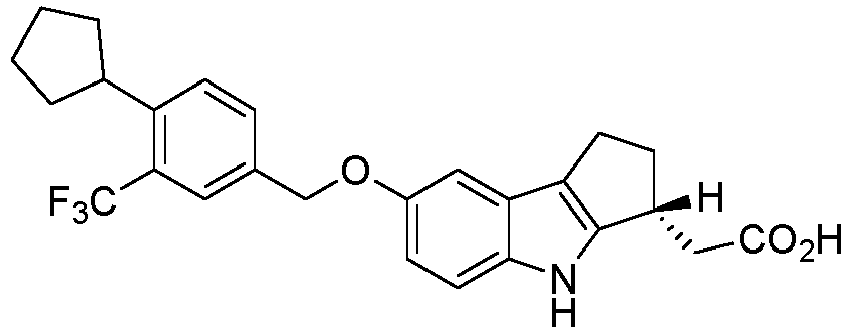
PCT/US2009/004265 .Compound 1, or a pharmaceutically acceptable salt, solvate, or hydrate thereof, is an investigational drug candidate intended for the treatment of sphingosine 1-phosphate subtype 1 (S1P1) receptor-associated disorders. - Many S1P1 agonists cause side effects, and particularly cardiovascular related adverse events, that require that doctors titrate patients slowly to a maintenance dose. This titration period can take weeks or even a month. The complexity and length of the titration regimen may result in prematurely discontinuing therapy by patients prior to reaching the maintenance dose or to doctors preferring other therapeutic options.
- There exists a need for effectively treating individuals who are in need of treatment with Compound 1, or a pharmaceutically acceptable salt, solvate, or hydrate thereof. The present disclosure satisfies this need and provides related advantages as well.
-
WO-2016/112075 discloses a method of treatment of a sphingosine 1-phosphate subtype 1 (S1P1) receptor-associated disorder comprising prescribing and/or administering to an individual in need thereof a standard dose of (R)-2-(7-(4-cyclopentyl-3-(trifluoromethyl)benzyloxy)-1,2,3,4-tetrahydrocyclopenta[b]indol-3-yl)acetic acid (Compound 1), or a pharmaceutically acceptable salt, hydrate, or solvate thereof, in an amount equivalent to about 1.5 to about 2.5 mg ofCompound 1. - Citation of any reference throughout this application is not to be construed as an admission that such reference is prior art to the present application.
- Provided is (R)-2-(7-(4-cyclopentyl-3-(trifluoromethyl)benzyloxy)-1,2,3,4-tetrahydrocyclopenta[b]indol-3-yl)acetic acid (Compound 1), or a pharmaceutically acceptable salt, hydrate, or solvate thereof for use in a method of treating an individual with a sphingosine 1-phosphate subtype 1 (S1P1) receptor-associated disorder, wherein the sphingosine 1-phosphate subtype 1 (S1P1) receptor-associated disorder is selected from: an autoimmune disease or disorder, an inflammatory disease or disorder, ankylosing spondylitis, biliary cirrhosis, cancer, psoriasis, psoriatic arthritis, rheumatoid arthritis, Crohn's disease, transplant rejection, multiple sclerosis, systemic lupus erythematosus, inflammatory bowel disease, ulcerative colitis, type I diabetes, hypertensive nephropathy, glomerulosclerosis, myocardial ischemia-reperfusion injury and acne; wherein the method comprises: administering to the individual in need thereof a pharmaceutical dosage form comprising a therapeutically effective amount of (R)-2-(7-(4-cyclopentyl-3-(trifluoromethyl)benzyloxy)-1,2,3,4-tetrahydrocyclopenta[b]indol-3-yl)acetic acid (Compound 1), or a pharmaceutically acceptable salt, hydrate, or solvate thereof, wherein: the dosage form is administered under fed conditions; the therapeutically effective amount is equivalent to 0.5 to 5.0 mg of
Compound 1; and the pharmaceutical dosage form has a mean fed/fasted ratio of the area under the plasma concentration versus time curve of from about 0.8 to about 1.25 and a mean fed/fasted ratio of the maximum plasma concentration (Cmax) from about 0.8 to about 1.25. - Further embodiments of the invention are defined in the appended claims.
- The invention is defined by the claims. Any subject-matter falling outside the scope of the claims is provided for information purposes only.
- The references to the methods of treatment by therapy in this description are to be interpreted as references to compounds, pharmaceutical compositions and medicaments of the present invention for use in those methods.
- Figure 1 shows the mean plasma concentration-time profiles for the tablet formulation of
Compound 1 administered under fed versus fasted conditions. - As used in the present specification, the following words and phrases are generally intended to have the meanings as set forth below, except to the extent that the context in which they are used indicates otherwise.
- COMPOUND 1: As used herein, "
Compound 1" means (R)-2-(7-(4-cyclopentyl-3-(trifluoromethyl)benzyloxy)-1,2,3,4-tetrahydrocyclopenta[b]indol-3-yl)acetic acid including crystalline forms thereof. As a non-limiting example,Compound 1 may be present as an anhydrous, non-solvated crystalline form as described inWO 2010/011316 . As another non-limiting example, an L-arginine salt ofCompound 1 may be present as an anhydrous, non-solvated crystalline form as described inWO 2010/011316 andWO 2011/094008 . As another non-limiting example, a calcium salt ofCompound 1 may be present as a crystalline form as described inWO 2010/011316 . - ADMINISTERING: As used herein, "administering" means to provide a compound or other therapy, remedy, or treatment such that an individual internalizes a compound.
- CO-ADMINISTER: As used herein, "co-administer" and "co-administration" and variants thereof mean the administration of at least two drugs to a patient either subsequently, simultaneously, or consequently proximate in time to one another (e.g., within the same day, or week or period of 30 days, or sufficiently proximate that each of the at least two drugs can be simultaneously detected in the blood plasma). When co-administered, two or more active agents can be co-formulated as part of the same composition or administered as separate formulations. This also may be referred to herein as "concomitant" administration or variants thereof.
- PRESCRIBING: As used herein, "prescribing" means to order, authorize, or recommend the use of a drug or other therapy, remedy, or treatment. In some embodiments, a health care practitioner can orally advise, recommend, or authorize the use of a compound, dosage regimen or other treatment to an individual. In this case the health care practitioner may or may not provide a prescription for the compound, dosage regimen, or treatment. Further, the health care practitioner may or may not provide the recommended compound or treatment. For example, the health care practitioner can advise the individual where to obtain the compound without providing the compound. In some embodiments, a health care practitioner can provide a prescription for the compound, dosage regimen, or treatment to the individual. For example, a health care practitioner can give a written or oral prescription to an individual. A prescription can be written on paper or on electronic media such as a computer file, for example, on a handheld computer device. For example, a health care practitioner can transform a piece of paper or electronic media with a prescription for a compound, dosage regimen, or treatment. In addition, a prescription can be called in (oral), faxed in (written), or submitted electronically via the internet to a pharmacy or a dispensary. In some embodiments, a sample of the compound or treatment can be given to the individual. As used herein, giving a sample of a compound constitutes an implicit prescription for the compound. Different health care systems around the world use different methods for prescribing and/or administering compounds or treatments and these methods are encompassed by the disclosure.
- A prescription can include, for example, an individual's name and/or identifying information such as date of birth. In addition, for example, a prescription can include: the medication name, medication strength, dose, frequency of administration, route of administration, number or amount to be dispensed, number of refills, physician name, physician signature, and the like. Further, for example, a prescription can include a DEA number and/or state number.
- A healthcare practitioner can include, for example, a physician, nurse, nurse practitioner, or other related health care professional who can prescribe or administer compounds (drugs) for the treatment of a sphingosine 1-phosphate subtype 1 (S1P1) receptor-associated disorder. In addition, a healthcare practitioner can include anyone who can recommend, prescribe, administer, or prevent an individual from receiving a compound or drug including, for example, an insurance provider.
- PREVENT, PREVENTING, OR PREVENTION: As used herein, the term "prevent," "preventing", or "prevention" such as prevention of a sphingosine 1-phosphate subtype 1 (S1P1) receptor-associated disorder or the occurrence or onset of one or more symptoms associated with the particular disorder and does not necessarily mean the complete prevention of the disorder. For example, the term "prevent," "preventing" and "prevention" means the administration of therapy on a prophylactic or preventative basis to an individual who may ultimately manifest at least one symptom of a disease or condition but who has not yet done so. Such individuals can be identified on the basis of risk factors that are known to correlate with the subsequent occurrence of the disease. Alternatively, prevention therapy can be administered without prior identification of a risk factor, as a prophylactic measure. Delaying the onset of at least one symptom can also be considered prevention or prophylaxis.
- TREAT, TREATING, OR TREATMENT: As used herein the term "treat," "treating", or "treatment" means the administration of therapy to an individual who already manifests at least one symptom of a disease or condition or who has previously manifested at least one symptom of a disease or condition. For example, "treating" can include alleviating, abating or ameliorating a disease or condition symptoms, preventing additional symptoms, ameliorating the underlying metabolic causes of symptoms, inhibiting the disease or condition, e.g., arresting the development of the disease or condition, relieving the disease or condition, causing regression of the disease or condition, relieving a condition caused by the disease or condition, or stopping the symptoms of the disease or condition. For example, the term "treating" in reference to a disorder means a reduction in severity of one or more symptoms associated with that particular disorder. Therefore, treating a disorder does not necessarily mean a reduction in severity of all symptoms associated with a disorder and does not necessarily mean a complete reduction in the severity of one or more symptoms associated with a disorder.
- TOLERATE: As used herein, an individual is said to "tolerate" a dose of a compound if administration of that dose to that individual does not result in an unacceptable adverse event or an unacceptable combination of adverse events. One of skill in the art will appreciate that tolerance is a subjective measure and that what may be tolerable to one individual may not be tolerable to a different individual. For example, one individual may not be able to tolerate headache, whereas a second individual may find headache tolerable but is not able to tolerate vomiting, whereas for a third individual, either headache alone or vomiting alone is tolerable, but the individual is not able to tolerate the combination of headache and vomiting, even if the severity of each is less than when experienced alone.
- ADVERSE EVENT: As used herein, an "adverse event" is an untoward medical occurrence that is associated with treatment with Compound 1 or a pharmaceutically acceptable salt, solvate, or hydrate thereof. In one embodiment, an adverse event is selected from: leukopenia, constipation, diarrhea, nausea, abdominal pain, neutropenia, vomiting, back pain, and menstrual disorder. In one embodiment, an adverse event is heart block, for example, a first-degree atrioventricular heart block. In one embodiment, an adverse event is an acute heart rate reduction. In one embodiment, an adverse event is an abnormal pulmonary function test finding, such as an FEV1 below 80%, FVC. In one embodiment, an adverse event is an abnormal liver function test, such as an elevated ALT & AST>2X ULN. In one embodiment, an adverse event is macular edema.
- IN NEED OF TREATMENT and IN NEED THEREOF: As used herein, "in need of treatment" and "in need thereof' when referring to treatment are used interchangeably to mean a judgment made by a caregiver (e.g. physician, nurse, nurse practitioner, etc. in the case of humans; veterinarian in the case of animals, including non-human mammals) that an individual or animal requires or will benefit from treatment. This judgment is made based on a variety of factors that are in the realm of a caregiver's expertise, but that includes the knowledge that the individual or animal is ill, or will become ill, as the result of a disease, condition or disorder that is treatable by the compounds of the invention. Accordingly, the compounds of the invention can be used in a protective or preventive manner; or compounds of the invention can be used to alleviate, inhibit or ameliorate the disease, condition or disorder.
- INDIVIDUAL: As used herein, "individual" means any animal, including mammals, preferably mice, rats, other rodents, rabbits, dogs, cats, swine, cattle, sheep, horses, or primates and most preferably humans. In some embodiments, a human individual is referred to a "patient."
- ACUTE HEART RATE REDUCTION: As used herein, "acute heart rate reduction" means a heart rate decrease from normal sinus rhythm of, for example, 10 or more beats per minute (bpm), such as less than about 5 bpm, e.g., less than about 4 bpm or less than about 3 bpm or less than 2 bpm, that is maximal within a few hours, for example 1-3 hours, after drug administration, and thereafter the heart rate returns towards the pre-dose value.
- NORMAL SINUS RHYTHM: As used herein, "normal sinus rhythm" means the sinus rhythm of the individual when not undergoing treatment. The evaluation of normal sinus rhythm is within the ability of a physician. A normal sinus rhythm will generally give rise to a heart rate in the range from 60-100 bpm.
- DOSE: As used herein, "dose" means a quantity of
Compound 1, or a pharmaceutically acceptable salt, solvate, or hydrate thereof, given to the individual for treating or preventing the disease or disorder at one specific time. - STANDARD DOSE: As used herein, "standard dose" means the dose of
Compound 1, or a pharmaceutically acceptable salt, solvate, or hydrate thereof, that is given to the individual for treating or preventing the disease or disorder. In some embodiments, administration of the standard dose achieves a target reduction in peripheral blood lymphocyte counts, e.g., a reduction in baseline of at least 35%, such as at least 40%, such as at least 45%, such as at least 50%, such as at least 55%, such as at least 60%, such as at least 65%, such as at least 70%. In some embodiments, administration of the standard dose achieves a reduction in baseline of about 35% to about 70%, such as about 40% to about 65%, such as about 50% to about 65%. In some embodiments, administration of the standard dose achieves target peripheral blood lymphocyte counts, e.g., less than 1000 lymphocytes per microliter, such as 400-800 lymphocytes per microliter. The target dose may vary depending on the nature and severity of the disease to be treated. - THERAPEUTICALLY EFFECTIVE AMOUNT: As used herein, "therapeutically effective amount" of an agent, compound, drug, composition or combination is an amount which is nontoxic and effective for producing some desired therapeutic effect upon administration to a subject or patient (e.g., a human subject or patient). The precise therapeutically effective amount for a subject may depend upon, e.g., the subject's size and health, the nature and extent of the condition, the therapeutics or combination of therapeutics selected for administration, and other variables known to those of skill in the art. The effective amount for a given situation is determined by routine experimentation and is within the judgment of the clinician. In some embodiments, the therapeutically effective amount is the standard dose.
- FASTED INDIVIDUAL: As used herein, "fasted individual" means an individual who has not eaten any food, i.e., has fasted for at least 6-8 hours, such as about 8 hours, before the administration of
Compound 1, or a pharmaceutically acceptable salt, hydrate, or solvate thereof, and who does not eat any food and continues to fast for at least 1 hour after the administration ofCompound 1, or a pharmaceutically acceptable salt, hydrate, or solvate thereof. In certain embodiments, the individual may also refrain from ingesting certain non-food substances during the fasting period. For example, in certain embodiments the individual does not ingest any supplements and/or drugs during the fasting period. In certain embodiments, the individual does not ingest any high calorie liquids during the fasting period. In certain embodiments, the individual does not ingest any liquids other than water during the fasting period. In certain embodiments, the individual may ingest small amounts of low-calorie beverages, such as tea, coffee, or diluted juices. - MAYO CLINIC SCORE (MCS): As used herein, "Mayo Clinic Score" or "MCS" means an instrument designed to measure disease activity of ulcerative colitis and consists of up to 4 subscores: stool frequency, rectal bleeding, findings of flexible proctosigmoidoscopy, and physician global assessment with each component ranging from 0 to 3 (0=normal, 1=mild, 2=moderate, 3=severe). Total score therefore ranges from 0 to 12, with a higher score indicating more severe disease. The 6-point Mayo score is based on stool frequency and rectal bleeding PROs collected daily using electronic patient diaries and excludes the findings on endoscopy and the physician's global assessment. The 3-point Mayo score is based on stool frequency, rectal bleeding, and findings on endoscopy and has a total score ranging from 0 to 9. The 2-point Mayo score is based on rectal bleeding and findings on endoscopy and has a total score ranging from 0 to 6. The physician's global assessment acknowledges the three other criteria findings of the MCS, the individual's daily record of abdominal discomfort and general sense of well-being, and other observations, such as physical findings and the individual's performance.
- MILDLY TO MODERATELY ACTIVE ULCERATIVE COLITIS: As used herein, "mildly to moderately active ulcerative colitis" means ulcerative colitis characterized by a 4-component MCS of 4 to 10.
- MODERATELY TO SEVERELY ACTIVE ULCERATIVE COLITIS: As used herein, "moderately to severely active ulcerative colitis" means ulcerative colitis characterized by a 3-component MCS of 4 to 9 including an endoscopic subscore of ≥ 2 and a rectal bleeding score of ≥ 1. The 3-component MCS uses 3 of the 4 components of the complete MCS (endoscopic findings, rectal bleeding, and stool frequency).
- CLINICAL REMISSION: As used herein, "clinical remission" with respect to ulcerative colitis means a 3-component Mayo Clinic score as follows: an endoscopy score (using flexible proctosigmoidoscopy) of 0 or 1, a rectal bleeding score of 0, and a stool frequency score of 0 or 1 with a decrease of ≥ 1 point from baseline subscore.
- CLINICAL RESPONSE: As used herein, "clinical response" with respect to ulcerative colitis means a reduction in the 3-component Mayo Clinic score of ≥ 2 points and a decrease of ≥ 30% from baseline with an accompanying decrease in rectal bleeding subscore of ≥ 1 or absolute rectal bleeding score of 0 or 1.
- ENDOSCOPIC IMPROVEMENT: As used herein, "endoscopic improvement" with respect to ulcerative colitis means ulcerative colitis characterized by a Mayo endoscopic subscore (using findings of flexible proctosigmoidoscopy) of ≤ 1 point.
- ENDOSCOPIC REMISSION: As used herein, "endoscopic remission" with respect to ulcerative colitis means ulcerative colitis characterized by findings from flexible proctosigmoidoscopy subscore of the Mayo Clinic score = 0.
- IMPROVEMENT IN RECTAL BLEEDING: As used herein, "improvement in rectal bleeding" with respect to ulcerative colitis means a change from baseline < 0.
- HISTOLOGIC HEALING / HISTOLOGIC IMPROVEMENT: As used herein, "histologic healing," "histological healing," "histologic improvement," or "histological improvement" with respect to ulcerative colitis means a score of < 3.1 on the Geboes Index.
- HISTOLOGIC REMISSION: As used herein, "histologic remission" or "histological remission" with respect to ulcerative colitis means a score of < 2.0 on the Geboes Index.
- MUCOSAL HEALING: As used herein, "mucosal healing" is both endoscopic improvement and histological remission.
- IMPROVEMENT IN STOOL FREQUENCY: As used herein, "improvement in stool frequency" with respect to ulcerative colitis means a change from baseline < 0.
- 5-AMINOSALICYLATES: As used herein, "5-aminosalicylates", means a class of drugs that include, for example, CANASA® (mesalamine), COLAZAL® (balsalazide disodium), ASACOL® (mesalamine), DELZICOL® (mesalamine), and DIPENTUM® (olsalazine).
- IMMUNOSUPPRESSIVES: As used herein, "immunosuppressives", means a class of drugs that include, for example, AZASAN® (azathioprine), IMURAN® (azathioprine), GENGRAF® (cyclosporine), NEORAL® (cyclosporine), and SANDIMMUNE® (cyclosporine).
- GLUCOCORTICOSTEROIDS: As used herein, "glucocorticosteroids", means a class of drugs that include, for example, UCERIS® (budesonide); DELTASONE® (prednisone), MEDROL® (methylprednisolone), and hydrocortisone.
- TNFα ANTAGONISTS: As used herein, "TNFα antagonists" or "tumor necrosis factor-a antagonists", means a class of drugs that include, for example, SIMPONI® (golimumab), REMICADE® (infliximab), HUMIRA® (adalimumab), and CIMZIA® (certolizumab pegol).
- INTEGRIN RECEPTOR ANTAGONISTS: As used herein, "integrin receptor antagonists", means a class of drugs that include, for example, ENTYVIO® (vedolizumab).
- PHARMACEUTICAL COMPOSITION: As used here, "pharmaceutical composition" means a composition comprising at least one active ingredient, such as
Compound 1; including but not limited to, salts, solvates, and hydrates ofCompound 1, whereby the composition is amenable to investigation for a specified, efficacious outcome in a mammal (for example, without limitation, a human). Those of ordinary skill in the art will understand and appreciate the techniques appropriate for determining whether an active ingredient has a desired efficacious outcome based upon the needs of the artisan. - AGONIST: As used herein, "agonist" means a moiety that interacts with and activates a G-protein-coupled receptor, such as the S1P1 receptor, such as can thereby initiate a physiological or pharmacological response characteristic of that receptor. For example, an agonist activates an intracellular response upon binding to the receptor or enhances GTP binding to a membrane. In certain embodiments, an agonist of the invention is an S1P1 receptor agonist that is capable of facilitating sustained S1P1 receptor internalization (see e.g., Matloubian et al., Nature, 427, 355, 2004).
- ANTAGONIST: As used herein, "antagonist" means a moiety that competitively binds to the receptor at the same site as an agonist (for example, the endogenous ligand), but which does not activate the intracellular response initiated by the active form of the receptor and can thereby inhibit the intracellular responses by an agonist or partial agonist. An antagonist does not diminish the baseline intracellular response in the absence of an agonist or partial agonist.
- INVERSE AGONIST: As used herein, "inverse agonist" means a moiety that binds to the endogenous form of the receptor or to the constitutively activated form of the receptor and which inhibits the baseline intracellular response initiated by the active form of the receptor below the normal base level of activity which is observed in the absence of an agonist or partial agonist, or decreases GTP binding to a membrane. In some embodiments, the baseline intracellular response is inhibited in the presence of the inverse agonist by at least 30%. In some embodiments, the baseline intracellular response is inhibited in the presence of the inverse agonist by at least 50%. In some embodiments, the baseline intracellular response is inhibited in the presence of the inverse agonist by at least 75%, as compared with the baseline response in the absence of the inverse agonist.
- HYDRATE: As used herein, "hydrate" means a compound of the invention or a salt thereof, that further includes a stoichiometric or non-stoichiometric amount of water bound by non-covalent intermolecular forces.
- SAFETY POPULATION: As used herein, "safety population" means all randomized subjects who received study medication.
- SOLVATE: As used herein, "solvate" means a compound of the invention or a salt, thereof, that further includes a stoichiometric or non-stoichiometric amount of a solvent bound by non-covalent intermolecular forces. Preferred solvents are volatile, non-toxic, and/or acceptable for administration to humans in trace amounts.
- The compounds according to the invention may optionally exist as pharmaceutically acceptable salts including pharmaceutically acceptable acid addition salts prepared from pharmaceutically acceptable non-toxic acids including inorganic and organic acids. Representative acids include, but are not limited to, acetic, benzenesulfonic, benzoic, camphorsulfonic, citric, ethenesulfonic, dichloroacetic, formic, fumaric, gluconic, glutamic, hippuric, hydrobromic, hydrochloric, isethionic, lactic, maleic, malic, mandelic, methanesulfonic, mucic, nitric, oxalic, pamoic, pantothenic, phosphoric, succinic, sulfiric, tartaric, oxalic, p-toluenesulfonic and the like, such as those pharmaceutically acceptable salts listed by Berge et al., Journal of Pharmaceutical Sciences, 66:1-19 (1977).
- The acid addition salts may be obtained as the direct products of compound synthesis. In the alternative, the free base may be dissolved in a suitable solvent containing the appropriate acid and the salt isolated by evaporating the solvent or otherwise separating the salt and solvent. The compounds of this invention may form solvates with standard low molecular weight solvents using methods known to the skilled artisan.
- It is understood that when the phrase "pharmaceutically acceptable salts, solvates and hydrates" or the phrase "pharmaceutically acceptable salt, solvate, or hydrate" is used when referring to
Compound 1, it embraces pharmaceutically acceptable solvates and/or hydrates ofCompound 1, pharmaceutically acceptable salts ofCompound 1, as well as pharmaceutically acceptable solvates and/or hydrates of pharmaceutically acceptable salts ofCompound 1. It is also understood that when the phrase "pharmaceutically acceptable solvates and hydrates" or the phrase "pharmaceutically acceptable solvate or hydrate" is used when referring to Compound 1that are salts, it embraces pharmaceutically acceptable solvates and/or hydrates of such salts. - It will be apparent to those skilled in the art that the dosage forms described herein may comprise, as the active component, either
Compound 1 or a pharmaceutically acceptable salt or as a solvate or hydrate thereof. Moreover, various hydrates and solvates ofCompound 1 and their salts will find use as intermediates in the manufacture of pharmaceutical compositions. Typical procedures for making and identifying suitable hydrates and solvates, outside those mentioned herein, are well known to those in the art; see for example, pages 202-209 of K.J. Guillory, "Generation of Polymorphs, Hydrates, Solvates, and Amorphous Solids," in: Polymorphism in Pharmaceutical Solids, ed. Harry G. Britain, Vol. 95, Marcel Dekker, Inc., New York, 1999. Accordingly, one aspect of the present disclosure pertains to methods of prescribing and/or administering hydrates and solvates ofCompound 1 and/or its pharmaceutical acceptable salts, that can be isolated and characterized by methods known in the art, such as, thermogravimetric analysis (TGA), TGA-mass spectroscopy, TGA-Infrared spectroscopy, powder X-ray diffraction (XRPD), Karl Fisher titration, high resolution X-ray diffraction, and the like. There are several commercial entities that provide quick and efficient services for identifying solvates and hydrates on a routine basis. Example companies offering these services include Wilmington PharmaTech (Wilmington, DE), Avantium Technologies (Amsterdam) and Aptuit (Greenwich, CT). - The present disclosure includes all isotopes of atoms occurring in the present compounds, salts, solvates, and hydrates. Isotopes include those atoms having the same atomic number but different mass numbers. One aspect of the present invention includes every combination of one or more atoms in the present compounds, salts, solvates, and hydrates that is replaced with an atom having the same atomic number but a different mass number. One such example is the replacement of an atom that is the most naturally abundant isotope, such as 1H or 12C, found in one the present compounds, salts, solvates, and hydrates, with a different atom that is not the most naturally abundant isotope, such as 2H or 3H (replacing 1H), or 11C, 13C, or 14C (replacing 12C). When such a replacement has taken place, it is commonly referred to as being isotopically labeled. Isotopic-labeling of the present compounds, salts, solvates, and hydrates can be accomplished using any one of a variety of different synthetic methods know to those of ordinary skill in the art and they are readily credited with understanding the synthetic methods and available reagents needed to conduct such isotopic-labeling. By way of general example, and without limitation, isotopes of hydrogen include 2H (deuterium) and 3H (tritium). Isotopes of carbon include 11C, 13C, and 14C. Isotopes of nitrogen include 13N and 15N. Isotopes of oxygen include 15O, 17O, and 18O. An isotope of fluorine includes 18F. An isotope of sulfur includes 35S. An isotope of chlorine includes 36Cl. Isotopes of bromine include 75Br, 76Br, 77Br, and 82Br. Isotopes of iodine include 123I, 124I, 125I, and 131I. Another aspect of the present invention includes compositions, such as, those prepared during synthesis, preformulation, and the like, and pharmaceutical compositions, such as, those prepared with the intent of using in a mammal for the treatment of one or more of the disorders described herein, comprising one or more of the present compounds, salts, solvates, and hydrates, wherein the naturally occurring distribution of the isotopes in the composition is perturbed. Another aspect of the present invention includes compositions and pharmaceutical compositions comprising the compounds, salts, solvates, and hydrates, as described herein wherein the salt is enriched at one or more positions with an isotope other than the most naturally abundant isotope. Methods are readily available to measure such isotope perturbations or enrichments, such as, mass spectrometry, and for isotopes that are radio-isotopes additional methods are available, such as, radio-detectors used in connection with HPLC or GC.
- AUC: As used herein, "AUC" refers to the area under the curve, or the integral, of the plasma concentration of an active pharmaceutical ingredient or metabolite over time following a dosing event.
- AUC 0- t: As used herein "AUC0-t" is the integral under the plasma concentration curve from time 0 (dosing) to time "t".
- AUC0-∞ : As used herein, "AUC0-∞" is the AUC from time 0 (dosing) to time infinity. Unless otherwise stated, AUC refers to AUC0-∞.
- Cmax: As used herein, Cmax (or Cmax) is a pharmacokinetic parameter denoting the maximum observed blood plasma concentration following delivery of an active pharmaceutical ingredient. Cmax occurs at the time of maximum plasma concentration, tmax.
- tmax : As used herein, "tmax" is a pharmacokinetic parameter denoting the time to maximum blood plasma concentration following delivery of an active pharmaceutical ingredient
t1/2 : As used herein, "t1/2" or "plasma half-life" or "elimination half-life" or the like is a pharmacokinetic parameter denoting the apparent plasma terminal phase half-life, i.e., the time, after absorption and distribution of a drug is complete, for the plasma concentration to fall by half. - As used herein, "a substance having a narrow therapeutic index" means a substance falling within any definition of narrow therapeutic index as promulgated by the U.S. Food and Drug Administration or any successor agency thereof, for example, a substance having a less than 2-fold difference in median lethal dose (LD50) and median effective dose (ED50) values or having a less than 2-fold difference in the minimum toxic concentration and minimum effective concentration in the blood; and for which safe and effective use of the substance requires careful titration and patient monitoring.
- As used herein, a substance is a "substrate" of enzyme activity when it can be chemically transformed by action of the enzyme on the substance. "Enzyme activity" refers broadly to the specific activity of the enzyme (i.e., the rate at which the enzyme transforms a substrate per mg or mole of enzyme) as well as the metabolic effect of such transformations. Thus, a substance is an "inhibitor" of enzyme activity when the specific activity or the metabolic effect of the specific activity of the enzyme can be decreased by the presence of the substance, without reference to the precise mechanism of such decrease. For example, a substance can be an inhibitor of enzyme activity by competitive, non-competitive, allosteric or other type of enzyme inhibition, by decreasing expression of the enzyme, or other direct or indirect mechanisms. Similarly, a substance is an "inducer" of enzyme activity when the specific activity or the metabolic effect of the specific activity of the enzyme can be increased by the presence of the substance, without reference to the precise mechanism of such increase. For example, a substance can be an inducer of enzyme activity by increasing reaction rate, by increasing expression of the enzyme, by allosteric activation or other direct or indirect mechanisms. Any of these effects on enzyme activity can occur at a given concentration of active agent in a single sample, donor, or patient without regard to clinical significance. It is possible for a substance to be a substrate, inhibitor, or inducer of an enzyme activity. For example, the substance can be an inhibitor of enzyme activity by one mechanism and an inducer of enzyme activity by another mechanism. The function (substrate, inhibitor, or inducer) of the substance with respect to activity of an enzyme can depend on environmental conditions. Lists of inhibitors, inducers and substrates for CYP3A4 can be found, for instance, at
http://www.genemedrx.com/Cytochrome_P450_Metabolism_Table.php, and other sites. - When an integer is used in a method disclosed herein, the term "about" can be inserted before the integer.
- Throughout this specification, unless the context requires otherwise, the word "comprise", or variations such as "comprises" or "comprising" will be understood to imply the inclusion of a stated step or element or integer or group of steps or elements or integers but not the exclusion of any other step or element or integer or group of elements or integers.
- Throughout this specification, unless specifically stated otherwise or the context requires otherwise, reference to a single step, composition of matter, group of steps, or group of compositions of matter shall be taken to encompass one and a plurality (i.e. one or more) of those steps, compositions of matter, groups of steps, or groups of compositions of matter.
- Provided herein are methods of
co-administering Compound 1 with another drug. Also provided herein are methods of reducing the dosage ofCompound 1 when co-administered with another drug. Also provided herein are methods of reducing the dosage of another drug when co-administered withCompound 1. Also provided herein are methods of discontinuing the administration ofCompound 1 when an individual is administered another drug. Also provided herein are methods of discontinuing the administration of another drug when an individual is administeredCompound 1. Also provided herein are methods of continuing the administration ofCompound 1 when an individual is administered another drug. Also provided herein are methods of continuing the administration of another drug when an individual is administeredCompound 1. Also provided herein are methods of monitoring an individual who isco-administered Compound 1 and another drug. Also provided herein are methods of titrating the dosage ofCompound 1 when co-administered with another drug. Also provided herein are methods of titrating the dosage of another drug when co-administered withCompound 1. Also provided herein are methods that entail combinations of the foregoing methods. - In some embodiments, the method is non-gender specific.
- In some embodiments, the individual is also being administered one or more agents independently chosen from oral corticosteroids and aminosalicylates.
- In some embodiments, the individual is not being administered one or more agents independently chosen from natalizumab, efalizumab, and rituximab. In some embodiments, the administration of
Compound 1 is not initiated if the individual is being administered one or more agents independently chosen from natalizumab, efalizumab, and rituximab. In some embodiments, the administration ofCompound 1 is discontinued if the individual is being administered one or more agents independently chosen from natalizumab, efalizumab, and rituximab. In some embodiments, the dose ofCompound 1 is reduced if the individual is being administered one or more agents independently chosen from natalizumab, efalizumab, and rituximab. In some embodiments, the individual has not been administered a biologic agent. In some embodiments, the individual has not been administered two or more biologic agents. In some embodiments, the individual has not been administered three or more biologic agents. In some embodiments, the individual is not being administered a biologic agent. In some embodiments, the individual is not being administered two or more biologic agents. In some embodiments, the individual is not being administered three or more biologic agents. - In some embodiments, the standard dose is administered without titration; and the individual does not experience a severe related adverse event.
- In some embodiments,
Compound 1 is not administered to the individual 1 if the individual has an active infection. In some embodiments, the active infection is a serious active infection. In some embodiments, the method further comprises monitoring the individual for an active infection. In some embodiments, the method further comprises discontinuing administration if the individual develops an active infection. - In some embodiments, the method further comprises monitoring for adverse events during the administration of
Compound 1, or a pharmaceutically acceptable salt, hydrate, or solvate thereof, and optionally, interrupting or terminating the administration ofCompound 1, or a pharmaceutically acceptable salt, hydrate, or solvate thereof. - In some embodiments, the treatment further comprises monitoring heart rate during the administration, monitoring pulmonary function during the administration, or monitoring liver function during the administration.
- In some embodiments, the treatment further comprises monitoring heart rate during the administration.
- In some embodiments, the treatment further comprises monitoring pulmonary function during the administration.
- In some embodiments, the treatment further comprises monitoring liver function during the administration.
- In some embodiments, the method reduces the incidence and severity of adverse events resulting from the treatment of the sphingosine 1-phosphate subtype 1 (S1P1) receptor-associated disorder.
- In some embodiments, the adverse event is a serious adverse event.
- In some embodiments, the serious adverse event is selected from leukopenia, constipation, diarrhea, nausea, abdominal pain, neutropenia, vomiting, back pain, and menstrual disorder.
- In some embodiments, the method results in no serious adverse events.
- In some embodiments, the standard dose is administered without substantially inducing an acute heart rate reduction or heart block in the individual.
- In some embodiments,
Compound 1 is administered without causing a reduction of more than 6 bpm in heart rate. - In some embodiments,
Compound 1 is administered without a first-dose effect on heart rate as seen with other S 1P receptor modulators. In some embodiments,Compound 1 is administered without a first-dose effect on AV conduction as seen with other S1P receptor modulators. - In some embodiments, the individual was previously administered at least one agent selected from: a TNF antagonist, an integrin antagonist, and an immunosuppressive agent.
- In some embodiments, the individual had an inadequate response with, lost response to, or was intolerant to the at least one agent.
- In some embodiments, the individual had demonstrated, over the previous 3-month period, an inadequate response to, loss of response to, or intolerance of at least one agent selected from oral 5-aminosalicylates, corticosteroids, immunosuppressives, TNFα antagonists, and integrin antagonists. In some embodiments, the individual had demonstrated, over the previous 6-month period, an inadequate response to, loss of response to, or intolerance of at least one agent selected from oral 5-aminosalicylates, corticosteroids, immunosuppressives, TNFα antagonists, and integrin antagonists. In some embodiments, the individual had demonstrated, over the previous 9-month period, an inadequate response to, loss of response to, or intolerance of at least one agent selected from oral 5-aminosalicylates, corticosteroids, immunosuppressives, TNFα antagonists, and integrin antagonists. In some embodiments, the individual had demonstrated, over the previous 1-year period, an inadequate response to, loss of response to, or intolerance of at least one agent selected from oral 5-aminosalicylates, corticosteroids, immunosuppressives, TNFα antagonists, and integrin antagonists. In some embodiments, the individual had demonstrated, over the previous 2-year period, an inadequate response to, loss of response to, or intolerance of at least one agent selected from oral 5-aminosalicylates, corticosteroids, immunosuppressives, TNFα antagonists, and integrin antagonists. In some embodiments, the individual had demonstrated, over the previous 3-year period, an inadequate response to, loss of response to, or intolerance of at least one agent selected from oral 5-aminosalicylates, corticosteroids, immunosuppressives, TNFα antagonists, and integrin antagonists. In some embodiments, the individual had demonstrated, over the previous 4-year period, an inadequate response to, loss of response to, or intolerance of at least one agent selected from oral 5-aminosalicylates, corticosteroids, immunosuppressives, TNFα antagonists, and integrin antagonists. In some embodiments, the individual had demonstrated, over the previous 5-year period, an inadequate response to, loss of response to, or intolerance of at least one agent selected from oral 5-aminosalicylates, corticosteroids, immunosuppressives, TNFα antagonists, and integrin antagonists.
- In some embodiments, the standard dose is administered without titration.
- In some embodiments, treating comprises inducing and/or maintaining clinical response; improving endoscopic appearance of the mucosa; and/or inducing and/or maintaining clinical remission.
- In some embodiments, treating comprises inducing and/or maintaining histologic improvement.
- In some embodiments, treating comprises inducing and/or maintaining histologic remission.
- In some embodiments, treating comprises inducing and/or maintaining mucosal healing.
- In some embodiments, prior to the administering the individual has a 3-component Mayo Clinic Score of at least 6.
- In some embodiments, the method results in an improvement of the individual's 3-component Mayo Clinic Score. In some embodiments, the method results in an improvement of the individual's 2-component Mayo Clinic Score. In some embodiments, the method results in an improvement of the individual's Total Mayo Clinic Score.
- In some embodiments of the method of treatment of inflammatory bowel disease, e.g., ulcerative colitis, such as moderately to severely active ulcerative colitis, the treatment results in endoscopic improvement, e.g., improving endoscopic appearance of the mucosa.
- In some embodiments of the method of treatment of inflammatory bowel disease, e.g., ulcerative colitis, such as moderately to severely active ulcerative colitis, the treatment results in inducing clinical remission. In some embodiments of the method of treatment of inflammatory bowel disease, e.g., ulcerative colitis, such as moderately to severely active ulcerative colitis, the treatment results in maintaining clinical remission. In some embodiments of the method of treatment of inflammatory bowel disease, e.g., ulcerative colitis, such as moderately to severely active ulcerative colitis, the treatment results in inducing and maintaining clinical remission.
- In some embodiments of the method of treatment of inflammatory bowel disease, e.g., ulcerative colitis, such as moderately to severely active ulcerative colitis, the treatment results in inducing clinical response. In some embodiments of the method of treatment of inflammatory bowel disease, e.g., ulcerative colitis, such as moderately to severely active ulcerative colitis, the treatment results in maintaining clinical response. In some embodiments of the method of treatment of inflammatory bowel disease, e.g., ulcerative colitis, such as moderately to severely active ulcerative colitis, the treatment results in inducing and maintaining clinical response.
- In some embodiments, the treatment reduces a lymphocyte count in the individual by at least 40%. In some embodiments, the treatment reduces a lymphocyte count in the individual by at least 45%, 50%, 55%, 60%, or 65%.
- In some embodiments of the method of treatment of inflammatory bowel disease, e.g., ulcerative colitis, such as moderately to severely active ulcerative colitis, the treatment results in corticosteroid-free remission.
- In some embodiments of the method of treatment of inflammatory bowel disease, e.g., ulcerative colitis, such as moderately to severely active ulcerative colitis, the treatment results in endoscopic remission.
- In some embodiments of the method of treatment of inflammatory bowel disease, e.g., ulcerative colitis, such as moderately to severely active ulcerative colitis, the treatment results in an improvement in rectal bleeding.
- In some embodiments of the method of treatment of inflammatory bowel disease, e.g., ulcerative colitis, such as moderately to severely active ulcerative colitis, the treatment results in histologic healing.
- In some embodiments of the method of treatment of inflammatory bowel disease, e.g., ulcerative colitis, such as moderately to severely active ulcerative colitis, the treatment results in an improvement in stool frequency.
- In some embodiments of the method of treatment of inflammatory bowel disease, e.g., ulcerative colitis, such as moderately to severely active ulcerative colitis, the treatment further comprises monitoring the level of level of fecal calprotectin.
- In some embodiments of the method of treatment of inflammatory bowel disease, e.g., ulcerative colitis, such as moderately to severely active ulcerative colitis, the treatment further comprises monitoring the level of level of c-reactive protein (CRP).
- In some embodiments, treating is reducing a sign and/or symptom of ulcerative colitis. In some embodiments, treating is reducing a sign of ulcerative colitis. In some embodiments, treating is reducing a symptom of ulcerative colitis. In some embodiments, treating is reducing a sign and/or symptom of Crohn's disease. In some embodiments, treating is reducing a sign of Crohn's disease. In some embodiments, treating is reducing a symptom of Crohn's disease.
- In some embodiments, treating is inducing and/or maintaining clinical remission. In some embodiments, treating is inducing and maintaining clinical remission. In some embodiments, treating is inducing and/or maintaining clinical remission and/or clinical response. In some embodiments, treating is inducing and maintaining clinical remission and clinical response. In some embodiments, treating is inducing clinical remission and/or clinical response. In some embodiments, treating is maintaining clinical remission and/or clinical response. In some embodiments, treating is inducing clinical remission and clinical response. In some embodiments, treating is maintaining clinical remission and clinical response. In some embodiments, treating is inducing and/or maintaining clinical remission and/or mucosal healing. In some embodiments, treating is inducing and maintaining clinical remission and mucosal healing. In some embodiments, treating is inducing and maintaining mucosal healing. In some embodiments, treating is inducing and maintaining clinical remission. In some embodiments, treating is inducing clinical remission. In some embodiments, treating is inducing mucosal healing. In some embodiments, treating is maintaining clinical remission. In some embodiments, treating is maintaining mucosal healing. In some embodiments, treating is achieving and/or sustaining clinical remission in induction responders. In some embodiments, treating is achieving and sustaining clinical remission in induction responders. In some embodiments, treating is achieving clinical remission in induction responders. In some embodiments, treating is sustaining clinical remission in induction responders. In some embodiments, treating is inducing and/or maintaining clinical response. In some embodiments, treating is inducing and maintaining clinical response. In some embodiments, treating is inducing clinical response. In some embodiments, treating is maintaining clinical response. In some embodiments, treating is inducing endoscopic improvement. In some embodiments, treating is maintaining endoscopic improvement. In some embodiments, treating is achieved endoscopic improvement. In some embodiments, treating is improving endoscopic remission. In some embodiments, treating is maintaining endoscopic remission. In some embodiments, treating is inducing histologic healing. In some embodiments, treating is maintaining histologic healing. In some embodiments, treating is improving stool frequency. In some embodiments, treating is maintaining improvement in stool frequency. In some embodiments, treating is improving endoscopic appearance of the mucosa. In some embodiments, treating is maintaining endoscopic improvement of the mucosa. In some embodiments, treating is improving endoscopic appearance of the mucosa during induction. In some embodiments, treating eliminates the need for corticosteroid use. In some embodiments, treating allows for reduced corticosteroid use. In some embodiments, treating allows for the use of a lower dose of a corticosteroid. In some embodiments, treating is achieving corticosteroid-free remission. In some embodiments, treating is sustaining corticosteroid-free remission. In some embodiments, treating is improving rectal bleeding. In some embodiments, treating is maintaining improvement in rectal bleeding. In some embodiments, treating is improving endoscopic subscore. In some embodiments, treating is maintaining improvement in endoscopic subscore.
- In some embodiments, ulcerative colitis has been diagnosed using a 2-component Mayo Clinic Score. For example, in some embodiments, ulcerative colitis has been diagnosed using a score ranging from 0 to 9 for rectal bleeding and endoscopic findings. In some embodiments, ulcerative colitis has been diagnosed using a 3-component Mayo Clinic Score. For example, in some embodiments, ulcerative colitis has been diagnosed using a score ranging from 0 to 9 for stool frequency, rectal bleeding, and endoscopic findings. In some embodiments, ulcerative colitis has been diagnosed using a Total Mayo Score. For example, in some embodiments, ulcerative colitis has been diagnosed using a score ranging from 0 to 12 for stool frequency, rectal bleeding, endoscopic findings, and Physicians Global Assessment.
- In some embodiments, improvement in ulcerative colitis is measured using a 2-component Mayo Clinic Score. In some embodiments, improvement in ulcerative colitis is measured using a 3-component Mayo Clinic Score. In some embodiments, improvement in ulcerative colitis is measured using a Total Mayo Score. In some embodiments, improvement in ulcerative colitis is measured by clinical remission. In some embodiments, improvement in ulcerative colitis is measured by lymphocyte reduction. In some embodiments, improvement in ulcerative colitis is measured by endoscopic improvement. In some embodiments, improvement in ulcerative colitis is measured by 6-point Mayo Score. For example, in some embodiments, improvement in ulcerative colitis is measured by stool frequency and rectal bleeding. In some embodiments, improvement in ulcerative colitis is statistically significant.
- In some embodiments,
Compound 1 is not recommended in an individual with active, severe infection. In some embodiments,Compound 1 is not recommended in an individual with an active infection. In some embodiments,Compound 1 is not recommended in an individual with a severe infection. In some embodiments,Compound 1 is not recommended in an individual with an active, severe infection until the infection is controlled. In some embodiments,Compound 1 is not recommended in an individual with an active infection until the infection is controlled. In some embodiments,Compound 1 is not recommended in an individual with a severe infection until the infection is controlled. In some embodiments, administration ofCompound 1 is not started during an active infection. In some embodiments, an individual is monitored for infection. In some embodiments, administration ofCompound 1 is stopped if an individual develops an infection. In some embodiments, administration ofCompound 1 is stopped if infection becomes serious. In some embodiments, administration ofCompound 1 is discontinued if an individual develops an infection. In some embodiments,Compound 1 is not administered to an individual with an infection. In some embodiments,Compound 1 is not administered during an active infection. In some embodiments, administration ofCompound 1 is not started during active infection; an individual is monitored if an infection develops during administration; and administration is stopped if the infection becomes serious. In some embodiments, an infection is mild. In some embodiments, an infection is moderate. In some embodiments, an infection is severe. In some embodiments, an infection is serious. In some embodiments, an infection is a serious adverse event. In some embodiments, an infection is a respiratory infection. - In some embodiments,
Compound 1 is administered without causing a severe adverse event. In some embodiments,Compound 1 is administered without causing a severe adverse event related to heart rate. In some embodiments,Compound 1 is administered without causing a severe adverse event related to heart rate change. In some embodiments,Compound 1 is administered without causing a severe adverse event related to elevated heart rate. In some embodiments,Compound 1 is administered without causing a severe adverse event related to bradycardia. In some embodiments,Compound 1 is administered without causing a severe adverse event related to AV block. In some embodiments,Compound 1 is administered without causing a severe adverse event related to AV conduction. In some embodiments,Compound 1 is administered without causing bradycardia. In some embodiments,Compound 1 is administered without causing AV block. In some embodiments,Compound 1 is administered without causing more than mild decrease in heart rate on first day of treatment (for example, >10 bpm). In some embodiments,Compound 1 is administered without a first-dose effect seen with other S1P receptor modulators. In some embodiments,Compound 1 is administered without a first-dose cardiovascular effect seen with other S1P receptor modulators. In some embodiments,Compound 1 is administered without symptomatic changes in heart rate. In some embodiments,Compound 1 is administered without symptomatic changes in heart rhythm. In some embodiments,Compound 1 is administered without requiring titration to avoid first-dose effect seen with other S1P receptor modulators. - In some embodiments,
Compound 1 is administered without increasing a liver function test (LFT). In some embodiments,Compound 1 is administered without causing an elevated LFT. In some embodiments,Compound 1 is administered without increasing ALT. In some embodiments,Compound 1 is administered without increasing AST. In some embodiments,Compound 1 is administered without increasing ALT >3X ULN. In some embodiments,Compound 1 is administered without increasing ALT >2.5X ULN. In some embodiments,Compound 1 is administered without increasing ALT >2X ULN. In some embodiments,Compound 1 is administered without increasing ALT >1.5X ULN. In some embodiments,Compound 1 is administered without increasing AST >3X ULN. In some embodiments,Compound 1 is administered without increasing AST >2.5X ULN. In some embodiments,Compound 1 is administered without increasing AST >2X ULN. In some embodiments,Compound 1 is administered without increasing AST >1.5X ULN. In some embodiments,Compound 1 is administered without increasing bilirubin. In some embodiments,Compound 1 is administered without increasing bilirubin >3X ULN. In some embodiments,Compound 1 is administered without increasing bilirubin >2.5X ULN. In some embodiments,Compound 1 is administered without increasing bilirubin >2X ULN. In some embodiments,Compound 1 is administered without increasing bilirubin >1.5X ULN. In some embodiments,Compound 1 is administered without increasing gamma-glutamyl transferase (GGT). In some embodiments,Compound 1 is administered without increasing GGT >3X ULN. In some embodiments,Compound 1 is administered without increasing GGT >2.5X ULN. In some embodiments,Compound 1 is administered without increasing GGT >2X ULN. In some embodiments,Compound 1 is administered without increasing GGT >1.5X ULN. - In some embodiments,
Compound 1 is administered without causing an abnormality in a pulmonary function test. In some embodiments,Compound 1 is administered without causing macular edema. - In some embodiments, the individual has had an inadequate response with, lost response to, been intolerant to, or demonstrated dependence on another agent for the treatment of an inflammatory bowel disease. In some embodiments, the individual has had an inadequate response with the other agent for the treatment of an inflammatory bowel disease. In some embodiments, the individual has lost response to another agent for the treatment of an inflammatory bowel disease. In some embodiments, the individual was intolerant to another agent for the treatment of an inflammatory bowel disease. In some embodiments, the individual requires continuous steroid therapy. In some embodiments, the other agent is at least one agent selected from: a tumor necrosis tumor necrosis factor (TNF) antagonist, a corticosteroid, an integrin antagonist, and immunosuppressive agent, and an aminosalicylate.
- In some embodiments, the individual has had an inadequate response with, lost response to, or been intolerant to a conventional therapy. In some embodiments, the individual has had an inadequate response to conventional therapy. In some embodiments, the individual has lost response to conventional therapy. In some embodiments, the individual has been intolerant to conventional therapy. In some embodiments, the conventional therapy is selected from: at least one agent selected from: a tumor necrosis tumor necrosis factor (TNF) antagonist, a corticosteroid, an integrin antagonist, and immunosuppressive agent, and an aminosalicylate.
- In some embodiments, the individual was previously administered a corticosteroid and/or an aminosalicylate. In some embodiments, the individual was previously administered a tumor necrosis tumor necrosis factor (TNF) antagonist, an integrin antagonist, and/or an immunosuppressive agent.
- In some embodiments, the corticosteroid is an oral corticosteroid. In some embodiments, the TNF antagonist is a TNF-α blocker. In some embodiments, the aminosalicylate is a 5-aminosalicylate. In some embodiments, the integrin antagonist is referred to as an integrin receptor antagonist. In some embodiments, the TNF antagonist is referred to as a TNF blocker. In some embodiments, the immunosuppressive agent is referred to as an immunomodulator. In some embodiments, the prior conventional therapy is referred to as prior treatment.
- In some embodiments, the individual is not administered a therapeutic dose of a thiopurine. In some embodiments, the individual is not administered a therapeutic dose of azathioprine. In some embodiments, the individual is not administered a therapeutic dose of 6-mercaptopurine. In some embodiments, the individual is not administered a therapeutic dose of thioguanine (also referred to as tioguanine or 6-thioguanine).
- In some embodiments, the inhibitor is a moderate inhibitor. In some embodiments, the inhibitor is a strong inhibitor. In some embodiments, the inducer is a moderate inducer. In some embodiments, the inducer is a strong inducer.
- In some embodiments, caution is used when
Compound 1 is co-administered with a CYP substrate. In some embodiments, caution is used whenCompound 1 is co-administered with a UGT substrate. In some embodiments, caution is used whenCompound 1 is co-administered with an OAT substrate. In some embodiments, caution is used whenCompound 1 is co-administered with strong inhibitors. In some embodiments, the strong inhibitor is a strong CYP inhibitor. In some embodiments, the strong inhibitor is a CYP2C8. In some embodiments, caution is used whenCompound 1 is co-administered with moderate inhibitors. In some embodiments, the moderate inhibitor is a moderate CYP inhibitor. In some embodiments, the moderate inhibitor is a CYP2C9 inhibitor. In some embodiments, caution is used whenCompound 1 is co-administered with strong inducers. In some embodiments, the strong inhibitor is a strong CYP inducer. In some embodiments, caution is used whenCompound 1 is co-administered with moderate inducers. In some embodiments, the moderate inducer is a moderate CYP inhibitor. In some embodiments, the moderate inducer is a CYP2C8 inducer. In some embodiments, the moderate inducer is a CYP2C9 inducer. - In some embodiments, the dose of
Compound 1 is limited when used with a CYP substrate. In some embodiments, the dose ofCompound 1 is limited when used a UGT substrate. In some embodiments, the dose ofCompound 1 is limited when used with an OAT substrate. In some embodiments, the dose ofCompound 1 is limited when used with strong inhibitors. In some embodiments, the dose ofCompound 1 is limited to, or is limited to about, does not exceed, or does not exceed about, 0.5, 0.6, 0.7. 0.75, 0.8, 0.9, 1.0., 1.1., 1.2, 1.3, 1.4, 1.5, 1.6, 1.7, 1.75, 1.8, 1.9, or 2.0 mg. In some embodiments,Compound 1 is administered at the lowest dose when used with a strong inhibitor. In some embodiments, the dose ofCompound 1 is limited when used with moderate inhibitors. In some embodiments,Compound 1 is administered at the lowest dose when used with a moderate inhibitor. In some embodiments, the lowest dose is the lowest efficacious dose. In some embodiments, the lowest dose is the lowest marketed dose. In some embodiments, the lowest dose is the lowest marketed dose in the United States. In some embodiments, the lowest dose ofCompound 1 is, or is about, 0.5, 0.6, 0.7. 0.75, 0.8, 0.9, 1.0., 1.1., 1.2, 1.3, 1.4, 1.5, 1.6, 1.7, 1.75, 1.8, 1.9, or 2.0 mg. - In some embodiments, the dose of a co-administered compound is limited when used with
Compound 1. In some embodiments, the co-administered compound is a CYP substrate. In some embodiments, the co-administered compound is a UGT substrate. In some embodiments, the dose of a co-administered compound is an OAT substrate. In some embodiments, the co-administered compound is a strong inducer. In some embodiments, the co-administered compound is a strong inhibitor. In some embodiments, the co-administered compound is a moderate inducer. In some embodiments, the co-administered compound is a moderate inhibitor. In some embodiments, the co-administered compound is administered at the lowest dose. In some embodiments, the lowest dose is the lowest efficacious dose. In some embodiments, the lowest dose is the lowest marketed dose. In some embodiments, the lowest dose is the lowest marketed dose in the United States. - In some embodiments,
Compound 1 is not used with a CYP substrate. In some embodiments,Compound 1 is not used with a UGT substrate. In some embodiments,Compound 1 is not used with an OAT substrate. In some embodiments,Compound 1 is not used with strong inducers. In some embodiments,Compound 1 is not used with moderate inducers. In some embodiments,Compound 1 is not used with strong inhibitors. In some embodiments,Compound 1 is not used with moderate inhibitors. - In some embodiments, concomitant use of
Compound 1 is not recommended with a CYP substrate. In some embodiments, concomitant use ofCompound 1 is not recommended with a UGT substrate. In some embodiments, concomitant use ofCompound 1 is not recommended with an OAT substrate. In some embodiments, concomitant use ofCompound 1 is not recommended with strong inducers. In some embodiments, concomitant use ofCompound 1 is not recommended with moderate inducers. In some embodiments, concomitant use ofCompound 1 is not recommended with strong inhibitors. In some embodiments, concomitant use ofCompound 1 is not recommended with moderate inhibitors. In some embodiments, concomitant use ofCompound 1 is not recommended with a CYP2C8 inhibitor. In some embodiments, concomitant use ofCompound 1 is not recommended with a CYP2C8 inducer. In some embodiments, concomitant use ofCompound 1 is not recommended with a CYP2C9 inhibitor. In some embodiments, concomitant use ofCompound 1 is not recommended with a CYP2C8 inducer. - Some embodiments provide a method of safely treating an individual with (R)-2-(7-(4-cyclopentyl-3-(trifluoromethyl)benzyloxy)-1,2,3,4-tetrahydrocyclopenta[b]indol-3-yl)acetic acid (Compound 1), or a pharmaceutically acceptable salt, hydrate, or solvate thereof.
- Some embodiments provide a method of safely administering (R)-2-(7-(4-cyclopentyl-3-(trifluoromethyl)benzyloxy)-1,2,3,4-tetrahydrocyclopenta[b]indol-3-yl)acetic acid (Compound 1), or a pharmaceutically acceptable salt, hydrate, or solvate thereof.
- Some embodiments provide a method of administering a daily dose of
Compound 1 when an individual is concomitantly receiving a CYP substrate, OAT substrate, or UGT substrate. In some embodiments, the daily dose ofCompound 1 is nor more than, or no more than about, 0.25, 0.3, 0.4, 0.5, 0.6, 0.7. 0.75, 0.8, 0.9, 1.0., 1.1., 1.2, 1.3, 1.4, 1.5, 1.6, 1.7, 1.75, 1.8, 1.9, 2.0, 2.1, 2.2, 2.25, 2.3, 2.4, 2.5, 2.6, 2.7, 2.75, 2.8, 2.9, or 3.0 mg. In some embodiments, the daily dose ofCompound 1 is less than, or less than about, 0.25, 0.3, 0.4, 0.5, 0.6, 0.7. 0.75, 0.8, 0.9, 1.0., 1.1., 1.2, 1.3, 1.4, 1.5, 1.6, 1.7, 1.75, 1.8, 1.9, 2.0, 2.1, 2.2, 2.25, 2.3, 2.4, 2.5, 2.6, 2.7, 2.75, 2.8, 2.9, or 3.0 mg. - In some embodiments, the CYP substrate is a CYP2C8 substrate.
- In some embodiments, the CYP substrate is a CYP2C9 substrate.
- In some embodiments, the UGT substrate is a UGT1A1 substrate.
- In some embodiments, the UGT substrate is a UGT1A4 substrate.
- In some embodiments, the UGT substrate is a UGT1A6 substrate.
- In some embodiments, the UGT substrate is a UGT1A7 substrate.
- In some embodiments, the OAT substrate is an OATP1B1 substrate.
- In some embodiments, the OAT substrate is an OATP1B3 substrate.
- In some embodiments, the OAT substrate is an OAT1 substrate.
- In some embodiments, the OAT substrate is an OAT3 substrate.
- In some embodiments, the CYP2C8 inhibitor, CYP2C9 inhibitor, CYP2C8 inducer, or CYP2C9 inducer is fluconazole.
- In some embodiments, the CYP2C8 inhibitor, CYP2C9 inhibitor, CYP2C8 inducer, or CYP2C9 inducer is gemfibrozil.
- In some embodiments, the CYP2C8 inhibitor, CYP2C9 inhibitor, CYP2C8 inducer, or CYP2C9 inducer is rifampin.
- In some embodiments, the substrate of OATP1B1 is rifampin.
- In some embodiments, the substrate of OATP1B3 is rifampin.
- In some embodiments, the co-administered compound is a CYP2C8 inhibitor.
- In some embodiments, the co-administered compound is a CYP2C8 inducer.
- In some embodiments, the co-administered compound is a CYP2C9 inhibitor.
- In some embodiments, the co-administered compound is a CYP2C9 inducer.
- In some embodiments, the co-administered compound is fluconazole.
- In some embodiments, the co-administered compound is gemfibrozil.
- In some embodiments, the co-administered compound is rifampin.
- In some embodiments, less than the amount that would be administered to a patient who is not also being administered a CYP substrate, OAT substrate, UGT substrate, CYP2C8 inhibitor, CYP2C9 inhibitor, CYP2C8 inducer, CYP2C9 inducer, UGT1A1 inhibitor, or UGT1A6 inhibitor is about, at least, or at least about, 1, 2, 3, 4, 5, 6, 7, 8, 9, 10, 11, 12, 13, 14, 15, 16, 17, 18, 19, 20, 21, 22, 23,24, 25, 26, 27, 28, 29, 30, 31, 32, 33, 34, 35, 36, 37, 38, 39, 40, 41, 42, 43, 44, 45, 46, 47, 48, 49, 50, 51, 52, 53, 54, 55, 56, 57, 58, 59, 60, 61, 62, 63, 64, 65, 66, 67, 68, 69, 70, 71, 72, 73, 74, 75, 76, 77, 778, 79, 80, 81, 82, 83, 84, 85, 86, 87, 88, 89, or 90% less than the amount that would be administered to a patient who is not also being administered a CYP substrate, OAT substrate, UGT substrate, CYP2C8 inhibitor, CYP2C9 inhibitor, CYP2C8 inducer, CYP2C9 inducer, UGT1A1 inhibitor, or UGT1A6 inhibitor.
- In some embodiments, less than the amount that would be administered to a patient who is not also being administered a CYP substrate, OAT substrate, UGT substrate, CYP2C8 inhibitor, CYP2C9 inhibitor, CYP2C8 inducer, CYP2C9 inducer, UGT1A1 inhibitor, or UGT1A6 inhibitor is about, at least, or at least about, 0.1, 0.2, 0.25, 0.3, 0.4, 0.5, 0.6, 0.7, 0.75, 0.8, 0.9, 1.0, 1.1, 1.2, 1.25, 1.3, 1.4, 1.5, 1.6, 1.7, 1.75, 1.8, 1.9, or 2.0 mg less than the amount that would be administered to a patient who is not also being administered a CYP substrate, OAT substrate, UGT substrate, CYP2C8 inhibitor, CYP2C9 inhibitor, CYP2C8 inducer, CYP2C9 inducer, UGT1A1 inhibitor, or UGT1A6 inhibitor.
- S1P receptor agonists having agonist activity on the S1P1 receptor have been shown to rapidly and reversibly induce lymphopenia (also referred to as peripheral lymphocyte lowering (PLL); Hale et al., Bioorg. Med. Chem. Lett., 14:3351-3355, 2004). This is attended by clinically useful immunosuppression by virtue of sequestering T- and B-cells in secondary lymphoid tissue (lymph nodes and Peyer's patches) and thus apart from sites of inflammation and organ grafts (Rosen et al., Immunol. Rev., 195:160-177, 2003; Schwab et al., Nature Immunol., 8:1295-1301, 2007). This lymphocyte sequestration, for example in lymph nodes, is thought to be a consequence of concurrent agonist-driven functional antagonism of the S1P1 receptor on T-cells (whereby the ability of S1P to mobilize T-cell egress from lymph nodes is reduced) and persistent agonism of the S1P1 receptor on lymph node endothelium (such that barrier function opposing transmigration of lymphocytes is increased) (Matloubian et al., Nature, 427:355-360, 2004; Baumruker et al., Expert Opin. Investig. Drugs, 16:283-289, 2007). It has been reported that agonism of the S1P1 receptor alone is sufficient to achieve lymphocyte sequestration (Sanna et al., J. Biol. Chem., 279:13839-13848, 2004) and that this occurs without impairment of immune responses to systemic infection (Brinkmann et al., Transplantation, 72:764-769, 2001; Brinkmann et al., Transplant. Proc., 33:530-531, 2001).
- That agonism of endothelial S1P1 receptors has a broader role in promoting vascular integrity is supported by work implicating the S1P1 receptor in capillary integrity in mouse skin and lung (Sanna et al., Nat. Chem. Biol., 2:434-441, 2006). Vascular integrity can be compromised by inflammatory processes, for example as may derive from sepsis, major trauma and surgery so as to lead to acute lung injury or respiratory distress syndrome (Johan Groeneveld, Vascul. Pharmacol., 39:247-256, 2003).
- An exemplary S1P receptor agonist having agonist activity on the S1P1 receptor is FTY720 (fingolimod), an immunosuppressive agent that has undergone clinical trials (Martini et al., Expert Opin. Investig. Drugs, 16:505-518, 2007) and was recently approved by the FDA for the treatment of individuals with relapsing forms of multiple sclerosis (MS) to reduce the frequency of clinical exacerbations and to delay the accumulation of physical disability. FTY720 acts as a prodrug which is phosphorylated in vivo; the phosphorylated derivative is an agonist for S1P1, S1P3, S1P4 and S1P5 receptors (but not the S1P2 receptor) (Chiba, Pharmacology & Therapeutics, 108:308-319, 2005). FTY720 has been shown to rapidly and reversibly induce lymphopenia; Hale et al., Bioorg. Med. Chem. Lett., 14:3351-3355, 2004). This is attended by clinically useful immunosuppression by virtue of sequestering T- and B-cells in secondary lymphoid tissue (lymph nodes and Peyer's patches) and thus apart from sites of inflammation and organ grafts (Rosen et al., Immunol. Rev., 195:160-177, 2003; Schwab et al., Nature Immunol., 8:1295-1301, 2007).
- In clinical trials, FTY720 elicited an adverse event (i.e., transient asymptomatic bradycardia) which may be due to its agonism of the S1P3 receptor (Budde et al., J. Am. Soc. Nephrol., 13:1073-1083, 2002; Sanna et al., J. Biol. Chem., 279:13839-13848, 2004; Ogawa et al., BBRC, 361:621-628, 2007).
- FTY720 has been reported to have therapeutic efficacy in at least: a rat model for autoimmune myocarditis and a mouse model for acute viral myocarditis (Kiyabayashi et al., J. Cardiovasc. Pharmacol., 35:410-416, 2000; Miyamoto et al., J. Am. Coll. Cardiol., 37:1713-1718, 2001); mouse models for inflammatory bowel disease including colitis (Mizushima et al., Inflamm. Bowel Dis., 10:182-192, 2004; Deguchi et al., Oncology Reports, 16:699-703, 2006; Fujii et al., Am. J. Physiol. Gαstrointest. Liver Physiol., 291:G267-G274, 2006; Daniel et al., J. Immunol., 178:2458-2468, 2007); a rat model for progressive mesangioproliferative glomerulonephritis (Martini et al., Am. J. Physiol. Renal Physiol., 292:F1761-F1770, 2007); a mouse model for asthma, suggested to be primarily through the S1P1 receptor on the basis of work using the S1P1 receptor agonist SEW2871 (Idzko et al., J. Clin. Invest., 116:2935-2944, 2006); a mouse model for airway inflammation and induction of bronchial hyperresponsiveness (Sawicka et al., J. Immunol., 171;6206-6214, 2003); a mouse model for atopic dermatitis (Kohno et al., Biol. Pharm. Bull., 27:1392-1396, 2004); a mouse model for ischemia-reperfusion injury (Kaudel et al., Transplant. Proc., 39:499-502, 2007); a mouse model for systemic lupus erythematosus (SLE) (Okazaki et al., J. Rheumatol., 29:707-716, 2002; Herzinger et al., Am. J. Clin. Dermatol., 8:329-336, 2007); rat models for rheumatoid arthritis (Matsuura et al., Int. J. Immunopharmacol., 22:323-331, 2000; Matsuura et al., Inflamm. Res., 49:404-410, 2000); a rat model for autoimmune uveitis (Kurose et al., Exp. Eye Res., 70:7-15, 2000); mouse models for type I diabetes (Fu et al., Transplantation, 73:1425-1430, 2002; Maki et al., Transplantation, 74:1684-1686, 2002; Yang et al., Clinical Immunology, 107:30-35, 2003; Maki et al., Transplantation, 79:1051-1055, 2005); mouse models for atherosclerosis (Nofer et al., Circulation, 115:501-508, 2007; Keul et al., Arterioscler. Thromb. Vasc. Biol., 27:607-613, 2007); a rat model for brain inflammatory reaction following traumatic brain injury (TBI) (Zhang et al., J. Cell. Mol. Med., 11:307-314, 2007); and mouse models for graft coronary artery disease and graft-versus-host disease (GVHD) (Hwang et al., Circulation, 100:1322-1329, 1999; Taylor et al., Blood, 110:3480-3488, 2007). In vitro results suggest that FTY720 may have therapeutic efficacy for β-amyloid-related inflammatory diseases including Alzheimer's disease (Kaneider et al., FASEB J., 18:309-311, 2004). KRP-203, an S1P receptor agonist having agonist activity on the S1P1 receptor, has been reported to have therapeutic efficacy in a rat model for autoimmune myocarditis (Ogawa et al., BBRC, 361:621-628, 2007). Using the S1P1 receptor agonist SEW2871, it has been shown that agonism of endothelial S1P1 receptors prevents proinflammatory monocyte/endothelial interactions in type I diabetic vascular endothelium (Whetzel et al., Circ. Res., 99:731-739, 2006) and protects the vasculature against TNFα-mediated monocyte/endothelial interactions (Bolick et al., Arterioscler. Thromb. Vasc. Biol., 25:976-981, 2005).
- Additionally, FTY720 has been reported to have therapeutic efficacy in experimental autoimmune encephalomyelitis (EAE) in rats and mice, a model for human multiple sclerosis (Brinkmann et al., J. Biol. Chem., 277:21453-21457, 2002; Fujino et al., J. Pharmacol. Exp. Ther., 305:70-77, 2003; Webb et al., J. Neuroimmunol., 153:108-121, 2004; Rausch et al., J. Magn. Reson. Imaging, 20:16-24, 2004; Kataoka et al., Cellular & Molecular Immunology, 2:439-448, 2005; Brinkmann et al., Pharmacology & Therapeutics, 115:84-105, 2007; Baumruker et al., Expert Opin. Investig. Drugs, 16:283-289, 2007; Balatoni et al., Brain Research Bulletin, 74:307-316, 2007). Furthermore, FTY720 has been found to have therapeutic efficacy for multiple sclerosis in clinical trials. In Phase II clinical trials for relapsing-remitting multiple sclerosis, FTY720 was found to reduce the number of lesions detected by magnetic resonance imaging (MRI) and clinical disease activity in individuals with multiple sclerosis (Kappos et al., N. Engl. J. Med., 355:1124-1140, 2006; Martini et al., Expert Opin. Investig. Drugs, 16:505-518, 2007; Zhang et al., Mini-Reviews in Medicinal Chemistry, 7:845-850, 2007; Brinkmann, Pharmacology & Therapeutics, 115:84-105, 2007). Phase III clinical studies with FTY720 in individuals with remitting-relapsing multiple sclerosis have been reported (Brinkmann, Pharmacology & Therapeutics, 115:84-105, 2007; Baumruker et al., Expert. Opin. Investig. Drugs, 16:283-289, 2007; Dev et al., Pharmacology and Therapeutics, 117:77-93, 2008).
- FTY720 has also been reported to have anti-viral activity. Specific data has been presented in the lymphocytic choriomeningitis virus (LCMV) mouse model, wherein the mice were infected with either the Armstrong or the clone 13 strain of LCMV (Premenko-Lanier et al., Nature, 454, 894, 2008).
- FTY720 has been reported to impair migration of dendritic cells infected with Francisella tularensis to the mediastinal lymph node, thereby reducing the bacterial colonization of it. Francisella tularensis is associated with tularemia, ulceroglandular infection, respiratory infection and a typhoidal disease (E. Bar-Haim et al., PLoS Pathogens, 4(11): e1000211, published 21 November 2008; info:doi/10.1371/journal.ppat.1000211, 2008).
- It has also been recently reported that a short-term high dose of FTY720 rapidly reduced ocular infiltrates in experimental autoimmune uveoretinitis. When given in the early stages of ocular inflammation, FTY720 rapidly prevented retinal damage. It was reported that FTY720 not only prevented infiltration of target organs, but also reduce existing infiltration (Raveney et al., Arch. Ophthalmol., 126(10), 1390, 2008).
- It has been reported that treatment with FTY720 relieved ovariectomy-induced osteoporosis in mice by reducing the number of mature osteoclasts attached to the bone surface. The data provided evidence that S1P controlled the migratory behavior of osteoclast precursors, dynamically regulating bone mineral homeostasis (Ishii et al., Nature, advance online publication, 8 February 2009, doi:10.1038/nature07713).
- Agonism of the S1P1 receptor has been implicated in enhancement of survival of oligodendrocyte progenitor cells. Survival of oligodendrocyte progenitor cells is a required component of the remyelination process. Remyelination of multiple sclerosis lesions is considered to promote recovery from clinical relapses (Miron et al., Ann. Neurol., 63:61-71, 2008; Coelho et al., J. Pharmacol. Exp. Ther., 323:626-635, 2007; Dev et al., Pharmacology and Therapeutics, 117:77-93, 2008). It also has been shown that the S1P1 receptor plays a role in platelet-derived growth factor (PDGF)-induced oligodendrocyte progenitor cell mitogenesis (Jung et al., Glia, 55:1656-1667, 2007).
- Agonism of the S1P1 receptor has also been reported to mediate migration of neural stem cells toward injured areas of the central nervous system (CNS), including in a rat model of spinal cord injury (Kimura et al., Stem Cells, 25:115-124, 2007).
- Agonism of the S1P1 receptor has been implicated in the inhibition of keratinocyte proliferation (Sauer et al., J. Biol. Chem., 279:38471-38479, 2004), consistent with reports that S1P inhibits keratinocyte proliferation (Kim et al., Cell Signal, 16:89-95, 2004). The hyperproliferation of keratinocytes at the entrance to the hair follicle, which can then become blocked, and an associated inflammation are significant pathogenetic factors of acne (Koreck et al., Dermatology, 206:96-105, 2003; Webster, Cutis, 76(2 Suppl):4-7, 2005).
- FTY720 has been reported to have therapeutic efficacy in inhibiting pathologic angiogenesis, such as that as may occur in tumor development. Inhibition of angiogenesis by FTY720 is thought to involve agonism of the S1P1 receptor (Oo et al., J. Biol. Chem., 282;9082-9089, 2007; Schmid et al., J. Cell Biochem., 101:259-270, 2007). FTY720 has been reported to have therapeutic efficacy for inhibiting primary and metastatic tumor growth in a mouse model of melanoma (LaMontagne et al., Cancer Res., 66:221-231, 2006). FTY720 has been reported to have therapeutic efficacy in a mouse model for metastatic hepatocellular carcinoma (Lee et al., Clin. Cancer Res., 11:84588466, 2005).
- It has been reported that oral administration of FTY720 to mice potently blocked VEGF-induced vascular permeability, an important process associated with angiogenesis, inflammation, and pathological conditions such as sepsis, hypoxia, and solid tumor growth (T Sanchez et al., J. Biol. Chem., 278(47), 47281-47290, 2003).
- Cyclosporin A and FK506 (calcineurin inhibitors) are drugs used to prevent rejection of transplanted organs. Although they are effective in delaying or suppressing transplant rejection, classical immunosuppressants such as cyclosporin A and FK506 are known to cause several undesirable side effects including nephrotoxicity, neurotoxicity, β-cell toxicity and gastrointestinal discomfort. There is an unmet need in organ transplantation for an immunosuppressant without these side effects which is effective as a monotherapy or in combination with a classical immunosuppressant for inhibiting migration of, e.g., alloantigen-reactive T-cells to the grafted tissue, thereby prolonging graft survival.
- FTY720 has been shown to have therapeutic efficacy in transplant rejection both as a monotherapy and in synergistic combination with a classical immunosuppressant, including cyclosporin A, FK506, and RAD (an mTOR inhibitor). It has been shown that, unlike the classical immunosuppressants cyclosporin A, FK506 and RAD, FTY720 has efficacy for prolonging graft survival without inducing general immunosuppression, and this difference in drug action is believed to be relevant to the synergism observed for the combination (Brinkmann et al., Transplant Proc., 33:530-531, 2001; Brinkmann et al., Transplantation, 72:764-769, 2001).
- Agonism of the S1P1 receptor has been reported to have therapeutic efficacy for prolonging allograft survival in mouse and rat skin allograft models (Lima et al., Transplant Proc., 36:1015-1017, 2004; Yan et al., Bioorg. & Med. Chem. Lett., 16:3679-3683, 2006). FTY720 has been reported to have therapeutic efficacy for prolonging allograft survival in a rat cardiac allograft model (Suzuki et al., Transpl. Immunol., 4:252-255, 1996). FTY720 has been reported to act synergistically with cyclosporin A to prolong rat skin allograft survival (Yanagawa et al., J. Immunol., 160:5493-5499, 1998), to act synergistically with cyclosporin A and with FK506 to prolong rat cardiac allograft survival, and to act synergistically with cyclosporin A to prolong canine renal allograft survival and monkey renal allograft survival (Chiba et al., Cell Mol. Biol., 3:11-19, 2006). KRP-203, an S1P receptor agonist has been reported to have therapeutic efficacy for prolonging allograft survival in a rat skin allograft model and both as monotherapy and in synergistic combination with cyclosporin A in a rat cardiac allograft model (Shimizu et al., Circulation, 111:222-229, 2005). KRP-203 also has been reported to have therapeutic efficacy in combination with mycophenolate mofetil (MMF; a prodrug for which the active metabolite is mycophenolic acid, an inhibitor of purine biosynthesis) for prolonging allograft survival both in a rat renal allograft model and in a rat cardiac allograft model (Suzuki et al., J. Heart Lung Transplant, 25:302-209, 2006; Fujishiro et al., J. Heart Lung Transplant, 25:825-833, 2006). It has been reported that an agonist of the S1P1 receptor, AUY954, in combination with a subtherapeutic dose of RAD001 (Certican/Everolimus, an mTOR inhibitor) can prolong rat cardiac allograft survival (Pan et al., Chemistry & Biology, 13:1227-1234, 2006). In a rat small bowel allograft model, FTY720 has been reported to act synergistically with cyclosporin A to prolong small bowel allograft survival (Sakagawa et al., Transpl. Immunol., 13:161-168, 2004). FTY720 has been reported to have therapeutic efficacy in a mouse islet graft model (Fu et al., Transplantation, 73:1425-1430, 2002; Liu et al., Microsurgery, 27:300-304; 2007) and in a study using human islet cells to evidence no detrimental effects on human islet function (Truong et al., American Journal of Transplantation, 7:2031-2038, 2007).
- FTY720 has been reported to reduce the nociceptive behavior in the spared nerve injury model for neuropathic pain which does not depend on prostaglandin synthesis (O. Costu et al., Journal of Cellular and Molecular Medicine 12(3), 995-1004, 2008).
- FTY720 has been reported to impair initiation of murine contact hypersensitivity (CHS). Adoptive transfer of immunized lymph node cells from mice treated with FTY720 during the sensitization phase was virtually incapable of inducing CHS response in recipients (D. Nakashima et al., J. Investigative Dermatology (128(12), 2833-2841, 2008).
- It has been reported that prophylactic oral administration of FTY720 (1 mg/kg, three times a week), completely prevented the development of experimental autoimmune myasthenia gravis (EAMG) in C57BL/6 mice (T. Kohono et al., Biological & Pharmaceutical Bulletin, 28(4), 736-739, 2005).
- Using a combined chemical approach with S1P receptor null mice, Sanna et al. reported that sustained bradycardia was induced by nonselective S1P receptor immunosuppressive agonists in wild-type mice but was abolished in S1P3-/- mice whereas an S1P1-selective agonist did not produce bradycardia. Thus, suggesting that the S1P3 receptor, and not the S1P1 receptor, was responsible for bradycardia (Sanna et al., J. Biol. Chem., 279:13839-13848, 2004). Therefore, an S1P1 receptor agonist selective over at least the S1P3 receptor has advantages over current therapies by virtue of an enhanced therapeutic window, allowing better tolerability with higher dosing and thus improving efficacy as therapy. The present invention encompasses Compound 1 (and pharmaceutically acceptable salts, hydrates, and solvates thereof) which is an agonist of the S1P1 receptor and has exhibited no or substantially no bradycardia in male Sprague-Dawley® rats (see
WO2010/011316 , Example 9). - A
phase 1 study withCompound 1 was conducted with single dosing at 0.1 mg, 0.35 mg, 1 mg, 3 mg, and 5 mg.Compound 1 was administered as the L-arginine salt. Lower doses of 0.1 mg through 3 mg were well tolerated by subjects with only minor adverse events reported, the most common of which were headache and contact dermatitis. A dose-dependent reduction in heart rate was seen in all doses >0.35 mg, however, no adverse events related to bradycardia were reported at doses lower than the 5 mg dose. Dose limiting adverse events were observed at the dose of 5 mg, with 3 (50%) subjects experiencing 4 AEs of bradycardia with first or second degree atrioventricular (AV) block, which resulted in discontinuation of dose escalation. The maximum tolerated dose in the study was 3 mg. There were no deaths or serious adverse events in the study. - There were no other clinically significant safety issues with respect to vital signs, ECGs, pulmonary function tests, ophthalmoscopy, or clinical laboratory tests with the exception of expected pharmacological effects on peripheral blood lymphocyte counts. Dosing at the 3 and 5 mg induced a dose responsive decline in the absolute number of peripheral blood B cells, T cells, NK cells, and all T cell subsets except TEM cells. Total peripheral blood lymphocyte (PBL) counts were reduced by 2-4 hours after dosing, reaching a nadir by hour 8 which persisted for 24 hours with recovery to baseline over the next 4 days. PBL counts were reduced by ~40% and ~55% at the 3 mg and 5 mg dose levels. TEM cells do not express CCR7 and are able to recirculate independently of S 1P receptor expression. These findings are therefore consistent with the anticipated pharmacodynamic effects of S 1P receptor agonists in preclinical studies and in humans (Gergely et al., Br J Pharmacol 167(5): 1035-1047, 2012; Brossard et al., Br J Clin Pharmacol 2013 Apr 18. doi:10.1111/bcp.12129. [Epub ahead of print] PubMed PMID: 23594176, and Kovarik et al., J Clin Pharmacol 44(5):532-537, 2004.)
- S1P1 receptor agonists are useful to treat or prevent conditions where suppression of the immune system or agonism of the S1P1 receptor is in order, such as diseases and disorders mediated by lymphocytes, transplant rejection, autoimmune diseases and disorders, inflammatory diseases and disorders, and conditions that have an underlying defect in vascular integrity or that relate to angiogenesis such as may be pathologic.
- S1P1 receptor agonists are useful for treating or preventing conditions where suppression of the immune system or agonism of the S1P1 receptor is in order, such as diseases and disorders mediated by lymphocytes, transplant rejection, autoimmune diseases and disorders, inflammatory diseases and disorders (e.g., acute and chronic inflammatory conditions), cancer, and conditions that have an underlying defect in vascular integrity or that are associated with angiogenesis such as may be pathologic (e.g., as may occur in inflammation, tumor development and atherosclerosis). Such conditions where suppression of the immune system or agonism of the S1P1 receptor is in order include diseases and disorders mediated by lymphocytes; conditions that have an underlying defect in vascular integrity; autoimmune diseases and disorders; inflammatory diseases and disorders (e.g., acute and chronic inflammatory conditions); acute or chronic rejection of cells; tissue or solid organ grafts; arthritis, including psoriatic arthritis, and rheumatoid arthritis; diabetes, including type I diabetes; demyelinating disease, including multiple sclerosis; ischemia-reperfusion injury, including renal and cardiac ischemia-reperfusion injury; inflammatory skin disease, including psoriasis, atopic dermatitis, and acne; hyperproliferative skin disease, including acne; inflammatory bowel disease, including Crohn's disease, and ulcerative colitis; systemic lupus erythematosus; asthma; uveitis; myocarditis; allergy; atherosclerosis; brain inflammation, including Alzheimer's disease, and brain inflammatory reaction following traumatic brain injury; ankylosing spondylitis; central nervous system disease, including spinal cord injury, or cerebral infarction; pathologic angiogenesis, including as may occur in primary and metastatic tumor growth; rheumatoid arthritis; diabetic retinopathy, atherosclerosis; cancer; chronic pulmonary disease; acute lung injury; acute respiratory disease syndrome; sepsis; and the like. In addition, S1P1 receptor agonists are useful for treating microbial infections, and viral infections or diseases.
- In some embodiments, the S1P1 receptor-associated disorder is a disease or disorder mediated by lymphocytes.
- In some embodiments, the S1P1 receptor-associated disorder is an autoimmune disease or disorder.
- In some embodiments, the S1P1 receptor-associated disorder is an inflammatory disease or disorder.
- In some embodiments, the S1P1 receptor-associated disorder is ankylosing spondylitis.
- In some embodiments, the S1P1 receptor-associated disorder is biliary cirrhosis.
- In some embodiments, the S1P1 receptor-associated disorder is primary biliary cholangitis.
- In some embodiments, the S1P1 receptor-associated disorder is cancer.
- In some embodiments, the S1P1 receptor-associated disorder is psoriasis.
- In some embodiments, the S1P1 receptor-associated disorder is erythema nodosum.
- In some embodiments, the S1P1 receptor-associated disorder is pyoderma gangrenosum.
- In some embodiments, the S1P1 receptor-associated disorder is psoriatic arthritis.
- In some embodiments, the S1P1 receptor-associated disorder is rheumatoid arthritis.
- In some embodiments, the S1P1 receptor-associated disorder is Crohn's disease.
- In some embodiments, the S1P1 receptor-associated disorder is transplant rejection.
- In some embodiments, the S1P1 receptor-associated disorder is multiple sclerosis.
- In some embodiments, the S1P1 receptor-associated disorder is systemic lupus erythematosus.
- In some embodiments, the S1P1 receptor-associated disorder is inflammatory bowel disease (IBD).
- In some embodiments, the S1P1 receptor-associated disorder is an active skin extra-intestinal manifestation of inflammatory bowel disease. In some embodiments, the S1P1 receptor-associated disorder is an active skin extra-intestinal manifestation of ulcerative colitis. In some embodiments, the active skin extra-intestinal manifestation is psoriasis. In some embodiments, the active skin extra-intestinal manifestation is erythema nodosum. In some embodiments, the active skin extra-intestinal manifestation is pyoderma gangrenosum.
- In some embodiments, the S1P1 receptor-associated disorder is ulcerative colitis. In some embodiments, the S1P1 receptor-associated disorder is moderately to severely active ulcerative colitis. In some embodiments, the S1P1 receptor-associated disorder is moderately active ulcerative colitis. In some embodiments, the S1P1 receptor-associated disorder is severely active ulcerative colitis. In some embodiments, the S1P1 receptor-associated disorder is mildly to moderately active ulcerative colitis. In some embodiments, the S1P1 receptor-associated disorder is mildly active ulcerative colitis.
- In some embodiments, the S1P1 receptor-associated disorder is type I diabetes.
- In some embodiments, the S1P1 receptor-associated disorder is hypertensive nephropathy.
- In some embodiments, the S1P1 receptor-associated disorder is glomerulosclerosis.
- In some embodiments, the S1P1 receptor-associated disorder is myocardial ischemia-reperfusion injury.
- In some embodiments, the S1P1 receptor-associated disorder is acne.
- In some embodiments, the S1P1 receptor-associated disorder is autoimmune hepatitis.
- In some embodiments, the standard dose is in an amount equivalent to 1 mg of
Compound 1. - In some embodiments, the standard dose is in an amount equivalent to 2 mg of
Compound 1. - In some embodiments, the standard dose is in an amount equivalent to 3 mg of
Compound 1. - In some embodiments, the standard dose of
Compound 1, or a pharmaceutically acceptable salt, hydrate, or solvate thereof is administered once daily to the individual. - In some embodiments, the
Compound 1, or a pharmaceutically acceptable salt, hydrate, or solvate thereof, is administered orally. - In some embodiments, the
Compound 1, or a pharmaceutically acceptable salt, hydrate, or solvate thereof, is formulated as a capsule or tablet suitable for oral administration. - In some embodiments, the
Compound 1, or a pharmaceutically acceptable salt, hydrate, or solvate thereof, is selected from:Compound 1; a calcium salt ofCompound 1; and an L-arginine salt ofCompound 1. In some embodiments, theCompound 1, or a pharmaceutically acceptable salt, hydrate, or solvate thereof, is an L-arginine salt ofCompound 1. In some embodiments, theCompound 1, or a pharmaceutically acceptable salt, hydrate, or solvate thereof, is an anhydrous, non-solvated crystalline form of an L-arginine salt ofCompound 1. In some embodiments, theCompound 1, or a pharmaceutically acceptable salt, hydrate, or solvate thereof, is an anhydrous, non-solvated crystalline form ofCompound 1. - In some embodiments, the individual also is administered a therapeutic dose of an oral 5-ASA compound. In some embodiments, the individual also is administered a stable dose of an oral 5-ASA compound.
- In some embodiments, the individual also is administered a therapeutic dose of an oral corticosteroid therapy. In some embodiments, the individual also is administered a stable dose of an oral corticosteroid therapy. In some embodiments, the corticosteroid is prednisone, e.g., prednisone at a dose ≤ 10 mg/day or 20 mg/day, or an equivalent steroid. In some embodiments, the corticosteroid is budesonide, e.g., at a dose ≤ 9 mg/day, or an equivalent steroid.
- In some embodiments, the individual also is administered a therapeutic dose of an immunosuppressive agent. In some embodiments, the individual also is administered a therapeutic dose of a thiopurine. In some embodiments, the individual also is administered a therapeutic dose of azathioprine. In some embodiments, the individual also is administered a therapeutic dose of 6-mercaptopurine. In some embodiments, the individual also is administered a therapeutic dose of thioguanine (also referred to as tioguanine or 6-thioguanine).
- In some embodiments, the individual also is administered a therapeutic dose of a probiotic. In some embodiments, the individual also is administered a therapeutic dose of Culturelle. In some embodiments, the individual also is administered a therapeutic dose of Saccharomyces boulardii.
- In some embodiments, the individual also is administered a therapeutic dose of an antidiarrheal. In some embodiments, the individual also is administered a therapeutic dose of loperamide. In some embodiments, the individual also is administered a therapeutic dose of diphenoxylate with atropine.
- Some embodiments of the present invention include a method of producing a pharmaceutical composition for "combination-therapy" comprising admixing at least one compound according to any of the compound embodiments disclosed herein, together with at least one known pharmaceutical agent as described herein and a pharmaceutically acceptable carrier.
- Also provided are pharmaceutical compositions comprising a standard dose of
Compound 1, or, a pharmaceutically acceptable salt, a hydrate or solvate thereof and, optionally, one or more pharmaceutically acceptable carriers. Also provided are pharmaceuticalcompositions comprising Compound 1, or, a pharmaceutically acceptable salt, a hydrate or solvate thereof, optionally, one or more pharmaceutically acceptable carriers. The carrier(s) must be "acceptable" in the sense of being compatible with the other ingredients of the formulation and not overly deleterious to the recipient thereof. - In some embodiments,
Compound 1, or, a pharmaceutically acceptable salt, a hydrate or solvate thereof, is administered as a raw or pure chemical, for example as a powder in capsule formulation. - In some embodiments,
Compound 1, or, a pharmaceutically acceptable salt, a hydrate or solvate thereof, is formulated as a pharmaceutical composition further comprising one or more pharmaceutically acceptable carriers. - Pharmaceutical compositions may be prepared by any suitable method, typically by uniformly mixing the active compound(s) with liquids or finely divided solid carriers, or both, in the required proportions and then, if necessary, forming the resulting mixture into a desired shape.
- Conventional excipients, such as binding agents, fillers, acceptable wetting agents, tabletting lubricants and disintegrants may be used in tablets and capsules for oral administration. The compounds described herein can be formulated into pharmaceutical compositions using techniques well known to those in the art. Suitable pharmaceutically acceptable carriers, outside those mentioned herein, are known in the art; for example, see Remington, The Science and Practice of Pharmacy, 20th Edition, 2000, Lippincott Williams & Wilkins, (Editors: Gennaro et al.)
- For oral administration, the pharmaceutical composition may be in the form of, for example, a tablet or capsule. The pharmaceutical composition is preferably made in the form of a dosage unit containing a particular amount of the active ingredient. Examples of such dosage units are capsules, tablets, powders, granules or suspensions, with conventional additives such as lactose, mannitol, corn starch or potato starch; with binders such as crystalline cellulose, cellulose derivatives, acacia, corn starch or gelatins; with disintegrators such as corn starch, potato starch or sodium carboxymethyl-cellulose; and with lubricants such as talc or magnesium stearate. Solid form preparations include powders, tablets, pills, capsules, cachets, suppositories, and dispersible granules. A solid carrier can be one or more substances which may also act as diluents, flavoring agents, solubilizers, lubricants, suspending agents, binders, preservatives, tablet disintegrating agents, or encapsulating materials.
- In powders, the carrier is a finely divided solid which is in a mixture with the finely divided active component.
- In tablets, the active component is mixed with the carrier having the necessary binding capacity in suitable proportions and compacted to the desired shape and size.
- The powders and tablets may contain varying percentage amounts of the active compound. A representative amount in a powder or tablet may be from 0.5 to about 90 percent of the active compound. However, an artisan would know when amounts outside of this range are necessary. Suitable carriers for powders and tablets include magnesium carbonate, magnesium stearate, talc, sugar, lactose, pectin, dextrin, starch, gelatin, tragacanth, methylcellulose, sodium carboxymethyl cellulose, a low melting wax, cocoa butter, and the like. The term "preparation" includes the formulation of the active compound with encapsulating material as carrier providing a capsule in which the active component, with or without carriers, is surrounded by a carrier, which is thus in association with it. Similarly, cachets and lozenges are included. Tablets, powders, capsules, pills, cachets, and lozenges can be used as solid forms suitable for oral administration.
- The pharmaceutical preparations are preferably in unit dosage forms. In such form, the preparation is subdivided into unit doses containing appropriate quantities of the active component. The unit dosage form can be a packaged preparation, the package containing discrete quantities of preparation, such as packeted tablets or capsules. Also, the unit dosage form can be a capsule or tablet itself, or it can be the appropriate number of any of these in packaged form.
- Further embodiments include the embodiments disclosed in the following Examples, which is not to be construed as limiting in any way.
- Formulations composed of immediate-release, hard gelatin capsules containing an L-arginine salt of
Compound 1 were prepared as shown in Table 1.Table 1 Formulation 0.1 mg 0.35 mg 0.5 mg 1 mg 2 mg L-arginine salt of Compound 1 (mg/capsule) 0.14 0.48 0.69 1.38 2.76 Empty capsule weight (mg)* 38.0 61.0 61.0 61.0 61.0 Total capsule target weight (mg)** 38.14 61.48 61.69 62.38 63.76 *Approximate weight. Based on capsule specification
** Theoretical total weight calculated by combining fill and empty capsule weights together - Formulations composed of immediate-release tablets containing an L-arginine salt of
Compound 1 were prepared as shown in Table 2.Table 2 Tablet Strength 0.5 mg 1 mg 2 mg 3 mg L-Arg Salt of Compound 10.69 1.381 2.762 4.143 Mannitol Pearlitol® 100SD 54.81 54.119 52.738 51.357 Microcrystalline cellulose - Avicel ®40 40 40 40 Sodium Starch Glycolate - Explotab® 4 4 4 4 Magnesium Stearate 0.5 0.5 0.5 0.5 Opadry® II Blue 4 4 4 4 Total tablet target weight 104 104 104 104 -
Compound 1 was evaluated for potential inhibition of the cytochrome P450 (CYP) enzymes CYP1A2, CYP2B6, CYP2C8, CYP2C9, CYP2C19, CYP2D6, CYP3A4/5 (using two different marker substrates) and UDP-glucuronosyltransferase (UGT) enzymes UGT1A1, UGT1A3, UGT1A4, UGT1A6, UGT1A9, UGT2B7 and UGT2B17 in human liver microsomes, with the aim of ascertaining the potential ofCompound 1 to inhibit the metabolism of concomitantly administered drugs. - To evaluate
Compound 1 as a direct and metabolism-dependent inhibitor of CYP activity and as a direct inhibitor of UGT activity, human liver microsomes from a pool of 200 individuals were incubated with marker substrates in the presence or absence ofCompound 1 at concentrations of 0, 1 or 10 µM. For metabolism-dependent inhibition of CYP enzymes,Compound 1 was preincubated with human liver microsomes for 30 minutes with an NADPH-regenerating system, prior to the incubation with the marker substrates. Known metabolism-dependent and/or direct inhibitors of CYP and UGT enzymes were included as positive controls, as applicable. - After 120 minutes of incubation with rCYP enzymes,
Compound 1 loss was observed to the greatest extent with rCYP2C8 (up to 75%) and ranged from 12 to 36% loss with rCYP2C9, rCYP2C19 and rCYP3A4. In the HLMs without chemical inhibitors, overall loss ofCompound 1 was negligible (0 to 13.0%). A selective CYP2C8 inhibitor (gemfibrozil) inhibited, by 85%, 47%, and 60%, the limited conversion ofCompound 1 to two oxidative metabolites and a ketone metabolite, respectively. The limited conversion ofCompound 1 to the second oxidative metabolite was also inhibited (72%) by a CYP2C9 inhibitor (tienilic acid). - Direct inhibition of CYP2C8 activity was 22% at 1 µM and -100% at 10 µM in the presence of
Compound 1. Little or no direct inhibition of CYP1A2, CYP2B6, CYP2C9, CYP2C19, CYP2D6 or CYP3A4/5 activities was observed in the presence ofCompound 1 concentrations up to 10 µM. In addition, little or no evidence of metabolism-dependent inhibition of CYPs was seen. - Treatment of cultured human hepatocytes with
Compound 1 was found to have no induction potential on CYP1A2 mRNA. Additionally, no induction potential for CYP2B6 and CYP3A4 was seen, based on induction criteria being a > 2-fold increase in mRNA and ≥ 20% of the mRNA increase seen with positive control. -
Compound 1 directly inhibited UGT1A1 and UGT1A6 activities by up to 28% and 48%, respectively, at the highest concentration tested (10 µM). There was no evidence of direct inhibition of UGT1A3, UGT1A4, UGT1A9, UGT2B7 or UGT2B17 as less than 8% inhibition was observed in the presence ofCompound 1 concentrations up to 10 µM. - Based on the results from two approaches to CYP reaction phenotyping, CYP2C8 and CYP2C9 were established to play major roles in conversion of
Compound 1 to oxidative metabolites, and CYP2C8 also plays a major role in formation of a ketone metabolite. However, the overall conversion ofCompound 1 to metabolites was negligible in HLMs and there was little difference in the loss ofCompound 1 seen in the presence and absence of direct-acting and metabolism-dependent selective CYP inhibitors. Direct inhibition of CYP2C8 activity was 22% at 1 µM and -100% at 10 µM in the presence ofCompound 1. However, there was little or no direct inhibition observed for any other CYPs withCompound 1.Compound 1 directly inhibited UGT1A1 and UGT1A6 activities by up to 28% and 48%, respectively, at the highest concentration tested (10 µM), but there was no evidence of direct inhibition of UGT1A3, UGT1A4, UGT1A9, UGT2B7 or UGT2B17. Compound 1 (up to 10 µM) was not a potential inducer of CYP1A2, CYP2B6, and CYP3A4/5. -
Compound 1 was evaluated as a potential substrate and/or inhibitor of human ABC transporters P-gp, BCRP and BSEP or human SLC transporters OATP1B1, OATP1B3, OAT1, OAT3, OCT1, OCT2,MATE 1 and MATE2-K. P-gp and BCRP are expressed on the apical membrane of a number of tissues. P-gp and BCRP are expressed in the luminal membrane of enterocytes, endothelial cells in the brain, the brush border membrane of renal proximal tubules and the canalicular membrane of hepatocytes where they limit the intestinal absorption, blood-brain barrier penetration and facilitate excretion into the bile and urine. BSEP is mainly expressed in the canalicular membrane of hepatocytes where it facilitates excretion into the bile. OATP1B1, OATP1B3 andOCT 1 are expressed on the sinusoidal membrane of hepatocytes and facilitate the accumulation of endogenous and xenobiotic compounds into hepatocytes for further metabolism or excretion into the bile. OAT1, OAT3 and OCT2 are expressed on the basolateral membrane of renal proximal tubules and facilitate the accumulation of compounds into the proximal tubule for further excretion in the urine. MATE1 and MATE2-K (multidrug and toxin extrusion proteins) are primarily expressed on the luminal (apical) membrane of the proximal tubular cells and thought to play a role in the excretion of cations and zwitterions into urine. MATE1 is also expressed in the liver on the canalicular membrane of hepatocytes and mediates the biliary excretion of cationic drugs. MATE1 and MATE2-K may function in cooperation with OCT transporters expressed on the canalicular membranes of hepatocytes and the basolateral membranes of proximal tubules to mediate excretion. Compounds that are substrates or inhibitors of the transporters may be victims or perpetrators in drug-drug interactions. - Madin-Darby canine kidney cells (MDCKII), over-expressing human permeability-glycoprotein (P-gp) and breast cancer resistance protein (BCRP), were used to evaluate
Compound 1 as a substrate of P-gp and BCRP, and as an inhibitor of BCRP. A polarized cell line, derived from a human colon carcinoma (Caco 2) cells, was used to evaluateCompound 1 as an inhibitor of P-gp. Membrane vesicles expressing bile salt export pump (BSEP) were used in a vesicular transport assay to evaluateCompound 1 as an inhibitor of BSEP. Human embryonic kidney cells (HEK293) transfected with vectors containing human transporter cDNA for organic anion-transporting polypeptide 1B 1 (OATP1B1), organic anion-transporting polypeptide 1B3 (OATP1B3), organic anion transporter 1 (OAT1), organic anion transporter 3 (OAT3), organic cation transporter 1 (OCT1), organic cation transporter 2 (OCT2) and control cells (HEK293 cells transfected with only vector) were used in experiments to evaluateCompound 1 as a substrate and an inhibitor of OATP1B1, OATP1B3, OAT1, OAT3, OCT1 and OCT2. HEK293 cells transfected with vectors containing renal multidrug andtoxin extrusion transporters 1 and 2-K (MATE 1, MATE2-K) were used for evaluatingCompound 1 as an inhibitor of MATE1 and MATE2-K. Known substrates and inhibitors of ABC and SLC transporters were included as positive controls in all experiments. - There was no P-gp inhibition at 10 µM. In the presence of 100
µM Compound 1, the efflux ratio of digoxin (10 µM) across Caco-2 cells was reduced by ~50% indicating thatCompound 1 is an inhibitor of P-gp with an IC50 value of ~100 µM. - In the presence of Compound 1 (10 and 100 µM), the corrected efflux ratio of prazosin (1 µM) across MDCKII-BCRP cells was reduced by more than 50%; however, inhibition potential of
Compound 1 could not be determined since post-assay TEER values were below acceptance criteria and lucifer yellow Papp values were above acceptable ranges at both 10 and 100 µM. To determine an IC50, a second experiment was performed with seven concentrations ofCompound 1 ranging from 0.03 to 30 µM. The resulting IC50 value was 35.7 µM. - In the presence of Compound 1 (1 and 10 µM), the ATP-dependent uptake of [3H]-taurocholic acid in BSEP-expressing vesicles was reduced by less than 50% indicating that
Compound 1 is not an inhibitor of BSEP at the concentrations evaluated. - There was no OATP1B1 inhibition at 1
µM Compound 1. In the presence of 10µM Compound 1, the uptake rate of [3H]-estradiol-17β-glucuronide (50 nM) into OATP1B1-expressing cells was reduced by ~ 50% indicating Compound 1 is an inhibitor of OATP1B1 with an IC50 value of ~ 10 µM. - In the presence of Compound 1 (1 and 10 µM), the uptake rate of [3H]-estradiol-17β-glucuronide (50 nM) into OATP1B3-expressing cells was reduced by less than 50
% indicating Compound 1 is not an inhibitor of OATP1B3 at the concentrations evaluated (IC50 > 10 µM). - In the presence of Compound 1 (1 and 10 µM), the uptake rate of [3H]-p-aminohippurate (1 µM) into OAT 1-expressing cells was reduced by less than 50
% indicating Compound 1 is not an inhibitor of OAT1 at the concentrations evaluated (IC50 > 10 µM). - In the presence of Compound 1 (1 and 10 µM), the uptake rate of [3H]-estrone-3-sulfate (50 nM) into OAT3-expressing cells was reduced by less than 50
% indicating Compound 1 is not an inhibitor at the concentrations evaluated (IC50 > 10 µM). - In the presence of Compound 1 (1 and 10 µM), the uptake rate of [14C]-tetraethylammonium bromide (5 µM) into OCT1-expressing cells was reduced by less than 50
% indicating Compound 1 is not an inhibitor at the concentrations evaluated (IC50 > 10 µM). - In the presence of Compound 1 (1 and 10 µM), the uptake rate of [14C]-metformin (10 µM) into OCT2-expressing cells was not reduced indicating
Compound 1 is not an inhibitor of OCT2 at the concentrations evaluated (IC50 > 10 µM). - The efflux ratio of Compound 1 (1 µM) across MDCKII-P-gp cells was 1.12 and increased to 3.08 in the presence of the P-gp inhibitor valspodar (10 µM). The efflux ratio of Compound 1 (10 µM) across MDCKII-P-gp cells was 3.17 and did not reduce in the presence of valspodar. These results indicate
Compound 1 is not a substrate of P-gp since the efflux ratio ofCompound 1 was not reduced in the presence of inhibitor. It should be noted thatCompound 1 recovery was low ranging from 18 to 60% and is likely due to non-specific binding to the plate. - The efflux ratio of
Compound 1 across MDCKII-BCRP cells was less than two at 1 µM, and more than two at 10 µM in the absence and presence of the BCRP inhibitor Ko143 (1 µM). Although the efflux ratio ofCompound 1 at 10 µM was 7.36 and was reduced to 3.17 in the presence of Ko143 (1 µM), the efflux ratio data ofCompound 1 at 1 µM indicateCompound 1 is not a substrate of BCRP. For consideration as a substrate of the BCRP transporter, the efflux ratio ofCompound 1 would be appreciably higher at lower concentration (1 µM) than at higher concentration (10 µM), and the consequent inhibition effect would likely be higher at a lower concentration (1 µM). It should be noted thatCompound 1 recovery was low ranging from 27 to 48% and is likely due to non-specific binding to the plate. - The uptake ratio of Compound 1 (1 and 10 µM) into OATP1B1-expressing cells was less than two in the absence and presence of the OATP1B1 inhibitor rifampin. These results show that
Compound 1 is not a substrate of OATP1B1. - The uptake ratio of Compound 1 (1 and 10 µM) into OATP1B3-expressing cells was less than two in the absence and presence of the OATP1B3 inhibitor rifampin. These results show that
Compound 1 is not a substrate of OATP1B3. - The uptake ratio of Compound 1 (1 and 10 µM) into OAT1-expressing cells was less than two in the absence and presence of the OAT1 inhibitor probenecid (100 µM). These results show that
Compound 1 is not a substrate of OAT1. - The uptake ratio of Compound 1 (1 and 10 µM) into OAT3-expressing cells was below two in the absence and presence of the OAT3 inhibitor probenecid (100 µM). These results show that
Compound 1 is not a substrate of OAT3. - The uptake ratio of Compound 1 (1 and 10 µM) into OCT1-expressing cells was below two in the absence and presence of the OCT1 inhibitor quinidine (100 µM). These results show that
Compound 1 is not a substrate of OCT1. - The uptake ratio of Compound 1 (1 and 10 µM) into OCT2-expressing cells was below two in the absence and presence of the OCT2 inhibitor quinidine (300 µM). These results show that
Compound 1 is not a substrate of OCT2.Table 3. In Vitro Characterization of Compound 1 as a Potential Substrate for Human ABC and SLC TransportersTransporter Test system Compound 1 concentrations Potential substrate (uptake or efflux ratio ≥ 2 and reduced in presence of inhibitor) P-gp MDCKII-P- gp cells 1 and 10 µM No BCRP MDCKII-BCRP cells No OATP1B1 HEK293 cells No OATP1B3 No OAT1 No OAT3 No OCT1 No OCT2 No Table 4. In Vitro Characterization of Compound 1 as a Potential Inhibitor of Human ABC and SLC TransportersTransporter Test system Substrate Compound 1 concentrations IC50 (µM) P-gp Caco-2 cells Digoxin (10 µM) 10 and 100 µM ∼ 100 a BCRP MDCKII-BCRP cells Prazosin (1 µM) 0.03 to 30 µM 35.7 BSEP Vesicles [3H]-Taurocholic acid (0.4 µM) 1 and 10 µM > 10 a OATP1B1 HEK293 cells [3H]-Estradiol-17β-glucuronide (50 nM) ∼ 10 a OATP1B3 > 10 a OAT1 [3H]-p-Aminohippurate (1 µM) > 10 a OAT3 [3H]-Estrone-3-sulfate (50 nM) > 10 a OCT1 [14C]-Tetraethylammonium bromide (5 µM) > 10 a OCT2 [14C]-Metformin (10 µM) > 10 a MATE1 > 10 a MATE2-K > 10 a aTwo test article concentrations were evaluated and < 50% inhibition was observed - Overall, the results of this study showed the following:
-
Compound 1 was not a substrate of P-gp, BCRP, OATP1B1, OATP1B3, OAT1, OAT3, OCT1 and OCT2 transporters under the conditions evaluated.Compound 1 inhibited P-gp, BCRP and OATP1B1 with IC50 values of ~100, 35.7, and ~10 µM, respectively. Compound 1 (up to 10 µM) caused less than 50% inhibition of all the other transporters examined (BSEP, OATP1B3, OAT1, OAT3, OCT1, OCT2, MATE1 and MATE2-K). -
Compound 1 inhibited P-gp, BCRP and OATP1B1 with an IC50 values of ~100, 35.7 and ~10 µM, respectively. - Compound 1 (up to 10 µM) caused less than 50% inhibition of the other transporters examined (BSEP, OATP1B3, OAT1, OAT3, OCT1, OCT2, MATE1 and MATE2-K).
Compound 1 was found to have no inhibition potential with an IC50 > 10 µM on BSEP, OATP1B3, OAT1, OAT3, OCT1, OCT2,MATE 1 and MATE2-K transporters. -
Compound 1 was evaluated to assess the single dose relative oral bioavailability of 2 mg tablet and capsule formulations in the fasted state, determine the effect of food on the pharmacokinetics of the 2 mg tablet, assess potential gender differences inCompound 1 pharmacokinetics, and evaluate safety and tolerability in healthy adult subjects. - A randomized, single-dose, open-label, three-period, cross-over,
phase 1 study was conducted in healthy adult subjects. A total of 14 subjects (7 males; 7 females) were randomized 1:1 into two groups,Sequence 1 andSequence 2. Under fasted conditions in the first treatment period, theSequence 1 group received a single 2 mg dose of the hard gelatin capsule formulation of Compound 1 (Treatment A), and theSequence 2 group received a single 2 mg dose of the tablet formulation of Compound 1 (Treatment B). After a 7-day washout, the two groups crossed over in the second treatment period to receive the alternate treatment under fasted conditions. Following another 7-day washout, all subjects received Treatment C (a single 2 mg dose of the tablet formulation ofCompound 1 under fed conditions; i.e., FDA-standard high-fat high-calorie meal) in the third treatment period. Blood samples for determination of plasma concentrations ofCompound 1 were collected at prespecified time points up to 120 hours post dose. Plasma samples were analyzed forCompound 1 using a validated LC/MS/MS assay. TheCompound 1 plasma concentration-time data were analyzed by noncompartmental methods in Phoenix™ WinNonlin® (Version 6.3, Pharsight Corporation) to determine plasma pharmacokinetic parameters including peak concentration (Cmax), time to peak concentration (Tmax), and area under the concentration-time curve from time-zero to the time of the last quantifiable concentration (AUC0-t) or to infinity (AUCinf). Consistent with the two one-sided test for bioequivalence, analysis of variance (ANOVA) was performed on In-transformed AUC0-t, AUCinf and Cmax values to determine geometric mean ratios (Test/Reference treatments; see Tables 3 and 4 for treatment designations) and their associated 90% confidence intervals to assess relative bioavailability and food effects. Pharmacokinetic results were also stratified by gender to evaluate any potential differences between males and females. Safety and tolerability were evaluated using physical examination, ophthalmological examination, neurological and progressive multifocal leukoencephalopathy (PML) examination, vital sign measurements (supine blood pressure, heart rate, temperature, and respiratory rate), clinical laboratory evaluations, electrocardiograms (ECGs), telemetry monitoring, tuberculosis (TB) screening, pulmonary function testing (PFT, using spirometry), and reported or observed adverse events (AEs). - No significant differences between
Compound 1 mean plasma concentration-time profiles were seen for the tablet and capsule formulations under fasted conditions (Figure 1). The 90% confidence intervals for the geometric mean ratios ofCompound 1 peak (Cmax) and total (AUC) plasma exposure measures, comparing tablet versus capsule formulations, were within the accepted 80% to 125% range for establishing bioequivalence (Table 5). - No significant differences between
Compound 1 mean plasma concentration-time profiles were seen for the tablet formulation administered under fed versus fasted conditions (Figure 1). The 90% confidence intervals for the geometric mean ratios ofCompound 1 peak (Cmax) and total (AUC) plasma exposure measures, comparing the tablet under fed versus fasted conditions, were within the accepted 80% to 125% range for establishing no food effect. -
Compound 1 mean plasma concentrations and exposure parameters were only moderately higher in females compared to males across treatments. - A total of eight AEs was reported by three subjects over the course of the study and consistent with what was seen previously in healthy volunteer studies. All AEs were considered treatment emergent, with only three AEs considered related to the administration of study medication. There were no serious AEs (SAEs) or AEs that led to subject discontinuation. No clinically significant abnormalities in ECGs or physical exams were observed. There were no AEs related to clinically significant out-of-range vital signs.
-
Compound 1 capsule and tablet formulations were found to be bioequivalent (interchangeable). No significant differences inCompound 1 exposure for the tablet formulation administered under fasted and fed conditions were demonstrated and thusCompound 1 can be taken without regard to meals. Observed modest gender differences in PK exposure measures were considered not likely clinically meaningful. Overall, the investigational product was well-tolerated in healthy subjects when administered as a 2 mg single dose under both fed and fasted conditions.Table 5. Statistical Analysis Comparing Systemic Exposure of 2 mg Tablet under Fasted Conditions (Treatment B; Test) to 2 mg Capsule under Fasted Conditions (Treatment A; Reference) PK Exposure Parameter Geometric Meana GMR (%)b (Test/Ref) 90% CIc Test Ref Lower Upper Cmax 43.49 44.26 98.25 91.42 105.59 AUC0-120 1551.17 1565.99 99.05 94.91 103.38 AUC0-t 1551.2 1566.1 99.05 94.90 103.37 AUCinf 1658.0 1703.8 97.31 92.82 102.02 a Geometric Mean for 2 mg tablet under Fasted Conditions (Test) and 2 mg capsule under fasted conditions (Ref) based on Least Squares Mean of log-transformed parameter values; units are ng/mL and h·ng/mL for Cmax and AUCs, respectively.
b Geometric Mean Ratio(%) = Geometric Mean (Test)/Geometric Mean (Ref)
c 90% Confidence IntervalTable 6. Statistical Analysis Comparing Systemic Exposure of 2 mg Tablet under Fed Conditions (Treatment C; Test) and Fasted Conditions (Treatment B; Reference) PK Exposure Parameter Geometric Meana GMR (%)b (Test/Ref) 90% CIc Test Ref Lower Upper Cmax 44.35 43.49 101.97 95.23 109.20 AUC0-t 1691.2 1551.2 109.03 104.35 113.91 AUCinf 1823.6 1658.0 109.99 104.88 115.35 a Geometric Mean for 2 mg tablet under fed conditions (Test) and 2 mg tablet under fasted conditions (Ref) based on Least Squares Mean of log-transformed parameter values; units are ng/mL and h·ng/mL for Cmax and AUCs, respectively.
b Geometric Mean Ratio(%) = Geometric Mean (Test)/Geometric Mean (Ref)
c 90% Confidence Interval - Compound 1 (1 mg, 2 mg) is evaluated in an open-label, three-treatment, randomized, fixed sequence study to assess plasma pharmacokinetics (PK), pharmacodynamics (PD), safety, and tolerability in the presence and absence of dosing of fluconazole (a moderate inhibitor of CYP2C9), gemfibrozil (a strong inhibitor of CYP2C8), or rifampin (a moderate inducer of both CYP2C8 and CYP2C9) in healthy adult subjects.
- Based on results from completed in vitro metabolism studies and a human mass balance clinical study,
Compound 1 appears to be extensively metabolized (>25% overall) by oxidative (CYP2C8 and CYP2C9) and conjugation (UGT1A7, minor extent UGT1A1 and UGT1A4) pathways.Compound 1 is eliminated from the systemic circulation mainly due to metabolism and biliary/fecal excretion. Potential changes inCompound 1 pharmacokinetics are evaluated in the presence and absence of co-administered drugs that can impact one or more of these metabolism/elimination pathways-fluconazole or gemfibrozil due to the significant CYP inhibition effects, and rifampin due to the significant CYP induction effects. - The study entails one of three treatments: 1) Compound 1 (1 mg) alone and in the presence of steady state fluconazole (400 mg loading dose followed by daily oral dose 200 mg); 2) Compound 1 (1 mg) alone and in the presence of steady state gemfibrozil (600 mg BID oral dose); and 3) Compound 1 (2 mg) alone and in the presence of steady state rifampin (600 mg daily oral dose).
- Each treatment consists of two periods: period 1 (administration of a single oral dose of
Compound 1 alone) and period 2 (administration ofCompound 1 in the presence of an inhibitor or inducer drug). Each period will be separated by 7-day washout period. - In
period 1 onday 1, following an overnight fast, subjects (n =16 per treatment group) will receive a single oral dose of Compound 1 (1 mg for treatments A and B; 2 mg for treatment C) and single dose PK will be assessed over the next 7 days. - In
period 2, all 16 subjects from each treatment group will be treated as follows: - Treatment A: On day 8, subjects will be administered a single dose of fluconazole (400 mg) followed by once daily dosing of fluconazole (200 mg) up to day 23. On day 12, following an overnight fast of at least 8 hours, a single dose of Compound 1 (1 mg) will be administered 30 min following daily dose of fluconazole.
- Treatment B: On day 8, subjects will be administered twice daily gemfibrozil (600 mg) up to day 23. On day 12, following an overnight fast of at least 8 hours, a single dose of Compound 1 (1 mg) will be administered 30 minutes following daily dose of gemfibrozil.
- Treatment C: On day 8, subjects will be administered once daily rifampin (600 mg) up to day 23. On day 15, following an overnight fast of at least 8 hours, a single dose of Compound 1 (2 mg) will be administered 30 min following daily dose of rifampin.
- PK and PD profiles of
Compound 1 are assessed after dose administration on day 1 (Compound 1 alone) and day 12/15 (in the presence of steady-state CYP2C8/CYP2C9 inhibitor or inducer). Measured PK parameters will include the following assessed using an analysis of covariance model for each comparison (i.e.,Compound 1 alone versus the CYP2C8/CYP2C9 inhibitor or inducer): - Cmax: maximum concentration determined directly from the concentration time profile
- tmax: time to reach maximum plasma concentration following drug administration determined directly from the concentration-time profile
- t½: terminal elimination half-life calculated as: ln2/λz
- λz: terminal elimination rate constant determined by selection of at least 3 data points on the terminal phase of the concentration-time curve
- AUC0-24: area under the concentration-time curve (AUC) zero to 24 hour calculated using the linear-log trapezoidal rule
- AUC0-168: area under the concentration-time curve (AUC) zero to 168 hour calculated using the linear-log trapezoidal rule
- AUC0-t
- AUClast: AUC from time zero to the time of the last quantifiable concentration (tlast) calculated using the linear-log trapezoidal rule
- AUC0-∞: AUC from time zero to the infinity calculated using the linear-log trapezoidal rule
- CL/F: total body clearance after oral administration
- Vz/F: apparent volume of distribution after oral administration based on the terminal phase
- MR: metabolic ratio calculated as AUC0-168(metabolite) / AUC0-168(parent)
- Primary analyses evaluate the PK of
Compound 1 and potential major metabolites to assess the extent of drug-drug interaction.
Claims (15)
- (R)-2-(7-(4-cyclopentyl-3-(trifluoromethyl)benzyloxy)-1,2,3,4-tetrahydrocyclopenta[b]indol-3-yl)acetic acid (Compound 1), or a pharmaceutically acceptable salt, hydrate, or solvate thereof for use in a method of treating an individual with a sphingosine 1-phosphate subtype 1 (S1P1) receptor-associated disorder;wherein the sphingosine 1-phosphate subtype 1 (S1P1) receptor-associated disorder is selected from: an autoimmune disease or disorder, an inflammatory disease or disorder, ankylosing spondylitis, biliary cirrhosis, cancer, psoriasis, psoriatic arthritis, rheumatoid arthritis, Crohn's disease, transplant rejection, multiple sclerosis, systemic lupus erythematosus, inflammatory bowel disease, ulcerative colitis, type I diabetes, hypertensive nephropathy, glomerulosclerosis, myocardial ischemia-reperfusion injury and acne;wherein the method comprises:administering to the individual in need thereof a pharmaceutical dosage form comprising a therapeutically effective amount of (R)-2-(7-(4-cyclopentyl-3-(trifluoromethyl)benzyloxy)-1,2,3,4-tetrahydrocyclopenta[b]indol-3-yl)acetic acid (Compound 1), or a pharmaceutically acceptable salt, hydrate, or solvate thereof,wherein:the dosage form is administered under fed conditions;the therapeutically effective amount is equivalent to 0.5 to 5.0 mg of Compound 1; andthe pharmaceutical dosage form has a mean fed/fasted ratio of the area under the plasma concentration versus time curve of from about 0.8 to about 1.25 and a mean fed/fasted ratio of the maximum plasma concentration (Cmax) from about 0.8 to about 1.25.
- (R)-2-(7-(4-cyclopentyl-3-(trifluoromethyl)benzyloxy)-1,2,3,4-tetrahydrocyclopenta[b]indol-3-yl)acetic acid (Compound 1), or a pharmaceutically acceptable salt, hydrate, or solvate thereof for use according to claim 1:
wherein the method is non-gender specific. - (R)-2-(7-(4-cyclopentyl-3-(trifluoromethyl)benzyloxy)-1,2,3,4-tetrahydrocyclopenta[b]indol-3-yl)acetic acid (Compound 1), or a pharmaceutically acceptable salt, hydrate, or solvate thereof for use according to claim 1 or claim 2:
wherein the method further comprises monitoring the individual for an active infection. - (R)-2-(7-(4-cyclopentyl-3-(trifluoromethyl)benzyloxy)-1,2,3,4-tetrahydrocyclopenta[b]indol-3-yl)acetic acid (Compound 1), or a pharmaceutically acceptable salt, hydrate, or solvate thereof for use according to claim 3:
wherein the method further comprises discontinuing administration if the individual develops an active infection. - (R)-2-(7-(4-cyclopentyl-3-(trifluoromethyl)benzyloxy)-1,2,3,4-tetrahydrocyclopenta[b]indol-3-yl)acetic acid (Compound 1), or a pharmaceutically acceptable salt, hydrate, or solvate thereof for use according to any one of claims 1-4:
wherein the treating comprises:inducing and/or maintaining clinical response;improving endoscopic appearance of the mucosa; and/orinducing and/or maintaining clinical remission. - (R)-2-(7-(4-cyclopentyl-3-(trifluoromethyl)benzyloxy)-1,2,3,4-tetrahydrocyclopenta[b]indol-3-yl)acetic acid (Compound 1), or a pharmaceutically acceptable salt, hydrate, or solvate thereof for use according to any one of claims 1-5:
wherein the Compound 1 is administered without titration. - (R)-2-(7-(4-cyclopentyl-3-(trifluoromethyl)benzyloxy)-1,2,3,4-tetrahydrocyclopenta[b]indol-3-yl)acetic acid (Compound 1), or a pharmaceutically acceptable salt, hydrate, or solvate thereof for use according to any one of claims 1-6:
wherein said administering results in no serious adverse events. - (R)-2-(7-(4-cyclopentyl-3-(trifluoromethyl)benzyloxy)-1,2,3,4-tetrahydrocyclopenta[b]indol-3-yl)acetic acid (Compound 1), or a pharmaceutically acceptable salt, hydrate, or solvate thereof for use according to any one of claims 1-7:
wherein the Compound 1 is administered without substantially inducing an acute heart rate reduction or heart block in the individual. - (R)-2-(7-(4-cyclopentyl-3-(trifluoromethyl)benzyloxy)-1,2,3,4-tetrahydrocyclopenta[b]indol-3-yl)acetic acid (Compound 1), or a pharmaceutically acceptable salt, hydrate, or solvate thereof for use according to any one of claims 1-8:
wherein the S1P1 receptor-associated disorder is inflammatory bowel disease. - (R)-2-(7-(4-cyclopentyl-3-(trifluoromethyl)benzyloxy)-1,2,3,4-tetrahydrocyclopenta[b]indol-3-yl)acetic acid (Compound 1), or a pharmaceutically acceptable salt, hydrate, or solvate thereof for use according to claim 9:
wherein the inflammatory bowel disease is ulcerative colitis. - (R)-2-(7-(4-cyclopentyl-3-(trifluoromethyl)benzyloxy)-1,2,3,4-tetrahydrocyclopenta[b]indol-3-yl)acetic acid (Compound 1), or a pharmaceutically acceptable salt, hydrate, or solvate thereof for use according to claim 10:
wherein the inflammatory bowel disease is moderately to severely active ulcerative colitis. - (R)-2-(7-(4-cyclopentyl-3-(trifluoromethyl)benzyloxy)-1,2,3,4-tetrahydrocyclopenta[b]indol-3-yl)acetic acid (Compound 1), or a pharmaceutically acceptable salt, hydrate, or solvate thereof for use according to any one of claims 1-11:
wherein the therapeutically effective amount is an amount equivalent to 2mg of Compound 1. - (R)-2-(7-(4-cyclopentyl-3-(trifluoromethyl)benzyloxy)-1,2,3,4-tetrahydrocyclopenta[b]indol-3-yl)acetic acid (Compound 1), or a pharmaceutically acceptable salt, hydrate, or solvate thereof for use according to any one of claims 1-12:
wherein the therapeutically effective amount of Compound 1, or a pharmaceutically acceptable salt, hydrate, or solvate thereof is administered once daily to the individual. - (R)-2-(7-(4-cyclopentyl-3-(trifluoromethyl)benzyloxy)-1,2,3,4-tetrahydrocyclopenta[b]indol-3-yl)acetic acid (Compound 1), or a pharmaceutically acceptable salt, hydrate, or solvate thereof for use according to any one of claims 1-13:
wherein the Compound 1, or a pharmaceutically acceptable salt, hydrate, or solvate thereof, is an L-arginine salt of Compound 1. - (R)-2-(7-(4-cyclopentyl-3-(trifluoromethyl)benzyloxy)-1,2,3,4-tetrahydrocyclopenta[b]indol-3-yl)acetic acid (Compound 1), or a pharmaceutically acceptable salt, hydrate, or solvate thereof for use according to any one of claims 1-13:
wherein the Compound 1, or a pharmaceutically acceptable salt, hydrate, or solvate thereof, is an anhydrous, non-solvated crystalline form of an L-arginine salt of Compound 1.
Applications Claiming Priority (4)
| Application Number | Priority Date | Filing Date | Title |
|---|---|---|---|
| US201862681426P | 2018-06-06 | 2018-06-06 | |
| US201862746946P | 2018-10-17 | 2018-10-17 | |
| US201962850470P | 2019-05-20 | 2019-05-20 | |
| PCT/US2019/035662 WO2019236757A1 (en) | 2018-06-06 | 2019-06-05 | Methods of treating conditions related to the s1p1 receptor |
Publications (2)
| Publication Number | Publication Date |
|---|---|
| EP3801459A1 EP3801459A1 (en) | 2021-04-14 |
| EP3801459B1 true EP3801459B1 (en) | 2024-08-07 |
Family
ID=67253955
Family Applications (1)
| Application Number | Title | Priority Date | Filing Date |
|---|---|---|---|
| EP19739424.0A Revoked EP3801459B1 (en) | 2018-06-06 | 2019-06-05 | Methods of treating conditions related to the s1p1 receptor |
Country Status (13)
| Country | Link |
|---|---|
| US (2) | US12156866B2 (en) |
| EP (1) | EP3801459B1 (en) |
| JP (1) | JP7397011B2 (en) |
| KR (1) | KR102859841B1 (en) |
| CN (1) | CN112601516A (en) |
| AU (1) | AU2019280822A1 (en) |
| BR (1) | BR112020024762A2 (en) |
| CA (1) | CA3102136A1 (en) |
| ES (1) | ES2987794T3 (en) |
| IL (1) | IL279180A (en) |
| MA (1) | MA52778A (en) |
| MX (1) | MX2020013157A (en) |
| WO (1) | WO2019236757A1 (en) |
Families Citing this family (8)
| Publication number | Priority date | Publication date | Assignee | Title |
|---|---|---|---|---|
| CA2786994C (en) | 2010-01-27 | 2018-01-16 | Arena Pharmaceuticals, Inc. | Processes for the preparation of (r)-2-(7-(4-cyclopentyl-3-(trifluoromethyl)benzyloxy)-1,2,3,4-tetrahydrocyclopenta[b]indol-3-yl)acetic acid and salts thereof |
| AU2016205361C1 (en) | 2015-01-06 | 2021-04-08 | Arena Pharmaceuticals, Inc. | Methods of treating conditions related to the S1P1 receptor |
| PL3310760T3 (en) | 2015-06-22 | 2023-03-06 | Arena Pharmaceuticals, Inc. | Crystalline l-arginine salt of (r)-2-(7-(4-cyclopentyl-3-(trifluoromethyl)benzyloxy)-1,2,3,4-tetrahydrocyclo-penta[b]indol-3-yl)acetic acid for use in s1p1 receptor-associated disorders |
| KR20190116416A (en) | 2017-02-16 | 2019-10-14 | 아레나 파마슈티칼스, 인크. | Compounds and Methods for Treating Primary Bile Cholangitis |
| JP2020507610A (en) | 2017-02-16 | 2020-03-12 | アリーナ ファーマシューティカルズ, インコーポレイテッド | Compounds and methods for the treatment of inflammatory bowel disease with parenteral symptoms |
| WO2020072824A1 (en) * | 2018-10-03 | 2020-04-09 | Arena Pharmaceuticals, Inc. | Methods for the treatment of scleroderma |
| WO2021163355A1 (en) * | 2020-02-11 | 2021-08-19 | Arena Pharmaceuticals, Inc. | Formulations and methods of treating conditions related to the s1p1 receptor |
| US20250152556A1 (en) * | 2022-01-13 | 2025-05-15 | Arena Pharmaceuticals, Inc. | Etrasimod for use in treating s1p1 receptor-associated disorders in combination with hormone treatment |
Citations (4)
| Publication number | Priority date | Publication date | Assignee | Title |
|---|---|---|---|---|
| WO2010011316A1 (en) | 2008-07-23 | 2010-01-28 | Arena Pharmaceuticals, Inc. | SUBSTITUTED 1,2,3,4- TETRAHYDROCYCLOPENTA[b]INDOL-3-YL) ACETIC ACID DERIVATIVES USEFUL IN THE TREATMENT OF AUTOIMMUNE AND INFLAMMATORY DISORDERS |
| WO2011094008A1 (en) | 2010-01-27 | 2011-08-04 | Arena Pharmaceuticals, Inc. | Processes for the preparation of (r)-2-(7-(4-cyclopentyl-3-(trifluoromethyl)benzyloxy)-1,2,3,4-tetrahydrocyclopenta[b]indol-3-yl)acetic acid and salts thereof |
| WO2016112075A1 (en) | 2015-01-06 | 2016-07-14 | Arena Pharmaceuticals, Inc. | Methods of treating conditions related to the s1p1 receptor |
| WO2016209809A1 (en) | 2015-06-22 | 2016-12-29 | Arena Pharmaceuticals, Inc. | Crystalline l-arginine salt of (r)-2-(7-(4-cyclopentyl-3-(trifluoromethyl)benzyloxy)-1,2,3,4-tetrahydrocyclo-penta[b]indol-3-yl)acetic acid(compound1) for use in sipi receptor-associated disorders |
Family Cites Families (516)
| Publication number | Priority date | Publication date | Assignee | Title |
|---|---|---|---|---|
| CH389134A (en) | 1960-03-15 | 1965-03-15 | Ciba Geigy | Process for the production of new anthraquinone vat dyes |
| NL293572A (en) | 1962-06-07 | |||
| CH478819A (en) | 1965-10-22 | 1969-09-30 | Ciba Geigy | Process for the preparation of new N, N'-di- (pyrimidyl- (4) -aminoalkyl) -diazacycloalkanes |
| CH480410A (en) | 1967-01-09 | 1969-10-31 | Geigy Ag J R | Process for the preparation of water-soluble azopyrimidine dyes |
| CA961052A (en) | 1967-01-12 | 1975-01-14 | Max Schellenbaum | N-2-ethylhexyl-n'-aryl ureas and preparation containing them |
| FR1593586A (en) | 1967-10-17 | 1970-06-01 | ||
| US3608087A (en) | 1968-06-21 | 1971-09-21 | Merck & Co Inc | Feed compositions |
| US3887329A (en) | 1969-05-05 | 1975-06-03 | Ciba Geigy Ag | Hexamethyl phosphotriamide-dye compositions |
| BE756953A (en) | 1969-10-02 | 1971-04-01 | Merck & Co Inc | POTENTIALIZATION OF ANTIBIOTICS |
| US3686238A (en) | 1970-01-19 | 1972-08-22 | Syntex Corp | Glycerol esterified with 2-naphthyl-acetic acids and fatty acids |
| US3852434A (en) | 1970-09-11 | 1974-12-03 | Merck & Co Inc | Potentiation of ({31 ) cis-1,2-epoxypropyl)phosphonic acid and analogues thereof |
| US3966744A (en) | 1971-01-11 | 1976-06-29 | Syva Company | Spin labeled compounds |
| US3690834A (en) | 1971-01-11 | 1972-09-12 | Syva Co | Ligand determination with spin labeled compounds by receptor displacement |
| DE2106585A1 (en) | 1971-02-11 | 1972-08-24 | Farbenfabriken Bayer Ag, 5090 Leverkusen | Aminothiodiazoles and thiodiazole azo dyes |
| CH560197A5 (en) | 1971-05-17 | 1975-03-27 | Ciba Geigy Ag | 2-alkylthio-4,6-bis (subst amino)-5-nitropyrimidines - - herbicides |
| CH558137A (en) | 1971-05-17 | 1975-01-31 | Ciba Geigy Ag | MEANS OF INFLUENCING PLANT GROWTH. |
| DE2226703A1 (en) | 1972-05-25 | 1973-12-13 | Schering Ag | NEW TETRAHYDROCARBAZOLE DERIVATIVES AND THE PROCESS FOR THEIR PRODUCTION |
| US3966764A (en) | 1972-07-10 | 1976-06-29 | Syva Company | Ligand determination of spin labeled compounds by receptor displacement-amphetamine analogs |
| US3849420A (en) | 1972-10-20 | 1974-11-19 | Dow Chemical Co | Bis-(alkylthio-and alkylsulfonyl)-pentachloroquinolines |
| CH574206A5 (en) | 1972-11-16 | 1976-04-15 | Ciba Geigy Ag | |
| DE2340569C2 (en) | 1973-08-10 | 1982-12-02 | Bayer Ag, 5090 Leverkusen | Azo dyes |
| AT340933B (en) | 1973-08-20 | 1978-01-10 | Thomae Gmbh Dr K | PROCESS FOR THE PRODUCTION OF NEW PYRIMIDE DERIVATIVES AND THEIR ACID ADDITIONAL SALTS |
| DE2341925A1 (en) | 1973-08-20 | 1975-03-06 | Thomae Gmbh Dr K | 2,4, (opt.5-), 6-substd. pyriminidines as antithrombic agents - e.g. 6-methyl-5-nitro-2-piperazino-4-thiomorpolino-pyrimidine |
| US4057559A (en) | 1973-10-01 | 1977-11-08 | American Home Products Corporation | Carbazole acetic acid derivatives |
| US4101541A (en) | 1973-12-21 | 1978-07-18 | Ciba-Geigy Corporation | 3-Cyano-1,2,4-thiadiazolyl-5-czo dyestuffs |
| CH584739A5 (en) | 1973-12-21 | 1977-02-15 | Ciba Geigy Ag | |
| FR2258841B1 (en) | 1974-01-29 | 1977-11-04 | Ugine Kuhlmann | |
| AT327605B (en) | 1974-05-06 | 1976-02-10 | Ciba Geigy Ag | AGENTS FOR INHIBITING PLANT GROWTH |
| AU492126B2 (en) | 1974-05-14 | 1975-11-20 | Ciba-Geigy Ag | Nitropyrimidine derivatives |
| FR2306697A1 (en) | 1975-04-10 | 1976-11-05 | Sogeras | NEW PYRIMIDINES FOR USE AS ANTIDIABETIC AND HYPOCHOLESTEROLEMANT MEDICINAL PRODUCTS |
| US4139705A (en) | 1977-05-20 | 1979-02-13 | The Dow Chemical Company | Pyrazolopyrimidines |
| US4189579A (en) | 1977-05-20 | 1980-02-19 | The Dow Chemical Company | Aminoalkylthiopurines |
| DE2731264A1 (en) | 1977-07-11 | 1979-02-01 | Boehringer Mannheim Gmbh | NEW 1-ACYL-2-CYANAZIRIDINE, METHOD FOR THE PRODUCTION THEREOF AND PHARMACEUTICAL PREPARATIONS CONTAINING THESE COMPOUNDS |
| JPS6038696B2 (en) | 1977-12-09 | 1985-09-02 | コニカ株式会社 | Silver halide color photographic material |
| US4242507A (en) | 1978-02-23 | 1980-12-30 | Fujisawa Pharmaceutical Co., Ltd. | Sulfonic acid esters |
| DE2831580C2 (en) | 1978-07-18 | 1980-09-18 | Boehringer Mannheim Gmbh, 6800 Mannheim | Method and reagent for the determination of glycerin |
| DE2831850A1 (en) | 1978-07-20 | 1980-02-07 | Basf Ag | Diuretic n-carboxy:phenyl:sulphonyl pyrrole derivs. - prepd. from substd. 3-sulphonamido:benzoic acid |
| DE2906603A1 (en) | 1979-02-21 | 1980-09-04 | Boehringer Mannheim Gmbh | N-SUBSTITUTED AZIRIDINE-2-CARBONIC ACID DERIVATIVES, METHOD FOR THE PRODUCTION THEREOF AND MEDICINAL PRODUCTS CONTAINING THESE SUBSTANCES |
| US4343804A (en) | 1979-03-26 | 1982-08-10 | A. H. Robins Company, Inc. | 4-Amino-3-quinolinecarboxylic acids and esters-antisecretory anti-ulcer compounds |
| WO1981003174A1 (en) | 1980-04-28 | 1981-11-12 | Teijin Ltd | Thiazolo(3,2-a)pyrimidine derivatives,process for preparing same,and drug containing same |
| EP0053678A1 (en) | 1980-12-05 | 1982-06-16 | BASF Aktiengesellschaft | 5-Amino-1-phenyl-4-cyano pyrazoles, herbicides containing them, process for their preparation and their use as herbicides |
| RU938559C (en) | 1980-12-12 | 1993-11-30 | Всесоюзный научно-исследовательский химико-фармацевтический институт им.Серго Орджоникидзе | S-derivatives of 5-amyno-6-mercaptopyrimidine possessing antitumoral and cytostatic activity |
| DOP1981004033A (en) | 1980-12-23 | 1990-12-29 | Ciba Geigy Ag | PROCEDURE TO PROTECT CROP PLANTS FROM PHYTOTOXIC ACTION OF HERBICIDES. |
| US4476248A (en) | 1983-02-28 | 1984-10-09 | The Upjohn Company | Crystallization of ibuprofen |
| DE3334455A1 (en) | 1983-03-04 | 1984-09-06 | Bayer Ag, 5090 Leverkusen | GUANIDIN DERIVATIVES |
| US4612376A (en) | 1983-03-25 | 1986-09-16 | Fujisawa Pharmaceutical Co., Ltd. | Substituted-3,4-dihydro-4-(2,4,6-trimethoxyphenylimino)-2(1H)-pyrimidones useful as cardiotonic, antihypertensive, cerebrovascular vasodilator and anti-platelet agent |
| ZA848275B (en) | 1983-12-28 | 1985-08-28 | Degussa | New piridine-2-ethers or pyridine-2-thioethers having a nitrogen-containing cycloaliphatic ring |
| DE3406329A1 (en) | 1984-02-22 | 1985-08-22 | Merck Patent Gmbh, 6100 Darmstadt | PYRIDONE |
| JPS6157587A (en) | 1984-08-29 | 1986-03-24 | Shionogi & Co Ltd | Condensed heterocyclic derivative and antiulcerative |
| PH22302A (en) | 1985-02-11 | 1988-07-22 | Fujisawa Pharmaceutical Co | Piperidine compounds |
| ZA861446B (en) | 1985-03-01 | 1986-10-29 | Duphar Int Res | Benzoyl urea derivatives having anti-tumor activity |
| DE3601196A1 (en) | 1986-01-17 | 1987-07-23 | Merck Patent Gmbh | 1,4-DIHYDROPYRIDINE |
| US4810699A (en) | 1987-02-20 | 1989-03-07 | American Home Products Corporation | Substituted 1,3,4,9-tetrahydropyrano[3,4,-b]indole-1-acetic acids, pharmaceutical compositions containing them, and methods for treating inflammatory conditions and for analgesic purposes using them |
| CA1340284C (en) | 1987-03-19 | 1998-12-22 | Zeneca Inc. | Herbicidal substituted cyclic diones |
| EP0324426B1 (en) | 1988-01-11 | 1996-06-19 | Fuji Photo Film Co., Ltd. | Process for forming super high contrast negative images |
| US4782076A (en) | 1988-03-01 | 1988-11-01 | American Home Products Corporation | Substituted 2,3,4,9-tetrahydro-1H-carbazole-1-acetic acid derivatives, composition and use |
| PT95692A (en) | 1989-10-27 | 1991-09-13 | American Home Prod | PROCESS FOR THE PREPARATION OF INDOLE-, INDENO-, PYRANOINDOLE- AND TETRA-HYDROCARBAZOLE-ALCANOIC ACID DERIVATIVES, OR WHICH ARE USEFUL AS PLA2 INHIBITORS AND LIPOXIGENASE |
| NZ238863A (en) | 1990-07-19 | 1993-03-26 | Janssen Pharmaceutica Nv | Substituted thiazolyl and pyridinyl derivatives |
| US5221678A (en) | 1990-07-26 | 1993-06-22 | Merck Frosst Canada, Inc. | (quinolin-2-ylmethoxy)tetrahydrocarbazoles as inhibitors of the biosynthesis of leukotrienes |
| WO1992012976A1 (en) | 1991-01-16 | 1992-08-06 | Yoshitomi Pharmaceutical Industries, Ltd. | Use of pyridine compound as selective drug and novel pyridine compound |
| CA2070978A1 (en) | 1991-06-11 | 1992-12-12 | William J. Greenlee | Cyclic renin inhibitors |
| GB9114760D0 (en) | 1991-07-09 | 1991-08-28 | Pfizer Ltd | Therapeutic agents |
| JPH0533359A (en) | 1991-08-02 | 1993-02-09 | Kubota Corp | Small-sized back hoe of full swing type |
| EP0556889A1 (en) | 1992-02-18 | 1993-08-25 | Duphar International Research B.V | Method of preparing aryl(homo)piperazines |
| DE4208254A1 (en) | 1992-03-14 | 1993-09-16 | Hoechst Ag | SUBSTITUTED PYRIMIDINE, METHOD FOR THE PRODUCTION THEREOF AND THEIR USE AS A PEST CONTROL AND FUNGICIDE |
| TW237456B (en) | 1992-04-09 | 1995-01-01 | Ciba Geigy | |
| FR2692575B1 (en) | 1992-06-23 | 1995-06-30 | Sanofi Elf | NOVEL PYRAZOLE DERIVATIVES, PROCESS FOR THEIR PREPARATION AND PHARMACEUTICAL COMPOSITIONS CONTAINING THEM. |
| NZ314207A (en) | 1992-09-28 | 2000-12-22 | Vertex Pharma | 1-(2-Oxoacetyl)-piperidine-2-carboxylic acid derivatives as multi drug resistant cancer cell sensitizers |
| DE4241632A1 (en) | 1992-12-10 | 1994-06-16 | Thomae Gmbh Dr K | Carboxylic acid derivatives, medicaments containing these compounds and process for their preparation |
| TW444018B (en) | 1992-12-17 | 2001-07-01 | Pfizer | Pyrazolopyrimidines |
| US5998499A (en) | 1994-03-25 | 1999-12-07 | Dentsply G.M.B.H. | Liquid crystalline (meth)acrylate compounds, composition and method |
| JPH0753546A (en) | 1993-08-09 | 1995-02-28 | Kuraray Co Ltd | Diaryl-substituted heterocyclic compound and pharmaceutical use thereof |
| CA2174080A1 (en) | 1993-10-12 | 1995-04-20 | Paul Edward Aldrich | 1n-alkyl-n-arylpyrimidinamines and derivatives thereof |
| GB9400889D0 (en) | 1994-01-18 | 1994-03-16 | Sandoz Ltd | Novel compounds |
| TW574214B (en) | 1994-06-08 | 2004-02-01 | Pfizer | Corticotropin releasing factor antagonists |
| RU2128996C1 (en) | 1994-09-09 | 1999-04-20 | Ниппон Синяку Ко., Лтд. | Heterocyclic derivative and a drug |
| PT801059E (en) | 1994-11-29 | 2001-10-30 | Dainippon Pharmaceutical Co | DERIVED INDOLE |
| US5691364A (en) | 1995-03-10 | 1997-11-25 | Berlex Laboratories, Inc. | Benzamidine derivatives and their use as anti-coagulants |
| DE69630214T2 (en) | 1995-03-10 | 2004-07-15 | Berlex Laboratories, Inc., Richmond | BENZAMIDINE DERIVATIVES, THEIR PRODUCTION AND THEIR USE AS ANTI-COAGULANTS |
| IL117659A (en) | 1995-04-13 | 2000-12-06 | Dainippon Pharmaceutical Co | Substituted 2-phenyl pyrimidino amino acetamide derivative process for preparing the same and a pharmaceutical composition containing same |
| GB9508538D0 (en) | 1995-04-27 | 1995-06-14 | Zeneca Ltd | Quinazoline derivatives |
| WO1996033994A1 (en) | 1995-04-28 | 1996-10-31 | Nippon Soda Co., Ltd. | Amino-substituted derivatives, process for the preparation thereof, and herbicide |
| JPH10506126A (en) | 1995-05-12 | 1998-06-16 | ニューロゲン コーポレイション | Novel deazapurine derivatives; a new class of CRF1 specific ligands |
| WO1996036613A1 (en) | 1995-05-19 | 1996-11-21 | Nippon Soda Co., Ltd. | Substituted benzoic acid derivatives, process for the production thereof, and herbicides |
| US6403599B1 (en) | 1995-11-08 | 2002-06-11 | Pfizer Inc | Corticotropin releasing factor antagonists |
| US6956047B1 (en) | 1995-06-06 | 2005-10-18 | Pfizer Inc. | Corticotropin releasing factor antagonists |
| TW438587B (en) | 1995-06-20 | 2001-06-07 | Takeda Chemical Industries Ltd | A pharmaceutical composition for prophylaxis and treatment of diabetes |
| KR0169813B1 (en) | 1995-07-12 | 1999-01-15 | 김종인 | 4-amino-3-acylnaphthyridine derivative |
| US6248571B1 (en) | 1995-08-31 | 2001-06-19 | Lonza Ag | Method of producing dihydroxypyrimidine derivatives |
| US6069176A (en) | 1995-10-26 | 2000-05-30 | Mitsubishi-Tokyo Pharmaceuticals, Inc. | Phenylethanolamine compounds useful as β 3 agonists, process for producing the same, and intermediates in the production of the same |
| US5849759A (en) | 1995-12-08 | 1998-12-15 | Berlex Laboratories, Inc. | Naphthyl-substituted benzimidazole derivatives as anti-coagulants |
| USH2007H1 (en) | 1996-01-19 | 2001-12-04 | Fmc Corporation | Insecticidal N-heterocyclylalkyl-or N-[(polycyclyl)alkyl]-N′substituted piperazines |
| DE19602095A1 (en) | 1996-01-22 | 1997-07-24 | Bayer Ag | Halopyrimidines |
| ATE236137T1 (en) | 1996-02-02 | 2003-04-15 | Merck & Co Inc | HETEROCYCLIC COMPOUNDS AS ANTIDIABETIC AGENTS AND FOR THE TREATMENT OF OBESITY |
| WO1997029109A1 (en) | 1996-02-07 | 1997-08-14 | Janssen Pharmaceutica N.V. | Pyrazolopyrimidines as crf receptor antagonists |
| US5948786A (en) | 1996-04-12 | 1999-09-07 | Sumitomo Pharmaceuticals Company, Limited | Piperidinylpyrimidine derivatives |
| DE122010000020I1 (en) | 1996-04-25 | 2010-07-08 | Prosidion Ltd | Method for lowering the blood glucose level in mammals |
| DE19624659A1 (en) | 1996-06-20 | 1998-01-08 | Klinge Co Chem Pharm Fab | New pyridylalkene and pyridylalkanoic acid amides |
| AU3176297A (en) | 1996-06-25 | 1998-01-14 | Novartis Ag | Substituted 7-amino-pyrrolo{3,2-d}pyrimidines and the use thereof |
| US6060478A (en) | 1996-07-24 | 2000-05-09 | Dupont Pharmaceuticals | Azolo triazines and pyrimidines |
| US5776967A (en) | 1996-07-26 | 1998-07-07 | American Home Products Corporation | Pyranoindole inhibitors of COX--2 |
| AR008789A1 (en) | 1996-07-31 | 2000-02-23 | Bayer Corp | PIRIDINES AND SUBSTITUTED BIPHENYLS |
| US5830911A (en) | 1996-08-14 | 1998-11-03 | American Home Products Corporation | Pyranoindole and tetrahydrocarbazole inhibitors of COX-2 |
| TW477787B (en) | 1996-08-27 | 2002-03-01 | Pfizer | Pyrido six-membered nitrogen-containing cyclic ring derivatives having corticotropin releasing factor antagonist activity and pharmaceutical composition containing same |
| TR199900389T2 (en) | 1996-08-28 | 2000-06-21 | Pfizer Inc. | Substituted 6,5-hetero-bicyclic derivatives. |
| US6008234A (en) | 1996-09-12 | 1999-12-28 | Berlex Laboratories, Inc. | Benzamidine derivatives substituted by cyclic amino acid and cyclic hydroxy acid derivatives and their use as anti-coagulants |
| ES2188979T3 (en) | 1996-09-12 | 2003-07-01 | Schering Ag | DERIVATIVES OF BENZAMIDINE SUBSTITUTED WITH DERIVATIVES OF CYCLIC AMINO ACIDS AND CYCLIC HYDROXIACIDES, AND ITS USE AS ANTI-COAGULANTS. |
| GB9718972D0 (en) | 1996-09-25 | 1997-11-12 | Zeneca Ltd | Chemical compounds |
| TW492957B (en) | 1996-11-07 | 2002-07-01 | Novartis Ag | N-substituted 2-cyanopyrrolidnes |
| DZ2376A1 (en) | 1996-12-19 | 2002-12-28 | Smithkline Beecham Plc | New sulfonamide derivatives process for their preparation and pharmaceutical compositions containing them. |
| NO980546L (en) | 1997-02-11 | 1998-08-12 | Lilly Co Eli | Pharmaceuticals |
| AU6279598A (en) | 1997-02-18 | 1998-09-08 | Neurocrine Biosciences, Inc. | Biazacyclic CRF antagonists |
| AU751710B2 (en) | 1997-04-22 | 2002-08-22 | Neurocrine Biosciences Inc. | CRF antagonistic thiophenopyridines |
| ES2207834T3 (en) | 1997-04-22 | 2004-06-01 | Janssen Pharmaceutica N.V. | QUINO- AND ANTAGONIST QUINAZOLINS OF CRF. |
| JPH11193277A (en) | 1997-05-14 | 1999-07-21 | Nippon Soda Co Ltd | Pyrimidine derivative, its production and harmful organism controller |
| BR9811939A (en) | 1997-08-14 | 2000-09-05 | Bayer Ag | Methoxyiminomethyloxadiazines as pesticides |
| DE19737723A1 (en) | 1997-08-14 | 1999-02-18 | Bayer Ag | New methoximino:methyl-di:hydro-1,2,4-oxadiazine derivatives |
| NL1010018C2 (en) | 1997-09-09 | 1999-03-10 | Duphar Int Res | Quinoline and quinazoline derivatives with corticotropin releasing factor (CRF) antagonistic effect. |
| US6861448B2 (en) | 1998-01-14 | 2005-03-01 | Virtual Drug Development, Inc. | NAD synthetase inhibitors and uses thereof |
| US6187777B1 (en) | 1998-02-06 | 2001-02-13 | Amgen Inc. | Compounds and methods which modulate feeding behavior and related diseases |
| CA2326383A1 (en) | 1998-04-02 | 1999-10-14 | Neurogen Corporation | Aminoalkyl substituted pyrrolo[2,3-b]pyridine and pyrrolo[2,3-d]pyrimidine derivatives: modulators of crf1 receptors |
| JP2000038350A (en) | 1998-05-18 | 2000-02-08 | Yoshitomi Pharmaceut Ind Ltd | Diabetes treatment |
| AU5777299A (en) | 1998-08-21 | 2000-03-14 | Du Pont Pharmaceuticals Company | Isoxazolo(4,5-d)pyrimidines as CRF antagonists |
| JP3635238B2 (en) | 1998-11-10 | 2005-04-06 | ジヤンセン・フアーマシユーチカ・ナームローゼ・フエンノートシヤツプ | Pyrimidines that inhibit HIV replication |
| US6262088B1 (en) | 1998-11-19 | 2001-07-17 | Berlex Laboratories, Inc. | Polyhydroxylated monocyclic N-heterocyclic derivatives as anti-coagulants |
| DK1133559T3 (en) | 1998-11-20 | 2006-04-10 | Arena Pharm Inc | Human G protein-coupled orphan receptor RUP3 |
| CO5150173A1 (en) | 1998-12-10 | 2002-04-29 | Novartis Ag | COMPOUNDS N- (REPLACED GLYCLE) -2-DIPEPTIDYL-IV PEPTIDASE INHIBITING CYANOPIRROLIDINS (DPP-IV) WHICH ARE EFFECTIVE IN THE TREATMENT OF CONDITIONS MEDIATED BY DPP-IV INHIBITION |
| EP1140831A1 (en) | 1998-12-17 | 2001-10-10 | American Home Products Corporation | Arylpiperidine and aryl-1,2,5,6-tetrahydropyridine urea derivatives having 5ht1a receptor activity |
| US6239126B1 (en) | 1998-12-17 | 2001-05-29 | American Home Products Corporation | Arylpiperidine and aryl-1,2,5,6-tetra-hydropyridine urea derivatives |
| EE200100323A (en) | 1998-12-18 | 2002-08-15 | Axys Pharmaceuticals, Inc. | (Hetero) aryl-bicyclic heteroaryl derivatives, their preparation and their use as protease inhibitors |
| CZ27399A3 (en) | 1999-01-26 | 2000-08-16 | Ústav Experimentální Botaniky Av Čr | Substituted nitrogen heterocyclic derivatives process of their preparation, the derivatives employed as medicaments, pharmaceutical composition and a compound pharmaceutical preparation in which these derivatives are comprised as well as use of these derivatives for preparing medicaments |
| US6267985B1 (en) | 1999-06-30 | 2001-07-31 | Lipocine Inc. | Clear oil-containing pharmaceutical compositions |
| WO2000055153A1 (en) | 1999-03-17 | 2000-09-21 | Astrazeneca Ab | Amide derivatives |
| EP1040831A3 (en) | 1999-04-02 | 2003-05-02 | Pfizer Products Inc. | Use of corticotropin releasing factor (CRF) antagonists to prevent sudden death |
| IL145922A0 (en) | 1999-04-28 | 2002-07-25 | Aventis Pharma Gmbh | Di-aryl acid derivatives as ppar receptor ligands |
| EP1195165A4 (en) | 1999-07-12 | 2005-08-10 | Ono Pharmaceutical Co | Fibrosis inhibitors containing as the active ingredient sphingosine-1-phosphate receptor agonist or sphingosine-1-phosphate |
| EP1074549B1 (en) | 1999-08-06 | 2003-11-19 | F. Hoffmann-La Roche Ag | Tetrahydro-benzo(d)azepines and their use as antagonists at metabotropic glutamate receptors |
| US6921763B2 (en) | 1999-09-17 | 2005-07-26 | Abbott Laboratories | Pyrazolopyrimidines as therapeutic agents |
| KR20020088406A (en) | 1999-09-17 | 2002-11-27 | 애보트 게엠베하 운트 콤파니 카게 | Pyrazolopyrimidines as therapeutic agents |
| US6414002B1 (en) | 1999-09-22 | 2002-07-02 | Bristol-Myers Squibb Company | Substituted acid derivatives useful as antidiabetic and antiobesity agents and method |
| JP2001089452A (en) | 1999-09-22 | 2001-04-03 | Sankyo Co Ltd | Pyrimidine derivative |
| DE60025837T2 (en) | 1999-09-24 | 2006-11-02 | Janssen Pharmaceutica N.V. | ANTIVIRAL SOLID DISPERSIONS |
| OA12050A (en) | 1999-09-30 | 2006-05-02 | Neurogen Corp | Certain alkylene diamine-substituted heterocycles. |
| YU23602A (en) | 1999-09-30 | 2004-09-03 | Neurogen Corporation | Amino substituted pyrazoloo /1,5-a/-1,5-pyrimidines and pyrazolo/1,5-a/-1,3,5-triazines |
| KR20020047198A (en) | 1999-09-30 | 2002-06-21 | 해피 페너 ; 해리 에이치. 페너 2세 | CERTAIN ALKYLENE DIAMINE-SUBSTITUTED PYRAZOLO[1,5-a]-1,5-PYRIMIDINES AND PYRAZOLO[1,5-a]-1,3,5-TRIAZINES |
| DE19947154A1 (en) | 1999-10-01 | 2001-10-04 | Bayer Ag | Substituted 2-thio-3,5-dicyano-4-aryl-6-aminopyridines and their use |
| US6887870B1 (en) | 1999-10-12 | 2005-05-03 | Bristol-Myers Squibb Company | Heterocyclic sodium/proton exchange inhibitors and method |
| CO5271670A1 (en) | 1999-10-29 | 2003-04-30 | Pfizer Prod Inc | ANTIGONISTS OF THE CORTICITROPINE RELEASE FACTOR AND RELATED COMPOSITIONS |
| GR990100388A (en) | 1999-11-09 | 2001-07-31 | PHARMACEUTICAL COMBINATION COMPRISING SEPARATE DOSAGE FORMS IN A COMPLIANCE PACKAGE OF AN INHIBITOR OF HMG CoA REDUCTASE AND A FIBRIC ACID DERIVATIVE, PROVIDING FOR PATIENT'S COMPLIANCE AND ANTIPATED TO RETAIN EFFICACY, IMPROVE SAFETY AND REDUCE.... | |
| WO2001046204A1 (en) | 1999-12-22 | 2001-06-28 | Merck Frosst Canada & Co. | Aromatic phosphonates as protein tyrosine phosphatase 1b (ptp-1b) inhibitors |
| DE19962936A1 (en) | 1999-12-24 | 2001-06-28 | Bayer Ag | New beta-aminoacid amide derivatives, are integrin antagonists useful for treating inflammatory, autoimmune or immunological disorders e.g. asthma, diabetes or rheumatoid arthritis |
| AU2152001A (en) | 1999-12-30 | 2001-07-16 | H. Lundbeck A/S | Phenylpiperazinyl derivatives |
| MXPA02007047A (en) | 2000-01-18 | 2002-12-13 | Pfizer Prod Inc | Corticotropin releasing factor antagonists. |
| EP1256582A1 (en) | 2000-02-09 | 2002-11-13 | Hokuriku Seiyaku Co., Ltd. | 1h-imidazopyridine derivatives |
| US6894084B2 (en) | 2000-02-15 | 2005-05-17 | Foster-Miller, Inc. | No VOC radiation curable resin compositions |
| US6569879B2 (en) | 2000-02-18 | 2003-05-27 | Merck & Co., Inc. | Aryloxyacetic acids for diabetes and lipid disorders |
| EP1259494A4 (en) | 2000-02-18 | 2004-09-15 | Merck & Co Inc | ARYLOXY ACETIC ACIDS FOR DIABETES AND LIPID DISEASES |
| ATE293962T1 (en) | 2000-02-25 | 2005-05-15 | Hoffmann La Roche | ADENOSINE RECEPTOR MODULATORS |
| CA2405793A1 (en) | 2000-04-12 | 2001-10-18 | Novartis Ag | Combination of organic compounds |
| US7034019B2 (en) | 2000-05-08 | 2006-04-25 | Janssen Pharmaceutica N.V. | Prodrugs of HIV replication inhibiting pyrimidines |
| DE10024319A1 (en) | 2000-05-17 | 2001-11-22 | Merck Patent Gmbh | New bis-acylguanidine compounds are subtype-1 cellular sodium ion-proton antiporter inhibitors useful e.g. for treating arrhythmia, angina pectoris, infarction and insulin-independent diabetes mellitus |
| PT1287133E (en) | 2000-05-18 | 2007-03-30 | Bayer Healthcare Ag | Regulation of human dopamine-like g protein-coupled receptor |
| US6440960B1 (en) | 2000-05-18 | 2002-08-27 | Neurocrine Biosciences, Inc. | CRF receptor antagonists and methods relating thereto |
| HUP0302015A2 (en) | 2000-05-25 | 2003-10-28 | F. Hoffmann-La Roche Ag. | Substituted 1-aminoalkyl-lactams and their use as muscarinic receptor antagonists |
| US6620821B2 (en) | 2000-06-15 | 2003-09-16 | Bristol-Myers Squibb Company | HMG-CoA reductase inhibitors and method |
| IL153688A0 (en) | 2000-06-28 | 2003-07-06 | Teva Pharma | Carvedilol |
| CN1705649A (en) | 2000-06-29 | 2005-12-07 | 艾伯特公司 | Aryl phenylheterocyclyl sulfide derivatives and their use as cell adhesion-inhibiting anti-inflammatory and immune-suppressive agents |
| AR028782A1 (en) | 2000-07-05 | 2003-05-21 | Taisho Pharmaceutical Co Ltd | TETRAHYDROPIRIDINE OR PIPERIDINE HETEROCICLIC DERIVATIVES |
| US6444685B1 (en) | 2000-07-17 | 2002-09-03 | Wyeth | N-(4-sulfonylaryl)Cyclylamine 2-hydroxyethylamines as beta-3 adrenergic receptor agonists |
| KR20030026979A (en) | 2000-07-18 | 2003-04-03 | 야마노우치세이야쿠 가부시키가이샤 | Medicine Comprising Dicyanopyridine Derivative |
| JP2004513076A (en) | 2000-07-25 | 2004-04-30 | メルク エンド カムパニー インコーポレーテッド | N-substituted indoles useful in the treatment of diabetes |
| US6410583B1 (en) | 2000-07-25 | 2002-06-25 | Merck Frosst Canada & Co. | Cyclopentanoindoles, compositions containing such compounds and methods of treatment |
| AU2001284417A1 (en) | 2000-09-05 | 2002-03-22 | Taisho Pharmaceutical Co. Ltd. | Hair growth stimulants |
| EP1322289B1 (en) | 2000-09-20 | 2007-07-25 | Jagotec AG | Spray drying process of compositions containing fenofibrate |
| US7276249B2 (en) | 2002-05-24 | 2007-10-02 | Elan Pharma International, Ltd. | Nanoparticulate fibrate formulations |
| US20030224058A1 (en) | 2002-05-24 | 2003-12-04 | Elan Pharma International, Ltd. | Nanoparticulate fibrate formulations |
| PE20020507A1 (en) | 2000-10-17 | 2002-06-25 | Schering Corp | NON-IMIDAZOLE COMPOUNDS AS ANTAGONISTS OF THE HISTAMINE H3 RECEPTOR |
| AU2002223626A1 (en) | 2000-10-20 | 2002-04-29 | Novartis Ag | Combinations of a thyromimetic compound and a statin |
| EP2404603A1 (en) | 2000-10-23 | 2012-01-11 | Glaxosmithkline LLC | Novel trisubstituted-8H-pyrido[2,3-d]pyrimidin-7-one compounds for the treatment of CSBP/p38 kinase mediated diseases |
| CA2427610A1 (en) | 2000-10-31 | 2002-08-08 | Merck & Co., Inc. | Benzopyrancarboxylic acid derivatives for the treatment of diabetes and lipid disorders |
| DE60126134T2 (en) | 2000-11-03 | 2007-10-18 | Neurocrine Biosciences, Inc., San Diego | CRF receptor antagonists and methods related thereto |
| US20020058026A1 (en) | 2000-11-13 | 2002-05-16 | Milton Hammerly | HMG CoA reductase inhibitor medications combined wih CoEnzyme Q-10 |
| WO2002039987A2 (en) | 2000-11-14 | 2002-05-23 | Neurosearch A/S | Use of malaria parasite anion channel blockers for treating malaria |
| UA77165C2 (en) | 2000-11-17 | 2006-11-15 | Lilly Co Eli | (n)-((s)-2-hydroxy-3-methyl-butyryl)-1-(l-alaninyl)-(s)-1-amino-3-methyl-4,5,6,7-tetrahydro-2h-3-benzazepin-2-one dihydrate, processes for manufacturing and pharmaceutical composition |
| US7022725B2 (en) | 2000-11-17 | 2006-04-04 | Takeda Pharmaceutical Company Limited | Isoxazole derivatives |
| NZ525700A (en) | 2000-11-20 | 2004-12-24 | Biovitrum Ab | Piperazinylpyrazine compounds as agonist or antagonist of serotonin 5HT-2 receptor |
| ATE348152T1 (en) | 2000-12-01 | 2007-01-15 | Astellas Pharma Inc | METHOD FOR SCREENING DIABETES CURE |
| US20020137755A1 (en) | 2000-12-04 | 2002-09-26 | Bilodeau Mark T. | Tyrosine kinase inhibitors |
| US20020107262A1 (en) | 2000-12-08 | 2002-08-08 | 3M Innovative Properties Company | Substituted imidazopyridines |
| US6545016B1 (en) | 2000-12-08 | 2003-04-08 | 3M Innovative Properties Company | Amide substituted imidazopyridines |
| US6545017B1 (en) | 2000-12-08 | 2003-04-08 | 3M Innovative Properties Company | Urea substituted imidazopyridines |
| US6525064B1 (en) | 2000-12-08 | 2003-02-25 | 3M Innovative Properties Company | Sulfonamido substituted imidazopyridines |
| AU3113902A (en) | 2000-12-21 | 2002-07-01 | Bristol Myers Squibb Co | Thiazolyl inhibitors of tec family tyrosine kinases |
| PT1355644E (en) | 2001-01-26 | 2006-11-30 | Schering Corp | The use of substituted azetidinone compounds for the treatment of sitosterolemia |
| US6852738B2 (en) | 2001-01-30 | 2005-02-08 | Merck & Co., Inc. | Acyl sulfamides for treatment of obesity, diabetes and lipid disorders |
| EP1383778B1 (en) | 2001-01-30 | 2009-10-21 | University Of Virginia Patent Foundation | Agonists and antagonists of sphingosine-1-phosphate receptors |
| EP1383767A1 (en) | 2001-02-08 | 2004-01-28 | Memory Pharmaceutical Corporation | Trifluoromethylpurines as phosphodiesterase 4 inhibitors |
| US7091230B2 (en) | 2001-02-09 | 2006-08-15 | Merck & Co., Inc. | 2-aryloxy-2-arylalkanoic acids for diabetes and lipid disorders |
| DE10110754A1 (en) | 2001-03-07 | 2002-09-19 | Bayer Ag | Substituted 2-thio-3,5-dicyano-4-aryl-6-aminopyridines and their use |
| WO2002072101A1 (en) | 2001-03-13 | 2002-09-19 | Bristol-Myers Squibb Pharma Company | A corticotropin releasing factor receptor ligand, its enantiomer and pharmaceutically acceptable salts |
| US7534547B2 (en) | 2001-03-29 | 2009-05-19 | Osaka Gas Company Limited | Optically active compound and photosensitive resin composition |
| WO2002081454A1 (en) | 2001-04-09 | 2002-10-17 | Dr. Reddy's Laboratories Ltd. | Derivatives of aryl acids, their use in medicine, process for their preparation and pharmaceutical compositions containing them |
| EA200301142A1 (en) | 2001-04-20 | 2004-02-26 | Уайт | DERIVATIVES OF HETEROCYCLILOXY-, -TIOOXY-AND-AMINOBENZAZOL AS A LYHANDS OF 5-HYDROXITRIPTAMINE-6 |
| US7179817B2 (en) | 2001-05-10 | 2007-02-20 | Ono Pharmaceutical Co., Ltd. | Carboxylic acid derivatives and drugs containing the same as the active ingredient |
| DK1397351T3 (en) | 2001-06-01 | 2010-01-18 | Hoffmann La Roche | Pyrimidine, triazine and pyrazine derivatives as glutamate receptors |
| WO2002102313A2 (en) | 2001-06-19 | 2002-12-27 | Bristol-Myers Squibb Company | Pyrimidine inhibitors of phosphodiesterase (pde) 7 |
| US6825198B2 (en) | 2001-06-21 | 2004-11-30 | Pfizer Inc | 5-HT receptor ligands and uses thereof |
| CA2451128A1 (en) | 2001-06-26 | 2003-01-09 | Bristol-Myers Squibb Company | N-heterocyclic inhibitors of tnf-alpha expression |
| UA74912C2 (en) | 2001-07-06 | 2006-02-15 | Merck & Co Inc | Beta-aminotetrahydroimidazo-(1,2-a)-pyrazines and tetratriazolo-(4,3-a)-pyrazines as inhibitors of dipeptylpeptidase for the treatment or prevention of diabetes |
| GB0117899D0 (en) | 2001-07-23 | 2001-09-12 | Astrazeneca Ab | Chemical compounds |
| JPWO2003026661A1 (en) | 2001-09-14 | 2005-01-06 | 山之内製薬株式会社 | Insulin secretion promoter and novel pyrimidine derivatives |
| AU2002332289B2 (en) | 2001-09-27 | 2007-05-10 | Kyorin Pharmaceutical Co., Ltd. | Diaryl sulfide derivative, addition salt thereof, and immunosuppressant |
| JP2005506350A (en) | 2001-10-18 | 2005-03-03 | ベーリンガー インゲルハイム ファーマシューティカルズ インコーポレイテッド | 1,4-Disubstituted benzo-condensed urea compounds as cytokine inhibitors |
| SE0104334D0 (en) | 2001-12-19 | 2001-12-19 | Astrazeneca Ab | Therapeutic agents |
| GB0229931D0 (en) | 2002-12-21 | 2003-01-29 | Astrazeneca Ab | Therapeutic agents |
| AU2002351752A1 (en) | 2001-12-29 | 2003-07-30 | Novo Nordisk A/S | Combined use of a glp-1 compound and another drug for treating dyslipidemia |
| WO2003057689A1 (en) | 2002-01-02 | 2003-07-17 | Fujisawa Pharmaceutical Co., Ltd. | Aminopyrimidine compounds, processes for their preparation and pharmaceutical compositions containing them |
| US20070225351A1 (en) | 2002-01-11 | 2007-09-27 | Lippa Arnold S | Methods and compositions for controlling body weight and appetite |
| JP2005516967A (en) | 2002-01-18 | 2005-06-09 | ザ ジェネティクス カンパニー インコーポレーティッド | β-secretase inhibitor |
| ATE441654T1 (en) | 2002-01-18 | 2009-09-15 | Merck & Co Inc | EDG RECEPTOR AGONISTS |
| US20050070506A1 (en) | 2002-01-18 | 2005-03-31 | Doherty George A. | Selective s1p1/edg1 receptor agonists |
| GB0201850D0 (en) | 2002-01-26 | 2002-03-13 | Astrazeneca Ab | Therapeutic treatment |
| JP2005531506A (en) | 2002-03-01 | 2005-10-20 | メルク エンド カムパニー インコーポレーテッド | Aminoalkylphosphonates and related compounds as agonists of EDG receptors |
| EP1482896A4 (en) | 2002-03-01 | 2005-11-23 | Merck & Co Inc | AMINOALKYLPHOSPHONATES AND ASSOCIATED COMPOUNDS AS EDG RECEPTOR AGONISTS |
| EP1521746B1 (en) | 2002-03-07 | 2011-04-27 | X-Ceptor Therapeutics, Inc. | Quinazolinone modulators of nuclear receptors |
| AU2003214110A1 (en) | 2002-03-15 | 2003-09-29 | Ciba Specialty Chemicals Holding Inc. | 4-aminopyrimidines and their use for the antimicrobial treatment of surfaces |
| PE20040291A1 (en) | 2002-03-22 | 2004-07-02 | Novartis Ag | COMBINATION INCLUDING AN HMG-CoA-REDUCTASE INHIBITOR AND AN INSULIN SECRETION ENHANCER AND / OR AN INSULIN SENSITIZER |
| WO2003088962A1 (en) | 2002-04-16 | 2003-10-30 | Merck & Co., Inc. | Combination therapy using a ppar alpha/gamma agonist |
| EP1499598A1 (en) | 2002-04-18 | 2005-01-26 | Ucb, S.A. | Chemical compounds with dual activity, processes for their preparation and pharmaceutical compositions |
| DE10219435A1 (en) | 2002-05-02 | 2003-11-13 | Bayer Cropscience Ag | Substituted pyrazolo-pyrimidin-4-ones |
| WO2003094845A2 (en) | 2002-05-08 | 2003-11-20 | Bristol-Myers Squibb Company | Pyridine-based thyroid receptor ligands |
| US7057046B2 (en) | 2002-05-20 | 2006-06-06 | Bristol-Myers Squibb Company | Lactam glycogen phosphorylase inhibitors and method of use |
| EP1511468A1 (en) | 2002-06-10 | 2005-03-09 | Elan Pharma International Limited | Nanoparticulate sterol formulations and sterol combinations |
| WO2003103640A1 (en) | 2002-06-10 | 2003-12-18 | Elan Pharma International, Ltd | Nanoparticulate formulations comprising hmg coa reductase inhibitor derivatives (“statins”), novel combinations thereof as well as manufacturing of these pharmaceutical compositions |
| AR040241A1 (en) | 2002-06-10 | 2005-03-23 | Merck & Co Inc | INHIBITORS OF 11-BETA-HYDROXIESTEROID DEHYDROGRENASE 1 FOR THE TREATMENT OF DIABETES OBESITY AND DISLIPIDEMIA |
| CA2488498A1 (en) | 2002-06-10 | 2003-12-18 | Elan Pharma International Limited | Nanoparticulate polycosanol formulations and novel polycosanol combinations |
| AU2003243545A1 (en) | 2002-06-14 | 2003-12-31 | Amylin Pharmaceuticals, Inc. | Prevention and/or treatment of inflammatory bowel disease using pyy or agonists thereof |
| DE10226943A1 (en) | 2002-06-17 | 2004-01-08 | Bayer Ag | Phenylaminopyrimidines and their use |
| JP2005533058A (en) | 2002-06-17 | 2005-11-04 | メルク エンド カムパニー インコーポレーテッド | 1-((5-Aryl-1,2,4-oxadiazol-3-yl) benzyl) azetidine-3-carboxylate and 1-((5-aryl-1,2,4) as EDG receptor agonists -Oxadiazol-3-yl) benzyl) pyrrolidine-3-carboxylate |
| GB0214254D0 (en) | 2002-06-20 | 2002-07-31 | Glaxo Group Ltd | Chemical compounds |
| SE0201980D0 (en) | 2002-06-24 | 2002-06-24 | Astrazeneca Ab | Novel compounds |
| SE0201976D0 (en) | 2002-06-24 | 2002-06-24 | Astrazeneca Ab | Novel compounds |
| DK1531832T3 (en) | 2002-06-28 | 2009-07-27 | Glykos Finland Oy | Therapeutic compositions for use in prophylaxis or treatment of diarrhea |
| US20040053842A1 (en) | 2002-07-02 | 2004-03-18 | Pfizer Inc. | Methods of treatment with CETP inhibitors and antihypertensive agents |
| US7071210B2 (en) | 2002-07-02 | 2006-07-04 | Pfizer Inc. | CETP inhibitors in combination with antihypertensive agents and uses thereof |
| AU2003252478A1 (en) | 2002-07-10 | 2004-02-02 | Ono Pharmaceutical Co., Ltd. | Ccr4 antagonist and medicinal use thereof |
| JP2006501200A (en) | 2002-07-23 | 2006-01-12 | スミスクライン ビーチャム コーポレーション | Pyrazolopyrimidines as kinase inhibitors |
| AU2003254051A1 (en) | 2002-07-23 | 2004-02-09 | Smithkline Beecham Corporation | Pyrazolopyrimidines as kinase inhibitors |
| WO2004009602A1 (en) | 2002-07-23 | 2004-01-29 | Smithkline Beecham Corporation | Pyrazolopyrimidines as kinase inhibitors |
| EP1527345A2 (en) | 2002-07-29 | 2005-05-04 | Axxima Pharmaceuticals AG | Method for isolating atp binding proteins by means of immobilized protein inhibitors |
| US7241790B2 (en) | 2002-07-30 | 2007-07-10 | University Of Virginia Patent Foundation | Compounds active in spinigosine 1-phosphate signaling |
| CA2493913A1 (en) | 2002-07-30 | 2004-02-05 | Merck & Co., Inc. | Ppar alpha selective compounds for the treatment of dyslipidemia and other lipid disorders |
| AU2003256842B8 (en) | 2002-07-30 | 2009-06-18 | Merck Sharp & Dohme Corp. | PPAR alpha selective compounds for the treatment of dyslipidemia and other lipid disorders |
| JP2004067575A (en) | 2002-08-06 | 2004-03-04 | Yaizu Suisankagaku Industry Co Ltd | Diabetes treatment effect enhancer |
| EP2270006A1 (en) | 2002-08-08 | 2011-01-05 | Amgen, Inc | Pyridazine derivatives useful as vanilloid receptor ligands |
| DE10237722A1 (en) | 2002-08-17 | 2004-08-19 | Aventis Pharma Deutschland Gmbh | Indole or benzimidazole derivatives for the modulation of IKappaB kinase |
| JP2006500378A (en) | 2002-08-21 | 2006-01-05 | メルク エンド カムパニー インコーポレーテッド | Combination therapy using a dual PPAR alpha/gamma agonist and an angiotensin II type I receptor antagonist - Patents.com |
| JP4340232B2 (en) | 2002-08-29 | 2009-10-07 | メルク エンド カムパニー インコーポレーテッド | Indoles having anti-diabetic activity |
| NZ538031A (en) | 2002-08-29 | 2007-10-26 | Merck & Co Inc | Indoles having anti-diabetic activity |
| US20050191612A1 (en) | 2002-09-11 | 2005-09-01 | Takahide Ohishi | Method of screening insulin content enhancer |
| EP1546115A4 (en) | 2002-09-27 | 2010-08-04 | Merck Sharp & Dohme | SUBSTITUTED PYRIMIDINES |
| US7067658B2 (en) | 2002-09-30 | 2006-06-27 | Bristol-Myers Squibb Company | Pyridino and pyrimidino pyrazinones |
| AU2003282679A1 (en) | 2002-10-04 | 2004-05-04 | Arena Pharmaceuticals, Inc. | Hydroxypyrazoles for use against metabolic-related disorders |
| WO2004033710A2 (en) | 2002-10-09 | 2004-04-22 | Genaissance Pharmaceuticals, Inc. | Itgb3 gene haplotypes and atorvastatin dose effects on hdl cholesterol |
| AU2003301302A1 (en) | 2002-10-15 | 2004-05-04 | Smithkline Beecham Corporation | Pyradazine compounds as gsk-3 inhibitors |
| US7129239B2 (en) | 2002-10-28 | 2006-10-31 | Pfizer Inc. | Purine compounds and uses thereof |
| AU2003285007A1 (en) | 2002-10-30 | 2004-06-07 | Merck & Co., Inc. | Kinase inhibitors |
| EP1559422B1 (en) | 2002-11-08 | 2014-04-30 | Takeda Pharmaceutical Company Limited | Receptor function controlling agent |
| US7098235B2 (en) | 2002-11-14 | 2006-08-29 | Bristol-Myers Squibb Co. | Triglyceride and triglyceride-like prodrugs of glycogen phosphorylase inhibiting compounds |
| US20040110241A1 (en) | 2002-12-06 | 2004-06-10 | Segal Mark S. | Materials and methods for monitoring vascular endothelial function |
| JP4516430B2 (en) | 2002-12-20 | 2010-08-04 | メルク・シャープ・エンド・ドーム・コーポレイション | 1- (Amino) indane and (1,2-dihydro-3-amino) -benzofuran, benzothiophene and indole |
| WO2004058727A1 (en) | 2002-12-20 | 2004-07-15 | Bayer Pharmaceuticals Corporation | Substituted 3,5-dihydro-4h-imidazol-4-ones for the treatment of obesity |
| JO2397B1 (en) | 2002-12-20 | 2007-06-17 | ميرك شارب اند دوم كوربوريشن | Triazole Derivatives As Inhibitors Of 11-Beta -Hydroxysteriod Dehydrogenase-1 |
| AU2003299790A1 (en) | 2002-12-20 | 2004-07-22 | Bayer Pharmaceuticals Corporation | Indane acetic acid derivatives and their use as pharmaceutical agents, intermediates, and method of preparation |
| GB0230020D0 (en) | 2002-12-23 | 2003-01-29 | Syngenta Ltd | Fungicides |
| GB0230021D0 (en) | 2002-12-23 | 2003-01-29 | Syngenta Ltd | Fungicides |
| CN102558155A (en) | 2003-01-14 | 2012-07-11 | 阿伦纳药品公司 | Aryl and heteroaryl derivatives as modulators of metabolism and the prophylaxis and treatment of diseases related thereto, such as diabetes and hyperglycemia |
| ATE359782T1 (en) | 2003-01-16 | 2007-05-15 | Sb Pharmco Inc | HETEROARYL-SUBSTITUTED PYRROLE(2, 3- B)PYRIDINE DERIVATIVES AS CRF RECEPTOR ANTAGONISTS |
| WO2004066963A2 (en) | 2003-01-17 | 2004-08-12 | Merck & Co., Inc. | N-cyclohexylaminocarbonyl benzenesulfonamide derivatives |
| GB0301259D0 (en) | 2003-01-20 | 2003-02-19 | Novartis Ag | Organic compounds |
| JP4505449B2 (en) | 2003-02-11 | 2010-07-21 | アイアールエム・リミテッド・ライアビリティ・カンパニー | Novel bicyclic compounds and compositions |
| TW200418829A (en) | 2003-02-14 | 2004-10-01 | Avanir Pharmaceutics | Inhibitors of macrophage migration inhibitory factor and methods for identifying the same |
| DK1602660T3 (en) | 2003-02-18 | 2011-05-23 | Kyorin Seiyaku Kk | Aminophosphonic acid derivatives, addition salts thereof, and S1P receptor modulators |
| WO2004076413A2 (en) | 2003-02-24 | 2004-09-10 | Arena Pharmaceuticals, Inc. | Phenyl- and pyridylpiperidine-derivatives as modulators of glucose metabolism |
| JP2004269468A (en) | 2003-03-12 | 2004-09-30 | Yamanouchi Pharmaceut Co Ltd | Pyrimidine derivative or salt thereof |
| JP2004269469A (en) | 2003-03-12 | 2004-09-30 | Yamanouchi Pharmaceut Co Ltd | Pyrimidine derivative or salt thereof |
| CN1795177A (en) | 2003-03-28 | 2006-06-28 | 辉瑞产品公司 | 1,2,4-substituerte 1,2,3,4-tetrahydro-and 1,2 dihydro-quinoline and 1,2,3,4-tetrahydro-quinoxaline derivatives as cetp inhibitors for the treatment of atherosclerosis and obesity |
| ATE547395T1 (en) | 2003-04-30 | 2012-03-15 | Novartis Pharma Gmbh | AMINOPROPANOL DERIVATIVES AS MODULATORS OF THE SPHINGOSINE-1 PHOSPHATE RECEPTOR |
| ES2392167T3 (en) | 2003-04-30 | 2012-12-05 | Novartis Ag | Aminopropanol derivatives as sphingosine-1-phosphate receptor modulators |
| JP2006525366A (en) | 2003-04-30 | 2006-11-09 | ジ インスチチュート フォー ファーマシューティカル ディスカバリー、エルエルシー | Heterocyclic carboxylic acid substituent |
| TWI494102B (en) | 2003-05-02 | 2015-08-01 | Japan Tobacco Inc | Combination comprising s-(2-(((1-(2-ethylbutyl)cyclohexyl)carbonyl)amino)phenyl)2-methylpropanethioate and an hmg coa reductase inhibitor |
| DK1475094T3 (en) | 2003-05-06 | 2010-11-22 | Univ Palackeho | Pyrazolo [4,3-d] pyrimidines, processes for their preparation and their use |
| SE0301368D0 (en) | 2003-05-09 | 2003-05-09 | Astrazeneca Ab | Chemical compounds |
| US7083933B1 (en) | 2003-05-09 | 2006-08-01 | Prosidion Limited | Methods for identification of modulators of OSGPR116 activity |
| CA2524867A1 (en) | 2003-05-15 | 2004-12-02 | Merck & Co., Inc. | 3-(2-amino-1-azacyclyl)-5-aryl-1,2,4-oxadiazoles as s1p receptor agonists |
| WO2004104205A2 (en) | 2003-05-16 | 2004-12-02 | Merck & Co., Inc. | Enzymatic preparation of chiral indole esters |
| AU2004251146A1 (en) | 2003-05-19 | 2005-01-06 | Irm, Llc | Immunosuppressant compounds and compositions |
| CN1787817B (en) | 2003-05-19 | 2011-09-07 | Irm责任有限公司 | Immunosuppressant compounds and compositions |
| MY150088A (en) | 2003-05-19 | 2013-11-29 | Irm Llc | Immunosuppressant compounds and compositions |
| WO2004113330A1 (en) | 2003-05-19 | 2004-12-29 | Irm Llc | Immunosuppressant compounds and compositions |
| US6987118B2 (en) | 2003-05-21 | 2006-01-17 | Pfizer Inc. | Tetrahydroisoquinoline derivatives as PPAR-alpha activators |
| US20060160834A1 (en) | 2003-06-06 | 2006-07-20 | Fong Tung M | Combination therapy for the treatment of hypertension |
| AU2003902882A0 (en) | 2003-06-10 | 2003-06-26 | Fujisawa Pharmaceutical Co., Ltd. | Piperidyl derivatives |
| GB0313612D0 (en) | 2003-06-12 | 2003-07-16 | Novartis Ag | Organic compounds |
| AR045047A1 (en) | 2003-07-11 | 2005-10-12 | Arena Pharm Inc | ARILO AND HETEROARILO DERIVATIVES TRISUSTITUIDOS AS MODULATORS OF METABOLISM AND PROFILAXIS AND TREATMENT OF DISORDERS RELATED TO THEMSELVES |
| TWI335328B (en) | 2003-07-14 | 2011-01-01 | Arena Pharm Inc | Fused-aryl and heteroaryl derivatives as modulators of metabolism and the prophylaxis and treatment of disorders related hereto |
| WO2005012221A1 (en) | 2003-08-04 | 2005-02-10 | Ono Pharmaceutical Co., Ltd. | Diphenyl ether compound, process for producing the same, and use |
| TWI378923B (en) | 2003-08-15 | 2012-12-11 | Novartis Ag | Pyrimidine derivatives |
| MXPA06002349A (en) | 2003-08-28 | 2006-05-22 | Novartis Ag | Aminopropanol derivatives. |
| US7825109B2 (en) | 2003-08-29 | 2010-11-02 | Ono Pharmaceutical Co., Ltd. | Compound capable of binding S1P receptor and pharmaceutical use thereof |
| US20060287528A1 (en) | 2003-09-02 | 2006-12-21 | Wenslow Robert M | Novel crystalline forms of a phosphoric acid salt of a dipeptidyl peptidase-iv inhibitor |
| WO2005023762A1 (en) | 2003-09-04 | 2005-03-17 | Abbott Laboratories | Pyrrolidine-2-carbonitrile derivatives and their use as inhibitors of dipeptidyl peptidase-iv (dpp-iv) |
| US7732442B2 (en) | 2003-09-05 | 2010-06-08 | Ono Pharmaceutical Co., Ltd. | Chemokine receptor antagonist and medical use thereof |
| PE20050374A1 (en) | 2003-09-05 | 2005-05-30 | Vertex Pharma | SERINE PROTEASE INHIBITORS, IN PARTICULAR HCV PROTEASE NS3-NS4A |
| JP2007505121A (en) | 2003-09-08 | 2007-03-08 | 武田薬品工業株式会社 | Dipeptidyl peptidase inhibitor |
| WO2005030751A2 (en) | 2003-09-08 | 2005-04-07 | Takeda Pharmaceutical Company Limited | Dipeptidyl peptidase inhibitors |
| AR046330A1 (en) | 2003-09-09 | 2005-12-07 | Japan Tobacco Inc | DIPEPTIDILPEPTIDASA IV INHIBITOR |
| CA2539707C (en) | 2003-09-23 | 2011-08-09 | Merck & Co., Inc. | Quinoline potassium channel inhibitors |
| WO2005030127A2 (en) | 2003-09-23 | 2005-04-07 | Merck & Co., Inc. | Novel crystalline form of a phosphoric acid salt of a dipeptidyl peptidase-iv inhibitor |
| CN1859908A (en) | 2003-10-01 | 2006-11-08 | 默克公司 | 3,5-aryl, heteroaryl or cycloalkyl substituted-1,2,4-oxadiazoles as S1P receptor agonists |
| WO2005033099A2 (en) | 2003-10-03 | 2005-04-14 | Glenmark Pharmaceuticals Ltd. | Novel dipeptidyl peptidase iv inhibitors; processes for their preparation and compositions thereof |
| US20060089335A1 (en) | 2003-10-14 | 2006-04-27 | Guosong Liu | Compositions and methods for enhancing cognitive function and synaptic plasticity |
| GB0324236D0 (en) | 2003-10-16 | 2003-11-19 | Astrazeneca Ab | Chemical compounds |
| PE20050444A1 (en) | 2003-10-31 | 2005-08-09 | Takeda Pharmaceutical | PYRIDINE COMPOUNDS AS PEPTIDASE INHIBITORS |
| WO2005041899A2 (en) | 2003-11-03 | 2005-05-12 | University Of Virginia Patent Foundation | Orally available sphingosine 1-phosphate receptor agonists and antagonists |
| WO2005044780A1 (en) | 2003-11-10 | 2005-05-19 | Kyorin Pharmaceutical Co., Ltd. | Aminocarboxylic acid derivative, addition salt thereof, and s1p receptor control agent |
| EP1687004A4 (en) | 2003-11-10 | 2009-04-08 | Synta Pharmaceuticals Corp | Pyridine compounds |
| EP1689757B1 (en) | 2003-11-12 | 2014-08-27 | Phenomix Corporation | Heterocyclic boronic acid compounds |
| MY141220A (en) | 2003-11-17 | 2010-03-31 | Astrazeneca Ab | Pyrazole derivatives as inhibitors of receptor tyrosine kinases |
| WO2005058315A1 (en) | 2003-12-12 | 2005-06-30 | Ribapharm, Inc. | Novel heterocyclic compounds as ikk2 inhibitors with anti-hbv activity |
| WO2005058849A1 (en) | 2003-12-15 | 2005-06-30 | Glenmark Pharmaceuticals Ltd. | New dipeptidyl peptidase in inhibitors; process for their preparation and compositions containing them |
| AU2004299456B2 (en) | 2003-12-17 | 2010-10-07 | Merck Sharp & Dohme Corp. | (3,4-disubstituted)propanoic carboxylates as S1P (Edg) receptor agonists |
| JP4766384B2 (en) | 2003-12-19 | 2011-09-07 | 小野薬品工業株式会社 | Compound having lysophosphatidic acid receptor antagonistic activity and use thereof |
| GB0329498D0 (en) | 2003-12-19 | 2004-01-28 | Novartis Ag | Organic compounds |
| DE10360835A1 (en) | 2003-12-23 | 2005-07-21 | Boehringer Ingelheim Pharma Gmbh & Co. Kg | New bicyclic imidazole derivatives are dipeptidylpeptidase-IV inhibitors useful to treat e.g. arthritis, obesity, allograft transplantation and calcitonin-induced osteoporosis |
| BRPI0418149A (en) | 2003-12-24 | 2007-04-17 | Prosidion Ltd | heterocyclic derivatives as gprc receptor agonists |
| US20080227786A1 (en) | 2004-01-16 | 2008-09-18 | Ferlita Russell R | Novel Crystalline Salts of a Dipeptidyl Peptidase-IV Inhibitor |
| GB0401332D0 (en) | 2004-01-21 | 2004-02-25 | Novartis Ag | Organic compounds |
| WO2005075426A1 (en) | 2004-02-03 | 2005-08-18 | Glenmark Pharmaceuticals Ltd. | Novel dipeptidyl peptidase iv inhibitors; processes for their preparation and compositions thereof |
| JP2007522233A (en) | 2004-02-11 | 2007-08-09 | アムジエン・インコーポレーテツド | Vanilloid receptor ligands and their use in therapy |
| TW200530236A (en) | 2004-02-23 | 2005-09-16 | Chugai Pharmaceutical Co Ltd | Heteroaryl phenylurea |
| US7718704B2 (en) | 2004-02-24 | 2010-05-18 | Irm Llc | Immunosuppressant compounds and compositions |
| TWI355934B (en) | 2004-02-24 | 2012-01-11 | Sankyo Co | Pharmaceutical composition for treatment or prophy |
| TW200538433A (en) | 2004-02-24 | 2005-12-01 | Irm Llc | Immunosuppressant compounds and compositiions |
| EP1726585A4 (en) | 2004-03-05 | 2009-07-15 | Banyu Pharma Co Ltd | HETEROCYCLIC DERIVATIVE WITH FIVE ELEMENTS SUBSTITUTED BY A DIARYLE |
| GB0405289D0 (en) | 2004-03-09 | 2004-04-21 | Novartis Ag | Organic compounds |
| GB0405933D0 (en) | 2004-03-16 | 2004-04-21 | Glaxo Group Ltd | Compounds |
| CA2561632A1 (en) | 2004-04-02 | 2005-10-20 | Merck & Co., Inc. | Asymmetric hydrogenation process useful for the preparation of cycloalkanoindole derivatives |
| AU2005233437A1 (en) | 2004-04-12 | 2005-10-27 | Sankyo Company, Limited | Thienopyridine derivatives |
| WO2005117909A2 (en) | 2004-04-23 | 2005-12-15 | Exelixis, Inc. | Kinase modulators and methods of use |
| HRP20090093T3 (en) | 2004-06-04 | 2009-03-31 | Arena Pharmaceuticals Inc. | Substituted aryl and heteroaryl derivatives as modulators of metabolism and the prophylaxis and treatment of disorders related thereto |
| WO2005123677A1 (en) | 2004-06-16 | 2005-12-29 | Actelion Pharmaceuticals Ltd | 4-carbonyl substituted 1,1,2-trimethyl-1a,4,5,5a-tetrahydro-1h-4-aza-cyclopropa'a!pentalene derivatives as agonists for the g-protein-coupled receptor s1p1/edg1 and immunosuppressive agents |
| JP5315611B2 (en) | 2004-06-23 | 2013-10-16 | 小野薬品工業株式会社 | Compound having S1P receptor binding ability and use thereof |
| ATE502630T1 (en) | 2004-07-16 | 2011-04-15 | Kyorin Seiyaku Kk | METHOD FOR EFFECTIVE USE OF A MEDICATION AND METHOD FOR PREVENTING SIDE EFFECTS |
| JP2007284350A (en) | 2004-07-27 | 2007-11-01 | Takeda Chem Ind Ltd | Diabetes treatment |
| WO2006010379A1 (en) | 2004-07-29 | 2006-02-02 | Actelion Pharmaceuticals Ltd. | Novel thiophene derivatives as immunosuppressive agents |
| TW200611687A (en) | 2004-07-29 | 2006-04-16 | Sankyo Co | Pharmaceutical compositions used for immunosuppressant |
| RU2383536C2 (en) | 2004-08-04 | 2010-03-10 | Тайсо Фармасьютикал Ко., Лтд. | Triazole derivative |
| US20060223866A1 (en) | 2004-08-13 | 2006-10-05 | Praecis Pharmaceuticals, Inc. | Methods and compositions for modulating sphingosine-1-phosphate (S1P) receptor activity |
| AU2005272619A1 (en) | 2004-08-13 | 2006-02-23 | Praecis Pharmaceuticals, Inc. | Methods and compositions for modulating sphingosine-1-phosphate (SIP) receptor activity |
| US20080167321A1 (en) | 2004-09-20 | 2008-07-10 | Xenon Pharmaceuticals Inc. | Pyridine Derivatives For Inhibiting Human Stearoyl-Coa-Desaturase |
| US7250441B2 (en) | 2004-09-23 | 2007-07-31 | Wyeth | Carbazole and cyclopentaindole derivatives to treat infection with Hepatitis C virus |
| EP1796669B1 (en) | 2004-10-01 | 2010-09-22 | Merck Sharp & Dohme Corp. | Aminopiperidines as dipeptidyl peptidase-iv inhibitors for the treatment or prevention of diabetes |
| CA2583259C (en) | 2004-10-08 | 2011-08-02 | Astellas Pharma Inc. | Aromatic ring fused pyrimidine derivative |
| CA2583947A1 (en) | 2004-10-12 | 2006-04-20 | Forbes Medi-Tech (Research) Inc. | Compounds and methods of treating insulin resistance and cardiomyopathy |
| TW200621257A (en) | 2004-10-20 | 2006-07-01 | Astellas Pharma Inc | Pyrimidine derivative fused with nonaromatic ring |
| EP1650186B1 (en) | 2004-10-22 | 2008-06-04 | Bioprojet | Novel dicarboxylic acid derivatives |
| JP2008517915A (en) | 2004-10-22 | 2008-05-29 | メルク エンド カムパニー インコーポレーテッド | 2- (Aryl) azacyclylmethylcarboxylates, sulfonates, phosphonates, phosphinates and heterocycles as S1P receptor agonists |
| AR051596A1 (en) | 2004-10-26 | 2007-01-24 | Irm Llc | CONDENSED HETEROCICLIC COMPOUNDS NITROGENATED AS INHIBITORS OF THE ACTIVITY OF THE CANABINOID RECEIVER 1; PHARMACEUTICAL COMPOSITIONS THAT CONTAIN THEM AND THEIR EMPLOYMENT IN THE PREPARATION OF MEDICINES FOR THE TREATMENT OF FOOD DISORDERS |
| SG170642A1 (en) | 2004-11-03 | 2011-05-30 | Arena Pharm Inc | Gpr41 and modulators thereof for the treatment of insulin-related disorders |
| GB0425035D0 (en) | 2004-11-12 | 2004-12-15 | Novartis Ag | Organic compounds |
| AU2005307718A1 (en) | 2004-11-18 | 2006-05-26 | The Institutes For Pharmaceutical Discovery, Llc | Heterocycle substituted carboxylic acids for the treatment of diabetes |
| US20080051418A1 (en) | 2004-11-26 | 2008-02-28 | Tsuyoshi Maekawa | Arylalkanoic Acid Derivative |
| JP2008522977A (en) | 2004-12-06 | 2008-07-03 | ユニバーシティ オブ バージニア パテント ファンデーション | Sphingosine = 1-phosphate arylamide analog |
| CA2590883A1 (en) | 2004-12-13 | 2006-06-22 | Daiichi Sankyo Company, Limited | Medicinal composition for treating diabetes |
| JP4318087B2 (en) | 2004-12-13 | 2009-08-19 | 小野薬品工業株式会社 | Aminocarboxylic acid derivatives and their pharmaceutical use |
| WO2006067531A1 (en) | 2004-12-24 | 2006-06-29 | Prosidion Ltd | G-protein coupled receptor (gpr116) agonists and use thereof for treating obesity and diabetes |
| EP1838706A1 (en) | 2004-12-24 | 2007-10-03 | Prosidion Limited | G-protein coupled receptor agonists |
| GB0428514D0 (en) | 2004-12-31 | 2005-02-09 | Prosidion Ltd | Compounds |
| DOP2006000008A (en) | 2005-01-10 | 2006-08-31 | Arena Pharm Inc | COMBINED THERAPY FOR THE TREATMENT OF DIABETES AND RELATED AFFECTIONS AND FOR THE TREATMENT OF AFFECTIONS THAT IMPROVE THROUGH AN INCREASE IN THE BLOOD CONCENTRATION OF GLP-1 |
| MY148521A (en) | 2005-01-10 | 2013-04-30 | Arena Pharm Inc | Substituted pyridinyl and pyrimidinyl derivatives as modulators of metabolism and the treatment of disorders related thereto |
| DOP2006000010A (en) | 2005-01-10 | 2006-07-31 | Arena Pharm Inc | PROCEDURE TO PREPARE AROMATIC ETERES |
| DOP2006000009A (en) | 2005-01-13 | 2006-08-15 | Arena Pharm Inc | PROCEDURE TO PREPARE ETERES OF PIRAZOLO [3,4-D] PYRIMIDINE |
| CA2595205A1 (en) | 2005-01-19 | 2006-07-27 | Neurogen Corporation | Heteroaryl substituted piperazinyl-pyridine analogues |
| WO2006079406A1 (en) | 2005-01-25 | 2006-08-03 | Merck Patent Gmbh | Mesogenic compounds, liquid crystal medium and liquid crystal display |
| EP1685841A1 (en) | 2005-01-31 | 2006-08-02 | Bayer Health Care Aktiengesellschaft | Prevention and treatment of thromboembolic disorders |
| MX2007009848A (en) | 2005-02-14 | 2008-03-10 | Univ Virginia | Sphingosine 1- phos phate agonists comprising cycloalkanes and 5 -membered heterocycles substituted by amino and phenyl groups. |
| BRPI0609668A2 (en) | 2005-03-23 | 2011-10-18 | Actelion Pharmaceuticals Ltd | compound, pharmaceutical composition, and use of a compound |
| AU2006226018B2 (en) | 2005-03-23 | 2012-07-12 | Idorsia Pharmaceuticals Ltd | Hydrogenated benzo (C) thiophene derivatives as immunomodulators |
| KR20080002850A (en) | 2005-03-23 | 2008-01-04 | 액테리온 파마슈티칼 리미티드 | Novel Thiophene Derivatives |
| JP2008545767A (en) | 2005-06-08 | 2008-12-18 | ノバルティス アクチエンゲゼルシャフト | Polycyclic oxadiazoles or isoxazoles and their use as SIP receptor ligands |
| US20090105136A1 (en) | 2005-06-09 | 2009-04-23 | Jun Suzuki | NPY Y2 Agonist for Use as Therapeutic Agent for Disease Accompanied by Diarrhea |
| TWI418350B (en) | 2005-06-24 | 2013-12-11 | Sankyo Co | Use of pharmaceutical compositions comprising ppar modulator |
| AU2006260573A1 (en) | 2005-06-24 | 2006-12-28 | Actelion Pharmaceuticals Ltd. | Novel thiophene derivatives |
| US20090203676A1 (en) | 2005-06-30 | 2009-08-13 | Oscar Barba | G-protein Coupled Receptor Agonists |
| CA2614148A1 (en) | 2005-07-01 | 2007-01-11 | Irm Llc | Pyrimidine-substituted benzimidazole derivatives as protein kinase inhibitors |
| US20070060573A1 (en) | 2005-08-10 | 2007-03-15 | Lars Wortmann | Acyltryptophanols |
| JP2009506046A (en) | 2005-08-23 | 2009-02-12 | アイアールエム・リミテッド・ライアビリティ・カンパニー | Immunosuppressant compounds and compositions |
| GEP20104966B (en) | 2005-09-16 | 2010-04-26 | Arena Pharm Inc | Modulators of metabolism and the treatment of disorders related thereto |
| TW200745055A (en) | 2005-09-23 | 2007-12-16 | Organon Nv | 4-Phenyl-6-substituted-pyrimidine-2-carbonitrile derivatives |
| WO2007037196A1 (en) | 2005-09-29 | 2007-04-05 | Yamamoto Chemicals, Inc. | Indoline compound and method for producing same |
| RU2421214C2 (en) | 2005-10-07 | 2011-06-20 | Киорин Фармасьютикал Ко., Лтд. | Therapeutic agent for treating hepatitis, and method of treating hepatitis |
| AU2006317689B2 (en) | 2005-11-23 | 2013-07-25 | Epix Delaware, Inc. | S1P receptor modulating compounds and use thereof |
| AR057894A1 (en) | 2005-11-23 | 2007-12-26 | Actelion Pharmaceuticals Ltd | THIOPHEN DERIVATIVES |
| EA019879B1 (en) | 2005-12-29 | 2014-07-30 | Лексикон Фармасьютикалз, Инк. | Multicyclic amino acid derivatives, pharmaceutical composition containing them and method of treatment using these derivatives |
| TWI404706B (en) | 2006-01-11 | 2013-08-11 | Actelion Pharmaceuticals Ltd | Novel thiophene derivatives |
| TW200736234A (en) | 2006-01-17 | 2007-10-01 | Astrazeneca Ab | Chemical compounds |
| PL1973884T3 (en) | 2006-01-19 | 2017-05-31 | Orchid Pharma Limited | Novel heterocycles |
| KR20080092385A (en) | 2006-01-24 | 2008-10-15 | 액테리온 파마슈티칼 리미티드 | Novel Pyridine Derivatives |
| GB0601744D0 (en) | 2006-01-27 | 2006-03-08 | Novartis Ag | Organic compounds |
| TWI389683B (en) | 2006-02-06 | 2013-03-21 | Kyorin Seiyaku Kk | A therapeutic agent for an inflammatory bowel disease or an inflammatory bowel disease treatment using a 2-amino-1,3-propanediol derivative as an active ingredient |
| AU2007212193A1 (en) | 2006-02-09 | 2007-08-16 | University Of Virginia Patent Foundation | Bicyclic sphingosine 1-phosphate analogs |
| TW200806611A (en) | 2006-02-09 | 2008-02-01 | Daiichi Seiyaku Co | Novel amidopropionic acid derivatives and medicine containing the same |
| US20070191371A1 (en) | 2006-02-14 | 2007-08-16 | Kalypsys, Inc. | Heterocyclic modulators of ppar |
| CA2642668C (en) | 2006-02-15 | 2013-01-08 | Allergan, Inc. | Indole-3-carboxylic acid amide and ester compounds bearing phenyl groups having sphingosine-1-phosphate (s1p) receptor antagonist biological activity |
| CN101460458A (en) | 2006-02-15 | 2009-06-17 | 阿勒根公司 | Indole-3-carboxylic acid amide, ester, thioamide and thiol ester compounds bearing aryl or heteroaryl groups having sphingosine-1-phosphate (S1P) receptor antagonist biological activity |
| BRPI0707957A2 (en) | 2006-02-21 | 2011-05-17 | Univ Virginia Patent Found | compound, and, method for preventing or treating a pathological condition or symptom in a mammal |
| US7649098B2 (en) | 2006-02-24 | 2010-01-19 | Lexicon Pharmaceuticals, Inc. | Imidazole-based compounds, compositions comprising them and methods of their use |
| CA2646430A1 (en) | 2006-03-14 | 2007-09-20 | Amgen Inc. | Bicyclic carboxylic acid derivatives useful for treating metabolic disorders |
| US7790707B2 (en) | 2006-03-21 | 2010-09-07 | Epix Pharmaceuticals Inc. | S1P receptor modulating compounds and use thereof |
| JP2007262009A (en) | 2006-03-29 | 2007-10-11 | Dai Ichi Seiyaku Co Ltd | Heteroaryl lower carboxylic acid derivative |
| MX2008012738A (en) | 2006-04-03 | 2009-02-06 | Astellas Pharma Inc | Hetero compound. |
| PE20071221A1 (en) | 2006-04-11 | 2007-12-14 | Arena Pharm Inc | GPR119 RECEPTOR AGONISTS IN METHODS TO INCREASE BONE MASS AND TO TREAT OSTEOPOROSIS AND OTHER CONDITIONS CHARACTERIZED BY LOW BONE MASS, AND COMBINED THERAPY RELATED TO THESE AGONISTS |
| ES2354390T3 (en) | 2006-04-11 | 2011-03-14 | Arena Pharmaceuticals, Inc. | PROCEDURES FOR USE OF THE GPR119 RECEIVER TO IDENTIFY USEFUL COMPOUNDS TO INCREASE BONE MASS IN AN INDIVIDUAL. |
| GB0607389D0 (en) | 2006-04-12 | 2006-05-24 | Novartis Ag | Organic compounds |
| MX2008013990A (en) | 2006-05-09 | 2009-01-29 | Pfizer Prod Inc | Cycloalkylamino acid derivatives and pharmaceutical compositions thereof. |
| EP2017263A4 (en) | 2006-05-09 | 2011-11-30 | Daiichi Sankyo Co Ltd | LOWER CARBOXYLIC ACID DERIVATIVE OF HETEROARYLAMIDE |
| WO2007129473A1 (en) | 2006-05-09 | 2007-11-15 | Daiichi Sankyo Company, Limited | Bicyclic aryl derivative |
| TW200811147A (en) | 2006-07-06 | 2008-03-01 | Arena Pharm Inc | Modulators of metabolism and the treatment of disorders related thereto |
| TW200811140A (en) | 2006-07-06 | 2008-03-01 | Arena Pharm Inc | Modulators of metabolism and the treatment of disorders related thereto |
| JP2009543805A (en) | 2006-07-13 | 2009-12-10 | スミスクライン ビーチャム コーポレーション | Indoline derivatives and GPR119 agonists |
| AR062156A1 (en) | 2006-08-01 | 2008-10-22 | Praecis Pharm Inc | S1P-1 RECEPTOR AGONIST AND SELECTIVE COMPOUNDS |
| US20080070866A1 (en) | 2006-08-01 | 2008-03-20 | Praecis Pharmaceuticals Incorporated | Chemical compounds |
| EP2099768A2 (en) | 2006-08-04 | 2009-09-16 | Praecis Pharmaceuticals Incorporated | Agonists of the sphingosine-1-phosphate receptor |
| US8232319B2 (en) | 2006-08-08 | 2012-07-31 | Kyorin Pharmaceutical Co., Ltd. | Amino phosphate derivative and S1P receptor modulator having same as an active ingredient |
| EP2054377A1 (en) | 2006-08-24 | 2009-05-06 | Praecis Pharmaceuticals Incorporated | Chemical compounds |
| JP2009269819A (en) | 2006-08-25 | 2009-11-19 | Asahi Kasei Pharma Kk | Amine compound |
| CA2661371A1 (en) | 2006-08-30 | 2008-03-06 | Biovitrum Ab (Publ) | Pyrimidine compounds for treating gpr119 related disorders |
| AR061841A1 (en) | 2006-09-07 | 2008-09-24 | Actelion Pharmaceuticals Ltd | DERIVATIVES OF THIOFEN-OXADIAZOLS, AGONISTS OF THE S1P1 / EDG1 RECEPTOR, PHARMACEUTICAL COMPOSITIONS CONTAINING THEM AND USES AS IMMUNOMODULATING AGENTS. |
| CA2662852A1 (en) | 2006-09-07 | 2008-03-13 | Allergan, Inc. | Heteroaromatic compounds having sphingosine-1-phosphate (s1p) receptor agonist and/or antagonist biological activity |
| CL2007002593A1 (en) | 2006-09-07 | 2008-06-13 | Actelion Pharmaceuticals Ltd | COMPOUNDS DERIVED FROM 4-HETEROARIL-PIRIDINA; PHARMACEUTICAL COMPOSITION; AND USE IN THE TREATMENT OF SUCH DISEASES AS REJECTION OF TRANSPLANTED ORGANS, AUTOIMMUNE SYNDROMES AND CANCER. |
| CA2662091A1 (en) | 2006-09-08 | 2008-03-13 | Novartis Ag | N-biaryl (hetero) arylsulphonamide derivatives useful in the treatment of diseases mediated by lymphocytes interactions |
| EP2069318B1 (en) | 2006-09-21 | 2012-09-12 | Actelion Pharmaceuticals Ltd. | Phenyl derivatives and their use as immunomodulators |
| CN101657471B (en) | 2006-12-06 | 2013-07-03 | 史密丝克莱恩比彻姆公司 | Bicyclic compounds and their use as antidiabetic agents |
| US8399485B2 (en) | 2006-12-14 | 2013-03-19 | Merck Sharp & Dohme Corp. | Acyl bipiperidinyl compounds useful as GPR 119 agonists |
| CN101562977A (en) | 2006-12-15 | 2009-10-21 | 艾博特公司 | Novel oxadiazole compounds |
| GB0625648D0 (en) | 2006-12-21 | 2007-01-31 | Glaxo Group Ltd | Compounds |
| CA2672727A1 (en) | 2006-12-21 | 2008-07-03 | Abbott Laboratories | Sphingosine-1-phosphate receptor agonist and antagonist compounds |
| JO2701B1 (en) | 2006-12-21 | 2013-03-03 | جلاكسو جروب ليميتد | Compounds |
| JP2010515750A (en) | 2007-01-11 | 2010-05-13 | アラーガン インコーポレイテッド | 6-Substituted indole-3-carboxylic acid amide compounds having sphingosine-1-phosphate (S1P) receptor antagonist biological activity |
| WO2008091967A1 (en) | 2007-01-26 | 2008-07-31 | Smithkline Beecham Corporation | Chemical compounds |
| WO2008097819A2 (en) | 2007-02-05 | 2008-08-14 | Smithkline Beecham Corporation | Chemical compounds |
| JP2010521450A (en) | 2007-03-16 | 2010-06-24 | アクテリオン ファーマシューティカルズ リミテッド | Amino-pyridine derivatives as S1P1 / EDG1 receptor agonists |
| JP5191497B2 (en) | 2007-03-21 | 2013-05-08 | エピックス ファーマシューティカルズ,インコーポレイテッド | S1P receptor modulating compounds and uses thereof |
| WO2008128832A1 (en) | 2007-04-18 | 2008-10-30 | Nicox S.A. | Nitroderivatives of non-peptidic renin inhibitors for the treatment of cardiovascular, renal and chronic liver disease, inflammations and metabolic syndrome |
| CL2008001099A1 (en) | 2007-04-19 | 2008-10-24 | Glaxo Group Ltd | COMPOUNDS DERIVED FROM INDAZOL; AND ITS USE TO TREAT DISEASES MEDIATED BY S1P1 RECEPTORS, SUCH AS MULTIPLE SCLEROSIS, AUTOIMMUNE DISEASE, INFLAMMATORY DISORDERS, DIABETES, BETWEEN OTHER. |
| ES2388967T3 (en) | 2007-05-04 | 2012-10-22 | Bristol-Myers Squibb Company | Agonists [6,6] - and [6,7] -cyclics of the GPR119 receptor coupled to the G protein |
| EP2014653A1 (en) | 2007-06-15 | 2009-01-14 | Bioprojet | Novel dicarboxylic acid derivatives as S1P1 receptor agonists |
| US20090069288A1 (en) | 2007-07-16 | 2009-03-12 | Breinlinger Eric C | Novel therapeutic compounds |
| WO2009019506A1 (en) | 2007-08-03 | 2009-02-12 | Astrazeneca Ab | Heterocyclyc sulfonamides having edg-1 antagonistic activity |
| BRPI0814975A2 (en) | 2007-08-08 | 2015-02-03 | Merck Serono Sa | 6-AMINO-PYRIMIDINE-4-CARBOXAMIDE DERIVATIVES AND RELATED COMPOUNDS THAT BIND TO THE Sphingosine 1-Phosphate (S1P) RECEPTOR FOR TREATMENT OF MULTIPLE SCLEROSIS |
| CA2697551C (en) | 2007-09-20 | 2013-03-12 | Irm Llc | Piperidine derivatives as modulators of gpr119 activity |
| UY31468A1 (en) | 2007-11-15 | 2009-07-17 | BIS- (SULFONYLAMINE) DERIVATIVES IN THERAPY 065 | |
| US8637704B2 (en) | 2007-11-28 | 2014-01-28 | Synta Pharmaceuticals Corp. | Polymorphs of N-malonyl-bis(N′-methyl-N′-thiobenzoylhydrazide) |
| AU2008338965A1 (en) | 2007-12-18 | 2009-06-25 | Arena Pharmaceuticals, Inc. | Tetrahydrocyclopenta[b]indol-3-yl carboxylic acid derivatives useful in the treatment of autoimmune and inflammatory disorders |
| CA2711887A1 (en) | 2008-01-25 | 2009-07-30 | Arena Pharmaceuticals, Inc. | Dihydro-1h-pyrrolo [1,2-a] indol-1-yl carboxylic derivatives which act as s1p1 agonists |
| AR070398A1 (en) | 2008-02-22 | 2010-03-31 | Gruenenthal Chemie | INDOL SUBSTITUTED DERIVATIVES |
| EP2258040A2 (en) | 2008-02-28 | 2010-12-08 | Solar Roofing Systems, Inc. | Photovoltaic roofing tile with fire suppression |
| WO2009115954A1 (en) | 2008-03-17 | 2009-09-24 | Actelion Pharmaceuticals Ltd | Dosing regimen for a selective s1p1 receptor agonist |
| JP2011516557A (en) | 2008-04-07 | 2011-05-26 | アイアールエム・リミテッド・ライアビリティ・カンパニー | Compounds and compositions as modulators of GPR119 activity |
| WO2009125434A2 (en) | 2008-04-07 | 2009-10-15 | Cadila Healthcare Limited | Oxime derivatives |
| EP2146210A1 (en) | 2008-04-07 | 2010-01-20 | Arena Pharmaceuticals, Inc. | Methods of using A G protein-coupled receptor to identify peptide YY (PYY) secretagogues and compounds useful in the treatment of conditions modulated by PYY |
| HUE025984T2 (en) | 2008-05-14 | 2016-05-30 | Scripps Research Inst | Novel modulators of sphingosine phosphate receptors |
| WO2009151621A1 (en) | 2008-06-13 | 2009-12-17 | Arena Pharmaceuticals, Inc. | Substituted (1, 2, 4-0xadiaz0l-3-yl) indolin-1-yl carboxylic acid derivatives useful as s1p1 agonists |
| WO2009151626A1 (en) | 2008-06-13 | 2009-12-17 | Arena Pharmaceuticals, Inc. | Substituted (1, 2, 4-0xadiaz0l-3-yl) indolin-1-yl carboxylic acid derivatives useful as s1p1 agonists |
| CN105816453B (en) | 2008-08-27 | 2021-03-05 | 艾尼纳制药公司 | Substituted tricyclic acid derivatives as S1P1 receptor agonists for the treatment of autoimmune and inflammatory disorders |
| WO2010072703A1 (en) | 2008-12-22 | 2010-07-01 | Novartis Ag | Dosage regimen of an s1p receptor agonist |
| PL2379067T3 (en) | 2008-12-22 | 2016-02-29 | Novartis Ag | Dosage regimen for fingolimod for the treatment of multiple sclerosis |
| WO2010075271A1 (en) | 2008-12-23 | 2010-07-01 | Schering Corporation | Bicyclic heterocycle derivatives and methods of use thereof |
| WO2010075273A1 (en) | 2008-12-23 | 2010-07-01 | Schering Corporation | Bicyclic heterocycle derivatives and methods of use thereof |
| WO2010074271A1 (en) | 2008-12-26 | 2010-07-01 | 武田薬品工業株式会社 | Therapeutic agent for diabetes |
| WO2010084944A1 (en) | 2009-01-22 | 2010-07-29 | 田辺三菱製薬株式会社 | NOVEL PYRROLO[2,3-d]PYRIMIDINE COMPOUND |
| AU2010213794A1 (en) | 2009-02-10 | 2011-09-01 | Abbott Laboratories | Agonists and antagonists of the S1P5 receptor, and methods of uses thereof |
| WO2011005290A1 (en) | 2009-06-23 | 2011-01-13 | Arena Pharmaceuticals, Inc. | Disubstituted oxadiazole derivatives useful in the treatment of autoimmune and inflammatory disorders |
| WO2011005295A1 (en) | 2009-06-24 | 2011-01-13 | Arena Pharmaceuticals, Inc. | Modulators of the sphingosine-1-phosphate (s1p) receptor useful for the treatment of disorders related thereto |
| AR077642A1 (en) | 2009-07-09 | 2011-09-14 | Arena Pharm Inc | METABOLISM MODULATORS AND THE TREATMENT OF DISORDERS RELATED TO THE SAME |
| AR077638A1 (en) | 2009-07-15 | 2011-09-14 | Lilly Co Eli | COMPOSITE OF (METHANOSULPHONYL -PIPERIDIN) - (ALCOXI-ARIL) -TETRAHIDRO- PYRIDINE, PHARMACEUTICAL COMPOSITION THAT INCLUDES IT AND ITS USE TO PREPARE A USEFUL MEDICINAL PRODUCT FOR THE TREATMENT OF DIABETES OR OBESITY |
| WO2011030139A1 (en) | 2009-09-11 | 2011-03-17 | Astrazeneca Ab | 4- (pyrimidin-2-yl) -piperazine and 4- (pyrimidin-2-yl) -piperidine derivatives as gpr119 modulators |
| CN102686571B (en) | 2009-10-29 | 2015-11-25 | 百时美施贵宝公司 | tricyclic heterocyclic compounds |
| US8299059B2 (en) | 2009-10-30 | 2012-10-30 | Eli Lilly And Company | Crystalline compound and a process for its preparation |
| US8440693B2 (en) | 2009-12-22 | 2013-05-14 | Novartis Ag | Substituted isoquinolinones and quinazolinones |
| MTP4285B (en) | 2009-12-30 | 2011-07-04 | Medichem Sa | A 1-(1h-1,2,3-triazol-1-yl)butan-2-ol derivative for pharmaceutical use, and the use of a 1-(1h-1, 2, 4- triazol-1yl) butan-2-ol derivative with substially undefined crystal shap for preparing said 1-(1h-1, 2, 4-triazol-1-yl0 butan-2-ol derivative |
| CN105503882B (en) | 2010-03-03 | 2019-07-05 | 艾尼纳制药公司 | The method for preparing S1P1 receptor modulators and its crystal form |
| MX2012011631A (en) | 2010-04-06 | 2013-01-18 | Arena Pharm Inc | Modulators of the gpr119 receptor and the treatment of disorders related thereto. |
| EP2598126A2 (en) | 2010-07-30 | 2013-06-05 | Saint Louis University | Methods of treating pain |
| MX2013003184A (en) | 2010-09-22 | 2013-06-07 | Arena Pharm Inc | Modulators of the gpr119 receptor and the treatment of disorders related thereto. |
| PT2672823T (en) | 2011-02-07 | 2016-11-21 | Biogen Ma Inc | S1p modulating agents |
| WO2012135570A1 (en) | 2011-04-01 | 2012-10-04 | Arena Pharmaceuticals, Inc. | Modulators of the gpr119 receptor and the treatment of disorders related thereto |
| WO2012145361A1 (en) | 2011-04-19 | 2012-10-26 | Arena Pharmaceuticals, Inc. | Modulators of the gpr119 receptor and the treatment of disorders related thereto |
| US20140051714A1 (en) | 2011-04-22 | 2014-02-20 | Arena Pharmaceuticals, Inc. | Modulators Of The GPR119 Receptor And The Treatment Of Disorders Related Thereto |
| US20140038889A1 (en) | 2011-04-22 | 2014-02-06 | Arena Pharmaceuticals, Inc. | Modulators Of The GPR119 Receptor And The Treatment Of Disorders Related Thereto |
| WO2012170702A1 (en) | 2011-06-08 | 2012-12-13 | Arena Pharmaceuticals, Inc. | Modulators of the gpr119 receptor and the treatment of disorders related thereto |
| WO2013055910A1 (en) | 2011-10-12 | 2013-04-18 | Arena Pharmaceuticals, Inc. | Modulators of the gpr119 receptor and the treatment of disorders related thereto |
| AR089862A1 (en) | 2012-02-03 | 2014-09-24 | Teva Pharma | USE OF LAQUINIMOD FOR THE TREATMENT OF PATIENTS WITH CROHN'S DISEASE IN THOSE WHO FAILS AN ANTI-FACTOR THUMOR NECROSIS THERAPY a (ANTI-TNFa) FIRST LINE |
| US20160038506A1 (en) | 2012-02-14 | 2016-02-11 | Repros Therapeutics Inc. | Selective Estrogen Receptor Modulators With Short Half-Lives and Uses Thereof |
| US8962888B2 (en) | 2012-12-03 | 2015-02-24 | Physical Sciences, Inc. | Forming spherical crystal habit |
| JP5589110B1 (en) | 2013-03-08 | 2014-09-10 | 株式会社ポーラファルマ | Crystal having crystal habit and pharmaceutical composition containing the crystal as an active ingredient |
| EP2981819A1 (en) | 2013-04-04 | 2016-02-10 | Novartis AG | Identifying patient response to s1p receptor modulator administration |
| KR102337598B1 (en) | 2013-05-03 | 2021-12-10 | 신닥스 파마슈티컬스, 인크. | Methods for the treatment of cancer |
| WO2016100310A1 (en) | 2014-12-16 | 2016-06-23 | Signal Pharmaceuticals, Llc | Formulations of 2-(tert-butylamino)-4-((1r,3r,4r)-3-hydroxy-4-methycyclohexylamino)-pyrimidine-5-carboxamide |
| WO2016164180A1 (en) | 2015-04-06 | 2016-10-13 | Auspex Pharmaceuticals, Inc. | Deuterium-substituted oxadiazoles |
| JP2020507610A (en) * | 2017-02-16 | 2020-03-12 | アリーナ ファーマシューティカルズ, インコーポレイテッド | Compounds and methods for the treatment of inflammatory bowel disease with parenteral symptoms |
| KR20190116416A (en) | 2017-02-16 | 2019-10-14 | 아레나 파마슈티칼스, 인크. | Compounds and Methods for Treating Primary Bile Cholangitis |
| WO2020072824A1 (en) | 2018-10-03 | 2020-04-09 | Arena Pharmaceuticals, Inc. | Methods for the treatment of scleroderma |
| AU2019387212A1 (en) | 2018-11-30 | 2021-06-24 | Arena Pharmaceuticals, Inc. | Methods of treating conditions related to the S1P1 receptor |
| AU2020206700A1 (en) | 2019-01-08 | 2021-07-15 | Arena Pharmaceuticals, Inc. | Methods of treating conditions related to the S1P |
-
2019
- 2019-06-05 AU AU2019280822A patent/AU2019280822A1/en not_active Abandoned
- 2019-06-05 EP EP19739424.0A patent/EP3801459B1/en not_active Revoked
- 2019-06-05 US US15/734,920 patent/US12156866B2/en active Active
- 2019-06-05 WO PCT/US2019/035662 patent/WO2019236757A1/en not_active Ceased
- 2019-06-05 MA MA052778A patent/MA52778A/en unknown
- 2019-06-05 BR BR112020024762-6A patent/BR112020024762A2/en unknown
- 2019-06-05 CA CA3102136A patent/CA3102136A1/en active Pending
- 2019-06-05 CN CN201980051786.0A patent/CN112601516A/en active Pending
- 2019-06-05 ES ES19739424T patent/ES2987794T3/en active Active
- 2019-06-05 MX MX2020013157A patent/MX2020013157A/en unknown
- 2019-06-05 JP JP2020567825A patent/JP7397011B2/en active Active
- 2019-06-05 KR KR1020217000401A patent/KR102859841B1/en active Active
-
2020
- 2020-12-03 IL IL279180A patent/IL279180A/en unknown
-
2024
- 2024-12-02 US US18/964,847 patent/US20250090497A1/en active Pending
Patent Citations (4)
| Publication number | Priority date | Publication date | Assignee | Title |
|---|---|---|---|---|
| WO2010011316A1 (en) | 2008-07-23 | 2010-01-28 | Arena Pharmaceuticals, Inc. | SUBSTITUTED 1,2,3,4- TETRAHYDROCYCLOPENTA[b]INDOL-3-YL) ACETIC ACID DERIVATIVES USEFUL IN THE TREATMENT OF AUTOIMMUNE AND INFLAMMATORY DISORDERS |
| WO2011094008A1 (en) | 2010-01-27 | 2011-08-04 | Arena Pharmaceuticals, Inc. | Processes for the preparation of (r)-2-(7-(4-cyclopentyl-3-(trifluoromethyl)benzyloxy)-1,2,3,4-tetrahydrocyclopenta[b]indol-3-yl)acetic acid and salts thereof |
| WO2016112075A1 (en) | 2015-01-06 | 2016-07-14 | Arena Pharmaceuticals, Inc. | Methods of treating conditions related to the s1p1 receptor |
| WO2016209809A1 (en) | 2015-06-22 | 2016-12-29 | Arena Pharmaceuticals, Inc. | Crystalline l-arginine salt of (r)-2-(7-(4-cyclopentyl-3-(trifluoromethyl)benzyloxy)-1,2,3,4-tetrahydrocyclo-penta[b]indol-3-yl)acetic acid(compound1) for use in sipi receptor-associated disorders |
Non-Patent Citations (19)
| Title |
|---|
| ANONYMOUS: "Arena Pharmaceuticals Reports Positive Phase 2 Results from the OASIS Trial for Etrasimod in Patients with Ulcerative Colitis", ARENA PHARMACEUTICALS PRESS RELEASES, 19 March 2018 (2018-03-19), XP055617285, Retrieved from the Internet <URL:http://invest.arenapharm.com/node/18666/pdf> [retrieved on 20190902] |
| ANONYMOUS: "Guidance for Industry - Bioavailability and Bioequivalence Studies Submitted in NDAs or INDs — General Considerations - DRAFT GUIDANCE ", U.S. DEPARTMENT OF HEALTH AND HUMAN SERVICES, FOOD AND DRUG ADMINISTRATION, CENTER FOR DRUG EVALUATION AND RESEARCH (CDER), 1 March 2014 (2014-03-01), XP093276772, Retrieved from the Internet <URL:https://www.fda.gov/media/88254/download> |
| ANONYMOUS: "International Nonproprietary Names for Pharmaceutical Substances (INN) - Proposed INN: List 116", WHO DRUG INFORMATION, VOL. 30, NO. 4, 9 December 2016 (2016-12-09), pages 605 - 710, XP093276764, Retrieved from the Internet <URL:https://www.who.int/publications/m/item/inn-pl-116> |
| ANONYMOUS: "Velsipity - Swiss Public Assessment Report", SWISSMEDIC, SWISS AGENCY FOR THERAPEUTIC PRODUCTS, 20 November 2024 (2024-11-20), XP093276781 |
| CURRÒ DIEGO, PUGLIESE DANIELA, ARMUZZI ALESSANDRO: "Frontiers in Drug Research and Development for Inflammatory Bowel Disease", FRONTIERS IN PHARMACOLOGY, FRONTIERS RESEARCH FOUNDATION, CH, vol. 8, CH , XP093276765, ISSN: 1663-9812, DOI: 10.3389/fphar.2017.00400 |
| D12 - T 0857/01 - 3.3.4 |
| D13 - Arena Pharmaceuticals/Mewburn Ellis, in the prosecution of EP3801459, 27 July 2021 |
| D9a - Tran et al. - proof of first publication on 10 November 2017 |
| D9b - J. Q. Tran, Am. J, Gastroenterol. 2016, 111(1), S298 Abstract 650 |
| DANIEL J. BUZARD, SUN HEE KIM, LUIS LOPEZ, ANDREW KAWASAKI, XIUWEN ZHU, JEANNE MOODY, LARS THORESEN, IMELDA CALDERON, BRETT ULLMAN: "Discovery of APD334: Design of a Clinical Stage Functional Antagonist of the Sphingosine-1-phosphate-1 Receptor", ACS MEDICINAL CHEMISTRY LETTERS, AMERICAN CHEMICAL SOCIETY, US, vol. 5, no. 12, 11 December 2014 (2014-12-11), US , pages 1313 - 1317, XP055255692, ISSN: 1948-5875, DOI: 10.1021/ml500389m |
| ELSHAER AMR; KHAN SHERAZ; PERUMAL DHAYA; HANSON PETER; MOHAMMED AFZAL R: "Use of amino acids as counterions improves the solubility of the BCS II model drug, indomethacin.", CURRENT DRUG DELIVERY, BENTHAM SCIENCE PUBLISHERS, HILVERSUM, NL, vol. 8, no. 4, 1 July 2011 (2011-07-01), NL , pages 363 - 372, XP009165495, ISSN: 1567-2018, DOI: 10.2174/156720111795767924 |
| FOOD AND DRUG ADMINISTRATION FDA: "Guidance for Industry Food-Effect Bioavailability and Fed Bioequivalence Studies", 1 December 2002 (2002-12-01), XP093270815, Retrieved from the Internet <URL:https://www.fda.gov/files/drugs/published/Food-Effect-Bioavailability-and-Fed-Bioequivalence-Studies.pdf> |
| JIANFENG XU; FRANK GRAY; ALEX HENDERSON; KIRSTY HICKS; JIANSONG YANG; PAUL THOMPSON; JOHANN OLIVER: "Safety, pharmacokinetics, pharmacodynamics, and bioavailability of GSK2018682, a sphingosine‐1‐phosphate receptor modulator, in healthy volunteers", CLINICAL PHARMACOLOGY IN DRUG DEVELOPMENT, WILEY-BLACKWELL PUBLISHING LTD., GB, vol. 3, no. 3, 10 February 2014 (2014-02-10), GB , pages 170 - 178, XP072463579, ISSN: 2160-763X, DOI: 10.1002/cpdd.98 |
| JONATHAN Q. TRAN; JEFFREY P. HARTUNG; CINDY‐ANN TOMPKINS; PAUL A. FROHNA: "Effects of High‐ and Low‐Fat Meals on the Pharmacokinetics of Ozanimod, a Novel Sphingosine‐1‐Phosphate Receptor Modulator", CLINICAL PHARMACOLOGY IN DRUG DEVELOPMENT, WILEY-BLACKWELL PUBLISHING LTD., GB, vol. 7, no. 6, 10 November 2017 (2017-11-10), GB , pages 634 - 640, XP072468146, ISSN: 2160-763X, DOI: 10.1002/cpdd.409 |
| JUIF PIERRE-ERIC, BALDONI DANIELA, REYES MARIBEL, WILBRAHAM DARREN, FEBBRARO SALVATORE, VACLAVKOVA ANDREA, HOCH MATTHIAS, DINGEMAN: "Pharmacokinetics, Pharmacodynamics, Tolerability, and Food Effect of Cenerimod, a Selective S1P1 Receptor Modulator in Healthy Subjects", INTERNATIONAL JOURNAL OF MOLECULAR SCIENCES, MOLECULAR DIVERSITY PRESERVATION INTERNATIONAL (MDPI), BASEL, CH, vol. 18, no. 12, Basel, CH , pages 2636, XP093276776, ISSN: 1422-0067, DOI: 10.3390/ijms18122636 |
| KOVARIK, ET AL.: "Single-dose FTY720 pharmacokinetics, food effect, and pharmacological responses in healthy subjects", BRITISH JOURNAL OF CLINICAL PHARMACOLOGY, vol. 57, 1 January 2004 (2004-01-01), pages 586 - 591, XP093007128 |
| LENTZ KIMBERLEY A.: "Current Methods for Predicting Human Food Effect", THE AAPS JOURNAL, SPRINGER US, BOSTON, vol. 10, no. 2, 24 May 2008 (2008-05-24), Boston , pages 282 - 288, XP035718943, DOI: 10.1208/s12248-008-9025-8 |
| PEYRIN-BIROULET L; ADAMS J; TURNER S; TROKAN L; PANES J: "P573: Safety and immune modulatory properties of etrasimod (APD334), a next-generation oral, selective sphingosine 1-phosphate receptor (S1PR) modulator, in healthy volunteers", JOURNAL OF CROHN'S AND COLITIS, OXFORD UNIVERSITY PRESS, NLD, vol. 12, no. Supplement 1, 1 February 2018 (2018-02-01) - 17 February 2018 (2018-02-17), NLD , pages S397, XP009517578, ISSN: 1876-4479, DOI: 10.1093/ecco-jcc/jjx180.700 |
| PIERRE-ERIC JUIF, STEPHAN KRAEHENBUEHL, JASPER DINGEMANSE: "Clinical pharmacology, efficacy, and safety aspects of sphingosine-1-phosphate receptor modulators", EXPERT OPINION ON DRUG METABOLISM & TOXICOLOGY, ASHLEY PRODUCTIONS LONDON, GB, vol. 12, no. 8, 2 August 2016 (2016-08-02), GB , pages 879 - 895, XP055526297, ISSN: 1742-5255, DOI: 10.1080/17425255.2016.1196188 |
Also Published As
| Publication number | Publication date |
|---|---|
| JP2021527050A (en) | 2021-10-11 |
| MX2020013157A (en) | 2021-04-29 |
| AU2019280822A8 (en) | 2021-01-28 |
| US20210228545A1 (en) | 2021-07-29 |
| KR20210029190A (en) | 2021-03-15 |
| US12156866B2 (en) | 2024-12-03 |
| US20250090497A1 (en) | 2025-03-20 |
| IL279180A (en) | 2021-01-31 |
| CA3102136A1 (en) | 2019-12-12 |
| EP3801459A1 (en) | 2021-04-14 |
| KR102859841B1 (en) | 2025-09-12 |
| ES2987794T3 (en) | 2024-11-18 |
| WO2019236757A1 (en) | 2019-12-12 |
| JP7397011B2 (en) | 2023-12-12 |
| BR112020024762A2 (en) | 2021-03-23 |
| AU2019280822A1 (en) | 2021-01-07 |
| CN112601516A (en) | 2021-04-02 |
| MA52778A (en) | 2021-04-21 |
Similar Documents
| Publication | Publication Date | Title |
|---|---|---|
| US11896578B2 (en) | Methods of treating conditions related to the S1P1 receptor | |
| US20250090497A1 (en) | Methods of treating conditions related to the s1p1 receptor | |
| KR102824401B1 (en) | Treatment of S1P1 receptor-related conditions | |
| HK40050237B (en) | Methods of treating conditions related to the s1p1 receptor | |
| HK40050237A (en) | Methods of treating conditions related to the s1p1 receptor | |
| HK40111393A (en) | Compound for use in treating conditions related to the s1p1 receptor | |
| WO2021163355A1 (en) | Formulations and methods of treating conditions related to the s1p1 receptor | |
| HK1240134B (en) | Compound for use in treating conditions related to the s1p1 receptor | |
| HK1240134A1 (en) | Compound for use in treating conditions related to the s1p1 receptor |
Legal Events
| Date | Code | Title | Description |
|---|---|---|---|
| STAA | Information on the status of an ep patent application or granted ep patent |
Free format text: STATUS: UNKNOWN |
|
| STAA | Information on the status of an ep patent application or granted ep patent |
Free format text: STATUS: THE INTERNATIONAL PUBLICATION HAS BEEN MADE |
|
| PUAI | Public reference made under article 153(3) epc to a published international application that has entered the european phase |
Free format text: ORIGINAL CODE: 0009012 |
|
| STAA | Information on the status of an ep patent application or granted ep patent |
Free format text: STATUS: REQUEST FOR EXAMINATION WAS MADE |
|
| 17P | Request for examination filed |
Effective date: 20201208 |
|
| AK | Designated contracting states |
Kind code of ref document: A1 Designated state(s): AL AT BE BG CH CY CZ DE DK EE ES FI FR GB GR HR HU IE IS IT LI LT LU LV MC MK MT NL NO PL PT RO RS SE SI SK SM TR |
|
| AX | Request for extension of the european patent |
Extension state: BA ME |
|
| REG | Reference to a national code |
Ref country code: HK Ref legal event code: DE Ref document number: 40050237 Country of ref document: HK |
|
| RAP3 | Party data changed (applicant data changed or rights of an application transferred) |
Owner name: ARENA PHARMACEUTICALS, INC. |
|
| STAA | Information on the status of an ep patent application or granted ep patent |
Free format text: STATUS: EXAMINATION IS IN PROGRESS |
|
| RAP3 | Party data changed (applicant data changed or rights of an application transferred) |
Owner name: ARENA PHARMACEUTICALS, INC. |
|
| 17Q | First examination report despatched |
Effective date: 20230316 |
|
| P01 | Opt-out of the competence of the unified patent court (upc) registered |
Effective date: 20230426 |
|
| REG | Reference to a national code |
Ref legal event code: R079 Ipc: A61K0031403000 Ref country code: DE Ref legal event code: R079 Ref document number: 602019056583 Country of ref document: DE Free format text: PREVIOUS MAIN CLASS: A61K0009000000 Ipc: A61K0031403000 |
|
| GRAP | Despatch of communication of intention to grant a patent |
Free format text: ORIGINAL CODE: EPIDOSNIGR1 |
|
| STAA | Information on the status of an ep patent application or granted ep patent |
Free format text: STATUS: GRANT OF PATENT IS INTENDED |
|
| RIC1 | Information provided on ipc code assigned before grant |
Ipc: G01N 33/68 20060101ALI20230921BHEP Ipc: A61K 9/48 20060101ALI20230921BHEP Ipc: A61K 9/20 20060101ALI20230921BHEP Ipc: A61K 31/7048 20060101ALI20230921BHEP Ipc: A61K 31/566 20060101ALI20230921BHEP Ipc: A61K 31/565 20060101ALI20230921BHEP Ipc: A61K 31/49 20060101ALI20230921BHEP Ipc: A61K 31/4196 20060101ALI20230921BHEP Ipc: A61K 31/195 20060101ALI20230921BHEP Ipc: A61K 31/192 20060101ALI20230921BHEP Ipc: G01N 33/50 20060101ALI20230921BHEP Ipc: A61P 1/04 20060101ALI20230921BHEP Ipc: A61K 31/496 20060101ALI20230921BHEP Ipc: A61K 9/00 20060101ALI20230921BHEP Ipc: A61K 31/403 20060101AFI20230921BHEP |
|
| INTG | Intention to grant announced |
Effective date: 20231023 |
|
| GRAJ | Information related to disapproval of communication of intention to grant by the applicant or resumption of examination proceedings by the epo deleted |
Free format text: ORIGINAL CODE: EPIDOSDIGR1 |
|
| STAA | Information on the status of an ep patent application or granted ep patent |
Free format text: STATUS: EXAMINATION IS IN PROGRESS |
|
| GRAS | Grant fee paid |
Free format text: ORIGINAL CODE: EPIDOSNIGR3 |
|
| STAA | Information on the status of an ep patent application or granted ep patent |
Free format text: STATUS: GRANT OF PATENT IS INTENDED |
|
| GRAP | Despatch of communication of intention to grant a patent |
Free format text: ORIGINAL CODE: EPIDOSNIGR1 |
|
| INTC | Intention to grant announced (deleted) | ||
| INTG | Intention to grant announced |
Effective date: 20240124 |
|
| GRAA | (expected) grant |
Free format text: ORIGINAL CODE: 0009210 |
|
| STAA | Information on the status of an ep patent application or granted ep patent |
Free format text: STATUS: THE PATENT HAS BEEN GRANTED |
|
| AK | Designated contracting states |
Kind code of ref document: B1 Designated state(s): AL AT BE BG CH CY CZ DE DK EE ES FI FR GB GR HR HU IE IS IT LI LT LU LV MC MK MT NL NO PL PT RO RS SE SI SK SM TR |
|
| REG | Reference to a national code |
Ref country code: GB Ref legal event code: FG4D |
|
| REG | Reference to a national code |
Ref country code: CH Ref legal event code: EP |
|
| REG | Reference to a national code |
Ref country code: IE Ref legal event code: FG4D |
|
| REG | Reference to a national code |
Ref country code: DE Ref legal event code: R096 Ref document number: 602019056583 Country of ref document: DE |
|
| PGFP | Annual fee paid to national office [announced via postgrant information from national office to epo] |
Ref country code: FR Payment date: 20240916 Year of fee payment: 7 |
|
| REG | Reference to a national code |
Ref country code: ES Ref legal event code: FG2A Ref document number: 2987794 Country of ref document: ES Kind code of ref document: T3 Effective date: 20241118 |
|
| REG | Reference to a national code |
Ref country code: LT Ref legal event code: MG9D |
|
| REG | Reference to a national code |
Ref country code: NL Ref legal event code: MP Effective date: 20240807 |
|
| PG25 | Lapsed in a contracting state [announced via postgrant information from national office to epo] |
Ref country code: NO Free format text: LAPSE BECAUSE OF FAILURE TO SUBMIT A TRANSLATION OF THE DESCRIPTION OR TO PAY THE FEE WITHIN THE PRESCRIBED TIME-LIMIT Effective date: 20241107 |
|
| REG | Reference to a national code |
Ref country code: AT Ref legal event code: MK05 Ref document number: 1710163 Country of ref document: AT Kind code of ref document: T Effective date: 20240807 |
|
| PG25 | Lapsed in a contracting state [announced via postgrant information from national office to epo] |
Ref country code: FI Free format text: LAPSE BECAUSE OF FAILURE TO SUBMIT A TRANSLATION OF THE DESCRIPTION OR TO PAY THE FEE WITHIN THE PRESCRIBED TIME-LIMIT Effective date: 20240807 Ref country code: NL Free format text: LAPSE BECAUSE OF FAILURE TO SUBMIT A TRANSLATION OF THE DESCRIPTION OR TO PAY THE FEE WITHIN THE PRESCRIBED TIME-LIMIT Effective date: 20240807 Ref country code: PL Free format text: LAPSE BECAUSE OF FAILURE TO SUBMIT A TRANSLATION OF THE DESCRIPTION OR TO PAY THE FEE WITHIN THE PRESCRIBED TIME-LIMIT Effective date: 20240807 Ref country code: GR Free format text: LAPSE BECAUSE OF FAILURE TO SUBMIT A TRANSLATION OF THE DESCRIPTION OR TO PAY THE FEE WITHIN THE PRESCRIBED TIME-LIMIT Effective date: 20241108 Ref country code: PT Free format text: LAPSE BECAUSE OF FAILURE TO SUBMIT A TRANSLATION OF THE DESCRIPTION OR TO PAY THE FEE WITHIN THE PRESCRIBED TIME-LIMIT Effective date: 20241209 |
|
| PG25 | Lapsed in a contracting state [announced via postgrant information from national office to epo] |
Ref country code: BG Free format text: LAPSE BECAUSE OF FAILURE TO SUBMIT A TRANSLATION OF THE DESCRIPTION OR TO PAY THE FEE WITHIN THE PRESCRIBED TIME-LIMIT Effective date: 20240807 |
|
| PG25 | Lapsed in a contracting state [announced via postgrant information from national office to epo] |
Ref country code: LV Free format text: LAPSE BECAUSE OF FAILURE TO SUBMIT A TRANSLATION OF THE DESCRIPTION OR TO PAY THE FEE WITHIN THE PRESCRIBED TIME-LIMIT Effective date: 20240807 |
|
| PG25 | Lapsed in a contracting state [announced via postgrant information from national office to epo] |
Ref country code: AT Free format text: LAPSE BECAUSE OF FAILURE TO SUBMIT A TRANSLATION OF THE DESCRIPTION OR TO PAY THE FEE WITHIN THE PRESCRIBED TIME-LIMIT Effective date: 20240807 Ref country code: IS Free format text: LAPSE BECAUSE OF FAILURE TO SUBMIT A TRANSLATION OF THE DESCRIPTION OR TO PAY THE FEE WITHIN THE PRESCRIBED TIME-LIMIT Effective date: 20241207 |
|
| PG25 | Lapsed in a contracting state [announced via postgrant information from national office to epo] |
Ref country code: HR Free format text: LAPSE BECAUSE OF FAILURE TO SUBMIT A TRANSLATION OF THE DESCRIPTION OR TO PAY THE FEE WITHIN THE PRESCRIBED TIME-LIMIT Effective date: 20240807 |
|
| PG25 | Lapsed in a contracting state [announced via postgrant information from national office to epo] |
Ref country code: RS Free format text: LAPSE BECAUSE OF FAILURE TO SUBMIT A TRANSLATION OF THE DESCRIPTION OR TO PAY THE FEE WITHIN THE PRESCRIBED TIME-LIMIT Effective date: 20241107 |
|
| PG25 | Lapsed in a contracting state [announced via postgrant information from national office to epo] |
Ref country code: RS Free format text: LAPSE BECAUSE OF FAILURE TO SUBMIT A TRANSLATION OF THE DESCRIPTION OR TO PAY THE FEE WITHIN THE PRESCRIBED TIME-LIMIT Effective date: 20241107 Ref country code: PT Free format text: LAPSE BECAUSE OF FAILURE TO SUBMIT A TRANSLATION OF THE DESCRIPTION OR TO PAY THE FEE WITHIN THE PRESCRIBED TIME-LIMIT Effective date: 20241209 Ref country code: PL Free format text: LAPSE BECAUSE OF FAILURE TO SUBMIT A TRANSLATION OF THE DESCRIPTION OR TO PAY THE FEE WITHIN THE PRESCRIBED TIME-LIMIT Effective date: 20240807 Ref country code: NO Free format text: LAPSE BECAUSE OF FAILURE TO SUBMIT A TRANSLATION OF THE DESCRIPTION OR TO PAY THE FEE WITHIN THE PRESCRIBED TIME-LIMIT Effective date: 20241107 Ref country code: NL Free format text: LAPSE BECAUSE OF FAILURE TO SUBMIT A TRANSLATION OF THE DESCRIPTION OR TO PAY THE FEE WITHIN THE PRESCRIBED TIME-LIMIT Effective date: 20240807 Ref country code: LV Free format text: LAPSE BECAUSE OF FAILURE TO SUBMIT A TRANSLATION OF THE DESCRIPTION OR TO PAY THE FEE WITHIN THE PRESCRIBED TIME-LIMIT Effective date: 20240807 Ref country code: IS Free format text: LAPSE BECAUSE OF FAILURE TO SUBMIT A TRANSLATION OF THE DESCRIPTION OR TO PAY THE FEE WITHIN THE PRESCRIBED TIME-LIMIT Effective date: 20241207 Ref country code: HR Free format text: LAPSE BECAUSE OF FAILURE TO SUBMIT A TRANSLATION OF THE DESCRIPTION OR TO PAY THE FEE WITHIN THE PRESCRIBED TIME-LIMIT Effective date: 20240807 Ref country code: GR Free format text: LAPSE BECAUSE OF FAILURE TO SUBMIT A TRANSLATION OF THE DESCRIPTION OR TO PAY THE FEE WITHIN THE PRESCRIBED TIME-LIMIT Effective date: 20241108 Ref country code: FI Free format text: LAPSE BECAUSE OF FAILURE TO SUBMIT A TRANSLATION OF THE DESCRIPTION OR TO PAY THE FEE WITHIN THE PRESCRIBED TIME-LIMIT Effective date: 20240807 Ref country code: BG Free format text: LAPSE BECAUSE OF FAILURE TO SUBMIT A TRANSLATION OF THE DESCRIPTION OR TO PAY THE FEE WITHIN THE PRESCRIBED TIME-LIMIT Effective date: 20240807 Ref country code: AT Free format text: LAPSE BECAUSE OF FAILURE TO SUBMIT A TRANSLATION OF THE DESCRIPTION OR TO PAY THE FEE WITHIN THE PRESCRIBED TIME-LIMIT Effective date: 20240807 |
|
| PG25 | Lapsed in a contracting state [announced via postgrant information from national office to epo] |
Ref country code: SM Free format text: LAPSE BECAUSE OF FAILURE TO SUBMIT A TRANSLATION OF THE DESCRIPTION OR TO PAY THE FEE WITHIN THE PRESCRIBED TIME-LIMIT Effective date: 20240807 Ref country code: RO Free format text: LAPSE BECAUSE OF FAILURE TO SUBMIT A TRANSLATION OF THE DESCRIPTION OR TO PAY THE FEE WITHIN THE PRESCRIBED TIME-LIMIT Effective date: 20240807 Ref country code: DK Free format text: LAPSE BECAUSE OF FAILURE TO SUBMIT A TRANSLATION OF THE DESCRIPTION OR TO PAY THE FEE WITHIN THE PRESCRIBED TIME-LIMIT Effective date: 20240807 |
|
| PGFP | Annual fee paid to national office [announced via postgrant information from national office to epo] |
Ref country code: IE Payment date: 20250205 Year of fee payment: 7 |
|
| PG25 | Lapsed in a contracting state [announced via postgrant information from national office to epo] |
Ref country code: EE Free format text: LAPSE BECAUSE OF FAILURE TO SUBMIT A TRANSLATION OF THE DESCRIPTION OR TO PAY THE FEE WITHIN THE PRESCRIBED TIME-LIMIT Effective date: 20240807 |
|
| PG25 | Lapsed in a contracting state [announced via postgrant information from national office to epo] |
Ref country code: CZ Free format text: LAPSE BECAUSE OF FAILURE TO SUBMIT A TRANSLATION OF THE DESCRIPTION OR TO PAY THE FEE WITHIN THE PRESCRIBED TIME-LIMIT Effective date: 20240807 |
|
| PG25 | Lapsed in a contracting state [announced via postgrant information from national office to epo] |
Ref country code: SK Free format text: LAPSE BECAUSE OF FAILURE TO SUBMIT A TRANSLATION OF THE DESCRIPTION OR TO PAY THE FEE WITHIN THE PRESCRIBED TIME-LIMIT Effective date: 20240807 |
|
| REG | Reference to a national code |
Ref country code: DE Ref legal event code: R026 Ref document number: 602019056583 Country of ref document: DE |
|
| PLBI | Opposition filed |
Free format text: ORIGINAL CODE: 0009260 |
|
| PLAX | Notice of opposition and request to file observation + time limit sent |
Free format text: ORIGINAL CODE: EPIDOSNOBS2 |
|
| 26 | Opposition filed |
Opponent name: SYNTHON BV Effective date: 20250507 Opponent name: MAIWALD GMBH Effective date: 20250507 Opponent name: TEVA PHARMACEUTICAL INDUSTRIES, LTD. Effective date: 20250507 Opponent name: SANDOZ AG Effective date: 20250506 |
|
| VS25 | Lapsed in a validation state [announced via postgrant information from nat. office to epo] |
Ref country code: MD Free format text: LAPSE BECAUSE OF FAILURE TO SUBMIT A TRANSLATION OF THE DESCRIPTION OR TO PAY THE FEE WITHIN THE PRESCRIBED TIME-LIMIT Effective date: 20240807 |
|
| PLBB | Reply of patent proprietor to notice(s) of opposition received |
Free format text: ORIGINAL CODE: EPIDOSNOBS3 |
|
| RDAF | Communication despatched that patent is revoked |
Free format text: ORIGINAL CODE: EPIDOSNREV1 |
|
| REG | Reference to a national code |
Ref country code: DE Ref legal event code: R064 Ref document number: 602019056583 Country of ref document: DE Ref country code: DE Ref legal event code: R103 Ref document number: 602019056583 Country of ref document: DE |
|
| PGFP | Annual fee paid to national office [announced via postgrant information from national office to epo] |
Ref country code: DE Payment date: 20241001 Year of fee payment: 7 |
|
| PGFP | Annual fee paid to national office [announced via postgrant information from national office to epo] |
Ref country code: GB Payment date: 20250402 Year of fee payment: 7 |
|
| PG25 | Lapsed in a contracting state [announced via postgrant information from national office to epo] |
Ref country code: SE Free format text: LAPSE BECAUSE OF FAILURE TO SUBMIT A TRANSLATION OF THE DESCRIPTION OR TO PAY THE FEE WITHIN THE PRESCRIBED TIME-LIMIT Effective date: 20240807 |
|
| RDAG | Patent revoked |
Free format text: ORIGINAL CODE: 0009271 |
|
| STAA | Information on the status of an ep patent application or granted ep patent |
Free format text: STATUS: PATENT REVOKED |
|
| REG | Reference to a national code |
Ref country code: CH Ref legal event code: N12 Free format text: ST27 STATUS EVENT CODE: U-0-0-N10-N12 (AS PROVIDED BY THE NATIONAL OFFICE) Effective date: 20251008 |
|
| 27W | Patent revoked |
Effective date: 20250630 |
|
| GBPR | Gb: patent revoked under art. 102 of the ep convention designating the uk as contracting state |
Effective date: 20250630 |
|
| PG25 | Lapsed in a contracting state [announced via postgrant information from national office to epo] |
Ref country code: MC Free format text: LAPSE BECAUSE OF FAILURE TO SUBMIT A TRANSLATION OF THE DESCRIPTION OR TO PAY THE FEE WITHIN THE PRESCRIBED TIME-LIMIT Effective date: 20240807 |