EP3798569B1 - Optische 3d-dimensionierung mit dualer struktur - Google Patents
Optische 3d-dimensionierung mit dualer struktur Download PDFInfo
- Publication number
- EP3798569B1 EP3798569B1 EP20198556.1A EP20198556A EP3798569B1 EP 3798569 B1 EP3798569 B1 EP 3798569B1 EP 20198556 A EP20198556 A EP 20198556A EP 3798569 B1 EP3798569 B1 EP 3798569B1
- Authority
- EP
- European Patent Office
- Prior art keywords
- pattern
- full
- field
- dual
- dimensioning
- Prior art date
- Legal status (The legal status is an assumption and is not a legal conclusion. Google has not performed a legal analysis and makes no representation as to the accuracy of the status listed.)
- Active
Links
Images











Classifications
-
- G—PHYSICS
- G01—MEASURING; TESTING
- G01B—MEASURING LENGTH, THICKNESS OR SIMILAR LINEAR DIMENSIONS; MEASURING ANGLES; MEASURING AREAS; MEASURING IRREGULARITIES OF SURFACES OR CONTOURS
- G01B11/00—Measuring arrangements characterised by the use of optical techniques
- G01B11/24—Measuring arrangements characterised by the use of optical techniques for measuring contours or curvatures
- G01B11/25—Measuring arrangements characterised by the use of optical techniques for measuring contours or curvatures by projecting a pattern, e.g. one or more lines, moiré fringes on the object
- G01B11/2531—Measuring arrangements characterised by the use of optical techniques for measuring contours or curvatures by projecting a pattern, e.g. one or more lines, moiré fringes on the object using several gratings, projected with variable angle of incidence on the object, and one detection device
-
- G—PHYSICS
- G01—MEASURING; TESTING
- G01B—MEASURING LENGTH, THICKNESS OR SIMILAR LINEAR DIMENSIONS; MEASURING ANGLES; MEASURING AREAS; MEASURING IRREGULARITIES OF SURFACES OR CONTOURS
- G01B11/00—Measuring arrangements characterised by the use of optical techniques
- G01B11/24—Measuring arrangements characterised by the use of optical techniques for measuring contours or curvatures
- G01B11/25—Measuring arrangements characterised by the use of optical techniques for measuring contours or curvatures by projecting a pattern, e.g. one or more lines, moiré fringes on the object
- G01B11/2513—Measuring arrangements characterised by the use of optical techniques for measuring contours or curvatures by projecting a pattern, e.g. one or more lines, moiré fringes on the object with several lines being projected in more than one direction, e.g. grids, patterns
-
- G—PHYSICS
- G06—COMPUTING OR CALCULATING; COUNTING
- G06T—IMAGE DATA PROCESSING OR GENERATION, IN GENERAL
- G06T7/00—Image analysis
- G06T7/20—Analysis of motion
- G06T7/246—Analysis of motion using feature-based methods, e.g. the tracking of corners or segments
-
- G—PHYSICS
- G06—COMPUTING OR CALCULATING; COUNTING
- G06T—IMAGE DATA PROCESSING OR GENERATION, IN GENERAL
- G06T7/00—Image analysis
- G06T7/50—Depth or shape recovery
- G06T7/521—Depth or shape recovery from laser ranging, e.g. using interferometry; from the projection of structured light
-
- G—PHYSICS
- G06—COMPUTING OR CALCULATING; COUNTING
- G06T—IMAGE DATA PROCESSING OR GENERATION, IN GENERAL
- G06T7/00—Image analysis
- G06T7/50—Depth or shape recovery
- G06T7/55—Depth or shape recovery from multiple images
- G06T7/586—Depth or shape recovery from multiple images from multiple light sources, e.g. photometric stereo
-
- G—PHYSICS
- G06—COMPUTING OR CALCULATING; COUNTING
- G06V—IMAGE OR VIDEO RECOGNITION OR UNDERSTANDING
- G06V2201/00—Indexing scheme relating to image or video recognition or understanding
- G06V2201/12—Acquisition of 3D measurements of objects
Definitions
- the present disclosure relates generally to optical dimensioning, and more particularly to dual-pattern optical 3D dimensioning.
- optical 3D dimensioning with structural light triangulation imaging suffers accuracy loss introduced by variations in relative positions and orientations of a projector, a camera, and a projector-camera pair. These variations can result from the thermal, structural, or other changes, such as component aging.
- the dimensioning accuracy problem can be, in some examples partially solved with calibration, but the ultimate accuracy is still limited due to the non-calibratable part of the variations, such as shock and vibration.
- temperature change of the system due to the ambient temperature change or selfgenerated heat may affect the triangular geometry. Temperature gradient change occurring due to the nonuniform heat-generating source and non-homogeneous heat dissipation may also introduce complex deformations to the triangular system geometry and individual components.
- CTEs thermal expansion coefficients
- the materials may include silicon sensor with 3.5ppm/C, glass lens 9ppm/C, plastic parts >60ppm/C.
- US2019/026912A1 discloses one or more light emitting assemblies configured to project a predetermined pattern on an object; an imaging assembly configured to sense light scattered and/or reflected of the object, and to capture an image of the object while the pattern is projected; and a processing assembly configured to analyze the image of the object to determine one or more dimension parameters of the object.
- US2018/010903A1 discloses a projection unit which projects a first pattern of structured light distributed in a two-dimensional manner with respect to a subject within a distance measurement region, a light modulation unit which spatially modulates the first pattern projected from the projection unit, an imaging unit which is provided in parallel with and apart from the projection unit by a baseline length, and captures an image including the first pattern reflected from the subject within the distance measurement region, a pattern extraction unit which extracts the first pattern spatially modulated by the light modulation unit from the image captured by the imaging unit, and a distance image acquisition unit which acquires a distance image indicating a distance of the subject within the distance measurement region based on the first pattern.
- US2015/316368A1 discloses a laser device for projecting a structured light pattern onto a scene.
- the device is formed of several arrays of semiconductor lasers, each array comprising an irregular distribution of emission areas of the semiconductor lasers.
- One or several imaging optics image said arrays to an imaging space and superpose the images of said arrays in the imaging space to form said light pattern.
- Applicant has identified a number of deficiencies and problems associated with conventional housing and apparatuses for dimensioning devices. Through applied effort, ingenuity, and innovation, many of these identified problems have been solved by developing solutions that are included in embodiments of the present disclosure, many examples of which are described in detail herein.
- the invention relates to a computer-implemented method as claimed in claims 1 to 7 and the present disclosure provides an assembly and system for optical dimensioning.
- embodiments of the present disclosure are not limited to the explicit embodiments depicted herein.
- the scope of protection is defined by the claims.
- All other examples, example embodiments or embodiments, in particular those related to figures 10 , 11 , 13-17 do not form part of the invention but may be useful for understanding the invention.
- Projectors and corresponding detection systems may utilize structured light for various 3D sensing applications.
- structured light may be produced and projected into a field to enable dimensioning of an object within the field.
- Such systems may utilize, in some examples, one or more projectors for generating the structured light, one or more cameras for capturing the structured light, and processing circuitry for performing one or more dimensioning algorithms (or other processes for other applications utilizing the structured light).
- Depth parameters associated with dimension parameters of an object may be calculated by analyzing a random pattern that is projected onto a surface. For example, depth information may be calculated from the correlation between the random pattern and a corresponding image captured by an image capture device. To better improve the matching process, the projected pattern may be unique or semi-unique to prevent mismatching of the pattern due to repeated patterns.
- Embodiments of the present disclosure produce a non-repeating full field pattern that improves and/or otherwise contributes to the aforementioned matching process.
- a non-repeating full field pattern is projected over a full projection field, such that no segment of the non-repeating full field pattern is repeated throughout the full projection field.
- a full field area modulation mask may be used to generate the random pattern.
- the full field area modulation mask may be modulated such that it is associated with a particular state, for example a binary-state mask or a multi-state mask. Such embodiments may reduce mismatching, improve robustness of the overall system, and simplify the optical structure of the system to minimize manufacture cost and improve manufacturer stability.
- Dual-pattern systems may also be utilized to further improve projection accuracy, stability, and matching. Dual-pattern systems may be constructed to avoid problems in pattern distinguishing and matching. In this regard, distinguishing between the dual-patterns generated by the dual pattern system may be difficult due to overlap or other projection problems due to component wear, misalignment, or the like. For example, where two projectors and/or pattern generators are used, the system may be improved using configurations to produce patterns that are distinguishable in spite of projection errors such as pattern overlap.
- Embodiments of the present disclosure utilize a single piece optical component to generate dual patterns.
- the single piece optical component includes a single projector optics and a light emitting assembly.
- the light emitting assembly may include a single light generation source used to produce two patterns.
- the light emitting assembly may include multiple light generation sources used to produce one or both patterns.
- the single piece optical component may be configured to receive light from multiple light emitting assemblies.
- the single piece optical component in some embodiments, comprises a light collimator, beam splitter, beam benders, and pattern generators.
- the single piece optical component in some embodiments, is associated with a light emitting apparatus for generating light beams used to produce dual patterns.
- the dual pattern systems may output particular patterns coded for improved alignment and to avoid unwanted overlap.
- the particular patterns may be designed such that the patterns may still function with potential overlap between features.
- the two patterns form a dual-pattern.
- the two patterns may form a complementary dual-pattern.
- a first, left pattern is produced that includes features of a first, left feature type
- a second right pattern is produced that includes features of a second, right feature type.
- the left and right feature types may be separately detectable, for example using directional filtering or spectral filtering with different filters.
- the filters may match the left feature type and right feature type.
- Embodiment apparatuses, systems, methods, or the like may utilize a single piece optical component for producing non-repeating full field dual-patterns. Such embodiments improve accuracy and improve pattern mismatching, improving overall system robustness. The simplified structure may further lower cost while maintaining these advantages in pattern detection and analysis.
- dual-pattern measurement allows for the extraction of information based on a ratio of the image separation of the same point from two or more patterns to the image distance between adjacent points from the same pattern.
- a camera can be at any location or orientation, and any variation in the relative position of the camera will not affect or will minimally affect the result of the measurements.
- identical patterns with a predetermined separation can be generated from two identical projectors, or a single projector with a beam splitter. Two identical projecting assemblies can exhibit identical or almost identical variations, which, in some examples, may not introduce relative positioning error. Indeed, results obtained with the single projector with a beam splitter can be free from minor pattern pair difference contributions.
- a dual-pattern image with known pattern separation can produce a 3D dimensioning result regardless of changes in camera focusing, distortion and magnification. Change in image position on the sensor introduced by thermal expansion may not affect the outcome, as the result is the ratio of pattern image separation to the pattern image base feature.
- 3D optical dimensioning system includes but are not limited to: object dimensioning to measure the length, width, height, volume, and irregularity, such as potential package damage in a shipment; zero contrast (surface profile only) direct product marking (DPM) barcode reading, including sensing with a mobile 3D sensor; 3D contour mapping for image recognition; and motion and gesture sensing for non-contact user interface, e.g. in electronic equipment.
- object dimensioning to measure the length, width, height, volume, and irregularity, such as potential package damage in a shipment
- DPM direct product marking
- 3D contour mapping for image recognition
- motion and gesture sensing for non-contact user interface, e.g. in electronic equipment.
- example embodiments disclosed herein may provide various detectable and/or decodable patterns.
- Such patterns may include, without limitation, interlaced dual-patterns, complemented, identical dual-patterns, or the like.
- Embodiments produce non-repeating full field patterns using to reduce or eliminate orientation errors during image capture and processing.
- the pattern according to the invention is a dual-pattern as specified in the claims.
- Figure 1A shows a dimensioning assembly 100.
- the assembly 100 includes a camera module 102 having one or more image sensors and an imaging lens assembly.
- a first pattern generator 104 is disposed proximate to the camera module 102.
- a second pattern generator 110 is disposed near the camera module 102 and is spaced apart from the first pattern generator 104.
- the assembly 100 may include or otherwise be associated with a processor system that is configured to detect and analyze positions of elements of the generated patterns.
- the processing system 116 can be configured to detect and analyze positions of equivalent elements of the generated patterns.
- the processing system 116 can be configured to detect and analyze positions of adjacent elements of at least one of the patterns.
- the assembly 100 can further include one or more additional pattern generators disposed near the camera module 102.
- the first pattern generator includes, or is associated with, a first laser diode and a first pattern projection assembly.
- the second pattern generator includes, or is associated with, a second laser diode and a second pattern projection assembly.
- the first and/or second pattern projection assembly can include a projection lens and a pattern die and/or a collimating lens and a diffractive optical element.
- the first and the second pattern projection assemblies are, in some embodiments, configured to generate identical patterns.
- the first and/or second laser diodes associated with each pattern generator can comprise a vertical-cavity surfaceemitting laser. Alternatively or additionally, in other embodiments, the first and/or second laser diodes associated with each pattern generator can comprise an edgeemitting laser.
- the first and second pattern generators 104 and 110 can be placed in a position that is equidistant from the camera module.
- the first pattern generator and second pattern generators 104 and 110, respectively can be placed in parallel, where the camera module is placed at a point between the pattern generators.
- the camera module and/or first and second pattern generators may be oriented such that the projected patterns are similarly projected (e.g., not distorted or similarly distorted).
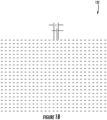
- Figure 1B shows an exemplary embodiment of a dual pattern 122 produced by the dimensioning assembly 100.
- Figures 2A-2D schematically depict relative positions of a camera module 202 and pattern generators 204 within a dimensioning assembly, according to several embodiments.
- Figures 2A-2D show relative positions of the camera module 202 and the patter generators 204 from the perspective of looking down from a top onto the dimensioning assembly, with the patterns being projected toward a bottom of the drawings; the horizontal lines represent mounting surfaces.
- the camera module 202 and two or more pattern generators 204 can be located on the same plane, whereas in other embodiments, the camera module 202 and pattern generators 204 can be located on different planes.
- the camera module 202 can be located on one plane, and the pattern generators 204 can be located on a different plane, which can be in front of the camera module 202 ( Figure 2B ), behind the camera module 202 ( Figure 2C ), or a combination of in front of and behind ( Figure 2A ).
- the camera module 202 can be located on one plane and the pattern generators 204 can be located on one or more arcs, which can similarly be in front of the camera module 202, behind it, or both ( Figure 2D ).
- Two pattern generators 204 are shown in Figures 2A-2D for illustrative purposes; however some example embodiments may include a different number of pattern generators 204.
- Figures 2A-2D show offsetting the pattern generators 204 from the camera module 202 in the Y direction, in some embodiments they can instead, or additionally, be offset in the X and/or Z directions. Mixed configurations where the pattern generators 204 are offset in non-symmetrical ways are also possible.
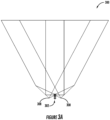
- Figures 3A and 3B show exemplary embodiments of an optical dimensioning system 300.
- the system 300 includes one or more light emitting assemblies 302.
- light emitting assemblies 302 is configured to project a predetermined pattern on an object.
- the system 300 includes an imaging assembly that is configured to sense light scattered and/or reflected of the object, and to capture an image of the object while the pattern is projected.
- the system 300 includes a processing assembly that is configured to analyze the image of the object to determine one or more dimension parameters of the object.
- the imaging assembly can include one or more image sensors with an imaging lens and/or a first beam splitter, for example beam splitter 308, adapted for multiimaging sensing, and one or more spectral filters.
- the one or more light emitting assemblies 302 can include a pattern generator and a second beam splitter adapted for pattern projection.
- the beam splitter can include, or otherwise be associated with, a relay lens 310 (shown in Figure 3B ). Such a configuration may be used to reduce the size of the system, and can, in some examples, be beneficial for application with space limitation, such as mobile devices.
- the optical dimensioning system 300 may thus be used to produce two patterns, and project the patterns onto a field.
- the patterns may be specially designed and/or configured to be analyzed, for example using a dimensioning process, to enable accurate dimensioning of an object within the field.
- the patterns may be projected onto the object within the field.
- the optical dimensioning system 300 may capture an image of the projected patterns, and analyze the image to calculate, determine, or otherwise identify dimension parameters associated with the object.
- the one or more dimension parameters of the object include a length, width, and/or height of the object.
- the system 300 may be used for various other processes utilizing analysis of the projected patterns.
- the patterns may be analyzed to calculate, determine, or otherwise identify particular depth information, encoded information, encoded data, or the like.
- the system 300 can be configured for scanning a zero contrast direct product marking barcode, image recognition with 3D contour mapping, and/or motion and/or gesture sensing for non-contact user interface.
- Figure 4 shows a method 400 for dual-pattern optical dimensioning, according to an embodiment.
- an object is illuminated with at least two identical predetermined patterns projected by one or more pattern generators.
- the predetermined patterns may be projected by one or more of the apparatuses, systems, or devices described herein, for example with respect to Figures 1 , 3A , 3 , or 7 .
- at least one image of the illuminated object is captured with a camera assembly.
- the camera assembly in some embodiments for example, may be integrated with, or associated with the device, system, apparatus, or the like utilized to produce the two patterns. In other embodiments, the camera assembly may be separate from said device, system, or apparatus.
- dimensions of the object are calculated by analyzing pattern separation of the elements comprising the projected patterns.
- the captured image is analyzed to separate the two projected patterns, for example as described below with respect to Figures 12 .
- the separated patterns as captured are then used to calculate, determine, or otherwise identify the dimensioning parameters of an object onto which the patterns were projected.
- Formula 1 may be used to calculate the separation and associated dimensioning parameters.
- the predetermined pattern can include a point grid.
- the method 400 can include controlling one or more pattern separation parameters. Additionally, illuminating an object at 402 can include illuminating an object with a projector operably coupled to a beam splitter.
- the patterns may be processed in a myriad of ways, and in some contexts may be analyzed via different methods depending on the features of each of the generated patterns.
- the features of the patterns may be encoded based on the shape of the feature (e.g., a dot for 0 and an elongated line for 1), and image processing feature filtering may be utilized to separate the patterns (e.g., using directional filtering).
- the patterns may be projected associated with a grid pattern distribution, and the patterns may be separated using grid pattern searching and matching to identify and separate the patterns. In this regard, the patterns may be separated in a circumstance where the patterns are interlaced and identical patterns.
- the patterns may be projected based on the grid pattern such that each row of features are separated, for example in a vertical direction, to enable improved identifying and separating of the patterns.
- the patterns may be searched and matched using one or more local area coded feature matching algorithms.
- the patterns may be identified and separated using grid searching and matching algorithms.
- the patterns may be identified and separated using local area pattern correlation to identify and/or separate the patterns.
- the invention is related to fixed pitch grid patterns.
- Blocks of the block diagrams and flowchart illustrations support combinations of means for performing specified functions, combinations of steps for performing the specified functions and program instruction means for performing the specified functions. It will also be understood that each block of the diagrams and flowcharts, and combinations of the blocks, can be implemented by special purpose hardware-based computer systems that perform the specified functions or steps, or combinations
- Figures 5A-5D show an exemplary light emitting assembly 500.
- Figure 5A shows an example perspective view of the light emitting assembly 500.
- Figure 5B shows an example side view of the light emitting assembly 500.
- Figure 5C shows an example top view of the light emitting assembly 500.
- Figure 5D shows an example back view of the light emitting assembly 500.
- Light emitting assembly 500 comprises aperture 502.
- the aperture may be used for housing and/or mounting various components of the light emitting assembly 500.
- aperture 502 is embodied by, houses, or is associated with a heat-sink module.
- the heat-sink module may embody the aperture 502 for distributing heat generated by components of the light emitting assembly 500, such as by the light generation source 504.
- Light emitting assembly 500 further comprises a light generation source 504 which, in some examples, comprises one or more laser modules.
- light generation source 504 is embodied by an edge emitting laser diode.
- light generation source 504 is embodied by another laser diode type, LED, or the like.
- light generation source 504 is embodied by another high-intensity light source.
- light generation source 504 may be one or more of any of a myriad of light sources, including coherent light generation source(s) and/or non-coherent light generation sources.
- Light generation source 504 may be mounted to the aperture 502 for producing a light beam at a particular angle, for example such that the light produced by the light generation source has a particular orientation.
- the light generation source 504 is mounted such that the light produced is at a 45-degree angle.
- the light generation source 504 may be designed and/or configured to generate light having a particular cross section for use in projecting a corresponding pattern feature.
- the example light generation source 504 may produce a laser beam having an elliptical cross section, the laser particular cross section rotated at a 45-degree angle, for example with respect to one or more axes (e.g., a mounting axis, or another axis associated with the aperture 502).
- the light generation source 504 may be utilized in one or more projection apparatuses, dimensioning apparatuses, or the like. In some embodiments, only a single light generation source 504 may be utilized. In other embodiments, a plurality of light generation sources, for example multiple of the light generations source 504, may be utilized. It should be appreciated that in some embodiments, the light generation source 504 may be utilized in combination with other light generation sources.
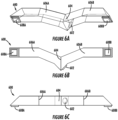
- Figures 6A-6C illustrate an exemplary single piece optical component 600.
- Figure 6A shows an example perspective view of the single piece optical component 600.
- Figure 6B shows an example frontal view of the single piece optical component 600.
- Figure 6C illustrates an example top view of the single piece optical component 600.
- the single piece optical component 600 is a component of a projection apparatus, dimensioning apparatus, or light emitting assembly.
- single piece optical component 600 comprises a light collimator component 602.
- the light collimator component 602 may form incoming light into a light beam for generating patterns via the single piece optical component 600.
- the light collimator component 602 is orientated to receive light from a light generation source, for example to receive a laser beam.
- the light collimator component 602 produces collimated light, for example a particular collimated light beam, based on inputted light, for example from a light emitting assembly.
- the particular collimated light beam has a particular cross-section or pattern feature based on the source light and/or the light collimator component 602.
- the collimated light beam may be associated with an elliptical feature rotated at a particular angle, such as a 45-degree angle.
- Single piece optical component 600 further comprises a light splitter component 604.
- the light splitter component 604 is orientated to receive light, for example such as a collimated light beam, produced or otherwise outputted from the light collimator component 602.
- the light splitter component 604 splits the received light into two or more light beams.
- the collimated light may be split into a first light beam and a second light beam, with each light beam produced at a particular angle towards a corresponding light beam bender.
- the light splitter component 604 comprises a beam splitter, such as a grating beam splitter, a prism beam splitter, and/or mirrors beam splitter.
- the light splitter component 604 may, in some embodiments, alter orientation of the received light associated with a desired feature for corresponding patterns. For example, the light splitter component 604 may generate a first beam associated with the same feature projection as the collimated light, and a second beam associated with a second feature projection rotated 90-degrees from the feature projection of the first beam.
- Single piece optical component 600 further comprises a first beam bender, for example left beam bender 606A, and a second beam bender, for example right beam bender 606B.
- the first beam bender, and similarly the second beam bender may include components to, and/or otherwise be designed, to relay a received light beam to an associated pattern generator.
- each beam bender may include one or more mirrors, total internal reflection surfaces, relay optics, and/or the like.
- each beam bender comprises one or more optical components, or a combination of optical components, for relaying the received light beam.
- Single piece optical component 600 further comprises a first diffractive pattern generator, for example left pattern generator 608A, and a second diffractive pattern generator, for example right pattern generator 608B.
- Each diffractive pattern generator may be designed to receive a light beam and produce a corresponding pattern based on a received light beam.
- left pattern generator 608A may generate a first
- left pattern generator 608B may generate a second, right pattern.
- each diffractive pattern generator is configured to generate a pattern without use of a particular pattern mask associated with the patterns.
- the left pattern and right pattern may be the same, shared pattern (e.g., an identical pattern).
- features of the first pattern and features of the second pattern may be located in the same positions, but the features of each pattern may differ in type, orientation, or the like.
- the features of the first pattern may be rotated as compared to the features of the second pattern.
- the first pattern includes features of a first detectable type, orientation, or the like, which are distinct from second features of a second detectable type, orientation, or the like associated with the second pattern.
- the first and second pattern may be embodied by any one, or pair, of the patterns described below with respect to Figures 10A-10B , and 12A/12B- 17.
- the pattern is a full-field dual pattern comprising a full-field left pattern projected to a full projection field and encoding a left encoded pattern by two different features shapes and a full-field right pattern projected to said full projection field and encoding a right encoded pattern by two different features shapes, the full-field left pattern and the full-field right pattern being associated with a baseline offset, said baseline offset being associated with a fixed pitch grid.
- Each pattern generator may include projection optics, for example including one or more projection lenses, for producing the corresponding pattern.
- the first pattern generator 608A and the second pattern generator 608B may be spaced apart by a predetermined separation distance.
- the first pattern generator 608A and the second pattern generator 608B may be orientated to produce the first pattern and second pattern to form a dual-pattern, as described herein.
- Single piece optical component 600 may be constructed from one or a myriad of materials. A suitable material may be selected based on a desired stability requirement and operating temperature range. In some embodiments, for example, the single piece optical component 600 is constructed of injection molding plastic. In other embodiments, for example, the single piece optical component 600 is constructed of glass. The single piece optical component 600 may be constructed of any of a myriad of materials depending on a target stability.
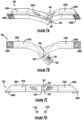
- Figures 7A-7D illustrate various views of an apparatus comprising a single piece optical component associated with a light emitting assembly in operation.
- Figure 7A shows an example perspective view of a single-piece dual-pattern projection apparatus 700 comprising the single piece optical component 600 in operation with an example light emitting assembly 500.
- Figure 7B shows an example frontal view of the single-piece dual-pattern projection apparatus 700.
- Figure 7C illustrates an example top view of the single-piece dual-pattern projection apparatus 700.
- Figure 7D illustrates example light beams associated with pattern generation via the example projection apparats 700, for example for use in one or more generated patterns.
- the single-piece dual-pattern projection apparatus 700 embodies, or embodies a component of, a projection apparatus, dimensioning apparatus, or light emitting assembly, as described above.
- single piece optical component 600 receives light 702.
- the light 702 may be produced by the light emitting assembly 500.
- 702 may comprise a laser beam produced by light emitting assembly 500 via a light generation source, for example via an edge emitting diode.
- the light emitting assembly 500 may be secured to, or integrated with, the single piece optical component 600.
- the light emitting assembly 500 is orientated in a particular manner, for example to produce light at a certain angle with respect to single piece optical component 600 or a component thereof.
- alternative and/or additional modules, components, assemblies, and/or light sources may produce light 702.
- the light 702 may be received by the single piece optical component 600 via a light collimator component, for example light collimator component 602.
- Light collimator component 602 may receive the light 702 and produce collimated light based on the received light.
- the light splitter component 602 is orientated such that the collimated light produced or otherwise outputted by the light collimator component 602 is received by another component of the single piece optical component 600, for example a light splitter component.
- the collimated light may be received by the light splitter component 604 for splitting into two or more beams. As illustrated, for example, the collimated light may be split into a first, left light beam 704A, and a second, right light beam 704B.
- the light splitter component 604 produces the first, left light beam 704A and second, right light beam 704B such that the two beams are offset, for example via rotation, by a predetermined angle based on the design and/or orientation of the light splitter component 604.
- the left light beam 704A and the right light beam 704B may be associated with cross-sections rotated 90-degrees from one another.
- the light splitter component 604 is orientated such that the light beams produced by the light splitter component 604 are received via corresponding pattern generation components to produce particular patterns.
- single piece optical component 600 comprises a left reflective beam bender 606A and a left pattern generator 608A.
- the light splitter component 604 may be orientated such that the left light beam 704A is received via the left reflective beam bender 606A and relayed to the left pattern generator 608A.
- the left pattern generator 608A may, for example, produce a first, left pattern utilizing, based on, or otherwise associated with, the left light beam 704A.
- the features of the left pattern may be projected based on the left light beam.
- the left light beam 704A may be associated with a particular cross-section defining a feature of the left pattern.
- single piece optical component 600 comprises a right reflective beam bender 606B and a right pattern generator 608B.
- the light splitter component 604 may further be orientated such that the right light beam 704B is received via the right reflective beam bender 606B and relayed to the right pattern generator 608B.
- the right pattern generator 608B may, for example, generate a particular pattern utilizing, based on, or otherwise associated with, the right light beam 704B, such as a cross section of the right light beam 704B.
- the left light beam 704A and the right light beam 704B may be altered based on one or more transformations.
- a transformation may alter the orientation and/or cross-section of the left light beam 704A and/or right light beam 704B based on the orientation of the beam splitter 604, the orientation of the left beam bender 606A, and/or the orientation of the right beam bender 606B.
- the left light beam 704A may be associated with a left elliptical cross section 710A defining a particular feature of the left pattern.
- the right light beam 704B may be associated with a right elliptical cross section 710B defining a particular feature of the right pattern.
- the left elliptical cross section 710A and the right elliptical cross section 710B may be utilized, respectively, by left pattern generator 608A and right pattern generator 608B to generate the corresponding pattern.
- the left light beam 704A and/or right light beam 704B may appear to represent various other cross sections detectable via one or more algorithms, for example via one or more directional filtering algorithms or other image processing algorithms.
- a left filter that matches the feature type of the left feature may be applied to detect the left pattern.
- a right filter that matches the feature type of the right feature may be applied to detect the right pattern.
- the left pattern generator 608A and right pattern generator 608B may generate an interlaced dual-pattern.
- the left and right patterns may be interlaced based on a rectangular grid pattern for separating the left and right patterns.
- the left and right patterns may be separated such that each row between the patterns is separated by predetermined baseline offset in a vertical direction.
- the first row of the left pattern may be separated by the baseline offset to the first row of the right pattern
- the first row of the right pattern may be separated by the baseline offset to the second row of the left pattern, and so on.
- the left identical pattern may be identified and separated based on the even rows of the interlaced dual-pattern, for example, and the right pattern may be identified based on the odd rows of the interlaced dual-pattern.
- the apparatus 700 projects a left pattern and a right pattern onto a projection field.
- the left pattern and/or right pattern may embody one or more non-repeating full field projection patterns projected onto a full projection field.
- the left and right pattern are projected to form a dual-pattern.
- the apparatus 700 may be associated with an imaging assembly, camera, image capture apparatus, and/or processing circuitry for performing 3D object dimensioning.
- the camera, imaging assembly, image capture apparatus, and/or processing circuitry may be adapted for multiimaging sensing, directional filtering, or application of other spectral filters.
- FIG. 8A and 8B depict various views of an apparatus embodying a mobile device comprising a single piece optical component in operation with a light emitting assembly, for example as apparatus 700, according to an example embodiment of the present disclosure.
- Figures 8A and 8B depict a particular mobile apparatus, for example mobile device 800.
- Mobile device 800 may embody any one of a variety of known computing devices, such as a smartphone, tablet, personal digital assistant or the like.
- the mobile device 800 may include additional circuitry, modules, components, or the like not depicted (e.g., processing circuitry, memory, and the like).
- the mobile device 800 embodies a smart phone device enhanced via the apparatus 700.
- the mobile device 800 may embody an object dimensioning apparatus configured to perform 3D dimensioning of an object.
- the mobile device 800 comprises a device frame 802.
- the device frame 802 may define a particular area forming the inside of the mobile device 800, and provide a surface for affixing, for example by securing and/or otherwise mounting, the various components, circuitry, and the like associated with mobile device 800.
- the device frame 802 may be constructed of any of a number of materials dependent on the required thermal, electro-magnetic or other structural requirements, for example glass, metal(s), and/or plastic(s).
- the mobile device 800 comprises single-piece dual-pattern projection apparatus 700.
- the single-piece dual-pattern projection apparatus 700 is affixed, mounted, fastened, or otherwise secured to the device frame 802.
- the single-piece dual-pattern projection apparatus 700 may be configured to produce one or more dual-pattern(s) for 3D object dimensioning, as described herein.
- the single-piece dual-pattern projection apparatus 700 is configured to communicate with circuitry (not shown) of the mobile device 800 to activate and perform projection. Additionally, circuitry and/or components of the mobile device 800, such as a camera (not shown), may be utilized to capture the projected dual-pattern and/or analyze the dual-pattern to perform a dimensioning process.
- the mobile device comprises a dual-projector dual-pattern projection apparatus that is affixed, mounted, fastened, or otherwise secured to the device frame 802.
- the dual-projector dual-pattern projection apparatus may include two projector devices, each configured for projecting a full-field pattern of a particular dual-pattern.
- the two projector devices are configured to project different patterns, as described herein.
- the device frame 802 may include one or more projector windows to enable projection of the dual-patterns by the single-piece dual-pattern projection apparatus 700.
- device frame 802 may include projector windows 804A and 804B.
- the projector windows 804A and 804B may define an open are of the device frame 802.
- the projector windows 804A and 804B may be a predetermined size required for projecting the dual-patterns using single-piece dual-pattern projection apparatus 700 without the device frame 802 impeding the projected pattern(s).
- the single-piece dual-pattern projection apparatus 700 may be implemented into another mobile device, apparatus, or the like.
- an alternative handheld device may include the single-piece dual-pattern projection apparatus 700 for projecting a dual-pattern, such as for 3D object dimensioning.
- the single-piece dual-pattern projection apparatus 700 may further comprise, or otherwise be associated with attachment means for mounting or affixing the apparatus 700 external to the mobile device 800.
- the particular apparatus depicted in Figures 8A and 8B is for illustration.
- Figure 9A shows an example apparatus for non-repeating full field projection.
- the non-repeating full field projection depicted may, for example, include a random pattern for where the random pattern is not repeated across the projection field.
- a single piece optical component for example single piece optical component 700 depicted in Figure 7 includes one or more apparatuses, or components thereof, for non-repeating full field projection.
- the apparatus and/or components thereof may be included such that the first, left light pattern and/or second, right light pattern each comprise a non-repeating full field pattern.
- the mobile device comprises a dual-projector dual-pattern projection apparatus that is affixed, mounted, fastened, or otherwise secured to the device frame 802.
- the dual-projector dual-pattern projection apparatus may include two projector devices, each configured for projecting a full-field pattern of a particular dual-pattern.
- the two projector devices are configured to project different patterns, as described herein.
- the example non-repeating full-field apparatus 900 comprises a light generation source 902.
- the light generation source 902 may be configured to produce a light, such as a light beam, for projection to and receiving by the full field modulation mask 904 for modulation.
- the light generation source 902 comprises a laser diode array, a VCSEL array, and/or one or more intensity light source(s), or a combination thereof.
- the light generation source 902 comprises only a single high intensity light generation source, laser, or the like.
- a coherent light generation source is utilized, while in other embodiments a non-coherent light generation source may be utilized.
- the example apparatus 900 further comprises a non-repeating full field modulation mask 904.
- the non-repeating full field modulation mask 904 may be utilized to provide a random pattern for projection.
- the random pattern is fully random, semi-random, or pseudo-random.
- non-repeating full field modulation mask 904 may receive the light provided by light generation source 902 and modulate the received light to produce a random pattern associated with the non-repeating full field modulation mask.
- the non-repeating full field modulation mask 904 in some examples, comprises a single mask without duplication optics, a lenslet array, or the like.
- the non-repeating full field modulation mask 904 in some embodiments, is manufactured and/or otherwise constructed to define the particular random pattern.
- Full-field modulation mask 904 may improve the complexity and accuracy of image processing associated with detecting, separating, and/or analyzing the resulting pattern.
- the non-repeating nature of the non-repeating full field modulation mask may eliminate potential mismatch caused by tile and/or sub-pattern repetition, and further may improve computing resources management by reducing or eliminating the need to allocate computing resources for such error detection and error handling.
- Apparatuses, systems, devices and the like comprising the non-repeating full field modulation mask 904 may have improved stability and, additionally or alternatively, may be made at a lower cost.
- the non-repeating full field modulation mask 904 may produce the random pattern, and be orientated such that projection optics 906 receives the random pattern for projecting the random pattern.
- projection optics 906 comprises at least one optical component for projecting the random pattern onto an object. Additionally or alternatively, in some embodiments the projection optics 906 further comprises one or more additional optics components.
- the projection optics 906 further comprises a field correction optics element for correcting one or more field errors.
- the optical projection 908 additionally or alternatively comprises a uniform intensity distribution component.
- the uniform intensity distribution component may be configured to distribute the light such that the projected light intensity associated with the pattern is distributed above a uniformity threshold along the area of the pattern.
- the uniform intensity distribution component may be implemented as a customized aperture with a shape matching the lens assembly that introduces a controlled vignetting of the incoming light.
- the customized aperture may compensate for the non-uniformity of the light distribution, and thus decrease the risk that the non-uniform light distribution causes errors in capturing and analyzing the projected patterns.
- the uniform intensity distribution component may comprise a light attenuator that compensates for the non-uniformity of the light distribution.
- the light attenuator may comprise a greyscale attenuator mask located between the light generation source 902 and the non-repeating full field modulation mask 904. The greyscale distribution of the light attenuator may be specially designed to compensate for the non-uniformity of the incoming light, and thus decrease the risk that the non-uniform light distribution causes errors in capturing and analyzing the projected patterns.
- the projection optics 906 produces the random pattern, for example, for projection to a projection field 908.
- the random pattern may represent a particular non-repeating full field pattern associated with the non-repeating full field modulation mask 904.
- the non-repeating full field pattern may be designed such that each captured area of the non-repeating full field modulation mask is designed to be unique at and/or above a particular capture size or window size.
- the unique pattern improves matching of the captured area to the corresponding location in the non-repeating full field pattern.
- the non-repeating full field pattern may embody a unique pattern across the full projection field and not repeat a particular section or pattern snippet throughout the entirety of the full projection field.
- the placement of the features in the pattern may be unique, such that snippets of the pattern are not repeated throughout the remainder of the full projection field.
- the non-repeating full field modulation mask 904 comprises a single mask associated with producing a random pattern for non-repeating full field projection.
- the non-repeating full field modulation mask 904 produces the random pattern without duplication optics, for example without duplication optical elements and/or a lenslet array.
- the non-repeating full field modulation mask 904, in conjunction with the projection lens, provides the random pattern across the entirety of the projection field 908.
- one or more of the apparatus 900 may be used for dual-pattern projection over a full field.
- a dual-pattern projection apparatus may comprise two identical projectors, each embodied by the apparatus 900, configured to project the two patterns into the full projection field to form a dual-pattern.
- a dual-pattern projection apparatus may comprise two projectors, with the second projector configured to project a second pattern with features at a different orientation from the first pattern (e.g., rotated 90 degrees).
- a dual-pattern projection apparatus may comprise the apparatus 900 and a corresponding beam splitter for generating the dual patterns.
- Figure 9B shows a method 950 for non-repeating full field projection, in accordance with an example embodiment.
- the method 950 may be performed by one or more of a myriad of systems, for example those depicted with respect to Figures 1 , 2 , 3 , 7 , or 9 .
- the operations of the method are performed by a non-repeating full field projection apparatus, such as apparatus 900.
- the operations of the method are performed via a projection apparatus, such as apparatus 700, for projecting a left pattern and/or a right pattern.
- light is projected from a light generation source.
- the light is one or more lasers generated by an edge emitting diode laser, VSCEL, VSCEL array, or other high-intensity coherent or non-coherent light generation source.
- the light is projected in response to a hardware and/or software signal indicating initiation of projection.
- the light is modulated via a non-repeating full field modulation mask.
- the non-repeating full field modulation mask embodies a single mask associated with a particular random pattern.
- the random pattern in some embodiments, may include randomly distributed features such that any portion is not repeated throughout the remainder of the full projection field, such that each portion of the random pattern may be uniquely identifiable throughout the full projection field.
- the non-repeating full field modulation mask is orientated to receive the light produced by the light generation source.
- the random pattern produced via the non-repeating full field modulation mask may be a non-repeating full field random pattern projected to the entirety of the full projection field.
- the random pattern does not include sub-patterns, segments, or portions that are repeated throughout the full projection field.
- each portion of the non-repeating full field random pattern may be unique from the remainder of the non-repeating full field random pattern.
- a captured portion of the pattern for example captured by an imager, camera, or other image capture device, is thus identifiable with certainty as to where the captured portion is located within the non-repeating full field random pattern.
- such embodiments eliminate confusion over conventional arrangements, patterns, systems, or the like, where the pattern(s) includes repeated instances of a particular sub-pattern (e.g., M repetitions along a length axis and N repetitions along a width axis). Eliminating such errors improves the rate at which a dimensioning apparatus may function by improving the efficiency and accuracy of localizing a captured portion of the projected pattern, further improving the efficiency and accuracy of a dimensioning system, device, or apparatus overall.
- a particular sub-pattern e.g., M repetitions along a length axis and N repetitions along a width axis.
- the random pattern is projected to the projection field.
- the random pattern produced by the non-repeating full field modulation mask is projected via a projection optics.
- the projection optics may include one or more lenses for projecting the random pattern onto the full projection field.
- the random pattern may be projected to the projection field without use of use of duplication optics, such that the random pattern associated with the non-repeating full field modulation mask covers the projection field.
- the random pattern may be projected onto an object, for example as a part of a 3D dimensioning process.
- FIGS 10A and 10B depict example patterns, in accordance with example embodiments of the present disclosure.
- the example patterns may each embody non-repeating full field random patterns produced via a projection apparatus, such as single-piece dual-pattern projection apparatus 700, or non-repeating full field projection apparatus 900.
- Figure 10A depicts an example binary state non-repeating full field random pattern 1002.
- the binary state non-repeating full field random pattern 1002 includes features associated with two states. Specifically, the features depicted utilize orientation of each feature to represent a corresponding value (e.g., horizontal may represent 0, vertical may represent 1). For example, the features may correspond to orientations of the aperture, such as where the features are determined based on the orientation of the light generation source of the aperture. As depicted in Figure 5 , for example, the orientation of the mounted light generation source 504 may define the feature of the left pattern and/or right pattern, or may be manipulated (such as through reflecting) to create a first feature and a second feature (e.g., a mounted orientation and a rotated orientation).
- the features may be detectable and/or interpretable using a spectral filter and/or directional filtering algorithms, or one or more other image processing algorithms.
- the pattern may be processed to determine a corresponding encoded pattern (e.g., a binary string patternized based on the features of the pattern).
- the binary state non-repeating full field random pattern 1002 may cover a full projection field without duplication of any portion of the random pattern.
- the binary state non-repeating full field random pattern may have a set size (e.g., 2.56mm by 2.56mm) that covers the entire full projection field.
- the binary state non-repeating full field random pattern may further be associated with a particular number of cells and cell size, for example 256 by 256 cells, each having a size of 10 micrometers by 10 micrometers. It should be appreciated that, in other embodiments, the binary state non-repeating full field random pattern 1002 may include different features and/or a different pattern of features.
- Figure 10B depicts an example multi-state (as illustrated a "tertiary state” or "3-state”) non-repeating full field random pattern 1052.
- the multi-state non-repeating full field random pattern 1052 includes features associated with three states. Specifically, the features depicted utilize a shift amount from a center of the aperture or opening thereof to represent a corresponding value. For example, no shift (e.g., centered) may represent zero, a first directional shift (e.g., a left shift) may represent -1, and a second directional shift (e.g., a right shift) may represent 1.
- the features may be detectable via a position filter, for example implemented via software, hardware, or a combination thereof associated with a camera or other image capture device.
- the pattern may be interlaced with a second projection of the pattern while minimizing the risk over overlap between the features of first and second pattern.
- the particular patterns reduce the risk of failures in pattern identification and separation during processing, and improve overall efficiency and accuracy of a dimensioning system, device, apparatus, or the like.
- either of the non-repeating full field random patterns may be created using a second round randomization.
- the second round randomization may ensure the light intensity distribution is uniform, or otherwise above a threshold uniformity.
- the second (and/or subsequent) randomization of the pattern may enhance the distribution of the light intensity across the full projection field, such that all portions of the pattern are sufficiently uniform.
- a multi-state non-repeating full field random pattern may include features having any number of associated states.
- the number of states for features is not merely associated with two or three.
- a multi-state non-repeating full field random pattern may include features having any number of states, such as four or more states.
- feature rotation such as aperture rotation, in the case of a physical mask, or a modulation scheme in a circumstance of software projection
- feature position shift (such as feature position shift in relation to a center position) may be used to differentiate features of different states, with any number of position shifts based on a particular measurable position shift level being utilized to produce various features of various states.
- a parameter set may be used to produce features associated with a particular state, or the parameter set may be used to produce features associated with various states.
- Figures 11A and 11B depict tables illustrating example state numbers, names/descriptions, and various parameter sets as well as margins for each parameter set. Further, Figure 11B illustrates example margins for detecting the random patterns illustrated and described above with respect to figures 10A and 10B respectively.
- each "Binary" state row is associated with a binary non-repeating full field random pattern having vertical elongated and horizontal elongated features, similar to those of binary non-repeating full field random pattern 1002, based on the parameters described in each row.
- each "3-State" row is associated with a particular multi-state pattern including or embodied by a tertiary non-repeating full field random pattern having shifted features, similar to those of tertiary non-repeating full field random pattern 1052, based on the parameters described in each row.
- a binary non-repeating full field random pattern having the parameters of "edge” equal to 1 micrometer, “r” equal to 1 micrometer, and “el” equal to 6 micrometers is associated with a margin of 15.5%. This margin increases to 19.2% for a binary non-repeating full field random pattern having the parameters of "edge” decreased to equal 0.75 micrometer, "r” unchanged to equal 1 micrometer, and “el” increased to equal 6.5 micrometer.
- an example multi-state pattern is embodied by, or comprises, a tertiary non-repeating full field random pattern having the parameters of "edge” equal to 1 micrometer, "r” equal to 1.5 micrometer, and "shift_per” equal to 2.5 micrometer is associated with a margin of 29.6%. This margin increases to 32.7% for a particular multi-state pattern comprising a tertiary non-repeating full field random pattern having the parameters of "edge” decreased to 0.75 micrometer, "r” unchanged to equal 1 micrometer, and "shift_per” increased to equal 2.75 micrometer.
- Each non-repeating full field random pattern may be associated with one or more parameters representing the layout of the features in the non-repeating full field random pattern.
- Each parameter adjusts the features and/or layout of the non-repeating full field random pattern.
- the parameter set may be adjusted such that margin is improved, for example at a particular desired distance.
- the length of an elongated feature may be improved to differentiate it from a circular feature, improving the margin.
- the length may be increased until a threshold length at which neighboring features become likely to overlap or introduce noise between the features, which makes feature identification and separation by the system less accurate.
- the pattern parameters may be tuned, for example by a user, to determine such thresholds and set each parameter to an optimal value based on the threshold(s).
- Figure 11B depicts a table illustrating the margins at different non-repeating full field sizes for a binary non-repeating full field random pattern having a certain parameter set and the particular multi-state pattern comprising a tertiary non-repeating full field random pattern having a second parameter set.
- the binary non-repeating full field random pattern is associated with a 19.2% margin at a focus distance associated with a particular 3D object dimensioning apparatus or device, camera, and/or image capture module, 17.94% at 500mm, 19.23% at 1000mm, 20.03% at 2500mm, and 20.27% at 4500mm.
- a tertiary non-repeating full field random pattern is associated with a 32.7% margin at a focus distance associated with the particular 3D object dimensioning apparatus or device, camera, and/or image capture module, 32.0% at 500mm, 32.66% at 1000mm, 33.26% at 2500mm, and 33.47% at 4500mm.
- the margin may be optimized to improve the efficiency of pattern identification, searching, and matching while minimizing a pattern mismatch risk.
- a higher length parameter e.g., greater elongation of a feature
- higher shift can improve margin but excessive elongation or shift (e.g., more than a corresponding threshold) may cause a dimensioning system and/or image processing system to experience more mismatch errors of neighboring features.
- a higher radius and/or higher width may improve feature identification, but excessive radius or width (e.g., more than a corresponding threshold) may similarly cause a dimensioning system and/or image processing system to experience more mismatch errors between neighboring features.
- parameters may be tuned based on external considerations and/or regulatory constraints, such as eye safety regulatory constraints that limit the total energy associated with each feature.
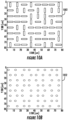
- Figure 12 illustrates an example identical patterns associated with an interlaced dual-pattern, in accordance with the present invention.
- the patterns depicted are projected to a full projection field, for example to form the interlaced dual-pattern depicted.
- the interlaced dual-pattern may be used for 3D object dimensioning, for example via one or more mathematical transformations based on the interlaced dual-pattern.
- 3D object dimensioning is performed via the process described above with respect to Figure 4 and/or utilization of Formula 1.
- Figure 12 specifically depicts a first, left pattern 1202 and a second, right pattern 1204.
- the left pattern 1202 and the right pattern 1204 include identical features.
- the features comprise an elongated horizontal line and a dot, either of which may represent a 1 and the other of which may represent a zero.
- the elongated horizontal line represents 1 and the dot represents 0.
- the left pattern 1202 and the right pattern 1204 are projected to form interlaced dual-pattern 1252.
- the interlaced dual-pattern 1252 may be projected by a projecting apparatus, such as projecting apparatus 700 and/or non-repeating full field apparatus 900.
- the left pattern 1202 is projected via a first, left pattern generator of a projecting apparatus embodied by apparatus 700 and the right pattern 1204 is projected via a second, right pattern generator of the projecting apparatus embodied by apparatus 700.
- the pattern generators may enable generation of the identical first pattern 1202 and second pattern 1204 from separate projector means using a first light beam and a second light beam produced via a light splitting component, for example a beam splitter.
- the pattern generators may receive the first light beam generated by a first projector and the second light beam generated by a second projector.
- the first projector may be configured together with a corresponding first pattern generator (e.g., a first, left diffractive pattern generator) and the second projector may be configured together with a corresponding second pattern generator (e.g., a second, left diffractive pattern generator) such that a light splitting component is not required.
- the first, left pattern generator that produces the left pattern 1202 may be spaced a set distance (or in other embodiments, a variable distance) from the second, right pattern generator that produces the right pattern 1204.
- the interlaced dual-pattern may only appear aligned at or above a threshold distance.
- the left pattern 1202 and the right pattern 1204 may be visibly misaligned at or closer than the threshold distance, for example resulting in the misaligned interlaced dual-pattern 1254.
- a 3D object dimensioning apparatus, device, system, or component thereof such as a camera, imaging assembly, or image capture device, is placed and/or operated at or above the threshold distance from the full projection field and/or an object within the full projection field to enable 3D dimensioning of an object. If misaligned interlaced dual-pattern 1254 is detected, the system may generate and/or output an error that indicates to the user and/or informs the user that the system, device, apparatus, or the like, should be moved to a threshold distance to reduce the likelihood of mismatch errors.
- the patterns may form a particular encoded pattern.
- the features may include a particular set of features corresponding to a binary string arranged via the patterns.
- the encoded pattern may be parsed and/or identified via the interpreted features.
- the encoded patterns may then be compared to determine where in the pattern the captured segment is, using local encoded pattern matching to find a sequence match between the left (or a first) pattern and the right (or a second) pattern.
- an apparatus, device, system, or the like may retrieve, receive, and/or otherwise identify a full encoded sequence.
- the sequence may be sequential, such that identifying a particular sub-portion of the sequence enables the apparatus to efficiently identify where the sub-portion is located in the full pattern associated with the full encoded sequence.
- a non-repeating full-field pattern may represent an encoded pattern with a randomized sequence to improve the uniform light density distribution while maintaining the ability to correlate the left and right patterns.
- the interlaced dual-pattern may provide various advantages over conventional patterns. Specifically, in some embodiments, the interlaced dual-pattern uses a particular base offset between rows of features between the first and second patterns. In some such embodiments, the first and second pattern may minimize or eliminate the risk of pattern overlap.
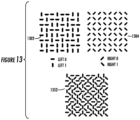
- Figure 13 illustrates other example patterns associated with another interlaced dual-pattern in accordance with an example embodiment of the present disclosure. The patterns are projected to a full projection field to form the interlaced dual-pattern depicted.
- the first, left pattern 1302 comprises features having horizontal elongated lines and vertical elongated lines. Specifically in the embodiment depicted, the horizontal elongated line represents a 0 and the vertical elongated line represents a 1.
- the second, right pattern 1304 comprises features having two elongated lines at opposite 45-degree angles from a base axis (e.g., one at a negative 45-degree angle from a base axis and the second at a positive 45-degree angle from a base axis), where the positive 45-degree elongated line represents a 1 and the negative 45-degree elongated line represents a 0, for example.
- the first, left pattern 1302, for example, may be generated by a first, left pattern generator of a projection apparatus such as apparatus 700.
- the second, right pattern 1304 may be generated by a second, right pattern generator of the projection apparatus embodied by apparatus 700.
- the left pattern generator and the right pattern generator may utilize different orientation pattern masks to generate the left pattern 1302 and right pattern 1304, respectively.
- the masks and subsequently left pattern 1302 and right pattern 1304 may be associated with a baseline offset.
- the left pattern 1302 and the right pattern 1304 may be projected to form interlaced dual-pattern 1352 comprising the features of both the left pattern 1302 and the right pattern 1304, as well as an associated offset.
- the interlaced dual-pattern 1352 may represent a full projection field.
- the interlaced dual-pattern 1352 may not repeat such that each portion of the interlaced dual-pattern 1352 is unique.
- the interlaced dual-pattern 1352 may span a particular full projection field having a particular area.
- the interlaced dual-pattern 1352 may be interpreted utilizing image processing, for example by using one or more algorithms for directional filtering (for example, by applying a particular filter corresponding to the feature of the left pattern and a second filter corresponding to the feature of the right pattern) or other detection algorithms and/or decoding algorithms.
- the interlaced dual-pattern 1352 may be interpreted by a dimensioning apparatus, camera, imaging assembly, or the like comprising and/or associated with a processor or processing circuitry and/or associated software.
- the left pattern 1302 may be parsed using a first directional filter set, for example a vertical filter and a horizontal filter.
- the right pattern 1304 may be parsed using a second directional filter set, for example using a first negative 45-degree filter and a second positive 45-degree filter.
- Other embodiments may utilize alternative interlaced dual-patterns and/or combined patterns, of which some may be more easily detectable and/or parsable using directional filtering or other detection algorithms than others.
- the filters may be used to generate a first, left encoded pattern for the left pattern and a second, right encoded pattern for the right pattern.
- a coded pattern sequence matching algorithm may be used to match the portion of the two patterns. For example, in some embodiments, local encoded pattern matching can be directly performed between the two patterns.
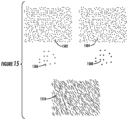
- Figure 14 illustrates example left and right patterns and a corresponding complemented dual-pattern, in accordance with an example embodiment of the present disclosure.
- the patterns depicted may be projected to a full projection field, for example to form the complemented dual-pattern depicted.
- the complemented dual-pattern may be used for 3D objection dimensioning, for example via one or more mathematical transformations based on the complemented dual-pattern.
- 3D object dimensioning is performed via the process described above with respect to Figure 4 .
- Figure 14 specifically depicts a first, left pattern 1402 and a second, right pattern 1404.
- the left pattern 1402 may, for example, be produced by a first, left pattern generator.
- the right pattern 1404 may, for example, be produced by a second, right pattern generator.
- the left pattern generator may be associated with a left pattern mask and the right pattern generator may be associated with a right pattern mask, to generate the corresponding left and right patterns.
- the left and right pattern mask may generate identical patterns comprising the different features. For example, a first light beam orientation may produce the left pattern 1402 and a second light beam orientation may produce the right pattern 1404.
- the left pattern 1402 includes dot features having a first orientation, for example dot features 1406.
- the right pattern 1404 includes dot features having a second orientation, for example dot features 1408.
- the first orientation may, for example, be rotated 90 degrees from the second orientation.
- the first features and the second features may be parsable and/or separable via image processing.
- the first dot features may be associated with a first filter for use in identifying the first dot features
- the second dot features may be associated with a second filter for use in identifying the second dot features.
- the left pattern 1402 and the right pattern 1404 may be projected to a full projection field.
- the left pattern 1402 and the right pattern 1404 are projected to form the complemented pattern 1410.
- the complemented pattern 1410 may represent a non-repeating full field dual-pattern projected onto a full projection field.
- the complemented pattern 1410 may be configured such that the complemented pattern 1410 forms a unique pattern throughout the full projection field (e.g., without repetition of a particular sub-pattern, segment or slice of the pattern, or the like).
- a dimensioning apparatus, camera, image capture device, and/or processing circuitry may be configured for image processing to separate the complemented dual-pattern 1410 and identify the left pattern 1402 and the right pattern 1404.
- the complemented dual-pattern comprises, or otherwise is formed from, features 1412.
- Features 1412 comprise the first features 1406 and the second features 1408 based on the first pattern 1402 and the second pattern 1404.
- the dimensioning apparatus, camera, image capture device, and/or processing device may detect the left pattern 1402 by detecting and/or parsing the first, left features 1406 using directional filtering and/or other feature detection algorithms.
- the dimensioning apparatus, camera, image capture device and/or processing device may detect the right pattern 1404 by detecting and/or parsing the second, right features 1408 using directional filtering and/or other feature detection algorithms.
- the left filtering kernel may be associated with a larger encoding, such as: 0 0 0 0 0 1 0 0 0 1 0 0 0 0 1 0 0 0 0 1 0 0 0 0 1 0 0 0 0 0 0 0 0 0 0 0 0 0 0 0
- the encoded representation of the right filtering kernel associated with the right dot features 1408 may be rotated similarly to the rotation of the right features 1408 with respect to the left features 1406.
- the encoded representation may be rotated 90 degrees.
- the right filtering kernel may be represented as: 1 0 0 0 1 0 0 0 1
- the right filtering kernel may be represented as: 1 0 0 0 0 0 1 0 0 0 0 0 1 0 0 0 0 0 1 0 0 0 0 0 0 1 0 0 0 0 0 1 1 0 0 0 0 0 0 1 1
- each filtering kernel may be applied to the complemented dual-pattern 1410 associated with a filtering threshold.
- the filtering threshold may be used to determine whether a particular application of the filtering kernel to a portion of the complemented dual-pattern indicates the portion of the complemented dual-pattern includes the feature corresponding to the filtering kernel. As the filtering threshold increases, the filtering kernel may satisfy the filtering threshold when more pixels match between the encoding of the portion of the pattern being analyzed and the filtering kernel.
- each application of the filtering kernel to a captured portion may be used to determine a filtering match count for comparison to the filtering threshold.
- the filtering match count may be calculated based on the sum of the matching activated pixels between the filtering kernel and the captured portion.
- a filtering threshold of 2 may be used to separate the complemented dual-pattern into left pattern 1402 and right pattern 1404.
- a filtering threshold of 4 (or higher in some embodiments) may be used.
- the example dot features depicted are examples and that, in other embodiments, other dot features may similarly be used.
- the filtering kernels described above with respect to the left dot features 1406 and right dot features 1408 are merely examples. In this regard, the alternative filtering kernels may be used. Further, the specific filtering kernels described may be enhanced, condensed, expanded, transformed, or otherwise manipulated..
- the complemented dual-pattern may provide various advantages over conventional patterns. Specifically, in some embodiments, the complemented dual-pattern includes specific pattern dot features for the first pattern and second dot features for the second pattern. The features may be readily identified and separated to form the two separate patterns. In some such embodiments, the first and second patterns improve the efficiency of pattern identification and pattern separation.
- Embodiments produce a different left pattern, right pattern, or complemented pattern.
- Figure 15 illustrates other example left and right patterns associated with another complemented dual-pattern in accordance with an example embodiment of the present disclosure. The patterns are projected to a full projection field, for example to form the complemented dual-pattern depicted.
- the left pattern 1502 comprises the first features 1506.
- the first features comprise, or are otherwise represented by, the feature type of open circles.
- the right pattern 1504 comprises the second features 1508.
- the second feature 1508 comprise, or are otherwise represented by, the feature type of closed circles.
- Each of the left feature 1506 and the right feature 1508 are detectable and/or parsable using one or more image processing, detection, or similar algorithms. It should be appreciated that in other embodiments, alternative feature that are detectable and/or parsable may be utilized.
- the complemented pattern 1510 comprises the first, left pattern 1502 and the second, right pattern 1504.
- the left pattern 1502 and the right pattern 1504 are offset by a predefined base offset.
- the complemented pattern 1510 is produced, for example via a first, left pattern generator and a second, right pattern generator of an example projection apparatus, for example embodied by apparatus 700, onto a full projection field.
- Figure 16 illustrates a first pattern and second pattern orientated associated with a pattern pitch.
- the first pattern and second pattern form an interlaced dual-pattern associated with a pattern pitch.
- the pattern pitch may define a grid of depth points for orientating the first pattern and the second pattern to form the interlaced dual-pattern.
- the first, left pattern 1612A may be associated with a 3-state non-repeating full field pattern.
- the left pattern 1612A comprises various features representing various values.
- the left pattern 1612A comprises single elliptical feature 1602A, double elliptical feature 1604A, and triple elliptical feature 1606A.
- Each of the features may represent a particular value, for example single elliptical feature 1602A may represent 1, double elliptical feature 1604A may represent 0, and triple elliptical feature 1606A may represent -1.
- the second, right pattern 1612B may similarly be associated with a 3-state non-repeating full field pattern.
- the right pattern 1612B comprises various features representing various values.
- the right pattern 1612B comprises a second single elliptical feature 1602B, second double elliptical feature 1604B, a second triple elliptical feature 1606B.
- These features may correspond to transformed versions of the features 1602A-1606A.
- the features associated with left pattern 1612A may be rotated 90 degrees from the features associated with right pattern 1612B.
- Each of the features are detectable and/or parsable using one or more image processing, detection, and/or parsing algorithms.
- Each of the features 1602A-1606A and 1602B-1606B is detectable utilizing one or more directional filtering algorithms.
- Each pattern may be associated with a sensor pixel grid, for example the sensor pixel grid 1608. Similarly, each pattern may be associated with a pattern pitch 1610. Each feature may be aligned based on the pattern pitch 1610. Each feature covers a minimum area of sensor pixels from the sensor pixel grid 1608, for example associated with a particular camera, image capture apparatus, or the like, which may be used for image capture and/or detection.
- the left pattern 1612A may include a particular pattern arrangement of features as depicted.
- the features correspond to the binary pattern representation 1614.
- the right patter 1612B may similarly correspond to the binary pattern representation 1614.
- the binary pattern representation 1614 may be used to detect, parse, and/or decode the left pattern 1612A and/or the right pattern 1612B.
- one or more patterns utilize an off-pitch pattern.
- an interlaced dual-pattern embodies an off-pitch pattern associated with a first, left pattern and a second, right pattern.
- the first, left pattern 1710A, the second, right pattern 1710B, and the interlaced off-pitch dual-pattern 1714 are associated with a particular pattern pitch 1708.
- the pattern pitch 1708 enables orientation of the left pattern 1710A and the right pattern 1710B.
- the pattern pitch may similarly be associated with the sensor pixel grid 1706. Each feature placement orientated to match, such as by aligning with, the pattern pitch 1708 covers a particular portion of the sensor pixel grid 1706.
- left pattern 1710A and right pattern 1710B embody binary non-repeating full field patterns, such that the features associated with each pattern only have two possible states, for example.
- left pattern 1710A may comprise single elliptical feature 1702A and double elliptical feature 1704A.
- right pattern 1710A may comprise the second elliptical feature 1702B and second double elliptical feature 1704B.
- the features may, in some patterns, be orientated off of the pattern pitch based on a particular off-pitch offset.
- the off-pitch offset may represent half the length and/or height of a particular element of the pattern pitch, such that a feature may fall halfway between two grid elements of a pattern pitch.
- the mid-grid feature orientating may be utilized to create more depth data points.
- each an elliptical of a double elliptical feature 604A or 604B may be used in determining the displacement with respect to a neighboring feature.
- both ellipticals of a double elliptical feature may be used to determine a displacement between both ellipticals of a neighboring double elliptical feature.
- the left pattern 1710A and the right pattern 1710B may each be associated with the binary pattern representation 1712.
- the binary pattern representation 1712 may be utilized to detect, parse, decode, and/or otherwise process the patterns, such as when the patterns are produced and orientated to form interlaced dual-pattern 1714.
- the interlaced dual-pattern 1714 may utilize mid-grid feature orientating to create additional depth points for use in 3D object dimensioning.
Landscapes
- Engineering & Computer Science (AREA)
- Physics & Mathematics (AREA)
- General Physics & Mathematics (AREA)
- Computer Vision & Pattern Recognition (AREA)
- Theoretical Computer Science (AREA)
- Optics & Photonics (AREA)
- Multimedia (AREA)
- Length Measuring Devices By Optical Means (AREA)
- Health & Medical Sciences (AREA)
- General Health & Medical Sciences (AREA)
- Vascular Medicine (AREA)
- Artificial Intelligence (AREA)
Claims (7)
- Computerimplementiertes Verfahren zum Analysieren einer dualen Struktur, wobei das computerimplementierte Verfahren umfasst:Projizieren einer dualen Vollfeldstruktur (1616) auf ein vollständiges Projektionsfeld, wobei die duale Vollfeldstruktur (1616) eine linke Vollfeldstruktur (1612A), die auf das vollständige Projektionsfeld projiziert wird und eine linke codierte Struktur durch zwei verschiedene Merkmalsformen codiert; und eine rechte Vollfeldstruktur (1612B), die auf das vollständige Projektionsfeld projiziert wird und eine rechte codierte Struktur durch zwei verschiedene Merkmalsformen codiert, umfasst; wobei die linke Vollfeldstruktur und die rechte Vollfeldstruktur einem Versatz des Ausgangswerts zugeordnet sind;Erkennen der linken Vollfeldstruktur unter Verwendung eines ersten Filters, der der linken Vollfeldstruktur entspricht;Erkennen der rechten Vollfeldstruktur unter Verwendung eines zweiten Filters, der der rechten Vollfeldstruktur entspricht; undDimensionieren eines Objekts, das in dem vollen Projektionsfeld enthalten ist, basierend auf der erkannten linken Vollfeldstruktur, der erkannten rechten Vollfeldstruktur und dem Ausgangswert, wobei der Ausgangswert einer festen Teilung des Gitters zugeordnet ist;wobei das Dimensionieren des Objekts umfasst:Identifizieren eines Teils des linken Vollfeldmusters;Identifizieren eines Teils des rechten Vollfeldmusters, der mit dem Teil des linken Vollfeldmusters übereinstimmt, einschließlich:Bestimmen der linken codierten Struktur für den Teil der linken Vollfeldstruktur; undErkennen des Teils der linken Vollfeldstruktur, der die rechte codierte Struktur darstellt, unter Verwendung eines Algorithmus zum Abgleich lokaler Bereiche mit codierten Merkmalen, wobei die linke codierte Struktur mit der rechten codierten Struktur übereinstimmt;Bestimmen eines Versatzes bei der Dimensionierung zwischen Merkmalen des Teils der linken Vollfeldstruktur und Merkmalen des Teils der rechten Vollfeldstruktur; undBerechnen von Dimensionierungsparametern basierend auf dem Versatz der Dimensionierung und dem Ausgangswert.
- Computerimplementiertes Verfahren nach Anspruch 1, wobei das Dimensionieren des Objekts umfasst:Erkennen eines linken lokalen Bereichsstrukturteils und eines rechten lokalen Bereichsstrukturteils unter Verwendung eines lokalen Bereichsstruktur-Korrelationsalgorithmus, wobei ein linker Merkmalssatz des linken lokalen Bereichsstrukturteils einem rechten Merkmalssatz des rechten lokalen Bereichsstrukturteils entspricht;Bestimmen eines Versatzes zwischen dem linken Merkmalssatz des linken Bereichsstrukturteils und dem rechten Merkmalssatz des rechten Bereichsstrukturteils; undBerechnen von Dimensionierungsparametern basierend auf dem Versatz der Dimensionierung und dem Ausgangswert.
- Computerimplementiertes Verfahren nach einem der Ansprüche 1 bis 2, wobei die linke Vollfeldstruktur durch einen linken Strukturgenerator und die rechte Vollfeldstruktur durch einen rechten Strukturgenerator projiziert wird, wobei der linke Strukturgenerator und der rechte Strukturgenerator in einem bestimmten Abstand angeordnet sind.
- Computerimplementiertes Verfahren nach einem der Ansprüche 1 bis 2, wobei die linke Vollfeldstruktur durch einen linken Strukturgenerator und die rechte Vollfeldstruktur durch einen rechten Strukturgenerator projiziert wird, wobei der linke Strukturgenerator und der rechte Strukturgenerator in einem variablen Abstand angeordnet sind.
- Computerimplementiertes Verfahren nach einem der Ansprüche 1-4, wobei die duale Vollfeldstruktur eine verschachtelte duale Struktur umfasst, die einen ersten Satz von Strukturen umfasst, die als der linken Vollfeldstruktur zugeordnet bestimmt wurden, und einen zweiten Satz von Strukturen, die als der rechten Vollfeldstruktur zugeordnet bestimmt wurden.
- Computerimplementiertes Verfahren nach einem der Ansprüche 1-5, ferner umfassend:
Erkennen der linken Vollfeldstruktur unter Verwendung des ersten Filters und eines lokalen Bereichsstruktur-Korrelationsalgorithmus. - Computerimplementiertes Verfahren nach einem der Ansprüche 1-6, wobei die linke Vollfeldstruktur einen ersten Satz von Strukturelementen umfasst, die um 45 Grad gegen den Uhrzeigersinn von einem Referenzpunkt gedreht sind, und die rechte Vollfeldstruktur einen zweiten Satz von Strukturelementen umfasst, die um 45 Grad im Uhrzeigersinn vom Referenzpunkt gedreht sind.
Priority Applications (2)
| Application Number | Priority Date | Filing Date | Title |
|---|---|---|---|
| EP23188717.5A EP4270945B1 (de) | 2019-09-27 | 2020-09-25 | Optische 3d-dimensionierung mit dualer struktur |
| EP25217405.7A EP4676025A3 (de) | 2019-09-27 | 2020-09-25 | Optische 3d-dimensionierung mit zwei mustern |
Applications Claiming Priority (1)
| Application Number | Priority Date | Filing Date | Title |
|---|---|---|---|
| US16/585,832 US11450083B2 (en) | 2019-09-27 | 2019-09-27 | Dual-pattern optical 3D dimensioning |
Related Child Applications (2)
| Application Number | Title | Priority Date | Filing Date |
|---|---|---|---|
| EP25217405.7A Division EP4676025A3 (de) | 2019-09-27 | 2020-09-25 | Optische 3d-dimensionierung mit zwei mustern |
| EP23188717.5A Division EP4270945B1 (de) | 2019-09-27 | 2020-09-25 | Optische 3d-dimensionierung mit dualer struktur |
Publications (2)
| Publication Number | Publication Date |
|---|---|
| EP3798569A1 EP3798569A1 (de) | 2021-03-31 |
| EP3798569B1 true EP3798569B1 (de) | 2023-08-16 |
Family
ID=72659727
Family Applications (3)
| Application Number | Title | Priority Date | Filing Date |
|---|---|---|---|
| EP20198556.1A Active EP3798569B1 (de) | 2019-09-27 | 2020-09-25 | Optische 3d-dimensionierung mit dualer struktur |
| EP23188717.5A Active EP4270945B1 (de) | 2019-09-27 | 2020-09-25 | Optische 3d-dimensionierung mit dualer struktur |
| EP25217405.7A Pending EP4676025A3 (de) | 2019-09-27 | 2020-09-25 | Optische 3d-dimensionierung mit zwei mustern |
Family Applications After (2)
| Application Number | Title | Priority Date | Filing Date |
|---|---|---|---|
| EP23188717.5A Active EP4270945B1 (de) | 2019-09-27 | 2020-09-25 | Optische 3d-dimensionierung mit dualer struktur |
| EP25217405.7A Pending EP4676025A3 (de) | 2019-09-27 | 2020-09-25 | Optische 3d-dimensionierung mit zwei mustern |
Country Status (2)
| Country | Link |
|---|---|
| US (2) | US11450083B2 (de) |
| EP (3) | EP3798569B1 (de) |
Families Citing this family (2)
| Publication number | Priority date | Publication date | Assignee | Title |
|---|---|---|---|---|
| US11639846B2 (en) | 2019-09-27 | 2023-05-02 | Honeywell International Inc. | Dual-pattern optical 3D dimensioning |
| US11450083B2 (en) * | 2019-09-27 | 2022-09-20 | Honeywell International Inc. | Dual-pattern optical 3D dimensioning |
Family Cites Families (101)
| Publication number | Priority date | Publication date | Assignee | Title |
|---|---|---|---|---|
| US4914460A (en) | 1987-05-29 | 1990-04-03 | Harbor Branch Oceanographic Institution Inc. | Apparatus and methods of determining distance and orientation |
| US5903388A (en) * | 1992-06-11 | 1999-05-11 | Sedlmayr Steven R | High efficiency electromagnetic beam projector and systems and method for implementation thereof |
| US7153366B1 (en) | 1998-03-24 | 2006-12-26 | Quantum Corporation | Systems and method for forming a servo pattern on a magnetic tape |
| US6956963B2 (en) * | 1998-07-08 | 2005-10-18 | Ismeca Europe Semiconductor Sa | Imaging for a machine-vision system |
| AU4975399A (en) * | 1998-07-08 | 2000-02-01 | Lennard H. Bieman | Machine vision and semiconductor handling |
| US6661521B1 (en) | 1998-09-11 | 2003-12-09 | Robotic Vision Systems, Inc. | Diffuse surface illumination apparatus and methods |
| JP2001265275A (ja) * | 2000-03-16 | 2001-09-28 | Olympus Optical Co Ltd | 画像表示装置 |
| CA2301822A1 (fr) * | 2000-03-24 | 2001-09-24 | 9071 9410 Quebec Inc. | Projection simultanee de plusieurs patrons avec acquisition simultanee pour l'inspection d'objets en trois dimensions |
| US20050110868A1 (en) * | 2001-10-04 | 2005-05-26 | Myers Kenneth J. | System and method for inputting contours of a three-dimensional subject to a computer |
| EP1533646A1 (de) | 2003-11-21 | 2005-05-25 | Heptagon OY | Vorrichtung zur Erzeugung optischer Muster |
| US7253885B2 (en) * | 2003-12-05 | 2007-08-07 | Canon Kabushiki Kaisha | Wavelength selecting method, position detecting method and apparatus, exposure method and apparatus, and device manufacturing method |
| US20060072122A1 (en) * | 2004-09-30 | 2006-04-06 | Qingying Hu | Method and apparatus for measuring shape of an object |
| US9330324B2 (en) * | 2005-10-11 | 2016-05-03 | Apple Inc. | Error compensation in three-dimensional mapping |
| GB0602380D0 (en) | 2006-02-06 | 2006-03-15 | Qinetiq Ltd | Imaging system |
| US8090194B2 (en) | 2006-11-21 | 2012-01-03 | Mantis Vision Ltd. | 3D geometric modeling and motion capture using both single and dual imaging |
| US20080156619A1 (en) * | 2006-12-01 | 2008-07-03 | Mehul Patel | Range finder |
| WO2009040872A1 (ja) * | 2007-09-25 | 2009-04-02 | Fujitsu Limited | 画像合成装置及び方法 |
| DE102007054906B4 (de) * | 2007-11-15 | 2011-07-28 | Sirona Dental Systems GmbH, 64625 | Verfahren zur optischen Vermessung der dreidimensionalen Geometrie von Objekten |
| US9170097B2 (en) * | 2008-04-01 | 2015-10-27 | Perceptron, Inc. | Hybrid system |
| US8547642B2 (en) | 2009-10-22 | 2013-10-01 | Avago Technologies General Ip (Singapore) Pte. Ltd. | Multi-beam, high efficiency diffractive optics system formed in a single substrate |
| US8996384B2 (en) | 2009-10-30 | 2015-03-31 | Vocollect, Inc. | Transforming components of a web page to voice prompts |
| GB0921461D0 (en) * | 2009-12-08 | 2010-01-20 | Qinetiq Ltd | Range based sensing |
| US8208704B2 (en) | 2010-07-13 | 2012-06-26 | Carestream Health, Inc. | Dental shade mapping |
| US9686532B2 (en) * | 2011-04-15 | 2017-06-20 | Faro Technologies, Inc. | System and method of acquiring three-dimensional coordinates using multiple coordinate measurement devices |
| US8985459B2 (en) | 2011-06-30 | 2015-03-24 | Metrologic Instruments, Inc. | Decodable indicia reading terminal with combined illumination |
| US8749796B2 (en) | 2011-08-09 | 2014-06-10 | Primesense Ltd. | Projectors of structured light |
| US8779898B2 (en) | 2011-08-17 | 2014-07-15 | Hand Held Products, Inc. | Encoded information reading terminal with micro-electromechanical radio frequency front end |
| US20150103358A1 (en) * | 2012-03-09 | 2015-04-16 | Galil Soft Ltd. | System and method for non-contact measurement of 3d geometry |
| EP3239652B1 (de) | 2012-03-26 | 2019-10-30 | Mantisvision Ltd. | Dreidimensionale kamera und projektor dafür |
| US9007368B2 (en) | 2012-05-07 | 2015-04-14 | Intermec Ip Corp. | Dimensioning system calibration systems and methods |
| US20150327012A1 (en) | 2012-05-23 | 2015-11-12 | Honeywell International Inc. | Portable electronic devices having a separate location trigger unit for use in controlling an application unit |
| US9659183B2 (en) | 2012-06-18 | 2017-05-23 | Honeywell International Inc. | Pattern for secure store |
| WO2014011182A1 (en) | 2012-07-12 | 2014-01-16 | Calfornia Institute Of Technology | Convergence/divergence based depth determination techniques and uses with defocusing imaging |
| WO2014019130A1 (en) | 2012-07-31 | 2014-02-06 | Honeywell International Inc. | Optical reading apparatus having variable settings |
| WO2014083485A1 (en) * | 2012-11-29 | 2014-06-05 | Koninklijke Philips N.V. | Laser device for projecting a structured light pattern onto a scene |
| EP2943859B1 (de) | 2013-01-11 | 2020-10-21 | Hand Held Products, Inc. | System, verfahren und computerlesbares medium zum verwalten von randvorrichtungen |
| US20140283282A1 (en) | 2013-02-22 | 2014-09-25 | Kenneth Dye | Hosiery and dancewear with antimicrobial and moisture-wicking properties |
| US20140267701A1 (en) | 2013-03-12 | 2014-09-18 | Ziv Aviv | Apparatus and techniques for determining object depth in images |
| US10052413B2 (en) | 2013-03-14 | 2018-08-21 | Medtronic Vascular, Inc. | Medical device and plasticized nylon |
| US20140320605A1 (en) | 2013-04-25 | 2014-10-30 | Philip Martin Johnson | Compound structured light projection system for 3-D surface profiling |
| EP2840353B1 (de) * | 2013-06-21 | 2019-08-07 | 3Shape A/S | Abtastvorrichtung mit strukturiertem Sondenlicht |
| TWI485361B (zh) * | 2013-09-11 | 2015-05-21 | Univ Nat Taiwan | 三維形貌輪廓量測裝置及其方法 |
| US20150070489A1 (en) | 2013-09-11 | 2015-03-12 | Microsoft Corporation | Optical modules for use with depth cameras |
| US10139495B2 (en) | 2014-01-24 | 2018-11-27 | Hand Held Products, Inc. | Shelving and package locating systems for delivery vehicles |
| US9665757B2 (en) | 2014-03-07 | 2017-05-30 | Hand Held Products, Inc. | Indicia reader for size-limited applications |
| JP6360699B2 (ja) * | 2014-03-25 | 2018-07-18 | スタンレー電気株式会社 | ヘッドランプ |
| FR3020871B1 (fr) | 2014-05-07 | 2017-08-11 | Areva | Dispositif et procede de reconstruction tridimensionnelle d'une scene par analyse d'image |
| US9794392B2 (en) | 2014-07-10 | 2017-10-17 | Hand Held Products, Inc. | Mobile-phone adapter for electronic transactions |
| US9823059B2 (en) | 2014-08-06 | 2017-11-21 | Hand Held Products, Inc. | Dimensioning system with guided alignment |
| WO2016024203A2 (en) * | 2014-08-12 | 2016-02-18 | Mantisvision Ltd. | System, method and computer program product to project light pattern |
| US11546428B2 (en) | 2014-08-19 | 2023-01-03 | Hand Held Products, Inc. | Mobile computing device with data cognition software |
| US10060729B2 (en) | 2014-10-21 | 2018-08-28 | Hand Held Products, Inc. | Handheld dimensioner with data-quality indication |
| US9752864B2 (en) | 2014-10-21 | 2017-09-05 | Hand Held Products, Inc. | Handheld dimensioning system with feedback |
| US9897434B2 (en) | 2014-10-21 | 2018-02-20 | Hand Held Products, Inc. | Handheld dimensioning system with measurement-conformance feedback |
| US9762793B2 (en) | 2014-10-21 | 2017-09-12 | Hand Held Products, Inc. | System and method for dimensioning |
| US9557166B2 (en) | 2014-10-21 | 2017-01-31 | Hand Held Products, Inc. | Dimensioning system with multipath interference mitigation |
| US10269342B2 (en) | 2014-10-29 | 2019-04-23 | Hand Held Products, Inc. | Method and system for recognizing speech using wildcards in an expected response |
| US9924006B2 (en) | 2014-10-31 | 2018-03-20 | Hand Held Products, Inc. | Adaptable interface for a mobile computing device |
| US10810529B2 (en) | 2014-11-03 | 2020-10-20 | Hand Held Products, Inc. | Directing an inspector through an inspection |
| US9984685B2 (en) | 2014-11-07 | 2018-05-29 | Hand Held Products, Inc. | Concatenated expected responses for speech recognition using expected response boundaries to determine corresponding hypothesis boundaries |
| US9767581B2 (en) | 2014-12-12 | 2017-09-19 | Hand Held Products, Inc. | Auto-contrast viewfinder for an indicia reader |
| US9564035B2 (en) | 2014-12-22 | 2017-02-07 | Hand Held Products, Inc. | Safety system and method |
| US9861182B2 (en) | 2015-02-05 | 2018-01-09 | Hand Held Products, Inc. | Device for supporting an electronic tool on a user's hand |
| US10121466B2 (en) | 2015-02-11 | 2018-11-06 | Hand Held Products, Inc. | Methods for training a speech recognition system |
| WO2016154218A1 (en) | 2015-03-22 | 2016-09-29 | Oculus Vr, Llc | Depth mapping with a head mounted display using stereo cameras and structured light |
| JP6247793B2 (ja) * | 2015-03-27 | 2017-12-13 | 富士フイルム株式会社 | 距離画像取得装置 |
| US9930050B2 (en) | 2015-04-01 | 2018-03-27 | Hand Held Products, Inc. | Device management proxy for secure devices |
| US9852102B2 (en) | 2015-04-15 | 2017-12-26 | Hand Held Products, Inc. | System for exchanging information between wireless peripherals and back-end systems via a peripheral hub |
| US10038716B2 (en) | 2015-05-01 | 2018-07-31 | Hand Held Products, Inc. | System and method for regulating barcode data injection into a running application on a smart device |
| US10401436B2 (en) | 2015-05-04 | 2019-09-03 | Hand Held Products, Inc. | Tracking battery conditions |
| US9891612B2 (en) | 2015-05-05 | 2018-02-13 | Hand Held Products, Inc. | Intermediate linear positioning |
| US10007112B2 (en) | 2015-05-06 | 2018-06-26 | Hand Held Products, Inc. | Hands-free human machine interface responsive to a driver of a vehicle |
| US9954871B2 (en) | 2015-05-06 | 2018-04-24 | Hand Held Products, Inc. | Method and system to protect software-based network-connected devices from advanced persistent threat |
| US9978088B2 (en) | 2015-05-08 | 2018-05-22 | Hand Held Products, Inc. | Application independent DEX/UCS interface |
| JP6761817B2 (ja) * | 2015-05-10 | 2020-09-30 | マジック アイ インコーポレイテッド | 物体までの距離を算出するための方法 |
| US10360728B2 (en) | 2015-05-19 | 2019-07-23 | Hand Held Products, Inc. | Augmented reality device, system, and method for safety |
| US9786101B2 (en) | 2015-05-19 | 2017-10-10 | Hand Held Products, Inc. | Evaluating image values |
| DE102015209402A1 (de) * | 2015-05-22 | 2016-11-24 | Sirona Dental Systems Gmbh | Vorrichtung zur optischen 3D-Vermessung eines Objekts |
| US10066982B2 (en) | 2015-06-16 | 2018-09-04 | Hand Held Products, Inc. | Calibrating a volume dimensioner |
| US9892876B2 (en) | 2015-06-16 | 2018-02-13 | Hand Held Products, Inc. | Tactile switch for a mobile electronic device |
| US9857167B2 (en) | 2015-06-23 | 2018-01-02 | Hand Held Products, Inc. | Dual-projector three-dimensional scanner |
| US9835486B2 (en) | 2015-07-07 | 2017-12-05 | Hand Held Products, Inc. | Mobile dimensioner apparatus for use in commerce |
| JP6109255B2 (ja) * | 2015-07-14 | 2017-04-05 | Ckd株式会社 | 三次元計測装置 |
| US10094650B2 (en) | 2015-07-16 | 2018-10-09 | Hand Held Products, Inc. | Dimensioning and imaging items |
| US20170017301A1 (en) | 2015-07-16 | 2017-01-19 | Hand Held Products, Inc. | Adjusting dimensioning results using augmented reality |
| US10451740B2 (en) * | 2016-04-26 | 2019-10-22 | Cepton Technologies, Inc. | Scanning lidar systems for three-dimensional sensing |
| US10033988B2 (en) * | 2016-10-31 | 2018-07-24 | Verizon Patent And Licensing Inc. | Methods and systems for capturing depth data using frequency-segregated structured light |
| CN106773489B (zh) | 2017-01-13 | 2018-08-14 | 深圳奥比中光科技有限公司 | 一种光学投影装置及深度相机 |
| DE102017202651A1 (de) * | 2017-02-20 | 2018-08-23 | Siemens Aktiengesellschaft | Vorrichtung und Verfahren zur Kalibrierung mittels projizierter Muster mit virtueller Ebene |
| US10360693B2 (en) * | 2017-03-01 | 2019-07-23 | Cognex Corporation | High speed structured light system |
| CN107424188B (zh) * | 2017-05-19 | 2020-06-30 | 深圳奥比中光科技有限公司 | 基于vcsel阵列光源的结构光投影模组 |
| US10036630B1 (en) * | 2017-05-22 | 2018-07-31 | Asm Technology Singapore Pte Ltd | Three-dimensional imaging using a multi-phase projector |
| CN107167997A (zh) | 2017-06-05 | 2017-09-15 | 深圳奥比中光科技有限公司 | 激光投影模组及深度相机 |
| US10733748B2 (en) * | 2017-07-24 | 2020-08-04 | Hand Held Products, Inc. | Dual-pattern optical 3D dimensioning |
| US10612912B1 (en) * | 2017-10-31 | 2020-04-07 | Facebook Technologies, Llc | Tileable structured light projection system |
| WO2019113445A2 (en) * | 2017-12-08 | 2019-06-13 | Arizona Board Of Regents On Behalf Of The University Of Arizona | Digital fringe projection and multi-spectral polarization imaging for rapid 3d reconstruction |
| US11896461B2 (en) | 2018-06-22 | 2024-02-13 | Align Technology, Inc. | Intraoral 3D scanner employing multiple miniature cameras and multiple miniature pattern projectors |
| US11874453B2 (en) | 2018-12-12 | 2024-01-16 | Genemind Biosciences Company Limited | Optical system, method for calibrating optical system, and sequencing system |
| US11639846B2 (en) * | 2019-09-27 | 2023-05-02 | Honeywell International Inc. | Dual-pattern optical 3D dimensioning |
| US11450083B2 (en) * | 2019-09-27 | 2022-09-20 | Honeywell International Inc. | Dual-pattern optical 3D dimensioning |
| US11650151B2 (en) * | 2020-10-08 | 2023-05-16 | United States Of America As Represented By The Administrator Of Nasa | Compact, self-aligned projection focusing schlieren method and system |
-
2019
- 2019-09-27 US US16/585,832 patent/US11450083B2/en active Active
-
2020
- 2020-09-25 EP EP20198556.1A patent/EP3798569B1/de active Active
- 2020-09-25 EP EP23188717.5A patent/EP4270945B1/de active Active
- 2020-09-25 EP EP25217405.7A patent/EP4676025A3/de active Pending
-
2022
- 2022-08-16 US US17/820,089 patent/US12135203B2/en active Active
Also Published As
| Publication number | Publication date |
|---|---|
| US11450083B2 (en) | 2022-09-20 |
| EP4270945B1 (de) | 2025-12-03 |
| EP4270945A2 (de) | 2023-11-01 |
| US20210097320A1 (en) | 2021-04-01 |
| EP4676025A3 (de) | 2026-04-08 |
| US12135203B2 (en) | 2024-11-05 |
| EP4270945A3 (de) | 2023-12-06 |
| US20230184543A1 (en) | 2023-06-15 |
| EP3798569A1 (de) | 2021-03-31 |
| EP4676025A2 (de) | 2026-01-07 |
Similar Documents
| Publication | Publication Date | Title |
|---|---|---|
| US20230221102A1 (en) | Dual-pattern optical 3d dimensioning | |
| US11054506B2 (en) | Spatially self-similar patterned illumination for depth imaging | |
| US10809056B2 (en) | Structured light projector | |
| US9142025B2 (en) | Method and apparatus for obtaining depth information using optical pattern | |
| EP2141448A1 (de) | Kalibrierung eines Profilmesssystems | |
| EP3435026B1 (de) | Optische 3d-dimensionierung mit zwei mustern | |
| JP6161714B2 (ja) | 3次元の物体の直線寸法を制御する方法 | |
| JP5966467B2 (ja) | 測距装置 | |
| JP2019158414A (ja) | 情報処理装置 | |
| US12135203B2 (en) | Dual-pattern optical 3D dimensioning | |
| KR20230101899A (ko) | 중첩 시야의 센서들을 갖는 3차원 스캐너 | |
| CN110906884B (zh) | 三维几何形状测量设备和三维几何形状测量方法 | |
| US10657665B2 (en) | Apparatus and method for generating three-dimensional information | |
| CN110955056B (zh) | 多影像投影机以及具有多影像投影机的电子装置 | |
| KR102927740B1 (ko) | 메타표면을 포함하는 구조화 광 깊이 센서 | |
| EP3637044B1 (de) | Mehrfachbildprojektor und elektronische vorrichtung mit dem mehrfachbildprojektor | |
| KR20180065896A (ko) | 3차원 정보 생성 장치 |
Legal Events
| Date | Code | Title | Description |
|---|---|---|---|
| PUAI | Public reference made under article 153(3) epc to a published international application that has entered the european phase |
Free format text: ORIGINAL CODE: 0009012 |
|
| STAA | Information on the status of an ep patent application or granted ep patent |
Free format text: STATUS: REQUEST FOR EXAMINATION WAS MADE |
|
| 17P | Request for examination filed |
Effective date: 20200925 |
|
| AK | Designated contracting states |
Kind code of ref document: A1 Designated state(s): AL AT BE BG CH CY CZ DE DK EE ES FI FR GB GR HR HU IE IS IT LI LT LU LV MC MK MT NL NO PL PT RO RS SE SI SK SM TR |
|
| AX | Request for extension of the european patent |
Extension state: BA ME |
|
| GRAP | Despatch of communication of intention to grant a patent |
Free format text: ORIGINAL CODE: EPIDOSNIGR1 |
|
| STAA | Information on the status of an ep patent application or granted ep patent |
Free format text: STATUS: GRANT OF PATENT IS INTENDED |
|
| RIC1 | Information provided on ipc code assigned before grant |
Ipc: H04N 13/218 20180101ALI20230210BHEP Ipc: G06T 7/521 20170101ALI20230210BHEP Ipc: G06T 7/586 20170101ALI20230210BHEP Ipc: G01B 11/25 20060101AFI20230210BHEP |
|
| INTG | Intention to grant announced |
Effective date: 20230317 |
|
| GRAS | Grant fee paid |
Free format text: ORIGINAL CODE: EPIDOSNIGR3 |
|
| GRAA | (expected) grant |
Free format text: ORIGINAL CODE: 0009210 |
|
| STAA | Information on the status of an ep patent application or granted ep patent |
Free format text: STATUS: THE PATENT HAS BEEN GRANTED |
|
| AK | Designated contracting states |
Kind code of ref document: B1 Designated state(s): AL AT BE BG CH CY CZ DE DK EE ES FI FR GB GR HR HU IE IS IT LI LT LU LV MC MK MT NL NO PL PT RO RS SE SI SK SM TR |
|
| REG | Reference to a national code |
Ref country code: CH Ref legal event code: EP |
|
| REG | Reference to a national code |
Ref country code: DE Ref legal event code: R096 Ref document number: 602020015739 Country of ref document: DE |
|
| REG | Reference to a national code |
Ref country code: IE Ref legal event code: FG4D |
|
| REG | Reference to a national code |
Ref country code: LT Ref legal event code: MG9D |
|
| REG | Reference to a national code |
Ref country code: NL Ref legal event code: MP Effective date: 20230816 |
|
| REG | Reference to a national code |
Ref country code: AT Ref legal event code: MK05 Ref document number: 1600455 Country of ref document: AT Kind code of ref document: T Effective date: 20230816 |
|
| PG25 | Lapsed in a contracting state [announced via postgrant information from national office to epo] |
Ref country code: GR Free format text: LAPSE BECAUSE OF FAILURE TO SUBMIT A TRANSLATION OF THE DESCRIPTION OR TO PAY THE FEE WITHIN THE PRESCRIBED TIME-LIMIT Effective date: 20231117 |
|
| PG25 | Lapsed in a contracting state [announced via postgrant information from national office to epo] |
Ref country code: IS Free format text: LAPSE BECAUSE OF FAILURE TO SUBMIT A TRANSLATION OF THE DESCRIPTION OR TO PAY THE FEE WITHIN THE PRESCRIBED TIME-LIMIT Effective date: 20231216 |
|
| PG25 | Lapsed in a contracting state [announced via postgrant information from national office to epo] |
Ref country code: SE Free format text: LAPSE BECAUSE OF FAILURE TO SUBMIT A TRANSLATION OF THE DESCRIPTION OR TO PAY THE FEE WITHIN THE PRESCRIBED TIME-LIMIT Effective date: 20230816 Ref country code: RS Free format text: LAPSE BECAUSE OF FAILURE TO SUBMIT A TRANSLATION OF THE DESCRIPTION OR TO PAY THE FEE WITHIN THE PRESCRIBED TIME-LIMIT Effective date: 20230816 Ref country code: PT Free format text: LAPSE BECAUSE OF FAILURE TO SUBMIT A TRANSLATION OF THE DESCRIPTION OR TO PAY THE FEE WITHIN THE PRESCRIBED TIME-LIMIT Effective date: 20231218 Ref country code: NO Free format text: LAPSE BECAUSE OF FAILURE TO SUBMIT A TRANSLATION OF THE DESCRIPTION OR TO PAY THE FEE WITHIN THE PRESCRIBED TIME-LIMIT Effective date: 20231116 Ref country code: NL Free format text: LAPSE BECAUSE OF FAILURE TO SUBMIT A TRANSLATION OF THE DESCRIPTION OR TO PAY THE FEE WITHIN THE PRESCRIBED TIME-LIMIT Effective date: 20230816 Ref country code: LV Free format text: LAPSE BECAUSE OF FAILURE TO SUBMIT A TRANSLATION OF THE DESCRIPTION OR TO PAY THE FEE WITHIN THE PRESCRIBED TIME-LIMIT Effective date: 20230816 Ref country code: LT Free format text: LAPSE BECAUSE OF FAILURE TO SUBMIT A TRANSLATION OF THE DESCRIPTION OR TO PAY THE FEE WITHIN THE PRESCRIBED TIME-LIMIT Effective date: 20230816 Ref country code: IS Free format text: LAPSE BECAUSE OF FAILURE TO SUBMIT A TRANSLATION OF THE DESCRIPTION OR TO PAY THE FEE WITHIN THE PRESCRIBED TIME-LIMIT Effective date: 20231216 Ref country code: HR Free format text: LAPSE BECAUSE OF FAILURE TO SUBMIT A TRANSLATION OF THE DESCRIPTION OR TO PAY THE FEE WITHIN THE PRESCRIBED TIME-LIMIT Effective date: 20230816 Ref country code: GR Free format text: LAPSE BECAUSE OF FAILURE TO SUBMIT A TRANSLATION OF THE DESCRIPTION OR TO PAY THE FEE WITHIN THE PRESCRIBED TIME-LIMIT Effective date: 20231117 Ref country code: FI Free format text: LAPSE BECAUSE OF FAILURE TO SUBMIT A TRANSLATION OF THE DESCRIPTION OR TO PAY THE FEE WITHIN THE PRESCRIBED TIME-LIMIT Effective date: 20230816 Ref country code: AT Free format text: LAPSE BECAUSE OF FAILURE TO SUBMIT A TRANSLATION OF THE DESCRIPTION OR TO PAY THE FEE WITHIN THE PRESCRIBED TIME-LIMIT Effective date: 20230816 |
|
| PG25 | Lapsed in a contracting state [announced via postgrant information from national office to epo] |
Ref country code: PL Free format text: LAPSE BECAUSE OF FAILURE TO SUBMIT A TRANSLATION OF THE DESCRIPTION OR TO PAY THE FEE WITHIN THE PRESCRIBED TIME-LIMIT Effective date: 20230816 |
|
| PG25 | Lapsed in a contracting state [announced via postgrant information from national office to epo] |
Ref country code: ES Free format text: LAPSE BECAUSE OF FAILURE TO SUBMIT A TRANSLATION OF THE DESCRIPTION OR TO PAY THE FEE WITHIN THE PRESCRIBED TIME-LIMIT Effective date: 20230816 |
|
| PG25 | Lapsed in a contracting state [announced via postgrant information from national office to epo] |
Ref country code: SM Free format text: LAPSE BECAUSE OF FAILURE TO SUBMIT A TRANSLATION OF THE DESCRIPTION OR TO PAY THE FEE WITHIN THE PRESCRIBED TIME-LIMIT Effective date: 20230816 Ref country code: RO Free format text: LAPSE BECAUSE OF FAILURE TO SUBMIT A TRANSLATION OF THE DESCRIPTION OR TO PAY THE FEE WITHIN THE PRESCRIBED TIME-LIMIT Effective date: 20230816 Ref country code: ES Free format text: LAPSE BECAUSE OF FAILURE TO SUBMIT A TRANSLATION OF THE DESCRIPTION OR TO PAY THE FEE WITHIN THE PRESCRIBED TIME-LIMIT Effective date: 20230816 Ref country code: EE Free format text: LAPSE BECAUSE OF FAILURE TO SUBMIT A TRANSLATION OF THE DESCRIPTION OR TO PAY THE FEE WITHIN THE PRESCRIBED TIME-LIMIT Effective date: 20230816 Ref country code: DK Free format text: LAPSE BECAUSE OF FAILURE TO SUBMIT A TRANSLATION OF THE DESCRIPTION OR TO PAY THE FEE WITHIN THE PRESCRIBED TIME-LIMIT Effective date: 20230816 Ref country code: CZ Free format text: LAPSE BECAUSE OF FAILURE TO SUBMIT A TRANSLATION OF THE DESCRIPTION OR TO PAY THE FEE WITHIN THE PRESCRIBED TIME-LIMIT Effective date: 20230816 Ref country code: SK Free format text: LAPSE BECAUSE OF FAILURE TO SUBMIT A TRANSLATION OF THE DESCRIPTION OR TO PAY THE FEE WITHIN THE PRESCRIBED TIME-LIMIT Effective date: 20230816 |
|
| REG | Reference to a national code |
Ref country code: CH Ref legal event code: PL |
|
| PG25 | Lapsed in a contracting state [announced via postgrant information from national office to epo] |
Ref country code: LU Free format text: LAPSE BECAUSE OF NON-PAYMENT OF DUE FEES Effective date: 20230925 |
|
| REG | Reference to a national code |
Ref country code: DE Ref legal event code: R097 Ref document number: 602020015739 Country of ref document: DE |
|
| REG | Reference to a national code |
Ref country code: BE Ref legal event code: MM Effective date: 20230930 |
|
| PG25 | Lapsed in a contracting state [announced via postgrant information from national office to epo] |
Ref country code: LU Free format text: LAPSE BECAUSE OF NON-PAYMENT OF DUE FEES Effective date: 20230925 Ref country code: MC Free format text: LAPSE BECAUSE OF FAILURE TO SUBMIT A TRANSLATION OF THE DESCRIPTION OR TO PAY THE FEE WITHIN THE PRESCRIBED TIME-LIMIT Effective date: 20230816 |
|
| PLBE | No opposition filed within time limit |
Free format text: ORIGINAL CODE: 0009261 |
|
| STAA | Information on the status of an ep patent application or granted ep patent |
Free format text: STATUS: NO OPPOSITION FILED WITHIN TIME LIMIT |
|
| REG | Reference to a national code |
Ref country code: IE Ref legal event code: MM4A |
|
| PG25 | Lapsed in a contracting state [announced via postgrant information from national office to epo] |
Ref country code: IE Free format text: LAPSE BECAUSE OF NON-PAYMENT OF DUE FEES Effective date: 20230925 |
|
| PG25 | Lapsed in a contracting state [announced via postgrant information from national office to epo] |
Ref country code: CH Free format text: LAPSE BECAUSE OF NON-PAYMENT OF DUE FEES Effective date: 20230930 |
|
| 26N | No opposition filed |
Effective date: 20240517 |
|
| PG25 | Lapsed in a contracting state [announced via postgrant information from national office to epo] |
Ref country code: IT Free format text: LAPSE BECAUSE OF FAILURE TO SUBMIT A TRANSLATION OF THE DESCRIPTION OR TO PAY THE FEE WITHIN THE PRESCRIBED TIME-LIMIT Effective date: 20230816 Ref country code: IE Free format text: LAPSE BECAUSE OF NON-PAYMENT OF DUE FEES Effective date: 20230925 Ref country code: CH Free format text: LAPSE BECAUSE OF NON-PAYMENT OF DUE FEES Effective date: 20230930 Ref country code: SI Free format text: LAPSE BECAUSE OF FAILURE TO SUBMIT A TRANSLATION OF THE DESCRIPTION OR TO PAY THE FEE WITHIN THE PRESCRIBED TIME-LIMIT Effective date: 20230816 |
|
| PG25 | Lapsed in a contracting state [announced via postgrant information from national office to epo] |
Ref country code: BE Free format text: LAPSE BECAUSE OF NON-PAYMENT OF DUE FEES Effective date: 20230930 |
|
| PGFP | Annual fee paid to national office [announced via postgrant information from national office to epo] |
Ref country code: FR Payment date: 20240925 Year of fee payment: 5 |
|
| PG25 | Lapsed in a contracting state [announced via postgrant information from national office to epo] |
Ref country code: BG Free format text: LAPSE BECAUSE OF FAILURE TO SUBMIT A TRANSLATION OF THE DESCRIPTION OR TO PAY THE FEE WITHIN THE PRESCRIBED TIME-LIMIT Effective date: 20230816 |
|
| PG25 | Lapsed in a contracting state [announced via postgrant information from national office to epo] |
Ref country code: BG Free format text: LAPSE BECAUSE OF FAILURE TO SUBMIT A TRANSLATION OF THE DESCRIPTION OR TO PAY THE FEE WITHIN THE PRESCRIBED TIME-LIMIT Effective date: 20230816 |
|
| PG25 | Lapsed in a contracting state [announced via postgrant information from national office to epo] |
Ref country code: CY Free format text: LAPSE BECAUSE OF FAILURE TO SUBMIT A TRANSLATION OF THE DESCRIPTION OR TO PAY THE FEE WITHIN THE PRESCRIBED TIME-LIMIT; INVALID AB INITIO Effective date: 20200925 |
|
| PG25 | Lapsed in a contracting state [announced via postgrant information from national office to epo] |
Ref country code: HU Free format text: LAPSE BECAUSE OF FAILURE TO SUBMIT A TRANSLATION OF THE DESCRIPTION OR TO PAY THE FEE WITHIN THE PRESCRIBED TIME-LIMIT; INVALID AB INITIO Effective date: 20200925 |
|
| PGFP | Annual fee paid to national office [announced via postgrant information from national office to epo] |
Ref country code: DE Payment date: 20250926 Year of fee payment: 6 |
|
| PGFP | Annual fee paid to national office [announced via postgrant information from national office to epo] |
Ref country code: GB Payment date: 20250923 Year of fee payment: 6 |
|
| PG25 | Lapsed in a contracting state [announced via postgrant information from national office to epo] |
Ref country code: TR Free format text: LAPSE BECAUSE OF FAILURE TO SUBMIT A TRANSLATION OF THE DESCRIPTION OR TO PAY THE FEE WITHIN THE PRESCRIBED TIME-LIMIT Effective date: 20230816 |