EP3797678A1 - Katheter mit dehnbarer leiterplatte - Google Patents
Katheter mit dehnbarer leiterplatte Download PDFInfo
- Publication number
- EP3797678A1 EP3797678A1 EP20191796.0A EP20191796A EP3797678A1 EP 3797678 A1 EP3797678 A1 EP 3797678A1 EP 20191796 A EP20191796 A EP 20191796A EP 3797678 A1 EP3797678 A1 EP 3797678A1
- Authority
- EP
- European Patent Office
- Prior art keywords
- catheter
- circuit board
- tube
- catheter according
- electrode
- Prior art date
- Legal status (The legal status is an assumption and is not a legal conclusion. Google has not performed a legal analysis and makes no representation as to the accuracy of the status listed.)
- Withdrawn
Links
- 239000004020 conductor Substances 0.000 claims abstract description 16
- 238000002560 therapeutic procedure Methods 0.000 claims abstract description 5
- 238000003745 diagnosis Methods 0.000 claims abstract description 4
- 229920001169 thermoplastic Polymers 0.000 claims abstract description 3
- 239000004433 Thermoplastic polyurethane Substances 0.000 claims description 3
- 229920002803 thermoplastic polyurethane Polymers 0.000 claims description 3
- RYGMFSIKBFXOCR-UHFFFAOYSA-N Copper Chemical compound [Cu] RYGMFSIKBFXOCR-UHFFFAOYSA-N 0.000 claims description 2
- 229910000881 Cu alloy Inorganic materials 0.000 claims description 2
- 229910052802 copper Inorganic materials 0.000 claims description 2
- 239000010949 copper Substances 0.000 claims description 2
- 239000004814 polyurethane Substances 0.000 claims description 2
- 229920002635 polyurethane Polymers 0.000 claims 1
- 238000011161 development Methods 0.000 description 4
- 230000018109 developmental process Effects 0.000 description 4
- 239000000463 material Substances 0.000 description 4
- 230000002441 reversible effect Effects 0.000 description 3
- 238000005452 bending Methods 0.000 description 2
- 230000005540 biological transmission Effects 0.000 description 2
- 229910001316 Ag alloy Inorganic materials 0.000 description 1
- 229920002943 EPDM rubber Polymers 0.000 description 1
- 244000043261 Hevea brasiliensis Species 0.000 description 1
- 244000089486 Phragmites australis subsp australis Species 0.000 description 1
- 229910045601 alloy Inorganic materials 0.000 description 1
- 239000000956 alloy Substances 0.000 description 1
- 210000003484 anatomy Anatomy 0.000 description 1
- DQXBYHZEEUGOBF-UHFFFAOYSA-N but-3-enoic acid;ethene Chemical compound C=C.OC(=O)CC=C DQXBYHZEEUGOBF-UHFFFAOYSA-N 0.000 description 1
- 210000005242 cardiac chamber Anatomy 0.000 description 1
- 230000000747 cardiac effect Effects 0.000 description 1
- 238000013153 catheter ablation Methods 0.000 description 1
- 238000010276 construction Methods 0.000 description 1
- 229920001971 elastomer Polymers 0.000 description 1
- 239000000806 elastomer Substances 0.000 description 1
- 230000005611 electricity Effects 0.000 description 1
- 239000005038 ethylene vinyl acetate Substances 0.000 description 1
- 229920001973 fluoroelastomer Polymers 0.000 description 1
- 229920003049 isoprene rubber Polymers 0.000 description 1
- 238000013507 mapping Methods 0.000 description 1
- 238000005259 measurement Methods 0.000 description 1
- 238000000034 method Methods 0.000 description 1
- 229920003052 natural elastomer Polymers 0.000 description 1
- 229920001194 natural rubber Polymers 0.000 description 1
- 239000004033 plastic Substances 0.000 description 1
- 229920003023 plastic Polymers 0.000 description 1
- 229920001200 poly(ethylene-vinyl acetate) Polymers 0.000 description 1
- 229920002037 poly(vinyl butyral) polymer Polymers 0.000 description 1
- 229920002379 silicone rubber Polymers 0.000 description 1
- 239000004945 silicone rubber Substances 0.000 description 1
- 229920003048 styrene butadiene rubber Polymers 0.000 description 1
- 238000012360 testing method Methods 0.000 description 1
Images

Classifications
-
- A—HUMAN NECESSITIES
- A61—MEDICAL OR VETERINARY SCIENCE; HYGIENE
- A61B—DIAGNOSIS; SURGERY; IDENTIFICATION
- A61B5/00—Measuring for diagnostic purposes; Identification of persons
- A61B5/24—Detecting, measuring or recording bioelectric or biomagnetic signals of the body or parts thereof
- A61B5/25—Bioelectric electrodes therefor
- A61B5/279—Bioelectric electrodes therefor specially adapted for particular uses
- A61B5/28—Bioelectric electrodes therefor specially adapted for particular uses for electrocardiography [ECG]
- A61B5/283—Invasive
- A61B5/287—Holders for multiple electrodes, e.g. electrode catheters for electrophysiological study [EPS]
-
- A—HUMAN NECESSITIES
- A61—MEDICAL OR VETERINARY SCIENCE; HYGIENE
- A61B—DIAGNOSIS; SURGERY; IDENTIFICATION
- A61B18/00—Surgical instruments, devices or methods for transferring non-mechanical forms of energy to or from the body
- A61B18/04—Surgical instruments, devices or methods for transferring non-mechanical forms of energy to or from the body by heating
- A61B18/12—Surgical instruments, devices or methods for transferring non-mechanical forms of energy to or from the body by heating by passing a current through the tissue to be heated, e.g. high-frequency current
- A61B18/14—Probes or electrodes therefor
- A61B18/1492—Probes or electrodes therefor having a flexible, catheter-like structure, e.g. for heart ablation
-
- A—HUMAN NECESSITIES
- A61—MEDICAL OR VETERINARY SCIENCE; HYGIENE
- A61B—DIAGNOSIS; SURGERY; IDENTIFICATION
- A61B5/00—Measuring for diagnostic purposes; Identification of persons
- A61B5/68—Arrangements of detecting, measuring or recording means, e.g. sensors, in relation to patient
- A61B5/6846—Arrangements of detecting, measuring or recording means, e.g. sensors, in relation to patient specially adapted to be brought in contact with an internal body part, i.e. invasive
- A61B5/6847—Arrangements of detecting, measuring or recording means, e.g. sensors, in relation to patient specially adapted to be brought in contact with an internal body part, i.e. invasive mounted on an invasive device
- A61B5/6852—Catheters
-
- A—HUMAN NECESSITIES
- A61—MEDICAL OR VETERINARY SCIENCE; HYGIENE
- A61B—DIAGNOSIS; SURGERY; IDENTIFICATION
- A61B18/00—Surgical instruments, devices or methods for transferring non-mechanical forms of energy to or from the body
- A61B2018/00053—Mechanical features of the instrument of device
- A61B2018/00059—Material properties
- A61B2018/00071—Electrical conductivity
- A61B2018/00077—Electrical conductivity high, i.e. electrically conducting
-
- A—HUMAN NECESSITIES
- A61—MEDICAL OR VETERINARY SCIENCE; HYGIENE
- A61B—DIAGNOSIS; SURGERY; IDENTIFICATION
- A61B18/00—Surgical instruments, devices or methods for transferring non-mechanical forms of energy to or from the body
- A61B2018/00315—Surgical instruments, devices or methods for transferring non-mechanical forms of energy to or from the body for treatment of particular body parts
- A61B2018/00345—Vascular system
- A61B2018/00351—Heart
-
- A—HUMAN NECESSITIES
- A61—MEDICAL OR VETERINARY SCIENCE; HYGIENE
- A61B—DIAGNOSIS; SURGERY; IDENTIFICATION
- A61B18/00—Surgical instruments, devices or methods for transferring non-mechanical forms of energy to or from the body
- A61B2018/00571—Surgical instruments, devices or methods for transferring non-mechanical forms of energy to or from the body for achieving a particular surgical effect
- A61B2018/00577—Ablation
-
- A—HUMAN NECESSITIES
- A61—MEDICAL OR VETERINARY SCIENCE; HYGIENE
- A61B—DIAGNOSIS; SURGERY; IDENTIFICATION
- A61B2560/00—Constructional details of operational features of apparatus; Accessories for medical measuring apparatus
- A61B2560/04—Constructional details of apparatus
-
- A—HUMAN NECESSITIES
- A61—MEDICAL OR VETERINARY SCIENCE; HYGIENE
- A61B—DIAGNOSIS; SURGERY; IDENTIFICATION
- A61B2562/00—Details of sensors; Constructional details of sensor housings or probes; Accessories for sensors
- A61B2562/12—Manufacturing methods specially adapted for producing sensors for in-vivo measurements
-
- A—HUMAN NECESSITIES
- A61—MEDICAL OR VETERINARY SCIENCE; HYGIENE
- A61B—DIAGNOSIS; SURGERY; IDENTIFICATION
- A61B2562/00—Details of sensors; Constructional details of sensor housings or probes; Accessories for sensors
- A61B2562/16—Details of sensor housings or probes; Details of structural supports for sensors
- A61B2562/164—Details of sensor housings or probes; Details of structural supports for sensors the sensor is mounted in or on a conformable substrate or carrier
-
- A—HUMAN NECESSITIES
- A61—MEDICAL OR VETERINARY SCIENCE; HYGIENE
- A61B—DIAGNOSIS; SURGERY; IDENTIFICATION
- A61B2562/00—Details of sensors; Constructional details of sensor housings or probes; Accessories for sensors
- A61B2562/16—Details of sensor housings or probes; Details of structural supports for sensors
- A61B2562/166—Details of sensor housings or probes; Details of structural supports for sensors the sensor is mounted on a specially adapted printed circuit board
-
- A—HUMAN NECESSITIES
- A61—MEDICAL OR VETERINARY SCIENCE; HYGIENE
- A61B—DIAGNOSIS; SURGERY; IDENTIFICATION
- A61B2562/00—Details of sensors; Constructional details of sensor housings or probes; Accessories for sensors
- A61B2562/22—Arrangements of medical sensors with cables or leads; Connectors or couplings specifically adapted for medical sensors
- A61B2562/221—Arrangements of sensors with cables or leads, e.g. cable harnesses
- A61B2562/222—Electrical cables or leads therefor, e.g. coaxial cables or ribbon cables
Definitions
- the invention relates to a catheter according to the preamble of claim 1.
- catheters that carry electrodes, such as those in the DE 694 01 562 T2 are described.
- mapping catheters are also known, for example for three-dimensional recording of the anatomy of a heart chamber, which must have a large number of electrodes.
- the object of the present invention is to create an inexpensive and at the same time flexible catheter and to at least partially remedy the disadvantages of the prior art.
- the catheter has the shape of an elongated, flexible tube which could also be referred to as a hose.
- the catheter has at least one electrode for carrying out a diagnosis, for example a measurement such as an electrophysiological examination, or for carrying out a therapy, for example an operation such as a catheter ablation, in each case in the human body.
- the at least one electrode is arranged at one end region of the tube and an electrical connection is attached to the other end region of the tube for electrically connecting the catheter to a control device, so that there is a current-conducting and data transmission connection between the at least one electrode and the electrical connection.
- the at least one electrode and the electrical connection are advantageously connected to one another in an electrically conductive manner by means of conductor tracks on at least one reversibly elastically stretchable circuit board, and the stretchable circuit board forms the outer surface of the catheter.
- a reversible one Stretching or elastic stretching means a reversible or non-permanent deformation.
- Reversibly elastic means that the circuit board can expand and experience a positive change in length (stretching) in a range of 5-100%, based on the original, unstretched length. This applies to expansions in all three spatial directions.
- Such a catheter has a very good flexibility and can be used for a wide variety of diagnoses and therapies. Thanks to the elasticity of the circuit board, it is advantageously not necessary to wind the circuit board in a spiral around the catheter tube, as is known from so-called flexible circuit boards.
- elongations in the range from 10 to 60% are possible. It is particularly preferred if elongations in the range from 15 to 35% are permitted. Expansions in this area allow a sufficiently high flexibility of the catheter and the catheter head with a sufficiently high number of reversible expansion cycles before material fatigue occurs.
- the printed circuit board can be arranged on the outer surface of the tube for this purpose.
- the pipe can, for example, be wrapped around or wrapped in the circuit board. It is particularly advantageous if the circuit board extends over the entire circumference of the outer surface of the tube. Then no unevenness remains in the surface of the lateral surface.
- the pipe is formed by the printed circuit board. This has the advantage that the catheter can be manufactured from as few materials as possible in a few work steps.
- the circuit board is provided with conductor tracks made of copper or copper alloys. This can in particular be applied in a subtractive process. Such a catheter can be manufactured particularly quickly and inexpensively.
- the end areas of the conductor tracks, the so-called pads, are not regarded as part of the conductor tracks.
- the pads, which serve as electrons, for example, can also have other alloys, such as silver alloys.
- the conductor tracks have a meander shape, in particular a rectangular, undulating, U-shaped or horseshoe-shaped meander.
- meanders are formed by stringing together rectangular, wave-shaped, U-shaped or horseshoe-shaped basic meander shapes.
- the circuit board consists of a thermoplastic polymer, for example polyurethane (PU), in particular a highly elastic, thermoplastic polyurethane (TPU).
- PU polyurethane
- TPU thermoplastic polyurethane
- PU polyurethane
- TPU thermoplastic polyurethane
- PU polyurethane
- other reversibly elastically stretchable plastics and elastomers can also be used, for example ethylene-propylene-diene rubber, ethylene vinyl acetate, fluororubber, isoprene rubber, natural rubber, silicone rubber, styrene-butadiene rubber or polyvinyl butyral.
- the invention also relates to the use of a catheter as described above as a cardiac catheter which is used in the diagnosis or therapy of the human heart.
- Fig. 1 shows an expandable circuit board 4 before and after it has been shaped into a tube 1 of a catheter 10.
- the basic meander shapes of the conductor tracks 5 extend over a large part of the circumference U of the jacket surface of the tube 1.
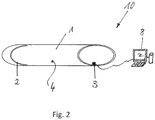
- Fig. 2 shows a catheter 10 according to the invention, which has the shape of an elongated, flexible tube 1. At least one electrode 2 is arranged at one end region. An electrical connection 3 is attached to its other end region. The at least one electrode 2 is on conductor tracks 5 on an elastically stretchable circuit board 4 (not shown here, see Figure 1 ) connected to the electrical connection 3 in terms of data transmission and electricity. A control device 8, which is used to control the catheter 10, is connected to the connection 3.
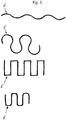
- Fig. 3 shows different meander shapes which the conductor tracks 5 can have on the elastically stretchable printed circuit board 4: the basic meander shape 6 can be wavy, horseshoe-shaped, rectangular or U-shaped.
Landscapes
- Health & Medical Sciences (AREA)
- Life Sciences & Earth Sciences (AREA)
- Surgery (AREA)
- Engineering & Computer Science (AREA)
- Public Health (AREA)
- Animal Behavior & Ethology (AREA)
- Veterinary Medicine (AREA)
- General Health & Medical Sciences (AREA)
- Physics & Mathematics (AREA)
- Biomedical Technology (AREA)
- Heart & Thoracic Surgery (AREA)
- Medical Informatics (AREA)
- Molecular Biology (AREA)
- Biophysics (AREA)
- Pathology (AREA)
- Cardiology (AREA)
- Nuclear Medicine, Radiotherapy & Molecular Imaging (AREA)
- Plasma & Fusion (AREA)
- Otolaryngology (AREA)
- Physiology (AREA)
- Measurement And Recording Of Electrical Phenomena And Electrical Characteristics Of The Living Body (AREA)
- Media Introduction/Drainage Providing Device (AREA)
- Structure Of Printed Boards (AREA)
Abstract
Description
- Die Erfindung betrifft einen Katheter gemäß dem Oberbegriff von Anspruch 1.
- Aus dem Stand der Technik sind unterschiedlichste Bauformen von Kathetern bekannt, welche ihrer medizinischen Anwendung entsprechend aufgebaut sind. Darunter sind auch elektrodentragende Katheter wie sie beispielsweise in der
DE 694 01 562 T2 beschrieben sind. Auch bekannt sind sogenannte Mappingkatheter, beispielsweise zur 3-dimensionalen Erfassung der Anatomie einer Herzkammer, welche eine hohe Anzahl an Elektroden aufweisen müssen. - Bei den aus dem Stand der Technik bekannten Kathetern entstehen hohe Produktionskosten, weil die zu den Elektroden führenden Leiterbahnen aufwändig im Katheterrohr untergebracht werden müssen. Weiter problematisch ist, dass sich auf Grund der verwendeten Materialien eine Beschränkung bzgl. des Biegeradius des Katheters ergeben kann und damit eine Einschränkung in dessen Einsatz. Gerade bei kardiologischen Anwendungen ist es wichtig, dass der Katheter enge Windungen toleriert und sich mehrmals entsprechend den durch die Gefäße vorgegebenen Biegeradien biegen lässt.
- Aufgabe der vorliegenden Erfindung ist es einen kostengünstigen und gleichzeitig flexiblen Katheter zu schaffen und die Nachteile des Standes der Technik zumindest teilweise zu beheben.
- Gelöst wird diese Aufgabe durch einen Katheter mit einer dehnbaren Leiterplatte mit den Merkmalen von Anspruch 1.
- Erfindungsgemäß wurde als vorteilhaft erkannt dehnbare Leiterplatten einzusetzen:
Der Katheter hat die Form eines länglichen, flexiblen Rohres welches auch als Schlauch bezeichnet werden könnte. Der Katheter besitzt mindestens eine Elektrode zur Durchführung einer Diagnose, beispielsweise einer Messung wie einer elektrophysiologischen Untersuchung, oder zur Durchführung einer Therapie, beispielsweise einer Operation wie einer Katheterablation, jeweils im menschlichen Körper. Die mindestens eine Elektrode ist an einem Endbereich des Rohres angeordnet und am anderen Endbereich des Rohres ist ein elektrischer Anschluss angebracht zum elektrischen Verbinden des Katheters mit einer Steuereinrichtung, sodass eine strom leitende und datenübertragungstechnische Verbindung zwischen der mindestens eine Elektrode und dem elektrischen Anschluss besteht. - In vorteilhafter Weise sind die mindestens eine Elektrode und der elektrische Anschluss mittels Leiterbahnen auf mindestens einer reversibel elastisch dehnbaren Leiterplatte elektrisch leitend miteinander verbunden und die dehnbare Leiterplatte bildet die Mantelfläche des Katheters. Eine reversible Dehnung bzw. elastische Dehnung bedeutet eine umkehrbare oder nicht dauerhafte Verformung.
Reversibel elastisch meint, dass die Leiterplatte sich ausdehnen kann und eine positive Längenänderung (Streckung) in einem Bereich von 5-100% erfährt, bezogen auf die ursprüngliche, ungedehnte Länge. Dies gilt für Dehnungen in allen drei Raumrichtungen.
Ein solcher Katheter besitzt eine sehr gute Flexibilität und kann für verschiedenste Diagnosen und Therapien eingesetzt werden.
Dank der Dehnbarkeit der Leiterplatte ist es in vorteilhafter Weise nicht erforderlich, die Leiterplatte spiralförmig um das Katheterrohr herum zu winden, wie dies von sogenannten flexiblen Leiterplatten bekannt ist. - Bevorzugt ist, wenn Dehnungen im Bereich von 10 bis 60% möglich sind. Besonders bevorzugt ist, wenn Dehnungen im Bereich von 15 bis 35% zugelassen werden. Dehnungen in diesem Bereich erlauben eine ausreichend hohe Flexibilität des Katheters und des Katheterkopfes bei einer ausreichend hohen Anzahl reversibler Dehnungzyklen, bevor Materialermüdung eintritt.
- In einer ersten Variante kann die Leiterplatte dazu auf der Mantelfläche des Rohres angeordnet sein. Das Rohr kann dazu beispielsweise von der Leiterplatte umwickelt bzw. eingeschlagen werden. Besonders vorteilhaft ist es wenn sich die Leiterplatte über den gesamten Umfang der Mantelfläche des Rohres erstreckt. Dann verbleiben in der Oberfläche der Mantelfläche keine Unebenheiten.
In einer zweiten Variante wird das Rohr durch die Leiterplatte ausgebildet. Dies hat den Vorteil, dass der Katheter aus möglichst wenigen Materialien in wenigen Arbeitsschritten gefertigt werden kann. - In vorteilhafter Weiterbildung des erfindungsgemäßen Katheters ist die Leiterplatte mit Leiterbahnen aus Kupfer oder Kupferlegierungen versehen. Diese können insbesondere in einem subtraktiven Verfahren aufgebracht sein. Ein solcher Katheter kann besonders schnell und kostengünstig gefertigt werden. Die Endbereiche der Leiterbahnen, die sogenannten Pads, werden hierbei nicht als Teil der Leiterbahnen angesehen. Die Pads, welche zum Beispiel als Elektronen dienen, können auch andere Legierungen, wie zum Beispiel Silberlegierungen aufweisen.
- Es hat sich als besonders vorteilhaft erwiesen wenn die Leiterbahnen eine Mäanderform aufweisen, insbesondere eine rechteckige, wellenförmige, u-förmige oder hufeisenförmige Mäandrierung (Mäander). Derartige Mäandrierungen (Mäander) werden gebildet durch Aneinanderreihung von rechteckigen, wellenförmigen, u- förmigen oder hufeisenförmigen Mäandergrundformen.
- In Versuchen hat sich gezeigt, dass es besonders vorteilhaft ist, wenn sich die Mäandergrundformen der Mäanderform mit ihren zwischen den Krümmungen bzw. Ecken gelegenen längeren Schenkeln jeweils über einen Großteil des Umfangs der Mantelfläche des Rohres erstrecken, insbesondere über mehr als 30%, besonders bevorzugt über 60 bis 80%. Die Beanspruchung der Leiterbahnen beim Biegen des Rohres im Einsatz des Katheters können so in einem zulässigen Bereich gehalten werden.
- In einer besonders vorteilhaften und daher bevorzugten Weiterbildung des erfindungsgemäßen Katheters besteht die Leiterplatte aus einem thermoplastischen Polymer, beispielsweise aus Polyurethan (PU), insbesondere aus einem hochelastischen, thermoplastischen Polyurethan (TPU). Diese Materialien sind besonders gut dehnbar, sodass sich besonders flexible Katheter ergeben. Grundsätzlich können auch andere reversibel elastisch dehnbaren Kunststoffe und Elastomere verwendet werden, z.B. Ethylen-Propylen-Dien- Kautschuk, Ethylenvinylacetat, Fluorkautschuk, Isopren-Kautschuk, Naturkautschuk, Silicon-Kautschuk, Styrol-Butadien-Kautschuk oder Polyvinylbutyral.
- Die Erfindung betrifft auch die Verwendung eines wie obenstehend beschriebenen Katheters als Herzkatheter, welcher in der Diagnose oder Therapie des menschlichen Herzens zum Einsatz gelangt.
- Die beschriebene Erfindung und die beschriebenen vorteilhaften Weiterbildungen der Erfindung stellen auch in Kombination miteinander - soweit dies technisch sinnvoll ist - vorteilhafte Weiterbildungen der Erfindung dar.
- Hinsichtlich weiterer Vorteile und in konstruktiver und funktioneller Hinsicht vorteilhafter Ausgestaltungen der Erfindung wird auf die Unteransprüche sowie die Beschreibung von Ausführungsbeispielen unter Bezugnahme auf die beiliegenden Figuren verwiesen.
- Die Erfindung soll anhand beigefügter Figuren noch näher erläutert werden. Einander entsprechende Elemente und Bauteile sind in den Figuren mit gleichen Bezugszeichen versehen. Zugunsten einer besseren Übersichtlichkeit der Figuren wurde auf eine maßstabsgetreue Darstellung verzichtet.
Es zeigen in schematischer Darstellung - Fig. 1
- eine dehnbaren Leiterplatte bevor und nachdem sie zu einem Rohr geformt wurde
- Fig. 2
- einen erfindungsgemäßen Katheter
- Fig. 3
- unterschiedliche Mäanderformen der Leiterbahnen
-
Fig. 1 zeigt eine dehnbaren Leiterplatte 4 bevor und nachdem sie zu einem Rohr 1 eines Katheters 10 geformt wurde. Auf der Leiterplatte 4 befinden sich Leiterbahnen 5, welche eine Mäanderform aufweisen. Die Mäandergrundformen der Leiterbahnen 5 erstrecken sich über einen Großteil des Umfangs U der Mantelfläche des Rohres 1. -
Fig. 2 zeigt einen erfindungsgemäßen Katheter 10, welcher die Form eines länglichen, flexiblen Rohres 1 besitzt. An seinem einen Endbereich ist mindestens eine Elektrode 2 angeordnet. An seinem anderen Endbereich ist ein elektrischer Anschluss 3 angebracht. Die mindestens eine Elektrode 2 ist über Leiterbahnen 5 auf einer elastisch dehnbaren Leiterplatte 4 (hier nicht näher dargestellt, sieheFigur 1 ) mit dem elektrischen Anschluss 3 datenübertragungstechnisch und strom leitend verbunden. An den Anschluss 3 ist eine Steuereinrichtung 8 angeschlossen, welche zur Steuerung des Katheters 10 dient. -
Fig. 3 zeigt unterschiedliche Mäanderformen, welche die Leiterbahnen 5 auf der elastisch dehnbaren Leiterplatte 4 aufweisen können: die Mäandergrundform 6 kann dabei wellenförmig, hufeisenförmig, rechteckig oder u-förmig sein. -
- 1
- Rohr
- 2
- Elektrode
- 3
- Anschluss
- 4
- Leiterplatte
- 5
- Leiterbahn
- 6
- Mäandergrundform
- 7
- -
- 8
- Steuereinrichtung
- 9
- -
- 10
- Katheter
- U
- Umfang der Mantelfläche des Rohres
Claims (8)
- Katheter (10) in Form eines länglichen, flexiblen Rohres (1) mit mindestens einer Elektrode (2) zur Durchführung einer Diagnose oder Therapie im menschlichen Körper, wobei die mindestens eine Elektrode (2) an einem Endbereich des Rohres (1) angeordnet ist und am anderen Endbereich des Rohres (1) ein elektrischer Anschluss (3) angebracht ist zum elektrischen Verbinden des Katheters (10) mit einer Steuereinrichtung (8) dadurch gekennzeichnet, dass
die mindestens eine Elektrode (2) und der elektrische Anschluss (3) mittels Leiterbahnen (5) auf einer reversibel elastisch dehnbaren Leiterplatte (4) elektrisch leitend miteinander verbunden sind und
die dehnbare Leiterplatte (4) die Mantelfläche des Katheters (10) bildet. - Katheter nach Anspruch 1 dadurch gekennzeichnet, dass
die Leiterplatte (4) auf der Mantelfläche des Rohres (1) angeordnet ist. - Katheter nach Anspruch 2, dadurch gekennzeichnet, dass
sich die Leiterplatte (4) über den gesamten Umfang (U) der Mantelfläche des Rohres (1) erstreckt. - Katheter nach Anspruch 1, dadurch gekennzeichnet, dass
die Leiterplatte (4) das Rohr (1) ausbildet. - Katheter nach einem der vorangehenden Ansprüche, dadurch gekennzeichnet, dass
die Leiterplatte (4) mit Leiterbahnen (5) aus Kupfer oder Kupferlegierungen versehen ist. - Katheter nach einem der vorangehenden Ansprüche, dadurch gekennzeichnet, dass
die Leiterbahnen (5) eine Mäanderform aufweisen, insbesondere eine rechteckige, wellenförmige, u-förmige oder hufeisenförmige Mäandrierung. - Katheter nach Anspruch 6, dadurch gekennzeichnet, dass
sich die Mäandergrundformen (6) mit ihren zwischen den Krümmungen bzw. Ecken gelegenen längeren Schenkeln jeweils über einen Großteil des Umfangs (U) der Mantelfläche des Rohres (1) erstrecken, insbesondere über mehr als 30%, besonders bevorzugt über 60 bis 80%. - Katheter nach einem der vorangehenden Ansprüche, dadurch gekennzeichnet, dass
die Leiterplatte (4) aus einem thermoplastischen Polymer besteht, beispielsweise aus Polyurethan, insbesondere aus einem hochelastischen, thermoplastischen Polyurethan.
Applications Claiming Priority (1)
| Application Number | Priority Date | Filing Date | Title |
|---|---|---|---|
| EP19196488.1A EP3791783A1 (de) | 2019-09-10 | 2019-09-10 | Katheter mit dehnbarer leiterplatte |
Publications (1)
| Publication Number | Publication Date |
|---|---|
| EP3797678A1 true EP3797678A1 (de) | 2021-03-31 |
Family
ID=68109086
Family Applications (2)
| Application Number | Title | Priority Date | Filing Date |
|---|---|---|---|
| EP19196488.1A Withdrawn EP3791783A1 (de) | 2019-09-10 | 2019-09-10 | Katheter mit dehnbarer leiterplatte |
| EP20191796.0A Withdrawn EP3797678A1 (de) | 2019-09-10 | 2020-08-19 | Katheter mit dehnbarer leiterplatte |
Family Applications Before (1)
| Application Number | Title | Priority Date | Filing Date |
|---|---|---|---|
| EP19196488.1A Withdrawn EP3791783A1 (de) | 2019-09-10 | 2019-09-10 | Katheter mit dehnbarer leiterplatte |
Country Status (2)
| Country | Link |
|---|---|
| US (1) | US20210068756A1 (de) |
| EP (2) | EP3791783A1 (de) |
Citations (9)
| Publication number | Priority date | Publication date | Assignee | Title |
|---|---|---|---|---|
| DE69401562T2 (de) | 1993-10-12 | 1997-05-15 | Arrow Int Investment | Katheter mit einer Elektrode sowie Verfahren zu ihrer Herstellung |
| US20070219551A1 (en) * | 2003-09-22 | 2007-09-20 | Honour Kirk S | Medical device with flexible printed circuit |
| WO2013074036A1 (en) * | 2011-11-16 | 2013-05-23 | Cathprint Ab | Catheter component |
| US20160113729A1 (en) * | 2009-03-10 | 2016-04-28 | Medtronic Xomed, Inc. | Navigated Malleable Surgical Instrument |
| US20160270732A1 (en) * | 2015-03-17 | 2016-09-22 | Cathprint Ab | Low profile medical device with bonded base for electrical components |
| US20180068759A1 (en) * | 2016-09-06 | 2018-03-08 | Biotronik Se & Co. Kg | Stretchable Electrode Conductor Arrangement and Medical Implant |
| US20180199443A1 (en) * | 2015-07-09 | 2018-07-12 | Nitto Denko Corporation | Producing method of wired circuit board |
| DE102017117674A1 (de) * | 2017-08-03 | 2019-02-07 | Biotronik Se & Co. Kg | Elektrodenleitung oder Katheter, Verfahren zur Herstellung einer Elektrodenleitung oder eines Katheters und dazugehöriges Halbzeug |
| US20190175056A1 (en) * | 2017-12-07 | 2019-06-13 | Biosense Webster (Israel) Ltd. | Catheter and method for catheter assembly |
Family Cites Families (1)
| Publication number | Priority date | Publication date | Assignee | Title |
|---|---|---|---|---|
| US10154583B1 (en) * | 2015-03-27 | 2018-12-11 | Flex Ltd | Mechanical strain reduction on flexible and rigid-flexible circuits |
-
2019
- 2019-09-10 EP EP19196488.1A patent/EP3791783A1/de not_active Withdrawn
-
2020
- 2020-08-19 EP EP20191796.0A patent/EP3797678A1/de not_active Withdrawn
- 2020-09-04 US US17/012,078 patent/US20210068756A1/en not_active Abandoned
Patent Citations (9)
| Publication number | Priority date | Publication date | Assignee | Title |
|---|---|---|---|---|
| DE69401562T2 (de) | 1993-10-12 | 1997-05-15 | Arrow Int Investment | Katheter mit einer Elektrode sowie Verfahren zu ihrer Herstellung |
| US20070219551A1 (en) * | 2003-09-22 | 2007-09-20 | Honour Kirk S | Medical device with flexible printed circuit |
| US20160113729A1 (en) * | 2009-03-10 | 2016-04-28 | Medtronic Xomed, Inc. | Navigated Malleable Surgical Instrument |
| WO2013074036A1 (en) * | 2011-11-16 | 2013-05-23 | Cathprint Ab | Catheter component |
| US20160270732A1 (en) * | 2015-03-17 | 2016-09-22 | Cathprint Ab | Low profile medical device with bonded base for electrical components |
| US20180199443A1 (en) * | 2015-07-09 | 2018-07-12 | Nitto Denko Corporation | Producing method of wired circuit board |
| US20180068759A1 (en) * | 2016-09-06 | 2018-03-08 | Biotronik Se & Co. Kg | Stretchable Electrode Conductor Arrangement and Medical Implant |
| DE102017117674A1 (de) * | 2017-08-03 | 2019-02-07 | Biotronik Se & Co. Kg | Elektrodenleitung oder Katheter, Verfahren zur Herstellung einer Elektrodenleitung oder eines Katheters und dazugehöriges Halbzeug |
| US20190175056A1 (en) * | 2017-12-07 | 2019-06-13 | Biosense Webster (Israel) Ltd. | Catheter and method for catheter assembly |
Also Published As
| Publication number | Publication date |
|---|---|
| US20210068756A1 (en) | 2021-03-11 |
| EP3791783A1 (de) | 2021-03-17 |
Similar Documents
| Publication | Publication Date | Title |
|---|---|---|
| DE69929963T2 (de) | Medizinische Leitung mit einem Sigmamerkmal | |
| DE69630305T2 (de) | Elektrodenkatheter | |
| EP3292885B1 (de) | Dehnbahre elektrodenleiteranordnung und medizinisches implantat | |
| DE60207216T2 (de) | Leitung mit zwischen elektroden einstellbaren winkel- und raumpositionen | |
| EP4364791B1 (de) | Elektrodenanordnung zur elektrischen stimulation sowie verfahren zur herstellung einer elektrodenanordnung | |
| DE1955516B2 (de) | Implantable elektrodenanordnung | |
| DE102011018228A1 (de) | Vorrichtung und Verfahren zur Aufbringung eines transkutanen elektrischen Stimulationsreizes auf die Oberfläche eines Abschnitts des menschlichen Ohrs | |
| EP3423148B1 (de) | Implantierbare manschettenelektrode | |
| DE2329426C3 (de) | Elektrischer Verbinder und Verfahren zu seiner Herstellung | |
| EP3541469B1 (de) | Implantierbare elektrische, multipolige verbindungsstruktur | |
| DE102018111178A1 (de) | Elektrodenleitung mit Fixiereinrichtung | |
| WO2011117773A1 (de) | Endotrachealtubus | |
| DE202021104261U1 (de) | Geflechtgestützte wendelförmige Zuleitungen für implantierbare Elektroden | |
| DE102011102570A1 (de) | Vorrichtung zur Erzeugung von Stoßwellen | |
| EP3791783A1 (de) | Katheter mit dehnbarer leiterplatte | |
| EP0092797B1 (de) | Mehrpolige elektrische Leitung | |
| EP3791782B1 (de) | Katheter mit flexibler leiterplatte und fertigungsverfahren für flexible leiterplatte | |
| DE102004035002A1 (de) | Elektrische Verbindungsleitung für implantierte Komponenten sowie Verfahren zur Herstellung | |
| DE102023128041B4 (de) | Elektrische Verbindungsleitung, elektrische Vorrichtung und Verfahren zur Herstellung einer Verbindungsleitung | |
| DE102018204036B4 (de) | Implantat in Art einer Wickelmanschetten-Elektrodenanordnung | |
| EP1247543A2 (de) | Elektrodenleitung | |
| EP2918308A1 (de) | Isolationsschlauch für eine elektrische leitung zur medizinischen anwendung und verfahren zur herstellung eines solchen | |
| DE3518245A1 (de) | Elektrisches koaxialkabel mit integriertem heizelement | |
| EP3181187B1 (de) | Implantierbare elektrode mit hohlzylindrischem mantel | |
| EP3957231A1 (de) | Flexible leiterplatte und katheter mit einer solchen leiterplatte |
Legal Events
| Date | Code | Title | Description |
|---|---|---|---|
| PUAI | Public reference made under article 153(3) epc to a published international application that has entered the european phase |
Free format text: ORIGINAL CODE: 0009012 |
|
| STAA | Information on the status of an ep patent application or granted ep patent |
Free format text: STATUS: THE APPLICATION HAS BEEN PUBLISHED |
|
| AK | Designated contracting states |
Kind code of ref document: A1 Designated state(s): AL AT BE BG CH CY CZ DE DK EE ES FI FR GB GR HR HU IE IS IT LI LT LU LV MC MK MT NL NO PL PT RO RS SE SI SK SM TR |
|
| AX | Request for extension of the european patent |
Extension state: BA ME |
|
| STAA | Information on the status of an ep patent application or granted ep patent |
Free format text: STATUS: REQUEST FOR EXAMINATION WAS MADE |
|
| 17P | Request for examination filed |
Effective date: 20210907 |
|
| RBV | Designated contracting states (corrected) |
Designated state(s): AL AT BE BG CH CY CZ DE DK EE ES FI FR GB GR HR HU IE IS IT LI LT LU LV MC MK MT NL NO PL PT RO RS SE SI SK SM TR |
|
| STAA | Information on the status of an ep patent application or granted ep patent |
Free format text: STATUS: EXAMINATION IS IN PROGRESS |
|
| 17Q | First examination report despatched |
Effective date: 20230209 |
|
| STAA | Information on the status of an ep patent application or granted ep patent |
Free format text: STATUS: THE APPLICATION IS DEEMED TO BE WITHDRAWN |
|
| 18D | Application deemed to be withdrawn |
Effective date: 20230620 |