EP3796897B1 - Compounds for preventing and treating skin or mucosal affections having an inflammatory component - Google Patents
Compounds for preventing and treating skin or mucosal affections having an inflammatory component Download PDFInfo
- Publication number
- EP3796897B1 EP3796897B1 EP19731151.7A EP19731151A EP3796897B1 EP 3796897 B1 EP3796897 B1 EP 3796897B1 EP 19731151 A EP19731151 A EP 19731151A EP 3796897 B1 EP3796897 B1 EP 3796897B1
- Authority
- EP
- European Patent Office
- Prior art keywords
- skin
- compounds
- formula
- sandal
- cosmetic
- Prior art date
- Legal status (The legal status is an assumption and is not a legal conclusion. Google has not performed a legal analysis and makes no representation as to the accuracy of the status listed.)
- Active
Links
Images

Classifications
-
- A—HUMAN NECESSITIES
- A61—MEDICAL OR VETERINARY SCIENCE; HYGIENE
- A61K—PREPARATIONS FOR MEDICAL, DENTAL OR TOILETRY PURPOSES
- A61K31/00—Medicinal preparations containing organic active ingredients
- A61K31/045—Hydroxy compounds, e.g. alcohols; Salts thereof, e.g. alcoholates
-
- A—HUMAN NECESSITIES
- A61—MEDICAL OR VETERINARY SCIENCE; HYGIENE
- A61K—PREPARATIONS FOR MEDICAL, DENTAL OR TOILETRY PURPOSES
- A61K47/00—Medicinal preparations characterised by the non-active ingredients used, e.g. carriers or inert additives; Targeting or modifying agents chemically bound to the active ingredient
- A61K47/06—Organic compounds, e.g. natural or synthetic hydrocarbons, polyolefins, mineral oil, petrolatum or ozokerite
- A61K47/08—Organic compounds, e.g. natural or synthetic hydrocarbons, polyolefins, mineral oil, petrolatum or ozokerite containing oxygen, e.g. ethers, acetals, ketones, quinones, aldehydes, peroxides
- A61K47/10—Alcohols; Phenols; Salts thereof, e.g. glycerol; Polyethylene glycols [PEG]; Poloxamers; PEG/POE alkyl ethers
-
- A—HUMAN NECESSITIES
- A61—MEDICAL OR VETERINARY SCIENCE; HYGIENE
- A61K—PREPARATIONS FOR MEDICAL, DENTAL OR TOILETRY PURPOSES
- A61K8/00—Cosmetics or similar toiletry preparations
- A61K8/18—Cosmetics or similar toiletry preparations characterised by the composition
- A61K8/30—Cosmetics or similar toiletry preparations characterised by the composition containing organic compounds
- A61K8/33—Cosmetics or similar toiletry preparations characterised by the composition containing organic compounds containing oxygen
- A61K8/34—Alcohols
-
- A—HUMAN NECESSITIES
- A61—MEDICAL OR VETERINARY SCIENCE; HYGIENE
- A61K—PREPARATIONS FOR MEDICAL, DENTAL OR TOILETRY PURPOSES
- A61K8/00—Cosmetics or similar toiletry preparations
- A61K8/18—Cosmetics or similar toiletry preparations characterised by the composition
- A61K8/30—Cosmetics or similar toiletry preparations characterised by the composition containing organic compounds
- A61K8/33—Cosmetics or similar toiletry preparations characterised by the composition containing organic compounds containing oxygen
- A61K8/34—Alcohols
- A61K8/342—Alcohols having more than seven atoms in an unbroken chain
-
- A—HUMAN NECESSITIES
- A61—MEDICAL OR VETERINARY SCIENCE; HYGIENE
- A61K—PREPARATIONS FOR MEDICAL, DENTAL OR TOILETRY PURPOSES
- A61K9/00—Medicinal preparations characterised by special physical form
- A61K9/0012—Galenical forms characterised by the site of application
- A61K9/0014—Skin, i.e. galenical aspects of topical compositions
-
- A—HUMAN NECESSITIES
- A61—MEDICAL OR VETERINARY SCIENCE; HYGIENE
- A61K—PREPARATIONS FOR MEDICAL, DENTAL OR TOILETRY PURPOSES
- A61K9/00—Medicinal preparations characterised by special physical form
- A61K9/0012—Galenical forms characterised by the site of application
- A61K9/0034—Urogenital system, e.g. vagina, uterus, cervix, penis, scrotum, urethra, bladder; Personal lubricants
-
- A—HUMAN NECESSITIES
- A61—MEDICAL OR VETERINARY SCIENCE; HYGIENE
- A61K—PREPARATIONS FOR MEDICAL, DENTAL OR TOILETRY PURPOSES
- A61K9/00—Medicinal preparations characterised by special physical form
- A61K9/08—Solutions
-
- A—HUMAN NECESSITIES
- A61—MEDICAL OR VETERINARY SCIENCE; HYGIENE
- A61K—PREPARATIONS FOR MEDICAL, DENTAL OR TOILETRY PURPOSES
- A61K9/00—Medicinal preparations characterised by special physical form
- A61K9/10—Dispersions; Emulsions
- A61K9/107—Emulsions ; Emulsion preconcentrates; Micelles
-
- A—HUMAN NECESSITIES
- A61—MEDICAL OR VETERINARY SCIENCE; HYGIENE
- A61P—SPECIFIC THERAPEUTIC ACTIVITY OF CHEMICAL COMPOUNDS OR MEDICINAL PREPARATIONS
- A61P17/00—Drugs for dermatological disorders
-
- A—HUMAN NECESSITIES
- A61—MEDICAL OR VETERINARY SCIENCE; HYGIENE
- A61P—SPECIFIC THERAPEUTIC ACTIVITY OF CHEMICAL COMPOUNDS OR MEDICINAL PREPARATIONS
- A61P17/00—Drugs for dermatological disorders
- A61P17/06—Antipsoriatics
-
- A—HUMAN NECESSITIES
- A61—MEDICAL OR VETERINARY SCIENCE; HYGIENE
- A61P—SPECIFIC THERAPEUTIC ACTIVITY OF CHEMICAL COMPOUNDS OR MEDICINAL PREPARATIONS
- A61P17/00—Drugs for dermatological disorders
- A61P17/10—Anti-acne agents
-
- A—HUMAN NECESSITIES
- A61—MEDICAL OR VETERINARY SCIENCE; HYGIENE
- A61P—SPECIFIC THERAPEUTIC ACTIVITY OF CHEMICAL COMPOUNDS OR MEDICINAL PREPARATIONS
- A61P29/00—Non-central analgesic, antipyretic or antiinflammatory agents, e.g. antirheumatic agents; Non-steroidal antiinflammatory drugs [NSAID]
-
- A—HUMAN NECESSITIES
- A61—MEDICAL OR VETERINARY SCIENCE; HYGIENE
- A61Q—SPECIFIC USE OF COSMETICS OR SIMILAR TOILETRY PREPARATIONS
- A61Q15/00—Anti-perspirants or body deodorants
-
- A—HUMAN NECESSITIES
- A61—MEDICAL OR VETERINARY SCIENCE; HYGIENE
- A61Q—SPECIFIC USE OF COSMETICS OR SIMILAR TOILETRY PREPARATIONS
- A61Q19/00—Preparations for care of the skin
-
- A—HUMAN NECESSITIES
- A61—MEDICAL OR VETERINARY SCIENCE; HYGIENE
- A61Q—SPECIFIC USE OF COSMETICS OR SIMILAR TOILETRY PREPARATIONS
- A61Q19/00—Preparations for care of the skin
- A61Q19/007—Preparations for dry skin
-
- A—HUMAN NECESSITIES
- A61—MEDICAL OR VETERINARY SCIENCE; HYGIENE
- A61K—PREPARATIONS FOR MEDICAL, DENTAL OR TOILETRY PURPOSES
- A61K2800/00—Properties of cosmetic compositions or active ingredients thereof or formulation aids used therein and process related aspects
- A61K2800/74—Biological properties of particular ingredients
- A61K2800/75—Anti-irritant
Definitions
- the invention concerns compounds for preventing or treating skin or mucosal affections as defined in the appended claims.
- the present invention origins in the field of cosmetic or pharmaceutical products for topical use.
- the present invention concerns the topical use of certain compounds for the cosmetic skincare treatment of cutaneous conditions or the dermatological treatment of certain skin, scalp or mucosal diseases in which an inflammation component plays a role.
- the human skin forms a protective shield or mechanical barrier protecting the body and inner tissues from the aggression of external agents.
- the skin is an ecosystem composed of diverse habitats with an abundance of folds, invaginations and specialized niches supporting a wide range of microorganisms.
- the skin is also an interface with the outside environment and is colonized by a large number of different microorganisms. Most of these microorganisms are harmless and in some cases provide vital functions that the human genome has not evolved. Symbiotic microorganisms occupy a wide range of skin niches and protect against invasion by more pathogenic or harmful organisms. These microorganisms may also have a role in educating the T cells of the skin, priming them to respond to similarly marked pathogenic microorganisms.
- Antimicrobial peptides also referred as AMPs, are peptides having a broad spectrum antimicrobial activity against bacteria, virus and fungi which play an important role against infections especially of the skin. Typically, these peptides are cationic and usually are 20 to 60 amino acids in length.
- cationic nature of these peptides allow them to bind to negatively charged molecules of the bacterial membrane such as lipopolysaccharides.
- AMPs are provided with hydrophobic and hydrophilic sides which enable them to interact in the aqueous environmental and with lipid membranes.
- peptides in addition to their antimicrobial activity also exert a function against the host cells themselves and have the capability of alerting host cells to the potential for infections or the presence of skin injuries.
- antimicrobial peptides also acts on host cells to stimulate cytokine production, cell proliferation, and extracellular matrix synthesis.
- antimicrobial peptides by human epidermis such as defensins and cathelicidins, which occurs constitutively, greatly increases in case of infections or skin injury.
- the etiopathogenesis of a certain number of skin diseases is multifactorial such as in the case of psoriasis, atopic dermatitis, rosacea, acne, acne in-versa/hidradenitis suppurativa and others, and do not seem strictly correlated with an altered expressions of AMPs and to their antimicrobial activity.
- EP2245045 discloses the use of peptides which induce endogenous skin antimicrobial peptides such as defensins for the treatment of several skin, mucosa, scalp and nails conditions including rosacea, folliculitis and bromhidrosis.
- one of the aim of the present invention consists in the provisions of compounds for the prevention and/or treatment of skin conditions in which inflammation plays a role.
- Another aim of the invention resides in providing products for dermatological use which represents therapeutic opportunities different from the available skin care products of medicines.
- a further aim of the invention resides in the provision of cosmetic products which are useful in ameliorating the aspect of the skin, especially skin of the face affected by redness.
- the inventors have found that certain selected compounds of following formula (I) when are applied on the skin exert a topical immunostimulating action which determines a reduction of the inflammation of the skin and are useful in the treatment of skin conditions or diseases wherein the inflammatory component plays a role.
- the inventors also observed that the topical anti-inflammatory action exerted by the selected compounds of the invention is mediated by the peptide dermcidin.
- sandal pentanol for use in the topical treatment of a skin, scalp or mucosal disease by promoting an immune-stimulating activity which is mediated by dermcidin wherein the disease is selected from the group consisting of psoriasis, rosacea, folliculitis, skin rashes.
- a composition comprising a physiologically acceptable carrier and sandal pentanol for use as defined above is provided.
- the present invention provides the cosmetic use of sandal pentanol as cosmetic skincare treatment wherein at least an area of the skin is affected by redness, flushed skin, red skin.
- the present invention provides the cosmetic use of a compound of formula (I) wherein:
- composition comprising a physiologically acceptable carrier and a compound of formula (I) as defined above for preventing or treating bromhidrosis is provided.
- the skin diseases treated by the topical application of the compounds of formula (I) are skin diseases with an inflammatory components, especially those referred herein .
- Figure 1 shows dermcidin protein expression in the epithelium of human scalp Hair Follicles (HFs) with Sandalore ® treatment
- Representative images show dermcidin (white arrows) in Sandalore ® and vehicle human treated scalp microdissected hair follicle for 5 days (a,b) or 3 days (c,d) ex vivo.
- Qualitative observation deriving from the analysis of n 3 independent experiments (3 donors) (a,b) or 1 independent experiment (1 donor) (c, d).
- HS hair shaft
- IRS inner root sheath
- ORS outer root sheath.
- the experimental data indicate the number of positive cells (DCD+cells). In the vehicle are present 4.444 + 0,623 (mean ⁇ SEM) DCD+ cells, whereas in the treatment with 500microM the DCD+ cells are 7.786 + 0.596 (mean ⁇ SEM). Sandalore ® induces statistical significant increase of the number of DCD+ cells with respect to vehicle (p ⁇ 0.001).
- the inventors found that specific compounds activate certain immune defense mechanisms of the skin and/or promote an immune-stimulating activity which is mediated by dermcidin, a peptide which is constitutively secreted in human sweat and which typically plays a role in the regulation of the innate immune response as evidenced by Echo Wang et al. on Shock, 2016 January; 45(1): 28-32 .
- sandalwood is referred to a class of woods from trees of the genus Santalum.
- the essential oil of sandalwood commonly is extracted by steam distillation of wood from matured sandalwood trees, and is a well-known valued component for perfumes.
- sandalwood oil The main components of sandalwood oil are ⁇ -santalol e ⁇ -santalol, which are alcohols basically showing a sesquiterpenic type chain.
- the above chemical structures includes a terminal tricyclohept-3-yl or a bicyclohept-2-yl group, respectively.
- sandal pentanol also known as Sandalore ® .
- This is a synthetic odorant having a fragrance similar to sandalwood and commonly used as component of perfumes or as emollient or skin cleaning agent or as an ingredient mimicking the sandalwood scent.
- Sandalore ® and its analogue derivatives, are alcohols having a chemical structure different from ⁇ -santalol e ⁇ -santalol which origin from natural sandalwood oil.
- Sandalore ® or sandal pentanol, have the following formula:
- the above referred molecules are synthetic.
- the compounds of formula (I) contain a terminal cyclopenten-1-yl group and have no polycyclic structure typical of natural sandalwood oil constituents.
- the compounds of formula (I) are selected from the compounds illustrated in the following Table: Compound IUPAC Name CAS N° Structural formula Formula/ MW 1 sandal pentanol 3-methyl-5-(2,2,3-trimethylcyclopent-3-en-1-yl)pentan-2-ol 65113-99-7 C 14 H 26 O 210.36 2 sandal pentenol (4Z)-3-methyl-5-(2,2,3-trimethylcyclopent-3-en-1-yl)pent-4-en-2-ol 67801-20-1 C 14 H 24 O 208.35 3 sandal cyclopropane 1-methyl-2-((1,2,2-trimethylbicyclo(3.1.0)hex-3-yl)methyl)-cyclopropane-methanol 198404-98-7 C 15 H 26 O 222.37 Compound IUPAC Name CAS N° Structural formula Formula/ MW 4 Santol pentenol (E)-3,3-dimethyl-5-(2,2,3-trimethylcycl
- a preferred compound falling in formula (I) and illustrated in the above Table is sandal pentanol (compound 1).
- the compounds of formula (I) have a 2,2,3-trimethylcyclopent-3-en-1yl moiety bearing a C 4 -C 5 alkyl or C 4 -C 5 alkenyl group in the 1-position of the ring.
- Preferred compounds falling in this embodiments are those with the moiety bearing a C 4 -C 5 alkyl group in the 1-position of the ring, for example compounds 1, 2, 4, 5, 6, 7 referred in the above Table.
- sandal cyclopentane is excluded from the compounds of formula (I).
- the referred immune modulation action is mediated by dermcidin (DCD), a protein secreted by eccrine gland.
- DCD dermcidin
- dermcidin In contrast to antimicrobial peptides (AMPs), dermcidin is constitutively secreted in human sweat and is not inducible by inflammation or skin injury.
- AMPs antimicrobial peptides
- dermcidin is an anionic peptide and kill bacteria through a different molecular mechanism.
- the compounds of formula (I) are also useful in the treatment of bromhidrosis because one of the factor from which this disorder origins is the dysregulation of skin secretion from eccrine sweat glands which are regulated by dermcidin which is the biological target of compounds of formula (I).
- a therapeutically effective amount of a pharmaceutical composition containing a compound of formula (I) is applied on the area of the skin in need of treatment.
- the treatment may include the application of the composition at least once a day, preferably twice until full recovery or until the symptomatology of the related diseases is substantially reduced or resolved.
- the present disclosure also provides a method of treatment of inflammatory diseases of the skin said method comprising the topical administration of an effective amount of a compound of formula (I) or a composition containing said compound and a pharmaceutically acceptable carrier.
- the method is useful in the treatment of folliculitis.
- the methods and compositions disclosed herein may be used for a wide range of skin disorders in which an inflammatory component is present including psoriasis, rosacea and folliculitis.
- Treatments disclosed herein may provide alternatives to antibiotic and/or anti-inflammatory therapy, the use of compounds of formula (I) according to the invention, presenting very few or absence of side effects with simple treatment regimens and long-term effectiveness.
- the cosmetic, non therapeutic, use of compounds of formula (I) for the topical prevention and/or treatment of imperfection or blemish of the skin for example for ameliorating the aesthetic aspect of flushed skin, or discoloring red skin or blotches.
- compositions are suitable for cutaneous or mucosal application in general, and when applied they do not cause an unwanted toxicity, allergic response, redness, incompatibility, instability, and similar reactions.
- composition comprising an effective amount of one of the compounds of formula (I) according to anyone of the embodiments referred herein above and a physiologically acceptable carrier.
- the composition may be a pharmaceutical composition or a cosmetic composition.
- a suitable carrier is a pharmaceutically, phisiologically or cosmetically acceptable carrier.
- compositions are suitable for topical application on the skin or on mucosa.
- carrier refers to an excipient, carrier, diluent or adjuvant which has no activity and which may be present in the composition of the invention. Any carrier and/or excipient suitable for the form of preparation desired for administration is contemplated in the uses described herein.
- cosmetically acceptable carrier are used for the cosmetic uses of the compounds of formula (I) of the invention.
- the composition of the invention contains a pharmaceutically acceptable and/or physiologically acceptable carrier or, and a compound of formula (I) in an amount ranging from 0.1 to 20% by weight, from 0.5 to 15%, from 1 to 10% by weight.
- composition of the invention either for cosmetic and pharmaceutical uses are in any forms suitable for topical/local application and may be in solid, fluid or semifluid form.
- compositions in solid form comprise creams, pastes, ointments, gel, bandages for pharmaceutical or cosmetic applications and sticks, make-up.
- the composition is a cream for topical application.
- Suitable compositions in fluid form include water-based formulations such as suspensions, solutions, lotions, gels, shampoos.
- Suitable compositions in semi-fluid form include foams and emulsions.
- suitable forms include masks, transdermal paste or patch.
- excipients typically used in the basic formulation of pharmaceutical or cosmetic formulations may be incorporated, such as oils, glycerin, emollients, emulsifiers, dispersing agent, in amounts which are typical for the desired use.
- composition of the invention may be present additional ingredients such as ⁇ Bisabolol, inositol, betaine, allantoins, ceramides for the creamy formulation.
- the fluid or semifluid composition of the invention may contain lipophilic substances such as oils, for example Hydrogenated castor oil.
- water is present as a diluent or solvent, optionally mixed with other liquids used for the formulation of pharmaceutical or cosmetic compositions.
- the cosmetic composition further comprises one or more amongst thickeners, solubilizers, preservatives, water, alcohols, glycerin, stabilizers, cosmetically acceptable antioxidants and antibacterials in amounts according to the common pharmaceutical or cosmetic practice.
- Human scalp samples were obtained 1 day after face-lifting procedure (i.e. after overnight transport from collaborating surgeons) and used at the same day for mi-crodissecting human anagen VI scalp HFs.
- the HF microdissection technique employed for setting up the classical Philpott assay used in the current study removes all perifollicular tissue with the sole exception of the HF's dermal sheath and thus does not contain any other skin appendage structures (e.g. eccrine gland elements).
- Microdissected human scalp HFs were cultured at 37°C with 5% CO 2 in a minimal media of William's E media (WEM, Gibco, Life technologies) supplemented with 2mM of L-glutamine (Gibco), 10ng/ml hydrocortisone (Sigma-Aldrich), 10 ⁇ g/ml insulin (Sigma-Aldrich) and 1% penicillin/streptomycin mix (Gibco) (WEM). After microdissection, the HFs were first incubated in WEM for 24hrs for re-equilibration.
- OCT embedded samples were sectioned with a Leica cryostat. Dermicidin protein was detected using tissue sections fixed in 4% paraformaldehyde, pre-incubated with 10% of goat serum, and incubated with a mouse anti-human Dermcidin (Novus Biologicals, G-81, 1:200). Secondary antibody (Goat anti - mouse Alexa fluor 488) incubation was performed at room temperature for 45 min. Counterstaning with DAPI (1 ⁇ g/mL) was performed to visualize nuclei.
- Dermicidin protein expression is increased in hair follicle outer root sheath keratino-cytes ex vivo after sandal pentanol (500 ⁇ M) treatment for 3 and 5 days ( Figure 1 ). Data are confirmed in following Table 1.
Landscapes
- Health & Medical Sciences (AREA)
- Life Sciences & Earth Sciences (AREA)
- Animal Behavior & Ethology (AREA)
- General Health & Medical Sciences (AREA)
- Public Health (AREA)
- Veterinary Medicine (AREA)
- Chemical & Material Sciences (AREA)
- Medicinal Chemistry (AREA)
- Pharmacology & Pharmacy (AREA)
- Epidemiology (AREA)
- Dermatology (AREA)
- Chemical Kinetics & Catalysis (AREA)
- General Chemical & Material Sciences (AREA)
- Nuclear Medicine, Radiotherapy & Molecular Imaging (AREA)
- Organic Chemistry (AREA)
- Engineering & Computer Science (AREA)
- Bioinformatics & Cheminformatics (AREA)
- Birds (AREA)
- Emergency Medicine (AREA)
- Pain & Pain Management (AREA)
- Rheumatology (AREA)
- Gynecology & Obstetrics (AREA)
- Reproductive Health (AREA)
- Urology & Nephrology (AREA)
- Oil, Petroleum & Natural Gas (AREA)
- Dispersion Chemistry (AREA)
- Acyclic And Carbocyclic Compounds In Medicinal Compositions (AREA)
- Cosmetics (AREA)
Description
- The invention concerns compounds for preventing or treating skin or mucosal affections as defined in the appended claims.
- The present invention origins in the field of cosmetic or pharmaceutical products for topical use.
- Specifically, the present invention concerns the topical use of certain compounds for the cosmetic skincare treatment of cutaneous conditions or the dermatological treatment of certain skin, scalp or mucosal diseases in which an inflammation component plays a role.
- The human skin forms a protective shield or mechanical barrier protecting the body and inner tissues from the aggression of external agents.
- The skin is an ecosystem composed of diverse habitats with an abundance of folds, invaginations and specialized niches supporting a wide range of microorganisms.
- The skin is also an interface with the outside environment and is colonized by a large number of different microorganisms. Most of these microorganisms are harmless and in some cases provide vital functions that the human genome has not evolved. Symbiotic microorganisms occupy a wide range of skin niches and protect against invasion by more pathogenic or harmful organisms. These microorganisms may also have a role in educating the T cells of the skin, priming them to respond to similarly marked pathogenic microorganisms.
- To defend against pathogens, the cell of the skin and dermis possess a defense immune response. The immune response of the skin is innate and plays the following major roles: recognize the pathogenic microorganisms, induce the production of specific molecules fighting against the pathogens, and secrete specific peptides to directly kill the pathogenic microorganisms. Antimicrobial peptides also referred as AMPs, are peptides having a broad spectrum antimicrobial activity against bacteria, virus and fungi which play an important role against infections especially of the skin. Typically, these peptides are cationic and usually are 20 to 60 amino acids in length.
- The cationic nature of these peptides allow them to bind to negatively charged molecules of the bacterial membrane such as lipopolysaccharides.
- In addition AMPs are provided with hydrophobic and hydrophilic sides which enable them to interact in the aqueous environmental and with lipid membranes.
- These peptides, in addition to their antimicrobial activity also exert a function against the host cells themselves and have the capability of alerting host cells to the potential for infections or the presence of skin injuries.
- In addition, the antimicrobial peptides also acts on host cells to stimulate cytokine production, cell proliferation, and extracellular matrix synthesis.
- The production of antimicrobial peptides by human epidermis such as defensins and cathelicidins, which occurs constitutively, greatly increases in case of infections or skin injury.
- It has been observed that certain skin diseases show altered expression of AMPs, a phenomenon that partially explains the pathophysiology of these diseases. Accordingly, the current research suggests that understanding how antimicrobial peptides modify susceptibility to microbes influences certain skin conditions and provides insight into the origins of certain disorders.
- Nevertheless, the etiopathogenesis of a certain number of skin diseases is multifactorial such as in the case of psoriasis, atopic dermatitis, rosacea, acne, acne in-versa/hidradenitis suppurativa and others, and do not seem strictly correlated with an altered expressions of AMPs and to their antimicrobial activity.
- Therefore, there is still a need of investigating the etiology of certain skin diseases especially those which are not derivable from infections or dysregulation of those beneficial bacterial species colonizing the skin to find out suitable products which are effective in the treatment of skin disorders or conditions having a multifactorial etiology and an inflammatory component.
-
EP2245045 discloses the use of peptides which induce endogenous skin antimicrobial peptides such as defensins for the treatment of several skin, mucosa, scalp and nails conditions including rosacea, folliculitis and bromhidrosis. - In view of the above, one of the aim of the present invention consists in the provisions of compounds for the prevention and/or treatment of skin conditions in which inflammation plays a role.
- Another aim of the invention resides in providing products for dermatological use which represents therapeutic opportunities different from the available skin care products of medicines.
- A further aim of the invention resides in the provision of cosmetic products which are useful in ameliorating the aspect of the skin, especially skin of the face affected by redness.
- In accordance with a general aspect of the present invention, the inventors have found that certain selected compounds of following formula (I) when are applied on the skin exert a topical immunostimulating action which determines a reduction of the inflammation of the skin and are useful in the treatment of skin conditions or diseases wherein the inflammatory component plays a role.
- The inventors also observed that the topical anti-inflammatory action exerted by the selected compounds of the invention is mediated by the peptide dermcidin.
- Thus, in accordance with a first aspect, sandal pentanol is provided for use in the topical treatment of a skin, scalp or mucosal disease by promoting an immune-stimulating activity which is mediated by dermcidin wherein the disease is selected from the group consisting of psoriasis, rosacea, folliculitis, skin rashes. In accordance with one embodiment, a composition comprising a physiologically acceptable carrier and sandal pentanol for use as defined above is provided. In accordance with a second aspect, the present invention provides the cosmetic use of sandal pentanol as cosmetic skincare treatment wherein at least an area of the skin is affected by redness, flushed skin, red skin.
- In accordance with a third aspect, the present invention provides the cosmetic use of a compound of formula (I)
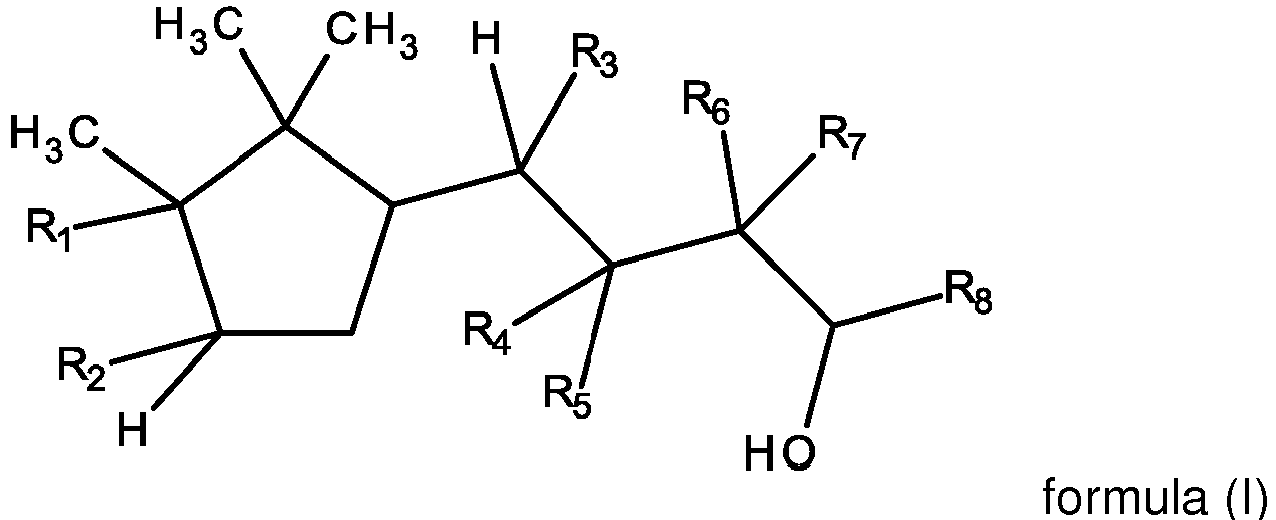
- R1 and R2 form together a double bond, or R1 and R2 form together a cyclopropyl group;
- R3, R4 are the same or different and independently selected from hydrogen, methyl, or R3 and R4 form together a double bond;
- R5, R6 are the same or different and independently selected from hydrogen, methyl; or R5 and R6 form together a double bond, or R5 and R6 form together a cyclopropyl group;
- R7 = methyl, or ethyl;
- R8 = hydrogen, or methyl,
- for preventing and treating bromhidrosis.
- In accordance with an additional aspect, the cosmetic use of a composition comprising a physiologically acceptable carrier and a compound of formula (I) as defined above for preventing or treating bromhidrosis is provided.
- Typically, the skin diseases treated by the topical application of the compounds of formula (I) are skin diseases with an inflammatory components, especially those referred herein .
- Certain aspects and advantages of the invention are further described with reference to the appended drawings.
-
Figure 1 shows dermcidin protein expression in the epithelium of human scalp Hair Follicles (HFs) with Sandalore® treatment Representative images show dermcidin (white arrows) in Sandalore® and vehicle human treated scalp microdissected hair follicle for 5 days (a,b) or 3 days (c,d) ex vivo. Qualitative observation deriving from the analysis of n=3 independent experiments (3 donors) (a,b) or 1 independent experiment (1 donor) (c, d). HS, hair shaft; IRS, inner root sheath; ORS, outer root sheath. - The experimental data indicate the number of positive cells (DCD+cells). In the vehicle are present 4.444 + 0,623 (mean ± SEM) DCD+ cells, whereas in the treatment with 500microM the DCD+ cells are 7.786 + 0.596 (mean ± SEM). Sandalore® induces statistical significant increase of the number of DCD+ cells with respect to vehicle (p<0.001).
- The invention is defined by the claims. Any subject-matter falling outside the scope of the claims is provided for information purposes only. Furthermore, any references in the description to methods of treatment refer to the compounds, pharmaceutical compositions and medicaments of the present invention for use in a method of treatment of the human or animal body by therapy.
- According to certain aspects of the invention, the inventors found that specific compounds activate certain immune defense mechanisms of the skin and/or promote an immune-stimulating activity which is mediated by dermcidin, a peptide which is constitutively secreted in human sweat and which typically plays a role in the regulation of the innate immune response as evidenced by Echo Wang et al. on Shock, 2016 January; 45(1): 28-32.
- Compounds of formula (I) were developed as synthetic substitutes of natural sandalwood . They provide a fragrance similar to that of Sandalwood.
- In general, the terminology sandalwood is referred to a class of woods from trees of the genus Santalum. The essential oil of sandalwood commonly is extracted by steam distillation of wood from matured sandalwood trees, and is a well-known valued component for perfumes.
- The main components of sandalwood oil are α-santalol e β-santalol, which are alcohols basically showing a sesquiterpenic type chain.
- The structural formula of α-santalol is the following

- The structural formula of β-santalol, which is as follow,

- The above chemical structures includes a terminal tricyclohept-3-yl or a bicyclohept-2-yl group, respectively.
- One of the preferred compounds for the topical uses according to the invention is sandal pentanol, also known as Sandalore®. This is a synthetic odorant having a fragrance similar to sandalwood and commonly used as component of perfumes or as emollient or skin cleaning agent or as an ingredient mimicking the sandalwood scent.
- Typically, Sandalore®, and its analogue derivatives, are alcohols having a chemical structure different from α-santalol e β-santalol which origin from natural sandalwood oil.
- Sandalore®, or sandal pentanol, have the following formula:

- Typically, the above referred molecules are synthetic.
- In accordance with certain embodiments the compounds of formula (I) contain a terminal cyclopenten-1-yl group and have no polycyclic structure typical of natural sandalwood oil constituents.
- In accordance with certain embodiments, the compounds of formula (I) are selected from the compounds illustrated in the following Table:
Compound IUPAC Name CAS N° Structural formula Formula/ MW 1 sandal pentanol 3-methyl-5-(2,2,3-trimethylcyclopent-3-en-1-yl)pentan-2-ol 65113-99-7 
C14H26O 210.36 2 sandal pentenol (4Z)-3-methyl-5-(2,2,3-trimethylcyclopent-3-en-1-yl)pent-4-en-2-ol 67801-20-1 
C14H24O 208.35 3 sandal cyclopropane 1-methyl-2-((1,2,2-trimethylbicyclo(3.1.0)hex-3-yl)methyl)-cyclopropane-methanol 198404-98-7 
C15H26O 222.37 Compound IUPAC Name CAS N° Structural formula Formula/ MW 4 Santol pentenol (E)-3,3-dimethyl-5-(2,2,3-trimethylcyclopent-3-en-1-yl)pent-4-en-2-ol 107898-54-4 
C15H26O 222.37 5 sandal cyclopentane 2-Methyl-4-(2,2,3-trimethyl-3-cyclopenten-1-yl)butanol 72089-08-8 
C13H24O 196.34 6 sandalrome (E)-2-ethyl-4-(2,2,3-trimethylcyclopent-3-en-1-yl)but-2-en-1-ol 28219-61-6 
C14H24O 208.35 7 sandal butenol (E)-2-methyl-4-(2,2,3-trimethyl-3-cyclopenten-1-yl)-2-buten-1-ol 28219-60-5 
C13H22O 194.32 - A preferred compound falling in formula (I) and illustrated in the above Table is sandal pentanol (compound 1).
- In accordance with certain embodiments the compounds of formula (I) have a 2,2,3-trimethylcyclopent-3-en-1yl moiety bearing a C4-C5 alkyl or C4-C5 alkenyl group in the 1-position of the ring. Preferred compounds falling in this embodiments are those with the moiety bearing a C4-C5 alkyl group in the 1-position of the ring, for
example compounds 1, 2, 4, 5, 6, 7 referred in the above Table. - In accordance with certain embodiments, sandal cyclopentane is excluded from the compounds of formula (I).
- It has been found that the selected compounds of formula (I) or the compounds falling in anyone of the above referred embodiments, when applied on the skin activates or promotes an immune defense response or an immune modulation action which is at the basis of their anti-inflammatory action.
- Typically, the referred immune modulation action is mediated by dermcidin (DCD), a protein secreted by eccrine gland.
- In contrast to antimicrobial peptides (AMPs), dermcidin is constitutively secreted in human sweat and is not inducible by inflammation or skin injury.
- In addition, contrary to the more common AMPs, such as defensins and cathelicidin, which are cationic peptides which bind to and permeabilize the bacterial membranes, dermcidin is an anionic peptide and kill bacteria through a different molecular mechanism.
- These properties make the dermcidin-mediated anti-inflammatory activity of the selected compounds of formula (I) in skin diseases underivable from the antimicrobial peptides having cationic nature allowing them to bind and disrupt bacterial membrane molecules.
- The inventors have also evidenced that the application on the skin of compounds of formula (I) stimulates the expression of dermcidin, a specific peptide provided with a local/topical anti-inflammatory action.
- These compounds exert an action on inflammatory skin diseases which makes them useful in the treatment of certain skin diseases with an inflammatory component especially psoriasis, folliculitis, rosacea and bromhidrosis especially severe bromhidrosis.
- The compounds of formula (I) are also useful in the treatment of bromhidrosis because one of the factor from which this disorder origins is the dysregulation of skin secretion from eccrine sweat glands which are regulated by dermcidin which is the biological target of compounds of formula (I).
- It has been also observed that the topical application to the skin of the compounds of formula (I) alters the composition of the microbiome from a pathological to healthy state thus resulting effective in many different skin diseases wherein inflammation is a component.
- In accordance with these aspects, a therapeutically effective amount of a pharmaceutical composition containing a compound of formula (I) is applied on the area of the skin in need of treatment. The treatment may include the application of the composition at least once a day, preferably twice until full recovery or until the symptomatology of the related diseases is substantially reduced or resolved.
- The present disclosure also provides a method of treatment of inflammatory diseases of the skin said method comprising the topical administration of an effective amount of a compound of formula (I) or a composition containing said compound and a pharmaceutically acceptable carrier.
- In accordance with this aspect, the method is useful in the treatment of folliculitis. The methods and compositions disclosed herein may be used for a wide range of skin disorders in which an inflammatory component is present including psoriasis, rosacea and folliculitis.
- Problems with current treatments for these disorders include antibiotic resistance, side effects, complicated regimens, and lack of long-term effectiveness. Treatments disclosed herein may provide alternatives to antibiotic and/or anti-inflammatory therapy, the use of compounds of formula (I) according to the invention, presenting very few or absence of side effects with simple treatment regimens and long-term effectiveness.
- It has been observed that the compounds of formula (I) ameliorated the aesthetic aspect of flushed skin, red skin, skin rashes and the redness of skin.
- Thus, in accordance with another aspect of the invention the cosmetic, non-therapeutic use of compounds of formula (I) as cosmetic skincare treatment is provided in accordance with the appended claims.
- In accordance with some embodiments it is provided the cosmetic, non therapeutic, use of compounds of formula (I) for the topical prevention and/or treatment of imperfection or blemish of the skin, for example for ameliorating the aesthetic aspect of flushed skin, or discoloring red skin or blotches.
- Within the non-claimed cosmetic uses of the compounds of formula (I) or composition containing the same, also fall mild acne and the excessive sebum production.
- The term "cosmetically acceptable" as used herein means that the components of the compositions are suitable for cutaneous or mucosal application in general, and when applied they do not cause an unwanted toxicity, allergic response, redness, incompatibility, instability, and similar reactions.
- In accordance with another aspect of the invention, a composition is provided, comprising an effective amount of one of the compounds of formula (I) according to anyone of the embodiments referred herein above and a physiologically acceptable carrier.
- The composition may be a pharmaceutical composition or a cosmetic composition. A suitable carrier is a pharmaceutically, phisiologically or cosmetically acceptable carrier.
- Typically, the composition are suitable for topical application on the skin or on mucosa.
- In the present specification, the term "carrier" refers to an excipient, carrier, diluent or adjuvant which has no activity and which may be present in the composition of the invention. Any carrier and/or excipient suitable for the form of preparation desired for administration is contemplated in the uses described herein.
- Typically, cosmetically acceptable carrier are used for the cosmetic uses of the compounds of formula (I) of the invention.
- In accordance with certain embodiments, the composition of the invention contains a pharmaceutically acceptable and/or physiologically acceptable carrier or, and a compound of formula (I) in an amount ranging from 0.1 to 20% by weight, from 0.5 to 15%, from 1 to 10% by weight.
- Typically, the composition of the invention either for cosmetic and pharmaceutical uses are in any forms suitable for topical/local application and may be in solid, fluid or semifluid form.
- Suitable compositions in solid form comprise creams, pastes, ointments, gel, bandages for pharmaceutical or cosmetic applications and sticks, make-up.
- In accordance with a preferred embodiment, the composition is a cream for topical application.
- Suitable compositions in fluid form include water-based formulations such as suspensions, solutions, lotions, gels, shampoos.
- Suitable compositions in semi-fluid form include foams and emulsions.
- For cosmetic application suitable forms include masks, transdermal paste or patch. In the composition of the invention, one or more excipients typically used in the basic formulation of pharmaceutical or cosmetic formulations may be incorporated, such as oils, glycerin, emollients, emulsifiers, dispersing agent, in amounts which are typical for the desired use.
- In the formulation of the composition of the invention may be present additional ingredients such as α Bisabolol, inositol, betaine, allantoins, ceramides for the creamy formulation.
- In some embodiments, the fluid or semifluid composition of the invention may contain lipophilic substances such as oils, for example Hydrogenated castor oil.
- In the case of formulations in liquid form, water is present as a diluent or solvent, optionally mixed with other liquids used for the formulation of pharmaceutical or cosmetic compositions.
- According to another embodiment, the cosmetic composition further comprises one or more amongst thickeners, solubilizers, preservatives, water, alcohols, glycerin, stabilizers, cosmetically acceptable antioxidants and antibacterials in amounts according to the common pharmaceutical or cosmetic practice.
- The present description is further described herein below with reference to the following examples which represent embodiments of the invention.
-
Component Q.ty (% w/w) PEG-8 Beeswax 6-18 Octyldodecanol 4-11 Diisopropyl sebacate 3 - 8 Mixed triglyceirdes decanoyl and octanoyl 2.3 - 6.8 Isostearyl isostearate 2 - 6 Sandalord®(sandal pentanol) 1 - 2 Butyrospermum parkii butter 1 - 3 Dicaprylyl ether 1 - 3 Pentylene glycol 1 - 3 Glycerin 1 - 2 Polymethyl methacrylate 1 - 2 Potassium cetyl phosphate 1 - 2 Symdiol 68T 0.4 - 1.1 Alphaa Bisabolol 0.3 - 0.8 Component Q.ty (% w/w) Betaine monohydrate 0.3 - 0.8 Inositol 0.3 - 0.8 Trehalose 100 0.3 - 0.8 Poloxamer 407 0.18 - 0.53 Dissolvine GL-38 0.2 - 0.5 Carbomer 0.1 - 0.3 Hydrogenated soy lecithin 0.1 - 0.3 Oxynex ST Liquid 0.1 - 0.3 Tromethamine 0.09 - 0.27 Allantoin 0.08 - 0.23 Disodium EDTA dihydrated 0.1 - 0.2 Pentaerytritol Tetrakis (3-(3.5-di-tert-butyl-4 hydroxyphenyl) propionate 0.03 - 0.08 Lactic acid 80% 0.018 - 0.053 Dimethylmethoxy chromanol 0.01 -0.03 Water q.s. to 100 g -
Component Q.ty (% w/w) Ethanol 10-20 Disodium EDTA 0.03 - 0.09 PEG-40 Hydrogenated castor oil 0.75 - 2.25 Sandalore®(sandal pentanol) 0.5 - 2.5 Water q.s. to 100 g -
Component Q.ty (% w/w) Ethanol 20 - 30 Sandalore®(sandal pentanol) 0.1 -10.0 PEG-40 Hydrogenated castor oil 1 - 3 Tocopheryl acetate 0.1 - 0.2 D-Panthenol 0.3 - 0.8 1.2 Propandiol 5 - 15 Triethyl citrate 0.2 - 0.5 Water q.s. to 100 g -
Component Q.ty (% w/w) Isopropyl myristate 5 - 10 Polisorbato 60 4.5 - 7.5 Sandalore®(sandal pentanol) 0.1 - 10.0 Sodium hydroxide 0.05-0.15 Alcool benzilico 1 - 2 Sorbitan monostearate 1.5 - 2.5 Cetyl palmitate 2 - 3 Cetyl alcohol 3 - 5 Stearyl Alcohol 3 - 5 Water q.s. to 100 g -
Component Q.ty (% w/w) C12-13 alkyl lactate 3-5 Gemseal 25 3-5 Sandalore® (sandal pentanol) 0.1 - 10.0 PEG-30 Dipolyhydroxystearate 1.3 - 3.8 Magnesium sulphate heptahydrate 0.4 - 1.2 Silica dimethyl silylate 1 - 2 Hydrogenated castor oil 1 - 2 Super sterol esters 0.3 - 0.8 Ethylhexyl palmitate 3 - 8 Allantoin 0.1 - 0.3 Fenossiethanol 0.4 - 0.6 Glycerin 2.3 - 6.8 PPG-15 Stearyl ether 1 - 3 Nylon-12 1 - 3 Ceramide Omega 9 0.1 - 0.3 Collageneer 0.2 - 0.5 Water q.s. to 100 g -
Component Q.ty (% w/w) Ethanol 30 - 50 Propylene glycol 2,5 - 8,0 Sandalor®(sandal pentanol) 0.1 -10.0 Water q.s. to 100 g -
Component Q.ty (% w/w) Poloxamer 30- 50 Propylene glycol 30 - 50 sandal ore 0,1 -10 water q.s. to 100g - Experimental evidence of regulation (promotion) of dermcidin by sandal pentanol.
- This experimental evidence is also based on the antinflammatory activity of dermcidin as evidenced in the article " The in vitro immune modulating properties of a swedt gland-derived anti-microbial peptide dermcidin" to Echo Wang et al., published on Shock, 2016 January; 45(1): 28-32.doi.1097/SHK0000000000000488, especially Fig. 3 showing that dermcidin modulated LPS- and HMGB1-induced chemokine (pro-inflammatory cytokines) release by human monocytes.
- Human scalp samples were obtained 1 day after face-lifting procedure (i.e. after overnight transport from collaborating surgeons) and used at the same day for mi-crodissecting human anagen VI scalp HFs. The HF microdissection technique employed for setting up the classical Philpott assay used in the current study, removes all perifollicular tissue with the sole exception of the HF's dermal sheath and thus does not contain any other skin appendage structures (e.g. eccrine gland elements). Microdissected human scalp HFs were cultured at 37°C with 5% CO2 in a minimal media of William's E media (WEM, Gibco, Life technologies) supplemented with 2mM of L-glutamine (Gibco), 10ng/ml hydrocortisone (Sigma-Aldrich), 10µg/ml insulin (Sigma-Aldrich) and 1% penicillin/streptomycin mix (Gibco) (WEM). After microdissection, the HFs were first incubated in WEM for 24hrs for re-equilibration.
- After 24 hours, WEM medium was replaced and HFs were treated with vehicle (0.1% DMSO), sandal pentanol 500µM, for 3 or 5 days for (immuno-)histology or 6 hours for microarray. Culture medium was replaced every second day and after 6 days, HFs were then embedded in cryomatrix (Fisher Scientific), and snap frozen in liquid nitrogen for (immuno-)histology.
- Expressional alteration was considered to be significant only when ≥1.8-fold and equidirectional changes were observed in at least 3 of 4 patients (independent experiments).
- OCT embedded samples were sectioned with a Leica cryostat. Dermicidin protein was detected using tissue sections fixed in 4% paraformaldehyde, pre-incubated with 10% of goat serum, and incubated with a mouse anti-human Dermcidin (Novus Biologicals, G-81, 1:200). Secondary antibody (Goat anti - mouse Alexa fluor 488) incubation was performed at room temperature for 45 min. Counterstaning with DAPI (1 µg/mL) was performed to visualize nuclei.
- Dermicidin protein expression is increased in hair follicle outer root sheath keratino-cytes ex vivo after sandal pentanol (500µM) treatment for 3 and 5 days (
Figure 1 ). Data are confirmed in following Table 1. - Microarray analysis revealed that Sandalore® significantly promotes AMPs secretion since transcripts of AMPs genes were up-regulated, particularly Dermcidin expression increased by 77.6 folds.
TABLE 1 Dermcidin positive cells Vehicle 500µM Sandalore® Mean 4,444 7,786 *** SEM 0,6232 0,5962 *** p<0.001
Claims (5)
- Sandal pentanol for use in the topical treatment of a skin, scalp or mucosal disease by promoting an immune-stimulating activity which is mediated by dermcidin wherein the disease is selected from the group consisting of psoriasis, rosacea, folliculitis, skin rashes.
- A composition comprising a physiologically acceptable carrier and sandal pentanol for use according to claim 1.
- Cosmetic use of sandal pentanol as cosmetic skincare treatment wherein at least an area of the skin is affected by redness, flushed skin, red skin.
- Cosmetic use of a compound of formula (I)
 R1 and R2 form together a double bond, or R1 and R2 form together a cyclopropyl group;R3, R4 are the same or different and independently selected from hydrogen, methyl,or R3 and R4 form together a double bond;R5, R6 are the same or different and independently selected from hydrogen, methyl;or R5 and R6 form together a double bond, or R5 and R6 form together a cyclopropyl group;R7 = methyl, or ethyl;R8 = hydrogen, or methyl,for preventing or treating bromhidrosis.
 - Cosmetic use of a composition comprising a physiologically acceptable carrier and a compound of formula (I) according to claim 4.
Priority Applications (4)
| Application Number | Priority Date | Filing Date | Title |
|---|---|---|---|
| HRP20221075TT HRP20221075T1 (en) | 2018-05-22 | 2019-05-21 | Compounds for preventing and treating skin or mucosal affections having an inflammatory component |
| SI201930311T SI3796897T1 (en) | 2018-05-22 | 2019-05-21 | Compounds for the prevention and treatment of skin or mucosal diseases that have an inflammatory component |
| RS20220781A RS63527B1 (en) | 2018-05-22 | 2019-05-21 | COMPOUNDS FOR THE PREVENTION AND TREATMENT OF DAMAGE TO THE SKIN OR MUCOSUM HAVING AN INFLAMMATORY COMPONENT |
| SM20220418T SMT202200418T1 (en) | 2018-05-22 | 2019-05-21 | Compounds for preventing and treating skin or mucosal affections having an inflammatory component |
Applications Claiming Priority (2)
| Application Number | Priority Date | Filing Date | Title |
|---|---|---|---|
| IT102018000005585A IT201800005585A1 (en) | 2018-05-22 | 2018-05-22 | COMPOUNDS TO PREVENT AND TREAT DISEASES OF THE SKIN OR MUCOSA WITH INFLAMMATORY COMPONENT |
| PCT/EP2019/063143 WO2019224211A1 (en) | 2018-05-22 | 2019-05-21 | Compounds for preventing and treating skin or mucosal affections having an inflammatory component |
Publications (2)
| Publication Number | Publication Date |
|---|---|
| EP3796897A1 EP3796897A1 (en) | 2021-03-31 |
| EP3796897B1 true EP3796897B1 (en) | 2022-06-22 |
Family
ID=63014978
Family Applications (1)
| Application Number | Title | Priority Date | Filing Date |
|---|---|---|---|
| EP19731151.7A Active EP3796897B1 (en) | 2018-05-22 | 2019-05-21 | Compounds for preventing and treating skin or mucosal affections having an inflammatory component |
Country Status (17)
| Country | Link |
|---|---|
| US (1) | US11759432B2 (en) |
| EP (1) | EP3796897B1 (en) |
| JP (1) | JP7503503B2 (en) |
| CA (1) | CA3100564A1 (en) |
| CY (1) | CY1125529T1 (en) |
| DK (1) | DK3796897T3 (en) |
| ES (1) | ES2926378T3 (en) |
| HR (1) | HRP20221075T1 (en) |
| HU (1) | HUE059806T2 (en) |
| IT (1) | IT201800005585A1 (en) |
| LT (1) | LT3796897T (en) |
| PL (1) | PL3796897T3 (en) |
| PT (1) | PT3796897T (en) |
| RS (1) | RS63527B1 (en) |
| SI (1) | SI3796897T1 (en) |
| SM (1) | SMT202200418T1 (en) |
| WO (1) | WO2019224211A1 (en) |
Family Cites Families (14)
| Publication number | Priority date | Publication date | Assignee | Title |
|---|---|---|---|---|
| JPH07109481A (en) * | 1993-10-12 | 1995-04-25 | Pola Chem Ind Inc | Perfume composition and cosmetic and fragrance containing the same |
| US5759556A (en) * | 1996-09-27 | 1998-06-02 | Chesebrough-Pond's Usa Co., Division Of Conopco, Inc. | Skin care compositions containing certain cyclic aliphatic unsaturated compounds and retinol or retinyl ester |
| DE69920567T2 (en) * | 1998-03-31 | 2005-10-06 | Shiseido Co. Ltd. | Method of preventing the body odor of old people |
| GB9918022D0 (en) | 1999-07-30 | 1999-09-29 | Unilever Plc | Skin care composition |
| JP2001348308A (en) | 2000-03-13 | 2001-12-18 | Lion Corp | Bacterial metabolic inhibitor |
| WO2000078117A2 (en) | 2000-05-31 | 2000-12-28 | Shiseido Co., Ltd. | Method of collection of fragrance ingredient, perfume composition and cosmetics containing it |
| EP1181866A1 (en) * | 2000-08-14 | 2002-02-27 | Givaudan SA | Antibacterial composition comprising Sandela |
| EP1184030A1 (en) * | 2000-08-14 | 2002-03-06 | Givaudan SA | Antibacterial composition comprising trimethylnorbornanylcyclohexanol derivatives |
| JP2004359602A (en) | 2003-06-04 | 2004-12-24 | Shiseido Co Ltd | Skin care preparation |
| ES2324192B1 (en) | 2008-01-30 | 2010-06-17 | PUIG BEAUTY & FASHION GROUP, S.L. | PEPTIDIC DERIVATIVES USEFUL IN THE TREATMENT, CARE OR CLEANING OF THE SKIN, MUCOSA, LEATHER HAIR OR NAILS. |
| JP5615527B2 (en) | 2009-11-05 | 2014-10-29 | 日本メナード化粧品株式会社 | Oxytocin production promoter |
| CA2790682C (en) * | 2010-03-03 | 2020-11-24 | Neocutis Sa | Compositions and methods for the treatment of skin diseases and disorders using antimicrobial peptide sequestering compounds |
| EP2957283B1 (en) * | 2014-06-19 | 2022-12-21 | Symrise AG | Process for identification of medicaments for acceleration of wound healing |
| ITUA20163604A1 (en) * | 2016-05-19 | 2017-11-19 | Giuliani Spa | COMPOUNDS TO PROMOTE HAIR GROWTH IN MAN AND / OR TO STOP OR DELAY ITS FALL, AND COMPOSITIONS FOR SUCH USES |
-
2018
- 2018-05-22 IT IT102018000005585A patent/IT201800005585A1/en unknown
-
2019
- 2019-05-21 JP JP2020565400A patent/JP7503503B2/en active Active
- 2019-05-21 PT PT197311517T patent/PT3796897T/en unknown
- 2019-05-21 EP EP19731151.7A patent/EP3796897B1/en active Active
- 2019-05-21 HR HRP20221075TT patent/HRP20221075T1/en unknown
- 2019-05-21 SM SM20220418T patent/SMT202200418T1/en unknown
- 2019-05-21 DK DK19731151.7T patent/DK3796897T3/en active
- 2019-05-21 HU HUE19731151A patent/HUE059806T2/en unknown
- 2019-05-21 LT LTEPPCT/EP2019/063143T patent/LT3796897T/en unknown
- 2019-05-21 US US17/057,814 patent/US11759432B2/en active Active
- 2019-05-21 RS RS20220781A patent/RS63527B1/en unknown
- 2019-05-21 ES ES19731151T patent/ES2926378T3/en active Active
- 2019-05-21 WO PCT/EP2019/063143 patent/WO2019224211A1/en not_active Ceased
- 2019-05-21 SI SI201930311T patent/SI3796897T1/en unknown
- 2019-05-21 PL PL19731151.7T patent/PL3796897T3/en unknown
- 2019-05-21 CA CA3100564A patent/CA3100564A1/en active Pending
-
2022
- 2022-09-06 CY CY20221100592T patent/CY1125529T1/en unknown
Also Published As
| Publication number | Publication date |
|---|---|
| WO2019224211A1 (en) | 2019-11-28 |
| IT201800005585A1 (en) | 2019-11-22 |
| SMT202200418T1 (en) | 2022-11-18 |
| EP3796897A1 (en) | 2021-03-31 |
| LT3796897T (en) | 2022-09-26 |
| JP7503503B2 (en) | 2024-06-20 |
| JP2021525253A (en) | 2021-09-24 |
| DK3796897T3 (en) | 2022-08-15 |
| PT3796897T (en) | 2022-09-02 |
| US20220071921A1 (en) | 2022-03-10 |
| SI3796897T1 (en) | 2022-11-30 |
| US11759432B2 (en) | 2023-09-19 |
| PL3796897T3 (en) | 2022-11-21 |
| CY1125529T1 (en) | 2026-02-25 |
| HUE059806T2 (en) | 2022-12-28 |
| ES2926378T3 (en) | 2022-10-25 |
| HRP20221075T1 (en) | 2022-11-11 |
| RS63527B1 (en) | 2022-09-30 |
| CA3100564A1 (en) | 2019-11-28 |
Similar Documents
| Publication | Publication Date | Title |
|---|---|---|
| Kumari et al. | Promising essential oils/plant extracts in the prevention and treatment of dandruff pathogenesis | |
| KR20190037229A (en) | A synergistic antifungal composition and method thereof | |
| KR101018352B1 (en) | Acne prevention and treatment composition using bee venom as an active ingredient | |
| JP2017523976A (en) | Application of surfactin in cosmetics | |
| KR20110082292A (en) | Extract of Hwangchil Tree for Atopic and Acne Skin | |
| CN105213210B (en) | Use of surfactin in cosmetics | |
| JP7135106B2 (en) | Scalp and hair composition | |
| JP5832302B2 (en) | Compositions, uses and methods of use of surface active proteins in topical drug delivery to keratin | |
| KR102279878B1 (en) | Cosmetic composition for improving acne | |
| BR112013027489B1 (en) | cosmetic use of e-polylysine (epsilon-polylysine) | |
| ES2316633T3 (en) | COMBINATIONS OF ACTIVE SUBSTANCES BASED ON DI-ALQUIL-SUBSTITUTED ACID AND ESTERES OF RENT OF GLYCERINE AGAINST BACTERIA, FUNGI AND VIRUSES. | |
| ITRM20130657A1 (en) | TREATMENT OF DERMATOPATHIES BY VEGETAL EXTRACT BY DAPHNE LAUREOLA | |
| US11759432B2 (en) | Compounds for preventing and treating skin or mucosal affections having an inflammatory component | |
| KR101638664B1 (en) | Pharmaceutical composition for preventing or treating infectious diseases of skin comprising 5-Aminolevulinic acid | |
| HK40044367A (en) | Compounds for preventing and treating skin or mucosal affections having an inflammatory component | |
| HK40044367B (en) | Compounds for preventing and treating skin or mucosal affections having an inflammatory component | |
| KR20090113614A (en) | Cosmetic Compositions Containing Retinol Derivatives | |
| JP6656890B2 (en) | Filaggrin production promoter | |
| JPH08301753A (en) | Active substance to bacteria,filamentous fungus and virus | |
| JP6002510B2 (en) | Estrogen receptor β activator | |
| KR20190067700A (en) | Cosmetic composition for acne improvement comprising black vinegar and niacinamide | |
| US20240197608A1 (en) | Acetyl sh-hexapeptide-5 amide acetate for use in the treatment of hair loss disorders and as a hair care agent | |
| KR20230067034A (en) | Method for producing lactoferrin derivative having functions such as antioxidant, whitening, anti-inflammatory and skin protection, and skin treatment ointment and cosmetic composition comprising the same | |
| KR20150051075A (en) | A body hair growth inhibition composition comprising palmatine as an effective ingredient | |
| KR20210070777A (en) | Composition for skin barrier |
Legal Events
| Date | Code | Title | Description |
|---|---|---|---|
| STAA | Information on the status of an ep patent application or granted ep patent |
Free format text: STATUS: UNKNOWN |
|
| STAA | Information on the status of an ep patent application or granted ep patent |
Free format text: STATUS: THE INTERNATIONAL PUBLICATION HAS BEEN MADE |
|
| PUAI | Public reference made under article 153(3) epc to a published international application that has entered the european phase |
Free format text: ORIGINAL CODE: 0009012 |
|
| STAA | Information on the status of an ep patent application or granted ep patent |
Free format text: STATUS: REQUEST FOR EXAMINATION WAS MADE |
|
| 17P | Request for examination filed |
Effective date: 20201218 |
|
| AK | Designated contracting states |
Kind code of ref document: A1 Designated state(s): AL AT BE BG CH CY CZ DE DK EE ES FI FR GB GR HR HU IE IS IT LI LT LU LV MC MK MT NL NO PL PT RO RS SE SI SK SM TR |
|
| AX | Request for extension of the european patent |
Extension state: BA ME |
|
| DAV | Request for validation of the european patent (deleted) | ||
| DAX | Request for extension of the european patent (deleted) | ||
| REG | Reference to a national code |
Ref country code: HK Ref legal event code: DE Ref document number: 40044367 Country of ref document: HK |
|
| GRAP | Despatch of communication of intention to grant a patent |
Free format text: ORIGINAL CODE: EPIDOSNIGR1 |
|
| STAA | Information on the status of an ep patent application or granted ep patent |
Free format text: STATUS: GRANT OF PATENT IS INTENDED |
|
| INTG | Intention to grant announced |
Effective date: 20220105 |
|
| GRAS | Grant fee paid |
Free format text: ORIGINAL CODE: EPIDOSNIGR3 |
|
| GRAA | (expected) grant |
Free format text: ORIGINAL CODE: 0009210 |
|
| STAA | Information on the status of an ep patent application or granted ep patent |
Free format text: STATUS: THE PATENT HAS BEEN GRANTED |
|
| AK | Designated contracting states |
Kind code of ref document: B1 Designated state(s): AL AT BE BG CH CY CZ DE DK EE ES FI FR GB GR HR HU IE IS IT LI LT LU LV MC MK MT NL NO PL PT RO RS SE SI SK SM TR |
|
| REG | Reference to a national code |
Ref country code: GB Ref legal event code: FG4D |
|
| REG | Reference to a national code |
Ref country code: CH Ref legal event code: EP |
|
| REG | Reference to a national code |
Ref country code: DE Ref legal event code: R096 Ref document number: 602019016194 Country of ref document: DE |
|
| REG | Reference to a national code |
Ref country code: AT Ref legal event code: REF Ref document number: 1499327 Country of ref document: AT Kind code of ref document: T Effective date: 20220715 |
|
| REG | Reference to a national code |
Ref country code: IE Ref legal event code: FG4D |
|
| REG | Reference to a national code |
Ref country code: RO Ref legal event code: EPE |
|
| REG | Reference to a national code |
Ref country code: DK Ref legal event code: T3 Effective date: 20220812 |
|
| REG | Reference to a national code |
Ref country code: PT Ref legal event code: SC4A Ref document number: 3796897 Country of ref document: PT Date of ref document: 20220902 Kind code of ref document: T Free format text: AVAILABILITY OF NATIONAL TRANSLATION Effective date: 20220826 |
|
| REG | Reference to a national code |
Ref country code: FI Ref legal event code: FGE |
|
| REG | Reference to a national code |
Ref country code: NL Ref legal event code: FP |
|
| REG | Reference to a national code |
Ref country code: SE Ref legal event code: TRGR |
|
| REG | Reference to a national code |
Ref country code: EE Ref legal event code: FG4A Ref document number: E022539 Country of ref document: EE Effective date: 20220830 Ref country code: NO Ref legal event code: T2 Effective date: 20220622 |
|
| REG | Reference to a national code |
Ref country code: ES Ref legal event code: FG2A Ref document number: 2926378 Country of ref document: ES Kind code of ref document: T3 Effective date: 20221025 |
|
| REG | Reference to a national code |
Ref country code: GR Ref legal event code: EP Ref document number: 20220401772 Country of ref document: GR Effective date: 20221010 |
|
| REG | Reference to a national code |
Ref country code: SK Ref legal event code: T3 Ref document number: E 40477 Country of ref document: SK |
|
| REG | Reference to a national code |
Ref country code: HR Ref legal event code: T1PR Ref document number: P20221075 Country of ref document: HR |
|
| REG | Reference to a national code |
Ref country code: HU Ref legal event code: AG4A Ref document number: E059806 Country of ref document: HU |
|
| REG | Reference to a national code |
Ref country code: DE Ref legal event code: R097 Ref document number: 602019016194 Country of ref document: DE |
|
| PLBE | No opposition filed within time limit |
Free format text: ORIGINAL CODE: 0009261 |
|
| STAA | Information on the status of an ep patent application or granted ep patent |
Free format text: STATUS: NO OPPOSITION FILED WITHIN TIME LIMIT |
|
| 26N | No opposition filed |
Effective date: 20230323 |
|
| REG | Reference to a national code |
Ref country code: HR Ref legal event code: ODRP Ref document number: P20221075 Country of ref document: HR Payment date: 20230517 Year of fee payment: 5 |
|
| P01 | Opt-out of the competence of the unified patent court (upc) registered |
Effective date: 20230525 |
|
| REG | Reference to a national code |
Ref country code: HR Ref legal event code: ODRP Ref document number: P20221075 Country of ref document: HR Payment date: 20240510 Year of fee payment: 6 |
|
| REG | Reference to a national code |
Ref country code: AT Ref legal event code: UEP Ref document number: 1499327 Country of ref document: AT Kind code of ref document: T Effective date: 20220622 |
|
| REG | Reference to a national code |
Ref country code: HR Ref legal event code: ODRP Ref document number: P20221075 Country of ref document: HR Payment date: 20250508 Year of fee payment: 7 |
|
| PGFP | Annual fee paid to national office [announced via postgrant information from national office to epo] |
Ref country code: NL Payment date: 20250521 Year of fee payment: 7 |
|
| PGFP | Annual fee paid to national office [announced via postgrant information from national office to epo] |
Ref country code: SM Payment date: 20250423 Year of fee payment: 7 |
|
| PGFP | Annual fee paid to national office [announced via postgrant information from national office to epo] |
Ref country code: MC Payment date: 20250527 Year of fee payment: 7 |
|
| PGFP | Annual fee paid to national office [announced via postgrant information from national office to epo] |
Ref country code: FI Payment date: 20250526 Year of fee payment: 7 |
|
| PGFP | Annual fee paid to national office [announced via postgrant information from national office to epo] |
Ref country code: PL Payment date: 20250513 Year of fee payment: 7 Ref country code: DE Payment date: 20250521 Year of fee payment: 7 |
|
| PGFP | Annual fee paid to national office [announced via postgrant information from national office to epo] |
Ref country code: GB Payment date: 20250527 Year of fee payment: 7 Ref country code: DK Payment date: 20250526 Year of fee payment: 7 |
|
| PGFP | Annual fee paid to national office [announced via postgrant information from national office to epo] |
Ref country code: LT Payment date: 20250424 Year of fee payment: 7 |
|
| PGFP | Annual fee paid to national office [announced via postgrant information from national office to epo] |
Ref country code: IS Payment date: 20250512 Year of fee payment: 7 Ref country code: RS Payment date: 20250508 Year of fee payment: 7 Ref country code: HU Payment date: 20250523 Year of fee payment: 7 Ref country code: NO Payment date: 20250523 Year of fee payment: 7 |
|
| PGFP | Annual fee paid to national office [announced via postgrant information from national office to epo] |
Ref country code: LU Payment date: 20250521 Year of fee payment: 7 Ref country code: BE Payment date: 20250521 Year of fee payment: 7 Ref country code: IT Payment date: 20250528 Year of fee payment: 7 Ref country code: AL Payment date: 20250509 Year of fee payment: 7 |
|
| PGFP | Annual fee paid to national office [announced via postgrant information from national office to epo] |
Ref country code: HR Payment date: 20250508 Year of fee payment: 7 |
|
| PGFP | Annual fee paid to national office [announced via postgrant information from national office to epo] |
Ref country code: LV Payment date: 20250514 Year of fee payment: 7 Ref country code: PT Payment date: 20250508 Year of fee payment: 7 |
|
| PGFP | Annual fee paid to national office [announced via postgrant information from national office to epo] |
Ref country code: EE Payment date: 20250530 Year of fee payment: 7 Ref country code: FR Payment date: 20250528 Year of fee payment: 7 |
|
| PGFP | Annual fee paid to national office [announced via postgrant information from national office to epo] |
Ref country code: MT Payment date: 20250425 Year of fee payment: 7 Ref country code: BG Payment date: 20250521 Year of fee payment: 7 Ref country code: GR Payment date: 20250523 Year of fee payment: 7 |
|
| PGFP | Annual fee paid to national office [announced via postgrant information from national office to epo] |
Ref country code: CH Payment date: 20250601 Year of fee payment: 7 |
|
| PGFP | Annual fee paid to national office [announced via postgrant information from national office to epo] |
Ref country code: AT Payment date: 20250522 Year of fee payment: 7 Ref country code: RO Payment date: 20250514 Year of fee payment: 7 |
|
| PGFP | Annual fee paid to national office [announced via postgrant information from national office to epo] |
Ref country code: TR Payment date: 20250513 Year of fee payment: 7 Ref country code: SK Payment date: 20250512 Year of fee payment: 7 |
|
| PGFP | Annual fee paid to national office [announced via postgrant information from national office to epo] |
Ref country code: CZ Payment date: 20250514 Year of fee payment: 7 |
|
| PGFP | Annual fee paid to national office [announced via postgrant information from national office to epo] |
Ref country code: IE Payment date: 20250521 Year of fee payment: 7 |
|
| PGFP | Annual fee paid to national office [announced via postgrant information from national office to epo] |
Ref country code: SI Payment date: 20250508 Year of fee payment: 7 Ref country code: SE Payment date: 20250521 Year of fee payment: 7 |
|
| PGFP | Annual fee paid to national office [announced via postgrant information from national office to epo] |
Ref country code: ES Payment date: 20250630 Year of fee payment: 7 |
|
| PGFP | Annual fee paid to national office [announced via postgrant information from national office to epo] |
Ref country code: MK Payment date: 20250423 Year of fee payment: 7 |
|
| PGFP | Annual fee paid to national office [announced via postgrant information from national office to epo] |
Ref country code: CY Payment date: 20250424 Year of fee payment: 7 |