EP3796417B1 - Secondary battery and battery pack including the same - Google Patents
Secondary battery and battery pack including the same Download PDFInfo
- Publication number
- EP3796417B1 EP3796417B1 EP20818869.8A EP20818869A EP3796417B1 EP 3796417 B1 EP3796417 B1 EP 3796417B1 EP 20818869 A EP20818869 A EP 20818869A EP 3796417 B1 EP3796417 B1 EP 3796417B1
- Authority
- EP
- European Patent Office
- Prior art keywords
- exterior
- vent
- secondary battery
- sheets
- vent member
- Prior art date
- Legal status (The legal status is an assumption and is not a legal conclusion. Google has not performed a legal analysis and makes no representation as to the accuracy of the status listed.)
- Active
Links
Images



Classifications
-
- H—ELECTRICITY
- H01—ELECTRIC ELEMENTS
- H01M—PROCESSES OR MEANS, e.g. BATTERIES, FOR THE DIRECT CONVERSION OF CHEMICAL ENERGY INTO ELECTRICAL ENERGY
- H01M50/00—Constructional details or processes of manufacture of the non-active parts of electrochemical cells other than fuel cells, e.g. hybrid cells
- H01M50/30—Arrangements for facilitating escape of gases
- H01M50/317—Re-sealable arrangements
-
- H—ELECTRICITY
- H01—ELECTRIC ELEMENTS
- H01M—PROCESSES OR MEANS, e.g. BATTERIES, FOR THE DIRECT CONVERSION OF CHEMICAL ENERGY INTO ELECTRICAL ENERGY
- H01M10/00—Secondary cells; Manufacture thereof
- H01M10/04—Construction or manufacture in general
- H01M10/0413—Large-sized flat cells or batteries for motive or stationary systems with plate-like electrodes
-
- H—ELECTRICITY
- H01—ELECTRIC ELEMENTS
- H01M—PROCESSES OR MEANS, e.g. BATTERIES, FOR THE DIRECT CONVERSION OF CHEMICAL ENERGY INTO ELECTRICAL ENERGY
- H01M10/00—Secondary cells; Manufacture thereof
- H01M10/04—Construction or manufacture in general
- H01M10/0436—Small-sized flat cells or batteries for portable equipment
-
- H—ELECTRICITY
- H01—ELECTRIC ELEMENTS
- H01M—PROCESSES OR MEANS, e.g. BATTERIES, FOR THE DIRECT CONVERSION OF CHEMICAL ENERGY INTO ELECTRICAL ENERGY
- H01M10/00—Secondary cells; Manufacture thereof
- H01M10/05—Accumulators with non-aqueous electrolyte
- H01M10/052—Li-accumulators
- H01M10/0525—Rocking-chair batteries, i.e. batteries with lithium insertion or intercalation in both electrodes; Lithium-ion batteries
-
- H—ELECTRICITY
- H01—ELECTRIC ELEMENTS
- H01M—PROCESSES OR MEANS, e.g. BATTERIES, FOR THE DIRECT CONVERSION OF CHEMICAL ENERGY INTO ELECTRICAL ENERGY
- H01M10/00—Secondary cells; Manufacture thereof
- H01M10/05—Accumulators with non-aqueous electrolyte
- H01M10/056—Accumulators with non-aqueous electrolyte characterised by the materials used as electrolytes, e.g. mixed inorganic/organic electrolytes
- H01M10/0564—Accumulators with non-aqueous electrolyte characterised by the materials used as electrolytes, e.g. mixed inorganic/organic electrolytes the electrolyte being constituted of organic materials only
- H01M10/0566—Liquid materials
-
- H—ELECTRICITY
- H01—ELECTRIC ELEMENTS
- H01M—PROCESSES OR MEANS, e.g. BATTERIES, FOR THE DIRECT CONVERSION OF CHEMICAL ENERGY INTO ELECTRICAL ENERGY
- H01M50/00—Constructional details or processes of manufacture of the non-active parts of electrochemical cells other than fuel cells, e.g. hybrid cells
- H01M50/10—Primary casings; Jackets or wrappings
- H01M50/102—Primary casings; Jackets or wrappings characterised by their shape or physical structure
- H01M50/105—Pouches or flexible bags
-
- H—ELECTRICITY
- H01—ELECTRIC ELEMENTS
- H01M—PROCESSES OR MEANS, e.g. BATTERIES, FOR THE DIRECT CONVERSION OF CHEMICAL ENERGY INTO ELECTRICAL ENERGY
- H01M50/00—Constructional details or processes of manufacture of the non-active parts of electrochemical cells other than fuel cells, e.g. hybrid cells
- H01M50/10—Primary casings; Jackets or wrappings
- H01M50/116—Primary casings; Jackets or wrappings characterised by the material
-
- H—ELECTRICITY
- H01—ELECTRIC ELEMENTS
- H01M—PROCESSES OR MEANS, e.g. BATTERIES, FOR THE DIRECT CONVERSION OF CHEMICAL ENERGY INTO ELECTRICAL ENERGY
- H01M50/00—Constructional details or processes of manufacture of the non-active parts of electrochemical cells other than fuel cells, e.g. hybrid cells
- H01M50/10—Primary casings; Jackets or wrappings
- H01M50/116—Primary casings; Jackets or wrappings characterised by the material
- H01M50/124—Primary casings; Jackets or wrappings characterised by the material having a layered structure
-
- H—ELECTRICITY
- H01—ELECTRIC ELEMENTS
- H01M—PROCESSES OR MEANS, e.g. BATTERIES, FOR THE DIRECT CONVERSION OF CHEMICAL ENERGY INTO ELECTRICAL ENERGY
- H01M50/00—Constructional details or processes of manufacture of the non-active parts of electrochemical cells other than fuel cells, e.g. hybrid cells
- H01M50/10—Primary casings; Jackets or wrappings
- H01M50/131—Primary casings; Jackets or wrappings characterised by physical properties, e.g. gas permeability, size or heat resistance
- H01M50/136—Flexibility or foldability
-
- H—ELECTRICITY
- H01—ELECTRIC ELEMENTS
- H01M—PROCESSES OR MEANS, e.g. BATTERIES, FOR THE DIRECT CONVERSION OF CHEMICAL ENERGY INTO ELECTRICAL ENERGY
- H01M50/00—Constructional details or processes of manufacture of the non-active parts of electrochemical cells other than fuel cells, e.g. hybrid cells
- H01M50/20—Mountings; Secondary casings or frames; Racks, modules or packs; Suspension devices; Shock absorbers; Transport or carrying devices; Holders
- H01M50/204—Racks, modules or packs for multiple batteries or multiple cells
- H01M50/207—Racks, modules or packs for multiple batteries or multiple cells characterised by their shape
- H01M50/209—Racks, modules or packs for multiple batteries or multiple cells characterised by their shape adapted for prismatic or rectangular cells
-
- H—ELECTRICITY
- H01—ELECTRIC ELEMENTS
- H01M—PROCESSES OR MEANS, e.g. BATTERIES, FOR THE DIRECT CONVERSION OF CHEMICAL ENERGY INTO ELECTRICAL ENERGY
- H01M50/00—Constructional details or processes of manufacture of the non-active parts of electrochemical cells other than fuel cells, e.g. hybrid cells
- H01M50/20—Mountings; Secondary casings or frames; Racks, modules or packs; Suspension devices; Shock absorbers; Transport or carrying devices; Holders
- H01M50/204—Racks, modules or packs for multiple batteries or multiple cells
- H01M50/207—Racks, modules or packs for multiple batteries or multiple cells characterised by their shape
- H01M50/211—Racks, modules or packs for multiple batteries or multiple cells characterised by their shape adapted for pouch cells
-
- H—ELECTRICITY
- H01—ELECTRIC ELEMENTS
- H01M—PROCESSES OR MEANS, e.g. BATTERIES, FOR THE DIRECT CONVERSION OF CHEMICAL ENERGY INTO ELECTRICAL ENERGY
- H01M50/00—Constructional details or processes of manufacture of the non-active parts of electrochemical cells other than fuel cells, e.g. hybrid cells
- H01M50/30—Arrangements for facilitating escape of gases
- H01M50/317—Re-sealable arrangements
- H01M50/325—Re-sealable arrangements comprising deformable valve members, e.g. elastic or flexible valve members
-
- H—ELECTRICITY
- H01—ELECTRIC ELEMENTS
- H01M—PROCESSES OR MEANS, e.g. BATTERIES, FOR THE DIRECT CONVERSION OF CHEMICAL ENERGY INTO ELECTRICAL ENERGY
- H01M50/00—Constructional details or processes of manufacture of the non-active parts of electrochemical cells other than fuel cells, e.g. hybrid cells
- H01M50/30—Arrangements for facilitating escape of gases
- H01M50/35—Gas exhaust passages comprising elongated, tortuous or labyrinth-shaped exhaust passages
- H01M50/367—Internal gas exhaust passages forming part of the battery cover or case; Double cover vent systems
-
- H—ELECTRICITY
- H01—ELECTRIC ELEMENTS
- H01M—PROCESSES OR MEANS, e.g. BATTERIES, FOR THE DIRECT CONVERSION OF CHEMICAL ENERGY INTO ELECTRICAL ENERGY
- H01M50/00—Constructional details or processes of manufacture of the non-active parts of electrochemical cells other than fuel cells, e.g. hybrid cells
- H01M50/30—Arrangements for facilitating escape of gases
- H01M50/392—Arrangements for facilitating escape of gases with means for neutralising or absorbing electrolyte; with means for preventing leakage of electrolyte through vent holes
-
- H—ELECTRICITY
- H01—ELECTRIC ELEMENTS
- H01M—PROCESSES OR MEANS, e.g. BATTERIES, FOR THE DIRECT CONVERSION OF CHEMICAL ENERGY INTO ELECTRICAL ENERGY
- H01M50/00—Constructional details or processes of manufacture of the non-active parts of electrochemical cells other than fuel cells, e.g. hybrid cells
- H01M50/30—Arrangements for facilitating escape of gases
- H01M50/394—Gas-pervious parts or elements
-
- H—ELECTRICITY
- H01—ELECTRIC ELEMENTS
- H01M—PROCESSES OR MEANS, e.g. BATTERIES, FOR THE DIRECT CONVERSION OF CHEMICAL ENERGY INTO ELECTRICAL ENERGY
- H01M2200/00—Safety devices for primary or secondary batteries
- H01M2200/20—Pressure-sensitive devices
-
- Y—GENERAL TAGGING OF NEW TECHNOLOGICAL DEVELOPMENTS; GENERAL TAGGING OF CROSS-SECTIONAL TECHNOLOGIES SPANNING OVER SEVERAL SECTIONS OF THE IPC; TECHNICAL SUBJECTS COVERED BY FORMER USPC CROSS-REFERENCE ART COLLECTIONS [XRACs] AND DIGESTS
- Y02—TECHNOLOGIES OR APPLICATIONS FOR MITIGATION OR ADAPTATION AGAINST CLIMATE CHANGE
- Y02E—REDUCTION OF GREENHOUSE GAS [GHG] EMISSIONS, RELATED TO ENERGY GENERATION, TRANSMISSION OR DISTRIBUTION
- Y02E60/00—Enabling technologies; Technologies with a potential or indirect contribution to GHG emissions mitigation
- Y02E60/10—Energy storage using batteries
-
- Y—GENERAL TAGGING OF NEW TECHNOLOGICAL DEVELOPMENTS; GENERAL TAGGING OF CROSS-SECTIONAL TECHNOLOGIES SPANNING OVER SEVERAL SECTIONS OF THE IPC; TECHNICAL SUBJECTS COVERED BY FORMER USPC CROSS-REFERENCE ART COLLECTIONS [XRACs] AND DIGESTS
- Y02—TECHNOLOGIES OR APPLICATIONS FOR MITIGATION OR ADAPTATION AGAINST CLIMATE CHANGE
- Y02P—CLIMATE CHANGE MITIGATION TECHNOLOGIES IN THE PRODUCTION OR PROCESSING OF GOODS
- Y02P70/00—Climate change mitigation technologies in the production process for final industrial or consumer products
- Y02P70/50—Manufacturing or production processes characterised by the final manufactured product
Definitions
- the present invention relates to a secondary battery and a battery pack including the secondary battery, and more particularly, to a secondary battery having a structure in which, when an internal pressure of the secondary battery increases, a gas within the secondary battery is discharged in a desired direction, and a battery pack including the secondary battery.
- Secondary batteries that are repetitively chargeable and dischargeable may be classified into cylindrical type secondary batteries, prismatic type secondary batteries, and pouch type secondary batteries according to their structures or manufacturing methods. Secondary batteries are disclosed in US 2010/239895 , WO 2011/070816 , KR 2015 0061996 and US 2009/017365 .
- the pouch type secondary battery has a structure in which an electrode assembly having a structure in which electrodes and separators are alternately disposed in a sheet-shaped pouch exterior is accommodated.
- the pouch type secondary battery has been widely used due to its relatively simple process and low manufacturing cost.
- a pressure within the secondary battery may increase due to an abnormal operation of the secondary battery. Particularly, when the pressure within the secondary battery abnormally increases, there is a possibility of explosion of the secondary battery. In order to prevent the secondary battery from being exploded, when the pressure within the secondary battery exceeds a certain value, it is necessary to discharge a gas within the secondary battery to the outside.
- an object to be achieved by the present invention is to prevent structures around a secondary battery from being damaged by discharging a gas within the secondary battery through a certain path when a pressure within the secondary battery abnormally increases.
- a secondary battery includes: an electrode assembly having a structure in which electrodes and separators are alternately disposed; an exterior having an inner space in which the electrode assembly is accommodated; a waterproof part provided in the exterior to surround at least a portion of a circumference of the electrode assembly so that a gas within the exterior passes through the waterproof part, but a liquid within the exterior does not pass through the waterproof part; and a vent part provided in an inner surface of the exterior to provide a path through which the gas within the exterior is discharged to the outside when an internal pressure of the exterior exceeds a certain value, wherein the waterproof part is provided to face an inner surface, in which the vent part is provided, among inner surfaces of the exterior.
- the exterior has a structure in which two sheets of exterior sheets face each other, a circumferential part on which ends of the two sheets of exterior sheets face each other is disposed on at least one surface of outer surfaces of the exterior, and the vent part is provided in the inner surface corresponding to the outer surface, on which the circumferential part is disposed, among the inner surfaces of the exterior.
- the secondary battery may further include an electrode lead protruding outward from one surface of the inner surfaces of the exterior, wherein the vent part may be provided in an inner surface except for the inner surface, from which the electrode lead protrudes, among the inner surfaces of the exterior.
- the waterproof part may surround an entire circumference of the electrode assembly.
- the vent part includes a first vent member and a second vent member, which face each other, and a distance between the first vent member and the second vent member decreases as closer to the outside of the exterior from the inside of the exterior.
- One end of the first vent member and one end of the second vent member, which extend outward from the exterior, may contact each other to block the path through which the gas within the exterior is discharged to the outside, and when the internal pressure of the exterior exceeds the certain value, the one end of the first vent member and the one end of the second vent member may be spaced apart from each other to provide the path through which the gas within the exterior is discharged to the outside.
- the secondary battery further includes an elastic part provided between an inner surface of the circumferential part and the vent part to press the vent part by elastic force.
- the elastic part includes: a first elastic member provided between the inner surface of the circumferential part and the first vent member to press the first vent member by the elastic force; and a second elastic member provided between the inner surface of the circumferential part and the second vent member to press the second vent member by the elastic force, wherein the first elastic member and the second elastic member presses an area on which the first vent member and the second vent member contact with each other when an internal pressure of the exterior is less than a certain value.
- the one end of the first vent member and the one end of the second vent member may contact again each other to block again the path through which the gas within the exterior is discharged to the outside.
- the two sheets of exterior sheets are bonded to each other to provide a sealing part on a circumferential part except for the circumferential part disposed on the outer surface corresponding to the inner surface, in which the vent part is provided, on the circumferential part, and the two sheets of exterior sheets are not bonded to each other or are bonded to each other with bonding force that is less than that of the sealing part on the circumferential part disposed on the outer surface corresponding to the inner surface, in which the vent part is provided, on the circumferential part.
- a battery pack including the secondary battery is provided.
- the exterior may have a structure in which two sheets of exterior sheets face each other, a circumferential part on which the two sheets of exterior sheets face each other may be disposed on an upper outer surface, which faces an upper side, among of outer surfaces of the exterior, and the vent part may be provided in an inner surface corresponding to the upper outer surface, on which the circumferential part is disposed, among the inner surfaces of the exterior.
- the gas within the secondary battery may be discharged through the certain path to prevent the structure around the secondary battery from being damaged.
- FIG. 1 is a perspective view illustrating a structure of a secondary battery according to an embodiment of the present invention
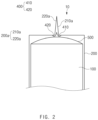
- FIG. 2 is a side cross-sectional view illustrating a normal state of an upper structure of a secondary battery according to a first embodiment of the present invention
- FIG. 3 is a side cross-sectional view illustrating a state of the upper structure of the secondary battery when an internal pressure of the secondary battery exceeds a certain value according to a first embodiment of the present invention
- FIG. 4 is a side cross-sectional view illustrating a state of an upper structure of a secondary battery according to a second embodiment of the present invention.
- a secondary battery 10 may include an electrode assembly 100.
- the electrode assembly 100 may have a structure in which electrodes and separators are alternately disposed.
- the secondary battery 10 may include an exterior 200 having an inner space in which the electrode assembly 100 is accommodated.
- the exterior 200 may have a pouch type exterior. That is, the secondary battery according to the present invention may be a pouch type secondary battery.
- the exterior 200 of the secondary battery 10 according to the present invention includes a first exterior sheet 210a and a second exterior sheet 220a.
- the secondary battery 10 according to the present invention includes a circumferential part 200a at which the first exterior sheet 210a and the second exterior sheet 220a of the exterior 200 face each other.
- the circumferential part 200a has a structure in which ends of the first exterior sheet 210a and the second exterior sheet 220a face each other.
- the circumference 200a is disposed on at least one surface of outer surfaces of the exterior 200.
- FIG. 1 illustrates a state in which the circumferential part 200a is disposed on each of a top surface and a bottom surface of the exterior 200.
- the secondary battery 10 may further include an electrode lead 300 protruding from one surface of the exterior 200.
- the electrode lead 300 is configured to be electrically connected to an electrode tab (not shown) of the electrode assembly 100 and may have a structure that protrudes outward from one surface of inner surfaces of the exterior 200.
- FIG. 1 illustrates a state in which two electrode leads 300 protrude in opposite directions.
- the secondary battery 10 may include a vent part 400 that provides a path through which a gas within the exterior 200 is discharged to the outside when an internal pressure of the exterior 200 exceeds a certain value.
- the vent part 400 includes a first vent member 410 and a second vent member 420.
- the first vent member 410 and the second vent member 420 may be disposed to symmetrically face each other.
- the vent part 400 is provided in an inner surface corresponding to an outer surface on which the circumferential part 200a is disposed, among the inner surfaces of the exterior 200.
- FIGS. 2 and 3 illustrate a state in which the vent part 400 is provided in the inner surface corresponding to the upper outer surface on which the circumferential part 200a is disposed among the inner surfaces of the exterior 200.
- first vent member 410 and the second vent member 420 may extend outward from the exterior 200.
- a distance between the first vent member 410 and the second vent member 420 gradually decreases as closer to the outside of the exterior 200 from the inside of the exterior 200.
- the path through which the gas within the exterior 200 passes through the vent part 400 and is discharged to the outside may be blocked in ordinary time.
- the vent part 400 may be provided in the inner surface except for the inner surface, from which the electrode lead 300 protrudes, among the inner surfaces of the exterior 200.
- the vent part 400 may be provided in the inner surface except for the inner surface, through which the electrode lead 300 protrudes, among the inner surfaces of the exterior 200.
- the principle in which the gas within the secondary battery 10 is discharged to the outside through the vent part 400 according to the present invention is as follows.
- the one end of the first vent member 410 and the one end of the second vent member 420 which are in a state of contacting each other in the ordinary time, are spaced apart from each other by the internal pressure of the exterior 200, and thus, the gas within the secondary battery 10 is discharged to the outside.
- the secondary battery 10 may be manufactured so that the first vent part 410 and the second vent part 420 of the vent part 400 are spaced apart from each other.
- the first vent member 410 and the second vent member 420 may be spaced apart from each other, and thus, the gas within the secondary battery 10 may be discharged to the outside.
- the one end of the first vent member 410 and the one end of the second vent member 420 may contact again each other to block again the path through which the gas within the exterior 200 is discharged to the outside. That is, the first vent member 410 and the second vent member 420 of the vent part 400 according to the present invention may be configured so that the contact and space therebetween is repeatedly performed according to the internal pressure of the exterior 200.
- the vent part 400 since the vent part 400 is provided in the secondary battery 10, when the pressure inside the secondary battery increases abnormally, the gas within the secondary battery 10 may be discharged to the outside through the certain path provided by the opening vent part 400.
- the present invention it is possible to prevent unexpected damage of structures around the secondary battery, which may occur when the path through which the gas within the secondary battery is discharged is not constant.
- two sheets of exterior sheets are bonded to each other on at least a portion of the circumferential surface 200a. That is, according to the present invention, the first exterior sheet 210a and the second exterior sheet 220a are bonded to each other to provide a sealing part on the circumferential part except for the circumferential part disposed on the outer surface corresponding to the inner surface, in which the vent part 400 is provided, on the circumferential part 200a. Referring to FIG. 1 , the first exterior sheet 210a and the second exterior sheet 220a are bonded to each other to provide the sealing part at the circumferential part 200a disposed on the bottom surface of the exterior 200.
- the two sheets of exterior sheets are not bonded to each other or are bonded to each other with bonding force less than that of the sealing part at the other portion of the circumferential part 200a.
- the first exterior sheet 210a and the second exterior sheet 220a are not bonded to each other or are bonded to each other with bonding force less than that of the sealing part at the circumferential part 200a disposed on the top surface of the exterior 200.
- the gas within the exterior 200 is quickly discharged to the outside through the vent part 400 before the other region of the exterior is broken.
- the secondary battery 10 may further include a waterproof part 500 provided in the exterior 200 to surround at least a portion of a circumference of the electrode assembly 100.
- the waterproof part 500 may be configured to allow the gas within the exterior 200 to pass therethrough and allow a liquid within the exterior 200 so as not to pass therethrough.
- the waterproof part 500 may have a waterproof property and may be fabric having a mesh structure.
- the waterproof part 500 may be provided to face the inner surface, in which the vent part 400 is provided, among the inner surfaces of the exterior 200.
- FIG. 2 illustrates a state in which the waterproof part 500 is provided to face the upper inner surface of the exterior 200 in which the vent part 400 is provided.
- the waterproof part 500 is provided to face the inner surface, in which the vent part 400 is provided, among the inner surfaces of the exterior 200, when the internal pressure of the exterior 200 exceeds a certain value, the gas within the secondary battery 10 may be discharged to the outside via the vent part 400 and the circumferential part 200a after passing through the waterproof part 500, but the liquid (for example, an electrolyte) within the secondary battery 10 may not be discharged to the outside, or discharge of the liquid to the outside may be minimized.
- the liquid for example, an electrolyte
- a main effect on the internal pressure of the exterior 200 of the secondary battery 10 may be affected to the gas, not the liquid, within the secondary battery 10. Particularly, when the electrolyte leaks to the outside, the secondary battery may not properly operate.
- the internal pressure of the exterior exceeds a certain value, only the gas affected by the main effect of the internal pressure of the exterior 200 may be discharged to the outside. As a result, even though the internal pressure of the exterior 200 increases abnormally, the operation of the secondary battery 10 may be stopped due to the discharge of the liquid within the secondary battery.
- FIG. 4 is a side cross-sectional view illustrating a state of an upper structure of a secondary battery according to a second embodiment of the present invention.
- the waterproof part 500 may surround only a portion of the circumferential part of the electrode assembly 100 (particularly, a region facing the vent part in the electrode assembly).
- a waterproof part 500 may surround an entire circumference of an electrode assembly 100.
- FIG. 5 is a side cross-sectional view illustrating a state of an upper structure of a secondary battery according to a third embodiment of the present invention
- FIG. 6 is an enlarged side cross-sectional view of a region A of FIG. 5 .
- a secondary battery 10 according to the present invention further includes an elastic part 600 provided between an inner surface of a circumferential part 200a and a vent part 400.
- the elastic part 600 is configured to press the vent part 400 by elastic force and may be made of a material having elasticity.
- the elastic part 600 includes a first elastic member 610 and a second elastic member 620.
- the first elastic member 610 is provided between the inner surface of the circumferential part 200a and the first vent member 410
- the second elastic member 620 is provided between the inner surface of the circumferential part 200a and the second vent member 420.
- the first elastic member 610 presses the first vent member 410 by the elastic force
- the second elastic member 620 presses the second vent member 420 by the elastic force.
- each of the first elastic member 610 and the second elastic member 620 may be a spring.
- One end and the other end of the first elastic member 610 may be attached to an inner surface of a first exterior sheet 210a and the first vent member 410, respectively.
- one end and the other end of the second elastic member 620 may be attached to an inner surface of a second exterior sheet 220a and the second vent member 420.
- the first vent member 410 and the second vent member 420 are more stably contact each other by the elastic force of the elastic part 600.
- the first elastic member 610 and the second elastic member 620 presses an area on which the first vent member 410 and the second vent member 420 contact with each other (that is, an area on which the one end of the first vent member and the one end of the second vent member, which extend outward from the exterior, contact each other).
- a battery pack according to the present invention may include a plurality of secondary batteries.
- a circumferential part on which two sheets of exterior sheets face each other may be disposed on at least a portion of outer surfaces of an exterior of the secondary battery according to the present invention.
- the circumferential part may be disposed on an upper outer surface, which facing an upper side, among the outer surfaces of the exterior.
- a vent part of the secondary battery may be provided in an inner surface corresponding to the upper outer surface, on which the circumferential part is disposed, among the inner surfaces of the exterior.
Landscapes
- Chemical & Material Sciences (AREA)
- Chemical Kinetics & Catalysis (AREA)
- Electrochemistry (AREA)
- General Chemical & Material Sciences (AREA)
- Engineering & Computer Science (AREA)
- Manufacturing & Machinery (AREA)
- General Physics & Mathematics (AREA)
- Inorganic Chemistry (AREA)
- Condensed Matter Physics & Semiconductors (AREA)
- Physics & Mathematics (AREA)
- Materials Engineering (AREA)
- Gas Exhaust Devices For Batteries (AREA)
- Sealing Battery Cases Or Jackets (AREA)
Description
- The present application claims the benefit of the priority of
Korean Patent Application 10-2019-0066143, filed on June 04, 2019 - The present invention relates to a secondary battery and a battery pack including the secondary battery, and more particularly, to a secondary battery having a structure in which, when an internal pressure of the secondary battery increases, a gas within the secondary battery is discharged in a desired direction, and a battery pack including the secondary battery.
- Secondary batteries that are repetitively chargeable and dischargeable may be classified into cylindrical type secondary batteries, prismatic type secondary batteries, and pouch type secondary batteries according to their structures or manufacturing methods. Secondary batteries are disclosed in
US 2010/239895 ,WO 2011/070816 ,KR 2015 0061996 US 2009/017365 . Among them, the pouch type secondary battery has a structure in which an electrode assembly having a structure in which electrodes and separators are alternately disposed in a sheet-shaped pouch exterior is accommodated. In particular, the pouch type secondary battery has been widely used due to its relatively simple process and low manufacturing cost. - A pressure within the secondary battery may increase due to an abnormal operation of the secondary battery. Particularly, when the pressure within the secondary battery abnormally increases, there is a possibility of explosion of the secondary battery. In order to prevent the secondary battery from being exploded, when the pressure within the secondary battery exceeds a certain value, it is necessary to discharge a gas within the secondary battery to the outside.
- However, since the gas within the secondary battery is in a high-temperature and high-pressure state, if the gas within the secondary battery is discharged to a wrong direction, structures around the secondary battery may be damaged. In order to prevent such a problem, it is necessary to design the secondary battery so that the gas within the secondary battery is discharged through a certain path.
- Therefore, an object to be achieved by the present invention is to prevent structures around a secondary battery from being damaged by discharging a gas within the secondary battery through a certain path when a pressure within the secondary battery abnormally increases.
- The subject matter of the present invention is defined in the appended claims. According to one aspect of the prevent invention for achieving the above object, a secondary battery includes: an electrode assembly having a structure in which electrodes and separators are alternately disposed; an exterior having an inner space in which the electrode assembly is accommodated; a waterproof part provided in the exterior to surround at least a portion of a circumference of the electrode assembly so that a gas within the exterior passes through the waterproof part, but a liquid within the exterior does not pass through the waterproof part; and a vent part provided in an inner surface of the exterior to provide a path through which the gas within the exterior is discharged to the outside when an internal pressure of the exterior exceeds a certain value, wherein the waterproof part is provided to face an inner surface, in which the vent part is provided, among inner surfaces of the exterior.
- The exterior has a structure in which two sheets of exterior sheets face each other, a circumferential part on which ends of the two sheets of exterior sheets face each other is disposed on at least one surface of outer surfaces of the exterior, and the vent part is provided in the inner surface corresponding to the outer surface, on which the circumferential part is disposed, among the inner surfaces of the exterior.
- The secondary battery may further include an electrode lead protruding outward from one surface of the inner surfaces of the exterior, wherein the vent part may be provided in an inner surface except for the inner surface, from which the electrode lead protrudes, among the inner surfaces of the exterior.
- The waterproof part may surround an entire circumference of the electrode assembly.
- The vent part includes a first vent member and a second vent member, which face each other, and a distance between the first vent member and the second vent member decreases as closer to the outside of the exterior from the inside of the exterior.
- One end of the first vent member and one end of the second vent member, which extend outward from the exterior, may contact each other to block the path through which the gas within the exterior is discharged to the outside, and when the internal pressure of the exterior exceeds the certain value, the one end of the first vent member and the one end of the second vent member may be spaced apart from each other to provide the path through which the gas within the exterior is discharged to the outside.
- The secondary battery further includes an elastic part provided between an inner surface of the circumferential part and the vent part to press the vent part by elastic force.
- The elastic part includes: a first elastic member provided between the inner surface of the circumferential part and the first vent member to press the first vent member by the elastic force; and a second elastic member provided between the inner surface of the circumferential part and the second vent member to press the second vent member by the elastic force,
wherein the first elastic member and the second elastic member presses an area on which the first vent member and the second vent member contact with each other when an internal pressure of the exterior is less than a certain value. - When the internal pressure of the exterior decreases again below the certain value, the one end of the first vent member and the one end of the second vent member may contact again each other to block again the path through which the gas within the exterior is discharged to the outside.
- The two sheets of exterior sheets are bonded to each other to provide a sealing part on a circumferential part except for the circumferential part disposed on the outer surface corresponding to the inner surface, in which the vent part is provided, on the circumferential part, and the two sheets of exterior sheets are not bonded to each other or are bonded to each other with bonding force that is less than that of the sealing part on the circumferential part disposed on the outer surface corresponding to the inner surface, in which the vent part is provided, on the circumferential part.
- According to another aspect of the prevent invention for achieving the above object, a battery pack including the secondary battery is provided.
- The exterior may have a structure in which two sheets of exterior sheets face each other, a circumferential part on which the two sheets of exterior sheets face each other may be disposed on an upper outer surface, which faces an upper side, among of outer surfaces of the exterior, and the vent part may be provided in an inner surface corresponding to the upper outer surface, on which the circumferential part is disposed, among the inner surfaces of the exterior.
- According to the present invention, when the pressure within the secondary battery abnormally increases, the gas within the secondary battery may be discharged through the certain path to prevent the structure around the secondary battery from being damaged.
-
-
FIG. 1 is a perspective view illustrating a structure of a secondary battery according to an embodiment of the present invention. -
FIG. 2 is a side cross-sectional view illustrating a normal state of an upper structure of a secondary battery according to a first embodiment of the present invention. -
FIG. 3 is a side cross-sectional view illustrating a state of the upper structure of the secondary battery when an internal pressure of the secondary battery exceeds a certain value according to a first embodiment of the present invention. -
FIG. 4 is a side cross-sectional view illustrating a state of an upper structure of a secondary battery according to a second embodiment of the present invention. -
FIG. 5 is a side cross-sectional view illustrating a state of an upper structure of a secondary battery according to a third embodiment of the present invention. -
FIG. 6 is an enlarged side cross-sectional view of a region A ofFIG. 5 . - Hereinafter, a secondary battery and a structure of a battery pack according to the present invention will be described with reference to the drawings.
-
FIG. 1 is a perspective view illustrating a structure of a secondary battery according to an embodiment of the present invention, andFIG. 2 is a side cross-sectional view illustrating a normal state of an upper structure of a secondary battery according to a first embodiment of the present invention.FIG. 3 is a side cross-sectional view illustrating a state of the upper structure of the secondary battery when an internal pressure of the secondary battery exceeds a certain value according to a first embodiment of the present invention, andFIG. 4 is a side cross-sectional view illustrating a state of an upper structure of a secondary battery according to a second embodiment of the present invention. - As illustrated in
FIGS. 1 and3 , asecondary battery 10 according to the present invention may include anelectrode assembly 100. Theelectrode assembly 100 may have a structure in which electrodes and separators are alternately disposed. - Also, the
secondary battery 10 may include an exterior 200 having an inner space in which theelectrode assembly 100 is accommodated. Theexterior 200 may have a pouch type exterior. That is, the secondary battery according to the present invention may be a pouch type secondary battery. - Continuously, referring to
FIGS. 1 to 3 , theexterior 200 of thesecondary battery 10 according to the present invention includes a firstexterior sheet 210a and a secondexterior sheet 220a. Also, thesecondary battery 10 according to the present invention includes acircumferential part 200a at which the firstexterior sheet 210a and the secondexterior sheet 220a of theexterior 200 face each other. Thecircumferential part 200a has a structure in which ends of the firstexterior sheet 210a and the secondexterior sheet 220a face each other. Thecircumference 200a is disposed on at least one surface of outer surfaces of theexterior 200.FIG. 1 illustrates a state in which thecircumferential part 200a is disposed on each of a top surface and a bottom surface of theexterior 200. - In addition, the
secondary battery 10 according to the present invention may further include anelectrode lead 300 protruding from one surface of theexterior 200. Theelectrode lead 300 is configured to be electrically connected to an electrode tab (not shown) of theelectrode assembly 100 and may have a structure that protrudes outward from one surface of inner surfaces of theexterior 200.FIG. 1 illustrates a state in which two electrode leads 300 protrude in opposite directions. - As illustrated in
FIGS. 2 and3 , thesecondary battery 10 according to the present invention may include avent part 400 that provides a path through which a gas within theexterior 200 is discharged to the outside when an internal pressure of theexterior 200 exceeds a certain value. - The
vent part 400 includes afirst vent member 410 and asecond vent member 420. Here, thefirst vent member 410 and thesecond vent member 420 may be disposed to symmetrically face each other. - The
vent part 400 is provided in an inner surface corresponding to an outer surface on which thecircumferential part 200a is disposed, among the inner surfaces of theexterior 200.FIGS. 2 and3 illustrate a state in which thevent part 400 is provided in the inner surface corresponding to the upper outer surface on which thecircumferential part 200a is disposed among the inner surfaces of theexterior 200. - Also, the
first vent member 410 and thesecond vent member 420 may extend outward from theexterior 200. Here, a distance between thefirst vent member 410 and thesecond vent member 420 gradually decreases as closer to the outside of theexterior 200 from the inside of theexterior 200. Also, as illustrated inFIG. 2 , since one end of thefirst vent member 410 and one end of thesecond vent member 420, which extend outward from the exterior 200, contact each other, the path through which the gas within the exterior 200 passes through thevent part 400 and is discharged to the outside may be blocked in ordinary time. - Continuously, referring to
FIGS. 2 and3 , thevent part 400 may be provided in the inner surface except for the inner surface, from which theelectrode lead 300 protrudes, among the inner surfaces of theexterior 200. - When the vent part is provided in the inner surface from which the electrode lead protrudes, the gas may contact the electrode lead while the gas within the secondary battery is discharged to the outside through the vent part. In this case, the electrode lead may be deformed or damaged by a temperature and pressure of the gas that is discharged to the outside through the vent part. Thus, according to the present invention, the
vent part 400 may be provided in the inner surface except for the inner surface, through which theelectrode lead 300 protrudes, among the inner surfaces of theexterior 200. - The principle in which the gas within the
secondary battery 10 is discharged to the outside through thevent part 400 according to the present invention is as follows. - When the internal pressure of the exterior 200 exceeds a certain value due to an abnormal operation of the
secondary battery 10, as illustrated inFIG. 3 , the one end of thefirst vent member 410 and the one end of thesecond vent member 420, which are in a state of contacting each other in the ordinary time, are spaced apart from each other by the internal pressure of the exterior 200, and thus, the gas within thesecondary battery 10 is discharged to the outside. - That is, when the internal pressure of the exterior 200 exceeds a fixed one value in a region adjacent to the
vent part 400, thesecondary battery 10 may be manufactured so that thefirst vent part 410 and thesecond vent part 420 of thevent part 400 are spaced apart from each other. For example, when the internal pressure of the exterior 200 exceeds a specific value A in the region adjacent to thevent part 400, thefirst vent member 410 and thesecond vent member 420 may be spaced apart from each other, and thus, the gas within thesecondary battery 10 may be discharged to the outside. - When the gas within the
exterior 200 is discharged, and thus, the internal pressure of the exterior 200 decreases again below the certain value, the one end of thefirst vent member 410 and the one end of thesecond vent member 420 may contact again each other to block again the path through which the gas within theexterior 200 is discharged to the outside. That is, thefirst vent member 410 and thesecond vent member 420 of thevent part 400 according to the present invention may be configured so that the contact and space therebetween is repeatedly performed according to the internal pressure of theexterior 200. - According to the present invention, since the
vent part 400 is provided in thesecondary battery 10, when the pressure inside the secondary battery increases abnormally, the gas within thesecondary battery 10 may be discharged to the outside through the certain path provided by theopening vent part 400. Thus, according to the present invention, it is possible to prevent unexpected damage of structures around the secondary battery, which may occur when the path through which the gas within the secondary battery is discharged is not constant. - Referring to
FIGS. 1 to 3 , in thesecondary battery 10 according to the present invention, two sheets of exterior sheets are bonded to each other on at least a portion of thecircumferential surface 200a. That is, according to the present invention, thefirst exterior sheet 210a and thesecond exterior sheet 220a are bonded to each other to provide a sealing part on the circumferential part except for the circumferential part disposed on the outer surface corresponding to the inner surface, in which thevent part 400 is provided, on thecircumferential part 200a. Referring toFIG. 1 , thefirst exterior sheet 210a and thesecond exterior sheet 220a are bonded to each other to provide the sealing part at thecircumferential part 200a disposed on the bottom surface of theexterior 200. - On the other hand, in the
secondary battery 10 according to the present invention, the two sheets of exterior sheets are not bonded to each other or are bonded to each other with bonding force less than that of the sealing part at the other portion of thecircumferential part 200a. Referring toFIG. 1 , thefirst exterior sheet 210a and thesecond exterior sheet 220a are not bonded to each other or are bonded to each other with bonding force less than that of the sealing part at thecircumferential part 200a disposed on the top surface of theexterior 200. In this case, when the internal pressure of the exterior 200 exceeds the certain value, the gas within theexterior 200 is quickly discharged to the outside through thevent part 400 before the other region of the exterior is broken. - The
secondary battery 10 according to the present invention may further include awaterproof part 500 provided in the exterior 200 to surround at least a portion of a circumference of theelectrode assembly 100. Thewaterproof part 500 may be configured to allow the gas within the exterior 200 to pass therethrough and allow a liquid within the exterior 200 so as not to pass therethrough. Thewaterproof part 500 may have a waterproof property and may be fabric having a mesh structure. - As illustrated in
FIG. 2 , thewaterproof part 500 may be provided to face the inner surface, in which thevent part 400 is provided, among the inner surfaces of theexterior 200.FIG. 2 illustrates a state in which thewaterproof part 500 is provided to face the upper inner surface of the exterior 200 in which thevent part 400 is provided. - According to the present invention, since the
waterproof part 500 is provided to face the inner surface, in which thevent part 400 is provided, among the inner surfaces of the exterior 200, when the internal pressure of the exterior 200 exceeds a certain value, the gas within thesecondary battery 10 may be discharged to the outside via thevent part 400 and thecircumferential part 200a after passing through thewaterproof part 500, but the liquid (for example, an electrolyte) within thesecondary battery 10 may not be discharged to the outside, or discharge of the liquid to the outside may be minimized. - A main effect on the internal pressure of the
exterior 200 of thesecondary battery 10 may be affected to the gas, not the liquid, within thesecondary battery 10. Particularly, when the electrolyte leaks to the outside, the secondary battery may not properly operate. Thus, according to the present invention, when the internal pressure of the exterior exceeds a certain value, only the gas affected by the main effect of the internal pressure of the exterior 200 may be discharged to the outside. As a result, even though the internal pressure of the exterior 200 increases abnormally, the operation of thesecondary battery 10 may be stopped due to the discharge of the liquid within the secondary battery. -
FIG. 4 is a side cross-sectional view illustrating a state of an upper structure of a secondary battery according to a second embodiment of the present invention. - As illustrated in
FIG. 3 , according to the first embodiment of the present invention, thewaterproof part 500 may surround only a portion of the circumferential part of the electrode assembly 100 (particularly, a region facing the vent part in the electrode assembly). However, as illustrated inFIG. 4 , according to the second embodiment of the present invention, awaterproof part 500 may surround an entire circumference of anelectrode assembly 100. According to a second embodiment of the present invention, since thewaterproof part 500 surrounds the entire region of theelectrode assembly 100, it may be possible to fundamentally block discharge of a liquid within thewaterproof part 500 to the outside. -
FIG. 5 is a side cross-sectional view illustrating a state of an upper structure of a secondary battery according to a third embodiment of the present invention, andFIG. 6 is an enlarged side cross-sectional view of a region A ofFIG. 5 . - A
secondary battery 10 according to the present invention further includes anelastic part 600 provided between an inner surface of acircumferential part 200a and avent part 400. Theelastic part 600 is configured to press thevent part 400 by elastic force and may be made of a material having elasticity. - As illustrated in
FIGS. 5 and6 , theelastic part 600 includes a firstelastic member 610 and a secondelastic member 620. The firstelastic member 610 is provided between the inner surface of thecircumferential part 200a and thefirst vent member 410, and the secondelastic member 620 is provided between the inner surface of thecircumferential part 200a and thesecond vent member 420. The firstelastic member 610 presses thefirst vent member 410 by the elastic force, and the secondelastic member 620 presses thesecond vent member 420 by the elastic force. For example, each of the firstelastic member 610 and the secondelastic member 620 may be a spring. One end and the other end of the firstelastic member 610 may be attached to an inner surface of afirst exterior sheet 210a and thefirst vent member 410, respectively. In addition, one end and the other end of the secondelastic member 620 may be attached to an inner surface of asecond exterior sheet 220a and thesecond vent member 420. - According to the present invention, when an internal pressure of the exterior 200 is less than a certain value, the
first vent member 410 and thesecond vent member 420 are more stably contact each other by the elastic force of theelastic part 600. The firstelastic member 610 and the secondelastic member 620 presses an area on which thefirst vent member 410 and thesecond vent member 420 contact with each other (that is, an area on which the one end of the first vent member and the one end of the second vent member, which extend outward from the exterior, contact each other). - A battery pack according to the present invention may include a plurality of secondary batteries.
- As described above, a circumferential part on which two sheets of exterior sheets face each other may be disposed on at least a portion of outer surfaces of an exterior of the secondary battery according to the present invention. Here, the circumferential part may be disposed on an upper outer surface, which facing an upper side, among the outer surfaces of the exterior.
- Also, a vent part of the secondary battery may be provided in an inner surface corresponding to the upper outer surface, on which the circumferential part is disposed, among the inner surfaces of the exterior.
- Other contents of the structure of the
secondary battery 10 are replaced with the contents described above with reference toFIGS. 1 to 6 for the structure of the secondary battery. -
- 10: Secondary battery
- 100: Electrode assembly
- 200: Exterior
- 200a: Circumferential part
- 210a: First exterior sheet
- 220a: Second exterior sheet
- 300: Electrode lead
- 400: Vent part
- 410: First vent member
- 420: Second vent member
- 500: Waterproof part
- 600: Elastic part
- 610: First Elastic member
- 620: Second Elastic member
Claims (5)
- A secondary battery (10) comprising:an electrode assembly (100) having a structure in which electrodes and separators are alternately disposed;an exterior (200) having an inner space in which the electrode assembly (100) is accommodated;a waterproof part (500) provided in the exterior (200) to surround at least a portion of a circumference of the electrode assembly (100) so that a gas within the exterior (200) passes through the waterproof part (500), but a liquid within the exterior (200) does not pass through the waterproof part (500); anda vent part (400) provided in an inner surface of the exterior (200) to provide a path through which the gas within the exterior (200) is discharged to the outside when an internal pressure of the exterior (200) exceeds a certain value,wherein the waterproof part (500) is provided to face an inner surface, in which the vent part (400) is provided, among inner surfaces of the exterior (200),wherein the exterior (200) has a structure in which two sheets of exterior sheets (210a, 220a) face each other,a circumferential part (200a) on which ends of the two sheets of exterior sheets (210a, 220a) face each other is disposed on at least one surface of outer surfaces of the exterior (200),wherein the two sheets of exterior sheets (210a, 220a) are bonded to each other to provide a sealing part on a circumferential part (200a) except for the circumferential part (200a) disposed on the outer surface corresponding to the inner surface, in which the vent part (400) is provided, on the circumferential part (200a), andthe two sheets of exterior sheets (210a, 220a) are not boned to each other or are bonded to each other with bonding force that is less than that of the sealing part on the circumferential part (200a) disposed on the outer surface corresponding to the inner surface, in which the vent part (400) is provided, on the circumferential part (200a)
andthe vent part (400) is provided in the inner surface corresponding to the outer surface, on which the circumferential part (200a) is disposed, among the inner surfaces of the exterior (200,wherein the vent part (400) comprises a first vent member (410) and a second vent member (420), which face each other, anda distance between the first vent member (410) and the second vent member (420) decreases as closer to the outside of the exterior (200) from the inside of the exterior (200),wherein the secondary battery (100) further comprises an elastic part (600) provided between an inner surface of the circumferential part (200a) and the vent part (400) to press the vent part (400) by elastic force, andwherein the elastic part (600) comprises:a first elastic member (610) provided between the inner surface of the circumferential part (200a) and the first vent member (410) to press the first vent member (410) by the elastic force; anda second elastic member (620) provided between the inner surface of the circumferential part (200a) and the second vent member (420) to press the second vent member (420) by the elastic force,wherein the first elastic member (610) and the second elastic member (620) presses an area on which the first vent member (410) and the second vent member (420) contact with each other when an internal pressure of the exterior (200) is less than a certain value. - The secondary battery (10) of claim 1, further comprising an electrode lead (300) protruding outward from one surface of the inner surfaces of the exterior (200),
wherein the vent part (400) is provided in an inner surface except for the inner surface, from which the electrode lead (300) protrudes, among the inner surfaces of the exterior (200). - The secondary battery (10) of claim 1, wherein the waterproof part (500) surrounds an entire circumference of the electrode assembly (100).
- The secondary battery (10) of claim 1, wherein, when the internal pressure of the exterior (200) decreases again below the certain value, the one end of the first vent member (410) and the one end of the second vent member (420) contact again each other to block again the path through which the gas within the exterior (200) is discharged to the outside.
- A battery pack comprising the secondary battery (10) of claim 1.
Applications Claiming Priority (2)
| Application Number | Priority Date | Filing Date | Title |
|---|---|---|---|
| KR1020190066143A KR102566979B1 (en) | 2019-06-04 | 2019-06-04 | secondary battery and battery pack including the same |
| PCT/KR2020/004752 WO2020246700A1 (en) | 2019-06-04 | 2020-04-08 | Secondary battery and battery pack comprising secondary battery |
Publications (3)
| Publication Number | Publication Date |
|---|---|
| EP3796417A1 EP3796417A1 (en) | 2021-03-24 |
| EP3796417A4 EP3796417A4 (en) | 2021-08-18 |
| EP3796417B1 true EP3796417B1 (en) | 2025-05-28 |
Family
ID=73653198
Family Applications (1)
| Application Number | Title | Priority Date | Filing Date |
|---|---|---|---|
| EP20818869.8A Active EP3796417B1 (en) | 2019-06-04 | 2020-04-08 | Secondary battery and battery pack including the same |
Country Status (8)
| Country | Link |
|---|---|
| US (2) | US12051822B2 (en) |
| EP (1) | EP3796417B1 (en) |
| JP (1) | JP7090969B2 (en) |
| KR (1) | KR102566979B1 (en) |
| CN (1) | CN112424989A (en) |
| ES (1) | ES3034137T3 (en) |
| HU (1) | HUE071567T2 (en) |
| WO (1) | WO2020246700A1 (en) |
Families Citing this family (5)
| Publication number | Priority date | Publication date | Assignee | Title |
|---|---|---|---|---|
| KR102355919B1 (en) * | 2021-04-28 | 2022-01-25 | 울산과학기술원 | Water in battery and battery module comprising the same |
| EP4203161B1 (en) * | 2021-05-24 | 2025-05-07 | LG Energy Solution, Ltd. | Battery cell and battery module including the same |
| US20230155208A1 (en) * | 2021-11-15 | 2023-05-18 | Beta Air, Llc | Heat-dissipating battery pack |
| KR102389851B1 (en) * | 2022-01-12 | 2022-04-22 | 울산과학기술원 | Water in battery and battery module comprising the same |
| DE102022203932A1 (en) | 2022-04-22 | 2023-10-26 | Volkswagen Aktiengesellschaft | Battery cell |
Citations (1)
| Publication number | Priority date | Publication date | Assignee | Title |
|---|---|---|---|---|
| JP2018195745A (en) * | 2017-05-19 | 2018-12-06 | 株式会社フジクラ | Power storage module |
Family Cites Families (25)
| Publication number | Priority date | Publication date | Assignee | Title |
|---|---|---|---|---|
| EP0818834A1 (en) * | 1996-07-10 | 1998-01-14 | Koninklijke Philips Electronics N.V. | Flat accumulator element comprising an electrochemical cell maintained under pressure, an assembly of such accumulator elements and a thin card comprising such a flat accumulator element |
| JP2000260411A (en) | 1999-03-12 | 2000-09-22 | Tdk Corp | Lithium secondary battery |
| JP2007157678A (en) * | 2005-05-23 | 2007-06-21 | Matsushita Electric Ind Co Ltd | Laminated battery safety mechanism |
| US8408246B2 (en) * | 2005-10-05 | 2013-04-02 | Societe Bic | Fuel cartridge for fuel cells |
| JP2007150055A (en) | 2005-11-29 | 2007-06-14 | Advanced Capacitor Technologies Inc | Electric double layer capacitor |
| US8956743B2 (en) * | 2006-08-28 | 2015-02-17 | Lg Chem, Ltd. | Secondary battery including one-way exhaust member |
| US8071231B2 (en) * | 2006-08-28 | 2011-12-06 | Lg Chem, Ltd. | Secondary battery including one-way exhaust valve |
| JP4130686B2 (en) | 2006-10-20 | 2008-08-06 | 株式会社パワーシステム | Structure of venting part of electronic parts |
| JP2010061972A (en) * | 2008-09-03 | 2010-03-18 | Panasonic Corp | Sealed battery |
| KR100949175B1 (en) | 2009-04-24 | 2010-03-23 | 주식회사 크라우젠 | Flameless heating pack with high heat efficiency and package for heating content including the same |
| JPWO2011070816A1 (en) * | 2009-12-11 | 2013-04-22 | 栗田工業株式会社 | Non-aqueous electrolyte secondary battery material and non-aqueous electrolyte secondary battery using the same |
| KR101200470B1 (en) * | 2010-11-05 | 2012-11-12 | 주식회사 엘지화학 | Waterproof layer coated secondary battery and its coating method |
| JP5362126B2 (en) | 2010-11-22 | 2013-12-11 | 三菱電機株式会社 | Pressure regulating device for power storage device and power storage device |
| JP2013012441A (en) | 2011-06-30 | 2013-01-17 | Sanyo Electric Co Ltd | Electric power source device and vehicle including the same |
| KR20150051178A (en) * | 2013-11-01 | 2015-05-11 | 주식회사 엘지화학 | Pouch-type secondary battery for preventing humidity penetration |
| KR101653305B1 (en) | 2013-11-14 | 2016-09-01 | 주식회사 엘지화학 | Pouch-typed Battery Cell |
| KR20150061200A (en) * | 2013-11-27 | 2015-06-04 | 삼성에스디아이 주식회사 | Secondary battery |
| KR101753213B1 (en) * | 2013-11-28 | 2017-07-19 | 주식회사 엘지화학 | Battery cell and Secondary battery assembly comprising the same |
| KR102042018B1 (en) | 2014-02-27 | 2019-11-07 | 주식회사 엘지화학 | Battery Cell Having Outer Circumferential Sealing Portion with Sealing Line, and Device for Manufacture thereof |
| KR102275273B1 (en) | 2014-07-29 | 2021-07-09 | 에스케이이노베이션 주식회사 | Venting system of pouch type lithium secondary battery |
| KR20160111614A (en) | 2015-03-17 | 2016-09-27 | 주식회사 엘지화학 | A Battery Cell having Venting Part at The Sealing Part |
| KR102376184B1 (en) * | 2015-04-30 | 2022-03-18 | 주식회사 아모그린텍 | Molding imbedded flexible battery and manufacturing method thereof |
| US10008702B2 (en) | 2015-05-20 | 2018-06-26 | Farasis Energy, Inc. | Pouch cell |
| KR101904587B1 (en) | 2015-09-01 | 2018-10-04 | 주식회사 엘지화학 | Battery cell and method for manufacturing the same |
| JP6748936B2 (en) | 2015-09-24 | 2020-09-02 | 株式会社Gsユアサ | Storage element |
-
2019
- 2019-06-04 KR KR1020190066143A patent/KR102566979B1/en active Active
-
2020
- 2020-04-08 US US17/254,584 patent/US12051822B2/en active Active
- 2020-04-08 WO PCT/KR2020/004752 patent/WO2020246700A1/en not_active Ceased
- 2020-04-08 ES ES20818869T patent/ES3034137T3/en active Active
- 2020-04-08 CN CN202080003329.7A patent/CN112424989A/en active Pending
- 2020-04-08 EP EP20818869.8A patent/EP3796417B1/en active Active
- 2020-04-08 HU HUE20818869A patent/HUE071567T2/en unknown
- 2020-04-08 JP JP2020565952A patent/JP7090969B2/en active Active
-
2024
- 2024-06-26 US US18/754,971 patent/US20240347854A1/en active Pending
Patent Citations (1)
| Publication number | Priority date | Publication date | Assignee | Title |
|---|---|---|---|---|
| JP2018195745A (en) * | 2017-05-19 | 2018-12-06 | 株式会社フジクラ | Power storage module |
Also Published As
| Publication number | Publication date |
|---|---|
| CN112424989A (en) | 2021-02-26 |
| KR20200139530A (en) | 2020-12-14 |
| KR102566979B1 (en) | 2023-08-16 |
| ES3034137T3 (en) | 2025-08-13 |
| WO2020246700A1 (en) | 2020-12-10 |
| US20240347854A1 (en) | 2024-10-17 |
| EP3796417A1 (en) | 2021-03-24 |
| JP7090969B2 (en) | 2022-06-27 |
| JP2021530830A (en) | 2021-11-11 |
| HUE071567T2 (en) | 2025-09-28 |
| US20210167460A1 (en) | 2021-06-03 |
| EP3796417A4 (en) | 2021-08-18 |
| US12051822B2 (en) | 2024-07-30 |
Similar Documents
| Publication | Publication Date | Title |
|---|---|---|
| EP3796417B1 (en) | Secondary battery and battery pack including the same | |
| EP3147987B1 (en) | Secondary battery | |
| EP2533326B1 (en) | Rechargeable battery | |
| KR102540837B1 (en) | Pouch type secondary battery and manufacturing method thereof | |
| KR20190024755A (en) | Rechargeable battery and the manufacturing method, and press block for rechargeable battery | |
| EP3264490A1 (en) | Cap assembly for secondary battery | |
| KR20190042801A (en) | Sealing Block to Prevent Crack of Pouch-Type Secondary Battery, Pouch-Type Battery Case and Sealing Method for Pouch-Type Battery Case Using thereof | |
| KR20090099241A (en) | Cap assembly and secondary battery having the same | |
| KR20170117748A (en) | Secondary battery | |
| KR101704162B1 (en) | Improved pouch battery overcharging safety | |
| US10741821B2 (en) | Secondary battery | |
| JP2015133245A (en) | Secondary battery | |
| US20250246694A1 (en) | Secondary battery and battery pack including the same | |
| KR20140017386A (en) | Battery module | |
| EP4231427A1 (en) | Cylindrical secondary battery | |
| US20160204482A1 (en) | Rechargeable battery | |
| US12009534B2 (en) | Secondary battery | |
| EP3490035B1 (en) | Secondary battery and method for manufacturing the same | |
| EP3531478B1 (en) | Current blocking structure applied to pouch type secondary battery | |
| KR101975389B1 (en) | Secondary battery | |
| JP7345957B2 (en) | Secondary batteries, secondary battery manufacturing methods, and battery packs containing the secondary batteries | |
| KR20250168803A (en) | Secondary battery |
Legal Events
| Date | Code | Title | Description |
|---|---|---|---|
| STAA | Information on the status of an ep patent application or granted ep patent |
Free format text: STATUS: THE INTERNATIONAL PUBLICATION HAS BEEN MADE |
|
| PUAI | Public reference made under article 153(3) epc to a published international application that has entered the european phase |
Free format text: ORIGINAL CODE: 0009012 |
|
| STAA | Information on the status of an ep patent application or granted ep patent |
Free format text: STATUS: REQUEST FOR EXAMINATION WAS MADE |
|
| 17P | Request for examination filed |
Effective date: 20201215 |
|
| AK | Designated contracting states |
Kind code of ref document: A1 Designated state(s): AL AT BE BG CH CY CZ DE DK EE ES FI FR GB GR HR HU IE IS IT LI LT LU LV MC MK MT NL NO PL PT RO RS SE SI SK SM TR |
|
| AX | Request for extension of the european patent |
Extension state: BA ME |
|
| REG | Reference to a national code |
Ref legal event code: R079 Ipc: H01M0010040000 Ref country code: DE Ref legal event code: R079 Ref document number: 602020052076 Country of ref document: DE Free format text: PREVIOUS MAIN CLASS: H01M0002120000 Ipc: H01M0010040000 |
|
| A4 | Supplementary search report drawn up and despatched |
Effective date: 20210715 |
|
| RIC1 | Information provided on ipc code assigned before grant |
Ipc: H01M 10/04 20060101AFI20210709BHEP Ipc: H01M 50/136 20210101ALI20210709BHEP Ipc: H01M 50/211 20210101ALI20210709BHEP Ipc: H01M 50/367 20210101ALI20210709BHEP Ipc: H01M 50/392 20210101ALI20210709BHEP Ipc: H01M 50/30 20210101ALI20210709BHEP Ipc: H01M 10/0525 20100101ALI20210709BHEP Ipc: H01M 10/0566 20100101ALI20210709BHEP |
|
| RAP1 | Party data changed (applicant data changed or rights of an application transferred) |
Owner name: LG ENERGY SOLUTION LTD. |
|
| RAP3 | Party data changed (applicant data changed or rights of an application transferred) |
Owner name: LG ENERGY SOLUTION, LTD. |
|
| DAV | Request for validation of the european patent (deleted) | ||
| DAX | Request for extension of the european patent (deleted) | ||
| TPAC | Observations filed by third parties |
Free format text: ORIGINAL CODE: EPIDOSNTIPA |
|
| STAA | Information on the status of an ep patent application or granted ep patent |
Free format text: STATUS: EXAMINATION IS IN PROGRESS |
|
| 17Q | First examination report despatched |
Effective date: 20231211 |
|
| GRAP | Despatch of communication of intention to grant a patent |
Free format text: ORIGINAL CODE: EPIDOSNIGR1 |
|
| STAA | Information on the status of an ep patent application or granted ep patent |
Free format text: STATUS: GRANT OF PATENT IS INTENDED |
|
| INTG | Intention to grant announced |
Effective date: 20241209 |
|
| P01 | Opt-out of the competence of the unified patent court (upc) registered |
Free format text: CASE NUMBER: APP_585/2025 Effective date: 20250107 |
|
| GRAS | Grant fee paid |
Free format text: ORIGINAL CODE: EPIDOSNIGR3 |
|
| GRAA | (expected) grant |
Free format text: ORIGINAL CODE: 0009210 |
|
| STAA | Information on the status of an ep patent application or granted ep patent |
Free format text: STATUS: THE PATENT HAS BEEN GRANTED |
|
| AK | Designated contracting states |
Kind code of ref document: B1 Designated state(s): AL AT BE BG CH CY CZ DE DK EE ES FI FR GB GR HR HU IE IS IT LI LT LU LV MC MK MT NL NO PL PT RO RS SE SI SK SM TR |
|
| REG | Reference to a national code |
Ref country code: GB Ref legal event code: FG4D |
|
| REG | Reference to a national code |
Ref country code: CH Ref legal event code: EP |
|
| REG | Reference to a national code |
Ref country code: DE Ref legal event code: R096 Ref document number: 602020052076 Country of ref document: DE |
|
| REG | Reference to a national code |
Ref country code: IE Ref legal event code: FG4D |
|
| REG | Reference to a national code |
Ref country code: ES Ref legal event code: FG2A Ref document number: 3034137 Country of ref document: ES Kind code of ref document: T3 Effective date: 20250813 |
|
| REG | Reference to a national code |
Ref country code: HU Ref legal event code: AG4A Ref document number: E071567 Country of ref document: HU |
|
| REG | Reference to a national code |
Ref country code: NL Ref legal event code: MP Effective date: 20250528 |
|
| PG25 | Lapsed in a contracting state [announced via postgrant information from national office to epo] |
Ref country code: FI Free format text: LAPSE BECAUSE OF FAILURE TO SUBMIT A TRANSLATION OF THE DESCRIPTION OR TO PAY THE FEE WITHIN THE PRESCRIBED TIME-LIMIT Effective date: 20250528 |
|
| REG | Reference to a national code |
Ref country code: LT Ref legal event code: MG9D |
|
| PG25 | Lapsed in a contracting state [announced via postgrant information from national office to epo] |
Ref country code: NO Free format text: LAPSE BECAUSE OF FAILURE TO SUBMIT A TRANSLATION OF THE DESCRIPTION OR TO PAY THE FEE WITHIN THE PRESCRIBED TIME-LIMIT Effective date: 20250828 Ref country code: GR Free format text: LAPSE BECAUSE OF FAILURE TO SUBMIT A TRANSLATION OF THE DESCRIPTION OR TO PAY THE FEE WITHIN THE PRESCRIBED TIME-LIMIT Effective date: 20250829 |
|
| PG25 | Lapsed in a contracting state [announced via postgrant information from national office to epo] |
Ref country code: PL Free format text: LAPSE BECAUSE OF FAILURE TO SUBMIT A TRANSLATION OF THE DESCRIPTION OR TO PAY THE FEE WITHIN THE PRESCRIBED TIME-LIMIT Effective date: 20250528 Ref country code: NL Free format text: LAPSE BECAUSE OF FAILURE TO SUBMIT A TRANSLATION OF THE DESCRIPTION OR TO PAY THE FEE WITHIN THE PRESCRIBED TIME-LIMIT Effective date: 20250528 |
|
| PG25 | Lapsed in a contracting state [announced via postgrant information from national office to epo] |
Ref country code: BG Free format text: LAPSE BECAUSE OF FAILURE TO SUBMIT A TRANSLATION OF THE DESCRIPTION OR TO PAY THE FEE WITHIN THE PRESCRIBED TIME-LIMIT Effective date: 20250528 |
|
| PG25 | Lapsed in a contracting state [announced via postgrant information from national office to epo] |
Ref country code: HR Free format text: LAPSE BECAUSE OF FAILURE TO SUBMIT A TRANSLATION OF THE DESCRIPTION OR TO PAY THE FEE WITHIN THE PRESCRIBED TIME-LIMIT Effective date: 20250528 |
|
| PG25 | Lapsed in a contracting state [announced via postgrant information from national office to epo] |
Ref country code: RS Free format text: LAPSE BECAUSE OF FAILURE TO SUBMIT A TRANSLATION OF THE DESCRIPTION OR TO PAY THE FEE WITHIN THE PRESCRIBED TIME-LIMIT Effective date: 20250828 |
|
| PG25 | Lapsed in a contracting state [announced via postgrant information from national office to epo] |
Ref country code: IS Free format text: LAPSE BECAUSE OF FAILURE TO SUBMIT A TRANSLATION OF THE DESCRIPTION OR TO PAY THE FEE WITHIN THE PRESCRIBED TIME-LIMIT Effective date: 20250928 |
|
| PG25 | Lapsed in a contracting state [announced via postgrant information from national office to epo] |
Ref country code: LV Free format text: LAPSE BECAUSE OF FAILURE TO SUBMIT A TRANSLATION OF THE DESCRIPTION OR TO PAY THE FEE WITHIN THE PRESCRIBED TIME-LIMIT Effective date: 20250528 |
|
| REG | Reference to a national code |
Ref country code: AT Ref legal event code: MK05 Ref document number: 1799174 Country of ref document: AT Kind code of ref document: T Effective date: 20250528 |
|
| PG25 | Lapsed in a contracting state [announced via postgrant information from national office to epo] |
Ref country code: AT Free format text: LAPSE BECAUSE OF FAILURE TO SUBMIT A TRANSLATION OF THE DESCRIPTION OR TO PAY THE FEE WITHIN THE PRESCRIBED TIME-LIMIT Effective date: 20250528 Ref country code: DK Free format text: LAPSE BECAUSE OF FAILURE TO SUBMIT A TRANSLATION OF THE DESCRIPTION OR TO PAY THE FEE WITHIN THE PRESCRIBED TIME-LIMIT Effective date: 20250528 Ref country code: SM Free format text: LAPSE BECAUSE OF FAILURE TO SUBMIT A TRANSLATION OF THE DESCRIPTION OR TO PAY THE FEE WITHIN THE PRESCRIBED TIME-LIMIT Effective date: 20250528 |
|
| PG25 | Lapsed in a contracting state [announced via postgrant information from national office to epo] |
Ref country code: CZ Free format text: LAPSE BECAUSE OF FAILURE TO SUBMIT A TRANSLATION OF THE DESCRIPTION OR TO PAY THE FEE WITHIN THE PRESCRIBED TIME-LIMIT Effective date: 20250528 |
|
| PG25 | Lapsed in a contracting state [announced via postgrant information from national office to epo] |
Ref country code: EE Free format text: LAPSE BECAUSE OF FAILURE TO SUBMIT A TRANSLATION OF THE DESCRIPTION OR TO PAY THE FEE WITHIN THE PRESCRIBED TIME-LIMIT Effective date: 20250528 |
|
| PG25 | Lapsed in a contracting state [announced via postgrant information from national office to epo] |
Ref country code: SK Free format text: LAPSE BECAUSE OF FAILURE TO SUBMIT A TRANSLATION OF THE DESCRIPTION OR TO PAY THE FEE WITHIN THE PRESCRIBED TIME-LIMIT Effective date: 20250528 |
|
| PG25 | Lapsed in a contracting state [announced via postgrant information from national office to epo] |
Ref country code: IT Free format text: LAPSE BECAUSE OF FAILURE TO SUBMIT A TRANSLATION OF THE DESCRIPTION OR TO PAY THE FEE WITHIN THE PRESCRIBED TIME-LIMIT Effective date: 20250528 |
|
| REG | Reference to a national code |
Ref country code: DE Ref legal event code: R097 Ref document number: 602020052076 Country of ref document: DE |
|
| PLBE | No opposition filed within time limit |
Free format text: ORIGINAL CODE: 0009261 |
|
| STAA | Information on the status of an ep patent application or granted ep patent |
Free format text: STATUS: NO OPPOSITION FILED WITHIN TIME LIMIT |
|
| PGFP | Annual fee paid to national office [announced via postgrant information from national office to epo] |
Ref country code: GB Payment date: 20260324 Year of fee payment: 7 |
|
| REG | Reference to a national code |
Ref country code: CH Ref legal event code: L10 Free format text: ST27 STATUS EVENT CODE: U-0-0-L10-L00 (AS PROVIDED BY THE NATIONAL OFFICE) Effective date: 20260409 |
|
| PGFP | Annual fee paid to national office [announced via postgrant information from national office to epo] |
Ref country code: BE Payment date: 20260323 Year of fee payment: 7 |
|
| PGFP | Annual fee paid to national office [announced via postgrant information from national office to epo] |
Ref country code: FR Payment date: 20260323 Year of fee payment: 7 |