EP3796366B1 - Ein verfahren zur oberflächenmodifizierung von halbleiternanopartikeln unter verwendung von nicht thermisch plasmaaktiviertem wasser und produkt davon - Google Patents
Ein verfahren zur oberflächenmodifizierung von halbleiternanopartikeln unter verwendung von nicht thermisch plasmaaktiviertem wasser und produkt davon Download PDFInfo
- Publication number
- EP3796366B1 EP3796366B1 EP20197349.2A EP20197349A EP3796366B1 EP 3796366 B1 EP3796366 B1 EP 3796366B1 EP 20197349 A EP20197349 A EP 20197349A EP 3796366 B1 EP3796366 B1 EP 3796366B1
- Authority
- EP
- European Patent Office
- Prior art keywords
- nanoparticles
- plasma
- water
- pulse
- anyone
- Prior art date
- Legal status (The legal status is an assumption and is not a legal conclusion. Google has not performed a legal analysis and makes no representation as to the accuracy of the status listed.)
- Active
Links
Images
Classifications
-
- H—ELECTRICITY
- H10—SEMICONDUCTOR DEVICES; ELECTRIC SOLID-STATE DEVICES NOT OTHERWISE PROVIDED FOR
- H10P—GENERIC PROCESSES OR APPARATUS FOR THE MANUFACTURE OR TREATMENT OF DEVICES COVERED BY CLASS H10
- H10P50/00—Etching of wafers, substrates or parts of devices
-
- C—CHEMISTRY; METALLURGY
- C09—DYES; PAINTS; POLISHES; NATURAL RESINS; ADHESIVES; COMPOSITIONS NOT OTHERWISE PROVIDED FOR; APPLICATIONS OF MATERIALS NOT OTHERWISE PROVIDED FOR
- C09C—TREATMENT OF INORGANIC MATERIALS, OTHER THAN FIBROUS FILLERS, TO ENHANCE THEIR PIGMENTING OR FILLING PROPERTIES ; PREPARATION OF CARBON BLACK ; PREPARATION OF INORGANIC MATERIALS WHICH ARE NO SINGLE CHEMICAL COMPOUNDS AND WHICH ARE MAINLY USED AS PIGMENTS OR FILLERS
- C09C3/00—Treatment in general of inorganic materials, other than fibrous fillers, to enhance their pigmenting or filling properties
- C09C3/04—Physical treatment, e.g. grinding or treatment with ultrasonic vibrations
Definitions
- the present invention concerns material science. In particular, it pertains to microstructural technology and nanotechnology. More in particular, the invention relates to the treatment of nanoparticles surface by non-thermal plasma activated water. The invention relates to a process for tailoring the surface chemistry and improving the physical properties of semiconductor nanoparticles.
- Nanoparticles are an emerging class of material with a wide range of application prospects. In contrast to their macroscopic alternatives, properties of the nanomaterials can be significantly tailored via suitable modification of their surface chemistry and size.
- the modification of nanoparticles' surface is crucial, since it influences their reactivity, solubility in various types of solvents, biocompatibility and biodegradability, optical properties, thermal conductivity, etc. Therefore, new methods of surface modification of nanoparticles are highly required, especially if they involve mild ambient conditions and inexpensive equipment.
- Non-thermal plasma which is also called the non-equilibrium or cold plasma, is an ionized gas created typically by electrical discharges.
- NTP possesses the following features: (a) the energy delivered to the discharge is predominantly used for the generation of electrons and (b) there is only a limited transfer of momentum between electrons and heavy particles. Therefore, the electrons show high temperature reaching tens of thousands of Kelvins, while the temperature of the ions and neutral particles is usually near to or a little above the ambient temperature. Nevertheless, the electron energy distribution is still close to the thermal distribution. These conditions determine the main characteristics and performance of non-thermal plasma [1, 2].
- Ionization and chemical processes induced by non-thermal plasma are related to the electron energy with approximately units of eV and the used atmosphere (air, nitrogen, oxygen, helium, hydrogen or argon).
- the collisions of these electrons with other particles result in, in the case of ambient atmosphere, the creation of reactive species (e.g. reactive oxygen species - ROS (i.e. OH ⁇ , OH - , ozone Os, etc.), reactive nitrogen species - RNS (i.e. NOx, N + , etc.)), charged particles and electromagnetic radiation ranging mainly from the ultraviolet to the visible spectral region [3].
- Plasma generated at the atmospheres of noble gasses lacks the oxygen and nitrogen reactive species.
- the properties of the NTP are also affected by the way of discharge generation. In particular, the apparatus composition and the continuous/pulse regime. Typical plasma generation techniques are direct-current corona discharge, dielectric barrier discharge, microwave and gliding discharge, and plasma jets systems [3].
- NTP plasma activated water
- PAW plasma activated water
- the NTP experimental setups need to be modified in the way that the discharge burns against the water surface (the plasma jet is directed against water or water is used as a counter electrode).
- the NTP treatment of pure water is followed by several processes which form the resulting properties and chemical composition of PAW: ( i ) water absorbs a stream of reactive species, which accompany the generation of plasma in the used atmosphere, ( ii ) the impact of high energy electrons on the water molecules causes the generation of water-related reactive species, ( iii ) a mutual reaction of reactive species from ( i ) and ( ii ) .
- the typical reactive species of PAW generated under the atmosphere containing nitrogen and oxygen are: hydrogen peroxide H 2 O 2 , ozone O 3 ; nitrogen oxides NO x - , which can subsequently cause the formation of HNO 2 and HNO 3 acids; or peroxynitrous acid ONOOH in the presence of peroxide.
- the concentration of these species is dependent on the NTP generation conditions and the composition of the atmosphere.
- WO 2016096751 and US 2017001886 disclose systems for the preparation of plasma activated water.
- plasma activated water can be used for treating waste water.
- US 6156114 and US 6383301 disclose a method for treatment of particle surface by plasma activated gas.
- the solutions are suitable for treating the particles at atmosphere or sub-atmosphere pressure.
- the atmospheric pressure plasma systems are not separately capable to effectively modify material surface by species related to substances that are produced in liquid ambient (e.g. NO 2 - , NO 3 - and ONOOH acids) or their concentration is naturally lower in gas plasma in contrast to PAW (e. g. HNO 2 , HNO 3 , H 2 O 2 , OH., OH - and OOH - ).
- D. Mariotti et al. used noble-gas-supplied microplasma setups to create PAW for the modification of nanocrystals [4]. Their methods intentionally avoid the presence of any air-originating oxygen and nitrogen reactive species in PAW. Moreover, the solution does not use pulse discharge for the generation of plasma, which significantly limits the range of the produced reactive species. Taking into account the small effective area of the plasma jet generated by the noble-gas-supplied microplasma apparatus, its industrial exploitation is limited.
- PAW prepared according to [5] on semiconductor nanoparticles would lead in the best case only to the oxidation of the nanoparticle's surface (can be done by several other well-established methods), or possibly even to their destruction.
- the main problem is the high concentration of ROS at the expense of other reactive species, especially NO 2 - and NO 3 - .
- high concentration of hydrogen peroxide can etch several important types of nanoparticles (e.g. Si).
- the domination of ROS would also limit surface functionalization of nanoparticles by other species.
- the domination of ROS would also limit the surface functionalization of nanoparticles by other species.
- the energy in current pulse presented in [5] is not sufficient for the generation of some types of bonds (e.g.
- Non-patent literature MARIOTTI D ET AL "Silicon Nanocrystals in Liquid Media: Optical Properties and Surface Stabilization by Microplasma-Induced Non-Equilibrium Liquid Chemistry", ADVANCED FUNCTIONAL MATERIALS VILEY-VCH VERLAG GMBH GERMANY, (20120307), vol. 22, no. 5, ISSN 1616-301X, pages 954 - 964, XP002801967 discloses the surface activation of silicon nanoparticles in water irradiated by a plasma or argon.
- a method for surface treatment of semiconductor nanoparticles is provided.
- the method provides an easy and inexpensive way to create a new nitrogen-based surface termination of semiconductor nanoparticles.
- the restructuring of the surface is done by exposing the surface to reactive oxygen and nitrogen species dissolved in plasma activated water during the exposure to non-thermal plasma.
- the method comprises the steps of:
- the invention as defined-above provides the surface modification of semiconductor nanoparticles by plasma-activated water, which contains the products of reactive oxygen and nitrogen reactive species. During the modification, the surface of the nanoparticles, dispersed in plasma-activated water, is exposed to an environment which can be represented by:
- the procedure can be carried out at ambient conditions (temperature and air atmosphere) such as standard laboratory condition 25°C and 101,3 kPa in air or using an artificial mixture of nitrogen and oxygen in various ratios (with or without a small additional portion of other compounds, preferably with organic compound, more preferably methane) or any other gasses of reasonable elemental composition (especially nitrogen, oxygen and carbon).
- atmosphere composition There is an exception from atmosphere composition.
- the exception applies to noble gasses, which prevent the creation of nitrogen related species.
- the solution provides further synergic technical advantage, which consists of the optimization of the composition of PAW, in particular, in increase in the concentration of RNS (e.g. NO 2 - ) at the expense of ROS (Table 1).
- the present invention avoids high concentration of hydrogen peroxide, which decreases RNS and etches several important types of nanocrystals headed by Si nanostructures.
- the present invention provides further synergic technical effect in binding the nitrogen related species on nanoparticles, which is due to a change in the structure of impedance system increasing the energy in pulse and optimizing the amount of the resulting suspension to the shape of a quartz cuvette.
- the equilibrium peak pulse current of a discharge ranges from 5 A to 20 A under ambient atmosphere.
- the temporal dependence of electric current was verified by a standard laboratory oscilloscope using 20 MHz bandwidth.
- the magnitude of the peak pulse current increased from 2 A to the presented equilibrium value during the modification, which is caused by the radicalization of ambient atmosphere and water and an efficient transfer of air related radical species to the PAW.
- the presented range of peak pulse current takes into account the fact that a low value of peak pulse current significantly decreases the creation of ROS and RNS and their transfer to water, which would shift the PAW composition to the state not favourable for the modification of semiconductor nanoparticles (e.g. high concentration of H 2 O 2 and at the same time low concentration of NO x ). Too high current could cause electric leaking through the edges of the used cuvettes and heating up of the water.
- the length of the pulse at full width in half maximum is from 40 ns to 200 ns.
- the length of the pulse at FWHM contributes to better properties of PAW as mentioned above.
- the non-thermal plasma pulse jet is generated using the positive transient spark technique.
- the pulse regime of transient spark is capable of transferring large amounts of energy in short time
- the preferred parameters are pulse length of 50 ns and peak pulse current of 10 A (measured with oscilloscope of 20 MHz bandwidth).
- This regime does not only increase the efficiency of the generation of specific ROS and RNS (in particular, atomic oxygen and nitrogen) and their transfer to the water, but also allows the cooling of the water between pulses during its activation.
- the nanoparticles are pre-treated in the dry-powder form using plasma generated by atmospheric-pressure air direct-current positive-corona discharge.
- pre-treatment can be realized even at higher or lower pressure conditions.
- the atmospheric-pressure condition is preferable for the below-mentioned industrial application. This treatment is especially effective using nanoparticles with insufficiently oxidized surface such as fresh Si nanocrystals prepared using the standard chemical or electrochemical techniques.
- passing current of the direct-current positive-corona discharge ranges from 0.05 mA to 0.5 mA.
- the range of the passing current magnitudes follows the same idea as was already mentioned for the transient spark discharge.
- the pre-treatment is at least 60 minutes, even more preferably not more than 300 minutes long. While the corona discharge is less effective in nanoparticle modifications than the pulse regime based plasma, the time intervals for an efficient surface activation need to be longer than in the case of the transient spark technique. Only negligible changes of nanoparticle surface properties were observed at times exceeding 300 minutes.
- a flow of the atmosphere or a mixture of gasses excluding noble gasses is used during the transient-spark generation as the source of the specific reactive species for the plasma activated water.
- the suspension is homogenized, preferably using an ultrasonic pulse homogenizer.
- the ultrasonic treatment decreases the clustering effect of the nanoparticles, which increases the effective surface of the nanoparticle ensemble and thus the efficiency of the following modification. It was proved that high energy ultrasonic pulses are more effective in breaking up the nanoparticle clusters in contrast to a standard ultrasonic bath.
- the exposure to the transient spark generated plasma is at least 30 seconds, preferably not more than 60 minutes.
- the preferred embodiment leads to the increase in nitrites and nitrates bonded to the surface of the treated nanoparticles, which in turn positively influence their dispersibility in water, cause deagglomeration and, if the nanoparticles are luminescent, this change in surface chemistry improves their luminescence properties.
- the concentration of the nanoparticles in the plasma activated water is between 0.5 mg/2 ml and 2 mg/2 ml. This concentration range is a compromise between the modification efficiency and the time demands of the experiment.
- the nanoparticles can be modified using a lower concentration; however, it would be impractical for mass application (time consuming). It was observed that exceeding the concentration of 2 mg/ 2 ml dramatically decreases the modification efficiency.
- the step of providing water is providing deionized water.
- Another method for surface modification of semiconductor nanoparticles comprises the steps of:
- the alternative method provides an easy and inexpensive way to create a new surface termination of semiconductor nanoparticles.
- the restructuralization of the nanoparticles surface provide a modification by only the long-living reactive species in the plasma activated water.
- the long-living reactive species are for example the ozone O 3 , NO 2 - and NO 3 - species.
- a separate delivery of semiconductor particles and plasma-activated water can be an advantage.
- the semiconductor nanoparticles are treated only when it is needed, e.g. before a delivery to a biological material.
- the semiconductor nanoparticles are selected from the group consisting of: ZnO, MgO, ZnS, preferably Si nanoparticles.
- the Si nanoparticles were chosen as a typical representative of nanoparticles showing efficient quantum confinement originating photoluminescence with a wide range of medical and opto-electronic applications.
- ZnO and MgO nanoparticles are well defined industrially produced nanostructures showing surface related photoluminescence.
- the suspension of treated nanoparticles is dried to powder.
- a product by process may be provided.
- the product exhibits new and improved luminescence properties as shown in Figs. 3 and 4 .
- the above-described methods may lead to a product by process exhibiting the increase in nitrites and nitrates bonded to the surface of the treated nanoparticles, which in turn positively influence their dispersibility in water, cause deagglomeration and, if the nanoparticles are luminescent, this change in surface chemistry improves their luminescence properties.
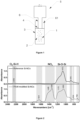
- Fig. 1 The following example is explained in respect to Fig. 1 .
- three examples of semiconductor nanoparticles 1 were chosen, namely the powder of ZnO, MgO or Si nanocrystals.
- the semiconductor nanocrystals were dispersed in water and placed into a glass cuvette 3.
- the plasma 4 was generated inside the cuvette 3 using an open air apparatus 5.
- the discharge burns between a point electrode 6, located several millimeters above the water level, and the water surface.
- the modification was performed for 30 min.
- the methods according to the present invention relates to an easy and inexpensive way to create a new surface termination of semiconductor nanoparticles 1.
- the restructuring of the surface can be mainly done by exposing the surface to reactive oxygen and nitrogen species dissolved in plasma activated water 2 in three different ways: (a) as-prepared nanoparticles 1 are dispersed in water before the plasma 4 treatment of water and they stay present in the plasma activated water 2 during the discharge burning and after it; ( b ) the method that consist of the process described in ( a ) that is preceded by a pre-treatment of the dry as-prepared nanoparticles 1 by corona discharge in air; ( c ) the nanoparticles 1 are dispersed in water 2 after its activation by non-thermal plasma 4, thus the nanoparticles 1 are modified only by the long-living reactive species in plasma activated water 2.
- the as-prepared dry semiconductor nanoparticles 1 are mixed with pure water.
- the suspension was treated by an ultrasonic pulse homogenizer for 60 minutes and placed into a quartz/glass cuvette 3 afterwards.
- the first electrode 6 of the discharge generation system represented by the tip of a standard syringe needle connected to the positive pole of the power source, is placed a few mm above the water level.
- the magnitude of the passing discharge electric current can be controlled by changing the distance between the water level and the tip.
- the surface of the suspension serves as a second electrode, because of the presence of submerged platinum wire 61 (sealed in immersed glass) that is electrically connected with the negative pole of the power source via a stabilizing ballast impedance with parallel connection of 10 M ⁇ resistor and capacitor of 500 pF (pulse length 50 ns and frequency 2.2 kHz).
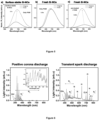
- the resulting transient spark discharge which is simply a pulse analogy to corona discharge (capable of creating high energy pulses and thus generating a wider spectrum of reactive species - Figure 6 ), starts to create air plasma 4 and thus high energy electrons and other charged particles, UV light, ozone, reactive oxygen and most importantly nitrogen species that are all directed against the water level.
- the reaction of plasma 4 containing species with pure water results in the production of plasma activated water 2 , as was already described in detail.
- the reaction can take between 30 s to 60 minutes, during this time the nanoparticles 1 in liquid are stirred in order to expose the whole sample to non-thermal plasma 4 , and especially the short living species, homogeneously.
- the surface of the nanoparticles 1 is modified by the above mentioned reactive species and a new termination of the nanoparticle surface is formed. Since there are long term stable reactive species present in the water after the treatment, the modification of the nanoparticle surface can continue for several days. However, while immediate non-thermal plasma 4 treatment in liquid is highly effective, further significant modification of the surface by stable reactive species without the discharge was detected only within sequential few tens of minutes.
- the representative example of the modification is shown in the Example 1.
- the nanoparticles 1 can be pre-treated by corona discharge before mixing with water. This procedure is particularly effective when applied to fresh as-prepared nanoparticles 1 (e.g. Si) which do not have a long-time stable surface termination yet.
- the DC positive corona discharge was created between two point electrodes 6, 61 using a DC source providing voltage supply in a range of 5 - 10 kV. The electrodes 6, 61 were positioned in the way that the plasma 4 jet was flashing against the dry nanoparticles 1.
- the nanoparticles 1 were placed in the confined and enclosed space. The reaction takes place between 60 to 300 minutes. The nanoparticles 1 were afterward mixed with water and treated according to the (a), omitting the sonication part that could decrease the reactivity of nanoparticles 1 surface before plasma activated water 2 treatment.
- the representative example of the modification is shown in the Example 2.
- the nanoparticles 1 were mixed with plasma activated water 2 after finishing the plasma 4 treatment of only water without nanoparticles 1. While the nanoparticles 1 surface was not in contact with plasma 4 , nanoparticles 1 surface is less reactive. Moreover, they are in contact only with the long-living radical species and their movement is reduced because of the absence of stirring by the plasma 4 jet and a magnetic stirrer. Thus, the reaction is slow and not as effective as the procedures (a) and (b).
- the plasma activated water 2 can be transferred independently of nanoparticles 1 and it can be used for the modification of the surface of the nanoparticles 1 subsequently without needing the plasma 4 generation systems 5 at all, which can simplify the method of providing a surface modification of the nanoparticles 1.
- FTIR Fourier-transformed infrared spectroscopy
- EDS energy-dispersive X-ray spectroscopy
- AFM atomic force microscopy
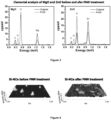
- AFM as well as simple naked-eye observation, showed significant deagglomeration of the nanoparticles 1 after the treatment.
- the non-thermal plasma 4 treated nanoparticles 1 exhibited luminescence such as silicon nanocrystals an increase of photoluminescence (PL) intensity of up to 7 times, a spectral shift towards 700 nm (maximum of the PL band), an increase of the quantum yield of magnitude comparable to the increase of the PL intensity and a decrease of PL time decay were observed, documenting the improved PL properties caused by the surface modification (see Figure 5 ).
- PL photoluminescence
- the zinc oxide (ZnO) nanoparticles 1 (average size of 14 nm, specific surface 30 ⁇ 5 m 2 /g and purity > 99 %) were mixed with the pure deionized water in the ratio of 0.5 mg to 2 ml. These nanoparticles 1 exhibit weak luminescence originating from the over band gap charge recombination (band gap of ZnO ⁇ 3.3 eV) and the red luminescence (band maximum ⁇ 635 nm) originated from the defects of ZnO surface.
- the suspension was treated by an ultrasonic pulse homogenizer (overall energy 78kJ) for 60 minutes and placed into a quartz/glass cuvette 3 afterwards.
- the non-commercial transient spark generation system 5 was set according to the procedure described in the first embodiment , i.e. part (a). During the whole non-thermal plasma 4 treatment, the water suspension of nanocrystals, which represent nanoparticles 1, has been mixed by a magnetic stirrer in order to ensure their homogeneous exposure to the radical plasma 4 species located initially around the water level. The PL intensity and spectra of ZnO nanoparticles 1 was measured in real time. The PL intensity of both bands of the nanoparticles 1 started to dramatically decrease almost immediately with plasma 4 presence. While the one originating from surface defects vanished within few tens of minutes of the treatment, the band related to over band gap charge recombination decreased its intensity about 60 %.
- the surface chemistry of the modified samples was studied using EDS that proved the increase of nitrogen and oxygen atoms in the ratio of 2-3:1, respectively, which proves the presence of the NO 2 and NO 3 functional groups on the surface of nanoparticles 1 (Table 2).
- the EDS measurements were realized after proper washing and subsequent drying of the nanoparticles 1 , so the elemental analysis cannot be affected by the artefacts from PAW.
- MgO magnesium oxide
- the silicon nanocrystals have been prepared by electrochemical etching.
- the nanoparticles 1 of silicon nanocrystals have been prepared from the p-type [1,0,0] Si boron doped wafer with resistivity of 0.066-0.100 ⁇ cm.
- the wafer was placed in the etching chamber and submerged in an etching solution consisting of hydrofluoric acid, and ethanol.
- the etching current density was set to 16 mA/cm 2 .
- the wafers were etched for 2 hours and the etching solution was mixed continuously for the exclusion of bubbles and homogenization of the etching solution.
- the etched wafer with a silicon nanocrystal layer on its surface was left to age for a few days in a chamber with controlled temperature and air humidity (around 26 °C and 55 %, respectively).
- the silicon nanoparticles 1 are then mechanically removed from the silicon wafer and kept in dry conditions.
- the as-prepared nanoparticles 1 are composed of a silicon crystalline core and silicon oxide shell. Even after prolonged time in air, the surface of silicon nanocrystals is not fully homogeneous, Si-OH, Si-O2, Si-O-Si groups are mostly prevalent on the surface with the presence of dangling bonds.
- the average luminescence quantum yield of these silicon nanocrystals varies from 8-12%.
- the plasma 4 was generated by a non-commercial system consisting of two point electrode 6 and standard 5kV DC power source.
- the electrodes 6, 61 were positioned in a way that the resulting discharge is directed to the silicon powder.
- the plasma 4 generation was realized at ambient atmosphere without use of any supporting gas.
- the discharge was guided to the sample through a metal grating.
- the passing current of discharge ranged from 0.05 to 0.5 mA.
- the activation processes last 240 minutes.
- the resulting powder was mixed with pure deionized water in a ratio 0.5 mg to 2 ml, respectively, and placed in a quartz/glass cuvette 3.
- the suspension was treated by PAW in the same way as was described in Example 1 afterwards.
- Table 1 provides comparison of pH and concentration of NO 2 - , NO 3 - and H 2 O 2 in plasma activated water 2 prepared according to the method described in [5] and the method according to the present invention.
- Table 1 PAW property Apparatus according to [5] Method according to the present invention pH 3 1-2 NO 2 - (mg/l) 0-1 30 NO 3 - (mg/l) 500 5000 H 2 O 2 (mg/l) 150 0
- Table 2 is providing elemental analysis of repetitive measurements magnesium and zinc oxide nanoparticles 1 before and after PAW treatment obtained by Energy-dispersive X-ray spectroscopy. Indicated are ratio of elemental concentration between zinc and oxygen before and after modification and oxygen and nitrogen obtained during the treatment (corrected to original concentration of oxygen). The same ratios are also presented for magnesium oxide. Presented deviation was calculated as mean deviation.
- the present invention provides an industrial method for surface modification of semiconductor nanoparticles. Subsequent product can be used for miniaturization of electronic components such as digital watches, calculators, and computers. An alternative industrial applicability can be found in a biotechnology such as bio-labelling of DNA, proteins and cells.
Landscapes
- Chemical & Material Sciences (AREA)
- Organic Chemistry (AREA)
- Physical Or Chemical Processes And Apparatus (AREA)
Claims (13)
- Ein Verfahren zur Oberflächenmodifikation von Halbleiter-Nanopartikeln oder MgO-Nanopartikeln (1), wobei das Verfahren die folgenden Schritte umfasst:i. Bereitstellung von Wasser;ii. Hinzufügen der Halbleiter-Nanopartikel (1) in das Wasser, wodurch eine Suspension entsteht;iii. Exponierung der Suspension zu einem nicht-thermischen Plasma (4) Impuls, wodurch plasmaaktiviertes Wasser (2) entsteht, das die Halbleiter-Nanopartikel (1) darin modifiziert, wobei das nicht-thermische Plasma (4) unter einer Atmosphäre bereitgestellt wird, die mindestens Sauerstoff und Stickstoff, aber kein Edelgas umfasst; und wobei der Spitzenimpulsstrom im Gleichgewicht von 5 A bis 20 A reicht, gemessen mit einem Oszilloskop mit 20 MHz Bandbreite.
- Das Verfahren nach Anspruch 1, wobei die Pulsdauer bei voller Breite auf halber Höhe von 40 ns bis 200 ns reicht.
- Das Verfahren nach Anspruch 1 oder 2, wobei der nicht-thermische Plasma (4) Impuls durch positive Transientfunken-Technik erzeugt wird.
- Das Verfahren nach dem vorangegangenen Anspruch, wobei die Nanopartikel (1) in Trockenpulverform unter Verwendung von Plasma, das durch atmosphärischen Druckluft-Gleichstrom-positiv-Koronaentladung mit einem durchschnittlichen Durchgangsstrom von 0,05 mA - 0,5 mA erzeugt wird, vorbehandelt werden.
- Das Verfahren nach Anspruch 4, wobei die Vorbehandlung mindestens 60 Minuten, vorzugsweise nicht mehr als 300 Minuten dauert oder die Zeit ausreicht, um die Oberflächenmodifikation durchzuführen.
- Das Verfahren nach einem der vorhergehenden Ansprüche, wobei ein Fluss der Atmosphäre oder ein Gasgemisch ohne Edelgase während der Transientfunken-Erzeugung als Quelle der spezifischen reaktiven Spezies für das plasmaaktivierte Wasser (2) verwendet wird.
- Das Verfahren nach einem der vorhergehenden Ansprüche, jedoch ohne jegliche Kombination von Anspruch 4, wobei die Suspensionsmischung homogenisiert wird, vorzugsweise durch einen Ultraschallpuls-Homogenisator.
- Das Verfahren nach einem der Ansprüche 3 bis 8, wobei die Exposition durch transienten Funken erzeugtes Plasma (4) mindestens 30 Sekunden, vorzugsweise nicht mehr als 60 Minuten beträgt.
- Das Verfahren nach einem der vorhergehenden Ansprüche, wobei die Konzentration der Nanopartikel (1) im plasmaaktivierten Wasser (2) zwischen 0,5 mg/2 ml und 2 mg/2 ml liegt.
- Das Verfahren nach einem der vorhergehenden Ansprüche, jedoch ohne jegliche Kombination von Anspruch 4, wobei der Schritt i. von Anspruch 1 die Bereitstellung von deionisiertem Wasser ist.
- Ein Verfahren zur Oberflächenmodifikation von Halbleiter-Nanopartikeln oder MgO-Nanopartikeln (1), wobei das Verfahren die folgenden Schritte umfasst:iv. Bereitstellung von Wasser;v. Exposition des Wassers zu einem nicht-thermischen Plasma (4) Impuls, wodurch plasmaaktiviertes Wasser (2) entsteht, wobei das nicht-thermische Plasma (4) unter einer Atmosphäre bereitgestellt wird, die mindestens Sauerstoff und Stickstoff, aber kein Edelgas umfasst;vi. Mischen der Halbleiter-Nanopartikel (1) mit dem in Schritt v. bereitgestellten plasmaaktivierten Wasser (2).
- Das Verfahren nach einem der vorhergehenden Ansprüche, wobei die Halbleiter-Nanopartikel (1) aus der Gruppe ausgewählt werden, die aus ZnO, MgO, ZnS, vorzugsweise Si-Nanopartikeln besteht.
- Das Verfahren nach einem der vorhergehenden Ansprüche, wobei die Suspension der behandelten Nanopartikel (1) zu Pulver getrocknet wird.
Applications Claiming Priority (1)
| Application Number | Priority Date | Filing Date | Title |
|---|---|---|---|
| LU101406A LU101406B1 (en) | 2019-09-23 | 2019-09-23 | A method for surface modification of semiconductor nanoparticles using non-thermal plasma activated water and product thereof |
Publications (2)
| Publication Number | Publication Date |
|---|---|
| EP3796366A1 EP3796366A1 (de) | 2021-03-24 |
| EP3796366B1 true EP3796366B1 (de) | 2024-10-30 |
Family
ID=68426779
Family Applications (1)
| Application Number | Title | Priority Date | Filing Date |
|---|---|---|---|
| EP20197349.2A Active EP3796366B1 (de) | 2019-09-23 | 2020-09-22 | Ein verfahren zur oberflächenmodifizierung von halbleiternanopartikeln unter verwendung von nicht thermisch plasmaaktiviertem wasser und produkt davon |
Country Status (2)
| Country | Link |
|---|---|
| EP (1) | EP3796366B1 (de) |
| LU (1) | LU101406B1 (de) |
Citations (1)
| Publication number | Priority date | Publication date | Assignee | Title |
|---|---|---|---|---|
| CZ2019600A3 (cs) * | 2019-09-23 | 2021-04-14 | Fyzikální Ústav Av Čr, V. V. I. | Způsob povrchové úpravy polovodičových nanočástic pomocí vody aktivované netermálním plazmatem a produkt této metody |
Family Cites Families (6)
| Publication number | Priority date | Publication date | Assignee | Title |
|---|---|---|---|---|
| US6156114A (en) | 1996-02-06 | 2000-12-05 | E. I. Du Pont De Nemours And Company | Treatment of deagglomerated particles with plasma-activated species |
| US6383301B1 (en) | 1998-08-04 | 2002-05-07 | E. I. Du Pont De Nemours And Company | Treatment of deagglomerated particles with plasma-activated species |
| US9481584B2 (en) | 2001-07-16 | 2016-11-01 | Foret Plasma Labs, Llc | System, method and apparatus for treating liquids with wave energy from plasma |
| WO2016096751A1 (en) | 2014-12-15 | 2016-06-23 | Technische Universiteit Eindhoven | Plasma activated water |
| WO2017062105A2 (en) * | 2015-08-20 | 2017-04-13 | Ndsu Research Foundation | Surface modified silicon quantum dots |
| KR101914732B1 (ko) * | 2016-11-17 | 2018-11-05 | 한국기초과학지원연구원 | 형광 탄소 나노입자 및 그 제조방법 |
-
2019
- 2019-09-23 LU LU101406A patent/LU101406B1/en active IP Right Grant
-
2020
- 2020-09-22 EP EP20197349.2A patent/EP3796366B1/de active Active
Patent Citations (1)
| Publication number | Priority date | Publication date | Assignee | Title |
|---|---|---|---|---|
| CZ2019600A3 (cs) * | 2019-09-23 | 2021-04-14 | Fyzikální Ústav Av Čr, V. V. I. | Způsob povrchové úpravy polovodičových nanočástic pomocí vody aktivované netermálním plazmatem a produkt této metody |
Also Published As
| Publication number | Publication date |
|---|---|
| LU101406B1 (en) | 2021-03-24 |
| EP3796366A1 (de) | 2021-03-24 |
Similar Documents
| Publication | Publication Date | Title |
|---|---|---|
| Kumar et al. | Ce-doped ZnO nanoparticles for efficient photocatalytic degradation of direct red-23 dye | |
| Yum et al. | Y 3Al5 O 12: Ce0. 05 phosphor coatings on gallium nitride for white light emitting diodes | |
| DE10209191A1 (de) | Vorrichtung zur Erzeugung von UV-Strahlung | |
| US20110048960A1 (en) | Electrochemical cell including a plasma source and method of operating the electrochemical cell | |
| Lin et al. | Plasma-electrochemical synthesis of europium doped cerium oxide nanoparticles | |
| Dash et al. | Nanocrystalline gadolinium doped ZnO: an excellent photoluminescent material and efficient photocatalyst towards optoelectronic and environment remedial applications | |
| Liu et al. | Field emission properties of ZnO nanorod arrays by few seed layers assisted growth | |
| Shuaibov et al. | OVERSTRESSED NANOSECOND DISCHARGE IN THE GASES AT ATMOSPHERIC PRESSURE AND ITS APPLICATION FOR THE SYNTHESIS OF NANOSTRUCTURES BASED ON TRANSITION METALS. | |
| Chang et al. | Tuning lattice defects and photocurrent response of ZnO thin films by Mg doping and Ar-H2 atmospheric plasma treatment | |
| KR20080094895A (ko) | 액체가 보다 반응성이 되게 하는 방법 및 장치 | |
| CN111215636A (zh) | 一种Ag纳米粒子的制备方法 | |
| CZ2019600A3 (cs) | Způsob povrchové úpravy polovodičových nanočástic pomocí vody aktivované netermálním plazmatem a produkt této metody | |
| Shuaibov et al. | Gas discharge source of synchronous flows of UV radiation and silver sulphide microstructures | |
| Teke et al. | A simple microplasma reactor paired with indirect ultrasonication for aqueous phase synthesis of cobalt oxide nanoparticles | |
| Ran et al. | Realization of homogeneous dielectric barrier discharge in atmospheric pressure argon and the effect of beads on its characteristics | |
| Krcma et al. | Diaphragm discharge in liquids: Fundamentals and applications | |
| CN114457354B (zh) | 一种氮掺杂碳量子点的制备方法 | |
| LU101406B1 (en) | A method for surface modification of semiconductor nanoparticles using non-thermal plasma activated water and product thereof | |
| Shuaibov et al. | Study into synchronous flows of bactericidal ultraviolet radiation and transition oxides metals (Zn, Cu, Fe) in a pulsed gas discharge overvoltage reactor nanosecond discharge in the air | |
| Kozáková et al. | Generation of silver nanoparticles by the pin-hole DC plasma source with and without gas bubbling | |
| Tominaga et al. | UV photo-mediated size-focusing synthesis of silver nanoclusters | |
| US10258956B2 (en) | Photoluminescent carbon nanoparticles and method of preparing the same | |
| JP5863178B2 (ja) | マイクロ波液中プラズマ処理によるアルカリ金属および/またはアルカリ土類金属ドープナノ粒子の製造方法とそれを用いた質量分析方法 | |
| WO1996017803A1 (en) | Method of evolving negatively charged oxygen atoms and equipment therefor | |
| Chen et al. | X-ray excited optical luminescence of CaF2: A candidate for UV water treatment |
Legal Events
| Date | Code | Title | Description |
|---|---|---|---|
| PUAI | Public reference made under article 153(3) epc to a published international application that has entered the european phase |
Free format text: ORIGINAL CODE: 0009012 |
|
| STAA | Information on the status of an ep patent application or granted ep patent |
Free format text: STATUS: REQUEST FOR EXAMINATION WAS MADE |
|
| 17P | Request for examination filed |
Effective date: 20201015 |
|
| AK | Designated contracting states |
Kind code of ref document: A1 Designated state(s): AL AT BE BG CH CY CZ DE DK EE ES FI FR GB GR HR HU IE IS IT LI LT LU LV MC MK MT NL NO PL PT RO RS SE SI SK SM TR |
|
| AX | Request for extension of the european patent |
Extension state: BA ME |
|
| RIN1 | Information on inventor provided before grant (corrected) |
Inventor name: GALAR , PAVEL Inventor name: KUSOVA, KATERINA Inventor name: FUCIKOVA, ANNA Inventor name: KHUN, JOSEF |
|
| GRAP | Despatch of communication of intention to grant a patent |
Free format text: ORIGINAL CODE: EPIDOSNIGR1 |
|
| STAA | Information on the status of an ep patent application or granted ep patent |
Free format text: STATUS: GRANT OF PATENT IS INTENDED |
|
| INTG | Intention to grant announced |
Effective date: 20240513 |
|
| RIN1 | Information on inventor provided before grant (corrected) |
Inventor name: KHUN, JOSEF Inventor name: FUCIKOVA, ANNA Inventor name: KUSOVA, KATERINA Inventor name: GALAR, PAVEL |
|
| GRAS | Grant fee paid |
Free format text: ORIGINAL CODE: EPIDOSNIGR3 |
|
| GRAA | (expected) grant |
Free format text: ORIGINAL CODE: 0009210 |
|
| STAA | Information on the status of an ep patent application or granted ep patent |
Free format text: STATUS: THE PATENT HAS BEEN GRANTED |
|
| AK | Designated contracting states |
Kind code of ref document: B1 Designated state(s): AL AT BE BG CH CY CZ DE DK EE ES FI FR GB GR HR HU IE IS IT LI LT LU LV MC MK MT NL NO PL PT RO RS SE SI SK SM TR |
|
| REG | Reference to a national code |
Ref country code: GB Ref legal event code: FG4D |
|
| REG | Reference to a national code |
Ref country code: CH Ref legal event code: EP |
|
| REG | Reference to a national code |
Ref country code: IE Ref legal event code: FG4D |
|
| REG | Reference to a national code |
Ref country code: DE Ref legal event code: R096 Ref document number: 602020040199 Country of ref document: DE |
|
| REG | Reference to a national code |
Ref country code: LT Ref legal event code: MG9D |
|
| REG | Reference to a national code |
Ref country code: NL Ref legal event code: MP Effective date: 20241030 |
|
| PG25 | Lapsed in a contracting state [announced via postgrant information from national office to epo] |
Ref country code: IS Free format text: LAPSE BECAUSE OF FAILURE TO SUBMIT A TRANSLATION OF THE DESCRIPTION OR TO PAY THE FEE WITHIN THE PRESCRIBED TIME-LIMIT Effective date: 20250228 Ref country code: HR Free format text: LAPSE BECAUSE OF FAILURE TO SUBMIT A TRANSLATION OF THE DESCRIPTION OR TO PAY THE FEE WITHIN THE PRESCRIBED TIME-LIMIT Effective date: 20241030 Ref country code: PT Free format text: LAPSE BECAUSE OF FAILURE TO SUBMIT A TRANSLATION OF THE DESCRIPTION OR TO PAY THE FEE WITHIN THE PRESCRIBED TIME-LIMIT Effective date: 20250228 |
|
| PG25 | Lapsed in a contracting state [announced via postgrant information from national office to epo] |
Ref country code: FI Free format text: LAPSE BECAUSE OF FAILURE TO SUBMIT A TRANSLATION OF THE DESCRIPTION OR TO PAY THE FEE WITHIN THE PRESCRIBED TIME-LIMIT Effective date: 20241030 Ref country code: NL Free format text: LAPSE BECAUSE OF FAILURE TO SUBMIT A TRANSLATION OF THE DESCRIPTION OR TO PAY THE FEE WITHIN THE PRESCRIBED TIME-LIMIT Effective date: 20241030 |
|
| REG | Reference to a national code |
Ref country code: AT Ref legal event code: MK05 Ref document number: 1737798 Country of ref document: AT Kind code of ref document: T Effective date: 20241030 |
|
| PG25 | Lapsed in a contracting state [announced via postgrant information from national office to epo] |
Ref country code: BG Free format text: LAPSE BECAUSE OF FAILURE TO SUBMIT A TRANSLATION OF THE DESCRIPTION OR TO PAY THE FEE WITHIN THE PRESCRIBED TIME-LIMIT Effective date: 20241030 |
|
| PG25 | Lapsed in a contracting state [announced via postgrant information from national office to epo] |
Ref country code: ES Free format text: LAPSE BECAUSE OF FAILURE TO SUBMIT A TRANSLATION OF THE DESCRIPTION OR TO PAY THE FEE WITHIN THE PRESCRIBED TIME-LIMIT Effective date: 20241030 |
|
| PG25 | Lapsed in a contracting state [announced via postgrant information from national office to epo] |
Ref country code: NO Free format text: LAPSE BECAUSE OF FAILURE TO SUBMIT A TRANSLATION OF THE DESCRIPTION OR TO PAY THE FEE WITHIN THE PRESCRIBED TIME-LIMIT Effective date: 20250130 |
|
| PG25 | Lapsed in a contracting state [announced via postgrant information from national office to epo] |
Ref country code: AT Free format text: LAPSE BECAUSE OF FAILURE TO SUBMIT A TRANSLATION OF THE DESCRIPTION OR TO PAY THE FEE WITHIN THE PRESCRIBED TIME-LIMIT Effective date: 20241030 Ref country code: LV Free format text: LAPSE BECAUSE OF FAILURE TO SUBMIT A TRANSLATION OF THE DESCRIPTION OR TO PAY THE FEE WITHIN THE PRESCRIBED TIME-LIMIT Effective date: 20241030 Ref country code: GR Free format text: LAPSE BECAUSE OF FAILURE TO SUBMIT A TRANSLATION OF THE DESCRIPTION OR TO PAY THE FEE WITHIN THE PRESCRIBED TIME-LIMIT Effective date: 20250131 |
|
| PG25 | Lapsed in a contracting state [announced via postgrant information from national office to epo] |
Ref country code: PL Free format text: LAPSE BECAUSE OF FAILURE TO SUBMIT A TRANSLATION OF THE DESCRIPTION OR TO PAY THE FEE WITHIN THE PRESCRIBED TIME-LIMIT Effective date: 20241030 |
|
| PG25 | Lapsed in a contracting state [announced via postgrant information from national office to epo] |
Ref country code: RS Free format text: LAPSE BECAUSE OF FAILURE TO SUBMIT A TRANSLATION OF THE DESCRIPTION OR TO PAY THE FEE WITHIN THE PRESCRIBED TIME-LIMIT Effective date: 20250130 |
|
| PG25 | Lapsed in a contracting state [announced via postgrant information from national office to epo] |
Ref country code: SM Free format text: LAPSE BECAUSE OF FAILURE TO SUBMIT A TRANSLATION OF THE DESCRIPTION OR TO PAY THE FEE WITHIN THE PRESCRIBED TIME-LIMIT Effective date: 20241030 |
|
| PG25 | Lapsed in a contracting state [announced via postgrant information from national office to epo] |
Ref country code: DK Free format text: LAPSE BECAUSE OF FAILURE TO SUBMIT A TRANSLATION OF THE DESCRIPTION OR TO PAY THE FEE WITHIN THE PRESCRIBED TIME-LIMIT Effective date: 20241030 |
|
| PG25 | Lapsed in a contracting state [announced via postgrant information from national office to epo] |
Ref country code: EE Free format text: LAPSE BECAUSE OF FAILURE TO SUBMIT A TRANSLATION OF THE DESCRIPTION OR TO PAY THE FEE WITHIN THE PRESCRIBED TIME-LIMIT Effective date: 20241030 |
|
| PG25 | Lapsed in a contracting state [announced via postgrant information from national office to epo] |
Ref country code: RO Free format text: LAPSE BECAUSE OF FAILURE TO SUBMIT A TRANSLATION OF THE DESCRIPTION OR TO PAY THE FEE WITHIN THE PRESCRIBED TIME-LIMIT Effective date: 20241030 |
|
| PG25 | Lapsed in a contracting state [announced via postgrant information from national office to epo] |
Ref country code: SK Free format text: LAPSE BECAUSE OF FAILURE TO SUBMIT A TRANSLATION OF THE DESCRIPTION OR TO PAY THE FEE WITHIN THE PRESCRIBED TIME-LIMIT Effective date: 20241030 |
|
| PG25 | Lapsed in a contracting state [announced via postgrant information from national office to epo] |
Ref country code: CZ Free format text: LAPSE BECAUSE OF FAILURE TO SUBMIT A TRANSLATION OF THE DESCRIPTION OR TO PAY THE FEE WITHIN THE PRESCRIBED TIME-LIMIT Effective date: 20241030 |
|
| PG25 | Lapsed in a contracting state [announced via postgrant information from national office to epo] |
Ref country code: IT Free format text: LAPSE BECAUSE OF FAILURE TO SUBMIT A TRANSLATION OF THE DESCRIPTION OR TO PAY THE FEE WITHIN THE PRESCRIBED TIME-LIMIT Effective date: 20241030 |
|
| REG | Reference to a national code |
Ref country code: DE Ref legal event code: R097 Ref document number: 602020040199 Country of ref document: DE |
|
| PLBE | No opposition filed within time limit |
Free format text: ORIGINAL CODE: 0009261 |
|
| STAA | Information on the status of an ep patent application or granted ep patent |
Free format text: STATUS: NO OPPOSITION FILED WITHIN TIME LIMIT |
|
| PG25 | Lapsed in a contracting state [announced via postgrant information from national office to epo] |
Ref country code: SE Free format text: LAPSE BECAUSE OF FAILURE TO SUBMIT A TRANSLATION OF THE DESCRIPTION OR TO PAY THE FEE WITHIN THE PRESCRIBED TIME-LIMIT Effective date: 20241030 |
|
| 26N | No opposition filed |
Effective date: 20250731 |
|
| REG | Reference to a national code |
Ref country code: DE Ref legal event code: R079 Ref document number: 602020040199 Country of ref document: DE Free format text: PREVIOUS MAIN CLASS: H01L0021306000 Ipc: H10P0050000000 |
|
| REG | Reference to a national code |
Ref country code: DE Ref legal event code: R119 Ref document number: 602020040199 Country of ref document: DE |
|
| REG | Reference to a national code |
Ref country code: CH Ref legal event code: H13 Free format text: ST27 STATUS EVENT CODE: U-0-0-H10-H13 (AS PROVIDED BY THE NATIONAL OFFICE) Effective date: 20260504 |
|
| PG25 | Lapsed in a contracting state [announced via postgrant information from national office to epo] |
Ref country code: LU Free format text: LAPSE BECAUSE OF NON-PAYMENT OF DUE FEES Effective date: 20250922 |
|
| GBPC | Gb: european patent ceased through non-payment of renewal fee |
Effective date: 20250922 |
|
| REG | Reference to a national code |
Ref country code: BE Ref legal event code: MM Effective date: 20250930 |
|
| PG25 | Lapsed in a contracting state [announced via postgrant information from national office to epo] |
Ref country code: LT Free format text: LAPSE BECAUSE OF FAILURE TO SUBMIT A TRANSLATION OF THE DESCRIPTION OR TO PAY THE FEE WITHIN THE PRESCRIBED TIME-LIMIT Effective date: 20241030 |
|
| PG25 | Lapsed in a contracting state [announced via postgrant information from national office to epo] |
Ref country code: MC Free format text: LAPSE BECAUSE OF FAILURE TO SUBMIT A TRANSLATION OF THE DESCRIPTION OR TO PAY THE FEE WITHIN THE PRESCRIBED TIME-LIMIT Effective date: 20241030 |
|
| PG25 | Lapsed in a contracting state [announced via postgrant information from national office to epo] |
Ref country code: GB Free format text: LAPSE BECAUSE OF NON-PAYMENT OF DUE FEES Effective date: 20250922 |
|
| PG25 | Lapsed in a contracting state [announced via postgrant information from national office to epo] |
Ref country code: DE Free format text: LAPSE BECAUSE OF NON-PAYMENT OF DUE FEES Effective date: 20260401 |
|
| PG25 | Lapsed in a contracting state [announced via postgrant information from national office to epo] |
Ref country code: CH Free format text: LAPSE BECAUSE OF NON-PAYMENT OF DUE FEES Effective date: 20250930 Ref country code: BE Free format text: LAPSE BECAUSE OF NON-PAYMENT OF DUE FEES Effective date: 20250930 Ref country code: IE Free format text: LAPSE BECAUSE OF NON-PAYMENT OF DUE FEES Effective date: 20250922 |
|
| PG25 | Lapsed in a contracting state [announced via postgrant information from national office to epo] |
Ref country code: FR Free format text: LAPSE BECAUSE OF NON-PAYMENT OF DUE FEES Effective date: 20250930 |