EP3793129B1 - System, verfahren und vorrichtung zum schlüsselaustausch - Google Patents
System, verfahren und vorrichtung zum schlüsselaustausch Download PDFInfo
- Publication number
- EP3793129B1 EP3793129B1 EP18920998.4A EP18920998A EP3793129B1 EP 3793129 B1 EP3793129 B1 EP 3793129B1 EP 18920998 A EP18920998 A EP 18920998A EP 3793129 B1 EP3793129 B1 EP 3793129B1
- Authority
- EP
- European Patent Office
- Prior art keywords
- key
- bit string
- result
- public key
- algorithm
- Prior art date
- Legal status (The legal status is an assumption and is not a legal conclusion. Google has not performed a legal analysis and makes no representation as to the accuracy of the status listed.)
- Active
Links
Images




Classifications
-
- H—ELECTRICITY
- H04—ELECTRIC COMMUNICATION TECHNIQUE
- H04L—TRANSMISSION OF DIGITAL INFORMATION, e.g. TELEGRAPHIC COMMUNICATION
- H04L9/00—Cryptographic mechanisms or cryptographic arrangements for secret or secure communications; Network security protocols
- H04L9/08—Key distribution or management, e.g. generation, sharing or updating, of cryptographic keys or passwords
- H04L9/0816—Key establishment, i.e. cryptographic processes or cryptographic protocols whereby a shared secret becomes available to two or more parties, for subsequent use
- H04L9/0819—Key transport or distribution, i.e. key establishment techniques where one party creates or otherwise obtains a secret value, and securely transfers it to the other(s)
- H04L9/0825—Key transport or distribution, i.e. key establishment techniques where one party creates or otherwise obtains a secret value, and securely transfers it to the other(s) using asymmetric-key encryption or public key infrastructure [PKI], e.g. key signature or public key certificates
-
- H—ELECTRICITY
- H04—ELECTRIC COMMUNICATION TECHNIQUE
- H04L—TRANSMISSION OF DIGITAL INFORMATION, e.g. TELEGRAPHIC COMMUNICATION
- H04L9/00—Cryptographic mechanisms or cryptographic arrangements for secret or secure communications; Network security protocols
- H04L9/08—Key distribution or management, e.g. generation, sharing or updating, of cryptographic keys or passwords
- H04L9/0816—Key establishment, i.e. cryptographic processes or cryptographic protocols whereby a shared secret becomes available to two or more parties, for subsequent use
- H04L9/0838—Key agreement, i.e. key establishment technique in which a shared key is derived by parties as a function of information contributed by, or associated with, each of these
-
- H—ELECTRICITY
- H04—ELECTRIC COMMUNICATION TECHNIQUE
- H04L—TRANSMISSION OF DIGITAL INFORMATION, e.g. TELEGRAPHIC COMMUNICATION
- H04L63/00—Network architectures or network communication protocols for network security
- H04L63/06—Network architectures or network communication protocols for network security for supporting key management in a packet data network
- H04L63/061—Network architectures or network communication protocols for network security for supporting key management in a packet data network for key exchange, e.g. in peer-to-peer networks
-
- H—ELECTRICITY
- H04—ELECTRIC COMMUNICATION TECHNIQUE
- H04L—TRANSMISSION OF DIGITAL INFORMATION, e.g. TELEGRAPHIC COMMUNICATION
- H04L9/00—Cryptographic mechanisms or cryptographic arrangements for secret or secure communications; Network security protocols
- H04L9/06—Cryptographic mechanisms or cryptographic arrangements for secret or secure communications; Network security protocols the encryption apparatus using shift registers or memories for block-wise or stream coding, e.g. DES systems or RC4; Hash functions; Pseudorandom sequence generators
- H04L9/0618—Block ciphers, i.e. encrypting groups of characters of a plain text message using fixed encryption transformation
-
- H—ELECTRICITY
- H04—ELECTRIC COMMUNICATION TECHNIQUE
- H04L—TRANSMISSION OF DIGITAL INFORMATION, e.g. TELEGRAPHIC COMMUNICATION
- H04L9/00—Cryptographic mechanisms or cryptographic arrangements for secret or secure communications; Network security protocols
- H04L9/08—Key distribution or management, e.g. generation, sharing or updating, of cryptographic keys or passwords
- H04L9/0816—Key establishment, i.e. cryptographic processes or cryptographic protocols whereby a shared secret becomes available to two or more parties, for subsequent use
- H04L9/0838—Key agreement, i.e. key establishment technique in which a shared key is derived by parties as a function of information contributed by, or associated with, each of these
- H04L9/0841—Key agreement, i.e. key establishment technique in which a shared key is derived by parties as a function of information contributed by, or associated with, each of these involving Diffie-Hellman or related key agreement protocols
- H04L9/0844—Key agreement, i.e. key establishment technique in which a shared key is derived by parties as a function of information contributed by, or associated with, each of these involving Diffie-Hellman or related key agreement protocols with user authentication or key authentication, e.g. ElGamal, MTI, MQV-Menezes-Qu-Vanstone protocol or Diffie-Hellman protocols using implicitly-certified keys
-
- H—ELECTRICITY
- H04—ELECTRIC COMMUNICATION TECHNIQUE
- H04L—TRANSMISSION OF DIGITAL INFORMATION, e.g. TELEGRAPHIC COMMUNICATION
- H04L9/00—Cryptographic mechanisms or cryptographic arrangements for secret or secure communications; Network security protocols
- H04L9/08—Key distribution or management, e.g. generation, sharing or updating, of cryptographic keys or passwords
- H04L9/0861—Generation of secret information including derivation or calculation of cryptographic keys or passwords
-
- H—ELECTRICITY
- H04—ELECTRIC COMMUNICATION TECHNIQUE
- H04L—TRANSMISSION OF DIGITAL INFORMATION, e.g. TELEGRAPHIC COMMUNICATION
- H04L9/00—Cryptographic mechanisms or cryptographic arrangements for secret or secure communications; Network security protocols
- H04L9/08—Key distribution or management, e.g. generation, sharing or updating, of cryptographic keys or passwords
- H04L9/0891—Revocation or update of secret information, e.g. encryption key update or rekeying
-
- H—ELECTRICITY
- H04—ELECTRIC COMMUNICATION TECHNIQUE
- H04L—TRANSMISSION OF DIGITAL INFORMATION, e.g. TELEGRAPHIC COMMUNICATION
- H04L9/00—Cryptographic mechanisms or cryptographic arrangements for secret or secure communications; Network security protocols
- H04L9/30—Public key, i.e. encryption algorithm being computationally infeasible to invert or user's encryption keys not requiring secrecy
- H04L9/3066—Public key, i.e. encryption algorithm being computationally infeasible to invert or user's encryption keys not requiring secrecy involving algebraic varieties, e.g. elliptic or hyper-elliptic curves
- H04L9/3073—Public key, i.e. encryption algorithm being computationally infeasible to invert or user's encryption keys not requiring secrecy involving algebraic varieties, e.g. elliptic or hyper-elliptic curves involving pairings, e.g. identity based encryption [IBE], bilinear mappings or bilinear pairings, e.g. Weil or Tate pairing
-
- H—ELECTRICITY
- H04—ELECTRIC COMMUNICATION TECHNIQUE
- H04L—TRANSMISSION OF DIGITAL INFORMATION, e.g. TELEGRAPHIC COMMUNICATION
- H04L9/00—Cryptographic mechanisms or cryptographic arrangements for secret or secure communications; Network security protocols
- H04L9/32—Cryptographic mechanisms or cryptographic arrangements for secret or secure communications; Network security protocols including means for verifying the identity or authority of a user of the system or for message authentication, e.g. authorization, entity authentication, data integrity or data verification, non-repudiation, key authentication or verification of credentials
- H04L9/3271—Cryptographic mechanisms or cryptographic arrangements for secret or secure communications; Network security protocols including means for verifying the identity or authority of a user of the system or for message authentication, e.g. authorization, entity authentication, data integrity or data verification, non-repudiation, key authentication or verification of credentials using challenge-response
Definitions
- This application relates to the field of quantum secure technologies, and in particular, to a key agreement system, method, and apparatus.
- authenticated key exchange Authenticated Key Exchange, AKE
- AKE Authenticated Key Exchange
- AKE protocols a private-public key pair, a password, and the like are used as materials for key agreement and authentication, and both communication parties agree on a common secure session key over a public insecure channel.
- these protocols such as an encrypted key exchange (Encrypted Key Exchange, EKE) protocol, a simple password-based encrypted key exchange (Simple Password-based encrypted key exchange, SPAKE) protocol, and a verifier-based two-basis password exponential key exchange (Verifier-based Two-Basis Password Exponential Key Exchange, VTBPEKE) protocol, are essentially based on a Diffie-Hellman (Diffie-Hellman, DH) key exchange technology.
- EKE Encrypted Key Exchange
- SPAKE Simple Password-based encrypted key exchange
- VTBPEKE verifier-based two-basis Password Exponential Key Exchange
- the DH key exchange technology is based on a discrete logarithm problem, and the problem has been proved decipherable. Therefore, the DH key exchange technology is no longer secure in quantum computing.
- existing quantum secure protocols AKEs are complex and inefficient. For example, in a Kyber (Kyber) protocol, both communication parties need to perform a total of six key encapsulation mechanism (Key Encapsulation Mechanism, KEM) encryption and decryption operations.
- KEM Key Encapsulation Mechanism
- other researchers propose a quantum protocol for optimizing system parameters, both communication parties still need to perform a total of two KEM encryption and decryption operations and four digital signature-related operations.
- AKE protocols from OW-CCA secure KEMs is proposed and CK+ security of the protocols in the random oracle model is proved.
- the random oracle and instantiate AKE protocols are exploited from various assumptions; DDH, gap DH, CDH, factoring, RSA, DCR, (ring-)LWE, McEliece one-way, NTRU one-way, subset sum, multi-variate quadratic systems, and more.
- AKE from a key encapsulation mechanism (KEM).
- KEM key encapsulation mechanism
- the construction is based on a chosen-ciphertext secure KEM, and the resultant AKE protocol is CK+ secure in the standard model.
- the construction gives the first CK1 secure AKE protocols based on the hardness of integer factorization problem, code-based problems, or learning problems with errors.
- Embodiments of this application provides a key agreement system, method, and apparatus, to implement simple and efficient quantum secure key agreement.
- an embodiment of this application provides a key agreement system including a first device and a second device.
- the first device is configured to: generate a private-public key pair by using a key generation algorithm, and send a public key in the private-public key pair to the second device.
- the second device is configured to: select an original key based on the received public key by using an encapsulation algorithm, obtain a ciphertext based on the public key and the original key by using the encapsulation algorithm, obtain a commitment value and an opening value based on a first bit string and a random number by using a commitment algorithm, and send the ciphertext and the commitment value to the first device, where the first bit string is a random bit string; and determine a second bit string based on some bits in the original key, and calculate a first result based on the first bit string and the second bit string.
- the first device is further configured to: obtain the original key based on a private key in the private-public key pair and the received ciphertext by using a decapsulation algorithm, determine the second bit string based on the some bits in the original key, calculate a second result based on the second bit string and the first result, and send the second result to the second device.
- the second device is further configured to: when the first bit string is the same as the received second result, send the opening value to the first device and generate a session key used to communicate with the first device. That the first bit string is the same as the second result indicates that the second device successfully authenticates the first device.
- the first device is further configured to authenticate the second device based on the received opening value and commitment value, to obtain an authentication result, where the authentication result is used to indicate that the first device successfully authenticates the second device, and generates a session key used to communicate with the second device.
- the second device is specifically configured to calculate the first bit string and the second result by using a first algorithm, to obtain the first result; and the first device is specifically configured to calculate the second bit string and the first result by using the first algorithm, to obtain the second result.
- the first algorithm is any one of an exclusive OR operation, a modulo addition operation, a modulo subtraction operation, or a modulo multiplication operation, or a combination thereof.
- the second device may calculate the first result by using various possible algorithms, and the first device may calculate the second by using an algorithm the same as that used for calculating the first result.
- the first device is further configured to: delete the private-public key pair after generating the session key used to communicate with the second device; and re-generate a private-public key pair when initiating key agreement again with the second device or initiating key agreement with a third device.
- both communication bodies need to store a private-public key pair, a password, and the like as materials for key agreement and authentication. Consequently, a large amount of storage space is occupied.
- the first device deletes the private-public key pair after generating the session key used to communicate with the second device. In this way, storage space can be saved.
- the method provided in this embodiment of this application is more applicable to a device with a limited hardware capability.
- the second device is further configured to: delete the public key after generating the session key used to communicate with the first device; and generate a private-public key pair when initiating key agreement again with the first device or initiating key agreement with a fourth device.
- both communication bodies need to store a private-public key pair, a password, and the like as materials for key agreement and authentication. Consequently, a large amount of storage space is occupied.
- the second device deletes the public key after generating the session key used to communicate with the first device. In this way, storage space can be saved.
- the method provided in this embodiment of this application is more applicable to a device with a limited hardware capability.
- the first device is specifically configured to generate the session key used to communicate with the second device, based on one or more of the following parameters: an identifier of the first device, an identifier of the second device, the public key, the ciphertext, the commitment value, the opening value, the original key, or the second result.
- the second device is specifically configured to generate, based on the one or more parameters, the session key used to communicate with the first device, where the session key used to communicate with the second device is the same as the session key used to communicate with the first device
- the session key may be generated by using various function forms and a combination of various parameters, and implementation is flexible and convenient.
- an embodiment of this application provides a key agreement method, including: A first device generates a private-public key pair by using a key generation algorithm, and sends a public key in the private-public key pair to a second device.
- the first device receives a ciphertext and a commitment value, where the ciphertext is obtained based on the public key and an original key by using an encapsulation algorithm, the original key is selected based on the public key by using the encapsulation algorithm, and the commitment value is obtained based on a first bit string and a random number by using a commitment algorithm, where the first bit string is a random bit string.
- the first device obtains a first result, where the first result is calculated based on the first bit string and a second bit string, and the second bit string is determined based on some bits in the original key.
- the first device obtains the original key based on a private key in the private-public key pair and the ciphertext by using a decapsulation algorithm, and determines the second bit string based on the some bits in the original key.
- the first device calculates a second result based on the second bit string and the first result, and sends the second result to the second device.
- the first device receives an opening value, where the opening value is sent by the second device to the first device when the first bit string is the same as the second result, and the opening value is obtained based on the first bit string and the random number by using the commitment algorithm.
- the first device attempts to authenticate the second device based on the opening value and the commitment value, to obtain an authentication result, where the authentication result is used to indicate that the second device successfully authenticates the second device, and generates a session key used to communicate with the second device.
- the first device when calculating the second result based on the second bit string and the first result, performs calculation based on the second bit string and the first result by using a first algorithm, to obtain the second result, where the first algorithm is any one of an exclusive OR operation, a modulo addition operation, a modulo subtraction operation, or a modulo multiplication operation, or a combination thereof.
- the first device may calculate the second result by using various possible algorithms.
- the first algorithm is the exclusive OR operation.
- the first device When performing calculation based on the second bit string and the first result by using the first algorithm, to obtain the second result, the first device performs calculation based on the second bit string and the first result by using an exclusive OR algorithm, to obtain the second result.
- the first device may perform calculation through the exclusive OR operation to obtain an exclusive OR result, and use the exclusive OR result as the second result.
- the first device deletes the private-public key pair after generating the session key used to communicate with the second device; and re-generate a private-public key pair when initiating key agreement again with the second device or initiating key agreement with a third device.
- both communication bodies need to store a private-public key pair, a password, and the like as materials for key agreement and authentication. Consequently, a large amount of storage space is occupied.
- the first device deletes the private-public key pair after generating the session key used to communicate with the second device. In this way, storage space can be saved.
- the method provided in this embodiment of this application is more applicable to a device with a limited hardware capability.
- the first device when generating the session key used to communicate with the second device, the first device generates the session key used to communicate with the second device, based on one or more of the following parameters: an identifier of the first device, an identifier of the second device, the public key, the ciphertext, the commitment value, the opening value, the original key, or the second result. Therefore, the first device may generate the session key by using various function forms and a combination of various parameters, and implementation is flexible and convenient.
- an embodiment of this application provides a key agreement method, including: A second device receives a public key, where the public key is a public key in a private-public key pair generated by using a key generation algorithm.
- a second device selects an original key based on the public key by using the encapsulation algorithm, obtains a ciphertext based on the public key and the original key by using the encapsulation algorithm, obtains a commitment value and an opening value based on a first bit string and a random number by using a commitment algorithm, and sends the ciphertext and the commitment value to the first device, where the first bit string is a random bit string.
- the second device determines a second bit string based on some bits in the original key, and calculates a first result based on the first bit string and the second bit string.
- the second device receives a second result, where the second result is calculated based on the second bit string and the first result.
- the second device sends the opening value to the first device and generates a session key used to communicate with the first device, where that the first bit string is the same as the second result indicates that the second device successfully authenticates the first device.
- the second device when calculating the first result based on the first bit string and the second bit string, performs calculation based on the first bit string and the second bit string by using a first algorithm, to obtain the first result, where the first algorithm is any one of an exclusive OR operation, a modulo addition operation, a modulo subtraction operation, or a modulo multiplication operation, or a combination thereof. Therefore, the second device may calculate the first result by using various possible algorithms, and implementation is more flexible and convenient.
- the first algorithm is the exclusive OR operation; and when performing calculation based on the first bit string and the second bit string by using the first algorithm, to obtain the first result, the second device performs calculation based on the first bit string and the second bit string through the exclusive OR operation, to obtain the first result.
- the second device deletes the public key after generating the session key used to communicate with the first device; and generates a private-public key pair when the initiating key agreement again with the first device, or initiating key agreement with a third device.
- both communication bodies need to store a private-public key pair, a password, and the like as materials for key agreement and authentication. Consequently, a large amount of storage space is occupied.
- the second device deletes the public key after generating the session key used to communicate with the first device. In this way, storage space can be saved.
- the method provided in this embodiment of this application is more applicable to a device with a limited hardware capability.
- the second device when generating the session key used to communicate with the second device, the second device generates the session key used to communicate with the first device, based on one or more of the following parameters: an identifier of the first device, an identifier of the second device, the public key, the ciphertext, the commitment value, the opening value, the original key, or the second result.
- both communication bodies need to store a private-public key pair, a password, and the like as materials for key agreement and authentication. Consequently, a large amount of storage space is occupied.
- the second device deletes the public key after generating the session key used to communicate with the second device. In this way, storage space can be saved.
- the method provided in this embodiment of this application is more applicable to a device with a limited hardware capability.
- an embodiment of this application provides a key agreement apparatus.
- the apparatus may be a first device, or may be a chip in a first device.
- the apparatus may include a processing unit and a transceiver unit.
- the processing unit may be a processor
- the transceiver unit may be a transceiver.
- the first device may further include a storage unit, and the storage unit may be a memory.
- the storage unit is configured to store an instruction, and the processing unit executes the instruction stored in the storage unit, to enable the first device to perform the method in the second aspect or any possible design of the second aspect.
- the processing unit may be a processor, and the transceiver unit may be an input/output interface, a pin, a circuit, or the like.
- the processing unit executes an instruction stored in a storage unit.
- the storage unit is configured to store an instruction.
- the storage unit may be a storage unit (for example, a register or a cache) in the chip.
- the storage unit may be a storage unit (for example, a read-only memory or a random access memory) located outside the chip but in the first device, so that the first device performs the method in the second aspect or any possible design of the second aspect.
- an embodiment of this application provides a key agreement apparatus.
- the apparatus may be a second device, or may be a chip in a second device.
- the apparatus may include a processing unit and a transceiver unit.
- the processing unit may be a processor
- the transceiver unit may be a transceiver.
- the second device may further include a storage unit, and the storage unit may be a memory.
- the storage unit is configured to store an instruction, and the processing unit executes the instruction stored in the storage unit, to enable the second device to perform the method in the third aspect or any possible design of the third aspect.
- the processing unit may be a processor, and the transceiver unit may be an input/output interface, a pin, a circuit, or the like.
- the processing unit executes an instruction stored in a storage unit.
- the storage unit is configured to store an instruction.
- the storage unit may be a storage unit (for example, a register or a cache) in the chip.
- the storage unit may be a storage unit (for example, a read-only memory or a random access memory) located outside the chip but in the second device, so that the second device performs the method in the third aspect or any possible design of the third aspect.
- an embodiment of this application further provides a computer-readable storage medium, and the computer-readable storage medium stores a computer program.
- the computer program When the computer program is run on a computer, the computer is enabled to perform the method in the first aspect and/or the second aspect.
- an embodiment of this application further provides a computer program product that includes a program.
- the computer program product runs on a computer, the computer is enabled to perform the method in the first aspect and/or the second aspect.
- a communication body in the embodiments of this application may be a device with a limited hardware capability in one or more aspects such as computing, storage, communication, and energy consumption, and may be specifically any device implemented by hardware, or a program or an application implemented by software, or another body implemented by a combination.
- the communication body in this application needs to have a simple input/output port (I/O).
- a device input port may be a simple keyboard or button, or the like; and a device output port may be a simple display, light color, light blinking, or the like.
- a possible application scenario of this application is an IoT scenario.
- the IoT is a network intended for machine type communication (MTC, Machine-Type Communications).
- MTC Machine-Type Communications
- the IoT may be used to connect industries, transportation, users, cities, devices, and the like.
- the IoT may be mainly applied to fields such as smart metering, medical examination and monitoring, logistics inspection, industrial inspection and monitoring, internet of vehicles, smart communities, and wearable devices.
- the communication body in this application may be an IoT terminal.
- the IoT terminal is an electricity meter or a water meter that is usually installed indoors or even in a basement, a sensor that is disposed in the soil to detect soil moisture to implement automatic irrigation, or a detection instrument that a cow wears to monitor a health status of the cow. Therefore, the communication body generally needs to be deployed on a large scale. To reduce costs, hardware configuration of the communication body is usually not high. For example, some IoT terminals are powered by batteries. In this case, to avoid frequent battery replacement during use of the batteries, the IoT terminals need to operate with extremely low power consumption. Therefore, computing and storage capabilities of the IoT terminals are usually not high.
- the commitment scheme may include the following two algorithms:
- the commitment scheme in this application may alternatively be replaced with a hash algorithm.
- the hash algorithm refers to a cryptographically secure hash function (hash function).
- H(m, r) may be used to replace the commitment scheme.
- F H(m, r)
- a standardized hash function is available, and therefore project implementation is easier.
- a hash function may also be used to generate a session key. Different Hash functions may be used, or a same hash function may be used, so as to facilitate project implementation.
- the first device and the second device may be any two devices that need to perform key agreement.
- the first device initiates key agreement with the second device.
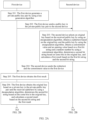
- FIG. 2A and FIG. 2B an embodiment of this application provides a key agreement method, to implement simple and efficient quantum secure key agreement. The method includes the following steps.
- Step 201 The first device generates a private-public key pair by using a key generation algorithm.
- the first device may generate the private-public key pair by using the key generation algorithm included in a KEM.
- the KEM may be any one of a ring learning with error (Ring Learning With Error, RLWE) KEM, a learning parity with noise (Learning Parity with Noise, LPN) KEM, a number theorist are us (Number Theorist aRe Us, NTRU) KEM, or a DH KEM.
- Step 202 The first device sends a public key in the private-public key pair to the second device.
- the first device may send the public key to the second device over a public channel.
- Step 203 The second device selects an original key based on the received public key by using an encapsulation algorithm, obtains a ciphertext based on the original key and the public key by using the encapsulation algorithm, obtains a commitment value and an opening value based on a first bit string and a random number by using a commitment algorithm, determines a second bit string based on some bits in the original key, and calculates a first result based on the first bit string and the second bit string.
- the second device may randomly generate the first bit string, use the first bit string as an input message, select the random number, and run the commitment algorithm, to obtain the commitment value and the opening value.
- the second device selects the random number; and runs a hash algorithm for the first bit string and the random number to obtain the commitment value, and uses the random number as the opening value.
- the second device may obtain the first result based on the first bit string and the second bit string by using a first algorithm.
- the first algorithm is any one or a combination of an exclusive OR operation, a modulo addition operation, a modulo subtraction operation, or a modulo multiplication operation.
- the first algorithm is the exclusive OR operation.
- the second device may use, as the first result, an exclusive OR result calculated based on the first bit string and the second bit string through the exclusive OR operation. It should be understood that the second device may alternatively "mix" the first bit string and the second bit string by using an algorithm other than the first algorithm described above, to obtain the first result. This is not limited in this embodiment of this application. Only an example in which the exclusive OR result calculated based on the first bit string and the second bit string through the exclusive OR operation is used as the first result is used for description in the following.
- Step 204 The second device sends the ciphertext and the commitment value to the first device.
- the second device may send the ciphertext and the commitment value to the first device over the public channel.
- Step 205 The first device obtains the first result. Specifically, the first device may obtain the first result by using, but not limited to, the following solutions.
- Solution A A staff member inputs the first result calculated by the second device in step 203 to the first device.
- the staff member manually obtains the first result from the second device through reading, viewing, listening, or the like, and then inputs the first result to the first device.
- the second device needs to have a simple output port
- the first device needs to have a simple input port.
- a device output port may be a simple display, light color, light blinking, sound, or the like; and a device input port may be a simple keyboard or button, or the like.
- the first result is an exclusive OR result calculated by the second device based on the first bit string and the second bit string through an exclusive OR operation.
- a length of the first result is the same as that of the first bit string, and is also 20 bits to 30 bits.
- Solution B A staff member uses the first device to scan a two-dimensional code or another identifier corresponding to the first result determined by the second device in step 203, so that the first device obtains the first result.
- Solution C The first device scans a two-dimensional code or another identifier corresponding to the first result determined by the second device in step 203.
- the first device may automatically move near to the second device, and collect, through a camera on the first device, the first result displayed on a display of the second device, or the two-dimensional code or the another identifier that corresponds to the first result and is displayed on a display of the second device, so that the first device obtains the first result.
- Step 206 The first device obtains the original key based on a private key in the private-public key pair and the received ciphertext by using a decapsulation algorithm, determines the second bit string based on the some bits in the original key, and calculates a second result based on the second bit string and the first result.
- a device A generates a private-public key pair by using a key generation algorithm in the LPN KEM, and sends a public key in the private-public key pair to a device B.
- the device B selects an original key based on the public key by using an encapsulation algorithm included in the LPN KEM, obtains a ciphertext based on the public key and the original key, and sends the ciphertext to the device A.
- the device A obtains the original key based on a private key in the private-public key pair and the ciphertext by using a decapsulation algorithm included in the LPN KEM.
- a manner used by the first device to determine the second bit string is the same as a manner used by the second device to determine the second bit string, to ensure that the second bit string determined by the second device is the same as the second bit string determined by the first device.
- the first device may calculate the second result based on the second bit string and the first result by using an algorithm that is used by the second device to calculate the first result. For example, the second device calculates the first result based on the first bit string and the second bit string through the exclusive OR operation. In this case, the first device calculates the second result based on the second bit string and the first result through the exclusive OR operation.
- Step 207 The first device sends the second result to the second device.
- the first device may send the second result to the second device over the public channel.
- Step 208 When the first bit string is the same as the second result, the second device successfully authenticates the first device. When the first bit string is different from the second result, the second device fails to authenticate the first device. In this case, the first device needs to perform key agreement with the second device again. The first device may re-generate a private-public key pair, and repeat the foregoing steps until the second device successfully authenticates the first device in step 208.
- Step 209 The second device sends the opening value to the first device.
- the second device may send the opening value to the first device over the public channel.
- the opening value herein is the opening value obtained in step 203.
- the second device may generate the session key used to communicate with the first device, based on one or more of the following parameters: an identifier of the first device, an identifier of the second device, the public key, the ciphertext, the commitment value, the opening value, the original key, or the second result.
- the second device generates the session key used to communicate with the first device, based on the identifier of the first device, the identifier of the second device, the public key, and the original key.
- the second device may generate, by using a hash function, the session key used to communicate with the first device, based on the identifier of the first device, the identifier of the second device, the public key, the ciphertext, the commitment value, the opening value, the original key, and the second result.
- the second device may delete the public key, to save storage space of the second device.
- the second device re-generates a private-public key pair when initiating key agreement again with the first device or when initiating key agreement with a third device.
- the third device is any device other than the first device.
- both communication bodies need to store a private-public key pair, a password, and the like as materials for key agreement and authentication. Consequently, large storage space is occupied.
- the second device deletes the public key after generating the session key used to communicate with the first device. In this way, storage space can be saved. Therefore, the method provided in this embodiment of this application is more applicable to a device with a limited hardware capability.
- steps 209 and 210 may be reversed, or steps 209 and 210 may be performed at the same time.
- An execution sequence of the two steps is not limited in this application.
- Step 211 The first device performs authentication on the second device based on the received opening value and commitment value, to obtain an authentication result, where the authentication result is used to indicate that the first device successfully authenticates the second device, and generates a session key used to communicate with the second device.
- the first device obtains a third result based on the opening value and the commitment value by using an opening algorithm (in other words, the first bit string is decrypted based on the opening value and the commitment value by using the opening algorithm).
- the first device determines that the third result is the same as the second result (in other words, the first device determines that the first bit string is the same as the second result)
- the first device determines that the first device successfully authenticates the second device. It should be understood that the commitment algorithm used by the second device and the opening algorithm used by the first device belong to a same commitment scheme.
- the first device determines that the fourth result is the same as the commitment value (in other words, the first device determines that the two commitment values are the same).
- the first device determines that the first device successfully authenticates the second device. It should be understood that the hash algorithm used by the second device and the hash algorithm used by the first device are the same.
- the session key that is generated by the first device and used to communicate with the second device is the same as the session key that is generated by the second device and used to communicate with the first device.
- the first device and the second device generate a same key based on a same parameter by using a same function.
- the first device may delete the private-public key pair.
- the first device re-generates a private-public key pair when initiating key agreement again with the second device, and performs key agreement with the second device based on the newly generated private-public key pair, to save storage space of the first device.
- the first device re-generates a private-public key pair when initiating key agreement with the third device.
- the third device is any device other than the first device.
- both communication bodies need to store a private-public key pair, a password, and the like as materials for key agreement and authentication. Consequently, large storage space is occupied.
- the first device does not store a private-public key pair. In this way, storage space can be saved. Therefore, the method provided in this embodiment of this application is more applicable to a device with a limited hardware capability.
- the following describes the key agreement method provided in the embodiment shown in FIG. 2A and FIG. 2B by using a key agreement process between devices A and B as an example. Details are as shown in FIG. 3 .
- the device A may generate a random private-public key pair (sk and pk) by using the key generation algorithm included in the KEM, and send a public key pk to the device B over a public channel.
- the device A stores a private key sk.
- a staff member may read the first result E from the device B and then inputs the first result E to the device A.
- the device B performs calculation by using the commitment algorithm included in the commitment scheme, performs commitment on the first bit string S, and selects a random number r, to obtain a commitment value F and an opening value t.
- the device B may send the ciphertext C and the commitment value F to the device A over the public channel.
- the device A may send the second result S' to the device B over the public channel.
- the device B checks whether the second result S' is equal to the first bit string S: If the second result S' is not equal to the first bit string S, the device B may determine that authentication on the device A fails, and does not continue to perform key agreement. If the second result S' is equal to the first bit string S, the device B may determine that authentication on the device A succeeds, and may send the opening value t to the device A over the public channel.
- the device A may obtain a third result S" based on the commitment value F and the opening value t by using the opening algorithm included in the commitment scheme. Further, the device A checks whether the third result S" is equal to the second result S'. If the third result S" is equal to the second result S', the device A may determine that authentication on the device B succeeds. If the third result S" is not equal to the second result S', the device A may determine that authentication on the device B fails.
- a ⁇ B ⁇ pk ⁇ C ⁇ F ⁇ S' ⁇ t ⁇ k may be considered as a session identifier (Session ID).
- the KEM is a specific KEM proposed in CRYSTALS.
- the CRYSTALS is a candidate algorithm suite in a post-quantum cryptography contest of the National Institute of Standards and Technology (National Institute of Standards and Technology, NIST).
- the CRYSTALS includes encryption, signature, and key agreement mechanisms.
- This KEM is a typical lattice-based cryptography scheme.
- Each element of R q is a polynomial of a degree not exceeding n-1.
- ⁇ is used to represent discrete Gaussian distribution (discrete Gaussian distribution) of R q . The following describes details of the RLWE KEM algorithm and usage of the RLWE KEM.
- the device A stores s as a KEM private key and sends a KEM public key (A, b) to the device B.
- the ciphertext c herein is obtained after encryption is performed on an original key b T t.
- b T t ⁇ R q is a polynomial of an n-1 degree, and parity of each coefficient in b T t ⁇ R q indicates 1 bit of the original key.
- the device A may calculate s T c ⁇ R q based on the KEM private key s, and use s T c as an original key.
- a key problem in KEM implementation lies in that b T t and s T c are not absolutely equal. It should be understood that b T t and s T c can be very approximate provided that a related parameter and vector are properly selected.
- the device A needs to perform proper reconciliation (reconciliation) on the ciphertext and the decrypted original key, in other words, some approximate and encoding operations need to be performed. In this way, the KEM decapsulation is very unlikely to fail.
- a polynomial matrix A included in the KEM public key (A, b) may be calculated based on a 256-bit random seed by using a given method. In this way, the device A only needs to send a random number and b to the device B, and does not need to send an entire matrix A.
- the KEM public key is 1088 bytes (Bytes)
- the KEM private key is 2400 bytes
- the ciphertext is 1184 bytes
- the original key has a length of 256 bits
- a decapsulation failure rate is 2 -142 .
- a KEM private-public key pair used by the device A and the device B is temporarily generated and used only once. Therefore, different from the prior art in which a decryption failure may cause partial leakage of private key information, the KEM decapsulation failure herein only means that both communication parties need to generate and use another KEM private-public key pair. Therefore, the system parameters may be optimized, to reduce sizes of the KEM private key, the KEM public key, and the ciphertext by properly increasing the decapsulation failure rate, and to improve computing and communication efficiencies.
- the LPN KEM operates in a binary field Z 2 .
- Parameters n, q, N, L, and D are positive integers. Parameters n and q needs to be properly selected to ensure that an LPN problem is difficult, where n determines a size of a ciphertext.
- N indicates a bit length of a codeword of an error-correcting code C[N, L, D], and also indicates a bit length of encapsulated information after encoding.
- the error-correcting code C[N, L, D] means that information with a length of L bits is encoded into an N-bit codeword.
- a Hamming distance (Hamming distance) between valid codewords is at least D.
- Ber ⁇ denotes Bernoulli distribution (Bernouilli distribution) with a parameter ⁇ .
- the distribution outputs 1 with a probability of ⁇ , and outputs 0 a probability of 1 - ⁇ .
- K indicates a bit length of information before encoding.
- the parameter D determines a quantity of errors that can be corrected in an encapsulated message. It is recommended herein that a percentage of errors that can be corrected does not exceed 10%.
- the device A may calculate u T S ⁇ Z 2 1 ⁇ N based on the KEM private key S, and use u T S ⁇ Z 2 1 ⁇ N as an original key.
- u T S and f T B are not absolutely equal.
- E and f are a noise matrix and a noise vector respectively, and bit values of f T B and f T B get fairly close to each other at a high probability as long as a proper related parameter is selected.
- the device B may divide c into j blocks, and each block has a length of L bits (a last block is padded).
- (j - 1)N ⁇ i ⁇ jN the error-correcting code C[N, L, D] is used to encode the L bits of each block into an N-bit codeword.
- Each codeword is considered as a row vector (that is, f T B in the foregoing solution), with one row and N columns, of Z 2 1 ⁇ N .
- the device B may encapsulate the codeword based on the KEM public key, and then send an encapsulated codeword to the device A.
- the device A may decapsulate the j blocks based on the KEM private key, decode each of the blocks by using the error-correcting code C[N, L, D], and restore the true original key c having a length of i bits.
- a key point herein lies in that proper parameters need to be selected so that an error (that is, f T B - u T S) between encapsulation and decapsulation can be considered as an error and be corrected at a high probability by the error-correcting code C[N, L, D].
- Solution 1 A Golay code [23, 12, 7] is used to transmit a 140-bit real original key c.
- the device B may divide the 140-bit true original key c into 12 blocks, and each block has 12 bits (4 bits of the last block are padded in a proper manner).
- the device B may encode each 12-bit block into a 23-bit codeword based on the Golay code [23, 12, 7]. In this way, a total of 12 codewords are generated.
- the device B encapsulates the 12 codewords based on the KEM public key, and sends an obtained encapsulation result to device A.
- the device A may decapsulate received 12 encapsulated blocks based on the KEM private key, and then decode and correct an obtained result based on the Golay code [23, 12, 7], to restore the 140-bit true original key c.
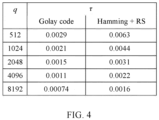
- FIG. 4 shows, in a first column and a second column, recommended LPN KEM parameters (q, ⁇ ).
- the device B may choose to generate A. by using a 256-bit random number seed. In this case, a size of the KEM public key is reduced to 1504 bytes.
- Solution 2 A concatenated code (Concatenated Code) is used for encoding, to transmit a 140-bit real original key c.
- Concatenated Code For example, Reed-Solomon [15, 7, 9] may be used as an outer code, and Hamming [7, 4] with a single-bit error correction capability may be used as an inner code.
- the device B may divide the 140-bit true original key c into five blocks, and each block has 28 bits.
- the device B may encode each 28-bit block by using the outer code Reed-Solomon [15, 7, 9].
- 28 bits are considered as seven 4 bits, and every 4 bits are used as one letter of Reed-Solomon [15, 7, 9].
- the device B encodes each letter (whose length is 4 bits) in the five Reed-Solomon codewords obtained in the previous step by using the inner code Hamming [7, 4].
- the device A may first perform decapsulation base on the KEM private key, decode and correct an obtained result based on the inner code Hamming [7, 4], and perform decoding and correction based on the outer code Reed-Solomon [15, 7, 9], to restore the 140-bit true original key c.
- FIG. 3 shows, in a first column and a third column, recommended LPN KEM parameters (q, ⁇ ).
- NTRU has been standardized in the IEEE 1394 and currently is promoted for standardization by the IETF.
- R q,s is used to represent polynomials of all small coefficients in R q .
- Encapsulation process After receiving the KEM public key h ⁇ R q , the device B considers each bit of an n-bit original key m ⁇ Z 2 n as a small-coefficient polynomial with a coefficient of 0 or 1.
- the ciphertext c herein is obtained after encryption of the original key m.
- the device A may calculate ((cg mod q)mod 2)/g ⁇ R q based on the KEM private key g, and use a result as an original key.
- a key problem in NTRU KEM implementation lies in that ((cg mod q)mod 2)/g and e mod 2 are not absolutely equal. It should be understood that, ((cg mod q)mod 2)/g and e mod 2 are very likely to be equal as long as a related parameter is properly selected and g, f, r, e ⁇ R q,s is small enough. In other words, the foregoing NTRU KEM decapsulation may fail at a very low probability after proper reconciliation (reconciliation).
- the NTRU KEM may use the following parameters for 128-bit quantum security:
- n 512
- q 12289 (14 bits).
- an element in a set ⁇ 0, ⁇ 1, ⁇ 2, ..., ⁇ 12 ⁇ is selected.
- the KEM public key is 896 bytes
- the KEM private key is 320 bytes
- the ciphertext is 896 bytes
- an encapsulated original key has a length of 512 bits
- a decapsulation failure rate is 2 -30 .
- the 128-bit quantum security is a concept of password strength, which means that 2 128 cryptographic operations need to be performed to crack a cryptosystem.
- n in the system parameters may be set to 1024 if the original key has a longer length.
- a key agreement method using the DH KEM is not quantum secure.
- the method is still of practical significance. Specific practical significance may include but is not limited to the following aspects: First, before the quantum computer comes into being, the method is secure and can be used in a proper scenario. Second, compared with the foregoing three embodiments based on lattice cryptography, lengths of KEM public and private keys corresponding to the key agreement method using the DH KEM are significantly reduced, and are 1/4 to 1/30 of those based on the lattice cryptography. Therefore, communication efficiency is greatly improved.
- the device A stores the KEM private key x.
- the device A obtains E (specifically, any solution provided in step 105 may be used).
- the device B checks whether S' is equal to S: If S' is not equal to S, the device B does not continue to perform key agreement. If S' is equal to S, the device B successfully authenticates the device A, and sends a committed opening value r to the device A.
- the device A After receiving the opening value r, the device A checks whether F is equal to H(S', r). If F is equal to H(S', r), the device A successfully authenticates the device B. If F is not equal to H(S', r), the device A fails to authenticate the device B.
- a session key SK H(A ⁇ B ⁇ pk ⁇ C ⁇ F ⁇ S' ⁇ t ⁇ k).
- DSA Digital Signature Algorithm
- Schnorr Schnorr
- ElGamal ElGamal
- the group G in the solution may be selected as a p-order multiplicative subgroup of a finite field Z q , where p and q are prime numbers, and p
- a bit length of p may be 1024, 1536, or 2048, and a bit length of q may be 128 or 256.
- G may be a 256-bit elliptic curve group, and a bit length of q may be 128 or 256.
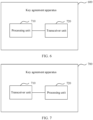
- an embodiment of this application provides a key agreement apparatus 600.
- the key agreement apparatus 600 may be included in a first device in a key agreement system.
- the apparatus 600 includes a processing unit 610 and a transceiver unit 620.
- the processing unit 610 is configured to generate a private-public key pair by using a key generation algorithm.
- the transceiver unit 620 is configured to: send a public key in the private-public key pair to a second device and receive a ciphertext and a commitment value, where the ciphertext is obtained based on the public key and an original key by using an encapsulation algorithm, the original key is selected based on the public key by using the encapsulation algorithm, and the commitment value is obtained based on a first bit string and a random number by using a commitment algorithm, where the first bit string is a random bit string.
- the transceiver unit 620 is further configured to obtain a first result, where the first result is calculated based on the first bit string and a second bit string, and the second bit string is determined based on some bits in the original key.
- the processing unit 610 is further configured to: obtain the original key based on a private key in the private-public key pair and the ciphertext by using a decapsulation algorithm, determine the second bit string based on the some bits in the original key, and calculate a second result based on the second bit string and the first result.
- the transceiver unit 620 is further configured to: send the second result to the second device and receive an opening value, where the opening value is sent by the second device to the first device when the first bit string is the same as the second result, and the opening value is obtained based on the first bit string and the random number by using the commitment algorithm.
- the processing unit 610 is further configured to authenticate the second device based on the opening value and the commitment value, to obtain an authentication result, where the authentication result is used to indicate that the second device successfully authenticates the second device, and generates a session key used to communicate with the second device.
- the processing unit 610 is specifically configured to: calculate the second bit string and the first result by using a first algorithm, to obtain the second result.
- the first algorithm is any one of an exclusive OR operation, a modulo addition operation, a modulo subtraction operation, or a modulo multiplication operation, or a combination thereof.
- the processing unit 610 is further configured to: delete the private-public key pair after generating the session key used to communicate with the second device; and re-generate a private-public key pair when initiating key agreement again with the second device or initiating key agreement with a third device.
- the processing unit 610 is specifically configured to: generate the session key used to communicate with the second device, based on one or more of the following parameters: an identifier of the first device, an identifier of the second device, the public key, the ciphertext, the commitment value, the opening value, the original key, or the second result.
- an embodiment of this application provides a key agreement apparatus 700.
- the key agreement apparatus 700 may be included in a second device in a key agreement system.
- the apparatus 700 includes a transceiver unit 710 and a processing unit 720.
- the transceiver unit 710 is configured to receive a public key, where the public key is a public key in a private-public key pair generated by using a key generation algorithm.
- the processing unit 720 is configured to: select an original key based on the public key by using an encapsulation algorithm, obtain a ciphertext based on the public key and the original key by using the encapsulation algorithm, and obtain a commitment value and an opening value based on a first bit string and a random number by using a commitment algorithm.
- the transceiver unit 710 is further configured to send the ciphertext and the commitment value to the first device.
- the first bit string is a random bit string.
- the processing unit 720 is further configured to: determine a second bit string based on some bits in the original key, and calculate a first result based on the first bit string and the second bit string.
- the transceiver unit 710 is further configured to receive a second result, where the second result is calculated based on the second bit string and the first result.
- the processing unit 720 is further configured to: when the first bit string is the same as the second result, generate a session key used to communicate with the first device. That the first bit string is the same as the second result indicates that the second device successfully authenticates the first device.
- the transceiver unit 710 is further configured to send the opening value to the first device.
- processing unit 720 is specifically configured to:
- the processing unit 720 is further configured to: delete the public key after generating the session key used to communicate with the first device; and generate a private-public key pair when initiating key agreement again with the first device or initiating key agreement with a third device.
- division into the units is merely logical function division. During actual implementation, all or some of the units may be integrated into one physical entity, or may be physically separated. In addition, all of the units may be implemented in a form of software invoked by a processing element, or may be implemented in a form of hardware; or some units may be implemented in a form of software invoked by a processing element, and some units may be implemented in a form of hardware. In an implementation process, steps in the foregoing method or the foregoing units can be implemented through a hardware integrated logical circuit in a processor element, or through instructions in a form of software.
- the foregoing units may be configured as one or more integrated circuits for implementing the foregoing method, for example, one or more application-specific integrated circuits (Application Specific Integrated Circuit, ASIC), or one or more microprocessors (digital signal processor, DSP), or one or more field programmable gate arrays (Field Programmable Gate Array, FPGA).
- ASIC Application Specific Integrated Circuit
- DSP digital signal processor
- FPGA Field Programmable Gate Array
- the processing element may be a general purpose processor, such as a central processing unit (Central Processing Unit, CPU) or another processor that can invoke a program.
- the units may be integrated and implemented in a form of a system-on-a-chip (system-on-a-chip, SOC).
- an embodiment of this application provides a key agreement apparatus.
- the key agreement apparatus may be a chip
- the apparatus includes a processor and an interface
- the interface may be an input/output interface.
- the processor implements the processing unit 610 in FIG. 6
- the interface implements the transceiver unit 620 in FIG. 6 .
- the processor implements a function of the processing unit 720 in FIG. 7
- the interface implements a function of the transceiver unit 710 in FIG. 7 .
- the apparatus may further include a memory.
- the memory is configured to store a program that can be run on the processor. When the processor executes the program, the method of the embodiment shown in FIG. 2A and FIG. 2B is performed.
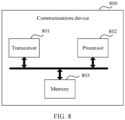
- an embodiment of this application further provides a communications device.
- the communications device 800 includes a transceiver 801, a processor 802, and a memory 803.
- the memory 803 is configured to store a computer program.
- the processor 802 invokes the computer program stored in the memory 803, and performs, by using the transceiver 801, a step of the first device or a step of the second device in the method embodiment shown in FIG. 2A and FIG. 2B .
- the processor may be a CPU, a network processor (network processor, NP), a hardware chip, or any combination thereof.
- the memory may include a volatile memory (volatile memory), for example, a random access memory (random access memory, RAM).
- the memory may include a nonvolatile memory (non-volatile memory), such as a read-only memory (read-only memory, ROM), a flash memory (flash memory), a hard disk drive (hard disk drive, HDD), or a solid-state drive (solid-state drive, SSD).
- nonvolatile memory such as a read-only memory (read-only memory, ROM), a flash memory (flash memory), a hard disk drive (hard disk drive, HDD), or a solid-state drive (solid-state drive, SSD).
- non-volatile memory such as a read-only memory (read-only memory, ROM), a flash memory (flash memory), a hard disk drive (hard disk drive, HDD), or a solid-state drive (solid-state drive, SSD).
- the memory may include a combination of the foregoing types of memories.
- An embodiment of this application provides a key agreement system including a first device and a second device.
- the system may include two communications devices shown in FIG. 8 .
- One device is configured to perform a step of the first device in the method embodiment shown in FIG. 2A and FIG. 2B
- the other device is configured to perform a step of the second device in the method embodiment shown in FIG. 2A and FIG. 2B .
- An embodiment of this application further provides a computer-readable storage medium, where the computer-readable storage medium stores a computer program, and when the computer program is run on a computer, the computer is enabled to perform the method in the embodiment shown in FIG. 2A and FIG. 2B .
- the embodiments of this application may be provided as a method, a system, or a computer program product. Therefore, the embodiments of this application may use a form of hardware only embodiments, software only embodiments, or embodiments with a combination of software and hardware. Moreover, the embodiments of this application may use a form of a computer program product that is implemented on one or more computer-usable storage media (including but not limited to a disk memory, a CD-ROM, an optical memory, and the like) that include computer-usable program code.
- computer-usable storage media including but not limited to a disk memory, a CD-ROM, an optical memory, and the like
- These computer program instructions may be provided for a general-purpose computer, a dedicated computer, an embedded processor, or a processor of another programmable data processing device to generate a machine, so that the instructions executed by the computer or the processor of the another programmable data processing device generate an apparatus for implementing a specific function in one or more processes in the flowcharts and/or in one or more blocks in the block diagrams.
- these computer program instructions may be stored in a computer-readable memory that can instruct a computer or another programmable data processing device to work in a specific manner, so that the instructions stored in the computer-readable memory generate an artifact that includes an instruction apparatus.
- the instruction apparatus implements a specific function in one or more processes in the flowcharts and/or in one or more blocks in the block diagrams.
- these computer program instructions may be loaded onto a computer or another programmable data processing device, so that a series of operations and steps are performed on the computer or the another programmable device, thereby generating computer-implemented processing. Therefore, the instructions executed on the computer or the another programmable device provide steps for implementing a specific function in one or more processes in the flowcharts and/or in one or more blocks in the block diagrams.
Landscapes
- Engineering & Computer Science (AREA)
- Computer Security & Cryptography (AREA)
- Computer Networks & Wireless Communication (AREA)
- Signal Processing (AREA)
- Theoretical Computer Science (AREA)
- Computing Systems (AREA)
- Mathematical Physics (AREA)
- Physics & Mathematics (AREA)
- Algebra (AREA)
- General Physics & Mathematics (AREA)
- Mathematical Analysis (AREA)
- Mathematical Optimization (AREA)
- Pure & Applied Mathematics (AREA)
- General Engineering & Computer Science (AREA)
- Computer Hardware Design (AREA)
- Mobile Radio Communication Systems (AREA)
Claims (11)
- Schlüsselvereinbarungssystem, umfassend eine erste Vorrichtung (600, 800) und eine zweite Vorrichtung (700, 800), wobei
die erste Vorrichtung (600, 800) zu Folgendem konfiguriert ist:Erzeugen eines privat-öffentlichen Schlüsselpaars unter Verwendung eines Schlüsselerzeugungsalgorithmus und Senden eines öffentlichen Schlüssels im privat-öffentlichen Schlüsselpaar an die zweite Vorrichtung (700, 800);die zweite Vorrichtung (700, 800) zu Folgendem konfiguriert ist: Auswählen eines Originalschlüssels (k = K∥K') basierend auf dem empfangenen öffentlichen Schlüssel (pk) unter Verwendung eines Kapselungsalgorithmus, Erlangen eines Chiffretexts (C) basierend auf dem öffentlichen Schlüssel und dem Originalschlüssel unter Verwendung des Kapselungsalgorithmus, Erlangen eines Verpflichtungswerts (F) und eines Eröffnungswerts (t) basierend auf einer ersten Bitfolge (S) und einer Zufallszahl (r) unter Verwendung eines Verpflichtungsalgorithmus und Senden des Chiffretexts und des Verpflichtungswerts an die erste Vorrichtung (600, 800), wobei die erste Bitfolge eine zufällige Bitfolge ist; und Bestimmen einer zweiten Bitfolge (K) basierend auf einigen Bits in dem Originalschlüssel und Berechnen eines ersten Ergebnisses (E) als exklusives ODER der ersten Bitfolge und der zweiten Bitfolge;die erste Vorrichtung (600, 800) ferner zu Folgendem konfiguriert ist: Erlangen des Originalschlüssels basierend auf einem privaten Schlüssel im privat-öffentlichen Schlüsselpaar und dem empfangenen Chiffretext unter Verwendung eines Entkapselungsalgorithmus, Bestimmen der zweiten Bitfolge basierend auf einigen Bits im Originalschlüssel, Berechnen eines zweiten Ergebnisses als exklusives ODER der zweiten Bitfolge und des ersten Ergebnisses und Senden des zweiten Ergebnisses an die zweite Vorrichtung (700, 800);die zweite Vorrichtung (700, 800) ferner zu Folgendem konfiguriert ist: wenn die erste Bitfolge mit dem empfangenen zweiten Ergebnis übereinstimmt, Senden des Eröffnungswerts an die erste Vorrichtung (600, 800) und Erzeugen eines Sitzungsschlüssels, der zur Kommunikation mit der ersten Vorrichtung (600, 800) verwendet wird, wobei die Tatsache, dass die erste Bitfolge mit dem zweiten Ergebnis übereinstimmt, angibt, dass die zweite Vorrichtung (700, 800) die erste Vorrichtung (600, 800) erfolgreich authentifiziert hat; unddie erste Vorrichtung (600, 800) ferner zu Folgendem konfiguriert ist: Authentifizieren der zweiten Vorrichtung (700, 800) basierend auf dem empfangenen Eröffnungswert und dem Verpflichtungswert, um ein Authentifizierungsergebnis (S") zu erlangen,wobei das Authentifizierungsergebnis verwendet wird, um anzugeben, dass die erste Vorrichtung (600, 800) die zweite Vorrichtung (700, 800) erfolgreich authentifiziert hat, und um einen Sitzungsschlüssel (SK) zu erzeugen, der zur Kommunikation mit der zweiten Vorrichtung (700, 800) verwendet wird. - System nach Anspruch 1, wobei die erste Vorrichtung (600, 800) ferner zu Folgendem konfiguriert ist: Löschen des privat-öffentlichen Schlüsselpaars nach dem Erzeugen des Sitzungsschlüssels, der zum Kommunizieren mit der zweiten Vorrichtung (700, 800) verwendet wird; und Neuerzeugen eines privat-öffentlichen Schlüsselpaars beim erneuten Initiieren einer Schlüsselvereinbarung mit der zweiten Vorrichtung (700, 800) oder beim Initiieren einer Schlüsselvereinbarung mit einer dritten Vorrichtung.
- System nach einem der Ansprüche 1 und 2, wobei die zweite Vorrichtung (700, 800) ferner zu Folgendem konfiguriert ist:
Löschen des öffentlichen Schlüssels nach dem Erzeugen des zur Kommunikation mit der ersten Vorrichtung (600, 800) verwendeten Sitzungsschlüssels; und Erzeugen eines privat-öffentlichen Schlüsselpaars, wenn die Schlüsselvereinbarung erneut mit der ersten Vorrichtung (600, 800) initiiert wird oder wenn die Schlüsselvereinbarung mit der dritten Vorrichtung initiiert wird. - System nach einem der Ansprüche 1 bis 3, wobei die erste Vorrichtung (600, 800) speziell dazu konfiguriert ist, den Sitzungsschlüssel, der zur Kommunikation mit der zweiten Vorrichtung (700, 800) verwendet wird, basierend auf einem oder mehreren der folgenden Parameter zu erzeugen: einer Kennung der ersten Vorrichtung (600, 800), einer Kennung der zweiten Vorrichtung (700, 800), des öffentlichen Schlüssels, des Chiffretexts, des Verpflichtungswerts, des Eröffnungswerts, des Originalschlüssels oder des zweiten Ergebnisses; und
die zweite Vorrichtung (700, 800) speziell dazu konfiguriert ist, basierend auf dem einem oder den mehreren Parametern den zur Kommunikation mit der ersten Vorrichtung (600, 800) verwendeten Sitzungsschlüssel zu erzeugen, wobei der zur Kommunikation mit der zweiten Vorrichtung (700, 800) verwendete Sitzungsschlüssel derselbe ist wie der zur Kommunikation mit der ersten Vorrichtung (600, 800) verwendete Sitzungsschlüssel. - Schlüsselvereinbarungsverfahren, umfassend:Erzeugen (201) eines privat-öffentlichen Schlüsselpaars durch eine erste Vorrichtung (600, 800) unter Verwendung eines Schlüsselerzeugungsalgorithmus und Senden (202) eines öffentlichen Schlüssels in dem privat-öffentlichen Schlüsselpaar an eine zweites Vorrichtung (700, 800); undEmpfangen (204) eines Chiffretexts und eines Verpflichtungswerts durch die erste Vorrichtung (600, 800), wobei der Chiffretext basierend auf dem öffentlichen Schlüssel und einem Originalschlüssel unter Verwendung eines Kapselungsalgorithmus erlangt wird, der Originalschlüssel basierend auf dem öffentlichen Schlüssel unter Verwendung des Kapselungsalgorithmus ausgewählt wird und der Verpflichtungswert basierend auf einer ersten Bitfolge und einer Zufallszahl unter Verwendung eines Verpflichtungsalgorithmus erlangt wird, wobei die erste Bitfolge eine zufällige Bitfolge ist;Erlangen (205) eines ersten Ergebnisses durch die erste Vorrichtung (600, 800), wobei das erste Ergebnis als exklusives ODER der ersten Bitfolge und einer zweiten Bitfolge berechnet wird und die zweite Bitfolge basierend auf einigen Bits im Originalschlüssel bestimmt wird;Erlangen (206) des Originalschlüssels durch die erste Vorrichtung (600, 800) basierend auf einem privaten Schlüssel im privat-öffentlichen Schlüsselpaar und dem Chiffretext unter Verwendung eines Entkapselungsalgorithmus und Bestimmen der zweiten Bitfolge basierend auf einigen Bits im Originalschlüssel;Berechnen (206) eines zweiten Ergebnisses durch die erste Vorrichtung (600, 800) als exklusives ODER der zweiten Bitfolge und des ersten Ergebnisses und Senden des zweiten Ergebnisses an die zweite Vorrichtung (700, 800);Empfangen (209) eines Eröffnungswerts durch die erste Vorrichtung (600, 800), wobei der Eröffnungswert von der zweiten Vorrichtung (700, 800) an die erste Vorrichtung (600, 800) gesendet wird, wenn die erste Bitfolge mit dem zweiten Ergebnis identisch ist, und der Eröffnungswert basierend auf der ersten Bitfolge und der Zufallszahl unter Verwendung des Verpflichtungsalgorithmus erlangt wird; undDurchführen (211) einer Authentifizierung durch die erste Vorrichtung (600, 800) auf der zweiten Vorrichtung (700, 800) basierend auf dem Eröffnungswert und dem Verpflichtungswert, um ein Authentifizierungsergebnis zu erlangen, wobei das Authentifizierungsergebnis verwendet wird, um anzugeben, dass die zweite Vorrichtung (700, 800) die zweite Vorrichtung (700, 800) erfolgreich authentifiziert hat, und Erzeugen (211) eines Sitzungsschlüssels, der zur Kommunikation mit der zweiten Vorrichtung (700, 800) verwendet wird.
- Verfahren nach Anspruch 5, wobei das Verfahren, nachdem die erste Vorrichtung (600, 800) den zur Kommunikation mit der zweiten Vorrichtung (700, 800) verwendeten Sitzungsschlüssel erzeugt (211), ferner Folgendes umfasst:Löschen des privat-öffentlichen Schlüsselpaars durch die erste Vorrichtung (600, 800); undNeuerzeugen eines privat-öffentlichen Schlüsselpaars durch die erste Vorrichtung (600, 800), wenn die Schlüsselvereinbarung erneut mit der zweiten Vorrichtung (700, 800) initiiert wird oder wenn die Schlüsselvereinbarung mit einer dritten Vorrichtung initiiert wird.
- Verfahren nach einem der Ansprüche 5 und 6, wobei das Erzeugen (211) des Sitzungsschlüssels, der zur Kommunikation mit der zweiten Vorrichtung (700, 800) verwendet wird, durch die erste Vorrichtung (600, 800) Folgendes umfasst:
Erzeugen des zur Kommunikation mit der zweiten Vorrichtung (700, 800) verwendeten Sitzungsschlüssels durch die erste Vorrichtung (600, 800), basierend auf einem oder mehreren der folgenden Parameter: einer Kennung der ersten Vorrichtung (600, 800), einer Kennung der zweiten Vorrichtung (700, 800), des öffentlichen Schlüssels, des Chiffretexts, des Verpflichtungswerts, des Eröffnungswerts, des Originalschlüssels oder des zweiten Ergebnisses. - Schlüsselvereinbarungsverfahren, umfassend:Empfangen (202) eines öffentlichen Schlüssels durch eine zweite Vorrichtung (700, 800), wobei der öffentliche Schlüssel ein öffentlicher Schlüssel in einem unter Verwendung eines Schlüsselerzeugungsalgorithmus erzeugten privat-öffentlichen Schlüsselpaar ist;Auswählen (203) eines Originalschlüssels basierend auf dem öffentlichen Schlüssel durch eine zweite Vorrichtung (700, 800) unter Verwendung des Kapselungsalgorithmus, Erlangen eines Chiffretexts basierend auf dem öffentlichen Schlüssel und dem Originalschlüssel durch Verwendung des Kapselungsalgorithmus, Erlangen (203) eines Verpflichtungswerts und eines Eröffnungswerts basierend auf einer ersten Bitfolge und einer Zufallszahl durch Verwendung eines Verpflichtungsalgorithmus, und Senden (204) des Chiffretexts und des Verpflichtungswerts an eine erste Vorrichtung (600, 800), wobei die erste Bitfolge eine zufällige Bitfolge ist;Bestimmen (203) einer zweiten Bitfolge durch die zweite Vorrichtung (700, 800) basierend auf einigen Bits im Originalschlüssel und Berechnen (203) eines ersten Ergebnisses als exklusives ODER der ersten Bitfolge und der zweiten Bitfolge;Empfangen (207) eines zweiten Ergebnisses durch die zweite Vorrichtung (700, 800), wobei das zweite Ergebnis als exklusives ODER der zweiten Bitfolge und des ersten Ergebnisses berechnet wird; undwenn die erste Bitfolge mit dem zweiten Ergebnis übereinstimmt, Senden (209) des Eröffnungswerts durch die zweite Vorrichtung (700, 800) an die erste Vorrichtung (600, 800) und Erzeugen (210) eines zur Kommunikation mit der ersten Vorrichtung (600, 800) verwendeten Sitzungsschlüssels, wobei die Tatsache, dass die erste Bitfolge mit dem zweiten Ergebnis übereinstimmt, angibt, dass die zweite Vorrichtung (700, 800) die erste Vorrichtung (600, 800) erfolgreich authentifiziert hat.
- Verfahren nach Anspruch 8, nach dem Erzeugen (210) des zur Kommunikation mit der ersten Vorrichtung (600, 800) verwendeten Sitzungsschlüssels durch die zweite Vorrichtung (700, 800) ferner Folgendes umfassend:Löschen des öffentlichen Schlüssels durch die zweite Vorrichtung (700, 800); undErzeugen eines privat-öffentlichen Schlüsselpaars durch die zweite Vorrichtung (700, 800), wenn die Schlüsselvereinbarung erneut mit der ersten Vorrichtung (600, 800) initiiert wird oder wenn die Schlüsselvereinbarung mit einer dritten Vorrichtung initiiert wird.
- Verfahren nach einem der Ansprüche 8 und 9, wobei das Erzeugen (210) des zur Kommunikation mit der zweiten Vorrichtung (700, 800) verwendeten Sitzungsschlüssels durch die zweite Vorrichtung (700, 800) Folgendes umfasst:
Erzeugen des zur Kommunikation mit der ersten Vorrichtung (600, 800) verwendeten Sitzungsschlüssels durch die zweite Vorrichtung (700, 800), basierend auf einem oder mehreren der folgenden Parameter: einer Kennung der ersten Vorrichtung (600, 800), einer Kennung der zweiten Vorrichtung (700, 800), des öffentlichen Schlüssels, des Chiffretexts, des Verpflichtungswerts, des Eröffnungswerts, des Originalschlüssels oder des zweiten Ergebnisses. - Schlüsselvereinbarungsvorrichtung (600, 800), umfassend:eine Verarbeitungseinheit (610, 802), die dazu konfiguriert ist, ein privat-öffentliches Schlüsselpaar unter Verwendung eines Schlüsselerzeugungsalgorithmus zu erzeugen; undeine Transceivereinheit (620, 801), die zu Folgendem konfiguriert ist: Senden eines öffentlichen Schlüssels im privat-öffentlichen Schlüsselpaar an eine zweite Vorrichtung (700, 800) und Empfangen eines Chiffretexts und eines Verpflichtungswerts, wobei der Chiffretext basierend auf dem öffentlichen Schlüssel und einem Originalschlüssel unter Verwendung eines Kapselungsalgorithmus erlangt wird, der Originalschlüssel basierend auf dem öffentlichen Schlüssel unter Verwendung des Kapselungsalgorithmus ausgewählt wird und der Verpflichtungswert basierend auf einer ersten Bitfolge und einer Zufallszahl unter Verwendung eines Verpflichtungsalgorithmus erlangt wird, wobei die erste Bitfolge eine zufällige Bitfolge ist; wobeidie Transceivereinheit (620, 801) ferner dazu konfiguriert ist, ein erstes Ergebnis zu erlangen, wobei das erste Ergebnis als exklusives ODER der ersten Bitfolge und einer zweiten Bitfolge berechnet wird und die zweite Bitfolge basierend auf einigen Bits im Originalschlüssel bestimmt wird;die Verarbeitungseinheit (610, 802) ferner zu Folgendem konfiguriert ist: Erlangen des Originalschlüssels basierend auf einem privaten Schlüssel im privat-öffentlichen Schlüsselpaar und dem Chiffretext unter Verwendung eines Entkapselungsalgorithmus, Bestimmen der zweiten Bitfolge basierend auf einigen Bits im Originalschlüssel und Berechnen eines zweiten Ergebnisses als exklusives ODER der zweiten Bitfolge und des ersten Ergebnisses;die Transceivereinheit (620, 801) ferner zu Folgendem konfiguriert ist: Senden des zweiten Ergebnisses an die zweite Vorrichtung (700, 800) und Empfangen eines Eröffnungswerts, wobei der Eröffnungswert von der zweiten Vorrichtung (700, 800) an eine erste Vorrichtung (600, 800) gesendet wird, wenn die erste Bitfolge mit dem zweiten Ergebnis identisch ist, und der Eröffnungswert basierend auf der ersten Bitfolge und der Zufallszahl unter Verwendung des Verpflichtungsalgorithmus erlangt wird; unddie Verarbeitungseinheit (610, 802) ferner dazu konfiguriert ist, die zweite Vorrichtung (700, 800) basierend auf dem Eröffnungswert und dem Verpflichtungswert zu authentifizieren, um ein Authentifizierungsergebnis zu erlangen, wobei das Authentifizierungsergebnis verwendet wird, um anzugeben, dass die zweite Vorrichtung (700, 800) die zweite Vorrichtung (700, 800) erfolgreich authentifiziert hat, und einen Sitzungsschlüssel erstellt, der zur Kommunikation mit der zweiten Vorrichtung (700, 800) verwendet wird.
Applications Claiming Priority (1)
| Application Number | Priority Date | Filing Date | Title |
|---|---|---|---|
| PCT/SG2018/050266 WO2019231392A1 (zh) | 2018-05-30 | 2018-05-30 | 一种密钥协商系统、方法及装置 |
Publications (3)
| Publication Number | Publication Date |
|---|---|
| EP3793129A1 EP3793129A1 (de) | 2021-03-17 |
| EP3793129A4 EP3793129A4 (de) | 2021-11-17 |
| EP3793129B1 true EP3793129B1 (de) | 2025-04-23 |
Family
ID=68698981
Family Applications (1)
| Application Number | Title | Priority Date | Filing Date |
|---|---|---|---|
| EP18920998.4A Active EP3793129B1 (de) | 2018-05-30 | 2018-05-30 | System, verfahren und vorrichtung zum schlüsselaustausch |
Country Status (3)
| Country | Link |
|---|---|
| US (1) | US11483142B2 (de) |
| EP (1) | EP3793129B1 (de) |
| WO (1) | WO2019231392A1 (de) |
Families Citing this family (17)
| Publication number | Priority date | Publication date | Assignee | Title |
|---|---|---|---|---|
| WO2015120170A1 (en) * | 2014-02-05 | 2015-08-13 | Bigdatabio, Llc | Methods and systems for biological sequence compression transfer and encryption |
| US11770265B2 (en) * | 2020-04-30 | 2023-09-26 | Deere & Company | Mobile machine with improved machine data authentication |
| CN111884798B (zh) * | 2020-07-22 | 2023-04-07 | 全球能源互联网研究院有限公司 | 一种电力业务量子加密系统 |
| US11153080B1 (en) * | 2020-07-29 | 2021-10-19 | John A. Nix | Network securing device data using two post-quantum cryptography key encapsulation mechanisms |
| US12301709B2 (en) * | 2020-11-24 | 2025-05-13 | John A. Nix | Multiple post-quantum cryptography key encapsulations with authentication and forward secrecy |
| US12003629B2 (en) | 2020-12-30 | 2024-06-04 | John A. Nix | Secure server digital signature generation for post-quantum cryptography key encapsulations |
| US11444753B1 (en) * | 2021-03-09 | 2022-09-13 | ISARA Corporation | Protocol key negotiation |
| CN113315628B (zh) * | 2021-04-09 | 2022-12-16 | 中国科学院信息工程研究所 | 密钥封装方法、装置、设备及存储介质 |
| DE102021110768B3 (de) * | 2021-04-27 | 2022-06-23 | Wincor Nixdorf International Gmbh | Forensik-Modul und eingebettetes System |
| WO2022260672A1 (en) * | 2021-06-10 | 2022-12-15 | Pqsecure Technologies, Llc | A low footprint resource sharing hardware architecture for crystals-dilithium and crystals-kyber |
| US12542683B2 (en) * | 2021-07-21 | 2026-02-03 | Visa International Service Association | Authentication using group signatures of user devices |
| US12289399B2 (en) * | 2021-10-29 | 2025-04-29 | Seagate Technology Llc | Device specific multiparty computation |
| CN113839786B (zh) * | 2021-10-29 | 2023-06-09 | 郑州信大捷安信息技术股份有限公司 | 一种基于sm9密钥算法的密钥分发方法和系统 |
| US12192184B2 (en) | 2021-12-08 | 2025-01-07 | John A. Nix | Secure session resumption using post-quantum cryptography |
| CN115134074B (zh) * | 2022-06-29 | 2025-02-25 | 海光信息技术股份有限公司 | 多芯片密钥协商方法以及多芯片身份验证方法 |
| WO2026065413A1 (zh) * | 2024-09-30 | 2026-04-02 | 北京雁栖湖应用数学研究院 | 一种基于可积多项式的密钥交换方法及装置 |
| CN119602953B (zh) * | 2024-11-28 | 2025-11-28 | 电子科技大学 | 一种格上基于口令的会话密钥协商生成方法 |
Family Cites Families (9)
| Publication number | Priority date | Publication date | Assignee | Title |
|---|---|---|---|---|
| US7649999B2 (en) * | 2005-06-08 | 2010-01-19 | Iris Anshel | Method and apparatus for establishing a key agreement protocol |
| US8621210B2 (en) * | 2008-06-26 | 2013-12-31 | Microsoft Corporation | Ad-hoc trust establishment using visual verification |
| CA2746830C (en) * | 2008-12-16 | 2016-06-07 | Blackberry Limited | Acceleration of key agreement protocols |
| WO2013152725A1 (en) | 2012-04-12 | 2013-10-17 | Jintai Ding | New cryptographic systems using pairing with errors |
| US9143331B2 (en) * | 2013-02-07 | 2015-09-22 | Qualcomm Incorporated | Methods and devices for authentication and key exchange |
| CN104980928B (zh) * | 2014-04-03 | 2018-12-07 | 华为终端(东莞)有限公司 | 一种用于建立安全连接的方法、设备及系统 |
| US9734355B2 (en) * | 2014-04-11 | 2017-08-15 | Rubicon Labs, Inc. | System and method for an efficient authentication and key exchange protocol |
| CN106603485B (zh) * | 2016-10-31 | 2020-03-03 | 美的智慧家居科技有限公司 | 密钥协商方法及装置 |
| CN107948189B (zh) * | 2017-12-19 | 2020-10-30 | 数安时代科技股份有限公司 | 非对称密码身份鉴别方法、装置、计算机设备及存储介质 |
-
2018
- 2018-05-30 EP EP18920998.4A patent/EP3793129B1/de active Active
- 2018-05-30 WO PCT/SG2018/050266 patent/WO2019231392A1/zh not_active Ceased
-
2020
- 2020-11-30 US US17/107,218 patent/US11483142B2/en active Active
Also Published As
| Publication number | Publication date |
|---|---|
| EP3793129A1 (de) | 2021-03-17 |
| US20210083862A1 (en) | 2021-03-18 |
| WO2019231392A1 (zh) | 2019-12-05 |
| EP3793129A4 (de) | 2021-11-17 |
| US11483142B2 (en) | 2022-10-25 |
Similar Documents
| Publication | Publication Date | Title |
|---|---|---|
| EP3793129B1 (de) | System, verfahren und vorrichtung zum schlüsselaustausch | |
| US11991285B2 (en) | Configurable cryptographic device | |
| US11050557B2 (en) | Key agreement devices and method | |
| JP6975361B2 (ja) | 鍵カプセル化プロトコル | |
| CN103490883B (zh) | 一种多变量公钥加密/解密系统及加密/解密方法 | |
| CN112997448A (zh) | 具有减小的公钥大小的公钥/私钥系统 | |
| EP3843320A1 (de) | Öffentliches/privates schlüsselsystem mit erhöhter sicherheit | |
| EP3547603A1 (de) | Konfigurierbare vorrichtung für latticebasierte kryptografie | |
| CN107786327B (zh) | 一种基于ldpc码的安全可靠传输方法 | |
| CN116318695A (zh) | 一种基于ntru格的密钥封装和加解密方法 | |
| CN113132100A (zh) | 一种基于滑窗QC-LDPC码的McEliece体制加解密方法 | |
| CN107026873B (zh) | 一种基于椭圆曲线算法的加解密方法及系统 | |
| Yang et al. | Quantum public-key cryptosystems based on induced trapdoor one-way transformations | |
| CN117478321A (zh) | 基于极化码的密钥封装机制 | |
| RU2787692C2 (ru) | Протоколы инкапсуляции ключей | |
| RU2787692C9 (ru) | Протоколы инкапсуляции ключей | |
| Han et al. | Joint encryption and channel coding scheme based on balancing indices and polar codes | |
| Hamburg et al. | Integer Module LWE key exchange and encryption: The three bears (draft) | |
| EP3609117A1 (de) | Schlüsselverkapselungsprotokolle | |
| Yao et al. | A Joint encryption system based on McEliece and RLWE | |
| Hooshmand | A Key Encapsulation Mechanism from Low Density Lattice Codes | |
| Ibrahim | Analysis and Development of Ciphers Homomorphic on Addition and Multiplication | |
| KR20250165981A (ko) | 공개키 암호 시스템에서의 암호화 방법 및 장치, 그리고 복호화 방법 및 장치 | |
| Ye et al. | An efficient blind signature scheme based on error correcting codes | |
| Chabanne et al. | Public-key cryptography from different assumptions: A multi-bit version |
Legal Events
| Date | Code | Title | Description |
|---|---|---|---|
| STAA | Information on the status of an ep patent application or granted ep patent |
Free format text: STATUS: THE INTERNATIONAL PUBLICATION HAS BEEN MADE |
|
| PUAI | Public reference made under article 153(3) epc to a published international application that has entered the european phase |
Free format text: ORIGINAL CODE: 0009012 |
|
| STAA | Information on the status of an ep patent application or granted ep patent |
Free format text: STATUS: REQUEST FOR EXAMINATION WAS MADE |
|
| 17P | Request for examination filed |
Effective date: 20201210 |
|
| AK | Designated contracting states |
Kind code of ref document: A1 Designated state(s): AL AT BE BG CH CY CZ DE DK EE ES FI FR GB GR HR HU IE IS IT LI LT LU LV MC MK MT NL NO PL PT RO RS SE SI SK SM TR |
|
| AX | Request for extension of the european patent |
Extension state: BA ME |
|
| DAV | Request for validation of the european patent (deleted) | ||
| DAX | Request for extension of the european patent (deleted) | ||
| REG | Reference to a national code |
Ref country code: DE Ref legal event code: R079 Free format text: PREVIOUS MAIN CLASS: H04L0009320000 Ipc: H04L0009080000 Ref country code: DE Ref legal event code: R079 Ref document number: 602018081428 Country of ref document: DE Free format text: PREVIOUS MAIN CLASS: H04L0009320000 Ipc: H04L0009080000 |
|
| A4 | Supplementary search report drawn up and despatched |
Effective date: 20211014 |
|
| RIC1 | Information provided on ipc code assigned before grant |
Ipc: H04L 9/08 20060101AFI20211008BHEP |
|
| GRAP | Despatch of communication of intention to grant a patent |
Free format text: ORIGINAL CODE: EPIDOSNIGR1 |
|
| STAA | Information on the status of an ep patent application or granted ep patent |
Free format text: STATUS: GRANT OF PATENT IS INTENDED |
|
| INTG | Intention to grant announced |
Effective date: 20241202 |
|
| P01 | Opt-out of the competence of the unified patent court (upc) registered |
Free format text: CASE NUMBER: APP_4449/2025 Effective date: 20250127 |
|
| GRAS | Grant fee paid |
Free format text: ORIGINAL CODE: EPIDOSNIGR3 |
|
| GRAA | (expected) grant |
Free format text: ORIGINAL CODE: 0009210 |
|
| STAA | Information on the status of an ep patent application or granted ep patent |
Free format text: STATUS: THE PATENT HAS BEEN GRANTED |
|
| AK | Designated contracting states |
Kind code of ref document: B1 Designated state(s): AL AT BE BG CH CY CZ DE DK EE ES FI FR GB GR HR HU IE IS IT LI LT LU LV MC MK MT NL NO PL PT RO RS SE SI SK SM TR |
|
| REG | Reference to a national code |
Ref country code: GB Ref legal event code: FG4D |
|
| REG | Reference to a national code |
Ref country code: CH Ref legal event code: EP |
|
| REG | Reference to a national code |
Ref country code: DE Ref legal event code: R096 Ref document number: 602018081428 Country of ref document: DE |
|
| REG | Reference to a national code |
Ref country code: IE Ref legal event code: FG4D |
|
| PGFP | Annual fee paid to national office [announced via postgrant information from national office to epo] |
Ref country code: DE Payment date: 20250408 Year of fee payment: 8 |
|
| PGFP | Annual fee paid to national office [announced via postgrant information from national office to epo] |
Ref country code: FR Payment date: 20250409 Year of fee payment: 8 |
|
| REG | Reference to a national code |
Ref country code: NL Ref legal event code: MP Effective date: 20250423 |
|
| PG25 | Lapsed in a contracting state [announced via postgrant information from national office to epo] |
Ref country code: NL Free format text: LAPSE BECAUSE OF FAILURE TO SUBMIT A TRANSLATION OF THE DESCRIPTION OR TO PAY THE FEE WITHIN THE PRESCRIBED TIME-LIMIT Effective date: 20250423 |
|
| REG | Reference to a national code |
Ref country code: AT Ref legal event code: MK05 Ref document number: 1788873 Country of ref document: AT Kind code of ref document: T Effective date: 20250423 |
|
| PG25 | Lapsed in a contracting state [announced via postgrant information from national office to epo] |
Ref country code: PT Free format text: LAPSE BECAUSE OF FAILURE TO SUBMIT A TRANSLATION OF THE DESCRIPTION OR TO PAY THE FEE WITHIN THE PRESCRIBED TIME-LIMIT Effective date: 20250825 Ref country code: FI Free format text: LAPSE BECAUSE OF FAILURE TO SUBMIT A TRANSLATION OF THE DESCRIPTION OR TO PAY THE FEE WITHIN THE PRESCRIBED TIME-LIMIT Effective date: 20250423 Ref country code: ES Free format text: LAPSE BECAUSE OF FAILURE TO SUBMIT A TRANSLATION OF THE DESCRIPTION OR TO PAY THE FEE WITHIN THE PRESCRIBED TIME-LIMIT Effective date: 20250423 |
|
| REG | Reference to a national code |
Ref country code: LT Ref legal event code: MG9D |
|
| PG25 | Lapsed in a contracting state [announced via postgrant information from national office to epo] |
Ref country code: GR Free format text: LAPSE BECAUSE OF FAILURE TO SUBMIT A TRANSLATION OF THE DESCRIPTION OR TO PAY THE FEE WITHIN THE PRESCRIBED TIME-LIMIT Effective date: 20250724 Ref country code: NO Free format text: LAPSE BECAUSE OF FAILURE TO SUBMIT A TRANSLATION OF THE DESCRIPTION OR TO PAY THE FEE WITHIN THE PRESCRIBED TIME-LIMIT Effective date: 20250723 |
|
| PG25 | Lapsed in a contracting state [announced via postgrant information from national office to epo] |
Ref country code: PL Free format text: LAPSE BECAUSE OF FAILURE TO SUBMIT A TRANSLATION OF THE DESCRIPTION OR TO PAY THE FEE WITHIN THE PRESCRIBED TIME-LIMIT Effective date: 20250423 |
|
| PG25 | Lapsed in a contracting state [announced via postgrant information from national office to epo] |
Ref country code: BG Free format text: LAPSE BECAUSE OF FAILURE TO SUBMIT A TRANSLATION OF THE DESCRIPTION OR TO PAY THE FEE WITHIN THE PRESCRIBED TIME-LIMIT Effective date: 20250423 |
|
| PG25 | Lapsed in a contracting state [announced via postgrant information from national office to epo] |
Ref country code: HR Free format text: LAPSE BECAUSE OF FAILURE TO SUBMIT A TRANSLATION OF THE DESCRIPTION OR TO PAY THE FEE WITHIN THE PRESCRIBED TIME-LIMIT Effective date: 20250423 |
|
| PG25 | Lapsed in a contracting state [announced via postgrant information from national office to epo] |
Ref country code: AT Free format text: LAPSE BECAUSE OF FAILURE TO SUBMIT A TRANSLATION OF THE DESCRIPTION OR TO PAY THE FEE WITHIN THE PRESCRIBED TIME-LIMIT Effective date: 20250423 |
|
| PG25 | Lapsed in a contracting state [announced via postgrant information from national office to epo] |
Ref country code: RS Free format text: LAPSE BECAUSE OF FAILURE TO SUBMIT A TRANSLATION OF THE DESCRIPTION OR TO PAY THE FEE WITHIN THE PRESCRIBED TIME-LIMIT Effective date: 20250723 |
|
| PG25 | Lapsed in a contracting state [announced via postgrant information from national office to epo] |
Ref country code: IS Free format text: LAPSE BECAUSE OF FAILURE TO SUBMIT A TRANSLATION OF THE DESCRIPTION OR TO PAY THE FEE WITHIN THE PRESCRIBED TIME-LIMIT Effective date: 20250823 |
|
| PG25 | Lapsed in a contracting state [announced via postgrant information from national office to epo] |
Ref country code: LV Free format text: LAPSE BECAUSE OF FAILURE TO SUBMIT A TRANSLATION OF THE DESCRIPTION OR TO PAY THE FEE WITHIN THE PRESCRIBED TIME-LIMIT Effective date: 20250423 |
|
| REG | Reference to a national code |
Ref country code: CH Ref legal event code: H13 Free format text: ST27 STATUS EVENT CODE: U-0-0-H10-H13 (AS PROVIDED BY THE NATIONAL OFFICE) Effective date: 20251223 |
|
| PG25 | Lapsed in a contracting state [announced via postgrant information from national office to epo] |
Ref country code: SM Free format text: LAPSE BECAUSE OF FAILURE TO SUBMIT A TRANSLATION OF THE DESCRIPTION OR TO PAY THE FEE WITHIN THE PRESCRIBED TIME-LIMIT Effective date: 20250423 Ref country code: DK Free format text: LAPSE BECAUSE OF FAILURE TO SUBMIT A TRANSLATION OF THE DESCRIPTION OR TO PAY THE FEE WITHIN THE PRESCRIBED TIME-LIMIT Effective date: 20250423 |
|
| PG25 | Lapsed in a contracting state [announced via postgrant information from national office to epo] |
Ref country code: LU Free format text: LAPSE BECAUSE OF NON-PAYMENT OF DUE FEES Effective date: 20250530 |
|
| PG25 | Lapsed in a contracting state [announced via postgrant information from national office to epo] |
Ref country code: CH Free format text: LAPSE BECAUSE OF NON-PAYMENT OF DUE FEES Effective date: 20250531 |
|
| PG25 | Lapsed in a contracting state [announced via postgrant information from national office to epo] |
Ref country code: CZ Free format text: LAPSE BECAUSE OF FAILURE TO SUBMIT A TRANSLATION OF THE DESCRIPTION OR TO PAY THE FEE WITHIN THE PRESCRIBED TIME-LIMIT Effective date: 20250423 |
|
| PG25 | Lapsed in a contracting state [announced via postgrant information from national office to epo] |
Ref country code: EE Free format text: LAPSE BECAUSE OF FAILURE TO SUBMIT A TRANSLATION OF THE DESCRIPTION OR TO PAY THE FEE WITHIN THE PRESCRIBED TIME-LIMIT Effective date: 20250423 |
|
| REG | Reference to a national code |
Ref country code: DE Ref legal event code: R097 Ref document number: 602018081428 Country of ref document: DE |
|
| PG25 | Lapsed in a contracting state [announced via postgrant information from national office to epo] |
Ref country code: RO Free format text: LAPSE BECAUSE OF FAILURE TO SUBMIT A TRANSLATION OF THE DESCRIPTION OR TO PAY THE FEE WITHIN THE PRESCRIBED TIME-LIMIT Effective date: 20250423 Ref country code: SK Free format text: LAPSE BECAUSE OF FAILURE TO SUBMIT A TRANSLATION OF THE DESCRIPTION OR TO PAY THE FEE WITHIN THE PRESCRIBED TIME-LIMIT Effective date: 20250423 |
|
| PG25 | Lapsed in a contracting state [announced via postgrant information from national office to epo] |
Ref country code: IT Free format text: LAPSE BECAUSE OF FAILURE TO SUBMIT A TRANSLATION OF THE DESCRIPTION OR TO PAY THE FEE WITHIN THE PRESCRIBED TIME-LIMIT Effective date: 20250423 |
|
| REG | Reference to a national code |
Ref country code: BE Ref legal event code: MM Effective date: 20250531 |
|
| PG25 | Lapsed in a contracting state [announced via postgrant information from national office to epo] |
Ref country code: MC Free format text: LAPSE BECAUSE OF FAILURE TO SUBMIT A TRANSLATION OF THE DESCRIPTION OR TO PAY THE FEE WITHIN THE PRESCRIBED TIME-LIMIT Effective date: 20250423 |
|
| PLBE | No opposition filed within time limit |
Free format text: ORIGINAL CODE: 0009261 |
|
| STAA | Information on the status of an ep patent application or granted ep patent |
Free format text: STATUS: NO OPPOSITION FILED WITHIN TIME LIMIT |
|
| REG | Reference to a national code |
Ref country code: CH Ref legal event code: L10 Free format text: ST27 STATUS EVENT CODE: U-0-0-L10-L00 (AS PROVIDED BY THE NATIONAL OFFICE) Effective date: 20260304 |
|
| 26N | No opposition filed |
Effective date: 20260126 |
|
| PGFP | Annual fee paid to national office [announced via postgrant information from national office to epo] |
Ref country code: GB Payment date: 20260325 Year of fee payment: 9 |
|
| PG25 | Lapsed in a contracting state [announced via postgrant information from national office to epo] |
Ref country code: IE Free format text: LAPSE BECAUSE OF NON-PAYMENT OF DUE FEES Effective date: 20250530 |
|
| PG25 | Lapsed in a contracting state [announced via postgrant information from national office to epo] |
Ref country code: BE Free format text: LAPSE BECAUSE OF NON-PAYMENT OF DUE FEES Effective date: 20250531 |