EP3792597B1 - Search system comprising portable terminals - Google Patents
Search system comprising portable terminals Download PDFInfo
- Publication number
- EP3792597B1 EP3792597B1 EP19800015.0A EP19800015A EP3792597B1 EP 3792597 B1 EP3792597 B1 EP 3792597B1 EP 19800015 A EP19800015 A EP 19800015A EP 3792597 B1 EP3792597 B1 EP 3792597B1
- Authority
- EP
- European Patent Office
- Prior art keywords
- search
- searcher
- search target
- route
- delivery
- Prior art date
- Legal status (The legal status is an assumption and is not a legal conclusion. Google has not performed a legal analysis and makes no representation as to the accuracy of the status listed.)
- Active
Links
Images



Classifications
-
- G—PHYSICS
- G09—EDUCATION; CRYPTOGRAPHY; DISPLAY; ADVERTISING; SEALS
- G09B—EDUCATIONAL OR DEMONSTRATION APPLIANCES; APPLIANCES FOR TEACHING, OR COMMUNICATING WITH, THE BLIND, DEAF OR MUTE; MODELS; PLANETARIA; GLOBES; MAPS; DIAGRAMS
- G09B29/00—Maps; Plans; Charts; Diagrams, e.g. route diagram
- G09B29/003—Maps
- G09B29/006—Representation of non-cartographic information on maps, e.g. population distribution, wind direction, radiation levels, air and sea routes
- G09B29/007—Representation of non-cartographic information on maps, e.g. population distribution, wind direction, radiation levels, air and sea routes using computer methods
-
- H—ELECTRICITY
- H04—ELECTRIC COMMUNICATION TECHNIQUE
- H04W—WIRELESS COMMUNICATION NETWORKS
- H04W4/00—Services specially adapted for wireless communication networks; Facilities therefor
- H04W4/02—Services making use of location information
- H04W4/029—Location-based management or tracking services
-
- G—PHYSICS
- G01—MEASURING; TESTING
- G01C—MEASURING DISTANCES, LEVELS OR BEARINGS; SURVEYING; NAVIGATION; GYROSCOPIC INSTRUMENTS; PHOTOGRAMMETRY OR VIDEOGRAMMETRY
- G01C21/00—Navigation; Navigational instruments not provided for in groups G01C1/00 - G01C19/00
- G01C21/26—Navigation; Navigational instruments not provided for in groups G01C1/00 - G01C19/00 specially adapted for navigation in a road network
- G01C21/34—Route searching; Route guidance
- G01C21/3407—Route searching; Route guidance specially adapted for specific applications
- G01C21/3415—Dynamic re-routing, e.g. recalculating the route when the user deviates from calculated route or after detecting real-time traffic data or accidents
-
- G—PHYSICS
- G01—MEASURING; TESTING
- G01C—MEASURING DISTANCES, LEVELS OR BEARINGS; SURVEYING; NAVIGATION; GYROSCOPIC INSTRUMENTS; PHOTOGRAMMETRY OR VIDEOGRAMMETRY
- G01C21/00—Navigation; Navigational instruments not provided for in groups G01C1/00 - G01C19/00
- G01C21/26—Navigation; Navigational instruments not provided for in groups G01C1/00 - G01C19/00 specially adapted for navigation in a road network
- G01C21/34—Route searching; Route guidance
- G01C21/3407—Route searching; Route guidance specially adapted for specific applications
- G01C21/3438—Rendezvous; Ride sharing
-
- G—PHYSICS
- G01—MEASURING; TESTING
- G01C—MEASURING DISTANCES, LEVELS OR BEARINGS; SURVEYING; NAVIGATION; GYROSCOPIC INSTRUMENTS; PHOTOGRAMMETRY OR VIDEOGRAMMETRY
- G01C21/00—Navigation; Navigational instruments not provided for in groups G01C1/00 - G01C19/00
- G01C21/26—Navigation; Navigational instruments not provided for in groups G01C1/00 - G01C19/00 specially adapted for navigation in a road network
- G01C21/34—Route searching; Route guidance
- G01C21/36—Input/output arrangements for on-board computers
- G01C21/3667—Display of a road map
- G01C21/367—Details, e.g. road map scale, orientation, zooming, illumination, level of detail, scrolling of road map or positioning of current position marker
-
- G—PHYSICS
- G01—MEASURING; TESTING
- G01C—MEASURING DISTANCES, LEVELS OR BEARINGS; SURVEYING; NAVIGATION; GYROSCOPIC INSTRUMENTS; PHOTOGRAMMETRY OR VIDEOGRAMMETRY
- G01C21/00—Navigation; Navigational instruments not provided for in groups G01C1/00 - G01C19/00
- G01C21/38—Electronic maps specially adapted for navigation; Updating thereof
- G01C21/3804—Creation or updating of map data
-
- G—PHYSICS
- G08—SIGNALLING
- G08B—SIGNALLING SYSTEMS, e.g. PERSONAL CALLING SYSTEMS; ORDER TELEGRAPHS; ALARM SYSTEMS
- G08B21/00—Alarms responsive to a single specified undesired or abnormal condition and not otherwise provided for
- G08B21/02—Alarms for ensuring the safety of persons
- G08B21/0202—Child monitoring systems using a transmitter-receiver system carried by the parent and the child
- G08B21/0269—System arrangements wherein the object is to detect the exact location of child or item using a navigation satellite system, e.g. GPS
-
- G—PHYSICS
- G08—SIGNALLING
- G08G—TRAFFIC CONTROL SYSTEMS
- G08G1/00—Traffic control systems for road vehicles
- G08G1/123—Traffic control systems for road vehicles indicating the position of vehicles, e.g. scheduled vehicles; Managing passenger vehicles circulating according to a fixed timetable, e.g. buses, trains, trams
- G08G1/133—Traffic control systems for road vehicles indicating the position of vehicles, e.g. scheduled vehicles; Managing passenger vehicles circulating according to a fixed timetable, e.g. buses, trains, trams within the vehicle ; Indicators inside the vehicles or at stops
- G08G1/137—Traffic control systems for road vehicles indicating the position of vehicles, e.g. scheduled vehicles; Managing passenger vehicles circulating according to a fixed timetable, e.g. buses, trains, trams within the vehicle ; Indicators inside the vehicles or at stops the indicator being in the form of a map
-
- G—PHYSICS
- G08—SIGNALLING
- G08G—TRAFFIC CONTROL SYSTEMS
- G08G1/00—Traffic control systems for road vehicles
- G08G1/20—Monitoring the location of vehicles belonging to a group, e.g. fleet of vehicles, countable or determined number of vehicles
- G08G1/205—Indicating the location of the monitored vehicles as destination, e.g. accidents, stolen, rental
-
- G—PHYSICS
- G09—EDUCATION; CRYPTOGRAPHY; DISPLAY; ADVERTISING; SEALS
- G09B—EDUCATIONAL OR DEMONSTRATION APPLIANCES; APPLIANCES FOR TEACHING, OR COMMUNICATING WITH, THE BLIND, DEAF OR MUTE; MODELS; PLANETARIA; GLOBES; MAPS; DIAGRAMS
- G09B29/00—Maps; Plans; Charts; Diagrams, e.g. route diagram
- G09B29/10—Map spot or coordinate position indicators; Map reading aids
-
- G—PHYSICS
- G06—COMPUTING OR CALCULATING; COUNTING
- G06Q—INFORMATION AND COMMUNICATION TECHNOLOGY [ICT] SPECIALLY ADAPTED FOR ADMINISTRATIVE, COMMERCIAL, FINANCIAL, MANAGERIAL OR SUPERVISORY PURPOSES; SYSTEMS OR METHODS SPECIALLY ADAPTED FOR ADMINISTRATIVE, COMMERCIAL, FINANCIAL, MANAGERIAL OR SUPERVISORY PURPOSES, NOT OTHERWISE PROVIDED FOR
- G06Q10/00—Administration; Management
- G06Q10/04—Forecasting or optimisation specially adapted for administrative or management purposes, e.g. linear programming or "cutting stock problem"
- G06Q10/047—Optimisation of routes or paths, e.g. travelling salesman problem
Definitions
- the present invention relates to a search system for effectively and reliably securing a person to be searched (search target).
- Detecting a wanderer accompanying with dementia, a lost child, and a kidnapped child is difficult unless such a wanderer or child is found as soon as possible after an event such as wandering is detected, and his or her life may be threatened. For this reason, many related parties such as the police, local groups, and guardians spend a lot of time for searching. As the population ages, the number of wanderers may increase, and there is a need for technology that can efficiently search for the wanderers and reliably protect them.
- a search target Conventionally, various methods have been proposed for efficiently searching for a person to be searched such as a wanderer and a lost child, and an animal to be searched such as a lost dog (hereinafter referred to as a search target). For example, there is a method of attaching a sensor or an oscillator to a search target to detect his or her behavior. In this method, a warning signal is generated when the search target leaves his or her home or location or when he or she moves beyond a certain distance, and his or her leaving or moving can be detected and searching can be performed.
- Patent Literature 1 discloses a method of having a target possess a global positioning system (GPS) and activating the GPS from a public line when the target is missing so as to grasp the position of the target.
- GPS global positioning system
- Patent Literature 2 discloses a method in which both of the search target and the searcher possess GPSs and the positional relationship between them is always corrected so as to improve the search accuracy.
- a wanderer search system including a search command engine that accepts a search request from a search requester and issues a search command based on contents of the received search request, a position search engine that searches for a position of a wanderer that is a search target based on the search command issued from the search command engine and acquires target position information indicating an area where the wanderer exists, a search execution engine that searches for the wanderer based on information indicating a relative positional relationship between a target position based on the target position information indicating the area where the wanderer exists acquired by the position search engine and a searcher's own tracking position based on position information of the searcher measured by a GPS.
- Patent Literature 4 discloses a method and system for supporting search of a search target person within a certain area such as an airport.
- a tile map method (section processing method) is performed for a map display, and position information such as latitude and longitude by a GPS is displayed using geographic information system (GIS) map information for each divided section within a predetermined range. Therefore, every time a wanderer or a fugitive moves out of a section, information of the section needs to be downloaded, and a search route or the like needs to be newly calculated and displayed.
- GIS geographic information system
- a lost dog is caused to hold a position information search device such as a GPS or a mobile phone with a GPS so that a position of the search target can be grasped when he or she is wandering or lost, and a searcher searches toward a position transmitted from the GPS of the search target, if the search target moves and goes out of the original search section, map information needs to be acquired for each section and a search route needs to be re-calculated. Therefore, a position search calculation needs to be performed again, and it takes time and effort to find the search target.
- a position information search device such as a GPS or a mobile phone with a GPS
- both of the search target and the searcher are caused to have position information search devices and searching is performed while grasping a positional relationship between the search target and the searcher, if the search target often moves or the searcher is unfamiliar with the area, the searcher needs to go after the search target and thus it takes time to secure the search target.
- An object of the present invention is to realize a search system for speedily and efficiently finding and securing a search target.
- a search system of the present invention includes: a position information terminal that is held by a search target and transmits position information of the search target; a processing unit that performs calculation processing, a search route processor that calculates, using the processing unit, a plurality of search routes between locations of a plurality of searchers belonging to a predetermined area and the search target based on the position information of the search target acquired from the position information terminal; and a plurality of portable terminals that is held by the plurality of searchers, transmits position information of the searchers, and displays the plurality of search routes calculated by the search route processor and personal information for identifying the search target, wherein both the plurality of searchers and the search target are movable, wherein the search route processor compares the plurality of search routes with each other to identify a shortest first search route, issues a search command to a first searcher on the first search route to cause the first searcher to start searching along the first search route displayed on corresponding one of the
- the search route processor assigns a line number and a node number from a position of the search target to the searchers such that the line number and the node number increase every time the node is passed.
- the plurality of portable terminals updates and displays information indicating a positional relationship on the vector map display every time the line number or node number of the searchers and the search target changes on a display screen.
- a portable terminal device also disclosed but not independently claimed,includes: a plurality of portable terminals that, based on position information of a search target acquired from a position information terminal held by the search target, calculates a plurality of search routes by a vector map display in which each intersection is identified as a node and each road is identified as a line between locations of a plurality of searchers belonging to a predetermined area and the search target, displays the calculated plurality of search routes, is held by the plurality of searchers, and transmits the position information of the searchers, in which each of the plurality of portable terminals compares the plurality of search routes to identify a shortest first search route, causes a first searcher on the first search route to start searching along the first search route displayed for the first searcher, updates the position information of the search target and the search routes as the search target moves, when a second search route is shorter than the first search route, and causes a second searcher on the second search route to start the searching along the second search route displayed for the second searcher.
- the portable terminal displays personal information that identifies the search target on a display screen.
- the present invention is used to calculate search routes between a search target such as a wanderer, a lost child, or a lost dog and a plurality of search institutions (searchers), a plurality of searchers is used to effectively search for the search target, and searching can be performed between those who are both moving.
- search targets such as a wanderer, a lost child, or a lost dog
- searchers search institutions
- the means for solving the above problems can be used in combination as much as possible.
- a searcher closest to the search target is always engaged in the search even when the searcher and the search target are both moving, and thus it is possible to secure the search target effectively, reliably, and speedily.
- using the present invention for improving the efficiency of physical distribution delivery enables speedier delivery and efficient physical distribution delivery. That is, when a delivery person who makes a delivery in each area corresponding to each of divisions of an area asks another delivery person (helper) in each area for delivery assistance, the helper needs to search for the delivery person who is moving and deliver packages while continuing his or her delivery operation. As described above, the present invention enables an efficient and speedy search between those who are both moving.
- search target and the searcher are both moving can be applied to a case where the police and the like (searcher) searches for a fleeing criminal (search target) in a criminal investigation, a case where regional center staff (searcher) delivers necessary supplies to a moving vehicle (search target), a case where a ride-sharing vehicle system or a taxi driver (searcher) searches for a moving customer (search target), and a case where local drone delivery machine (searcher) delivers relief supplies and fuel to a moving rescue vehicle (search target) in the event of a disaster, as a result of which it is possible to achieve the purpose efficiently, reliably, and speedily.
- search target a case where the police and the like (searcher) searches for a fleeing criminal (search target) in a criminal investigation
- search target a case where regional center staff (searcher) delivers necessary supplies to a moving vehicle (search target)
- search target a case where a ride-sharing vehicle system or a taxi driver (searcher) searches for a moving customer (search target)
- the present invention provides a search system that allows a parent or relative, a local supporter, a search related person, the police, or nursing home (hereinafter referred to as searcher) that searches for and investigates a moving person or a moving object such as a wanderer, a lost child, a lost dog, a taxi, a fugitive, or an escaped animal that is moving (hereinafter referred to as a search target) to efficiently perform searching.
- searcher a search related person, the police, or nursing home
- search target a moving person or a moving object
- searching or meeting up in a case where the search target and the searcher are both moving it is possible to construct a search system capable of speedy discovery and reliable capture.
- Fig. 1 is an explanatory map of a wanderer search system according to a first example of the present invention.
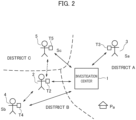
- Fig. 2 is a schematic explanatory diagram of the search system according to the first example of the present invention.
- the first example of the present invention will be described with reference to Figs. 1 and 2 .
- Pa indicates home, nursing home, or a base of a moving person or animal such as a wanderer, a lost child, a lost dog, and a fugitive who is a search target 2.
- a wanderer has started moving from this base and a place to which the wanderer has moved is unknown and thus searching is required.
- Pb indicates a current position of the wanderer at the time when a related person recognizes the wandering.
- Pc indicates a point to which the wanderer has moved with lapse of time thereafter.
- search bases Sa, Sb, and Sc are provided in districts A, B, and C to investigate and search for a search target, respectively.
- these search bases correspond to police stations and police boxes in the administrative districts, and are also bases for local volunteers such as community monitoring services, or safety net bases such as dementia support centers provided by the private sector or local governments.
- a searcher 3 is placed in Sa
- a searcher 4 is placed in Sb
- a searcher 5 is placed in Sc.
- the search target 2 is equipped with a global positioning system (GPS) terminal T2 or holds a mobile phone equivalent to a GPS or a personal handy-phone system (PHS) communication terminal 21.
- GPS global positioning system
- PHS personal handy-phone system
- These GPS terminals may be incorporated into shoes, clothes, a cane, a belt, or the like that the search target 2 always wears or be worn as a wearable terminal on a part of the body of the search target 2.
- the GPS terminal T2 constantly transmits GPS position information signals when the search target 2 goes out.
- the searcher 3 in the district A has a portable terminal T3
- the searcher 4 in the district B has a portable terminal T4
- the searcher 5 in the district C has a portable terminal T5, each of which is configured to be capable of establishing a network with an investigation center 1 once an investigation is started.
- the wanderer 2 who is the search target, has started wandering from the base Pa of the wanderer, and when the family, related persons, and the like have noticed the wandering, the wanderer 2 has moved to the point Pb (position at the time of reporting) in the district B.
- the family and related persons recognize the wandering, they contact the police or the investigation center 1 and provide information of the wanderer, and a search operation is started.
- the investigation center 1 sets a search range around Pb, which is the position at the time of reporting of the wanderer 2, and identifies a search base within the predetermined search range.
- the predetermined range here is set in consideration of approximate walking speed from the start base Pa to the position Pb at the time of reporting, average walking speed of the wanderer, and topographical characteristics, but it is unnecessary to set an unreasonably wide range to operate many search bases. If no search base exists within the predetermined range, the predetermined range is expanded to search for a search base.
- the investigation center 1 calculates search distances and search routes between the wanderer 2, who is the search target, and the search bases (fixed points), and compares the search routes with each other to identify a search base that is supposed to be the shortest search route.
- the search base Sb and the searcher 4 are on the shortest route when the wanderer 2 is moving on Pb, together with detailed specific personal information (name, gender, age, body shape, characteristics, photos, disappearance time, clothes at the time of disappearance, etc.) of the wanderer 2, notification of a search route signal is provided to the portable terminal T4 of the searcher 4 at the search base Sb from the investigation center 1 by a line node search by a vector map method, and a search command is issued.
- Notification of the personal information of the wanderer 2 and search route are provided to all the search bases Sa, Sb, and Sc within the predetermined range so that the wanderer 2 can be searched for.
- the search command is issued to and the search route is displayed for the searcher who is at the search base on a route that is considered to be the shortest so as to start a search activity.
- a search command may be issued to a plurality of searchers, and the plurality of searchers may perform searching. Assuming that the search target 2 is currently moving on the point Pb and the base Sb is on the shortest route from Pb, the searcher 4 at the closest base Sb starts searching.
- the searchers 3, 4, and 5 at the search bases Sa, Sb, and Sc have portable terminals T3, T4, and T5 with a GPS function, respectively.
- the portable terminals T3, T4, and T5 continue to transmit position information of the searchers.
- the portable terminals T3, T4, and T5 constitute a portable terminal device.
- the search command from the investigation center 1 and movement information of the wanderer 2, and a change of the search route are displayed in real time.
- the first searcher 4 of the base Sb determined to be on the shortest route at the time of reporting starts searching, and searches for the wanderer 2 according to the search route displayed on the portable terminal T4.
- the moving position of the wanderer 2 is always grasped by the GPS terminal T2 held by the wanderer, and the search distance and search route between the moving position of the wanderer 2 and each of the plurality of searchers are always updated by the investigation center 1.
- the search distance and search route from the investigation center 1 are displayed on the portable terminals T3, T4, and T5 of the respective searchers.
- the wanderer 2 continues to move from the position Pb at the time of reporting, and when the distance between the position of the wanderer 2 and each searcher is shorter than the distance between the position of the wanderer 2 and the first searcher 4 due to movement, that is, for example, when the wanderer 2 moves from the position Pb at the time of reporting to Pc, the investigation center 1 determines whether a relative distance between the searcher 5 at the search base Sc and the wanderer 2 is shorter than the relative distance between the searcher 4 and the wanderer 2. If the relative distance between the searcher 5 at the search base Sc and the wanderer 2 is shorter than the relative distance between the searcher 4 and the wanderer 2, the investigation center 1 issues a command to the portable terminal T5 of the searcher 5, and the searcher 5 also starts a search investigation.
- a network is formed between the portable terminals T3, T4, and T5 held by the searchers 3, 4, and 5 at the search bases Sa, Sb, and Sc, and the GPS terminal T2 of the search target 2 based on instructions of the investigation center 1.
- the searcher 4 at the search base Sb on the shortest route from the search target 2 establishes a search network between the GPS terminal T2 of the search target 2 and the portable terminal T4 of the searcher 4, and when the search target 2 moves to Pc, the searcher 5 at the search base Sc on the shortest route from the search target 2 establishes a search network between the GPS terminal T2 of the search target 2 and the portable terminal T5 of the searcher 5.
- whether the searcher 4 continues or stops searching is determined depending on the situation.
- the search route is displayed as a map on the portable terminal of the searcher.
- This search route displays map search software on the portable terminal of the searcher using vector data as follows. The display of the search route will be described with reference to Fig. 3 .
- Fig. 3 it is assumed that the search target 2 is moving on Pb and searching is started from the search base Sb of the searcher 4 in the district B.
- information of publicly available GIS geographic information system is used as a vector map method.
- This GIS information includes map information such as roads, administrative divisions, houses, blocks, meshes, and points.
- a tile map method (raster map) is the main method, but in the tile map method, an area is subdivided and displayed as mesh tiles. Accordingly, each time the display area moves, the mesh tiles of the required area need to be downloaded, and thus it takes time when searching needs to be done in a short time.
- objects such as roads and buildings, positions, and shapes on the map are displayed as coordinates such as points, lines (lines, arcs), and polygons. Therefore, as long as data of these coordinates and connection relation are retained, the map can be displayed without interruption.
- Fig. 1 is a layer of a road through which a car can pass that also displays attached information such as one-way traffic, vehicle prohibition, and road width.
- Fig. 3 is an example of a more detailed map of the map illustrated in Fig. 1 , and is a layer displaying a road through which a pedestrian or a bicycle can pass.
- This layer can be divided into many layers, but several layers are sufficient depending on the search purpose and regional characteristics. As the search area is narrowed down, and the searcher approaches the search target, a more detailed display is performed.
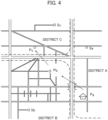
- Fig. 4 is an example of a map illustrating the map illustrated in Fig. 3 in more detail, and illustrates an example of the most detailed map display.
- the searcher displays each layer such as Figs. 1 , 3 , and 4 according to the search purpose and search conditions to perform searching. As the searcher approaches the search target, the searcher displays the layer in more detail and confirms the layer. Within the same layer, the road is followed and displayed continuously as far as possible without being separated.
- Fig. 5 is an explanatory diagram for calculating a search route of the search system according to the present invention, and the search route is calculated with reference to the layer of the map in Fig. 3 .
- latitude and longitude information of Pb which is the current position of the search target 2
- the portable terminal T4 of the searcher 4 By the GPS held by the search target 2, latitude and longitude information of Pb, which is the current position of the search target 2, is displayed on the portable terminal T4 of the searcher 4.
- line information (road), point information (intersection), and other attached information such as buildings acquired from the GIS geographic information system, the point information (intersection) is used as a node and each road is used as a line, and a number is assigned to each line closest to the current position Pb of the search target 2.
- line numbers are given as follows: a road (line) closest to the location Pb of the search target 2 is designated as L1, and a road (line) that intersects the next intersection (node 1) N1 is designated as L2. Similarly, a road (line) that intersects the next intersection (node 2) N2 after L2 is designated as L3.
- L1 a road (line) closest to the location Pb of the search target 2
- L2 a road (line) that intersects the next intersection
- L3 a road (line) that intersects the next intersection (node 2) N2 after L2 is designated as L3.
- line numbers and node numbers are assigned between the current position Pb of the search target 2 and the current position Sb of the searcher 4.
- Line numbers and node numbers are displayed on the portable terminal T4 of the searcher 4, and the search route is displayed.
- the searcher 4 who receives the search command starts searching from the point Sb. If the searcher 4 starts searching in a direction in which the line numbers and the node numbers decrease, the searcher 4 approaches the search target 2. That is, the searcher 4 selects a direction in which the line numbers and the node numbers decrease at an intersection. If the line numbers are the same at an intersection, the one with the lower node number is selected.
- a navigation function can be provided by giving an instruction on in which direction the line numbers and the node numbers decrease when an intersection (node) is reached by a change in voice or color or an arrow. Needless to say, it is also possible to display a recommended search line on the map display of the portable terminal. Further, in a portable terminal used in the search system, information indicating the positional relationship on the vector map display is updated and displayed every time the line numbers or node numbers of the searcher and the search target change on the display screen of the terminal device so that searching can be performed while confirming the mutual positional relationship.
- a plurality of the same line numbers and the same node numbers may be generated, and a plurality of routes may be generated.
- the searcher can get closer to the search target, but priority can be given by selecting the shortest distance, shortest time, road width, and the like as conditions.
- the shortest search route can be normally calculated by a Dijkstra method.
- Coding of the line numbers and the node numbers as illustrated in Fig. 5 is considered to extend endlessly between the search target and the searcher, but it is sufficient to display only within the predetermined search range that has been initially set around the current position Pb of the search target 2 as a display range. However, if the moving speed of the search target 2 is faster than the searchers 3, 4, and 5 and exceeds the initial search range, the search range needs to be reset and the search base and the searcher need to be selected.
- the search route is selected by the line numbers and the node numbers by the vector map method.
- a central processing unit (CPU) of the investigation center 1 performs processing control, calculation result information and instructions of the search route are sent to the terminal of each searcher, and a map is displayed on the portable terminal.
- the CPU of the investigation center 1 corresponds to the search route processor of the present invention.
- the investigation center 1 transmits information to each of the searchers 3, 4, and 5, specifies the searcher, and gives a search instruction.
- the investigation center 1 and the searcher 3, 4, or 5 can receive and confirm the position of the search target in real time, and can confirm the moving position of the search target 2 even if the searcher and the search target are both moving.
- the search route is updated in real time, and the searcher can continue to search for the search target.
- the portable terminal it is necessary for the portable terminal to have dedicated application software for search, and in the terminal application software, which line number or node number is decreased at each intersection of the search route is displayed by voice, an arrow, color change, or the like. Acquisition of GIS geographic information and calculation processing are performed by the CPU. In the portable terminal, it is only necessary to acquire the GPS information (latitude, longitude) of the search target and display the information on the map. Therefore, basically the terminal only needs to perform voice and drawing processing, and extract a search range that has been initially set for each layer as a display area, and thus the processing in the terminal can be configured to be quick and simple.
- a search navigation according to the present invention assigns numbers of all the search-related roads within the search range by the line (road) numbers and the nodes (intersection) by the vector map method, compared to a method of acquiring map road information necessary for each divided information and calculating the search route while recalculating the search route within the divided map information, quicker display is made possible, and the searcher can continue to follow the search target who is moving in real time.
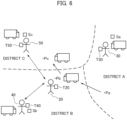
- Fig. 6 is an explanatory diagram of a search system illustrating an example in which the present invention is applied to efficiency improvement of physical distribution delivery.
- a delivery method in a physical distribution delivery system an area of a delivery company is divided into districts A, B, and C, for the respective regional bases, and an efficient delivery route is determined according to the delivery destination of the day within the divided section.
- many conditions such as delivery address, road information such as one-way traffic and no entry, delivery time limit, delivery vehicle stop position and time limit, working hours and break time limit of the delivery person are taken into consideration to determine an optimal route, but the delivery time always fluctuates due to circumstances such as an increase or decrease in the number of deliveries and redelivery during absence. Therefore, in some districts, delivery may not be completed within a predetermined working time, causing problems such as delay in delivery.
- a delivery vehicle is temporarily stopped at a designated location within the delivery route, from which the delivery person uses a cart or bicycle to make a delivery to nearby delivery destinations.
- a delivery person 20 who departs from a point Pa in the district A determines that the delivery person may not be able to delivery all the packages he or she has at a temporary stop point Pb on a delivery route within a specified delivery time, and requests delivery assistance from a delivery person in a nearby district.
- the delivery person 20 corresponds to the searcher
- the delivery assistant corresponds to the search target.
- the delivery person (searcher) 20 in the district A, another delivery person 30 in the same district, a delivery person 40 in the district B, and a delivery person 50 in the district C have portable terminals T20, T30, T40, and T50 having a GPS function, respectively, so that delivery positions can be always confirmed.
- the delivery person 20 searches for a delivery person at a delivery base or another district existing within a predetermined range around the current position Pb. While expanding or reducing the search range, whether delivery assistance can be provided is checked by mobile phone or e-mail communication in order from the delivery person at the shortest distance.
- the delivery person 20 can request delivery assistance from a delivery center 10 or the like while continuing his or her delivery operation, and the delivery center 10 can select a delivery assistant who can provide delivery assistance.
- the person desiring delivery assistance 20 starts delivery from the point Pa in the district A, needs delivery assistance at the point Pb, and sends a delivery assistance request by the portable terminal T20.
- the delivery person 30 in the district A, the delivery person 40 in the district B, and the delivery person 50 in the district C are selected as candidates for the delivery assistant that can provide delivery assistance within the predetermined range.
- These delivery persons also continue their delivery operations, and an optimal delivery assistant is selected by calculating an arrival route, distance, and time to the point Pb, taking into consideration the delivery status of the remaining packages in their delivery operations, possibility of providing assistance, and the like.
- the delivery person 40 in the district B is selected as the most optimal delivery assistant.
- the delivery assistant 40 in the district B continues his or her delivery operation and is moving, but has reached the point Sb point at the time of receiving the delivery assistance request, and performs a route search between the point Sb and the position Pb of the assistance requester 20 by the portable terminal T40 of the delivery assistant 40.
- This search method is a method of assigning line numbers and node numbers based on the vector map described above.
- the delivery assistant 40 follows the indicated route to the location of the assistance requester 20.
- the CPU in the investigation center 1 calculates and processes the GIS geographic information and the GPS position information, and the investigation center 1 contacts each searcher, but in the second example, the GIS geographic information and calculation information processing are uploaded on the cloud, necessary area information is downloaded to the portable terminal of each searcher as appropriate, and GPS information (latitude, longitude) of the search target is called to the portable terminal of each searcher to display the search route on the portable terminal.
- a network is established between the portable terminal T20 of the assistance requester 20 and the portable terminal T40 of the delivery assistant 40, and the GPS position information of the assistance requester 20 is acquired by the portable terminal of the delivery assistant 40 and the search route is calculated and displayed by the portable terminal T40 of the assistant 40.
- the search route is constantly updated in real time while the delivery assistant 40 heads for the point of the assistance requester 20.
- the assistance requester moves from the point Pb to the point Pc due to his or her delivery operation, and the portable terminal T50 determines that the distance between the delivery assistant 50, who is a backup candidate, and the moving point Sc of the assistance requester 20 is shorter than the distance or time between the assistance requester 20 and the delivery assistant 40, the delivery assistant 50 holding the portable terminal T50 goes for assistance.
- the search route from the position of the requester 20 at this time is displayed in line numbers and node numbers. Whether the delivery assistant 40 stops the assistance and leaves it to the assistant 50 or jointly provides delivery assistance with the assistant 50 is determined by the assistance requester 20.
- the present invention is not limited to these examples, and by combining a plurality of components of the present invention as appropriate, the present invention can be widely applied to cases where the searcher and the search target are both moving such as a lost dog or animal search, criminal investigation, delivery of relief supplies between moving vehicles in the event of a disaster, and searching for or contacting a taxi for ride sharing, and has great industrial usefulness and applicability.
Landscapes
- Engineering & Computer Science (AREA)
- Radar, Positioning & Navigation (AREA)
- Remote Sensing (AREA)
- Physics & Mathematics (AREA)
- General Physics & Mathematics (AREA)
- Automation & Control Theory (AREA)
- Theoretical Computer Science (AREA)
- Business, Economics & Management (AREA)
- Health & Medical Sciences (AREA)
- Mathematical Physics (AREA)
- Child & Adolescent Psychology (AREA)
- Educational Administration (AREA)
- Educational Technology (AREA)
- General Health & Medical Sciences (AREA)
- Computer Networks & Wireless Communication (AREA)
- Signal Processing (AREA)
- Computer Hardware Design (AREA)
- Life Sciences & Earth Sciences (AREA)
- Ecology (AREA)
- General Engineering & Computer Science (AREA)
- Emergency Management (AREA)
- Navigation (AREA)
- Traffic Control Systems (AREA)
- Instructional Devices (AREA)
Description
- The present invention relates to a search system for effectively and reliably securing a person to be searched (search target).
- Detecting a wanderer accompanying with dementia, a lost child, and a kidnapped child is difficult unless such a wanderer or child is found as soon as possible after an event such as wandering is detected, and his or her life may be threatened. For this reason, many related parties such as the police, local groups, and guardians spend a lot of time for searching. As the population ages, the number of wanderers may increase, and there is a need for technology that can efficiently search for the wanderers and reliably protect them.
- Conventionally, various methods have been proposed for efficiently searching for a person to be searched such as a wanderer and a lost child, and an animal to be searched such as a lost dog (hereinafter referred to as a search target). For example, there is a method of attaching a sensor or an oscillator to a search target to detect his or her behavior. In this method, a warning signal is generated when the search target leaves his or her home or location or when he or she moves beyond a certain distance, and his or her leaving or moving can be detected and searching can be performed.
- In addition,
Patent Literature 1 discloses a method of having a target possess a global positioning system (GPS) and activating the GPS from a public line when the target is missing so as to grasp the position of the target. However, in this method, since both the search target and the searcher are moving, it takes time to protect the search target, and the search target may not be protected. - For this reason,
Patent Literature 2 discloses a method in which both of the search target and the searcher possess GPSs and the positional relationship between them is always corrected so as to improve the search accuracy. - Further, in
Patent Literature 3, provided is a wanderer search system including a search command engine that accepts a search request from a search requester and issues a search command based on contents of the received search request, a position search engine that searches for a position of a wanderer that is a search target based on the search command issued from the search command engine and acquires target position information indicating an area where the wanderer exists, a search execution engine that searches for the wanderer based on information indicating a relative positional relationship between a target position based on the target position information indicating the area where the wanderer exists acquired by the position search engine and a searcher's own tracking position based on position information of the searcher measured by a GPS. -
Patent Literature 4 discloses a method and system for supporting search of a search target person within a certain area such as an airport. - However, in such a search navigation system, in many cases, calculation processing by a tile map method (section processing method) is performed for a map display, and position information such as latitude and longitude by a GPS is displayed using geographic information system (GIS) map information for each divided section within a predetermined range. Therefore, every time a wanderer or a fugitive moves out of a section, information of the section needs to be downloaded, and a search route or the like needs to be newly calculated and displayed.
-
- Patent Literature 1:
JP H6-188819 A - Patent Literature 2:
JP 1997-243727 A - Patent Literature 3:
JP 2000-304564 A - Patent Literature 4:
JP 2008-225855 A - As described above, in a method in which a search target such as a wanderer, a lost child, a lost dog is caused to hold a position information search device such as a GPS or a mobile phone with a GPS so that a position of the search target can be grasped when he or she is wandering or lost, and a searcher searches toward a position transmitted from the GPS of the search target, if the search target moves and goes out of the original search section, map information needs to be acquired for each section and a search route needs to be re-calculated. Therefore, a position search calculation needs to be performed again, and it takes time and effort to find the search target. In addition, in a search method in which both of the search target and the searcher are caused to have position information search devices and searching is performed while grasping a positional relationship between the search target and the searcher, if the search target often moves or the searcher is unfamiliar with the area, the searcher needs to go after the search target and thus it takes time to secure the search target.
- Moreover, when the search target and the searcher both are moving, when there is a plurality of search targets, and when the search target is sick or a criminal and needs to be urgently secured, it is desired to shorten the search time and perform searching speedily and efficiently.
- An object of the present invention is to realize a search system for speedily and efficiently finding and securing a search target.
- In order to solve such a problem and achieve the above object, a search system of the present invention according to
claim 1 includes: a position information terminal that is held by a search target and transmits position information of the search target; a processing unit that performs calculation processing, a search route processor that calculates, using the processing unit, a plurality of search routes between locations of a plurality of searchers belonging to a predetermined area and the search target based on the position information of the search target acquired from the position information terminal; and a plurality of portable terminals that is held by the plurality of searchers, transmits position information of the searchers, and displays the plurality of search routes calculated by the search route processor and personal information for identifying the search target, wherein both the plurality of searchers and the search target are movable, wherein the search route processor compares the plurality of search routes with each other to identify a shortest first search route, issues a search command to a first searcher on the first search route to cause the first searcher to start searching along the first search route displayed on corresponding one of the portable terminals, updates the position information of the search target and the search routes as the search target moves, when a second search route is shorter than the first search route, issues a search command to a second searcher on the second search route to cause the second searcher to start the searching along the second search route displayed on corresponding one of the portable terminals, and the plurality of portable terminals displays the search routes by a vector map display in which each intersection is identified as node and a road is identified as a line based on the position information of the search target. - Further, in the search system of the present invention, the search route processor assigns a line number and a node number from a position of the search target to the searchers such that the line number and the node number increase every time the node is passed.
- Further, in the search system of the present invention , the plurality of portable terminals updates and displays information indicating a positional relationship on the vector map display every time the line number or node number of the searchers and the search target changes on a display screen.
- A portable terminal device, also disclosed but not independently claimed,includes: a plurality of portable terminals that, based on position information of a search target acquired from a position information terminal held by the search target, calculates a plurality of search routes by a vector map display in which each intersection is identified as a node and each road is identified as a line between locations of a plurality of searchers belonging to a predetermined area and the search target, displays the calculated plurality of search routes, is held by the plurality of searchers, and transmits the position information of the searchers, in which each of the plurality of portable terminals compares the plurality of search routes to identify a shortest first search route, causes a first searcher on the first search route to start searching along the first search route displayed for the first searcher, updates the position information of the search target and the search routes as the search target moves, when a second search route is shorter than the first search route, and causes a second searcher on the second search route to start the searching along the second search route displayed for the second searcher.
- Further, in the portable terminal device, the portable terminal displays personal information that identifies the search target on a display screen.
- With such a configuration, the present invention is used to calculate search routes between a search target such as a wanderer, a lost child, or a lost dog and a plurality of search institutions (searchers), a plurality of searchers is used to effectively search for the search target, and searching can be performed between those who are both moving. The means for solving the above problems can be used in combination as much as possible.
- When searching for a search target such as a wanderer, a lost child, or a lost dog by the search system configuration according to the present invention, a searcher closest to the search target is always engaged in the search even when the searcher and the search target are both moving, and thus it is possible to secure the search target effectively, reliably, and speedily.
- Further, using the present invention for improving the efficiency of physical distribution delivery enables speedier delivery and efficient physical distribution delivery. That is, when a delivery person who makes a delivery in each area corresponding to each of divisions of an area asks another delivery person (helper) in each area for delivery assistance, the helper needs to search for the delivery person who is moving and deliver packages while continuing his or her delivery operation. As described above, the present invention enables an efficient and speedy search between those who are both moving.
- The above-described case where the search target and the searcher are both moving can be applied to a case where the police and the like (searcher) searches for a fleeing criminal (search target) in a criminal investigation, a case where regional center staff (searcher) delivers necessary supplies to a moving vehicle (search target), a case where a ride-sharing vehicle system or a taxi driver (searcher) searches for a moving customer (search target), and a case where local drone delivery machine (searcher) delivers relief supplies and fuel to a moving rescue vehicle (search target) in the event of a disaster, as a result of which it is possible to achieve the purpose efficiently, reliably, and speedily.
-
-
Fig. 1 is an example of a map for explaining a search system according to a first example of the present invention. -
Fig. 2 is a schematic explanatory diagram of the search system according to the first example of the present invention. -
Fig. 3 is an example of a more detailed map of the map illustrated inFig. 1 . -
Fig. 4 is an example of a more detailed map of the map illustrated inFig. 3 . -
Fig. 5 is an explanatory diagram for calculating a search route of a search system according to the present invention. -
Fig. 6 is an explanatory diagram of a search system for improving efficiency of physical distribution delivery according to a second example of the present invention. - The present invention provides a search system that allows a parent or relative, a local supporter, a search related person, the police, or nursing home (hereinafter referred to as searcher) that searches for and investigates a moving person or a moving object such as a wanderer, a lost child, a lost dog, a taxi, a fugitive, or an escaped animal that is moving (hereinafter referred to as a search target) to efficiently perform searching. In addition, by applying the present invention to searching or meeting up in a case where the search target and the searcher are both moving, it is possible to construct a search system capable of speedy discovery and reliable capture.
- Hereinafter, examples of the present invention will be described with reference to the drawings. Each of the drawings described in the following examples is drawn as a schematic view for the purpose of explaining the present invention, and the actual dimensions, shapes, and configurations are not particularly limited. Further, the dimensions, materials, shapes, relative arrangements, etc. of the components are not intended to limit the technical scope of the invention to those alone unless otherwise specified.
-
Fig. 1 is an explanatory map of a wanderer search system according to a first example of the present invention.Fig. 2 is a schematic explanatory diagram of the search system according to the first example of the present invention. Hereinafter, the first example of the present invention will be described with reference toFigs. 1 and2 . - In
Figs. 1 and2 , Pa indicates home, nursing home, or a base of a moving person or animal such as a wanderer, a lost child, a lost dog, and a fugitive who is asearch target 2. A situation is considered where a wanderer has started moving from this base and a place to which the wanderer has moved is unknown and thus searching is required. Pb indicates a current position of the wanderer at the time when a related person recognizes the wandering. In addition, Pc indicates a point to which the wanderer has moved with lapse of time thereafter. - On the map, the governmental jurisdiction is divided by administrative districts, and search bases Sa, Sb, and Sc are provided in districts A, B, and C to investigate and search for a search target, respectively. In a case of searching for a wanderer, these search bases correspond to police stations and police boxes in the administrative districts, and are also bases for local volunteers such as community monitoring services, or safety net bases such as dementia support centers provided by the private sector or local governments. At these regional bases, a
searcher 3 is placed in Sa, asearcher 4 is placed in Sb, and asearcher 5 is placed in Sc. - The
searchers - It is assumed that the
search target 2 is equipped with a global positioning system (GPS) terminal T2 or holds a mobile phone equivalent to a GPS or a personal handy-phone system (PHS) communication terminal 21. These GPS terminals may be incorporated into shoes, clothes, a cane, a belt, or the like that thesearch target 2 always wears or be worn as a wearable terminal on a part of the body of thesearch target 2. The GPS terminal T2 constantly transmits GPS position information signals when thesearch target 2 goes out. - In addition, as illustrated in in
Fig. 2 , thesearcher 3 in the district A has a portable terminal T3, thesearcher 4 in the district B has a portable terminal T4, and thesearcher 5 in the district C has a portable terminal T5, each of which is configured to be capable of establishing a network with aninvestigation center 1 once an investigation is started. - It is assumed that the
wanderer 2, who is the search target, has started wandering from the base Pa of the wanderer, and when the family, related persons, and the like have noticed the wandering, thewanderer 2 has moved to the point Pb (position at the time of reporting) in the district B. When the family and related persons recognize the wandering, they contact the police or theinvestigation center 1 and provide information of the wanderer, and a search operation is started. - In the
investigation center 1, the current position of thewanderer 2, who is the search target, is grasped by a position information acquisition means of the GPS terminal T2 of thewanderer 2. Next, theinvestigation center 1 sets a search range around Pb, which is the position at the time of reporting of thewanderer 2, and identifies a search base within the predetermined search range. In the case of thewanderer 2, the predetermined range here is set in consideration of approximate walking speed from the start base Pa to the position Pb at the time of reporting, average walking speed of the wanderer, and topographical characteristics, but it is unnecessary to set an unreasonably wide range to operate many search bases. If no search base exists within the predetermined range, the predetermined range is expanded to search for a search base. - In this example, it is assumed that the district A (the
searcher 3 at the point Sa), the district B (thesearcher 4 at the point Sb), and the district C (thesearcher 5 at the point Sc) are selected within the predetermined search range around Pb. When a plurality search bases exists within the search range, theinvestigation center 1 calculates search distances and search routes between thewanderer 2, who is the search target, and the search bases (fixed points), and compares the search routes with each other to identify a search base that is supposed to be the shortest search route. If it is specified that the search base Sb and thesearcher 4 are on the shortest route when thewanderer 2 is moving on Pb, together with detailed specific personal information (name, gender, age, body shape, characteristics, photos, disappearance time, clothes at the time of disappearance, etc.) of thewanderer 2, notification of a search route signal is provided to the portable terminal T4 of thesearcher 4 at the search base Sb from theinvestigation center 1 by a line node search by a vector map method, and a search command is issued. - Notification of the personal information of the
wanderer 2 and search route are provided to all the search bases Sa, Sb, and Sc within the predetermined range so that thewanderer 2 can be searched for. However, in principle, the search command is issued to and the search route is displayed for the searcher who is at the search base on a route that is considered to be the shortest so as to start a search activity. Needless to say, a search command may be issued to a plurality of searchers, and the plurality of searchers may perform searching. Assuming that thesearch target 2 is currently moving on the point Pb and the base Sb is on the shortest route from Pb, thesearcher 4 at the closest base Sb starts searching. - The
searchers investigation center 1 and movement information of thewanderer 2, and a change of the search route are displayed in real time. Thefirst searcher 4 of the base Sb determined to be on the shortest route at the time of reporting starts searching, and searches for thewanderer 2 according to the search route displayed on the portable terminal T4. - The moving position of the
wanderer 2 is always grasped by the GPS terminal T2 held by the wanderer, and the search distance and search route between the moving position of thewanderer 2 and each of the plurality of searchers are always updated by theinvestigation center 1. The search distance and search route from theinvestigation center 1 are displayed on the portable terminals T3, T4, and T5 of the respective searchers. Thewanderer 2 continues to move from the position Pb at the time of reporting, and when the distance between the position of thewanderer 2 and each searcher is shorter than the distance between the position of thewanderer 2 and thefirst searcher 4 due to movement, that is, for example, when thewanderer 2 moves from the position Pb at the time of reporting to Pc, theinvestigation center 1 determines whether a relative distance between thesearcher 5 at the search base Sc and thewanderer 2 is shorter than the relative distance between thesearcher 4 and thewanderer 2. If the relative distance between thesearcher 5 at the search base Sc and thewanderer 2 is shorter than the relative distance between thesearcher 4 and thewanderer 2, theinvestigation center 1 issues a command to the portable terminal T5 of thesearcher 5, and thesearcher 5 also starts a search investigation. - As described above, a network is formed between the portable terminals T3, T4, and T5 held by the
searchers search target 2 based on instructions of theinvestigation center 1. When thesearch target 2 is moving on Pb, thesearcher 4 at the search base Sb on the shortest route from thesearch target 2 establishes a search network between the GPS terminal T2 of thesearch target 2 and the portable terminal T4 of thesearcher 4, and when thesearch target 2 moves to Pc, thesearcher 5 at the search base Sc on the shortest route from thesearch target 2 establishes a search network between the GPS terminal T2 of thesearch target 2 and the portable terminal T5 of thesearcher 5. In this case, whether thesearcher 4 continues or stops searching is determined depending on the situation. - When the search network is established between the
wanderer 2, who is the search target, and thesearchers 4 and/or 5, the search route is displayed as a map on the portable terminal of the searcher. This search route displays map search software on the portable terminal of the searcher using vector data as follows. The display of the search route will be described with reference toFig. 3 . - In
Fig. 3 , it is assumed that thesearch target 2 is moving on Pb and searching is started from the search base Sb of thesearcher 4 in the district B. In the present invention, information of publicly available GIS geographic information system is used as a vector map method. This GIS information includes map information such as roads, administrative divisions, houses, blocks, meshes, and points. - As a map display method, a tile map method (raster map) is the main method, but in the tile map method, an area is subdivided and displayed as mesh tiles. Accordingly, each time the display area moves, the mesh tiles of the required area need to be downloaded, and thus it takes time when searching needs to be done in a short time. On the other hand, in the vector map method, objects such as roads and buildings, positions, and shapes on the map are displayed as coordinates such as points, lines (lines, arcs), and polygons. Therefore, as long as data of these coordinates and connection relation are retained, the map can be displayed without interruption.
- In the data of the vector map method, roads, buildings, district information, and the like are managed as layers on the map display. In the present invention, an appropriate layer is selected from these layers according to search conditions. For example, in a case of searching by car, road markings are displayed around main roads as illustrated in
Fig. 1. Fig. 1 is a layer of a road through which a car can pass that also displays attached information such as one-way traffic, vehicle prohibition, and road width. In addition,Fig. 3 is an example of a more detailed map of the map illustrated inFig. 1 , and is a layer displaying a road through which a pedestrian or a bicycle can pass. - This layer can be divided into many layers, but several layers are sufficient depending on the search purpose and regional characteristics. As the search area is narrowed down, and the searcher approaches the search target, a more detailed display is performed.
Fig. 4 is an example of a map illustrating the map illustrated inFig. 3 in more detail, and illustrates an example of the most detailed map display. The searcher displays each layer such asFigs. 1 ,3 , and4 according to the search purpose and search conditions to perform searching. As the searcher approaches the search target, the searcher displays the layer in more detail and confirms the layer. Within the same layer, the road is followed and displayed continuously as far as possible without being separated. -
Fig. 5 is an explanatory diagram for calculating a search route of the search system according to the present invention, and the search route is calculated with reference to the layer of the map inFig. 3 . By the GPS held by thesearch target 2, latitude and longitude information of Pb, which is the current position of thesearch target 2, is displayed on the portable terminal T4 of thesearcher 4. Based on line information (road), point information (intersection), and other attached information such as buildings acquired from the GIS geographic information system, the point information (intersection) is used as a node and each road is used as a line, and a number is assigned to each line closest to the current position Pb of thesearch target 2. - In
Fig. 5 , line numbers are given as follows: a road (line) closest to the location Pb of thesearch target 2 is designated as L1, and a road (line) that intersects the next intersection (node 1) N1 is designated as L2. Similarly, a road (line) that intersects the next intersection (node 2) N2 after L2 is designated as L3. When intersecting a road that has already been given a line number (in this case, intersecting a road with a lower line number), the one with a higher line number of the roads to be intersected is selected and a line number plus one is given. That is, every time a line Ln of a road intersects a node, the line number becomesLn + 1. - In this way, line numbers and node numbers are assigned between the current position Pb of the
search target 2 and the current position Sb of thesearcher 4. Line numbers and node numbers are displayed on the portable terminal T4 of thesearcher 4, and the search route is displayed. - The
searcher 4 who receives the search command starts searching from the point Sb. If thesearcher 4 starts searching in a direction in which the line numbers and the node numbers decrease, thesearcher 4 approaches thesearch target 2. That is, thesearcher 4 selects a direction in which the line numbers and the node numbers decrease at an intersection. If the line numbers are the same at an intersection, the one with the lower node number is selected. - In the portable terminal, a navigation function can be provided by giving an instruction on in which direction the line numbers and the node numbers decrease when an intersection (node) is reached by a change in voice or color or an arrow. Needless to say, it is also possible to display a recommended search line on the map display of the portable terminal. Further, in a portable terminal used in the search system, information indicating the positional relationship on the vector map display is updated and displayed every time the line numbers or node numbers of the searcher and the search target change on the display screen of the terminal device so that searching can be performed while confirming the mutual positional relationship.
- According to this line search and node search method, a plurality of the same line numbers and the same node numbers may be generated, and a plurality of routes may be generated. In such a case, no matter which road (line) is selected, the searcher can get closer to the search target, but priority can be given by selecting the shortest distance, shortest time, road width, and the like as conditions.
- By giving conditions such as which of a distance or road width is given a priority based on information such as a distance and road width obtained as attached information of each road (line) from the GIS information, it is possible to give a priority and perform specification. In this case, the shortest search route can be normally calculated by a Dijkstra method.
- Coding of the line numbers and the node numbers as illustrated in
Fig. 5 is considered to extend endlessly between the search target and the searcher, but it is sufficient to display only within the predetermined search range that has been initially set around the current position Pb of thesearch target 2 as a display range. However, if the moving speed of thesearch target 2 is faster than thesearchers - For the calculation of the search route, the search route is selected by the line numbers and the node numbers by the vector map method. For the acquired GIS geographic information, its calculation processing, and processing of linking with GPS data, a central processing unit (CPU) of the
investigation center 1 performs processing control, calculation result information and instructions of the search route are sent to the terminal of each searcher, and a map is displayed on the portable terminal. The CPU of theinvestigation center 1 corresponds to the search route processor of the present invention. - In this way, the
investigation center 1 transmits information to each of thesearchers investigation center 1 and thesearcher search target 2 even if the searcher and the search target are both moving. As thesearch target 2 moves, the search route is updated in real time, and the searcher can continue to search for the search target. - In addition, it is necessary for the portable terminal to have dedicated application software for search, and in the terminal application software, which line number or node number is decreased at each intersection of the search route is displayed by voice, an arrow, color change, or the like. Acquisition of GIS geographic information and calculation processing are performed by the CPU. In the portable terminal, it is only necessary to acquire the GPS information (latitude, longitude) of the search target and display the information on the map. Therefore, basically the terminal only needs to perform voice and drawing processing, and extract a search range that has been initially set for each layer as a display area, and thus the processing in the terminal can be configured to be quick and simple.
- As described above, since a search navigation according to the present invention assigns numbers of all the search-related roads within the search range by the line (road) numbers and the nodes (intersection) by the vector map method, compared to a method of acquiring map road information necessary for each divided information and calculating the search route while recalculating the search route within the divided map information, quicker display is made possible, and the searcher can continue to follow the search target who is moving in real time.
-
Fig. 6 is an explanatory diagram of a search system illustrating an example in which the present invention is applied to efficiency improvement of physical distribution delivery. As a delivery method in a physical distribution delivery system, an area of a delivery company is divided into districts A, B, and C, for the respective regional bases, and an efficient delivery route is determined according to the delivery destination of the day within the divided section. When determining the delivery route, many conditions such as delivery address, road information such as one-way traffic and no entry, delivery time limit, delivery vehicle stop position and time limit, working hours and break time limit of the delivery person are taken into consideration to determine an optimal route, but the delivery time always fluctuates due to circumstances such as an increase or decrease in the number of deliveries and redelivery during absence. Therefore, in some districts, delivery may not be completed within a predetermined working time, causing problems such as delay in delivery. - Many delivery companies employ a system in which a delivery vehicle is temporarily stopped at a designated location within the delivery route, from which the delivery person uses a cart or bicycle to make a delivery to nearby delivery destinations. As an example, as illustrated in
Fig. 6 , a case is assumed where adelivery person 20 who departs from a point Pa in the district A determines that the delivery person may not be able to delivery all the packages he or she has at a temporary stop point Pb on a delivery route within a specified delivery time, and requests delivery assistance from a delivery person in a nearby district. In this case, thedelivery person 20 corresponds to the searcher, and the delivery assistant corresponds to the search target. - The delivery person (searcher) 20 in the district A, another
delivery person 30 in the same district, adelivery person 40 in the district B, and adelivery person 50 in the district C have portable terminals T20, T30, T40, and T50 having a GPS function, respectively, so that delivery positions can be always confirmed. Thedelivery person 20 searches for a delivery person at a delivery base or another district existing within a predetermined range around the current position Pb. While expanding or reducing the search range, whether delivery assistance can be provided is checked by mobile phone or e-mail communication in order from the delivery person at the shortest distance. As another method, thedelivery person 20 can request delivery assistance from a delivery center 10 or the like while continuing his or her delivery operation, and the delivery center 10 can select a delivery assistant who can provide delivery assistance. - In
Fig. 6 , the person desiringdelivery assistance 20 starts delivery from the point Pa in the district A, needs delivery assistance at the point Pb, and sends a delivery assistance request by the portable terminal T20. It is assumed that thedelivery person 30 in the district A, thedelivery person 40 in the district B, and thedelivery person 50 in the district C are selected as candidates for the delivery assistant that can provide delivery assistance within the predetermined range. These delivery persons also continue their delivery operations, and an optimal delivery assistant is selected by calculating an arrival route, distance, and time to the point Pb, taking into consideration the delivery status of the remaining packages in their delivery operations, possibility of providing assistance, and the like. In this example, it is assumed that thedelivery person 40 in the district B is selected as the most optimal delivery assistant. - The
delivery assistant 40 in the district B continues his or her delivery operation and is moving, but has reached the point Sb point at the time of receiving the delivery assistance request, and performs a route search between the point Sb and the position Pb of the assistance requester 20 by the portable terminal T40 of thedelivery assistant 40. This search method is a method of assigning line numbers and node numbers based on the vector map described above. When the search route between the point Sb and the point Pb is indicated, thedelivery assistant 40 follows the indicated route to the location of theassistance requester 20. - Here, in the first example, the CPU in the
investigation center 1 calculates and processes the GIS geographic information and the GPS position information, and theinvestigation center 1 contacts each searcher, but in the second example, the GIS geographic information and calculation information processing are uploaded on the cloud, necessary area information is downloaded to the portable terminal of each searcher as appropriate, and GPS information (latitude, longitude) of the search target is called to the portable terminal of each searcher to display the search route on the portable terminal. As a result, a network is established between the portable terminal T20 of the assistance requester 20 and the portable terminal T40 of thedelivery assistant 40, and the GPS position information of the assistance requester 20 is acquired by the portable terminal of thedelivery assistant 40 and the search route is calculated and displayed by the portable terminal T40 of theassistant 40. - The search route is constantly updated in real time while the
delivery assistant 40 heads for the point of theassistance requester 20. In the meantime, if the assistance requester moves from the point Pb to the point Pc due to his or her delivery operation, and the portable terminal T50 determines that the distance between thedelivery assistant 50, who is a backup candidate, and the moving point Sc of the assistance requester 20 is shorter than the distance or time between the assistance requester 20 and thedelivery assistant 40, thedelivery assistant 50 holding the portable terminal T50 goes for assistance. On the portable terminal T50 of thedelivery assistant 50, the search route from the position of the requester 20 at this time is displayed in line numbers and node numbers. Whether thedelivery assistant 40 stops the assistance and leaves it to the assistant 50 or jointly provides delivery assistance with theassistant 50 is determined by theassistance requester 20. - In this way, by performing the route search by the method of assigning line numbers and node numbers with the vector map according to the present invention, even while the delivery assistants and the delivery assistance requester placed in the respective areas continue their delivery operations and each continue to move, the search route is continuously updated and displayed. Therefore, there is no need to calculate detailed map information and search route for each section and display them again, and thus this method can be effectively used for searching a route between objects that are both moving. In addition, since delivery assistant candidates and delivery bases are placed in the respective areas, and a network is formed with the delivery assistance requester, even when the delivery assistance requester and assistant candidates are all moving, it is possible for the closest delivery assistant to rush to the delivery assistance requester according to the situation, and thus it is possible to efficiently collect and deliver packages.
- As described above, an example in which the present invention is applied to searching and investigation between searchers assigned by area and a search target such as a wanderer or a lost child, and an example in which the present invention is applied to a case where delivery and collection operations are helped among the respective areas such that the delivery and collection operation can be efficiently performed have been explained. However, the present invention is not limited to these examples, and by combining a plurality of components of the present invention as appropriate, the present invention can be widely applied to cases where the searcher and the search target are both moving such as a lost dog or animal search, criminal investigation, delivery of relief supplies between moving vehicles in the event of a disaster, and searching for or contacting a taxi for ride sharing, and has great industrial usefulness and applicability.
-
- 1
- INVESTIGATION CENTER
- 2
- SEARCH TARGET
- 3
- SEARCHER AT POINT Sa IN DISTRICT A
- 4
- SEARCHER AT POINT Sb IN DISTRICT B
- 5
- SEARCHER AT POINT Sc IN DISTRICT C
- 20
- PERSON DESIRING DELIVERY ASSISTANCE
- 30
- DELIVERY PERSON AT POINT Sa IN DISTRICT A
- 40
- DELIVERY PERSON AT POINT Sb IN DISTRICT B
- 50
- DELIVERY PERSON AT POINT Sc IN DISTRICT C
- Pa
- HOME OR BASE OF WANDERER
- Pb
- CURRENT POSITION OF WANDERER
- Pc
- POINT TO WHICH WANDERER HAS MOVED
Claims (1)
- A search system comprising:a position information terminal for being held by a search target (2) in use and configured to transmit position information of the search target (2);a processing unit configured to perform calculation processing;a search route processor configured to calculate, using the processing unit, a plurality of search routes between respective locations of a plurality of searchers (3, 4, 5) belonging to a predetermined area and the search target (2) based on the position information of the search target (2) acquired from the position information terminal; anda plurality of portable terminals (T3, T4, T5) for being held by the plurality of searchers (3, 4, 5) in use, each portable terminal configured to transmit position information of a respective searcher (3, 4, 5), and to display a respective search route calculated by the search route processor and personal information for identifying the search target, whereinboth the plurality of searchers (3, 4, 5) and the search target (2) are movable,the search route processor is configured to compare the plurality of search routes with each other to identify a shortest first search route, issue a search command to a first searcher on the first search route to cause the first searcher to start searching along the first search route displayed on corresponding one of the portable terminals (T3, T4, T5), update the position information of the search target (2) and the search routes as the search target (2) moves, when a second search route is shorter than the first search route, issue a search command to a second searcher on the second search route to cause the second searcher to start the searching along the second search route displayed on corresponding one of the portable terminals (T3, T4, T5),the system being characterized in that the plurality of portable terminals (T3, T4, T5) is configured to display the position information of the search target (2) and the search routes by a vector map display acquired from a geographic information system in which each intersection is identified as a node and a road is identified as a line based on the position information of the search target (2), wherein the search route processor is configured to assign a line number and a node number from a position of the search target (2) to the searchers (3, 4, 5) such that the line number and the node number increase every time the node is passed, andthe plurality of portable terminals (T3, T4, T5) is configured to update and display information indicating a positional relationship on the vector map display every time line numbers or node numbers of the searchers (3, 4, 5) and the search target (2) change on a display screen.
Applications Claiming Priority (2)
| Application Number | Priority Date | Filing Date | Title |
|---|---|---|---|
| JP2018100027 | 2018-05-09 | ||
| PCT/JP2019/018569 WO2019216377A1 (en) | 2018-05-09 | 2019-05-09 | Portable terminal device, and search system |
Publications (4)
| Publication Number | Publication Date |
|---|---|
| EP3792597A1 EP3792597A1 (en) | 2021-03-17 |
| EP3792597A4 EP3792597A4 (en) | 2022-03-02 |
| EP3792597B1 true EP3792597B1 (en) | 2024-11-20 |
| EP3792597C0 EP3792597C0 (en) | 2024-11-20 |
Family
ID=68466785
Family Applications (1)
| Application Number | Title | Priority Date | Filing Date |
|---|---|---|---|
| EP19800015.0A Active EP3792597B1 (en) | 2018-05-09 | 2019-05-09 | Search system comprising portable terminals |
Country Status (6)
| Country | Link |
|---|---|
| US (1) | US11564062B2 (en) |
| EP (1) | EP3792597B1 (en) |
| JP (1) | JP6758006B2 (en) |
| CN (1) | CN112088287B (en) |
| AU (1) | AU2019268006B2 (en) |
| WO (1) | WO2019216377A1 (en) |
Families Citing this family (2)
| Publication number | Priority date | Publication date | Assignee | Title |
|---|---|---|---|---|
| KR102753529B1 (en) * | 2022-04-14 | 2025-01-21 | 주식회사 베스텔라랩 | VECTOR-BASED DYNAMIC MAP FOR NAVIGATING and supporting autonomous car |
| CN115346333A (en) * | 2022-07-12 | 2022-11-15 | 北京声智科技有限公司 | Information prompting method and device, AR glasses, cloud server and storage medium |
Family Cites Families (20)
| Publication number | Priority date | Publication date | Assignee | Title |
|---|---|---|---|---|
| JPH06188819A (en) | 1992-12-21 | 1994-07-08 | Toyo Commun Equip Co Ltd | Position detecting system |
| JPH09243727A (en) | 1996-03-07 | 1997-09-19 | Niigata Pref Gov | Moving type position display device |
| JP3671734B2 (en) * | 1999-04-23 | 2005-07-13 | アイシン・エィ・ダブリュ株式会社 | Route search apparatus and route search method |
| JP2000304564A (en) | 1999-04-26 | 2000-11-02 | Harada Ind Co Ltd | Wanderer search system and mobile terminal for search |
| JP2002257582A (en) * | 2000-12-27 | 2002-09-11 | Aisin Aw Co Ltd | Portable navigation system and navigation program |
| JP4188690B2 (en) * | 2001-01-12 | 2008-11-26 | セコム株式会社 | Search support device and search support system |
| JP3730578B2 (en) * | 2001-12-04 | 2006-01-05 | エヌ・ティ・ティ・コムウェア株式会社 | Navigation system and navigation method thereof, navigation program, computer-readable recording medium recording the program, mobile communication terminal, control program in the mobile communication terminal, and computer-readable recording medium recording the program |
| US7076505B2 (en) * | 2002-07-11 | 2006-07-11 | Metrobot Llc | Method, apparatus, and computer program product for providing a graphical user interface with a linear map component |
| JP2005017052A (en) * | 2003-06-25 | 2005-01-20 | Hitachi Ltd | How to display navigation |
| JP4301022B2 (en) * | 2004-02-06 | 2009-07-22 | 株式会社エクォス・リサーチ | Road information correction device |
| JP5066956B2 (en) * | 2007-03-13 | 2012-11-07 | 富士通株式会社 | Search support method, mobile terminal for search, server device, search support system, and computer program |
| JP4561769B2 (en) * | 2007-04-27 | 2010-10-13 | アイシン・エィ・ダブリュ株式会社 | Route guidance system and route guidance method |
| CN102713521B (en) * | 2009-10-22 | 2015-07-15 | 通腾德国股份有限公司 | Generate, refine and augment incremental maps with GPS traces |
| US8600666B2 (en) * | 2010-01-19 | 2013-12-03 | Mitsubishi Electric Corporation | Map data creating device, navigation device, and map processing system using these devices |
| JP2012127770A (en) * | 2010-12-15 | 2012-07-05 | Clarion Co Ltd | Route search method and device |
| JP2012230523A (en) * | 2011-04-26 | 2012-11-22 | Mitsubishi Electric Corp | Rescue system, rescue instruction device, rescue device, object device, computer program and rescue instruction method |
| JP5892004B2 (en) * | 2012-08-29 | 2016-03-23 | アイシン・エィ・ダブリュ株式会社 | Route search system, route search device, route search method, and computer program |
| JP6040391B2 (en) * | 2012-08-29 | 2016-12-07 | 株式会社 聖亘トランスネットワーク | Meeting support system, meeting support server, meeting support method and program |
| JP6389708B2 (en) * | 2014-09-03 | 2018-09-12 | アイシン・エィ・ダブリュ株式会社 | Route search system, route search method and computer program |
| JP6578776B2 (en) * | 2015-07-16 | 2019-09-25 | 株式会社デンソー | Information display system |
-
2019
- 2019-05-09 EP EP19800015.0A patent/EP3792597B1/en active Active
- 2019-05-09 CN CN201980031012.1A patent/CN112088287B/en active Active
- 2019-05-09 WO PCT/JP2019/018569 patent/WO2019216377A1/en not_active Ceased
- 2019-05-09 AU AU2019268006A patent/AU2019268006B2/en active Active
- 2019-05-09 JP JP2019572839A patent/JP6758006B2/en active Active
-
2020
- 2020-11-03 US US17/087,956 patent/US11564062B2/en active Active
Also Published As
| Publication number | Publication date |
|---|---|
| CN112088287B (en) | 2024-08-09 |
| CN112088287A (en) | 2020-12-15 |
| EP3792597A1 (en) | 2021-03-17 |
| AU2019268006B2 (en) | 2022-01-13 |
| EP3792597A4 (en) | 2022-03-02 |
| US20210051446A1 (en) | 2021-02-18 |
| US11564062B2 (en) | 2023-01-24 |
| JP6758006B2 (en) | 2020-09-23 |
| EP3792597C0 (en) | 2024-11-20 |
| AU2019268006A1 (en) | 2021-01-07 |
| JPWO2019216377A1 (en) | 2020-05-28 |
| WO2019216377A1 (en) | 2019-11-14 |
Similar Documents
| Publication | Publication Date | Title |
|---|---|---|
| EP1541968B1 (en) | Guiding device, system and method | |
| JP4681556B2 (en) | Traffic condition notification device | |
| JP5325865B2 (en) | Navigation device and navigation program | |
| JP2012117876A (en) | Navigation device and navigation program | |
| JP4225194B2 (en) | Navigation system | |
| US11564062B2 (en) | Portable terminal device, and search system | |
| JP2009054072A (en) | Information collection/distribution system, information collection/distribution server, user terminal device, and information collection/distribution method | |
| JP2018100921A (en) | Program, device and method for estimating route on map according to movement locus | |
| US10762869B2 (en) | Information presentation apparatus and method that display target information | |
| JP2013108804A (en) | Guide apparatus and method | |
| JP6559546B2 (en) | Navigation device | |
| JP6962659B2 (en) | Electronic device | |
| JP2021124794A (en) | Information processing equipment, information processing methods and information processing programs | |
| JPWO2018230656A1 (en) | Point information providing system, point information providing method, and program | |
| JP2009204417A (en) | Navigation system, and merging point extraction method and program | |
| JP2019074836A (en) | Candidate position evaluation program, candidate position evaluation device, and candidate position evaluation method | |
| US20230400322A1 (en) | Computer-readable medium, information display device, and information display method | |
| US20230401959A1 (en) | Information presentation method | |
| JP6891241B2 (en) | Map display system, map display method, and program | |
| JP2022037505A (en) | Navigation equipment, programs | |
| JP2002296066A (en) | Pedestrian route guidance system, method, and mobile terminal | |
| JP2017173077A (en) | Map display system, map display method, and program | |
| JP6057964B2 (en) | Automatic speed control information providing apparatus, method and computer program | |
| JP5687931B2 (en) | Automatic speed control information providing apparatus, method and computer program | |
| JP6592276B2 (en) | Route search system and route search method |
Legal Events
| Date | Code | Title | Description |
|---|---|---|---|
| STAA | Information on the status of an ep patent application or granted ep patent |
Free format text: STATUS: THE INTERNATIONAL PUBLICATION HAS BEEN MADE |
|
| PUAI | Public reference made under article 153(3) epc to a published international application that has entered the european phase |
Free format text: ORIGINAL CODE: 0009012 |
|
| STAA | Information on the status of an ep patent application or granted ep patent |
Free format text: STATUS: REQUEST FOR EXAMINATION WAS MADE |
|
| 17P | Request for examination filed |
Effective date: 20201202 |
|
| AK | Designated contracting states |
Kind code of ref document: A1 Designated state(s): AL AT BE BG CH CY CZ DE DK EE ES FI FR GB GR HR HU IE IS IT LI LT LU LV MC MK MT NL NO PL PT RO RS SE SI SK SM TR |
|
| AX | Request for extension of the european patent |
Extension state: BA ME |
|
| DAV | Request for validation of the european patent (deleted) | ||
| DAX | Request for extension of the european patent (deleted) | ||
| A4 | Supplementary search report drawn up and despatched |
Effective date: 20220128 |
|
| RIC1 | Information provided on ipc code assigned before grant |
Ipc: G08G 1/00 20060101ALI20220125BHEP Ipc: G06Q 10/04 20120101ALI20220125BHEP Ipc: G08B 21/02 20060101ALI20220125BHEP Ipc: G01C 21/00 20060101ALI20220125BHEP Ipc: G01C 21/36 20060101ALI20220125BHEP Ipc: H04M 11/00 20060101ALI20220125BHEP Ipc: G09B 29/10 20060101ALI20220125BHEP Ipc: G09B 29/00 20060101ALI20220125BHEP Ipc: G08G 1/137 20060101ALI20220125BHEP Ipc: G08B 25/04 20060101ALI20220125BHEP Ipc: G01C 21/26 20060101ALI20220125BHEP Ipc: G01C 21/34 20060101AFI20220125BHEP |
|
| STAA | Information on the status of an ep patent application or granted ep patent |
Free format text: STATUS: EXAMINATION IS IN PROGRESS |
|
| 17Q | First examination report despatched |
Effective date: 20240207 |
|
| RIC1 | Information provided on ipc code assigned before grant |
Ipc: G06Q 10/047 20230101ALI20240328BHEP Ipc: G01C 21/26 20060101ALI20240328BHEP Ipc: G08B 25/04 20060101ALI20240328BHEP Ipc: G08G 1/137 20060101ALI20240328BHEP Ipc: G09B 29/00 20060101ALI20240328BHEP Ipc: G09B 29/10 20060101ALI20240328BHEP Ipc: H04M 11/00 20060101ALI20240328BHEP Ipc: G01C 21/36 20060101ALI20240328BHEP Ipc: G01C 21/00 20060101ALI20240328BHEP Ipc: G08B 21/02 20060101ALI20240328BHEP Ipc: G06Q 10/04 20120101ALI20240328BHEP Ipc: G08G 1/00 20060101ALI20240328BHEP Ipc: G01C 21/34 20060101AFI20240328BHEP |
|
| GRAP | Despatch of communication of intention to grant a patent |
Free format text: ORIGINAL CODE: EPIDOSNIGR1 |
|
| STAA | Information on the status of an ep patent application or granted ep patent |
Free format text: STATUS: GRANT OF PATENT IS INTENDED |
|
| INTG | Intention to grant announced |
Effective date: 20240611 |
|
| GRAS | Grant fee paid |
Free format text: ORIGINAL CODE: EPIDOSNIGR3 |
|
| GRAA | (expected) grant |
Free format text: ORIGINAL CODE: 0009210 |
|
| STAA | Information on the status of an ep patent application or granted ep patent |
Free format text: STATUS: THE PATENT HAS BEEN GRANTED |
|
| AK | Designated contracting states |
Kind code of ref document: B1 Designated state(s): AL AT BE BG CH CY CZ DE DK EE ES FI FR GB GR HR HU IE IS IT LI LT LU LV MC MK MT NL NO PL PT RO RS SE SI SK SM TR |
|
| REG | Reference to a national code |
Ref country code: GB Ref legal event code: FG4D |
|
| REG | Reference to a national code |
Ref country code: CH Ref legal event code: EP |
|
| REG | Reference to a national code |
Ref country code: DE Ref legal event code: R096 Ref document number: 602019062290 Country of ref document: DE |
|
| REG | Reference to a national code |
Ref country code: IE Ref legal event code: FG4D |
|
| U01 | Request for unitary effect filed |
Effective date: 20241120 |
|
| U07 | Unitary effect registered |
Designated state(s): AT BE BG DE DK EE FI FR IT LT LU LV MT NL PT RO SE SI Effective date: 20241126 |
|
| PG25 | Lapsed in a contracting state [announced via postgrant information from national office to epo] |
Ref country code: HR Free format text: LAPSE BECAUSE OF FAILURE TO SUBMIT A TRANSLATION OF THE DESCRIPTION OR TO PAY THE FEE WITHIN THE PRESCRIBED TIME-LIMIT Effective date: 20241120 Ref country code: IS Free format text: LAPSE BECAUSE OF FAILURE TO SUBMIT A TRANSLATION OF THE DESCRIPTION OR TO PAY THE FEE WITHIN THE PRESCRIBED TIME-LIMIT Effective date: 20250320 |
|
| PG25 | Lapsed in a contracting state [announced via postgrant information from national office to epo] |
Ref country code: ES Free format text: LAPSE BECAUSE OF FAILURE TO SUBMIT A TRANSLATION OF THE DESCRIPTION OR TO PAY THE FEE WITHIN THE PRESCRIBED TIME-LIMIT Effective date: 20241120 |
|
| PG25 | Lapsed in a contracting state [announced via postgrant information from national office to epo] |
Ref country code: NO Free format text: LAPSE BECAUSE OF FAILURE TO SUBMIT A TRANSLATION OF THE DESCRIPTION OR TO PAY THE FEE WITHIN THE PRESCRIBED TIME-LIMIT Effective date: 20250220 |
|
| PG25 | Lapsed in a contracting state [announced via postgrant information from national office to epo] |
Ref country code: GR Free format text: LAPSE BECAUSE OF FAILURE TO SUBMIT A TRANSLATION OF THE DESCRIPTION OR TO PAY THE FEE WITHIN THE PRESCRIBED TIME-LIMIT Effective date: 20250221 |
|
| PG25 | Lapsed in a contracting state [announced via postgrant information from national office to epo] |
Ref country code: PL Free format text: LAPSE BECAUSE OF FAILURE TO SUBMIT A TRANSLATION OF THE DESCRIPTION OR TO PAY THE FEE WITHIN THE PRESCRIBED TIME-LIMIT Effective date: 20241120 |
|
| PG25 | Lapsed in a contracting state [announced via postgrant information from national office to epo] |
Ref country code: RS Free format text: LAPSE BECAUSE OF FAILURE TO SUBMIT A TRANSLATION OF THE DESCRIPTION OR TO PAY THE FEE WITHIN THE PRESCRIBED TIME-LIMIT Effective date: 20250220 |
|
| U20 | Renewal fee for the european patent with unitary effect paid |
Year of fee payment: 7 Effective date: 20250407 |
|
| PG25 | Lapsed in a contracting state [announced via postgrant information from national office to epo] |
Ref country code: SM Free format text: LAPSE BECAUSE OF FAILURE TO SUBMIT A TRANSLATION OF THE DESCRIPTION OR TO PAY THE FEE WITHIN THE PRESCRIBED TIME-LIMIT Effective date: 20241120 |
|
| PG25 | Lapsed in a contracting state [announced via postgrant information from national office to epo] |
Ref country code: SK Free format text: LAPSE BECAUSE OF FAILURE TO SUBMIT A TRANSLATION OF THE DESCRIPTION OR TO PAY THE FEE WITHIN THE PRESCRIBED TIME-LIMIT Effective date: 20241120 |
|
| PG25 | Lapsed in a contracting state [announced via postgrant information from national office to epo] |
Ref country code: CZ Free format text: LAPSE BECAUSE OF FAILURE TO SUBMIT A TRANSLATION OF THE DESCRIPTION OR TO PAY THE FEE WITHIN THE PRESCRIBED TIME-LIMIT Effective date: 20241120 |
|
| PLBE | No opposition filed within time limit |
Free format text: ORIGINAL CODE: 0009261 |
|
| STAA | Information on the status of an ep patent application or granted ep patent |
Free format text: STATUS: NO OPPOSITION FILED WITHIN TIME LIMIT |
|
| 26N | No opposition filed |
Effective date: 20250821 |
|
| REG | Reference to a national code |
Ref country code: CH Ref legal event code: H13 Free format text: ST27 STATUS EVENT CODE: U-0-0-H10-H13 (AS PROVIDED BY THE NATIONAL OFFICE) Effective date: 20251223 |
|
| PG25 | Lapsed in a contracting state [announced via postgrant information from national office to epo] |
Ref country code: CH Free format text: LAPSE BECAUSE OF NON-PAYMENT OF DUE FEES Effective date: 20250531 |
|
| GBPC | Gb: european patent ceased through non-payment of renewal fee |
Effective date: 20250509 |
|
| PG25 | Lapsed in a contracting state [announced via postgrant information from national office to epo] |
Ref country code: MC Free format text: LAPSE BECAUSE OF FAILURE TO SUBMIT A TRANSLATION OF THE DESCRIPTION OR TO PAY THE FEE WITHIN THE PRESCRIBED TIME-LIMIT Effective date: 20241120 |
|
| PG25 | Lapsed in a contracting state [announced via postgrant information from national office to epo] |
Ref country code: GB Free format text: LAPSE BECAUSE OF NON-PAYMENT OF DUE FEES Effective date: 20250509 |
|
| PG25 | Lapsed in a contracting state [announced via postgrant information from national office to epo] |
Ref country code: IE Free format text: LAPSE BECAUSE OF NON-PAYMENT OF DUE FEES Effective date: 20250509 |