EP3789797B1 - Verfahren und vorrichtung zur beurteilung von daten, vorrichtung und computerlesbares speichermedium - Google Patents
Verfahren und vorrichtung zur beurteilung von daten, vorrichtung und computerlesbares speichermedium Download PDFInfo
- Publication number
- EP3789797B1 EP3789797B1 EP20162156.2A EP20162156A EP3789797B1 EP 3789797 B1 EP3789797 B1 EP 3789797B1 EP 20162156 A EP20162156 A EP 20162156A EP 3789797 B1 EP3789797 B1 EP 3789797B1
- Authority
- EP
- European Patent Office
- Prior art keywords
- data
- data set
- posture
- posture data
- reference position
- Prior art date
- Legal status (The legal status is an assumption and is not a legal conclusion. Google has not performed a legal analysis and makes no representation as to the accuracy of the status listed.)
- Active
Links
Images



Classifications
-
- G—PHYSICS
- G01—MEASURING; TESTING
- G01S—RADIO DIRECTION-FINDING; RADIO NAVIGATION; DETERMINING DISTANCE OR VELOCITY BY USE OF RADIO WAVES; LOCATING OR PRESENCE-DETECTING BY USE OF THE REFLECTION OR RERADIATION OF RADIO WAVES; ANALOGOUS ARRANGEMENTS USING OTHER WAVES
- G01S19/00—Satellite radio beacon positioning systems; Determining position, velocity or attitude using signals transmitted by such systems
- G01S19/38—Determining a navigation solution using signals transmitted by a satellite radio beacon positioning system
- G01S19/39—Determining a navigation solution using signals transmitted by a satellite radio beacon positioning system the satellite radio beacon positioning system transmitting time-stamped messages, e.g. GPS [Global Positioning System], GLONASS [Global Orbiting Navigation Satellite System] or GALILEO
- G01S19/396—Determining accuracy or reliability of position or pseudorange measurements
-
- G—PHYSICS
- G01—MEASURING; TESTING
- G01S—RADIO DIRECTION-FINDING; RADIO NAVIGATION; DETERMINING DISTANCE OR VELOCITY BY USE OF RADIO WAVES; LOCATING OR PRESENCE-DETECTING BY USE OF THE REFLECTION OR RERADIATION OF RADIO WAVES; ANALOGOUS ARRANGEMENTS USING OTHER WAVES
- G01S19/00—Satellite radio beacon positioning systems; Determining position, velocity or attitude using signals transmitted by such systems
- G01S19/01—Satellite radio beacon positioning systems transmitting time-stamped messages, e.g. GPS [Global Positioning System], GLONASS [Global Orbiting Navigation Satellite System] or GALILEO
- G01S19/13—Receivers
- G01S19/23—Testing, monitoring, correcting or calibrating of receiver elements
-
- G—PHYSICS
- G01—MEASURING; TESTING
- G01C—MEASURING DISTANCES, LEVELS OR BEARINGS; SURVEYING; NAVIGATION; GYROSCOPIC INSTRUMENTS; PHOTOGRAMMETRY OR VIDEOGRAMMETRY
- G01C21/00—Navigation; Navigational instruments not provided for in groups G01C1/00 - G01C19/00
- G01C21/10—Navigation; Navigational instruments not provided for in groups G01C1/00 - G01C19/00 by using measurements of speed or acceleration
- G01C21/12—Navigation; Navigational instruments not provided for in groups G01C1/00 - G01C19/00 by using measurements of speed or acceleration executed aboard the object being navigated; Dead reckoning
- G01C21/16—Navigation; Navigational instruments not provided for in groups G01C1/00 - G01C19/00 by using measurements of speed or acceleration executed aboard the object being navigated; Dead reckoning by integrating acceleration or speed, i.e. inertial navigation
- G01C21/165—Navigation; Navigational instruments not provided for in groups G01C1/00 - G01C19/00 by using measurements of speed or acceleration executed aboard the object being navigated; Dead reckoning by integrating acceleration or speed, i.e. inertial navigation combined with non-inertial navigation instruments
-
- G—PHYSICS
- G01—MEASURING; TESTING
- G01C—MEASURING DISTANCES, LEVELS OR BEARINGS; SURVEYING; NAVIGATION; GYROSCOPIC INSTRUMENTS; PHOTOGRAMMETRY OR VIDEOGRAMMETRY
- G01C21/00—Navigation; Navigational instruments not provided for in groups G01C1/00 - G01C19/00
- G01C21/26—Navigation; Navigational instruments not provided for in groups G01C1/00 - G01C19/00 specially adapted for navigation in a road network
- G01C21/28—Navigation; Navigational instruments not provided for in groups G01C1/00 - G01C19/00 specially adapted for navigation in a road network with correlation of data from several navigational instruments
-
- G—PHYSICS
- G01—MEASURING; TESTING
- G01S—RADIO DIRECTION-FINDING; RADIO NAVIGATION; DETERMINING DISTANCE OR VELOCITY BY USE OF RADIO WAVES; LOCATING OR PRESENCE-DETECTING BY USE OF THE REFLECTION OR RERADIATION OF RADIO WAVES; ANALOGOUS ARRANGEMENTS USING OTHER WAVES
- G01S19/00—Satellite radio beacon positioning systems; Determining position, velocity or attitude using signals transmitted by such systems
- G01S19/38—Determining a navigation solution using signals transmitted by a satellite radio beacon positioning system
- G01S19/39—Determining a navigation solution using signals transmitted by a satellite radio beacon positioning system the satellite radio beacon positioning system transmitting time-stamped messages, e.g. GPS [Global Positioning System], GLONASS [Global Orbiting Navigation Satellite System] or GALILEO
- G01S19/40—Correcting position, velocity or attitude
-
- G—PHYSICS
- G01—MEASURING; TESTING
- G01S—RADIO DIRECTION-FINDING; RADIO NAVIGATION; DETERMINING DISTANCE OR VELOCITY BY USE OF RADIO WAVES; LOCATING OR PRESENCE-DETECTING BY USE OF THE REFLECTION OR RERADIATION OF RADIO WAVES; ANALOGOUS ARRANGEMENTS USING OTHER WAVES
- G01S19/00—Satellite radio beacon positioning systems; Determining position, velocity or attitude using signals transmitted by such systems
- G01S19/38—Determining a navigation solution using signals transmitted by a satellite radio beacon positioning system
- G01S19/39—Determining a navigation solution using signals transmitted by a satellite radio beacon positioning system the satellite radio beacon positioning system transmitting time-stamped messages, e.g. GPS [Global Positioning System], GLONASS [Global Orbiting Navigation Satellite System] or GALILEO
- G01S19/42—Determining position
- G01S19/45—Determining position by combining measurements of signals from the satellite radio beacon positioning system with a supplementary measurement
- G01S19/47—Determining position by combining measurements of signals from the satellite radio beacon positioning system with a supplementary measurement the supplementary measurement being an inertial measurement, e.g. tightly coupled inertial
-
- G—PHYSICS
- G01—MEASURING; TESTING
- G01S—RADIO DIRECTION-FINDING; RADIO NAVIGATION; DETERMINING DISTANCE OR VELOCITY BY USE OF RADIO WAVES; LOCATING OR PRESENCE-DETECTING BY USE OF THE REFLECTION OR RERADIATION OF RADIO WAVES; ANALOGOUS ARRANGEMENTS USING OTHER WAVES
- G01S19/00—Satellite radio beacon positioning systems; Determining position, velocity or attitude using signals transmitted by such systems
- G01S19/38—Determining a navigation solution using signals transmitted by a satellite radio beacon positioning system
- G01S19/39—Determining a navigation solution using signals transmitted by a satellite radio beacon positioning system the satellite radio beacon positioning system transmitting time-stamped messages, e.g. GPS [Global Positioning System], GLONASS [Global Orbiting Navigation Satellite System] or GALILEO
- G01S19/42—Determining position
- G01S19/48—Determining position by combining or switching between position solutions derived from the satellite radio beacon positioning system and position solutions derived from a further system
-
- G—PHYSICS
- G01—MEASURING; TESTING
- G01S—RADIO DIRECTION-FINDING; RADIO NAVIGATION; DETERMINING DISTANCE OR VELOCITY BY USE OF RADIO WAVES; LOCATING OR PRESENCE-DETECTING BY USE OF THE REFLECTION OR RERADIATION OF RADIO WAVES; ANALOGOUS ARRANGEMENTS USING OTHER WAVES
- G01S19/00—Satellite radio beacon positioning systems; Determining position, velocity or attitude using signals transmitted by such systems
- G01S19/38—Determining a navigation solution using signals transmitted by a satellite radio beacon positioning system
- G01S19/39—Determining a navigation solution using signals transmitted by a satellite radio beacon positioning system the satellite radio beacon positioning system transmitting time-stamped messages, e.g. GPS [Global Positioning System], GLONASS [Global Orbiting Navigation Satellite System] or GALILEO
- G01S19/42—Determining position
- G01S19/48—Determining position by combining or switching between position solutions derived from the satellite radio beacon positioning system and position solutions derived from a further system
- G01S19/485—Determining position by combining or switching between position solutions derived from the satellite radio beacon positioning system and position solutions derived from a further system whereby the further system is an optical system or imaging system
-
- G—PHYSICS
- G01—MEASURING; TESTING
- G01S—RADIO DIRECTION-FINDING; RADIO NAVIGATION; DETERMINING DISTANCE OR VELOCITY BY USE OF RADIO WAVES; LOCATING OR PRESENCE-DETECTING BY USE OF THE REFLECTION OR RERADIATION OF RADIO WAVES; ANALOGOUS ARRANGEMENTS USING OTHER WAVES
- G01S19/00—Satellite radio beacon positioning systems; Determining position, velocity or attitude using signals transmitted by such systems
- G01S19/38—Determining a navigation solution using signals transmitted by a satellite radio beacon positioning system
- G01S19/39—Determining a navigation solution using signals transmitted by a satellite radio beacon positioning system the satellite radio beacon positioning system transmitting time-stamped messages, e.g. GPS [Global Positioning System], GLONASS [Global Orbiting Navigation Satellite System] or GALILEO
- G01S19/42—Determining position
- G01S19/48—Determining position by combining or switching between position solutions derived from the satellite radio beacon positioning system and position solutions derived from a further system
- G01S19/49—Determining position by combining or switching between position solutions derived from the satellite radio beacon positioning system and position solutions derived from a further system whereby the further system is an inertial position system, e.g. loosely-coupled
Definitions
- Embodiments of the present disclosure mainly relate to the field of autonomous driving, and more specifically to a method and apparatus for evaluating data, a device, and a computer-readable storage medium.
- High-precision positioning technology is an important part of autonomous driving technology, and is also the basis for path planning, control decision making, and perception by autonomous vehicles.
- Conventional positioning schemes mainly include a positioning scheme based on a global navigation satellite system (GNSS)/ inertial measurement unit (IMU), a positioning scheme based on laser radar, and a positioning scheme based on a camera.
- GNSS global navigation satellite system
- IMU inertial measurement unit
- a solution to evaluating data is provided.
- an embodiment of the present disclosure provides a method for evaluating data as defined by the appended claim 1.
- an embodiment of the present disclosure provides an apparatus for evaluating data as defined by the appended claim 8.
- an embodiment of the present disclosure provides an electronic device, including: one or more processors; and a storage apparatus configured to store one or more programs, wherein the one or more programs, when executed by the one or more processors, cause the one or more processors to implement the method according to the first aspect.
- an embodiment of the present disclosure provides a computer-readable storage medium, storing a computer program thereon, where when the program is executed by a processor, the method according to the first aspect is implemented.
- the term “include” and the like should be interpreted as open inclusion, i.e., “include but not limited to”.
- the term “based on” should be interpreted as “at least partially based on”.
- the term “an embodiment” or “the embodiment” should be interpreted as “at least one embodiment”.
- the terms “first”, “second” and the like may indicate different or identical objects. Other explicit and implicit definitions may also be included below.
- the laser radar/ visual mapping capability in a weak GNSS environment is one of the important technologies for mass production of autonomous vehicles. Therefore, it is important to evaluate the mapping capability in the weak GNSS environment.
- conventional surveying and mapping methods are often used, for example, a total station is used to measure wires, or a high-level laser scanner is erected to obtain coordinates of key points in a scenario, or the like, thereby obtaining a high-precision reference map.
- the data obtained from a collection vehicle is revised by a mapping module to obtain a test map.
- the revised test map is compared with a reference map to verify the accuracy of mapping, thereby determining the performance of a cartography application.
- a solution to evaluating data is proposed.
- This method proposes to acquire GNSS data, and then fuse the GNSS data with IMU data and wheel speedometer data to obtain a reference position and posture data set of a collection vehicle. Then, the scenario of the GNSS data is edited, that is, data of part of satellites in the GNSS data is selected to obtain GNSS inputs under different conditions, and the data is fused with the IMU data and the wheel speedometer data to obtain a test position and posture of the collection vehicle.
- the test position and posture data set obtained by the weak GNSS is input into a revising apparatus (e.g., a mapping module) to obtain a revised position and posture data set.
- the correction performance of the revising apparatus is determined by comparing the revised position and posture data set with a reference position and posture data set.
- position and posture refers to the position and posture of an object in a particular coordinate system.
- the position and posture of the object may be expressed by, for example, two-dimensional coordinates and a heading angle, or the like.
- the position and posture of the object may be expressed by, for example, three-dimensional coordinates, a pitch angle, a heading angle, a roll angle, or the like.
- Fig. 1 shows a schematic diagram of an exemplary environment 100 in which the embodiments of the present disclosure may be implemented.
- the environment 100 generally includes a vehicle 101 having a satellite navigation data receiving apparatus 102 thereon.
- the vehicle 101 refers to any vehicle or other object to be positioned. However, it should be understood that this is for illustration purpose only and is not intended to limit the scope of the present disclosure. The embodiments of the present disclosure may be similarly applied to other moving objects.
- the satellite navigation data receiving apparatus 102 is used to receive signals transmitted by a satellite navigation system to generate satellite navigation data 103.
- the satellite navigation system is a global navigation satellite system.
- the global navigation satellite system is a space-based radio navigation positioning system that can provide users with all-weather three-dimensional coordinates and speed and time information at any place of the earth surface or the near-earth space.
- the GNSS may be US GPS, Russian GLONASS, EU GALILEO or China Beidou satellite navigation system. The example is only used to describe the present disclosure, but not to specifically limit the present disclosure.
- the satellite navigation system may be any satellite system capable of implementing navigation functions.
- the environment 100 further includes a computing device 104.
- the computing device 104 is any electronic device capable of processing data, including but not limited to a mobile phone (e.g., a smart phone), a laptop computer, a portable digital assistant (PDA), an electronic book (e-book) reader, a portable game console, a portable media player, a game console, a set-top box (STB), a smart television (TV), a personal computer, a laptop computer, a vehicle-mounted computer (e.g., a navigation unit), a multi-processor system, consumer electronics, a mainframe computer, a distributed computing environment including any one of the systems or devices, and the like.
- a mobile phone e.g., a smart phone
- PDA portable digital assistant
- e-book electronic book reader
- STB set-top box
- TV smart television
- personal computer a laptop computer
- a vehicle-mounted computer e.g., a navigation unit
- multi-processor system consumer electronics
- mainframe computer
- the computing device 104 generates a reference position and posture data set of the vehicle based on the received satellite navigation data 103.
- the satellite navigation data 103 is obtained by a collection vehicle from a scenario with good GNSS signals and rich reference points. For example, the scenario is a wide road with less obstruction.
- the computing device also receives inertial measurement unit data and wheel speedometer data measured by an inertial measurement unit and a wheel speedometer in the vehicle 101.
- the computing device 104 obtains the reference position and posture data set by fusing the satellite navigation data 103, the inertial measurement unit data, and the wheel speedometer data.
- the computing device further obtains point cloud data acquired by a laser radar/ vision camera of the vehicle 101, and may map, based on the reference position and posture data set, the point cloud data into the same coordinate system as the position and posture data to obtain a reference point cloud data set.
- the computing device 104 may process 100 position and posture data per second.
- the computing device 104 further selects data of part of satellites from the satellite navigation data 103 to obtain part of satellite navigation data.
- the part of satellite navigation data obtained in this way is used to simulate data in a scenario with poor GNSS signals.
- a test position and posture data set of the vehicle is generated.
- the computing device 104 obtains a revised position and posture data set based on the test position and posture data set.
- the computing device 104 may send the test position and posture data set to a data revising apparatus 105, and the data revising apparatus 105 corrects the test position and posture data set and provides the correction result to the computing device 104.
- the data revising apparatus 105 is used to revise an input position and posture data set, and output a revised position and posture data set.
- the data revising apparatus 105 may include a cartography application, such as a laser radar/ visual cartography application.
- the cartography application also generates a map based on GNSS data and data acquired by a laser radar/ vision camera, for example, generates a clear map using reference GNSS data and data acquired by a laser radar/ vision camera, or generates unclear map data using tested GNSS data and data from a laser radar/ vision camera.
- Fig. 1 shows that the data revising apparatus 105 and the computing device 104 are separate components. The example is only used to describe the present disclosure, but not to specifically limit the present disclosure.
- the data revising apparatus 105 may alternatively be in the computing device 104.
- the data revising apparatus 105 sends the revised position and posture data set to the computing device 104, and the computing device 104 then compares the reference position and posture data set with the revised position and posture data set to determine a correction performance 106 of the data revising apparatus 105.
- the vehicle 101 may also have an inertial measurement unit, a wheel speedometer, a laser radar, and a vision camera.
- the inertial measurement unit is an apparatus used to measure the three-axis posture angle (or angular rate) and acceleration of the vehicle.
- the inertial measurement unit includes three single-axis accelerometers and three single-axis gyroscopes.
- the accelerometers are used to detect acceleration signals of the object on three independent axes of a carrier coordinate system, and the gyroscopes detect angular velocity signals of a carrier relative to the navigation coordinate system.
- the wheel speedometer is used to measure the speed of the vehicle.
- the laser radar is used to scan the scenario to obtain laser radar point cloud data.
- the vision camera may be used to take a picture of the scenario.
- FIG. 1 A schematic diagram of an example environment 100 for evaluating data according to an embodiment of the present disclosure is described above with reference to Fig. 1 .
- FIG. 2 A flowchart of an example method 200 for positioning according to an embodiment of the present disclosure will be described in detail below with reference to Fig. 2 .
- the method 200 may be performed by the computing device 104 shown in Fig. 1 .
- Each operation of the method 200 will be described in detail below with reference to Fig. 1 .
- the method 200 may also include additional operations not shown and/or the operations shown may be omitted. The scope of the present disclosure is not limited in this respect.
- the computing device 104 generates, at least based on satellite navigation data related to a vehicle, a reference position and posture data set of the vehicle.
- the satellite navigation data used by the computing device 104 is generally obtained by a collection vehicle from a scenario with good GNSS signals.
- the environment with good GNSS signals is generally a space without obstructions, for example, an open urban street, including various traffic signs and the like.
- the collection vehicle is also provided with an inertial measurement unit and a wheel speedometer.
- the inertial measurement unit is used to obtain inertial measurement unit data of the collection vehicle, including acceleration and angular velocity.
- the wheel speedometer is used to obtain data related to the speed of the vehicle.
- the satellite navigation data 103 related to the vehicle, inertial measurement unit data, and wheel speedometer data obtained by the collection vehicle are provided to the computing device 104.
- the computing device 104 fuses the satellite navigation data 103, the inertial measurement unit data, and the wheel speedometer data to generate the reference position and posture data set of the vehicle.
- the satellite navigation data, the inertial measurement unit data, and the wheel speedometer data may be fused by a conventional data fusion algorithm to obtain the reference position and posture data set of the vehicle in a good GNSS environment.
- the collection vehicle also obtains laser radar point cloud data or an image of the scenario through a laser radar/ vision camera.
- the obtained laser radar point cloud data or image may be used to generate a high-definition map.
- the computing device 104 generates, at least based on a part of the satellite navigation data, a test position and posture data set of the vehicle, the accuracy of the test position and posture data set being lower than the accuracy of the reference position and posture data set.
- the computing device 104 selects data of part of satellites from the satellite navigation data 103 to form part of satellite navigation data to simulate GNSS signals in an obscured scenario, that is, deletes the other part of satellite data from the satellite navigation data 103.
- the data of part of satellites may be selected or deleted from the satellite navigation data 103 based on carrier-to-noise ratios and satellite altitude angles from the satellite signals.
- GNSS data of some satellites are randomly selected based on the carrier-to-noise ratios. In some embodiments, data of some satellites in the GNSS data is removed or selected based on the carrier-to-noise ratios from small to large or large to small. In some embodiments, data of some satellites is randomly selected from the GNSS data based on the satellite altitude angles. In some embodiments, part of the satellite data is selected or deleted based on the order of the satellite height angles from large to small or small to large. The example is only used to describe the present disclosure, but not to specifically limit the present disclosure.
- the computing device 104 obtains a revised position and posture data set for the test position and posture data set.
- the computing device 104 sends the generated test position and posture data set to the data revising apparatus 105.
- the data revising apparatus 105 revises the test position and posture data set to generate the revised position and posture data set.
- the data revising apparatus 105 then sends the revised position and posture data set to the computing device 104.
- the data revising apparatus 105 is a cartography application, which revises the input laser radar point cloud data while revising the position and posture data.
- the revision capability of the cartography application may be tested by testing the degree of revison of the position and posture data.
- the computing device 104 evaluates, based on the reference position and posture data set and the revised position and posture data set, a revison performance for the test position and posture data set.
- the process of evaluating the revison performance for the test position and posture data set will be described in detail in Fig. 3 below.
- test GNSS signals of a poor environment may be directly simulated by reference GNSS signals obtained from a scenario with a good GNSS environment, and then the revised position and posture data set is compared with the reference position and posture data set to determine the revision capability of the data revising apparatus.
- This method not only avoids using a variety of devices to test a high-precision map, but also may quickly detect the revision capability of the revising apparatus.
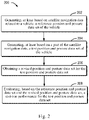
- FIG. 2 shows a flowchart of a method 300 for evaluating data according to an embodiment of the present disclosure.
- the computing device 104 determines, based on position information of data in the reference position and posture data set and the revised position and posture data set, a first number of matching data pairs in the reference position and posture data set and the revised position and posture data set.
- the comparison of data is based on time, that is, the reference position and posture data at certain time in the reference position and posture data set is compared with the data at the same time in the revised position and posture data set.
- a distance between a first position corresponding to the first data and a second position corresponding to the second data is determined.
- the position information of the data in the reference position and posture data set and the revised position and posture data set may be compared, that is, the spatial distance between the first position represented by the reference position and posture data and the second position represented by the corresponding revised position and posture data is compared.
- the first data and the second data are a matching data pair. For example, if the spatial distance between the spatial positions represented by the two data is less than 10 cm, 20 cm, or 30 cm, the two data are considered to match. Therefore, the first number of matching data pairs in the reference position and posture data set and the revised position and posture data set can be determined.
- the computing device 104 determines, based on angle information of data in the reference position and posture data set and the revised position and posture data set, a second number of matching data pairs in the reference position and posture data set and the revised position and posture data set.
- a difference between at least one angle associated with the third data and at least one corresponding angle associated with the fourth data is determined.
- the reference position and posture data and the revised position and posture data at a given time are also compared to determine the difference between the posture angles of the data.
- There are three components in the posture data including roll angle, pitch angle, and yaw angle.
- the difference between respective corresponding components may be compared. In some other embodiments, only one or two components in the posture data may be compared.
- the difference in angle is smaller than a threshold angle, it may be determined that the third data and the fourth data are a matching data pair.
- the threshold angle is 1 degree.
- the two data are considered to match.
- the difference in the yaw angle of the reference position and posture data and the revised position and posture data is within 1 degree, the two data are considered to match.
- the computing device 104 evaluates the correction performance based on at least one of the first number or the second number, and the total number of data in the reference position and posture data set.
- a first ratio of the matching first number to the total number of data in the reference position and posture data set may be determined.
- a second ratio of the matching second number to the total number may also be determined.
- the correction performance is then determined based on at least one of the two ratios.
- the revision capability may be determined based on a ratio of the first number to the total number. For example, if the number of data whose differences between the spatial positions of data in the revised position and posture data set and the spatial positions of corresponding data in the reference position and posture data set are within 30 cm accounts for 90% of the total number, the data revising apparatus 105 is considered to have relatively good revision capability.
- the correction capability may be determined based on a ratio of the second number to the total number. For example, if the number of data whose corresponding differences between three angles of postures of data in the revised position and posture data set and three angles of postures of corresponding data in the reference position and posture data set are all within 1 degree accounts for 99% of the total number, the data revising apparatus 105 is considered to have relatively good revision capability.
- the revision capability may be determined based on both the ratio of the first number to the total number and the ratio of the second number to the total number. For example, in the revised position and posture data set, if the number of data whose distance differences between the spatial positions of data and the spatial positions of corresponding reference position and posture data are within 30 cm accounts for 90% of the total number, and the number of data whose differences in three corresponding angles between the postures of the data and the postures of the corresponding reference position and posture data are all within 1 degree accounts for 99% of the total number, the data revising apparatus is considered to have relatively good correction capability.
- the revision capability of the data revising apparatus may be quickly evaluated by comparing the ratio of the number of matching data in the reference position and posture data set and the revised position and posture data set to the total number, which saves the processing time and improves the efficiency of evaluation.
- Fig. 4 shows a schematic block diagram of an apparatus 400 for evaluating data according to an embodiment of the present disclosure.
- the apparatus 400 includes a first reference position and posture data set generating module 402, configured to generate, at least based on satellite navigation data related to a vehicle, a reference position and posture data set of the vehicle.
- the apparatus 400 further includes a test position and posture data set generating module 404, configured to generate, at least based on a part of the satellite navigation data, a test position and posture data set of the vehicle, accuracy of the test position and posture data set being lower than that of the reference position and posture data set.
- the apparatus 400 further includes a first revised position and posture data set obtaining module 406, configured to obtain a revised position and posture data set for the test position and posture data set.
- the apparatus 400 further includes a first evaluating module 408, configured to evaluate, based on the reference position and posture data set and the revised position and posture data set, a correction performance for the test position and posture data set.
- the first reference position and posture data set generating module 402 includes: an inertial measurement unit data and wheel speedometer data obtaining module, configured to obtain inertial measurement unit data and wheel speedometer data related to the vehicle; and a second reference position and posture data set generating module, configured to generate the reference position and posture data set of the vehicle based on the satellite navigation data, the inertial measurement unit data, and the wheel speedometer data.
- the test position and posture data set generating module 404 includes a selecting module, configured to select the part of the satellite navigation data based on at least one of carrier-to-noise ratios or satellite altitude angles.
- the first revised position and posture data set obtaining module 406 includes: a sending module, configured to send the test position and posture data set to a data revising apparatus; and a second revised position and posture data set obtaining module, configured to obtain the revised position and posture data set from the data revising apparatus.
- the first evaluating module 408 includes: a first number determining module, configured to determine, based on position information of data in the reference position and posture data set and the revised position and posture data set, a first number of matching data pairs in the reference position and posture data set and the revised position and posture data set; a second number determining module, configured to determine, based on angle information of data in the reference position and posture data set and the revised position and posture data set, a second number of matching data pairs in the reference position and posture data set and the revised position and posture data set; and a second evaluating module, configured to evaluate the revision performance based on at least one of the first number or the second number, and the total number of data in the reference position and posture data set.
- the first number determining module includes: a distance determining module, configured to determine, based on position information of first data in the reference position and posture data set and position information of corresponding second data in the revised position and posture data set, a distance between a first position corresponding to the first data and a second position corresponding to the second data; and a first matching data pair determining module, configured to determine, in response to the distance being smaller than a threshold distance, that the first data and the second data are a matching data pair.
- the second number determining module includes: a difference determining module, configured to determine, based on angle information of third data in the reference position and posture data set and angle information of corresponding fourth data in the revised position and posture data set, a difference between at least one angle associated with the third data and at least one corresponding angle associated with the fourth data; and a second matching data pair determining module, configured to determine, in response to the difference being smaller than a threshold angle difference, that the third data and the fourth data are a matching data pair.
- a difference determining module configured to determine, based on angle information of third data in the reference position and posture data set and angle information of corresponding fourth data in the revised position and posture data set, a difference between at least one angle associated with the third data and at least one corresponding angle associated with the fourth data
- a second matching data pair determining module configured to determine, in response to the difference being smaller than a threshold angle difference, that the third data and the fourth data are a matching data pair.
- Fig. 5 shows a schematic block diagram of an exemplary device 500 capable of implementing various embodiments of the present disclosure.
- the device 500 may be used to implement the computing device 104 as shown in Fig. 1 .
- the device 500 includes a computing unit 501 that may perform various appropriate actions and processing in accordance with computer program instructions stored in a read only memory (ROM) 502 or computer program instructions loaded into a random access memory (RAM) 503 from a storage unit 508.
- ROM read only memory
- RAM random access memory
- various programs and data required for the operation of the device 500 may also be stored.
- the computing unit 501, the ROM 502, and the RAM 503 are connected to each other through a bus 504.
- An input/output (I/O) interface 505 is also coupled to the bus 504.
- a plurality of components in the device 500 are coupled to the I/O interface 505, including: an input unit 506, such as a keyboard or a mouse; an output unit 507, such as various types of displays, or speakers; the storage unit 508, such as a disk or an optical disk; and a communication unit 509 such as a network card, a modem, or a wireless communication transceiver.
- the communication unit 509 allows the device 500 to exchange information/data with other devices over a computer network such as the Internet and/or various telecommunication networks.
- the computing unit 501 may be a variety of general-purpose and/or dedicated processing components with processing and computing capabilities. Some examples of the computing unit 501 include, but are not limited to, a central processing unit (CPU), a graphics processing unit (GPU), various specialized artificial intelligence (AI) computing chips, various computing units that run machine learning model algorithms, a digital signal processor (DSP), and any suitable processor, controller, microcontroller, etc.
- the computing unit 501 executes the various methods and processes described above, such as the methods 200 and 300.
- the methods 200 and 300 may be implemented as a computer software program that is tangibly contained in a machine readable medium, such as the storage unit 508.
- some or all of the computer program may be loaded and/or installed to the device 500 via the ROM 502 and/or the communication unit 509.
- the computer program When the computer program is loaded to the RAM 503 and executed by the computing unit 501, one or more steps of the methods 200 and 300 described above may be executed.
- the computing unit 501 may be configured to execute the method 500 by any other suitable means (e.g., by means of firmware).
- FPGA Field Programmable Gate Array
- ASIC Application Specific Integrated Circuit
- ASSP Application Specific Standard Product
- SOC System on Chip
- CPLD Complex Programmable Logic Device
- Program codes for implementing the method of the present disclosure may be written in any combination of one or more programming languages. These program codes may be provided to a processor or controller of a general purpose computer, special purpose computer or other programmable data processing apparatus such that the program codes, when executed by the processor or controller, enables the functions/operations specified in the flowcharts and/or block diagrams being implemented.
- the program codes may execute entirely on the machine, partly on the machine, as a stand-alone software package partly on the machine and partly on the remote machine, or entirely on the remote machine or server.
- the machine readable medium may be a tangible medium that may contain or store programs for use by or in connection with an instruction execution system, apparatus, or device.
- the machine readable medium may be a machine readable signal medium or a machine readable storage medium.
- the machine readable medium may include, but is not limited to, an electronic, magnetic, optical, electromagnetic, infrared, or semiconductor system, apparatus, or device, or any suitable combination of the foregoing.
- machine readable storage medium may include an electrical connection based on one or more wires, portable computer disk, hard disk, random access memory (RAM), read only memory (ROM), erasable programmable read only memory (EPROM or flash memory), optical fiber, portable compact disk read only memory (CD-ROM), optical storage device, magnetic storage device, or any suitable combination of the foregoing.
- RAM random access memory
- ROM read only memory
- EPROM or flash memory erasable programmable read only memory
- CD-ROM portable compact disk read only memory
- magnetic storage device magnetic storage device, or any suitable combination of the foregoing.
Landscapes
- Engineering & Computer Science (AREA)
- Radar, Positioning & Navigation (AREA)
- Remote Sensing (AREA)
- Physics & Mathematics (AREA)
- General Physics & Mathematics (AREA)
- Computer Networks & Wireless Communication (AREA)
- Automation & Control Theory (AREA)
- Navigation (AREA)
- Position Fixing By Use Of Radio Waves (AREA)
Claims (15)
- Computergestütztes Verfahren zur Auswertung von Daten, das umfasst:Erzeugen (202), wenigstens basierend auf Satellitennavigationsdaten, die sich auf ein Fahrzeug beziehen, eines Referenz-Positions- und -Stellungsdatensatzes des Fahrzeugs;Erzeugen (204) eines Test-Positions- und - Stellungsdatensatz des Fahrzeugs, wenigstens basierend auf einem Teil der Satellitennavigationsdaten, wobei der Teil der Satellitennavigationsdaten durch Auswählen von Daten eines Teils der Satelliten der Satellitennavigationsdaten erhalten wird, und auf diese Weise verwendet wird, um Daten in einem Szenario mit schlechten GNSS-Signalen zu simulieren, , wobei die Genauigkeit des Test-Positions- und -Stellungsdatensatzes geringer ist als die Genauigkeit des Referenz-Positions- und - Stellungsdatensatzes;Erhalten (206) eines überarbeiteten Positions- und Stellungsdatensatzes für den Test-Positions- und - Stellungsdatensatz; undAuswertung (208), basierend auf dem Referenz-Positions- und -Stellungsdatensatz und dem überarbeiteten Positions- und Stellungsdatensatz, einer Überarbeitungsleistung für den Test-Positions- und -Stellungsdatensatz.
- Verfahren nach Anspruch 1, wobei das Erzeugen eines Referenz-Positions- und -Stellungsdatensatzes des Fahrzeugs umfasst:Erhalten von Trägheitsmesseinheitsdaten und Radgeschwindigkeitsmesserdaten, die sich auf das Fahrzeug beziehen; undErzeugen des Referenz-Positions- und - Stellungsdatensatzes des Fahrzeugs basierend auf den Satellitennavigationsdaten, den Trägheitsmesseinheitsdaten und den Radgeschwindigkeitsmesserdaten.
- Verfahren nach Anspruch 1 oder 2, wobei das Erzeugen eines Test-Positions- und -Stellungsdatensatzes des Fahrzeugs umfasst:
Auswählen des Teils der Satellitennavigationsdaten basierend auf wenigstens den Träger-Rausch-Verhältnissen und/oder Satellitenhöhenwinkeln. - Verfahren nach einem der Ansprüche 1 bis 3, wobei das Erhalten eines überarbeiteten Positions- und Stellungsdatensatzes für den Test-Positions- und -Stellungsdatensatz umfasst:Senden des Test-Positions- und -Stellungsdatensatzes an eine Datenüberarbeitungsvorrichtung; undErhalten des überarbeiteten Positions- und Stellungsdatensatzes von der Datenüberarbeitungsvorrichtung.
- Verfahren nach einem der Ansprüche 1 bis 4, wobei die Auswertung einer Korrekturleistung umfasst:Bestimmen, basierend auf Positionsinformationen von Daten in dem Referenz-Positions- und -Stellungsdatensatz und dem überarbeiteten Positions- und Stellungsdatensatz, einer ersten Zahl von übereinstimmenden Datenpaaren in dem Referenz-Positions- und -Stellungsdatensatz und dem überarbeiteten Positions- und Stellungsdatensatz;Bestimmen einer zweiten Zahl übereinstimmender Datenpaare in dem Referenz-Positions- und -Stellungsdatensatz und dem überarbeiteten Positions- und Stellungsdatensatz basierend auf Winkelinformationen von Daten in dem Referenz-Positions- und -Stellungsdatensatz und dem überarbeiteten Positions- und Stellungsdatensatz; undAuswertung der Überarbeitungsleistung basierend wenigstens auf der ersten Zahl oder der zweiten Zahl und/oder der Gesamtzahl von Daten in dem Referenz-Positions- und - Stellungsdatensatz.
- Verfahren nach Anspruch 5, wobei das Bestimmen einer ersten Zahl umfasst:Bestimmen, basierend auf Positionsinformationen von ersten Daten in dem Referenz-Positions- und -Stellungsdatensatz und Positionsinformationen von entsprechenden zweiten Daten in dem überarbeiteten Positions- und Stellungsdatensatz, eines Abstands zwischen einer ersten Position, die den ersten Daten entspricht, und einer zweiten Position, die den zweiten Daten entspricht; undBestimmen, als Reaktion darauf, dass der Abstand kleiner als ein Schwellenabstand ist, dass die ersten Daten und die zweiten Daten ein übereinstimmendes Datenpaar sind.
- Verfahren nach Anspruch 5 oder 6, wobei das Bestimmen einer zweiten Zahl umfasst:Bestimmen, basierend auf Winkelinformationen dritter Daten in dem Referenz-Positions- und -Stellungsdatensatz und Winkelinformationen entsprechender vierter Daten in dem überarbeiteten Positions- und Stellungsdatensatz, einer Differenz zwischen wenigstens einem Winkel, der den dritten Daten zugeordnet ist, und wenigstens einem entsprechenden Winkel, der den vierten Daten zugeordnet ist; undBestimmen, als Reaktion darauf, dass die Differenz kleiner als eine Schwellenwinkeldifferenz ist, dass die dritten Daten und die vierten Daten ein übereinstimmendes Datenpaar sind.
- Vorrichtung zur Auswertung von Daten, umfassend:ein erstes Referenz-Positions- und -Stellungsdatensatz-Erzeugungsmodul (402), das so eingerichtet ist, dass es wenigstens basierend auf Satellitennavigationsdaten, die sich auf ein Fahrzeug beziehen, einen Referenz-Positions- und - Stellungsdatensatz des Fahrzeugs erzeugt;ein Test-Positions- und -Stellungsdatensatz-Erzeugungsmodul (404), das so eingerichtet ist, dass es einen Test-Positions- und -Stellungsdatensatz des Fahrzeugs erzeugt, wenigstens basierend auf einem Teil der Satellitennavigationsdaten, wobei der Teil der Satellitennavigationsdaten durch Auswählen von Daten eines Teils der Satelliten der Satellitennavigationsdaten erhalten wird, und auf diese Weise verwendet wird, um Daten in einem Szenario mit schlechten GNSS-Signalen zu simulieren, wobei die Genauigkeit des Test-Positions- und -Stellungsdatensatzes geringer ist als die Genauigkeit des Referenz-Positions- und - Stellungsdatensatzes;ein erstes Modul (406) zum Erhalten eines überarbeiteten Positions- und Stellungsdatensatzes, das so eingerichtet ist, dass es einen überarbeiteten Positions- und Stellungsdatensatz für den Test-Positions- und -Stellungsdatensatz erhält; undein erstes Auswertungsmodul (408), das so eingerichtet ist, dass es basierend auf dem Referenz-Positions- und - Stellungsdatensatz und dem überarbeiteten Positions- und Stellungsdatensatz eine Überarbeitungsdurchführung für den Test-Positions- und -Stellungsdatensatz auswertet.
- Vorrichtung nach Anspruch 8, wobei das erste Referenz-Positions- und -Stellungsdatensatz-Erzeugungsmodul (402) umfasst:ein Modul zum Erhalten von Trägheitsmesseinheitsdaten und Radgeschwindigkeitsmesserdaten, das so eingerichtet ist, dass es Trägheitsmesseinheitsdaten und Radgeschwindigkeitsmesserdaten bezogen auf das Fahrzeug erhält; undein zweites Referenz-Positions- und -Stellungsdatensatz-Erzeugungsmodul, das so eingerichtet ist, dass es den Referenz-Positions- und -Stellungsdatensatz des Fahrzeugs basierend auf den Satellitennavigationsdaten, den Trägheitsmesseinheitsdaten und den Radgeschwindigkeitsmesserdaten erzeugt.
- Vorrichtung nach Anspruch 8 oder 9, wobei das Test-Positions- und -Stellungsdatensatz-Erzeugungsmodul (404) umfasst:
ein Auswahlmodul, das so eingerichtet ist, dass es den Teil der Satellitennavigationsdaten basierend auf wenigstens Träger-Rausch-Verhältnissen und/oder Satellitenhöhenwinkeln auswählt. - Vorrichtung nach einem der Ansprüche 8 bis 10, wobei das Modul (406) zum Erhalten des ersten überarbeiteten Positions- und Stellungsdatensatzes umfasst:ein Sendemodul, das so eingerichtet ist, dass es den Test-Positions- und -Stellungsdatensatz an eine Datenüberarbeitungsvorrichtung sendet; undein zweites Modul zum Erhalten des überarbeiteten Positions- und Stellungsdatensatzes, das so eingerichtet ist, dass es den überarbeiteten Positions- und Stellungsdatensatz von der Datenüberarbeitungsvorrichtung erhält.
- Vorrichtung nach einem der Ansprüche 8 bis 11, wobei das erste Auswertungsmodul (408) umfasst:ein erstes Zahlbestimmungsmodul, dass so eingerichtet ist, dass es, basierend auf Positionsinformationen von Daten in dem Referenz-Positions- und -Stellungsdatensatz und dem überarbeiteten Positions- und Stellungsdatensatz, eine erste Zahl von übereinstimmenden Datenpaaren in dem Referenzpositions- und -Stellungsdatensatz und den überarbeiteten Positions- und Stellungsdatensatz bestimmt;ein zweites Zahlbestimmungsmodul, das so eingerichtet ist, dass es eine zweite Zahl übereinstimmender Datenpaare in dem Referenz-Positions- und -Stellungsdatensatz und dem überarbeiteten Positions- und Stellungsdatensatz basierend auf Winkelinformationen von Daten in dem Referenz-Positions- und - Stellungsdatensatz und dem überarbeiteten Positions- und Stellungsdatensatz bestimmt; undein zweites Auswertungsmodul, das so eingerichtet ist, dass es die Überarbeitungsdurchführung basierend auf wenigstens der ersten Zahl oder der zweiten Zahl und/oder der Gesamtzahl von Daten in dem Referenz-Positions- und -Stellungsdatensatz bewertet.
- Vorrichtung nach Anspruch 12, wobei das erste Zahlbestimmungsmodul umfasst:ein Abstandsbestimmungsmodul, das so eingerichtet ist, dass es basierend auf Positionsinformationen von ersten Daten in dem Referenz-Positions- und -Stellungsdatensatz und Positionsinformationen von entsprechenden zweiten Daten in dem überarbeiteten Positions- und Stellungsdatensatz, einen Abstand zwischen einer ersten Position, die den ersten Daten entspricht, und einer zweiten Position, die den zweiten Daten entspricht, bestimmt; undein erstes Bestimmungsmodul für übereinstimmende Datenpaare, das dazu eingerichtet ist, als Reaktion darauf, dass der Abstand kleiner als ein Schwellenabstand ist, zu bestimmen, dass die ersten Daten und die zweiten Daten ein übereinstimmendes Datenpaar sind.
- Vorrichtung nach Anspruch 12 oder 13, wobei das zweite Zahlbestimmungsmodul umfasst:ein Differenzbestimmungsmodul, das so eingerichtet ist, dass es basierend auf Winkelinformationen dritter Daten in dem Referenz-Positions- und -Stellungsdatensatz und Winkelinformationen entsprechender vierter Daten in dem überarbeiteten Positions- und Stellungsdatensatz, eine Differenz zwischen wenigstens einem Winkel, der den dritten Daten zugeordnet ist, und wenigstens einem entsprechenden Winkel, der den vierten Daten zugeordnet ist, bestimmt; undein zweites Bestimmungsmodul für übereinstimmende Datenpaare, das so eingerichtet ist, dass es als Reaktion darauf, dass die Differenz kleiner als eine Schwellenwinkeldifferenz ist, bestimmt, dass die dritten Daten und die vierten Daten ein übereinstimmendes Datenpaar sind.
- Computerlesbares Speichermedium, auf dem ein Computerprogramm gespeichert ist, wobei das Computerprogramm, wenn es von einem Computer ausgeführt wird, bewirkt, dass der Computer das Verfahren nach einem der Ansprüche 1 bis 7 ausführt.
Applications Claiming Priority (1)
| Application Number | Priority Date | Filing Date | Title |
|---|---|---|---|
| CN201910838298.6A CN110515110B (zh) | 2019-09-05 | 2019-09-05 | 数据评估的方法、装置、设备和计算机可读存储介质 |
Publications (2)
| Publication Number | Publication Date |
|---|---|
| EP3789797A1 EP3789797A1 (de) | 2021-03-10 |
| EP3789797B1 true EP3789797B1 (de) | 2022-05-11 |
Family
ID=68630967
Family Applications (1)
| Application Number | Title | Priority Date | Filing Date |
|---|---|---|---|
| EP20162156.2A Active EP3789797B1 (de) | 2019-09-05 | 2020-03-10 | Verfahren und vorrichtung zur beurteilung von daten, vorrichtung und computerlesbares speichermedium |
Country Status (3)
| Country | Link |
|---|---|
| US (1) | US11448771B2 (de) |
| EP (1) | EP3789797B1 (de) |
| CN (1) | CN110515110B (de) |
Families Citing this family (5)
| Publication number | Priority date | Publication date | Assignee | Title |
|---|---|---|---|---|
| CN111708043B (zh) * | 2020-05-13 | 2023-09-26 | 阿波罗智能技术(北京)有限公司 | 定位方法及装置 |
| US11238643B1 (en) * | 2020-12-16 | 2022-02-01 | Pony Ai Inc. | High-definition city mapping |
| CN113267178B (zh) * | 2021-03-25 | 2023-07-07 | 浙江大学 | 一种基于多传感器融合的模型位姿测量系统与方法 |
| CN114777813B (zh) * | 2022-04-20 | 2025-06-06 | 智道网联科技(北京)有限公司 | 自动驾驶车辆的融合定位精度评估方法、装置及电子设备 |
| CN117824671B (zh) * | 2023-12-22 | 2024-09-17 | 贵州航天控制技术有限公司 | 一种组合导航方法及装置 |
Family Cites Families (15)
| Publication number | Priority date | Publication date | Assignee | Title |
|---|---|---|---|---|
| US7855678B2 (en) * | 2007-05-16 | 2010-12-21 | Trimble Navigation Limited | Post-mission high accuracy position and orientation system |
| CN103777218B (zh) * | 2012-10-23 | 2016-12-21 | 中国科学院光电研究院 | Gnss/ins超紧组合导航系统的性能评估系统及方法 |
| US9187099B2 (en) * | 2013-10-17 | 2015-11-17 | Richard M. Powers | Systems and methods for predicting weather performance for a vehicle |
| KR101640052B1 (ko) * | 2014-12-11 | 2016-07-18 | 현대자동차주식회사 | Avn 장치, 이를 포함하는 차량, 및 차량의 제어 방법 |
| EP3106897A1 (de) * | 2015-06-19 | 2016-12-21 | Centre National d'Etudes Spatiales | Gnss-empfänger mit eingebauter fähigkeit zur durchführung eines optimalen fehlerkorrekturverfahrens |
| US9939276B2 (en) | 2016-01-28 | 2018-04-10 | Uber Technologies, Inc. | Simplifying GPS data for map building and distance calculation |
| US20170299724A1 (en) * | 2016-04-14 | 2017-10-19 | Qualcomm Incorporated | Method for enhanced stand-alone global navigation satellite system (gnss) performance |
| CN205749912U (zh) * | 2016-05-24 | 2016-11-30 | 南京泰司空间信息科技有限公司 | 一种室内移动测量装置 |
| CN106525046A (zh) * | 2016-10-27 | 2017-03-22 | 深圳大图科创技术开发有限公司 | 一种智能导游服务定位系统 |
| CN108732603B (zh) * | 2017-04-17 | 2020-07-10 | 百度在线网络技术(北京)有限公司 | 用于定位车辆的方法和装置 |
| US20190033077A1 (en) * | 2017-07-28 | 2019-01-31 | Dura Operating, Llc | High precision vehicle localization system and method for high precision vehicle localization |
| JP6950460B2 (ja) * | 2017-10-31 | 2021-10-13 | セイコーエプソン株式会社 | 物理量検出回路、物理量検出装置、慣性計測装置、移動体測位装置、携帯型電子機器、電子機器及び移動体 |
| DE102018202225A1 (de) * | 2018-02-14 | 2019-08-14 | Robert Bosch Gmbh | Verfahren und Vorrichtung zum Bereitstellen von Roh-Korrekturdaten zur Korrektur atmosphärischer Störungen zur Satellitennavigation sowie Verfahren und Vorrichtung zum Bestimmen von Korrekturdaten zur Korrektur atmosphärischer Störungen zur Satellitennavigation |
| JP2019164415A (ja) * | 2018-03-19 | 2019-09-26 | セコム株式会社 | 飛行制御システム |
| CN110174105B (zh) * | 2019-06-14 | 2022-02-11 | 西南科技大学 | 一种复杂环境下智能体自主导航算法及系统 |
-
2019
- 2019-09-05 CN CN201910838298.6A patent/CN110515110B/zh active Active
-
2020
- 2020-03-10 US US16/814,452 patent/US11448771B2/en active Active
- 2020-03-10 EP EP20162156.2A patent/EP3789797B1/de active Active
Also Published As
| Publication number | Publication date |
|---|---|
| US11448771B2 (en) | 2022-09-20 |
| CN110515110B (zh) | 2021-08-10 |
| CN110515110A (zh) | 2019-11-29 |
| US20210072404A1 (en) | 2021-03-11 |
| EP3789797A1 (de) | 2021-03-10 |
Similar Documents
| Publication | Publication Date | Title |
|---|---|---|
| EP3789797B1 (de) | Verfahren und vorrichtung zur beurteilung von daten, vorrichtung und computerlesbares speichermedium | |
| US11176701B2 (en) | Position estimation system and position estimation method | |
| JP7186607B2 (ja) | 電子地図を更新する方法、装置、およびコンピュータ読み取り可能な記憶媒体 | |
| US20210025713A1 (en) | Lane line positioning method and apparatus, and storage medium thereof | |
| CN109270545B (zh) | 一种定位真值校验方法、装置、设备及存储介质 | |
| CN107328410B (zh) | 用于定位自动驾驶车辆的方法和汽车电脑 | |
| CN110501712B (zh) | 无人驾驶中用于确定位置姿态数据的方法、装置和设备 | |
| CN114119886B (zh) | 高精地图点云重建方法、装置、车辆、设备和存储介质 | |
| US20180299273A1 (en) | Method and apparatus for positioning vehicle | |
| US20210278549A1 (en) | Lane-level navigation system for ground vehicles with lidar and cellular signals | |
| CN106097304A (zh) | 一种无人机实时在线地图生成方法 | |
| CN114111775A (zh) | 一种多传感器融合定位方法、装置、存储介质及电子设备 | |
| CN110906954A (zh) | 一种基于自动驾驶平台的高精度地图测试评估方法和装置 | |
| Jin et al. | Fast and accurate initialization for monocular vision/INS/GNSS integrated system on land vehicle | |
| CN114061611B (zh) | 目标对象定位方法、装置、存储介质和计算机程序产品 | |
| CN110160545A (zh) | 一种激光雷达与gps的增强定位系统及方法 | |
| US20250189343A1 (en) | Positioning information processing method and apparatus, device, and medium | |
| Chiang et al. | Multifusion schemes of INS/GNSS/GCPs/V-SLAM applied using data from smartphone sensors for land vehicular navigation applications | |
| Bento et al. | Set-membership position estimation with GNSS pseudorange error mitigation using lane-boundary measurements | |
| CN115950646A (zh) | 一种硬件在环测试系统及方法 | |
| Li et al. | AutoMine: A Multimodal Dataset for Robot Navigation in Open‐Pit Mines | |
| Forno et al. | Techniques for improving localization applications running on low-cost IoT devices | |
| Mounier et al. | Investigating the complementary use of radar and lidar for positioning applications | |
| CN111397602A (zh) | 一种宽频电磁指纹与组合导航融合的高精度定位方法与设备 | |
| EP4166909A2 (de) | Erstellung einer fahrzeugumgebungskarte basierend auf luftbildgebung |
Legal Events
| Date | Code | Title | Description |
|---|---|---|---|
| PUAI | Public reference made under article 153(3) epc to a published international application that has entered the european phase |
Free format text: ORIGINAL CODE: 0009012 |
|
| STAA | Information on the status of an ep patent application or granted ep patent |
Free format text: STATUS: REQUEST FOR EXAMINATION WAS MADE |
|
| 17P | Request for examination filed |
Effective date: 20200310 |
|
| AK | Designated contracting states |
Kind code of ref document: A1 Designated state(s): AL AT BE BG CH CY CZ DE DK EE ES FI FR GB GR HR HU IE IS IT LI LT LU LV MC MK MT NL NO PL PT RO RS SE SI SK SM TR |
|
| AX | Request for extension of the european patent |
Extension state: BA ME |
|
| RAP1 | Party data changed (applicant data changed or rights of an application transferred) |
Owner name: APOLLO INTELLIGENT DRIVING TECHNOLOGY (BEIJING) CO., LTD. |
|
| RIC1 | Information provided on ipc code assigned before grant |
Ipc: G01S 19/49 20100101ALN20211124BHEP Ipc: G01S 19/40 20100101ALI20211124BHEP Ipc: G01S 19/39 20100101AFI20211124BHEP |
|
| GRAP | Despatch of communication of intention to grant a patent |
Free format text: ORIGINAL CODE: EPIDOSNIGR1 |
|
| STAA | Information on the status of an ep patent application or granted ep patent |
Free format text: STATUS: GRANT OF PATENT IS INTENDED |
|
| INTG | Intention to grant announced |
Effective date: 20220111 |
|
| GRAS | Grant fee paid |
Free format text: ORIGINAL CODE: EPIDOSNIGR3 |
|
| GRAA | (expected) grant |
Free format text: ORIGINAL CODE: 0009210 |
|
| STAA | Information on the status of an ep patent application or granted ep patent |
Free format text: STATUS: THE PATENT HAS BEEN GRANTED |
|
| AK | Designated contracting states |
Kind code of ref document: B1 Designated state(s): AL AT BE BG CH CY CZ DE DK EE ES FI FR GB GR HR HU IE IS IT LI LT LU LV MC MK MT NL NO PL PT RO RS SE SI SK SM TR |
|
| REG | Reference to a national code |
Ref country code: GB Ref legal event code: FG4D |
|
| REG | Reference to a national code |
Ref country code: CH Ref legal event code: EP |
|
| REG | Reference to a national code |
Ref country code: AT Ref legal event code: REF Ref document number: 1491896 Country of ref document: AT Kind code of ref document: T Effective date: 20220515 |
|
| REG | Reference to a national code |
Ref country code: DE Ref legal event code: R096 Ref document number: 602020003091 Country of ref document: DE |
|
| REG | Reference to a national code |
Ref country code: IE Ref legal event code: FG4D |
|
| REG | Reference to a national code |
Ref country code: LT Ref legal event code: MG9D |
|
| REG | Reference to a national code |
Ref country code: NL Ref legal event code: MP Effective date: 20220511 |
|
| REG | Reference to a national code |
Ref country code: AT Ref legal event code: MK05 Ref document number: 1491896 Country of ref document: AT Kind code of ref document: T Effective date: 20220511 |
|
| PG25 | Lapsed in a contracting state [announced via postgrant information from national office to epo] |
Ref country code: SE Free format text: LAPSE BECAUSE OF FAILURE TO SUBMIT A TRANSLATION OF THE DESCRIPTION OR TO PAY THE FEE WITHIN THE PRESCRIBED TIME-LIMIT Effective date: 20220511 Ref country code: PT Free format text: LAPSE BECAUSE OF FAILURE TO SUBMIT A TRANSLATION OF THE DESCRIPTION OR TO PAY THE FEE WITHIN THE PRESCRIBED TIME-LIMIT Effective date: 20220912 Ref country code: NO Free format text: LAPSE BECAUSE OF FAILURE TO SUBMIT A TRANSLATION OF THE DESCRIPTION OR TO PAY THE FEE WITHIN THE PRESCRIBED TIME-LIMIT Effective date: 20220811 Ref country code: NL Free format text: LAPSE BECAUSE OF FAILURE TO SUBMIT A TRANSLATION OF THE DESCRIPTION OR TO PAY THE FEE WITHIN THE PRESCRIBED TIME-LIMIT Effective date: 20220511 Ref country code: LT Free format text: LAPSE BECAUSE OF FAILURE TO SUBMIT A TRANSLATION OF THE DESCRIPTION OR TO PAY THE FEE WITHIN THE PRESCRIBED TIME-LIMIT Effective date: 20220511 Ref country code: HR Free format text: LAPSE BECAUSE OF FAILURE TO SUBMIT A TRANSLATION OF THE DESCRIPTION OR TO PAY THE FEE WITHIN THE PRESCRIBED TIME-LIMIT Effective date: 20220511 Ref country code: GR Free format text: LAPSE BECAUSE OF FAILURE TO SUBMIT A TRANSLATION OF THE DESCRIPTION OR TO PAY THE FEE WITHIN THE PRESCRIBED TIME-LIMIT Effective date: 20220812 Ref country code: FI Free format text: LAPSE BECAUSE OF FAILURE TO SUBMIT A TRANSLATION OF THE DESCRIPTION OR TO PAY THE FEE WITHIN THE PRESCRIBED TIME-LIMIT Effective date: 20220511 Ref country code: BG Free format text: LAPSE BECAUSE OF FAILURE TO SUBMIT A TRANSLATION OF THE DESCRIPTION OR TO PAY THE FEE WITHIN THE PRESCRIBED TIME-LIMIT Effective date: 20220811 Ref country code: AT Free format text: LAPSE BECAUSE OF FAILURE TO SUBMIT A TRANSLATION OF THE DESCRIPTION OR TO PAY THE FEE WITHIN THE PRESCRIBED TIME-LIMIT Effective date: 20220511 |
|
| PG25 | Lapsed in a contracting state [announced via postgrant information from national office to epo] |
Ref country code: RS Free format text: LAPSE BECAUSE OF FAILURE TO SUBMIT A TRANSLATION OF THE DESCRIPTION OR TO PAY THE FEE WITHIN THE PRESCRIBED TIME-LIMIT Effective date: 20220511 Ref country code: PL Free format text: LAPSE BECAUSE OF FAILURE TO SUBMIT A TRANSLATION OF THE DESCRIPTION OR TO PAY THE FEE WITHIN THE PRESCRIBED TIME-LIMIT Effective date: 20220511 Ref country code: LV Free format text: LAPSE BECAUSE OF FAILURE TO SUBMIT A TRANSLATION OF THE DESCRIPTION OR TO PAY THE FEE WITHIN THE PRESCRIBED TIME-LIMIT Effective date: 20220511 Ref country code: IS Free format text: LAPSE BECAUSE OF FAILURE TO SUBMIT A TRANSLATION OF THE DESCRIPTION OR TO PAY THE FEE WITHIN THE PRESCRIBED TIME-LIMIT Effective date: 20220911 |
|
| PG25 | Lapsed in a contracting state [announced via postgrant information from national office to epo] |
Ref country code: SM Free format text: LAPSE BECAUSE OF FAILURE TO SUBMIT A TRANSLATION OF THE DESCRIPTION OR TO PAY THE FEE WITHIN THE PRESCRIBED TIME-LIMIT Effective date: 20220511 Ref country code: SK Free format text: LAPSE BECAUSE OF FAILURE TO SUBMIT A TRANSLATION OF THE DESCRIPTION OR TO PAY THE FEE WITHIN THE PRESCRIBED TIME-LIMIT Effective date: 20220511 Ref country code: RO Free format text: LAPSE BECAUSE OF FAILURE TO SUBMIT A TRANSLATION OF THE DESCRIPTION OR TO PAY THE FEE WITHIN THE PRESCRIBED TIME-LIMIT Effective date: 20220511 Ref country code: ES Free format text: LAPSE BECAUSE OF FAILURE TO SUBMIT A TRANSLATION OF THE DESCRIPTION OR TO PAY THE FEE WITHIN THE PRESCRIBED TIME-LIMIT Effective date: 20220511 Ref country code: EE Free format text: LAPSE BECAUSE OF FAILURE TO SUBMIT A TRANSLATION OF THE DESCRIPTION OR TO PAY THE FEE WITHIN THE PRESCRIBED TIME-LIMIT Effective date: 20220511 Ref country code: DK Free format text: LAPSE BECAUSE OF FAILURE TO SUBMIT A TRANSLATION OF THE DESCRIPTION OR TO PAY THE FEE WITHIN THE PRESCRIBED TIME-LIMIT Effective date: 20220511 Ref country code: CZ Free format text: LAPSE BECAUSE OF FAILURE TO SUBMIT A TRANSLATION OF THE DESCRIPTION OR TO PAY THE FEE WITHIN THE PRESCRIBED TIME-LIMIT Effective date: 20220511 |
|
| REG | Reference to a national code |
Ref country code: DE Ref legal event code: R097 Ref document number: 602020003091 Country of ref document: DE |
|
| PLBE | No opposition filed within time limit |
Free format text: ORIGINAL CODE: 0009261 |
|
| STAA | Information on the status of an ep patent application or granted ep patent |
Free format text: STATUS: NO OPPOSITION FILED WITHIN TIME LIMIT |
|
| PG25 | Lapsed in a contracting state [announced via postgrant information from national office to epo] |
Ref country code: AL Free format text: LAPSE BECAUSE OF FAILURE TO SUBMIT A TRANSLATION OF THE DESCRIPTION OR TO PAY THE FEE WITHIN THE PRESCRIBED TIME-LIMIT Effective date: 20220511 |
|
| 26N | No opposition filed |
Effective date: 20230214 |
|
| PG25 | Lapsed in a contracting state [announced via postgrant information from national office to epo] |
Ref country code: SI Free format text: LAPSE BECAUSE OF FAILURE TO SUBMIT A TRANSLATION OF THE DESCRIPTION OR TO PAY THE FEE WITHIN THE PRESCRIBED TIME-LIMIT Effective date: 20220511 |
|
| P01 | Opt-out of the competence of the unified patent court (upc) registered |
Effective date: 20230526 |
|
| PG25 | Lapsed in a contracting state [announced via postgrant information from national office to epo] |
Ref country code: MC Free format text: LAPSE BECAUSE OF FAILURE TO SUBMIT A TRANSLATION OF THE DESCRIPTION OR TO PAY THE FEE WITHIN THE PRESCRIBED TIME-LIMIT Effective date: 20220511 |
|
| REG | Reference to a national code |
Ref country code: CH Ref legal event code: PL |
|
| REG | Reference to a national code |
Ref country code: BE Ref legal event code: MM Effective date: 20230331 |
|
| PG25 | Lapsed in a contracting state [announced via postgrant information from national office to epo] |
Ref country code: LU Free format text: LAPSE BECAUSE OF NON-PAYMENT OF DUE FEES Effective date: 20230310 |
|
| REG | Reference to a national code |
Ref country code: IE Ref legal event code: MM4A |
|
| PG25 | Lapsed in a contracting state [announced via postgrant information from national office to epo] |
Ref country code: LI Free format text: LAPSE BECAUSE OF NON-PAYMENT OF DUE FEES Effective date: 20230331 Ref country code: IT Free format text: LAPSE BECAUSE OF FAILURE TO SUBMIT A TRANSLATION OF THE DESCRIPTION OR TO PAY THE FEE WITHIN THE PRESCRIBED TIME-LIMIT Effective date: 20220511 Ref country code: IE Free format text: LAPSE BECAUSE OF NON-PAYMENT OF DUE FEES Effective date: 20230310 Ref country code: CH Free format text: LAPSE BECAUSE OF NON-PAYMENT OF DUE FEES Effective date: 20230331 |
|
| PG25 | Lapsed in a contracting state [announced via postgrant information from national office to epo] |
Ref country code: BE Free format text: LAPSE BECAUSE OF NON-PAYMENT OF DUE FEES Effective date: 20230331 |
|
| PG25 | Lapsed in a contracting state [announced via postgrant information from national office to epo] |
Ref country code: BG Free format text: LAPSE BECAUSE OF FAILURE TO SUBMIT A TRANSLATION OF THE DESCRIPTION OR TO PAY THE FEE WITHIN THE PRESCRIBED TIME-LIMIT Effective date: 20220511 |
|
| PG25 | Lapsed in a contracting state [announced via postgrant information from national office to epo] |
Ref country code: BG Free format text: LAPSE BECAUSE OF FAILURE TO SUBMIT A TRANSLATION OF THE DESCRIPTION OR TO PAY THE FEE WITHIN THE PRESCRIBED TIME-LIMIT Effective date: 20220511 |
|
| PG25 | Lapsed in a contracting state [announced via postgrant information from national office to epo] |
Ref country code: CY Free format text: LAPSE BECAUSE OF FAILURE TO SUBMIT A TRANSLATION OF THE DESCRIPTION OR TO PAY THE FEE WITHIN THE PRESCRIBED TIME-LIMIT; INVALID AB INITIO Effective date: 20200310 |
|
| PG25 | Lapsed in a contracting state [announced via postgrant information from national office to epo] |
Ref country code: HU Free format text: LAPSE BECAUSE OF FAILURE TO SUBMIT A TRANSLATION OF THE DESCRIPTION OR TO PAY THE FEE WITHIN THE PRESCRIBED TIME-LIMIT; INVALID AB INITIO Effective date: 20200310 |
|
| PG25 | Lapsed in a contracting state [announced via postgrant information from national office to epo] |
Ref country code: TR Free format text: LAPSE BECAUSE OF FAILURE TO SUBMIT A TRANSLATION OF THE DESCRIPTION OR TO PAY THE FEE WITHIN THE PRESCRIBED TIME-LIMIT Effective date: 20220511 |
|
| PGFP | Annual fee paid to national office [announced via postgrant information from national office to epo] |
Ref country code: GB Payment date: 20260203 Year of fee payment: 7 |
|
| PGFP | Annual fee paid to national office [announced via postgrant information from national office to epo] |
Ref country code: DE Payment date: 20260320 Year of fee payment: 7 |
|
| PGFP | Annual fee paid to national office [announced via postgrant information from national office to epo] |
Ref country code: FR Payment date: 20260213 Year of fee payment: 7 |