EP3789790B1 - Distance measuring device - Google Patents
Distance measuring device Download PDFInfo
- Publication number
- EP3789790B1 EP3789790B1 EP20175697.0A EP20175697A EP3789790B1 EP 3789790 B1 EP3789790 B1 EP 3789790B1 EP 20175697 A EP20175697 A EP 20175697A EP 3789790 B1 EP3789790 B1 EP 3789790B1
- Authority
- EP
- European Patent Office
- Prior art keywords
- delay time
- circuit
- measuring device
- distance measuring
- time
- Prior art date
- Legal status (The legal status is an assumption and is not a legal conclusion. Google has not performed a legal analysis and makes no representation as to the accuracy of the status listed.)
- Active
Links
Images




Classifications
-
- G—PHYSICS
- G01—MEASURING; TESTING
- G01S—RADIO DIRECTION-FINDING; RADIO NAVIGATION; DETERMINING DISTANCE OR VELOCITY BY USE OF RADIO WAVES; LOCATING OR PRESENCE-DETECTING BY USE OF THE REFLECTION OR RERADIATION OF RADIO WAVES; ANALOGOUS ARRANGEMENTS USING OTHER WAVES
- G01S13/00—Systems using the reflection or reradiation of radio waves, e.g. radar systems; Analogous systems using reflection or reradiation of waves whose nature or wavelength is irrelevant or unspecified
- G01S13/74—Systems using reradiation of radio waves, e.g. secondary radar systems; Analogous systems
- G01S13/82—Systems using reradiation of radio waves, e.g. secondary radar systems; Analogous systems wherein continuous-type signals are transmitted
- G01S13/825—Systems using reradiation of radio waves, e.g. secondary radar systems; Analogous systems wherein continuous-type signals are transmitted with exchange of information between interrogator and responder
-
- G—PHYSICS
- G01—MEASURING; TESTING
- G01S—RADIO DIRECTION-FINDING; RADIO NAVIGATION; DETERMINING DISTANCE OR VELOCITY BY USE OF RADIO WAVES; LOCATING OR PRESENCE-DETECTING BY USE OF THE REFLECTION OR RERADIATION OF RADIO WAVES; ANALOGOUS ARRANGEMENTS USING OTHER WAVES
- G01S13/00—Systems using the reflection or reradiation of radio waves, e.g. radar systems; Analogous systems using reflection or reradiation of waves whose nature or wavelength is irrelevant or unspecified
- G01S13/74—Systems using reradiation of radio waves, e.g. secondary radar systems; Analogous systems
- G01S13/82—Systems using reradiation of radio waves, e.g. secondary radar systems; Analogous systems wherein continuous-type signals are transmitted
- G01S13/84—Systems using reradiation of radio waves, e.g. secondary radar systems; Analogous systems wherein continuous-type signals are transmitted for distance determination by phase measurement
-
- G—PHYSICS
- G01—MEASURING; TESTING
- G01S—RADIO DIRECTION-FINDING; RADIO NAVIGATION; DETERMINING DISTANCE OR VELOCITY BY USE OF RADIO WAVES; LOCATING OR PRESENCE-DETECTING BY USE OF THE REFLECTION OR RERADIATION OF RADIO WAVES; ANALOGOUS ARRANGEMENTS USING OTHER WAVES
- G01S11/00—Systems for determining distance or velocity not using reflection or reradiation
- G01S11/02—Systems for determining distance or velocity not using reflection or reradiation using radio waves
-
- B—PERFORMING OPERATIONS; TRANSPORTING
- B60—VEHICLES IN GENERAL
- B60R—VEHICLES, VEHICLE FITTINGS, OR VEHICLE PARTS, NOT OTHERWISE PROVIDED FOR
- B60R25/00—Fittings or systems for preventing or indicating unauthorised use or theft of vehicles
- B60R25/20—Means to switch the anti-theft system on or off
- B60R25/24—Means to switch the anti-theft system on or off using electronic identifiers containing a code not memorised by the user
- B60R25/245—Means to switch the anti-theft system on or off using electronic identifiers containing a code not memorised by the user where the antenna reception area plays a role
-
- G—PHYSICS
- G01—MEASURING; TESTING
- G01S—RADIO DIRECTION-FINDING; RADIO NAVIGATION; DETERMINING DISTANCE OR VELOCITY BY USE OF RADIO WAVES; LOCATING OR PRESENCE-DETECTING BY USE OF THE REFLECTION OR RERADIATION OF RADIO WAVES; ANALOGOUS ARRANGEMENTS USING OTHER WAVES
- G01S13/00—Systems using the reflection or reradiation of radio waves, e.g. radar systems; Analogous systems using reflection or reradiation of waves whose nature or wavelength is irrelevant or unspecified
- G01S13/02—Systems using reflection of radio waves, e.g. primary radar systems; Analogous systems
- G01S13/06—Systems determining position data of a target
- G01S13/08—Systems for measuring distance only
- G01S13/10—Systems for measuring distance only using transmission of interrupted, pulse modulated waves
- G01S13/14—Systems for measuring distance only using transmission of interrupted, pulse modulated waves wherein a voltage or current pulse is initiated and terminated in accordance respectively with the pulse transmission and echo reception
-
- G—PHYSICS
- G01—MEASURING; TESTING
- G01S—RADIO DIRECTION-FINDING; RADIO NAVIGATION; DETERMINING DISTANCE OR VELOCITY BY USE OF RADIO WAVES; LOCATING OR PRESENCE-DETECTING BY USE OF THE REFLECTION OR RERADIATION OF RADIO WAVES; ANALOGOUS ARRANGEMENTS USING OTHER WAVES
- G01S7/00—Details of systems according to groups G01S13/00, G01S15/00, G01S17/00
- G01S7/02—Details of systems according to groups G01S13/00, G01S15/00, G01S17/00 of systems according to group G01S13/00
- G01S7/35—Details of non-pulse systems
- G01S7/352—Receivers
-
- G—PHYSICS
- G01—MEASURING; TESTING
- G01S—RADIO DIRECTION-FINDING; RADIO NAVIGATION; DETERMINING DISTANCE OR VELOCITY BY USE OF RADIO WAVES; LOCATING OR PRESENCE-DETECTING BY USE OF THE REFLECTION OR RERADIATION OF RADIO WAVES; ANALOGOUS ARRANGEMENTS USING OTHER WAVES
- G01S7/00—Details of systems according to groups G01S13/00, G01S15/00, G01S17/00
- G01S7/02—Details of systems according to groups G01S13/00, G01S15/00, G01S17/00 of systems according to group G01S13/00
- G01S7/40—Means for monitoring or calibrating
- G01S7/4004—Means for monitoring or calibrating of parts of a radar system
- G01S7/4021—Means for monitoring or calibrating of parts of a radar system of receivers
-
- G—PHYSICS
- G01—MEASURING; TESTING
- G01S—RADIO DIRECTION-FINDING; RADIO NAVIGATION; DETERMINING DISTANCE OR VELOCITY BY USE OF RADIO WAVES; LOCATING OR PRESENCE-DETECTING BY USE OF THE REFLECTION OR RERADIATION OF RADIO WAVES; ANALOGOUS ARRANGEMENTS USING OTHER WAVES
- G01S7/00—Details of systems according to groups G01S13/00, G01S15/00, G01S17/00
- G01S7/02—Details of systems according to groups G01S13/00, G01S15/00, G01S17/00 of systems according to group G01S13/00
- G01S7/40—Means for monitoring or calibrating
- G01S7/4052—Means for monitoring or calibrating by simulation of echoes
-
- G—PHYSICS
- G01—MEASURING; TESTING
- G01S—RADIO DIRECTION-FINDING; RADIO NAVIGATION; DETERMINING DISTANCE OR VELOCITY BY USE OF RADIO WAVES; LOCATING OR PRESENCE-DETECTING BY USE OF THE REFLECTION OR RERADIATION OF RADIO WAVES; ANALOGOUS ARRANGEMENTS USING OTHER WAVES
- G01S7/00—Details of systems according to groups G01S13/00, G01S15/00, G01S17/00
- G01S7/02—Details of systems according to groups G01S13/00, G01S15/00, G01S17/00 of systems according to group G01S13/00
- G01S7/40—Means for monitoring or calibrating
- G01S7/4052—Means for monitoring or calibrating by simulation of echoes
- G01S7/406—Means for monitoring or calibrating by simulation of echoes using internally generated reference signals, e.g. via delay line, via RF or IF signal injection or via integrated reference reflector or transponder
- G01S7/4065—Means for monitoring or calibrating by simulation of echoes using internally generated reference signals, e.g. via delay line, via RF or IF signal injection or via integrated reference reflector or transponder involving a delay line
-
- G—PHYSICS
- G07—CHECKING-DEVICES
- G07C—TIME OR ATTENDANCE REGISTERS; REGISTERING OR INDICATING THE WORKING OF MACHINES; GENERATING RANDOM NUMBERS; VOTING OR LOTTERY APPARATUS; ARRANGEMENTS, SYSTEMS OR APPARATUS FOR CHECKING NOT PROVIDED FOR ELSEWHERE
- G07C9/00—Individual registration on entry or exit
- G07C9/00174—Electronically operated locks; Circuits therefor; Nonmechanical keys therefor, e.g. passive or active electrical keys or other data carriers without mechanical keys
- G07C9/00309—Electronically operated locks; Circuits therefor; Nonmechanical keys therefor, e.g. passive or active electrical keys or other data carriers without mechanical keys operated with bidirectional data transmission between data carrier and locks
-
- G—PHYSICS
- G07—CHECKING-DEVICES
- G07C—TIME OR ATTENDANCE REGISTERS; REGISTERING OR INDICATING THE WORKING OF MACHINES; GENERATING RANDOM NUMBERS; VOTING OR LOTTERY APPARATUS; ARRANGEMENTS, SYSTEMS OR APPARATUS FOR CHECKING NOT PROVIDED FOR ELSEWHERE
- G07C9/00—Individual registration on entry or exit
- G07C9/00174—Electronically operated locks; Circuits therefor; Nonmechanical keys therefor, e.g. passive or active electrical keys or other data carriers without mechanical keys
- G07C9/00944—Details of construction or manufacture
-
- H—ELECTRICITY
- H04—ELECTRIC COMMUNICATION TECHNIQUE
- H04B—TRANSMISSION
- H04B1/00—Details of transmission systems, not covered by a single one of groups H04B3/00 - H04B13/00; Details of transmission systems not characterised by the medium used for transmission
- H04B1/38—Transceivers, i.e. devices in which transmitter and receiver form a structural unit and in which at least one part is used for functions of transmitting and receiving
- H04B1/40—Circuits
- H04B1/44—Transmit/receive switching
-
- G—PHYSICS
- G01—MEASURING; TESTING
- G01S—RADIO DIRECTION-FINDING; RADIO NAVIGATION; DETERMINING DISTANCE OR VELOCITY BY USE OF RADIO WAVES; LOCATING OR PRESENCE-DETECTING BY USE OF THE REFLECTION OR RERADIATION OF RADIO WAVES; ANALOGOUS ARRANGEMENTS USING OTHER WAVES
- G01S7/00—Details of systems according to groups G01S13/00, G01S15/00, G01S17/00
- G01S7/02—Details of systems according to groups G01S13/00, G01S15/00, G01S17/00 of systems according to group G01S13/00
- G01S7/03—Details of HF subsystems specially adapted therefor, e.g. common to transmitter and receiver
- G01S7/034—Duplexers
-
- G—PHYSICS
- G07—CHECKING-DEVICES
- G07C—TIME OR ATTENDANCE REGISTERS; REGISTERING OR INDICATING THE WORKING OF MACHINES; GENERATING RANDOM NUMBERS; VOTING OR LOTTERY APPARATUS; ARRANGEMENTS, SYSTEMS OR APPARATUS FOR CHECKING NOT PROVIDED FOR ELSEWHERE
- G07C9/00—Individual registration on entry or exit
- G07C9/00174—Electronically operated locks; Circuits therefor; Nonmechanical keys therefor, e.g. passive or active electrical keys or other data carriers without mechanical keys
- G07C9/00309—Electronically operated locks; Circuits therefor; Nonmechanical keys therefor, e.g. passive or active electrical keys or other data carriers without mechanical keys operated with bidirectional data transmission between data carrier and locks
- G07C2009/00555—Electronically operated locks; Circuits therefor; Nonmechanical keys therefor, e.g. passive or active electrical keys or other data carriers without mechanical keys operated with bidirectional data transmission between data carrier and locks comprising means to detect or avoid relay attacks
-
- G—PHYSICS
- G07—CHECKING-DEVICES
- G07C—TIME OR ATTENDANCE REGISTERS; REGISTERING OR INDICATING THE WORKING OF MACHINES; GENERATING RANDOM NUMBERS; VOTING OR LOTTERY APPARATUS; ARRANGEMENTS, SYSTEMS OR APPARATUS FOR CHECKING NOT PROVIDED FOR ELSEWHERE
- G07C2209/00—Indexing scheme relating to groups G07C9/00 - G07C9/38
- G07C2209/60—Indexing scheme relating to groups G07C9/00174 - G07C9/00944
- G07C2209/63—Comprising locating means for detecting the position of the data carrier, i.e. within the vehicle or within a certain distance from the vehicle
Definitions
- Embodiments described herein relate generally to a distance measuring device.
- Document US 2018/267 154 A1 relates to a distance measuring device that includes a calculating section configured to calculate, based on phase information acquired by a first device and a second device, at least one of which is movable, a distance between the first device and the second device.
- the first device includes a first reference signal source and a first transceiver configured to transmit two or more first carrier signals and receives two or more second carrier signals using an output of the first reference signal source.
- the second device includes a second reference signal source configured to operate independently from the first reference signal source and a second transceiver configured to transmit the second carrier signals and receives the first carrier signals using an output of the second reference signal source.
- the calculating section calculates the distance based on a phase detection result obtained by reception of the first and second carrier signals.
- Document DE 10 2017 100 225 A1 relates to a transponder for a novel system for measuring short distances by means of the transit time - time of flight - of radio signals between at least one interrogation unit and a transponder.
- the distance measuring device includes a transmission circuit, a reception circuit, a filter, a first switching circuit, an impedance circuit, a second switching circuit, a third switching circuit, and a fourth switching circuit.
- the transmission circuit transmits a signal for distance measurement.
- the reception circuit receives the signal for distance measurement.
- the filter restricts the signal for distance measurement transmitted from the transmission circuit and a signal for distance measurement received by an antenna within a desired frequency band.
- the impedance circuit is adjusted to have a higher impedance than an impedance of the antenna.
- the second switching circuit switches conduction and non-conduction between the the fourth switching circuit and the transmission circuit.
- the third switching circuit switches conduction and non-conduction between the fourth switching circuit and the reception circuit.
- the fourth switching circuit switches conduction and non-conduction between the impedance ecircuit and both, the second switching circuit the third switching circuit.
- Fig. 1 is a block diagram illustrating a configuration of a distance measuring system that includes a distance measuring device according to a first embodiment.
- a distance measuring system is configured to include a distance measuring device 1 and a distance measuring device 2.
- the distance measuring device 1 and the distance measuring device 2 are, for example, a vehicle and a key.
- the distance measuring device 1 and the distance measuring device 2 are disposed so as to be separated from each other by a distance d. At least one of the distance measuring device 1 and the distance measuring device 2 is freely movable, and the distance d changes corresponding to the movement.
- the distance measuring device 1 is configured to include a transmission circuit 10, a reception circuit 11, a power amplifier (hereinafter, abbreviated as a PA) 12, a low-noise amplifier (hereinafter, abbreviated as an LNA) 13, a switch 14, a band pass filter (hereinafter, abbreviated as a BPF) 15, an antenna 16, a resistor R1, and switches 17, 18, and 19.
- a transmission circuit 10 a reception circuit 11
- a PA power amplifier
- LNA low-noise amplifier
- BPF band pass filter
- a resistance value of the resistor R1 disposed in a feedback path between the BPF 15 and the antenna 16 is sufficiently large with respect to a resistance value of the antenna 16.
- the resistance value of the resistor R1 is set to 1000 ⁇ .
- the resistor R1 is an impedance adjustable circuit adjusted to have a higher impedance than an impedance of the antenna 16.
- the impedance adjustable circuit adjusted to have a higher impedance than the impedance of the antenna 16 is not limited to the resistor R1 but may be an inductor that has a higher impedance than the impedance of the antenna 16.
- the distance measuring device 2 is configured to include a transmission circuit 20, a reception circuit 21, a PA 22, an LNA 23, a switch 24, a BPF 25, an antenna 26, a resistor R2, and switches 27, 28, and 29.
- the transmission circuit 10 outputs a signal for distance measurement to the PA 12.
- the PA 12 amplifies the signal for distance measurement input from the transmission circuit 10 and outputs the signal for distance measurement to the switch 14.
- the switch 14 is switched to establish connection between the PA 12 and the BPF 15. Therefore, the signal for distance measurement is input to the BPF 15 via the switch 14.
- the BPF 15 restricts the input signal for distance measurement within a desired frequency band and outputs the signal for distance measurement to the antenna 16, and the antenna 16 transmits the signal for distance measurement.
- the signal for distance measurement output from the antenna 16 is received by the antenna 26 of the distance measuring device 2.
- the signal for distance measurement received by the antenna 26 is input to the BPF 25.
- the BPF 25 restricts the input signal for distance measurement within a desired frequency band and outputs the signal for distance measurement to the switch 24.
- the switch 24 is switched to establish connection between the BPF 25 and the LNA 23. Therefore, the signal for distance measurement is input to the LNA 23 via the switch 24.
- the LNA 23 amplifies the input signal for distance measurement with low noise and outputs the signal for distance measurement to the reception circuit 21.
- the transmission circuit 20 outputs the signal for distance measurement to the PA 22.
- the PA 22 amplifies the signal for distance measurement input from the transmission circuit 20 and outputs the signal for distance measurement to the switch 24.
- the switch 24 is switched to establish connection between the PA 22 and the BPF 25. Therefore, the signal for distance measurement is input to the BPF 25 via the switch 24.
- the BPF 25 restricts the input signal for distance measurement within a desired frequency band and outputs the signal for distance measurement to the antenna 26, and the signal for distance measurement is transmitted form the antenna 26.
- the signal for distance measurement output from the antenna 26 is received by the antenna 16 of the distance measuring device 1.
- the signal for distance measurement received by the antenna 16 is input to the BPF 15.
- the BPF 15 restricts the input signal for distance measurement within a desired frequency band and outputs the signal for distance measurement to the switch 14.
- the switch 14 is switched to establish connection between the BPF 15 and the LNA 13. Therefore, the signal for distance measurement is input to the LNA 13 via the switch 14.
- the LNA 13 amplifies the input signal for distance measurement with low noise and outputs the signal for distance measurement to the reception circuit 11.
- the distance measuring device 1 transmits the signal for distance measurement from the transmission circuit 10 and obtains a total transmission time until the reception circuit 11 receives the signal for distance measurement. It is possible to calculate an accurate space transmission time by compensating for a delay time Ttxtot1 at the time of the transmission and a delay time Trxtot1 at the time of the reception of the distance measuring device 1 and a delay time Ttxtot2 at the time of the transmission and a delay time Trxtot2 at the time of the reception of the distance measuring device 2, which are obtained by a delay compensation operation, from the total transmission time.
- the distance measuring device 1 can calculate the accurate distance d between the distance measuring device 1 and the distance measuring device 2 on the basis of the accurate space transmission time.
- Figs. 2A and 2B are block diagrams illustrating an example of a configuration of a distance measuring device in the related art.
- a distance measuring device 100 in the related art is configured to include a transmission circuit 110, a reception circuit 111, an amplifier 112, a switch 113, a BPF 114, an antenna 115, a switch 116, and an amplifier 117.
- the BPF 114 configured to suppress frequency components other than frequency components near a desired frequency is inserted between the transmission circuit 110 and the antenna 115 and between the reception circuit 111 and the antenna 115. Since the BPF 114 is required to have steep frequency characteristics, the BPF 114 typically has a high order, and a delay of a signal passing through the BPF 114 is thus large. Therefore, it is not possible to accurately obtain the distance without compensating for the delay time of the BPF 114 at the time of the distance measurement. Thus, compensation for such a delay time of the BPF 114 is performed in the related art.
- the switch 113 is switched to establish connection between an output of the transmission circuit 110 and an input of the BPF 114, the switch 116 is switched to establish connection between an output of the BPF 114 and an input of the amplifier 117, and a delay time Ta of a loop A is measured, as illustrated in Fig. 2A .
- the switch 113 is switched to establish connection between the output of the transmission circuit 110 and the input of the BPF 114, the switch 116 is switched to establish connection between an output of the switch 113 and the input of the amplifier 117, and a delay time Tb of a loop B is measured, as illustrated in Fig. 2B .
- a delay time of the BPF 114 is obtained from a difference between the delay time Ta of the loop A and the delay time Tb of the loop B.
- the delay time of the BPF 114 with a large delay is obtained by measuring the delay time twice by switching the switch 113 and the switch 116 in the related art.
- the delay time Tb is a delay that is larger than an accurate delay since the connection to the BPF 114 is not actually opened.
- the delay time of the BPF 114 measured for the loop A is a delay time at the time of transmission, and a delay time at the time of reception is not measured.
- the delay time of the BPF 114 at the time of transmission and the delay time of the BPF 114 at the time of reception are different delay times due to a difference in impedances of circuits before and after the BPF 114.
- a delay time of the amplifier 112 in a previous stage of the reception circuit 111 is equivalent to a delay time of the amplifier 117. In other words, it is not possible to accurately obtain the delay time of the amplifier 112 at the time of reception.
- the delay time at the time of transmission and the delay time at the time of reception are accurately measured by switching the switch 14, the switch 17, the switch 18, and the switch 19 to measure delay times of a loop C, a loop D, and a loop E three times in the embodiment.
- Fig. 3A is a block diagram for explaining a state of the distance measuring device 1 in which the route for the loop C is formed
- Fig. 3B is a block diagram for explaining a state of the distance measuring device 1 in which a route for the loop D is formed
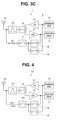
- Fig. 3C is a block diagram for explaining a state of the distance measuring device 1 in which a route for the loop E is formed.
- the delay time of the BPF 15 at the time of transmission is defined as Tfil'
- the delay time of the BPF 15 at the time of reception is defined as Tfil".
- the delay time Ttxtot1 at the time of transmission is a time obtained by adding a delay time Ttx of the transmission circuit 10, a delay time Tpa of the PA 12, and the delay time Tfil' of the BPF 15 at the time of transmission.
- the delay time Trxtot1 at the time of reception is a time obtained by adding the delay time Tfil" of the BPF 15 at the time of reception, a delay time Tina of the LNA 13, and a delay time Trx of the reception circuit 11.
- the switch 14 is switched to establish connection between the PA 12 and the BPF 15 as illustrated in Fig. 3A . Then, the switch 17 and the switch 18 are turned on, the switch 19 is turned off, and the route for the loop C is thus formed.
- the switch 14 configures a first switching circuit configured to switch a route between the transmission circuit 10 and the antenna 16 and a route between the reception circuit 11 and the antenna 16.
- the switch 19 configures a second switching circuit configured to switch conduction and non-conduction between the resistor R1 and the transmission circuit 10.
- the switch 18 configures a third switching circuit a third switching circuit configured to switch conduction and non-conduction between the resistor R1 and the reception circuit 11.
- the switch 17 configures a fourth switching circuit configured to switch conduction and non-conduction between the resistor R1 and the switch 19 and conduction and non-conduction between the resistor R1 and the switch 18.
- a delay time Tc of the loop C is a time obtained by adding the delay time Ttx of the transmission circuit 10, the delay time Tpa of the PA 12, the delay time Tfil' of the BPF 15 at the time of transmission, and the delay time Trx of the reception circuit 11.
- the delay time Tc of the loop C is represented by Equation (1) below.
- Tc Ttx + Tpa + Tfil ′ + Trx
- the switch 14 is switched to establish connection between the LNA 13 and the BPF 15 as illustrated in Fig. 3B .
- the switch 17 and the switch 19 are turned on, the switch 18 is turned off, and the route for the loop D is thus formed.
- a delay time Td of the loop D is a time obtained by adding the delay time Ttx of the transmission circuit 10, the delay time Tfil" of the BPF 15 at the time of reception, the delay time Tina of the LNA 13, and the delay time Trx of the reception circuit 11.
- the delay time Td of the loop D is represented by Equation (2) below.
- the switch 14 is opened as illustrated in Fig. 3C .
- the switch 18 and the switch 19 are turned on, the switch 17 is turned off, and the route for the loop E is thus formed.
- a delay time Te of the loop E is a time obtained by adding the delay time Ttx of the transmission circuit 10 and the delay time Trx of the reception circuit 11.
- the delay time Te of the loop E is represented by Equation (3) below.
- Tc + Td - Te is calculated.
- the delay time Ttxtot1 at the time of transmission and the delay time Trxtot1 at the time of reception are measured by measuring the delay times three times, that is, the delay time Tc of the loop C, the delay time Td of the loop D, and the delay time Te of the loop E, in this embodiment, and by calculating Tc + Td - Te.
- the resistance value of the resistor R1 is a value that is sufficiently large with respect to the resistance value of the antenna 16. In this manner, an unnecessary difference in delay at the time of the distance measurement operation and the delay compensation measurement, that is, due to a difference in impedances caused by turning on and off the switch 17 is eliminated by setting an input and output impedance of the feedback path from a part between the BPF 15 and the antenna 16 to be sufficiently large, and the delay time is thus accurately measured.
- the delay time Tfil' of the BPF 15 at the time of transmission is measured using the delay time Tc of the loop C
- the delay time Tfil" of the BPF 15 at the time of reception is measured using the delay time Td of the loop D
- an error in delay times of the BPF 15 at the time of transmission and reception is eliminated.
- the distance measuring device in the embodiment it is possible to accurately compensate for the delay time of the circuit in the device and to obtain an accurate distance.
- the distance measuring system can obtain an accurate space transmission time and to obtain the accurate distance d between the distance measuring device 1 and the distance measuring device 2.
- Fig. 4 is a block diagram illustrating a configuration of a distance measuring device according to the second embodiment.
- the same reference numerals will be given to components in Fig. 4 that are similar to the components in Fig. 3A , and description will be omitted.
- a distance measuring device 1A according to the embodiment is configured such that the resistor R1 is deleted from the distance measuring device 1 in Fig. 3A and a switch 17A is used instead of the switch 17.
- the other components are similar to the components in the first embodiment.
- the switch 17A is a switch using a transistor with a high ON resistance, for example. In this manner, an input and output impedance of the switch 17A is set to be higher than an impedance of the antenna 16.
- the distance measuring device 1A can obtain similar effects to effects of the first embodiment without using the resistor R1 of the distance measuring device 1 in the first embodiment.
- Fig. 5 is a block diagram illustrating a configuration of a distance measuring device according to the third embodiment.
- the same reference numerals will be given to components in Fig. 5 that are similar to the components in Fig. 3A , and description will be omitted.
- a distance measuring device 1B is configured such that signal processing circuits 31 and 32 are added to the distance measuring device 1 in Fig. 3A .
- the signal processing circuit 31 is added between the switch 18 and the reception circuit 11
- the signal processing circuit 32 is added between the switch 19 and the transmission circuit 10.
- the signal processing circuits 31 and 32 are circuits configured to perform desired signal processing and are each configured of an amplifier or an attenuator, for example. In this manner, in the distance measuring device 1B, it is possible to dispose other circuits (signal processing circuits 31 and 32) in addition to the resistor R1, the switches 17, 18, and 19 to a feedback path of a signal.
- Fig. 6 is a block diagram illustrating a configuration of a distance measuring device according to the fourth embodiment.
- the same reference numerals will be given to components in Fig. 6 that are similar to the components in Fig. 3A , and description will be omitted.
- a distance measuring device 1C may be configured such that at least one circuit of the PA 12, the LNA 13, and the BPF 15 is not included. It is a matter of course that the distance measuring device 1C may be configured such that none of the PA 12, the LNA 13, and the BPF 15 is included.
- Fig. 7 is a block diagram illustrating a configuration of a distance measuring device according to the fifth embodiment.
- the same reference numerals will be given to components in Fig. 7 that are similar to the components in Fig. 3A , and description will be omitted.
- a distance measuring device 1D includes the BPF 15 disposed between the LNA 13 and the switch 14.
- the BPF 15 is used only at the time of reception.
- the other components are similar to the components in the first embodiment.
- a delay time of only a loop I is measured only once. In this manner, the delay time Ttx of the transmission circuit 10, the delay time Tfil" of the BPF 15 at the time of reception, the delay time Tlna of the LNA 13, and the delay time Trx of the reception circuit 11 can be obtained.
- the distance measuring device 1D measures the delay time of only the loop I only once, it is possible to shorten a measurement time of the delay time as compared with a case in which delay times are measured three times.
- the distance measuring device 1D can also measure the delay time of the PA 12 by switching the switches 14, 17, 18, and 19 and measuring the delay times three times similarly to the first embodiment. Since the delay time of the PA 12 can also be measured by measuring the delay times three times, it is possible to improve accuracy in measuring the distance.
- Figs. 8A and 8B are block diagrams illustrating a configuration of a distance measuring device according to the sixth embodiment.
- the same reference numerals will be given to components in Figs. 8A and 8B that are similar to the components in Fig. 5 , and description will be omitted.
- a distance measuring device 1E is configured such that the switch 18, the switch 19, and the signal processing circuit 32 are deleted from the distance measuring device 1B in Fig. 5 .
- the other components are similar to the components in the distance measuring device 1B in Fig. 5 .
- the delay time of the BPF 15 is not affected by impedances of circuits before and after the BPF 15.
- the delay time Tfil' of the BPF 15 at the time of transmission and the delay time Tfil" at the time of reception are the same.
- the delay time of the BPF 15 at the time of transmission and the delay time at the time of reception are defined as a delay time Tfil in the embodiment.
- the delay time Tlna of the LNA 13 and a delay time Trxsub of the signal processing circuit 31 are also the same.
- a delay time Ttxtot3 at the time of transmission and a delay time Trxtot3 at the time of reception can be obtained through measurement performed twice for a loop J and a loop K.
- the switch 14 is switched to establish connection between the PA 12 and the BPF 15 as illustrated in Fig. 8A .
- the switch 17 is turned on, and a route for the loop J is thus formed.
- a delay time Tj of the loop J is a time obtained by adding the delay time Ttx of the transmission circuit 10, the delay time Tpa of the PA 12, the delay time Tfil of the BPF 15, the delay time Trxsub of the signal processing circuit 31, and the delay time Trx of the reception circuit 11.
- the delay time Tj of the loop J is represented by Equation (4) below.
- Tj Ttx + Tpa + Tfil + Trxsub + Trx
- the switch 14 is switched to establish connection between the PA 12 and the LNA 13 as illustrated in Fig. 8B .
- the switch 17 is turned off, and a route for the loop K is thus formed.
- a delay time Tk of the loop K is a time obtained by adding the delay time Ttx of the transmission circuit 10, a delay time Tpa of the PA 12, the delay time Tlna of the LNA 13, and the delay time Trx of the reception circuit 11.
- the delay time Tk of the loop K is represented by Equation (5) below.
- Tj + (Tj - Tk) is calculated.
Landscapes
- Engineering & Computer Science (AREA)
- Radar, Positioning & Navigation (AREA)
- Remote Sensing (AREA)
- Physics & Mathematics (AREA)
- General Physics & Mathematics (AREA)
- Computer Networks & Wireless Communication (AREA)
- Signal Processing (AREA)
- Mechanical Engineering (AREA)
- Manufacturing & Machinery (AREA)
- Radar Systems Or Details Thereof (AREA)
- Lock And Its Accessories (AREA)
Description
- Embodiments described herein relate generally to a distance measuring device.
- In a case in which distance measurement between a key and a vehicle is performed, it is not possible to obtain an accurate distance between the key and the vehicle without accurately obtaining a delay time of a circuit in a device and accurately compensating for the delay time.
DocumentUS 2018/267 154 A1 relates to a distance measuring device that includes a calculating section configured to calculate, based on phase information acquired by a first device and a second device, at least one of which is movable, a distance between the first device and the second device. The first device includes a first reference signal source and a first transceiver configured to transmit two or more first carrier signals and receives two or more second carrier signals using an output of the first reference signal source. The second device includes a second reference signal source configured to operate independently from the first reference signal source and a second transceiver configured to transmit the second carrier signals and receives the first carrier signals using an output of the second reference signal source. The calculating section calculates the distance based on a phase detection result obtained by reception of the first and second carrier signals.
DocumentDE 10 2017 100 225 A1 relates to a transponder for a novel system for measuring short distances by means of the transit time - time of flight - of radio signals between at least one interrogation unit and a transponder. -
-
Fig. 1 is a block diagram illustrating a configuration of a distance measuring system that includes a distance measuring device according to the claimed embodiment; -
Fig. 2A is a block diagram illustrating an example of a configuration of a distance measuring device in the related art; -
Fig. 2B is a block diagram illustrating an example of a configuration of a distance measuring device in the related art; -
Fig. 3A is a block diagram for explaining a state of a distance measuringdevice 1 in which a route of a loop C is formed; -
Fig. 3B is a block diagram for explaining a state of the distance measuringdevice 1 in which a route of a loop D is formed; -
Fig. 3C is a block diagram for explaining a state of the distance measuringdevice 1 in which a route of a loop E is formed; -
Fig. 4 is a block diagram illustrating a configuration of a distance measuring device according to another, non-claimed embodiment, useful for understanding the invention as claimed; -
Fig. 5 is a block diagram illustrating a configuration of the distance measuring device as claimed; -
Fig. 6 is a block diagram illustrating a configuration of the distance measuring device as claimed; -
Fig. 7 is a block diagram illustrating a configuration of the distance measuring device as claimed -
Fig. 8A is a block diagram illustrating a configuration of a distance measuring device according to a another, non-claimed embodiment, useful for understanding the invention as claimed; and -
Fig. 8B is a block diagram illustrating the configuration of the distance measuring device according to the other, non-claimed embodiment ofFig. 8A , useful for understanding the invention as claimed. - The distance measuring device includes a transmission circuit, a reception circuit, a filter, a first switching circuit, an impedance circuit, a second switching circuit, a third switching circuit, and a fourth switching circuit. The transmission circuit transmits a signal for distance measurement. The reception circuit receives the signal for distance measurement. The filter restricts the signal for distance measurement transmitted from the transmission circuit and a signal for distance measurement received by an antenna within a desired frequency band. The impedance circuit is adjusted to have a higher impedance than an impedance of the antenna. The second switching circuit switches conduction and non-conduction between the the fourth switching circuit and the transmission circuit. The third switching circuit switches conduction and non-conduction between the fourth switching circuit and the reception circuit. The fourth switching circuit switches conduction and non-conduction between the impedance ecircuit and both, the second switching circuit the third switching circuit.
- Hereinafter, embodiments will be described in detail with reference to drawings.
-
Fig. 1 is a block diagram illustrating a configuration of a distance measuring system that includes a distance measuring device according to a first embodiment. - In recent years, many vehicles have employed keyless entry that makes it easy to lock and unlock the vehicles. According to the technology, doors are locked and unlocked using communication between keys of the vehicles and the vehicles. Further, smart entry systems capable of locking and unlocking doors without touching keys and starting engines using smart keys have also been employed in recent years.
- However, cases in which attackers invade communication between keys and vehicles and steal the vehicles have often occurred. As a measure for protection from the aforementioned attack (so-called relay attack), a measure of measuring distances between the keys and the vehicles and inhibiting control of the vehicles through communication when the distances are determined to be equal to or greater than predetermined distances has been studied. For this reason, there has been a requirement to accurately measure the distances (distance measurement) between the keys and the vehicles. When an operation for the distance measurement between a key and a vehicle is performed, the distance measurement is performed by transmitting and receiving a signal for distance measurement between the key and the vehicle.
- As illustrated in
Fig. 1 , a distance measuring system is configured to include adistance measuring device 1 and adistance measuring device 2. The distance measuringdevice 1 and the distance measuringdevice 2 are, for example, a vehicle and a key. The distance measuringdevice 1 and the distance measuringdevice 2 are disposed so as to be separated from each other by a distance d. At least one of the distance measuringdevice 1 and thedistance measuring device 2 is freely movable, and the distance d changes corresponding to the movement. - The
distance measuring device 1 is configured to include atransmission circuit 10, areception circuit 11, a power amplifier (hereinafter, abbreviated as a PA) 12, a low-noise amplifier (hereinafter, abbreviated as an LNA) 13, aswitch 14, a band pass filter (hereinafter, abbreviated as a BPF) 15, anantenna 16, a resistor R1, andswitches - A resistance value of the resistor R1 disposed in a feedback path between the
BPF 15 and theantenna 16 is sufficiently large with respect to a resistance value of theantenna 16. In a case in which the resistance value of theantenna 16 is 50 Ω, for example, the resistance value of the resistor R1 is set to 1000 Ω. - In other words, the resistor R1 is an impedance adjustable circuit adjusted to have a higher impedance than an impedance of the
antenna 16. Note that the impedance adjustable circuit adjusted to have a higher impedance than the impedance of theantenna 16 is not limited to the resistor R1 but may be an inductor that has a higher impedance than the impedance of theantenna 16. - The
distance measuring device 2 is configured to include atransmission circuit 20, areception circuit 21, aPA 22, anLNA 23, aswitch 24, aBPF 25, anantenna 26, a resistor R2, andswitches - The
transmission circuit 10 outputs a signal for distance measurement to thePA 12. ThePA 12 amplifies the signal for distance measurement input from thetransmission circuit 10 and outputs the signal for distance measurement to theswitch 14. At the time of the transmission, theswitch 14 is switched to establish connection between thePA 12 and theBPF 15. Therefore, the signal for distance measurement is input to theBPF 15 via theswitch 14. TheBPF 15 restricts the input signal for distance measurement within a desired frequency band and outputs the signal for distance measurement to theantenna 16, and theantenna 16 transmits the signal for distance measurement. - The signal for distance measurement output from the
antenna 16 is received by theantenna 26 of thedistance measuring device 2. The signal for distance measurement received by theantenna 26 is input to theBPF 25. TheBPF 25 restricts the input signal for distance measurement within a desired frequency band and outputs the signal for distance measurement to theswitch 24. At the time of the reception, theswitch 24 is switched to establish connection between theBPF 25 and theLNA 23. Therefore, the signal for distance measurement is input to theLNA 23 via theswitch 24. TheLNA 23 amplifies the input signal for distance measurement with low noise and outputs the signal for distance measurement to thereception circuit 21. - If the signal for distance measurement is received by the
reception circuit 21, then thetransmission circuit 20 outputs the signal for distance measurement to thePA 22. ThePA 22 amplifies the signal for distance measurement input from thetransmission circuit 20 and outputs the signal for distance measurement to theswitch 24. At the time of the transmission theswitch 24 is switched to establish connection between thePA 22 and theBPF 25. Therefore, the signal for distance measurement is input to theBPF 25 via theswitch 24. TheBPF 25 restricts the input signal for distance measurement within a desired frequency band and outputs the signal for distance measurement to theantenna 26, and the signal for distance measurement is transmitted form theantenna 26. - The signal for distance measurement output from the
antenna 26 is received by theantenna 16 of thedistance measuring device 1. The signal for distance measurement received by theantenna 16 is input to theBPF 15. TheBPF 15 restricts the input signal for distance measurement within a desired frequency band and outputs the signal for distance measurement to theswitch 14. At the time of the reception, theswitch 14 is switched to establish connection between theBPF 15 and theLNA 13. Therefore, the signal for distance measurement is input to theLNA 13 via theswitch 14. TheLNA 13 amplifies the input signal for distance measurement with low noise and outputs the signal for distance measurement to thereception circuit 11. - At the time of the distance measurement operation, the
distance measuring device 1 transmits the signal for distance measurement from thetransmission circuit 10 and obtains a total transmission time until thereception circuit 11 receives the signal for distance measurement. It is possible to calculate an accurate space transmission time by compensating for a delay time Ttxtot1 at the time of the transmission and a delay time Trxtot1 at the time of the reception of thedistance measuring device 1 and a delay time Ttxtot2 at the time of the transmission and a delay time Trxtot2 at the time of the reception of thedistance measuring device 2, which are obtained by a delay compensation operation, from the total transmission time. Thedistance measuring device 1 can calculate the accurate distance d between thedistance measuring device 1 and thedistance measuring device 2 on the basis of the accurate space transmission time. - Here, problems of the related art will be described on the basis of
Figs. 2A and 2B . -
Figs. 2A and 2B are block diagrams illustrating an example of a configuration of a distance measuring device in the related art. - As illustrated in
Figs. 2A and 2B , adistance measuring device 100 in the related art is configured to include atransmission circuit 110, areception circuit 111, anamplifier 112, aswitch 113, aBPF 114, anantenna 115, aswitch 116, and anamplifier 117. - Typically, the
BPF 114 configured to suppress frequency components other than frequency components near a desired frequency is inserted between thetransmission circuit 110 and theantenna 115 and between thereception circuit 111 and theantenna 115. Since theBPF 114 is required to have steep frequency characteristics, theBPF 114 typically has a high order, and a delay of a signal passing through theBPF 114 is thus large. Therefore, it is not possible to accurately obtain the distance without compensating for the delay time of theBPF 114 at the time of the distance measurement. Thus, compensation for such a delay time of theBPF 114 is performed in the related art. - First, the
switch 113 is switched to establish connection between an output of thetransmission circuit 110 and an input of theBPF 114, theswitch 116 is switched to establish connection between an output of theBPF 114 and an input of theamplifier 117, and a delay time Ta of a loop A is measured, as illustrated inFig. 2A . Next, theswitch 113 is switched to establish connection between the output of thetransmission circuit 110 and the input of theBPF 114, theswitch 116 is switched to establish connection between an output of theswitch 113 and the input of theamplifier 117, and a delay time Tb of a loop B is measured, as illustrated inFig. 2B . Then, a delay time of theBPF 114 is obtained from a difference between the delay time Ta of the loop A and the delay time Tb of the loop B. In this manner, the delay time of theBPF 114 with a large delay is obtained by measuring the delay time twice by switching theswitch 113 and theswitch 116 in the related art. However, it is not possible to obtain an accurate distance in the related art for the following reasons. - First, although the delay time of the loop B is measured without including the
BPF 114, the delay time Tb is a delay that is larger than an accurate delay since the connection to theBPF 114 is not actually opened. - In addition, the delay time of the
BPF 114 measured for the loop A is a delay time at the time of transmission, and a delay time at the time of reception is not measured. Specifically, the delay time of theBPF 114 at the time of transmission and the delay time of theBPF 114 at the time of reception are different delay times due to a difference in impedances of circuits before and after theBPF 114. - Further, it is difficult to define a delay time of the
amplifier 112 in a previous stage of thereception circuit 111 as being equivalent to a delay time of theamplifier 117. In other words, it is not possible to accurately obtain the delay time of theamplifier 112 at the time of reception. - Finally, although it is possible to obtain the delay time of the
BPF 114 from the difference between the delay time Ta of the loop A and the delay time Tb of the loop B, delays of circuits other than theBPF 114, such as thetransmission circuit 110, thereception circuit 111, and theamplifier 112 in this case, are not taken into consideration. - Thus, the delay time at the time of transmission and the delay time at the time of reception are accurately measured by switching the
switch 14, theswitch 17, theswitch 18, and theswitch 19 to measure delay times of a loop C, a loop D, and a loop E three times in the embodiment. - Calculation of the delay time at the time of transmission and a delay time at the time of reception will be described on the basis of
Figs. 3A, 3B , and3C .Fig. 3A is a block diagram for explaining a state of thedistance measuring device 1 in which the route for the loop C is formed,Fig. 3B is a block diagram for explaining a state of thedistance measuring device 1 in which a route for the loop D is formed, andFig. 3C is a block diagram for explaining a state of thedistance measuring device 1 in which a route for the loop E is formed. - Note that since delay times of the
switch 14, theswitch 17, theswitch 18, theswitch 19, and the resistor R1 are significantly small, the delay times will be ignored. It is assumed that a delay time of theBPF 15 at the time of transmission and a delay time of theBPF 15 at the time of reception are different from each other. In the embodiment, the delay time of theBPF 15 at the time of transmission is defined as Tfil', and the delay time of theBPF 15 at the time of reception is defined as Tfil". In this case, the delay time Ttxtot1 at the time of transmission is a time obtained by adding a delay time Ttx of thetransmission circuit 10, a delay time Tpa of thePA 12, and the delay time Tfil' of theBPF 15 at the time of transmission. The delay time Trxtot1 at the time of reception is a time obtained by adding the delay time Tfil" of theBPF 15 at the time of reception, a delay time Tina of theLNA 13, and a delay time Trx of thereception circuit 11. - First, the
switch 14 is switched to establish connection between thePA 12 and theBPF 15 as illustrated inFig. 3A . Then, theswitch 17 and theswitch 18 are turned on, theswitch 19 is turned off, and the route for the loop C is thus formed. - At this time, the
switch 14 configures a first switching circuit configured to switch a route between thetransmission circuit 10 and theantenna 16 and a route between thereception circuit 11 and theantenna 16. Theswitch 19 configures a second switching circuit configured to switch conduction and non-conduction between the resistor R1 and thetransmission circuit 10. Theswitch 18 configures a third switching circuit a third switching circuit configured to switch conduction and non-conduction between the resistor R1 and thereception circuit 11. Theswitch 17 configures a fourth switching circuit configured to switch conduction and non-conduction between the resistor R1 and theswitch 19 and conduction and non-conduction between the resistor R1 and theswitch 18. - A delay time Tc of the loop C is a time obtained by adding the delay time Ttx of the
transmission circuit 10, the delay time Tpa of thePA 12, the delay time Tfil' of theBPF 15 at the time of transmission, and the delay time Trx of thereception circuit 11. In other words, the delay time Tc of the loop C is represented by Equation (1) below.
- Next, the
switch 14 is switched to establish connection between theLNA 13 and theBPF 15 as illustrated inFig. 3B . Then, theswitch 17 and theswitch 19 are turned on, theswitch 18 is turned off, and the route for the loop D is thus formed. - A delay time Td of the loop D is a time obtained by adding the delay time Ttx of the
transmission circuit 10, the delay time Tfil" of theBPF 15 at the time of reception, the delay time Tina of theLNA 13, and the delay time Trx of thereception circuit 11. In other words, the delay time Td of the loop D is represented by Equation (2) below.
- Next, the
switch 14 is opened as illustrated inFig. 3C . Then, theswitch 18 and theswitch 19 are turned on, theswitch 17 is turned off, and the route for the loop E is thus formed. - A delay time Te of the loop E is a time obtained by adding the delay time Ttx of the
transmission circuit 10 and the delay time Trx of thereception circuit 11. In other words, the delay time Te of the loop E is represented by Equation (3) below.
- Here, Tc + Td - Te is calculated.

- In this manner, the delay time Ttxtot1 at the time of transmission and the delay time Trxtot1 at the time of reception are measured by measuring the delay times three times, that is, the delay time Tc of the loop C, the delay time Td of the loop D, and the delay time Te of the loop E, in this embodiment, and by calculating Tc + Td - Te.
- In the embodiment, the resistance value of the resistor R1 is a value that is sufficiently large with respect to the resistance value of the
antenna 16. In this manner, an unnecessary difference in delay at the time of the distance measurement operation and the delay compensation measurement, that is, due to a difference in impedances caused by turning on and off theswitch 17 is eliminated by setting an input and output impedance of the feedback path from a part between theBPF 15 and theantenna 16 to be sufficiently large, and the delay time is thus accurately measured. - The delay time Tfil' of the
BPF 15 at the time of transmission is measured using the delay time Tc of the loop C, the delay time Tfil" of theBPF 15 at the time of reception is measured using the delay time Td of the loop D, and an error in delay times of theBPF 15 at the time of transmission and reception is eliminated. - Therefore, according to the distance measuring device in the embodiment, it is possible to accurately compensate for the delay time of the circuit in the device and to obtain an accurate distance.
- In addition, it is possible to accurately obtain the delay time Ttxtot2 at the time of transmission and the delay time Trxtot2 at the time of reception by similarly performing measuring in the
distance measuring device 2, measuring a delay time Tf of a loop F, a delay time Tg of a loop G, and a delay time Th of a loop H, and calculating Tf + Tg - Th. As a result, the distance measuring system can obtain an accurate space transmission time and to obtain the accurate distance d between thedistance measuring device 1 and thedistance measuring device 2. - Next, a second embodiment, not claimed but useful for understanding the invention as claimed, will be described.
-
Fig. 4 is a block diagram illustrating a configuration of a distance measuring device according to the second embodiment. The same reference numerals will be given to components inFig. 4 that are similar to the components inFig. 3A , and description will be omitted. - A
distance measuring device 1A according to the embodiment is configured such that the resistor R1 is deleted from thedistance measuring device 1 inFig. 3A and aswitch 17A is used instead of theswitch 17. The other components are similar to the components in the first embodiment. - The
switch 17A according to the embodiment is a switch using a transistor with a high ON resistance, for example. In this manner, an input and output impedance of theswitch 17A is set to be higher than an impedance of theantenna 16. - As a result, the
distance measuring device 1A can obtain similar effects to effects of the first embodiment without using the resistor R1 of thedistance measuring device 1 in the first embodiment. - Next, a third embodiment will be described.
-
Fig. 5 is a block diagram illustrating a configuration of a distance measuring device according to the third embodiment. The same reference numerals will be given to components inFig. 5 that are similar to the components inFig. 3A , and description will be omitted. - As illustrated in
Fig. 5 , adistance measuring device 1B according to the embodiment is configured such thatsignal processing circuits distance measuring device 1 inFig. 3A . Specifically, thesignal processing circuit 31 is added between theswitch 18 and thereception circuit 11, and thesignal processing circuit 32 is added between theswitch 19 and thetransmission circuit 10. - The
signal processing circuits distance measuring device 1B, it is possible to dispose other circuits (signal processing circuits 31 and 32) in addition to the resistor R1, theswitches - It is possible to keep gains of the loops C, D, and E constant and to achieve satisfactory characteristics by disposing such
signal processing circuits - Next, a fourth embodiment will be described.
-
Fig. 6 is a block diagram illustrating a configuration of a distance measuring device according to the fourth embodiment. The same reference numerals will be given to components inFig. 6 that are similar to the components inFig. 3A , and description will be omitted. - As illustrated in
Fig. 6 , adistance measuring device 1C according to the embodiment may be configured such that at least one circuit of thePA 12, theLNA 13, and theBPF 15 is not included. It is a matter of course that thedistance measuring device 1C may be configured such that none of thePA 12, theLNA 13, and theBPF 15 is included. - Next, a fifth embodiment will be described.
-
Fig. 7 is a block diagram illustrating a configuration of a distance measuring device according to the fifth embodiment. The same reference numerals will be given to components inFig. 7 that are similar to the components inFig. 3A , and description will be omitted. - As illustrated in
Fig. 7 , adistance measuring device 1D according to the embodiment includes theBPF 15 disposed between theLNA 13 and theswitch 14. In other words, theBPF 15 is used only at the time of reception. The other components are similar to the components in the first embodiment. - In a case in which it is possible to ignore a delay time of the
PA 12, a delay time of only a loop I is measured only once. In this manner, the delay time Ttx of thetransmission circuit 10, the delay time Tfil" of theBPF 15 at the time of reception, the delay time Tlna of theLNA 13, and the delay time Trx of thereception circuit 11 can be obtained. - Since the
distance measuring device 1D according to the embodiment measures the delay time of only the loop I only once, it is possible to shorten a measurement time of the delay time as compared with a case in which delay times are measured three times. - Note that the
distance measuring device 1D can also measure the delay time of thePA 12 by switching theswitches PA 12 can also be measured by measuring the delay times three times, it is possible to improve accuracy in measuring the distance. - Next, a sixth embodiment, not claimed but useful for understanding the invention as claimed, will be described.
-
Figs. 8A and8B are block diagrams illustrating a configuration of a distance measuring device according to the sixth embodiment. The same reference numerals will be given to components inFigs. 8A and8B that are similar to the components inFig. 5 , and description will be omitted. - As illustrated in
Figs. 8A and8B , adistance measuring device 1E according to the embodiment is configured such that theswitch 18, theswitch 19, and thesignal processing circuit 32 are deleted from thedistance measuring device 1B inFig. 5 . The other components are similar to the components in thedistance measuring device 1B inFig. 5 . - In the embodiment, it is assumed that the delay time of the
BPF 15 is not affected by impedances of circuits before and after theBPF 15. In this case, the delay time Tfil' of theBPF 15 at the time of transmission and the delay time Tfil" at the time of reception are the same. Thus, the delay time of theBPF 15 at the time of transmission and the delay time at the time of reception are defined as a delay time Tfil in the embodiment. Further, it is assumed that the delay time Tlna of theLNA 13 and a delay time Trxsub of thesignal processing circuit 31 are also the same. - Under the aforementioned conditions, a delay time Ttxtot3 at the time of transmission and a delay time Trxtot3 at the time of reception can be obtained through measurement performed twice for a loop J and a loop K.
- First, the
switch 14 is switched to establish connection between thePA 12 and theBPF 15 as illustrated inFig. 8A . Then, theswitch 17 is turned on, and a route for the loop J is thus formed. - A delay time Tj of the loop J is a time obtained by adding the delay time Ttx of the
transmission circuit 10, the delay time Tpa of thePA 12, the delay time Tfil of theBPF 15, the delay time Trxsub of thesignal processing circuit 31, and the delay time Trx of thereception circuit 11. In other words, the delay time Tj of the loop J is represented by Equation (4) below.
- Next, the
switch 14 is switched to establish connection between thePA 12 and theLNA 13 as illustrated inFig. 8B . Then, theswitch 17 is turned off, and a route for the loop K is thus formed. - A delay time Tk of the loop K is a time obtained by adding the delay time Ttx of the
transmission circuit 10, a delay time Tpa of thePA 12, the delay time Tlna of theLNA 13, and the delay time Trx of thereception circuit 11. In other words, the delay time Tk of the loop K is represented by Equation (5) below.
- Here, Tj + (Tj - Tk) is calculated. Note that Tina = Trxsub is established as described above.

- In this manner, it is possible to accurately obtain the delay time Ttxtot3 at the time of transmission and the delay time Trxtot3 at the time of reception by measuring the delay time Tj of the loop J and the delay time Tk of the loop K and calculating Tj + (Tj - Tk).
- As described above, it is possible to obtain the delay time Ttxtot3 at the time of transmission and the delay time Trxtot3 at the time of reception through measurement performed twice and thereby to shorten a measurement time of the delay time in the embodiment as compared with the first embodiment.
Claims (5)
- A distance measuring device (1) comprising:a transmission circuit (10) configured to transmit a signal for distance measurement to another distance measuring device (2);a reception circuit (11) configured to receive the signal for distance measurement transmitted form the other distance measuring device (2);a filter (15) configured to restrict the signal for distance measurement transmitted from the transmission circuit (10) and a signal for distance measurement received by an antenna (16) within a desired frequency band; anda first switching circuit (14) configured to switch a route between the transmission circuit (10) and the antenna (16) and a route between the reception circuit (11) and the antenna (16),characterized in further comprising:an impedance circuit (R1) configured to have a higher impedance than an impedance of the antenna (16);a second switching circuit (19);a third switching circuit (18); anda fourth switching circuit (17), whereinthe second switching circuit (19) is configured to switch conduction and non-conduction between the fourth switching circuit (17) and the transmission circuit (10),the third switching circuit (18) is configured to switch conduction and non-conduction between the fourth switching circuit (17) and the reception circuit (11), andthe fourth switching circuit (17) is configured to switch conduction and non-conduction between the impedance circuit (R1) and both of the second switching circuit (19) and the third switching circuit (18).
- The distance measuring device according to claim 1, wherein the impedance circuit (R1) is a resistor.
- The distance measuring device according to claim 1, wherein the fourth switching circuit (17) has a higher impedance than the impedance of the antenna (16).
- The distance measuring device according to claim 1, further comprising:a first signal processing circuit (32) disposed between the second switching circuit (19) and the transmission circuit (10); anda second signal processing circuit (31) disposed between the third switching circuit (18) and the reception circuit (11).
- The distance measuring device according to claim 4, wherein the first signal processing circuit (32) and the second signal processing circuit (31) are each an amplifier or an attenuator.
Applications Claiming Priority (1)
| Application Number | Priority Date | Filing Date | Title |
|---|---|---|---|
| JP2019162238A JP7159132B2 (en) | 2019-09-05 | 2019-09-05 | rangefinder |
Publications (3)
| Publication Number | Publication Date |
|---|---|
| EP3789790A1 EP3789790A1 (en) | 2021-03-10 |
| EP3789790B1 true EP3789790B1 (en) | 2023-12-06 |
| EP3789790C0 EP3789790C0 (en) | 2023-12-06 |
Family
ID=70802611
Family Applications (1)
| Application Number | Title | Priority Date | Filing Date |
|---|---|---|---|
| EP20175697.0A Active EP3789790B1 (en) | 2019-09-05 | 2020-05-20 | Distance measuring device |
Country Status (4)
| Country | Link |
|---|---|
| US (1) | US11460571B2 (en) |
| EP (1) | EP3789790B1 (en) |
| JP (1) | JP7159132B2 (en) |
| CN (1) | CN112444801B (en) |
Families Citing this family (2)
| Publication number | Priority date | Publication date | Assignee | Title |
|---|---|---|---|---|
| CN113608202B (en) * | 2021-09-30 | 2021-12-17 | 深圳市鑫道为科技有限公司 | Sensing control system for increasing sensing distance based on back sensing signal |
| US20250110208A1 (en) * | 2023-09-29 | 2025-04-03 | Infineon Technologies Ag | Phase correction based on baseband delay |
Family Cites Families (28)
| Publication number | Priority date | Publication date | Assignee | Title |
|---|---|---|---|---|
| JPS6030905B2 (en) * | 1975-07-18 | 1985-07-19 | 島田理化工業株式会社 | Radio distance measurement method |
| JPS59133478A (en) * | 1983-01-20 | 1984-07-31 | Nec Corp | Range finding system |
| JP3411856B2 (en) * | 1999-07-26 | 2003-06-03 | 松下電器産業株式会社 | Distance detection method and distance detection device |
| JP2006098167A (en) * | 2004-09-29 | 2006-04-13 | Tdk Corp | Pulse radar system |
| CN100428616C (en) * | 2004-11-29 | 2008-10-22 | 崇贸科技股份有限公司 | Switching control device and method for generating switching signal |
| CN101154971A (en) * | 2006-09-27 | 2008-04-02 | 明基电通股份有限公司 | Radio signal transceiver for enhancing signal transceiving function of mobile communication device |
| JP4802979B2 (en) | 2006-11-01 | 2011-10-26 | 日本電気株式会社 | Wireless communication device, analog delay amount control method, program, and recording medium |
| US20080278370A1 (en) * | 2007-05-09 | 2008-11-13 | Rudolf Lachner | Rf-frontend for a radar system |
| CN102342056A (en) * | 2009-03-05 | 2012-02-01 | 三菱电机株式会社 | Wireless communication system, transmitting device and receiving device |
| CN101644776B (en) * | 2009-07-07 | 2012-07-04 | 宁波大学 | Method for obtaining circuit delay time in ultrasonic measuring device |
| JP2011196938A (en) | 2010-03-23 | 2011-10-06 | Fuji Heavy Ind Ltd | In-vehicle radar system adjustment system |
| JP2012137478A (en) | 2010-12-10 | 2012-07-19 | Rcs:Kk | Distance measurement device and distance correction means |
| JP5712680B2 (en) * | 2011-03-04 | 2015-05-07 | オムロン株式会社 | Communication processing device and distance measurement method in communication processing device |
| JP2013217754A (en) | 2012-04-09 | 2013-10-24 | Rcs:Kk | Distance measuring device and distance correction means |
| CN102778678A (en) * | 2012-08-03 | 2012-11-14 | 浙江大学 | High-precision carrier ranging system and method |
| US9613747B2 (en) * | 2013-08-26 | 2017-04-04 | Qualcomm Incorporated | System and method for efficient data communication and wireless power transfer coexistence |
| CN103916006B (en) * | 2014-04-08 | 2016-08-17 | 江苏银河电子股份有限公司 | A kind of drive circuit of perceptual device |
| CN204858723U (en) * | 2015-07-20 | 2015-12-09 | 中国长城计算机深圳股份有限公司 | Switching circuit, device and server power of dual input power supply |
| US9979080B2 (en) * | 2015-07-29 | 2018-05-22 | Qualcomm Incorporated | Calibration and adaptive control of antenna tuners |
| CN105277935B (en) * | 2015-08-28 | 2017-10-03 | 电子科技大学 | A kind of distance-measuring device and its measuring method and actual range measuring method |
| TWI583059B (en) * | 2015-10-27 | 2017-05-11 | 宏碁股份有限公司 | Wireless communication device |
| DE102017100225A1 (en) | 2017-01-08 | 2018-07-12 | Oliver Bartels | Transponder with automatic calibration for radio-based position determination with high-precision delay in the transponder |
| US10976419B2 (en) * | 2017-03-17 | 2021-04-13 | Kabushiki Kaisha Toshiba | Distance measuring device and distance measuring method |
| JP6912301B2 (en) | 2017-03-17 | 2021-08-04 | 株式会社東芝 | Distance measuring device |
| JP2018194328A (en) | 2017-05-12 | 2018-12-06 | 株式会社東海理化電機製作所 | Propagation distance estimating device |
| EP3435563B1 (en) * | 2017-07-25 | 2020-06-10 | Nxp B.V. | Apparatus and method for determination of a time delay |
| US10935634B2 (en) * | 2018-06-01 | 2021-03-02 | Endress+Hauser SE+Co. KG | In situ verification of guided wave radar device |
| US10381915B1 (en) * | 2018-10-04 | 2019-08-13 | Texas Instruments Incorporated | Variable delay for soft switching in power conversion circuit |
-
2019
- 2019-09-05 JP JP2019162238A patent/JP7159132B2/en active Active
-
2020
- 2020-01-09 CN CN202010020936.6A patent/CN112444801B/en active Active
- 2020-03-06 US US16/811,495 patent/US11460571B2/en active Active
- 2020-05-20 EP EP20175697.0A patent/EP3789790B1/en active Active
Also Published As
| Publication number | Publication date |
|---|---|
| US11460571B2 (en) | 2022-10-04 |
| CN112444801A (en) | 2021-03-05 |
| US20210072374A1 (en) | 2021-03-11 |
| CN112444801B (en) | 2024-02-06 |
| JP2021039067A (en) | 2021-03-11 |
| JP7159132B2 (en) | 2022-10-24 |
| EP3789790A1 (en) | 2021-03-10 |
| EP3789790C0 (en) | 2023-12-06 |
Similar Documents
| Publication | Publication Date | Title |
|---|---|---|
| US5546090A (en) | Method and apparatus for calibrating antenna arrays | |
| EP3789790B1 (en) | Distance measuring device | |
| US6510308B1 (en) | Reception of weak radio frequency signal in the presence of a strong internal radio frequency interferer—device and method for compensation of an internal interfering signal by a superposition method | |
| US7576687B2 (en) | RF front-end circuitry with reduced DC offset | |
| US20180152898A1 (en) | Remote antenna compensation | |
| US8326234B2 (en) | High frequency switching circuit and method for determining a power of a high frequency signal | |
| US20100255774A1 (en) | Radio system and method for relaying radio signals with a power calibration of transmit radio signals | |
| US10564254B2 (en) | Method using ultra high frequency waves for locating a portable device giving “hands free” access to a vehicle, associated locating device and portable device | |
| US10371789B2 (en) | Position detection system and position detection method | |
| CN107110955B (en) | Method for calibrating a radar system | |
| KR100761462B1 (en) | Distance measuring sensor and distance measuring method using the same | |
| US20210124014A1 (en) | Radar sensor including synchronized high frequency components | |
| US7949324B2 (en) | Method for compensating transmission carrier leakage and transceiving circuit embodying the same | |
| EP2336803A1 (en) | Communication device | |
| US9531428B2 (en) | Wireless communication calibration system and associated method | |
| CN111819461B (en) | Radar sensor system and method for operating a radar sensor system | |
| KR102704934B1 (en) | Bistatic radar system and method of compensating synchronization error | |
| US20250112663A1 (en) | On-chip noise measurement in a transceiver, method and system thereof | |
| CN112526492A (en) | Distance measuring device and distance measuring system | |
| EP3509215B1 (en) | Wireless system having local oscillator signal derived from reference clock output of active oscillator that has no electromechanical resonator | |
| CN113702932A (en) | Height finding radar calibration system | |
| KR101957290B1 (en) | Cross-eye jamming system | |
| KR102365932B1 (en) | Radar system for local oscillation frequency characteristic matching and method of driving the same | |
| US11121787B2 (en) | Method, system and apparatus for calibration of phased array radio frequency transceiver | |
| US20070165764A1 (en) | Phase conjugate circuit |
Legal Events
| Date | Code | Title | Description |
|---|---|---|---|
| PUAI | Public reference made under article 153(3) epc to a published international application that has entered the european phase |
Free format text: ORIGINAL CODE: 0009012 |
|
| STAA | Information on the status of an ep patent application or granted ep patent |
Free format text: STATUS: REQUEST FOR EXAMINATION WAS MADE |
|
| 17P | Request for examination filed |
Effective date: 20200520 |
|
| AK | Designated contracting states |
Kind code of ref document: A1 Designated state(s): AL AT BE BG CH CY CZ DE DK EE ES FI FR GB GR HR HU IE IS IT LI LT LU LV MC MK MT NL NO PL PT RO RS SE SI SK SM TR |
|
| AX | Request for extension of the european patent |
Extension state: BA ME |
|
| GRAP | Despatch of communication of intention to grant a patent |
Free format text: ORIGINAL CODE: EPIDOSNIGR1 |
|
| STAA | Information on the status of an ep patent application or granted ep patent |
Free format text: STATUS: GRANT OF PATENT IS INTENDED |
|
| RIC1 | Information provided on ipc code assigned before grant |
Ipc: H04B 1/48 20060101ALN20230609BHEP Ipc: G07C 9/00 20200101ALN20230609BHEP Ipc: B60R 25/20 20130101ALN20230609BHEP Ipc: B60R 25/24 20130101ALI20230609BHEP Ipc: G01S 7/40 20060101ALI20230609BHEP Ipc: G01S 7/03 20060101ALI20230609BHEP Ipc: G01S 13/84 20060101AFI20230609BHEP |
|
| INTG | Intention to grant announced |
Effective date: 20230626 |
|
| GRAS | Grant fee paid |
Free format text: ORIGINAL CODE: EPIDOSNIGR3 |
|
| GRAA | (expected) grant |
Free format text: ORIGINAL CODE: 0009210 |
|
| STAA | Information on the status of an ep patent application or granted ep patent |
Free format text: STATUS: THE PATENT HAS BEEN GRANTED |
|
| AK | Designated contracting states |
Kind code of ref document: B1 Designated state(s): AL AT BE BG CH CY CZ DE DK EE ES FI FR GB GR HR HU IE IS IT LI LT LU LV MC MK MT NL NO PL PT RO RS SE SI SK SM TR |
|
| REG | Reference to a national code |
Ref country code: GB Ref legal event code: FG4D |
|
| REG | Reference to a national code |
Ref country code: DE Ref legal event code: R096 Ref document number: 602020022182 Country of ref document: DE |
|
| REG | Reference to a national code |
Ref country code: CH Ref legal event code: EP |
|
| REG | Reference to a national code |
Ref country code: IE Ref legal event code: FG4D |
|
| U01 | Request for unitary effect filed |
Effective date: 20231206 |
|
| U07 | Unitary effect registered |
Designated state(s): AT BE BG DE DK EE FI FR IT LT LU LV MT NL PT SE SI Effective date: 20231211 |
|
| PG25 | Lapsed in a contracting state [announced via postgrant information from national office to epo] |
Ref country code: GR Free format text: LAPSE BECAUSE OF FAILURE TO SUBMIT A TRANSLATION OF THE DESCRIPTION OR TO PAY THE FEE WITHIN THE PRESCRIBED TIME-LIMIT Effective date: 20240307 |
|
| PG25 | Lapsed in a contracting state [announced via postgrant information from national office to epo] |
Ref country code: ES Free format text: LAPSE BECAUSE OF FAILURE TO SUBMIT A TRANSLATION OF THE DESCRIPTION OR TO PAY THE FEE WITHIN THE PRESCRIBED TIME-LIMIT Effective date: 20231206 |
|
| PG25 | Lapsed in a contracting state [announced via postgrant information from national office to epo] |
Ref country code: GR Free format text: LAPSE BECAUSE OF FAILURE TO SUBMIT A TRANSLATION OF THE DESCRIPTION OR TO PAY THE FEE WITHIN THE PRESCRIBED TIME-LIMIT Effective date: 20240307 Ref country code: ES Free format text: LAPSE BECAUSE OF FAILURE TO SUBMIT A TRANSLATION OF THE DESCRIPTION OR TO PAY THE FEE WITHIN THE PRESCRIBED TIME-LIMIT Effective date: 20231206 |
|
| U20 | Renewal fee for the european patent with unitary effect paid |
Year of fee payment: 5 Effective date: 20240408 |
|
| PG25 | Lapsed in a contracting state [announced via postgrant information from national office to epo] |
Ref country code: RS Free format text: LAPSE BECAUSE OF FAILURE TO SUBMIT A TRANSLATION OF THE DESCRIPTION OR TO PAY THE FEE WITHIN THE PRESCRIBED TIME-LIMIT Effective date: 20231206 Ref country code: NO Free format text: LAPSE BECAUSE OF FAILURE TO SUBMIT A TRANSLATION OF THE DESCRIPTION OR TO PAY THE FEE WITHIN THE PRESCRIBED TIME-LIMIT Effective date: 20240306 Ref country code: HR Free format text: LAPSE BECAUSE OF FAILURE TO SUBMIT A TRANSLATION OF THE DESCRIPTION OR TO PAY THE FEE WITHIN THE PRESCRIBED TIME-LIMIT Effective date: 20231206 |
|
| PG25 | Lapsed in a contracting state [announced via postgrant information from national office to epo] |
Ref country code: IS Free format text: LAPSE BECAUSE OF FAILURE TO SUBMIT A TRANSLATION OF THE DESCRIPTION OR TO PAY THE FEE WITHIN THE PRESCRIBED TIME-LIMIT Effective date: 20240406 |
|
| PG25 | Lapsed in a contracting state [announced via postgrant information from national office to epo] |
Ref country code: CZ Free format text: LAPSE BECAUSE OF FAILURE TO SUBMIT A TRANSLATION OF THE DESCRIPTION OR TO PAY THE FEE WITHIN THE PRESCRIBED TIME-LIMIT Effective date: 20231206 |
|
| PG25 | Lapsed in a contracting state [announced via postgrant information from national office to epo] |
Ref country code: SK Free format text: LAPSE BECAUSE OF FAILURE TO SUBMIT A TRANSLATION OF THE DESCRIPTION OR TO PAY THE FEE WITHIN THE PRESCRIBED TIME-LIMIT Effective date: 20231206 |
|
| PG25 | Lapsed in a contracting state [announced via postgrant information from national office to epo] |
Ref country code: SM Free format text: LAPSE BECAUSE OF FAILURE TO SUBMIT A TRANSLATION OF THE DESCRIPTION OR TO PAY THE FEE WITHIN THE PRESCRIBED TIME-LIMIT Effective date: 20231206 Ref country code: SK Free format text: LAPSE BECAUSE OF FAILURE TO SUBMIT A TRANSLATION OF THE DESCRIPTION OR TO PAY THE FEE WITHIN THE PRESCRIBED TIME-LIMIT Effective date: 20231206 Ref country code: RO Free format text: LAPSE BECAUSE OF FAILURE TO SUBMIT A TRANSLATION OF THE DESCRIPTION OR TO PAY THE FEE WITHIN THE PRESCRIBED TIME-LIMIT Effective date: 20231206 Ref country code: IS Free format text: LAPSE BECAUSE OF FAILURE TO SUBMIT A TRANSLATION OF THE DESCRIPTION OR TO PAY THE FEE WITHIN THE PRESCRIBED TIME-LIMIT Effective date: 20240406 Ref country code: CZ Free format text: LAPSE BECAUSE OF FAILURE TO SUBMIT A TRANSLATION OF THE DESCRIPTION OR TO PAY THE FEE WITHIN THE PRESCRIBED TIME-LIMIT Effective date: 20231206 |
|
| PG25 | Lapsed in a contracting state [announced via postgrant information from national office to epo] |
Ref country code: PL Free format text: LAPSE BECAUSE OF FAILURE TO SUBMIT A TRANSLATION OF THE DESCRIPTION OR TO PAY THE FEE WITHIN THE PRESCRIBED TIME-LIMIT Effective date: 20231206 |
|
| PG25 | Lapsed in a contracting state [announced via postgrant information from national office to epo] |
Ref country code: PL Free format text: LAPSE BECAUSE OF FAILURE TO SUBMIT A TRANSLATION OF THE DESCRIPTION OR TO PAY THE FEE WITHIN THE PRESCRIBED TIME-LIMIT Effective date: 20231206 |
|
| REG | Reference to a national code |
Ref country code: DE Ref legal event code: R097 Ref document number: 602020022182 Country of ref document: DE |
|
| PLBE | No opposition filed within time limit |
Free format text: ORIGINAL CODE: 0009261 |
|
| STAA | Information on the status of an ep patent application or granted ep patent |
Free format text: STATUS: NO OPPOSITION FILED WITHIN TIME LIMIT |
|
| 26N | No opposition filed |
Effective date: 20240909 |
|
| REG | Reference to a national code |
Ref country code: CH Ref legal event code: PL |
|
| PG25 | Lapsed in a contracting state [announced via postgrant information from national office to epo] |
Ref country code: MC Free format text: LAPSE BECAUSE OF FAILURE TO SUBMIT A TRANSLATION OF THE DESCRIPTION OR TO PAY THE FEE WITHIN THE PRESCRIBED TIME-LIMIT Effective date: 20231206 |
|
| GBPC | Gb: european patent ceased through non-payment of renewal fee |
Effective date: 20240520 |
|
| PG25 | Lapsed in a contracting state [announced via postgrant information from national office to epo] |
Ref country code: MC Free format text: LAPSE BECAUSE OF FAILURE TO SUBMIT A TRANSLATION OF THE DESCRIPTION OR TO PAY THE FEE WITHIN THE PRESCRIBED TIME-LIMIT Effective date: 20231206 Ref country code: CH Free format text: LAPSE BECAUSE OF NON-PAYMENT OF DUE FEES Effective date: 20240531 |
|
| PG25 | Lapsed in a contracting state [announced via postgrant information from national office to epo] |
Ref country code: IE Free format text: LAPSE BECAUSE OF NON-PAYMENT OF DUE FEES Effective date: 20240520 |
|
| PG25 | Lapsed in a contracting state [announced via postgrant information from national office to epo] |
Ref country code: GB Free format text: LAPSE BECAUSE OF NON-PAYMENT OF DUE FEES Effective date: 20240520 |
|
| U20 | Renewal fee for the european patent with unitary effect paid |
Year of fee payment: 6 Effective date: 20250407 |
|
| PG25 | Lapsed in a contracting state [announced via postgrant information from national office to epo] |
Ref country code: CY Free format text: LAPSE BECAUSE OF FAILURE TO SUBMIT A TRANSLATION OF THE DESCRIPTION OR TO PAY THE FEE WITHIN THE PRESCRIBED TIME-LIMIT; INVALID AB INITIO Effective date: 20200520 |
|
| PG25 | Lapsed in a contracting state [announced via postgrant information from national office to epo] |
Ref country code: HU Free format text: LAPSE BECAUSE OF FAILURE TO SUBMIT A TRANSLATION OF THE DESCRIPTION OR TO PAY THE FEE WITHIN THE PRESCRIBED TIME-LIMIT; INVALID AB INITIO Effective date: 20200520 |