EP3789609B1 - System for energy storage - Google Patents
System for energy storage Download PDFInfo
- Publication number
- EP3789609B1 EP3789609B1 EP20177216.7A EP20177216A EP3789609B1 EP 3789609 B1 EP3789609 B1 EP 3789609B1 EP 20177216 A EP20177216 A EP 20177216A EP 3789609 B1 EP3789609 B1 EP 3789609B1
- Authority
- EP
- European Patent Office
- Prior art keywords
- air
- water
- manifold
- vessel
- valve
- Prior art date
- Legal status (The legal status is an assumption and is not a legal conclusion. Google has not performed a legal analysis and makes no representation as to the accuracy of the status listed.)
- Active
Links
Images


Classifications
-
- F—MECHANICAL ENGINEERING; LIGHTING; HEATING; WEAPONS; BLASTING
- F03—MACHINES OR ENGINES FOR LIQUIDS; WIND, SPRING, OR WEIGHT MOTORS; PRODUCING MECHANICAL POWER OR A REACTIVE PROPULSIVE THRUST, NOT OTHERWISE PROVIDED FOR
- F03G—SPRING, WEIGHT, INERTIA OR LIKE MOTORS; MECHANICAL-POWER PRODUCING DEVICES OR MECHANISMS, NOT OTHERWISE PROVIDED FOR OR USING ENERGY SOURCES NOT OTHERWISE PROVIDED FOR
- F03G7/00—Mechanical-power-producing mechanisms, not otherwise provided for or using energy sources not otherwise provided for
- F03G7/06—Mechanical-power-producing mechanisms, not otherwise provided for or using energy sources not otherwise provided for using expansion or contraction of bodies due to heating, cooling, moistening, drying or the like
-
- F—MECHANICAL ENGINEERING; LIGHTING; HEATING; WEAPONS; BLASTING
- F03—MACHINES OR ENGINES FOR LIQUIDS; WIND, SPRING, OR WEIGHT MOTORS; PRODUCING MECHANICAL POWER OR A REACTIVE PROPULSIVE THRUST, NOT OTHERWISE PROVIDED FOR
- F03B—MACHINES OR ENGINES FOR LIQUIDS
- F03B13/00—Adaptations of machines or engines for special use; Combinations of machines or engines with driving or driven apparatus; Power stations or aggregates
- F03B13/06—Stations or aggregates of water-storage type, e.g. comprising a turbine and a pump
-
- F—MECHANICAL ENGINEERING; LIGHTING; HEATING; WEAPONS; BLASTING
- F01—MACHINES OR ENGINES IN GENERAL; ENGINE PLANTS IN GENERAL; STEAM ENGINES
- F01K—STEAM ENGINE PLANTS; STEAM ACCUMULATORS; ENGINE PLANTS NOT OTHERWISE PROVIDED FOR; ENGINES USING SPECIAL WORKING FLUIDS OR CYCLES
- F01K27/00—Plants for converting heat or fluid energy into mechanical energy, not otherwise provided for
-
- F—MECHANICAL ENGINEERING; LIGHTING; HEATING; WEAPONS; BLASTING
- F02—COMBUSTION ENGINES; HOT-GAS OR COMBUSTION-PRODUCT ENGINE PLANTS
- F02C—GAS-TURBINE PLANTS; AIR INTAKES FOR JET-PROPULSION PLANTS; CONTROLLING FUEL SUPPLY IN AIR-BREATHING JET-PROPULSION PLANTS
- F02C6/00—Plural gas-turbine plants; Combinations of gas-turbine plants with other apparatus; Adaptations of gas-turbine plants for special use
- F02C6/14—Gas-turbine plants having means for storing energy, e.g. for meeting peak loads
- F02C6/16—Gas-turbine plants having means for storing energy, e.g. for meeting peak loads for storing compressed air
-
- F—MECHANICAL ENGINEERING; LIGHTING; HEATING; WEAPONS; BLASTING
- F03—MACHINES OR ENGINES FOR LIQUIDS; WIND, SPRING, OR WEIGHT MOTORS; PRODUCING MECHANICAL POWER OR A REACTIVE PROPULSIVE THRUST, NOT OTHERWISE PROVIDED FOR
- F03B—MACHINES OR ENGINES FOR LIQUIDS
- F03B11/00—Parts or details not provided for in, or of interest apart from, the preceding groups, e.g. wear-protection couplings, between turbine and generator
- F03B11/002—Injecting air or other fluid
-
- F—MECHANICAL ENGINEERING; LIGHTING; HEATING; WEAPONS; BLASTING
- F03—MACHINES OR ENGINES FOR LIQUIDS; WIND, SPRING, OR WEIGHT MOTORS; PRODUCING MECHANICAL POWER OR A REACTIVE PROPULSIVE THRUST, NOT OTHERWISE PROVIDED FOR
- F03G—SPRING, WEIGHT, INERTIA OR LIKE MOTORS; MECHANICAL-POWER PRODUCING DEVICES OR MECHANISMS, NOT OTHERWISE PROVIDED FOR OR USING ENERGY SOURCES NOT OTHERWISE PROVIDED FOR
- F03G7/00—Mechanical-power-producing mechanisms, not otherwise provided for or using energy sources not otherwise provided for
-
- F—MECHANICAL ENGINEERING; LIGHTING; HEATING; WEAPONS; BLASTING
- F15—FLUID-PRESSURE ACTUATORS; HYDRAULICS OR PNEUMATICS IN GENERAL
- F15B—SYSTEMS ACTING BY MEANS OF FLUIDS IN GENERAL; FLUID-PRESSURE ACTUATORS, e.g. SERVOMOTORS; DETAILS OF FLUID-PRESSURE SYSTEMS, NOT OTHERWISE PROVIDED FOR
- F15B1/00—Installations or systems with accumulators; Supply reservoir or sump assemblies
- F15B1/02—Installations or systems with accumulators
- F15B1/027—Installations or systems with accumulators having accumulator charging devices
-
- F—MECHANICAL ENGINEERING; LIGHTING; HEATING; WEAPONS; BLASTING
- F17—STORING OR DISTRIBUTING GASES OR LIQUIDS
- F17C—VESSELS FOR CONTAINING OR STORING COMPRESSED, LIQUEFIED OR SOLIDIFIED GASES; FIXED-CAPACITY GAS-HOLDERS; FILLING VESSELS WITH, OR DISCHARGING FROM VESSELS, COMPRESSED, LIQUEFIED, OR SOLIDIFIED GASES
- F17C5/00—Methods or apparatus for filling containers with liquefied, solidified, or compressed gases under pressures
- F17C5/06—Methods or apparatus for filling containers with liquefied, solidified, or compressed gases under pressures for filling with compressed gases
-
- F—MECHANICAL ENGINEERING; LIGHTING; HEATING; WEAPONS; BLASTING
- F17—STORING OR DISTRIBUTING GASES OR LIQUIDS
- F17C—VESSELS FOR CONTAINING OR STORING COMPRESSED, LIQUEFIED OR SOLIDIFIED GASES; FIXED-CAPACITY GAS-HOLDERS; FILLING VESSELS WITH, OR DISCHARGING FROM VESSELS, COMPRESSED, LIQUEFIED, OR SOLIDIFIED GASES
- F17C7/00—Methods or apparatus for discharging liquefied, solidified, or compressed gases from pressure vessels, not covered by another subclass
-
- H—ELECTRICITY
- H02—GENERATION; CONVERSION OR DISTRIBUTION OF ELECTRIC POWER
- H02J—ELECTRIC POWER NETWORKS; CIRCUIT ARRANGEMENTS OR SYSTEMS FOR SUPPLYING OR DISTRIBUTING ELECTRIC POWER; SYSTEMS FOR STORING ELECTRIC ENERGY
- H02J15/00—Systems for storing electric energy specially adapted for power networks
- H02J15/20—Systems for storing electric energy specially adapted for power networks using storage of pneumatic energy, e.g. compressed air energy storage [CAES]
-
- H—ELECTRICITY
- H02—GENERATION; CONVERSION OR DISTRIBUTION OF ELECTRIC POWER
- H02K—DYNAMO-ELECTRIC MACHINES
- H02K7/00—Arrangements for handling mechanical energy structurally associated with dynamo-electric machines, e.g. structural association with mechanical driving motors or auxiliary dynamo-electric machines
- H02K7/18—Structural association of electric generators with mechanical driving motors, e.g. with turbines
- H02K7/1807—Rotary generators
- H02K7/1823—Rotary generators structurally associated with turbines or similar engines
- H02K7/183—Rotary generators structurally associated with turbines or similar engines wherein the turbine is a wind turbine
-
- F—MECHANICAL ENGINEERING; LIGHTING; HEATING; WEAPONS; BLASTING
- F05—INDEXING SCHEMES RELATING TO ENGINES OR PUMPS IN VARIOUS SUBCLASSES OF CLASSES F01-F04
- F05B—INDEXING SCHEME RELATING TO WIND, SPRING, WEIGHT, INERTIA OR LIKE MOTORS, TO MACHINES OR ENGINES FOR LIQUIDS COVERED BY SUBCLASSES F03B, F03D AND F03G
- F05B2210/00—Working fluid
- F05B2210/18—Air and water being simultaneously used as working fluid
-
- F—MECHANICAL ENGINEERING; LIGHTING; HEATING; WEAPONS; BLASTING
- F05—INDEXING SCHEMES RELATING TO ENGINES OR PUMPS IN VARIOUS SUBCLASSES OF CLASSES F01-F04
- F05B—INDEXING SCHEME RELATING TO WIND, SPRING, WEIGHT, INERTIA OR LIKE MOTORS, TO MACHINES OR ENGINES FOR LIQUIDS COVERED BY SUBCLASSES F03B, F03D AND F03G
- F05B2210/00—Working fluid
- F05B2210/40—Flow geometry or direction
- F05B2210/401—Flow geometry or direction upwards due to the buoyancy of compressed air
-
- F—MECHANICAL ENGINEERING; LIGHTING; HEATING; WEAPONS; BLASTING
- F05—INDEXING SCHEMES RELATING TO ENGINES OR PUMPS IN VARIOUS SUBCLASSES OF CLASSES F01-F04
- F05B—INDEXING SCHEME RELATING TO WIND, SPRING, WEIGHT, INERTIA OR LIKE MOTORS, TO MACHINES OR ENGINES FOR LIQUIDS COVERED BY SUBCLASSES F03B, F03D AND F03G
- F05B2260/00—Function
- F05B2260/42—Storage of energy
- F05B2260/422—Storage of energy in the form of potential energy, e.g. pressurized or pumped fluid
-
- F—MECHANICAL ENGINEERING; LIGHTING; HEATING; WEAPONS; BLASTING
- F05—INDEXING SCHEMES RELATING TO ENGINES OR PUMPS IN VARIOUS SUBCLASSES OF CLASSES F01-F04
- F05D—INDEXING SCHEME FOR ASPECTS RELATING TO NON-POSITIVE-DISPLACEMENT MACHINES OR ENGINES, GAS-TURBINES OR JET-PROPULSION PLANTS
- F05D2260/00—Function
- F05D2260/42—Storage of energy
-
- F—MECHANICAL ENGINEERING; LIGHTING; HEATING; WEAPONS; BLASTING
- F17—STORING OR DISTRIBUTING GASES OR LIQUIDS
- F17C—VESSELS FOR CONTAINING OR STORING COMPRESSED, LIQUEFIED OR SOLIDIFIED GASES; FIXED-CAPACITY GAS-HOLDERS; FILLING VESSELS WITH, OR DISCHARGING FROM VESSELS, COMPRESSED, LIQUEFIED, OR SOLIDIFIED GASES
- F17C2221/00—Handled fluid, in particular type of fluid
- F17C2221/03—Mixtures
- F17C2221/031—Air
-
- F—MECHANICAL ENGINEERING; LIGHTING; HEATING; WEAPONS; BLASTING
- F17—STORING OR DISTRIBUTING GASES OR LIQUIDS
- F17C—VESSELS FOR CONTAINING OR STORING COMPRESSED, LIQUEFIED OR SOLIDIFIED GASES; FIXED-CAPACITY GAS-HOLDERS; FILLING VESSELS WITH, OR DISCHARGING FROM VESSELS, COMPRESSED, LIQUEFIED, OR SOLIDIFIED GASES
- F17C2223/00—Handled fluid before transfer, i.e. state of fluid when stored in the vessel or before transfer from the vessel
- F17C2223/01—Handled fluid before transfer, i.e. state of fluid when stored in the vessel or before transfer from the vessel characterised by the phase
- F17C2223/0107—Single phase
- F17C2223/0123—Single phase gaseous, e.g. CNG, GNC
-
- F—MECHANICAL ENGINEERING; LIGHTING; HEATING; WEAPONS; BLASTING
- F17—STORING OR DISTRIBUTING GASES OR LIQUIDS
- F17C—VESSELS FOR CONTAINING OR STORING COMPRESSED, LIQUEFIED OR SOLIDIFIED GASES; FIXED-CAPACITY GAS-HOLDERS; FILLING VESSELS WITH, OR DISCHARGING FROM VESSELS, COMPRESSED, LIQUEFIED, OR SOLIDIFIED GASES
- F17C2223/00—Handled fluid before transfer, i.e. state of fluid when stored in the vessel or before transfer from the vessel
- F17C2223/03—Handled fluid before transfer, i.e. state of fluid when stored in the vessel or before transfer from the vessel characterised by the pressure level
- F17C2223/035—High pressure (>10 bar)
-
- F—MECHANICAL ENGINEERING; LIGHTING; HEATING; WEAPONS; BLASTING
- F17—STORING OR DISTRIBUTING GASES OR LIQUIDS
- F17C—VESSELS FOR CONTAINING OR STORING COMPRESSED, LIQUEFIED OR SOLIDIFIED GASES; FIXED-CAPACITY GAS-HOLDERS; FILLING VESSELS WITH, OR DISCHARGING FROM VESSELS, COMPRESSED, LIQUEFIED, OR SOLIDIFIED GASES
- F17C2225/00—Handled fluid after transfer, i.e. state of fluid after transfer from the vessel
- F17C2225/01—Handled fluid after transfer, i.e. state of fluid after transfer from the vessel characterised by the phase
- F17C2225/0107—Single phase
- F17C2225/0123—Single phase gaseous, e.g. CNG, GNC
-
- Y—GENERAL TAGGING OF NEW TECHNOLOGICAL DEVELOPMENTS; GENERAL TAGGING OF CROSS-SECTIONAL TECHNOLOGIES SPANNING OVER SEVERAL SECTIONS OF THE IPC; TECHNICAL SUBJECTS COVERED BY FORMER USPC CROSS-REFERENCE ART COLLECTIONS [XRACs] AND DIGESTS
- Y02—TECHNOLOGIES OR APPLICATIONS FOR MITIGATION OR ADAPTATION AGAINST CLIMATE CHANGE
- Y02E—REDUCTION OF GREENHOUSE GAS [GHG] EMISSIONS, RELATED TO ENERGY GENERATION, TRANSMISSION OR DISTRIBUTION
- Y02E60/00—Enabling technologies; Technologies with a potential or indirect contribution to GHG emissions mitigation
- Y02E60/16—Mechanical energy storage, e.g. flywheels or pressurised fluids
-
- Y—GENERAL TAGGING OF NEW TECHNOLOGICAL DEVELOPMENTS; GENERAL TAGGING OF CROSS-SECTIONAL TECHNOLOGIES SPANNING OVER SEVERAL SECTIONS OF THE IPC; TECHNICAL SUBJECTS COVERED BY FORMER USPC CROSS-REFERENCE ART COLLECTIONS [XRACs] AND DIGESTS
- Y02—TECHNOLOGIES OR APPLICATIONS FOR MITIGATION OR ADAPTATION AGAINST CLIMATE CHANGE
- Y02E—REDUCTION OF GREENHOUSE GAS [GHG] EMISSIONS, RELATED TO ENERGY GENERATION, TRANSMISSION OR DISTRIBUTION
- Y02E70/00—Other energy conversion or management systems reducing GHG emissions
- Y02E70/30—Systems combining energy storage with energy generation of non-fossil origin
Definitions
- This invention relates to technologies storing and generating energy, and more particularly to energy storage and retrieval systems.
- Natural energy sources are effectively inexhaustible and are abundantly available throughout the world in various forms such as natural wind, solar, tidal and wave energy. Unfortunately, natural energy sources have an irregular nature, and peak demands for electrical energy in homes and in industry are usually out of phase with the availability of renewable energy resources.
- wind energy conversion technology is today regarded as one of the most technically advanced technologies available that can effectively help develop a low carbon economy while ensuring a clean and secure supply of energy.
- wind is inherently variable. Some days are windy, some are not, and, even during a single day, wind varies throughout the day. Consequently, a mismatch frequently occurs between peak demand from the electrical grid and wind energy availability, since there are many time periods with low winds during peak demand, and vice versa , high winds during periods when the demands of the electrical grid may be low, such as in the evening.
- solar energy is most abundant typically during the middle of the day, while it diminishes during evening hours, when there is peak demand. Likewise, solar cells generate no electricity at night.
- U.S. Pat. No. 4,058,979 describes combined thermal and compressed air storage systems that utilize an exhaustless heater, such as a thermal storage unit, to provide power with enhanced efficiency. Compressed air is heated by the thermal storage unit prior to entering a turbine, which powers an electrical generator. In various embodiments, ambient air temperature, turbine exhaust or other types of waste heat are used to preheat the compressed air prior to the compressed air entering the thermal storage unit, thereby further increasing system efficiency.
- an exhaustless heater such as a thermal storage unit
- the concept of the disclosure involves storage of pressurized gas for further utilization in order to store energy and later (when required) to generate electric power.
- a system for energy storage and an electrical power generation that includes an energy storage subsystem and an electricity generation subsystem coupled to the energy storage subsystem.
- a system for energy storage being configured to store energy in the form of compressed air
- the system comprising: a first energy storage branch and a second energy storage, the first energy storage branch including: a first air compressing vessel arranged in a borehole made in the ground, and configured to collect water and air from the atmosphere and to compress the air to a predetermined pressure; a first air storage vessel pneumatically communicating with the first air compressing vessel and configured to hold compressed air; a first compressed air manifold pneumatically coupled to the first air compressing vessel and to the first the air storage vessel, and configured to provide pneumatic communication between the first air compressing vessel and the first air storage vessel; a first air inlet manifold pneumatically coupled to the compressed air manifold, and configured to provide air from the atmosphere, so as to compress the air in the first air compressing vessel and to fill the first air storage vessel with the compressed air; a first air valve assembly including: a first air storage valve arranged in the first compressed air manifold between the first air storage vessel
- the first and second air storage vessels are arranged in corresponding boreholes made in the ground
- the first and second air storage vessels, and the first and second air compressing vessels in the corresponding boreholes are surrounded by a compacted and thermally isolated filling material filling a space between walls of the vessels and walls of the borehole.
- the system for energy storage further comprises a water exchange manifold hydraulically coupled to the first water inlet manifold of the first energy storage branch between the first upper and lower inlet water valves at one end of the first water inlet manifold and to the second water inlet manifold of the second energy storage branch between the second upper and lower inlet water valves at another end of the first water inlet manifold; and a reverse water pump arranged in the water exchange manifold, the reverse water pump is configured to pump the water for exchange between the first and second air compressing vessels of the first and second energy storage branches, correspondingly.
- the first energy storage branch further includes: a first sprinkler manifold coupled to the first water inlet manifold at one end of first sprinkler manifold, and inserted into the first air compressing vessel at another end of first sprinkler manifold, the first sprinkler manifold being configured to enable hydraulic communication of the first air compressing vessel with the water exchange manifold; a first sprinkler nozzle at the end that is inserted into the first compressing vessel, and a first sprinkler valve configured for controlling supply of water into the first air compressing vessel through the first sprinkler nozzle and wherein the second energy storage branch includes: a second sprinkler manifold coupled to the second water inlet manifold at one end of second sprinkle manifold, and inserted into the second air compressing vessel at another end of the second sprinkler manifold, the second sprinkler manifold is configured to enable hydraulic communication of the second air compressing vessel with the water exchange manifold; a second sprinkler nozzle at the end that is inserted into the second compressing vessel, and a
- the system for energy storage further comprises: a first water exchange valve arranged in the water exchange manifold between said first coupling point of the first air inlet manifold to the first compressed air manifold and the reverse water pump; and a second water exchange valve arranged in the water exchange manifold between said second coupling point and the reverse water pump, the first water exchange valve and the second water exchange valve are adapted to control exchange of water between the first and second air compressing vessels.
- the system for energy storage further comprises a first air exchange valve and a second air exchange valve, the first and second exchange valves are adapted to control the exchange of compressed air between the first and second air storage vessels.
- the system for energy storage comprises an air pipeline, and an air control valve coupled to the compressed air exchange manifold and to the air pipeline, the air control valve configured to regulate the flow of the compressed gas released from the first and second air storage vessels of the system for energy storage such that a desired flow rate of egress of the compressed gas is maintained over specified periods of time through the air pipeline.
- the system for energy storage includes a control system coupled to the air control valve arranged in the air pipeline to regulate the flow of the compressed gas through the air pipeline.
- the control system includes an electronic controller coupled to the air control valve, and a pneumatic flow meter arranged within the air pipeline and operatively coupled to the electronic controller; the pneumatic flow meter is configured to produce air flow sensor signals representative of the air flow within the air pipeline; the electronic controller is responsive to air flow sensor signals and configured to control operation of the air control valve to regulate the flow of the compressed gas released from the first and second air storage vessels of the system for energy storage.
- the electricity generation subsystem includes an airlift pumping system pneumatically coupled to the air control valve arranged in the air pipeline, and a hydro-electric power system driven by the airlift pumping system.
- the airlift pumping system includes a water collecting tank containing collecting water, and a riser tube having a base immersed in the collecting water.
- the airlift pumping system is configured for injecting the compressed air into the riser tube through the air pipeline to provide air bubbles within the riser tube.
- the air bubbles produce an upward flow of the collecting water together with the air bubbles to drive the hydro-electric power system.
- the air pipeline includes an air injector coupled to the base of the riser tube through a plurality of jacket holes.
- the jacket holes are uniformly distributed around the perimeter of the riser pipe in a plurality of rows and/or columns to ensure uniform feed of the air into the riser tube.
- the airlift pumping system includes a returning tube hydraulically coupled to the hydro-electric power system.
- the returning tube is configured for returning a flow containing returning water into the water collecting tank after passing through the hydro-electric power system.
- the water collecting tank includes a circulation opening coupled to the returning tube for receiving the flow of the returning water after passing through the hydro-electric power system.
- the hydro-electric power system includes an air release outlet.
- the air release outlet is configured for releasing air bubbles from the high speed water-air flow mixture after it was used to rotate a turbine of the hydro-electric power system.
- the energy storage and electricity generation system herein disclosed has many of the advantages of the prior art techniques, while simultaneously overcoming some of the disadvantages normally associated therewith.
- the system for energy storage and electricity generation herein disclosed enables mitigating problems associated with the unreliable intermittent supply of natural energy by providing a regulated supply of pressurized gas for generating electric energy.
- An additional advantage of the energy storage and electricity generation system herein disclosed is that it may be continually upgraded to be sized as needed, which is effective for both long term and short term energy storage.
- the system for energy storage and electrical power generation herein disclosed only requires minimal moving parts. Unlike other energy storage and/or electrical power generation technologies such as batteries, the system has a long service lifetime and its performance does not degrade with the number of energy storage cycles. Furthermore, the utilized materials are mainly limited to steel/concrete.
- the invention extends to methods, systems, kits of parts and apparatus substantially as described herein and/or as illustrated with reference to the accompanying figures.
- the invention also provides a computer program or a computer program product for carrying out any of the methods described herein, and/or for embodying any of the apparatus features described herein, and a computer readable medium having stored thereon a program for carrying out any of the methods described herein and/or for embodying any of the apparatus features described herein.
- the invention also provides a signal embodying a computer program or a computer program product for carrying out any of the methods described herein, and/or for embodying any of the apparatus features described herein, a method of transmitting such a signal, and a computer product having an operating system which supports a computer program for carrying out the methods described herein and/or for embodying any of the apparatus features described herein.
- the system 1 for energy storage and electrical power generation includes an energy storage subsystem 10 configured to store energy in the form of compressed air and an electricity generation subsystem 100 coupled to the energy storage subsystem 10 and configured to produce electricity by utilizing the compressed air stored in the energy storage subsystem 10.
- the energy storage subsystem 10 and the electricity generation subsystem 100 are coupled to an electricity grid 15.
- the compressed air stored in the energy storage subsystem 10 has a temperature greater than the temperature of the ambient air in the atmosphere.
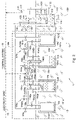
- FIG. 2 a schematic cross-sectional view of the system 1 for energy storage and electricity generation of Fig. 1 is illustrated.
- the energy storage subsystem 10 of the system 1 for energy storage and electrical power generation includes two identical energy storage branches, such as a first energy storage branch 101a and a second energy storage branch 101b.
- the first energy storage branch 101a includes a first air compressing vessel 11a configured to collect water and air from the atmosphere and to compress the air to a predetermined pressure.
- the first energy storage branch 101a also includes a first air storage vessel 12a pneumatically communicating with the first air compressing vessel 11a and configured to hold compressed air.
- the second energy storage branch 101b includes a second air compressing vessel 11b configured to collect water and air from the atmosphere and to compress the air to a predetermined pressure.
- the second energy storage branch 101b also includes a second air storage vessel 12b pneumatically communicating with the second air compressing vessel 11b and configured to hold compressed air.
- first and second air storage vessels 12a and 12b can be used to achieve the increase in compressed air volume. This additional volume can also absorb the pressure transients resulting from changes in the state-of-charge of the first and second air compressing vessels 11a and 11b.
- the first and second air compressing vessels 11a, 11b , and the air storage vessels 12a, 12b can, for example, be constructed on the ground surface and/or under the ground.
- the vessels, which are built on the ground may be not economically viable when high volumes are required.
- the vessels when the vessels are built on the ground, they require a high level of maintenance and must accommodate many safety regulations.
- the first and second air compressing vessels 11a, 11b and the first and second air storage vessels 12a, 12b are mounted in corresponding boreholes made in the ground 13. Building the air compressing vessels 11a, 11b and the air storage vessels 12a, 12b underground can facilitate effective use of the ground surface in the regions where the underground construction is placed, and preserve the site's appearance.
- the first and second air storage vessels 12a, 12b and the first and second compressing vessels 11a, 11b in the boreholes are surrounded by a compacted and thermally isolated filling material 1040 filling the space between walls of the vessels and walls of the borehole. It should be understood that when the first and second air storage vessels 12a and 12b and the first and second compressing vessels 11a, 11b are thermally isolated, they can keep the heat accumulated during compression of the air in the first and second air compressing vessels 11a and 11b for a relatively long time.
- the entire depth of the boreholes is mainly determined by the soil properties and by the maximal value of the desired magnitude of the pressure of the compressed air that is compressed in the first and second compressing vessels 11a, 11b and then is stored in the first and second air storage vessels 12a and 12b.
- the depth of the borehole is such that the vessels are located relatively deep inside the ground in order to be anchored, due to resistance of the filling material surrounding the vessels.
- the air pressure within the first and second air storage vessels 12a and 12b communicating with the first and second air compressing vessels 11a and 11b should be sufficient to drive the electricity generation subsystem 100.
- the air pressure within the first and second air storage vessels 12a and 12b can be in the range of about 10 bar to 500 bar.
- first and second air storage vessels 12a, 12b and the first and second air compressing vessels 11a , 11b can have any desired shape and be constructed of a suitable metal, plastic or composite material appropriate to withstand the strain on the walls caused by the air-hydraulic pressure inside the vessels.
- the vessels suitable for the first and second air compressing vessels 11a , 11b and for first and second the air storage vessels 12a, 12b are described in International Pat. Appl. Publ. WO2018/092122A1 .
- the first energy storage branch 101a of the energy storage subsystem 10 includes a first compressed air manifold 16a pneumatically coupled to the first air compressing vessel 11a and to the first the air storage vessel 12a.
- the second energy storage branch 101b includes a second compressed air manifold 16b pneumatically coupled to the second air compressing vessel 11b and to the second air storage vessel 11b.
- the first and second compressed air manifolds 16a and 16b are configured to provide pneumatic communication between the first and second air compressing vessels 11a , 11b and the first and second air storage vessels 12a, 12b, correspondingly.
- the first energy storage branch 101a includes a first air inlet manifold 17a pneumatically coupled to the compressed air manifold 16a
- the second energy storage branch 101b includes a second air inlet manifold 17b pneumatically coupled to the second compressed air manifold 16b.
- the first and second air inlet manifolds 17a and 17b are adapted to provide air from the atmosphere, so as to compress the air in the first and second air compressing vessels 11a , 11b and to fill the first and second air storage vessels 12a, 12b with the compressed air, correspondingly.
- the first energy storage branch 101a includes a first air valve assembly 104a, while the second energy storage branch 101b includes a second air valve assembly 104b.
- the first air valve assembly 104a includes a first air storage valve 1041a arranged in the first compressed air manifold 16a between the first air storage vessel 12a and a first coupling point 190a of the first air inlet manifold 17a to the first compressed air manifold 16a.
- the first air valve assembly 104a also includes a first compressed air valve 1042a arranged in the first compressed air manifold 16a between the first air compressing vessel 11a and the first coupling point 190a.
- the first air storage valve 1041a and the first compressed air valve 1042a are provided for control of passage of the compressed air from the first air compressing vessel 11a to the first air storage vessel 12a.
- the first air valve assembly 104a further includes a first inlet air valve 1043a configured for controlling the supply of air.
- the air is supplied for compression in the first air compressing vessel 11a and for storage of the compressed air in the first air storage vessel 12a.
- the second air valve assembly 104b includes a second air storage valve 1041b arranged in the second compressed air manifold 16b between the second air storage vessel 12b and a second coupling point 190b of the second air inlet manifold 17b to the second compressed air manifold 16b.
- the second air valve assembly 104b also includes a second compressed air valve 1042b arranged in the second compressed air manifold 16b between the second air compressing vessel 11b and the second coupling point 19b.
- the second air storage valve 1041b and the second compressed air valve 1042b are provided for control of passage of the compressed air from the second air compressing vessel 11b to the second air storage vessel 12b.
- the second air valve assembly 104b further includes a second inlet air valve 1043b configured for controlling supply of air.
- the air is supplied for compression in the second air compressing vessel 11b and for storage of the compressed air in the second air storage vessel 12b.
- the first energy storage branch 101a of the energy storage subsystem 10 also includes a first water inlet manifold 19a hydraulically coupled to the first air compressing vessel 11a.
- the first water inlet manifold 19a is configured to supply water to the first air compressing vessel 11a.
- the energy storage subsystem 10 can include a second water inlet manifold 19b that can be arranged in the second energy storage branch 101b.
- the second water inlet manifold 19b can be hydraulically coupled to the second air compressing vessel 11b and configured to provide water to the second air compressing vessel 11b .
- the first energy storage branch 101a also includes a first upper inlet water valve 191a and a first lower inlet water valve 195a, which are both arranged in the first water inlet manifold 19a and configured for controlling supply of water into the first air compressing vessel 11a.
- the second energy storage branch 101b includes a second upper inlet water valve 191b and a second lower inlet water valve 195b, which are both arranged in the second water inlet manifold 19b and configured for controlling supply of water into the first air compressing vessel 11b .
- the first air compressing vessel 11a or the second air compressing vessel 11b can be pre-filled charged with water using one or more water compressors (not shown) that can be either a part of the subsystem 10 or be separate units.
- the subsystem 10 can also include one or several safety valves (not shown) that can automatically open when pressure in the first and/or second air compressing vessels 11a, 11b reaches a dangerous level.
- the system 1 for energy storage and electrical power generation includes a water exchange manifold 102 hydraulically coupled to the first water inlet manifold 19a between the first upper and lower inlet water valves at one end of the water exchange manifold 102, and to the second water inlet manifold 19b between the second upper and lower inlet water valves at another end of the water exchange manifold 102.
- the first energy storage branch 101a can also include a first sprinkler manifold 194a coupled to the first water inlet manifold 19a at one end of first sprinkler manifold 194a, and inserted into the first air compressing vessel 11a at another end of first sprinkler manifold 194a.
- the first sprinkler manifold 194a is configured to enable hydraulic communication of the first air compressing vessel 11a with the water exchange manifold 102.
- the first sprinkler manifold 194a is equipped with a first sprinkler nozzle 192a at the end that is inserted into the first compressing vessel 11a.
- the first sprinkler manifold 194a is also equipped with a first sprinkler valve 193a configured for controlling supply of water into the first air compressing vessel 11a through the first sprinkler nozzle 192a.
- the second energy storage branch 101b can also include a second sprinkler manifold 194b coupled to the second water inlet manifold 19b at one end of the second sprinkler manifold 194b, and inserted into the second air compressing vessel 11b at another end.
- the second sprinkler manifold 194b is configured to enable hydraulic communication of the second air compressing vessel 11b with the water exchange manifold 102.
- the second sprinkler manifold 194b is equipped with a second sprinkler nozzle 192b the end of which is inserted into the second air compressing vessel 11b.
- the second sprinkler manifold 194b is also equipped with a second sprinkler valve 193b configured for controlling supply of water into the second air compressing vessel 11b through the second sprinkler nozzle 192b.
- the energy storage subsystem 10 further includes a reverse water pump 103 arranged in the water exchange manifold 102.
- the reverse water pump 103 is an electric pump that is coupled to an electrical power grid 15 and powered by electricity.
- the reverse water pump 103 is configured to pump the water for exchange between the first and second air compressing vessels 11a and 11b of the first and second energy storage branches 101a and 101b, correspondingly.
- the energy storage subsystem 10 includes a first water exchange valve 105a and a second water exchange valve 105b.
- the first water exchange valve 105a is arranged in the water exchange manifold 102 between the first coupling point 190a and the reverse water pump 103
- the second water exchange valve 105b is arranged in the water exchange manifold 102 between the second coupling point 190b and the reverse water pump 103.
- the first air storage vessel 12a and the second air storage vessel 12b can be pneumatically coupled by a compressed air exchange manifold 106.
- the energy storage subsystem 10 includes a first air exchange valve 107a and a second air exchange valve 107b.
- Operation of the energy storage subsystem 10 begins from pre-charging either the first air compressing vessel 11a or the second air compressing vessel 11b with water.
- the first upper inlet water valve 191a and the first lower inlet water valve 195a arranged in the first water inlet manifold 19a of the first energy storage branch 101a must be opened to enable access of water to the first air compressing vessel 11a.
- the first compressed air valve 1042a and the first inlet air valve 1043a are also open to enable escape of the air from the first air compressing vessel 11a during the pre-filling with water.
- the first air storage valves 1041a, the first water exchange valve 105a and the first air exchange valve 107a must be closed to avoid escape of the water from the first air compressing vessel 11a.
- water can be additionally supplied through the first sprinkler manifold 194a. In this case, the first sprinkler valve 193a should also be opened.
- operation of the energy storage subsystem 10 can begin from pre-charging the second air compressing vessel 11b with water, mutatis mutandis.
- the first upper inlet water valve 191a and the first sprinkler valve 193a are closed, while the first lower inlet water valve 195a arranged in the first water inlet manifold 19a is opened to provide inlet of water from the first air compressing vessel 11a.
- the second upper inlet water valve 191b and the second lower inlet water valve 195b arranged in the second water inlet manifold 19b are closed, while the first inlet air valve 1043a and the first compressed air valve 1042a are opened to provide inlet of air into the first air compressing vessel 11a.
- the second sprinkler valve 193b is opened to provide inlet of water into the first water inlet manifold 19a.
- the second compressed air valve 1042b arranged in the second compressed air manifold 16b of the second energy storage branch 101b is also closed.
- the first sprinkler valve 193a, the second air storage valve 1041b and the second compressed air valve 1042b are closed, while the first water exchange valve 105a and the second water exchange valve 105b arranged in the water exchange manifold 102 are opened.
- the reverse water pump 103 is activated to pump the water from the first air compressing vessel 11a of the first energy storage branch 101a into the second air compressing vessel 11b of the second energy storage branch 101b.
- the water passes through the second sprinkler manifold 194b, and is sprayed through the second sprinkler nozzle 192b. Accordingly, the water is accumulated in the second air compressing vessel 11b, while the air located in the second air compressing vessel 11b is compressed.
- the temperature of the air in the second air compressing vessel 11b may increase above the temperature of the original air temperature in the second air compressing vessel 11b.
- the internal heat generated due to the compressing process of the air is also transferred to the water due to exchange of heat with the sprayed water. Indeed, the heat can be exchanged between the water and the air due to continuous contact between the air and water droplets sprayed from the second sprinkler nozzle 192b.
- the second air storage valve 1041b and the second compressed air valve 1042b arranged in the second compressed air manifold 16b are opened to enable passage of the compressed air from the second air compressing vessel 11b into the second air storage vessels 12b, due to air pressure difference between the second air compressing vessel 11b and the second air storage vessels 12b.
- the second inlet air valve 1043b is closed to avoid escape of the air from the second compressed air manifold 16b during the air passage.
- the reverse water pump 103 is deactivated, and the second water exchange valve 105b is closed. Then, the second air storage valve 1041b is closed, while the second compressed air valve 1042b and the second inlet air valve 1043b are open to enable inlet flow of air from the atmosphere into the air compressing vessel 11b.
- first lower inlet water valve 195a arranged in the first water inlet manifold 19a is closed, while the first and second water exchange valves 105a and 105b arranged in the water exchange manifold 102 are open, and the reverse water pump 103 is activated in the opposite direction to pump the water from the second air compressing vessel 11b of the second energy storage branch 101b into the first air compressing vessel 11a of the first energy storage branch 101a.
- the water passes through the first sprinkler manifold 194a, and is sprayed through the first sprinkler nozzle 192a. Accordingly, the water is accumulated in the first air compressing vessel 11a, while the air located in the first air compressing vessel 11a is compressed.
- the first air storage valve 1041a and the first compressed air valve 1042a arranged in the first compressed air manifold 16a are opened to enable passage of the compressed air from the first air compressing vessel 11a into the first air storage vessels 12a due to the pressure difference between the first air compressing vessel 11a and the first air storage vessels 12a.
- the first inlet air valve 1043a is closed to avoid escape of the air from the first compressed air manifold 16a during the air passage.
- the reverse water pump 103 is deactivated, and the first water exchange valve 105a is closed.
- the temperature of the air in the first air compressing vessel 11a may increase above the temperature of the original air temperature in the first air compressing vessel 11a.
- the internal heat generated due to the compressing process of the air is also transferred to the water due to exchange of heat with the sprayed water. Indeed, heat can be exchanged between the water and the air due to continuous contact between the air and water droplets sprayed from the second sprinkler nozzle 192b.
- Such a compression process can be repeated as many times as required for reaching the desired pressure of the air in the first and second air storage vessels 12a and 12b.
- a temperature of the water in the first and second air compressing vessels 11a and 11b as well a temperature of the air in the first and second air storage vessels 12a and 12b are greater than the temperature of the external air in the atmosphere.
- the system 1 for energy storage and electrical power generation uses the compressed gas of the first and/or second air storage vessels 12a and 12b of the energy storage subsystem 10 for producing electricity by the electricity generation subsystem 100.
- the system 1 for energy storage and electricity generation includes an air pipeline 108 and an air control valve 109.
- the hydraulic control valve 109 is coupled to the air pipeline 108 and to the compressed air exchange manifold 106, and is configured to regulate the flow of the compressed gas released from the first and second air storage vessels 12a and 12b that passes through the compressed air exchange manifold 106 into the air pipeline 108.
- the regulation is such that a desired flow rate of egress of the compressed gas is maintained over specified periods of time through the air pipeline 108.
- the compressed gas transferred through the air pipeline 108 can be supplied to the electricity generation subsystem 100.
- the electricity generation subsystem 100 includes an airlift pumping system 110 and a hydro-electric power system 117 driven by the airlift pumping system 110.
- the airlift pumping system 110 includes a water collecting tank 111 arranged under the ground.
- the water collecting tank 111 contains collecting water 112 to be pumped. It should be understood that the collecting water 112 can be pumped into the water collecting tank 111 through a water collecting manifold 120 from any water source. Supply of the collecting water 112 can be controlled by a water collecting valve 121 arranged in the water collecting manifold 120.
- the water accumulated in the air compressing vessels 11a and 11b can also be used as the collecting water 112. In this case, it can be pumped into the water collecting tank 111 through water collecting manifold 120, mutatis mutandis, after the end of the air compression process.
- the airlift pumping system 110 also includes a riser tube 113 which is partially immersed in the water 112. Compressed air is injected at a base 114 of the riser tube 113 through the air pipeline 108 equipped with an air injector 115 to provide air bubbles within the riser tube 113 that produce an upward flow of the water, together with the air bubbles.
- the air injector 115 is coupled to the base 114 of the riser tube 113 through a plurality of jacket holes 116 uniformly distributed around the pipe perimeter in a plurality of rows and/or columns to ensure uniform feed of the air into the riser tube 113.
- the compressed air supplied by the air pipeline 108 enters the riser tube 113 through the jacket holes 116, forming bubbles which move the water within the riser tube 113 in the upward direction.
- the hydro-electric power system 117 includes an air release outlet 119 through which air released from the bubbles escapes into the atmosphere.
- the airlift pumping system includes a returning tube 1130 hydraulically coupled to the hydro-electric power system 117.
- the returning tube 1130 is configured for returning a flow containing the returning water 1131 after passing through the hydro-electric power system 117.
- the flow of retuning water 1131 without air bubbles returns to the water collecting tank 111 after passing through the hydro-electric power system 117.
- the returning water flow returns to the water collecting tank 111 through a circulation opening 118 arranged at a wall of the water collecting tank 111.
- the reverse water pump 103 of the energy storage subsystem 10 is an electric pump that is coupled to the electrical power grid 15 and powered by electricity. In operation, the reverse water pump 103 pumps the water for exchange between the first and second air compressing vessels 11a and 11b of the first and second energy storage branches 101a and 101b, correspondingly, so as to compress air and store the compressed air in the first and second air storage vessels 12a and 12b.
- the compressed air exiting the air storage subsystem 10 can be controllably supplied at a desired pressure through the pipeline 108 to drive the hydro-electric power system 117 arranged within the riser tube 113.
- the hydro-electric power system 117 includes a housing 31 that includes the air release outlet 119 at a top portion 32 through which air released from the bubbles escapes into the atmosphere.
- the hydro-electric power system 117 includes a hydraulic turbine 33 mounted in the housing 31.
- the hydraulic turbine 33 has turbine reel 34 equipped with turbine blades 35.
- the hydraulic turbine 33 is driven by flow of water and bubbles acting on the turbine blades 35.
- the water flow is generated by air-lift and is provided by the riser tube 113.
- the water is accumulated at a bottom portion 36 of the housing 31, and then returns to the water collecting tank (111 in Fig. 2 ) through the returning tube 1130 that is coupled to the bottom portion 36.
- the hydro-electric power system 117 also includes an electrical generator (not shown) coupled to hydraulic turbine 33.
- the electrical generator is connected to an electrical power grid (15 in Fig. 2 ), and is configured to generate output electrical power and provide it to the electrical power grid.
- Excess electrical energy in the electrical power grid 15 can again be converted into pneumatic-energy, and thus be stored in the energy storage subsystem 10 through air compression.
- the pneumatic-energy may then be converted back to electricity by the hydro-electric power system 117 and fed into the grid, and so on.
- the design parameters include configuration of the airlift pumping system 110, e.g., the diameter and height of the riser tube 113 and other geometrical characteristics.
- the operating parameters include the submersion ratio in the airlift pumping system 110, and the gas flow rate.
- the temperature of the compressed gas can also affect performance of the airlift pumping system 110.
- the greater the temperature of the compressed gas the greater the flow rate of the upward flow of the water together with the air bubbles in the riser tube 113.
- the compressed air stored in the first and second air storage vessels 12a and 12b of the energy storage subsystem 10 and the water inside the compressing vessels 11a and 11b has a temperature greater than the temperature of the ambient air in the atmosphere.
- the first and second air storage vessels 12a, 12b and the compressing vessels 11a and 11b are thermally isolated from the environment, the increased temperature of the compressed air and the water can be maintained for a relatively long time.
- the energy storage and electricity generation system 1 advantageously leverages this feature for enhancing the performance of the electricity generation subsystem 100 by storing the heat generated by the air compressing process and then later recovering this heat by the electrical power generation process.
- the system 1 for energy storage and electricity generation includes a control system generally indicated by a reference numeral 18.
- the control system 18 is coupled, inter alia, to the air control valve 109 arranged in the air pipeline 108 to regulate the flow of the compressed gas released from the first and second air storage vessels 12a and 12b of the energy storage subsystem 10 so that a desired flow rate of egress of the compressed gas is maintained over specified periods of time through the air pipeline 108.
- the control system 18 is a computer system that, generally, may include, without limitations, flow meters, sensors, actuators, monitoring devices, as well as other similar or suitable devices. Each may be a commercially available component.
- the control system 18 also includes an electronic controller (not shown) programmed with a software model stored in a computer-readable medium (not shown), and configured for controlling operation of the energy storage and electricity generation system 1.
- the control system can include one or more pneumatic pressure sensors (not shown) that can be operable for producing air pressure sensor signals throughout operation of the system.
- the control system can include one or more hydraulic pressure sensors (not shown) that can be operable for producing hydraulic pressure sensor signals throughout operation of the system. Location of the pneumatic and hydraulic pressure sensors depends on the specific configuration of the system.
- the pneumatic pressure sensors can be arranged in the first and second air storage vessels 12a and 12b.
- the hydraulic pressure sensors can be arranged within the first and second air compressing vessels 11a and 11b that are occupied by water.
- the control system 18 can alert the operator of any detrimental pressure drops.
- the gas and hydraulic pressure sensor signals can be relayed to control system 18 via a connecting wire, or wirelessly.
- the control system 18 includes an upper water level sensor (not shown) arranged inside the water collecting tank 111.
- the upper water level sensor is configured for producing level signals to ensure that the level of water inside the water collecting tank 111 is within a predetermined level limit range.
- the control system 18 can include one or more pneumatic pressure sensors.
- a pneumatic pressure sensor P can be arranged within the air pipeline 108 and measure a pressure of the air passing through the air pipeline 108.
- the electronic controller of the control system 18 can be operatively coupled to the pneumatic pressure sensors, the hydraulic pressure sensor, and the water level sensors, for controllable compression of air.
- the electronic controller can, inter alia, be responsive to the air pressure sensor signals, the hydraulic pressure sensor signals, the level signals and the air and water flow sensor signals, respectively, for controlling operation of the energy storage subsystem 10.
- the control system 18 can include one or more hydraulic and pneumatic flow meters (not shown).
- a pneumatic flow meter AF can be arranged within the air pipeline 108 to produce air flow sensor signals representative of the air flows within the air pipeline 108.
- the electronic controller of the control system 18 is coupled to the air control valve 109.
- the pneumatic flow meter AF is operatively coupled to the electronic controller.
- the pneumatic flow meter AF is configured to produce air flow sensor signals representative of the air flow within the air pipeline 108.
- the electronic controller can be responsive to air flow sensor signals and configured generate control signals to control, inter alia, operation of the pneumatic control valve 109 in order to regulate flow of the compressed gas released from the first and second air storage vessels 12a and 12b of the energy storage subsystem 10 so as to provide controllable discharge of the compressed air required to drive the airlift pumping system 110.
- a hydraulic flow meter (not shown) can be arranged within the riser tube 113 of the airlift pumping system 110 to produce water flow sensor signals representative of the water flow within the riser tube 113.
- the hydraulic flow meter is coupled to the electronic controller of the control system which is, inter alia, responsive to the water flow sensor signal and for controlling operation of the hydro-electric power system 117.
- a desired air flow rate can be specified and maintained by the electronic controller during operation of the system.
- the air control valve 109 ensures a stable supply of pressurized air to produce constant electrical power output over stipulated periods, hence overcoming certain technical problems encountered with conventional technology when feeding electricity to the grid.
- the electronic controller of the control system 18 can also be operatively coupled to the first and second air storage valves 1041a, 1041b and to the first and second compressed air valves 1042a, 1042b for control of passage of the compressed air from the first and second air compressing vessels 11a, 11b to the first and second air storage vessels 12a, 12b, correspondingly.
- the control system 18 can also be operatively coupled to the first and second inlet air valves 1043a, 1043b for controlling supply of air for compression in the first and second air compressing vessels 11a, 11b, correspondingly.
- the electronic controller of the control system 18 can also be operatively coupled to the first and second upper inlet water valve 191a, 191b, to the first and second lower inlet water valve 195a, 195b as well as to the first and second water exchange valves 105a, 105b; and to the reverse water pump 103 for regulating water exchange between the first and second air compressing vessels 11a and 11b of the first and second energy storage branches 101a and 101b, as described above.
- the system can include an energy storage subsystem and an electricity generation subsystem coupled to the energy storage subsystem.
- the energy storage subsystem can be configured to store energy in the form of compressed air at a temperature greater than a temperature of ambient air in the atmosphere.
- the electricity generation subsystem can be configured to produce electricity by utilizing the compressed air stored in the energy storage subsystem at the temperature greater than the temperature of ambient air in the atmosphere.
Landscapes
- Engineering & Computer Science (AREA)
- Mechanical Engineering (AREA)
- General Engineering & Computer Science (AREA)
- Chemical & Material Sciences (AREA)
- Combustion & Propulsion (AREA)
- Power Engineering (AREA)
- Physics & Mathematics (AREA)
- Fluid Mechanics (AREA)
- Life Sciences & Earth Sciences (AREA)
- Sustainable Development (AREA)
- Sustainable Energy (AREA)
- Other Liquid Machine Or Engine Such As Wave Power Use (AREA)
- Filling Or Discharging Of Gas Storage Vessels (AREA)
- Memory System Of A Hierarchy Structure (AREA)
Description
- This invention relates to technologies storing and generating energy, and more particularly to energy storage and retrieval systems.
- The world's demand for electric energy is continuously increasing. A vast amount of electric energy is currently generated by oil, gas, coal or nuclear plants. However, burning oil, gas and coal results in polluted air, and all of these fuel resources are rapidly diminishing. Nuclear energy requires the disposal of nuclear waste, which remains dangerous for centuries.
- Natural energy sources are effectively inexhaustible and are abundantly available throughout the world in various forms such as natural wind, solar, tidal and wave energy. Unfortunately, natural energy sources have an irregular nature, and peak demands for electrical energy in homes and in industry are usually out of phase with the availability of renewable energy resources.
- For example, wind energy conversion technology is today regarded as one of the most technically advanced technologies available that can effectively help develop a low carbon economy while ensuring a clean and secure supply of energy. However, wind is inherently variable. Some days are windy, some are not, and, even during a single day, wind varies throughout the day. Consequently, a mismatch frequently occurs between peak demand from the electrical grid and wind energy availability, since there are many time periods with low winds during peak demand, and vice versa, high winds during periods when the demands of the electrical grid may be low, such as in the evening.
- Similarly, solar energy is most abundant typically during the middle of the day, while it diminishes during evening hours, when there is peak demand. Likewise, solar cells generate no electricity at night.
- Accordingly, it is necessary that the energy obtained from renewable energy resources be somehow stored so as to be releasable during periods of power demand, as required.
- A variety of techniques are available to store excess power for later delivery. One approach to energy storage is the use of batteries. Large storage batteries have been developed on a commercial basis and have been used both in residences and in industry. Electrical storage batteries are, however, inferior, due to problems related to durability and maintenance. Moreover, many large-scale batteries use a lead electrode and acid electrolyte, and these components are environmentally hazardous. In addition, batteries suffer from high degradation and thus require mandatory replacement every several years, depending on the frequency of use.
-
U.S. Pat. No. 4,058,979 describes combined thermal and compressed air storage systems that utilize an exhaustless heater, such as a thermal storage unit, to provide power with enhanced efficiency. Compressed air is heated by the thermal storage unit prior to entering a turbine, which powers an electrical generator. In various embodiments, ambient air temperature, turbine exhaust or other types of waste heat are used to preheat the compressed air prior to the compressed air entering the thermal storage unit, thereby further increasing system efficiency. Another example of a system for energy storage is disclosed inUS 7281371 B1 . - Aspects and embodiments of the present invention are set out in the appended claims. These and other aspects and embodiments of the invention are also described herein.
- The concept of the disclosure involves storage of pressurized gas for further utilization in order to store energy and later (when required) to generate electric power.
- Thus, according to a general aspect not forming part of the claimed invention, there is provided a system for energy storage and an electrical power generation that includes an energy storage subsystem and an electricity generation subsystem coupled to the energy storage subsystem.
- According to an aspect of the present invention, there is provided a system for energy storage being configured to store energy in the form of compressed air, the system comprising: a first energy storage branch and a second energy storage, the first energy storage branch including: a first air compressing vessel arranged in a borehole made in the ground, and configured to collect water and air from the atmosphere and to compress the air to a predetermined pressure; a first air storage vessel pneumatically communicating with the first air compressing vessel and configured to hold compressed air; a first compressed air manifold pneumatically coupled to the first air compressing vessel and to the first the air storage vessel, and configured to provide pneumatic communication between the first air compressing vessel and the first air storage vessel; a first air inlet manifold pneumatically coupled to the compressed air manifold, and configured to provide air from the atmosphere, so as to compress the air in the first air compressing vessel and to fill the first air storage vessel with the compressed air; a first air valve assembly including: a first air storage valve arranged in the first compressed air manifold between the first air storage vessel and a first coupling point of the first air inlet manifold to the first compressed air manifold and configured for control of passage of the compressed air from the first air compressing vessel into the first air storage vessel; a first compressed air valve arranged in the first compressed air manifold between the first air compressing vessel and the first coupling point, and configured for control of passage of the compressed air from the first air compressing vessel into the first air storage vessel; and a first inlet air valve configured for controlling supply of air for compression in the first air compressing vessel and for storage of the compressed air in the first air storage vessel; a first water inlet manifold hydraulically coupled to the first air compressing vessel and configured to supply water to the first air compressing vessel; a first upper inlet water valve and a first lower inlet water valve arranged in the first water inlet manifold and configured for controlling supply of water into the first air compressing vessel; the second energy storage branch including: a second air compressing vessel arranged in a borehole made in the ground, and configured to collect water and air from the atmosphere and to compress the air to a predetermined pressure; a second air storage vessel pneumatically communicating with the second air compressing vessel and configured to hold compressed air and pneumatically coupled to the first air storage vessel via a compressed air exchange manifold; a second compressed air manifold pneumatically coupled to the second air compressing vessel and to the second air storage vessel, and configured to provide pneumatic communication between the second air compressing vessel and the second air storage vessel; a second air inlet manifold pneumatically coupled to the compressed air manifold, and configured to provide air from the atmosphere so as to compress air in the second air compressing vessel and to fill the second air storage vessel with the compressed air; a second air valve assembly including: a second air storage valve arranged in the second compressed air manifold between the second air storage vessel and a second coupling point of the second air inlet manifold to the second compressed air manifold and configured for control of passage of the compressed air from the second air compressing vessel into the second air storage vessel; a second compressed air valve arranged in the second compressed air manifold between the second air compressing vessel and the second coupling point and configured for control of passage of the compressed air from the second air compressing vessel into the second air storage vessel; and a second inlet air valve configured for controlling supply of air for compression in the second air compressing vessel and for storage of the compressed air in the second air storage vessel; a second water inlet manifold hydraulically coupled to the second air compressing vessel, and configured to supply water to the second air compressing vessel; a second upper inlet water valve and a second lower inlet water valve arranged in the second water inlet manifold and configured for controlling supply of water into the second air compressing vessel; wherein the compressed air during storage has a temperature greater than the temperature of ambient air in the atmosphere
- According to an embodiment of the present invention, the first and second air storage vessels are arranged in corresponding boreholes made in the ground
- According to an embodiment of the present invention, the first and second air storage vessels, and the first and second air compressing vessels in the corresponding boreholes are surrounded by a compacted and thermally isolated filling material filling a space between walls of the vessels and walls of the borehole.
- According to an embodiment of the present invention, the system for energy storage further comprises a water exchange manifold hydraulically coupled to the first water inlet manifold of the first energy storage branch between the first upper and lower inlet water valves at one end of the first water inlet manifold and to the second water inlet manifold of the second energy storage branch between the second upper and lower inlet water valves at another end of the first water inlet manifold; and a reverse water pump arranged in the water exchange manifold, the reverse water pump is configured to pump the water for exchange between the first and second air compressing vessels of the first and second energy storage branches, correspondingly.
- According to an embodiment of the present invention, the first energy storage branch further includes: a first sprinkler manifold coupled to the first water inlet manifold at one end of first sprinkler manifold, and inserted into the first air compressing vessel at another end of first sprinkler manifold, the first sprinkler manifold being configured to enable hydraulic communication of the first air compressing vessel with the water exchange manifold; a first sprinkler nozzle at the end that is inserted into the first compressing vessel, and a first sprinkler valve configured for controlling supply of water into the first air compressing vessel through the first sprinkler nozzle and wherein the second energy storage branch includes: a second sprinkler manifold coupled to the second water inlet manifold at one end of second sprinkle manifold, and inserted into the second air compressing vessel at another end of the second sprinkler manifold, the second sprinkler manifold is configured to enable hydraulic communication of the second air compressing vessel with the water exchange manifold; a second sprinkler nozzle at the end that is inserted into the second compressing vessel, and a second sprinkler valve configured for controlling supply of water into the second air compressing vessel through the second sprinkler nozzle.
- According to an embodiment of the present invention, the system for energy storage further comprises: a first water exchange valve arranged in the water exchange manifold between said first coupling point of the first air inlet manifold to the first compressed air manifold and the reverse water pump; and a second water exchange valve arranged in the water exchange manifold between said second coupling point and the reverse water pump, the first water exchange valve and the second water exchange valve are adapted to control exchange of water between the first and second air compressing vessels.
- According to an embodiment of the present invention, the system for energy storage further comprises a first air exchange valve and a second air exchange valve, the first and second exchange valves are adapted to control the exchange of compressed air between the first and second air storage vessels.
- According to an embodiment of the present invention, the system for energy storage comprises an air pipeline, and an air control valve coupled to the compressed air exchange manifold and to the air pipeline, the air control valve configured to regulate the flow of the compressed gas released from the first and second air storage vessels of the system for energy storage such that a desired flow rate of egress of the compressed gas is maintained over specified periods of time through the air pipeline.
- According to an embodiment of the present invention, the system for energy storage includes a control system coupled to the air control valve arranged in the air pipeline to regulate the flow of the compressed gas through the air pipeline.
- According to an embodiment of the present invention, the control system includes an electronic controller coupled to the air control valve, and a pneumatic flow meter arranged within the air pipeline and operatively coupled to the electronic controller; the pneumatic flow meter is configured to produce air flow sensor signals representative of the air flow within the air pipeline; the electronic controller is responsive to air flow sensor signals and configured to control operation of the air control valve to regulate the flow of the compressed gas released from the first and second air storage vessels of the system for energy storage.
- According to an embodiment not covered by the claimed invention, the electricity generation subsystem includes an airlift pumping system pneumatically coupled to the air control valve arranged in the air pipeline, and a hydro-electric power system driven by the airlift pumping system.
- According to an embodiment of the unclaimed electricity subsystem, the airlift pumping system includes a water collecting tank containing collecting water, and a riser tube having a base immersed in the collecting water. The airlift pumping system is configured for injecting the compressed air into the riser tube through the air pipeline to provide air bubbles within the riser tube. The air bubbles produce an upward flow of the collecting water together with the air bubbles to drive the hydro-electric power system.
- According to an embodiment of the unclaimed electricity subsystem, the air pipeline includes an air injector coupled to the base of the riser tube through a plurality of jacket holes. The jacket holes are uniformly distributed around the perimeter of the riser pipe in a plurality of rows and/or columns to ensure uniform feed of the air into the riser tube.
- According to an embodiment of the unclaimed electricity subsystem, the airlift pumping system includes a returning tube hydraulically coupled to the hydro-electric power system. The returning tube is configured for returning a flow containing returning water into the water collecting tank after passing through the hydro-electric power system.
- According to an embodiment of the unclaimed electricity subsystem, the water collecting tank includes a circulation opening coupled to the returning tube for receiving the flow of the returning water after passing through the hydro-electric power system.
- According to an embodiment of the unclaimed electricity subsystem, the hydro-electric power system includes an air release outlet. The air release outlet is configured for releasing air bubbles from the high speed water-air flow mixture after it was used to rotate a turbine of the hydro-electric power system.
- The energy storage and electricity generation system herein disclosed has many of the advantages of the prior art techniques, while simultaneously overcoming some of the disadvantages normally associated therewith.
- The system for energy storage and electricity generation herein disclosed enables mitigating problems associated with the unreliable intermittent supply of natural energy by providing a regulated supply of pressurized gas for generating electric energy.
- An additional advantage of the energy storage and electricity generation system herein disclosed is that it may be continually upgraded to be sized as needed, which is effective for both long term and short term energy storage.
- The system for energy storage and electrical power generation herein disclosed only requires minimal moving parts. Unlike other energy storage and/or electrical power generation technologies such as batteries, the system has a long service lifetime and its performance does not degrade with the number of energy storage cycles. Furthermore, the utilized materials are mainly limited to steel/concrete.
- There has thus been outlined, rather broadly, the more important features of the invention in order that the detailed description thereof that follows hereinafter may be better understood. Additional details and advantages of the invention will be set forth in the detailed description, and in part will be appreciated from the description, or may be learned by practice of the invention.
- The invention extends to methods, systems, kits of parts and apparatus substantially as described herein and/or as illustrated with reference to the accompanying figures.
- The invention also provides a computer program or a computer program product for carrying out any of the methods described herein, and/or for embodying any of the apparatus features described herein, and a computer readable medium having stored thereon a program for carrying out any of the methods described herein and/or for embodying any of the apparatus features described herein.
- The invention also provides a signal embodying a computer program or a computer program product for carrying out any of the methods described herein, and/or for embodying any of the apparatus features described herein, a method of transmitting such a signal, and a computer product having an operating system which supports a computer program for carrying out the methods described herein and/or for embodying any of the apparatus features described herein.
- The invention extends to any novel aspects or features described and/or illustrated herein. In addition, apparatus aspects may be applied to method aspects, and vice versa. Furthermore, any, some and/or all features in one aspect can be applied to any, some and/or all features in any other aspect, in any appropriate combination.
- It should also be appreciated that any particular combination of the various features described and defined in any aspects of the invention can be implemented and/or supplied and/or used independently.
- In order to understand the invention and to see how it may be carried out in practice, embodiments will now be described, by way of non-limiting example only, with reference to the accompanying drawings, in which:
-
Fig. 1 is a general schematic view of a system for energy storage and electricity generation; -
Fig. 2 is a schematic cross-sectional view of the system for energy storage and electrical power generation ofFig. 1 ; and -
Fig. 3 is a schematic cross-sectional view of a hydro-electric power system of the energy storage and electrical power generation system ofFig. 2 . - The principles and operation of the system for energy storage and electrical power generation may be better understood with reference to the drawings and the accompanying description. Aspects of the electricity generation subsystem do not form part of the claimed subject matter but are described to aid understanding of the invention. It should be understood that these drawings are given for illustrative purposes only and are not meant to be limiting. It should be noted that the figures illustrating various examples of the system of the present invention are not to scale, and are not in proportion, for purposes of clarity. It should be noted that the blocks, as well other elements in these figures, are intended as functional entities only, such that the functional relationships between the entities are shown, rather than any physical connections and/or physical relationships. The same reference numerals and alphabetic characters are utilized for identifying those components which are common in the system for energy storage and electricity generation and its components shown in the drawings throughout the present description of the invention. Examples of constructions are provided for selected elements. Those versed in the art should appreciate that many of the examples provided have suitable alternatives which may be utilized.
- Referring to
Fig. 1 , a general schematic view of asystem 1 for energy storage and electrical power generation is illustrated. Thesystem 1 for energy storage and electrical power generation includes anenergy storage subsystem 10 configured to store energy in the form of compressed air and anelectricity generation subsystem 100 coupled to theenergy storage subsystem 10 and configured to produce electricity by utilizing the compressed air stored in theenergy storage subsystem 10. Theenergy storage subsystem 10 and theelectricity generation subsystem 100 are coupled to anelectricity grid 15. The compressed air stored in theenergy storage subsystem 10 has a temperature greater than the temperature of the ambient air in the atmosphere. - Referring to
Fig. 2 , a schematic cross-sectional view of thesystem 1 for energy storage and electricity generation ofFig. 1 is illustrated. - The
energy storage subsystem 10 of thesystem 1 for energy storage and electrical power generation includes two identical energy storage branches, such as a firstenergy storage branch 101a and a secondenergy storage branch 101b. - The first
energy storage branch 101a includes a firstair compressing vessel 11a configured to collect water and air from the atmosphere and to compress the air to a predetermined pressure. The firstenergy storage branch 101a also includes a firstair storage vessel 12a pneumatically communicating with the firstair compressing vessel 11a and configured to hold compressed air. - Likewise, the second
energy storage branch 101b includes a secondair compressing vessel 11b configured to collect water and air from the atmosphere and to compress the air to a predetermined pressure. The secondenergy storage branch 101b also includes a secondair storage vessel 12b pneumatically communicating with the secondair compressing vessel 11b and configured to hold compressed air. - It should be understood that, when desired, a plurality of the first and second
air storage vessels air compressing vessels - Various types of air compressing vessels and air storage vessels can be used for the purpose of storing compressed gas. The first and second
air compressing vessels air storage vessels - The first and second
air compressing vessels air storage vessels ground 13. Building theair compressing vessels air storage vessels - The first and second
air storage vessels second compressing vessels material 1040 filling the space between walls of the vessels and walls of the borehole. It should be understood that when the first and secondair storage vessels second compressing vessels air compressing vessels - The entire depth of the boreholes is mainly determined by the soil properties and by the maximal value of the desired magnitude of the pressure of the compressed air that is compressed in the first and
second compressing vessels air storage vessels - The air pressure within the first and second
air storage vessels air compressing vessels electricity generation subsystem 100. For example, the air pressure within the first and secondair storage vessels - It should be understood that generally, the first and second
air storage vessels air compressing vessels - For example, the vessels suitable for the first and second
air compressing vessels air storage vessels WO2018/092122A1 . - The first
energy storage branch 101a of theenergy storage subsystem 10 includes a firstcompressed air manifold 16a pneumatically coupled to the firstair compressing vessel 11a and to the first theair storage vessel 12a. Likewise, the secondenergy storage branch 101b includes a secondcompressed air manifold 16b pneumatically coupled to the secondair compressing vessel 11b and to the secondair storage vessel 11b. The first and secondcompressed air manifolds air compressing vessels air storage vessels - The first
energy storage branch 101a includes a first air inlet manifold 17a pneumatically coupled to thecompressed air manifold 16a, while the secondenergy storage branch 101b includes a secondair inlet manifold 17b pneumatically coupled to the secondcompressed air manifold 16b. The first and secondair inlet manifolds 17a and 17b are adapted to provide air from the atmosphere, so as to compress the air in the first and secondair compressing vessels air storage vessels - The first
energy storage branch 101a includes a firstair valve assembly 104a, while the secondenergy storage branch 101b includes a secondair valve assembly 104b. - The first
air valve assembly 104a includes a firstair storage valve 1041a arranged in the firstcompressed air manifold 16a between the firstair storage vessel 12a and afirst coupling point 190a of the first air inlet manifold 17a to the firstcompressed air manifold 16a. The firstair valve assembly 104a also includes a firstcompressed air valve 1042a arranged in the firstcompressed air manifold 16a between the firstair compressing vessel 11a and thefirst coupling point 190a. The firstair storage valve 1041a and the firstcompressed air valve 1042a are provided for control of passage of the compressed air from the firstair compressing vessel 11a to the firstair storage vessel 12a. - The first
air valve assembly 104a further includes a firstinlet air valve 1043a configured for controlling the supply of air. The air is supplied for compression in the firstair compressing vessel 11a and for storage of the compressed air in the firstair storage vessel 12a. - Likewise, the second
air valve assembly 104b includes a secondair storage valve 1041b arranged in the secondcompressed air manifold 16b between the secondair storage vessel 12b and asecond coupling point 190b of the secondair inlet manifold 17b to the secondcompressed air manifold 16b. The secondair valve assembly 104b also includes a secondcompressed air valve 1042b arranged in the secondcompressed air manifold 16b between the secondair compressing vessel 11b and thesecond coupling point 19b. The secondair storage valve 1041b and the secondcompressed air valve 1042b are provided for control of passage of the compressed air from the secondair compressing vessel 11b to the secondair storage vessel 12b. - The second
air valve assembly 104b further includes a secondinlet air valve 1043b configured for controlling supply of air. The air is supplied for compression in the secondair compressing vessel 11b and for storage of the compressed air in the secondair storage vessel 12b. - The first
energy storage branch 101a of theenergy storage subsystem 10 also includes a firstwater inlet manifold 19a hydraulically coupled to the firstair compressing vessel 11a. The firstwater inlet manifold 19a is configured to supply water to the firstair compressing vessel 11a. Likewise, theenergy storage subsystem 10 can include a secondwater inlet manifold 19b that can be arranged in the secondenergy storage branch 101b. The secondwater inlet manifold 19b can be hydraulically coupled to the secondair compressing vessel 11b and configured to provide water to the secondair compressing vessel 11b. - The first
energy storage branch 101a also includes a first upperinlet water valve 191a and a first lowerinlet water valve 195a, which are both arranged in the firstwater inlet manifold 19a and configured for controlling supply of water into the firstair compressing vessel 11a. Likewise, the secondenergy storage branch 101b includes a second upperinlet water valve 191b and a second lowerinlet water valve 195b, which are both arranged in the secondwater inlet manifold 19b and configured for controlling supply of water into the firstair compressing vessel 11b. - The first
air compressing vessel 11a or the secondair compressing vessel 11b can be pre-filled charged with water using one or more water compressors (not shown) that can be either a part of thesubsystem 10 or be separate units. - When required, the
subsystem 10 can also include one or several safety valves (not shown) that can automatically open when pressure in the first and/or secondair compressing vessels - The
system 1 for energy storage and electrical power generation includes awater exchange manifold 102 hydraulically coupled to the firstwater inlet manifold 19a between the first upper and lower inlet water valves at one end of thewater exchange manifold 102, and to the secondwater inlet manifold 19b between the second upper and lower inlet water valves at another end of thewater exchange manifold 102. - The first
energy storage branch 101a can also include afirst sprinkler manifold 194a coupled to the firstwater inlet manifold 19a at one end offirst sprinkler manifold 194a, and inserted into the firstair compressing vessel 11a at another end offirst sprinkler manifold 194a. Thefirst sprinkler manifold 194a is configured to enable hydraulic communication of the firstair compressing vessel 11a with thewater exchange manifold 102. Thefirst sprinkler manifold 194a is equipped with afirst sprinkler nozzle 192a at the end that is inserted into thefirst compressing vessel 11a. Thefirst sprinkler manifold 194a is also equipped with a first sprinkler valve 193a configured for controlling supply of water into the firstair compressing vessel 11a through thefirst sprinkler nozzle 192a. - Likewise, the second
energy storage branch 101b can also include asecond sprinkler manifold 194b coupled to the secondwater inlet manifold 19b at one end of thesecond sprinkler manifold 194b, and inserted into the secondair compressing vessel 11b at another end. Thesecond sprinkler manifold 194b is configured to enable hydraulic communication of the secondair compressing vessel 11b with thewater exchange manifold 102. Thesecond sprinkler manifold 194b is equipped with asecond sprinkler nozzle 192b the end of which is inserted into the secondair compressing vessel 11b. Thesecond sprinkler manifold 194b is also equipped with asecond sprinkler valve 193b configured for controlling supply of water into the secondair compressing vessel 11b through thesecond sprinkler nozzle 192b. - The
energy storage subsystem 10 further includes areverse water pump 103 arranged in thewater exchange manifold 102. Thereverse water pump 103 is an electric pump that is coupled to anelectrical power grid 15 and powered by electricity. Thereverse water pump 103 is configured to pump the water for exchange between the first and secondair compressing vessels energy storage branches - In order to control the exchange of water between the first and second
air compressing vessels energy storage subsystem 10 includes a firstwater exchange valve 105a and a secondwater exchange valve 105b. The firstwater exchange valve 105a is arranged in thewater exchange manifold 102 between thefirst coupling point 190a and thereverse water pump 103, while the secondwater exchange valve 105b is arranged in thewater exchange manifold 102 between thesecond coupling point 190b and thereverse water pump 103. - The first
air storage vessel 12a and the secondair storage vessel 12b can be pneumatically coupled by a compressedair exchange manifold 106. In order to control the exchange of compressed air between the first and secondair storage vessels energy storage subsystem 10 includes a firstair exchange valve 107a and a secondair exchange valve 107b. - Operation of the
energy storage subsystem 10 begins from pre-charging either the firstair compressing vessel 11a or the secondair compressing vessel 11b with water. - In order to pre-charge the first
air compressing vessel 11a, the first upperinlet water valve 191a and the first lowerinlet water valve 195a arranged in the firstwater inlet manifold 19a of the firstenergy storage branch 101a must be opened to enable access of water to the firstair compressing vessel 11a. In turn, the firstcompressed air valve 1042a and the firstinlet air valve 1043a are also open to enable escape of the air from the firstair compressing vessel 11a during the pre-filling with water. The firstair storage valves 1041a, the firstwater exchange valve 105a and the firstair exchange valve 107a must be closed to avoid escape of the water from the firstair compressing vessel 11a. When desired, water can be additionally supplied through thefirst sprinkler manifold 194a. In this case, the first sprinkler valve 193a should also be opened. - It should be understood that operation of the
energy storage subsystem 10 can begin from pre-charging the secondair compressing vessel 11b with water, mutatis mutandis. - Upon filling up the first
air compressing vessel 11a with water, the first upperinlet water valve 191a and the first sprinkler valve 193a are closed, while the first lowerinlet water valve 195a arranged in the firstwater inlet manifold 19a is opened to provide inlet of water from the firstair compressing vessel 11a. Moreover, the second upperinlet water valve 191b and the second lowerinlet water valve 195b arranged in the secondwater inlet manifold 19b, are closed, while the firstinlet air valve 1043a and the firstcompressed air valve 1042a are opened to provide inlet of air into the firstair compressing vessel 11a. In turn, thesecond sprinkler valve 193b is opened to provide inlet of water into the firstwater inlet manifold 19a. The secondcompressed air valve 1042b arranged in the secondcompressed air manifold 16b of the secondenergy storage branch 101b, is also closed. - Then, the first sprinkler valve 193a, the second
air storage valve 1041b and the secondcompressed air valve 1042b are closed, while the firstwater exchange valve 105a and the secondwater exchange valve 105b arranged in thewater exchange manifold 102 are opened. Then, thereverse water pump 103 is activated to pump the water from the firstair compressing vessel 11a of the firstenergy storage branch 101a into the secondair compressing vessel 11b of the secondenergy storage branch 101b. During pumping, the water passes through thesecond sprinkler manifold 194b, and is sprayed through thesecond sprinkler nozzle 192b. Accordingly, the water is accumulated in the secondair compressing vessel 11b, while the air located in the secondair compressing vessel 11b is compressed. - It should be noted that owing to compression, the temperature of the air in the second
air compressing vessel 11b may increase above the temperature of the original air temperature in the secondair compressing vessel 11b. The internal heat generated due to the compressing process of the air is also transferred to the water due to exchange of heat with the sprayed water. Indeed, the heat can be exchanged between the water and the air due to continuous contact between the air and water droplets sprayed from thesecond sprinkler nozzle 192b. - When the air pressure in the second
air compressing vessel 11b reaches a predetermined value, e.g., lObar to 60 bar, the secondair storage valve 1041b and the secondcompressed air valve 1042b arranged in the secondcompressed air manifold 16b are opened to enable passage of the compressed air from the secondair compressing vessel 11b into the secondair storage vessels 12b, due to air pressure difference between the secondair compressing vessel 11b and the secondair storage vessels 12b. The secondinlet air valve 1043b is closed to avoid escape of the air from the secondcompressed air manifold 16b during the air passage. - When the second
air compressing vessel 11b is filled with water as desired, and all the compressed air is transferred from the secondair compressing vessel 11b to the secondair storage vessels 12b, thereverse water pump 103 is deactivated, and the secondwater exchange valve 105b is closed. Then, the secondair storage valve 1041b is closed, while the secondcompressed air valve 1042b and the secondinlet air valve 1043b are open to enable inlet flow of air from the atmosphere into theair compressing vessel 11b. - Further, the first lower
inlet water valve 195a arranged in the firstwater inlet manifold 19a is closed, while the first and secondwater exchange valves water exchange manifold 102 are open, and thereverse water pump 103 is activated in the opposite direction to pump the water from the secondair compressing vessel 11b of the secondenergy storage branch 101b into the firstair compressing vessel 11a of the firstenergy storage branch 101a. During pumping, the water passes through thefirst sprinkler manifold 194a, and is sprayed through thefirst sprinkler nozzle 192a. Accordingly, the water is accumulated in the firstair compressing vessel 11a, while the air located in the firstair compressing vessel 11a is compressed. - When the air pressure in the first
air compressing vessel 11a reaches a predetermined value, e.g., lObar to 60 bar, the firstair storage valve 1041a and the firstcompressed air valve 1042a arranged in the firstcompressed air manifold 16a are opened to enable passage of the compressed air from the firstair compressing vessel 11a into the firstair storage vessels 12a due to the pressure difference between the firstair compressing vessel 11a and the firstair storage vessels 12a. The firstinlet air valve 1043a is closed to avoid escape of the air from the firstcompressed air manifold 16a during the air passage. - When the second
air compressing vessel 11b is filled with water as desired, and all the compressed air is transferred from the firstair compressing vessel 11a to the firstair storage vessels 12a, thereverse water pump 103 is deactivated, and the firstwater exchange valve 105a is closed. - Then, the first
air storage valve 1041a is closed. - As described above, owing to compression, the temperature of the air in the first
air compressing vessel 11a may increase above the temperature of the original air temperature in the firstair compressing vessel 11a. The internal heat generated due to the compressing process of the air is also transferred to the water due to exchange of heat with the sprayed water. Indeed, heat can be exchanged between the water and the air due to continuous contact between the air and water droplets sprayed from thesecond sprinkler nozzle 192b. - Such a compression process can be repeated as many times as required for reaching the desired pressure of the air in the first and second
air storage vessels - It should be understood that at the end of the compression process, a temperature of the water in the first and second
air compressing vessels air storage vessels air storage vessels air compressing vessels - The
system 1 for energy storage and electrical power generation uses the compressed gas of the first and/or secondair storage vessels energy storage subsystem 10 for producing electricity by theelectricity generation subsystem 100. - The
system 1 for energy storage and electricity generation includes anair pipeline 108 and anair control valve 109. Thehydraulic control valve 109 is coupled to theair pipeline 108 and to the compressedair exchange manifold 106, and is configured to regulate the flow of the compressed gas released from the first and secondair storage vessels air exchange manifold 106 into theair pipeline 108. The regulation is such that a desired flow rate of egress of the compressed gas is maintained over specified periods of time through theair pipeline 108. - In operation, the compressed gas transferred through the
air pipeline 108 can be supplied to theelectricity generation subsystem 100. - The
electricity generation subsystem 100 includes anairlift pumping system 110 and a hydro-electric power system 117 driven by theairlift pumping system 110. - The
airlift pumping system 110 includes awater collecting tank 111 arranged under the ground. Thewater collecting tank 111 contains collecting water 112 to be pumped. It should be understood that the collecting water 112 can be pumped into thewater collecting tank 111 through awater collecting manifold 120 from any water source. Supply of the collecting water 112 can be controlled by awater collecting valve 121 arranged in thewater collecting manifold 120. - When desired, the water accumulated in the
air compressing vessels water collecting tank 111 throughwater collecting manifold 120, mutatis mutandis, after the end of the air compression process. - The
airlift pumping system 110 also includes ariser tube 113 which is partially immersed in the water 112. Compressed air is injected at abase 114 of theriser tube 113 through theair pipeline 108 equipped with anair injector 115 to provide air bubbles within theriser tube 113 that produce an upward flow of the water, together with the air bubbles. - The
air injector 115 is coupled to thebase 114 of theriser tube 113 through a plurality of jacket holes 116 uniformly distributed around the pipe perimeter in a plurality of rows and/or columns to ensure uniform feed of the air into theriser tube 113. In operation, the compressed air supplied by theair pipeline 108 enters theriser tube 113 through the jacket holes 116, forming bubbles which move the water within theriser tube 113 in the upward direction. - The hydro-
electric power system 117 includes anair release outlet 119 through which air released from the bubbles escapes into the atmosphere. - The airlift pumping system includes a returning
tube 1130 hydraulically coupled to the hydro-electric power system 117. The returningtube 1130 is configured for returning a flow containing the returningwater 1131 after passing through the hydro-electric power system 117. The flow of retuningwater 1131 without air bubbles returns to thewater collecting tank 111 after passing through the hydro-electric power system 117. The returning water flow returns to thewater collecting tank 111 through acirculation opening 118 arranged at a wall of thewater collecting tank 111. - As described above, the
reverse water pump 103 of theenergy storage subsystem 10 is an electric pump that is coupled to theelectrical power grid 15 and powered by electricity. In operation, thereverse water pump 103 pumps the water for exchange between the first and secondair compressing vessels energy storage branches air storage vessels - The compressed air exiting the
air storage subsystem 10 can be controllably supplied at a desired pressure through thepipeline 108 to drive the hydro-electric power system 117 arranged within theriser tube 113. - Referring to
Fig. 3 , a schematic cross-sectional view of a hydro-electric power system of the energy storage and electricalpower generation system 117 is illustrated. The hydro-electric power system 117 includes ahousing 31 that includes theair release outlet 119 at atop portion 32 through which air released from the bubbles escapes into the atmosphere. The hydro-electric power system 117 includes ahydraulic turbine 33 mounted in thehousing 31. Thehydraulic turbine 33 hasturbine reel 34 equipped withturbine blades 35. Thehydraulic turbine 33 is driven by flow of water and bubbles acting on theturbine blades 35. The water flow is generated by air-lift and is provided by theriser tube 113. The water is accumulated at abottom portion 36 of thehousing 31, and then returns to the water collecting tank (111 inFig. 2 ) through the returningtube 1130 that is coupled to thebottom portion 36. - The hydro-
electric power system 117 also includes an electrical generator (not shown) coupled tohydraulic turbine 33. The electrical generator is connected to an electrical power grid (15 inFig. 2 ), and is configured to generate output electrical power and provide it to the electrical power grid. - Excess electrical energy in the
electrical power grid 15 can again be converted into pneumatic-energy, and thus be stored in theenergy storage subsystem 10 through air compression. The pneumatic-energy may then be converted back to electricity by the hydro-electric power system 117 and fed into the grid, and so on. - It should be noted that performance of the
airlift pumping system 110 depends on a number of important parameters. - These parameters can be classified into two types: design parameters and operating parameters. The design parameters, inter alia, include configuration of the
airlift pumping system 110, e.g., the diameter and height of theriser tube 113 and other geometrical characteristics. The operating parameters, inter alia, include the submersion ratio in theairlift pumping system 110, and the gas flow rate. - It was found by the inventor that the temperature of the compressed gas can also affect performance of the
airlift pumping system 110. In particular, the greater the temperature of the compressed gas, the greater the flow rate of the upward flow of the water together with the air bubbles in theriser tube 113. - These design and operating parameters affect several phenomena occurring in the airlift system, such as the size and the shape of the bubbles, the gas flow regime, the pressure drop, the gas holdup, and the liquid flow rate.
- As can be understood by a person versed in the art, temperature of the air increases during compression. Thus, the compressed air stored in the first and second
air storage vessels energy storage subsystem 10 and the water inside the compressingvessels air storage vessels compressing vessels electricity generation system 1 advantageously leverages this feature for enhancing the performance of theelectricity generation subsystem 100 by storing the heat generated by the air compressing process and then later recovering this heat by the electrical power generation process. - The
system 1 for energy storage and electricity generation includes a control system generally indicated by areference numeral 18. Thecontrol system 18 is coupled, inter alia, to theair control valve 109 arranged in theair pipeline 108 to regulate the flow of the compressed gas released from the first and secondair storage vessels energy storage subsystem 10 so that a desired flow rate of egress of the compressed gas is maintained over specified periods of time through theair pipeline 108. - The
control system 18 is a computer system that, generally, may include, without limitations, flow meters, sensors, actuators, monitoring devices, as well as other similar or suitable devices. Each may be a commercially available component. Thecontrol system 18 also includes an electronic controller (not shown) programmed with a software model stored in a computer-readable medium (not shown), and configured for controlling operation of the energy storage andelectricity generation system 1. - For measuring pressure of the air within the first and second
air storage vessels air compressing vessels air storage vessels air compressing vessels control system 18 can alert the operator of any detrimental pressure drops. The gas and hydraulic pressure sensor signals can be relayed to controlsystem 18 via a connecting wire, or wirelessly. - The
control system 18 includes an upper water level sensor (not shown) arranged inside thewater collecting tank 111. The upper water level sensor is configured for producing level signals to ensure that the level of water inside thewater collecting tank 111 is within a predetermined level limit range. - The
control system 18 can include one or more pneumatic pressure sensors. For example, a pneumatic pressure sensor P can be arranged within theair pipeline 108 and measure a pressure of the air passing through theair pipeline 108. The electronic controller of thecontrol system 18 can be operatively coupled to the pneumatic pressure sensors, the hydraulic pressure sensor, and the water level sensors, for controllable compression of air. The electronic controller can, inter alia, be responsive to the air pressure sensor signals, the hydraulic pressure sensor signals, the level signals and the air and water flow sensor signals, respectively, for controlling operation of theenergy storage subsystem 10. - In order to provide regulation of the flow rate, the
control system 18 can include one or more hydraulic and pneumatic flow meters (not shown). For example, a pneumatic flow meter AF can be arranged within theair pipeline 108 to produce air flow sensor signals representative of the air flows within theair pipeline 108. The electronic controller of thecontrol system 18 is coupled to theair control valve 109. The pneumatic flow meter AF is operatively coupled to the electronic controller. The pneumatic flow meter AF is configured to produce air flow sensor signals representative of the air flow within theair pipeline 108. The electronic controller can be responsive to air flow sensor signals and configured generate control signals to control, inter alia, operation of thepneumatic control valve 109 in order to regulate flow of the compressed gas released from the first and secondair storage vessels energy storage subsystem 10 so as to provide controllable discharge of the compressed air required to drive theairlift pumping system 110. - A hydraulic flow meter (not shown) can be arranged within the
riser tube 113 of theairlift pumping system 110 to produce water flow sensor signals representative of the water flow within theriser tube 113. The hydraulic flow meter is coupled to the electronic controller of the control system which is, inter alia, responsive to the water flow sensor signal and for controlling operation of the hydro-electric power system 117. - Depending on the power attributes of the electricity generation subsystem 10 (input availability and output demand), a desired air flow rate can be specified and maintained by the electronic controller during operation of the system. The
air control valve 109 ensures a stable supply of pressurized air to produce constant electrical power output over stipulated periods, hence overcoming certain technical problems encountered with conventional technology when feeding electricity to the grid. - According to some embodiments, the electronic controller of the
control system 18 can also be operatively coupled to the first and secondair storage valves compressed air valves air compressing vessels air storage vessels control system 18 can also be operatively coupled to the first and secondinlet air valves air compressing vessels - According to some embodiments, the electronic controller of the
control system 18 can also be operatively coupled to the first and second upperinlet water valve inlet water valve water exchange valves reverse water pump 103 for regulating water exchange between the first and secondair compressing vessels energy storage branches - Also, it is to be understood that the phraseology and terminology employed herein are for the purpose of description and should not be regarded as limiting.
- Finally, it should be noted that the word "comprising" as used throughout the appended claims is to be interpreted to mean "including but not limited to".
- It is important, therefore, that the scope of the invention is not construed as being limited by the illustrative embodiments set forth herein. Other variations are possible within the scope of the present invention as defined in the appended claims. Other combinations and sub-combinations of features, functions, elements and/or properties may be claimed through amendment of the present claims or presentation of new claims in this or a related application.
In general, a system for energy storage and electricity generation is described. The system can include an energy storage subsystem and an electricity generation subsystem coupled to the energy storage subsystem. The energy storage subsystem can be configured to store energy in the form of compressed air at a temperature greater than a temperature of ambient air in the atmosphere. The electricity generation subsystem can be configured to produce electricity by utilizing the compressed air stored in the energy storage subsystem at the temperature greater than the temperature of ambient air in the atmosphere. - It will be understood that the invention has been described above purely by way of example, and modification of detail can be made within the scope of the invention.
- Each feature disclosed in the description, and (where appropriate) the claims and drawings may be provided independently or in any appropriate combination.
- Reference numerals appearing in the claims are by way of illustration only and shall have no limiting effect on the scope of the claims.
Claims (10)
- A system for energy storage being configured to store energy in the form of compressed air, the system comprising:a first energy storage branch (101a) and a second energy storage branch (101b), the first energy storage branch (101a) including:a first air compressing vessel (11a) arranged in a borehole made in the ground, and configured to collect water and air from the atmosphere and to compress the air to a predetermined pressure;a first air storage vessel (12a) pneumatically communicating with the first air compressing vessel (11a) and configured to hold compressed air;a first compressed air manifold (16a) pneumatically coupled to the first air compressing vessel (11a) and to the first air storage vessel, and configured to provide pneumatic communication between the first air compressing vessel (11a) and the first air storage vessel (12a);a first air inlet manifold (17a) pneumatically coupled to the compressed air manifold, and configured to provide air from the atmosphere, so as to compress the air in the first air compressing vessel (11a) and to fill the first air storage vessel (12a) with the compressed air;a first air valve assembly (104a) including:a first air storage valve (1041a) arranged in the first compressed air manifold (16a) between the first air storage vessel (12a) and a first coupling point of the first air inlet manifold (17a) to the first compressed air manifold (16a) and configured for control of passage of the compressed air from the first air compressing vessel (11a) into the first air storage vessel (12a);a first compressed air valve (1042a) arranged in the first compressed air manifold (16a) between the first air compressing vessel (11a) and the first coupling point, and configured for control of passage of the compressed air from the first air compressing vessel (11a) into the first air storage vessel (12a); anda first inlet air valve (1043a) configured for controlling supply of air for compression in the first air compressing vessel (11a) and for storage of the compressed air in the first air storage vessel (12a);a first water inlet manifold (19a) hydraulically coupled to the first air compressing vessel (11a), and configured to supply water to the first air compressing vessel (11a);a first upper inlet water valve (191a) and a first lower inlet water valve (195a) arranged in the first water inlet manifold (19a) and configured for controlling supply of water into the first air compressing vessel (11a);the second energy storage branch (101b) including:a second air compressing vessel (11b) arranged in a borehole made in the ground, and configured to collect water and air from the atmosphere and to compress the air to a predetermined pressure;a second air storage vessel (12b) pneumatically communicating with the second air compressing vessel (11b) and configured to hold compressed air and pneumatically coupled to the first air storage vessel (12a) via a compressed air exchange manifold;a second compressed air manifold (16b) pneumatically coupled to the second air compressing vessel (11b) and to the second air storage vessel (12b), and configured to provide pneumatic communication between the second air compressing vessel (11b) and the second air storage vessel (12b);a second air inlet manifold (17b) pneumatically coupled to the second compressed air manifold (16b), and configured to provide air from the atmosphere, so as to compress the air in the second air compressing vessel (11b) and to fill the second air storage vessel (12b) with the compressed air,a second air valve assembly (104b) including:a second air storage valve (104b) arranged in the second compressed air manifold (16b) between the second air storage vessel (12b) and a second coupling point of the second air inlet manifold (17b) to the second compressed air manifold and configured for control of passage of the compressed air from the second air compressing vessel into the second air storage vessel (12b);a second compressed air valve (1042b) arranged in the second compressed air manifold (16b) between the second air compressing vessel and the second coupling point, and configured for control of passage of the compressed air from the second air compressing vessel into the second air storage vessel (12b); anda second inlet air valve (1043b) configured for controlling supply of air for compression in the second air compressing vessel and for storage of the compressed air in the second air storage vessel (12b);a second water inlet manifold (19b) hydraulically coupled to the second air compressing vessel, and configured to supply water to the second air compressing vessel;a second upper inlet water valve (191b) and a second lower inlet water valve (195b) arranged in the second water inlet manifold (19b) and configured for controlling supply of water into the second air compressing vessel;wherein the compressed air during storage has a temperature greater than a temperature of ambient air in the atmosphere.
- The system of claim 1, wherein the first and second air storage vessels (12a and 12b) are arranged in corresponding boreholes made in the ground.
- The system of claim 2, wherein the first and second air storage vessels, and the first and second compressing vessels in the corresponding boreholes are surrounded by a compacted and thermally isolated filling material filling a space between walls of these vessels and walls of the borehole.
- The system of any one of claims 1 to 3, further comprising:a water exchange manifold (102) hydraulically coupled to the first water inlet manifold (19a) of the first energy storage branch (101a) between the first upper and lower inlet water valves at one end of the first water inlet manifold (19a) and to the second water inlet manifold (19b) of the second energy storage branch between the second upper and lower inlet water valves at another end of the first water inlet manifold (19a); anda reverse water pump (103) arranged in the water exchange manifold (102), the reverse water pump (103) is configured to pump water for exchange between the first and second air compressing vessels of the first and second energy storage branches, correspondingly.
- The system of any one of claims 1 to 4, wherein
the first energy storage branch (11a) further includes:a first sprinkler manifold (194a) coupled to the first water inlet manifold (19a) at one end of first sprinkler manifold (194a), and inserted into the first air compressing vessel (11a) at another end of first sprinkler manifold (194a), the first sprinkler manifold (194a) is configured to enable hydraulic communication of the first air compressing vessel (11a) with the water exchange manifold (102);a first sprinkler nozzle (192a) at the end that is inserted into the first compressing vessel, anda first sprinkler valve (193a) configured for controlling supply of water into the first air compressing vessel (11a) through the first sprinkler nozzle (192a); andwherein the second energy storage branch (101b) includes:a second sprinkler manifold (194b) coupled to the second water inlet manifold (19b) at one end of second sprinkler manifold (194b), and inserted into the second air compressing vessel at another end of second sprinkler manifold (194b), the second sprinkler manifold (194b) is configured to enable hydraulic communication of the second air compressing vessel with the water exchange manifold (102);a second sprinkler nozzle (192b) at the end that is inserted into the second compressing vessel, anda second sprinkler valve (193b) configured for controlling supply of water into the second air compressing vessel through the second sprinkler nozzle (192b). - The system of claim 4, further comprising:a first water exchange valve (105a) arranged in the water exchange manifold (102) between said first coupling point of the first air inlet manifold (17a) to the first compressed air manifold (16a) and the reverse water pump (103); anda second water exchange valve (105b) arranged in the water exchange manifold (102) between said second coupling point and the reverse water pump (103);the first water exchange valve (105a) and the second water exchange valve (105b) are adapted to control exchange of water between the first and second air compressing vessels.
- The system of any one of claims 2 to 6, further comprising a first air exchange valve (107a) and a second air exchange valve (107b), the first and second exchange valves are adapted to control the exchange of compressed air between the first and second air storage vessels (12a and 12b).
- The system of any one of claims 2 to 7, comprising an air pipeline (108), and an air control valve (109) coupled to the compressed air exchange manifold and to the air pipeline (108), the air control valve (109) configured to regulate the flow of the compressed gas released from the first and second air storage vessels (12a and 12b) of the system for energy storage such that a desired flow rate of egress of the compressed gas is maintained over specified periods of time through the air pipeline (108).
- The system of claim 8, including a control system (18) coupled to the air control valve arranged in the air pipeline (108) to regulate the flow of the compressed gas through the air pipeline.
- The system of claim 9, wherein the control system (18) includes an electronic controller coupled to the air control valve (109), and a pneumatic flow meter (AF) arranged within the air pipeline (108) and operatively coupled to the electronic controller;the pneumatic flow meter (AF) is configured to produce air flow sensor signals representative of the air flow within the air pipeline;the electronic controller is responsive to air flow sensor signals and configured to control operation of the air control valve to regulate the flow of the compressed gas released from the first and second air storage vessels of the system for energy storage.
Priority Applications (1)
| Application Number | Priority Date | Filing Date | Title |
|---|---|---|---|
| EP20204194.3A EP3792479B1 (en) | 2019-09-08 | 2020-05-28 | System for electricity generation |
Applications Claiming Priority (1)
| Application Number | Priority Date | Filing Date | Title |
|---|---|---|---|
| IL269163A IL269163B (en) | 2019-09-08 | 2019-09-08 | A system for energy storage and electricity generation |
Related Child Applications (2)
| Application Number | Title | Priority Date | Filing Date |
|---|---|---|---|
| EP20204194.3A Division EP3792479B1 (en) | 2019-09-08 | 2020-05-28 | System for electricity generation |
| EP20204194.3A Division-Into EP3792479B1 (en) | 2019-09-08 | 2020-05-28 | System for electricity generation |
Publications (2)
| Publication Number | Publication Date |
|---|---|
| EP3789609A1 EP3789609A1 (en) | 2021-03-10 |
| EP3789609B1 true EP3789609B1 (en) | 2023-01-04 |
Family
ID=70921812
Family Applications (2)
| Application Number | Title | Priority Date | Filing Date |
|---|---|---|---|
| EP20204194.3A Active EP3792479B1 (en) | 2019-09-08 | 2020-05-28 | System for electricity generation |
| EP20177216.7A Active EP3789609B1 (en) | 2019-09-08 | 2020-05-28 | System for energy storage |
Family Applications Before (1)
| Application Number | Title | Priority Date | Filing Date |
|---|---|---|---|
| EP20204194.3A Active EP3792479B1 (en) | 2019-09-08 | 2020-05-28 | System for electricity generation |
Country Status (6)
| Country | Link |
|---|---|
| US (2) | US11404935B2 (en) |
| EP (2) | EP3792479B1 (en) |
| CN (1) | CN112459980B (en) |
| ES (1) | ES2940656T3 (en) |
| IL (1) | IL269163B (en) |
| PT (1) | PT3789609T (en) |
Families Citing this family (14)
| Publication number | Priority date | Publication date | Assignee | Title |
|---|---|---|---|---|
| IL304933A (en) * | 2021-02-04 | 2023-10-01 | Storage Drop Ltd | System and method for storing energy, and for recovering stored energy by using liquid and gas as pistons |
| WO2022173493A1 (en) * | 2021-02-09 | 2022-08-18 | Matt Hutcheson | Hydroelectricity production using changes in water column density to induce vertical flow |
| EP4374061A4 (en) * | 2021-07-21 | 2025-04-16 | Augwind Ltd. | ENERGY STORAGE AND ELECTRICAL POWER GENERATION SYSTEM |
| CN114017247B (en) * | 2021-11-15 | 2024-11-19 | 邢志国 | A floating device for new energy buoyancy power generation |
| US12234797B2 (en) | 2021-12-03 | 2025-02-25 | Powers8 TECH INC. | Smart controlling systems for energy storage |
| JP7852051B2 (en) | 2021-12-03 | 2026-04-27 | パワーエイト テック インコーポレイテッド | Energy storage system and method using a dissimilar pressure medium interaction module |
| US12180919B2 (en) | 2021-12-03 | 2024-12-31 | Power8 Tech. Inc. | Power tunnel |
| US12253285B2 (en) | 2021-12-03 | 2025-03-18 | Power8 Tech. Inc. | Geothermal energy storage and conversion systems and methods |
| US12355238B2 (en) | 2021-12-03 | 2025-07-08 | Power8 Tech. Inc. | Energy storage systems and methods using heterogeneous pressure media and interactive actuation module |
| IL293583A (en) * | 2022-06-02 | 2024-01-01 | Augwind Ltd | A system for gas compression and storage |
| TW202424404A (en) | 2022-09-13 | 2024-06-16 | 美商能源8科技公司 | Concentrated solar power storage system and method |
| WO2024194699A1 (en) | 2023-03-21 | 2024-09-26 | Bouheraoua Mohammed | Hydraulic gas compressor |
| CN118640152B (en) * | 2024-06-13 | 2024-11-26 | 浙江明创能源工程技术有限公司 | Novel air energy storage system |
| WO2026062413A1 (en) | 2024-09-20 | 2026-03-26 | Mohammed Bouheraoua | Hydraulic valveless gas compressor |
Family Cites Families (22)
| Publication number | Priority date | Publication date | Assignee | Title |
|---|---|---|---|---|
| US271040A (en) * | 1883-01-23 | Etdropnefmatio engine | ||
| FR2326595A1 (en) | 1975-02-10 | 1977-04-29 | Germain Fernand | IMPROVED INSTALLATION FOR THE GENERATION OF ELECTRIC ENERGY |
| JPH0617555A (en) * | 1992-06-30 | 1994-01-25 | Nippon Steel Corp | Underground tank for compressed gas storage |
| US6162020A (en) * | 1998-12-04 | 2000-12-19 | Nca2Bioprocess, Inc. | Airlift pump apparatus and method |
| US6447243B1 (en) * | 2000-10-20 | 2002-09-10 | Ira F. Kittle | Buoyancy prime mover |
| US7281371B1 (en) * | 2006-08-23 | 2007-10-16 | Ebo Group, Inc. | Compressed air pumped hydro energy storage and distribution system |
| US8225606B2 (en) | 2008-04-09 | 2012-07-24 | Sustainx, Inc. | Systems and methods for energy storage and recovery using rapid isothermal gas expansion and compression |
| US7579700B1 (en) * | 2008-05-28 | 2009-08-25 | Moshe Meller | System and method for converting electrical energy into pressurized air and converting pressurized air into electricity |
| KR20110128187A (en) * | 2009-03-05 | 2011-11-28 | 시 명 김 | Generator using buoyancy of bubbles |
| US8436489B2 (en) * | 2009-06-29 | 2013-05-07 | Lightsail Energy, Inc. | Compressed air energy storage system utilizing two-phase flow to facilitate heat exchange |
| GB2476489B (en) | 2009-12-23 | 2012-02-15 | Global Power And Energy Ltd | Compressed Air Energy Storage Systems |
| GB2482557A (en) * | 2010-08-06 | 2012-02-08 | Green Energy Inc Ltd | Gas lift riser with storage and turbine downpipe |
| US20130263585A1 (en) | 2012-04-06 | 2013-10-10 | Chamisa Energy Company, Llc | Multiple cavern compressed air energy storage system and method |
| WO2014161065A1 (en) | 2013-04-03 | 2014-10-09 | Sigma Energy Storage Inc. | Compressed air energy storage and recovery |
| EP2832666A1 (en) * | 2013-08-02 | 2015-02-04 | Park-ID B.V. | Installation for storing compressed air |
| KR101550737B1 (en) * | 2013-11-26 | 2015-09-09 | 한국지질자원연구원 | Method for constructing reservoir in underground for the storage of highly pressured fluid |
| JP6305756B2 (en) * | 2013-12-24 | 2018-04-04 | 日立三菱水力株式会社 | Pumped-storage power generator |
| DE102016002749A1 (en) * | 2016-03-08 | 2017-12-07 | Volker Mothes | Energy storage, combined by air pressure and water |
| IL249007B (en) | 2016-11-16 | 2018-01-31 | Or Yogev | System for storing compressed gas and method for construction thereof |
| JP7230005B2 (en) * | 2017-08-28 | 2023-02-28 | ジェイ. メイナード マーク | air driven generator |
| JP6913044B2 (en) * | 2018-02-23 | 2021-08-04 | 株式会社神戸製鋼所 | Compressed air storage power generator |
| CN108571415B (en) * | 2018-04-03 | 2019-12-24 | 西安交通大学 | A high-pressure adiabatic gas storage pumped compressed air energy storage system |
-
2019
- 2019-09-08 IL IL269163A patent/IL269163B/en active IP Right Grant
-
2020
- 2020-05-28 PT PT201772167T patent/PT3789609T/en unknown
- 2020-05-28 EP EP20204194.3A patent/EP3792479B1/en active Active
- 2020-05-28 EP EP20177216.7A patent/EP3789609B1/en active Active
- 2020-05-28 ES ES20177216T patent/ES2940656T3/en active Active
- 2020-06-22 CN CN202010573181.2A patent/CN112459980B/en active Active
- 2020-07-02 US US16/919,862 patent/US11404935B2/en active Active
- 2020-10-19 US US17/074,380 patent/US11387707B2/en active Active
Also Published As
| Publication number | Publication date |
|---|---|
| EP3792479B1 (en) | 2023-06-07 |
| EP3792479C0 (en) | 2023-06-07 |
| CN112459980B (en) | 2023-04-07 |
| EP3792479A1 (en) | 2021-03-17 |
| US20210075296A1 (en) | 2021-03-11 |
| CN112459980A (en) | 2021-03-09 |
| US11387707B2 (en) | 2022-07-12 |
| ES2940656T3 (en) | 2023-05-10 |
| EP3789609A1 (en) | 2021-03-10 |
| IL269163B (en) | 2020-05-31 |
| PT3789609T (en) | 2023-03-20 |
| US11404935B2 (en) | 2022-08-02 |
| US20210075297A1 (en) | 2021-03-11 |
Similar Documents
| Publication | Publication Date | Title |
|---|---|---|
| EP3789609B1 (en) | System for energy storage | |
| US11532949B2 (en) | System for energy storage and electrical power generation | |
| EP3256716B1 (en) | Hydro-pneumatic energy storage system | |
| US11067099B2 (en) | Method and system for combined pump water pressure-compressed air energy storage at constant turbine water pressure | |
| US7743609B1 (en) | Power plant with energy storage deep water tank | |
| EP2516827B1 (en) | Compressed air energy storage system | |
| US12218499B2 (en) | Hydraulic compressed air energy storage system | |
| AU2007272319A1 (en) | Thermal energy storage system | |
| CN103206349B (en) | Compressed gas energy storage power station device | |
| CN102619668A (en) | Constant-pressure water-gas compatible cabin power energy storage system | |
| CN102261299A (en) | Method for performing energy storage and electricity generation by utilizing underground mines | |
| WO2014079410A2 (en) | Energy storage power station | |
| CN109139343A (en) | A kind of power generator and method using wave energy | |
| WO2023002487A1 (en) | System for energy storage and electrical power generation | |
| RU2094925C1 (en) | Energy storage incorporating equipment for its supply to users | |
| CN116429464A (en) | Energy storage system model test device and method for simulating pumped storage and compressed air | |
| CN116488353A (en) | Photothermal, hydraulic pressure stabilization and compressed air composite energy storage system and energy storage and discharge method | |
| CN213202941U (en) | Energy-saving natural gas hydrate power generation device | |
| EP4678889A1 (en) | Thermal impact of gas storage | |
| EP4281665A1 (en) | An improved system and method for generating electrical energy from air hydropower | |
| CN103047533B (en) | Compressed-air storage device and natural energy power station with same | |
| AU2021105608A4 (en) | Enhanced pumped-hydro energy storage | |
| CN120667830A (en) | Single-tank multi-layer water body cross-season multifunctional heat storage system and operation control method | |
| CN109243648A (en) | A kind of electric device for data center |
Legal Events
| Date | Code | Title | Description |
|---|---|---|---|
| PUAI | Public reference made under article 153(3) epc to a published international application that has entered the european phase |
Free format text: ORIGINAL CODE: 0009012 |
|
| STAA | Information on the status of an ep patent application or granted ep patent |
Free format text: STATUS: REQUEST FOR EXAMINATION WAS MADE |
|
| 17P | Request for examination filed |
Effective date: 20201027 |
|
| AK | Designated contracting states |
Kind code of ref document: A1 Designated state(s): AL AT BE BG CH CY CZ DE DK EE ES FI FR GB GR HR HU IE IS IT LI LT LU LV MC MK MT NL NO PL PT RO RS SE SI SK SM TR |
|
| AX | Request for extension of the european patent |
Extension state: BA ME |
|
| STAA | Information on the status of an ep patent application or granted ep patent |
Free format text: STATUS: EXAMINATION IS IN PROGRESS |
|
| 17Q | First examination report despatched |
Effective date: 20210331 |
|
| RIC1 | Information provided on ipc code assigned before grant |
Ipc: F17C 7/00 20060101ALI20220622BHEP Ipc: F17C 5/06 20060101ALI20220622BHEP Ipc: H02J 15/00 20060101ALI20220622BHEP Ipc: F03B 13/06 20060101AFI20220622BHEP |
|
| GRAP | Despatch of communication of intention to grant a patent |
Free format text: ORIGINAL CODE: EPIDOSNIGR1 |
|
| STAA | Information on the status of an ep patent application or granted ep patent |
Free format text: STATUS: GRANT OF PATENT IS INTENDED |
|
| INTG | Intention to grant announced |
Effective date: 20220803 |
|
| GRAS | Grant fee paid |
Free format text: ORIGINAL CODE: EPIDOSNIGR3 |
|
| GRAA | (expected) grant |
Free format text: ORIGINAL CODE: 0009210 |
|
| STAA | Information on the status of an ep patent application or granted ep patent |
Free format text: STATUS: THE PATENT HAS BEEN GRANTED |
|
| AK | Designated contracting states |
Kind code of ref document: B1 Designated state(s): AL AT BE BG CH CY CZ DE DK EE ES FI FR GB GR HR HU IE IS IT LI LT LU LV MC MK MT NL NO PL PT RO RS SE SI SK SM TR |
|
| REG | Reference to a national code |
Ref country code: GB Ref legal event code: FG4D |
|
| REG | Reference to a national code |
Ref country code: DE Ref legal event code: R096 Ref document number: 602020007294 Country of ref document: DE |
|
| REG | Reference to a national code |
Ref country code: CH Ref legal event code: EP |
|
| REG | Reference to a national code |
Ref country code: AT Ref legal event code: REF Ref document number: 1542099 Country of ref document: AT Kind code of ref document: T Effective date: 20230115 |
|
| REG | Reference to a national code |
Ref country code: IE Ref legal event code: FG4D |
|
| REG | Reference to a national code |
Ref country code: PT Ref legal event code: SC4A Ref document number: 3789609 Country of ref document: PT Date of ref document: 20230320 Kind code of ref document: T Free format text: AVAILABILITY OF NATIONAL TRANSLATION Effective date: 20230313 |
|
| REG | Reference to a national code |
Ref country code: LT Ref legal event code: MG9D |
|
| REG | Reference to a national code |
Ref country code: GR Ref legal event code: EP Ref document number: 20230400430 Country of ref document: GR Effective date: 20230410 |
|
| REG | Reference to a national code |
Ref country code: NL Ref legal event code: MP Effective date: 20230104 Ref country code: ES Ref legal event code: FG2A Ref document number: 2940656 Country of ref document: ES Kind code of ref document: T3 Effective date: 20230510 |
|
| PG25 | Lapsed in a contracting state [announced via postgrant information from national office to epo] |
Ref country code: NL Free format text: LAPSE BECAUSE OF FAILURE TO SUBMIT A TRANSLATION OF THE DESCRIPTION OR TO PAY THE FEE WITHIN THE PRESCRIBED TIME-LIMIT Effective date: 20230104 |
|
| PG25 | Lapsed in a contracting state [announced via postgrant information from national office to epo] |
Ref country code: RS Free format text: LAPSE BECAUSE OF FAILURE TO SUBMIT A TRANSLATION OF THE DESCRIPTION OR TO PAY THE FEE WITHIN THE PRESCRIBED TIME-LIMIT Effective date: 20230104 Ref country code: NO Free format text: LAPSE BECAUSE OF FAILURE TO SUBMIT A TRANSLATION OF THE DESCRIPTION OR TO PAY THE FEE WITHIN THE PRESCRIBED TIME-LIMIT Effective date: 20230404 Ref country code: LV Free format text: LAPSE BECAUSE OF FAILURE TO SUBMIT A TRANSLATION OF THE DESCRIPTION OR TO PAY THE FEE WITHIN THE PRESCRIBED TIME-LIMIT Effective date: 20230104 Ref country code: LT Free format text: LAPSE BECAUSE OF FAILURE TO SUBMIT A TRANSLATION OF THE DESCRIPTION OR TO PAY THE FEE WITHIN THE PRESCRIBED TIME-LIMIT Effective date: 20230104 Ref country code: HR Free format text: LAPSE BECAUSE OF FAILURE TO SUBMIT A TRANSLATION OF THE DESCRIPTION OR TO PAY THE FEE WITHIN THE PRESCRIBED TIME-LIMIT Effective date: 20230104 |
|
| P01 | Opt-out of the competence of the unified patent court (upc) registered |
Effective date: 20230714 |
|
| PG25 | Lapsed in a contracting state [announced via postgrant information from national office to epo] |
Ref country code: SE Free format text: LAPSE BECAUSE OF FAILURE TO SUBMIT A TRANSLATION OF THE DESCRIPTION OR TO PAY THE FEE WITHIN THE PRESCRIBED TIME-LIMIT Effective date: 20230104 Ref country code: PL Free format text: LAPSE BECAUSE OF FAILURE TO SUBMIT A TRANSLATION OF THE DESCRIPTION OR TO PAY THE FEE WITHIN THE PRESCRIBED TIME-LIMIT Effective date: 20230104 Ref country code: IS Free format text: LAPSE BECAUSE OF FAILURE TO SUBMIT A TRANSLATION OF THE DESCRIPTION OR TO PAY THE FEE WITHIN THE PRESCRIBED TIME-LIMIT Effective date: 20230504 Ref country code: FI Free format text: LAPSE BECAUSE OF FAILURE TO SUBMIT A TRANSLATION OF THE DESCRIPTION OR TO PAY THE FEE WITHIN THE PRESCRIBED TIME-LIMIT Effective date: 20230104 |
|
| REG | Reference to a national code |
Ref country code: DE Ref legal event code: R097 Ref document number: 602020007294 Country of ref document: DE |
|
| PG25 | Lapsed in a contracting state [announced via postgrant information from national office to epo] |
Ref country code: SM Free format text: LAPSE BECAUSE OF FAILURE TO SUBMIT A TRANSLATION OF THE DESCRIPTION OR TO PAY THE FEE WITHIN THE PRESCRIBED TIME-LIMIT Effective date: 20230104 Ref country code: RO Free format text: LAPSE BECAUSE OF FAILURE TO SUBMIT A TRANSLATION OF THE DESCRIPTION OR TO PAY THE FEE WITHIN THE PRESCRIBED TIME-LIMIT Effective date: 20230104 Ref country code: EE Free format text: LAPSE BECAUSE OF FAILURE TO SUBMIT A TRANSLATION OF THE DESCRIPTION OR TO PAY THE FEE WITHIN THE PRESCRIBED TIME-LIMIT Effective date: 20230104 Ref country code: DK Free format text: LAPSE BECAUSE OF FAILURE TO SUBMIT A TRANSLATION OF THE DESCRIPTION OR TO PAY THE FEE WITHIN THE PRESCRIBED TIME-LIMIT Effective date: 20230104 Ref country code: CZ Free format text: LAPSE BECAUSE OF FAILURE TO SUBMIT A TRANSLATION OF THE DESCRIPTION OR TO PAY THE FEE WITHIN THE PRESCRIBED TIME-LIMIT Effective date: 20230104 |
|
| PLBE | No opposition filed within time limit |
Free format text: ORIGINAL CODE: 0009261 |
|
| STAA | Information on the status of an ep patent application or granted ep patent |
Free format text: STATUS: NO OPPOSITION FILED WITHIN TIME LIMIT |
|
| PG25 | Lapsed in a contracting state [announced via postgrant information from national office to epo] |
Ref country code: SK Free format text: LAPSE BECAUSE OF FAILURE TO SUBMIT A TRANSLATION OF THE DESCRIPTION OR TO PAY THE FEE WITHIN THE PRESCRIBED TIME-LIMIT Effective date: 20230104 |
|
| 26N | No opposition filed |
Effective date: 20231005 |
|
| REG | Reference to a national code |
Ref country code: CH Ref legal event code: PL |
|
| PG25 | Lapsed in a contracting state [announced via postgrant information from national office to epo] |
Ref country code: MC Free format text: LAPSE BECAUSE OF FAILURE TO SUBMIT A TRANSLATION OF THE DESCRIPTION OR TO PAY THE FEE WITHIN THE PRESCRIBED TIME-LIMIT Effective date: 20230104 |
|
| REG | Reference to a national code |
Ref country code: BE Ref legal event code: MM Effective date: 20230531 |
|
| PG25 | Lapsed in a contracting state [announced via postgrant information from national office to epo] |
Ref country code: SI Free format text: LAPSE BECAUSE OF FAILURE TO SUBMIT A TRANSLATION OF THE DESCRIPTION OR TO PAY THE FEE WITHIN THE PRESCRIBED TIME-LIMIT Effective date: 20230104 Ref country code: MC Free format text: LAPSE BECAUSE OF FAILURE TO SUBMIT A TRANSLATION OF THE DESCRIPTION OR TO PAY THE FEE WITHIN THE PRESCRIBED TIME-LIMIT Effective date: 20230104 Ref country code: LU Free format text: LAPSE BECAUSE OF NON-PAYMENT OF DUE FEES Effective date: 20230528 Ref country code: LI Free format text: LAPSE BECAUSE OF NON-PAYMENT OF DUE FEES Effective date: 20230531 Ref country code: CH Free format text: LAPSE BECAUSE OF NON-PAYMENT OF DUE FEES Effective date: 20230531 |
|
| REG | Reference to a national code |
Ref country code: IE Ref legal event code: MM4A |
|
| PG25 | Lapsed in a contracting state [announced via postgrant information from national office to epo] |
Ref country code: IE Free format text: LAPSE BECAUSE OF NON-PAYMENT OF DUE FEES Effective date: 20230528 |
|
| PG25 | Lapsed in a contracting state [announced via postgrant information from national office to epo] |
Ref country code: IE Free format text: LAPSE BECAUSE OF NON-PAYMENT OF DUE FEES Effective date: 20230528 |
|
| PG25 | Lapsed in a contracting state [announced via postgrant information from national office to epo] |
Ref country code: BE Free format text: LAPSE BECAUSE OF NON-PAYMENT OF DUE FEES Effective date: 20230531 |
|
| PG25 | Lapsed in a contracting state [announced via postgrant information from national office to epo] |
Ref country code: BG Free format text: LAPSE BECAUSE OF FAILURE TO SUBMIT A TRANSLATION OF THE DESCRIPTION OR TO PAY THE FEE WITHIN THE PRESCRIBED TIME-LIMIT Effective date: 20230104 |
|
| REG | Reference to a national code |
Ref country code: AT Ref legal event code: UEP Ref document number: 1542099 Country of ref document: AT Kind code of ref document: T Effective date: 20230104 |
|
| PG25 | Lapsed in a contracting state [announced via postgrant information from national office to epo] |
Ref country code: BG Free format text: LAPSE BECAUSE OF FAILURE TO SUBMIT A TRANSLATION OF THE DESCRIPTION OR TO PAY THE FEE WITHIN THE PRESCRIBED TIME-LIMIT Effective date: 20230104 |
|
| PGFP | Annual fee paid to national office [announced via postgrant information from national office to epo] |
Ref country code: DE Payment date: 20250528 Year of fee payment: 6 |
|
| PGFP | Annual fee paid to national office [announced via postgrant information from national office to epo] |
Ref country code: GB Payment date: 20250520 Year of fee payment: 6 Ref country code: ES Payment date: 20250611 Year of fee payment: 6 |
|
| PGFP | Annual fee paid to national office [announced via postgrant information from national office to epo] |
Ref country code: IT Payment date: 20250522 Year of fee payment: 6 |
|
| PGFP | Annual fee paid to national office [announced via postgrant information from national office to epo] |
Ref country code: PT Payment date: 20250507 Year of fee payment: 6 |
|
| PGFP | Annual fee paid to national office [announced via postgrant information from national office to epo] |
Ref country code: FR Payment date: 20250526 Year of fee payment: 6 |
|
| PGFP | Annual fee paid to national office [announced via postgrant information from national office to epo] |
Ref country code: GR Payment date: 20250523 Year of fee payment: 6 |
|
| PGFP | Annual fee paid to national office [announced via postgrant information from national office to epo] |
Ref country code: AT Payment date: 20250520 Year of fee payment: 6 |
|
| PG25 | Lapsed in a contracting state [announced via postgrant information from national office to epo] |
Ref country code: CY Free format text: LAPSE BECAUSE OF FAILURE TO SUBMIT A TRANSLATION OF THE DESCRIPTION OR TO PAY THE FEE WITHIN THE PRESCRIBED TIME-LIMIT; INVALID AB INITIO Effective date: 20200528 |
|
| PG25 | Lapsed in a contracting state [announced via postgrant information from national office to epo] |
Ref country code: HU Free format text: LAPSE BECAUSE OF FAILURE TO SUBMIT A TRANSLATION OF THE DESCRIPTION OR TO PAY THE FEE WITHIN THE PRESCRIBED TIME-LIMIT; INVALID AB INITIO Effective date: 20200528 |
|
| PG25 | Lapsed in a contracting state [announced via postgrant information from national office to epo] |
Ref country code: TR Free format text: LAPSE BECAUSE OF FAILURE TO SUBMIT A TRANSLATION OF THE DESCRIPTION OR TO PAY THE FEE WITHIN THE PRESCRIBED TIME-LIMIT Effective date: 20230104 |