EP3788552B1 - Procede et dispositif pour la determination d'une image de profondeur a partir d'une image d'entree - Google Patents
Procede et dispositif pour la determination d'une image de profondeur a partir d'une image d'entree Download PDFInfo
- Publication number
- EP3788552B1 EP3788552B1 EP19717825.4A EP19717825A EP3788552B1 EP 3788552 B1 EP3788552 B1 EP 3788552B1 EP 19717825 A EP19717825 A EP 19717825A EP 3788552 B1 EP3788552 B1 EP 3788552B1
- Authority
- EP
- European Patent Office
- Prior art keywords
- scaling
- image
- map
- feature map
- depth information
- Prior art date
- Legal status (The legal status is an assumption and is not a legal conclusion. Google has not performed a legal analysis and makes no representation as to the accuracy of the status listed.)
- Active
Links
Images




Classifications
-
- G—PHYSICS
- G06—COMPUTING OR CALCULATING; COUNTING
- G06T—IMAGE DATA PROCESSING OR GENERATION, IN GENERAL
- G06T7/00—Image analysis
- G06T7/50—Depth or shape recovery
-
- B—PERFORMING OPERATIONS; TRANSPORTING
- B60—VEHICLES IN GENERAL
- B60W—CONJOINT CONTROL OF VEHICLE SUB-UNITS OF DIFFERENT TYPE OR DIFFERENT FUNCTION; CONTROL SYSTEMS SPECIALLY ADAPTED FOR HYBRID VEHICLES; ROAD VEHICLE DRIVE CONTROL SYSTEMS FOR PURPOSES NOT RELATED TO THE CONTROL OF A PARTICULAR SUB-UNIT
- B60W60/00—Drive control systems specially adapted for autonomous road vehicles
- B60W60/001—Planning or execution of driving tasks
-
- G—PHYSICS
- G06—COMPUTING OR CALCULATING; COUNTING
- G06N—COMPUTING ARRANGEMENTS BASED ON SPECIFIC COMPUTATIONAL MODELS
- G06N3/00—Computing arrangements based on biological models
- G06N3/02—Neural networks
- G06N3/04—Architecture, e.g. interconnection topology
- G06N3/045—Combinations of networks
- G06N3/0455—Auto-encoder networks; Encoder-decoder networks
-
- G—PHYSICS
- G06—COMPUTING OR CALCULATING; COUNTING
- G06N—COMPUTING ARRANGEMENTS BASED ON SPECIFIC COMPUTATIONAL MODELS
- G06N3/00—Computing arrangements based on biological models
- G06N3/02—Neural networks
- G06N3/04—Architecture, e.g. interconnection topology
- G06N3/0464—Convolutional networks [CNN, ConvNet]
-
- G—PHYSICS
- G06—COMPUTING OR CALCULATING; COUNTING
- G06N—COMPUTING ARRANGEMENTS BASED ON SPECIFIC COMPUTATIONAL MODELS
- G06N3/00—Computing arrangements based on biological models
- G06N3/02—Neural networks
- G06N3/08—Learning methods
- G06N3/09—Supervised learning
-
- G—PHYSICS
- G06—COMPUTING OR CALCULATING; COUNTING
- G06T—IMAGE DATA PROCESSING OR GENERATION, IN GENERAL
- G06T2207/00—Indexing scheme for image analysis or image enhancement
- G06T2207/20—Special algorithmic details
- G06T2207/20081—Training; Learning
-
- G—PHYSICS
- G06—COMPUTING OR CALCULATING; COUNTING
- G06T—IMAGE DATA PROCESSING OR GENERATION, IN GENERAL
- G06T2207/00—Indexing scheme for image analysis or image enhancement
- G06T2207/20—Special algorithmic details
- G06T2207/20084—Artificial neural networks [ANN]
-
- G—PHYSICS
- G06—COMPUTING OR CALCULATING; COUNTING
- G06T—IMAGE DATA PROCESSING OR GENERATION, IN GENERAL
- G06T2207/00—Indexing scheme for image analysis or image enhancement
- G06T2207/30—Subject of image; Context of image processing
- G06T2207/30232—Surveillance
Definitions
- the invention relates to methods for image processing, in particular to methods for determining depth information from a provided image.
- the invention further relates to methods for implementing functions of a technical system, in particular a robot, a vehicle, a tool or a machine tool, wherein the functions are carried out depending on a depth information image of the environment, or for controlling vehicle functions based on a depth information image.
- Functions of a technical system are known, in particular of a robot, a vehicle, a tool or a machine tool, where the functions are carried out depending on a depth information image of the environment.
- autonomous or semi-autonomous vehicle functions controlled by vehicles or external devices, are based on the reliable detection of open space, vehicles and people or other objects in the environment of the motor vehicle.
- the image capture of the environment using one or more cameras or other image capture devices is a basic requirement.
- the captured camera images are evaluated in a suitable manner, for example to segment the vehicle surroundings or to recognize objects in the vehicle surroundings.
- a suitable manner for example to segment the vehicle surroundings or to recognize objects in the vehicle surroundings.
- the depth information enables or simplifies, among other things, the assignment of image areas to individual objects, which is advantageous for reliable segmentation of the image to be examined.
- Previous methods for creating such depth information images ie images provided with depth information or images that correspond to a depth map and indicate the depth of each pixel of a reference image, generally use stereo cameras to capture stereo images. By identifying features in the recorded scene, distances of the captured features can be determined based on image differences between the two stereo images and a depth map can be created from this.
- David Eigen ET AL “Depth Map Prediction from a Single Image using a Multi-Scale Deep Network”, June 9, 2014 , describes a computer-implemented method for determining a depth information image for an input image, in particular to control vehicle functions depending on the depth information image, wherein the input image is processed using a convolutional neural network, wherein the convolutional neural network has a plurality of layers which sequentially process the input image (B) and each convert an input feature map (MKI) into an output feature map (MKO), wherein at least one of the layers is designed as a depth map layer, wherein the depth information image is determined depending on a depth map layer, wherein in the depth map layer an input feature map of the depth map layer is convolved with a plurality of scaling filters in order to obtain respective scaling maps.
- a convolutional neural network has a plurality of layers which sequentially process the input image (B) and each convert an input feature map (MKI) into an output feature map (MKO), wherein at least one of the layers is designed
- the selected scaling map can correspond to the scaling map that contains the largest pixel value for the respective pixel.
- the above method uses feature recognition in different scales specified by the scaling filters. This makes it possible to recognize the size of a feature in the image to be examined by evaluating the different scaling maps obtained on the basis of the scaling filters, which are assigned to the corresponding different scales. The size of the feature then contains - for certain objects to be recognized - information about the distance the object belonging to the feature is from the camera capturing the image.
- scaling filters of different scales By using scaling filters of different scales, a certain object can be identified by at least one of the scaling filters, regardless of its distance from the capturing camera.
- the above method now uses the information about which scaling filter was decisive for identifying the object in order to estimate a distance to the object in question.
- a channel of an input image is passed through one or more layers of a convolutional neural network with different scaling filters (kernels) to produce scaling maps that are linked in a subsequent max-pooling step to form an output feature map.
- the max-pooling step corresponds to a maximum selection of the pixel values applied pixel by pixel, whereby the respective maximum value of the pixel values of the scaling maps assigned to identical pixels is entered into the output feature map.
- a scaling specification is entered in a scaling feature map for each pixel of the output feature map, which specifies the scaling filter that led to the maximum pixel value.
- Scaling feature maps are thus determined for the individual channels of the input feature map of the one or more calculation layers of the convolutional neural network. Depending on the one or more scaling feature maps determined in this way, a depth information image can be specified for the image to be examined.
- the above method has the advantage that depth information for the features shown in the image can be determined from a simple, i.e. non-stereoscopic image.
- the depth information is obtained from a scaling that is assigned to the scaling filter that best recognizes the feature specified by the scaling filter.
- scaling filters can be determined from a filter kernel of the trained convolutional neural network by down-sampling.
- the convolutional neural network has a plurality of depth map layers to determine a plurality of scaling feature maps, wherein the depth information image is determined from the plurality of scaling feature maps using a further neural network.
- the multiple scaling maps can be compared pixel by pixel in a combining process to obtain the output feature map from the respective maximum pixel values, which serves as the input feature map of a subsequent calculation of another layer of the convolutional neural network, or to obtain an output image.
- the depth information image can be determined from the plurality of scaling feature maps and one or more output feature maps of one or more of the layers of the neural network and/or an output image of the neural network.
- the neural network generates an output image, wherein at least one of the layers generates an output feature map and/or the output image depending on one or more of the scaling feature maps, wherein for this purpose in particular the one or more of the scaling feature maps supplied to the relevant layer are added.
- the output image and the depth information image can be processed together in a downstream additional neural network, wherein the additional neural network processes the output image and the depth information image into a segmented image.
- Figure 1 shows a schematic representation of an image processing system 1 for carrying out a method for determining depth information for a non-stereoscopically provided input image B in the form of a depth information image.
- the image processing system 1 comprises a processing device in which a first convolutional neural network 2 with several layers 21 is implemented.
- a convolutional neural network is calculated in a manner known per se by cascading calculation of feature maps.
- the convolutional neural network can comprise various types of calculation layers, the layers comprising one or more convolution layers 21.
- a filter kernel is applied to a section of an input feature map, which can correspond to the input image for the first calculation layer, in order to generate an output feature map of the layer in question.
- the filter kernel corresponds to a convolution matrix with weighting values.
- a pixel of the output feature map is assigned to the image section currently subject to the filter kernel and the corresponding pixel value is calculated using their inner product.
- the weighting values are multiplied by the corresponding pixel values of the section of the input feature map, with the results of all multiplications of a filter kernel being added to obtain the corresponding pixel value of the output feature map.
- the output feature map is usually used as the input feature map of a next computational layer or - in the last computational layer - as the output image.
- the first neural network 2 of the image processing system 1 provides, for example, several cascaded standard convolution layers 21, wherein in the embodiment shown a first layer is provided as a depth map layer 22.
- a first layer is provided as a depth map layer 22.
- several of the first layers can be provided as depth map layers 22 in the neural network 2. These can also be used in subsequent (deeper) layers, but typically these layers are designed as standard convolution layers 21.
- the depth map layer 22 has an implementation that differs from the other layers of the first convolutional neural network 2, in which the respective input feature map (in this case the input image B) is processed with several different scaling kernels 23.
- the scaling kernels 23 correspond to a filter kernel of a convolutional layer of the convolutional neural network 2, which is provided in different scales, so that several scaling kernels 23 are formed. These are obtained by specifying the largest scaling kernel 23a as the filter kernel with the largest number of weights and by down-sampling the largest scaling kernel 23a to the other scaling kernels 23b, 23c.
- the filter kernel assumed to be the largest scaling kernel 23a can be specified or result from training the convolutional neural network 2 with corresponding training data.
- the number of scaling kernels 23 per layer can be selected arbitrarily, but is preferably 2 to 10, more preferably 3 to 5.
- Down-sampling generally refers to the reduction of the sampling points of a time series or other arrangements of discrete values.
- the size of the matrix of the weighting values of the filter kernel is reduced accordingly by summarizing the weighting values.
- A 1 3 3 0 0 2 1 0 0 3 0 0 1 2 0 0 3
- Y is multiplied by a freely selectable factor.
- this operation is performed for each of the k features.
- the following methods can also be used in the downsampling method: nearest neighbors, cubic, bicubic, area-interploation, bilinear or pooling.
- corresponding scaling maps 24a, 24b, 24c are determined by convolution, which are each assigned to the scaling kernels 23a, 23b, 23c.
- the processing is carried out in the usual way for convolutional neural networks, whereby each pixel value of the scaling map 24a, 24b, 24c is calculated by applying the assigned scaling filter 23a, 23b, 23c to the corresponding section of the input feature map MKI.
- the scaling maps 24a, 24b, 24c obtained in this way are fed to a combining process 25, which is similar to a max-pooling process.
- the respective maximum value of the pixel values is transferred to the corresponding output feature map MKO by comparing the scaling maps 24a, 24b, 24c pixel by pixel.
- This output feature map MKO can now be used as Input feature map for the next layer of the neural network 2, which may be a standard convolutional layer 21 or a depth map layer 22, or, if the computational layer is a final layer of the neural network 2, may correspond to the output image A processed by the neural network 2, for example a segmented image.
- an indication is obtained as to which of the scaling maps 24a, 24b, 24c the maximum pixel value (argmax function) was calculated from.
- the scaling maps 24a, 24b, 24c are assigned to the corresponding scaling kernels 23a, 23b, 23c and thus to the corresponding scalings, so that with the indication of the scaling map 24a, 24b, 24c responsible for the maximum pixel value, an indication of the size/scaling of the assigned scaling kernel 23a, 23b, 23c is also available.
- the information about the scaling map 24 providing the maximum pixel value is written into the scaling feature map SK, so that for each pixel of the output feature map MKO in the scaling feature map SK there is information about which of the scaling maps 24a, 24b, 24c or which size of the scaling kernel 23a, 23b, 23c was responsible for the selection of the maximum pixel value in the output feature map MKO.
- the scaling feature map SK can be used directly as a depth map TK or can be converted into the depth map TK in a processing block 3.
- the depth map TK corresponds to a depth information image that indicates a distance of each individual image point (pixel) from the camera plane.
- the processing block 3 can correspond to a simple function block or a trainable neural network.
- FIG. 2 shown schematically, several depth map layers 22 are applied in a cascaded manner in order to obtain several scaling feature maps SK1, SK2, SK3, SKn.
- a corresponding scaling feature map SK is available in addition to the respective output feature map MKO.
- the several scaling feature maps SK1, SK2, SK3, ..., SKn can be processed accordingly in a processing block designed as a further neural network 3 to obtain a depth map TK for the e.g. segmented output image A.
- processing in the processing block 3 may process the current output image A in addition to the one or more scaling feature maps SK, Sk1, Sk2..., SKn to obtain the depth map TK.
- the processing in the neural network 2 can also take into account the one or more scaling feature maps SK, Sk1, Sk2..., SKn or a depth map TK determined therefrom in order to obtain the current output image A.
- the output image A can represent a segmented image in which the depth information from several scaling feature maps Sk1, Sk2..., SKn is processed.
- the output image can then represent a depth information image.
- a neural network 2' can be used for semantic segmentation, which has an encoder part 27 with depth map layers 22 and possibly further layers of a conventional convolutional neural network and a decoder part 26.
- the decoder part 26 has decoding layers 28, which process the input image B propagated by the neural network 2' together with a respective scaling feature map SK1, SK2, SK3,... of the relevant depth map layer 22 of the encoder part 27.
- the result is a segmented image based on the neural network 2' and the additionally generated depth information of the scaling maps 22.
- the combination of encoder part 27 and decoder part 26 shown forms a segmentation network as is shown, for example, in Hyeonwoo Noh et al., “Learning Deconvolution Network for Semantic Segmentation,” Computer Vision and Pattern Recognition, https://arxiv.org/abs/1505.04366 is known.
- the latent space formed by the configuration of the network between the encoder part 27 and the decoder part 26 (corresponding to an autoencoder network) serves to reduce the amount of data for describing the input image, whereby the image in the latent space is interpreted by the decoder as a segmentation image.
- the decoding layers 28 process the scaling feature maps Sk1, Sk2..., SKn by appending them on the input side to the respective input vector/input tensor of the relevant decoding layer 28.
- the neural network 2 and the further neural network of the processing block 3 are trained and fixed in multiple stages and/or alternately, since the function argmax cannot be derived and thus a backpropagation method cannot be used. Therefore, the filter kernels of the neural network 2 are first trained in the conventional manner using training images. Training images are then applied to the neural network 2 in the manner described above in order to obtain the scaling feature map SK1, SK2, SK3, ...SKn. For this purpose, training segmentation images are assigned to the training images so that the parameters of the first neural network 2 can be trained. The parameters trained in this way are now fixed and scaling kernels are determined for the filter kernels of the depth map layers 22, e.g. using the downsampling described above.
- the training images are then used to determine 23 training scaling feature maps SK1, SK2, SK3, ...SKn, which are assigned to the respective training image, using the scaling kernel.
- the second neural network 3 can now be trained using training depth maps assigned to the training images, which provide depth information for the training images. This is based on the scaling feature maps SK1, SK2, SK3, ...SKn obtained when training images are created on the input side and the predefined training depth map assigned to the respective training image.
- the second neural network 3 can also be designed as a conventional, convolutional network.
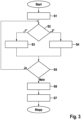
- step S1 an input image B is provided which is processed by the given convolutional neural network 2 to be applied to determine a segmented image.
- step S2 according to the configuration of the neural network 2, it is checked whether the first/next layer to be calculated corresponds to a depth map layer 22 or a conventional layer 21 of the neural network 2. If the next layer to be calculated corresponds to a depth map layer (alternative: "1"), the method continues with step S3, otherwise (alternative: "2"), the method continues with step S4.
- step S3 the output feature map MKO and simultaneously the associated scaling feature map SK are determined based on the plurality of scaling filters 23 as described above.
- the corresponding output feature map MKO is determined based on the function of the conventional layer 21.
- step S5 it is checked whether the neural network 2 has another layer to be calculated. If this is the case (alternative: yes), the output feature map MKO is assumed to be the input feature map of the next layer and the method continues with step S2. Otherwise, the method continues with step S6.
- the output feature map is output as the output image A in step S6
- step S7 the previously obtained scaling feature maps SK can be fed to the further appropriately trained neural network of the processing block 3 in order to determine the depth map TK from the scaling feature maps SK.
- the depth map TK then corresponds to the depth information image.
- depth information images can be determined from non-stereoscopic input images recorded by a camera of a technical system, in particular a robot, a vehicle, a tool or a machine tool.
- a technical system 10 which has a camera 11 for capturing an input image, a preprocessing unit 12 and a control unit 13 for executing control functions.
- the preprocessing unit 12 carries out the above method for determining a depth information image (depth map TK) and, if necessary, an output image A based on an input image captured by the camera 11.
- the control unit 13 implements functions of the technical system 10 that require depth information from camera images but do not enable stereoscopic capture of images.
- the control unit 13 processes the depth information image, in addition to other input variables, to produce one or more output variables.
- a computing unit controls at least one actuator 14 of the technical system with a corresponding control signal. For example, this can be used to control the movement of a robot or vehicle or to control a drive unit or a driver assistance system of a vehicle.
Landscapes
- Engineering & Computer Science (AREA)
- Physics & Mathematics (AREA)
- Theoretical Computer Science (AREA)
- General Physics & Mathematics (AREA)
- Computing Systems (AREA)
- Mathematical Physics (AREA)
- Biophysics (AREA)
- Computational Linguistics (AREA)
- Data Mining & Analysis (AREA)
- Evolutionary Computation (AREA)
- General Health & Medical Sciences (AREA)
- Molecular Biology (AREA)
- Artificial Intelligence (AREA)
- General Engineering & Computer Science (AREA)
- Life Sciences & Earth Sciences (AREA)
- Biomedical Technology (AREA)
- Software Systems (AREA)
- Health & Medical Sciences (AREA)
- Computer Vision & Pattern Recognition (AREA)
- Automation & Control Theory (AREA)
- Human Computer Interaction (AREA)
- Transportation (AREA)
- Mechanical Engineering (AREA)
- Image Analysis (AREA)
- Image Processing (AREA)
Claims (12)
- Procédé mis en œuvre par ordinateur pour la détermination d'une image d'information de profondeur pour une image d'entrée (B), afin de commander des fonctions de véhicule en particulier en fonction de l'image d'information de profondeur, l'image d'entrée (B) étant traitée à l'aide d'un réseau neuronal convolutif (2), le réseau neuronal convolutif (2) comportant de multiples couches qui traitent séquentiellement l'image d'entrée (B) et convertissent chacune une carte de caractéristiques d'entrée (MKI) en une carte de caractéristiques de sortie (MKO), au moins l'une des couches étant formée en tant que couche de carte de profondeurs, l'image d'information de profondeur étant déterminée en fonction d'une couche de carte de profondeurs, dans lequel, dans la couche de carte de profondeurs (22)- une carte de caractéristiques d'entrée (MKI) de la couche de carte de profondeurs (22) est pliée avec de multiples filtres d'échelle (23, 23a, 23b, 23c) pour obtenir des cartes d'échelle (24a, 24b, 24c) respectives, les filtres d'échelle ayant été générés en fonction d'un filtre prédéterminé par des changements d'échelle prédéterminées de ce filtre prédéterminé ;- les multiples cartes d'échelle (24a, 24b, 24c) sont comparées pixel par pixel pour générer une carte de caractéristiques de sortie (MKO) respective dans laquelle chaque pixel correspond à un pixel correspondant d'une carte sélectionnée parmi les cartes d'échelle (24a, 24b, 24c),- une carte de caractéristiques d'échelle (SK) est générée en faisant en sorte que chaque pixel de la carte de caractéristiques d'échelle (SK) soit associé à une indication qui indique la carte d'échelle (24a, 24b, 24c) à partir de laquelle le pixel de la carte de caractéristiques de sortie (MKO) est sélectionné ;dans lequel l'image d'information de profondeur correspond à la carte de caractéristiques d'échelle (SK) ou est déterminée en fonction de la carte de caractéristiques d'échelle (SK).
- Procédé selon la revendication 1, dans lequel la carte de caractéristiques d'échelle (24a, 24b, 24c) sélectionnée correspond à la carte de caractéristiques d'échelle qui contient la plus grande valeur de pixel pour le pixel respectif.
- Procédé selon la revendication 2, dans lequel les filtres d'échelle sont déterminés à partir d'un noyau de filtre du réseau neuronal convolutif entraîné par sous-échantillonnage ou sur-échantillonnage.
- Procédé selon l'une des revendications 1 à 3, dans lequel de multiples cartes de caractéristiques d'échelle (SK) sont déterminées dans de multiples couches de cartes de profondeurs (22), l'image d'information de profondeur étant déterminée à partir des multiples cartes de caractéristiques d'échelle (SK) à l'aide d'un autre réseau neuronal (3), l'image d'information de profondeur correspondant en particulier à une carte de profondeurs (TK) .
- Procédé selon la revendication 3, dans lequel l'image d'information de profondeur est déterminée à partir des multiples cartes de caractéristiques d'échelle (SK) et d'une ou de multiples cartes de caractéristiques de sortie (MKO) d'une ou de multiples couches parmi les couches du réseau neuronal (2) et/ou d'une image de sortie (A) du réseau neuronal (2).
- Procédé selon l'une des revendications 1 à 5, dans lequel le réseau neuronal génère une image de sortie (A), au moins l'une des couches (21) générant une carte de caractéristiques de sortie (MKO) et/ou l'image de sortie (A) en fonction d'une ou de multiples cartes parmi les cartes de caractéristiques d'entrée (SK), en particulier ladite une ou lesdites multiples cartes de caractéristiques d'entrée (MKI) ajoutées aux cartes de caractéristiques d'entrée (SK) de la couche concernée étant ajoutées à celle-ci.
- Procédé selon la revendication 6, dans lequel l'image de sortie (A) et l'image d'information de profondeur sont traitées conjointement dans un réseau neuronal supplémentaire connecté en aval, le réseau neuronal supplémentaire traitant l'image de sortie (A) et l'image d'information de profondeur pour obtenir une image segmentée.
- Procédé selon l'une des revendications 1 à 7, dans lequel l'image d'information de profondeur est utilisée pour commander une fonction de véhicule, qui concerne notamment un mode de conduite entièrement autonome ou semi-autonome ou une fonction d'assistance à la conduite permettant d'être averti de la présence d'objets environnants.
- Dispositif de détermination d'une image d'information de profondeur pour une image d'entrée (B), afin de commander des fonctions de véhicule en particulier en fonction de l'image d'information de profondeur, l'image d'entrée (B) étant traitée à l'aide d'un réseau neuronal convolutif (2), le réseau neuronal convolutif (2) comportant de multiples couches qui traitent séquentiellement l'image d'entrée (B) et convertissent chacune une carte de caractéristiques d'entrée (MKI) en une carte de caractéristiques de sortie (MKO), au moins l'une des couches étant formée en tant que couche de carte de profondeurs (22), l'image d'information de profondeur étant déterminée en fonction d'une couche de carte de profondeurs (22), le dispositif étant conçu, pour ladite au moins une couche de carte de profondeurs (22), afin de :- plier une carte de caractéristiques d'entrée (MKI) de la couche de carte de profondeurs (22) avec de multiples filtres d'échelle pour obtenir des cartes d'échelle (24a, 24b, 24c) respectives, les filtres d'échelle ayant été générés en fonction d'un filtre prédéterminé par des changements d'échelle prédéterminées de ce filtre prédéterminé,- comparer les multiples cartes d'échelle (24a, 24b, 24c) pixel par pixel pour générer une carte de caractéristiques de sortie (MKO) respective dans laquelle chaque pixel correspond à un pixel correspondant d'une carte sélectionnée parmi les cartes d'échelle (24a, 24b, 24c),- générer une carte de caractéristiques d'échelle (SK) en faisant en sorte que chaque pixel de la carte de caractéristiques d'échelle (SK) soit associé à une indication qui indique la carte d'échelle (24a, 24b, 24c) à partir de laquelle le pixel de la carte de caractéristiques initiale (MKO) est sélectionné ;dans lequel l'image d'information de profondeur correspond à la carte de caractéristiques d'échelle (SK) ou est déterminée en fonction de la carte de caractéristiques d'échelle (SK).
- Système (10) comprenant :- un dispositif d'acquisition d'image (11) destiné à acquérir une image d'entrée (B)- un dispositif de prétraitement (12) correspondant au dispositif selon la revendication 9 destiné à fournir une image d'information de profondeur en fonction de l'image d'entrée ;- un appareil de commande (13) destiné à commander au moins un actionneur (14) du système (10) en fonction de l'image d'information de profondeur.
- Programme informatique, lequel comporte des instructions qui, lorsque ces instructions sont exécutées sur un ordinateur, sont conçues pour amener l'ordinateur à mettre en œuvre le procédé selon l'une des revendications 1 à 8.
- Support de stockage électronique sur lequel est stocké un programme informatique selon la revendication 11.
Applications Claiming Priority (2)
| Application Number | Priority Date | Filing Date | Title |
|---|---|---|---|
| DE102018206848.8A DE102018206848A1 (de) | 2018-05-03 | 2018-05-03 | Verfahren und Vorrichtung zum Ermitteln eines Tiefeninformationsbilds aus einem Eingangsbild |
| PCT/EP2019/059087 WO2019211068A1 (fr) | 2018-05-03 | 2019-04-10 | Procédé et dispositif de détermination d'une image d'information de profondeur à partir d'une image d'entrée |
Publications (2)
| Publication Number | Publication Date |
|---|---|
| EP3788552A1 EP3788552A1 (fr) | 2021-03-10 |
| EP3788552B1 true EP3788552B1 (fr) | 2024-07-17 |
Family
ID=66182536
Family Applications (1)
| Application Number | Title | Priority Date | Filing Date |
|---|---|---|---|
| EP19717825.4A Active EP3788552B1 (fr) | 2018-05-03 | 2019-04-10 | Procede et dispositif pour la determination d'une image de profondeur a partir d'une image d'entree |
Country Status (5)
| Country | Link |
|---|---|
| US (1) | US11580653B2 (fr) |
| EP (1) | EP3788552B1 (fr) |
| CN (1) | CN112020725B (fr) |
| DE (1) | DE102018206848A1 (fr) |
| WO (1) | WO2019211068A1 (fr) |
Families Citing this family (10)
| Publication number | Priority date | Publication date | Assignee | Title |
|---|---|---|---|---|
| WO2020221443A1 (fr) * | 2019-04-30 | 2020-11-05 | Huawei Technologies Co., Ltd. | Localisation et cartographie monoculaires sensibles à l'échelle |
| US11580399B2 (en) * | 2019-04-30 | 2023-02-14 | Samsung Electronics Co., Ltd. | System and method for convolutional layer structure for neural networks |
| CN114175090A (zh) * | 2019-08-09 | 2022-03-11 | 株式会社半导体能源研究所 | 系统 |
| CN111102920A (zh) * | 2019-12-18 | 2020-05-05 | 佛山科学技术学院 | 一种基于增强现实的机械组件质检方法及系统 |
| US11972348B2 (en) | 2020-10-30 | 2024-04-30 | Apple Inc. | Texture unit circuit in neural network processor |
| KR102897168B1 (ko) * | 2021-02-25 | 2025-12-08 | 삼성전자주식회사 | Ar/vr 환경을 제공하는 전자 장치 및 그 운용 방법 |
| DE102021205034A1 (de) * | 2021-05-18 | 2022-11-24 | Robert Bosch Gesellschaft mit beschränkter Haftung | Trainieren eines maschinenlernfähigen modells zur schätzung des relativen objektmassstabs |
| US12017355B2 (en) * | 2021-06-08 | 2024-06-25 | Fanuc Corporation | Grasp learning using modularized neural networks |
| US11809521B2 (en) * | 2021-06-08 | 2023-11-07 | Fanuc Corporation | Network modularization to learn high dimensional robot tasks |
| US12073545B2 (en) * | 2021-10-22 | 2024-08-27 | The Boeing Company | Method for large area inspection |
Family Cites Families (10)
| Publication number | Priority date | Publication date | Assignee | Title |
|---|---|---|---|---|
| US8253740B2 (en) * | 2006-02-27 | 2012-08-28 | Koninklijke Philips Electronics N.V. | Method of rendering an output image on basis of an input image and a corresponding depth map |
| CN102855459B (zh) * | 2011-06-30 | 2015-11-25 | 株式会社理光 | 用于特定前景物体的检测验证的方法和系统 |
| US10019657B2 (en) | 2015-05-28 | 2018-07-10 | Adobe Systems Incorporated | Joint depth estimation and semantic segmentation from a single image |
| US20170206434A1 (en) * | 2016-01-14 | 2017-07-20 | Ford Global Technologies, Llc | Low- and high-fidelity classifiers applied to road-scene images |
| US10466714B2 (en) * | 2016-09-01 | 2019-11-05 | Ford Global Technologies, Llc | Depth map estimation with stereo images |
| EP3507771B1 (fr) | 2016-09-15 | 2020-06-24 | Google LLC | Réseaux neuronaux de prédiction de profondeur d'image |
| US20200005151A1 (en) * | 2016-12-30 | 2020-01-02 | Nokia Technologies Oy | Artificial neural network |
| CN107204010B (zh) * | 2017-04-28 | 2019-11-19 | 中国科学院计算技术研究所 | 一种单目图像深度估计方法与系统 |
| US10497145B2 (en) * | 2017-11-16 | 2019-12-03 | Nec Corporation | System and method for real-time large image homography processing |
| CN112307826B (zh) * | 2019-07-30 | 2026-02-03 | 华为技术有限公司 | 行人检测方法、装置、计算机可读存储介质和芯片 |
-
2018
- 2018-05-03 DE DE102018206848.8A patent/DE102018206848A1/de not_active Ceased
-
2019
- 2019-04-10 CN CN201980029633.6A patent/CN112020725B/zh active Active
- 2019-04-10 WO PCT/EP2019/059087 patent/WO2019211068A1/fr not_active Ceased
- 2019-04-10 EP EP19717825.4A patent/EP3788552B1/fr active Active
- 2019-04-10 US US17/040,595 patent/US11580653B2/en active Active
Also Published As
| Publication number | Publication date |
|---|---|
| WO2019211068A1 (fr) | 2019-11-07 |
| EP3788552A1 (fr) | 2021-03-10 |
| CN112020725B (zh) | 2024-11-01 |
| CN112020725A (zh) | 2020-12-01 |
| DE102018206848A1 (de) | 2019-11-07 |
| US20210042946A1 (en) | 2021-02-11 |
| US11580653B2 (en) | 2023-02-14 |
Similar Documents
| Publication | Publication Date | Title |
|---|---|---|
| DE102018206848A1 (de) | Verfahren und Vorrichtung zum Ermitteln eines Tiefeninformationsbilds aus einem Eingangsbild | |
| EP4000010B1 (fr) | Dispositif et procédé mis en oeuvre par ordinateur pour le traitement de données de capteur numériques | |
| DE102018206208A1 (de) | Verfahren, Vorrichtung, Erzeugnis und Computerprogramm zum Betreiben eines technischen Systems | |
| DE102017203276B4 (de) | Verfahren und Vorrichtung zur Ermittlung einer Trajektorie in Off-road-Szenarien | |
| DE102018119467A1 (de) | Autonomer betrieb durch tiefes räumlich-zeitliches lernen | |
| DE102018217092A1 (de) | Verfahren, künstliches neuronales Netz, Vorrichtung, Computerprogramm und maschinenlesbares Speichermedium zur semantischen Segmentierung von Bilddaten | |
| DE102018214198A1 (de) | System zum Bewerten eines Bildes, Betriebsassistenzverfahren und Steuereinheit für eine Arbeitsvorrichtung sowie Arbeitsvorrichtung | |
| WO2023194009A1 (fr) | Procédé de prédiction de trajectoires d'objets | |
| DE102020211262A1 (de) | Verfahren und Vorrichtung zum Komprimieren eines neuronalen Netzes | |
| DE102022201679A1 (de) | Verfahren und Vorrichtung zum Trainieren eines neuronalen Netzes | |
| EP3956820B1 (fr) | Procédé, dispositif et programme informatique de création d'un réseau neuronal | |
| DE102021205034A1 (de) | Trainieren eines maschinenlernfähigen modells zur schätzung des relativen objektmassstabs | |
| EP4526842B1 (fr) | Procédé de commande d'un dispositif robot | |
| DE102019220615A1 (de) | Verfahren und Vorrichtung zum Erkennen und Klassifizieren von Objekten | |
| DE102023212400A1 (de) | Verfahren zum Training eines Maschinenlern-Modells für ein semantisches Szenenverständnis | |
| EP3629252A1 (fr) | Procédé et dispositif de fonctionnement d'un système de commande | |
| DE102023109651A1 (de) | Verfahren zum Erzeugen einer Umgebungsdarstellung | |
| DE102022121839A1 (de) | Texterkennung basierend auf einem verzeichneten Kamerabild | |
| DE102021110056A1 (de) | Automatische visuelle Wahrnehmung mit globaler Aufmerksamkeit | |
| DE102023130646B4 (de) | Verfahren zur Dimensionsreduzierung | |
| DE112020001526T5 (de) | Informationsverarbeitungsvorrichtung, informationsverarbeitungsverfahren, informationsverarbeitungsprogramm und informationsverarbeitungssystem | |
| DE102024209264A1 (de) | Konvolutionales neuronales Netzwerk und Verfahren zum Betreiben des konvolutionalen neuronalen Netzwerks | |
| DE112022001417T5 (de) | Objekterkennungsvorrichtung und objekterkennungsverfahren | |
| DE102023207671A1 (de) | Verfahren zum Verarbeiten und Fusionieren Radarsensor-Rohdaten und Kamera-Rohdaten | |
| DE102024201292A1 (de) | Verfahren und Vorrichtung zum Trainieren eines maschinellen Lernmodells |
Legal Events
| Date | Code | Title | Description |
|---|---|---|---|
| STAA | Information on the status of an ep patent application or granted ep patent |
Free format text: STATUS: UNKNOWN |
|
| STAA | Information on the status of an ep patent application or granted ep patent |
Free format text: STATUS: THE INTERNATIONAL PUBLICATION HAS BEEN MADE |
|
| PUAI | Public reference made under article 153(3) epc to a published international application that has entered the european phase |
Free format text: ORIGINAL CODE: 0009012 |
|
| STAA | Information on the status of an ep patent application or granted ep patent |
Free format text: STATUS: REQUEST FOR EXAMINATION WAS MADE |
|
| 17P | Request for examination filed |
Effective date: 20201203 |
|
| AK | Designated contracting states |
Kind code of ref document: A1 Designated state(s): AL AT BE BG CH CY CZ DE DK EE ES FI FR GB GR HR HU IE IS IT LI LT LU LV MC MK MT NL NO PL PT RO RS SE SI SK SM TR |
|
| AX | Request for extension of the european patent |
Extension state: BA ME |
|
| DAV | Request for validation of the european patent (deleted) | ||
| DAX | Request for extension of the european patent (deleted) | ||
| STAA | Information on the status of an ep patent application or granted ep patent |
Free format text: STATUS: EXAMINATION IS IN PROGRESS |
|
| 17Q | First examination report despatched |
Effective date: 20231122 |
|
| REG | Reference to a national code |
Ref country code: DE Ref legal event code: R079 Free format text: PREVIOUS MAIN CLASS: G06N0003040000 Ipc: G06N0003045000 Ref country code: DE Ref legal event code: R079 Ref document number: 502019011698 Country of ref document: DE Free format text: PREVIOUS MAIN CLASS: G06N0003040000 Ipc: G06N0003045000 |
|
| GRAP | Despatch of communication of intention to grant a patent |
Free format text: ORIGINAL CODE: EPIDOSNIGR1 |
|
| STAA | Information on the status of an ep patent application or granted ep patent |
Free format text: STATUS: GRANT OF PATENT IS INTENDED |
|
| RIC1 | Information provided on ipc code assigned before grant |
Ipc: G06T 7/50 20170101ALI20240424BHEP Ipc: G06N 3/045 20230101AFI20240424BHEP |
|
| INTG | Intention to grant announced |
Effective date: 20240508 |
|
| GRAS | Grant fee paid |
Free format text: ORIGINAL CODE: EPIDOSNIGR3 |
|
| GRAA | (expected) grant |
Free format text: ORIGINAL CODE: 0009210 |
|
| STAA | Information on the status of an ep patent application or granted ep patent |
Free format text: STATUS: THE PATENT HAS BEEN GRANTED |
|
| AK | Designated contracting states |
Kind code of ref document: B1 Designated state(s): AL AT BE BG CH CY CZ DE DK EE ES FI FR GB GR HR HU IE IS IT LI LT LU LV MC MK MT NL NO PL PT RO RS SE SI SK SM TR |
|
| REG | Reference to a national code |
Ref country code: CH Ref legal event code: EP |
|
| REG | Reference to a national code |
Ref country code: DE Ref legal event code: R096 Ref document number: 502019011698 Country of ref document: DE |
|
| REG | Reference to a national code |
Ref country code: IE Ref legal event code: FG4D Free format text: LANGUAGE OF EP DOCUMENT: GERMAN |
|
| REG | Reference to a national code |
Ref country code: LT Ref legal event code: MG9D |
|
| REG | Reference to a national code |
Ref country code: NL Ref legal event code: MP Effective date: 20240717 |
|
| PG25 | Lapsed in a contracting state [announced via postgrant information from national office to epo] |
Ref country code: PT Free format text: LAPSE BECAUSE OF FAILURE TO SUBMIT A TRANSLATION OF THE DESCRIPTION OR TO PAY THE FEE WITHIN THE PRESCRIBED TIME-LIMIT Effective date: 20241118 |
|
| PG25 | Lapsed in a contracting state [announced via postgrant information from national office to epo] |
Ref country code: NL Free format text: LAPSE BECAUSE OF FAILURE TO SUBMIT A TRANSLATION OF THE DESCRIPTION OR TO PAY THE FEE WITHIN THE PRESCRIBED TIME-LIMIT Effective date: 20240717 |
|
| PG25 | Lapsed in a contracting state [announced via postgrant information from national office to epo] |
Ref country code: PT Free format text: LAPSE BECAUSE OF FAILURE TO SUBMIT A TRANSLATION OF THE DESCRIPTION OR TO PAY THE FEE WITHIN THE PRESCRIBED TIME-LIMIT Effective date: 20241118 Ref country code: NL Free format text: LAPSE BECAUSE OF FAILURE TO SUBMIT A TRANSLATION OF THE DESCRIPTION OR TO PAY THE FEE WITHIN THE PRESCRIBED TIME-LIMIT Effective date: 20240717 |
|
| PG25 | Lapsed in a contracting state [announced via postgrant information from national office to epo] |
Ref country code: NO Free format text: LAPSE BECAUSE OF FAILURE TO SUBMIT A TRANSLATION OF THE DESCRIPTION OR TO PAY THE FEE WITHIN THE PRESCRIBED TIME-LIMIT Effective date: 20241017 |
|
| PG25 | Lapsed in a contracting state [announced via postgrant information from national office to epo] |
Ref country code: FI Free format text: LAPSE BECAUSE OF FAILURE TO SUBMIT A TRANSLATION OF THE DESCRIPTION OR TO PAY THE FEE WITHIN THE PRESCRIBED TIME-LIMIT Effective date: 20240717 Ref country code: GR Free format text: LAPSE BECAUSE OF FAILURE TO SUBMIT A TRANSLATION OF THE DESCRIPTION OR TO PAY THE FEE WITHIN THE PRESCRIBED TIME-LIMIT Effective date: 20241018 Ref country code: PL Free format text: LAPSE BECAUSE OF FAILURE TO SUBMIT A TRANSLATION OF THE DESCRIPTION OR TO PAY THE FEE WITHIN THE PRESCRIBED TIME-LIMIT Effective date: 20240717 |
|
| PG25 | Lapsed in a contracting state [announced via postgrant information from national office to epo] |
Ref country code: BG Free format text: LAPSE BECAUSE OF FAILURE TO SUBMIT A TRANSLATION OF THE DESCRIPTION OR TO PAY THE FEE WITHIN THE PRESCRIBED TIME-LIMIT Effective date: 20240717 |
|
| PG25 | Lapsed in a contracting state [announced via postgrant information from national office to epo] |
Ref country code: LV Free format text: LAPSE BECAUSE OF FAILURE TO SUBMIT A TRANSLATION OF THE DESCRIPTION OR TO PAY THE FEE WITHIN THE PRESCRIBED TIME-LIMIT Effective date: 20240717 |
|
| PG25 | Lapsed in a contracting state [announced via postgrant information from national office to epo] |
Ref country code: IS Free format text: LAPSE BECAUSE OF FAILURE TO SUBMIT A TRANSLATION OF THE DESCRIPTION OR TO PAY THE FEE WITHIN THE PRESCRIBED TIME-LIMIT Effective date: 20241117 |
|
| PG25 | Lapsed in a contracting state [announced via postgrant information from national office to epo] |
Ref country code: HR Free format text: LAPSE BECAUSE OF FAILURE TO SUBMIT A TRANSLATION OF THE DESCRIPTION OR TO PAY THE FEE WITHIN THE PRESCRIBED TIME-LIMIT Effective date: 20240717 |
|
| PG25 | Lapsed in a contracting state [announced via postgrant information from national office to epo] |
Ref country code: RS Free format text: LAPSE BECAUSE OF FAILURE TO SUBMIT A TRANSLATION OF THE DESCRIPTION OR TO PAY THE FEE WITHIN THE PRESCRIBED TIME-LIMIT Effective date: 20241017 Ref country code: ES Free format text: LAPSE BECAUSE OF FAILURE TO SUBMIT A TRANSLATION OF THE DESCRIPTION OR TO PAY THE FEE WITHIN THE PRESCRIBED TIME-LIMIT Effective date: 20240717 |
|
| PG25 | Lapsed in a contracting state [announced via postgrant information from national office to epo] |
Ref country code: RS Free format text: LAPSE BECAUSE OF FAILURE TO SUBMIT A TRANSLATION OF THE DESCRIPTION OR TO PAY THE FEE WITHIN THE PRESCRIBED TIME-LIMIT Effective date: 20241017 Ref country code: PL Free format text: LAPSE BECAUSE OF FAILURE TO SUBMIT A TRANSLATION OF THE DESCRIPTION OR TO PAY THE FEE WITHIN THE PRESCRIBED TIME-LIMIT Effective date: 20240717 Ref country code: NO Free format text: LAPSE BECAUSE OF FAILURE TO SUBMIT A TRANSLATION OF THE DESCRIPTION OR TO PAY THE FEE WITHIN THE PRESCRIBED TIME-LIMIT Effective date: 20241017 Ref country code: LV Free format text: LAPSE BECAUSE OF FAILURE TO SUBMIT A TRANSLATION OF THE DESCRIPTION OR TO PAY THE FEE WITHIN THE PRESCRIBED TIME-LIMIT Effective date: 20240717 Ref country code: IS Free format text: LAPSE BECAUSE OF FAILURE TO SUBMIT A TRANSLATION OF THE DESCRIPTION OR TO PAY THE FEE WITHIN THE PRESCRIBED TIME-LIMIT Effective date: 20241117 Ref country code: HR Free format text: LAPSE BECAUSE OF FAILURE TO SUBMIT A TRANSLATION OF THE DESCRIPTION OR TO PAY THE FEE WITHIN THE PRESCRIBED TIME-LIMIT Effective date: 20240717 Ref country code: GR Free format text: LAPSE BECAUSE OF FAILURE TO SUBMIT A TRANSLATION OF THE DESCRIPTION OR TO PAY THE FEE WITHIN THE PRESCRIBED TIME-LIMIT Effective date: 20241018 Ref country code: FI Free format text: LAPSE BECAUSE OF FAILURE TO SUBMIT A TRANSLATION OF THE DESCRIPTION OR TO PAY THE FEE WITHIN THE PRESCRIBED TIME-LIMIT Effective date: 20240717 Ref country code: ES Free format text: LAPSE BECAUSE OF FAILURE TO SUBMIT A TRANSLATION OF THE DESCRIPTION OR TO PAY THE FEE WITHIN THE PRESCRIBED TIME-LIMIT Effective date: 20240717 Ref country code: BG Free format text: LAPSE BECAUSE OF FAILURE TO SUBMIT A TRANSLATION OF THE DESCRIPTION OR TO PAY THE FEE WITHIN THE PRESCRIBED TIME-LIMIT Effective date: 20240717 |
|
| PG25 | Lapsed in a contracting state [announced via postgrant information from national office to epo] |
Ref country code: SM Free format text: LAPSE BECAUSE OF FAILURE TO SUBMIT A TRANSLATION OF THE DESCRIPTION OR TO PAY THE FEE WITHIN THE PRESCRIBED TIME-LIMIT Effective date: 20240717 Ref country code: RO Free format text: LAPSE BECAUSE OF FAILURE TO SUBMIT A TRANSLATION OF THE DESCRIPTION OR TO PAY THE FEE WITHIN THE PRESCRIBED TIME-LIMIT Effective date: 20240717 Ref country code: DK Free format text: LAPSE BECAUSE OF FAILURE TO SUBMIT A TRANSLATION OF THE DESCRIPTION OR TO PAY THE FEE WITHIN THE PRESCRIBED TIME-LIMIT Effective date: 20240717 |
|
| REG | Reference to a national code |
Ref country code: DE Ref legal event code: R097 Ref document number: 502019011698 Country of ref document: DE |
|
| PG25 | Lapsed in a contracting state [announced via postgrant information from national office to epo] |
Ref country code: EE Free format text: LAPSE BECAUSE OF FAILURE TO SUBMIT A TRANSLATION OF THE DESCRIPTION OR TO PAY THE FEE WITHIN THE PRESCRIBED TIME-LIMIT Effective date: 20240717 |
|
| PG25 | Lapsed in a contracting state [announced via postgrant information from national office to epo] |
Ref country code: CZ Free format text: LAPSE BECAUSE OF FAILURE TO SUBMIT A TRANSLATION OF THE DESCRIPTION OR TO PAY THE FEE WITHIN THE PRESCRIBED TIME-LIMIT Effective date: 20240717 |
|
| PG25 | Lapsed in a contracting state [announced via postgrant information from national office to epo] |
Ref country code: SK Free format text: LAPSE BECAUSE OF FAILURE TO SUBMIT A TRANSLATION OF THE DESCRIPTION OR TO PAY THE FEE WITHIN THE PRESCRIBED TIME-LIMIT Effective date: 20240717 |
|
| PLBE | No opposition filed within time limit |
Free format text: ORIGINAL CODE: 0009261 |
|
| STAA | Information on the status of an ep patent application or granted ep patent |
Free format text: STATUS: NO OPPOSITION FILED WITHIN TIME LIMIT |
|
| 26N | No opposition filed |
Effective date: 20250422 |
|
| PG25 | Lapsed in a contracting state [announced via postgrant information from national office to epo] |
Ref country code: SE Free format text: LAPSE BECAUSE OF FAILURE TO SUBMIT A TRANSLATION OF THE DESCRIPTION OR TO PAY THE FEE WITHIN THE PRESCRIBED TIME-LIMIT Effective date: 20240717 |
|
| REG | Reference to a national code |
Ref country code: CH Ref legal event code: H13 Free format text: ST27 STATUS EVENT CODE: U-0-0-H10-H13 (AS PROVIDED BY THE NATIONAL OFFICE) Effective date: 20251125 |
|
| PG25 | Lapsed in a contracting state [announced via postgrant information from national office to epo] |
Ref country code: LU Free format text: LAPSE BECAUSE OF NON-PAYMENT OF DUE FEES Effective date: 20250410 |
|
| PG25 | Lapsed in a contracting state [announced via postgrant information from national office to epo] |
Ref country code: MC Free format text: LAPSE BECAUSE OF FAILURE TO SUBMIT A TRANSLATION OF THE DESCRIPTION OR TO PAY THE FEE WITHIN THE PRESCRIBED TIME-LIMIT Effective date: 20240717 |
|
| GBPC | Gb: european patent ceased through non-payment of renewal fee |
Effective date: 20250410 |
|
| REG | Reference to a national code |
Ref country code: BE Ref legal event code: MM Effective date: 20250430 |
|
| PG25 | Lapsed in a contracting state [announced via postgrant information from national office to epo] |
Ref country code: GB Free format text: LAPSE BECAUSE OF NON-PAYMENT OF DUE FEES Effective date: 20250410 |
|
| PG25 | Lapsed in a contracting state [announced via postgrant information from national office to epo] |
Ref country code: FR Free format text: LAPSE BECAUSE OF NON-PAYMENT OF DUE FEES Effective date: 20250430 |
|
| PG25 | Lapsed in a contracting state [announced via postgrant information from national office to epo] |
Ref country code: BE Free format text: LAPSE BECAUSE OF NON-PAYMENT OF DUE FEES Effective date: 20250430 |
|
| PG25 | Lapsed in a contracting state [announced via postgrant information from national office to epo] |
Ref country code: CH Free format text: LAPSE BECAUSE OF NON-PAYMENT OF DUE FEES Effective date: 20250430 |
|
| PG25 | Lapsed in a contracting state [announced via postgrant information from national office to epo] |
Ref country code: IT Free format text: LAPSE BECAUSE OF FAILURE TO SUBMIT A TRANSLATION OF THE DESCRIPTION OR TO PAY THE FEE WITHIN THE PRESCRIBED TIME-LIMIT Effective date: 20240717 |
|
| PG25 | Lapsed in a contracting state [announced via postgrant information from national office to epo] |
Ref country code: IE Free format text: LAPSE BECAUSE OF NON-PAYMENT OF DUE FEES Effective date: 20250410 |
|
| PG25 | Lapsed in a contracting state [announced via postgrant information from national office to epo] |
Ref country code: CY Free format text: LAPSE BECAUSE OF FAILURE TO SUBMIT A TRANSLATION OF THE DESCRIPTION OR TO PAY THE FEE WITHIN THE PRESCRIBED TIME-LIMIT Effective date: 20240717 |
|
| REG | Reference to a national code |
Ref country code: AT Ref legal event code: MM01 Ref document number: 1704834 Country of ref document: AT Kind code of ref document: T Effective date: 20250410 |
|
| PG25 | Lapsed in a contracting state [announced via postgrant information from national office to epo] |
Ref country code: LT Free format text: LAPSE BECAUSE OF FAILURE TO SUBMIT A TRANSLATION OF THE DESCRIPTION OR TO PAY THE FEE WITHIN THE PRESCRIBED TIME-LIMIT Effective date: 20240717 |
|
| PGFP | Annual fee paid to national office [announced via postgrant information from national office to epo] |
Ref country code: DE Payment date: 20260625 Year of fee payment: 8 |
|
| PG25 | Lapsed in a contracting state [announced via postgrant information from national office to epo] |
Ref country code: AT Free format text: LAPSE BECAUSE OF NON-PAYMENT OF DUE FEES Effective date: 20250410 |