EP3788552B1 - Method and device for the determination of a depth-image from an input image - Google Patents
Method and device for the determination of a depth-image from an input image Download PDFInfo
- Publication number
- EP3788552B1 EP3788552B1 EP19717825.4A EP19717825A EP3788552B1 EP 3788552 B1 EP3788552 B1 EP 3788552B1 EP 19717825 A EP19717825 A EP 19717825A EP 3788552 B1 EP3788552 B1 EP 3788552B1
- Authority
- EP
- European Patent Office
- Prior art keywords
- scaling
- image
- map
- feature map
- depth information
- Prior art date
- Legal status (The legal status is an assumption and is not a legal conclusion. Google has not performed a legal analysis and makes no representation as to the accuracy of the status listed.)
- Active
Links
Images




Classifications
-
- G—PHYSICS
- G06—COMPUTING OR CALCULATING; COUNTING
- G06T—IMAGE DATA PROCESSING OR GENERATION, IN GENERAL
- G06T7/00—Image analysis
- G06T7/50—Depth or shape recovery
-
- B—PERFORMING OPERATIONS; TRANSPORTING
- B60—VEHICLES IN GENERAL
- B60W—CONJOINT CONTROL OF VEHICLE SUB-UNITS OF DIFFERENT TYPE OR DIFFERENT FUNCTION; CONTROL SYSTEMS SPECIALLY ADAPTED FOR HYBRID VEHICLES; ROAD VEHICLE DRIVE CONTROL SYSTEMS FOR PURPOSES NOT RELATED TO THE CONTROL OF A PARTICULAR SUB-UNIT
- B60W60/00—Drive control systems specially adapted for autonomous road vehicles
- B60W60/001—Planning or execution of driving tasks
-
- G—PHYSICS
- G06—COMPUTING OR CALCULATING; COUNTING
- G06N—COMPUTING ARRANGEMENTS BASED ON SPECIFIC COMPUTATIONAL MODELS
- G06N3/00—Computing arrangements based on biological models
- G06N3/02—Neural networks
- G06N3/04—Architecture, e.g. interconnection topology
- G06N3/045—Combinations of networks
- G06N3/0455—Auto-encoder networks; Encoder-decoder networks
-
- G—PHYSICS
- G06—COMPUTING OR CALCULATING; COUNTING
- G06N—COMPUTING ARRANGEMENTS BASED ON SPECIFIC COMPUTATIONAL MODELS
- G06N3/00—Computing arrangements based on biological models
- G06N3/02—Neural networks
- G06N3/04—Architecture, e.g. interconnection topology
- G06N3/0464—Convolutional networks [CNN, ConvNet]
-
- G—PHYSICS
- G06—COMPUTING OR CALCULATING; COUNTING
- G06N—COMPUTING ARRANGEMENTS BASED ON SPECIFIC COMPUTATIONAL MODELS
- G06N3/00—Computing arrangements based on biological models
- G06N3/02—Neural networks
- G06N3/08—Learning methods
- G06N3/09—Supervised learning
-
- G—PHYSICS
- G06—COMPUTING OR CALCULATING; COUNTING
- G06T—IMAGE DATA PROCESSING OR GENERATION, IN GENERAL
- G06T2207/00—Indexing scheme for image analysis or image enhancement
- G06T2207/20—Special algorithmic details
- G06T2207/20081—Training; Learning
-
- G—PHYSICS
- G06—COMPUTING OR CALCULATING; COUNTING
- G06T—IMAGE DATA PROCESSING OR GENERATION, IN GENERAL
- G06T2207/00—Indexing scheme for image analysis or image enhancement
- G06T2207/20—Special algorithmic details
- G06T2207/20084—Artificial neural networks [ANN]
-
- G—PHYSICS
- G06—COMPUTING OR CALCULATING; COUNTING
- G06T—IMAGE DATA PROCESSING OR GENERATION, IN GENERAL
- G06T2207/00—Indexing scheme for image analysis or image enhancement
- G06T2207/30—Subject of image; Context of image processing
- G06T2207/30232—Surveillance
Definitions
- the invention relates to methods for image processing, in particular to methods for determining depth information from a provided image.
- the invention further relates to methods for implementing functions of a technical system, in particular a robot, a vehicle, a tool or a machine tool, wherein the functions are carried out depending on a depth information image of the environment, or for controlling vehicle functions based on a depth information image.
- Functions of a technical system are known, in particular of a robot, a vehicle, a tool or a machine tool, where the functions are carried out depending on a depth information image of the environment.
- autonomous or semi-autonomous vehicle functions controlled by vehicles or external devices, are based on the reliable detection of open space, vehicles and people or other objects in the environment of the motor vehicle.
- the image capture of the environment using one or more cameras or other image capture devices is a basic requirement.
- the captured camera images are evaluated in a suitable manner, for example to segment the vehicle surroundings or to recognize objects in the vehicle surroundings.
- a suitable manner for example to segment the vehicle surroundings or to recognize objects in the vehicle surroundings.
- the depth information enables or simplifies, among other things, the assignment of image areas to individual objects, which is advantageous for reliable segmentation of the image to be examined.
- Previous methods for creating such depth information images ie images provided with depth information or images that correspond to a depth map and indicate the depth of each pixel of a reference image, generally use stereo cameras to capture stereo images. By identifying features in the recorded scene, distances of the captured features can be determined based on image differences between the two stereo images and a depth map can be created from this.
- David Eigen ET AL “Depth Map Prediction from a Single Image using a Multi-Scale Deep Network”, June 9, 2014 , describes a computer-implemented method for determining a depth information image for an input image, in particular to control vehicle functions depending on the depth information image, wherein the input image is processed using a convolutional neural network, wherein the convolutional neural network has a plurality of layers which sequentially process the input image (B) and each convert an input feature map (MKI) into an output feature map (MKO), wherein at least one of the layers is designed as a depth map layer, wherein the depth information image is determined depending on a depth map layer, wherein in the depth map layer an input feature map of the depth map layer is convolved with a plurality of scaling filters in order to obtain respective scaling maps.
- a convolutional neural network has a plurality of layers which sequentially process the input image (B) and each convert an input feature map (MKI) into an output feature map (MKO), wherein at least one of the layers is designed
- the selected scaling map can correspond to the scaling map that contains the largest pixel value for the respective pixel.
- the above method uses feature recognition in different scales specified by the scaling filters. This makes it possible to recognize the size of a feature in the image to be examined by evaluating the different scaling maps obtained on the basis of the scaling filters, which are assigned to the corresponding different scales. The size of the feature then contains - for certain objects to be recognized - information about the distance the object belonging to the feature is from the camera capturing the image.
- scaling filters of different scales By using scaling filters of different scales, a certain object can be identified by at least one of the scaling filters, regardless of its distance from the capturing camera.
- the above method now uses the information about which scaling filter was decisive for identifying the object in order to estimate a distance to the object in question.
- a channel of an input image is passed through one or more layers of a convolutional neural network with different scaling filters (kernels) to produce scaling maps that are linked in a subsequent max-pooling step to form an output feature map.
- the max-pooling step corresponds to a maximum selection of the pixel values applied pixel by pixel, whereby the respective maximum value of the pixel values of the scaling maps assigned to identical pixels is entered into the output feature map.
- a scaling specification is entered in a scaling feature map for each pixel of the output feature map, which specifies the scaling filter that led to the maximum pixel value.
- Scaling feature maps are thus determined for the individual channels of the input feature map of the one or more calculation layers of the convolutional neural network. Depending on the one or more scaling feature maps determined in this way, a depth information image can be specified for the image to be examined.
- the above method has the advantage that depth information for the features shown in the image can be determined from a simple, i.e. non-stereoscopic image.
- the depth information is obtained from a scaling that is assigned to the scaling filter that best recognizes the feature specified by the scaling filter.
- scaling filters can be determined from a filter kernel of the trained convolutional neural network by down-sampling.
- the convolutional neural network has a plurality of depth map layers to determine a plurality of scaling feature maps, wherein the depth information image is determined from the plurality of scaling feature maps using a further neural network.
- the multiple scaling maps can be compared pixel by pixel in a combining process to obtain the output feature map from the respective maximum pixel values, which serves as the input feature map of a subsequent calculation of another layer of the convolutional neural network, or to obtain an output image.
- the depth information image can be determined from the plurality of scaling feature maps and one or more output feature maps of one or more of the layers of the neural network and/or an output image of the neural network.
- the neural network generates an output image, wherein at least one of the layers generates an output feature map and/or the output image depending on one or more of the scaling feature maps, wherein for this purpose in particular the one or more of the scaling feature maps supplied to the relevant layer are added.
- the output image and the depth information image can be processed together in a downstream additional neural network, wherein the additional neural network processes the output image and the depth information image into a segmented image.
- Figure 1 shows a schematic representation of an image processing system 1 for carrying out a method for determining depth information for a non-stereoscopically provided input image B in the form of a depth information image.
- the image processing system 1 comprises a processing device in which a first convolutional neural network 2 with several layers 21 is implemented.
- a convolutional neural network is calculated in a manner known per se by cascading calculation of feature maps.
- the convolutional neural network can comprise various types of calculation layers, the layers comprising one or more convolution layers 21.
- a filter kernel is applied to a section of an input feature map, which can correspond to the input image for the first calculation layer, in order to generate an output feature map of the layer in question.
- the filter kernel corresponds to a convolution matrix with weighting values.
- a pixel of the output feature map is assigned to the image section currently subject to the filter kernel and the corresponding pixel value is calculated using their inner product.
- the weighting values are multiplied by the corresponding pixel values of the section of the input feature map, with the results of all multiplications of a filter kernel being added to obtain the corresponding pixel value of the output feature map.
- the output feature map is usually used as the input feature map of a next computational layer or - in the last computational layer - as the output image.
- the first neural network 2 of the image processing system 1 provides, for example, several cascaded standard convolution layers 21, wherein in the embodiment shown a first layer is provided as a depth map layer 22.
- a first layer is provided as a depth map layer 22.
- several of the first layers can be provided as depth map layers 22 in the neural network 2. These can also be used in subsequent (deeper) layers, but typically these layers are designed as standard convolution layers 21.
- the depth map layer 22 has an implementation that differs from the other layers of the first convolutional neural network 2, in which the respective input feature map (in this case the input image B) is processed with several different scaling kernels 23.
- the scaling kernels 23 correspond to a filter kernel of a convolutional layer of the convolutional neural network 2, which is provided in different scales, so that several scaling kernels 23 are formed. These are obtained by specifying the largest scaling kernel 23a as the filter kernel with the largest number of weights and by down-sampling the largest scaling kernel 23a to the other scaling kernels 23b, 23c.
- the filter kernel assumed to be the largest scaling kernel 23a can be specified or result from training the convolutional neural network 2 with corresponding training data.
- the number of scaling kernels 23 per layer can be selected arbitrarily, but is preferably 2 to 10, more preferably 3 to 5.
- Down-sampling generally refers to the reduction of the sampling points of a time series or other arrangements of discrete values.
- the size of the matrix of the weighting values of the filter kernel is reduced accordingly by summarizing the weighting values.
- A 1 3 3 0 0 2 1 0 0 3 0 0 1 2 0 0 3
- Y is multiplied by a freely selectable factor.
- this operation is performed for each of the k features.
- the following methods can also be used in the downsampling method: nearest neighbors, cubic, bicubic, area-interploation, bilinear or pooling.
- corresponding scaling maps 24a, 24b, 24c are determined by convolution, which are each assigned to the scaling kernels 23a, 23b, 23c.
- the processing is carried out in the usual way for convolutional neural networks, whereby each pixel value of the scaling map 24a, 24b, 24c is calculated by applying the assigned scaling filter 23a, 23b, 23c to the corresponding section of the input feature map MKI.
- the scaling maps 24a, 24b, 24c obtained in this way are fed to a combining process 25, which is similar to a max-pooling process.
- the respective maximum value of the pixel values is transferred to the corresponding output feature map MKO by comparing the scaling maps 24a, 24b, 24c pixel by pixel.
- This output feature map MKO can now be used as Input feature map for the next layer of the neural network 2, which may be a standard convolutional layer 21 or a depth map layer 22, or, if the computational layer is a final layer of the neural network 2, may correspond to the output image A processed by the neural network 2, for example a segmented image.
- an indication is obtained as to which of the scaling maps 24a, 24b, 24c the maximum pixel value (argmax function) was calculated from.
- the scaling maps 24a, 24b, 24c are assigned to the corresponding scaling kernels 23a, 23b, 23c and thus to the corresponding scalings, so that with the indication of the scaling map 24a, 24b, 24c responsible for the maximum pixel value, an indication of the size/scaling of the assigned scaling kernel 23a, 23b, 23c is also available.
- the information about the scaling map 24 providing the maximum pixel value is written into the scaling feature map SK, so that for each pixel of the output feature map MKO in the scaling feature map SK there is information about which of the scaling maps 24a, 24b, 24c or which size of the scaling kernel 23a, 23b, 23c was responsible for the selection of the maximum pixel value in the output feature map MKO.
- the scaling feature map SK can be used directly as a depth map TK or can be converted into the depth map TK in a processing block 3.
- the depth map TK corresponds to a depth information image that indicates a distance of each individual image point (pixel) from the camera plane.
- the processing block 3 can correspond to a simple function block or a trainable neural network.
- FIG. 2 shown schematically, several depth map layers 22 are applied in a cascaded manner in order to obtain several scaling feature maps SK1, SK2, SK3, SKn.
- a corresponding scaling feature map SK is available in addition to the respective output feature map MKO.
- the several scaling feature maps SK1, SK2, SK3, ..., SKn can be processed accordingly in a processing block designed as a further neural network 3 to obtain a depth map TK for the e.g. segmented output image A.
- processing in the processing block 3 may process the current output image A in addition to the one or more scaling feature maps SK, Sk1, Sk2..., SKn to obtain the depth map TK.
- the processing in the neural network 2 can also take into account the one or more scaling feature maps SK, Sk1, Sk2..., SKn or a depth map TK determined therefrom in order to obtain the current output image A.
- the output image A can represent a segmented image in which the depth information from several scaling feature maps Sk1, Sk2..., SKn is processed.
- the output image can then represent a depth information image.
- a neural network 2' can be used for semantic segmentation, which has an encoder part 27 with depth map layers 22 and possibly further layers of a conventional convolutional neural network and a decoder part 26.
- the decoder part 26 has decoding layers 28, which process the input image B propagated by the neural network 2' together with a respective scaling feature map SK1, SK2, SK3,... of the relevant depth map layer 22 of the encoder part 27.
- the result is a segmented image based on the neural network 2' and the additionally generated depth information of the scaling maps 22.
- the combination of encoder part 27 and decoder part 26 shown forms a segmentation network as is shown, for example, in Hyeonwoo Noh et al., “Learning Deconvolution Network for Semantic Segmentation,” Computer Vision and Pattern Recognition, https://arxiv.org/abs/1505.04366 is known.
- the latent space formed by the configuration of the network between the encoder part 27 and the decoder part 26 (corresponding to an autoencoder network) serves to reduce the amount of data for describing the input image, whereby the image in the latent space is interpreted by the decoder as a segmentation image.
- the decoding layers 28 process the scaling feature maps Sk1, Sk2..., SKn by appending them on the input side to the respective input vector/input tensor of the relevant decoding layer 28.
- the neural network 2 and the further neural network of the processing block 3 are trained and fixed in multiple stages and/or alternately, since the function argmax cannot be derived and thus a backpropagation method cannot be used. Therefore, the filter kernels of the neural network 2 are first trained in the conventional manner using training images. Training images are then applied to the neural network 2 in the manner described above in order to obtain the scaling feature map SK1, SK2, SK3, ...SKn. For this purpose, training segmentation images are assigned to the training images so that the parameters of the first neural network 2 can be trained. The parameters trained in this way are now fixed and scaling kernels are determined for the filter kernels of the depth map layers 22, e.g. using the downsampling described above.
- the training images are then used to determine 23 training scaling feature maps SK1, SK2, SK3, ...SKn, which are assigned to the respective training image, using the scaling kernel.
- the second neural network 3 can now be trained using training depth maps assigned to the training images, which provide depth information for the training images. This is based on the scaling feature maps SK1, SK2, SK3, ...SKn obtained when training images are created on the input side and the predefined training depth map assigned to the respective training image.
- the second neural network 3 can also be designed as a conventional, convolutional network.
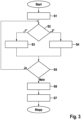
- step S1 an input image B is provided which is processed by the given convolutional neural network 2 to be applied to determine a segmented image.
- step S2 according to the configuration of the neural network 2, it is checked whether the first/next layer to be calculated corresponds to a depth map layer 22 or a conventional layer 21 of the neural network 2. If the next layer to be calculated corresponds to a depth map layer (alternative: "1"), the method continues with step S3, otherwise (alternative: "2"), the method continues with step S4.
- step S3 the output feature map MKO and simultaneously the associated scaling feature map SK are determined based on the plurality of scaling filters 23 as described above.
- the corresponding output feature map MKO is determined based on the function of the conventional layer 21.
- step S5 it is checked whether the neural network 2 has another layer to be calculated. If this is the case (alternative: yes), the output feature map MKO is assumed to be the input feature map of the next layer and the method continues with step S2. Otherwise, the method continues with step S6.
- the output feature map is output as the output image A in step S6
- step S7 the previously obtained scaling feature maps SK can be fed to the further appropriately trained neural network of the processing block 3 in order to determine the depth map TK from the scaling feature maps SK.
- the depth map TK then corresponds to the depth information image.
- depth information images can be determined from non-stereoscopic input images recorded by a camera of a technical system, in particular a robot, a vehicle, a tool or a machine tool.
- a technical system 10 which has a camera 11 for capturing an input image, a preprocessing unit 12 and a control unit 13 for executing control functions.
- the preprocessing unit 12 carries out the above method for determining a depth information image (depth map TK) and, if necessary, an output image A based on an input image captured by the camera 11.
- the control unit 13 implements functions of the technical system 10 that require depth information from camera images but do not enable stereoscopic capture of images.
- the control unit 13 processes the depth information image, in addition to other input variables, to produce one or more output variables.
- a computing unit controls at least one actuator 14 of the technical system with a corresponding control signal. For example, this can be used to control the movement of a robot or vehicle or to control a drive unit or a driver assistance system of a vehicle.
Landscapes
- Engineering & Computer Science (AREA)
- Physics & Mathematics (AREA)
- Theoretical Computer Science (AREA)
- General Physics & Mathematics (AREA)
- Computing Systems (AREA)
- Mathematical Physics (AREA)
- Biophysics (AREA)
- Computational Linguistics (AREA)
- Data Mining & Analysis (AREA)
- Evolutionary Computation (AREA)
- General Health & Medical Sciences (AREA)
- Molecular Biology (AREA)
- Artificial Intelligence (AREA)
- General Engineering & Computer Science (AREA)
- Life Sciences & Earth Sciences (AREA)
- Biomedical Technology (AREA)
- Software Systems (AREA)
- Health & Medical Sciences (AREA)
- Computer Vision & Pattern Recognition (AREA)
- Automation & Control Theory (AREA)
- Human Computer Interaction (AREA)
- Transportation (AREA)
- Mechanical Engineering (AREA)
- Image Analysis (AREA)
- Image Processing (AREA)
Description
Die Erfindung betrifft Verfahren zur Bildverarbeitung, insbesondere Verfahren, um eine Tiefeninformation aus einem bereitgestellten Bild zu ermitteln. Die Erfindung betrifft weiterhin Verfahren zur Realisierung von Funktionen eines technischen Systems, insbesondere eines Roboters, eines Fahrzeugs, eines Werkzeugs oder einer Werkmaschine, wobei die Funktionen abhängig von einem Tiefeninformationsbild der Umgebung ausgeführt werden, oder zur Steuerung von Fahrzeugfunktionen basierend auf einem Tiefeninformationsbild.The invention relates to methods for image processing, in particular to methods for determining depth information from a provided image. The invention further relates to methods for implementing functions of a technical system, in particular a robot, a vehicle, a tool or a machine tool, wherein the functions are carried out depending on a depth information image of the environment, or for controlling vehicle functions based on a depth information image.
Es sind Funktionen eines technischen Systems bekannt, insbesondere eines Roboters, eines Fahrzeugs, eines Werkzeugs oder einer Werkmaschine, wobei die Funktionen abhängig von einem Tiefeninformationsbild der Umgebung ausgeführt werden. Beispielsweise basieren autonome oder halbautonome Fahrzeugfunktionen, gesteuert durch Fahrzeuge oder externe Einrichtungen, auf der sicheren Erkennung von Freifläche, Fahrzeugen und Menschen bzw. sonstigen Objekten in der Umgebung des Kraftfahrzeugs. Für eine Realisierung einer solchen Fahrfunktion in einem Kraftfahrzeug ist die Bilderfassung der Umgebung mit Hilfe einer oder mehrerer Kameras oder sonstigen Bilderfassungseinrichtungen Grundvoraussetzung.Functions of a technical system are known, in particular of a robot, a vehicle, a tool or a machine tool, where the functions are carried out depending on a depth information image of the environment. For example, autonomous or semi-autonomous vehicle functions, controlled by vehicles or external devices, are based on the reliable detection of open space, vehicles and people or other objects in the environment of the motor vehicle. In order to implement such a driving function in a motor vehicle, the image capture of the environment using one or more cameras or other image capture devices is a basic requirement.
Die erfassten Kamerabilder werden in geeigneter Weise ausgewertet, um beispielsweise die Fahrzeugumgebung zu segmentieren bzw. Objekte in der Fahrzeugumgebung zu erkennen. Von erheblicher Bedeutung ist dabei das Ermitteln einer Tiefeninformation für die einzelnen Bildpunkte bzw. Bildobjekte der erfassten Bilder. Die Tiefeninformation ermöglicht oder vereinfacht u. a. die Zuordnung von Bildbereichen zu einzelnen Objekten, was für eine zuverlässige Segmentierung des zu untersuchenden Bildes vorteilhaft ist.The captured camera images are evaluated in a suitable manner, for example to segment the vehicle surroundings or to recognize objects in the vehicle surroundings. Of considerable importance here is the determination of depth information for the individual pixels or image objects of the captured images. The depth information enables or simplifies, among other things, the assignment of image areas to individual objects, which is advantageous for reliable segmentation of the image to be examined.
Bisherige Verfahren zum Erstellen solcher Tiefeninformationsbilder, d. h. mit Tiefeninformation versehener Bilder bzw. Bilder, die einer Tiefenkarte entsprechen und die Tiefe jedes Bildpunktes eines Referenzbildes angeben, nutzen in der Regel Stereokameras zur Erfassung von Stereobildern. Durch Identifikation von Merkmalen in der aufgezeichneten Szene können basierend auf Bildunterschieden zwischen den zwei Stereobildern Distanzen der erfassten Merkmale ermittelt werden und daraus eine Tiefenkarte erstellt werden.
Eine Ermittlung von Tiefeninformationsbildern basierend auf einem mit Hilfe einer Monokamera nicht-stereoskopisch erfassten Eingangsbild ist bislang nicht bekannt bzw. nicht zuverlässig umgesetzt.The determination of depth information images based on an input image captured non-stereoscopically using a mono camera is not yet known or has not been reliably implemented.
Erfindungsgemäß sind ein Verfahren zum Ermitteln eines Tiefeninformationsbilds aus einem Eingangsbild gemäß Anspruch 1 sowie eine Vorrichtung und ein Bildverarbeitungssystem gemäß den nebengeordneten Ansprüchen vorgesehen. Weitere Ausgestaltungen sind in den abhängigen Ansprüchen angegeben.According to the invention, a method for determining a depth information image from an input image according to claim 1 and a device and an image processing system according to the independent claims are provided. Further embodiments are specified in the dependent claims.
Gemäß einem ersten Aspekt ist ein Computerimplementiertes Verfahren zum Ermitteln eines Tiefeninformationsbilds für ein Eingangsbild, wobei das Eingangsbild mithilfe eines konvolutionellen neuronalen Netzes verarbeitet wird, wobei das konvolutionelle neuronale Netz mehrere Schichten aufweist, die das Eingangsbild sequentiell bearbeiten und jeweils eine Eingangsmerkmalskarte in eine Ausgangsmerkmalskarte umsetzen, wobei eine der Schichten als eine Tiefenkartenschicht ausgebildet ist, wobei das Tiefeninformationsbild abhängig von einer Tiefenkartenschicht ermittelt wird, wobei in der Tiefenkartenschicht
- eine Eingangsmerkmalskarte der Tiefenkartenschicht mit mehreren Skalierungsfiltern gefaltet wird, um jeweilige Skalierungskarten zu erhalten, wobei die Skalierungsfilter abhängig von einem vorgegebenen Filter durch vorgegebene Skalierungen dieses vorgegebenen Filters erzeugt wurden;
- die mehreren Skalierungskarten pixelweise verglichen werden, um eine jeweilige Ausgangsmerkmalskarte zu generieren, in der jeder Pixel einem entsprechenden Pixel aus einer ausgewählten der Skalierungskarten entspricht,
- eine Skalierungsmerkmalskarte generiert wird, indem jeder Pixel der Skalierungsmerkmalskarte einer Angabe zugeordnet wird, die diejenige Skalierungskarte angibt, aus der der Pixel der Ausgangsmerkmalskarte ausgewählt ist;
- an input feature map of the depth map layer is convolved with a plurality of scaling filters to obtain respective scaling maps, wherein the scaling filters dependent on a given filter were generated by given scalings of this given filter;
- the plurality of scaling maps are compared pixel by pixel to generate a respective output feature map in which each pixel corresponds to a corresponding pixel from a selected one of the scaling maps,
- a scaling feature map is generated by associating each pixel of the scaling feature map with an indication that specifies the scaling map from which the pixel of the output feature map is selected;
Weiterhin kann die ausgewählte Skalierungskarte derjenigen Skalierungskarte entsprechen, die für den jeweiligen Pixel den größten Pixelwert enthält.Furthermore, the selected scaling map can correspond to the scaling map that contains the largest pixel value for the respective pixel.
Das obige Verfahren nutzt eine Merkmalserkennung in verschiedenen durch die Skalierungsfilter vorgegebenen Skalierungen. Dadurch kann durch Auswertung der unterschiedlichen auf Grundlage der Skalierungsfilter erhaltenen Skalierungskarten, die den entsprechenden unterschiedlichen Skalierungen zugeordnet sind, erkannt werden kann, in welcher Größe ein Merkmal in dem zu untersuchenden Bild auftritt. Die Größe des Merkmals beinhaltet - für bestimmte zu erkennende Objekte - dann eine Information darüber, welcher Abstand das zu dem Merkmal gehörende Objekt von der das Bild erfassenden Kamera hat. Durch die Anwendung von Skalierungsfiltern verschiedener Skalierungen kann somit ein bestimmtes Objekt unabhängig von dessen Abstand zur erfassenden Kamera durch jeweils mindestens einen der Skalierungsfilter identifiziert werden. Das obige Verfahren nutzt nun die Information, welcher der Skalierungsfilter für die Identifikation des Objektes maßgeblich war, um daraus eine Distanz zu dem betreffenden Objekt abzuschätzen.The above method uses feature recognition in different scales specified by the scaling filters. This makes it possible to recognize the size of a feature in the image to be examined by evaluating the different scaling maps obtained on the basis of the scaling filters, which are assigned to the corresponding different scales. The size of the feature then contains - for certain objects to be recognized - information about the distance the object belonging to the feature is from the camera capturing the image. By using scaling filters of different scales, a certain object can be identified by at least one of the scaling filters, regardless of its distance from the capturing camera. The above method now uses the information about which scaling filter was decisive for identifying the object in order to estimate a distance to the object in question.
Wird ein Kanal eines Eingangsbildes durch eine oder mehrere Schichten eines konvolutionellen neuronalen Netzes mit verschiedenen Skalierungsfiltern (Kerneln) gefaltet, so ergeben sich Skalierungskarten, die in einem nachfolgenden Max-Pooling-Schritt für eine Ausgangsmerkmalskarte verknüpft werden. Der Max-Pooling-Schritt entspricht einer Pixel für Pixel angewendeten Maximalauswahl der Pixelwerte, wobei der jeweilige Maximalwert den identischen Pixeln zugeordneten Pixelwerte der Skalierungskarten in die Ausgangsmerkmalskarte eingetragen wird.If a channel of an input image is passed through one or more layers of a convolutional neural network with different scaling filters (kernels) to produce scaling maps that are linked in a subsequent max-pooling step to form an output feature map. The max-pooling step corresponds to a maximum selection of the pixel values applied pixel by pixel, whereby the respective maximum value of the pixel values of the scaling maps assigned to identical pixels is entered into the output feature map.
Gleichzeitig wird in einer Skalierungsmerkmalskarte für jedes Pixel der Ausgangsmerkmalskarte eine Skalierungsangabe eingetragen, die denjenigen Skalierungsfilter angibt, der zu dem maximalen Pixelwert geführt hat. Für die einzelnen Kanäle der Eingangsmerkmalskarte der einen oder mehreren Berechnungsschichten des konvolutionellen neuronalen Netzes werden so Skalierungsmerkmalskarten ermittelt. Abhängig von der einen oder den mehreren so bestimmten Skalierungsmerkmalskarten kann ein Tiefeninformationsbild für das zu untersuchende Bild angegeben werden.At the same time, a scaling specification is entered in a scaling feature map for each pixel of the output feature map, which specifies the scaling filter that led to the maximum pixel value. Scaling feature maps are thus determined for the individual channels of the input feature map of the one or more calculation layers of the convolutional neural network. Depending on the one or more scaling feature maps determined in this way, a depth information image can be specified for the image to be examined.
Das obige Verfahren hat den Vorteil, dass aus einem einfachen, d. h. nicht stereoskopisch vorliegenden Bild eine Tiefeninformation für die in dem Bild dargestellten Merkmale ermittelt werden kann. Die Tiefeninformation ergibt sich dabei aus einer Skalierung, die demjenigen Skalierungsfilter zugeordnet ist, der das durch den Skalierungsfilter angegebene Merkmal am besten erkennt.The above method has the advantage that depth information for the features shown in the image can be determined from a simple, i.e. non-stereoscopic image. The depth information is obtained from a scaling that is assigned to the scaling filter that best recognizes the feature specified by the scaling filter.
Weiterhin können die Skalierungsfilter aus einem Filterkernel des trainierten konvolutionellen neuronalen Netzes durch Down-Sampling bestimmt werden.Furthermore, the scaling filters can be determined from a filter kernel of the trained convolutional neural network by down-sampling.
Es kann vorgesehen sein, dass das konvolutionelle neuronale Netz mehrere Tiefenkartenschichten aufweist, um mehrere Skalierungsmerkmalskarten zu ermitteln, wobei das Tiefeninformationsbild aus den mehreren Skalierungsmerkmalskarten mithilfe eines weiteren neuronalen Netzes ermittelt wird.It may be provided that the convolutional neural network has a plurality of depth map layers to determine a plurality of scaling feature maps, wherein the depth information image is determined from the plurality of scaling feature maps using a further neural network.
Weiterhin können die mehreren Skalierungskarten in einem Kombinierprozess pixelweise verglichen werden, um aus den jeweiligen maximalen Pixelwerten weiterhin die Ausgangsmerkmalskarte, die als Eingangsmerkmalskarte einer nachfolgenden Berechnung einer weiteren Schicht des konvolutionellen neuronalen Netzwerkes dient, zu erhalten oder ein Ausgangsbild zu erhalten.Furthermore, the multiple scaling maps can be compared pixel by pixel in a combining process to obtain the output feature map from the respective maximum pixel values, which serves as the input feature map of a subsequent calculation of another layer of the convolutional neural network, or to obtain an output image.
Weiterhin kann das Tiefeninformationsbild aus den mehreren Skalierungsmerkmalskarten und einer oder mehreren Ausgangsmerkmalskarten einer oder mehrerer der Schichten des neuronalen Netzes und/oder eines Ausgangsbilds des neuronalen Netzes ermittelt werden.Furthermore, the depth information image can be determined from the plurality of scaling feature maps and one or more output feature maps of one or more of the layers of the neural network and/or an output image of the neural network.
Es kann vorgesehen sein, dass das neuronale Netz ein Ausgangsbild generiert, wobei mindestens eine der Schichten eine Ausgangsmerkmalskarte und/oder das Ausgangsbild abhängig von einer oder mehreren der Skalierungsmerkmalskarten generiert, wobei dazu insbesondere die eine oder die mehreren der Skalierungsmerkmalskarten der betreffenden Schicht zugeführte Eingangsmerkmalskarte hinzugefügt wird.It can be provided that the neural network generates an output image, wherein at least one of the layers generates an output feature map and/or the output image depending on one or more of the scaling feature maps, wherein for this purpose in particular the one or more of the scaling feature maps supplied to the relevant layer are added.
Gemäß einer Ausführungsform kann in einem nachgeschalteten zusätzlichen neuronalen Netz das Ausgangsbild und das Tiefeninformationsbild gemeinsam verarbeitet werden, wobei das zusätzliche neuronale Netz das Ausgangsbild und das Tiefeninformationsbild zu einem segmentierten Bild verarbeitet.According to one embodiment, the output image and the depth information image can be processed together in a downstream additional neural network, wherein the additional neural network processes the output image and the depth information image into a segmented image.
Gemäß einem weiteren Aspekt ist eine Vorrichtung zum Ermitteln eines Tiefeninformationsbilds für ein Eingangsbild vorgesehen, um insbesondere abhängig von dem Tiefeninformationsbild Fahrzeugfunktionen anzusteuern, wobei das Eingangsbild mithilfe eines konvolutionellen neuronalen Netzes verarbeitet wird, wobei das konvolutionelle neuronale Netz mehrere Schichten aufweist, die das Eingangsbild sequentiell bearbeiten und jeweils eine Eingangsmerkmalskarte in eine Ausgangsmerkmalskarte umsetzen, wobei mindestens eine der Schichten als eine Tiefenkartenschicht ausgebildet ist, wobei das Tiefeninformationsbild abhängig von einer Tiefenkartenschicht ermittelt wird, wobei die Vorrichtung ausgebildet ist, um für die mindestens eine Tiefenkartenschicht:
- eine Eingangsmerkmalskarte der betreffenden Tiefenkartenschicht mit mehreren Skalierungsfiltern zu falten, um jeweilige Skalierungskarten zu erhalten, wobei die Skalierungsfilter abhängig von einem vorgegebenen Filter durch vorgegebene Skalierungen dieses vorgegebenen Filters erzeugt wurden;
- die mehreren Skalierungskarten pixelweise zu vergleichen, um eine jeweilige Ausgangsmerkmalskarte zu generieren, in der jeder Pixel einem entsprechenden Pixel aus einer ausgewählten der Skalierungskarten entspricht,
- eine Skalierungsmerkmalskarte zu generieren, indem jeder Pixel der Skalierungsmerkmalskarte einer Angabe zugeordnet wird, die diejenige Skalierungskarte angibt, aus der der Pixel der Ausgangsmerkmalskarte ausgewählt ist;
- convolving an input feature map of the respective depth map layer with a plurality of scaling filters to obtain respective scaling maps, wherein the scaling filters dependent on a given filter were generated by given scalings of this given filter;
- comparing the plurality of scaling maps pixel by pixel to generate a respective output feature map in which each pixel corresponds to a corresponding pixel from a selected one of the scaling maps,
- generate a scale feature map by associating each pixel of the scale feature map with an indication that specifies the scale map from which the pixel of the output feature map is selected;
Gemäß einem weiteren Aspekt ist ein System vorgesehen, umfassend:
- eine Bilderfassungseinrichtung zum Erfassen eines Eingangsbilds;
- eine Vorverarbeitungseinrichtung, die durch die obige Vorrichtung zum Bereitstellen eines Tiefeninformationsbilds abhängig von dem Eingangsbild realisiert ist; und
- ein Steuergerät zum Ansteuern mindestens eines Aktors des Systems abhängig von dem Tiefeninformationsbild.
- an image capture device for capturing an input image;
- a preprocessing device realized by the above device for providing a depth information image depending on the input image; and
- a control unit for controlling at least one actuator of the system depending on the depth information image.
Ausführungsformen werden nachfolgend anhand der beigefügten Zeichnungen näher erläutert. Es zeigen:
- Figur 1
- eine schematische Darstellung einer Ermittlung eines segmentierten Bilds mit einer Tiefeninformation aus einem Eingangsbild;
- Figur 2
- eine schematische Darstellung der Struktur zum Erhalten eines Tiefeninformationsbilds aus mehreren Skalierungsmerkmalskarten;
- Figur 3
- ein Flussdiagramm zur Veranschaulichung eines Verfahrens zum Ermitteln einer Tiefeninformation für Objekte in einem nicht-stereoskopisch vorliegenden zu untersuchenden Eingangsbild; und
- Figur 4
- eine schematische Darstellung der Struktur zum Erhalten eines segmentierten Ausgangsbilds aus mehreren Skalierungsmerkmalskarten und mithilfe eines neuronalen Netzes zur semantischen Segmentierung.
- Figure 1
- a schematic representation of a determination of a segmented image with depth information from an input image;
- Figure 2
- a schematic representation of the structure for obtaining a depth information image from multiple scaling feature maps;
- Figure 3
- a flow chart illustrating a method for determining depth information for objects in a non-stereoscopic input image to be examined; and
- Figure 4
- a schematic representation of the structure for obtaining a segmented output image from multiple scaling feature maps and using a neural network for semantic segmentation.
Ein konvolutionelles neuronales Netz wird in an sich bekannter Weise durch kaskadiertes Berechnen von Merkmalskarten berechnet. Das konvolutionelle neuronale Netz kann dazu verschiedene Arten von Berechnungsschichten umfassen, wobei die Schichten eine oder mehrere Konvolutionsschichten 21 umfassen. Bei einer Faltungsschicht 21 wird auf einen Ausschnitt einer Eingangsmerkmalskarte, die für die erste Berechnungsschicht dem Eingangsbild entsprechen kann, ein Filterkernel angewendet, um eine Ausgangsmerkmalskarte der betreffenden Schicht zu erzeugen. Der Filterkernel entspricht einer Faltungsmatrix mit Gewichtungswerten. Dabei wird dem aktuell dem Filterkernel unterliegenden Bildausschnitt jeweils ein Pixel der Ausgangsmerkmalskarte zugeordnet und der entsprechende Pixelwert durch deren inneres Produkt berechnet. Die Gewichtungswerte werden mit den entsprechenden Pixelwerten des Ausschnitts der Eingangsmerkmalskarte multipliziert, wobei die Ergebnisse aller Multiplikationen eines Filterkernels addiert werden, um den entsprechenden Pixelwert der Ausgangsmerkmalskarte zu erhalten.A convolutional neural network is calculated in a manner known per se by cascading calculation of feature maps. The convolutional neural network can comprise various types of calculation layers, the layers comprising one or more convolution layers 21. In a
Bei mehrschichtigen konvolutionellen neuronalen Netzen wird üblicherweise die Ausgangsmerkmalskarte als Eingangsmerkmalskarte einer nächsten Berechnungsschicht oder - bei der letzte Berechnungsschicht - als Ausgangsbild vorgesehen.In multilayer convolutional neural networks, the output feature map is usually used as the input feature map of a next computational layer or - in the last computational layer - as the output image.
Das erste neuronale Netz 2 des Bildverarbeitungssystems 1 sieht beispielhaft mehrere kaskadierte Standard-Konvolutionsschichten 21 vor, wobei im dargestellten Ausführungsbeispiel eine erste Schicht als Tiefenkartenschicht 22 vorgesehen ist. Allgemein können in dem neuronalen Netz 2 mehrere der ersten Schichten als Tiefenkartenschichten 22 vorgesehen. In nachfolgenden (tieferen) Schichten können diese ebenfalls eingesetzt werden, typischerweise sind diese Schichten aber als Standard-Konvolutionsschichten 21 ausgebildet.The first neural network 2 of the image processing system 1 provides, for example, several cascaded standard convolution layers 21, wherein in the embodiment shown a first layer is provided as a
Die Tiefenkartenschicht 22 weist eine von den übrigen Schichten des ersten konvolutionellen neuronalen Netzes 2 abweichende Implementierung auf, bei der die betreffende Eingangsmerkmalskarte (in diesem Fall das Eingangsbild B) mit mehreren verschiedenen Skalierungskerneln 23 verarbeitet wird.The
Die Skalierungskernel 23 entsprechen einem Filterkernel einer Konvolutionsschicht des konvolutiellen neuronalen Netzes 2, der in verschiedenen Skalierungen vorgesehen ist, so dass mehrere Skalierungskernel 23 gebildet werden. Diese ergeben sich durch Vorgabe des größten Skalierungskernels 23a als dem Filterkernel mit der größten Anzahl von Gewichtungen und durch Down-Sampling des größten Skalierungskernels 23a zu den übrigen Skalierungskerneln 23b, 23c. Der als der größte Skalierungskernel 23a angenommene Filterkernel kann vorgegeben sein oder sich aus einem Training des konvolutionellen neuronalen Netzes 2 mit entsprechenden Trainingsdaten ergeben. Die Anzahl der Skalierungskernel 23 pro Schicht ist beliebig wählbar, beträgt jedoch vorzugsweise 2 bis 10, weiter bevorzugt 3 bis 5.The scaling
Down-Sampling bezeichnet allgemein die Reduktion der Stützstellen einer Zeitreihe oder anderer Anordnungen diskreter Werte. Hier wird die Größe der Matrix der Gewichtungswerte des Filterkernels entsprechend durch Zusammenfassung der Gewichtungswerte reduziert.Down-sampling generally refers to the reduction of the sampling points of a time series or other arrangements of discrete values. Here, the size of the matrix of the weighting values of the filter kernel is reduced accordingly by summarizing the weighting values.
Im einfachsten Fall entspricht das "Downsampling" eine Matrixmultiplikation. Dabei wird ein großer Filter X eines großen Skalierungskernels auf einen kleinen Filter Y abgebildet: 
Als Beispiel für ein Downsampling eines 5x5x1 Filters zu einem 3x3x1-Filter: 
Dann ist: 
Gegebenenfalls wird Y noch mit einem frei wählbaren Faktor multipliziert.If necessary, Y is multiplied by a freely selectable factor.
Für einen Kernel mit mehreren (k) Features, etwa 5x5xk, führt man die diese Operation für jedes der k Features aus. Neben dem obigen Verfahren können in dem Downsamplingverfahren auch folgende Verfahren verwendet werden: Nearest neighbors, cubic, bicubic, area-interploation, bilinear oder Pooling.For a kernel with multiple (k) features, say 5x5xk, this operation is performed for each of the k features. In addition to the above method, the following methods can also be used in the downsampling method: nearest neighbors, cubic, bicubic, area-interploation, bilinear or pooling.
Durch die Verarbeitung der Eingangsmerkmalskarte MKI mit den mehreren Skalierungskerneln 23a, 23b, 23c werden durch Faltung entsprechende Skalierungskarten 24a, 24b, 24c ermittelt, die den Skalierungskerneln 23a, 23b, 23c jeweils zugeordnet sind. Die Verarbeitung erfolgt in der bei konvolutionellen neuronalen Netzen üblichen Weise, wobei jeder Pixelwert der Skalierungskarte 24a, 24b, 24c durch Anwenden des zugeordneten Skalierungsfilters 23a, 23b, 23c auf den entsprechenden Ausschnitt der Eingangsmerkmalskarte MKI errechnet wird.By processing the input feature map MKI with the multiple scaling
Die so erhaltenen Skalierungskarten 24a, 24b, 24c werden einem Kombinierprozess 25 zugeführt, der einem Max-Pooling-Prozess ähnelt. In dem Kombinierprozess wird durch pixelweises Vergleichen der Skalierungskarten 24a, 24b, 24c der jeweilige Maximalwert der Pixelwerte in die entsprechende Ausgangsmerkmalskarte MKO übernommen. Diese Ausgangsmerkmalskarte MKO kann nun als Eingangsmerkmalskarte für die nächste Schicht des neuronalen Netzes 2 dienen, die eine Standard-Konvolutionsschicht 21 oder eine Tiefenkartenschicht 22 sein kann, oder, wenn die berechnende Schicht eine letzte Schicht des neuronalen Netzes 2 ist, dem Ausgangsbild A der Verarbeitung durch das neuronale Netz 2, beispielsweise einem segmentierten Bild, entsprechen kann.The scaling maps 24a, 24b, 24c obtained in this way are fed to a combining
Bei dem Kombinierprozess 25 für die Skalierungskarten 24a, 24b, 24c erhält man neben dem maximalen Pixelwert eine Angabe, aus welcher der Skalierungskarten 24a, 24b, 24c der maximale Pixelwert (argmax-Funktion) errechnet worden ist. Die Skalierungskarten 24a, 24b, 24c sind den entsprechenden Skalierungskerneln 23a, 23b, 23c und damit entsprechenden Skalierungen zugeordnet, so dass mit der Angabe der für den maximalen Pixelwert verantwortlichen Skalierungskarte 24a, 24b, 24c auch eine Angabe über die Größe/Skalierung des zugeordneten Skalierungskernels 23a, 23b, 23c vorliegt. Die Angabe über die den maximalen Pixelwert liefernde Skalierungskarte 24 wird in die Skalierungsmerkmalskarte SK geschrieben, so dass für jeden Pixel der Ausgangsmerkmalskarte MKO in der Skalierungsmerkmalskarte SK eine Angabe vorliegt, welche der Skalierungskarten 24a, 24b, 24c bzw. welche Größe des Skalierungskernels 23a, 23b, 23c für die Auswahl des maximalen Pixelwerts in der Ausgangsmerkmalskarte MKO verantwortlich war.In the
Die Skalierungsmerkmalskarte SK kann unmittelbar als eine Tiefenkarte TK verwendet werden oder in einem Bearbeitungsblock 3 in die Tiefenkarte TK umgesetzt werden. Die Tiefenkarte TK entspricht einem Tiefeninformationsbild, das einen Abstand jedes einzelnen Bildpunktes (Pixels) von der Kameraebene angibt. Der Bearbeitungsblock 3 kann einem einfachen Funktionsblock oder einem trainierbaren neuronalen Netz entsprechen.The scaling feature map SK can be used directly as a depth map TK or can be converted into the depth map TK in a processing block 3. The depth map TK corresponds to a depth information image that indicates a distance of each individual image point (pixel) from the camera plane. The processing block 3 can correspond to a simple function block or a trainable neural network.
Alternativ können, wie in
Zusätzlich kann die Verarbeitung in dem Bearbeitungsblock 3 neben der einen oder den mehreren Skalierungsmerkmalskarte SK, Sk1, Sk2..., SKn auch das aktuelle Ausgangsbild A verarbeiten, um die Tiefenkarte TK zu erhalten.In addition, the processing in the processing block 3 may process the current output image A in addition to the one or more scaling feature maps SK, Sk1, Sk2..., SKn to obtain the depth map TK.
Alternativ oder zusätzlich kann die Verarbeitung in dem neuronalen Netz 2 auch die eine oder die mehreren Skalierungsmerkmalskarte SK, Sk1, Sk2..., SKn oder eine daraus ermittelte Tiefenkarte TK berücksichtigen, um das aktuelle Ausgabebild A zu erhalten.Alternatively or additionally, the processing in the neural network 2 can also take into account the one or more scaling feature maps SK, Sk1, Sk2..., SKn or a depth map TK determined therefrom in order to obtain the current output image A.
Das Ausgangsbild A kann ein segmentiertes Bild darstellen, in dem die Tiefeninformation von mehreren Skalierungsmerkmalskarten Sk1, Sk2..., SKn verarbeitet sind. Das Ausgangsbild kann dann ein Tiefeninformationsbild darstellen. Dazu kann wie in
Die Decodierschichten 28 verarbeiten die Skalierungsmerkmalskarten Sk1, Sk2..., SKn, indem diese eingangsseitig an den jeweiligen Eingangsvektor/Eingangstensor der betreffenden Dekodierschicht 28 angehangen wird.The decoding layers 28 process the scaling feature maps Sk1, Sk2..., SKn by appending them on the input side to the respective input vector/input tensor of the
Zum Trainieren des Bildverarbeitungssystems der
Aus den Trainingsbildern werden nun mithilfe der Skalierungskernel 23 Trainings- Skalierungsmerkmalskarten SK1, SK2, SK3, ...SKn ermittelt, die dem jeweiligen Trainingsbild zugeordnet sind. Mithilfe von den Trainingsbildern zugeordneten Trainingstiefenkarten, die zu den Trainingsbildern Tiefeninformation bereitstellen, kann nun das zweite neuronale Netz 3 trainiert werden. Dies basiert auf den bei eingangsseitigem Anlegen von Trainingsbildern erhaltenen Skalierungsmerkmalskarten SK1, SK2, SK3, ...SKn und der dem jeweiligen Trainingsbild zugeordneten vorgegebenen Trainingstiefenkarte. Das zweite neuronale Netz 3 kann dazu ebenfalls als herkömmliches, konvolutionelles Netz ausgebildet sein.The training images are then used to determine 23 training scaling feature maps SK1, SK2, SK3, ...SKn, which are assigned to the respective training image, using the scaling kernel. The second neural network 3 can now be trained using training depth maps assigned to the training images, which provide depth information for the training images. This is based on the scaling feature maps SK1, SK2, SK3, ...SKn obtained when training images are created on the input side and the predefined training depth map assigned to the respective training image. The second neural network 3 can also be designed as a conventional, convolutional network.
Das Verfahren zum Ermitteln der Tiefenkarte TK wird nachfolgend anhand des Flussdiagramms der
In Schritt S1 wird ein Eingangsbild B bereitgestellt, das durch das vorgegebene konvolutionelle neuronale Netz 2, das zum Ermitteln eines segmentierten Bildes angewendet werden soll, verarbeitet wird.In step S1, an input image B is provided which is processed by the given convolutional neural network 2 to be applied to determine a segmented image.
In Schritt S2 wird gemäß Konfiguration des neuronalen Netzes 2 überprüft, ob die erste/nächste zu berechnende Schicht einer Tiefenkartenschicht 22 oder einer herkömmlichen Schicht 21 des neuronalen Netzes 2 entspricht. Entspricht die nächste zu berechnende Schicht einer Tiefenkartenschicht (Alternative. "1"), so wird das Verfahren mit Schritt S3 fortgesetzt, anderenfalls (Alternative: "2"), wird das Verfahren mit Schritt S4 fortgesetzt.In step S2, according to the configuration of the neural network 2, it is checked whether the first/next layer to be calculated corresponds to a
In Schritt S3 wird wie oben beschrieben die Ausgangsmerkmalskarte MKO und gleichzeitig die zugehörige Skalierungsmerkmalskarte SK basierend auf den mehreren Skalierungsfiltern 23, wie oben beschrieben, ermittelt.In step S3, as described above, the output feature map MKO and simultaneously the associated scaling feature map SK are determined based on the plurality of scaling
In dem alternativen Schritt S4 wird die entsprechende Ausgangsmerkmalskarte MKO basierend auf der Funktion der herkömmlichen Schicht 21 ermittelt.In the alternative step S4, the corresponding output feature map MKO is determined based on the function of the
In Schritt S5 wird überprüft, ob das neuronale Netz 2 eine weitere zu berechnende Schicht aufweist. Ist dies der Fall (Alternative: Ja) wird die Ausgangsmerkmalskarte MKO als Eingangsmerkmalskarte der nächsten Schicht angenommen und das Verfahren mit Schritt S2 fortgesetzt. Anderenfalls wird das Verfahren mit Schritt S6 fortgesetzt.In step S5, it is checked whether the neural network 2 has another layer to be calculated. If this is the case (alternative: yes), the output feature map MKO is assumed to be the input feature map of the next layer and the method continues with step S2. Otherwise, the method continues with step S6.
Da keine weiteren Berechnungsschritte vorgesehen sind, wird in Schritt S6 die Ausgangsmerkmalskarte als das Ausgangsbild A ausgegebenSince no further calculation steps are planned, the output feature map is output as the output image A in step S6
In Schritt S7 können die zuvor erhaltenen Skalierungsmerkmalskarte SK dem weiteren entsprechend trainierten neuronalen Netz des Bearbeitungsblocks 3 zugeführt werden, um die Tiefenkarte TK aus den Skalierungsmerkmalskarten SK zu bestimmen. Die Tiefenkarte TK entspricht dann dem Tiefeninformationsbild.In step S7, the previously obtained scaling feature maps SK can be fed to the further appropriately trained neural network of the processing block 3 in order to determine the depth map TK from the scaling feature maps SK. The depth map TK then corresponds to the depth information image.
So können Tiefeninformationsbilder aus nicht-stereoskopischen Eingangsbildern bestimmt werden, die von einer Kamera eines technischen Systems, insbesondere eines Roboters, eines Fahrzeugs, eines Werkzeugs oder einer Werkmaschine, aufgezeichnet werden.Thus, depth information images can be determined from non-stereoscopic input images recorded by a camera of a technical system, in particular a robot, a vehicle, a tool or a machine tool.
In
Durch das Steuergerät 13 werden Funktionen des technischen Systems 10 realisiert, die Tiefeninformationen von Kamerabildern benötigen, aber keine stereoskopische Erfassung von Bildern ermöglichen. Das Steuergerät 13 verarbeitet ggfs neben weiteren Eingangsgrößen das Tiefeninformationsbild zu einer oder mehreren Ausgangsgrößen. Abhängig von den Ausgangsgrößen des Steuergeräts 13 wird durch eine Recheneinheit mindestens ein Aktor 14 des technischen Systems mit einem entsprechenden Ansteuersignal angesteuert. Beispielsweise kann so eine Bewegung eines Roboters oder Fahrzeugs gesteuert werden oder eine Steuerung einer Antriebseinheit oder eines Fahrerassistenzsystems eines Fahrzeugs erfolgen.The
Claims (12)
- Computer-implemented method for determining a depth information image for an input image (B), in order in particular to drive vehicle functions depending on the depth information image, wherein the input image (B) is processed by way of a convolutional neural network (2), wherein the convolutional neural network (2) has multiple layers that process the input image (B) sequentially and each convert an input feature map (MKI) into an output feature map (MKO), wherein at least one of the layers is formed as a depth map layer, wherein the depth information image is determined depending on a depth map layer, wherein, in the depth map layer (22),- an input feature map (MKI) of the depth map layer (22) is convolved with multiple scaling filters (23, 23a, 23b, 23c) in order to obtain respective scaling maps (24a, 24b, 24c), wherein the scaling filters were generated, depending on a predefined filter, by predefined scalings of this predefined filter;- the multiple scaling maps (24a, 24b, 24c) are compared pixel-by-pixel in order to generate a respective output feature map (MKO) in which each pixel corresponds to a corresponding pixel from a selected one of the scaling maps (24a, 24b, 24c),- a scaling feature map (SK) is generated by assigning each pixel of the scaling feature map (SK) to an indication indicating the scaling map (24a, 24b, 24c) from which the pixel of the output feature map (MKO) is selected;wherein the depth information image corresponds to the scaling feature map (SK) or is determined depending on the scaling feature map (SK).
- Method according to Claim 1, wherein the selected scaling map (24a, 24b, 24c) corresponds to the scaling map that contains the greatest pixel value for the respective pixel.
- Method according to Claim 2, wherein the scaling filters are determined from a filter kernel of the trained convolutional neural network by downsampling or upsampling.
- Method according to one of Claims 1 to 3, wherein multiple scaling feature maps (SK) are determined in multiple depth map layers (22), wherein the depth information image is determined from the multiple scaling feature maps (SK) by way of a further neural network (3), wherein the depth information image in particular corresponds to a depth map (TK).
- Method according to Claim 3, wherein the depth information image is determined from the multiple scaling feature maps (SK) and one or more output feature maps (MKO) of one or more of the layers of the neural network (2) and/or an output image (A) of the neural network (2).
- Method according to one of Claims 1 to 5, wherein the neural network generates an output image (A), wherein at least one of the layers (21) generates an output feature map (MKO) and/or the output image (A) depending on one or more of the scaling feature maps (SK), wherein in particular the one or more input feature maps (MKI) supplied to the scaling feature maps (SK) of the layer in question are added thereto.
- Method according to Claim 6, wherein, in a downstream additional neural network, the output image (A) and the depth information image are processed together, wherein the additional neural network processes the output image (A) and the depth information image to form a segmented image.
- Method according to one of Claims 1 to 7, wherein the depth information image is used to drive a vehicle function, in particular a fully autonomous or semi-autonomous driving mode or a driver assistance function for warning about objects in the environment.
- Device for determining a depth information image for an input image (B), in order in particular to drive vehicle functions depending on the depth information image, wherein the input image (B) is processed by way of a convolutional neural network (2), wherein the convolutional neural network (2) has multiple layers that process the input image (B) sequentially and each convert an input feature map (MKI) into an output feature map (MKO), wherein at least one of the layers is formed as a depth map layer (22), wherein the depth information image is determined depending on a depth map layer (22), wherein the device is designed, for the at least one depth map layer (22):- to convolve an input feature map (MKI) of the depth map layer (22) in question with multiple scaling filters in order to obtain respective scaling maps (24a, 24b, 24c), wherein the scaling filters were generated, depending on a predefined filter, by predefined scalings of this predefined filter,- to compare the multiple scaling maps (24a, 24b, 24c) pixel-by-pixel in order to generate a respective output feature map (MKO) in which each pixel corresponds to a corresponding pixel from a selected one of the scaling maps (24a, 24b, 24c),- to generate a scaling feature map (SK) by assigning each pixel of the scaling feature map (SK) to an indication indicating the scaling map (24a, 24b, 24c) from which the pixel of the output feature map (MKO) is selected;wherein the depth information image corresponds to the scaling feature map (SK) or is determined depending on the scaling feature map (SK).
- System (10) comprising:- an image acquisition apparatus (11) for acquiring an input image (B);- a preprocessing apparatus (12) corresponding to the device according to Claim 9 for providing a depth information image depending on the input image;- a control unit (13) for driving at least one actuator (14) of the system (10) depending on the depth information image.
- Computer program comprising instructions that, when these instructions are executed on a computer, are configured to cause the computer to carry out the method according to one of Claims 1 to 8.
- Electronic storage medium on which a computer program according to Claim 11 is stored.
Applications Claiming Priority (2)
| Application Number | Priority Date | Filing Date | Title |
|---|---|---|---|
| DE102018206848.8A DE102018206848A1 (en) | 2018-05-03 | 2018-05-03 | Method and apparatus for determining a depth information image from an input image |
| PCT/EP2019/059087 WO2019211068A1 (en) | 2018-05-03 | 2019-04-10 | Method and device for determining a depth information image from an input image |
Publications (2)
| Publication Number | Publication Date |
|---|---|
| EP3788552A1 EP3788552A1 (en) | 2021-03-10 |
| EP3788552B1 true EP3788552B1 (en) | 2024-07-17 |
Family
ID=66182536
Family Applications (1)
| Application Number | Title | Priority Date | Filing Date |
|---|---|---|---|
| EP19717825.4A Active EP3788552B1 (en) | 2018-05-03 | 2019-04-10 | Method and device for the determination of a depth-image from an input image |
Country Status (5)
| Country | Link |
|---|---|
| US (1) | US11580653B2 (en) |
| EP (1) | EP3788552B1 (en) |
| CN (1) | CN112020725B (en) |
| DE (1) | DE102018206848A1 (en) |
| WO (1) | WO2019211068A1 (en) |
Families Citing this family (10)
| Publication number | Priority date | Publication date | Assignee | Title |
|---|---|---|---|---|
| WO2020221443A1 (en) * | 2019-04-30 | 2020-11-05 | Huawei Technologies Co., Ltd. | Scale-aware monocular localization and mapping |
| US11580399B2 (en) * | 2019-04-30 | 2023-02-14 | Samsung Electronics Co., Ltd. | System and method for convolutional layer structure for neural networks |
| CN114175090A (en) * | 2019-08-09 | 2022-03-11 | 株式会社半导体能源研究所 | System for controlling a power supply |
| CN111102920A (en) * | 2019-12-18 | 2020-05-05 | 佛山科学技术学院 | Mechanical component quality inspection method and system based on augmented reality |
| US11972348B2 (en) | 2020-10-30 | 2024-04-30 | Apple Inc. | Texture unit circuit in neural network processor |
| KR102897168B1 (en) * | 2021-02-25 | 2025-12-08 | 삼성전자주식회사 | Electronic device providing ar/vr environment and operating method thereof |
| DE102021205034A1 (en) * | 2021-05-18 | 2022-11-24 | Robert Bosch Gesellschaft mit beschränkter Haftung | TRAINING A MACHINE LEARNING MODEL TO ESTIMATE OBJECT RELATIVE SCALE |
| US12017355B2 (en) * | 2021-06-08 | 2024-06-25 | Fanuc Corporation | Grasp learning using modularized neural networks |
| US11809521B2 (en) * | 2021-06-08 | 2023-11-07 | Fanuc Corporation | Network modularization to learn high dimensional robot tasks |
| US12073545B2 (en) * | 2021-10-22 | 2024-08-27 | The Boeing Company | Method for large area inspection |
Family Cites Families (10)
| Publication number | Priority date | Publication date | Assignee | Title |
|---|---|---|---|---|
| US8253740B2 (en) * | 2006-02-27 | 2012-08-28 | Koninklijke Philips Electronics N.V. | Method of rendering an output image on basis of an input image and a corresponding depth map |
| CN102855459B (en) * | 2011-06-30 | 2015-11-25 | 株式会社理光 | For the method and system of the detection validation of particular prospect object |
| US10019657B2 (en) | 2015-05-28 | 2018-07-10 | Adobe Systems Incorporated | Joint depth estimation and semantic segmentation from a single image |
| US20170206434A1 (en) * | 2016-01-14 | 2017-07-20 | Ford Global Technologies, Llc | Low- and high-fidelity classifiers applied to road-scene images |
| US10466714B2 (en) * | 2016-09-01 | 2019-11-05 | Ford Global Technologies, Llc | Depth map estimation with stereo images |
| EP3507771B1 (en) | 2016-09-15 | 2020-06-24 | Google LLC | Image depth prediction neural networks |
| US20200005151A1 (en) * | 2016-12-30 | 2020-01-02 | Nokia Technologies Oy | Artificial neural network |
| CN107204010B (en) * | 2017-04-28 | 2019-11-19 | 中国科学院计算技术研究所 | A monocular image depth estimation method and system |
| US10497145B2 (en) * | 2017-11-16 | 2019-12-03 | Nec Corporation | System and method for real-time large image homography processing |
| CN112307826B (en) * | 2019-07-30 | 2026-02-03 | 华为技术有限公司 | Pedestrian detection method, device, computer-readable storage medium and chip |
-
2018
- 2018-05-03 DE DE102018206848.8A patent/DE102018206848A1/en not_active Ceased
-
2019
- 2019-04-10 CN CN201980029633.6A patent/CN112020725B/en active Active
- 2019-04-10 WO PCT/EP2019/059087 patent/WO2019211068A1/en not_active Ceased
- 2019-04-10 EP EP19717825.4A patent/EP3788552B1/en active Active
- 2019-04-10 US US17/040,595 patent/US11580653B2/en active Active
Also Published As
| Publication number | Publication date |
|---|---|
| WO2019211068A1 (en) | 2019-11-07 |
| EP3788552A1 (en) | 2021-03-10 |
| CN112020725B (en) | 2024-11-01 |
| CN112020725A (en) | 2020-12-01 |
| DE102018206848A1 (en) | 2019-11-07 |
| US20210042946A1 (en) | 2021-02-11 |
| US11580653B2 (en) | 2023-02-14 |
Similar Documents
| Publication | Publication Date | Title |
|---|---|---|
| DE102018206848A1 (en) | Method and apparatus for determining a depth information image from an input image | |
| EP4000010B1 (en) | DEVICE AND COMPUTER-IMPLEMENTED METHOD FOR PROCESSING DIGITAL SENSOR DATA | |
| DE102018206208A1 (en) | Method, device, product and computer program for operating a technical system | |
| DE102017203276B4 (en) | Method and device for determining a trajectory in off-road scenarios | |
| DE102018119467A1 (en) | AUTONOMIC OPERATION THROUGH LOW SPATIAL-TIME LEARNING | |
| DE102018217092A1 (en) | Process, artificial neural network, device, computer program and machine-readable storage medium for the semantic segmentation of image data | |
| DE102018214198A1 (en) | System for evaluating an image, operation assistance method and control unit for a working device and working device | |
| WO2023194009A1 (en) | Method for predicting trajectories of objects | |
| DE102020211262A1 (en) | Method and device for compressing a neural network | |
| DE102022201679A1 (en) | Method and device for training a neural network | |
| EP3956820B1 (en) | Method, device and computer program for creating a neuronal network | |
| DE102021205034A1 (en) | TRAINING A MACHINE LEARNING MODEL TO ESTIMATE OBJECT RELATIVE SCALE | |
| EP4526842B1 (en) | Method for controlling a robot device | |
| DE102019220615A1 (en) | Method and device for recognizing and classifying objects | |
| DE102023212400A1 (en) | Method for training a machine learning model for semantic scene understanding | |
| EP3629252A1 (en) | Method and device for operating a control system | |
| DE102023109651A1 (en) | Method for generating an environment representation | |
| DE102022121839A1 (en) | Text recognition based on a recorded camera image | |
| DE102021110056A1 (en) | Automatic visual perception with global attention | |
| DE102023130646B4 (en) | Dimension reduction process | |
| DE112020001526T5 (en) | INFORMATION PROCESSING DEVICE, INFORMATION PROCESSING METHOD, INFORMATION PROCESSING PROGRAM AND INFORMATION PROCESSING SYSTEM | |
| DE102024209264A1 (en) | Convolutional neural network and methods for operating the convolutional neural network | |
| DE112022001417T5 (en) | OBJECT RECOGNITION DEVICE AND OBJECT RECOGNITION METHOD | |
| DE102023207671A1 (en) | Method for processing and fusing radar sensor raw data and camera raw data | |
| DE102024201292A1 (en) | Method and apparatus for training a machine learning model |
Legal Events
| Date | Code | Title | Description |
|---|---|---|---|
| STAA | Information on the status of an ep patent application or granted ep patent |
Free format text: STATUS: UNKNOWN |
|
| STAA | Information on the status of an ep patent application or granted ep patent |
Free format text: STATUS: THE INTERNATIONAL PUBLICATION HAS BEEN MADE |
|
| PUAI | Public reference made under article 153(3) epc to a published international application that has entered the european phase |
Free format text: ORIGINAL CODE: 0009012 |
|
| STAA | Information on the status of an ep patent application or granted ep patent |
Free format text: STATUS: REQUEST FOR EXAMINATION WAS MADE |
|
| 17P | Request for examination filed |
Effective date: 20201203 |
|
| AK | Designated contracting states |
Kind code of ref document: A1 Designated state(s): AL AT BE BG CH CY CZ DE DK EE ES FI FR GB GR HR HU IE IS IT LI LT LU LV MC MK MT NL NO PL PT RO RS SE SI SK SM TR |
|
| AX | Request for extension of the european patent |
Extension state: BA ME |
|
| DAV | Request for validation of the european patent (deleted) | ||
| DAX | Request for extension of the european patent (deleted) | ||
| STAA | Information on the status of an ep patent application or granted ep patent |
Free format text: STATUS: EXAMINATION IS IN PROGRESS |
|
| 17Q | First examination report despatched |
Effective date: 20231122 |
|
| REG | Reference to a national code |
Ref country code: DE Ref legal event code: R079 Free format text: PREVIOUS MAIN CLASS: G06N0003040000 Ipc: G06N0003045000 Ref country code: DE Ref legal event code: R079 Ref document number: 502019011698 Country of ref document: DE Free format text: PREVIOUS MAIN CLASS: G06N0003040000 Ipc: G06N0003045000 |
|
| GRAP | Despatch of communication of intention to grant a patent |
Free format text: ORIGINAL CODE: EPIDOSNIGR1 |
|
| STAA | Information on the status of an ep patent application or granted ep patent |
Free format text: STATUS: GRANT OF PATENT IS INTENDED |
|
| RIC1 | Information provided on ipc code assigned before grant |
Ipc: G06T 7/50 20170101ALI20240424BHEP Ipc: G06N 3/045 20230101AFI20240424BHEP |
|
| INTG | Intention to grant announced |
Effective date: 20240508 |
|
| GRAS | Grant fee paid |
Free format text: ORIGINAL CODE: EPIDOSNIGR3 |
|
| GRAA | (expected) grant |
Free format text: ORIGINAL CODE: 0009210 |
|
| STAA | Information on the status of an ep patent application or granted ep patent |
Free format text: STATUS: THE PATENT HAS BEEN GRANTED |
|
| AK | Designated contracting states |
Kind code of ref document: B1 Designated state(s): AL AT BE BG CH CY CZ DE DK EE ES FI FR GB GR HR HU IE IS IT LI LT LU LV MC MK MT NL NO PL PT RO RS SE SI SK SM TR |
|
| REG | Reference to a national code |
Ref country code: CH Ref legal event code: EP |
|
| REG | Reference to a national code |
Ref country code: DE Ref legal event code: R096 Ref document number: 502019011698 Country of ref document: DE |
|
| REG | Reference to a national code |
Ref country code: IE Ref legal event code: FG4D Free format text: LANGUAGE OF EP DOCUMENT: GERMAN |
|
| REG | Reference to a national code |
Ref country code: LT Ref legal event code: MG9D |
|
| REG | Reference to a national code |
Ref country code: NL Ref legal event code: MP Effective date: 20240717 |
|
| PG25 | Lapsed in a contracting state [announced via postgrant information from national office to epo] |
Ref country code: PT Free format text: LAPSE BECAUSE OF FAILURE TO SUBMIT A TRANSLATION OF THE DESCRIPTION OR TO PAY THE FEE WITHIN THE PRESCRIBED TIME-LIMIT Effective date: 20241118 |
|
| PG25 | Lapsed in a contracting state [announced via postgrant information from national office to epo] |
Ref country code: NL Free format text: LAPSE BECAUSE OF FAILURE TO SUBMIT A TRANSLATION OF THE DESCRIPTION OR TO PAY THE FEE WITHIN THE PRESCRIBED TIME-LIMIT Effective date: 20240717 |
|
| PG25 | Lapsed in a contracting state [announced via postgrant information from national office to epo] |
Ref country code: PT Free format text: LAPSE BECAUSE OF FAILURE TO SUBMIT A TRANSLATION OF THE DESCRIPTION OR TO PAY THE FEE WITHIN THE PRESCRIBED TIME-LIMIT Effective date: 20241118 Ref country code: NL Free format text: LAPSE BECAUSE OF FAILURE TO SUBMIT A TRANSLATION OF THE DESCRIPTION OR TO PAY THE FEE WITHIN THE PRESCRIBED TIME-LIMIT Effective date: 20240717 |
|
| PG25 | Lapsed in a contracting state [announced via postgrant information from national office to epo] |
Ref country code: NO Free format text: LAPSE BECAUSE OF FAILURE TO SUBMIT A TRANSLATION OF THE DESCRIPTION OR TO PAY THE FEE WITHIN THE PRESCRIBED TIME-LIMIT Effective date: 20241017 |
|
| PG25 | Lapsed in a contracting state [announced via postgrant information from national office to epo] |
Ref country code: FI Free format text: LAPSE BECAUSE OF FAILURE TO SUBMIT A TRANSLATION OF THE DESCRIPTION OR TO PAY THE FEE WITHIN THE PRESCRIBED TIME-LIMIT Effective date: 20240717 Ref country code: GR Free format text: LAPSE BECAUSE OF FAILURE TO SUBMIT A TRANSLATION OF THE DESCRIPTION OR TO PAY THE FEE WITHIN THE PRESCRIBED TIME-LIMIT Effective date: 20241018 Ref country code: PL Free format text: LAPSE BECAUSE OF FAILURE TO SUBMIT A TRANSLATION OF THE DESCRIPTION OR TO PAY THE FEE WITHIN THE PRESCRIBED TIME-LIMIT Effective date: 20240717 |
|
| PG25 | Lapsed in a contracting state [announced via postgrant information from national office to epo] |
Ref country code: BG Free format text: LAPSE BECAUSE OF FAILURE TO SUBMIT A TRANSLATION OF THE DESCRIPTION OR TO PAY THE FEE WITHIN THE PRESCRIBED TIME-LIMIT Effective date: 20240717 |
|
| PG25 | Lapsed in a contracting state [announced via postgrant information from national office to epo] |
Ref country code: LV Free format text: LAPSE BECAUSE OF FAILURE TO SUBMIT A TRANSLATION OF THE DESCRIPTION OR TO PAY THE FEE WITHIN THE PRESCRIBED TIME-LIMIT Effective date: 20240717 |
|
| PG25 | Lapsed in a contracting state [announced via postgrant information from national office to epo] |
Ref country code: IS Free format text: LAPSE BECAUSE OF FAILURE TO SUBMIT A TRANSLATION OF THE DESCRIPTION OR TO PAY THE FEE WITHIN THE PRESCRIBED TIME-LIMIT Effective date: 20241117 |
|
| PG25 | Lapsed in a contracting state [announced via postgrant information from national office to epo] |
Ref country code: HR Free format text: LAPSE BECAUSE OF FAILURE TO SUBMIT A TRANSLATION OF THE DESCRIPTION OR TO PAY THE FEE WITHIN THE PRESCRIBED TIME-LIMIT Effective date: 20240717 |
|
| PG25 | Lapsed in a contracting state [announced via postgrant information from national office to epo] |
Ref country code: RS Free format text: LAPSE BECAUSE OF FAILURE TO SUBMIT A TRANSLATION OF THE DESCRIPTION OR TO PAY THE FEE WITHIN THE PRESCRIBED TIME-LIMIT Effective date: 20241017 Ref country code: ES Free format text: LAPSE BECAUSE OF FAILURE TO SUBMIT A TRANSLATION OF THE DESCRIPTION OR TO PAY THE FEE WITHIN THE PRESCRIBED TIME-LIMIT Effective date: 20240717 |
|
| PG25 | Lapsed in a contracting state [announced via postgrant information from national office to epo] |
Ref country code: RS Free format text: LAPSE BECAUSE OF FAILURE TO SUBMIT A TRANSLATION OF THE DESCRIPTION OR TO PAY THE FEE WITHIN THE PRESCRIBED TIME-LIMIT Effective date: 20241017 Ref country code: PL Free format text: LAPSE BECAUSE OF FAILURE TO SUBMIT A TRANSLATION OF THE DESCRIPTION OR TO PAY THE FEE WITHIN THE PRESCRIBED TIME-LIMIT Effective date: 20240717 Ref country code: NO Free format text: LAPSE BECAUSE OF FAILURE TO SUBMIT A TRANSLATION OF THE DESCRIPTION OR TO PAY THE FEE WITHIN THE PRESCRIBED TIME-LIMIT Effective date: 20241017 Ref country code: LV Free format text: LAPSE BECAUSE OF FAILURE TO SUBMIT A TRANSLATION OF THE DESCRIPTION OR TO PAY THE FEE WITHIN THE PRESCRIBED TIME-LIMIT Effective date: 20240717 Ref country code: IS Free format text: LAPSE BECAUSE OF FAILURE TO SUBMIT A TRANSLATION OF THE DESCRIPTION OR TO PAY THE FEE WITHIN THE PRESCRIBED TIME-LIMIT Effective date: 20241117 Ref country code: HR Free format text: LAPSE BECAUSE OF FAILURE TO SUBMIT A TRANSLATION OF THE DESCRIPTION OR TO PAY THE FEE WITHIN THE PRESCRIBED TIME-LIMIT Effective date: 20240717 Ref country code: GR Free format text: LAPSE BECAUSE OF FAILURE TO SUBMIT A TRANSLATION OF THE DESCRIPTION OR TO PAY THE FEE WITHIN THE PRESCRIBED TIME-LIMIT Effective date: 20241018 Ref country code: FI Free format text: LAPSE BECAUSE OF FAILURE TO SUBMIT A TRANSLATION OF THE DESCRIPTION OR TO PAY THE FEE WITHIN THE PRESCRIBED TIME-LIMIT Effective date: 20240717 Ref country code: ES Free format text: LAPSE BECAUSE OF FAILURE TO SUBMIT A TRANSLATION OF THE DESCRIPTION OR TO PAY THE FEE WITHIN THE PRESCRIBED TIME-LIMIT Effective date: 20240717 Ref country code: BG Free format text: LAPSE BECAUSE OF FAILURE TO SUBMIT A TRANSLATION OF THE DESCRIPTION OR TO PAY THE FEE WITHIN THE PRESCRIBED TIME-LIMIT Effective date: 20240717 |
|
| PG25 | Lapsed in a contracting state [announced via postgrant information from national office to epo] |
Ref country code: SM Free format text: LAPSE BECAUSE OF FAILURE TO SUBMIT A TRANSLATION OF THE DESCRIPTION OR TO PAY THE FEE WITHIN THE PRESCRIBED TIME-LIMIT Effective date: 20240717 Ref country code: RO Free format text: LAPSE BECAUSE OF FAILURE TO SUBMIT A TRANSLATION OF THE DESCRIPTION OR TO PAY THE FEE WITHIN THE PRESCRIBED TIME-LIMIT Effective date: 20240717 Ref country code: DK Free format text: LAPSE BECAUSE OF FAILURE TO SUBMIT A TRANSLATION OF THE DESCRIPTION OR TO PAY THE FEE WITHIN THE PRESCRIBED TIME-LIMIT Effective date: 20240717 |
|
| REG | Reference to a national code |
Ref country code: DE Ref legal event code: R097 Ref document number: 502019011698 Country of ref document: DE |
|
| PG25 | Lapsed in a contracting state [announced via postgrant information from national office to epo] |
Ref country code: EE Free format text: LAPSE BECAUSE OF FAILURE TO SUBMIT A TRANSLATION OF THE DESCRIPTION OR TO PAY THE FEE WITHIN THE PRESCRIBED TIME-LIMIT Effective date: 20240717 |
|
| PG25 | Lapsed in a contracting state [announced via postgrant information from national office to epo] |
Ref country code: CZ Free format text: LAPSE BECAUSE OF FAILURE TO SUBMIT A TRANSLATION OF THE DESCRIPTION OR TO PAY THE FEE WITHIN THE PRESCRIBED TIME-LIMIT Effective date: 20240717 |
|
| PG25 | Lapsed in a contracting state [announced via postgrant information from national office to epo] |
Ref country code: SK Free format text: LAPSE BECAUSE OF FAILURE TO SUBMIT A TRANSLATION OF THE DESCRIPTION OR TO PAY THE FEE WITHIN THE PRESCRIBED TIME-LIMIT Effective date: 20240717 |
|
| PLBE | No opposition filed within time limit |
Free format text: ORIGINAL CODE: 0009261 |
|
| STAA | Information on the status of an ep patent application or granted ep patent |
Free format text: STATUS: NO OPPOSITION FILED WITHIN TIME LIMIT |
|
| 26N | No opposition filed |
Effective date: 20250422 |
|
| PG25 | Lapsed in a contracting state [announced via postgrant information from national office to epo] |
Ref country code: SE Free format text: LAPSE BECAUSE OF FAILURE TO SUBMIT A TRANSLATION OF THE DESCRIPTION OR TO PAY THE FEE WITHIN THE PRESCRIBED TIME-LIMIT Effective date: 20240717 |
|
| REG | Reference to a national code |
Ref country code: CH Ref legal event code: H13 Free format text: ST27 STATUS EVENT CODE: U-0-0-H10-H13 (AS PROVIDED BY THE NATIONAL OFFICE) Effective date: 20251125 |
|
| PG25 | Lapsed in a contracting state [announced via postgrant information from national office to epo] |
Ref country code: LU Free format text: LAPSE BECAUSE OF NON-PAYMENT OF DUE FEES Effective date: 20250410 |
|
| PG25 | Lapsed in a contracting state [announced via postgrant information from national office to epo] |
Ref country code: MC Free format text: LAPSE BECAUSE OF FAILURE TO SUBMIT A TRANSLATION OF THE DESCRIPTION OR TO PAY THE FEE WITHIN THE PRESCRIBED TIME-LIMIT Effective date: 20240717 |
|
| GBPC | Gb: european patent ceased through non-payment of renewal fee |
Effective date: 20250410 |
|
| REG | Reference to a national code |
Ref country code: BE Ref legal event code: MM Effective date: 20250430 |
|
| PG25 | Lapsed in a contracting state [announced via postgrant information from national office to epo] |
Ref country code: GB Free format text: LAPSE BECAUSE OF NON-PAYMENT OF DUE FEES Effective date: 20250410 |
|
| PG25 | Lapsed in a contracting state [announced via postgrant information from national office to epo] |
Ref country code: FR Free format text: LAPSE BECAUSE OF NON-PAYMENT OF DUE FEES Effective date: 20250430 |
|
| PG25 | Lapsed in a contracting state [announced via postgrant information from national office to epo] |
Ref country code: BE Free format text: LAPSE BECAUSE OF NON-PAYMENT OF DUE FEES Effective date: 20250430 |
|
| PG25 | Lapsed in a contracting state [announced via postgrant information from national office to epo] |
Ref country code: CH Free format text: LAPSE BECAUSE OF NON-PAYMENT OF DUE FEES Effective date: 20250430 |
|
| PG25 | Lapsed in a contracting state [announced via postgrant information from national office to epo] |
Ref country code: IT Free format text: LAPSE BECAUSE OF FAILURE TO SUBMIT A TRANSLATION OF THE DESCRIPTION OR TO PAY THE FEE WITHIN THE PRESCRIBED TIME-LIMIT Effective date: 20240717 |
|
| PG25 | Lapsed in a contracting state [announced via postgrant information from national office to epo] |
Ref country code: IE Free format text: LAPSE BECAUSE OF NON-PAYMENT OF DUE FEES Effective date: 20250410 |
|
| PG25 | Lapsed in a contracting state [announced via postgrant information from national office to epo] |
Ref country code: CY Free format text: LAPSE BECAUSE OF FAILURE TO SUBMIT A TRANSLATION OF THE DESCRIPTION OR TO PAY THE FEE WITHIN THE PRESCRIBED TIME-LIMIT Effective date: 20240717 |
|
| REG | Reference to a national code |
Ref country code: AT Ref legal event code: MM01 Ref document number: 1704834 Country of ref document: AT Kind code of ref document: T Effective date: 20250410 |
|
| PG25 | Lapsed in a contracting state [announced via postgrant information from national office to epo] |
Ref country code: LT Free format text: LAPSE BECAUSE OF FAILURE TO SUBMIT A TRANSLATION OF THE DESCRIPTION OR TO PAY THE FEE WITHIN THE PRESCRIBED TIME-LIMIT Effective date: 20240717 |
|
| PGFP | Annual fee paid to national office [announced via postgrant information from national office to epo] |
Ref country code: DE Payment date: 20260625 Year of fee payment: 8 |
|
| PG25 | Lapsed in a contracting state [announced via postgrant information from national office to epo] |
Ref country code: AT Free format text: LAPSE BECAUSE OF NON-PAYMENT OF DUE FEES Effective date: 20250410 |