EP3787929B1 - Truck loading system - Google Patents
Truck loading system Download PDFInfo
- Publication number
- EP3787929B1 EP3787929B1 EP19796834.0A EP19796834A EP3787929B1 EP 3787929 B1 EP3787929 B1 EP 3787929B1 EP 19796834 A EP19796834 A EP 19796834A EP 3787929 B1 EP3787929 B1 EP 3787929B1
- Authority
- EP
- European Patent Office
- Prior art keywords
- bin
- rails
- truck
- application deck
- deck
- Prior art date
- Legal status (The legal status is an assumption and is not a legal conclusion. Google has not performed a legal analysis and makes no representation as to the accuracy of the status listed.)
- Active
Links
Images































Classifications
-
- B—PERFORMING OPERATIONS; TRANSPORTING
- B60—VEHICLES IN GENERAL
- B60P—VEHICLES ADAPTED FOR LOAD TRANSPORTATION OR TO TRANSPORT, TO CARRY, OR TO COMPRISE SPECIAL LOADS OR OBJECTS
- B60P1/00—Vehicles predominantly for transporting loads and modified to facilitate loading, consolidating the load, or unloading
- B60P1/003—Vehicles predominantly for transporting loads and modified to facilitate loading, consolidating the load, or unloading vehicles with loading gates
-
- B—PERFORMING OPERATIONS; TRANSPORTING
- B65—CONVEYING; PACKING; STORING; HANDLING THIN OR FILAMENTARY MATERIAL
- B65G—TRANSPORT OR STORAGE DEVICES, e.g. CONVEYORS FOR LOADING OR TIPPING, SHOP CONVEYOR SYSTEMS OR PNEUMATIC TUBE CONVEYORS
- B65G67/00—Loading or unloading vehicles
- B65G67/02—Loading or unloading land vehicles
-
- B—PERFORMING OPERATIONS; TRANSPORTING
- B60—VEHICLES IN GENERAL
- B60P—VEHICLES ADAPTED FOR LOAD TRANSPORTATION OR TO TRANSPORT, TO CARRY, OR TO COMPRISE SPECIAL LOADS OR OBJECTS
- B60P1/00—Vehicles predominantly for transporting loads and modified to facilitate loading, consolidating the load, or unloading
- B60P1/44—Vehicles predominantly for transporting loads and modified to facilitate loading, consolidating the load, or unloading having a loading platform thereon raising the load to the level of the load-transporting element
- B60P1/4414—Vehicles predominantly for transporting loads and modified to facilitate loading, consolidating the load, or unloading having a loading platform thereon raising the load to the level of the load-transporting element and keeping the loading platform parallel to the ground when raising the load
-
- B—PERFORMING OPERATIONS; TRANSPORTING
- B60—VEHICLES IN GENERAL
- B60P—VEHICLES ADAPTED FOR LOAD TRANSPORTATION OR TO TRANSPORT, TO CARRY, OR TO COMPRISE SPECIAL LOADS OR OBJECTS
- B60P1/00—Vehicles predominantly for transporting loads and modified to facilitate loading, consolidating the load, or unloading
- B60P1/02—Vehicles predominantly for transporting loads and modified to facilitate loading, consolidating the load, or unloading with parallel up-and-down movement of load supporting or containing element
-
- B—PERFORMING OPERATIONS; TRANSPORTING
- B60—VEHICLES IN GENERAL
- B60P—VEHICLES ADAPTED FOR LOAD TRANSPORTATION OR TO TRANSPORT, TO CARRY, OR TO COMPRISE SPECIAL LOADS OR OBJECTS
- B60P1/00—Vehicles predominantly for transporting loads and modified to facilitate loading, consolidating the load, or unloading
- B60P1/36—Vehicles predominantly for transporting loads and modified to facilitate loading, consolidating the load, or unloading using endless chains or belts thereon
- B60P1/365—Vehicles predominantly for transporting loads and modified to facilitate loading, consolidating the load, or unloading using endless chains or belts thereon the chains or belts being fixed to a rigid pusher plate
-
- B—PERFORMING OPERATIONS; TRANSPORTING
- B60—VEHICLES IN GENERAL
- B60P—VEHICLES ADAPTED FOR LOAD TRANSPORTATION OR TO TRANSPORT, TO CARRY, OR TO COMPRISE SPECIAL LOADS OR OBJECTS
- B60P1/00—Vehicles predominantly for transporting loads and modified to facilitate loading, consolidating the load, or unloading
- B60P1/36—Vehicles predominantly for transporting loads and modified to facilitate loading, consolidating the load, or unloading using endless chains or belts thereon
- B60P1/38—Vehicles predominantly for transporting loads and modified to facilitate loading, consolidating the load, or unloading using endless chains or belts thereon forming the main load-transporting element or part thereof
-
- B—PERFORMING OPERATIONS; TRANSPORTING
- B60—VEHICLES IN GENERAL
- B60P—VEHICLES ADAPTED FOR LOAD TRANSPORTATION OR TO TRANSPORT, TO CARRY, OR TO COMPRISE SPECIAL LOADS OR OBJECTS
- B60P1/00—Vehicles predominantly for transporting loads and modified to facilitate loading, consolidating the load, or unloading
- B60P1/43—Vehicles predominantly for transporting loads and modified to facilitate loading, consolidating the load, or unloading using a loading ramp mounted on the vehicle
-
- B—PERFORMING OPERATIONS; TRANSPORTING
- B60—VEHICLES IN GENERAL
- B60P—VEHICLES ADAPTED FOR LOAD TRANSPORTATION OR TO TRANSPORT, TO CARRY, OR TO COMPRISE SPECIAL LOADS OR OBJECTS
- B60P1/00—Vehicles predominantly for transporting loads and modified to facilitate loading, consolidating the load, or unloading
- B60P1/64—Vehicles predominantly for transporting loads and modified to facilitate loading, consolidating the load, or unloading the load supporting or containing element being readily removable
-
- B—PERFORMING OPERATIONS; TRANSPORTING
- B60—VEHICLES IN GENERAL
- B60P—VEHICLES ADAPTED FOR LOAD TRANSPORTATION OR TO TRANSPORT, TO CARRY, OR TO COMPRISE SPECIAL LOADS OR OBJECTS
- B60P1/00—Vehicles predominantly for transporting loads and modified to facilitate loading, consolidating the load, or unloading
- B60P1/64—Vehicles predominantly for transporting loads and modified to facilitate loading, consolidating the load, or unloading the load supporting or containing element being readily removable
- B60P1/6418—Vehicles predominantly for transporting loads and modified to facilitate loading, consolidating the load, or unloading the load supporting or containing element being readily removable the load-transporting element being a container or similar
- B60P1/6427—Vehicles predominantly for transporting loads and modified to facilitate loading, consolidating the load, or unloading the load supporting or containing element being readily removable the load-transporting element being a container or similar the load-transporting element being shifted horizontally in a fore and aft direction, combined or not with a vertical displacement
-
- B—PERFORMING OPERATIONS; TRANSPORTING
- B60—VEHICLES IN GENERAL
- B60P—VEHICLES ADAPTED FOR LOAD TRANSPORTATION OR TO TRANSPORT, TO CARRY, OR TO COMPRISE SPECIAL LOADS OR OBJECTS
- B60P1/00—Vehicles predominantly for transporting loads and modified to facilitate loading, consolidating the load, or unloading
- B60P1/64—Vehicles predominantly for transporting loads and modified to facilitate loading, consolidating the load, or unloading the load supporting or containing element being readily removable
- B60P1/6418—Vehicles predominantly for transporting loads and modified to facilitate loading, consolidating the load, or unloading the load supporting or containing element being readily removable the load-transporting element being a container or similar
- B60P1/649—Guiding means for the load-transporting element
-
- B—PERFORMING OPERATIONS; TRANSPORTING
- B60—VEHICLES IN GENERAL
- B60P—VEHICLES ADAPTED FOR LOAD TRANSPORTATION OR TO TRANSPORT, TO CARRY, OR TO COMPRISE SPECIAL LOADS OR OBJECTS
- B60P7/00—Securing or covering of load on vehicles
- B60P7/06—Securing of load
- B60P7/08—Securing to the vehicle floor or sides
-
- B—PERFORMING OPERATIONS; TRANSPORTING
- B60—VEHICLES IN GENERAL
- B60P—VEHICLES ADAPTED FOR LOAD TRANSPORTATION OR TO TRANSPORT, TO CARRY, OR TO COMPRISE SPECIAL LOADS OR OBJECTS
- B60P9/00—Other vehicles predominantly for carrying loads, e.g. load carrying vehicles convertible for an intended purpose
-
- B—PERFORMING OPERATIONS; TRANSPORTING
- B66—HOISTING; LIFTING; HAULING
- B66F—HOISTING, LIFTING, HAULING OR PUSHING, NOT OTHERWISE PROVIDED FOR, e.g. DEVICES WHICH APPLY A LIFTING OR PUSHING FORCE DIRECTLY TO THE SURFACE OF A LOAD
- B66F7/00—Lifting frames, e.g. for lifting vehicles; Platform lifts
- B66F7/06—Lifting frames, e.g. for lifting vehicles; Platform lifts with platforms supported by levers for vertical movement
-
- B—PERFORMING OPERATIONS; TRANSPORTING
- B66—HOISTING; LIFTING; HAULING
- B66F—HOISTING, LIFTING, HAULING OR PUSHING, NOT OTHERWISE PROVIDED FOR, e.g. DEVICES WHICH APPLY A LIFTING OR PUSHING FORCE DIRECTLY TO THE SURFACE OF A LOAD
- B66F7/00—Lifting frames, e.g. for lifting vehicles; Platform lifts
- B66F7/06—Lifting frames, e.g. for lifting vehicles; Platform lifts with platforms supported by levers for vertical movement
- B66F7/0625—Lifting frames, e.g. for lifting vehicles; Platform lifts with platforms supported by levers for vertical movement with wheels for moving around the floor
-
- B—PERFORMING OPERATIONS; TRANSPORTING
- B66—HOISTING; LIFTING; HAULING
- B66F—HOISTING, LIFTING, HAULING OR PUSHING, NOT OTHERWISE PROVIDED FOR, e.g. DEVICES WHICH APPLY A LIFTING OR PUSHING FORCE DIRECTLY TO THE SURFACE OF A LOAD
- B66F7/00—Lifting frames, e.g. for lifting vehicles; Platform lifts
- B66F7/06—Lifting frames, e.g. for lifting vehicles; Platform lifts with platforms supported by levers for vertical movement
- B66F7/065—Scissor linkages, i.e. X-configuration
-
- B—PERFORMING OPERATIONS; TRANSPORTING
- B66—HOISTING; LIFTING; HAULING
- B66F—HOISTING, LIFTING, HAULING OR PUSHING, NOT OTHERWISE PROVIDED FOR, e.g. DEVICES WHICH APPLY A LIFTING OR PUSHING FORCE DIRECTLY TO THE SURFACE OF A LOAD
- B66F7/00—Lifting frames, e.g. for lifting vehicles; Platform lifts
- B66F7/06—Lifting frames, e.g. for lifting vehicles; Platform lifts with platforms supported by levers for vertical movement
- B66F7/065—Scissor linkages, i.e. X-configuration
- B66F7/0683—Scissor linkage plus tilting action
-
- B—PERFORMING OPERATIONS; TRANSPORTING
- B66—HOISTING; LIFTING; HAULING
- B66F—HOISTING, LIFTING, HAULING OR PUSHING, NOT OTHERWISE PROVIDED FOR, e.g. DEVICES WHICH APPLY A LIFTING OR PUSHING FORCE DIRECTLY TO THE SURFACE OF A LOAD
- B66F9/00—Devices for lifting or lowering bulky or heavy goods for loading or unloading purposes
- B66F9/06—Devices for lifting or lowering bulky or heavy goods for loading or unloading purposes movable, with their loads, on wheels or the like, e.g. fork-lift trucks
-
- B—PERFORMING OPERATIONS; TRANSPORTING
- B66—HOISTING; LIFTING; HAULING
- B66F—HOISTING, LIFTING, HAULING OR PUSHING, NOT OTHERWISE PROVIDED FOR, e.g. DEVICES WHICH APPLY A LIFTING OR PUSHING FORCE DIRECTLY TO THE SURFACE OF A LOAD
- B66F9/00—Devices for lifting or lowering bulky or heavy goods for loading or unloading purposes
- B66F9/06—Devices for lifting or lowering bulky or heavy goods for loading or unloading purposes movable, with their loads, on wheels or the like, e.g. fork-lift trucks
- B66F9/075—Constructional features or details
- B66F9/12—Platforms; Forks; Other load supporting or gripping members
- B66F9/19—Additional means for facilitating unloading
-
- B—PERFORMING OPERATIONS; TRANSPORTING
- B66—HOISTING; LIFTING; HAULING
- B66F—HOISTING, LIFTING, HAULING OR PUSHING, NOT OTHERWISE PROVIDED FOR, e.g. DEVICES WHICH APPLY A LIFTING OR PUSHING FORCE DIRECTLY TO THE SURFACE OF A LOAD
- B66F9/00—Devices for lifting or lowering bulky or heavy goods for loading or unloading purposes
- B66F9/06—Devices for lifting or lowering bulky or heavy goods for loading or unloading purposes movable, with their loads, on wheels or the like, e.g. fork-lift trucks
- B66F9/075—Constructional features or details
- B66F9/12—Platforms; Forks; Other load supporting or gripping members
- B66F9/19—Additional means for facilitating unloading
- B66F9/195—Additional means for facilitating unloading for pushing the load
-
- B—PERFORMING OPERATIONS; TRANSPORTING
- B65—CONVEYING; PACKING; STORING; HANDLING THIN OR FILAMENTARY MATERIAL
- B65G—TRANSPORT OR STORAGE DEVICES, e.g. CONVEYORS FOR LOADING OR TIPPING, SHOP CONVEYOR SYSTEMS OR PNEUMATIC TUBE CONVEYORS
- B65G2203/00—Indexing code relating to control or detection of the articles or the load carriers during conveying
- B65G2203/02—Control or detection
- B65G2203/0266—Control or detection relating to the load carrier(s)
- B65G2203/0283—Position of the load carrier
-
- B—PERFORMING OPERATIONS; TRANSPORTING
- B65—CONVEYING; PACKING; STORING; HANDLING THIN OR FILAMENTARY MATERIAL
- B65G—TRANSPORT OR STORAGE DEVICES, e.g. CONVEYORS FOR LOADING OR TIPPING, SHOP CONVEYOR SYSTEMS OR PNEUMATIC TUBE CONVEYORS
- B65G2203/00—Indexing code relating to control or detection of the articles or the load carriers during conveying
- B65G2203/04—Detection means
- B65G2203/042—Sensors
- B65G2203/044—Optical
Definitions
- This invention relates to an apparatus for loading and unloading cargo, equipment, materials, tools, mulch, topsoil, debris, etc. (generally referred to herein as cargo) from the cavity or truck bed (generally referred to herein as a truck bed) of truck, SUV, hatchback of a vehicle, etc. (generally referred to herein as a vehicle).
- cargo cargo
- truck bed generally referred to herein as a truck bed
- SUV hatchback of a vehicle, etc.
- a vehicle generally referred to herein as a vehicle.
- US 9,545,869 upon which the two-part form of claim 1 is based discloses a suitable system and apparatus for loading/unloading or dumping cargo from a truck bed.
- FIG. 1 a rear portion of an automotive vehicle such as a pickup truck 100 is illustrated, although it will be appreciated that the vehicle could also be an SUV, van, or still another type of vehicle with an enlarged storage compartment with ease of rearward access.
- the tailgate has been removed from the vehicle 100 and provides access to a cavity or truck bed 102.
- a loading/unloading system 110 is mounted in the truck bed 102 and the system includes, for example, truck rails TR, a power loader assembly PLA, and an application deck/(bin in other embodiments) APP/B as will be individually and collectively described in greater detail below.
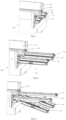
- Figure 1 illustrates initial advancement of the power loader assembly PLA rearwardly from a nested, stowed location within the truck bed 102 and particularly nested with the truck rails TR and the application deck/bin APPlE of the system 110.
- Suitable controls (not shown) for operation of the loading/unloading system 110 including advancement/retraction of the power loader assembly PLA from the truck bed 102 may be provided in the vehicle 100, adjacent the truck bed, or via a remote controller, e.g. wired or wireless controller, tablet/phone app, etc.
- the power loader assembly PLA includes first and second elongated, linear transfer rails 120, 122.
- the transfer rails 120, 122 are laterally spaced apart and disposed in parallel relation and maintained in this orientation by laterally interconnecting cross rails 124 (that actually interconnect the legs as will become more apparent below)( Figure 4 ).
- the first transfer rail 120 has the same construction as the second transfer rail 122 so that description of one applies fully to the other unless noted otherwise, and likewise each cross rail 124 is substantially the same as other cross rails that interconnect the transfer rails.
- the transfer rails 120, 122 are inverted, substantially U-shaped channels such as extruded aluminum channels for light weight, strength, ease of construction, and functionality. This of course does not preclude use of other configurations, other materials, or other manners of forming the transfer rails 120, 122.
- the power loader assembly PLA may be selectively operated to load and unload the application deck/bin APP/B that is dimensioned or configured to receive various types of cargo.
- the power loader assembly PLA is advanced via motive power rearwardly relative to the remainder of the loading/unloading system 110.
- the transfer rails 120, 122 and associated leg assemblies 130, 132 of the power loader assembly are advanced rearwardly from the truck bed 102. Initially, the leg assemblies 130, 132 are in a collapsed condition and thus transfer rails 120, 122 and leg assemblies are disposed in linear, parallel relation ( Figure 2 ).
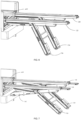
- second or front legs 140, 142 begin to deploy from the parallel arrangement with the transfer rails 120, 122 toward engagement with the ground surface. Comparing Figures 7 and 8 , it is evident that the transfer rails 120, 122 and first ends of the front legs 140, 142 that remain connected to the transfer rails move a limited distance relative to one another as the opposite, ground contacting end of the front legs move toward the ground surface.
- Pads 150 are provided at the ground contacting end of the front legs 140, 142. The pads 150 sit on the ground surface when the power loader assembly PLA is lifted. This prevents the power loader assembly PLA from rolling during the unloading and loading of cargo. When the power loader assembly PLA is lifted a small distance off the ground, rollers/wheels 152 located adjacent or behind the pads 150 contact the ground surface allowing the power loader assembly to be rolled back and forth on the ground surface.
- Figures 9-11 particularly illustrate movement of the application deck/bin APP/B from the truck bed 102 along the first and second transfer rails 120, 122 of the power loader assembly PLA.
- Figures 9 and 10 illustrate rearward movement of the application deck/bin APP/B along the transfer rails 120, 122 specifically, application deck/bin rails 160, 162 are configured for sliding movement along the transfer rails.
- the application deck/bin rails 160, 162 are also preferably extruded, U-shaped inverted channels dimensioned for receipt over the transfer rails 120, 122.
- Guide rollers are provided along rails 160, 162 to facilitate sliding receipt of the application deck/bin rails relative to the transfer rails 120, 122.
- a floor panel(s) 164 that is(are) received along opposite, lateral edges in the grooves provided on the facing surfaces of the application deck/bin rails. This creates a weld-free, fastener-free, all aluminum deck/bin assembly APP/B.
- grooves 166 may also be formed in outer lateral faces of the application deck/bin rails 160, 162 to receive bin side supports or for installing tie-down brackets which will be described further below.
- the grooves 166 also receive casters 168 therein that slide relative to the rails 160, 162.
- the casters 168 can move a limited distance relative to rails 160, 162 so that the movement of the application deck/bin is not impeded if the casters were to engage the truck wheel wells that extend into the truck bed 102.
- the application deck/bin APP/B is completely transferred from the truck bed onto the transfer rails 120, 122 of the power loader assembly PLA ( Figure 11 ).
- a slide mechanism is installed in the transfer rail and is linked to the rear leg to allow the power loader assembly to slide rearwardly and give the front legs 140, 142 clearance relative to the truck bumper.
- This slide mechanism may have a motor and drive screw installed in it for driving the front legs 140, 142 back and forth automatically.
- the slide mechanism has two axles, the front axle engaging the upper, inner rear leg latch during normal lifting, and a rear one engaging a latch at the end of the rear outer legs for dumping. These latches will be described further below.
- the leg assemblies 130, 132 are then collapsed ( Figure 14 ) in order to lower the application deck/bin to the ground surface.
- caster wheels 168 of the application deck/bin APP/B engage the ground surface because a latch 170 on each caster holds the casters from sliding in the grooves 166 of the respective rails 160, 162 when the application deck/bin is pushed around on the ground surface ( Figures 15-16 ).
- this latch 170 is moved or lifted upwardly by the truck rails disengaging the casters from the application deck/bin and thereby allowing the casters 168 to slide within the application deck grooves 166.
- Figure 17 illustrates cargo C received on the application deck/bin APP/B, and rolling of the application deck/bin on to the power loader assembly PLA.
- the leg assemblies 130, 132 raise the floor panel and cargo C ( Figure 19 ) and the application deck/bin with cargo is loaded into the truck bed ( Figures 20 - 21 ) until the application deck/bin is fully received in the truck bed ( Figures 22 - 23).
- Figure 23 is an elevational view of the rear surface 172 of a bin B (rather than the application deck illustrated in the other figures).
- the power loader assembly PLA is then loaded into the truck bed 102 in a manner that is illustrated in Figures 24 - 30 ) and that is the reverse process of Figures 1-8 .
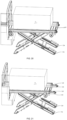
- Figures 31 - 32 illustrates the pivoting or dump mode operation of the power loader assembly PLA relative to the truck bed. It will be appreciated that even though the tailgate of the truck 100 has been removed, during the dump mode, the application deck/bin APP/B must be moved a limited distance rearwardly so that the rear, terminal edge of the application deck/bin clears the rear bumper of the truck.
- Figures 33 - 39 illustrate the unloading of a bin B from the truck bed 102 at a worksite and receipt of a different bin APP filled with cargo C that is loaded into the truck bed.
- separation of the first bin B from the power loader assembly PLA is completed ( Figure 34 ), the second application deck or bin APP moved on to the power loader assembly ( Figure 35 ), the power loader assembly lifting the second application deck or bin to the height of the truck bed 102 ( Figure 36 ), the second bin advanced into the truck bed ( Figure 37 ), and the power loader assembly loaded into the truck bed so that the truck 100 can be driven from the worksite ( Figure 38 ).
- the cargo C in the second application deck or bin APP is then dumped from the truck bed 102 at a second worksite.
- Figures 40 and 41 illustrate a potential application of features of the present invention in connection with a delivery vehicle or cargo van or even a trailer of a tractor/trailer vehicle 100, particularly such a vehicle 100 that is autonomous or self-driving.
- the application deck/bin APP/B is modified so that the floor panels described in the previous figures are received beneath a powered conveyor belt 180.
- cargo C is previously loaded onto the application deck/bin APP/B of the loading/unloading system 110 such as at a warehouse (not shown), and the vehicle 100 completes a delivery to a worksite, commercial establishment, resident, etc.
- the doors 104of the vehicle 100 can be made to automatically open as a part of the autonomous vehicle, and thereafter, the power loader assembly PLA can remove the application deck/bin APP/B from the vehicle cavity 102, position the application deck/bin at the desired location of the worksite, and the conveyor belt 180 that includes one or more pusher members or blocks 182 integrated onto the belt, or push members or push bars 184 that may, for example, extend from one or both sides of channels in the application deck/bin rails 160, 162 to selectively engage the cargo C and the push bars move along with the cargo relative to the application deck/bin, and push the cargo from the application deck/bin to the desired location of the worksite.
- the application deck/bin APP/B is then loaded into the vehicle cavity 102 for return to the warehouse for the next delivery.
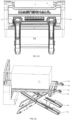
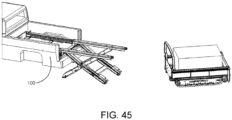
- Figures 42 - 45 illustrate transfer of an application deck/cargo bin APP/B from the power loader assembly PLA onto a motorized tracking device 200.
- the track device 200 includes first and second continuous tracks or belts 202, 204 mounted on a frame 206.
- the frame 206 receives the application deck/bin APP/B and if the application deck/bin includes casters, the frame is designed to support the casters above the ground surface.
- the frame 206 may include roller bearings or the like facing upwardly to facilitate transfer of the application deck/bin APP/B from the power loader assembly PLA onto the track device 200.
- the tracks or belts 202, 204 facilitate movement of the track device 200 on the worksite, particularly one that has uneven ground surface and is typically too rough of a terrain for wheels to easily roll.
- the track device 200 can have other uses by modifying the frame to accommodate different end uses, e.g., in agriculture where the frame 206 spaces apart the belts 202, 204 to track along the aisles on either side of the plant rows.
- Legs and rails are aluminum extrusions. Channels are extruded into the parts for many different purposes.
- the channel shape receives batteries therein to power motors to drive the power loader assembly.
- the batteries are preferably linked together to power the motors.
- the batteries are not required to be mounted in the legs/rails of the assembly but could also be separately mounted at different locations on the vehicle or power loader assembly, or plug-in power may also be used as an alternative-either from the vehicle or another power source.
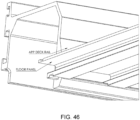
- the application deck/bin rail aluminum extrusions have channels for the floor panels to slide into, this creates a weld free, bolt free, all aluminum assembly ( Figure 46 ).
- Channels are extruded into the app deck rails for mounting the bin side supports or for installing tie down brackets ( Figure 47 ).
- the application deck/bin extruded rails have channels for the casters to slide into, allowing the front casters to slide back as the application deck/bin is rolled into the truck. Without this feature, the casters would run into the wheel wells of the truck preventing the application deck/bin from fitting into a standard pickup truck bed ( Figures 47 ).
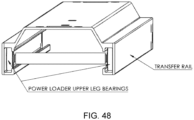
- the transfer rail has channels in it for the power loader upper leg bearings to roll in ( Figure 48 ).
- the outer legs have ribs running the length of them to add strength.
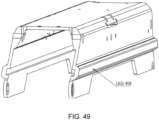
- a channel is formed on the inside of these ribs for latch 14's slide bar to ride in ( Figure 49 ).
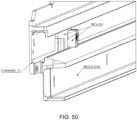
- the truck rails have a channel for a trolley to travel in. This trolley is used to pull or push the app deck and the power loader into and out of the truck bed ( Figure 50 ).
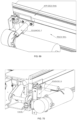
- Truck rails are installed in the truck bed for both the power loader and the application deck/bin to roll into ( Figures 2 and 51 ). When the rear legs lift to the nest position they now cantilever, supported by the truck rails.
- the motors are preferably located in the middle leg which consists of two flat bars bolted together using the motor mounts and the end support block for the drive screws. Each motor turns a drive screw which drives a push block that rides in a channel machined into the inner leg sides.
- the drive blocks have links that connect the drive blocks to the outer legs ( Figure 53 ).
- Figure 12 in US 9,545,869 where that design used one motor, the drive screw had a different pitch on each end and drove both outer legs up simultaneously.
- two motors are provided in each leg with separate drive screws so each leg is controlled independently.
- the split nut arrangement shown in Figure 25 of US 9,545,869 is not used in the present arrangement.
- a fifth motor is preferably installed in the transfer rail to drive the legs back so the front leg can be raised without hitting the bumper ( Figure 53 ).
- a sixth motor is installed on the truck rails and drives a chain that in turn drives a trolley for moving the power loader assembly PLA and the app deck APP/B into and out of the truck 100.
- a drive screw could be used instead of a chain ( Figure 54 ).
- rollers installed at the entrance to the truck rails to guide the transfer rail and the application deck/bin into the rails. These rollers have a tapered top face so if the transfer rail or app deck are slightly too low, as they are guided in they will be lifted up in line with the truck rails ( Figure 57 ).
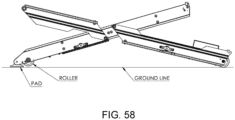
- the front legs on the power loader have pads instead of wheels that sit on the ground when the loader is lifted. This prevents the power loader from rolling while the app deck is loaded and unloaded ( Figure 58 ). When the power loader is lifted a small distance off the ground, wheels mounted behind the pads contact the ground allowing the power loader with or without the app deck on it, to be rolled back and forth ( Figure 59 ).
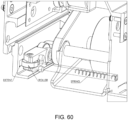
- rollers installed in the front and on the side of the transfer rail that guide it in and keep it centered in the truck rails. These rollers are spring loaded to the outward position. There are detents in the truck rails for these rollers to engage. When the rollers are engaged in these detents it assures that the solenoid pins are in alignment with their locking holes ( Figure 60 ).
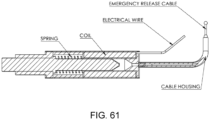
- Solenoids are used throughout the power loader to latch parts into or onto rails. Two of these solenoids (D&G) are standard push type. Nine of these solenoids are a special designed pull type with their plunger acting as a pin engaging a hole to lock parts in place. These are unique in that they are made as a single part with the spring-loaded plunger and the coil in one housing. Another unique feature is that a small cable is attached to the plunger so in the event electrical activation is not possible the cable can be manually pulled to unlatch the solenoid (see Figure 61 ). These solenoids perform the following functions.
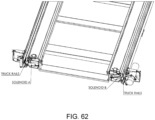
- solenoids A & B control pins that are located in the front of the transfer rail ( Figure 62 ) and latch it to the truck rails in three locations: (a) at the back of the truck rails to hold the transfer rails to the truck rails while the application deck/bin is rolled in and out; (b) at a point in the middle of the truck rails to hold the transfer rail and power loader in place when the rear legs are lifted to the cantilever and nested position; and (c) at the front on the truck rails to hold the transfer rail and power loader into the truck while driving ( Figure 63 ). In each of these positions the pins engage holes or recesses in the truck rails.
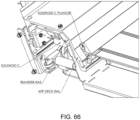
- solenoids C (two each) control pins in the transfer rails that latch the APP/B to the PLA while lifting and lowering and while in the dump mode ( Figure 66 ).
- solenoid D (push type) is used to release the motor 5 drive mechanism during the dump mode ( Figure 50 , also see Figure 79 ).
- solenoid E controls a pin that attaches the power loader to the trolley ( Figure 68 ).
- solenoids F (two each) control pins that latch the application deck/bin to the truck rails while driving ( Figure 69 ).
- solenoid G (push type) is used to disconnect the application deck/bin latch from the trolley when the application deck/bin is in the truck ( Figure 70 ). This allows the trolley to return to the back of the truck rails so that it can latch to the power loader and pull it into the truck rails.
- a slide mechanism is installed in the transfer rail and is linked to the rear leg, this allows the power loader to slide back to give the front legs clearance from the truck bumper.
- This slide can have a motor (motor 5) and drive screw installed in it for driving the legs back and forth automatically.
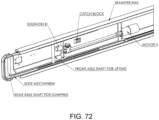
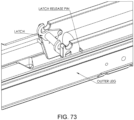
- This slide has two axles, the front one engages the upper inner rear leg latch ( Figure 72 ) during normal lifting, the rear one engages a latch at the end of the rear outer legs for dumping. These latches are described below in connection with Figures 73 and 74 .
- a latch is installed at the top of the rear inner leg to secure it to the forward axle in the slide mechanism during normal lifting. This latch automatically disengages when the legs nest allowing the transfer rails and application deck/bin to be lifted for loading and for dumping ( Figure 75 ).
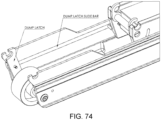
- a dump slide latch is installed at the top of rear outer leg that engages the rear axle in the slide to hold the power loader from bouncing up when tilted up (in dump mode) and the truck is driven on a rough surface ( Figure 74 ).
- a spring steel latch is installed in the transfer rail that latches the transfer rail to the upper axle of the front outer leg during dump mode.
- the spring tension is sufficient to hold the transfer rail against the upper leg bearing during dump but releases when the power load is lifted straight up and down ( Figure 75 ).
- the truck rails have a trolley that is powered by a motor and chain to drive the power loader or the application deck/bin into the truck.
- a latch and release mechanism to the trolley are installed on both of these so they can be powered into the truck independently ( Figures 68 , 77, and 78 ).
- the slide mechanism (with the fifth motor) that is installed in the transfer rail and connects to the power loader can selectively be attached and unattached to the transfer rail.
- a mechanism including solenoid D is used to do this ( Figure 79 ).
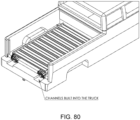
- a pickup truck manufacturer could make a truck with channels built into the truck bed instead of in the app deck rails. This would allow an app deck to be flat without the side channels.
- the same power loader system and electronic controls could be used.
- a pickup truck manufacturer could make a truck with channels built into the truck bed instead of in the application deck rails This would allow an application deck to be flat without the side channels.
- the same power loader system and electronic controls can be used.
- a pickup truck Fracture could make a truck that is designed so that the entire truck bed rolls off the truck frame ( Figures 80 - 81 ).
- the same power loader system and electronic controls can be used.
- the cargo is contained in the application deck/bin and therefore never touches the truck bed.
- a pickup truck manufacturer could make trucks without a bed or a very simple bed made out of plastic just to stop water and dirt from coming up from the road below. This would save the manufacturer both money and weight.
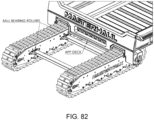
- a separate rubber track device can be used to move the application deck/bin around a construction site where the surface is too rough for typical wheels to roll on. Such a device would have ball bearing rollers in the cross bars for the app deck to roll onto ( Figure 82 ).
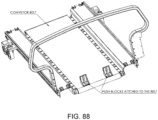
- a version of the application deck for delivering packages has a motorized conveyor belt build into it for moving the cargo or packages off of it ( Figure 88 ).
- the conveyor belt could have push blocks attached to it to assure that packaged are pushed completely off the application deck ( Figure 88 ).
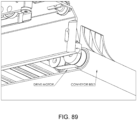
- a view of a preferred motor drive system is shown in Figure 89 .
- An alternative to a conveyor belt, a push plate could travel in channels on each side of the application deck and be motor driven to push packages off the app deck ( Figure 90 ).
- the application deck/bin has rollers under its channel for rolling on the transfer rail. These rollers have a flange on one side so that two rollers straddle the crowned top on the transfer rail. This keeps the app deck centered over the transfer rail guiding it into the truck rails ( Figure 91 ).
- a sensor assembly operatively mounted on the transfer rails to monitor the position of the first transfer rail relative to the second transfer rail.
- the sensor assembly is interconnected to the first and second motors to maintain the transfer rails at the same height relative to one another.
- the sensor assembly is an optical sensor (e.g., laser transmitter and receiver) although other type of sensors could be used.
- the positions of the transfer rails relative to the truck rails may also be monitored/sensed by a sensor assembly (preferably locating a transmitter on one of the truck rail/track bed or transfer rails, and the receiver on the other of the transfer rails or truck rail/track bed).
Landscapes
- Engineering & Computer Science (AREA)
- Mechanical Engineering (AREA)
- Transportation (AREA)
- Structural Engineering (AREA)
- Life Sciences & Earth Sciences (AREA)
- Geology (AREA)
- Civil Engineering (AREA)
- Aviation & Aerospace Engineering (AREA)
- Loading Or Unloading Of Vehicles (AREA)
- Vehicle Body Suspensions (AREA)
Description
- This invention relates to an apparatus for loading and unloading cargo, equipment, materials, tools, mulch, topsoil, debris, etc. (generally referred to herein as cargo) from the cavity or truck bed (generally referred to herein as a truck bed) of truck, SUV, hatchback of a vehicle, etc. (generally referred to herein as a vehicle). A need exists for a vehicle platform, bin, storage container, or the like that can be easily loaded or unloaded from the truck bed, or alternatively pivoted relative to the vehicle for dumping the contents thereof.
US 9,545,869 claim 1 is based discloses a suitable system and apparatus for loading/unloading or dumping cargo from a truck bed. However, a need exists for an arrangement that provides still further improvements, and other features and benefits. - In accordance with the invention, there is provided a loading/unloading system for an associated cavity or truck bed, as defined in
claim 1. - Benefits and advantages of the present disclosure will become more apparent from reading and understanding the following detailed description.
-
-
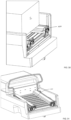
Figures 1 - 14 are images that illustrate a progressive series of steps of unloading or removing a cargo carrier or deck from a truck bed (and likewise, if reversed,Figures 14-1 illustrate progressive steps for loading a cargo carrier or bin into a truck bed). -
Figures 15 - 30 illustrate progressive steps for loading the carrier/bin with cargo into the truck bed. -
Figures 31 - 32 illustrate how the carrier/bin can be selectively tilted relative to the truck bed. -
Figures 33 - 38 illustrate how cargo or materials can be unloaded, loaded, or swapped at a worksite. -
Figure 39 shows the carrier/bin in a dump mode to empty the deck/bin at a worksite. -
Figures 40 - 41 illustrate how cargo can be automatically delivered without human intervention. -
Figures 42 - 45 illustrate unloading cargo from a truck bed. -
Figure 46 - 92 are detail views of different structural and functional features of the present disclosure. - In
Figure 1 , a rear portion of an automotive vehicle such as apickup truck 100 is illustrated, although it will be appreciated that the vehicle could also be an SUV, van, or still another type of vehicle with an enlarged storage compartment with ease of rearward access. The tailgate has been removed from thevehicle 100 and provides access to a cavity ortruck bed 102. A loading/unloading system 110 is mounted in thetruck bed 102 and the system includes, for example, truck rails TR, a power loader assembly PLA, and an application deck/(bin in other embodiments) APP/B as will be individually and collectively described in greater detail below.Figure 1 illustrates initial advancement of the power loader assembly PLA rearwardly from a nested, stowed location within thetruck bed 102 and particularly nested with the truck rails TR and the application deck/bin APPlE of thesystem 110. Suitable controls (not shown) for operation of the loading/unloading system 110 including advancement/retraction of the power loader assembly PLA from thetruck bed 102 may be provided in thevehicle 100, adjacent the truck bed, or via a remote controller, e.g. wired or wireless controller, tablet/phone app, etc. - With continued reference to
Figure 1 and additional reference toFigures 2 - 8 , the power loader assembly PLA includes first and second elongated,linear transfer rails transfer rails Figure 4 ). Thefirst transfer rail 120 has the same construction as thesecond transfer rail 122 so that description of one applies fully to the other unless noted otherwise, and likewise eachcross rail 124 is substantially the same as other cross rails that interconnect the transfer rails. In a preferred arrangement, thetransfer rails transfer rails - From the completely nested, stored position within the
truck bed 102, the power loader assembly PLA may be selectively operated to load and unload the application deck/bin APP/B that is dimensioned or configured to receive various types of cargo. The power loader assembly PLA is advanced via motive power rearwardly relative to the remainder of the loading/unloading system 110. As shown inFigures 1 and 2 , thetransfer rails leg assemblies truck bed 102. Initially, theleg assemblies transfer rails Figure 2 ). InFigure 3 , advancement of the power loader assembly PLA is temporarily suspended/terminated while first orrear legs transfer rails 120, 122 (note progressive pivoting or rotation illustrated inFigures 3 - 5 ). Rollers or wheels 138 are located at the terminal ends of the half-leg portions 134a, 136a and allow the leg assemblies 130, 132 to roll over the ground surface. Thus, once the half-leg portions 134a, 136a are fully pivoted and the rollers 138 engage the ground surface, the power loader assembly PLA is further advanced rearwardly from the truck bed 102 (compareFigures 5 and6 ). - At this point in the unloading process, second or
front legs 140, 142 begin to deploy from the parallel arrangement with thetransfer rails Figures 7 and8 , it is evident that thetransfer rails front legs 140, 142 that remain connected to the transfer rails move a limited distance relative to one another as the opposite, ground contacting end of the front legs move toward the ground surface.Pads 150 are provided at the ground contacting end of thefront legs 140, 142. Thepads 150 sit on the ground surface when the power loader assembly PLA is lifted. This prevents the power loader assembly PLA from rolling during the unloading and loading of cargo. When the power loader assembly PLA is lifted a small distance off the ground, rollers/wheels 152 located adjacent or behind thepads 150 contact the ground surface allowing the power loader assembly to be rolled back and forth on the ground surface. -
Figures 9-11 particularly illustrate movement of the application deck/bin APP/B from thetruck bed 102 along the first andsecond transfer rails Figures 9 and10 illustrate rearward movement of the application deck/bin APP/B along thetransfer rails bin rails bin rails transfer rails rails transfer rails rails bin rails casters 168 therein that slide relative to therails casters 168 can move a limited distance relative torails truck bed 102. Ultimately, the application deck/bin APP/B is completely transferred from the truck bed onto thetransfer rails Figure 11 ). - When the power loader assembly PLA lifts or lowers its
front legs 140, 142, thetransfer rails front legs 140, 142 to clear the bumper of the vehicle 100 (Figure 12 ). To achieve this action, a slide mechanism is installed in the transfer rail and is linked to the rear leg to allow the power loader assembly to slide rearwardly and give thefront legs 140, 142 clearance relative to the truck bumper. This slide mechanism may have a motor and drive screw installed in it for driving thefront legs 140, 142 back and forth automatically. Preferably, the slide mechanism has two axles, the front axle engaging the upper, inner rear leg latch during normal lifting, and a rear one engaging a latch at the end of the rear outer legs for dumping. These latches will be described further below. - Once the application deck/bin APP/B locks on to the
transfer rails 120, 122 (Figure 13 ), theleg assemblies Figure 14 ) in order to lower the application deck/bin to the ground surface. When fully lowered,caster wheels 168 of the application deck/bin APP/B engage the ground surface because a latch 170 on each caster holds the casters from sliding in the grooves 166 of therespective rails Figures 15-16 ). Similarly, when the application deck/bin APP/B is rolled onto the truck rails TR, this latch 170 is moved or lifted upwardly by the truck rails disengaging the casters from the application deck/bin and thereby allowing thecasters 168 to slide within the application deck grooves 166. -
Figure 17 illustrates cargo C received on the application deck/bin APP/B, and rolling of the application deck/bin on to the power loader assembly PLA. Once latched into place on the power loader assembly PLA as a result of the latches 170 associated with each of thecasters 168 latching in place (Figure 18 ), theleg assemblies Figure 19 ) and the application deck/bin with cargo is loaded into the truck bed (Figures 20 - 21 ) until the application deck/bin is fully received in the truck bed (Figures 22 - 23). Figure 23 is an elevational view of the rear surface 172 of a bin B (rather than the application deck illustrated in the other figures). Subsequently, the power loader assembly PLA is then loaded into thetruck bed 102 in a manner that is illustrated inFigures 24 - 30 ) and that is the reverse process ofFigures 1-8 . -
Figures 31 - 32 illustrates the pivoting or dump mode operation of the power loader assembly PLA relative to the truck bed. It will be appreciated that even though the tailgate of thetruck 100 has been removed, during the dump mode, the application deck/bin APP/B must be moved a limited distance rearwardly so that the rear, terminal edge of the application deck/bin clears the rear bumper of the truck. -
Figures 33 - 39 illustrate the unloading of a bin B from thetruck bed 102 at a worksite and receipt of a different bin APP filled with cargo C that is loaded into the truck bed. Specifically, separation of the first bin B from the power loader assembly PLA is completed (Figure 34 ), the second application deck or bin APP moved on to the power loader assembly (Figure 35 ), the power loader assembly lifting the second application deck or bin to the height of the truck bed 102 (Figure 36 ), the second bin advanced into the truck bed (Figure 37 ), and the power loader assembly loaded into the truck bed so that thetruck 100 can be driven from the worksite (Figure 38 ). InFigure 39 , the cargo C in the second application deck or bin APP is then dumped from thetruck bed 102 at a second worksite. -
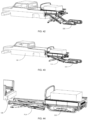
Figures 40 and 41 illustrate a potential application of features of the present invention in connection with a delivery vehicle or cargo van or even a trailer of a tractor/trailer vehicle 100, particularly such avehicle 100 that is autonomous or self-driving. Here, the application deck/bin APP/B is modified so that the floor panels described in the previous figures are received beneath apowered conveyor belt 180. Thus, cargo C is previously loaded onto the application deck/bin APP/B of the loading/unloading system 110 such as at a warehouse (not shown), and thevehicle 100 completes a delivery to a worksite, commercial establishment, resident, etc. The doors 104of thevehicle 100 can be made to automatically open as a part of the autonomous vehicle, and thereafter, the power loader assembly PLA can remove the application deck/bin APP/B from thevehicle cavity 102, position the application deck/bin at the desired location of the worksite, and theconveyor belt 180 that includes one or more pusher members or blocks 182 integrated onto the belt, or push members or push bars 184 that may, for example, extend from one or both sides of channels in the application deck/bin rails 160, 162 to selectively engage the cargo C and the push bars move along with the cargo relative to the application deck/bin, and push the cargo from the application deck/bin to the desired location of the worksite. Once the cargo C has been removed from the application deck/bin APP/B, the application deck/bin APP/B is then loaded into thevehicle cavity 102 for return to the warehouse for the next delivery. -
Figures 42 - 45 illustrate transfer of an application deck/cargo bin APP/B from the power loader assembly PLA onto amotorized tracking device 200. For example, thetrack device 200 includes first and second continuous tracks or belts 202, 204 mounted on a frame 206. The frame 206 receives the application deck/bin APP/B and if the application deck/bin includes casters, the frame is designed to support the casters above the ground surface. The frame 206 may include roller bearings or the like facing upwardly to facilitate transfer of the application deck/bin APP/B from the power loader assembly PLA onto thetrack device 200. The tracks or belts 202, 204 facilitate movement of thetrack device 200 on the worksite, particularly one that has uneven ground surface and is typically too rough of a terrain for wheels to easily roll. Thetrack device 200 can have other uses by modifying the frame to accommodate different end uses, e.g., in agriculture where the frame 206 spaces apart the belts 202, 204 to track along the aisles on either side of the plant rows. - Additional, specific structural details are enumerated and described below.
- Legs and rails are aluminum extrusions. Channels are extruded into the parts for many different purposes. In the leg assembly, the channel shape receives batteries therein to power motors to drive the power loader assembly. The batteries are preferably linked together to power the motors. One skilled in the art will also appreciate that the batteries are not required to be mounted in the legs/rails of the assembly but could also be separately mounted at different locations on the vehicle or power loader assembly, or plug-in power may also be used as an alternative-either from the vehicle or another power source.
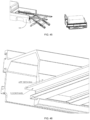
- The application deck/bin rail aluminum extrusions have channels for the floor panels to slide into, this creates a weld free, bolt free, all aluminum assembly (
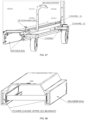
Figure 46 ). - Channels are extruded into the app deck rails for mounting the bin side supports or for installing tie down brackets (
Figure 47 ). - The application deck/bin extruded rails have channels for the casters to slide into, allowing the front casters to slide back as the application deck/bin is rolled into the truck. Without this feature, the casters would run into the wheel wells of the truck preventing the application deck/bin from fitting into a standard pickup truck bed (
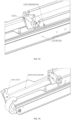
Figures 47 ). - The transfer rail has channels in it for the power loader upper leg bearings to roll in (
Figure 48 ). - The outer legs have ribs running the length of them to add strength. A channel is formed on the inside of these ribs for latch 14's slide bar to ride in (
Figure 49 ). - The truck rails have a channel for a trolley to travel in. This trolley is used to pull or push the app deck and the power loader into and out of the truck bed (
Figure 50 ). - Truck rails are installed in the truck bed for both the power loader and the application deck/bin to roll into (
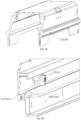
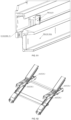
Figures 2 and51 ). When the rear legs lift to the nest position they now cantilever, supported by the truck rails. - There are preferably four motors in the power loader legs allowing for independent control of each leg. This allows tilt, both fore and aft, and from side to side, to be controlled to compensate for different ground levels (
Figure 52 ). The motors are preferably located in the middle leg which consists of two flat bars bolted together using the motor mounts and the end support block for the drive screws. Each motor turns a drive screw which drives a push block that rides in a channel machined into the inner leg sides. The drive blocks have links that connect the drive blocks to the outer legs (Figure 53 ). This is similar toFigure 12 inUS 9,545,869 Figure 25 ofUS 9,545,869 - A fifth motor is preferably installed in the transfer rail to drive the legs back so the front leg can be raised without hitting the bumper (
Figure 53 ). - A sixth motor is installed on the truck rails and drives a chain that in turn drives a trolley for moving the power loader assembly PLA and the app deck APP/B into and out of the
truck 100. A drive screw could be used instead of a chain (Figure 54 ). - When the application deck APP/B rolls into the truck rails the
casters 168 roll onto leaf springs 250 next to the truck rails, the leaf springs hold the caster up a little to reduce the friction between the caster slide and the channel that they slide in. This support provided by the leaf spring also has a detent to hold the caster wheel into the truck bed as the app deck is rolled out so that the caster returns to the front of the app deck (Figure 55 ). - There is a latch on the casters that hold them from sliding in the channel when the app deck is pushed around on the ground. When the application deck APP/B is rolled into the truck rails this latch is lifted up at one end by the truck rails disengaging them from the app deck and allowing the casters to slide back in the
app deck channel 1C (Figure 56A-56B ). - There are rollers installed at the entrance to the truck rails to guide the transfer rail and the application deck/bin into the rails. These rollers have a tapered top face so if the transfer rail or app deck are slightly too low, as they are guided in they will be lifted up in line with the truck rails (
Figure 57 ). - The front legs on the power loader have pads instead of wheels that sit on the ground when the loader is lifted. This prevents the power loader from rolling while the app deck is loaded and unloaded (
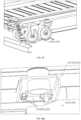
Figure 58 ). When the power loader is lifted a small distance off the ground, wheels mounted behind the pads contact the ground allowing the power loader with or without the app deck on it, to be rolled back and forth (Figure 59 ). - There are rollers installed in the front and on the side of the transfer rail that guide it in and keep it centered in the truck rails. These rollers are spring loaded to the outward position. There are detents in the truck rails for these rollers to engage. When the rollers are engaged in these detents it assures that the solenoid pins are in alignment with their locking holes (
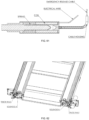
Figure 60 ). - Solenoids are used throughout the power loader to latch parts into or onto rails. Two of these solenoids (D&G) are standard push type. Nine of these solenoids are a special designed pull type with their plunger acting as a pin engaging a hole to lock parts in place. These are unique in that they are made as a single part with the spring-loaded plunger and the coil in one housing. Another unique feature is that a small cable is attached to the plunger so in the event electrical activation is not possible the cable can be manually pulled to unlatch the solenoid (see
Figure 61 ). These solenoids perform the following functions. First, solenoids A & B control pins that are located in the front of the transfer rail (Figure 62 ) and latch it to the truck rails in three locations: (a) at the back of the truck rails to hold the transfer rails to the truck rails while the application deck/bin is rolled in and out; (b) at a point in the middle of the truck rails to hold the transfer rail and power loader in place when the rear legs are lifted to the cantilever and nested position; and (c) at the front on the truck rails to hold the transfer rail and power loader into the truck while driving (Figure 63 ). In each of these positions the pins engage holes or recesses in the truck rails. However, the holes atposition Figure 64 ) while the holes on the right side do not (Figure 65 ). This allows the transfer rail to be moved fromposition 1 toposition 2 and fromposition 2 toposition 3 without activating solenoid A. This is necessary so if the truck is parked on a rearward incline is not necessary to release both A and B to move the transfer rail forward. Releasing both A and B at the same time in this situation could allow the transfer rail and power loader to undesirably roll backward and out of the truck. - Second, solenoids C (two each) control pins in the transfer rails that latch the APP/B to the PLA while lifting and lowering and while in the dump mode (
Figure 66 ). - Third, solenoid D (push type) is used to release the
motor 5 drive mechanism during the dump mode (Figure 50 , also seeFigure 79 ). - Fourth, solenoid E controls a pin that attaches the power loader to the trolley (
Figure 68 ). - Fifth, solenoids F (two each) control pins that latch the application deck/bin to the truck rails while driving (
Figure 69 ). - Sixth, solenoid G (push type) is used to disconnect the application deck/bin latch from the trolley when the application deck/bin is in the truck (
Figure 70 ). This allows the trolley to return to the back of the truck rails so that it can latch to the power loader and pull it into the truck rails. - Seventh, when the power loader lifts the front of the application deck/bin for dumping it is first rolled back a short distance so that the wheels clear the bumper, solenoid H holds it in this position during the dump mode (
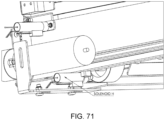
Figure 71 ). - When the power loader lifts or lowers its front legs, the transfer rails remain latched to the truck rails creating a situation where the power loader must move back a short distance for the front legs to clear the truck's bumper. A slide mechanism is installed in the transfer rail and is linked to the rear leg, this allows the power loader to slide back to give the front legs clearance from the truck bumper. This slide can have a motor (motor 5) and drive screw installed in it for driving the legs back and forth automatically. This slide has two axles, the front one engages the upper inner rear leg latch (
Figure 72 ) during normal lifting, the rear one engages a latch at the end of the rear outer legs for dumping. These latches are described below in connection withFigures 73 and 74 . - A latch is installed at the top of the rear inner leg to secure it to the forward axle in the slide mechanism during normal lifting. This latch automatically disengages when the legs nest allowing the transfer rails and application deck/bin to be lifted for loading and for dumping (
Figure 75 ). - A dump slide latch is installed at the top of rear outer leg that engages the rear axle in the slide to hold the power loader from bouncing up when tilted up (in dump mode) and the truck is driven on a rough surface (
Figure 74 ). - A spring steel latch is installed in the transfer rail that latches the transfer rail to the upper axle of the front outer leg during dump mode. The spring tension is sufficient to hold the transfer rail against the upper leg bearing during dump but releases when the power load is lifted straight up and down (
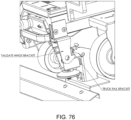
Figure 75 ). - Slots in the tailgate hinge bracket engage pins in the truck rails to hold the application deck/bin down while the truck is in motion (
Figure 76 ). - The truck rails have a trolley that is powered by a motor and chain to drive the power loader or the application deck/bin into the truck. A latch and release mechanism to the trolley are installed on both of these so they can be powered into the truck independently (
Figures 68 ,77, and 78 ). - The slide mechanism (with the fifth motor) that is installed in the transfer rail and connects to the power loader can selectively be attached and unattached to the transfer rail. A mechanism including solenoid D is used to do this (
Figure 79 ). - A pickup truck manufacturer could make a truck with channels built into the truck bed instead of in the app deck rails. This would allow an app deck to be flat without the side channels. The same power loader system and electronic controls could be used.
- A pickup truck manufacturer could make a truck with channels built into the truck bed instead of in the application deck rails This would allow an application deck to be flat without the side channels. The same power loader system and electronic controls can be used.
- A pickup truck. Fracture could make a truck that is designed so that the entire truck bed rolls off the truck frame (
Figures 80 - 81 ). The same power loader system and electronic controls can be used. - When using the power loader system of the present disclosure, the cargo is contained in the application deck/bin and therefore never touches the truck bed. Hence a pickup truck manufacturer could make trucks without a bed or a very simple bed made out of plastic just to stop water and dirt from coming up from the road below. This would save the manufacturer both money and weight.
- A separate rubber track device can be used to move the application deck/bin around a construction site where the surface is too rough for typical wheels to roll on. Such a device would have ball bearing rollers in the cross bars for the app deck to roll onto (
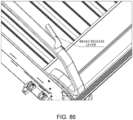
Figure 82 ). - When the application deck/bin is rolled on a sloped surface it needs a brake system that engages automatically to prevent the application deck/bin from rolling downhill out of control. Brake shoes are installed over the rear wheels (
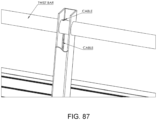
Figure 83 ). The rear wheels are stationary and do not slide intrack 1C like the front wheels do. A cable is attached to the brake shoes to hold the shoes up (disengaged) when the application deck/bin is being pushed around (Figure 84 ). This brake release cable is routed along the side the application deck and into the handle bar (Figure 85 ). The operator must hold them up by pulling up on the cable (Figure 85 ) or by using a lever device (Figure 86 ) or by turning a twist bar (Figure 87 ). If the operator lets go, the brakes come on, i.e., are applied, automatically. - A version of the application deck for delivering packages has a motorized conveyor belt build into it for moving the cargo or packages off of it (
Figure 88 ). The conveyor belt could have push blocks attached to it to assure that packaged are pushed completely off the application deck (Figure 88 ). A view of a preferred motor drive system is shown inFigure 89 . An alternative to a conveyor belt, a push plate could travel in channels on each side of the application deck and be motor driven to push packages off the app deck (Figure 90 ). - The application deck/bin has rollers under its channel for rolling on the transfer rail. These rollers have a flange on one side so that two rollers straddle the crowned top on the transfer rail. This keeps the app deck centered over the transfer rail guiding it into the truck rails (
Figure 91 ). - In
Figure 92 , there are shown a sensor assembly operatively mounted on the transfer rails to monitor the position of the first transfer rail relative to the second transfer rail. The sensor assembly is interconnected to the first and second motors to maintain the transfer rails at the same height relative to one another. In one embodiment, the sensor assembly is an optical sensor (e.g., laser transmitter and receiver) although other type of sensors could be used. The positions of the transfer rails relative to the truck rails may also be monitored/sensed by a sensor assembly (preferably locating a transmitter on one of the truck rail/track bed or transfer rails, and the receiver on the other of the transfer rails or truck rail/track bed). - This written description uses examples to describe the disclosure, including the best mode, and also to enable any person skilled in the art to make and use the disclosure. The scope of the invention is defined by the claims.
Claims (14)
- A loading/unloading system (110) for an associated cavity or truck bed (102) comprising:first and second laterally spaced truck rails (TR) configured for receipt in the associated cavity or truck bed (102);a power loader assembly (PLA) that includes (i) first and second support leg assemblies (130, 132) that include (ii) first and second transfer rails (120, 122), respectively, that operatively cooperate with the first and second truck rails (TR), respectively, (iii) first and second motors received on the first and second leg assemblies (130, 132), respectively, and configured to selectively raise and lower the first and second transfer rails (120, 122), and (iv) a sensor assembly to monitor the position of the first transfer rail (120) relative to the second transfer rail (12), the sensor assembly operatively interconnected to the first and second motors to maintain the transfer rails (120, 122) at the same height relative to one another; andcharacterised by further comprising one of a bin or application deck (APP/B) having first and second application deck/bin rails (160, 162) that slidingly engage the truck rails (TR), and a motor that selectively slides the bin or application deck (APP/B) relative to the truck rails (TR), andwherein the sensor assembly is operatively mounted on the transfer rails (120, 122).
- The system of claim 1 further comprising an alignment assembly that monitors the position of the power loader assembly relative to the associated cavity or truck bed (102), the alignment assembly optionally including an optical transmitter and receiver.
- The system of claim 2 wherein the transmitter is received on at least one of (i) the power loader assembly and (ii) the associated cavity or truck bed (102) or truck rails (TR), and the receiver is received on the other of (ii) the associated cavity or truck bed (102) or truck rails (TR) and (i) the power loader assembly.
- The system of claim 3 wherein the first and second truck rails (TR) mounted in the cavity or truck bed (102) slidingly receive the first and second transfer rails (120, 122), respectively, and the system further comprising at least one transfer motor that selectively slides the first and second transfer rails relative to the cavity or truck bed (102).
- The system of claim 1 further comprising third and fourth motors, and each of the first and second leg assemblies (130, 132) including first and second portions, the first portion of the first leg assembly dimensioned to receive the first motor, the second portion of the first leg assembly dimensioned to receive the second motor, the first portion of the second leg assembly dimensioned to receive the third motor, and the second portion of the second leg assembly dimensioned to receive the fourth motor.
- The system of claim 1 wherein each leg assembly includes a pad (150) and first and second spaced apart rollers (138, 152), the pad of each leg assembly pivotally mounted to the respective leg assembly whereby the pad of each leg initially engages a horizontal surface prior to the first roller engaging the horizontal surface.
- The system of claim 1 further comprising at least one motor to reciprocate a bin or application deck (APP/B) relative to the truck rails (TR) to load/unload the bin or application deck (APP/B) and a motor in front leg portions that selectively tilts the bin or application deck relative to the truck rails whereby the system is used to dump.
- The system of claim 7 wherein the combination load/unload motor is configured to reciprocate the bin or application deck (APP/B) relative to the cavity or truck bed (102) independently of tilting the bin or application deck.
- The system of claim 1 wherein the first and second application deck/bin rails (160, 162) selectively, slidably engage with the first and second transfer rails (TR), respectively, the system further comprising a second locking mechanism that selectively prevents the bin or application deck (APP/B) from sliding relative to the first and second transfer rails, and optionally a third detent mechanism that selectively prevents the bin or application deck (APP/B) from sliding relative to the cavity or truck bed (102).
- The system of claim 1 further comprising casters mounted on the bin or application deck (APP/B), wherein the truck rails are dimensioned to receive the casters, wherein the casters, when the bin or application deck is loaded in the truck bed, are mounted for limited sliding movement relative to the bin or application deck, the system further comprising a latch that engages a respective caster to a respective first or second application deck/bin rail of the bin or application deck when the bin or application deck is separated from the power loader assembly.
- The system of claim 1 wherein the bin or application deck includes a movable conveyor belt (180) that aids in loading/unloading cargo onto the application deck, the system further comprising a drive motor that moves the conveyor belt.
- The system of claim 11 further comprising one of (i) a push block (182) attached to the conveyor belt (180) or (ii) a push plate driven by the drive motor and movable relative to the application deck for pushing cargo from the conveyor belt.
- The system of claim 1 further comprising a powered track device (200) having first and second continuous tracks (202, 204), the power loader unloading the bin or application deck (APP/B) on to the track device.
- The system of claim 13 further comprising first and second crossbars extending between the tracks, and roller surfaces on the crossbars to assist with loading and unloading of the application deck on and off the track device.
Applications Claiming Priority (2)
| Application Number | Priority Date | Filing Date | Title |
|---|---|---|---|
| US201862664918P | 2018-04-30 | 2018-04-30 | |
| PCT/US2019/029949 WO2019213104A1 (en) | 2018-04-30 | 2019-04-30 | Truck loading system |
Publications (4)
| Publication Number | Publication Date |
|---|---|
| EP3787929A1 EP3787929A1 (en) | 2021-03-10 |
| EP3787929A4 EP3787929A4 (en) | 2022-02-16 |
| EP3787929B1 true EP3787929B1 (en) | 2024-05-01 |
| EP3787929C0 EP3787929C0 (en) | 2024-05-01 |
Family
ID=68386796
Family Applications (1)
| Application Number | Title | Priority Date | Filing Date |
|---|---|---|---|
| EP19796834.0A Active EP3787929B1 (en) | 2018-04-30 | 2019-04-30 | Truck loading system |
Country Status (9)
| Country | Link |
|---|---|
| US (1) | US11440752B2 (en) |
| EP (1) | EP3787929B1 (en) |
| JP (1) | JP7394837B2 (en) |
| KR (1) | KR102698591B1 (en) |
| CN (1) | CN112368176B (en) |
| AU (1) | AU2019263088B2 (en) |
| CA (1) | CA3098906A1 (en) |
| MX (1) | MX2020011513A (en) |
| WO (1) | WO2019213104A1 (en) |
Families Citing this family (14)
| Publication number | Priority date | Publication date | Assignee | Title |
|---|---|---|---|---|
| WO2020033218A1 (en) * | 2018-08-07 | 2020-02-13 | Milwaukee Electric Tool Corporation | Material transport cart |
| NO345766B1 (en) * | 2018-10-12 | 2021-07-19 | Autostore Tech As | A mobile storage system and a method of providing the mobile storage system |
| CA3130792A1 (en) | 2019-03-07 | 2020-09-10 | Gen-Probe Incorporated | System and method for transporting and holding consumables in a processing instrument |
| WO2020227215A1 (en) | 2019-05-03 | 2020-11-12 | Eidsmore Paul G | System having automated lift assembly and process for loading and unloading cargo from delivery vehicle |
| CN111532294B (en) * | 2020-04-30 | 2021-10-15 | 庆安集团有限公司 | Railway freight carriage |
| US20220080873A1 (en) * | 2020-09-15 | 2022-03-17 | Hall Labs Llc | Package Delivery System with Robots for Last Distance |
| DE102020131525B4 (en) * | 2020-11-27 | 2023-05-25 | Knut Martin | Transport and loading arrangement for a motor vehicle |
| US11753095B2 (en) * | 2021-01-21 | 2023-09-12 | James Broadwell | Truck topper removal device |
| CN113044601B (en) * | 2021-04-20 | 2023-04-14 | 郑州铁路职业技术学院 | A kind of loading equipment for bulky logistics parts |
| US11987279B2 (en) * | 2021-07-13 | 2024-05-21 | International Business Machines Corporation | Single user loader |
| CN115010052B (en) * | 2022-07-06 | 2023-03-10 | 湖南驰众机器人有限公司 | AGV dolly is used in metallurgical industry material transfer |
| CN114851939B (en) * | 2022-07-07 | 2022-11-11 | 成都苏试广博环境可靠性技术有限公司 | Generator discharging device based on shelter car |
| CN115723867A (en) * | 2022-12-07 | 2023-03-03 | 山东郓城中运通挂车制造有限公司 | Low flat-bed semi-trailer with shock-absorbing function |
| CN118387574B (en) * | 2024-06-21 | 2024-10-22 | 福建省中通通信物流有限公司 | An intelligent logistics transport vehicle |
Family Cites Families (19)
| Publication number | Priority date | Publication date | Assignee | Title |
|---|---|---|---|---|
| US3768673A (en) * | 1972-01-31 | 1973-10-30 | B Nydam | Extendable and tiltable load-transfer platform |
| US4288195A (en) * | 1979-06-07 | 1981-09-08 | Southworth, Incorporated | Roll-away wheel truck and lift table assembly |
| KR900005692Y1 (en) * | 1987-10-05 | 1990-06-28 | 함영식 | Loading and unloading device |
| KR19980029300U (en) * | 1996-11-27 | 1998-08-17 | 김영귀 | Cargo loading of trucks with pull-outs |
| JP2000062963A (en) * | 1998-08-21 | 2000-02-29 | Taisei Corp | Load transfer device |
| US6024528A (en) * | 1998-09-18 | 2000-02-15 | Taylor; William L. | Ambulance mounted stretcher lift |
| US6431319B1 (en) * | 2000-02-29 | 2002-08-13 | Ferno-Washington, Inc. | Height-adjustable equipment cart with detachable table |
| WO2011041170A2 (en) * | 2009-10-02 | 2011-04-07 | Stryker Corporation | Ambulance cot and loading and unloading system |
| US9540220B2 (en) * | 2010-04-21 | 2017-01-10 | 2S Innvations, Inc. | Device and method for moving a load from a first height to a second height |
| JP5812407B2 (en) * | 2011-09-20 | 2015-11-11 | 株式会社アテックス | Carrier support device for elevated floor work vehicles |
| CA2862167C (en) * | 2012-01-20 | 2019-10-01 | Paul G. Eidsmore | System and apparatus for loading/unloading cargo from suv or truck bed |
| US9486373B2 (en) * | 2013-03-14 | 2016-11-08 | Stryker Corporation | Reconfigurable patient support |
| KR20160087834A (en) * | 2013-11-15 | 2016-07-22 | 페르노-와싱턴, 인코포레이티드. | Self-actuating cots |
| AU2015250137B2 (en) * | 2014-04-24 | 2020-01-30 | Ferno-Washington, Inc. | Loading platform alignment system and loading/unloading method thereof |
| US9707880B2 (en) * | 2014-12-09 | 2017-07-18 | Kenneth Ochenkowski | Motorcycle lift |
| US9637318B2 (en) * | 2014-12-16 | 2017-05-02 | Amazon Technologies, Inc. | Mobile configurable conveyor component |
| CN205075699U (en) * | 2015-07-31 | 2016-03-09 | 谢子聪 | A kind of mobile electrified car for replacing the power battery in electric passenger car |
| US10940786B2 (en) * | 2017-04-26 | 2021-03-09 | OnScene Solutions, LLC | Cargo lowering slide assembly |
| WO2019094489A1 (en) * | 2017-11-08 | 2019-05-16 | Walmart Apollo, Llc | Automated vehicle loading |
-
2019
- 2019-04-30 MX MX2020011513A patent/MX2020011513A/en unknown
- 2019-04-30 CA CA3098906A patent/CA3098906A1/en active Pending
- 2019-04-30 JP JP2021510265A patent/JP7394837B2/en active Active
- 2019-04-30 WO PCT/US2019/029949 patent/WO2019213104A1/en not_active Ceased
- 2019-04-30 EP EP19796834.0A patent/EP3787929B1/en active Active
- 2019-04-30 KR KR1020207033998A patent/KR102698591B1/en active Active
- 2019-04-30 US US17/051,652 patent/US11440752B2/en active Active
- 2019-04-30 CN CN201980044661.5A patent/CN112368176B/en active Active
- 2019-04-30 AU AU2019263088A patent/AU2019263088B2/en active Active
Also Published As
| Publication number | Publication date |
|---|---|
| EP3787929A4 (en) | 2022-02-16 |
| WO2019213104A1 (en) | 2019-11-07 |
| AU2019263088A1 (en) | 2020-11-26 |
| JP7394837B2 (en) | 2023-12-08 |
| MX2020011513A (en) | 2021-01-29 |
| CN112368176B (en) | 2023-06-30 |
| AU2019263088B2 (en) | 2025-03-13 |
| US11440752B2 (en) | 2022-09-13 |
| EP3787929A1 (en) | 2021-03-10 |
| EP3787929C0 (en) | 2024-05-01 |
| JP2021523060A (en) | 2021-09-02 |
| CA3098906A1 (en) | 2019-11-07 |
| CN112368176A (en) | 2021-02-12 |
| KR102698591B1 (en) | 2024-08-27 |
| US20210053780A1 (en) | 2021-02-25 |
| KR20210002652A (en) | 2021-01-08 |
Similar Documents
| Publication | Publication Date | Title |
|---|---|---|
| EP3787929B1 (en) | Truck loading system | |
| US5829947A (en) | Cargo handling hydraulic ramp loader system and methods | |
| EP1592579B1 (en) | Vehicles and traillers incorporating moveable load carrying platforms | |
| US20090123260A1 (en) | Tilting bed trailer | |
| US10946782B2 (en) | Assistance vehicle tilt lift | |
| US5288197A (en) | Equipment trailer | |
| US20010026756A1 (en) | Lift for a motorized vehicle or the like | |
| US4261682A (en) | Loading and unloading of vehicles | |
| WO2008092206A1 (en) | Loading and unloading arrangement for a vehicle | |
| US20070020076A1 (en) | Cargo lifting apparatus for a vehicle | |
| AU2007313377B2 (en) | Transport trailer and method | |
| US20030147734A1 (en) | Goods handling system | |
| US20050118004A1 (en) | Removable load bed for a vehicle | |
| CN100506604C (en) | Vehicle and trailer with movable platforms | |
| RU2784834C2 (en) | Truck loading system | |
| US20070020075A1 (en) | Vehicle passenger lift | |
| WO1996020850A1 (en) | Apparatus for loading vehicles into cargo containers | |
| US10752147B1 (en) | Lowerable and raisable vehicle trailer system, and method of operating a vehicle trailer system | |
| AU2001100269A4 (en) | Roll-back body vehicles | |
| TW202130532A (en) | A load carrier, a chassis frame and a vehicle employing the same | |
| CA2550613A1 (en) | Mobile storage system | |
| US20050220590A1 (en) | Lifting and moving apparatus |
Legal Events
| Date | Code | Title | Description |
|---|---|---|---|
| STAA | Information on the status of an ep patent application or granted ep patent |
Free format text: STATUS: THE INTERNATIONAL PUBLICATION HAS BEEN MADE |
|
| PUAI | Public reference made under article 153(3) epc to a published international application that has entered the european phase |
Free format text: ORIGINAL CODE: 0009012 |
|
| STAA | Information on the status of an ep patent application or granted ep patent |
Free format text: STATUS: REQUEST FOR EXAMINATION WAS MADE |
|
| 17P | Request for examination filed |
Effective date: 20201124 |
|
| AK | Designated contracting states |
Kind code of ref document: A1 Designated state(s): AL AT BE BG CH CY CZ DE DK EE ES FI FR GB GR HR HU IE IS IT LI LT LU LV MC MK MT NL NO PL PT RO RS SE SI SK SM TR |
|
| AX | Request for extension of the european patent |
Extension state: BA ME |
|
| DAV | Request for validation of the european patent (deleted) | ||
| DAX | Request for extension of the european patent (deleted) | ||
| A4 | Supplementary search report drawn up and despatched |
Effective date: 20220119 |
|
| RIC1 | Information provided on ipc code assigned before grant |
Ipc: B66F 9/075 20060101ALI20220113BHEP Ipc: B66F 7/06 20060101ALI20220113BHEP Ipc: B60P 1/00 20060101AFI20220113BHEP |
|
| GRAP | Despatch of communication of intention to grant a patent |
Free format text: ORIGINAL CODE: EPIDOSNIGR1 |
|
| STAA | Information on the status of an ep patent application or granted ep patent |
Free format text: STATUS: GRANT OF PATENT IS INTENDED |
|
| INTG | Intention to grant announced |
Effective date: 20231201 |
|
| GRAS | Grant fee paid |
Free format text: ORIGINAL CODE: EPIDOSNIGR3 |
|
| GRAA | (expected) grant |
Free format text: ORIGINAL CODE: 0009210 |
|
| STAA | Information on the status of an ep patent application or granted ep patent |
Free format text: STATUS: THE PATENT HAS BEEN GRANTED |
|
| AK | Designated contracting states |
Kind code of ref document: B1 Designated state(s): AL AT BE BG CH CY CZ DE DK EE ES FI FR GB GR HR HU IE IS IT LI LT LU LV MC MK MT NL NO PL PT RO RS SE SI SK SM TR |
|
| REG | Reference to a national code |
Ref country code: GB Ref legal event code: FG4D |
|
| REG | Reference to a national code |
Ref country code: CH Ref legal event code: EP |
|
| REG | Reference to a national code |
Ref country code: DE Ref legal event code: R096 Ref document number: 602019051516 Country of ref document: DE |
|
| REG | Reference to a national code |
Ref country code: IE Ref legal event code: FG4D |
|
| U01 | Request for unitary effect filed |
Effective date: 20240528 |
|
| U07 | Unitary effect registered |
Designated state(s): AT BE BG DE DK EE FI FR IT LT LU LV MT NL PT SE SI Effective date: 20240708 |
|
| PG25 | Lapsed in a contracting state [announced via postgrant information from national office to epo] |
Ref country code: IS Free format text: LAPSE BECAUSE OF FAILURE TO SUBMIT A TRANSLATION OF THE DESCRIPTION OR TO PAY THE FEE WITHIN THE PRESCRIBED TIME-LIMIT Effective date: 20240901 |
|
| PG25 | Lapsed in a contracting state [announced via postgrant information from national office to epo] |
Ref country code: HR Free format text: LAPSE BECAUSE OF FAILURE TO SUBMIT A TRANSLATION OF THE DESCRIPTION OR TO PAY THE FEE WITHIN THE PRESCRIBED TIME-LIMIT Effective date: 20240501 |
|
| PG25 | Lapsed in a contracting state [announced via postgrant information from national office to epo] |
Ref country code: GR Free format text: LAPSE BECAUSE OF FAILURE TO SUBMIT A TRANSLATION OF THE DESCRIPTION OR TO PAY THE FEE WITHIN THE PRESCRIBED TIME-LIMIT Effective date: 20240802 |
|
| PG25 | Lapsed in a contracting state [announced via postgrant information from national office to epo] |
Ref country code: ES Free format text: LAPSE BECAUSE OF FAILURE TO SUBMIT A TRANSLATION OF THE DESCRIPTION OR TO PAY THE FEE WITHIN THE PRESCRIBED TIME-LIMIT Effective date: 20240501 |
|
| PG25 | Lapsed in a contracting state [announced via postgrant information from national office to epo] |
Ref country code: PL Free format text: LAPSE BECAUSE OF FAILURE TO SUBMIT A TRANSLATION OF THE DESCRIPTION OR TO PAY THE FEE WITHIN THE PRESCRIBED TIME-LIMIT Effective date: 20240501 |
|
| PG25 | Lapsed in a contracting state [announced via postgrant information from national office to epo] |
Ref country code: PL Free format text: LAPSE BECAUSE OF FAILURE TO SUBMIT A TRANSLATION OF THE DESCRIPTION OR TO PAY THE FEE WITHIN THE PRESCRIBED TIME-LIMIT Effective date: 20240501 Ref country code: NO Free format text: LAPSE BECAUSE OF FAILURE TO SUBMIT A TRANSLATION OF THE DESCRIPTION OR TO PAY THE FEE WITHIN THE PRESCRIBED TIME-LIMIT Effective date: 20240801 Ref country code: IS Free format text: LAPSE BECAUSE OF FAILURE TO SUBMIT A TRANSLATION OF THE DESCRIPTION OR TO PAY THE FEE WITHIN THE PRESCRIBED TIME-LIMIT Effective date: 20240901 Ref country code: HR Free format text: LAPSE BECAUSE OF FAILURE TO SUBMIT A TRANSLATION OF THE DESCRIPTION OR TO PAY THE FEE WITHIN THE PRESCRIBED TIME-LIMIT Effective date: 20240501 Ref country code: GR Free format text: LAPSE BECAUSE OF FAILURE TO SUBMIT A TRANSLATION OF THE DESCRIPTION OR TO PAY THE FEE WITHIN THE PRESCRIBED TIME-LIMIT Effective date: 20240802 Ref country code: ES Free format text: LAPSE BECAUSE OF FAILURE TO SUBMIT A TRANSLATION OF THE DESCRIPTION OR TO PAY THE FEE WITHIN THE PRESCRIBED TIME-LIMIT Effective date: 20240501 Ref country code: RS Free format text: LAPSE BECAUSE OF FAILURE TO SUBMIT A TRANSLATION OF THE DESCRIPTION OR TO PAY THE FEE WITHIN THE PRESCRIBED TIME-LIMIT Effective date: 20240801 |
|
| PG25 | Lapsed in a contracting state [announced via postgrant information from national office to epo] |
Ref country code: CZ Free format text: LAPSE BECAUSE OF FAILURE TO SUBMIT A TRANSLATION OF THE DESCRIPTION OR TO PAY THE FEE WITHIN THE PRESCRIBED TIME-LIMIT Effective date: 20240501 |
|
| PG25 | Lapsed in a contracting state [announced via postgrant information from national office to epo] |
Ref country code: SK Free format text: LAPSE BECAUSE OF FAILURE TO SUBMIT A TRANSLATION OF THE DESCRIPTION OR TO PAY THE FEE WITHIN THE PRESCRIBED TIME-LIMIT Effective date: 20240501 Ref country code: RO Free format text: LAPSE BECAUSE OF FAILURE TO SUBMIT A TRANSLATION OF THE DESCRIPTION OR TO PAY THE FEE WITHIN THE PRESCRIBED TIME-LIMIT Effective date: 20240501 |
|
| PG25 | Lapsed in a contracting state [announced via postgrant information from national office to epo] |
Ref country code: SM Free format text: LAPSE BECAUSE OF FAILURE TO SUBMIT A TRANSLATION OF THE DESCRIPTION OR TO PAY THE FEE WITHIN THE PRESCRIBED TIME-LIMIT Effective date: 20240501 |
|
| PG25 | Lapsed in a contracting state [announced via postgrant information from national office to epo] |
Ref country code: SM Free format text: LAPSE BECAUSE OF FAILURE TO SUBMIT A TRANSLATION OF THE DESCRIPTION OR TO PAY THE FEE WITHIN THE PRESCRIBED TIME-LIMIT Effective date: 20240501 Ref country code: SK Free format text: LAPSE BECAUSE OF FAILURE TO SUBMIT A TRANSLATION OF THE DESCRIPTION OR TO PAY THE FEE WITHIN THE PRESCRIBED TIME-LIMIT Effective date: 20240501 Ref country code: RO Free format text: LAPSE BECAUSE OF FAILURE TO SUBMIT A TRANSLATION OF THE DESCRIPTION OR TO PAY THE FEE WITHIN THE PRESCRIBED TIME-LIMIT Effective date: 20240501 Ref country code: CZ Free format text: LAPSE BECAUSE OF FAILURE TO SUBMIT A TRANSLATION OF THE DESCRIPTION OR TO PAY THE FEE WITHIN THE PRESCRIBED TIME-LIMIT Effective date: 20240501 |
|
| REG | Reference to a national code |
Ref country code: DE Ref legal event code: R097 Ref document number: 602019051516 Country of ref document: DE |
|
| PLBE | No opposition filed within time limit |
Free format text: ORIGINAL CODE: 0009261 |
|
| STAA | Information on the status of an ep patent application or granted ep patent |
Free format text: STATUS: NO OPPOSITION FILED WITHIN TIME LIMIT |
|
| 26N | No opposition filed |
Effective date: 20250204 |
|
| U21 | Renewal fee for the european patent with unitary effect paid with additional fee |
Year of fee payment: 7 Effective date: 20250724 |
|
| REG | Reference to a national code |
Ref country code: CH Ref legal event code: H13 Free format text: ST27 STATUS EVENT CODE: U-0-0-H10-H13 (AS PROVIDED BY THE NATIONAL OFFICE) Effective date: 20251125 |
|
| PG25 | Lapsed in a contracting state [announced via postgrant information from national office to epo] |
Ref country code: MC Free format text: LAPSE BECAUSE OF FAILURE TO SUBMIT A TRANSLATION OF THE DESCRIPTION OR TO PAY THE FEE WITHIN THE PRESCRIBED TIME-LIMIT Effective date: 20240501 |
|
| GBPC | Gb: european patent ceased through non-payment of renewal fee |
Effective date: 20250430 |
|
| PG25 | Lapsed in a contracting state [announced via postgrant information from national office to epo] |
Ref country code: GB Free format text: LAPSE BECAUSE OF NON-PAYMENT OF DUE FEES Effective date: 20250430 |
|
| PG25 | Lapsed in a contracting state [announced via postgrant information from national office to epo] |
Ref country code: CH Free format text: LAPSE BECAUSE OF NON-PAYMENT OF DUE FEES Effective date: 20250430 |
|
| PG25 | Lapsed in a contracting state [announced via postgrant information from national office to epo] |
Ref country code: IE Free format text: LAPSE BECAUSE OF NON-PAYMENT OF DUE FEES Effective date: 20250430 |