EP3786733B1 - System und verfahren für die simulation eines chemischen oder biochemischen verfahrens - Google Patents
System und verfahren für die simulation eines chemischen oder biochemischen verfahrens Download PDFInfo
- Publication number
- EP3786733B1 EP3786733B1 EP19306046.4A EP19306046A EP3786733B1 EP 3786733 B1 EP3786733 B1 EP 3786733B1 EP 19306046 A EP19306046 A EP 19306046A EP 3786733 B1 EP3786733 B1 EP 3786733B1
- Authority
- EP
- European Patent Office
- Prior art keywords
- chemical
- module
- vector
- equipment
- differential
- Prior art date
- Legal status (The legal status is an assumption and is not a legal conclusion. Google has not performed a legal analysis and makes no representation as to the accuracy of the status listed.)
- Active
Links
Images






Classifications
-
- G—PHYSICS
- G16—INFORMATION AND COMMUNICATION TECHNOLOGY [ICT] SPECIALLY ADAPTED FOR SPECIFIC APPLICATION FIELDS
- G16C—COMPUTATIONAL CHEMISTRY; CHEMOINFORMATICS; COMPUTATIONAL MATERIALS SCIENCE
- G16C10/00—Computational theoretical chemistry, i.e. ICT specially adapted for theoretical aspects of quantum chemistry, molecular mechanics, molecular dynamics or the like
-
- G—PHYSICS
- G05—CONTROLLING; REGULATING
- G05B—CONTROL OR REGULATING SYSTEMS IN GENERAL; FUNCTIONAL ELEMENTS OF SUCH SYSTEMS; MONITORING OR TESTING ARRANGEMENTS FOR SUCH SYSTEMS OR ELEMENTS
- G05B17/00—Systems involving the use of models or simulators of said systems
- G05B17/02—Systems involving the use of models or simulators of said systems electric
-
- G—PHYSICS
- G05—CONTROLLING; REGULATING
- G05B—CONTROL OR REGULATING SYSTEMS IN GENERAL; FUNCTIONAL ELEMENTS OF SUCH SYSTEMS; MONITORING OR TESTING ARRANGEMENTS FOR SUCH SYSTEMS OR ELEMENTS
- G05B13/00—Adaptive control systems, i.e. systems automatically adjusting themselves to have a performance which is optimum according to some preassigned criterion
- G05B13/02—Adaptive control systems, i.e. systems automatically adjusting themselves to have a performance which is optimum according to some preassigned criterion electric
- G05B13/04—Adaptive control systems, i.e. systems automatically adjusting themselves to have a performance which is optimum according to some preassigned criterion electric involving the use of models or simulators
- G05B13/042—Adaptive control systems, i.e. systems automatically adjusting themselves to have a performance which is optimum according to some preassigned criterion electric involving the use of models or simulators in which a parameter or coefficient is automatically adjusted to optimise the performance
- G05B13/044—Adaptive control systems, i.e. systems automatically adjusting themselves to have a performance which is optimum according to some preassigned criterion electric involving the use of models or simulators in which a parameter or coefficient is automatically adjusted to optimise the performance not using a perturbation signal
-
- G—PHYSICS
- G16—INFORMATION AND COMMUNICATION TECHNOLOGY [ICT] SPECIALLY ADAPTED FOR SPECIFIC APPLICATION FIELDS
- G16C—COMPUTATIONAL CHEMISTRY; CHEMOINFORMATICS; COMPUTATIONAL MATERIALS SCIENCE
- G16C20/00—Chemoinformatics, i.e. ICT specially adapted for the handling of physicochemical or structural data of chemical particles, elements, compounds or mixtures
- G16C20/10—Analysis or design of chemical reactions, syntheses or processes
-
- G—PHYSICS
- G16—INFORMATION AND COMMUNICATION TECHNOLOGY [ICT] SPECIALLY ADAPTED FOR SPECIFIC APPLICATION FIELDS
- G16C—COMPUTATIONAL CHEMISTRY; CHEMOINFORMATICS; COMPUTATIONAL MATERIALS SCIENCE
- G16C20/00—Chemoinformatics, i.e. ICT specially adapted for the handling of physicochemical or structural data of chemical particles, elements, compounds or mixtures
- G16C20/70—Machine learning, data mining or chemometrics
Definitions
- the present invention relates to the field of modeling and simulation in process engineering.
- the present invention relates to a system and a method for computer simulation of a chemical or biochemical process.
- Fine chemical or biotechnology manufacturers must frequently estimate or compare production processes involving several operations and various equipment from a very limited amount of information. This is especially the case in the early stages of development. It should be noted that in these industries, when a production process has to be devised, it often happens that the chances of marketing the targeted molecule are very low, for example, for reasons of clinical trial failures. There are therefore very many technical and economic estimates to be made on many molecules which will only be produced in small quantities and for a limited period of time.
- US 2005/267723 A1 describes a system for modeling processes that involve the manipulation of chemical species such as by chemical reactions, mass transfers, phase transfers, or flows.
- the present invention falls within this framework.
- the embodiments of the invention provide an industrial tool for fine chemical process engineering.
- a functional technical feature of the embodiments resides in the simulation of processes for their subsequent implementation in installations for the production of chemical or biochemical products.
- the embodiments make it possible to predict, in a concrete manner, the behavior of chemical or biochemical processes in order to make a certain number of estimates, in particular on their industrial feasibility.
- the embodiments of the invention thus make it possible to direct the development of methods chemicals or biochemicals with sufficient precision, and within reasonable time and cost, to allow the chances of success of their industrial implementation to be estimated, even before the installation of an installation and the commissioning of this facility.
- the embodiments of the invention thus offer the industrial tool lacking today in the development of chemical or biochemical installations. They make it possible to determine very early on, the industrial feasibility or any difficulties in implementing the process or chemical or biochemical installations.
- a purely intellectual implementation of a simulation of chemical or biochemical processes is not possible. This is particularly the case of simulations for industrial needs. In practice, it is impossible to carry out the calculations necessary to arrive at sufficiently precise and significant results enabling industrial decisions to be taken, such as the setting up of chemical installations, for example. In addition, the purely intellectual implementation of the simulation would take prohibitive time, not in particular to calibrate the parameters of the model.
- An object of the invention is to enable the fine chemical and biotechnology industries to use relevant simulators by providing a tool that can be used by a non-simulation expert, which allows a production project to be taken into account with knowledge of physico-chemistry initially almost non-existent.
- This tool must be able to help the user to identify the delicate or limiting points of the evaluation process in order to determine the knowledge to be acquire or use in order to achieve a given objective, to refine these forecasts as new knowledge becomes available.
- This tool must also be reliable, easy to use, and allow an accurate estimation of the technical and economic performance of the process studied which is adapted to the problem posed and which can evolve according to the needs and the evolution of the industrial project.
- the embodiments of the invention are based on a simulation taking into account the physicochemical characteristics of the reagents and intermediates used in the simulated chemical or biochemical process or installation.
- the invention relates to a system according to claim 1.
- fine chemicals also called “specialty chemicals” is meant in this document a branch of the chemical industry which synthesizes specific products, in low production volumes, but with high added value, and meeting technical constraints. , for example purity, high.
- biotechnology we mean technologies for the production of molecules by fermentation, cell cultures, extraction from the natural environment.
- algebraic equation is meant an equation having one or more real variables as an unknown.
- differentiated equation an equation having one or more functions as an unknown; it is presented in the form of a relation between these unknown functions and their successive derivatives.
- internal state variable we mean a chemical variable that describes what is happening inside a given piece of equipment, for example temperature, pressure, concentration, etc.
- input state variable or "output state variable”, we mean a chemical variable which describes what enters or leaves, respectively, a given piece of equipment, for example the temperature, the pressure, the concentration...
- predictive model is meant the association of a certain number of algebraic and differential equations based on concepts of chemistry and/or physics, the resolution of which allows the determination of the internal state variables of at least one operation carried out in at least one device.
- operation is meant a transformation making it possible to pass from an input state to an output state (or from an initial state to a final state).
- a chemical or biochemical process comprises a plurality of operations.
- a chemical process can be split into a plurality of operations carried out in a plurality of equipment.
- the number of operations can be less than, greater than or equal to the number of equipment. Indeed, the number of operations can be greater than the number of equipment if several operations are performed in the same equipment while the number of equipment can be higher than the number of operations if an operation requires several equipment.
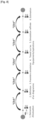
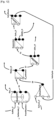
- FIG. 1 schematically illustrates these various scenarios with various operations O1 to O4 and various equipment E1 to E4 to implement these operations.
- the operations can consist of mixtures, separations and various reactions.
- the equipment can consist of reactors, mixers, extractors, filters, evaporators, etc.
- a raw material is received by the equipment E1 to carry out an operation O1.
- the product from equipment 1 (which is not only the result of operation O1 as seen below), is supplied to equipment E2 to perform operation 02.
- a feedback loop exists between equipment E2 and E1.
- the product from equipment E2 is supplied both to equipment E1 and to equipment E3.
- An additional operation O3 is therefore also performed in the equipment E1.
- operation 04 is performed using two equipment items E3 and E4.
- E3 can be a reactor and the equipment E4 a heat exchanger).
- An operation (i) and a piece of equipment (j) make it possible to pass from an input state ( Y e I / I ) to an output state ( Y s I / I ).
- the input state and output state variables are vectors representing chemical quantities at the input and output of an operation and equipment of a chemical or biochemical process.
- Internal state variables are vectors representing internal chemical quantities of an operation and of equipment of a chemical or biochemical process.
- the inventors had the idea of replacing the explicit algebraic equations with algebro-differential equations involving internal state pseudo-variables.
- the algebro-differential equations thus created are affected by a very small time constant compared to the characteristic time of the operation. It will be noted that a person skilled in the art knows the characteristic time of each operation of the method and will know how to choose a time constant that is low with respect to this characteristic time (for example a time constant of the order of a second). By choosing a low time constant, for a time well above this time constant, the differential term vanishes in the steady state and all that remains is to ensure that the other terms of the differential equation converge towards the conditions of the explicit algebraic equation.
- the explicit algebraic equations can be integrated into the simulation system and the user can choose between fine modeling or not of each operation.
- the user can opt for one or other of the models, using the same equation solving module.
- ⁇ is a time constant
- X ⁇ i an internal state pseudo-variable.
- the operator can therefore choose to describe an operation using a system of equations involving internal state variables or an explicit algebraic equation. If at least one explicit algebraic equation is selected for at least one operation of the method, the system according to the invention replaces this explicit algebraic equation into an algebro-differential equation in order to be able to integrate it into the system of equations of the whole of the process.
- FIG. 2 illustrates a block diagram of a simulation module according to one embodiment of the invention.
- a client device 100 connects to the simulation system 200 according to the invention.
- the simulation module 200 according to the invention comprises a reception module 201, optionally a selection module 202, a processing module 203 and an algebro-differential equation solving module 204.
- the client device 100 connects to the reception module 201 in order to communicate to the reception module 201 an explicit algebraic equation representing a chemical or biochemical operation and linking a vector of input state variables representing initial chemical quantities of said operation to a vector of output state variables representing final chemical quantities of said operation.
- the receiving module 201 is connected to the processing module 203 in order to receive the explicit algebraic equation representing a chemical and biochemical operation and to create an algebro-differential equation so that the steady state solution of the algebraic equation differential thus created converges to said vector of output state variables according to the explicit algebraic equation.
- the processing module 203 is connected to the algebro-differential equation solving module 204.
- the solving module 204 solves the equation in order to obtain the vector of output state variables of the operation.
- the algebro-differential equation solver 204 is connected to the client device 100 in order to return the vector of output state variables of the operation.
- the client device 100 communicates to the reception module 201 an explicit algebraic equation of the first operation and an algebro-differential equation of the first operation.
- the client device 100 is connected to the selection module 202 so as to select a simulation via the explicit algebraic equation or a simulation via the algebro-differential equation.
- the processing module creates an algebro-differential equation converging towards said vector of output state variables according to the explicit algebraic equation or alternatively uses the existing algebro-differential equation.
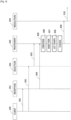
- the client module 100 communicates with the reception module 201 at step 301.
- the client module communicates to the reception module an explicit algebraic equation representing a first chemical or biochemical operation and linking a first vector of variables from input state representing initial chemical quantities of said first operation to a first vector of output state variables representing final chemical quantities of said first operation.
- the client device can also communicate an algebro-differential equation representing said first chemical or biochemical operation and linking a first vector of input state variables; and a first vector of internal state variables of said first operation as the unknown of the equation.
- the client device can also communicate an algebro-differential equation representing a second chemical or biochemical operation and linking a second vector of input state variables; and a second vector of internal state variables of said first operation as an unknown in the equation.
- the client module 100 communicates with the reception module at step 302. During this step 302, the client device selects a simulation mode.
- the simulation mode comprises either the simulation of the chemical operation via the algebro-differential equation or via the explicit algebraic equation.
- step 303 the selection module 202 communicates to the processing module the selected simulation mode and the reception module transmits 304 to the processing module the equation according to the selected simulation mode.
- the processing module performs the step of creating 305 a first algebro-differential equation linking a first vector of input state variables; and a first vector of internal state variables of said first operation as the unknown of the equation. Subsequently, the processing module injects 306 into the first algebro-differential equation the expression of the vector of output state variables of said first operation according to said first explicit algebraic equation as a vector of pseudo-state variables internal state of said first operation, the steady-state solution of said algebro-differential equation thus converging to said first vector of output state variables according to the first explicit algebraic equation. The processing module then fixes in step 307 the time constant. This time constant is less than the characteristic time of the first operation. This characteristic time can be provided by the user via the client module 100 and the reception module 201 to the processing module 203.
- the processing module then transmits the algebro-differential equation thus obtained to the resolution module for the resolution of equation 309 in order to obtain the vector of output state variables of the first operation.
- the resolution module transmits this vector of output state variables of the first operation to the client device during a step 310.
- the processing module is configured to receive from the reception module the second algebro-differential equation during a step 304 and to merge the second algebro-differential equation with the first algebro-differential equation during a step 308.
- the processing module then transmits the system of algebro-differential equations to the resolution module during a step 309 which will solve this system and obtain a vector of process output state variables comprising the two operations.
- the client device selects in step 302 a simulation mode. If simulation via the explicit algebraic equation is selected, the processing module performs the steps of creation 305, injection 306 and setting of the time constant 307 then the step of merging 308 with the algebraic equations -differential from the other operations of the process. If simulation via the algebro-differential equation is selected, the processing module directly merges this algebro-differential equation with the algebro-differential equations of the other operations of the method.
- the present invention makes it possible to combine a precise simulation using an algebro-differential equation for certain critical operations and the selection of a less precise simulation using an explicit algebraic equation.
- the solution of this explicit algebraic equation being integrated into an algebro-differential equation in order to allow the fusion of the algebro-differential equations in a single resolution system.
- a simulation module as described above, and the corresponding method, can be implemented in a more global system and offering a complete industrial design tool enabling an entire design team to cooperate in the evaluation and development of a chemical or biochemical process and the corresponding industrial installation.
- This tool brings together various functionalities such as: data management (for example experimental data concerning chemical products, physico-chemical characteristics relating to raw materials or other), the processing of these data, the definition of operational units for carry out a chemical process, the definition of basic operations entering into the chemical process, the definition of an installation for the implementation of the process with material equipment, the economic and financial evaluation.
- data management for example experimental data concerning chemical products, physico-chemical characteristics relating to raw materials or other
- the processing of these data the definition of operational units for carry out a chemical process
- the definition of basic operations entering into the chemical process the definition of an installation for the implementation of the process with material equipment
- the economic and financial evaluation for example experimental data concerning chemical products, physico-chemical characteristics relating to raw materials or other
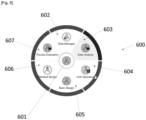
- FIG. 6 schematically illustrates a system 600 according to embodiments. It comprises a central module 601 capable of controlling the system and coordinating the execution of the various modules. The system further comprises modules 602 to 607 corresponding to the various functionalities listed above.
- each of the modules 604 to 606 relating to the definition of operational units, the definition of basic operations and the definition of a chemical installation can implement a simulation module 200 as described above.
- the client module 201 as described above can then be the central module 601.
- the module 602 makes it possible to store and organize experimental data in a data structure that can be used by all the other modules of the system. In particular, this module offers data relating to chemical species into which the raw materials, reactants and products will be decomposed throughout the process.
- the module 603 makes it possible to process and analyze experimental data, for example to carry out statistical analyses, to identify parameters of a chemical process, etc.
- Module 607 makes it possible to make performance estimates based on experimental data from module 602 or module 603 or even results of simulations carried out by modules 604 to 606. Module 607 also makes it possible to to make comparisons between different performance estimates or between a performance estimate and experimental data.
- a system 600 according to the embodiments of the invention makes it possible to avoid these difficulties by integrating in the same tool the management of the data experiments, prediction by simulation but also global evaluation by means of past experiences.
- This innovative approach designated by GPX, an acronym for "Guess, Predict, Experimental”, makes it possible to carry out relevant and rapid assessments.
- Modules 605 to 606 take part in the “G” approach, which allows an overall assessment based on a simulation based on algebraic equations or past economic data.
- Modules 602 to 607 take part in the “P” approach by allowing precise simulation, using differential or algebro-differential equations from experimental data.
- Modules 601, 602 and 607 participate in the "X" approach by providing experimental data and historical data to supply the other modules of the other approaches with relevant data.
- a system thus makes it possible, in the same data system and with consistent processing, to carry out all the operations necessary for the evaluation of a chemical process or of a corresponding installation: reception or definition of a evaluation to be carried out with the corresponding technical data (1), definition of a block diagram with corresponding operations and equipment (2), a first simulation based on this diagram (3), refinement of the equipment and operations (4), more accurate simulation (5) and evaluation (6).
- a system thus makes it possible to share information on an evaluation project of a chemical process, to capitalize on the information collected over the course of the evaluations and to communicate the result of these evaluations. All this is allowed without loss of information and with great consistency in processing.
- the module 602 makes it possible to organize the data which is shared in the system. In particular, it allows the recording of experimental scientific data concerning chemical species.
- the format in which these data is recorded is shared between all modules, allowing efficient and coordinated processing between modules.
- the modules implementing simulations 604, 605 and 606 share this data format since they access the experimental data, in particular, as described below, the decomposition of the raw materials used by a chemical process. This is also the case of module 607 which allows comparisons, in particular between simulation results and experimental data.
- a project is defined within the system by means of a “project” file and a set of files.
- a first file describes the structure of the chemical or biochemical process
- a file describes the sequence of operations of the process and the last represents the modeling of the process. Then, different files are created to represent the simulations of each operational unit, basic operation and installation.
- a special feature of the system lies in the fact that in each file, it is possible to find the decomposition of raw materials and intermediate reagents broken down according to chemical species whose characteristics are stored via module 602.
- write and read access will be different for each type of file. For example, only the central module 601 will be able to access the “write project” file. The other modules will only be able to access it in read mode for the purposes of executing their functions.
- the module 602 will be the only one to access the files representative of the experimental write data.
- the other modules will only be able to access it in read mode.
- he has read access to the “project” file and to the files representing the experimental data.
- the modules capable of carrying out simulations 604, 605, 606 have access to the project file and to the files representing the experimental data. They can also access the files representing the simulations in write mode.
- the project file can take the form of an XML (extensible markup language) type file with three parts.
- a first part represents the list of chemical species used in the project.
- Another part represents the list of raw materials with an identification and a composition in reference with the list of species.
- each raw material of the second part is decomposed into chemical species of the second part.
- a third part includes the other elements involved in the reactions such as catalysts, filter absorber resins, etc. with a respective identifier and some physico-chemical parameters.
- the identifiers given to the chemical species, raw materials and others are valid for the project file and therefore for all the functions performed by the different modules. Thus, all the modules can have access to the same decomposition and make calculations on this decomposition.
- the chemical process is represented in the form of a block diagram, each block representing an operation or a facility.
- the blocks are linked together according to the inputs and outputs as illustrated by the figure 1 .
- each block is represented by a set of three files.
- a first file, of the XML type comprises two parts.
- a first part includes a list of streams with respective identification and stream inputs and outputs.
- a second part comprises process blocks with respective identifications, a position and lists of inputs and outputs corresponding to those of flows of the first part.
- a second file describes the operations associated with the process.
- This second file of XML type, comprises a first part with the input streams of the process (listed by their identification according to the first file) with the identification of the raw materials that they carry as well as their quantity. It has a second part with lists of process blocks and their operating temperatures.
- the third file also of XML type, comprises the modeling of the process with two parts. A first part with the input fluxes and the physical properties of each phase of the flux and the distribution of species in each phase. A second part with the process blocks and the list of phases for each input stream with the physical properties and the distribution of the chemical species. If a chemical reaction takes place in the blocks, it is described in this part of the file.
- Each type of process description has a corresponding experimental data file .
- This file has four parts.
- the first part has a description similar to that found in the first file describing the blocks and described above.
- the second part (which is optional) contains modeling data, similar to that of the third file describing the blocks described above.
- the third part includes a description identical to that of the second file describing the blocks and described above.
- the fourth part is used to store measurement results.
- the simulation files resulting from the modules 604, 605, 606 are also of the XML type and comprise four parts.
- the first part is a copy of the "project" file.
- the second part is a copy of the first file describing the simulated block.
- the third part is a copy of the second file describing the simulated block.
- the fourth part is a copy of the third file describing the simulated block.
- An additional part may include a description of mass and energy balances expressed as a function of fluxes for mass and blocks for energy.
- they can also include mass balance and descriptions of the evolution of state variables such as temperature, flow rates, etc.
- the evaluations as processed by the module 607 are described in the system by a file which groups together all the data necessary for the calculation of the costs and other performance evaluation criteria.
- this file may include flow identifiers in the reaction or the simulated installation which are consistent with those of the simulation files. he can additionally include reference species identifiers that are consistent with the simulation files.
- the file may include unit costs for the raw materials used by the process or the simulated installation. These costs are entered for each raw material identified in a consistent manner with the simulation file.
- an evaluation corresponds to a raw material or a species, it is identified according to the identifiers of these raw materials or species. If it matches a stream, it will be identified based on the stream ID.
- the system processes the files as a transfer function which takes as arguments and as outputs some of the files described above. It is possible to process all these files in a coherent way by using as common data the species into which the raw materials are broken down. Indeed, experimental data generally deals with data relating to species. The same is true for numerical simulations. Finally, with regard to economic and financial data, they deal more with commodities, but which are broken down into cash.
- module 602 may take as input the project file as well as other user data and produce therefrom the experimental data file.
- the use of the project file ensures that all user data is expressed in terms of cash versus raw materials.
- the module 605 takes as inputs the project file as well as user data (it can also use the experimental data file or other). It renders simulation files as output.
- the definition by the project file in terms of chemical species makes it possible to make results consistent with this representation.
- the module 607 takes as input the simulation files created from the project file and outputs evaluation files.
- the first step 1. is a definition of raw materials and species. It comprises three sub-steps 1.1, 1.2, 1.3. It can be done using modules 601 and 602.
- the first sub-step 1.1 is a definition by the user of the raw materials entering the process.
- the second sub-step 1.2 is a decomposition of the raw materials into chemical species (eg: the raw material “azeotropic alcohol” is decomposed into its constituent chemical species, namely 96% ethanol and 4% water).
- the third sub-step 1.3 is an input by the user of the chemical species or biological materials produced in the process.
- the second step is a definition of the Operation Block Diagram. It comprises five sub-steps 2.1 to 2.5. It can be performed by module 605.
- an operation block diagram consisting of operation blocks is created by a user or from a laboratory recipe.
- a BBOP library of BOP operation blocks is available, each operation block presenting a number of inputs and outputs, in cash, raw materials, or energy and representing an elementary operation, such as a mixture, a reaction, separation, heating.
- These BOP operation blocks represent transformations of flows or quantities regardless of the volume or time required.
- These BOP operation blocks are not associated with equipment and do not contain any notion of productivity.
- the second step 2.2 there is a consideration by the system of the relationships between the inputs and the outputs of each of the selected BOP operation blocks.
- the user can supply these relations by extracting a model from a first library of operation models MOP1 and possibly specifying parameters of this model, for example a ratio between an input and output bit rate of the block.
- These relationships can relate to various parameters such as temperatures, pressures, quantities or flows of matter, concentrations in different phases.
- mode "Guess" in Anglo-Saxon terminology only intuition, the experience of the user are used, no physico-chemical information is necessary.
- step 2.3 by means of the diagram of operation blocks and the relations between the inputs and the outputs of each of the selected BOP operation blocks, the system determines global balance sheets of the process. These overall balances can concern the production of chemical species or biological materials produced in the process, the consumption of raw materials or energy. This determination can be carried out either continuously (flow data) or discontinuously (quantity data per batch). At this stage, the system can also determine a first estimation of performance criteria of the process based on the consumption of raw materials and/or energy, this criterion possibly being economic or environmental.
- step 2.4 the possibility is then offered to the user to repeat step 2.1, by selecting other operation blocks or by arranging them differently to obtain another diagram of operation blocks and/or repeating step 2.2 by choosing other relationships between the inputs and outputs of the selected operation blocks, then performing step 2.3 again for determining the global balances, and continuing until global balances are obtained satisfactory.
- step 2.5 the possibility is offered to the user at the end of a step 2.3 or 2.4 to replace the relations between the inputs and the outputs of some of the BOP operation blocks by relations extracted from a second library of MOP2 operation templates.
- This second library of MOP2 operation models includes more elaborate characteristics, taking into account, for example, thermodynamic information, or phase composition.
- the system determines the overall balances, following step 2.3, on the basis of the improved characteristics.
- the user will advantageously select the operation blocks for which the input/output relationships must be replaced from among the most critical operation blocks in the method.
- the system can also propose a second determination of the performance criteria based on the consumption of raw materials and/or energy.
- the third step is the definition of equipment diagrams. It comprises six sub-steps 3.1 to 3.6. It can be performed by modules 604, 606.
- the operation block diagram into an equipment diagram representing the industrial installation to be designed.
- Equipment is chosen from a library of generic equipment BEQGEN or from a library of specific equipment BEQSPEC to carry out the operations of one or more BOP operation blocks of the operation block diagram, up to the transformation of all the operation blocks of the operation block diagram.
- the equipments of the BEQGEN library are generic equipments: their characteristics can remain rather vague, even idealized: a reactor can for example be defined as a perfectly mixed adiabatic system, independently of the means to achieve this result.
- the equipments of the BEQSPEC library are specific equipments. They can then have very specific characteristics and can be associated with a given manufacturer reference.
- the approach presented also authorizes the direct creation of an equipment diagram without prior creation of an operation diagram. Such a shortcut can for example be useful if one seeks to represent an already existing installation.
- a step 3.2 there is a specification of the different operations carried out in each piece of equipment.
- its nature is specified in particular (loading of raw material, reaction, emptying, temperature change, etc.) as well as its duration. All of these equipment specifications correspond to an operating procedure such as those used in industrial workshops. This operating procedure does not involve modeling elements.
- Step 3.3 is a determination by the system of operating parameters of the industrial installation represented by the equipment diagram using the model libraries MOP1 and MEQ1 as well as the connectivity between the equipment.
- the models of the MEQ1 library are used to describe the operations performed in the equipment as entered in step 3.2.
- the MOP1 library these are models based on a macroscopic description of the phenomena and not using any physico-chemical data.
- the operating parameters of the industrial installation can include productivities, yields, product quality parameters, such as purity, waste production, energy consumption.
- the system can determine a first evaluation of a performance criterion based both on the consumption of raw materials, energy, size and mode of operation of the equipment. This criterion can for example be economic or environmental.
- step 3.4 the possibility is then offered to the user of repeating step 3.1, by selecting other equipment, and/or of repeating step 3.2, by choosing other characteristics for the operations carried out in the equipment, then performing step 3.3 again for determining operating parameters, and continuing until parameters complying with the set constraints are obtained.
- step 3.5 the possibility is offered to the user at the end of a step 3.3 or 3.4 to replace the characteristics of certain operations carried out in generic or specific equipment of the equipment diagram by characteristics extracted a second library MEQ2 of models of operations performed in equipment.
- the models from this second library are much more elaborate and make it possible, for example, to calculate conversions in reactors or separation performance in distillation from physico-chemical data.
- the system then again determines the operating parameters of the industrial installation, according to step 3.3, on the basis of the improved characteristics. At this stage, the system can determine performance criteria based on the consumption of raw materials, energy, size and mode of operation of the equipment.
- step 3.6 the possibility is offered to the user at the end of a step 3.3 or 3.4 to replace the characteristics of certain operations carried out in generic or specific equipment of the equipment diagram by characteristics extracted a third library MEQ3 of models of operations performed in equipment.
- the models resulting from this third library are detailed models and allow for example to represent non-idealities of mixing or complex hydrodynamic phenomena by taking into account such and such a geometric characteristic of specified equipment.
- the system then again determines the operating parameters of the industrial installation, according to step 3.3, on the basis of the improved characteristics. At this stage, the system can determine performance criteria based on the consumption of raw materials, energy, size and mode of operation of the equipment.
- This sub-step can be performed by module 607.
- the top-down approach presented here consists in carrying out a first series of calculations on the basis of information available or accessible immediately and free of charge. Then, on the basis of these calculations, one identifies the additional information really necessary in order to minimize the effort of collecting this information.
- the delta-valerolactone is in an aqueous solution which also contains cyclopentanone, hydrogen peroxide and acetic acid. It is sought to remove these last two species and to dehydrate the product.
- the traditional procedure consists of: neutralizing the peroxide with sodium sulphite, neutralizing the acetic acid with sodium carbonate, extracting the organic molecules using an organic solvent, evaporating the water to precipitate the salts, filter the salts, evaporate the organic solvent.
- the first step is the definition of raw materials and species.
- the second step is the definition of operation block diagrams.
- step 2.1 for modeling a process is the development of an operation block diagram.
- Each icon in this diagram represents an operation (ie an action on a flow or on a quantity).
- these operations are described by the relations between their inputs and their outputs and can be represented by very simple empirical models or by more precise thermodynamic models.
- step 2.3 solving the balance equations associated with the relationships between the inputs and outputs of each block and the connectivity of the blocks between them will allow us to know the fluxes (or quantities) of mass and heat at each location. of the system, and in particular at the output.
- the operation block diagrams can be read in flow (kg/h) for continuous processes as well as in quantity (kg) treated per operation for discontinuous processes.
- step 2.2 relations between the inputs and outputs of the operation blocks are defined.
- the models of the MOP1 library propose a very macroscopic description of the effect of each block of operation on flows or traversing quantities. This macroscopic description lends itself well to the use of assumptions based on intuition and experience.
- the diagram of the figure 9 comprises two reactions H2O2_quench and AA_neutralize corresponding respectively to the neutralization of H2O2 by Na2SO3 and of AcH by Na2CO3.
- This scheme also includes three separations LLE, SaltsFiltration and SolvEvap corresponding respectively to the extraction of DVL and CP by an organic solvent (with removal of water and precipitation of salts), filtration of salts, evaporation of solvent.
- the diagram of the figure 10 is extremely similar to that of figure 1 with the addition of the SolvPurif operation - intended to separate the solvent to be thrown away from that which can be recycled - as well as the MIX1 operation intended to mix the fresh solvent and the recycled solvent.
- the diagram of the figure 11 simply includes the H2O2_quench reaction block corresponding to the thermal neutralization of H2O2 and the distillation separation block corresponding to the removal of H2O and AcH.
- mixing operations simply consist of grouping together the masses (or mass flow rates) of each species contained in all the incoming flows.
- a ratio is provided by the user for each species to indicate its distribution between the output streams.
- these ratios are often 0% or 100% but they can take any value between 0% and 100%.
- this system of ratios is illustrated here on situations with two outgoing flows but it also applies to situations where these flows would be more numerous as well as to balances between phases.
- reaction models ⁇ /b> Name Equation Conversion H2O2_quench (case 1 and 2) H2O2 + Na2SO3 ⁇ H2O + Na2SO4 100% H2O2 AA_neutralize 2 AcH + Na2CO3 ⁇ 2 AcNa + H2O + CO2 100% AcH H2O2_quench (case 3) 2 H2O2 ⁇ 2 H2O + O2 100% H2O2
- the table below comprises partition ratios corresponding to the hypothesis according to which, during the chemical neutralization of AcH, all the CO 2 generated is evacuated without entrainment of liquid.
- Table 9 an identical assumption is made for the release of 02 in the case of thermal neutralization.
- ⁇ b>Table 4 Species partition ratios between ⁇ i>AA_neutralize ⁇ /i> ⁇ /b> outputs Gas_O S3 CO2 100% 0% Other species 0% 100%
- the system of partition ratios is here used to account for generally ideal separations. By its structure, this system makes it possible to keep aware of this assumption of ideality and would authorize to represent departures from ideality, for example by taking ratios 97%/3% instead of the current 100%/0%.
- step 2.3 The overall balances are then determined in step 2.3.
- the aim is to treat a load of 4050 kg of reaction mixture (see composition in Table 1).
- Sulphite and carbonate flow rates are calculated so as to completely neutralize H2O2 and AcH.
- the flow rate of fresh MIBK is calculated so that in LLE, 4000 kg of MIBK are mixed with the load of DVL and CP.
- step 2.4 when a laboratory recipe is available - that is to say an experimental procedure possibly accompanied by elements of results - the system to which this invention relates allows the entry of information present in the recipe. It is possible to enter all the information of the recipe without prejudging its possible later use; at the same time, no information must imperatively be provided apart from the nature of each transaction.
- the computer program is able to interpret its content to create the structure of an operation block diagram based on this content.
- a laboratory recipe can for example come from a scientific article relating to a synthesis experiment. This article then constitutes one of the first sources of information on the process.
- the energy flows brought to the processes are assigned a cost of 0.10 €/kWh.
- the energy flows withdrawn from the processes are assigned a cost of 0.05 €/kWh.
- the material balances relate to species, the economy to the value of raw materials, hence the importance of step 1.2.
- process 2 allows, thanks to the recycling of solvent, interesting savings both at the level of the fresh MIBK and the treatment of effluents. The energy counterpart is minimal.
- Process 3 allows even greater savings because the neutralization technique used significantly reduces the quantities of raw materials to be injected and the quantities of solvents (including water) to be separated and reprocessed.
- step 3.1 each of the operation blocks of two retained diagrams is assigned to a device. Note that several operations can be carried out in the same equipment (for example the two neutralization reactions in the case of process 2).
- the system has a library of generic equipment BEQGEN and a library of specific equipment BEQSPEC, each equipment having its characteristics.
- a first (slightly arbitrary) volume value is given for each piece of equipment. This can be changed later.
- ⁇ b>Table 20 allocation of operations to equipment in the case of process 2 (recycling of the extraction solvent) ⁇ /b> Operation block Equipment Name Kind Volume ( m3 ) H2O2_quench QuenchSTR Stirred reactor 14 AA_neutralize LLE LL_extractor Generic separator 18 SaltsFiltration SaltsFilter Generic separator 10 SolvEvap Evaporator Generic separator 8 SolvPurif SolvPurif Generic separator 6 MIX1 SolventTank Tank 6 Operation block Equipment Name Kind Volume ( m3 ) H2O2_quench QuenchSTR Stirred reactor 6 distillation Distill Generic separator 6
- step 3.2 it is noted that at the start of process 2 (liquid-liquid extraction with solvent recycling), the SolventTank equipment contains 3800 kg of MIBK. Then the operating procedure applied is that set out in Table 22. For a certain number of operations, an arbitrary duration of 0.01h is applied because it is assumed that the duration of these steps is negligible with regard to the durations of reactions and separations. .
- step 3.3 the system determines operating parameters according to quess models (MEQ1)
- the models of the MEQ1 library are used to describe the operations taking place in the devices (see Table 22 and Table 23). They are extremely similar in principle and structure to those of the MOP1 library.
- the transition from the operation diagram to the equipment diagram therefore does not require a large additional amount of information as long as equipment from the BEQGEN library and operation models from the MEQ1 library are used.
- the additional information essentially consists in giving durations to the operations.
- the calculation also provides the filling rate of each piece of equipment likely to store content as well as the total time of the operating sequence (see Table 24 and Table 25).
- Table 24 and Table 25 the total time of the operating sequence
- the cost of the equipment is considered to be amortized over 64,000 hours.
- step 3.4 the system determines operating parameters according to a standard model (MEQ2).
- MEQ2 a standard model
- step 3.5 the system determines operating parameters according to a detailed model (MEQ3).
- MEQ3 a detailed model
- the general objective is to minimize the cost of producing enantiomerically pure or optically enriched sertraline-tetralone (in the R form) from a mixture containing two enantiomers (R and S) by means of chromatography such as chromatography on simulated moving bed (LMS)
- the information available consists of a short series of experience reports indicating what was injected into which equipment and providing some macroscopic information on the observed consequences.
- the information contained in this document may also contain certain errors and should be treated with caution.
- the only raw materials are the racemic mixture and the fresh solvent.
- acetonitrile, methanol, soda and hydrochloric acid should be added.
- step 2.1 the representation of the processes begins with the establishment of operation diagrams.
- the operation block diagrams can be read in flow (kg/h) as well as in quantity (kg) processed per operation.
- step 2.2 the relationships between the inputs and outputs of the operation blocks are defined.
- the operation block diagram of the figure 14 contains only two operation blocks: an EluMix mixing operation block and an SMB_Evap separation-evaporation operation block which allows enantiomers to be separated and concentrated.
- the operation block diagram of the figure 15 contains the operations of the figure 14 and further, the following blocks.
- a Racemization reaction operation block it converts the S-enantiomer into the R-enantiomer. The transformation stops when a racemic mixture is obtained.
- the EluMix and RacMix mixers receive input materials at 25°C.
- the output compositions and temperature are a simple linear combination of the input ones; the mixtures here are supposedly ideal liquids.
- separation ratios describe how a compound contained in the input streams is distributed between the output streams. Temperature, state, split ratios are given (possibly guessed/intuitive/desired) by the user. They are either 0% or 100% in the tables below, but can take any value between 0% and 100% (see Table 33). Values are based on chemist's experience or intuition or by some patent results US 6,444,854 B1 .
- the PrecipFiltr operation block converts Na+ and Cl- (dissolved) into solid NaCl which is sent to SaltsOut.
- Table 30 Table 30: ⁇ i>PrecipFiltr ⁇ /i> operation separation ratios SaltsOut S2 NaCl (Solid) 100% 0% Other species 0% 100%
- the RacDry operation block is described with the parameters in Table 31. They describe a perfect racemate drying operation. For this separation, the whole of the charge is brought to 85°C with evaporation of SolvOut (enthaply of change of state of 850 kJ/ka) then the two outlets are brought back to 25°C in the liquid state.
- Table 31 ⁇ i>RacDry ⁇ /i> operation block separation ratios SolvOut Rac_Loop R-Sertraline-tetralone 0% 100% S-Sertraline-tetralone 0% 100% Other species 100% 0%
- step 2.3 the overall balances are determined.
- the input streams are sized to obtain a flow rate of 12.5 kg/h (ie 100 tonnes per year for 8,000 hours) of R-enantiomer in the Raffinate stream.
- the flow rate of the FreshEluent stream is calculated so that the S3 stream meets the conditions in Table 3.
- the quantities of raw materials necessary for the Racemization operation (C2H3N_feed1, NaOH_feed, MeOH_feed, MeOH_feed2, C2H3N_feed2, HCl_feed) and the flow rates are calculated on the basis of the racemization experiment described in the Patent US 6,444,854 to maintain the proportions between these raw materials and the quantity of enantiomers to be racemized.
- the flow rate (quantity) of acetonitrile to be supplied is equal to 30 liters for each kilogram of S-enantiomer which is fed to the racemization.
- the Extr feed (quantity) that arrives at the Racemization operation contains acetonitrile which is deducted from the C2H3N_feed1 feed.
- the thermal power to be supplied to the process amounts to 1182 kW; the thermal power to be removed amounts to 1131 kW.
- Table 35 description of the inputs, outputs and internals of the process in the case with recycling of the S enantiomer and racemization.
- Tables 34 to 36 leads to the variable costs of the two versions of the process shown in Table 37.
- Table 37 contribution of each input to the variable part of the R-enantiomer production cost. The values are expressed in €/kg of R-enantiomer in the ⁇ i>Raff. ⁇ /i> stream Method 1 Method 2 Process 3 Without racemization With S-enantiomer recycling and racemization With S-enantiomer recycling, racemization and acetonitrile recycling FreshRacemate 203, 25 100.12 100.12 Total Acetonitrile (two feeds) - 461.10 - Total Methanol (two feeds) - 2.07 2.07 Eluent charges 60.99 61.27 61.27 NaOH_feed - ⁇ 0.01 ⁇ 0.01 HCl_feed - 0.12 0.12 Effluent treatment 0.00 3.88 0.46 Energy 12.51 13.58 15.68 Total ( €/kg of R in Raffinate) 276.75 642.14 190.53
- option 2 is very likely to be unattractive from an economic point of view and in terms of waste production. In the following, we will only consider options 1 and 3.
- step 3.1 each of the operation blocks of the previous diagrams is assigned to a device.
- Table 38 provides a correspondence between operation blocks and equipment.
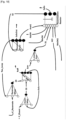
- the generated equipment diagrams are shown on the figure 9 And 10 .
- the equipment used here all belongs to the BEQGEN library.
- Table 38 correspondence between operation blocks and equipment.
- the device types correspond to those defined in the BEQGEN library. ⁇ /b> Operation block equipment (name) equipment (type) Volume ( m3 )
- RacemateMixer and S_enantio_store equipment must therefore be able to store the production of a cycle.
- This second storage device is created by practical necessity, it has no equivalent in the operations diagram because the approach used has hitherto made it possible to disregard the constraints of continuous-discontinuous interfacing.
- equipment diagrams manage the notions of time and equipment size.
- operating parameters such as the maximum filling rate or the productivity of such and such equipment.
- the values of these operating parameters allow the user to judge the practical relevance of the equipment sizes and operating times he has specified.
- the maximum occupation rate of the racemization reactor and of the racemate dryer is approximately 130%, which is obviously unrealistic.
- SMB_evap we would end up with a productivity of 42 kg of R enantiomer per hour and per m 3 , whereas the current values for such separations are rather of the order of 25 kg of R enantiomer per hour and per m 3 .
- the system can use this information to make an initial economic estimate of the fixed costs.
- the raw material costs are those of Table 36. The assumptions on the variable costs remain the same as before.
- Table 40 size, economic parameters and cost of each equipment; equipment Size size unit Ref. size Ref. (k €) Elasticity Cost (k €) of equipment SMB_evap 0.5 m 3 1 30,000 0.6 19,793 RacemizationReactor 10 m 3 3 1,000 2,060 RacemateDryer 10 m 3 3 1,500 3,090 Total CAPEX (without racemization or acetonitrile recycling) 19,793 Total CAPEX (with racemization and acetonitrile recycling) 24,940
- the contribution of the equipment to the production cost is calculated by considering that the investment cost of the equipment is amortized over 64,000 hours of use.
- a maintenance cost which is equivalent to 5% of CAPEX per year (ie 8,000 hours).
- the cost of labor is considered secondary (for the purpose of illustration) but could be considered.
- a quality control cost of €100,000/year and an overhead cost that is equivalent to 25% of the other fixed costs.
- the cost of the adsorbent used for chromatography in LMS we consider a purchase cost of 10,000 €/kg, a duration of use of 16,000 hours and a mass of 1 kg per kg of R-enantiomer in Raff per day. For the case involving racemization, it is considered that the process is stopped 10 hours between the cycles of 20 hours.
- Table 41 total cost of production (in € per kg of R-enantiomer in ⁇ i>Raff ⁇ /i>) with breakdown of fixed costs Option 1 Option 3 Without racemization With racemization of the S-enantiomer and recycling of acetonitrile Equipment depreciation 24.74 46.79 Interview 9.89 18.72 Adsorbent 15.00 15.00 Quality control 1.00 1.50 Overheads 12.66 20.50 Total fixed costs 63.29 102.51 Total variable costs 276.75 190.53 Total ( €/kg of R in Raffinate) 340.04 293.04
- option 3 Due to the presence of additional equipment, option 3 has higher fixed costs than option 1. However, by combining variable and fixed costs, option 3 seems more attractive. In the following studies, only this configuration will be considered.
- the invention's top-down approach begins with moderately complex and information-efficient calculations. Thanks to the results of these first calculations, we know which refinements have priority, which additional information should be
- the technical effect of the system according to the invention is therefore to make it possible to obtain an equipment diagram of an industrial installation, then to produce and operate it. Thanks to the invention, this equipment diagram can be obtained more quickly than in the traditional methods. In addition, thanks to the iteration options, with improvement of the most critical elements, the obtained equipment diagram can present better operating parameters than those obtained by traditional methods.
- the method and device of the invention can be used by a laboratory chemist, who does not necessarily have the skills and experience of a process engineer.
- each module can correspond to a routine of one or more computer programs.
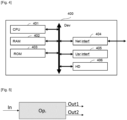
- the system is then implemented by a global device 400 as illustrated in the figure 4 .
- the executable code can be stored either in the read-only memory 403, or on the hard disk 406, or on a removable digital medium such as a disk for example.
- the executable code of the programs can be received by means of a communication network, via the network interface 404, in order to be stored on one of the storage media of the communication device 400, such as the disc hard 406, before being executed.
- the central processing unit 401 is adapted to control and direct the execution of the instructions or software code portions of the program in accordance with the embodiments of the invention, which instructions are stored on one of the aforementioned storage media. After being put into service, the CPU 401 is able to execute the instructions from the main RAM memory 402 in connection with a software application for example after these instructions have been loaded from the ROM program 403 or on the disk. hard (HD) 406. This software application, when executed by CPU 401, causes the method steps to be implemented in accordance with the embodiments.
Landscapes
- Engineering & Computer Science (AREA)
- Chemical & Material Sciences (AREA)
- Theoretical Computer Science (AREA)
- Computing Systems (AREA)
- Bioinformatics & Computational Biology (AREA)
- Bioinformatics & Cheminformatics (AREA)
- Life Sciences & Earth Sciences (AREA)
- Crystallography & Structural Chemistry (AREA)
- Health & Medical Sciences (AREA)
- Chemical Kinetics & Catalysis (AREA)
- Analytical Chemistry (AREA)
- Physics & Mathematics (AREA)
- Evolutionary Computation (AREA)
- Software Systems (AREA)
- Computer Vision & Pattern Recognition (AREA)
- Artificial Intelligence (AREA)
- Medical Informatics (AREA)
- General Health & Medical Sciences (AREA)
- General Physics & Mathematics (AREA)
- Automation & Control Theory (AREA)
- Databases & Information Systems (AREA)
- Data Mining & Analysis (AREA)
- Spectroscopy & Molecular Physics (AREA)
- Management, Administration, Business Operations System, And Electronic Commerce (AREA)
Claims (7)
- System (200, 400, 600) zur Simulation eines chemischen oder biochemischen Prozesses, umfassend mindestens eine Reaktion oder eine Separation, die mindestens ein Ausgangsmaterial umwandelt, wobei das System umfasst:- eine Vielzahl Funktionsmodule (604, 605, 606), die derart konfiguriert sind, dass sie jeweilige Simulationsstufen des chemischen bzw. biochemischen Prozesses ausführen, wobei:∘ mindestens ein Funktionsmodul eine Simulation unter Verwendung einer auf einer Spezies-Erhaltungsgleichung basierenden algebraischen Differentialmodellierung ermöglicht und∘ mindestens ein Funktionsmodul eine Simulation unter Verwendung einer algebraischen Modellierung, die Ein- und Ausgänge und/oder Ausgangs- und Endzustände mindestens der mindestens einen Reaktion ermöglicht,- - mindestens ein Speichermodul (602) zum Speichern der die chemischen Spezies betreffenden Versuchsdaten in einer von mindestens einem der Vielzahl Funktionsmodule nutzbaren Datenstruktur;- ein Leistungsbewertungsmodul (607), das konfiguriert ist zum:o Ausführen von Leistungsschätzungen über das Verfahren anhand der Versuchsdaten des Speichermoduls und/oder der von einem der Vielzahl Funktionsmodul erreichten Simulationsergebnisse;o Vergleichen mindestens zweier Leistungsschätzungen miteinander oder mit Versuchsergebnissen,- wobei das Verfahren definiert wird durch eine Gruppe von Dateien, die von allen Modulen des Systems geteilt werden, wobei jede Datei eine Beschreibung des mindestens einen Ausgangsmaterials und eine Beschreibung eines Abbaus des mindestens einen Ausgangsmaterials in chemische Spezies enthält,- wobei es sich bei den Dateien um die Ein- und Ausgänge der Module des Systems handelt, wobei der Abbau in chemische Spezies über den ganzen Bearbeitungsverlauf erhalten bleibt.
- System nach Anspruch 1, ferner umfassend ein Modul (603) zur Bearbeitung und Auswertung von Versuchsdaten, die die Bearbeitung von Signalen, die Ausführung statistischer Auswertungen und die Identifizierung von Modellparametern ermöglicht.
- System nach Anspruch 1 oder 2, umfassend ein Datenkbanmodul (602), in dem einerseits die physikalisch-chemischen Eigenschaften der chemischen Spezies und andererseits Zusammensetzung, Herkunft und/oder Kosten der Ausgangsmaterialien zusammengetragen werden.
- System nach einem der Ansprüche 1 - 2, umfassend:- ein Datenkbanmodul (602), in dem einerseits die physikalisch-chemischen Eigenschaften der chemischen Spezies und andererseits Zusammensetzung, Herkunft und/oder Kosten der Ausgangsmaterialien zusammengetragen werden.- ein zentrales Modul (601), das zur Erzeugung eines einen Abbau des mindestens einen Ausgangsmaterials in eine Vielzahl chemischer Spezies darstellenden Zusammensetzungsvektors konfiguriert ist;- eine Dateistruktur, die den verschiedenen Modulen nach Bedarf den Zugriff sowohl auf die Ausgangsmaterialien und deren Datenbank als auch auf die Spezies und deren Datenbunk sowie auf beide gewährt.
- System nach einem der vorstehenden Ansprüche zum rechnergestützten Simulieren eines chemischen oder biochemischen Verfahrens, umfassend mindestens einen ersten chemischen bzw. biochemischen Vorgang, wobei das System umfasst:- ein Lösungsmodul (204), das zum Lösen algebraischer Differentialgleichungen konfiguriert ist,- ein Empfangsmodul (201), das derart konfiguriert ist, dass es eine den ersten chemischen bzw. biochemischen Vorgang darstellende erste ausdrückliche algebraische Gleichung, die einen chemische Ausgangsgrößen des ersten Vorgangs darstellenden Ausgangszustandsvektor mit einem die letztendlichen chemischen Größen des ersten Vorgangs darstellenden ersten Endzustandsvariablenvektor verbindet, empfängt, und- ein Bearbeitungsmodul (203), das derart konfiguriert ist, dass eso in einer ersten algebraischen Differentialgleichung zur Verbindung• des ersten Ausgangszustandsvariablen Vektors mit• einem ersten Vektor von Variablen, die den internen Zustand des ersten Vorgangs betreffen, als unbekannter Größe,o in die erste algebraische Differentialgleichung den Ausdruck des Endzustandsvariablenvektors des ersten Vorgangs gemäß der ersten ausdrücklichen algebraischen Gleichung als Vektor von Pseudovariablen des internen Zustands des ersten Vorgangs einführt, wobei die derart ermittelte Lösung der algebraischen Differentialgleichung im stationären Zustand in Richtung des ersten Endzustandsvariablenvektors gemäß der ersten ausdrücklichen algebraischen Gleichung konvergiert,o eine Zeitkonstante der derart ermittelte algebraischen Differentialgleichung unterhalb einer charakteristischen Zeit des ersten Vorgangs festsetzt und∘ das Lösungsmodul die derart ermittelte algebraische Differentialgleichung bearbeiten lässt, um den ersten Endzustandvariablenvektor zu errechnen.
- System (200) nach Anspruch 5, ferner umfassend ein Auswahlmodul (202), das derart konfiguriert ist, dass es einen Simulationsmodus auswählt, wobei das Bearbeitungsmodul (203) zur Ausführung der Einführung als Funktion des ausgewählten Moduls konfiguriert ist.
- System (200) nach Anspruch 5 oder 6 zur rechnergestützten Simulation eines chemischen oder biochemischen Vorgangs, ferner umfassend einen zweiten chemischen bzw. biochemischen Vorgang, wobei- das Empfangsmodul (201) ferner derart konfiguriert ist, dass es eine zweite algebraische Differentialgleichung empfängt, die den zweiten chemischen bzw. biochemischen Vorgang darstellt, welcheo einen zweiten Ausgangszustandsvariablenvektor, der chemische Ausgangsgrößen des zweiten Vorgangsdarstellt mit∘ einem ersten Vektor von Variablen, die den internen Zustand des ersten Vorgangs betreffen, als unbekannter Größe, verbindet,wobei die Lösung der zweiten algebraischen Differentialgleichung im stationären Zustand in Richtung eines zweiten Endzustandsvariablenvektor, der chemische Endgrößen des zweiten Vorgangs darstellt, konvergiert,- wobei das Bearbeitungsmodul (203) ferner konfiguriert ist zumo Fusionieren der ersten und zweiten algebraischen Differentialgleichungen undo Ausführen des Lösungsmoduls (204) an der Fusion der derart ermittelten ersten und zweiten algebraischen Differentialzleichung, um einen Ausgangs- und Endvariablenvektor des Vorgangs zu errechnen.
Priority Applications (5)
| Application Number | Priority Date | Filing Date | Title |
|---|---|---|---|
| EP19306046.4A EP3786733B1 (de) | 2019-08-29 | 2019-08-29 | System und verfahren für die simulation eines chemischen oder biochemischen verfahrens |
| CN202080057787.9A CN114223037A (zh) | 2019-08-29 | 2020-08-24 | 对化学或生物化学方法进行仿真的系统和方法 |
| EP20758231.3A EP4022402A1 (de) | 2019-08-29 | 2020-08-24 | System und verfahren zum simulieren eines chemischen oder biochemischen verfahrens |
| PCT/EP2020/073606 WO2021037784A1 (fr) | 2019-08-29 | 2020-08-24 | Système et procédé pour la simulation d'un procédé chimique ou biochimique |
| US17/635,567 US20220308534A1 (en) | 2019-08-29 | 2020-08-24 | System and method for simulating a chemical or biochemical method |
Applications Claiming Priority (1)
| Application Number | Priority Date | Filing Date | Title |
|---|---|---|---|
| EP19306046.4A EP3786733B1 (de) | 2019-08-29 | 2019-08-29 | System und verfahren für die simulation eines chemischen oder biochemischen verfahrens |
Publications (2)
| Publication Number | Publication Date |
|---|---|
| EP3786733A1 EP3786733A1 (de) | 2021-03-03 |
| EP3786733B1 true EP3786733B1 (de) | 2023-04-12 |
Family
ID=67982004
Family Applications (2)
| Application Number | Title | Priority Date | Filing Date |
|---|---|---|---|
| EP19306046.4A Active EP3786733B1 (de) | 2019-08-29 | 2019-08-29 | System und verfahren für die simulation eines chemischen oder biochemischen verfahrens |
| EP20758231.3A Withdrawn EP4022402A1 (de) | 2019-08-29 | 2020-08-24 | System und verfahren zum simulieren eines chemischen oder biochemischen verfahrens |
Family Applications After (1)
| Application Number | Title | Priority Date | Filing Date |
|---|---|---|---|
| EP20758231.3A Withdrawn EP4022402A1 (de) | 2019-08-29 | 2020-08-24 | System und verfahren zum simulieren eines chemischen oder biochemischen verfahrens |
Country Status (4)
| Country | Link |
|---|---|
| US (1) | US20220308534A1 (de) |
| EP (2) | EP3786733B1 (de) |
| CN (1) | CN114223037A (de) |
| WO (1) | WO2021037784A1 (de) |
Family Cites Families (5)
| Publication number | Priority date | Publication date | Assignee | Title |
|---|---|---|---|---|
| US6983227B1 (en) * | 1995-01-17 | 2006-01-03 | Intertech Ventures, Ltd. | Virtual models of complex systems |
| ATE255555T1 (de) | 1998-05-01 | 2003-12-15 | Pfizer Prod Inc | Verfahren zur herstellung von enantiomeren reinem oder optisch angereicherter sertraline-tetralon durch kontinuierliche chromatographie |
| AU2003212615A1 (en) * | 2003-03-10 | 2004-09-30 | Dynochem Ip Limited | A physiocochemical process modelling system |
| US7769576B2 (en) * | 2005-06-30 | 2010-08-03 | The Mathworks, Inc. | Method and apparatus for integrated modeling, simulation and analysis of chemical and biological systems having a sequence of reactions, each simulated at a reaction time determined based on reaction kinetics |
| CA2953385C (en) * | 2014-06-30 | 2024-07-02 | Evolving Machine Intelligence Pty Ltd | SYSTEM AND METHOD FOR MODELING SYSTEM BEHAVIOR |
-
2019
- 2019-08-29 EP EP19306046.4A patent/EP3786733B1/de active Active
-
2020
- 2020-08-24 CN CN202080057787.9A patent/CN114223037A/zh active Pending
- 2020-08-24 EP EP20758231.3A patent/EP4022402A1/de not_active Withdrawn
- 2020-08-24 WO PCT/EP2020/073606 patent/WO2021037784A1/fr not_active Ceased
- 2020-08-24 US US17/635,567 patent/US20220308534A1/en active Pending
Also Published As
| Publication number | Publication date |
|---|---|
| EP4022402A1 (de) | 2022-07-06 |
| US20220308534A1 (en) | 2022-09-29 |
| CN114223037A (zh) | 2022-03-22 |
| EP3786733A1 (de) | 2021-03-03 |
| WO2021037784A1 (fr) | 2021-03-04 |
Similar Documents
| Publication | Publication Date | Title |
|---|---|---|
| Jiménez-González et al. | Key green engineering research areas for sustainable manufacturing: a perspective from pharmaceutical and fine chemicals manufacturers | |
| Ho et al. | Biocatalytic continuous manufacturing of diabetes drug: plantwide process modeling, optimization, and environmental and economic analysis | |
| Taylor et al. | An automated computational approach to kinetic model discrimination and parameter estimation | |
| Eugene et al. | Data science-enabled molecular-to-systems engineering for sustainable water treatment | |
| Zhang et al. | Screening of functional solvent system for automatic aldehyde and ketone separation in aldol reaction: A combined COSMO-RS and experimental approach | |
| Tufvesson et al. | Economic considerations for selecting an amine donor in biocatalytic transamination | |
| Kollges et al. | Design and performance assessment of continuous crystallization processes resolving racemic conglomerates | |
| Carter et al. | Rapid route design of AZD7594 | |
| Grimaldi et al. | Life cycle assessment of an enzymatic ibuprofen production process with automatic recycling and purification | |
| Ploch et al. | Multiscale dynamic modeling and simulation of a biorefinery | |
| Wang et al. | Solvent selection for chemical reactions toward optimal thermodynamic and kinetic performances: group contribution and COSMO-based modeling | |
| Chen et al. | Optimal aqueous biphasic systems design for the recovery of ionic liquids | |
| EP3566769B1 (de) | Simulationsmethode und -vorrichtung einer industrieanlage für die nutzung eines chemischen oder biochemischen verfahrens | |
| EP3786733B1 (de) | System und verfahren für die simulation eines chemischen oder biochemischen verfahrens | |
| Patle et al. | Plantwide control of the formic acid production process using an integrated framework of simulation and heuristics | |
| Gazis et al. | Towards greener-by-design fine chemicals. Part 2: technological frontiers | |
| Asenjo et al. | Strategies for the simultaneous optimization of the structure and the process variables of a protein production plant | |
| Takle et al. | Flash Thermal Racemization of Chiral Amine in Continuous Flow: An Exploration of Reaction Space Using DoE and Multivariate Transient Flow | |
| Ramin et al. | Modelling continuous pharmaceutical and bio-based processes at plant-wide level: A roadmap towards efficient decision-making | |
| Roth et al. | Beyond partition coefficients: model-based solvent screening in extractive-reaction processes considering fluid dynamics and mass transfer limitations | |
| Papadakis | Modelling and synthesis of pharmaceutical processes: moving from batch to continuous | |
| Ley et al. | 11 Outlook, future directions, and emerging applications | |
| Fischer et al. | Mass integration as a design heuristic: improvements in the HDA process | |
| Xiong et al. | 3CLpro inhibitors: DEL-based molecular generation | |
| Campbell | Sustainability and quality by digital design of integrated continuous pharmaceutical processes |
Legal Events
| Date | Code | Title | Description |
|---|---|---|---|
| PUAI | Public reference made under article 153(3) epc to a published international application that has entered the european phase |
Free format text: ORIGINAL CODE: 0009012 |
|
| STAA | Information on the status of an ep patent application or granted ep patent |
Free format text: STATUS: THE APPLICATION HAS BEEN PUBLISHED |
|
| AK | Designated contracting states |
Kind code of ref document: A1 Designated state(s): AL AT BE BG CH CY CZ DE DK EE ES FI FR GB GR HR HU IE IS IT LI LT LU LV MC MK MT NL NO PL PT RO RS SE SI SK SM TR |
|
| AX | Request for extension of the european patent |
Extension state: BA ME |
|
| STAA | Information on the status of an ep patent application or granted ep patent |
Free format text: STATUS: REQUEST FOR EXAMINATION WAS MADE |
|
| 17P | Request for examination filed |
Effective date: 20210831 |
|
| RBV | Designated contracting states (corrected) |
Designated state(s): AL AT BE BG CH CY CZ DE DK EE ES FI FR GB GR HR HU IE IS IT LI LT LU LV MC MK MT NL NO PL PT RO RS SE SI SK SM TR |
|
| GRAP | Despatch of communication of intention to grant a patent |
Free format text: ORIGINAL CODE: EPIDOSNIGR1 |
|
| STAA | Information on the status of an ep patent application or granted ep patent |
Free format text: STATUS: GRANT OF PATENT IS INTENDED |
|
| INTG | Intention to grant announced |
Effective date: 20230127 |
|
| GRAS | Grant fee paid |
Free format text: ORIGINAL CODE: EPIDOSNIGR3 |
|
| GRAA | (expected) grant |
Free format text: ORIGINAL CODE: 0009210 |
|
| STAA | Information on the status of an ep patent application or granted ep patent |
Free format text: STATUS: THE PATENT HAS BEEN GRANTED |
|
| AK | Designated contracting states |
Kind code of ref document: B1 Designated state(s): AL AT BE BG CH CY CZ DE DK EE ES FI FR GB GR HR HU IE IS IT LI LT LU LV MC MK MT NL NO PL PT RO RS SE SI SK SM TR |
|
| REG | Reference to a national code |
Ref country code: GB Ref legal event code: FG4D Free format text: NOT ENGLISH |
|
| REG | Reference to a national code |
Ref country code: CH Ref legal event code: EP |
|
| REG | Reference to a national code |
Ref country code: DE Ref legal event code: R096 Ref document number: 602019027437 Country of ref document: DE |
|
| REG | Reference to a national code |
Ref country code: IE Ref legal event code: FG4D Free format text: LANGUAGE OF EP DOCUMENT: FRENCH |
|
| REG | Reference to a national code |
Ref country code: AT Ref legal event code: REF Ref document number: 1560130 Country of ref document: AT Kind code of ref document: T Effective date: 20230515 |
|
| REG | Reference to a national code |
Ref country code: LT Ref legal event code: MG9D |
|
| REG | Reference to a national code |
Ref country code: NL Ref legal event code: MP Effective date: 20230412 |
|
| REG | Reference to a national code |
Ref country code: AT Ref legal event code: MK05 Ref document number: 1560130 Country of ref document: AT Kind code of ref document: T Effective date: 20230412 |
|
| PG25 | Lapsed in a contracting state [announced via postgrant information from national office to epo] |
Ref country code: NL Free format text: LAPSE BECAUSE OF FAILURE TO SUBMIT A TRANSLATION OF THE DESCRIPTION OR TO PAY THE FEE WITHIN THE PRESCRIBED TIME-LIMIT Effective date: 20230412 |
|
| PG25 | Lapsed in a contracting state [announced via postgrant information from national office to epo] |
Ref country code: SE Free format text: LAPSE BECAUSE OF FAILURE TO SUBMIT A TRANSLATION OF THE DESCRIPTION OR TO PAY THE FEE WITHIN THE PRESCRIBED TIME-LIMIT Effective date: 20230412 Ref country code: PT Free format text: LAPSE BECAUSE OF FAILURE TO SUBMIT A TRANSLATION OF THE DESCRIPTION OR TO PAY THE FEE WITHIN THE PRESCRIBED TIME-LIMIT Effective date: 20230814 Ref country code: NO Free format text: LAPSE BECAUSE OF FAILURE TO SUBMIT A TRANSLATION OF THE DESCRIPTION OR TO PAY THE FEE WITHIN THE PRESCRIBED TIME-LIMIT Effective date: 20230712 Ref country code: ES Free format text: LAPSE BECAUSE OF FAILURE TO SUBMIT A TRANSLATION OF THE DESCRIPTION OR TO PAY THE FEE WITHIN THE PRESCRIBED TIME-LIMIT Effective date: 20230412 Ref country code: AT Free format text: LAPSE BECAUSE OF FAILURE TO SUBMIT A TRANSLATION OF THE DESCRIPTION OR TO PAY THE FEE WITHIN THE PRESCRIBED TIME-LIMIT Effective date: 20230412 |
|
| PG25 | Lapsed in a contracting state [announced via postgrant information from national office to epo] |
Ref country code: RS Free format text: LAPSE BECAUSE OF FAILURE TO SUBMIT A TRANSLATION OF THE DESCRIPTION OR TO PAY THE FEE WITHIN THE PRESCRIBED TIME-LIMIT Effective date: 20230412 Ref country code: PL Free format text: LAPSE BECAUSE OF FAILURE TO SUBMIT A TRANSLATION OF THE DESCRIPTION OR TO PAY THE FEE WITHIN THE PRESCRIBED TIME-LIMIT Effective date: 20230412 Ref country code: LV Free format text: LAPSE BECAUSE OF FAILURE TO SUBMIT A TRANSLATION OF THE DESCRIPTION OR TO PAY THE FEE WITHIN THE PRESCRIBED TIME-LIMIT Effective date: 20230412 Ref country code: LT Free format text: LAPSE BECAUSE OF FAILURE TO SUBMIT A TRANSLATION OF THE DESCRIPTION OR TO PAY THE FEE WITHIN THE PRESCRIBED TIME-LIMIT Effective date: 20230412 Ref country code: IS Free format text: LAPSE BECAUSE OF FAILURE TO SUBMIT A TRANSLATION OF THE DESCRIPTION OR TO PAY THE FEE WITHIN THE PRESCRIBED TIME-LIMIT Effective date: 20230812 Ref country code: HR Free format text: LAPSE BECAUSE OF FAILURE TO SUBMIT A TRANSLATION OF THE DESCRIPTION OR TO PAY THE FEE WITHIN THE PRESCRIBED TIME-LIMIT Effective date: 20230412 Ref country code: GR Free format text: LAPSE BECAUSE OF FAILURE TO SUBMIT A TRANSLATION OF THE DESCRIPTION OR TO PAY THE FEE WITHIN THE PRESCRIBED TIME-LIMIT Effective date: 20230713 Ref country code: AL Free format text: LAPSE BECAUSE OF FAILURE TO SUBMIT A TRANSLATION OF THE DESCRIPTION OR TO PAY THE FEE WITHIN THE PRESCRIBED TIME-LIMIT Effective date: 20230412 |
|
| PG25 | Lapsed in a contracting state [announced via postgrant information from national office to epo] |
Ref country code: FI Free format text: LAPSE BECAUSE OF FAILURE TO SUBMIT A TRANSLATION OF THE DESCRIPTION OR TO PAY THE FEE WITHIN THE PRESCRIBED TIME-LIMIT Effective date: 20230412 |
|
| REG | Reference to a national code |
Ref country code: DE Ref legal event code: R097 Ref document number: 602019027437 Country of ref document: DE |
|
| PG25 | Lapsed in a contracting state [announced via postgrant information from national office to epo] |
Ref country code: SK Free format text: LAPSE BECAUSE OF FAILURE TO SUBMIT A TRANSLATION OF THE DESCRIPTION OR TO PAY THE FEE WITHIN THE PRESCRIBED TIME-LIMIT Effective date: 20230412 |
|
| PG25 | Lapsed in a contracting state [announced via postgrant information from national office to epo] |
Ref country code: SM Free format text: LAPSE BECAUSE OF FAILURE TO SUBMIT A TRANSLATION OF THE DESCRIPTION OR TO PAY THE FEE WITHIN THE PRESCRIBED TIME-LIMIT Effective date: 20230412 Ref country code: SK Free format text: LAPSE BECAUSE OF FAILURE TO SUBMIT A TRANSLATION OF THE DESCRIPTION OR TO PAY THE FEE WITHIN THE PRESCRIBED TIME-LIMIT Effective date: 20230412 Ref country code: RO Free format text: LAPSE BECAUSE OF FAILURE TO SUBMIT A TRANSLATION OF THE DESCRIPTION OR TO PAY THE FEE WITHIN THE PRESCRIBED TIME-LIMIT Effective date: 20230412 Ref country code: EE Free format text: LAPSE BECAUSE OF FAILURE TO SUBMIT A TRANSLATION OF THE DESCRIPTION OR TO PAY THE FEE WITHIN THE PRESCRIBED TIME-LIMIT Effective date: 20230412 Ref country code: DK Free format text: LAPSE BECAUSE OF FAILURE TO SUBMIT A TRANSLATION OF THE DESCRIPTION OR TO PAY THE FEE WITHIN THE PRESCRIBED TIME-LIMIT Effective date: 20230412 Ref country code: CZ Free format text: LAPSE BECAUSE OF FAILURE TO SUBMIT A TRANSLATION OF THE DESCRIPTION OR TO PAY THE FEE WITHIN THE PRESCRIBED TIME-LIMIT Effective date: 20230412 |
|
| PLBE | No opposition filed within time limit |
Free format text: ORIGINAL CODE: 0009261 |
|
| STAA | Information on the status of an ep patent application or granted ep patent |
Free format text: STATUS: NO OPPOSITION FILED WITHIN TIME LIMIT |
|
| PG25 | Lapsed in a contracting state [announced via postgrant information from national office to epo] |
Ref country code: MC Free format text: LAPSE BECAUSE OF FAILURE TO SUBMIT A TRANSLATION OF THE DESCRIPTION OR TO PAY THE FEE WITHIN THE PRESCRIBED TIME-LIMIT Effective date: 20230412 |
|
| 26N | No opposition filed |
Effective date: 20240115 |
|
| PG25 | Lapsed in a contracting state [announced via postgrant information from national office to epo] |
Ref country code: MC Free format text: LAPSE BECAUSE OF FAILURE TO SUBMIT A TRANSLATION OF THE DESCRIPTION OR TO PAY THE FEE WITHIN THE PRESCRIBED TIME-LIMIT Effective date: 20230412 |
|
| PG25 | Lapsed in a contracting state [announced via postgrant information from national office to epo] |
Ref country code: LU Free format text: LAPSE BECAUSE OF NON-PAYMENT OF DUE FEES Effective date: 20230829 |
|
| PG25 | Lapsed in a contracting state [announced via postgrant information from national office to epo] |
Ref country code: LU Free format text: LAPSE BECAUSE OF NON-PAYMENT OF DUE FEES Effective date: 20230829 |
|
| PG25 | Lapsed in a contracting state [announced via postgrant information from national office to epo] |
Ref country code: SI Free format text: LAPSE BECAUSE OF FAILURE TO SUBMIT A TRANSLATION OF THE DESCRIPTION OR TO PAY THE FEE WITHIN THE PRESCRIBED TIME-LIMIT Effective date: 20230412 |
|
| PG25 | Lapsed in a contracting state [announced via postgrant information from national office to epo] |
Ref country code: SI Free format text: LAPSE BECAUSE OF FAILURE TO SUBMIT A TRANSLATION OF THE DESCRIPTION OR TO PAY THE FEE WITHIN THE PRESCRIBED TIME-LIMIT Effective date: 20230412 Ref country code: IT Free format text: LAPSE BECAUSE OF FAILURE TO SUBMIT A TRANSLATION OF THE DESCRIPTION OR TO PAY THE FEE WITHIN THE PRESCRIBED TIME-LIMIT Effective date: 20230412 |
|
| PG25 | Lapsed in a contracting state [announced via postgrant information from national office to epo] |
Ref country code: BG Free format text: LAPSE BECAUSE OF FAILURE TO SUBMIT A TRANSLATION OF THE DESCRIPTION OR TO PAY THE FEE WITHIN THE PRESCRIBED TIME-LIMIT Effective date: 20230412 |
|
| PG25 | Lapsed in a contracting state [announced via postgrant information from national office to epo] |
Ref country code: BG Free format text: LAPSE BECAUSE OF FAILURE TO SUBMIT A TRANSLATION OF THE DESCRIPTION OR TO PAY THE FEE WITHIN THE PRESCRIBED TIME-LIMIT Effective date: 20230412 |
|
| PG25 | Lapsed in a contracting state [announced via postgrant information from national office to epo] |
Ref country code: CY Free format text: LAPSE BECAUSE OF FAILURE TO SUBMIT A TRANSLATION OF THE DESCRIPTION OR TO PAY THE FEE WITHIN THE PRESCRIBED TIME-LIMIT; INVALID AB INITIO Effective date: 20190829 |
|
| PG25 | Lapsed in a contracting state [announced via postgrant information from national office to epo] |
Ref country code: HU Free format text: LAPSE BECAUSE OF FAILURE TO SUBMIT A TRANSLATION OF THE DESCRIPTION OR TO PAY THE FEE WITHIN THE PRESCRIBED TIME-LIMIT; INVALID AB INITIO Effective date: 20190829 |
|
| PGFP | Annual fee paid to national office [announced via postgrant information from national office to epo] |
Ref country code: DE Payment date: 20250827 Year of fee payment: 7 |
|
| PGFP | Annual fee paid to national office [announced via postgrant information from national office to epo] |
Ref country code: BE Payment date: 20250825 Year of fee payment: 7 Ref country code: GB Payment date: 20250826 Year of fee payment: 7 |
|
| PGFP | Annual fee paid to national office [announced via postgrant information from national office to epo] |
Ref country code: FR Payment date: 20250819 Year of fee payment: 7 |
|
| PGFP | Annual fee paid to national office [announced via postgrant information from national office to epo] |
Ref country code: CH Payment date: 20250901 Year of fee payment: 7 |
|
| PGFP | Annual fee paid to national office [announced via postgrant information from national office to epo] |
Ref country code: IE Payment date: 20250819 Year of fee payment: 7 |
|
| PG25 | Lapsed in a contracting state [announced via postgrant information from national office to epo] |
Ref country code: TR Free format text: LAPSE BECAUSE OF FAILURE TO SUBMIT A TRANSLATION OF THE DESCRIPTION OR TO PAY THE FEE WITHIN THE PRESCRIBED TIME-LIMIT Effective date: 20230412 |