EP3566769B1 - Simulationsmethode und -vorrichtung einer industrieanlage für die nutzung eines chemischen oder biochemischen verfahrens - Google Patents
Simulationsmethode und -vorrichtung einer industrieanlage für die nutzung eines chemischen oder biochemischen verfahrens Download PDFInfo
- Publication number
- EP3566769B1 EP3566769B1 EP18171093.0A EP18171093A EP3566769B1 EP 3566769 B1 EP3566769 B1 EP 3566769B1 EP 18171093 A EP18171093 A EP 18171093A EP 3566769 B1 EP3566769 B1 EP 3566769B1
- Authority
- EP
- European Patent Office
- Prior art keywords
- equipment
- library
- blocks
- models
- bop
- Prior art date
- Legal status (The legal status is an assumption and is not a legal conclusion. Google has not performed a legal analysis and makes no representation as to the accuracy of the status listed.)
- Active
Links
Images





Classifications
-
- B—PERFORMING OPERATIONS; TRANSPORTING
- B01—PHYSICAL OR CHEMICAL PROCESSES OR APPARATUS IN GENERAL
- B01J—CHEMICAL OR PHYSICAL PROCESSES, e.g. CATALYSIS OR COLLOID CHEMISTRY; THEIR RELEVANT APPARATUS
- B01J19/00—Chemical, physical or physico-chemical processes in general; Their relevant apparatus
- B01J19/0006—Controlling or regulating processes
-
- B—PERFORMING OPERATIONS; TRANSPORTING
- B01—PHYSICAL OR CHEMICAL PROCESSES OR APPARATUS IN GENERAL
- B01J—CHEMICAL OR PHYSICAL PROCESSES, e.g. CATALYSIS OR COLLOID CHEMISTRY; THEIR RELEVANT APPARATUS
- B01J19/00—Chemical, physical or physico-chemical processes in general; Their relevant apparatus
- B01J19/0006—Controlling or regulating processes
- B01J19/0033—Optimalisation processes, i.e. processes with adaptive control systems
-
- B—PERFORMING OPERATIONS; TRANSPORTING
- B01—PHYSICAL OR CHEMICAL PROCESSES OR APPARATUS IN GENERAL
- B01J—CHEMICAL OR PHYSICAL PROCESSES, e.g. CATALYSIS OR COLLOID CHEMISTRY; THEIR RELEVANT APPARATUS
- B01J2219/00—Chemical, physical or physico-chemical processes in general; Their relevant apparatus
- B01J2219/00049—Controlling or regulating processes
- B01J2219/00243—Mathematical modelling
-
- G—PHYSICS
- G16—INFORMATION AND COMMUNICATION TECHNOLOGY [ICT] SPECIALLY ADAPTED FOR SPECIFIC APPLICATION FIELDS
- G16C—COMPUTATIONAL CHEMISTRY; CHEMOINFORMATICS; COMPUTATIONAL MATERIALS SCIENCE
- G16C20/00—Chemoinformatics, i.e. ICT specially adapted for the handling of physicochemical or structural data of chemical particles, elements, compounds or mixtures
- G16C20/10—Analysis or design of chemical reactions, syntheses or processes
Definitions
- the invention relates to a method for simulating an industrial installation for operating a process for obtaining chemical molecules or biological material.
- the invention also relates to a device for the implementation by means of a computer of this method, to a computer program for the execution of the method, and to an industrial installation obtained by said method.
- Fine chemical or biotechnology manufacturers must frequently estimate or compare chemical or biochemical production processes with a very limited amount of information, especially in the early stages of development. It should be noted that in these industries, when a production process must be devised, it often happens that the chances of marketing the targeted molecule are very low, for example, for reasons of failure of clinical trials. There are therefore very many technical and economic estimates to be made on many molecules which will only be produced in small quantities and for a limited period of time. The ability to have quick estimates is therefore essential.
- thermodynamics which are in fact unknown and the determination of which would be incompatible in time and cost with the constraints of developing fine chemical or biotechnology processes.
- the document US 8,983,815 discloses an apparatus and method for computer modeling of chemical processes in which a simulation system is provided with a set of data to obtain a rigorous simulation of the process.
- the examples provided in this document relate to an oil and gas separation installation, and an oil refining installation and include technical-economic considerations that are not suited to fine chemicals or biotechnologies.
- the method presented in the document US 8,983,815 is therefore not suitable for fine chemicals or biotechnologies.
- fine chemicals also called “specialty chemicals” is meant in this document a branch of the chemical industry which synthesizes specific products, in low production volumes, but with high added value, and meeting high technical constraints, for example purity.
- biological material is meant any molecules or mixtures of molecules obtained by fermentation, cell culture or extracts from the natural environment.
- EP-A-3 242 226 describes a method for simulating a chemical process.
- the embodiments of the invention provide an industrial tool for fine chemical process engineering.
- a functional technical feature of the embodiments resides in the simulation of processes for their subsequent implementation in installations for the production of chemical or biological products.
- the embodiments make it possible to predict, in a concrete manner, the behavior of chemical processes in order to make a certain number of estimates, in particular on their industrial feasibility.
- the embodiments of the invention thus make it possible to direct the development of chemical processes with sufficient precision, and within reasonable times and costs, to make it possible to estimate the chances of success of their industrial implementation and this, even before the establishment of an installation and the commissioning of this installation.
- An object of the invention is to allow the fine chemical and biotechnology industries to use relevant simulators by providing a tool that can be used by a non-simulation expert, which allows a production project to be taken into account with initially almost non-existent physical-chemical knowledge.
- This tool must be able to help the user to identify the delicate or limiting points of the evaluation process in order to determine the knowledge to be acquired or used in order to achieve a given objective, to refine these forecasts as new knowledge becomes available.
- This tool must also be reliable, easy to use, and allow an accurate estimation of the technical and economic performance of the process studied which is adapted to the problem posed and which can evolve according to the needs and the evolution of the industrial project.
- Step 1 definition of raw materials and species
- Step 2 Diagram of operation blocks
- step 2.1 for modeling a process is the development of an operation block diagram.
- Each icon in this diagram represents an operation (ie an action on a flow or on a quantity).
- these operations are described by the relations between their inputs and their outputs and can be represented by very simple empirical models or by more precise thermodynamic models.
- step 2.3 the resolution of the balance equations associated with the relationships between the inputs and the outputs of each block and the connectivity of the blocks between them will allow us to know the fluxes (or quantities) of mass and heat at each place of the system, and in particular at the output.
- the operation block diagrams can be read in flow (kg/h) for continuous processes as well as in quantity (kg) treated per operation for discontinuous processes.
- the models of the MOP1 library propose a very macroscopic description of the effect of each block of operation on flows or traversing quantities. This macroscopic description lends itself well to the use of hypotheses based on intuition and experience.
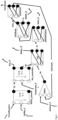
- the diagram of the figure 1 comprises two reactions H2O2_quench and AA_neutralize corresponding respectively to the neutralization of H2O2 by Na2SO3 and of AcH by Na2CO3.
- This diagram also includes three separations LLE, SaltsFiltration and SolvEvap corresponding respectively to the extraction of the DVL and the CP by an organic solvent (with removal of water and precipitation of the salts), the filtration of the salts, the evaporation of the solvent.
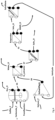
- the diagram of the figure 2 is extremely similar to that of figure 1 plus the SolvPurif operation - intended to separate the solvent to be disposed of from that which can be recycled - as well as the MIX1 operation intended to mix the fresh solvent and the recycled solvent.
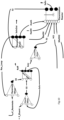
- the diagram of the picture 3 simply includes the H2O2_quench reaction block corresponding to the thermal neutralization of H2O2 and the distillation separation block corresponding to the removal of H2O and AcH.
- mixing operations simply consist of grouping together the masses (or mass flow rates) of each species contained in all the incoming flows.
- a ratio is provided by the user for each species to indicate its distribution between the output streams.
- these ratios are often 0% or 100% but they can take any value between 0% and 100%.
- this system of ratios is illustrated here on situations with two outgoing flows but it also applies to situations where these flows would be more numerous as well as to balances between phases.
- the system of partition ratios is here used to account for generally ideal separations. By its structure, this system makes it possible to remain aware of this assumption of ideality and would allow representing deviations from ideality, for example by taking ratios of 97%/3% instead of the current 100%/0%.
- the aim is to treat a load of 4050 kg of reaction mixture (see composition in Table 1).
- the sulphite and carbonate flow rates are calculated so as to completely neutralize H2O2 and AcH.
- the flow rate of fresh MIBK is calculated so that in LLE, 4000 kg of MIBK are mixed with the load of DVL and CP.
- the computer program to which this invention relates allows the entry of the information present in the recipe. It is possible to enter all the information of the recipe without prejudging its possible later use; at the same time, no information must imperatively be provided apart from the nature of each operation.
- the computer program is able to interpret the content to create the structure of an operation block diagram based on this content.
- a laboratory recipe can for example come from a scientific article relating to a synthesis experiment. This article then constitutes one of the first sources of information on the process.
- the energy flows brought to the processes are assigned a cost of 0.10 €/kWh.
- the energy flows withdrawn from the processes are assigned a cost of 0.05 €/kWh.
- step 1.2 the material balances relate to cash, the savings to the value of raw materials, hence the importance of step 1.2.
- process 2 allows, thanks to the recycling of solvent, interesting savings both at the level of the fresh MIBK and the treatment of effluents. The energy counterpart is minimal.
- Process 3 allows even greater savings because the neutralization technique used significantly reduces the quantities of raw materials to be injected and the quantities of solvents (including water) to be separated and reprocessed.
- step 3.1 each of the operation blocks of two retained diagrams is assigned to a device. Note that several operations can be carried out in the same equipment (for example the two neutralization reactions in the case of process 2).
- the system has a library of generic equipment BEQGEN and a library of specific equipment BEQSPEC, each equipment having its characteristics.
- a first (slightly arbitrary) volume value is given for each piece of equipment. This can be changed later.
- ⁇ b>Table 20 allocation of operations to equipment in the case of process 2 (recycling of the extraction solvent) ⁇ /b> Operation block Equipment Name Kind Volume ( m3 ) H2O2_quench QuenchSTR Stirred reactor 14 AA_neutralize LLE LL_extractor Generic separator 18 SaltsFiltration SaltsFilter Generic separator 10 SolvEvap Evaporator Generic separator 8 SolvPurif SolvPurif Generic separator 6 MIX1 SolventTank Tank 6 Operation block Equipment Name Kind Volume ( m3 ) H2O2_quench QuenchSTR Stirred reactor 6 distillation Distill Generic separator 6
- the SolventTank equipment contains 3800 kg of MIBK. Then the operating procedure applied is that set out in Table 22. For a certain number of operations, an arbitrary duration of 0.01h is applied because it is assumed that the duration of these steps is negligible with regard to the durations of reactions and separations.
- the models of the MEQ1 library are used to describe the operations taking place in the devices (see Table 22 and Table 23). They are extremely similar in principle and structure to those of the MOP1 library.
- the transition from the operations diagram to the equipment diagram therefore does not require a large additional amount of information as long as equipment from the BEQGEN library and operation models from the MEQ1 library.
- the additional information essentially consists in giving durations to the operations.
- the calculation also provides the filling rate of each piece of equipment likely to store content as well as the total time of the operating sequence (see Table 24 and Table 25).
- Table 24 and Table 25 the total time of the operating sequence
- the cost of the equipment is considered to be amortized over 64,000 hours.
- the general objective is to minimize the cost of producing enantiomerically pure or optically enriched sertraline-tetralone (in the R form) from a mixture containing two enantiomers (R and S) by means of chromatography such as simulated moving bed chromatography (LMS)
- the information available consists of a short series of experience reports indicating what was injected into which equipment and providing some macroscopic information on the observed consequences.
- the information contained in this document may also contain certain errors and should be treated with caution.
- Step 1 definition of raw materials and species
- the only raw materials are the racemic mixture and the fresh solvent.
- acetonitrile, methanol, soda and hydrochloric acid should be added.
- Step 2 Diagram of operation blocks
- the operation block diagrams can be read in flow (kg/h) as well as in quantity (kg) processed per operation.
- the EluMix and RacMix mixers receive input materials at 25°C.
- the output compositions and temperature are a simple linear combination of the input ones; the mixtures here are supposedly ideal liquids.
- separation ratios describe how a compound contained in the input streams is distributed between the output streams. Temperature, state, split ratios are given (possibly guessed/intuitive/desired) by the user. They are either 0% or 100% in the tables below, but can take any value between 0% and 100% (see Table 33). Values are based on chemist's experience or intuition or by some patent results US 6,444,854 B1 . - the PrecipFiltr operation block converts Na+ and Cl- (dissolved) into solid NaCl which is sent to SaltsOut.
- the input streams are sized to obtain a flow rate of 12.5 kg/h (ie 100 tonnes per year for 8,000 hours) of R-enantiomer in the Raffinate stream.
- the flow rate of the FreshEluent stream is calculated so that the S3 stream meets the conditions in Table 3.
- the quantities of raw materials needed for the Racemization operation (C2H3N_feed1, NaOH_feed, MeOH_feed, MeOH_feed2, C2H3N_feed2, HCl_feed) and the flow rates are calculated based on the racemization experiment described in the U.S. Patent 6,444,854 to maintain the proportions between these raw materials and the quantity of enantiomers to be racemized.
- the flow rate (quantity) of acetonitrile to be supplied is equal to 30 liters for each kilogram of S-enantiomer which is fed to the racemization.
- the Extr feed (quantity) that arrives at the Racemization operation contains acetonitrile which is deducted from the C2H3N_feed1 feed.
- the thermal power to be supplied to the process amounts to 1182 kW; the thermal power to be removed amounts to 1131 kW.
- Table 35 description of the inputs, outputs and internals of the process in the case with recycling of the S enantiomer and racemization.
- Tables 34 to 36 leads to the variable costs of the two versions of the process shown in Table 37.
- Table 37 contribution of each input to the variable part of the R-enantiomer production cost. The values are expressed in €/kg of R-enantiomer in the ⁇ i>Raff. ⁇ /i> stream Method 1 Method 2 Process 3 Without racemization With S-enantiomer recycling and racemization With S-enantiomer recycling, racemization and acetonitrile recycling FreshRacemate 203.25 100.12 100.12 Total Acetonitrile (two feeds) - 461.10 - Total Methanol (two feeds) - 2.07 2.07 Eluent charges 60.99 61.27 61.27 NaOH_feed - ⁇ 0.01 ⁇ 0.01 HCl_feed - 0.12 0.12 Effluent treatment 0.00 3.88 0.46 Energy 12.51 13.58 15.68 Total ( €/kg of R in Raffinate) 276.75 642.14 190.53
- option 2 is very likely to be unattractive from an economic point of view and in terms of waste production. In the following, we will only consider options 1 and 3.
- step 3.1 each of the operation blocks of the previous diagrams is assigned to a device.
- Table 38 provides a correspondence between operation blocks and equipment.
- the generated equipment diagrams are shown on the figure 9 And 10 .
- the equipment used here all belongs to the BEQGEN library.
- Table 38 correspondence between operation blocks and equipment.
- the device types correspond to those defined in the BEQGEN library. ⁇ /b> Operation block equipment (name) equipment (type) Volume ( m3 )
- RacemateMixer and S_enantio_store equipment must therefore be able to store the production of a cycle.
- This second storage device is created by practical necessity, it has no equivalent in the operations diagram because the approach used has hitherto made it possible to disregard the constraints of continuous-discontinuous interfacing.
- equipment diagrams manage the notions of time and equipment size.
- operating parameters such as the maximum filling rate or the productivity of such and such equipment.
- the values of these operating parameters allow the user to judge the practical relevance of the equipment sizes and operating times he has specified.
- the maximum occupation rate of the racemization reactor and of the racemate dryer is approximately 130%, which is obviously unrealistic.
- SMB_evap we would end up with a productivity of 42 kg of R enantiomer per hour and per m 3 , where the current values for such separations are rather of the order of 25 kg of R enantiomer per hour and per m 3 .
- the system can use this information to make an initial economic estimate of the fixed costs.
- the raw material costs are those of Table 36. The assumptions on the variable costs remain the same as before.
- Table 40 size, economic parameters and cost of each equipment; equipment Size size unit Ref. size Ref. (k €) Elasticity Cost (k €) of equipment SMB_evap 0.5 m3 1 30,000 0.6 19,793 RacemizationReactor 10 m3 3 1,000 2,060 RacemateDryer 10 m3 3 1,500 3,090 Total CAPEX (without racemization or acetonitrile recycling) 19,793 Total CAPEX (with racemization and acetonitrile recycling) 24,940
- the contribution of the equipment to the production cost is calculated by considering that the investment cost of the equipment is amortized over 64,000 hours of use.
- a maintenance cost which is equivalent to 5% of CAPEX per year (ie 8,000 hours).
- the cost of labor is considered secondary (for the purpose of illustration) but could be considered.
- a quality control cost of €100,000/year and an overhead cost that is equivalent to 25% of the other fixed costs.
- the cost of the adsorbent used for LMS chromatography we consider a purchase cost of €10,000/kg, a service life of 16,000 hours and a mass of 1 kg per kg of R-enantiomer in Raff per day. For the case involving racemization, it is considered that the process is stopped 10 hours between the cycles of 20 hours.
- Table 41 total cost of production (in € per kg of R-enantiomer in ⁇ i>Raff ⁇ /i>) with breakdown of fixed costs Option 1 Option 3 Without racemization With racemization of the S-enantiomer and recycling of acetonitrile Equipment depreciation 24.74 46.79 Interview 9.89 18.72 Adsorbent 15.00 15.00 Quality control 1.00 1.50 Overheads 12.66 20.50 Total fixed costs 63.29 102.51 Total variable costs 276.75 190.53 Total ( €/kg of R in Raffinate) 340.04 293.04
- option 3 Due to the presence of additional equipment, option 3 has higher fixed costs than option 1. However, by combining variable and fixed costs, option 3 seems more attractive. In the following studies, only this configuration will be considered.
- the performance of the SMB (“Simulated Moving Bed”) has a direct impact on the costs via the consumption of eluent, the quantity of adsorbent or even the size of the SMB which is directly dependent on productivity.
- the invention's top-down approach begins with moderately complex and information-efficient calculations. Thanks to the results of these first calculations, we know which refinements have priority, which additional information must be
- the technical effect of the method and of the device according to the invention is to make it possible to obtain an equipment diagram of an industrial installation, then to produce and operate it. Thanks to the invention, this equipment diagram can be obtained more quickly than in the traditional methods. In addition, thanks to the iteration options, with improvement of the most critical elements, the obtained equipment diagram can present better operating parameters than those obtained by traditional methods.
- the method and device of the invention can be used by a laboratory chemist, who does not necessarily have the skills and experience of a process engineer.
- Picture 11 is a block diagram depicting a device 1100 for implementing one or more embodiments of the invention.
- the various Parts of the system described above may have the same structure as device 1100.
- the executable code can be stored either in the read-only memory 1103 , or on the hard disk 1106, or on a removable digital medium such as a disk for example.
- the executable code of the programs can be received by means of a communication network, via the network interface 11 04 , in order to be stored on one of the storage media of the communication device 1100, such as hard disk 1106, before being executed.
- the central processing unit 1101 is adapted to control and direct the execution of the instructions or software code portions of the program of the programs in accordance with the embodiments of the invention, which instructions are stored on one of the aforementioned storage media.
- CPU 1101 After being commissioned, CPU 1101 is capable of executing instructions from main RAM 1102 related to a software application such as after those instructions have been loaded from program ROM 1103 or onto hard disk (HD) 1106.
- This software application when executed by CPU 1101, causes the method steps to be implemented in accordance with the embodiments.
Landscapes
- Chemical & Material Sciences (AREA)
- Organic Chemistry (AREA)
- Chemical Kinetics & Catalysis (AREA)
- Engineering & Computer Science (AREA)
- Automation & Control Theory (AREA)
- Organic Low-Molecular-Weight Compounds And Preparation Thereof (AREA)
Claims (9)
- Methode zur Umsetzung durch einen Rechner einer Simulation einer Industrieanlage zur Nutzung eines chemischen oder biochemischen Verfahrens zur Produktion einer oder mehrerer finaler Substanzen bei Einhaltung der Anforderungen, die sich auf Betriebsparameter der Industrieanlage beziehen, umfassend die Produktivität, die Leistung, Qualitätsparameter der Produkte wie Reinheit, Abfallerzeugung, Energieverbrauch, die Investitions- oder Betriebskosten, wobei man verfügt über• eine BBOP-Bibliothek aus BOP-Operation-Blocks, wobei jeder BOP-Operation-Block eine elementare Operation eines chemischen oder biochemischen Verfahrens durch seine Eingänge und seine Ausgänge repräsentiert,• eine BEQGEN-Bibliothek generischer Ausrüstungen und eine BEQSPEC-Bibliothek spezifischer Ausrüstungen, wobei die Ausrüstungen imstande sind, Operationen der Operation-Blocks auszuführen,umfassend:in Schritt 1,1.1 die Definition der in das Verfahren eingehenden Rohstoffe durch den Benutzer;1.2 die Zerlegung dieser Rohstoffe in chemische Substanzen,1.3 die Bereitstellung der Information über die im Verfahren hergestellten chemischen Substanzen oder biologischen Materialien durch den Benutzer;in Schritt 2,2.1 die Definition eines Operation-Blocks-Schemas, das für das chemische oder biochemische Verfahren repräsentativ ist, durch Anordnung von in der BBOP-Operation-Blocks-Bibliothek ausgewählten BOP-Operation-Blocks;2.2 das Hinzufügen zum Operation-Blocks-Schema einer Definition der Beziehungen zwischen den Eingängen und den Ausgängen jedes der ausgewählten BOP-Operation-Blocks;2.3 die Bestimmung durch den Rechner, auf der Basis der in den Schritten 1.1 bis 2.2 erhaltenen Daten, von Gesamtbilanzen des Verfahrens, wobei diese Gesamtbilanzen einen oder mehrere Parameter enthalten, die aus der Produktion der einen oder mehrerer finaler Substanzen, dem Verbrauch von Rohstoffen oder von Energie ausgewählt sind,2.4 optional die Wiederholung der Schritte 2.1 und oder 2.2 dann 2.3 bis zum Erhalt verbesserter Gesamtbilanzen;in Schritt 3,3.1 die Transformation des Operation-Blocks-Schemas in ein Ausrüstungsschema, das die Industrieanlage repräsentiert, wobei Ausrüstungen aus der BEQGEN-Bibliothek generischer Ausrüstungen oder aus der BEQSPEC-Bibliothek spezifischer Ausrüstungen ausgewählt sind, um die Operationen eines oder mehrerer BOP-Operation-Blocks des Operation-Blocks-Schemas bis zur Transformation aller BOP-Operation-Blocks des Operation-Blocks-Schemas durchzuführen;3.2 die Definition der Merkmale der verschiedenen generischen oder spezifischen Ausrüstungen des Ausrüstungsschemas, wobei diese Merkmale Produktivitäts-, Volumen-, Reaktions-, Entleerungs- oder Heizzeit- oder Investitions- oder Betriebskostendaten umfassen;3.3 die Bestimmung durch den Rechner, auf der Basis der in den Schritten 3.1 bis 3.2 erhaltenen Daten, der Betriebsparameter der Industrieanlage;3.4 optional die Wiederholung der Schritte 3.1 und oder 3.2 dann 3.3 bis zum Erhalt verbesserter Betriebsparameter.
- Methode nach Anspruch 1, dadurch gekennzeichnet, dass man ferner über eine erste MOP1-Operation-Models-Bibliothek verfügt, die die Beziehungen zwischen den Eingängen und den Ausgängen der BOP-Operation-Blocks definiert, und dass in Schritt 2.2 die Definition der Beziehungen zwischen den Eingängen und den Ausgängen von mindestens einem der ausgewählten BOP-Operation-Blocks aus der ersten Bibliothek abgeleitet wird, optional ergänzt durch die Bereitstellung von Parametern dieses Modells durch den Benutzer.
- Methode nach einem der vorangehenden Ansprüche, dadurch gekennzeichnet, dass sie ferner nach Abschluss von Schritt 2.3 oder 2.4 einen Schritt 2.5 umfasst, bei dem die Beziehungen zwischen den Eingängen und den Ausgängen einiger der BOP-Operation-Blocks durch aus einer zweiten MOP2-Operation-Models-Bibliothek abgeleitete Beziehungen ersetzt werden, wobei diese zweite MOP2-Operation-Models-Bibliothek präzisere Merkmale aufweist, die aus den thermodynamischen Informationen oder Phasenzusammensetzungen ausgewählt sind, und die Verfahrensbilanzen gemäß Schritt 2.3 auf der Basis dieser verbesserten Merkmale bestimmt werden.
- Methode nach einem der vorangehenden Ansprüche, dadurch gekennzeichnet, dass man über eine erste MEQ1-Ausrüstungs-Models-Bibliothek verfügt, die Leistungsmerkmale der Ausrüstungen aufweist und dass in Schritt 3.2 die Definition der Merkmale mindestens aus einer der generischen oder spezifischen Ausrüstungen des Ausrüstungsschemas der ersten MEQ1-Ausrüstungs-Models-Bibliothek abgeleitet werden, optional ergänzt durch die Bereitstellung von Parametern dieses Modells durch den Benutzer.
- Methode nach einem der vorangehenden Ansprüche, dadurch gekennzeichnet, dass sie ferner nach Abschluss von Schritt 3.3 oder 3.4 einen Schritt 3.5 umfasst, bei dem die Merkmale einiger der generischen oder spezifischen Ausrüstungen des Ausrüstungsschemas durch aus einer zweiten MEQ2-Ausrüstungs-Models-Bibliothek abgeleitete Merkmale ersetzt werden, wobei die aus dieser zweiten Bibliothek abgeleiteten Models präziser sind und insbesondere erlauben, Umwandlungen in Reaktoren oder Trennleistungen durch Destillation auf der Basis von physikalisch-chemischen Daten zu berechnen, und die Betriebsparameter der Industrieanlage gemäß Schritt 3.3 auf der Basis dieser verbesserten Merkmale bestimmt werden.
- Methode nach den Ansprüchen 4 oder 5, dadurch gekennzeichnet, dass sie ferner nach Abschluss von Schritt 3.3 oder 3.4 einen Schritt 3.5 umfasst, bei dem die Merkmale einiger der verschiedenen generischen oder spezifischen Ausrüstungen des Ausrüstungsschemas durch aus einer dritten MEQ3-Ausrüstungs-Models-Bibliothek abgeleitete Merkmale ersetzt werden, wobei die aus dieser dritten Bibliothek abgeleiteten Models detaillierte Models sind und die Betriebsparameter der Industrieanlage gemäß Schritt 3.3 auf der Basis der verbesserten Merkmale bestimmt werden.
- Methode nach einem der vorangehenden Ansprüche, dadurch gekennzeichnet, dass sie ferner den Bau der geplanten Industrieanlage und/oder die Nutzung des chemischen oder biochemischen Verfahrens in dieser Anlage umfasst.
- Vorrichtung für die Simulation einer Industrieanlage zur Nutzung eines chemischen oder biochemischen Verfahrens zur Produktion einer oder mehrerer finaler Substanzen bei Einhaltung der Anforderungen, die sich auf Betriebsparameter der Industrieanlage beziehen, umfassend die Produktivität, die Leistung, Qualitätsparameter der Produkte wie Reinheit, Abfallerzeugung, Energieverbrauch, die Investitions- oder Betriebskosten, dadurch gekennzeichnet, dass sie Mittel zur Umsetzung einer Methode nach einem der Ansprüche 1 bis 7 umfasst.
- Vorrichtung nach Anspruch 8, umfassend mindestens einen Rechner, einen Speicher, in dem gespeichert sind• eine BBOP-Bibliothek aus BOP-Operation-Blocks, wobei jeder BOP-Operation-Block eine elementare Operation eines chemischen oder biochemischen Verfahrens durch seine Eingänge und seine Ausgänge repräsentiert,• eine erste MOP1-Operation-Models-Bibliothek, die die Beziehungen zwischen den Eingängen und den Ausgängen der BOP-Operation-Blocks definiert,• eine BEQGEN-Bibliothek generischer Ausrüstungen und eine BEQSPEC-Bibliothek spezifischer Ausrüstungen, wobei die Ausrüstungen imstande sind, Operationen der Operation-Blocks auszuführen,• eine erste MEQ1-Ausrüstungs-Models-Bibliothek, die Leistungsmerkmale der Ausrüstungen aufweist,Eingangs-/Ausgangsmittel, die geeignet sind, es einem Benutzer zu erlauben, die erforderlichen Daten bereitzustellen und die in einer Methode nach einem der Ansprüche 1 bis 7 bestimmten Gesamtbilanzen und Betriebsparameter zur Kenntnis zu nehmen;
Rechenmittel, um die in der Methode bestimmten Gesamtbilanzen und Betriebsparameter zu bestimmen.
Priority Applications (1)
| Application Number | Priority Date | Filing Date | Title |
|---|---|---|---|
| EP18171093.0A EP3566769B1 (de) | 2018-05-07 | 2018-05-07 | Simulationsmethode und -vorrichtung einer industrieanlage für die nutzung eines chemischen oder biochemischen verfahrens |
Applications Claiming Priority (1)
| Application Number | Priority Date | Filing Date | Title |
|---|---|---|---|
| EP18171093.0A EP3566769B1 (de) | 2018-05-07 | 2018-05-07 | Simulationsmethode und -vorrichtung einer industrieanlage für die nutzung eines chemischen oder biochemischen verfahrens |
Publications (2)
| Publication Number | Publication Date |
|---|---|
| EP3566769A1 EP3566769A1 (de) | 2019-11-13 |
| EP3566769B1 true EP3566769B1 (de) | 2023-07-26 |
Family
ID=62152344
Family Applications (1)
| Application Number | Title | Priority Date | Filing Date |
|---|---|---|---|
| EP18171093.0A Active EP3566769B1 (de) | 2018-05-07 | 2018-05-07 | Simulationsmethode und -vorrichtung einer industrieanlage für die nutzung eines chemischen oder biochemischen verfahrens |
Country Status (1)
| Country | Link |
|---|---|
| EP (1) | EP3566769B1 (de) |
Families Citing this family (1)
| Publication number | Priority date | Publication date | Assignee | Title |
|---|---|---|---|---|
| CN112486111B (zh) * | 2020-11-17 | 2021-12-14 | 湖南师范大学 | 一种基于数据分析的食用油碱炼工艺智能调节方法 |
Family Cites Families (8)
| Publication number | Priority date | Publication date | Assignee | Title |
|---|---|---|---|---|
| ATE255555T1 (de) | 1998-05-01 | 2003-12-15 | Pfizer Prod Inc | Verfahren zur herstellung von enantiomeren reinem oder optisch angereicherter sertraline-tetralon durch kontinuierliche chromatographie |
| US20020143725A1 (en) * | 2001-01-29 | 2002-10-03 | Smith Robin Young | Systems, methods and computer program products for determining parameters for chemical synthesis and for supplying the reagents, equipment and/or chemicals synthesized thereby |
| DE10253519A1 (de) * | 2002-11-16 | 2004-06-03 | Ehrfeld Mikrotechnik Ag | Verfahren zur Ermittlung optimaler Reaktionswege und Prozessbedingungen zur Synthese chemischer Verbindungen in Mikroreaktionssystemen und zur Durchführung der Synthese |
| AU2003212615A1 (en) * | 2003-03-10 | 2004-09-30 | Dynochem Ip Limited | A physiocochemical process modelling system |
| US8554486B2 (en) * | 2004-02-20 | 2013-10-08 | The Mathworks, Inc. | Method, computer program product, and apparatus for selective memory restoration of a simulation |
| US9183347B1 (en) * | 2005-02-17 | 2015-11-10 | The Mathworks, Inc. | Methods and system for simulation of chemical and biological processes in a distributed technical computing environment |
| US8983815B2 (en) | 2010-04-22 | 2015-03-17 | Aspen Technology, Inc. | Configuration engine for a process simulator |
| CN104504152B (zh) * | 2015-01-09 | 2017-08-29 | 常州三泰科技有限公司 | 提高化学工艺效率和促进化学信息分享的装置和方法 |
-
2018
- 2018-05-07 EP EP18171093.0A patent/EP3566769B1/de active Active
Also Published As
| Publication number | Publication date |
|---|---|
| EP3566769A1 (de) | 2019-11-13 |
Similar Documents
| Publication | Publication Date | Title |
|---|---|---|
| Rogers et al. | Continuous manufacturing–the Green Chemistry promise? | |
| Jiménez-González et al. | Key green engineering research areas for sustainable manufacturing: a perspective from pharmaceutical and fine chemicals manufacturers | |
| Clarke et al. | Green and sustainable solvents in chemical processes | |
| Anderson | Practical process research and development: a guide for organic chemists | |
| Ho et al. | Biocatalytic continuous manufacturing of diabetes drug: plantwide process modeling, optimization, and environmental and economic analysis | |
| May et al. | Development and manufacturing GMP scale-up of a continuous Ir-catalyzed homogeneous reductive amination reaction | |
| Tufvesson et al. | Economic considerations for selecting an amine donor in biocatalytic transamination | |
| Kollges et al. | Design and performance assessment of continuous crystallization processes resolving racemic conglomerates | |
| Chea et al. | Framework for solvent recovery, reuse, and recycling in industries | |
| Zhang et al. | Screening of functional solvent system for automatic aldehyde and ketone separation in aldol reaction: A combined COSMO-RS and experimental approach | |
| Dai et al. | Design and economic evaluation for the production of ethyl lactate via reactive distillation combined with various separation configurations | |
| EP3566769B1 (de) | Simulationsmethode und -vorrichtung einer industrieanlage für die nutzung eines chemischen oder biochemischen verfahrens | |
| Carter et al. | Rapid route design of AZD7594 | |
| Chen et al. | Optimal aqueous biphasic systems design for the recovery of ionic liquids | |
| EP3786733B1 (de) | System und verfahren für die simulation eines chemischen oder biochemischen verfahrens | |
| Gazis et al. | Towards greener-by-design fine chemicals. Part 2: technological frontiers | |
| Xu et al. | Techno-economic analysis of CO₂-based gas fermentation for acetic acid production | |
| Malwade et al. | Conceptual process synthesis for recovery of natural products from plants: a case study of artemisinin from Artemisia annua | |
| Szekely | Sustainable Process Engineering | |
| Madden et al. | A pharmacophore-based approach to demonstrating the scope of alcohol dehydrogenases | |
| Gonawan et al. | Rapid base-catalyzed racemization of (R)-ibuprofen ester in isooctane–dimethyl sulfoxide medium with improved kinetic model | |
| Neefe et al. | Recycling binary solvent mixtures using distillation and membrane separations: implications for end-of-life considerations | |
| Sharma et al. | Conceptual Process Design and Techno-Economic Analysis of Biocatalytic Furfural Hydrogenation Using Ethanol as the Terminal Reductant | |
| Papadakis | Modelling and synthesis of pharmaceutical processes: moving from batch to continuous | |
| Teoh et al. | Sustainability improvements through catalyst recycling in a liquid–liquid batch and continuous phase transfer catalyzed process |
Legal Events
| Date | Code | Title | Description |
|---|---|---|---|
| PUAI | Public reference made under article 153(3) epc to a published international application that has entered the european phase |
Free format text: ORIGINAL CODE: 0009012 |
|
| STAA | Information on the status of an ep patent application or granted ep patent |
Free format text: STATUS: THE APPLICATION HAS BEEN PUBLISHED |
|
| AK | Designated contracting states |
Kind code of ref document: A1 Designated state(s): AL AT BE BG CH CY CZ DE DK EE ES FI FR GB GR HR HU IE IS IT LI LT LU LV MC MK MT NL NO PL PT RO RS SE SI SK SM TR |
|
| AX | Request for extension of the european patent |
Extension state: BA ME |
|
| RIN1 | Information on inventor provided before grant (corrected) |
Inventor name: SIMON, MARC-OLIVIER Inventor name: BERGER, ETIENNE Inventor name: NICOUD, ROGER-MARC |
|
| RIN1 | Information on inventor provided before grant (corrected) |
Inventor name: SIMON, MARC-OLIVIER Inventor name: BERGER, ETIENNE Inventor name: NICOUD, ROGER-MARC |
|
| STAA | Information on the status of an ep patent application or granted ep patent |
Free format text: STATUS: REQUEST FOR EXAMINATION WAS MADE |
|
| 17P | Request for examination filed |
Effective date: 20200410 |
|
| RBV | Designated contracting states (corrected) |
Designated state(s): AL AT BE BG CH CY CZ DE DK EE ES FI FR GB GR HR HU IE IS IT LI LT LU LV MC MK MT NL NO PL PT RO RS SE SI SK SM TR |
|
| STAA | Information on the status of an ep patent application or granted ep patent |
Free format text: STATUS: EXAMINATION IS IN PROGRESS |
|
| 17Q | First examination report despatched |
Effective date: 20201217 |
|
| GRAP | Despatch of communication of intention to grant a patent |
Free format text: ORIGINAL CODE: EPIDOSNIGR1 |
|
| RIC1 | Information provided on ipc code assigned before grant |
Ipc: G16C 10/00 20190101ALI20230315BHEP Ipc: B01J 19/00 20060101AFI20230315BHEP |
|
| STAA | Information on the status of an ep patent application or granted ep patent |
Free format text: STATUS: GRANT OF PATENT IS INTENDED |
|
| INTG | Intention to grant announced |
Effective date: 20230420 |
|
| GRAS | Grant fee paid |
Free format text: ORIGINAL CODE: EPIDOSNIGR3 |
|
| GRAA | (expected) grant |
Free format text: ORIGINAL CODE: 0009210 |
|
| STAA | Information on the status of an ep patent application or granted ep patent |
Free format text: STATUS: THE PATENT HAS BEEN GRANTED |
|
| RAP3 | Party data changed (applicant data changed or rights of an application transferred) |
Owner name: YF1 |
|
| AK | Designated contracting states |
Kind code of ref document: B1 Designated state(s): AL AT BE BG CH CY CZ DE DK EE ES FI FR GB GR HR HU IE IS IT LI LT LU LV MC MK MT NL NO PL PT RO RS SE SI SK SM TR |
|
| REG | Reference to a national code |
Ref country code: CH Ref legal event code: EP |
|
| REG | Reference to a national code |
Ref country code: IE Ref legal event code: FG4D Free format text: LANGUAGE OF EP DOCUMENT: FRENCH |
|
| REG | Reference to a national code |
Ref country code: DE Ref legal event code: R096 Ref document number: 602018053924 Country of ref document: DE |
|
| REG | Reference to a national code |
Ref country code: LT Ref legal event code: MG9D |
|
| REG | Reference to a national code |
Ref country code: NL Ref legal event code: MP Effective date: 20230726 |
|
| REG | Reference to a national code |
Ref country code: AT Ref legal event code: MK05 Ref document number: 1591300 Country of ref document: AT Kind code of ref document: T Effective date: 20230726 |
|
| PG25 | Lapsed in a contracting state [announced via postgrant information from national office to epo] |
Ref country code: NL Free format text: LAPSE BECAUSE OF FAILURE TO SUBMIT A TRANSLATION OF THE DESCRIPTION OR TO PAY THE FEE WITHIN THE PRESCRIBED TIME-LIMIT Effective date: 20230726 |
|
| PG25 | Lapsed in a contracting state [announced via postgrant information from national office to epo] |
Ref country code: GR Free format text: LAPSE BECAUSE OF FAILURE TO SUBMIT A TRANSLATION OF THE DESCRIPTION OR TO PAY THE FEE WITHIN THE PRESCRIBED TIME-LIMIT Effective date: 20231027 |
|
| PG25 | Lapsed in a contracting state [announced via postgrant information from national office to epo] |
Ref country code: IS Free format text: LAPSE BECAUSE OF FAILURE TO SUBMIT A TRANSLATION OF THE DESCRIPTION OR TO PAY THE FEE WITHIN THE PRESCRIBED TIME-LIMIT Effective date: 20231126 |
|
| PG25 | Lapsed in a contracting state [announced via postgrant information from national office to epo] |
Ref country code: SE Free format text: LAPSE BECAUSE OF FAILURE TO SUBMIT A TRANSLATION OF THE DESCRIPTION OR TO PAY THE FEE WITHIN THE PRESCRIBED TIME-LIMIT Effective date: 20230726 Ref country code: RS Free format text: LAPSE BECAUSE OF FAILURE TO SUBMIT A TRANSLATION OF THE DESCRIPTION OR TO PAY THE FEE WITHIN THE PRESCRIBED TIME-LIMIT Effective date: 20230726 Ref country code: PT Free format text: LAPSE BECAUSE OF FAILURE TO SUBMIT A TRANSLATION OF THE DESCRIPTION OR TO PAY THE FEE WITHIN THE PRESCRIBED TIME-LIMIT Effective date: 20231127 Ref country code: NO Free format text: LAPSE BECAUSE OF FAILURE TO SUBMIT A TRANSLATION OF THE DESCRIPTION OR TO PAY THE FEE WITHIN THE PRESCRIBED TIME-LIMIT Effective date: 20231026 Ref country code: LV Free format text: LAPSE BECAUSE OF FAILURE TO SUBMIT A TRANSLATION OF THE DESCRIPTION OR TO PAY THE FEE WITHIN THE PRESCRIBED TIME-LIMIT Effective date: 20230726 Ref country code: LT Free format text: LAPSE BECAUSE OF FAILURE TO SUBMIT A TRANSLATION OF THE DESCRIPTION OR TO PAY THE FEE WITHIN THE PRESCRIBED TIME-LIMIT Effective date: 20230726 Ref country code: IS Free format text: LAPSE BECAUSE OF FAILURE TO SUBMIT A TRANSLATION OF THE DESCRIPTION OR TO PAY THE FEE WITHIN THE PRESCRIBED TIME-LIMIT Effective date: 20231126 Ref country code: HR Free format text: LAPSE BECAUSE OF FAILURE TO SUBMIT A TRANSLATION OF THE DESCRIPTION OR TO PAY THE FEE WITHIN THE PRESCRIBED TIME-LIMIT Effective date: 20230726 Ref country code: GR Free format text: LAPSE BECAUSE OF FAILURE TO SUBMIT A TRANSLATION OF THE DESCRIPTION OR TO PAY THE FEE WITHIN THE PRESCRIBED TIME-LIMIT Effective date: 20231027 Ref country code: FI Free format text: LAPSE BECAUSE OF FAILURE TO SUBMIT A TRANSLATION OF THE DESCRIPTION OR TO PAY THE FEE WITHIN THE PRESCRIBED TIME-LIMIT Effective date: 20230726 Ref country code: AT Free format text: LAPSE BECAUSE OF FAILURE TO SUBMIT A TRANSLATION OF THE DESCRIPTION OR TO PAY THE FEE WITHIN THE PRESCRIBED TIME-LIMIT Effective date: 20230726 |
|
| PG25 | Lapsed in a contracting state [announced via postgrant information from national office to epo] |
Ref country code: PL Free format text: LAPSE BECAUSE OF FAILURE TO SUBMIT A TRANSLATION OF THE DESCRIPTION OR TO PAY THE FEE WITHIN THE PRESCRIBED TIME-LIMIT Effective date: 20230726 |
|
| PG25 | Lapsed in a contracting state [announced via postgrant information from national office to epo] |
Ref country code: ES Free format text: LAPSE BECAUSE OF FAILURE TO SUBMIT A TRANSLATION OF THE DESCRIPTION OR TO PAY THE FEE WITHIN THE PRESCRIBED TIME-LIMIT Effective date: 20230726 |
|
| REG | Reference to a national code |
Ref country code: DE Ref legal event code: R097 Ref document number: 602018053924 Country of ref document: DE |
|
| PG25 | Lapsed in a contracting state [announced via postgrant information from national office to epo] |
Ref country code: SM Free format text: LAPSE BECAUSE OF FAILURE TO SUBMIT A TRANSLATION OF THE DESCRIPTION OR TO PAY THE FEE WITHIN THE PRESCRIBED TIME-LIMIT Effective date: 20230726 Ref country code: RO Free format text: LAPSE BECAUSE OF FAILURE TO SUBMIT A TRANSLATION OF THE DESCRIPTION OR TO PAY THE FEE WITHIN THE PRESCRIBED TIME-LIMIT Effective date: 20230726 Ref country code: ES Free format text: LAPSE BECAUSE OF FAILURE TO SUBMIT A TRANSLATION OF THE DESCRIPTION OR TO PAY THE FEE WITHIN THE PRESCRIBED TIME-LIMIT Effective date: 20230726 Ref country code: EE Free format text: LAPSE BECAUSE OF FAILURE TO SUBMIT A TRANSLATION OF THE DESCRIPTION OR TO PAY THE FEE WITHIN THE PRESCRIBED TIME-LIMIT Effective date: 20230726 Ref country code: DK Free format text: LAPSE BECAUSE OF FAILURE TO SUBMIT A TRANSLATION OF THE DESCRIPTION OR TO PAY THE FEE WITHIN THE PRESCRIBED TIME-LIMIT Effective date: 20230726 Ref country code: CZ Free format text: LAPSE BECAUSE OF FAILURE TO SUBMIT A TRANSLATION OF THE DESCRIPTION OR TO PAY THE FEE WITHIN THE PRESCRIBED TIME-LIMIT Effective date: 20230726 Ref country code: SK Free format text: LAPSE BECAUSE OF FAILURE TO SUBMIT A TRANSLATION OF THE DESCRIPTION OR TO PAY THE FEE WITHIN THE PRESCRIBED TIME-LIMIT Effective date: 20230726 |
|
| PG25 | Lapsed in a contracting state [announced via postgrant information from national office to epo] |
Ref country code: IT Free format text: LAPSE BECAUSE OF FAILURE TO SUBMIT A TRANSLATION OF THE DESCRIPTION OR TO PAY THE FEE WITHIN THE PRESCRIBED TIME-LIMIT Effective date: 20230726 |
|
| PLBE | No opposition filed within time limit |
Free format text: ORIGINAL CODE: 0009261 |
|
| STAA | Information on the status of an ep patent application or granted ep patent |
Free format text: STATUS: NO OPPOSITION FILED WITHIN TIME LIMIT |
|
| 26N | No opposition filed |
Effective date: 20240429 |
|
| PG25 | Lapsed in a contracting state [announced via postgrant information from national office to epo] |
Ref country code: SI Free format text: LAPSE BECAUSE OF FAILURE TO SUBMIT A TRANSLATION OF THE DESCRIPTION OR TO PAY THE FEE WITHIN THE PRESCRIBED TIME-LIMIT Effective date: 20230726 |
|
| PG25 | Lapsed in a contracting state [announced via postgrant information from national office to epo] |
Ref country code: BG Free format text: LAPSE BECAUSE OF FAILURE TO SUBMIT A TRANSLATION OF THE DESCRIPTION OR TO PAY THE FEE WITHIN THE PRESCRIBED TIME-LIMIT Effective date: 20230726 |
|
| PG25 | Lapsed in a contracting state [announced via postgrant information from national office to epo] |
Ref country code: BG Free format text: LAPSE BECAUSE OF FAILURE TO SUBMIT A TRANSLATION OF THE DESCRIPTION OR TO PAY THE FEE WITHIN THE PRESCRIBED TIME-LIMIT Effective date: 20230726 |
|
| PG25 | Lapsed in a contracting state [announced via postgrant information from national office to epo] |
Ref country code: MC Free format text: LAPSE BECAUSE OF FAILURE TO SUBMIT A TRANSLATION OF THE DESCRIPTION OR TO PAY THE FEE WITHIN THE PRESCRIBED TIME-LIMIT Effective date: 20230726 |
|
| PG25 | Lapsed in a contracting state [announced via postgrant information from national office to epo] |
Ref country code: LU Free format text: LAPSE BECAUSE OF NON-PAYMENT OF DUE FEES Effective date: 20240507 |
|
| PG25 | Lapsed in a contracting state [announced via postgrant information from national office to epo] |
Ref country code: MC Free format text: LAPSE BECAUSE OF FAILURE TO SUBMIT A TRANSLATION OF THE DESCRIPTION OR TO PAY THE FEE WITHIN THE PRESCRIBED TIME-LIMIT Effective date: 20230726 Ref country code: LU Free format text: LAPSE BECAUSE OF NON-PAYMENT OF DUE FEES Effective date: 20240507 |
|
| PGFP | Annual fee paid to national office [announced via postgrant information from national office to epo] |
Ref country code: DE Payment date: 20250528 Year of fee payment: 8 |
|
| PGFP | Annual fee paid to national office [announced via postgrant information from national office to epo] |
Ref country code: GB Payment date: 20250520 Year of fee payment: 8 |
|
| PGFP | Annual fee paid to national office [announced via postgrant information from national office to epo] |
Ref country code: BE Payment date: 20250526 Year of fee payment: 8 |
|
| PGFP | Annual fee paid to national office [announced via postgrant information from national office to epo] |
Ref country code: FR Payment date: 20250527 Year of fee payment: 8 |
|
| PGFP | Annual fee paid to national office [announced via postgrant information from national office to epo] |
Ref country code: CH Payment date: 20250601 Year of fee payment: 8 |
|
| PGFP | Annual fee paid to national office [announced via postgrant information from national office to epo] |
Ref country code: IE Payment date: 20250522 Year of fee payment: 8 |
|
| PG25 | Lapsed in a contracting state [announced via postgrant information from national office to epo] |
Ref country code: CY Free format text: LAPSE BECAUSE OF FAILURE TO SUBMIT A TRANSLATION OF THE DESCRIPTION OR TO PAY THE FEE WITHIN THE PRESCRIBED TIME-LIMIT; INVALID AB INITIO Effective date: 20180507 |
|
| PG25 | Lapsed in a contracting state [announced via postgrant information from national office to epo] |
Ref country code: HU Free format text: LAPSE BECAUSE OF FAILURE TO SUBMIT A TRANSLATION OF THE DESCRIPTION OR TO PAY THE FEE WITHIN THE PRESCRIBED TIME-LIMIT; INVALID AB INITIO Effective date: 20180507 |