EP3785958B1 - Side vehicle-body structure for vehicle, vehicle body structure, and vehicle - Google Patents
Side vehicle-body structure for vehicle, vehicle body structure, and vehicle Download PDFInfo
- Publication number
- EP3785958B1 EP3785958B1 EP20190704.5A EP20190704A EP3785958B1 EP 3785958 B1 EP3785958 B1 EP 3785958B1 EP 20190704 A EP20190704 A EP 20190704A EP 3785958 B1 EP3785958 B1 EP 3785958B1
- Authority
- EP
- European Patent Office
- Prior art keywords
- vehicle
- door
- center pillar
- body structure
- absorbing material
- Prior art date
- Legal status (The legal status is an assumption and is not a legal conclusion. Google has not performed a legal analysis and makes no representation as to the accuracy of the status listed.)
- Active
Links
Images






Classifications
-
- B—PERFORMING OPERATIONS; TRANSPORTING
- B62—LAND VEHICLES FOR TRAVELLING OTHERWISE THAN ON RAILS
- B62D—MOTOR VEHICLES; TRAILERS
- B62D25/00—Superstructure or monocoque structure sub-units; Parts or details thereof not otherwise provided for
- B62D25/04—Door pillars ; windshield pillars
-
- B—PERFORMING OPERATIONS; TRANSPORTING
- B60—VEHICLES IN GENERAL
- B60J—WINDOWS, WINDSCREENS, NON-FIXED ROOFS, DOORS, OR SIMILAR DEVICES FOR VEHICLES; REMOVABLE EXTERNAL PROTECTIVE COVERINGS SPECIALLY ADAPTED FOR VEHICLES
- B60J5/00—Doors
- B60J5/04—Doors arranged at the vehicle sides
- B60J5/042—Reinforcement elements
- B60J5/0422—Elongated type elements, e.g. beams, cables, belts or wires
- B60J5/0423—Elongated type elements, e.g. beams, cables, belts or wires characterised by position in the lower door structure
- B60J5/043—Elongated type elements, e.g. beams, cables, belts or wires characterised by position in the lower door structure the elements being arranged vertically
-
- B—PERFORMING OPERATIONS; TRANSPORTING
- B60—VEHICLES IN GENERAL
- B60J—WINDOWS, WINDSCREENS, NON-FIXED ROOFS, DOORS, OR SIMILAR DEVICES FOR VEHICLES; REMOVABLE EXTERNAL PROTECTIVE COVERINGS SPECIALLY ADAPTED FOR VEHICLES
- B60J5/00—Doors
- B60J5/04—Doors arranged at the vehicle sides
- B60J5/042—Reinforcement elements
- B60J5/0422—Elongated type elements, e.g. beams, cables, belts or wires
- B60J5/0423—Elongated type elements, e.g. beams, cables, belts or wires characterised by position in the lower door structure
- B60J5/0429—Elongated type elements, e.g. beams, cables, belts or wires characterised by position in the lower door structure the elements being arranged diagonally
-
- B—PERFORMING OPERATIONS; TRANSPORTING
- B60—VEHICLES IN GENERAL
- B60J—WINDOWS, WINDSCREENS, NON-FIXED ROOFS, DOORS, OR SIMILAR DEVICES FOR VEHICLES; REMOVABLE EXTERNAL PROTECTIVE COVERINGS SPECIALLY ADAPTED FOR VEHICLES
- B60J5/00—Doors
- B60J5/04—Doors arranged at the vehicle sides
- B60J5/042—Reinforcement elements
- B60J5/0451—Block or short strip-type elements
-
- B—PERFORMING OPERATIONS; TRANSPORTING
- B60—VEHICLES IN GENERAL
- B60J—WINDOWS, WINDSCREENS, NON-FIXED ROOFS, DOORS, OR SIMILAR DEVICES FOR VEHICLES; REMOVABLE EXTERNAL PROTECTIVE COVERINGS SPECIALLY ADAPTED FOR VEHICLES
- B60J5/00—Doors
- B60J5/04—Doors arranged at the vehicle sides
- B60J5/047—Doors arranged at the vehicle sides characterised by the opening or closing movement
- B60J5/0477—Doors arranged at the vehicle sides characterised by the opening or closing movement with two doors opening in opposite direction
- B60J5/0479—Doors arranged at the vehicle sides characterised by the opening or closing movement with two doors opening in opposite direction without B-pillar or releasable B-pillar, i.e. the pillar is moving with door
-
- B—PERFORMING OPERATIONS; TRANSPORTING
- B60—VEHICLES IN GENERAL
- B60R—VEHICLES, VEHICLE FITTINGS, OR VEHICLE PARTS, NOT OTHERWISE PROVIDED FOR
- B60R22/00—Safety belts or body harnesses in vehicles
- B60R22/18—Anchoring devices
- B60R22/24—Anchoring devices secured to the side, door, or roof of the vehicle
-
- B—PERFORMING OPERATIONS; TRANSPORTING
- B62—LAND VEHICLES FOR TRAVELLING OTHERWISE THAN ON RAILS
- B62D—MOTOR VEHICLES; TRAILERS
- B62D21/00—Understructures, i.e. chassis frame on which a vehicle body may be mounted
- B62D21/15—Understructures, i.e. chassis frame on which a vehicle body may be mounted having impact absorbing means, e.g. a frame designed to permanently or temporarily change shape or dimension upon impact with another body
- B62D21/157—Understructures, i.e. chassis frame on which a vehicle body may be mounted having impact absorbing means, e.g. a frame designed to permanently or temporarily change shape or dimension upon impact with another body for side impacts
Definitions
- the present invention relates to a side vehicle-body structure for a vehicle, a vehicle body structure, and a vehicle.
- the present invention relates to a side vehicle-body structure for a vehicle including a center pillar in which a lower end side is positioned on the vehicle-width-direction outer side with respect to an upper end thereof.
- a center pillar lower end side is positioned on the vehicle-width-direction outer side with respect to a center pillar upper end in a front view, and an up-down-direction intermediate portion of the center pillar behaves so as to intrude into the vehicle cabin when load is input to the center pillar intermediate portion at the time of a side collision.
- Patent Literature 1 discloses a structure in which a center pillar portion formed by an outer member and an inner member is provided and an opening serving as a breakage inducing portion that induces breakage at the time of a side collision is formed in a place close to a lower portion of the inner member in the center pillar portion. Further, an energy absorbing material is disposed on the inner member at a place directly above the opening.
- the energy absorbing material is compactly disposed on the inner member of the center pillar portion.
- the energy absorbing material does not absorb energy until the side collision progresses to a certain degree, and hence there has been room for improvement in this regard.
- JP 2005 153644 A describes a door structure of a vehicle which is configured to make an impact beam of a side door on one side efficiently absorb energy by impact load when applied with an impact load from the other side of a vehicle without narrowing a cabin space by a slight increase.
- the vehicle includes double doors with a center pillar on rear door, step-down portion and energy absorbing material.
- Patent Literature 1 Japanese Patent Laid-Open No. 2017-226268
- an object of the present invention is to efficiently absorb side collision energy while downsizing an energy absorbing material.
- a side vehicle-body structure including a center pillar in which a lower end side is positioned on a vehicle-width-direction outer side with respect to an upper end thereof.
- the center pillar includes an outer wall, a breakage inducing portion that is provided to be close to a lower portion of the outer wall of the center pillar and is configured to induce breakage at time of a side collision, and a step-down portion provided in a corner portion of the outer wall of the center pillar the breakage inducing portion, and an energy absorbing material is disposed between the step-down portion and an inner panel.
- the breakage inducing portion may be formed by an opening.
- the energy absorbing material by disposing the energy absorbing material on the stepped-down corner portion of the center pillar, the energy absorbing material can be downsized, and the side collision energy can be efficiently absorbed.
- the side collision load When the side collision load is input to the step-down portion in the corner portion of the outer wall of the center pillar, the side collision load can be immediately transmitted to the energy absorbing material and the energy can be absorbed without a time lag.
- a vehicle part is mounted on the center pillar and a reinforcement member is provided on a portion of the center pillar on which the vehicle part is mounted, and the energy absorbing material extending toward a vehicle outer side is integrally formed with the reinforcement member.
- the vehicle part may be set to be a seat belt anchor.
- the reinforcement member may be set to be an anchor reinforcement.
- the reinforcement member can also serve as the energy absorbing material, and hence both of the reduction of the number of parts and the reduction of the assembling time can be performed.
- the energy absorbing material is formed in a substantially box-like shape.
- the absorption amount of the side collision energy can be improved.
- the vehicle is a front-hinged front door and a rear-hinged rear door (e.g. clamshell door) vehicle including a front door and a rear door in a form of a front-hinged front door and a rear-hinged rear door (e.g. clamshell door) structure, the center pillar is built in a front end portion of the rear door, the step-down portion is formed in the corner portion on a front side of the center pillar, and a rear end portion of the front door is configured to overlap at least partially with an outer side of the step-down portion.
- a front-hinged front door and a rear-hinged rear door e.g. clamshell door
- the center pillar is built in a front end portion of the rear door
- the step-down portion is formed in the corner portion on a front side of the center pillar
- a rear end portion of the front door is configured to overlap at least partially with an outer side of the step-down portion.
- the step-down portions are formed in the front end of the rear door such that the front door and the rear door are flush when both of the doors are closed in a manner in which the rear end portion of the front door is configured to overlap at least partially with the front end portion of the rear door.
- the energy absorbing material can be compactly disposed while using the structure as above in which the front door to the rear door are flush when the doors are closed. In other words, the energy absorbing material can be compactly disposed without forming a special door shape.
- the energy absorbing material is formed in a substantially half-box-like shape.
- the half-box-like shape is a shape including a front wall portion along a front end of the rear door, a side wall portion along the step-down portion, and an upper wall portion configured to connect an upper end of the front wall portion and an upper end of the side wall portion to each other.
- the energy absorbing material includes the upper wall portion and the front wall portion to which the side collision load is easily input, and hence the efficiency of the side collision energy absorption can be improved.
- the upper wall portion is formed by an outward bending portion, an inward bending portion, and a rearward bending portion.
- a side collision load is easily input to the upper wall portion and the front wall portion.
- the rear door includes a door outer panel and a door inner panel connected to the door outer panel.
- a vehicle body structure includes the above side vehicle-body structure.
- a vehicle includes a vehicle-width-direction outer side, a vehicle part and the above side vehicle-body structure the above vehicle body structure.
- An object of efficiently absorbing side collision energy while downsizing an energy absorbing material is achieved by a configuration of a side vehicle-body structure for a vehicle, the side vehicle-body structure including a center pillar in which a lower end side is positioned on a vehicle-width-direction outer side with respect to an upper end thereof, in which the center pillar includes an outer wall, a breakage inducing portion that is provided to be close to a lower portion of an outer wall of the center pillar and is configured to induce breakage at time of a side collision, and a step-down portion provided in a corner portion of the outer wall of the center pillar of the breakage inducing portion, and an energy absorbing material is disposed between the step-down portion and an inner panel.
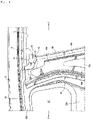
- FIG. 1 is a side view illustrating the side vehicle-body structure for the vehicle in a state in which a door outer panel is removed and the side vehicle-body structure is seen from the vehicle-width-direction outer side
- FIG. 2 is a main-part enlarged side view of FIG. 1
- FIG. 3 is a cross-sectional arrow view taken along line A-A in FIG. 2
- FIG. 4 is a partially-enlarged side view illustrating a structure in the periphery of an upper end portion of a door-side center pillar
- FIG. 5 is a partially-enlarged side view illustrating a state in which a die molding sealing member is mounted on a rear door front end portion
- FIG. 6 is a perspective view illustrating a gusset member.
- a hinge pillar portion 1 on the front side, a hinge pillar portion 2 on the rear side, a side sill portion 3, a front pillar portion 4, and a roof side rail portion 5 form an annular structure 6, and a center-pillar-less vehicle body in which a center pillar does not exist on the body side is formed.
- a door opening 7 (see FIG. 2 ) surrounded by the abovementioned portions, in other words, the hinge pillar portions 1 and 2, the side sill portion 3, the front pillar portion 4, and the roof side rail portion 5 is formed.
- the hinge pillar portion 1 on the front side is a vehicle body rigid member having a hinge pillar closed cross-section extending in the vehicle up-down direction obtained by joining or welding a hinge pillar outer and a hinge pillar inner to each other.
- the side sill portion 3 is a vehicle body rigid member connecting lower portions of the front and rear hinge pillar portions 1 and 2 to each other, and the side sill portion 3 has a side sill closed cross-section extending in the vehicle front-rear direction obtained by joining or welding a side sill outer portion, a side sill inner portion, and a side sill reinforcement to each other.
- the front pillar portion 4 is a vehicle body rigid member diagonally extending to the rear side and the upper side from a front portion to a rear portion thereof by connecting an upper end of the hinge pillar portion 1 on the front side and a front end of the roof side rail portion 5 to each other.
- the front pillar portion 4 has a diagonally-extending front pillar closed cross-section obtained by joining or welding a front pillar outer and a front pillar inner to each other.
- the roof side rail portion 5 is a vehicle body rigid member connecting a rear end of the front pillar portion 4 and a rear pillar portion front end (not shown) to each other in the vehicle front-rear direction.
- the roof side rail portion 5 has a roof side rail closed cross-section extending in the vehicle front-rear direction obtained by joining or welding a roof side rail outer and a roof side rail inner to each other.
- a front door 10 and a rear door 30 in the form of a front-hinged front door and a rear-hinged rear door (e.g. clamshell door) structure are provided on the door opening 7 illustrated in FIG. 2 .
- the front door 10 is formed such that the rear side of the front door 10 opens and closes in a manner in which a door front end portion serves as a fulcrum via a pair of upper and lower hinge brackets 8, 8 provided on the hinge pillar portion 1.
- the rear door 30 is formed such that a front side of the rear door 30 opens and closes in a manner in which a door rear end portion serves as a fulcrum via a hinge bracket (not shown) provided on the hinge pillar portion 2 on the rear side.
- the front door 10 and the rear door 30 in the form of a front-hinged front door and a rear-hinged rear door (e.g. clamshell door) structure are formed such that the front door 10 is opened and/or closed in preference to the rear door 30.
- the front door 10 includes a door outer panel 11 made of a steel plate, and a door inner panel 12 made of a steel plate connected to the door outer panel 11 by a hemming process and the like, and a door panel is formed by both of the door outer panel 11 and the door inner panel 12.
- the door outer panel 11 is disposed on the outside of the vehicle cabin to form a design surface of the front door 10. Meanwhile, the door inner panel 12 is disposed closer to the inside of the vehicle cabin than the door outer panel 11, and a door inner space 13 is formed between both of the door outer panel 11 and the door inner panel 12.
- the front door 10 includes a front edge portion 10A, a lower edge portion 10B, a rear edge portion 10C, a door sash portion 10S, and a beltline portion BL.
- the door inner panel 12 is supported by the hinge pillar portion 1 on the vehicle body side in an openable and closable manner via the pair of upper and lower hinge brackets 8, 8.
- an upper hinge reinforcement 14 is provided on a place in the door inner panel 12 corresponding to the hinge bracket 8 on the upper side out of the pair of upper and lower hinge brackets 8, 8.
- a lower hinge reinforcement 15 is provided on a place in the door inner panel 12 corresponding to the hinge bracket 8 on the lower side out of the pair of upper and lower hinge brackets 8, 8.
- a reinforcement 16 extending in the up-down direction from the door inner panel 12 at the upper side of the rear edge portion 10C of the front door 10 to a rear piece portion of the door sash portion 10S is provided.
- a latch reinforcement 17 is provided in a place in the door inner panel 12 at an up-down-direction intermediate portion of the rear edge portion 10C.
- a connecting reinforcement member 18 is provided from a lower portion of the rear edge portion 10C to a rear portion of the lower edge portion 10B in the door inner panel 12.
- a beltline reinforcement 19 extending in the front-rear direction is provided along the beltline portion BL.
- a bracket 20 On the vehicle-width-direction inner side of the beltline reinforcement 19 and in a position corresponding to a door mirror (not shown) provided on the door outer panel 11, a bracket 20 also serving as a member for mounting the door mirror is provided.
- an impact bar 21 is mounted between the upper hinge reinforcement 14 positioned on the front side and the connecting reinforcement member 18 positioned on the rear side.
- the impact bar 21 is disposed so as to be inclined in a substantially front-high rear-low shape such that a front portion is positioned on the upper side with respect to a rear portion in the up-down direction, and the impact bar 21 is for responding to a side collision.
- a reinforcement gusset member 22 connecting a rear portion of the impact bar 21 and the connecting reinforcement member 18 in the lower edge portion 10B of the front door 10 to each other is provided, and the reinforcement gusset member 22 is caused to function as a tension member.
- a stiffener 23 is provided that at least diagonally extends in the front-rear direction in a substantially front-high rear-low shape, between a front portion of the beltline reinforcement 19 and a front portion of the impact bar 21, to the rear edge portion 10C directly below the latch reinforcement 17.
- the stiffener 23 is in abutment with the door outer panel 11 via a sponge member or a urethane material, and the tensile rigidity of the door outer panel 11 is secured by the stiffener 23.
- glass guides 24 and 25 are mounted on both of the bracket 20 and the reinforcement 16. Window glass is guided to be raised and lowered along the pair of front and rear glass guides 24 and 25.
- the door inner panel 12 has a panel body 12a, and one or a plurality of openings 12b, 12c, and 12d for disposing a door module, a speaker, and the like are formed in the panel body 12a.
- the length of the rear door 30 in the front-rear direction is formed to be substantially shorter than the length of the front door 10 in the front-rear direction.
- the rear door 30 includes a door outer panel 31 made of a steel plate, and a door inner panel 32 made of a steel plate connected to the door outer panel 31 by a hemming process or spot welding, and both of the door outer panel 31 and the door inner panel 32 form a door panel.
- the door outer panel 31 is disposed on the outside of the vehicle cabin to form a design surface of the rear door 30. Meanwhile, the door inner panel 32 is disposed closer to the inside of the vehicle cabin than the door outer panel 31, and a door inner space 33 is formed between both of the door outer panel 31 and the door inner panel 32.
- the rear door 30 includes a front edge portion 30A, a lower edge portion 30B, a rear edge portion 30C, and a window frame portion 30S.
- the door inner panel 32 is supported by the hinge pillar portion 2 on the vehicle body side in an openable and closable manner via a pair of upper and lower hinge brackets (not shown).
- a hinge reinforcement 34 extending in the up-down direction is provided in the door inner panel 32.
- a center pillar 35 (the same meaning as a vertical reinforcement) on the door side is built in a front portion of the rear door 30 such that a front end thereof is along the front edge portion 30A.
- the center pillar 35 is a pillar member extending in the up-down direction from a front upper-end portion of the window frame portion 30S to the lower edge portion 30B.
- the center pillar 35 is formed to have a substantially hat-shaped profile in a horizontal cross-section by integrally forming a joining flange portion 35a on the front side, a front wall portion 35b, an outer wall portion 35c, a rear wall portion 35d, and a joining flange portion 35e on the rear side.
- the center pillar 35 is formed such that the length on the upper portion side in the front-rear direction is substantially shorter than the length on the lower portion side in the front-rear direction, but the center pillar 35 is formed to have a substantially cross-sectional hat-shaped profile from the upper portion side to the lower portion side except for both of upper and lower end portions thereof.
- the front and rear joining flange portions 35a and 35e of the center pillar 35 extend in the front-rear direction, and each of the joining flange portions 35a and 35e is joined (or welded) and fixed to the door inner panel 32.
- the front wall portion 35b extends from a rear end of the joining flange portion 35a to the vehicle-width-direction outer side.
- the rear wall portion 35d extends from a front end of the joining flange portion 35e to the vehicle-width-direction outer side.
- the outer wall portion 35c extends between vehicle-width-direction outer ends of the front wall portion 35b and the rear wall portion 35d in the front-rear direction and connects the vehicle-width-direction outer ends to each other.
- an opening 36 is formed in the outer wall portion 35c of the center pillar 35 on the lower portion side thereof, and a reinforcement member 37 extending from the rear wall portion 35d to a rear rim portion of the opening 36 is provided in order to reinforce rigidity that decreases by forming the opening 36.
- a reinforcement member 40 that reinforces an upper portion of the center pillar 35 is provided on the upper portion side of the center pillar 35 in order to reinforce the upper portion side of the center pillar 35 of which length in the front-rear direction is relatively shorter than the length of the lower portion side thereof in the front-rear direction.
- the reinforcement member 40 includes a front edge portion 40a, a rear edge portion 40b spaced apart from the front edge portion 40a to the rear side, an upper portion connecting portion 40c extending upwards and connecting upper ends of the front edge portion 40a and the rear edge portion 40b to each other, and a lower portion connecting portion 40d extending in the front-rear direction and connecting lower ends of the front edge portion 40a and the rear edge portion 40b to each other.
- the reinforcement member 40 includes a downward extending portion 40e extending downward from a lower end of the rear edge portion 40b.
- the reinforcement member 40 is formed by integrally forming the components 40a to 40e.
- the front edge portion 40a is formed to have an substantially L-shaped cross-section and is joined or welded to the front wall portion 35b and the outer wall portion 35c of the center pillar 35.
- the rear edge portion 40b is also formed to have an substantially L-shaped cross-section and is joined or welded to the rear wall portion 35d and the outer wall portion 35c of the center pillar 35.
- the upper portion connecting portion 40c is joined or welded to at least the outer wall portion 35c of the center pillar 35.
- the lower portion connecting portion 40d is joined or welded to the outer wall portion 35c of the center pillar 35.
- the downward extending portion 40e is formed to have an substantially L-shaped cross-section and is joined or welded to the rear wall portion 35d and the outer wall portion 35c of the center pillar 35.
- Breakage is prevented by reinforcing an upper portion of the center pillar 35 of which width in the front-rear direction is short by the reinforcement member 40.
- the rigidity is adjusted by both of the center pillar 35 and the reinforcement member 40. In other words, the proof stress against a side collision is adjusted.
- a gusset member 41 serving as a load transmission member that protrudes to the door outer panel 31 side with respect to the outer wall portion 35c of the center pillar 35 from the rear wall portion 35d of the center pillar 35 is included.
- the gusset member 41 is obtained by integrally forming a receiving surface portion 41a for a side collision load along the door outer panel 31, a mounting portion 41b for the rear wall portion 35d of the center pillar 35, and a connecting portion 41c connecting both of the portions 41a and 41b to each other.
- the gusset member 41 is disposed to be close to a lower portion of the center pillar 35, and a distal end side (a rear end side in this embodiment) of the gusset member 41 is set to be a free end.
- a urethane member 42 serving as an elastic member in abutment with the door outer panel 31 is provided on the receiving surface portion 41a of the gusset member 41.
- the load is transmitted to the rear wall portion 35d of the center pillar 35 at the gusset member 41 at the time of a side collision.
- a behavior in which the front wall portion 35b of the center pillar 35 is greatly displaced to the vehicle-width-direction inner side with respect to the rear wall portion 35d due to the side collision load being slightly pressed against the front wall portion 35b of the center pillar 35 with respect to the rear wall portion 35d is suppressed.
- the rear wall portion 35d of the center pillar 35 is pushed to the vehicle-width-direction inner side, and the rear wall portion 35d is dragged into the same direction via the mounting portion 41b of the gusset member 41 at the time of a side collision.
- the displacement of the front wall portion 35b to the vehicle-width-direction inner side is offset.
- a behavior in which the rear wall portion 35d of the center pillar 35 is displaced to the vehicle-width-direction inner side with respect to the front wall portion 35b is secured.
- one or a plurality of reinforcement beads 41d, 41e, and 41f are formed on the gusset member 41 along the extending direction of the gusset member 41.
- the reinforcement beads 41d and 41e out of the plurality of reinforcement beads 41d, 41e, and 41f protrude to the vehicle-width-direction inner side and are formed over the receiving surface portion 41a and the connecting portion 41c.
- the reinforcement bead 41f protrudes to the vehicle rear side and is formed over the entire length of the extending direction of the mounting portion 41b.
- the rigidity of the gusset member 41 in the extending direction thereof is increased.
- the load transmission efficiency thereof is improved.
- the downward extending portion 40e that is a rear end portion of the reinforcement member 40 extends downward to the position in which the gusset member 41 is disposed.
- the tension force against a lower portion of the rear door 30 by the gusset member 41 increases as the reinforcement member 40 is pushed to the indoor direction at the time of a side collision.
- a latch reinforcement 43 is provided on the front portion upper side of the door inner panel 32.
- the latch reinforcement 43 extends in the up-down direction from an upper end of the center pillar 35 to a portion directly above the gusset member 41 so as to correspond to the center pillar 35 as most parts thereof are illustrated in FIG. 2 with dotted lines.
- a cutout portion 44 is formed so as to be continuous with both of the latch reinforcement 43 and the door inner panel 32.
- a cutout portion 45 of which cutout range is substantially larger than that of the cutout portion 44 is formed in an upper end front portion of the center pillar 35.
- the cutout portion 45 is a cutout portion for mounting a die molding sealing member 46 (see FIG. 5 ) that performs corner sealing with the front door 10.
- the door inner panel 32 has a panel body 32a, one or a plurality of openings 32b, 32c, and 32d are formed in the panel body 32a, and an opening 47 for mounting side window glass is formed in the window frame portion 30S.
- FIG. 7 is a perspective view of the center pillar
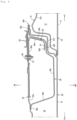
- FIG. 8 is a cross-sectional arrow view of a main part taken along line B-B in FIG. 2
- FIG. 9 is a side view of an energy absorbing material
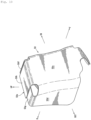
- FIG. 10 is a perspective view illustrating the energy absorbing material in a state seen from the vehicle-width-direction outer side and the upper front direction
- FIG. 11 is a perspective view illustrating the energy absorbing material in a state seen from the vehicle-width-direction inner side and the upper rear direction.
- the center pillar 35 is formed such that the lower end side is positioned on the vehicle-width-direction outer side with respect to an upper end thereof.
- the center pillar 35 is formed such that the width of the lower end side in the vehicle width direction is substantially wider than the width of the upper end in the vehicle width direction.
- the opening 36 is provided to be close to the lower portion of the outer wall portion 35c serving as an outer wall thereof, and the opening 36 is set in a breakage inducing portion that is configured to induce breakage at the time of a vehicle side collision.
- a step-down portion 35f recessed to the vehicle-width-direction inner side is formed in a corner portion between a vehicle-width-direction outer portion of the front wall portion 35b and a front portion of the outer wall portion 35c of the center pillar 35 of the opening 36 forming the breakage inducing portion.
- the step-down portion 35f is formed in the corner portion on the front side in a position closer to the lower portion of the center pillar 35, and a step-down portion 31f is similarly formed in the door outer panel 31 so as to correspond to the step-down portion 35f (see FIG. 8 ).
- a rear end portion of the front door 10 overlaps with the outer side of the step-down portions 31f and 35f of the door outer panel 31 and the center pillar 35 from the vehicle-width-direction outer side. As a result, when both of the doors 10 and 30 are closed, the front door 10 to the rear door 30 are caused to be flush.
- an energy absorbing material 50 is disposed between the step-down portion 35f of the center pillar 35 and a lower front portion of the door inner panel 32 of the rear door 30.
- the energy absorbing material 50 is downsized and the side collision energy is efficiently absorbed.
- a seat belt anchor 62 that is a vehicle part is mounted on a place in the door inner panel 32 between the front and rear joining flange portions 35a and 35e of the center pillar 35 with use of a bolt 60 and a nut 61 (in detail, a weld nut).
- the seat belt anchor 62 is mounted on a vehicle-width-direction inner surface of the door inner panel 32.
- an anchor reinforcement 50a serving as a reinforcement member is provided by also using the bolt 60 and the nut 61.
- the anchor reinforcement 50a is provided on a portion on which the seat belt anchor 62 is mounted so as to face the seat belt anchor 62 via the door inner panel 32.
- the energy absorbing material 50 is integrally formed with the anchor reinforcement 50a that is a reinforcement member so as to extend toward the vehicle outer side.
- FIG. 8 only one set of the bolt 60 and the nut 61 that fastens and fixes the anchor reinforcement 50a is illustrated. However, specifically, as illustrated in FIG. 11 , the anchor reinforcement 50a is fixed by one or a plurality of the bolts 60 inserted through one or a plurality of bolt insertion holes 50b and one or a plurality of the nuts 61.
- the anchor reinforcement 50a also serves as the energy absorbing material 50, and both of the number of parts and the assembling time are reduced.
- the energy absorbing material 50 is formed in a substantially box-like shape. As a result, at the time of a side collision, the absorption amount of the side collision energy by the energy absorbing material 50 is improved.
- the energy absorbing material 50 is formed as illustrated in FIG. 8 to FIG. 11 , in detail.
- the energy absorbing material 50 is formed in a substantially half-box-like shape.
- the half-box-like shape is a shape including a front wall portion 50c along the front wall portion 35b of the center pillar 35 corresponding to a front end of the rear door 30, a side wall portion 50d along the step-down portion 35f, and an upper wall portion 50e configured to connect an upper end of the front wall portion 50c and an upper end of the side wall portion 50d to each other.
- the energy absorbing material 50 is formed in a substantially half-box-like shape of which vehicle lower side and vehicle rear side are opened.
- a clearance 51 is formed between the side wall portion 50d of the energy absorbing material 50 and the step-down portion 35f of the center pillar 35.
- the upper wall portion 50e is formed by an outward bending portion 50f obtained by bending an upper end of the anchor reinforcement 50a to the vehicle outer side, an inward bending portion 50g obtained by bending the upper end of the side wall portion 50d to the vehicle inner side, and a rearward bending portion 50h obtained by bending the upper end of the front wall portion 50c to the vehicle rear side.
- the energy absorbing material 50 When the energy absorbing material 50 is formed by the anchor reinforcement 50a, the wall portions 50c and 50d, and the bending portions 50f, 50g, and 50h, the energy absorbing material 50 can be easily formed by press working from a plate member expanded to have a substantially flat plate-like shape.
- the energy absorbing material 50 includes the upper wall portion 50e and the front wall portion 50c to which a side collision load is easily input. As a result, the efficiency of the side collision energy absorption is improved.
- the front wall portion 50c and the side wall portion 50d of the energy absorbing material 50 are formed so as to be substantially parallel to the front wall portion 35b and the step-down portion 35f of the center pillar 35.
- arrow F indicates the vehicle front side
- arrow R indicates the vehicle rear side
- arrow IN indicates the vehicle-width-direction inner side
- arrow OUT indicates the vehicle-width-direction outer side
- arrow UP indicates the vehicle upper side.
- the lower portion side of the center pillar 35 is temporarily broken, to thereby cause the center pillar 35 to be vertical at the time of a side collision.
- the opening 36 serving as the breakage inducing portion is formed in the outer wall portion 35c of the center pillar 35, and hence an up-down-direction intermediate position between a lower end of the downward extending portion 40e in the reinforcement member 40 and an upper rim of the opening 36 indicated by a virtual line ⁇ in FIG. 7 breaks to the vehicle-width-direction inner side.
- the energy absorbing material 50 is provided in a position corresponding to the virtual line ⁇ , and the step-down portion 35f of the center pillar 35 absorbs the side collision energy from the start of the side collision at which breakage deformation to the vehicle-width-direction inner side occurs.
- the energy absorbing material 50 is formed in a substantially half-box-like shape.
- the half-box-like shape is a shape including the upper wall portion 50e and the front wall portion 50c to which the side collision load is easily input, and hence both of the improvement of the efficiency of the side collision energy absorption and the improvement of the absorption amount of the side collision energy can be obtained.
- the side vehicle-body structure for the vehicle of the abovementioned embodiment includes the center pillar 35 in which the lower end side is positioned on the vehicle-width-direction outer side with respect to the upper end thereof, the center pillar 35 includes the breakage inducing portion (opening 36) that is provided to be close to the lower portion of the outer wall (outer wall portion 35c) of the center pillar 35 and is configured to induce breakage at the time of a side collision, and the step-down portion 35f provided in the corner portion of the outer wall of the center pillar 35 of the breakage inducing portion (opening 36), and the energy absorbing material 50 is disposed between the step-down portion 35f and the door inner panel 32 (see FIG. 7 and FIG. 8 ).
- the energy absorbing material 50 can be downsized and the side collision energy can be efficiently absorbed.
- the side collision load When the side collision load is input to the step-down portion 35f in the corner portion of the outer wall of the center pillar 35, the side collision load can be immediately transmitted to the energy absorbing material 50 and the energy can be absorbed without a time lag.
- a vehicle part (seat belt anchor 62) is mounted on the center pillar 35 and the reinforcement member (anchor reinforcement 50a) is provided on the portion of the center pillar 35 on which the vehicle part is mounted, and the energy absorbing material 50 extending toward the vehicle outer side is integrally formed with the reinforcement member (anchor reinforcement 50a) (see FIG. 8 ).
- the reinforcement member (anchor reinforcement 50a) can also serve as the energy absorbing material 50, and hence both of the reduction of the number of parts and the reduction of the assembling time can be performed.
- the energy absorbing material 50 is formed in a substantially box-like shape (see FIG. 9 , FIG. 10 , and FIG. 11 ).
- the absorption amount of the side collision energy can be improved.
- the vehicle is a front-hinged front door and a rear-hinged rear door (e.g. clamshell door) vehicle including the front door 10 and the rear door 30 in the form of a front-hinged front door and a rear-hinged rear door (e.g. clamshell door) structure, the center pillar 35 is built in the front end portion of the rear door 30, the step-down portion 35f is formed in the corner portion of the front side of the center pillar 35, and the rear end portion of the front door 10 overlaps with the outer side of the step-down portion 35f (see FIG. 1 and FIG. 8 ).
- the center pillar 35 is built in the front end portion of the rear door 30
- the step-down portion 35f is formed in the corner portion of the front side of the center pillar 35
- the rear end portion of the front door 10 overlaps with the outer side of the step-down portion 35f (see FIG. 1 and FIG. 8 ).
- the step-down portions 31f and 35f are formed in the front end of the rear door 30 such that the front door 10 and the rear door 30 are flush when both of the doors 10 and 30 are closed in a manner in which the rear end portion of the front door 10 overlaps with the front end portion of the rear door 30.
- the energy absorbing material 50 can be compactly disposed while using the structure as above in which the front door 10 to the rear door 30 are flush when the doors are closed. In other words, the energy absorbing material 50 can be compactly disposed without forming a special door shape.
- the energy absorbing material 50 is formed in a substantially half-box-like shape.
- the half-box-like shape is a shape including the front wall portion 50c along the front end of the rear door 30, the side wall portion 50d along the step-down portion 35f, and the upper wall portion 50e connecting the upper end of the front wall portion 50c and the upper end of the side wall portion 50d to each other (see FIG. 8 to FIG. 11 ) .
- the energy absorbing material 50 includes the upper wall portion 50e and the front wall portion 50c to which the side collision load is easily input, and hence the efficiency of the side collision energy absorption can be improved.
- the outer wall of the center pillar of the present invention corresponds to the outer wall portion 35c of the center pillar 35 of the embodiment.
- the breakage inducing portion corresponds to the opening 36
- the inner panel corresponds to the door inner panel 32
- the vehicle part corresponds to the seat belt anchor 62
- the reinforcement member corresponds to the anchor reinforcement 50a.
- the present invention is not limited to the configuration of the abovementioned embodiment.
- the side vehicle-body structure for the vehicle including the doors in the form of a front-hinged front door and a rear-hinged rear door (e.g. clamshell door) structure has been exemplified in the abovementioned embodiment, but a vehicle in which the rear door is a slide door is also possible as long as the vehicle is a vehicle in which the center pillar does not exist on the body side.
- a vehicle in which the rear door is a slide door is also possible as long as the vehicle is a vehicle in which the center pillar does not exist on the body side.
- the present invention is useful for a side vehicle-body structure for a vehicle including a center pillar in which a lower end side is positioned on the vehicle-width-direction outer side with respect to an upper end thereof.
Landscapes
- Engineering & Computer Science (AREA)
- Mechanical Engineering (AREA)
- Chemical & Material Sciences (AREA)
- Combustion & Propulsion (AREA)
- Transportation (AREA)
- Body Structure For Vehicles (AREA)
Description
- The present invention relates to a side vehicle-body structure for a vehicle, a vehicle body structure, and a vehicle. In particular, the present invention relates to a side vehicle-body structure for a vehicle including a center pillar in which a lower end side is positioned on the vehicle-width-direction outer side with respect to an upper end thereof.
- In general, in a vehicle, a center pillar lower end side is positioned on the vehicle-width-direction outer side with respect to a center pillar upper end in a front view, and an up-down-direction intermediate portion of the center pillar behaves so as to intrude into the vehicle cabin when load is input to the center pillar intermediate portion at the time of a side collision.
- In order to prevent the above, a technology in which the center pillar is caused to have a vertical shape by temporarily breaking the center pillar lower portion side at the time of a side collision has been known.
-
Patent Literature 1 discloses a structure in which a center pillar portion formed by an outer member and an inner member is provided and an opening serving as a breakage inducing portion that induces breakage at the time of a side collision is formed in a place close to a lower portion of the inner member in the center pillar portion. Further, an energy absorbing material is disposed on the inner member at a place directly above the opening. - When the center pillar portion is broken at the time of a side collision, the side collision energy is actively absorbed by the energy absorbing material.
- In the structure disclosed in
Patent Literature 1, the energy absorbing material is compactly disposed on the inner member of the center pillar portion. However, in this structure, the energy absorbing material does not absorb energy until the side collision progresses to a certain degree, and hence there has been room for improvement in this regard. -
JP 2005 153644 A - [Patent Literature 1]
Japanese Patent Laid-Open No. 2017-226268 - Thus, an object of the present invention is to efficiently absorb side collision energy while downsizing an energy absorbing material.
- The invention is defined by the independent claims. Particular embodiments are defined in the dependent claims. In particular, there is provided a side vehicle-body structure including a center pillar in which a lower end side is positioned on a vehicle-width-direction outer side with respect to an upper end thereof. In the side vehicle-body structure, the center pillar includes an outer wall, a breakage inducing portion that is provided to be close to a lower portion of the outer wall of the center pillar and is configured to induce breakage at time of a side collision, and a step-down portion provided in a corner portion of the outer wall of the center pillar the breakage inducing portion, and an energy absorbing material is disposed between the step-down portion and an inner panel.
- The breakage inducing portion may be formed by an opening.
- According to the abovementioned configuration, by disposing the energy absorbing material on the stepped-down corner portion of the center pillar, the energy absorbing material can be downsized, and the side collision energy can be efficiently absorbed.
- When the side collision load is input to the step-down portion in the corner portion of the outer wall of the center pillar, the side collision load can be immediately transmitted to the energy absorbing material and the energy can be absorbed without a time lag.
- Particularly, a vehicle part is mounted on the center pillar and a reinforcement member is provided on a portion of the center pillar on which the vehicle part is mounted, and the energy absorbing material extending toward a vehicle outer side is integrally formed with the reinforcement member.
- The vehicle part may be set to be a seat belt anchor. The reinforcement member may be set to be an anchor reinforcement.
- According to the abovementioned configuration, the reinforcement member can also serve as the energy absorbing material, and hence both of the reduction of the number of parts and the reduction of the assembling time can be performed.
- Further particularly, the energy absorbing material is formed in a substantially box-like shape.
- According to the abovementioned configuration, by forming the energy absorbing material in a substantially box-like shape, the absorption amount of the side collision energy can be improved.
- According to the invention, the vehicle is a front-hinged front door and a rear-hinged rear door (e.g. clamshell door) vehicle including a front door and a rear door in a form of a front-hinged front door and a rear-hinged rear door (e.g. clamshell door) structure, the center pillar is built in a front end portion of the rear door, the step-down portion is formed in the corner portion on a front side of the center pillar, and a rear end portion of the front door is configured to overlap at least partially with an outer side of the step-down portion.
- According to the abovementioned configuration, the following effect is obtained.
- In other words, in the doors in the form of a front-hinged front door and a rear-hinged rear door (e.g. clamshell door) structure, the step-down portions are formed in the front end of the rear door such that the front door and the rear door are flush when both of the doors are closed in a manner in which the rear end portion of the front door is configured to overlap at least partially with the front end portion of the rear door. The energy absorbing material can be compactly disposed while using the structure as above in which the front door to the rear door are flush when the doors are closed. In other words, the energy absorbing material can be compactly disposed without forming a special door shape.
- Further particularly, the energy absorbing material is formed in a substantially half-box-like shape. The half-box-like shape is a shape including a front wall portion along a front end of the rear door, a side wall portion along the step-down portion, and an upper wall portion configured to connect an upper end of the front wall portion and an upper end of the side wall portion to each other.
- According to the abovementioned configuration, the energy absorbing material includes the upper wall portion and the front wall portion to which the side collision load is easily input, and hence the efficiency of the side collision energy absorption can be improved.
- Further particularly, the upper wall portion is formed by an outward bending portion, an inward bending portion, and a rearward bending portion.
- Further particularly, a side collision load is easily input to the upper wall portion and the front wall portion.
- Further particularly, the rear door includes a door outer panel and a door inner panel connected to the door outer panel.
- Further particularly, a vehicle body structure includes the above side vehicle-body structure.
- Further particularly, a vehicle includes a vehicle-width-direction outer side, a vehicle part and the above side vehicle-body structure the above vehicle body structure.
- According to the present invention, an effect in which the side collision energy can be efficiently absorbed while downsizing the energy absorbing material is obtained.
-
-
FIG. 1 is a side view illustrating a side vehicle-body structure for a vehicle of the present invention. -
FIG. 2 is a main-part enlarged side view ofFIG. 1 . -
FIG. 3 is a cross-sectional arrow view taken along line A-A inFIG. 2 . -
FIG. 4 is a partially-enlarged side view illustrating a structure for the periphery of an upper end portion of a door-side center pillar. -
FIG. 5 is a partially-enlarged side view illustrating a state in which a die molding sealing member is mounted on a rear door front end portion. -
FIG. 6 is a perspective view illustrating a gusset member. -
FIG. 7 is a perspective view of a center pillar. -
FIG. 8 is a cross-sectional arrow view of a main part taken along line B-B inFIG. 2 . -
FIG. 9 is a side view of an energy absorbing material. -
FIG. 10 is a perspective view illustrating the energy absorbing material in a state seen from the vehicle-width-direction outer side and the upper front direction. -
FIG. 11 is a perspective view illustrating the energy absorbing material in a state seen from the vehicle-width-direction inner side and the upper rear direction. - An object of efficiently absorbing side collision energy while downsizing an energy absorbing material is achieved by a configuration of a side vehicle-body structure for a vehicle, the side vehicle-body structure including a center pillar in which a lower end side is positioned on a vehicle-width-direction outer side with respect to an upper end thereof, in which the center pillar includes an outer wall, a breakage inducing portion that is provided to be close to a lower portion of an outer wall of the center pillar and is configured to induce breakage at time of a side collision, and a step-down portion provided in a corner portion of the outer wall of the center pillar of the breakage inducing portion, and an energy absorbing material is disposed between the step-down portion and an inner panel.
- One embodiment of the present invention is described in detail with reference to the drawings below.
- The drawings illustrate a side vehicle-body structure for a vehicle.
FIG. 1 is a side view illustrating the side vehicle-body structure for the vehicle in a state in which a door outer panel is removed and the side vehicle-body structure is seen from the vehicle-width-direction outer side, andFIG. 2 is a main-part enlarged side view ofFIG. 1 .FIG. 3 is a cross-sectional arrow view taken along line A-A inFIG. 2 ,FIG. 4 is a partially-enlarged side view illustrating a structure in the periphery of an upper end portion of a door-side center pillar,FIG. 5 is a partially-enlarged side view illustrating a state in which a die molding sealing member is mounted on a rear door front end portion, andFIG. 6 is a perspective view illustrating a gusset member. - As illustrated in
FIG. 1 , in a side portion on the body side, ahinge pillar portion 1 on the front side, ahinge pillar portion 2 on the rear side, a side sill portion 3, a front pillar portion 4, and a roofside rail portion 5 form an annular structure 6, and a center-pillar-less vehicle body in which a center pillar does not exist on the body side is formed. - A door opening 7 (see
FIG. 2 ) surrounded by the abovementioned portions, in other words, thehinge pillar portions side rail portion 5 is formed. - The
hinge pillar portion 1 on the front side is a vehicle body rigid member having a hinge pillar closed cross-section extending in the vehicle up-down direction obtained by joining or welding a hinge pillar outer and a hinge pillar inner to each other. - The side sill portion 3 is a vehicle body rigid member connecting lower portions of the front and rear
hinge pillar portions - The front pillar portion 4 is a vehicle body rigid member diagonally extending to the rear side and the upper side from a front portion to a rear portion thereof by connecting an upper end of the
hinge pillar portion 1 on the front side and a front end of the roofside rail portion 5 to each other. The front pillar portion 4 has a diagonally-extending front pillar closed cross-section obtained by joining or welding a front pillar outer and a front pillar inner to each other. - The roof
side rail portion 5 is a vehicle body rigid member connecting a rear end of the front pillar portion 4 and a rear pillar portion front end (not shown) to each other in the vehicle front-rear direction. The roofside rail portion 5 has a roof side rail closed cross-section extending in the vehicle front-rear direction obtained by joining or welding a roof side rail outer and a roof side rail inner to each other. - As illustrated in
FIG. 1 andFIG. 2 , on thedoor opening 7 illustrated inFIG. 2 , afront door 10 and arear door 30 in the form of a front-hinged front door and a rear-hinged rear door (e.g. clamshell door) structure are provided. - The
front door 10 is formed such that the rear side of thefront door 10 opens and closes in a manner in which a door front end portion serves as a fulcrum via a pair of upper and lower hinge brackets 8, 8 provided on thehinge pillar portion 1. Therear door 30 is formed such that a front side of therear door 30 opens and closes in a manner in which a door rear end portion serves as a fulcrum via a hinge bracket (not shown) provided on thehinge pillar portion 2 on the rear side. - As illustrated in
FIG. 3 , thefront door 10 and therear door 30 in the form of a front-hinged front door and a rear-hinged rear door (e.g. clamshell door) structure are formed such that thefront door 10 is opened and/or closed in preference to therear door 30. - As illustrated in
FIG. 1 andFIG. 3 , thefront door 10 includes a doorouter panel 11 made of a steel plate, and a doorinner panel 12 made of a steel plate connected to the doorouter panel 11 by a hemming process and the like, and a door panel is formed by both of the doorouter panel 11 and the doorinner panel 12. - The door
outer panel 11 is disposed on the outside of the vehicle cabin to form a design surface of thefront door 10. Meanwhile, the doorinner panel 12 is disposed closer to the inside of the vehicle cabin than the doorouter panel 11, and a doorinner space 13 is formed between both of the doorouter panel 11 and the doorinner panel 12. - As illustrated in
FIG. 1 , thefront door 10 includes afront edge portion 10A, alower edge portion 10B, a rear edge portion 10C, adoor sash portion 10S, and a beltline portion BL. At thefront edge portion 10A, the doorinner panel 12 is supported by thehinge pillar portion 1 on the vehicle body side in an openable and closable manner via the pair of upper and lower hinge brackets 8, 8. - At the
front edge portion 10A of thefront door 10, an upper hinge reinforcement 14 is provided on a place in the doorinner panel 12 corresponding to the hinge bracket 8 on the upper side out of the pair of upper and lower hinge brackets 8, 8. - Similarly, at the
front edge portion 10A of thefront door 10, alower hinge reinforcement 15 is provided on a place in the doorinner panel 12 corresponding to the hinge bracket 8 on the lower side out of the pair of upper and lower hinge brackets 8, 8. - As illustrated in
FIG. 1 , areinforcement 16 extending in the up-down direction from the doorinner panel 12 at the upper side of the rear edge portion 10C of thefront door 10 to a rear piece portion of thedoor sash portion 10S is provided. Alatch reinforcement 17 is provided in a place in the doorinner panel 12 at an up-down-direction intermediate portion of the rear edge portion 10C. A connectingreinforcement member 18 is provided from a lower portion of the rear edge portion 10C to a rear portion of thelower edge portion 10B in the doorinner panel 12. - In addition, as illustrated in
FIG. 1 , abeltline reinforcement 19 extending in the front-rear direction is provided along the beltline portion BL. - The
beltline reinforcement 19 is extended between the upper hinge reinforcement 14 of thefront edge portion 10A and a lower portion of thereinforcement 16 at a rear piece portion of thedoor sash portion 10S. - On the vehicle-width-direction inner side of the
beltline reinforcement 19 and in a position corresponding to a door mirror (not shown) provided on the doorouter panel 11, abracket 20 also serving as a member for mounting the door mirror is provided. - As illustrated in
FIG. 1 , animpact bar 21 is mounted between the upper hinge reinforcement 14 positioned on the front side and the connectingreinforcement member 18 positioned on the rear side. Theimpact bar 21 is disposed so as to be inclined in a substantially front-high rear-low shape such that a front portion is positioned on the upper side with respect to a rear portion in the up-down direction, and theimpact bar 21 is for responding to a side collision. - As illustrated in
FIG. 1 , areinforcement gusset member 22 connecting a rear portion of theimpact bar 21 and the connectingreinforcement member 18 in thelower edge portion 10B of thefront door 10 to each other is provided, and thereinforcement gusset member 22 is caused to function as a tension member. - As illustrated in
FIG. 1 , astiffener 23 is provided that at least diagonally extends in the front-rear direction in a substantially front-high rear-low shape, between a front portion of thebeltline reinforcement 19 and a front portion of theimpact bar 21, to the rear edge portion 10C directly below thelatch reinforcement 17. - The
stiffener 23 is in abutment with the doorouter panel 11 via a sponge member or a urethane material, and the tensile rigidity of the doorouter panel 11 is secured by thestiffener 23. - As illustrated in the same drawing, glass guides 24 and 25 are mounted on both of the
bracket 20 and thereinforcement 16. Window glass is guided to be raised and lowered along the pair of front and rear glass guides 24 and 25. - As illustrated in
FIG. 1 , the doorinner panel 12 has apanel body 12a, and one or a plurality ofopenings panel body 12a. - Next, the structure of the
rear door 30 is described with reference toFIG. 1 ,FIG. 2 , andFIG. 3 . - As illustrated in
FIG. 1 , the length of therear door 30 in the front-rear direction is formed to be substantially shorter than the length of thefront door 10 in the front-rear direction. - As illustrated in
FIG. 3 , therear door 30 includes a doorouter panel 31 made of a steel plate, and a doorinner panel 32 made of a steel plate connected to the doorouter panel 31 by a hemming process or spot welding, and both of the doorouter panel 31 and the doorinner panel 32 form a door panel. - The door
outer panel 31 is disposed on the outside of the vehicle cabin to form a design surface of therear door 30. Meanwhile, the doorinner panel 32 is disposed closer to the inside of the vehicle cabin than the doorouter panel 31, and a doorinner space 33 is formed between both of the doorouter panel 31 and the doorinner panel 32. - As illustrated in
FIG. 1 andFIG. 2 , therear door 30 includes afront edge portion 30A, alower edge portion 30B, arear edge portion 30C, and awindow frame portion 30S. At therear edge portion 30C, the doorinner panel 32 is supported by thehinge pillar portion 2 on the vehicle body side in an openable and closable manner via a pair of upper and lower hinge brackets (not shown). - As illustrated in
FIG. 2 andFIG. 3 , at therear edge portion 30C, ahinge reinforcement 34 extending in the up-down direction is provided in the doorinner panel 32. - As illustrated in
FIG. 2 andFIG. 3 , a center pillar 35 (the same meaning as a vertical reinforcement) on the door side is built in a front portion of therear door 30 such that a front end thereof is along thefront edge portion 30A. Thecenter pillar 35 is a pillar member extending in the up-down direction from a front upper-end portion of thewindow frame portion 30S to thelower edge portion 30B. - As illustrated in
FIG. 3 as a cross-sectional view, thecenter pillar 35 is formed to have a substantially hat-shaped profile in a horizontal cross-section by integrally forming a joiningflange portion 35a on the front side, afront wall portion 35b, anouter wall portion 35c, arear wall portion 35d, and a joiningflange portion 35e on the rear side. - As illustrated in
FIG. 2 , thecenter pillar 35 is formed such that the length on the upper portion side in the front-rear direction is substantially shorter than the length on the lower portion side in the front-rear direction, but thecenter pillar 35 is formed to have a substantially cross-sectional hat-shaped profile from the upper portion side to the lower portion side except for both of upper and lower end portions thereof. - As illustrated in
FIG. 3 , the front and rear joiningflange portions center pillar 35 extend in the front-rear direction, and each of the joiningflange portions inner panel 32. - The
front wall portion 35b extends from a rear end of the joiningflange portion 35a to the vehicle-width-direction outer side. Similarly, therear wall portion 35d extends from a front end of the joiningflange portion 35e to the vehicle-width-direction outer side. Theouter wall portion 35c extends between vehicle-width-direction outer ends of thefront wall portion 35b and therear wall portion 35d in the front-rear direction and connects the vehicle-width-direction outer ends to each other. - As illustrated in
FIG. 2 , anopening 36 is formed in theouter wall portion 35c of thecenter pillar 35 on the lower portion side thereof, and areinforcement member 37 extending from therear wall portion 35d to a rear rim portion of theopening 36 is provided in order to reinforce rigidity that decreases by forming theopening 36. - As illustrated in
FIG. 2 , areinforcement member 40 that reinforces an upper portion of thecenter pillar 35 is provided on the upper portion side of thecenter pillar 35 in order to reinforce the upper portion side of thecenter pillar 35 of which length in the front-rear direction is relatively shorter than the length of the lower portion side thereof in the front-rear direction. - As illustrated in
FIG. 2 , thereinforcement member 40 includes afront edge portion 40a, arear edge portion 40b spaced apart from thefront edge portion 40a to the rear side, an upperportion connecting portion 40c extending upwards and connecting upper ends of thefront edge portion 40a and therear edge portion 40b to each other, and a lowerportion connecting portion 40d extending in the front-rear direction and connecting lower ends of thefront edge portion 40a and therear edge portion 40b to each other. - The
reinforcement member 40 includes a downward extendingportion 40e extending downward from a lower end of therear edge portion 40b. Thereinforcement member 40 is formed by integrally forming thecomponents 40a to 40e. - The
front edge portion 40a is formed to have an substantially L-shaped cross-section and is joined or welded to thefront wall portion 35b and theouter wall portion 35c of thecenter pillar 35. Therear edge portion 40b is also formed to have an substantially L-shaped cross-section and is joined or welded to therear wall portion 35d and theouter wall portion 35c of thecenter pillar 35. The upperportion connecting portion 40c is joined or welded to at least theouter wall portion 35c of thecenter pillar 35. The lowerportion connecting portion 40d is joined or welded to theouter wall portion 35c of thecenter pillar 35. The downward extendingportion 40e is formed to have an substantially L-shaped cross-section and is joined or welded to therear wall portion 35d and theouter wall portion 35c of thecenter pillar 35. - Breakage is prevented by reinforcing an upper portion of the
center pillar 35 of which width in the front-rear direction is short by thereinforcement member 40. By ending a lower end of thefront edge portion 40a at the position of the lowerportion connecting portion 40d, the rigidity is adjusted by both of thecenter pillar 35 and thereinforcement member 40. In other words, the proof stress against a side collision is adjusted. - As illustrated in
FIG. 2 andFIG. 3 , agusset member 41 serving as a load transmission member that protrudes to the doorouter panel 31 side with respect to theouter wall portion 35c of thecenter pillar 35 from therear wall portion 35d of thecenter pillar 35 is included. - As illustrated in
FIG. 3 andFIG. 6 , thegusset member 41 is obtained by integrally forming a receivingsurface portion 41a for a side collision load along the doorouter panel 31, a mountingportion 41b for therear wall portion 35d of thecenter pillar 35, and a connectingportion 41c connecting both of theportions - The
gusset member 41 is disposed to be close to a lower portion of thecenter pillar 35, and a distal end side (a rear end side in this embodiment) of thegusset member 41 is set to be a free end. Aurethane member 42 serving as an elastic member in abutment with the doorouter panel 31 is provided on the receivingsurface portion 41a of thegusset member 41. - By mounting the
gusset member 41 having the receivingsurface portion 41a for the side collision load on therear wall portion 35d of thecenter pillar 35, the load is transmitted to therear wall portion 35d of thecenter pillar 35 at thegusset member 41 at the time of a side collision. As a result, a behavior in which thefront wall portion 35b of thecenter pillar 35 is greatly displaced to the vehicle-width-direction inner side with respect to therear wall portion 35d due to the side collision load being slightly pressed against thefront wall portion 35b of thecenter pillar 35 with respect to therear wall portion 35d is suppressed. - In detail, the
rear wall portion 35d of thecenter pillar 35 is pushed to the vehicle-width-direction inner side, and therear wall portion 35d is dragged into the same direction via the mountingportion 41b of thegusset member 41 at the time of a side collision. As a result, the displacement of thefront wall portion 35b to the vehicle-width-direction inner side is offset. In addition, a behavior in which therear wall portion 35d of thecenter pillar 35 is displaced to the vehicle-width-direction inner side with respect to thefront wall portion 35b is secured. - As illustrated in
FIG. 6 , one or a plurality ofreinforcement beads gusset member 41 along the extending direction of thegusset member 41. Thereinforcement beads reinforcement beads surface portion 41a and the connectingportion 41c. Thereinforcement bead 41f protrudes to the vehicle rear side and is formed over the entire length of the extending direction of the mountingportion 41b. - By the
reinforcement beads 41d to 41f, the rigidity of thegusset member 41 in the extending direction thereof is increased. In addition, when load is transmitted to therear wall portion 35d of thecenter pillar 35 via thegusset member 41 at the time of a side collision, the load transmission efficiency thereof is improved. - As illustrated in
FIG. 2 , regarding the relationship between thegusset member 41 and thereinforcement member 40, the downward extendingportion 40e that is a rear end portion of thereinforcement member 40 extends downward to the position in which thegusset member 41 is disposed. As a result, the tension force against a lower portion of therear door 30 by thegusset member 41 increases as thereinforcement member 40 is pushed to the indoor direction at the time of a side collision. - As illustrated in
FIG. 2 , alatch reinforcement 43 is provided on the front portion upper side of the doorinner panel 32. Thelatch reinforcement 43 extends in the up-down direction from an upper end of thecenter pillar 35 to a portion directly above thegusset member 41 so as to correspond to thecenter pillar 35 as most parts thereof are illustrated inFIG. 2 with dotted lines. - As illustrated in
FIG. 2 ,FIG. 4 , andFIG. 5 , in upper end front portions of thelatch reinforcement 43 and the doorinner panel 32, acutout portion 44 is formed so as to be continuous with both of thelatch reinforcement 43 and the doorinner panel 32. - As illustrated in
FIG. 2 ,FIG. 4 , andFIG. 5 , in an upper end front portion of thecenter pillar 35, acutout portion 45 of which cutout range is substantially larger than that of thecutout portion 44 is formed. Thecutout portion 45 is a cutout portion for mounting a die molding sealing member 46 (seeFIG. 5 ) that performs corner sealing with thefront door 10. - Even when the
cutout portion 45 as above is formed, a case where the upper end front portion of thecenter pillar 35 slips through thecutout portion 45 to the indoor direction is suppressed by suppressing the abovementioned behavior of thecenter pillar 35 by thegusset member 41. - As illustrated in
FIG. 1 to FIG. 5 , the doorinner panel 32 has apanel body 32a, one or a plurality ofopenings panel body 32a, and anopening 47 for mounting side window glass is formed in thewindow frame portion 30S. -
FIG. 7 is a perspective view of the center pillar,FIG. 8 is a cross-sectional arrow view of a main part taken along line B-B inFIG. 2 ,FIG. 9 is a side view of an energy absorbing material,FIG. 10 is a perspective view illustrating the energy absorbing material in a state seen from the vehicle-width-direction outer side and the upper front direction, andFIG. 11 is a perspective view illustrating the energy absorbing material in a state seen from the vehicle-width-direction inner side and the upper rear direction. - As illustrated in
FIG. 7 , thecenter pillar 35 is formed such that the lower end side is positioned on the vehicle-width-direction outer side with respect to an upper end thereof. In other words, thecenter pillar 35 is formed such that the width of the lower end side in the vehicle width direction is substantially wider than the width of the upper end in the vehicle width direction. - As illustrated in
FIG. 2 andFIG. 7 , in thecenter pillar 35, theopening 36 is provided to be close to the lower portion of theouter wall portion 35c serving as an outer wall thereof, and theopening 36 is set in a breakage inducing portion that is configured to induce breakage at the time of a vehicle side collision. - As illustrated in
FIG. 7 andFIG. 8 , a step-downportion 35f recessed to the vehicle-width-direction inner side is formed in a corner portion between a vehicle-width-direction outer portion of thefront wall portion 35b and a front portion of theouter wall portion 35c of thecenter pillar 35 of theopening 36 forming the breakage inducing portion. In other words, the step-downportion 35f is formed in the corner portion on the front side in a position closer to the lower portion of thecenter pillar 35, and a step-downportion 31f is similarly formed in the doorouter panel 31 so as to correspond to the step-downportion 35f (seeFIG. 8 ). - As illustrated in
FIG. 8 , a rear end portion of thefront door 10 overlaps with the outer side of the step-downportions outer panel 31 and thecenter pillar 35 from the vehicle-width-direction outer side. As a result, when both of thedoors front door 10 to therear door 30 are caused to be flush. - As illustrated in
FIG. 2 ,FIG. 7 , andFIG. 8 , anenergy absorbing material 50 is disposed between the step-downportion 35f of thecenter pillar 35 and a lower front portion of the doorinner panel 32 of therear door 30. - As illustrated in
FIG. 8 , by disposing theenergy absorbing material 50 on the stepped-down corner portion of thecenter pillar 35, theenergy absorbing material 50 is downsized and the side collision energy is efficiently absorbed. - As illustrated in
FIG. 8 , aseat belt anchor 62 that is a vehicle part is mounted on a place in the doorinner panel 32 between the front and rear joiningflange portions center pillar 35 with use of abolt 60 and a nut 61 (in detail, a weld nut). Theseat belt anchor 62 is mounted on a vehicle-width-direction inner surface of the doorinner panel 32. - On a vehicle-width-direction outer surface of the door
inner panel 32 on which theseat belt anchor 62 is mounted, ananchor reinforcement 50a serving as a reinforcement member is provided by also using thebolt 60 and thenut 61. In other words, theanchor reinforcement 50a is provided on a portion on which theseat belt anchor 62 is mounted so as to face theseat belt anchor 62 via the doorinner panel 32. - The
energy absorbing material 50 is integrally formed with theanchor reinforcement 50a that is a reinforcement member so as to extend toward the vehicle outer side. - In
FIG. 8 , only one set of thebolt 60 and thenut 61 that fastens and fixes theanchor reinforcement 50a is illustrated. However, specifically, as illustrated inFIG. 11 , theanchor reinforcement 50a is fixed by one or a plurality of thebolts 60 inserted through one or a plurality of bolt insertion holes 50b and one or a plurality of the nuts 61. - As described above, by integrally forming the
energy absorbing material 50 extending toward the vehicle outer side with theanchor reinforcement 50a, theanchor reinforcement 50a also serves as theenergy absorbing material 50, and both of the number of parts and the assembling time are reduced. - As illustrated in
FIG. 8 to FIG. 11 , theenergy absorbing material 50 is formed in a substantially box-like shape. As a result, at the time of a side collision, the absorption amount of the side collision energy by theenergy absorbing material 50 is improved. - The
energy absorbing material 50 is formed as illustrated inFIG. 8 to FIG. 11 , in detail. - In other words, the
energy absorbing material 50 is formed in a substantially half-box-like shape. The half-box-like shape is a shape including afront wall portion 50c along thefront wall portion 35b of thecenter pillar 35 corresponding to a front end of therear door 30, aside wall portion 50d along the step-downportion 35f, and anupper wall portion 50e configured to connect an upper end of thefront wall portion 50c and an upper end of theside wall portion 50d to each other. - As illustrated in
FIG. 8 to FIG. 11 , theenergy absorbing material 50 is formed in a substantially half-box-like shape of which vehicle lower side and vehicle rear side are opened. - As illustrated in
FIG. 8 , aclearance 51 is formed between theside wall portion 50d of theenergy absorbing material 50 and the step-downportion 35f of thecenter pillar 35. - As illustrated in
FIG. 10 andFIG. 11 , theupper wall portion 50e is formed by anoutward bending portion 50f obtained by bending an upper end of theanchor reinforcement 50a to the vehicle outer side, aninward bending portion 50g obtained by bending the upper end of theside wall portion 50d to the vehicle inner side, and arearward bending portion 50h obtained by bending the upper end of thefront wall portion 50c to the vehicle rear side. - When the
energy absorbing material 50 is formed by theanchor reinforcement 50a, thewall portions bending portions energy absorbing material 50 can be easily formed by press working from a plate member expanded to have a substantially flat plate-like shape. - As described above, the
energy absorbing material 50 includes theupper wall portion 50e and thefront wall portion 50c to which a side collision load is easily input. As a result, the efficiency of the side collision energy absorption is improved. In this embodiment, as illustrated inFIG. 8 , thefront wall portion 50c and theside wall portion 50d of theenergy absorbing material 50 are formed so as to be substantially parallel to thefront wall portion 35b and the step-downportion 35f of thecenter pillar 35. - In the drawings, arrow F indicates the vehicle front side, arrow R indicates the vehicle rear side, arrow IN indicates the vehicle-width-direction inner side, arrow OUT indicates the vehicle-width-direction outer side, and arrow UP indicates the vehicle upper side.
- In the side vehicle-body structure for the vehicle formed as described above, the lower portion side of the
center pillar 35 is temporarily broken, to thereby cause thecenter pillar 35 to be vertical at the time of a side collision. - In this case, the
opening 36 serving as the breakage inducing portion is formed in theouter wall portion 35c of thecenter pillar 35, and hence an up-down-direction intermediate position between a lower end of the downward extendingportion 40e in thereinforcement member 40 and an upper rim of theopening 36 indicated by a virtual line α inFIG. 7 breaks to the vehicle-width-direction inner side. - The
energy absorbing material 50 is provided in a position corresponding to the virtual line α, and the step-downportion 35f of thecenter pillar 35 absorbs the side collision energy from the start of the side collision at which breakage deformation to the vehicle-width-direction inner side occurs. - The
energy absorbing material 50 is formed in a substantially half-box-like shape. The half-box-like shape is a shape including theupper wall portion 50e and thefront wall portion 50c to which the side collision load is easily input, and hence both of the improvement of the efficiency of the side collision energy absorption and the improvement of the absorption amount of the side collision energy can be obtained. - As described above, the side vehicle-body structure for the vehicle of the abovementioned embodiment includes the
center pillar 35 in which the lower end side is positioned on the vehicle-width-direction outer side with respect to the upper end thereof, thecenter pillar 35 includes the breakage inducing portion (opening 36) that is provided to be close to the lower portion of the outer wall (outer wall portion 35c) of thecenter pillar 35 and is configured to induce breakage at the time of a side collision, and the step-downportion 35f provided in the corner portion of the outer wall of thecenter pillar 35 of the breakage inducing portion (opening 36), and theenergy absorbing material 50 is disposed between the step-downportion 35f and the door inner panel 32 (seeFIG. 7 andFIG. 8 ). - According to this configuration, by disposing the
energy absorbing material 50 on the stepped-down corner portion of thecenter pillar 35, theenergy absorbing material 50 can be downsized and the side collision energy can be efficiently absorbed. - When the side collision load is input to the step-down
portion 35f in the corner portion of the outer wall of thecenter pillar 35, the side collision load can be immediately transmitted to theenergy absorbing material 50 and the energy can be absorbed without a time lag. - Particularly, a vehicle part (seat belt anchor 62) is mounted on the
center pillar 35 and the reinforcement member (anchor reinforcement 50a) is provided on the portion of thecenter pillar 35 on which the vehicle part is mounted, and theenergy absorbing material 50 extending toward the vehicle outer side is integrally formed with the reinforcement member (anchor reinforcement 50a) (seeFIG. 8 ). - According to this configuration, the reinforcement member (
anchor reinforcement 50a) can also serve as theenergy absorbing material 50, and hence both of the reduction of the number of parts and the reduction of the assembling time can be performed. - Further particularly, the
energy absorbing material 50 is formed in a substantially box-like shape (seeFIG. 9 ,FIG. 10 , andFIG. 11 ). - According to this configuration, by forming the
energy absorbing material 50 in a substantially box-like shape, the absorption amount of the side collision energy can be improved. - Further particularly, the vehicle is a front-hinged front door and a rear-hinged rear door (e.g. clamshell door) vehicle including the
front door 10 and therear door 30 in the form of a front-hinged front door and a rear-hinged rear door (e.g. clamshell door) structure, thecenter pillar 35 is built in the front end portion of therear door 30, the step-downportion 35f is formed in the corner portion of the front side of thecenter pillar 35, and the rear end portion of thefront door 10 overlaps with the outer side of the step-downportion 35f (seeFIG. 1 andFIG. 8 ). - According to this configuration, the following effect is obtained.
- In other words, in the doors in the form of a front-hinged front door and a rear-hinged rear door (e.g. clamshell door) structure, the step-down
portions rear door 30 such that thefront door 10 and therear door 30 are flush when both of thedoors front door 10 overlaps with the front end portion of therear door 30. Theenergy absorbing material 50 can be compactly disposed while using the structure as above in which thefront door 10 to therear door 30 are flush when the doors are closed. In other words, theenergy absorbing material 50 can be compactly disposed without forming a special door shape. - Further particularly, the
energy absorbing material 50 is formed in a substantially half-box-like shape. The half-box-like shape is a shape including thefront wall portion 50c along the front end of therear door 30, theside wall portion 50d along the step-downportion 35f, and theupper wall portion 50e connecting the upper end of thefront wall portion 50c and the upper end of theside wall portion 50d to each other (seeFIG. 8 to FIG. 11 ) . - According to this configuration, the
energy absorbing material 50 includes theupper wall portion 50e and thefront wall portion 50c to which the side collision load is easily input, and hence the efficiency of the side collision energy absorption can be improved. - Regarding the correspondence between the configuration of the present invention and the abovementioned embodiment, the outer wall of the center pillar of the present invention corresponds to the
outer wall portion 35c of thecenter pillar 35 of the embodiment. Similarly, the breakage inducing portion corresponds to theopening 36, the inner panel corresponds to the doorinner panel 32, the vehicle part corresponds to theseat belt anchor 62, and the reinforcement member corresponds to theanchor reinforcement 50a. However, the present invention is not limited to the configuration of the abovementioned embodiment. - For example, the side vehicle-body structure for the vehicle including the doors in the form of a front-hinged front door and a rear-hinged rear door (e.g. clamshell door) structure has been exemplified in the abovementioned embodiment, but a vehicle in which the rear door is a slide door is also possible as long as the vehicle is a vehicle in which the center pillar does not exist on the body side.
- As described above, the present invention is useful for a side vehicle-body structure for a vehicle including a center pillar in which a lower end side is positioned on the vehicle-width-direction outer side with respect to an upper end thereof.
-
- 10
- Front door
- 30
- Rear door
- 32
- Door inner panel (inner panel)
- 35
- Center pillar
- 35c
- Outer wall portion (outer wall)
- 35f
- Step-down portion
- 36
- Opening (breakage inducing portion)
- 50
- Energy absorbing material
- 50a
- Anchor reinforcement (reinforcement member)
- 50c
- Front wall portion
- 50d
- Side wall portion
- 50e
- Upper wall portion
- 62
- Seat belt anchor (vehicle part)
Claims (12)
- A side vehicle-body structure for a vehicle, the side vehicle-body structure comprising a center pillar (35) in which a lower end side is positioned on a vehicle-width-direction outer side with respect to an upper end thereof, whereinthe center pillar (35) includes:a front wall (35b);an outer wall (35c);a breakage inducing portion (36) that is provided to be close to a lower portion of the outer wall (35c) of the center pillar (35) and is configured to induce breakage at time of a side collision; anda step-down portion (35f) recessed to a vehicle-width-direction inner side provided in a corner portion between a vehicle-width-direction outer portion of the front wall (35b) and a front portion of the outer wall (35c) of the center pillar (35) of the breakage inducing portion (36), andan energy absorbing material (50) is disposed between the step-down portion (35f) and an inner panel (32), whereinthe vehicle is a front-hinged front door and a rear-hinged rear door vehicle including a front door (10) and a rear door (30) in a form of a front-hinged front door and a rear-hinged rear door structure, and whereinthe center pillar (35) is built in a front end portion of the rear door (30),the step-down portion (35f) is formed in the corner portion on a front side of the center pillar (35), anda rear end portion of the front door (10) is configured to overlap at least partially with an outer side of the step-down portion (35f).
- The side vehicle-body structure for a vehicle according to claim 1, wherein
the breakage inducing portion (36) is formed by an opening (36). - The side vehicle-body structure for a vehicle according to claim 1 or 2, wherein
a vehicle part (62) is mounted on the center pillar (35) and a reinforcement member (50a) is provided on a portion of the center pillar (35) on which the vehicle part (62) is mounted. - The side vehicle-body structure for a vehicle according to claim 3, wherein the energy absorbing material (50) extending toward a vehicle outer side is integrally formed with the reinforcement member (50a).
- The side vehicle-body structure for a vehicle according to claim 3 or 4, whereinthe vehicle part (62) is set to be a seat belt anchor (62), and whereinthe reinforcement member (50a) is set to be an anchor reinforcement(50a) .
- The side vehicle-body structure for a vehicle according to any of claims 3 to 5, wherein
the energy absorbing material (50) is formed in a substantially box-like shape. - The side vehicle-body structure for a vehicle according to claim 1, wherein
the energy absorbing material (50) is formed in a substantially half-box-like shape. - The side vehicle-body structure for a vehicle according to claim 7, wherein
the half-box-like shape (50) is a shape including a front wall portion (50c) along a front end of the rear door (30), a side wall portion (50d) along the step-down portion (35f), and an upper wall portion (50e) configured to connect an upper end of the front wall portion (50c) and an upper end of the side wall portion (50d) to each other. - The side vehicle-body structure for a vehicle according to claim 8, wherein
the upper wall portion (50e) is formed by an outward bending portion (50f), an inward bending portion (50g), and a rearward bending portion (50h). - The side vehicle-body structure for a vehicle according to any one of claims 1 to 9, wherein
the rear door (30) includes a door outer panel (31) and a door inner panel (32) connected to the door outer panel (31). - A vehicle body structure comprising the side vehicle-body structure according to any one of claims 1 to 10.
- A vehicle comprising:a vehicle-width-direction outer side;a vehicle part (62); andthe side vehicle-body structure according to any one of claims 1 to 10 or the vehicle body structure according to claim 11.
Applications Claiming Priority (1)
| Application Number | Priority Date | Filing Date | Title |
|---|---|---|---|
| JP2019153787A JP7367388B2 (en) | 2019-08-26 | 2019-08-26 | Vehicle side body structure |
Publications (2)
| Publication Number | Publication Date |
|---|---|
| EP3785958A1 EP3785958A1 (en) | 2021-03-03 |
| EP3785958B1 true EP3785958B1 (en) | 2023-03-08 |
Family
ID=72050738
Family Applications (1)
| Application Number | Title | Priority Date | Filing Date |
|---|---|---|---|
| EP20190704.5A Active EP3785958B1 (en) | 2019-08-26 | 2020-08-12 | Side vehicle-body structure for vehicle, vehicle body structure, and vehicle |
Country Status (4)
| Country | Link |
|---|---|
| US (1) | US11235813B2 (en) |
| EP (1) | EP3785958B1 (en) |
| JP (1) | JP7367388B2 (en) |
| CN (1) | CN112429091B (en) |
Families Citing this family (1)
| Publication number | Priority date | Publication date | Assignee | Title |
|---|---|---|---|---|
| KR20230090729A (en) * | 2021-12-15 | 2023-06-22 | 현대자동차주식회사 | Seat belt mounting structure |
Family Cites Families (12)
| Publication number | Priority date | Publication date | Assignee | Title |
|---|---|---|---|---|
| JP3876279B2 (en) | 2001-05-24 | 2007-01-31 | ダイハツ工業株式会社 | Automobile pillar reinforcement structure |
| JP2003252057A (en) * | 2002-02-27 | 2003-09-09 | Mazda Motor Corp | Vehicle door structure |
| JP2005153644A (en) | 2003-11-25 | 2005-06-16 | Hino Motors Ltd | Vehicle door structure |
| JP2009120157A (en) * | 2007-11-19 | 2009-06-04 | Honda Motor Co Ltd | Body frame structure |
| JP5131065B2 (en) | 2008-07-14 | 2013-01-30 | トヨタ自動車株式会社 | Vehicle pillar structure and manufacturing method thereof. |
| JP2010095176A (en) * | 2008-10-17 | 2010-04-30 | Toyota Motor Corp | Center pillar structure |
| JP5407372B2 (en) * | 2009-01-30 | 2014-02-05 | マツダ株式会社 | Vehicle side body structure |
| JP4924628B2 (en) * | 2009-02-02 | 2012-04-25 | マツダ株式会社 | Vehicle side door structure |
| JP5654045B2 (en) * | 2010-12-13 | 2015-01-14 | 本田技研工業株式会社 | Vehicle side structure |
| JP6137096B2 (en) * | 2014-09-19 | 2017-05-31 | トヨタ自動車株式会社 | Vehicle side structure |
| JP2017226268A (en) | 2016-06-21 | 2017-12-28 | 株式会社Subaru | Fiber-reinforced resin-made center pillar structure |
| JP6843181B2 (en) * | 2019-05-22 | 2021-03-17 | 本田技研工業株式会社 | Body side structure and partition members |
-
2019
- 2019-08-26 JP JP2019153787A patent/JP7367388B2/en active Active
-
2020
- 2020-08-05 CN CN202010775735.7A patent/CN112429091B/en active Active
- 2020-08-12 EP EP20190704.5A patent/EP3785958B1/en active Active
- 2020-08-17 US US16/995,660 patent/US11235813B2/en active Active
Also Published As
| Publication number | Publication date |
|---|---|
| US11235813B2 (en) | 2022-02-01 |
| US20210061360A1 (en) | 2021-03-04 |
| CN112429091A (en) | 2021-03-02 |
| JP7367388B2 (en) | 2023-10-24 |
| JP2021030914A (en) | 2021-03-01 |
| EP3785958A1 (en) | 2021-03-03 |
| CN112429091B (en) | 2022-12-13 |
Similar Documents
| Publication | Publication Date | Title |
|---|---|---|
| EP2281732B1 (en) | Body structure of vehicle and assembling method therefor | |
| EP2199128B1 (en) | Door structure for a vehicle, method of providing a door structure and vehicle comprising the same | |
| EP1360080B1 (en) | An inner panel for a vehicle door | |
| KR20010015105A (en) | Side door structure of a vehicle | |
| CN112277584A (en) | Vehicle body structure of vehicle | |
| EP3785958B1 (en) | Side vehicle-body structure for vehicle, vehicle body structure, and vehicle | |
| EP3785956B1 (en) | Side vehicle-body structure for vehicle, vehicle body structure, and vehicle | |
| JP3818856B2 (en) | Belt line reinforcement structure for vehicle doors | |
| WO2004026604A1 (en) | A vehicle | |
| EP3785957B1 (en) | Side vehicle-body structure for vehicle, vehicle body structure, and vehicle | |
| US11618304B2 (en) | Door structure of vehicle | |
| JP5476932B2 (en) | Vehicle door structure | |
| JP2011098684A (en) | Upper vehicle body structure of vehicle | |
| JP2004314697A (en) | Vehicle door | |
| JP3997187B2 (en) | Automobile beltline structure | |
| JP4693973B2 (en) | Vehicle door structure | |
| JP3266010B2 (en) | Door structure | |
| US20230311624A1 (en) | Vehicle door structure | |
| JP3265274B2 (en) | Power unit mounting structure of window regulator device | |
| JP3265275B2 (en) | Power unit mounting structure of window regulator device | |
| JP2005239075A (en) | Vehicle side door structure | |
| JPS61244675A (en) | Front body construction of car |
Legal Events
| Date | Code | Title | Description |
|---|---|---|---|
| PUAI | Public reference made under article 153(3) epc to a published international application that has entered the european phase |
Free format text: ORIGINAL CODE: 0009012 |
|
| STAA | Information on the status of an ep patent application or granted ep patent |
Free format text: STATUS: THE APPLICATION HAS BEEN PUBLISHED |
|
| AK | Designated contracting states |
Kind code of ref document: A1 Designated state(s): AL AT BE BG CH CY CZ DE DK EE ES FI FR GB GR HR HU IE IS IT LI LT LU LV MC MK MT NL NO PL PT RO RS SE SI SK SM TR |
|
| AX | Request for extension of the european patent |
Extension state: BA ME |
|
| STAA | Information on the status of an ep patent application or granted ep patent |
Free format text: STATUS: REQUEST FOR EXAMINATION WAS MADE |
|
| 17P | Request for examination filed |
Effective date: 20210805 |
|
| RBV | Designated contracting states (corrected) |
Designated state(s): AL AT BE BG CH CY CZ DE DK EE ES FI FR GB GR HR HU IE IS IT LI LT LU LV MC MK MT NL NO PL PT RO RS SE SI SK SM TR |
|
| RIC1 | Information provided on ipc code assigned before grant |
Ipc: B60J 5/04 20060101AFI20220825BHEP |
|
| GRAP | Despatch of communication of intention to grant a patent |
Free format text: ORIGINAL CODE: EPIDOSNIGR1 |
|
| STAA | Information on the status of an ep patent application or granted ep patent |
Free format text: STATUS: GRANT OF PATENT IS INTENDED |
|
| INTG | Intention to grant announced |
Effective date: 20221007 |
|
| GRAS | Grant fee paid |
Free format text: ORIGINAL CODE: EPIDOSNIGR3 |
|
| GRAA | (expected) grant |
Free format text: ORIGINAL CODE: 0009210 |
|
| STAA | Information on the status of an ep patent application or granted ep patent |
Free format text: STATUS: THE PATENT HAS BEEN GRANTED |
|
| AK | Designated contracting states |
Kind code of ref document: B1 Designated state(s): AL AT BE BG CH CY CZ DE DK EE ES FI FR GB GR HR HU IE IS IT LI LT LU LV MC MK MT NL NO PL PT RO RS SE SI SK SM TR |
|
| REG | Reference to a national code |
Ref country code: CH Ref legal event code: EP Ref country code: AT Ref legal event code: REF Ref document number: 1552356 Country of ref document: AT Kind code of ref document: T Effective date: 20230315 |
|
| REG | Reference to a national code |
Ref country code: DE Ref legal event code: R096 Ref document number: 602020008668 Country of ref document: DE |
|
| REG | Reference to a national code |
Ref country code: IE Ref legal event code: FG4D |
|
| REG | Reference to a national code |
Ref country code: LT Ref legal event code: MG9D |
|
| REG | Reference to a national code |
Ref country code: NL Ref legal event code: MP Effective date: 20230308 |
|
| PG25 | Lapsed in a contracting state [announced via postgrant information from national office to epo] |
Ref country code: RS Free format text: LAPSE BECAUSE OF FAILURE TO SUBMIT A TRANSLATION OF THE DESCRIPTION OR TO PAY THE FEE WITHIN THE PRESCRIBED TIME-LIMIT Effective date: 20230308 Ref country code: NO Free format text: LAPSE BECAUSE OF FAILURE TO SUBMIT A TRANSLATION OF THE DESCRIPTION OR TO PAY THE FEE WITHIN THE PRESCRIBED TIME-LIMIT Effective date: 20230608 Ref country code: LV Free format text: LAPSE BECAUSE OF FAILURE TO SUBMIT A TRANSLATION OF THE DESCRIPTION OR TO PAY THE FEE WITHIN THE PRESCRIBED TIME-LIMIT Effective date: 20230308 Ref country code: LT Free format text: LAPSE BECAUSE OF FAILURE TO SUBMIT A TRANSLATION OF THE DESCRIPTION OR TO PAY THE FEE WITHIN THE PRESCRIBED TIME-LIMIT Effective date: 20230308 Ref country code: HR Free format text: LAPSE BECAUSE OF FAILURE TO SUBMIT A TRANSLATION OF THE DESCRIPTION OR TO PAY THE FEE WITHIN THE PRESCRIBED TIME-LIMIT Effective date: 20230308 Ref country code: ES Free format text: LAPSE BECAUSE OF FAILURE TO SUBMIT A TRANSLATION OF THE DESCRIPTION OR TO PAY THE FEE WITHIN THE PRESCRIBED TIME-LIMIT Effective date: 20230308 |
|
| REG | Reference to a national code |
Ref country code: AT Ref legal event code: MK05 Ref document number: 1552356 Country of ref document: AT Kind code of ref document: T Effective date: 20230308 |
|
| PG25 | Lapsed in a contracting state [announced via postgrant information from national office to epo] |
Ref country code: SE Free format text: LAPSE BECAUSE OF FAILURE TO SUBMIT A TRANSLATION OF THE DESCRIPTION OR TO PAY THE FEE WITHIN THE PRESCRIBED TIME-LIMIT Effective date: 20230308 Ref country code: NL Free format text: LAPSE BECAUSE OF FAILURE TO SUBMIT A TRANSLATION OF THE DESCRIPTION OR TO PAY THE FEE WITHIN THE PRESCRIBED TIME-LIMIT Effective date: 20230308 Ref country code: GR Free format text: LAPSE BECAUSE OF FAILURE TO SUBMIT A TRANSLATION OF THE DESCRIPTION OR TO PAY THE FEE WITHIN THE PRESCRIBED TIME-LIMIT Effective date: 20230609 Ref country code: FI Free format text: LAPSE BECAUSE OF FAILURE TO SUBMIT A TRANSLATION OF THE DESCRIPTION OR TO PAY THE FEE WITHIN THE PRESCRIBED TIME-LIMIT Effective date: 20230308 |
|
| PG25 | Lapsed in a contracting state [announced via postgrant information from national office to epo] |
Ref country code: SM Free format text: LAPSE BECAUSE OF FAILURE TO SUBMIT A TRANSLATION OF THE DESCRIPTION OR TO PAY THE FEE WITHIN THE PRESCRIBED TIME-LIMIT Effective date: 20230308 Ref country code: RO Free format text: LAPSE BECAUSE OF FAILURE TO SUBMIT A TRANSLATION OF THE DESCRIPTION OR TO PAY THE FEE WITHIN THE PRESCRIBED TIME-LIMIT Effective date: 20230308 Ref country code: PT Free format text: LAPSE BECAUSE OF FAILURE TO SUBMIT A TRANSLATION OF THE DESCRIPTION OR TO PAY THE FEE WITHIN THE PRESCRIBED TIME-LIMIT Effective date: 20230710 Ref country code: EE Free format text: LAPSE BECAUSE OF FAILURE TO SUBMIT A TRANSLATION OF THE DESCRIPTION OR TO PAY THE FEE WITHIN THE PRESCRIBED TIME-LIMIT Effective date: 20230308 Ref country code: CZ Free format text: LAPSE BECAUSE OF FAILURE TO SUBMIT A TRANSLATION OF THE DESCRIPTION OR TO PAY THE FEE WITHIN THE PRESCRIBED TIME-LIMIT Effective date: 20230308 Ref country code: AT Free format text: LAPSE BECAUSE OF FAILURE TO SUBMIT A TRANSLATION OF THE DESCRIPTION OR TO PAY THE FEE WITHIN THE PRESCRIBED TIME-LIMIT Effective date: 20230308 |
|
| PG25 | Lapsed in a contracting state [announced via postgrant information from national office to epo] |
Ref country code: SK Free format text: LAPSE BECAUSE OF FAILURE TO SUBMIT A TRANSLATION OF THE DESCRIPTION OR TO PAY THE FEE WITHIN THE PRESCRIBED TIME-LIMIT Effective date: 20230308 Ref country code: PL Free format text: LAPSE BECAUSE OF FAILURE TO SUBMIT A TRANSLATION OF THE DESCRIPTION OR TO PAY THE FEE WITHIN THE PRESCRIBED TIME-LIMIT Effective date: 20230308 Ref country code: IS Free format text: LAPSE BECAUSE OF FAILURE TO SUBMIT A TRANSLATION OF THE DESCRIPTION OR TO PAY THE FEE WITHIN THE PRESCRIBED TIME-LIMIT Effective date: 20230708 |
|
| REG | Reference to a national code |
Ref country code: DE Ref legal event code: R097 Ref document number: 602020008668 Country of ref document: DE |
|
| PLBE | No opposition filed within time limit |
Free format text: ORIGINAL CODE: 0009261 |
|
| STAA | Information on the status of an ep patent application or granted ep patent |
Free format text: STATUS: NO OPPOSITION FILED WITHIN TIME LIMIT |
|
| PG25 | Lapsed in a contracting state [announced via postgrant information from national office to epo] |
Ref country code: SI Free format text: LAPSE BECAUSE OF FAILURE TO SUBMIT A TRANSLATION OF THE DESCRIPTION OR TO PAY THE FEE WITHIN THE PRESCRIBED TIME-LIMIT Effective date: 20230308 Ref country code: DK Free format text: LAPSE BECAUSE OF FAILURE TO SUBMIT A TRANSLATION OF THE DESCRIPTION OR TO PAY THE FEE WITHIN THE PRESCRIBED TIME-LIMIT Effective date: 20230308 |
|
| 26N | No opposition filed |
Effective date: 20231211 |
|
| PG25 | Lapsed in a contracting state [announced via postgrant information from national office to epo] |
Ref country code: MC Free format text: LAPSE BECAUSE OF FAILURE TO SUBMIT A TRANSLATION OF THE DESCRIPTION OR TO PAY THE FEE WITHIN THE PRESCRIBED TIME-LIMIT Effective date: 20230308 |
|
| REG | Reference to a national code |
Ref country code: CH Ref legal event code: PL |
|
| PG25 | Lapsed in a contracting state [announced via postgrant information from national office to epo] |
Ref country code: MC Free format text: LAPSE BECAUSE OF FAILURE TO SUBMIT A TRANSLATION OF THE DESCRIPTION OR TO PAY THE FEE WITHIN THE PRESCRIBED TIME-LIMIT Effective date: 20230308 |
|
| PG25 | Lapsed in a contracting state [announced via postgrant information from national office to epo] |
Ref country code: LU Free format text: LAPSE BECAUSE OF NON-PAYMENT OF DUE FEES Effective date: 20230812 |
|
| PG25 | Lapsed in a contracting state [announced via postgrant information from national office to epo] |
Ref country code: LU Free format text: LAPSE BECAUSE OF NON-PAYMENT OF DUE FEES Effective date: 20230812 Ref country code: CH Free format text: LAPSE BECAUSE OF NON-PAYMENT OF DUE FEES Effective date: 20230831 |
|
| REG | Reference to a national code |
Ref country code: BE Ref legal event code: MM Effective date: 20230831 |
|
| REG | Reference to a national code |
Ref country code: IE Ref legal event code: MM4A |
|
| PG25 | Lapsed in a contracting state [announced via postgrant information from national office to epo] |
Ref country code: IT Free format text: LAPSE BECAUSE OF FAILURE TO SUBMIT A TRANSLATION OF THE DESCRIPTION OR TO PAY THE FEE WITHIN THE PRESCRIBED TIME-LIMIT Effective date: 20230308 |
|
| PG25 | Lapsed in a contracting state [announced via postgrant information from national office to epo] |
Ref country code: IE Free format text: LAPSE BECAUSE OF NON-PAYMENT OF DUE FEES Effective date: 20230812 |
|
| PG25 | Lapsed in a contracting state [announced via postgrant information from national office to epo] |
Ref country code: IE Free format text: LAPSE BECAUSE OF NON-PAYMENT OF DUE FEES Effective date: 20230812 Ref country code: FR Free format text: LAPSE BECAUSE OF NON-PAYMENT OF DUE FEES Effective date: 20230831 |
|
| PG25 | Lapsed in a contracting state [announced via postgrant information from national office to epo] |
Ref country code: BE Free format text: LAPSE BECAUSE OF NON-PAYMENT OF DUE FEES Effective date: 20230831 |
|
| PG25 | Lapsed in a contracting state [announced via postgrant information from national office to epo] |
Ref country code: BG Free format text: LAPSE BECAUSE OF FAILURE TO SUBMIT A TRANSLATION OF THE DESCRIPTION OR TO PAY THE FEE WITHIN THE PRESCRIBED TIME-LIMIT Effective date: 20230308 |
|
| PG25 | Lapsed in a contracting state [announced via postgrant information from national office to epo] |
Ref country code: BG Free format text: LAPSE BECAUSE OF FAILURE TO SUBMIT A TRANSLATION OF THE DESCRIPTION OR TO PAY THE FEE WITHIN THE PRESCRIBED TIME-LIMIT Effective date: 20230308 |
|
| GBPC | Gb: european patent ceased through non-payment of renewal fee |
Effective date: 20240812 |
|
| PG25 | Lapsed in a contracting state [announced via postgrant information from national office to epo] |
Ref country code: GB Free format text: LAPSE BECAUSE OF NON-PAYMENT OF DUE FEES Effective date: 20240812 |
|
| PG25 | Lapsed in a contracting state [announced via postgrant information from national office to epo] |
Ref country code: CY Free format text: LAPSE BECAUSE OF FAILURE TO SUBMIT A TRANSLATION OF THE DESCRIPTION OR TO PAY THE FEE WITHIN THE PRESCRIBED TIME-LIMIT; INVALID AB INITIO Effective date: 20200812 |
|
| PG25 | Lapsed in a contracting state [announced via postgrant information from national office to epo] |
Ref country code: HU Free format text: LAPSE BECAUSE OF FAILURE TO SUBMIT A TRANSLATION OF THE DESCRIPTION OR TO PAY THE FEE WITHIN THE PRESCRIBED TIME-LIMIT; INVALID AB INITIO Effective date: 20200812 |
|
| PGFP | Annual fee paid to national office [announced via postgrant information from national office to epo] |
Ref country code: DE Payment date: 20250702 Year of fee payment: 6 |
|
| PG25 | Lapsed in a contracting state [announced via postgrant information from national office to epo] |
Ref country code: TR Free format text: LAPSE BECAUSE OF FAILURE TO SUBMIT A TRANSLATION OF THE DESCRIPTION OR TO PAY THE FEE WITHIN THE PRESCRIBED TIME-LIMIT Effective date: 20230308 |