EP3782832A1 - Trim component for cladding an interior space of a means of passenger transport, process of manufacturing such a trim component and use of pelletized carbon-fiber reinforced plastics for manufacturing such a trim component - Google Patents
Trim component for cladding an interior space of a means of passenger transport, process of manufacturing such a trim component and use of pelletized carbon-fiber reinforced plastics for manufacturing such a trim component Download PDFInfo
- Publication number
- EP3782832A1 EP3782832A1 EP19193080.9A EP19193080A EP3782832A1 EP 3782832 A1 EP3782832 A1 EP 3782832A1 EP 19193080 A EP19193080 A EP 19193080A EP 3782832 A1 EP3782832 A1 EP 3782832A1
- Authority
- EP
- European Patent Office
- Prior art keywords
- trim component
- base body
- carbon fibers
- manufacturing
- polymer
- Prior art date
- Legal status (The legal status is an assumption and is not a legal conclusion. Google has not performed a legal analysis and makes no representation as to the accuracy of the status listed.)
- Granted
Links
Images

Classifications
-
- B—PERFORMING OPERATIONS; TRANSPORTING
- B60—VEHICLES IN GENERAL
- B60H—ARRANGEMENTS OF HEATING, COOLING, VENTILATING OR OTHER AIR-TREATING DEVICES SPECIALLY ADAPTED FOR PASSENGER OR GOODS SPACES OF VEHICLES
- B60H1/00—Heating, cooling or ventilating devices
- B60H1/22—Heating, cooling or ventilating devices the heat source being other than the propulsion plant
- B60H1/2215—Heating, cooling or ventilating devices the heat source being other than the propulsion plant the heat being derived from electric heaters
- B60H1/2227—Electric heaters incorporated in vehicle trim components, e.g. panels or linings
-
- B—PERFORMING OPERATIONS; TRANSPORTING
- B60—VEHICLES IN GENERAL
- B60H—ARRANGEMENTS OF HEATING, COOLING, VENTILATING OR OTHER AIR-TREATING DEVICES SPECIALLY ADAPTED FOR PASSENGER OR GOODS SPACES OF VEHICLES
- B60H1/00—Heating, cooling or ventilating devices
- B60H1/22—Heating, cooling or ventilating devices the heat source being other than the propulsion plant
- B60H2001/2268—Constructional features
- B60H2001/2287—Integration into a vehicle HVAC system or vehicle dashboard
-
- B—PERFORMING OPERATIONS; TRANSPORTING
- B60—VEHICLES IN GENERAL
- B60H—ARRANGEMENTS OF HEATING, COOLING, VENTILATING OR OTHER AIR-TREATING DEVICES SPECIALLY ADAPTED FOR PASSENGER OR GOODS SPACES OF VEHICLES
- B60H1/00—Heating, cooling or ventilating devices
- B60H1/22—Heating, cooling or ventilating devices the heat source being other than the propulsion plant
- B60H2001/2268—Constructional features
- B60H2001/2293—Integration into other parts of a vehicle
-
- B—PERFORMING OPERATIONS; TRANSPORTING
- B60—VEHICLES IN GENERAL
- B60R—VEHICLES, VEHICLE FITTINGS, OR VEHICLE PARTS, NOT OTHERWISE PROVIDED FOR
- B60R13/00—Elements for body-finishing, identifying, or decorating; Arrangements or adaptations for advertising purposes
- B60R13/02—Internal Trim mouldings ; Internal Ledges; Wall liners for passenger compartments; Roof liners
Definitions
- the present invention relates to a trim component for cladding an interior space of a means of passenger transport, in particular a vehicle.
- the present invention is further directed to a process of manufacturing such a trim component and to the use of pelletized carbon-fiber reinforced plastics for manufacturing such a trim component.
- the means of passenger transport is embodied in particular as a vehicle, but can also be a ship, an aircraft, a train or the like.
- a vehicle can also be a ship, an aircraft, a train or the like.
- the explanations shall also apply to other means of passenger transport, such as ships, aircraft, trains or the like.
- the interior space of a vehicle typically is heated in two ways.
- an air conditioner heats air.
- the heated air is then distributed through various outlets inside the passenger compartment using an air distribution system comprising for example defrost and/or air ducts.
- an air distribution system comprising for example defrost and/or air ducts.
- defrost and/or air ducts As a consequence areas in the passenger compartment are heated that do not require heating.
- the energy required to heat the air is high.
- the second way relates to a seat heating or an armrest heating.
- a heating mat with heating wires or heating foils with electrically conductive pastes are employed.
- Heating mats and heating foils are additional components which cause additional costs, in particular as they should be mounted or integrated such that they are not visible to a vehicle passenger.
- DE 10 2008 045 757 A1 discloses skin that may be laminated to trim components of a vehicle, the skin being made of a plastic like polyvinylchloride.
- the skin is connected to a conductive layer that is provided with an embedded electrically conductive path.
- the conductor path consists of a mixture of the plastic material of the skin and a conductive material.
- the conductive material is incorporated into the plastic material by a rolling kneading process.
- a sintering process or a spray process is needed.
- To connect the conductive layer to the skin an adhesive, a solvent and a roller process need to be employed. Thus the manufacturing process is expensive.
- EP 1 325 665 A1 is related to a carbon fiber-embedded heating paper and a sheet heater comprising such a heating paper.
- the alignment of the carbon fibers is controlled to give different heating characteristics to lateral and transverse directions of the said heating paper.
- this heating paper pulp is fabricated in the carbon fibers to have heating characteristics to lateral and transverse directions and the sheet heater comprised of the polymer coating to have electrically insulating characteristics. Ceramic fibers, ceramic powders or their mixture are dispersed as heat-conducting material together with carbon fibers.
- KR 2016 0040 364 A relates to a heating element for a vehicle seat using carbon fibers to provide a seat heating wherein the seat is woven using horizontal thread and vertical thread. Carbon fibers are inserted into the horizontal thread or the vertical thread at predetermined intervals such that a fabric is formed. Copper wires or nichrome wires for applying power to the carbon fibers are inserted into the horizontal thread or the vertical thread, thereby being resistible against repeated loads or impacts.
- trim components are disclosed in CN 10 6808 715 B , WO 2011/65694 A1 , DE 20 2016 106 374 , EP 2 184 149 A1 and EP 2 505 342 A1 .
- an embodiment of the present disclosure has the object to provide a process of manufacturing such a trim component in a cost-efficient way.
- the trim component for cladding an interior space of a means of passenger transport, in particular a vehicle comprises a base body made of a plastic or a polymer, carbon fibers embedded into the plastic or polymer, and at least one anode and at least one cathode welded onto the base body or embedded into the plastic or polymer.
- the plastic or the polymer may be a thermoplastic resin or a thermosetting resin. Trim components may be door side panels, instrument panels and center consoles. Carbon fiber reinforced polymers (CFRPs) are increasingly used due to their lightweight construction potential.
- CFRPs Carbon fiber reinforced polymers
- anode and one cathode have to be welded onto or embedded into the base body.
- this simple design it is possible to select the trim components or areas of the trim component that should be heated.
- only desired areas of the interior space of the vehicle can be heated.
- No additional components such as heating mats or heating foils are required.
- the integration of the anode and the cathode into the basic body is easier compared to the integration of heating mats heating foils.
- the heating of the trim components is more energy-efficient, particularly due to the fact that only desired areas of the interior space may be heated.
- the rear part of the interior space is not heated, contrary to heating via air.
- the content of carbon fibers (16) embedded into the plastic or polymer is at least 10% (wt/wt). In case the amount of carbon fibers exceeds a certain level, approximately 10% (wt/wt), a stable current conductive network is formed that can be used to heat the trim components in a controlled manner.
- the carbon fibers are recycled carbon fibers. It is possible to use recycled carbon fibers as they are available at an economical prize that is usually lower compared to unutilized carbon fibers.
- the base body may be made of recycled plastic or polymer. Moreover, the use of recycled plastic or polymer and recycled carbon fibers adds to the sustainability of the trim components.
- the polymer is polypropylene or polyamide, polycarbonate or acrylnitril-butadien-styrol-copolymer.
- a trim component made of polypropylene (PP), polyamide (PA), polycarbonate (PC) or acrylnitril-butadien-styrol-copolymer (ABS) has advantageous mechanical properties, e.g., with respect to the crashworthiness of the vehicle. Thus, safety requirements vehicles must fulfil can be met.
- the base body is made of a foam material.
- the trim components may be provided with soft and resilient portions such as armrests and seats.
- very light trim components may be provided when using foam material.
- the foam material is polyurethane.
- the foam material can be provided with a broad range of properties. Particularly the mechanical properties can be chosen by the degree of cross-linking.
- the carbon fibers are embedded once the precursors mentioned react with each other.
- polyurethanes are a very versatile compound.
- the basic body is at least partly laminated with at least one layer.
- a layer may be a textile or a decorative layer.
- the at least one layer may serve for adjusting the appearance of the trim component to the design of the remaining interior space.
- a given section of the trim component may be provided with specific features, e.g., a reduced hardness in the armrest.
- the basic body comprises at least one surface provided with a surface texture.
- the surface texture may also serve for adjusting the appearance of the trim component to the design of the interior space.
- the surface texture may be chosen to provide grains or the like. No additional layers are necessary.
- Another aspect of the invention is directed to a process of manufacturing a trim component according to one of the embodiments previously presented, comprising the following steps:
- the possibility to form the base body using injection molding is a very important criterion in the vehicle production.
- By using injection molding a high number of trim components may be produced within a short time at low costs.
- the anode and/or the cathode are embedded into the base body during the step of forming a base body by injection molding.
- the anode and the cathode may be inserted into the injection mold and the base body may be injection-molded around the anode and the cathode. No additional manufacturing steps are needed to embed the anode and the cathode into the base body. The production process is thereby accelerated.
- the process further comprises the step of at least partially laminating at least one layer onto the base body.
- a layer may be a textile or a decorative layer.
- the at least one layer may serve for adjusting the appearance of the trim component to the design of the remaining interior space.
- a given section of the trim component may be provided with specific features, e.g., a reduced hardness in the armrest. It is worth mentioning that it is possible to only partially laminating the base body, leaving the remaining base body unchanged. It is thus not necessary to produce a separate part for the armrest.
- the armrest can be integrated into the trim component such that the number of components may be kept low.
- the process further comprises the step of providing at least one surface of the base body with a surface texture.
- the surface texture may also serve for adjusting the appearance of the trim component to the design of the interior space.
- the surface texture may be chosen to provide grains or the like. No additional layers are necessary.
- the surface texture may be provided by an injection mold that is appropriately equipped.
- Another aspect of the invention is directed to the use of pelletized carbon-fiber reinforced plastics for manufacturing a trim component according to one of the embodiments mentioned above, the carbon fiber content being preferably at least 10% (wt/wt).
- the carbon fiber content being preferably at least 10% (wt/wt).
- a stable current conductive network is formed that can be used to heat the trim components in a controlled manner.
- no additional means for heating are necessary in the trim components.
- recycled plastics, polymers and/or recycled carbon fibers which are available at competitive costs.
- the trim components manufactured from carbon-fiber reinforced plastics are sustainable and possess mechanical properties advantageous for the crashworthiness of the vehicle.
- Another aspect of the invention is directed to a vehicle comprising a trim component according to one of the embodiments described above.
- the advantages and technical effects described with reference to the trim components equally apply to the vehicle.
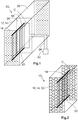
- a trim component 10 1 for cladding an interior space 11 of a means of passenger transport 13, in particular a vehicle 15 is shown by means of a principle and perspective view.
- the trim component 10 1 comprises a base body 12 that is made of a plastic or a polymer 14 such as a thermoplastic resin 14 or a thermosetting resin.
- the use of polypropylene (PP) or polyamide (PA) as the polymer 14 is particularly suited.
- the base body 12 further comprises carbon fibers 16 that are embedded into the plastic or a polymer 14.
- the amount of carbon fibers 16 is equal to or higher than 10% (wt/wt) with reference to the plastic or a polymer 14, preferably higher than 15%.
- the plastic or a polymer 14 and/or the carbon fibers 16 may have been recycled previously.
- the trim component 10 1 according to the first embodiment is thus a part made from carbon fiber reinforced polymer (CFRP), in this case from PPCF (polypropylene and carbon fiber).
- CFRP carbon fiber reinforced polymer
- the trim component 10 1 comprises an anode 18 and a cathode 20 that are embedded into the base body 12.
- the anode 18 and the cathode 20 are connected to a power source 22 by means of a wiring 24 such that a current may be applied to the anode 18 and the cathode 20.
- the carbon fibers 16 provide a current conductive network that can be used to heat the trim component 10 1 in a controlled manner when applying a current to the anode 18 and the cathode 20.
- the direction of current flow between the anode 18 and the cathode 20 is indicated by the lines C.
- anode 18 and the cathode 20 are provided in a first section 26 of the trim component 10 1 whereas a second section 28 of the trim component 10 1 is free of the anode 18 and the cathode 20. As a consequence only the first section 26 may actively be heated.
- a trim component 10 1 may be provided with more than one anode 18 and more than one cathode 20. Depending on the arrangement of the anodes 18 and the cathodes 20 one or more sections of the trim component 10 1 are actively heated whereas other sections may not be actively heated. It is thus possible to only heat the sections of interest of the trim component 10 1 .
- Figure 2 shows a perspective and principle sketch of a second embodiment a trim component 10 2 as proposed.
- the basic layout of the trim component 10 2 of the second embodiment is the same as of the trim component 10 1 of the first embodiment.
- Figure 2 is therefore reduced to the essential parts.
- the base body 12 is made of a foam material 30, e.g., polyurethane.
- a foam material 30 e.g., polyurethane.
- the mechanical properties of the trim component 10 2 according to the second embodiment may differ from those of the trim component 10 1 of the first embodiment.
- the resilience may be higher so that the trim component 10 2 of the second embodiment may be used for armrests or seats.
- Figure 3 shows a principle sectional view of a third embodiment a trim component 10 3 as proposed. Also in this case the basic layout of the trim component 10 3 of the third embodiment is the same as of the trim component 10 1 of the first embodiment.
- a layer 32 is laminated onto the base body 12.
- the layer 32 may be a textile or a decorative layer.
- the layer 32 may only be laminated on parts of the base body 12 whereas other parts of the base body 12 may be free of the layer 32. It is also possible to laminate more than one layer 32 to the base body 12. Two different or equal layers 32 may be arranged on top of each other or side by side.
- the at least one layer 32 may serve for adjusting the appearance of the trim component 10 3 to the design of an interior space 11 of a vehicle 15 (see Figure 5 ). Moreover, a given section of the trim component 10 3 may be provided with specific features, e.g., a reduced hardness or increased fluffiness in the armrest. The at least one layer 32 forms the face of the trim component 10 3 visible to a vehicle 15 passenger (see Figure 5 ).
- Figure 4 shows a principle sectional view of a fourth embodiment a trim component 10 4 as proposed.
- the basic layout of the trim component 10 4 of the fourth embodiment is the same as of the trim component 10 1 of the first embodiment.
- the base body 12 comprises at least one surface provided with a surface texture 34.
- the surface texture 34 may also serve for adjusting the appearance of the trim component 10 1 to the design of the interior space 11 (see Figure 5 ).
- the surface texture 34 may be used to adjust the haptic of the trim component 10 1 .
- the surface texture 34 may be chosen to provide grains or the like. No additional layers 32 are necessary.
- the surface that is provided with the surface texture 34 is typically the face of the trim component 10 3 visible to a vehicle 15 passenger.
- trim component 10 3 and 10 4 shown in Figures 3 and 4 may also be integrated into one single trim component 10.
- FIG. 5 is a principle top view on a means for passenger transport 13, in this case a vehicle 15.
- the vehicle 15 comprises an interior space 11 that is cladded with a number of trim component 10 according to one of the embodiments presented above.
- the trim components 10 are embodied as one instrument panel 36 and two door side panels 38.
- the instrument panel 36 is fastened to a first A-pillar 40 and a second A-pillar 42 and a partition wall 44 separating the interior space 11 from an engine compartment 46.
- the vehicle 15 comprised two side doors 48 each of which being provided with one of the door side panels 38.
- the anodes 18 and cathodes 20 are connected to the power source 22.
- the power source 22 may be the battery of the vehicle 15.
- the wiring 24 may also connect the battery with a climate control unit 50 by which the temperature in the interior space 11 can be controlled. A current may be applied to the anodes 18 and cathodes 20 according to the commands of the climate control unit 50 such that the temperature in the interior space 11 may be increased to the desired value.
Landscapes
- Physics & Mathematics (AREA)
- Thermal Sciences (AREA)
- Engineering & Computer Science (AREA)
- Mechanical Engineering (AREA)
- Vehicle Interior And Exterior Ornaments, Soundproofing, And Insulation (AREA)
Abstract
Description
- The present invention relates to a trim component for cladding an interior space of a means of passenger transport, in particular a vehicle. The present invention is further directed to a process of manufacturing such a trim component and to the use of pelletized carbon-fiber reinforced plastics for manufacturing such a trim component.
- The means of passenger transport is embodied in particular as a vehicle, but can also be a ship, an aircraft, a train or the like. In the following the disclosure is explained with reference to vehicles, however, the explanations shall also apply to other means of passenger transport, such as ships, aircraft, trains or the like.
- At present, the interior space of a vehicle typically is heated in two ways. In the first way an air conditioner heats air. The heated air is then distributed through various outlets inside the passenger compartment using an air distribution system comprising for example defrost and/or air ducts. As a consequence areas in the passenger compartment are heated that do not require heating. In addition, the energy required to heat the air is high.
- The second way relates to a seat heating or an armrest heating. In a seat heating or an armrest heating a heating mat with heating wires or heating foils with electrically conductive pastes are employed. Heating mats and heating foils are additional components which cause additional costs, in particular as they should be mounted or integrated such that they are not visible to a vehicle passenger.
- In order to overcome these disadvantages
DE 10 2008 045 757 A1 discloses skin that may be laminated to trim components of a vehicle, the skin being made of a plastic like polyvinylchloride. The skin is connected to a conductive layer that is provided with an embedded electrically conductive path. The conductor path consists of a mixture of the plastic material of the skin and a conductive material. Thus there are at least two layers. The conductive material is incorporated into the plastic material by a rolling kneading process. To produce the skin a sintering process or a spray process is needed. To connect the conductive layer to the skin an adhesive, a solvent and a roller process need to be employed. Thus the manufacturing process is expensive. -
EP 1 325 665 A1 is related to a carbon fiber-embedded heating paper and a sheet heater comprising such a heating paper. The alignment of the carbon fibers is controlled to give different heating characteristics to lateral and transverse directions of the said heating paper. In this heating paper pulp is fabricated in the carbon fibers to have heating characteristics to lateral and transverse directions and the sheet heater comprised of the polymer coating to have electrically insulating characteristics. Ceramic fibers, ceramic powders or their mixture are dispersed as heat-conducting material together with carbon fibers. -
KR 2016 0040 364 A - Neither the heating paper of
EP 1 325 665 A1 nor the heating element disclosed inKR 2016 0040 364 A - Further trim components are disclosed in
CN 10 6808 715 BWO 2011/65694 A1 DE 20 2016 106 374EP 2 184 149 A1 andEP 2 505 342 A1 . - It is one task of one embodiment of the present disclosure to present a trim component for cladding an interior space of a means of passenger transport, in particular a vehicle, by which the interior space may be heated in an efficient way. Moreover, an embodiment of the present invention has the object to provide a process of manufacturing such a trim component in a cost-efficient way.
- The task is solved by the features specified in
claims 1, 10 and 14. Advantageous embodiments are the subject of the dependent claims. - According to an embodiment the trim component for cladding an interior space of a means of passenger transport, in particular a vehicle, comprises a base body made of a plastic or a polymer, carbon fibers embedded into the plastic or polymer, and at least one anode and at least one cathode welded onto the base body or embedded into the plastic or polymer.
- The plastic or the polymer may be a thermoplastic resin or a thermosetting resin. Trim components may be door side panels, instrument panels and center consoles. Carbon fiber reinforced polymers (CFRPs) are increasingly used due to their lightweight construction potential.
- As proposed only one anode and one cathode have to be welded onto or embedded into the base body. With this simple design it is possible to select the trim components or areas of the trim component that should be heated. Thus only desired areas of the interior space of the vehicle can be heated. No additional components such as heating mats or heating foils are required. The integration of the anode and the cathode into the basic body is easier compared to the integration of heating mats heating foils. Compared to heating via air the heating of the trim components is more energy-efficient, particularly due to the fact that only desired areas of the interior space may be heated. As an example in case only one person, namely the driver, is present in the interior space the rear part of the interior space is not heated, contrary to heating via air.
- In a further embodiment that the content of carbon fibers (16) embedded into the plastic or polymer is at least 10% (wt/wt). In case the amount of carbon fibers exceeds a certain level, approximately 10% (wt/wt), a stable current conductive network is formed that can be used to heat the trim components in a controlled manner.
- In another embodiment the carbon fibers are recycled carbon fibers. It is possible to use recycled carbon fibers as they are available at an economical prize that is usually lower compared to unutilized carbon fibers. The base body may be made of recycled plastic or polymer. Moreover, the use of recycled plastic or polymer and recycled carbon fibers adds to the sustainability of the trim components.
- In another embodiment the polymer is polypropylene or polyamide, polycarbonate or acrylnitril-butadien-styrol-copolymer. A trim component made of polypropylene (PP), polyamide (PA), polycarbonate (PC) or acrylnitril-butadien-styrol-copolymer (ABS) has advantageous mechanical properties, e.g., with respect to the crashworthiness of the vehicle. Thus, safety requirements vehicles must fulfil can be met.
- According to another embodiment the base body is made of a foam material. By using foam material the trim components may be provided with soft and resilient portions such as armrests and seats. Moreover, very light trim components may be provided when using foam material.
- In a further embodiment the foam material is polyurethane. Depending on the choice of the precursors (polyol and polyisocyanate) the foam material can be provided with a broad range of properties. Particularly the mechanical properties can be chosen by the degree of cross-linking. The carbon fibers are embedded once the precursors mentioned react with each other. Thus, polyurethanes are a very versatile compound.
- In another embodiment the basic body is at least partly laminated with at least one layer. Such a layer may be a textile or a decorative layer. The at least one layer may serve for adjusting the appearance of the trim component to the design of the remaining interior space. Moreover, a given section of the trim component may be provided with specific features, e.g., a reduced hardness in the armrest.
- According to another embodiment the basic body comprises at least one surface provided with a surface texture. The surface texture may also serve for adjusting the appearance of the trim component to the design of the interior space. As an example the surface texture may be chosen to provide grains or the like. No additional layers are necessary.
- Another aspect of the invention is directed to a process of manufacturing a trim component according to one of the embodiments previously presented, comprising the following steps:
- providing a pelletized carbon-fiber reinforced plastics, the carbon fiber content being preferably at least 10% (wt/wt),
- forming a base body by injection molding, and
- welding at least one anode and at least one cathode onto the base body or embedding at least one anode and at least one cathode into the base body.
- The possibility to form the base body using injection molding is a very important criterion in the vehicle production. By using injection molding a high number of trim components may be produced within a short time at low costs.
- In a further implementation the anode and/or the cathode are embedded into the base body during the step of forming a base body by injection molding. The anode and the cathode may be inserted into the injection mold and the base body may be injection-molded around the anode and the cathode. No additional manufacturing steps are needed to embed the anode and the cathode into the base body. The production process is thereby accelerated.
- In accordance with a further implementation the process further comprises the step of at least partially laminating at least one layer onto the base body. As mentioned, such a layer may be a textile or a decorative layer. The at least one layer may serve for adjusting the appearance of the trim component to the design of the remaining interior space. Moreover, a given section of the trim component may be provided with specific features, e.g., a reduced hardness in the armrest. It is worth mentioning that it is possible to only partially laminating the base body, leaving the remaining base body unchanged. It is thus not necessary to produce a separate part for the armrest. The armrest can be integrated into the trim component such that the number of components may be kept low.
- According to a further implementation the process further comprises the step of providing at least one surface of the base body with a surface texture. As mentioned, the surface texture may also serve for adjusting the appearance of the trim component to the design of the interior space. As an example the surface texture may be chosen to provide grains or the like. No additional layers are necessary. The surface texture may be provided by an injection mold that is appropriately equipped.
- Another aspect of the invention is directed to the use of pelletized carbon-fiber reinforced plastics for manufacturing a trim component according to one of the embodiments mentioned above, the carbon fiber content being preferably at least 10% (wt/wt). In case the amount of carbon fibers exceeds a certain level, approximately 10% (wt/wt), a stable current conductive network is formed that can be used to heat the trim components in a controlled manner. Apart from an anode and a cathode no additional means for heating are necessary in the trim components. It is in particular possible to use recycled plastics, polymers and/or recycled carbon fibers which are available at competitive costs. The trim components manufactured from carbon-fiber reinforced plastics are sustainable and possess mechanical properties advantageous for the crashworthiness of the vehicle.
- Another aspect of the invention is directed to a vehicle comprising a trim component according to one of the embodiments described above. The advantages and technical effects described with reference to the trim components equally apply to the vehicle.
- The present invention is described in detail with reference to the drawings attached wherein
- Figure 1
- shows a perspective and principle sketch of a first embodiment a trim component as proposed,
- Figure 2
- shows a perspective and principle sketch of a second embodiment a trim component as proposed,
- Figure 3
- shows a principle sectional view of a third embodiment a trim component as proposed,
- Figure 4
- shows a principle sectional view of a fourth embodiment a trim component as proposed, and
- Figure 5
- is a principle top view of a vehicle equipped with a trim component according to one of the embodiments shown in
Figures 1 to 4 . - In
Figure 1 a first embodiment atrim component 101 for cladding aninterior space 11 of a means of passenger transport 13, in particular a vehicle 15 (seeFigure 5 ) is shown by means of a principle and perspective view. Thetrim component 101 comprises abase body 12 that is made of a plastic or a polymer 14 such as a thermoplastic resin 14 or a thermosetting resin. The use of polypropylene (PP) or polyamide (PA) as the polymer 14 is particularly suited. Thebase body 12 further comprisescarbon fibers 16 that are embedded into the plastic or a polymer 14. The amount ofcarbon fibers 16 is equal to or higher than 10% (wt/wt) with reference to the plastic or a polymer 14, preferably higher than 15%. The plastic or a polymer 14 and/or thecarbon fibers 16 may have been recycled previously. Thetrim component 101 according to the first embodiment is thus a part made from carbon fiber reinforced polymer (CFRP), in this case from PPCF (polypropylene and carbon fiber). - Moreover, the
trim component 101 comprises ananode 18 and acathode 20 that are embedded into thebase body 12. Theanode 18 and thecathode 20 are connected to apower source 22 by means of awiring 24 such that a current may be applied to theanode 18 and thecathode 20. Thecarbon fibers 16 provide a current conductive network that can be used to heat thetrim component 101 in a controlled manner when applying a current to theanode 18 and thecathode 20. The direction of current flow between theanode 18 and thecathode 20 is indicated by the lines C. - As evident from
Figure 1 theanode 18 and thecathode 20 are provided in afirst section 26 of thetrim component 101 whereas asecond section 28 of thetrim component 101 is free of theanode 18 and thecathode 20. As a consequence only thefirst section 26 may actively be heated. Atrim component 101 may be provided with more than oneanode 18 and more than onecathode 20. Depending on the arrangement of theanodes 18 and thecathodes 20 one or more sections of thetrim component 101 are actively heated whereas other sections may not be actively heated. It is thus possible to only heat the sections of interest of thetrim component 101. -
Figure 2 shows a perspective and principle sketch of a second embodiment atrim component 102 as proposed. The basic layout of thetrim component 102 of the second embodiment is the same as of thetrim component 101 of the first embodiment.Figure 2 is therefore reduced to the essential parts. - According to the second embodiment of
trim component 102 thebase body 12 is made of a foam material 30, e.g., polyurethane. Depending on the settings and in particular the degree of cross-linking the mechanical properties of thetrim component 102 according to the second embodiment may differ from those of thetrim component 101 of the first embodiment. In particular the resilience may be higher so that thetrim component 102 of the second embodiment may be used for armrests or seats. -
Figure 3 shows a principle sectional view of a third embodiment atrim component 103 as proposed. Also in this case the basic layout of thetrim component 103 of the third embodiment is the same as of thetrim component 101 of the first embodiment. However, alayer 32 is laminated onto thebase body 12. Thelayer 32 may be a textile or a decorative layer. Thelayer 32 may only be laminated on parts of thebase body 12 whereas other parts of thebase body 12 may be free of thelayer 32. It is also possible to laminate more than onelayer 32 to thebase body 12. Two different orequal layers 32 may be arranged on top of each other or side by side. - The at least one
layer 32 may serve for adjusting the appearance of thetrim component 103 to the design of aninterior space 11 of a vehicle 15 (seeFigure 5 ). Moreover, a given section of thetrim component 103 may be provided with specific features, e.g., a reduced hardness or increased fluffiness in the armrest. The at least onelayer 32 forms the face of thetrim component 103 visible to a vehicle 15 passenger (seeFigure 5 ). -
Figure 4 shows a principle sectional view of a fourth embodiment atrim component 104 as proposed. Also in this case the basic layout of thetrim component 104 of the fourth embodiment is the same as of thetrim component 101 of the first embodiment. However, in this case thebase body 12 comprises at least one surface provided with asurface texture 34. Thesurface texture 34 may also serve for adjusting the appearance of thetrim component 101 to the design of the interior space 11 (seeFigure 5 ). Moreover thesurface texture 34 may be used to adjust the haptic of thetrim component 101. As an example thesurface texture 34 may be chosen to provide grains or the like. Noadditional layers 32 are necessary. The surface that is provided with thesurface texture 34 is typically the face of thetrim component 103 visible to a vehicle 15 passenger. - The embodiments of the
trim component Figures 3 and 4 may also be integrated into onesingle trim component 10. -
Figure 5 is a principle top view on a means for passenger transport 13, in this case a vehicle 15. The vehicle 15 comprises aninterior space 11 that is cladded with a number oftrim component 10 according to one of the embodiments presented above. In this case thetrim components 10 are embodied as one instrument panel 36 and two door side panels 38. The instrument panel 36 is fastened to a first A-pillar 40 and a second A-pillar 42 and apartition wall 44 separating theinterior space 11 from anengine compartment 46. The vehicle 15 comprised twoside doors 48 each of which being provided with one of the door side panels 38. - As mentioned with reference to
Figure 1 theanodes 18 and cathodes 20 (not shown inFigure 5 ) are connected to thepower source 22. Thepower source 22 may be the battery of the vehicle 15. Thewiring 24 may also connect the battery with aclimate control unit 50 by which the temperature in theinterior space 11 can be controlled. A current may be applied to theanodes 18 andcathodes 20 according to the commands of theclimate control unit 50 such that the temperature in theinterior space 11 may be increased to the desired value. -
- 10
- trim component
- 101 - 104
- trim component
- 11
- interior space
- 12
- base body
- 13
- means for passenger transport
- 14
- resin
- 15
- vehicle
- 16
- carbon fiber
- 18
- anode
- 20
- cathode
- 22
- power source
- 24
- wiring
- 26
- first section
- 28
- second section
- 30
- foam material
- 32
- layer
- 34
- surface texture
- 36
- instrument panel
- 38
- door side panel
- 40
- A-pillar
- 42
- A-pillar
- 44
- partition wall
- 46
- engine compartment
- 48
- side door
- 50
- climate control unit
- C
- direction of current flow
Claims (13)
- Trim component (10) for cladding an interior space (11) of a means of passenger transport (13), in particular a vehicle (15), the trim component (10) comprising- a base body (12) made of a plastic or polymer (14),- carbon fibers (16) embedded into the plastic or polymer (14), and- at least one anode (18) and at least one cathode (20) welded onto the base body (12) or embedded into the plastic or polymer (14).
- Trim component (10) according to claim 1,
characterized in that the content of carbon fibers (16) embedded into the plastic or polymer is at least 10% (wt/wt). - Trim component (10) according to one of the claims 1 or 2,
characterized in that the carbon fibers are recycled carbon fibers (16). - Trim component (10) according to one of the preceding claims,
characterized in that the plastic or polymer (14) is polypropylene, polyamide, polycarbonate or acrylnitril-butadien-styrol-copolymer. - Trim component (10) according to one of the claims 1 to 3,
characterized in that the base body (12) is made of a foam material (30). - Trim component (10) according to claim 5,
characterized in that the foam material (30) is polyurethane. - Trim component (10) according to one of the preceding claims,
characterized in that the base body (12) is at least partly laminated with at least one layer (32). - Trim component (10) according to one of the preceding claims,
characterized in that the base body (12) comprises at least one surface provided with a surface texture (34). - Process of manufacturing a trim component (10) according to one of the preceding claims, comprising the following steps:- providing a pelletized carbon-fiber reinforced plastics, the carbon fibers content (16) preferably being at least 10% (wt/wt),- forming a base body (12) by injection molding, and- welding at least one anode (18) and at least one cathode (20) onto the base body (12) or embedding at least one anode (18) and at least one cathode (20) into the base body (12).
- Process according to claim 9,
characterized in that the anode (18) and/or the cathode (20) are embedded into the base body (12) during the step of forming a base body (12) by injection molding. - Process according to one of the claims 9 or 10,
further comprising the step of at least partially laminating at least one further layer (32) onto the base body (12). - Process according to one of the claims 9 to 11,
further comprising the step of providing at least one surface of the base body (12) with a surface texture (34). - Use of pelletized carbon-fiber reinforced plastics for manufacturing a trim component (10) according to one of the claims 1 to 8, the carbon fibers content being preferably at least 10% (wt/wt).
Priority Applications (3)
| Application Number | Priority Date | Filing Date | Title |
|---|---|---|---|
| EP19193080.9A EP3782832B1 (en) | 2019-08-22 | 2019-08-22 | Trim component for cladding an interior space of a means of passenger transport |
| ES19193080T ES2975971T3 (en) | 2019-08-22 | 2019-08-22 | Trim component for the lining of an interior space of a means of passenger transport |
| HUE19193080A HUE066842T2 (en) | 2019-08-22 | 2019-08-22 | Trim component for cladding an interior space of a means of passenger transport |
Applications Claiming Priority (1)
| Application Number | Priority Date | Filing Date | Title |
|---|---|---|---|
| EP19193080.9A EP3782832B1 (en) | 2019-08-22 | 2019-08-22 | Trim component for cladding an interior space of a means of passenger transport |
Publications (2)
| Publication Number | Publication Date |
|---|---|
| EP3782832A1 true EP3782832A1 (en) | 2021-02-24 |
| EP3782832B1 EP3782832B1 (en) | 2024-03-13 |
Family
ID=67734537
Family Applications (1)
| Application Number | Title | Priority Date | Filing Date |
|---|---|---|---|
| EP19193080.9A Active EP3782832B1 (en) | 2019-08-22 | 2019-08-22 | Trim component for cladding an interior space of a means of passenger transport |
Country Status (3)
| Country | Link |
|---|---|
| EP (1) | EP3782832B1 (en) |
| ES (1) | ES2975971T3 (en) |
| HU (1) | HUE066842T2 (en) |
Cited By (1)
| Publication number | Priority date | Publication date | Assignee | Title |
|---|---|---|---|---|
| FR3134070A1 (en) * | 2022-04-05 | 2023-10-06 | Faurecia Interieur Industrie | Filling element comprising a discreet heating element made of carbon material |
Citations (11)
| Publication number | Priority date | Publication date | Assignee | Title |
|---|---|---|---|---|
| DE19904076A1 (en) * | 1999-02-02 | 2000-08-03 | Bayerische Motoren Werke Ag | Vehicle molded part made of a composite material with unidirectionally arranged carbon fibers |
| EP1325665A1 (en) | 2000-08-26 | 2003-07-09 | Magicyura Corporation | Carbon fiber-embedded heating paper and thereof sheet heater |
| DE102008045757A1 (en) | 2008-09-04 | 2010-03-11 | Benecke-Kaliko Ag | Plastic skin with conductor tracks |
| EP2184149A1 (en) | 2008-11-05 | 2010-05-12 | Peguform GmbH | Method and device for producing a moulded part with a decorative surface |
| WO2011065694A2 (en) | 2009-11-26 | 2011-06-03 | 인하대학교 산학협력단 | Carbon fiber reinforced plastic composite material coated with nanoparticles |
| EP2505342A1 (en) | 2009-11-26 | 2012-10-03 | JX Nippon Oil & Energy Corporation | Molded carbon-fiber-reinforced plastic and process for producing same |
| US20120256440A1 (en) * | 2011-04-05 | 2012-10-11 | Smp Deutschland Gmbh | Motor vehicle interior paneling component made of plastic |
| US20130062130A1 (en) * | 2011-09-14 | 2013-03-14 | Hutchinson | Electric or Hybrid Motor Vehicle Bodywork Structure, This Vehicle, and Method for Controlling/Modifying the Temperature of the Passenger Compartment Thereof |
| KR20160040364A (en) | 2014-10-02 | 2016-04-14 | 주식회사 유니웜 | Heater for car seats with carbon fiber |
| CN106808715A (en) | 2016-12-29 | 2017-06-09 | 盐城赛福汽车零部件有限公司 | A kind of preparation method of carbon fibre composite auto parts and components |
| DE202016106374U1 (en) | 2016-11-15 | 2018-02-26 | Hans-Jürgen Bader | Flat heating element, in particular for a cladding component and such a cladding component |
-
2019
- 2019-08-22 HU HUE19193080A patent/HUE066842T2/en unknown
- 2019-08-22 ES ES19193080T patent/ES2975971T3/en active Active
- 2019-08-22 EP EP19193080.9A patent/EP3782832B1/en active Active
Patent Citations (11)
| Publication number | Priority date | Publication date | Assignee | Title |
|---|---|---|---|---|
| DE19904076A1 (en) * | 1999-02-02 | 2000-08-03 | Bayerische Motoren Werke Ag | Vehicle molded part made of a composite material with unidirectionally arranged carbon fibers |
| EP1325665A1 (en) | 2000-08-26 | 2003-07-09 | Magicyura Corporation | Carbon fiber-embedded heating paper and thereof sheet heater |
| DE102008045757A1 (en) | 2008-09-04 | 2010-03-11 | Benecke-Kaliko Ag | Plastic skin with conductor tracks |
| EP2184149A1 (en) | 2008-11-05 | 2010-05-12 | Peguform GmbH | Method and device for producing a moulded part with a decorative surface |
| WO2011065694A2 (en) | 2009-11-26 | 2011-06-03 | 인하대학교 산학협력단 | Carbon fiber reinforced plastic composite material coated with nanoparticles |
| EP2505342A1 (en) | 2009-11-26 | 2012-10-03 | JX Nippon Oil & Energy Corporation | Molded carbon-fiber-reinforced plastic and process for producing same |
| US20120256440A1 (en) * | 2011-04-05 | 2012-10-11 | Smp Deutschland Gmbh | Motor vehicle interior paneling component made of plastic |
| US20130062130A1 (en) * | 2011-09-14 | 2013-03-14 | Hutchinson | Electric or Hybrid Motor Vehicle Bodywork Structure, This Vehicle, and Method for Controlling/Modifying the Temperature of the Passenger Compartment Thereof |
| KR20160040364A (en) | 2014-10-02 | 2016-04-14 | 주식회사 유니웜 | Heater for car seats with carbon fiber |
| DE202016106374U1 (en) | 2016-11-15 | 2018-02-26 | Hans-Jürgen Bader | Flat heating element, in particular for a cladding component and such a cladding component |
| CN106808715A (en) | 2016-12-29 | 2017-06-09 | 盐城赛福汽车零部件有限公司 | A kind of preparation method of carbon fibre composite auto parts and components |
Cited By (1)
| Publication number | Priority date | Publication date | Assignee | Title |
|---|---|---|---|---|
| FR3134070A1 (en) * | 2022-04-05 | 2023-10-06 | Faurecia Interieur Industrie | Filling element comprising a discreet heating element made of carbon material |
Also Published As
| Publication number | Publication date |
|---|---|
| HUE066842T2 (en) | 2024-09-28 |
| ES2975971T3 (en) | 2024-07-18 |
| EP3782832B1 (en) | 2024-03-13 |
Similar Documents
| Publication | Publication Date | Title |
|---|---|---|
| EP1554911B1 (en) | Panel heating system, method for producing the same, heatable object, seat occupancy recognition system, seat provided with the same and seat occupancy recognition method | |
| DE112019003911B4 (en) | SUSPENSION FABRIC SEAT HEATING SYSTEM AND METHOD FOR MANUFACTURING A SEAT | |
| EP3750697B1 (en) | Composite panel comprising an integrated electrical circuit and manufacturing method thereof | |
| DE102009052535C5 (en) | interior lining | |
| WO2002052899A1 (en) | Surface heating device, method for producing the same and heatable object | |
| WO2003005769A2 (en) | Surface heater, method for the production thereof and heatable object in addition to a system for recognising the occupancy of a seat, a seat fitted with said system and method for recognising the occupancy of a seat | |
| DE102015200272A1 (en) | INTERIOR ELEMENT FOR A MOTOR VEHICLE AND METHOD FOR MANUFACTURING AN INTERIOR ELEMENT | |
| US8894125B2 (en) | Motor vehicle interior paneling component made of plastic | |
| US10308177B2 (en) | Motor-vehicle passenger-compartment component, and a method for manufacturing this component | |
| KR20160060734A (en) | Front body module for a motor vehicle | |
| DE102016225837A1 (en) | Method for producing a body-supporting padding part and motor vehicle | |
| EP1627554A2 (en) | Heating device and method for the production thereof and heatable object and method for the production thereof | |
| JP5745409B2 (en) | Plastic skin material with strip conductors | |
| DE10015158B4 (en) | Mold carrier part with integrated heating element and method for producing the same | |
| EP3782832B1 (en) | Trim component for cladding an interior space of a means of passenger transport | |
| DE102007062898A1 (en) | Interior trim component for motor vehicles, in particular instrument panel, door or side paneling | |
| DE102010021123A1 (en) | Molded part such as a dashboard, a door trim or a central console for a motor vehicle, comprises an insert, and a foam body, which defines a three-dimensional viewing surface of the molded part and partially surrounds the insert | |
| DE10159814A1 (en) | Heated vehicle interior panel manufacture involves embedment of a heater element in foam injected between a decorative layer and supporting layer | |
| EP2101998B1 (en) | Thermoplastic film comprising an expanded covering sheet | |
| EP1026019A2 (en) | Moulding element for a vehicle of composite material with unidirectionally arranged carbon fibre | |
| EP3828019A1 (en) | Heating element for a trim component for cladding an interior space of a means of passenger transport | |
| EP2073387A2 (en) | Method for manufacturing a button-less operating device | |
| DE10326445B4 (en) | Device for air conditioning a vehicle seat | |
| DE20320372U1 (en) | Device for air-conditioning a vehicle seat which has a core cushion, comprises base, intermediate and cover layers, and is joined to the core cushion by material bonds | |
| DE10326446B4 (en) | Device for air conditioning a vehicle seat |
Legal Events
| Date | Code | Title | Description |
|---|---|---|---|
| PUAI | Public reference made under article 153(3) epc to a published international application that has entered the european phase |
Free format text: ORIGINAL CODE: 0009012 |
|
| STAA | Information on the status of an ep patent application or granted ep patent |
Free format text: STATUS: THE APPLICATION HAS BEEN PUBLISHED |
|
| AK | Designated contracting states |
Kind code of ref document: A1 Designated state(s): AL AT BE BG CH CY CZ DE DK EE ES FI FR GB GR HR HU IE IS IT LI LT LU LV MC MK MT NL NO PL PT RO RS SE SI SK SM TR |
|
| AX | Request for extension of the european patent |
Extension state: BA ME |
|
| STAA | Information on the status of an ep patent application or granted ep patent |
Free format text: STATUS: REQUEST FOR EXAMINATION WAS MADE |
|
| 17P | Request for examination filed |
Effective date: 20210616 |
|
| RBV | Designated contracting states (corrected) |
Designated state(s): AL AT BE BG CH CY CZ DE DK EE ES FI FR GB GR HR HU IE IS IT LI LT LU LV MC MK MT NL NO PL PT RO RS SE SI SK SM TR |
|
| RAP3 | Party data changed (applicant data changed or rights of an application transferred) |
Owner name: MOTHERSON INNOVATIONS COMPANY LIMITED |
|
| STAA | Information on the status of an ep patent application or granted ep patent |
Free format text: STATUS: EXAMINATION IS IN PROGRESS |
|
| 17Q | First examination report despatched |
Effective date: 20221013 |
|
| P01 | Opt-out of the competence of the unified patent court (upc) registered |
Effective date: 20230427 |
|
| GRAP | Despatch of communication of intention to grant a patent |
Free format text: ORIGINAL CODE: EPIDOSNIGR1 |
|
| STAA | Information on the status of an ep patent application or granted ep patent |
Free format text: STATUS: GRANT OF PATENT IS INTENDED |
|
| RIC1 | Information provided on ipc code assigned before grant |
Ipc: B60R 13/02 20060101ALI20230921BHEP Ipc: B60H 1/22 20060101AFI20230921BHEP |
|
| INTG | Intention to grant announced |
Effective date: 20231011 |
|
| RIN1 | Information on inventor provided before grant (corrected) |
Inventor name: JOHANNBOEKE, JOHANN Inventor name: HEINZ, CHRISTOPH |
|
| GRAS | Grant fee paid |
Free format text: ORIGINAL CODE: EPIDOSNIGR3 |
|
| GRAA | (expected) grant |
Free format text: ORIGINAL CODE: 0009210 |
|
| STAA | Information on the status of an ep patent application or granted ep patent |
Free format text: STATUS: THE PATENT HAS BEEN GRANTED |
|
| RIN1 | Information on inventor provided before grant (corrected) |
Inventor name: JOHANNBOEKE, ECKHARD Inventor name: HEINZ, CHRISTOPH |
|
| AK | Designated contracting states |
Kind code of ref document: B1 Designated state(s): AL AT BE BG CH CY CZ DE DK EE ES FI FR GB GR HR HU IE IS IT LI LT LU LV MC MK MT NL NO PL PT RO RS SE SI SK SM TR |
|
| REG | Reference to a national code |
Ref country code: GB Ref legal event code: FG4D |
|
| REG | Reference to a national code |
Ref country code: CH Ref legal event code: EP |
|
| REG | Reference to a national code |
Ref country code: DE Ref legal event code: R096 Ref document number: 602019048115 Country of ref document: DE |
|
| REG | Reference to a national code |
Ref country code: IE Ref legal event code: FG4D |
|
| PG25 | Lapsed in a contracting state [announced via postgrant information from national office to epo] |
Ref country code: LT Free format text: LAPSE BECAUSE OF FAILURE TO SUBMIT A TRANSLATION OF THE DESCRIPTION OR TO PAY THE FEE WITHIN THE PRESCRIBED TIME-LIMIT Effective date: 20240313 |
|
| REG | Reference to a national code |
Ref country code: LT Ref legal event code: MG9D |
|
| PG25 | Lapsed in a contracting state [announced via postgrant information from national office to epo] |
Ref country code: GR Free format text: LAPSE BECAUSE OF FAILURE TO SUBMIT A TRANSLATION OF THE DESCRIPTION OR TO PAY THE FEE WITHIN THE PRESCRIBED TIME-LIMIT Effective date: 20240614 |
|
| REG | Reference to a national code |
Ref country code: NL Ref legal event code: MP Effective date: 20240313 |
|
| PG25 | Lapsed in a contracting state [announced via postgrant information from national office to epo] |
Ref country code: HR Free format text: LAPSE BECAUSE OF FAILURE TO SUBMIT A TRANSLATION OF THE DESCRIPTION OR TO PAY THE FEE WITHIN THE PRESCRIBED TIME-LIMIT Effective date: 20240313 Ref country code: RS Free format text: LAPSE BECAUSE OF FAILURE TO SUBMIT A TRANSLATION OF THE DESCRIPTION OR TO PAY THE FEE WITHIN THE PRESCRIBED TIME-LIMIT Effective date: 20240613 |
|
| REG | Reference to a national code |
Ref country code: ES Ref legal event code: FG2A Ref document number: 2975971 Country of ref document: ES Kind code of ref document: T3 Effective date: 20240718 |
|
| PG25 | Lapsed in a contracting state [announced via postgrant information from national office to epo] |
Ref country code: RS Free format text: LAPSE BECAUSE OF FAILURE TO SUBMIT A TRANSLATION OF THE DESCRIPTION OR TO PAY THE FEE WITHIN THE PRESCRIBED TIME-LIMIT Effective date: 20240613 Ref country code: NO Free format text: LAPSE BECAUSE OF FAILURE TO SUBMIT A TRANSLATION OF THE DESCRIPTION OR TO PAY THE FEE WITHIN THE PRESCRIBED TIME-LIMIT Effective date: 20240613 Ref country code: LT Free format text: LAPSE BECAUSE OF FAILURE TO SUBMIT A TRANSLATION OF THE DESCRIPTION OR TO PAY THE FEE WITHIN THE PRESCRIBED TIME-LIMIT Effective date: 20240313 Ref country code: HR Free format text: LAPSE BECAUSE OF FAILURE TO SUBMIT A TRANSLATION OF THE DESCRIPTION OR TO PAY THE FEE WITHIN THE PRESCRIBED TIME-LIMIT Effective date: 20240313 Ref country code: GR Free format text: LAPSE BECAUSE OF FAILURE TO SUBMIT A TRANSLATION OF THE DESCRIPTION OR TO PAY THE FEE WITHIN THE PRESCRIBED TIME-LIMIT Effective date: 20240614 Ref country code: FI Free format text: LAPSE BECAUSE OF FAILURE TO SUBMIT A TRANSLATION OF THE DESCRIPTION OR TO PAY THE FEE WITHIN THE PRESCRIBED TIME-LIMIT Effective date: 20240313 Ref country code: BG Free format text: LAPSE BECAUSE OF FAILURE TO SUBMIT A TRANSLATION OF THE DESCRIPTION OR TO PAY THE FEE WITHIN THE PRESCRIBED TIME-LIMIT Effective date: 20240313 |
|
| REG | Reference to a national code |
Ref country code: AT Ref legal event code: MK05 Ref document number: 1665431 Country of ref document: AT Kind code of ref document: T Effective date: 20240313 |
|
| PG25 | Lapsed in a contracting state [announced via postgrant information from national office to epo] |
Ref country code: SE Free format text: LAPSE BECAUSE OF FAILURE TO SUBMIT A TRANSLATION OF THE DESCRIPTION OR TO PAY THE FEE WITHIN THE PRESCRIBED TIME-LIMIT Effective date: 20240313 Ref country code: LV Free format text: LAPSE BECAUSE OF FAILURE TO SUBMIT A TRANSLATION OF THE DESCRIPTION OR TO PAY THE FEE WITHIN THE PRESCRIBED TIME-LIMIT Effective date: 20240313 |
|
| PG25 | Lapsed in a contracting state [announced via postgrant information from national office to epo] |
Ref country code: NL Free format text: LAPSE BECAUSE OF FAILURE TO SUBMIT A TRANSLATION OF THE DESCRIPTION OR TO PAY THE FEE WITHIN THE PRESCRIBED TIME-LIMIT Effective date: 20240313 |
|
| REG | Reference to a national code |
Ref country code: HU Ref legal event code: AG4A Ref document number: E066842 Country of ref document: HU |
|
| PG25 | Lapsed in a contracting state [announced via postgrant information from national office to epo] |
Ref country code: NL Free format text: LAPSE BECAUSE OF FAILURE TO SUBMIT A TRANSLATION OF THE DESCRIPTION OR TO PAY THE FEE WITHIN THE PRESCRIBED TIME-LIMIT Effective date: 20240313 |
|
| PG25 | Lapsed in a contracting state [announced via postgrant information from national office to epo] |
Ref country code: IS Free format text: LAPSE BECAUSE OF FAILURE TO SUBMIT A TRANSLATION OF THE DESCRIPTION OR TO PAY THE FEE WITHIN THE PRESCRIBED TIME-LIMIT Effective date: 20240713 |
|
| PG25 | Lapsed in a contracting state [announced via postgrant information from national office to epo] |
Ref country code: PT Free format text: LAPSE BECAUSE OF FAILURE TO SUBMIT A TRANSLATION OF THE DESCRIPTION OR TO PAY THE FEE WITHIN THE PRESCRIBED TIME-LIMIT Effective date: 20240715 Ref country code: SM Free format text: LAPSE BECAUSE OF FAILURE TO SUBMIT A TRANSLATION OF THE DESCRIPTION OR TO PAY THE FEE WITHIN THE PRESCRIBED TIME-LIMIT Effective date: 20240313 |
|
| PG25 | Lapsed in a contracting state [announced via postgrant information from national office to epo] |
Ref country code: EE Free format text: LAPSE BECAUSE OF FAILURE TO SUBMIT A TRANSLATION OF THE DESCRIPTION OR TO PAY THE FEE WITHIN THE PRESCRIBED TIME-LIMIT Effective date: 20240313 |
|
| PG25 | Lapsed in a contracting state [announced via postgrant information from national office to epo] |
Ref country code: AT Free format text: LAPSE BECAUSE OF FAILURE TO SUBMIT A TRANSLATION OF THE DESCRIPTION OR TO PAY THE FEE WITHIN THE PRESCRIBED TIME-LIMIT Effective date: 20240313 |
|
| PG25 | Lapsed in a contracting state [announced via postgrant information from national office to epo] |
Ref country code: PL Free format text: LAPSE BECAUSE OF FAILURE TO SUBMIT A TRANSLATION OF THE DESCRIPTION OR TO PAY THE FEE WITHIN THE PRESCRIBED TIME-LIMIT Effective date: 20240313 |
|
| PG25 | Lapsed in a contracting state [announced via postgrant information from national office to epo] |
Ref country code: SK Free format text: LAPSE BECAUSE OF FAILURE TO SUBMIT A TRANSLATION OF THE DESCRIPTION OR TO PAY THE FEE WITHIN THE PRESCRIBED TIME-LIMIT Effective date: 20240313 |
|
| PG25 | Lapsed in a contracting state [announced via postgrant information from national office to epo] |
Ref country code: SM Free format text: LAPSE BECAUSE OF FAILURE TO SUBMIT A TRANSLATION OF THE DESCRIPTION OR TO PAY THE FEE WITHIN THE PRESCRIBED TIME-LIMIT Effective date: 20240313 Ref country code: SK Free format text: LAPSE BECAUSE OF FAILURE TO SUBMIT A TRANSLATION OF THE DESCRIPTION OR TO PAY THE FEE WITHIN THE PRESCRIBED TIME-LIMIT Effective date: 20240313 Ref country code: RO Free format text: LAPSE BECAUSE OF FAILURE TO SUBMIT A TRANSLATION OF THE DESCRIPTION OR TO PAY THE FEE WITHIN THE PRESCRIBED TIME-LIMIT Effective date: 20240313 Ref country code: PT Free format text: LAPSE BECAUSE OF FAILURE TO SUBMIT A TRANSLATION OF THE DESCRIPTION OR TO PAY THE FEE WITHIN THE PRESCRIBED TIME-LIMIT Effective date: 20240715 Ref country code: PL Free format text: LAPSE BECAUSE OF FAILURE TO SUBMIT A TRANSLATION OF THE DESCRIPTION OR TO PAY THE FEE WITHIN THE PRESCRIBED TIME-LIMIT Effective date: 20240313 Ref country code: IS Free format text: LAPSE BECAUSE OF FAILURE TO SUBMIT A TRANSLATION OF THE DESCRIPTION OR TO PAY THE FEE WITHIN THE PRESCRIBED TIME-LIMIT Effective date: 20240713 Ref country code: EE Free format text: LAPSE BECAUSE OF FAILURE TO SUBMIT A TRANSLATION OF THE DESCRIPTION OR TO PAY THE FEE WITHIN THE PRESCRIBED TIME-LIMIT Effective date: 20240313 Ref country code: AT Free format text: LAPSE BECAUSE OF FAILURE TO SUBMIT A TRANSLATION OF THE DESCRIPTION OR TO PAY THE FEE WITHIN THE PRESCRIBED TIME-LIMIT Effective date: 20240313 |
|
| PG25 | Lapsed in a contracting state [announced via postgrant information from national office to epo] |
Ref country code: IT Free format text: LAPSE BECAUSE OF FAILURE TO SUBMIT A TRANSLATION OF THE DESCRIPTION OR TO PAY THE FEE WITHIN THE PRESCRIBED TIME-LIMIT Effective date: 20240313 |
|
| REG | Reference to a national code |
Ref country code: DE Ref legal event code: R097 Ref document number: 602019048115 Country of ref document: DE |
|
| PG25 | Lapsed in a contracting state [announced via postgrant information from national office to epo] |
Ref country code: IT Free format text: LAPSE BECAUSE OF FAILURE TO SUBMIT A TRANSLATION OF THE DESCRIPTION OR TO PAY THE FEE WITHIN THE PRESCRIBED TIME-LIMIT Effective date: 20240313 |
|
| PG25 | Lapsed in a contracting state [announced via postgrant information from national office to epo] |
Ref country code: DK Free format text: LAPSE BECAUSE OF FAILURE TO SUBMIT A TRANSLATION OF THE DESCRIPTION OR TO PAY THE FEE WITHIN THE PRESCRIBED TIME-LIMIT Effective date: 20240313 |
|
| PLBE | No opposition filed within time limit |
Free format text: ORIGINAL CODE: 0009261 |
|
| STAA | Information on the status of an ep patent application or granted ep patent |
Free format text: STATUS: NO OPPOSITION FILED WITHIN TIME LIMIT |
|
| PG25 | Lapsed in a contracting state [announced via postgrant information from national office to epo] |
Ref country code: DK Free format text: LAPSE BECAUSE OF FAILURE TO SUBMIT A TRANSLATION OF THE DESCRIPTION OR TO PAY THE FEE WITHIN THE PRESCRIBED TIME-LIMIT Effective date: 20240313 |
|
| 26N | No opposition filed |
Effective date: 20241216 |
|
| REG | Reference to a national code |
Ref country code: CH Ref legal event code: PL |
|
| PG25 | Lapsed in a contracting state [announced via postgrant information from national office to epo] |
Ref country code: LU Free format text: LAPSE BECAUSE OF NON-PAYMENT OF DUE FEES Effective date: 20240822 |
|
| GBPC | Gb: european patent ceased through non-payment of renewal fee |
Effective date: 20240822 |
|
| PG25 | Lapsed in a contracting state [announced via postgrant information from national office to epo] |
Ref country code: SI Free format text: LAPSE BECAUSE OF FAILURE TO SUBMIT A TRANSLATION OF THE DESCRIPTION OR TO PAY THE FEE WITHIN THE PRESCRIBED TIME-LIMIT Effective date: 20240313 Ref country code: MC Free format text: LAPSE BECAUSE OF FAILURE TO SUBMIT A TRANSLATION OF THE DESCRIPTION OR TO PAY THE FEE WITHIN THE PRESCRIBED TIME-LIMIT Effective date: 20240313 Ref country code: CH Free format text: LAPSE BECAUSE OF NON-PAYMENT OF DUE FEES Effective date: 20240831 |
|
| REG | Reference to a national code |
Ref country code: BE Ref legal event code: MM Effective date: 20240831 |
|
| PG25 | Lapsed in a contracting state [announced via postgrant information from national office to epo] |
Ref country code: GB Free format text: LAPSE BECAUSE OF NON-PAYMENT OF DUE FEES Effective date: 20240822 |
|
| PG25 | Lapsed in a contracting state [announced via postgrant information from national office to epo] |
Ref country code: BE Free format text: LAPSE BECAUSE OF NON-PAYMENT OF DUE FEES Effective date: 20240831 |
|
| PG25 | Lapsed in a contracting state [announced via postgrant information from national office to epo] |
Ref country code: IE Free format text: LAPSE BECAUSE OF NON-PAYMENT OF DUE FEES Effective date: 20240822 |
|
| PGFP | Annual fee paid to national office [announced via postgrant information from national office to epo] |
Ref country code: HU Payment date: 20250814 Year of fee payment: 7 |
|
| PGFP | Annual fee paid to national office [announced via postgrant information from national office to epo] |
Ref country code: ES Payment date: 20250917 Year of fee payment: 7 |
|
| PGFP | Annual fee paid to national office [announced via postgrant information from national office to epo] |
Ref country code: DE Payment date: 20250819 Year of fee payment: 7 |
|
| PGFP | Annual fee paid to national office [announced via postgrant information from national office to epo] |
Ref country code: FR Payment date: 20250827 Year of fee payment: 7 |
|
| PGFP | Annual fee paid to national office [announced via postgrant information from national office to epo] |
Ref country code: CZ Payment date: 20250808 Year of fee payment: 7 |
|
| PG25 | Lapsed in a contracting state [announced via postgrant information from national office to epo] |
Ref country code: CY Free format text: LAPSE BECAUSE OF FAILURE TO SUBMIT A TRANSLATION OF THE DESCRIPTION OR TO PAY THE FEE WITHIN THE PRESCRIBED TIME-LIMIT; INVALID AB INITIO Effective date: 20190822 |