EP3780248B1 - Degradation state determination device and degradation state determination method - Google Patents
Degradation state determination device and degradation state determination method Download PDFInfo
- Publication number
- EP3780248B1 EP3780248B1 EP18912371.4A EP18912371A EP3780248B1 EP 3780248 B1 EP3780248 B1 EP 3780248B1 EP 18912371 A EP18912371 A EP 18912371A EP 3780248 B1 EP3780248 B1 EP 3780248B1
- Authority
- EP
- European Patent Office
- Prior art keywords
- value
- characteristic
- secondary battery
- arithmetic processing
- initial
- Prior art date
- Legal status (The legal status is an assumption and is not a legal conclusion. Google has not performed a legal analysis and makes no representation as to the accuracy of the status listed.)
- Active
Links
Images


Classifications
-
- G—PHYSICS
- G01—MEASURING; TESTING
- G01R—MEASURING ELECTRIC VARIABLES; MEASURING MAGNETIC VARIABLES
- G01R31/00—Arrangements for testing electric properties; Arrangements for locating electric faults; Arrangements for electrical testing characterised by what is being tested not provided for elsewhere
- G01R31/36—Arrangements for testing, measuring or monitoring the electrical condition of accumulators or electric batteries, e.g. capacity or state of charge [SoC]
- G01R31/392—Determining battery ageing or deterioration, e.g. state of health
-
- G—PHYSICS
- G01—MEASURING; TESTING
- G01R—MEASURING ELECTRIC VARIABLES; MEASURING MAGNETIC VARIABLES
- G01R31/00—Arrangements for testing electric properties; Arrangements for locating electric faults; Arrangements for electrical testing characterised by what is being tested not provided for elsewhere
- G01R31/36—Arrangements for testing, measuring or monitoring the electrical condition of accumulators or electric batteries, e.g. capacity or state of charge [SoC]
- G01R31/3644—Constructional arrangements
- G01R31/3648—Constructional arrangements comprising digital calculation means, e.g. for performing an algorithm
-
- G—PHYSICS
- G01—MEASURING; TESTING
- G01R—MEASURING ELECTRIC VARIABLES; MEASURING MAGNETIC VARIABLES
- G01R31/00—Arrangements for testing electric properties; Arrangements for locating electric faults; Arrangements for electrical testing characterised by what is being tested not provided for elsewhere
- G01R31/36—Arrangements for testing, measuring or monitoring the electrical condition of accumulators or electric batteries, e.g. capacity or state of charge [SoC]
- G01R31/367—Software therefor, e.g. for battery testing using modelling or look-up tables
-
- G—PHYSICS
- G01—MEASURING; TESTING
- G01R—MEASURING ELECTRIC VARIABLES; MEASURING MAGNETIC VARIABLES
- G01R31/00—Arrangements for testing electric properties; Arrangements for locating electric faults; Arrangements for electrical testing characterised by what is being tested not provided for elsewhere
- G01R31/36—Arrangements for testing, measuring or monitoring the electrical condition of accumulators or electric batteries, e.g. capacity or state of charge [SoC]
- G01R31/382—Arrangements for monitoring battery or accumulator variables, e.g. SoC
-
- G—PHYSICS
- G01—MEASURING; TESTING
- G01R—MEASURING ELECTRIC VARIABLES; MEASURING MAGNETIC VARIABLES
- G01R31/00—Arrangements for testing electric properties; Arrangements for locating electric faults; Arrangements for electrical testing characterised by what is being tested not provided for elsewhere
- G01R31/36—Arrangements for testing, measuring or monitoring the electrical condition of accumulators or electric batteries, e.g. capacity or state of charge [SoC]
- G01R31/382—Arrangements for monitoring battery or accumulator variables, e.g. SoC
- G01R31/3842—Arrangements for monitoring battery or accumulator variables, e.g. SoC combining voltage and current measurements
-
- H—ELECTRICITY
- H01—ELECTRIC ELEMENTS
- H01M—PROCESSES OR MEANS, e.g. BATTERIES, FOR THE DIRECT CONVERSION OF CHEMICAL ENERGY INTO ELECTRICAL ENERGY
- H01M10/00—Secondary cells; Manufacture thereof
- H01M10/42—Methods or arrangements for servicing or maintenance of secondary cells or secondary half-cells
- H01M10/48—Accumulators combined with arrangements for measuring, testing or indicating the condition of cells, e.g. the level or density of the electrolyte
-
- H—ELECTRICITY
- H01—ELECTRIC ELEMENTS
- H01M—PROCESSES OR MEANS, e.g. BATTERIES, FOR THE DIRECT CONVERSION OF CHEMICAL ENERGY INTO ELECTRICAL ENERGY
- H01M50/00—Constructional details or processes of manufacture of the non-active parts of electrochemical cells other than fuel cells, e.g. hybrid cells
- H01M50/50—Current conducting connections for cells or batteries
- H01M50/569—Constructional details of current conducting connections for detecting conditions inside cells or batteries, e.g. details of voltage sensing terminals
-
- Y—GENERAL TAGGING OF NEW TECHNOLOGICAL DEVELOPMENTS; GENERAL TAGGING OF CROSS-SECTIONAL TECHNOLOGIES SPANNING OVER SEVERAL SECTIONS OF THE IPC; TECHNICAL SUBJECTS COVERED BY FORMER USPC CROSS-REFERENCE ART COLLECTIONS [XRACs] AND DIGESTS
- Y02—TECHNOLOGIES OR APPLICATIONS FOR MITIGATION OR ADAPTATION AGAINST CLIMATE CHANGE
- Y02E—REDUCTION OF GREENHOUSE GAS [GHG] EMISSIONS, RELATED TO ENERGY GENERATION, TRANSMISSION OR DISTRIBUTION
- Y02E60/00—Enabling technologies; Technologies with a potential or indirect contribution to GHG emissions mitigation
- Y02E60/10—Energy storage using batteries
Definitions
- the present invention relates to a system and the like for determining the degradation state of a secondary battery, such as a lithium ion battery.
- Patent Literature 1 There has been proposed a technical method for diagnosing the degradation of a secondary battery by estimating the value of a model parameter in an electrical equivalent circuit model of the secondary battery on the basis of the present measurement results of a current value, a voltage value, and an ambient temperature of the secondary battery (refer to Patent Literature 1). Additionally the patent document US 2011/161025 A1 discloses a battery state estimating unit that estimates an internal state of a secondary battery in accordance with a battery model equation in every arithmetic cycle and estimates a charging rate and a battery current based on a result of the estimation. Other examples of related prior art documents can be found in WO 2016/059869 A1 , US 2013/027047 A1 , US 2012/109443 A1 , JP 2008 054389 A , and US 2018/050601 A1 .
- Patent Literature 1 Japanese Patent Application Laid-Open No. 2017-016991
- the degradation of a secondary battery is diagnosed on the basis of the time-series amount of change of an estimated value of a model parameter, and therefore, the measurement of an initial current value and the like of the secondary battery itself is a prerequisite for determining the degree of degradation of the secondary battery from its initial state. For this reason, if an initial measurement result of a current value or the like of a target secondary battery is not available, then it is difficult to determine the state of degradation of the secondary battery.
- an object of the present invention is to provide a device and the like that make it possible to determine the state of degradation of a target secondary battery even if an initial measurement result of a characteristic parameter of the secondary battery itself is not available.
- the initial characteristic estimated value (an estimated value as an initial state)" of the first characteristic parameter is calculated according to the initial characteristic model, which represents the characteristics of a target, on the basis of "a present measurement value (a measurement value at the time point of determination)" of each of the first characteristic parameter and the second characteristic parameter of the target.
- the first index value is calculated on the basis of the present time series of the measurement values (the time series of measurement values in a period of determination including the time point of determination) of the first characteristic parameter
- the second index value is calculated on the basis of the present time series of the initial characteristic estimated value (the time series of the initial characteristic estimated values in the period of determination including the time point of determination) of the first characteristic parameter.
- the degradation state of the target can be determined even if the initial or past measurement results of a characteristic parameter of the target to be determined, which is in a degraded state, are not available.
- the degradation state determination device 100 as an embodiment of the present invention illustrated in FIG. 1 is composed of a single or a plurality of servers that can communicate with target equipment 200 through a network.
- the degradation state determination device 100 determines the degradation state of a secondary battery 220 mounted in the target equipment 200 as a power supply.
- the degradation state determination device 100 includes an input element 102, an output element 104, a first arithmetic processing element 110, a second arithmetic processing element 120, and a third arithmetic processing element 130.
- the input element 102 receives the measurement values of characteristic parameters from the target equipment 200 in which the secondary battery 220 is mounted.
- the output element 104 transmits, to the target equipment 200, a determination result of the degradation state of the secondary battery 220 or degradation diagnosis information generated on the basis of the determination result.
- Each of the first arithmetic processing element 110, the second arithmetic processing element 120, and the third arithmetic processing element 130 is composed of a processor (arithmetic processing unit), a memory (storage) and an I/O circuit or the like.
- a program (software) is stored or retained in the memory or a storage separate from the memory.
- Each of a plurality of identifiers for identifying the type of the secondary battery 220 or the target equipment 200 in which the secondary battery 220 is mounted is associated with each of a plurality of models, and stored or retained in the memory.
- the processor reads a necessary program and data from the memory and carries out arithmetic processing on the basis of the data according to the program, thereby performing a task assigned to each of the arithmetic processing elements 110, 120 and 130.
- the "initial characteristic model” denotes the initial characteristics of the secondary battery based on specifications or type.
- the function G may be defined by a relational expression (111) as a multivariable function G 1 having, as the main variables thereof, a second initial characteristic parameter q 2 (qi (p (k))) as a dependent variable of a first initial characteristic parameter q 1 (p (k)) according to a present measurement value p (k) of the plurality of characteristic parameters p, and a present measurement value p 2 (k) of a second characteristic parameter p 2 which is different from the first characteristic parameter p 1 .
- G G 1 q 2 q 1 p k , p 2 k
- G G 2 q 2 q 1 p k , p 1 j , p 2 k
- i k, k+1, .. ⁇ of the measurement value p (k) of the plurality of characteristic parameters p of the secondary battery 220 (refer to relational expression (121)).
- F 1 ⁇ k f p k
- F 2 ⁇ k f V 0 ⁇ k , I k , T k
- the third arithmetic processing element 130 calculates a degradation degree D (i) of the secondary battery 220 according to a relational expression (130) on the basis of the first index value F 1 (i) and the second index value F 2 (i).
- D i F 2 i ⁇ F 1 i / F 2 i
- the target equipment 200 is provided with an input interface 202, an output interface 204, a control unit 210, the secondary battery 220, and a sensor group 222.
- the target equipment 200 includes every device using the secondary battery 220 as their power supply, such as a personal computer, a cellular phone (smartphone), a household appliance, or a moving body, such as an electric bicycle.
- the control unit 210 is composed mainly of a processor (arithmetic processing unit), a memory (storage), and an I/O circuit. Various data, including the time series of the measurement values of characteristic parameters, is stored or retained in the memory or a storage that is separate from the memory.
- the control unit 210 is actuated when power is supplied from the secondary battery 220, and controls the operation of the target equipment 200 in an energized state.
- the operation of the target equipment 200 includes the operation of an actuator (electric actuator or the like) constituting the target equipment 200.
- the processor constituting the control unit 210 reads a necessary program and data from the memory to perform arithmetic processing on the basis of the data according to the program, thereby performing an assigned task.
- the secondary battery 220 is, for example, a lithium ion battery or cell, or may be other secondary battery, such as a nickel-cadmium battery.
- the sensor group 222 measures the characteristic parameters of the secondary battery 220 and also the values of parameters necessary for controlling the target equipment 200.
- the sensor group 222 is composed of, for example, a voltage sensor, a current sensor, and a temperature sensor that output signals according to the voltage, the current, and the temperature of the secondary battery 220.
- the degradation state determination device 100 may be mounted in the target equipment 200.
- a software server (not illustrated) may transmit software for determining degradation to an arithmetic processing unit constituting the control unit 210 provided in the target equipment 200 thereby to impart a function as the degradation state determination device 100 to the arithmetic processing unit.
- FIG. 2 is a block diagram illustrating the functions of the arithmetic processing elements 110, 120 and 130.
- the first arithmetic processing element 110 is provided with functions as a first initial characteristic model parameter storage 112, a second initial characteristic model parameter initial characteristic estimated value calculating unit 114, and a first characteristic parameter initial characteristic estimated value calculating unit 116.
- the second arithmetic processing element 120 is provided with functions as a first index value calculating unit 121 and a second index value calculating unit 122.
- the third arithmetic processing element 130 is provided with a function as a degradation degree calculating unit.
- the first initial characteristic model parameter storage 112 stores or retains a first initial characteristic model parameter q 1 (p) that represents the initial characteristics of an arbitrary secondary battery of the same specifications or the same type as a reference secondary battery.
- the first initial characteristic model parameter q 1 (p) has a plurality of identifiers ID for identifying the specifications or the type of a secondary battery and a plurality of values corresponding to various measurement values p of a plurality of characteristic parameters p.
- the characteristic parameters p (p 1 , p 2 , p 3 ) may alternatively be (V, T, I), (I, V, T), (I, T, V), (T, I, V) or (T, V, I).
- the characteristic parameters p may be two (p 1 , p 2 ) or equal to or more than four (p 1 , .. p N ) (4 ⁇ N).
- an initial characteristic model is defined by applying the first initial characteristic model parameter q 1 to the electrical equivalent circuit model illustrated in FIG. 3 .
- the electrical equivalent circuit is composed of an internal power supply of an electromotive force V 0 and an internal resistor having a resistance value r.
- the electrical characteristics of the electrical equivalent circuit model of the secondary battery 220 are defined according to a relational expression (210) on the basis of the voltage between terminals V, the current I, the electromotive force V 0 of the internal power supply, and the resistance value r of the internal resistor of the secondary battery 220.
- V V 0 ⁇ I ⁇ r
- the relationship between the voltage V (the first characteristic parameter p 1 ), the current I (the second characteristic parameter p 2 ), and the temperature T (the third characteristic parameter p 3 ) of a plurality of reference secondary batteries having different specifications and the resistance value r of the internal resistor of the secondary battery in an initial state is approximately represented by a relational expression (212) on the basis of a reference voltage V a , a reference current I a and a reference temperature T a .
- r V , I , T r V a , I a , T a + ⁇ r / ⁇ V V ⁇ V a + ⁇ r / ⁇ I I ⁇ I a + ⁇ r / ⁇ T T ⁇ T 0
- the relational expression (212) is represented by a relational expression (214).
- r V , I , T r V 0 , 0 , T a + ⁇ r / ⁇ V V ⁇ V 0 + ⁇ r / ⁇ I I + ⁇ r / ⁇ T T ⁇ T a
- the partial derivative ( ⁇ r / ⁇ p s ) calculated for an arbitrary p as described above is stored or retained as the first initial characteristic model parameter q 1 (p) in the first initial characteristic model parameter storage 112.
- the internal resistor may be configured by connecting in series a resistor (the resistance value being R s ) and three composite resistors (the impedances being Z 1 , Z 2 , and Z 3 ).
- the first composite resistor is composed of a parallel circuit of a resistor (the resistance value being R 0 ) and an inductor (the inductance being L 0 ).
- the second composite resistor is composed of a parallel circuit of a resistor (the resistance value being R 1 ) and a capacitor (the capacitance being Ci).
- the third composite resistor is composed of a parallel circuit of a series circuit of a pair of resistors (the resistance value being R 2 ) and a resistor (the impedance being Z W ) and a capacitor (the capacitance being C 2 ).
- the second initial characteristic model parameter initial characteristic estimated value calculating unit 114 reads, from the first initial characteristic model parameter storage 112, the identifier ID of the secondary battery 220 and the first initial characteristic model parameters q 1 corresponding to the present measurement values (V (k), I (k), T (k)) of the plurality of characteristic parameters V, I and T.
- r 0 ⁇ k r V 0 , 0 , T 0 + ⁇ r / ⁇ V V k ⁇ V 0 + ⁇ r / ⁇ I I k + ⁇ r / ⁇ T T k ⁇ T 0
- V 0 ⁇ k V 0 j ⁇ I k ⁇ r 0 ⁇ k
- the measurement value V (j) of the voltage V of the secondary battery 220 is stored or retained in the storage constituting the first characteristic parameter initial characteristic estimated value calculating unit 116. Thereafter, when the current measurement value I (t) of the secondary battery 220 becomes zero, the measurement value V (j) of the voltage V of the secondary battery 220 at that time point is saved in the storage as a present electromotive force V 0 (k) of the internal power supply in the initial characteristic model.
- the function G is, for example, a function obtained by substituting the relational expression (122) into the second term of the right side of the relational expression (14).
- the second index value calculating unit 122 calculates, as a second index value F 2 , the cumulative value or the time integration value of values f (V (0 ⁇ — k), I (k), T (k)) calculated according to the same multivariable function f (V, I, T) on the basis of an initial characteristic estimated value V (0 ⁇ k) of the voltage V, a measurement value I (k) of the current I, and a measurement value T (k) of the temperature T (refer to the relational expression (122)).
- the temporal change mode of the voltage V (the first characteristic parameter p 1 (t)) of the secondary battery 220 in an initial state is indicated by a solid line
- the temporal change mode of the voltage V of the secondary battery 220 in a degraded state is indicated by a dashed line.
- an arbitrary period may be adopted as a cumulative interval or an integration interval [t 1 , t 2 ].
- An interval in which the elapsed period from the last time point at which the current I became zero is within a predetermined period may be adopted as the cumulative interval.
- the first index value F 1 and the second index value F 2 may be calculated by accumulating or integrating the value of the function (dependent variable) as with the relational expressions (121) and (122) according to at least one of functions f 1 (V), f 2 (V, 1) and f 3 (V, T) having at least the voltage V (the first characteristic parameter p 1 ) as the main variable thereof.
- the third arithmetic processing element 130 calculates the degradation degree D (i) of the secondary battery 220 according to the relational expression (130) on the basis of the first index value F 1 (i) and the second index value F 2 (i).
- the control unit 210 in an energized state determines whether a first condition is satisfied (STEP202 of FIG. 4 ).
- the first condition a condition is adopted, in which a request for determining the degradation state of the secondary battery 220 is received through the input interface 202 in the target equipment 200, in which predetermined application software is started in the target equipment 200, or in which a measurement value of a characteristic parameter of the secondary battery 220 indicates a first change mode.
- processing for determining whether the first condition is satisfied is performed again (STEP202 of FIG. 4 ).
- the processing for determining whether the first condition is satisfied may be omitted.
- "k” denotes an index that indicates discrete time based on a sampling cycle.
- the voltage V of the secondary battery 220 is measured as the first characteristic parameter p 1 .
- the current I (including charging current and discharging current) of the secondary battery 220 is measured as the second characteristic parameter p 2 .
- the temperature T of the secondary battery 220 (the ambient temperature or the surface temperature of the housing) is measured as the third characteristic parameter p 3 .
- the measurement value V (j) of the voltage V at the last time point at which the current I became zero, t j, is stored or retained in the memory as the reference measurement value V 0 (j).
- the control unit 210 determines whether a second condition is satisfied (STEP206 of FIG. 4 ).
- the second condition a condition is adopted, in which a second time point is reached after predetermined time elapses from the first time point at which it is determined last that the first condition is satisfied, in which the cumulative value from the first time point of the data indicating the measurement results of the characteristic parameter p (k) reaches a threshold value, or in which the measurement value of a characteristic parameter of the secondary battery 220 measured by the sensor group 222 indicates a second change mode.
- the present time series P s (i) of the measurement values p s (k) of the characteristic parameters p s is transmitted from the target equipment 200 to the degradation state determination device 100 by a transmission device constituting the output interface 204 (STEP210 of FIG. 4 ).
- the identifier ID for identifying the specifications or the type of the secondary battery 220 and the reference measurement value V 0 (j) of the voltage V are also transmitted to the degradation state determination device 100 from the target equipment 200.
- an index i is incremented by 1 (STEP212 of FIG. 4 ), and then the processing after the determination whether the first condition is satisfied is performed again (refer to STEP202 ⁇ STEP204 ⁇ .. STEP210 of FIG. 4 ).
- the processing for determining whether the second condition is satisfied may be omitted, and the present measurement value p s (k) of the characteristic parameters p s may be sequentially transmitted together with the identifier ID and the reference measurement value V 0 (j) of the voltage V to the degradation state determination device 100 from the target equipment 200.
- an input interface 202 receives the present time series P s (i) of the measurement values of the characteristic parameters p s (k), the identifier ID, and the reference measurement value V (j) of the voltage V (STEP 102 of FIG. 4 ).
- the first arithmetic processing element 110 (the second initial characteristic model parameter calculating unit 114) reads, from the memory (the first initial characteristic model parameter storage 112 in FIG. 2 ), the identifier ID and the first initial characteristic model parameters q 1 (p (k)) corresponding to the measurement value p (k) of the characteristic parameter p (STEP104 of FIG. 4 ).
- the first initial characteristic model parameter q 1 is the partial derivative ( ⁇ r / ⁇ p s ) in the foregoing relational expression (12).
- the first arithmetic processing element 110 calculates, as the second initial characteristic model parameter q 2 (0 ⁇ k), the present initial characteristic estimated value r (0 ⁇ k) of the resistance value r of the internal resistor of the secondary battery in an initial state model according to the relational expression (122) on the basis of the present measurement value p (k) of the characteristic parameter p of the secondary battery 220 and the first initial characteristic model parameter q 1 (p (k)) (STEP 106 of FIG. 4 ).
- the first arithmetic processing element 110 calculates the present initial characteristic estimated value V (0 ⁇ — k) of the voltage V according to the relational expression (220) on the basis of the reference measurement value V 0 (j) of the voltage V, the present measurement value I (k) of the current I, and the present initial characteristic estimated value r (0 ⁇ — k) of the resistance value r of the internal resistor in an initial model (STEP 108 of FIG. 4 ).
- the second arithmetic processing element 120 calculates the first index value F 1 (i) according to, for example, the relational expression (121) on the basis of at least the present time series V (i) of the measurement value V (k) of the voltage V as the first characteristic parameter p 1 (STEP 110 of FIG. 4 ).
- the second arithmetic processing element 120 calculates the second index value F 2 (i) according to, for example, the relational expression (122) on the basis of at least the present time series V (i) of the measurement value V (k) of the voltage V as the first characteristic parameter p 1 (STEP110 of FIG. 4 ).
- the third arithmetic processing element 130 calculates the degradation degree D (i) of the secondary battery 220 according to, for example, the relational expression (130) on the basis of the first index value F 1 (i) and the second index value F 2 (i) (STEP 112 of FIG. 4 ).
- the third arithmetic processing element 130 generates degradation diagnosis information Inf (D (i)) based on the degradation degree D (i) of the secondary battery 220 (STEP114 of FIG. 4 ).
- the diagnosis information Inf (D (i)) is transmitted from the degradation state determination device 100 to the target equipment 200 by the transmission device constituting the output element 104 (STEP116 of FIG. 4 ).
- a receiving device constituting the input interface 202 receives the degradation diagnosis information Inf (D (i)) (STEP222 of FIG. 4 ).
- the degradation diagnosis information Inf (D (i)) is output to and displayed on a display device constituting the output interface 204 (STEP224 of FIG. 4 ).
- a graph indicating the degradation degree D (i) of the secondary battery 220 is displayed, and also a message related to a resolution method based on the degradation degree D (i), such as "Degradation degree of battery is 30%. Replacement in 150 days is recommended,” is displayed on the display device.
- the degradation state determination method for the secondary battery 220 in the foregoing embodiment may be applied to each of a plurality of secondary batteries (cells) which constitute one or common secondary battery module (e.g., a battery) and which share the same specifications.
- the present measurement values p (k) of a plurality of characteristic parameters p may be measured in each of a plurality of periods that do not mutually overlap.
- the characteristic parameter p the voltage V as the first characteristic parameter p 1 in this case
- the four curves are illustrated, being shifted in the direction of the vertical axis, and therefore, it does not mean that the value of the first characteristic parameter p 1 of the first secondary battery is steadily higher than those of the other secondary batteries.
- control is performed such that the measurement periods of the characteristic parameters p of the secondary batteries are not mutually overlapped.
- the degradation state of each secondary battery is determined according to the foregoing procedure (refer to FIG. 4 ). The same applies to cases where the number of secondary batteries constituting a secondary battery module is less than or more than four.
- the degradation state may be determined on the single secondary battery or each of the plurality of secondary batteries constituting a degraded secondary battery group having a predetermined value or more of the degradation degree D (i), which indicates the degradation state, among the plurality of secondary batteries constituting the single secondary battery module.
- the degradation state of a secondary battery having a relatively higher degradation degree is determined with priority given to the remaining secondary batteries.
- 100 .. degradation state determination device 102 .. input element; 104 .. output element; 110 .. first arithmetic processing element; 112 .. first initial characteristic model parameter storage; 114 .. second initial characteristic model parameter initial characteristic estimated value calculating unit; 116 .. first characteristic parameter initial characteristic estimated value calculating unit; 120 .. second arithmetic processing element; 121 .. first index value calculating unit; 122 .. second index value calculating unit; 130 .. third arithmetic processing element (degradation degree calculating unit); 200 .. target equipment; 202 .. input interface; 204 .. output interface; 210 .. control unit; 220.. secondary battery; and 222 .. sensor group.
Landscapes
- Physics & Mathematics (AREA)
- General Physics & Mathematics (AREA)
- Chemical & Material Sciences (AREA)
- Chemical Kinetics & Catalysis (AREA)
- Electrochemistry (AREA)
- General Chemical & Material Sciences (AREA)
- Engineering & Computer Science (AREA)
- Manufacturing & Machinery (AREA)
- Secondary Cells (AREA)
- Tests Of Electric Status Of Batteries (AREA)
- Charge And Discharge Circuits For Batteries Or The Like (AREA)
- Indicating And Signalling Devices For Elevators (AREA)
- Separation Using Semi-Permeable Membranes (AREA)
- Measurement Of The Respiration, Hearing Ability, Form, And Blood Characteristics Of Living Organisms (AREA)
Description
- The present invention relates to a system and the like for determining the degradation state of a secondary battery, such as a lithium ion battery.
- There has been proposed a technical method for diagnosing the degradation of a secondary battery by estimating the value of a model parameter in an electrical equivalent circuit model of the secondary battery on the basis of the present measurement results of a current value, a voltage value, and an ambient temperature of the secondary battery (refer to Patent Literature 1). Additionally the
patent document US 2011/161025 A1 discloses a battery state estimating unit that estimates an internal state of a secondary battery in accordance with a battery model equation in every arithmetic cycle and estimates a charging rate and a battery current based on a result of the estimation. Other examples of related prior art documents can be found inWO 2016/059869 A1 ,US 2013/027047 A1 ,US 2012/109443 A1 ,JP 2008 054389 A US 2018/050601 A1 . - Patent Literature 1:
Japanese Patent Application Laid-Open No. 2017-016991 - However, according to the prior art, the degradation of a secondary battery is diagnosed on the basis of the time-series amount of change of an estimated value of a model parameter, and therefore, the measurement of an initial current value and the like of the secondary battery itself is a prerequisite for determining the degree of degradation of the secondary battery from its initial state. For this reason, if an initial measurement result of a current value or the like of a target secondary battery is not available, then it is difficult to determine the state of degradation of the secondary battery.
- Therefore, an object of the present invention is to provide a device and the like that make it possible to determine the state of degradation of a target secondary battery even if an initial measurement result of a characteristic parameter of the secondary battery itself is not available.
- The solution is given by the implementation of the degradation state determination device, according to
claim 1, the method, according to claim 5, and the automatic implementation according to claim 6. Further embodiments are defined in the dependent claims. Additional examples, aspects and non-claimed embodiments are presented in the description for the better understanding of the claimed invention. - According to the degradation state determination device in accordance with the present invention, "the initial characteristic estimated value (an estimated value as an initial state)" of the first characteristic parameter is calculated according to the initial characteristic model, which represents the characteristics of a target, on the basis of "a present measurement value (a measurement value at the time point of determination)" of each of the first characteristic parameter and the second characteristic parameter of the target. Further, "the first index value" is calculated on the basis of the present time series of the measurement values (the time series of measurement values in a period of determination including the time point of determination) of the first characteristic parameter, and "the second index value" is calculated on the basis of the present time series of the initial characteristic estimated value (the time series of the initial characteristic estimated values in the period of determination including the time point of determination) of the first characteristic parameter. Then, the degradation state of the target is determined on the basis of "first index value" and "the second index value."
- Thus, even if the initial or past measurement results of a characteristic parameter of the target to be determined, which is in a degraded state, are not available, the degradation state of the target can be determined.
-
-
FIG. 1 is an explanatory diagram related to the configuration of a degradation state determination device as an embodiment of the present invention; -
FIG. 2 is a block diagram illustrating the functions of the degradation state determination device; -
FIG. 3 is an explanatory diagram related to an example of an electrical equivalent circuit model of a battery; -
FIG. 4 is an explanatory diagram related to a degradation state determination method as an embodiment of the present invention; -
FIG. 5 is an explanatory diagram related to an integration interval for calculating a first index value and a second index value; -
FIG. 6 is an explanatory diagram related to an output example of degradation diagnosis information; -
FIG. 7 is a time chart of the degradation state determination method in accordance with the present invention; -
FIG. 8 is a time chart of a degradation state determination method in accordance with a prior art; and -
FIG. 9 is an illustrative diagram related to the manners in which the characteristic parameters of each of a plurality of secondary batteries constituting a secondary battery module change. - The degradation
state determination device 100 as an embodiment of the present invention illustrated inFIG. 1 is composed of a single or a plurality of servers that can communicate withtarget equipment 200 through a network. The degradationstate determination device 100 determines the degradation state of asecondary battery 220 mounted in thetarget equipment 200 as a power supply. - The degradation
state determination device 100 includes aninput element 102, anoutput element 104, a firstarithmetic processing element 110, a secondarithmetic processing element 120, and a thirdarithmetic processing element 130. - The
input element 102 receives the measurement values of characteristic parameters from thetarget equipment 200 in which thesecondary battery 220 is mounted. Theoutput element 104 transmits, to thetarget equipment 200, a determination result of the degradation state of thesecondary battery 220 or degradation diagnosis information generated on the basis of the determination result. - Each of the first
arithmetic processing element 110, the secondarithmetic processing element 120, and the thirdarithmetic processing element 130 is composed of a processor (arithmetic processing unit), a memory (storage) and an I/O circuit or the like. In addition to various data such as characteristic parameters representing the characteristics of thesecondary battery 220, a program (software) is stored or retained in the memory or a storage separate from the memory. Each of a plurality of identifiers for identifying the type of thesecondary battery 220 or thetarget equipment 200 in which thesecondary battery 220 is mounted is associated with each of a plurality of models, and stored or retained in the memory. The processor reads a necessary program and data from the memory and carries out arithmetic processing on the basis of the data according to the program, thereby performing a task assigned to each of thearithmetic processing elements - The first
arithmetic processing element 110 inputs a present measurement value p (k) of each of a plurality of characteristic parameters p = (p1, .. pn), which represent the characteristics of thesecondary battery 220, to an initial characteristic model thereby to calculate, as an output of the initial characteristic model, an initial characteristic estimated value p1 (0 ← k) of the first characteristic parameter p1 among the plurality of characteristic parameters p. The "initial characteristic model" denotes the initial characteristics of the secondary battery based on specifications or type. The initial characteristic model is represented by a function G according to a relational expression (110).

- The function G may be defined by a relational expression (111) as a multivariable function G1 having, as the main variables thereof, a second initial characteristic parameter q2 (qi (p (k))) as a dependent variable of a first initial characteristic parameter q1 (p (k)) according to a present measurement value p (k) of the plurality of characteristic parameters p, and a present measurement value p2 (k) of a second characteristic parameter p2 which is different from the first characteristic parameter p1.

- The function G may be defined by a relational expression (112) as a multivariable function G2 having, as the main variables thereof, a measurement value p1 (j) of the first characteristic parameter p1 at time point t = j at which the measurement value p2 (j) of the second characteristic parameter p2 becomes zero in addition to a second initial characteristic parameter q2 (qi (p (k))) and a present measurement value p2 (k) of the second characteristic parameter p2.

- The second
arithmetic processing element 120 calculates, as a first index value F1, a cumulative value or a time integration value of a value f (p (k)) = f (p1 (k), p2 (k), ..) calculated according to a multivariable function f (p) on the basis of a time series P (i) = {p (i) | i = k, k+1, ..} of the measurement value p (k) of the plurality of characteristic parameters p of the secondary battery 220 (refer to relational expression (121)).

- The second
arithmetic processing element 120 calculates, as a second index value F2, a cumulative value or a time integration value of a value f (p1 (0 ← k), p2 (k), ..) calculated according to the same multivariable function f (p) on the basis of the initial characteristic estimated value p1 (0 ← k) of the first characteristic parameter p1 and measurement values Pu (k) of other characteristic parameters pu (u = 2, 3 ..) (refer to a relational expression (122)).

- The third
arithmetic processing element 130 calculates a degradation degree D (i) of thesecondary battery 220 according to a relational expression (130) on the basis of the first index value F1 (i) and the second index value F2 (i).

- The
target equipment 200 is provided with aninput interface 202, anoutput interface 204, acontrol unit 210, thesecondary battery 220, and asensor group 222. Thetarget equipment 200 includes every device using thesecondary battery 220 as their power supply, such as a personal computer, a cellular phone (smartphone), a household appliance, or a moving body, such as an electric bicycle. - The
control unit 210 is composed mainly of a processor (arithmetic processing unit), a memory (storage), and an I/O circuit. Various data, including the time series of the measurement values of characteristic parameters, is stored or retained in the memory or a storage that is separate from the memory. Thecontrol unit 210 is actuated when power is supplied from thesecondary battery 220, and controls the operation of thetarget equipment 200 in an energized state. The operation of thetarget equipment 200 includes the operation of an actuator (electric actuator or the like) constituting thetarget equipment 200. The processor constituting thecontrol unit 210 reads a necessary program and data from the memory to perform arithmetic processing on the basis of the data according to the program, thereby performing an assigned task. - The
secondary battery 220 is, for example, a lithium ion battery or cell, or may be other secondary battery, such as a nickel-cadmium battery. Thesensor group 222 measures the characteristic parameters of thesecondary battery 220 and also the values of parameters necessary for controlling thetarget equipment 200. Thesensor group 222 is composed of, for example, a voltage sensor, a current sensor, and a temperature sensor that output signals according to the voltage, the current, and the temperature of thesecondary battery 220. - The degradation
state determination device 100 may be mounted in thetarget equipment 200. In this case, a software server (not illustrated) may transmit software for determining degradation to an arithmetic processing unit constituting thecontrol unit 210 provided in thetarget equipment 200 thereby to impart a function as the degradationstate determination device 100 to the arithmetic processing unit. -
FIG. 2 is a block diagram illustrating the functions of thearithmetic processing elements - The first
arithmetic processing element 110 is provided with functions as a first initial characteristic model parameter storage 112, a second initial characteristic model parameter initial characteristic estimatedvalue calculating unit 114, and a first characteristic parameter initial characteristic estimatedvalue calculating unit 116. The secondarithmetic processing element 120 is provided with functions as a first indexvalue calculating unit 121 and a second indexvalue calculating unit 122. The thirdarithmetic processing element 130 is provided with a function as a degradation degree calculating unit. - The first initial characteristic model parameter storage 112 stores or retains a first initial characteristic model parameter q1 (p) that represents the initial characteristics of an arbitrary secondary battery of the same specifications or the same type as a reference secondary battery. The first initial characteristic model parameter q1 (p) has a plurality of identifiers ID for identifying the specifications or the type of a secondary battery and a plurality of values corresponding to various measurement values p of a plurality of characteristic parameters p.
- According to the present embodiment, a voltage between terminals V, a current I and a temperature T of the
secondary battery 220 are measured as characteristic parameters p = (p1, p2, p3). The characteristic parameters p = (p1, p2, p3) may alternatively be (V, T, I), (I, V, T), (I, T, V), (T, I, V) or (T, V, I). The characteristic parameters p may be two (p1, p2) or equal to or more than four (p1, .. pN) (4 ≤ N). - For example, an initial characteristic model is defined by applying the first initial characteristic model parameter q1 to the electrical equivalent circuit model illustrated in
FIG. 3 . The electrical equivalent circuit is composed of an internal power supply of an electromotive force V0 and an internal resistor having a resistance value r. The electrical characteristics of the electrical equivalent circuit model of thesecondary battery 220 are defined according to a relational expression (210) on the basis of the voltage between terminals V, the current I, the electromotive force V0 of the internal power supply, and the resistance value r of the internal resistor of thesecondary battery 220.

- The relationship between the voltage V (the first characteristic parameter p1), the current I (the second characteristic parameter p2), and the temperature T (the third characteristic parameter p3) of a plurality of reference secondary batteries having different specifications and the resistance value r of the internal resistor of the secondary battery in an initial state is approximately represented by a relational expression (212) on the basis of a reference voltage Va, a reference current Ia and a reference temperature Ta.

- If the reference value Ia = 0, then the reference voltage Va corresponds to the electromotive force V0, and therefore, the relational expression (212) is represented by a relational expression (214).
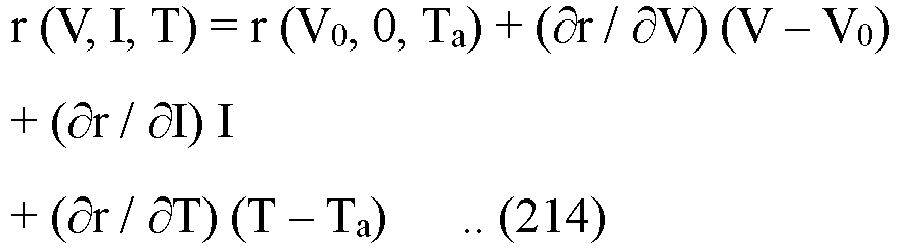
- The voltage V, the current I and the temperature T of the secondary battery in the initial state are measured, and based on the measurement results, a partial derivative (∂r / ∂ps) (s = 1, 2, 3) is calculated for each of various combinations of p = (V, I, T). The partial derivative (∂r / ∂ps) calculated for an arbitrary p as described above is stored or retained as the first initial characteristic model parameter q1 (p) in the first initial characteristic model parameter storage 112. Based on the calculation result of a discrete partial derivative (∂r / ∂ps), the (∂r / ∂ps) for p = (V, I, T) may be approximately represented by a continuous function, and the continuous function may be stored or retained in the first initial characteristic model parameter storage 112 as the first initial characteristic model parameter q1 (p).
- An electrical equivalent circuit model that takes transient response characteristics of the internal resistor into account may be constructed. For example, as illustrated in the upper right area of
FIG. 3 , the internal resistor may be configured by connecting in series a resistor (the resistance value being Rs) and three composite resistors (the impedances being Z1, Z2, and Z3). The first composite resistor is composed of a parallel circuit of a resistor (the resistance value being R0) and an inductor (the inductance being L0). The second composite resistor is composed of a parallel circuit of a resistor (the resistance value being R1) and a capacitor (the capacitance being Ci). The third composite resistor is composed of a parallel circuit of a series circuit of a pair of resistors (the resistance value being R2) and a resistor (the impedance being ZW) and a capacitor (the capacitance being C2). The resistance value r of the internal resistor is defined according to a relational expression (216).

- In this case, a partial derivative (∂Z / ∂pi) (Z = Rs, Z1, Z2, Z3) calculated for an arbitrary p_m = (V_m, I_m, T_m) by approximating each of Rs, Z1, Z2 and Z3 in the same manner as expression (12) may be stored or retained in the first initial characteristic model parameter storage 112 as the first initial characteristic model parameter q1 (V, I, T).
- The second initial characteristic model parameter initial characteristic estimated
value calculating unit 114 reads, from the first initial characteristic model parameter storage 112, the identifier ID of thesecondary battery 220 and the first initial characteristic model parameters q1 corresponding to the present measurement values (V (k), I (k), T (k)) of the plurality of characteristic parameters V, I and T. The second initial characteristic model parameter initial characteristic estimatedvalue calculating unit 114 calculates the resistance value r of the internal resistor as a present initial characteristic estimated value q2 (0 ← k) of the second initial characteristic model parameter q2 according to a relational expression (218) on the basis of the present measurement values p (k) = (V (k), I (k), T (k)) of the plurality of characteristic parameters of thesecondary battery 220 and the first initial characteristic model parameter q1 (p (k)) based on the present measurement values p (k).

- The first characteristic parameter initial characteristic estimated
value calculating unit 116 calculates the present initial characteristic estimated value V (0 ← k) of the voltage V according to a relational expression (220) on the basis of a reference measurement value V0 (j), which is a measurement value V (j) of the voltage V at a last time point t = j at which a current measurement value I (t) of thesecondary battery 220 was zero, the present measurement value V (k) of the voltage V, and the present initial characteristic estimated value r (0 <— k) of the internal resistor (refer to the relational expression (112)).

- The measurement value V (j) of the voltage V of the
secondary battery 220 is stored or retained in the storage constituting the first characteristic parameter initial characteristic estimatedvalue calculating unit 116. Thereafter, when the current measurement value I (t) of thesecondary battery 220 becomes zero, the measurement value V (j) of the voltage V of thesecondary battery 220 at that time point is saved in the storage as a present electromotive force V0 (k) of the internal power supply in the initial characteristic model. - The first
arithmetic processing element 110 inputs a present measurement value p (k) = (p1 (k), .. pN (k)) of each of a plurality of characteristic parameters p = (p1, .. pN) representing the characteristics of thesecondary battery 220 to the function G representing the initial characteristic model thereby to calculate, as an output G (p (k)) of the initial characteristic model, the present initial characteristic estimated value p1 (0 ← k) of the first characteristic parameter p1 among the plurality of characteristic parameters p. The function G is, for example, a function obtained by substituting the relational expression (122) into the second term of the right side of the relational expression (14). - The first index
value calculating unit 121 calculates, as a first index value F1, the cumulative value or the time integration value of values f (V (k), I (k), T (k)) calculated according to the multivariable function f (p) on the basis of the measurement value p (k) = (V (k), I (k), T (k)) of the characteristic parameter p of the secondary battery 220 (refer to the relational expression (121)). The second indexvalue calculating unit 122 calculates, as a second index value F2, the cumulative value or the time integration value of values f (V (0 <— k), I (k), T (k)) calculated according to the same multivariable function f (V, I, T) on the basis of an initial characteristic estimated value V (0 ← k) of the voltage V, a measurement value I (k) of the current I, and a measurement value T (k) of the temperature T (refer to the relational expression (122)). - In
FIG. 5 , the temporal change mode of the voltage V (the first characteristic parameter p1 (t)) of thesecondary battery 220 in an initial state is indicated by a solid line, and the temporal change mode of the voltage V of thesecondary battery 220 in a degraded state is indicated by a dashed line. As illustrated inFIG. 5 , an arbitrary period may be adopted as a cumulative interval or an integration interval [t1, t2]. An interval in which the elapsed period from the last time point at which the current I became zero is within a predetermined period may be adopted as the cumulative interval. - In place of the function f, the first index value F1 and the second index value F2 may be calculated by accumulating or integrating the value of the function (dependent variable) as with the relational expressions (121) and (122) according to at least one of functions f1 (V), f2 (V, 1) and f3 (V, T) having at least the voltage V (the first characteristic parameter p1) as the main variable thereof.
- The third arithmetic processing element 130 (the degradation degree calculating unit) calculates the degradation degree D (i) of the
secondary battery 220 according to the relational expression (130) on the basis of the first index value F1 (i) and the second index value F2 (i). - A description will be given of the method for determining the degradation state of a target carried out by the degradation state determination device having the configuration described above.
- In the
target equipment 200, thecontrol unit 210 in an energized state determines whether a first condition is satisfied (STEP202 ofFIG. 4 ). As "the first condition," a condition is adopted, in which a request for determining the degradation state of thesecondary battery 220 is received through theinput interface 202 in thetarget equipment 200, in which predetermined application software is started in thetarget equipment 200, or in which a measurement value of a characteristic parameter of thesecondary battery 220 indicates a first change mode. - If it is determined that the first condition is not satisfied (NO in STEP202 of
FIG. 4 ), then processing for determining whether the first condition is satisfied is performed again (STEP202 ofFIG. 4 ). The processing for determining whether the first condition is satisfied (STEP202 ofFIG. 4 ) may be omitted. - If it is determined that the first condition is satisfied (YES in STEP202 of
FIG. 4 ), then the measurement values p (k) = (V (k), I (k), T (k)) of the plurality of characteristic parameters representing the characteristics of thesecondary battery 220 are acquired on the basis of an output signal of the sensor group 222 (STEP204 ofFIG. 4 ). "k" denotes an index that indicates discrete time based on a sampling cycle. The voltage V of thesecondary battery 220 is measured as the first characteristic parameter p1. The current I (including charging current and discharging current) of thesecondary battery 220 is measured as the second characteristic parameter p2. The temperature T of the secondary battery 220 (the ambient temperature or the surface temperature of the housing) is measured as the third characteristic parameter p3. In the process of the measurement, the measurement value V (j) of the voltage V at the last time point at which the current I became zero, t = j, is stored or retained in the memory as the reference measurement value V0 (j). - Subsequently, it is determined by the
control unit 210 whether a second condition is satisfied (STEP206 ofFIG. 4 ). As "the second condition," a condition is adopted, in which a second time point is reached after predetermined time elapses from the first time point at which it is determined last that the first condition is satisfied, in which the cumulative value from the first time point of the data indicating the measurement results of the characteristic parameter p (k) reaches a threshold value, or in which the measurement value of a characteristic parameter of thesecondary battery 220 measured by thesensor group 222 indicates a second change mode. - If it is determined that the second condition is not satisfied (NO in STEP206 of
FIG. 4 ), then the index k is incremented by 1 (STEP208 ofFIG. 4 ), and then a measurement value ps (k) of each characteristic parameter ps (s = 1, 2, 3) is acquired (STEP204 ofFIG. 4 ). At this time, a present time series Ps (i) = {ps (i) | i = k, k+1, ..} of the measurement value ps (k) of the characteristic parameter ps is cumulatively stored or retained in the memory. - If it is determined that the second condition is satisfied (YES in STEP206 of
FIG. 4 ), then the present time series Ps (i) of the measurement values ps (k) of the characteristic parameters ps is transmitted from thetarget equipment 200 to the degradationstate determination device 100 by a transmission device constituting the output interface 204 (STEP210 ofFIG. 4 ). At this time, the identifier ID for identifying the specifications or the type of thesecondary battery 220 and the reference measurement value V0 (j) of the voltage V are also transmitted to the degradationstate determination device 100 from thetarget equipment 200. When the transmission is performed, an index i is incremented by 1 (STEP212 ofFIG. 4 ), and then the processing after the determination whether the first condition is satisfied is performed again (refer to STEP202 → STEP204 → .. STEP210 ofFIG. 4 ). - The processing for determining whether the second condition is satisfied (STEP206 of
FIG. 4 ) may be omitted, and the present measurement value ps (k) of the characteristic parameters ps may be sequentially transmitted together with the identifier ID and the reference measurement value V0 (j) of the voltage V to the degradationstate determination device 100 from thetarget equipment 200. - In the degradation
state determination device 100, aninput interface 202 receives the present time series Ps (i) of the measurement values of the characteristic parameters ps (k), the identifier ID, and the reference measurement value V (j) of the voltage V (STEP 102 ofFIG. 4 ). - The first arithmetic processing element 110 (the second initial characteristic model parameter calculating unit 114) reads, from the memory (the first initial characteristic model parameter storage 112 in
FIG. 2 ), the identifier ID and the first initial characteristic model parameters q1 (p (k)) corresponding to the measurement value p (k) of the characteristic parameter p (STEP104 ofFIG. 4 ). The first initial characteristic model parameter q1 is the partial derivative (∂r / ∂ps) in the foregoing relational expression (12). - The first arithmetic processing element 110 (the second initial characteristic model parameter calculating unit 114) calculates, as the second initial characteristic model parameter q2 (0 ← k), the present initial characteristic estimated value r (0 ← k) of the resistance value r of the internal resistor of the secondary battery in an initial state model according to the relational expression (122) on the basis of the present measurement value p (k) of the characteristic parameter p of the
secondary battery 220 and the first initial characteristic model parameter q1 (p (k)) (STEP 106 ofFIG. 4 ). - The first arithmetic processing element 110 (the first characteristic parameter initial characteristic estimated value calculating unit 116) calculates the present initial characteristic estimated value V (0 <— k) of the voltage V according to the relational expression (220) on the basis of the reference measurement value V0 (j) of the voltage V, the present measurement value I (k) of the current I, and the present initial characteristic estimated value r (0 <— k) of the resistance value r of the internal resistor in an initial model (STEP 108 of
FIG. 4 ). - The second arithmetic processing element 120 (the first index value calculating unit 121) calculates the first index value F1 (i) according to, for example, the relational expression (121) on the basis of at least the present time series V (i) of the measurement value V (k) of the voltage V as the first characteristic parameter p1 (STEP 110 of
FIG. 4 ). The second arithmetic processing element 120 (the second index value calculating unit 122) calculates the second index value F2 (i) according to, for example, the relational expression (122) on the basis of at least the present time series V (i) of the measurement value V (k) of the voltage V as the first characteristic parameter p1 (STEP110 ofFIG. 4 ). - The third arithmetic processing element 130 (the degradation degree calculating unit) calculates the degradation degree D (i) of the
secondary battery 220 according to, for example, the relational expression (130) on the basis of the first index value F1 (i) and the second index value F2 (i) (STEP 112 ofFIG. 4 ). - The third
arithmetic processing element 130 generates degradation diagnosis information Inf (D (i)) based on the degradation degree D (i) of the secondary battery 220 (STEP114 ofFIG. 4 ). The diagnosis information Inf (D (i)) is transmitted from the degradationstate determination device 100 to thetarget equipment 200 by the transmission device constituting the output element 104 (STEP116 ofFIG. 4 ). - In the
target equipment 200, a receiving device constituting theinput interface 202 receives the degradation diagnosis information Inf (D (i)) (STEP222 ofFIG. 4 ). The degradation diagnosis information Inf (D (i)) is output to and displayed on a display device constituting the output interface 204 (STEP224 ofFIG. 4 ). Thus, as illustrated in, for example,FIG. 6 , a graph indicating the degradation degree D (i) of thesecondary battery 220 is displayed, and also a message related to a resolution method based on the degradation degree D (i), such as "Degradation degree of battery is 30%. Replacement in 150 days is recommended," is displayed on the display device. - According to the degradation state determination device and the degradation state determination method, the measurement of the characteristic parameter p at the initial time point and during the initial period of the
secondary battery 220, the degradation state of which is to be determined, is omitted, and the degradation state of thesecondary battery 220 is determined on the basis of the measurement results of the characteristic parameter p during a present period t = t1 ~ t2 having arbitrary start and end points, as illustrated inFIG. 5 andFIG. 7 . This makes it possible to shorten the period required for determining the degradation state of thesecondary battery 220. - On the other hand, according to the prior art, in order to determine the degradation state of the
secondary battery 220, it is required to use the present time series of the measurement values of the characteristic parameters p = (V, I, T) of thesecondary battery 220 during a certain period t = tx1 ~ tx2 in addition to the past time series of the measurement values of the characteristic parameters p = (V, I, T) of thesecondary battery 220 during a certain period t = t01 ~ t02 before the present time (e.g., an initial state), as illustrated inFIG. 8 . - The degradation state determination method for the
secondary battery 220 in the foregoing embodiment may be applied to each of a plurality of secondary batteries (cells) which constitute one or common secondary battery module (e.g., a battery) and which share the same specifications. - For each of a plurality of secondary batteries constituting a common secondary battery module, the present measurement values p (k) of a plurality of characteristic parameters p may be measured in each of a plurality of periods that do not mutually overlap. A case will be discussed, in which the characteristic parameter p (the voltage V as the first characteristic parameter p1 in this case) of each of a first to a fourth secondary batteries constituting a secondary battery module changes as illustrated in
FIG. 9 . Here, for the purpose of ease of looking at the curves of the four characteristic parameters p, the four curves are illustrated, being shifted in the direction of the vertical axis, and therefore, it does not mean that the value of the first characteristic parameter p1 of the first secondary battery is steadily higher than those of the other secondary batteries. - In this case, control is performed such that the measurement periods of the characteristic parameters p of the secondary batteries are not mutually overlapped. The start point of the measurement period of the characteristic parameter p of a {mod (n, 4) + 1 }-th secondary battery (n = 1, 2, 3 or 4) is later than the end point of the measurement period of the characteristic parameter p of an n-th secondary battery. Further, the degradation state of each secondary battery is determined according to the foregoing procedure (refer to
FIG. 4 ). The same applies to cases where the number of secondary batteries constituting a secondary battery module is less than or more than four. - In the foregoing other embodiment, the degradation state may be determined on the single secondary battery or each of the plurality of secondary batteries constituting a degraded secondary battery group having a predetermined value or more of the degradation degree D (i), which indicates the degradation state, among the plurality of secondary batteries constituting the single secondary battery module. In other words, among the plurality of secondary batteries constituting the secondary battery module, the degradation state of a secondary battery having a relatively higher degradation degree is determined with priority given to the remaining secondary batteries.
- 100 .. degradation state determination device; 102 .. input element; 104 .. output element; 110 .. first arithmetic processing element; 112 .. first initial characteristic model parameter storage; 114 .. second initial characteristic model parameter initial characteristic estimated value calculating unit; 116 .. first characteristic parameter initial characteristic estimated value calculating unit; 120 .. second arithmetic processing element; 121 .. first index value calculating unit; 122 .. second index value calculating unit; 130 .. third arithmetic processing element (degradation degree calculating unit); 200 .. target equipment; 202 .. input interface; 204 .. output interface; 210 .. control unit; 220.. secondary battery; and 222 .. sensor group.
Claims (6)
- A degradation state determination device comprising:a first arithmetic processing element, a second arithmetic processing element,and a third arithmetic processing element; each of the first arithmetic processing element, the second arithmetic processing element, and the third arithmetic processing element being composed of a processor,an input element that receives a measurement value of each of the plurality of characteristic parameters (V(k), I(k)) of a voltage (V) and a current (I) of a secondary battery at a determination time point (k) from target equipment in which the secondary battery is mounted; andan output element that transmits, to the target equipment, degradation diagnosis information representing a degradation degree (D) calculated by the third arithmetic processing element whereinthe first arithmetic processing element obtains a measurement value of each of the voltage (V) and the current (I) of the secondary battery as a plurality of characteristic parameters representing characteristics of the secondary battery based on an output of each of a voltage sensor and a current sensor connected to the secondary battery,characterized in that the first arithmetic processing element calculates- an initial characteristic estimated value (V(0←k)) according to an initial characteristic model and based on present measurement value (V(k), I(k)) at a determination time point (k) of each of the plurality of characteristic parameters (V, I), the initial characteristic estimated value (V(0←k)) being a value at a past initial time point (0) before the determination time point (k) of the voltage (V) as a first characteristic parameter among the plurality of characteristic parameters (V, I) as an output of the initial characteristic model, the initial characteristic model being defined by a multivariable function (G) having the plurality of characteristic parameters (V, I) as main variables and representing an initial characteristic model representing an initial characteristic of a reference secondary battery having same specifications as those of the secondary battery- a second initial characteristic model parameter ((∂r/∂V)V=V (0←k), (∂r/∂I)I=I(0← k)) representing an initial characteristic of an internal resistor (r) of the secondary battery based on a present measurement value of at least one characteristic parameter (V(k), I(k)) among the plurality of parameters (V, I),- a first initial characteristic model parameter ((∂r/∂V)V=V (k), (∂r/∂I)I=I(k)) representing an initial characteristic of an internal resistor (r) of the reference secondary battery,- a present initial characteristic estimated value (V(0←k)) of the voltage (V) as the first characteristic parameter based on a present measurement value (I(k)) of the current (I) as a second characteristic parameter that is different from the first characteristic parameter (V) and a present calculated value of the second initial characteristic model parameter ((∂r/∂V)V=V (0←k), (∂r/∂I)I=I(0←k)), and- a present initial characteristic estimated value (V(0←k)) of the voltage (V) as the first characteristic parameter based on a reference measurement value (V(j)) of the voltage (V) as the first characteristic parameter at a reference time (j) as a latest time point at which a measurement value of the current (I) as the second characteristic parameter was zero in addition to the present measurement value (I(k)) of the current (I) as the second characteristic parameter, and the present calculated value of the second initial characteristic model parameter ((∂r/∂V)v=v (0←k), (∂r/∂I)I=I(0←k));the second arithmetic processing element calculates a value (f(V(k))) of a specified function (f) having the first characteristic parameter (V) as a main variable based on the measurement value (V(k)) of the first characteristic parameter obtained by the first arithmetic processing element, to calculate a cumulative value (Σ1f(V(k)) or an integral value of a value of the specified function (f) during a period of determination including the determination time point of determination (k), as a first index value (F1) indicating a present state of the secondary battery, and calculates a value (f(V(0←k))) of the specified function (f) based on the initial characteristic estimated value (V(0←k)) of the first characteristic parameter calculated by the first arithmetic processing element, to calculate a cumulative value (Σ1f(V(0←k)) or an integral value during a period of determination of a value (f(V(0←k)) of the specified function (f), as a second index value (F2) indicating an initial state of the secondary battery; andthe third arithmetic processing element calculates a degradation degree (D) of the secondary battery according to an expression for calculating the degradation degree to be higher with reference to an initial state of the secondary battery as a deviation between the first index value (F1) and the second index value (F2) calculated by the second arithmetic processing element is larger.
- The degradation state determination device according to claim 1,
wherein the second arithmetic processing element calculates a cumulative value (Σ1f(V(k)) or an integral value of a value of the specified function (f) based on the measurement value (V(k)) of the first characteristic parameter during the period of determination from the reference time (j) to the elapse of a specified period, as the first index value (F1) and calculates a cumulative value (Σ1f(V(0←k)) or an integral value of a value (f(V(0←k)) of the specified function (f) based on the initial characteristic estimated value (V(0←k)) of the first characteristic parameter calculated by the first arithmetic processing element during the period of determination from the reference time (j) to the elapse of the specified period, as the second index value (F2). - The degradation state determination device according to claim 1,wherein the first arithmetic processing element inputs, to the initial characteristic model, a present measurement value (V(k), I(k)) of each of the plurality of characteristic parameters (V, I) in each of a plurality of periods of determination that do not mutually overlap for each of a plurality of secondary batteries which constitute a single secondary battery module and which have the same specifications, thereby calculating an initial characteristic estimated value (V(0←k)) of the voltage (V) as the first characteristic parameter according to the multivariable function (G) defining the initial characteristic model, andthe second arithmetic processing element calculates, for each of the plurality of secondary batteries, a cumulative value (Σ1f(V(k)) or an integral value of a value of the specified function (f) based on the measurement value (V(k)) of the first characteristic parameter during each of the periods of determination from the reference time (j) to the elapse of a specified period, as the first index values (F1), and calculates a cumulative value (Σ1f(V(0←k)) or an integral value of a value (f(V(0←k)) of the specified function (f) based on the initial characteristic estimated value (V(0←k)) of the first characteristic parameter calculated by the first arithmetic processing element during each of the periods of determination from the reference time (j) to the elapse of the specified period, as the second index values (F2), andthe third arithmetic processing element determines, for each of the plurality of secondary batteries, a degradation degree (D) based on the first index values (F1) and the second index values (F2) calculated by the second arithmetic processing element.
- The degradation state determination device according to claim 3,wherein the first arithmetic processing element calculates the initial characteristic estimated value V(0←k) of the voltage (V) as the first characteristic parameter for a single secondary battery or each of the plurality of secondary batteries constituting a degraded secondary battery group having a degradation degree (D) calculated by the third arithmetic processing element equal to or more than a predetermined value among the plurality of secondary batteries,the second arithmetic processing element calculates the first index value (F1) and the second index value (F2) for a single secondary battery or each of the plurality of secondary batteries constituting the degraded secondary battery group, andthe third arithmetic processing element calculates, for a single secondary battery or each of the plurality of secondary batteries constituting the degraded secondary battery group, a degradation degree (D) based on the first index value (F1) and the second index value (F2) calculated by the second arithmetic processing element.
- A computer implemented degradation state determination method that performs:first arithmetic processing for obtaining a measurement value of each of a voltage (V) and a current (I) as a plurality of characteristic parameters representing characteristics of a secondary battery based on an output of each of a voltage sensor and a current sensor connected to the secondary battery, and calculating- an initial characteristic estimated value (V(0←k)) according to an initial characteristic model and based on present measurement value (V(k), I(k)) at a determination time point (k) of each of the plurality of characteristic parameters (V, I), the initial characteristic estimated value (V(0←k)) being a value at a past initial time point (0) before the determination time point (k) of the voltage (V) as a first characteristic parameter among the plurality of characteristic parameters (V, I) as an output of the initial characteristic model, the initial characteristic model being defined by a multivariable function (G) having the plurality of characteristic parameters (V, I) as main variables and representing an initial characteristic model representing an initial characteristic of a reference secondary battery having same specifications as those of the secondary battery- a second initial characteristic model parameter ((∂r/∂V)V=V (0←k), (∂r/∂I)I=I(0← k)) representing an initial characteristic of an internal resistor (r) of the secondary battery based on a present measurement value of at least one characteristic parameter (V(k), I(k)) among the plurality of parameters (V, I), and a first initial characteristic model parameter ((∂r/∂V)V=V (k), (∂r/∂I)I=I(k)) representing an initial characteristic of an internal resistor (r) of the reference secondary battery,- a present initial characteristic estimated value (V(0←k)) of the voltage (V) as the first characteristic parameter based on a present measurement value (I(k)) of the current (I) as a second characteristic parameter that is different from the first characteristic parameter (V), and a present calculated value of the second initial characteristic model parameter ((∂r/∂V)V=V (0←k), (∂r/∂I)I=I(0←k)), and- a present initial characteristic estimated value (V(0←k)) of the voltage (V) as the first characteristic parameter based on a reference measurement value (V(j)) of the voltage (V) as the first characteristic parameter at a reference time (j) as a latest time point at which a measurement value of the current (I) as the second characteristic parameter was zero in addition to the present measurement value (I(k)) of the current (I) as the second characteristic parameter and the present calculated value of the second initial characteristic model parameter ((∂r/∂V)V=V (0←k), (∂r/∂I)I=I(0←k));second arithmetic processing for calculating a value (f(V(k))) of a specified function (f) having the first characteristic parameter (V) as a main variable based on the measurement value (V(k)) of the first characteristic parameter obtained by the first arithmetic processing element, to calculate a cumulative value (Σ1f(V(k)) or an integral value of a value of the specified function (f) during a period of determination including the determination time point of determination (k), as a first index value (F1), which indicates a present state of the secondary battery, and also for calculating a value (f(V(0←k))) of the specified function (f) based on the initial characteristic estimated value (V(0←k)) of the first characteristic parameter calculated by the first arithmetic processing, to calculate a cumulative value (Σ1f(V(0←k)) or an integral value during a period of determination of a value (f(V(0←k)) of the specified function (f), as a second index value (F2), which indicates an initial state of the secondary battery; andthird arithmetic processing for calculating a degradation degree (D) of the secondary battery according to an expression for calculating the degradation degree to be higher with reference to an initial state of the secondary battery as a deviation between the first index value (F1) and the second index value (F2) calculated by the second arithmetic processing is larger.
- A computer program comprising instructions which, when transmitted by a server to the degradation state determination device of any one of claims 1 to 4 and when executed by the degradation state determination device, cause the degradation state determination device to carry out the method of claim 5.
Priority Applications (1)
| Application Number | Priority Date | Filing Date | Title |
|---|---|---|---|
| HRP20230478TT HRP20230478T1 (en) | 2018-03-28 | 2018-10-12 | Degradation state determination device and degradation state determination method |
Applications Claiming Priority (2)
| Application Number | Priority Date | Filing Date | Title |
|---|---|---|---|
| JP2018061133 | 2018-03-28 | ||
| PCT/JP2018/038056 WO2019187264A1 (en) | 2018-03-28 | 2018-10-12 | Degradation state determination device and degradation state determination method |
Publications (3)
| Publication Number | Publication Date |
|---|---|
| EP3780248A1 EP3780248A1 (en) | 2021-02-17 |
| EP3780248A4 EP3780248A4 (en) | 2022-01-12 |
| EP3780248B1 true EP3780248B1 (en) | 2023-03-29 |
Family
ID=68061084
Family Applications (1)
| Application Number | Title | Priority Date | Filing Date |
|---|---|---|---|
| EP18912371.4A Active EP3780248B1 (en) | 2018-03-28 | 2018-10-12 | Degradation state determination device and degradation state determination method |
Country Status (10)
| Country | Link |
|---|---|
| US (1) | US11085971B2 (en) |
| EP (1) | EP3780248B1 (en) |
| JP (5) | JP6745554B2 (en) |
| KR (1) | KR102237565B1 (en) |
| CN (1) | CN111902996B (en) |
| CA (1) | CA3095272C (en) |
| DK (1) | DK3780248T3 (en) |
| HR (1) | HRP20230478T1 (en) |
| TW (1) | TWI754109B (en) |
| WO (1) | WO2019187264A1 (en) |
Families Citing this family (14)
| Publication number | Priority date | Publication date | Assignee | Title |
|---|---|---|---|---|
| CN110927606B (en) * | 2019-11-05 | 2022-01-25 | 腾讯科技(深圳)有限公司 | Battery state monitoring method and device |
| JP7457939B2 (en) * | 2019-11-29 | 2024-03-29 | パナソニックIpマネジメント株式会社 | management system |
| JP6842212B1 (en) | 2019-12-26 | 2021-03-17 | 東洋システム株式会社 | Battery performance evaluation method and battery performance evaluation device |
| JP6842213B1 (en) * | 2019-12-27 | 2021-03-17 | 東洋システム株式会社 | Simulated battery construction method and simulated battery construction device |
| JP6887700B1 (en) * | 2020-01-20 | 2021-06-16 | 東洋システム株式会社 | Battery performance evaluation device, electronic device, charger and battery performance evaluation method |
| JP6944208B2 (en) * | 2020-01-20 | 2021-10-06 | 東洋システム株式会社 | Charger |
| JP6997473B2 (en) * | 2020-04-13 | 2022-02-04 | 東洋システム株式会社 | Secondary battery inspection method and secondary battery inspection device |
| KR102869261B1 (en) * | 2020-04-24 | 2025-10-14 | 셴젠 인왕 인텔리전트 테크놀러지 컴퍼니 리미티드 | Battery detection method and device |
| JP7214253B2 (en) | 2021-05-12 | 2023-01-30 | 東洋システム株式会社 | BATTERY PERFORMANCE EVALUATION DEVICE AND BATTERY PERFORMANCE EVALUATION METHOD |
| JP7266907B2 (en) * | 2021-08-06 | 2023-05-01 | 東洋システム株式会社 | BATTERY PERFORMANCE EVALUATION DEVICE AND BATTERY PERFORMANCE EVALUATION METHOD |
| JP7361750B2 (en) * | 2021-12-09 | 2023-10-16 | 本田技研工業株式会社 | fuel cell system |
| JP7276928B1 (en) | 2022-03-29 | 2023-05-18 | 東洋システム株式会社 | Secondary battery capacity estimation system |
| JP7426439B2 (en) * | 2022-06-13 | 2024-02-01 | 株式会社トヨタシステムズ | Battery deterioration determination system, battery deterioration determination device, and battery deterioration determination method |
| CN115859579B (en) * | 2022-11-18 | 2025-10-21 | 宁德时代新能源科技股份有限公司 | Fault assessment method, device, storage medium and electrical device |
Family Cites Families (39)
| Publication number | Priority date | Publication date | Assignee | Title |
|---|---|---|---|---|
| TW298621B (en) * | 1994-05-31 | 1997-02-21 | Omron Tateisi Electronics Co | A batting life tester and method of testing the batting life |
| JPH11285155A (en) * | 1998-03-27 | 1999-10-15 | Suzuki Motor Corp | Battery replacement time determination device, deterioration degree display device, and storage medium storing battery performance measurement data |
| JP3868692B2 (en) * | 2000-02-21 | 2007-01-17 | 矢崎総業株式会社 | Battery deterioration degree determination apparatus and recording medium recording deterioration degree calculation program in battery deterioration degree determination apparatus |
| JP2005037230A (en) | 2003-07-14 | 2005-02-10 | Toyota Motor Corp | Battery degradation detection apparatus and method |
| JP4638195B2 (en) * | 2004-09-28 | 2011-02-23 | 富士重工業株式会社 | Battery degradation degree estimation device |
| JP4661457B2 (en) | 2005-08-24 | 2011-03-30 | 日産自動車株式会社 | Detection method of internal resistance of secondary battery |
| JP5220269B2 (en) * | 2005-09-16 | 2013-06-26 | 古河電気工業株式会社 | Method and apparatus for detecting deterioration / charge state of storage battery |
| WO2007032382A1 (en) * | 2005-09-16 | 2007-03-22 | The Furukawa Electric Co., Ltd | Secondary cell degradation judgment method, secondary cell degradation judgment device, and power supply system |
| JP4969179B2 (en) * | 2006-08-23 | 2012-07-04 | 中国電力株式会社 | Distribution line remote monitoring control system, battery deterioration diagnosis device and method |
| JP2009071986A (en) | 2007-09-13 | 2009-04-02 | Fuji Heavy Ind Ltd | In-vehicle battery deterioration degree calculation device |
| JP4649682B2 (en) | 2008-09-02 | 2011-03-16 | 株式会社豊田中央研究所 | Secondary battery state estimation device |
| JP2010230469A (en) * | 2009-03-27 | 2010-10-14 | Calsonic Kansei Corp | Device and method for determining state of health of secondary battery |
| JP4744622B2 (en) * | 2009-07-01 | 2011-08-10 | トヨタ自動車株式会社 | Vehicle control device |
| WO2011125213A1 (en) * | 2010-04-09 | 2011-10-13 | トヨタ自動車株式会社 | Secondary battery degradation determination device and degradation determination method |
| AU2010354957B2 (en) * | 2010-06-07 | 2014-04-17 | Mitsubishi Electric Corporation | Charge status estimation apparatus |
| JP5341823B2 (en) * | 2010-06-07 | 2013-11-13 | トヨタ自動車株式会社 | Lithium ion secondary battery degradation judgment system and degradation judgment method |
| JP5343168B2 (en) | 2010-06-24 | 2013-11-13 | パナソニック株式会社 | Method and system for obtaining the degree of battery degradation |
| WO2013014930A1 (en) * | 2011-07-28 | 2013-01-31 | 三洋電機株式会社 | Battery system, battery control device, electric vehicle, mobile body, and power source device |
| JP5694088B2 (en) * | 2011-08-23 | 2015-04-01 | トヨタ自動車株式会社 | Secondary battery deterioration management system |
| JP5772615B2 (en) | 2011-11-14 | 2015-09-02 | トヨタ自動車株式会社 | Power storage system |
| US20150115969A1 (en) * | 2012-03-02 | 2015-04-30 | Hitachi Solutions, Ltd. | Storage battery analysis system, storage battery analysis method and storage battery analysis program |
| JP6182588B2 (en) * | 2013-02-19 | 2017-08-16 | 古河電気工業株式会社 | Secondary battery deterioration determination method and secondary battery deterioration determination device |
| US9500538B2 (en) * | 2013-03-14 | 2016-11-22 | Google Inc. | Method and apparatus for determining a thermal state of a battery taking into account battery aging |
| JP5810116B2 (en) * | 2013-03-14 | 2015-11-11 | 古河電気工業株式会社 | Secondary battery state detection device and secondary battery state detection method |
| WO2014185163A1 (en) | 2013-05-16 | 2014-11-20 | 日本電気株式会社 | Cell state-maintaining device, cell state management system, cell, method for maintaining cell state, and program |
| KR101509001B1 (en) * | 2013-10-31 | 2015-04-07 | 현대모비스 주식회사 | Apparatus and Method Deciding Degradation of High Voltage Battery for Vehicle |
| JP6244850B2 (en) * | 2013-11-21 | 2017-12-13 | 日産自動車株式会社 | Battery pack and battery deterioration detection device |
| JPWO2016059869A1 (en) * | 2014-10-17 | 2017-04-27 | 株式会社東芝 | Secondary battery charge state estimation apparatus and charge state estimation method thereof |
| JP6593769B2 (en) * | 2015-03-09 | 2019-10-23 | 中国電力株式会社 | Storage battery remaining life estimation method, storage battery check date determination method, storage battery remaining life estimation device, and storage battery remaining life estimation system |
| JP6626356B2 (en) * | 2015-03-18 | 2019-12-25 | 積水化学工業株式会社 | Secondary battery deterioration detection system, secondary battery deterioration detection method |
| JP6461684B2 (en) * | 2015-04-03 | 2019-01-30 | プライムアースEvエナジー株式会社 | Battery control device, battery control method, and determination method of lower limit voltage |
| US10353007B2 (en) * | 2015-05-28 | 2019-07-16 | Mitsubishi Electric Corporation | Rechargeable battery parameter estimation apparatus and rechargeable battery parameter estimation method for calculating first and second coefficients which are partial derivatives of an estimated value of the battery state-of-charge |
| JP6161133B2 (en) | 2015-07-02 | 2017-07-12 | 学校法人同志社 | Data extraction apparatus, data extraction method, and data extraction program |
| WO2017038749A1 (en) * | 2015-08-31 | 2017-03-09 | 日立化成株式会社 | Degradation diagnosis device, degradation diagnosis method, and degradation diagnosis system for batteries |
| US10114079B2 (en) * | 2016-02-24 | 2018-10-30 | Ford Global Technologies, Llc | System and method for identifying vehicle battery decay |
| JP6615011B2 (en) | 2016-03-09 | 2019-12-04 | 日立オートモティブシステムズ株式会社 | Battery management system, battery system and hybrid vehicle control system |
| JP6699391B2 (en) | 2016-06-22 | 2020-05-27 | 株式会社リコー | Status output device, status output program, and status output method |
| JP2018029430A (en) * | 2016-08-17 | 2018-02-22 | トヨタ自動車株式会社 | Electric vehicle |
| CN110476072B (en) * | 2017-03-29 | 2022-11-04 | 株式会社杰士汤浅国际 | Degradation estimating device, degradation estimating method, and recording medium |
-
2018
- 2018-10-12 DK DK18912371.4T patent/DK3780248T3/en active
- 2018-10-12 CA CA3095272A patent/CA3095272C/en active Active
- 2018-10-12 EP EP18912371.4A patent/EP3780248B1/en active Active
- 2018-10-12 WO PCT/JP2018/038056 patent/WO2019187264A1/en not_active Ceased
- 2018-10-12 KR KR1020207031033A patent/KR102237565B1/en active Active
- 2018-10-12 CN CN201880091858.XA patent/CN111902996B/en active Active
- 2018-10-12 US US17/042,472 patent/US11085971B2/en active Active
- 2018-10-12 HR HRP20230478TT patent/HRP20230478T1/en unknown
- 2018-10-12 JP JP2019569847A patent/JP6745554B2/en active Active
- 2018-10-23 TW TW107137316A patent/TWI754109B/en active
-
2020
- 2020-07-22 JP JP2020125818A patent/JP7201254B2/en active Active
- 2020-07-22 JP JP2020125817A patent/JP7201253B2/en active Active
- 2020-07-22 JP JP2020125816A patent/JP7195633B2/en active Active
- 2020-07-22 JP JP2020125815A patent/JP7160370B2/en active Active
Also Published As
| Publication number | Publication date |
|---|---|
| JP2020191780A (en) | 2020-11-26 |
| WO2019187264A1 (en) | 2019-10-03 |
| JP2020191778A (en) | 2020-11-26 |
| TW201942590A (en) | 2019-11-01 |
| JP7195633B2 (en) | 2022-12-26 |
| KR20200128170A (en) | 2020-11-11 |
| JP7160370B2 (en) | 2022-10-25 |
| JP2020198780A (en) | 2020-12-10 |
| JP7201253B2 (en) | 2023-01-10 |
| JP6745554B2 (en) | 2020-08-26 |
| CA3095272A1 (en) | 2019-10-03 |
| JP2020191779A (en) | 2020-11-26 |
| HRP20230478T1 (en) | 2023-07-21 |
| CN111902996B (en) | 2022-05-06 |
| TWI754109B (en) | 2022-02-01 |
| US20210028510A1 (en) | 2021-01-28 |
| CN111902996A (en) | 2020-11-06 |
| KR102237565B1 (en) | 2021-04-07 |
| DK3780248T3 (en) | 2023-05-22 |
| JP7201254B2 (en) | 2023-01-10 |
| CA3095272C (en) | 2021-11-30 |
| US11085971B2 (en) | 2021-08-10 |
| JPWO2019187264A1 (en) | 2020-04-30 |
| EP3780248A1 (en) | 2021-02-17 |
Similar Documents
| Publication | Publication Date | Title |
|---|---|---|
| EP3780248A1 (en) | Degradation state determination device and degradation state determination method | |
| US11982720B2 (en) | Method and battery management system for ascertaining a state of health of a secondary battery | |
| CN110346725B (en) | Construction method, evaluation method and device of battery health degree evaluation model | |
| CN104890526B (en) | Vehicles, systems and methods | |
| JP6555773B2 (en) | Storage power remaining amount estimation device, method for estimating remaining power storage amount of storage battery, and computer program | |
| EP3896776B1 (en) | Simulated battery construction method and simulated battery construction device | |
| KR102862817B1 (en) | Battery performance evaluation device and battery performance evaluation method | |
| KR102648764B1 (en) | Battery performance evaluation method and battery performance evaluation device | |
| EP4354165A1 (en) | Battery performance evaluation device and battery performance evaluation method | |
| JP6997483B2 (en) | Simulated battery control system including charger and simulated battery control method | |
| US20220058892A1 (en) | Battery diagnostic device, battery diagnostic method, battery diagnostic program, and vehicle | |
| CN114594391A (en) | Method and apparatus for predicting the aging state of a device battery in a battery-operated device |
Legal Events
| Date | Code | Title | Description |
|---|---|---|---|
| REG | Reference to a national code |
Ref country code: HR Ref legal event code: TUEP Ref document number: P20230478T Country of ref document: HR |
|
| STAA | Information on the status of an ep patent application or granted ep patent |
Free format text: STATUS: THE INTERNATIONAL PUBLICATION HAS BEEN MADE |
|
| PUAI | Public reference made under article 153(3) epc to a published international application that has entered the european phase |
Free format text: ORIGINAL CODE: 0009012 |
|
| STAA | Information on the status of an ep patent application or granted ep patent |
Free format text: STATUS: REQUEST FOR EXAMINATION WAS MADE |
|
| 17P | Request for examination filed |
Effective date: 20200930 |
|
| AK | Designated contracting states |
Kind code of ref document: A1 Designated state(s): AL AT BE BG CH CY CZ DE DK EE ES FI FR GB GR HR HU IE IS IT LI LT LU LV MC MK MT NL NO PL PT RO RS SE SI SK SM TR |
|
| AX | Request for extension of the european patent |
Extension state: BA ME |
|
| DAV | Request for validation of the european patent (deleted) | ||
| DAX | Request for extension of the european patent (deleted) | ||
| A4 | Supplementary search report drawn up and despatched |
Effective date: 20211209 |
|
| RIC1 | Information provided on ipc code assigned before grant |
Ipc: G01R 31/367 20190101ALI20211203BHEP Ipc: G01R 31/36 20200101ALI20211203BHEP Ipc: H01M 10/48 20060101AFI20211203BHEP |
|
| RIC1 | Information provided on ipc code assigned before grant |
Ipc: H01M 50/569 20210101ALI20220913BHEP Ipc: G01R 31/367 20190101ALI20220913BHEP Ipc: G01R 31/36 20200101ALI20220913BHEP Ipc: H01M 10/48 20060101AFI20220913BHEP |
|
| GRAP | Despatch of communication of intention to grant a patent |
Free format text: ORIGINAL CODE: EPIDOSNIGR1 |
|
| STAA | Information on the status of an ep patent application or granted ep patent |
Free format text: STATUS: GRANT OF PATENT IS INTENDED |
|
| INTG | Intention to grant announced |
Effective date: 20221024 |
|
| GRAS | Grant fee paid |
Free format text: ORIGINAL CODE: EPIDOSNIGR3 |
|
| GRAA | (expected) grant |
Free format text: ORIGINAL CODE: 0009210 |
|
| STAA | Information on the status of an ep patent application or granted ep patent |
Free format text: STATUS: THE PATENT HAS BEEN GRANTED |
|
| AK | Designated contracting states |
Kind code of ref document: B1 Designated state(s): AL AT BE BG CH CY CZ DE DK EE ES FI FR GB GR HR HU IE IS IT LI LT LU LV MC MK MT NL NO PL PT RO RS SE SI SK SM TR |
|
| REG | Reference to a national code |
Ref country code: CH Ref legal event code: EP |
|
| REG | Reference to a national code |
Ref country code: DE Ref legal event code: R096 Ref document number: 602018047911 Country of ref document: DE |
|
| REG | Reference to a national code |
Ref country code: AT Ref legal event code: REF Ref document number: 1557296 Country of ref document: AT Kind code of ref document: T Effective date: 20230415 |
|
| REG | Reference to a national code |
Ref country code: IE Ref legal event code: FG4D |
|
| REG | Reference to a national code |
Ref country code: DK Ref legal event code: T3 Effective date: 20230516 Ref country code: NO Ref legal event code: T2 Effective date: 20230329 |
|
| REG | Reference to a national code |
Ref country code: SE Ref legal event code: TRGR |
|
| P01 | Opt-out of the competence of the unified patent court (upc) registered |
Effective date: 20230313 |
|
| REG | Reference to a national code |
Ref country code: LT Ref legal event code: MG9D |
|
| REG | Reference to a national code |
Ref country code: HR Ref legal event code: T1PR Ref document number: P20230478 Country of ref document: HR |
|
| PG25 | Lapsed in a contracting state [announced via postgrant information from national office to epo] |
Ref country code: RS Free format text: LAPSE BECAUSE OF FAILURE TO SUBMIT A TRANSLATION OF THE DESCRIPTION OR TO PAY THE FEE WITHIN THE PRESCRIBED TIME-LIMIT Effective date: 20230329 Ref country code: LV Free format text: LAPSE BECAUSE OF FAILURE TO SUBMIT A TRANSLATION OF THE DESCRIPTION OR TO PAY THE FEE WITHIN THE PRESCRIBED TIME-LIMIT Effective date: 20230329 Ref country code: LT Free format text: LAPSE BECAUSE OF FAILURE TO SUBMIT A TRANSLATION OF THE DESCRIPTION OR TO PAY THE FEE WITHIN THE PRESCRIBED TIME-LIMIT Effective date: 20230329 |
|
| REG | Reference to a national code |
Ref country code: NL Ref legal event code: MP Effective date: 20230329 |
|
| PG25 | Lapsed in a contracting state [announced via postgrant information from national office to epo] |
Ref country code: NL Free format text: LAPSE BECAUSE OF FAILURE TO SUBMIT A TRANSLATION OF THE DESCRIPTION OR TO PAY THE FEE WITHIN THE PRESCRIBED TIME-LIMIT Effective date: 20230329 Ref country code: GR Free format text: LAPSE BECAUSE OF FAILURE TO SUBMIT A TRANSLATION OF THE DESCRIPTION OR TO PAY THE FEE WITHIN THE PRESCRIBED TIME-LIMIT Effective date: 20230630 Ref country code: FI Free format text: LAPSE BECAUSE OF FAILURE TO SUBMIT A TRANSLATION OF THE DESCRIPTION OR TO PAY THE FEE WITHIN THE PRESCRIBED TIME-LIMIT Effective date: 20230329 |
|
| REG | Reference to a national code |
Ref country code: HR Ref legal event code: ODRP Ref document number: P20230478 Country of ref document: HR Payment date: 20230928 Year of fee payment: 6 |
|
| PG25 | Lapsed in a contracting state [announced via postgrant information from national office to epo] |
Ref country code: SM Free format text: LAPSE BECAUSE OF FAILURE TO SUBMIT A TRANSLATION OF THE DESCRIPTION OR TO PAY THE FEE WITHIN THE PRESCRIBED TIME-LIMIT Effective date: 20230329 Ref country code: RO Free format text: LAPSE BECAUSE OF FAILURE TO SUBMIT A TRANSLATION OF THE DESCRIPTION OR TO PAY THE FEE WITHIN THE PRESCRIBED TIME-LIMIT Effective date: 20230329 Ref country code: PT Free format text: LAPSE BECAUSE OF FAILURE TO SUBMIT A TRANSLATION OF THE DESCRIPTION OR TO PAY THE FEE WITHIN THE PRESCRIBED TIME-LIMIT Effective date: 20230731 Ref country code: ES Free format text: LAPSE BECAUSE OF FAILURE TO SUBMIT A TRANSLATION OF THE DESCRIPTION OR TO PAY THE FEE WITHIN THE PRESCRIBED TIME-LIMIT Effective date: 20230329 Ref country code: EE Free format text: LAPSE BECAUSE OF FAILURE TO SUBMIT A TRANSLATION OF THE DESCRIPTION OR TO PAY THE FEE WITHIN THE PRESCRIBED TIME-LIMIT Effective date: 20230329 |
|
| PG25 | Lapsed in a contracting state [announced via postgrant information from national office to epo] |
Ref country code: SK Free format text: LAPSE BECAUSE OF FAILURE TO SUBMIT A TRANSLATION OF THE DESCRIPTION OR TO PAY THE FEE WITHIN THE PRESCRIBED TIME-LIMIT Effective date: 20230329 Ref country code: PL Free format text: LAPSE BECAUSE OF FAILURE TO SUBMIT A TRANSLATION OF THE DESCRIPTION OR TO PAY THE FEE WITHIN THE PRESCRIBED TIME-LIMIT Effective date: 20230329 Ref country code: IS Free format text: LAPSE BECAUSE OF FAILURE TO SUBMIT A TRANSLATION OF THE DESCRIPTION OR TO PAY THE FEE WITHIN THE PRESCRIBED TIME-LIMIT Effective date: 20230729 |
|
| REG | Reference to a national code |
Ref country code: AT Ref legal event code: UEP Ref document number: 1557296 Country of ref document: AT Kind code of ref document: T Effective date: 20230329 |
|
| REG | Reference to a national code |
Ref country code: DE Ref legal event code: R097 Ref document number: 602018047911 Country of ref document: DE |
|
| PG25 | Lapsed in a contracting state [announced via postgrant information from national office to epo] |
Ref country code: CZ Free format text: LAPSE BECAUSE OF FAILURE TO SUBMIT A TRANSLATION OF THE DESCRIPTION OR TO PAY THE FEE WITHIN THE PRESCRIBED TIME-LIMIT Effective date: 20230329 |
|
| PLBE | No opposition filed within time limit |
Free format text: ORIGINAL CODE: 0009261 |
|
| STAA | Information on the status of an ep patent application or granted ep patent |
Free format text: STATUS: NO OPPOSITION FILED WITHIN TIME LIMIT |
|
| 26N | No opposition filed |
Effective date: 20240103 |
|
| PG25 | Lapsed in a contracting state [announced via postgrant information from national office to epo] |
Ref country code: SI Free format text: LAPSE BECAUSE OF FAILURE TO SUBMIT A TRANSLATION OF THE DESCRIPTION OR TO PAY THE FEE WITHIN THE PRESCRIBED TIME-LIMIT Effective date: 20230329 |
|
| PG25 | Lapsed in a contracting state [announced via postgrant information from national office to epo] |
Ref country code: SI Free format text: LAPSE BECAUSE OF FAILURE TO SUBMIT A TRANSLATION OF THE DESCRIPTION OR TO PAY THE FEE WITHIN THE PRESCRIBED TIME-LIMIT Effective date: 20230329 Ref country code: MC Free format text: LAPSE BECAUSE OF FAILURE TO SUBMIT A TRANSLATION OF THE DESCRIPTION OR TO PAY THE FEE WITHIN THE PRESCRIBED TIME-LIMIT Effective date: 20230329 |
|
| REG | Reference to a national code |
Ref country code: CH Ref legal event code: PL |
|
| REG | Reference to a national code |
Ref country code: BE Ref legal event code: MM Effective date: 20231031 |
|
| PG25 | Lapsed in a contracting state [announced via postgrant information from national office to epo] |
Ref country code: LU Free format text: LAPSE BECAUSE OF NON-PAYMENT OF DUE FEES Effective date: 20231012 |
|
| GBPC | Gb: european patent ceased through non-payment of renewal fee |
Effective date: 20231012 |
|
| PG25 | Lapsed in a contracting state [announced via postgrant information from national office to epo] |
Ref country code: LU Free format text: LAPSE BECAUSE OF NON-PAYMENT OF DUE FEES Effective date: 20231012 |
|
| PG25 | Lapsed in a contracting state [announced via postgrant information from national office to epo] |
Ref country code: GB Free format text: LAPSE BECAUSE OF NON-PAYMENT OF DUE FEES Effective date: 20231012 |
|
| PG25 | Lapsed in a contracting state [announced via postgrant information from national office to epo] |
Ref country code: CH Free format text: LAPSE BECAUSE OF NON-PAYMENT OF DUE FEES Effective date: 20231031 |
|
| PG25 | Lapsed in a contracting state [announced via postgrant information from national office to epo] |
Ref country code: GB Free format text: LAPSE BECAUSE OF NON-PAYMENT OF DUE FEES Effective date: 20231012 Ref country code: CH Free format text: LAPSE BECAUSE OF NON-PAYMENT OF DUE FEES Effective date: 20231031 |
|
| PG25 | Lapsed in a contracting state [announced via postgrant information from national office to epo] |
Ref country code: BE Free format text: LAPSE BECAUSE OF NON-PAYMENT OF DUE FEES Effective date: 20231031 |
|
| PG25 | Lapsed in a contracting state [announced via postgrant information from national office to epo] |
Ref country code: IE Free format text: LAPSE BECAUSE OF NON-PAYMENT OF DUE FEES Effective date: 20231012 |
|
| REG | Reference to a national code |
Ref country code: HR Ref legal event code: ODRP Ref document number: P20230478 Country of ref document: HR Payment date: 20240924 Year of fee payment: 7 |
|
| PG25 | Lapsed in a contracting state [announced via postgrant information from national office to epo] |
Ref country code: IE Free format text: LAPSE BECAUSE OF NON-PAYMENT OF DUE FEES Effective date: 20231012 |
|
| PG25 | Lapsed in a contracting state [announced via postgrant information from national office to epo] |
Ref country code: BG Free format text: LAPSE BECAUSE OF FAILURE TO SUBMIT A TRANSLATION OF THE DESCRIPTION OR TO PAY THE FEE WITHIN THE PRESCRIBED TIME-LIMIT Effective date: 20230329 |
|
| PG25 | Lapsed in a contracting state [announced via postgrant information from national office to epo] |
Ref country code: BG Free format text: LAPSE BECAUSE OF FAILURE TO SUBMIT A TRANSLATION OF THE DESCRIPTION OR TO PAY THE FEE WITHIN THE PRESCRIBED TIME-LIMIT Effective date: 20230329 |
|
| PG25 | Lapsed in a contracting state [announced via postgrant information from national office to epo] |
Ref country code: CY Free format text: LAPSE BECAUSE OF FAILURE TO SUBMIT A TRANSLATION OF THE DESCRIPTION OR TO PAY THE FEE WITHIN THE PRESCRIBED TIME-LIMIT; INVALID AB INITIO Effective date: 20181012 |
|
| PG25 | Lapsed in a contracting state [announced via postgrant information from national office to epo] |
Ref country code: HU Free format text: LAPSE BECAUSE OF FAILURE TO SUBMIT A TRANSLATION OF THE DESCRIPTION OR TO PAY THE FEE WITHIN THE PRESCRIBED TIME-LIMIT; INVALID AB INITIO Effective date: 20181012 |
|
| PGFP | Annual fee paid to national office [announced via postgrant information from national office to epo] |
Ref country code: HR Payment date: 20250926 Year of fee payment: 8 |
|
| REG | Reference to a national code |
Ref country code: HR Ref legal event code: ODRP Ref document number: P20230478 Country of ref document: HR Payment date: 20250926 Year of fee payment: 8 |
|
| PG25 | Lapsed in a contracting state [announced via postgrant information from national office to epo] |
Ref country code: TR Free format text: LAPSE BECAUSE OF FAILURE TO SUBMIT A TRANSLATION OF THE DESCRIPTION OR TO PAY THE FEE WITHIN THE PRESCRIBED TIME-LIMIT Effective date: 20230329 |
|
| PGFP | Annual fee paid to national office [announced via postgrant information from national office to epo] |
Ref country code: DE Payment date: 20251010 Year of fee payment: 8 |
|
| PGFP | Annual fee paid to national office [announced via postgrant information from national office to epo] |
Ref country code: NO Payment date: 20251028 Year of fee payment: 8 |
|
| PGFP | Annual fee paid to national office [announced via postgrant information from national office to epo] |
Ref country code: AT Payment date: 20251024 Year of fee payment: 8 |
|
| PGFP | Annual fee paid to national office [announced via postgrant information from national office to epo] |
Ref country code: DK Payment date: 20251024 Year of fee payment: 8 Ref country code: IT Payment date: 20251030 Year of fee payment: 8 |
|
| PGFP | Annual fee paid to national office [announced via postgrant information from national office to epo] |
Ref country code: FR Payment date: 20251010 Year of fee payment: 8 |
|
| PGFP | Annual fee paid to national office [announced via postgrant information from national office to epo] |
Ref country code: SE Payment date: 20251024 Year of fee payment: 8 |