EP3780154B1 - Battery module - Google Patents
Battery module Download PDFInfo
- Publication number
- EP3780154B1 EP3780154B1 EP19893593.4A EP19893593A EP3780154B1 EP 3780154 B1 EP3780154 B1 EP 3780154B1 EP 19893593 A EP19893593 A EP 19893593A EP 3780154 B1 EP3780154 B1 EP 3780154B1
- Authority
- EP
- European Patent Office
- Prior art keywords
- cell
- battery
- terrace
- partition wall
- outermost
- Prior art date
- Legal status (The legal status is an assumption and is not a legal conclusion. Google has not performed a legal analysis and makes no representation as to the accuracy of the status listed.)
- Active
Links
Images



Classifications
-
- H—ELECTRICITY
- H01—ELECTRIC ELEMENTS
- H01M—PROCESSES OR MEANS, e.g. BATTERIES, FOR THE DIRECT CONVERSION OF CHEMICAL ENERGY INTO ELECTRICAL ENERGY
- H01M50/00—Constructional details or processes of manufacture of the non-active parts of electrochemical cells other than fuel cells, e.g. hybrid cells
- H01M50/20—Mountings; Secondary casings or frames; Racks, modules or packs; Suspension devices; Shock absorbers; Transport or carrying devices; Holders
- H01M50/204—Racks, modules or packs for multiple batteries or multiple cells
- H01M50/207—Racks, modules or packs for multiple batteries or multiple cells characterised by their shape
- H01M50/213—Racks, modules or packs for multiple batteries or multiple cells characterised by their shape adapted for cells having curved cross-section, e.g. round or elliptic
-
- H—ELECTRICITY
- H01—ELECTRIC ELEMENTS
- H01M—PROCESSES OR MEANS, e.g. BATTERIES, FOR THE DIRECT CONVERSION OF CHEMICAL ENERGY INTO ELECTRICAL ENERGY
- H01M50/00—Constructional details or processes of manufacture of the non-active parts of electrochemical cells other than fuel cells, e.g. hybrid cells
- H01M50/50—Current conducting connections for cells or batteries
- H01M50/502—Interconnectors for connecting terminals of adjacent batteries; Interconnectors for connecting cells outside a battery casing
- H01M50/505—Interconnectors for connecting terminals of adjacent batteries; Interconnectors for connecting cells outside a battery casing comprising a single busbar
-
- H—ELECTRICITY
- H01—ELECTRIC ELEMENTS
- H01M—PROCESSES OR MEANS, e.g. BATTERIES, FOR THE DIRECT CONVERSION OF CHEMICAL ENERGY INTO ELECTRICAL ENERGY
- H01M50/00—Constructional details or processes of manufacture of the non-active parts of electrochemical cells other than fuel cells, e.g. hybrid cells
- H01M50/50—Current conducting connections for cells or batteries
- H01M50/502—Interconnectors for connecting terminals of adjacent batteries; Interconnectors for connecting cells outside a battery casing
- H01M50/503—Interconnectors for connecting terminals of adjacent batteries; Interconnectors for connecting cells outside a battery casing characterised by the shape of the interconnectors
-
- H—ELECTRICITY
- H01—ELECTRIC ELEMENTS
- H01M—PROCESSES OR MEANS, e.g. BATTERIES, FOR THE DIRECT CONVERSION OF CHEMICAL ENERGY INTO ELECTRICAL ENERGY
- H01M50/00—Constructional details or processes of manufacture of the non-active parts of electrochemical cells other than fuel cells, e.g. hybrid cells
- H01M50/10—Primary casings; Jackets or wrappings
- H01M50/102—Primary casings; Jackets or wrappings characterised by their shape or physical structure
- H01M50/105—Pouches or flexible bags
-
- H—ELECTRICITY
- H01—ELECTRIC ELEMENTS
- H01M—PROCESSES OR MEANS, e.g. BATTERIES, FOR THE DIRECT CONVERSION OF CHEMICAL ENERGY INTO ELECTRICAL ENERGY
- H01M50/00—Constructional details or processes of manufacture of the non-active parts of electrochemical cells other than fuel cells, e.g. hybrid cells
- H01M50/10—Primary casings; Jackets or wrappings
- H01M50/116—Primary casings; Jackets or wrappings characterised by the material
-
- H—ELECTRICITY
- H01—ELECTRIC ELEMENTS
- H01M—PROCESSES OR MEANS, e.g. BATTERIES, FOR THE DIRECT CONVERSION OF CHEMICAL ENERGY INTO ELECTRICAL ENERGY
- H01M50/00—Constructional details or processes of manufacture of the non-active parts of electrochemical cells other than fuel cells, e.g. hybrid cells
- H01M50/20—Mountings; Secondary casings or frames; Racks, modules or packs; Suspension devices; Shock absorbers; Transport or carrying devices; Holders
- H01M50/204—Racks, modules or packs for multiple batteries or multiple cells
- H01M50/207—Racks, modules or packs for multiple batteries or multiple cells characterised by their shape
- H01M50/209—Racks, modules or packs for multiple batteries or multiple cells characterised by their shape adapted for prismatic or rectangular cells
-
- H—ELECTRICITY
- H01—ELECTRIC ELEMENTS
- H01M—PROCESSES OR MEANS, e.g. BATTERIES, FOR THE DIRECT CONVERSION OF CHEMICAL ENERGY INTO ELECTRICAL ENERGY
- H01M50/00—Constructional details or processes of manufacture of the non-active parts of electrochemical cells other than fuel cells, e.g. hybrid cells
- H01M50/20—Mountings; Secondary casings or frames; Racks, modules or packs; Suspension devices; Shock absorbers; Transport or carrying devices; Holders
- H01M50/204—Racks, modules or packs for multiple batteries or multiple cells
- H01M50/207—Racks, modules or packs for multiple batteries or multiple cells characterised by their shape
- H01M50/211—Racks, modules or packs for multiple batteries or multiple cells characterised by their shape adapted for pouch cells
-
- H—ELECTRICITY
- H01—ELECTRIC ELEMENTS
- H01M—PROCESSES OR MEANS, e.g. BATTERIES, FOR THE DIRECT CONVERSION OF CHEMICAL ENERGY INTO ELECTRICAL ENERGY
- H01M50/00—Constructional details or processes of manufacture of the non-active parts of electrochemical cells other than fuel cells, e.g. hybrid cells
- H01M50/20—Mountings; Secondary casings or frames; Racks, modules or packs; Suspension devices; Shock absorbers; Transport or carrying devices; Holders
- H01M50/289—Mountings; Secondary casings or frames; Racks, modules or packs; Suspension devices; Shock absorbers; Transport or carrying devices; Holders characterised by spacing elements or positioning means within frames, racks or packs
-
- H—ELECTRICITY
- H01—ELECTRIC ELEMENTS
- H01M—PROCESSES OR MEANS, e.g. BATTERIES, FOR THE DIRECT CONVERSION OF CHEMICAL ENERGY INTO ELECTRICAL ENERGY
- H01M50/00—Constructional details or processes of manufacture of the non-active parts of electrochemical cells other than fuel cells, e.g. hybrid cells
- H01M50/50—Current conducting connections for cells or batteries
-
- H—ELECTRICITY
- H01—ELECTRIC ELEMENTS
- H01M—PROCESSES OR MEANS, e.g. BATTERIES, FOR THE DIRECT CONVERSION OF CHEMICAL ENERGY INTO ELECTRICAL ENERGY
- H01M50/00—Constructional details or processes of manufacture of the non-active parts of electrochemical cells other than fuel cells, e.g. hybrid cells
- H01M50/50—Current conducting connections for cells or batteries
- H01M50/528—Fixed electrical connections, i.e. not intended for disconnection
- H01M50/529—Intercell connections through partitions, e.g. in a battery casing
-
- H—ELECTRICITY
- H01—ELECTRIC ELEMENTS
- H01M—PROCESSES OR MEANS, e.g. BATTERIES, FOR THE DIRECT CONVERSION OF CHEMICAL ENERGY INTO ELECTRICAL ENERGY
- H01M50/00—Constructional details or processes of manufacture of the non-active parts of electrochemical cells other than fuel cells, e.g. hybrid cells
- H01M50/50—Current conducting connections for cells or batteries
- H01M50/531—Electrode connections inside a battery casing
- H01M50/533—Electrode connections inside a battery casing characterised by the shape of the leads or tabs
-
- H—ELECTRICITY
- H01—ELECTRIC ELEMENTS
- H01M—PROCESSES OR MEANS, e.g. BATTERIES, FOR THE DIRECT CONVERSION OF CHEMICAL ENERGY INTO ELECTRICAL ENERGY
- H01M50/00—Constructional details or processes of manufacture of the non-active parts of electrochemical cells other than fuel cells, e.g. hybrid cells
- H01M50/50—Current conducting connections for cells or batteries
- H01M50/571—Methods or arrangements for affording protection against corrosion; Selection of materials therefor
-
- H—ELECTRICITY
- H01—ELECTRIC ELEMENTS
- H01M—PROCESSES OR MEANS, e.g. BATTERIES, FOR THE DIRECT CONVERSION OF CHEMICAL ENERGY INTO ELECTRICAL ENERGY
- H01M50/00—Constructional details or processes of manufacture of the non-active parts of electrochemical cells other than fuel cells, e.g. hybrid cells
- H01M50/50—Current conducting connections for cells or batteries
- H01M50/572—Means for preventing undesired use or discharge
- H01M50/584—Means for preventing undesired use or discharge for preventing incorrect connections inside or outside the batteries
- H01M50/59—Means for preventing undesired use or discharge for preventing incorrect connections inside or outside the batteries characterised by the protection means
- H01M50/593—Spacers; Insulating plates
-
- Y—GENERAL TAGGING OF NEW TECHNOLOGICAL DEVELOPMENTS; GENERAL TAGGING OF CROSS-SECTIONAL TECHNOLOGIES SPANNING OVER SEVERAL SECTIONS OF THE IPC; TECHNICAL SUBJECTS COVERED BY FORMER USPC CROSS-REFERENCE ART COLLECTIONS [XRACs] AND DIGESTS
- Y02—TECHNOLOGIES OR APPLICATIONS FOR MITIGATION OR ADAPTATION AGAINST CLIMATE CHANGE
- Y02E—REDUCTION OF GREENHOUSE GAS [GHG] EMISSIONS, RELATED TO ENERGY GENERATION, TRANSMISSION OR DISTRIBUTION
- Y02E60/00—Enabling technologies; Technologies with a potential or indirect contribution to GHG emissions mitigation
- Y02E60/10—Energy storage using batteries
Definitions
- the present disclosure relates to a battery module, and more particularly to a battery module having a busbar frame shape for preventing contact.
- Secondary batteries which are easily applied to various product groups and has electrical characteristics such as high energy density, are universally applied not only for a portable device but also for an electric vehicle (EV) or a hybrid electric vehicle (HEV), an energy storage system or the like, which is driven by an electric driving source.
- the secondary battery is attracting attention as a new environment-friendly energy source for improving energy efficiency since it gives a primary advantage of remarkably reducing the use of fossil fuels and also does not generate by-products from the use of energy at all.
- a battery pack for use in electric vehicles has a structure in which a plurality of cell assemblies, each including a plurality of unit cells, are connected in series to obtain a high output.
- the unit cell can be repeatedly charged and discharged by electrochemical reactions among components, which include a positive electrode current collector, a negative electrode current collector, a separator, an active material, an electrolyte and the like.
- a conventional battery module includes a plurality of stacked battery cells and a busbar assembly for electrically connecting electrode leads of the plurality of battery cells.
- the busbar assembly includes a busbar frame having lead slots through which the electrode leads of the battery cells pass individually, and a busbar mounted to the busbar frame and having busbar slots corresponding to the number of lead slots, so that the busbar is connected to the electrode leads passing through the busbar slots by welding or the like.
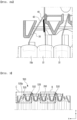
- FIG. 1 is a diagram showing a busbar frame in a conventional battery module.
- FIG. 2 is an enlarged view of a region "A" in FIG. 1 .
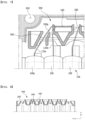
- FIG. 2a is a cross-sectional view showing the possibility that an electrode lead 40 and the edge of a cell terrace 30 come into contact with each other
- FIG. 2b is a cross-sectional view showing that an insulating tape 60 is attached to prevent the electrode lead 40 from coming into contact with the edge of the cell terrace 30.
- a plurality of battery cells 10 are stacked, and at least one or more electrode leads 40 protruding from the cell terrace 30 extended from a pouch covering the battery cell 10 meets and passes through one lead slot.
- the electrode lead 40 and the edge of the cell terrace 30 become close to each other, and they can come into contact with each other.
- the electrode lead 40 comes into contact with the edge of the cell terrace 30, the cell terrace 30 has a potential, and the life of the battery cell 10 may be shortened or the pouch may be corroded.
- a separate insulating tape 60 can be attached in order to prevent contact between the above-mentioned electrode lead 40 and the edge of the cell terrace 30.
- the method of attaching the insulating tape 60 requires additional fees and processes, and if the attachment position is not appropriate, there is still a possibility that contact will occur.
- the adhesive force of the insulating tape 60 is not permanently maintained, the insulating tape 60 is likely to be detached.
- EP 3 340 338 A1 refers to a battery module.
- the battery module includes: a cell assembly including a plurality of secondary batteries and a plurality of cartridges, the secondary batteries being vertically arranged and including electrode leads, the cartridges being vertically stacked to accommodate the secondary batteries in an inner space thereof; and a sensing assembly mounted on a front side of the cell assembly and including an insulation housing formed of an electrically insulative material and a sensing bus bar formed of an electrically conductive material, the sensing assembly being coupled to the electrode leads to sense voltages of the secondary batteries, wherein the insulation housing includes a plurality of penetration holes vertically spaced apart from each other to receive the electrode leads therethrough, and a plurality of housing slant portions arranged in the penetration holes and sloped at a predetermined angle from a horizontal direction.
- EP 2 693 516 A1 relates to a battery pack, including: a plurality of unit batteries that include a positive-electrode pulled-out tab and a negative-electrode pulled-out tab; and a board on which pulled-out tab connection sections are formed to connect the pulled-out tabs of different polarities of adjacent unit batteries.
- the present invention has been made to solve the above problems, and it is therefore an object to provide a battery module that does not allow the electrode leads to make contact with the edge of the cell terrace adjacent thereto in the outside of the busbar frame.
- a battery module is defined in claim 1 and includes: a battery cell stack in which a plurality of battery cells are stacked, a busbar frame connected to the battery cell stack, cell terraces each protruding from battery cells adjacent to each other among the battery cells included in the battery cell stack, electrode leads each protruding from the cell terraces, and a partition wall which is disposed between electrode leads adjacent to each other among the electrode leads and is formed on the busbar frame, wherein the partition wall includes an outermost partition wall located between a first cell terrace protruding from the outermost battery cell and a second cell terrace protruding from the battery cell immediately adjacent to the outermost battery cell among the battery cells included in the battery cell stack.
- the outermost partition wall has a bending structure.
- the bending structure of the outermost partition wall is folded in a direction in which an interval between the first cell terrace and the second cell terrace becomes narrower.
- a plurality of path guiders separating the electrode leads are formed on the busbar frame, and the outermost partition wall may be disposed between two path guiders located at the outermost part of the busbar frame.
- the electrode lead is inserted into a lead slot formed on the busbar frame, and an electrode lead protruding from the first cell terrace and an end of the second cell terrace can maintain a separation state by the outermost partition wall.
- the partition wall may be disposed one by one between path guiders adjacent to each other among a plurality of path guides formed on the busbar frame.
- Both the polarity of the electrode lead protruding from the first cell terrace and that of the electrode lead protruding from the second cell terrace may be negative.
- the interval between the first cell terrace and the second cell terrace where the electrode leads having the same polarity as each other protrude may become gradually narrower along a direction in which the electrode leads protrude.
- the electrode leads adjacent to each other with the partition wall being interposed therebetween pass through a lead slot formed on the busbar frame and can meet and connect at the rear surface of the busbar frame.
- the bent angle of the partition wall may gradually decrease as it goes from the outermost battery cell to the central battery cell.
- the first cell terrace protruding from the outermost battery cell may have a more bent structure than the second cell terrace protruding from the battery cell immediately adjacent to the outermost battery cell.
- the electrode lead is inserted into a lead slot formed on the busbar frame, and any one of the ends of the cell terraces adjacent to each other, and an electrode lead connected to another end may maintain a separation state by the partition wall.
- the cell terraces in which the electrode leads having the same polarity as each other protrude may have a narrower interval along a direction in which the electrode leads protrude.
- a battery pack according to another embodiment of the present invention is defined in claim 12 and includes the above-mentioned battery module.
- a battery module that forms a partition wall at the outermost part of the busbar frame and does not allow the electrode lead to make contact with the edge of the cell terrace adjacent thereto, thereby preventing a porch corrosion and a decrease in the cell life.
- planar when referred to as “planar”, it means when a target portion is viewed from the top, and when referred to as “cross-sectional”, it means when a target portion is viewed from the side of a cross section cut vertically.
- FIG. 3 is a plan view showing a busbar frame included in a battery module according to one embodiment of the present invention.
- FIG. 4 is an enlarged view showing a connection part between the battery cell stack and the busbar frame in a region "B" of FIG. 3 .
- the busbar frame 500 included in the battery module includes a path guider 260, and a plurality of lead slots 510 are formed in the busbar frame 500.
- the lead slot 510 may be an opening into which an electrode lead described later is inserted.
- a plurality of the path guiders 260 may be provided.
- the plurality of path guides 260 may be provided to correspond to the number of the plurality of lead slots 510.
- the path guider 260 located at the outermost part of both sides of the busbar frame 500 include a first branch part 260a and a second branch part 260b which are connected to each other.
- the first branch part 260a are parallel to the y-direction which is the direction in which the battery cell stack described later and the busbar frame 500 are connected.
- the second branch part 260b has a diagonal shape inclined in the x direction from the y direction.
- a partition wall 530 is formed between the path guiders 260 adjacent to each other. At least one partition wall 530 may be formed between adjacent path guiders 260. If a large number of partition walls 530 are formed in a narrow space, the process may be complicated. Therefore, a structure in which one partition wall 530 is formed between the path guiders 260 and two lead electrodes pass through one lead slot 510 with the partition wall 530 being interposed therebetween is preferable. In the present embodiment, the partition wall 530 may be disposed one by one between path guiders 260 adjacent to each other among the plurality of path guiders 260 formed on the busbar frame 500.
- a negative electrode lead 160 may be inserted into a lead slot 510.
- the negative electrode lead 160 may be formed of copper, and thus is highly likely to cause corrosion by coming into contact with the cell terrace 135.
- a plurality of electrode leads 160 may be inserted into one lead slot 510, and the number of the electrode lead 160 inserted into one lead slot 510 may be plural.
- a plurality of electrode leads 160 may be separated and inserted by the partition wall 530 formed in the lead slot 510. After the lead electrode 160 passes through the lead slot 510, it may be electrically connected to a busbar via laser welding.
- the insertion structure of the electrode lead 160 may be variously modified according to the design change of the series and parallel connection structures of the battery cells.
- FIG. 5 is an enlarged view showing a connection part between the battery cell stack and the busbar frame in a region "C" of FIG. 3 .
- the battery module includes a busbar frame 500 connected to the battery cell stack 105, and includes a cell terrace 135 protruding from the battery cell 100 and an electrode lead 160 protruding from the cell terrace 135.
- a plurality of path guiders 260 for separating the electrode leads 160 are formed on the busbar frame 500, and the outermost partition wall 530p is formed between the two path guiders 260 located on the outermost part of the busbar frame 500.
- the outermost partition wall 530p is located between a first cell terrace 135a protruding from the outermost battery cell 100p and a second cell terrace 135b protruding from the battery cell 100 immediately adjacent to the outermost battery cell 100p, among the battery cells 100 included in the battery cell stack 105.
- the outermost partition wall 530p has a bending structure.
- the first cell terrace 135a may have a more bent structure than the second cell terrace 135b.
- both the polarity of the electrode lead 160 protruding from the first cell terrace 135a and that of the electrode lead 160 protruding from the second cell terrace 135b may be negative.
- the interval between the first cell terrace 135a and the second cell terrace 135b from which the electrode leads 160 having the same polarity as each other protrude becomes gradually narrower along the direction in which the electrode leads 160 protrude.
- the bending structure of the outermost partition wall 530p is folded in a direction in which an interval between the first cell terrace 135a and the second cell terrace 135 becomes narrower.
- FIG. 6 is a plan view showing a battery module including the busbar frame of FIG. 3 .
- the upper left view of FIG. 6 is a plan view of the structure in which the busbar frame 500 is mounted on the battery cell stack 105, as viewed from above, and the lower left view is a front view of the structure as viewed from the front, and the lower right view is an enlarged view of a part of the front view.
- the electrode leads 160 may pass through the lead slot 510 via each path guider 260 to form a group of electrode leads 160.
- one electrode lead 160 may be disposed between the path guider 260 and the partition wall 530.
- the partition wall 530 has a shape elongated in a direction parallel to the y direction.
- the outermost partition wall 530p has a bending structure that is folded in a direction in which an interval between the first cell terrace 135a and the second cell terrace 135b becomes narrower.
- the first cell terrace 135a protruding from the outermost battery cell 100p has a structure that is more folded when extending from the outermost battery cell 100p compared to the cell terrace 135 protruding from the battery cell 100 located at the center of the busbar frame 500. Therefore, the possibility that the electrode lead 160 protruding from the first cell terrace 135a comes into contact with the second cell terrace 135b is increased. When the electrode lead 160 comes into contact with the second cell terrace 135b, the pouch case including the cell terrace 135 is corroded, and the cell terrace 135 has a potential, so that the life of the battery cell 10 may be shortened.
- the interval between the electrode lead 160 protruding from the first cell terrace 135a and the end of the second cell terrace 135b may be maintained by the outermost partition wall 530p.
- the interval between any one of the ends of the adjacent cell terraces 135 and the electrode lead 160 connected to another end may be maintained by the partition wall 530.
- a cell terrace 135 is formed in which an interval becomes narrower along a direction in which the electrode leads 160 of each of the plurality of battery cells 100 protrude.
- the cell terrace 135 may be a portion where the battery case body is extended.
- the path guider 260 is to guide so that the electrode lead 160 passes through the lead slot 510, before forming the cell terrace 135 that allows the electrode lead 160 of each of two adjacent battery cells 100 to be extended, and it may be formed on one side of the busbar frame 500.
- the busbar frame 500 may have a path guider 260 in the inside of the back surface of the busbar frame 500 located apart from the battery cells 100.
- the path guider 260 may form a predetermined guide space from the rear surface of the busbar frame 500 such that the two electrode leads 160 and the extended parts of the case body 132 including the same become close to each other, before passing through the lead slot 510.
- the width of the guide space may be narrower toward the front direction (-y-axis direction) of the busbar frame 500 having the lead slot 510 from the rear direction (y-axis direction) of the busbar frame 500.
- FIG. 7 is a view showing a busbar frame included in a battery module according to another embodiment of the present invention.
- the busbar frame included in the battery module according to the present embodiment is the same as the embodiment of FIG. 5 described above, but a hole 650 for mounting the battery module to the device is formed on the busbar frame 500.
- a space for forming such a hole 650 should be provided.
- the outermost battery cell 100p is structurally folded compared to other battery cells 100, the possibility that the electrode lead 160 protruding from the first cell terrace 135a comes into contact with the second cell terrace 135b is increased.
- the role of the partition wall 530p according to the present embodiment may be more important.
- FIG. 8 is a plan view showing a connection part between a battery cell stack and a busbar frame in a battery module according to another embodiment of the present invention.
- FIG. 8 is substantially the same as the embodiment described in FIGS. 3 to 6 , but there is some difference in the shape of the partition wall 530.
- the differences will be mainly described, except for the part where there are differences, the contents described with reference to FIGS. 3 to 6 may be applied to the present embodiment.
- the bent angle of the partition wall 530 may gradually decrease as the battery cells 100 included in the battery cell stack are moved from the outermost battery cell 100p to the central battery cell 100.
- the battery module described above may be included in the battery pack.
- the battery pack may have a structure in which one or more battery modules according to the present embodiment are collected, and then packed by adding a battery management system (BMS) and a cooling device to manage the temperature or voltage of the battery.
- BMS battery management system
- the battery pack can be applied to various devices.
- a device may be applied to a vehicle such as an electric bicycle, an electric vehicle, or a hybrid vehicle, but the present disclosure is not limited thereto, and is applicable to various devices that can use a battery module.
Landscapes
- Chemical & Material Sciences (AREA)
- Chemical Kinetics & Catalysis (AREA)
- Electrochemistry (AREA)
- General Chemical & Material Sciences (AREA)
- Battery Mounting, Suspending (AREA)
- Connection Of Batteries Or Terminals (AREA)
- Sealing Battery Cases Or Jackets (AREA)
Description
- The present disclosure relates to a battery module, and more particularly to a battery module having a busbar frame shape for preventing contact.
- Secondary batteries, which are easily applied to various product groups and has electrical characteristics such as high energy density, are universally applied not only for a portable device but also for an electric vehicle (EV) or a hybrid electric vehicle (HEV), an energy storage system or the like, which is driven by an electric driving source. The secondary battery is attracting attention as a new environment-friendly energy source for improving energy efficiency since it gives a primary advantage of remarkably reducing the use of fossil fuels and also does not generate by-products from the use of energy at all.
- A battery pack for use in electric vehicles has a structure in which a plurality of cell assemblies, each including a plurality of unit cells, are connected in series to obtain a high output. In addition, the unit cell can be repeatedly charged and discharged by electrochemical reactions among components, which include a positive electrode current collector, a negative electrode current collector, a separator, an active material, an electrolyte and the like.
- Meanwhile, as the need for a large capacity structure is increasing along with the utilization as an energy storage source in recent years, there is a growing demand for a battery pack with a multi-module structure in which a plurality of battery modules, each including a plurality of secondary batteries connected in series and/or in parallel, are integrated.
- Meanwhile, when a plurality of battery cells are connected in series or in parallel to configure a battery pack, it is common to configure a battery module composed of at least one battery cell first, and then configure a battery pack by using at least one battery module and adding other components.
- A conventional battery module includes a plurality of stacked battery cells and a busbar assembly for electrically connecting electrode leads of the plurality of battery cells. Here, the busbar assembly includes a busbar frame having lead slots through which the electrode leads of the battery cells pass individually, and a busbar mounted to the busbar frame and having busbar slots corresponding to the number of lead slots, so that the busbar is connected to the electrode leads passing through the busbar slots by welding or the like.
- However, in the conventional battery module, when the number of cell terrace and battery cell increases, the number of electrode leads also increases, and the electrode lead and cell terrace shapes may become compact, and thus, adjacent electrode leads can be in contact with the edge of the cell terrace.
-
FIG. 1 is a diagram showing a busbar frame in a conventional battery module.FIG. 2 is an enlarged view of a region "A" inFIG. 1 . Specifically,FIG. 2a is a cross-sectional view showing the possibility that an electrode lead 40 and the edge of acell terrace 30 come into contact with each other, andFIG. 2b is a cross-sectional view showing that aninsulating tape 60 is attached to prevent theelectrode lead 40 from coming into contact with the edge of thecell terrace 30. - Referring to
FIG. 1 , a plurality ofbattery cells 10 are stacked, and at least one or more electrode leads 40 protruding from thecell terrace 30 extended from a pouch covering thebattery cell 10 meets and passes through one lead slot. - Referring to
FIG. 2a , when having a structure that becomes gradually narrower as the interval betweenadjacent cell terraces 30 moves away from thebattery cell 10, the electrode lead 40 and the edge of thecell terrace 30 become close to each other, and they can come into contact with each other. When theelectrode lead 40 comes into contact with the edge of thecell terrace 30, thecell terrace 30 has a potential, and the life of thebattery cell 10 may be shortened or the pouch may be corroded. - Referring to
FIG. 2b , a separateinsulating tape 60 can be attached in order to prevent contact between the above-mentionedelectrode lead 40 and the edge of thecell terrace 30. However, the method of attaching theinsulating tape 60 requires additional fees and processes, and if the attachment position is not appropriate, there is still a possibility that contact will occur. In addition, since the adhesive force of theinsulating tape 60 is not permanently maintained, theinsulating tape 60 is likely to be detached. -
EP 3 340 338 A1 refers to a battery module. The battery module includes: a cell assembly including a plurality of secondary batteries and a plurality of cartridges, the secondary batteries being vertically arranged and including electrode leads, the cartridges being vertically stacked to accommodate the secondary batteries in an inner space thereof; and a sensing assembly mounted on a front side of the cell assembly and including an insulation housing formed of an electrically insulative material and a sensing bus bar formed of an electrically conductive material, the sensing assembly being coupled to the electrode leads to sense voltages of the secondary batteries, wherein the insulation housing includes a plurality of penetration holes vertically spaced apart from each other to receive the electrode leads therethrough, and a plurality of housing slant portions arranged in the penetration holes and sloped at a predetermined angle from a horizontal direction. -
EP 2 693 516 A1 relates to a battery pack, including: a plurality of unit batteries that include a positive-electrode pulled-out tab and a negative-electrode pulled-out tab; and a board on which pulled-out tab connection sections are formed to connect the pulled-out tabs of different polarities of adjacent unit batteries. - The present invention has been made to solve the above problems, and it is therefore an object to provide a battery module that does not allow the electrode leads to make contact with the edge of the cell terrace adjacent thereto in the outside of the busbar frame.
- However, the problem to be solved by the embodiments of the present invention is not limited to the above-described problems. The scope of protection is defined by the appended claims.
- A battery module according to the present invention is defined in claim 1 and includes: a battery cell stack in which a plurality of battery cells are stacked, a busbar frame connected to the battery cell stack, cell terraces each protruding from battery cells adjacent to each other among the battery cells included in the battery cell stack, electrode leads each protruding from the cell terraces, and a partition wall which is disposed between electrode leads adjacent to each other among the electrode leads and is formed on the busbar frame, wherein the partition wall includes an outermost partition wall located between a first cell terrace protruding from the outermost battery cell and a second cell terrace protruding from the battery cell immediately adjacent to the outermost battery cell among the battery cells included in the battery cell stack.
- The outermost partition wall has a bending structure.
- The bending structure of the outermost partition wall is folded in a direction in which an interval between the first cell terrace and the second cell terrace becomes narrower.
- A plurality of path guiders separating the electrode leads are formed on the busbar frame, and the outermost partition wall may be disposed between two path guiders located at the outermost part of the busbar frame.
- The electrode lead is inserted into a lead slot formed on the busbar frame, and an electrode lead protruding from the first cell terrace and an end of the second cell terrace can maintain a separation state by the outermost partition wall.
- The partition wall may be disposed one by one between path guiders adjacent to each other among a plurality of path guides formed on the busbar frame.
- Both the polarity of the electrode lead protruding from the first cell terrace and that of the electrode lead protruding from the second cell terrace may be negative.
- The interval between the first cell terrace and the second cell terrace where the electrode leads having the same polarity as each other protrude may become gradually narrower along a direction in which the electrode leads protrude.
- The electrode leads adjacent to each other with the partition wall being interposed therebetween pass through a lead slot formed on the busbar frame and can meet and connect at the rear surface of the busbar frame.
- Among the battery cells included in the battery cell stack, the bent angle of the partition wall may gradually decrease as it goes from the outermost battery cell to the central battery cell.
- The first cell terrace protruding from the outermost battery cell may have a more bent structure than the second cell terrace protruding from the battery cell immediately adjacent to the outermost battery cell.
- The electrode lead is inserted into a lead slot formed on the busbar frame, and any one of the ends of the cell terraces adjacent to each other, and an electrode lead connected to another end may maintain a separation state by the partition wall.
- The cell terraces in which the electrode leads having the same polarity as each other protrude may have a narrower interval along a direction in which the electrode leads protrude.
- A battery pack according to another embodiment of the present invention is defined in claim 12 and includes the above-mentioned battery module.
- According to the embodiments, it is possible to implement a battery module that forms a partition wall at the outermost part of the busbar frame and does not allow the electrode lead to make contact with the edge of the cell terrace adjacent thereto, thereby preventing a porch corrosion and a decrease in the cell life.
-
-
FIG. 1 is a diagram showing a busbar frame in a conventional battery module. -
FIG. 2 is an enlarged view of a region "A" inFIG. 1 . -
FIG. 3 is a plan view showing a busbar frame included in a battery module according to one embodiment of the present invention. -
FIG. 4 is an enlarged view showing a connection part between the battery cell stack and the busbar frame in the region "B" inFIG. 3 . -
FIG. 5 is an enlarged view showing a connection part between the battery cell stack and the busbar frame in a region "C" ofFIG. 3 . -
FIG. 6 is a plan view showing a battery module including the busbar frame ofFIG. 3 . -
FIG. 7 is a diagram showing a busbar frame included in a battery module according to another embodiment of the present invention. -
FIG. 8 is a plan view showing a connection part between a battery cell stack and a busbar frame in a battery module according to another embodiment of the present invention. - Hereinafter, various embodiments of the present invention will be described in detail with reference to the accompanying drawings so that those skilled in the art can easily implement them.
- Parts that are irrelevant to the description will be omitted to clearly describe the present invention, and like reference numerals designate like elements throughout the specification.
- Further, in the drawings, the size and thickness of each element are arbitrarily illustrated for convenience of description, and the present disclosure is not necessarily limited to those illustrated in the drawings. In the drawings, the thickness of layers, regions, etc. are exaggerated for clarity. In the drawings, for convenience of description, the thicknesses of some layers and regions are exaggerated.
- Further, throughout the specification, when a part is referred to as "including" a certain component, it means that it can further include other components, without excluding the other components, unless otherwise stated.
- Further, throughout the specification, when referred to as "planar", it means when a target portion is viewed from the top, and when referred to as "cross-sectional", it means when a target portion is viewed from the side of a cross section cut vertically.
-
FIG. 3 is a plan view showing a busbar frame included in a battery module according to one embodiment of the present invention.FIG. 4 is an enlarged view showing a connection part between the battery cell stack and the busbar frame in a region "B" ofFIG. 3 . - Referring to
FIGS. 3 and4 , thebusbar frame 500 included in the battery module according to one embodiment of the present invention includes apath guider 260, and a plurality oflead slots 510 are formed in thebusbar frame 500. Thelead slot 510 may be an opening into which an electrode lead described later is inserted. - A plurality of the path guiders 260 may be provided. Here, the plurality of path guides 260 may be provided to correspond to the number of the plurality of
lead slots 510. The path guider 260 located at the outermost part of both sides of thebusbar frame 500 include a first branch part 260a and a second branch part 260b which are connected to each other. In thebusbar frame 500, the first branch part 260a are parallel to the y-direction which is the direction in which the battery cell stack described later and thebusbar frame 500 are connected. On the other hand, the second branch part 260b has a diagonal shape inclined in the x direction from the y direction. - A
partition wall 530 is formed between the path guiders 260 adjacent to each other. At least onepartition wall 530 may be formed between adjacent path guiders 260. If a large number ofpartition walls 530 are formed in a narrow space, the process may be complicated. Therefore, a structure in which onepartition wall 530 is formed between the path guiders 260 and two lead electrodes pass through onelead slot 510 with thepartition wall 530 being interposed therebetween is preferable. In the present embodiment, thepartition wall 530 may be disposed one by one betweenpath guiders 260 adjacent to each other among the plurality ofpath guiders 260 formed on thebusbar frame 500. - A
negative electrode lead 160 may be inserted into alead slot 510. Thenegative electrode lead 160 may be formed of copper, and thus is highly likely to cause corrosion by coming into contact with thecell terrace 135. A plurality of electrode leads 160 may be inserted into onelead slot 510, and the number of theelectrode lead 160 inserted into onelead slot 510 may be plural. A plurality of electrode leads 160 may be separated and inserted by thepartition wall 530 formed in thelead slot 510. After thelead electrode 160 passes through thelead slot 510, it may be electrically connected to a busbar via laser welding. The insertion structure of theelectrode lead 160 may be variously modified according to the design change of the series and parallel connection structures of the battery cells. -
FIG. 5 is an enlarged view showing a connection part between the battery cell stack and the busbar frame in a region "C" ofFIG. 3 . - Referring to
FIG. 3 andFIG. 5 , the battery module according to the present embodiment includes abusbar frame 500 connected to thebattery cell stack 105, and includes acell terrace 135 protruding from thebattery cell 100 and anelectrode lead 160 protruding from thecell terrace 135. - A plurality of
path guiders 260 for separating the electrode leads 160 are formed on thebusbar frame 500, and theoutermost partition wall 530p is formed between the twopath guiders 260 located on the outermost part of thebusbar frame 500. Theoutermost partition wall 530p is located between afirst cell terrace 135a protruding from theoutermost battery cell 100p and asecond cell terrace 135b protruding from thebattery cell 100 immediately adjacent to theoutermost battery cell 100p, among thebattery cells 100 included in thebattery cell stack 105. Theoutermost partition wall 530p has a bending structure. Thefirst cell terrace 135a may have a more bent structure than thesecond cell terrace 135b. - In the present embodiment, both the polarity of the
electrode lead 160 protruding from thefirst cell terrace 135a and that of theelectrode lead 160 protruding from thesecond cell terrace 135b may be negative. The interval between thefirst cell terrace 135a and thesecond cell terrace 135b from which the electrode leads 160 having the same polarity as each other protrude becomes gradually narrower along the direction in which the electrode leads 160 protrude. The bending structure of theoutermost partition wall 530p is folded in a direction in which an interval between thefirst cell terrace 135a and thesecond cell terrace 135 becomes narrower. -
FIG. 6 is a plan view showing a battery module including the busbar frame ofFIG. 3 . The upper left view ofFIG. 6 is a plan view of the structure in which thebusbar frame 500 is mounted on thebattery cell stack 105, as viewed from above, and the lower left view is a front view of the structure as viewed from the front, and the lower right view is an enlarged view of a part of the front view. - Thereby, after the adjacent electrode leads 160 in the plurality of
battery cells 100 are paired in two, the electrode leads 160 may pass through thelead slot 510 via each path guider 260 to form a group of electrode leads 160. At this time, oneelectrode lead 160 may be disposed between thepath guider 260 and thepartition wall 530. Thepartition wall 530 has a shape elongated in a direction parallel to the y direction. However, theoutermost partition wall 530p has a bending structure that is folded in a direction in which an interval between thefirst cell terrace 135a and thesecond cell terrace 135b becomes narrower. - Structurally at the outermost part of the
busbar frame 500, thefirst cell terrace 135a protruding from theoutermost battery cell 100p has a structure that is more folded when extending from theoutermost battery cell 100p compared to thecell terrace 135 protruding from thebattery cell 100 located at the center of thebusbar frame 500. Therefore, the possibility that theelectrode lead 160 protruding from thefirst cell terrace 135a comes into contact with thesecond cell terrace 135b is increased. When theelectrode lead 160 comes into contact with thesecond cell terrace 135b, the pouch case including thecell terrace 135 is corroded, and thecell terrace 135 has a potential, so that the life of thebattery cell 10 may be shortened. - In this regard, according to the present embodiment, the interval between the
electrode lead 160 protruding from thefirst cell terrace 135a and the end of thesecond cell terrace 135b may be maintained by theoutermost partition wall 530p. Besides, the interval between any one of the ends of theadjacent cell terraces 135 and theelectrode lead 160 connected to another end may be maintained by thepartition wall 530. Acell terrace 135 is formed in which an interval becomes narrower along a direction in which the electrode leads 160 of each of the plurality ofbattery cells 100 protrude. Thecell terrace 135 may be a portion where the battery case body is extended. - The path guider 260 is to guide so that the
electrode lead 160 passes through thelead slot 510, before forming thecell terrace 135 that allows theelectrode lead 160 of each of twoadjacent battery cells 100 to be extended, and it may be formed on one side of thebusbar frame 500. Specifically, thebusbar frame 500 may have apath guider 260 in the inside of the back surface of thebusbar frame 500 located apart from thebattery cells 100. - The path guider 260 may form a predetermined guide space from the rear surface of the
busbar frame 500 such that the two electrode leads 160 and the extended parts of the case body 132 including the same become close to each other, before passing through thelead slot 510. To this end, the width of the guide space may be narrower toward the front direction (-y-axis direction) of thebusbar frame 500 having thelead slot 510 from the rear direction (y-axis direction) of thebusbar frame 500. -
FIG. 7 is a view showing a busbar frame included in a battery module according to another embodiment of the present invention. - Referring to
FIG. 7 , the busbar frame included in the battery module according to the present embodiment is the same as the embodiment ofFIG. 5 described above, but ahole 650 for mounting the battery module to the device is formed on thebusbar frame 500. - As described above, when a
hole 650 for mounting the battery module according to the present embodiment to a device such as a vehicle is formed on the outermost side of thebusbar frame 500, a space for forming such ahole 650 should be provided. Thereby, since theoutermost battery cell 100p is structurally folded compared toother battery cells 100, the possibility that theelectrode lead 160 protruding from thefirst cell terrace 135a comes into contact with thesecond cell terrace 135b is increased. In this structure, the role of thepartition wall 530p according to the present embodiment may be more important. -
FIG. 8 is a plan view showing a connection part between a battery cell stack and a busbar frame in a battery module according to another embodiment of the present invention. - The embodiment described in
FIG. 8 is substantially the same as the embodiment described inFIGS. 3 to 6 , but there is some difference in the shape of thepartition wall 530. Hereinafter, the differences will be mainly described, except for the part where there are differences, the contents described with reference toFIGS. 3 to 6 may be applied to the present embodiment. - Referring to
FIG. 8 , the bent angle of thepartition wall 530 may gradually decrease as thebattery cells 100 included in the battery cell stack are moved from theoutermost battery cell 100p to thecentral battery cell 100. - The battery module described above may be included in the battery pack. The battery pack may have a structure in which one or more battery modules according to the present embodiment are collected, and then packed by adding a battery management system (BMS) and a cooling device to manage the temperature or voltage of the battery.
- The battery pack can be applied to various devices. Such a device may be applied to a vehicle such as an electric bicycle, an electric vehicle, or a hybrid vehicle, but the present disclosure is not limited thereto, and is applicable to various devices that can use a battery module.
-
- 135:
- cell terrace 160: electrode lead
- 260:
- path guider 500: busbar frame
- 510:
- lead slot
Claims (13)
- A battery module comprising:a battery cell stack (105) in which a plurality of battery cells (100) are stacked,a busbar frame (500) connected to the battery cell stack (105),cell terraces (135) each protruding from battery cells (100) adjacent to each other among the battery cells (100) included in the battery cell stack (105),electrode leads (160) each protruding from the cell terraces (135), anda partition wall (530) which is disposed between electrode leads (160) adjacent to each other among the electrode leads (160) and is formed on the busbar frame (500),wherein the partition wall (530) includes an outermost partition wall (530p) located between a first cell terrace (135a) protruding from the outermost battery cell and a second cell terrace (135b) protruding from the battery cell immediately adjacent to the outermost battery cell among the battery cells (100) included in the battery cell stack (105),wherein the outermost partition wall (530p) has a bending structure which is folded in a direction in which an interval between the first cell terrace (135a) and the second cell terrace (135b) becomes narrower.
- The battery module of claim 1,
wherein a plurality of path guiders (260) separating the electrode leads (160) are formed on the busbar frame (500), and the outermost partition wall (530p) is disposed between two path guiders (260) located at the outermost part of the busbar frame (500). - The battery module of claim 1,
wherein the electrode lead (160) is inserted into a lead slot (510) formed on the busbar frame (500), and an electrode lead (160) protruding from the first cell terrace (135a) and an end of the second cell terrace (135b) maintains a separation state by the outermost partition wall (530p). - The battery module of claim 1,
wherein the partition wall (530) is disposed one by one between path guiders (260) adjacent to each other among a plurality of path guiders (260) formed on the busbar frame (500). - The battery module of claim 1,
wherein both the polarity of the electrode lead (160) protruding from the first cell terrace (135a) and that of the electrode lead (160) protruding from the second cell terrace (135b) are negative. - The battery module of claim 5,
wherein the interval between the first cell terrace (135a) and the second cell terrace (135b) where the electrode leads (160) having the same polarity as each other protrude become gradually narrower along a direction in which the electrode lead (160) protrudes. - The battery module of claim 1,
wherein the electrode leads (160) adjacent to each other with the partition wall (530) being interposed therebetween pass through the lead slot (510) formed on the busbar frame (500) and meet and connect at the rear surface of the busbar frame (500). - The battery module of claim 1,
wherein among the battery cells (100) included in the battery cell stack (105), the bent angle of the partition wall (530) gradually decreases as it goes from the outermost battery cell to the central battery cell. - The battery module of claim 1,
wherein the first cell terrace (135a) protruding from the outermost battery cell has a more bent structure than the second cell terrace (135b) protruding from the battery cell immediately adjacent to the outermost battery cell. - The battery module of claim 1,
wherein the electrode lead (160) is inserted into a lead slot (510) formed on the busbar frame (500), and any one of the ends of the cell terraces (135) adjacent to each other, and an electrode lead (160) connected to another end maintain a separation state by the partition wall (530). - The battery module of claim 1,
wherein the cell terraces (135) in which the electrode leads (160) having the same polarity as each other protrude become narrower along a direction in which the electrode leads (160) protrude. - A battery pack comprising the battery module according to claim 1.
- A device comprising the battery pack according to claim 12.
Applications Claiming Priority (2)
| Application Number | Priority Date | Filing Date | Title |
|---|---|---|---|
| KR1020180156145A KR102366138B1 (en) | 2018-12-06 | 2018-12-06 | Battery module |
| PCT/KR2019/016860 WO2020116880A1 (en) | 2018-12-06 | 2019-12-02 | Battery module |
Publications (3)
| Publication Number | Publication Date |
|---|---|
| EP3780154A1 EP3780154A1 (en) | 2021-02-17 |
| EP3780154A4 EP3780154A4 (en) | 2021-08-25 |
| EP3780154B1 true EP3780154B1 (en) | 2024-05-22 |
Family
ID=70975363
Family Applications (1)
| Application Number | Title | Priority Date | Filing Date |
|---|---|---|---|
| EP19893593.4A Active EP3780154B1 (en) | 2018-12-06 | 2019-12-02 | Battery module |
Country Status (9)
| Country | Link |
|---|---|
| US (1) | US11967735B2 (en) |
| EP (1) | EP3780154B1 (en) |
| JP (1) | JP7210083B2 (en) |
| KR (1) | KR102366138B1 (en) |
| CN (1) | CN112204809B (en) |
| ES (1) | ES2981334T3 (en) |
| HU (1) | HUE066797T2 (en) |
| PL (1) | PL3780154T3 (en) |
| WO (1) | WO2020116880A1 (en) |
Families Citing this family (8)
| Publication number | Priority date | Publication date | Assignee | Title |
|---|---|---|---|---|
| KR20220040895A (en) * | 2020-09-24 | 2022-03-31 | 현대모비스 주식회사 | Battery module assembly |
| KR102708662B1 (en) * | 2020-12-07 | 2024-09-20 | 주식회사 엘지에너지솔루션 | Battery Module, Battery Pack, and Vehicle |
| KR102731448B1 (en) * | 2021-01-28 | 2024-11-15 | 주식회사 엘지에너지솔루션 | Battery module and battery pack including the same |
| DE102022205774B4 (en) | 2022-06-07 | 2025-10-30 | Volkswagen Aktiengesellschaft | Busbar element, arrangement of cell poles of battery cells interconnected by means of such busbar elements, and method for connecting cell poles |
| EP4459763A4 (en) * | 2022-06-09 | 2025-05-07 | LG Energy Solution, Ltd. | BUSBAR FRAME ASSEMBLY AND BATTERY MODULE THEREFORE |
| KR20240009718A (en) * | 2022-07-14 | 2024-01-23 | 주식회사 엘지에너지솔루션 | Battery module, battery pack and vehicle including the battery module |
| US20260005407A1 (en) * | 2024-06-27 | 2026-01-01 | Kyma Batteries LLC | Battery cells with bent tab couplings |
| JP2026043644A (en) * | 2024-08-29 | 2026-03-12 | プライムプラネットエナジー&ソリューションズ株式会社 | Batteries and battery packs |
Family Cites Families (22)
| Publication number | Priority date | Publication date | Assignee | Title |
|---|---|---|---|---|
| JPH07282841A (en) | 1994-04-05 | 1995-10-27 | Mitsubishi Chem Corp | Lithium ion secondary battery |
| JPH10188942A (en) | 1996-12-19 | 1998-07-21 | Yuasa Corp | Collective battery |
| KR101136800B1 (en) * | 2008-02-29 | 2012-04-19 | 주식회사 엘지화학 | Process for Preparation of Battery Module and Middle- or Large-sized Battery Pack Using the Same |
| KR101106324B1 (en) | 2010-01-12 | 2012-01-18 | 삼성에스디아이 주식회사 | Pouch Type Battery |
| KR20120055156A (en) | 2010-11-23 | 2012-05-31 | 주식회사 엘지화학 | Battery module having novel structure and battery pack employed with the same |
| US8741471B2 (en) | 2011-03-09 | 2014-06-03 | Samsung Sdi Co., Ltd. | Battery pack |
| JP5700543B2 (en) * | 2011-03-31 | 2015-04-15 | Necエナジーデバイス株式会社 | Battery pack |
| US9356278B2 (en) | 2011-03-31 | 2016-05-31 | Nec Energy Devices, Ltd. | Battery pack |
| US8609276B2 (en) | 2011-06-23 | 2013-12-17 | Samsung Sdi Co., Ltd. | Battery pack |
| CN103688391B (en) * | 2011-07-25 | 2016-03-09 | 株式会社Lg化学 | Battery module with improved reliability and battery pack using same |
| US8846240B2 (en) * | 2012-02-16 | 2014-09-30 | Lg Chem, Ltd. | Battery cell interconnect and voltage sensing assembly and method of manufacturing the assembly |
| KR101363598B1 (en) | 2012-08-09 | 2014-02-17 | (주)미섬시스텍 | Battery pack with fixing member for electrodes of battery cell |
| JP6160202B2 (en) * | 2013-04-18 | 2017-07-12 | 日産自動車株式会社 | Battery module |
| KR101817237B1 (en) | 2014-12-24 | 2018-01-11 | 주식회사 엘지화학 | Method for welding of electrode-leads & secondary battery module utilizing thereof |
| KR102277561B1 (en) | 2014-12-30 | 2021-07-14 | 에이치엘그린파워 주식회사 | Battery pack for prevention of combustion |
| KR101941415B1 (en) | 2015-10-22 | 2019-01-22 | 닛산 지도우샤 가부시키가이샤 | Battery |
| JP6680881B2 (en) * | 2016-02-11 | 2020-04-15 | エルジー・ケム・リミテッド | Battery module |
| KR102082903B1 (en) * | 2016-02-22 | 2020-02-28 | 주식회사 엘지화학 | Battery module, battery pack comprising the battery module and vehicle comprising the battery pack |
| KR102034208B1 (en) | 2016-03-03 | 2019-10-18 | 주식회사 엘지화학 | Battery module, battery pack the battery module and vehicle comprising the battery pack |
| KR102106999B1 (en) * | 2016-04-25 | 2020-05-06 | 주식회사 엘지화학 | Battery Cell with Improved Insulative Performance of Electrode Lead and Excellent Productivity on Standardized Structure and Battery Pack Comprising the Same |
| KR102258817B1 (en) * | 2017-04-25 | 2021-06-07 | 주식회사 엘지에너지솔루션 | Battery module, battery pack comprising the battery module and vehicle comprising the battery pack |
| KR102082498B1 (en) * | 2017-04-26 | 2020-02-27 | 주식회사 엘지화학 | Battery module with improved coupling structure between electrode lead and bus bar and Method for manufacturing the same |
-
2018
- 2018-12-06 KR KR1020180156145A patent/KR102366138B1/en active Active
-
2019
- 2019-12-02 ES ES19893593T patent/ES2981334T3/en active Active
- 2019-12-02 CN CN201980034700.3A patent/CN112204809B/en active Active
- 2019-12-02 JP JP2020560828A patent/JP7210083B2/en active Active
- 2019-12-02 US US17/053,238 patent/US11967735B2/en active Active
- 2019-12-02 PL PL19893593.4T patent/PL3780154T3/en unknown
- 2019-12-02 EP EP19893593.4A patent/EP3780154B1/en active Active
- 2019-12-02 HU HUE19893593A patent/HUE066797T2/en unknown
- 2019-12-02 WO PCT/KR2019/016860 patent/WO2020116880A1/en not_active Ceased
Also Published As
| Publication number | Publication date |
|---|---|
| JP2021521603A (en) | 2021-08-26 |
| JP7210083B2 (en) | 2023-01-23 |
| EP3780154A1 (en) | 2021-02-17 |
| PL3780154T3 (en) | 2024-08-05 |
| CN112204809A (en) | 2021-01-08 |
| US20210280949A1 (en) | 2021-09-09 |
| WO2020116880A1 (en) | 2020-06-11 |
| EP3780154A4 (en) | 2021-08-25 |
| CN112204809B (en) | 2023-08-08 |
| KR102366138B1 (en) | 2022-02-22 |
| US11967735B2 (en) | 2024-04-23 |
| ES2981334T3 (en) | 2024-10-08 |
| HUE066797T2 (en) | 2024-09-28 |
| KR20200069041A (en) | 2020-06-16 |
Similar Documents
| Publication | Publication Date | Title |
|---|---|---|
| EP3780154B1 (en) | Battery module | |
| EP3817090B1 (en) | Battery module | |
| JP7045588B2 (en) | Battery module including busbar assembly | |
| US11239511B2 (en) | Battery module having heat dissipation plate | |
| KR102034208B1 (en) | Battery module, battery pack the battery module and vehicle comprising the battery pack | |
| JP7069312B2 (en) | Battery pack with connection plate | |
| US20210313657A1 (en) | Battery Module with ICB Assembly in Space-Saving Structure | |
| EP3761396B1 (en) | Battery module including protective cover for covering flexible printed circuit board | |
| EP3783694A1 (en) | Battery module including terminal connecting structure provided with floating nut and battery pack including the same | |
| US20240250368A1 (en) | Battery Module Comprising Module Housing | |
| JP2021501457A (en) | Battery module and battery pack with busbar | |
| US10468643B2 (en) | Battery module and battery pack including the same | |
| JP2022519501A (en) | Battery module | |
| EP3764421B1 (en) | Battery module including connector having bidirectional coupling structure | |
| KR102167624B1 (en) | Battery module, battery pack comprising the battery module and vehicle comprising the battery pack | |
| US11848455B2 (en) | Battery module | |
| CN110622340B (en) | Battery module and method for manufacturing battery module | |
| EP4175036B1 (en) | Battery module, battery pack, and power storage device | |
| US12476329B2 (en) | Battery module and battery pack including the same | |
| US20260106332A1 (en) | Busbar assembly | |
| EP4300661B1 (en) | Battery module and battery pack including the same | |
| EP4421967A1 (en) | Battery module comprising upper/lower-separable bus bar frame, and method for assembling same | |
| EP4250463B1 (en) | Battery module and battery pack comprising same | |
| KR20260055089A (en) | Busbar assembly |
Legal Events
| Date | Code | Title | Description |
|---|---|---|---|
| STAA | Information on the status of an ep patent application or granted ep patent |
Free format text: STATUS: THE INTERNATIONAL PUBLICATION HAS BEEN MADE |
|
| PUAI | Public reference made under article 153(3) epc to a published international application that has entered the european phase |
Free format text: ORIGINAL CODE: 0009012 |
|
| STAA | Information on the status of an ep patent application or granted ep patent |
Free format text: STATUS: REQUEST FOR EXAMINATION WAS MADE |
|
| 17P | Request for examination filed |
Effective date: 20201029 |
|
| AK | Designated contracting states |
Kind code of ref document: A1 Designated state(s): AL AT BE BG CH CY CZ DE DK EE ES FI FR GB GR HR HU IE IS IT LI LT LU LV MC MK MT NL NO PL PT RO RS SE SI SK SM TR |
|
| AX | Request for extension of the european patent |
Extension state: BA ME |
|
| A4 | Supplementary search report drawn up and despatched |
Effective date: 20210723 |
|
| RIC1 | Information provided on ipc code assigned before grant |
Ipc: H01M 50/20 20210101AFI20210719BHEP Ipc: H01M 50/502 20210101ALI20210719BHEP |
|
| RAP1 | Party data changed (applicant data changed or rights of an application transferred) |
Owner name: LG ENERGY SOLUTION LTD. |
|
| DAV | Request for validation of the european patent (deleted) | ||
| DAX | Request for extension of the european patent (deleted) | ||
| RAP3 | Party data changed (applicant data changed or rights of an application transferred) |
Owner name: LG ENERGY SOLUTION, LTD. |
|
| REG | Reference to a national code |
Ref country code: DE Ref legal event code: R079 Free format text: PREVIOUS MAIN CLASS: H01M0002200000 Ipc: H01M0050500000 Ref document number: 602019052766 Country of ref document: DE |
|
| GRAP | Despatch of communication of intention to grant a patent |
Free format text: ORIGINAL CODE: EPIDOSNIGR1 |
|
| STAA | Information on the status of an ep patent application or granted ep patent |
Free format text: STATUS: GRANT OF PATENT IS INTENDED |
|
| RIC1 | Information provided on ipc code assigned before grant |
Ipc: H01M 50/593 20210101ALI20231221BHEP Ipc: H01M 50/533 20210101ALI20231221BHEP Ipc: H01M 50/529 20210101ALI20231221BHEP Ipc: H01M 50/503 20210101ALI20231221BHEP Ipc: H01M 50/289 20210101ALI20231221BHEP Ipc: H01M 50/213 20210101ALI20231221BHEP Ipc: H01M 50/211 20210101ALI20231221BHEP Ipc: H01M 50/105 20210101ALI20231221BHEP Ipc: H01M 50/50 20210101AFI20231221BHEP |
|
| INTG | Intention to grant announced |
Effective date: 20240116 |
|
| GRAS | Grant fee paid |
Free format text: ORIGINAL CODE: EPIDOSNIGR3 |
|
| GRAA | (expected) grant |
Free format text: ORIGINAL CODE: 0009210 |
|
| STAA | Information on the status of an ep patent application or granted ep patent |
Free format text: STATUS: THE PATENT HAS BEEN GRANTED |
|
| AK | Designated contracting states |
Kind code of ref document: B1 Designated state(s): AL AT BE BG CH CY CZ DE DK EE ES FI FR GB GR HR HU IE IS IT LI LT LU LV MC MK MT NL NO PL PT RO RS SE SI SK SM TR |
|
| REG | Reference to a national code |
Ref country code: GB Ref legal event code: FG4D |
|
| REG | Reference to a national code |
Ref country code: CH Ref legal event code: EP |
|
| P01 | Opt-out of the competence of the unified patent court (upc) registered |
Effective date: 20240430 |
|
| REG | Reference to a national code |
Ref country code: DE Ref legal event code: R096 Ref document number: 602019052766 Country of ref document: DE |
|
| REG | Reference to a national code |
Ref country code: IE Ref legal event code: FG4D |
|
| REG | Reference to a national code |
Ref country code: SE Ref legal event code: TRGR |
|
| REG | Reference to a national code |
Ref country code: LT Ref legal event code: MG9D |
|
| REG | Reference to a national code |
Ref country code: NL Ref legal event code: MP Effective date: 20240522 |
|
| REG | Reference to a national code |
Ref country code: HU Ref legal event code: AG4A Ref document number: E066797 Country of ref document: HU |
|
| PG25 | Lapsed in a contracting state [announced via postgrant information from national office to epo] |
Ref country code: IS Free format text: LAPSE BECAUSE OF FAILURE TO SUBMIT A TRANSLATION OF THE DESCRIPTION OR TO PAY THE FEE WITHIN THE PRESCRIBED TIME-LIMIT Effective date: 20240922 |
|
| PG25 | Lapsed in a contracting state [announced via postgrant information from national office to epo] |
Ref country code: BG Free format text: LAPSE BECAUSE OF FAILURE TO SUBMIT A TRANSLATION OF THE DESCRIPTION OR TO PAY THE FEE WITHIN THE PRESCRIBED TIME-LIMIT Effective date: 20240522 |
|
| REG | Reference to a national code |
Ref country code: ES Ref legal event code: FG2A Ref document number: 2981334 Country of ref document: ES Kind code of ref document: T3 Effective date: 20241008 |
|
| PG25 | Lapsed in a contracting state [announced via postgrant information from national office to epo] |
Ref country code: HR Free format text: LAPSE BECAUSE OF FAILURE TO SUBMIT A TRANSLATION OF THE DESCRIPTION OR TO PAY THE FEE WITHIN THE PRESCRIBED TIME-LIMIT Effective date: 20240522 Ref country code: FI Free format text: LAPSE BECAUSE OF FAILURE TO SUBMIT A TRANSLATION OF THE DESCRIPTION OR TO PAY THE FEE WITHIN THE PRESCRIBED TIME-LIMIT Effective date: 20240522 |
|
| PG25 | Lapsed in a contracting state [announced via postgrant information from national office to epo] |
Ref country code: GR Free format text: LAPSE BECAUSE OF FAILURE TO SUBMIT A TRANSLATION OF THE DESCRIPTION OR TO PAY THE FEE WITHIN THE PRESCRIBED TIME-LIMIT Effective date: 20240823 |
|
| PG25 | Lapsed in a contracting state [announced via postgrant information from national office to epo] |
Ref country code: PT Free format text: LAPSE BECAUSE OF FAILURE TO SUBMIT A TRANSLATION OF THE DESCRIPTION OR TO PAY THE FEE WITHIN THE PRESCRIBED TIME-LIMIT Effective date: 20240923 |
|
| REG | Reference to a national code |
Ref country code: AT Ref legal event code: MK05 Ref document number: 1689532 Country of ref document: AT Kind code of ref document: T Effective date: 20240522 |
|
| PG25 | Lapsed in a contracting state [announced via postgrant information from national office to epo] |
Ref country code: NL Free format text: LAPSE BECAUSE OF FAILURE TO SUBMIT A TRANSLATION OF THE DESCRIPTION OR TO PAY THE FEE WITHIN THE PRESCRIBED TIME-LIMIT Effective date: 20240522 |
|
| PG25 | Lapsed in a contracting state [announced via postgrant information from national office to epo] |
Ref country code: AT Free format text: LAPSE BECAUSE OF FAILURE TO SUBMIT A TRANSLATION OF THE DESCRIPTION OR TO PAY THE FEE WITHIN THE PRESCRIBED TIME-LIMIT Effective date: 20240522 |
|
| PG25 | Lapsed in a contracting state [announced via postgrant information from national office to epo] |
Ref country code: LV Free format text: LAPSE BECAUSE OF FAILURE TO SUBMIT A TRANSLATION OF THE DESCRIPTION OR TO PAY THE FEE WITHIN THE PRESCRIBED TIME-LIMIT Effective date: 20240522 |
|
| PG25 | Lapsed in a contracting state [announced via postgrant information from national office to epo] |
Ref country code: PT Free format text: LAPSE BECAUSE OF FAILURE TO SUBMIT A TRANSLATION OF THE DESCRIPTION OR TO PAY THE FEE WITHIN THE PRESCRIBED TIME-LIMIT Effective date: 20240923 Ref country code: NO Free format text: LAPSE BECAUSE OF FAILURE TO SUBMIT A TRANSLATION OF THE DESCRIPTION OR TO PAY THE FEE WITHIN THE PRESCRIBED TIME-LIMIT Effective date: 20240822 Ref country code: NL Free format text: LAPSE BECAUSE OF FAILURE TO SUBMIT A TRANSLATION OF THE DESCRIPTION OR TO PAY THE FEE WITHIN THE PRESCRIBED TIME-LIMIT Effective date: 20240522 Ref country code: LV Free format text: LAPSE BECAUSE OF FAILURE TO SUBMIT A TRANSLATION OF THE DESCRIPTION OR TO PAY THE FEE WITHIN THE PRESCRIBED TIME-LIMIT Effective date: 20240522 Ref country code: IS Free format text: LAPSE BECAUSE OF FAILURE TO SUBMIT A TRANSLATION OF THE DESCRIPTION OR TO PAY THE FEE WITHIN THE PRESCRIBED TIME-LIMIT Effective date: 20240922 Ref country code: HR Free format text: LAPSE BECAUSE OF FAILURE TO SUBMIT A TRANSLATION OF THE DESCRIPTION OR TO PAY THE FEE WITHIN THE PRESCRIBED TIME-LIMIT Effective date: 20240522 Ref country code: GR Free format text: LAPSE BECAUSE OF FAILURE TO SUBMIT A TRANSLATION OF THE DESCRIPTION OR TO PAY THE FEE WITHIN THE PRESCRIBED TIME-LIMIT Effective date: 20240823 Ref country code: FI Free format text: LAPSE BECAUSE OF FAILURE TO SUBMIT A TRANSLATION OF THE DESCRIPTION OR TO PAY THE FEE WITHIN THE PRESCRIBED TIME-LIMIT Effective date: 20240522 Ref country code: BG Free format text: LAPSE BECAUSE OF FAILURE TO SUBMIT A TRANSLATION OF THE DESCRIPTION OR TO PAY THE FEE WITHIN THE PRESCRIBED TIME-LIMIT Effective date: 20240522 Ref country code: AT Free format text: LAPSE BECAUSE OF FAILURE TO SUBMIT A TRANSLATION OF THE DESCRIPTION OR TO PAY THE FEE WITHIN THE PRESCRIBED TIME-LIMIT Effective date: 20240522 Ref country code: RS Free format text: LAPSE BECAUSE OF FAILURE TO SUBMIT A TRANSLATION OF THE DESCRIPTION OR TO PAY THE FEE WITHIN THE PRESCRIBED TIME-LIMIT Effective date: 20240822 |
|
| PG25 | Lapsed in a contracting state [announced via postgrant information from national office to epo] |
Ref country code: DK Free format text: LAPSE BECAUSE OF FAILURE TO SUBMIT A TRANSLATION OF THE DESCRIPTION OR TO PAY THE FEE WITHIN THE PRESCRIBED TIME-LIMIT Effective date: 20240522 |
|
| PG25 | Lapsed in a contracting state [announced via postgrant information from national office to epo] |
Ref country code: EE Free format text: LAPSE BECAUSE OF FAILURE TO SUBMIT A TRANSLATION OF THE DESCRIPTION OR TO PAY THE FEE WITHIN THE PRESCRIBED TIME-LIMIT Effective date: 20240522 |
|
| PG25 | Lapsed in a contracting state [announced via postgrant information from national office to epo] |
Ref country code: CZ Free format text: LAPSE BECAUSE OF FAILURE TO SUBMIT A TRANSLATION OF THE DESCRIPTION OR TO PAY THE FEE WITHIN THE PRESCRIBED TIME-LIMIT Effective date: 20240522 |
|
| PG25 | Lapsed in a contracting state [announced via postgrant information from national office to epo] |
Ref country code: RO Free format text: LAPSE BECAUSE OF FAILURE TO SUBMIT A TRANSLATION OF THE DESCRIPTION OR TO PAY THE FEE WITHIN THE PRESCRIBED TIME-LIMIT Effective date: 20240522 Ref country code: SK Free format text: LAPSE BECAUSE OF FAILURE TO SUBMIT A TRANSLATION OF THE DESCRIPTION OR TO PAY THE FEE WITHIN THE PRESCRIBED TIME-LIMIT Effective date: 20240522 |
|
| PG25 | Lapsed in a contracting state [announced via postgrant information from national office to epo] |
Ref country code: SM Free format text: LAPSE BECAUSE OF FAILURE TO SUBMIT A TRANSLATION OF THE DESCRIPTION OR TO PAY THE FEE WITHIN THE PRESCRIBED TIME-LIMIT Effective date: 20240522 |
|
| PG25 | Lapsed in a contracting state [announced via postgrant information from national office to epo] |
Ref country code: SM Free format text: LAPSE BECAUSE OF FAILURE TO SUBMIT A TRANSLATION OF THE DESCRIPTION OR TO PAY THE FEE WITHIN THE PRESCRIBED TIME-LIMIT Effective date: 20240522 Ref country code: SK Free format text: LAPSE BECAUSE OF FAILURE TO SUBMIT A TRANSLATION OF THE DESCRIPTION OR TO PAY THE FEE WITHIN THE PRESCRIBED TIME-LIMIT Effective date: 20240522 Ref country code: RO Free format text: LAPSE BECAUSE OF FAILURE TO SUBMIT A TRANSLATION OF THE DESCRIPTION OR TO PAY THE FEE WITHIN THE PRESCRIBED TIME-LIMIT Effective date: 20240522 Ref country code: EE Free format text: LAPSE BECAUSE OF FAILURE TO SUBMIT A TRANSLATION OF THE DESCRIPTION OR TO PAY THE FEE WITHIN THE PRESCRIBED TIME-LIMIT Effective date: 20240522 Ref country code: DK Free format text: LAPSE BECAUSE OF FAILURE TO SUBMIT A TRANSLATION OF THE DESCRIPTION OR TO PAY THE FEE WITHIN THE PRESCRIBED TIME-LIMIT Effective date: 20240522 Ref country code: CZ Free format text: LAPSE BECAUSE OF FAILURE TO SUBMIT A TRANSLATION OF THE DESCRIPTION OR TO PAY THE FEE WITHIN THE PRESCRIBED TIME-LIMIT Effective date: 20240522 |
|
| PG25 | Lapsed in a contracting state [announced via postgrant information from national office to epo] |
Ref country code: IT Free format text: LAPSE BECAUSE OF FAILURE TO SUBMIT A TRANSLATION OF THE DESCRIPTION OR TO PAY THE FEE WITHIN THE PRESCRIBED TIME-LIMIT Effective date: 20240522 |
|
| REG | Reference to a national code |
Ref country code: DE Ref legal event code: R097 Ref document number: 602019052766 Country of ref document: DE |
|
| PLBE | No opposition filed within time limit |
Free format text: ORIGINAL CODE: 0009261 |
|
| STAA | Information on the status of an ep patent application or granted ep patent |
Free format text: STATUS: NO OPPOSITION FILED WITHIN TIME LIMIT |
|
| PG25 | Lapsed in a contracting state [announced via postgrant information from national office to epo] |
Ref country code: SI Free format text: LAPSE BECAUSE OF FAILURE TO SUBMIT A TRANSLATION OF THE DESCRIPTION OR TO PAY THE FEE WITHIN THE PRESCRIBED TIME-LIMIT Effective date: 20240522 |
|
| 26N | No opposition filed |
Effective date: 20250225 |
|
| PG25 | Lapsed in a contracting state [announced via postgrant information from national office to epo] |
Ref country code: MC Free format text: LAPSE BECAUSE OF FAILURE TO SUBMIT A TRANSLATION OF THE DESCRIPTION OR TO PAY THE FEE WITHIN THE PRESCRIBED TIME-LIMIT Effective date: 20240522 |
|
| REG | Reference to a national code |
Ref country code: CH Ref legal event code: PL |
|
| PG25 | Lapsed in a contracting state [announced via postgrant information from national office to epo] |
Ref country code: LU Free format text: LAPSE BECAUSE OF NON-PAYMENT OF DUE FEES Effective date: 20241202 |
|
| PG25 | Lapsed in a contracting state [announced via postgrant information from national office to epo] |
Ref country code: CH Free format text: LAPSE BECAUSE OF NON-PAYMENT OF DUE FEES Effective date: 20241231 |
|
| PG25 | Lapsed in a contracting state [announced via postgrant information from national office to epo] |
Ref country code: IE Free format text: LAPSE BECAUSE OF NON-PAYMENT OF DUE FEES Effective date: 20241202 |
|
| PGFP | Annual fee paid to national office [announced via postgrant information from national office to epo] |
Ref country code: DE Payment date: 20251120 Year of fee payment: 7 |
|
| PGFP | Annual fee paid to national office [announced via postgrant information from national office to epo] |
Ref country code: GB Payment date: 20251120 Year of fee payment: 7 |
|
| PGFP | Annual fee paid to national office [announced via postgrant information from national office to epo] |
Ref country code: HU Payment date: 20251216 Year of fee payment: 7 Ref country code: FR Payment date: 20251125 Year of fee payment: 7 |
|
| PGFP | Annual fee paid to national office [announced via postgrant information from national office to epo] |
Ref country code: BE Payment date: 20251120 Year of fee payment: 7 |
|
| PGFP | Annual fee paid to national office [announced via postgrant information from national office to epo] |
Ref country code: SE Payment date: 20251121 Year of fee payment: 7 |
|
| PGFP | Annual fee paid to national office [announced via postgrant information from national office to epo] |
Ref country code: PL Payment date: 20251124 Year of fee payment: 7 |
|
| PG25 | Lapsed in a contracting state [announced via postgrant information from national office to epo] |
Ref country code: CY Free format text: LAPSE BECAUSE OF FAILURE TO SUBMIT A TRANSLATION OF THE DESCRIPTION OR TO PAY THE FEE WITHIN THE PRESCRIBED TIME-LIMIT; INVALID AB INITIO Effective date: 20191202 |
|
| PGFP | Annual fee paid to national office [announced via postgrant information from national office to epo] |
Ref country code: ES Payment date: 20260122 Year of fee payment: 7 |