EP3779924A1 - Automation architecture for compliance with air traffic clearances - Google Patents
Automation architecture for compliance with air traffic clearances Download PDFInfo
- Publication number
- EP3779924A1 EP3779924A1 EP20187080.5A EP20187080A EP3779924A1 EP 3779924 A1 EP3779924 A1 EP 3779924A1 EP 20187080 A EP20187080 A EP 20187080A EP 3779924 A1 EP3779924 A1 EP 3779924A1
- Authority
- EP
- European Patent Office
- Prior art keywords
- action
- actions
- air traffic
- tasks
- execution
- Prior art date
- Legal status (The legal status is an assumption and is not a legal conclusion. Google has not performed a legal analysis and makes no representation as to the accuracy of the status listed.)
- Granted
Links
Images

Classifications
-
- G—PHYSICS
- G08—SIGNALLING
- G08G—TRAFFIC CONTROL SYSTEMS
- G08G5/00—Traffic control systems for aircraft
- G08G5/50—Navigation or guidance aids
-
- G—PHYSICS
- G08—SIGNALLING
- G08G—TRAFFIC CONTROL SYSTEMS
- G08G5/00—Traffic control systems for aircraft
- G08G5/50—Navigation or guidance aids
- G08G5/56—Navigation or guidance aids for two or more aircraft
-
- G—PHYSICS
- G08—SIGNALLING
- G08G—TRAFFIC CONTROL SYSTEMS
- G08G5/00—Traffic control systems for aircraft
- G08G5/20—Arrangements for acquiring, generating, sharing or displaying traffic information
-
- G—PHYSICS
- G08—SIGNALLING
- G08G—TRAFFIC CONTROL SYSTEMS
- G08G5/00—Traffic control systems for aircraft
- G08G5/20—Arrangements for acquiring, generating, sharing or displaying traffic information
- G08G5/21—Arrangements for acquiring, generating, sharing or displaying traffic information located onboard the aircraft
-
- G—PHYSICS
- G08—SIGNALLING
- G08G—TRAFFIC CONTROL SYSTEMS
- G08G5/00—Traffic control systems for aircraft
- G08G5/20—Arrangements for acquiring, generating, sharing or displaying traffic information
- G08G5/22—Arrangements for acquiring, generating, sharing or displaying traffic information located on the ground
-
- G—PHYSICS
- G08—SIGNALLING
- G08G—TRAFFIC CONTROL SYSTEMS
- G08G5/00—Traffic control systems for aircraft
- G08G5/20—Arrangements for acquiring, generating, sharing or displaying traffic information
- G08G5/26—Transmission of traffic-related information between aircraft and ground stations
-
- G—PHYSICS
- G08—SIGNALLING
- G08G—TRAFFIC CONTROL SYSTEMS
- G08G5/00—Traffic control systems for aircraft
- G08G5/30—Flight plan management
- G08G5/34—Flight plan management for flight plan modification
-
- G—PHYSICS
- G08—SIGNALLING
- G08G—TRAFFIC CONTROL SYSTEMS
- G08G5/00—Traffic control systems for aircraft
- G08G5/50—Navigation or guidance aids
- G08G5/52—Navigation or guidance aids for take-off
-
- G—PHYSICS
- G08—SIGNALLING
- G08G—TRAFFIC CONTROL SYSTEMS
- G08G5/00—Traffic control systems for aircraft
- G08G5/50—Navigation or guidance aids
- G08G5/53—Navigation or guidance aids for cruising
-
- G—PHYSICS
- G08—SIGNALLING
- G08G—TRAFFIC CONTROL SYSTEMS
- G08G5/00—Traffic control systems for aircraft
- G08G5/50—Navigation or guidance aids
- G08G5/54—Navigation or guidance aids for approach or landing
-
- G—PHYSICS
- G08—SIGNALLING
- G08G—TRAFFIC CONTROL SYSTEMS
- G08G5/00—Traffic control systems for aircraft
- G08G5/50—Navigation or guidance aids
- G08G5/55—Navigation or guidance aids for a single aircraft
-
- G—PHYSICS
- G10—MUSICAL INSTRUMENTS; ACOUSTICS
- G10L—SPEECH ANALYSIS TECHNIQUES OR SPEECH SYNTHESIS; SPEECH RECOGNITION; SPEECH OR VOICE PROCESSING TECHNIQUES; SPEECH OR AUDIO CODING OR DECODING
- G10L15/00—Speech recognition
- G10L15/08—Speech classification or search
- G10L15/18—Speech classification or search using natural language modelling
- G10L15/1822—Parsing for meaning understanding
-
- G—PHYSICS
- G10—MUSICAL INSTRUMENTS; ACOUSTICS
- G10L—SPEECH ANALYSIS TECHNIQUES OR SPEECH SYNTHESIS; SPEECH RECOGNITION; SPEECH OR VOICE PROCESSING TECHNIQUES; SPEECH OR AUDIO CODING OR DECODING
- G10L15/00—Speech recognition
- G10L15/22—Procedures used during a speech recognition process, e.g. man-machine dialogue
-
- G—PHYSICS
- G06—COMPUTING OR CALCULATING; COUNTING
- G06F—ELECTRIC DIGITAL DATA PROCESSING
- G06F3/00—Input arrangements for transferring data to be processed into a form capable of being handled by the computer; Output arrangements for transferring data from processing unit to output unit, e.g. interface arrangements
- G06F3/01—Input arrangements or combined input and output arrangements for interaction between user and computer
- G06F3/048—Interaction techniques based on graphical user interfaces [GUI]
- G06F3/0484—Interaction techniques based on graphical user interfaces [GUI] for the control of specific functions or operations, e.g. selecting or manipulating an object, an image or a displayed text element, setting a parameter value or selecting a range
-
- G—PHYSICS
- G06—COMPUTING OR CALCULATING; COUNTING
- G06F—ELECTRIC DIGITAL DATA PROCESSING
- G06F3/00—Input arrangements for transferring data to be processed into a form capable of being handled by the computer; Output arrangements for transferring data from processing unit to output unit, e.g. interface arrangements
- G06F3/16—Sound input; Sound output
- G06F3/167—Audio in a user interface, e.g. using voice commands for navigating, audio feedback
-
- G—PHYSICS
- G10—MUSICAL INSTRUMENTS; ACOUSTICS
- G10L—SPEECH ANALYSIS TECHNIQUES OR SPEECH SYNTHESIS; SPEECH RECOGNITION; SPEECH OR VOICE PROCESSING TECHNIQUES; SPEECH OR AUDIO CODING OR DECODING
- G10L15/00—Speech recognition
- G10L15/22—Procedures used during a speech recognition process, e.g. man-machine dialogue
- G10L2015/223—Execution procedure of a spoken command
-
- H—ELECTRICITY
- H04—ELECTRIC COMMUNICATION TECHNIQUE
- H04L—TRANSMISSION OF DIGITAL INFORMATION, e.g. TELEGRAPHIC COMMUNICATION
- H04L67/00—Network arrangements or protocols for supporting network services or applications
- H04L67/01—Protocols
- H04L67/12—Protocols specially adapted for proprietary or special-purpose networking environments, e.g. medical networks, sensor networks, networks in vehicles or remote metering networks
Definitions
- Embodiments of the subject matter described herein relate generally to air traffic communication. More particularly, embodiments of the subject matter relate to automating an aircraft's response to air traffic command messages.
- An air traffic command automation system on an aerial vehicle for automating the process of listening to, interpreting, adhering to, and responding to air traffic commands is disclosed.
- the system includes one or more processors configured by programming instructions on non-transient computer readable media.
- the system is configured to: receive an air traffic command message directed to the aerial vehicle, from an entity other than flight crew on the aerial vehicle, that includes one or more tasks for the aerial vehicle to perform; determine from the air traffic command message the one or more tasks for the aerial vehicle to perform; generate a sequence of actions for each task that the aerial vehicle can undertake to accomplish the task; verify the coherence, feasibility, and safety of each action individually and together; relay an interpretation of the air traffic command message to the air traffic command originator; preview the verified sequence of actions with the flight crew; and issue commands to execute actions at appropriate points during a mission.
- a processor-implemented method in a vehicle for automating the process of listening to, interpreting, adhering to, and responding to air traffic commands includes: receiving, by the processor, an air traffic command message directed to the vehicle, from an entity other than the flight crew, that includes one or more tasks for the vehicle to perform; determining, by the processor, from the air traffic command message the one or more tasks for the vehicle to perform; generating, by the processor, a sequence of actions for each task that the vehicle can undertake to accomplish the task; verifying, by the processor, the coherence, feasibility, and safety of each action individually and together; relaying, by the processor, an interpretation of the air traffic command message to the command message originator; previewing, by the processor, the verified sequence of actions with the flight crew; and issuing, by the processor, commands to execute actions at appropriate points during a mission.
- Non-transient computer readable media encoded with programming instructions configurable to cause a processor to perform a method includes: receiving an air traffic command message, from an entity other than the flight crew, that includes one or more tasks for an aerial vehicle to perform; determining from the air traffic command message the one or more tasks for the aerial vehicle to perform; generating a sequence of actions for each task that the aerial vehicle can undertake to accomplish the task; verifying the coherence, feasibility, and safety of each action individually and together; relaying an interpretation of the air traffic command message to the command message originator; previewing the verified sequence of actions with the flight crew; and issuing commands to execute actions at appropriate points during a mission.
- module refers to any hardware, software, firmware, electronic control component, processing logic, and/or processor device, individually or in any combination, including without limitation: application specific integrated circuit (ASIC), a field-programmable gate-array (FPGA), an electronic circuit, a processor (shared, dedicated, or group) and memory that executes one or more software or firmware programs, a combinational logic circuit, and/or other suitable components that provide the described functionality.
- ASIC application specific integrated circuit
- FPGA field-programmable gate-array
- processor shared, dedicated, or group
- memory executes one or more software or firmware programs, a combinational logic circuit, and/or other suitable components that provide the described functionality.
- Embodiments of the present disclosure may be described herein in terms of functional and/or logical block components and various processing steps. It should be appreciated that such block components may be realized by any number of hardware, software, and/or firmware components configured to perform the specified functions. For example, an embodiment of the present disclosure may employ various integrated circuit components, e.g., memory elements, digital signal processing elements, logic elements, look-up tables, or the like, which may carry out a variety of functions under the control of one or more microprocessors or other control devices. In addition, those skilled in the art will appreciate that embodiments of the present disclosure may be practiced in conjunction with any number of systems, and that the systems described herein is merely exemplary embodiments of the present disclosure.
- Apparatus, systems, techniques and articles for automating an air traffic command interface in an aerial vehicle in a manner that allows the pilot or operator of the aerial vehicle to easily and intuitively monitor and, if necessary, change the aircraft's response.
- Apparatus, systems, techniques and articles provided herein can allow for automated responses to air traffic voice messages to be performed in a demonstrably safe manner.
- Apparatus, systems, techniques and articles provided herein can allow for the presentation of a proposed automated response to the flight crew to be presented in an intuitive manner ( e.g ., so that a pilot may be able to quickly and accurately interact with it).
- Apparatus, systems, techniques and articles provided herein can be configured to interface with current aircraft control technology ( e.g ., to reduce the cost of installation).
- Apparatus, systems, techniques and articles provided herein can receive air traffic control (ATC) command messages in the form of voice messages or Controller-Pilot Data Link Communication (CPDLC) messages, interpret them, and generate a sequence of "actions" that are comparable to the actions that would be taken by a pilot (e.g ., setting the altitude, changing speed, etc.) that an aircraft can undertake to accomplish tasks assigned via the ATC command message.
- ATC air traffic control
- CPDLC Controller-Pilot Data Link Communication
- Decomposing complex tasks into simple actions may also allow for the intuitive presentation of the plan to the pilot for approval or monitoring.
- apparatus, systems, techniques and articles provided herein can check the received command for coherence (e.g., a "descend" command from ATC should provide an altitude that is lower than the aircrafts current altitude), feasibility (e.g ., a command to change the speed of the aircraft should provide a value that is within the operating speeds of the aircraft), and safety (e.g., simultaneous speed and altitude changes must not cause the aircraft to stall).
- Apparatus, systems, techniques and articles provided herein can provide an architecture that is both configurable and expandable. Apparatus, systems, techniques and articles provided herein can be configured to present a generated plan of actions to the pilot for approval before enacting it, or it can be configured to automatically relay and enact all or part of the plan without the need for pilot approval (e.g ., changes to internal states such as the ATIS code or altimeter setting could be set automatically, while changes to the physical state of the aircraft such as speed or altitude could require pilot approval).
- changes to internal states such as the ATIS code or altimeter setting could be set automatically, while changes to the physical state of the aircraft such as speed or altitude could require pilot approval.
- Apparatus, systems, techniques and articles provided herein can provide a relatively low-cost solution for automating a significant portion of an aircraft's interactions with air traffic command messages. Doing so can reduce the cognitive load on pilots, providing faster and more reliable responses to ATC commands. This, in turn, can reduce the costs incurred by mistakes and delays in aircraft routing and control.
- FIG. 1 is a block diagram depicting an example operating environment 100 for an example air traffic command automation system 102.
- a vehicle 104 such as a manned aircraft or an unmanned aerial system (UAS) is traveling, the vehicle 104 may receive an air traffic command message (e.g ., ATC voice command message / CPDLC message) 106 from a control entity, such as air traffic control 108.
- Air traffic command message e.g ., ATC voice command message / CPDLC message
- Listening and responding to ATC command messages can place a significant cognitive stress on pilots or operators (e.g ., in the case of a UAS), particularly in high-traffic areas (such as terminal areas) where the pilot/operator must quickly and accurately parse numerous messages - many of which may not apply to that aircraft.
- the cognitive load has the potential to cause costly delays or mistakes by the aircraft's pilot/operator in the processing and interpretation of important ATC command messages.
- the inherent risks and costs involved in air traffic routing and control make it imperative that ATC command messages are quickly, accurately, and safely processed and acted on.
- the air traffic command automation system 102 is provided in the vehicle 104.
- the air traffic command automation system 102 is configured to automatically comply with and respond to air traffic commands in a quick, accurate and safe manner.
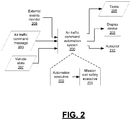
- FIG. 2 is a diagram depicting an example air traffic command automation system 200 for automating the process of listening to, interpreting, adhering to, and responding to air traffic command messages.
- the example air traffic command automation system 200 is integrated into a vehicle such as an aircraft, to interface with voice or CPDLC services, the autopilot, the pilot's interface, and other software components (such as a detect and avoid system).
- the example air traffic command automation system 200 includes an automation executive 202 for listening to, interpreting, and responding to the air traffic command messages (e.g ., receive CPDLC messages and process them to determine the appropriate plan of action for the aircraft) and a mission and safety executive 204 for implementing additional safety protocols before implementing tasks required by the air traffic command message (e.g ., to interface with the flight crew and software systems on the aircraft to relay and, if appropriate, enact the plan).
- an automation executive 202 for listening to, interpreting, and responding to the air traffic command messages (e.g ., receive CPDLC messages and process them to determine the appropriate plan of action for the aircraft) and a mission and safety executive 204 for implementing additional safety protocols before implementing tasks required by the air traffic command message (e.g ., to interface with the flight crew and software systems on the aircraft to relay and, if appropriate, enact the plan).
- the automation executive 202 may use an automated planning technique called Hierarchical Task Networks to decompose the incoming task(s) into a sequence of primitive actions.
- Each task may correspond to a possible CPDLC uplink message, and each action may correspond to a state change that can be made by the aircraft.
- a plan is then a mapping from an incoming task to one or more actions, in order; this mapping can make use of other simpler tasks in the decomposition of a complex task. Once a plan is generated for the incoming task(s), the actions in that plan are checked to ensure that their interactions meet specified safety conditions.
- the mission and safety executive 204 is configured to take the plan that is output by the automation executive 202 and determine which actions in the plan should be enacted or passed to the pilot for approval. It also incorporates information from other software systems (e.g., Detect and Avoid) to ensure the safe flight of the aircraft, and passes appropriate inputs to the autopilot.
- Other software systems e.g., Detect and Avoid
- the example air traffic command automation system 200 includes a controller that is configured to implement the automation executive 202 and the mission and safety executive 204.
- the controller includes at least one processor and a computer-readable storage device or media encoded with programming instructions for configuring the controller.
- the processor may be any custom-made or commercially available processor, a central processing unit (CPU), a graphics processing unit (GPU), an application specific integrated circuit (ASIC), a field programmable gate array (FPGA), an auxiliary processor among several processors associated with the controller, a semiconductor-based microprocessor (in the form of a microchip or chip set), any combination thereof, or generally any device for executing instructions.
- the computer readable storage device or media may include volatile and nonvolatile storage in read-only memory (ROM), random-access memory (RAM), and keep-alive memory (KAM), for example.
- KAM is a persistent or non-volatile memory that may be used to store various operating variables while the processor is powered down.
- the computer-readable storage device or media may be implemented using any of a number of known memory devices such as PROMs (programmable read-only memory), EPROMs (electrically PROM), EEPROMs (electrically erasable PROM), flash memory, or any other electric, magnetic, optical, or combination memory devices capable of storing data, some of which represent executable programming instructions, used by the controller.
- each of the automation executive 202 and the mission and safety executive 204 includes one or more processors configured by programming instructions on non-transient computer readable media.
- the example automation executive 202 is configured to receive an air traffic command message 203 from an entity other than the flight crew (e.g., ATC), wherein the air traffic command message includes one or more tasks for the vehicle to perform.
- the air traffic command message 203 is a controller-pilot data link communication (CPDLC) message from ATC.
- CPDLC controller-pilot data link communication
- the air traffic command message 203 is an ATC voice message.
- the example automation executive 202 is configured to determine the intent of the air traffic command message 203.
- the example automation executive 202 is configured to identify the one or more tasks from a voice message.
- the example automation executive 202 may convert the voice message to text, for example, using voice recognition software, parse the text into a plurality of text sections, match text sections to a task type that is known to be contained in a CPDLC message, and adjust the task type based on the content of the text sections.
- the example automation executive 202 is configured to identify the one or more tasks from a CPDLC message.
- the example automation executive 202 is configured to generate a sequence of "actions" for each task that the aircraft can undertake. To generate the sequence of actions for each task, the example automation executive 202 may decompose each of the one or more tasks into one or more primitive actions, wherein the tasks are decomposed into individual actions that are comparable to the actions that would be taken by the pilot (e.g ., setting the altitude, changing speed, etc.), which allows for the intuitive presentation of the plan to the pilot for approval or monitoring.
- the pilot e.g ., setting the altitude, changing speed, etc.
- An example of a task and corresponding primitive actions can be for the aircraft to undertake the task: "proceed direct to [position], and after passing [position] climb to [altitude]"; this task requires the aircraft to fly to the location specified by [position] and, after reaching that location, adjust its altitude to the specified value.
- the example automation executive 202 is configured to check the coherence (e.g., a "descend" command from ATC should provide an altitude that is lower than the aircraft's current altitude), feasibility (e.g ., a command to change the speed of the aircraft should provide a value that is within the operating speeds of the aircraft), and safety (e.g ., simultaneous speed and altitude changes must not cause the aircraft to stall) of each action after generating a sequence of actions.
- coherence e.g., a "descend" command from ATC should provide an altitude that is lower than the aircraft's current altitude
- feasibility e.g ., a command to change the speed of the aircraft should provide a value that is within the operating speeds of the aircraft
- safety e.g ., simultaneous speed and altitude changes must not cause the aircraft to stall
- the example automation executive 202 is configured to generate a separate execution stream for different types of actions.
- the execution streams divorce independent actions from one another by treating their execution separately. This allows tasks that affect different states of the aircraft (e.g., a task that changes the altitude and one that changes the speed) to be planned for and executed independently, except where necessitated by the tasks themselves.
- the example automation executive 202 is configured to relay its interpretation of the air traffic command message (retrieved tasks 205) and/or the plan of actions to the air traffic command message originator (e.g ., ATC), preview the plan with the flight crew, and request flight crew approval of the plan when necessary.
- the example automation executive 202 may reply to the ATC with scripted readback for the retrieved tasks 205 and/or series of actions.
- the example automation executive 202 may present the plan of actions to the flight crew, for example, via a graphical user interface (GUI) on a display device 206.
- GUI graphical user interface
- the example automation executive 202 is configured to issue commands to execute the actions at one or more appropriate points during the mission after receiving flight crew approval of the plan of actions when necessary or automatically when flight crew approval is not required.
- the example automation executive 202 may generate execution event monitors for identifying events on which action execution is dependent (e.g ., reaching a waypoint), evaluate event monitors based on the values of the vehicle states 207, and issue a command to execute an action when an event (e.g. , determined based on vehicle states 207) on which the action is dependent occurs.
- the example mission and safety executive 204 is configured to evaluate whether system states 207 indicate that action execution is appropriate when action execution is commanded by the automation executive 202 and to communicate to the flight crew that action execution has been commanded, for example, via the GUI.
- the example mission and safety executive 204 is also configured to monitor external events, e.g ., using an external events monitor 208, to determine if any external event would dictate not performing a commanded action.
- an external event may be crossing a geofence wherein geofencing constraints would cause the mission and safety executive 204 to override a commanded action to prevent flying into protected airspace.
- an external event may be a Detect-and-Avoid (DAA) alert from a DAA sensor that can detect one or more approaching aircraft that may be an obstacle to safely performing the commanded action.
- DAA sensors may include a radar system, an automatic dependent surveillance - broadcast (ADS-B) sensor, a traffic alert and collision avoidance system (TCAS), and others.
- ADS-B automatic dependent surveillance - broadcast
- TCAS traffic alert and collision avoidance system
- ADS-B is a satellite-based navigation tool in which an aircraft determines its position and then broadcasts that information, enabling other nearby airplanes equipped with the same tool to know its location.
- TCAS keeps an electronic eye on the sky immediately surrounding an airplane. Should another airplane with a similar device fly too close, an alert will issue.
- the mission and safety executive 204 may choose to deviate from the plan created by the automation executive 202, in order to react to external events.
- the example mission and safety executive 204 is configured to cause the execution of an action when the system states 207 indicate that action execution is appropriate and when no external event is detected that dictates not performing the action. To cause the execution of the action, the example mission and safety executive 204 can prepare and send an appropriate input to vehicle equipment, such as the autopilot 210 to cause performance of the action.
- vehicle equipment such as the autopilot 210 to cause performance of the action.
- the example mission executive 204 is not only configured to check for external events before commanding new action, it is configured to override currently executing actions if an external event occurs while adhering to a given clearance.
- a pilot's use of the air traffic command automation system 200 should be intuitive and require minimal effort - part of the value of the system. Once configured, the system 200 will allow the pilot to monitor the interpretation of incoming commands and (if so configured) approve the resulting plans. Notifications and warnings can be provided to the pilot via the GUI on the display device 206 in the cockpit.
- the architecture is both configurable and expandable.
- the system can be configured to present the generated plan to the pilot for approval before enacting it, or it can be configured to automatically relay and enact all or part of the plan without the need for pilot approval (e.g ., changes to internal states such as the ATIS code or altimeter setting could be set automatically, while changes to the physical state of the aircraft such as speed or altitude could require pilot approval).
- changes to internal states such as the ATIS code or altimeter setting could be set automatically, while changes to the physical state of the aircraft such as speed or altitude could require pilot approval.
- the decomposition of complex tasks into a sequence of simple actions allows new tasks to be added simply by creating a new "recipe" for that task that uses already existing components - the coherence, feasibility, and safety checks incorporated in the simpler tasks are automatically included in the new complex task.
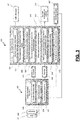
- FIG. 3 is a process flow chart depicting an example process 300 in an example automation executive and an example process 320 in an example mission and safety executive.
- the order of operation within the processes 300 and 320 are not limited to the sequential execution as illustrated in figure 3 , but may be performed in one or more varying orders as applicable and in accordance with the present disclosure.
- the example process 300 includes determining the intent of an uplink message 301 (operation 302).
- the message 301 is an uplink message from an entity other than the flight crew (e.g., ATC), wherein the message includes one or more tasks for a vehicle to perform.
- the message 301 is a controller-pilot data link communication (CPDLC) voice message from ATC.
- the message 301 is an ATC voice message.
- the intent is the one or more tasks for the aircraft to perform.
- determining the intent includes identifying one or more tasks from the uplink message (e.g. , CPDLC or voice message).
- Identifying one or more tasks from the uplink message may include converting a voice message to text, for example, using voice recognition software, parsing the text into a plurality of text sections, matching text sections to a task type that is known to be contained in a CPDLC message, and adjusting the task type based on the content of the text sections.
- the example process 300 includes decomposing the tasks into primitive actions (operation 304).
- the tasks are decomposed into individual actions that are comparable to the actions that would be taken by the pilot (e.g ., setting the altitude, changing speed, etc.), which allows for the intuitive presentation of the plan to the pilot for approval or monitoring
- the example process 300 includes checking the coherence and feasibility of actions (operation 306).
- Checking the coherence may include determining if the actions are logical and consistent (e.g. , a "descend" command from ATC should provide an altitude that is lower than the aircraft's current altitude).
- Checking the feasibility may include determining if the actions are possible to do easily or conveniently (e.g ., a command to change the speed of the aircraft should provide a value that is within the operating speeds of the aircraft).
- the example process 300 includes generating separate execution streams for decomposed tasks (operation 308).
- the execution streams divorce independent actions from one another by treating their execution separately. This allows tasks that affect different states of the aircraft (e.g., a task that changes the altitude and one that changes the heading) to be planned for and executed independently, except where necessitated by the tasks themselves.
- the example process 300 includes checking the safety of the interacting actions (operation 310). As an example, simultaneous speed and altitude changes must not cause the aircraft to stall.
- the example process 300 includes relaying the plan and obtaining pilot approval, when necessary (operation 312).
- Relaying may involve relaying its interpretation 303 of the command message and/or the plan of actions to the command message originator (e.g ., ATC).
- Obtaining pilot approval may involve previewing the plan with the flight crew, for example, via a GUI 305, and requesting flight crew approval of the plan, via the GUI 305, when necessary.
- the example process 300 includes generating execution event monitors (operation 314).
- Generating execution event monitors may include generating execution event monitors for identifying events on which action execution is dependent (e.g ., reaching a waypoint).
- the example process 300 includes evaluating event monitors and executing actions when the event monitors indicate action initiation is appropriate (operation 316).
- Evaluating event monitors may include determining vehicle states 307, and executing actions may include issuing a command to execute an action when an event (e.g ., determined based on vehicle states 307) on which the action is dependent occurs.
- the example process 320 includes evaluating action execution (operation 322). Evaluating execution may involve evaluating whether system states 307 indicate that action execution is appropriate after action execution has been commanded and communicating to the flight crew that action execution has been commanded, for example, via the GUI 305.
- the example process 320 includes detecting external events (operation 324). Detecting external events may include monitoring for external events, e.g., to determine if any external event would dictate not performing a commanded action.
- an external event may be a geofencing alert, from a geofence sensor 309, wherein geofencing constraints would cause the overriding of a commanded action to prevent flying into protected airspace.
- an external event may be a Detect-and-Avoid (DAA) alert from a DAA sensor 311 that can detect one or more approaching aircraft that may be an obstacle to safely performing the commanded action. Examples of DAA sensors 311 may include a radar system, an automatic dependent surveillance - broadcast (ADS-B) sensor, a traffic alert and collision avoidance system (TCAS), and others.
- ADS-B automatic dependent surveillance - broadcast
- TCAS traffic alert and collision avoidance system
- the example process 320 includes processing UAS commands (operation 326).
- Processing UAS commands may involve causing the execution of an action when the system states 307 indicate that action execution is appropriate and when no external event is detected that dictates not performing the action.
- Causing the execution of the action may further involve preparing and sending an appropriate input to vehicle equipment, such as the autopilot 313 to cause performance of the action.
- Apparatus, systems, techniques and articles provided herein can provide for coherence and feasibility checks during the planning process.
- Apparatus, systems, techniques and articles provided herein can provide for tasks to be decomposed into smaller, actionable pieces.
- Apparatus, systems, techniques and articles provided herein can provide for safety, coherence, and feasibility checks to be included in any level of the decomposed task, and can include component-level checks.
- Apparatus, systems, techniques and articles provided herein can provide that when tasks are defined using already defined tasks or actions as components, the safety checks become inherited.
- Apparatus, systems, techniques and articles provided herein can provide for generating independent plans (e.g ., sequences of primitive actions) for each "stream" of execution, e.g ., a task that affects the vertical state of the aircraft may not affect a plan for the horizontal state of the aircraft.
- Apparatus, systems, techniques and articles provided herein can provide for the execution of actions to be triggered by events (e.g. , reaching a waypoint or a desired altitude).
- Apparatus, systems, techniques and articles provided herein can provide for plan execution to be automatic or require pilot approval, e.g ., based on a setting for level of autonomy and phase of flight.
- Apparatus, systems, techniques and articles provided herein can provide a system with very minimal computational requirements.
- Apparatus, systems, techniques and articles provided herein can provide a system wherein the framework is easy to extend to additional tasks.
- an air traffic command automation system on an aerial vehicle for automating the process of listening to, interpreting, adhering to, and responding to air traffic commands.
- the system comprises one or more processors configured by programming instructions on non-transient computer readable media.
- the system is configured to: receive an air traffic command message directed to the aerial vehicle, from an entity other than flight crew on the aerial vehicle, that includes one or more tasks for the aerial vehicle to perform; determine from the command message the one or more tasks for the aerial vehicle to perform; generate a sequence of actions for each task that the aerial vehicle can undertake to accomplish the task; verify the coherence, feasibility, and safety of the actions; relay an interpretation of the command message to the command message originator; preview the verified sequence of actions with the flight crew; and issue commands to execute actions at appropriate points during a mission.
- the command message may comprise a controller-pilot data link communication (CPDLC) message or a voice message from air traffic control (ATC).
- CPDLC controller-pilot data link communication
- ATC air traffic control
- To determine the one or more tasks for the aircraft to perform the system may be configured to identify the one or more tasks from a CPDLC or voice message.
- To identify the one or more tasks from a voice message the system may be configured to convert the voice message to text using voice recognition software, parse the text into a plurality of text sections, match text sections to a task type that may be known to be contained in a CPDLC message, and adjust the task type based on the content of the text sections.
- the system may be configured to decompose each of the one or more tasks into one or more primitive actions that are comparable to the actions that would be taken by the pilot.
- the system may be configured to reply to ATC with scripted readback for the command message.
- the system may be configured to present the plan of actions to the flight crew via a graphical user interface (GUI).
- GUI graphical user interface
- the system may be further configured to evaluate whether system states indicate that action execution is appropriate and to communicate to the flight crew, via a graphical user interface (GUI), that action execution has been commanded.
- GUI graphical user interface
- the system may be further configured to monitor external events to determine if any external event would dictate not performing a commanded action.
- An external event may comprise a geofencing alert or a detect-and-avoid (DAA) alert indicating that one or more approaching aircraft have been detected that may be an obstacle to safely performing the commanded action.
- DAA detect-and-avoid
- the system may be further configured to cause the execution of an action when the system states indicate that action execution is appropriate and when no external event is detected that dictates not performing the action.
- the system may be configured to prepare and send an appropriate input to an autopilot system on the vehicle to cause performance of the action.
- a processor-implemented method in a vehicle for automating the process of listening to, interpreting, adhering to, and responding to air traffic commands comprises: receiving, by the processor, an air traffic command message directed to the vehicle, from an entity other than flight crew, that includes one or more tasks for the vehicle to perform; determining, by the processor, from the air traffic command message the one or more tasks for the vehicle to perform; generating, by the processor, a sequence of actions for each task that the vehicle can undertake to accomplish the task; verifying, by the processor, the coherence, feasibility, and safety of the actions; relaying, by the processor, an interpretation of the air traffic command message to the command message originator; previewing, by the processor, the verified sequence of actions with the flight crew; and issuing, by the processor, commands to execute actions at appropriate points during a mission.
- the command message may comprise a controller-pilot data link communication (CPDLC) message or a voice message from air traffic control (ATC).
- the determining the one or more tasks for the vehicle to perform may comprise identifying the one or more tasks from a CPDLC message or voice message.
- the identifying the one or more tasks from a voice message may comprise converting the voice message to text using voice recognition software, parsing the text into a plurality of text sections, matching text sections to a task type that is known to be contained in a CPDLC message, and adjusting the task type based on the content of the text sections.
- the generating the sequence of actions for each task may comprise decomposing each of the one or more tasks into one or more primitive actions that are comparable to the actions that would be taken by the pilot.
- the relaying an interpretation of the command message to the command message originator may comprise replying to ATC with scripted readback for the command message.
- Previewing the plan with the flight crew comprises presenting the plan of actions to the flight crew via a graphical user interface (GUI).
- Issuing commands to execute actions at appropriate points during a mission may comprise generating execution event monitors for identifying events on which action execution is dependent, evaluating the event monitors, and issuing a command to execute actions when an event on which the action is dependent is detected.
- the method may further comprise evaluating whether system states indicate that action execution is appropriate and communicating to the flight crew, via a graphical user interface (GUI), that action execution has been commanded.
- the method may further comprise monitoring external events to determine if any external event would dictate not performing a commanded action.
- An external event may comprise a geofencing alert or a detect-and-avoid (DAA) alert indicating that one or more approaching aircraft have been detected that may be an obstacle to safely performing the commanded action.
- the method may further comprise causing the execution of an action when the system states indicate that action execution is appropriate and when no external event is detected that dictates not performing the action.
- Causing the execution of the action may comprise preparing and sending an appropriate input to an autopilot system on the vehicle to cause performance of the action.
- non-transient computer readable media encoded with programming instructions configurable to cause a processor to perform a method comprises: receiving an air traffic command message, from an entity other than flight crew, that includes one or more tasks for an aerial vehicle to perform; determining from the command message the one or more tasks for the aerial vehicle to perform; generating a sequence of actions for each task that the aerial vehicle can undertake to accomplish the task; verifying the coherence, feasibility, and safety of the actions; relaying an interpretation of the command message to the command message originator; previewing the verified sequence of actions with the flight crew; and issuing commands to execute actions at appropriate points during a mission.
- the command message may comprise a controller-pilot data link communication (CPDLC) message or a voice message from air traffic control (ATC).
- the determining the one or more tasks for the vehicle to perform may comprise identifying the one or more tasks from a CPDLC message or voice message.
- the identifying the one or more tasks from a voice message may comprise converting the CPDLC voice message to text using voice recognition software, parsing the text into a plurality of text sections, matching text sections to a task type that is known to be contained in a CPDLC message, and adjusting the task type based on the content of the text sections.
- the generating the sequence of actions for each task may comprise decomposing each of the one or more tasks into one or more primitive actions that are comparable to the actions that would be taken by the pilot.
- the relaying an interpretation of the command message to the command message originator may comprise replying to ATC with scripted readback for the command message.
- Previewing the plan with the flight crew comprises presenting the plan of actions to the flight crew via a graphical user interface (GUI).
- Issuing commands to execute actions at appropriate points during a mission may comprise generating execution event monitors for identifying events on which action execution is dependent, evaluating the event monitors, and issuing a command to execute actions when an event on which the action is dependent is detected.
- the method may further comprise evaluating whether system states indicate that action execution is appropriate and communicating to the flight crew, via a graphical user interface (GUI), that action execution has been commanded.
- the method may further comprise monitoring external events to determine if any external event would dictate not performing a commanded action.
- An external event may comprise a geofencing alert or a detect-and-avoid (DAA) alert indicating that one or more approaching aircraft have been detected that may be an obstacle to safely performing the commanded action.
- the method may further comprise causing the execution of an action when the system states indicate that action execution is appropriate and when no external event is detected that dictates not performing the action.
- Causing the execution of the action may comprise preparing and sending an appropriate input to an autopilot system on the vehicle to cause performance of the action.
- Skilled artisans may implement the described functionality in varying ways for each particular application, but such implementation decisions should not be interpreted as causing a departure from the scope of the present invention.
- an embodiment of a system or a component may employ various integrated circuit components, e.g., memory elements, digital signal processing elements, logic elements, look-up tables, or the like, which may carry out a variety of functions under the control of one or more microprocessors or other control devices.
- integrated circuit components e.g., memory elements, digital signal processing elements, logic elements, look-up tables, or the like, which may carry out a variety of functions under the control of one or more microprocessors or other control devices.
- DSP digital signal processor
- ASIC application specific integrated circuit
- FPGA field programmable gate array
- a general-purpose processor may be a microprocessor, but in the alternative, the processor may be any conventional processor, controller, microcontroller, or state machine.
- a processor may also be implemented as a combination of computing devices, e.g., a combination of a DSP and a microprocessor, a plurality of microprocessors, one or more microprocessors in conjunction with a DSP core, or any other such configuration.
- a software module may reside in RAM memory, flash memory, ROM memory, EPROM memory, EEPROM memory, registers, hard disk, a removable disk, a CD-ROM, or any other form of storage medium known in the art.
- An exemplary storage medium is coupled to the processor such that the processor can read information from, and write information to, the storage medium.
- the storage medium may be integral to the processor.
- the processor and the storage medium may reside in an ASIC.
- the ASIC may reside in a user terminal.
- the processor and the storage medium may reside as discrete components in a user terminal.
Landscapes
- Engineering & Computer Science (AREA)
- Physics & Mathematics (AREA)
- Aviation & Aerospace Engineering (AREA)
- General Physics & Mathematics (AREA)
- Health & Medical Sciences (AREA)
- Computational Linguistics (AREA)
- Audiology, Speech & Language Pathology (AREA)
- Human Computer Interaction (AREA)
- Acoustics & Sound (AREA)
- Multimedia (AREA)
- Artificial Intelligence (AREA)
- Traffic Control Systems (AREA)
- Radar, Positioning & Navigation (AREA)
- Remote Sensing (AREA)
Abstract
Description
- Embodiments of the subject matter described herein relate generally to air traffic communication. More particularly, embodiments of the subject matter relate to automating an aircraft's response to air traffic command messages.
- Listening and responding to air traffic command messages can place significant cognitive stress on pilots, particularly in high-traffic areas (such as terminal areas) where the pilot must quickly and accurately parse numerous messages - many of which may not apply to that aircraft. This cognitive load can cause a pilot to make mistakes when processing and interpreting important air traffic voice messages and lead to costly delays (e.g., missed approach). The inherent risks and costs involved in air traffic routing and control make it imperative that air traffic commands are quickly, accurately, and safely processed and acted on. New systems and methods for reducing pilot workload can aid the advancement toward single pilot and autonomous flight operations.
- Hence, it is desirable to provide a system and method for automating the response to air traffic command messages. Furthermore, other desirable features and characteristics of the present invention will become apparent from the subsequent detailed description and the appended claims, taken in conjunction with the accompanying drawings and the foregoing technical field and background.
- This summary is provided to describe select concepts in a simplified form that are further described in the Detailed Description. This summary is not intended to identify key or essential features of the claimed subject matter, nor is it intended to be used as an aid in determining the scope of the claimed subject matter.
- An air traffic command automation system on an aerial vehicle for automating the process of listening to, interpreting, adhering to, and responding to air traffic commands is disclosed. The system includes one or more processors configured by programming instructions on non-transient computer readable media. The system is configured to: receive an air traffic command message directed to the aerial vehicle, from an entity other than flight crew on the aerial vehicle, that includes one or more tasks for the aerial vehicle to perform; determine from the air traffic command message the one or more tasks for the aerial vehicle to perform; generate a sequence of actions for each task that the aerial vehicle can undertake to accomplish the task; verify the coherence, feasibility, and safety of each action individually and together; relay an interpretation of the air traffic command message to the air traffic command originator; preview the verified sequence of actions with the flight crew; and issue commands to execute actions at appropriate points during a mission.
- A processor-implemented method in a vehicle for automating the process of listening to, interpreting, adhering to, and responding to air traffic commands is disclosed. The method includes: receiving, by the processor, an air traffic command message directed to the vehicle, from an entity other than the flight crew, that includes one or more tasks for the vehicle to perform; determining, by the processor, from the air traffic command message the one or more tasks for the vehicle to perform; generating, by the processor, a sequence of actions for each task that the vehicle can undertake to accomplish the task; verifying, by the processor, the coherence, feasibility, and safety of each action individually and together; relaying, by the processor, an interpretation of the air traffic command message to the command message originator; previewing, by the processor, the verified sequence of actions with the flight crew; and issuing, by the processor, commands to execute actions at appropriate points during a mission.
- Non-transient computer readable media encoded with programming instructions configurable to cause a processor to perform a method is disclosed. The method includes: receiving an air traffic command message, from an entity other than the flight crew, that includes one or more tasks for an aerial vehicle to perform; determining from the air traffic command message the one or more tasks for the aerial vehicle to perform; generating a sequence of actions for each task that the aerial vehicle can undertake to accomplish the task; verifying the coherence, feasibility, and safety of each action individually and together; relaying an interpretation of the air traffic command message to the command message originator; previewing the verified sequence of actions with the flight crew; and issuing commands to execute actions at appropriate points during a mission.
- Furthermore, other desirable features and characteristics will become apparent from the subsequent detailed description and the appended claims, taken in conjunction with the accompanying drawings and the preceding background.
- Embodiments of the subject matter will hereinafter be described in conjunction with the following drawing figures, wherein like numerals denote like elements, and wherein:
-
FIG. 1 is a diagram depicting an example operating environment for an example air traffic command automation system, in accordance with some embodiments; -
FIG. 2 is a block diagram depicting an example air traffic command automation system for automating the process of listening to, interpreting, adhering to, and responding to air traffic command messages, in accordance with some embodiments; and -
FIG. 3 is a process flow chart depicting an example process in an example automation executive and an example process in an example mission and safety executive, in accordance with some embodiments. - The following detailed description is merely exemplary in nature and is not intended to limit the application and uses. Furthermore, there is no intention to be bound by any expressed or implied theory presented in the preceding technical field, background, summary, or the following detailed description. As used herein, the term "module" refers to any hardware, software, firmware, electronic control component, processing logic, and/or processor device, individually or in any combination, including without limitation: application specific integrated circuit (ASIC), a field-programmable gate-array (FPGA), an electronic circuit, a processor (shared, dedicated, or group) and memory that executes one or more software or firmware programs, a combinational logic circuit, and/or other suitable components that provide the described functionality.
- Embodiments of the present disclosure may be described herein in terms of functional and/or logical block components and various processing steps. It should be appreciated that such block components may be realized by any number of hardware, software, and/or firmware components configured to perform the specified functions. For example, an embodiment of the present disclosure may employ various integrated circuit components, e.g., memory elements, digital signal processing elements, logic elements, look-up tables, or the like, which may carry out a variety of functions under the control of one or more microprocessors or other control devices. In addition, those skilled in the art will appreciate that embodiments of the present disclosure may be practiced in conjunction with any number of systems, and that the systems described herein is merely exemplary embodiments of the present disclosure.
- For the sake of brevity, conventional techniques related to signal processing, data transmission, signaling, control, and other functional aspects of the systems (and the individual operating components of the systems) may not be described in detail herein. Furthermore, the connecting lines shown in the various figures contained herein are intended to represent example functional relationships and/or physical couplings between the various elements. It should be noted that many alternative or additional functional relationships or physical connections may be present in an embodiment of the present disclosure.
- The subject matter described herein discloses apparatus, systems, techniques and articles for automating an air traffic command interface in an aerial vehicle in a manner that allows the pilot or operator of the aerial vehicle to easily and intuitively monitor and, if necessary, change the aircraft's response. Apparatus, systems, techniques and articles provided herein can allow for automated responses to air traffic voice messages to be performed in a demonstrably safe manner. Apparatus, systems, techniques and articles provided herein can allow for the presentation of a proposed automated response to the flight crew to be presented in an intuitive manner (e.g., so that a pilot may be able to quickly and accurately interact with it). Apparatus, systems, techniques and articles provided herein can be configured to interface with current aircraft control technology (e.g., to reduce the cost of installation).
- Apparatus, systems, techniques and articles provided herein can receive air traffic control (ATC) command messages in the form of voice messages or Controller-Pilot Data Link Communication (CPDLC) messages, interpret them, and generate a sequence of "actions" that are comparable to the actions that would be taken by a pilot (e.g., setting the altitude, changing speed, etc.) that an aircraft can undertake to accomplish tasks assigned via the ATC command message. By decomposing complex tasks into simple actions, apparatus, systems, techniques and articles provided herein can interface with an existing autopilot computer to provide automated control of an aircraft.
- Decomposing complex tasks into simple actions may also allow for the intuitive presentation of the plan to the pilot for approval or monitoring. In generating the plan, apparatus, systems, techniques and articles provided herein can check the received command for coherence (e.g., a "descend" command from ATC should provide an altitude that is lower than the aircrafts current altitude), feasibility (e.g., a command to change the speed of the aircraft should provide a value that is within the operating speeds of the aircraft), and safety (e.g., simultaneous speed and altitude changes must not cause the aircraft to stall).
- Apparatus, systems, techniques and articles provided herein can provide an architecture that is both configurable and expandable. Apparatus, systems, techniques and articles provided herein can be configured to present a generated plan of actions to the pilot for approval before enacting it, or it can be configured to automatically relay and enact all or part of the plan without the need for pilot approval (e.g., changes to internal states such as the ATIS code or altimeter setting could be set automatically, while changes to the physical state of the aircraft such as speed or altitude could require pilot approval). The decomposition of complex tasks into a sequence of simple actions provided by apparatus, systems, techniques and articles described herein can allow new tasks to be added simply by creating a new "recipe" for that task that uses already existing components - the coherence, feasibility, and safety checks incorporated in the simpler tasks are automatically included in the new complex task.
- Apparatus, systems, techniques and articles provided herein can provide a relatively low-cost solution for automating a significant portion of an aircraft's interactions with air traffic command messages. Doing so can reduce the cognitive load on pilots, providing faster and more reliable responses to ATC commands. This, in turn, can reduce the costs incurred by mistakes and delays in aircraft routing and control.
-
FIG. 1 is a block diagram depicting anexample operating environment 100 for an example air trafficcommand automation system 102. As avehicle 104, such as a manned aircraft or an unmanned aerial system (UAS) is traveling, thevehicle 104 may receive an air traffic command message (e.g., ATC voice command message / CPDLC message) 106 from a control entity, such asair traffic control 108. Listening and responding to ATC command messages can place a significant cognitive stress on pilots or operators (e.g., in the case of a UAS), particularly in high-traffic areas (such as terminal areas) where the pilot/operator must quickly and accurately parse numerous messages - many of which may not apply to that aircraft. The cognitive load has the potential to cause costly delays or mistakes by the aircraft's pilot/operator in the processing and interpretation of important ATC command messages. The inherent risks and costs involved in air traffic routing and control make it imperative that ATC command messages are quickly, accurately, and safely processed and acted on. - To reduce pilot/operator workload, the air traffic
command automation system 102 is provided in thevehicle 104. The air trafficcommand automation system 102 is configured to automatically comply with and respond to air traffic commands in a quick, accurate and safe manner. -
FIG. 2 is a diagram depicting an example air trafficcommand automation system 200 for automating the process of listening to, interpreting, adhering to, and responding to air traffic command messages. The example air trafficcommand automation system 200 is integrated into a vehicle such as an aircraft, to interface with voice or CPDLC services, the autopilot, the pilot's interface, and other software components (such as a detect and avoid system). The example air trafficcommand automation system 200 includes anautomation executive 202 for listening to, interpreting, and responding to the air traffic command messages (e.g., receive CPDLC messages and process them to determine the appropriate plan of action for the aircraft) and a mission andsafety executive 204 for implementing additional safety protocols before implementing tasks required by the air traffic command message (e.g., to interface with the flight crew and software systems on the aircraft to relay and, if appropriate, enact the plan). - The
automation executive 202 may use an automated planning technique called Hierarchical Task Networks to decompose the incoming task(s) into a sequence of primitive actions. Each task may correspond to a possible CPDLC uplink message, and each action may correspond to a state change that can be made by the aircraft. A plan is then a mapping from an incoming task to one or more actions, in order; this mapping can make use of other simpler tasks in the decomposition of a complex task. Once a plan is generated for the incoming task(s), the actions in that plan are checked to ensure that their interactions meet specified safety conditions. - The mission and
safety executive 204 is configured to take the plan that is output by theautomation executive 202 and determine which actions in the plan should be enacted or passed to the pilot for approval. It also incorporates information from other software systems (e.g., Detect and Avoid) to ensure the safe flight of the aircraft, and passes appropriate inputs to the autopilot. - The example air traffic
command automation system 200 includes a controller that is configured to implement theautomation executive 202 and the mission andsafety executive 204. The controller includes at least one processor and a computer-readable storage device or media encoded with programming instructions for configuring the controller. The processor may be any custom-made or commercially available processor, a central processing unit (CPU), a graphics processing unit (GPU), an application specific integrated circuit (ASIC), a field programmable gate array (FPGA), an auxiliary processor among several processors associated with the controller, a semiconductor-based microprocessor (in the form of a microchip or chip set), any combination thereof, or generally any device for executing instructions. - The computer readable storage device or media may include volatile and nonvolatile storage in read-only memory (ROM), random-access memory (RAM), and keep-alive memory (KAM), for example. KAM is a persistent or non-volatile memory that may be used to store various operating variables while the processor is powered down. The computer-readable storage device or media may be implemented using any of a number of known memory devices such as PROMs (programmable read-only memory), EPROMs (electrically PROM), EEPROMs (electrically erasable PROM), flash memory, or any other electric, magnetic, optical, or combination memory devices capable of storing data, some of which represent executable programming instructions, used by the controller. In one example, each of the
automation executive 202 and the mission andsafety executive 204 includes one or more processors configured by programming instructions on non-transient computer readable media. - The
example automation executive 202 is configured to receive an airtraffic command message 203 from an entity other than the flight crew (e.g., ATC), wherein the air traffic command message includes one or more tasks for the vehicle to perform. In one example, the airtraffic command message 203 is a controller-pilot data link communication (CPDLC) message from ATC. In another example the airtraffic command message 203 is an ATC voice message. - The
example automation executive 202 is configured to determine the intent of the airtraffic command message 203. In one example, to determine the intent, theexample automation executive 202 is configured to identify the one or more tasks from a voice message. To identify the one or more tasks from the voice message, theexample automation executive 202 may convert the voice message to text, for example, using voice recognition software, parse the text into a plurality of text sections, match text sections to a task type that is known to be contained in a CPDLC message, and adjust the task type based on the content of the text sections. In another example, to determine the intent, theexample automation executive 202 is configured to identify the one or more tasks from a CPDLC message. - The
example automation executive 202 is configured to generate a sequence of "actions" for each task that the aircraft can undertake. To generate the sequence of actions for each task, theexample automation executive 202 may decompose each of the one or more tasks into one or more primitive actions, wherein the tasks are decomposed into individual actions that are comparable to the actions that would be taken by the pilot (e.g., setting the altitude, changing speed, etc.), which allows for the intuitive presentation of the plan to the pilot for approval or monitoring. An example of a task and corresponding primitive actions can be for the aircraft to undertake the task: "proceed direct to [position], and after passing [position] climb to [altitude]"; this task requires the aircraft to fly to the location specified by [position] and, after reaching that location, adjust its altitude to the specified value. - The
example automation executive 202 is configured to check the coherence (e.g., a "descend" command from ATC should provide an altitude that is lower than the aircraft's current altitude), feasibility (e.g., a command to change the speed of the aircraft should provide a value that is within the operating speeds of the aircraft), and safety (e.g., simultaneous speed and altitude changes must not cause the aircraft to stall) of each action after generating a sequence of actions. - The
example automation executive 202 is configured to generate a separate execution stream for different types of actions. The execution streams divorce independent actions from one another by treating their execution separately. This allows tasks that affect different states of the aircraft (e.g., a task that changes the altitude and one that changes the speed) to be planned for and executed independently, except where necessitated by the tasks themselves. - The
example automation executive 202 is configured to relay its interpretation of the air traffic command message (retrieved tasks 205) and/or the plan of actions to the air traffic command message originator (e.g., ATC), preview the plan with the flight crew, and request flight crew approval of the plan when necessary. To relay the interpretation of the air traffic command message and/or the plan of actions, theexample automation executive 202 may reply to the ATC with scripted readback for the retrievedtasks 205 and/or series of actions. To preview the plan with the flight crew, and request flight crew approval of the plan when necessary, theexample automation executive 202 may present the plan of actions to the flight crew, for example, via a graphical user interface (GUI) on adisplay device 206. - The
example automation executive 202 is configured to issue commands to execute the actions at one or more appropriate points during the mission after receiving flight crew approval of the plan of actions when necessary or automatically when flight crew approval is not required. Theexample automation executive 202 may generate execution event monitors for identifying events on which action execution is dependent (e.g., reaching a waypoint), evaluate event monitors based on the values of the vehicle states 207, and issue a command to execute an action when an event (e.g., determined based on vehicle states 207) on which the action is dependent occurs. - The example mission and
safety executive 204 is configured to evaluate whether system states 207 indicate that action execution is appropriate when action execution is commanded by theautomation executive 202 and to communicate to the flight crew that action execution has been commanded, for example, via the GUI. - The example mission and
safety executive 204 is also configured to monitor external events, e.g., using an external events monitor 208, to determine if any external event would dictate not performing a commanded action. For example, an external event may be crossing a geofence wherein geofencing constraints would cause the mission andsafety executive 204 to override a commanded action to prevent flying into protected airspace. As another example, an external event may be a Detect-and-Avoid (DAA) alert from a DAA sensor that can detect one or more approaching aircraft that may be an obstacle to safely performing the commanded action. Examples of DAA sensors may include a radar system, an automatic dependent surveillance - broadcast (ADS-B) sensor, a traffic alert and collision avoidance system (TCAS), and others. ADS-B is a satellite-based navigation tool in which an aircraft determines its position and then broadcasts that information, enabling other nearby airplanes equipped with the same tool to know its location. TCAS keeps an electronic eye on the sky immediately surrounding an airplane. Should another airplane with a similar device fly too close, an alert will issue. The mission andsafety executive 204 may choose to deviate from the plan created by theautomation executive 202, in order to react to external events. - The example mission and
safety executive 204 is configured to cause the execution of an action when the system states 207 indicate that action execution is appropriate and when no external event is detected that dictates not performing the action. To cause the execution of the action, the example mission andsafety executive 204 can prepare and send an appropriate input to vehicle equipment, such as theautopilot 210 to cause performance of the action. Theexample mission executive 204 is not only configured to check for external events before commanding new action, it is configured to override currently executing actions if an external event occurs while adhering to a given clearance. - A pilot's use of the air traffic
command automation system 200 should be intuitive and require minimal effort - part of the value of the system. Once configured, thesystem 200 will allow the pilot to monitor the interpretation of incoming commands and (if so configured) approve the resulting plans. Notifications and warnings can be provided to the pilot via the GUI on thedisplay device 206 in the cockpit. - The architecture is both configurable and expandable. The system can be configured to present the generated plan to the pilot for approval before enacting it, or it can be configured to automatically relay and enact all or part of the plan without the need for pilot approval (e.g., changes to internal states such as the ATIS code or altimeter setting could be set automatically, while changes to the physical state of the aircraft such as speed or altitude could require pilot approval). The decomposition of complex tasks into a sequence of simple actions allows new tasks to be added simply by creating a new "recipe" for that task that uses already existing components - the coherence, feasibility, and safety checks incorporated in the simpler tasks are automatically included in the new complex task.
-
FIG. 3 is a process flow chart depicting anexample process 300 in an example automation executive and anexample process 320 in an example mission and safety executive. The order of operation within theprocesses figure 3 , but may be performed in one or more varying orders as applicable and in accordance with the present disclosure. - The
example process 300 includes determining the intent of an uplink message 301 (operation 302). Themessage 301 is an uplink message from an entity other than the flight crew (e.g., ATC), wherein the message includes one or more tasks for a vehicle to perform. In one example, themessage 301 is a controller-pilot data link communication (CPDLC) voice message from ATC. In another example, themessage 301 is an ATC voice message. The intent is the one or more tasks for the aircraft to perform. In one example, determining the intent includes identifying one or more tasks from the uplink message (e.g., CPDLC or voice message). Identifying one or more tasks from the uplink message may include converting a voice message to text, for example, using voice recognition software, parsing the text into a plurality of text sections, matching text sections to a task type that is known to be contained in a CPDLC message, and adjusting the task type based on the content of the text sections. - The
example process 300 includes decomposing the tasks into primitive actions (operation 304). The tasks are decomposed into individual actions that are comparable to the actions that would be taken by the pilot (e.g., setting the altitude, changing speed, etc.), which allows for the intuitive presentation of the plan to the pilot for approval or monitoring - The
example process 300 includes checking the coherence and feasibility of actions (operation 306). Checking the coherence may include determining if the actions are logical and consistent (e.g., a "descend" command from ATC should provide an altitude that is lower than the aircraft's current altitude). Checking the feasibility may include determining if the actions are possible to do easily or conveniently (e.g., a command to change the speed of the aircraft should provide a value that is within the operating speeds of the aircraft). - The
example process 300 includes generating separate execution streams for decomposed tasks (operation 308). The execution streams divorce independent actions from one another by treating their execution separately. This allows tasks that affect different states of the aircraft (e.g., a task that changes the altitude and one that changes the heading) to be planned for and executed independently, except where necessitated by the tasks themselves. - The
example process 300 includes checking the safety of the interacting actions (operation 310). As an example, simultaneous speed and altitude changes must not cause the aircraft to stall. - The
example process 300 includes relaying the plan and obtaining pilot approval, when necessary (operation 312). Relaying may involve relaying itsinterpretation 303 of the command message and/or the plan of actions to the command message originator (e.g., ATC). Obtaining pilot approval may involve previewing the plan with the flight crew, for example, via aGUI 305, and requesting flight crew approval of the plan, via theGUI 305, when necessary. - The
example process 300 includes generating execution event monitors (operation 314). Generating execution event monitors may include generating execution event monitors for identifying events on which action execution is dependent (e.g., reaching a waypoint). - The
example process 300 includes evaluating event monitors and executing actions when the event monitors indicate action initiation is appropriate (operation 316). Evaluating event monitors may include determining vehicle states 307, and executing actions may include issuing a command to execute an action when an event (e.g., determined based on vehicle states 307) on which the action is dependent occurs. - The
example process 320 includes evaluating action execution (operation 322). Evaluating execution may involve evaluating whether system states 307 indicate that action execution is appropriate after action execution has been commanded and communicating to the flight crew that action execution has been commanded, for example, via theGUI 305. - The
example process 320 includes detecting external events (operation 324). Detecting external events may include monitoring for external events, e.g., to determine if any external event would dictate not performing a commanded action. For example, an external event may be a geofencing alert, from ageofence sensor 309, wherein geofencing constraints would cause the overriding of a commanded action to prevent flying into protected airspace. As another example, an external event may be a Detect-and-Avoid (DAA) alert from aDAA sensor 311 that can detect one or more approaching aircraft that may be an obstacle to safely performing the commanded action. Examples ofDAA sensors 311 may include a radar system, an automatic dependent surveillance - broadcast (ADS-B) sensor, a traffic alert and collision avoidance system (TCAS), and others. - The
example process 320 includes processing UAS commands (operation 326). Processing UAS commands may involve causing the execution of an action when the system states 307 indicate that action execution is appropriate and when no external event is detected that dictates not performing the action. Causing the execution of the action may further involve preparing and sending an appropriate input to vehicle equipment, such as theautopilot 313 to cause performance of the action. - Described herein are apparatus, systems, techniques and articles for automating a significant portion of an aircraft's interactions with air traffic command messages. Apparatus, systems, techniques and articles provided herein can provide for coherence and feasibility checks during the planning process. Apparatus, systems, techniques and articles provided herein can provide for tasks to be decomposed into smaller, actionable pieces. Apparatus, systems, techniques and articles provided herein can provide for safety, coherence, and feasibility checks to be included in any level of the decomposed task, and can include component-level checks. Apparatus, systems, techniques and articles provided herein can provide that when tasks are defined using already defined tasks or actions as components, the safety checks become inherited. Apparatus, systems, techniques and articles provided herein can provide for generating independent plans (e.g., sequences of primitive actions) for each "stream" of execution, e.g., a task that affects the vertical state of the aircraft may not affect a plan for the horizontal state of the aircraft. Apparatus, systems, techniques and articles provided herein can provide for the execution of actions to be triggered by events (e.g., reaching a waypoint or a desired altitude). Apparatus, systems, techniques and articles provided herein can provide for plan execution to be automatic or require pilot approval, e.g., based on a setting for level of autonomy and phase of flight. Apparatus, systems, techniques and articles provided herein can provide a system with very minimal computational requirements. Apparatus, systems, techniques and articles provided herein can provide a system wherein the framework is easy to extend to additional tasks.
- In one embodiment, an air traffic command automation system on an aerial vehicle for automating the process of listening to, interpreting, adhering to, and responding to air traffic commands is provided. The system comprises one or more processors configured by programming instructions on non-transient computer readable media. The system is configured to: receive an air traffic command message directed to the aerial vehicle, from an entity other than flight crew on the aerial vehicle, that includes one or more tasks for the aerial vehicle to perform; determine from the command message the one or more tasks for the aerial vehicle to perform; generate a sequence of actions for each task that the aerial vehicle can undertake to accomplish the task; verify the coherence, feasibility, and safety of the actions; relay an interpretation of the command message to the command message originator; preview the verified sequence of actions with the flight crew; and issue commands to execute actions at appropriate points during a mission.
- These aspects and other embodiments may include one or more of the following features. The command message may comprise a controller-pilot data link communication (CPDLC) message or a voice message from air traffic control (ATC). To determine the one or more tasks for the aircraft to perform the system may be configured to identify the one or more tasks from a CPDLC or voice message. To identify the one or more tasks from a voice message the system may be configured to convert the voice message to text using voice recognition software, parse the text into a plurality of text sections, match text sections to a task type that may be known to be contained in a CPDLC message, and adjust the task type based on the content of the text sections. To generate the sequence of actions for each task, the system may be configured to decompose each of the one or more tasks into one or more primitive actions that are comparable to the actions that would be taken by the pilot. To relay an interpretation of the command message to the command message originator the system may be configured to reply to ATC with scripted readback for the command message. To preview the plan with the flight crew, the system may be configured to present the plan of actions to the flight crew via a graphical user interface (GUI). To issue commands to execute actions at appropriate point during a mission the system may be configured to generate execution event monitors for identifying events on which action execution is dependent, evaluate the event monitors, and issue commands to execute actions when an event on which the action is dependent is detected. The system may be further configured to evaluate whether system states indicate that action execution is appropriate and to communicate to the flight crew, via a graphical user interface (GUI), that action execution has been commanded. The system may be further configured to monitor external events to determine if any external event would dictate not performing a commanded action. An external event may comprise a geofencing alert or a detect-and-avoid (DAA) alert indicating that one or more approaching aircraft have been detected that may be an obstacle to safely performing the commanded action. The system may be further configured to cause the execution of an action when the system states indicate that action execution is appropriate and when no external event is detected that dictates not performing the action. To cause the execution of the action, the system may be configured to prepare and send an appropriate input to an autopilot system on the vehicle to cause performance of the action.
- In another embodiment, a processor-implemented method in a vehicle for automating the process of listening to, interpreting, adhering to, and responding to air traffic commands is provided. The method comprises: receiving, by the processor, an air traffic command message directed to the vehicle, from an entity other than flight crew, that includes one or more tasks for the vehicle to perform; determining, by the processor, from the air traffic command message the one or more tasks for the vehicle to perform; generating, by the processor, a sequence of actions for each task that the vehicle can undertake to accomplish the task; verifying, by the processor, the coherence, feasibility, and safety of the actions; relaying, by the processor, an interpretation of the air traffic command message to the command message originator; previewing, by the processor, the verified sequence of actions with the flight crew; and issuing, by the processor, commands to execute actions at appropriate points during a mission.
- These aspects and other embodiments may include one or more of the following features. The command message may comprise a controller-pilot data link communication (CPDLC) message or a voice message from air traffic control (ATC). The determining the one or more tasks for the vehicle to perform may comprise identifying the one or more tasks from a CPDLC message or voice message. The identifying the one or more tasks from a voice message may comprise converting the voice message to text using voice recognition software, parsing the text into a plurality of text sections, matching text sections to a task type that is known to be contained in a CPDLC message, and adjusting the task type based on the content of the text sections. The generating the sequence of actions for each task may comprise decomposing each of the one or more tasks into one or more primitive actions that are comparable to the actions that would be taken by the pilot. The relaying an interpretation of the command message to the command message originator may comprise replying to ATC with scripted readback for the command message. Previewing the plan with the flight crew comprises presenting the plan of actions to the flight crew via a graphical user interface (GUI). Issuing commands to execute actions at appropriate points during a mission may comprise generating execution event monitors for identifying events on which action execution is dependent, evaluating the event monitors, and issuing a command to execute actions when an event on which the action is dependent is detected. The method may further comprise evaluating whether system states indicate that action execution is appropriate and communicating to the flight crew, via a graphical user interface (GUI), that action execution has been commanded. The method may further comprise monitoring external events to determine if any external event would dictate not performing a commanded action. An external event may comprise a geofencing alert or a detect-and-avoid (DAA) alert indicating that one or more approaching aircraft have been detected that may be an obstacle to safely performing the commanded action. The method may further comprise causing the execution of an action when the system states indicate that action execution is appropriate and when no external event is detected that dictates not performing the action. Causing the execution of the action, may comprise preparing and sending an appropriate input to an autopilot system on the vehicle to cause performance of the action.
- In another embodiment, non-transient computer readable media encoded with programming instructions configurable to cause a processor to perform a method is provided. The method comprises: receiving an air traffic command message, from an entity other than flight crew, that includes one or more tasks for an aerial vehicle to perform; determining from the command message the one or more tasks for the aerial vehicle to perform; generating a sequence of actions for each task that the aerial vehicle can undertake to accomplish the task; verifying the coherence, feasibility, and safety of the actions; relaying an interpretation of the command message to the command message originator; previewing the verified sequence of actions with the flight crew; and issuing commands to execute actions at appropriate points during a mission.
- These aspects and other embodiments may include one or more of the following features. The command message may comprise a controller-pilot data link communication (CPDLC) message or a voice message from air traffic control (ATC). The determining the one or more tasks for the vehicle to perform may comprise identifying the one or more tasks from a CPDLC message or voice message. The identifying the one or more tasks from a voice message may comprise converting the CPDLC voice message to text using voice recognition software, parsing the text into a plurality of text sections, matching text sections to a task type that is known to be contained in a CPDLC message, and adjusting the task type based on the content of the text sections. The generating the sequence of actions for each task may comprise decomposing each of the one or more tasks into one or more primitive actions that are comparable to the actions that would be taken by the pilot. The relaying an interpretation of the command message to the command message originator may comprise replying to ATC with scripted readback for the command message. Previewing the plan with the flight crew comprises presenting the plan of actions to the flight crew via a graphical user interface (GUI). Issuing commands to execute actions at appropriate points during a mission may comprise generating execution event monitors for identifying events on which action execution is dependent, evaluating the event monitors, and issuing a command to execute actions when an event on which the action is dependent is detected. The method may further comprise evaluating whether system states indicate that action execution is appropriate and communicating to the flight crew, via a graphical user interface (GUI), that action execution has been commanded. The method may further comprise monitoring external events to determine if any external event would dictate not performing a commanded action. An external event may comprise a geofencing alert or a detect-and-avoid (DAA) alert indicating that one or more approaching aircraft have been detected that may be an obstacle to safely performing the commanded action. The method may further comprise causing the execution of an action when the system states indicate that action execution is appropriate and when no external event is detected that dictates not performing the action. Causing the execution of the action, may comprise preparing and sending an appropriate input to an autopilot system on the vehicle to cause performance of the action.
- Those of skill in the art will appreciate that the various illustrative logical blocks, modules, circuits, and algorithm steps described in connection with the embodiments disclosed herein may be implemented as electronic hardware, computer software, or combinations of both. Some of the embodiments and implementations are described above in terms of functional and/or logical block components (or modules) and various processing steps. However, it should be appreciated that such block components (or modules) may be realized by any number of hardware, software, and/or firmware components configured to perform the specified functions. To clearly illustrate this interchangeability of hardware and software, various illustrative components, blocks, modules, circuits, and steps have been described above generally in terms of their functionality. Whether such functionality is implemented as hardware or software depends upon the particular application and design constraints imposed on the overall system. Skilled artisans may implement the described functionality in varying ways for each particular application, but such implementation decisions should not be interpreted as causing a departure from the scope of the present invention. For example, an embodiment of a system or a component may employ various integrated circuit components, e.g., memory elements, digital signal processing elements, logic elements, look-up tables, or the like, which may carry out a variety of functions under the control of one or more microprocessors or other control devices. In addition, those skilled in the art will appreciate that embodiments described herein are merely exemplary implementations.
- The various illustrative logical blocks, modules, and circuits described in connection with the embodiments disclosed herein may be implemented or performed with a general purpose processor, a digital signal processor (DSP), an application specific integrated circuit (ASIC), a field programmable gate array (FPGA) or other programmable logic device, discrete gate or transistor logic, discrete hardware components, or any combination thereof designed to perform the functions described herein. A general-purpose processor may be a microprocessor, but in the alternative, the processor may be any conventional processor, controller, microcontroller, or state machine. A processor may also be implemented as a combination of computing devices, e.g., a combination of a DSP and a microprocessor, a plurality of microprocessors, one or more microprocessors in conjunction with a DSP core, or any other such configuration.
- The steps of a method or algorithm described in connection with the embodiments disclosed herein may be embodied directly in hardware, in a software module executed by a processor, or in a combination of the two. A software module may reside in RAM memory, flash memory, ROM memory, EPROM memory, EEPROM memory, registers, hard disk, a removable disk, a CD-ROM, or any other form of storage medium known in the art. An exemplary storage medium is coupled to the processor such that the processor can read information from, and write information to, the storage medium. In the alternative, the storage medium may be integral to the processor. The processor and the storage medium may reside in an ASIC. The ASIC may reside in a user terminal. In the alternative, the processor and the storage medium may reside as discrete components in a user terminal.
- In this document, relational terms such as first and second, and the like may be used solely to distinguish one entity or action from another entity or action without necessarily requiring or implying any actual such relationship or order between such entities or actions. Numerical ordinals such as "first," "second," "third," etc. simply denote different singles of a plurality and do not imply any order or sequence unless specifically defined by the claim language. The sequence of the text in any of the claims does not imply that process steps must be performed in a temporal or logical order according to such sequence unless it is specifically defined by the language of the claim. The process steps may be interchanged in any order without departing from the scope of the invention as long as such an interchange does not contradict the claim language and is not logically nonsensical.
- Furthermore, depending on the context, words such as "connect" or "coupled to" used in describing a relationship between different elements do not imply that a direct physical connection must be made between these elements. For example, two elements may be connected to each other physically, electronically, logically, or in any other manner, through one or more additional elements.
- While at least one exemplary embodiment has been presented in the foregoing detailed description of the invention, it should be appreciated that a vast number of variations exist. It should also be appreciated that the exemplary embodiment or exemplary embodiments are only examples, and are not intended to limit the scope, applicability, or configuration of the invention in any way. Rather, the foregoing detailed description will provide those skilled in the art with a convenient road map for implementing an exemplary embodiment of the invention. It being understood that various changes may be made in the function and arrangement of elements described in an exemplary embodiment without departing from the scope of the invention as set forth in the appended claims.
Claims (10)
- An air traffic command automation system on an aerial vehicle for automating the process of listening to, interpreting, adhering to, and responding to air traffic commands, the system comprising one or more processors configured by programming instructions on non-transient computer readable media, the system configured to:receive an air traffic command message directed to the aerial vehicle, from an entity other than flight crew on the aerial vehicle, that includes one or more tasks for the aerial vehicle to perform;determine from the command message the one or more tasks for the aerial vehicle to perform;generate a sequence of actions for each task that the aerial vehicle can undertake to accomplish the task;verify the coherence, feasibility, and safety of the actions;relay an interpretation of the command message to the command message originator;preview the verified sequence of actions with the flight crew; andissue commands to execute actions at appropriate points during a mission.
- The system of claim 1, wherein:the command message comprises a controller-pilot data link communication (CPDLC) message or a voice message from air traffic control (ATC);to determine the one or more tasks for the aerial vehicle to perform the system is configured to identify the one or more tasks from a CPDLC or voice message; andto identify the one or more tasks from a voice message the system is configured to convert the voice message to text using voice recognition software, parse the text into a plurality of text sections, match text sections to a task type that is known to be contained in a CPDLC message, and adjust the task type based on the content of the text sections.
- The system of claim 1, wherein to issue commands to execute actions at appropriate points during a mission the system is configured to generate execution event monitors for identifying events on which action execution is dependent, evaluate the event monitors, and issue a command to execute actions when an event on which the action is dependent is detected.
- The system of claim 1, further configured to evaluate whether system states indicate that action execution is appropriate and to communicate to the flight crew, via a graphical user interface (GUI), that action execution has been commanded.
- The system of claim 4, further configured to monitor external events to determine if an external event would dictate not performing a commanded action.
- The system of claim 5, wherein an external event comprises a geofencing alert or a detect-and-avoid (DAA) alert indicating that one or more approaching aerial vehicle have been detected that may be an obstacle to safely performing the commanded action.
- The system of claim 4, further configured to cause the execution of an action when the system states indicate that action execution is appropriate and when no external event is detected that dictates not performing the action.
- The system of claim 7 wherein to cause the execution of the action, the system is configured to prepare and send an appropriate input to an autopilot system on the vehicle to cause performance of the action.
- A processor-implemented method in a vehicle for automating the process of listening to, interpreting, adhering to, and responding to air traffic commands comprising:receiving, by the processor, an air traffic command message directed to the vehicle, from an entity other than flight crew, that includes one or more tasks for the vehicle to perform;determining, by the processor, from the air traffic command message the one or more tasks for the vehicle to perform;generating, by the processor, a sequence of actions for each task that the vehicle can undertake to accomplish the task;verifying, by the processor, the coherence, feasibility, and safety of the actions;relaying, by the processor, an interpretation of the air traffic command message to the command message originator;previewing, by the processor, the verified sequence of actions with the flight crew; andissuing, by the processor, commands to execute actions at appropriate points during a mission.
- The method of claim 9, further comprising:evaluating whether system states indicate that action execution is appropriate and communicating to the flight crew, via a graphical user interface (GUI), that action execution has been commanded;monitoring external events to determine if any external event would dictate not performing a commanded action; andcausing the execution of an action when the system states indicate that action execution is appropriate and when no external event is detected that dictates not performing the action.
Applications Claiming Priority (1)
| Application Number | Priority Date | Filing Date | Title |
|---|---|---|---|
| US16/534,537 US11348474B2 (en) | 2019-08-07 | 2019-08-07 | Automation architecture for compliance with air traffic clearances |
Publications (2)
| Publication Number | Publication Date |
|---|---|
| EP3779924A1 true EP3779924A1 (en) | 2021-02-17 |
| EP3779924B1 EP3779924B1 (en) | 2025-07-16 |
Family
ID=71741635
Family Applications (1)
| Application Number | Title | Priority Date | Filing Date |
|---|---|---|---|
| EP20187080.5A Active EP3779924B1 (en) | 2019-08-07 | 2020-07-22 | Automation architecture for compliance with air traffic clearances |
Country Status (3)
| Country | Link |
|---|---|
| US (1) | US11348474B2 (en) |
| EP (1) | EP3779924B1 (en) |
| CN (1) | CN112349146B (en) |
Families Citing this family (10)
| Publication number | Priority date | Publication date | Assignee | Title |
|---|---|---|---|---|
| TWI761841B (en) * | 2020-05-22 | 2022-04-21 | 緯創資通股份有限公司 | Mobile device, system and method for task management based on voice intercom function |
| CN116457770B (en) * | 2020-10-13 | 2026-01-02 | 梅林实验室公司 | Systems and/or methods for semantic parsing of air traffic control audio. |
| US11521616B2 (en) | 2020-10-13 | 2022-12-06 | Merlin Labs, Inc. | System and/or method for semantic parsing of air traffic control audio |
| US11817000B2 (en) * | 2020-12-10 | 2023-11-14 | Rockwell Collins, Inc. | System and method to reduce runway occupancy time using pseudo threshold |
| US11783817B2 (en) * | 2021-05-28 | 2023-10-10 | International Business Machines Corporation | Identification of anomalies in air traffic control communications |
| US20220383761A1 (en) * | 2021-05-28 | 2022-12-01 | Rockwell Collins, Inc. | Dynamic navigation procedures |
| US20240255950A1 (en) * | 2021-08-19 | 2024-08-01 | Merlin Labs, Inc. | Advanced flight processing system and/or method |
| US11862031B1 (en) * | 2023-03-24 | 2024-01-02 | Merlin Labs, Inc. | System and/or method for directed aircraft perception |
| US20250158840A1 (en) * | 2023-11-13 | 2025-05-15 | Lockheed Martin Corporation | Decentralized mission planning, command, and control |
| EP4679404A1 (en) * | 2024-07-08 | 2026-01-14 | ARINC Incorporated | System for enhanced controller pilot data link communications |
Citations (3)
| Publication number | Priority date | Publication date | Assignee | Title |
|---|---|---|---|---|
| US20150162001A1 (en) * | 2013-12-10 | 2015-06-11 | Honeywell International Inc. | System and method for textually and graphically presenting air traffic control voice information |
| US20170365177A1 (en) * | 2016-06-20 | 2017-12-21 | The Boeing Company | Vehicle operation instruction confirmation |
| EP3432294A1 (en) * | 2017-07-19 | 2019-01-23 | Honeywell International Inc. | System and method for providing visualization aids for effective interval management procedure execution |
Family Cites Families (20)
| Publication number | Priority date | Publication date | Assignee | Title |
|---|---|---|---|---|
| US6965816B2 (en) * | 2001-10-01 | 2005-11-15 | Kline & Walker, Llc | PFN/TRAC system FAA upgrades for accountable remote and robotics control to stop the unauthorized use of aircraft and to improve equipment management and public safety in transportation |
| US7177731B2 (en) * | 2004-03-10 | 2007-02-13 | The Boeing Company | Systems and methods for handling aircraft information received from an off-board source |
| US7848877B2 (en) | 2006-11-14 | 2010-12-07 | The Boeing Company | Displaying and/or programming airplane systems based on clearances and/or instructions |
| FR2913799A1 (en) | 2007-03-16 | 2008-09-19 | Thales Sa | Digital clearance routing method for e.g. drone, involves analyzing digital clearances received on-board by aircraft, using on-board computer, and directing clearances towards recipient equipments by computer |
| US8571586B2 (en) | 2007-06-19 | 2013-10-29 | Honeywell International Inc. | Method for automatic standby response to reduce pilot workload |
| FR2955959B1 (en) | 2010-02-02 | 2012-09-21 | Thales Sa | NAVIGATION ASSISTANCE SYSTEM FOR A DRONE |
| WO2014115139A1 (en) * | 2013-01-23 | 2014-07-31 | Iatas (Automatic Air Traffic Control) Ltd | System and methods for automated airport air traffic control services |
| WO2016093908A2 (en) * | 2014-09-05 | 2016-06-16 | Precisionhawk Usa Inc. | Automated un-manned air traffic control system |
| US10026324B2 (en) | 2014-11-04 | 2018-07-17 | Honeywell International Inc. | Systems and methods for enhanced adoptive validation of ATC clearance requests |
| US9547993B2 (en) * | 2015-02-23 | 2017-01-17 | Honeywell International Inc. | Automated aircraft ground threat avoidance system |
| US9430949B1 (en) | 2015-03-25 | 2016-08-30 | Honeywell International Inc. | Verbal taxi clearance system |
| US10127821B2 (en) | 2015-06-24 | 2018-11-13 | Honeywell International Inc. | Aircraft systems and methods to improve airport traffic management |
| US10204430B2 (en) * | 2015-11-03 | 2019-02-12 | Honeywell International Inc. | Aircraft systems and methods with enhanced CPDLC message management |
| US10275427B2 (en) | 2016-11-09 | 2019-04-30 | Honeywell International Inc. | Systems and methods for contextual tagging of data on vehicle display |
| US10446039B2 (en) | 2017-02-15 | 2019-10-15 | Honeywell International Inc. | Display systems and methods for preventing runway incursions |
| US10297159B2 (en) | 2017-03-17 | 2019-05-21 | Honeywell International Inc. | Systems and methods for graphical visualization of communication transmissions received onboard an aircraft |
| US10157617B2 (en) | 2017-03-22 | 2018-12-18 | Honeywell International Inc. | System and method for rendering an aircraft cockpit display for use with ATC conditional clearance instructions |
| US10426393B2 (en) * | 2017-09-22 | 2019-10-01 | Aurora Flight Sciences Corporation | Systems and methods for monitoring pilot health |
| US10672279B2 (en) * | 2017-09-26 | 2020-06-02 | Honeywell International Inc. | Systems and methods for presenting an intuitive timeline visualization via an avionics primary flight display (PFD) |
| US11107360B1 (en) * | 2019-08-28 | 2021-08-31 | Amazon Technologies, Inc. | Automated air traffic control systems and methods |
-
2019
- 2019-08-07 US US16/534,537 patent/US11348474B2/en active Active
-
2020
- 2020-07-08 CN CN202010659661.0A patent/CN112349146B/en active Active
- 2020-07-22 EP EP20187080.5A patent/EP3779924B1/en active Active
Patent Citations (3)
| Publication number | Priority date | Publication date | Assignee | Title |
|---|---|---|---|---|
| US20150162001A1 (en) * | 2013-12-10 | 2015-06-11 | Honeywell International Inc. | System and method for textually and graphically presenting air traffic control voice information |
| US20170365177A1 (en) * | 2016-06-20 | 2017-12-21 | The Boeing Company | Vehicle operation instruction confirmation |
| EP3432294A1 (en) * | 2017-07-19 | 2019-01-23 | Honeywell International Inc. | System and method for providing visualization aids for effective interval management procedure execution |
Also Published As
| Publication number | Publication date |
|---|---|
| CN112349146A (en) | 2021-02-09 |
| EP3779924B1 (en) | 2025-07-16 |
| US11348474B2 (en) | 2022-05-31 |
| CN112349146B (en) | 2024-12-10 |
| US20210043095A1 (en) | 2021-02-11 |
Similar Documents
| Publication | Publication Date | Title |
|---|---|---|
| EP3779924B1 (en) | Automation architecture for compliance with air traffic clearances | |
| EP3703036B1 (en) | System and method for enabling automatic diversion management | |
| US11238742B2 (en) | Methods and systems for mitigating clearance ambiguities | |
| US9117368B2 (en) | Ground based system and methods for providing multiple flightplan re-plan scenarios to a pilot during flight | |
| EP3667644B1 (en) | Systems and methods for an enhanced stable approach monitor | |
| CN105632247A (en) | System and method for enhanced adoptive validation of atc clearance requests | |
| US11104449B2 (en) | Significant weather advisory system | |
| US12260765B2 (en) | Systems and methods for alerting when an intruder trend vector is predicted to intercept with an aircraft taxi path | |
| CN109284522B (en) | Systems and methods for providing visual assistance | |
| EP3564131B1 (en) | Systems and methods for providing dynamic voice-prompt dialogue for situational awareness onboard an aircraft | |
| EP3745380A1 (en) | Method and system for flight safety analytics display | |
| CN115830915A (en) | Airborne display and control method for enhancing situation awareness and flying operation | |
| US9818305B2 (en) | Method and apparatus for monitoring compliance with a non-transgression zone between aircraft approach corridors | |
| US11955012B2 (en) | Transcription systems and message fusion methods | |
| EP3518185A1 (en) | Method and system for data reporting using customized triggers | |
| Omeri et al. | Quantifying Well Clear for autonomous small UAS | |
| US20220392358A1 (en) | Method and apparatus for implementing an autonomous distress tracking triggering function | |
| EP4160572A1 (en) | Systems and methods for alerting when an intruder trend vector is predicted to intercept with an aircraft taxi path | |
| US11790785B2 (en) | System and method of producing relative active flight voice tags on a graphical display unit | |
| US11636768B2 (en) | System and method for predicting ownship clearance and timing by modelling controller pilot conversations | |
| EP4102482A1 (en) | Method and apparatus for implementing an autonomous distress tracking triggering function | |
| CN106933250A (en) | Headroom spatial domain unmanned plane management method | |
| EP4589571A1 (en) | Systems and methods for generating collision avoidance directives | |
| EP4120222B1 (en) | Transcription systems and message fusion methods | |
| EP4053823B1 (en) | System amd method of producing relative active flight voice tags on a graphical display unit |
Legal Events
| Date | Code | Title | Description |
|---|---|---|---|
| PUAI | Public reference made under article 153(3) epc to a published international application that has entered the european phase |
Free format text: ORIGINAL CODE: 0009012 |
|
| STAA | Information on the status of an ep patent application or granted ep patent |
Free format text: STATUS: THE APPLICATION HAS BEEN PUBLISHED |
|
| AK | Designated contracting states |
Kind code of ref document: A1 Designated state(s): AL AT BE BG CH CY CZ DE DK EE ES FI FR GB GR HR HU IE IS IT LI LT LU LV MC MK MT NL NO PL PT RO RS SE SI SK SM TR |
|
| AX | Request for extension of the european patent |
Extension state: BA ME |
|
| STAA | Information on the status of an ep patent application or granted ep patent |
Free format text: STATUS: REQUEST FOR EXAMINATION WAS MADE |
|
| 17P | Request for examination filed |
Effective date: 20210816 |
|
| RBV | Designated contracting states (corrected) |
Designated state(s): AL AT BE BG CH CY CZ DE DK EE ES FI FR GB GR HR HU IE IS IT LI LT LU LV MC MK MT NL NO PL PT RO RS SE SI SK SM TR |
|
| RAP3 | Party data changed (applicant data changed or rights of an application transferred) |
Owner name: HONEYWELL INTERNATIONAL INC. |
|
| P01 | Opt-out of the competence of the unified patent court (upc) registered |
Effective date: 20230421 |
|
| STAA | Information on the status of an ep patent application or granted ep patent |
Free format text: STATUS: EXAMINATION IS IN PROGRESS |
|
| 17Q | First examination report despatched |
Effective date: 20231117 |
|
| REG | Reference to a national code |
Ref country code: DE Ref legal event code: R079 Free format text: PREVIOUS MAIN CLASS: G08G0005000000 Ipc: G10L0015220000 Ref document number: 602020054490 Country of ref document: DE |
|
| RIC1 | Information provided on ipc code assigned before grant |
Ipc: G08G 5/55 20250101ALI20250108BHEP Ipc: G08G 5/53 20250101ALI20250108BHEP Ipc: G08G 5/52 20250101ALI20250108BHEP Ipc: G08G 5/26 20250101ALI20250108BHEP Ipc: G08G 5/21 20250101ALI20250108BHEP Ipc: B64D 45/00 20060101ALI20250108BHEP Ipc: G10L 15/26 20060101ALI20250108BHEP Ipc: G10L 15/22 20060101AFI20250108BHEP |
|
| GRAP | Despatch of communication of intention to grant a patent |
Free format text: ORIGINAL CODE: EPIDOSNIGR1 |
|
| STAA | Information on the status of an ep patent application or granted ep patent |
Free format text: STATUS: GRANT OF PATENT IS INTENDED |
|
| INTG | Intention to grant announced |
Effective date: 20250217 |
|
| GRAS | Grant fee paid |
Free format text: ORIGINAL CODE: EPIDOSNIGR3 |
|
| GRAA | (expected) grant |
Free format text: ORIGINAL CODE: 0009210 |
|
| STAA | Information on the status of an ep patent application or granted ep patent |
Free format text: STATUS: THE PATENT HAS BEEN GRANTED |
|
| AK | Designated contracting states |
Kind code of ref document: B1 Designated state(s): AL AT BE BG CH CY CZ DE DK EE ES FI FR GB GR HR HU IE IS IT LI LT LU LV MC MK MT NL NO PL PT RO RS SE SI SK SM TR |
|
| REG | Reference to a national code |
Ref country code: GB Ref legal event code: FG4D |
|
| REG | Reference to a national code |
Ref country code: CH Ref legal event code: EP |
|
| REG | Reference to a national code |
Ref country code: DE Ref legal event code: R096 Ref document number: 602020054490 Country of ref document: DE |
|
| REG | Reference to a national code |
Ref country code: IE Ref legal event code: FG4D |
|
| PGFP | Annual fee paid to national office [announced via postgrant information from national office to epo] |
Ref country code: FR Payment date: 20250901 Year of fee payment: 6 |
|
| REG | Reference to a national code |
Ref country code: NL Ref legal event code: MP Effective date: 20250716 |
|
| PG25 | Lapsed in a contracting state [announced via postgrant information from national office to epo] |
Ref country code: PT Free format text: LAPSE BECAUSE OF FAILURE TO SUBMIT A TRANSLATION OF THE DESCRIPTION OR TO PAY THE FEE WITHIN THE PRESCRIBED TIME-LIMIT Effective date: 20251117 |
|
| PG25 | Lapsed in a contracting state [announced via postgrant information from national office to epo] |
Ref country code: NL Free format text: LAPSE BECAUSE OF FAILURE TO SUBMIT A TRANSLATION OF THE DESCRIPTION OR TO PAY THE FEE WITHIN THE PRESCRIBED TIME-LIMIT Effective date: 20250716 |
|
| REG | Reference to a national code |
Ref country code: AT Ref legal event code: MK05 Ref document number: 1814842 Country of ref document: AT Kind code of ref document: T Effective date: 20250716 |
|
| PG25 | Lapsed in a contracting state [announced via postgrant information from national office to epo] |
Ref country code: IS Free format text: LAPSE BECAUSE OF FAILURE TO SUBMIT A TRANSLATION OF THE DESCRIPTION OR TO PAY THE FEE WITHIN THE PRESCRIBED TIME-LIMIT Effective date: 20251116 |
|
| PG25 | Lapsed in a contracting state [announced via postgrant information from national office to epo] |
Ref country code: NO Free format text: LAPSE BECAUSE OF FAILURE TO SUBMIT A TRANSLATION OF THE DESCRIPTION OR TO PAY THE FEE WITHIN THE PRESCRIBED TIME-LIMIT Effective date: 20251016 |
|
| REG | Reference to a national code |
Ref country code: LT Ref legal event code: MG9D |
|
| PG25 | Lapsed in a contracting state [announced via postgrant information from national office to epo] |
Ref country code: AT Free format text: LAPSE BECAUSE OF FAILURE TO SUBMIT A TRANSLATION OF THE DESCRIPTION OR TO PAY THE FEE WITHIN THE PRESCRIBED TIME-LIMIT Effective date: 20250716 |
|
| PG25 | Lapsed in a contracting state [announced via postgrant information from national office to epo] |
Ref country code: FI Free format text: LAPSE BECAUSE OF FAILURE TO SUBMIT A TRANSLATION OF THE DESCRIPTION OR TO PAY THE FEE WITHIN THE PRESCRIBED TIME-LIMIT Effective date: 20250716 |
|
| PG25 | Lapsed in a contracting state [announced via postgrant information from national office to epo] |
Ref country code: HR Free format text: LAPSE BECAUSE OF FAILURE TO SUBMIT A TRANSLATION OF THE DESCRIPTION OR TO PAY THE FEE WITHIN THE PRESCRIBED TIME-LIMIT Effective date: 20250716 |
|
| PG25 | Lapsed in a contracting state [announced via postgrant information from national office to epo] |
Ref country code: GR Free format text: LAPSE BECAUSE OF FAILURE TO SUBMIT A TRANSLATION OF THE DESCRIPTION OR TO PAY THE FEE WITHIN THE PRESCRIBED TIME-LIMIT Effective date: 20251017 |
|
| PG25 | Lapsed in a contracting state [announced via postgrant information from national office to epo] |
Ref country code: SE Free format text: LAPSE BECAUSE OF FAILURE TO SUBMIT A TRANSLATION OF THE DESCRIPTION OR TO PAY THE FEE WITHIN THE PRESCRIBED TIME-LIMIT Effective date: 20250716 |
|
| PG25 | Lapsed in a contracting state [announced via postgrant information from national office to epo] |
Ref country code: LV Free format text: LAPSE BECAUSE OF FAILURE TO SUBMIT A TRANSLATION OF THE DESCRIPTION OR TO PAY THE FEE WITHIN THE PRESCRIBED TIME-LIMIT Effective date: 20250716 |
|
| PG25 | Lapsed in a contracting state [announced via postgrant information from national office to epo] |
Ref country code: PL Free format text: LAPSE BECAUSE OF FAILURE TO SUBMIT A TRANSLATION OF THE DESCRIPTION OR TO PAY THE FEE WITHIN THE PRESCRIBED TIME-LIMIT Effective date: 20250716 Ref country code: BG Free format text: LAPSE BECAUSE OF FAILURE TO SUBMIT A TRANSLATION OF THE DESCRIPTION OR TO PAY THE FEE WITHIN THE PRESCRIBED TIME-LIMIT Effective date: 20250716 |
|
| PG25 | Lapsed in a contracting state [announced via postgrant information from national office to epo] |
Ref country code: RS Free format text: LAPSE BECAUSE OF FAILURE TO SUBMIT A TRANSLATION OF THE DESCRIPTION OR TO PAY THE FEE WITHIN THE PRESCRIBED TIME-LIMIT Effective date: 20251016 |
|
| PG25 | Lapsed in a contracting state [announced via postgrant information from national office to epo] |
Ref country code: ES Free format text: LAPSE BECAUSE OF FAILURE TO SUBMIT A TRANSLATION OF THE DESCRIPTION OR TO PAY THE FEE WITHIN THE PRESCRIBED TIME-LIMIT Effective date: 20250716 |
|
| REG | Reference to a national code |
Ref country code: DE Ref legal event code: R119 Ref document number: 602020054490 Country of ref document: DE |
|
| REG | Reference to a national code |
Ref country code: CH Ref legal event code: H13 Free format text: ST27 STATUS EVENT CODE: U-0-0-H10-H13 (AS PROVIDED BY THE NATIONAL OFFICE) Effective date: 20260224 |
|
| PG25 | Lapsed in a contracting state [announced via postgrant information from national office to epo] |
Ref country code: LU Free format text: LAPSE BECAUSE OF NON-PAYMENT OF DUE FEES Effective date: 20250722 Ref country code: RO Free format text: LAPSE BECAUSE OF FAILURE TO SUBMIT A TRANSLATION OF THE DESCRIPTION OR TO PAY THE FEE WITHIN THE PRESCRIBED TIME-LIMIT Effective date: 20250716 |
|
| REG | Reference to a national code |
Ref country code: BE Ref legal event code: MM Effective date: 20250731 |
|
| PG25 | Lapsed in a contracting state [announced via postgrant information from national office to epo] |
Ref country code: SM Free format text: LAPSE BECAUSE OF FAILURE TO SUBMIT A TRANSLATION OF THE DESCRIPTION OR TO PAY THE FEE WITHIN THE PRESCRIBED TIME-LIMIT Effective date: 20250716 |
|
| PG25 | Lapsed in a contracting state [announced via postgrant information from national office to epo] |
Ref country code: DK Free format text: LAPSE BECAUSE OF FAILURE TO SUBMIT A TRANSLATION OF THE DESCRIPTION OR TO PAY THE FEE WITHIN THE PRESCRIBED TIME-LIMIT Effective date: 20250716 Ref country code: DE Free format text: LAPSE BECAUSE OF NON-PAYMENT OF DUE FEES Effective date: 20260203 |
|
| PG25 | Lapsed in a contracting state [announced via postgrant information from national office to epo] |
Ref country code: BE Free format text: LAPSE BECAUSE OF NON-PAYMENT OF DUE FEES Effective date: 20250731 Ref country code: IT Free format text: LAPSE BECAUSE OF FAILURE TO SUBMIT A TRANSLATION OF THE DESCRIPTION OR TO PAY THE FEE WITHIN THE PRESCRIBED TIME-LIMIT Effective date: 20250716 |
|
| PG25 | Lapsed in a contracting state [announced via postgrant information from national office to epo] |
Ref country code: CH Free format text: LAPSE BECAUSE OF NON-PAYMENT OF DUE FEES Effective date: 20250731 Ref country code: CZ Free format text: LAPSE BECAUSE OF FAILURE TO SUBMIT A TRANSLATION OF THE DESCRIPTION OR TO PAY THE FEE WITHIN THE PRESCRIBED TIME-LIMIT Effective date: 20250716 |
|
| PG25 | Lapsed in a contracting state [announced via postgrant information from national office to epo] |
Ref country code: SK Free format text: LAPSE BECAUSE OF FAILURE TO SUBMIT A TRANSLATION OF THE DESCRIPTION OR TO PAY THE FEE WITHIN THE PRESCRIBED TIME-LIMIT Effective date: 20250716 Ref country code: EE Free format text: LAPSE BECAUSE OF FAILURE TO SUBMIT A TRANSLATION OF THE DESCRIPTION OR TO PAY THE FEE WITHIN THE PRESCRIBED TIME-LIMIT Effective date: 20250716 |
|
| PLBE | No opposition filed within time limit |
Free format text: ORIGINAL CODE: 0009261 |
|
| STAA | Information on the status of an ep patent application or granted ep patent |
Free format text: STATUS: NO OPPOSITION FILED WITHIN TIME LIMIT |
|
| REG | Reference to a national code |
Ref country code: CH Ref legal event code: L10 Free format text: ST27 STATUS EVENT CODE: U-0-0-L10-L00 (AS PROVIDED BY THE NATIONAL OFFICE) Effective date: 20260528 |
|
| 26N | No opposition filed |
Effective date: 20260417 |
|
| GBPC | Gb: european patent ceased through non-payment of renewal fee |
Effective date: 20251016 |
|
| PG25 | Lapsed in a contracting state [announced via postgrant information from national office to epo] |
Ref country code: LT Free format text: LAPSE BECAUSE OF FAILURE TO SUBMIT A TRANSLATION OF THE DESCRIPTION OR TO PAY THE FEE WITHIN THE PRESCRIBED TIME-LIMIT Effective date: 20250716 Ref country code: MC Free format text: LAPSE BECAUSE OF FAILURE TO SUBMIT A TRANSLATION OF THE DESCRIPTION OR TO PAY THE FEE WITHIN THE PRESCRIBED TIME-LIMIT Effective date: 20250716 |
|
| PG25 | Lapsed in a contracting state [announced via postgrant information from national office to epo] |
Ref country code: GB Free format text: LAPSE BECAUSE OF NON-PAYMENT OF DUE FEES Effective date: 20251016 |
|
| PG25 | Lapsed in a contracting state [announced via postgrant information from national office to epo] |
Ref country code: IE Free format text: LAPSE BECAUSE OF NON-PAYMENT OF DUE FEES Effective date: 20250722 |
|
| PG25 | Lapsed in a contracting state [announced via postgrant information from national office to epo] |
Ref country code: CY Free format text: LAPSE BECAUSE OF FAILURE TO SUBMIT A TRANSLATION OF THE DESCRIPTION OR TO PAY THE FEE WITHIN THE PRESCRIBED TIME-LIMIT Effective date: 20250716 |