EP3779599A1 - Aqueous development solution for flexographic printing plate, and manufacturing method of flexographic printing plate - Google Patents
Aqueous development solution for flexographic printing plate, and manufacturing method of flexographic printing plate Download PDFInfo
- Publication number
- EP3779599A1 EP3779599A1 EP19778244.4A EP19778244A EP3779599A1 EP 3779599 A1 EP3779599 A1 EP 3779599A1 EP 19778244 A EP19778244 A EP 19778244A EP 3779599 A1 EP3779599 A1 EP 3779599A1
- Authority
- EP
- European Patent Office
- Prior art keywords
- printing plate
- flexographic printing
- surfactant
- aqueous developer
- water
- Prior art date
- Legal status (The legal status is an assumption and is not a legal conclusion. Google has not performed a legal analysis and makes no representation as to the accuracy of the status listed.)
- Granted
Links
Classifications
-
- G—PHYSICS
- G03—PHOTOGRAPHY; CINEMATOGRAPHY; ANALOGOUS TECHNIQUES USING WAVES OTHER THAN OPTICAL WAVES; ELECTROGRAPHY; HOLOGRAPHY
- G03F—PHOTOMECHANICAL PRODUCTION OF TEXTURED OR PATTERNED SURFACES, e.g. FOR PRINTING, FOR PROCESSING OF SEMICONDUCTOR DEVICES; MATERIALS THEREFOR; ORIGINALS THEREFOR; APPARATUS SPECIALLY ADAPTED THEREFOR
- G03F7/00—Photomechanical, e.g. photolithographic, production of textured or patterned surfaces, e.g. printing surfaces; Materials therefor, e.g. comprising photoresists; Apparatus specially adapted therefor
- G03F7/26—Processing photosensitive materials; Apparatus therefor
- G03F7/30—Imagewise removal using liquid means
- G03F7/32—Liquid compositions therefor, e.g. developers
- G03F7/322—Aqueous alkaline compositions
-
- G—PHYSICS
- G03—PHOTOGRAPHY; CINEMATOGRAPHY; ANALOGOUS TECHNIQUES USING WAVES OTHER THAN OPTICAL WAVES; ELECTROGRAPHY; HOLOGRAPHY
- G03F—PHOTOMECHANICAL PRODUCTION OF TEXTURED OR PATTERNED SURFACES, e.g. FOR PRINTING, FOR PROCESSING OF SEMICONDUCTOR DEVICES; MATERIALS THEREFOR; ORIGINALS THEREFOR; APPARATUS SPECIALLY ADAPTED THEREFOR
- G03F7/00—Photomechanical, e.g. photolithographic, production of textured or patterned surfaces, e.g. printing surfaces; Materials therefor, e.g. comprising photoresists; Apparatus specially adapted therefor
- G03F7/20—Exposure; Apparatus therefor
- G03F7/2002—Exposure; Apparatus therefor with visible light or UV light, through an original having an opaque pattern on a transparent support, e.g. film printing, projection printing; by reflection of visible or UV light from an original such as a printed image
- G03F7/2014—Contact or film exposure of light sensitive plates such as lithographic plates or circuit boards, e.g. in a vacuum frame
-
- G—PHYSICS
- G03—PHOTOGRAPHY; CINEMATOGRAPHY; ANALOGOUS TECHNIQUES USING WAVES OTHER THAN OPTICAL WAVES; ELECTROGRAPHY; HOLOGRAPHY
- G03F—PHOTOMECHANICAL PRODUCTION OF TEXTURED OR PATTERNED SURFACES, e.g. FOR PRINTING, FOR PROCESSING OF SEMICONDUCTOR DEVICES; MATERIALS THEREFOR; ORIGINALS THEREFOR; APPARATUS SPECIALLY ADAPTED THEREFOR
- G03F7/00—Photomechanical, e.g. photolithographic, production of textured or patterned surfaces, e.g. printing surfaces; Materials therefor, e.g. comprising photoresists; Apparatus specially adapted therefor
- G03F7/20—Exposure; Apparatus therefor
- G03F7/24—Curved surfaces
-
- G—PHYSICS
- G03—PHOTOGRAPHY; CINEMATOGRAPHY; ANALOGOUS TECHNIQUES USING WAVES OTHER THAN OPTICAL WAVES; ELECTROGRAPHY; HOLOGRAPHY
- G03F—PHOTOMECHANICAL PRODUCTION OF TEXTURED OR PATTERNED SURFACES, e.g. FOR PRINTING, FOR PROCESSING OF SEMICONDUCTOR DEVICES; MATERIALS THEREFOR; ORIGINALS THEREFOR; APPARATUS SPECIALLY ADAPTED THEREFOR
- G03F7/00—Photomechanical, e.g. photolithographic, production of textured or patterned surfaces, e.g. printing surfaces; Materials therefor, e.g. comprising photoresists; Apparatus specially adapted therefor
- G03F7/26—Processing photosensitive materials; Apparatus therefor
- G03F7/30—Imagewise removal using liquid means
- G03F7/32—Liquid compositions therefor, e.g. developers
-
- G—PHYSICS
- G03—PHOTOGRAPHY; CINEMATOGRAPHY; ANALOGOUS TECHNIQUES USING WAVES OTHER THAN OPTICAL WAVES; ELECTROGRAPHY; HOLOGRAPHY
- G03F—PHOTOMECHANICAL PRODUCTION OF TEXTURED OR PATTERNED SURFACES, e.g. FOR PRINTING, FOR PROCESSING OF SEMICONDUCTOR DEVICES; MATERIALS THEREFOR; ORIGINALS THEREFOR; APPARATUS SPECIALLY ADAPTED THEREFOR
- G03F7/00—Photomechanical, e.g. photolithographic, production of textured or patterned surfaces, e.g. printing surfaces; Materials therefor, e.g. comprising photoresists; Apparatus specially adapted therefor
- G03F7/26—Processing photosensitive materials; Apparatus therefor
- G03F7/40—Treatment after imagewise removal, e.g. baking
-
- G—PHYSICS
- G03—PHOTOGRAPHY; CINEMATOGRAPHY; ANALOGOUS TECHNIQUES USING WAVES OTHER THAN OPTICAL WAVES; ELECTROGRAPHY; HOLOGRAPHY
- G03G—ELECTROGRAPHY; ELECTROPHOTOGRAPHY; MAGNETOGRAPHY
- G03G9/00—Developers
- G03G9/08—Developers with toner particles
- G03G9/097—Plasticisers; Charge controlling agents
- G03G9/09733—Organic compounds
- G03G9/0975—Organic compounds anionic
-
- G—PHYSICS
- G03—PHOTOGRAPHY; CINEMATOGRAPHY; ANALOGOUS TECHNIQUES USING WAVES OTHER THAN OPTICAL WAVES; ELECTROGRAPHY; HOLOGRAPHY
- G03G—ELECTROGRAPHY; ELECTROPHOTOGRAPHY; MAGNETOGRAPHY
- G03G9/00—Developers
- G03G9/08—Developers with toner particles
- G03G9/097—Plasticisers; Charge controlling agents
- G03G9/09733—Organic compounds
- G03G9/09775—Organic compounds containing atoms other than carbon, hydrogen or oxygen
-
- G—PHYSICS
- G03—PHOTOGRAPHY; CINEMATOGRAPHY; ANALOGOUS TECHNIQUES USING WAVES OTHER THAN OPTICAL WAVES; ELECTROGRAPHY; HOLOGRAPHY
- G03G—ELECTROGRAPHY; ELECTROPHOTOGRAPHY; MAGNETOGRAPHY
- G03G9/00—Developers
- G03G9/08—Developers with toner particles
- G03G9/12—Developers with toner particles in liquid developer mixtures
- G03G9/125—Developers with toner particles in liquid developer mixtures characterised by the liquid
Definitions
- the present invention relates to an aqueous developer for a flexographic printing plate and a method of manufacturing a flexographic printing plate using the same.
- JP1995-234523A JP-H07-234523A discloses "a method of developing a photosensitive resin plate including removing an unexposed portion using a developer after exposing the photosensitive resin plate, in which the developer is a developer in which a hydrocarbon compound having 11 or less carbon atoms, which has a SO 3 M group (M represents any one of a monovalent metal atom, a divalent metal atom, a trivalent metal atom, or an ammonium compound), is contained in water" ([claim 1]).
- JP2004-317660A discloses "an aqueous developer composition for a photosensitive resin consisting of at least a surfactant (A), a pH adjuster (B), a cleaning accelerator (C), and water, in which the surfactant (A) includes an alkylene oxide adduct of a primary alcohol having at least HLB 12 to 16 and having 6 to 8 carbon atoms, the pH adjuster (B) is an inorganic salt, the pH of the aqueous developer is 8 to 13, and the cleaning accelerator (C) includes a compound represented by Formula (I) or (II), RO(AO) n R1 ... (I) C n H 2n+2 ...
- R and R1 represent an alkyl or alkenyl group having 2 to 6 carbon atoms
- A represents an alkylene group having 2 to 4 carbon atoms
- n represents a number of 1 to 5
- the present inventors have conducted an investigation on the aqueous developers described in JP1995-234523A ( JP-H07-234523A ) and JP2004-317660A and thus have found that image reproducibility is good.
- JP1995-234523A JP-H07-234523A
- JP2004-317660A JP2004-317660A
- An object of the present invention is to provide an aqueous developer for a flexographic printing plate capable of maintaining good printing reproducibility and suppressing adhesion and aggregation of a dispersion in a developer during repeated use, and a method of manufacturing a flexographic printing plate using the same.
- an aqueous developer in which a surfactant having a predetermined molecular weight is formulated is capable of maintaining good printing reproducibility and suppressing the adhesion and aggregation of the dispersion in the developer during repeated use, and thus completed the present invention.
- an aqueous developer for a flexographic printing plate capable of maintaining good printing reproducibility and suppressing the adhesion and aggregation of the dispersion in the developer during repeated use, and a method of manufacturing a flexographic printing plate using the same.
- the numerical range expressed by using “to” means a range including the numerical values before and after “to” as the lower limit value and the upper limit value.
- aqueous developer for a flexographic printing plate is an aqueous developer for a flexographic printing plate containing a surfactant having a molecular weight of 1000 or more, and water.
- the aqueous developer containing a surfactant having a molecular weight of 1000 or more is capable of maintaining good printing reproducibility and suppressing the adhesion and aggregation of a dispersion in the developer during repeated use.
- the aqueous developer is usually used repeatedly for two or more times of development, but for example, in the developer used for the second development, the plate material removed from the flexographic printing plate precursor by the first development, that is, the plate material in an unexposed portion (uncured portion) is present as a dispersion.
- the surfactant contained in the aqueous developer according to the embodiment of the present invention is a surfactant having a molecular weight of 1000 or more.
- the molecular weight is a weight-average molecular weight measured by a gel permeation chromatography (GPC) method under the following conditions.
- the surfactant has a molecular weight of preferably 1000 to 500000, and more preferably 1500 to 50000.
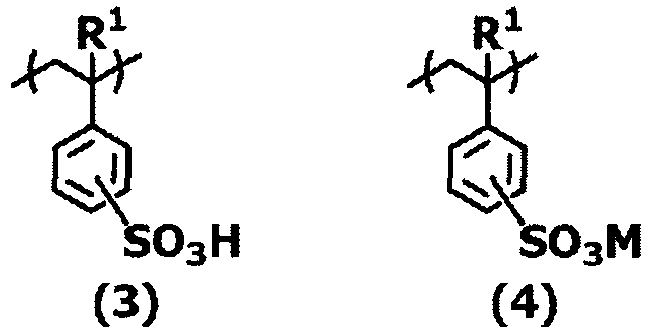
- the surfactant is preferably a polymer having a repeating unit represented by any of Formulae (1) to (6), and among these, the surfactant is more preferably a polymer having a repeating unit represented by Formula (1) (polycarboxylic acid) or a polymer having a repeating unit represented by Formula (2) (polycarboxylic acid metal salt), and the surfactant is even more preferably a polymer having a repeating unit represented by Formula (2).
- R 1 represents a hydrogen atom or a methyl group.
- R 2 represents any one of a hydrogen atom, a methyl group, or an ethyl group, and preferably represents a hydrogen atom.
- M represents any one of sodium, potassium, or calcium, and preferably represents sodium.
- the surfactant is preferably a polymer represented by Formula (7), that is, a metal salt of ⁇ -naphthalenesulfonic acid formalin condensation.
- R 2 represents any one of a hydrogen atom, a methyl group, or an ethyl group, and is preferably a hydrogen atom.
- M represents any of sodium, potassium, or calcium, and is preferably sodium.
- the surfactant is preferably an anionic surfactant from the viewpoint of hydrophilic stability in the developer.
- the content of the surfactant is preferably 0.005% to 5% by mass, more preferably 0.01% to 1% by mass, and even more preferably more than 0.01% by mass and less than 0.5% by mass with respect to the total mass of the aqueous developer.
- the water contained in the aqueous developer according to the embodiment of the present invention is not particularly limited, and any of purified water, distilled water, ion exchange water, pure water, ultrapure water such as Milli-Q water can be used.
- the Milli-Q water is ultrapure water obtained by a Milli-Q water production device, which is an ultrapure water production device manufactured by Merck KGaA.
- the content of water contained in the aqueous developer according to the embodiment of the present invention is preferably 80% to 99.99% by mass, and more preferably 90% to 99.9% by mass with respect to the total mass of the developer.
- the aqueous developer according to the embodiment of the present invention preferably contains at least one of an alkali metal carbonate or an alkali metal hydroxide and more preferably contains at least an alkali metal carbonate for the reason that the adhesion of the dispersion can be further suppressed.
- alkali metal examples include sodium, potassium, and calcium.
- alkali metal carbonate examples include sodium carbonate, potassium carbonate and the like, and among these, sodium carbonate is preferable from the viewpoint of safety.
- alkali metal hydroxide examples include sodium hydroxide and potassium hydroxide.
- the content of the alkali metal carbonate and/or the alkali metal hydroxide (the total content in a case where both are contained) is preferably 0.01% to 5% by mass and more preferably 0.1% to 1% by mass with respect to the total mass of the aqueous developer.
- various additives may be formulated as optional components, as required.
- additives examples include sequestering agents such as citric acid and ethylenediaminetetraacetic acid (EDTA); alkanolamines such as ethanolamine; preservatives such as benzotriazole and benzoic acid; freezing point depressants such as glycols (for example, ethylene glycol) and lower alcohols (for example, ethanol); and antifoaming agents such as silicones and polyols, and these can be appropriately formulated within a range that does not impair the effects of the present invention.
- sequestering agents such as citric acid and ethylenediaminetetraacetic acid (EDTA); alkanolamines such as ethanolamine; preservatives such as benzotriazole and benzoic acid; freezing point depressants such as glycols (for example, ethylene glycol) and lower alcohols (for example, ethanol); and antifoaming agents such as silicones and polyols, and these can be appropriately formulated within a range that does not impair the effects of the present
- the same method as a developing method using a conventionally known aqueous developer may be used, and examples thereof include a method of bringing an aqueous developer into contact with an unexposed portion of a flexographic printing plate precursor, applying a physical action of a brush, water pressure, supersonic waves, or the like, and dispersing a photosensitive layer (photosensitive resin composition) that constitutes the unexposed portion in water to remove the photosensitive layer.
- the unexposed portion may be immersed in the aqueous developer or the aqueous developer may be continuously supplied and brought into contact with the unexposed portion in a case where a physical action is exerted.
- the liquid temperature of the aqueous developer at the time of development is preferably 20°C to 60°C, and more preferably 30°C to 50°C.
- a brush is used for the physical action force usually used, and the material, thickness, length of hair, denseness of hair, arrangement, movement of brush, rotation direction, and the like are appropriately selected.
- a conventionally known photosensitive resin composition can be used for the photosensitive layer (photosensitive resin composition) of the flexographic printing plate precursor developed with the water developer according to the embodiment of the present invention.
- a conventionally known photosensitive resin composition can be used. Examples thereof include a water-dispersible latex, rubber, a photopolymerizable monomer, a photopolymerization initiator, and a surfactant.
- the water-dispersible latex contained in the resin composition is not particularly limited, and water-dispersible latexes used in conventionally known flexographic printing plates can be used.
- water-dispersible latexes include water-dispersible latex polymers such as polybutadiene latex, natural rubber latex, styrene-butadiene copolymer latex, acrylonitrile-butadiene copolymer latex, polychloroprene latex, polyisoprene latex, polyurethane latex, methylmethacrylate-butadiene copolymer latex, vinylpyridine polymer latex, butyl polymer latex, thiokol polymer latex, and acrylate polymer latex; and polymers obtained by copolymerizing another component, such as acrylic acid and methacrylic acid, therewith. These may be used alone or in combination of two or more.
- the rubber contained in the resin composition is not particularly limited, and rubber materials used in conventionally known flexographic printing plates can be used.
- the rubbers include butadiene rubber (BR), nitrile rubber (NBR), acrylic rubber, epichlorohydrin rubber, urethane rubber, isoprene rubber, styrene isoprene rubber, styrene butadiene rubber, ethylene-propylene copolymer, and chlorinated polyethylene. These may be used alone or in combination of two or more.
- the photopolymerizable monomer contained in the resin composition is not particularly limited, and photopolymerizable monomers used in conventionally known flexographic printing plates can be used.
- Examples of the photopolymerizable monomers include ethylenically unsaturated compounds.
- ethylenically unsaturated compounds include (meth)acrylic monomers, (meth)acrylic oligomers, and (meth)acrylic modified polymers.
- (meth)acrylic modified polymers include (meth)acrylic modified butadiene rubber and (meth)acrylic modified nitrile rubber.
- (meth)acryl means acryl or methacryl.
- the photopolymerization initiator contained in the resin composition is not particularly limited as long as the photopolymerization of the above-described photopolymerizable monomer is initiated, and examples thereof include photopolymerization initiators such as alkylphenones, acetophenones, benzoin ethers, benzophenones, thioxanthones, anthraquinones, benzyls, and biacetyls.
- benzyl dimethyl ketal 2-hydroxy-2-methyl-1-phenyl-propane-1-one, methyl-o-benzoylbenzoate, and 1-hydroxycyclohexyl phenyl ketone.
- the resin composition contained in the resin composition preferably contains a surfactant from the viewpoint of improving water developability.
- the surfactant examples include a cationic surfactant, an anionic surfactant, and a nonionic surfactant. Among these, an anionic surfactant is preferable.
- anionic surfactant examples include
- a method of manufacturing a flexographic printing plate includes an exposure step of imagewise exposing a photosensitive layer in a flexographic printing plate precursor having the photosensitive layer, a development step of performing development using the aqueous developer for a flexographic printing plate after the exposure step to form a non-image area and an image area, and a rinsing step of rinsing the non-image area and the image area with water after the development step.
- the exposure step is a step of irradiating the photosensitive layer with an actinic ray imagewise to induce crosslinking and/or polymerization of the region irradiated with the actinic ray and to cure the region.
- the exposure step can be performed by exposing the photosensitive layer through a mask provided on the outer surface side of the photosensitive layer.
- the exposure using a vacuum frame exposure device, and in this case, after the air between the relief forming layer and the mask is exhausted, the exposure with an actinic ray is performed.
- the exposure may be performed in a state where the oxygen concentration is lowered, or may be performed in the atmosphere.
- the exposure is performed at a low oxygen concentration.
- the development step is a step of performing developing using the above-described aqueous developer according to the embodiment of the present invention to form a non-image area and an image area, and the details are as described in the above-mentioned development method of the aqueous developer according to the embodiment of the present invention.
- the rinsing step is a step of rinsing the surfaces of the non-image area and the image area formed in the development step with water.
- the developer remaining on the surfaces of the non-image area and the image area is the above-described aqueous developer according to the embodiment of the present invention, even in a case where the aqueous developer is diluted with water used in the rinsing step, the adhesion and aggregation of the dispersion in the developer can be suppressed.
- a method of washing with tap water, a method of spraying high pressure water, a method of rubbing the surfaces of the non-image area and the image area using a batch type or transport type brush washing machine known as a developing machine for flexographic printing plates mainly in the presence of water, and the like may be used.
- Each surfactant, an alkali metal carbonate, and water shown in Table 1 below were formulated so as to have the ratio (% by mass) shown in Table 1 below to prepare aqueous developers.
- a commercially available flexographic printing plate precursor [FW-L, manufactured by Fujifilm Corporation] was exposed (back exposure) from the substrate side for 30 seconds using an exposure device having fifteen 20 W chemical lamps arranged side by side at a distance of 15 cm apart from the lamps.
- a commercially available flexographic printing plate precursor [FW-L, manufactured by Fujifilm Corporation] was exposed (back exposure) from the substrate side for 30 seconds using an exposure device having fifteen 20 W chemical lamps arranged side by side at a distance of 15 cm apart from the lamps.
- the protective film was peeled off, a pattern [halftone dot: 175 lpi 2%, independent dot: 150 ⁇ m diameter] was formed on an infrared ablation layer with an infrared laser, and exposure (main exposure) was performed for 10 minutes using the above exposure device at a distance of 15 cm.
- the developer was dried with hot air at 60°C until water was removed.
- the flexographic printing plate having an image area (dots and independent small dots) and a non-image area was prepared by exposing (post-exposure) the photosensitive layer for 10 minutes using the above exposure device from a distance of 15 cm.
Landscapes
- Physics & Mathematics (AREA)
- General Physics & Mathematics (AREA)
- Photosensitive Polymer And Photoresist Processing (AREA)
- Die Bonding (AREA)
Abstract
Description
- The present invention relates to an aqueous developer for a flexographic printing plate and a method of manufacturing a flexographic printing plate using the same.
- In recent years, various industries have started to reduce the use of organic solvents from the viewpoint of improving the working environment and preserving the global environment, and in a plate making step of a photosensitive flexographic printing plate used for printing, the use of an aqueous developable photosensitive resin plate is increasing.
- For example,
JP1995-234523A JP-H07-234523A - In addition,
JP2004-317660A
RO(AO)nR1 ... (I)
CnH2n+2 ... (II)
in Formula (I), R and R1 represent an alkyl or alkenyl group having 2 to 6 carbon atoms, A represents an alkylene group having 2 to 4 carbon atoms, and n represents a number of 1 to 5, and
in Formula (II), n is 6 to 20" ([claim 1]). - The present inventors have conducted an investigation on the aqueous developers described in
JP1995-234523A JP-H07-234523A JP2004-317660A - An object of the present invention is to provide an aqueous developer for a flexographic printing plate capable of maintaining good printing reproducibility and suppressing adhesion and aggregation of a dispersion in a developer during repeated use, and a method of manufacturing a flexographic printing plate using the same.
- As a result of conducting intensive investigations to achieve the above object, the present inventors have found that an aqueous developer in which a surfactant having a predetermined molecular weight is formulated is capable of maintaining good printing reproducibility and suppressing the adhesion and aggregation of the dispersion in the developer during repeated use, and thus completed the present invention.
- That is, the present inventors have found that the above object can be achieved by adopting the following configurations.
- [1] An aqueous developer for a flexographic printing plate comprising: a surfactant having a molecular weight of 1000 or more; and water.
- [2] The aqueous developer for a flexographic printing plate according to [1], in which a content of the surfactant is 0.005% to 5% by mass.
- [3] The aqueous developer for a flexographic printing plate according to [1] or [2], in which the surfactant is a polymer having a repeating unit represented by any one of Formulae (1) to (6),


- [4] The aqueous developer for a flexographic printing plate according to [1] or [2], in which the surfactant is a polymer represented by Formula (7),

- [5] The aqueous developer for a flexographic printing plate according to any one of [1] to [4], in which the surfactant is an anionic surfactant.
- [6] The aqueous developer for a flexographic printing plate according to any one of [1] to [5], further comprising: at least one of an alkali metal carbonate or an alkali metal hydroxide.
- [7] A method of manufacturing a flexographic printing plate having a non-image area and an image area, the method comprising:
- an exposure step of imagewise exposing a photosensitive layer in a flexographic printing plate precursor having the photosensitive layer;
- a development step of performing development using the aqueous developer for a flexographic printing plate according to any one of [1] to [6] after the exposure step to form a non-image area and an image area; and
- a rinsing step of rinsing the non-image area and the image area with water after the development step.
- According to the present invention, it is possible to provide an aqueous developer for a flexographic printing plate capable of maintaining good printing reproducibility and suppressing the adhesion and aggregation of the dispersion in the developer during repeated use, and a method of manufacturing a flexographic printing plate using the same.
- Hereinafter, the present invention will be described in detail.
- The description of the components described below may be made based on typical embodiments of the present invention, but the present invention is not limited to such embodiments.
- In the specification, the numerical range expressed by using "to" means a range including the numerical values before and after "to" as the lower limit value and the upper limit value.
- An aqueous developer for a flexographic printing plate according to an embodiment of the present invention (hereinafter, also abbreviated as "aqueous developer of the present invention") is an aqueous developer for a flexographic printing plate containing a surfactant having a molecular weight of 1000 or more, and water.
- In the present invention, as described above, the aqueous developer containing a surfactant having a molecular weight of 1000 or more is capable of maintaining good printing reproducibility and suppressing the adhesion and aggregation of a dispersion in the developer during repeated use.
- Although the details thereof are not clear, the present inventors have assumed as follows.
- First, the aqueous developer is usually used repeatedly for two or more times of development, but for example, in the developer used for the second development, the plate material removed from the flexographic printing plate precursor by the first development, that is, the plate material in an unexposed portion (uncured portion) is present as a dispersion.
- Then, as shown in Comparative Examples described later, in a case where a surfactant having a molecular weight of less than 1000 is formulated in the aqueous developer, it is found that the adhesion of the dispersion increases in a case where the aqueous developer is diluted with water in the assumption of a rinsing step.
- Therefore, in the present invention, it is considered that this is because by formulating a surfactant having a molecular weight of 1000 or more, the association between the surfactant and the dispersant becomes strong, and the association state can be maintained even in a case where the aqueous developer is diluted with water in the assumption of the rinsing step.
- Hereinafter, each component contained in the aqueous developer according to the embodiment of the present invention will be described in detail.
- The surfactant contained in the aqueous developer according to the embodiment of the present invention is a surfactant having a molecular weight of 1000 or more.
- Here, the molecular weight is a weight-average molecular weight measured by a gel permeation chromatography (GPC) method under the following conditions.
- [Eluent] tetrahydrofuran (THF)
- [Device name] Ecosec HLC-8220GPC (manufactured by Tosoh Corporation)
- [Column] TSKgel SuperHZM-H, TSKgel SuperHZ4000, and TSKgel SuperHZM200 (manufactured by Tosoh Corporation)
- [Column temperature] 40°C
- [Flow rate] 50 ml/min
- The surfactant has a molecular weight of preferably 1000 to 500000, and more preferably 1500 to 50000.
- In the present invention, from the viewpoint of maintaining the dispersibility of the dispersion, the surfactant is preferably a polymer having a repeating unit represented by any of Formulae (1) to (6), and among these, the surfactant is more preferably a polymer having a repeating unit represented by Formula (1) (polycarboxylic acid) or a polymer having a repeating unit represented by Formula (2) (polycarboxylic acid metal salt), and the surfactant is even more preferably a polymer having a repeating unit represented by Formula (2).


- In Formulae (1) to (4), R1 represents a hydrogen atom or a methyl group.
- In Formulae (5) and (6), R2 represents any one of a hydrogen atom, a methyl group, or an ethyl group, and preferably represents a hydrogen atom.
- Further, in Formulae (2), (4) and (6), M represents any one of sodium, potassium, or calcium, and preferably represents sodium.
- In the present invention, from the viewpoint of adsorbability to the dispersion and maintaining the dispersibility of the dispersion, the surfactant is preferably a polymer represented by Formula (7), that is, a metal salt of β-naphthalenesulfonic acid formalin condensation.

- In Formula (7), R2 represents any one of a hydrogen atom, a methyl group, or an ethyl group, and is preferably a hydrogen atom.
- Further, in Formula (7), M represents any of sodium, potassium, or calcium, and is preferably sodium.
- In the present invention, the surfactant is preferably an anionic surfactant from the viewpoint of hydrophilic stability in the developer.
- In addition, in the present invention, the content of the surfactant is preferably 0.005% to 5% by mass, more preferably 0.01% to 1% by mass, and even more preferably more than 0.01% by mass and less than 0.5% by mass with respect to the total mass of the aqueous developer.
- The water contained in the aqueous developer according to the embodiment of the present invention is not particularly limited, and any of purified water, distilled water, ion exchange water, pure water, ultrapure water such as Milli-Q water can be used. The Milli-Q water is ultrapure water obtained by a Milli-Q water production device, which is an ultrapure water production device manufactured by Merck KGaA.
- The content of water contained in the aqueous developer according to the embodiment of the present invention is preferably 80% to 99.99% by mass, and more preferably 90% to 99.9% by mass with respect to the total mass of the developer.
- The aqueous developer according to the embodiment of the present invention preferably contains at least one of an alkali metal carbonate or an alkali metal hydroxide and more preferably contains at least an alkali metal carbonate for the reason that the adhesion of the dispersion can be further suppressed.
- Here, specific examples of the alkali metal include sodium, potassium, and calcium.
- Specific examples of the alkali metal carbonate include sodium carbonate, potassium carbonate and the like, and among these, sodium carbonate is preferable from the viewpoint of safety.
- Specific examples of the alkali metal hydroxide include sodium hydroxide and potassium hydroxide.
- The content of the alkali metal carbonate and/or the alkali metal hydroxide (the total content in a case where both are contained) is preferably 0.01% to 5% by mass and more preferably 0.1% to 1% by mass with respect to the total mass of the aqueous developer.
- In the aqueous developer according to the embodiment of the present invention, various additives may be formulated as optional components, as required.
- Examples of the additives include sequestering agents such as citric acid and ethylenediaminetetraacetic acid (EDTA); alkanolamines such as ethanolamine; preservatives such as benzotriazole and benzoic acid; freezing point depressants such as glycols (for example, ethylene glycol) and lower alcohols (for example, ethanol); and antifoaming agents such as silicones and polyols, and these can be appropriately formulated within a range that does not impair the effects of the present invention.
- As a development method using the aqueous developer according to the embodiment of the present invention, the same method as a developing method using a conventionally known aqueous developer may be used, and examples thereof include a method of bringing an aqueous developer into contact with an unexposed portion of a flexographic printing plate precursor, applying a physical action of a brush, water pressure, supersonic waves, or the like, and dispersing a photosensitive layer (photosensitive resin composition) that constitutes the unexposed portion in water to remove the photosensitive layer.
- At this time, the unexposed portion may be immersed in the aqueous developer or the aqueous developer may be continuously supplied and brought into contact with the unexposed portion in a case where a physical action is exerted.
- The liquid temperature of the aqueous developer at the time of development is preferably 20°C to 60°C, and more preferably 30°C to 50°C.
- A brush is used for the physical action force usually used, and the material, thickness, length of hair, denseness of hair, arrangement, movement of brush, rotation direction, and the like are appropriately selected.
- For the photosensitive layer (photosensitive resin composition) of the flexographic printing plate precursor developed with the water developer according to the embodiment of the present invention, a conventionally known photosensitive resin composition can be used. Examples thereof include a water-dispersible latex, rubber, a photopolymerizable monomer, a photopolymerization initiator, and a surfactant.
- The water-dispersible latex contained in the resin composition is not particularly limited, and water-dispersible latexes used in conventionally known flexographic printing plates can be used.
- Specific examples of the water-dispersible latexes include water-dispersible latex polymers such as polybutadiene latex, natural rubber latex, styrene-butadiene copolymer latex, acrylonitrile-butadiene copolymer latex, polychloroprene latex, polyisoprene latex, polyurethane latex, methylmethacrylate-butadiene copolymer latex, vinylpyridine polymer latex, butyl polymer latex, thiokol polymer latex, and acrylate polymer latex; and polymers obtained by copolymerizing another component, such as acrylic acid and methacrylic acid, therewith. These may be used alone or in combination of two or more.
- The rubber contained in the resin composition is not particularly limited, and rubber materials used in conventionally known flexographic printing plates can be used.
- Specific examples of the rubbers include butadiene rubber (BR), nitrile rubber (NBR), acrylic rubber, epichlorohydrin rubber, urethane rubber, isoprene rubber, styrene isoprene rubber, styrene butadiene rubber, ethylene-propylene copolymer, and chlorinated polyethylene. These may be used alone or in combination of two or more.
- The photopolymerizable monomer contained in the resin composition is not particularly limited, and photopolymerizable monomers used in conventionally known flexographic printing plates can be used.
- Examples of the photopolymerizable monomers include ethylenically unsaturated compounds.
- Specific examples of the ethylenically unsaturated compounds include (meth)acrylic monomers, (meth)acrylic oligomers, and (meth)acrylic modified polymers.
- Specific examples of the (meth)acrylic modified polymers include (meth)acrylic modified butadiene rubber and (meth)acrylic modified nitrile rubber.
- In addition, the term "(meth)acryl" means acryl or methacryl.
- The photopolymerization initiator contained in the resin composition is not particularly limited as long as the photopolymerization of the above-described photopolymerizable monomer is initiated, and examples thereof include photopolymerization initiators such as alkylphenones, acetophenones, benzoin ethers, benzophenones, thioxanthones, anthraquinones, benzyls, and biacetyls.
- Specific examples include benzyl dimethyl ketal, 2-hydroxy-2-methyl-1-phenyl-propane-1-one, methyl-o-benzoylbenzoate, and 1-hydroxycyclohexyl phenyl ketone.
- The resin composition contained in the resin composition preferably contains a surfactant from the viewpoint of improving water developability.
- Examples of the surfactant include a cationic surfactant, an anionic surfactant, and a nonionic surfactant. Among these, an anionic surfactant is preferable.
- Specific examples of the anionic surfactant include
- aliphatic carboxylates such as sodium laurate, and sodium oleate;
- higher alcohol sulfate ester salts such as sodium lauryl sulfate, sodium cetyl sulfate, and sodium oleyl sulfate;
- polyoxyethylene alkyl ether sulfate ester salts such as sodium polyoxyethylene lauryl ether sulfate;
- polyoxyethylene alkyl allyl ether sulfate ester salts such as sodium polyoxyethylene octyl phenyl ether sulfate, and sodium polyoxyethylene nonyl phenyl ether sulfate;
- alkyl sulfonates such as sodium dodecyl sulfonate, and sodium dialkyl sulfosuccinate;
- alkyl allyl sulfonates such as alkyl disulfonate, sodium dodecyl benzene sulfonate, sodium dibutyl naphthalene sulfonate, and sodium triisopropyl naphthalene sulfonate;
- higher alcohol phosphate ester salts such as disodium lauryl phosphate monoester, and sodium lauryl phosphate diester; and
- polyoxyethylene alkyl ether phosphate ester salts such as disodium polyoxyethylene lauryl ether phosphate monoester, and sodium polyoxyethylene lauryl ether phosphate diester. These may be used alone or in combination of two or more.
- A method of manufacturing a flexographic printing plate according to an embodiment of the present invention includes an exposure step of imagewise exposing a photosensitive layer in a flexographic printing plate precursor having the photosensitive layer, a development step of performing development using the aqueous developer for a flexographic printing plate after the exposure step to form a non-image area and an image area, and a rinsing step of rinsing the non-image area and the image area with water after the development step.
- The exposure step is a step of irradiating the photosensitive layer with an actinic ray imagewise to induce crosslinking and/or polymerization of the region irradiated with the actinic ray and to cure the region.
- The exposure step can be performed by exposing the photosensitive layer through a mask provided on the outer surface side of the photosensitive layer.
- In addition, it is also preferable to perform the exposure using a vacuum frame exposure device, and in this case, after the air between the relief forming layer and the mask is exhausted, the exposure with an actinic ray is performed.
- Further, the exposure may be performed in a state where the oxygen concentration is lowered, or may be performed in the atmosphere. Although not particularly limited, from the viewpoint of preventing polymerization inhibition by oxygen, it is preferable that exposure is performed at a low oxygen concentration.
- The development step is a step of performing developing using the above-described aqueous developer according to the embodiment of the present invention to form a non-image area and an image area, and the details are as described in the above-mentioned development method of the aqueous developer according to the embodiment of the present invention.
- The rinsing step is a step of rinsing the surfaces of the non-image area and the image area formed in the development step with water.
- In the present invention, since the developer remaining on the surfaces of the non-image area and the image area is the above-described aqueous developer according to the embodiment of the present invention, even in a case where the aqueous developer is diluted with water used in the rinsing step, the adhesion and aggregation of the dispersion in the developer can be suppressed.
- As the rinsing method in the rinsing step, a method of washing with tap water, a method of spraying high pressure water, a method of rubbing the surfaces of the non-image area and the image area using a batch type or transport type brush washing machine known as a developing machine for flexographic printing plates mainly in the presence of water, and the like may be used.
- Hereinafter, the present invention will be described in more detail with reference to examples. Materials, amounts used, ratios, treatment contents, treatment procedures, and the like shown in the following examples can be appropriately changed without departing from the spirit of the present invention. Therefore, the scope of the present invention should not be construed as being limited by the following examples.
- Each surfactant, an alkali metal carbonate, and water shown in Table 1 below were formulated so as to have the ratio (% by mass) shown in Table 1 below to prepare aqueous developers.
- A commercially available flexographic printing plate precursor [FW-L, manufactured by Fujifilm Corporation] was exposed (back exposure) from the substrate side for 30 seconds using an exposure device having fifteen 20 W chemical lamps arranged side by side at a distance of 15 cm apart from the lamps.
- Then, development was performed for 5 minutes with a brush type washing machine (liquid temperature: 50°C) containing each of the prepared aqueous developers.
- The development was continued with a new flexographic printing plate precursor until the solid content in each aqueous developer became 5% to prepare an aqueous developer for evaluation.
- Into a 1000 cc poly container containing 450 cc of water in advance, 50 cc of the aqueous developer for evaluation was poured, and was left to stand for 24 hours after stirring. Then, the adhesion of the dispersion attached to the inner wall of the poly container was visually observed and evaluated according to the standards. The results are shown in Table 1 below.
- A: There is no attached matter.
- B: There is a slight amount of attached matter.
- C: There is a small amount of attached matter.
- D: There is a large amount of attached matter.
- In a 1000 cc plastic container containing 450 cc of water in advance, 50 cc of the aqueous developing solution for evaluation was poured and was left to stand for 12 hours after stirring. Then, the aggregates in the solution were visually observed and evaluated according to the following standards. The results are shown in Table 1 below.
- A: There no large aggregates that can be visually identified.
- B: A slight amount of large aggregates that can be visually identified are generated.
- C: A small amount of large aggregates that can be visually identified are generated.
- D: A large amount of large aggregates that can be visually identified are generated.
- A commercially available flexographic printing plate precursor [FW-L, manufactured by Fujifilm Corporation] was exposed (back exposure) from the substrate side for 30 seconds using an exposure device having fifteen 20 W chemical lamps arranged side by side at a distance of 15 cm apart from the lamps.
- Then, the protective film was peeled off, a pattern [halftone dot: 175 lpi 2%, independent dot: 150 µm diameter] was formed on an infrared ablation layer with an infrared laser, and exposure (main exposure) was performed for 10 minutes using the above exposure device at a distance of 15 cm.
- Then, development was performed for 5 minutes with a brush type washing machine (liquid temperature: 50°C) containing each of the prepared aqueous developers.
- Then, the developer was dried with hot air at 60°C until water was removed.
- Then, the flexographic printing plate having an image area (dots and independent small dots) and a non-image area was prepared by exposing (post-exposure) the photosensitive layer for 10 minutes using the above exposure device from a distance of 15 cm.
- Whether or not the pattern formed on the infrared ablation layer was reproduced on the flexographic printing plate was confirmed with an optical microscope [VH8000 manufactured by Keyence Corporation, magnification: 100 times] and evaluated according to the following standards. The results are shown in Table 1 below.
- A: Halftone dots and independent dots are reproduced.
- B: Only halftone dots or independent dots are reproduced.
- C: Neither halftone dots nor independent dots are reproduced.
- The following components were used as the components shown in Table 1 above.
- · Polysulfonic acid sodium salt: sodium salt of β-naphthalenesulfonic acid formalin condensate [DEMOL NL, weight average molecular weight: 3000, manufactured by Kao Corporation]
- · Polycarboxylic acid sodium salt: POLYSTER (registered trademark) OMR [weight average molecular weight: 30000, manufactured by NOF Corporation]
- · Polycarboxylic acid: MALIALIM (registered trademark) SC-505K [weight average molecular weight: 20000, manufactured by NOF CORPORATION]
- · Sulfonic acid sodium salt: PELEX SS-L [Molecular weight: 350, manufactured by Kao Corporation]
- · Sodium carbonate: Reagent (manufactured by Wako Pure Chemical Industries, Ltd.)
- · Water: Tap water
- As shown in Table 1 above, in a case where a surfactant having a molecular weight of less than 1000 was used, it was found that in a case where the dispersion contained in the aqueous developer in the assumption of repeated use was increased was diluted with water in the assumption of the rinsing step, the adhesion of the dispersion was increased (Comparative Examples 1 and 2). Particularly, similar to Example 1, in a case where 0.01% by mass of the surfactant was formulated, it was found that in a case where the surfactant was a surfactant having a molecular weight of less than 1000, the dispersion was aggregated (Comparative Example 3).
- On the other hand, in a case where a surfactant having a molecular weight of 1000 or more was used, it was found that good printing reproducibility was maintained and even in a case where the dispersion contained in the aqueous developer in the assumption of repeated use was diluted with water in the assumption of the rinsing step, the adhesion and aggregating properties of the adhesion could be suppressed (Examples 1 to 19).
- Particularly, from the comparison of Examples 1 to 4, it was found that in a case where the content of the surfactant was more than 0.01% by mass and less than 0.5% by mass, the adhesion and aggregation of the dispersion could be further suppressed.
- Further, from the comparison between Examples 5 and 8 and the comparison between Examples 6 and 9, it was found that in a case where alkali metal carbonate was formulated, the adhesion of the dispersion could be further suppressed.
| Example | Comparative Example | ||||||||||||
| 1 | 2 | 3 | 4 | 5 | 6 | 7 | 8 | 9 | 1 | 2 | 3 | ||
| Surfactant | Polysulfonic acid sodium salt | 0.01 | 0.1 | 0.5 | 1.0 | 0.1 | |||||||
| Polycarboxylic acid sodium salt | 0.1 | 0.1 | |||||||||||
| Polycarboxylic acid | 0.1 | 0.1 | |||||||||||
| Sulfonic acid sodium salt | 0.1 | 0.1 | 0.01 | ||||||||||
| Alkali metal carbonate | Sodium carbonate | 0.4 | 0.4 | 0.4 | 0.4 | ||||||||
| Water | 99.99 | 99.9 | 99.5 | 99.0 | 99.9 | 99.9 | 99.5 | 99.5 | 99.5 | 99.9 | 99.5 | 99.99 | |
| Adhesion of dispersion | B | A | A | A | B | B | A | A | A | D | D | D | |
| Aggregating properties of dispersion | A | A | B | C | B | C | A | A | B | B | A | D | |
| Image Reproducibility | A | A | A | A | A | A | A | A | A | A | A | A | |
Claims (7)
- An aqueous developer for a flexographic printing plate comprising:a surfactant having a molecular weight of 1000 or more; andwater.
- The aqueous developer for a flexographic printing plate according to claim 1,
wherein a content of the surfactant is 0.005% to 5% by mass. - The aqueous developer for a flexographic printing plate according to claim 1 or 2,
wherein the surfactant is a polymer having a repeating unit represented by any one of Formulae (1) to (6),

- The aqueous developer for a flexographic printing plate according to claim 1 or 2,
wherein the surfactant is a polymer represented by Formula (7),
- The aqueous developer for a flexographic printing plate according to any one of claims 1 to 4,
wherein the surfactant is an anionic surfactant. - The aqueous developer for a flexographic printing plate according to any one of claims 1 to 5, further comprising:
at least one of an alkali metal carbonate or an alkali metal hydroxide. - A method of manufacturing a flexographic printing plate having a non-image area and an image area, the method comprising:an exposure step of imagewise exposing a photosensitive layer in a flexographic printing plate precursor having the photosensitive layer;a development step of performing development using the aqueous developer for a flexographic printing plate according to any one of claims 1 to 6 after the exposure step to form a non-image area and an image area; anda rinsing step of rinsing the non-image area and the image area with water after the development step.
Applications Claiming Priority (2)
| Application Number | Priority Date | Filing Date | Title |
|---|---|---|---|
| JP2018062163 | 2018-03-28 | ||
| PCT/JP2019/009445 WO2019188137A1 (en) | 2018-03-28 | 2019-03-08 | Aqueous development solution for flexographic printing plate, and manufacturing method of flexographic printing plate |
Publications (3)
| Publication Number | Publication Date |
|---|---|
| EP3779599A1 true EP3779599A1 (en) | 2021-02-17 |
| EP3779599A4 EP3779599A4 (en) | 2021-05-05 |
| EP3779599B1 EP3779599B1 (en) | 2023-10-18 |
Family
ID=68060426
Family Applications (1)
| Application Number | Title | Priority Date | Filing Date |
|---|---|---|---|
| EP19778244.4A Active EP3779599B1 (en) | 2018-03-28 | 2019-03-08 | Aqueous development solution for flexographic printing plate, and manufacturing method of flexographic printing plate |
Country Status (5)
| Country | Link |
|---|---|
| US (1) | US12044972B2 (en) |
| EP (1) | EP3779599B1 (en) |
| JP (1) | JP7058721B2 (en) |
| CN (1) | CN111954853B (en) |
| WO (1) | WO2019188137A1 (en) |
Family Cites Families (12)
| Publication number | Priority date | Publication date | Assignee | Title |
|---|---|---|---|---|
| JPS5077037A (en) * | 1973-11-07 | 1975-06-24 | ||
| JPH07234523A (en) | 1994-02-22 | 1995-09-05 | Toyobo Co Ltd | Developing method for photosensitive resin plate and developing liquid therefor |
| JPH07301920A (en) * | 1994-05-02 | 1995-11-14 | Toyobo Co Ltd | Photosensitive resin composition |
| JP2000056473A (en) * | 1998-08-06 | 2000-02-25 | Toray Ind Inc | Printing plate developer |
| JP4689804B2 (en) * | 1999-12-21 | 2011-05-25 | コダック株式会社 | Positive image forming method and developer used therefor |
| US6511790B2 (en) * | 2000-08-25 | 2003-01-28 | Fuji Photo Film Co., Ltd. | Alkaline liquid developer for lithographic printing plate and method for preparing lithographic printing plate |
| JP2004045724A (en) * | 2002-07-11 | 2004-02-12 | Konica Minolta Holdings Inc | Developing solution for photosensitive lithographic printing plate, and method for engraving photosensitive lithographic printing plate |
| JP2004271985A (en) * | 2003-03-10 | 2004-09-30 | Fuji Photo Film Co Ltd | Developing solution for photosensitive lithographic printing plate and platemaking method for lithographic printing plate |
| JP4323206B2 (en) | 2003-04-14 | 2009-09-02 | 旭化成イーマテリアルズ株式会社 | Aqueous developer for photosensitive resin |
| JP4166167B2 (en) * | 2004-02-05 | 2008-10-15 | 富士フイルム株式会社 | Photosensitive lithographic printing plate developer and lithographic printing plate making method |
| US9588429B1 (en) * | 2015-09-03 | 2017-03-07 | Eastman Kodak Company | Lithographic developer composition and method of use |
| US20190101820A1 (en) * | 2017-09-28 | 2019-04-04 | Eastman Kodak Company | Assembly of elements for flexography |
-
2019
- 2019-03-08 JP JP2020509800A patent/JP7058721B2/en active Active
- 2019-03-08 EP EP19778244.4A patent/EP3779599B1/en active Active
- 2019-03-08 WO PCT/JP2019/009445 patent/WO2019188137A1/en not_active Ceased
- 2019-03-08 CN CN201980022471.3A patent/CN111954853B/en active Active
-
2020
- 2020-09-25 US US17/032,255 patent/US12044972B2/en active Active
Also Published As
| Publication number | Publication date |
|---|---|
| US20210011386A1 (en) | 2021-01-14 |
| CN111954853A (en) | 2020-11-17 |
| US12044972B2 (en) | 2024-07-23 |
| JPWO2019188137A1 (en) | 2021-03-11 |
| JP7058721B2 (en) | 2022-04-22 |
| CN111954853B (en) | 2024-03-12 |
| WO2019188137A1 (en) | 2019-10-03 |
| EP3779599B1 (en) | 2023-10-18 |
| EP3779599A4 (en) | 2021-05-05 |
Similar Documents
| Publication | Publication Date | Title |
|---|---|---|
| EP3435158B1 (en) | Active ray-sensitive or radiation-sensitive composition, method for purifying active ray-sensitive or radiation-sensitive composition, pattern-forming method, and method for producing electronic device | |
| US6900003B2 (en) | Photoresist processing aid and method | |
| WO2014069245A1 (en) | Organic treatment solution for patterning of chemically amplified resist film, container for organic treatment solution for patterning of chemically amplified resist film, and pattern formation method, electronic device manufacturing method, and electronic device using same | |
| EP2470963B1 (en) | Method for providing flexographic printing plates using a developer solution | |
| TW201510678A (en) | Method for forming resist pattern | |
| US4725528A (en) | Production of non-tacky, smooth surfaces of photopolymer relief printing plates for flexographic printing | |
| JPH07140667A (en) | Resist material and pattern forming method | |
| US6660454B2 (en) | Additive composition for both rinse water recycling in water recycling systems and simultaneous surface treatment of lithographic printing plates | |
| EP3779599B1 (en) | Aqueous development solution for flexographic printing plate, and manufacturing method of flexographic printing plate | |
| US10248025B2 (en) | Concentrated and working strength aqueous flexographic developers | |
| US12044971B2 (en) | Aqueous developer for flexographic printing plate and manufacturing method of flexographic printing plate | |
| US20260048581A1 (en) | Aqueous developer for flexographic printing plate and manufacturing method of flexographic printing plate | |
| WO2017191929A1 (en) | Method and composition for improving lwr in patterning step using negative tone photoresist | |
| US5204227A (en) | Method of developing photopolymerizable printing plates and composition therefor | |
| JP7538140B2 (en) | Aqueous developer for flexographic printing plates, concentrated aqueous developer for flexographic printing plates, and method for producing flexographic printing plates | |
| EP4730040A1 (en) | Photoresist pattern forming method and semiconductor device manufactured using the same | |
| CN116096575A (en) | Aqueous developer for flexographic printing plate and method for manufacturing flexographic printing plate | |
| US10216089B2 (en) | Methods of forming flexographic printing members | |
| JP2004347983A (en) | Developer for photosensitive composition | |
| JP2010256860A (en) | Photosensitive resin composition for flexographic printing, and printing original plate obtained therefrom | |
| JPH03148663A (en) | Developing solution for damping-waterless photosensitive planographic printing plate | |
| JPH03191355A (en) | Method of development processing for photosensitive planographic plate | |
| JPS63179358A (en) | Method for processing photosensitive planographic printing plate |
Legal Events
| Date | Code | Title | Description |
|---|---|---|---|
| STAA | Information on the status of an ep patent application or granted ep patent |
Free format text: STATUS: THE INTERNATIONAL PUBLICATION HAS BEEN MADE |
|
| PUAI | Public reference made under article 153(3) epc to a published international application that has entered the european phase |
Free format text: ORIGINAL CODE: 0009012 |
|
| STAA | Information on the status of an ep patent application or granted ep patent |
Free format text: STATUS: REQUEST FOR EXAMINATION WAS MADE |
|
| 17P | Request for examination filed |
Effective date: 20200923 |
|
| AK | Designated contracting states |
Kind code of ref document: A1 Designated state(s): AL AT BE BG CH CY CZ DE DK EE ES FI FR GB GR HR HU IE IS IT LI LT LU LV MC MK MT NL NO PL PT RO RS SE SI SK SM TR |
|
| AX | Request for extension of the european patent |
Extension state: BA ME |
|
| RAP3 | Party data changed (applicant data changed or rights of an application transferred) |
Owner name: FUJIFILM CORPORATION |
|
| A4 | Supplementary search report drawn up and despatched |
Effective date: 20210409 |
|
| RIC1 | Information provided on ipc code assigned before grant |
Ipc: G03F 7/32 20060101AFI20210401BHEP Ipc: G03F 7/00 20060101ALI20210401BHEP Ipc: G03F 7/24 20060101ALI20210401BHEP |
|
| DAV | Request for validation of the european patent (deleted) | ||
| DAX | Request for extension of the european patent (deleted) | ||
| GRAP | Despatch of communication of intention to grant a patent |
Free format text: ORIGINAL CODE: EPIDOSNIGR1 |
|
| STAA | Information on the status of an ep patent application or granted ep patent |
Free format text: STATUS: GRANT OF PATENT IS INTENDED |
|
| INTG | Intention to grant announced |
Effective date: 20230612 |
|
| RIN1 | Information on inventor provided before grant (corrected) |
Inventor name: TASHIRO, HIROSHI |
|
| GRAS | Grant fee paid |
Free format text: ORIGINAL CODE: EPIDOSNIGR3 |
|
| GRAA | (expected) grant |
Free format text: ORIGINAL CODE: 0009210 |
|
| STAA | Information on the status of an ep patent application or granted ep patent |
Free format text: STATUS: THE PATENT HAS BEEN GRANTED |
|
| P01 | Opt-out of the competence of the unified patent court (upc) registered |
Effective date: 20230904 |
|
| AK | Designated contracting states |
Kind code of ref document: B1 Designated state(s): AL AT BE BG CH CY CZ DE DK EE ES FI FR GB GR HR HU IE IS IT LI LT LU LV MC MK MT NL NO PL PT RO RS SE SI SK SM TR |
|
| REG | Reference to a national code |
Ref country code: GB Ref legal event code: FG4D |
|
| REG | Reference to a national code |
Ref country code: CH Ref legal event code: EP |
|
| REG | Reference to a national code |
Ref country code: IE Ref legal event code: FG4D |
|
| REG | Reference to a national code |
Ref country code: DE Ref legal event code: R096 Ref document number: 602019039664 Country of ref document: DE |
|
| REG | Reference to a national code |
Ref country code: LT Ref legal event code: MG9D |
|
| REG | Reference to a national code |
Ref country code: NL Ref legal event code: MP Effective date: 20231018 |
|
| REG | Reference to a national code |
Ref country code: AT Ref legal event code: MK05 Ref document number: 1622975 Country of ref document: AT Kind code of ref document: T Effective date: 20231018 |
|
| PG25 | Lapsed in a contracting state [announced via postgrant information from national office to epo] |
Ref country code: NL Free format text: LAPSE BECAUSE OF FAILURE TO SUBMIT A TRANSLATION OF THE DESCRIPTION OR TO PAY THE FEE WITHIN THE PRESCRIBED TIME-LIMIT Effective date: 20231018 |
|
| PG25 | Lapsed in a contracting state [announced via postgrant information from national office to epo] |
Ref country code: GR Free format text: LAPSE BECAUSE OF FAILURE TO SUBMIT A TRANSLATION OF THE DESCRIPTION OR TO PAY THE FEE WITHIN THE PRESCRIBED TIME-LIMIT Effective date: 20240119 |
|
| PG25 | Lapsed in a contracting state [announced via postgrant information from national office to epo] |
Ref country code: IS Free format text: LAPSE BECAUSE OF FAILURE TO SUBMIT A TRANSLATION OF THE DESCRIPTION OR TO PAY THE FEE WITHIN THE PRESCRIBED TIME-LIMIT Effective date: 20240218 |
|
| PG25 | Lapsed in a contracting state [announced via postgrant information from national office to epo] |
Ref country code: LT Free format text: LAPSE BECAUSE OF FAILURE TO SUBMIT A TRANSLATION OF THE DESCRIPTION OR TO PAY THE FEE WITHIN THE PRESCRIBED TIME-LIMIT Effective date: 20231018 |
|
| PG25 | Lapsed in a contracting state [announced via postgrant information from national office to epo] |
Ref country code: AT Free format text: LAPSE BECAUSE OF FAILURE TO SUBMIT A TRANSLATION OF THE DESCRIPTION OR TO PAY THE FEE WITHIN THE PRESCRIBED TIME-LIMIT Effective date: 20231018 |
|
| PG25 | Lapsed in a contracting state [announced via postgrant information from national office to epo] |
Ref country code: ES Free format text: LAPSE BECAUSE OF FAILURE TO SUBMIT A TRANSLATION OF THE DESCRIPTION OR TO PAY THE FEE WITHIN THE PRESCRIBED TIME-LIMIT Effective date: 20231018 |
|
| PG25 | Lapsed in a contracting state [announced via postgrant information from national office to epo] |
Ref country code: LT Free format text: LAPSE BECAUSE OF FAILURE TO SUBMIT A TRANSLATION OF THE DESCRIPTION OR TO PAY THE FEE WITHIN THE PRESCRIBED TIME-LIMIT Effective date: 20231018 Ref country code: IS Free format text: LAPSE BECAUSE OF FAILURE TO SUBMIT A TRANSLATION OF THE DESCRIPTION OR TO PAY THE FEE WITHIN THE PRESCRIBED TIME-LIMIT Effective date: 20240218 Ref country code: GR Free format text: LAPSE BECAUSE OF FAILURE TO SUBMIT A TRANSLATION OF THE DESCRIPTION OR TO PAY THE FEE WITHIN THE PRESCRIBED TIME-LIMIT Effective date: 20240119 Ref country code: ES Free format text: LAPSE BECAUSE OF FAILURE TO SUBMIT A TRANSLATION OF THE DESCRIPTION OR TO PAY THE FEE WITHIN THE PRESCRIBED TIME-LIMIT Effective date: 20231018 Ref country code: BG Free format text: LAPSE BECAUSE OF FAILURE TO SUBMIT A TRANSLATION OF THE DESCRIPTION OR TO PAY THE FEE WITHIN THE PRESCRIBED TIME-LIMIT Effective date: 20240118 Ref country code: AT Free format text: LAPSE BECAUSE OF FAILURE TO SUBMIT A TRANSLATION OF THE DESCRIPTION OR TO PAY THE FEE WITHIN THE PRESCRIBED TIME-LIMIT Effective date: 20231018 Ref country code: PT Free format text: LAPSE BECAUSE OF FAILURE TO SUBMIT A TRANSLATION OF THE DESCRIPTION OR TO PAY THE FEE WITHIN THE PRESCRIBED TIME-LIMIT Effective date: 20240219 |
|
| PG25 | Lapsed in a contracting state [announced via postgrant information from national office to epo] |
Ref country code: SE Free format text: LAPSE BECAUSE OF FAILURE TO SUBMIT A TRANSLATION OF THE DESCRIPTION OR TO PAY THE FEE WITHIN THE PRESCRIBED TIME-LIMIT Effective date: 20231018 Ref country code: RS Free format text: LAPSE BECAUSE OF FAILURE TO SUBMIT A TRANSLATION OF THE DESCRIPTION OR TO PAY THE FEE WITHIN THE PRESCRIBED TIME-LIMIT Effective date: 20231018 Ref country code: PL Free format text: LAPSE BECAUSE OF FAILURE TO SUBMIT A TRANSLATION OF THE DESCRIPTION OR TO PAY THE FEE WITHIN THE PRESCRIBED TIME-LIMIT Effective date: 20231018 Ref country code: NO Free format text: LAPSE BECAUSE OF FAILURE TO SUBMIT A TRANSLATION OF THE DESCRIPTION OR TO PAY THE FEE WITHIN THE PRESCRIBED TIME-LIMIT Effective date: 20240118 Ref country code: LV Free format text: LAPSE BECAUSE OF FAILURE TO SUBMIT A TRANSLATION OF THE DESCRIPTION OR TO PAY THE FEE WITHIN THE PRESCRIBED TIME-LIMIT Effective date: 20231018 Ref country code: HR Free format text: LAPSE BECAUSE OF FAILURE TO SUBMIT A TRANSLATION OF THE DESCRIPTION OR TO PAY THE FEE WITHIN THE PRESCRIBED TIME-LIMIT Effective date: 20231018 |
|
| PG25 | Lapsed in a contracting state [announced via postgrant information from national office to epo] |
Ref country code: DK Free format text: LAPSE BECAUSE OF FAILURE TO SUBMIT A TRANSLATION OF THE DESCRIPTION OR TO PAY THE FEE WITHIN THE PRESCRIBED TIME-LIMIT Effective date: 20231018 |
|
| REG | Reference to a national code |
Ref country code: DE Ref legal event code: R097 Ref document number: 602019039664 Country of ref document: DE |
|
| PG25 | Lapsed in a contracting state [announced via postgrant information from national office to epo] |
Ref country code: CZ Free format text: LAPSE BECAUSE OF FAILURE TO SUBMIT A TRANSLATION OF THE DESCRIPTION OR TO PAY THE FEE WITHIN THE PRESCRIBED TIME-LIMIT Effective date: 20231018 |
|
| PG25 | Lapsed in a contracting state [announced via postgrant information from national office to epo] |
Ref country code: SK Free format text: LAPSE BECAUSE OF FAILURE TO SUBMIT A TRANSLATION OF THE DESCRIPTION OR TO PAY THE FEE WITHIN THE PRESCRIBED TIME-LIMIT Effective date: 20231018 |
|
| PG25 | Lapsed in a contracting state [announced via postgrant information from national office to epo] |
Ref country code: SM Free format text: LAPSE BECAUSE OF FAILURE TO SUBMIT A TRANSLATION OF THE DESCRIPTION OR TO PAY THE FEE WITHIN THE PRESCRIBED TIME-LIMIT Effective date: 20231018 Ref country code: SK Free format text: LAPSE BECAUSE OF FAILURE TO SUBMIT A TRANSLATION OF THE DESCRIPTION OR TO PAY THE FEE WITHIN THE PRESCRIBED TIME-LIMIT Effective date: 20231018 Ref country code: RO Free format text: LAPSE BECAUSE OF FAILURE TO SUBMIT A TRANSLATION OF THE DESCRIPTION OR TO PAY THE FEE WITHIN THE PRESCRIBED TIME-LIMIT Effective date: 20231018 Ref country code: IT Free format text: LAPSE BECAUSE OF FAILURE TO SUBMIT A TRANSLATION OF THE DESCRIPTION OR TO PAY THE FEE WITHIN THE PRESCRIBED TIME-LIMIT Effective date: 20231018 Ref country code: EE Free format text: LAPSE BECAUSE OF FAILURE TO SUBMIT A TRANSLATION OF THE DESCRIPTION OR TO PAY THE FEE WITHIN THE PRESCRIBED TIME-LIMIT Effective date: 20231018 Ref country code: DK Free format text: LAPSE BECAUSE OF FAILURE TO SUBMIT A TRANSLATION OF THE DESCRIPTION OR TO PAY THE FEE WITHIN THE PRESCRIBED TIME-LIMIT Effective date: 20231018 Ref country code: CZ Free format text: LAPSE BECAUSE OF FAILURE TO SUBMIT A TRANSLATION OF THE DESCRIPTION OR TO PAY THE FEE WITHIN THE PRESCRIBED TIME-LIMIT Effective date: 20231018 |
|
| PLBE | No opposition filed within time limit |
Free format text: ORIGINAL CODE: 0009261 |
|
| STAA | Information on the status of an ep patent application or granted ep patent |
Free format text: STATUS: NO OPPOSITION FILED WITHIN TIME LIMIT |
|
| 26N | No opposition filed |
Effective date: 20240719 |
|
| PG25 | Lapsed in a contracting state [announced via postgrant information from national office to epo] |
Ref country code: SI Free format text: LAPSE BECAUSE OF FAILURE TO SUBMIT A TRANSLATION OF THE DESCRIPTION OR TO PAY THE FEE WITHIN THE PRESCRIBED TIME-LIMIT Effective date: 20231018 |
|
| PG25 | Lapsed in a contracting state [announced via postgrant information from national office to epo] |
Ref country code: SI Free format text: LAPSE BECAUSE OF FAILURE TO SUBMIT A TRANSLATION OF THE DESCRIPTION OR TO PAY THE FEE WITHIN THE PRESCRIBED TIME-LIMIT Effective date: 20231018 |
|
| REG | Reference to a national code |
Ref country code: CH Ref legal event code: PL |
|
| PG25 | Lapsed in a contracting state [announced via postgrant information from national office to epo] |
Ref country code: LU Free format text: LAPSE BECAUSE OF NON-PAYMENT OF DUE FEES Effective date: 20240308 |
|
| PG25 | Lapsed in a contracting state [announced via postgrant information from national office to epo] |
Ref country code: MC Free format text: LAPSE BECAUSE OF FAILURE TO SUBMIT A TRANSLATION OF THE DESCRIPTION OR TO PAY THE FEE WITHIN THE PRESCRIBED TIME-LIMIT Effective date: 20231018 |
|
| PG25 | Lapsed in a contracting state [announced via postgrant information from national office to epo] |
Ref country code: MC Free format text: LAPSE BECAUSE OF FAILURE TO SUBMIT A TRANSLATION OF THE DESCRIPTION OR TO PAY THE FEE WITHIN THE PRESCRIBED TIME-LIMIT Effective date: 20231018 Ref country code: LU Free format text: LAPSE BECAUSE OF NON-PAYMENT OF DUE FEES Effective date: 20240308 |
|
| REG | Reference to a national code |
Ref country code: BE Ref legal event code: MM Effective date: 20240331 |
|
| PG25 | Lapsed in a contracting state [announced via postgrant information from national office to epo] |
Ref country code: BE Free format text: LAPSE BECAUSE OF NON-PAYMENT OF DUE FEES Effective date: 20240331 |
|
| PG25 | Lapsed in a contracting state [announced via postgrant information from national office to epo] |
Ref country code: FR Free format text: LAPSE BECAUSE OF NON-PAYMENT OF DUE FEES Effective date: 20240331 |
|
| PG25 | Lapsed in a contracting state [announced via postgrant information from national office to epo] |
Ref country code: IE Free format text: LAPSE BECAUSE OF NON-PAYMENT OF DUE FEES Effective date: 20240308 |
|
| PG25 | Lapsed in a contracting state [announced via postgrant information from national office to epo] |
Ref country code: IE Free format text: LAPSE BECAUSE OF NON-PAYMENT OF DUE FEES Effective date: 20240308 Ref country code: FR Free format text: LAPSE BECAUSE OF NON-PAYMENT OF DUE FEES Effective date: 20240331 Ref country code: BE Free format text: LAPSE BECAUSE OF NON-PAYMENT OF DUE FEES Effective date: 20240331 Ref country code: CH Free format text: LAPSE BECAUSE OF NON-PAYMENT OF DUE FEES Effective date: 20240331 |
|
| PG25 | Lapsed in a contracting state [announced via postgrant information from national office to epo] |
Ref country code: CY Free format text: LAPSE BECAUSE OF FAILURE TO SUBMIT A TRANSLATION OF THE DESCRIPTION OR TO PAY THE FEE WITHIN THE PRESCRIBED TIME-LIMIT; INVALID AB INITIO Effective date: 20190308 |
|
| PG25 | Lapsed in a contracting state [announced via postgrant information from national office to epo] |
Ref country code: HU Free format text: LAPSE BECAUSE OF FAILURE TO SUBMIT A TRANSLATION OF THE DESCRIPTION OR TO PAY THE FEE WITHIN THE PRESCRIBED TIME-LIMIT; INVALID AB INITIO Effective date: 20190308 |
|
| PG25 | Lapsed in a contracting state [announced via postgrant information from national office to epo] |
Ref country code: FI Free format text: LAPSE BECAUSE OF FAILURE TO SUBMIT A TRANSLATION OF THE DESCRIPTION OR TO PAY THE FEE WITHIN THE PRESCRIBED TIME-LIMIT Effective date: 20231019 |
|
| PG25 | Lapsed in a contracting state [announced via postgrant information from national office to epo] |
Ref country code: TR Free format text: LAPSE BECAUSE OF FAILURE TO SUBMIT A TRANSLATION OF THE DESCRIPTION OR TO PAY THE FEE WITHIN THE PRESCRIBED TIME-LIMIT Effective date: 20231018 |
|
| PGFP | Annual fee paid to national office [announced via postgrant information from national office to epo] |
Ref country code: GB Payment date: 20260202 Year of fee payment: 8 |
|
| PGFP | Annual fee paid to national office [announced via postgrant information from national office to epo] |
Ref country code: DE Payment date: 20260128 Year of fee payment: 8 |