EP3778946A1 - PRODUCTION METHOD FOR Al Si Mg-BASED ALUMINUM ALLOY CASTING MATERIAL - Google Patents
PRODUCTION METHOD FOR Al Si Mg-BASED ALUMINUM ALLOY CASTING MATERIAL Download PDFInfo
- Publication number
- EP3778946A1 EP3778946A1 EP18913036.2A EP18913036A EP3778946A1 EP 3778946 A1 EP3778946 A1 EP 3778946A1 EP 18913036 A EP18913036 A EP 18913036A EP 3778946 A1 EP3778946 A1 EP 3778946A1
- Authority
- EP
- European Patent Office
- Prior art keywords
- mass
- aluminum alloy
- larger
- smaller
- treatment
- Prior art date
- Legal status (The legal status is an assumption and is not a legal conclusion. Google has not performed a legal analysis and makes no representation as to the accuracy of the status listed.)
- Granted
Links
Images

Classifications
-
- C—CHEMISTRY; METALLURGY
- C22—METALLURGY; FERROUS OR NON-FERROUS ALLOYS; TREATMENT OF ALLOYS OR NON-FERROUS METALS
- C22C—ALLOYS
- C22C21/00—Alloys based on aluminium
- C22C21/02—Alloys based on aluminium with silicon as the next major constituent
-
- B—PERFORMING OPERATIONS; TRANSPORTING
- B22—CASTING; POWDER METALLURGY
- B22D—CASTING OF METALS; CASTING OF OTHER SUBSTANCES BY THE SAME PROCESSES OR DEVICES
- B22D21/00—Casting non-ferrous metals or metallic compounds so far as their metallurgical properties are of importance for the casting procedure; Selection of compositions therefor
- B22D21/02—Casting exceedingly oxidisable non-ferrous metals, e.g. in inert atmosphere
- B22D21/04—Casting aluminium or magnesium
-
- C—CHEMISTRY; METALLURGY
- C22—METALLURGY; FERROUS OR NON-FERROUS ALLOYS; TREATMENT OF ALLOYS OR NON-FERROUS METALS
- C22F—CHANGING THE PHYSICAL STRUCTURE OF NON-FERROUS METALS AND NON-FERROUS ALLOYS
- C22F1/00—Changing the physical structure of non-ferrous metals or alloys by heat treatment or by hot or cold working
- C22F1/04—Changing the physical structure of non-ferrous metals or alloys by heat treatment or by hot or cold working of aluminium or alloys based thereon
- C22F1/043—Changing the physical structure of non-ferrous metals or alloys by heat treatment or by hot or cold working of aluminium or alloys based thereon of alloys with silicon as the next major constituent
Definitions
- the present invention relates to a method for manufacturing an Al-Si-Mg aluminum alloy casting material.
- the present invention is particularly suitable for a large casting material such as those used for an automobile component. Background
- Casting alloys are known (such as alloy A356 specified by the American Society for Testing and Materials (ASTM)), which are aluminum (Al) alloys containing silicon (Si) and having added magnesium (Mg) for improving mechanical properties of an Al-Si aluminum alloy with favorable castability.
- the Mg added for improved strength may be oxidized and depleted in a molten state, thereby promoting oxide production and gas absorption.
- the addition of beryllium (Be) to the Al-Si-Mg aluminum alloy is known to inhibit Mg depletion.
- the blackening is inhibited when a Be content is 0.05 mass% or larger. Adequate care is required in handling Be because Be is a rare metal and therefore expensive, and because Be dust is highly toxic.
- the present invention has been made in consideration of the above matters and is directed to providing a method for manufacturing an Al-Si-Mg aluminum alloy casting material with a low Be content and an excellent appearance after heat treatment.
- a method for manufacturing an Al-Si-Mg aluminum alloy casting material includes: performing solution treatment on an Al-Si-Mg aluminum alloy casting material containing 5 mass% or larger and 10 mass% or smaller of Si, 0.2 mass% or larger and 1.0 mass% or smaller of Mg, 0.03 mass% or larger and 0.5 mass% or smaller of Sb, and 0.0004 mass% or larger and 0.0026 mass% or smaller of Be, and a remainder having an alloy composition including Al and unavoidable impurities; performing quenching treatment; and performing aging treatment.
- the heat treatment includes: solution treatment in which a temperature is held at 500°C or higher and 550°C or lower for 2 hours or longer and 12 hours or shorter; quenching treatment after the solution treatment; and aging treatment in which a temperature is held at 120°C or higher and 180°C or lower for 2 hours or longer and 12 hours or shorter after the quenching treatment.
- the method for manufacturing an Al-Si-Mg aluminum alloy casting material can be provided.
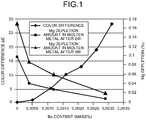
- FIG. 1 is a diagram for explaining a relation between a color difference with respect to a Be content in an Al-Si-Mg aluminum alloy for casting and a Mg depletion amount.
- FIG. 2 is a diagram illustrating examples of appearances of side surfaces of casts after heat treatment.
- An Al-Si-Mg aluminum alloy for casting of the present embodiment contains 5 mass% or larger and 10 mass% or smaller of Si, 0.2 mass% or larger and 1.0 mass% or smaller of Mg, 0.03 mass% or larger and 0.5 mass% or smaller of Sb, and 0.0004 mass% or larger and 0.0026 mass% or smaller of Be with the remainder comprising Al and unavoidable impurities.
- Si contributes to castability and mechanical properties.
- the castability improves considerably when the Si content is 5 mass% or larger.
- the castability is important in making a large cast such as an automobile part. Because the addition of Si makes a Si crystallized matter more likely to coarsen and makes the elongation property more likely to drop, the Si content needs to be kept to 10 mass% or smaller.
- Si is precipitated along with Mg as an Mg-Si compound, contributing to improved strength.
- Mg is precipitated together with Si as the Mg-Si compound in the Al-Si-Mg aluminum alloy for casting of the present embodiment during the aging treatment.
- Mg provides the effect of improving strength. This effect is significant when the Mg content is 0.2 mass% or larger and even more so when it is 0.3 mass% or larger.
- the Mg content of larger than 1.0 mass% deteriorates the elongation property and promotes oxide production, thereby causing hard spots and other defects.
- the Mg content is more preferably 0.3 mass% or larger and 0.5 mass% or smaller, which improves the strength, prevents the deterioration of the elongation property, and inhibits the oxide production.
- Sb provides the effects of refining Si in the eutectic structure and improving the elongation property. These effects are significant when the Sb content is 0.03 mass% or larger. When the Sb content is larger than 0.5 mass%, a coarse Mg-Sb compound may be created, which may result in the deterioration of the elongation property.
- the blackening of the cast surface has been considered unavoidable unless the Al-Si-Mg aluminum alloy contains a large amount of Be.
- a relation between the Be content in the Al-Si-Mg aluminum alloy and the blackening of the cast surface is not a simple inverse proportional relation. More specifically, they have found that the blackening of the cast surface is unlikely to occur until the Be content in the Al-Si-Mg aluminum alloy reaches a prescribed threshold value; that the blackening occurs easily when the Be content is higher than the prescribed threshold value; and that the blackening is inhibited when the Be content further increases, for example, to 0.05 mass% or larger.
- Be forms a dense passive oxide film on the molten metal surface of the aluminum alloy and inhibits oxidation of the molten aluminum alloy. Be inhibits Mg depletion in the aluminum alloy.
- the Be content needs to be 0.0004 mass% or larger.
- the Be content is larger than 0.0026 mass%, the cast surface easily blackens when an ingot is subjected to, after casting, solution treatment, water quenching, and aging treatment, or so-called temper designation T6 heat treatment stipulated in JIS H 0001 (hereinafter referred to as T6 heat treatment). This is presumably because the aluminum oxide layer on the cast surface becomes thick by the T6 heat treatment, which leads to the blackening of the cast surface.
- the Be content of 0.0004 mass% or larger and 0.0026 mass% or smaller inhibits the blackening of the cast surface by the T6 heat treatment.
- the Al-Si-Mg aluminum alloy for casting of the present embodiment may also contain an element group selected from titanium (Ti) and/or boron (B) as a refining material of the cast structure, where Ti ⁇ 0.15 and B ⁇ 0.01% hold.
- Ti titanium
- B boron
- the Al-Si-Mg aluminum alloy for casting of the present embodiment permits inevitable impurities, but iron (Fe), which gets easily mixed in, is preferably kept to 0.15% or smaller, and other elements of the inevitable impurities are preferably kept to 0.05% or smaller.
- the Al-Si-Mg aluminum alloy for casting of the present embodiment permits calcium (Ca), which inevitably gets mixed in.
- the Ca content in the Al-Si-Mg aluminum alloy for casting of the present embodiment is preferably 0 mass% or larger and smaller than 0.01 mass%, and more favorably kept to 0 mass% or larger and 0.005 mass% or smaller.
- the following describes an example of the method for manufacturing a casting material using the Al-Si-Mg aluminum alloy for casting of the present embodiment described above.
- An aluminum alloy with an alloy composition containing 5 to 10 mass% inclusive of Si, 0.2 mass% or larger and 1.0 mass% or smaller of Mg, 0.03 mass% or larger and 0.5 mass% or smaller of Sb, and 0.0004 mass% or larger and 0.0026 mass% or smaller of Be, and the remainder comprising Al and inevitable impurities is produced by melting with a known method.
- the resulting aluminum alloy molten metal undergoes molten metal treatment, such as component adjustment, slag removal, degassing and the like. If Ti and B are contained as refining materials, a rod hardener (refining material) formed with an Al-Ti-B alloy, for example, is added to the aluminum alloy molten metal before casting.
- molten metal treatment such as component adjustment, slag removal, degassing and the like.
- the aluminum alloy molten metal obtained in the melting step is poured into a mold to obtain an ingot.
- the ingot obtained in the casting step undergoes the T6 heat treatment to obtain the Al-Si-Mg aluminum alloy casting material of the present embodiment.
- the T6 heat treatment is heat treatment in which the ingot is subjected to solution treatment, quenching treatment, and aging treatment in sequence.
- a solution treatment temperature is held at 500°C or higher and 550°C or lower for 2 hours or longer and 12 hours or shorter.
- the solution treatment temperature is held at 535°C for 4 hours. If the solution treatment temperature is lower than 500°C or temperature hold time is shorter than 2 hours, the effect of the solution treatment is small. If the solution treatment temperature is higher than 550°C, local melting (burning) may occur. Even if the temperature hold time exceeds 12 hours, no change is seen in amounts of elements of Mg and Si in solid solution, but the costs increase.
- the ingot subjected to the solution treatment is water-cooled as the quenching treatment.
- Water used for the quenching treatment may be warm water.
- the ingot forming supersaturated solid solution is subjected to the aging treatment.
- the aging temperature is held at 120°C or higher and 180°C or lower for 2 hours or longer and 12 hours or shorter.
- the aging temperature is held at 150°C for 6 hours.
- the Al-Si-Mg aluminum alloy for casting and the Al-Si-Mg aluminum alloy casting material of the present embodiment, having undergone the T6 heat treatment, are less blackened after the heat treatment and are excellent in appearance.
- Mg contributes to the mechanical strength as there is little Mg depletion in the molten metal and the temper designation T6 refining stipulated in JIS H 0001 is performed, thereby making the tensile strength 300 MPa or higher and the elongation 10% or greater, for example.
- the Al-Si-Mg aluminum alloy casting material of the present embodiment, having undergone the T6 heat treatment, is manufactured as an automobile part, for example.
- Example 1 Example 2 and Comparative Example 1, an aluminum alloy having elements of an alloy composition of Table 1 and the remainder of Al was melted to manufacture a molten metal for evaluation.
- the temperature of each manufactured molten metal for evaluation was held at 850°C, and the Mg content was measured after 24 hours and 48 hours.
- Each measured Mg content was subtracted from the Mg content immediately after the melting to calculate the Mg depletion amounts in the molten metal after 24 hours (h) and 48 hours (h), and the results are listed in Table 1.
- Example 1 and Example 2 Mg added for strength improvement becomes less oxidized and depleted in the molten metal than Mg in Comparative Example 1, thereby lowering the possibility of promoting oxide production and gas absorption.
- the molten state is less affected than that in Comparative Example 1 and a casting material with improved strength can be stably manufactured.
- Example 2 Examples 3 to 7 and Comparative Example 3, casting materials were manufactured with the manufacturing method described above so as to make aluminum alloys having the elements of the alloy composition of Table 2 and the remainder of Al. Each casting material was cast into a boat shape using gravity die casting in the same die. Each casting material underwent the T6 heat treatment after water-cooling to sequentially perform the solution treatment, in which the casting material was held at a holding temperature of 535°C for 4 hours, the quenching treatment, and the aging treatment, in which the casting material was held at a holding temperature of 150°C for 6 hours.
- a color-difference meter (CR-400 manufactured by Konica Minolta Japan, Inc.) was used to obtain a body color of the surface of each casting material on the basis of JIS Z 8722.
- a color difference ⁇ E was calculated for the resulting body colors using the body color of the second comparative example with Be of smaller than 0.0001 mass% as a standard on the basis of JIS Z 8730.
- FIG. 1 is a diagram for explaining a relation between a color difference with respect to a Be content in the Al-Si-Mg aluminum alloy for casting and a Mg depletion amount.
- FIG. 2 is a diagram illustrating examples of appearances of the side surfaces of casts after the heat treatment.
- the Al-Si-Mg aluminum alloy for casting and the Al-Si-Mg aluminum alloy casting material have a Be content of 0.004 mass% or larger and 0.026 mass% or smaller, thereby inhibiting the blackening of the cast surface that has been refined with the temper designation T6 specified in JIS H 0001, while inhibiting the depletion amount of Mg in the molten metal.
- Comparative Example 2 and Example 6 are visually recognized as silver and the third comparative example is visually recognized as black.
- the third comparative example has a Be content larger than 0.0026 mass% and it is understood from FIG. 2 that the surface is blackened.
- the color difference ⁇ E from the color of the second comparative example is 19 or larger, the blackness of the cast surface can be easily visually recognized.
Landscapes
- Chemical & Material Sciences (AREA)
- Engineering & Computer Science (AREA)
- Mechanical Engineering (AREA)
- Materials Engineering (AREA)
- Metallurgy (AREA)
- Organic Chemistry (AREA)
- Physics & Mathematics (AREA)
- Thermal Sciences (AREA)
- Crystallography & Structural Chemistry (AREA)
- Continuous Casting (AREA)
Abstract
Description
- The present invention relates to a method for manufacturing an Al-Si-Mg aluminum alloy casting material. The present invention is particularly suitable for a large casting material such as those used for an automobile component. Background
- Casting alloys are known (such as alloy A356 specified by the American Society for Testing and Materials (ASTM)), which are aluminum (Al) alloys containing silicon (Si) and having added magnesium (Mg) for improving mechanical properties of an Al-Si aluminum alloy with favorable castability. The Mg added for improved strength may be oxidized and depleted in a molten state, thereby promoting oxide production and gas absorption. The addition of beryllium (Be) to the Al-Si-Mg aluminum alloy is known to inhibit Mg depletion.
- The addition of antimony (Sb) to the Al-Si-Mg aluminum alloy AC4C or AC4A specified in Japanese Industrial Standards (JIS) H 5202, for example, is known to improve (refine) a Si phase in a eutectic structure and thus improve an elongation property (refer to Patent Literature 1).
- However, when the Al-Si-Mg aluminum alloy with added Sb undergoes high-temperature heat treatment such as solution treatment, a cast surface may turn black, thereby damaging its appearance. Proposals for inhibiting the blackening of the cast surface include the addition of a large amount of Be to the Al-Si-Mg aluminum alloy to which Sb has been added, and the combined addition of Be and Ca (refer to
Patent Literature 2 and Patent Literature 3). -
- Patent Literature 1: Japanese Laid-open Patent Publication No.
52-156117 - Patent Literature 2: Japanese Laid-open Patent Publication No.
63-162832 - Patent Literature 3: Japanese Laid-open Patent Publication No.
59-064736 - As per
Patent Literature 2, the blackening is inhibited when a Be content is 0.05 mass% or larger. Adequate care is required in handling Be because Be is a rare metal and therefore expensive, and because Be dust is highly toxic. - The present invention has been made in consideration of the above matters and is directed to providing a method for manufacturing an Al-Si-Mg aluminum alloy casting material with a low Be content and an excellent appearance after heat treatment.
- According to an aspect, a method for manufacturing an Al-Si-Mg aluminum alloy casting material includes:
performing solution treatment on an Al-Si-Mg aluminum alloy casting material containing 5 mass% or larger and 10 mass% or smaller of Si, 0.2 mass% or larger and 1.0 mass% or smaller of Mg, 0.03 mass% or larger and 0.5 mass% or smaller of Sb, and 0.0004 mass% or larger and 0.0026 mass% or smaller of Be, and a remainder having an alloy composition including Al and unavoidable impurities; performing quenching treatment; and performing aging treatment. - As a preferred aspect, the heat treatment includes:
solution treatment in which a temperature is held at 500°C or higher and 550°C or lower for 2 hours or longer and 12 hours or shorter; quenching treatment after the solution treatment; and aging treatment in which a temperature is held at 120°C or higher and 180°C or lower for 2 hours or longer and 12 hours or shorter after the quenching treatment. - According to the aspect of the present invention, the method for manufacturing an Al-Si-Mg aluminum alloy casting material can be provided.
-
FIG. 1 is a diagram for explaining a relation between a color difference with respect to a Be content in an Al-Si-Mg aluminum alloy for casting and a Mg depletion amount.
FIG. 2 is a diagram illustrating examples of appearances of side surfaces of casts after heat treatment. - An embodiment according to the present invention is described below with reference to the drawings but the present invention is not limited thereto. Constituent elements of the embodiment described below can be combined as appropriate. In some cases, part of the constituent elements may not be used. The constituent elements in the embodiment described below include elements that can be easily conceived of by a person skilled in the art, elements substantially equivalent thereto, and elements within a so-called range of equivalents.
- An Al-Si-Mg aluminum alloy for casting of the present embodiment contains 5 mass% or larger and 10 mass% or smaller of Si, 0.2 mass% or larger and 1.0 mass% or smaller of Mg, 0.03 mass% or larger and 0.5 mass% or smaller of Sb, and 0.0004 mass% or larger and 0.0026 mass% or smaller of Be with the remainder comprising Al and unavoidable impurities.
- Si contributes to castability and mechanical properties. The castability improves considerably when the Si content is 5 mass% or larger. The castability is important in making a large cast such as an automobile part. Because the addition of Si makes a Si crystallized matter more likely to coarsen and makes the elongation property more likely to drop, the Si content needs to be kept to 10 mass% or smaller. During aging treatment, Si is precipitated along with Mg as an Mg-Si compound, contributing to improved strength.
- Because Mg is precipitated together with Si as the Mg-Si compound in the Al-Si-Mg aluminum alloy for casting of the present embodiment during the aging treatment, Mg provides the effect of improving strength. This effect is significant when the Mg content is 0.2 mass% or larger and even more so when it is 0.3 mass% or larger. Conversely, the Mg content of larger than 1.0 mass% deteriorates the elongation property and promotes oxide production, thereby causing hard spots and other defects. Thus, the Mg content is more preferably 0.3 mass% or larger and 0.5 mass% or smaller, which improves the strength, prevents the deterioration of the elongation property, and inhibits the oxide production.
- Sb provides the effects of refining Si in the eutectic structure and improving the elongation property. These effects are significant when the Sb content is 0.03 mass% or larger. When the Sb content is larger than 0.5 mass%, a coarse Mg-Sb compound may be created, which may result in the deterioration of the elongation property.
- As described in
Patent Literature 2, the blackening of the cast surface has been considered unavoidable unless the Al-Si-Mg aluminum alloy contains a large amount of Be. Through extensive research, the inventors of the present invention have discovered that a relation between the Be content in the Al-Si-Mg aluminum alloy and the blackening of the cast surface is not a simple inverse proportional relation. More specifically, they have found that the blackening of the cast surface is unlikely to occur until the Be content in the Al-Si-Mg aluminum alloy reaches a prescribed threshold value; that the blackening occurs easily when the Be content is higher than the prescribed threshold value; and that the blackening is inhibited when the Be content further increases, for example, to 0.05 mass% or larger. - More specifically, Be forms a dense passive oxide film on the molten metal surface of the aluminum alloy and inhibits oxidation of the molten aluminum alloy. Be inhibits Mg depletion in the aluminum alloy. For enhanced effects, the Be content needs to be 0.0004 mass% or larger. However, if the Be content is larger than 0.0026 mass%, the cast surface easily blackens when an ingot is subjected to, after casting, solution treatment, water quenching, and aging treatment, or so-called temper designation T6 heat treatment stipulated in JIS H 0001 (hereinafter referred to as T6 heat treatment). This is presumably because the aluminum oxide layer on the cast surface becomes thick by the T6 heat treatment, which leads to the blackening of the cast surface. In the present embodiment, the Be content of 0.0004 mass% or larger and 0.0026 mass% or smaller inhibits the blackening of the cast surface by the T6 heat treatment.
- The Al-Si-Mg aluminum alloy for casting of the present embodiment may also contain an element group selected from titanium (Ti) and/or boron (B) as a refining material of the cast structure, where Ti ≤ 0.15 and B ≤ 0.01% hold.
- The Al-Si-Mg aluminum alloy for casting of the present embodiment permits inevitable impurities, but iron (Fe), which gets easily mixed in, is preferably kept to 0.15% or smaller, and other elements of the inevitable impurities are preferably kept to 0.05% or smaller.
- The Al-Si-Mg aluminum alloy for casting of the present embodiment permits calcium (Ca), which inevitably gets mixed in. However, if the Ca content is 0.01 mass% or larger, gas absorption becomes intensified and fluidity worsens. Therefore, the Ca content in the Al-Si-Mg aluminum alloy for casting of the present embodiment is preferably 0 mass% or larger and smaller than 0.01 mass%, and more favorably kept to 0 mass% or larger and 0.005 mass% or smaller.
- The following describes an example of the method for manufacturing a casting material using the Al-Si-Mg aluminum alloy for casting of the present embodiment described above.
- An aluminum alloy with an alloy composition containing 5 to 10 mass% inclusive of Si, 0.2 mass% or larger and 1.0 mass% or smaller of Mg, 0.03 mass% or larger and 0.5 mass% or smaller of Sb, and 0.0004 mass% or larger and 0.0026 mass% or smaller of Be, and the remainder comprising Al and inevitable impurities is produced by melting with a known method.
- The resulting aluminum alloy molten metal undergoes molten metal treatment, such as component adjustment, slag removal, degassing and the like. If Ti and B are contained as refining materials, a rod hardener (refining material) formed with an Al-Ti-B alloy, for example, is added to the aluminum alloy molten metal before casting.
- The aluminum alloy molten metal obtained in the melting step is poured into a mold to obtain an ingot.
- The ingot obtained in the casting step undergoes the T6 heat treatment to obtain the Al-Si-Mg aluminum alloy casting material of the present embodiment. The T6 heat treatment is heat treatment in which the ingot is subjected to solution treatment, quenching treatment, and aging treatment in sequence.
- As conditions of the solution treatment, a solution treatment temperature is held at 500°C or higher and 550°C or lower for 2 hours or longer and 12 hours or shorter. As an example of the solution treatment conditions, the solution treatment temperature is held at 535°C for 4 hours. If the solution treatment temperature is lower than 500°C or temperature hold time is shorter than 2 hours, the effect of the solution treatment is small. If the solution treatment temperature is higher than 550°C, local melting (burning) may occur. Even if the temperature hold time exceeds 12 hours, no change is seen in amounts of elements of Mg and Si in solid solution, but the costs increase.
- The ingot subjected to the solution treatment is water-cooled as the quenching treatment. Water used for the quenching treatment may be warm water.
- After the quenching treatment, the ingot forming supersaturated solid solution is subjected to the aging treatment. As conditions for the aging treatment, the aging temperature is held at 120°C or higher and 180°C or lower for 2 hours or longer and 12 hours or shorter. As an example of conditions for the aging treatment, the aging temperature is held at 150°C for 6 hours.
- The Al-Si-Mg aluminum alloy for casting and the Al-Si-Mg aluminum alloy casting material of the present embodiment, having undergone the T6 heat treatment, are less blackened after the heat treatment and are excellent in appearance. In the Al-Si-Mg aluminum alloy for casting and the Al-Si-Mg aluminum alloy casting material of the present embodiment, Mg contributes to the mechanical strength as there is little Mg depletion in the molten metal and the temper designation T6 refining stipulated in JIS H 0001 is performed, thereby making the tensile strength 300 MPa or higher and the
elongation 10% or greater, for example. The Al-Si-Mg aluminum alloy casting material of the present embodiment, having undergone the T6 heat treatment, is manufactured as an automobile part, for example. - The following describes examples of the present invention. In Example 1, Example 2 and Comparative Example 1, an aluminum alloy having elements of an alloy composition of Table 1 and the remainder of Al was melted to manufacture a molten metal for evaluation. The temperature of each manufactured molten metal for evaluation was held at 850°C, and the Mg content was measured after 24 hours and 48 hours. Each measured Mg content was subtracted from the Mg content immediately after the melting to calculate the Mg depletion amounts in the molten metal after 24 hours (h) and 48 hours (h), and the results are listed in Table 1.
Table 1 Alloy composition (mass%) Mg depletion in molten metal (mass%) Si Mg Sb Be After 24h After 48h Example 1 5.3 0.40 0.10 0.0004 0.04 0.09 Example 2 5.5 0.39 0.10 0.0012 0.03 0.06 Comparative Example 1 5.5 0.40 0.10 <0.0001 0.10 0.17 - It was confirmed that the Mg depletion amount in the molten metal was obviously smaller in Example 1 and Example 2 than that in Comparative Example 1 with a Be content smaller than 0.0001 mass%. Therefore, in Example 1 and Example 2, Mg added for strength improvement becomes less oxidized and depleted in the molten metal than Mg in Comparative Example 1, thereby lowering the possibility of promoting oxide production and gas absorption. As a result, in Example 1 and Example 2, the molten state is less affected than that in Comparative Example 1 and a casting material with improved strength can be stably manufactured.
- In Comparative Example 2, Examples 3 to 7 and Comparative Example 3, casting materials were manufactured with the manufacturing method described above so as to make aluminum alloys having the elements of the alloy composition of Table 2 and the remainder of Al. Each casting material was cast into a boat shape using gravity die casting in the same die. Each casting material underwent the T6 heat treatment after water-cooling to sequentially perform the solution treatment, in which the casting material was held at a holding temperature of 535°C for 4 hours, the quenching treatment, and the aging treatment, in which the casting material was held at a holding temperature of 150°C for 6 hours.
- Subsequently, a color-difference meter (CR-400 manufactured by Konica Minolta Japan, Inc.) was used to obtain a body color of the surface of each casting material on the basis of JIS Z 8722. A color difference ΔE was calculated for the resulting body colors using the body color of the second comparative example with Be of smaller than 0.0001 mass% as a standard on the basis of JIS Z 8730.
Table 2 Alloy composition (mass%) Color difference ΔE Si Mg Sb Be Comparative Example 2 5.5 0.41 0.09 <0.0001 0 Example 3 5.5 0.41 0.09 0.0005 0.8 Example 4 5.5 0.41 0.09 0.0011 5.0 Example 5 5.5 0.41 0.09 0.0016 10.0 Example 6 5.5 0.41 0.09 0.0021 12.8 Example 7 5.5 0.41 0.10 0.0026 18.9 Comparative Example 3 5.5 0.41 0.09 0.0031 28.1 - The resulting color differences ΔE for Examples 3 to 7 and Comparative Example 3 compared to Comparative Example 2 are listed in Table 2.
FIG. 1 is a diagram for explaining a relation between a color difference with respect to a Be content in the Al-Si-Mg aluminum alloy for casting and a Mg depletion amount.FIG. 2 is a diagram illustrating examples of appearances of the side surfaces of casts after the heat treatment. - As can be understood from
FIG. 1 , the Al-Si-Mg aluminum alloy for casting and the Al-Si-Mg aluminum alloy casting material have a Be content of 0.004 mass% or larger and 0.026 mass% or smaller, thereby inhibiting the blackening of the cast surface that has been refined with the temper designation T6 specified in JIS H 0001, while inhibiting the depletion amount of Mg in the molten metal. - As illustrated in
FIG. 2 , Comparative Example 2 and Example 6 are visually recognized as silver and the third comparative example is visually recognized as black. The third comparative example has a Be content larger than 0.0026 mass% and it is understood fromFIG. 2 that the surface is blackened. As illustrated inFIG. 2 , the larger the color difference ΔE from the color of Comparative Example 2 is, the more significant the blackening becomes. As can be understood fromFIG. 2 and Table 2, if the color difference ΔE from the color of the second comparative example is 19 or larger, the blackness of the cast surface can be easily visually recognized. - Various useful examples of the present embodiment have been illustrated and described above. The present embodiment is not limited to Examples described above or modifications thereof, and it goes without saying that various changes can be made in the embodiment without departing from the gist of the present embodiment or the attached claims.
Claims (2)
- A method for manufacturing an Al-Si-Mg aluminum alloy casting material, the method comprising:performing solution treatment on an Al-Si-Mg aluminum alloy casting material containing 5 mass% or larger and 10 mass% or smaller of Si, 0.2 mass% or larger and 1.0 mass% or smaller of Mg, 0.03 mass% or larger and 0.5 mass% or smaller of Sb, and 0.0004 mass% or larger and 0.0026 mass% or smaller of Be, and a remainder having an alloy composition including Al and unavoidable impurities;performing quenching treatment; andperforming aging treatment.
- The method for manufacturing an Al-Si-Mg aluminum alloy casting material according to claim 1, wherein
the heat treatment comprises:solution treatment in which a temperature is held at 500°C or higher and 550°C or lower for 2 hours or longer and 12 hours or shorter;quenching treatment after the solution treatment; andaging treatment in which a temperature is held at 120°C or higher and 180°C or lower for 2 hours or longer and 12 hours or shorter after the quenching treatment.
Applications Claiming Priority (1)
| Application Number | Priority Date | Filing Date | Title |
|---|---|---|---|
| PCT/JP2018/012595 WO2019186739A1 (en) | 2018-03-27 | 2018-03-27 | PRODUCTION METHOD FOR Al–Si–Mg-BASED ALUMINUM ALLOY CASTING MATERIAL |
Publications (3)
| Publication Number | Publication Date |
|---|---|
| EP3778946A1 true EP3778946A1 (en) | 2021-02-17 |
| EP3778946A4 EP3778946A4 (en) | 2021-10-20 |
| EP3778946B1 EP3778946B1 (en) | 2025-08-27 |
Family
ID=65020551
Family Applications (1)
| Application Number | Title | Priority Date | Filing Date |
|---|---|---|---|
| EP18913036.2A Active EP3778946B1 (en) | 2018-03-27 | 2018-03-27 | Production method for al-si-mg-based aluminum alloy casting material |
Country Status (5)
| Country | Link |
|---|---|
| US (1) | US11542580B2 (en) |
| EP (1) | EP3778946B1 (en) |
| JP (1) | JP6454450B1 (en) |
| CN (1) | CN111094607B (en) |
| WO (1) | WO2019186739A1 (en) |
Family Cites Families (9)
| Publication number | Priority date | Publication date | Assignee | Title |
|---|---|---|---|---|
| JPS52156117A (en) | 1976-06-21 | 1977-12-26 | Mitsubishi Keikinzoku Kogyo | Aluminium alloy for casting |
| JPS57169056A (en) * | 1981-04-13 | 1982-10-18 | Hitachi Metals Ltd | Preventing method for discoloration of al-si-mg alloy casting |
| JPS5964736A (en) | 1982-10-04 | 1984-04-12 | Mitsui Alum Kogyo Kk | Aluminum alloy for casting |
| JPS63162832A (en) | 1986-12-25 | 1988-07-06 | Hitachi Metals Ltd | Aluminum alloy for casting combining high strength with high toughness |
| JPH0243339A (en) * | 1988-07-31 | 1990-02-13 | Asahi Tec Corp | Casting aluminum alloy and vehicle wheel |
| JPH02285042A (en) | 1989-04-27 | 1990-11-22 | Nissan Motor Co Ltd | Forging aluminum alloy |
| JPH0678580B2 (en) | 1990-04-18 | 1994-10-05 | 日産自動車株式会社 | Aluminum alloy for forging |
| JP2012050993A (en) | 2010-08-31 | 2012-03-15 | Mitsubishi Alum Co Ltd | Fluxless brazing method of aluminum material and aluminum clad material for fluxless brazing |
| CN106244957A (en) | 2016-03-24 | 2016-12-21 | 上海汇众汽车制造有限公司 | The Technology for Heating Processing of AlSi7Mg aluminium alloy castings |
-
2018
- 2018-03-27 WO PCT/JP2018/012595 patent/WO2019186739A1/en not_active Ceased
- 2018-03-27 EP EP18913036.2A patent/EP3778946B1/en active Active
- 2018-03-27 US US16/643,498 patent/US11542580B2/en active Active
- 2018-03-27 JP JP2018535195A patent/JP6454450B1/en active Active
- 2018-03-27 CN CN201880057259.6A patent/CN111094607B/en active Active
Also Published As
| Publication number | Publication date |
|---|---|
| WO2019186739A1 (en) | 2019-10-03 |
| EP3778946B1 (en) | 2025-08-27 |
| US11542580B2 (en) | 2023-01-03 |
| JP6454450B1 (en) | 2019-01-16 |
| EP3778946A4 (en) | 2021-10-20 |
| CN111094607A (en) | 2020-05-01 |
| CN111094607B (en) | 2021-09-07 |
| US20200190647A1 (en) | 2020-06-18 |
| JPWO2019186739A1 (en) | 2020-04-30 |
Similar Documents
| Publication | Publication Date | Title |
|---|---|---|
| EP3121302B1 (en) | Aluminum alloy for die casting, and die-cast aluminum alloy using same | |
| EP2339037B1 (en) | Manufacturing method of aluminum alloy | |
| JP5852580B2 (en) | Flame retardant magnesium alloy having excellent mechanical properties and method for producing the same | |
| EP2333122B1 (en) | Aluminum alloy and manufacturing method thereof | |
| JP5703881B2 (en) | High strength magnesium alloy and method for producing the same | |
| EP3216884B1 (en) | Aluminum alloy for die casting and aluminum-alloy die cast obtained therefrom | |
| EP3878991A1 (en) | Aluminum alloy for die casting and die cast aluminum alloy material | |
| JP4852082B2 (en) | Magnesium alloy | |
| EP3196323B1 (en) | Aluminum alloy die-cast product | |
| EP3778945B1 (en) | Al-si-mg-based aluminum alloy | |
| EP3778946B1 (en) | Production method for al-si-mg-based aluminum alloy casting material | |
| JP7401080B1 (en) | Manufacturing method of Al alloy for casting | |
| CN108149083A (en) | A kind of semisolid pressure casting aluminium alloy and the method for preparing semisolid pressure casting aluminium alloy castings | |
| JPH0941064A (en) | Production of aluminum alloy for casting and aluminum alloy casting material | |
| EP3192883B1 (en) | Ai alloy containing cu and c and its manufacturing method | |
| EP3943629B1 (en) | Aluminum alloy and aluminum alloy die casting material | |
| KR102911960B1 (en) | Cast aluminum alloy with excellent strength, ductility and impact resistance and aluminum alloy castings | |
| JP7238545B2 (en) | Method for manufacturing aluminum alloy and cast parts | |
| KR102780397B1 (en) | Non-heat treatment type aluminum alloy and manufacturing method of aluminum alloy parts using the same | |
| KR102607048B1 (en) | High strength and high corrosion resistant aluminum die casting alloy | |
| JPS6140300B2 (en) | ||
| KR20230171947A (en) | Oxidation-resistant Al-Mg high-strength die casting alloy | |
| JP2020105545A (en) | Aluminum alloy having low casting crack sensitivity, and aluminum alloy casting using the same | |
| JPH07216486A (en) | Aluminum alloy for squeeze casting |
Legal Events
| Date | Code | Title | Description |
|---|---|---|---|
| STAA | Information on the status of an ep patent application or granted ep patent |
Free format text: STATUS: THE INTERNATIONAL PUBLICATION HAS BEEN MADE |
|
| PUAI | Public reference made under article 153(3) epc to a published international application that has entered the european phase |
Free format text: ORIGINAL CODE: 0009012 |
|
| STAA | Information on the status of an ep patent application or granted ep patent |
Free format text: STATUS: REQUEST FOR EXAMINATION WAS MADE |
|
| 17P | Request for examination filed |
Effective date: 20200303 |
|
| AK | Designated contracting states |
Kind code of ref document: A1 Designated state(s): AL AT BE BG CH CY CZ DE DK EE ES FI FR GB GR HR HU IE IS IT LI LT LU LV MC MK MT NL NO PL PT RO RS SE SI SK SM TR |
|
| AX | Request for extension of the european patent |
Extension state: BA ME |
|
| DAV | Request for validation of the european patent (deleted) | ||
| DAX | Request for extension of the european patent (deleted) | ||
| A4 | Supplementary search report drawn up and despatched |
Effective date: 20210921 |
|
| RIC1 | Information provided on ipc code assigned before grant |
Ipc: C22F 1/043 20060101ALI20210915BHEP Ipc: B22D 21/04 20060101ALI20210915BHEP Ipc: C22C 21/02 20060101AFI20210915BHEP |
|
| GRAP | Despatch of communication of intention to grant a patent |
Free format text: ORIGINAL CODE: EPIDOSNIGR1 |
|
| STAA | Information on the status of an ep patent application or granted ep patent |
Free format text: STATUS: GRANT OF PATENT IS INTENDED |
|
| RIC1 | Information provided on ipc code assigned before grant |
Ipc: C22F 1/043 20060101ALI20250116BHEP Ipc: B22D 21/04 20060101ALI20250116BHEP Ipc: C22C 21/02 20060101AFI20250116BHEP |
|
| INTG | Intention to grant announced |
Effective date: 20250131 |
|
| GRAJ | Information related to disapproval of communication of intention to grant by the applicant or resumption of examination proceedings by the epo deleted |
Free format text: ORIGINAL CODE: EPIDOSDIGR1 |
|
| STAA | Information on the status of an ep patent application or granted ep patent |
Free format text: STATUS: REQUEST FOR EXAMINATION WAS MADE |
|
| GRAP | Despatch of communication of intention to grant a patent |
Free format text: ORIGINAL CODE: EPIDOSNIGR1 |
|
| STAA | Information on the status of an ep patent application or granted ep patent |
Free format text: STATUS: GRANT OF PATENT IS INTENDED |
|
| INTC | Intention to grant announced (deleted) | ||
| INTG | Intention to grant announced |
Effective date: 20250417 |
|
| GRAS | Grant fee paid |
Free format text: ORIGINAL CODE: EPIDOSNIGR3 |
|
| GRAA | (expected) grant |
Free format text: ORIGINAL CODE: 0009210 |
|
| STAA | Information on the status of an ep patent application or granted ep patent |
Free format text: STATUS: THE PATENT HAS BEEN GRANTED |
|
| AK | Designated contracting states |
Kind code of ref document: B1 Designated state(s): AL AT BE BG CH CY CZ DE DK EE ES FI FR GB GR HR HU IE IS IT LI LT LU LV MC MK MT NL NO PL PT RO RS SE SI SK SM TR |
|
| REG | Reference to a national code |
Ref country code: GB Ref legal event code: FG4D |
|
| REG | Reference to a national code |
Ref country code: CH Ref legal event code: EP |
|
| REG | Reference to a national code |
Ref country code: DE Ref legal event code: R096 Ref document number: 602018085090 Country of ref document: DE |
|
| REG | Reference to a national code |
Ref country code: IE Ref legal event code: FG4D |
|
| P01 | Opt-out of the competence of the unified patent court (upc) registered |
Free format text: CASE NUMBER: UPC_APP_5056_3778946/2025 Effective date: 20250828 |
|
| REG | Reference to a national code |
Ref country code: NL Ref legal event code: MP Effective date: 20250827 |
|
| PG25 | Lapsed in a contracting state [announced via postgrant information from national office to epo] |
Ref country code: IS Free format text: LAPSE BECAUSE OF FAILURE TO SUBMIT A TRANSLATION OF THE DESCRIPTION OR TO PAY THE FEE WITHIN THE PRESCRIBED TIME-LIMIT Effective date: 20251227 |
|
| PG25 | Lapsed in a contracting state [announced via postgrant information from national office to epo] |
Ref country code: NO Free format text: LAPSE BECAUSE OF FAILURE TO SUBMIT A TRANSLATION OF THE DESCRIPTION OR TO PAY THE FEE WITHIN THE PRESCRIBED TIME-LIMIT Effective date: 20251127 |
|
| REG | Reference to a national code |
Ref country code: LT Ref legal event code: MG9D |
|
| PG25 | Lapsed in a contracting state [announced via postgrant information from national office to epo] |
Ref country code: PT Free format text: LAPSE BECAUSE OF FAILURE TO SUBMIT A TRANSLATION OF THE DESCRIPTION OR TO PAY THE FEE WITHIN THE PRESCRIBED TIME-LIMIT Effective date: 20251229 |
|
| PG25 | Lapsed in a contracting state [announced via postgrant information from national office to epo] |
Ref country code: FI Free format text: LAPSE BECAUSE OF FAILURE TO SUBMIT A TRANSLATION OF THE DESCRIPTION OR TO PAY THE FEE WITHIN THE PRESCRIBED TIME-LIMIT Effective date: 20250827 |
|
| PG25 | Lapsed in a contracting state [announced via postgrant information from national office to epo] |
Ref country code: HR Free format text: LAPSE BECAUSE OF FAILURE TO SUBMIT A TRANSLATION OF THE DESCRIPTION OR TO PAY THE FEE WITHIN THE PRESCRIBED TIME-LIMIT Effective date: 20250827 Ref country code: NL Free format text: LAPSE BECAUSE OF FAILURE TO SUBMIT A TRANSLATION OF THE DESCRIPTION OR TO PAY THE FEE WITHIN THE PRESCRIBED TIME-LIMIT Effective date: 20250827 |
|
| PG25 | Lapsed in a contracting state [announced via postgrant information from national office to epo] |
Ref country code: GR Free format text: LAPSE BECAUSE OF FAILURE TO SUBMIT A TRANSLATION OF THE DESCRIPTION OR TO PAY THE FEE WITHIN THE PRESCRIBED TIME-LIMIT Effective date: 20251128 |
|
| PG25 | Lapsed in a contracting state [announced via postgrant information from national office to epo] |
Ref country code: SE Free format text: LAPSE BECAUSE OF FAILURE TO SUBMIT A TRANSLATION OF THE DESCRIPTION OR TO PAY THE FEE WITHIN THE PRESCRIBED TIME-LIMIT Effective date: 20250827 |
|
| PG25 | Lapsed in a contracting state [announced via postgrant information from national office to epo] |
Ref country code: LV Free format text: LAPSE BECAUSE OF FAILURE TO SUBMIT A TRANSLATION OF THE DESCRIPTION OR TO PAY THE FEE WITHIN THE PRESCRIBED TIME-LIMIT Effective date: 20250827 |
|
| PG25 | Lapsed in a contracting state [announced via postgrant information from national office to epo] |
Ref country code: BG Free format text: LAPSE BECAUSE OF FAILURE TO SUBMIT A TRANSLATION OF THE DESCRIPTION OR TO PAY THE FEE WITHIN THE PRESCRIBED TIME-LIMIT Effective date: 20250827 Ref country code: PL Free format text: LAPSE BECAUSE OF FAILURE TO SUBMIT A TRANSLATION OF THE DESCRIPTION OR TO PAY THE FEE WITHIN THE PRESCRIBED TIME-LIMIT Effective date: 20250827 |
|
| PG25 | Lapsed in a contracting state [announced via postgrant information from national office to epo] |
Ref country code: RS Free format text: LAPSE BECAUSE OF FAILURE TO SUBMIT A TRANSLATION OF THE DESCRIPTION OR TO PAY THE FEE WITHIN THE PRESCRIBED TIME-LIMIT Effective date: 20251127 |
|
| PG25 | Lapsed in a contracting state [announced via postgrant information from national office to epo] |
Ref country code: ES Free format text: LAPSE BECAUSE OF FAILURE TO SUBMIT A TRANSLATION OF THE DESCRIPTION OR TO PAY THE FEE WITHIN THE PRESCRIBED TIME-LIMIT Effective date: 20250827 |
|
| REG | Reference to a national code |
Ref country code: AT Ref legal event code: MK05 Ref document number: 1830027 Country of ref document: AT Kind code of ref document: T Effective date: 20250827 |
|
| PG25 | Lapsed in a contracting state [announced via postgrant information from national office to epo] |
Ref country code: SM Free format text: LAPSE BECAUSE OF FAILURE TO SUBMIT A TRANSLATION OF THE DESCRIPTION OR TO PAY THE FEE WITHIN THE PRESCRIBED TIME-LIMIT Effective date: 20250827 |
|
| PG25 | Lapsed in a contracting state [announced via postgrant information from national office to epo] |
Ref country code: DK Free format text: LAPSE BECAUSE OF FAILURE TO SUBMIT A TRANSLATION OF THE DESCRIPTION OR TO PAY THE FEE WITHIN THE PRESCRIBED TIME-LIMIT Effective date: 20250827 |
|
| PGFP | Annual fee paid to national office [announced via postgrant information from national office to epo] |
Ref country code: DE Payment date: 20260323 Year of fee payment: 9 |
|
| PG25 | Lapsed in a contracting state [announced via postgrant information from national office to epo] |
Ref country code: AT Free format text: LAPSE BECAUSE OF FAILURE TO SUBMIT A TRANSLATION OF THE DESCRIPTION OR TO PAY THE FEE WITHIN THE PRESCRIBED TIME-LIMIT Effective date: 20250827 |
|
| PG25 | Lapsed in a contracting state [announced via postgrant information from national office to epo] |
Ref country code: IT Free format text: LAPSE BECAUSE OF FAILURE TO SUBMIT A TRANSLATION OF THE DESCRIPTION OR TO PAY THE FEE WITHIN THE PRESCRIBED TIME-LIMIT Effective date: 20250827 |
|
| PG25 | Lapsed in a contracting state [announced via postgrant information from national office to epo] |
Ref country code: CZ Free format text: LAPSE BECAUSE OF FAILURE TO SUBMIT A TRANSLATION OF THE DESCRIPTION OR TO PAY THE FEE WITHIN THE PRESCRIBED TIME-LIMIT Effective date: 20250827 |
|
| PG25 | Lapsed in a contracting state [announced via postgrant information from national office to epo] |
Ref country code: EE Free format text: LAPSE BECAUSE OF FAILURE TO SUBMIT A TRANSLATION OF THE DESCRIPTION OR TO PAY THE FEE WITHIN THE PRESCRIBED TIME-LIMIT Effective date: 20250827 Ref country code: SK Free format text: LAPSE BECAUSE OF FAILURE TO SUBMIT A TRANSLATION OF THE DESCRIPTION OR TO PAY THE FEE WITHIN THE PRESCRIBED TIME-LIMIT Effective date: 20250827 |