EP3778570B1 - Strongly-polarized molecule, and single molecule field effect transistor prepared therefrom - Google Patents
Strongly-polarized molecule, and single molecule field effect transistor prepared therefrom Download PDFInfo
- Publication number
- EP3778570B1 EP3778570B1 EP19780897.5A EP19780897A EP3778570B1 EP 3778570 B1 EP3778570 B1 EP 3778570B1 EP 19780897 A EP19780897 A EP 19780897A EP 3778570 B1 EP3778570 B1 EP 3778570B1
- Authority
- EP
- European Patent Office
- Prior art keywords
- molecule
- compound
- field effect
- graphene
- effect transistor
- Prior art date
- Legal status (The legal status is an assumption and is not a legal conclusion. Google has not performed a legal analysis and makes no representation as to the accuracy of the status listed.)
- Active
Links
Images

Classifications
-
- C—CHEMISTRY; METALLURGY
- C07—ORGANIC CHEMISTRY
- C07D—HETEROCYCLIC COMPOUNDS
- C07D487/00—Heterocyclic compounds containing nitrogen atoms as the only ring hetero atoms in the condensed system, not provided for by groups C07D451/00 - C07D477/00
- C07D487/02—Heterocyclic compounds containing nitrogen atoms as the only ring hetero atoms in the condensed system, not provided for by groups C07D451/00 - C07D477/00 in which the condensed system contains two hetero rings
- C07D487/04—Ortho-condensed systems
-
- C—CHEMISTRY; METALLURGY
- C07—ORGANIC CHEMISTRY
- C07C—ACYCLIC OR CARBOCYCLIC COMPOUNDS
- C07C209/00—Preparation of compounds containing amino groups bound to a carbon skeleton
- C07C209/44—Preparation of compounds containing amino groups bound to a carbon skeleton by reduction of carboxylic acids or esters thereof in presence of ammonia or amines, or by reduction of nitriles, carboxylic acid amides, imines or imino-ethers
- C07C209/52—Preparation of compounds containing amino groups bound to a carbon skeleton by reduction of carboxylic acids or esters thereof in presence of ammonia or amines, or by reduction of nitriles, carboxylic acid amides, imines or imino-ethers by reduction of imines or imino-ethers
-
- C—CHEMISTRY; METALLURGY
- C07—ORGANIC CHEMISTRY
- C07C—ACYCLIC OR CARBOCYCLIC COMPOUNDS
- C07C15/00—Cyclic hydrocarbons containing only six-membered aromatic rings as cyclic parts
- C07C15/20—Polycyclic condensed hydrocarbons
-
- C—CHEMISTRY; METALLURGY
- C07—ORGANIC CHEMISTRY
- C07C—ACYCLIC OR CARBOCYCLIC COMPOUNDS
- C07C211/00—Compounds containing amino groups bound to a carbon skeleton
- C07C211/01—Compounds containing amino groups bound to a carbon skeleton having amino groups bound to acyclic carbon atoms
- C07C211/26—Compounds containing amino groups bound to a carbon skeleton having amino groups bound to acyclic carbon atoms of an unsaturated carbon skeleton containing at least one six-membered aromatic ring
- C07C211/30—Compounds containing amino groups bound to a carbon skeleton having amino groups bound to acyclic carbon atoms of an unsaturated carbon skeleton containing at least one six-membered aromatic ring the six-membered aromatic ring being part of a condensed ring system formed by two rings
-
- C—CHEMISTRY; METALLURGY
- C07—ORGANIC CHEMISTRY
- C07C—ACYCLIC OR CARBOCYCLIC COMPOUNDS
- C07C211/00—Compounds containing amino groups bound to a carbon skeleton
- C07C211/01—Compounds containing amino groups bound to a carbon skeleton having amino groups bound to acyclic carbon atoms
- C07C211/26—Compounds containing amino groups bound to a carbon skeleton having amino groups bound to acyclic carbon atoms of an unsaturated carbon skeleton containing at least one six-membered aromatic ring
- C07C211/31—Compounds containing amino groups bound to a carbon skeleton having amino groups bound to acyclic carbon atoms of an unsaturated carbon skeleton containing at least one six-membered aromatic ring the six-membered aromatic ring being part of a condensed ring system formed by at least three rings
-
- C—CHEMISTRY; METALLURGY
- C07—ORGANIC CHEMISTRY
- C07D—HETEROCYCLIC COMPOUNDS
- C07D209/00—Heterocyclic compounds containing five-membered rings, condensed with other rings, with one nitrogen atom as the only ring hetero atom
- C07D209/02—Heterocyclic compounds containing five-membered rings, condensed with other rings, with one nitrogen atom as the only ring hetero atom condensed with one carbocyclic ring
- C07D209/52—Heterocyclic compounds containing five-membered rings, condensed with other rings, with one nitrogen atom as the only ring hetero atom condensed with one carbocyclic ring condensed with a ring other than six-membered
-
- C—CHEMISTRY; METALLURGY
- C07—ORGANIC CHEMISTRY
- C07D—HETEROCYCLIC COMPOUNDS
- C07D333/00—Heterocyclic compounds containing five-membered rings having one sulfur atom as the only ring hetero atom
- C07D333/50—Heterocyclic compounds containing five-membered rings having one sulfur atom as the only ring hetero atom condensed with carbocyclic rings or ring systems
- C07D333/78—Heterocyclic compounds containing five-membered rings having one sulfur atom as the only ring hetero atom condensed with carbocyclic rings or ring systems condensed with rings other than six-membered or with ring systems containing such rings
-
- C—CHEMISTRY; METALLURGY
- C07—ORGANIC CHEMISTRY
- C07F—ACYCLIC, CARBOCYCLIC OR HETEROCYCLIC COMPOUNDS CONTAINING ELEMENTS OTHER THAN CARBON, HYDROGEN, HALOGEN, OXYGEN, NITROGEN, SULFUR, SELENIUM OR TELLURIUM
- C07F15/00—Compounds containing elements of Groups 8, 9, 10 or 18 of the Periodic Table
-
- C—CHEMISTRY; METALLURGY
- C07—ORGANIC CHEMISTRY
- C07F—ACYCLIC, CARBOCYCLIC OR HETEROCYCLIC COMPOUNDS CONTAINING ELEMENTS OTHER THAN CARBON, HYDROGEN, HALOGEN, OXYGEN, NITROGEN, SULFUR, SELENIUM OR TELLURIUM
- C07F15/00—Compounds containing elements of Groups 8, 9, 10 or 18 of the Periodic Table
- C07F15/0006—Compounds containing elements of Groups 8, 9, 10 or 18 of the Periodic Table compounds of the platinum group
- C07F15/0046—Ruthenium compounds
-
- C—CHEMISTRY; METALLURGY
- C07—ORGANIC CHEMISTRY
- C07F—ACYCLIC, CARBOCYCLIC OR HETEROCYCLIC COMPOUNDS CONTAINING ELEMENTS OTHER THAN CARBON, HYDROGEN, HALOGEN, OXYGEN, NITROGEN, SULFUR, SELENIUM OR TELLURIUM
- C07F15/00—Compounds containing elements of Groups 8, 9, 10 or 18 of the Periodic Table
- C07F15/0006—Compounds containing elements of Groups 8, 9, 10 or 18 of the Periodic Table compounds of the platinum group
- C07F15/0046—Ruthenium compounds
- C07F15/0053—Ruthenium compounds without a metal-carbon linkage
-
- C—CHEMISTRY; METALLURGY
- C07—ORGANIC CHEMISTRY
- C07F—ACYCLIC, CARBOCYCLIC OR HETEROCYCLIC COMPOUNDS CONTAINING ELEMENTS OTHER THAN CARBON, HYDROGEN, HALOGEN, OXYGEN, NITROGEN, SULFUR, SELENIUM OR TELLURIUM
- C07F15/00—Compounds containing elements of Groups 8, 9, 10 or 18 of the Periodic Table
- C07F15/02—Iron compounds
- C07F15/025—Iron compounds without a metal-carbon linkage
-
- C—CHEMISTRY; METALLURGY
- C07—ORGANIC CHEMISTRY
- C07F—ACYCLIC, CARBOCYCLIC OR HETEROCYCLIC COMPOUNDS CONTAINING ELEMENTS OTHER THAN CARBON, HYDROGEN, HALOGEN, OXYGEN, NITROGEN, SULFUR, SELENIUM OR TELLURIUM
- C07F15/00—Compounds containing elements of Groups 8, 9, 10 or 18 of the Periodic Table
- C07F15/02—Iron compounds
- C07F15/03—Sideramines; The corresponding desferri compounds
-
- C—CHEMISTRY; METALLURGY
- C07—ORGANIC CHEMISTRY
- C07F—ACYCLIC, CARBOCYCLIC OR HETEROCYCLIC COMPOUNDS CONTAINING ELEMENTS OTHER THAN CARBON, HYDROGEN, HALOGEN, OXYGEN, NITROGEN, SULFUR, SELENIUM OR TELLURIUM
- C07F15/00—Compounds containing elements of Groups 8, 9, 10 or 18 of the Periodic Table
- C07F15/06—Cobalt compounds
-
- C—CHEMISTRY; METALLURGY
- C07—ORGANIC CHEMISTRY
- C07F—ACYCLIC, CARBOCYCLIC OR HETEROCYCLIC COMPOUNDS CONTAINING ELEMENTS OTHER THAN CARBON, HYDROGEN, HALOGEN, OXYGEN, NITROGEN, SULFUR, SELENIUM OR TELLURIUM
- C07F3/00—Compounds containing elements of Groups 2 or 12 of the Periodic Table
- C07F3/003—Compounds containing elements of Groups 2 or 12 of the Periodic Table without C-Metal linkages
-
- C—CHEMISTRY; METALLURGY
- C07—ORGANIC CHEMISTRY
- C07F—ACYCLIC, CARBOCYCLIC OR HETEROCYCLIC COMPOUNDS CONTAINING ELEMENTS OTHER THAN CARBON, HYDROGEN, HALOGEN, OXYGEN, NITROGEN, SULFUR, SELENIUM OR TELLURIUM
- C07F3/00—Compounds containing elements of Groups 2 or 12 of the Periodic Table
- C07F3/06—Zinc compounds
-
- H—ELECTRICITY
- H10—SEMICONDUCTOR DEVICES; ELECTRIC SOLID-STATE DEVICES NOT OTHERWISE PROVIDED FOR
- H10K—ORGANIC ELECTRIC SOLID-STATE DEVICES
- H10K10/00—Organic devices specially adapted for rectifying, amplifying, oscillating or switching; Organic capacitors or resistors having potential barriers
- H10K10/701—Organic molecular electronic devices
-
- H—ELECTRICITY
- H10—SEMICONDUCTOR DEVICES; ELECTRIC SOLID-STATE DEVICES NOT OTHERWISE PROVIDED FOR
- H10K—ORGANIC ELECTRIC SOLID-STATE DEVICES
- H10K85/00—Organic materials used in the body or electrodes of devices covered by this subclass
- H10K85/30—Coordination compounds
- H10K85/331—Metal complexes comprising an iron-series metal, e.g. Fe, Co, Ni
-
- H—ELECTRICITY
- H10—SEMICONDUCTOR DEVICES; ELECTRIC SOLID-STATE DEVICES NOT OTHERWISE PROVIDED FOR
- H10K—ORGANIC ELECTRIC SOLID-STATE DEVICES
- H10K85/00—Organic materials used in the body or electrodes of devices covered by this subclass
- H10K85/30—Coordination compounds
- H10K85/341—Transition metal complexes, e.g. Ru(II)polypyridine complexes
- H10K85/344—Transition metal complexes, e.g. Ru(II)polypyridine complexes comprising ruthenium
-
- H—ELECTRICITY
- H10—SEMICONDUCTOR DEVICES; ELECTRIC SOLID-STATE DEVICES NOT OTHERWISE PROVIDED FOR
- H10K—ORGANIC ELECTRIC SOLID-STATE DEVICES
- H10K85/00—Organic materials used in the body or electrodes of devices covered by this subclass
- H10K85/30—Coordination compounds
- H10K85/381—Metal complexes comprising a group IIB metal element, e.g. comprising cadmium, mercury or zinc
-
- H—ELECTRICITY
- H10—SEMICONDUCTOR DEVICES; ELECTRIC SOLID-STATE DEVICES NOT OTHERWISE PROVIDED FOR
- H10K—ORGANIC ELECTRIC SOLID-STATE DEVICES
- H10K85/00—Organic materials used in the body or electrodes of devices covered by this subclass
- H10K85/60—Organic compounds having low molecular weight
-
- H—ELECTRICITY
- H10—SEMICONDUCTOR DEVICES; ELECTRIC SOLID-STATE DEVICES NOT OTHERWISE PROVIDED FOR
- H10K—ORGANIC ELECTRIC SOLID-STATE DEVICES
- H10K85/00—Organic materials used in the body or electrodes of devices covered by this subclass
- H10K85/60—Organic compounds having low molecular weight
- H10K85/615—Polycyclic condensed aromatic hydrocarbons, e.g. anthracene
- H10K85/624—Polycyclic condensed aromatic hydrocarbons, e.g. anthracene containing six or more rings
-
- H—ELECTRICITY
- H10—SEMICONDUCTOR DEVICES; ELECTRIC SOLID-STATE DEVICES NOT OTHERWISE PROVIDED FOR
- H10K—ORGANIC ELECTRIC SOLID-STATE DEVICES
- H10K85/00—Organic materials used in the body or electrodes of devices covered by this subclass
- H10K85/60—Organic compounds having low molecular weight
- H10K85/649—Aromatic compounds comprising a hetero atom
- H10K85/655—Aromatic compounds comprising a hetero atom comprising only sulfur as heteroatom
-
- H—ELECTRICITY
- H10—SEMICONDUCTOR DEVICES; ELECTRIC SOLID-STATE DEVICES NOT OTHERWISE PROVIDED FOR
- H10K—ORGANIC ELECTRIC SOLID-STATE DEVICES
- H10K85/00—Organic materials used in the body or electrodes of devices covered by this subclass
- H10K85/60—Organic compounds having low molecular weight
- H10K85/649—Aromatic compounds comprising a hetero atom
- H10K85/657—Polycyclic condensed heteroaromatic hydrocarbons
- H10K85/6572—Polycyclic condensed heteroaromatic hydrocarbons comprising only nitrogen in the heteroaromatic polycondensed ring system, e.g. phenanthroline or carbazole
-
- H—ELECTRICITY
- H10—SEMICONDUCTOR DEVICES; ELECTRIC SOLID-STATE DEVICES NOT OTHERWISE PROVIDED FOR
- H10K—ORGANIC ELECTRIC SOLID-STATE DEVICES
- H10K10/00—Organic devices specially adapted for rectifying, amplifying, oscillating or switching; Organic capacitors or resistors having potential barriers
- H10K10/40—Organic transistors
- H10K10/46—Field-effect transistors, e.g. organic thin-film transistors [OTFT]
Definitions
- This application relates to the technical field of single molecule electronic devices, in particular to a strongly-polarized molecule and a single molecule field effect transistor prepared therefrom.
- transistors In the current semiconductor industry, the core of electronic circuits is transistors, which are the cornerstone of the contemporary digital revolution. Since the first model of transistors was proposed in 1947, researchers have developed various types of transistors.
- the fundamental principle of transistors is that: , as the capacitance effect of the dielectric layer can change the carrier concentration at the interface between the insulation layer and the semiconductor layer, the current between source electrodes and drain electrodes can be modulated by applying an appropriate voltage to the gate. Therefore, on the one hand, the logic function of the switch can be realized, and on the other hand, since the output power is higher than the input power, the transistor has an amplifier function .
- single molecule field effect transistors have also aroused great interest among researchers.
- the electrostatic potential of a molecule in a single molecule heterojunction can be modulated by applying gate voltage, and thereby energy levels of the molecules are changed, which is different from traditional field-effect transistors. Therefore, on the one hand, the conductive properties of the molecule can be modulated, and on the other hand, certain information related to the vibration mode and excited state of the molecule and vibration-related information can be obtained.
- single molecule field effect transistors are still only at the conceptual stage and have not been implemented in the prior art CN102456702 deals with materials for graphene based transistor devices.
- the examples of the present application aim to provide a strongly-polarized molecule and a single molecule field effect transistor prepared therefrom.
- the specific technical solutions are as follows:
- Ph phenyl
- halogen refers to fluorine, chlorine, bromine or iodine.
- C 1-12 alkyl refers to a linear or branched saturated hydrocarbon group containing 1-12 carbon atoms, including but not limited to methyl, ethyl, n-propyl, isopropyl, n-butyl, isobutyl, 3-ethylheptyl and n-dodecyl.
- the " in the structural formula of a group represents the attachment site of the group to the other parts of the molecule.
- the strongly-polarized molecules represented by the aforementioned general formulae (II) has one of the following structural formulae:
- the inventor found that, without being limited to any theory, when a voltage is applied, especially within the gate modulation voltage of -2 V to +2 V, the aforementioned strongly-polarized molecules are prone to polarization so that the molecular orbital energy level shifts for compatible with gate modulation. Therefore, the gate modulation of the single molecule field effect transistor can be effectively realized.
- the present application also provides a strongly-polarized molecule-graphene molecular heterojunction, wherein the molecular heterojunction includes the aforementioned strongly-polarized molecule bridging between layers of the two-dimensional single-layer graphene via amide covalent bonds.
- the two-dimensional single-layer graphene with a nanogap is a two-dimensional single-layer graphene with an array of nanogaps.
- This application also provides a method for preparing a strongly-polarized molecule-graphene molecular heterojunction, which includes the following steps:
- the "two-dimensional single-layer graphene with a nanogap" can be prepared by the method described in the literature (see Angew. Chem. Int. Ed. 2012, 51, 12228 .).
- the "two-dimensional single-layer graphene with a nanogap” or “two-dimensional single-layer graphene with an array of nanogaps” is also referred to as graphene nanogap electrode or graphene nano-electrode in the prior art.
- the two-dimensional single-layer graphene with a nanogap is taken out of the solution, washed with a large amount of acetone and ultrapure water, and dried in N 2 gas stream.
- the ultrapure water used preferably has a resistivity greater than 18 M ⁇ cm.
- This application also provides a single molecule field effect transistor, which may comprise a substrate, a gate, a dielectric layer, and the strongly-polarized molecule-graphene molecule heterojunction.
- the dielectric layer is located between the gate and the strongly-polarized molecule-graphene molecular heterojunction.
- the two-dimensional single-layer graphene on both sides of the gap in the strongly-polarized molecule-graphene molecule heterojunction can be used as source electrodes and drain electrodes of the single-molecule field effect transistor.
- the material of the gate is one of graphene or metallic aluminum.
- the material of the dielectric layer is one of hafnium oxide, zirconium oxide, titanium oxide and aluminum oxide, or any combinations thereof.
- the present application provides a single molecule field effect transistor, wherein:
- the substrate may also be referred to as a base.
- the substrate may be a silicon wafer having a silicon oxide layer, which is commercially available.
- the gate or the strongly-polarized molecule-graphene molecular heterojunction is located on the silicon oxide layer. The inventor found that when the thickness of the silicon oxide layer is 200-400 nm, and preferably 300 nm, the optical contrast of the graphene is better. Of course, those skilled in the art can also use other substrates to implement the technical solutions of the present application.
- the thickness of the dielectric layer is 3-10 nm, preferably 4-7 nm, and more preferably 5 nm.
- the thickness of the gate since it has no substantial influence on the performance of the transistor itself, it is not specifically limited here in the present application.
- the thickness of the gate can be selected by those skilled in the art according to the actual requirements of size of the transistor itself.
- the thickness of aluminum can be selected from 20 to 30 nm, when the metal aluminum is used as the gate material; the thickness of the single-layer graphene itself is less than 1 nm, when graphene is used as the gate material.
- the present application provides a single-molecule field effect transistor, wherein the gate is located on the substrate, the dielectric layer is located on the gate, and the strongly-polarized molecule-graphene molecule heterojunction is located on the dielectric layer, to form a bottom gate structure, as shown in FIG. 1 ; or the strongly-polarized molecule-graphene molecule heterojunction is located on the substrate, the dielectric layer is located on the strongly-polarized molecule-graphene molecule heterojunction, and the gate is located on the dielectric layer, to form a top gate structure, as shown in FIG. 2 .
- Table 1 Combination of gate and dielectric layer Combination No. 1 2 3 4 5 Gate Graphene Graphene Graphene Aluminum Aluminum Dielectric layer Hafnium oxide Zirconium oxide Titanium oxide Aluminum oxide Aluminum oxide +Hafnium oxide
- the single molecule field effect transistor with a bottom gate structure can be prepared by the following method:
- electron beam evaporation deposition and “atomic layer deposition” herein are both conventional micro-nano processing techniques.
- electron beam evaporation deposition of a metal layer or metal oxide layer with a certain thickness, or atomic layer deposition of a metal layer or metal oxide layer with a certain thickness is very easy to implement for those skilled in the art, which will not be repeated in this application.
- the gate and the dielectric layer when preparing a single molecule field effect transistor with a top gate structure, can also use the 5 combinations in Table 1. Nevertheless, the first three combinations are preferred from the perspective of the simplicity of preparation process.
- a two-dimensional single-layer graphene with a nanogap array is firstly constructed on the substrate. After forming the strongly-polarized molecule-graphene molecule heterojunction by chemical self-assembly method, PMMA (polymethyl methacrylate) is used as a support to transfer the dielectric layer and the gate onto the monomolecular heterojunction.
- PMMA polymethyl methacrylate
- the transfering process of the dielectric layer and the gate may specifically include: firstly, preparing a dielectric layer on a silicon wafer, which may be implemented by using the dielectric layer preparation method in the preparation method of the bottom gate structure, then transferring the graphene grown by chemical vapor deposition on the dielectric layer, further spin-coating PMMA thereon, etching the silicon wafer having hydrofluoric acid, rinsing the dielectric layer/graphene/PMMA film with deionized water and isopropanol three times, and then locatedplacing it on the molecular heterojunction (see ACS Nano 2011, 5, 6916 .).
- support refers to the carrier used to transfer the graphene gate.
- the present application also provides a molecular switch, which includes the aforementioned single molecule field effect transistor.
- the present application also provides a semiconductor chip, which includes the aforementioned single molecule field effect transistor.
- This application provides a strongly-polarized molecule as shown in general formula (II).
- Single molecule field effect transistors are prepared with these molecules for the first time, which is a breakthrough. Since graphene is used as source electrodes and drain electrodes, and the graphene has the matching size with the molecules, which greatly improves the coupling efficiency between the molecules and the gate, and , the efficient gate modulation can be realized cooperating with the strongly-polarized molecule structure.
- the size of the single molecule field effect transistor provided by the present application is within the molecular size range, which strongly promotes the miniaturization of the field effect transistor. Therefore, the semiconductor chip prepared by the single molecule field effect transistor provided by the present application can greatly improve integration. Furthermore, the single molecule field effect transistor provided in the present application has good performance reproducibility, which is more conducive to the application of single molecule field effect transistors.
- the strongly-polarized molecule-graphene molecule heterojunction can be produced in batches
- the single molecule field effect transistor device constructed based on the strongly-polarized molecule-graphene molecule heterojunction provided in this application can be produced in batches.
- the single molecule field effect transistor provided in this application is of epoch-making significance in the technological field of semiconductor.
- the synthetic route is as follows:
- the resultant was circulated 3 times by a freezing and thawing pump circulation method to remove oxygen, and then heated and stirred at 90 °C under the protection of argon for 24 h. After cooling, the reaction mixture was poured into water (50 mL) and extracted with dichloromethane (3 ⁇ 30 mL). After the organic phases were combined and dried over anhydrous sodium sulfate, the solvent was removed under reduced pressure. The crude product was analyzed and purified by silica gel column chromatography to obtain compound B as a purple solid.
- Trifluoroacetic acid (1.0 mL, 0.34 g, 3.73 mmol) was added dropwise to compound B (0.120 g, 0.13 mmol) in dichloromethane (10 mL). After stirring for 2 hours at room temperature, the reaction mixture was added dropwise to saturated aqueous sodium bicarbonate solution (20 mL), and extracted with dichloromethane (50 mL). The organic layer was washed with saturated aqueous sodium bicarbonate solution (30 mL) and saturated sodium chloride solution, and dried over anhydrous sodium sulfate. The solvent was evaporated in vacuo to obtain interested compound 1 as a dark purple solid.
- Graphene was used as the gate electrode, and hafnium oxide with a thickness of 5 nm was used as the dielectric layer to construct a field effect transistor with a bottom gate structure.
- the single-layer graphene grown by chemical vapor deposition was transferred onto a silicon wafer having a oxide layer of 300 nm, as the bottom gate.
- a hafnium oxide layer with a thickness of 5 nm was deposited on the bottom gate by the sol-gel method.
- a two-dimensional single-layer graphene with a nanogap was constructed on the dielectric layer to obtain a molecule device to be assembled.
- a strongly-polarized molecule-graphene molecule heterojunction was constructed on the molecule device to be assembled to obtain a single molecule field effect transistor device.
- the specific process is as follows.
- the compound of formula 1 and the carbodiimide dehydrator-activator 1-ethyl-3-(3-dimethylaminopropyl) carbodiimide hydrochloric acid (EDCI) were dissolved in pyridine.
- the concentrations were 10 -4 mol/L and 3 ⁇ 10 -3 mol/L, respectively.
- the molecule device to be assembled was added into the above solution, and reacted for 48 h in argon atmosphere in dark. After that, the device was taken out of the solution, washed with acetone and ultrapure water three times, respectively, and dried with a nitrogen stream to obtain the compound 1 based single molecule field effect transistor.
- the synthetic route is as follows:
- Compound A was synthesized according to the method of Example 1.
- the resultant was circulated 3 times by a freezing and thawing pump circulation method to remove oxygen, and then heated and stirred at 90 °C under the protection of argon for 24 h. After cooling, the reaction mixture was poured into water (50 mL) and extracted with dichloromethane (3 ⁇ 30 mL). After the organic phases were combined and dried over anhydrous sodium sulfate, the solvent was removed under reduced pressure. The crude product was analyzed and purified by silica gel column chromatography to obtain compound C as a purple solid.
- the locatedreaction was carried out according to the method of Example 1, except that compound B was relocated with compound C (0.120 g, 0.13 mmol), to obtain the interested compound 2 as a dark purple solid.
- a strongly-polarized molecule-graphene molecular heterojunction was constructed to obtain a compound 2 based field effect transistor with bottom gate structure according to the preparation method of transistor in Example 1, in which graphene was used as the gate electrode, hafnium oxide with a thickness of 5 nm was used as the dielectric layer, and compound 2 was used to replace compound 1.
- the synthetic route is as follows:
- Compound A was synthesized according to the method of Example 1.
- the resultant was circulated 3 times by a freezing and thawing pump circulation method to remove oxygen, and then heated and stirred at 90 °C under the protection of argon for 24 h. After cooling, the reaction mixture was poured into water (50 mL) and extracted with dichloromethane (3 ⁇ 30 mL). After the organic phases were and combined and dried over anhydrous sodium sulfate, the solvent was removed under reduced pressure. The crude product was analyzed and purified by silica gel column chromatography to obtain compound D as a purple solid.
- the located reaction was carried out according to the method of Example 1, except that compound B was relocated with compound D (0.127 g, 0.13 mmol), to obtain the interested compound 3 as a dark purple solid.
- a strongly-polarized molecule-graphene molecular heterojunction was constructed to obtain a compound 3 based field effect transistor with bottom gate structure according to the preparation method of transistor in Example 1, in which graphene was used as the gate electrode, hafnium oxide with a thickness of 5 nm was used as the dielectric layer, and compound 3 was used to replace compound 1.
- the synthetic route was as follows.
- reaction solution was poured into dichloromethane (30 mL) and washed with water (2 ⁇ 20 mL) and saturated sodium chloride solution (20 mL), and then dried over anhydrous sodium sulfate. The solvent was removed under reduced pressure. The crude product was analyzed and purified by silica gel column chromatography to obtain compound E as a colorless oily liquid.
- the locatedreaction was carried out according to the method of Example 1, except that compound B was relocated with compound G (0.131g, 0.13mmol), to obtain the interested compound 4 as a dark purple solid.
- a strongly-polarized molecule-graphene molecular heterojunction was constructed to obtain a compound 4 based field effect transistor with bottom gate structure according to the preparation method of transistor in Example 1, in which graphene was used as the gate electrode, hafnium oxide with a thickness of 5 nm was used as the dielectric layer, and compound 4 was used to replace compound 1.
- the synthetic route is as follows:
- Trifluoroacetic acid (1.0 mL, 0.34 g, 3.73 mmol) was added dropwise to compound H (0.173 g, 0.13 mmol) in dichloromethane (10 mL). After stirring for 20 hours at room temperature, the reaction mixture was added dropwise to saturated aqueous sodium bicarbonate solution (20 mL), and extracted with dichloromethane (50 mL). The organic layer was washed with saturated aqueous sodium bicarbonate solution (30 mL) and saturated sodium chloride solution, and dried over anhydrous sodium sulfate. The solvent was evaporated in vacuo to obtain interested compound 5 as a yellow solid.
- a strongly-polarized molecule-graphene molecular heterojunction was constructed to obtain a compound 5 based field effect transistor with bottom gate structure based on compound 5 with reference to the preparation method of transistor in Example 1, in which graphene was used as the gate electrode, hafnium oxide with a thickness of 5 nm was used as the dielectric layer, and compound 5 was used to replace compound 1.
- the synthetic route is as follows:
- a strongly-polarized molecule-graphene molecular heterojunction was constructed to obtain a compound 6 based field effect transistor with bottom gate structure according to the preparation method of transistor in Example 1, in which graphene was used as the gate electrode, hafnium oxide with a thickness of 5 nm was used as the dielectric layer, and compound 6 was used to replace compound 1.
- the synthetic route is as follows:
- a strongly-polarized molecule-graphene molecular heterojunction was constructed to obtain a compound 7 based field effect transistor with bottom gate structure according to the preparation method of transistor in Example 1, in which graphene was used as the gate electrode, hafnium oxide with a thickness of 5 nm was used as the dielectric layer, and compound 7 was used to replace compound 1.
- the synthetic route is as follows:
- reaction solution was poured into dichloromethane (30 mL) and washed with water (2 ⁇ 20 mL) and saturated sodium chloride solution (20 mL) in turn, and then dried over anhydrous sodium sulfate. The solvent was removed under reduced pressure. The crude product was analyzed and purified by silica gel column chromatography to obtain compound N as a white solid.
- Trifluoroacetic acid (1.0 mL, 0.34 g, 3.73 mmol) was added dropwise to compound Q (0.135 g, 0.13 mmol) in dichloromethane (10 mL). After stirring for 20 hours at room temperature, the reaction mixture was added dropwise to saturated aqueous sodium bicarbonate solution (20 mL), and extracted with dichloromethane (50 mL). The organic layer was washed with saturated aqueous sodium bicarbonate solution (30 mL) and saturated sodium chloride solution, and dried over anhydrous sodium sulfate. The solvent was evaporated in vacuo to obtain interested compound 8 as a purple solid.
- a strongly-polarized molecule-graphene molecular heterojunction was constructed to obtain a compound 8 based field effect transistor with bottom gate structure according to the preparation method of transistor in Example 1, in which graphene was used as the gate electrode, hafnium oxide with a thickness of 5 nm was used as the dielectric layer, and compound 8 was used to replace compound 1.
- the synthetic route is as follows:
- a strongly-polarized molecule-graphene molecular heterojunction was constructed to obtain a compound 9 based field effect transistor with bottom gate structure accordingto the preparation method of transistor in Example 1, in which graphene was used as the gate electrode, hafnium oxide with a thickness of 5 nm was used as the dielectric layer, and compound 9 was used to replace compound 1.
- the synthetic route is as follows:
- the locatedreaction was carried out according to the method of Example 8, except that compound Q was relocated with compound S (0.164 g, 0.13 mmol), to obtain the interested compound 10 as a red solid.
- a strongly-polarized molecule-graphene molecular heterojunction was constructed to obtain a compound 10 based field effect transistor with bottom gate structure accordingto the preparation method of transistor in Example 1, in which graphene was used as the gate electrode, hafnium oxide with a thickness of 5 nm was used as the dielectric layer, and compound 10 was used to replace compound 1.
- the synthetic route is as follows:
- reaction was carried out locatedaccording to the method of Example 8, except that compound Q was relocated with compound X (0.283 g, 0.13 mmol), to obtain the interested compound 11 as a red solid.
- a strongly-polarized molecule-graphene molecular heterojunction was constructed to obtain a compound 11 based field effect transistor with bottom gate structure accordingto the preparation method of transistor in Example 1, in which graphene was used as the gate electrode, hafnium oxide with a thickness of 5 nm was used as the dielectric layer, and compound 11 was used to replace compound 1.
- the synthetic route is as follows:
- 1,3-dibromo-5-iodobenzene (1.092 g, 3.02 mmol), 4-(Boc-amino)phenylboronic acid (455 mg, 3.32 mmol), palladium tetrakis(triphenylphosphine) (34.9 mg, 30.3 ⁇ mol), and anhydrous potassium carbonate (3.93 g, 28.5 mmol) were added to a 250 mL Schlenk bottle in sequence, and then 60 mL of tetrahydrofuran and 15 mL of distilled water were injected.
- the resultant was circulated 3 times by a freezing and thawing pump circulation method to remove oxygen, and then heated and stirred at 90 °C under the protection of argon for 24 h. After cooling, the reaction mixture was poured into water (200 mL) and extracted with dichloromethane (3 ⁇ 60 mL). After the organic phases were combined and dried over anhydrous sodium sulfate, the solvent was removed under reduced pressure. The crude product was analyzed and purified by silica gel column chromatography to obtain compound Y.
- reaction was carried out locatedaccording to the method of Example 8, except that compound Q was relocated with compound Z2 (0.282 g, 0.13 mmol), to obtain the interested compound 12 as a purple solid.
- a strongly-polarized molecule-graphene molecular heterojunction was constructed to obtain a compound 12 based field effect transistor with bottom gate structure according to the preparation method of transistor in Example 1, in which graphene was used as the gate electrode, hafnium oxide with a thickness of 5 nm was used as the dielectric layer, and compound 12 was used to replace compound 1.
- the synthetic route is as follows:
- a strongly-polarized molecule-graphene molecular heterojunction was constructed to obtain a compound 13 based field effect transistor with bottom gate structure according to the preparation method of transistor in Example 1, in which graphene was used as the gate electrode, hafnium oxide with a thickness of 5 nm was used as the dielectric layer, and compound 13 was used to replace compound 1.
- the synthetic route is as follows:
- a strongly-polarized molecule-graphene molecular heterojunction was constructed to obtain a compound 14 based field effect transistor with bottom gate structure according to the preparation method of transistor in Example 1, in which graphene was used as the gate electrode, hafnium oxide with a thickness of 5 nm was used as the dielectric layer, and compound 14 was used to replace compound 1.
- Graphene was used as the gate electrode, and zirconium oxide with a thickness of 5 nm was used as the dielectric layer to construct a field effect transistor with a bottom gate structure.
- a bottom gate was formed on the silicon wafer according to the method described in Example 1.
- a zirconium oxide layer with a thickness of 5 nm was deposited on the bottom gate by the electron beam evaporation deposition method.
- Example 1 According to the method described in Example 1, a strongly-polarized molecule-graphene molecule heterojunction was constructed on the dielectric layer to obtain a single molecule field effect transistor device.
- Graphene was used as the gate electrode, and titanium oxide with a thickness of 5 nm was used as the dielectric layer to construct a field effect transistor with a bottom gate structure.
- a bottom gate was formed on the silicon wafer according to the method described in Example 1.
- a titanium oxide layer with a thickness of 5 nm was deposited on the bottom gate by the electron beam evaporation deposition method.
- Example 1 According to the method described in Example 1, a strongly-polarized molecule-graphene molecule heterojunction was constructed on the dielectric layer to obtain a single molecule field effect transistor device.
- Aluminum was used as the gate electrode, and aluminium oxide with a thickness of 5 nm was used as the dielectric layer to construct a field effect transistor with a bottom gate structure.
- an aluminum layer with a thickness of 35 nm was deposited on the silicon wafer by electron beam evaporation deposition method. After that, it was heated at 180 °C for 1 hour to prepare an aluminum oxide layer with a thickness of 5 nm.
- Example 1 According to the method described in Example 1, a strongly-polarized molecule-graphene molecule heterojunction was constructed on the dielectric layer to obtain a single molecule field effect transistor device.
- Aluminum was used as the gate electrode, and aluminium oxide with a thickness of 3 nm and hafnium oxide with a thickness of 2 nm were used as the dielectric layer to construct a field effect transistor with a bottom gate structure.
- an aluminum layer with a thickness of 35 nm was deposited on the silicon wafer by electron beam evaporation deposition method. After that, it was located in the atmosphere for 24 hours, and naturally oxidized to obtain an aluminum oxide layer with a thickness of 3 nm, and then a hafnium oxide layer with a thickness of 2 nm was deposited by atomic layer deposition.
- Example 1 According to the method described in Example 1, a strongly-polarized molecule-graphene molecule heterojunction was constructed on the hafnium oxide layer to obtain a single molecule field effect transistor device.
- Example 19 differs from Example 15 in that the thickness of zirconium oxide was 3 nm.
- Example 20 differs from Example 15 in that the thickness of zirconium oxide was 10 nm.
- Graphene was used as the gate electrode, and hafnium oxide with a thickness of 5 nm was used as the dielectric layer to construct a field effect transistor with a top gate structure.
- hafnium oxide layer with a thickness of 5 nm was prepared by the sol-gel method. After that, the graphene grown by chemical vapor deposition was transferred thereon, on which PMMA was further spin-coated. Finally, the silicon wafer was etched with hydrofluoric acid. The hafnium oxide/graphene/PMMA film was rinsed with deionized water and isopropanol three times, respectively, which was then located on the molecule heterojunction to obtain a single molecule field effect transistor device with a top gate structure based on compound 2.
- Example 22 differs from Example 21 in that: a zirconium oxide layer with a thickness of 5 nm prepared by the electron beam evaporation method was used as the dielectric layer.
- Example 23 differs from Example 21 in that: a titanium oxide layer with a thickness of 5 nm prepared by the atomic layer deposition method was used as the dielectric layer.
- the gate voltage is changed within the range of -2 V to +2 V.
- the source-drain bias voltage (-1 V ⁇ +1 V) was applied with fixing a certain gate voltage.
- I-V characteristic curve of the above-mentioned single molecule field effect transistor modulated by the gate voltage was determined (as shown in FIGs. 3-9 ). It can be seen from FIGs. 3-9 that the single molecule field effect transistor prepared in Examples 1-7 exhibits the conductivity characteristic that it varies with the gate voltage. Specifically, the I-V curves under different gate voltages are significantly different. As the gate voltage changes from negative to positive, the conductivity characteristics significantly change by gradually decreasing. This indicates that the single molecular field effect transistors prepared in Examples 1-7 have efficient gate modulation characteristics. At the same time, it is fully proved that the single molecule field effect transistors provided by the present application have indeed realized the characteristics of industrial transistors and have a wide range of application prospects.
- the single molecule field effect transistors prepared in Examples 8-23 can also fit I-V characteristic curves similar to those of the single molecule field effect transistor prepared in Example 1-7. Therefore, they can achieve the same technical effect of the single molecule field effect transistors prepared in Example 1-7.
Landscapes
- Chemical & Material Sciences (AREA)
- Organic Chemistry (AREA)
- Engineering & Computer Science (AREA)
- Materials Engineering (AREA)
- Physics & Mathematics (AREA)
- Spectroscopy & Molecular Physics (AREA)
- Inorganic Chemistry (AREA)
- Crystallography & Structural Chemistry (AREA)
- Thin Film Transistor (AREA)
- Nitrogen Condensed Heterocyclic Rings (AREA)
- Pyridine Compounds (AREA)
- Organic Low-Molecular-Weight Compounds And Preparation Thereof (AREA)
Description
- This application relates to the technical field of single molecule electronic devices, in particular to a strongly-polarized molecule and a single molecule field effect transistor prepared therefrom.
- In the current semiconductor industry, the core of electronic circuits is transistors, which are the cornerstone of the contemporary digital revolution. Since the first model of transistors was proposed in 1947, researchers have developed various types of transistors. The fundamental principle of transistors is that: , as the capacitance effect of the dielectric layer can change the carrier concentration at the interface between the insulation layer and the semiconductor layer, the current between source electrodes and drain electrodes can be modulated by applying an appropriate voltage to the gate. Therefore, on the one hand, the logic function of the switch can be realized, and on the other hand, since the output power is higher than the input power, the transistor has an amplifier function . Similarly, in the field of single molecule electronics, single molecule field effect transistors have also aroused great interest among researchers. The electrostatic potential of a molecule in a single molecule heterojunction can be modulated by applying gate voltage, and thereby energy levels of the molecules are changed, which is different from traditional field-effect transistors. Therefore, on the one hand, the conductive properties of the molecule can be modulated, and on the other hand, certain information related to the vibration mode and excited state of the molecule and vibration-related information can be obtained. However, single molecule field effect transistors are still only at the conceptual stage and have not been implemented in the prior art
CN102456702 deals with materials for graphene based transistor devices. - The examples of the present application aim to provide a strongly-polarized molecule and a single molecule field effect transistor prepared therefrom. The specific technical solutions are as follows:
- First of all, the present application provides a strongly-polarized molecule of general formula (II):

- wherein A is a group having a polarizability greater than 2 C·m2/V;
- R3 and R4 are respectively any one of hydrogen, halogen, hydroxyl, amino, cyano, nitro, carboxyl, C1-12 alkyl, C1-12 alkoxy, halogenated C1-12 alkyl, halogenated C1-12 alkoxy, hydroxyl C1-12 alkyl, hydroxyl C1-12 alkoxy, or C1-12 alkyl amino;
- x1 and x2 are 0 or a positive integer, respectively; preferably, 0≤x1≤3; 0≤x2≤3; more particularly, x1 and x2 are 0, 1, 2 or 3, respectively.
- In some embodiments of the present application, x1 and x2 can be the same or different;
- Similarly, in some embodiments of the present application, y1 and y2 can be the same or different;
- As used herein, the abbreviation "Ph" is phenyl.
- As used herein, the term "halogen" refers to fluorine, chlorine, bromine or iodine.
- As used herein, the term "C1-12 alkyl" refers to a linear or branched saturated hydrocarbon group containing 1-12 carbon atoms, including but not limited to methyl, ethyl, n-propyl, isopropyl, n-butyl, isobutyl, 3-ethylheptyl and n-dodecyl.
- As used herein, the "" in the structural formula of a group represents the attachment site of the group to the other parts of the molecule.

- In some embodiments of the present application, the strongly-polarized molecules represented by the aforementioned general formulae (II) has one of the following structural formulae:
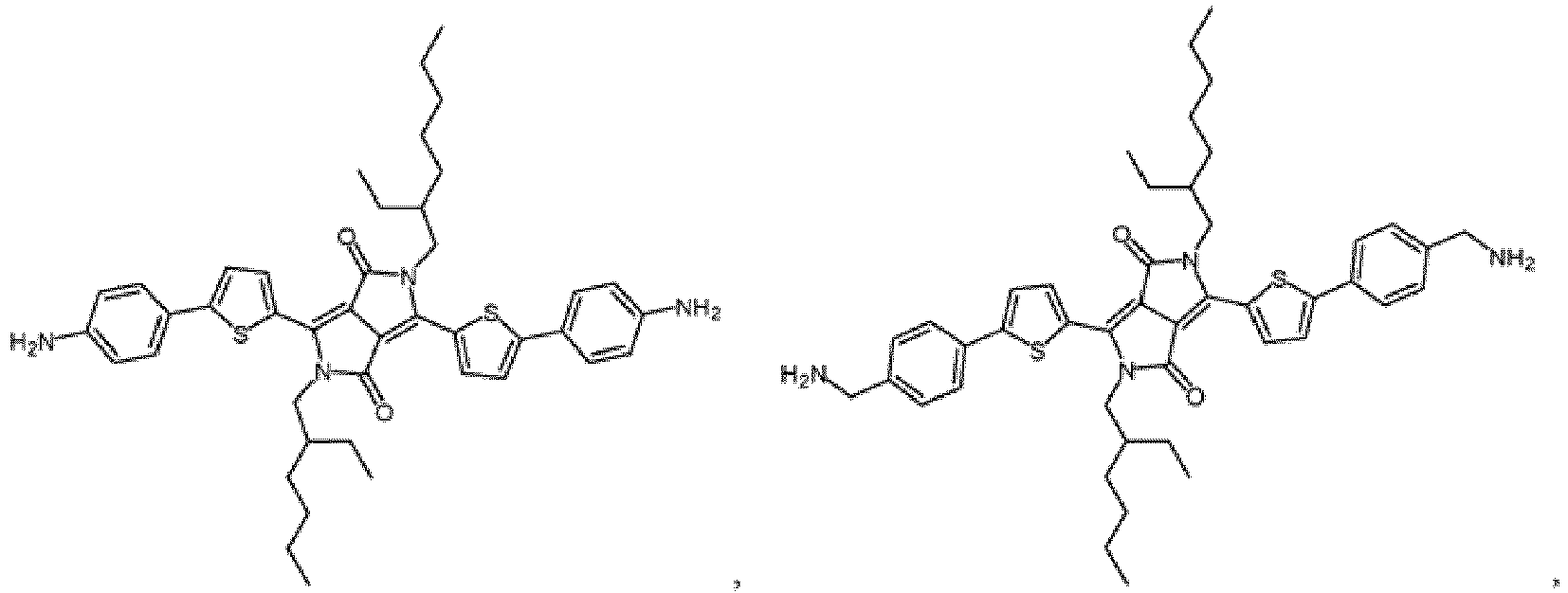

- Through in-depth research, the inventor found that, without being limited to any theory, when a voltage is applied, especially within the gate modulation voltage of -2 V to +2 V, the aforementioned strongly-polarized molecules are prone to polarization so that the molecular orbital energy level shifts for compatible with gate modulation. Therefore, the gate modulation of the single molecule field effect transistor can be effectively realized.
- The present application also provides a strongly-polarized molecule-graphene molecular heterojunction, wherein the molecular heterojunction includes the aforementioned strongly-polarized molecule bridging between layers of the two-dimensional single-layer graphene via amide covalent bonds.
- In some embodiments of the present application, the two-dimensional single-layer graphene with a nanogap is a two-dimensional single-layer graphene with an array of nanogaps.
- This application also provides a method for preparing a strongly-polarized molecule-graphene molecular heterojunction, which includes the following steps:
- (1) preparing the two-dimensional single-layer graphene with a nanogap, which can be constructed on a support;
- (2) dissolving the strongly-polarized molecule provided in the present application and dehydrating agents (for example: 1-ethyl-3-(3-dimethylaminopropyl) carbodiimide hydrochloride, EDCI) in an organic solvent (for example: pyridine) to obtain a solution of molecules to be connected;
- (3) adding the two-dimensional single-layer graphene with nanogap (which can be together with its support) into the solution, reacting for 1-4 days in the absence of light, washing and drying.
- In this application, the "two-dimensional single-layer graphene with a nanogap" can be prepared by the method described in the literature (see Angew. Chem. Int. Ed. 2012, 51, 12228.).
- The "two-dimensional single-layer graphene with a nanogap" or "two-dimensional single-layer graphene with an array of nanogaps" is also referred to as graphene nanogap electrode or graphene nano-electrode in the prior art.
- The term "in the absence of light" can also be understood as in dark. For those skilled in the art, the meaning of in the absence of light or in dark is clear.
- In a specific embodiment of the present application, after the reaction is completed in the absence of light, the two-dimensional single-layer graphene with a nanogap is taken out of the solution, washed with a large amount of acetone and ultrapure water, and dried in N2 gas stream. In this application, the ultrapure water used preferably has a resistivity greater than 18 MΩ·cm.
- This application also provides a single molecule field effect transistor, which may comprise a substrate, a gate, a dielectric layer, and the strongly-polarized molecule-graphene molecule heterojunction. The dielectric layer is located between the gate and the strongly-polarized molecule-graphene molecular heterojunction.
- In a specific implementation process, the two-dimensional single-layer graphene on both sides of the gap in the strongly-polarized molecule-graphene molecule heterojunction can be used as source electrodes and drain electrodes of the single-molecule field effect transistor.
- In some embodiments of the present application, the material of the gate is one of graphene or metallic aluminum.
- In some embodiments of the present application, the material of the dielectric layer is one of hafnium oxide, zirconium oxide, titanium oxide and aluminum oxide, or any combinations thereof.
- In some embodiments of the present application, the present application provides a single molecule field effect transistor, wherein:
- the dielectric layer is a hafnium oxide layer, and the gate is a graphene layer; or
- the dielectric layer is a zirconium oxide layer, and the gate is a graphene layer; or
- the dielectric layer is a titanium oxide layer, and the gate is a graphene layer; or
- the dielectric layer is an aluminum oxide layer, and the gate is a metal aluminum layer; or
- the dielectric layer is a composite layer of aluminum oxide and hafnium oxide, and the gate is a metal aluminum layer.
- The inventor found that the single molecule field effect transistor obtained by using the above-mentioned gate material, dielectric layer material, and the above-mentioned combination of gate and dielectric layer has a higher gate modulation efficiency with a relatively simple preparation method of transistor and better application prospects.
- Herein, the "substrate" may also be referred to as a base. In some specific embodiments of the present application, the substrate may be a silicon wafer having a silicon oxide layer, which is commercially available. In a specific implementation process, the gate or the strongly-polarized molecule-graphene molecular heterojunction is located on the silicon oxide layer. The inventor found that when the thickness of the silicon oxide layer is 200-400 nm, and preferably 300 nm, the optical contrast of the graphene is better. Of course, those skilled in the art can also use other substrates to implement the technical solutions of the present application.
- In some embodiments of the present application, the thickness of the dielectric layer is 3-10 nm, preferably 4-7 nm, and more preferably 5 nm.
- Regarding the thickness of the gate, since it has no substantial influence on the performance of the transistor itself, it is not specifically limited here in the present application. The thickness of the gate can be selected by those skilled in the art according to the actual requirements of size of the transistor itself. In some embodiments of the present application, the thickness of aluminum can be selected from 20 to 30 nm, when the metal aluminum is used as the gate material; the thickness of the single-layer graphene itself is less than 1 nm, when graphene is used as the gate material.
- In some embodiments of the present application, the present application provides a single-molecule field effect transistor, wherein the gate is located on the substrate, the dielectric layer is located on the gate, and the strongly-polarized molecule-graphene molecule heterojunction is located on the dielectric layer, to form a bottom gate structure, as shown in
FIG. 1 ;
or
the strongly-polarized molecule-graphene molecule heterojunction is located on the substrate, the dielectric layer is located on the strongly-polarized molecule-graphene molecule heterojunction, and the gate is located on the dielectric layer, to form a top gate structure, as shown inFIG. 2 . - In some specific embodiments of the present application, 5 combinations in the following Table 1 can be used to make a single molecule field effect transistor with a bottom gate structure:
Table 1 Combination of gate and dielectric layer Combination No. 1 2 3 4 5 Gate Graphene Graphene Graphene Aluminum Aluminum Dielectric layer Hafnium oxide Zirconium oxide Titanium oxide Aluminum oxide Aluminum oxide +Hafnium oxide - In a specific embodiment, the single molecule field effect transistor with a bottom gate structure can be prepared by the following method:
- For combination 1, combination 2 and combination 3, a single-layer graphene grown by chemical vapor deposition (see Sci. Rep. 2012, 2, 707.) can be transferred onto the substrate (for example, a silicon wafer having an oxide layer of 300 nm) as the gate (referred to as bottom gate) (see ACS Nano 2011, 5, 6916.). Then a dielectric layer is formed on the bottom gate. The thickness of each of the three types of dielectric layers can be 3-10 nm. Hafnium oxide can be prepared by atomic layer deposition and sol-gel method (see Adv. Mater. 2015, 27, 2113.), wherein the sol-gel method is relatively cheap and therefore more preferred. Both zirconium oxide and titanium oxide can be prepared by electron beam evaporation deposition or atomic layer deposition.
- For
combination 4, an aluminum layer with a certain thickness (such as 35 nm) can be deposited on the substrate by electron beam evaporation deposition, and then heated at 180 °C for 1 hour, so that an aluminum oxide layer of a certain thickness (such as 5 nm) can be made on the aluminum layer. - For combination 5, an aluminum layer with a certain thickness (such as 35 nm) can be deposited on the substrate by electron beam evaporation deposition, located in the atmosphere for a period of time (such as 24 hours), and naturally oxidized to obtain an aluminum oxide layer with a certain thickness (such as 3 nm), on which a hafnium oxide layer with a certain thickness (such as 2 nm) is further deposited by atomic layer deposition.
- After the bottom gate and the dielectric layer are prepared by the previous method, a two-dimensional single-layer graphene with a nanogap is constructed on the dielectric layer (see Angew. Chem. Int. Ed. 2012, 51, 12228.), and then through the chemical self-assembly method, specifically, through acylation reaction, the strongly-polarized molecules represented by the aforementioned general formulae (I)-(XVI) bridge between layers of graphene to form a strongly-polarized molecules-graphene molecule heterojunction.
- It should be noted that the "electron beam evaporation deposition" and "atomic layer deposition" herein are both conventional micro-nano processing techniques. In order to realize the technical solution of this application, electron beam evaporation deposition of a metal layer or metal oxide layer with a certain thickness, or atomic layer deposition of a metal layer or metal oxide layer with a certain thickness is very easy to implement for those skilled in the art, which will not be repeated in this application.
- In some specific embodiments of the present application, when preparing a single molecule field effect transistor with a top gate structure, the gate and the dielectric layer can also use the 5 combinations in Table 1. Nevertheless, the first three combinations are preferred from the perspective of the simplicity of preparation process. In a specific implementation process, for combination 1, combination 2 and combination 3, a two-dimensional single-layer graphene with a nanogap array is firstly constructed on the substrate. After forming the strongly-polarized molecule-graphene molecule heterojunction by chemical self-assembly method, PMMA (polymethyl methacrylate) is used as a support to transfer the dielectric layer and the gate onto the monomolecular heterojunction. The transfering process of the dielectric layer and the gate may specifically include: firstly, preparing a dielectric layer on a silicon wafer, which may be implemented by using the dielectric layer preparation method in the preparation method of the bottom gate structure, then transferring the graphene grown by chemical vapor deposition on the dielectric layer, further spin-coating PMMA thereon, etching the silicon wafer having hydrofluoric acid, rinsing the dielectric layer/graphene/PMMA film with deionized water and isopropanol three times, and then locatedplacing it on the molecular heterojunction (see ACS Nano 2011, 5, 6916.). As used herein, "support" refers to the carrier used to transfer the graphene gate.
- The present application also provides a molecular switch, which includes the aforementioned single molecule field effect transistor.
- The present application also provides a semiconductor chip, which includes the aforementioned single molecule field effect transistor.
- This application provides a strongly-polarized molecule as shown in general formula (II). Single molecule field effect transistors are prepared with these molecules for the first time, which is a breakthrough. Since graphene is used as source electrodes and drain electrodes, and the graphene has the matching size with the molecules, which greatly improves the coupling efficiency between the molecules and the gate, and , the efficient gate modulation can be realized cooperating with the strongly-polarized molecule structure.
- Moreover, the size of the single molecule field effect transistor provided by the present application is within the molecular size range, which strongly promotes the miniaturization of the field effect transistor. Therefore, the semiconductor chip prepared by the single molecule field effect transistor provided by the present application can greatly improve integration. Furthermore, the single molecule field effect transistor provided in the present application has good performance reproducibility, which is more conducive to the application of single molecule field effect transistors.
- In addition, since the strongly-polarized molecule-graphene molecule heterojunction can be produced in batches, the single molecule field effect transistor device constructed based on the strongly-polarized molecule-graphene molecule heterojunction provided in this application can be produced in batches.
- In summary, the single molecule field effect transistor provided in this application is of epoch-making significance in the technological field of semiconductor.
- In order to more clearly illustrate the examples of the present application and the embodiments of the prior art, the following description of the embodiments and the drawings of the prior art will be briefly described.
-
FIG. 1 is a schematic diagram of the structure of the single molecule field effect transistor with a bottom gate structure. -
FIG. 2 is a schematic diagram of the structure of the single molecule field effect transistor with a top gate structure. -
FIG. 3 is an I-V characteristic curve of the compound 1 based single molecule field effect transistor prepared in Example 1. -
FIG. 4 is an I-V characteristic curve of the compound 2 based single molecule field effect transistor prepared in Example 2 within a gate voltage range of -2 V to +2 V. -
FIG. 5 is an I-V characteristic curve of the compound 3 based single molecule field effect transistor prepared in Example 3 within a gate voltage range of -2 V to +2 V. -
FIG. 6 is an I-V characteristic curve of thecompound 4 based single molecule field effect transistor prepared in Example 4 within a gate voltage range of -2 V to +2 V. -
FIG. 7 is an I-V characteristic curve of the compound 5 based single molecule field effect transistor prepared in Example 5 within a gate voltage range of -2 V to +2 V. -
FIG. 8 is an I-V characteristic curve of the compound 6 based single molecule field effect transistor prepared in Example 6 within a gate voltage range of -2 V to +2 V. -
FIG. 9 is an I-V characteristic curve of the compound 7 based single molecule field effect transistor prepared in Example 7 within a gate voltage range of -2 V to +2 V. - The technical solutions in the embodiments of the present application are clearly and completely described in the following with reference to the drawings in the examples of the present application.
- The experimental methods described in the following examples are conventional methods unless otherwise specified. The reagents and materials, unless otherwise specified, are commercially available.
- The synthetic route is as follows:
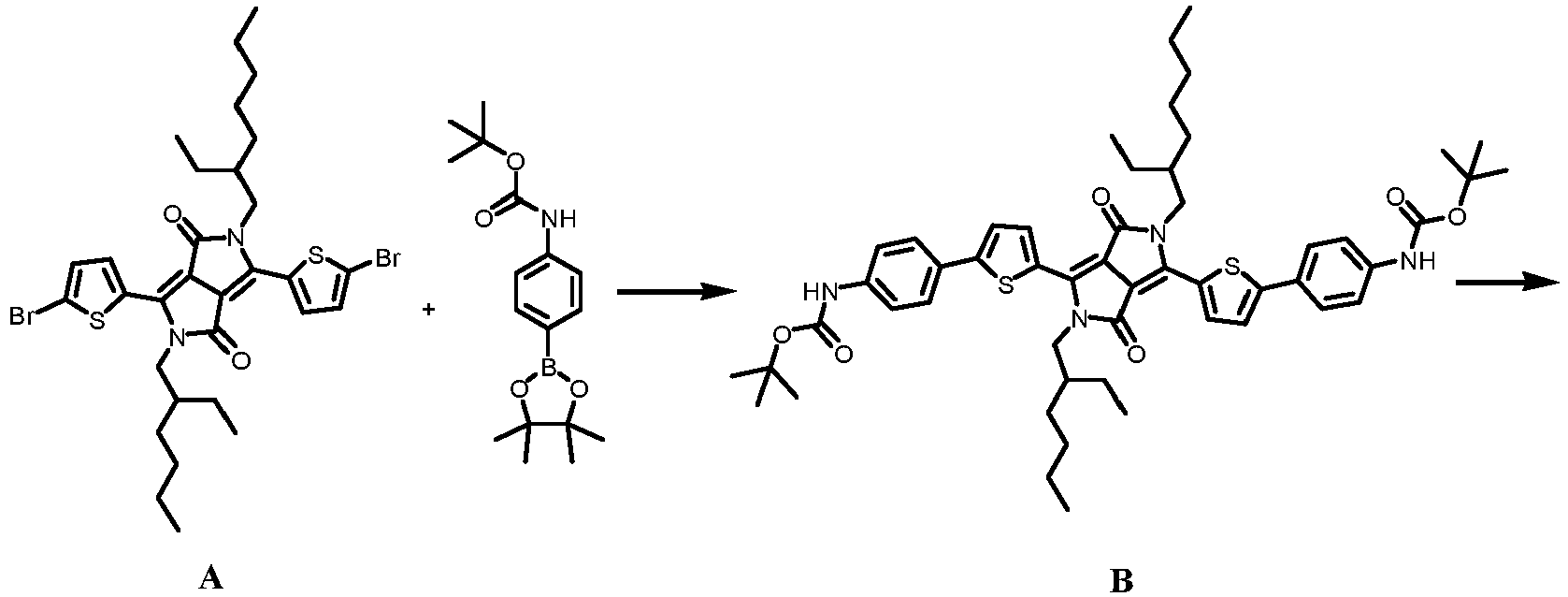

- Compound A was synthesized according to the method described in the literature (J. Am. Chem. Soc., 2010, 132 (44), pp 15547-15549).
- Compound A (857 mg, 1.23 mmol), N-Boc-4-aminophenylboronic acid pinacol ester (865 mg, 2.71 mmol), bis(dibenzalacetone) palladium (22.6 mg, 24.6 µmol), tri(o-tolyl)phosphine (30.1 mg, 98.6 µmol), and anhydrous potassium carbonate (1.60 g, 11.6 mmol) were added to a 100 mL Schlenk bottle in sequence. After adding 2 drops of aliquat 336 (methyl trioctyl ammonium chloride), 24 mL of toluene and 6 mL of distilled water were injected. The resultant was circulated 3 times by a freezing and thawing pump circulation method to remove oxygen, and then heated and stirred at 90 °C under the protection of argon for 24 h. After cooling, the reaction mixture was poured into water (50 mL) and extracted with dichloromethane (3 × 30 mL). After the organic phases were combined and dried over anhydrous sodium sulfate, the solvent was removed under reduced pressure. The crude product was analyzed and purified by silica gel column chromatography to obtain compound B as a purple solid. 1H NMR (400 MHz, CDCl3, 298 K): δ 7.87 (d, J = 8.5 Hz, 2H), 7.65 (ddd, J = 8.7, 1.3, 0.4 Hz, 4H), 7.39 (m, 6H), 4.10 (d, J= 7.0 Hz, 4H),1.64 (m, 2H), 1.45 (s, 18H), 1.15-1.38 (m, 14H), 0.76-0.91 (m, 16H). 13C NMR (100 MHz, CDCl3, 298 K): δ 172.83, 153.93, 148.85, 145.64, 138.76, 133.63, 127.67, 127.38, 123.40, 121.45, 119.57, 100.02, 80.43, 46.33, 38.65, 32.60, 32.11, 30.79, 29.64, 28.61, 28.16, 25.09, 23.56, 22.79, 14.09, 14.06, 11.51. HRMS (TOF-ESI+) (m/z): C53H68N4O6S2 calculated: 921.47 [M+H+]; found: 921.49.
- Trifluoroacetic acid (1.0 mL, 0.34 g, 3.73 mmol) was added dropwise to compound B (0.120 g, 0.13 mmol) in dichloromethane (10 mL). After stirring for 2 hours at room temperature, the reaction mixture was added dropwise to saturated aqueous sodium bicarbonate solution (20 mL), and extracted with dichloromethane (50 mL). The organic layer was washed with saturated aqueous sodium bicarbonate solution (30 mL) and saturated sodium chloride solution, and dried over anhydrous sodium sulfate. The solvent was evaporated in vacuo to obtain interested compound 1 as a dark purple solid.
- 1H NMR (400 MHz, CDCl3, 298 K): δ 7.80 (d, J = 8.5 Hz, 2H), 7.38 (ddd, J = 8.2, 1.6, 0.4 Hz, 4H) , 7.26 (d, J = 8.5 Hz, 2H), 7.02 (ddd, J = 8.7, 1.2, 0.4 Hz, 4H), 4.12 (d, J = 7.0 Hz, 4H) , 1.64 (m, 2H), 1.15-1.38 (m, 14H), 0.76-0.91 (m, 16H). 13C NMR (100 MHz, CDCl3, 298 K): δ 172.83, 150.10, 148.85, 145.64, 133.63, 128.09, 127.67, 122.80, 121.45, 114.80 , 100.02, 46.33, 38.65, 32.60, 32.11, 30.79, 29.64, 28.61, 25.09, 23.56, 22.79, 14.09, 14.06, 11.51. HRMS (TOF-ESI+) (m/z):
C43H52N4O2S2 calculated: 721.36 [M+H+]; found: 721.35. - Graphene was used as the gate electrode, and hafnium oxide with a thickness of 5 nm was used as the dielectric layer to construct a field effect transistor with a bottom gate structure.
- First, the single-layer graphene grown by chemical vapor deposition was transferred onto a silicon wafer having a oxide layer of 300 nm, as the bottom gate.
- A hafnium oxide layer with a thickness of 5 nm was deposited on the bottom gate by the sol-gel method.
- A two-dimensional single-layer graphene with a nanogap was constructed on the dielectric layer to obtain a molecule device to be assembled.
- A strongly-polarized molecule-graphene molecule heterojunction was constructed on the molecule device to be assembled to obtain a single molecule field effect transistor device. The specific process is as follows.
- First, the compound of formula 1 and the carbodiimide dehydrator-activator 1-ethyl-3-(3-dimethylaminopropyl) carbodiimide hydrochloric acid (EDCI) were dissolved in pyridine. The concentrations were 10-4 mol/L and 3×10⁻³ mol/L, respectively. Then, the molecule device to be assembled was added into the above solution, and reacted for 48 h in argon atmosphere in dark. After that, the device was taken out of the solution, washed with acetone and ultrapure water three times, respectively, and dried with a nitrogen stream to obtain the compound 1 based single molecule field effect transistor.
- It should be noted that the specific methods, conditions, parameters, and the like in the preparation process of the molecule device to be assembled can be implemented according to the methods in the relevant documents previously described herein, which will not be repeated in this application.
- The synthetic route is as follows:

- Compound A was synthesized according to the method of Example 1.
- Compound A (697 mg, 1.00 mmol), 4-(N-Boc-aminomethyl)phenylboronic acid pinacol ester (734 mg, 2.20 mmol), bis(dibenzalacetone) palladium (18.4 mg, 20 µmol), tri(o-tolyl)phosphine (24.5 mg, 80.2 µmol), and anhydrous potassium carbonate (1.30 g, 9.43 mmol) were added to a 100 mL Schlenk bottle in sequence. After adding 2 drops of aliquat 336, 24 mL of toluene and 6 mL of distilled water were injected. The resultant was circulated 3 times by a freezing and thawing pump circulation method to remove oxygen, and then heated and stirred at 90 °C under the protection of argon for 24 h. After cooling, the reaction mixture was poured into water (50 mL) and extracted with dichloromethane (3 × 30 mL). After the organic phases were combined and dried over anhydrous sodium sulfate, the solvent was removed under reduced pressure. The crude product was analyzed and purified by silica gel column chromatography to obtain compound C as a purple solid.
- 1H NMR (400 MHz, CDCl3, 298 K): δ 7.70 (d, J = 8.6 Hz, 2H), 7.60-7.67 (m, 4H), 7.40 (ddd, J = 8.5, 1.5, 0.5 Hz, 6H), 4.32 (s, 4H), 4.12 (d, J = 7.0 Hz, 4H), 1.54-1.76 (m, 2H), 1.44 (s, 18H), 1.15-1.38 (m, 14H), 0.76-0.91 (m, 16H). 13C NMR (100 MHz, CDCl3, 298 K): δ 172.83, 156.03, 148.85, 145.64, 143.21, 133.63, 133.12, 128.11, 127.67, 126.29, 121.45, 100.02, 79.66, 46.33, 43.70, 38.65, 32.60, 32.11, 30.79, 29.64, 28.61, 28.30, 25.09, 23.56, 22.79, 14.09, 14.06, 11.51 HRMS (TOF-ESI+) (m/z): C55H72N4O6S2 calculated : 949.50 [M+H+]; found : 949.50.
- The locatedreaction was carried out according to the method of Example 1, except that compound B was relocated with compound C (0.120 g, 0.13 mmol), to obtain the interested compound 2 as a dark purple solid.
- 1H NMR (400 MHz, CDCl3, 298 K): δ 7.70 (d, J = 8.6 Hz, 2H), 7.63 (dd, J = 6.5, 1.3 Hz, 4H), 7.38 (ddd, J = 6.5, 1.3, 0.5 Hz, 6H), 4.10 (d, J = 7.0 Hz, 4H), 3.67 (s, 4H), 1.54-1.76 (m, 2H), 1.15-1.38 (m, 14H), 0.76-0.91 (m, 16H). 13C NMR (100 MHz, CDCl3, 298 K): δ 172.83, 148.85, 145.64, 141.15, 133.63, 133.34, 128.28, 127.67, 126.74, 121.45, 100.02, 46.33, 45.58, 38.65, 32.60, 32.11, 30.79, 29.64, 28.61, 25.09, 23.56, 22.79, 14.09, 14.06, 11.51. HRMS (TOF-ESI+) (m/z): C45H56N4O2S2 calculated : 749.39 [M+H+]; found: 749.35.
- A strongly-polarized molecule-graphene molecular heterojunction was constructed to obtain a compound 2 based field effect transistor with bottom gate structure according to the preparation method of transistor in Example 1, in which graphene was used as the gate electrode, hafnium oxide with a thickness of 5 nm was used as the dielectric layer, and compound 2 was used to replace compound 1.
- The synthetic route is as follows:

- Compound A was synthesized according to the method of Example 1.
- Compound A (843 mg, 1.21 mmol), 4-(N-Boc-aminomethyl)phenylboronic acid pinacol ester (924 mg, 2.66 mmol), bis(dibenzalacetone)palladium (22.3 mg, 24 µmol), tri(o-tolyl)phosphine (29.6 mg, 97.0 µmol), and anhydrous potassium carbonate (1.57 g, 11.41 mmol) were added to a 100 mL Schlenk bottle in sequence. After adding 2 drops of aliquat 336, 24 mL of toluene and 6 mL of distilled water were injected. The resultant was circulated 3 times by a freezing and thawing pump circulation method to remove oxygen, and then heated and stirred at 90 °C under the protection of argon for 24 h. After cooling, the reaction mixture was poured into water (50 mL) and extracted with dichloromethane (3 × 30 mL). After the organic phases were and combined and dried over anhydrous sodium sulfate, the solvent was removed under reduced pressure. The crude product was analyzed and purified by silica gel column chromatography to obtain compound D as a purple solid.
- 1H NMR (400 MHz, CDCl3, 298 K): δ 7.72 (d, J = 8.6 Hz, 2H), 7.64 (ddd, J = 8.5, 1.5, 0.5 Hz, 4H), 7.39 (d, J = 8.6 Hz, 2H), 7.19 (ddd, J = 8.2, 1.5, 0.5 Hz, 4H), 4.13 (d, J = 7.0 Hz, 4H), 3.50 (t, J = 5.3 Hz, 4H), 2.55 (t, J = 5.3 Hz, 4H), 1.54-1.76 (m, 2H), 1.43 (s, 18H), 1.15-1.38 (m, 14H), 0.76-0.91 (m, 16H). 13C NMR (100 MHz, CDCl3, 298 K): δ 172.83, 156.24, 148.85, 145.64, 136.73, 133.63, 132.41, 128.18, 127.67, 126.64, 121.45, 100.02, 79.52, 46.33, 42.33, 38.65, 35.31, 32.60, 32.11, 30.79, 29.64, 28.61, 28.30, 25.09, 23.56, 22.79, 14.09, 14.06, 11.51. HRMS (TOF-ESI+) (m/z): C37H76N4O6S2 calculated: 977.53 [M+H+]; found: 977.50.
- The located reaction was carried out according to the method of Example 1, except that compound B was relocated with compound D (0.127 g, 0.13 mmol), to obtain the interested compound 3 as a dark purple solid.
- 1H NMR (400 MHz, CDCl3, 298 K): δ 7.72 (d, J = 8.6 Hz, 2H), 7.63 (ddd, J = 8.5, 1.5, 0.5 Hz, 4H), 7.38 (d, J = 8.6 Hz, 2H), 7.17 (ddd, J = 8.1, 1.5, 0.5 Hz, 4H), 4.10 (d, J = 7.0 Hz, 4H), 2.76 (t, J = 6.6 Hz, 4H), 2.49 (t, J = 6.6 Hz, 4H), 1.54-1.76 (m, 2H), 1.15-1.38 (m, 14H), 0.76-0.91 (m, 16H). 13C NMR (100 MHz, CDCl3, 298 K): δ 172.83, 148.85, 145.64, 136.83, 133.63, 132.36, 127.92, 127.67, 126.58, 121.45, 100.02, 46.33, 42.84, 38.87, 38.65, 32.60, 32.11, 30.79, 29.64 , 28.61, 25.09, 23.56, 22.79, 14.09, 14.06, 11.51. HRMS (TOF-ESI+) (m/z): C47H60N4O2S2 calculated: 777.42 [M+H+]; found: 777.42.
- A strongly-polarized molecule-graphene molecular heterojunction was constructed to obtain a compound 3 based field effect transistor with bottom gate structure according to the preparation method of transistor in Example 1, in which graphene was used as the gate electrode, hafnium oxide with a thickness of 5 nm was used as the dielectric layer, and compound 3 was used to replace compound 1.
- The synthetic route was as follows.

- Dichloromethane (15 mL), p-bromoamphetamine (1.293 g, 6.04 mmol) and triethylamine (944 mg, 1.3 mL, 9.33 mmol) were added into a 50 mL reaction flask under the protection of argon, and the reaction flask was located in an ice-water bath. Di-tert-butyl dicarbonate (1.61 g, 1.7 mL, 7.40 mmol) was added dropwise with stirring, allowed to warm to room temperature, and reacted for 4 h. After that, the reaction solution was poured into dichloromethane (30 mL) and washed with water (2 × 20 mL) and saturated sodium chloride solution (20 mL), and then dried over anhydrous sodium sulfate. The solvent was removed under reduced pressure. The crude product was analyzed and purified by silica gel column chromatography to obtain compound E as a colorless oily liquid.
- 1H NMR (400 MHz, CDCl3, 298 K): δ 7.45 - 7.39 (m, 2H), 7.12 - 7.06 (m, 2H), 3.24 (t, J = 5.0 Hz, 2H), 2.61 - 2.53 (m, 2H), 1.77 (tt, J = 8.0, 5.0 Hz, 2H), 1.44 (s, 9H). 13C NMR (100 MHz, CDCl3, 298 K): δ 156.19, 140.06, 131.22, 129.96, 119.50, 79.52, 40.56, 33.48, 30.67, 28.30. HRMS (TOF-ESI+) (m/z): C14H20BrNO2 calculated 314.07 [M+H+]; found: 314.01.
- Compound E (1.02 g, 3.26 mmol), pinacol diborate (993 mg, 3.91 mmol), palladium tetrakis(triphenylphosphine) (151 mg, 0.13 mmol), and potassium acetate (1.60 g, 16.30 mmol) were added to a 100 mL Schlenk bottle in sequence, and then 50 mL of N,N-dimethylformamide was added. The resultant was circulated 3 times by a freezing and thawing pump circulation method to remove oxygen, and then heated and stirred at 90 °C under the protection of argon for 10 h. After cooling, the reaction mixture was poured into water (50 mL) and extracted with dichloromethane (3 × 30 mL). The organic phase was washed with water (3 × 30 mL) and saturated sodium chloride solution (30 mL) in turn, and dried with anhydrous sodium sulfate. The solvent was removed under reduced pressure. The crude product was analyzed and purified by silica gel column chromatography to obtain compound F as a colorless oily liquid.
- 1H NMR (400 MHz, CDCl3, 298 K): δ 7.57 - 7.51 (m, 2H), 7.08 (dt, J = 7.4, 1.0 Hz, 2H), 5.94 (t, J = 6.4 Hz, 2H), 3.17 (td, J = 7.1, 6.4 Hz, 2H), 2.66 (tt, J = 7.1, 1.0 Hz, 2H), 1.83 (p, J = 7.1 Hz, 2H), 1.42 (s, 9H), 1.24 (s, 9H). 13C NMR (100 MHz, CDCl3, 298 K): δ 156.63, 143.39, 134.66, 134,61, 126.72, 84.02, 79.63, 39.62, 33.32, 29.09, 29.05, 24.82. HRMS (TOF-ESI+) (m/z): C20H32BNO4 calculated: 362.25 [M+H+]; found: 362.29.
- Compound A (843 mg, 1.21 mmol), compound F (965 mg, 2.66 mmol), bis(dibenzalacetone) palladium (22.3 mg, 24 µmol), tri(o-tolyl)phosphine (29.6 mg, 97.0 µmol), and anhydrous potassium carbonate (1.57 g, 11.41 mmol) were added to a 100 mL Schlenk bottle in sequence. After adding 2 drops of aliquat 336, 24 mL of toluene and 6 mL of distilled water were injected. The resultant was circulated 3 times by a freezing and thawing pump circulation method to remove oxygen, and then heated and stirred at 90 °C under the protection of argon for 24 h. After cooling, the reaction mixture was poured into water (50 mL) and extracted with dichloromethane (3 × 30 mL). After the organic phases were combined and dried over anhydrous sodium sulfate, the solvent was removed under reduced pressure. The crude product was analyzed and purified by silica gel column chromatography to obtain compound G as a purple solid.
- 1H NMR (400 MHz, CDCl3, 298 K): δ 7.76 (d, J = 8.6 Hz, 2H), 7.59-7.66 (m, 4H), 7.39 (dd, J = 24.6, 7.5 Hz, 2H), 7.16 (ddd, J = 8.2, 1.5, 0.5 Hz, 4H), 4.11 (d, J = 6.9 Hz, 4H), 3.19 (t, J = 6.4 Hz, 4H), 2.39 (t, J = 6.8 Hz, 4H), 1.84-2.03 (m, 4H), 1.54-1.76 (m, 2H), 1.43 (s, 18H), 1.15-1.38 (m, 14H), 0.76-0.91 (m, 16H). 13C NMR (100 MHz, CDCl3, 298 K): δ 172.83, 156.19, 148.85, 145.64, 141.66, 133.63, 132.81, 128.37, 127.67, 126.29, 121.45, 100.02, 79.52, 46.33, 40.56, 38.65, 33.48, 32.60, 32.11, 30.79, 30.67, 29.64 , 28.61, 28.30, 25.09, 23.56, 22.79, 14.09, 14.06, 11.51. HRMS (TOF-EST+) (m/z): C59H80N4O6S2 calculated: 1005.55 [M+H+]; found: 1005.55.
- The locatedreaction was carried out according to the method of Example 1, except that compound B was relocated with compound G (0.131g, 0.13mmol), to obtain the
interested compound 4 as a dark purple solid. - 1H NMR (400 MHz, CDCl3, 298 K): δ 7.72 (d, J = 8.6 Hz, 2H), 7.63 (ddd, J = J = 8.5, 1.5, 0.5 Hz, 4H), 7.40 (d, J = 8.6, 2H), 7.12-7.19 (m, 4H), 4.07-4.15 (m, 4H), 2.60-2.68 (m, 4H), 2.29-2.37 (t, J = 6.6 Hz, 4H), 1.54-1.94 (m, 6H), 1.15-1.38 (m, 14H), 0.76-0.91 (m, 16H). 13C NMR (100 MHz, CDCl3, 298 K): δ 172.83, 148.85, 145.64, 141.66, 133.63, 132.81, 128.37, 127.67, 126.29, 121.45, 100.02, 46.33, 41.70, 38.65, 33.53, 33.05, 32.60, 32.11, 30.79, 29.64, 28.61, 25.09, 23.56, 22.79, 14.09, 14.06, 11.51. HRMS (TOF-ESI+) (m/z): C49H64N4O2S2 calculated: 805.45 [M+H+];found: 805.42.
- A strongly-polarized molecule-graphene molecular heterojunction was constructed to obtain a
compound 4 based field effect transistor with bottom gate structure according to the preparation method of transistor in Example 1, in which graphene was used as the gate electrode, hafnium oxide with a thickness of 5 nm was used as the dielectric layer, andcompound 4 was used to replace compound 1. - The synthetic route is as follows:

- Bis[1,2-bis(diphenylphosphine)ethane]ruthenium dichloride (223 mg, 0.23 mmol), N-Boc-4-ethynylaniline (150 mg, 0.69 mmol), and sodium hexafluorophosphate (154 mg, 0.92 mmol) were added to a 50 mL Schlenk bottle, which was then dissolved in dry dichloromethane (15 mL). Triethylamine (0.190 mL) was added dropwise to the above reaction solution under the protection of argon, which was then reacted at 35 °C with stirring for 24 h. After the reaction was completed, the reaction mixture was filtered. The solvent was removed under reduced pressure. The obtained solid was washed with n-pentane (25 mL). The crude product was analyzed and purified by silica gel column chromatography to obtain compound H as a yellow solid.
- 31P NMR (162 MHz, CDCl3, 298 K): δ 53.4. 1H NMR (400 MHz, CDCl3, 298 K): δ 6.98-7.55 (m, 48H), 2.45 (m, 8H), 1.50 (s, 18H). 13C NMR (100 MHz, CDCl3, 298 K): δ 195.14, 138.85, 132.99, 131.93, 131.20, 131.08, 128.13, 121.56, 119.15, 116.90, 79.54, 30.23, 25.43, HRMS (TOF-ESI+) (m/z): C78H76N2O4P4Ru calculated: 1331.44 [M+H+]; found : 1331.39.
- Trifluoroacetic acid (1.0 mL, 0.34 g, 3.73 mmol) was added dropwise to compound H (0.173 g, 0.13 mmol) in dichloromethane (10 mL). After stirring for 20 hours at room temperature, the reaction mixture was added dropwise to saturated aqueous sodium bicarbonate solution (20 mL), and extracted with dichloromethane (50 mL). The organic layer was washed with saturated aqueous sodium bicarbonate solution (30 mL) and saturated sodium chloride solution, and dried over anhydrous sodium sulfate. The solvent was evaporated in vacuo to obtain interested compound 5 as a yellow solid.
- 31P NMR (162 MHz, CDCl3, 298 K): d = 53.4 1H NMR (400 MHz, CDCl3, 298 K): δ 6.98-7.55 (m, 48H), 2.45 (m, 8H). 13C NMR (100 MHz, CDCl3, 298 K): δ 148.85, 132.99, 131.93, 131.20, 131.08, 128.13, 121.56, 119.15, 116.90, 24.96. HRMS (TOF-ESI+) (m/z): C68H60N2P4Ru calculated:1131.28 [M+H+]; found: 1131.29.
- A strongly-polarized molecule-graphene molecular heterojunction was constructed to obtain a compound 5 based field effect transistor with bottom gate structure based on compound 5 with reference to the preparation method of transistor in Example 1, in which graphene was used as the gate electrode, hafnium oxide with a thickness of 5 nm was used as the dielectric layer, and compound 5 was used to replace compound 1.
- The synthetic route is as follows:

- Compound I was synthesized according to the method described in the literature (New J. Chem., 2011, 35, 2105-2113).
- Compound I (527 mg, 0.23 mmol), N-Boc-4-ethynylaniline (150 mg, 0.69 mmol), and sodium hexafluorophosphate (154 mg, 0.92 mmol) were added to a 50 mL Schlenk bottle, which was then dissolved in dry dichloromethane (15 mL). Triethylamine (0.190 mL) was added dropwise to the above reaction solution under the protection of argon, which was then reacted at 35 °C with stirring for 48 h. After the reaction was completed, the reaction mixture was filtered. The solvent was removed under reduced pressure. The obtained solid was washed with n-pentane (25 mL). The crude product was analyzed and purified by silica gel column chromatography to obtain compound J as a yellow solid.
- 31P NMR (162 MHz, CDCl3, 298 K): δ 54.9. 1H NMR (400 MHz, CDCl3, 298 K): δ 6.98 - 7.55 (m, 92H), 2.45 (m, 16H), 1.50 (s, 18H). 13C NMR (100 MHz, CDCl3, 298 K): δ 195.14, 138.85, 137.24, 132.99, 131.93, 131.20, 131.08, 128.13, 125.60, 121.56, 119.15, 116.90, 79.54, 30.23, 25.43, HRMS (TOF-ESI+) (m/z): C140H128N2O4P8Ru2 calculated: 2353.59 [M+H+]; found: 2353.50.
- The reaction was carried out locatedaccording to the method of Example 5, except that compound H was relocated with compound J (0.306 g, 0.13 mmol), , to obtain the interested compound 6 as a yellow solid.
- 31P NMR (162 MHz, CDCl3, 298 K): d = 55.4 1H NMR (400 MHz, CDCl3, 298 K): δ 6.98-7.55 (m, 92H), 2.45 (m, 16H). 13C NMR (100 MHz, CDCl3, 298 K): δ 150.20, 137.39, 137.23, 132.46, 132.41, 123.20, 122.20, 117.38, 113.78, 103.62, 133.05, 132.92, 128.47, 128.42, 24.96; HRMS (TOF-ESI+) (m/z):C130H112N2P8Ru2 calculated: 2153.48 [M+H+]; found: 2153.49.
- A strongly-polarized molecule-graphene molecular heterojunction was constructed to obtain a compound 6 based field effect transistor with bottom gate structure according to the preparation method of transistor in Example 1, in which graphene was used as the gate electrode, hafnium oxide with a thickness of 5 nm was used as the dielectric layer, and compound 6 was used to replace compound 1.
- The synthetic route is as follows:

- Bis[1,2-bis(diphenylphosphine)ethane] ruthenium chloride triflate (825 mg, 0.75 mmol) and N-Boc-4-ethynylaniline (330 mg, 1.52 mmol) were added to a 100 mL Schlenk bottle, and dissolved in 40 mL of dichloromethane. The reaction was stirred at room temperature under the protection of argon for 6 h, and then filtered. The solvent of the filtrate was removed under reduced pressure. The resulting precipitate was washed with ether (4 × 30 mL) to obtain compound K as a dark green solid.
- 31P NMR (162 MHz, CDCl3, 298 K): δ 38.2. 1H NMR (400 MHz, CDCl3, 298 K): δ 7.51 - 7.05 (m, 40H), 6.55 (d, J = 7.8 Hz, 2H), 5.64 (d, J = 8.0Hz, 2H), 4.10 (s, 1H), 2.92 (m, 8H), 1.50 (s, 18H). 13C NMR (100 MHz, CDCl3, 298 K): δ 354.27, 194.75, 137.24, 132.99, 131.93, 131.20, 131.08, 128.13, 125.60, 124.93, 120.4, 108.98, 79.54, 30.23, 28.68. HRMS (TOF-ESI+) (m/z): C66H63ClF3NO5P4RuS calculated: 1300.21 [M+H+]; found: 1300.20.
- Compound L was synthesized according to the method described in the literature (New J. Chem., 2011, 35, 2105-2113).
- Compound K (338 mg, 0.26 mmol), Compound L (149 mg, 0.13 mmol), sodium hexafluorophosphate (88 mg, 0.2 mmol) were added to a 50 mL Schlenk bottle, and then dissolved in dry dichloromethane (30 mL). Triethylamine (0.150 mL) was added dropwise to the above reaction solution under the protection of argon, which was then reacted at 35 °C with stirring for 96 h. After the reaction was completed, the reaction mixture was filtered. The solvent was removed under reduced pressure. The obtained solid was washed with n-pentane (25 mL). The crude product was analyzed and purified by silica gel column chromatography to obtain compound M as a yellow solid.
- 31PNMR (162 MHz, CDCl3, 298 K): & 54.89. 1H NMR (400 MHz, CDCl3, 298 K): δ 6.98 - 7.55 (m, 136H), 2.45 (m, 24H), 1.50 (s, 18H). 13C NMR (100 MHz, CDCl3, 298 K): δ 195.14, 137.95 - 126.92, 119.15, 118,42, 116.90, 79.54, 30.23, 25.43, HRMS (TOF-ESI+) (m/z): C202H180N2O4P12Ru3 calculated: 3375.79 [M+H+]; found: 3375.70.
- The reaction was carried out locatedaccording to the method of Example 5, except that compound H was relocated with compound M (0.439 g, 0.13 mmol), to obtain the interested compound 7 as a yellow solid.
- 31P NMR (162 MHz, CDCl3, 298 K): d = 55.00, 1H NMR (400 MHz, CDCl3, 298 K): δ 6.98 - 7.55 (m, 136H), 2.45 (m, 24H). 13C NMR (100 MHz, CDCl3, 298 K): δ 195.14, 137.95 - 126.92, 119.15, 118,42, 116.90, 25.43; HRMS (TOF-ESI+) (m/z): C192H164N2P12Ru3calculated : 3175.68 [M+H+]; found: 3175.68.

- A strongly-polarized molecule-graphene molecular heterojunction was constructed to obtain a compound 7 based field effect transistor with bottom gate structure according to the preparation method of transistor in Example 1, in which graphene was used as the gate electrode, hafnium oxide with a thickness of 5 nm was used as the dielectric layer, and compound 7 was used to replace compound 1.
- The synthetic route is as follows:

- Dichloromethane (15 mL), 3-bromo-4'-aminobiphenyl (1.499 g, 6.04 mmol) and triethylamine (944 mg, 1.3 mL, 9.33 mmol) were added into a 50 mL reaction flask under argon protection, and the reaction flask was located in an ice-water bath. Di-tert-butyl dicarbonate (1.61 g, 1.7 mL, 7.40 mmol) was added dropwise with stirring, allowed to warm to room temperature, and reacted for 4 h. After that, the reaction solution was poured into dichloromethane (30 mL) and washed with water (2 × 20 mL) and saturated sodium chloride solution (20 mL) in turn, and then dried over anhydrous sodium sulfate. The solvent was removed under reduced pressure. The crude product was analyzed and purified by silica gel column chromatography to obtain compound N as a white solid.
- 1H NMR (400 MHz, CDCl3, 298 K): δ 7.78 (t, J = 2.0 Hz, 1H), 7.72 - 7.65 (m, 2H), 7.62 (dt, J = 7.5, 2.0 Hz, 1H), 7.53 (dq, J = 8.2, 2.1 Hz, 3H), 7.31 (t, J = 7.5 Hz, 1H), 6.57 (s, 1H), 1.50 (s, 9H). 13C NMR (100 MHz, CDCl3, 298 K): δ 153.93, 143.43, 137.44, 136.75, 131.50, 130.90, 130.48, 127.82, 126.46, 126.38, 123.40, 80.43, 28.16. HRMS (TOF-ESI+) (m/z): C17H18BrNO2 calculated: 348.06 [M+H+]; found: 348.06.
- Compound O was synthesized according to the method described in the literature (J. Am. Chem. Soc. 2014, 136, 8165-8168).
- Compound N (428 mg, 1.23 mmol), compound O (477 mg, 1.35 mmol), tetrakis(triphenylphosphine) palladium (14.6 mg, 12.3 µmol), and anhydrous potassium carbonate (1.60 g, 11.6 mmol) were added to a 100 mL Schlenk bottle in sequence, and then 25 mL of tetrahydrofuran and 5 mL of distilled water were injected. The resultant was circulated 3 times by a freezing and thawing pump circulation method to remove oxygen, and then heated and stirred at 90 °C under the protection of argon for 24 h. After cooling, the reaction mixture was poured into water (50 mL) and extracted with dichloromethane (3 × 30 mL). After the organic phases were combined and dried over anhydrous sodium sulfate, the solvent was removed under reduced pressure. The crude product was analyzed and purified by silica gel column chromatography to obtain compound P as a white solid.
- 1H NMR (400 MHz, CDCl3, 298 K): δ 8.58 (dd, J = 10.2, 1.1 Hz, 2H), 8.55 - 8.48 (m, 4H), 8.08 (t, J = 2.0 Hz, 1H), 8.01 (t, J = 2.0 Hz, 1H), 7.80 - 7.55 (m, 10H), 7.48 (td, J = 7.9, 1.2 Hz, 2H), 6.93 (ddd, J = 8.0, 5.1, 1.1 Hz, 2H), 6.59 (s, 1H), 1.50 (s, 9H). 13C NMR (100 MHz, CDCl3, 298 K): δ 156.38, 155.79, 153.93, 149.14, 147.56, 142.54, 140.08, 139.77, 138.84, 137.44, 136.75, 136.59, 129.45, 129.37, 129.27, 128.17, 128.05, 127.82, 127.76, 126.46, 125.60, 124.02, 121.39, 120.06, 80.43, 28.16. HRMS (TOF-ESI+) (m/z): C38H32N4O2 calculated: 577.26 [M+H+]; found: 577.26.
- Methanol (10 mL) was added to a 50 mL reaction flask to dissolve compound P (182 mg, 0.316 mmol). After that, ferrous chloride (21 mg, 0.158 mmol) in methanol (10 mL) was added dropwise, and the reactant was stirred and refluxed under the protection of argon for 4 h. Then the reactant was cooled to room temperature, and an excess of saturated ammonium hexafluorophosphate in methanol was added dropwise until the precipitation was completely precipitated, which was filtered. The obtained solid was rinsed with distilled water (2 × 10 mL) and ether (2 × 10 mL) in turn. The crude product was recrystallized with a mixed solvent of acetonitrile and acetone to obtain compound Q as a purple solid.
- 1H NMR (400 MHz, CDCl3, 298 K): δ 8.85 (dd, J = 7.5, 1.4 Hz, 4H), 8.69 (d, J = 8.0 Hz, 8H), 8.04 (t, J = 2.0 Hz, 4H), 7.76 (dd, J = 8.1, 6.7 Hz, 4H), 7.71 - 7.49 (m, 20H), 7.00 (td, J = 7.4, 1.6 Hz, 4H), 1.50 (s, 18H). 13C NMR (100 MHz, CDCl3, 298 K): δ 195.12, 155.16, 153.93, 152.39, 150.10, 149.69, 142.54, 140.08, 139.77, 138.84, 138.67, 137.44, 136.75, 129.45, 129.37, 129.27, 128.17, 128.05, 127.82, 127.76, 126.46, 125.60, 125.08, 122.82, 80.43, 28.16. HRMS (TOF-ESI+) (m/z): C76H64FeN8O4 calculated: 1029.44 [M-2PF6 -+H+]; found: 1029.44.
- Trifluoroacetic acid (1.0 mL, 0.34 g, 3.73 mmol) was added dropwise to compound Q (0.135 g, 0.13 mmol) in dichloromethane (10 mL). After stirring for 20 hours at room temperature, the reaction mixture was added dropwise to saturated aqueous sodium bicarbonate solution (20 mL), and extracted with dichloromethane (50 mL). The organic layer was washed with saturated aqueous sodium bicarbonate solution (30 mL) and saturated sodium chloride solution, and dried over anhydrous sodium sulfate. The solvent was evaporated in vacuo to obtain interested compound 8 as a purple solid.
- 1H NMR (400 MHz, CDCl3, 298 K): δ 8.43-8.52 (m, 12H), 8.05 (t, J = 2.0 Hz, 2H), 7.97 (t, J = 2.0 Hz, 2H), 7.79 - 7.58 (m, 12H), 7.48 (td, J = 8.0, 1.3 Hz, 4H), 7.31 - 7.25 (m, 4H), 6.93 (ddd, J = 8.0, 5.1, 1.1 Hz, 4H), 6.79 - 6.73 (m, 4H). 13C NMR (100 MHz, CDCl3, 298 K) δ 156.38, 155.79, 149.14, 148.03, 147.56, 142.54, 140.08, 139.77, 138.84, 136.59, 134.36, 129.45, 129.37, 129.27, 128.17, 128.15, 128.05, 127.76, 125.60, 124.02, 121.39, 120.06, 115.37. HRMS (TOF-ESI+)(m/z): C66H48FeN8 calculated: 1009.34 [M-2PF6 -+H+]; found :1009.34
- A strongly-polarized molecule-graphene molecular heterojunction was constructed to obtain a compound 8 based field effect transistor with bottom gate structure according to the preparation method of transistor in Example 1, in which graphene was used as the gate electrode, hafnium oxide with a thickness of 5 nm was used as the dielectric layer, and compound 8 was used to replace compound 1.
- The synthetic route is as follows:

- Methanol (10 mL) was added to a 50 mL reaction flask to dissolve compound P (182 mg, 0.316 mmol). After that, zinc chloride (26 mg, 0.158 mmol) in methanol (10 mL) was added dropwise, and the reactant was stirred and refluxed under the protection of argon for 4 h. Then the reactant was cooled to room temperature, and an excess of saturated ammonium hexafluorophosphate in methanol was added dropwise until the precipitation was completely precipitated, which was filtered. The obtained solid was rinsed with distilled water (2 × 10 mL) and ether (2 × 10 mL) in turn. The crude product was recrystallized with a mixed solvent of acetonitrile and acetone to obtain compound R.
- 1H NMR (400 MHz, CDCl3, 298 K): δ 8.75 (dd, J = 7.5, 1.4 Hz, 4H), 8.59 (d, J = 8.0 Hz, 8H), 7.94 (t, J = 2.0 Hz, 4H), 7.66 (dd, J = 8.1, 6.7 Hz, 4H), 7.61-7.39 (m, 20H), 7.00 (td, J = 7.4, 1.6 Hz, 4H), 1.50 (s, 18H).13C NMR (100 MHz, CDCl3, 298 K): δ 195.12, 156.16, 153.93, 152.39, 151.10, 149.69, 142.64, 140.08, 139.77, 138.88, 138.77, 137.44, 136.75, 129.45, 129.37, 129.27, 128.17, 128.15, 127.82, 127.76, 126.46, 125.60, 125.08, 122.82, 80.43, 28.16. HRMS (TOF-ESI+) (m/z): C76H64ZnN8O4 calculated: 1017.45 [M-2PF6 -+H+]; found: 1017.45.
- The reaction was carried out locatedaccording to the method of Example 8, except that compound Q was relocated with compound R (0.158 g, 0.13 mmol), to obtain the interested compound 9.
- 1H NMR (400 MHz, CDCl3, 298 K): δ 8.43-8.52 (m, 12H), 8.05 (t, J = 2.0 Hz, 2H), 7.97 (t, J = 2.0 Hz, 2H), 7.79 - 7.58 (m, 12H), 7.48 (td, J = 8.0, 1.3 Hz, 4H), 7.31 - 7.25 (m, 4H), 6.93 (ddd, J = 8.0, 5.1, 1.1 Hz, 4H), 6.79 - 6.73 (m, 4H). 13C NMR (100 MHz, CDCl3, 298 K) δ 156.38, 155.79, 149.14, 148.03, 147.56, 142.54, 140.08, 139.77, 138.84, 136.59, 134.36, 129.45, 129.37, 129.27, 128.17, 128.15, 128.05, 127.76, 125.60, 124.02, 121.39, 120.06, 115.37. HRMS (TOF-ESI+) (m/z): C66H48ZnN8 calculated: 1017.33 [M-2PF6 -+H+]; found: 1017.34.
- A strongly-polarized molecule-graphene molecular heterojunction was constructed to obtain a compound 9 based field effect transistor with bottom gate structure accordingto the preparation method of transistor in Example 1, in which graphene was used as the gate electrode, hafnium oxide with a thickness of 5 nm was used as the dielectric layer, and compound 9 was used to replace compound 1.
- The synthetic route is as follows:

- Methanol (10 mL) was added to a 50 mL reaction flask to dissolve compound P (182 mg, 0.316 mmol). After that, ruthenium chloride (33 mg, 0.158 mmol) in methanol (10 mL) was added dropwise, and the reactant was stirred and refluxed under the protection of argon for 4 h. Then the reactant was cooled to room temperature, and an excess of saturated ammonium hexafluorophosphate in methanol was added dropwise until the precipitation was completely precipitated, which was filtered. The obtained solid was rinsed with distilled water (2 × 10 mL) and ether (2 × 10 mL) in turn. The crude product was recrystallized with a mixed solvent of acetonitrile and acetone to obtain compound S as a red solid.
- 1H NMR (400 MHz, CDCl3, 298 K): δ 9.05 (dd, J = 7.5, 1.4 Hz, 4H), 8.79 (d, J = 8.0 Hz, 8H), 8.14 (t, J = 2.0 Hz, 4H), 7.76 (dd, J = 8.1, 6.7 Hz, 4H), 7.71-7.49 (m, 20H), 7.10 (td, J = 7.4, 1.6 Hz, 4H), 1.50 (s, 18H).13C NMR (100 MHz, CDCl3, 298 K): δ 195.12, 155.16, 153.93, 152.39, 150.10, 149.69, 142.54, 141.08, 139.77, 138.94, 138.67, 137.44, 136.75, 129.45, 129.37, 129.27, 128.17, 128.15, 127.82, 127.76, 126.46, 125.60, 125.08, 122.82, 80.43, 28.16. HRMS (TOF-ESI+) (m/z): C76H64RuN8O4 calculated :1255.40 [M-2PF6 -+H+];found: 1255.40.
- The locatedreaction was carried out according to the method of Example 8, except that compound Q was relocated with compound S (0.164 g, 0.13 mmol), to obtain the
interested compound 10 as a red solid. - 1H NMR (400 MHz, CDCl3, 298 K): δ 8.63-8.72 (m, 12H), 8.25 (t, J = 2.0 Hz, 2H), 8.17 (t, J = 2.0 Hz, 2H), 7.89 - 7.68 (m, 12H), 7.68 (td, J = 8.0, 1.3 Hz, 4H), 7.31 -7.25 (m, 4H), 6.93 (ddd, J = 8.0, 5.1, 1.1 Hz, 4H), 6.79 - 6.73 (m, 4H). 13C NMR (100 MHz, CDCl3, 298 K) δ 156.38, 155.79, 149.14, 148.03, 147.56, 142.54, 140.08, 139.77, 138.84, 136.59, 134.36, 129.45, 129.37, 129.27, 128.17, 128.15, 128.05, 127.76, 125.60, 124.02, 121.39, 120.06, 115.37. HRMS (TOF-ESI+) (m/z): C66H48RuN8 alculated: 1055.31 [M-2PF6 -+H+]; found:1055.31
- A strongly-polarized molecule-graphene molecular heterojunction was constructed to obtain a
compound 10 based field effect transistor with bottom gate structure accordingto the preparation method of transistor in Example 1, in which graphene was used as the gate electrode, hafnium oxide with a thickness of 5 nm was used as the dielectric layer, andcompound 10 was used to replace compound 1. - The synthetic route is as follows:

- 4-(Boc-amino) benzaldehyde (2.212 g, 10 mmol) and acetophenone (2.403 g, 20 mmol) were added to a reaction flask under the protection of argon. Boron trifluoride ether (4.258 g, 30 mmol) was added dropwise with stirring, which was reacted at 100 °C for 3 h. After that, the reaction solution was cooled to room temperature, poured into ether (200 mL), and filtered to obtain the precipitated solid, which was recrystallized with absolute ethanol to obtain compound T as a yellow solid.
- 1H NMR (400 MHz, CDCl3, 298 K): δ 8.91 - 8.85 (m, 6H), 7.80 - 7.72 (m, 4H), 7.47 - 7.41 (m, 2H), 7.23 (tt, J = 7.4, 2.0 Hz, 2H), 6.56 - 6.50 (m, 2H), 1.50 (s, 9H). 13C NMR (100 MHz, CDCl3, 298 K) δ 168.71, 166.14, 153.93, 137.71, 133.99, 132.58, 131.06, 130.95, 129.13, 127.95, 126.42, 115.21, 80.43, 28.16. HRMS (TOF-ESI+) (m/z): C28H26NO3 calculated: 425.19 [M-BF4-+H+]; found: 425.19.
- Compound T (511 mg, 1 mmol) was added to a reaction flask under the protection of argon, and dissolved with tetrahydro furan (5 mL). After that, p-bromoaniline (172 mg, 1 mmol) was added. The reactant was refluxed for 4 h, cooled to room temperature. Ethanol was added for recrystallization, to obtain compound U.
- 1H NMR (400 MHz, CDCl3, 298 K): δ 7.89 - 7.81 (m, 4H), 7.59 - 7.53 (m, 2H), 7.52 - 7.46 (m, 6H), 7.41 (qd, J = 3.8, 1.5 Hz, 6H), 7.19 - 7.13 (m, 2H), 1.50 (s, 9H). 13C NMR (100 MHz, CDCl3, 298 K) δ 156.07, 153.93, 140.59, 137.71, 136.23, 134.01, 132.14, 130.72, 129.94, 129.48, 128.57, 128.09, 127.95, 126.43, 126.40, 120.79, 80.43, 28.16. HRMS (TOF-ESI+) (m/z):C34H30BrN2O2 calculated :578.16[M-BF4 -+H+]; found :578.16.
- Compound V was synthesized according to the method described in the literature (J. Am. Chem. Soc. 2012, 134, 7672-7675).
- Compound U (710 mg, 1.23 mmol), compound V (477 mg, 1.35 mmol), tetrakis(triphenylphosphine) palladium (14.6 mg, 12.3 µmol), and anhydrous potassium carbonate (1.60 g, 11.6 mmol) were added to a 100 mL Schlenk bottle in sequence, and then 25 mL of tetrahydrofuran and 5 mL of distilled water were injected. The resultant was circulated 3 times by a freezing and thawing pump circulation method to remove oxygen, and then heated and stirred at 90 °C under the protection of argon for 24 h. After cooling, the reaction mixture was poured into water (50 mL) and extracted with dichloromethane (3 × 30 mL). After the organic phases were combined and dried over anhydrous sodium sulfate, the solvent was removed under reduced pressure. The crude product was analyzed and purified by silica gel column chromatography to obtain compound W.
- 1H NMR (400 MHz, CDCl3, 298K) δ 8.81 (dd, J = 8.0, 1.0 Hz, 2H), 8.58 (s, 2H), 8.52 (dd, J = 5.0, 1.3 Hz, 2H), 7.90 - 7.81 (m, 10H), 7.59 - 7.52 (m, 4H), 7.52 - 7.45 (m, 6H), 7.41 (qd, J = 3.8, 1.5 Hz, 6H), 6.93 (ddd, J = 8.0, 5.1, 1.1 Hz, 2H), 1.50 (s, 9H). 13C NMR (100 MHz, CDCl3, 298 K) δ 156.72, 156.07, 155.79, 153.93, 149.49, 149.14, 142.53, 141.53, 138.74, 137.71, 136.59, 136.23, 135.65, 134.01, 131.13, 130.72, 129.94, 129.48, 128.90, 128.09, 127.95, 127.79, 127.28, 126.43, 126.40, 124.02, 121.39, 118.36, 80.43, 28.16.HRMS(TOF-ESI+)(m/z):C55H44N5O2 calculated: 807.34 [M-BF4 -+H+]; found:807.34.
- Methanol (10 mL) was added to a 50 mL reaction flask to dissolve compound W (282 mg, 0.316 mmol). After that, ruthenium chloride (33 mg, 0.158 mmol) in methanol (10 mL) was added dropwise, and the reactant was stirred and refluxed under the protection of argon for 4 h. Then the reactant was cooled to room temperature, and an excess of saturated ammonium hexafluorophosphate in methanol was added dropwise until the precipitation was completely precipitated, which was filtered. The obtained solid was rinsed with distilled water (2 × 10 mL) and ether (2 × 10 mL) in turn. The crude product was recrystallized with a mixed solvent of acetonitrile and acetone to obtain compound X as a red solid.
- 1H NMR (400 MHz, CDCl3, 298 K): δ 8.75 (dd, J = 7.5, 1.4 Hz, 4H), 8.59 (d, J = 8.0 Hz, 8H), 7.90 - 7.81 (m, 20H), 7.59 - 7.52 (m, 8H), 7.51 - 7.37 (m, 25H), 7.00 (td, J = 7.4, 1.6 Hz, 4H), 1.50 (s, 18H). 13C NMR (100 MHz, CDCl3, 298 K): δ 156.07, 154.69, 153.93, 151.96, 150.33, 149.96, 142.53, 141.53, 138.80, 138.75, 137.71, 136.23, 135.65, 134.01, 131.13, 130.72, 129.94, 129.67, 129.48, 128.90, 128.09, 127.95, 127.79, 127.28, 126.43, 126.40, 125.48, 124.07, 80.43, 28.16. HRMS (TOF-ESI+) (m/z): C110H88N10O4Ru calculated: 1715.61 [M-2BF4 --2PF6 -+H+]; found: 1715.61.
- The reaction was carried out locatedaccording to the method of Example 8, except that compound Q was relocated with compound X (0.283 g, 0.13 mmol), to obtain the interested compound 11 as a red solid.
- 1H NMR (400 MHz, CDCl3, 298 K): δ 8.75 (dd, J = 7.5, 1.6 Hz, 4H), 8.60 - 8.56 (m, 8H), 7.90 - 7.81 (m, 20H), 7.58 - 7.52 (m, 4H), 7.48 (s, 4H), 7.46 - 7.37 (m, 16H), 7.21 - 7.15 (m, 4H), 7.00 (td, J = 7.4, 1.6 Hz, 4H), 6.81 - 6.75 (m, 4H). 13C NMR (100 MHz, CDCl3, 298 K) δ 156.07, 154.69, 151.96, 150.33, 149.96, 148.03, 142.53, 141.53, 138.80, 138.74, 136.23, 135.65, 134.01, 131.13, 130.72, 129.94, 129.67, 129.48, 128.90, 128.22, 128.09, 127.79, 127.28, 125.48, 125.32, 124.07, 115.05. HRMS (TOF-ESI+) (m/z): C100H72N10Ru calculated: 1515.50 [M-2BF4 --2PF6 -+H+];found: 1515.50.
- A strongly-polarized molecule-graphene molecular heterojunction was constructed to obtain a compound 11 based field effect transistor with bottom gate structure accordingto the preparation method of transistor in Example 1, in which graphene was used as the gate electrode, hafnium oxide with a thickness of 5 nm was used as the dielectric layer, and compound 11 was used to replace compound 1.
- The synthetic route is as follows:
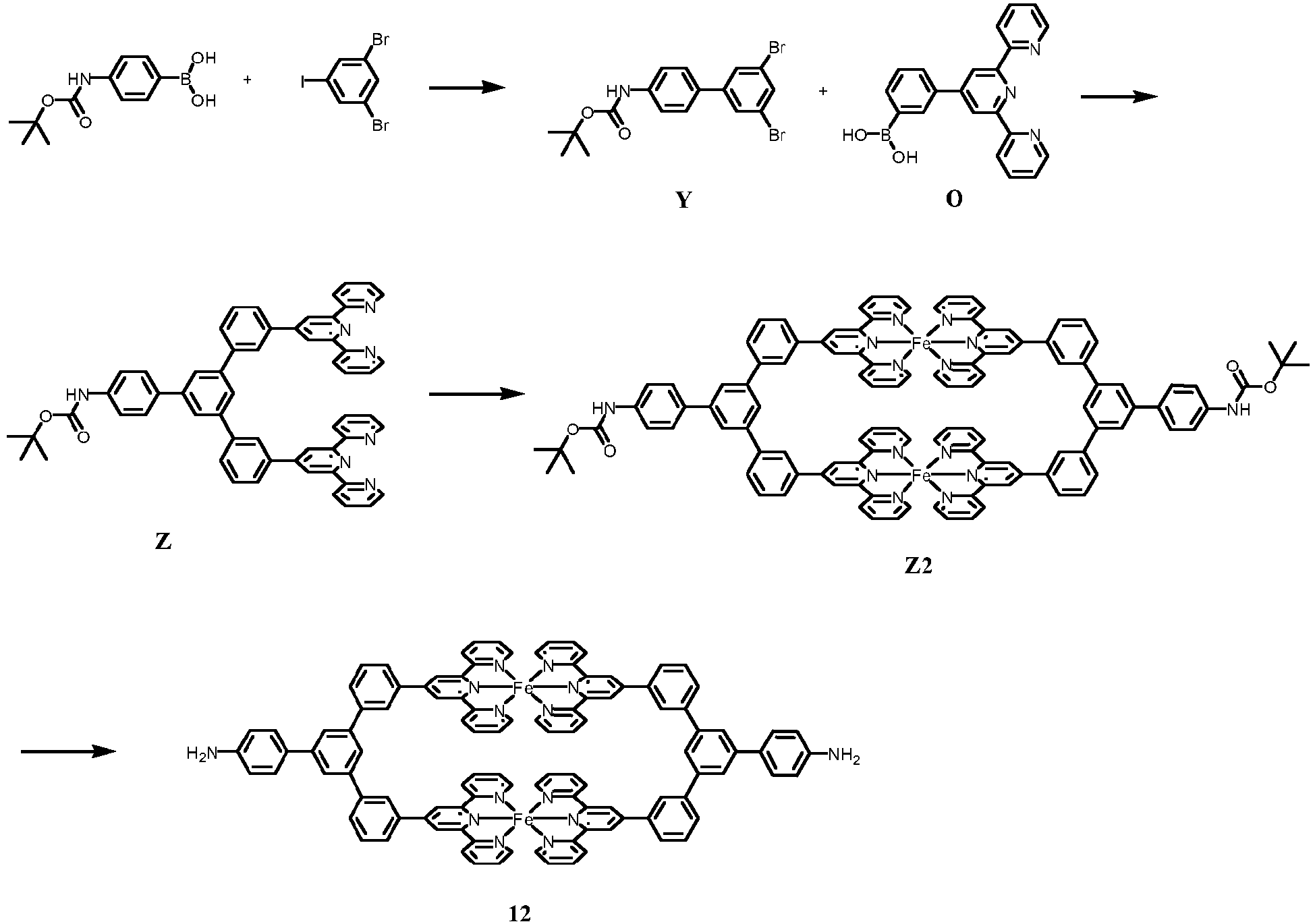
- 1,3-dibromo-5-iodobenzene (1.092 g, 3.02 mmol), 4-(Boc-amino)phenylboronic acid (455 mg, 3.32 mmol), palladium tetrakis(triphenylphosphine) (34.9 mg, 30.3 µmol), and anhydrous potassium carbonate (3.93 g, 28.5 mmol) were added to a 250 mL Schlenk bottle in sequence, and then 60 mL of tetrahydrofuran and 15 mL of distilled water were injected. The resultant was circulated 3 times by a freezing and thawing pump circulation method to remove oxygen, and then heated and stirred at 90 °C under the protection of argon for 24 h. After cooling, the reaction mixture was poured into water (200 mL) and extracted with dichloromethane (3 × 60 mL). After the organic phases were combined and dried over anhydrous sodium sulfate, the solvent was removed under reduced pressure. The crude product was analyzed and purified by silica gel column chromatography to obtain compound Y.
- 1H NMR (400 MHz, CDCl3, 298 K): δ 7.76 (q, J = 1.4 Hz, 3H), 7.72 - 7.65 (m, 2H), 7.56 - 7.50 (m, 2H), 6.57 (s, 1H), 1.50 (s, 9H). 13C NMR (100 MHz, CDCl3, 298 K) δ 153.93, 143.19, 137.71, 134.00, 128.66, 127.95, 126.42, 123.44, 80.43, 28.16. HRMS (TOF-ESI+) (m/z): C17H17Br2N02 calculated: 425.97 [M+H+];found: 425.97.
- Compound Y (522 mg, 1.23 mmol), compound O (477 mg, 1.35 mmol), tetrakis(triphenylphosphine) palladium (14.6 mg, 12.3 µmol), and anhydrous potassium carbonate (1.60 g, 11.6 mmol) were added to a 100 mL Schlenk bottle in sequence, and then 25 mL of tetrahydrofuran and 5 mL of distilled water were injected. The resultant was circulated 3 times by a freezing and thawing pump circulation method to remove oxygen, and then heated and stirred at 90 °C under the protection of argon for 24 h. After cooling, the reaction mixture was poured into water (50 mL) and extracted with dichloromethane (3 × 30 mL). After the organic phases were combined and dried over anhydrous sodium sulfate, the solvent was removed under reduced pressure. The crude product was analyzed and purified by silica gel column chromatography to obtain compound Z.
- 1H NMR (400 MHz, CDCl3, 298 K): δ 8.70-8.44 (m, 12H), 8.31 (dt, J = 3.5, 2.0 Hz, 2H), 8.23 (t, J = 2.0 Hz, 1H), 8.17 (t, J = 2.0 Hz, 1H), 8.12 (t, J = 1.9 Hz, 1H), 7.83- 7.59 (m, 11H), 7.48 (td, J = 8.0, 1.3 Hz, 4H), 6.93 (ddd, J = 8.0, 5.1, 1.1 Hz, 4H), 1.50 (s, 9H).13C NMR (100 MHz, CDCl3, 298 K) δ 156.38, 155.79, 153.93, 149.14, 147.56, 141.72, 141.37, 138.86, 137.71, 136.59, 133.99, 129.37, 129.27, 129.18, 128.16, 127.95, 126.42, 124.02, 121.39, 120.06, 80.43,28.16.HRMS (TOF-ESI') (m/z): C59H45N7O2 calculated:884.35 [M+H'];found: 884.35.
- Methanol (10 mL) was added to a 50 mL reaction flask to dissolve compound Z (280 mg, 0.316 mmol). After that, ferrous chloride (21 mg, 0.158 mmol) in methanol (10 mL) was added dropwise, and the reactant was stirred and refluxed under the protection of argon for 4 h. Then the reactant was cooled to room temperature, and an excess of saturated ammonium hexafluorophosphate in methanol was added dropwise until the precipitation was completely precipitated, which was filtered. The obtained solid was rinsed with distilled water (2 × 10 mL) and ether (2 × 10 mL) in turn. The crude product was recrystallized with a mixed solvent of acetonitrile and acetone to obtain compound Z2 as a purple solid.
- 1H NMR (400 MHz, CDCl3, 298 K): δ 8.75 (dd, J = 7.5, 1.4 Hz, 8H), 8.59 (d, J = 8.0 Hz, 15H), 8.04 (s, 6H), 7.94 (t, J = 2.0 Hz, 4H), 7.66 - 7.42 (m, 28H), 1.50 (s, 18H). 13C NMR (100 MHz, CDCl3, 298 K): δ 155.16, 153.93, 152.39, 150.10, 149.69, 141.72, 141.37, 138.86, 138.67, 137.71, 133.99, 129.45, 129.37, 129.27, 129.18, 128.16, 127.95, 126.42, 125.08, 122.82, 80.43, 28.16. HRMS (TOF-ESI+) (m/z): C118H90Fe2N14O4 calculated: 1879.58 [M-2PF6 -+H+] ; found: 1879.58.
- The reaction was carried out locatedaccording to the method of Example 8, except that compound Q was relocated with compound Z2 (0.282 g, 0.13 mmol), to obtain the interested compound 12 as a purple solid.
- 1H NMR (400 MHz, CDCl3, 298 K): δ 8.75 (dd, J = 7.5, 1.6 Hz, 8H), 8.60-8.56 (m, 15H), 8.04 (s, 6H), 7.94 (t, J = 2.0 Hz, 4H), 7.66 (dd, J = 8.0, 6.7 Hz, 4H), 7.58 (dd, J = 7.2, 2.0 Hz, 8H), 7.43 (td, J = 7.4, 1.6 Hz, 8H), 7.21 - 7.15 (m, 4H), 7.00 (td, J = 7.4, 1.6 Hz, 8H), 6.81 - 6.75 (m, 4H). 13C NMR (100 MHz, CDCl3, 298 K) δ 155.16, 152.39, 150.10, 149.69, 148.03, 141.72, 141.37, 138.86, 138.67, 131.31, 129.45, 129.37, 129.27, 129.18, 128.27, 128.16, 125.08, 122.82,115.05.HRMS(TOF-ESI+) (m/z): C108H74Fe2N14 calculated : 1679.50 [M-2PF6 -+H+]; found: 1679.50.
- A strongly-polarized molecule-graphene molecular heterojunction was constructed to obtain a compound 12 based field effect transistor with bottom gate structure according to the preparation method of transistor in Example 1, in which graphene was used as the gate electrode, hafnium oxide with a thickness of 5 nm was used as the dielectric layer, and compound 12 was used to replace compound 1.
- The synthetic route is as follows:

- Compound Z3 was synthesized according to the route in the literature (European Journal of Medicinal Chemistry, 102, 277-287; 2015).
- Compound Z4 was synthesized according to the route in the literature (Journal of the American Chemical Society, 136(10), 3972-3980; 2014).
- Compound Z3 (0.279 g, 1 mmol), compound Z4 (0.878 g, 2.4 mmol), Pd(PPh3)4 (83 mg, 0.072 mmol) and K2CO3 (1.0 g, 7.2 mmol) were added to a 100 mL Schlenk bottle in sequence, and then THF/H2O (20 mL/4 mL) was injected. The resultant was circulated 3 times by a freezing and thawing pump circulation method to remove oxygen, and then heated and stirred at 90 °C under the protection of argon for 24. After cooling, the reaction mixture was poured into water (50 mL) and extracted with dichloromethane (3 × 30 mL). The organic phases were combined and dried with Na2SO4 and the solvent was removed under reduced pressure. The crude product was analyzed and purified by silica gel column chromatography to obtain compound Z5 as a yellow solid.
- 1H NMR (400 MHz, CDCl3, 298 K): δ 8.11 - 7.96 (m, 6H), 7.92 - 7.80 (m, 6H), 7.80 - 7.61 (m, 6H), 3.92 (s, 4H), 3.75 (s, 6H). 13C NMR (100 MHz, CDCl3, 298 K): δ 172.68 , 137.95 , 133.76 , 132.68 , 131.30 , 129.89 , 129.08 , 128.51 , 128.06 , 127.35 , 127.06 , 125.89 , 123.71 , 123.64 , 51.97 , 40.77. HRMS (TOF-ESI+) (m/z): C36H29O4 calculated:525.21 [M+H+];found; 525.21.
- Compound Z5 (0.488 g, 0.93 mmol) was added to 5 mL of 28% ammonia water, and the reaction was stirred at room temperature for 24 h. After that, th reactant was extracted with dichloromethane (3 × 10 mL). The organic phases were combined and dried over anhydrous sodium sulfate, and the solvent was removed under reduced pressure. The crude product was analyzed and purified by silica gel column chromatography to obtain compound Z6 as a yellow solid.
- 1H NMR (400 MHz, CDCl3, 298 K): δ 8.12 - 7.96 (m, 6H), 7.92 - 7.67 (m, 12H), 3.63 (s, 4H).13C NMR (100 MHz, CDCl3, 298 K): δ 172.58 , 137.95 , 135.09 , 133.06 , 131.30 , 130.40 , 128.51 , 128.35 , 128.06 , 127.67 , 125.89 , 125.49 , 123.71 , 123.64 , 41.07. HRMS (TOF-ESI+) (m/z): C34H26N2O2 calculated: 495.21 [M+H+];found:495.21.
- After LiAlH4 (0.152 g, 4 mmol) and anhydrous THF (5 mL) were added to a reaction flask, a solution of compound Z6 (0.198 g, 0.4 mmol) in anhydrous THF (1 mL) was added dropwise. The reactant was then refluxed for 24 h, and cooled to room temperature. Water was added to quench the reaction. The resultant was extracted with dichloromethane (3 × 10 mL). The organic phases were combined and dried over anhydrous sodium sulfate, and the solvent was removed under reduced pressure. The crude product was analyzed and purified by silica gel column chromatography to obtain compound 13 as a yellow solid.
- 1H NMR (400 MHz, CDCl3, 298 K): δ 8.11 -7.96 (m, 6H), 7.92 -7.80 (m, 6H), 7.80 - 7.61 (m, 6H), 2.53 (s, 4H), 1.24 (s, 4H). 13C NMR (100 MHz, CDCl3, 298 K): δ 137.95, 133.79 , 131.30 , 130.12 , 128.64 , 128.51 , 128.06 , 126.36 , 125.89 , 125.43 , 123.71 , 123.64 , 43.70 , 39.10. HRMS (TOF-ESI+) (m/z): C34H30N2 calculated: 467.25 [M+H+]; found: 467.25.
- A strongly-polarized molecule-graphene molecular heterojunction was constructed to obtain a compound 13 based field effect transistor with bottom gate structure according to the preparation method of transistor in Example 1, in which graphene was used as the gate electrode, hafnium oxide with a thickness of 5 nm was used as the dielectric layer, and compound 13 was used to replace compound 1.
- The synthetic route is as follows:

- Compound Z7 was synthesized according to the route in the literature (Chemistry-a European Journal, 2001, 7(22): 4894-4901).
- Compound Z7 (1.00 g, 0.69 mmol), copper iodide (0.572 g, 0.30 mmol), tetrakis(triphenylphosphine) palladium (0.182 g, 0.16 mmol), methyl propiolate (0.060 g, 0.71 mmol) and piperidine (60 mL) were added to a 250 mL Schlenk bottle. The resultant was circulated 3 times by a freezing and thawing pump circulation method to remove oxygen, and then heated and stirred at 90 °C under the protection of argon for 24 h. After cooling, the reaction mixture was poured into water (50 mL) and extracted with dichloromethane (3 × 30 mL). The organic phases were combined and dried with Na2SO4 and the solvent was removed under reduced pressure. The crude product was analyzed and purified by silica gel column chromatography to obtain compound Z8 as a yellow solid.
- 1H NMR (400 MHz, CDCl3, 298 K): δ 8.40 (s, 2H), 8.13 (s, 2H), 8.02 (s, 2H), 7.99 (s, 2H), 7.98 (s, 2H), 7.86 (s, 2H), 3.75 (s, 3H) ,1.26 (m, 88H), 0.92 - 0.86 (m, 12H) 13C NMR (100 MHz, CDCl3, 298 K): δ 173.44, 139.29, 139.13, 139.10, 129.83, 129.02, 128.96, 128.81, 128.45, 123.60, 123.21, 122.48, 122.29, 120.92, 120.65, 120.53, 120.45, 119.08, 118.94, 118.68, 118.17, 89.82, 82.48, 51.06, 37.29, 37.20, 34.02, 32.45, 32.39, 32.05, 31.98, 30.31, 30.27, 30.10, 30.04, 29.96, 29.88, 29.54, 29.45, 29.41, 25.09, 22.88, 20.15, 14.19.
- HRMS (TOF-ESI+) (m/z): C94H115BrO2 calculated: 1355.81 [M+H+]; found: 1355.81.
- Compound Z8 (1.10 g, 0.81 mmol), pinacol diborate (0.124 g, 0.49 mmol), palladium tetrakis(triphenylphosphine) (0.038 g, 0.03 mmol), and potassium acetate (0.40 g, 4.07 mmol) were added to a 250 mL Schlenk bottle in sequence, and then 50 mL of N,N-dimethylformamide was added. The resultant was circulated 3 times by a freezing and thawing pump circulation method to remove oxygen, and then heated and stirred at 90 °C under the protection of argon for 10 h. After cooling, the reaction mixture was poured into water (50 mL) and extracted with dichloromethane (3 × 30 mL). The organic phase was washed with water (3 × 30 mL) and saturated sodium chloride solution (30 mL) in turn, and dried with anhydrous sodium sulfate. The solvent was removed under reduced pressure. The crude product was analyzed and purified by silica gel column chromatography to obtain compound Z9 as a yellow solid.
- 1H NMR (400 MHz, CDCl3, 298 K): δ 8.50 (s, 4H), 8.23 (s, 4H), 8.18 (s, 4H), 8.09 (s, 4H), 7.98 (s, 4H), 7.88 (s, 4H), 3.75 (s, 6H), 1.26 (m, 176H), 0.92 - 0.86 (m, 24H).
- 13C NMR (100 MHz, CDCl3, 298 K): δ 175.49, 149.45, 139.93, 138.10, 129.81, 129.02, 128.96, 128.81, 128.45, 124.60, 124.21, 124.48, 123.39, 121.92, 121.65, 121.53, 120.45, 119.28, 118.94, 118.68, 118.27, 89.87, 82.58, 51.06, 37.29, 37.20, 34.02, 32.45, 32.39, 32.05, 31.98, 30.31, 30.27, 30.10, 30.04, 29.96, 29.88, 29.54, 29.45, 29.41, 25.09, 22.88, 20.15, 14.19.
- HRMS (TOF-ESI+) (m/z): C188H230O4 calculated: 2552.78 [M+H+]; found : 2552.78.
- Compound Z9 (663 mg, 0.26 mmol) was dissolved in THF (200 mL), and then Pd/C (10%, 285 mg) was added. H2 (1 bar) was introduced at room temperature, and the reaction was stirred for 16 h. After the catalyst was removed by filtration, the solvent was removed under reduced pressure. The crude product was analyzed and purified by silica gel column chromatography to obtain compound Z10 as a yellow solid.
- 1HNMR(400 MHz, CDCl3, 298 K): δ 8.50 (s, 4H), 8.23 (s, 4H), 8.18 (s, 4H), 8.09 (s, 4H), 7.98 (s, 4H), 7.88 (s, 4H), 3.75 (s, 6H), 1.26 (m, 180H), 2.28 (t, J=7.5Hz, 4H), 0.92 - 0.86 (m, 24H).
- 13C NMR (100 MHz, CDCl3, 298 K): δ 173.53, 139.42, 129.36, 122.91, 120.78, 119.15, 52.15, 37.29, 33.99, 32.51, 32.37, 32.04, 30.21, 30.05, 30.01, 29.93, 29.85, 29.76, 29.53, 29.48, 29.31, 25.02, 22.86, 14.18.
- HRMS (TOF-ESI+) (m/z): C188H238O4 calculated: 2560.84 [M+H+]; found: 2560.84.
- Compound Z10 (0.589g, 0.23 mmol) was added to 5 mL of 28% ammonia water, and the reaction was stirred at room temperature for 24 h, then extracted with dichloromethane (3 × 10 mL). The organic phases were combined and dried over anhydrous sodium sulfate, and the solvent was removed under reduced pressure. The crude product was analyzed and purified by silica gel column chromatography to obtain compound Z11 as a yellow solid.
- 1H NMR (400 MHz, CDCl3, 298 K): δ 8.50 (s, 4H), 8.23 (s, 4H), 8.18 (s, 4H), 8.07 (s, 4H), 7.96 (s, 4H), 7.86 (s, 4H), 1.26 (m, 180H), 2.28 (t, J=7.5Hz, 4H), 0.92 - 0.86 (m, 24H) 13C NMR (100 MHz, CDCl3, 298 K): δ 173.53, 139.42, 129.36, 122.91, 120.78, 119.15, 51.05, 37.29, 33.99, 32.51, 32.37, 32.04, 30.21, 30.05, 30.01, 29.93, 29.85, 29.76, 29.53, 29.48, 29.31, 25.02, 22.86, 14.18.
- HRMS (TOF-ESI+) (m/z): C186H236N2O2 calculated : 2530.85 [M+H+];found : 2530.85.
- After LiAlH4 (0.152 g, 4 mmol) and anhydrous THF (50 mL) were added to a reaction flask, a solution of compound Z11 (0.506 g, 0.20 mmol) in anhydrous THF (50 mL) was added dropwise. The reactant was then refluxed for 24 h, and cooled to room temperature. Water was added to quench the reaction. The resultant was extracted with dichloromethane (3 × 30 mL). The organic phase were combined and dried over anhydrous sodium sulfate, and the solvent was removed under reduced pressure. The crude product was analyzed and purified by silica gel column chromatography to obtain compound 14 as a yellow solid.
- 1H NMR (400 MHz, CDCl3, 298 K): δ 8.50 (s, 4H), 8.23 (s, 4H), 8.18 (s, 4H), 8.07 (s, 4H), 7.96 (s, 4H), 7.86 (s, 4H), 1.26 (m, 192H), 0.92 - 0.86 (m, 24H) 13C NMR (100 MHz, CDCl3, 298 K): δ 173.53, 139.42, 129.36, 122.91, 120.78, 119.15, 54.05, 48.67, 38.29, 33.89, 32.51, 32.35, 31.84, 30.61, 30.05, 30.01, 29.93, 29.85, 29.76, 29.53, 29.48, 29.31, 25.01, 22.84, 14.19. HRMS (TOF-ESI+) (m/z): C186H240N2 calculated: 2502.89 [M+H+];found: 2502.89.
- A strongly-polarized molecule-graphene molecular heterojunction was constructed to obtain a compound 14 based field effect transistor with bottom gate structure according to the preparation method of transistor in Example 1, in which graphene was used as the gate electrode, hafnium oxide with a thickness of 5 nm was used as the dielectric layer, and compound 14 was used to replace compound 1.
- Graphene was used as the gate electrode, and zirconium oxide with a thickness of 5 nm was used as the dielectric layer to construct a field effect transistor with a bottom gate structure.
- First, a bottom gate was formed on the silicon wafer according to the method described in Example 1.
- A zirconium oxide layer with a thickness of 5 nm was deposited on the bottom gate by the electron beam evaporation deposition method.
- According to the method described in Example 1, a strongly-polarized molecule-graphene molecule heterojunction was constructed on the dielectric layer to obtain a single molecule field effect transistor device.
- Graphene was used as the gate electrode, and titanium oxide with a thickness of 5 nm was used as the dielectric layer to construct a field effect transistor with a bottom gate structure.
- First, a bottom gate was formed on the silicon wafer according to the method described in Example 1.
- A titanium oxide layer with a thickness of 5 nm was deposited on the bottom gate by the electron beam evaporation deposition method.
- According to the method described in Example 1, a strongly-polarized molecule-graphene molecule heterojunction was constructed on the dielectric layer to obtain a single molecule field effect transistor device.
- Aluminum was used as the gate electrode, and aluminium oxide with a thickness of 5 nm was used as the dielectric layer to construct a field effect transistor with a bottom gate structure.
- First, an aluminum layer with a thickness of 35 nm was deposited on the silicon wafer by electron beam evaporation deposition method. After that, it was heated at 180 °C for 1 hour to prepare an aluminum oxide layer with a thickness of 5 nm.
- According to the method described in Example 1, a strongly-polarized molecule-graphene molecule heterojunction was constructed on the dielectric layer to obtain a single molecule field effect transistor device.
- Aluminum was used as the gate electrode, and aluminium oxide with a thickness of 3 nm and hafnium oxide with a thickness of 2 nm were used as the dielectric layer to construct a field effect transistor with a bottom gate structure.
- First, an aluminum layer with a thickness of 35 nm was deposited on the silicon wafer by electron beam evaporation deposition method. After that, it was located in the atmosphere for 24 hours, and naturally oxidized to obtain an aluminum oxide layer with a thickness of 3 nm, and then a hafnium oxide layer with a thickness of 2 nm was deposited by atomic layer deposition.
- According to the method described in Example 1, a strongly-polarized molecule-graphene molecule heterojunction was constructed on the hafnium oxide layer to obtain a single molecule field effect transistor device.
- Example 19 differs from Example 15 in that the thickness of zirconium oxide was 3 nm.
- Example 20 differs from Example 15 in that the thickness of zirconium oxide was 10 nm.
- Graphene was used as the gate electrode, and hafnium oxide with a thickness of 5 nm was used as the dielectric layer to construct a field effect transistor with a top gate structure.
- With reference to the method described in Example 1, a strongly-polarized molecule-graphene molecule heterojunction was constructed on a silicon wafer having an oxide layer with a thickness of 300 nm.
- On another silicon wafer, a hafnium oxide layer with a thickness of 5 nm was prepared by the sol-gel method. After that, the graphene grown by chemical vapor deposition was transferred thereon, on which PMMA was further spin-coated. Finally, the silicon wafer was etched with hydrofluoric acid. The hafnium oxide/graphene/PMMA film was rinsed with deionized water and isopropanol three times, respectively, which was then located on the molecule heterojunction to obtain a single molecule field effect transistor device with a top gate structure based on compound 2.
- Example 22 differs from Example 21 in that: a zirconium oxide layer with a thickness of 5 nm prepared by the electron beam evaporation method was used as the dielectric layer.
- Example 23 differs from Example 21 in that: a titanium oxide layer with a thickness of 5 nm prepared by the atomic layer deposition method was used as the dielectric layer.
- Agilent 4155C semiconductor tester and Karl Suss (PM5) manual probe station were used to test the performance of single molecule field effect transistors prepared in Examples 1-7.
- At room temperature and atmospheric conditions, the gate voltage is changed within the range of -2 V to +2 V. The source-drain bias voltage (-1 V ~ +1 V) was applied with fixing a certain gate voltage. I-V characteristic curve of the above-mentioned single molecule field effect transistor modulated by the gate voltage was determined (as shown in
FIGs. 3-9 ). It can be seen fromFIGs. 3-9 that the single molecule field effect transistor prepared in Examples 1-7 exhibits the conductivity characteristic that it varies with the gate voltage. Specifically, the I-V curves under different gate voltages are significantly different. As the gate voltage changes from negative to positive, the conductivity characteristics significantly change by gradually decreasing. This indicates that the single molecular field effect transistors prepared in Examples 1-7 have efficient gate modulation characteristics. At the same time, it is fully proved that the single molecule field effect transistors provided by the present application have indeed realized the characteristics of industrial transistors and have a wide range of application prospects. - In addition, it should be noted that although the gate voltage range of the aforementioned test is -2 V ∼ +2 V, it is confirmed by experiments that I-V characteristic curves similar to those shown in
FIGs. 3-9 can be obtained within the gate voltage range of -4 V ~ +4 V, by which the conductivity characteristic that it varies with the gate voltage is also shown. - It should be noted that the single molecule field effect transistors prepared in Examples 8-23 can also fit I-V characteristic curves similar to those of the single molecule field effect transistor prepared in Example 1-7. Therefore, they can achieve the same technical effect of the single molecule field effect transistors prepared in Example 1-7.
- Through the performance test experiment analysis, it can be seen that the strongly-polarized molecules containing the groups with the polarizability greater than 2 C·m2/V are prone to polarization due to the abundant electron cloud of the molecules and the application of voltage, which in turn makes molecular orbital energy levels shift more. Therefore, it is easier to effectively realize the gate modulation of the single molecule field effect transistor.
Claims (12)
- A strongly-polarized molecule represented by general formula (II):
 wherein R3 and R4 are respectively any one of hydrogen, halogen, hydroxyl, amino, cyano, nitro, carboxyl, C1-12 alkyl, C1-12 alkoxy, halogenated C1-12 alkyl, halogenated C1-12 alkoxy, hydroxyl C1-12 alkyl, hydroxyl C1-12 alkoxy, and C1-12 alkyl amino;x1 and x2 are 0 or a positive integer respectively, preferably, 0≤x1≤3; 0≤x2≤3.
 - The strongly-polarized molecule according to claim 1, having any one of the following structural formulae:


- A strongly-polarized molecule-graphene molecule heterojunction, wherein the molecule heterojunction comprises the strongly-polarized molecule according to claim 1 or 2 bridging between layers of two-dimensional single-layer graphene with a nanogap via amide covalent bonds; preferably, the two-dimensional single-layer graphene with a nanogap is a two-dimensional single-layer graphene with a nanogap array.
- A single molecule field effect transistor, comprising a substrate, a gate, a dielectric layer, and the strongly-polarized molecule-graphene molecule heterojunction according to claim 3, wherein the dielectric layer is located between the gate and the strongly-polarized molecule-graphene molecular heterojunction.
- The single molecule field effect transistor according to claim 4, wherein the material of the gate is one of graphene or metal aluminum.
- The single molecule field effect transistor according claim 4 or 5, wherein the material of the dielectric layer is one of hafnium oxide, zirconium oxide, titanium oxide, and aluminum oxide, or any combinations thereof.
- The single molecule field effect transistor according to any one of claims 4-6, wherein:the dielectric layer is a hafnium oxide layer, and the gate is a graphene layer; orthe dielectric layer is a zirconium oxide layer, and the gate is a graphene layer; orthe dielectric layer is a titanium oxide layer, and the gate is a graphene layer; orthe dielectric layer is an aluminium oxide layer, and the gate is a metal aluminum layer; orthe dielectric layer is a composite layer of aluminium oxide and hafnium oxide, and the gate is a metal aluminum layer.
- The single molecule field effect transistor according to any one of claims 4-7, wherein the substrate is a silicon wafer having a silicon oxide layer; preferably, the thickness of the silicon oxide layer is 200-400 nm, and more preferably, 300 nm.
- The single molecule field effect transistor according to any one of claims 4-8, wherein the thickness of the dielectric layer is 3-10 nm, preferably 4-7 nm, and more preferably 5 nm.
- The single molecule field effect transistor according to any one of claims 4-9, wherein the gate is located on the substrate, the dielectric layer is located on the gate, and the strongly-polarized molecule-graphene molecule heterojunction is located on the dielectric layer; or
the strongly-polarized molecule-graphene molecule heterojunction is located on the substrate, the dielectric layer is located on the strongly-polarized molecule-graphene molecule heterojunction, and the gate is located on the dielectric layer. - A molecular switch comprising the single molecule field effect transistor according to any one of claims 4-10.
- A semiconductor chip comprising the single molecule field effect transistor according to any one of claims 4-10.
Applications Claiming Priority (2)
| Application Number | Priority Date | Filing Date | Title |
|---|---|---|---|
| CN201810283361.XA CN110343110B (en) | 2018-04-02 | 2018-04-02 | Strongly polarized molecules and single-molecule field-effect transistors fabricated by using the same |
| PCT/CN2019/080347 WO2019192395A1 (en) | 2018-04-02 | 2019-03-29 | Strongly-polarized molecule, and single molecule field effect transistor prepared therefrom |
Publications (3)
| Publication Number | Publication Date |
|---|---|
| EP3778570A1 EP3778570A1 (en) | 2021-02-17 |
| EP3778570A4 EP3778570A4 (en) | 2021-09-15 |
| EP3778570B1 true EP3778570B1 (en) | 2023-10-04 |
Family
ID=68100050
Family Applications (1)
| Application Number | Title | Priority Date | Filing Date |
|---|---|---|---|
| EP19780897.5A Active EP3778570B1 (en) | 2018-04-02 | 2019-03-29 | Strongly-polarized molecule, and single molecule field effect transistor prepared therefrom |
Country Status (6)
| Country | Link |
|---|---|
| US (1) | US12173016B2 (en) |
| EP (1) | EP3778570B1 (en) |
| JP (1) | JP7083981B2 (en) |
| KR (1) | KR102507357B1 (en) |
| CN (2) | CN112538085B (en) |
| WO (1) | WO2019192395A1 (en) |
Families Citing this family (13)
| Publication number | Priority date | Publication date | Assignee | Title |
|---|---|---|---|---|
| CN111420708B (en) * | 2020-04-30 | 2021-08-20 | 林贤贵 | A kind of graphene covalently grafted aminophenylterpyridine-iron complex Fenton catalyst and preparation method thereof |
| CN112582541B (en) * | 2020-12-06 | 2022-07-29 | 南开大学 | A vertical monomolecular film field effect transistor based on two-dimensional stacked heterostructure and its preparation method |
| CN112582540B (en) * | 2020-12-06 | 2022-09-30 | 南开大学 | Compound with quantum interference effect and preparation method of vertical monomolecular field effect transistor integrated device comprising compound |
| CN112582542B (en) * | 2020-12-06 | 2022-09-30 | 南开大学 | Monomolecular field effect transistor based on two-dimensional van der Waals heterostructure and preparation method thereof |
| US11390160B2 (en) * | 2020-12-09 | 2022-07-19 | Ford Global Technologies, Llc | Wheel disconnect clutch |
| CN114031753B (en) * | 2020-12-31 | 2023-11-03 | 广东聚华印刷显示技术有限公司 | Organic polymers and their use |
| CN112898582B (en) * | 2021-01-19 | 2022-12-20 | 南开大学 | A supramolecular-based single-molecule field-effect transistor and its preparation method |
| CN114213258B (en) * | 2021-12-13 | 2024-06-18 | 北京未名元上分子技术有限公司 | Planar conjugated molecular compound and single-molecule field effect transistor comprising same |
| CN114230378B (en) * | 2021-12-27 | 2022-11-15 | 复旦大学 | Preparation method of a redox-driven super-assembled intelligent gating system |
| CN114292201B (en) * | 2021-12-27 | 2024-05-28 | 北京未名元上分子技术有限公司 | Compound with quantum interference effect and single-molecule field effect transistor comprising same |
| CN117285549A (en) * | 2023-10-20 | 2023-12-26 | 南开大学 | Metal nanocluster compounds and graphene single molecule field effect transistors |
| CN118234253B (en) * | 2024-05-24 | 2024-09-10 | 南开大学 | Single-molecule field effect transistor based on double-gate regulation and control and preparation method thereof |
| CN119947557B (en) * | 2025-04-07 | 2025-06-03 | 南开大学 | Bicolor light source single-molecule device based on femtosecond two-photon absorption and preparation method thereof |
Family Cites Families (9)
| Publication number | Priority date | Publication date | Assignee | Title |
|---|---|---|---|---|
| CN102456702B (en) * | 2010-10-14 | 2014-03-19 | 北京大学 | Functional molecular electronic device based on graphene electrode as well as preparation method and application thereof |
| CN102775273B (en) * | 2012-07-05 | 2014-09-10 | 北京大学 | Bifurcate alkyl chain and preparation and application thereof in organic conjugated molecules |
| CN104177366A (en) | 2013-05-27 | 2014-12-03 | 海洋王照明科技股份有限公司 | Organic semiconductor material containing pyrrolopyrrolidone unit and preparation method thereof, and solar cell device |
| JP6158013B2 (en) | 2013-09-24 | 2017-07-05 | 株式会社東芝 | Organic molecular memory |
| WO2015090497A1 (en) * | 2013-12-19 | 2015-06-25 | Merck Patent Gmbh | Dye compounds |
| KR101608579B1 (en) * | 2014-04-22 | 2016-04-04 | 한국생산기술연구원 | Electron transport material and organic electroluminescent device using thereof |
| CN107098816A (en) | 2015-03-04 | 2017-08-29 | 湖南工业大学 | Contain naphthalene and ester structure function diamine monomer and its synthetic method and application with high flatness |
| KR101703118B1 (en) | 2015-10-14 | 2017-02-07 | 한국생산기술연구원 | Electron transport material and organic electroluminescent device using thereof |
| CN107011317B (en) | 2016-05-24 | 2020-03-20 | 北京大学 | Photoisomerizable compounds and devices comprising same |
-
2018
- 2018-04-02 CN CN202011405289.7A patent/CN112538085B/en active Active
- 2018-04-02 CN CN201810283361.XA patent/CN110343110B/en active Active
-
2019
- 2019-03-29 JP JP2020550619A patent/JP7083981B2/en active Active
- 2019-03-29 WO PCT/CN2019/080347 patent/WO2019192395A1/en not_active Ceased
- 2019-03-29 KR KR1020207031057A patent/KR102507357B1/en active Active
- 2019-03-29 US US17/042,800 patent/US12173016B2/en active Active
- 2019-03-29 EP EP19780897.5A patent/EP3778570B1/en active Active
Also Published As
| Publication number | Publication date |
|---|---|
| JP2021516868A (en) | 2021-07-08 |
| WO2019192395A1 (en) | 2019-10-10 |
| CN110343110A (en) | 2019-10-18 |
| US12173016B2 (en) | 2024-12-24 |
| CN112538085B (en) | 2022-04-05 |
| EP3778570A1 (en) | 2021-02-17 |
| CN110343110B (en) | 2021-05-28 |
| KR20200138784A (en) | 2020-12-10 |
| JP7083981B2 (en) | 2022-06-14 |
| US20210024560A1 (en) | 2021-01-28 |
| KR102507357B1 (en) | 2023-03-08 |
| CN112538085A (en) | 2021-03-23 |
| EP3778570A4 (en) | 2021-09-15 |
Similar Documents
| Publication | Publication Date | Title |
|---|---|---|
| EP3778570A1 (en) | Strongly-polarized molecule, and single molecule field effect transistor prepared therefrom | |
| Rudebusch et al. | Quinoidal diindenothienoacenes: synthesis and properties of new functional organic materials | |
| EP2368892A1 (en) | Novel compound, process for producing the compound, organic semiconductor material, and organic semiconductor device | |
| CN108155290B (en) | A single-molecule field-effect transistor based on an ionic liquid gate | |
| Yamada et al. | Synthesis of perfluoroalkylated pentacenes and evaluation of their fundamental physical properties | |
| Hoang et al. | Organic field-effect transistors based on semiconducting porphyrin single crystals | |
| Yu et al. | Designed synthesis and supramolecular architectures of furan-substituted perylene diimide | |
| CN107628924A (en) | A kind of anthracene derivative and preparation method and application | |
| CN102127424B (en) | Iridium metal coordination compound organic fluorescent nanoparticles and preparation method thereof | |
| Fang et al. | Chalcogen bridged pyrene derivatives: Synthesis, crystal− packing structures and field effect transistors properties | |
| Alam et al. | Comparing the impact of trifluoromethyl versus methoxy group on optoelectronic properties of novel 9, 9′-spirobifluorene-based hole transporting materials: Synthesis and computational studies | |
| Rajwar et al. | Synthesis and 2D self-assembly at the liquid-solid interface of end-substituted star-shaped oligophenylenes | |
| Wang et al. | Facile and versatile access to substituted hexabenzoovalene derivatives: characterization and optoelectronic properties | |
| Werner et al. | Reductive O-triflylation of naphthalene diimide: access to alkyne-and amine-functionalized 2, 7-diazapyrenes | |
| CN115626911B (en) | Trans-dithienylethylene derivative and preparation method and application thereof | |
| Nakano et al. | Synthesis and intramolecular magnetic interaction of triphenylamine derivatives with nitronyl nitroxide radicals | |
| CN108997404A (en) | A kind of photosensitizer, preparation method and applications | |
| Hallani et al. | The effect of regioisomerism on the crystal packing and device performance of desymmetrized anthradithiophenes | |
| CN101353352A (en) | Hexathiophene and its derivatives and their preparation method and application | |
| CN119947557B (en) | Bicolor light source single-molecule device based on femtosecond two-photon absorption and preparation method thereof | |
| Carcel et al. | Synthesis and redox properties of several new oligoTTF containing functional spacer | |
| US9773988B2 (en) | Diindenoanthracene and diindenopentacene | |
| CN110526932B (en) | Micromolecule organic semiconductor material containing planar quinoid structure and preparation and application thereof | |
| CN113735876B (en) | Benzothienothienobenzene (BTBT) derivative with asymmetric structure and preparation method and application thereof | |
| CN102977084A (en) | Thiophene pyrroloquinone type structure n-type semiconductor material synthesis and semiconductor device containing thiophene pyrroloquinone type structure n-type semiconductor material |
Legal Events
| Date | Code | Title | Description |
|---|---|---|---|
| STAA | Information on the status of an ep patent application or granted ep patent |
Free format text: STATUS: THE INTERNATIONAL PUBLICATION HAS BEEN MADE |
|
| PUAI | Public reference made under article 153(3) epc to a published international application that has entered the european phase |
Free format text: ORIGINAL CODE: 0009012 |
|
| STAA | Information on the status of an ep patent application or granted ep patent |
Free format text: STATUS: REQUEST FOR EXAMINATION WAS MADE |
|
| 17P | Request for examination filed |
Effective date: 20201001 |
|
| AK | Designated contracting states |
Kind code of ref document: A1 Designated state(s): AL AT BE BG CH CY CZ DE DK EE ES FI FR GB GR HR HU IE IS IT LI LT LU LV MC MK MT NL NO PL PT RO RS SE SI SK SM TR |
|
| AX | Request for extension of the european patent |
Extension state: BA ME |
|
| RIC1 | Information provided on ipc code assigned before grant |
Ipc: C07D 209/52 20060101AFI20210508BHEP Ipc: C07C 15/20 20060101ALI20210508BHEP Ipc: C07D 333/78 20060101ALI20210508BHEP Ipc: C07F 15/00 20060101ALI20210508BHEP Ipc: H01L 51/05 20060101ALI20210508BHEP Ipc: C07C 209/52 20060101ALI20210508BHEP Ipc: C07F 15/06 20060101ALI20210508BHEP |
|
| DAV | Request for validation of the european patent (deleted) | ||
| DAX | Request for extension of the european patent (deleted) | ||
| A4 | Supplementary search report drawn up and despatched |
Effective date: 20210817 |
|
| RIC1 | Information provided on ipc code assigned before grant |
Ipc: C07F 15/06 20060101ALI20210811BHEP Ipc: C07C 209/52 20060101ALI20210811BHEP Ipc: H01L 51/05 20060101ALI20210811BHEP Ipc: C07F 15/00 20060101ALI20210811BHEP Ipc: C07D 333/78 20060101ALI20210811BHEP Ipc: C07C 15/20 20060101ALI20210811BHEP Ipc: C07D 209/52 20060101AFI20210811BHEP |
|
| GRAP | Despatch of communication of intention to grant a patent |
Free format text: ORIGINAL CODE: EPIDOSNIGR1 |
|
| STAA | Information on the status of an ep patent application or granted ep patent |
Free format text: STATUS: GRANT OF PATENT IS INTENDED |
|
| RIC1 | Information provided on ipc code assigned before grant |
Ipc: C07C 211/30 20060101ALN20230330BHEP Ipc: C07C 15/20 20060101ALN20230330BHEP Ipc: C07D 333/78 20060101ALN20230330BHEP Ipc: C07C 209/52 20060101ALN20230330BHEP Ipc: C07F 15/03 20060101ALN20230330BHEP Ipc: H10K 10/46 20230101ALN20230330BHEP Ipc: H10K 10/00 20230101ALI20230330BHEP Ipc: C07F 3/06 20060101ALI20230330BHEP Ipc: C07F 15/06 20060101ALI20230330BHEP Ipc: C07D 487/04 20060101ALI20230330BHEP Ipc: C07C 211/31 20060101ALI20230330BHEP Ipc: C07F 15/00 20060101ALI20230330BHEP Ipc: C07C 5/00 20060101ALI20230330BHEP Ipc: C07D 209/52 20060101AFI20230330BHEP |
|
| INTG | Intention to grant announced |
Effective date: 20230502 |
|
| GRAS | Grant fee paid |
Free format text: ORIGINAL CODE: EPIDOSNIGR3 |
|
| GRAA | (expected) grant |
Free format text: ORIGINAL CODE: 0009210 |
|
| STAA | Information on the status of an ep patent application or granted ep patent |
Free format text: STATUS: THE PATENT HAS BEEN GRANTED |
|
| AK | Designated contracting states |
Kind code of ref document: B1 Designated state(s): AL AT BE BG CH CY CZ DE DK EE ES FI FR GB GR HR HU IE IS IT LI LT LU LV MC MK MT NL NO PL PT RO RS SE SI SK SM TR |
|
| REG | Reference to a national code |
Ref country code: GB Ref legal event code: FG4D |
|
| REG | Reference to a national code |
Ref country code: CH Ref legal event code: EP |
|
| REG | Reference to a national code |
Ref country code: DE Ref legal event code: R096 Ref document number: 602019038724 Country of ref document: DE |
|
| REG | Reference to a national code |
Ref country code: IE Ref legal event code: FG4D |
|
| P01 | Opt-out of the competence of the unified patent court (upc) registered |
Effective date: 20231130 |
|
| REG | Reference to a national code |
Ref country code: LT Ref legal event code: MG9D |
|
| REG | Reference to a national code |
Ref country code: NL Ref legal event code: MP Effective date: 20231004 |
|
| REG | Reference to a national code |
Ref country code: AT Ref legal event code: MK05 Ref document number: 1617656 Country of ref document: AT Kind code of ref document: T Effective date: 20231004 |
|
| PG25 | Lapsed in a contracting state [announced via postgrant information from national office to epo] |
Ref country code: NL Free format text: LAPSE BECAUSE OF FAILURE TO SUBMIT A TRANSLATION OF THE DESCRIPTION OR TO PAY THE FEE WITHIN THE PRESCRIBED TIME-LIMIT Effective date: 20231004 |
|
| PG25 | Lapsed in a contracting state [announced via postgrant information from national office to epo] |
Ref country code: GR Free format text: LAPSE BECAUSE OF FAILURE TO SUBMIT A TRANSLATION OF THE DESCRIPTION OR TO PAY THE FEE WITHIN THE PRESCRIBED TIME-LIMIT Effective date: 20240105 |
|
| PG25 | Lapsed in a contracting state [announced via postgrant information from national office to epo] |
Ref country code: IS Free format text: LAPSE BECAUSE OF FAILURE TO SUBMIT A TRANSLATION OF THE DESCRIPTION OR TO PAY THE FEE WITHIN THE PRESCRIBED TIME-LIMIT Effective date: 20240204 |
|
| PG25 | Lapsed in a contracting state [announced via postgrant information from national office to epo] |
Ref country code: LT Free format text: LAPSE BECAUSE OF FAILURE TO SUBMIT A TRANSLATION OF THE DESCRIPTION OR TO PAY THE FEE WITHIN THE PRESCRIBED TIME-LIMIT Effective date: 20231004 |
|
| PG25 | Lapsed in a contracting state [announced via postgrant information from national office to epo] |
Ref country code: AT Free format text: LAPSE BECAUSE OF FAILURE TO SUBMIT A TRANSLATION OF THE DESCRIPTION OR TO PAY THE FEE WITHIN THE PRESCRIBED TIME-LIMIT Effective date: 20231004 |
|
| PG25 | Lapsed in a contracting state [announced via postgrant information from national office to epo] |
Ref country code: ES Free format text: LAPSE BECAUSE OF FAILURE TO SUBMIT A TRANSLATION OF THE DESCRIPTION OR TO PAY THE FEE WITHIN THE PRESCRIBED TIME-LIMIT Effective date: 20231004 |
|
| PG25 | Lapsed in a contracting state [announced via postgrant information from national office to epo] |
Ref country code: LT Free format text: LAPSE BECAUSE OF FAILURE TO SUBMIT A TRANSLATION OF THE DESCRIPTION OR TO PAY THE FEE WITHIN THE PRESCRIBED TIME-LIMIT Effective date: 20231004 Ref country code: IS Free format text: LAPSE BECAUSE OF FAILURE TO SUBMIT A TRANSLATION OF THE DESCRIPTION OR TO PAY THE FEE WITHIN THE PRESCRIBED TIME-LIMIT Effective date: 20240204 Ref country code: GR Free format text: LAPSE BECAUSE OF FAILURE TO SUBMIT A TRANSLATION OF THE DESCRIPTION OR TO PAY THE FEE WITHIN THE PRESCRIBED TIME-LIMIT Effective date: 20240105 Ref country code: ES Free format text: LAPSE BECAUSE OF FAILURE TO SUBMIT A TRANSLATION OF THE DESCRIPTION OR TO PAY THE FEE WITHIN THE PRESCRIBED TIME-LIMIT Effective date: 20231004 Ref country code: BG Free format text: LAPSE BECAUSE OF FAILURE TO SUBMIT A TRANSLATION OF THE DESCRIPTION OR TO PAY THE FEE WITHIN THE PRESCRIBED TIME-LIMIT Effective date: 20240104 Ref country code: AT Free format text: LAPSE BECAUSE OF FAILURE TO SUBMIT A TRANSLATION OF THE DESCRIPTION OR TO PAY THE FEE WITHIN THE PRESCRIBED TIME-LIMIT Effective date: 20231004 Ref country code: PT Free format text: LAPSE BECAUSE OF FAILURE TO SUBMIT A TRANSLATION OF THE DESCRIPTION OR TO PAY THE FEE WITHIN THE PRESCRIBED TIME-LIMIT Effective date: 20240205 |
|
| PG25 | Lapsed in a contracting state [announced via postgrant information from national office to epo] |
Ref country code: SE Free format text: LAPSE BECAUSE OF FAILURE TO SUBMIT A TRANSLATION OF THE DESCRIPTION OR TO PAY THE FEE WITHIN THE PRESCRIBED TIME-LIMIT Effective date: 20231004 Ref country code: RS Free format text: LAPSE BECAUSE OF FAILURE TO SUBMIT A TRANSLATION OF THE DESCRIPTION OR TO PAY THE FEE WITHIN THE PRESCRIBED TIME-LIMIT Effective date: 20231004 Ref country code: PL Free format text: LAPSE BECAUSE OF FAILURE TO SUBMIT A TRANSLATION OF THE DESCRIPTION OR TO PAY THE FEE WITHIN THE PRESCRIBED TIME-LIMIT Effective date: 20231004 Ref country code: NO Free format text: LAPSE BECAUSE OF FAILURE TO SUBMIT A TRANSLATION OF THE DESCRIPTION OR TO PAY THE FEE WITHIN THE PRESCRIBED TIME-LIMIT Effective date: 20240104 Ref country code: LV Free format text: LAPSE BECAUSE OF FAILURE TO SUBMIT A TRANSLATION OF THE DESCRIPTION OR TO PAY THE FEE WITHIN THE PRESCRIBED TIME-LIMIT Effective date: 20231004 Ref country code: HR Free format text: LAPSE BECAUSE OF FAILURE TO SUBMIT A TRANSLATION OF THE DESCRIPTION OR TO PAY THE FEE WITHIN THE PRESCRIBED TIME-LIMIT Effective date: 20231004 |
|
| REG | Reference to a national code |
Ref country code: DE Ref legal event code: R097 Ref document number: 602019038724 Country of ref document: DE |
|
| PG25 | Lapsed in a contracting state [announced via postgrant information from national office to epo] |
Ref country code: DK Free format text: LAPSE BECAUSE OF FAILURE TO SUBMIT A TRANSLATION OF THE DESCRIPTION OR TO PAY THE FEE WITHIN THE PRESCRIBED TIME-LIMIT Effective date: 20231004 |
|
| PG25 | Lapsed in a contracting state [announced via postgrant information from national office to epo] |
Ref country code: CZ Free format text: LAPSE BECAUSE OF FAILURE TO SUBMIT A TRANSLATION OF THE DESCRIPTION OR TO PAY THE FEE WITHIN THE PRESCRIBED TIME-LIMIT Effective date: 20231004 |
|
| PG25 | Lapsed in a contracting state [announced via postgrant information from national office to epo] |
Ref country code: SK Free format text: LAPSE BECAUSE OF FAILURE TO SUBMIT A TRANSLATION OF THE DESCRIPTION OR TO PAY THE FEE WITHIN THE PRESCRIBED TIME-LIMIT Effective date: 20231004 |
|
| PG25 | Lapsed in a contracting state [announced via postgrant information from national office to epo] |
Ref country code: SM Free format text: LAPSE BECAUSE OF FAILURE TO SUBMIT A TRANSLATION OF THE DESCRIPTION OR TO PAY THE FEE WITHIN THE PRESCRIBED TIME-LIMIT Effective date: 20231004 Ref country code: SK Free format text: LAPSE BECAUSE OF FAILURE TO SUBMIT A TRANSLATION OF THE DESCRIPTION OR TO PAY THE FEE WITHIN THE PRESCRIBED TIME-LIMIT Effective date: 20231004 Ref country code: RO Free format text: LAPSE BECAUSE OF FAILURE TO SUBMIT A TRANSLATION OF THE DESCRIPTION OR TO PAY THE FEE WITHIN THE PRESCRIBED TIME-LIMIT Effective date: 20231004 Ref country code: IT Free format text: LAPSE BECAUSE OF FAILURE TO SUBMIT A TRANSLATION OF THE DESCRIPTION OR TO PAY THE FEE WITHIN THE PRESCRIBED TIME-LIMIT Effective date: 20231004 Ref country code: EE Free format text: LAPSE BECAUSE OF FAILURE TO SUBMIT A TRANSLATION OF THE DESCRIPTION OR TO PAY THE FEE WITHIN THE PRESCRIBED TIME-LIMIT Effective date: 20231004 Ref country code: DK Free format text: LAPSE BECAUSE OF FAILURE TO SUBMIT A TRANSLATION OF THE DESCRIPTION OR TO PAY THE FEE WITHIN THE PRESCRIBED TIME-LIMIT Effective date: 20231004 Ref country code: CZ Free format text: LAPSE BECAUSE OF FAILURE TO SUBMIT A TRANSLATION OF THE DESCRIPTION OR TO PAY THE FEE WITHIN THE PRESCRIBED TIME-LIMIT Effective date: 20231004 |
|
| PLBE | No opposition filed within time limit |
Free format text: ORIGINAL CODE: 0009261 |
|
| STAA | Information on the status of an ep patent application or granted ep patent |
Free format text: STATUS: NO OPPOSITION FILED WITHIN TIME LIMIT |
|
| 26N | No opposition filed |
Effective date: 20240705 |
|
| PG25 | Lapsed in a contracting state [announced via postgrant information from national office to epo] |
Ref country code: SI Free format text: LAPSE BECAUSE OF FAILURE TO SUBMIT A TRANSLATION OF THE DESCRIPTION OR TO PAY THE FEE WITHIN THE PRESCRIBED TIME-LIMIT Effective date: 20231004 |
|
| PG25 | Lapsed in a contracting state [announced via postgrant information from national office to epo] |
Ref country code: SI Free format text: LAPSE BECAUSE OF FAILURE TO SUBMIT A TRANSLATION OF THE DESCRIPTION OR TO PAY THE FEE WITHIN THE PRESCRIBED TIME-LIMIT Effective date: 20231004 |
|
| REG | Reference to a national code |
Ref country code: CH Ref legal event code: PL |
|
| PG25 | Lapsed in a contracting state [announced via postgrant information from national office to epo] |
Ref country code: LU Free format text: LAPSE BECAUSE OF NON-PAYMENT OF DUE FEES Effective date: 20240329 |
|
| PG25 | Lapsed in a contracting state [announced via postgrant information from national office to epo] |
Ref country code: MC Free format text: LAPSE BECAUSE OF FAILURE TO SUBMIT A TRANSLATION OF THE DESCRIPTION OR TO PAY THE FEE WITHIN THE PRESCRIBED TIME-LIMIT Effective date: 20231004 |
|
| PG25 | Lapsed in a contracting state [announced via postgrant information from national office to epo] |
Ref country code: MC Free format text: LAPSE BECAUSE OF FAILURE TO SUBMIT A TRANSLATION OF THE DESCRIPTION OR TO PAY THE FEE WITHIN THE PRESCRIBED TIME-LIMIT Effective date: 20231004 Ref country code: LU Free format text: LAPSE BECAUSE OF NON-PAYMENT OF DUE FEES Effective date: 20240329 |
|
| REG | Reference to a national code |
Ref country code: BE Ref legal event code: MM Effective date: 20240331 |
|
| PG25 | Lapsed in a contracting state [announced via postgrant information from national office to epo] |
Ref country code: BE Free format text: LAPSE BECAUSE OF NON-PAYMENT OF DUE FEES Effective date: 20240331 |
|
| PG25 | Lapsed in a contracting state [announced via postgrant information from national office to epo] |
Ref country code: IE Free format text: LAPSE BECAUSE OF NON-PAYMENT OF DUE FEES Effective date: 20240329 |
|
| PG25 | Lapsed in a contracting state [announced via postgrant information from national office to epo] |
Ref country code: IE Free format text: LAPSE BECAUSE OF NON-PAYMENT OF DUE FEES Effective date: 20240329 Ref country code: BE Free format text: LAPSE BECAUSE OF NON-PAYMENT OF DUE FEES Effective date: 20240331 Ref country code: CH Free format text: LAPSE BECAUSE OF NON-PAYMENT OF DUE FEES Effective date: 20240331 |
|
| PG25 | Lapsed in a contracting state [announced via postgrant information from national office to epo] |
Ref country code: CY Free format text: LAPSE BECAUSE OF FAILURE TO SUBMIT A TRANSLATION OF THE DESCRIPTION OR TO PAY THE FEE WITHIN THE PRESCRIBED TIME-LIMIT; INVALID AB INITIO Effective date: 20190329 |
|
| PG25 | Lapsed in a contracting state [announced via postgrant information from national office to epo] |
Ref country code: HU Free format text: LAPSE BECAUSE OF FAILURE TO SUBMIT A TRANSLATION OF THE DESCRIPTION OR TO PAY THE FEE WITHIN THE PRESCRIBED TIME-LIMIT; INVALID AB INITIO Effective date: 20190329 |
|
| PG25 | Lapsed in a contracting state [announced via postgrant information from national office to epo] |
Ref country code: FI Free format text: LAPSE BECAUSE OF FAILURE TO SUBMIT A TRANSLATION OF THE DESCRIPTION OR TO PAY THE FEE WITHIN THE PRESCRIBED TIME-LIMIT Effective date: 20231004 |
|
| PG25 | Lapsed in a contracting state [announced via postgrant information from national office to epo] |
Ref country code: TR Free format text: LAPSE BECAUSE OF FAILURE TO SUBMIT A TRANSLATION OF THE DESCRIPTION OR TO PAY THE FEE WITHIN THE PRESCRIBED TIME-LIMIT Effective date: 20231004 |
|
| PGFP | Annual fee paid to national office [announced via postgrant information from national office to epo] |
Ref country code: GB Payment date: 20260209 Year of fee payment: 8 |
|
| PGFP | Annual fee paid to national office [announced via postgrant information from national office to epo] |
Ref country code: DE Payment date: 20260204 Year of fee payment: 8 |
|
| PGFP | Annual fee paid to national office [announced via postgrant information from national office to epo] |
Ref country code: FR Payment date: 20260209 Year of fee payment: 8 |