EP3778546A1 - Method for preparing (meth)acrylic acid ester-based compound - Google Patents
Method for preparing (meth)acrylic acid ester-based compound Download PDFInfo
- Publication number
- EP3778546A1 EP3778546A1 EP20800538.9A EP20800538A EP3778546A1 EP 3778546 A1 EP3778546 A1 EP 3778546A1 EP 20800538 A EP20800538 A EP 20800538A EP 3778546 A1 EP3778546 A1 EP 3778546A1
- Authority
- EP
- European Patent Office
- Prior art keywords
- based compound
- acrylic acid
- chemical formula
- substituted
- meth
- Prior art date
- Legal status (The legal status is an assumption and is not a legal conclusion. Google has not performed a legal analysis and makes no representation as to the accuracy of the status listed.)
- Granted
Links
Classifications
-
- C—CHEMISTRY; METALLURGY
- C07—ORGANIC CHEMISTRY
- C07C—ACYCLIC OR CARBOCYCLIC COMPOUNDS
- C07C67/00—Preparation of carboxylic acid esters
- C07C67/08—Preparation of carboxylic acid esters by reacting carboxylic acids or symmetrical anhydrides with the hydroxy or O-metal group of organic compounds
-
- C—CHEMISTRY; METALLURGY
- C07—ORGANIC CHEMISTRY
- C07C—ACYCLIC OR CARBOCYCLIC COMPOUNDS
- C07C67/00—Preparation of carboxylic acid esters
- C07C67/48—Separation; Purification; Stabilisation; Use of additives
- C07C67/58—Separation; Purification; Stabilisation; Use of additives by liquid-liquid treatment
-
- C—CHEMISTRY; METALLURGY
- C07—ORGANIC CHEMISTRY
- C07C—ACYCLIC OR CARBOCYCLIC COMPOUNDS
- C07C69/00—Esters of carboxylic acids; Esters of carbonic or haloformic acids
- C07C69/52—Esters of acyclic unsaturated carboxylic acids having the esterified carboxyl group bound to an acyclic carbon atom
- C07C69/533—Monocarboxylic acid esters having only one carbon-to-carbon double bond
- C07C69/54—Acrylic acid esters; Methacrylic acid esters
Definitions
- the invention relates to a method for preparing a (meth)acrylic acid ester-based compound, and according to the preparation method, a (meth)acrylic acid ester-based compound, particularly a (meth)acrylic acid ester-based compound with high steric hindrance can be prepared with high purity and high yield, by easily introducing an acrylic structure into alcohol using a diamine-based compound and acid anhydride.
- An acrylic structure is a representative functional structure of monomers for polymerization. Due to the acrylic structure, polymerized polymer may be used for various applications such as an adhesive, superabsorbent polymer(SAP), and the like.
- esterification hardly occurs in a highly structurally hindered structure, i.e., a highly sterically hindered structure.
- a method of using acryloyl chloride or acrylic anhydride as raw materials and reacting them with alcohol is mainly used.
- the inventors confirmed that in case a diamine-based compound and acid anhydride are used when synthesizing acrylic acid ester, an acrylic structure can be easily introduced into alcohol, particularly sterically hindered alcohol, and thus, a (meth)acrylic acid ester-based compound can be prepared with high purity and high yield, and completed the invention.
- a method for preparing a (meth)acrylic acid ester-based compound of the following Chemical Formula 1 comprising the step of reacting a an alcohol-based compound of the following Chemical Formula 2 and a (meth)acrylic acid-based compound of the following Chemical Formula 3, in the presence of a diamine-based compound of the following Chemical Formula 4 and acid anhydride of the following Chemical Formula 5:
- substituted or unsubstituted means unsubstituted or substituted with one or more substituents selected from the group consisting of deuterium; a halogen group; a nitrile group; a hydroxyl group; a carbonyl group; an ester group; an imide group; an amino group; a phosphine oxide group; an alkoxy group; an aryloxy group; an alkylthioxy group; an arylthioxy group; an alkylsulfoxy group; an arylsulfoxy group; a silyl group; a boron group; an alkyl group; a cycloalkyl group; an alkenyl group; an aryl group; an aralkyl group; an aralkenyl group; an alkylaryl group; an alkylamine group; an aralkylamine group; a heteroarylamine group; an arylamine group; an arylphos
- a substituent in which two or more substituents are connected may be a biphenyl group.
- a biphenyl group may be an aryl group, or it may be interpreted as a substituent in which two phenyl groups are connected.
- an "alkyl group” may be a linear or branched chain, and the carbon number is not specifically limited, but may be 1 to 20, more specifically 1 to 12 or 1 to 6. Specific examples thereof may include methyl, ethyl, propyl, n-propyl, isopropyl, butyl, n-butyl, isobutyl, tert-butyl, sec-butyl, 1-methyl-butyl, 1-ethyl-butyl, pentyl, n-pentyl, isopentyl, neopentyl, tert-pentyl, hexyl, n-hexyl, 1-methylpentyl, 2-methylpentyl, 4-methyl-2-pentyl, 3,3-dimethylbutyl, 2-ethylbutyl, heptyl, n-heptyl, 1-methylhexyl, octyl, n-octyl,
- a "cycloalkyl group” is a saturated hydrocarbon based functional group having a ring structure (or an alicyclic alkyl group), and it may have a monocylic or polycyclic structure.
- the carbon number of the cycloalkyl group is not specifically limited, but may be 3 to 20, more specifically 3 to 12 or 3 to 6. Specific examples thereof may include cyclopropyl, cyclobutyl, cyclopentyl, cyclohexyl, or adamantly, and the like, but are not limited thereto.
- alkylene As used herein, to "alkylene”, explanations about the above explained alkyl group may be applied, except that it is a divalent group. Specific examples thereof may include methylene, ethylene, propylene, or butylenes, and the like, but are not limited thereto.
- the method for preparing a (meth)acrylic acid ester-based compound of the Chemical Formula 1 comprises a step of reacting a an alcohol-based compound of the Chemical Formula 2 and a (meth)acrylic acid-based compound of the Chemical Formula 3, in the presence of a diamine-based compound of the Chemical Formula 4 and acid anhydride of the Chemical Formula 5.
- the diamine-based compound of the Chemical Formula 4 reacts with the above reactants, and specifically, it reacts first with the (meth)acrylic acid-based compound to form an acryl-diaminoalkane cation.
- the acid anhydride of the Chemical Formula 5 reacts with acryl of the acryl-diaminoalkane cation to form acryl-alkyl mixed anhydride, which is a key material for preparing acrylic acid ester, and the formed mixed anhydride reacts with the acryl-diaminoalkane cation again to lower activation energy, thereby promoting the esterification reaction of the alcohol-based compound of the Chemical Formula 2 having high steric hindrance and (meth)acrylic acid-based compound of the Chemical Formula 3.
- the reactant alcohol-based compound of the Chemical Formula 2 may be primary alcohol of the Chemical Formula 2 wherein all of R 11 to R 13 are hydrogen atoms, or two of R 11 to R 13 are hydrogen atoms, and the others are substituted or unsubstituted C 1-20 alkyl, or substituted or unsubstituted C 3-20 cycloalkyl; or secondary or tertiary alcohol of the Chemical Formula 2 having high steric hindrance wherein R 11 to R 13 are each independently, hydrogen, substituted or unsubstituted C 1-20 alkyl, or substituted or unsubstituted C 3-20 cycloalkyl, or two neighboring functional groups are linked to form an alicyclic structure, provided that two or more of R 11 to R 13 are not simultaneously hydrogen.
- the alcohol-based compound is secondary or tertiary alcohol, it may be a compound of the Chemical Formula 2 wherein R 11 to R 13 are each independently, hydrogen, substituted or unsubstituted C 1-12 alkyl, or substituted or unsubstituted C 3-12 cycloalkyl, or two neighboring functional groups are linked to form a C 6-12 alicyclic, provided that two or three of R 11 to R 13 are not simultaneously hydrogen.
- a (meth)acrylic acid ester-based compound with high steric hindrance can be prepared with high purity and high yield by the esterification reaction using the diamine-based compound of the Chemical Formula 4 and acid anhydride of the Chemical Formula 5.
- R 11 to R 13 may be substituted with one or more of C 1-6 linear or branched alkyl, or C 3-6 cycloalkyl, more specifically, C 1-4 linear or branched alkyl, such as methyl, ethyl, isopropyl, and t-butyl.
- the alcohol-based compound may be a compound of the Chemical Formula 2, wherein R 11 to R 13 are each independently, C 1-6 linear or branched alkyl, such as methyl, ethyl, propyl, isopropyl, t-butyl, and the like; or C 3-6 cycloalkyl, such as cyclopropyl, cyclobutyl, cyclohexyl, and the like, or one of R 11 to R 13 , for example R 11 is hydrogen, and the other two functional groups, for example R 12 and R 13 are linked with each other to form a C 6-10 alicyclic structure, unsubstituted or substituted with C 1-6 linear or branched alkyl, such as cyclohexyl, cycloheptyl, methylcyclohexyl, 2-isopropyl-5-methylcyclohexyl, and the like.
- R 11 to R 13 are each independently, C 1-6 linear or branched alkyl, such as methyl
- alcohol-based compound may include t-BuOH or menthol, and the like, but not limited thereto.
- the (meth)acrylic acid-based compound of the Chemical Formula 3 that reacts with the alcohol-based compound is a compound providing an acrylic structure for the finally prepared acrylic acid ester-based compound, and specifically, it may be acrylic acid of the Chemical Formula 3 wherein R 14 is hydrogen, or methacrylic acid of the Chemical Formula 3 wherein R 14 is methyl.
- the (meth)acrylic acid-based compound may be used at a mole ratio of 1 to 3, more specifically 1.5 to 2.3, based on 1 mole of the alcohol-based compound. If the amount of the (meth)acrylic acid-based compound based on 1 mole of the alcohol-based compound is less than 1 mole, the content of non-reacted alcohol-based compounds may increase, and thus, there is a concern about the generation of by-products. And, if the amount of the (meth)acrylic acid-based compound is greater than 3 moles, due to the use of an excessive amount of the (meth)acrylic acid-based compound, extraction efficiency and purity may decrease.
- the diamine-based compound is a compound containing two amino groups, and when preparing an acrylic acid ester-based compound, it reacts first with the reactants to form acryl-diaminoalkane cation, as explained above. Thereby, the activation energy of the reaction is lowered, and thus, the reaction may occur at lower temperature, compared to the conventional acrylic acid ester-based compound preparation reaction, and polymerization reactions between acrylic acid ester-based compounds may be prevented during the reaction.
- the amount of reactants used to obtain the same amount of product may be decreased, and a dropwise addition process is not required, and thus, the preparation process may be simplified and process time and process cost may be reduced.
- the diamine-based compound may be specifically, a compound of the Chemical Formula 4 wherein R 21 to R 24 are each independently, hydrogen, or substituted or unsubstituted C 1-10 alkyl, R 25 is substituted or unsubstituted C 1-10 alkylene, and the R 21 to R 24 may be substituted with C 1-6 linear or branched alkyl, or C 3-6 cycloalkyl, more specifically, substituted with one or more of C 1-4 linear or branched alkyl, such as methyl, ethyl, isopropyl, t-butyl.
- the diamine-based compound may be a compound of the Chemical Formula 4 wherein R 21 to R 24 are each independently, hydrogen; or C 1-6 linear or branched alkyl such as methyl, ethyl, propyl, isopropyl, t-butyl, and the like, R 25 is C 1-5 alkylene such as methylene, ethylene, propylene, and the like, and more specifically, a compound of the Chemical Formula 4 wherein R 21 and R 22 are methyl, R 23 and R 24 are each independently hydrogen or methyl, and R 25 is methylene or ethylene.
- the diamine-based compound may include N,N,N',N'-tetramethylethylenediamine(TMEDA), N,N-dimethylethylene-1,2-diamine, N,N,N',N'-tetramethylpropylenediamine, or N,N,N',N'-tetramethylbutylenediamine, and the like, and among them, TMEDA may be more preferable, considering the purity and yield improvement effect when preparing a (meth)acrylic acid ester-based compound.
- TMEDA N,N,N',N'-tetramethylethylenediamine
- the diamine-based compound may be used at a mole ratio of 0.5 to 1.5, or 0.8 to 1.2, based on 1 mole of the alcohol-based compound. If the mole ratio of the diamine-based compound to the alcohol-based compound is less than 0.5, acryl-diaminoalkane cation may not be sufficiently formed, and thus, conversion may be lowered, and if the mole ratio is greater than 1.5, purity and extraction efficiency may be lowered.
- the acid anhydride of the Chemical Formula 5 reacts with the acryl-diaminoalkane cation that is formed by the reaction of the reactants for the preparation of an acrylic acid ester-based compound and the diamine-based compound, thus forming acryl-alkyl mixed anhydride, which is key material for the preparation of acrylic acid ester, and the formed mixed anhydride reacts with acryl-diaminoalkane cation again to promote the esterification reaction between the alcohol-based compound having high steric hindrance and the (meth)acrylic acid-based compound.
- acrylic anhydride was mainly used to promote an esterification reaction, but since the reaction temperature of acrylic anhydride is high (110°C or more), polymerization between the produced acrylic acid esters was generated.
- the acid anhydride having the structure of the Chemical Formula 5 a reaction may occur at lower temperature than before, and thus, polymerization between acrylic acid ester-based compounds may be prevented.
- the acid anhydride may be specifically, alkanoic anhydride of the Chemical Formula 5 wherein R 31 and R 32 are each independently, hydrogen or methyl, R 41 and R 42 are each independently, substituted or unsubstituted C 1-6 or C 1-4 alkylene, and m and n are each independently, an integer of 0 or 1, provided that when both m and n are 0, each of R 31 and R 32 is methyl.
- each of R 41 and R 42 may be independently substituted, wherein the substituent may be appropriately selected considering the structure of a (meth)acrylic acid ester-based compound to be prepared.
- each of R 41 and R 42 may be independently substituted with C 1-6 alkyl, more specifically C 1-4 alkyl. If R 41 and R 42 are substituted with halogen, or hetero hydrocarbon containing a hetero atom, it may be difficult to prepare a (meth)acrylic acid ester-based compound.
- acetyl-ester such as trichloroacetyl-ester may be formed instead of acrylester, and it may be difficult to apply.
- the acid anhydride may include acetic anhydride, propanoic anhydride, acetic propanoic anhydride, butyric anhydride, isobutyric anhydride, isovaleric anhydride, trimethylacetic anhydride, and the like, and among them, acetic anhydride may be more preferable because yield and conversion of a (meth)acrylic acid ester-based compound may be further improved, and preparation cost may be reduced through recovery and reuse.
- the acid anhydride may be used at a mole ratio of 1 to 1.5, or 1.2 to 1.3, based on 1 mole of the alcohol-based compound. If the mole ratio of the acid anhydride to the alcohol-based compound is less than 1, a conversion may be lowered, and if the mole ratio is greater than 1.5, alkyl ester formation side reactions may be generated.
- the reaction of the alcohol-based compound and the (meth)acrylic acid-based compound may be conducted under a non-solvent condition.
- the preparation process may be simplified, and there is no concern about environmental and safety problems due to the use of solvents.
- the reaction of the alcohol-based compound and the (meth)acrylic acid-based compound may be conducted at 50°C or more and 80°C or less, or 60°C or more and 70°C or less. If the reaction temperature is less than 50°C, conversion may be lowered, and if it is greater than 80°C, the probability of polymerization between acrylic acid esters during the reaction may increase, and thus, yield may be lowered.
- reaction of the alcohol-based compound and the (meth)acrylic acid-based compound may be conducted through primary mixing of the alcohol-based compound and the (meth)acrylic acid-based compound, secondary mixing of the resultant primary mixture with the diamine-based compound, and tertiary mixing of the resultant secondary mixture with the acid anhydride.
- the reaction of the alcohol-based compound and the (meth)acrylic acid-based compound may be conducted by step 1 in which the alcohol-based compound and the (meth)acrylic acid-based compound are mixed; step 2 in which the mixture obtained as the result of the step 1 is mixed with the diamine-based compound and reacted; and step 3 in which the reactant obtained as the result of the step 2 is mixed with the acid anhydride and reacted, wherein the reactant obtained as the result of the step 2 comprises acryl-diaminoalkane cation produced by the reaction of the diamine-based compound and the (meth)acrylic acid-based compound.
- the primary to tertiary mixing processes may be conducted by a common mixing method.
- the reaction is conducted under a non-solvent condition, a large quantity of heat may be generated during the primary and secondary mixing.
- the primary mixing and the secondary mixing are conducted at 0°C or less, more specifically 0 to -15°C, and for this, the primary mixing and the secondary mixing may be conducted in an ice bath.
- the tertiary mixing may be conducted under the above described reaction temperature condition.
- the tertiary mixing may be conducted in an oil bath of 50 to 80 °C.
- the resulting reactant may be optionally subjected to an extraction purification process using hexane, and the like, and thus, the preparation method according to one embodiment of the invention may further comprise an extraction purification process after the reaction.
- the extraction purification process may be conducted by a common method, and the detailed explanations thereof are omitted.
- a (meth)acrylic acid ester-based compound can be prepared with high purity and high yield, even by a single synthesis reaction.
- a (meth)acrylic acid ester-based compound can be prepared with high purity of 90% or more, or 95% or more, and with high yield of 60% or more, or 65% or more, or 80%.
- the preparation method according to one embodiment may lower reaction activation energy using the diamine-based compound of the Chemical Formula 4 and the acid anhydride of the Chemical Formula 5, thereby easily introducing an acrylic structure even in highly sterically hindered alcohol, and thus, it may be useful for the preparation of a (meth)acrylic acid ester-based compound having high steric hindrance, specifically, a (meth)acrylic acid ester-based compound of the Chemical Formula 1, wherein R 11 to R 13 are each independently, hydrogen, substituted or unsubstituted C 1-20 alkyl, or substituted or unsubstituted C 3-20 cycloalkyl, or two neighboring functional groups are linked to form an alicyclic structure, provided that two or more of R 11 to R 13 are not simultaneously hydrogen.
- the (meth)acrylic acid ester prepared by the above preparation method although not limited hereto, may be used for an adhesive, superabsorbent polymer, or a crosslinking agent, and the like.
- a (meth)acrylic acid ester-based compound can be prepared with high purity and high yield, by easily introducing an acrylic structure into highly sterically hindered alcohol using a diamine-based compound and acid anhydride.
- Acrylic acid ester of the above structure was obtained by the same method as Example 2, except that triethylamine(TEA) was used instead of TMEDA (yield: 66%, conversion: >99%, purity: >60%). It was confirmed that acetylated by-products were produced about 30%, as the result of the reaction.
Landscapes
- Chemical & Material Sciences (AREA)
- Organic Chemistry (AREA)
- Organic Low-Molecular-Weight Compounds And Preparation Thereof (AREA)
- Low-Molecular Organic Synthesis Reactions Using Catalysts (AREA)
Abstract
Description
- This application claims the benefit of Korean Patent Application No.
10-2019-0054493 filed on May 9, 2019 10-2020-0017053 filed on February 12, 2020 - The invention relates to a method for preparing a (meth)acrylic acid ester-based compound, and according to the preparation method, a (meth)acrylic acid ester-based compound, particularly a (meth)acrylic acid ester-based compound with high steric hindrance can be prepared with high purity and high yield, by easily introducing an acrylic structure into alcohol using a diamine-based compound and acid anhydride.
- An acrylic structure is a representative functional structure of monomers for polymerization. Due to the acrylic structure, polymerized polymer may be used for various applications such as an adhesive, superabsorbent polymer(SAP), and the like.
- Thus, methods for introducing an acrylic structure into monomers have been continuously studied, but there are many limitations to the preparation of structurally complicated acrylic acid ester monomers.
- In general, esterification hardly occurs in a highly structurally hindered structure, i.e., a highly sterically hindered structure. Thus, when preparing acrylic acid ester monomers having high steric hindrance, a method of using acryloyl chloride or acrylic anhydride as raw materials and reacting them with alcohol is mainly used.
- However, in case acryloyl chloride is used as raw material, it is difficult for an operator to handle, and in case acrylic anhydride is used, due to the high reaction temperature of 110°C or more, polymerization reactions between the produced acrylic acid esters are likely to be progressed. In addition, both materials are expensive, and raise environmental and safety problems, thus rendering mass production difficult.
- And, since high sterically hindered alcohol such as tertiary alcohol has low reactivity, when reacting with acryloyl chloride or acrylic anhydride, base such as triethylamine or 4-dimethylamino pyridine(DMAP) is used, and in this case, acrylic acid ester conversion and yield are low.
- Thus, the inventors confirmed that in case a diamine-based compound and acid anhydride are used when synthesizing acrylic acid ester, an acrylic structure can be easily introduced into alcohol, particularly sterically hindered alcohol, and thus, a (meth)acrylic acid ester-based compound can be prepared with high purity and high yield, and completed the invention.
- It is an object of the invention to provide a preparation method capable of preparing a (meth)acrylic acid ester-based compound, particularly a (meth)acrylic acid ester-based compound having high steric hindrance with high purity and high yield, by easily introducing an acrylic structure into alcohol using a diamine-based compound and acid anhydride.
- According to one embodiment of the invention, there is provided a method for preparing a (meth)acrylic acid ester-based compound of the following Chemical Formula 1, comprising the step of reacting a an alcohol-based compound of the following Chemical Formula 2 and a (meth)acrylic acid-based compound of the following Chemical Formula 3, in the presence of a diamine-based compound of the following Chemical Formula 4 and acid anhydride of the following Chemical Formula 5:


- in the Chemical Formulae 1 to 5,
- R11 to R13 are each independently, hydrogen, substituted or unsubstituted C1-20 alkyl, or substituted or unsubstituted C3-20 cycloalkyl, or two neighboring functional groups are linked to form an alicyclic structure,
- R14 is hydrogen or methyl,
- R21 to R24 are each independently, hydrogen, or substituted or unsubstituted C1-10 alkyl,
- R25 is substituted or unsubstituted C1-10 alkylene,
- R31 and R32 are each independently, hydrogen or methyl,
- R41 and R42 are each independently, substituted or unsubstituted C1-10 alkylene,
- m and n are each independently, an integer of 0 or 1, provided that when both m and n are 0, each of R31 and R32 is methyl.
- Hereinafter, the invention will be explained in detail.
- As used herein, the term "substituted or unsubstituted" means unsubstituted or substituted with one or more substituents selected from the group consisting of deuterium; a halogen group; a nitrile group; a hydroxyl group; a carbonyl group; an ester group; an imide group; an amino group; a phosphine oxide group; an alkoxy group; an aryloxy group; an alkylthioxy group; an arylthioxy group; an alkylsulfoxy group; an arylsulfoxy group; a silyl group; a boron group; an alkyl group; a cycloalkyl group; an alkenyl group; an aryl group; an aralkyl group; an aralkenyl group; an alkylaryl group; an alkylamine group; an aralkylamine group; a heteroarylamine group; an arylamine group; an arylphosphine group; or a heterocyclic group containing one or more selected from N, O and S atoms, or unsubstituted or substituted with a substituent in which two or more of the above illustrated substituents are connected. For example, "a substituent in which two or more substituents are connected" may be a biphenyl group. Namely, a biphenyl group may be an aryl group, or it may be interpreted as a substituent in which two phenyl groups are connected.
- As used herein, an "alkyl group" may be a linear or branched chain, and the carbon number is not specifically limited, but may be 1 to 20, more specifically 1 to 12 or 1 to 6. Specific examples thereof may include methyl, ethyl, propyl, n-propyl, isopropyl, butyl, n-butyl, isobutyl, tert-butyl, sec-butyl, 1-methyl-butyl, 1-ethyl-butyl, pentyl, n-pentyl, isopentyl, neopentyl, tert-pentyl, hexyl, n-hexyl, 1-methylpentyl, 2-methylpentyl, 4-methyl-2-pentyl, 3,3-dimethylbutyl, 2-ethylbutyl, heptyl, n-heptyl, 1-methylhexyl, octyl, n-octyl, tert-octyl, 1-methylheptyl, 2-ethylhexyl, 2-propylpentyl, n-nonyl, 2,2-dimethylheptyl, 1-ethyl-propyl, 1,1-dimethyl-propyl, isohexyl, 2-methylpentyl, 4-methylhexyl, or 5-methylhexyl, and the like, but are not limited thereto.
- As used herein, a "cycloalkyl group" is a saturated hydrocarbon based functional group having a ring structure (or an alicyclic alkyl group), and it may have a monocylic or polycyclic structure. The carbon number of the cycloalkyl group is not specifically limited, but may be 3 to 20, more specifically 3 to 12 or 3 to 6. Specific examples thereof may include cyclopropyl, cyclobutyl, cyclopentyl, cyclohexyl, or adamantly, and the like, but are not limited thereto.
- As used herein, to "alkylene", explanations about the above explained alkyl group may be applied, except that it is a divalent group. Specific examples thereof may include methylene, ethylene, propylene, or butylenes, and the like, but are not limited thereto.
- The method for preparing a (meth)acrylic acid ester-based compound of the Chemical Formula 1 according to one embodiment comprises a step of reacting a an alcohol-based compound of the Chemical Formula 2 and a (meth)acrylic acid-based compound of the Chemical Formula 3, in the presence of a diamine-based compound of the Chemical Formula 4 and acid anhydride of the Chemical Formula 5.
- If a reaction is conducted under the above conditions, the diamine-based compound of the Chemical Formula 4 reacts with the above reactants, and specifically, it reacts first with the (meth)acrylic acid-based compound to form an acryl-diaminoalkane cation. Subsequently, the acid anhydride of the Chemical Formula 5 reacts with acryl of the acryl-diaminoalkane cation to form acryl-alkyl mixed anhydride, which is a key material for preparing acrylic acid ester, and the formed mixed anhydride reacts with the acryl-diaminoalkane cation again to lower activation energy, thereby promoting the esterification reaction of the alcohol-based compound of the Chemical Formula 2 having high steric hindrance and (meth)acrylic acid-based compound of the Chemical Formula 3.
- Thus, in the preparation method according to one embodiment, if the acid anhydride of the Chemical Formula 5 is used alone without the diamine-based compound of the Chemical Formula 4, acryl-diaminoalkane cation for promoting the esterification reaction may not be formed, and thus, reaction efficiency may be remarkably lowered. And, if acid anhydrides other than the acid anhydride of the Chemical Formula 5 are used, a separate high cost process is required for the formation of mixed anhydride, but if the acid anhydride of the Chemical Formula 5 is used, mixed anhydride is formed in-situ, and thereafter, an esterification reaction for the synthesis of acrylic acid ester may be progressed selectively and in stages, and thus, acrylic acid ester, particularly acrylic acid ester with high steric hindrance can be prepared with high purity and high yield.
- In the above preparation method, the reactant alcohol-based compound of the Chemical Formula 2 may be primary alcohol of the Chemical Formula 2 wherein all of R11 to R13 are hydrogen atoms, or two of R11 to R13 are hydrogen atoms, and the others are substituted or unsubstituted C1-20 alkyl, or substituted or unsubstituted C3-20 cycloalkyl; or secondary or tertiary alcohol of the Chemical Formula 2 having high steric hindrance wherein R11 to R13 are each independently, hydrogen, substituted or unsubstituted C1-20 alkyl, or substituted or unsubstituted C3-20 cycloalkyl, or two neighboring functional groups are linked to form an alicyclic structure, provided that two or more of R11 to R13 are not simultaneously hydrogen.
- If the alcohol-based compound is secondary or tertiary alcohol, it may be a compound of the Chemical Formula 2 wherein R11 to R13 are each independently, hydrogen, substituted or unsubstituted C1-12 alkyl, or substituted or unsubstituted C3-12 cycloalkyl, or two neighboring functional groups are linked to form a C6-12 alicyclic, provided that two or three of R11 to R13 are not simultaneously hydrogen. As such, even if the alcohol-based compound is secondary or tertiary alcohol having high steric hindrance, a (meth)acrylic acid ester-based compound with high steric hindrance can be prepared with high purity and high yield by the esterification reaction using the diamine-based compound of the Chemical Formula 4 and acid anhydride of the Chemical Formula 5.
- And, in the Chemical Formula 1, if R11 to R13 are substituted, they may be substituted with one or more of C1-6 linear or branched alkyl, or C3-6 cycloalkyl, more specifically, C1-4 linear or branched alkyl, such as methyl, ethyl, isopropyl, and t-butyl.
- More specifically, the alcohol-based compound may be a compound of the Chemical Formula 2, wherein R11 to R13 are each independently, C1-6 linear or branched alkyl, such as methyl, ethyl, propyl, isopropyl, t-butyl, and the like; or C3-6 cycloalkyl, such as cyclopropyl, cyclobutyl, cyclohexyl, and the like, or one of R11 to R13, for example R11 is hydrogen, and the other two functional groups, for example R12 and R13 are linked with each other to form a C6-10 alicyclic structure, unsubstituted or substituted with C1-6 linear or branched alkyl, such as cyclohexyl, cycloheptyl, methylcyclohexyl, 2-isopropyl-5-methylcyclohexyl, and the like.
- Specific examples of the alcohol-based compound may include t-BuOH or menthol, and the like, but not limited thereto.
- And, the (meth)acrylic acid-based compound of the Chemical Formula 3 that reacts with the alcohol-based compound is a compound providing an acrylic structure for the finally prepared acrylic acid ester-based compound, and specifically, it may be acrylic acid of the Chemical Formula 3 wherein R14 is hydrogen, or methacrylic acid of the Chemical Formula 3 wherein R14 is methyl.
- The (meth)acrylic acid-based compound may be used at a mole ratio of 1 to 3, more specifically 1.5 to 2.3, based on 1 mole of the alcohol-based compound. If the amount of the (meth)acrylic acid-based compound based on 1 mole of the alcohol-based compound is less than 1 mole, the content of non-reacted alcohol-based compounds may increase, and thus, there is a concern about the generation of by-products. And, if the amount of the (meth)acrylic acid-based compound is greater than 3 moles, due to the use of an excessive amount of the (meth)acrylic acid-based compound, extraction efficiency and purity may decrease.
- Meanwhile, the reaction of the alcohol-based compound and (meth)acrylic acid-based compound is conducted in the presence of a diamine-based compound of the Chemical Formula 4 and acid anhydride of the Chemical Formula 5.
- The diamine-based compound is a compound containing two amino groups, and when preparing an acrylic acid ester-based compound, it reacts first with the reactants to form acryl-diaminoalkane cation, as explained above. Thereby, the activation energy of the reaction is lowered, and thus, the reaction may occur at lower temperature, compared to the conventional acrylic acid ester-based compound preparation reaction, and polymerization reactions between acrylic acid ester-based compounds may be prevented during the reaction.
- Previously, when preparing a (meth)acrylic acid ester-based compound through the reaction of an alcohol-based compound and acrylic acid or anhydride thereof, triethylamine(TEA) was used as a catalyst. However, in this case, the rate of by-product acetic acid ester increased. However, since the diamine-based compound is used herein, the diamine-based compound reacts with reactants to form acryl-diaminoalkane cation, and then, a (meth)acrylic acid ester-based compound is formed through the subsequent reaction, there is no concern about the generation of by-products due to acetylation, and an acrylic acid ester-based compound can be prepared with high purity and high yield.
- And, compared to the conventional preparation method using an esterification catalyst, the amount of reactants used to obtain the same amount of product may be decreased, and a dropwise addition process is not required, and thus, the preparation process may be simplified and process time and process cost may be reduced.
- The diamine-based compound may be specifically, a compound of the Chemical Formula 4 wherein R21 to R24 are each independently, hydrogen, or substituted or unsubstituted C1-10 alkyl, R25 is substituted or unsubstituted C1-10 alkylene, and the R21 to R24 may be substituted with C1-6 linear or branched alkyl, or C3-6 cycloalkyl, more specifically, substituted with one or more of C1-4 linear or branched alkyl, such as methyl, ethyl, isopropyl, t-butyl.
- More specifically, the diamine-based compound may be a compound of the Chemical Formula 4 wherein R21 to R24 are each independently, hydrogen; or C1-6 linear or branched alkyl such as methyl, ethyl, propyl, isopropyl, t-butyl, and the like, R25 is C1-5 alkylene such as methylene, ethylene, propylene, and the like, and more specifically, a compound of the Chemical Formula 4 wherein R21 and R22 are methyl, R23 and R24 are each independently hydrogen or methyl, and R25 is methylene or ethylene.
- Specific examples of the diamine-based compound may include N,N,N',N'-tetramethylethylenediamine(TMEDA), N,N-dimethylethylene-1,2-diamine, N,N,N',N'-tetramethylpropylenediamine, or N,N,N',N'-tetramethylbutylenediamine, and the like, and among them, TMEDA may be more preferable, considering the purity and yield improvement effect when preparing a (meth)acrylic acid ester-based compound.
- The diamine-based compound may be used at a mole ratio of 0.5 to 1.5, or 0.8 to 1.2, based on 1 mole of the alcohol-based compound. If the mole ratio of the diamine-based compound to the alcohol-based compound is less than 0.5, acryl-diaminoalkane cation may not be sufficiently formed, and thus, conversion may be lowered, and if the mole ratio is greater than 1.5, purity and extraction efficiency may be lowered.
- And, the acid anhydride of the Chemical Formula 5 reacts with the acryl-diaminoalkane cation that is formed by the reaction of the reactants for the preparation of an acrylic acid ester-based compound and the diamine-based compound, thus forming acryl-alkyl mixed anhydride, which is key material for the preparation of acrylic acid ester, and the formed mixed anhydride reacts with acryl-diaminoalkane cation again to promote the esterification reaction between the alcohol-based compound having high steric hindrance and the (meth)acrylic acid-based compound.
- Previously, when preparing (meth)acrylic acid ester having high steric hindrance, acrylic anhydride was mainly used to promote an esterification reaction, but since the reaction temperature of acrylic anhydride is high (110°C or more), polymerization between the produced acrylic acid esters was generated. In this regard, by using the acid anhydride having the structure of the Chemical Formula 5, a reaction may occur at lower temperature than before, and thus, polymerization between acrylic acid ester-based compounds may be prevented.
- The acid anhydride may be specifically, alkanoic anhydride of the Chemical Formula 5 wherein R31 and R32 are each independently, hydrogen or methyl, R41 and R42 are each independently, substituted or unsubstituted C1-6 or C1-4 alkylene, and m and n are each independently, an integer of 0 or 1, provided that when both m and n are 0, each of R31 and R32 is methyl.
- And, in the Chemical Formula 5, each of R41 and R42 may be independently substituted, wherein the substituent may be appropriately selected considering the structure of a (meth)acrylic acid ester-based compound to be prepared. Specifically, each of R41 and R42 may be independently substituted with C1-6 alkyl, more specifically C1-4 alkyl. If R41 and R42 are substituted with halogen, or hetero hydrocarbon containing a hetero atom, it may be difficult to prepare a (meth)acrylic acid ester-based compound. For example, in the case of halogen-containing substituent such as trichloro, trifluoro, and the like, acetyl-ester such as trichloroacetyl-ester may be formed instead of acrylester, and it may be difficult to apply.
- And, specific examples of the acid anhydride may include acetic anhydride, propanoic anhydride, acetic propanoic anhydride, butyric anhydride, isobutyric anhydride, isovaleric anhydride, trimethylacetic anhydride, and the like, and among them, acetic anhydride may be more preferable because yield and conversion of a (meth)acrylic acid ester-based compound may be further improved, and preparation cost may be reduced through recovery and reuse.
- The acid anhydride may be used at a mole ratio of 1 to 1.5, or 1.2 to 1.3, based on 1 mole of the alcohol-based compound. If the mole ratio of the acid anhydride to the alcohol-based compound is less than 1, a conversion may be lowered, and if the mole ratio is greater than 1.5, alkyl ester formation side reactions may be generated.
- In the preparation method according to one embodiment, the reaction of the alcohol-based compound and the (meth)acrylic acid-based compound may be conducted under a non-solvent condition. Thus, the preparation process may be simplified, and there is no concern about environmental and safety problems due to the use of solvents.
- And, the reaction of the alcohol-based compound and the (meth)acrylic acid-based compound may be conducted at 50°C or more and 80°C or less, or 60°C or more and 70°C or less. If the reaction temperature is less than 50°C, conversion may be lowered, and if it is greater than 80°C, the probability of polymerization between acrylic acid esters during the reaction may increase, and thus, yield may be lowered.
- Specifically, the reaction of the alcohol-based compound and the (meth)acrylic acid-based compound may be conducted through primary mixing of the alcohol-based compound and the (meth)acrylic acid-based compound, secondary mixing of the resultant primary mixture with the diamine-based compound, and tertiary mixing of the resultant secondary mixture with the acid anhydride.
- More specifically, the reaction of the alcohol-based compound and the (meth)acrylic acid-based compound may be conducted by step 1 in which the alcohol-based compound and the (meth)acrylic acid-based compound are mixed; step 2 in which the mixture obtained as the result of the step 1 is mixed with the diamine-based compound and reacted; and step 3 in which the reactant obtained as the result of the step 2 is mixed with the acid anhydride and reacted, wherein the reactant obtained as the result of the step 2 comprises acryl-diaminoalkane cation produced by the reaction of the diamine-based compound and the (meth)acrylic acid-based compound.
- The primary to tertiary mixing processes may be conducted by a common mixing method.
- However, since the reaction is conducted under a non-solvent condition, a large quantity of heat may be generated during the primary and secondary mixing. Thus, it may be preferable that the primary mixing and the secondary mixing are conducted at 0°C or less, more specifically 0 to -15°C, and for this, the primary mixing and the secondary mixing may be conducted in an ice bath.
- And, after completing the secondary mixing, the tertiary mixing may be conducted under the above described reaction temperature condition. Thus, after completing the secondary mixing, the tertiary mixing may be conducted in an oil bath of 50 to 80 °C.
- Through the above processes, (meth)acrylic acid ester represented by the Chemical Formula 1 is prepared.
- Wherein, in order to further improve the purity of the prepared (meth)acrylic acid ester-based compound, the resulting reactant may be optionally subjected to an extraction purification process using hexane, and the like, and thus, the preparation method according to one embodiment of the invention may further comprise an extraction purification process after the reaction.
- The extraction purification process may be conducted by a common method, and the detailed explanations thereof are omitted.
- As explained, by the preparation method according to one embodiment of the invention, a (meth)acrylic acid ester-based compound can be prepared with high purity and high yield, even by a single synthesis reaction.
- Specifically, by the above preparation method, a (meth)acrylic acid ester-based compound can be prepared with high purity of 90% or more, or 95% or more, and with high yield of 60% or more, or 65% or more, or 80%.
- The yield of (meth)acrylic acid ester can be calculated according to the following Mathematical Formula 1.

- And, the preparation method according to one embodiment may lower reaction activation energy using the diamine-based compound of the Chemical Formula 4 and the acid anhydride of the Chemical Formula 5, thereby easily introducing an acrylic structure even in highly sterically hindered alcohol, and thus, it may be useful for the preparation of a (meth)acrylic acid ester-based compound having high steric hindrance, specifically, a (meth)acrylic acid ester-based compound of the Chemical Formula 1, wherein R11 to R13 are each independently, hydrogen, substituted or unsubstituted C1-20 alkyl, or substituted or unsubstituted C3-20 cycloalkyl, or two neighboring functional groups are linked to form an alicyclic structure, provided that two or more of R11 to R13 are not simultaneously hydrogen.
- And, the (meth)acrylic acid ester prepared by the above preparation method, although not limited hereto, may be used for an adhesive, superabsorbent polymer, or a crosslinking agent, and the like.
- According to the preparation method, a (meth)acrylic acid ester-based compound can be prepared with high purity and high yield, by easily introducing an acrylic structure into highly sterically hindered alcohol using a diamine-based compound and acid anhydride.
- Hereinafter, preferable examples are presented for better understanding of the invention. However, these examples are presented only as the illustrations of the invention, and the scope of the invention is not limited thereby.
-

- Into a 100ml flask, 2.3g (30mmol) of t-BuOH and 4.3g (60mmol) of acrylic acid were introduced, and slowly stirred in an ice bath of 0°C or less. Into the flask, 3.5g (30mmol) of N,N,N',N'-tetramethylethylenediamine(TMEDA) was slowly introduced while taking care about exotherm. After completing the introduction, the flask was transferred to a 60°C oil bath, and 3.8g (37.5mmol) of acetic anhydride was slowly introduced over about 2 hours. After completing the introduction, they were additionally stirred at 60 °C for 3 hours, and conversion was confirmed through TLC and GC. After confirming the termination of the reaction, hexane was introduced into the resulting reactant, and the mixture was stirred to extract. The hexane layer at the upper part of the extract was separated, and the organic salt layer at the lower part was extracted once again using hexane. The collected hexane layer was washed once with water. The residual moisture in the hexane layer was removed with MgSO4, and then, hexane was removed through vacuum distillation, thus obtaining acrylic acid ester of the above structure (yield: 66%, conversion: >99%, purity: >95%).
1H NMR (CDCl3, 500MHz): 6.30 (m, 1H), 6.07 (m, 1H), 5.72 (m, 1H), 1.52 (s, 9H) -

- Into a 100ml flask, 4.7g (30mmol) of menthol and 4.3g (60mmol) of acrylic acid were introduced, and slowly stirred in an ice bath of 0°C or less. Into the flask, 3.5g (30mmol) of TMEDA was slowly introduced while taking care about exotherm. After completing the introduction, the flask was transferred to a 60°C oil bath, and 3.8g (37.5mmol) of acetic anhydride was slowly introduced over about 2 hours. After completing the introduction, they were additionally stirred at 60 °C for 3 hours, and conversion was confirmed through TLC and GC. After confirming the termination of the reaction, hexane was introduced into the resulting reactant, and the mixture was stirred to extract. The hexane layer at the upper part of the extract was separated, and the organic salt layer at the lower part was extracted once again using hexane. The collected hexane layer was washed once with water. The residual moisture in the hexane layer was removed with MgSO4, and then, hexane was removed through vacuum distillation, thus obtaining acrylic acid ester of the above structure (yield: 86%, conversion: >99%, purity: >95%).
1H NMR (CDCl3, 500MHz): 6.39 (dd, J=17.4Hz, 1.2Hz, 1H), 6.10 (dd, J=17.4Hz, 10.5Hz, 1H), 5.79 (dd, J=10.5Hz, 1.2Hz, 1H), 4.76 (dt, J=11.0Hz, 4.6Hz, 1H), 2.11 (m, 1H), 1.87 (m, 1H), 1.68 (m, 1H), 1.50 (m, 1H), 1.41 (m, 1H), 1.11-0.95 (m, 2H), 0.90 (dd, J=7.9Hz, 6.8Hz, 6H), 0.76 (d, J=7.1Hz, 3H) -
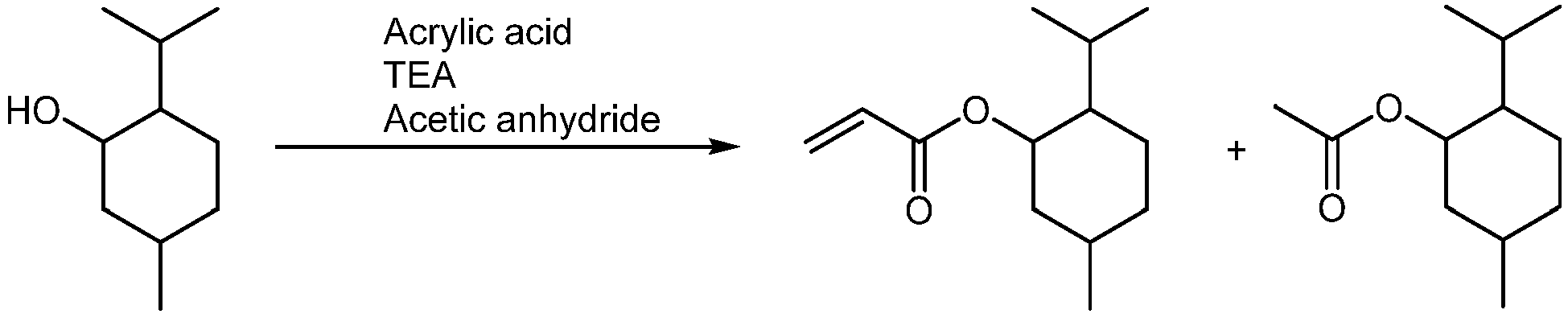
- Acrylic acid ester of the above structure was obtained by the same method as Example 2, except that triethylamine(TEA) was used instead of TMEDA (yield: 66%, conversion: >99%, purity: >60%). It was confirmed that acetylated by-products were produced about 30%, as the result of the reaction.
- Into a 100ml flask, 2.3g (30mmol) of t-BuOH), 4.2g (33mmol) of acrylic anhydride, and 200ppm of polymerization inhibitor MEHQ (4-methoxyphenol) were introduced, and stirred at 60°C for 10 hours, and conversion was confirmed through TLC and GC. After termination of the reaction, hexane was introduced into the resulting reactant, and the mixture was stirred to extract. The hexane layer at the upper part of the extract was separated, and the organic salt layer at the lower part was extracted once again using hexane. The collected hexane layer was washed once with water. The residual moisture in the hexane layer was removed with MgSO4, and then, hexane was removed through vacuum distillation, thus obtaining acrylic acid ester of the same structure as Example 1 (conversion : <5%).
Claims (15)
- A method for preparing a (meth)acrylic acid ester-based compound of the following Chemical Formula 1, comprising the step of reacting an alcohol-based compound of the following Chemical Formula 2 and a (meth)acrylic acid-based compound of the following Chemical Formula 3, in the presence of a diamine-based compound of the following Chemical Formula 4 and an acid anhydride of the following Chemical Formula 5:


 R11 to R13 are each independently, hydrogen, substituted or unsubstituted C1-20 alkyl, or substituted or unsubstituted C3-20 cycloalkyl, or two neighboring functional groups are linked to form an alicyclic structure,R14 is hydrogen or methyl,R21 to R24 are each independently, hydrogen, or substituted or unsubstituted C1-10 alkyl,R25 is substituted or unsubstituted C1-10 alkylene,R31 and R32 are each independently, hydrogen or methyl,R41 and R42 are each independently, substituted or unsubstituted C1-10 alkylene,m and n are each independently, an integer of 0 or 1, provided that when both m and n are 0, each of R31 and R32 is methyl.
 - The method according to claim 1, wherein R11 to R13 are each independently, hydrogen, substituted or unsubstituted C1-20 alkyl, or substituted or unsubstituted C3-20 cycloalkyl, or two neighboring functional groups are linked to form an alicyclic structure, provided that two or more of R11 to R13 are not simultaneously hydrogen.
- The method according to claim 1, wherein the alcohol-based compound is a compound of the Chemical Formula 2 in which R11 to R13 are each independently C1-6 linear or branched alkyl, or C3-6 cycloalkyl; or a compound of the Chemical Formula 2 in which R11 is hydrogen, and R12 and R13 are linked with each other to form a C6-10 alicyclic structure unsubstituted or substituted with C1-6 alkyl.
- The method according to claim 1, wherein the alcohol-based compound is butanol or menthol.
- The method according to claim 1, wherein the (meth)acrylic acid-based compound is acrylic acid.
- The method according to claim 1, wherein the (meth)acrylic acid-based compound is used at a mole ratio of 1 to 3, based on 1mole of the alcohol-based compound.
- The method according to claim 1, wherein the diamine-based compound is a compound of the Chemical Formula 4, in which R21 to R24 are each independently, hydrogen; or C1-10 alkyl unsubstituted or substituted with C1-6 alkyl or C3-6 cycloalkyl; and, R25 is C1-10 alkylene unsubstituted or substituted with C1-6 alkyl or C3-6 cycloalkyl.
- The method according to claim 1, wherein the diamine-based compound is N,N,N',N'-tetramethylethylenediamine, N,N-dimethylethylene-1,2-diamine, N,N,N',N'-tetramethylpropylenediamine, or N,N,N',N'-tetramethylbutylenediamine.
- The method according to claim 1, wherein the diamine-based compound is used at a mole ratio of 0.5 to 1.5, based on 1 mole of the alcohol-based compound.
- The method according to claim 1, wherein the acid anhydride is a compound of the Chemical Formula 5, in which R31 and R32 are each independently, hydrogen or methyl, R41 and R42 are each independently, substituted or unsubstituted C1-6 alkylene, and m and n are each independently, an integer of 0 or 1, provided that when both m and n are 0, each of R31 and R32 is methyl.
- The method according to claim 1, wherein the acid anhydride is acetic anhydride.
- The method according to claim 1, wherein the acid anhydride is used at a mole ratio of 1 to 1.5, based on 1 mole of the alcohol-based compound.
- The method according to claim 1, wherein the reaction is conducted through step 1 in which the alcohol-based compound and the (meth)acrylic acid-based compound are mixed; step 2 in which the mixture obtained as the result of the step 1 is mixed with the diamine-based compound, and reacted; and step 3 in which the reactant obtained as the result of step 2 is mixed with the acid anhydride, and reacted,
the step 1 and the step 2 are conducted at a temperature of 0°C or less, and
the step 3 is conducted at 50 to 80 °C. - The method according to claim 13, wherein the reactant obtained as the result of the step 2 comprises acryl-diaminoalkane cation.
- The method according to claim 1, further comprising an extraction purification process with hexane, after the reaction.
Applications Claiming Priority (3)
| Application Number | Priority Date | Filing Date | Title |
|---|---|---|---|
| KR20190054493 | 2019-05-09 | ||
| KR1020200017053A KR102371579B1 (en) | 2019-05-09 | 2020-02-12 | Method for preparing (meth)acrylic acid ester based compound |
| PCT/KR2020/002019 WO2020226271A1 (en) | 2019-05-09 | 2020-02-13 | Method for preparing (meth)acrylic acid ester-based compound |
Publications (3)
| Publication Number | Publication Date |
|---|---|
| EP3778546A1 true EP3778546A1 (en) | 2021-02-17 |
| EP3778546A4 EP3778546A4 (en) | 2021-06-30 |
| EP3778546B1 EP3778546B1 (en) | 2021-11-24 |
Family
ID=73697310
Family Applications (1)
| Application Number | Title | Priority Date | Filing Date |
|---|---|---|---|
| EP20800538.9A Active EP3778546B1 (en) | 2019-05-09 | 2020-02-13 | Method for preparing (meth)acrylic acid ester-based compound |
Country Status (5)
| Country | Link |
|---|---|
| US (1) | US11198666B2 (en) |
| EP (1) | EP3778546B1 (en) |
| JP (1) | JP7130303B2 (en) |
| KR (1) | KR102371579B1 (en) |
| CN (1) | CN112218848B (en) |
Families Citing this family (1)
| Publication number | Priority date | Publication date | Assignee | Title |
|---|---|---|---|---|
| KR102813526B1 (en) * | 2020-11-25 | 2025-05-26 | 주식회사 엘지화학 | Method for preparing (meth)acrylic acid aryl ester |
Family Cites Families (15)
| Publication number | Priority date | Publication date | Assignee | Title |
|---|---|---|---|---|
| JP4369568B2 (en) | 1999-10-05 | 2009-11-25 | 三菱レイヨン株式会社 | Method for producing hydroxyalkyl methacrylate |
| JP3463876B2 (en) * | 2000-10-23 | 2003-11-05 | 株式会社日本触媒 | Vinyl ether group-containing (meth) acrylate composition and method for producing the same |
| EP1201641B1 (en) | 2000-10-23 | 2013-08-14 | Nippon Shokubai Co., Ltd. | Composition of vinyl ether group containing (meth)acrylic acid ester and production method thereof |
| FR2934261B1 (en) | 2008-07-25 | 2015-04-10 | Arkema France | PROCESS FOR THE SYNTHESIS OF ESTERS OF ACRYLIC ACID |
| EP2308820B1 (en) * | 2008-08-05 | 2016-12-28 | Mitsubishi Rayon Co., Ltd. | Method for producing (meth)acrylic acid anhydride, method for storing (meth)acrylic acid anhydride, and method for producing (meth)acrylate ester |
| WO2010090258A1 (en) * | 2009-02-05 | 2010-08-12 | 三菱レイヨン株式会社 | Method for producing (meth)acrylate ester |
| JP5393757B2 (en) | 2010-12-22 | 2014-01-22 | 富士フイルム株式会社 | NOVEL COMPOUND AND PROCESS FOR PRODUCING THE SAME |
| KR101659915B1 (en) * | 2012-08-29 | 2016-09-26 | 금호석유화학 주식회사 | Novel acryl monomer, polymer and resist composition comprising same |
| JP2014091725A (en) | 2012-11-06 | 2014-05-19 | Daicel Corp | Method for producing (meth)acrylic acid ester |
| KR101447497B1 (en) * | 2012-12-26 | 2014-10-06 | 금호석유화학 주식회사 | Novel acryl monomer, polymer and resist composition comprising the same |
| RU2661899C2 (en) | 2014-06-12 | 2018-07-23 | Мицубиси Кемикал Корпорейшн | Method of producing a (met)acrylic acid ester and the method of production of an aromatic carboxylic acid ester |
| JP2016023153A (en) | 2014-07-18 | 2016-02-08 | 株式会社クラレ | Acrylic acid ester derivative and method for producing the same |
| JP6633612B2 (en) * | 2015-03-12 | 2020-01-22 | 株式会社クラレ | Method for producing (meth) acrylate compound |
| JP7137911B2 (en) | 2015-08-20 | 2022-09-15 | 住友化学株式会社 | RESIN, RESIST COMPOSITION AND METHOD FOR MANUFACTURING RESIST PATTERN |
| JP6614996B2 (en) * | 2016-02-18 | 2019-12-04 | 株式会社トクヤマデンタル | Method for producing polymerizable monomer |
-
2020
- 2020-02-12 KR KR1020200017053A patent/KR102371579B1/en active Active
- 2020-02-13 CN CN202080002717.3A patent/CN112218848B/en active Active
- 2020-02-13 EP EP20800538.9A patent/EP3778546B1/en active Active
- 2020-02-13 US US17/053,588 patent/US11198666B2/en active Active
- 2020-02-13 JP JP2020565412A patent/JP7130303B2/en active Active
Also Published As
| Publication number | Publication date |
|---|---|
| CN112218848B (en) | 2023-10-31 |
| US20210130279A1 (en) | 2021-05-06 |
| CN112218848A (en) | 2021-01-12 |
| JP2021526518A (en) | 2021-10-07 |
| JP7130303B2 (en) | 2022-09-05 |
| EP3778546B1 (en) | 2021-11-24 |
| KR20200130079A (en) | 2020-11-18 |
| US11198666B2 (en) | 2021-12-14 |
| KR102371579B1 (en) | 2022-03-07 |
| EP3778546A4 (en) | 2021-06-30 |
Similar Documents
| Publication | Publication Date | Title |
|---|---|---|
| JP5804472B2 (en) | Ester production method | |
| US10421705B2 (en) | Carboxylic acid ester production method | |
| JP6747560B2 (en) | Method for producing carboxylic acid ester | |
| CA2913520A1 (en) | Synthesis of alpha, beta-unsaturated carboxylic acid (meth)acrylates from olefins and co2 | |
| JPH0714897B2 (en) | Process for producing sterically hindered hydroxyphenylcarboxylic acid ester | |
| EP3778546B1 (en) | Method for preparing (meth)acrylic acid ester-based compound | |
| KR100190784B1 (en) | Process for preparing organic esters and amides and catalyst system therefor | |
| JP2008001704A (en) | Method for producing glycerol carbonate ester (II) | |
| KR20040084915A (en) | Novel boronate esters | |
| JP6025476B2 (en) | Process for producing ethylenically unsaturated group-containing isocyanate compound | |
| JP2612996B2 (en) | Method for producing isocyanurate containing organosilicon group | |
| WO2013073596A1 (en) | Optically active bisoxazoline compound, asymmetric catalyst, and method for producing optically active cyclopropane compound using said catalyst | |
| WO2020226271A1 (en) | Method for preparing (meth)acrylic acid ester-based compound | |
| JP2004506597A (en) | Method for producing symmetrical anhydrides | |
| TW201934527A (en) | Method for producing halogen compound, method for producing potassium salt, and potassium salt | |
| KR102813526B1 (en) | Method for preparing (meth)acrylic acid aryl ester | |
| KR101872044B1 (en) | A method to prepare beta-functionalized aliphatic esters | |
| KR102352033B1 (en) | Process for preparing tetrahydroindenes | |
| EP0111950A2 (en) | Process for the preparation of bisphosphine dioxides | |
| JP5305580B2 (en) | Oxetane compounds | |
| RU1768604C (en) | Method of higher tetraalxoxysilanes synthesis | |
| JP4421153B2 (en) | Method for producing trialkanoyloxyboron | |
| JP4781048B2 (en) | Process for producing disubstituted β-ketoesters | |
| KR100594693B1 (en) | Method for preparing ester using diphosgene | |
| JP5623103B2 (en) | Process for producing N-acyl- (2S) -oxycarbonyl- (5R) -phosphonylpyrrolidine derivatives |
Legal Events
| Date | Code | Title | Description |
|---|---|---|---|
| STAA | Information on the status of an ep patent application or granted ep patent |
Free format text: STATUS: UNKNOWN |
|
| STAA | Information on the status of an ep patent application or granted ep patent |
Free format text: STATUS: THE INTERNATIONAL PUBLICATION HAS BEEN MADE |
|
| PUAI | Public reference made under article 153(3) epc to a published international application that has entered the european phase |
Free format text: ORIGINAL CODE: 0009012 |
|
| STAA | Information on the status of an ep patent application or granted ep patent |
Free format text: STATUS: REQUEST FOR EXAMINATION WAS MADE |
|
| 17P | Request for examination filed |
Effective date: 20201111 |
|
| AK | Designated contracting states |
Kind code of ref document: A1 Designated state(s): AL AT BE BG CH CY CZ DE DK EE ES FI FR GB GR HR HU IE IS IT LI LT LU LV MC MK MT NL NO PL PT RO RS SE SI SK SM TR |
|
| AX | Request for extension of the european patent |
Extension state: BA ME |
|
| A4 | Supplementary search report drawn up and despatched |
Effective date: 20210528 |
|
| RIC1 | Information provided on ipc code assigned before grant |
Ipc: C07C 69/54 20060101ALI20210521BHEP Ipc: C07C 67/08 20060101AFI20210521BHEP |
|
| GRAP | Despatch of communication of intention to grant a patent |
Free format text: ORIGINAL CODE: EPIDOSNIGR1 |
|
| STAA | Information on the status of an ep patent application or granted ep patent |
Free format text: STATUS: GRANT OF PATENT IS INTENDED |
|
| GRAS | Grant fee paid |
Free format text: ORIGINAL CODE: EPIDOSNIGR3 |
|
| DAV | Request for validation of the european patent (deleted) | ||
| DAX | Request for extension of the european patent (deleted) | ||
| INTG | Intention to grant announced |
Effective date: 20210923 |
|
| GRAA | (expected) grant |
Free format text: ORIGINAL CODE: 0009210 |
|
| STAA | Information on the status of an ep patent application or granted ep patent |
Free format text: STATUS: THE PATENT HAS BEEN GRANTED |
|
| AK | Designated contracting states |
Kind code of ref document: B1 Designated state(s): AL AT BE BG CH CY CZ DE DK EE ES FI FR GB GR HR HU IE IS IT LI LT LU LV MC MK MT NL NO PL PT RO RS SE SI SK SM TR |
|
| REG | Reference to a national code |
Ref country code: GB Ref legal event code: FG4D |
|
| REG | Reference to a national code |
Ref country code: AT Ref legal event code: REF Ref document number: 1449755 Country of ref document: AT Kind code of ref document: T Effective date: 20211215 |
|
| REG | Reference to a national code |
Ref country code: DE Ref legal event code: R096 Ref document number: 602020001109 Country of ref document: DE |
|
| REG | Reference to a national code |
Ref country code: IE Ref legal event code: FG4D |
|
| REG | Reference to a national code |
Ref country code: LT Ref legal event code: MG9D |
|
| REG | Reference to a national code |
Ref country code: NL Ref legal event code: MP Effective date: 20211124 |
|
| REG | Reference to a national code |
Ref country code: AT Ref legal event code: MK05 Ref document number: 1449755 Country of ref document: AT Kind code of ref document: T Effective date: 20211124 |
|
| PG25 | Lapsed in a contracting state [announced via postgrant information from national office to epo] |
Ref country code: RS Free format text: LAPSE BECAUSE OF FAILURE TO SUBMIT A TRANSLATION OF THE DESCRIPTION OR TO PAY THE FEE WITHIN THE PRESCRIBED TIME-LIMIT Effective date: 20211124 Ref country code: LT Free format text: LAPSE BECAUSE OF FAILURE TO SUBMIT A TRANSLATION OF THE DESCRIPTION OR TO PAY THE FEE WITHIN THE PRESCRIBED TIME-LIMIT Effective date: 20211124 Ref country code: FI Free format text: LAPSE BECAUSE OF FAILURE TO SUBMIT A TRANSLATION OF THE DESCRIPTION OR TO PAY THE FEE WITHIN THE PRESCRIBED TIME-LIMIT Effective date: 20211124 Ref country code: BG Free format text: LAPSE BECAUSE OF FAILURE TO SUBMIT A TRANSLATION OF THE DESCRIPTION OR TO PAY THE FEE WITHIN THE PRESCRIBED TIME-LIMIT Effective date: 20220224 Ref country code: AT Free format text: LAPSE BECAUSE OF FAILURE TO SUBMIT A TRANSLATION OF THE DESCRIPTION OR TO PAY THE FEE WITHIN THE PRESCRIBED TIME-LIMIT Effective date: 20211124 |
|
| PG25 | Lapsed in a contracting state [announced via postgrant information from national office to epo] |
Ref country code: IS Free format text: LAPSE BECAUSE OF FAILURE TO SUBMIT A TRANSLATION OF THE DESCRIPTION OR TO PAY THE FEE WITHIN THE PRESCRIBED TIME-LIMIT Effective date: 20220324 Ref country code: SE Free format text: LAPSE BECAUSE OF FAILURE TO SUBMIT A TRANSLATION OF THE DESCRIPTION OR TO PAY THE FEE WITHIN THE PRESCRIBED TIME-LIMIT Effective date: 20211124 Ref country code: PT Free format text: LAPSE BECAUSE OF FAILURE TO SUBMIT A TRANSLATION OF THE DESCRIPTION OR TO PAY THE FEE WITHIN THE PRESCRIBED TIME-LIMIT Effective date: 20220324 Ref country code: PL Free format text: LAPSE BECAUSE OF FAILURE TO SUBMIT A TRANSLATION OF THE DESCRIPTION OR TO PAY THE FEE WITHIN THE PRESCRIBED TIME-LIMIT Effective date: 20211124 Ref country code: NO Free format text: LAPSE BECAUSE OF FAILURE TO SUBMIT A TRANSLATION OF THE DESCRIPTION OR TO PAY THE FEE WITHIN THE PRESCRIBED TIME-LIMIT Effective date: 20220224 Ref country code: NL Free format text: LAPSE BECAUSE OF FAILURE TO SUBMIT A TRANSLATION OF THE DESCRIPTION OR TO PAY THE FEE WITHIN THE PRESCRIBED TIME-LIMIT Effective date: 20211124 Ref country code: LV Free format text: LAPSE BECAUSE OF FAILURE TO SUBMIT A TRANSLATION OF THE DESCRIPTION OR TO PAY THE FEE WITHIN THE PRESCRIBED TIME-LIMIT Effective date: 20211124 Ref country code: HR Free format text: LAPSE BECAUSE OF FAILURE TO SUBMIT A TRANSLATION OF THE DESCRIPTION OR TO PAY THE FEE WITHIN THE PRESCRIBED TIME-LIMIT Effective date: 20211124 Ref country code: GR Free format text: LAPSE BECAUSE OF FAILURE TO SUBMIT A TRANSLATION OF THE DESCRIPTION OR TO PAY THE FEE WITHIN THE PRESCRIBED TIME-LIMIT Effective date: 20220225 |
|
| PG25 | Lapsed in a contracting state [announced via postgrant information from national office to epo] |
Ref country code: SM Free format text: LAPSE BECAUSE OF FAILURE TO SUBMIT A TRANSLATION OF THE DESCRIPTION OR TO PAY THE FEE WITHIN THE PRESCRIBED TIME-LIMIT Effective date: 20211124 Ref country code: SK Free format text: LAPSE BECAUSE OF FAILURE TO SUBMIT A TRANSLATION OF THE DESCRIPTION OR TO PAY THE FEE WITHIN THE PRESCRIBED TIME-LIMIT Effective date: 20211124 Ref country code: RO Free format text: LAPSE BECAUSE OF FAILURE TO SUBMIT A TRANSLATION OF THE DESCRIPTION OR TO PAY THE FEE WITHIN THE PRESCRIBED TIME-LIMIT Effective date: 20211124 Ref country code: ES Free format text: LAPSE BECAUSE OF FAILURE TO SUBMIT A TRANSLATION OF THE DESCRIPTION OR TO PAY THE FEE WITHIN THE PRESCRIBED TIME-LIMIT Effective date: 20211124 Ref country code: EE Free format text: LAPSE BECAUSE OF FAILURE TO SUBMIT A TRANSLATION OF THE DESCRIPTION OR TO PAY THE FEE WITHIN THE PRESCRIBED TIME-LIMIT Effective date: 20211124 Ref country code: DK Free format text: LAPSE BECAUSE OF FAILURE TO SUBMIT A TRANSLATION OF THE DESCRIPTION OR TO PAY THE FEE WITHIN THE PRESCRIBED TIME-LIMIT Effective date: 20211124 Ref country code: CZ Free format text: LAPSE BECAUSE OF FAILURE TO SUBMIT A TRANSLATION OF THE DESCRIPTION OR TO PAY THE FEE WITHIN THE PRESCRIBED TIME-LIMIT Effective date: 20211124 |
|
| REG | Reference to a national code |
Ref country code: DE Ref legal event code: R097 Ref document number: 602020001109 Country of ref document: DE |
|
| PG25 | Lapsed in a contracting state [announced via postgrant information from national office to epo] |
Ref country code: MC Free format text: LAPSE BECAUSE OF FAILURE TO SUBMIT A TRANSLATION OF THE DESCRIPTION OR TO PAY THE FEE WITHIN THE PRESCRIBED TIME-LIMIT Effective date: 20211124 |
|
| PLBE | No opposition filed within time limit |
Free format text: ORIGINAL CODE: 0009261 |
|
| STAA | Information on the status of an ep patent application or granted ep patent |
Free format text: STATUS: NO OPPOSITION FILED WITHIN TIME LIMIT |
|
| REG | Reference to a national code |
Ref country code: BE Ref legal event code: MM Effective date: 20220228 |
|
| PG25 | Lapsed in a contracting state [announced via postgrant information from national office to epo] |
Ref country code: LU Free format text: LAPSE BECAUSE OF NON-PAYMENT OF DUE FEES Effective date: 20220213 Ref country code: AL Free format text: LAPSE BECAUSE OF FAILURE TO SUBMIT A TRANSLATION OF THE DESCRIPTION OR TO PAY THE FEE WITHIN THE PRESCRIBED TIME-LIMIT Effective date: 20211124 |
|
| 26N | No opposition filed |
Effective date: 20220825 |
|
| PG25 | Lapsed in a contracting state [announced via postgrant information from national office to epo] |
Ref country code: IE Free format text: LAPSE BECAUSE OF NON-PAYMENT OF DUE FEES Effective date: 20220213 |
|
| PG25 | Lapsed in a contracting state [announced via postgrant information from national office to epo] |
Ref country code: BE Free format text: LAPSE BECAUSE OF NON-PAYMENT OF DUE FEES Effective date: 20220228 |
|
| PG25 | Lapsed in a contracting state [announced via postgrant information from national office to epo] |
Ref country code: IT Free format text: LAPSE BECAUSE OF FAILURE TO SUBMIT A TRANSLATION OF THE DESCRIPTION OR TO PAY THE FEE WITHIN THE PRESCRIBED TIME-LIMIT Effective date: 20211124 |
|
| P01 | Opt-out of the competence of the unified patent court (upc) registered |
Effective date: 20230523 |
|
| REG | Reference to a national code |
Ref country code: CH Ref legal event code: PL |
|
| PG25 | Lapsed in a contracting state [announced via postgrant information from national office to epo] |
Ref country code: LI Free format text: LAPSE BECAUSE OF NON-PAYMENT OF DUE FEES Effective date: 20230228 Ref country code: CH Free format text: LAPSE BECAUSE OF NON-PAYMENT OF DUE FEES Effective date: 20230228 |
|
| PG25 | Lapsed in a contracting state [announced via postgrant information from national office to epo] |
Ref country code: MK Free format text: LAPSE BECAUSE OF FAILURE TO SUBMIT A TRANSLATION OF THE DESCRIPTION OR TO PAY THE FEE WITHIN THE PRESCRIBED TIME-LIMIT Effective date: 20211124 Ref country code: CY Free format text: LAPSE BECAUSE OF FAILURE TO SUBMIT A TRANSLATION OF THE DESCRIPTION OR TO PAY THE FEE WITHIN THE PRESCRIBED TIME-LIMIT Effective date: 20211124 |
|
| PG25 | Lapsed in a contracting state [announced via postgrant information from national office to epo] |
Ref country code: HU Free format text: LAPSE BECAUSE OF FAILURE TO SUBMIT A TRANSLATION OF THE DESCRIPTION OR TO PAY THE FEE WITHIN THE PRESCRIBED TIME-LIMIT; INVALID AB INITIO Effective date: 20200213 |
|
| PG25 | Lapsed in a contracting state [announced via postgrant information from national office to epo] |
Ref country code: TR Free format text: LAPSE BECAUSE OF FAILURE TO SUBMIT A TRANSLATION OF THE DESCRIPTION OR TO PAY THE FEE WITHIN THE PRESCRIBED TIME-LIMIT Effective date: 20211124 |
|
| PG25 | Lapsed in a contracting state [announced via postgrant information from national office to epo] |
Ref country code: MT Free format text: LAPSE BECAUSE OF FAILURE TO SUBMIT A TRANSLATION OF THE DESCRIPTION OR TO PAY THE FEE WITHIN THE PRESCRIBED TIME-LIMIT Effective date: 20211124 |
|
| PG25 | Lapsed in a contracting state [announced via postgrant information from national office to epo] |
Ref country code: SI Free format text: LAPSE BECAUSE OF FAILURE TO SUBMIT A TRANSLATION OF THE DESCRIPTION OR TO PAY THE FEE WITHIN THE PRESCRIBED TIME-LIMIT Effective date: 20211124 |
|
| PGFP | Annual fee paid to national office [announced via postgrant information from national office to epo] |
Ref country code: GB Payment date: 20260122 Year of fee payment: 7 |
|
| PGFP | Annual fee paid to national office [announced via postgrant information from national office to epo] |
Ref country code: DE Payment date: 20260120 Year of fee payment: 7 |
|
| PGFP | Annual fee paid to national office [announced via postgrant information from national office to epo] |
Ref country code: FR Payment date: 20260121 Year of fee payment: 7 |