EP3776261B1 - Systems and methods for image searching - Google Patents
Systems and methods for image searching Download PDFInfo
- Publication number
- EP3776261B1 EP3776261B1 EP19799936.0A EP19799936A EP3776261B1 EP 3776261 B1 EP3776261 B1 EP 3776261B1 EP 19799936 A EP19799936 A EP 19799936A EP 3776261 B1 EP3776261 B1 EP 3776261B1
- Authority
- EP
- European Patent Office
- Prior art keywords
- image
- images
- target
- range
- sub
- Prior art date
- Legal status (The legal status is an assumption and is not a legal conclusion. Google has not performed a legal analysis and makes no representation as to the accuracy of the status listed.)
- Active
Links
Images





Classifications
-
- G—PHYSICS
- G06—COMPUTING OR CALCULATING; COUNTING
- G06F—ELECTRIC DIGITAL DATA PROCESSING
- G06F16/00—Information retrieval; Database structures therefor; File system structures therefor
- G06F16/50—Information retrieval; Database structures therefor; File system structures therefor of still image data
- G06F16/58—Retrieval characterised by using metadata, e.g. metadata not derived from the content or metadata generated manually
- G06F16/583—Retrieval characterised by using metadata, e.g. metadata not derived from the content or metadata generated manually using metadata automatically derived from the content
-
- G—PHYSICS
- G06—COMPUTING OR CALCULATING; COUNTING
- G06F—ELECTRIC DIGITAL DATA PROCESSING
- G06F16/00—Information retrieval; Database structures therefor; File system structures therefor
- G06F16/50—Information retrieval; Database structures therefor; File system structures therefor of still image data
- G06F16/56—Information retrieval; Database structures therefor; File system structures therefor of still image data having vectorial format
-
- G—PHYSICS
- G06—COMPUTING OR CALCULATING; COUNTING
- G06F—ELECTRIC DIGITAL DATA PROCESSING
- G06F16/00—Information retrieval; Database structures therefor; File system structures therefor
- G06F16/70—Information retrieval; Database structures therefor; File system structures therefor of video data
-
- G—PHYSICS
- G06—COMPUTING OR CALCULATING; COUNTING
- G06F—ELECTRIC DIGITAL DATA PROCESSING
- G06F18/00—Pattern recognition
- G06F18/20—Analysing
- G06F18/21—Design or setup of recognition systems or techniques; Extraction of features in feature space; Blind source separation
- G06F18/211—Selection of the most significant subset of features
- G06F18/2113—Selection of the most significant subset of features by ranking or filtering the set of features, e.g. using a measure of variance or of feature cross-correlation
-
- G—PHYSICS
- G06—COMPUTING OR CALCULATING; COUNTING
- G06F—ELECTRIC DIGITAL DATA PROCESSING
- G06F18/00—Pattern recognition
- G06F18/20—Analysing
- G06F18/22—Matching criteria, e.g. proximity measures
Definitions
- the present disclosure generally relates to image searching, and more particularly, relates to systems and methods for searching a similar image to a target image.
- Image searching has become more difficult with the increase in the number of digital images.
- an image search engine e.g., a Google image search engine, a Baidu image search engine
- image searching based on textual meta-information may have limited accuracy because it is difficult to describe an image clearly using a keyword or tag.
- different people may assign different keywords or labels on a same image, which may lead to an inaccurate search result.
- a portion of the images in the set may have little or no textual meta-information, which may also affect the searching accuracy.
- Another approach for searching a similar image to a target image from the set is based on feature vectors of the target image and the images in the set.
- the degree of similarity between the target image and an image in the set may be determined by comparing the feature vector of the target image and the feature vector of the image.
- the efficiency of the approach based on the feature vectors may be reduced if the count of the images in the set is too large (e.g., greater than a threshold).
- a system may include at least one storage medium including a set of instructions, and at least one processor in communication with the at least one storage medium.
- the at least one processor may be directed to cause the system to obtain a target image and a plurality of images. At least one similar image to the target image may be searched from the plurality of images.
- the at least one processor may be directed to cause the system to determine a target feature vector of the target image and a feature vector of each of the plurality of images.
- Each of the target feature vector and the feature vectors may be an N-dimensional feature vector in an N-dimensional feature space.
- the at least one processor may be directed to cause the system to determine a search region in the N-dimensional feature space based on the target feature vector and a preset similarity range between the at least one similar image and the target image.
- the at least one processor may be directed to cause the system to determine one or more candidate images among the plurality of images.
- the feature vector of each candidate image may be within the search region.
- the at least one processor may be directed to cause the system to determine the at least one similar image to the target image among the one or more candidate images based on the preset similarity range, the target feature vector, and the one or more feature vectors of the one or more candidate images.
- the at least one processor may be directed to cause the system to determine a similarity degree between the target image and each of the one or more candidate images.
- the at least one processor may be directed to cause the system to select at least one candidate image among the one or more candidate images.
- the similarity degree of each selected candidate image may be within the preset similarity range.
- the at least one processor may be directed to cause the system to designate the at least one selected candidate image as the at least one similar image to the target image.
- the at least one processor may be directed to cause the system to rank the plurality of similar images according to the similarity degree between each similar image and the target image in a descending order to generate a first ranking result.
- the at least one processor may be directed to cause the system to transmit a display list including at least a portion of the plurality of similar images to a terminal device. The at least a portion of the plurality of similar images may be ranked according to the first ranking result in the display list.
- the target feature vector may include a target feature value in each dimension in the N-dimensional feature space.
- the at least one processor may be directed to cause the system to determine a geometrical distance range in the N-dimensional feature space corresponding to the preset similarity range.
- the at least one processor may be directed to cause the system to determine a coordinate range of the at least one similar image in each dimension. A difference between the target feature value in the dimension and each value in the coordinate range may be within the geometrical distance range.
- the at least one processor may be further directed to cause the system to determine the search region based on the coordinate range in each dimension.
- the at least one processor may be directed to cause the system to determine a geometrical distance range in the N-dimensional feature space corresponding to the preset similarity range.
- the geometrical distance range may be defined by a shortest geometrical distance and a longest geometrical distance.
- the at least one processor may also be directed to cause the system to determine a first coordinate range based on the shortest geometrical distance and the target feature value in the dimension. A difference between the target feature value in the dimension and each value in the first coordinate range may be smaller than the shortest geometrical distance.
- the at least one processor may be directed to cause the system to determine a second coordinate range based on the longest geometrical distance and the target feature value in the dimension.
- a difference between the target feature value in the dimension and each value in the second coordinate range may be smaller than the longest geometrical distance.
- the at least one processor may be further directed to cause the system to determine a first region defined by the first coordinate ranges in the N-dimensional feature space and a second region defined by the second coordinate ranges in the N-dimensional feature space.
- the at least one processor may be directed to cause the system to determine a region in the second region excluding the first region as the search region.
- the at least one processor may be directed to cause the system to divide the preset similarity range into a plurality of sub-ranges. For each of the plurality of sub-ranges, the at least one processor may be directed to cause the system to determine a sub-search region corresponding to the sub-range in the N-dimensional feature space based on the target feature vector.
- the search region may include plurality of sub-search regions corresponding to the plurality of sub-ranges.
- the at least one processor may be directed to cause the system to determine one or more first candidate images among the plurality of images for each of the plurality of sub-search regions, wherein the feature vector of each first candidate image may be within the corresponding sub-search region.
- the one or more candidate images may include the one or more first candidate images corresponding to each sub-search region.
- the at least one processor may be directed to cause the system to determine or obtain a similarity degree between the target image and each first candidate image corresponding to the sub-search region. For each of the plurality of sub-search regions, the at least one processor may be directed to cause the system to select one or more first candidate images among the one or more first candidate images corresponding to the sub-search region. The similar degree between each selected first candidate image and the target image may be within the corresponding sub-range. For each of the plurality of sub-search regions, the at least one processor may be directed to cause the system to designate the one or more selected first candidate images as one or more similar images of the at least one similar image to the target image.
- the at least one processor may be directed to cause the system to rank the plurality of sub-ranges to generate a second ranking result.
- the at least one processor may be directed to cause the system to sequentially determine the sub-search region for each of the plurality of sub-ranges according to the second ranking result.
- the at least one processor may be directed to cause the system to store the feature vectors of the plurality of images into a table.
- the table may include a plurality of rows and N columns, each row representing an image of the plurality of images, and each column representing a dimension in the N-dimensional feature space.
- the at least one processor may be directed to cause the system to create an index for each of the N columns of the table.
- the at least one processor may be directed to cause the system to select the one or more candidate images among the plurality of images based on the search region and the indexes of the table.
- the feature vector of each candidate image may be within the search region.
- a method may be implemented on a device having at least one storage medium including a set of instructions, and at least one processor in communication with the at least one storage medium.
- the method may include obtaining a target image and a plurality of images. At least one similar image to the target image may be to be searched from the plurality of images.
- the method may include determining a target feature vector of the target image and a feature vector of each of the plurality of images. Each of the target feature vector and the feature vectors may be an N-dimensional feature vector in an N-dimensional feature space.
- the method may also include determining a search region in the N-dimensional feature space based on the target feature vector and a preset similarity range between the at least one similar image and the target image.
- the method may include determining one or more candidate images among the plurality of images.
- the feature vector of each candidate image may be within the search region.
- the method may further include determining the at least one similar image to the target image among the one or more candidate images based on the preset similarity range, the target feature vector, and the one or more feature vectors of the one or more candidate images.
- a non-transitory computer readable medium may comprise at least one set of instructions for image searching, wherein when executed by at least one processor of a system, the at least one set of instructions may direct the system to obtain a target image and a plurality of images. At least one similar image to the target image may be to be searched from the plurality of images.
- the at least one set of instructions may direct the system to determine a target feature vector of the target image and a feature vector of each of the plurality of images.
- Each of the target feature vector and the feature vectors may be an N-dimensional feature vector in an N-dimensional feature space.
- the at least one set of instructions may direct the system to determine a search region in the N-dimensional feature space based on the target feature vector and a preset similarity range between the at least one similar image and the target image.
- the at least one set of instructions may direct the system to determine one or more candidate images among the plurality of images.
- the feature vector of each candidate image may be within the search region.
- the at least one set of instructions may direct the system to determine the at least one similar image to the target image, among the one or more candidate images, based on the preset similarity range, the target feature vector, and the one or more feature vectors of the one or more candidate images.
- a system for image searching may include an obtaining module, a feature vector determination module, a search region determination module, a candidate image determination module, and a similar image determination module.
- the obtaining module may be configured to obtain a target image and a plurality of images, wherein at least one similar image to the target image is to be searched from the plurality of images.
- the feature vector determination module may be configured to determine a target feature vector of the target image and a feature vector of each of the plurality of images, each of the target feature vector and the feature vectors being an N-dimensional feature vector in an N-dimensional feature space.
- the search region determination module may be configured to determine a search region in the N-dimensional feature space based on the target feature vector and a preset similarity range between the at least one similar image and the target image.
- the candidate image determination module may be configured to determine one or more candidate images among the plurality of images, wherein the feature vector of each candidate image is within the search region.
- the similar image determination module may be configured to determine the at least one similar image to the target image among the one or more candidate images based on the preset similarity range, the target feature vector, and the one or more feature vectors of the one or more candidate images.
- system engine
- unit unit
- module module
- block block
- module refers to logic embodied in hardware or firmware, or to a collection of software instructions.
- a module, a unit, or a block described herein may be implemented as software and/or hardware and may be stored in any type of non-transitory computer-readable medium or another storage device.
- a software module/unit/block may be compiled and linked into an executable program. It will be appreciated that software modules can be callable from other modules/units/blocks or from themselves, and/or may be invoked in response to detected events or interrupts.
- Software modules/units/blocks configured for execution on computing devices (e.g., processor 201 as illustrated in FIG.
- a computer-readable medium such as a compact disc, a digital video disc, a flash drive, a magnetic disc, or any other tangible medium, or as a digital download (and can be originally stored in a compressed or installable format that needs installation, decompression, or decryption prior to execution).
- Such software code may be stored, partially or fully, on a storage device of the executing computing device, for execution by the computing device.
- Software instructions may be embedded in firmware, such as an EPROM.
- hardware modules/units/blocks may be included in connected logic components, such as gates and flip-flops, and/or can be included of programmable units, such as programmable gate arrays or processors.
- modules/units/blocks or computing device functionality described herein may be implemented as software modules/units/blocks, but may be represented in hardware or firmware.
- the modules/units/blocks described herein refer to logical modules/units/blocks that may be combined with other modules/units/blocks or divided into sub-modules/subunits/sub-blocks despite their physical organization or storage. The description may be applicable to a system, an engine, or a portion thereof.
- the invention relates to systems and methods for image searching.
- the systems and methods may obtain a target image and a plurality of images, wherein at least one similar image to the target image is to be searched from the plurality of images.
- the systems and methods may determine a target feature vector of the target image and a feature vector of each of the images, each of the target feature vector and the feature vectors being an N-dimensional feature vector in an N-dimensional feature space.
- the systems and methods may also determine a search region in the N-dimensional feature space based on the target feature vector and a preset similarity range between the at least one similar image and the target image.
- the systems and methods further determine one or more candidate images among the plurality of images, wherein the feature vector of each candidate image is within the search region.
- the systems and methods may further select the at least one similar image to the target image from the one or more candidate images based on the preset similarity range, the target feature vector, and the one or more feature vectors of the one or more candidate images.
- At least one similar image to a target image may be search from a set of images based on a target feature vector of the target image and a feature vector of each image in the set.
- a search region in the N-dimensional feature space may be determined based on the preset similarity range.
- An image in the set whose feature vector is within the search region may be determined as a candidate image for further analysis, while an image in the set whose feature vector is outside the search region may be omitted from further analysis. This may reduce computational amount and improve searching efficiency.
- the preset similarity range is divided into a plurality of sub-ranges. The systems and methods may process the sub-ranges in parallel or in sequence to determine one or more similar images that satisfies each sub-range. This may further improve searching efficiency.
- FIG. 1 is a schematic diagram illustrating an exemplary image searching system 100 according to some embodiments of the present disclosure.
- the image searching system 100 may include a processing device 120, a network 130, a terminal device 140, a storage device 150, and an image acquisition device 170.
- the processing device 120 may be process information and/or data relating to the image searching system 100 to perform one or more functions described in the present disclosure. For example, the processing device 120 obtain a target image 180 and an image set including an image I 1 , an image I 2 , ... ... , and an image I n as shown in FIG. 1 .
- the target image 180 and/or the image set may be obtained from an external source and/or one or more components of the image searching system 100, such as the terminal device 140, the storage device 150, and/or an image acquisition device 170.
- the processing device 120 may further search one or more similar images 160 that are similar to the target image 180 from the image set.
- the processing device 120 may be a single server or a server group.
- the server group may be centralized or distributed.
- the processing device 120 may be local to or remote from the image searching system 100.
- the processing device 120 may access information and/or data from the terminal device 140, the storage device 150, and/or the image acquisition device 170 via the network 130.
- the processing device 120 may be directly connected to the terminal device 140, the storage device 150, and/or the image acquisition device 170 to access information and/or data.
- the processing device 120 may be implemented on a cloud platform.
- the cloud platform may include a private cloud, a public cloud, a hybrid cloud, a community cloud, a distributed cloud, an inter-cloud, a multi-cloud, or the like, or a combination thereof.
- the processing device 120 may be implemented by a computing device 200 having one or more components as described in connection with FIG. 2 .
- the processing device 120 may include one or more processors (e.g., single-core processor(s) or multi-core processor(s)) to perform operations disclosed in this disclosure.
- the processor(s) may include a microcontroller, a microprocessor, a reduced instruction set computer (RISC), an application specific integrated circuits (ASICs), an application-specific instruction-set processor (ASIP), a central processing unit (CPU), a graphics processing unit (GPU), a physics processing unit (PPU), a microcontroller unit, a digital signal processor (DSP), a field programmable gate array (FPGA), an advanced RISC machine (ARM), a programmable logic device (PLD), any circuit or processor capable of executing one or more functions, or the like, or any combinations thereof.
- the processing device 120 may include a microprocessor to process a video/image captured by the image acquisition device 170.
- the network 130 may include any suitable network that can facilitate the exchange of information and/or data for the image searching system 100.
- one or more components of the image searching system 100 e.g., the processing device 120, the storage device 150, the terminal device 140
- the processing device 120 may obtain images from the storage device 150 via the network 130.
- the processing device 120 may obtain user instruction(s) from the terminal device 140 via the network 130.
- the network 130 may be or include a public network (e.g., the Internet), a private network (e.g., a local area network (LAN)), a wired network, a wireless network (e.g., an 802.11 network, a Wi-Fi network), a frame relay network, a virtual private network (VPN), a satellite network, a telephone network, routers, hubs, switches, server computers, and/or any combination thereof.
- a public network e.g., the Internet
- a private network e.g., a local area network (LAN)
- a wireless network e.g., an 802.11 network, a Wi-Fi network
- a frame relay network e.g., a frame relay network
- VPN virtual private network
- satellite network e.g., a satellite network, a telephone network, routers, hubs, switches, server computers, and/or any combination thereof.
- the network 130 may include a cable network, a wireline network, a fiber-optic network, a telecommunications network, an intranet, a wireless local area network (WLAN), a metropolitan area network (MAN), a public telephone switched network (PSTN), a Bluetooth TM network, a ZigBee TM network, a near field communication (NFC) network, or the like, or any combination thereof.
- the network 130 may include one or more network access points.
- the network 130 may include wired and/or wireless network access points such as base stations and/or internet exchange points through which one or more components of the image searching system 100 may be connected to the network 130 to exchange data and/or information.
- the terminal device 140 may enable a user interaction between a user and one or more components of the image searching system 100, such as the processing device 120 and/or the storage device 150. For example, the user may input a search request to search similar images to the target image 180 via the terminal device 140. Additionally or alternatively, the terminal device 140 may display the one or more similar images 160 of the target image 180 to the user.
- the terminal device 140 may include a mobile device 141, a tablet computer 142, a laptop computer 143, or the like, or any combination thereof.
- the mobile device 141 may include a mobile phone, a personal digital assistant (PDA), a gaming device, a navigation device, a point of sale (POS) device, a laptop, a tablet computer, a desktop, or the like, or any combination thereof.
- the terminal device 140 may include an input device, an output device, etc. In some embodiments, the terminal device 140 may be part of the processing device 120.
- the storage device 150 may store data, instructions, and/or any other information. In some embodiments, the storage device 150 may store data obtained from the processing device 120, the terminal device 140, and/or image acquisition device 170. In some embodiments, the storage device 150 may store data and/or instructions that the processing device 120 may execute or use to perform exemplary methods described in the present disclosure. In some embodiments, the storage device 150 may include a mass storage device, a removable storage device, a volatile read-and-write memory, a read-only memory (ROM), or the like, or any combination thereof. Exemplary mass storage devices may include a magnetic disk, an optical disk, a solid-state drive, etc.
- Exemplary removable storage devices may include a flash drive, a floppy disk, an optical disk, a memory card, a zip disk, a magnetic tape, etc.
- Exemplary volatile read-and-write memory may include a random access memory (RAM).
- Exemplary RAM may include a dynamic RAM (DRAM), a double date rate synchronous dynamic RAM (DDR SDRAM), a static RAM (SRAM), a thyristor RAM (T-RAM), and a zero-capacitor RAM (Z-RAM), etc.
- DRAM dynamic RAM
- DDR SDRAM double date rate synchronous dynamic RAM
- SRAM static RAM
- T-RAM thyristor RAM
- Z-RAM zero-capacitor RAM
- Exemplary ROM may include a mask ROM (MROM), a programmable ROM (PROM), an erasable programmable ROM (EPROM), an electrically erasable programmable ROM (EEPROM), a compact disk ROM (CD-ROM), and a digital versatile disk ROM, etc.
- MROM mask ROM
- PROM programmable ROM
- EPROM erasable programmable ROM
- EEPROM electrically erasable programmable ROM
- CD-ROM compact disk ROM
- digital versatile disk ROM etc.
- the storage device 150 may be implemented on a cloud platform as described elsewhere in the disclosure.
- the storage device 150 may be connected to the network 130 to communicate with one or more other components of the image searching system 100 (e.g., the processing device 120, the terminal device 140). One or more components of the image searching system 100 may access the data or instructions stored in the storage device 150 via the network 130. In some embodiments, the storage device 150 may be part of the processing device 120.
- the image acquisition device 170 may be and/or include any suitable device that is capable of acquiring image data.
- Exemplary image acquisition device 170 may include a camera (e.g., a digital camera, an analog camera, an IP camera (IPC), etc.), a video recorder, a scanner, a mobile phone, a tablet computing device, a wearable computing device, an infrared imaging device (e.g., a thermal imaging device), or the like.
- the image acquisition device 170 may include a gun camera, a dome camera, an integrated camera, a binocular camera, a monocular camera, etc.
- the image data acquired by the image acquisition device 170 may include an image, or any data about an image, such as values of one or more pixels (or referred to as pixel values) of an image (e.g., luma, gray values, intensities, chrominance, contrast of one or more pixels of an image), RGB data, audio information, timing information, location data, etc.
- the image acquisition device 170 may include a charge-coupled device (CCD), a complementary metal-oxide-semiconductor (CMOS) sensor, an N-type metal-oxide-semiconductor (NMOS), a contact image sensor (CIS), and/or any other suitable image sensor.
- CCD charge-coupled device
- CMOS complementary metal-oxide-semiconductor
- NMOS N-type metal-oxide-semiconductor
- CIS contact image sensor
- the image searching system 100 may include one or more additional components. Additionally or alternatively, one or more components of the image searching system 100 described above, such as the terminal device 140 and/or the image acquisition device 170 may be omitted. As another example, two or more components of the image searching system 100 may be integrated into a single component.
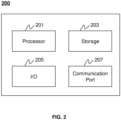
- FIG. 2 is a schematic diagram illustrating exemplary hardware and/or software components of an exemplary computing device 200 according to some embodiments of the present disclosure.
- the computing device 200 may be used to implement any component of the image searching system 100 as described herein.
- the processing device 120 and/or the terminal device 140 may be implemented on the computing device 200, via its hardware, software program, firmware, or a combination thereof.
- the computer functions relating to the image searching system 100 as described herein may be implemented in a distributed fashion on a number of similar platforms, to distribute the processing load.
- the computing device 200 may include a processor 201, a storage 203, an input/output (I/O) 205, and a communication port 207.
- the processor 201 may execute computer instructions (e.g., program code) and perform functions of the image searching system 100 in accordance with techniques as described elsewhere in the present disclosure.
- the computer instructions may include, for example, routines, programs, objects, components, data structures, procedures, modules, and functions, which perform particular functions as described elsewhere in the present disclosure.
- the processor 201 may determine one or more similar images to a target image.
- the processor 201 may include interface circuits and processing circuits therein.
- the interface circuits may be configured to receive electronic signals from the communication port 207, wherein the electronic signals encode structured data and/or instructions for the processing circuits to process.
- the processing circuits may conduct logic calculations, and then determine a conclusion, a result, and/or an instruction encoded as electronic signals. Then the interface circuits may send out the electronic signals from the processing circuits via the communication port 207.
- the processor 201 may include one or more hardware processors, such as a microcontroller, a microprocessor, a reduced instruction set computer (RISC), an application specific integrated circuits (ASICs), an application-specific instruction-set processor (ASIP), a central processing unit (CPU), a graphics processing unit (GPU), a physics processing unit (PPU), a microcontroller unit, a digital signal processor (DSP), a field-programmable gate array (FPGA), an advanced RISC machine (ARM), a programmable logic device (PLD), any circuit or processor capable of executing one or more functions, or the like, or any combinations thereof.
- RISC reduced instruction set computer
- ASICs application specific integrated circuits
- ASIP application-specific instruction-set processor
- CPU central processing unit
- GPU graphics processing unit
- PPU physics processing unit
- DSP digital signal processor
- FPGA field-programmable gate array
- ARM advanced RISC machine
- PLD programmable logic device
- processors may be described in the computing device 200.
- the computing device 200 of the present disclosure may also include multiple processors, and thus operations and/or method steps that are performed by one processor as described in the present disclosure may also be jointly or separately performed by the multiple processors.
- the processor of the computing device 200 executes both operations A and operation B
- operation A and operation B may also be performed by two or more different processors jointly or separately in the computing device 200 (e.g., a first processor executes operation A and a second processor executes operation B, or vice versa, or the first and second processors jointly execute operations A and B).
- the storage 203 may store data/information obtained from one or more components of the image searching system 100.
- the storage 203 may include a mass storage device, a removable storage device, a volatile read-and-write memory, a read-only memory (ROM), or the like, or any combination thereof.
- the mass storage device may include a magnetic disk, an optical disk, solid-state drives, etc.
- the removable storage device may include a flash drive, a floppy disk, an optical disk, a memory card, a zip disk, a magnetic tape, etc.
- the volatile read-and-write memory may include a random access memory (RAM).
- the RAM may include a dynamic RAM (DRAM), a double date rate synchronous dynamic RAM (DDR SDRAM), a static RAM (SRAM), a thyristor RAM (T-RAM), and a zero-capacitor RAM (Z-RAM), etc.
- the ROM may include a mask ROM (MROM), a programmable ROM (PROM), an erasable programmable ROM (EPROM), an electrically-erasable programmable ROM (EEPROM), a compact disk ROM (CD-ROM), and a digital versatile disk ROM, etc.
- the storage 203 may store one or more programs and/or instructions to perform exemplary methods described in the present disclosure.
- the storage 203 may store a program for determining one or more similar images to a target image.
- the I/O 205 may input and/or output signals, data, information, etc. In some embodiments, the I/O 205 may enable a user interaction with the computing device 200. In some embodiments, the I/O 205 may include or communicate with an input device and an output device to facilitate communication between the computing device 200 and an input device or an output device. Examples of the input device may include a keyboard, a mouse, a touch screen, a microphone, or the like, or any combination thereof. Examples of the output device may include a display device, a loudspeaker, a printer, a projector, or the like, or any combination thereof.
- Examples of the display device may include a liquid crystal display (LCD), a light-emitting diode (LED)-based display, a flat panel display, a curved screen, a television device, a cathode ray tube (CRT), a touch screen, or the like, or any combination thereof.
- LCD liquid crystal display
- LED light-emitting diode
- flat panel display a flat panel display
- curved screen a television device
- CTR cathode ray tube
- touch screen or the like, or any combination thereof.
- the communication port 207 may be connected to a network (e.g., the network 130) to facilitate data communications.
- the communication port 207 may establish connections between the computing device 200 and one or more other components of the image searching system 100 or an external source.
- the connection may be a wired connection, a wireless connection, any other communication connection that can enable data transmission and/or reception, and/or any combination of these connections.
- the wired connection may include, for example, an electrical cable, an optical cable, a telephone wire, or the like, or any combination thereof.
- the wireless connection may include, for example, a Bluetooth TM link, a Wi-Fi TM link, a WiMax TM link, a WLAN link, a ZigBee link, a mobile network link (e.g., 3G, 4G, 5G, etc.), or the like, or any combination thereof.
- the communication port 207 may be and/or include a standardized communication port, such as RS232, RS485, etc. In some embodiments, the communication port 207 may be a specially designed communication port.
- FIG. 3 is a schematic diagram illustrating exemplary components of an exemplary user terminal 300 according to some embodiments of the present disclosure.
- one or more components e.g., a terminal device 140
- the image searching system 100 may be implemented on the user terminal 300.
- the user terminal 300 may include a communication platform 320, a display 310, a graphics processing unit (GPU) 330, a central processing unit (CPU) 340, an I/O port 350, a memory 360, and a storage 390.
- any other suitable component including but not limited to a system bus or a controller (not shown), may also be included in the user terminal 300.
- a mobile operating system 370 e.g., iOS TM , Android TM , Windows Phone TM
- one or more applications 380 may be loaded into the memory 360 from the storage 390 in order to be executed by the CPU 340.
- computer hardware platforms may be used as the hardware platform(s) for one or more of the elements described herein.
- a computer with user interface elements may be used to implement a personal computer (PC) or any other type of work station or terminal device.
- PC personal computer
- a computer may also act as a server if appropriately programmed.
- FIG. 4 is a block diagram of an exemplary processing device 120 according to some embodiments of the present disclosure.
- the processing device 120 may include an obtaining module 410, a feature vector determination module 420, a search region determination module 430, a candidate image determination module 440, a similar image determination module 450, and a transmission module 460.
- a module may be implemented in many different ways and as hardware, software or in different combinations of hardware and software.
- all or parts of a module implementations may be a processing circuitry that may include part or all of an instruction processor, such as a central processing unit (CPU), a microcontroller, a microprocessor; or an application specific integrated circuit (ASIC), a digital signal processor (DSP), a digital signal processing device (DSPD), a programmable logic device (PLD), a field programmable gate array (FPGA), a controller, other electronic components; or as circuitry that includes discrete logic or other circuit components, including an analog circuit component, a digital circuit component or both; or any combination thereof.
- the circuitry may include discrete interconnected hardware components or may be combined on a single integrated circuit die, distributed among multiple integrated circuit dies, or implemented in a Multiple Chip Module (MCM) of multiple integrated circuit dies in a common package, as examples.
- MCM Multiple Chip Module
- the obtaining module 410 may obtain information and/or data related to the image searching system 100.
- the obtaining module 410 may obtain a target image.
- the target image may be an image of any biological object (e.g., a human being, an animal, a plant) and/or a non-biological object (e.g., a vehicle, a building).
- the obtaining module 410 may obtain a plurality of images, wherein at least one similar image to the target image is to be searched from the plurality of images.
- the obtaining module 410 may transmit the target image and/or the plurality of images to other modules of the processing device 120 for further processing.
- the obtaining module 410 may transmit the target image and the plurality of images to the feature vector determination module 420 for determining a target feature vector of the target image and a feature vector of each of the plurality of images.
- the obtaining module 410 may transmit the target image to the search region determination module 430 for determining a search region in a N-dimensional feature space based on the target feature vector and a preset similarity range between at least one similar image and the target image.
- the obtaining module 410 may transmit the plurality of images to the candidate image determination module 440 for determining one or more candidate images.
- the feature vector determination module 420 may be configured to determine the target feature vector of the target image and the feature vector of each of the plurality of images.
- Each of the target feature vector and the feature vectors may be an N-dimensional feature vector in an N-dimensional feature space.
- N may have be any suitable positive integer. Details regarding the determination of the target feature vector and the feature vectors may be found elsewhere in the present disclosure (e.g., operation 504 and the relevant descriptions thereof).
- the search region determination module 430 may be configured to determine the search region in the N-dimensional feature space.
- the search region may refer to a region in the N-dimensional feature space to be searched.
- the search region may be a space defined by a coordinate range in each dimension of the N-dimensional feature space.
- the search region determination module 430 may determine a coordinate range in each dimension based on the target feature vector and a preset similarity range between the at least one similar image and the target image.
- the preset similarity range may define a required range of a similarity degree between each similar image to be searched and the target image. Details regarding the determination of the search region may be found elsewhere in the present disclosure (e.g., operation 506 and the relevant descriptions thereof).
- the candidate image determination module 440 may be configured to determine one or more candidate images among the plurality of images.
- the feature vector of each candidate image may be within the search region.
- the candidate image determination module 440 may generate an index of the plurality of images, and determine the candidate image(s) according to the index of the images. Details regarding the determination of the candidate image(s) may be found elsewhere in the present disclosure (e.g., operation 508 and the relevant descriptions thereof).
- the similar image determination module 450 may be configured to determine the at least one similar image to the target image among the one or more candidate images based on the preset similarity range, the target feature vector, and the one or more feature vectors of the one or more candidate images. In some embodiments, the similar image determination module 450 may determine a candidate image as a similar image to the target image if the similarity degree between the candidate image and the target image is within the preset similarity range. Details regarding the determination of the at least one similar image may be found elsewhere in the present disclosure (e.g., operation 510 and the relevant descriptions thereof).
- the transmission module 460 may be configured to transmit a display list including at least a portion of the at least one similar image to a terminal device (e.g., a terminal device 140) for display.
- the at least one similar image may include a plurality of similar images to the target image.
- the display list may include at least a portion of the plurality of similar images.
- the transmission module 460 may rank the plurality of similar images according to a similarity degrees between each similar image and the target image in a descending order to generate a first ranking result.
- the transmission module 460 may further generate a display list including at least a portion of the similar images, wherein the at least a portion of the similar images in the display list are ranked according to the first ranking result.
- processing device 120 is merely provided for the purposes of illustration, and not intended to be understood as the only embodiment.
- various variations and modifications may be conduct under the teaching of some embodiments of the present disclosure. However, those variations and modifications may not depart from the protecting of some embodiments of the present disclosure.
- one or more of the modules mentioned above may be omitted.
- the transmission module 460 may be omitted.
- two or more of the modules may be combined into a single module, and any one of the modules may be divided into two or more units.
- the candidate image determination module 440 and the similar image determination module 450 may be integrated into a single module.
- the processing device 120 may further include one or more additional modules, such as a division module configured to divide the search region into a plurality of sub-search regions.
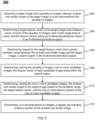
- FIG. 5 is a flow chart illustrating an exemplary process 500 for image searching according to some embodiments of the present disclosure.
- the process 500 may be implemented on the image searching system 100 as illustrated in FIG. 1 .
- the process 500 may be stored in a storage medium (e.g., the storage device 150, or the storage 203 of the computing device 200) as a form of instructions, and invoked and/or executed by the processing device 120 (e.g., the processor 201 of the computing device 200, the CPU 340 of the mobile device 300, and/or one or more modules illustrated in FIG. 4 ).
- the processing device 120 e.g., the processor 201 of the computing device 200, the CPU 340 of the mobile device 300, and/or one or more modules illustrated in FIG. 4 .
- the processing device 120 e.g., the obtaining module 410) (e.g., the interface circuits of the processor 201) may obtain a target image and a plurality of images, wherein at least one similar image to the target image is to be searched from the plurality of images.
- the target image may be a two-dimensional (2D) image, a three-dimensional (3D) image, a four-dimensional (4D), or any other type of image.
- the target image may be stored in any image format, such as a RAW format (e.g., unprocessed processed image data), a tagged input file format (TIFF), a joint photographic experts group format (JPEG), a graphics interchange format (GIF), or a bitmap format (BMP), or the like, or the combination thereof.
- the target image may be an image of any biological object (e.g., a human being, an animal, a plant) and/or a non-biological object (e.g., a vehicle, a building).
- the plurality of images may include images from which the at least one similar image is to be searched. Similar to the target image, the images may be of any type and stored in any image format.
- the images may be images of any biological object and/or a non-biological object. Different images may have the same image type (or format) or different image types (or formats).
- the images and the target image may be images of a same type of object, for example, both of the images and the target image are images of human beings.
- the images and the target image may be images of different types of objects.
- the target image and/or the images may be obtained from one or more components of the image searching system 100, such as the image acquisition device 170, a storage device (e.g., the storage device 150, the storage 203 of the computing device 200, the storage 390), the terminal device 140, or the like, or any combination thereof.
- the target image may be obtained from the terminal device 140, and the images may be obtained from the storage device 150.
- the target image and/or the images may be obtained from an external source via a network (e.g., the network 130).
- the processing device 120 may acquire the images from an external image database designated by a user.
- the processing device 120 may receive a search request to search the at least one similar image to the target image. In response to the search request, the processing device 120 may obtain the target image and the plurality of images.
- the search request may be inputted by a user via a terminal device (e.g., the terminal device 140).
- the search request, including the target image may be transmitted from the terminal device to the processing device 120 via a network (e.g., the network 130).
- the search request may be initiated by a computing device (e.g., the processing device 120) in certain conditions. For example, the computing device may designate an image to be processed as a target image and initiate a search request to search for similar images to the target image.
- the computing device may designate an image browsed by a user as a target image, and initiate a search request to search for similar images to the target image, wherein the similar images may be recommended to the user.
- the search request may further include a searching range specifying the plurality of images to be searched, for example, a source, a type, a capture time, a captured location, or one or more other features of the plurality of images.
- the processing device 120 may obtain the images according to the searching range.
- the processing device 120 e.g., the feature vector determination module 420
- the processing circuits of the processor 201 may determine a target feature vector of the target image and a feature vector of each of the plurality of images.
- Each of the target feature vector and the feature vectors may be an N-dimensional feature vector in an N-dimensional feature space.
- N may have be any suitable positive integer.
- Each dimension of the target feature vector may represent a feature of the target image and have a target feature value the target image in the dimension.
- the target feature vector is denoted as (A1, A2, ... ... , An) herein, wherein Ai represents a target feature value of the target feature vector in an i th dimension.
- Each dimension of a feature vector of an image may represent a feature of the image and have a feature value of the image in the dimension.
- Exemplary features of an image or the target image may include a low-level feature, a high-level feature (e.g., a semantic feature), or a complicated feature (e.g., a deep hierarchical feature that is determined by a machine learning model), or the like, or any combination thereof.
- a high-level feature e.g., a semantic feature
- a complicated feature e.g., a deep hierarchical feature that is determined by a machine learning model
- Exemplary low-level features may include a color-based feature (e.g., an RGB feature, a greyscale feature, etc.), a texture-based feature (e.g., a Local Binary Pattern (LBP) feature, etc.), a normalization-based feature (e.g., an illumination normalized feature, a color normalized feature, etc.), a gradient-based feature (e.g., a histogram of oriented gradients (HOG) feature, a gradient location and orientation histogram (GLOH) feature, etc.), or the like, or any combination thereof.
- the high-level feature may be determined by analyzing the low-level feature using a machine learning model.
- the complicated features may be determined by analyzing the high-level features using a machine learning model.
- the N-dimensional feature space may be regarded as an N-dimensional coordinate system, and each dimension in the N-dimensional feature space may be regarded as a coordinate axis in the N-dimension coordinate system.
- An N-dimensional feature vector of an image may represent a point in the N-dimensional feature space (i.e., the N-dimensional coordinate system), wherein a feature value in each dimension may represent a coordinate value of the point along the corresponding coordinate axis.
- an N-dimensional feature vector of an image A may represent a point A' in the N-dimensional feature space, wherein a feature value in the i th dimension may represent a coordinate value of the point A' in a corresponding i th dimensional coordinate axis.
- the processing device 120 may extract the target feature values of the target image by analyzing the target image, and construct the target feature vector using the target feature values. For each of the images, the processing device 120 may extract the feature values of the image by analyzing the image, and construct the corresponding feature vector using the corresponding feature values. In some embodiments, the processing device 120 may determine the target feature vector and the feature vectors based on a machine learning model.
- the machine learning model may be configured to receive an image and output a feature vector of the image by analyzing the inputted image. For example, the target image and the images may be inputted into the machine learning model, respectively, to generate a corresponding feature vector.
- the machine learning model may trained be in advance by a computing device (e.g., the processing device 120 or another processing device), and stored in a storage device (e.g., the storage device 150, the storage 203 of the computing device 200, the storage 390) of the image searching system 100 or an external source.
- the processing device 120 may obtain the machine learning model from the storage device or the external source via a network.
- the machine learning model may be a convolutional neural network model (CNN), a fully convolutional neural network (FCN) model, a generative adversarial network (GAN), a back propagation (BP) neural network model, a radial basis function (RBF) neural network model, a deep belief nets (DBN) neural network model, an Elman neural network model, or any other type of model.
- CNN convolutional neural network model
- FCN fully convolutional neural network
- GAN generative adversarial network
- BP back propagation
- RBF radial basis function
- DNN deep belief nets
- the processing device 120 e.g., the search region determination module 430
- the processing circuits of the processor 201 may determine a search region in the N-dimensional feature space based on the target feature vector and a preset similarity range between the at least one similar image and the target image.
- the preset similarity range defines a required range of a similarity degree between each similar image to be searched and the target image.
- the preset similarity range may define a minimum similarity degree (denoted as S1) and a maximum similarity degree (denoted as S2).
- the preset similarity range may define that the similar degree between each similar image and the target image needs to be in a range of [60%, 100%] or (90%, 100%).
- the similarity degree between the target image and a certain image may be measured by a similarity degree between the target feature vector of the target image and a feature vector of the certain image.
- the similarity degree between the target feature vector and the feature vector of the certain image may be determined based on a similarity algorithm, include but be not limited to a Euclidean distance algorithm, a Manhattan distance algorithm, a Minkowski distance algorithm, a cosine similarity algorithm, a Jaccard similarity algorithm, a Pearson correlation algorithm, or the like, or any combination thereof.
- the target feature vector and the feature vector may represent a target point and a point in the N-dimensional feature space, respectively.
- the similarity degree between the target feature vector and the feature vector may have a negative correlation with a geometrical distance between the target point and the point in the N-dimensional feature space.
- the geometrical distance between the target point and the point may refer to, for example, an Euclidean distance, a Manhattan distance, a Chebyshev distance, a Minkowski distance, a standardized Euclidean distance, a Mahalanobis distance, a cosine distance, or the like.
- the preset similarity range may be set by a user manually. For example, as described in connection with operation 502, a user may input a search request to search one or more similar images to the target image. The user may input an expected similarity range between the one or more similar images and the target image, wherein the expected similarity range may be included in the search request and transmitted to the processing device 120. The expected similarity range may be designated as the preset similarity range. Alternatively, the preset similarity range may be a default setting of the image searching system 100 or be determined by a computing device according to different situations. For example, the minimum similarity degree S1 of the preset similarity range may be increased if the count of the images to be searched is greater than a threshold.
- a portion of the preset similarity range (e.g., the minimum similarity degree S1) may be set by a user manual, and the other portion of the preset similarity range (e.g., the maximum similarity degree S2) may be a default setting of the image searching system 100 or be determined by the computing device according to different situations.
- the search region may refer to a region in the N-dimensional feature space to be searched.
- the search region may be a space defined by a coordinate range in each dimension of the N-dimensional feature space.
- the processing device 120 may determine a coordinate range in each dimension based on the target feature vector and the preset similarity range.
- the processing device 120 may further determine the search region based on the coordinate ranges in the N dimensions.
- the processing device 120 may perform one or more operations of process 600A as described in connection with FIG. 6A to determine the coordinate ranges and the search region.
- the preset similarity range may define a minimum similarity degree S1 and a maximum similarity degree S2 as described above.
- the processing device 120 may determine a first region corresponding to the maximum similarity degree S2 and a second region corresponding to the minimum similarity degree S1. The processing device 120 may further determine the search region based on the first region and the second region. In some embodiments, the processing device 120 may perform one or more operations of process 600B as described in connection with FIG. 6B to determine the first region, the second region, and the search region.
- the search region includes a plurality of sub-search regions in the N-dimensional feature space.
- the processing device 120 divides the preset similarity range into a plurality of sub-ranges.
- the processing device 120 further determines a plurality of sub-search regions corresponding to the sub-ranges, wherein the sub-search regions form the search region.
- different sub-search regions may at least partially overlap with each other or not overlap at all in the N-dimensional feature space. Details regarding the determination of the sub-search regions may be found elsewhere in the present disclosure (e.g., operations 702 and 704 in FIG. 7 and the relevant descriptions thereof).
- the processing device 120 may determine one or more candidate images among the plurality of images.
- the feature vector of each candidate image may be within the search region.
- the feature vector of an image may be regarded as being within the search region if a feature value of the feature vector in each dimension is within the coordinate range of the search region in the dimension.
- the processing device 120 may generate an index of the plurality of images, and determine the candidate image(s) according to the index of the images. For example, the processing device 120 may store the feature vectors of the images into a table.
- the table may include a plurality of rows and N columns, wherein each row represents an image of the images and each column represents a dimension in the N-dimensional feature space (i.e., a feature of an image).
- the table may include one or more additional columns configured to store one or more other characteristics of the images (e.g., a storage path, an image format, etc.).
- the table may be stored in a database, such as an Oracle database, a MySQL database, or the like, or the combination thereof.
- the processing device 120 may further create an index for each of the N columns of the table.
- An index created for a column may be used in searching feature values in the corresponding dimension and improve search speed.
- the processing device 120 may select the candidate image(s) among the images based on the search region and the indexes of the table.
- the search region may define a coordinate range in each dimension as described above.
- the processing device 120 may retrieve the candidate image(s) from the table using an inquire statement (e.g., a "select" statement).
- the inquire statement may specify a value range in each column, which is equal to the coordinate range of the corresponding dimension.
- the determination of the candidate image(s) based on an MySQL database is provided hereinafter as an example. It is assumed that the target feature vector of the target image and the feature vector of each image are in a 16-dimensional feature space.
- the target feature vector may be denoted as (a1, a2, a3, a4, a5, a6, a7, a8, a9, a10, a11, a12, a13, a14, a15, a16).
- the search region may be defined by a coordinate range in each of the 16 dimensions, i.e., [a1-d', a1-d) and (a1+d, a1+d'] on a first dimension, [a2-d', a2-d) and (a2+d, a2+d'] on a second dimension, « , and [a16-d', a16-d) and (a16+d, a16+d'] on a 16 th dimension.
- the processing device 120 may create a table to store the feature vectors of the images using a first SQL statement "CREATE TABLE Feature (x1 integer, x2 integer, x3 integer, x4 integer, x5 integer, x6 integer, x7 integer, x8 integer, x9 integer, x10 integer, x11 integer, x12 integer, x13 integer, x14 integer, x15 integer, x16 integer)".
- the search region may include a plurality of sub-search regions.
- the processing device 120 may determine one or more first candidate images for each sub-search region.
- the one or more first candidate images corresponding to each sub-search region may form the candidate images corresponding to the search region. Details regarding the determination of the one or more first candidate images corresponding to a sub-search region may be found elsewhere in the present disclosure (e.g., operation 706 in FIG. 7 and the relevant descriptions thereof).
- the processing device 120 e.g., the similar image determination module 450
- the processing circuits of the processor 201 may determine the at least one similar image to the target image among the one or more candidate images based on the preset similarity range, the target feature vector, and the one or more feature vectors of the one or more candidate images.
- the processing device 120 determines a candidate image as a similar image to the target image if the similarity degree between the candidate image and the target image is within the preset similarity range.
- the processing device 120 determines a similarity degree between the target image and each candidate image.
- the similarity degree between the target image and a candidate image may be measured by a similarity degree between the target feature vector and a feature vector of the candidate image. Details regarding the similarity degree between the target image and a candidate image may be found elsewhere in the present disclosure (e.g., operation 506 and the relevant descriptions thereof).
- the processing device 120 selects at least one candidate image among the one or more candidate images, wherein the similarity degree between each selected candidate image and the target image is within the preset similarity range.
- the processing device 120 may further designate the at least one selected candidate image as the at least one similar image to the target image.
- the processing device 120 may transmit a display list including at least a portion of the at least one similar image to a terminal device (e.g., a terminal device 140) for display.
- a terminal device e.g., a terminal device 140
- the terminal device may be associated with a user of the image searching system 100.
- the terminal device may be associated with a user who initiates a search request to search the at least one similar image.
- the at least one similar image may include a plurality of similar images to the target image.
- the display list may include at least a portion of the plurality of similar images.
- the display list may include all or a portion of the similar images.
- the similar images in the display list may be ranked randomly or according to one or more ranking criterion (e.g., a capture time, a similarity degree to the target image, an image definition, an image size).
- the processing device 120 may rank the similar images according to a similarity degrees between each similar image and the target image in a descending order to generate a first ranking result.
- the processing device 120 may further generate a display list including at least a portion of the similar images, wherein the at least a portion of the similar images in the display list are ranked according to the first ranking result.
- the at least a portion of the similar images may include all or a portion (e.g., top 3, top 10, top 20, etc.) of the similar images.
- the processing device 120 may further transmit the display list to the terminal device for display.
- the terminal device may display the display list according to a preference of a user associated with the terminal device. For example, the terminal device may display a certain number of similar images on an interface according to a user setting of the terminal device. Additionally or alternatively, the terminal device may receive a response regarding the display list from the user. For example, the user may click a similar image in the display list to enlarge the clicked similar image. As another example, the user may input a request to search one or more other similar images to the target image if he/she is not satisfied with the display list or needs to search more similar images.
- process 500 may be accomplished with one or more additional operations not described, and/or without one or more of the operations discussed.
- the process 500 may further include a storing operation, in which the processing device 120 may store the at least one similar image and/or an intermediate result in a storage device (e.g., the storage device 150, or the storage 203) disclosed elsewhere in the present disclosure.
- operation 512 may be omitted.
- the order of the operations of the process 500 as illustrated in FIG. 5 and described above may not be intended to be limiting.
- FIG. 6A is a flow chart illustrating an exemplary process for determining a search region according to some embodiments of the present disclosure.
- process 600A may be implemented on the image searching system 100 as illustrated in FIG. 1 .
- the process 600A may be stored in a storage medium (e.g., the storage device 150, or the storage 203) as a form of instructions, and invoked and/or executed by the processing device 120 (e.g., the processor 201 of the computing device 200, the CPU 340 of the mobile device 300, and/or one or more modules illustrated in FIG. 4 ).
- the processing device 120 e.g., the processor 201 of the computing device 200, the CPU 340 of the mobile device 300, and/or one or more modules illustrated in FIG. 4 .
- one or more operations of the process 600A may be performed to achieve at least part of operation 506 as described in connection with FIG. 5 .
- the processing device 120 e.g., the search region determination module 430
- the processing circuits of the processor 201 may determine a geometrical distance range in the N-dimensional feature space corresponding to the preset similarity range.
- the preset similarity range may define a minimum similarity degree S1 and a maximum similarity degree S2 between each similar image to be searched and the target image.
- the target feature vector of the target image may represent to a target point, and a feature vector of an image may represent a point in the N-dimensional feature space.
- the similarity degree between the target image and an image may have a negative correlation with a distance between the target point and the point corresponding to the image.
- the geometrical distance range may refer to a required range of a geometrical distance between the target point and a point corresponding to each similar image.
- the geometrical distance range may include a shortest geometrical distance (denoted as D1) and a longest geometrical distance (denoted as D2).
- a point located at the longest geometrical distance D2 to the target point may represent an image that has the minimum similarity degree S1 with the target image.
- a point located at the shortest geometrical distance D1 to the target point may represent an image that has the maximum similarity degree S2 with the target image.
- the processing device 120 may determine the geometrical distance range by determining the longest geometrical distance D2 and/or the shortest geometrical distance D1. For example, the processing device 120 may determine the longest geometrical distance D2 based on the minimum similarity degree S1 and a relationship between geometrical distances in the N-dimensional feature space and similarity degrees. The relationship may be described in the form of a correlation function, or a table or a curve recording different similarity degrees and their corresponding geometrical distances. The processing device 120 may determine the longest geometrical distance D2 based on the minimum similarity degree S1 by solving the correlation function, looking up the table, or consulting the curve.
- the processing device 120 may determine the shortest geometrical distance D1 based on the maximum similarity degree S2 and the relationship between geometrical distances in the N-dimensional feature space and similarity degrees.
- a boundary value such as the shortest geometrical distance D1 and/or the longest geometrical distance D2, may be included or excluded in the geometrical distance range.
- the processing device 120 may determine a coordinate range of the at least one similar image in the dimension, wherein a difference between the target feature value of the target feature vector in the dimension and each value in the coordinate range is within the geometrical distance range.
- a coordinate range of the at least one similar image in a dimension may refer to a required range of a coordinate value of a feature vector of each similar image in the dimension.
- the geometrical distance range corresponding to the preset similarity range may be denoted as [D1, D2]
- the target feature vector in the N-dimensional feature space may be denoted as (A1, A2, ... ... , An).
- the coordinate range of the at least one similar image in an i th dimension may be [Ai-D2, Ai-D1] or [Ai+D1, Ai+D2], wherein a difference between Ai (i.e., the target value in the i th dimension) and each value in the [Ai-D2, Ai-D1] or [Ai+D1, Ai+D2] is within [D1, D2].
- the processing device 120 may determine a search region based on the coordinate range in each dimension. For example, the processing device 120 may determine a region formed by the coordinate range in each dimension as the search region.
- the search region may be region including a plurality of points in the N-dimensional feature space.
- a coordinate of each point in the first dimension may be within the coordinate range in the first dimension (e.g., [A1-D2, A1-D1] or [A1+D1, A1+D2])
- a coordinate of each point in the second dimension may be in the coordinate range in the second dimension (e.g., [A2-D2, A2-D1] or [A2+D1, A2+D2])
- a coordinate of each point in the N th dimension may be in the coordinate range in the N th dimension (e.g., [An-D2, An-D1] or [An+D1, An+D2]).
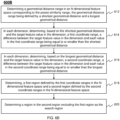
- FIG. 6B is a flow chart illustrating an exemplary process for determining a search region according to some embodiments of the present disclosure.
- process 600B may be implemented on the image searching system 100 as illustrated in FIG. 1 .
- the process 600B may be stored in a storage medium (e.g., the storage device 150, or the storage 203) as a form of instructions, and invoked and/or executed by the processing device 120 (e.g., the processor 201 of the computing device 200, the CPU 340 of the mobile device 300, and/or one or more modules illustrated in FIG. 4 ).
- the operations in the process 600B presented below are intended to be illustrative.
- one or more operations of the process 600B may be performed to achieve at least part of operation 506 as described in connection with FIG. 5 .
- the processing device 120 may determine a geometrical distance range in the N-dimensional feature space corresponding to the preset similarity range.
- the geometrical distance range may be defined by a shortest geometrical distance D1 and a longest geometrical distance D2. More descriptions regarding the determination of the geometrical distance range may be found elsewhere in the present disclosure. See, e.g., operation 602 in FIG. 6 and relevant descriptions thereof.
- the processing device 120 may determine a first coordinate range based on the shortest geometrical distance D1 and a target feature value in the dimension, wherein a difference between the target feature value in the dimension and each value in the first coordinate range may be equal to or smaller than the shortest geometrical distance D1.
- the target feature value in an i th dimension may be Ai
- the first coordinate range in the i th dimension may be [Ai-D1, Ai+D1], wherein a difference between Ai and each value in [Ai-D1, Ai+D1] is equal to or smaller than D1.
- the boundary values of the first coordinate range may be or may not be within the first coordinate range.
- the boundary values of the first coordinate range may be within the first coordinate range, and a difference between the target feature value in a dimension and each value in the first coordinate range in the dimension may be equal to or smaller than the shortest geometrical distance D1.
- the boundary values of the first coordinate range may not be within the first coordinate range, and a difference between the target feature value in a dimension and each value in the first coordinate range in the dimension may be smaller than the shortest geometrical distance D1.
- the processing device 120 may determine a second coordinate range based on the longest geometrical distance D2 and the target feature value in the dimension, wherein a difference between the target feature value in the dimension and each value in the second coordinate range is equal to or smaller than the longest geometrical distance D2.
- the target feature value in an i th dimension may be Ai
- the second coordinate range in the i th dimension may be [Ai-D2, Ai+D2], wherein a difference between Ai and each value in [Ai-D2, Ai+D2] is equal to or smaller than D2.
- the boundary values of the second coordinate range such as Ai-D2 and Ai+D2, may be or may not be within the second coordinate range.
- the processing device 120 e.g., the search region determination module 430
- the processing circuits of the processor 201 may determine a first region defined by the first coordinate ranges in the N-dimensional feature space and a second region defined by the second coordinate ranges in the N-dimensional feature space.
- the processing device 120 may determine a region formed by the first coordinate range in each dimension as the first region.
- the first region may be a region including a plurality of first points in the N-dimensional feature space.
- a coordinate of each first point in the first dimension may within the first coordinate range in the first dimension (e.g., [A1-D1, A1+D1])
- a coordinate of each first point in the second dimension may be within the first coordinate range in the second dimension (e.g., [A2-D1, A2+D1], ⁇
- a coordinate of each first point in the N th dimension may be within the first coordinate range in the N th dimension (e.g., [An-D1, An+D1]).
- a difference between a coordinate value of a first point in the dimension and the target feature value in the dimension may be smaller than the minimum geometrical distance D1. It may suggest that a similarity degree between the target image and an image corresponding to the first point is greater than the maximum similarity degree S2, which is out of the preset similarity range.
- the processing device 120 may determine a region formed by the second coordinate range in each dimension in the N-dimensional feature space as the second region.
- the second region may be a region in a plurality of second points in the N-dimensional feature space.
- a coordinate of each second point in the first dimension may within the second coordinate range in the first dimension (e.g., [A1-D2, A1+D2])
- a coordinate of each second point in the second dimension may be within the second coordinate range in the second dimension (e.g., [A2-D2, A2+D2], ⁇
- a coordinate of each second point in the N th dimension may be within the second coordinate range in the N th dimension (e.g., [An-D2, An+D2]).
- the N-dimensional feature space is a 2-dimensional feature space formed by an X-axis and a Y-axis
- first coordinate ranges in the X-axis and Y-axis are both [-1, 1]
- second coordinate ranges in the X-axis and Y-axis are both [-2, 2].
- a first region in the 2-dimensional feature space may be a square with four vertexes whose coordinates are (-1, -1), (-1, 1), (1, -1), and (1, 1).
- a second region in the 2-dimensional feature space may be a square with four vertexes whose coordinates are (-2, -2), (-2, 2), (2, -2), (2, 2).
- the processing device 120 may determine a region in the second region excluding the first region as the search region. As described in connection with 618, a similarity degree between the target image and an image corresponding to a first point in the first region is out of the preset similarity range. Thus, the processing device 120 may exclude the first region from the search region.
- the processing device 120 may determine a coordinate range of the at least one similar image to be searched by subtracting the first coordinate range in the dimension from the second coordinate range in the dimension.
- the coordinate range of the at least one similar image in the i th dimension may be determined by subtracting a first coordinate range [Ai-D1, Ai+D1] from a second coordinate range [Ai-D2, Ai+D2], which is equal to a coordinate range [Ai-D2, Ai-D1) and (Ai+D1, Ai+D2],
- the search region may include or exclude a boundary of the first region.
- FIG. 7 is a flow chart illustrating an exemplary process for determining at least one similar image to a target image according to some embodiments of the present disclosure.
- process 700 may be implemented on the image searching system 100 as illustrated in FIG. 1 .
- the process 700 may be stored in a storage medium (e.g., the storage device 150, or the storage 203) as a form of instructions, and invoked and/or executed by the processing device 120 (e.g., the processor 201 of the computing device 200, the CPU 340 of the mobile device 300, and/or one or more modules illustrated in FIG. 4 ).
- the processing device 120 e.g., the processor 201 of the computing device 200, the CPU 340 of the mobile device 300, and/or one or more modules illustrated in FIG. 4 .
- one or more operations of the process 700 may be performed to achieve at least part of operations 506 to 510 as described in connection with FIG. 5 .
- the processing device 120 e.g., the search region determination module 430
- the processing circuits of the processor 201 may divide a preset similarity range into a plurality of sub-ranges.
- the preset similarity range may define a required range of a similarity degree between each similar image to be searched and the target image.
- the preset similarity range may include a minimum similarity degree S1 and a maximum similarity degree S2.
- the processing device 120 may divide the preset similarity range evenly into the sub-ranges having the same span.
- a span of a sub-range may refer to a similarity degree difference between the largest similarity degree in the sub-range and the smallest similarity degree in the sub-range.
- the span of each sub-range may be 1%, 3%, 5%, 7%, 10%, 20%, or any other suitable value.
- a preset similarity range (60%, 100] may be evenly divided into 4 sub-ranges (i.e., (60%, 70%], (70%, 80%], (80%, 90%], and (99%, 100%]), each of which has a span of 10% similarity degrees.
- a preset similarity range (60%, 100] may be evenly divided into 8 sub-ranges (i.e., (60%, 65%], (65%, 70%], (70%, 75%], (75%, 80%], (80%, 85%], (85%, 90%], (90%, 95%], (95%, 100%]), each of which has a span of 5% similarity degree.
- the processing device 120 may divide the preset similarity range unevenly into the sub-ranges having different spans.
- a preset similarity range of (60%, 100%] may be unevenly divided into 4 sub-ranges having different spans, such as (60%, 80%], (80%, 90%], (90%, 95%], (95%, 100%].
- the division rule of the preset similarity range may be a default setting of the image searching system 100 or be inputted by a user of the image searching system 100. Additionally or alternatively, the division rule may be determined by a computing device (e.g., the processing device 120) according to different situations. For example, the span of each sub-range may be determined by taking a required searching speed and/or a required searching time into consideration. In order to accelerate searching speed, the computing device may divide the preset similarity range evenly into more sub-ranges with a smaller span, wherein the sub-ranges may be processed in parallel or in sequence in image searching.
- the processing device 120 e.g., the search region determination module 430
- the processing circuits of the processor 201 may determine a sub-search region in the N-dimensional feature space corresponding to the sub-range based on the target feature vector of the target image.
- a sub-search region corresponding to a sub-range may be similar to a search region corresponding to the preset similarity range as described in connection with 506.
- the determination of a sub-search region corresponding to a sub-range may be performed in a similar manner with the determination of the search region corresponding to the preset similarity range as described in connection with operation 506, and the descriptions thereof are not repeated here.
- the processing device 120 e.g., the candidate image determination module 440
- the processing circuits of the processor 201 may determine one or more first candidate images among the plurality of images, wherein the feature vector of each first candidate image corresponding to the sub-search region is within the sub-search region.
- the determination of one or more first candidate images whose feature vectors are within a sub-search region may be performed in a similar manner with the determination of one or more candidate images whose feature vectors are within the search region described in connection with operation 508, and the descriptions thereof are not repeated here.
- the processing device 120 may determine one or more similar images to the target image among the one or more first candidate images corresponding to the sub-search region.
- the processing device 120 may determine or obtain a similarity degree between the target image and each first candidate image corresponding to the sub-search region. The processing device 120 may then select one or more first candidate images among the one or more first candidate images corresponding to the sub-search region, wherein a similar degree between each selected first candidate image and the target image is within the sub-range corresponding to the sub-search region. The processing device 120 may further designate the one or more selected first candidate images as one or more similar images of the at least one similar image to the target image.
- operations 704 to 708 may be performed for each sub-range in parallel, for example, by different processing units of the processing device 120.
- operations 704 to 708 may be performed for each sub-range in sequence.
- the processing device 120 may rank the plurality of sub-ranges to generate a second ranking result.
- the sub-ranges may ranked according to, for example, the largest similarity degree, the smallest similarity degree, a mid-similarity degree of each sub-range in a descending order or an ascending order.
- the processing device 120 may sequentially perform operations 704 to 708 for each sub-range according to the second ranking result.
- the preset similarity range may be evenly divided into forty sub-ranges, i.e., (60%, 61%], (61%, 62%], ... ... , and (99%, 100%].
- the forty sub-ranges may be ranked in a descending order according to the largest similarity degree in each sub-range, and be processed sequentially.
- the processing device 120 may perform operations 704 and 706 for the sub-range (99%, 100%] to determine a first sub-search region corresponding to (99%, 100%], and identify one or more candidate images (denoted as Set c ) whose feature vectors are within the first sub-search region.
- the processing device 120 may also perform operation 708 to determine a similarity degree between the target image and each candidate image in Set c , and select one or more candidate images in Set c whose similarity degrees to the target image are within (99%, 100%] as one or more similar images corresponding to the sub-range (99%, 100%]. In processing the sub-range (99%, 100%], the similarity degree between the target image and each candidate image in Set c may be determined. If a similarity degree between the target image and a certain candidate image in Set c is out of the range (99%, 100%], the certain image may be likely to be further processed, for example, when the processing device 120 processes one or more other sub-ranges (e.g., (98%, 99%], (97%, 98%]).
- sub-ranges e.g., (98%, 99%]
- the processing device 120 may not need to determine the similarity degree between the certain candidate image and the target image again, thus increasing the searching rate and efficiency.
- the processing device 120 may process the other sub-ranges (98%, 99%], (97%, 98%], ... ... , and (60%, 61%] in sequence in a similarly manner as the sub-range (99%, 100%].
- the processing device 120 may directly obtain the similar image between the certain candidate image and the target image.
- process 700 is merely provided for the purposes of illustration, and not intended to be understood as the only embodiment.
- process 700 may be accomplished with one or more additional operations not described, and/or without one or more of the operations discussed. Additionally, the order of the operations of the process 700 as illustrated in FIG. 7 and described below may not be intended to be limiting.
- aspects of the present disclosure may be illustrated and described herein in any of a number of patentable classes or context including any new and useful process, machine, manufacture, or composition of matter, or any new and useful improvement thereof. Accordingly, aspects of the present disclosure may be implemented entirely hardware, entirely software (including firmware, resident software, micro-code, etc.) or combining software and hardware implementation that may all generally be referred to herein as a "module,” “unit,” “component,” “device,” or “system.” Furthermore, aspects of the present disclosure may take the form of a computer program product embodied in one or more computer readable media having computer readable program code embodied thereon.
- a computer readable signal medium may include a propagated data signal with computer readable program code embodied therein, for example, in baseband or as part of a carrier wave. Such a propagated signal may take any of a variety of forms, including electro-magnetic, optical, or the like, or any suitable combination thereof.
- a computer readable signal medium may be any computer readable medium that is not a computer readable storage medium and that may communicate, propagate, or transport a program for use by or in connection with an instruction execution system, apparatus, or device.
- Program code embodied on a computer readable signal medium may be transmitted using any appropriate medium, including wireless, wireline, optical fiber cable, RF, or the like, or any suitable combination of the foregoing.
- Computer program code for carrying out operations for aspects of the present disclosure may be written in any combination of one or more programming languages, including an object oriented programming language such as Java, Scala, Smalltalk, Eiffel, JADE, Emerald, C++, C#, VB. NET, Python or the like, conventional procedural programming languages, such as the "C" programming language, Visual Basic, Fortran 2003, Perl, COBOL 2002, PHP, ABAP, dynamic programming languages such as Python, Ruby and Groovy, or other programming languages.
- the program code may execute entirely on the user's computer, partly on the user's computer, as a stand-alone software package, partly on the user's computer and partly on a remote computer or entirely on the remote computer or server.
- the remote computer may be connected to the user's computer through any type of network, including a local area network (LAN) or a wide area network (WAN), or the connection may be made to an external computer (for example, through the Internet using an Internet Service Provider) or in a cloud computing environment or offered as a service such as a Software as a Service (SaaS).
- LAN local area network
- WAN wide area network
- SaaS Software as a Service
- the numbers expressing quantities or properties used to describe and claim certain embodiments of the application are to be understood as being modified in some instances by the term “about,” “approximate,” or “substantially.”
- “about,” “approximate,” or “substantially” may indicate a certain variation (e.g., ⁇ 1%, ⁇ 5%, ⁇ 10%, or ⁇ 20%) of the value it describes, unless otherwise stated.
- the numerical parameters set forth in the written description and attached claims are approximations that may vary depending upon the desired properties sought to be obtained by a particular embodiment. In some embodiments, the numerical parameters should be construed in light of the number of reported significant digits and by applying ordinary rounding techniques.
Landscapes
- Engineering & Computer Science (AREA)
- Theoretical Computer Science (AREA)
- Data Mining & Analysis (AREA)
- Physics & Mathematics (AREA)
- General Physics & Mathematics (AREA)
- General Engineering & Computer Science (AREA)
- Databases & Information Systems (AREA)
- Library & Information Science (AREA)
- Life Sciences & Earth Sciences (AREA)
- Artificial Intelligence (AREA)
- Bioinformatics & Cheminformatics (AREA)
- Bioinformatics & Computational Biology (AREA)
- Computer Vision & Pattern Recognition (AREA)
- Evolutionary Biology (AREA)
- Evolutionary Computation (AREA)
- Multimedia (AREA)
- Information Retrieval, Db Structures And Fs Structures Therefor (AREA)
- Image Analysis (AREA)
Applications Claiming Priority (2)
| Application Number | Priority Date | Filing Date | Title |
|---|---|---|---|
| CN201810425927.8A CN108733780B (zh) | 2018-05-07 | 2018-05-07 | 一种图片搜索方法及装置 |
| PCT/CN2019/085630 WO2019214565A1 (en) | 2018-05-07 | 2019-05-06 | Systems and methods for image searching |
Publications (3)
| Publication Number | Publication Date |
|---|---|
| EP3776261A1 EP3776261A1 (en) | 2021-02-17 |
| EP3776261A4 EP3776261A4 (en) | 2021-06-02 |
| EP3776261B1 true EP3776261B1 (en) | 2023-07-12 |
Family
ID=63937018
Family Applications (1)
| Application Number | Title | Priority Date | Filing Date |
|---|---|---|---|
| EP19799936.0A Active EP3776261B1 (en) | 2018-05-07 | 2019-05-06 | Systems and methods for image searching |
Country Status (6)
| Country | Link |
|---|---|
| US (1) | US11409984B2 (pl) |
| EP (1) | EP3776261B1 (pl) |
| CN (1) | CN108733780B (pl) |
| ES (1) | ES2954475T3 (pl) |
| PL (1) | PL3776261T3 (pl) |
| WO (1) | WO2019214565A1 (pl) |
Families Citing this family (20)
| Publication number | Priority date | Publication date | Assignee | Title |
|---|---|---|---|---|
| CN108733780B (zh) | 2018-05-07 | 2020-06-23 | 浙江大华技术股份有限公司 | 一种图片搜索方法及装置 |
| CN111177438B (zh) * | 2018-11-12 | 2023-05-12 | 深圳云天励飞技术有限公司 | 图像特征值的搜索方法、装置、电子设备及存储介质 |
| JP7526210B2 (ja) * | 2019-06-07 | 2024-07-31 | ライカ マイクロシステムズ シーエムエス ゲゼルシャフト ミット ベシュレンクテル ハフツング | 生物学関連のデータを処理するためのシステムおよび方法、顕微鏡を制御するためのシステムおよび方法ならびに顕微鏡 |
| CN110659373B (zh) * | 2019-08-27 | 2022-11-08 | 浙江大华技术股份有限公司 | 图像检索的方法、设备、计算机设备和存储介质 |
| CN110909766B (zh) * | 2019-10-29 | 2022-11-29 | 北京明略软件系统有限公司 | 相似度的确定方法及装置、存储介质、电子装置 |
| CN111191612B (zh) * | 2019-12-31 | 2023-05-12 | 深圳云天励飞技术有限公司 | 视频图像匹配方法、装置、终端设备及可读存储介质 |
| CN111292268B (zh) * | 2020-02-07 | 2023-07-25 | 抖音视界有限公司 | 图像处理方法、装置、电子设备及计算机可读存储介质 |
| CN112883214B (zh) * | 2021-01-07 | 2022-10-28 | 浙江大华技术股份有限公司 | 特征检索方法、电子设备及存储介质 |
| CN115035015B (zh) * | 2021-02-23 | 2025-09-05 | 京东方科技集团股份有限公司 | 图片处理方法、装置、计算机设备及存储介质 |
| CN113535824B (zh) * | 2021-07-27 | 2024-06-07 | 杭州海康威视数字技术股份有限公司 | 数据搜索方法、装置、电子设备及存储介质 |
| CN113590922A (zh) * | 2021-08-06 | 2021-11-02 | 青岛海信网络科技股份有限公司 | 图像搜索方法及电子设备 |
| CN115793379B (zh) * | 2021-09-09 | 2025-09-02 | 中芯国际集成电路制造(上海)有限公司 | 光学邻近修正方法及系统、掩膜版、设备及存储介质 |
| CN114022763A (zh) * | 2021-10-28 | 2022-02-08 | 国家能源集团广西电力有限公司 | 一种高压架空线路的异物检测方法、装置及可读存储介质 |
| CN116627906A (zh) * | 2022-02-10 | 2023-08-22 | 华为技术有限公司 | 一种同类对象关联显示方法及电子设备 |
| CN114168770A (zh) * | 2022-02-14 | 2022-03-11 | 成都四方伟业软件股份有限公司 | 一种基于深度学习的以图搜图方法及装置 |
| CN116186314A (zh) * | 2022-12-29 | 2023-05-30 | 青岛云天励飞科技有限公司 | 图像搜索方法、装置、计算机设备及存储介质 |
| CN116883740A (zh) * | 2023-07-11 | 2023-10-13 | 北京永辉科技有限公司 | 相似图片识别方法、装置、电子设备和存储介质 |
| CN117831078B (zh) * | 2024-01-08 | 2025-03-07 | 北京多维视通技术有限公司 | 基于局部区域检索的行人重识别方法、装置、设备及介质 |
| CN118506357B (zh) * | 2024-07-11 | 2025-09-05 | 宁波惠康工业科技股份有限公司 | 基于卷积神经网络的智能冰箱果蔬图像识别系统及方法 |
| CN120929498B (zh) * | 2025-10-13 | 2026-02-13 | 济南浪潮数据技术有限公司 | 检索方法、装置、存储介质、电子设备及计算机程序产品 |
Family Cites Families (13)
| Publication number | Priority date | Publication date | Assignee | Title |
|---|---|---|---|---|
| JP3026712B2 (ja) * | 1993-12-09 | 2000-03-27 | キヤノン株式会社 | 画像検索方法及びその装置 |
| AU2399301A (en) * | 1999-12-21 | 2001-07-03 | Matsushita Electric Industrial Co., Ltd. | Vector index creating method, similar vector searching method, and devices for them |
| JP4682030B2 (ja) * | 2005-11-30 | 2011-05-11 | 富士通株式会社 | 図形検索プログラム、該プログラムを記録した記録媒体、図形検索装置、および図形検索方法 |
| CN101526944B (zh) * | 2008-12-23 | 2011-10-12 | 广州乐庚信息科技有限公司 | 图像检索比对方法 |
| CN102436491A (zh) * | 2011-11-08 | 2012-05-02 | 张三明 | 一种基于BigBase的海量图片搜索系统及方法 |
| CN106055576B (zh) * | 2016-05-20 | 2018-04-10 | 大连理工大学 | 一种大规模数据背景下的快速有效的图像检索方法 |
| CA3031548A1 (en) * | 2016-07-22 | 2018-01-25 | 9206868 Canada Inc. | System and method for analyzing and searching for features associated with objects |
| EP3300002A1 (en) * | 2016-09-22 | 2018-03-28 | Styria medijski servisi d.o.o. | Method for determining the similarity of digital images |
| CN107247730A (zh) * | 2017-05-04 | 2017-10-13 | 北京奇艺世纪科技有限公司 | 图片搜索方法及装置 |
| CN107194424B (zh) * | 2017-05-19 | 2019-08-27 | 山东财经大学 | 一种图像相似块快速搜索方法 |
| CN107291855A (zh) * | 2017-06-09 | 2017-10-24 | 中国电子科技集团公司第五十四研究所 | 一种基于显著对象的图像检索方法及系统 |
| CN107766492B (zh) * | 2017-10-18 | 2020-07-31 | 北京京东尚科信息技术有限公司 | 一种图像搜索的方法和装置 |
| CN108733780B (zh) * | 2018-05-07 | 2020-06-23 | 浙江大华技术股份有限公司 | 一种图片搜索方法及装置 |
-
2018
- 2018-05-07 CN CN201810425927.8A patent/CN108733780B/zh active Active
-
2019
- 2019-05-06 PL PL19799936.0T patent/PL3776261T3/pl unknown
- 2019-05-06 EP EP19799936.0A patent/EP3776261B1/en active Active
- 2019-05-06 WO PCT/CN2019/085630 patent/WO2019214565A1/en not_active Ceased
- 2019-05-06 ES ES19799936T patent/ES2954475T3/es active Active
-
2020
- 2020-11-05 US US17/089,737 patent/US11409984B2/en active Active
Also Published As
| Publication number | Publication date |
|---|---|
| CN108733780A (zh) | 2018-11-02 |
| US20210049406A1 (en) | 2021-02-18 |
| WO2019214565A1 (en) | 2019-11-14 |
| CN108733780B (zh) | 2020-06-23 |
| EP3776261A4 (en) | 2021-06-02 |
| EP3776261A1 (en) | 2021-02-17 |
| ES2954475T3 (es) | 2023-11-22 |
| US11409984B2 (en) | 2022-08-09 |
| PL3776261T3 (pl) | 2023-12-18 |
Similar Documents
| Publication | Publication Date | Title |
|---|---|---|
| EP3776261B1 (en) | Systems and methods for image searching | |
| US12039440B2 (en) | Image classification method and apparatus, and image classification model training method and apparatus | |
| US10289927B2 (en) | Image integration search based on human visual pathway model | |
| US20220108478A1 (en) | Processing images using self-attention based neural networks | |
| US20200202533A1 (en) | Identifying target objects using scale-diverse segmentation neural networks | |
| CN111104962A (zh) | 图像的语义分割方法、装置、电子设备及可读存储介质 | |
| US20190087647A1 (en) | Method and apparatus for facial recognition | |
| CN113704531A (zh) | 图像处理方法、装置、电子设备及计算机可读存储介质 | |
| US20230172457A1 (en) | Systems and methods for temperature measurement | |
| US20220012526A1 (en) | Systems and methods for image retrieval | |
| WO2022247406A1 (en) | Systems and methods for determining key frame images of video data | |
| US10397498B2 (en) | Compressive sensing capturing device and method | |
| CN110717929B (zh) | 图像目标检测方法、装置及存储介质 | |
| US20220100795A1 (en) | Systems and methods for image retrieval | |
| WO2025000278A1 (zh) | 单目标姿态估计方法、装置以及电子设备 | |
| US20180165539A1 (en) | Visual-saliency driven scene description | |
| US20230260263A1 (en) | Systems and methods for object recognition | |
| US20170185900A1 (en) | Reconstruction of signals using a Gramian Matrix | |
| US12154362B2 (en) | Framework for document layout and information extraction | |
| EP4579485A1 (en) | Deep search based on components of 3-d models | |
| CN115240042B (zh) | 多模态图像识别方法、装置、可读介质和电子设备 | |
| CN112927149B (zh) | 高光谱图像的空间分辨率增强方法、装置及电子设备 | |
| US20250217408A1 (en) | Deep search based on components of 3-d models | |
| KR20250163182A (ko) | 의미론적 편향이 감소된 이미지 복원 모델을 이용하여 저해상도 이미지를 복원하기 위한 전자 장치, 방법, 및 비-일시적 컴퓨터 판독 가능 기록 매체 | |
| KR20250135053A (ko) | 고해상도 이미지의 특징 정보를 이용하여 트레이닝된 이미지 복원 모델을 이용하여 저해상도 이미지를 복원하기 위한 전자 장치 및 그 방법 |
Legal Events
| Date | Code | Title | Description |
|---|---|---|---|
| STAA | Information on the status of an ep patent application or granted ep patent |
Free format text: STATUS: THE INTERNATIONAL PUBLICATION HAS BEEN MADE |
|
| PUAI | Public reference made under article 153(3) epc to a published international application that has entered the european phase |
Free format text: ORIGINAL CODE: 0009012 |
|
| STAA | Information on the status of an ep patent application or granted ep patent |
Free format text: STATUS: REQUEST FOR EXAMINATION WAS MADE |
|
| 17P | Request for examination filed |
Effective date: 20201105 |
|
| AK | Designated contracting states |
Kind code of ref document: A1 Designated state(s): AL AT BE BG CH CY CZ DE DK EE ES FI FR GB GR HR HU IE IS IT LI LT LU LV MC MK MT NL NO PL PT RO RS SE SI SK SM TR |
|
| AX | Request for extension of the european patent |
Extension state: BA ME |
|
| A4 | Supplementary search report drawn up and despatched |
Effective date: 20210430 |
|
| RIC1 | Information provided on ipc code assigned before grant |
Ipc: G06F 16/70 20190101AFI20210423BHEP Ipc: G06F 16/583 20190101ALI20210423BHEP |
|
| DAV | Request for validation of the european patent (deleted) | ||
| DAX | Request for extension of the european patent (deleted) | ||
| GRAP | Despatch of communication of intention to grant a patent |
Free format text: ORIGINAL CODE: EPIDOSNIGR1 |
|
| STAA | Information on the status of an ep patent application or granted ep patent |
Free format text: STATUS: GRANT OF PATENT IS INTENDED |
|
| INTG | Intention to grant announced |
Effective date: 20230331 |
|
| GRAS | Grant fee paid |
Free format text: ORIGINAL CODE: EPIDOSNIGR3 |
|
| GRAA | (expected) grant |
Free format text: ORIGINAL CODE: 0009210 |
|
| STAA | Information on the status of an ep patent application or granted ep patent |
Free format text: STATUS: THE PATENT HAS BEEN GRANTED |
|
| AK | Designated contracting states |
Kind code of ref document: B1 Designated state(s): AL AT BE BG CH CY CZ DE DK EE ES FI FR GB GR HR HU IE IS IT LI LT LU LV MC MK MT NL NO PL PT RO RS SE SI SK SM TR |
|
| REG | Reference to a national code |
Ref country code: CH Ref legal event code: EP |
|
| REG | Reference to a national code |
Ref country code: IE Ref legal event code: FG4D |
|
| REG | Reference to a national code |
Ref country code: DE Ref legal event code: R096 Ref document number: 602019032696 Country of ref document: DE |
|
| REG | Reference to a national code |
Ref country code: LT Ref legal event code: MG9D |
|
| REG | Reference to a national code |
Ref country code: NL Ref legal event code: MP Effective date: 20230712 |
|
| REG | Reference to a national code |
Ref country code: ES Ref legal event code: FG2A Ref document number: 2954475 Country of ref document: ES Kind code of ref document: T3 Effective date: 20231122 |
|
| REG | Reference to a national code |
Ref country code: AT Ref legal event code: MK05 Ref document number: 1587868 Country of ref document: AT Kind code of ref document: T Effective date: 20230712 |
|
| PG25 | Lapsed in a contracting state [announced via postgrant information from national office to epo] |
Ref country code: NL Free format text: LAPSE BECAUSE OF FAILURE TO SUBMIT A TRANSLATION OF THE DESCRIPTION OR TO PAY THE FEE WITHIN THE PRESCRIBED TIME-LIMIT Effective date: 20230712 |
|
| PG25 | Lapsed in a contracting state [announced via postgrant information from national office to epo] |
Ref country code: GR Free format text: LAPSE BECAUSE OF FAILURE TO SUBMIT A TRANSLATION OF THE DESCRIPTION OR TO PAY THE FEE WITHIN THE PRESCRIBED TIME-LIMIT Effective date: 20231013 |
|
| PG25 | Lapsed in a contracting state [announced via postgrant information from national office to epo] |
Ref country code: IS Free format text: LAPSE BECAUSE OF FAILURE TO SUBMIT A TRANSLATION OF THE DESCRIPTION OR TO PAY THE FEE WITHIN THE PRESCRIBED TIME-LIMIT Effective date: 20231112 |
|
| PG25 | Lapsed in a contracting state [announced via postgrant information from national office to epo] |
Ref country code: SE Free format text: LAPSE BECAUSE OF FAILURE TO SUBMIT A TRANSLATION OF THE DESCRIPTION OR TO PAY THE FEE WITHIN THE PRESCRIBED TIME-LIMIT Effective date: 20230712 Ref country code: RS Free format text: LAPSE BECAUSE OF FAILURE TO SUBMIT A TRANSLATION OF THE DESCRIPTION OR TO PAY THE FEE WITHIN THE PRESCRIBED TIME-LIMIT Effective date: 20230712 Ref country code: PT Free format text: LAPSE BECAUSE OF FAILURE TO SUBMIT A TRANSLATION OF THE DESCRIPTION OR TO PAY THE FEE WITHIN THE PRESCRIBED TIME-LIMIT Effective date: 20231113 Ref country code: NO Free format text: LAPSE BECAUSE OF FAILURE TO SUBMIT A TRANSLATION OF THE DESCRIPTION OR TO PAY THE FEE WITHIN THE PRESCRIBED TIME-LIMIT Effective date: 20231012 Ref country code: LV Free format text: LAPSE BECAUSE OF FAILURE TO SUBMIT A TRANSLATION OF THE DESCRIPTION OR TO PAY THE FEE WITHIN THE PRESCRIBED TIME-LIMIT Effective date: 20230712 Ref country code: LT Free format text: LAPSE BECAUSE OF FAILURE TO SUBMIT A TRANSLATION OF THE DESCRIPTION OR TO PAY THE FEE WITHIN THE PRESCRIBED TIME-LIMIT Effective date: 20230712 Ref country code: IS Free format text: LAPSE BECAUSE OF FAILURE TO SUBMIT A TRANSLATION OF THE DESCRIPTION OR TO PAY THE FEE WITHIN THE PRESCRIBED TIME-LIMIT Effective date: 20231112 Ref country code: HR Free format text: LAPSE BECAUSE OF FAILURE TO SUBMIT A TRANSLATION OF THE DESCRIPTION OR TO PAY THE FEE WITHIN THE PRESCRIBED TIME-LIMIT Effective date: 20230712 Ref country code: GR Free format text: LAPSE BECAUSE OF FAILURE TO SUBMIT A TRANSLATION OF THE DESCRIPTION OR TO PAY THE FEE WITHIN THE PRESCRIBED TIME-LIMIT Effective date: 20231013 Ref country code: FI Free format text: LAPSE BECAUSE OF FAILURE TO SUBMIT A TRANSLATION OF THE DESCRIPTION OR TO PAY THE FEE WITHIN THE PRESCRIBED TIME-LIMIT Effective date: 20230712 Ref country code: AT Free format text: LAPSE BECAUSE OF FAILURE TO SUBMIT A TRANSLATION OF THE DESCRIPTION OR TO PAY THE FEE WITHIN THE PRESCRIBED TIME-LIMIT Effective date: 20230712 |
|
| REG | Reference to a national code |
Ref country code: DE Ref legal event code: R097 Ref document number: 602019032696 Country of ref document: DE |
|
| PG25 | Lapsed in a contracting state [announced via postgrant information from national office to epo] |
Ref country code: SM Free format text: LAPSE BECAUSE OF FAILURE TO SUBMIT A TRANSLATION OF THE DESCRIPTION OR TO PAY THE FEE WITHIN THE PRESCRIBED TIME-LIMIT Effective date: 20230712 Ref country code: RO Free format text: LAPSE BECAUSE OF FAILURE TO SUBMIT A TRANSLATION OF THE DESCRIPTION OR TO PAY THE FEE WITHIN THE PRESCRIBED TIME-LIMIT Effective date: 20230712 Ref country code: EE Free format text: LAPSE BECAUSE OF FAILURE TO SUBMIT A TRANSLATION OF THE DESCRIPTION OR TO PAY THE FEE WITHIN THE PRESCRIBED TIME-LIMIT Effective date: 20230712 Ref country code: DK Free format text: LAPSE BECAUSE OF FAILURE TO SUBMIT A TRANSLATION OF THE DESCRIPTION OR TO PAY THE FEE WITHIN THE PRESCRIBED TIME-LIMIT Effective date: 20230712 Ref country code: SK Free format text: LAPSE BECAUSE OF FAILURE TO SUBMIT A TRANSLATION OF THE DESCRIPTION OR TO PAY THE FEE WITHIN THE PRESCRIBED TIME-LIMIT Effective date: 20230712 |
|
| PLBE | No opposition filed within time limit |
Free format text: ORIGINAL CODE: 0009261 |
|
| STAA | Information on the status of an ep patent application or granted ep patent |
Free format text: STATUS: NO OPPOSITION FILED WITHIN TIME LIMIT |
|
| 26N | No opposition filed |
Effective date: 20240415 |
|
| PG25 | Lapsed in a contracting state [announced via postgrant information from national office to epo] |
Ref country code: SI Free format text: LAPSE BECAUSE OF FAILURE TO SUBMIT A TRANSLATION OF THE DESCRIPTION OR TO PAY THE FEE WITHIN THE PRESCRIBED TIME-LIMIT Effective date: 20230712 |
|
| PG25 | Lapsed in a contracting state [announced via postgrant information from national office to epo] |
Ref country code: BG Free format text: LAPSE BECAUSE OF FAILURE TO SUBMIT A TRANSLATION OF THE DESCRIPTION OR TO PAY THE FEE WITHIN THE PRESCRIBED TIME-LIMIT Effective date: 20230712 |
|
| PG25 | Lapsed in a contracting state [announced via postgrant information from national office to epo] |
Ref country code: BG Free format text: LAPSE BECAUSE OF FAILURE TO SUBMIT A TRANSLATION OF THE DESCRIPTION OR TO PAY THE FEE WITHIN THE PRESCRIBED TIME-LIMIT Effective date: 20230712 |
|
| REG | Reference to a national code |
Ref country code: CH Ref legal event code: PL |
|
| PG25 | Lapsed in a contracting state [announced via postgrant information from national office to epo] |
Ref country code: MC Free format text: LAPSE BECAUSE OF FAILURE TO SUBMIT A TRANSLATION OF THE DESCRIPTION OR TO PAY THE FEE WITHIN THE PRESCRIBED TIME-LIMIT Effective date: 20230712 |
|
| PG25 | Lapsed in a contracting state [announced via postgrant information from national office to epo] |
Ref country code: LU Free format text: LAPSE BECAUSE OF NON-PAYMENT OF DUE FEES Effective date: 20240506 |
|
| PG25 | Lapsed in a contracting state [announced via postgrant information from national office to epo] |
Ref country code: CZ Free format text: LAPSE BECAUSE OF NON-PAYMENT OF DUE FEES Effective date: 20240506 |
|
| PG25 | Lapsed in a contracting state [announced via postgrant information from national office to epo] |
Ref country code: MC Free format text: LAPSE BECAUSE OF FAILURE TO SUBMIT A TRANSLATION OF THE DESCRIPTION OR TO PAY THE FEE WITHIN THE PRESCRIBED TIME-LIMIT Effective date: 20230712 Ref country code: LU Free format text: LAPSE BECAUSE OF NON-PAYMENT OF DUE FEES Effective date: 20240506 Ref country code: CZ Free format text: LAPSE BECAUSE OF NON-PAYMENT OF DUE FEES Effective date: 20240506 Ref country code: CH Free format text: LAPSE BECAUSE OF NON-PAYMENT OF DUE FEES Effective date: 20240531 |
|
| REG | Reference to a national code |
Ref country code: BE Ref legal event code: MM Effective date: 20240531 |
|
| PG25 | Lapsed in a contracting state [announced via postgrant information from national office to epo] |
Ref country code: IE Free format text: LAPSE BECAUSE OF NON-PAYMENT OF DUE FEES Effective date: 20240506 |
|
| PG25 | Lapsed in a contracting state [announced via postgrant information from national office to epo] |
Ref country code: BE Free format text: LAPSE BECAUSE OF NON-PAYMENT OF DUE FEES Effective date: 20240531 |
|
| PG25 | Lapsed in a contracting state [announced via postgrant information from national office to epo] |
Ref country code: IT Free format text: LAPSE BECAUSE OF NON-PAYMENT OF DUE FEES Effective date: 20240506 |
|
| REG | Reference to a national code |
Ref country code: ES Ref legal event code: FD2A Effective date: 20250626 |
|
| PGFP | Annual fee paid to national office [announced via postgrant information from national office to epo] |
Ref country code: DE Payment date: 20250513 Year of fee payment: 7 |
|
| PG25 | Lapsed in a contracting state [announced via postgrant information from national office to epo] |
Ref country code: ES Free format text: LAPSE BECAUSE OF NON-PAYMENT OF DUE FEES Effective date: 20240507 |
|
| PGFP | Annual fee paid to national office [announced via postgrant information from national office to epo] |
Ref country code: GB Payment date: 20250521 Year of fee payment: 7 |
|
| PGFP | Annual fee paid to national office [announced via postgrant information from national office to epo] |
Ref country code: FR Payment date: 20250530 Year of fee payment: 7 |
|
| PG25 | Lapsed in a contracting state [announced via postgrant information from national office to epo] |
Ref country code: CY Free format text: LAPSE BECAUSE OF FAILURE TO SUBMIT A TRANSLATION OF THE DESCRIPTION OR TO PAY THE FEE WITHIN THE PRESCRIBED TIME-LIMIT; INVALID AB INITIO Effective date: 20190506 |
|
| PG25 | Lapsed in a contracting state [announced via postgrant information from national office to epo] |
Ref country code: HU Free format text: LAPSE BECAUSE OF FAILURE TO SUBMIT A TRANSLATION OF THE DESCRIPTION OR TO PAY THE FEE WITHIN THE PRESCRIBED TIME-LIMIT; INVALID AB INITIO Effective date: 20190506 |
|
| PG25 | Lapsed in a contracting state [announced via postgrant information from national office to epo] |
Ref country code: PL Free format text: LAPSE BECAUSE OF NON-PAYMENT OF DUE FEES Effective date: 20240506 |