EP3774714B1 - Electrodes and batteries comprising functional fluoropolymers - Google Patents
Electrodes and batteries comprising functional fluoropolymers Download PDFInfo
- Publication number
- EP3774714B1 EP3774714B1 EP19784265.1A EP19784265A EP3774714B1 EP 3774714 B1 EP3774714 B1 EP 3774714B1 EP 19784265 A EP19784265 A EP 19784265A EP 3774714 B1 EP3774714 B1 EP 3774714B1
- Authority
- EP
- European Patent Office
- Prior art keywords
- lithium
- electrode
- monomer
- oxide
- hydrogen
- Prior art date
- Legal status (The legal status is an assumption and is not a legal conclusion. Google has not performed a legal analysis and makes no representation as to the accuracy of the status listed.)
- Active
Links
Classifications
-
- C—CHEMISTRY; METALLURGY
- C08—ORGANIC MACROMOLECULAR COMPOUNDS; THEIR PREPARATION OR CHEMICAL WORKING-UP; COMPOSITIONS BASED THEREON
- C08F—MACROMOLECULAR COMPOUNDS OBTAINED BY REACTIONS ONLY INVOLVING CARBON-TO-CARBON UNSATURATED BONDS
- C08F283/00—Macromolecular compounds obtained by polymerising monomers on to polymers provided for in subclass C08G
- C08F283/02—Macromolecular compounds obtained by polymerising monomers on to polymers provided for in subclass C08G on to polycarbonates or saturated polyesters
-
- C—CHEMISTRY; METALLURGY
- C07—ORGANIC CHEMISTRY
- C07C—ACYCLIC OR CARBOCYCLIC COMPOUNDS
- C07C21/00—Acyclic unsaturated compounds containing halogen atoms
- C07C21/02—Acyclic unsaturated compounds containing halogen atoms containing carbon-to-carbon double bonds
- C07C21/18—Acyclic unsaturated compounds containing halogen atoms containing carbon-to-carbon double bonds containing fluorine
-
- C—CHEMISTRY; METALLURGY
- C07—ORGANIC CHEMISTRY
- C07C—ACYCLIC OR CARBOCYCLIC COMPOUNDS
- C07C57/00—Unsaturated compounds having carboxyl groups bound to acyclic carbon atoms
- C07C57/52—Unsaturated compounds having carboxyl groups bound to acyclic carbon atoms containing halogen
-
- C—CHEMISTRY; METALLURGY
- C07—ORGANIC CHEMISTRY
- C07C—ACYCLIC OR CARBOCYCLIC COMPOUNDS
- C07C69/00—Esters of carboxylic acids; Esters of carbonic or haloformic acids
- C07C69/52—Esters of acyclic unsaturated carboxylic acids having the esterified carboxyl group bound to an acyclic carbon atom
- C07C69/533—Monocarboxylic acid esters having only one carbon-to-carbon double bond
- C07C69/54—Acrylic acid esters; Methacrylic acid esters
-
- C—CHEMISTRY; METALLURGY
- C08—ORGANIC MACROMOLECULAR COMPOUNDS; THEIR PREPARATION OR CHEMICAL WORKING-UP; COMPOSITIONS BASED THEREON
- C08F—MACROMOLECULAR COMPOUNDS OBTAINED BY REACTIONS ONLY INVOLVING CARBON-TO-CARBON UNSATURATED BONDS
- C08F214/00—Copolymers of compounds having one or more unsaturated aliphatic radicals, each having only one carbon-to-carbon double bond, and at least one being terminated by a halogen
- C08F214/18—Monomers containing fluorine
- C08F214/22—Vinylidene fluoride
-
- C—CHEMISTRY; METALLURGY
- C08—ORGANIC MACROMOLECULAR COMPOUNDS; THEIR PREPARATION OR CHEMICAL WORKING-UP; COMPOSITIONS BASED THEREON
- C08F—MACROMOLECULAR COMPOUNDS OBTAINED BY REACTIONS ONLY INVOLVING CARBON-TO-CARBON UNSATURATED BONDS
- C08F220/00—Copolymers of compounds having one or more unsaturated aliphatic radicals, each having only one carbon-to-carbon double bond, and only one being terminated by only one carboxyl radical or a salt, anhydride ester, amide, imide or nitrile thereof
- C08F220/02—Monocarboxylic acids having less than ten carbon atoms; Derivatives thereof
- C08F220/10—Esters
- C08F220/22—Esters containing halogen
-
- C—CHEMISTRY; METALLURGY
- C08—ORGANIC MACROMOLECULAR COMPOUNDS; THEIR PREPARATION OR CHEMICAL WORKING-UP; COMPOSITIONS BASED THEREON
- C08F—MACROMOLECULAR COMPOUNDS OBTAINED BY REACTIONS ONLY INVOLVING CARBON-TO-CARBON UNSATURATED BONDS
- C08F4/00—Polymerisation catalysts
- C08F4/28—Oxygen or compounds releasing free oxygen
-
- C—CHEMISTRY; METALLURGY
- C08—ORGANIC MACROMOLECULAR COMPOUNDS; THEIR PREPARATION OR CHEMICAL WORKING-UP; COMPOSITIONS BASED THEREON
- C08K—Use of inorganic or non-macromolecular organic substances as compounding ingredients
- C08K3/00—Use of inorganic substances as compounding ingredients
- C08K3/02—Elements
- C08K3/04—Carbon
-
- C—CHEMISTRY; METALLURGY
- C08—ORGANIC MACROMOLECULAR COMPOUNDS; THEIR PREPARATION OR CHEMICAL WORKING-UP; COMPOSITIONS BASED THEREON
- C08K—Use of inorganic or non-macromolecular organic substances as compounding ingredients
- C08K3/00—Use of inorganic substances as compounding ingredients
- C08K3/18—Oxygen-containing compounds, e.g. metal carbonyls
- C08K3/20—Oxides; Hydroxides
- C08K3/22—Oxides; Hydroxides of metals
-
- C—CHEMISTRY; METALLURGY
- C08—ORGANIC MACROMOLECULAR COMPOUNDS; THEIR PREPARATION OR CHEMICAL WORKING-UP; COMPOSITIONS BASED THEREON
- C08K—Use of inorganic or non-macromolecular organic substances as compounding ingredients
- C08K3/00—Use of inorganic substances as compounding ingredients
- C08K3/32—Phosphorus-containing compounds
-
- C—CHEMISTRY; METALLURGY
- C08—ORGANIC MACROMOLECULAR COMPOUNDS; THEIR PREPARATION OR CHEMICAL WORKING-UP; COMPOSITIONS BASED THEREON
- C08L—COMPOSITIONS OF MACROMOLECULAR COMPOUNDS
- C08L27/00—Compositions of homopolymers or copolymers of compounds having one or more unsaturated aliphatic radicals, each having only one carbon-to-carbon double bond, and at least one being terminated by a halogen; Compositions of derivatives of such polymers
- C08L27/02—Compositions of homopolymers or copolymers of compounds having one or more unsaturated aliphatic radicals, each having only one carbon-to-carbon double bond, and at least one being terminated by a halogen; Compositions of derivatives of such polymers not modified by chemical after-treatment
- C08L27/12—Compositions of homopolymers or copolymers of compounds having one or more unsaturated aliphatic radicals, each having only one carbon-to-carbon double bond, and at least one being terminated by a halogen; Compositions of derivatives of such polymers not modified by chemical after-treatment containing fluorine atoms
- C08L27/16—Homopolymers or copolymers or vinylidene fluoride
-
- C—CHEMISTRY; METALLURGY
- C09—DYES; PAINTS; POLISHES; NATURAL RESINS; ADHESIVES; COMPOSITIONS NOT OTHERWISE PROVIDED FOR; APPLICATIONS OF MATERIALS NOT OTHERWISE PROVIDED FOR
- C09D—COATING COMPOSITIONS, e.g. PAINTS, VARNISHES OR LACQUERS; FILLING PASTES; CHEMICAL PAINT OR INK REMOVERS; INKS; CORRECTING FLUIDS; WOODSTAINS; PASTES OR SOLIDS FOR COLOURING OR PRINTING; USE OF MATERIALS THEREFOR
- C09D127/00—Coating compositions based on homopolymers or copolymers of compounds having one or more unsaturated aliphatic radicals, each having only one carbon-to-carbon double bond, and at least one being terminated by a halogen; Coating compositions based on derivatives of such polymers
- C09D127/02—Coating compositions based on homopolymers or copolymers of compounds having one or more unsaturated aliphatic radicals, each having only one carbon-to-carbon double bond, and at least one being terminated by a halogen; Coating compositions based on derivatives of such polymers not modified by chemical after-treatment
- C09D127/12—Coating compositions based on homopolymers or copolymers of compounds having one or more unsaturated aliphatic radicals, each having only one carbon-to-carbon double bond, and at least one being terminated by a halogen; Coating compositions based on derivatives of such polymers not modified by chemical after-treatment containing fluorine atoms
- C09D127/16—Homopolymers or copolymers of vinylidene fluoride
-
- C—CHEMISTRY; METALLURGY
- C09—DYES; PAINTS; POLISHES; NATURAL RESINS; ADHESIVES; COMPOSITIONS NOT OTHERWISE PROVIDED FOR; APPLICATIONS OF MATERIALS NOT OTHERWISE PROVIDED FOR
- C09D—COATING COMPOSITIONS, e.g. PAINTS, VARNISHES OR LACQUERS; FILLING PASTES; CHEMICAL PAINT OR INK REMOVERS; INKS; CORRECTING FLUIDS; WOODSTAINS; PASTES OR SOLIDS FOR COLOURING OR PRINTING; USE OF MATERIALS THEREFOR
- C09D133/00—Coating compositions based on homopolymers or copolymers of compounds having one or more unsaturated aliphatic radicals, each having only one carbon-to-carbon double bond, and at least one being terminated by only one carboxyl radical, or of salts, anhydrides, esters, amides, imides, or nitriles thereof; Coating compositions based on derivatives of such polymers
- C09D133/04—Homopolymers or copolymers of esters
- C09D133/14—Homopolymers or copolymers of esters of esters containing halogen, nitrogen, sulfur or oxygen atoms in addition to the carboxy oxygen
- C09D133/16—Homopolymers or copolymers of esters containing halogen atoms
-
- C—CHEMISTRY; METALLURGY
- C09—DYES; PAINTS; POLISHES; NATURAL RESINS; ADHESIVES; COMPOSITIONS NOT OTHERWISE PROVIDED FOR; APPLICATIONS OF MATERIALS NOT OTHERWISE PROVIDED FOR
- C09D—COATING COMPOSITIONS, e.g. PAINTS, VARNISHES OR LACQUERS; FILLING PASTES; CHEMICAL PAINT OR INK REMOVERS; INKS; CORRECTING FLUIDS; WOODSTAINS; PASTES OR SOLIDS FOR COLOURING OR PRINTING; USE OF MATERIALS THEREFOR
- C09D151/00—Coating compositions based on graft polymers in which the grafted component is obtained by reactions only involving carbon-to-carbon unsaturated bonds; Coating compositions based on derivatives of such polymers
- C09D151/08—Coating compositions based on graft polymers in which the grafted component is obtained by reactions only involving carbon-to-carbon unsaturated bonds; Coating compositions based on derivatives of such polymers grafted on to macromolecular compounds obtained otherwise than by reactions only involving carbon-to-carbon unsaturated bonds
-
- H—ELECTRICITY
- H01—ELECTRIC ELEMENTS
- H01M—PROCESSES OR MEANS, e.g. BATTERIES, FOR THE DIRECT CONVERSION OF CHEMICAL ENERGY INTO ELECTRICAL ENERGY
- H01M10/00—Secondary cells; Manufacture thereof
- H01M10/05—Accumulators with non-aqueous electrolyte
- H01M10/052—Li-accumulators
- H01M10/0525—Rocking-chair batteries, i.e. batteries with lithium insertion or intercalation in both electrodes; Lithium-ion batteries
-
- H—ELECTRICITY
- H01—ELECTRIC ELEMENTS
- H01M—PROCESSES OR MEANS, e.g. BATTERIES, FOR THE DIRECT CONVERSION OF CHEMICAL ENERGY INTO ELECTRICAL ENERGY
- H01M4/00—Electrodes
- H01M4/02—Electrodes composed of, or comprising, active material
- H01M4/04—Processes of manufacture in general
- H01M4/0402—Methods of deposition of the material
- H01M4/0404—Methods of deposition of the material by coating on electrode collectors
-
- H—ELECTRICITY
- H01—ELECTRIC ELEMENTS
- H01M—PROCESSES OR MEANS, e.g. BATTERIES, FOR THE DIRECT CONVERSION OF CHEMICAL ENERGY INTO ELECTRICAL ENERGY
- H01M4/00—Electrodes
- H01M4/02—Electrodes composed of, or comprising, active material
- H01M4/62—Selection of inactive substances as ingredients for active masses, e.g. binders, fillers
- H01M4/621—Binders
- H01M4/622—Binders being polymers
- H01M4/623—Binders being polymers fluorinated polymers
-
- C—CHEMISTRY; METALLURGY
- C08—ORGANIC MACROMOLECULAR COMPOUNDS; THEIR PREPARATION OR CHEMICAL WORKING-UP; COMPOSITIONS BASED THEREON
- C08K—Use of inorganic or non-macromolecular organic substances as compounding ingredients
- C08K3/00—Use of inorganic substances as compounding ingredients
- C08K3/18—Oxygen-containing compounds, e.g. metal carbonyls
- C08K3/20—Oxides; Hydroxides
- C08K3/22—Oxides; Hydroxides of metals
- C08K2003/2203—Oxides; Hydroxides of metals of lithium
-
- C—CHEMISTRY; METALLURGY
- C08—ORGANIC MACROMOLECULAR COMPOUNDS; THEIR PREPARATION OR CHEMICAL WORKING-UP; COMPOSITIONS BASED THEREON
- C08K—Use of inorganic or non-macromolecular organic substances as compounding ingredients
- C08K3/00—Use of inorganic substances as compounding ingredients
- C08K3/18—Oxygen-containing compounds, e.g. metal carbonyls
- C08K3/20—Oxides; Hydroxides
- C08K3/22—Oxides; Hydroxides of metals
- C08K2003/2227—Oxides; Hydroxides of metals of aluminium
-
- C—CHEMISTRY; METALLURGY
- C08—ORGANIC MACROMOLECULAR COMPOUNDS; THEIR PREPARATION OR CHEMICAL WORKING-UP; COMPOSITIONS BASED THEREON
- C08K—Use of inorganic or non-macromolecular organic substances as compounding ingredients
- C08K3/00—Use of inorganic substances as compounding ingredients
- C08K3/18—Oxygen-containing compounds, e.g. metal carbonyls
- C08K3/20—Oxides; Hydroxides
- C08K3/22—Oxides; Hydroxides of metals
- C08K2003/2262—Oxides; Hydroxides of metals of manganese
-
- C—CHEMISTRY; METALLURGY
- C08—ORGANIC MACROMOLECULAR COMPOUNDS; THEIR PREPARATION OR CHEMICAL WORKING-UP; COMPOSITIONS BASED THEREON
- C08K—Use of inorganic or non-macromolecular organic substances as compounding ingredients
- C08K3/00—Use of inorganic substances as compounding ingredients
- C08K3/18—Oxygen-containing compounds, e.g. metal carbonyls
- C08K3/20—Oxides; Hydroxides
- C08K3/22—Oxides; Hydroxides of metals
- C08K2003/2289—Oxides; Hydroxides of metals of cobalt
-
- C—CHEMISTRY; METALLURGY
- C08—ORGANIC MACROMOLECULAR COMPOUNDS; THEIR PREPARATION OR CHEMICAL WORKING-UP; COMPOSITIONS BASED THEREON
- C08K—Use of inorganic or non-macromolecular organic substances as compounding ingredients
- C08K3/00—Use of inorganic substances as compounding ingredients
- C08K3/18—Oxygen-containing compounds, e.g. metal carbonyls
- C08K3/20—Oxides; Hydroxides
- C08K3/22—Oxides; Hydroxides of metals
- C08K2003/2293—Oxides; Hydroxides of metals of nickel
-
- C—CHEMISTRY; METALLURGY
- C08—ORGANIC MACROMOLECULAR COMPOUNDS; THEIR PREPARATION OR CHEMICAL WORKING-UP; COMPOSITIONS BASED THEREON
- C08K—Use of inorganic or non-macromolecular organic substances as compounding ingredients
- C08K3/00—Use of inorganic substances as compounding ingredients
- C08K3/32—Phosphorus-containing compounds
- C08K2003/321—Phosphates
- C08K2003/324—Alkali metal phosphate
-
- C—CHEMISTRY; METALLURGY
- C08—ORGANIC MACROMOLECULAR COMPOUNDS; THEIR PREPARATION OR CHEMICAL WORKING-UP; COMPOSITIONS BASED THEREON
- C08K—Use of inorganic or non-macromolecular organic substances as compounding ingredients
- C08K3/00—Use of inorganic substances as compounding ingredients
- C08K3/32—Phosphorus-containing compounds
- C08K2003/321—Phosphates
- C08K2003/328—Phosphates of heavy metals
-
- C—CHEMISTRY; METALLURGY
- C08—ORGANIC MACROMOLECULAR COMPOUNDS; THEIR PREPARATION OR CHEMICAL WORKING-UP; COMPOSITIONS BASED THEREON
- C08K—Use of inorganic or non-macromolecular organic substances as compounding ingredients
- C08K2201/00—Specific properties of additives
- C08K2201/001—Conductive additives
-
- C—CHEMISTRY; METALLURGY
- C08—ORGANIC MACROMOLECULAR COMPOUNDS; THEIR PREPARATION OR CHEMICAL WORKING-UP; COMPOSITIONS BASED THEREON
- C08K—Use of inorganic or non-macromolecular organic substances as compounding ingredients
- C08K2201/00—Specific properties of additives
- C08K2201/014—Additives containing two or more different additives of the same subgroup in C08K
-
- H—ELECTRICITY
- H01—ELECTRIC ELEMENTS
- H01M—PROCESSES OR MEANS, e.g. BATTERIES, FOR THE DIRECT CONVERSION OF CHEMICAL ENERGY INTO ELECTRICAL ENERGY
- H01M4/00—Electrodes
- H01M4/02—Electrodes composed of, or comprising, active material
- H01M2004/026—Electrodes composed of, or comprising, active material characterised by the polarity
- H01M2004/028—Positive electrodes
-
- Y—GENERAL TAGGING OF NEW TECHNOLOGICAL DEVELOPMENTS; GENERAL TAGGING OF CROSS-SECTIONAL TECHNOLOGIES SPANNING OVER SEVERAL SECTIONS OF THE IPC; TECHNICAL SUBJECTS COVERED BY FORMER USPC CROSS-REFERENCE ART COLLECTIONS [XRACs] AND DIGESTS
- Y02—TECHNOLOGIES OR APPLICATIONS FOR MITIGATION OR ADAPTATION AGAINST CLIMATE CHANGE
- Y02E—REDUCTION OF GREENHOUSE GAS [GHG] EMISSIONS, RELATED TO ENERGY GENERATION, TRANSMISSION OR DISTRIBUTION
- Y02E60/00—Enabling technologies; Technologies with a potential or indirect contribution to GHG emissions mitigation
- Y02E60/10—Energy storage using batteries
Definitions
- the invention relates to electrodes comprising a binder made of functional fluoropolymers that have been obtained by copolymerizing vinylidene fluoride and a hydrophilic (meth)acrylic comonomer bearing a halogen functionality. At most 10.0 weight percent of the (meth)acrylic comonomer units are present in the copolymer as single monomer units between two fluoromonomer units.
- the invention also relates to batteries comprising these electrodes.
- Fluoropolymers are traditionally used for applications requiring special properties, such as low surface energy, high resistance to chemical attack, aging resistance, and electrochemical stability. However, these advantageous properties also make fluoropolymers difficult to work with and limits their applications. For example, the lack of functional groups on the fluoropolymers makes them difficult: to adhere to substrates, to facilitate cross-linking, to provide sites for subsequent chemical modification, to be wetted by water, and to add hydrophilic characteristics. There is a need for fluorinated polymers having modified properties, such as functional groups, which can augment their properties.
- Functionality has been added by several means, such as, by direct copolymerization of a functional monomer with the fluoromonomers, and by a post-polymerization grafting mechanism, such as the grafting of maleic anhydride onto a polyvinylidene fluoride homopolymer or copolymer, as described in US 7,241,817 , to form KYNAR ® ADX resins available from Arkema Inc. (Pennsylvania, USA).
- WO 2013/110740 and US 7,351,498 further describe functionalization of a fluoropolymer by monomer grafting or by copolymerization.
- US 5,415,958 discloses copolymerization of vinylidene fluoride with an unsaturated dibasic acid monoester polar monomer, to introduce carbonyl groups to the backbone of PVDF in order to improve its adhesion to different substrates.
- each of R1, R2, R3, equal or different from each other is independently a hydrogen atom or a C 1 -C 3 hydrocarbon group
- R OH is a hydrogen or a C 1 -C 5 hydrocarbon moiety comprising at least one hydroxyl group.
- CN 104725544 discloses a vinylidene fluoride copolymer prepared via copolymerization of vinylidene fluoride monomer and at least one modified acrylic ester comonomer.
- the modified acrylate comonomer is particularly preferably 2-trifluoroethyl methacrylate, trifluoromethyl 2-methacrylate or 1,1-difluoro-2- Methyl methacrylate, 2-trifluoromethyl methacrylate.
- the amount of the modified acrylate comonomer is preferably from 1 to 5% by weight in the copolymer.
- JPS57 137308 discloses a process for producing a copolymer by an emulsion polymerization process, and the copolymer is produced by a seed polymerization used a homopolymer and then copolymerizing perfluoroacrylic acid octahydrate with other fluorine-containing polymerizable monomers.
- the invention relates to an electrode comprising a binder, the binder comprising a fluorinated copolymer comprising vinylidene fluoride and a halogenated monomer (1): wherein:
- the fluorinated copolymer is formulated in a solvent, and may further comprise conductive carbon additives and active material particles.
- Active materials for lithium ion battery cathode formulation include, but are not limited to: lithium iron phosphate (LFP), lithium nickel manganese cobalt oxide (NMC), lithium-manganese-cobalt-oxide (LCO), lithium-nickel-cobalt-aluminum oxide (NCA), lithium-manganese oxide (LMO), lithium-nickel-manganese-oxide (LNMO), and lithium manganese iron phosphate (LMFP).
- Active materials for anode formulation include, but are not limited to graphite, hard carbon, soft carbon, graphene, silicon, silicon monoxide (SiO), tin, or lithium titanate (LTO).
- the present application further relates to a formulation comprising the fluorinated copolymer in a solvent, and further contemplates a process for preparing the fluorinated copolymer in an aqueous reaction medium, comprising:
- the application further provides articles formed from the fluorinated copolymer, which benefit from the special properties of the functional copolymer.
- These articles find uses in applications such as for: an electrode or separator for a battery or capacitor; a hydrophilic porous membrane or hollow fiber membrane; an article coated on at least one surface with said functional fluoropolymer, impregnation of woven and unwoven fibers, and a multi-layer construction wherein said functional fluoropolymer forms a tie layer between a fluoropolymer layer and a polymer layer that is incompatible with said fluoropolymer layer.
- Copolymer is used to mean a polymer having two or more different monomer units.
- Polymer is used to mean both homopolymer and copolymers. Polymers may be straight chain, branched, star comb, block, or any other structure. The polymers may be homogeneous, heterogeneous, and may have a gradient distribution of co-monomer units. As used herein, unless otherwise described, percent shall mean weight percent. Unless otherwise stated, molecular weight is a weight average molecular weight as measured by GPC, using a polymethyl methacrylate standard.
- soluble fraction/ gel fraction or soluble faction molecular weight after extraction from gel is used.
- Crystallinity and melting temperature are measured by DSC as described in ASTM D3418 at heating rate of 10 °C/min. Melt viscosity is measured in accordance with ASTM D3835 at 230°C expressed in k Poise @100 Sec ⁇ (-1).
- Fluoropolymers particularly poly(vinylidene fluoride) (PVDF) and its copolymers, find application as the binder in electrode articles used in lithium ion batteries.
- PVDF poly(vinylidene fluoride)
- One key binder performance matrix is determined by an adhesion test whereby a formulated electrode is subjected to a peel test. Improved binding performance increases the potential to reduce the overall binder loading, increasing active material loading and improving battery capacity and energy density.
- copolymers of fluorinated vinylic monomers with acid-functional comonomers lead to adhesion performance improvement.
- the functional fluoropolymers provide enhanced properties compared to the fluoropolymer, such as increased adhesion and hydrophilic characteristics.
- the fluoropolymer may be used in applications benefiting from a functional fluoropolymer including as binders in electrode-forming compositions and separator compositions, or in forming hydrophilic membranes and hollow fibers.
- an electrode comprising a binder, the binder comprising a fluorinated copolymer comprising vinylidene fluoride and a monomer (1): wherein:
- the functional copolymer is further characterized by the following embodiments.
- the fluorinated copolymer comprises up to 10 wt % of Monomer (1), preferably 0.001 to 10.0 wt%, preferably from 0.01 to 10.0wt% of Monomer (1) and 90.0 to 99.99wt% of vinylidene fluoride.
- the fluorinated copolymer comprises vinylidene fluoride and Monomer (1), wherein R 1 is fluorine.
- the fluorinated copolymer comprises vinylidene fluoride and Monomer (1), wherein R 1 is fluorine and R 4 is hydrogen or an alkali metal, ammonium, or alkylammonium.
- the fluorinated copolymer comprises vinylidene fluoride and Monomer (1), wherein R 1 , R 2 and R 3 are fluorine and R 4 is hydrogen or an alkali metal, ammonium, or alkylammonium.
- Monomer (1) is randomly copolymerized as determined by nuclear magnetic resonance ( 19 F NMR and 1 H NMR) of Monomer (1).
- the application further provides a formulation comprising the fluorinated copolymer in a solvent.
- the solvent is preferably chosen from: n-methylpyrrolidone (NMP), dimethylsulfoxide (DMSO), N,N-dimethylformamide (DMF), triethylphosphite (TEP), acetone, tetrahydrofuran, methyl ethylketone (MEK), methyl isobutyl ketone (MiBK), ethyl acetate (EA), butyl acetate (BA), ethylene carbonate (EC), propylene carbonate (PC), dimethyl carbonate (DMC), diethyl carbonate (DEC) or ethyl methyl carbonate (EMC).
- NMP n-methylpyrrolidone
- DMSO dimethylsulfoxide
- DMF N,N-dimethylformamide
- TEP triethylphosphite
- MEK methyl ethy
- the electrode further comprises conductive carbon additives and active material particles in suspension in said solvent.
- Such formulation is particularly suitable for forming battery electrode films, notably positive (cathode) electrode or negative (anode) electrod for a lithium ion battery.
- Active material for lithium ion battery cathode formulation can be selected from the group: lithium iron phosphate (LFP), lithium nickel manganese cobalt oxide (NMC), lithium-manganese-cobalt-oxide (LCO), lithium-nickel-cobalt-aluminum oxide (NCA), lithium-manganese oxide (LMO), lithium-nickel-manganese-oxide (LNMO), and lithium manganese iron phosphate (LMFP).
- Active material for anode formulation can be from graphite, hard carbon, soft carbon, graphene, silicon, silicon monoxide (SiO), tin, or lithium titanate (LTO).
- the invention encompasses a battery comprising the electrode described herein.
- the present application further relates to a formulation comprising the fluorinated copolymer in a solvent, and further contemplates a process for preparing the fluorinated copolymer in an aqueous reaction medium, comprising:
- the polymerization reaction may be carried out by charging a reactor with water (preferably deionized water), vinylidene fluoride, at least one halogenated Monomer (1) as defined above and optionally, one or more of a surfactant, a chain-transfer agent and/or an antifoulant. Air may be purged from the reactor prior to the introduction of the fluoromonomer. Water is added to the reactor before bringing the reactor to the desired starting temperature, but the other materials may be added before or after bringing the reactor to temperature. At least one radical initiator is added to start and maintain the polymerization reaction.
- Additional vinylidene fluoride and/or additional functional monomer may be optionally added to replenish monomer that is consumed, and the other materials may be optionally added during the course of the polymerization to maintain the reaction and control the final product properties.
- all monomer components will be fed at a controlled ratio (to each other) to maintain reaction pressure Monomer (1)
- the Monomers (1) comonomers may be used in the reactor in an amount, for example, of from 0.001 to 15 weight percent, preferably from 0.01 to 15 weight percent based on total monomer. Preferably they are used in an amount from 0.001 to 10 weight percent, preferably 0.01 to 10 weight percent based on total monomer.
- the total amount of hydrophilic monomer(s) is at least 0.001, at least 0.01, at least 0.05, at least 0.1, at least 1.0 or at least 2.0 weight percent based on total monomer. In other embodiments, the total amount of hydrophilic monomer does not exceed 13.0, 10.0, 9.0, 7.0, 6.0, 5.0 weight percent based on total monomer.
- the hydrophilic (meth)acrylic comonomer may be used in solution such as in aqueous solution for convenient handling.
- two or more different functional acrylates were found to provide increased adhesion. While not being bound by any particular theory, it is believed that different functionalities, for example an alcohol and acid functionality, could react or crosslink to form ester groups.
- the two or more different functionalities preferably are present in the same terpolymer, but could also be a blend of two or more different copolymers.
- the surfactant used in the polymerization can be any surfactant known in the art to be useful in PVDF emulsion polymerization, including perfluorinated, partially fluorinated, and non-fluorinated surfactants.
- the PVDF emulsion of the present disclosure can be fluorosurfactant free, with no fluorosurfactants being used in any part of the polymerization.
- Non-fluorinated surfactants useful in the PVDF polymerization could be both ionic and non-ionic in nature including, but are not limited to, 3-allyloxy-2-hydroxy-1-propane sulfonic acid salt, polyvinylphosphonic acid, polyacrylic acids, polyvinyl sulfonic acid, and salts thereof, polyethylene glycol and/or polypropylene glycol and the block copolymers thereof, alkyl phosphonates and siloxane-based surfactants.
- Surfactants can also be used in combination with hydrophilic (meth)acrylic comonomer to provide further stability to the polymer emulsion.
- Preferred surfactants are non-fluorinated hydrocarbon surfactants, siloxane surfactants or a combination thereof.
- a hydrophilic (meth)acrylic comonomer can be used in combination with sodium dodecyl benzene sulfonate (SDDBS), sodium octyl sulfonate, sodium lauryl sulfate, ammonium lauryl sulfate, or sodium laureth sulfate, among others.
- no fluorosurfactant is present in the aqueous emulsion and/or no fluorosurfactant is introduced during copolymerization of the fluorinated vinylic monomer with the hydrophilic (meth)acrylic comonomer.
- the stabilizer is a polyelectrolyte.
- the stabilizer of the polymer emulsion is a functionalized cellulose.
- initiator and the expressions "radical initiator” and “free radical initiator” refer to a chemical that is capable of providing a source of free radicals, either induced spontaneously, or by exposure to heat or light. Examples of suitable initiators include peroxides, peroxydicarbonates and azo compounds. “Initiators” also includes redox systems useful in providing a source of free radicals.
- radical and the expression “free radical” refer to a chemical species that contains at least one unpaired electron.
- the radical initiator is added to the reaction mixture in an amount sufficient to initiate and maintain the polymerization reaction at a desired reaction rate.
- the order of addition may vary according to the desired process and latex emulsion characteristics.
- the radical initiator may comprise a persulfate salt, such as sodium persulfate, potassium persulfate, or ammonium persulfate.
- the amount of persulfate salt added to the reaction mixture may, for example, be from 0.002 to 1.0 weight percent.
- the radical initiator may comprise an organic peroxide such as an alkyl, dialkyl, or diacyl peroxide, peroxydicarbonates, and peroxy esters or mixtures thereof.
- a preferred dialkyl peroxide is di-tert-butylperoxide (DTBP), which may be added to the reaction mixture in an amount from 0.01 to 5 weight percent on total monomer, and is preferably added in an amount from 0.05 to 2.5 weight percent on total monomer.
- Preferred peroxydicarbonate initiators are di-n-propyl peroxydicarbonate and diisopropyl peroxydicarbonate, which may be added to the reaction mixture in an amount from 0.5 to 2.5 weight percent on total monomer.
- Peroxy ester initiators include tert-amyl peroxypivalate, tertbutyl peroxypivalate, and succinic acid peroxide.
- the radical initiator may comprise an azo initiator, such as 2,2'- azobis(2 methyl-propionamidine)dihydrochloride.
- the radical initiator may comprise a redox system.
- redox system is meant a system comprising an oxidizing agent, a reducing agent and optionally, a promoter as an electron transfer medium.
- Oxidizing agents include, for example, persulfate salts; peroxides, such as hydrogen peroxide; hydroperoxides such as tert-butyl hydroperoxide and cumene hydroperoxide; and oxidizing metal salts such as, for example, ferric sulfate.
- Reducing agents include, for example, sodium formaldehyde sulfoxylate, sodium and potassium sulfite, ascorbic acid, bisulfite, metabisulfite, and reduced metal salts.
- the promoter is a component of the redox system which, in different oxidation states, is capable of reacting with both the oxidant and the reducing agent, thereby accelerating the overall reaction. Promoters include, for example, transition metal salts such as ferrous sulfate.
- the oxidizing agent and the reducing agent may be utilized in an amount from 0.01 to 0.5 weight percent on total monomer.
- the optional promoter may be utilized in an amount from 0.005 to 0.025 weight percent on total monomer. Redox systems are described in G.S. Misra and U.D.N. Bajpai, Prog. Polym. Sci., 1982, 8(1-2), pp. 61-131 .
- Chain-transfer agents are added to the polymerization to regulate the molecular weight of the product. They may be added to a polymerization in a single portion at the beginning of the reaction, or incrementally or continuously throughout the reaction. The amount and mode of addition of chain-transfer agent depend on the activity of the particular chain transfer agent employed, and on the desired molecular weight of the polymer product. The amount of chain-transfer agent added to the polymerization reaction is preferably from 0.05 to 5 weight percent, more preferably from 0.1 to 2 weight percent based on the total weight of monomer added to the reaction mixture.
- Oxygenated compounds such as alcohols, carbonates, ketones, esters, and ethers may serve as chain-transfer agents.
- oxygenated compounds useful as chain-transfer agents include isopropyl alcohol, as described in U.S. Patent 4,360,652 .
- Other classes of compounds which may serve as chain-transfer agents in the polymerization of halogen-containing monomers include, for example, halocarbons and hydrohalocarbons, such as chlorocarbons.
- Alkanes such as ethane and propane may also function as chain-transfer agents.
- the polymerization reaction mixture may optionally contain a buffering agent to maintain a controlled pH throughout the polymerization reaction.
- the pH is preferably controlled within the range of from 4 to 8, to minimize undesirable color development in the product.
- Buffering agents may comprise an organic or inorganic acid or alkali metal salt thereof, or base or salt of such organic or inorganic acid, that has at least one pK a value and/or pK b value in the range of from 4 to 10, preferably from 4.5 to 9.5.
- Preferred buffering agents in the practice of the invention include, for example, phosphate buffers and acetate buffers.
- a "phosphate buffer” is a salt or a mixture of salts of phosphoric acid.
- An “acetate buffer” is a salt of acetic acid.
- Buffering agents are preferably employed where potassium persulfate is employed as the radical initiator.
- a preferred buffering agent for use with persulfate radical initiators is sodium acetate.
- a preferred amount of sodium acetate buffer is from 50 wt.% to 150 wt.%, based on the weight of persulfate initiator added to the reaction.
- the initiator feed comprises approximately equal weights of potassium persulfate and sodium acetate in aqueous solution.
- the addition of a paraffin wax or hydrocarbon oil to the reaction serves as an antifoulant to minimize or prevent polymer adhesions to the reactor components. Any long chain saturated hydrocarbon wax or oil can perform this function.
- the amount of oil or wax added to the reactor is an amount which serves to minimize the formation of polymer adhesions on the reactor components. The amount is generally proportional to the interior surface area of the reactor and may vary from 1 to 40 mg per square centimeter of reactor interior surface area.
- the amount of paraffin wax or hydrocarbon oil is preferably about 5 mg/cm 2 of the reactor interior surface area.
- the temperature used for polymerization may vary, for example, from 20-130 degrees Celsius, depending on the initiator system chosen.
- the polymerization temperature is preferably from 35-130 degrees Celsius, and most preferably from 70-125 degrees Celsius.
- the pressure used for polymerization may vary from 280-20,000 kPa, depending on the capabilities of the reaction equipment, the initiator system chosen, and the monomer selection.
- the polymerization pressure is preferably from 2,000-11,000 kPa, and most preferably from 2,750-6,900 kPa.
- a pressurized polymerization reactor equipped with a stirrer and heat control means is charged with water, preferably deionized water, one or more halogenated monomers (1) and vinylidene fluoride.
- the mixture may optionally contain one or more of a surfactant, a buffering agent, an antifoulant or a chain-transfer agent for molecular weight regulation of the polymer product.
- air Prior to introduction of the monomer or monomers, air is preferably removed from the reactor in order to obtain an oxygen-free environment for the polymerization reaction.
- the order in which the polymerization components are assembled may be varied, although it is generally preferred that at least a portion of the Monomer (1) is present in the aqueous reaction medium prior to the initiation of the polymerization of vinylidene fluoride. An additional amount of Monomer (1) may be fed to the reactor during the reaction.
- water, initiator, Monomer (1) and optionally surfactant, antifoulant, chain transfer agent and/or buffer are charged to the reactor, and the reactor heated to the desired reaction temperature.
- Vinylidene fluoride is then fed into the reactor, preferably at a rate which provides an essentially constant pressure.
- Monomer (1) and initiator can be fed to the reactor, along with one or more of the optional ingredients.
- Other variations for fluoropolymer copolymerization processes are contemplated, as known in the art.
- the monomer feed is terminated when the desired weight of monomer has been fed to the reactor. Additional radical initiator is optionally added, and the reaction is allowed to react out for a suitable amount of time. The reactor pressure drops as the monomer within the reactor is consumed.
- the reactor Upon completion of the copolymerization reaction, the reactor is brought to ambient temperature and the residual unreacted monomer is vented to atmospheric pressure. The aqueous reaction medium containing the copolymer is then recovered from the reactor as a latex.
- the latex consists of a stable mixture of the reaction components, i.e., water, Monomer (1), initiator (and/or decomposition products of the initiator) and copolymer solids.
- the latex contains from 10 to 50 weight percent copolymer solids.
- the polymer in the latex may be in the form of small particles having a size range of from 30 nm to 800 nm.
- the product of the copolymerization is a latex which can be used in that form, usually after filtration of solid byproducts from the polymerization process, or which can be coagulated to isolate the solids, which may then be washed and dried.
- the latex can be stabilized by the addition of a surfactant, which may be the same as or different from the surfactant present during polymerization (if any). This later added surfactant may, for example, be an ionic or non-ionic surfactant. In one embodiment of the invention, no fluorosurfactant is added to the latex.
- the latex may be coagulated mechanically or by the addition of salts or acids, and then isolated by well-known means such as by filtration. Once isolated, solid product can be purified by washing or other techniques, and it may be dried for use as a powder, which can be further processed into granules, pellets or the like.
- the functional copolymer may be applied to a substrate, as a latex in water or as a solvent solution, the solvent being chosen among those listed above.
- a primer layer can be applied to the substrate, before the layer of functional copolymer.
- the substrate may be porous, for example a porous membrane.
- PVDF copolymer of the invention is first dissolved in N-methylpyrrolidone (NMP) solvent, typically in 5-10wt% concentration.
- NMP N-methylpyrrolidone
- Conductive carbon additive such as SuperP-Li from Timcal
- active material such as Celcore ® NMC622 (Umicore)
- small amount of NMP are added to the mixture, and mixed to form a thick and uniform paste, typically 60s at 2000rpm.
- the cathode slurry is then cast onto aluminum foil (15 ⁇ m thickness) using adjustable doctor blade on an automatic film applicator (Elcometer 4340).
- the wet casting is then transferred to a convection oven, and dried at 120°C for 30min.
- the electrode is calendered using a roll mill (IRM, international roll mill), to a final density of 3.2-3.6 g/cm 3 , with a typical value of 3.4 g/cm 3 .
- the typical areal mass loading of the dry cathode is 180-220 g/m 2 .
- Peel strengths for cathodes were obtained via a 180° peel test using ASTM D903 with three modifications.
- the first modification was that the extension rate used was 50 mm/minute (peel rate of 25 mm/minute), electrodes were tested one day after fabrication, and the electrode was bonded to the alignment plate using double sided paper tape (3M Company, type 401M) with the flexible aluminum foil current collector peeled affixed in the testing grips.
- Example 1 To a 2 gallon (7.57 L) autoclave were added 3500g of deionized water, 9.2g of low molecular weight poly(acrylic acid) (BASF CP-10S), and 0.5g of methyl 2-fluoroacrylate (MFA). The autoclave was agitated, heated to 100°C and pressurized to 650psi (4.482MPa) with vinylidene fluoride. A 2.0wt% feed of potassium persulfate was started at 2.0mL/min. Upon start of pressure drop, an additional feed of MFA was started at 0.25mL/min. and pressure was maintained by additional VDF feed.
- BASF CP-10S low molecular weight poly(acrylic acid)
- MFA methyl 2-fluoroacrylate
- Feeds were continued in this fashion, increasing MFA feed rate to moderate instantaneous VDF feed demand to maintain a range of 500-1500g/hr.
- MFA feed was increased in this fashion up to 1.0mL/min. All feeds were continued until a total of 1650g of VDF had been fed to the reactor, corresponding to 69.6g of MFA.
- Monomer feeds were stopped and the pressure was allowed to autogenously decrease for 10 minutes at which point the reactor was vented to atmospheric pressure and cooled to room temperature. Latex was discharged from the reactor and dried in a convection oven overnight. 4993g of latex was recovered with solids of 31 wt%.
- Example 2 To a 2 gallon (7.57 L) autoclave were added 3500g of deionized water, 9.2g of low molecular weight poly(acrylic acid) solution (BASF CP-10S), and 25mL of sodium 2-fluoroacrylate (SFA) as 5.25wt% solution in deionized water. The autoclave was agitated, heated to 100°C and pressurized to 650psi (4.482MPa) with vinylidene fluoride. A 2.0wt% feed of potassium persulfate was started at 2.0mL/min. Upon start of pressure drop, an additional feed of SFA solution was started at 2.0mL/min. and pressure was maintained by additional VDF feed.
- BASF CP-10S low molecular weight poly(acrylic acid) solution
- SFA sodium 2-fluoroacrylate
- Example 3 An identical procedure as outlined in Example 1 was used except a reaction temperature of 83°C was used and total of 1.15% MFA was fed vs. total VDF. Fluid latex was recovered with solids of33.5 wt%.
- Example 4 An identical procedure as outlined in Example 1 was used except a reaction temperature of 83°C was used and total of 2.30% MFA was fed vs. total VDF. Fluid latex was recovered with solids of30.5 wt%.
Landscapes
- Chemical & Material Sciences (AREA)
- Organic Chemistry (AREA)
- Chemical Kinetics & Catalysis (AREA)
- Health & Medical Sciences (AREA)
- Medicinal Chemistry (AREA)
- Polymers & Plastics (AREA)
- Engineering & Computer Science (AREA)
- Materials Engineering (AREA)
- Electrochemistry (AREA)
- General Chemical & Material Sciences (AREA)
- Wood Science & Technology (AREA)
- Life Sciences & Earth Sciences (AREA)
- Manufacturing & Machinery (AREA)
- Addition Polymer Or Copolymer, Post-Treatments, Or Chemical Modifications (AREA)
- Manufacture Of Porous Articles, And Recovery And Treatment Of Waste Products (AREA)
- Electric Double-Layer Capacitors Or The Like (AREA)
- Battery Electrode And Active Subsutance (AREA)
Description
- The invention relates to electrodes comprising a binder made of functional fluoropolymers that have been obtained by copolymerizing vinylidene fluoride and a hydrophilic (meth)acrylic comonomer bearing a halogen functionality. At most 10.0 weight percent of the (meth)acrylic comonomer units are present in the copolymer as single monomer units between two fluoromonomer units. The invention also relates to batteries comprising these electrodes.
- Fluoropolymers are traditionally used for applications requiring special properties, such as low surface energy, high resistance to chemical attack, aging resistance, and electrochemical stability. However, these advantageous properties also make fluoropolymers difficult to work with and limits their applications. For example, the lack of functional groups on the fluoropolymers makes them difficult: to adhere to substrates, to facilitate cross-linking, to provide sites for subsequent chemical modification, to be wetted by water, and to add hydrophilic characteristics. There is a need for fluorinated polymers having modified properties, such as functional groups, which can augment their properties.
- However it is difficult to add functional monomer units directly into the polymerizing polymer backbone, especially in a random manner, due to the aggressive nature of the fluorine-containing free radicals. Functionality has been added by several means, such as, by direct copolymerization of a functional monomer with the fluoromonomers, and by a post-polymerization grafting mechanism, such as the grafting of maleic anhydride onto a polyvinylidene fluoride homopolymer or copolymer, as described in
US 7,241,817 , to form KYNAR® ADX resins available from Arkema Inc. (Pennsylvania, USA).WO 2013/110740 andUS 7,351,498 further describe functionalization of a fluoropolymer by monomer grafting or by copolymerization. -
US 5,415,958 discloses copolymerization of vinylidene fluoride with an unsaturated dibasic acid monoester polar monomer, to introduce carbonyl groups to the backbone of PVDF in order to improve its adhesion to different substrates. -
US 8,337,725 discloses copolymerization of vinylidene fluoride with at least one hydrophilic (meth)acrylic monomer of formula:
- wherein each of R1, R2, R3, equal or different from each other, is independently a hydrogen atom or a C1-C3 hydrocarbon group, and ROH is a hydrogen or a C1-C5 hydrocarbon moiety comprising at least one hydroxyl group.
-
CN 104725544 discloses a vinylidene fluoride copolymer prepared via copolymerization of vinylidene fluoride monomer and at least one modified acrylic ester comonomer. The modified acrylate comonomer is particularly preferably 2-trifluoroethyl methacrylate, trifluoromethyl 2-methacrylate or 1,1-difluoro-2- Methyl methacrylate, 2-trifluoromethyl methacrylate. The amount of the modified acrylate comonomer is preferably from 1 to 5% by weight in the copolymer. JPS57 137308 discloses a process for producing a copolymer by an emulsion polymerization process, and the copolymer is produced by a seed polymerization used a homopolymer and then copolymerizing perfluoroacrylic acid octahydrate with other fluorine-containing polymerizable monomers. Boschet et al. Macromolecules American Chem. Society Vol. 43, no. 11, 8 June 2010 pages 4879-4888 discloses the synthesis of α,β-difluoroacrylic acid (FHC=CF-CO2H, DiFAA) and its radical copolymerization with vinylidene fluoride (CH2=CF2, VDF). - There is a need to further improve the adhesion performance of fluorinated polymers.
- The art is silent as to the use as binders in the manufacture of electrodes of functional fluoropolymers obtained by copolymerizing a fluorinated vinylic monomer and a hydrophilic (meth)acrylic comonomer bearing a halogen functionality, that allow for improved adhesion to a substrate, when compared to the non-functional fluoropolymer, while maintaining good mechanical and thermal properties.
- The invention relates to an electrode comprising a binder, the binder comprising a fluorinated copolymer comprising vinylidene fluoride and a halogenated monomer (1):

- R1, R2, and R3 is a hydrogen or a halogen (F, Cl, Br, I), and at least one is a halogen;
- R4 is hydrogen, CH3, a fluorinated oligomer of hexafluoropropylene oxide, an alkali metal (lithium, sodium, potassium, rubidium, cesium), ammonium, alkylammonium, or alkyl aryl ammonium ion.
- The fluorinated copolymer is formulated in a solvent, and may further comprise conductive carbon additives and active material particles. Active materials for lithium ion battery cathode formulation include, but are not limited to: lithium iron phosphate (LFP), lithium nickel manganese cobalt oxide (NMC), lithium-manganese-cobalt-oxide (LCO), lithium-nickel-cobalt-aluminum oxide (NCA), lithium-manganese oxide (LMO), lithium-nickel-manganese-oxide (LNMO), and lithium manganese iron phosphate (LMFP). Active materials for anode formulation include, but are not limited to graphite, hard carbon, soft carbon, graphene, silicon, silicon monoxide (SiO), tin, or lithium titanate (LTO).
- The present application further relates to a formulation comprising the fluorinated copolymer in a solvent, and further contemplates a process for preparing the fluorinated copolymer in an aqueous reaction medium, comprising:
- a) forming an aqueous emulsion comprising at least one initiator, a stabilizer, at least one fluoromonomer, and a halogenated monomer (1) as defined above,
- b) initiating copolymerization of said at least one fluoromonomer with said halogenated monomer (1) with stirring, under heat and super-atmospheric pressure.
- The application further provides articles formed from the fluorinated copolymer, which benefit from the special properties of the functional copolymer. These articles find uses in applications such as for: an electrode or separator for a battery or capacitor; a hydrophilic porous membrane or hollow fiber membrane; an article coated on at least one surface with said functional fluoropolymer, impregnation of woven and unwoven fibers, and a multi-layer construction wherein said functional fluoropolymer forms a tie layer between a fluoropolymer layer and a polymer layer that is incompatible with said fluoropolymer layer.
- "Copolymer" is used to mean a polymer having two or more different monomer units. "Polymer" is used to mean both homopolymer and copolymers. Polymers may be straight chain, branched, star comb, block, or any other structure. The polymers may be homogeneous, heterogeneous, and may have a gradient distribution of co-monomer units. As used herein, unless otherwise described, percent shall mean weight percent. Unless otherwise stated, molecular weight is a weight average molecular weight as measured by GPC, using a polymethyl methacrylate standard. In cases where the polymer contains some cross-linking, and GPC cannot be applied due to an insoluble polymer fraction, soluble fraction/ gel fraction or soluble faction molecular weight after extraction from gel is used. Crystallinity and melting temperature are measured by DSC as described in ASTM D3418 at heating rate of 10 °C/min. Melt viscosity is measured in accordance with ASTM D3835 at 230°C expressed in k Poise @100 Sec^(-1).
- Fluoropolymers, particularly poly(vinylidene fluoride) (PVDF) and its copolymers, find application as the binder in electrode articles used in lithium ion batteries. As the demand for greater energy density and battery performance intensifies, the need for reduction of the binder content in the electrodes has increased. To reduce the binder content, it is paramount to increase the performance of the binder material. One key binder performance matrix is determined by an adhesion test whereby a formulated electrode is subjected to a peel test. Improved binding performance increases the potential to reduce the overall binder loading, increasing active material loading and improving battery capacity and energy density. It has been shown that copolymers of fluorinated vinylic monomers with acid-functional comonomers lead to adhesion performance improvement. These approaches have also suffered from low reaction productivity, and difficulty to supply sufficient quantities of material to a rapidly-growing market. Here, we present a copolymer and process with vastly improved productivity.
- The functional fluoropolymers provide enhanced properties compared to the fluoropolymer, such as increased adhesion and hydrophilic characteristics. The fluoropolymer may be used in applications benefiting from a functional fluoropolymer including as binders in electrode-forming compositions and separator compositions, or in forming hydrophilic membranes and hollow fibers.
- The invention solves the above-cited problems by providing an electrode comprising a binder, the binder comprising a fluorinated copolymer comprising vinylidene fluoride and a monomer (1):

- R1, R2, and R3 is a hydrogen or a halogen (F, Cl, Br, I), and at least one is a halogen;
- R4 is hydrogen, CH3, hexafluoropropylene oxide, an alkali metal (lithium, sodium, potassium, rubidium, cesium), ammonium, alkylammonium, or alkylarylammonium ion.
- The functional copolymer is further characterized by the following embodiments.
- According to one embodiment, the fluorinated copolymer comprises up to 10 wt % of Monomer (1), preferably 0.001 to 10.0 wt%, preferably from 0.01 to 10.0wt% of Monomer (1) and 90.0 to 99.99wt% of vinylidene fluoride.
- According to one embodiment, the fluorinated copolymer comprises vinylidene fluoride and Monomer (1), wherein R1 is fluorine.
- According to one embodiment, the fluorinated copolymer comprises vinylidene fluoride and Monomer (1), wherein R1 is fluorine and R4 is hydrogen or an alkali metal, ammonium, or alkylammonium.
- According to one embodiment, the fluorinated copolymer comprises vinylidene fluoride and Monomer (1), wherein R1, R2 and R3 are fluorine and R4 is hydrogen or an alkali metal, ammonium, or alkylammonium.
- Monomer (1) is randomly copolymerized as determined by nuclear magnetic resonance (19F NMR and 1H NMR) of Monomer (1).
- The application further provides a formulation comprising the fluorinated copolymer in a solvent. The solvent is preferably chosen from: n-methylpyrrolidone (NMP), dimethylsulfoxide (DMSO), N,N-dimethylformamide (DMF), triethylphosphite (TEP), acetone, tetrahydrofuran, methyl ethylketone (MEK), methyl isobutyl ketone (MiBK), ethyl acetate (EA), butyl acetate (BA), ethylene carbonate (EC), propylene carbonate (PC), dimethyl carbonate (DMC), diethyl carbonate (DEC) or ethyl methyl carbonate (EMC).
- According to one embodiment, the electrode further comprises conductive carbon additives and active material particles in suspension in said solvent.- Such formulation is particularly suitable for forming battery electrode films, notably positive (cathode) electrode or negative (anode) electrod for a lithium ion battery. Active material for lithium ion battery cathode formulation can be selected from the group: lithium iron phosphate (LFP), lithium nickel manganese cobalt oxide (NMC), lithium-manganese-cobalt-oxide (LCO), lithium-nickel-cobalt-aluminum oxide (NCA), lithium-manganese oxide (LMO), lithium-nickel-manganese-oxide (LNMO), and lithium manganese iron phosphate (LMFP). Active material for anode formulation can be from graphite, hard carbon, soft carbon, graphene, silicon, silicon monoxide (SiO), tin, or lithium titanate (LTO). The invention encompasses a battery comprising the electrode described herein.
- The present application further relates to a formulation comprising the fluorinated copolymer in a solvent, and further contemplates a process for preparing the fluorinated copolymer in an aqueous reaction medium, comprising:
- a) forming an aqueous emulsion comprising at least one initiator, a stabilizer, at least one fluorinated vinylic monomer, and a halogenated monomer (1) as defined above,
- b) initiating copolymerization of said at least one fluorinated vinylic monomer with said halogenated monomer (1) with stirring, under heat and super-atmospheric pressure.
- The polymerization reaction may be carried out by charging a reactor with water (preferably deionized water), vinylidene fluoride, at least one halogenated Monomer (1) as defined above and optionally, one or more of a surfactant, a chain-transfer agent and/or an antifoulant. Air may be purged from the reactor prior to the introduction of the fluoromonomer. Water is added to the reactor before bringing the reactor to the desired starting temperature, but the other materials may be added before or after bringing the reactor to temperature. At least one radical initiator is added to start and maintain the polymerization reaction. Additional vinylidene fluoride and/or additional functional monomer (Monomer 1) may be optionally added to replenish monomer that is consumed, and the other materials may be optionally added during the course of the polymerization to maintain the reaction and control the final product properties. In a typical embodiment, all monomer components will be fed at a controlled ratio (to each other) to maintain reaction pressure Monomer (1)
- The structure of Monomer (1) is detailed above.
- The Monomers (1) comonomers may be used in the reactor in an amount, for example, of from 0.001 to 15 weight percent, preferably from 0.01 to 15 weight percent based on total monomer. Preferably they are used in an amount from 0.001 to 10 weight percent, preferably 0.01 to 10 weight percent based on total monomer. In various embodiments, the total amount of hydrophilic monomer(s) is at least 0.001, at least 0.01, at least 0.05, at least 0.1, at least 1.0 or at least 2.0 weight percent based on total monomer. In other embodiments, the total amount of hydrophilic monomer does not exceed 13.0, 10.0, 9.0, 7.0, 6.0, 5.0 weight percent based on total monomer. The hydrophilic (meth)acrylic comonomer (Monomer (1)) may be used in solution such as in aqueous solution for convenient handling.
- In one embodiment, two or more different functional acrylates were found to provide increased adhesion. While not being bound by any particular theory, it is believed that different functionalities, for example an alcohol and acid functionality, could react or crosslink to form ester groups. The two or more different functionalities preferably are present in the same terpolymer, but could also be a blend of two or more different copolymers.
- The surfactant used in the polymerization can be any surfactant known in the art to be useful in PVDF emulsion polymerization, including perfluorinated, partially fluorinated, and non-fluorinated surfactants. In a preferred embodiment, the PVDF emulsion of the present disclosure can be fluorosurfactant free, with no fluorosurfactants being used in any part of the polymerization. Non-fluorinated surfactants useful in the PVDF polymerization could be both ionic and non-ionic in nature including, but are not limited to, 3-allyloxy-2-hydroxy-1-propane sulfonic acid salt, polyvinylphosphonic acid, polyacrylic acids, polyvinyl sulfonic acid, and salts thereof, polyethylene glycol and/or polypropylene glycol and the block copolymers thereof, alkyl phosphonates and siloxane-based surfactants.
- Surfactants can also be used in combination with hydrophilic (meth)acrylic comonomer to provide further stability to the polymer emulsion. Preferred surfactants are non-fluorinated hydrocarbon surfactants, siloxane surfactants or a combination thereof. For example a hydrophilic (meth)acrylic comonomer can be used in combination with sodium dodecyl benzene sulfonate (SDDBS), sodium octyl sulfonate, sodium lauryl sulfate, ammonium lauryl sulfate, or sodium laureth sulfate, among others. In certain embodiments of the invention, no fluorosurfactant is present in the aqueous emulsion and/or no fluorosurfactant is introduced during copolymerization of the fluorinated vinylic monomer with the hydrophilic (meth)acrylic comonomer. In one embodiment, the stabilizer is a polyelectrolyte. In another embodiment, the stabilizer of the polymer emulsion is a functionalized cellulose.
- The term "initiator" and the expressions "radical initiator" and "free radical initiator" refer to a chemical that is capable of providing a source of free radicals, either induced spontaneously, or by exposure to heat or light. Examples of suitable initiators include peroxides, peroxydicarbonates and azo compounds. "Initiators" also includes redox systems useful in providing a source of free radicals. The term "radical" and the expression "free radical" refer to a chemical species that contains at least one unpaired electron.
- The radical initiator is added to the reaction mixture in an amount sufficient to initiate and maintain the polymerization reaction at a desired reaction rate. The order of addition may vary according to the desired process and latex emulsion characteristics.
- The radical initiator may comprise a persulfate salt, such as sodium persulfate, potassium persulfate, or ammonium persulfate. The amount of persulfate salt added to the reaction mixture (based upon the total weight of monomer added to the reaction mixture) may, for example, be from 0.002 to 1.0 weight percent.
- The radical initiator may comprise an organic peroxide such as an alkyl, dialkyl, or diacyl peroxide, peroxydicarbonates, and peroxy esters or mixtures thereof. A preferred dialkyl peroxide is di-tert-butylperoxide (DTBP), which may be added to the reaction mixture in an amount from 0.01 to 5 weight percent on total monomer, and is preferably added in an amount from 0.05 to 2.5 weight percent on total monomer. Preferred peroxydicarbonate initiators are di-n-propyl peroxydicarbonate and diisopropyl peroxydicarbonate, which may be added to the reaction mixture in an amount from 0.5 to 2.5 weight percent on total monomer. Peroxy ester initiators include tert-amyl peroxypivalate, tertbutyl peroxypivalate, and succinic acid peroxide.
- The radical initiator may comprise an azo initiator, such as 2,2'- azobis(2 methyl-propionamidine)dihydrochloride.
- The radical initiator may comprise a redox system. By "redox system" is meant a system comprising an oxidizing agent, a reducing agent and optionally, a promoter as an electron transfer medium. Oxidizing agents include, for example, persulfate salts; peroxides, such as hydrogen peroxide; hydroperoxides such as tert-butyl hydroperoxide and cumene hydroperoxide; and oxidizing metal salts such as, for example, ferric sulfate. Reducing agents include, for example, sodium formaldehyde sulfoxylate, sodium and potassium sulfite, ascorbic acid, bisulfite, metabisulfite, and reduced metal salts. The promoter is a component of the redox system which, in different oxidation states, is capable of reacting with both the oxidant and the reducing agent, thereby accelerating the overall reaction. Promoters include, for example, transition metal salts such as ferrous sulfate. In redox systems, the oxidizing agent and the reducing agent may be utilized in an amount from 0.01 to 0.5 weight percent on total monomer. The optional promoter may be utilized in an amount from 0.005 to 0.025 weight percent on total monomer. Redox systems are described in G.S. Misra and U.D.N. Bajpai, Prog. Polym. Sci., 1982, 8(1-2), pp. 61-131.
- Chain-transfer agents are added to the polymerization to regulate the molecular weight of the product. They may be added to a polymerization in a single portion at the beginning of the reaction, or incrementally or continuously throughout the reaction. The amount and mode of addition of chain-transfer agent depend on the activity of the particular chain transfer agent employed, and on the desired molecular weight of the polymer product. The amount of chain-transfer agent added to the polymerization reaction is preferably from 0.05 to 5 weight percent, more preferably from 0.1 to 2 weight percent based on the total weight of monomer added to the reaction mixture.
- Oxygenated compounds such as alcohols, carbonates, ketones, esters, and ethers may serve as chain-transfer agents. Examples of oxygenated compounds useful as chain-transfer agents include isopropyl alcohol, as described in
U.S. Patent 4,360,652 . Other classes of compounds which may serve as chain-transfer agents in the polymerization of halogen-containing monomers include, for example, halocarbons and hydrohalocarbons, such as chlorocarbons. Alkanes such as ethane and propane may also function as chain-transfer agents. - The polymerization reaction mixture may optionally contain a buffering agent to maintain a controlled pH throughout the polymerization reaction. The pH is preferably controlled within the range of from 4 to 8, to minimize undesirable color development in the product.
- Buffering agents may comprise an organic or inorganic acid or alkali metal salt thereof, or base or salt of such organic or inorganic acid, that has at least one pKa value and/or pKb value in the range of from 4 to 10, preferably from 4.5 to 9.5. Preferred buffering agents in the practice of the invention include, for example, phosphate buffers and acetate buffers. A "phosphate buffer" is a salt or a mixture of salts of phosphoric acid. An "acetate buffer" is a salt of acetic acid.
- Buffering agents are preferably employed where potassium persulfate is employed as the radical initiator. A preferred buffering agent for use with persulfate radical initiators is sodium acetate. A preferred amount of sodium acetate buffer is from 50 wt.% to 150 wt.%, based on the weight of persulfate initiator added to the reaction. In one preferred embodiment, the initiator feed comprises approximately equal weights of potassium persulfate and sodium acetate in aqueous solution.
- The addition of a paraffin wax or hydrocarbon oil to the reaction serves as an antifoulant to minimize or prevent polymer adhesions to the reactor components. Any long chain saturated hydrocarbon wax or oil can perform this function. The amount of oil or wax added to the reactor is an amount which serves to minimize the formation of polymer adhesions on the reactor components. The amount is generally proportional to the interior surface area of the reactor and may vary from 1 to 40 mg per square centimeter of reactor interior surface area. The amount of paraffin wax or hydrocarbon oil is preferably about 5 mg/cm2 of the reactor interior surface area.
- The temperature used for polymerization may vary, for example, from 20-130 degrees Celsius, depending on the initiator system chosen. The polymerization temperature is preferably from 35-130 degrees Celsius, and most preferably from 70-125 degrees Celsius.
- The pressure used for polymerization may vary from 280-20,000 kPa, depending on the capabilities of the reaction equipment, the initiator system chosen, and the monomer selection. The polymerization pressure is preferably from 2,000-11,000 kPa, and most preferably from 2,750-6,900 kPa.
- The polymerization occurs under stirring or other agitation. The stirring/agitation may be constant, or may be varied to optimize process conditions during the course of the polymerization. In one embodiment, both multiple stirring speeds and multiple temperatures are used for controlling the reaction.
- According to one embodiment of the process of the invention, a pressurized polymerization reactor equipped with a stirrer and heat control means is charged with water, preferably deionized water, one or more halogenated monomers (1) and vinylidene fluoride. The mixture may optionally contain one or more of a surfactant, a buffering agent, an antifoulant or a chain-transfer agent for molecular weight regulation of the polymer product.
- Prior to introduction of the monomer or monomers, air is preferably removed from the reactor in order to obtain an oxygen-free environment for the polymerization reaction.
- The order in which the polymerization components are assembled may be varied, although it is generally preferred that at least a portion of the Monomer (1) is present in the aqueous reaction medium prior to the initiation of the polymerization of vinylidene fluoride. An additional amount of Monomer (1) may be fed to the reactor during the reaction.
- In one embodiment, water, initiator, Monomer (1) and optionally surfactant, antifoulant, chain transfer agent and/or buffer are charged to the reactor, and the reactor heated to the desired reaction temperature. Vinylidene fluoride is then fed into the reactor, preferably at a rate which provides an essentially constant pressure.
- Alternatively vinylidene fluoride, Monomer (1) and initiator can be fed to the reactor, along with one or more of the optional ingredients. Other variations for fluoropolymer copolymerization processes are contemplated, as known in the art.
- The monomer feed is terminated when the desired weight of monomer has been fed to the reactor. Additional radical initiator is optionally added, and the reaction is allowed to react out for a suitable amount of time. The reactor pressure drops as the monomer within the reactor is consumed.
- Upon completion of the copolymerization reaction, the reactor is brought to ambient temperature and the residual unreacted monomer is vented to atmospheric pressure. The aqueous reaction medium containing the copolymer is then recovered from the reactor as a latex. The latex consists of a stable mixture of the reaction components, i.e., water, Monomer (1), initiator (and/or decomposition products of the initiator) and copolymer solids.
- Generally, the latex contains from 10 to 50 weight percent copolymer solids. The polymer in the latex may be in the form of small particles having a size range of from 30 nm to 800 nm.
- The product of the copolymerization is a latex which can be used in that form, usually after filtration of solid byproducts from the polymerization process, or which can be coagulated to isolate the solids, which may then be washed and dried. For use in latex form, the latex can be stabilized by the addition of a surfactant, which may be the same as or different from the surfactant present during polymerization (if any). This later added surfactant may, for example, be an ionic or non-ionic surfactant. In one embodiment of the invention, no fluorosurfactant is added to the latex. For solid product, the latex may be coagulated mechanically or by the addition of salts or acids, and then isolated by well-known means such as by filtration. Once isolated, solid product can be purified by washing or other techniques, and it may be dried for use as a powder, which can be further processed into granules, pellets or the like.
- The functional copolymer may be applied to a substrate, as a latex in water or as a solvent solution, the solvent being chosen among those listed above. Optionally, a primer layer can be applied to the substrate, before the layer of functional copolymer.
- The substrate may be porous, for example a porous membrane.
- One exemplary cathode slurry preparation procedure for laboratory scale is described here. PVDF copolymer of the invention is first dissolved in N-methylpyrrolidone (NMP) solvent, typically in 5-10wt% concentration. Conductive carbon additive, such as SuperP-Li from Timcal, is added to the binder solution, and mixed using a centrifugal planetary mixer, Thinky AR-310, for 3 repeats of 120s at 2000rpm with Imin air cooling in between. Once the conductive carbon is dispersed in the binder solution, active material such as Celcore® NMC622 (Umicore), and small amount of NMP are added to the mixture, and mixed to form a thick and uniform paste, typically 60s at 2000rpm. Then small amount of NMP is added to the paste and mixed at 60s/2000rpm to gradually reduce the slurry solids (in about 1.5% with each NMP addition) and viscosity. This dilution step is repeated multiple time until the slurry viscosity reaches proper level for coating, typically 3,000-15,000cP (3-15 Pa.s) @1/s shear rate. A typical formulation for our laboratory cathode is active material/carbon/PVDF=97/1.5/1.5 (wt/wt/wt) on dry basis.
- The cathode slurry is then cast onto aluminum foil (15µm thickness) using adjustable doctor blade on an automatic film applicator (Elcometer 4340). The wet casting is then transferred to a convection oven, and dried at 120°C for 30min. After drying, the electrode is calendered using a roll mill (IRM, international roll mill), to a final density of 3.2-3.6 g/cm3, with a typical value of 3.4 g/cm3. The typical areal mass loading of the dry cathode is 180-220 g/m2.
- Peel strengths for cathodes were obtained via a 180° peel test using ASTM D903 with three modifications. The first modification was that the extension rate used was 50 mm/minute (peel rate of 25 mm/minute), electrodes were tested one day after fabrication, and the electrode was bonded to the alignment plate using double sided paper tape (3M Company, type 401M) with the flexible aluminum foil current collector peeled affixed in the testing grips.
- NMR Analysis for % Incorporation: Samples solution was prepared at 1wt% concentration in DMSO-d6 with heating at 90°C overnight. The 1H and 19F experiments were carried out using a Bruker AV III HD 500 (11.7 T) spectrometer equipped with a 5 mm TXO probe at 50°C. The peaks appearing around -160ppm in the decoupled 19F spectrum (shifted and split vs. authentic poly(methyl 2-fluoroacrylate)) were taken as indicative of the incorporated comonomer and integrated vs. total PVDF signal.
Example 1: To a 2 gallon (7.57 L) autoclave were added 3500g of deionized water, 9.2g of low molecular weight poly(acrylic acid) (BASF CP-10S), and 0.5g of methyl 2-fluoroacrylate (MFA). The autoclave was agitated, heated to 100°C and pressurized to 650psi (4.482MPa) with vinylidene fluoride. A 2.0wt% feed of potassium persulfate was started at 2.0mL/min. Upon start of pressure drop, an additional feed of MFA was started at 0.25mL/min. and pressure was maintained by additional VDF feed. Feeds were continued in this fashion, increasing MFA feed rate to moderate instantaneous VDF feed demand to maintain a range of 500-1500g/hr. MFA feed was increased in this fashion up to 1.0mL/min. All feeds were continued until a total of 1650g of VDF had been fed to the reactor, corresponding to 69.6g of MFA. Monomer feeds were stopped and the pressure was allowed to autogenously decrease for 10 minutes at which point the reactor was vented to atmospheric pressure and cooled to room temperature. Latex was discharged from the reactor and dried in a convection oven overnight. 4993g of latex was recovered with solids of 31 wt%.
Example 2: To a 2 gallon (7.57 L) autoclave were added 3500g of deionized water, 9.2g of low molecular weight poly(acrylic acid) solution (BASF CP-10S), and 25mL of sodium 2-fluoroacrylate (SFA) as 5.25wt% solution in deionized water. The autoclave was agitated, heated to 100°C and pressurized to 650psi (4.482MPa) with vinylidene fluoride. A 2.0wt% feed of potassium persulfate was started at 2.0mL/min. Upon start of pressure drop, an additional feed of SFA solution was started at 2.0mL/min. and pressure was maintained by additional VDF feed. Feeds were continued in this fashion, increasing SFA feed rate in order to moderate instantaneous VDF feed demand to maintain a range of 500-1500g/hr. SFA solution feed was increased in this fashion up to 10.0mL/min. All feeds were continued until a total of 1650g of VDF had been fed to the reactor, corresponding to 12.45g of SFA solid. Monomer feeds were stopped and the pressure was allowed to autogenously decrease for 10 minutes at which point the reactor was vented to atmospheric pressure and cooled to room temperature. Latex was discharged from the reactor and dried in a convection oven overnight. 6046g of latex was recovered with solids of 31.8wt%.
Example 3: An identical procedure as outlined in Example 1 was used except a reaction temperature of 83°C was used and total of 1.15% MFA was fed vs. total VDF. Fluid latex was recovered with solids of33.5 wt%.
Example 4: An identical procedure as outlined in Example 1 was used except a reaction temperature of 83°C was used and total of 2.30% MFA was fed vs. total VDF. Fluid latex was recovered with solids of30.5 wt%.Example Comonomer Initiator Demand (ppm) Comonomer Feed (vs. VDF total) (%) Incorporation of comonomer into PVDF (%) Solution Viscosity (5wt% in NMP) Electrode Peel Strength (N/m) HSV-900 None ~900 n/a n/a 881 18.7 HSV-1800 None ~1500 n/a n/a 441 22.3 Control Acrylic Acid 12330 0.86 0.13 196 16.0 1 Methyl 2-fluoroacrylate 4177 4.25 1.1 180 33.3 2 Sodium 2-fluoroacrylate 4251 0.75 n/d 401 19.1 3 Methyl 2-fluoroacrylate 1876 1.15 n/d 311 >30 4 Methyl 2-fluoroacrylate 2737 2.30 n/d 265 >30
Claims (9)
- An electrode comprising a binder, the binder comprising a copolymer comprising vinylidene fluoride and a halogenated monomer (1):
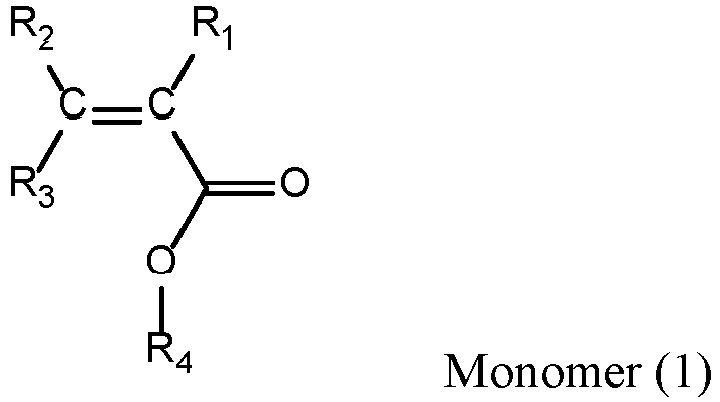 - R1, R2, and R3 is a hydrogen or a halogen selected from F, Cl, Br and I, and at least one is a halogen;- R4 is hydrogen, CH3, a fluorinated oligomer of hexafluoropropylene oxide, an alkali metal selected from lithium, sodium, potassium, rubidium and cesium, ammonium, alkylammonium, or alkyl aryl ammonium ion.
 - The electrode of claim 1, wherein the copolymer comprises up to 10.0wt% of Monomer (1).
- The electrode of claim 1, wherein R1 is fluorine.
- The electrode of claim 3, wherein R4 is hydrogen or an alkali metal, ammonium, or alkylammonium.
- The electrode of claim 1, wherein R1 and R2 are fluorine and R4 is hydrogen or an alkali metal, ammonium, or alkylammonium.
- The electrode of claim 1, wherein R1, R2 and R3 are fluorine and R4 is hydrogen or an alkali metal, ammonium, or alkylammonium.
- A formulation for making the electrode of any of claims 1 to 6 comprisingconductive carbon additives and cathode active material particles;said cathode active material particles being selected from the group:lithium iron phosphate (LFP), lithium nickel manganese cobalt oxide (NMC), lithium-manganese-cobalt-oxide (LCO), lithium-nickel-cobalt-aluminum oxide (NCA), lithium-manganese oxide (LMO), lithium-nickel-manganese-oxide (LNMO),and lithium manganese iron phosphate (LMFP).
- A formulation for making the electrode of any of claims 1 to 6 comprising a solvent, conductive carbon additives and anode active material particles, said anode active material particles being selected from the group consisting of graphite, hard carbon, soft carbon, graphene, silicon, silicon monoxide (SiO), tin, and lithium titanate (LTO).
- A battery comprising the electrode of any one of claims 1 to 6.
Applications Claiming Priority (2)
| Application Number | Priority Date | Filing Date | Title |
|---|---|---|---|
| US201862655453P | 2018-04-10 | 2018-04-10 | |
| PCT/US2019/026490 WO2019199752A1 (en) | 2018-04-10 | 2019-04-09 | Functional fluoropolymers |
Publications (3)
| Publication Number | Publication Date |
|---|---|
| EP3774714A1 EP3774714A1 (en) | 2021-02-17 |
| EP3774714A4 EP3774714A4 (en) | 2021-12-22 |
| EP3774714B1 true EP3774714B1 (en) | 2025-04-23 |
Family
ID=68163777
Family Applications (1)
| Application Number | Title | Priority Date | Filing Date |
|---|---|---|---|
| EP19784265.1A Active EP3774714B1 (en) | 2018-04-10 | 2019-04-09 | Electrodes and batteries comprising functional fluoropolymers |
Country Status (6)
| Country | Link |
|---|---|
| US (1) | US12435174B2 (en) |
| EP (1) | EP3774714B1 (en) |
| JP (1) | JP7535947B2 (en) |
| KR (1) | KR102836859B1 (en) |
| CN (1) | CN111954657A (en) |
| WO (1) | WO2019199752A1 (en) |
Families Citing this family (6)
| Publication number | Priority date | Publication date | Assignee | Title |
|---|---|---|---|---|
| CN112189271A (en) | 2018-06-12 | 2021-01-05 | 株式会社吴羽 | Binder composition, electrode mixture, electrode structure, method for producing electrode structure, and secondary battery |
| WO2021247285A1 (en) * | 2020-06-02 | 2021-12-09 | Arkema Inc. | Method of making battery electrodes with improved characteristics |
| CN115863639B (en) * | 2021-09-26 | 2025-05-13 | 比亚迪股份有限公司 | Binder for dry electrode and preparation method thereof |
| CN114292554B (en) * | 2022-01-27 | 2022-07-26 | 上海水立方新材料有限公司 | Modified nano-silica reinforced aqueous PVDF coating and preparation method thereof |
| CN115558049B (en) * | 2022-10-19 | 2024-01-26 | 上海华谊三爱富新材料有限公司 | Vinylidene fluoride copolymer and preparation method thereof |
| CN115441042A (en) * | 2022-10-21 | 2022-12-06 | 天能帅福得能源股份有限公司 | Low-temperature lithium iron phosphate battery and preparation method thereof |
Family Cites Families (33)
| Publication number | Priority date | Publication date | Assignee | Title |
|---|---|---|---|---|
| JPS5141678B1 (en) * | 1964-08-07 | 1976-11-11 | ||
| JPS551351B2 (en) * | 1974-03-07 | 1980-01-12 | ||
| JPS5523567B1 (en) | 1977-05-09 | 1980-06-24 | ||
| JPS54135400A (en) * | 1978-04-13 | 1979-10-20 | Kureha Chemical Ind Co Ltd | High dielectric film |
| JPS5554311A (en) * | 1978-10-18 | 1980-04-21 | Japan Atom Energy Res Inst | Preparation of fluorine-containing polymer having functional group |
| US4294675A (en) * | 1978-10-18 | 1981-10-13 | Japan Atomic Energy Research Institute | Process for production of fluorine-containing multi-component copolymers |
| JPS5827803B2 (en) * | 1979-04-27 | 1983-06-11 | 日本原子力研究所 | Method for producing cross-linked fluorine-containing copolymer containing ion exchange group |
| JPS57137308A (en) * | 1981-02-19 | 1982-08-24 | Nippon Mektron Ltd | Production of copolymer |
| US4360652A (en) | 1981-08-31 | 1982-11-23 | Pennwalt Corporation | Method of preparing high quality vinylidene fluoride polymer in aqueous emulsion |
| JP3121943B2 (en) | 1992-12-02 | 2001-01-09 | 呉羽化学工業株式会社 | Vinylidene fluoride copolymer |
| JP2000200623A (en) | 1999-01-06 | 2000-07-18 | Reiko Udagawa | Lithium battery having fluorine-containing polymer electrolyte |
| JP2002249589A (en) * | 2001-02-23 | 2002-09-06 | Nippon Mektron Ltd | Gel composition |
| JP4779213B2 (en) * | 2001-02-23 | 2011-09-28 | ユニマテック株式会社 | Coating material |
| JP4605919B2 (en) | 2001-02-26 | 2011-01-05 | 甲南化工株式会社 | Protein purification carrier, production method thereof, and protein purification method using the same |
| WO2002084764A1 (en) | 2001-04-10 | 2002-10-24 | Mitsubishi Materials Corporation | Lithium ion polymer secondary battery, its electrode and method for synthesizing polymer compound in binder used in adhesion layer thereof |
| US7121817B2 (en) | 2002-05-30 | 2006-10-17 | Anest Iwata Corporation | Scroll fluid machine comprising compressing and expanding sections |
| CN100367415C (en) * | 2002-10-03 | 2008-02-06 | 大金工业株式会社 | Fluoropolymer solid electrolyte containing fluoroether chains |
| US7241817B2 (en) | 2003-06-06 | 2007-07-10 | Arkema France | Process for grafting a fluoropolymer and multilayer structures comprising this grafted polymer |
| JP2007258127A (en) * | 2006-03-27 | 2007-10-04 | Sony Corp | Negative electrode and battery |
| TWI437009B (en) | 2007-04-24 | 2014-05-11 | Solvay Solexis Spa | Vinylidene fluoride copolymers |
| JP5423214B2 (en) * | 2009-07-31 | 2014-02-19 | 旭硝子株式会社 | Novel fluorine-containing copolymer and membrane |
| JP5701131B2 (en) * | 2011-04-05 | 2015-04-15 | 株式会社クレハ | Vinylidene fluoride copolymer and use of the copolymer |
| US10745555B2 (en) | 2011-06-23 | 2020-08-18 | Solvay Specialty Polymer Italy S.P.A. | Process for manufacturing porous membranes |
| EP2731170A4 (en) * | 2011-07-06 | 2014-12-31 | Zeon Corp | Porous membrane for secondary battery, separator for secondary battery, and secondary battery |
| WO2013110740A1 (en) | 2012-01-25 | 2013-08-01 | Solvay Sa | Fluoropolymers as binder for the electrodes in supercapacitors |
| CA2879425A1 (en) * | 2012-07-19 | 2014-01-23 | Relypsa, Inc. | Compositions comprising crosslinked cation-binding polymers |
| FR3004185B1 (en) | 2013-04-03 | 2017-10-13 | Arkema France | TERPOLYMERS CONTAINING VINYLIDENE FLUORIDE AND TRIFLUOROETHYLENE |
| CN104725544B (en) * | 2013-12-20 | 2016-08-17 | 浙江蓝天环保高科技股份有限公司 | A kind of high-adhesion vinylidene fluoride copolymers |
| CN104725545A (en) | 2013-12-23 | 2015-06-24 | 浙江蓝天环保高科技股份有限公司 | Novel high-cohesiveness vinylidene fluoride copolymer |
| JP6863364B2 (en) * | 2016-03-23 | 2021-04-21 | Agc株式会社 | A method for producing an α-fluoroacrylic acid ester, a composition containing a high-purity fluorocyclopropane derivative, and a composition containing a high-purity α-fluoroacrylic acid ester. |
| EP3447831B1 (en) | 2016-10-07 | 2021-02-17 | Daikin Industries, Ltd. | Binder for secondary batteries and electrode mixture for secondary batteries |
| US11643486B1 (en) * | 2022-06-08 | 2023-05-09 | Arkema Inc. | Non-linear vinylidene fluoride copolymers |
| JP2025135400A (en) * | 2024-03-05 | 2025-09-18 | ローム株式会社 | Semiconductor Devices |
-
2019
- 2019-04-09 CN CN201980024552.7A patent/CN111954657A/en active Pending
- 2019-04-09 EP EP19784265.1A patent/EP3774714B1/en active Active
- 2019-04-09 US US17/045,263 patent/US12435174B2/en active Active
- 2019-04-09 WO PCT/US2019/026490 patent/WO2019199752A1/en not_active Ceased
- 2019-04-09 KR KR1020207032363A patent/KR102836859B1/en active Active
- 2019-04-09 JP JP2020555440A patent/JP7535947B2/en active Active
Also Published As
| Publication number | Publication date |
|---|---|
| US20210171693A1 (en) | 2021-06-10 |
| KR102836859B1 (en) | 2025-07-23 |
| JP7535947B2 (en) | 2024-08-19 |
| US12435174B2 (en) | 2025-10-07 |
| WO2019199752A1 (en) | 2019-10-17 |
| EP3774714A4 (en) | 2021-12-22 |
| CN111954657A (en) | 2020-11-17 |
| EP3774714A1 (en) | 2021-02-17 |
| JP2021521296A (en) | 2021-08-26 |
| KR20200141485A (en) | 2020-12-18 |
Similar Documents
| Publication | Publication Date | Title |
|---|---|---|
| EP3774713B1 (en) | Functional fluoropolymers | |
| EP3774714B1 (en) | Electrodes and batteries comprising functional fluoropolymers | |
| US20250118760A1 (en) | Binder, slurry for solid-state battery, electrode for solid-state battery and secondary solid-state battery | |
| US10570231B2 (en) | Fluoropolymers | |
| US20180072829A1 (en) | Modified fluoropolymers | |
| KR20200141530A (en) | Adhesive composition, separator structure, electrode structure, nonaqueous electrolyte secondary battery, and manufacturing method thereof | |
| CN119173547A (en) | Nonlinear vinylidene fluoride copolymer | |
| US20240186522A1 (en) | Composition for electrodes | |
| CN115702173B (en) | Electrode binder composition for lithium ion power storage device | |
| WO2024052543A1 (en) | Binder for electrode comprising poly(vinylidene fluoride) and a hydrophilic polymer | |
| WO2025229104A1 (en) | Flexible vinylidene fluoride copolymers | |
| CN121152818A (en) | Shear-stable aqueous fluoropolymer dispersions |
Legal Events
| Date | Code | Title | Description |
|---|---|---|---|
| STAA | Information on the status of an ep patent application or granted ep patent |
Free format text: STATUS: THE INTERNATIONAL PUBLICATION HAS BEEN MADE |
|
| PUAI | Public reference made under article 153(3) epc to a published international application that has entered the european phase |
Free format text: ORIGINAL CODE: 0009012 |
|
| STAA | Information on the status of an ep patent application or granted ep patent |
Free format text: STATUS: REQUEST FOR EXAMINATION WAS MADE |
|
| 17P | Request for examination filed |
Effective date: 20201002 |
|
| AK | Designated contracting states |
Kind code of ref document: A1 Designated state(s): AL AT BE BG CH CY CZ DE DK EE ES FI FR GB GR HR HU IE IS IT LI LT LU LV MC MK MT NL NO PL PT RO RS SE SI SK SM TR |
|
| AX | Request for extension of the european patent |
Extension state: BA ME |
|
| TPAC | Observations filed by third parties |
Free format text: ORIGINAL CODE: EPIDOSNTIPA |
|
| DAV | Request for validation of the european patent (deleted) | ||
| DAX | Request for extension of the european patent (deleted) | ||
| REG | Reference to a national code |
Ref legal event code: R079 Free format text: PREVIOUS MAIN CLASS: C07C0057520000 Ref country code: DE Ref legal event code: R079 Ref document number: 602019069039 Country of ref document: DE Free format text: PREVIOUS MAIN CLASS: C07C0057520000 Ipc: C08F0214220000 |
|
| A4 | Supplementary search report drawn up and despatched |
Effective date: 20211119 |
|
| RIC1 | Information provided on ipc code assigned before grant |
Ipc: H01M 4/02 20060101ALI20211112BHEP Ipc: H01M 10/0525 20100101ALI20211112BHEP Ipc: H01M 4/04 20060101ALI20211112BHEP Ipc: H01M 4/62 20060101ALI20211112BHEP Ipc: C07C 57/52 20060101ALI20211112BHEP Ipc: C09D 127/16 20060101ALI20211112BHEP Ipc: C08F 220/22 20060101ALI20211112BHEP Ipc: C08F 214/22 20060101AFI20211112BHEP |
|
| STAA | Information on the status of an ep patent application or granted ep patent |
Free format text: STATUS: EXAMINATION IS IN PROGRESS |
|
| 17Q | First examination report despatched |
Effective date: 20240326 |
|
| GRAP | Despatch of communication of intention to grant a patent |
Free format text: ORIGINAL CODE: EPIDOSNIGR1 |
|
| STAA | Information on the status of an ep patent application or granted ep patent |
Free format text: STATUS: GRANT OF PATENT IS INTENDED |
|
| INTG | Intention to grant announced |
Effective date: 20241128 |
|
| GRAS | Grant fee paid |
Free format text: ORIGINAL CODE: EPIDOSNIGR3 |
|
| GRAA | (expected) grant |
Free format text: ORIGINAL CODE: 0009210 |
|
| STAA | Information on the status of an ep patent application or granted ep patent |
Free format text: STATUS: THE PATENT HAS BEEN GRANTED |
|
| AK | Designated contracting states |
Kind code of ref document: B1 Designated state(s): AL AT BE BG CH CY CZ DE DK EE ES FI FR GB GR HR HU IE IS IT LI LT LU LV MC MK MT NL NO PL PT RO RS SE SI SK SM TR |
|
| REG | Reference to a national code |
Ref country code: GB Ref legal event code: FG4D |
|
| REG | Reference to a national code |
Ref country code: CH Ref legal event code: EP |
|
| REG | Reference to a national code |
Ref country code: DE Ref legal event code: R096 Ref document number: 602019069039 Country of ref document: DE |
|
| REG | Reference to a national code |
Ref country code: IE Ref legal event code: FG4D |
|
| REG | Reference to a national code |
Ref country code: NL Ref legal event code: MP Effective date: 20250423 |
|
| PG25 | Lapsed in a contracting state [announced via postgrant information from national office to epo] |
Ref country code: NL Free format text: LAPSE BECAUSE OF FAILURE TO SUBMIT A TRANSLATION OF THE DESCRIPTION OR TO PAY THE FEE WITHIN THE PRESCRIBED TIME-LIMIT Effective date: 20250423 |
|
| REG | Reference to a national code |
Ref country code: AT Ref legal event code: MK05 Ref document number: 1787719 Country of ref document: AT Kind code of ref document: T Effective date: 20250423 |
|
| PG25 | Lapsed in a contracting state [announced via postgrant information from national office to epo] |
Ref country code: ES Free format text: LAPSE BECAUSE OF FAILURE TO SUBMIT A TRANSLATION OF THE DESCRIPTION OR TO PAY THE FEE WITHIN THE PRESCRIBED TIME-LIMIT Effective date: 20250423 Ref country code: PT Free format text: LAPSE BECAUSE OF FAILURE TO SUBMIT A TRANSLATION OF THE DESCRIPTION OR TO PAY THE FEE WITHIN THE PRESCRIBED TIME-LIMIT Effective date: 20250825 Ref country code: FI Free format text: LAPSE BECAUSE OF FAILURE TO SUBMIT A TRANSLATION OF THE DESCRIPTION OR TO PAY THE FEE WITHIN THE PRESCRIBED TIME-LIMIT Effective date: 20250423 |
|
| REG | Reference to a national code |
Ref country code: LT Ref legal event code: MG9D |
|
| PG25 | Lapsed in a contracting state [announced via postgrant information from national office to epo] |
Ref country code: GR Free format text: LAPSE BECAUSE OF FAILURE TO SUBMIT A TRANSLATION OF THE DESCRIPTION OR TO PAY THE FEE WITHIN THE PRESCRIBED TIME-LIMIT Effective date: 20250724 Ref country code: NO Free format text: LAPSE BECAUSE OF FAILURE TO SUBMIT A TRANSLATION OF THE DESCRIPTION OR TO PAY THE FEE WITHIN THE PRESCRIBED TIME-LIMIT Effective date: 20250723 |
|
| PG25 | Lapsed in a contracting state [announced via postgrant information from national office to epo] |
Ref country code: PL Free format text: LAPSE BECAUSE OF FAILURE TO SUBMIT A TRANSLATION OF THE DESCRIPTION OR TO PAY THE FEE WITHIN THE PRESCRIBED TIME-LIMIT Effective date: 20250423 |
|
| PG25 | Lapsed in a contracting state [announced via postgrant information from national office to epo] |
Ref country code: BG Free format text: LAPSE BECAUSE OF FAILURE TO SUBMIT A TRANSLATION OF THE DESCRIPTION OR TO PAY THE FEE WITHIN THE PRESCRIBED TIME-LIMIT Effective date: 20250423 |
|
| PG25 | Lapsed in a contracting state [announced via postgrant information from national office to epo] |
Ref country code: HR Free format text: LAPSE BECAUSE OF FAILURE TO SUBMIT A TRANSLATION OF THE DESCRIPTION OR TO PAY THE FEE WITHIN THE PRESCRIBED TIME-LIMIT Effective date: 20250423 |
|
| PG25 | Lapsed in a contracting state [announced via postgrant information from national office to epo] |
Ref country code: AT Free format text: LAPSE BECAUSE OF FAILURE TO SUBMIT A TRANSLATION OF THE DESCRIPTION OR TO PAY THE FEE WITHIN THE PRESCRIBED TIME-LIMIT Effective date: 20250423 |
|
| PG25 | Lapsed in a contracting state [announced via postgrant information from national office to epo] |
Ref country code: RS Free format text: LAPSE BECAUSE OF FAILURE TO SUBMIT A TRANSLATION OF THE DESCRIPTION OR TO PAY THE FEE WITHIN THE PRESCRIBED TIME-LIMIT Effective date: 20250723 |
|
| PG25 | Lapsed in a contracting state [announced via postgrant information from national office to epo] |
Ref country code: IS Free format text: LAPSE BECAUSE OF FAILURE TO SUBMIT A TRANSLATION OF THE DESCRIPTION OR TO PAY THE FEE WITHIN THE PRESCRIBED TIME-LIMIT Effective date: 20250823 |
|
| PG25 | Lapsed in a contracting state [announced via postgrant information from national office to epo] |
Ref country code: LV Free format text: LAPSE BECAUSE OF FAILURE TO SUBMIT A TRANSLATION OF THE DESCRIPTION OR TO PAY THE FEE WITHIN THE PRESCRIBED TIME-LIMIT Effective date: 20250423 |
|
| PG25 | Lapsed in a contracting state [announced via postgrant information from national office to epo] |
Ref country code: DK Free format text: LAPSE BECAUSE OF FAILURE TO SUBMIT A TRANSLATION OF THE DESCRIPTION OR TO PAY THE FEE WITHIN THE PRESCRIBED TIME-LIMIT Effective date: 20250423 Ref country code: SM Free format text: LAPSE BECAUSE OF FAILURE TO SUBMIT A TRANSLATION OF THE DESCRIPTION OR TO PAY THE FEE WITHIN THE PRESCRIBED TIME-LIMIT Effective date: 20250423 |
|
| PG25 | Lapsed in a contracting state [announced via postgrant information from national office to epo] |
Ref country code: CZ Free format text: LAPSE BECAUSE OF FAILURE TO SUBMIT A TRANSLATION OF THE DESCRIPTION OR TO PAY THE FEE WITHIN THE PRESCRIBED TIME-LIMIT Effective date: 20250423 |
|
| PG25 | Lapsed in a contracting state [announced via postgrant information from national office to epo] |
Ref country code: EE Free format text: LAPSE BECAUSE OF FAILURE TO SUBMIT A TRANSLATION OF THE DESCRIPTION OR TO PAY THE FEE WITHIN THE PRESCRIBED TIME-LIMIT Effective date: 20250423 |
|
| REG | Reference to a national code |
Ref country code: DE Ref legal event code: R097 Ref document number: 602019069039 Country of ref document: DE |
|
| PG25 | Lapsed in a contracting state [announced via postgrant information from national office to epo] |
Ref country code: RO Free format text: LAPSE BECAUSE OF FAILURE TO SUBMIT A TRANSLATION OF THE DESCRIPTION OR TO PAY THE FEE WITHIN THE PRESCRIBED TIME-LIMIT Effective date: 20250423 Ref country code: SK Free format text: LAPSE BECAUSE OF FAILURE TO SUBMIT A TRANSLATION OF THE DESCRIPTION OR TO PAY THE FEE WITHIN THE PRESCRIBED TIME-LIMIT Effective date: 20250423 |
|
| PG25 | Lapsed in a contracting state [announced via postgrant information from national office to epo] |
Ref country code: IT Free format text: LAPSE BECAUSE OF FAILURE TO SUBMIT A TRANSLATION OF THE DESCRIPTION OR TO PAY THE FEE WITHIN THE PRESCRIBED TIME-LIMIT Effective date: 20250423 |
|
| PLBE | No opposition filed within time limit |
Free format text: ORIGINAL CODE: 0009261 |
|
| STAA | Information on the status of an ep patent application or granted ep patent |
Free format text: STATUS: NO OPPOSITION FILED WITHIN TIME LIMIT |
|
| REG | Reference to a national code |
Ref country code: CH Ref legal event code: L10 Free format text: ST27 STATUS EVENT CODE: U-0-0-L10-L00 (AS PROVIDED BY THE NATIONAL OFFICE) Effective date: 20260304 |
|
| 26N | No opposition filed |
Effective date: 20260126 |
|
| PGFP | Annual fee paid to national office [announced via postgrant information from national office to epo] |
Ref country code: GB Payment date: 20260223 Year of fee payment: 8 |
|
| PGFP | Annual fee paid to national office [announced via postgrant information from national office to epo] |
Ref country code: FR Payment date: 20260309 Year of fee payment: 8 |