EP3774543B1 - Eisentfernungssystem - Google Patents
Eisentfernungssystem Download PDFInfo
- Publication number
- EP3774543B1 EP3774543B1 EP19716237.3A EP19716237A EP3774543B1 EP 3774543 B1 EP3774543 B1 EP 3774543B1 EP 19716237 A EP19716237 A EP 19716237A EP 3774543 B1 EP3774543 B1 EP 3774543B1
- Authority
- EP
- European Patent Office
- Prior art keywords
- electrical
- layer
- icing
- thermoplastic
- layers
- Prior art date
- Legal status (The legal status is an assumption and is not a legal conclusion. Google has not performed a legal analysis and makes no representation as to the accuracy of the status listed.)
- Active
Links
Images




Classifications
-
- B—PERFORMING OPERATIONS; TRANSPORTING
- B64—AIRCRAFT; AVIATION; COSMONAUTICS
- B64D—EQUIPMENT FOR FITTING IN OR TO AIRCRAFT; FLIGHT SUITS; PARACHUTES; ARRANGEMENT OR MOUNTING OF POWER PLANTS OR PROPULSION TRANSMISSIONS IN AIRCRAFT
- B64D15/00—De-icing or preventing icing on exterior surfaces of aircraft
- B64D15/16—De-icing or preventing icing on exterior surfaces of aircraft by mechanical means, e.g. pulsating mats or shoes attached to, or built into, surface
-
- B—PERFORMING OPERATIONS; TRANSPORTING
- B32—LAYERED PRODUCTS
- B32B—LAYERED PRODUCTS, i.e. PRODUCTS BUILT-UP OF STRATA OF FLAT OR NON-FLAT, e.g. CELLULAR OR HONEYCOMB, FORM
- B32B27/00—Layered products comprising a layer of synthetic resin
- B32B27/06—Layered products comprising a layer of synthetic resin as the main or only constituent of a layer, which is next to another layer of the same or of a different material
- B32B27/08—Layered products comprising a layer of synthetic resin as the main or only constituent of a layer, which is next to another layer of the same or of a different material of synthetic resin
-
- B—PERFORMING OPERATIONS; TRANSPORTING
- B32—LAYERED PRODUCTS
- B32B—LAYERED PRODUCTS, i.e. PRODUCTS BUILT-UP OF STRATA OF FLAT OR NON-FLAT, e.g. CELLULAR OR HONEYCOMB, FORM
- B32B27/00—Layered products comprising a layer of synthetic resin
- B32B27/28—Layered products comprising a layer of synthetic resin comprising synthetic resins not wholly covered by any one of the sub-groups B32B27/30 - B32B27/42
- B32B27/288—Layered products comprising a layer of synthetic resin comprising synthetic resins not wholly covered by any one of the sub-groups B32B27/30 - B32B27/42 comprising polyketones
-
- B—PERFORMING OPERATIONS; TRANSPORTING
- B64—AIRCRAFT; AVIATION; COSMONAUTICS
- B64D—EQUIPMENT FOR FITTING IN OR TO AIRCRAFT; FLIGHT SUITS; PARACHUTES; ARRANGEMENT OR MOUNTING OF POWER PLANTS OR PROPULSION TRANSMISSIONS IN AIRCRAFT
- B64D15/00—De-icing or preventing icing on exterior surfaces of aircraft
- B64D15/02—De-icing or preventing icing on exterior surfaces of aircraft by ducted hot gas or liquid
- B64D15/06—Liquid application
- B64D15/08—Liquid application exuded from surface
-
- B—PERFORMING OPERATIONS; TRANSPORTING
- B64—AIRCRAFT; AVIATION; COSMONAUTICS
- B64D—EQUIPMENT FOR FITTING IN OR TO AIRCRAFT; FLIGHT SUITS; PARACHUTES; ARRANGEMENT OR MOUNTING OF POWER PLANTS OR PROPULSION TRANSMISSIONS IN AIRCRAFT
- B64D15/00—De-icing or preventing icing on exterior surfaces of aircraft
- B64D15/12—De-icing or preventing icing on exterior surfaces of aircraft by electric heating
-
- B—PERFORMING OPERATIONS; TRANSPORTING
- B64—AIRCRAFT; AVIATION; COSMONAUTICS
- B64D—EQUIPMENT FOR FITTING IN OR TO AIRCRAFT; FLIGHT SUITS; PARACHUTES; ARRANGEMENT OR MOUNTING OF POWER PLANTS OR PROPULSION TRANSMISSIONS IN AIRCRAFT
- B64D15/00—De-icing or preventing icing on exterior surfaces of aircraft
- B64D15/16—De-icing or preventing icing on exterior surfaces of aircraft by mechanical means, e.g. pulsating mats or shoes attached to, or built into, surface
- B64D15/163—De-icing or preventing icing on exterior surfaces of aircraft by mechanical means, e.g. pulsating mats or shoes attached to, or built into, surface using electro-impulsive devices
-
- H—ELECTRICITY
- H05—ELECTRIC TECHNIQUES NOT OTHERWISE PROVIDED FOR
- H05B—ELECTRIC HEATING; ELECTRIC LIGHT SOURCES NOT OTHERWISE PROVIDED FOR; CIRCUIT ARRANGEMENTS FOR ELECTRIC LIGHT SOURCES, IN GENERAL
- H05B3/00—Ohmic-resistance heating
- H05B3/20—Heating elements having extended surface area substantially in a two-dimensional [2D] plane, e.g. plate-heater
- H05B3/34—Heating elements having extended surface area substantially in a two-dimensional [2D] plane, e.g. plate-heater flexible, e.g. heating nets or webs
- H05B3/36—Heating elements having extended surface area substantially in a two-dimensional [2D] plane, e.g. plate-heater flexible, e.g. heating nets or webs heating conductor embedded in insulating material
-
- B—PERFORMING OPERATIONS; TRANSPORTING
- B32—LAYERED PRODUCTS
- B32B—LAYERED PRODUCTS, i.e. PRODUCTS BUILT-UP OF STRATA OF FLAT OR NON-FLAT, e.g. CELLULAR OR HONEYCOMB, FORM
- B32B2250/00—Layers arrangement
- B32B2250/05—5 or more layers
-
- B—PERFORMING OPERATIONS; TRANSPORTING
- B32—LAYERED PRODUCTS
- B32B—LAYERED PRODUCTS, i.e. PRODUCTS BUILT-UP OF STRATA OF FLAT OR NON-FLAT, e.g. CELLULAR OR HONEYCOMB, FORM
- B32B2250/00—Layers arrangement
- B32B2250/24—All layers being polymeric
-
- B—PERFORMING OPERATIONS; TRANSPORTING
- B32—LAYERED PRODUCTS
- B32B—LAYERED PRODUCTS, i.e. PRODUCTS BUILT-UP OF STRATA OF FLAT OR NON-FLAT, e.g. CELLULAR OR HONEYCOMB, FORM
- B32B2307/00—Properties of the layers or laminate
- B32B2307/20—Properties of the layers or laminate having particular electrical or magnetic properties, e.g. piezoelectric
- B32B2307/206—Insulating
-
- B—PERFORMING OPERATIONS; TRANSPORTING
- B32—LAYERED PRODUCTS
- B32B—LAYERED PRODUCTS, i.e. PRODUCTS BUILT-UP OF STRATA OF FLAT OR NON-FLAT, e.g. CELLULAR OR HONEYCOMB, FORM
- B32B2307/00—Properties of the layers or laminate
- B32B2307/30—Properties of the layers or laminate having particular thermal properties
-
- B—PERFORMING OPERATIONS; TRANSPORTING
- B32—LAYERED PRODUCTS
- B32B—LAYERED PRODUCTS, i.e. PRODUCTS BUILT-UP OF STRATA OF FLAT OR NON-FLAT, e.g. CELLULAR OR HONEYCOMB, FORM
- B32B2605/00—Vehicles
- B32B2605/18—Aircraft
-
- H—ELECTRICITY
- H05—ELECTRIC TECHNIQUES NOT OTHERWISE PROVIDED FOR
- H05B—ELECTRIC HEATING; ELECTRIC LIGHT SOURCES NOT OTHERWISE PROVIDED FOR; CIRCUIT ARRANGEMENTS FOR ELECTRIC LIGHT SOURCES, IN GENERAL
- H05B2203/00—Aspects relating to Ohmic resistive heating covered by group H05B3/00
- H05B2203/002—Heaters using a particular layout for the resistive material or resistive elements
- H05B2203/005—Heaters using a particular layout for the resistive material or resistive elements using multiple resistive elements or resistive zones isolated from each other
-
- H—ELECTRICITY
- H05—ELECTRIC TECHNIQUES NOT OTHERWISE PROVIDED FOR
- H05B—ELECTRIC HEATING; ELECTRIC LIGHT SOURCES NOT OTHERWISE PROVIDED FOR; CIRCUIT ARRANGEMENTS FOR ELECTRIC LIGHT SOURCES, IN GENERAL
- H05B2203/00—Aspects relating to Ohmic resistive heating covered by group H05B3/00
- H05B2203/016—Heaters using particular connecting means
Definitions
- the present invention is concerned with aerospace ice-protection systems and specifically, but not exclusively, to an ice-protection system that is capable of being used with small to medium sized aircraft as well as larger commercial aircraft.
- Aerospace surfaces such as wing leading edges or engine nacelles (or the like) are prone to ice accretion during flight as the cold outer surfaces of the component come into contact with water during flight, landing, taxi or take-off.
- Ice build-up can change the aerodynamic profile or shape of the component thus changing the functionality of the component. This can have disastrous consequences.
- nacelle ice may be ingested into the engine again potentially have very serious and dangerous results.
- One system involves using hot exhaust gas from the engines which can be directed to the desired surface (for example along the leading edge of a wing). This has the advantage of using the unwanted heat from the exhaust gas.
- electrical heaters are applied to the aircraft surfaces prone to icing and an electrical current passed through the heaters. The advantage of this system is that it allows complex and distributed heating systems to be deployed around the aircraft. In fact this system has become the industry's preferred solution to ice accretion.
- US 6,283,411 B1 discusses a de-icer comprising a skin heating means immediately subjacent an outer skin overlying an apex of a leading edge, and a skin deflection means immediately subjacent the outer skin chordwise aft of the apex.
- the skin heating means prevents the formation of ice over the apex and the skin deflection means deflects the outer skin to expulse ice formed chordwise aft of the apex.
- a controller controls the heating and deflection cycles to minimize power consumption of the de-icer.
- US 5,553,814 A discusses an aircraft de-icing assembly for attachment to an airfoil including a deflection shell disposed over a deflection means.
- the deflection shell is comprised of a primary layer comprised of a high strength fabric reinforced with a phenolic resin and a backing layer comprised of a high strength fabric reinforced with an epoxy resin.
- the thickness of the backing layer is varied as a function of curvature of the airfoil and spanwise length of the airfoil.
- US 4,875,644 A discusses an electroexpulsive separation apparatus suitable for deicing leading edges of aircraft which includes a pair of sheet-like arrays each containing in spaced-apart relationship a plurality of parallel ribbon-shaped electrically conductive members.
- the electrically conductive members are electrically interconnected such that any electrical current flowing in the conductive members flows in the same direction in adjacent electrically conductive members in the first sheet like member and also flows in adjacent electrically conductive members of the second sheet-like array in a direction opposite.
- the first and second sheet-like arrays are coextensive and superposed proximate to each other such that the electrically conductive members of the first and second sheet-like members are substantially parallel.
- the electrically conductive members are electrically insulated from one another. Large current pulses of predetermined magnitude, shape and duration are fed to the conductors from a power storage unit resulting in rapid and forceful separation of the first and second sheet-like arrays and other members associated therewith.
- the laminate is in the form of: a first thermoplastic heat dissipation layer; a second electrically operable heating element layer; a third electrically insulating thermoplastic layer; a fourth electrically insulating thermoplastic layer; a fifth electrical power supply layer; and a sixth thermoplastic backing layer wherein an electrical actuator is located between the third and fourth thermoplastic layers, and wherein the second electrically operable heating element layer overlaps the electrical actuator.
- an apparatus which combines a conventional electrical heater with an expandable or movable structure.
- the expansion is in a direction perpendicular to the surface of the conventional heater surface such that the surface displaces outwards from the surface onto which it is formed or connected. Parts of the surface can thereby be configured to move away or out of the conventional surface to disturb the shape or contours of the conventional surface.
- the invention described herein thereby provides a combination or hybrid ice removal system that can simultaneously heat a surface and displace a surface and this advantageously allows ice can be both melted and mechanically or physically cracked or pushed away from the surface.
- Examples of this technology include the Boeing 787, which incorporates a heater mat technology. As also described above, the application of this technology to smaller aircraft is however limited by the ability of the aircraft to generate sufficient electrical power.
- the inventors have created a thin, flexible, single-layer integrated heater and actuator manufactured from a combination of etched and/or deposited metallic tracks encapsulated within a thermoplastic/glass fibre composite laminate. This is in contrast to existing examples of ice removal systems which use discrete, separate components for actuation and heating which then have to be assembled.
- the system described herein is applicable to any surface on which ice may build up.
- the integrated functional layer may be bonded between a thin metallic erosion shield skin and a structural composite or metallic skin.
- thermoplastic/glass functional layer laminate incorporates the following:
- the laminate structure is in the form of:
- a multi-layer laminate including an actuator within i.e. embedded or encapsulated within the laminate.
- the actuator must be thin to minimise the weight of the system and thus, advantageously the electrical actuator may be in the form of a pair of opposing electrical conductors separated by an electrical insulator.
- Ampere's force law means that a repulsive force can be generated between two conductors by virtue of the magnetic field each conductor generates and the interaction of those fields. Thus, a very small movement can be generated in the laminate structure using this principle. Pulsing an electrical current can cause pulses in movement of the actuator and thus pulses in movement of the surface of the laminate which is caused to rise and fall as the pulse current is applied.
- the conductors may be any suitable shape depending on the application and shape of the surface to be de-iced.
- the opposing electrical conductors may be in the form of parallel and overlapping electrically conductive tracks. By overlapping the tracks the maximum force effect can be realised.
- the tracks must be electrically insulated from one another.
- the opposing electrical conductors may be separated by an elastomeric layer, with suitable mechanical dielectric strength for the voltages in use.
- One or both of the conductors may be free to move to maximise the movement created by the Ampere law i.e. one or both of the electrical conductors may be free to move relative to the electrical insulator.
- the movement can be translated to the outer surface of the deicing structure since the conductor movement is not inhibited by being bonded or connected to the insulator.
- the electrical conductors are arranged in use to be electrically coupled to an electrical supply.
- the electrical conductors are electrically connected together at one end and arranged to be electrically coupled to an electrical supply at the other end.
- the structure may be provided with thermoplastic fillers located adjacent to each of the electrical conductors between the third and fourth thermoplastic layers. These fillers 'fill' the gap in the laminate created by the thickness of the two conductors and the insulating layer between them.
- an electrical path may be provided between the second electrically operable heating element layer and the fifth electrical power supply layer.
- the heating element itself may be a serpentine track for example of conducting copper for example. Passing a current through the track create heat.
- the heating element may be applied in a variety of conventional ways or using more advanced techniques such as flame sprayed copper.
- the electrical conductors and the electrical power supply layer may similarly be applied in a variety of ways including, for example, copper etched layers.
- the choice of layers will be dependent on whether it is arranged to carry current to create heat, or to supply the current (without creating heat) to a location where it will be used to create heat.
- the laminate may be cured together, for example in an autoclave where a thermoplastic material softens and adheres to an adjacent layer.
- a thermoplastic material softens and adheres to an adjacent layer.
- a laminate structure comprising a plurality of thermoplastic layers encapsulating a plurality of electrical conducting layers.
- the electrical insulator located between the electrical conductors may be in the form of a thermoplastic material comprising a discontinuity allowing the insulator outer surfaces to move apart relative to each other.
- the discontinuity may be in the form of a slit extending in a plane within the layer and parallel with the outermost surfaces of the layer. This slit or discontinuity allows the insulator to expand such that if it is coupled to the conductors they may still move. In an alternative arrangement one or both of the conductors may be un-bonded to the outer surfaces of the insulator thereby achieving the same effect.
- the layers can be configured to allow for relative movement of the two conductors whilst maintaining their electrical isolation.
- the electrical insulator could be in the form of two independent sub-layers immediately adjacent to each other.
- a variety of material may be used for the layers within the laminate.
- a polyetheretherketone (PEEK) material may be used for one or each of the thermoplastic and insulating layers.
- the conductors forming the actuator may be any suitable shape.
- the conductors may be overlapping elongate tracks having a constant width and cross-section. Thus a uniform force and movement may be created.
- the tracks may be configures to follow the contour of the aerodynamic shape which is to be de-iced and may be continuous or curved, zig-zag or any desired shape.
- the electrical conductors may be overlapping elongate tracks with varying widths defining regions of greater and less surface areas. Non-uniform displacements can then be created.
- areas of greater displacement i.e. greater force may advantageously be aligned with structural components of the aerospace component thus ensuring the forces do not damage any delicate or fragile parts of the structure.
- the regions of greater force could for example be arranged to align with the ribs of a wing for example.
- the outer surface of the apparatus may also be provided with a metallic erosion shield skin.
- a structural composite or metallic skin may also be applied on a second opposing side of the apparatus.
- the de-icing apparatus is particularly applicable to leading edges or nacelles of aerodynamic components which will be curved or have rounded contours.
- the layers can thus be formed in a shape corresponding to the desired application profile.
- a de-icing system for an aircraft comprising the de-icing apparatus of the first aspect and one or more electrical control and supply devices arranged to electrically excite the electrical heating element and the electrical actuator.
- a complete system may thereby be provided.
- the conductors may be excited in a variety of different manners to achieve different displacements, different displacement profiles and/or different resonances or waves along the apparatus.
- a component such as a wing may comprise more than one de-icing apparatus which may advantageously be simultaneously or independently controlled. Independent control allows the electrical power requirements of the de-icing system to be managed; a particularly important aspect for smaller aircraft.
- a method of manufacturing a de-icing apparatus and system in which a laminate structure is laid-up and then cured to create a continuous structure.
- Another arrangement of de-icing an aerospace component such as a wing involves secreting a de-icing fluid onto the surface which has frozen. In effect a liquid is released onto the surface which causes the ice to break down and can then flow away from the critical zones or areas of the aerospace component.
- Such liquids are known as freezing point depression liquids or FPDs.
- FPDs freezing point depression liquids
- One such example is an ethylene glycol-based fluid.
- the de-icing apparatus of the first aspect may be used in combination with such a fluid ice protection system.
- the conventional heating mat described above may be used in combination with the actuator and heater described herein it may be used in precisely the same way with a fluid system i.e. located down-stream of the leading edge area where the fluid is deployed.
- locating a de-icing apparatus described herein down-stream but adjacent to a leading edge using a fluid secretion systems allows the fluid to flow for a longer period along the wing without re-freezing, it also allows for smaller quantities of fluid to be carried and/or lower concentrations of fluid to be used having environment benefits.
- the fluid itself may be secreted for example from a conduit at or near to the leading edge.
- a region of the apparatus aligning with the leading edge may comprise a perforated surface for communication of fluid from the conduit through the leading edge.
- the perforated surface may additionally include an electrical heater arranged in use to heat the leading edge surface.
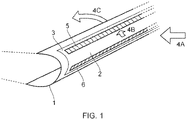
- Figure 1 shows one application for the inventions disclosed herein on the leading edge of an aircraft wing 1.
- the wing 1 comprises a leading edge 2 which is a curved profile forming the front or upstream part of the wing.
- the wing creates lift by separating airflow into two stream on the upper and lower surfaces of the wing.
- leading edge 1 Extending from the top and bottom surface of the leading edge 1 are the trailing regions 3 or areas which extend from the leading edge away from the front of the wing towards the trailing edge (not shown at the rear of the wing). Only a section of the wing is shown in figure 1 but it will be recognised that the wing extends from the fuselage of the aircraft to the wing tip.
- the arrows 4A, 4B and 4C show the airflow over the surfaces. As the aircraft is pushed through the air the air 4A approaches the wing leading edge 2 and impinges or collides with the surface. Air is directed as shown by arrow 4B around the curved surface towards the flow 4C on the upper surface of the wing. The same occurs on the lower surface of the wing.
- Air impinging on the leading edge may contain water vapour and owing to the altitude of aircraft the airframes can become extremely cold causing ice to form on the wing surfaces.
- the disclosures herein provide a variety of novel ways to de-ice or release ice from these wing surfaces (as well as other aerodynamic surfaces) using a particular laminate structure which provides an electrically operable actuator surface optionally in combination with an electrical heater.
- actuator is intended to refer to something that causes movement i.e. displacement. By causing displacement of a surface at the wing surfaces ice can be caused to crack and/or break away from the wing surface.
- de-icing apparatus 5 and 6 are located not along the front of the leading edge but on a trailing portion of the wing relative to the leading edge i.e. adjacent to the leading edge but down-stream from it in an airflow direction.
- the laminate structure of the de-icing apparatus described herein will have a shape corresponding to the particular profile of the aerodynamic component to which it is applied.
- a leading edge of a wing is shown and thus the de-icing apparatus would have a curved, somewhat semi-circular profile as illustrated in figure 1 .
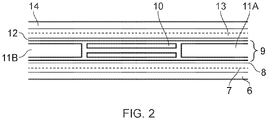
- Figure 2 shows such a cross-section through the laminate structure forming part of the deicing apparatuses described herein.
- the laminate is arranged for connection to the aircraft outer surface and comprises (working from the bottom layer shown in figure 2 ) a thermoplastic backing layer 6.
- An electrical circuit 7 is formed on the layer 6 by etching copper tracks which can receive electrical power. This circuit or track provides the electrical heated circuit described below.
- the copper tracks 7 are sandwiched between layer 6 and another thermoplastic layer 8.
- the central portion 9 of the laminate comprises an electrically operable actuator 10 which will be described with reference to figure 3 below.
- Figure 2 illustrates the optional filler portions 11A and 11B which are located on either side of the actuator 10 and which fill in the spaces between layer 8 and the next thermoplastic layer 12 located above the actuator 10. These filler fill the gaps created in the laminate by the thickness of the actuator 10 and provide a uniform thickness and outer surface to the overall laminate.
- thermoplastic layer 12 is applied to the top of the thermoplastic layer 12 in a profile (layout) that corresponds to the desired heat output profile that is desired for the heated region.
- a further upper thermoplastic layer 14 formed the upper surface of the di-icing apparatus.
- a further erosion shield may be applied to the upper surface 14 and a corresponding composite or metallic backing layer to the lower surface of layer 6. Both not shown.
- thermoplastic material Any suitable thermoplastic material may be used for the laminate layers.
- PEEK polyetheretherketone
- EAK is particularly suitable owing to its electrical insulation properties and thermal conductivity.
- the centrally located actuator 10 will now be described with reference to figure 3 .
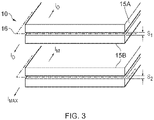
- the actuator's function is to cause relative movement of one portion 15A with respect to the other half of the actuator 15B.
- The may be achieved according to Ampere's force law i.e. that attractive or repulsive forces can be generated between electrical conductors that are adjacent to each other by supplying opposing current directions.
- the embedded actuator according to the arrangement shown in figure 3 is provided with a current in a first direction in actuator half 15A and an opposing current direction in the other half of the actuator 15B.as illustrated by I 0 and I Max and the associated arrows in figure 3 .
- the two actuator halves 15A and 15B are electrically separated and isolated by an insulator 16 located between the two.
- This may for example be an additional layer of PEEK or a release layer of a suitable dielectric material such as, for example, Polyimide.
- the upper image in figure 3 shows a situation when the actuators 15A and 15B are not electrically excited i.e. there is no electrical current passing through the two halves. No forces are generated and the separation of the two halves is S 1
- the lower image in figure 3 shows a situation when the actuators 15A and 15B are provided with an electrical current I Max .
- Ampere's force law means that as a result of the opposing current directions and the associated generation of magnetic fields the two halves are pushed apart creating a separation S 2 where S 2 > S 1 .
- This functionality of the actuator 10 is embedded into the middle of the de-icing apparatus shown in figure 2 .
- the inventor have established that by pulsing a current through the actuator 10 extremely powerful impulses can be generated over very small distances. For example 10,000G over 1mm.
- This rapid impulse allows the surface of the de-icing apparatus immediately above the actuator to be rapidly displaced over this small distance meaning that the connection or adhesion between ice on the surface and the outer surface of the apparatus can be broken or disturbed.
- FIG. 4 illustrates schematically the electrical circuit forming each actuator portion. It will be recognised that each apparatus may comprise multiple such actuators extending along the length of the apparatus or arranged over discrete areas or zones.
- an electrical supply and controller 17 is provided which can provide the necessary current and switching capability.
- the two halves are electrically connected together such that current is returned in an opposing direction. It will be recognised that the opposing current flows may be achieved in other electrical ways.
- the controller may advantageously be configured to apply currents to multiple such actuators to cause ripples in the de-icing surface or even waves by applying currents are predetermined times or in particular sequences.
- One or more actuators may be used to create complex waves or forces.
- a single actuator could create a ripple in a defined locality on a surface, but a number of actuators would allow a stronger ripple (or complex wave) to be created and this could spread over a larger surface and depending on the positioning of the actuators, could allow for different degrees of force to be applied in selected localities.
- Some areas may collect more ice than others, for example because of profile and/or airflow, and these areas may have more actuators.
- a combination of single or multiple actuators may be used depending on the desired configuration in order to provide a targeted degree of ice removal depending on the location and extent of ice build-up.
- Figure 5 shows how the actuator extends in on example as a pair of parallel tracks 15A 15B in a z direction. As shown the two halves of the actuator are substantially overlapping. This, in combination with their close proximity to each other and then depth maximises the effectiveness in the de-icing application since it maximises the impulse that can be generated whilst minimising the thickness. This reduces weight and allows complex geometries to be followed.
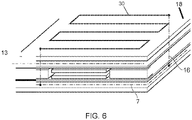
- Figure 6 illustrates the electrical path between the power supply layer 7 and the heater layer 13.
- a shown a series of electrical connections 16 are provided through the laminate allowing power to be communicated from a power supply to the de-icer (not shown but located on the inner surface of the apparatus) to the heater circuit proximate to the outer surface of the deicing apparatus.
- the layer 13 has an alternative path 30 which dissipates heat in the design profile on the upper surface 18.
- Figure 7 shows two alternative arrangements for the profile of the actuators.
- a uniform profile is shown. Such a profile will generate uniform impulses along the length of the actuator.
- Figure 7B shows an alternative arrangement in which the actuator is non-uniform and comprises regions with narrower width 19 and greater width 20. In regions of narrower width the will be greater current concentration and consequently (assuming the opposing actuator is the same) greater opposing forces.
- Such an arrangement allows for the optimisation of forces and thereby movement along the length of the apparatus.
- By adapting the two halves of the actuator the forces and displacements for a given current can be optimised and adapted to provide precisely the desired displacement of the de-icing apparatus over complex geometries.
- the heating element described above is optional and the de-icing apparatus may utilise the actuator concept at a separate location to the actuator.
- Figure 8A shows a situation where ice has built up on the leading edge of the wing.
- an electrical heater 21 is provided at the leading edge surface and may be activated once ice has built up.
- the heater can be activated in combination with the de-icing systems 22 located in the trailing regions of the wing.
- the de-icing apparatus 22 may optionally include and electrical heating layer and in combination with the leading edge heater 21 (formed using a conventional heater mat for example) may provide a hybrid anti-icing system using less electrical energy than heating the entire leading edge. Only a portion of the leading edge need require conventional heating mat technology.
- the de-icing apparatus is located immediately adjacent to the leading edge heater.
- Figure 8B shows how ice has been removed.
- Figure 9A and 9B show a further alternative approach, not falling within the scope of the claims, wherein a heater 21 is again provided at the leading edge.
- the de-icing apparatus 22 is located further towards the trailing edge of the wing.
- an alternative approach is applied to ice removal. Specifically, the ice is melted by the leading edge heater 21 and allowed to flow towards the trailing edge of the wing. Once the water leaves the heated areas at the leading edge it begins to freeze.
- the de-icing apparatus 22 is that optimally position at a position where the ice begins to freeze.
- Activation of the actuators allows the newly frozen ice to be periodically released from the surface by activating of firing the actuators within the laminate layer as described above.
- the ice is melted and allowed to reform at a region where the actuators can be positioned.
- ice can be removed from the wing surface using less electrical power.
- the electro-thermal sub-system has by far the greater power consumption, and therefore its physical extent, temperature and duration of operation should be minimised.
- the electro-mechanical sub-system has relatively low power consumption and therefore its effective operation should be maximised.
- a further potential development of this invention would be to include in the leading edge component an optical ice detection device which provides both detection of icing conditions and measurement of ice thickness. This could be used to automate IPS activation in the presence of icing conditions and/or once the required level of ice accretion has been reached for the system to be effective.
- This OID could be housed inside the surface to be protected, rather than relying on sensors from other parts of the aircraft which may not reflect the local conditions or ice accretion.
- Such a development would result in a "smart" IPS able to operate automatically and with optimal efficiency.
- the technology used could be the GKN OID sensor currently in development in other projects.
- Figures 10 and 11 show a still further arrangement for de-icing not falling within the scope of the claims.
- leading edge heater is replaced with a fluid based system in which an ice dissolving fluid is secreted through a conduit 23 and optional permeable leading edge surface 24.
- hybrid low-power IPS configuration
- the system is composed of both electro-thermal and FPD fluid sub-systems, which work together to prevent, manage and remove ice formation on aircraft surfaces so that it remains within allowable limits for aircraft handling and performance.
- This solution is the arrangement, integration and method of operation as a single hybrid solution.
- the hybrid solution reduces the operational restrictions associated with existing FPD fluid ice protection systems, whilst using less power than electro-thermal ice protection systems.
- the electro-thermal sub-system has by far the greater power consumption, and therefore its physical extent, temperature and duration of operation should be minimised.
- the FPD fluid sub-system has relatively low power consumption (only a fluid pump is required) and therefore its effective operation should be maximised. However it also requires a continuous supply of FPD fluid during its activation, which has to be stored on the aircraft and transported to the required areas.
- the hybrid system overall has:
- the heaters are downstream of the FPD fluid panel and physically separated from it.
- the general principle of operation is as follows:
- the heaters are configured to also cover the FPD fluid panel area, thus further reducing the amount of FPD fluid needed.
- the heater used in this area would need to be compatible with the perforations required for secretion of the FPD fluid.
- the FPD-fluid panel and runback heater areas should be optimised in order to achieve the desired balance of fluid delivery/storage requirements (i.e. fluid flow rate) and power consumption (impacted most greatly by heater size and temperature).
- fluid delivery/storage requirements i.e. fluid flow rate
- power consumption impacted most greatly by heater size and temperature.
- the exact trade-off for any given application will be determine by a large number of factors including required endurance, allowable ice shapes, weight, space and available power.
- the technology used for the electro-thermal heating could employ the thin film, thermoplastic heater mat technology. If the configuration described in figure 11 is adopted, a different heater technology may be required in order to make the heater compatible with the perforated skin surface and the passage of FPD fluid through it.
- a further potential development of this invention would be to include in the leading edge component an optical ice detection device which provides both detection of icing conditions and measurement of ice thickness. This could be used to automate IPS activation in the presence of icing conditions and/or once the required level of ice accretion has been reached for the system to be effective.
- This OID could be housed inside the surface to be protected, rather than relying on sensors from other parts of the aircraft which may not reflect the local conditions or ice accretion.
- Such a development would result in a "smart" IPS able to operate automatically and with optimal efficiency.
- the technology used could be the GKN OID sensor currently in development in other projects.
Landscapes
- Engineering & Computer Science (AREA)
- Aviation & Aerospace Engineering (AREA)
- Mechanical Engineering (AREA)
- Control Of Resistance Heating (AREA)
- Surface Heating Bodies (AREA)
Claims (15)
- Enteisungsvorrichtung für ein Flugzeug, die Vorrichtung eine elektrisch betriebene Heizung (13), einen elektrischen Aktuator (10) und eine Laminatstruktur umfassend, welche die elektrisch betriebene Heizung und den elektrischen Aktuator verkapselt, wobei die Laminatstruktur mehrere Schichten umfasst und wobei mindestens zwei Schichten eingerichtet sind, um wahlweise relativ zueinander beweglich zu sein, um die Trennung der beiden Schichten zu erhöhen, wobei die Laminatstruktur von einer oberen Oberfläche zu einer unteren Schicht Folgendes umfasst:eine erste thermoplastische Wärmeabfuhrschicht (14), welche die obere Oberfläche der Enteisungsvorrichtung ausbildet;eine zweite elektrisch betriebene Heizelementschicht, welche die elektrisch betriebene Heizung (13) umfasst;eine dritte elektrisch isolierende thermoplastische Schicht (12);eine vierte elektrisch isolierende thermoplastische Schicht (8);eine fünfte Stromversorgungsschicht (7); undeine sechste thermoplastische Trägerschicht (6), welche die untere Schicht ausbildet, die zur Verbindung mit einer äußeren Oberfläche des Flugzeugs eingerichtet ist;wobei der elektrische Aktuator (10) zwischen der dritten und der vierten thermoplastischen Schicht lokalisiert ist.
- Vorrichtung nach Anspruch 1, wobei der elektrische Aktuator in der Gestalt eines Paars gegenüberliegender elektrischer Leiter (15A, 15B) ist, die durch einen elektrischen Isolator (16) separiert sind, wobei gegebenenfalls die gegenüberliegenden elektrischen Leiter in der Gestalt paralleler und sich überlappender elektrischer Leitbahnen sind, wobei gegebenenfalls:die gegenüberliegenden elektrischen Leiter durch eine Elastomerschicht separiert sind;einer oder beide der elektrischen Leiter frei ist/sind, um sich relativ zu dem elektrischen Isolator zu bewegen;die elektrischen Leiter bei Verwendung eingerichtet sind, um elektrisch mit einer Stromversorgung verbunden zu sein;die elektrischen Leiter elektrisch an einem Ende miteinander verbunden sind und eingerichtet sind, um an dem anderen Ende elektrisch mit einer Stromversorgung verbunden zu sein;thermoplastische Füllmittel an jedem der elektrischen Leiter angrenzend zwischen der dritten und der vierten thermoplastischen Schicht angeordnet sind;ein elektrischer Pfad zwischen der zweiten elektrisch betriebenen Heizelementschicht und der fünften Stromversorgungsschicht bereitgestellt ist;die zweite elektrisch betriebene Heizelementschicht eine flammgespritzte Kupferschicht ist und die elektrischen Leiter und die Stromversorgungsschicht geätzte Kupferschichten sind;die Schichten so zusammen ausgehärtet sind, dass benachbarte Schichten unmittelbar benachbart sind und mit der Ausnahme der beiden gegenüberliegenden elektrischen Leiter miteinander verbunden sind; und/oderdie Laminatstruktur aus mehreren thermoplastischen Schichten ausgebildet ist, die mehrere elektrisch leitende Schichten verkapselt.
- Vorrichtung nach Anspruch 2, wobei der elektrische Isolator, der zwischen den elektrischen Leitern angeordnet ist, in der Gestalt eines thermoplastischen Materials ist, das eine Diskontinuität umfasst, die den Isolatoraußenflächen ermöglicht, sich relativ zueinander voneinander weg zu bewegen, wobei gegebenenfalls die Diskontinuität in der Gestalt eines Schlitzes ist, der sich in einer Ebene innerhalb der Schicht und parallel zu den äußersten Oberflächen der Schicht erstreckt; oder
wobei der elektrische Isolator in der Gestalt von zwei unabhängigen Subschichten ist, die unmittelbar benachbart zueinander sind. - Vorrichtung nach einem der vorhergehenden Ansprüche, wobei eine oder mehrere Schichten aus einem Polyetheretherketon-Material (PEEK-Material) ausgebildet ist/sind.
- Vorrichtung nach einem der Ansprüche 2 oder 3, oder nach Anspruch 4, wenn abhängig von Anspruch 2 oder 3, wobei die elektrischen Leiter längliche Bahnen mit konstanter Breite und Querschnitt überlappen.
- Vorrichtung nach einem der Ansprüche 2 oder 3, wobei die elektrischen Leiter längliche Bahnen mit variierenden Breiten überlappen, die Bereiche mit größerem Oberflächenareal definieren.
- Vorrichtung nach einem der vorhergehenden Ansprüche, weiterhin eine metallische Erosionsschutzhaut auf der oberen Oberfläche und einen Strukturverbundstoff oder eine Metallhaut auf der gegenüberliegenden unteren Schicht umfassend.
- Vorrichtung nach einem der vorhergehenden Ansprüche, wobei die Vorrichtung ein gekrümmtes Profil aufweist.
- Enteisungssystem für ein Flugzeug, eine Enteisungsvorrichtung nach einem der vorhergehenden Ansprüche und eine oder mehrere elektrische Steuervorrichtungen und Stromversorgungen umfassend, die eingerichtet sind, um das elektrische Heizelement und den elektrischen Aktuator elektrisch anzusteuern.
- Enteisungssystem nach Anspruch 9, wobei das System mehrere Enteisungsvorrichtungen nach einem der Ansprüche 1 bis 8 umfasst, die gleichzeitig oder unabhängig elektrisch angesteuert werden können.
- Verfahren zum Enteisen einer Luftfahrtkomponente unter Verwendung des Enteisungssystems nach Anspruch 10, das den Schritt des unabhängigen, gleichzeitigen oder in einer vorbestimmten Sequenz elektrischen Ansteuerns der mehreren Enteisungsvorrichtungen umfasst.
- Verfahren nach Anspruch 11, wobei die Vorrichtung elektrisch angesteuert wird, um zu bewirken, dass sich eine Welligkeit oder eine Welle entlang einer Luftfahrtkomponente fortpflanzt, die durch die elektrischen Aktuatoren bewirkt wird.
- Verfahren zum Herstellen einer Enteisungsvorrichtung für ein Flugzeug nach einem der Ansprüche 1 bis 8, den folgenden Schritt umfassend:(A) Ausbilden einer Laminatstruktur, die mindestens Folgendes umfasst:eine erste thermoplastische Wärmeabfuhrschicht;eine zweite elektrisch betriebene Heizelementschicht;eine dritte elektrisch isolierende thermoplastische Schicht;eine vierte elektrisch isolierende thermoplastische Schicht;eine fünfte Stromversorgungsschicht; undeine sechste thermoplastische Trägerschicht,wobei ein elektrischer Aktuator zwischen der dritten und der vierten thermoplastischen Schicht lokalisiert ist; und(B) Aushärten der Struktur, um eine oder mehrere der Schichten zusammen zu bonden, um eine kontinuierliche Struktur auszubilden.
- Fluid absonderndes Eisschutzsystem, eine Fluidzufuhrrohrleitung umfassend, zur Ausrichtung mit einer Vorderkantenoberfläche einer Luftfahrtkomponente, das System eine oder mehrere Enteisungsvorrichtung(en) nach einem der Ansprüche 1 bis 8 umfassend,
wobei gegebenenfalls:die eine oder die mehreren Enteisungsvorrichtungen an einem hinteren Bereich der Luftfahrtkomponentenoberfläche relativ zu der Vorderkante angeordnet sind; und/odereine Enteisungsvorrichtung auf einer oberen und einer unteren Oberfläche des hinteren Bereichs eingerichtet ist, der an die Vorderkantenoberfläche angrenzt; und/oderein Bereich der Vorrichtung, der mit der Vorderkante ausgerichtet ist, eine perforierte Oberfläche zur Übertragung von Fluid aus der Rohrleitung durch die Vorderkante umfasst, wobei gegebenenfallsdie perforierte Oberfläche eine elektrische Heizung umfasst, die bei Verwendung eingerichtet ist, um die Vorderkantenoberfläche zu heizen. - Flugzeugflügel, eine Enteisungsvorrichtung oder ein Enteisungssystem nach einem der Ansprüche 1 bis 10 umfassend.
Applications Claiming Priority (2)
| Application Number | Priority Date | Filing Date | Title |
|---|---|---|---|
| GB1805284.5A GB2574184B (en) | 2018-03-29 | 2018-03-29 | Ice removal system |
| PCT/GB2019/050936 WO2019186206A1 (en) | 2018-03-29 | 2019-03-29 | Ice removal system |
Publications (3)
| Publication Number | Publication Date |
|---|---|
| EP3774543A1 EP3774543A1 (de) | 2021-02-17 |
| EP3774543B1 true EP3774543B1 (de) | 2022-12-21 |
| EP3774543B8 EP3774543B8 (de) | 2023-01-25 |
Family
ID=62142337
Family Applications (1)
| Application Number | Title | Priority Date | Filing Date |
|---|---|---|---|
| EP19716237.3A Active EP3774543B8 (de) | 2018-03-29 | 2019-03-29 | Eisentfernungssystem |
Country Status (6)
| Country | Link |
|---|---|
| US (1) | US12030648B2 (de) |
| EP (1) | EP3774543B8 (de) |
| CN (1) | CN112055684B (de) |
| CA (1) | CA3095372C (de) |
| GB (1) | GB2574184B (de) |
| WO (1) | WO2019186206A1 (de) |
Families Citing this family (14)
| Publication number | Priority date | Publication date | Assignee | Title |
|---|---|---|---|---|
| CA3054177A1 (en) * | 2018-10-22 | 2020-04-22 | Goodrich Corporation | Heater design for carbon allotrope ice protection systems |
| US11873098B2 (en) | 2018-10-22 | 2024-01-16 | Goodrich Corporation | Heater design for carbon allotrope ice protection systems |
| GB2584996B (en) * | 2019-06-18 | 2023-08-02 | Gkn Aerospace Services Ltd | Adaptive structure |
| US12227297B2 (en) | 2022-07-15 | 2025-02-18 | The Boeing Company | Aircraft fluid ice protection system |
| US12539976B2 (en) | 2022-07-15 | 2026-02-03 | The Boeing Company | Nacelle inlet assembly with acoustic panel |
| CN115230970B (zh) * | 2022-09-07 | 2024-11-22 | 中国人民解放军空军工程大学 | 基于等离子体合成射流机翼除冰的装置和方法 |
| GB2625313A (en) * | 2022-12-13 | 2024-06-19 | Cav Ice Prot Limited | Ice protection apparatus and system |
| US12351323B2 (en) * | 2023-02-02 | 2025-07-08 | Rtx Corporation | Hybrid electric engine and nacelle system |
| CN116374177B (zh) * | 2023-04-07 | 2024-11-05 | 西安航空学院 | 一种基于sma智能材料的飞机除冰系统 |
| US12612166B2 (en) * | 2023-06-28 | 2026-04-28 | Airbus Operations Sas | Method for de-icing an aerodynamic wall using at least two different de-icing systems, aircraft equipped with a de-icing device making it possible to implement said method |
| CN116696692A (zh) * | 2023-07-25 | 2023-09-05 | 南方电网科学研究院有限责任公司 | 一种用于振动除冰的振动片结构 |
| CN117002738A (zh) * | 2023-08-03 | 2023-11-07 | 南京工业大学 | 一种飞机机翼表面回流冰防除冰系统及方法 |
| DE102024115037B3 (de) * | 2024-05-29 | 2025-10-16 | Deutsches Zentrum für Luft- und Raumfahrt e.V. | Verfahren zur Detektion einer Luftfahrzeugvereisung sowie Vorrichtung und Luftfahrzeug hierzu |
| KR102773913B1 (ko) * | 2024-08-01 | 2025-02-26 | 국방과학연구소 | 임펄스 작동 장치 및 그 작동 방법 |
Family Cites Families (38)
| Publication number | Priority date | Publication date | Assignee | Title |
|---|---|---|---|---|
| GB2130158A (en) * | 1982-11-15 | 1984-05-31 | Fiber Materials | Deicing aircraft surfaces |
| US4690353A (en) * | 1985-05-31 | 1987-09-01 | The United States Of America As Represented By The Administrator Of The National Aeronautics And Space Administration | Electro-expulsive separation system |
| US4894569A (en) * | 1988-06-13 | 1990-01-16 | Dataproducts New England, Inc. | Electro-expulsive separation apparatus |
| US4875644A (en) * | 1988-10-14 | 1989-10-24 | The B. F. Goodrich Company | Electro-repulsive separation system for deicing |
| US5098037A (en) * | 1989-11-06 | 1992-03-24 | The B. F. Goodrich Company | Structural airfoil having integral expulsive system |
| US5142767A (en) * | 1989-11-15 | 1992-09-01 | Bf Goodrich Company | Method of manufacturing a planar coil construction |
| US5152480A (en) * | 1989-11-15 | 1992-10-06 | The B. F. Goodrich Company | Planar coil construction |
| US5129598A (en) * | 1989-12-22 | 1992-07-14 | B. F. Goodrich Co. | Attachable electro-impulse de-icer |
| US5346160A (en) * | 1992-06-30 | 1994-09-13 | The B. F. Goodrich Company | Electro-expulsive deicing system having fail safe conductive bridge means |
| US5326051A (en) * | 1992-06-30 | 1994-07-05 | The B. F. Goodrich Company | Electro-expulsive deicing system having circuit board expulsive members |
| US5356096A (en) | 1992-12-30 | 1994-10-18 | The B. F. Goodrich Company | Skin for a deicer |
| US5314145A (en) * | 1992-12-30 | 1994-05-24 | The B.F. Goodrich Company | Compressible nose dynamic de-icer |
| US5427332A (en) * | 1993-11-10 | 1995-06-27 | The B. F. Goodrich Company | Modular ice protection assembly |
| US5558304A (en) * | 1994-03-14 | 1996-09-24 | The B. F. Goodrich Company | Deicer assembly utilizing shaped memory metals |
| US5553815A (en) * | 1994-04-07 | 1996-09-10 | The B. F. Goodrich Company | De-icer adapted for installment on the inner surface of a structural member |
| US5686003A (en) * | 1994-06-06 | 1997-11-11 | Innovative Dynamics, Inc. | Shape memory alloy de-icing technology |
| US5743494A (en) * | 1995-03-07 | 1998-04-28 | The Bfgoodrich Company | Polyurethane deicer |
| US5782435A (en) * | 1995-05-24 | 1998-07-21 | Cox & Company, Inc. | Electro-magnetic expulsion de-icing system |
| US5657952A (en) * | 1995-07-31 | 1997-08-19 | Dynamic Controls Hs, Inc. | Electro-expulsive de-icing apparatus and method of use |
| US5921502A (en) | 1996-06-19 | 1999-07-13 | Cox & Company, Inc. | Hybrid ice-protection system for use on roughness-sensitive airfoils |
| CA2227526A1 (en) * | 1997-01-21 | 1998-07-21 | Michael J. Giamati | Hybrid deicer with element sequence control |
| EP0872417A1 (de) * | 1997-04-16 | 1998-10-21 | The B.F. Goodrich Company | Hybrider Enteiser |
| US6237874B1 (en) * | 1997-09-22 | 2001-05-29 | Northcoast Technologies | Zoned aircraft de-icing system and method |
| US6283411B1 (en) * | 1998-01-21 | 2001-09-04 | The B.F. Goodrich Company | Hybrid deicer with element sequence control |
| US7883609B2 (en) * | 1998-06-15 | 2011-02-08 | The Trustees Of Dartmouth College | Ice modification removal and prevention |
| FR2888081B1 (fr) * | 2005-06-30 | 2007-10-05 | Aerazur Soc Par Actions Simpli | Stratifie contenant en son sein un tissu conducteur de l'electricite, degivreur electrothermique comportant ce stratifie et partie d'un aerodyne comportant ce degivreur. |
| US7291815B2 (en) * | 2006-02-24 | 2007-11-06 | Goodrich Corporation | Composite ice protection heater and method of producing same |
| GB2453769B (en) * | 2007-10-18 | 2012-09-05 | Gkn Aerospace Services Ltd | An aircraft leading edge thermoplastic heating mat |
| GB2453934B (en) * | 2007-10-18 | 2012-09-05 | Gkn Aerospace Services Ltd | Aircraft leading edge component with thermoplastic heater |
| BRPI0920243A2 (pt) * | 2008-10-14 | 2019-09-24 | Airbus Operations Gmbh | sistema aquecedor com ao menos uma camada aquecedora eletrotérmica, componente estrutural com esta camada aquecedora, processo de aquecimento, bem como processo para produzir um produto semiacabado ou componente com um dispositivo aquecedor |
| US9004407B2 (en) * | 2008-12-24 | 2015-04-14 | Middle River Aircraft Systems | Anti-icing system and method for preventing ice accumulation |
| US20100206990A1 (en) * | 2009-02-13 | 2010-08-19 | The Trustees Of Dartmouth College | System And Method For Icemaker And Aircraft Wing With Combined Electromechanical And Electrothermal Pulse Deicing |
| US9108735B2 (en) * | 2009-05-13 | 2015-08-18 | Tmc Aerospace, Inc. | Electro-expulsive de-icing system for aircraft and other applications |
| CA2786838C (en) * | 2010-01-14 | 2017-01-10 | Saab Ab | Multifunctional de-icing/anti-icing system |
| US20130228653A1 (en) | 2011-11-17 | 2013-09-05 | Spirit Aerosystems, Inc. | Electrothermal and electro expulsive hybrid ice protection system for engine inlet |
| DE102013020496A1 (de) * | 2013-12-11 | 2015-06-11 | Airbus Defence and Space GmbH | Aktuatormontageverfahren und Herstellverfahren für eine Eisschutzvorrichtung sowie Montagevorrichtung |
| GB2561228B (en) * | 2017-04-06 | 2019-07-31 | Gkn Aerospace Services Ltd | Heater element and method of manufacture thereof |
| US11623753B2 (en) * | 2018-12-16 | 2023-04-11 | Goodrich Corporation | Selectively meltable adhesives for bonding of deicers |
-
2018
- 2018-03-29 GB GB1805284.5A patent/GB2574184B/en not_active Expired - Fee Related
-
2019
- 2019-03-29 US US17/041,663 patent/US12030648B2/en active Active
- 2019-03-29 WO PCT/GB2019/050936 patent/WO2019186206A1/en not_active Ceased
- 2019-03-29 EP EP19716237.3A patent/EP3774543B8/de active Active
- 2019-03-29 CN CN201980023966.8A patent/CN112055684B/zh active Active
- 2019-03-29 CA CA3095372A patent/CA3095372C/en active Active
Also Published As
| Publication number | Publication date |
|---|---|
| US12030648B2 (en) | 2024-07-09 |
| GB2574184A (en) | 2019-12-04 |
| EP3774543A1 (de) | 2021-02-17 |
| CA3095372A1 (en) | 2019-10-03 |
| CN112055684B (zh) | 2024-09-13 |
| CA3095372C (en) | 2024-01-16 |
| EP3774543B8 (de) | 2023-01-25 |
| US20210129998A1 (en) | 2021-05-06 |
| GB201805284D0 (en) | 2018-05-16 |
| WO2019186206A1 (en) | 2019-10-03 |
| GB2574184B (en) | 2020-12-02 |
| CN112055684A (zh) | 2020-12-08 |
Similar Documents
| Publication | Publication Date | Title |
|---|---|---|
| EP3774543B1 (de) | Eisentfernungssystem | |
| EP3738882B1 (de) | Aerodynamikverbesserungsvorrichtung für ein flugzeug mit solch einer vorrichtung ausgestattetes flugzeug | |
| EP3450320B1 (de) | Massgeschneidertes rotorblatteisschutzsystem | |
| CA2746418C (en) | Anti-icing system and method for preventing ice accumulation | |
| EP1593595B1 (de) | Pulsierende Eisschutzvorrichtung mit niedrigem Stromverbrauch | |
| US9771158B2 (en) | Ice protection of aerodynamic surfaces | |
| US7078658B2 (en) | Heater mat made of electrically-conductive fibers | |
| EP0855340A2 (de) | Hybrid-Enteisungseinrichtung mit Sequenzsteuerung für die Enteisungselemente | |
| US6207940B1 (en) | Microwave de-icing system for aircrafts | |
| EP2528816B1 (de) | Heizmatte aufweisend ein dielektrisches bauteil mit elektrischem anschluss | |
| WO2001010713A1 (en) | Redundant de-icing/anti-icing system for aircraft | |
| US5904322A (en) | Hybrid deicer | |
| US7124983B2 (en) | Hybrid electrical ice protection system and method including an energy saving mode | |
| CN103153788A (zh) | 用于对结构元件进行除冰的方法和装置 | |
| CN116280213A (zh) | 一种机翼热力耦合除冰装置和方法 | |
| US20260042541A1 (en) | Systems and Methods for an Ice Runback Control Zone in an Electrothermal Ice Protection System | |
| EP0872417A1 (de) | Hybrider Enteiser | |
| KR102827382B1 (ko) | 항공기 방·제빙 시스템 및 이를 제조하는 방법 | |
| CN118043260A (zh) | 组合式除冰装置 | |
| WO2026017680A1 (en) | Structure comprising a heater layer and an erosion shield layer | |
| Affonso et al. | Carbon Nanotube (CNT) based Ice Protection System applied to a small aircraft | |
| CN119218426A (zh) | 用于飞行器的空气动力学壁的除冰方法 | |
| GB2544585A (en) | Heating system for electrothermal temperature control, and method for the production of said heating system |
Legal Events
| Date | Code | Title | Description |
|---|---|---|---|
| STAA | Information on the status of an ep patent application or granted ep patent |
Free format text: STATUS: UNKNOWN |
|
| STAA | Information on the status of an ep patent application or granted ep patent |
Free format text: STATUS: THE INTERNATIONAL PUBLICATION HAS BEEN MADE |
|
| PUAI | Public reference made under article 153(3) epc to a published international application that has entered the european phase |
Free format text: ORIGINAL CODE: 0009012 |
|
| STAA | Information on the status of an ep patent application or granted ep patent |
Free format text: STATUS: REQUEST FOR EXAMINATION WAS MADE |
|
| 17P | Request for examination filed |
Effective date: 20201029 |
|
| AK | Designated contracting states |
Kind code of ref document: A1 Designated state(s): AL AT BE BG CH CY CZ DE DK EE ES FI FR GB GR HR HU IE IS IT LI LT LU LV MC MK MT NL NO PL PT RO RS SE SI SK SM TR |
|
| AX | Request for extension of the european patent |
Extension state: BA ME |
|
| DAV | Request for validation of the european patent (deleted) | ||
| DAX | Request for extension of the european patent (deleted) | ||
| GRAP | Despatch of communication of intention to grant a patent |
Free format text: ORIGINAL CODE: EPIDOSNIGR1 |
|
| STAA | Information on the status of an ep patent application or granted ep patent |
Free format text: STATUS: GRANT OF PATENT IS INTENDED |
|
| INTG | Intention to grant announced |
Effective date: 20220712 |
|
| GRAS | Grant fee paid |
Free format text: ORIGINAL CODE: EPIDOSNIGR3 |
|
| GRAA | (expected) grant |
Free format text: ORIGINAL CODE: 0009210 |
|
| STAA | Information on the status of an ep patent application or granted ep patent |
Free format text: STATUS: THE PATENT HAS BEEN GRANTED |
|
| AK | Designated contracting states |
Kind code of ref document: B1 Designated state(s): AL AT BE BG CH CY CZ DE DK EE ES FI FR GB GR HR HU IE IS IT LI LT LU LV MC MK MT NL NO PL PT RO RS SE SI SK SM TR |
|
| REG | Reference to a national code |
Ref country code: GB Ref legal event code: FG4D |
|
| REG | Reference to a national code |
Ref country code: CH Ref legal event code: PK Free format text: BERICHTIGUNG B8 Ref country code: CH Ref legal event code: EP |
|
| REG | Reference to a national code |
Ref country code: DE Ref legal event code: R081 Ref document number: 602019023390 Country of ref document: DE Owner name: GKN AEROSPACE SERVICES LIMITED, SHIRLEY, GB Free format text: FORMER OWNER: GKN AEROSPACE SERVICES LIMITED, SHIRLEY, SOLIHULL, GB |
|
| REG | Reference to a national code |
Ref country code: DE Ref legal event code: R096 Ref document number: 602019023390 Country of ref document: DE |
|
| REG | Reference to a national code |
Ref country code: AT Ref legal event code: REF Ref document number: 1538931 Country of ref document: AT Kind code of ref document: T Effective date: 20230115 |
|
| RAP4 | Party data changed (patent owner data changed or rights of a patent transferred) |
Owner name: GKN AEROSPACE SERVICES LIMITED |
|
| REG | Reference to a national code |
Ref country code: IE Ref legal event code: FG4D |
|
| REG | Reference to a national code |
Ref country code: LT Ref legal event code: MG9D |
|
| REG | Reference to a national code |
Ref country code: NL Ref legal event code: MP Effective date: 20221221 |
|
| PG25 | Lapsed in a contracting state [announced via postgrant information from national office to epo] |
Ref country code: SE Free format text: LAPSE BECAUSE OF FAILURE TO SUBMIT A TRANSLATION OF THE DESCRIPTION OR TO PAY THE FEE WITHIN THE PRESCRIBED TIME-LIMIT Effective date: 20221221 Ref country code: NO Free format text: LAPSE BECAUSE OF FAILURE TO SUBMIT A TRANSLATION OF THE DESCRIPTION OR TO PAY THE FEE WITHIN THE PRESCRIBED TIME-LIMIT Effective date: 20230321 Ref country code: LT Free format text: LAPSE BECAUSE OF FAILURE TO SUBMIT A TRANSLATION OF THE DESCRIPTION OR TO PAY THE FEE WITHIN THE PRESCRIBED TIME-LIMIT Effective date: 20221221 Ref country code: FI Free format text: LAPSE BECAUSE OF FAILURE TO SUBMIT A TRANSLATION OF THE DESCRIPTION OR TO PAY THE FEE WITHIN THE PRESCRIBED TIME-LIMIT Effective date: 20221221 |
|
| REG | Reference to a national code |
Ref country code: AT Ref legal event code: MK05 Ref document number: 1538931 Country of ref document: AT Kind code of ref document: T Effective date: 20221221 |
|
| PG25 | Lapsed in a contracting state [announced via postgrant information from national office to epo] |
Ref country code: RS Free format text: LAPSE BECAUSE OF FAILURE TO SUBMIT A TRANSLATION OF THE DESCRIPTION OR TO PAY THE FEE WITHIN THE PRESCRIBED TIME-LIMIT Effective date: 20221221 Ref country code: LV Free format text: LAPSE BECAUSE OF FAILURE TO SUBMIT A TRANSLATION OF THE DESCRIPTION OR TO PAY THE FEE WITHIN THE PRESCRIBED TIME-LIMIT Effective date: 20221221 Ref country code: HR Free format text: LAPSE BECAUSE OF FAILURE TO SUBMIT A TRANSLATION OF THE DESCRIPTION OR TO PAY THE FEE WITHIN THE PRESCRIBED TIME-LIMIT Effective date: 20221221 Ref country code: GR Free format text: LAPSE BECAUSE OF FAILURE TO SUBMIT A TRANSLATION OF THE DESCRIPTION OR TO PAY THE FEE WITHIN THE PRESCRIBED TIME-LIMIT Effective date: 20230322 |
|
| PG25 | Lapsed in a contracting state [announced via postgrant information from national office to epo] |
Ref country code: NL Free format text: LAPSE BECAUSE OF FAILURE TO SUBMIT A TRANSLATION OF THE DESCRIPTION OR TO PAY THE FEE WITHIN THE PRESCRIBED TIME-LIMIT Effective date: 20221221 |
|
| P01 | Opt-out of the competence of the unified patent court (upc) registered |
Effective date: 20230526 |
|
| PG25 | Lapsed in a contracting state [announced via postgrant information from national office to epo] |
Ref country code: SM Free format text: LAPSE BECAUSE OF FAILURE TO SUBMIT A TRANSLATION OF THE DESCRIPTION OR TO PAY THE FEE WITHIN THE PRESCRIBED TIME-LIMIT Effective date: 20221221 Ref country code: RO Free format text: LAPSE BECAUSE OF FAILURE TO SUBMIT A TRANSLATION OF THE DESCRIPTION OR TO PAY THE FEE WITHIN THE PRESCRIBED TIME-LIMIT Effective date: 20221221 Ref country code: PT Free format text: LAPSE BECAUSE OF FAILURE TO SUBMIT A TRANSLATION OF THE DESCRIPTION OR TO PAY THE FEE WITHIN THE PRESCRIBED TIME-LIMIT Effective date: 20230421 Ref country code: ES Free format text: LAPSE BECAUSE OF FAILURE TO SUBMIT A TRANSLATION OF THE DESCRIPTION OR TO PAY THE FEE WITHIN THE PRESCRIBED TIME-LIMIT Effective date: 20221221 Ref country code: EE Free format text: LAPSE BECAUSE OF FAILURE TO SUBMIT A TRANSLATION OF THE DESCRIPTION OR TO PAY THE FEE WITHIN THE PRESCRIBED TIME-LIMIT Effective date: 20221221 Ref country code: CZ Free format text: LAPSE BECAUSE OF FAILURE TO SUBMIT A TRANSLATION OF THE DESCRIPTION OR TO PAY THE FEE WITHIN THE PRESCRIBED TIME-LIMIT Effective date: 20221221 Ref country code: AT Free format text: LAPSE BECAUSE OF FAILURE TO SUBMIT A TRANSLATION OF THE DESCRIPTION OR TO PAY THE FEE WITHIN THE PRESCRIBED TIME-LIMIT Effective date: 20221221 |
|
| PG25 | Lapsed in a contracting state [announced via postgrant information from national office to epo] |
Ref country code: SK Free format text: LAPSE BECAUSE OF FAILURE TO SUBMIT A TRANSLATION OF THE DESCRIPTION OR TO PAY THE FEE WITHIN THE PRESCRIBED TIME-LIMIT Effective date: 20221221 Ref country code: PL Free format text: LAPSE BECAUSE OF FAILURE TO SUBMIT A TRANSLATION OF THE DESCRIPTION OR TO PAY THE FEE WITHIN THE PRESCRIBED TIME-LIMIT Effective date: 20221221 Ref country code: IS Free format text: LAPSE BECAUSE OF FAILURE TO SUBMIT A TRANSLATION OF THE DESCRIPTION OR TO PAY THE FEE WITHIN THE PRESCRIBED TIME-LIMIT Effective date: 20230421 Ref country code: AL Free format text: LAPSE BECAUSE OF FAILURE TO SUBMIT A TRANSLATION OF THE DESCRIPTION OR TO PAY THE FEE WITHIN THE PRESCRIBED TIME-LIMIT Effective date: 20221221 |
|
| REG | Reference to a national code |
Ref country code: DE Ref legal event code: R097 Ref document number: 602019023390 Country of ref document: DE |
|
| PLBE | No opposition filed within time limit |
Free format text: ORIGINAL CODE: 0009261 |
|
| STAA | Information on the status of an ep patent application or granted ep patent |
Free format text: STATUS: NO OPPOSITION FILED WITHIN TIME LIMIT |
|
| PG25 | Lapsed in a contracting state [announced via postgrant information from national office to epo] |
Ref country code: MC Free format text: LAPSE BECAUSE OF FAILURE TO SUBMIT A TRANSLATION OF THE DESCRIPTION OR TO PAY THE FEE WITHIN THE PRESCRIBED TIME-LIMIT Effective date: 20221221 Ref country code: DK Free format text: LAPSE BECAUSE OF FAILURE TO SUBMIT A TRANSLATION OF THE DESCRIPTION OR TO PAY THE FEE WITHIN THE PRESCRIBED TIME-LIMIT Effective date: 20221221 |
|
| REG | Reference to a national code |
Ref country code: CH Ref legal event code: PL |
|
| 26N | No opposition filed |
Effective date: 20230922 |
|
| REG | Reference to a national code |
Ref country code: BE Ref legal event code: MM Effective date: 20230331 |
|
| PG25 | Lapsed in a contracting state [announced via postgrant information from national office to epo] |
Ref country code: LU Free format text: LAPSE BECAUSE OF NON-PAYMENT OF DUE FEES Effective date: 20230329 |
|
| REG | Reference to a national code |
Ref country code: IE Ref legal event code: MM4A |
|
| PG25 | Lapsed in a contracting state [announced via postgrant information from national office to epo] |
Ref country code: SI Free format text: LAPSE BECAUSE OF FAILURE TO SUBMIT A TRANSLATION OF THE DESCRIPTION OR TO PAY THE FEE WITHIN THE PRESCRIBED TIME-LIMIT Effective date: 20221221 Ref country code: LI Free format text: LAPSE BECAUSE OF NON-PAYMENT OF DUE FEES Effective date: 20230331 Ref country code: IE Free format text: LAPSE BECAUSE OF NON-PAYMENT OF DUE FEES Effective date: 20230329 Ref country code: CH Free format text: LAPSE BECAUSE OF NON-PAYMENT OF DUE FEES Effective date: 20230331 |
|
| PG25 | Lapsed in a contracting state [announced via postgrant information from national office to epo] |
Ref country code: BE Free format text: LAPSE BECAUSE OF NON-PAYMENT OF DUE FEES Effective date: 20230331 |
|
| PG25 | Lapsed in a contracting state [announced via postgrant information from national office to epo] |
Ref country code: IT Free format text: LAPSE BECAUSE OF FAILURE TO SUBMIT A TRANSLATION OF THE DESCRIPTION OR TO PAY THE FEE WITHIN THE PRESCRIBED TIME-LIMIT Effective date: 20221221 |
|
| PG25 | Lapsed in a contracting state [announced via postgrant information from national office to epo] |
Ref country code: BG Free format text: LAPSE BECAUSE OF FAILURE TO SUBMIT A TRANSLATION OF THE DESCRIPTION OR TO PAY THE FEE WITHIN THE PRESCRIBED TIME-LIMIT Effective date: 20221221 |
|
| PG25 | Lapsed in a contracting state [announced via postgrant information from national office to epo] |
Ref country code: BG Free format text: LAPSE BECAUSE OF FAILURE TO SUBMIT A TRANSLATION OF THE DESCRIPTION OR TO PAY THE FEE WITHIN THE PRESCRIBED TIME-LIMIT Effective date: 20221221 |
|
| PG25 | Lapsed in a contracting state [announced via postgrant information from national office to epo] |
Ref country code: CY Free format text: LAPSE BECAUSE OF FAILURE TO SUBMIT A TRANSLATION OF THE DESCRIPTION OR TO PAY THE FEE WITHIN THE PRESCRIBED TIME-LIMIT; INVALID AB INITIO Effective date: 20190329 |
|
| PG25 | Lapsed in a contracting state [announced via postgrant information from national office to epo] |
Ref country code: HU Free format text: LAPSE BECAUSE OF FAILURE TO SUBMIT A TRANSLATION OF THE DESCRIPTION OR TO PAY THE FEE WITHIN THE PRESCRIBED TIME-LIMIT; INVALID AB INITIO Effective date: 20190329 |
|
| PG25 | Lapsed in a contracting state [announced via postgrant information from national office to epo] |
Ref country code: TR Free format text: LAPSE BECAUSE OF FAILURE TO SUBMIT A TRANSLATION OF THE DESCRIPTION OR TO PAY THE FEE WITHIN THE PRESCRIBED TIME-LIMIT Effective date: 20221221 |
|
| PGFP | Annual fee paid to national office [announced via postgrant information from national office to epo] |
Ref country code: FR Payment date: 20251231 Year of fee payment: 8 |
|
| PGFP | Annual fee paid to national office [announced via postgrant information from national office to epo] |
Ref country code: GB Payment date: 20260106 Year of fee payment: 8 |
|
| PGFP | Annual fee paid to national office [announced via postgrant information from national office to epo] |
Ref country code: DE Payment date: 20260102 Year of fee payment: 8 |