EP3772080A2 - Schalter mit integrierten überstromschutzkomponenten - Google Patents
Schalter mit integrierten überstromschutzkomponenten Download PDFInfo
- Publication number
- EP3772080A2 EP3772080A2 EP20188424.4A EP20188424A EP3772080A2 EP 3772080 A2 EP3772080 A2 EP 3772080A2 EP 20188424 A EP20188424 A EP 20188424A EP 3772080 A2 EP3772080 A2 EP 3772080A2
- Authority
- EP
- European Patent Office
- Prior art keywords
- contact
- terminal
- bus bar
- terminal contact
- overcurrent protection
- Prior art date
- Legal status (The legal status is an assumption and is not a legal conclusion. Google has not performed a legal analysis and makes no representation as to the accuracy of the status listed.)
- Granted
Links
Images







Classifications
-
- H—ELECTRICITY
- H01—ELECTRIC ELEMENTS
- H01H—ELECTRIC SWITCHES; RELAYS; SELECTORS; EMERGENCY PROTECTIVE DEVICES
- H01H19/00—Switches operated by an operating part which is rotatable about a longitudinal axis thereof and which is acted upon directly by a solid body external to the switch, e.g. by a hand
- H01H19/50—Switches operated by an operating part which is rotatable about a longitudinal axis thereof and which is acted upon directly by a solid body external to the switch, e.g. by a hand the operating part having four operative positions, e.g. off/two-in-series/one-only/two-in-parallel
- H01H19/52—Switches operated by an operating part which is rotatable about a longitudinal axis thereof and which is acted upon directly by a solid body external to the switch, e.g. by a hand the operating part having four operative positions, e.g. off/two-in-series/one-only/two-in-parallel having only axial contact pressure
-
- H—ELECTRICITY
- H01—ELECTRIC ELEMENTS
- H01H—ELECTRIC SWITCHES; RELAYS; SELECTORS; EMERGENCY PROTECTIVE DEVICES
- H01H71/00—Details of the protective switches or relays covered by groups H01H73/00 - H01H83/00
- H01H71/10—Operating or release mechanisms
- H01H71/12—Automatic release mechanisms with or without manual release
- H01H71/14—Electrothermal mechanisms
- H01H71/16—Electrothermal mechanisms with bimetal element
-
- H—ELECTRICITY
- H01—ELECTRIC ELEMENTS
- H01H—ELECTRIC SWITCHES; RELAYS; SELECTORS; EMERGENCY PROTECTIVE DEVICES
- H01H19/00—Switches operated by an operating part which is rotatable about a longitudinal axis thereof and which is acted upon directly by a solid body external to the switch, e.g. by a hand
- H01H19/02—Details
- H01H19/04—Cases; Covers
-
- H—ELECTRICITY
- H01—ELECTRIC ELEMENTS
- H01H—ELECTRIC SWITCHES; RELAYS; SELECTORS; EMERGENCY PROTECTIVE DEVICES
- H01H19/00—Switches operated by an operating part which is rotatable about a longitudinal axis thereof and which is acted upon directly by a solid body external to the switch, e.g. by a hand
- H01H19/02—Details
- H01H19/10—Movable parts; Contacts mounted thereon
- H01H19/14—Operating parts, e.g. turn knob
-
- H—ELECTRICITY
- H01—ELECTRIC ELEMENTS
- H01H—ELECTRIC SWITCHES; RELAYS; SELECTORS; EMERGENCY PROTECTIVE DEVICES
- H01H19/00—Switches operated by an operating part which is rotatable about a longitudinal axis thereof and which is acted upon directly by a solid body external to the switch, e.g. by a hand
- H01H19/36—Switches operated by an operating part which is rotatable about a longitudinal axis thereof and which is acted upon directly by a solid body external to the switch, e.g. by a hand the operating part having only two operative positions, e.g. relatively displaced by 180 degrees
-
- H—ELECTRICITY
- H01—ELECTRIC ELEMENTS
- H01H—ELECTRIC SWITCHES; RELAYS; SELECTORS; EMERGENCY PROTECTIVE DEVICES
- H01H19/00—Switches operated by an operating part which is rotatable about a longitudinal axis thereof and which is acted upon directly by a solid body external to the switch, e.g. by a hand
- H01H19/46—Switches operated by an operating part which is rotatable about a longitudinal axis thereof and which is acted upon directly by a solid body external to the switch, e.g. by a hand the operating part having three operative positions, e.g. off/star/delta
- H01H19/48—Switches operated by an operating part which is rotatable about a longitudinal axis thereof and which is acted upon directly by a solid body external to the switch, e.g. by a hand the operating part having three operative positions, e.g. off/star/delta having only axial contact pressure
-
- H—ELECTRICITY
- H01—ELECTRIC ELEMENTS
- H01H—ELECTRIC SWITCHES; RELAYS; SELECTORS; EMERGENCY PROTECTIVE DEVICES
- H01H71/00—Details of the protective switches or relays covered by groups H01H73/00 - H01H83/00
- H01H71/08—Terminals; Connections
-
- H—ELECTRICITY
- H01—ELECTRIC ELEMENTS
- H01H—ELECTRIC SWITCHES; RELAYS; SELECTORS; EMERGENCY PROTECTIVE DEVICES
- H01H71/00—Details of the protective switches or relays covered by groups H01H73/00 - H01H83/00
- H01H71/10—Operating or release mechanisms
- H01H71/50—Manual reset mechanisms which may be also used for manual release
- H01H71/58—Manual reset mechanisms which may be also used for manual release actuated by push-button, pull-knob, or slide
-
- H—ELECTRICITY
- H01—ELECTRIC ELEMENTS
- H01H—ELECTRIC SWITCHES; RELAYS; SELECTORS; EMERGENCY PROTECTIVE DEVICES
- H01H77/00—Protective overload circuit-breaking switches operated by excess current and requiring separate action for resetting
- H01H77/02—Protective overload circuit-breaking switches operated by excess current and requiring separate action for resetting in which the excess current itself provides the energy for opening the contacts, and having a separate reset mechanism
- H01H77/04—Protective overload circuit-breaking switches operated by excess current and requiring separate action for resetting in which the excess current itself provides the energy for opening the contacts, and having a separate reset mechanism with electrothermal opening
-
- H—ELECTRICITY
- H01—ELECTRIC ELEMENTS
- H01H—ELECTRIC SWITCHES; RELAYS; SELECTORS; EMERGENCY PROTECTIVE DEVICES
- H01H19/00—Switches operated by an operating part which is rotatable about a longitudinal axis thereof and which is acted upon directly by a solid body external to the switch, e.g. by a hand
- H01H19/36—Switches operated by an operating part which is rotatable about a longitudinal axis thereof and which is acted upon directly by a solid body external to the switch, e.g. by a hand the operating part having only two operative positions, e.g. relatively displaced by 180 degrees
- H01H19/38—Change-over switches
- H01H19/40—Change-over switches having only axial contact pressure
-
- H—ELECTRICITY
- H01—ELECTRIC ELEMENTS
- H01H—ELECTRIC SWITCHES; RELAYS; SELECTORS; EMERGENCY PROTECTIVE DEVICES
- H01H19/00—Switches operated by an operating part which is rotatable about a longitudinal axis thereof and which is acted upon directly by a solid body external to the switch, e.g. by a hand
- H01H19/54—Switches operated by an operating part which is rotatable about a longitudinal axis thereof and which is acted upon directly by a solid body external to the switch, e.g. by a hand the operating part having at least five or an unspecified number of operative positions
- H01H19/56—Angularly-movable actuating part carrying contacts, e.g. drum switch
- H01H19/58—Angularly-movable actuating part carrying contacts, e.g. drum switch having only axial contact pressure, e.g. disc switch, wafer switch
-
- H—ELECTRICITY
- H01—ELECTRIC ELEMENTS
- H01H—ELECTRIC SWITCHES; RELAYS; SELECTORS; EMERGENCY PROTECTIVE DEVICES
- H01H9/00—Details of switching devices, not covered by groups H01H1/00 - H01H7/00
- H01H9/10—Adaptation for built-in fuses
- H01H9/102—Fuses mounted on or constituting the movable contact parts of the switch
Definitions
- a separate circuit breaker or other overcurrent protection device is provided in series with a switch configured to control the flow of current to a device and through the separate overcurrent protection device.
- a rotary switch including an integrated overcurrent protection device including a housing a first terminal extending into the housing and electrically connected to a first terminal contact; a second terminal extending into the housing and electrically connected to a second; a knob rotatable with respect to the housing; and an overcurrent protection element located within the housing and rotationally coupled to the knob to rotate in response to rotation of the knob, the overcurrent protection element rotatable between a first angular orientation in which the overcurrent protection element is electrically connected to the first and second terminal contacts and a second angular orientation in which the overcurrent protection element is not electrically connected to at least one of the first and second terminal contacts.
- the overcurrent protection device can include a bimetallic element configured to change shape in response to electrical current above a specified limit.
- the bimetallic element can be configured to change shape between a first position in which the bimetallic element is electrically connected to the first and second terminal contacts when the overcurrent protection element is in the first angular orientation, and a second position in which the bimetallic element is curved such that the bimetallic element is not electrically connected to at least one of the first and second terminal contacts when the overcurrent protection element is in the first angular orientation.
- the rotary switch of Claim 1 wherein the overcurrent protection device can include a bimetallic element located within the housing, the bimetallic element configured to deform from a first position to a second position in response to an electrical current above a specified limit.
- the bimetallic element can be supported by and configured to rotate around a central post, where the bimetallic element can be configured to deform to a second position by radially outward sections of the bimetallic element flexing away from the first and second terminal contacts.
- the rotary switch can also include a reset mechanism configured to reset the bimetallic element from the second position to the first position.
- the reset mechanism can include a reset button concentric with the center post and a reset plate operably connected to the reset button, and depressing the reset button can force the reset plate against the bimetallic element to move the bimetallic element to the first position.
- the reset button can be concentric with the knob and extends through a through-hole in the knob.
- a rotary switch including an integrated overcurrent protection device including a housing; a first terminal extending into the housing and electrically connected to a first terminal contact; a second terminal extending into the housing and electrically connected to a second terminal contact; a knob rotatable with respect to the housing; an overcurrent protection element which includes a bimetallic element located within the housing, supported by and configured to rotate around a central post, and rotationally coupled to the knob to rotate in response to rotation of the knob, the bimetallic element rotatable between a first angular orientation in which the bimetallic element is electrically connected to the first and second terminal contacts and a second angular orientation in which the bimetallic element is not electrically connected to the first and second terminal contacts, the bimetallic element configured to change shape by curving in response to electrical current above a specified limit, between a first position in which the bimetallic element is electrically connected to the first and second terminal contacts when the bimetallic element is in the first angular orientation, and a second
- the overcurrent protection device can include a fuse.
- the overcurrent protection device can include a cartridge fuse.
- the overcurrent protection device can include a fuse or cartridge fuse.
- a rotary switch including an integrated overcurrent protection device, the switch including a housing a first terminal; a second terminal; a knob rotatable with respect to the housing; a bimetallic element located within the housing, the bimetallic element configured to deform from a first position to a second position in response to an electrical current above a specified limit, the bimetallic element rotationally coupled to the knob to rotate in response to rotation of the knob, the bimetallic element rotatable between a first angular orientation and a second angular orientation, the bimetallic element forming part of an electrical connection between the first and second terminals when the bimetallic element is in the first position and at the first angular orientation, the bimetallic element not being electrically connected to at least one of the first and second terminals when the bimetallic element is at the second angular orientation; and a reset mechanism configured to move the bimetallic element from the second position into the first position.
- the reset mechanism can include a reset button and a reset plate operably connected to the reset button. Depressing the reset button can force the reset plate against the bimetallic element to move the bimetallic element to the first position, and the bimetallic element can be generally planar in the first position.
- the reset button can be concentric with the knob and extends through a through-hole in the knob.
- the bimetallic element can be supported by and configured to rotate about a center post, and wherein the reset button is concentric with the center post.
- the reset mechanism can further include a spring biasing the reset plate away from the bimetallic element.
- the first terminal can be electrically connected to a first stationary contact within the housing and the second terminal can be electrically connected to a second stationary contact within the housing, where the bimetallic element can include a first electrical contact and a second electrical contact When the bimetallic element is at the first angular orientation and in the first position, the first electrical contact can be aligned with and in contact with the first stationary contact and the second electrical contact can be aligned with and in contact with the second stationary contact.
- a switch including an integrated overcurrent protection device including a housing a first terminal extending into the housing and electrically connected to a first terminal contact; a second terminal extending into the housing and electrically connected to a second; a switch interface movable with respect to the housing; and an overcurrent protection element located within the housing and coupled to switch interface to move in response to movement of the switch interface, the overcurrent protection element movable between a first position in which the overcurrent protection element is electrically connected to the first and second terminal contacts and a second position in which the overcurrent protection element is not electrically connected to at least one of the first and second terminal contacts.
- the overcurrent protection element can be configured to be linearly translated between the first position and the second position.
- a rotary switch including an integrated overcurrent protection device including a housing a first terminal extending into the housing and electrically connected to a first terminal contact; a second terminal extending into the housing and electrically connected to a second terminal contact; an overcurrent protection element located within the housing and configured to be placed in electrical communication with the first terminal contact at a first stationary contact location and in electrical communication with the second terminal contact at a second stationary contact location; a third terminal extending into the housing and electrically connected to a third terminal contact; a knob rotatable with respect to the housing; and an arcuate bus bar located within the housing and rotationally coupled to the knob to rotate in response to rotation of the knob, the arcuate bus bar movable between a first angular orientation in which the arcuate bus bar is electrically connected to the first terminal contact and the third terminal contact, and a second angular orientation in which the arcuate bus bar is not in electrical communication with either of the first terminal contact or the third terminal contact.
- the arcuate bus bar can be located radially outward of the first and second stationary contact locations.
- the arcuate bus bar can be configured to rotate around a longitudinal axis concentric with the curve of the arcuate bus bar.
- the overcurrent protection element can be rotationally uncoupled from the knob or the arcuate bus bar.
- the arcuate bus bar can include at least a first longitudinally protruding section and a second longitudinally protruding section, the first and second longitudinally protruding sections located closer to the first, second, and third terminal contacts than a recessed portion of the arcuate bus bar extending between the first and second longitudinally protruding sections. When the arcuate bus bar is at the first angular orientation, the first longitudinally protruding section can be in contact with the first terminal contact and the second longitudinally protruding section can be in contact with the third terminal contact.
- the arcuate bus bar can be supported by an insulating retaining ring.
- the retaining ring can be biased in the direction of the first, second, and third terminal contacts by at least one spring.
- the overcurrent protection device can include a bimetallic element configured to change shape from a first shape to a second shape in response to electrical current above a specified limit.
- the rotary switch can additionally include a reset mechanism configured to change the bimetallic element back to the first shape, the reset mechanism including a reset plate operably connected to a reset button extending through a through-hole in the knob.
- the overcurrent protection device can include a fuse.
- a rotary switch including an integrated overcurrent protection device including a housing, a first terminal extending into the housing and electrically connected to a first terminal contact; a second terminal extending into the housing and electrically connected to a second terminal contact; an overcurrent protection element located within the housing and configured to be placed in electrical communication with the first terminal contact at a first stationary contact location and in electrical communication with the second terminal contact at a second stationary contact location; a third terminal extending into the housing and electrically connected to a third terminal contact; a fourth terminal extending into the housing and electrically connected to a fourth terminal contact; a knob rotatable with respect to the housing; and an arcuate bus bar located within the housing and rotationally coupled to the knob to rotate in response to rotation of the knob, the arcuate bus bar movable between a first angular orientation in which the arcuate bus bar is electrically connected to the first terminal contact and the third terminal contact, a second angular orientation in which the arcuate bus bar is electrically connected to the
- the arcuate bus bar can be located radially outward of the first and second stationary contact locations.
- the arcuate bus bar can be configured to rotate around a longitudinal axis concentric with the curve of the arcuate bus bar.
- the overcurrent protection element can be not rotationally coupled to the knob or the arcuate bus bar.
- the arcuate bus bar can include at least a first longitudinally protruding section, a second longitudinally protruding section, and a third longitudinally protruding section, the first and second longitudinally protruding sections located closer to the first, second, and third terminal contacts than a first recessed portion of the arcuate bus bar extending between the first and second longitudinally protruding sections and a second recessed portion of the arcuate bus bar extending between the second and third longitudinally protruding sections.
- the first longitudinally protruding section can be in contact with the first terminal contact and the second longitudinally protruding section can be in contact with the third terminal contact.
- the first longitudinally protruding section can be in contact with the fourth terminal contact
- the second longitudinally protruding section can be in contact with the first terminal contact
- the third longitudinally protruding section can be in contact with the third terminal contact.
- the second longitudinally protruding section can be in contact with the fourth terminal contact and the third longitudinally protruding section can be in contact with the first terminal contact.
- the arcuate bus bar can be supported by an insulating retaining ring.
- the retaining ring can be biased in the direction of the first, second, third, and fourth terminal contacts by at least one spring.
- the overcurrent protection device can include a bimetallic element configured to change shape from a first shape to a second shape in response to electrical current above a specified limit.
- the rotary switch can additionally include a reset mechanism configured to change the bimetallic element back to the first shape, the reset mechanism including a reset plate operably connected to a reset button extending through a through-hole in the knob.
- the overcurrent protection device can include a fuse.
- a rotary switch can include an integrated overcurrent protection device, the switch including a housing a first terminal extending into the housing and electrically connected to a first terminal contact; a second terminal extending into the housing and electrically connected to a second terminal contact; a third terminal extending into the housing and electrically connected to a third terminal contact; a fourth terminal extending into the housing and electrically connected to a fourth terminal contact; a first contact point within the housing; an overcurrent protection element located within the housing and configured to be placed in electrical communication with the third terminal contact at a third stationary contact location and in electrical communication with the first contact point at a first contact point location; a knob rotatable with respect to the housing; and a first arcuate bus bar located within the housing and rotationally coupled to the knob to rotate in response to rotation of the knob, the arcuate bus bar movable between a first angular orientation in which the arcuate bus bar is electrically connected to the first terminal contact and the second terminal contact, a second angular orientation in which the arcu
- a second arcuate bus bar located within the housing and rotationally coupled to the knob to rotate in response to rotation of the knob, the arcuate bus bar movable between a first angular orientation in which the arcuate bus bar is electrically connected to the fourth terminal contact and the first contact point, a second angular orientation in which the arcuate bus bar is electrically connected to the fourth terminal contact and the first contact point, a third angular orientation in which the arcuate bus bar is only in connection with the third terminal contact, and not in electrical communication with any of the first terminal contact, the second terminal contact, the fourth terminal contact, or the first contact point.
- the arcuate bus bars can be configured to rotate around a longitudinal axis concentric with the curve of the arcuate bus bars.
- the overcurrent protection element can be not rotationally coupled to the knob or the arcuate bus bars.
- the arcuate bus bars can each include at least a first longitudinally protruding section, a second longitudinally protruding section, and a third longitudinally protruding section, the first, second and third longitudinally protruding sections located closer to the first, second, third, and fourth terminal contacts and the first contact point than a first recessed portion of the arcuate bus bars extending between the first and second longitudinally protruding sections and a second recessed portion of the arcuate bus bar extending between the second and third longitudinally protruding sections.
- the first and second longitudinally protruding section can be in contact with the first terminal contact, and the third longitudinally protruding section can be in contact with the second terminal contact.
- the first longitudinally protruding section can be in contact with the first terminal contact
- the second longitudinally protruding section can be in contact with the second terminal contact
- the third longitudinally protruding section can be in contact with the third terminal contact.
- the first and second longitudinally protruding sections can be not in contact with any of the first, second, third, or fourth terminal contacts, or the first contact point, and the third longitudinally protruding section can be in contact with the first terminal contact.
- the first longitudinally protruding section When the second arcuate bus bar is at the first angular orientation, the first longitudinally protruding section can be in contact with the fourth terminal contact, and the second and third longitudinally protruding sections can be in contact with the first contact point.
- the first longitudinally protruding section When the second arcuate bus bar is at the second angular orientation, the first longitudinally protruding section can be not in contact with any of the first, second, third, or fourth terminal contacts, or the first contact point, the second longitudinally protruding section can be in contact with the fourth terminal contact, and the third longitudinally protruding section can be in contact with the first contact point.
- the first, second, and third longitudinally protruding sections When the second arcuate bus bar is at the third angular orientation, the first, second, and third longitudinally protruding sections can be in contact with the third terminal contact.
- the arcuate bus bar can be supported by an insulating retaining ring.
- the retaining ring can be biased in the direction of the first, second, third, and fourth terminal contacts and the first contact point by at least one spring.
- the first and second bus bars can be biased in the direction of the first, second, third and fourth terminal contacts and the first contact point by at least one spring.
- the overcurrent protection device can include a bimetallic element configured to change shape from a first shape to a second shape in response to electrical current above a specified limit.
- the rotary switch can additionally include a reset mechanism configured to change the bimetallic element back to the first shape, the reset mechanism including a reset plate operably connected to a reset button extending through a through-hole in the knob.
- the overcurrent protection device can include a fuse.
- circuits There exist a number of electrical circuit protection devices and a number of manual actuated switches or disconnects rated for low voltage, which may be defined as voltages under 600V.
- Many electrical circuits such as circuits in marine applications, require on-off switching, disconnection from battery banks, and over-current protection. To obtain all these functions, a circuit typically requires at least two separate products: a switch/disconnect component, and a separate over-current protection device, such as a fuse or circuitbreaker.
- a switch/disconnect with a manually operated rotational actuator is preferred for ease-of-use, to be able to connect one or more power sources, like battery banks, into the circuit, or to disconnect the power source from the circuit entirely.
- a manual push-to-reset over-current snap-action circuit breaker is a preferred method of protecting the circuit from damage by electrical currents exceeding the design limits of the wiring, power sources, or loads.
- switches including an integrated overcurrent protection device are rotary switches, but the principles described herein may be applied to other types of switches, including but not limited to throw switches.
- the integrated overcurrent protection device may be selectively engaged.
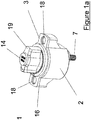
- Figure 1a is a perspective view of an embodiment of a rotary switch with an integrated overcurrent protection element, shown from above.
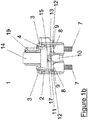
- Figure 1b is a side cross- sectional view of the rotary switch of Figure 1a .
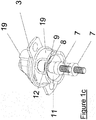
- Figure 1c is a perspective view of the rotary switch of Figure 1a , shown from below, with a portion of the switch removed to expose the interior components of the rotary switch.
- the embodiment of device 1 illustrated in Figure 1a may be an electric current responsive switching circuit breaker device.
- the base 2 may be cup shaped, as illustrated, although the shape and dimensions of the base may vary.
- the base 2 may be formed from or include an electrically insulatingmaterial.
- the base 2 has at least one internal compartment 4 having an open end 5, as well as cover 3 which in the illustrated embodiment is generally flat.
- the cover 3 includes at least one through-hole 6.
- the cover 6 encloses the open end 5 of the base 2. Rivets 18 may be used to anchor the cover 3 and a gasket 16 to the base 2.
- Electrically conducting terminals 7a and 7b extend through the base 2.
- the device 1 includes two terminals 7a and 7b, but in other embodiments, additional terminals may be included. These terminals may be, for example, starter terminals.
- the terminals include electrical contact points 8a and 8b within the cup shaped portion of the base 2. In the illustrated embodiment, these electrical contact points 8a and 8b include stationary electrical contacts 9a and 9b.
- the device 1 also includes a center post 10, which in the illustrated embodiment is supported by a portion of base 2. In the illustrated embodiment, the central post 10 is secured in a threaded hole in the base 2, but may be supported in any other suitable fashion.
- the central post 10 may extend parallel to at least a portion of the electrical contacts 8a and 8b, but may be electrically isolated from the electrical contacts 8 when the device 1 is in the off position.
- the center post 10 supports an overcurrent protection element 11, which in the illustrated embodiment is a bimetallic current-sensing element.
- the central post 10 pierces the center of the overcurrent protection element 11, but other suitable support configurations may be possible as well.
- the overcurrent protection element 11 is held in position by a sleeve 13 within the base 2.
- the overcurrent protection element 11 includes two electrical contacts 12a and 12b at locations radially outward from the central post 10.
- the overcurrent protection element 11 is formed such that, in response to Joule heating generated by electrical current flowing through the overcurrent protection element 11, the overcurrent protection element 11 will rapidly change shape and snap over center. In particular, the radially outward portions of the overcurrent protection element 11 will flex away from the stationary electrical contacts 9a and 9b .
- the overcurrent protection element 11 When the overcurrent protection element 11 is not flexed in response to Joule heating generated by electrical current flowing through the overcurrent protection element 11, the overcurrent protection element 11 may be in a first position in which the electrical contacts 12a and 12b of the overcurrent protection element 11 are in contact with the stationary electrical contacts 9a and 9b of the device 1.
- the overcurrent protection element 11 In the illustrated embodiment, the overcurrent protection element 11 is in a generally planar configuration when in the first element, but in other embodiments, the first position may involve some curvature of the overcurrent protection element 11. In this first position, the overcurrent protection element 11 provides circuit continuity between the stationary electrical contacts 9a and 9b of the device 1.
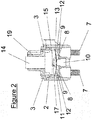
- Figure 2 is a side cross-sectional view of the rotary switch of Figure 1a , with the overcurrent protection element shown in a tripped position.
- the overcurrent protection element 11 responds to the Joule heating by rapidly changing shape to a second position in which the electrical contacts 12a and 12b of the overcurrent protection element 11 are spaced apart from and no longer in contact with the stationary electrical contacts 9a and 9b of the device 1.
- the overcurrent protection element therefore automatically separates the facing electrical contacts from one another in response to sufficient Joule heating and breaks the flow of current through the device 1.
- the second position may only separate one of the electrical contacts 12a or 12b from the corresponding stationary electrical contact 9a or 9b of the device 1, but may still interrupt the flow of current through the device 1.
- the device 1 may include a feature for manually resetting the overcurrent protection element 11 to the first position.
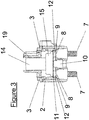
- Figure 3 is a side cross- sectional view of the rotary switch of Figure 1a , in which the reset button 14 has been manually depressed to move the overcurrent protection element 11 back into an untripped position.
- the reset button 14 is operably connected to a reset plate 15.
- the reset button 14 and the reset plate 15 are axially aligned with the center post 10 supporting the overcurrent protection element 11.
- the reset button 14 protrudes through the sealing gasket 16 and cover through-hole 6 of the cover 3 which encloses the open side of the base 2.
- a return spring 17 serves to return said reset button 14 and reset plate 15 to their original position by biasing these elements against the cover 3, as can be seen in Figure 1b . If the overcurrent protection element 11 has not been sufficiently cooled from the Joule heating which tripped the overcurrent protection element 11 to the second position, the overcurrent protection element 11 will immediately flex back to the second position.
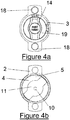
- Figure 4a is a top plan view of the rotary switch of Figure 1a , with the switch in the "on” position.
- Figure 4b shows the position of the overcurrent protection element with the switch in the "on” position.
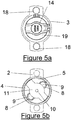
- Figure 5a is a top plan view of the rotary switch of Figure 1a , with the switch in the "off” position.
- Figure 5b shows the position of the overcurrent protection element with the switch in the "off” position, expositing the stationary contacts of the circuit.
- the device 1 includes a switching knob 19 concentric with the reset button 14 and extending through the gasket 16 and the through-hole 6 of the cover 3.
- the knob 19 can be manually rotated to either of the "on” or “off” positions. These positions may be defined by a series of detents 23 in the base 2.
- the gasket, sleeve, spring, reset plate, knob, button and cover are not shown in Figures 4b or 5b , allowing the position of the overcurrent protection element 11 to be seen.
- a device may include an overcurrent protection element without a component configured to allow a user to manually reset the overcurrent protection element.
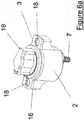
- Figure 6a is a perspective view of another embodiment of a rotary switch with an integrated overcurrent protection element, shown from above, without a reset button or other element to reset the overcurrent protection element.
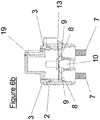
- Figure 6b is a side cross-sectional view of the rotary switch of Figure 6a .
- the device 1' of Figure 6b does not include a reset button or reset plate, and the knob 19 does not include a through hole allowing passage of such a reset button.
- the overcurrent protection element 11 may be designed, such as through the use of integral bias, to move back to the first position when the overcurrent protection element 11 has sufficiently cooled from the Joule heating which triggered the flexure to the second position.
- the circuit of the device 1 ' will therefore automatically reopen on its own, in such an embodiment.
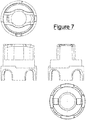
- Figure 7 shows multiple views of a switch cover which can be used with a rotary switch described herein.
- the switch cover does not have a through hole for a reset button, but in other embodiments, the switch cover may have a through hole for a reset button or other component.
- one of the connections between the overcurrent protection element 11 and a terminal may be a direct connection, such as a pin or a rivet, attaching that end of the overcurrent protection element 11 to a terminal or a conductive component electrically connected to that terminal. Only the other end of the overcurrent protection element 11 may thus move in response to an electrical current above the specified limit.
- the pin or rivet may be axially aligned with the axis of rotation of the knob.
- twitching to the "ON” or “OFF” positions may be accomplished by manually rotating the switching actuator knob, thereby rotating the overcurrent protection element around such a pin or rivet to move the single electrical contact pair in or out of contact, thereby closing or opening the electrical circuit.
- the overcurrent protection element 11 may include a fuse clip and a cartridge fuse, or another type of fuse or overcurrent protection element, instead of or in addition to a bimetallic element with contact points. Any other suitable overcurrent protection element may be used in place of or in addition to the bimetallic element.
- a multi-pole switch may include an integrated overcurrent protection element.
- Figure 8a is a perspective view of an embodiment of a rotatable multi-pole switch, shown from above.
- Figure 8b is a side view of the rotatable multi-pole switch of Figure 8a .
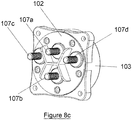
- Figure 8c is a perspective view of the rotatable multi-pole switch of Figure 8a , shown from below.
- Figure 9 is an exploded assembly view of the rotatable multi-pole switch of Figure 8a .
- the exterior of the device 101 is similar in some ways to the device 1 of Figure 1a , but differs in that the device 101 includes four terminals 107a, 107b, 107c, and 107d extending into the device 101 through the base 102.
- the device 101 includes a generally flat base 102 and a generally cup-shaped cover 103 having an internal compartment 104, an open end 105 and at least one through-hole 106 extending through the cover 103.
- the base 102 has four terminals 107a, 107b, 107c, and 107d extending therethrough, but other embodiments may include fewer or additional terminals.
- Each of the terminals 107a, 107b, 107c, and 107d are electrically connected to respective electrical contact points 108a, 108b, 108c, and 108d.
- the terminals 107a, 107b, 107c, and 107d are generally located along one or more diameters of base 102 at 90 degrees to each other.
- Terminals 107a and 107b are generally aligned along a diameter of base 102, along a line perpendicular to and passing through a central axis of device 101.
- electrical contact points 108a and 108b have stationary contact points 109a and 109b supported thereon.
- the device 101 is configured to be electrically connected to an engine starter circuit, an auxiliary circuit, and two batteries.
- the terminal 107a may be referred to as a starter terminal
- the terminal 107b may be referred to as an auxiliary terminal
- the terminals 107c and 107d may be referred to respectively as battery terminals "1" and "2".
- Corresponding terminology may also be used for the corresponding electrical contact points and stationary contacts.
- the device 101 is not limited to use only in such an embodiment, but the use of this terminology is used herein to illustrate certain aspects of the operation of the device.
- the base 102 also includes a center post 110 aligned with a central axis of the device 101.
- the center post 110 supports an overcurrent protection element 111 which may be a bimetallic current sensing element configured to change shape in response to heat generated by current flow therethrough and thereby protect the auxiliary circuit from electrical overload.
- the center post 110 may extend through the overcurrent protection element 111, which may be held in place on the center post 110 by a sleeve 113.
- the overcurrent protection element 111 includes two electrical contacts 112a and 112b supported thereon.
- the device 101 also includes a curved bus bar 122 which in the illustrated embodiment extends in an almost circular shape.
- the curved bus bar 122 is formed from a conductive material, and may be shaped to include a plurality of downwardly protruding sections 136 in which are lower than at other portions of the bus bar 122.
- the bus bar 122 is coupled to the knob 119 to rotate along with the knob 119.
- the bus bar 122 includes two or more downwardly protruding sections, the spacing of which is illustrated with respect to Figures 10a to 10d .
- a switching actuator knob 119 concentric to both the reset button 114 and the cover through hole 106, protrudes through the cover through hole 106 to allow the knob 119 to be manually rotated.
- the rotation of the knob 119 is transmitted to the bus bar 122 by one or more switching posts 120 to an electrically conducting, basically circle shaped, moving bus bar 122.
- the rotation of the knob 119 results in the rotation of the moving bus bar 122 around a rotational axis aligned with the center post 110.
- electrical contact may be established by the moving bus bar 122 between one or more of the battery terminal contact points 108c, 108d and the starter terminal contact point 108a.
- Contact point 108b is electrically insulated from the moving bus bar 122, being imbedded within the insulating material of base 102.
- a range of positions may be defined by a series of detents in the cover 103.
- Electrical contact pressure may be maintained by one or more contact springs 124, thereby establishing one or more continuous electrical circuits between certain of the battery terminals 107c and 107d and starter terminal 107a.
- the knob 119 may also be manually rotated into the "OFF" position, rotating the bus bar 122 into contact with one or fewer of terminal contact points 108a, 108c, and 108d, thereby opening all electrical circuits as shown in Figure 10d .
- Figure 10a is a top plan view of the rotatable multi-pole switch of Figure 8a , with the switch in the "1" position.
- Figure 10a also shows an internal top plan view of the position of certain internal elements with the switch in the "1" position and a simple electrical schematic diagram of the internal circuit.
- the bus bar 122 is rotated to a position in which one of the downwardly protruding sections 136a overlies and is in contact with electrical contact point 108a, and another of the downwardly protruding sections 136c overlies and is in contact with electrical contact point 108c.
- Contact between the bus bar 122 and the electrical contact points 108a and 108c may be maintained by one or more springs 124, which bias the bus bar 122 against the underlying electrical contact points.
- Current may therefore flow from battery terminal 107c associated with the first battery, through electrical contact point 108c, through the bus bar 122 to the starter terminal contact point 108a. From there, current may flow through the starter terminal 107a into the starter circuit. Current may also flow into the auxiliary circuit through the overcurrent protection element 111a and the auxiliary terminal 107b, as discussed above.
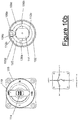
- Figure 10b is a top plan view of the rotatable multi-pole switch of Figure 8a , with the switch in the "1+2" position.
- Figure 10b also shows a top plan view of the position of certain internal elements with the switch in the "1+2" position and a simple electrical schematic diagram of the internal circuit.
- the bus bar 122 is rotated to a position in which each of the downwardly protruding sections of the bus bar 122 is in contact with a different underlying electrical contact point.
- one of the downwardly protruding sections 136b overlies and is in contact with electrical contact point 108c
- one of the downwardly protruding sections 136c overlies and is in contact with electrical contact point 108a
- another of the downwardly protruding sections 136a overlies and is in contact with electrical contact point 108d.
- current may also flow through the through the moving bus bar 122 from the terminal 107c associated with the first battery to the terminal 107d associated with the second battery, or from the terminal 107d to the terminal 107c, by means of contact between the moving bus bar 112 and the respective terminal contact points 108c and 108d.
- Current may also flow into the auxiliary circuit through the overcurrent protection element 111 and the auxiliary terminal 107b, as discussed above.
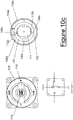
- Figure 10c is a top plan view of the rotatable multi-pole switch of Figure 8a , with the switch in the "2" position.
- Figure 10c also shows a top plan view of the position of certain internal elements with the switch in the "2" position and a simple electrical schematic diagram of the internal circuit.
- the bus bar 122 is rotated to a position in which one of the downwardly protruding sections 136b overlies and is in contact with electrical contact point 108a, and another of the downwardly protruding sections 136c overlies and is in contact with electrical contact point 108d.
- current may flow through the bus bar 122 from battery terminal 107d associated with the second battery to the starter terminal contact point 108a. From there, current may flow into the starter circuit. Current may also flow into the auxiliary circuit through the overcurrent protection element 111a and the auxiliary terminal 107b, as discussed above.
- the bus bar 122 When the switch is rotated into the top "OFF" position of Figure 10d , the bus bar 122 will be in a position where it makes no electrical contact with the electrical contact points associated with the first or second batteries, or the starter elements. In such a position, no current is allowed to flow through the bus bar 122.
- the bus bar 122 can be moved to a position where the downwardly protruding sections 136 only contact the insulating material of the base 102 and the bus bar 122 overlies, but does not come into electrical contact with, the electrical contact points 108a, 108c, or 108d.
- the off-center positioning of battery terminals 107c and 107d and their associated contact points 108c and 108d provides additional clearance for the "OFF" position, ensuring that no undesired electrical contact is made.
- Figure 11 is a perspective view of internal components of the rotatable multi-pole switch of Figure 8a , with the overcurrent protection element in a tripped position.
- Figure 11 also shows a simple electrical schematic diagram of the internal circuit with the switch in the "1" position and the overcurrent protection element in a tripped position.
- the overcurrent protection element 111 When electrical current above a specified limit flows through the overcurrent protection element 111, the overcurrent protection element 111 responds to the Joule heating by rapidly changing shape from a first position in which the electrical contacts 112a and 112b are in contact with stationary contacts 109a and 109b, to a second position in which at least one of the pairs of contacts is separated, breaking the flow of current between "starter" terminal 107a and "auxiliary" terminal 107b, as shown in Figure 11 .
- the overcurrent protection element 111 When sufficiently cooled from the Joule heating, the overcurrent protection element 111 can be manually reset to its original position, bringing the electrical contacts 112a and 112b back into contact with stationary contacts 109a and 109b and reestablishing circuit continuity between "starter" terminal 107a and "auxiliary" terminal 107b.
- This reset operation may be performed by manually depressing the reset button 114, which protrudes through the through hole 135 in the knob 119 (see Figure 9 ), thereby also depressing the reset plate 115 concentrically positioned on the center post 110 onto the overcurrent protection element 111. This forces the overcurrent protection element 111 back into its original position.
- the button return spring 117 serves to return the reset button 114 and reset plate 115 to their original position against the internal compartment of the cover 104 after this manual reset operation.
- One or more rivets (not shown) or a snap-type friction fit may be used to anchor the cover 103 to the base 102.
- the device 101 may not include the reset button 114 and reset plate 115, and there is no need to include the corresponding switching actuator knob through hole 135.
- the overcurrent protection element 111 may be designed such that, after cooling sufficiently from Joule heating, the element will automatically return from the open second position to its original first position, reclosing the electrical circuit.
- one pair of contacts between the overcurrent protection element 111 and mating stationary contact (such as the pair of contacts 112a and 109a or the pair of contacts 112b and 109b), is replaced by a weld or rivet, attaching that end of the overcurrent protection element 111 to a terminal contact point and using only the other pair of contacts to break the circuit when the overcurrent protection element 111 flexes in response to an electrical current above a specified limit.
- the overcurrent protection element 111 and associated electrical contacts 112a and 112b may be replaced by a fuse clip and cartridge fuse, transferring the function of the over-current protection feature of the illustrated embodiments from an overcurrent protection element 111 in the form of a bimetallic element, to the cartridge fuse.
- the starter terminal 107a may be removed, but the starter terminal contact point 108a is retained, forcing all current to flow through the overcurrent protection element 111 when in a closed position.
- a multi-pole switch may include an integrated overcurrent protection element.
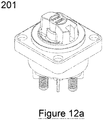
- Figure 12a is a view of an embodiment of a rotatable multi-pole switch, device 201, shown from above.
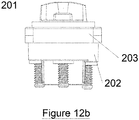
- Figure 12b is a side view of the rotatable switch of Figure 12a .
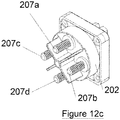
- Figure 12c is a perspective view of the rotatable switch, shown from below.
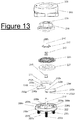
- the device 201 is similar in many ways to the device 101 of Figure 8a , but differs in that, when in the "ON” position, the device 201 allows the batteries “1" and “2", referred to in the description of device 101, to separately power the “auxiliary” and “starter” circuits noted in device 101. When switched to the “combine” position, device 201 also allows the batteries “1” and “2” to be used in combination to power the “auxiliary” and “starter” circuit, similar to the "1+2" switch position of device 101. Like device 101, when device 201 is switched to the "ON” or “combine” positions, the "auxiliary” circuit is protected by the integrated overcurrent protection element 211.
- the exterior of the device 201 is similar in some ways to the device 101 of Figure 8a , in that the device 201 includes four terminals 207a, 207b, 207c, and 207d extending into the device 201 through the base 202.
- the device 201 includes a generally flat base 202 and a generally cup-shaped cover 203 having an internal compartment 204, an open end 205 and at least one through-hole 206 extending through the cover 203.
- the base 202 has four terminals 207a, 207b, 207c, and 207d extending therethrough, but other embodiments may include fewer or additional terminals.
- Each of the terminals 207a, 207b, 207c, and 207d is electrically connected to respective electrical contact points 208a, 208b, 208c, and 208d.
- Internal electrical contact point 208e is not connected to any terminal.
- the terminals 207a, 207b, 207c, and 207d are generally located along one or more diameters of base 202 at 90 degrees to each other. Electrical contact points 208d and 208e have stationary contact points 209a and 209b supported thereon.
- the device 201 is configured to be electrically connected to an engine starter circuit and to an auxiliary circuit which may include two batteries.
- the terminal 207a may be referred to as a starter terminal
- the terminal 207b may be referred to as an auxiliary terminal
- the terminals 207c and 207d may be referred to respectively as battery terminals "1" and "2".
- Corresponding terminology may also be used for the corresponding electrical contact points and stationary contacts.
- the device 201 is not limited to use only in such an embodiment, but the use of this terminology is used herein to illustrate certain aspects of the operation of the device.
- the base 202 of device 201 also includes a center post 210 aligned with a central axis of the device 201.
- the center post 210 supports an overcurrent protection element 211 which may be a bimetallic current sensing element configured to change shape in response to heat generated by current flow therethrough.
- the center post 210 may extend through the overcurrent protection element 211, which may be held in place on the center post 210 by a sleeve 213.
- the overcurrent protection element 211 includes two electrical contacts 212a and 212b supported thereon which mate with contact 209a and 209b.
- the device 201 also includes two mutually insulated curved bus bars 222a and 222b which in the illustrated embodiment extend in somewhat semicircular shapes.
- the curved bus bars 222a and 222b are formed from a conductive material and may be shaped to include a plurality of downwardly protruding sections 236 which are lower than at other portions of the bus bars 222a and 222b.
- the bus bars 222a and 222b are coupled to the insulating carrier ring 237 which is coupled to the switching actuator knob 219 to rotate along with the knob 219.
- the bus bar 222a and 222b each include three downwardly protruding sections 236a, 236b, 236c, 236d, 236e, and 236f, the spacing of which is illustrated with respect to Figures 14a to 14c .
- the switching actuator knob 219 concentric to both the reset button 214 and the cover through hole 206, protrudes through the cover through hole 206 to allow the knob 219 to be manually rotated.
- the rotation of the knob 219 is transmitted to the bus bars 222a and 222b through the insulating carrier ring 237 to the electrically conducting, basically semicircle shaped, moving bus bars 222a and 222b.
- the rotation of the knob 219 results in the rotation of the moving bus bars 222a and 222b around a rotational axis aligned with the center post 210.
- a range of rotational positions of the moving bus bars 222a and 222b may be defined by a series of detents in the cover 203. Electrical contact pressure between each moving bus bar 222a and 222b and various contact points 208a-208e may be maintained by one or more contact springs 224, positioned between bottom of the switching actuator knob 219 and the insulating carrier ring 237, and thereby establishing one or more continuous electrical circuits between certain of the battery terminals 207c and 207d and the starter terminal 207a and the auxiliary terminal 207b.
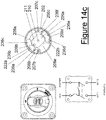
- the knob 219 may also be manually rotated into the "OFF" position shown in Figure 14c , rotating the bus bars 222a and 222b into contact with one or fewer of terminal contact points 208a and 208d, thereby opening all electrical circuits.
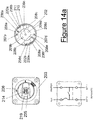
- Figure 14a is a top plan view of the rotatable multi-pole switch of Figure 12a , with the switch in the "ON" position.
- Figure 14a also shows an internal top view of the position of certain internal elements with the switch in the "ON” position and a simple electrical schematic diagram of the internal circuit.
- the bus bar 222a is rotated to a position in which the downwardly protruding sections 236a and 236b overlie and are in contact with electrical contact point 208a, and another of the downwardly protruding sections 236c overlies and is in contact with electrical contact point 208c.
- Contact between the bus bar 222a and the electrical contact points 208a and 208c may be maintained by one or more springs 224, which bias the insulating carrier ring 237 against the bus bar 222a which is then biased against the underlying electrical contact points.
- Current may then flow from battery "1" through battery terminal 207c, contact point 208c, downwardly protruding section 236c, bus bar 222a, downwardly protruding sections 236a and 236b, contact point 208a, and terminal 207a to the starter.
- bus bar 222b is rotated into a position in which the downwardly protruding section 236d overlies and is in contact with electrical contact point 208b, and the downwardly protruding sections 236e and 236f overlie and are in contact with electrical contact point 208e.
- Contact between the bus bar 222b and the electrical contact points 208b and 208e may be maintained by one or more springs 224, which bias the insulating carrier ring 237 against the bus bar 222b which is then biased against the bus bar 222b which is then biased against the underlying electrical contact points.
- Figure 14b is a top plan view of the rotatable multi-pole switch of Figure 12a , with the switch in the "COMBINE” position.
- Figure 14b also shows an internal top view of the position of certain internal elements with the switch in the "COMBINE” position and a simple electrical schematic diagram of the internal circuit.
- the bus bar 222a is rotated to a position in which the downwardly protruding section 236a overlies and is in contact with electrical contact point 208a, downwardly protruding section 236b overlies and is in contact with electrical contact point 208c and downwardly protruding section 236c overlies and is in contact with electrical contact point 208d.
- Contact between the bus bar 222a and the electrical contact points 208a, 208c, and 208d may be maintained by one or more springs 224, which bias the insulating carrier ring 237 against bias the bus bar 222a which is then biased against the underlying electrical contact points.
- Current may then flow from battery "1" through battery terminal 207c, contact point 208c, downwardly protruding section 236b, bus bar 222a, downwardly protruding sections 236a, contact point 208a, and terminal 207a to the starter circuit.
- bus bar 222a When the switch is rotated into the "OFF" position, bus bar 222a will be in a position where it makes electrical contact only with the electrical contact points associated with the starter elements, and bus bar 222b will be in a position where it makes electrical contact only with the electrical contacts points associated with battery 2. In such a position, no current is allowed to flow through either bus bar 222a or 222b.
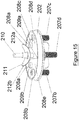
- FIG 15 is a perspective view of internal components of the rotatable multi-pole switch of Figure 12a , with the overcurrent protection element in a tripped position.
- the overcurrent protection element 211 responds to the Joule heating by rapidly changing shape from a first position in which the electrical contacts 212a and 212b are in contact with stationary contacts 209a and 209b, to a second position in which at least one of the pairs of contacts is separated, breaking the flow of current in the circuit between battery "2" terminal 207d and "auxiliary" terminal 207b, as shown in Figure 15 .
- the overcurrent protection element 211 can be manually reset to its original position, bringing the electrical contacts 212a and 212b back into contact with stationary contacts 209a and 209b and reestablishing continuity in the circuit between battery "2" terminal 207d and "auxiliary" terminal 207b.
- This reset operation may be performed by manually depressing the reset button 214, which protrudes through the through hole 235 in the knob 219 (see Figure 13 ), thereby also depressing the reset plate 215 concentrically positioned on the center post 210 onto the overcurrent protection element 211. This forces the overcurrent protection element 211 back into its original position.
- the return spring 217 serves to return the reset button 214 and reset plate 215 to their original position against the internal compartment of the cover 204 after this manual reset operation.
- One or more rivets (not shown) or a snap-type friction fit may be used to anchor the cover 203 to the base 202.
- the device 201 may not include the reset button 214 and reset plate 215, and there is no need to include the corresponding switching actuator knob through hole 235.
- the overcurrent protection element 211 may be designed such that, after cooling sufficiently from Joule heating, the element will automatically return from the open second position to its original first position, reclosing the electrical circuit.
- one pair of contacts between the overcurrent protection element 211 and mating stationary contact (such as the pair of contacts 212a and 209a or the pair of contacts 212b and 209b), is replaced by a weld or rivet, attaching that end of the overcurrent protection element 211 to a terminal contact point and using only the other pair of contacts to break the circuit when the overcurrent protection element 211 flexes in response to an electrical current above a specified limit.
- the overcurrent protection element 211 and associated electrical contacts 212a and 212b may be replaced by a fuse clip and cartridge fuse, transferring the function of the over-current protection feature of the illustrated embodiments from an overcurrent protection element 211 in the form of a bimetallic element, to the cartridge fuse.
- the words “comprise,” “comprising,” “include,” “including” and the like are to be construed in an inclusive sense, as opposed to an exclusive or exhaustive sense; that is to say, in the sense of "including, but not limited to.”
- the word “coupled”, as generally used herein, refers to two or more elements that may be either directly connected, or connected by way of one or more intermediate elements.
- the word “connected”, as generally used herein, refers to two or more elements that may be either directly connected, or connected by way of one or more intermediate elements.
- conditional language used herein such as, among others, “can,” “could,” “might,” “may,” “e.g.,” “for example,” “such as” and the like, unless specifically stated otherwise, or otherwise understood within the context as used, is generally intended to convey that certain embodiments include, while other embodiments do not include, certain features, elements and/or states. Thus, such conditional language is not generally intended to imply that features, elements and/or states are in any way required for one or more embodiments.
Landscapes
- Rotary Switch, Piano Key Switch, And Lever Switch (AREA)
- Thermally Actuated Switches (AREA)
- Breakers (AREA)
- Thermistors And Varistors (AREA)
Priority Applications (1)
| Application Number | Priority Date | Filing Date | Title |
|---|---|---|---|
| EP24186720.9A EP4418300A3 (de) | 2019-07-30 | 2020-07-29 | Schalter mit integrierten überstromschutzkomponenten |
Applications Claiming Priority (1)
| Application Number | Priority Date | Filing Date | Title |
|---|---|---|---|
| US201962880517P | 2019-07-30 | 2019-07-30 |
Related Child Applications (2)
| Application Number | Title | Priority Date | Filing Date |
|---|---|---|---|
| EP24186720.9A Division EP4418300A3 (de) | 2019-07-30 | 2020-07-29 | Schalter mit integrierten überstromschutzkomponenten |
| EP24186720.9A Division-Into EP4418300A3 (de) | 2019-07-30 | 2020-07-29 | Schalter mit integrierten überstromschutzkomponenten |
Publications (3)
| Publication Number | Publication Date |
|---|---|
| EP3772080A2 true EP3772080A2 (de) | 2021-02-03 |
| EP3772080A3 EP3772080A3 (de) | 2021-06-02 |
| EP3772080B1 EP3772080B1 (de) | 2024-08-14 |
Family
ID=71846307
Family Applications (2)
| Application Number | Title | Priority Date | Filing Date |
|---|---|---|---|
| EP20188424.4A Active EP3772080B1 (de) | 2019-07-30 | 2020-07-29 | Schalter mit integrierten überstromschutzkomponenten |
| EP24186720.9A Pending EP4418300A3 (de) | 2019-07-30 | 2020-07-29 | Schalter mit integrierten überstromschutzkomponenten |
Family Applications After (1)
| Application Number | Title | Priority Date | Filing Date |
|---|---|---|---|
| EP24186720.9A Pending EP4418300A3 (de) | 2019-07-30 | 2020-07-29 | Schalter mit integrierten überstromschutzkomponenten |
Country Status (2)
| Country | Link |
|---|---|
| US (2) | US11837426B2 (de) |
| EP (2) | EP3772080B1 (de) |
Families Citing this family (3)
| Publication number | Priority date | Publication date | Assignee | Title |
|---|---|---|---|---|
| US11476064B1 (en) * | 2021-03-02 | 2022-10-18 | David Worsham | Rotor for multi-pole rotary electrical switches |
| US12191098B2 (en) * | 2021-09-24 | 2025-01-07 | MP Hollywood | Switch with integral overcurrent protection |
| CN114148837A (zh) * | 2021-12-15 | 2022-03-08 | 杭州优迈科技有限公司 | 电梯操作装置以及电梯 |
Family Cites Families (23)
| Publication number | Priority date | Publication date | Assignee | Title |
|---|---|---|---|---|
| US2182315A (en) * | 1936-03-14 | 1939-12-05 | Hart George Hegeman | Thermostatically operated electric switch |
| US2434984A (en) | 1943-06-17 | 1948-01-27 | Metals & Controls Corp | Thermostatic control |
| US2511069A (en) * | 1946-07-27 | 1950-06-13 | Gen Motors Corp | Switch |
| US2530006A (en) | 1948-02-26 | 1950-11-14 | Gilbert S Ellithorpe | Rotary switch construction |
| US2696538A (en) * | 1953-08-10 | 1954-12-07 | Metals & Controls Corp | Thermostatic switch |
| US2825960A (en) * | 1955-07-14 | 1958-03-11 | M J Mccarthy | Snap-acting element and method of making same |
| US2810041A (en) * | 1956-07-05 | 1957-10-15 | Metals & Controls Corp | Thermostatic device |
| US2901574A (en) * | 1956-09-27 | 1959-08-25 | Carter Parts Company | Switch |
| US2839638A (en) * | 1957-03-28 | 1958-06-17 | Metals & Controls Corp | Thermally responsive switch structures |
| US3852697A (en) * | 1973-07-11 | 1974-12-03 | Therm O Disc Inc | Bimetal snap disc |
| US3832667A (en) * | 1973-07-23 | 1974-08-27 | Texas Instruments Inc | Thermostatic switch |
| DE2642913C3 (de) | 1976-09-24 | 1980-08-14 | Christian Geyer Gmbh & Co, 8500 Nuernberg | Sicherungs-Lastschalter |
| US4891476A (en) * | 1988-05-09 | 1990-01-02 | Illinois Tool Works, Inc. | Index rotary switch |
| US4973933A (en) * | 1990-02-22 | 1990-11-27 | Harper-Wyman Company | Dual control infinite switch |
| US5436413A (en) * | 1993-09-17 | 1995-07-25 | Hosiden Corporation | Multiple staged rotary switch |
| CA2151641C (en) * | 1995-06-13 | 2004-04-13 | Hans Kolb | Electrical thermostat |
| US6538549B1 (en) * | 2001-08-30 | 2003-03-25 | Blue Sea Systems | Advanced electrical circuit breaker system and method |
| US6596950B2 (en) * | 2001-09-10 | 2003-07-22 | Illinois Tool Works Inc. | Rotary switch |
| US6744345B2 (en) * | 2002-05-06 | 2004-06-01 | Cooper Technologies | Mid-range circuit breaker |
| US7952461B2 (en) * | 2008-05-08 | 2011-05-31 | Cooper Technologies Company | Sensor element for a fault interrupter and load break switch |
| WO2016077668A1 (en) * | 2014-11-14 | 2016-05-19 | Power Products, Llc | Single throw battery switch with improved contact dome |
| US9911567B2 (en) | 2015-06-08 | 2018-03-06 | Littlfuse, Inc. | Disconnect switch with integrated thermal breaker |
| US12191098B2 (en) * | 2021-09-24 | 2025-01-07 | MP Hollywood | Switch with integral overcurrent protection |
-
2020
- 2020-07-29 EP EP20188424.4A patent/EP3772080B1/de active Active
- 2020-07-29 US US16/942,275 patent/US11837426B2/en active Active
- 2020-07-29 EP EP24186720.9A patent/EP4418300A3/de active Pending
-
2023
- 2023-12-04 US US18/528,159 patent/US12417889B2/en active Active
Also Published As
| Publication number | Publication date |
|---|---|
| US20240258058A1 (en) | 2024-08-01 |
| US12417889B2 (en) | 2025-09-16 |
| EP4418300A2 (de) | 2024-08-21 |
| US11837426B2 (en) | 2023-12-05 |
| US20210035763A1 (en) | 2021-02-04 |
| EP3772080B1 (de) | 2024-08-14 |
| EP4418300A3 (de) | 2024-11-20 |
| EP3772080A3 (de) | 2021-06-02 |
Similar Documents
| Publication | Publication Date | Title |
|---|---|---|
| US12417889B2 (en) | Switches with integral overcurrent protection components | |
| EP2180487B1 (de) | Mikroschalter | |
| US3486150A (en) | Circuit breaker | |
| US8264306B2 (en) | Movable contactor assembly for current limiting type molded case circuit breaker | |
| US20170110226A1 (en) | Surge protection device, comprising at least one surge arrester and one short-circuit switching device which is connected in parallel with the surge arrester, can be thermally tripped and is spring-pretensioned | |
| CA2911299C (en) | Circuit breakers with common trip cams and related trip cams | |
| CN1918679B (zh) | 开关以及使用该开关的装置 | |
| MX2012010909A (es) | Mecanismo plegable para disyuntores de circuito. | |
| US12191098B2 (en) | Switch with integral overcurrent protection | |
| EP1858046A2 (de) | Querstangenunterstützungsmechanismus und damit ausgerüstete elektrische Schaltvorrichtung | |
| US12237127B2 (en) | Circuit breaker with integral fuse mounting stud | |
| US6727788B1 (en) | Latch mechanism for a circuit breaker | |
| EP2685480B1 (de) | Kontaktanordnung eines Schalters | |
| JP6656339B1 (ja) | スイッチの過熱破壊式電力切断方法 | |
| EP1346386A1 (de) | Strombegrenzender schutzschalter | |
| CN101295607A (zh) | 跳闸指示器元件、具有多个该元件的限制器和电开关装置 | |
| US9111695B2 (en) | Electrical switching device, especially circuit breaker | |
| US10680391B2 (en) | Heat destructive disconnecting switch | |
| CN107680890B (zh) | 刻度盘装置、及使用了该刻度盘装置的电路断路器 | |
| US10825632B2 (en) | Circuit breaker | |
| EP4270438B1 (de) | Zustandsanzeigevorrichtung für schwachstromanwendungen mit breiterem betriebsbereich | |
| JP2677866B2 (ja) | 負荷保護装置 | |
| CN119943599A (zh) | 电子开关式低压保护开关装置 | |
| CN103632893A (zh) | 电触头位置指示器设备、系统及操作方法 | |
| JP2022538442A (ja) | 電気スイッチングシステム |
Legal Events
| Date | Code | Title | Description |
|---|---|---|---|
| PUAI | Public reference made under article 153(3) epc to a published international application that has entered the european phase |
Free format text: ORIGINAL CODE: 0009012 |
|
| STAA | Information on the status of an ep patent application or granted ep patent |
Free format text: STATUS: THE APPLICATION HAS BEEN PUBLISHED |
|
| AK | Designated contracting states |
Kind code of ref document: A2 Designated state(s): AL AT BE BG CH CY CZ DE DK EE ES FI FR GB GR HR HU IE IS IT LI LT LU LV MC MK MT NL NO PL PT RO RS SE SI SK SM TR |
|
| AX | Request for extension of the european patent |
Extension state: BA ME |
|
| PUAL | Search report despatched |
Free format text: ORIGINAL CODE: 0009013 |
|
| AK | Designated contracting states |
Kind code of ref document: A3 Designated state(s): AL AT BE BG CH CY CZ DE DK EE ES FI FR GB GR HR HU IE IS IT LI LT LU LV MC MK MT NL NO PL PT RO RS SE SI SK SM TR |
|
| RIC1 | Information provided on ipc code assigned before grant |
Ipc: H01H 19/36 20060101AFI20210427BHEP Ipc: H01H 19/48 20060101ALI20210427BHEP Ipc: H01H 19/52 20060101ALI20210427BHEP Ipc: H01H 71/16 20060101ALI20210427BHEP Ipc: H01H 71/58 20060101ALI20210427BHEP Ipc: H01H 77/04 20060101ALI20210427BHEP |
|
| STAA | Information on the status of an ep patent application or granted ep patent |
Free format text: STATUS: REQUEST FOR EXAMINATION WAS MADE |
|
| 17P | Request for examination filed |
Effective date: 20211201 |
|
| RBV | Designated contracting states (corrected) |
Designated state(s): AL AT BE BG CH CY CZ DE DK EE ES FI FR GB GR HR HU IE IS IT LI LT LU LV MC MK MT NL NO PL PT RO RS SE SI SK SM TR |
|
| GRAP | Despatch of communication of intention to grant a patent |
Free format text: ORIGINAL CODE: EPIDOSNIGR1 |
|
| STAA | Information on the status of an ep patent application or granted ep patent |
Free format text: STATUS: GRANT OF PATENT IS INTENDED |
|
| INTG | Intention to grant announced |
Effective date: 20240311 |
|
| GRAS | Grant fee paid |
Free format text: ORIGINAL CODE: EPIDOSNIGR3 |
|
| GRAA | (expected) grant |
Free format text: ORIGINAL CODE: 0009210 |
|
| STAA | Information on the status of an ep patent application or granted ep patent |
Free format text: STATUS: THE PATENT HAS BEEN GRANTED |
|
| AK | Designated contracting states |
Kind code of ref document: B1 Designated state(s): AL AT BE BG CH CY CZ DE DK EE ES FI FR GB GR HR HU IE IS IT LI LT LU LV MC MK MT NL NO PL PT RO RS SE SI SK SM TR |
|
| REG | Reference to a national code |
Ref country code: GB Ref legal event code: FG4D |
|
| REG | Reference to a national code |
Ref country code: CH Ref legal event code: EP |
|
| REG | Reference to a national code |
Ref country code: DE Ref legal event code: R096 Ref document number: 602020035640 Country of ref document: DE |
|
| REG | Reference to a national code |
Ref country code: IE Ref legal event code: FG4D |
|
| REG | Reference to a national code |
Ref country code: LT Ref legal event code: MG9D |
|
| REG | Reference to a national code |
Ref country code: NL Ref legal event code: MP Effective date: 20240814 |
|
| PG25 | Lapsed in a contracting state [announced via postgrant information from national office to epo] |
Ref country code: NO Free format text: LAPSE BECAUSE OF FAILURE TO SUBMIT A TRANSLATION OF THE DESCRIPTION OR TO PAY THE FEE WITHIN THE PRESCRIBED TIME-LIMIT Effective date: 20241114 |
|
| REG | Reference to a national code |
Ref country code: AT Ref legal event code: MK05 Ref document number: 1714099 Country of ref document: AT Kind code of ref document: T Effective date: 20240814 |
|
| PG25 | Lapsed in a contracting state [announced via postgrant information from national office to epo] |
Ref country code: FI Free format text: LAPSE BECAUSE OF FAILURE TO SUBMIT A TRANSLATION OF THE DESCRIPTION OR TO PAY THE FEE WITHIN THE PRESCRIBED TIME-LIMIT Effective date: 20240814 Ref country code: GR Free format text: LAPSE BECAUSE OF FAILURE TO SUBMIT A TRANSLATION OF THE DESCRIPTION OR TO PAY THE FEE WITHIN THE PRESCRIBED TIME-LIMIT Effective date: 20241115 Ref country code: NL Free format text: LAPSE BECAUSE OF FAILURE TO SUBMIT A TRANSLATION OF THE DESCRIPTION OR TO PAY THE FEE WITHIN THE PRESCRIBED TIME-LIMIT Effective date: 20240814 Ref country code: PL Free format text: LAPSE BECAUSE OF FAILURE TO SUBMIT A TRANSLATION OF THE DESCRIPTION OR TO PAY THE FEE WITHIN THE PRESCRIBED TIME-LIMIT Effective date: 20240814 Ref country code: PT Free format text: LAPSE BECAUSE OF FAILURE TO SUBMIT A TRANSLATION OF THE DESCRIPTION OR TO PAY THE FEE WITHIN THE PRESCRIBED TIME-LIMIT Effective date: 20241216 |
|
| PG25 | Lapsed in a contracting state [announced via postgrant information from national office to epo] |
Ref country code: BG Free format text: LAPSE BECAUSE OF FAILURE TO SUBMIT A TRANSLATION OF THE DESCRIPTION OR TO PAY THE FEE WITHIN THE PRESCRIBED TIME-LIMIT Effective date: 20240814 |
|
| PG25 | Lapsed in a contracting state [announced via postgrant information from national office to epo] |
Ref country code: LV Free format text: LAPSE BECAUSE OF FAILURE TO SUBMIT A TRANSLATION OF THE DESCRIPTION OR TO PAY THE FEE WITHIN THE PRESCRIBED TIME-LIMIT Effective date: 20240814 |
|
| PG25 | Lapsed in a contracting state [announced via postgrant information from national office to epo] |
Ref country code: AT Free format text: LAPSE BECAUSE OF FAILURE TO SUBMIT A TRANSLATION OF THE DESCRIPTION OR TO PAY THE FEE WITHIN THE PRESCRIBED TIME-LIMIT Effective date: 20240814 Ref country code: IS Free format text: LAPSE BECAUSE OF FAILURE TO SUBMIT A TRANSLATION OF THE DESCRIPTION OR TO PAY THE FEE WITHIN THE PRESCRIBED TIME-LIMIT Effective date: 20241214 |
|
| PG25 | Lapsed in a contracting state [announced via postgrant information from national office to epo] |
Ref country code: HR Free format text: LAPSE BECAUSE OF FAILURE TO SUBMIT A TRANSLATION OF THE DESCRIPTION OR TO PAY THE FEE WITHIN THE PRESCRIBED TIME-LIMIT Effective date: 20240814 |
|
| PG25 | Lapsed in a contracting state [announced via postgrant information from national office to epo] |
Ref country code: RS Free format text: LAPSE BECAUSE OF FAILURE TO SUBMIT A TRANSLATION OF THE DESCRIPTION OR TO PAY THE FEE WITHIN THE PRESCRIBED TIME-LIMIT Effective date: 20241114 Ref country code: ES Free format text: LAPSE BECAUSE OF FAILURE TO SUBMIT A TRANSLATION OF THE DESCRIPTION OR TO PAY THE FEE WITHIN THE PRESCRIBED TIME-LIMIT Effective date: 20240814 |
|
| PG25 | Lapsed in a contracting state [announced via postgrant information from national office to epo] |
Ref country code: RS Free format text: LAPSE BECAUSE OF FAILURE TO SUBMIT A TRANSLATION OF THE DESCRIPTION OR TO PAY THE FEE WITHIN THE PRESCRIBED TIME-LIMIT Effective date: 20241114 Ref country code: PT Free format text: LAPSE BECAUSE OF FAILURE TO SUBMIT A TRANSLATION OF THE DESCRIPTION OR TO PAY THE FEE WITHIN THE PRESCRIBED TIME-LIMIT Effective date: 20241216 Ref country code: PL Free format text: LAPSE BECAUSE OF FAILURE TO SUBMIT A TRANSLATION OF THE DESCRIPTION OR TO PAY THE FEE WITHIN THE PRESCRIBED TIME-LIMIT Effective date: 20240814 Ref country code: NO Free format text: LAPSE BECAUSE OF FAILURE TO SUBMIT A TRANSLATION OF THE DESCRIPTION OR TO PAY THE FEE WITHIN THE PRESCRIBED TIME-LIMIT Effective date: 20241114 Ref country code: NL Free format text: LAPSE BECAUSE OF FAILURE TO SUBMIT A TRANSLATION OF THE DESCRIPTION OR TO PAY THE FEE WITHIN THE PRESCRIBED TIME-LIMIT Effective date: 20240814 Ref country code: LV Free format text: LAPSE BECAUSE OF FAILURE TO SUBMIT A TRANSLATION OF THE DESCRIPTION OR TO PAY THE FEE WITHIN THE PRESCRIBED TIME-LIMIT Effective date: 20240814 Ref country code: IS Free format text: LAPSE BECAUSE OF FAILURE TO SUBMIT A TRANSLATION OF THE DESCRIPTION OR TO PAY THE FEE WITHIN THE PRESCRIBED TIME-LIMIT Effective date: 20241214 Ref country code: HR Free format text: LAPSE BECAUSE OF FAILURE TO SUBMIT A TRANSLATION OF THE DESCRIPTION OR TO PAY THE FEE WITHIN THE PRESCRIBED TIME-LIMIT Effective date: 20240814 Ref country code: GR Free format text: LAPSE BECAUSE OF FAILURE TO SUBMIT A TRANSLATION OF THE DESCRIPTION OR TO PAY THE FEE WITHIN THE PRESCRIBED TIME-LIMIT Effective date: 20241115 Ref country code: FI Free format text: LAPSE BECAUSE OF FAILURE TO SUBMIT A TRANSLATION OF THE DESCRIPTION OR TO PAY THE FEE WITHIN THE PRESCRIBED TIME-LIMIT Effective date: 20240814 Ref country code: ES Free format text: LAPSE BECAUSE OF FAILURE TO SUBMIT A TRANSLATION OF THE DESCRIPTION OR TO PAY THE FEE WITHIN THE PRESCRIBED TIME-LIMIT Effective date: 20240814 Ref country code: BG Free format text: LAPSE BECAUSE OF FAILURE TO SUBMIT A TRANSLATION OF THE DESCRIPTION OR TO PAY THE FEE WITHIN THE PRESCRIBED TIME-LIMIT Effective date: 20240814 Ref country code: AT Free format text: LAPSE BECAUSE OF FAILURE TO SUBMIT A TRANSLATION OF THE DESCRIPTION OR TO PAY THE FEE WITHIN THE PRESCRIBED TIME-LIMIT Effective date: 20240814 |
|
| PG25 | Lapsed in a contracting state [announced via postgrant information from national office to epo] |
Ref country code: SM Free format text: LAPSE BECAUSE OF FAILURE TO SUBMIT A TRANSLATION OF THE DESCRIPTION OR TO PAY THE FEE WITHIN THE PRESCRIBED TIME-LIMIT Effective date: 20240814 Ref country code: RO Free format text: LAPSE BECAUSE OF FAILURE TO SUBMIT A TRANSLATION OF THE DESCRIPTION OR TO PAY THE FEE WITHIN THE PRESCRIBED TIME-LIMIT Effective date: 20240814 Ref country code: DK Free format text: LAPSE BECAUSE OF FAILURE TO SUBMIT A TRANSLATION OF THE DESCRIPTION OR TO PAY THE FEE WITHIN THE PRESCRIBED TIME-LIMIT Effective date: 20240814 |
|
| PG25 | Lapsed in a contracting state [announced via postgrant information from national office to epo] |
Ref country code: EE Free format text: LAPSE BECAUSE OF FAILURE TO SUBMIT A TRANSLATION OF THE DESCRIPTION OR TO PAY THE FEE WITHIN THE PRESCRIBED TIME-LIMIT Effective date: 20240814 |
|
| PG25 | Lapsed in a contracting state [announced via postgrant information from national office to epo] |
Ref country code: CZ Free format text: LAPSE BECAUSE OF FAILURE TO SUBMIT A TRANSLATION OF THE DESCRIPTION OR TO PAY THE FEE WITHIN THE PRESCRIBED TIME-LIMIT Effective date: 20240814 |
|
| PG25 | Lapsed in a contracting state [announced via postgrant information from national office to epo] |
Ref country code: IT Free format text: LAPSE BECAUSE OF FAILURE TO SUBMIT A TRANSLATION OF THE DESCRIPTION OR TO PAY THE FEE WITHIN THE PRESCRIBED TIME-LIMIT Effective date: 20240814 Ref country code: SK Free format text: LAPSE BECAUSE OF FAILURE TO SUBMIT A TRANSLATION OF THE DESCRIPTION OR TO PAY THE FEE WITHIN THE PRESCRIBED TIME-LIMIT Effective date: 20240814 |
|
| REG | Reference to a national code |
Ref country code: DE Ref legal event code: R097 Ref document number: 602020035640 Country of ref document: DE |
|
| PLBE | No opposition filed within time limit |
Free format text: ORIGINAL CODE: 0009261 |
|
| STAA | Information on the status of an ep patent application or granted ep patent |
Free format text: STATUS: NO OPPOSITION FILED WITHIN TIME LIMIT |
|
| PGFP | Annual fee paid to national office [announced via postgrant information from national office to epo] |
Ref country code: GB Payment date: 20250612 Year of fee payment: 6 |
|
| PGFP | Annual fee paid to national office [announced via postgrant information from national office to epo] |
Ref country code: FR Payment date: 20250613 Year of fee payment: 6 |
|
| 26N | No opposition filed |
Effective date: 20250515 |
|
| PG25 | Lapsed in a contracting state [announced via postgrant information from national office to epo] |
Ref country code: SE Free format text: LAPSE BECAUSE OF FAILURE TO SUBMIT A TRANSLATION OF THE DESCRIPTION OR TO PAY THE FEE WITHIN THE PRESCRIBED TIME-LIMIT Effective date: 20240814 |
|
| PGFP | Annual fee paid to national office [announced via postgrant information from national office to epo] |
Ref country code: DE Payment date: 20250611 Year of fee payment: 6 |