EP3769554B1 - Verfahren und system zur autorisierung der kommunikation eines netzwerkknotens - Google Patents
Verfahren und system zur autorisierung der kommunikation eines netzwerkknotens Download PDFInfo
- Publication number
- EP3769554B1 EP3769554B1 EP19710319.5A EP19710319A EP3769554B1 EP 3769554 B1 EP3769554 B1 EP 3769554B1 EP 19710319 A EP19710319 A EP 19710319A EP 3769554 B1 EP3769554 B1 EP 3769554B1
- Authority
- EP
- European Patent Office
- Prior art keywords
- network node
- iot1
- iot4
- panel
- mobile communication
- Prior art date
- Legal status (The legal status is an assumption and is not a legal conclusion. Google has not performed a legal analysis and makes no representation as to the accuracy of the status listed.)
- Active
Links
Images

Classifications
-
- H—ELECTRICITY
- H04—ELECTRIC COMMUNICATION TECHNIQUE
- H04W—WIRELESS COMMUNICATION NETWORKS
- H04W12/00—Security arrangements; Authentication; Protecting privacy or anonymity
- H04W12/06—Authentication
-
- H—ELECTRICITY
- H04—ELECTRIC COMMUNICATION TECHNIQUE
- H04W—WIRELESS COMMUNICATION NETWORKS
- H04W12/00—Security arrangements; Authentication; Protecting privacy or anonymity
- H04W12/08—Access security
-
- H—ELECTRICITY
- H04—ELECTRIC COMMUNICATION TECHNIQUE
- H04B—TRANSMISSION
- H04B5/00—Near-field transmission systems, e.g. inductive or capacitive transmission systems
- H04B5/20—Near-field transmission systems, e.g. inductive or capacitive transmission systems characterised by the transmission technique; characterised by the transmission medium
-
- H—ELECTRICITY
- H04—ELECTRIC COMMUNICATION TECHNIQUE
- H04B—TRANSMISSION
- H04B5/00—Near-field transmission systems, e.g. inductive or capacitive transmission systems
- H04B5/70—Near-field transmission systems, e.g. inductive or capacitive transmission systems specially adapted for specific purposes
-
- H—ELECTRICITY
- H04—ELECTRIC COMMUNICATION TECHNIQUE
- H04W—WIRELESS COMMUNICATION NETWORKS
- H04W4/00—Services specially adapted for wireless communication networks; Facilities therefor
- H04W4/80—Services using short range communication, e.g. near-field communication [NFC], radio-frequency identification [RFID] or low energy communication
-
- H—ELECTRICITY
- H04—ELECTRIC COMMUNICATION TECHNIQUE
- H04W—WIRELESS COMMUNICATION NETWORKS
- H04W12/00—Security arrangements; Authentication; Protecting privacy or anonymity
- H04W12/60—Context-dependent security
- H04W12/63—Location-dependent; Proximity-dependent
Definitions
- the invention relates to a method and system for authorizing the communication of a network node in a communication network. Furthermore, the invention relates to a network node of a communication network.
- IoT devices Internet-enabled devices
- WLAN wireless local area network
- the Chinese patent application CN104936266A discloses a method for network access for Internet of Things (IoT) devices, wherein an IoT device obtains network connection parameters for network access via near field communication (NFC).
- IoT Internet of Things
- the American patent application US20160344559A1 discloses a method and a device for an initial certification of a registration in a wireless communication system, wherein a first mobile device establishes a first wireless connection with an infrastructure and a second wireless connection with a second mobile device, wherein the first mobile device from the second mobile Device receives a first certification request, the first certification request being a request for a digital Includes certificate for the second mobile device and first biometric data associated with a user of the first mobile device.
- the first mobile device further obtains second biometrics associated with a user of the second mobile device and transmits a second certification request to the infrastructure that includes the digital certificate request for the second mobile device and the first and second biometrics.
- the first mobile device then receives the digital certificate for the second mobile device from the infrastructure and forwards it to the second mobile device.
- the Chinese patent application CN107613544A discloses a method and a device for network connections in the field of the Internet of Things, in particular for a network connection method of an Internet of Things device (I-oT device) and a wireless router, the wireless router having an NFC chip, wherein the NFC chip sends authentication information to the IoT device online when the IoT device is within working distance of the NFC chip.
- I-oT device Internet of Things device
- NFC chip an NFC chip
- Proprietary interfaces are inflexible and require additional tools on the part of a user. Certificates can be stolen from a certification server via hacker attacks and misused. Often without the knowledge of the operator of the IoT infrastructure or a user.
- the object is achieved by a method for authorizing the communication (e.g. data connection) of a network node (e.g. IoT device) of a communication network (e.g. IP network), the communication of the network node (data/signals received/sent to other network nodes/to the cloud / to the smartphone) is only permitted if the network node receives an authorization after a successful NFC connection (e.g. Bluetooth, RFID) with a defined mobile communication device (e.g. smartphone).
- the mobile communication terminal is advantageously a correspondingly certified mobile communication terminal.
- Communication includes, for example, receiving or sending data, files, signals, commands, parameters to other network nodes, to a panel, to a cloud or to a mobile communication device.
- a network node e.g.
- a communication e.g. a firmware update or an update of operating parameters of the IoT device
- the network node has an NFC connection (near field communication, e.g. Bluetooth, RFID) with a defined mobile communication terminal (e.g. a mobile communication terminal from a set of certified mobile communication terminals) has been received.
- NFC connection near field communication, e.g. Bluetooth, RFID
- a defined mobile communication terminal e.g. a mobile communication terminal from a set of certified mobile communication terminals
- the network node is authorized for communication in addition to the NFC connection set up between the network node and the mobile communication terminal by further authorization of the network node (e.g. by a release from a control center, another node in the network or by registering the device in the IP network itself (by appropriate access authorization)).
- This two-factor verification or two-factor authorization offers a high level of security for access to the network node.
- a first verification or authorization is advantageously carried out by the IP access itself (virtual component).
- a second verification or authorization takes place, for example, via a physical component (eg by entering a PIN to register with the IP network in which the network node is located).
- Data transmission for the network node can only be activated when the first and second verification or authorization have taken place.
- Physical access to the network node e.g. IoT device in a building
- an access control system This would enable or mean a three-factor verification or three-factor authorization.
- Network nodes can be e.g. IoT devices, or hazard and/or fire alarms, controllers for sensors and/or actuators, actuators or bus participants of an installation bus (e.g. KNX bus).
- IoT devices e.g. IoT devices, or hazard and/or fire alarms
- controllers for sensors and/or actuators, actuators or bus participants of an installation bus e.g. KNX bus.
- access to the network node is only released if direct data communication between the network node and a mobile communication device (e.g. smartphone) is in the immediate vicinity (e.g. at a defined maximum distance of approx. 2 to 3m in the Perimeter of the network node) is possible, such as using NFC or Bluetooth. If a spatial proximity is determined, access is released so that the device can store external data via the server or via the cloud in the secure storage area. Alternatively, the external data can also be transmitted directly from the mobile communication device to the network node using NFC or Bluetooth.
- a request to a cloud (cloud server or cloud service application) for uploading external data is advantageously transmitted in encrypted form to the corresponding network node.
- the corresponding network node only releases the secured memory area if the encrypted request is valid and the corresponding network node is also in a communication link with the mobile communication terminal.
- the external data can then be transmitted directly from the mobile communication device to the network node or via the cloud.
- NFC Near field communication
- RFID radio frequency identification
- Bluetooth Bluetooth
- a near-field communication requires that the two devices to be connected are spatially close to each other (e.g. 2-3m). If the mobile communication device and the network node have installed an NFC connection with each other, this can be taken as proof that their respective geographic positions essentially match (e.g. at a distance of 2-3m).
- a first advantageous embodiment of the invention is that the network node receives the authorization from the mobile communication terminal prior to communication.
- the mobile communication terminal can send an authorization message, an authorization signal, or an authorization code (e.g. four-digit or six-digit PIN) to the network node. This is advantageously done via the established NFC connection.
- the authorization from the mobile communication terminal to the network node can also take place via a different communication path (eg via the IP network of the network node).
- a further advantageous embodiment of the invention lies in the fact that the network node receives the authorization from a correspondingly set up cloud server or a corresponding cloud service application before the communication.
- the cloud server or the cloud service application is requested by the mobile communication terminal via a corresponding communication connection (e.g. IP connection) to send an authorization (e.g. an authorization message or an authorization signal) to the corresponding network node.
- a corresponding communication connection e.g. IP connection
- a further advantageous embodiment of the invention lies in the fact that the network node, after receiving the authorization, requests the mobile communication terminal via an NFC connection to send an acknowledgment (e.g. acknowledgment) to the network node. This ensures additional data security.
- a further advantageous embodiment of the invention lies in the fact that the network node, after receiving the authorization, requests the mobile communication terminal via an NFC connection to send an acknowledgment (e.g. acknowledgment) to a certification server. This also ensures additional data security.
- a further advantageous embodiment of the invention lies in the fact that the network node is in a permanent NFC connection with the mobile communication terminal during communication. This further increases the security of access to the network node and the security of communication with the network node. For example, the mobile communication device must be connected to the corresponding network node via an NFC connection for the entire duration of a firmware update.
- a further advantageous embodiment of the invention is that the mobile communication terminal requires an authorization (token, certificate; actually authorization for authorization) by a certification server (e.g. trusted server).
- a certification server can, for example, create digital certificates using a suitable asymmetric encryption method and transmit these to mobile communication terminals.
- a digital certificate is advantageously only valid for a specific period of time and/or for a defined number of authorizations and/or for defined network nodes (e.g. network nodes in a specific building area (e.g. a specific room). This further increases the security of access to the Network node and the security of communication with the network node.
- a further advantageous embodiment of the invention lies in the fact that the network node only communicates when the mobile communication terminal device is within a defined distance (e.g. maximum distance 3-4m, in particular 2m) from the network node.
- the geographic position of the network node can be stored, for example, in a building information model (BIM, Building Information Model) in an appropriately set up database.
- BIM Building Information Model
- the geographical position of the mobile communication model can be determined, for example, via a positioning system (satellite-based (e.g. GPS) or by an indoor positioning system (IPS, e.g. based on BLE (Bluetooth Low Energy Beacons)).
- the determination of the distance and the authorization for communication can be determined e.g. in the mobile communication device or in a cloud application.This further increases the security of access to the network node and the security of communication with the network node.
- a further advantageous embodiment of the invention lies in the fact that write access to a memory of the authorized network node (eg via other network nodes or via the mobile communication terminal) is permitted only after authorization has taken place.
- the write access can take place, for example, via other network nodes, via the mobile communication terminal or via a server.
- the server Located with advantage the server is in a cloud infrastructure and is set up accordingly for communication with the network node.
- the object is also achieved by a system for authorizing the communication of network nodes (e.g. IoT device) within a communication network (e.g. IP network), a network node being set up so that it can only carry out a communication if it has done so after one NFC connection with a defined (certified) mobile communication device (e.g. smartphone) receives an authorization.
- the mobile communication terminal is advantageously a correspondingly certified mobile communication terminal.
- Communication includes, for example, receiving or sending data, files, signals, commands, parameters to other network nodes, to a panel, to a cloud or to a mobile communication device.
- a network node e.g. IoT device
- a network node is only authorized to carry out a communication (e.g.
- NFC connection near field communication, e.g. Bluetooth, RFID
- a defined mobile communication terminal e.g. a mobile communication terminal from a set of certified mobile communication terminals
- the network node is authorized for communication in addition to the established NFC connection between the network node and the mobile communication terminal by further authorization of the network node (e.g. by a release from a control center, another node in the network or by registering the device in the IP network itself (through appropriate access authorization)).
- This two-factor verification or two-factor authorization offers a high level of security for access to the network node.
- a first verification or authorization is advantageously carried out by the IP access itself (virtual component).
- a second verification or authorization takes place, for example, via a physical component (eg by entering a PIN to register with the IP network in which the network node is located).
- Data transmission for the network node can only be activated when the first and second verification or authorization have taken place.
- Physical access to the network node e.g. IoT device in a building
- an access control system This would enable or mean a three-factor verification or three-factor authorization.
- access to the network node is only released if direct data communication between the network node and a mobile communication device (e.g. smartphone) is in the immediate vicinity (e.g. at a defined maximum distance of approx. 2 to 3m in the perimeter of the network node) is possible, e.g. using NFC or Bluetooth. If a spatial proximity is determined, access is released so that the device can store external data via the server or via the cloud in the secure storage area. Alternatively, the external data can also be transmitted directly from the mobile communication terminal to the network node using NFC or Bluetooth.
- a request to a cloud (cloud server or cloud service application) for uploading external data is advantageously transmitted in encrypted form to the corresponding network node.
- the corresponding network node only releases the secured memory area if the encrypted request is valid and the corresponding network node is also in a communication link with the mobile communication terminal.
- the external data can then be transmitted directly from the mobile communication device to the network node or via the cloud.
- a near field communication (NFC) between the mobile communication terminal and the network node can be established, for example, via RFID (Radio Frequency Identification) or via Bluetooth.
- NFC Near-field communication requires that the two devices to be connected are physically close to each other (e.g. 2-3m). If the mobile communication terminal and the network node have installed an NFC connection with each other, this can be taken as proof that their respective geographic positions essentially match (e.g. at a distance of 2-3m).
- the system according to the invention can be implemented with the infrastructure that is already present in a building anyway.
- Network nodes can be e.g. IoT devices, or hazard and/or fire alarms, controllers for sensors and/or actuators, or bus users of an installation bus (e.g. KNX bus).
- IoT devices e.g. IoT devices, or hazard and/or fire alarms, controllers for sensors and/or actuators, or bus users of an installation bus (e.g. KNX bus).
- KNX bus e.g. KNX bus
- a further advantageous embodiment of the invention is that the network node is set up so that it is in a permanent NFC connection with the mobile communication terminal for the duration of a communication.
- this increases security during communication (e.g. data transfer).
- a further advantageous embodiment of the invention lies in the fact that the network node is set up to allow write access to a memory of this authorized network node (e.g. via other network nodes, via a cloud server, or via the mobile communication terminal) after authorization has taken place.
- This ensures, among other things, a high level of protection against hacker attacks or man-in-the-middle attacks (MITM attack, middleman attack) on the network node.
- MITM attack man-in-the-middle attacks
- a network node of a communication network eg IP network
- the network node being set up so that it can only carry out communication if it has completed an NFC connection with a defined, advantageously certified mobile communication terminal (e.g. smartphone) receives an authorization.
- a defined, advantageously certified mobile communication terminal e.g. smartphone
- Appropriately set up network nodes have a high level of protection against unauthorized access.
- Network nodes can be IoT devices, for example, or hazard and/or fire alarms, controllers for sensors and/or actuators, or bus subscribers of an installation bus (eg KNX bus).
- a further advantageous embodiment of the invention is that the network node is an IoT device.
- An IoT device (IoT stands for Internet of Things) is a physical and/or virtual object that is connected to each other and/or to the Internet. Depending on the equipment (hardware, software, processor, memory), IoT devices can have different performance levels.
- a further advantageous embodiment of the invention lies in the fact that the network node is set up to allow write access to a memory of this authorized network node (e.g. via other network nodes, via a cloud server or via the mobile communication terminal) after authorization has taken place. This ensures, among other things, a high level of protection against hacker attacks or man-in-the-middle attacks (MITM attack, middleman attack) on the network node.
- MITM attack man-in-the-middle attacks
- IoT devices e.g. Internet-enabled devices
- IoT solutions solutions for the Internet of Things
- patch management fixing of errors
- the present invention is particularly concerned with secure/authorized access to safety-relevant devices installed in the building, such as smoke detectors, alarming devices, actuators for smoke flaps, extinguishing valves, etc. Because if data security is at risk, this inhibits technical progress.
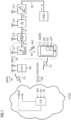
- figure 1 shows a first exemplary system for authorizing the communication of network nodes IoT1 - IoT4 (e.g. IoT device) within a communication network IP2 (e.g. IP network), a network node IoT1 - IoT4 being set up so that it can only carry out communication if he receives an authorization GRANT after an NFC connection NFC (e.g. RFID, Bluetooth) with a defined (advantageously certified) mobile communication device SMART (e.g. smartphone, tablet computer, PDA (Personal Digital Assistant)).
- NFC e.g. RFID, Bluetooth
- SMART e.g. smartphone, tablet computer, PDA (Personal Digital Assistant)
- a network node IoT1 - IoT4 can only communicate with other network nodes IoT1 - IoT4, cloud servers, or devices (e.g.
- a mobile communication device SMART e.g. smartphone, tablet computer, PDA (Personal Digital Assistant) is in the immediate vicinity, i.e. within range for there is an NFC connection (e.g. at a maximum distance of 3 - 5m, in particular a maximum of 3m).
- the communication network IP2 is, for example, an IP network based on an IP protocol (Internet Protocol, e.g. IPv4 or IPv6).
- IP protocol Internet Protocol, e.g. IPv4 or IPv6
- a network node IoT1 - IoT4 is advantageously an Internet-enabled IoT device.
- buildings for example, around appropriately set up hazard or fire alarms, or appropriately set up operating and monitoring stations PANEL.
- the network node IoT1-IoT4 is advantageously set up such that after authorization has taken place, write access to a memory M (eg flash memory) of the authorized network node is possible.
- the write access can take place, for example, through other network nodes of the IP network IP2, and/or through the mobile communication terminal SMART, and/or through a cloud service application CSA, which is located on a cloud server in a cloud infrastructure CLOUD.
- Write access can be a firmware update, for example FW or an update of operating parameters of the IoT device.
- the network node IoT1-IoT4, PANEL is advantageously an IoT device that is connected to other devices or to the Internet via an IP connection IP2.
- the IoT device IoT1 only receives an authorization GRANT for a communication (e.g. firmware update FW) if the mobile communication terminal device is SMART through an NFC connection NFC (near field communication, e.g. RFID (Radio Frequency Identification) or Bluetooth (e.g. BLE) ) connected to the IoT device IoT1.
- NFC near field communication
- RFID Radio Frequency Identification
- BLE Bluetooth
- the mobile communication device SMART must be in the immediate vicinity (e.g. within a distance of 5m, in particular 3m) of the device IoT1.
- the spatial proximity is represented by the dashed line, within which the mobile communication terminal SMART and the IoT device IoT1 are located.
- the exemplary mobile communication terminal SMART includes a corresponding app APP for communication with a cloud service application CSA, as well as firmware FW, which is to be uploaded (uploaded) to the device IoT1.
- a user e.g. a commissioning engineer or a maintenance technician
- the app APP can also be used to legitimize or certify the mobile communication terminal SMART.
- the mobile communication terminal SMART uses a corresponding IP connection IP1 (Internet Protocol connection) to send a request (request) REQ for an update for the corresponding device IoTn to a cloud service application CSA, which is implemented by a cloud infrastructure CLOUD.
- the cloud service application CSA receives the request REQ, the identification IDn for the corresponding device IoTn and the firmware FW to be loaded onto the corresponding IoTn device.
- the mobile communication terminal SMART receives the identification IDn from the device IoTn through the NFC connection NFC.
- the cloud service application CSA receives from the mobile communication terminal SMART via the communication connection IP1 (e.g. Internet, WLAN) the request (request) REQ for an update to be carried out (firmware update), the associated firmware FW, and the identification IDn for the device IoTn that the firmware FW should be loaded.
- the cloud service application CSA gives a grant or authorization GRANT for a communication via the IP connection IP2 to the corresponding device IoTn.
- the Cloud Service Application CSA transmits the firmware FW to the corresponding IoT device, as shown in the example figure 1 to the device IoT1.
- the cloud service application CSA is implemented in a suitably set up cloud infrastructure CLOUD, e.g. on a suitably set up server.
- the cloud service application CSA can access the IP network for the IP connection IP2 via a gateway GW or also directly to the corresponding IoT device IoT1-IoT4.
- the IP connections IP1, IP2 are advantageously radio-based connections (e.g. WLAN).
- the IoT device IoT1 is a fire detector that is connected to other devices IoT1 - I-oT4 via a detector line ML with a corresponding control station or fire alarm control panel PANEL (e.g. FS20 control panel).
- An alarm message AL can thus be forwarded via the detector line ML from a device IoT1 - IoT4 to the control panel PANEL.
- the network node IoT1-IoT4 is advantageously set up so that it is in a permanent NFC connection NFC with the mobile communication terminal SMART for the duration of a communication.
- the network node is advantageously set up to allow write access to a memory M of this authorized network node (e.g. via other network nodes, the cloud service application CSA, or via the mobile communication terminal SMART).
- the network node is advantageously set up so that it can only carry out a communication if it receives an authorization GRANT after a successful NFC connection NFC with a defined (certified) mobile communication terminal SMART (e.g. smartphone).
- a defined (certified) mobile communication terminal SMART e.g. smartphone
- FIG 2 shows a second exemplary system for authorizing the communication of network nodes IoT1 - IoT4 (e.g. IoT device) within a communication network IP2 (e.g. IP network), a network node IoT1 - IoT4 being set up so that it can only carry out a communication if he receives an authorization GRANT after an NFC connection NFC (e.g. RFID, Bluetooth) with a defined (advantageously certified) mobile communication device SMART (e.g. smartphone, tablet computer, PDA (Personal Digital Assistant)).
- NFC e.g. RFID, Bluetooth
- SMART e.g. smartphone, tablet computer, PDA (Personal Digital Assistant)
- a network node IoT1 - IoT4 can only communicate with other network nodes IoT1 - IoT4, cloud servers, or devices (e.g.
- a mobile communication device SMART e.g. smartphone, tablet computer, PDA (Personal Digital Assistant) is in the immediate vicinity, i.e. within range for there is an NFC connection (e.g. at a maximum distance of 3 - 5m, in particular a maximum of 3m).
- the communication network IP2 is, for example, an IP network based on an IP protocol (Internet Protocol, e.g. IPv4 or IPv6).
- IP protocol Internet Protocol, e.g. IPv4 or IPv6
- a network node IoT1 - IoT4 is advantageously an Internet-enabled IoT device.
- buildings for example, around appropriately set up hazard or fire alarms, or appropriately set up operating and monitoring stations PANEL.
- the network node IoT1-IoT4 is advantageously set up such that after authorization has taken place, write access to a memory M (e.g. flash memory) of the authorized network node is possible.
- the write access can e.g. via further network nodes of the IP network IP2, and/or via the mobile communication terminal SMART, and/or via a cloud service application CSA, which is located on a cloud server in a cloud infrastructure CLOUD.
- Write access can be, for example, a firmware update FW or an update of the operating parameters of the IoT device.
- the network node IoT1-IoT4, PANEL is advantageously an IoT device that is connected to other devices or to the Internet via an IP connection IP2.
- the IoT device IoT1 only receives an authorization GRANT IDn for a communication (e.g. firmware update FW) when the mobile communication terminal SMART is connected via an NFC connection NFC (near field communication, e.g. RFID (Radio Frequency Identification) or Bluetooth (e.g. BLE )) connected to the IoT device IoT1.
- NFC near field communication
- RFID Radio Frequency Identification
- BLE Bluetooth
- the mobile communication device SMART must be in the immediate vicinity (e.g. within a distance of 5m, in particular 3m) of the device IoT1.
- the spatial proximity is represented by the dashed line, within which the mobile communication terminal SMART and the IoT device IoT1 are located.
- the exemplary mobile communication terminal SMART includes a corresponding app APP for communication with a cloud service application CSA, as well as firmware FW, which is to be uploaded (uploaded) to the device IoT1.
- a user e.g a commissioning engineer or a maintenance technician
- the app APP can also be used to legitimize or certify the mobile communication terminal SMART.
- the mobile communication terminal SMART uses a corresponding IP connection IP1 (Internet Protocol connection) to send a request (request) REQ IoTn for an update for the corresponding device IoTn to a cloud service application CSA, which is implemented by a cloud infrastructure CLOUD.
- the cloud service application CSA receives the request REQ IoTn , the identification IDn for the corresponding device IoTn on which the firmware FW is to be loaded.
- the mobile communication terminal SMART receives the identification IDn from the device IoTn through the NFC connection NFC.
- the cloud service application CSA receives the request (request) REQ IoTn for an update to be carried out (firmware update) and the identification IDn for the device IoTn to which the firmware FW should be loaded.
- the cloud service application CSA gives a grant or authorization GRANT IDn for a communication via the IP connection IP2 to the corresponding device IoTn.
- the cloud service application CSA can access the IP network for the IP connection IP2 via a gateway GW or also directly to the corresponding IoT device IoT1-IoT4.
- the IP connections IP1, IP2 are advantageously radio-based connections (eg WLAN).
- the cloud service application CSA is advantageously implemented in a suitably set up cloud infrastructure CLOUD, for example on a suitably set up server.
- the device sends I-oT1, after receiving the authorization GRANT IDn from the Cloud Service Application CSA, to the mobile communication terminal SMART, with which it is in an NFC connection NFC stands.
- the mobile communication terminal SMART After the mobile communication terminal SMART has received the authorization GRANT IDn from the IoT device IoT1, the mobile communication terminal SMART sends the firmware FW to the IoT device IoT1 via the NFC connection NFC.
- the IoT device IoT1 is a fire detector that is connected to other devices IoT1 - I-oT4 via a detector line ML with a corresponding control station or fire alarm control panel PANEL (e.g. FS20 control panel).
- An alarm message AL can thus be forwarded via the detector line ML from a device IoT1 - IoT4 to the control panel PANEL.
- the network node IoT1-IoT4 is advantageously set up so that it is in a permanent NFC connection NFC with the mobile communication terminal SMART for the duration of a communication.
- the network node is advantageously set up to allow write access to a memory M of this authorized network node (e.g. via other network nodes, the cloud service application CSA, or via the mobile communication terminal SMART).
- the network node is advantageously set up so that it can only carry out a communication if it receives an authorization GRANT IDn after a successful NFC connection NFC with a defined (certified) mobile communication terminal SMART (eg smartphone).
- a defined (certified) mobile communication terminal SMART eg smartphone
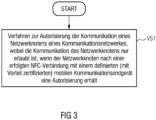
- figure 3 shows an exemplary flowchart for a method of authorizing the communication (e.g. data connection, sending or receiving data) of a network node (e.g. IoT device) of a communication network (e.g. IP network), the authorization for communication of the network node only taking place if the network node an NFC connection with a defined (advantageously certified) mobile communication device (e.g. smartphone) has been established.
- a network node e.g. IoT device
- a communication network e.g. IP network
- the network node receives the authorization from a correspondingly set up cloud server before the communication.
- the network node receives the authorization from the mobile communication terminal prior to communication.
- the mobile communication terminal receives authorization from a trustworthy certification server.
- the network node After receiving the authorization, the network node advantageously requests the mobile communication terminal to send an acknowledgment to the network node via the NFC connection.
- the network node After receiving the authorization, the network node advantageously requests the mobile communication terminal to send an acknowledgment to a certification server via the NFC connection.
- the network node is advantageously in a permanent (continuous, i.e. uninterrupted) NFC connection with the mobile communication terminal for the duration of a communication.
- the mobile communication terminal advantageously receives authorization (token, certificate; actually authorization for authorization) from a certification server. This can be done, for example, by downloading a corresponding certificate from the certification server.
- the network node only communicates when the mobile communication terminal is within a defined distance (e.g. 3-4 m) of the network node.
- write access to a memory of the authorized network node takes place only after authorization has taken place (Eg via other network nodes or via the mobile communication terminal).
- the inventive method is based on the method step: (VS1) Method for authorizing the communication of a network node of a communication network, the communication of the network node is only permitted if the network node receives an authorization after an NFC connection with a defined (advantageously certified) mobile communication terminal.
- This process step can be implemented using an infrastructure that is already present in a building.
- IoT Internet of Things
- the present invention prevents direct external data access to the IoT devices.
- data access directly or via the server or the control center
- data access to the IoT device only takes place if direct data communication with the built-in IoT device with a smartphone in the immediate vicinity (approx. 2 to 3m in the vicinity of the IoT device) is possible, such as using NFC or Bluetooth.
- the device can store external data in a secure storage area (e.g. flash memory) via a remote server or via the cloud.
- a secure storage area e.g. flash memory
- the external data can also be transferred directly from the smartphone to the IoT device using NFC or Bluetooth.
- a request to the cloud to upload external data is transmitted to the IoT devices in encrypted form.
- the device in question only releases the secure storage area if the encrypted request is valid and the IoT device is also in a communication connection with the smartphone.
- the external data can then be transferred directly from the smartphone to the IoT device or via the cloud.
- the method according to the invention enables an increased level of security for access to the secured memory area of an IoT device.
- a physical component (location) is required to enable data delivery.
- Physical access to the device can also be further secured by access control systems.
- the method according to the invention and the system according to the invention for authorizing the communication of a network node of a communication network are particularly suitable for applications with high security requirements.
- the method according to the invention and the system according to the invention are thus particularly suitable for the commissioning and maintenance or testing of IoT devices with high security requirements or in environments with high security requirements or with sensitive infrastructure (e.g. in banks, prisons, shelters, military facilities, disaster control facilities, nuclear plants, power plants).
- the IoT devices can be, for example, fire or hazard detectors that are connected to the Internet or intranet.
- Method and system for authorizing the communication of a network node of a communication network the communication of the network node is only permitted if the network node receives an authorization after an NFC connection with a defined (advantageously certified) mobile communication terminal.
Landscapes
- Engineering & Computer Science (AREA)
- Computer Networks & Wireless Communication (AREA)
- Signal Processing (AREA)
- Computer Security & Cryptography (AREA)
- Mobile Radio Communication Systems (AREA)
- Data Exchanges In Wide-Area Networks (AREA)
- Telephonic Communication Services (AREA)
Description
- Die Erfindung betrifft ein Verfahren und System zur Autorisierung der Kommunikation eines Netzwerkknotens eines Kommunikationsnetzwerkes. Weiterhin betrifft die Erfindung einen Netzwerkknoten eines Kommunikationsnetzwerkes.
- Die Vernetzung von Gegenständen und Geräten untereinander und mit dem Internet durchdringt immer mehr den Alltag, sowohl im privaten als auch im industriellen Umfeld. Beim sogenannten Internet der Dinge bilden internetfähige Geräte (sog. IoT-Devices) ein Netzwerk, in dem sie über geeignete Kommunikationsverbindungen (z.B. WLAN) untereinander bzw. mit dem Internet kommunizieren.
- Viele auf dem Markt vorhandene IoT-Geräte weisen wenige bis gar keine Sicherheitsmechanismen auf und enthalten teilweise diverse Schwachstellen und stellen damit eine potentielle Gefahr für deren Anwender und Dritte dar. Die Zahl böswilliger Attacken auf internetbasierte Systeme, Geräte und Anwendungen steigt derzeit sprunghaft an.
- Die chinesische Patentanmeldung
CN104936266A offenbart ein Verfahren für den Netzwerkzugang für Internet-of-Things-Geräte (IoT-Geräte), wobei ein IoT-Gerät über Nahfeldkommunikation (NFC) Netzwerkverbindungsparameter für den Netzwerkzugang erhält. - Die amerikanische Patentanmeldung
US20160344559A1 offenbart ein Verfahren und eine Vorrichtung werden für eine initiale Zertifizierung einer Registrierung in einem drahtlosen Kommunikationssystem, wobei ein erstes mobiles Gerät eine erste drahtlose Verbindung mit einer Infrastruktur aufbaut und eine zweite drahtlose Verbindung mit einem zweiten mobilen Gerät, wobei das erste mobile Gerät vom zweiten mobilen Gerät eine erste Zertifizierungsanforderung empfängt, wobei die erste Zertifizierungsanforderung eine Anforderung für ein digitales Zertifikat für das zweite mobile Gerät umfasst und erste biometrische Daten, die mit einem Benutzer des ersten des ersten mobilen Geräts zugeordnet sind. Das erste mobile Gerät erhält weiterhin zweite biometrische Daten, die mit einem Benutzer des zweiten mobilen Geräts zugeordnet sind, und übermittelt eine zweite Zertifizierungsanforderung an die Infrastruktur, die die Anforderung des digitalen Zertifikats für das zweite mobile Gerät und die ersten und zweiten biometrischen Daten enthält. Das erste mobile Gerät empfängt dann, von der Infrastruktur das digitale Zertifikat für das zweite mobile Gerät und leitet es an das zweite mobile Gerät weiter. - Die chinesische Patentanmeldung
CN107613544A offenbart ein Verfahren und eine Vorrichtung für Netzwerkverbindungen auf dem Gebiet des Internets der Dinge, insbesondere für ein Netzwerkverbindungsverfahren eines Internet-der-Dinge-Gerätes (I-oT-Gerät) und eines drahtlosen Routers, wobei der drahtlose Router einen NFC-Chip aufweist, wobei der NFC-Chip online Authentifizierungsinformation an das IoT-Gerät sendet, wenn sich das IoT-Gerät in Arbeitsdistanz des NFC-Chips befindet. - Die amerikanische Patentanmeldung
US2017295447A1 offenbart Systeme und Methoden zur Konfiguration und Verwaltung einer beliebigen Anzahl von heterogenen Geräten, wobei eine gemeinsame Gerätekonfiguration gleichzeitig auf eine ausgewählte Gruppe von ansonsten inkompatiblen heterogenen Geräten angewendet wird, die unterschiedliche Kommunikationsprotokolle und Betriebssysteme verwenden. - Bekannt ist die Verwendung von proprietären Schnittstellen zu den verbauten Geräten durch Nutzung von Herstellerwerkzeugen, wie z.B. über eine Serviceschnittstelle. Bekannt ist weiterhin die Verwendung von Zertifikaten, um eine gesicherte Datenübertragung zwischen den IoT-Geräten und/oder einer Zentrale bzw. Serviceeinheit zu gewährleisten.
- Proprietäre Schnittstellen sind unflexibel und erfordern zusätzliche Werkzeuge auf Seite eines Benutzers. Zertifikate können über Hackerangriffe von einem Zertifizierungsserver gestohlen und missbraucht werden. Dies häufig ohne Kenntnis des Betreibers der IoT-Infrastruktur bzw. eines Benutzers.
- Es ist daher die Aufgabe der vorliegenden Erfindung, ein Verfahren und ein System für einen benutzerfreundlichen und gesicherten Zugriff auf IoT-Geräte bereitzustellen.
- Die gestellte Aufgabe wird mit den Merkmalen der unabhänigen Ansprüche gelöst. Weitere vorteilhafte Ausgestaltungen sind in den abhändigen Ansprüchen beschrieben.
- Die Aufgabe wird gelöst durch ein Verfahren zur Autorisierung der Kommunikation (z.B. Datenverbindung) eines Netzwerkknotens (z.B. IoT-Gerät) eines Kommunikationsnetzwerkes (z.B. IP-Netzwerk), wobei die Kommunikation des Netzwerkknotens (Daten/Signale empfangen/senden zu anderen Netzwerkknoten / zur Cloud / zum Smartphone) nur erlaubt ist, wenn der Netzwerkknoten nach einer erfolgten NFC-Verbindung (z.B. Bluetooth, RFID) mit einem definierten mobilen Kommunikationsendgerät (z.B. Smartphone) eine Autorisierung erhält. Mit Vorteil handelt es sich beim mobilen Kommunikationsendgerät um ein entsprechend zertifiziertes mobiles Kommunikationsendgerät. Eine Kommunikation umfasst z.B. das Empfangen oder das Senden von Daten, Dateien, Signalen, Befehlen, Parametern zu anderen Netzwerkknoten, zu einem Panel, zu einer Cloud oder zum mobilen Kommunikationsendgerät. Ein Netzwerkknoten (z.B. IoT-Gerät) ist nur dann autorisiert eine Kommunikation (z.B. ein Firmware Update oder ein Update von Betriebsparametern des IoT-Geräts) durchzuführen, wenn der Netzwerkknoten eine NFC-Verbindung (Nahfeldkommunikation, z.B. Bluetooth, RFID) mit einem definierten mobilen Kommunikationsendgerät (z.B. ein mobiles Kommunikationsendgerät aus einer Menge von zertifizierten mobilen Kommunikationsendgeräten) eingegangen ist.
- Mit Vorteil erfolgt eine Autorisierung des Netzwerkknotens für eine Kommunikation zusätzlich zur eingerichteten NFC-Verbindung zwischen Netzwerkknoten und mobilem Kommunikationsendgerät zusätzlich noch durch eine weitere Autorisierung des Netzwerkknotens (z.B. durch eine Freigabe durch eine Leitstelle, einen weiteren Knoten im Netzwerk oder durch die Anmeldung des Gerätes im IP-Netzwerk selbst (durch entsprechende Zugangsautorisierung)). Diese Zweifaktoren-Verifikation bzw. Zweifaktoren-Autorisierung bietet ein hohes Mass an Sicherheit für den Zugriff auf den Netzwerkknoten. Bei der Zweifaktoren-Verifikation bzw. Zweifaktoren-Autorisierung erfolgt mit Vorteil eine erste Verifikation bzw. Autorisierung durch den IP-Zugriff selbst (virtuelle Komponente). Eine zweite Verifikation bzw. Autorisierung erfolgt z.B. über eine physische Komponente (z.B. durch eine PIN-Eingabe zur Anmeldung beim IP-Netzwerk in dem sich der Netzwerkknoten befindet). Erst wenn erste und zweite Verifikation bzw. Autorisierung erfolgt sind, kann die Datenübermittlung für den Netzwerkknoten aktiviert werden. Mit Vorteil wird der physische Zugang zum Netzwerkknoten (z.B. IoT-Gerät in einem Gebäude) durch ein Zutrittskontrollsystem gesichert werden. Dies würde eine Dreifaktoren-Verifikation bzw. Dreifaktoren-Autorisierung ermöglichen bzw. bedeuten.
- Mit Vorteil wird das erfindungsgemässe Verfahren für die Installation und/oder für die Wartung von Netzwerkknoten in einem Gebäude bzw. innerhalb einer Gebäudeautomatisierung verwendet. Netzwerkknoten können z.B. IoT-Geräte sein, oder Gefahren- und/oder Brandmelder, Controller für Sensoren und/oder Aktoren, Stellantriebe oder Busteilnehmer eines Installationsbuses (z.B. KNX-Bus).
- Mit Vorteil wird der Zugriff auf den Netzwerkknoten (z.B. IoT-Gerät) nur dann freigegeben, wenn eine direkte Datenkommunikation zwischen dem Netzwerkknoten mit einem mobilen Kommunikationsendgerät (z.B. Smartphone) in unmittelbarer Nähe (z.B. in einem definierten maximalen Abstand von ca. 2 bis 3m im Umkreis des Netzwerkknotens) möglich ist, wie z.B. mittels NFC oder Bluetooth. Wenn eine räumliche Nähe festgestellt ist, wird der Zugriff freigegeben, sodass das Gerät externe Daten über den Server bzw. über die Cloud in den gesicherten Speicherbereich ablegen kann. Alternativ können die externen Daten auch direkt mittels NFC oder Bluetooth vom mobilen Kommunikationsendgerät auf den Netzwerkknoten übertragen werden.
- Mit Vorteil wird zur Erhöhung der Sicherheit eine Anfrage an eine Cloud (Cloud-Server bzw. Cloud Service Application) zum Aufspielen externer Daten verschlüsselt an den entsprechenden Netzwerkknoten übertragen. Der entsprechende Netzwerkknoten gibt den gesicherten Speicherbereich nur dann frei, wenn die verschlüsselte Anfrage gültig ist und zudem der entsprechende Netzwerkknoten in einer Kommunikationsverbindung mit dem mobilen Kommunikationsendgerät ist. Der externen Daten können dann direkt vom mobilen Kommunikationsendgerät auf den Netzwerkknoten übertragen werden oder über die Cloud.
- Eine Nahfeldkommunikation (Near Field Communication, NFC) zwischen dem mobilen Kommunikationsendgerät und dem Netzwerkknoten kann z.B. über RFID (Radio Frequency Identification) oder durch Bluetooth hergestellt werden. Eine Nahfeldkommunikation erfordert, dass die beiden zu verbindenden Geräte räumlich nahe (z.B. 2-3m) beieinander sind. Wenn das mobile Kommunikationsendgerät und der Netzwerkknoten eine NFC-Verbindung untereinander installiert haben, kann dies als Nachweis angesehen werden, dass ihre jeweilige geographische Position im Wesentlichen (z.B. im Abstand von 2-3m) übereinstimmt.
- Eine erste vorteilhafte Ausgestaltung der Erfindung liegt darin, dass der Netzwerkknoten vor der Kommunikation die Autorisierung vom mobilen Kommunikationsendgerät erhält. Nach einer erfolgten NFC-Verbindung zwischen dem Netzwerkknoten und dem mobilen Kommunikationsendgerät kann das mobile Kommunikationsendgerät eine Autorisierungsmeldung, ein Autorisierungssignal, oder einen Autorisierungscode (z.B. vierstellige oder sechsstellige PIN) an den Netzwerkknotensenden. Dies erfolgt mit Vorteil über die eingerichtete NFC-Verbindung. Prinzipiell kann die Autorisierung vom mobilen Kommunikationsendgerät an den Netzwerkknoten aber auch über einen anderen Kommunikationsweg (z.B. über das IP-Netzwerk des Netzwerkknotens) erfolgen.
- Eine weitere vorteilhafte Ausgestaltung der Erfindung liegt darin, dass der Netzwerkknoten vor der Kommunikation die Autorisierung durch einen entsprechend eingerichteten Cloud-Server bzw. eine entsprechende Cloud Service Application erhält. Vom mobilen Kommunikationsendgerät wird der Cloud-Server bzw. die Cloud Service Application über eine entsprechende Kommunikationsverbindung (z.B. IP-Verbindung) aufgefordert, eine Autorisierung (z.B. eine Autorisierungsmeldung oder ein Autorisierungssignal) an den entsprechenden Netzwerkknoten zu senden. Dadurch wird die Sicherheit zusätzlich erhöht.
- Eine weitere vorteilhafte Ausgestaltung der Erfindung liegt darin, dass der Netzwerkknoten nach Erhalt der Autorisierung das mobile Kommunikationsendgerät über NFC-Verbindung auffordert, eine Quittierung (z.B. Acknowledgement) an den Netzwercknoten zu senden. Dies sorgt für eine zusätzliche Datensicherheit.
- Eine weitere vorteilhafte Ausgestaltung der Erfindung liegt darin, dass der Netzwerkknoten nach Erhalt der Autorisierung das mobile Kommunikationsendgerät über NFC-Verbindung auffordert, eine Quittierung (z.B. Acknowledgement) an einen Zertifizierungsserver zu senden. Auch dies sorgt für eine zusätzliche Datensicherheit.
- Eine weitere vorteilhafte Ausgestaltung der Erfindung liegt darin, dass der Netzwerkknoten während einer Kommunikation in einer permanenten NFC-Verbindung mit dem mobilen Kommunikationsendgerät steht. Dies erhöht weiterhin die Sicherheit des Zugriffs auf den Netzwerkknoten und die Sicherheit der Kommunikation mit dem Netzwerkknoten. Das mobile Kommunikationsendgerät muss z.B. für die gesamte Dauer eines Firmware-Updates über eine NFC-Verbindung mit dem entsprechenden Netzwerkknoten stehen.
- Eine weitere vorteilhafte Ausgestaltung der Erfindung liegt darin, dass das mobile Kommunikationsendgerät eine Autorisierung (Token, Zertifikat; eigentlich Autorisierung zur Autorisierung) durch einen Zertifizierungsserver (z.B. vertrauenswürdiger Server) erhält. Ein Zertifizierungsserver kann z.B. über ein geeignetes asymmetrisches Verschlüsselungsverfahren digitale Zertifikate erstellen und diese auf mobile Kommunikationsendgeräte übertragen. Mit Vorteil ist ein digitales Zertifikat nur für eine bestimmte Zeitspanne und/oder für eine definierte Anzahl von Autorisierungen und/oder für definierte Netzwerkknoten (z.B. Netzwerkknoten in einem bestimmten Gebäudebereich (z.B. ein bestimmter Raum) gültig. Dies erhöht weiterhin die Sicherheit des Zugriffs auf den Netzwerkknoten und die Sicherheit der Kommunikation mit dem Netzwerkknoten.
- Eine weitere vorteilhafte Ausgestaltung der Erfindung liegt darin, dass eine Kommunikation des Netzwerkknotens nur erfolgt, wenn sich das mobile Kommunikationsendgerät innerhalb einer definierten Entfernung (z.B. Höchstabstand 3-4m, insbesondere 2m) zum Netzwerkknoten befindet. Die geographische Position des Netzwerkknotens kann z.B. in einem Gebäudeinformationsmodell (BIM, Building Information Model) in einer entsprechend eingerichteten Datenbank hinterlegt ein. Die geographische Position des mobilen Kommunikationsmodells kann z.B. über ein Positionsbestimmungssystem (satellitengestützt (z.B. GPS) oder durch ein Indoor-Positionsbestimmungssystem (IPS, z.B. basierend auf BLE (Bluetooth Low Energy Beacons)) ermittelt werden. Die Bestimmung des Abstandes und die Autorisierung zur Kommunikation können z.B. im mobilen Kommunikationsendgerät oder in einer Cloud Application erfolgen. Dies erhöht weiterhin die Sicherheit des Zugriffs auf den Netzwerkknoten und die Sicherheit der Kommunikation mit dem Netzwerkknoten.
- Eine weitere vorteilhafte Ausgestaltung der Erfindung liegt darin, dass nur nach einer erfolgten Autorisierung ein Schreibzugriff auf einen Speicher des autorisierten Netzwercknotens (z.B. über weitere Netzwerkknoten oder über das mobile Kommunikationsendgerät) erlaubt wird. Der Schreibzugriff kann z.B. über weitere Netzwerkknoten, über das mobile Kommunikationsendgerät oder über einen Server erfolgen. Mit Vorteil befindet sich der Server in einer Cloud-Infrastruktur und ist für eine Kommunikation mit dem Netzwerkknoten entsprechend eingerichtet.
- Die Aufgabe wird weiterhin gelöst durch ein System zur Autorisierung der Kommunikation von Netzwerkknoten (z.B. IoT-Gerät) innerhalb eines Kommunikationsnetzwerkes (z.B. IP-Netzwerk), wobei ein Netzwerkknoten dazu eingerichtet ist, dass er eine Kommunikation nur durchführen kann, wenn er nach einer erfolgten NFC-Verbindung mit einem definierten (zertifizierten) mobilen Kommunikationsendgerät (z.B. Smartphone) eine Autorisierung erhält. Mit Vorteil handelt es sich beim mobilen Kommunikationsendgerät um ein entsprechend zertifiziertes mobiles Kommunikationsendgerät. Eine Kommunikation umfasst z.B. das Empfangen oder das Senden von Daten, Dateien, Signalen, Befehlen, Parametern zu anderen Netzwerkknoten, zu einem Panel, zu einer Cloud oder zum mobilen Kommunikationsendgerät. Ein Netzwerkknoten (z.B. IoT-Gerät) ist nur dann autorisiert eine Kommunikation (z.B. ein Firmware Update oder ein Update von Betriebsparametern des IoT-Geräts) durchzuführen, wenn der Netzwerkknoten eine NFC-Verbindung (Nahfeldkommunikation, z.B. Bluetooth, RFID) mit einem definierten mobilen Kommunikationsendgerät (z.B. ein mobiles Kommunikationsendgerät aus einer Menge von zertifizierten mobilen Kommunikationsendgeräten) eingegangen ist.
- Mit Vorteil erfolgt eine Autorisierung des Netzwerkknotens für eine Kommunikation zusätzlich zur eingerichteten NFC-Verbindung zwischen Netzwerkknoten und mobilem Kommunikationsendgerät zusätzlich noch durch eine weitere Autorisierung des Netzwerkknotens (z.B. durch eine Freigabe durch eine Leitstelle, einen weiteren Knoten im Netzwerk oder durch die Anmeldung des Gerätes im IP-Netzwerk selbst (durch entsprechende Zugangsautorisierung)). Diese Zweifaktoren-Verifikation bzw. Zweifaktoren-Autorisierung bietet ein hohes Mass an Sicherheit für den Zugriff auf den Netzwerkknoten. Bei der Zweifaktoren-Verifikation bzw. Zweifaktoren-Autorisierung erfolgt mit Vorteil eine erste Verifikation bzw. Autorisierung durch den IP-Zugriff selbst (virtuelle Komponente). Eine zweite Verifikation bzw. Autorisierung erfolgt z.B. über eine physische Komponente (z.B. durch eine PIN-Eingabe zur Anmeldung beim IP-Netzwerk, in dem sich der Netzwerkknoten befindet). Erst wenn erste und zweite Verifikation bzw. Autorisierung erfolgt sind, kann die Datenübermittlung für den Netzwerkknoten aktiviert werden. Mit Vorteil wird der physische Zugang zum Netzwerkknoten (z.B. IoT-Gerät in einem Gebäude) durch ein Zutrittskontrollsystem gesichert werden. Dies würde eine Dreifaktoren-Verifikation bzw. Dreifaktoren-Autorisierung ermöglichen bzw. bedeuten.
- Mit Vorteil wird der Zugriff auf den Netzwerkknoten (z.B. IoT-Gerät) nur dann freigegeben, wenn eine direkte Datenkommunikation zwischen dem Netzwerkknoten mit einem mobilen Kommunikationsendgerät (z.B. Smartphone) in unmittelbarer Nähe (z.B. in einem definierten maximalen Abstand von ca. 2 bis 3m im Umkreis des Netzwerkknotens) möglich ist, wie z.B. mittels NFC oder Bluetooth. Wenn eine räumliche Nähe festgestellt ist, wird der Zugriff freigegeben, sodass das Gerät externe Daten über den Server bzw. über die Cloud in den gesicherten Speicherbereich ablegen kann. Alternativ können die externen Daten auch direkt mittels NFC oder Bluetooth vom mobilen Kommunikationsendgerät auf den Netzwerkknoten übertragen werden.
- Mit Vorteil wird zur Erhöhung der Sicherheit eine Anfrage an eine Cloud (Cloud-Server bzw. Cloud Service Application) zum Aufspielen externer Daten verschlüsselt an den entsprechenden Netzwerkknoten übertragen. Der entsprechende Netzwerkknoten gibt den gesicherten Speicherbereich nur dann frei, wenn die verschlüsselte Anfrage gültig ist und zudem der entsprechende Netzwerkknoten in einer Kommunikationsverbindung mit dem mobilen Kommunikationsendgerät ist. Der externen Daten können dann direkt vom mobilen Kommunikationsendgerät auf den Netzwerkknoten übertragen werden oder über die Cloud.
- Eine Nahfeldkommunikation (Near Field Communication, NFC) zwischen dem mobilen Kommunikationsendgerät und dem Netzwerkknoten kann z.B. über RFID (Radio Frequency Identification) oder durch Bluetooth hergestellt werden. Eine Nahfeldkommunikation erfordert, dass die beiden zu verbindenden Geräte räumlich nahe (z.B. 2-3m) beieinander sind. Wenn das mobile Kommunikationsendgerät und der Netzwerkknoten eine NFC-Verbindung untereinander installiert haben, kann dies als Nachweis angesehen werden, dass ihre jeweilige geographische Position im Wesentlichen (z.B. im Abstand von 2-3m) übereinstimmt.
- Das erfindungsgemässe System lässt sich mit sowieso schon in einem Gebäude vorhandener Infrastruktur realisieren.
- Netzwerkknoten können z.B. IoT-Geräte sein, oder Gefahrenund/oder Brandmelder, Controller für Sensoren und/oder Aktoren, oder Busteilnehmer eines Installationsbuses (z.B. KNX-Bus) .
- Eine weitere vorteilhafte Ausgestaltung der Erfindung liegt darin, dass der Netzwerkknoten dazu eingerichtet ist, dass er während der Dauer einer Kommunikation in einer permanenten NFC-Verbindung mit dem mobilen Kommunikationsendgerät steht. Dies erhöht u.a. die Sicherheit während der Dauer einer Kommunikation (z.B. Datentransfer).
- Eine weitere vorteilhafte Ausgestaltung der Erfindung liegt darin, dass der Netzwerkknoten nach erfolgter Autorisierung dazu eingerichtet ist, einen Schreibzugriff auf einen Speicher dieses autorisierten Netzwerkknotens (z.B. über weitere Netzwerkknoten, über einen Cloud-Server, oder über das mobile Kommunikationsendgerätes) zu erlauben. Dadurch ist u.a. ein hoher Schutz von Hackerangriffen oder Man-in-the-Middle-Attacken (MITM-Angriff, Mittelsmannangriff) auf den Netzwerkknoten sichergestellt.
- Die Aufgabe wird weiterhin gelöst durch einen Netzwerkknoten eines Kommunikationsnetzwerkes (z.B. IP-Netzwerk), wobei der Netzwerkknoten dazu eingerichtet ist, dass er eine Kommunikation nur durchführen kann, wenn er nach einer erfolgten NFC-Verbindung mit einem definierten, mit Vorteil zertifizierten mobilen Kommunikationsendgerät (z.B. Smartphone) eine Autorisierung erhält. Entsprechend eingerichtete Netzwerkknoten weisen einen hohen Schutz vor einem unberechtigten Zugriff auf. Netzwerkknoten können z.B. IoT-Geräte sein, oder Gefahrenund/oder Brandmelder, Controller für Sensoren und/oder Aktoren, oder Busteilnehmer eines Installationsbuses (z.B. KNX-Bus) .
- Eine weitere vorteilhafte Ausgestaltung der Erfindung liegt darin, dass es sich beim Netzwerkknoten um ein IoT-Gerät handelt. Bei einem IoT-Gerät (IoT steht für Internet of Things, Internet der Dinge) handelt sich um physische und/oder virtuelle Gegenstände, die untereinander und/oder mit dem Internet verbunden sind. Je nach Ausstattung (Hardware, Software, Prozessor, Speicher) können IoT-Geräte unterschiedlich leistungsfähig sein.
- Eine weitere vorteilhafte Ausgestaltung der Erfindung liegt darin, dass der Netzwerkknoten nach erfolgter Autorisierung dazu eingerichtet ist, einen Schreibzugriff auf einen Speicher dieses autorisierten Netzwerkknotens (z.B. über weitere Netzwerkknoten, über einen Cloud-Server oder über das mobile Kommunikationsendgerätes) zu erlauben. Dadurch ist u.a. ein hoher Schutz von Hackerangriffen oder Man-in-the-Middle-Attacken (MITM-Angriff, Mittelsmannangriff) auf den Netzwerkknoten sichergestellt.
- Die Erfindung sowie vorteilhafte Ausführungen der vorliegenden Erfindung werden am Beispiel der nachfolgenden Figuren erläutert. Dabei zeigen:
-
FIG 1 ein erstes beispielhaftes System zur Autorisierung der Kommunikation eines Netzwerkknotens eines Kommunikationsnetzwerkes, -
FIG 2 ein zweites beispielhaftes System zur Autorisierung der Kommunikation eines Netzwerkknotens eines Kommunikationsnetzwerkes, und -
FIG 3 ein beispielhaftes Flussdiagramm für ein Verfahren Autorisierung der Kommunikation eines Netzwerkknotens eines Kommunikationsnetzwerkes. - Damit IoT-Geräte (z.B. Internetfähige Geräte) in Institutionen eingesetzt werden können, müssen sie ein Minimum an Sicherheitskriterien erfüllen. Die Geräte müssen Update-Funktionen besitzen, und der Hersteller muss einen Update-Prozess anbieten. Wenn IoT-Lösungen (Lösungen zum Internet der Dinge) ein unzureichendes oder fehlendes Patch-Management (Behebung von Fehlern) mitbringen, können keine Schwachstellen behoben werden. Ersatzweise müssten die Sicherheitslücken anderweitig abgeschirmt werden. Dies kann sehr aufwendig werden und auch das ganze Nutzungskonzept eines IoT-Gerätes ad absurdum führen.
- Bei der vorliegenden Erfindung geht es insbesondere um den gesicherten/autorisierten Zugriff auf im Gebäude verbaute sicherheitsrelevante Geräte, wie z.B. Rauchmelder, Alarming Devices, Stellantriebe für Rauchklappen, Löschventile etc. Denn sind ist die Datensicherheit gefährdet, hemmt das den technischen Fortschritt.
- Mit der Verbreitung und dem Einzug der IoT-Technologie auch im Gebäudesektor besteht ein erhöhtes Sicherheitsrisiko zur Manipulation der verbauten sicherheitsrelevanten Infrastruktur. So kann das bewusste Auslösen eines Fehlalarms zu einer Evakuierung eines Hotels führen, was negative Folgen für das Hotel und für die Hotelbesucher zur Folge hat, wie z.B. Unfälle in Panik. Unter anderem kann das zu Lösegeldforderungen führen. Auch der Einsatzzweck kann durch nicht verifizierbare Veränderungen an den Geräten kompromittiert werden (Alarmauslösung eines Rauchmelders unterdrücken).
-
Figur 1 zeigt ein erstes beispielhaftes System zur Autorisierung der Kommunikation von Netzwerkknoten IoT1 - IoT4 (z.B. IoT-Gerät) innerhalb eines Kommunikationsnetzwerkes IP2 (z.B. IP-Netzwerk), wobei ein Netzwerkknoten IoT1 - IoT4 dazu eingerichtet ist, dass er eine Kommunikation nur durchführen kann, wenn er nach einer erfolgten NFC-Verbindung NFC (z.B. RFID, Bluetooth) mit einem definierten (mit Vorteil zertifizierten) mobilen Kommunikationsendgerät SMART (z.B. Smartphone, Tablet-Computer, PDA (Personal Digital Assistant) eine Autorisierung GRANT erhält. Ein Netzwerkknoten IoT1 - IoT4 kann nur dann mit anderen Netzwerkknoten IoT1 - IoT4, Cloud-Servern, oder Geräten (z.B. mobilen Kommunikationsendgeräten) kommunizieren, wenn sich ein mobiles Kommunikationsendgerät SMART (z.B. Smartphone, Tablet-Computer, PDA (Personal Digital Assistant) in unmittelbarer Nähe, d.h. in Reichweite für eine NFC-Verbindung (z.B. in einem Abstand von höchstens 3 - 5m, insbesondere höchstens 3m) befindet. - Beim Kommunikationsnetzwerk IP2 handelt es sich z.B. um ein IP-Netzwerk, das auf einem IP-Protokoll (Internet Protocol, z.B. IPv4 oder IPv6) basiert.
- Beim einem Netzwerkknoten IoT1 - IoT4 handelt es sich mit Vorteil um ein internetfähiges IoT-Gerät. In Gebäuden z.B. um entsprechend eingerichtete Gefahren- oder Brandmelder, oder entsprechend eingerichtete Bedien- und Überwachungsstationen PANEL.
- Mit Vorteil ist der Netzwerkknoten IoT1 - IoT4 dazu eingerichtet, dass nach erfolgter Autorisierung ein Schreibzugriff auf einen Speicher M (z.B. Flash-Speicher) des autorisierten Netzwerkknotens möglich ist. Der Schreibzugriff kann z.B. durch weitere Netzwerkknoten des IP-Netzwerkes IP2 erfolgen, und/oder über das mobile Kommunikationsendgerät SMART, und/oder durch eine Cloud Service Application CSA, die sich auf einem Cloud-Server in einer Cloud-Infrastruktur CLOUD befindet. Beim Schreibzugriff kann es sich z.B. um ein Firmware-Update FW oder um ein Update von Betriebsparametern des IoT-Geräts handeln.
- Mit Vorteil handelt es sich beim Netzwerkknoten IoT1 - IoT4, PANEL um ein IoT-Gerät, das über eine IP-Verbindung IP2 mit anderen Geräten bzw. mit dem Internet verbunden ist.
- Im beispielhaften System gemäss
Figur 1 erhält das IoT-Gerät IoT1 erst dann eine Autorisierung GRANT für eine Kommunikation (z.B. Firmware-Update FW), wenn sich das mobile Kommunikationsendgerät SMART durch eine NFC-Verbindung NFC (Nahfeldkommunikation, z.B. RFID (Radio Frequency Identification) oder Bluetooth( z.B. BLE)) mit dem IoT-Gerät IoT1 verbunden hat. Für eine NFC-Verbindung muss sich das mobile Kommunikationsendgerät SMART in unmittelbarer räumlicher Nähe (z.B. innerhalb eines Abstandes von 5m, insbesondere 3m) des Gerätes IoT1 befinden. In der Darstellung gemässFigur 1 ist die räumlichen Nähe durch die gestrichelte Linie dargestellt, innerhalb derer sich das mobile Kommunikationsendgerät SMART und das IoT-Gerät IoT1 befinden. - Das beispielhafte mobile Kommunikationsendgerät SMART umfasst eine entsprechende App APP zur Kommunikation mit einer Cloud Service Application CSA, sowie Firmware FW, die auf das Gerät IoT1 hochgeladen (Upload) werden soll. Auf dem Display DIS des mobilen Kommunikationsendgerätes SMART kann ein Benutzer (z.B. ein Inbetriebsetzer oder ein Wartungstechniker) entsprechende Bedieneingaben durchführen. Die App APP kann auch zur Legitimation bzw. Zertifizierung des mobilen Kommunikationsendgerätes SMART verwendet werden.
- Das mobile Kommunikationsendgerät SMART sendet über eine entsprechende IP-Verbindung IP1 (Internet Protokoll Verbindung) eine Anforderung (Request) REQ für ein Update für das entsprechende Gerät IoTn an eine Cloud Service Application CSA, die durch eine Cloud-Infrastruktur CLOUD realisiert ist. Die Cloud Service Application CSA erhält den Request REQ, die Identifikation IDn für das entsprechende Gerät IoTn und die Firmware FW, die auf das entsprechende Gerät IoTn geladen werden soll. Durch die NFC-Verbindung NFC erhält das mobile Kommunikationsendgerät SMART die Identifikation IDn vom Gerät IoTn.
- Im beispielhaften System gemäss
Figur 1 erhält die Cloud Service Application CSA vom mobilen Kommunikationsendgerät SMART über die Kommunikationsverbindung IP1 (z.B. Internet, WLAN) die Anforderung (Request) REQ für ein durchzuführendes Update (Firmware-Update), die dazugehörige Firmware FW, und die Identifikation IDn für das Gerät IoTn auf das die Firmware FW geladen werden soll. Die Cloud Service Application CSA gibt eine Bewilligung bzw. Autorisierung GRANT für eine Kommunikation über die IP-Verbindung IP2 an das entsprechende Gerät IoTn. Weiterhin übermittelt die Cloud Service Application CSA die Firmware FW an das entsprechende IoT-Gerät, in der beispielhaften Darstellung gemässFigur 1 an das Gerät IoT1. - Mit Vorteil ist die Cloud Service Application CSA in einer entsprechend eingerichteten Cloud-Infrastruktur CLOUD implementiert, z.B. auf einem entsprechend eingerichteten Server. Die Cloud Service Application CSA kann über ein Gateway GW auf das IP-Netz für die IP-Verbindung IP2 zugreifen oder aber auch direkt auf das entsprechende IoT-Gerät IoT1 - IoT4. Bei den IP-Verbindungen IP1, IP2 handelt es sich mit Vorteil um funkbasierte Verbindungen (z.B. WLAN).
- Bei der beispielhaften Darstellung gemäss
Figur 1 ist das IoT-Gerät IoT1 ein Brandmelder, der mit anderen Geräten IoT1 - I-oT4 über eine Melderlinie ML mit einer entsprechenden Kontrollstation oder Brandmeldezentrale PANEL (z.B. FS20-Zentrale) verbunden ist. Eine Alarmmeldung AL kann somit über die Melderlinie ML von einem Gerät IoT1 - IoT4 bis zur Zentrale PANEL weitergeleitet werden. - Mit Vorteil ist der Netzwerkknoten IoT1 - IoT4 dazu eingerichtet, dass er während der Dauer einer Kommunikation in einer permanenten NFC-Verbindung NFC mit dem mobilen Kommunikationsendgerät SMART steht.
- Mit Vorteil ist der Netzwerkknoten nach erfolgter Autorisierung dazu eingerichtet, einen Schreibzugriff auf einen Speicher M dieses autorisierten Netzwerkknotens (z.B. über weitere Netzwerkknoten, die Cloud Service Application CSA, oder über das mobile Kommunikationsendgerät SMART) zu erlauben.
- Mit Vorteil ist der Netzwerkknoten dazu eingerichtet, dass er eine Kommunikation nur durchführen kann, wenn er nach einer erfolgten NFC-Verbindung NFC mit einem definierten (zertifizierten) mobilen Kommunikationsendgerät SMART (z.B. Smartphone) eine Autorisierung GRANT erhält.
-
Figur 2 zeigt ein zweites beispielhaftes System zur Autorisierung der Kommunikation von Netzwerkknoten IoT1 - IoT4 (z.B. IoT-Gerät) innerhalb eines Kommunikationsnetzwerkes IP2 (z.B. IP-Netzwerk), wobei ein Netzwerkknoten IoT1 - IoT4 dazu eingerichtet ist, dass er eine Kommunikation nur durchführen kann, wenn er nach einer erfolgten NFC-Verbindung NFC (z.B. RFID, Bluetooth) mit einem definierten (mit Vorteil zertifizierten) mobilen Kommunikationsendgerät SMART (z.B. Smartphone, Tablet-Computer, PDA (Personal Digital Assistant) eine Autorisierung GRANT erhält. Ein Netzwerkknoten IoT1 - IoT4 kann nur dann mit anderen Netzwerkknoten IoT1 - IoT4, Cloud-Servern, oder Geräten (z.B. mobilen Kommunikationsendgeräten) kommunizieren, wenn sich ein mobiles Kommunikationsendgerät SMART (z.B. Smartphone, Tablet-Computer, PDA (Personal Digital Assistant) in unmittelbarer Nähe, d.h. in Reichweite für eine NFC-Verbindung (z.B. in einem Abstand von höchstens 3 - 5m, insbesondere höchstens 3m) befindet. - Beim Kommunikationsnetzwerk IP2 handelt es sich z.B. um ein IP-Netzwerk, das auf einem IP-Protokoll (Internet Protocol, z.B. IPv4 oder IPv6) basiert.
- Beim einem Netzwerkknoten IoT1 - IoT4 handelt es sich mit Vorteil um ein internetfähiges IoT-Gerät. In Gebäuden z.B. um entsprechend eingerichtete Gefahren- oder Brandmelder, oder entsprechend eingerichtete Bedien- und Überwachungsstationen PANEL.
- Mit Vorteil ist der Netzwerkknoten IoT1 - IoT4 dazu eingerichtet, dass nach erfolgter Autorisierung ein Schreibzugriff auf einen Speicher M (z.B. Flash-Speicher) des autorisierten Netzwerkknotens möglich ist. Der Schreibzugriff kann z.B. durch weitere Netzwerkknoten des IP-Netzwerkes IP2 erfolgen, und/oder über das mobile Kommunikationsendgerät SMART, und/oder durch eine Cloud Service Application CSA, die sich auf einem Cloud-Server in einer Cloud-Infrastruktur CLOUD befindet. Beim Schreibzugriff kann es sich z.B. um ein Firmware-Update FW oder um ein Update von Betriebsparametern des IoT-Geräts handeln.
- Mit Vorteil handelt es sich beim Netzwerkknoten IoT1 - IoT4, PANEL um ein IoT-Gerät, das über eine IP-Verbindung IP2 mit anderen Geräten bzw. mit dem Internet verbunden ist.
- Im beispielhaften System gemäss
Figur 2 erhält das IoT-Gerät IoT1 erst dann eine Autorisierung GRANTIDn für eine Kommunikation (z.B. Firmware-Update FW), wenn sich das mobile Kommunikationsendgerät SMART durch eine NFC-Verbindung NFC (Nahfeldkommunikation, z.B. RFID (Radio Frequency Identification) oder Bluetooth( z.B. BLE)) mit dem IoT-Gerät IoT1 verbunden hat. Für eine NFC-Verbindung muss sich das mobile Kommunikationsendgerät SMART in unmittelbarer räumlicher Nähe (z.B. innerhalb eines Abstandes von 5m, insbesondere 3m) des Gerätes IoT1 befinden. In der Darstellung gemässFigur 2 ist die räumlichen Nähe durch die gestrichelte Linie dargestellt, innerhalb derer sich das mobile Kommunikationsendgerät SMART und das IoT-Gerät IoT1 befinden. - Das beispielhafte mobile Kommunikationsendgerät SMART umfasst eine entsprechende App APP zur Kommunikation mit einer Cloud Service Application CSA, sowie Firmware FW, die auf das Gerät IoT1 hochgeladen (Upload) werden soll. Auf dem Display DIS des mobilen Kommunikationsendgerätes SMART kann ein Benutzer (z.B. ein Inbetriebsetzer oder ein Wartungstechniker) entsprechende Bedieneingaben durchführen. Die App APP kann auch zur Legitimation bzw. Zertifizierung des mobilen Kommunikationsendgerätes SMART verwendet werden.
- Das mobile Kommunikationsendgerät SMART sendet über eine entsprechende IP-Verbindung IP1 (Internet Protokoll Verbindung) eine Anforderung (Request) REQIoTn für ein Update für das entsprechende Gerät IoTn an eine Cloud Service Application CSA, die durch eine Cloud-Infrastruktur CLOUD realisiert ist. Die Cloud Service Application CSA erhält den Request REQIoTn, die Identifikation IDn für das entsprechende Gerät IoTn auf das die Firmware FW geladen werden soll. Durch die NFC-Verbindung NFC erhält das mobile Kommunikationsendgerät SMART die Identifikation IDn vom Gerät IoTn.
- Im beispielhaften System gemäss
Figur 2 erhält die Cloud Service Application CSA vom mobilen Kommunikationsendgerät SMART über die Kommunikationsverbindung IP1 (z.B. Internet, WLAN) die Anforderung (Request) REQIoTn für ein durchzuführendes Update (Firmware-Update) und die Identifikation IDn für das Gerät IoTn, auf das die Firmware FW geladen werden soll. Die Cloud Service Application CSA gibt eine Bewilligung bzw. Autorisierung GRANTIDn für eine Kommunikation über die IP-Verbindung IP2 an das entsprechende Gerät IoTn. Die Cloud Service Application CSA kann über ein Gateway GW auf das IP-Netz für die IP-Verbindung IP2 zugreifen oder aber auch direkt auf das entsprechende IoT-Gerät IoT1 - IoT4. Bei den IP-Verbindungen IP1, IP2 handelt es sich mit Vorteil um funkbasierte Verbindungen (z.B. WLAN). Mit Vorteil ist die Cloud Service Application CSA in einer entsprechend eingerichteten Cloud-Infrastruktur CLOUD implementiert, z.B. auf einem entsprechend eingerichteten Server. - Beim beispielhaften System gemäss
Figur 2 sendet das Gerät I-oT1, nachdem es die Autorisierung GRANTIDn von der Cloud Service Application CSA erhalten hat, weiter an das mobile Kommunikationsendgerät SMART, mit dem es in einer NFC-Verbindung NFC steht. Nachdem das mobile Kommunikationsendgerät SMART die Autorisierung GRANTIDn vom IoT-Gerät IoT1 erhalten hat, sendet das mobile Kommunikationsendgerät SMART die Firmware FW über die NFC-Verbindung NFC an das IoT-Gerät IoT1. - Bei der beispielhaften Darstellung gemäss
Figur 2 ist das IoT-Gerät IoT1 ein Brandmelder, der mit anderen Geräten IoT1 - I-oT4 über eine Melderlinie ML mit einer entsprechenden Kontrollstation oder Brandmeldezentrale PANEL (z.B. FS20-Zentrale) verbunden ist. Eine Alarmmeldung AL kann somit über die Melderlinie ML von einem Gerät IoT1 - IoT4 bis zur Zentrale PANEL weitergeleitet werden. - Mit Vorteil ist der Netzwerkknoten IoT1 - IoT4 dazu eingerichtet, dass er während der Dauer einer Kommunikation in einer permanenten NFC-Verbindung NFC mit dem mobilen Kommunikationsendgerät SMART steht.
- Mit Vorteil ist der Netzwerkknoten nach erfolgter Autorisierung dazu eingerichtet, einen Schreibzugriff auf einen Speicher M dieses autorisierten Netzwerkknotens (z.B. über weitere Netzwerkknoten, die Cloud Service Application CSA, oder über das mobile Kommunikationsendgerät SMART) zu erlauben.
- Mit Vorteil ist der Netzwerkknoten dazu eingerichtet, dass er eine Kommunikation nur durchführen kann, wenn er nach einer erfolgten NFC-Verbindung NFC mit einem definierten (zertifizierten) mobilen Kommunikationsendgerät SMART (z.B. Smartphone) eine Autorisierung GRANTIDn erhält.
-
Figur 3 zeigt ein beispielhaftes Flussdiagramm für ein Verfahren Autorisierung der Kommunikation (z.B. Datenverbindung, Daten senden oder empfangen) eines Netzwerkknotens (z.B. IoT-Gerät) eines Kommunikationsnetzwerkes (z.B. IP-Netzwerk), wobei die Autorisierung zur Kommunikation des Netzwerkknotens nur dann erfolgt, wenn der Netzwerkknoten eine NFC-Verbindung mit einem definierten (mit Vorteil zertifizierten) mobilen Kommunikationsendgerät (z.B. Smartphone) eingegangen ist. - Mit Vorteil erhält der Netzwerkknoten vor der Kommunikation die Autorisierung durch einen entsprechend eingerichteten Cloud-Server.
- Optional erhält der Netzwerkknoten vor der Kommunikation die Autorisierung vom mobilen Kommunikationsendgerät. Das mobile Kommunikationsendgerät erhält dazu die Autorisierung durch einen vertrauenswürdigen Zertifizierungsserver.
- Mit Vorteil fordert der Netzwerkknoten, nach Erhalt der Autorisierung, vom mobilen Kommunikationsendgerät eine Quittierung an den Netzwerkknoten über die NFC-Verbindung zu senden.
- Mit Vorteil fordert der Netzwerkknoten, nach Erhalt der Autorisierung, das mobile Kommunikationsendgerät dazu auf, eine Quittierung an einen Zertifizierungsserver über die NFC-Verbindung zu senden.
- Mit Vorteil steht der Netzwerkknoten während der Dauer einer Kommunikation in einer permanenten (durchgehenden, d.h. zeitlich nicht unterbrochenen) NFC-Verbindung mit dem mobilen Kommunikationsendgerät.
- Mit Vorteil erhält das mobile Kommunikationsendgerät eine Autorisierung (Token, Zertifikat; eigentlich Autorisierung zur Autorisierung) durch einen Zertifizierungsserver. Dies kann z.B. durch einen Download eines entsprechenden Zertifikats vom Zertifizierungsserver erfolgen.
- Mit Vorteil erfolgt eine Kommunikation des Netzwerkknotens nur, wenn sich das mobile Kommunikationsendgerät innerhalb einer definierten Entfernung (z.B. 3-4m) zum Netzwerkknoten befindet.
- Mit Vorteil erfolgt nur nach einer erfolgten Autorisierung ein Schreibzugriff auf einen Speicher des autorisierten Netzwercknotens (z.B. über weitere Netzwerkknoten oder über das mobile Kommunikationsendgerät).
- Im Prinzip beruht das erfinderische Verfahren auf dem Verfahrensschritt:
(VS1) Verfahren zur Autorisierung der Kommunikation eines Netzwerkknotens eines Kommunikationsnetzwerkes, wobei die Kommunikation des Netzwerkknotens nur erlaubt ist, wenn der Netzwerkknoten nach einer erfolgten NFC-Verbindung mit einem definierten (mit Vorteil zertifizierten) mobilen Kommunikationsendgerät eine Autorisierung erhält. - Dieser Verfahrensschritt kann durch eine sowieso schon in einem Gebäude vorhandene Infrastruktur realisiert werden.
- Zum Schützen einer IoT-Infrastruktur (Internet of Things, Internet der Dinge) ist bekanntlich eine umfassende Sicherheitsstrategie erforderlich. Diese Strategie muss folgende Bereiche abdecken: das Sichern von Daten in der Cloud, das Schützen der Integrität der Daten bei der Übertragung über das öffentliche Internet sowie das sichere Bereitstellen von Geräten. Jede Ebene leistet ihren eigenen Beitrag zur Sicherheit der Gesamtinfrastruktur, und die Beiträge bauen aufeinander auf und ergänzen sich. Die gravierendsten Angriffe gegen die IoT-Infrastruktur selbst beginnen mit einem direkten datentechnischen Zugriff auf die IoT-Geräte vor Ort in der direkten Umgebung des jeweiligen IoT-Geräts.
- Die vorliegende Erfindung verhindert insbesondere einen direkten datentechnischen Zugriff von aussen auf die IoT-Geräte.
- Erfindungsgemäss erfolgt ein datentechnischer Zugriff (direkt oder über den Server bzw. die Zentrale) auf das IoT-Gerät nur dann, wenn eine direkte Datenkommunikation mit dem verbauten IoT-Gerät mit einem Smartphone in unmittelbarer Nähe (ca. 2 bis 3m im Umkreis des IoT-Geräts) möglich ist, wie z.B. mittels NFC oder Bluetooth.
- Wenn über die NFC-Verbindung eine räumliche Nähe festgestellt ist, wird der Zugriff freigegeben, sodass das Gerät externe Daten über einen entfernten Server bzw. über die Cloud in einen gesicherten Speicherbereich (z.B. Flash-Speicher) ablegen kann. Alternativ können die externen Daten auch direkt mittel NFC oder Bluetooth vom Smartphone auf das IoT-Gerät übertragen werden.
- Zur Erhöhung der Sicherheit wird eine Anfrage an die Cloud zum Aufspielen externer Daten verschlüsselt an die IoT-Geräte übertragen. Das betreffende Gerät gibt den gesicherten Speicherbereich nur dann frei, wenn die verschlüsselte Anfrage gültig ist und zudem das IoT-Gerät zudem in einer Kommunikationsverbindung mit dem Smartphone ist. Der externen Daten können dann direkt vom Smartphone auf das IoT-Gerät übertragen werden oder über die Cloud.
- Durch das erfindungsgemässe Verfahren ist ein erhöhtes Mass an Sicherheit für den Zugriff auf den gesicherten Speicherbereich eines IoT-Gerätes möglich. Neben der virtuellen Komponente (IP-Zugriff) ist eine physische Komponente (Standort) erforderlich, um die Datenübermittlung zu aktivieren. Der physische Zugang zum Gerät kann zudem weiter durch Zutrittskontrollsysteme gesichert werden.
- Durch das erfindungsgemässe Verfahren und den gesicherten Zugriff auf einen Cloud-Server bzw. auf eine Cloud Service Application (z.B. PKI-Login) müssen künftig keine Passwörter mehr eingegeben oder komplizierte Konfigurationen vorgenommen werden.
- Das erfindungsgemässe Verfahren und das erfindungsgemässe System zur Autorisierung der Kommunikation eines Netzwerkknotens eines Kommunikationsnetzwerkes sind insbesondere für Anwendungen mit hohen Sicherheitsanforderungen geeignet. So sind das erfindungsgemässe Verfahren und das erfindungsgemässe System insbesondere für die Inbetriebnahme und die Wartung oder den Test von IoT-Geräten mit hohen Sicherheitsanforderungen oder in Umgebungen mit hohen Sicherheitsanforderungen bzw. mit sensibler Infrastruktur (z.B. bei Banken, Gefängnissen, Schutzräumen, militärischen Einrichtungen, Katastrophenschutzeinrichtungen, Nuklearanlagen, Elektrizitätswerke) geeignet. Bei den IoT-Geräten kann es sich z.B. um Brand- oder Gefahrenmelder handeln, die mit dem Internet bzw. Intranet verbunden sind.
- Verfahren und System zur Autorisierung der Kommunikation eines Netzwerkknotens eines Kommunikationsnetzwerkes, wobei die Kommunikation des Netzwerkknotens nur erlaubt ist, wenn der Netzwerkknoten nach einer erfolgten NFC-Verbindung mit einem definierten (mit Vorteil zertifizierten) mobilen Kommunikationsendgerät eine Autorisierung erhält.
-
- REQ
- Anforderung
- IDn
- Identifikation (ID)
- FW
- Firmware
- GRANT, GRANTIDn
- Bewilligung
- CLOUD
- Cloud-Infrastruktur
- CSA
- Cloud Service Application
- GW
- Gateway
- IoT1 - IoT4
- IoT-Gerät
- PANEL
- Steuer- und Bedienpanel
- ML
- Melderlinie
- AL
- Alarm
- BAT
- Batterie
- M
- Speicher
- SMART
- Mobiles Kommunikationsendgerät
- DIS
- Display
- APP
- Applikationsprogramm
- IP1, IP2
- IP-Verbindung
- NFC
- Nahfeldkommunikation
- VS1
- Verfahrensschritt
Claims (13)
- Verfahren zur Autorisierung der Kommunikation eines Netzwerkknotens (IoT1 - IoT4, PANEL) eines Kommunikationsnetzwerkes (IP2), wobei die Kommunikation des Netzwerkknotens (IoT1 - IoT4, PANEL) nur erlaubt ist, wenn der Netzwerkknoten (IoT1 - IoT4, PANEL) nach einer erfolgten NFC-Verbindung (NFC) mit einem definierten mobilen Kommunikationsendgerät (SMART) eine Autorisierung (GRANT, GRANTIDn) erhält, wobei eine Kommunikation des Netzwerkknotens (IoT1 - IoT4, PANEL) nur erfolgt, wenn sich das definierte mobile Kommunikationsendgerät (SMART) innerhalb einer definierten Entfernung von höchstens 3 bis 4m zum Netzwerkknoten (IoT1 - IoT4, PANEL) befindet, und wobei der Netzwerkknoten (IoT1 - IoT4, PANEL) während einer Kommunikation in einer permanenten NFC-Verbindung mit dem definierten mobilen Kommunikationsendgerät (SMART) steht.
- Verfahren nach Anspruch 1, wobei der Netzwerkknoten (IoT1 - IoT4, PANEL) vor der Kommunikation die Autorisierung vom mobilen Kommunikationsendgerät (SMART) erhält.
- Verfahren nach einem der vorstehenden Ansprüche, wobei der Netzwerkknoten (IoT1 - IoT4, PANEL) vor der Kommunikation die Autorisierung (GRANT, GRANTIDn) durch einen entsprechend eingerichteten Cloud-Server (CSA) erhält.
- Verfahren nach einem der vorstehenden Ansprüche, wobei der Netzwerkknoten (IoT1 - IoT4, PANEL) nach Erhalt der Autorisierung das mobile Kommunikationsendgerät (SMART) über NFC-Verbindung (NFC) auffordert, eine Quittierung an den Netzwercknoten (IoT1 - IoT4, PANEL) zu senden.
- Verfahren nach einem der vorstehenden Ansprüche, wobei der Netzwerkknoten (IoT1 - IoT4, PANEL) nach Erhalt der Autorisierung das mobile Kommunikationsendgerät (SMART) über NFC-Verbindung (NFC) auffordert, eine Quittierung an einen Zertifizierungsserver zu senden.
- Verfahren nach einem der vorstehenden Ansprüche, wobei das mobile Kommunikationsendgerät (SMART) eine Autorisierung durch einen Zertifizierungsserver erhält.
- Verfahren nach einem der vorstehenden Ansprüche, wobei nur nach einer erfolgten Autorisierung ein Schreibzugriff auf einen Speicher (M) des autorisierten Netzwerkknotens (IoT1 - I-oT4, PANEL) erlaubt wird.
- System zur Autorisierung der Kommunikation von Netzwerkknoten (IoT1 - IoT4, PANEL) innerhalb eines Kommunikationsnetzwerkes (IP2), wobei ein Netzwerkknoten (IoT1 - IoT4, PANEL) dazu eingerichtet ist, dass er eine Kommunikation nur durchführen kann, wenn er nach einer erfolgten NFC-Verbindung (NFC) mit einem definierten mobilen Kommunikationsendgerät (SMART) eine Autorisierung erhält, wobei eine Kommunikation des Netzwerkknotens (IoT1 - IoT4, PANEL) nur erfolgt, wenn sich das definierte mobile Kommunikationsendgerät (SMART) innerhalb einer definierten Entfernung von höchstens 3 bis 4m zum Netzwerkknoten (IoT1 - IoT4, PANEL) befindet und wobei der Netzwerkknoten (I-oT1 - IoT4, PANEL) während einer Kommunikation in einer permanenten NFC-Verbindung mit dem definierten mobilen Kommunikationsendgerät (SMART) steht.
- System nach Anspruch 8, wobei der Netzwerkknoten (IoT1 - IoT4, PANEL) dazu eingerichtet ist, dass er während der Dauer einer Kommunikation in einer permanenten NFC-Verbindung (NFC) mit dem mobilen Kommunikationsendgerät (SMART) steht.
- System nach Anspruch 8 oder 9, wobei der Netzwerkknoten (IoT1 - IoT4, PANEL) nach erfolgter Autorisierung dazu eingerichtet ist, einen Schreibzugriff auf einen Speicher (M) dieses autorisierten Netzwerkknotens (IoT1 - IoT4, PANEL) zu erlauben.
- Netzwerkknoten (IoT1 - IoT4, PANEL) eines Kommunikationsnetzwerkes (z.B. IP-Netzwerk), wobei der Netzwerkknoten (IoT1 - IoT4, PANEL) dazu eingerichtet ist, dass er eine Kommunikation nur durchführen kann, wenn er nach einer erfolgten NFC-Verbindung (NFC) mit einem definierten mobilen Kommunikationsendgerät (SMART) eine Autorisierung erhält, wobei eine Kommunikation des Netzwerkknotens (IoT1 - IoT4, PANEL) nur erfolgt, wenn sich das definierte mobile Kommunikationsendgerät (SMART) innerhalb einer definierten Entfernung von höchstens 3 bis 4m zum Netzwerkknoten (IoT1 - IoT4, PANEL) befindet und wobei der Netzwerkknoten (IoT1 - IoT4, PANEL) während einer Kommunikation in einer permanenten NFC-Verbindung mit dem definierten mobilen Kommunikationsendgerät (SMART) steht.
- Netzwerkknoten (IoT1 - IoT4, PANEL) nach Anspruch 11, wobei es sich beim Netzwerkknoten (IoT1 - IoT4, PANEL) um ein IoT-Gerät handelt.
- Netzwerkknoten (IoT1 - IoT4, PANEL) nach Anspruch 11 oder 12, wobei der Netzwerkknoten (IoT1 - IoT4, PANEL) nach erfolgter Autorisierung dazu eingerichtet ist, einen Schreibzugriff auf einen Speicher (M) dieses autorisierten Netzwerkknotens (IoT1 - IoT4, PANEL) zu erlauben.
Applications Claiming Priority (2)
| Application Number | Priority Date | Filing Date | Title |
|---|---|---|---|
| DE102018204367.1A DE102018204367A1 (de) | 2018-03-22 | 2018-03-22 | Verfahren und System zur Autorisierung der Kommunikation eines Netzwerkknotens |
| PCT/EP2019/054917 WO2019179739A1 (de) | 2018-03-22 | 2019-02-27 | Verfahren und system zur autorisierung der kommunikation eines netzwerkknotens |
Publications (2)
| Publication Number | Publication Date |
|---|---|
| EP3769554A1 EP3769554A1 (de) | 2021-01-27 |
| EP3769554B1 true EP3769554B1 (de) | 2023-05-24 |
Family
ID=65729305
Family Applications (1)
| Application Number | Title | Priority Date | Filing Date |
|---|---|---|---|
| EP19710319.5A Active EP3769554B1 (de) | 2018-03-22 | 2019-02-27 | Verfahren und system zur autorisierung der kommunikation eines netzwerkknotens |
Country Status (6)
| Country | Link |
|---|---|
| US (1) | US12028708B2 (de) |
| EP (1) | EP3769554B1 (de) |
| CN (1) | CN111869252A (de) |
| DE (1) | DE102018204367A1 (de) |
| ES (1) | ES2952746T3 (de) |
| WO (1) | WO2019179739A1 (de) |
Families Citing this family (3)
| Publication number | Priority date | Publication date | Assignee | Title |
|---|---|---|---|---|
| JP7056680B2 (ja) * | 2020-02-13 | 2022-04-19 | セイコーエプソン株式会社 | 電子機器、設定装置、設定装置の制御方法、及びプログラム |
| JP7500984B2 (ja) | 2020-02-13 | 2024-06-18 | セイコーエプソン株式会社 | 設定装置の制御方法、設定装置、プログラム、及び画像表示システム |
| US12688103B2 (en) * | 2024-08-09 | 2026-07-21 | Cisco Technology, Inc. | Automatic creation of Internet-of-Things device descriptors |
Family Cites Families (29)
| Publication number | Priority date | Publication date | Assignee | Title |
|---|---|---|---|---|
| JP2012159975A (ja) * | 2011-01-31 | 2012-08-23 | Sony Corp | 情報処理装置および方法、並びにプログラム |
| US10505751B2 (en) | 2011-08-25 | 2019-12-10 | Siemens Industry, Inc. | Synergistic interface system for a building network |
| US9374369B2 (en) * | 2012-12-28 | 2016-06-21 | Lookout, Inc. | Multi-factor authentication and comprehensive login system for client-server networks |
| US10057289B2 (en) * | 2013-08-12 | 2018-08-21 | International Business Machines Corporation | Adjusting multi-factor authentication using context and pre-registration of objects |
| US9016562B1 (en) * | 2013-12-17 | 2015-04-28 | Xerox Corporation | Verifying relative locations of machine-readable tags using composite sensor data |
| JP6136925B2 (ja) * | 2013-12-27 | 2017-05-31 | スター精密株式会社 | 情報処理装置のセキュリティシステム、セキュリティ制御装置およびロック解除指示出力方法 |
| US10212143B2 (en) * | 2014-01-31 | 2019-02-19 | Dropbox, Inc. | Authorizing an untrusted client device for access on a content management system |
| US9460573B1 (en) * | 2014-02-27 | 2016-10-04 | Sprint Communications Company, L.P. | Autonomous authentication of a reader by a radio frequency identity (RFID) device |
| MX385337B (es) * | 2014-06-02 | 2025-03-18 | Schlage Lock Co Llc | Sistema de gestion de credenciales electrónicas. |
| US9712963B2 (en) | 2014-12-04 | 2017-07-18 | Belkin International Inc. | Crowd sourced location determination |
| US9460577B2 (en) * | 2014-07-17 | 2016-10-04 | Hyundai Motor Company | Sharing a key for a vehicle |
| US9699659B2 (en) | 2014-07-31 | 2017-07-04 | Qualcomm Incorporated | On-boarding a device to a secure local network |
| US9872240B2 (en) * | 2014-08-19 | 2018-01-16 | Belkin International Inc. | Network device source entity triggered device configuration setup |
| US9730001B2 (en) * | 2015-03-30 | 2017-08-08 | Vmware, Inc. | Proximity based authentication using bluetooth |
| CN104717225B (zh) | 2015-03-30 | 2018-04-27 | 中国联合网络通信集团有限公司 | 一种物联网网关接入认证方法及系统 |
| US20160323283A1 (en) | 2015-04-30 | 2016-11-03 | Samsung Electronics Co., Ltd. | Semiconductor device for controlling access right to resource based on pairing technique and method thereof |
| US10122709B2 (en) | 2015-05-12 | 2018-11-06 | Citrix Systems, Inc. | Multifactor contextual authentication and entropy from device or device input or gesture authentication |
| CN104936266A (zh) * | 2015-05-20 | 2015-09-23 | 青岛海尔科技有限公司 | 一种网络接入方法和装置 |
| US9882726B2 (en) * | 2015-05-22 | 2018-01-30 | Motorola Solutions, Inc. | Method and apparatus for initial certificate enrollment in a wireless communication system |
| WO2017019871A1 (en) * | 2015-07-28 | 2017-02-02 | Masterpeace Solutions Ltd. | Consistently configuring devices in close physical proximity |
| KR101828444B1 (ko) * | 2015-09-23 | 2018-02-13 | 주식회사 하렉스인포텍 | 휴대단말을 이용한 자동입출금서비스 제공 시스템 및 방법 |
| US10178530B2 (en) * | 2015-12-14 | 2019-01-08 | Afero, Inc. | System and method for performing asset and crowd tracking in an IoT system |
| US9800994B1 (en) | 2016-04-08 | 2017-10-24 | Quest Software Inc. | Systems and methods for cloud-based device configuration management of heterogeneous devices |
| US10123178B2 (en) | 2016-08-30 | 2018-11-06 | Ca, Inc. | Mapping devices to a physical space |
| US9998923B2 (en) * | 2016-09-15 | 2018-06-12 | Network Performance Research Group Llc | Systems, methods and computer-readable storage media facilitating access point management via secure association of an access point and a mobile device |
| CN106921650B (zh) * | 2016-12-21 | 2021-01-19 | 创新先进技术有限公司 | 跨设备的登录方法、系统及装置 |
| DE102017206369A1 (de) * | 2017-04-13 | 2018-10-18 | EcoG GmbH | Verfahren zur Steuerung eines Ladevorgangs eines Fahrzeugs an einer Ladesäule |
| CN107613544A (zh) * | 2017-10-12 | 2018-01-19 | 上海斐讯数据通信技术有限公司 | 一种物联网设备的网络连接方法及一种无线路由器 |
| CN108241974B (zh) * | 2017-12-06 | 2020-11-10 | 创新先进技术有限公司 | Nfc便携设备的写入、支付方法、装置以及设备 |
-
2018
- 2018-03-22 DE DE102018204367.1A patent/DE102018204367A1/de not_active Withdrawn
-
2019
- 2019-02-27 WO PCT/EP2019/054917 patent/WO2019179739A1/de not_active Ceased
- 2019-02-27 CN CN201980021176.6A patent/CN111869252A/zh active Pending
- 2019-02-27 US US16/982,719 patent/US12028708B2/en active Active
- 2019-02-27 EP EP19710319.5A patent/EP3769554B1/de active Active
- 2019-02-27 ES ES19710319T patent/ES2952746T3/es active Active
Also Published As
| Publication number | Publication date |
|---|---|
| EP3769554A1 (de) | 2021-01-27 |
| WO2019179739A1 (de) | 2019-09-26 |
| DE102018204367A1 (de) | 2019-09-26 |
| CN111869252A (zh) | 2020-10-30 |
| US12028708B2 (en) | 2024-07-02 |
| US20210099878A1 (en) | 2021-04-01 |
| ES2952746T3 (es) | 2023-11-03 |
Similar Documents
| Publication | Publication Date | Title |
|---|---|---|
| US11038887B2 (en) | Enhanced smart process control switch port lockdown | |
| DE102011016513A1 (de) | Bedrohungsmilderung in einem Fahrzeug-zu-Fahrzeug-Kommunikationsnetz | |
| DE102015113054A1 (de) | Sichern von Vorrichtungen bei Prozesssteuerungssystemen | |
| DE102018007534A1 (de) | Zeitgebundener sicherer Zugang | |
| US20200213305A1 (en) | Managing internet of things devices using blockchain operations | |
| US20180359241A1 (en) | Authorization apparatus and method for an authorized issuing of an authentication token for a device | |
| EP1320962B1 (de) | Verfahren zur steuerung des zugriffs | |
| EP2956913A1 (de) | Anordnung zum autorisierten ansprechen mindestens eines in einem gebäude befindlichen bauelements | |
| CN106850642A (zh) | 用于直接访问网络的网络位置确定 | |
| EP3021524A1 (de) | Verfahren zum aufbau eines lokalen steuerungskanals zwischen einem steuerungsgerät und einem gebäudeinternen zugangsportal | |
| DE102017203235A1 (de) | Verfahren und System zum Freischalten eines Nutzerzugangs zu einem mit einem eingebetteten System gekoppelten Server | |
| JP2019534633A (ja) | 定義されたデータ定義を使用したデータ処理 | |
| EP3769554A1 (de) | Verfahren und system zur autorisierung der kommunikation eines netzwerkknotens | |
| EP3769553B1 (de) | Verfahren und system zur autorisierung der kommunikation eines netzwerkknotens | |
| CN102045310B (zh) | 一种工业互联网入侵检测和防御方法及其装置 | |
| DE102011007199A1 (de) | Verfahren und Kommunikationseinrichtung zum kryptographischen Schützen einer Feldgerät-Datenkommunikation | |
| CN109922058B (zh) | 一种防止非法访问内网的内网保护方法 | |
| CA3080097A1 (en) | Managing and controlling access to secured areas | |
| CN103177203A (zh) | 一种电脑登陆管理系统 | |
| US11064544B2 (en) | Mobile communication system and pre-authentication filters | |
| WO2023217645A1 (de) | Abgesichertes zugriffssystem | |
| DE102015221372A1 (de) | Verfahren zur Aktivierung eines Konfigurationsmodus eines Geräts | |
| EP4356565A1 (de) | Verfahren und automatisierungssystem zur einbindung eines automatisierungsgeräts | |
| RU172884U1 (ru) | Устройство дистанционного управления и мониторинга телекоммуникационного оборудования | |
| EP3869761A1 (de) | Verfahren zur inbetriebnahme eines gerätes innerhalb einer netzwerkumgebung |
Legal Events
| Date | Code | Title | Description |
|---|---|---|---|
| STAA | Information on the status of an ep patent application or granted ep patent |
Free format text: STATUS: UNKNOWN |
|
| STAA | Information on the status of an ep patent application or granted ep patent |
Free format text: STATUS: THE INTERNATIONAL PUBLICATION HAS BEEN MADE |
|
| PUAI | Public reference made under article 153(3) epc to a published international application that has entered the european phase |
Free format text: ORIGINAL CODE: 0009012 |
|
| STAA | Information on the status of an ep patent application or granted ep patent |
Free format text: STATUS: REQUEST FOR EXAMINATION WAS MADE |
|
| 17P | Request for examination filed |
Effective date: 20200817 |
|
| AK | Designated contracting states |
Kind code of ref document: A1 Designated state(s): AL AT BE BG CH CY CZ DE DK EE ES FI FR GB GR HR HU IE IS IT LI LT LU LV MC MK MT NL NO PL PT RO RS SE SI SK SM TR |
|
| AX | Request for extension of the european patent |
Extension state: BA ME |
|
| DAV | Request for validation of the european patent (deleted) | ||
| DAX | Request for extension of the european patent (deleted) | ||
| GRAP | Despatch of communication of intention to grant a patent |
Free format text: ORIGINAL CODE: EPIDOSNIGR1 |
|
| STAA | Information on the status of an ep patent application or granted ep patent |
Free format text: STATUS: GRANT OF PATENT IS INTENDED |
|
| INTG | Intention to grant announced |
Effective date: 20230214 |
|
| GRAS | Grant fee paid |
Free format text: ORIGINAL CODE: EPIDOSNIGR3 |
|
| GRAA | (expected) grant |
Free format text: ORIGINAL CODE: 0009210 |
|
| STAA | Information on the status of an ep patent application or granted ep patent |
Free format text: STATUS: THE PATENT HAS BEEN GRANTED |
|
| AK | Designated contracting states |
Kind code of ref document: B1 Designated state(s): AL AT BE BG CH CY CZ DE DK EE ES FI FR GB GR HR HU IE IS IT LI LT LU LV MC MK MT NL NO PL PT RO RS SE SI SK SM TR |
|
| REG | Reference to a national code |
Ref country code: GB Ref legal event code: FG4D Free format text: NOT ENGLISH |
|
| REG | Reference to a national code |
Ref country code: CH Ref legal event code: EP |
|
| REG | Reference to a national code |
Ref country code: DE Ref legal event code: R096 Ref document number: 502019007766 Country of ref document: DE |
|
| REG | Reference to a national code |
Ref country code: AT Ref legal event code: REF Ref document number: 1570318 Country of ref document: AT Kind code of ref document: T Effective date: 20230615 |
|
| REG | Reference to a national code |
Ref country code: IE Ref legal event code: FG4D Free format text: LANGUAGE OF EP DOCUMENT: GERMAN |
|
| P01 | Opt-out of the competence of the unified patent court (upc) registered |
Effective date: 20230726 |
|
| REG | Reference to a national code |
Ref country code: SE Ref legal event code: TRGR |
|
| REG | Reference to a national code |
Ref country code: LT Ref legal event code: MG9D |
|
| REG | Reference to a national code |
Ref country code: NL Ref legal event code: MP Effective date: 20230524 |
|
| PG25 | Lapsed in a contracting state [announced via postgrant information from national office to epo] |
Ref country code: PT Free format text: LAPSE BECAUSE OF FAILURE TO SUBMIT A TRANSLATION OF THE DESCRIPTION OR TO PAY THE FEE WITHIN THE PRESCRIBED TIME-LIMIT Effective date: 20230925 Ref country code: NO Free format text: LAPSE BECAUSE OF FAILURE TO SUBMIT A TRANSLATION OF THE DESCRIPTION OR TO PAY THE FEE WITHIN THE PRESCRIBED TIME-LIMIT Effective date: 20230824 Ref country code: NL Free format text: LAPSE BECAUSE OF FAILURE TO SUBMIT A TRANSLATION OF THE DESCRIPTION OR TO PAY THE FEE WITHIN THE PRESCRIBED TIME-LIMIT Effective date: 20230524 |
|
| REG | Reference to a national code |
Ref country code: ES Ref legal event code: FG2A Ref document number: 2952746 Country of ref document: ES Kind code of ref document: T3 Effective date: 20231103 |
|
| PG25 | Lapsed in a contracting state [announced via postgrant information from national office to epo] |
Ref country code: RS Free format text: LAPSE BECAUSE OF FAILURE TO SUBMIT A TRANSLATION OF THE DESCRIPTION OR TO PAY THE FEE WITHIN THE PRESCRIBED TIME-LIMIT Effective date: 20230524 Ref country code: PL Free format text: LAPSE BECAUSE OF FAILURE TO SUBMIT A TRANSLATION OF THE DESCRIPTION OR TO PAY THE FEE WITHIN THE PRESCRIBED TIME-LIMIT Effective date: 20230524 Ref country code: LV Free format text: LAPSE BECAUSE OF FAILURE TO SUBMIT A TRANSLATION OF THE DESCRIPTION OR TO PAY THE FEE WITHIN THE PRESCRIBED TIME-LIMIT Effective date: 20230524 Ref country code: LT Free format text: LAPSE BECAUSE OF FAILURE TO SUBMIT A TRANSLATION OF THE DESCRIPTION OR TO PAY THE FEE WITHIN THE PRESCRIBED TIME-LIMIT Effective date: 20230524 Ref country code: IS Free format text: LAPSE BECAUSE OF FAILURE TO SUBMIT A TRANSLATION OF THE DESCRIPTION OR TO PAY THE FEE WITHIN THE PRESCRIBED TIME-LIMIT Effective date: 20230924 Ref country code: HR Free format text: LAPSE BECAUSE OF FAILURE TO SUBMIT A TRANSLATION OF THE DESCRIPTION OR TO PAY THE FEE WITHIN THE PRESCRIBED TIME-LIMIT Effective date: 20230524 Ref country code: GR Free format text: LAPSE BECAUSE OF FAILURE TO SUBMIT A TRANSLATION OF THE DESCRIPTION OR TO PAY THE FEE WITHIN THE PRESCRIBED TIME-LIMIT Effective date: 20230825 |
|
| PG25 | Lapsed in a contracting state [announced via postgrant information from national office to epo] |
Ref country code: FI Free format text: LAPSE BECAUSE OF FAILURE TO SUBMIT A TRANSLATION OF THE DESCRIPTION OR TO PAY THE FEE WITHIN THE PRESCRIBED TIME-LIMIT Effective date: 20230524 |
|
| PG25 | Lapsed in a contracting state [announced via postgrant information from national office to epo] |
Ref country code: SK Free format text: LAPSE BECAUSE OF FAILURE TO SUBMIT A TRANSLATION OF THE DESCRIPTION OR TO PAY THE FEE WITHIN THE PRESCRIBED TIME-LIMIT Effective date: 20230524 |
|
| PG25 | Lapsed in a contracting state [announced via postgrant information from national office to epo] |
Ref country code: SM Free format text: LAPSE BECAUSE OF FAILURE TO SUBMIT A TRANSLATION OF THE DESCRIPTION OR TO PAY THE FEE WITHIN THE PRESCRIBED TIME-LIMIT Effective date: 20230524 Ref country code: SK Free format text: LAPSE BECAUSE OF FAILURE TO SUBMIT A TRANSLATION OF THE DESCRIPTION OR TO PAY THE FEE WITHIN THE PRESCRIBED TIME-LIMIT Effective date: 20230524 Ref country code: RO Free format text: LAPSE BECAUSE OF FAILURE TO SUBMIT A TRANSLATION OF THE DESCRIPTION OR TO PAY THE FEE WITHIN THE PRESCRIBED TIME-LIMIT Effective date: 20230524 Ref country code: EE Free format text: LAPSE BECAUSE OF FAILURE TO SUBMIT A TRANSLATION OF THE DESCRIPTION OR TO PAY THE FEE WITHIN THE PRESCRIBED TIME-LIMIT Effective date: 20230524 Ref country code: DK Free format text: LAPSE BECAUSE OF FAILURE TO SUBMIT A TRANSLATION OF THE DESCRIPTION OR TO PAY THE FEE WITHIN THE PRESCRIBED TIME-LIMIT Effective date: 20230524 Ref country code: CZ Free format text: LAPSE BECAUSE OF FAILURE TO SUBMIT A TRANSLATION OF THE DESCRIPTION OR TO PAY THE FEE WITHIN THE PRESCRIBED TIME-LIMIT Effective date: 20230524 |
|
| REG | Reference to a national code |
Ref country code: DE Ref legal event code: R097 Ref document number: 502019007766 Country of ref document: DE |
|
| PLBE | No opposition filed within time limit |
Free format text: ORIGINAL CODE: 0009261 |
|
| STAA | Information on the status of an ep patent application or granted ep patent |
Free format text: STATUS: NO OPPOSITION FILED WITHIN TIME LIMIT |
|
| 26N | No opposition filed |
Effective date: 20240227 |
|
| PG25 | Lapsed in a contracting state [announced via postgrant information from national office to epo] |
Ref country code: SI Free format text: LAPSE BECAUSE OF FAILURE TO SUBMIT A TRANSLATION OF THE DESCRIPTION OR TO PAY THE FEE WITHIN THE PRESCRIBED TIME-LIMIT Effective date: 20230524 |
|
| PG25 | Lapsed in a contracting state [announced via postgrant information from national office to epo] |
Ref country code: SI Free format text: LAPSE BECAUSE OF FAILURE TO SUBMIT A TRANSLATION OF THE DESCRIPTION OR TO PAY THE FEE WITHIN THE PRESCRIBED TIME-LIMIT Effective date: 20230524 |
|
| PG25 | Lapsed in a contracting state [announced via postgrant information from national office to epo] |
Ref country code: MC Free format text: LAPSE BECAUSE OF FAILURE TO SUBMIT A TRANSLATION OF THE DESCRIPTION OR TO PAY THE FEE WITHIN THE PRESCRIBED TIME-LIMIT Effective date: 20230524 |
|
| PG25 | Lapsed in a contracting state [announced via postgrant information from national office to epo] |
Ref country code: LU Free format text: LAPSE BECAUSE OF NON-PAYMENT OF DUE FEES Effective date: 20240227 |
|
| PG25 | Lapsed in a contracting state [announced via postgrant information from national office to epo] |
Ref country code: LU Free format text: LAPSE BECAUSE OF NON-PAYMENT OF DUE FEES Effective date: 20240227 |
|
| PG25 | Lapsed in a contracting state [announced via postgrant information from national office to epo] |
Ref country code: BG Free format text: LAPSE BECAUSE OF FAILURE TO SUBMIT A TRANSLATION OF THE DESCRIPTION OR TO PAY THE FEE WITHIN THE PRESCRIBED TIME-LIMIT Effective date: 20230524 |
|
| PG25 | Lapsed in a contracting state [announced via postgrant information from national office to epo] |
Ref country code: BG Free format text: LAPSE BECAUSE OF FAILURE TO SUBMIT A TRANSLATION OF THE DESCRIPTION OR TO PAY THE FEE WITHIN THE PRESCRIBED TIME-LIMIT Effective date: 20230524 |
|
| REG | Reference to a national code |
Ref country code: BE Ref legal event code: MM Effective date: 20240229 |
|
| PG25 | Lapsed in a contracting state [announced via postgrant information from national office to epo] |
Ref country code: BE Free format text: LAPSE BECAUSE OF NON-PAYMENT OF DUE FEES Effective date: 20240229 |
|
| PG25 | Lapsed in a contracting state [announced via postgrant information from national office to epo] |
Ref country code: IE Free format text: LAPSE BECAUSE OF NON-PAYMENT OF DUE FEES Effective date: 20240227 |
|
| PG25 | Lapsed in a contracting state [announced via postgrant information from national office to epo] |
Ref country code: IE Free format text: LAPSE BECAUSE OF NON-PAYMENT OF DUE FEES Effective date: 20240227 Ref country code: BE Free format text: LAPSE BECAUSE OF NON-PAYMENT OF DUE FEES Effective date: 20240229 |
|
| PG25 | Lapsed in a contracting state [announced via postgrant information from national office to epo] |
Ref country code: CY Free format text: LAPSE BECAUSE OF FAILURE TO SUBMIT A TRANSLATION OF THE DESCRIPTION OR TO PAY THE FEE WITHIN THE PRESCRIBED TIME-LIMIT; INVALID AB INITIO Effective date: 20190227 |
|
| PG25 | Lapsed in a contracting state [announced via postgrant information from national office to epo] |
Ref country code: HU Free format text: LAPSE BECAUSE OF FAILURE TO SUBMIT A TRANSLATION OF THE DESCRIPTION OR TO PAY THE FEE WITHIN THE PRESCRIBED TIME-LIMIT; INVALID AB INITIO Effective date: 20190227 |
|
| PG25 | Lapsed in a contracting state [announced via postgrant information from national office to epo] |
Ref country code: TR Free format text: LAPSE BECAUSE OF FAILURE TO SUBMIT A TRANSLATION OF THE DESCRIPTION OR TO PAY THE FEE WITHIN THE PRESCRIBED TIME-LIMIT Effective date: 20230524 |
|
| PGFP | Annual fee paid to national office [announced via postgrant information from national office to epo] |
Ref country code: SE Payment date: 20260205 Year of fee payment: 8 |
|
| PGFP | Annual fee paid to national office [announced via postgrant information from national office to epo] |
Ref country code: GB Payment date: 20260310 Year of fee payment: 8 |
|
| PGFP | Annual fee paid to national office [announced via postgrant information from national office to epo] |
Ref country code: AT Payment date: 20260116 Year of fee payment: 8 |
|
| PGFP | Annual fee paid to national office [announced via postgrant information from national office to epo] |
Ref country code: IT Payment date: 20260225 Year of fee payment: 8 |
|
| PGFP | Annual fee paid to national office [announced via postgrant information from national office to epo] |
Ref country code: FR Payment date: 20260213 Year of fee payment: 8 |
|
| REG | Reference to a national code |
Ref country code: CH Ref legal event code: U11 Free format text: ST27 STATUS EVENT CODE: U-0-0-U10-U11 (AS PROVIDED BY THE NATIONAL OFFICE) Effective date: 20260511 |
|
| PGFP | Annual fee paid to national office [announced via postgrant information from national office to epo] |
Ref country code: ES Payment date: 20260522 Year of fee payment: 8 |
|
| PGFP | Annual fee paid to national office [announced via postgrant information from national office to epo] |
Ref country code: DE Payment date: 20260420 Year of fee payment: 8 |
|
| PGFP | Annual fee paid to national office [announced via postgrant information from national office to epo] |
Ref country code: CH Payment date: 20260511 Year of fee payment: 8 |