EP3768526B1 - Pneumatique comprenant une unique nappe de carcasse avec une profondeur de déformation dans le flanc améliorée après rodage - Google Patents
Pneumatique comprenant une unique nappe de carcasse avec une profondeur de déformation dans le flanc améliorée après rodage Download PDFInfo
- Publication number
- EP3768526B1 EP3768526B1 EP19718774.3A EP19718774A EP3768526B1 EP 3768526 B1 EP3768526 B1 EP 3768526B1 EP 19718774 A EP19718774 A EP 19718774A EP 3768526 B1 EP3768526 B1 EP 3768526B1
- Authority
- EP
- European Patent Office
- Prior art keywords
- equal
- tire
- tyre
- kpa
- reinforcement
- Prior art date
- Legal status (The legal status is an assumption and is not a legal conclusion. Google has not performed a legal analysis and makes no representation as to the accuracy of the status listed.)
- Active
Links
Images



Classifications
-
- B—PERFORMING OPERATIONS; TRANSPORTING
- B60—VEHICLES IN GENERAL
- B60C—VEHICLE TYRES; TYRE INFLATION; TYRE CHANGING; CONNECTING VALVES TO INFLATABLE ELASTIC BODIES IN GENERAL; DEVICES OR ARRANGEMENTS RELATED TO TYRES
- B60C9/00—Reinforcements or ply arrangement of pneumatic tyres
- B60C9/005—Reinforcements made of different materials, e.g. hybrid or composite cords
-
- B—PERFORMING OPERATIONS; TRANSPORTING
- B60—VEHICLES IN GENERAL
- B60C—VEHICLE TYRES; TYRE INFLATION; TYRE CHANGING; CONNECTING VALVES TO INFLATABLE ELASTIC BODIES IN GENERAL; DEVICES OR ARRANGEMENTS RELATED TO TYRES
- B60C3/00—Tyres characterised by the transverse section
-
- B—PERFORMING OPERATIONS; TRANSPORTING
- B60—VEHICLES IN GENERAL
- B60C—VEHICLE TYRES; TYRE INFLATION; TYRE CHANGING; CONNECTING VALVES TO INFLATABLE ELASTIC BODIES IN GENERAL; DEVICES OR ARRANGEMENTS RELATED TO TYRES
- B60C3/00—Tyres characterised by the transverse section
- B60C3/04—Tyres characterised by the transverse section characterised by the relative dimensions of the section, e.g. low profile
-
- B—PERFORMING OPERATIONS; TRANSPORTING
- B60—VEHICLES IN GENERAL
- B60C—VEHICLE TYRES; TYRE INFLATION; TYRE CHANGING; CONNECTING VALVES TO INFLATABLE ELASTIC BODIES IN GENERAL; DEVICES OR ARRANGEMENTS RELATED TO TYRES
- B60C9/00—Reinforcements or ply arrangement of pneumatic tyres
- B60C9/0042—Reinforcements made of synthetic materials
-
- B—PERFORMING OPERATIONS; TRANSPORTING
- B60—VEHICLES IN GENERAL
- B60C—VEHICLE TYRES; TYRE INFLATION; TYRE CHANGING; CONNECTING VALVES TO INFLATABLE ELASTIC BODIES IN GENERAL; DEVICES OR ARRANGEMENTS RELATED TO TYRES
- B60C9/00—Reinforcements or ply arrangement of pneumatic tyres
- B60C9/02—Carcasses
- B60C9/04—Carcasses the reinforcing cords of each carcass ply arranged in a substantially parallel relationship
-
- B—PERFORMING OPERATIONS; TRANSPORTING
- B60—VEHICLES IN GENERAL
- B60C—VEHICLE TYRES; TYRE INFLATION; TYRE CHANGING; CONNECTING VALVES TO INFLATABLE ELASTIC BODIES IN GENERAL; DEVICES OR ARRANGEMENTS RELATED TO TYRES
- B60C9/00—Reinforcements or ply arrangement of pneumatic tyres
- B60C9/02—Carcasses
- B60C9/04—Carcasses the reinforcing cords of each carcass ply arranged in a substantially parallel relationship
- B60C9/08—Carcasses the reinforcing cords of each carcass ply arranged in a substantially parallel relationship the cords extend transversely from bead to bead, i.e. radial ply
-
- B—PERFORMING OPERATIONS; TRANSPORTING
- B60—VEHICLES IN GENERAL
- B60C—VEHICLE TYRES; TYRE INFLATION; TYRE CHANGING; CONNECTING VALVES TO INFLATABLE ELASTIC BODIES IN GENERAL; DEVICES OR ARRANGEMENTS RELATED TO TYRES
- B60C9/00—Reinforcements or ply arrangement of pneumatic tyres
- B60C2009/0071—Reinforcements or ply arrangement of pneumatic tyres characterised by special physical properties of the reinforcements
- B60C2009/0092—Twist structure
-
- B—PERFORMING OPERATIONS; TRANSPORTING
- B60—VEHICLES IN GENERAL
- B60C—VEHICLE TYRES; TYRE INFLATION; TYRE CHANGING; CONNECTING VALVES TO INFLATABLE ELASTIC BODIES IN GENERAL; DEVICES OR ARRANGEMENTS RELATED TO TYRES
- B60C9/00—Reinforcements or ply arrangement of pneumatic tyres
- B60C9/02—Carcasses
- B60C9/04—Carcasses the reinforcing cords of each carcass ply arranged in a substantially parallel relationship
- B60C2009/0416—Physical properties or dimensions of the carcass cords
- B60C2009/0466—Twist structures
-
- B—PERFORMING OPERATIONS; TRANSPORTING
- B60—VEHICLES IN GENERAL
- B60C—VEHICLE TYRES; TYRE INFLATION; TYRE CHANGING; CONNECTING VALVES TO INFLATABLE ELASTIC BODIES IN GENERAL; DEVICES OR ARRANGEMENTS RELATED TO TYRES
- B60C9/00—Reinforcements or ply arrangement of pneumatic tyres
- B60C9/02—Carcasses
- B60C9/04—Carcasses the reinforcing cords of each carcass ply arranged in a substantially parallel relationship
- B60C2009/0475—Particular materials of the carcass cords
Definitions
- the invention relates to a tire comprising a carcass reinforcement comprising a single carcass ply comprising a reinforcing element comprising at least one multifilament strand of aromatic polyamide or aromatic copolyamide and at least one multifilament strand of polyester assembled together.
- Such a tire comprises a crown comprising a tread and a crown reinforcement, two sidewalls, two beads, each sidewall connecting each bead to the crown.
- the crown reinforcement extends into the crown in a circumferential direction of the tire.
- the tire comprises a radial carcass reinforcement anchored in each of the beads and extending into the sidewalls and the crown.
- the crown reinforcement is radially interposed between the carcass reinforcement and the tread.
- the tire In order to carry a relatively high load linked to the empty weight of the vehicle for which the tire is intended, the tire, on the one hand, has a sidewall height greater than or equal to 110 mm, here equal to 128 mm, and an index of load greater than or equal to 94 and here equal to 107, and on the other hand, is such that the carcass reinforcement comprises two carcass layers, each comprising several reinforcing elements.
- Each reinforcing element comprises a balanced assembly consisting of two polyester multifilament strands assembled together and wound helically around each other at a twist of 290 turns per meter.
- Each multifilament strand has a title equal to 144 tex.
- each carcass ply is wound on and around a manufacturing drum, each carcass ply then having two free ends.
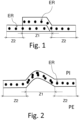
- the two free ends of each sheet are then welded by superposition (and not by joining the two free ends edge to edge) of the two free ends one on top of the other over a length of the order of a centimeter in order to form a zone Z1 overlay.
- each carcass ply has a double thickness and therefore a density 2de of reinforcing elements ER twice as high compared to the adjacent zones Z2 in which each carcass ply has a single thickness and therefore a density of ER reinforcement elements.
- each reinforcing element of each adjacent zone takes up a tension 2T generating an elongation ⁇ 2 of each reinforcing element included in this adjacent zone Z2, whereas, in each superposition zone Z1, due to 'a 2d density of reinforcing elements, each reinforcing element of each superposition zone Z1 takes up a tension T generating an elongation ⁇ 1 of each reinforcing element included in this superposition zone Z1, the elongation ⁇ 1 being less than 2.
- this difference between 1 and 2 results, once the tire is inflated to pressure PI and the reinforcing elements under tension, a relatively large difference in elongation between the reinforcing elements of each of these zones creating, seen from the outside of the tire, at pressure external PE, a hollow in each side of the tire, this hollow forming an unsightly deformation.
- This deformation is also all the more significant as the nominal inflation pressure is high, such pressure being necessary to carry heavy loads. This deformation is all the more significant as the flank height is high. Sidewall heights greater than or equal to 110 mm are therefore particularly sensitive to the appearance of these deformations. Such deformations, although only unsightly, generate numerous returns from customers because the deformation exceeds the threshold of perception of the human eye. Although this problem is not present on the tire of the state of the art presented above due to the fact that it comprises two layers of carcasses, it is important that any tire manufactured is not subject to returns from the from customers due to these deformations even if they have no effect on the performance and safety of the tire.
- the aim of the invention is to find a tire, in particular intended to equip vehicles of the SUV type or of the small heavy goods vehicle type, with a reduced mass and not presenting aesthetic defects unacceptable to the customer.
- the carcass reinforcement of the tire according to the invention comprises a single carcass ply.
- the carcass reinforcement is, at with the exception of the carcass ply, devoid of any ply reinforced by wire reinforcing elements.
- the wire reinforcing elements of such reinforced plies excluded from the carcass reinforcement of the tire include metal wire reinforcing elements and textile wire reinforcing elements.
- the carcass reinforcement is constituted by a carcass ply. In other words, the carcass reinforcement is made up of a single carcass ply.
- hybrid reinforcing element comprising an assembly of aromatic polyamide or aromatic copolyamide monofilaments and polyester monofilaments makes it possible to obtain a carcass ply having mechanical resistance properties, in particular breaking strength and endurance. sufficiently high to allow the tire designer to limit the number of carcass layers in the carcass reinforcement to a single (and not several) carcass layers.
- the use of hybrid reinforcing elements as defined above makes it possible to obtain a carcass ply having a ply breaking force sufficient to carry high loads, whether due to the high empty weight of the vehicle, or whether due to the high gross vehicle weight of the vehicle. Also, by reducing the number of carcass layers, we reduce the cost, the mass but also the hysteresis and therefore the rolling resistance of the tire.
- One effect of reducing the number of carcass layers is to make the tire according to the invention more sensitive to the presence of deformations in the sidewall at the end of its manufacturing process.
- the inventors have noticed that the depth of the deformations in the sidewall observed on the tire according to the invention, at the end of its manufacturing process, when it does not exceed the threshold of perception of the human eye, approximately equal to 600 ⁇ m, is relatively high.
- the depth of the deformations decreases after a relatively short running-in of the tire according to the invention and is below the threshold of perception of the human eye at the end of this running-in, which limits or even eliminates feedback from customers.
- the inventors hypothesize that following running-in, the module of the force-elongation curve of each reinforcing element increases so that the difference between 2 and 1 decreases and therefore so that the depth of the deformation decreases.
- the invention therefore consists of the combination of a single carcass ply and a hybrid reinforcing element making it possible to lighten the tire while making sidewall deformations invisible to the customer after a break-in period.
- aromatic polyamide or aromatic copolyamide filament we recall in a well-known manner that it is a filament of linear macromolecules formed of aromatic groups linked together by amide bonds of which at least 85% are directly linked to two nuclei aromatics, and more particularly poly (p-phenylene terephthalamide) fibers (or PPT'A), manufactured for a very long time from optically anisotropic spinning compositions.
- PPT'A poly (p-phenylene terephthalamide) fibers
- aromatic polyamides or aromatic copolyamides mention may be made of polyarylamides (or PAA, notably known under the trade name Ixef from the company Solvay), poly(metaxylylene adipamide), polyphthalamides (or PPA, notably known under the trade name Amodel from the company Solvay), amorphous semi-aromatic polyamides (or PA 6-3T, notably known under the trade name Trogamid from the company Evonik), meta-aramides (or poly(metaphenylene isophthalamide or PA MPD-I, notably known under the trade name Nomex from the company Du Pont de Nemours) or para-aramids (or poly(paraphenylene terephthalamide or PA PPD-T in particular known under the trade name Kevlar from the company Du Pont de Nemours or Twaron from the company Teijin).
- PAA polyarylamides
- PAA notably known under the trade name Ixef from the company Solvay
- polyester filament we recall that it is a filament of linear macromolecules formed of groups linked together by ester bonds.
- Polyesters are manufactured by polycondensation by esterification between a dicarboxylic acid or one of its derivatives a diol.
- the Polyethylene terephthalate can be manufactured by polycondensation of terephthalic acid and ethylene glycol.
- PET polyethylene terephthalate
- PEN polyethylene naphthalate
- PBT polybutylene terephthalate
- PBN polybutylene naphthalate
- PPT' polypropylene terephthalate
- PPN polypropylene naphthalate
- sidewall height we recall that it is the section height which is half the difference between the external diameter of the tire and the nominal diameter of the rim as defined in the “Engineering Design Information” document. 2017, from ETRTO (European Tire and Rim Technical Organization), General Information, page GI.5. Another way to determine the sidewall height is to multiply the nominal aspect ratio by the nominal flange size and dividing by 100 as defined in the document “Engineering Design Information”, 2017, from ETRTO (European Tire and Rim Technical Organization), General Information, page GI.7.
- load index is a numerical code associated with the maximum load that a tire can carry at the speed indicated by its speed code under the conditions of use specified by the tire manufacturer as defined in the document “Standards Manual”, 2017, of the ETRTO (European Tire and Rim Technical Organisation), General Information, page G.7.
- each carcass reinforcement element makes an angle ranging from 80° to 90° with the circumferential direction of the tire in the equatorial circumferential plane of the tire.
- each carcass reinforcement element makes an angle ranging from 80° to 90° with the circumferential direction of the tire in each sidewall, in other words, the carcass reinforcement is radial in each sidewall.
- the carcass reinforcement also extends into the crown.
- Each reinforcing element makes an angle ranging from 80° to 90° with the circumferential direction of the tire in the median plane of the tire.
- each carcass reinforcement element makes an angle ranging from 80° to 90° with the circumferential direction of the pneumatic in the crown, in other words, the carcass reinforcement is radial in the crown.
- the tire has a sidewall height greater than or equal to 120 mm, preferably greater than or equal to 130 mm and even more preferably greater than or equal to 140 mm.
- the sidewall height is less than or equal to 220 mm, preferably less than or equal to 210 mm and even more preferably less than or equal to 200 mm.
- Such sidewall heights are particularly suitable for tires intended to equip vehicles of the "SUV” type ("Sport Utility Vehicles” in English) or of the small heavy goods vehicle type ("light truck” in English) such as for example trucks or vans intended to carry heavy loads.
- the load index of the tire is greater than or equal to 100.
- a hybrid reinforcing element comprising a multifilament strand of aromatic polyamide or aromatic copolyamide, having a particularly high breaking strength, it is then possible to carry a relatively high load while having only a single ply of carcass, this layer of carcass having a reasonable density of reinforcing elements and bridges of elastomer composition connecting adjacent well-formed reinforcing elements.
- the charge index is less than or equal to 130, preferably less than or equal to 125 and more preferably less than or equal to 121.
- the nominal inflation pressure of the tire is greater than or equal to 200 kPa, preferably greater than or equal to 220 kPa and more preferably greater than or equal to 250 kPa.
- the nominal inflation pressure is the pressure recommended by ETRTO considered as minimum for general use as defined in the document “Engineering Design Information”, 2017, of the ETRTO (European Tire and Rim Technical Organization), page C. 3.
- tires having such nominal inflation pressures are free of sidewall deformations having a depth greater than the threshold of perception of the human eye, in particular after running-in.
- the nominal inflation pressure is less than or equal to 600 kPa, preferably less than or equal to 585 kPa and more preferably less than or equal to 575 kPa.
- the tire has an aspect ratio ranging from 35 to 95 and preferably from 40 to 80.
- the aspect ratio or nominal aspect ratio is the ratio expressed as a percentage of the height of the tire section to the nominal width of the tire section as defined in the document “Engineering Design Information”, 2017, of the ETRTO (European Tire and Rim Technical Organization), paragraph D, page GI.5.
- the tire has a nominal rim diameter ranging from 13 to 22 inches and preferably from 14 to 21 inches.
- the nominal rim diameter is the dimension as defined in the document “Engineering Design Information”, 2017, of the ETRTO (European Tire and Rim Technical Organization), paragraph D, page GI.5.
- Such nominal inflation pressures, such aspect ratios and such nominal rim diameters are particularly suitable for tires intended to equip vehicles of the "SUV” type ("Sport Utility Vehicles” in English) or of the light weight type. -heavy (“light truck” in English) such as, for example, trucks or vans intended to carry heavy loads.
- the breaking force of the carcass ply is greater than or equal to 300 daN.cm -1 , preferably greater than or equal to 380 daN.cm -1 and more preferably greater than or equal to 410 daN.cm -1 .
- Such forces at carcass ply rupture make it possible to reduce the damage suffered by the tire in the event of a “pinch shock” type impact, such as for example a curb impact or going through a pothole.
- the breaking force of a sheet is calculated from a force-elongation curve obtained by applying the ASTM D 885/D 885M - 10a standard of 2014 to a reinforcing element of the sheet.
- the breaking force of the ply is determined by multiplying the breaking force of the reinforcing element by the number of reinforcing elements per cm of ply, this number being determined in a direction perpendicular to the direction in which the elements of reinforcement extends into the layer.
- the breaking force of the reinforcing element ranges from 30 to 45 daN, preferably from 33 to 43 daN and more preferably from 35 to 41 daN.
- the breaking force of a reinforcing element is measured according to standard ASTM D 885/D 885M - 10a of 2014.
- the diameter d of the reinforcing element is less than or equal to 0.95 mm, preferably less than or equal to 0.80 mm, more preferably less than or equal to 0.70 mm.
- the reinforcing element extends in a general direction G and the diameter of this reinforcing element is the diameter in which this reinforcing element is inscribed in a cutting plane perpendicular to the direction G.
- the thickness Ep of the composite is less than or equal to 1.45 mm, preferably less than or equal to 1.30 mm, more preferably less than or equal to 1.20 mm.
- the thickness of the composite is the shortest distance between the two external surfaces of the composite, that is to say the distance measured in a direction perpendicular to the two external surfaces of the composite.
- composite we mean the object comprising the reinforcing elements embedded in a polymeric and preferably elastomeric matrix.
- the ratio of the diameter of the reinforcing element to the thickness of the carcass ply d/Ep is strictly less than 0.65, preferably less than or equal to 0.62. In one embodiment, the ratio of the diameter of the reinforcing element to the thickness of the carcass ply is more preferably less than or equal to 0.58.
- the thickness of the carcass ply is reduced and thus the hysteresis of the tires to reduce the energy consumption of vehicles equipped with such tires.
- the carcass ply being obtained from a composite comprising several reinforcing elements arranged substantially parallel to each other, the density of reinforcing elements in the composite ranges from 90 to 130 reinforcing elements per decimeter of composite, preferably from 100 to 125 reinforcing elements per decimeter of composite and more preferably from 105 to 120 reinforcing elements per decimeter of composite.
- the density of reinforcing elements is determined by counting the number of reinforcing elements per decimeter in a direction perpendicular to the direction in which the reinforcing elements extend in the composite.
- the carcass ply has a relatively high breaking strength and a relatively low cost allowing its use in tires suitable for vehicles of the small heavy goods vehicle and SUV type.
- the tire is such that the reinforcing element comprises an assembly consisting of two multifilament strands.
- assembly we mean that the assembly does not include any other multifilament strand than the two multifilament strands of aromatic polyamide or aromatic copolyamide and polyester.
- the multifilament strand of aromatic polyamide or aromatic copolyamide and the multifilament strand of polyester are assembled together and are wound helically around each other.
- the reinforcing element is torsionally balanced.
- the two multifilament strands are wound with a substantially identical twist and that the twist of the monofilaments of each multifilament strand, that is to say the twist of the monofilaments of the multifilament strand of polyamide or aromatic copolyamide and the twist of the monofilaments of the polyester strand is substantially zero.
- each monofilament yarn in English “yarn"
- substantially zero residual twist we mean that the residual twist is strictly less than 2.5% of the twist R3.
- the reinforcing element is torsionally unbalanced.
- the tire reinforcing element has a relatively constant breaking force which allows the tire designer to adapt other characteristics of the reinforcing element , in particular twisting, to the use or uses for which the tire is intended. Furthermore, in the selected twist factor interval, the reinforcing element has an endurance compatible with most uses of current tires.
- the selected twist factor interval makes it possible to choose reinforcing elements having a lower twist, and therefore likely to lead to less dispersion of the force at rupture of the reinforcing element.
- the measurement of the torsion R of the reinforcing element can be carried out by any method known to those skilled in the art, for example in accordance with standard ASTM D 885/D 885M - 10a of 2014.
- each strand is determined according to the ASTM D1423 standard. The title is given in tex (weight in grams of 1000 m of product - reminder: 0.111 tex equal to 1 denier).
- the reinforcing element also comprises a layer of an adhesive composition coating the assembly consisting of the two strands.
- an adhesive composition is for example of the RFL type (acronym for Resorcinol-Formaldehyde-Latex).
- the twist factor K of the reinforcing element ranges from 5.2 to 6.3 and preferably from 5.2 to 6.1.
- the risk of dispersion of the breaking force of the reinforcing element is further reduced.
- the twist of the reinforcing element ranges from 250 to 405 turns per meter, preferably from 250 to 390 turns per meter and even more preferably from 250 to 380 turns per meter.
- the reinforcing element has sufficient endurance to be used in a tire suitable for small heavy-duty and SUV-type vehicles and a risk of dispersion of its breaking force. relatively weak.
- the titer of the multifilament strand of aromatic polyamide or aromatic copolyamide ranges from 140 to 210 tex, preferably from 150 to 190 tex, more preferably from 160 to 180 tex.
- the reinforcing element would have a relatively high twist which would lead to a risk of dispersion of the breaking force.
- the reinforcing element would present a relatively low torsion which would lead to a risk of reduction of the 'endurance.
- the title intervals of the multifilament strand of aromatic polyamide or aromatic copolyamide described above make it possible to preferentially obtain a good breaking strength-endurance compromise.
- the title of the multifilament strand of polyester ranges from 100 to 210 tex, preferably from 120 to 190 tex, more preferably from 130 to 180 tex.
- the density of the multifilament polyester strand goes even more preferably from 160 to 180 tex.
- the reinforcing element preferentially presents a good compromise strength to rupture-endurance.
- the twist factor K ranges from 5.2 to 5.5, preferably from 5.3 to 5.5 and even more preferably from 5.3 to 5.4.
- the twist of the reinforcing element advantageously ranges from 250 to 340 turns per meter, preferably from 260 to 325 turns per meter, more preferably from 275 to 305 turns per meter.
- the twist factor K ranges from 5.5 to 6.5, preferably belonging to the interval ]5.5; 6.5] (that is to say excluding the value 5.5), preferably from 5.6 to 6.1 and even more preferably from 5.9 to 6.1.
- the twist of the reinforcing element advantageously ranges from 275 to 365 turns per meter, preferably from 275 to 350 turns per meter, more preferably from 300 to 330 turns per meter.
- the reinforcing element has sufficient endurance to be used in a tire adapted to most current uses and a risk of dispersion of its breaking force relatively weak.
- the invention applies to a tire intended to equip small heavy-duty vehicles ("light truck” in English) such as, for example, trucks or vans intended to carry heavy loads .
- the sidewall height ranges from 139 to 223 mm and preferably from 139 to 200 mm.
- the charge index ranges from 100 to 125 and preferably from 102 to 121.
- the nominal inflation pressure ranges from 425 kPa to 575 kPa, preferably from 450 kPa to 550 kPa and more preferably from 475 kPa to 525 kPa.
- Such inflation pressure is sufficiently high to carry heavy loads, which constitutes frequent use for tires intended to equip vehicles of the small heavy goods vehicle type.
- the aspect ratio ranges from 50 to 85, preferably from 60 to 80 and more preferably from 65 to 75.
- the nominal rim diameter ranges from 14 to 20 inches, preferably from 15 to 19 inches and more preferably from 15 to 17 inches.
- the nominal rim diameter ranges from 15 to 17 inches.
- the invention applies to a tire intended to equip "SUV” type vehicles ("Sport Utility Vehicles” in English).
- the sidewall height is less than or equal to 141 mm.
- the charge index ranges from 100 to 115 and preferably from 100 to 105.
- the nominal inflation pressure ranges from 175 kPa to 425 kPa, preferably from 200 kPa to 350 kPa and more preferably from 220 kPa to 300 kPa.
- the aspect ratio ranges from 35 to 70, preferably from 40 to 65 and more preferably from 50 to 60.
- the nominal rim diameter ranges from 17 to 22 inches , preferably 17 to 20 inches and more preferably 17 to 19 inches.
- the diameter nominal rim size from 17 to 19 inches.
- each bead comprising at least one annular reinforcing structure
- the radial carcass reinforcement is anchored in each of the beads by turning around the annular reinforcing structure.
- the top frame comprises a working frame comprising at least one and preferably two working layers.
- each work sheet comprises several work reinforcement elements, preferably metallic, arranged side by side substantially parallel to each other.
- Such working reinforcing elements form an angle ranging from 10° to 45° with the circumferential direction of the tire.
- the working reinforcing elements are crossed from one working layer to the other.
- the top reinforcement comprises a hooping reinforcement arranged radially outside the working reinforcement.
- the hooping sheet comprises one or more hooping reinforcement elements, preferably textile, arranged side by side substantially parallel to each other. Such hooping reinforcement elements form an angle at most equal to 10°, preferably ranging from 5° to 10° with the circumferential direction of the tire.
- textile means, in a very general way, any material made of a material other than metallic, whether natural or synthetic, capable of being transformed into thread, fiber or film by any appropriate transformation process.
- a polymer spinning process such as for example melt spinning, solution spinning or gel spinning.
- non-polymeric material for example made of mineral material such as glass or non-polymeric organic material such as carbon
- the invention is preferentially implemented with materials made of non-polymeric material such as carbon.
- polymer both of the thermoplastic type and of the non-thermoplastic type.
- polymeric materials of the thermoplastic type or not, we will cite for example celluloses, in particular rayon, polyvinyl alcohols (abbreviated “PVA”), polyketones, aramids (aromatic polyamides), aromatic polyesters. , polybenzazoles (abbreviated “PBO”), polyimides, polyesters, in particular those chosen from PET (polyethylene terephthalate), PEN (polyethylene naphthalate), PBT (polybutylene terephthalate), PBN (polybutylene naphthalate), PPT' (polypropylene terephthalate ), PPN (polypropylene naphthalate).
- PET polyethylene terephthalate
- PEN polyethylene naphthalate
- PBT polybutylene terephthalate
- PBN polybutylene naphthalate
- PPT' polypropylene terephthalate
- PPN polypropylene naphthalate
- the carcass ply is obtained from a composite by shaping a tire blank.
- a manufacturing cylinder having a general toroidal shape around an axis of the cylinder, the cylinder having a laying surface in contact with which a composite comprising the embedded reinforcing element(s) is rolled up. in an elastomeric matrix in the raw state, that is to say not crosslinked, which then forms a cylindrical winding axially and circumferentially continuous.
- the composite can be placed directly in contact with the installation surface or on a radially interior sheet, for example a sealing sheet, itself rolled up in contact with the installation surface.
- the composite is deposited in a single cylindrical winding turn.
- other layers are available on the composite.
- the installation surface is spread radially from the axis of the cylinder, for example by pressurization by an inflation gas of an annular space interior to the installation surface, for example by air.
- This step is called conformation because the blank is deformed so as to obtain a shape suitable for the subsequent installation of the crown reinforcement and the tread.
- This conformation causes the reinforcing element density of the carcass ply obtained from the composite to vary depending on whether it is located in the bead or radially under the crown reinforcement. We then obtain a shaped tire blank.
- the installation surface is brought radially closer to the axis of the cylinder, for example by depressurizing the annular space.
- the tire is then obtained in its raw state. Finally, the tire is crosslinked, for example by vulcanization, in order to obtain the tire in the cooked state.
- the invention also relates to a method of running in a tire in which the tire according to the invention rolls.
- running-in we mean the rolling of the tire for a certain duration under certain conditions, this duration and these conditions depending in particular on the load, the speed and the driving style of the driver.
- This break-in period will make it possible to reduce the depth of deformations in the sidewall of the tire below the threshold of perception of the eye.
- the tire according to the invention has a depth of deformation in the sidewall the reduction of which can reach 25% compared to the new tire.
- radial section or “radial section” we mean here a section or a section along a plane which includes the axis of rotation of the tire.
- the “median circumferential plane” M of the tire is the plane which is normal to the axis of rotation of the tire and which is located equidistant from the annular reinforcing structures of each bead.
- the “equatorial circumferential plane” E of the tire is the theoretical plane passing through the equator of the tire, perpendicular to the median plane and to the radial direction.
- the equator of the tire is, in a circumferential section plane (plane perpendicular to the circumferential direction and parallel to the radial and axial directions) the axis parallel to the axis of rotation of the tire and located equidistant between the radially most point outer part of the tread intended to be in contact with the ground and the radially innermost point of the tire intended to be in contact with a support, for example a rim, the distance between these two points being equal to H.
- An “axial” direction is a direction parallel to the axis of rotation of the tire.
- a “circumferential” direction is a direction that is perpendicular to both a radius of the tire and the axial direction.
- any interval of values designated by the expression "from a to b” means the range of values going from terminal "a” to terminal "b”, i.e. say including the strict limits “a” and “b”.
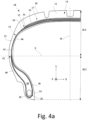
- FIG. 4a a view in radial section, of a tire according to a first embodiment of the invention and designated by the general reference 10.
- the tire 10 is substantially of revolution around an axis substantially parallel to the axial direction X.
- the tire 10 has a sidewall height greater than or equal to 110 mm, or even greater than or equal to 120 mm, preferably greater than or equal to 130 mm and even more preferably greater than or equal to 140 mm and less than or equal to 220 mm, preferably less than or equal to 210 mm and even more preferably less than or equal to 200 mm.
- the tire 10 has a load index greater than or equal to 100 and less than or equal to 130, preferably less than or equal to 125 and more preferably less than or equal to 121.
- the tire 10 has a nominal inflation pressure greater than or equal to 200 kPa, preferably greater than or equal to 220 kPa and more preferably greater than or equal to 250 kPa and less than or equal to 600 kPa, preferably less than or equal to 585 kPa and more preferably less than or equal to 575 kPa.
- the tire 10 has an aspect ratio ranging from 35 to 95 and preferably from 40 to 80.
- the tire 10 has a nominal rim diameter ranging from 13 to 22 inches and preferably from 14 to 21 inches.
- the tire 10 is here intended for a small heavy-duty vehicle and has the dimension 215/75 R16 113/111R.
- the sidewall height of the tire 10 ranges from 139 to 223 mm and preferably from 139 to 200 mm and is here equal to 161 mm.
- the charge index ranges from 100 to 125 and preferably from 102 to 121 and is here equal to 113/111.
- the nominal inflation pressure ranges from 425 kPa to 575 kPa, preferably from 450 kPa to 550 kPa and more preferably from 475 kPa to 525 kPa and is here equal to 475 kPa.
- the aspect ratio ranges from 50 to 85, preferably from 60 to 80 and more preferably from 65 to 75 and is here equal to 75.
- the nominal rim diameter ranges from 14 to 20 inches, preferably from 15 to 19 inches and more preferably from 15 to 17 inches and is here equal to 16 inches.
- the tire 10 comprises a crown 12 comprising a crown reinforcement 14 comprising a working reinforcement 15 comprising two working layers 16, 18 of working reinforcement elements and a hooping reinforcement 17 comprising a hooping ply 19 of reinforcing elements. shrink reinforcement.
- the crown reinforcement 14 extends in the crown 12 in the circumferential direction Z of the tire 10.
- the crown 12 comprises a tread 20 arranged radially external to the crown reinforcement 14.
- the hooping reinforcement 17, here the hooping ply 19 is radially interposed between the working armature 15 and the tread 20.
- the tire 10 also comprises two sidewalls 22 extending the top 12 radially inwards.
- the tire 10 further comprises two beads 24 radially inside the sidewalls 22 and each comprising an annular reinforcing structure 26, in this case a rod 28, surmounted by a mass of rubber 30 for padding on the rod, as well as a reinforcement of radial carcass 32.
- Each side 22 connects each bead 24 to the top 12.
- the carcass reinforcement 32 comprises a carcass ply 34 comprising several reinforcing elements, the carcass ply 34 being anchored to each of the beads 24 by an inversion around the rod 28, so as to form in each bead 24 a forward strand 38 extending from the beads through the sides towards the top 12, and a return strand 40, the radially outer end 42 of the return strand 40 being radially outside the annular reinforcing structure 26.
- the reinforcement of carcass 32 thus extends from the beads 24 in and through the sides 22 into the crown 12.
- the carcass reinforcement 32 is arranged radially inside the crown reinforcement 14 and the shrink reinforcement 17.
- the crown reinforcement 14 is therefore radially interposed between the carcass reinforcement 32 and the tread 20.
- the carcass reinforcement 32 comprises a single carcass ply 34, here is made up of the carcass ply 34 .
- each reinforcing element makes an angle ranging from 80° to 90° with the circumferential direction of the tire 10 in the median planes M and equatorial E of the pneumatic 10.
- the tire 10 also comprises an internal sealing layer 46, preferably made of butyl, located axially inside the sidewalls 22 and radially inside the crown reinforcement 14 and extending between the two beads 24.
- an internal sealing layer 46 preferably made of butyl, located axially inside the sidewalls 22 and radially inside the crown reinforcement 14 and extending between the two beads 24.
- Each working ply 16, 18, hooping 19 and carcass 34 comprises a polymer composition in which reinforcing elements of the corresponding ply are embedded.
- Each polymer composition, here an elastomeric composition, working layers 16, 18, hooping layers 19 and carcass 34 is made in a conventional composition for calendering reinforcing elements conventionally comprising a diene elastomer, for example natural rubber, a reinforcing filler, for example carbon black and/or silica, a system of crosslinking, for example a vulcanization system, preferably comprising sulfur, stearic acid and zinc oxide, and optionally a vulcanization accelerator and/or retarder and/or various additives.
- the composite 50 comprises several reinforcing elements 44.
- the reinforcing elements 44 are arranged side by side parallel to each other in a main direction D substantially perpendicular to the general direction G in which the reinforcing elements of the composite 50 extend, the general direction G forming, once the composite 50 forms the carcass ply 34 within the tire 10, an angle ranging from 80° to 90° with the circumferential direction Z of the tire 10.
- the general direction G made, once the composite 50 forming the carcass ply 34 within the tire 10, an angle substantially equal to 90° with the circumferential direction Z of the tire 10.
- the density of reinforcing elements 44 in the composite 50 ranges from 90 to 130 reinforcing elements per decimeter of composite 50, preferably from 100 to 125 reinforcing elements per decimeter of composite 50, more preferably from 105 to 120 reinforcing elements per decimeter of composite 50 and here equal to 110 reinforcing elements per decimeter of composite 50.
- the thickness Ep of the composite 50 is less than or equal to 1.45 mm, and preferably less than or equal to 1.30 mm and here equal to 1.28 mm.
- the density of reinforcing elements and the thickness Ep described above are, as explained previously, the density of reinforcing elements 44 and the thickness Ep of the composite 50.
- the carcass ply 34 being obtained from the composite 50 by shaping a tire blank, the density of reinforcing elements as well as the thickness Ep of the carcass ply 34 are different from those of the composite and vary depending on whether one is more or less close to the axis of revolution of the tire. These variations are particularly dependent on the conformation rate of the tire blank but also on its geometry. Based in particular on the conformation rate of the tire blank and its geometry, those skilled in the art will be able to determine the characteristics of the corresponding composite.
- the diameter d of the reinforcing element is less than or equal to 0.95 mm, preferably less than or equal to 0.80 mm, more preferably less than or equal to 0.70 mm and is here equal to 0.67 mm.
- the d/Ep ratio is strictly less than 0.65, preferably less than or equal to 0.62 and is here equal to 0.52.
- the breaking force of the carcass ply is greater than or equal to 300 daN.cm -1 , preferably greater than or equal to 380 daN.cm -1 and more preferably greater than or equal to 410 daN.cm -1 and is here equal at 440 daN.cm -1 .
- the reinforcing element 44 comprises an assembly consisting of a multifilament strand 47 in aromatic polyamide or aromatic copolyamide and a multifilament strand 48 in polyester, the two strands 47, 48 being wound helically one around the other.
- the reinforcing element 44 is torsionally balanced.
- the figure 8 is a sectional view of the reinforcing element 44 and on which the monofilaments of each of the strands can be distinguished.
- the aromatic polyamide chosen here is preferably a para-aramid, known under the trade name Twaron 1000 from the company Teijin.
- the polyester is polyethylene terephthalate (PET), known under the trade name PET HMLS (High Module Low Shrinkage) from the companies Hyosung or Hailide.
- the reinforcing element 44 comprises one or more layers of an adhesive composition coating the assembly.
- the title of the multifilament strand 47 in aromatic polyamide or aromatic copolyamide ranges from 140 to 210 tex, preferably from 150 to 190 tex, more preferably from 160 to 180 tex. In the first embodiment, the title of the strand 47 of the reinforcing element 44 is equal to 167 tex.
- the density of the multifilament strand 48 in polyester ranges from 100 to 210 tex, preferably from 120 to 190 tex, more preferably from 130 to 180 tex.
- the title of the strand 48 of the reinforcing element 44 is equal to 167 tex.
- the twist R of the reinforcing element 44 ranges from 250 to 405 turns per meter, preferably from 250 to 390 turns per meter, more preferably from 250 to 380 turns per meter.
- the twist of the reinforcing element advantageously ranges from 275 to 365 turns per meter, preferably from 275 to 350 turns per meter, more preferably from 300 to 330 turns per meter and is here equal to 315 revolutions per meter.
- the twist factor K of the reinforcing element 44 ranges from 5.2 to 6.5, preferably from 5.2 to 6.3, more preferably from 5.2 to 6.1.
- the breaking force of the reinforcing element 44 ranges from 30 to 45 daN, preferably from 33 to 43 daN and more preferably from 35 to 41 daN and is here equal to 40 daN.
- each reinforcing element 44 is balanced in twists, that is to say that the two multifilament strands are wound with a substantially identical twist and that the twist of the monofilaments of each multifilament strand is substantially zero.
- each monofilament yarn in English “yarn”
- an initial twist equal to 315 turns per meter in a given direction, here the Z direction
- a strand or twist in English “strand”.
- the two strands are then twisted together according to a final twist equal to 315 turns per meter in direction S to obtain the assembly of the reinforcing element (in English "cord ").
- each assembly is coated with an adhesive composition, for example an RFL type adhesive composition (acronym for Resorcinol-Formaldehyde-Latex) and undergoes heat treatment steps in order to crosslink, at least in part, the adhesive composition.
- an adhesive composition for example an RFL type adhesive composition (acronym for Resorcinol-Formaldehyde-Latex) and undergoes heat treatment steps in order to crosslink, at least in part, the adhesive composition.
- the composite 50 is first manufactured by embedding several reinforcing elements 44 in an elastomer composition, for example by calendering.
- an elastomer composition for example by calendering.
- reinforcing elements are scrolled and two strips made of an elastomer composition, called skims, are brought on either side of the calendering elements. reinforcement so as to sandwich the reinforcing elements between the two skims. The reinforcing elements are thus embedded in the elastomer composition.
- the tire manufacturing process is that conventionally used by those skilled in the art. During this process and as already described previously, different composites are successively placed, during a first series of assembly steps, including the composite 50 intended to form the carcass ply 34. Then, the outline thus obtained. Then, we have other composites intended to form the layers 16, 18, 19 of the top 12 of the tire 10. Finally, we vulcanize the blank thus obtained to obtain the tire 10.
- FIG 4b a tire 10' according to a second embodiment of the invention.
- the elements similar to those of the first embodiment are designated by identical references with the exception of the composite 52, the carcass reinforcement 33, the carcass ply 35 and the reinforcing element 45.
- the composite 52 the carcass reinforcement 33, the carcass ply 35 and the reinforcing element 45.
- the tire 10' according to the second embodiment is here intended for an SUV type vehicle and has a dimension 255/50 R19 107W
- the sidewall height of the tire 10' is less than or equal to 141 mm and is here equal to 128 mm.
- the load index ranges from 100 to 115 and preferably from 100 to 105 and is here equal to 107.
- the nominal inflation pressure ranges from 175 kPa to 425 kPa, preferably from 200 kPa to 350 kPa and more preferably from 220 kPa to 300 kPa and is here equal to 290 kPa.
- the aspect ratio ranges from 35 to 70, preferably from 40 to 65 and more preferably from 50 to 60 and is here equal to 50.
- the nominal rim diameter ranges from 17 to 22 inches, preferably from 17 to 20 inches and more preferably from 17 to 19 inches and is here equal to 19 inches.
- the density of reinforcing elements 45 in the composite 52 here equal to 116 reinforcing elements per decimeter of composite 52.
- the thickness Ep of the composite 52 is less than or equal to 1.45 mm, preferably less than or equal to 1 .30 mm, more preferably less than or equal to 1.20 mm and is here equal to 1.16 mm.
- the diameter d of the reinforcing element 45 is equal to 0.65 mm.
- the d/Ep ratio here is equal to 0.56.
- the breaking force of the carcass ply 33 is here equal to 430 daN.cm -1 .
- the titer of strand 47 of the reinforcing element 45 is also equal to 167 tex and the titer of strand 48 of the reinforcing element 45 is equal to 144 tex.
- the twist of the reinforcing element 45 ranges from 250 to 340 turns per meter, preferably from 260 to 325 turns per meter, more preferably from 275 to 305 turns per meter and is here equal to 290 revolutions per meter.
- the twist factor K ranges from 5.2 to 5.5, preferably from 5.3 to 5.5 and even more preferably from 5.3 to 5.4 and here is 5, 3.
- the breaking force of the reinforcing element 45 is here equal to 37 daN.
- the assembly of the reinforcing element 45 is manufactured mutatis mutandis with respect to the reinforcing element 44 by applying a twist equal to 290 turns per meter.
- Table 2 summarizes the characteristics of the tires 10, 10' of the first and second embodiments according to the invention, of a PT' tire of the state of the art having two carcass layers each formed by a composite CT and a tire PC' having a single carcass ply formed by a CC composite. ⁇ b>Table 2 ⁇ /b> P.T.
- the initial depth of deformation in the sidewall is measured on a new tire before running-in.
- the depth of deformation in the sidewall after running-in is determined by rolling each tire tested over a distance and a speed determined here: 200 km at 100 km/h at a pressure of 400 kPa.
- the depth of deformation in the sidewall is measured using a measuring probe, for example from the company AKRON, which is positioned on a suitable and relevant area of the tire.
- the measurement is preferably carried out on the area at the equator.
- the tire 10 has a reduced mass compared to the PT tire and nevertheless makes it possible to carry an equivalent load despite the presence of a single carcass ply.
- the tire 10' has a reduced mass compared to the PT' and PC' tires.
- the tire 10' thanks to a carcass ply in accordance with the invention, makes it possible to carry a higher load than the PC' tire and higher than the PT' tire without requiring the use of two carcass layers.
- the tire 10' according to the invention has a depth of deformation in the sidewall which decreases by 26% after running-in. It can be seen that the depth of deformation in the sidewall of the state-of-the-art PT' tire increases by 35% after running-in at an equivalent load index. Thus, although the tire 10' has a depth of deformation in the sidewall exceeding the threshold of perception of the human eye at the end of its manufacturing process, after running-in, we see that the depth of deformation in the sidewall of the tire 10' decreases sharply, passing below the threshold of perception of the human eye while the depth of deformation in the sidewall of the tire PT' will increase significantly.
- the tire 10 has a depth of sidewall deformation lower than the threshold of perception of the human eye before running-in but nevertheless relatively close to this threshold.
- the depth of deformation in the sidewall of the tire 10 decreases sharply, reaching a value well below the threshold of perception of the human eye while the depth of deformation in the sidewall of the PT tire will increase significantly.
- the invention indeed consists of a tire having a sidewall height greater or equal to 110 mm and a load index greater than or equal to 94 and in the combination of a single carcass ply and a hybrid reinforcement element making it possible to lighten the tire while making sidewall deformations invisible to the customer after a break-in period.
Landscapes
- Engineering & Computer Science (AREA)
- Mechanical Engineering (AREA)
- Tires In General (AREA)
- Yarns And Mechanical Finishing Of Yarns Or Ropes (AREA)
Applications Claiming Priority (2)
| Application Number | Priority Date | Filing Date | Title |
|---|---|---|---|
| FR1852368 | 2018-03-20 | ||
| PCT/FR2019/050584 WO2019180352A1 (fr) | 2018-03-20 | 2019-03-15 | Pneumatique comprenant une unique nappe de carcasse avec une profondeur de déformation dans le flanc améliorée après rodage |
Publications (2)
| Publication Number | Publication Date |
|---|---|
| EP3768526A1 EP3768526A1 (fr) | 2021-01-27 |
| EP3768526B1 true EP3768526B1 (fr) | 2024-05-22 |
Family
ID=62751050
Family Applications (1)
| Application Number | Title | Priority Date | Filing Date |
|---|---|---|---|
| EP19718774.3A Active EP3768526B1 (fr) | 2018-03-20 | 2019-03-15 | Pneumatique comprenant une unique nappe de carcasse avec une profondeur de déformation dans le flanc améliorée après rodage |
Country Status (5)
| Country | Link |
|---|---|
| US (1) | US12365203B2 (enExample) |
| EP (1) | EP3768526B1 (enExample) |
| JP (1) | JP2021518307A (enExample) |
| CN (1) | CN111954600B (enExample) |
| WO (1) | WO2019180352A1 (enExample) |
Families Citing this family (10)
| Publication number | Priority date | Publication date | Assignee | Title |
|---|---|---|---|---|
| FR3102089A1 (fr) | 2019-10-16 | 2021-04-23 | Compagnie Generale Des Etablissements Michelin | Pneumatique presentant une uniformite amelioree et son procede de fabrication |
| FR3102097A1 (fr) | 2019-10-16 | 2021-04-23 | Compagnie Generale Des Etablissements Michelin | Pneumatique a emission de bruit reduit et son procede de fabrication |
| FR3107006B1 (fr) * | 2020-02-06 | 2022-01-07 | Michelin & Cie | Pneumatique pour véhicule agricole comprenant une armature de carcasse monocouche |
| FR3107206B1 (fr) * | 2020-02-19 | 2022-02-18 | Michelin & Cie | Pneumatique a faible hauteur de flanc |
| FR3107207B1 (fr) * | 2020-02-19 | 2022-02-18 | Michelin & Cie | Pneumatique a faible hauteur de flanc |
| US20230373249A1 (en) * | 2020-10-09 | 2023-11-23 | Compagnie Generale Des Etablissements Michelin | Tire comprising two carcass layers |
| CN116171229A (zh) * | 2020-10-09 | 2023-05-26 | 米其林集团总公司 | 包括单个胎体层的轮胎 |
| FR3118654A1 (fr) * | 2021-01-07 | 2022-07-08 | Compagnie Generale Des Etablissements Michelin | Courroie de transmission de puissance présentant un comportement bimodule en fonctionnement |
| FR3126042B1 (fr) * | 2021-08-06 | 2023-07-21 | Michelin & Cie | Procédé d’obtention de la charge d’un pneumatique en roulage |
| FR3137868B1 (fr) * | 2022-07-18 | 2026-04-24 | Michelin & Cie | Tissu pour pneumatique comprenant des éléments de renfort comprenant un assemblage constitué de deux brins multifilamentaires de polyamide 5,6 |
Family Cites Families (16)
| Publication number | Priority date | Publication date | Assignee | Title |
|---|---|---|---|---|
| FR1538478A (fr) * | 1967-07-24 | 1968-09-06 | Uniroyal Englebert France | Enveloppe de pneumatique à carcasse radiale à flancs renforcés |
| BE792557A (fr) * | 1971-12-31 | 1973-06-12 | Michelin & Cie | Perfectionnements aux enveloppes de pneumatiques |
| US4155394A (en) * | 1977-08-29 | 1979-05-22 | The Goodyear Tire & Rubber Company | Tire cord composite and pneumatic tire |
| JPH0524410A (ja) * | 1991-07-25 | 1993-02-02 | Sumitomo Rubber Ind Ltd | ライトトラツク用ラジアルタイヤ |
| FR2892664B1 (fr) * | 2005-10-27 | 2007-12-07 | Michelin Soc Tech | Pneumatique comportant un element de renfort bielastique |
| JP4316660B2 (ja) * | 2007-11-30 | 2009-08-19 | 横浜ゴム株式会社 | 空気入りタイヤ |
| EP2583837B1 (en) * | 2010-06-21 | 2016-05-18 | Bridgestone Corporation | Pneumatic radial tire for automobiles |
| FR2977829B1 (fr) * | 2011-07-12 | 2015-06-05 | Michelin Soc Tech | Pneumatique pour vehicule leger. |
| FR2993501B1 (fr) * | 2012-07-20 | 2014-08-08 | Michelin & Cie | Pneumatique optimise. |
| FR2996807B1 (fr) * | 2012-10-12 | 2015-01-02 | Michelin & Cie | Pneumatique adapte pour un roulage a plat comprenant nappe de carcasse hybride. |
| FR3008997B1 (fr) * | 2013-07-29 | 2016-01-01 | Michelin & Cie | Produit renforce a faible epaisseur et pneumatique comprenant ce produit |
| JP6196494B2 (ja) * | 2013-08-09 | 2017-09-13 | 住友ゴム工業株式会社 | 空気入りタイヤ |
| US20160288574A1 (en) * | 2015-03-31 | 2016-10-06 | The Goodyear Tire & Rubber Company | Crown reinforcement for a pneumatic tire |
| US20180297410A1 (en) * | 2015-10-07 | 2018-10-18 | Bridgestone Corporation | Tire |
| DE102016216081A1 (de) * | 2016-08-26 | 2018-03-01 | Continental Reifen Deutschland Gmbh | Festigkeitsträgerlage für elastomere Erzeugnisse, insbesondere für eine Karkasslage eines Fahrzeugluftreifens, aufweisend einen Hybridcord |
| US11639565B2 (en) * | 2016-09-29 | 2023-05-02 | Kolon Industries, Inc. | Hybrid tire cord and method for manufacturing the same |
-
2019
- 2019-03-15 EP EP19718774.3A patent/EP3768526B1/fr active Active
- 2019-03-15 CN CN201980024798.4A patent/CN111954600B/zh active Active
- 2019-03-15 JP JP2020550855A patent/JP2021518307A/ja active Pending
- 2019-03-15 US US16/982,270 patent/US12365203B2/en active Active
- 2019-03-15 WO PCT/FR2019/050584 patent/WO2019180352A1/fr not_active Ceased
Also Published As
| Publication number | Publication date |
|---|---|
| CN111954600A (zh) | 2020-11-17 |
| EP3768526A1 (fr) | 2021-01-27 |
| US20210053398A1 (en) | 2021-02-25 |
| US12365203B2 (en) | 2025-07-22 |
| CN111954600B (zh) | 2023-04-28 |
| WO2019180352A1 (fr) | 2019-09-26 |
| JP2021518307A (ja) | 2021-08-02 |
Similar Documents
| Publication | Publication Date | Title |
|---|---|---|
| EP3768526A1 (fr) | Pneumatique comprenant une unique nappe de carcasse avec une profondeur de déformation dans le flanc améliorée après rodage | |
| EP2906434B1 (fr) | Pneumatique adapté pour un roulage à plat comprenant nappe de carcasse hybride | |
| EP3515727B1 (fr) | Composite d'élastomère et pneumatique comprenant ce composite | |
| FR3056149A1 (fr) | Element de renfort, composite d'elastomere et pneumatique comprenant cet element de renfort | |
| EP3568289B1 (fr) | Assemblage comprenant une structure élastique et une structure porteuse | |
| WO2018130785A1 (fr) | Assemblage pour pneumatique comprenant une structure rompable et une structure porteuse | |
| EP3568290A1 (fr) | Assemblage comprenant un tissu partiellement rompable et une structure porteuse | |
| EP3768882B1 (fr) | Câblé textile aramide perfectionne à au moins triple torsion | |
| EP3277869B1 (fr) | Élément de renfort hybride à torsions différenciées | |
| EP2331350B1 (fr) | Pneumatique pour vehicules lourds comportant au moins dans chaque epaule au moins deux couches additionnelles dans l'armature de sommet | |
| EP4100264B1 (fr) | Pneumatique pour véhicule agricole comprenant un élément de renfort de carcasse hybride | |
| EP2150423B1 (fr) | Pneumatique pour vehicule comportant des renforts dans les flancs | |
| EP4100265B1 (fr) | Pneumatique pour véhicule agricole comprenant une armature de carcasse monocouche | |
| EP3853045B1 (fr) | Pneumatique comportant une armature de carcasse formee d'une unique couche d'elements de renforcement textiles | |
| EP3880492B1 (fr) | Pneumatique pour véhicule à deux roues comprenant un renfort de frettage hybride | |
| EP1789266B1 (fr) | Pneumatique a mobilite etendue avec zone d'ancrage surabaissee | |
| EP4377101B1 (fr) | Pneumatique pour motocylcette a haute vitesse limite | |
| FR3137868A1 (fr) | Tissu pour pneumatique comprenant des éléments de renfort comprenant un assemblage constitué de deux brins multifilamentaires de polyamide 5,6 |
Legal Events
| Date | Code | Title | Description |
|---|---|---|---|
| STAA | Information on the status of an ep patent application or granted ep patent |
Free format text: STATUS: UNKNOWN |
|
| STAA | Information on the status of an ep patent application or granted ep patent |
Free format text: STATUS: THE INTERNATIONAL PUBLICATION HAS BEEN MADE |
|
| PUAI | Public reference made under article 153(3) epc to a published international application that has entered the european phase |
Free format text: ORIGINAL CODE: 0009012 |
|
| STAA | Information on the status of an ep patent application or granted ep patent |
Free format text: STATUS: REQUEST FOR EXAMINATION WAS MADE |
|
| 17P | Request for examination filed |
Effective date: 20201020 |
|
| AK | Designated contracting states |
Kind code of ref document: A1 Designated state(s): AL AT BE BG CH CY CZ DE DK EE ES FI FR GB GR HR HU IE IS IT LI LT LU LV MC MK MT NL NO PL PT RO RS SE SI SK SM TR |
|
| AX | Request for extension of the european patent |
Extension state: BA ME |
|
| DAV | Request for validation of the european patent (deleted) | ||
| DAX | Request for extension of the european patent (deleted) | ||
| STAA | Information on the status of an ep patent application or granted ep patent |
Free format text: STATUS: EXAMINATION IS IN PROGRESS |
|
| 17Q | First examination report despatched |
Effective date: 20220913 |
|
| GRAP | Despatch of communication of intention to grant a patent |
Free format text: ORIGINAL CODE: EPIDOSNIGR1 |
|
| STAA | Information on the status of an ep patent application or granted ep patent |
Free format text: STATUS: GRANT OF PATENT IS INTENDED |
|
| INTG | Intention to grant announced |
Effective date: 20240202 |
|
| GRAS | Grant fee paid |
Free format text: ORIGINAL CODE: EPIDOSNIGR3 |
|
| GRAA | (expected) grant |
Free format text: ORIGINAL CODE: 0009210 |
|
| STAA | Information on the status of an ep patent application or granted ep patent |
Free format text: STATUS: THE PATENT HAS BEEN GRANTED |
|
| AK | Designated contracting states |
Kind code of ref document: B1 Designated state(s): AL AT BE BG CH CY CZ DE DK EE ES FI FR GB GR HR HU IE IS IT LI LT LU LV MC MK MT NL NO PL PT RO RS SE SI SK SM TR |
|
| REG | Reference to a national code |
Ref country code: GB Ref legal event code: FG4D Free format text: NOT ENGLISH |
|
| REG | Reference to a national code |
Ref country code: CH Ref legal event code: EP |
|
| REG | Reference to a national code |
Ref country code: DE Ref legal event code: R096 Ref document number: 602019052567 Country of ref document: DE |
|
| REG | Reference to a national code |
Ref country code: IE Ref legal event code: FG4D Free format text: LANGUAGE OF EP DOCUMENT: FRENCH |
|
| REG | Reference to a national code |
Ref country code: LT Ref legal event code: MG9D |
|
| REG | Reference to a national code |
Ref country code: NL Ref legal event code: MP Effective date: 20240522 |
|
| PG25 | Lapsed in a contracting state [announced via postgrant information from national office to epo] |
Ref country code: IS Free format text: LAPSE BECAUSE OF FAILURE TO SUBMIT A TRANSLATION OF THE DESCRIPTION OR TO PAY THE FEE WITHIN THE PRESCRIBED TIME-LIMIT Effective date: 20240922 |
|
| PG25 | Lapsed in a contracting state [announced via postgrant information from national office to epo] |
Ref country code: BG Free format text: LAPSE BECAUSE OF FAILURE TO SUBMIT A TRANSLATION OF THE DESCRIPTION OR TO PAY THE FEE WITHIN THE PRESCRIBED TIME-LIMIT Effective date: 20240522 |
|
| PG25 | Lapsed in a contracting state [announced via postgrant information from national office to epo] |
Ref country code: HR Free format text: LAPSE BECAUSE OF FAILURE TO SUBMIT A TRANSLATION OF THE DESCRIPTION OR TO PAY THE FEE WITHIN THE PRESCRIBED TIME-LIMIT Effective date: 20240522 Ref country code: FI Free format text: LAPSE BECAUSE OF FAILURE TO SUBMIT A TRANSLATION OF THE DESCRIPTION OR TO PAY THE FEE WITHIN THE PRESCRIBED TIME-LIMIT Effective date: 20240522 |
|
| PG25 | Lapsed in a contracting state [announced via postgrant information from national office to epo] |
Ref country code: GR Free format text: LAPSE BECAUSE OF FAILURE TO SUBMIT A TRANSLATION OF THE DESCRIPTION OR TO PAY THE FEE WITHIN THE PRESCRIBED TIME-LIMIT Effective date: 20240823 |
|
| PG25 | Lapsed in a contracting state [announced via postgrant information from national office to epo] |
Ref country code: PT Free format text: LAPSE BECAUSE OF FAILURE TO SUBMIT A TRANSLATION OF THE DESCRIPTION OR TO PAY THE FEE WITHIN THE PRESCRIBED TIME-LIMIT Effective date: 20240923 |
|
| REG | Reference to a national code |
Ref country code: AT Ref legal event code: MK05 Ref document number: 1688479 Country of ref document: AT Kind code of ref document: T Effective date: 20240522 |
|
| PG25 | Lapsed in a contracting state [announced via postgrant information from national office to epo] |
Ref country code: NL Free format text: LAPSE BECAUSE OF FAILURE TO SUBMIT A TRANSLATION OF THE DESCRIPTION OR TO PAY THE FEE WITHIN THE PRESCRIBED TIME-LIMIT Effective date: 20240522 |
|
| PG25 | Lapsed in a contracting state [announced via postgrant information from national office to epo] |
Ref country code: ES Free format text: LAPSE BECAUSE OF FAILURE TO SUBMIT A TRANSLATION OF THE DESCRIPTION OR TO PAY THE FEE WITHIN THE PRESCRIBED TIME-LIMIT Effective date: 20240522 |
|
| PG25 | Lapsed in a contracting state [announced via postgrant information from national office to epo] |
Ref country code: AT Free format text: LAPSE BECAUSE OF FAILURE TO SUBMIT A TRANSLATION OF THE DESCRIPTION OR TO PAY THE FEE WITHIN THE PRESCRIBED TIME-LIMIT Effective date: 20240522 |
|
| PG25 | Lapsed in a contracting state [announced via postgrant information from national office to epo] |
Ref country code: PL Free format text: LAPSE BECAUSE OF FAILURE TO SUBMIT A TRANSLATION OF THE DESCRIPTION OR TO PAY THE FEE WITHIN THE PRESCRIBED TIME-LIMIT Effective date: 20240522 |
|
| PG25 | Lapsed in a contracting state [announced via postgrant information from national office to epo] |
Ref country code: LV Free format text: LAPSE BECAUSE OF FAILURE TO SUBMIT A TRANSLATION OF THE DESCRIPTION OR TO PAY THE FEE WITHIN THE PRESCRIBED TIME-LIMIT Effective date: 20240522 |
|
| PG25 | Lapsed in a contracting state [announced via postgrant information from national office to epo] |
Ref country code: PT Free format text: LAPSE BECAUSE OF FAILURE TO SUBMIT A TRANSLATION OF THE DESCRIPTION OR TO PAY THE FEE WITHIN THE PRESCRIBED TIME-LIMIT Effective date: 20240923 Ref country code: PL Free format text: LAPSE BECAUSE OF FAILURE TO SUBMIT A TRANSLATION OF THE DESCRIPTION OR TO PAY THE FEE WITHIN THE PRESCRIBED TIME-LIMIT Effective date: 20240522 Ref country code: NO Free format text: LAPSE BECAUSE OF FAILURE TO SUBMIT A TRANSLATION OF THE DESCRIPTION OR TO PAY THE FEE WITHIN THE PRESCRIBED TIME-LIMIT Effective date: 20240822 Ref country code: NL Free format text: LAPSE BECAUSE OF FAILURE TO SUBMIT A TRANSLATION OF THE DESCRIPTION OR TO PAY THE FEE WITHIN THE PRESCRIBED TIME-LIMIT Effective date: 20240522 Ref country code: LV Free format text: LAPSE BECAUSE OF FAILURE TO SUBMIT A TRANSLATION OF THE DESCRIPTION OR TO PAY THE FEE WITHIN THE PRESCRIBED TIME-LIMIT Effective date: 20240522 Ref country code: IS Free format text: LAPSE BECAUSE OF FAILURE TO SUBMIT A TRANSLATION OF THE DESCRIPTION OR TO PAY THE FEE WITHIN THE PRESCRIBED TIME-LIMIT Effective date: 20240922 Ref country code: HR Free format text: LAPSE BECAUSE OF FAILURE TO SUBMIT A TRANSLATION OF THE DESCRIPTION OR TO PAY THE FEE WITHIN THE PRESCRIBED TIME-LIMIT Effective date: 20240522 Ref country code: GR Free format text: LAPSE BECAUSE OF FAILURE TO SUBMIT A TRANSLATION OF THE DESCRIPTION OR TO PAY THE FEE WITHIN THE PRESCRIBED TIME-LIMIT Effective date: 20240823 Ref country code: FI Free format text: LAPSE BECAUSE OF FAILURE TO SUBMIT A TRANSLATION OF THE DESCRIPTION OR TO PAY THE FEE WITHIN THE PRESCRIBED TIME-LIMIT Effective date: 20240522 Ref country code: ES Free format text: LAPSE BECAUSE OF FAILURE TO SUBMIT A TRANSLATION OF THE DESCRIPTION OR TO PAY THE FEE WITHIN THE PRESCRIBED TIME-LIMIT Effective date: 20240522 Ref country code: BG Free format text: LAPSE BECAUSE OF FAILURE TO SUBMIT A TRANSLATION OF THE DESCRIPTION OR TO PAY THE FEE WITHIN THE PRESCRIBED TIME-LIMIT Effective date: 20240522 Ref country code: AT Free format text: LAPSE BECAUSE OF FAILURE TO SUBMIT A TRANSLATION OF THE DESCRIPTION OR TO PAY THE FEE WITHIN THE PRESCRIBED TIME-LIMIT Effective date: 20240522 Ref country code: RS Free format text: LAPSE BECAUSE OF FAILURE TO SUBMIT A TRANSLATION OF THE DESCRIPTION OR TO PAY THE FEE WITHIN THE PRESCRIBED TIME-LIMIT Effective date: 20240822 |
|
| PG25 | Lapsed in a contracting state [announced via postgrant information from national office to epo] |
Ref country code: DK Free format text: LAPSE BECAUSE OF FAILURE TO SUBMIT A TRANSLATION OF THE DESCRIPTION OR TO PAY THE FEE WITHIN THE PRESCRIBED TIME-LIMIT Effective date: 20240522 |
|
| PG25 | Lapsed in a contracting state [announced via postgrant information from national office to epo] |
Ref country code: EE Free format text: LAPSE BECAUSE OF FAILURE TO SUBMIT A TRANSLATION OF THE DESCRIPTION OR TO PAY THE FEE WITHIN THE PRESCRIBED TIME-LIMIT Effective date: 20240522 |
|
| PG25 | Lapsed in a contracting state [announced via postgrant information from national office to epo] |
Ref country code: CZ Free format text: LAPSE BECAUSE OF FAILURE TO SUBMIT A TRANSLATION OF THE DESCRIPTION OR TO PAY THE FEE WITHIN THE PRESCRIBED TIME-LIMIT Effective date: 20240522 |
|
| PG25 | Lapsed in a contracting state [announced via postgrant information from national office to epo] |
Ref country code: RO Free format text: LAPSE BECAUSE OF FAILURE TO SUBMIT A TRANSLATION OF THE DESCRIPTION OR TO PAY THE FEE WITHIN THE PRESCRIBED TIME-LIMIT Effective date: 20240522 Ref country code: SK Free format text: LAPSE BECAUSE OF FAILURE TO SUBMIT A TRANSLATION OF THE DESCRIPTION OR TO PAY THE FEE WITHIN THE PRESCRIBED TIME-LIMIT Effective date: 20240522 |
|
| PG25 | Lapsed in a contracting state [announced via postgrant information from national office to epo] |
Ref country code: SM Free format text: LAPSE BECAUSE OF FAILURE TO SUBMIT A TRANSLATION OF THE DESCRIPTION OR TO PAY THE FEE WITHIN THE PRESCRIBED TIME-LIMIT Effective date: 20240522 |
|
| PG25 | Lapsed in a contracting state [announced via postgrant information from national office to epo] |
Ref country code: SM Free format text: LAPSE BECAUSE OF FAILURE TO SUBMIT A TRANSLATION OF THE DESCRIPTION OR TO PAY THE FEE WITHIN THE PRESCRIBED TIME-LIMIT Effective date: 20240522 Ref country code: SK Free format text: LAPSE BECAUSE OF FAILURE TO SUBMIT A TRANSLATION OF THE DESCRIPTION OR TO PAY THE FEE WITHIN THE PRESCRIBED TIME-LIMIT Effective date: 20240522 Ref country code: RO Free format text: LAPSE BECAUSE OF FAILURE TO SUBMIT A TRANSLATION OF THE DESCRIPTION OR TO PAY THE FEE WITHIN THE PRESCRIBED TIME-LIMIT Effective date: 20240522 Ref country code: EE Free format text: LAPSE BECAUSE OF FAILURE TO SUBMIT A TRANSLATION OF THE DESCRIPTION OR TO PAY THE FEE WITHIN THE PRESCRIBED TIME-LIMIT Effective date: 20240522 Ref country code: DK Free format text: LAPSE BECAUSE OF FAILURE TO SUBMIT A TRANSLATION OF THE DESCRIPTION OR TO PAY THE FEE WITHIN THE PRESCRIBED TIME-LIMIT Effective date: 20240522 Ref country code: CZ Free format text: LAPSE BECAUSE OF FAILURE TO SUBMIT A TRANSLATION OF THE DESCRIPTION OR TO PAY THE FEE WITHIN THE PRESCRIBED TIME-LIMIT Effective date: 20240522 |
|
| PG25 | Lapsed in a contracting state [announced via postgrant information from national office to epo] |
Ref country code: IT Free format text: LAPSE BECAUSE OF FAILURE TO SUBMIT A TRANSLATION OF THE DESCRIPTION OR TO PAY THE FEE WITHIN THE PRESCRIBED TIME-LIMIT Effective date: 20240522 |
|
| REG | Reference to a national code |
Ref country code: DE Ref legal event code: R097 Ref document number: 602019052567 Country of ref document: DE |
|
| PLBE | No opposition filed within time limit |
Free format text: ORIGINAL CODE: 0009261 |
|
| STAA | Information on the status of an ep patent application or granted ep patent |
Free format text: STATUS: NO OPPOSITION FILED WITHIN TIME LIMIT |
|
| PG25 | Lapsed in a contracting state [announced via postgrant information from national office to epo] |
Ref country code: SI Free format text: LAPSE BECAUSE OF FAILURE TO SUBMIT A TRANSLATION OF THE DESCRIPTION OR TO PAY THE FEE WITHIN THE PRESCRIBED TIME-LIMIT Effective date: 20240522 |
|
| 26N | No opposition filed |
Effective date: 20250225 |
|
| PG25 | Lapsed in a contracting state [announced via postgrant information from national office to epo] |
Ref country code: SE Free format text: LAPSE BECAUSE OF FAILURE TO SUBMIT A TRANSLATION OF THE DESCRIPTION OR TO PAY THE FEE WITHIN THE PRESCRIBED TIME-LIMIT Effective date: 20240522 |
|
| PG25 | Lapsed in a contracting state [announced via postgrant information from national office to epo] |
Ref country code: MC Free format text: LAPSE BECAUSE OF FAILURE TO SUBMIT A TRANSLATION OF THE DESCRIPTION OR TO PAY THE FEE WITHIN THE PRESCRIBED TIME-LIMIT Effective date: 20240522 |
|
| REG | Reference to a national code |
Ref country code: CH Ref legal event code: H13 Free format text: ST27 STATUS EVENT CODE: U-0-0-H10-H13 (AS PROVIDED BY THE NATIONAL OFFICE) Effective date: 20251024 |
|
| PG25 | Lapsed in a contracting state [announced via postgrant information from national office to epo] |
Ref country code: LU Free format text: LAPSE BECAUSE OF NON-PAYMENT OF DUE FEES Effective date: 20250315 |
|
| GBPC | Gb: european patent ceased through non-payment of renewal fee |
Effective date: 20250315 |
|
| REG | Reference to a national code |
Ref country code: BE Ref legal event code: MM Effective date: 20250331 |
|
| PG25 | Lapsed in a contracting state [announced via postgrant information from national office to epo] |
Ref country code: GB Free format text: LAPSE BECAUSE OF NON-PAYMENT OF DUE FEES Effective date: 20250315 |
|
| PG25 | Lapsed in a contracting state [announced via postgrant information from national office to epo] |
Ref country code: BE Free format text: LAPSE BECAUSE OF NON-PAYMENT OF DUE FEES Effective date: 20250331 |
|
| PG25 | Lapsed in a contracting state [announced via postgrant information from national office to epo] |
Ref country code: CH Free format text: LAPSE BECAUSE OF NON-PAYMENT OF DUE FEES Effective date: 20250331 |
|
| PG25 | Lapsed in a contracting state [announced via postgrant information from national office to epo] |
Ref country code: IE Free format text: LAPSE BECAUSE OF NON-PAYMENT OF DUE FEES Effective date: 20250315 |
|
| PGFP | Annual fee paid to national office [announced via postgrant information from national office to epo] |
Ref country code: DE Payment date: 20260319 Year of fee payment: 8 |
|
| PGFP | Annual fee paid to national office [announced via postgrant information from national office to epo] |
Ref country code: FR Payment date: 20260323 Year of fee payment: 8 |
|
| PG25 | Lapsed in a contracting state [announced via postgrant information from national office to epo] |
Ref country code: CY Free format text: LAPSE BECAUSE OF FAILURE TO SUBMIT A TRANSLATION OF THE DESCRIPTION OR TO PAY THE FEE WITHIN THE PRESCRIBED TIME-LIMIT Effective date: 20240522 |
|
| PG25 | Lapsed in a contracting state [announced via postgrant information from national office to epo] |
Ref country code: LT Free format text: LAPSE BECAUSE OF FAILURE TO SUBMIT A TRANSLATION OF THE DESCRIPTION OR TO PAY THE FEE WITHIN THE PRESCRIBED TIME-LIMIT Effective date: 20240522 |
|
| PG25 | Lapsed in a contracting state [announced via postgrant information from national office to epo] |
Ref country code: TR Free format text: LAPSE BECAUSE OF FAILURE TO SUBMIT A TRANSLATION OF THE DESCRIPTION OR TO PAY THE FEE WITHIN THE PRESCRIBED TIME-LIMIT Effective date: 20240522 |