EP3765137B1 - Harnröhreneinführvorrichtung - Google Patents
Harnröhreneinführvorrichtung Download PDFInfo
- Publication number
- EP3765137B1 EP3765137B1 EP19709931.0A EP19709931A EP3765137B1 EP 3765137 B1 EP3765137 B1 EP 3765137B1 EP 19709931 A EP19709931 A EP 19709931A EP 3765137 B1 EP3765137 B1 EP 3765137B1
- Authority
- EP
- European Patent Office
- Prior art keywords
- antimicrobial
- elongate member
- urethral
- delivery device
- gel
- Prior art date
- Legal status (The legal status is an assumption and is not a legal conclusion. Google has not performed a legal analysis and makes no representation as to the accuracy of the status listed.)
- Active
Links
Images

Classifications
-
- A—HUMAN NECESSITIES
- A61—MEDICAL OR VETERINARY SCIENCE; HYGIENE
- A61M—DEVICES FOR INTRODUCING MEDIA INTO, OR ONTO, THE BODY; DEVICES FOR TRANSDUCING BODY MEDIA OR FOR TAKING MEDIA FROM THE BODY; DEVICES FOR PRODUCING OR ENDING SLEEP OR STUPOR
- A61M31/00—Devices for introducing or retaining media, e.g. remedies, in cavities of the body
-
- A—HUMAN NECESSITIES
- A61—MEDICAL OR VETERINARY SCIENCE; HYGIENE
- A61K—PREPARATIONS FOR MEDICAL, DENTAL OR TOILETRY PURPOSES
- A61K31/00—Medicinal preparations containing organic active ingredients
- A61K31/13—Amines
- A61K31/155—Amidines (), e.g. guanidine (H2N—C(=NH)—NH2), isourea (N=C(OH)—NH2), isothiourea (—N=C(SH)—NH2)
-
- A—HUMAN NECESSITIES
- A61—MEDICAL OR VETERINARY SCIENCE; HYGIENE
- A61K—PREPARATIONS FOR MEDICAL, DENTAL OR TOILETRY PURPOSES
- A61K47/00—Medicinal preparations characterised by the non-active ingredients used, e.g. carriers or inert additives; Targeting or modifying agents chemically bound to the active ingredient
- A61K47/06—Organic compounds, e.g. natural or synthetic hydrocarbons, polyolefins, mineral oil, petrolatum or ozokerite
- A61K47/26—Carbohydrates, e.g. sugar alcohols, amino sugars, nucleic acids, mono-, di- or oligo-saccharides; Derivatives thereof, e.g. polysorbates, sorbitan fatty acid esters or glycyrrhizin
-
- A—HUMAN NECESSITIES
- A61—MEDICAL OR VETERINARY SCIENCE; HYGIENE
- A61K—PREPARATIONS FOR MEDICAL, DENTAL OR TOILETRY PURPOSES
- A61K9/00—Medicinal preparations characterised by special physical form
- A61K9/0012—Galenical forms characterised by the site of application
- A61K9/0034—Urogenital system, e.g. vagina, uterus, cervix, penis, scrotum, urethra, bladder; Personal lubricants
-
- A—HUMAN NECESSITIES
- A61—MEDICAL OR VETERINARY SCIENCE; HYGIENE
- A61K—PREPARATIONS FOR MEDICAL, DENTAL OR TOILETRY PURPOSES
- A61K9/00—Medicinal preparations characterised by special physical form
- A61K9/06—Ointments; Bases therefor; Other semi-solid forms, e.g. creams, sticks, gels
-
- A—HUMAN NECESSITIES
- A61—MEDICAL OR VETERINARY SCIENCE; HYGIENE
- A61M—DEVICES FOR INTRODUCING MEDIA INTO, OR ONTO, THE BODY; DEVICES FOR TRANSDUCING BODY MEDIA OR FOR TAKING MEDIA FROM THE BODY; DEVICES FOR PRODUCING OR ENDING SLEEP OR STUPOR
- A61M3/00—Medical syringes, e.g. enemata; Irrigators
- A61M3/02—Enemata; Irrigators
- A61M3/0233—Enemata; Irrigators characterised by liquid supply means, e.g. from pressurised reservoirs
- A61M3/0254—Enemata; Irrigators characterised by liquid supply means, e.g. from pressurised reservoirs the liquid being pumped
- A61M3/0262—Enemata; Irrigators characterised by liquid supply means, e.g. from pressurised reservoirs the liquid being pumped manually, e.g. by squeezing a bulb
-
- A—HUMAN NECESSITIES
- A61—MEDICAL OR VETERINARY SCIENCE; HYGIENE
- A61M—DEVICES FOR INTRODUCING MEDIA INTO, OR ONTO, THE BODY; DEVICES FOR TRANSDUCING BODY MEDIA OR FOR TAKING MEDIA FROM THE BODY; DEVICES FOR PRODUCING OR ENDING SLEEP OR STUPOR
- A61M3/00—Medical syringes, e.g. enemata; Irrigators
- A61M3/02—Enemata; Irrigators
- A61M3/0279—Cannula; Nozzles; Tips; their connection means
-
- A—HUMAN NECESSITIES
- A61—MEDICAL OR VETERINARY SCIENCE; HYGIENE
- A61P—SPECIFIC THERAPEUTIC ACTIVITY OF CHEMICAL COMPOUNDS OR MEDICINAL PREPARATIONS
- A61P13/00—Drugs for disorders of the urinary system
- A61P13/02—Drugs for disorders of the urinary system of urine or of the urinary tract, e.g. urine acidifiers
-
- A—HUMAN NECESSITIES
- A61—MEDICAL OR VETERINARY SCIENCE; HYGIENE
- A61P—SPECIFIC THERAPEUTIC ACTIVITY OF CHEMICAL COMPOUNDS OR MEDICINAL PREPARATIONS
- A61P31/00—Antiinfectives, i.e. antibiotics, antiseptics, chemotherapeutics
- A61P31/02—Local antiseptics
-
- A—HUMAN NECESSITIES
- A61—MEDICAL OR VETERINARY SCIENCE; HYGIENE
- A61M—DEVICES FOR INTRODUCING MEDIA INTO, OR ONTO, THE BODY; DEVICES FOR TRANSDUCING BODY MEDIA OR FOR TAKING MEDIA FROM THE BODY; DEVICES FOR PRODUCING OR ENDING SLEEP OR STUPOR
- A61M2205/00—General characteristics of the apparatus
- A61M2205/02—General characteristics of the apparatus characterised by a particular materials
- A61M2205/0205—Materials having antiseptic or antimicrobial properties, e.g. silver compounds, rubber with sterilising agent
-
- A—HUMAN NECESSITIES
- A61—MEDICAL OR VETERINARY SCIENCE; HYGIENE
- A61M—DEVICES FOR INTRODUCING MEDIA INTO, OR ONTO, THE BODY; DEVICES FOR TRANSDUCING BODY MEDIA OR FOR TAKING MEDIA FROM THE BODY; DEVICES FOR PRODUCING OR ENDING SLEEP OR STUPOR
- A61M2205/00—General characteristics of the apparatus
- A61M2205/07—General characteristics of the apparatus having air pumping means
- A61M2205/071—General characteristics of the apparatus having air pumping means hand operated
- A61M2205/075—Bulb type
-
- A—HUMAN NECESSITIES
- A61—MEDICAL OR VETERINARY SCIENCE; HYGIENE
- A61M—DEVICES FOR INTRODUCING MEDIA INTO, OR ONTO, THE BODY; DEVICES FOR TRANSDUCING BODY MEDIA OR FOR TAKING MEDIA FROM THE BODY; DEVICES FOR PRODUCING OR ENDING SLEEP OR STUPOR
- A61M2210/00—Anatomical parts of the body
- A61M2210/10—Trunk
- A61M2210/1078—Urinary tract
- A61M2210/1089—Urethra
- A61M2210/1092—Female
-
- A—HUMAN NECESSITIES
- A61—MEDICAL OR VETERINARY SCIENCE; HYGIENE
- A61M—DEVICES FOR INTRODUCING MEDIA INTO, OR ONTO, THE BODY; DEVICES FOR TRANSDUCING BODY MEDIA OR FOR TAKING MEDIA FROM THE BODY; DEVICES FOR PRODUCING OR ENDING SLEEP OR STUPOR
- A61M3/00—Medical syringes, e.g. enemata; Irrigators
- A61M3/02—Enemata; Irrigators
- A61M3/0233—Enemata; Irrigators characterised by liquid supply means, e.g. from pressurised reservoirs
- A61M3/0245—Containers therefor, e.g. with heating means or with storage means for cannula
Definitions
- the present invention relates to an antimicrobial delivery device, in particular, an urethral antimicrobial delivery device, designed for delivery of an antimicrobial in the lower urethra of a female subject.
- Conditions such as bladder pain syndrome, interstitial cystitis, urethritis, urethra pain syndrome are inflammatory conditions of the mucosal, submucosal and muscular layers of the bladder without the presence of detectable infectious pathogens.
- the cause of lower urinary tract inflammation is often, but not necessarily, triggered by an infection (bacterial cystitis). However, in a significant number of cases, the cause is unknown and diagnosis of the condition is regarded as a diagnosis of exclusion. Inflammation of the lower urinary tract is associated with urinary urgency, urinary frequency, waking at night to urinate (nocturia), and pain/discomfort during voiding (dysuria) and in the suprapubic area. Symptoms may overlap with other urinary bladder disorders (in both sexes) such as: urinary tract infection (UTI), overactive bladder and prostatitis.
- Urinary tract infections are especially common in females, and cystitis (bladder infection) represents the majority of these infections.
- Related terms include pyelonephritis, which refers to upper urinary tract infection; bacteriuria, which describes bacteria in the urine (with or without symptoms); and candiduria, which describes yeast in the urine.
- Escherichia coli causes the majority of uncomplicated cystitis cases. Among the pathogens responsible for the remainder are Staphylococcus saprophyticus , Proteus mirabilis , Klebsiella pneumoniae , or Enterococcus faecalis.
- Uropathogenic bacteria derived from a subset of faecal flora, have traits that enable adherence, growth, and resistance of host defences. These traits facilitate colonization and infection of the urinary tract.
- Adhesins are bacterial surface structures that enable attachment to host membranes. In E . coli infection, these include both pili (i.e. fimbriae) and outer-membrane proteins (e.g. Dr hemagglutinin). P fimbriae, which attach to globoseries-type glycolipids found in the colon and urinary epithelium, are associated with pyelonephritis and cystitis and are found in many E. coli strains that cause urosepsis.
- pili i.e. fimbriae
- Dr hemagglutinin outer-membrane proteins
- UTIs are nosocomial in origin.
- UTIs in patients in health care institutions and in those with frequent antibiotic exposure are caused by multidrug-resistant gram-negative pathogens, such as extended-spectrum beta-lactamase (ESBL) and carbapenemase producers.
- ESBL extended-spectrum beta-lactamase
- carbapenemase producers are multidrug-resistant gram-negative pathogens, such as extended-spectrum beta-lactamase (ESBL) and carbapenemase producers.
- ESBL extended-spectrum beta-lactamase
- carbapenemase producers the prevalence of multidrug-resistant pathogens varies by locale.
- the most important risk factor for bacteriuria is the presence of a catheter.
- a large portion of nosocomial UTIs are related to urethral catheterization, while 5-10% are related to genitourinary manipulation. Catheters inoculate organisms into the bladder and promote colonization by providing a
- UTIs are the most common type of bacterial infection and occur in approximately 50-60% of women over their lifetime. These infections are normally treated with systemic antibiotics and recovery is usually complete. However, there is a group of patients who suffer from recurrent UTls. A recurrent urinary tract infection (RUTI) defined as 2 culture-proven UTIs in 6 months or 3 in 12 months. These patients can find their lives to be significantly disrupted and the only effective treatments for RUTls at this point are PRN (short term courses of antibiotics as needed) or long-term prophylactic antibiotics (subject to sensitivity).
- PRN short term courses of antibiotics as needed
- prophylactic antibiotics subject to sensitivity
- recurrences occur within the first 3 months after treatment and about 90% of the time are re-infections, i.e. infection with a different organism at any time or the same organism more than 2 weeks after clearance of infection from the urine after treatment. Where infection with the same organism occurs within 2 weeks of treatment, persistence or relapse of infection is said to occur.
- Risk factors include sexual activity, use of spermicides, non-secretor status (associated with facilitated bacterial cell surface binding) and prior antibiotic exposure.
- E. Coli is the causative organism in 80-90% of community-acquired cases.
- Uropathogenic E . Coli are such most likely by virtue of the presence of flagellae, surface antigens expressed on fimbriae or the cell wall or just by virtue of being the most prevalent faecal clones.
- the currently accepted mechanism for infection and re-infection is transfer of UPEC from the rectum to the anus ⁇ perineum ⁇ introitus ⁇ vagina ⁇ urethral meatus and distal urethra.
- the epithelial lining of the latter is identical to and continuous with the non-keratinising, stratified, squamous epithelium of the vagina.
- the transitional cell layer lines the upper third or so of the urethra and is continuous with the transitional cell layer of the bladder.
- UTI Normally, resident E . Coli and other microbes are non-pathogenic, do not transgress beyond the distal urethra and function as true commensals. However, when UPEC replace commensals and their entry is facilitated to the bladder via the urethra during sexual activity (75% instances), UTI results. Symptomatic UTI (burning pain, frequency, urgency) requires attachment of the bacteria to specific polysaccharide receptors on the umbrella cell surface layer of the transitional epithelium followed by penetration of the cell membrane to set up an inflammatory reaction. Symptoms and signs of UTI in the adult are as follows:
- the first-choice agents for treatment of uncomplicated acute cystitis in women include the following:
- Bladder instillation of pharmaceutical agents is one of the main forms of treatment of lower urinary tract inflammation. Advantages of this treatment approach include direct contact of the medication with the bladder wall and decreased risk of systemic side effects. Bladder instillations use a transurethral approach where a drug is instilled directly into the bladder using a catheter tube on several occasions and localised delivery of therapeutics can eradicate the infection in some patients.
- the present invention provides a device to address this need
- the present invention is defined by claim 1 and provides an urethral antimicrobial delivery device comprising: a deformable reservoir in fluid connection with an elongate member, the elongate member comprising a lumen, the elongate member having a proximal end and a distal end, the elongate member having a plurality of pores defined therein, said pores being distributed along a length of said elongate member, the elongate member being dimensioned for insertion through an external urethral orifice of a female subject, whereby the elongate member is insertable into a distal urethral cavity for delivery of an antimicrobial in said distal urethral cavity.
- the device comprises a collar to prevent said elongate member entering the proximal urethral cavity.
- the present invention provides an urethral antimicrobial delivery device comprising: a deformable reservoir in fluid connection with an elongate member, the elongate member comprising a single lumen, wherein the elongate member is of from 15 mm to 40 mm in length, the elongate member having a proximal end and a distal end, the elongate member having a plurality of pores defined therein, said pores being distributed along a length of said elongate member, the elongate member being dimensioned for insertion through an external urethral orifice of a female subject, whereby the elongate member is insertable into a distal urethral cavity for delivery of an antimicrobial in said distal urethral cavity; and wherein the device comprises a collar to prevent said elongate member entering the proximal urethral cavity.
- the device may be employed to deliver a composition to the distal urethral cavity of a female subject.
- the above device may be employed for topical delivery of an antimicrobial in the distal urethral cavity of a female subject, prior to engaging in sexual activity, such as intercourse, thereby reducing the likelihood of the subject developing a urinary tract infection.
- the antimicrobial may be an antimicrobial composition comprising an antimicrobial agent.
- An antimicrobial, such as an antimicrobial gel may be stored in the device, and the device may be employed to topically apply said antimicrobial in the distal urethral cavity of a female subject.
- the device is configured to enable the subject to self-administer a single topical application of an antimicrobial in their distal urethral cavity.
- the device is a disposable device, designed for a single use. Suitably, the device is sterilised. Accordingly, the device is sterile, prior to use, and therefore will not itself be a potential source of infection.
- the elongate member may be tapered such that the diameter of the distal end of the elongate member is of smaller diameter than the diameter of the proximal end of said elongate member.
- the tapered elongate member facilitates easy insertion into the urethral cavity, through the urethral orifice.
- the pores are distributed along the length of the elongate member, and advantageously, the pores may be offset with respect to each other. This ensures optimal delivery of an antimicrobial agent from the device.
- the pores are configured to ensure circumferential delivery of an antimicrobial device from the elongate member.
- the elongate member may be capped at the terminus of the distal end, for example by a plate member.
- This configuration provides an elongate member having a closed terminus (i.e. there are no pores (or orifices) in the plate member which caps the terminus of the distal end) and ensures that the antimicrobial may be delivered exclusively through the pores defined in the elongate member.
- the elongate member may comprise a terminal orifice defined therein at the distal end of the elongate member. This ensures delivery of an antimicrobial from the terminus of the device into the urethral cavity in addition to circumferential delivery of the antimicrobial from the elongate member, thereby ensuring the antimicrobial is effectively and efficiently delivered within the entire distal urethral cavity including the urethral mucosal infoldings.
- the diameter of the terminal orifice may be similar in size to the diameter of the pores, or indeed the diameter of the terminal orifice may be shorter in length than the diameter of the pores defined in said elongate member, this arrangement is advantageous as it encourages an antimicrobial agent to flow from pores along the length of the elongate member.
- the elongate member may comprise a plurality of terminal orifices defined therein at the distal end of the elongate member, for example, the elongate member may comprise two or three or more orifices defined therein.
- the terminus of the elongate member may be capped with a plate comprising a plurality of terminal orifices defined within the plate.
- the pores may have a diameter in the range of from 0.1 mm to 2.0 mm, such as from 0.5 mm to 1.8 mm, or from 0.5 mm to 1.5 mm.
- the diameter is lower than 0.1 mm, delivery of the antimicrobial is too slow, and when the diameter is greater than 2.0 mm, delivery of the antimicrobial occurs too rapidly.
- the collar of the device prevents the elongate member entering the proximal urethral cavity.
- the collar may be disposed in the range of from 15 mm to 40 mm from the terminus of the distal end of the elongate member.
- the elongate member is dimensioned such that it may extend a distance of from 10 mm to 40 mm into the urethral cavity, such as from 15 mm to 20 mm into the urethral cavity. If the elongate member was longer in length than 40 mm, this could lead to insertion of the elongate member into the proximal urethral cavity which is not desirable. If the elongate member is less than 15 mm in length, the ease of insertion into the female urethral cavity decreases, and the delivery of an antimicrobial from the device is less effective.
- the deformable reservoir comprises a water soluble antimicrobial gel.
- the deformable reservoir comprises an internal volume in the range of from 0.5 mL to 3 mL.
- the antimicrobial may be delivered from the device for example, by squeezing the deformable reservoir.
- the reservoir is arranged such that a female subject may self-administer a single topical application of an antimicrobial in their distal urethral cavity. Once the elongate member has been inserted into the distal urethral cavity, the user/operator may topically apply the antimicrobial in their distal urethral cavity by squeezing the deformable reservoir.
- the collar and the deformable reservoir are integrally formed.
- the elongate member may have an external diameter in the range of from 3.0 mm to 5.0 mm, preferably from 4.0 mm to 4.7 mm.
- the external diameter will vary, however, suitably the external diameter of any point along the elongate member will be in the range of from 3.0 mm to 5.0 mm, preferably from 4.0 mm to 4.7 mm.
- the antimicrobial delivery device comprises an antimicrobial.
- the antimicrobial may be an antimicrobial agent, or for example a composition comprising an antimicrobial agent, such as an antimicrobial gel.
- the antimicrobial comprises an antimicrobial agent.
- the antimicrobial may comprise at least one antimicrobial agent selected from the group consisting of antiseptics such as chlorhexidine, povidone-iodine, glutaraldehyde, chloroxylenol, silver ions, benzalkonium chloride, cetylpyridinium chloride cetalkonium chloride, triclosan, lauric acid, benzethonium chloride, sodium hypochlorite and antibiotics such as neomycin, bacitracin, polymyxin, penicillin, mupirocin, fusidic acid and combinations thereof.
- antiseptics such as chlorhexidine, povidone-iodine, glutaraldehyde, chloroxylenol, silver ions,
- the antimicrobial may comprise an antimicrobial gel comprising at least one antimicrobial agent selected from the group consisting of antiseptics such as chlorhexidine, povidone-iodine, glutaraldehyde, chloroxylenol, silver ions benzalkonium chloride, cetylpyridinium chloride cetalkonium chloride, triclosan, lauric acid, benzethonium chloride, sodium hypochlorite and antibiotics such as neomycin, bacitracin, polymyxin, penicillin, mupirocin, fusidic acid and combinations thereof.
- antiseptics such as chlorhexidine, povidone-iodine, glutaraldehyde, chloroxylenol, silver ions benzalkonium chloride, cetylpyridinium chloride cetalkonium chloride, triclosan, lauric acid, benzethonium chloride, sodium hypochlorite and antibiotics such as neomycin
- the antimicrobial may comprise an antimicrobial composition.
- the antimicrobial composition may comprise a sugar such as mannose. This sugar may be added in concentrations of 0.01 wt% or more to 50 wt% or less, for example the sugar may be added in a concentration of from 0.1 wt% or more, such as 0.5 wt% or more, or 1 wt% or more, for example 5 wt% or more based on the total weight of the antimicrobial composition.
- the sugar may be added in a concentration of 50 wt% or less such as 30 wt% or less, suitably 15 wt% or less, for example 10 wt% or less, or 8 wt% or less based on the total weight of the antimicrobial composition.
- the sugar may be present in a concentration of from 0.01 to 8 wt% based on the total weight of the antimicrobial composition.
- the antimicrobial composition is an antimicrobial gel comprising a sugar such as mannose.
- This sugar may be added in concentrations of 0.01 wt% or more to 50 wt% or less, for example the sugar may be added in a concentration of from 0.1 wt% or more, such as 0.5 wt% or more, or 1 wt% or more, for example 5 wt% or more based on the total weight of the antimicrobial gel.
- the sugar may be added in a concentration of 50 wt% or less such as 30 wt% or less, suitably 15 wt% or less, for example 10 wt% or less, or 8 wt% or less based on the total weight of the antimicrobial gel.
- the sugar may be present in a concentration of from 0.01 to 8 wt% based on the total weight of the antimicrobial gel.
- sugars such as mannose may preferentially bind to virulent E. coli bacteria and thereby prevent them from migrating to the proximal urethra and into the bladder.
- the bacteria may then be eliminated by an antimicrobial agent in the gel.
- the antimicrobial agent is present in the antimicrobial composition at a concentration in the range of from 0.01 wt% to 1.0 wt% based on the total weight of the antimicrobial composition.
- the antimicrobial agent is present in the antimicrobial composition at a concentration in the range of from 0.01 wt% to 0.5 wt%, such as from 0.1 wt% to 0.3 wt% based on the total weight of the antimicrobial composition.
- the antimicrobial agent may be present in an amount of from 0.05 wt% to 0.25 wt% based on the total weight of the antimicrobial composition.
- the antimicrobial agent may be present in an antimicrobial gel at a concentration in the range of from 0.01 wt% to 1.0 wt% based on the total weight of the antimicrobial gel.
- the antimicrobial agent is present in the antimicrobial gel at a concentration in the range of from 0.01 wt% to 0.5 wt%, such as from 0.1 wt% to 0.3 wt% based on the total weight of the antimicrobial gel.
- the antimicrobial agent may be present in an amount of from 0.05 wt% to 0.25 wt% based on the total weight of the antimicrobial gel.
- the antimicrobial gel may have a viscosity in the range of from about 35 cP to about 3500 cP when measured at 25°C, such as from about 100 cP to about 1000 cP when measured at 25°C.
- the antimicrobial gel has a viscosity in the range of from about 400 cP to 800 cP when measured at 25°C.
- the antimicrobial agent comprises chlorhexidine.
- the antimicrobial composition may comprise: an antimicrobial agent in an amount of from 0.01 wt% to 1.0 wt% based on the total weight of the composition, a gelling agent in an amount of from 0.5 wt% to 30 wt% based on the total weight of the composition, and a pharmaceutically acceptable carrier.
- the antimicrobial composition may comprise an antimicrobial agent comprising chlorhexidine, suitably the chlorhexidine is present in an amount of from 0.1 wt% to 0.3 wt% based on the total weight of the composition, a gelling agent comprising hydroxyethylcellulose which is present in an amount of from about 1 wt% to about 2.5 wt%, and a pharmaceutically acceptable carrier comprising water.
- an antimicrobial agent comprising chlorhexidine
- the chlorhexidine is present in an amount of from 0.1 wt% to 0.3 wt% based on the total weight of the composition
- a gelling agent comprising hydroxyethylcellulose which is present in an amount of from about 1 wt% to about 2.5 wt%
- a pharmaceutically acceptable carrier comprising water.
- the antimicrobial composition comprises one or more preservatives.
- the antimicrobial composition is water soluble, for example the antimicrobial gel is water soluble. Accordingly, when a subject urinates the barrier formed by the antimicrobial composition in the urethral cavity of the subject will be completely flushed from said cavity.
- the urethral antimicrobial delivery device may comprise an antimicrobial gel, comprising chlorhexidine in a concentration of from 0.01 wt% to 1.0 wt% based on the total weight of the antimicrobial gel, said antimicrobial gel having a viscosity in the range of from 400 cP to 800 cP when measured at 25°C.
- the deformable reservoir may comprise a seal, to retain antimicrobial within the reservoir.
- the seal may be broken once pressure is exerted on said reservoir, for example, when the user squeezes the reservoir, to thereby enable an antimicrobial stored within the reservoir to flow from the reservoir into the elongate member.
- the presence of the seal increases the shelf-life of an antimicrobial stored within the deformable reservoir of the delivery device.
- the present invention provides a kit comprising the urethral antimicrobial delivery device described herein, said urethral delivery device comprising an antimicrobial gel, wherein said device is sterile and packaged in a sealed sterile packaging.
- the kit may additionally comprise one or more condoms and/or lubricant.
- the present invention provides the urethral antimicrobial delivery device as described herein for use in treating, preventing or reducing the likelihood of urinary tract infection.
- the urethral antimicrobial delivery device for use in treating, preventing or reducing the likelihood of urinary tract infection may comprise an antimicrobial composition.
- the antimicrobial composition may comprise an antimicrobial gel.
- the antimicrobial agent in the antimicrobial composition may comprise chlorhexidine.
- the antimicrobial gel may comprise mannose.
- the elongate member of the intravesical delivery device may be tapered such that the diameter of the distal end of the elongate member is of smaller diameter than the diameter of the proximal end of said elongate member.
- the pores distributed along the length of said elongate member may be offset.
- the diameter of the orifices defined in the hemispherical terminus may be shorter in length than the diameter of the pores defined in said elongate member.
- the hemispherical terminus comprises from 3 to 12 orifices defined therein.
- pores are distributed along the distal end of the elongate member of the intravesical delivery device.
- the pores may be distributed within 10 mm to 20 mm from the terminus of the distal end. This ensures optimal delivery of a therapeutic/payload to the bladder.
- a kit comprising the urethral antimicrobial delivery device described herein, and an intravesical delivery device, comprising: a deformable reservoir in fluid connection with an elongate member, the elongate member comprising a lumen, the elongate member having a proximal end and a distal end, the elongate member having a plurality of pores defined therein, said pores being distributed along a length of said elongate member, the elongate member being dimensioned for insertion through an external urethral orifice of a female subject, said elongate member having a length of from 50 mm to 70 mm.
- said kit further comprises an antimicrobial, such as an antimicrobial composition as described herein.
- the kit further comprises an antibiotic.
- the kit comprises an urethral antimicrobial delivery device comprising an antimicrobial composition, and an intravesical delivery device comprising an antibiotic.
- the bladder Since the bladder is normally sterile, it is only when bacteria physically ascend from the urethra into the bladder that an infection typically occurs. Outside of nosocomial and catheter related infections, research has shown that one of the main factors giving rise to infections is sexual intercourse. During sex, the physical contact between participants and fluid flow can physically transfer bacteria from the anus, the vaginal introitus and other skin areas into the urethra and into the bladder, thereby initiating a urinary tract infection. This is often referred to as "honeymoon cystitis".
- One potential method to prevent the ascension of the bacteria into the upper urethra and bladder is to physically impede their access.
- a physical blockage of the lower urethra would prevent the bacteria gaining access to the internal portion of the urethra and bladder.
- complete blockage of the urethra would require a sub-micron alignment of the barrier with the internal wall. This would be difficult to achieve with a physical plug, as the plug has to be small enough to fit comfortably into the urethra and may itself act as a surface along which bacteria may migrate.
- a device that blocks the bulk of the urethral opening and lower urethra and is removed shortly after intercourse could significantly reduce bacterial ascension into the upper urethra and bladder.
- a further option is to incorporate a temporary barrier into the distal portion of the urethra, which reduces the likelihood of UTI, by discouraging bacterial migration into the proximal urethral cavity and on to the bladder.
- the present invention provides such a means for introducing such a barrier.
- references herein to an antimicrobial should be construed as referring to an antimicrobial agent or a composition comprising an antimicrobial agent i.e. the antimicrobial may be an antimicrobial agent or a composition comprising an antimicrobial agent.
- the present invention provides an urethral antimicrobial delivery device comprising a deformable reservoir in fluid connection with an elongate member, the elongate member comprising a lumen, the elongate member having a proximal end and a distal end, the elongate member having a plurality of pores defined therein, said pores being distributed along a length of said elongate member, the elongate member being dimensioned for insertion through an external urethral orifice, whereby the elongate member is insertable into a distal urethral cavity for topical delivery of an antimicrobial in said distal urethral cavity; and wherein the device comprises a collar to prevent said elongate member entering a proximal urethral cavity.
- the device facilitates delivery of a temporary barrier into the distal portion of the urethra, which reduces the likelihood of UTI, by discouraging bacterial migration into the proximal urethral cavity and on to the bladder.
- the barrier is a water soluble gel, and said gel can be inserted into the distal urethra prior to intercourse where it forms a physical barrier that prevents migration of bacteria into the distal urethra.
- the barrier can be readily removed subsequent to sexual activity by urinating.
- the water soluble gel comprises an antimicrobial - i.e. the barrier comprises a water soluble antimicrobial gel.
- the device facilitates topical administration of an antimicrobial in the distal urethral cavity.
- the antimicrobial is preferably a gel.
- a female subject may employ the antimicrobial delivery device to administer a charge of antimicrobial gel into the distal urethral cavity.
- the antimicrobial gel comprises an antimicrobial agent, which kills commensal bacteria within the distal urethral cavity, and acts as an antimicrobial barrier thereby helping to eradicate any bacteria that successfully enter the distal and proximal urethral cavity during sexual intercourse, thereby preventing transmission of bacteria to the proximal urethra and bladder.
- the gel may be easily removed from the distal urethral cavity by urination.
- the elongate member is the part of the device which may be inserted into the female distal urethral cavity.
- the elongate member is tapered to facilitate easy insertion.
- the elongate member of the device may be formed from a soft and flexible material.
- the elongate member may be formed from a silicone or silicone rubber material.
- the elongate member may be coated with an antimicrobial surface coating.
- an antimicrobial surface coating minimizes the likelihood of pathogens being transmitted into the urethra on the device.
- the device may be formed from a silicone or silicone rubber material.
- the device may be constructed of a flexible plastic or elastomer such as PVC, nitrile, polyisoprene, latex, rubber or any thermoplastic elastomer.
- the device may be integrally formed or formed from individual component parts which are subsequently assembled together. Preferably, the device is integrally formed.
- Rigid polymers such as polypropylene can be used as long as the wall of the reservoir is thin enough to allow the reservoir to flex and deform in order to squeeze the composition (such as the antimicrobial gel) from the reservoir.
- the deformable reservoir and collar remain outside of the body (i.e. outside of the urethra).
- the collar is designed to abut the urethral meatus, and prevents the elongate member from entering a proximal urethral cavity. For example, when the elongate member is inserted into the distal urethral cavity, the collar may abut the user's labia.
- the elongate member may be from 15 mm to 40 mm in length.
- the collar ensures that any bacteria which may adhere to the device, cannot reach the proximal urethral cavity.
- the antimicrobial kills any such bacteria.
- An antimicrobial may be stored in the deformable reservoir.
- the deformable reservoir may be integrally formed with the elongate member.
- the deformable reservoir may comprise a seal for retaining the antimicrobial in the reservoir (prior to use). This protects the antimicrobial from contamination.
- the seal may be broken for example by squeezing the deformable reservoir, thereby expelling the antimicrobial therefrom. By squeezing the deformable reservoir, the seal is broken, the antimicrobial flows into the elongate member and out of the pores of the elongate member.
- the reservoir may be bulbous or bulb shaped; the skilled person will appreciate that a range of shapes would be suitable.
- the reservoir may be easily squeezed/deformed using two fingers, such as a finger and a thumb.
- the external surface of the reservoir is preferably textured to provide the user with grip during use.
- the antimicrobial is preferably an antimicrobial gel.
- the antimicrobial gel includes an antimicrobial agent for example an antiseptic, a metal ion solution or it may be an antibiotic.
- the antimicrobial agent is an antiseptic such as chlorohexidine and is present in an antimicrobial gel composition at a concentration of 0.01 wt% or more and 1.0 wt% or less based on the total weight of the antimicrobial gel.
- the chlorhexidine is present in the range of from 0.1 wt% to 0.3 wt% and most preferably in the range of from 0.2 wt% to 0.3 wt% based on the total weight of the antimicrobial gel.
- the antimicrobial gel may contain preservatives, viscosity modifiers and/or other modifiers such as stabilisers, perfumes and solvents.
- the antimicrobial gel may contain preservatives such as methyl hydroxybenzoate and/or propyl hydroxybenzoate.
- a preservative may be present at a concentration of less than 1.0 wt% based on the total weight of the antimicrobial gel.
- methyl hydroxybenzoate and propyl hydroxybenzoate also act as mild antimicrobials, which may assist with the bacteriostatic effects of the antimicrobial gel.
- the antimicrobial gel has a viscosity in the range of from 100 cP to 1000 cP when measured at 25°C, more preferably the viscosity is in the range of from 400 cP to 800 cP, even more preferably the viscosity is in the range of from 730 to 750 cP when measured at 25°C.
- the antimicrobial gel comprises a gel such as glycerol, hydroxyethyl cellulose, polyethylene glycol, propylene glycol, hyaluronic acid, chondroitin sulphate silicone, oils, petroleum jelly, water or combinations thereof.
- the gel may comprise a mixture of such materials which are mixed to produce the desired viscosity.
- the active antimicrobial agent such as chlorohexidine, is preferably added at less than 1% based on the total weight of the antimicrobial gel, optionally additives and preservatives such as methyl hydroxybenzoate and/or propyl hydroxybenzoate may also be included.
- the antimicrobial When pressure is applied to the deformable reservoir, the antimicrobial is urged therefrom into the elongate member and out through the pores defined in the elongate member.
- the pores are apertures which extend through the walls of the elongate member.
- the distal end of the elongate member is inserted through the external urethral orifice, into the distal urethral cavity.
- the collar prevents over insertion of the elongate member, as it abuts the urethral meatus (and depending on the size of the collar, the collar may also abut the labia minoris).
- the subject may topically deliver the antimicrobial by squeezing the deformable reservoir which comprises the antimicrobial, urging the antimicrobial from the deformable reservoir, into the elongate member, and out through the pores defined in the elongate member into the distal urethral cavity.
- the pores defined along the length of the elongate member may be configured to facilitate circumferential application of the antimicrobial, coaxial with a longitudinal axis of the elongate member.
- the elongate member may comprise a terminal orifice.
- the antimicrobial When pressure is applied to the deformable reservoir, the antimicrobial will also be urged through the terminal orifice of the elongate member and be applied to the mid-urethral sphincter which partitions the distal urethral cavity from the proximal urethral cavity. Only a small portion of the gel is directed up into the upper, proximal urethra and the bulk of the gel is retained in the distal urethra. Once the antimicrobial has been delivered into the distal urethral cavity, the device may be removed and discarded. The viscosity of the gel is chosen such that the gel does not easily leak from the urethra, but may be readily flushed by urination.
- the urethral antimicrobial delivery device is only in contact with the body for a short time, preferably less than 1 minute and is not therefore an implantable device. This short contact time eliminates any possible reactions from the local tissue to the device itself.
- the elongate member may be lubricated to facilitate insertion and removal from the urethral cavity. This may be achieved for example by expelling a small quantity of antimicrobial prior to insertion - the antimicrobial is urged through the pores and will function as a lubricant on the outer surface of the elongate member.
- the topical application of an antimicrobial using the antimicrobial delivery device of the present invention has significant advantages in comparison to traditional insertion of medicaments into the urethra using syringes.
- the elongate member is dimensioned for insertion through an external urethral orifice, whereas a syringe will require additional attachments such as quills.
- the syringe having a tube attached thereto, to facilitate insertion through the urethral orifice is not configured to prevent over insertion of the tube.
- the presence of the collar in the present invention prevents over insertion of the elongate member, thereby ensuring the mid-urethral sphincter is not breached, and the antimicrobial is desirably, topically applied in the distal urethral cavity.
- a plastic tube attached to a syringe will deliver a medicament from the aperture at the terminus of the plastic tube, and topical application throughout the entire distal urethral cavity is not certain. A medicament being delivered by a syringe, will be expelled upwards, which may lead to the medicament being discharged into the proximal urethral cavity and bladder.
- the plastic tubes attached to a syringe may themselves act as a surface on which pathogens may be transmitted, if the plastic tube enters the proximal urethral cavity, such pathogens may be introduced into the proximal urethral cavity.
- the elongate member and the collar are configured to ensure that the elongate member cannot enter the proximal urethral cavity, thereby precluding the possibility of the elongate member introducing pathogens into the proximal urethral cavity and cavity.
- the patient merely has to insert the elongate member into the distal urethral cavity, which operation is facile, owed to the customised dimensions of the device, and then the antimicrobial can be effectively delivered by gently squeezing the deformable reservoir to deploy the antimicrobial in the distal urethral cavity.
- the external surfaces of the device be lubricated with a sterile lubricating gel.
- a preferred method is to lubricate the elongate member with the antimicrobial, such as an antimicrobial gel, by simply squeezing a small amount of the antimicrobial gel from the deformable reservoir. This also primes the system and ensures that no air resides in the line.
- a preferred antimicrobial composition comprises:
- said antimicrobial composition has a viscosity in the range of from 400 cP to 800 cP when measured at 25°C.
- the device of the present invention may be employed to topically apply a composition comprising mannose in the distal urethral tract of a female subject.
- composition comprising mannose may be a gel.
- Mannose may be present in the composition in concentrations of 0.01 wt% or more to 50 wt% or less, for example mannose may be added in a concentration of from 0.1 wt% or more, such as 0.5 wt% or more, or 1 wt% or more, for example 5 wt% or more based on the total weight of the composition.
- the mannose may be added in a concentration of 50 wt% or less such as 30 wt% or less, suitably 15 wt% or less, for example 10 wt% or less, or 8 wt% or less based on the total weight of the antimicrobial gel composition.
- mannose may be present in a concentration of from 0.01 to 8 wt% based on the total weight of the antimicrobial gel composition. Without being bound by theory, it is thought that mannose may preferentially bind to virulent E . coli bacteria and thereby prevent them from migrating to the proximal urethra and into the bladder. The bacteria bound by the mannose in the gel may then be eliminated from the urethra by urination.
- the gel may for example be a gel comprising glycerol, hydroxyethyl cellulose, polyethylene glycol, propylene glycol, hyaluronic acid, chondroitin sulphate silicone, oils, petroleum jelly, water or combinations thereof.
- the gel may comprise a mixture of such materials which are mixed to produce a gel of a preferred viscosity.
- the mannose may be added in concentrations as described above.
- additives and preservatives such as methyl hydroxybenzoate and/or propyl hydroxybenzoate may also be included.
- the device comprising a composition comprising mannose may be used to treat or prevent or reduce the likelihood of urinary tract infection in a female subject.
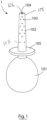
- the elongate member having a proximal end (107) and a distal end (108), the elongate member having a plurality of pores (103) defined therein, said pores being distributed along a length of said elongate member, the elongate member being dimensioned for insertion through an external urethral orifice, whereby the elongate member is insertable into a distal urethral cavity for topical delivery of an antimicrobial in said distal urethral cavity, the device comprising a collar (105) to prevent said elongate member entering a proximal urethral cavity.
- the embodiment depicted in Figure 1 represents a device wherein the elongate member (102) is approximately 20 mm in length.
- the diameter of the elongate member (102) is approximately 3 mm.
- the pores (103) defined in the elongate member have a diameter of approximately 0.8 mm.
- the deformable reservoir (101) has an internal volume of approximately 2 mL.
- Figure 2 is a cross-section of the embodiment shown in Figure 1 .
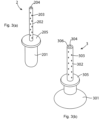
- Figure 3 illustrates two alternative embodiments of the present invention.
- the embodiment (2) of Figure 3(a) comprises an elongate member 202 having pores (203) defined therein and comprising a terminal orifice (204) at a distal end of the elongate member.
- the collar (205) is circumferentially disposed about the proximal end of the elongate member. The collar is disposed approximately 15 mm from the terminus of the distal end of the elongate member.
- the embodiment (2) shown in Figure 3(a) comprises a deformable reservoir (201) having an internal volume of approximately 1.5 mL.
- the embodiment (3) shown in Figure 3(b) comprises a deformable reservoir (301) having an internal volume of approximately 3 mL.
- the embodiment of Figure 3(b) comprises an elongate member (302) having a length of approximately 35 mm.
- the diameter of the elongate member is approximately 4 mm.
- the elongate member is capped by a terminal plate (306) having a plurality of terminal orifices (304) defined therein.
- the pores (303) have a diameter of approximately 1 mm.
- the terminal orifices have a diameter of approximately 0.1 mm.
- the collar (305) prevents the elongate member (302) entering the proximal urethral cavity of the female subject when the elongate member (302) is inserted into the distal urethral cavity.
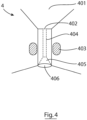
- FIG 4 is a schematic of the female urethra and bladder.
- the urethra transports urine from the bladder (401) to the outside of the body.
- the urethra comprises a lumen (402) and the urethra is partitioned into two regions, the distal urethra (405) and the proximal urethra (404).
- the mid-urethral sphincter (403) is positioned between the distal urethra and the proximal urethra.
- the opening to the urethra or urethral orifice (406) is the orifice through which the elongate member of the antimicrobial delivery device must enter.
- the antimicrobial delivery device such as that shown in the embodiment of Figure 1 , comprises an elongate member in fluid connection with a deformable reservoir.
- the elongate member may be inserted through the urethral orifice (406) into the distal urethral cavity (405).
- the collar (105) abuts the urethral meatus and prevents over insertion of the elongate member (102) beyond the distal urethral cavity, into the proximal urethral cavity.
- the collar may, for example, lie against the labia to prevent over-insertion of the elongate member.
- the deformable reservoir (101) may then be squeezed by the user to deploy the antimicrobial gel stored therein, from the deformable reservoir (101) via the elongate member (102), through the pores (103) and terminal orifice (104) into the distal urethral cavity (405).
- the antimicrobial is topically delivered in the distal urethral cavity.
- the elongate member may then be withdrawn from the distal urethral cavity by the user leaving the antimicrobial gel as a temporary physical barrier that minimises bacterial ascension by physically filling and blocking the distal urethral cavity, and further acts by directly eradicating bacteria that do enter the urethra through the antiseptic action of the antimicrobial gel.
Landscapes
- Health & Medical Sciences (AREA)
- Life Sciences & Earth Sciences (AREA)
- Public Health (AREA)
- Animal Behavior & Ethology (AREA)
- General Health & Medical Sciences (AREA)
- Veterinary Medicine (AREA)
- Chemical & Material Sciences (AREA)
- Engineering & Computer Science (AREA)
- Medicinal Chemistry (AREA)
- Pharmacology & Pharmacy (AREA)
- Biomedical Technology (AREA)
- Heart & Thoracic Surgery (AREA)
- Hematology (AREA)
- Anesthesiology (AREA)
- Epidemiology (AREA)
- Chemical Kinetics & Catalysis (AREA)
- General Chemical & Material Sciences (AREA)
- Urology & Nephrology (AREA)
- Organic Chemistry (AREA)
- Nuclear Medicine, Radiotherapy & Molecular Imaging (AREA)
- Biochemistry (AREA)
- Gynecology & Obstetrics (AREA)
- Reproductive Health (AREA)
- Molecular Biology (AREA)
- Oil, Petroleum & Natural Gas (AREA)
- Bioinformatics & Cheminformatics (AREA)
- Communicable Diseases (AREA)
- Oncology (AREA)
- Medicinal Preparation (AREA)
- Pharmaceuticals Containing Other Organic And Inorganic Compounds (AREA)
Claims (14)
- Antimikrobielle Harnröhreneinführvorrichtung, umfassend:a) ein verformbares Reservoir in Fluidverbindung mit einem länglichen Element, wobei das verformbare Reservoir und das längliche Element integral ausgebildet sind;b) wobei das längliche Element ein Lumen umfasst, wobei das längliche Element eine Länge von 15 mm bis 40 mm hat,c) wobei das längliche Element ein proximales Ende und ein distales Ende aufweist, wobei das längliche Element einen geschlossenen Abschluss am distalen Ende aufweist,d) wobei das längliche Element eine Vielzahl von Poren aufweist, die darin definiert sind, wobei die Poren entlang einer Länge des länglichen Elements verteilt sind,e) wobei das längliche Element für die Einführung durch eine äußere Harnröhrenöffnung eines weiblichen Subjekts dimensioniert ist,f) wobei das längliche Element in einen distalen Harnröhrenhohlraum zur Einführung eines antimikrobiellen Mittels in den distalen Harnröhrenhohlraum einführbar ist, undg) wobei die Vorrichtung einen Kragen umfasst, um zu vermeiden, dass das längliche Element in einen proximalen Harnröhrenhohlraum eindringen kann; dadurch gekennzeichnet, dassh) das Reservoir ein Innenvolumen von 0,5 ml bis 3 ml aufweist; und die Vorrichtung umfasst ferner ein wasserlösliches antimikrobielles Gel.
- Antimikrobielle Harnröhreneinführvorrichtung nach Anspruch 1, wobei das längliche Element sich derart verjüngt, dass der Durchmesser des distalen Endes des länglichen Elements einen kleineren Durchmesser aufweist als der Durchmesser des proximalen Endes des länglichen Elements.
- Antimikrobielle Harnröhreneinführvorrichtung nach einem der vorhergehenden Ansprüche, wobei die Poren einen Durchmesser im Bereich von 0,1 mm bis 2,0 mm, wie etwa von 0,5 mm bis 1,8 mm oder von 0,5 mm bis 1,5 mm, aufweisen.
- Antimikrobielle Harnröhreneinführvorrichtung nach einem der vorhergehenden Ansprüche, wobei der Kragen zirkumferenziell um das proximale Ende des länglichen Elements angeordnet ist.
- Antimikrobielle Harnröhreneinführvorrichtung nach einem der vorhergehenden Ansprüche, wobei der Kragen im Bereich von 15 bis 40 mm vom Ende des distalen Endes des länglichen Elements angeordnet ist.
- Antimikrobielle Harnröhreneinführvorrichtung nach einem der vorhergehenden Ansprüche, wobei der Kragen und das verformbare Reservoir integral ausgebildet sind.
- Antimikrobielle Harnröhreneinführvorrichtung nach einem der vorhergehenden Ansprüche, wobei das längliche Element einen Außendurchmesser im Bereich von 3,0 bis 5,0 mm, wie etwa von 4,0 bis 4,7 mm, aufweist.
- Antimikrobielle Harnröhreneinführvorrichtung nach einem der vorhergehenden Ansprüche, wobei das antimikrobielle Gel aus einem Gel gebildet ist, das eines oder mehrere von Folgenden umfasst: Glyzerin, Hydroxyethylcellulose, Polyethylenglykol, Propylenglykol, Hyaluronsäure, Chondroitinsulfat, Silikon, Öle, Vaseline, Wasser oder Kombinationen davon.
- Antimikrobielle Harnröhreneinführvorrichtung nach Anspruch 8, wobei das antimikrobielle Gel mindestens ein antimikrobielles Mittel, ausgewählt aus der Gruppe, bestehend aus Antiseptika wie Chlorhexidin, Povidon-Iod, Glutaraldehyd, Chloroxylenol, Silberionen, Benzalkoniumchlorid, Cetylpyridiniumchlorid, Cetalkoniumchlorid, Triclosan, Laurinsäure, Benzethoniumchlorid, Natriumhypochlorit und Antibiotika wie Neomycin, Bacitracin, Polymyxin, Penicillin, Mupirocin, Fusidinsäure und Kombinationen davon, umfasst.
- Antimikrobielle Harnröhreneinführvorrichtung nach einem der vorhergehenden Ansprüche, wobei das antimikrobielle Mittel in dem antimikrobiellen Gel in einer Konzentration im Bereich von 0,01 Gew.-% bis 1,0 Gew.-%, bezogen auf das Gesamtgewicht des antimikrobiellen Gels, vorliegt, wobei das antimikrobielle Mittel in dem antimikrobiellen Gel entsprechend in einer Konzentration im Bereich von 0,01 Gew.-% bis 0,50 Gew.-%, wie etwa von 0,1 Gew.-% bis 0,3 Gew.-%, bezogen auf das Gesamtgewicht des antimikrobiellen Gels, vorliegt.
- Antimikrobielle Harnröhreneinführvorrichtung nach einem der vorhergehenden Ansprüche, wobei das antimikrobielle Gel Folgendes umfasst:
ein antimikrobielles Mittel in einer Menge von 0,01 Gew.-% bis 1,0 Gew.-%, bezogen auf das Gesamtgewicht der Zusammensetzung, ein Geliermittel in einer Menge von 0,5 Gew.-% bis 30 Gew.-%, bezogen auf das Gesamtgewicht der Zusammensetzung, ein oder mehrere Konservierungsmittel und einen pharmazeutisch annehmbaren Träger. - Antimikrobielle Harnröhreneinführvorrichtung nach einem der vorhergehenden Ansprüche, wobei das verformbare Reservoir ferner eine Dichtung umfasst, um antimikrobielle Mittel innerhalb des Reservoirs zurückzuhalten.
- Ein Kit, umfassend die antimikrobielle Harnröhreneinführvorrichtung nach einem der vorhergehenden Ansprüche, wobei die Vorrichtung steril ist und in einer abgedichteten sterilen Verpackung verpackt ist.
- Antimikrobielle Harnröhreneinführvorrichtung nach einem der Ansprüche 1 bis 12, wobei die Vorrichtung zur Verwendung beim Behandeln, Vorbeugen oder Verringern der Wahrscheinlichkeit einer Harnwegsinfektion geeignet ist, wobei das antimikrobielle Gel ferner optional Mannose umfasst.
Applications Claiming Priority (2)
| Application Number | Priority Date | Filing Date | Title |
|---|---|---|---|
| GBGB1804165.7A GB201804165D0 (en) | 2018-03-15 | 2018-03-15 | Urethal delivery device |
| PCT/EP2019/055878 WO2019175055A1 (en) | 2018-03-15 | 2019-03-15 | Urethral delivery device |
Publications (3)
| Publication Number | Publication Date |
|---|---|
| EP3765137A1 EP3765137A1 (de) | 2021-01-20 |
| EP3765137C0 EP3765137C0 (de) | 2025-02-26 |
| EP3765137B1 true EP3765137B1 (de) | 2025-02-26 |
Family
ID=62017692
Family Applications (1)
| Application Number | Title | Priority Date | Filing Date |
|---|---|---|---|
| EP19709931.0A Active EP3765137B1 (de) | 2018-03-15 | 2019-03-15 | Harnröhreneinführvorrichtung |
Country Status (5)
| Country | Link |
|---|---|
| US (2) | US11839730B2 (de) |
| EP (1) | EP3765137B1 (de) |
| CN (1) | CN111936196A (de) |
| GB (1) | GB201804165D0 (de) |
| WO (1) | WO2019175055A1 (de) |
Families Citing this family (8)
| Publication number | Priority date | Publication date | Assignee | Title |
|---|---|---|---|---|
| USD956216S1 (en) * | 2018-12-11 | 2022-06-28 | Ningbo Albert Novosino Co., Ltd. | Renju shaped contra-flow resistant enema cleaner |
| WO2020252003A1 (en) | 2019-06-13 | 2020-12-17 | Hollister Incorporated | Reusable urinary catheter products |
| US12440644B2 (en) | 2019-06-25 | 2025-10-14 | Hollister Incorporated | Reusable urinary catheter products |
| DE202021104247U1 (de) * | 2020-06-09 | 2021-09-24 | G. Pohl-Boskamp Gmbh & Co. Kg | Zusammensetzungen zur Prophylaxe und Behandlung von Harnwegsinfektionen und zur kosmetischen Anwendung |
| DE102020129363A1 (de) | 2020-11-06 | 2022-05-12 | Selina Jakumeit | Schutzvorrichtung als temporäre Versiegelung während sexueller Aktivitäten zur Vermeidung von Harnwegs- und Blasenentzündungen |
| US20220370772A1 (en) * | 2021-05-24 | 2022-11-24 | Record Buck Farms Medical Cannabis Llc | Dispenser device for delivery of compositions into vaginal or anal orifices |
| NO20211289A1 (en) * | 2021-10-27 | 2023-04-28 | Insu El Tech As | Device and method for applying insulation material in a cavity |
| USD990991S1 (en) * | 2022-06-06 | 2023-07-04 | Think Green Limited | Feeding device for infants |
Family Cites Families (15)
| Publication number | Priority date | Publication date | Assignee | Title |
|---|---|---|---|---|
| US289528A (en) * | 1883-12-04 | Goodneb | ||
| FR423811A (fr) | 1910-12-17 | 1911-04-27 | Juan Bautistan Lesquerre | Appareil pour bains et injections désinfectants |
| US2895280A (en) | 1956-03-12 | 1959-07-21 | Deere & Co | Beet harvester |
| CN2137165Y (zh) * | 1992-04-30 | 1993-06-30 | 赵家驹 | 体外给药器 |
| CN2173611Y (zh) * | 1993-06-16 | 1994-08-10 | 湖南经纬实业有限公司 | 腔道用软膏管 |
| CN2368536Y (zh) | 1999-05-07 | 2000-03-15 | 龚仲志 | 泌尿舒治疗器 |
| US20060122563A1 (en) * | 2004-08-09 | 2006-06-08 | Elan Ziv | Applicator assembly for application of substances to a body orifice and cavity |
| CN2936293Y (zh) * | 2006-08-28 | 2007-08-22 | 亓红国 | 一次性尿道药剂包装给药器 |
| KR20130098327A (ko) * | 2010-08-09 | 2013-09-04 | 이노베이션 테크놀로지스, 인코포레이티드 | 농양 세척을 위한 디바이스 및 방법 |
| CN201978329U (zh) * | 2011-02-21 | 2011-09-21 | 肖�琳 | 一次性尿道感染治疗装置 |
| DE102011119160A1 (de) * | 2011-11-22 | 2013-05-23 | Largentec Gmbh | Vorrichtung zum Verhindern und/oder Behandeln von Harnwegsinfektionen |
| CA2910752C (en) * | 2013-05-01 | 2021-11-23 | Neoculi Pty Ltd | Use of robenidine in the treatment of bacterial infection |
| EP2815790A1 (de) * | 2013-06-17 | 2014-12-24 | Hestia Investments | Zusammensetzung zur topischen Verwendung bei der Vorbeugung und Behandlung von bakteriellen und Pilzinfektionen von Haut und Schleimhaut |
| AU2016205037B2 (en) * | 2015-01-10 | 2020-09-03 | Nine Medical, Inc. | Methods and devices to prevent premature birth |
| EP3419676B1 (de) * | 2016-02-22 | 2022-08-31 | Board of Regents, The University of Texas System | Antimikrobielle zusammensetzungen und verwendungen davon |
-
2018
- 2018-03-15 GB GBGB1804165.7A patent/GB201804165D0/en not_active Ceased
-
2019
- 2019-03-15 US US16/980,469 patent/US11839730B2/en active Active
- 2019-03-15 WO PCT/EP2019/055878 patent/WO2019175055A1/en not_active Ceased
- 2019-03-15 CN CN201980025059.7A patent/CN111936196A/zh active Pending
- 2019-03-15 EP EP19709931.0A patent/EP3765137B1/de active Active
-
2023
- 2023-11-03 US US18/501,067 patent/US20240149029A1/en not_active Abandoned
Also Published As
| Publication number | Publication date |
|---|---|
| US20240149029A1 (en) | 2024-05-09 |
| EP3765137C0 (de) | 2025-02-26 |
| US11839730B2 (en) | 2023-12-12 |
| GB201804165D0 (en) | 2018-05-02 |
| WO2019175055A1 (en) | 2019-09-19 |
| EP3765137A1 (de) | 2021-01-20 |
| CN111936196A (zh) | 2020-11-13 |
| US20210015993A1 (en) | 2021-01-21 |
Similar Documents
| Publication | Publication Date | Title |
|---|---|---|
| US20240149029A1 (en) | Urethral delivery device | |
| WO2007106356A2 (en) | Self-catheterization device to administer compounds to the bladder | |
| CA2513007C (en) | Vaginal or rectal applicator | |
| US10322083B2 (en) | Tumescent drug delivery | |
| US20090171317A1 (en) | Self-Catheterization Device To Administes Compounds To The Bladder | |
| MX2015003110A (es) | Sistemas de administracion de farmaco y metodos para el tratamiento de la disfuncion miccional de la vejiga y otros trastornos del tracto urinario inferior. | |
| CN103874497A (zh) | 用于治疗瘘的组合物 | |
| US20200214882A1 (en) | Treating conditions caused by abnormal growth of pathogens in body cavities | |
| US20220409859A1 (en) | Urinary catheters and methods for preventing bacterial infections | |
| US8337481B2 (en) | Method for treating otitis externa | |
| CN206560590U (zh) | 缓释给药导尿管 | |
| US11213481B2 (en) | Tumescent drug delivery | |
| EP4616878A1 (de) | Kanüle zur rektalen verabreichung eines klistiers und zusammensetzungen zur verwendung damit | |
| US20040249364A1 (en) | Device and method for dispensing medication to tissue lining a body cavity | |
| CN114425127B (zh) | 一次性使用肛周脓肿抗菌引流管 | |
| RU2236851C1 (ru) | Способ местного лечения бактериального вагиноза | |
| WO2025191166A1 (en) | Cannula for rectal administration of an enema and compositions for use therewith | |
| CN112089952A (zh) | 一种非涂层抗菌导尿管 | |
| CN220025869U (zh) | 阴道给药器 | |
| EP3986503B1 (de) | Kit zum waschen einer darmanastomose vor ort | |
| CN216456313U (zh) | 一种双针管式阴道冲洗器 | |
| US20100210600A1 (en) | Methods and Compositions for Treating Urogenital Disorders | |
| CN121754791A (zh) | 一种用于辅助治疗尿道或阴道感染的医疗器械及用法 | |
| US7981104B2 (en) | Method for treating otitis externa | |
| RU2232575C2 (ru) | Средство для лечения хронического эндометрита |
Legal Events
| Date | Code | Title | Description |
|---|---|---|---|
| STAA | Information on the status of an ep patent application or granted ep patent |
Free format text: STATUS: UNKNOWN |
|
| STAA | Information on the status of an ep patent application or granted ep patent |
Free format text: STATUS: THE INTERNATIONAL PUBLICATION HAS BEEN MADE |
|
| PUAI | Public reference made under article 153(3) epc to a published international application that has entered the european phase |
Free format text: ORIGINAL CODE: 0009012 |
|
| STAA | Information on the status of an ep patent application or granted ep patent |
Free format text: STATUS: REQUEST FOR EXAMINATION WAS MADE |
|
| 17P | Request for examination filed |
Effective date: 20201013 |
|
| AK | Designated contracting states |
Kind code of ref document: A1 Designated state(s): AL AT BE BG CH CY CZ DE DK EE ES FI FR GB GR HR HU IE IS IT LI LT LU LV MC MK MT NL NO PL PT RO RS SE SI SK SM TR |
|
| AX | Request for extension of the european patent |
Extension state: BA ME |
|
| DAV | Request for validation of the european patent (deleted) | ||
| DAX | Request for extension of the european patent (deleted) | ||
| GRAP | Despatch of communication of intention to grant a patent |
Free format text: ORIGINAL CODE: EPIDOSNIGR1 |
|
| STAA | Information on the status of an ep patent application or granted ep patent |
Free format text: STATUS: GRANT OF PATENT IS INTENDED |
|
| RIC1 | Information provided on ipc code assigned before grant |
Ipc: A61P 31/02 20060101ALI20240430BHEP Ipc: A61P 13/02 20060101ALI20240430BHEP Ipc: A61K 31/155 20060101ALI20240430BHEP Ipc: A61K 31/00 20060101ALI20240430BHEP Ipc: A61M 3/02 20060101ALI20240430BHEP Ipc: A61M 31/00 20060101AFI20240430BHEP |
|
| INTG | Intention to grant announced |
Effective date: 20240516 |
|
| GRAJ | Information related to disapproval of communication of intention to grant by the applicant or resumption of examination proceedings by the epo deleted |
Free format text: ORIGINAL CODE: EPIDOSDIGR1 |
|
| STAA | Information on the status of an ep patent application or granted ep patent |
Free format text: STATUS: REQUEST FOR EXAMINATION WAS MADE |
|
| GRAP | Despatch of communication of intention to grant a patent |
Free format text: ORIGINAL CODE: EPIDOSNIGR1 |
|
| STAA | Information on the status of an ep patent application or granted ep patent |
Free format text: STATUS: GRANT OF PATENT IS INTENDED |
|
| INTC | Intention to grant announced (deleted) | ||
| INTG | Intention to grant announced |
Effective date: 20240925 |
|
| GRAS | Grant fee paid |
Free format text: ORIGINAL CODE: EPIDOSNIGR3 |
|
| GRAA | (expected) grant |
Free format text: ORIGINAL CODE: 0009210 |
|
| STAA | Information on the status of an ep patent application or granted ep patent |
Free format text: STATUS: THE PATENT HAS BEEN GRANTED |
|
| AK | Designated contracting states |
Kind code of ref document: B1 Designated state(s): AL AT BE BG CH CY CZ DE DK EE ES FI FR GB GR HR HU IE IS IT LI LT LU LV MC MK MT NL NO PL PT RO RS SE SI SK SM TR |
|
| REG | Reference to a national code |
Ref country code: GB Ref legal event code: FG4D |
|
| REG | Reference to a national code |
Ref country code: CH Ref legal event code: EP |
|
| REG | Reference to a national code |
Ref country code: DE Ref legal event code: R096 Ref document number: 602019066456 Country of ref document: DE |
|
| REG | Reference to a national code |
Ref country code: IE Ref legal event code: FG4D |
|
| U01 | Request for unitary effect filed |
Effective date: 20250325 |
|
| U07 | Unitary effect registered |
Designated state(s): AT BE BG DE DK EE FI FR IT LT LU LV MT NL PT RO SE SI Effective date: 20250401 |
|
| PG25 | Lapsed in a contracting state [announced via postgrant information from national office to epo] |
Ref country code: RS Free format text: LAPSE BECAUSE OF FAILURE TO SUBMIT A TRANSLATION OF THE DESCRIPTION OR TO PAY THE FEE WITHIN THE PRESCRIBED TIME-LIMIT Effective date: 20250526 |
|
| PG25 | Lapsed in a contracting state [announced via postgrant information from national office to epo] |
Ref country code: PL Free format text: LAPSE BECAUSE OF FAILURE TO SUBMIT A TRANSLATION OF THE DESCRIPTION OR TO PAY THE FEE WITHIN THE PRESCRIBED TIME-LIMIT Effective date: 20250226 |
|
| PG25 | Lapsed in a contracting state [announced via postgrant information from national office to epo] |
Ref country code: ES Free format text: LAPSE BECAUSE OF FAILURE TO SUBMIT A TRANSLATION OF THE DESCRIPTION OR TO PAY THE FEE WITHIN THE PRESCRIBED TIME-LIMIT Effective date: 20250226 |
|
| PG25 | Lapsed in a contracting state [announced via postgrant information from national office to epo] |
Ref country code: IS Free format text: LAPSE BECAUSE OF FAILURE TO SUBMIT A TRANSLATION OF THE DESCRIPTION OR TO PAY THE FEE WITHIN THE PRESCRIBED TIME-LIMIT Effective date: 20250626 Ref country code: NO Free format text: LAPSE BECAUSE OF FAILURE TO SUBMIT A TRANSLATION OF THE DESCRIPTION OR TO PAY THE FEE WITHIN THE PRESCRIBED TIME-LIMIT Effective date: 20250526 |
|
| PG25 | Lapsed in a contracting state [announced via postgrant information from national office to epo] |
Ref country code: HR Free format text: LAPSE BECAUSE OF FAILURE TO SUBMIT A TRANSLATION OF THE DESCRIPTION OR TO PAY THE FEE WITHIN THE PRESCRIBED TIME-LIMIT Effective date: 20250226 |
|
| PG25 | Lapsed in a contracting state [announced via postgrant information from national office to epo] |
Ref country code: GR Free format text: LAPSE BECAUSE OF FAILURE TO SUBMIT A TRANSLATION OF THE DESCRIPTION OR TO PAY THE FEE WITHIN THE PRESCRIBED TIME-LIMIT Effective date: 20250527 |
|
| PG25 | Lapsed in a contracting state [announced via postgrant information from national office to epo] |
Ref country code: SM Free format text: LAPSE BECAUSE OF FAILURE TO SUBMIT A TRANSLATION OF THE DESCRIPTION OR TO PAY THE FEE WITHIN THE PRESCRIBED TIME-LIMIT Effective date: 20250226 |
|
| PG25 | Lapsed in a contracting state [announced via postgrant information from national office to epo] |
Ref country code: CZ Free format text: LAPSE BECAUSE OF FAILURE TO SUBMIT A TRANSLATION OF THE DESCRIPTION OR TO PAY THE FEE WITHIN THE PRESCRIBED TIME-LIMIT Effective date: 20250226 |
|
| REG | Reference to a national code |
Ref country code: CH Ref legal event code: H13 Free format text: ST27 STATUS EVENT CODE: U-0-0-H10-H13 (AS PROVIDED BY THE NATIONAL OFFICE) Effective date: 20251023 |
|
| PG25 | Lapsed in a contracting state [announced via postgrant information from national office to epo] |
Ref country code: SK Free format text: LAPSE BECAUSE OF FAILURE TO SUBMIT A TRANSLATION OF THE DESCRIPTION OR TO PAY THE FEE WITHIN THE PRESCRIBED TIME-LIMIT Effective date: 20250226 |
|
| U90 | Renewal fees not paid: noting of loss of rights |
Free format text: RENEWAL FEE NOT PAID FOR YEAR 07 Effective date: 20251017 |
|
| PG25 | Lapsed in a contracting state [announced via postgrant information from national office to epo] |
Ref country code: MC Free format text: LAPSE BECAUSE OF FAILURE TO SUBMIT A TRANSLATION OF THE DESCRIPTION OR TO PAY THE FEE WITHIN THE PRESCRIBED TIME-LIMIT Effective date: 20250226 |
|
| PLBE | No opposition filed within time limit |
Free format text: ORIGINAL CODE: 0009261 |
|
| STAA | Information on the status of an ep patent application or granted ep patent |
Free format text: STATUS: NO OPPOSITION FILED WITHIN TIME LIMIT |
|
| PG25 | Lapsed in a contracting state [announced via postgrant information from national office to epo] |
Ref country code: CH Free format text: LAPSE BECAUSE OF NON-PAYMENT OF DUE FEES Effective date: 20250331 |
|
| PG25 | Lapsed in a contracting state [announced via postgrant information from national office to epo] |
Ref country code: IE Free format text: LAPSE BECAUSE OF NON-PAYMENT OF DUE FEES Effective date: 20250315 |
|
| GBPC | Gb: european patent ceased through non-payment of renewal fee |
Effective date: 20250526 |
|
| 26N | No opposition filed |
Effective date: 20251127 |
|
| U93 | Unitary patent lapsed |
Free format text: RENEWAL FEE NOT PAID Effective date: 20250331 |
|
| PG25 | Lapsed in a contracting state [announced via postgrant information from national office to epo] |
Ref country code: GB Free format text: LAPSE BECAUSE OF NON-PAYMENT OF DUE FEES Effective date: 20250526 |