EP3762953B1 - Trennvorrichtung zur gleichstromunterbrechung eines strompfads, und bordnetz eines kraftfahrzeugs - Google Patents
Trennvorrichtung zur gleichstromunterbrechung eines strompfads, und bordnetz eines kraftfahrzeugs Download PDFInfo
- Publication number
- EP3762953B1 EP3762953B1 EP19701646.2A EP19701646A EP3762953B1 EP 3762953 B1 EP3762953 B1 EP 3762953B1 EP 19701646 A EP19701646 A EP 19701646A EP 3762953 B1 EP3762953 B1 EP 3762953B1
- Authority
- EP
- European Patent Office
- Prior art keywords
- switch
- current
- semiconductor switch
- contact system
- resistor
- Prior art date
- Legal status (The legal status is an assumption and is not a legal conclusion. Google has not performed a legal analysis and makes no representation as to the accuracy of the status listed.)
- Active
Links
Images
Classifications
-
- H—ELECTRICITY
- H01—ELECTRIC ELEMENTS
- H01H—ELECTRIC SWITCHES; RELAYS; SELECTORS; EMERGENCY PROTECTIVE DEVICES
- H01H9/00—Details of switching devices, not covered by groups H01H1/00 - H01H7/00
- H01H9/54—Circuit arrangements not adapted to a particular application of the switching device and for which no provision exists elsewhere
- H01H9/541—Contacts shunted by semiconductor devices
-
- H—ELECTRICITY
- H01—ELECTRIC ELEMENTS
- H01H—ELECTRIC SWITCHES; RELAYS; SELECTORS; EMERGENCY PROTECTIVE DEVICES
- H01H9/00—Details of switching devices, not covered by groups H01H1/00 - H01H7/00
- H01H9/54—Circuit arrangements not adapted to a particular application of the switching device and for which no provision exists elsewhere
- H01H9/541—Contacts shunted by semiconductor devices
- H01H9/542—Contacts shunted by static switch means
-
- B—PERFORMING OPERATIONS; TRANSPORTING
- B60—VEHICLES IN GENERAL
- B60R—VEHICLES, VEHICLE FITTINGS, OR VEHICLE PARTS, NOT OTHERWISE PROVIDED FOR
- B60R16/00—Electric or fluid circuits specially adapted for vehicles and not otherwise provided for; Arrangement of elements of electric or fluid circuits specially adapted for vehicles and not otherwise provided for
- B60R16/005—Electro-mechanical devices, e.g. switched
-
- B—PERFORMING OPERATIONS; TRANSPORTING
- B60—VEHICLES IN GENERAL
- B60R—VEHICLES, VEHICLE FITTINGS, OR VEHICLE PARTS, NOT OTHERWISE PROVIDED FOR
- B60R16/00—Electric or fluid circuits specially adapted for vehicles and not otherwise provided for; Arrangement of elements of electric or fluid circuits specially adapted for vehicles and not otherwise provided for
- B60R16/02—Electric or fluid circuits specially adapted for vehicles and not otherwise provided for; Arrangement of elements of electric or fluid circuits specially adapted for vehicles and not otherwise provided for electric constitutive elements
-
- B—PERFORMING OPERATIONS; TRANSPORTING
- B60—VEHICLES IN GENERAL
- B60R—VEHICLES, VEHICLE FITTINGS, OR VEHICLE PARTS, NOT OTHERWISE PROVIDED FOR
- B60R16/00—Electric or fluid circuits specially adapted for vehicles and not otherwise provided for; Arrangement of elements of electric or fluid circuits specially adapted for vehicles and not otherwise provided for
- B60R16/02—Electric or fluid circuits specially adapted for vehicles and not otherwise provided for; Arrangement of elements of electric or fluid circuits specially adapted for vehicles and not otherwise provided for electric constitutive elements
- B60R16/03—Electric or fluid circuits specially adapted for vehicles and not otherwise provided for; Arrangement of elements of electric or fluid circuits specially adapted for vehicles and not otherwise provided for electric constitutive elements for supply of electrical power to vehicle subsystems or for
-
- G—PHYSICS
- G02—OPTICS
- G02B—OPTICAL ELEMENTS, SYSTEMS OR APPARATUS
- G02B1/00—Optical elements characterised by the material of which they are made; Optical coatings for optical elements
- G02B1/10—Optical coatings produced by application to, or surface treatment of, optical elements
- G02B1/11—Anti-reflection coatings
- G02B1/113—Anti-reflection coatings using inorganic layer materials only
- G02B1/115—Multilayers
-
- G—PHYSICS
- G02—OPTICS
- G02B—OPTICAL ELEMENTS, SYSTEMS OR APPARATUS
- G02B5/00—Optical elements other than lenses
- G02B5/003—Light absorbing elements
-
- G—PHYSICS
- G02—OPTICS
- G02B—OPTICAL ELEMENTS, SYSTEMS OR APPARATUS
- G02B5/00—Optical elements other than lenses
- G02B5/20—Filters
- G02B5/22—Absorbing filters
-
- H—ELECTRICITY
- H01—ELECTRIC ELEMENTS
- H01H—ELECTRIC SWITCHES; RELAYS; SELECTORS; EMERGENCY PROTECTIVE DEVICES
- H01H33/00—High-tension or heavy-current switches with arc-extinguishing or arc-preventing means
- H01H33/02—Details
- H01H33/59—Circuit arrangements not adapted to a particular application of the switch and not otherwise provided for, e.g. for ensuring operation of the switch at a predetermined point in the AC cycle
- H01H33/596—Circuit arrangements not adapted to a particular application of the switch and not otherwise provided for, e.g. for ensuring operation of the switch at a predetermined point in the AC cycle for interrupting DC
-
- H—ELECTRICITY
- H02—GENERATION; CONVERSION OR DISTRIBUTION OF ELECTRIC POWER
- H02H—EMERGENCY PROTECTIVE CIRCUIT ARRANGEMENTS
- H02H3/00—Emergency protective circuit arrangements for automatic disconnection directly responsive to an undesired change from normal electric working condition with or without subsequent reconnection ; integrated protection
- H02H3/02—Details
- H02H3/025—Disconnection after limiting, e.g. when limiting is not sufficient or for facilitating disconnection
-
- H—ELECTRICITY
- H01—ELECTRIC ELEMENTS
- H01H—ELECTRIC SWITCHES; RELAYS; SELECTORS; EMERGENCY PROTECTIVE DEVICES
- H01H9/00—Details of switching devices, not covered by groups H01H1/00 - H01H7/00
- H01H9/54—Circuit arrangements not adapted to a particular application of the switching device and for which no provision exists elsewhere
- H01H9/541—Contacts shunted by semiconductor devices
- H01H9/542—Contacts shunted by static switch means
- H01H2009/544—Contacts shunted by static switch means the static switching means being an insulated gate bipolar transistor, e.g. IGBT, Darlington configuration of FET and bipolar transistor
-
- H—ELECTRICITY
- H01—ELECTRIC ELEMENTS
- H01H—ELECTRIC SWITCHES; RELAYS; SELECTORS; EMERGENCY PROTECTIVE DEVICES
- H01H9/00—Details of switching devices, not covered by groups H01H1/00 - H01H7/00
- H01H9/54—Circuit arrangements not adapted to a particular application of the switching device and for which no provision exists elsewhere
- H01H9/541—Contacts shunted by semiconductor devices
- H01H9/542—Contacts shunted by static switch means
- H01H2009/546—Contacts shunted by static switch means the static switching means being triggered by the voltage over the mechanical switch contacts
Definitions
- the invention relates to a separating device for interrupting a direct current path, in particular for an on-board network of a motor vehicle.
- the invention further relates to an on-board network for a motor vehicle with such a separating device.
- On-board networks are used to supply electrical consumers and devices with an operating voltage of the on-board network.
- Such on-board networks are usually supplied by means of an energy storage device, for example in the form of an electrochemical battery system. Due to their nature, such battery systems continuously supply an operating current and an operating voltage, which is measured in a low-voltage range (NV) between 12V and 48V (DC) and in a high-voltage range (HV) up to around 1500V (DC) and higher.
- NV low-voltage range
- HV high-voltage range
- a reliable separation of electrical components or devices from the battery system which acts as a direct current source, is desired, for example for installation, assembly or service purposes and in particular for general personal protection.
- An appropriate separation device must be able to carry out an interruption under load, i.e. without first switching off the direct current source, reliably and safely.
- From the DE 102 25 259 B3 is an electrical connector designed as a load disconnector, which has a semiconductor switch as well as main and auxiliary contacts in the manner of a hybrid switch, which are connected to a direct current source.
- the main contact which leads during an unplugging process, is connected in parallel to the auxiliary contact, which lags behind and is connected in series with the semiconductor switches.
- the semiconductor switch is controlled to avoid or extinguish arcs by periodically switching it on and off.
- a hybrid isolating device with a mechanical contact system and a semiconductor switch connected in parallel is known.
- the semiconductor switch is coupled to control electronics which have no additional energy source.
- the control electronics or the semiconductor switch block current, which means that they are practically without current and voltage.
- the control electronics obtain the energy required to operate it from the isolating device, i.e. from the isolating switch system itself, using the energy of the arc that occurs when the mechanical contact system opens.
- the control electronics are connected to the mechanical contact system on the control side in such a way that when the contact system opens, the arc voltage via its switching contacts switches the control electronics and thus the semiconductor switch to conduct current as a result of the arc.
- a circuit arrangement for a hybrid contactor which has a parallel circuit consisting of an electromagnetically actuated main switching contact and an electronic switch, whereby a load can be connected to a voltage source by means of the parallel circuit.
- the circuit arrangement has a voltage limiting circuit for limiting the voltage when the electronic switch and the main switching contact are switched off, which is electrically connected at least to the source-side end of the parallel circuit and which has a charge storage device that is discharged when a voltage limit is exceeded.
- a first freewheeling circuit is provided for reducing the induction voltage when the electronic switch and the main switching contact are switched off, which is electrically connected to the load-side end of the parallel circuit.
- the arc current begins to commutate from the mechanical contact system to the semiconductor switch. This extinguishes the arc between the switching contacts of the contact system.
- the invention is based on the object of specifying a particularly suitable isolating device (hybrid switch or electronics) for interrupting direct current in a current path, in particular for an on-board power supply system of a motor vehicle.
- a isolating device with improved operational reliability is to be specified, even when switching high on-board power supply voltages.
- the invention is also based on the object of specifying a particularly suitable on-board power supply system of a motor vehicle with such an isolating device.
- the isolating device is suitable and designed as an isolating switch system for the direct current interruption of a current path, in particular for an on-board network of a motor vehicle.
- the isolating device has a hybrid switch with a current-carrying mechanical contact system (switch) and with a first semiconductor switch connected in parallel thereto.
- the parallel The first semiconductor switch is open when the mechanical contact system is closed, i.e. switched to blocking or non-conductive, so that the electrical current is conducted across the switching path of the mechanical contact system. This ensures particularly low conduction losses of the isolating device during normal operation.
- the isolating device also has a switchable resistance cascade with at least one ohmic resistor.
- the resistance cascade is connected in parallel to the contact system of the hybrid switch.
- the resistance cascade thus acts as a protective circuit for the hybrid switch. This creates a particularly suitable and reliable isolating device.
- any arc that forms is extinguished reliably and safely.
- the semiconductor switch is closed or switched on, the switching path of the contact system is short-circuited, which causes the arc current to commutate via the semiconductor switch and the resistance cascade and thus be extinguished.
- the isolating device according to the invention makes it possible to create a particularly space-saving and compact isolating switch system. This is particularly advantageous in a confined installation situation in the electrical system of a motor vehicle.
- the resistor cascade or the at least one resistor can also be used as a charging and/or discharging resistor for an intermediate circuit capacitor.
- the resistance cascade is designed as a cascading switch-off overvoltage limiter (overvoltage limiter). This ensures reliable and safe extinguishing of arcs.
- the resistance cascade has at least one second semiconductor switch, which is connected in series with the at least one resistor.
- the resistance cascade preferably has several such resistor and semiconductor switch pairs, which are connected in cascade one after the other. This makes it possible to force an occurring current to zero step by step or successively. It is preferably provided that the or every second semiconductor switch is switched to conduct essentially at the same time as the first semiconductor switch.
- the hybrid switch in particular its mechanical contact system, can be short-circuited by means of a series connection of the resistance cascade with a third semiconductor switch. This reliably prevents dangerous contact voltages on the contact system despite the lack of galvanic isolation. This ensures particularly effective and reliable personal protection (finger safety).
- the or each semiconductor switch is connected to a common controller on the control side.
- the controller is designed in particular as a common control unit for the first, second and third semiconductor switches. This ensures that the semiconductor switches are switched together and reliably. This ensures that the arc is extinguished particularly reliably and quickly.
- the controller is generally suitable and set up in terms of programming and/or circuitry to control the semiconductor switches during a closing or opening process of the mechanical contact system.
- the controller is therefore specifically set up to control the semiconductor switches during a closing process in which the contacts of the contact system are closed in such a way that the contact system can be switched on without voltage.
- the controller controls the semiconductor switches in such a way that an arc between the opening contacts of the contact system is reliably and is extinguished promptly, and protection against contact, in particular in the sense of sufficient "finger safety", is guaranteed.
- the controller is formed at least in its core by a microcontroller with a processor and with a data memory in which the functionality for carrying out the control is implemented in the form of operating software (firmware) so that the control - if necessary in interaction with a user - is carried out automatically when the operating software is executed in the microcontroller.
- operating software firmware
- the controller can alternatively also be formed by a non-programmable electronic component, e.g. an application-specific integrated circuit (ASIC), in which the functionality for controlling the method is implemented using circuitry.
- ASIC application-specific integrated circuit
- an overcurrent protection device is connected upstream of the hybrid switch. This means that the switching task of the isolating device is taken over by the semiconductor switches under load and by the overcurrent protection device in the event of a short circuit. In particular, this ensures a safe galvanic interruption of the current path in the event of a fault.
- the overcurrent protection device is designed as a quick fuse, for example in the form of a current-carrying expansion or fuse wire. This ensures galvanic isolation of the current path in the event of a fault.
- An additional or further aspect of the invention provides for the use of the above-described separating device in an on-board power supply of a motor vehicle.
- the on-board power supply has a direct current circuit with an energy storage device and at least one current path.
- the energy storage device is designed, for example, as an electrochemical battery system, which is connected to the current path as a direct current source.
- the current path is, for example, led to an intermediate circuit of the on-board power supply.
- the separating device is in the current path. This creates a particularly reliable and reliably switchable on-board network.
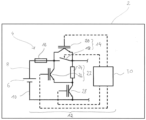
- FIG. 1 An embodiment of the invention is explained in more detail below with reference to a drawing.
- the single figure shows a schematic and simplified representation of an on-board network for a motor vehicle, with a disconnecting device for interrupting a direct current circuit.
- the figure shows a motor vehicle 2 in a schematic and simplified representation.
- the motor vehicle 2 has a partial electrical system 4.
- the electrical system 4 is designed with an electrochemical battery system 6 as an energy storage device or direct current source.
- a current path 8, 10 is connected to each pole of the battery system 6.
- the current path 8 leading to the positive pole of the battery system 6 is also referred to below as the positive path and the current path 10 leading to the negative pole of the battery system 6 is also referred to below as the negative path.
- a separating device 12 for interrupting the direct current is connected in the positive path 8.
- the separating device 12 has a hybrid switch 14 and an overcurrent protection device 16 connected upstream of it.
- the overcurrent protection device 16 is designed as a fuse, for example.
- the hybrid switch 14 has a current-carrying mechanical contact system 18 in the form of a switch, to which a semiconductor switch 20 is connected in parallel.
- a resistance cascade 22 is also connected in parallel to the semiconductor switch 20 and to the switching path of the contact system 18 as a cascading switch-off overvoltage limiter of the isolating device 12.
- the resistance cascade 22 has an ohmic resistor 24 and a semiconductor switch 26 connected in series with it.
- a further semiconductor switch 28 is connected in series with the resistance cascade 22, which is connected on the output side to the negative path 10.
- the semiconductor switches 20, 26, 28 are connected on the control side to a common controller 30.
- the semiconductor switches 20, 26 and 28 are designed as power semiconductors, in particular as transistors, preferably as IGBTs (Insulated-Gate Bipolar Transistors).
- the input or collector connections of the semiconductor switches 20 and 26 are connected between the overcurrent protection device 16 and the contact system 18.
- the output or emitter connection of the semiconductor switch 26 is connected between the resistor 24 and the input or collector connection of the semiconductor switch 28.
- the semiconductor switch 28 is connected to the negative path 10 on the output or emitter side.
- the semiconductor switches 20, 26 and 28 are switched off, i.e. switched to blocking or electrically non-conductive, and the mechanical contact system 18 is closed.
- a direct current from the battery system 6 is only conducted via the mechanical contacts of the contact system 18. This ensures particularly low conduction losses of the isolating device 12.
- the current-carrying contact system 18 is opened.
- an arc is formed due to the applied operating or on-board network voltage of the on-board network 4.
- the controller 30 switches the semiconductor switch 20 on so that the arc current that occurs commutes to the semiconductor switch 20 and is thereby extinguished.
- the controller 30 switches on the semiconductor switch 26 of the resistor cascade 22 essentially at the same time as the semiconductor switch 20.
- the semiconductor switch 20 is switched off, whereby the current through the resistor cascade 22 gradually passes over the resistor 24 to Zero is forced. In this case, sufficient electrical strength is understood to mean in particular that the arc is extinguished.
- the semiconductor switch 28 is switched to conductive by the controller 30. As a result, the contact system 18 is short-circuited by the series connection of the resistor 24 and the semiconductor switch 28. The series connection thus forms a low-resistance connection between the positive path 8 and the negative path 10. In the event of a fault, the overcurrent protection device 16 would thus trigger, thereby reliably and safely interrupting the positive path 8 galvanically.
- the semiconductor switch 28 When the isolating device 12 is switched on, the semiconductor switch 28 is first switched off by the controller 30, i.e., it is switched off. The semiconductor switch 26 is then switched on and a load or intermediate circuit connected to the vehicle electrical system 4 is thus precharged via the resistor 24 of the resistor cascade 22. When the charging current flowing in this case has decayed to a certain value, the semiconductor switch 20 is switched on by the controller 30. To monitor the charging current, the controller 30 has, for example, a current meter (not shown in detail) in the positive path 8.
- the conductive semiconductor switch 20 bridges the mechanical contact system 18, which means that it can be switched on without voltage. This reliably and easily prevents the mechanical contacts of the contact system 18 from closing. Due to the lower forward voltage of the mechanical switching path, the current thus commutes completely from the semiconductor switch 20 to the contact system 18. Finally, the semiconductor switches 20 and 26 are switched off without current by the controller 30.
- the semiconductor switches 20, 26 and 28 are thus only exposed to short-term and low loads during operation of the isolating device 12. This reduces heat losses of the semiconductor switches 20, 26 and 28, which means that a heat sink of the isolating device 12 can essentially be dispensed with.
- the switching task of the isolating device 12 is taken over by the semiconductor switches 22, 26 and 28 under load and by the overcurrent protection device 16 in the event of a short circuit or fault. This makes it possible to dimension the switching point of the contact system 18 only with regard to the currents to be carried by the on-board network.
- the resistor cascade 22 has several cascading pairs of resistors 24 and semiconductor switches 26, so that the resistors 24 can be switched on or off step by step or successively by means of the semiconductor switches 26. This enables a particularly effective and reliable dissipation of heat losses during current commutation.
Landscapes
- Physics & Mathematics (AREA)
- Engineering & Computer Science (AREA)
- Mechanical Engineering (AREA)
- General Physics & Mathematics (AREA)
- Optics & Photonics (AREA)
- Power Engineering (AREA)
- Chemical & Material Sciences (AREA)
- Inorganic Chemistry (AREA)
- Electric Propulsion And Braking For Vehicles (AREA)
- Emergency Protection Circuit Devices (AREA)
- Direct Current Feeding And Distribution (AREA)
- Driving Mechanisms And Operating Circuits Of Arc-Extinguishing High-Tension Switches (AREA)
- Keying Circuit Devices (AREA)
Description
- Die Erfindung betrifft eine Trennvorrichtung zur Gleichstromunterbrechung eines Strompfads, insbesondere für ein Bordnetz eines Kraftfahrzeugs. Die Erfindung betrifft weiterhin ein Bordnetz für ein Kraftfahrzeug mit einer solchen Trennvorrichtung.
- Bordnetze dienen der Versorgung von elektrischen Verbrauchern und Geräten mit einer Betriebsspannung des Bordnetzes. Derartige Bordnetze werden in der Regel mittels eines Energiespeichers, beispielsweise in Form eines elektrochemischen Batteriesystems, versorgt. Derartige Batteriesysteme liefern systembedingt einerseits dauerhaft einen Betriebsstrom und eine Betriebsspannung, welche sich in einem Niedrigvoltbereich (NV) zwischen 12V bis 48 V (DC) und in einem Hochvoltbereich (HV) bis etwa 1500 V (DC) und höher bemisst. Hierbei ist beispielsweise zu Installations-, Montage- oder Servicezwecken sowie insbesondere auch zum allgemeinen Personenschutz eine zuverlässige Trennung von elektrischen Komponenten oder Einrichtungen von dem als Gleichstromquelle wirksamen Batteriesystem gewünscht. Eine entsprechende Trennvorrichtung muss hierbei in der Lage sein, eine Unterbrechung unter Last, das bedeutet ohne ein vorheriges Abschalten der Gleichstromquelle, zuverlässig und betriebssicher vorzunehmen.
- Zur Lasttrennung ist es möglich, einen mechanischen Schalter (Schaltkontakt, Kontaktsystem) mit dem Vorteil einzusetzen, dass bei einer erfolgten Kontaktöffnung eine galvanische Trennung der elektrischen Einrichtung (Verbraucher) von der Gleichstromquelle (Batteriesystem) hergestellt ist. Werden demgegenüber zur Lasttrennung leistungsfähige Halbleiterschalter eingesetzt, so treten auch im Normalbetrieb unvermeidbare Leistungsverluste an den Halbleiterschaltern auf. Des Weiteren ist es mit derartigen Leistungshalbleitern typischerweise nicht möglich, eine galvanische Trennung und somit einen zuverlässigen Personenschutz sicherzustellen.
- Aus der
DE 102 25 259 B3 ist ein als Lasttrenner ausgebildeter elektrischer Steckverbinder bekannt, welcher nach Art eines Hybridschalters ein Halbleiterschalter sowie Haupt- und Hilfskontakte aufweist, welche mit einer Gleichstromquelle verbunden sind. Der bei einem Aussteckvorgang voreilende Hauptkontakt ist dem nacheilenden und mit den Halbleiterschaltern in Reihe geschalteten Hilfskontakt parallel geschaltet. Dabei wird der Halbleiterschalter zur Lichtbogenvermeidung bzw. Lichtbogenverlöschung angesteuert, in dem dieser periodisch ein- und ausgeschaltet wird. - Aus der
WO 2010/108565 A1 ist eine hybride Trennvorrichtung mit einem mechanischen Kontaktsystem und einem diesen parallel geschalteten Halbleiterschalter bekannt. Der Halbleiterschalter ist mit einer Steuerelektronik gekoppelt, welche keine zusätzliche Energiequelle aufweist. Bei einem geschlossenen mechanischen Kontaktsystem ist die Steuerelektronik bzw. der Halbleiterschalter stromsperrend, dies bedeutet, praktisch strom- und spannungslos. Die Steuerelektronik gewinnt die zu deren Betrieb erforderliche Energie aus der Trennvorrichtung, das bedeutet, aus dem Trennschaltersystem selbst, wobei die Energie des beim Öffnen des mechanischen Kontaktsystems entstehenden Lichtbogens genutzt wird. Hierbei ist die Steuerelektronik ansteuerseitig derart mit dem mechanischen Kontaktsystem verschaltet, das bei sich öffnendem Kontaktsystem die Lichtbogenspannung über dessen Schaltkontakte in Folge des Lichtbogens die Steuerelektronik und somit den Halbleiterschalter stromleitend schaltet. - Aus der
DE 103 15 982 A2 ist eine Schaltungsanordnung für ein hybrides Schütz bekannt, welche eine Parallelschaltung aus einem elektromagnetisch betätigbaren Hauptschaltkontakt und einem elektronischen Schalter aufweist, wobei mittels der Parallelschaltung eine Last mit einer Spannungsquelle schaltend verbindbar ist. Die Schaltungsanordnung weist hierbei eine Spannungsbegrenzungsschaltung zum Begrenzen der Spannung beim Ausschalten des elektronischen Schalters und des Hauptschaltkontaktes auf, die zumindest mit dem quellenseitigen Ende der Parallelschaltung elektrisch verbunden ist und die einen Ladungsspeicher aufweist, der beim Überschreiten eines Grenzwertes der Spannung entladen wird. Weiterhin ist eine erste Freilaufschaltung zum Abbau der Induktionsspannung beim Ausschalten des elektronischen Schalters und des Hauptschaltkontaktes vorgesehen, die mit dem lastseitigen Ende der Parallelschaltung elektrisch verbunden ist. - Sobald die Steuerelektronik stromleitend geschaltet ist, beginnt der Lichtbogenstrom von dem mechanischen Kontaktsystem auf den Halbleiterschalter zu kommutieren. Dadurch wird der Lichtbogen zwischen den Schaltkontakten des Kontaktsystems verlöscht.
- Der Erfindung liegt die Aufgabe zugrunde, eine besonders geeignete Trennvorrichtung (Hybridschalter oder Elektronik) zur Gleichstromunterbrechung eines Strompfades, insbesondere für ein Bordnetz eines Kraftfahrzeugs, anzugeben. Insbesondere soll hierbei eine Trennvorrichtung mit einer verbesserten Betriebssicherheit, auch beim Schalten von hohen Bordnetzspannungen angegeben werden. Der Erfindung liegt weiterhin die Aufgabe zugrunde, ein besonders geeignetes Bordnetz eines Kraftfahrzeugs mit einer derartigen Trennvorrichtung anzugeben.
- Hinsichtlich der Trennvorrichtung wird die Aufgabe mit den Merkmalen des Anspruchs 1 und hinsichtlich des Bordnetzes mit den Merkmalen des Anspruchs 6 erfindungsgemäß gelöst. Vorteilhafte Ausgestaltungen und Weiterbildungen sind Gegenstand der jeweiligen Unteransprüche.
- Die erfindungsgemäße Trennvorrichtung ist als Trennschaltersystem zur Gleichstromunterbrechung eines Strompfads, insbesondere für ein Bordnetz eines Kraftfahrzeugs, geeignet und eingerichtet. Die Trennvorrichtung weist hierbei einen Hybridschalter mit einem stromführenden mechanischen Kontaktsystem (Schalter) und mit einem hierzu parallel geschalteten ersten Halbleiterschalter auf. Der parallel geschaltete erste Halbleiterschalter ist hierbei in einem geschlossenen Zustand des mechanischen Kontaktsystems geöffnet, also sperrend oder nicht leitend geschaltet, so dass der elektrische Strom über die Schaltstrecke des mechanischen Kontaktsystems geführt wird. Dadurch sind besonders niedrige Durchlassverluste der Trennvorrichtung im Normalbetrieb gewährleistet.
- Die Trennvorrichtung weist weiterhin eine schaltbare Widerstandskaskade mit mindestens einem ohmschen Widerstand auf. Die Widerstandskaskade ist hierbei parallel zu dem Kontaktsystem des Hybridschalters geschaltet. Die Widerstandskaskade wirkt somit als eine Schutzbeschaltung des Hybridschalters. Dadurch ist eine besonders geeignete und betriebssichere Trennvorrichtung realisiert.
- Bei einem Öffnen des Kontaktsystems wird ein sich ausbildender Lichtbogen zuverlässig und betriebssicher verlöscht. Durch das Schließen oder leitend Schalten des Halbleiterschalters wird die Schaltstrecke des Kontaktsystems kurzgeschlossen, wodurch der Lichtbogenstrom über den Halbleiterschalter und die Widerstandskaskade kommutiert und dadurch verlöscht wird.
- Durch die erfindungsgemäße Trennvorrichtung ist insbesondere ein besonders bauraumsparendes und kompaktes Trennschaltersystem realisiert. Dies überträgt sich in der Folge besonders vorteilhaft auf eine beengte Einbausituation in einem Bordnetz eines Kraftfahrzeugs.
- Bei einer Anwendung der Trennvorrichtung in einem Bordnetz ist es beispielsweise denkbar, dass die Widerstandskaskade bzw. der mindestens eine Widerstand zusätzlich als ein Lade- und/oder Entladewiderstand für einen Zwischenkreiskondensator nutzbar ist.
- In einer vorteilhaften Ausführung ist die Widerstandskaskade als ein kaskadierender Ausschaltüberspannungsbegrenzer (Überspannungsbegrenzer) ausgebildet. Dadurch ist eine zuverlässige und betriebssichere Verlöschung von Lichtbögen gewährleistet.
- Die Widerstandskaskade weist mindestens einen zweiten Halbleiterschalter auf, welcher dem mindestens einen Widerstand in Reihe geschaltet ist. Vorzugsweise weist die Widerstandskaskade hierbei mehrerer solcher Widerstands- und Halbleiterschalterpaarungen auf, welche kaskadierend nacheinander geschaltet sind. Dadurch ist es möglich, einen auftretenden Strom schrittweise oder sukzessive zu Null zu zwingen. Vorzugsweise ist es hierbei vorgesehen, dass der oder jeder zweite Halbleiterschalter im Wesentlichen zeitgleich zu dem ersten Halbleiterschalter leitend geschaltet wird.
- Der Hybridschalter, insbesondere dessen mechanisches Kontaktsystem, ist mittels einer Reihenschaltung der Widerstandskaskade mit einem dritten Halbleiterschalter kurzschließbar. Dadurch werden trotz einer fehlenden galvanischen Trennung gefährliche Berührungsspannungen am Kontaktsystem zuverlässig vermieden. Dadurch ist ein besonders effektiver und betriebssicherer Personenschutz (Fingersicherheit) gewährleistet.
- In einer zweckmäßigen Ausgestaltung ist der oder jeder Halbleiterschalter ansteuerseitig an einen gemeinsamen Controller geführt. Der Controller ist hierbei insbesondere als eine gemeinsame Steuereinheit für den ersten, den zweiten und den dritten Halbleiterschalter ausgeführt. Dadurch wird sichergestellt, dass die Halbleiterschalter gemeinsam und zuverlässig geschaltet werden. Somit ist eine besonders betriebssichere und schnelle Verlöschung des Lichtbogens gewährleistet.
- Der Controller ist allgemein programm- und/oder schaltungstechnisch zur Ansteuerung der Halbleiterschalter im Zuge eines Schließ- oder Öffnungsvorgangs des mechanischen Kontaktsystems geeignet und eingerichtet. Der Controller ist somit konkret dazu eingerichtet, bei einem Schließvorgang, bei welchem die Kontakte des Kontaktsystems geschlossen werden, die Halbleiterschalter derart anzusteuern, dass das Kontaktsystem spannungslos eingeschaltet werden kann. Bei einem Öffnungsvorgang steuert der Controller die Halbleiterschalter derart an, dass ein Lichtbogen zwischen den sich öffnenden Kontakten des Kontaktsystems zuverlässig und zeitnah verlöscht wird, und ein Berührungsschutz, insbesondere im Sinne einer ausreichenden "Fingersicherheit", gewährleistet ist.
- In bevorzugter Ausgestaltung ist der Controller zumindest im Kern durch einen Microcontroller mit einem Prozessor und mit einem Datenspeicher gebildet, in dem die Funktionalität zur Durchführung der Ansteuerung in Form einer Betriebssoftware (Firmware) programmtechnisch implementiert ist, sodass die Ansteuerung - gegebenenfalls in Interaktion mit einem Benutzer - bei Ausführung der Betriebssoftware in dem Microcontroller automatisch durchgeführt wird.
- Der Controller kann im Rahmen der Erfindung alternativ aber auch durch ein nicht programmierbares elektronisches Bauteil, z.B. einen anwendungsspezifischen Schaltkreis (ASIC), gebildet sein, in dem die Funktionalität zur Ansteuerung des Verfahrens mit schaltungstechnischen Mitteln implementiert ist.
- In einer besonders betriebssicheren Ausbildung ist dem Hybridschalter eine Überstromschutzeinrichtung vorgeschaltet. Dadurch wird die Schaltaufgabe der Trennvorrichtung unter Last von den Halbleiterschaltern und im Kurzschlussfall von der Überstromschutzeinrichtung übernommen. Insbesondere ist hierdurch eine sichere galvanische Unterbrechung des Strompfades im Fehlerfall gewährleistet.
- In einer vorteilhaften Ausführung ist die Überstromschutzeinrichtung als eine Schnellsicherung, beispielsweise in Form eines stromführenden Dehn- oder Schmelzdrahtes, ausgeführt. Dadurch ist eine galvanische Trennung des Strompfades im Fehlerfall sichergestellt.
- Ein zusätzlicher oder weiterer Aspekt der Erfindung sieht die Anwendung der vorstehend beschriebenen Trennvorrichtung in einem Bordnetz eines Kraftfahrzeugs vor. Das Bordnetz weist hierbei einen Gleichstromkreis mit einem Energiespeicher und mindestens einen Strompfad auf. Der Energiespeicher ist beispielsweise als ein elektrochemisches Batteriesystem ausgeführt, welche als Gleichstromquelle an den Strompfad angeschlossen ist. Der Strompfad ist hierbei beispielsweise an einen Zwischenkreis des Bordnetzes geführt. Die Trennvorrichtung ist hierbei in den Strompfad verschaltet. Dadurch ist ein besonders betriebssicheres und zuverlässig abschaltbares Bordnetz realisiert.
- Nachfolgend ist ein Ausführungsbeispiel der Erfindung anhand einer Zeichnung näher erläutert. Darin zeigt die einzige Figur in einer schematischen und vereinfachten Darstellung ein Bordnetz für ein Kraftfahrzeug, mit einer Trennvorrichtung zur Unterbrechung eines Gleichstromkreises.
- Die Figur zeigt in schematischer und vereinfachter Darstellung ein Kraftfahrzeug 2. Das Kraftfahrzeug 2 weist ein ausschnittsweise dargestelltes Bordnetz 4 auf. Das Bordnetz 4 ist mit einem elektrochemischen Batteriesystem 6 als Energiespeicher oder Gleichstromquelle ausgeführt. An die Pole des Batteriesystems 6 ist jeweils ein Strompfad 8, 10 angeschlossen. Der an den Pluspol des Batteriesystems 6 geführte Strompfad 8 ist nachfolgend auch als Pluspfad und der an den Minuspol der an das Batteriesystem 6 geführte Strompfad 10 ist nachfolgend entsprechend auch als Minuspfad bezeichnet.
- In dem gezeigten Ausführungsbeispiel ist eine Trennvorrichtung 12 zur Gleichstromunterbrechung in dem Pluspfad 8 verschaltet. Die Trennvorrichtung 12 weist einen Hybridschalter 14 und eine diesem vorgeschalteten Überstromschutzeinrichtung 16 auf. Die Überstromschutzeinrichtung 16 ist hierbei beispielsweise als eine Schmelzsicherung ausgeführt.
- Der Hybridschalter 14 weist ein stromführendes mechanisches Kontaktsystem 18 in Form eines Schalters auf, dem ein Halbleiterschalter 20 parallel geschaltet ist. Parallel zu dem Halbleiterschalter 20 und zu der Schaltstrecke des Kontaktsystems 18 ist weiterhin eine Widerstandskaskade 22 als kaskadierende Ausschaltüberspannungsbegrenzer der Trennvorrichtung 12 verschaltet.
- In dem gezeigten Ausführungsbeispiel weist die Widerstandskaskade 22 einen ohmschen Widerstand 24 und einen hierzu in Reihe geschalteten Halbleiterschalterschalter 26 auf. In Reihe zu der Widerstandskaskade 22 ist ein weiter Halbleiterschalter 28 verschaltet, welcher ausgangsseitig an den Minuspfad 10 geführt ist. Die Halbleiterschalter 20, 26, 28 sind ansteuersteuerseitig an einen gemeinsamen Controller 30 geführt.
- Die Halbleiterschalter 20, 26 und 28 sind als Leistungshalbleiter, insbesondere als Transistoren, vorzugsweise als IGBTs (Insulated-Gate Bipolar Transistor) ausgeführt. Die Eingangs- oder Kollektoranschlüsse der Halbleiterschalter 20 und 26 sind hierbei zwischen der Überstromschutzeinrichtung 16 und dem Kontaktsystem 18 verschaltet. Der Ausgangs- oder Emitteranschluss des Halbleiterschalters 26 ist hierbei zwischen den Widerstand 24 und den Eingangs- oder Kollektoranschluss des Halbleiterschalters 28 geschaltet. Der Halbleiterschalter 28 ist ausgangs- oder emitterseitig an den Minuspfad 10 geführt.
- Im eingeschalteten oder stromführenden Betrieb der Trennvorrichtung 12 sind die Halbleiterschalter 20, 26 und 28 ausgeschaltet, also sperrend oder elektrisch nicht leitend geschaltet, und das mechanische Kontaktsystem 18 ist geschlossen. Dadurch wird ein Gleichstrom des Batteriesystems 6 lediglich über die mechanischen Kontakte des Kontaktsystems 18 geführt. Dadurch sind besonders geringe Durchlassverluste der Trennvorrichtung 12 gewährleistet.
- Im Zuge eines Ausschaltvorgangs, also eines Trennvorgangs der Trennvorrichtung 12, wird das stromdurchflossene Kontaktsystem 18 geöffnet. Bei einem Öffnen des Kontaktsystems 18 bildet sich ein Lichtbogen aufgrund der anliegenden Betriebs- oder Bordnetzspannung des Bordnetzes 4 aus.
- Bei einem Öffnen des Kontaktsystems 18 schaltet der Controller 30 den Halbleiterschalter 20 leitend, so dass der auftretende Lichtbogenstrom auf den Halbleiterschalter 20 kommutiert und dadurch verlöscht. Der Controller 30 schaltet im Wesentlichen zeitgleich zum Halbleiterschalter 20 auch den Halbleiterschalter 26 der Widerstandskaskade 22 ein.
- Sobald die Schaltstrecke des Kontaktsystems 18 eine ausreichende elektrische Festigkeit aufweist, wird der Halbleiterschalter 20 abgeschaltet, wodurch der Strom durch die Widerstandskaskade 22 schrittweise über den Widerstand 24 zu Null gezwungen wird. Unter einer ausreichenden elektrischen Festigkeit ist hierbei insbesondere ein Verlöschen des Lichtbogens zu verstehen. Um trotz einer fehlenden galvanischen Trennung personengefährliche Berührungsspannungen am Kontaktsystem 18 zuverlässig zu vermeiden, wird der Halbleiterschalter 28 von dem Controller 30 leitend geschaltet. Dadurch wird das Kontaktsystem 18 durch die Reihenschaltung aus dem Widerstand 24 und dem Halbleiterschalter 28 kurzgeschlossen. Die Reihenschaltung bildet somit eine niederohmige Verbindung zwischen dem Pluspfad 8 und dem Minuspfad 10. Bei einem Fehlerfall würde somit die Überstromschutzeinrichtung 16 auslösen, und dadurch den Pluspfad 8 zuverlässig und betriebssicher galvanisch unterbrechen.
- Bei einem Einschaltvorgang der Trennvorrichtung 12 wird zunächst der Halbleiterschalter 28 von dem Controller 30 ausgeschaltet, also sperrend angesteuert. Im Anschluss wird der Halbleiterschalter 26 eingeschaltet und somit ein an dem Bordnetz 4 angeschlossener Last- oder Zwischenkreis über den Widerstand 24 der Widerstandskaskade 22 vorgeladen. Ist der dabei fließende Ladestrom auf einen gewissen Wert abgeklungen, wird der Halbleiterschalter 20 von dem Controller 30 eingeschaltet. Zur Überwachung des Ladestroms weist der Controller 30 beispielsweise einen nicht näher dargestellten Strommesser im Pluspfad 8 auf.
- Durch den leitend geschalteten Halbleiterschalter 20 wird das mechanische Kontaktsystem 18 überbrückt, wodurch dieser spannungslos zugeschaltet werden kann. Dadurch ist ein Verschließen der mechanischen Kontakte des Kontaktsystems 18 zuverlässig und einfach vermieden. Aufgrund der geringeren Durchlassspannung der mechanischen Schaltstrecke kommutiert der Strom somit vollständig von dem Halbleiterschalter 20 auf das Kontaktsystem 18. Abschließend werden die Halbleiterschalter 20 und 26 stromlos von dem Controller 30 ausgeschaltet.
- Die Halbleiterschalter 20, 26 und 28 werden somit im Betrieb der Trennvorrichtung 12 lediglich kurzzeitigen und niedrigen Belastungen ausgesetzt. Dadurch werden Wärmeverluste der Halbleiterschalter 20, 26 und 28 reduziert, wodurch auf einen Kühlkörper der Trennvorrichtung 12 im Wesentlichen verzichtet werden kann.
- Die Schaltaufgabe der Trennvorrichtung 12 wird unter Last von den Halbleiterschaltern 22, 26 und 28 und in einem Kurzschluss oder Fehlerfall von der Überstromschutzeinrichtung 16 übernommen. Dadurch ist es möglich, die Schaltstelle des Kontaktsystems 18 lediglich hinsichtlich der zu führenden Ströme des Bordnetzes zu dimensionieren.
- Die Erfindung ist nicht auf das vorstehend beschriebene Ausführungsbeispiel beschränkt. Vielmehr können auch andere Varianten der Erfindung von dem Fachmann hieraus abgeleitet werden, ohne den Gegenstand der Erfindung zu verlassen. Insbesondere sind ferner alle im Zusammenhang mit dem Ausführungsbeispiel beschriebenen Einzelmerkmale auch auf andere Weise miteinander kombinierbar, ohne den Gegenstand der Erfindung zu verlassen.
- Insbesondere ist es beispielsweise denkbar, dass die Widerstandskaskade 22 mehrere kaskadierend geschaltete Paarungen von Widerständen 24 und Halbleiterschaltern 26 aufweist, sodass die Widerstände 24 mittels der Halbleiterschalter 26 schrittweise oder sukzessive hinzu- oder weggeschaltet werden können. Dadurch ist eine besonders effektive und betriebssichere Abführung von Wärmeverlusten im Zuge der Stromkommutierung ermöglicht.
-
- 2
- Kraftfahrzeug
- 4
- Bordnetz
- 6
- Batteriesystem/Energiespeicher
- 8
- Strompfad/Pluspfad
- 10
- Strompfad/Minuspfad
- 12
- Trennvorrichtung
- 14
- Hybridschalter
- 16
- Überstromschutzeinrichtung
- 18
- Kontaktsystem
- 20
- Halbleiterschalter
- 22
- Widerstandskaskade
- 24
- Widerstand
- 26
- Halbleiterschalter
- 28
- Halbleiterschalter
- 30
- Controller
Claims (6)
- Trennvorrichtung (12) zur Gleichstromunterbrechung eines Strompfads (8), insbesondere für ein Bordnetz (4) eines Kraftfahrzeugs (2), aufweisend- einen Hybridschalter (14) mit einem stromführenden mechanischen Kontaktsystem (18) und mit einem hierzu parallel geschalteten ersten Halbleiterschalter (20), welcher in einem ersten Strompfad (8) verschaltet ist, und- eine schaltbare Widerstandskaskade (22) mit mindestens einem ohmschen Widerstand (24), welche parallel zu dem Kontaktsystem (18) des Hybridschalters (14) geschaltet ist, dadurch gekennzeichnet,- dass die Widerstandskaskade (22) mindestens einen zweiten Halbleiterschalter (26) aufweist, welcher dem mindestens einen Widerstand (24) in Reihe geschaltet ist,- wobei in Reihe zu der Widerstandskaskade (22) ein dritter Halbleiterschalter (28) verschaltet ist, welcher ausgangsseitig an einen zweiten Strompfad (10) geführt ist, und- wobei das Kontaktsystem (18) des Hybridschalters (14) mittels der Reihenschaltung der Widerstandskaskade (22) mit dem dritter Halbleiterschalter (28) kurzschließbar ist.
- Trennvorrichtung (12) nach Anspruch 1,
dadurch gekennzeichnet,
dass die Widerstandskaskade (22) als ein kaskadierender Ausschaltüberspannungsbegrenzer ausgebildet ist. - Trennvorrichtung (12) nach Anspruch 1 oder 2,
dadurch gekennzeichnet,
dass der oder jeder Halbleiterschalter (20, 26, 28) ansteuerseitig an einen gemeinsamen Controller (30) geführt ist. - Trennvorrichtung (12) nach einem der Ansprüche 1 bis 3,
dadurch gekennzeichnet,
dass dem Hybridschalter (14) eine Überstromschutzeinrichtung (16) vorgeschaltet ist. - Trennvorrichtung (12) nach Anspruch 4,
dadurch gekennzeichnet,
dass die Überstromschutzeinrichtung (16) als eine Schmelzsicherung ausgeführt ist. - Bordnetz (4) für ein Kraftfahrzeug (2), aufweisend einen Gleichstromkreis mit einem Energiespeicher (6) und mit zwei Strompfaden (8, 10), wobei einer der Strompfade (8) eine Trennvorrichtung (12) nach einem der Ansprüche 1 bis 5 aufweist.
Applications Claiming Priority (2)
| Application Number | Priority Date | Filing Date | Title |
|---|---|---|---|
| DE102018203636.5A DE102018203636B3 (de) | 2018-03-09 | 2018-03-09 | Trennvorrichtung zur Gleichstromunterbrechung eines Strompfads, und Bordnetz eines Kraftfahrzeugs |
| PCT/EP2019/051718 WO2019170317A1 (de) | 2018-03-09 | 2019-01-24 | Trennvorrichtung zur gleichstromunterbrechung eines strompfads, und bordnetz eines kraftfahrzeugs |
Publications (3)
| Publication Number | Publication Date |
|---|---|
| EP3762953A1 EP3762953A1 (de) | 2021-01-13 |
| EP3762953C0 EP3762953C0 (de) | 2024-11-20 |
| EP3762953B1 true EP3762953B1 (de) | 2024-11-20 |
Family
ID=65228564
Family Applications (1)
| Application Number | Title | Priority Date | Filing Date |
|---|---|---|---|
| EP19701646.2A Active EP3762953B1 (de) | 2018-03-09 | 2019-01-24 | Trennvorrichtung zur gleichstromunterbrechung eines strompfads, und bordnetz eines kraftfahrzeugs |
Country Status (7)
| Country | Link |
|---|---|
| US (1) | US11322319B2 (de) |
| EP (1) | EP3762953B1 (de) |
| JP (1) | JP7138184B2 (de) |
| KR (1) | KR102493181B1 (de) |
| CN (1) | CN111971770B (de) |
| DE (2) | DE102018203636B3 (de) |
| WO (1) | WO2019170317A1 (de) |
Families Citing this family (3)
| Publication number | Priority date | Publication date | Assignee | Title |
|---|---|---|---|---|
| DE102019212473A1 (de) * | 2019-08-21 | 2021-02-25 | Robert Bosch Gmbh | Batteriesystem für ein Kraftfahrzeug, Verfahren zum Betreiben eines Batteriesystems und Kraftfahrzeug |
| KR102566804B1 (ko) * | 2021-06-25 | 2023-08-16 | 한국기술교육대학교 산학협력단 | 중압 직류배전시스템용 사고전류 클램핑 장치 |
| JP7644502B2 (ja) * | 2022-01-31 | 2025-03-12 | ネクスファイ・テクノロジー株式会社 | 直流遮断器 |
Family Cites Families (21)
| Publication number | Priority date | Publication date | Assignee | Title |
|---|---|---|---|---|
| CH588153A5 (en) * | 1975-08-13 | 1977-05-31 | Hasler Ag | Contact break arc quenching circuit - has two:pole component with Darlington cascade of transistors with capacitance coupled feedback |
| JPS61259416A (ja) * | 1985-05-10 | 1986-11-17 | 大光電気株式会社 | スイツチ回路 |
| KR100434153B1 (ko) * | 2002-04-12 | 2004-06-04 | 엘지산전 주식회사 | 하이브리드 직류 전자 접촉기 |
| DE10225259B3 (de) | 2002-06-07 | 2004-01-22 | Sma Regelsysteme Gmbh | Elektrischer Steckverbinder |
| DE102005061532B4 (de) * | 2005-12-22 | 2008-05-29 | Siemens Ag Österreich | Lasttrennschaltung zum stromlosen Verbinden und Trennen von elektrischen Kontakten |
| DE202009004198U1 (de) | 2009-03-25 | 2010-08-12 | Ellenberger & Poensgen Gmbh | Trennschalter zur galvanischen Gleichstromunterbrechung |
| WO2011034140A1 (ja) * | 2009-09-16 | 2011-03-24 | 株式会社ワイ・ワイ・エル | スイッチ |
| US8378528B2 (en) * | 2009-12-07 | 2013-02-19 | GM Global Technology Operations LLC | Systems and methods for discharging bus voltage using semiconductor devices |
| GB2493911A (en) * | 2011-08-18 | 2013-02-27 | Univ Manchester | Conduction path of direct current circuit breaker |
| WO2013091689A1 (de) * | 2011-12-21 | 2013-06-27 | Siemens Aktiengesellschaft | Trennvorrichtung zur gleichstromunterbrechung zwischen einem photovoltaikgenerator und einer elektrischen einrichtung sowie photovoltaikanlage mit einer derartigen trennvorrichtung |
| US9373964B2 (en) * | 2012-05-16 | 2016-06-21 | General Electric Company | Optimized control of a power converter in response to load conditions |
| DE102012217972A1 (de) * | 2012-10-02 | 2014-04-03 | Robert Bosch Gmbh | Schaltungsanordnung und Verfahren zum Aufladen eines Zwischenkreiskondensators sowie Batterie und Kraftfahrzeug mit einer solchen Schaltungsanordnung |
| DE102012221952A1 (de) * | 2012-11-30 | 2014-06-05 | Siemens Aktiengesellschaft | Verfahren, Steuerungsvorrichtung und Pulsstromquelle zum Unterdrücken oder Unterbrechen eines Lichtbogens und Stromverteilungsstation |
| DE102013008586A1 (de) * | 2013-05-17 | 2014-11-20 | Audi Ag | Vorladen eines Kraftfahrzeug-Hochvoltnetzes |
| KR101521545B1 (ko) | 2013-10-07 | 2015-05-19 | 한국전기연구원 | 고압 직류 전류 차단 장치 및 방법 |
| JP2015096016A (ja) * | 2013-11-14 | 2015-05-18 | トヨタ自動車株式会社 | 充放電システム |
| EP3072143B1 (de) * | 2014-01-21 | 2017-09-27 | Siemens Aktiengesellschaft | Vorrichtung zum schalten eines gleichstroms |
| EP3059827A1 (de) | 2015-02-20 | 2016-08-24 | ABB Technology Ltd | Vermittlungssystem zum schalten eines stroms und verfahren zur durchführung einer stromschaltoperation |
| JP5839137B1 (ja) * | 2015-04-20 | 2016-01-06 | ソニー株式会社 | スイッチング装置 |
| JP6781972B2 (ja) * | 2016-04-15 | 2020-11-11 | 嶋田 隆一 | 無アーク電流接続装置 |
| DE102018215827B3 (de) * | 2018-09-18 | 2019-09-19 | Siemens Aktiengesellschaft | Schaltvorrichtung zum Auftrennen eines Strompfads |
-
2018
- 2018-03-09 DE DE102018203636.5A patent/DE102018203636B3/de active Active
- 2018-03-09 DE DE202018006154.9U patent/DE202018006154U1/de active Active
-
2019
- 2019-01-24 WO PCT/EP2019/051718 patent/WO2019170317A1/de not_active Ceased
- 2019-01-24 JP JP2020545765A patent/JP7138184B2/ja active Active
- 2019-01-24 KR KR1020207028846A patent/KR102493181B1/ko active Active
- 2019-01-24 EP EP19701646.2A patent/EP3762953B1/de active Active
- 2019-01-24 CN CN201980017933.2A patent/CN111971770B/zh active Active
-
2020
- 2020-09-09 US US17/015,316 patent/US11322319B2/en active Active
Also Published As
| Publication number | Publication date |
|---|---|
| CN111971770A (zh) | 2020-11-20 |
| JP2021520600A (ja) | 2021-08-19 |
| CN111971770B (zh) | 2025-07-29 |
| DE102018203636B3 (de) | 2019-07-04 |
| DE202018006154U1 (de) | 2019-06-17 |
| WO2019170317A1 (de) | 2019-09-12 |
| EP3762953C0 (de) | 2024-11-20 |
| JP7138184B2 (ja) | 2022-09-15 |
| US20210012981A1 (en) | 2021-01-14 |
| US11322319B2 (en) | 2022-05-03 |
| KR102493181B1 (ko) | 2023-01-27 |
| KR20200130391A (ko) | 2020-11-18 |
| EP3762953A1 (de) | 2021-01-13 |
| CA3093318A1 (en) | 2019-09-12 |
Similar Documents
| Publication | Publication Date | Title |
|---|---|---|
| EP3158571B1 (de) | Trennschalter zur gleichstromunterbrechung | |
| DE102013110240B4 (de) | Schaltungsanordnung für einen Photovoltaikwechselrichter zur Ausschaltentlastung mit Kurzschlussschaltern und Verwendungen der Schaltungsanordnung | |
| EP3925072B1 (de) | Gleichspannungsschalter | |
| DE102016216331B3 (de) | Trennvorrichtung zur Stromunterbrechung, Schutzschalter mit einem Sensor und einer Trennvorrichtung sowie Verfahren zum Betrieb einer Trennvorrichtung | |
| DE102016213072B4 (de) | Ein Hochvolt-Batteriesystem mit Sicherungseinrichtung | |
| EP3320553B1 (de) | Trennvorrichtung zur gleichstromunterbrechung | |
| DE102016101252A1 (de) | Hochvoltbordnetzsystem und Verfahren zum Betreiben eines Hochvoltbordnetzsystems | |
| DE102019203977B4 (de) | Schutzschalteinrichtung für Gleichspannung und Gleichspannungsabzweig mit Schutzschalteinrichtung | |
| DE19719919A1 (de) | Anordnung zum Schutz von elektrischen Einrichtungen | |
| DE102012018321A1 (de) | Verfahren zum Abschalten eines Batteriesystems unter Last sowie Batteriesystem | |
| EP3762953B1 (de) | Trennvorrichtung zur gleichstromunterbrechung eines strompfads, und bordnetz eines kraftfahrzeugs | |
| WO2019170457A1 (de) | Wechselstromladevorrichtung für ein kraftfahrzeug und verfahren zum betreiben einer wechselstromladevorrichtung für ein kraftfahrzeug | |
| EP3915127B1 (de) | Gleichstrom-schutzschaltgerät | |
| DE102018119916A1 (de) | Elektrische AC/DC-Umwandlungs-Anordnung | |
| EP2500208A2 (de) | Schutzschaltungsanordnung | |
| EP2672595B1 (de) | Schaltungsanordnung und Verfahren zur Gleichstromunterbrechung | |
| DE102019134212A1 (de) | Fahrzeug mit Energiespeichermodul | |
| EP4167413A1 (de) | Trennschaltanordnung zur absicherung eines fahrzeug-bordnetzes | |
| LU505555B1 (de) | Trennschalter | |
| EP3991195A1 (de) | Leistungsschalter für gleichströme | |
| EP4268252A1 (de) | Leistungsschalter für gleichströme | |
| WO2021073977A1 (de) | Fahrzeugbordnetz |
Legal Events
| Date | Code | Title | Description |
|---|---|---|---|
| STAA | Information on the status of an ep patent application or granted ep patent |
Free format text: STATUS: UNKNOWN |
|
| STAA | Information on the status of an ep patent application or granted ep patent |
Free format text: STATUS: THE INTERNATIONAL PUBLICATION HAS BEEN MADE |
|
| PUAI | Public reference made under article 153(3) epc to a published international application that has entered the european phase |
Free format text: ORIGINAL CODE: 0009012 |
|
| STAA | Information on the status of an ep patent application or granted ep patent |
Free format text: STATUS: REQUEST FOR EXAMINATION WAS MADE |
|
| 17P | Request for examination filed |
Effective date: 20200911 |
|
| AK | Designated contracting states |
Kind code of ref document: A1 Designated state(s): AL AT BE BG CH CY CZ DE DK EE ES FI FR GB GR HR HU IE IS IT LI LT LU LV MC MK MT NL NO PL PT RO RS SE SI SK SM TR |
|
| AX | Request for extension of the european patent |
Extension state: BA ME |
|
| DAV | Request for validation of the european patent (deleted) | ||
| DAX | Request for extension of the european patent (deleted) | ||
| STAA | Information on the status of an ep patent application or granted ep patent |
Free format text: STATUS: EXAMINATION IS IN PROGRESS |
|
| 17Q | First examination report despatched |
Effective date: 20221208 |
|
| GRAP | Despatch of communication of intention to grant a patent |
Free format text: ORIGINAL CODE: EPIDOSNIGR1 |
|
| STAA | Information on the status of an ep patent application or granted ep patent |
Free format text: STATUS: GRANT OF PATENT IS INTENDED |
|
| INTG | Intention to grant announced |
Effective date: 20240805 |
|
| GRAS | Grant fee paid |
Free format text: ORIGINAL CODE: EPIDOSNIGR3 |
|
| GRAA | (expected) grant |
Free format text: ORIGINAL CODE: 0009210 |
|
| STAA | Information on the status of an ep patent application or granted ep patent |
Free format text: STATUS: THE PATENT HAS BEEN GRANTED |
|
| AK | Designated contracting states |
Kind code of ref document: B1 Designated state(s): AL AT BE BG CH CY CZ DE DK EE ES FI FR GB GR HR HU IE IS IT LI LT LU LV MC MK MT NL NO PL PT RO RS SE SI SK SM TR |
|
| REG | Reference to a national code |
Ref country code: GB Ref legal event code: FG4D Free format text: NOT ENGLISH |
|
| REG | Reference to a national code |
Ref country code: CH Ref legal event code: EP |
|
| REG | Reference to a national code |
Ref country code: DE Ref legal event code: R096 Ref document number: 502019012504 Country of ref document: DE |
|
| REG | Reference to a national code |
Ref country code: IE Ref legal event code: FG4D Free format text: LANGUAGE OF EP DOCUMENT: GERMAN |
|
| U01 | Request for unitary effect filed |
Effective date: 20241121 |
|
| U07 | Unitary effect registered |
Designated state(s): AT BE BG DE DK EE FI FR IT LT LU LV MT NL PT RO SE SI Effective date: 20241127 |
|
| U20 | Renewal fee for the european patent with unitary effect paid |
Year of fee payment: 7 Effective date: 20250131 |
|
| PG25 | Lapsed in a contracting state [announced via postgrant information from national office to epo] |
Ref country code: IS Free format text: LAPSE BECAUSE OF FAILURE TO SUBMIT A TRANSLATION OF THE DESCRIPTION OR TO PAY THE FEE WITHIN THE PRESCRIBED TIME-LIMIT Effective date: 20250320 Ref country code: HR Free format text: LAPSE BECAUSE OF FAILURE TO SUBMIT A TRANSLATION OF THE DESCRIPTION OR TO PAY THE FEE WITHIN THE PRESCRIBED TIME-LIMIT Effective date: 20241120 |
|
| PG25 | Lapsed in a contracting state [announced via postgrant information from national office to epo] |
Ref country code: ES Free format text: LAPSE BECAUSE OF FAILURE TO SUBMIT A TRANSLATION OF THE DESCRIPTION OR TO PAY THE FEE WITHIN THE PRESCRIBED TIME-LIMIT Effective date: 20241120 |
|
| PG25 | Lapsed in a contracting state [announced via postgrant information from national office to epo] |
Ref country code: NO Free format text: LAPSE BECAUSE OF FAILURE TO SUBMIT A TRANSLATION OF THE DESCRIPTION OR TO PAY THE FEE WITHIN THE PRESCRIBED TIME-LIMIT Effective date: 20250220 |
|
| PG25 | Lapsed in a contracting state [announced via postgrant information from national office to epo] |
Ref country code: GR Free format text: LAPSE BECAUSE OF FAILURE TO SUBMIT A TRANSLATION OF THE DESCRIPTION OR TO PAY THE FEE WITHIN THE PRESCRIBED TIME-LIMIT Effective date: 20250221 |
|
| PG25 | Lapsed in a contracting state [announced via postgrant information from national office to epo] |
Ref country code: PL Free format text: LAPSE BECAUSE OF FAILURE TO SUBMIT A TRANSLATION OF THE DESCRIPTION OR TO PAY THE FEE WITHIN THE PRESCRIBED TIME-LIMIT Effective date: 20241120 |
|
| PG25 | Lapsed in a contracting state [announced via postgrant information from national office to epo] |
Ref country code: RS Free format text: LAPSE BECAUSE OF FAILURE TO SUBMIT A TRANSLATION OF THE DESCRIPTION OR TO PAY THE FEE WITHIN THE PRESCRIBED TIME-LIMIT Effective date: 20250220 |
|
| PG25 | Lapsed in a contracting state [announced via postgrant information from national office to epo] |
Ref country code: SM Free format text: LAPSE BECAUSE OF FAILURE TO SUBMIT A TRANSLATION OF THE DESCRIPTION OR TO PAY THE FEE WITHIN THE PRESCRIBED TIME-LIMIT Effective date: 20241120 |
|
| PG25 | Lapsed in a contracting state [announced via postgrant information from national office to epo] |
Ref country code: SK Free format text: LAPSE BECAUSE OF FAILURE TO SUBMIT A TRANSLATION OF THE DESCRIPTION OR TO PAY THE FEE WITHIN THE PRESCRIBED TIME-LIMIT Effective date: 20241120 |
|
| PG25 | Lapsed in a contracting state [announced via postgrant information from national office to epo] |
Ref country code: CZ Free format text: LAPSE BECAUSE OF FAILURE TO SUBMIT A TRANSLATION OF THE DESCRIPTION OR TO PAY THE FEE WITHIN THE PRESCRIBED TIME-LIMIT Effective date: 20241120 |
|
| REG | Reference to a national code |
Ref country code: CH Ref legal event code: PL |
|
| PG25 | Lapsed in a contracting state [announced via postgrant information from national office to epo] |
Ref country code: MC Free format text: LAPSE BECAUSE OF FAILURE TO SUBMIT A TRANSLATION OF THE DESCRIPTION OR TO PAY THE FEE WITHIN THE PRESCRIBED TIME-LIMIT Effective date: 20241120 |
|
| PLBE | No opposition filed within time limit |
Free format text: ORIGINAL CODE: 0009261 |
|
| STAA | Information on the status of an ep patent application or granted ep patent |
Free format text: STATUS: NO OPPOSITION FILED WITHIN TIME LIMIT |
|
| PG25 | Lapsed in a contracting state [announced via postgrant information from national office to epo] |
Ref country code: CH Free format text: LAPSE BECAUSE OF NON-PAYMENT OF DUE FEES Effective date: 20250131 |
|
| 26N | No opposition filed |
Effective date: 20250821 |
|
| GBPC | Gb: european patent ceased through non-payment of renewal fee |
Effective date: 20250220 |
|
| PG25 | Lapsed in a contracting state [announced via postgrant information from national office to epo] |
Ref country code: GB Free format text: LAPSE BECAUSE OF NON-PAYMENT OF DUE FEES Effective date: 20250220 |
|
| PG25 | Lapsed in a contracting state [announced via postgrant information from national office to epo] |
Ref country code: IE Free format text: LAPSE BECAUSE OF NON-PAYMENT OF DUE FEES Effective date: 20250124 |
|
| U20 | Renewal fee for the european patent with unitary effect paid |
Year of fee payment: 8 Effective date: 20260123 |