EP3762598B1 - Method for managing a fuel supply of a spark ignition internal combustion engine and a supply system implementing said method - Google Patents
Method for managing a fuel supply of a spark ignition internal combustion engine and a supply system implementing said method Download PDFInfo
- Publication number
- EP3762598B1 EP3762598B1 EP19716552.5A EP19716552A EP3762598B1 EP 3762598 B1 EP3762598 B1 EP 3762598B1 EP 19716552 A EP19716552 A EP 19716552A EP 3762598 B1 EP3762598 B1 EP 3762598B1
- Authority
- EP
- European Patent Office
- Prior art keywords
- internal combustion
- combustion engine
- fuel
- reference value
- procedure
- Prior art date
- Legal status (The legal status is an assumption and is not a legal conclusion. Google has not performed a legal analysis and makes no representation as to the accuracy of the status listed.)
- Active
Links
Images


Classifications
-
- F—MECHANICAL ENGINEERING; LIGHTING; HEATING; WEAPONS; BLASTING
- F02—COMBUSTION ENGINES; HOT-GAS OR COMBUSTION-PRODUCT ENGINE PLANTS
- F02D—CONTROLLING COMBUSTION ENGINES
- F02D41/00—Electrical control of supply of combustible mixture or its constituents
- F02D41/02—Circuit arrangements for generating control signals
- F02D41/14—Introducing closed-loop corrections
- F02D41/1438—Introducing closed-loop corrections using means for determining characteristics of the combustion gases; Sensors therefor
- F02D41/1444—Introducing closed-loop corrections using means for determining characteristics of the combustion gases; Sensors therefor characterised by the characteristics of the combustion gases
- F02D41/1454—Introducing closed-loop corrections using means for determining characteristics of the combustion gases; Sensors therefor characterised by the characteristics of the combustion gases the characteristics being an oxygen content or concentration or the air-fuel ratio
-
- F—MECHANICAL ENGINEERING; LIGHTING; HEATING; WEAPONS; BLASTING
- F01—MACHINES OR ENGINES IN GENERAL; ENGINE PLANTS IN GENERAL; STEAM ENGINES
- F01N—GAS-FLOW SILENCERS OR EXHAUST APPARATUS FOR MACHINES OR ENGINES IN GENERAL; GAS-FLOW SILENCERS OR EXHAUST APPARATUS FOR INTERNAL-COMBUSTION ENGINES
- F01N3/00—Exhaust or silencing apparatus having means for purifying, rendering innocuous, or otherwise treating exhaust
- F01N3/08—Exhaust or silencing apparatus having means for purifying, rendering innocuous, or otherwise treating exhaust for rendering innocuous
- F01N3/10—Exhaust or silencing apparatus having means for purifying, rendering innocuous, or otherwise treating exhaust for rendering innocuous by thermal or catalytic conversion of noxious components of exhaust
- F01N3/101—Three-way catalysts
-
- F—MECHANICAL ENGINEERING; LIGHTING; HEATING; WEAPONS; BLASTING
- F02—COMBUSTION ENGINES; HOT-GAS OR COMBUSTION-PRODUCT ENGINE PLANTS
- F02D—CONTROLLING COMBUSTION ENGINES
- F02D19/00—Controlling engines characterised by their use of non-liquid fuels, pluralities of fuels, or non-fuel substances added to the combustible mixtures
- F02D19/02—Controlling engines characterised by their use of non-liquid fuels, pluralities of fuels, or non-fuel substances added to the combustible mixtures peculiar to engines working with gaseous fuels
- F02D19/026—Measuring or estimating parameters related to the fuel supply system
- F02D19/029—Determining density, viscosity, concentration or composition
-
- F—MECHANICAL ENGINEERING; LIGHTING; HEATING; WEAPONS; BLASTING
- F02—COMBUSTION ENGINES; HOT-GAS OR COMBUSTION-PRODUCT ENGINE PLANTS
- F02D—CONTROLLING COMBUSTION ENGINES
- F02D41/00—Electrical control of supply of combustible mixture or its constituents
- F02D41/0025—Controlling engines characterised by use of non-liquid fuels, pluralities of fuels, or non-fuel substances added to the combustible mixtures
- F02D41/0027—Controlling engines characterised by use of non-liquid fuels, pluralities of fuels, or non-fuel substances added to the combustible mixtures the fuel being gaseous
-
- F—MECHANICAL ENGINEERING; LIGHTING; HEATING; WEAPONS; BLASTING
- F02—COMBUSTION ENGINES; HOT-GAS OR COMBUSTION-PRODUCT ENGINE PLANTS
- F02D—CONTROLLING COMBUSTION ENGINES
- F02D41/00—Electrical control of supply of combustible mixture or its constituents
- F02D41/02—Circuit arrangements for generating control signals
- F02D41/14—Introducing closed-loop corrections
- F02D41/1401—Introducing closed-loop corrections characterised by the control or regulation method
- F02D41/1408—Dithering techniques
-
- F—MECHANICAL ENGINEERING; LIGHTING; HEATING; WEAPONS; BLASTING
- F02—COMBUSTION ENGINES; HOT-GAS OR COMBUSTION-PRODUCT ENGINE PLANTS
- F02D—CONTROLLING COMBUSTION ENGINES
- F02D41/00—Electrical control of supply of combustible mixture or its constituents
- F02D41/02—Circuit arrangements for generating control signals
- F02D41/14—Introducing closed-loop corrections
- F02D41/1438—Introducing closed-loop corrections using means for determining characteristics of the combustion gases; Sensors therefor
- F02D41/1473—Introducing closed-loop corrections using means for determining characteristics of the combustion gases; Sensors therefor characterised by the regulation method
- F02D41/1474—Introducing closed-loop corrections using means for determining characteristics of the combustion gases; Sensors therefor characterised by the regulation method by detecting the commutation time of the sensor
-
- F—MECHANICAL ENGINEERING; LIGHTING; HEATING; WEAPONS; BLASTING
- F02—COMBUSTION ENGINES; HOT-GAS OR COMBUSTION-PRODUCT ENGINE PLANTS
- F02D—CONTROLLING COMBUSTION ENGINES
- F02D41/00—Electrical control of supply of combustible mixture or its constituents
- F02D41/02—Circuit arrangements for generating control signals
- F02D41/14—Introducing closed-loop corrections
- F02D41/1438—Introducing closed-loop corrections using means for determining characteristics of the combustion gases; Sensors therefor
- F02D41/1486—Introducing closed-loop corrections using means for determining characteristics of the combustion gases; Sensors therefor with correction for particular operating conditions
- F02D41/1488—Inhibiting the regulation
- F02D41/1491—Replacing of the control value by a mean value
-
- F—MECHANICAL ENGINEERING; LIGHTING; HEATING; WEAPONS; BLASTING
- F02—COMBUSTION ENGINES; HOT-GAS OR COMBUSTION-PRODUCT ENGINE PLANTS
- F02D—CONTROLLING COMBUSTION ENGINES
- F02D41/00—Electrical control of supply of combustible mixture or its constituents
- F02D41/24—Electrical control of supply of combustible mixture or its constituents characterised by the use of digital means
- F02D41/2406—Electrical control of supply of combustible mixture or its constituents characterised by the use of digital means using essentially read only memories
- F02D41/2425—Particular ways of programming the data
- F02D41/2429—Methods of calibrating or learning
- F02D41/2441—Methods of calibrating or learning characterised by the learning conditions
-
- F—MECHANICAL ENGINEERING; LIGHTING; HEATING; WEAPONS; BLASTING
- F02—COMBUSTION ENGINES; HOT-GAS OR COMBUSTION-PRODUCT ENGINE PLANTS
- F02D—CONTROLLING COMBUSTION ENGINES
- F02D41/00—Electrical control of supply of combustible mixture or its constituents
- F02D41/24—Electrical control of supply of combustible mixture or its constituents characterised by the use of digital means
- F02D41/2406—Electrical control of supply of combustible mixture or its constituents characterised by the use of digital means using essentially read only memories
- F02D41/2425—Particular ways of programming the data
- F02D41/2429—Methods of calibrating or learning
- F02D41/2451—Methods of calibrating or learning characterised by what is learned or calibrated
- F02D41/2454—Learning of the air-fuel ratio control
-
- F—MECHANICAL ENGINEERING; LIGHTING; HEATING; WEAPONS; BLASTING
- F02—COMBUSTION ENGINES; HOT-GAS OR COMBUSTION-PRODUCT ENGINE PLANTS
- F02D—CONTROLLING COMBUSTION ENGINES
- F02D41/00—Electrical control of supply of combustible mixture or its constituents
- F02D41/24—Electrical control of supply of combustible mixture or its constituents characterised by the use of digital means
- F02D41/2406—Electrical control of supply of combustible mixture or its constituents characterised by the use of digital means using essentially read only memories
- F02D41/2425—Particular ways of programming the data
- F02D41/2487—Methods for rewriting
-
- F—MECHANICAL ENGINEERING; LIGHTING; HEATING; WEAPONS; BLASTING
- F02—COMBUSTION ENGINES; HOT-GAS OR COMBUSTION-PRODUCT ENGINE PLANTS
- F02D—CONTROLLING COMBUSTION ENGINES
- F02D2200/00—Input parameters for engine control
- F02D2200/02—Input parameters for engine control the parameters being related to the engine
- F02D2200/06—Fuel or fuel supply system parameters
- F02D2200/0611—Fuel type, fuel composition or fuel quality
- F02D2200/0612—Fuel type, fuel composition or fuel quality determined by estimation
-
- Y—GENERAL TAGGING OF NEW TECHNOLOGICAL DEVELOPMENTS; GENERAL TAGGING OF CROSS-SECTIONAL TECHNOLOGIES SPANNING OVER SEVERAL SECTIONS OF THE IPC; TECHNICAL SUBJECTS COVERED BY FORMER USPC CROSS-REFERENCE ART COLLECTIONS [XRACs] AND DIGESTS
- Y02—TECHNOLOGIES OR APPLICATIONS FOR MITIGATION OR ADAPTATION AGAINST CLIMATE CHANGE
- Y02A—TECHNOLOGIES FOR ADAPTATION TO CLIMATE CHANGE
- Y02A50/00—TECHNOLOGIES FOR ADAPTATION TO CLIMATE CHANGE in human health protection, e.g. against extreme weather
- Y02A50/20—Air quality improvement or preservation, e.g. vehicle emission control or emission reduction by using catalytic converters
-
- Y—GENERAL TAGGING OF NEW TECHNOLOGICAL DEVELOPMENTS; GENERAL TAGGING OF CROSS-SECTIONAL TECHNOLOGIES SPANNING OVER SEVERAL SECTIONS OF THE IPC; TECHNICAL SUBJECTS COVERED BY FORMER USPC CROSS-REFERENCE ART COLLECTIONS [XRACs] AND DIGESTS
- Y02—TECHNOLOGIES OR APPLICATIONS FOR MITIGATION OR ADAPTATION AGAINST CLIMATE CHANGE
- Y02T—CLIMATE CHANGE MITIGATION TECHNOLOGIES RELATED TO TRANSPORTATION
- Y02T10/00—Road transport of goods or passengers
- Y02T10/10—Internal combustion engine [ICE] based vehicles
- Y02T10/12—Improving ICE efficiencies
Definitions
- the invention relates to the field of methods and systems for managing a supply of a spark ignition engine.
- Gaseous or liquid fuels have a strong composition variability, which often makes it hard or even impossible to obtain, especially in a short time, a correct stoichiometry of the combustion.
- the quantity of fuel to be injected depends on the mass of fresh air introduced into the engine, which is measures by means of a dedicated sensor arranged on the intake manifold.
- the fuel supply of the internal combustion engine can be operated by means of a closed loop control, which uses a linear lambda sensor as a feedback signal in order to obtain a correct air/fuel ratio (A/F).
- Linear lambda sensors are precise and fast, allow the supply of the internal combustion engine to be properly corrected and ensure the stoichiometry of the combustion.
- linear lambda sensors are technically complicated and, therefore, expensive.
- they require a dedicated software for the conditioning of the relative generated signal.
- Binary lambda sensors commonly known as ON/OFF sensors, are also known. They do not need a dedicated sensor and their implementation definitely is cheaper.
- ON/OFF sensors also require a closed loop control scheme, forcing the air/fuel ratio (A/F) to oscillate around the stoichiometric value, thus obtaining - as feedback - the switching of the signal generated by the binary sensor.
- This A/F forcing operation modulates the supply of fuel, increasing or decreasing the quantity of fuel injected, so as to alternatively cause the combustion i taking place in the cylinder to lack oxygen or have excess oxygen.
- This forcing operation can be a multiplying non-dimensional correction of the reference signal controlling the mass of fuel to be injected. If its value is 1, there basically is no correction, whereas, if its value is more than 1 or less than 1, there is a correction of the mass of fuel to be injected relative to a reference value, in order to reach a reference air/fuel ratio.
- the three-way catalyst is forced to work on a stoichiometric condition, in a bi-stable situation, namely continuously oscillating between an oxidizing operation and a reducing operation.
- the closed loop control is carried out by means of a PI (proportional and integral) controller, which corrects the supply of the internal combustion engine based on the switchings performed by the binary lambda sensor upstream of the three-way catalyst.
- PI proportional and integral
- Alpha is the median of a plurality of alpha_zero correction values close to the switchings of the binary sensor.
- the object of the invention is to provide a method for managing a fuel supply of a spark ignition engine, which is capable of better adjusting to the variability of the fuel composition using a binary lambda sensor.
- the idea on which the invention is based is that of sampling the air/fuel ratio measured in at least two consecutive switchings of the binary sensor and of calculating an average value.
- the closed loop control is forced to cause the air/fuel ratio to converge towards said average value.
- the air/fuel ratios are sampled in two consecutive switchings, which corresponds to sampling the control signals of the injectors, which has nothing in common with the sampling of the feedback variable.
- control is based on the air/fuel ratios
- control is based on the feedback variable.
- invention is independent of the implementation of a feedback control on of the possible features thereof.
- control according to the invention despite being capable of being combined with a traditional feedback control, can actually be compared with an open loop control.
- the control manages the supply of fuel based on the air flowing into the engine. If, on the other hand, the throttle valve is motor-driven, then the control can also manage the opening of the throttle valves, besides the injection of fuel.
- the quantity of fuel clearly corresponds to an electric control signal of the injectors.
- the (electric) control signal of the injectors injecting fuel into the cylinders depends on the stoichiometry value towards which the control converges.
- this average value alters the average quantity of fuel to be injected in a predetermined operating condition of the engine.
- the reference quantity of fuel to be injected is pre-calculated in ideal conditions and, therefore, is referred to as "nominal stoichiometry".
- the method can alternatively comprise the sampling of said multiplying coefficient during said two switchings of the binary sensor and the subsequent calculation of the relative average value of the multiplying coefficient.
- said "learned stoichiometry" is preferably calculated as the mobile average of a plurality of consecutive switchings, preferably an even number of consecutive switchings.
- An even number of switchings leads to an advantageous effect, which allows the learning strategy to be simplified. Indeed, in this way, possible delays between the calculation of the A/F forcing factor and the moment of the rich/lean switching of the sensor itself are cancelled out. These delays affect both the rich state, thus causing an overestimation of the air/fuel ratio, and the lean state, thus causing an underestimation of the air/fuel ratio.
- An even number of samples causes the two delays, leading to an overestimation and to an underestimation of the air/fuel ratio, to compensate one another.
- said "learned stoichiometry" is calculated in an operating point of the engine and reflects on the entire operating interval of the internal combustion engine.
- a change in the air/fuel ratio can be calculated relative to a reference value of the calculation engine point and the change can be applied to the entire operating interval of the engine or, if the system is working in terms of A/D forcing factor, the entire operating interval of the engine can be subjected to an intervention in terms of A/F forcing factor.
- the adjustment is preferably operated as soon as a filling of the tank with gaseous or liquid CNG or LNG fuel is detected.
- a 2D map is stored in a memory allocation of the processing unit controlling the fuel supply of the internal combustion engine.
- This 2D map expresses a reference air/fuel ratio or a correction thereof as a function of the "engine point", namely of the revolutions/minute of the drive shaft and of the delivered torque.
- the 2D map is provided with a plurality of cells.
- said 2D map can store a central value of said A/F forcing factor, around which it oscillates, in order to determine the oscillation of the air/fuel ratio.
- the fuel is renewed with a homogeneous chemical composition and the procedure described above is carried out, thus changing the air/fuel ratio or the central value of the A/F forcing factor in the entire operating field of the internal combustion engine, hence in all the cells making up said 2D map.
- a second correction process is carried out in each engine point, for example in each cell of the aforesaid 2D map, when the engine operates in stationary conditions for a predetermined amount of time.
- This correction is not applied to all the cells of the 2D map in an indiscriminate manner, but only to the cell corresponding to the engine point in which the process to calculate the aforesaid average value was carried out, and, if necessary, is extended to the cells adjacent to said cell, by means of decreasing weighing factor.
- the first process preferably takes lace after a refuelling operation and affects the entire map
- the second process takes place when the first process has ended and affects the sole cell corresponding to the relative engine point or, at the most, the cells nearby.
- the broken-line connections of figure 1 represent analogue or digital electric lines.
- second component does not imply the presence of a "first” component.
- first component does not imply the presence of a "first” component.
- Figure 1 schematically shows a spark ignition internal combustion engine E provided with supply means J, for example fuel injectors.
- the engine E is provided with an exhaust line, on which which a three-way catalyst 3WC is housed. Upstream of the catalyst there is, along the exhaust line, a binary lambda sensor B, which is adapted to switch between two logical conditions indicating a lean and a rich combustion, respectively.
- a processing unit CPU monitors the control of the internal combustion engine E and, in particular, controls the injection of fuel into the cylinders of the engine by means of relative injectors J.
- Said processing unit implements a closed loop control over said binary lambda sensor B, causing the supply of the internal combustion engine to continuously oscillate around the stoichiometric air/fuel ratio (A/F).
- the processing unit when a switching of the level of signal generated by the lambda sensor is detected, reverses the sign of the correction by means of the aforesaid "A/F forcing factor", until it detects a new switching of the level of signal generated by the sensor.
- the forcing factor if expressed as a multiplying coefficient, oscillates relative to a central value, which, in ideal conditions, is 1. Therefore, 1.01 and 0.99 determine a rich condition or a lean condition of the air/fuel ratio.
- the processing unit there is stored a reference value of the fuel to be injected into the internal combustion engine.
- the supply managing method comprises a proportional/integral closed loop control over a binary signal (ON/OFF) generated by the binary lambda sensor, the method comprising a procedure for continuously changing an air/fuel ratio between a lean combustion condition and a rich combustion condition and vice versa, when a switching of said binary signal is detected, the method comprising a procedure carried out in stationary operating conditions of the internal combustion engine and consisting of:
- This setting can evidently be gradual, thus determining a convergence, when the method is carried out repeatedly for some processing cycles.
- the result is a zero value or, in case of a correction carried out by means of a multiplying coefficient, to a neutral value, i.e. equal to 1.
- Figure 2 shows a diagram of a supply signal of the internal combustion engine over time.
- the closed loop control which is based on the binary signal generated by the binary lambda sensor, determines oscillations around a reference value Ref, which was previously stored in the processing unit.
- the reference value of the supply signal is greater than the stoichiometric value ⁇ m for the currently implemented fuel composition.
- the switchings of the binary lambda sensor take place in ⁇ 1 and ⁇ 2, which are equally spaced apart from ⁇ m. Therefore, there is a difference between the previously stored A/F ratio Ref and the current one, which takes into account the actual composition of the fuel. When the engine remains in stationary conditions for a long time, these circumstances can be exploited by calculating a mobile average between the air/fuel ratios of the ON/OFF switchings of the sensor.
- the processing unit preferably implements a closed loop control scheme with a proportional and integrative controller PI on the feedback branch, as suggested by the prior art documents for spark ignition Otto engines. This scheme, though, is changed as described above.
- the reference value Ref changes upon variation of the engine point and is an ideal value, since it depends on an ideal fuel.
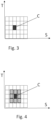
- Figure 3 shows an example of a 2D map.
- a sensor L1 is capable of detecting a refuelling operation of the tank S1 and a sensor L2 is capable of detecting a refuelling operation of the tank S2 with a gaseous fuel, which supplies the internal combustion engine.
- Said sensor can detect a sudden pressure increase in the tank of the fuel gas or it can detect the increase of the level sensor of the tank containing the liquid phase fuel.
- said first procedure is carried out monitoring the engine point and when the latter is deemed to be stable, said correction of the A/F ratio of the internal combustion engine is performed.
- the correction is preferably applied to the same extent to all the reference values of the operating dominion of the engine and, therefore, to the entire 2D map described above, when said procedure is triggered by a refuelling procedure, thus defining a so-called "first process".
- a second procedure starts, which is preferably carried out in a constant manner until a subsequent refuelling operation.
- a "second process” is provided, which is carried out when said first process has ended and involves a similar correction of the reference values Ref, cell by cell.
- the correction unlike what happens in the first process, is not applied to the entire map, but is applied to the sole cell C in which the engine operates and only optionally to near cells. Said cell C is dark in figure 3.
- Figure 4 shows the cells adjacent to the cell C.
- a more or less thick map can be obtained, i.e. a map with cells with a smaller size.
- the method can comprise making corrections in the immediately surrounding cells, which define a first level, and in further cells immediately adjacent to the cells of the first level. These further cells define a second level, etc..
- the correction is preferably weighed, i.e. proportionally decreased, when gradually moving away from the cell corresponding to the current engine point.
- This is a “zone” correction scheme and is slower than the "global correction”.
- the processing unit controlling the internal combustion engine comprises a second 2D map implemented for managing the supply of the internal combustion engine when the latter is supplied by a second tank S2 filled with a fuel that is different from the one of the previous tank S1. Therefore, when the supply is switched between two different fuel sources, a relative 2D map is implemented so as to to avoid excessively long convergence times of the first process, at first, and, then, of the second process.
- the vehicle can implement an LNG liquid methane tank and also a CNG gaseous methane tank (so-called "dual fuel” systems).
- This variant can be extended based on the number of tanks installed in the vehicle. In other words, for each tank being used there can be a 2D learning map.
- This invention can be advantageously implemented by means of a computer program comprising encoding means for carrying out one or more steps of the method, when the program is run on a computer. Therefore, the scope of protection is extended to said computer program and, furthermore, to means that can be read by a computer and comprise a recorded message, said means that can be read by a computer comprising program encoding means for carrying out one or more steps of the method, when the program is run on a computer.
- Figure 5 shows a step 0, during which the engine is in stationary conditions, which means that the number of revolutions and the delivered torque are constant for a predetermined amount of time.
- the method can be carried out only once o can be carried out for a predetermined number of times by means of an inner loop with a counter, which joins the input of step 3-1 to the input of step 0.
- Step 3-1 specifically involves changing the reference value of the air/fuel ratio in the entire operating dominion of the engine.
- step 3-2 of figure 5b which represents the second process, only involves changing the reference value of the air/fuel ratio of the cell C where the engine operates in the stationary conditions while the second procedure is carried out.
- Figure 5b shows the Yes/No outputs of step F reversed relative to one another, as it is carried out when the first process is not being performed or has ended.
Landscapes
- Engineering & Computer Science (AREA)
- Chemical & Material Sciences (AREA)
- Combustion & Propulsion (AREA)
- Mechanical Engineering (AREA)
- General Engineering & Computer Science (AREA)
- Materials Engineering (AREA)
- Health & Medical Sciences (AREA)
- Chemical Kinetics & Catalysis (AREA)
- Toxicology (AREA)
- Electrical Control Of Air Or Fuel Supplied To Internal-Combustion Engine (AREA)
- Combined Controls Of Internal Combustion Engines (AREA)
- Ignition Installations For Internal Combustion Engines (AREA)
Description
- Related applications This application claims priority from
Italian Patent Application No. 102018000003377 filed on 08/03/2018 - The invention relates to the field of methods and systems for managing a supply of a spark ignition engine.
- In spark ignition engines, also known as Otto engines, the respect of the stoichiometric ratio is crucial in order to observe the limits set by laws on polluting emissions.
- This is also important when trying to ensure uniform performances in terms of torque delivery, regardless of unpredictable changes in the quality of the fuel used.
- This problem is particularly urgent in the field of engines supplied with gas, for example natural gas, commonly known as methane, which can be stored in the tanks in a gaseous form (CNG) or in a liquid form (LNG).
- Gaseous or liquid fuels have a strong composition variability, which often makes it hard or even impossible to obtain, especially in a short time, a correct stoichiometry of the combustion.
- Drivers simply need to change filling station in order to find fuels that are very different from one another and, hence, require a different metering during the relative injection into the cylinders of the internal combustion engine.
- The quantity of fuel to be injected depends on the mass of fresh air introduced into the engine, which is measures by means of a dedicated sensor arranged on the intake manifold.
- The fuel supply of the internal combustion engine can be operated by means of a closed loop control, which uses a linear lambda sensor as a feedback signal in order to obtain a correct air/fuel ratio (A/F).
- Linear lambda sensors are precise and fast, allow the supply of the internal combustion engine to be properly corrected and ensure the stoichiometry of the combustion. However, linear lambda sensors are technically complicated and, therefore, expensive. Furthermore, they require a dedicated software for the conditioning of the relative generated signal.
- Binary lambda sensors, commonly known as ON/OFF sensors, are also known. They do not need a dedicated sensor and their implementation definitely is cheaper.
- These ON/OFF sensors also require a closed loop control scheme, forcing the air/fuel ratio (A/F) to oscillate around the stoichiometric value, thus obtaining - as feedback - the switching of the signal generated by the binary sensor. This A/F forcing operation modulates the supply of fuel, increasing or decreasing the quantity of fuel injected, so as to alternatively cause the combustion i taking place in the cylinder to lack oxygen or have excess oxygen.
- This forcing operation can be a multiplying non-dimensional correction of the reference signal controlling the mass of fuel to be injected. If its value is 1, there basically is no correction, whereas, if its value is more than 1 or less than 1, there is a correction of the mass of fuel to be injected relative to a reference value, in order to reach a reference air/fuel ratio.
- Therefore, the three-way catalyst is forced to work on a stoichiometric condition, in a bi-stable situation, namely continuously oscillating between an oxidizing operation and a reducing operation.
- Examples of this concept can be found in
US2008319634 andWO2010097267 . - The closed loop control is carried out by means of a PI (proportional and integral) controller, which corrects the supply of the internal combustion engine based on the switchings performed by the binary lambda sensor upstream of the three-way catalyst.
-
US4655188 shows a feedback control, in which alpha is a feedback correction control in the formula
- The object of the invention is to provide a method for managing a fuel supply of a spark ignition engine, which is capable of better adjusting to the variability of the fuel composition using a binary lambda sensor.
- The idea on which the invention is based is that of sampling the air/fuel ratio measured in at least two consecutive switchings of the binary sensor and of calculating an average value. The closed loop control is forced to cause the air/fuel ratio to converge towards said average value.
- Therefore, according to the invention, the air/fuel ratios are sampled in two consecutive switchings, which corresponds to sampling the control signals of the injectors, which has nothing in common with the sampling of the feedback variable.
- In other words, whereas in the invention the control is based on the air/fuel ratios, in
US4655188 the control is based on the feedback variable. In addition, the invention is independent of the implementation of a feedback control on of the possible features thereof. - Indeed, no variable measured on the exhaust line is acquired, but only the switching instants of the binary sensor are acquired. As a consequence, the control according to the invention, despite being capable of being combined with a traditional feedback control, can actually be compared with an open loop control.
- If the air mass flowing into the engine is decided by the driver, then the control manages the supply of fuel based on the air flowing into the engine. If, on the other hand, the throttle valve is motor-driven, then the control can also manage the opening of the throttle valves, besides the injection of fuel.
- When dealing with a control carried out by means of a processing unit and of electric injectors, the quantity of fuel clearly corresponds to an electric control signal of the injectors.
- The (electric) control signal of the injectors injecting fuel into the cylinders depends on the stoichiometry value towards which the control converges.
- Therefore, this average value, hereinafter referred to as "learned stoichiometry", alters the average quantity of fuel to be injected in a predetermined operating condition of the engine.
- The more the composition of the fuel changes relative to an ideal composition, the higher the aforesaid alteration of the mass of fuel to be injected is relative to an ideal condition.
- In other words, the reference quantity of fuel to be injected is pre-calculated in ideal conditions and, therefore, is referred to as "nominal stoichiometry".
- When the closed loop control involves the use of a multiplying coefficient, referred to as A/F forcing factor, to correct the air/fuel ratio, the method can alternatively comprise the sampling of said multiplying coefficient during said two switchings of the binary sensor and the subsequent calculation of the relative average value of the multiplying coefficient.
- The fact of sampling the air/fuel ratios during the switchings of the binary sensor is independent of the type of open loop control adopted.
- When the engine point remains stationary for a predetermined amount of time, said "learned stoichiometry" is preferably calculated as the mobile average of a plurality of consecutive switchings, preferably an even number of consecutive switchings. An even number of switchings leads to an advantageous effect, which allows the learning strategy to be simplified. Indeed, in this way, possible delays between the calculation of the A/F forcing factor and the moment of the rich/lean switching of the sensor itself are cancelled out. These delays affect both the rich state, thus causing an overestimation of the air/fuel ratio, and the lean state, thus causing an underestimation of the air/fuel ratio. An even number of samples causes the two delays, leading to an overestimation and to an underestimation of the air/fuel ratio, to compensate one another.
- According to a first aspect of the invention, said "learned stoichiometry" is calculated in an operating point of the engine and reflects on the entire operating interval of the internal combustion engine.
- For example, a change in the air/fuel ratio can be calculated relative to a reference value of the calculation engine point and the change can be applied to the entire operating interval of the engine or, if the system is working in terms of A/D forcing factor, the entire operating interval of the engine can be subjected to an intervention in terms of A/F forcing factor.
- This advantageously leads to a quick adjustment of the injection times of the engine to the changes in the chemical composition of the fuel, so that the internal combustion engine can perfectly work astride a stoichiometric combustion.
- The adjustment is preferably operated as soon as a filling of the tank with gaseous or liquid CNG or LNG fuel is detected.
- According to a preferred variant of the invention, a 2D map is stored in a memory allocation of the processing unit controlling the fuel supply of the internal combustion engine. This 2D map expresses a reference air/fuel ratio or a correction thereof as a function of the "engine point", namely of the revolutions/minute of the drive shaft and of the delivered torque.
- Therefore, the 2D map is provided with a plurality of cells. Similarly, said 2D map can store a central value of said A/F forcing factor, around which it oscillates, in order to determine the oscillation of the air/fuel ratio. Advantageously, when a refuelling procedure is detected, the fuel is renewed with a homogeneous chemical composition and the procedure described above is carried out, thus changing the air/fuel ratio or the central value of the A/F forcing factor in the entire operating field of the internal combustion engine, hence in all the cells making up said 2D map.
- According to a preferred variant of the invention, a second correction process is carried out in each engine point, for example in each cell of the aforesaid 2D map, when the engine operates in stationary conditions for a predetermined amount of time. This correction is not applied to all the cells of the 2D map in an indiscriminate manner, but only to the cell corresponding to the engine point in which the process to calculate the aforesaid average value was carried out, and, if necessary, is extended to the cells adjacent to said cell, by means of decreasing weighing factor.
- Therefore, whereas the first process preferably takes lace after a refuelling operation and affects the entire map, the second process takes place when the first process has ended and affects the sole cell corresponding to the relative engine point or, at the most, the cells nearby. The claims describe preferred embodiments of the invention, thus forming an integral part of the description.
- Further objects and advantages of the invention will be best understood upon perusal of the following detailed description of an embodiment thereof (and of relative variants) with reference to the accompanying drawings merely showing non-limiting examples, wherein:
-
figure 1 schematically shows a spark ignition internal combustion engine provided with relative supply means and with an exhaust line, on which there are arranged a three-way catalyst and a binary lambda sensor according to the invention; -
figure 2 shows a time diagram of the switchings due to the implementation of a binary lambda sensor and of the method according to the invention; -
figure 3 shows a 2D map where reference values are stored, which relate to injection times or to the mass of fuel to be injected in each combustion cycle of a cylinder; -
figure 4 shows the 2D map offigure 3 displaying a calculation cell and relative adjacent cells; -
figures 5, 5a and 5b respectively show a flowchart explaining the control method according to the invention, declined in the two variants offigures 5a and 5b , wherein the variant offigure 5a is preferably carried out when a refuelling procedure is detected, whereas the variant offigure 5b is carried out when the variant offigure 5a is deactivated. - In the figures, the same numbers and the same reference letters indicate the same elements or components.
- The blocks of
figure 2 represented with a broken line are to be considered as optional. - The broken-line connections of
figure 1 represent analogue or digital electric lines. - For the purposes of the invention, the term "second" component does not imply the presence of a "first" component. As a matter of fact, these terms are only used for greater clarity and should not be interpreted in a limiting manner.
-
Figure 1 schematically shows a spark ignition internal combustion engine E provided with supply means J, for example fuel injectors. - The engine E is provided with an exhaust line, on which which a three-way catalyst 3WC is housed. Upstream of the catalyst there is, along the exhaust line, a binary lambda sensor B, which is adapted to switch between two logical conditions indicating a lean and a rich combustion, respectively.
- A processing unit CPU monitors the control of the internal combustion engine E and, in particular, controls the injection of fuel into the cylinders of the engine by means of relative injectors J.
- Said processing unit implements a closed loop control over said binary lambda sensor B, causing the supply of the internal combustion engine to continuously oscillate around the stoichiometric air/fuel ratio (A/F).
- The processing unit, when a switching of the level of signal generated by the lambda sensor is detected, reverses the sign of the correction by means of the aforesaid "A/F forcing factor", until it detects a new switching of the level of signal generated by the sensor. The forcing factor, if expressed as a multiplying coefficient, oscillates relative to a central value, which, in ideal conditions, is 1. Therefore, 1.01 and 0.99 determine a rich condition or a lean condition of the air/fuel ratio.
- In the processing unit there is stored a reference value of the fuel to be injected into the internal combustion engine.
- The supply managing method according to the invention comprises a proportional/integral closed loop control over a binary signal (ON/OFF) generated by the binary lambda sensor, the method comprising a procedure for continuously changing an air/fuel ratio between a lean combustion condition and a rich combustion condition and vice versa, when a switching of said binary signal is detected, the method comprising a procedure carried out in stationary operating conditions of the internal combustion engine and consisting of:
- a first step of registering at least two values of said air/fuel ratio λ1 and λ2 for as many consecutive switchings,
- a second step of calculating an average value λm of said two registered values,
- a third step of setting said calculated average value as a reference value Ref of the air/fuel ratio.
- This setting can evidently be gradual, thus determining a convergence, when the method is carried out repeatedly for some processing cycles.
- In other words, the result is a zero value or, in case of a correction carried out by means of a multiplying coefficient, to a neutral value, i.e. equal to 1.
- The fact of setting said average value as reference value corresponds to calculating a variation D_Ref = λm - Ref.
-
Figure 2 shows a diagram of a supply signal of the internal combustion engine over time. The closed loop control, which is based on the binary signal generated by the binary lambda sensor, determines oscillations around a reference value Ref, which was previously stored in the processing unit. - In the case of
figure 2 , the reference value of the supply signal is greater than the stoichiometric value λm for the currently implemented fuel composition. - In the example, the switchings of the binary lambda sensor take place in λ1 and λ2, which are equally spaced apart from λm. Therefore, there is a difference between the previously stored A/F ratio Ref and the current one, which takes into account the actual composition of the fuel. When the engine remains in stationary conditions for a long time, these circumstances can be exploited by calculating a mobile average between the air/fuel ratios of the ON/OFF switchings of the sensor.
- The processing unit preferably implements a closed loop control scheme with a proportional and integrative controller PI on the feedback branch, as suggested by the prior art documents for spark ignition Otto engines. This scheme, though, is changed as described above.
- The reference value Ref changes upon variation of the engine point and is an ideal value, since it depends on an ideal fuel.
-
Figure 3 shows an example of a 2D map. - A sensor L1 is capable of detecting a refuelling operation of the tank S1 and a sensor L2 is capable of detecting a refuelling operation of the tank S2 with a gaseous fuel, which supplies the internal combustion engine. Said sensor can detect a sudden pressure increase in the tank of the fuel gas or it can detect the increase of the level sensor of the tank containing the liquid phase fuel.
- When, after having detected said refuelling operation, said first procedure is carried out monitoring the engine point and when the latter is deemed to be stable, said correction of the A/F ratio of the internal combustion engine is performed.
- The correction is preferably applied to the same extent to all the reference values of the operating dominion of the engine and, therefore, to the entire 2D map described above, when said procedure is triggered by a refuelling procedure, thus defining a so-called "first process". According to a preferred variant of the invention, after having ended the first procedure triggered by the refuelling procedure, a second procedure starts, which is preferably carried out in a constant manner until a subsequent refuelling operation.
- According to a preferred variant of the invention, which can be combined with the previous one, a "second process" is provided, which is carried out when said first process has ended and involves a similar correction of the reference values Ref, cell by cell.
- In other words, the correction, unlike what happens in the first process, is not applied to the entire map, but is applied to the sole cell C in which the engine operates and only optionally to near cells. Said cell C is dark in
figure 3. Figure 4 , on the other hand, shows the cells adjacent to the cell C. - This is a "punctual correction", which is opposed to the "global correction" performed on the entire map.
- Depending on the adopted solution, namely on the degree of division of the operating field of the engine, a more or less thick map can be obtained, i.e. a map with cells with a smaller size.
- In case of a very thick map, the method can comprise making corrections in the immediately surrounding cells, which define a first level, and in further cells immediately adjacent to the cells of the first level. These further cells define a second level, etc..
- In this case, again, the correction is preferably weighed, i.e. proportionally decreased, when gradually moving away from the cell corresponding to the current engine point. This is a "zone" correction scheme and is slower than the "global correction".
- According to a further preferred variant of the invention, the processing unit controlling the internal combustion engine comprises a second 2D map implemented for managing the supply of the internal combustion engine when the latter is supplied by a second tank S2 filled with a fuel that is different from the one of the previous tank S1. Therefore, when the supply is switched between two different fuel sources, a relative 2D map is implemented so as to to avoid excessively long convergence times of the first process, at first, and, then, of the second process. Hence, the vehicle can implement an LNG liquid methane tank and also a CNG gaseous methane tank (so-called "dual fuel" systems).
- In other words, when the supply is switched from CNG to LNG and vice versa, the processing unit starts working on the corresponding 2D map.
- This variant can be extended based on the number of tanks installed in the vehicle. In other words, for each tank being used there can be a 2D learning map.
- This invention can be advantageously implemented by means of a computer program comprising encoding means for carrying out one or more steps of the method, when the program is run on a computer. Therefore, the scope of protection is extended to said computer program and, furthermore, to means that can be read by a computer and comprise a recorded message, said means that can be read by a computer comprising program encoding means for carrying out one or more steps of the method, when the program is run on a computer.
-
Figure 5 shows astep 0, during which the engine is in stationary conditions, which means that the number of revolutions and the delivered torque are constant for a predetermined amount of time. - Subsequently, the above-mentioned steps 1 - 3 are carried out and the process starts again from the beginning.
- In case of implementation of the first process, which is shown in
figure 5a , a refuelling procedure has just been preliminarily performed by means of the step F. - The method can be carried out only once o can be carried out for a predetermined number of times by means of an inner loop with a counter, which joins the input of step 3-1 to the input of
step 0. - Step 3-1 specifically involves changing the reference value of the air/fuel ratio in the entire operating dominion of the engine.
- On the contrary, step 3-2 of
figure 5b , which represents the second process, only involves changing the reference value of the air/fuel ratio of the cell C where the engine operates in the stationary conditions while the second procedure is carried out. -
Figure 5b shows the Yes/No outputs of step F reversed relative to one another, as it is carried out when the first process is not being performed or has ended.
Claims (15)
- A method for managing a supply of a spark ignition internal combustion engine (E), the engine (E) being provided with+ a fuel supply system (J) adapted to meter fuel in response to supply signals,+ a three-way catalyst (3WC) connected to an outlet manifold of the internal combustion engine,+ a binary lambda sensor (B), adapted to switch between two operative conditions respectively indicating lean and rich burn, said sensor being arranged immediately upstream of said catalyst (3WC),the method comprising a procedure of commanding said supply system on the basis of a switching between said operative conditions, so that said combustion oscillates over a stoichiometric combustion condition, and so that an air/fuel ratio oscillates around a reference value (Ref) stored in a processing unit,the method comprising a first procedure carried out in stationary operating conditions of the internal combustion engine formed by,- a first step of registering two values (λ1, λ2) of an air/fuel ratio for as many consecutive switchings between said operative conditions by means of sampling the supply signals,- a second step of calculating an average value (Am) of said two registered values,- a third step of setting said calculated average value as the reference value (Ref) of the air/fuel ratio.
- The method according to claim 1, wherein said average value is calculated by means of a mobile average over a plurality of consecutive switchings.
- The method according to any one of the preceding claims 1 or 2, wherein said procedure is activated when a procedure of supplying a tank (S) supplying said supply system (J) is detected.
- The method according to claim 3, wherein a difference (Ref - Am) between said reference value (Ref) and said average value (λm) is called (Delta_lambda) error, before carrying out said third step, and wherein said reference value is mapped on the entire operating dominion of the internal combustion engine, and wherein said third step includes correction of said reference value by means of said error for all the values of the reference value of said mapping.
- The method according to claim 4, wherein said operating domain of the internal combustion engine is mapped in a 2D map and wherein said third step includes correction of said reference value by means of said error for all the values in the cells of said 2D map.
- The method according to any one of the preceding claims, wherein said first procedure is carried out for a predetermined number of cycles and is then terminated.
- The method according to any one of the preceding claims from 1 to 3, wherein said third step is carried out only for a reference value (Ref) corresponding to said stationary operating conditions of the internal combustion engine.
- The method according to any one of the claims from 4 to 6, further comprising a second procedure comprising the aforementioned first, second and third steps, wherein said third step is carried out only for a reference value (Ref) corresponding to said stationary operating conditions of the internal combustion engine and wherein said second procedure is carried out when said first procedure has been terminated.
- The method according to claim 8, wherein an operating dominion of the internal combustion engine is mapped in a 2D map and wherein, in each cell of said map a reference value of said air/fuel ratio is shown and wherein a difference (Ref - Am) between said reference value (Ref), before the execution of said third step, and said average value (Am) is called (Delta_lambda) error, and wherein said third step includes correction of said reference value of a first cell (C) of said 2D map, at said stationary operating conditions of the internal combustion engine.
- The method according to claim 9, wherein a correction is carried out on the cells adjacent to said first cell by weighing said error by means of a coefficient P.
- A system for managing a supply of an internal combustion engine provided with+ a fuel supply system (J) adapted to meter fuel in response to supply signals,+ a three-way catalyst (3WC) connected to an outlet manifold of the internal combustion engine,+ a binary lambda sensor (B), adapted to switch between two logical conditions respectively indicating lean and rich burn, said sensor being arranged immediately upstream of said catalyst (3WC),characterized in that said management system comprises a processing unit (ECU), configured to carry out all the steps of any one of the claims from 1 to 10.
- A terrestrial vehicle provided with+ an internal combustion engine (E) having a fuel supply system (J) adapted to meter fuel in response to supply signals,+ a three-way catalyst (3WC) connected to an outlet manifold of the internal combustion engine,+ a binary lambda sensor (B), adapted to switch between two logical conditions respectively indicating lean and rich burn, said sensor being arranged immediately upstream of said catalyst (3WC),+ a management system for supplying said internal combustion engine according to claim 11.
- The vehicle according to claim 12, further comprising a tank (S1, S2) of gaseous fuel, provided with a sensor (L1, L2) adapted to detect a procedure of supplying said tank with fuel.
- A computer program comprising program encoding means adapted to cause the system of claim 11 to perform all the steps of any one of the claims from 1 to 10.
- Computer-readable means comprising the computer program of claim 14.
Applications Claiming Priority (2)
| Application Number | Priority Date | Filing Date | Title |
|---|---|---|---|
| IT102018000003377A IT201800003377A1 (en) | 2018-03-08 | 2018-03-08 | METHOD OF MANAGING A POWER SUPPLY OF AN INTERNAL COMBUSTION ENGINE WITH COMMANDED IGNITION AND IMPLEMENTING POWER SUPPLY SYSTEM SAID METHOD |
| PCT/IB2019/051901 WO2019171343A1 (en) | 2018-03-08 | 2019-03-08 | Method for managing a fuel supply of a spark ignition internal combustion engine and a supply system implementing said method |
Publications (2)
| Publication Number | Publication Date |
|---|---|
| EP3762598A1 EP3762598A1 (en) | 2021-01-13 |
| EP3762598B1 true EP3762598B1 (en) | 2024-10-09 |
Family
ID=62386812
Family Applications (1)
| Application Number | Title | Priority Date | Filing Date |
|---|---|---|---|
| EP19716552.5A Active EP3762598B1 (en) | 2018-03-08 | 2019-03-08 | Method for managing a fuel supply of a spark ignition internal combustion engine and a supply system implementing said method |
Country Status (5)
| Country | Link |
|---|---|
| EP (1) | EP3762598B1 (en) |
| KR (1) | KR102604262B1 (en) |
| CN (1) | CN112041550B (en) |
| IT (1) | IT201800003377A1 (en) |
| WO (1) | WO2019171343A1 (en) |
Family Cites Families (13)
| Publication number | Priority date | Publication date | Assignee | Title |
|---|---|---|---|---|
| US4703430A (en) * | 1983-11-21 | 1987-10-27 | Hitachi, Ltd. | Method controlling air-fuel ratio |
| GB2165063B (en) * | 1984-01-24 | 1987-08-12 | Japan Electronic Control Syst | Air/fuel mixture ratio learning controller in electronic control fuel injection internal combustion engine |
| JPS6176733A (en) * | 1984-09-10 | 1986-04-19 | Mazda Motor Corp | Air-fuel ratio control device of engine |
| US4850326A (en) * | 1986-10-21 | 1989-07-25 | Japan Electronic Control Systems, Co., Ltd. | Apparatus for learning and controlling air/fuel ratio in internal combustion engine |
| JP2721978B2 (en) * | 1988-08-31 | 1998-03-04 | 富士重工業株式会社 | Air-fuel ratio learning control device |
| JP2581775B2 (en) * | 1988-09-05 | 1997-02-12 | 株式会社日立製作所 | Fuel injection control method for internal combustion engine and control apparatus therefor |
| US5467755A (en) * | 1994-08-25 | 1995-11-21 | Ford Motor Company | Method and system for controlling flexible fuel vehicle fueling |
| DE102004050092B3 (en) * | 2004-10-14 | 2006-04-13 | Siemens Ag | Method for controlling the lambda value of an internal combustion engine |
| JP2007009903A (en) * | 2005-06-01 | 2007-01-18 | Toyota Motor Corp | Fuel injection amount control device for internal combustion engine |
| JP2008144723A (en) * | 2006-12-13 | 2008-06-26 | Toyota Motor Corp | Control device for internal combustion engine |
| GB2516658A (en) * | 2013-07-29 | 2015-02-04 | Gm Global Tech Operations Inc | Method of correcting operating set points of an internal combustion engine |
| JP6209982B2 (en) * | 2014-01-31 | 2017-10-11 | トヨタ自動車株式会社 | Internal combustion engine control system |
| DE102016213767B4 (en) * | 2016-07-27 | 2018-05-30 | Audi Ag | Method and device for diagnosing an exhaust system of an internal combustion engine |
-
2018
- 2018-03-08 IT IT102018000003377A patent/IT201800003377A1/en unknown
-
2019
- 2019-03-08 KR KR1020207028541A patent/KR102604262B1/en active Active
- 2019-03-08 WO PCT/IB2019/051901 patent/WO2019171343A1/en not_active Ceased
- 2019-03-08 CN CN201980017654.6A patent/CN112041550B/en active Active
- 2019-03-08 EP EP19716552.5A patent/EP3762598B1/en active Active
Also Published As
| Publication number | Publication date |
|---|---|
| EP3762598A1 (en) | 2021-01-13 |
| WO2019171343A1 (en) | 2019-09-12 |
| IT201800003377A1 (en) | 2019-09-08 |
| KR102604262B1 (en) | 2023-11-21 |
| CN112041550A (en) | 2020-12-04 |
| BR112020018224A2 (en) | 2020-12-29 |
| CN112041550B (en) | 2024-03-26 |
| KR20200133351A (en) | 2020-11-27 |
Similar Documents
| Publication | Publication Date | Title |
|---|---|---|
| US6928998B2 (en) | Fuel properties estimation for internal combustion engine | |
| RU2717476C2 (en) | Method (versions) and system for engine control based on assessment of air-fuel ratio by means of oxygen sensor with variable voltage | |
| US20100198486A1 (en) | Method for operating an internal combustion engine | |
| JP6269367B2 (en) | Control device for internal combustion engine | |
| US20120080016A1 (en) | Individual cylinder fuel control systems and methods for oxygen sensor degredation | |
| US8793976B2 (en) | Sulfur accumulation monitoring systems and methods | |
| EP2538058B1 (en) | Idle rotation speed control device for bifuel engine | |
| EP3762598B1 (en) | Method for managing a fuel supply of a spark ignition internal combustion engine and a supply system implementing said method | |
| JP5427727B2 (en) | Engine control system | |
| JPH08261045A (en) | Air-fuel ratio control device for internal combustion engine | |
| JP2015209762A (en) | Engine control system | |
| JP2021076052A (en) | Internal combustion engine control device | |
| EP2098709A1 (en) | A method for operating an internal combustion engine | |
| JP2004285972A (en) | Control device for internal combustion engine | |
| JPH0531245Y2 (en) | ||
| JPH0437260B2 (en) | ||
| JP2015140791A (en) | Control device of internal combustion engine | |
| JP5418678B2 (en) | Injection amount learning device for internal combustion engine | |
| JP6361534B2 (en) | Control device for internal combustion engine | |
| JP2004293349A (en) | Control device for internal combustion engine | |
| JP5859842B2 (en) | Fuel injection system | |
| BR112020018224B1 (en) | METHOD FOR MANAGING FUEL SUPPLY TO AN INTERNAL COMBUSTION ENGINE WITH SPARK IGNITION AND SUPPLY SYSTEM IMPLEMENTING SAID METHOD | |
| JP2011132930A (en) | Ignition system of gas fuel internal combustion engine | |
| JP2004245098A (en) | Control device for internal combustion engine | |
| JP2021105360A (en) | Engine control system |
Legal Events
| Date | Code | Title | Description |
|---|---|---|---|
| STAA | Information on the status of an ep patent application or granted ep patent |
Free format text: STATUS: UNKNOWN |
|
| STAA | Information on the status of an ep patent application or granted ep patent |
Free format text: STATUS: THE INTERNATIONAL PUBLICATION HAS BEEN MADE |
|
| PUAI | Public reference made under article 153(3) epc to a published international application that has entered the european phase |
Free format text: ORIGINAL CODE: 0009012 |
|
| STAA | Information on the status of an ep patent application or granted ep patent |
Free format text: STATUS: REQUEST FOR EXAMINATION WAS MADE |
|
| 17P | Request for examination filed |
Effective date: 20200916 |
|
| AK | Designated contracting states |
Kind code of ref document: A1 Designated state(s): AL AT BE BG CH CY CZ DE DK EE ES FI FR GB GR HR HU IE IS IT LI LT LU LV MC MK MT NL NO PL PT RO RS SE SI SK SM TR |
|
| AX | Request for extension of the european patent |
Extension state: BA ME |
|
| RIN1 | Information on inventor provided before grant (corrected) |
Inventor name: CARO, MARCELLO Inventor name: AIMAR, BRUNO Inventor name: BRUCATO, ALDO |
|
| DAV | Request for validation of the european patent (deleted) | ||
| DAX | Request for extension of the european patent (deleted) | ||
| STAA | Information on the status of an ep patent application or granted ep patent |
Free format text: STATUS: EXAMINATION IS IN PROGRESS |
|
| 17Q | First examination report despatched |
Effective date: 20221104 |
|
| GRAP | Despatch of communication of intention to grant a patent |
Free format text: ORIGINAL CODE: EPIDOSNIGR1 |
|
| STAA | Information on the status of an ep patent application or granted ep patent |
Free format text: STATUS: GRANT OF PATENT IS INTENDED |
|
| INTG | Intention to grant announced |
Effective date: 20240508 |
|
| P01 | Opt-out of the competence of the unified patent court (upc) registered |
Free format text: CASE NUMBER: APP_39682/2024 Effective date: 20240703 |
|
| GRAS | Grant fee paid |
Free format text: ORIGINAL CODE: EPIDOSNIGR3 |
|
| GRAA | (expected) grant |
Free format text: ORIGINAL CODE: 0009210 |
|
| STAA | Information on the status of an ep patent application or granted ep patent |
Free format text: STATUS: THE PATENT HAS BEEN GRANTED |
|
| AK | Designated contracting states |
Kind code of ref document: B1 Designated state(s): AL AT BE BG CH CY CZ DE DK EE ES FI FR GB GR HR HU IE IS IT LI LT LU LV MC MK MT NL NO PL PT RO RS SE SI SK SM TR |
|
| REG | Reference to a national code |
Ref country code: CH Ref legal event code: EP |
|
| REG | Reference to a national code |
Ref country code: DE Ref legal event code: R096 Ref document number: 602019060025 Country of ref document: DE |
|
| REG | Reference to a national code |
Ref country code: IE Ref legal event code: FG4D |
|
| REG | Reference to a national code |
Ref country code: LT Ref legal event code: MG9D |
|
| REG | Reference to a national code |
Ref country code: NL Ref legal event code: MP Effective date: 20241009 |
|
| REG | Reference to a national code |
Ref country code: AT Ref legal event code: MK05 Ref document number: 1730823 Country of ref document: AT Kind code of ref document: T Effective date: 20241009 |
|
| PG25 | Lapsed in a contracting state [announced via postgrant information from national office to epo] |
Ref country code: NL Free format text: LAPSE BECAUSE OF FAILURE TO SUBMIT A TRANSLATION OF THE DESCRIPTION OR TO PAY THE FEE WITHIN THE PRESCRIBED TIME-LIMIT Effective date: 20241009 |
|
| PG25 | Lapsed in a contracting state [announced via postgrant information from national office to epo] |
Ref country code: NL Free format text: LAPSE BECAUSE OF FAILURE TO SUBMIT A TRANSLATION OF THE DESCRIPTION OR TO PAY THE FEE WITHIN THE PRESCRIBED TIME-LIMIT Effective date: 20241009 |
|
| PG25 | Lapsed in a contracting state [announced via postgrant information from national office to epo] |
Ref country code: IS Free format text: LAPSE BECAUSE OF FAILURE TO SUBMIT A TRANSLATION OF THE DESCRIPTION OR TO PAY THE FEE WITHIN THE PRESCRIBED TIME-LIMIT Effective date: 20250209 Ref country code: PT Free format text: LAPSE BECAUSE OF FAILURE TO SUBMIT A TRANSLATION OF THE DESCRIPTION OR TO PAY THE FEE WITHIN THE PRESCRIBED TIME-LIMIT Effective date: 20250210 Ref country code: HR Free format text: LAPSE BECAUSE OF FAILURE TO SUBMIT A TRANSLATION OF THE DESCRIPTION OR TO PAY THE FEE WITHIN THE PRESCRIBED TIME-LIMIT Effective date: 20241009 |
|
| PG25 | Lapsed in a contracting state [announced via postgrant information from national office to epo] |
Ref country code: FI Free format text: LAPSE BECAUSE OF FAILURE TO SUBMIT A TRANSLATION OF THE DESCRIPTION OR TO PAY THE FEE WITHIN THE PRESCRIBED TIME-LIMIT Effective date: 20241009 |
|
| PG25 | Lapsed in a contracting state [announced via postgrant information from national office to epo] |
Ref country code: BG Free format text: LAPSE BECAUSE OF FAILURE TO SUBMIT A TRANSLATION OF THE DESCRIPTION OR TO PAY THE FEE WITHIN THE PRESCRIBED TIME-LIMIT Effective date: 20241009 |
|
| PG25 | Lapsed in a contracting state [announced via postgrant information from national office to epo] |
Ref country code: ES Free format text: LAPSE BECAUSE OF FAILURE TO SUBMIT A TRANSLATION OF THE DESCRIPTION OR TO PAY THE FEE WITHIN THE PRESCRIBED TIME-LIMIT Effective date: 20241009 |
|
| PG25 | Lapsed in a contracting state [announced via postgrant information from national office to epo] |
Ref country code: NO Free format text: LAPSE BECAUSE OF FAILURE TO SUBMIT A TRANSLATION OF THE DESCRIPTION OR TO PAY THE FEE WITHIN THE PRESCRIBED TIME-LIMIT Effective date: 20250109 |
|
| PG25 | Lapsed in a contracting state [announced via postgrant information from national office to epo] |
Ref country code: LV Free format text: LAPSE BECAUSE OF FAILURE TO SUBMIT A TRANSLATION OF THE DESCRIPTION OR TO PAY THE FEE WITHIN THE PRESCRIBED TIME-LIMIT Effective date: 20241009 Ref country code: GR Free format text: LAPSE BECAUSE OF FAILURE TO SUBMIT A TRANSLATION OF THE DESCRIPTION OR TO PAY THE FEE WITHIN THE PRESCRIBED TIME-LIMIT Effective date: 20250110 Ref country code: AT Free format text: LAPSE BECAUSE OF FAILURE TO SUBMIT A TRANSLATION OF THE DESCRIPTION OR TO PAY THE FEE WITHIN THE PRESCRIBED TIME-LIMIT Effective date: 20241009 |
|
| PG25 | Lapsed in a contracting state [announced via postgrant information from national office to epo] |
Ref country code: PL Free format text: LAPSE BECAUSE OF FAILURE TO SUBMIT A TRANSLATION OF THE DESCRIPTION OR TO PAY THE FEE WITHIN THE PRESCRIBED TIME-LIMIT Effective date: 20241009 |
|
| PG25 | Lapsed in a contracting state [announced via postgrant information from national office to epo] |
Ref country code: RS Free format text: LAPSE BECAUSE OF FAILURE TO SUBMIT A TRANSLATION OF THE DESCRIPTION OR TO PAY THE FEE WITHIN THE PRESCRIBED TIME-LIMIT Effective date: 20250109 |
|
| PG25 | Lapsed in a contracting state [announced via postgrant information from national office to epo] |
Ref country code: SM Free format text: LAPSE BECAUSE OF FAILURE TO SUBMIT A TRANSLATION OF THE DESCRIPTION OR TO PAY THE FEE WITHIN THE PRESCRIBED TIME-LIMIT Effective date: 20241009 |
|
| PG25 | Lapsed in a contracting state [announced via postgrant information from national office to epo] |
Ref country code: DK Free format text: LAPSE BECAUSE OF FAILURE TO SUBMIT A TRANSLATION OF THE DESCRIPTION OR TO PAY THE FEE WITHIN THE PRESCRIBED TIME-LIMIT Effective date: 20241009 |
|
| REG | Reference to a national code |
Ref country code: DE Ref legal event code: R097 Ref document number: 602019060025 Country of ref document: DE |
|
| PG25 | Lapsed in a contracting state [announced via postgrant information from national office to epo] |
Ref country code: EE Free format text: LAPSE BECAUSE OF FAILURE TO SUBMIT A TRANSLATION OF THE DESCRIPTION OR TO PAY THE FEE WITHIN THE PRESCRIBED TIME-LIMIT Effective date: 20241009 |
|
| PG25 | Lapsed in a contracting state [announced via postgrant information from national office to epo] |
Ref country code: RO Free format text: LAPSE BECAUSE OF FAILURE TO SUBMIT A TRANSLATION OF THE DESCRIPTION OR TO PAY THE FEE WITHIN THE PRESCRIBED TIME-LIMIT Effective date: 20241009 |
|
| PG25 | Lapsed in a contracting state [announced via postgrant information from national office to epo] |
Ref country code: SK Free format text: LAPSE BECAUSE OF FAILURE TO SUBMIT A TRANSLATION OF THE DESCRIPTION OR TO PAY THE FEE WITHIN THE PRESCRIBED TIME-LIMIT Effective date: 20241009 |
|
| PG25 | Lapsed in a contracting state [announced via postgrant information from national office to epo] |
Ref country code: CZ Free format text: LAPSE BECAUSE OF FAILURE TO SUBMIT A TRANSLATION OF THE DESCRIPTION OR TO PAY THE FEE WITHIN THE PRESCRIBED TIME-LIMIT Effective date: 20241009 |
|
| PLBE | No opposition filed within time limit |
Free format text: ORIGINAL CODE: 0009261 |
|
| STAA | Information on the status of an ep patent application or granted ep patent |
Free format text: STATUS: NO OPPOSITION FILED WITHIN TIME LIMIT |
|
| PG25 | Lapsed in a contracting state [announced via postgrant information from national office to epo] |
Ref country code: SE Free format text: LAPSE BECAUSE OF FAILURE TO SUBMIT A TRANSLATION OF THE DESCRIPTION OR TO PAY THE FEE WITHIN THE PRESCRIBED TIME-LIMIT Effective date: 20241009 |
|
| 26N | No opposition filed |
Effective date: 20250710 |
|
| PG25 | Lapsed in a contracting state [announced via postgrant information from national office to epo] |
Ref country code: MC Free format text: LAPSE BECAUSE OF FAILURE TO SUBMIT A TRANSLATION OF THE DESCRIPTION OR TO PAY THE FEE WITHIN THE PRESCRIBED TIME-LIMIT Effective date: 20241009 |
|
| REG | Reference to a national code |
Ref country code: CH Ref legal event code: H13 Free format text: ST27 STATUS EVENT CODE: U-0-0-H10-H13 (AS PROVIDED BY THE NATIONAL OFFICE) Effective date: 20251023 |
|
| PG25 | Lapsed in a contracting state [announced via postgrant information from national office to epo] |
Ref country code: LU Free format text: LAPSE BECAUSE OF NON-PAYMENT OF DUE FEES Effective date: 20250308 |
|
| GBPC | Gb: european patent ceased through non-payment of renewal fee |
Effective date: 20250308 |
|
| REG | Reference to a national code |
Ref country code: BE Ref legal event code: MM Effective date: 20250331 |
|
| PG25 | Lapsed in a contracting state [announced via postgrant information from national office to epo] |
Ref country code: GB Free format text: LAPSE BECAUSE OF NON-PAYMENT OF DUE FEES Effective date: 20250308 |
|
| PG25 | Lapsed in a contracting state [announced via postgrant information from national office to epo] |
Ref country code: BE Free format text: LAPSE BECAUSE OF NON-PAYMENT OF DUE FEES Effective date: 20250331 |
|
| PG25 | Lapsed in a contracting state [announced via postgrant information from national office to epo] |
Ref country code: CH Free format text: LAPSE BECAUSE OF NON-PAYMENT OF DUE FEES Effective date: 20250331 |
|
| PG25 | Lapsed in a contracting state [announced via postgrant information from national office to epo] |
Ref country code: IE Free format text: LAPSE BECAUSE OF NON-PAYMENT OF DUE FEES Effective date: 20250308 |
|
| PGFP | Annual fee paid to national office [announced via postgrant information from national office to epo] |
Ref country code: DE Payment date: 20260320 Year of fee payment: 8 |
|
| PGFP | Annual fee paid to national office [announced via postgrant information from national office to epo] |
Ref country code: IT Payment date: 20260311 Year of fee payment: 8 |
|
| PGFP | Annual fee paid to national office [announced via postgrant information from national office to epo] |
Ref country code: FR Payment date: 20260323 Year of fee payment: 8 |