EP3762244B1 - Spring assembly for a tandem axle vehicle suspension - Google Patents
Spring assembly for a tandem axle vehicle suspension Download PDFInfo
- Publication number
- EP3762244B1 EP3762244B1 EP19712698.0A EP19712698A EP3762244B1 EP 3762244 B1 EP3762244 B1 EP 3762244B1 EP 19712698 A EP19712698 A EP 19712698A EP 3762244 B1 EP3762244 B1 EP 3762244B1
- Authority
- EP
- European Patent Office
- Prior art keywords
- spring
- washers
- washer
- assembly
- axial direction
- Prior art date
- Legal status (The legal status is an assumption and is not a legal conclusion. Google has not performed a legal analysis and makes no representation as to the accuracy of the status listed.)
- Active
Links
Images



Classifications
-
- B—PERFORMING OPERATIONS; TRANSPORTING
- B60—VEHICLES IN GENERAL
- B60G—VEHICLE SUSPENSION ARRANGEMENTS
- B60G11/00—Resilient suspensions characterised by arrangement, location or kind of springs
- B60G11/32—Resilient suspensions characterised by arrangement, location or kind of springs having springs of different kinds
- B60G11/34—Resilient suspensions characterised by arrangement, location or kind of springs having springs of different kinds including leaf springs
- B60G11/38—Resilient suspensions characterised by arrangement, location or kind of springs having springs of different kinds including leaf springs and also rubber springs
- B60G11/40—Resilient suspensions characterised by arrangement, location or kind of springs having springs of different kinds including leaf springs and also rubber springs the rubber springs being attached to the axle
-
- B—PERFORMING OPERATIONS; TRANSPORTING
- B60—VEHICLES IN GENERAL
- B60G—VEHICLE SUSPENSION ARRANGEMENTS
- B60G9/00—Resilient suspensions of a rigid axle or axle housing for two or more wheels
- B60G9/003—Resilient suspensions of a rigid axle or axle housing for two or more wheels the axle being rigidly connected to a trailing guiding device
-
- B—PERFORMING OPERATIONS; TRANSPORTING
- B60—VEHICLES IN GENERAL
- B60G—VEHICLE SUSPENSION ARRANGEMENTS
- B60G5/00—Resilient suspensions for a set of tandem wheels or axles having interrelated movements
- B60G5/02—Resilient suspensions for a set of tandem wheels or axles having interrelated movements mounted on a single pivoted arm, e.g. the arm being rigid
- B60G5/03—Resilient suspensions for a set of tandem wheels or axles having interrelated movements mounted on a single pivoted arm, e.g. the arm being rigid the arm itself being resilient, e.g. a leafspring
-
- F—MECHANICAL ENGINEERING; LIGHTING; HEATING; WEAPONS; BLASTING
- F16—ENGINEERING ELEMENTS AND UNITS; GENERAL MEASURES FOR PRODUCING AND MAINTAINING EFFECTIVE FUNCTIONING OF MACHINES OR INSTALLATIONS; THERMAL INSULATION IN GENERAL
- F16F—SPRINGS; SHOCK-ABSORBERS; MEANS FOR DAMPING VIBRATION
- F16F1/00—Springs
- F16F1/02—Springs made of steel or other material having low internal friction; Wound, torsion, leaf, cup, ring or the like springs, the material of the spring not being relevant
- F16F1/32—Belleville-type springs
- F16F1/324—Belleville-type springs characterised by having tongues or arms directed in a generally radial direction, i.e. diaphragm-type springs
-
- F—MECHANICAL ENGINEERING; LIGHTING; HEATING; WEAPONS; BLASTING
- F16—ENGINEERING ELEMENTS AND UNITS; GENERAL MEASURES FOR PRODUCING AND MAINTAINING EFFECTIVE FUNCTIONING OF MACHINES OR INSTALLATIONS; THERMAL INSULATION IN GENERAL
- F16F—SPRINGS; SHOCK-ABSORBERS; MEANS FOR DAMPING VIBRATION
- F16F1/00—Springs
- F16F1/36—Springs made of rubber or other material having high internal friction, e.g. thermoplastic elastomers
- F16F1/40—Springs made of rubber or other material having high internal friction, e.g. thermoplastic elastomers consisting of a stack of similar elements separated by non-elastic intermediate layers
-
- F—MECHANICAL ENGINEERING; LIGHTING; HEATING; WEAPONS; BLASTING
- F16—ENGINEERING ELEMENTS AND UNITS; GENERAL MEASURES FOR PRODUCING AND MAINTAINING EFFECTIVE FUNCTIONING OF MACHINES OR INSTALLATIONS; THERMAL INSULATION IN GENERAL
- F16F—SPRINGS; SHOCK-ABSORBERS; MEANS FOR DAMPING VIBRATION
- F16F1/00—Springs
- F16F1/36—Springs made of rubber or other material having high internal friction, e.g. thermoplastic elastomers
- F16F1/40—Springs made of rubber or other material having high internal friction, e.g. thermoplastic elastomers consisting of a stack of similar elements separated by non-elastic intermediate layers
- F16F1/403—Springs made of rubber or other material having high internal friction, e.g. thermoplastic elastomers consisting of a stack of similar elements separated by non-elastic intermediate layers characterised by the shape of the non-elastic interengaging parts between the elements
-
- B—PERFORMING OPERATIONS; TRANSPORTING
- B60—VEHICLES IN GENERAL
- B60G—VEHICLE SUSPENSION ARRANGEMENTS
- B60G2202/00—Indexing codes relating to the type of spring, damper or actuator
- B60G2202/10—Type of spring
- B60G2202/11—Leaf spring
- B60G2202/112—Leaf spring longitudinally arranged
-
- B—PERFORMING OPERATIONS; TRANSPORTING
- B60—VEHICLES IN GENERAL
- B60G—VEHICLE SUSPENSION ARRANGEMENTS
- B60G2202/00—Indexing codes relating to the type of spring, damper or actuator
- B60G2202/10—Type of spring
- B60G2202/14—Plastic spring, e.g. rubber
-
- B—PERFORMING OPERATIONS; TRANSPORTING
- B60—VEHICLES IN GENERAL
- B60G—VEHICLE SUSPENSION ARRANGEMENTS
- B60G2202/00—Indexing codes relating to the type of spring, damper or actuator
- B60G2202/10—Type of spring
- B60G2202/14—Plastic spring, e.g. rubber
- B60G2202/143—Plastic spring, e.g. rubber subjected to compression
-
- B—PERFORMING OPERATIONS; TRANSPORTING
- B60—VEHICLES IN GENERAL
- B60G—VEHICLE SUSPENSION ARRANGEMENTS
- B60G2206/00—Indexing codes related to the manufacturing of suspensions: constructional features, the materials used, procedures or tools
- B60G2206/01—Constructional features of suspension elements, e.g. arms, dampers, springs
- B60G2206/011—Modular constructions
- B60G2206/0112—Bogies for heavy vehicles
-
- B—PERFORMING OPERATIONS; TRANSPORTING
- B60—VEHICLES IN GENERAL
- B60G—VEHICLE SUSPENSION ARRANGEMENTS
- B60G2206/00—Indexing codes related to the manufacturing of suspensions: constructional features, the materials used, procedures or tools
- B60G2206/01—Constructional features of suspension elements, e.g. arms, dampers, springs
- B60G2206/40—Constructional features of dampers and/or springs
- B60G2206/42—Springs
-
- B—PERFORMING OPERATIONS; TRANSPORTING
- B60—VEHICLES IN GENERAL
- B60G—VEHICLE SUSPENSION ARRANGEMENTS
- B60G2300/00—Indexing codes relating to the type of vehicle
- B60G2300/02—Trucks; Load vehicles
-
- B—PERFORMING OPERATIONS; TRANSPORTING
- B60—VEHICLES IN GENERAL
- B60G—VEHICLE SUSPENSION ARRANGEMENTS
- B60G2300/00—Indexing codes relating to the type of vehicle
- B60G2300/02—Trucks; Load vehicles
- B60G2300/026—Heavy duty trucks
- B60G2300/0262—Multi-axle trucks
Definitions
- the invention relates to a spring assembly for a vehicle bogie suspension arrangement. Moreover, the present invention relates to a bogie suspension arrangement for a vehicle as well as to a vehicle. Further, the present invention relates to a method for manufacturing a spring assembly for a vehicle.
- the invention can be applied in heavy-duty vehicles, such as trucks, buses and construction equipment. Although the invention will be described with respect to a truck, the invention is not restricted to this particular vehicle, but may also be used in other vehicles such as a bus or a working machine.
- a spring assembly may be used in various positions in a vehicle.
- a spring assembly may be used in a vehicle bogie suspension arrangement of a heavy-duty vehicle, such as a truck.
- a spring assembly is a so called rubber tower, which may also be referred to as a rubber spring or a rubber bolster.
- a rubber tower may comprise a set of flat metal plates, arranged parallel to each other, which are moulded into a rubber body.
- a spring assembly such as the one exemplified above may not provide sufficient stiffness in at least one of a lateral or vertical direction when the spring assembly is used in a vehicle.
- US2007/145654 A1 relates to a resilient mount including a first mounting member and a second mounting member.
- the mount includes a first plurality of stiffening elements located between the first and second mounting members. At least a first stiffening element of the first plurality of stiffening elements is non-parallel to a second stiffening element of the first plurality of stiffening elements.
- Each of the first plurality of stiffening elements has a material thickness and an out-of-plane dimension that is greater than the material thickness.
- Each stiffening element of the first plurality of stiffening elements is substantially rigid so as to substantially limit the deformation of the stiffening element under load.
- the mount may also include a resilient material located between and coupled to adjacent stiffening elements of the first plurality of stiffening elements.
- FR 2 142 158 A5 relates to a unitary plate-like element of steel comprising at least one high-carbon region extending inwardly from a plane face towards a low carbon region, the high carbon region having a sorbitic or bainitic structure and having a thickness at least 10% of that of the low carbon region.
- An object of the invention is to provide a spring assembly for a vehicle bogie suspension arrangement which spring assembly provides an appropriate stiffness in at least one of a lateral and vertical direction during use.
- the present invention relates to a spring assembly for a vehicle bogie suspension arrangement.
- the spring assembly comprises a set of washers moulded into an elastomer body.
- the spring assembly has an axial extension in an axial direction and the washers are arranged relative to each other in the axial direction.
- At least one, preferably a plurality, of the washers is a spring washer comprising a spring washer body and at least two spring tongues.
- Each spring tongue has a spring base connected to the spring washer body and a spring tip distal to the spring base. At least a portion of the spring tongue is located at a non-zero distance from the spring base in the axial direction.
- the above-mentioned at least two spring tongues which are moulded in to the elastomer body will provide a springing characteristic to the spring assembly.
- the at least two spring tongues may provide a springing characteristic in a lateral direction of the vehicle when the spring assembly is mounted in a vehicle. This is since the at least two spring tongues are moulded into the elastomer body such that when a portion of the elastomer body is subjected to a lateral displacement, such a displacement will be transferred to the at least two spring tongues.
- each spring tongue Since at least a portion of each spring tongue is located at a non-zero distance from the spring base in the axial direction, such a displacement will result in a lateral spring force from the spring tongues which consequently will result in an additional lateral stiffness of the spring assembly.
- spring tongue is intended to encompass a cantilever member one end of which - namely the spring base - is anchored to the spring washer body and the other end of which - namely the spring tip - is not anchored to the washer body.
- the vertical stiffness of the spring washer is a function of the ratio between the non-zero distance and the thickness of the spring washer, i.e. ⁇ /t wherein ⁇ indicates the non-zero distance and t indicates the thickness.
- the non-zero distance may be at least 2% of the diameter of the spring washer.
- the non-zero distance may be within the range of 2-20 % of the diameter of the spring washer. If the spring washer does not have a circular shape, the diameter of the spring washer is defined as the diameter of a smallest circle that can circumscribe the perimeter of the spring washer.
- the spring tip of the spring tongue is located at a non-zero distance from the spring base in the axial direction. Arranging the spring tip at a non-zero distance from the spring base will result in appropriate possibilities to obtain requisite stiffness characteristics in at least one of the lateral and vertical directions.
- a tip portion extends from the spring tip towards the spring base.
- the spring tongue has a spring tongue length, along the spring tongue from the spring tip to the spring base, and the tip portion having a tip portion length.
- the tip portion length is at least 5% of the spring tongue length, the tip portion extending substantially perpendicularly to the axial direction.
- the spring washer comprises an outer circumference extending around a central axis.
- Each one of the spring tongues of the spring washer extends in a direction from the circumference towards the central axis.
- the spring washer comprises at least four, preferably at least six, spring tongues.
- the above implementation of the spring washer implies that appropriate stiffness characteristics may be obtained in several horizontal directions when the spring washer is mounted in a vehicle.
- a plurality of the washers is a spring washer such that the spring assembly comprises a first spring washer and a second spring washer.
- the first and second spring washers are oriented relative to each other such that the non-zero distances, as seen from said spring base to said portion of said spring tongue in said axial direction, for spring tongues of the first and second washers extend in opposite directions.
- Such a configuration implies that appropriate stiffness characteristics may be obtained at a relatively short axial distance.
- the elastomer body is a rubber body.
- a rubber body is a preferred implementation of the elastomer body since a rubber body generally may provide appropriate stiffness characteristics.
- the use of a rubber body implies an appropriate adherence between the rubber body and the washers, such as the at least one spring washer.
- the spring washer is made of metal, preferably steel.
- a metal spring washer implies appropriate springing characteristics.
- the spring assembly further comprises a first and a second interface plate located on opposite sides of the elastomer body in the axial direction.
- the spring assembly further comprises a tensioning arrangement at least partially extending through the elastomer body and connecting the interface plates.
- the tensioning arrangement comprises a bolt and a nut, preferably a bolt having a bolt portion with a conical envelope surface, adapted to abut the first interface plate, and a nut having a nut portion with a conical envelope surface, adapted to abut the second interface plate.
- a second aspect of the present invention relates to a bogie suspension arrangement for a vehicle, preferably a rear bogie suspension arrangement for a vehicle.
- the bogie suspension arrangement comprises a spring assembly according to the first aspect of the present invention.
- a third aspect of the present invention relates to a vehicle, preferably a heavy-duty vehicle, such as a truck, comprising a spring assembly according to the first aspect of the present invention and/or a bogie suspension arrangement according to the second aspect of the present invention.
- a fourth aspect of the present invention relates to a method for manufacturing a spring assembly for a vehicle.
- the method comprises:
- a plurality of the washers is a spring washer and wherein the step of arranging the plurality of washers in the mould comprises attaching at least two spring washers to each other, preferably by attaching together the spring washer bodies of the at least two spring washers, before the liquid elastomer is introduced into the mould.
- the method comprises arranging at least a first and a second washer relative to each other such that the non-zero distances, as seen from said spring base to said portion of said spring tongue in said axial direction, for spring tongues of the first and second washers extend in opposite directions, before the liquid elastomer is introduced into the mould.
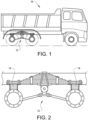
- the invention will be described below for a vehicle in the form of a truck 10 such as the truck illustrated in Fig. 1 .
- the truck 10 should be seen as an example of a vehicle which could comprise a spring assembly and/or a bogie suspension according to the present invention.
- the present invention may be implemented in a plurality of different types of vehicles.
- the present invention could be implemented in a truck, a tractor, a car, a bus, a work machine such as a wheel loader or an articulated hauler, or any other type of construction equipment.
- the Fig. 1 vehicle 10 comprises a bogie suspension arrangement 12 as illustrated in Fig. 2 .
- the bogie suspension arrangement 12 comprises two spring assemblies 14.
- Fig. 3 is a cross-sectional view of an embodiment of a spring assembly 14 for a vehicle bogie suspension arrangement 12.
- the spring assembly 14 comprises a set 16 of washers 18, 20, 22, 24, 26 moulded into an elastomer body 28.
- the spring assembly 14 has an axial extension in an axial direction A and the washers 18, 20, 22, 24, 26 are arranged relative to each other in the axial direction A.
- the washers are aligned in the axial direction A and spaced from each other in the axial direction A.
- the term "elastomer body” relates to a body of a polymer that can be stretched upon the application of a load and which is adapted to assume its original shape when unloaded.
- the "elastomer body” may comprise or even constitute a rubber body.
- the term “rubber” encompasses natural rubber as well as synthetic rubber.
- At least one, preferably a plurality, of the washers is a spring washer.
- the embodiment illustrated in Fig. 3 comprises four spring washers 20, 22, 24 and 26.
- a spring washer 20, 22, 24, 26 may be made out of made of metal, preferably steel.
- Fig. 4 illustrates a perspective view of one of the spring washers 24 from the Fig. 3 embodiment.
- the spring washer 24 comprises a spring washer body 30 and at least two spring tongues 32, 34.
- the Fig. 4 implementation of the spring washer 24 comprises twelve spring tongues.
- the Fig. 4 spring washer 24 comprises a plurality of alignment openings 27.
- the purpose of the alignment openings 27 is to keep spring washers aligned when manufacturing the spring assembly 14. This possibility is discussed further hereinbelow with reference to Fig. 9 .
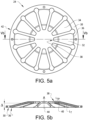
- Figs. 5a and 5b illustrate the first and second spring tongues 32, 34 in the Fig. 4 implementation of the spring washer 24.
- Features of each spring tongue 32, 34 will be described hereinbelow with reference to the first spring tongue 32. However, it should be emphasized that the below description is equally applicable to each one of the other spring tongues of a spring washer 24.
- each spring tongue has a spring base 36 connected to the spring washer body 30 and a spring tip 38 distal to the spring base 36. At least a portion of the spring tongue 32 is located at a non-zero distance ⁇ from the spring base 36 in the axial direction A. Further, as indicated in Fig. 5b , the non-zero distance ⁇ may be determined by selecting one side of the spring washer 24, as seen in the axial direction A, and measuring the distance from the spring base 36 to the portion of the spring tongue. In the Fig. 5b example, the bottom side of the spring washer 24 has been selected when determining the non-zero distance ⁇ but it is of course also possible to use the upper side of the spring washer 24 instead.
- the spring tip 38 of the spring tongue 32 is located at the non-zero distance ⁇ from the spring base 36 in the axial direction.
- a tip portion 40 extends from the spring tip 38 towards the spring base 36.
- the spring tongue 32 has a spring tongue length L T , along the spring tongue 32 from the spring tip 38 to the spring base 36, and the tip portion has a tip portion length L TP .
- the tip portion length L TP is at least 5% of the spring tongue length L T and the tip portion 40 extends substantially perpendicularly to the axial direction A.
- the tip portion length L TP is approximately 25% of the spring tongue length L T .
- the spring washer 24 may comprise an outer circumference 42 extending around a central axis 44.
- Each one of the spring tongues 32, 34 of the spring washer 22 extends in a direction from the circumference 42 towards the central axis 44.
- the spring washer body 30 is located radially outside the spring tongues 32, 34 such that a radial outer portion of the spring washer body 30 defines the outer circumference 42 of the spring washer 24.
- embodiments of the spring washer 42 may comprise a spring washer body (not shown) located radially inwards of the spring tongues 32, 34.
- the spring tongues may extend radially outwards from spring washer body.
- spring washers 24 are illustrated as being substantially circular in the figures, it is also envisaged that implementations of the spring washer may have outer shapes, such as oval or rectangular shapes (not shown).
- the spring washer 24 may comprise at least four, preferably at least six, spring tongues.
- the implementation illustrated in Figs. 5a and 5b comprises twelve spring tongues.
- a spring assembly 14 may comprise a plurality of spring washers.
- the spring assembly 14 comprises a set of flat washers 18 and a set of spring washers 20, 22, 24, 26. It is also conceivable that embodiments of the spring assembly 14 may comprise further elements (not shown) moulded into the elastomer body.
- Fig. 6 illustrates another embodiment of the spring assembly 14 wherein a plurality of the washers is a spring washer such that the spring assembly comprises a first spring washer 22 and a second spring washer 44.
- the first and second spring washers 22, 44 are oriented relative to each other such that the non-zero distances ⁇ 1 , ⁇ 2 , as seen from the spring base 36 to the portion of the spring tongue 32 in the axial direction A, for spring tongues of the first and second spring washers 22, 44 extend in opposite directions, as seen in the axial direction A.
- a plurality of the washers is a spring washer such that the spring assembly comprises a first spring washer 22 and a second spring washer 44.
- the first and second spring washers 22, 44 are oriented relative to each other such that the non-zero distances ⁇ 1 , ⁇ 2 , as seen from the spring base 36 to the portion of the spring tongue 32 in the axial direction A, for spring tongues of the first and second spring washers 22, 44 extend in opposite directions, as seen in the axial
- the first and second spring washers 22, 44 are oriented such that the spring tip 38 of the first spring washer 22 and the spring tip 46 of the second spring washer 44 are closer to each other, as seen in the axial direction A, than the spring washer bodies 30, 48 of the first and second spring washers 22, 44.
- first and second spring washers 22, 44 such that the spring tip 38 of the first spring washer 22 and the spring tip 46 of the second spring washer 44 are further away from each other, as seen in the axial direction A, than the spring washer bodies 30, 48 of the first and second spring washers 22, 44.
- Fig. 7 Such an embodiment is illustrated in Fig. 7 .
- embodiments of the spring assembly may comprise combinations of the Fig. 6 and Fig. 7 embodiments; an example of such a combination is presented in Fig. 8 .
- the spring assembly 14 may preferably further comprise a first 50 and a second 52 interface plate located on opposite sides of the elastomer body 28 in the axial direction A.
- the spring assembly further comprises a tensioning arrangement 54 at least partially extending through the elastomer body 28 and connecting the interface plates 50, 52.
- the tensioning arrangement 54 may comprise a bolt 56 and a nut 58.
- the , bolt 56 may have a bolt portion 60 with a conical envelope surface, adapted to abut the first interface plate 50, and a nut 58 having a nut portion 62 with a conical envelope surface, adapted to abut the second interface plate 52.
- Fig. 9 illustrates an embodiment of a method for manufacturing a spring assembly for a vehicle.
- the method comprises: S10 arranging a plurality of washers 20, 22, 24, 26 in a mould 64 such that the washers 20, 22, 24, 26 are arranged relative to each other in an axial direction A, at least one, preferably a plurality, of the washers 20, 22, 24, 26 being a spring washer comprising a spring washer body and at least two spring tongues, each spring tongue having a spring base connected to the spring washer body and a spring tip distal to the spring base, at least a portion of the spring tongue being located at a non-zero distance from the spring base in the axial direction, and S12 introducing liquid elastomer 28 into the mould 64.
- a plurality of the washers may be a spring washer 20, 22, 24, 26 and the step S10 of arranging the plurality of washers in the mould comprises attaching at least two spring washers 20, 22 to each other, preferably by attaching together the spring washer bodies of the at least two spring washers, before the liquid elastomer 28 is introduced into the mould 64.
- the above alignment may be achieved using the alignment openings 27 that have been discussed above with reference to Fig. 4 .
- adjacent spring washers may be attached to each other by introducing attachment means 66 into the alignment openings.
- the attachment means 66 may comprise pins and/or rivets extending through the alignment openings 27 of the spring washers 20, 22.
- adjacent spring washers may be attached to each other using other attachment means such as weld joints or glue joints.
- embodiments of the method may comprise arranging at least a first 20 and a second 22 washer relative to each other such that the non-zero distances, as seen from the spring base 36 to the portion of the spring tongue 32 in the axial direction A, for spring tongues of the first and second washers extend in opposite directions, before the liquid elastomer 28 is introduced into the mould 64.
- Fig. 9 illustrates a further step of an embodiment of a method for manufacturing a spring assembly for a vehicle.
- the further step comprises: S13 arranging a first 50 and a second 52 interface plate on opposite sides of the elastomer body 28 in the axial direction A and tensioning the elastomer body using a tensioning arrangement 54 at least partially extending through the elastomer body 28 and connecting the interface plates 50, 52.
Landscapes
- Engineering & Computer Science (AREA)
- General Engineering & Computer Science (AREA)
- Mechanical Engineering (AREA)
- Architecture (AREA)
- Springs (AREA)
Description
- The invention relates to a spring assembly for a vehicle bogie suspension arrangement. Moreover, the present invention relates to a bogie suspension arrangement for a vehicle as well as to a vehicle. Further, the present invention relates to a method for manufacturing a spring assembly for a vehicle.
- The invention can be applied in heavy-duty vehicles, such as trucks, buses and construction equipment. Although the invention will be described with respect to a truck, the invention is not restricted to this particular vehicle, but may also be used in other vehicles such as a bus or a working machine.
- A spring assembly may be used in various positions in a vehicle. For instance, a spring assembly may be used in a vehicle bogie suspension arrangement of a heavy-duty vehicle, such as a truck.
- One type of a spring assembly is a so called rubber tower, which may also be referred to as a rubber spring or a rubber bolster. Such a rubber tower may comprise a set of flat metal plates, arranged parallel to each other, which are moulded into a rubber body.
- However, a spring assembly such as the one exemplified above may not provide sufficient stiffness in at least one of a lateral or vertical direction when the spring assembly is used in a vehicle.
- As such, it would be desirable to improve the spring assembly that can be used for a vehicle bogie suspension arrangement.
- According to its abstract,
US2007/145654 A1 relates to a resilient mount including a first mounting member and a second mounting member. The mount includes a first plurality of stiffening elements located between the first and second mounting members. At least a first stiffening element of the first plurality of stiffening elements is non-parallel to a second stiffening element of the first plurality of stiffening elements. Each of the first plurality of stiffening elements has a material thickness and an out-of-plane dimension that is greater than the material thickness. Each stiffening element of the first plurality of stiffening elements is substantially rigid so as to substantially limit the deformation of the stiffening element under load. The mount may also include a resilient material located between and coupled to adjacent stiffening elements of the first plurality of stiffening elements. - According to its abstract,
FR 2 142 158 A5 - An object of the invention is to provide a spring assembly for a vehicle bogie suspension arrangement which spring assembly provides an appropriate stiffness in at least one of a lateral and vertical direction during use.
- The object is achieved by a spring assembly according to claim 1.
- As such, the present invention relates to a spring assembly for a vehicle bogie suspension arrangement. The spring assembly comprises a set of washers moulded into an elastomer body. The spring assembly has an axial extension in an axial direction and the washers are arranged relative to each other in the axial direction.
- According to the present invention, at least one, preferably a plurality, of the washers is a spring washer comprising a spring washer body and at least two spring tongues. Each spring tongue has a spring base connected to the spring washer body and a spring tip distal to the spring base. At least a portion of the spring tongue is located at a non-zero distance from the spring base in the axial direction.
- The above-mentioned at least two spring tongues which are moulded in to the elastomer body will provide a springing characteristic to the spring assembly. For instance, the at least two spring tongues may provide a springing characteristic in a lateral direction of the vehicle when the spring assembly is mounted in a vehicle. This is since the at least two spring tongues are moulded into the elastomer body such that when a portion of the elastomer body is subjected to a lateral displacement, such a displacement will be transferred to the at least two spring tongues. Since at least a portion of each spring tongue is located at a non-zero distance from the spring base in the axial direction, such a displacement will result in a lateral spring force from the spring tongues which consequently will result in an additional lateral stiffness of the spring assembly.
- As used herein, the term "spring tongue" is intended to encompass a cantilever member one end of which - namely the spring base - is anchored to the spring washer body and the other end of which - namely the spring tip - is not anchored to the washer body.
- By way of example, the vertical stiffness of the spring washer is a function of the ratio between the non-zero distance and the thickness of the spring washer, i.e. Δ/t wherein Δ indicates the non-zero distance and t indicates the thickness. By varying the non-zero distance and for instance keeping the thickness constant, the spring force characteristics can be adjusted over a wide range. Purely by way of example, the non-zero distance may be at least 2% of the diameter of the spring washer. As a non-limiting example, the non-zero distance may be within the range of 2-20 % of the diameter of the spring washer. If the spring washer does not have a circular shape, the diameter of the spring washer is defined as the diameter of a smallest circle that can circumscribe the perimeter of the spring washer.
- Optionally, the spring tip of the spring tongue is located at a non-zero distance from the spring base in the axial direction. Arranging the spring tip at a non-zero distance from the spring base will result in appropriate possibilities to obtain requisite stiffness characteristics in at least one of the lateral and vertical directions.
- Optionally, a tip portion extends from the spring tip towards the spring base. The spring tongue has a spring tongue length, along the spring tongue from the spring tip to the spring base, and the tip portion having a tip portion length. The tip portion length is at least 5% of the spring tongue length, the tip portion extending substantially perpendicularly to the axial direction. Such a configuration of the spring tongue will increase the possibilities for the elastomer to adhere to the spring tongue which in turn will increase the possibilities to obtain requisite stiffness characteristics.
- Optionally, the spring washer comprises an outer circumference extending around a central axis. Each one of the spring tongues of the spring washer extends in a direction from the circumference towards the central axis. Such a configuration implies a possibility to obtain a compact spring assembly.
- Optionally, the spring washer comprises at least four, preferably at least six, spring tongues. The above implementation of the spring washer implies that appropriate stiffness characteristics may be obtained in several horizontal directions when the spring washer is mounted in a vehicle.
- Optionally, a plurality of the washers is a spring washer such that the spring assembly comprises a first spring washer and a second spring washer. The first and second spring washers are oriented relative to each other such that the non-zero distances, as seen from said spring base to said portion of said spring tongue in said axial direction, for spring tongues of the first and second washers extend in opposite directions. Such a configuration implies that appropriate stiffness characteristics may be obtained at a relatively short axial distance.
- Optionally, the elastomer body is a rubber body. A rubber body is a preferred implementation of the elastomer body since a rubber body generally may provide appropriate stiffness characteristics. Moreover, the use of a rubber body implies an appropriate adherence between the rubber body and the washers, such as the at least one spring washer.
- Optionally, the spring washer is made of metal, preferably steel. A metal spring washer implies appropriate springing characteristics.
- Optionally, the spring assembly further comprises a first and a second interface plate located on opposite sides of the elastomer body in the axial direction. The spring assembly further comprises a tensioning arrangement at least partially extending through the elastomer body and connecting the interface plates. By virtue of the above members, it is possible to pretension to the spring assembly prior to use.
- Optionally, the tensioning arrangement comprises a bolt and a nut, preferably a bolt having a bolt portion with a conical envelope surface, adapted to abut the first interface plate, and a nut having a nut portion with a conical envelope surface, adapted to abut the second interface plate.
- A second aspect of the present invention relates to a bogie suspension arrangement for a vehicle, preferably a rear bogie suspension arrangement for a vehicle. The bogie suspension arrangement comprises a spring assembly according to the first aspect of the present invention.
- A third aspect of the present invention relates to a vehicle, preferably a heavy-duty vehicle, such as a truck, comprising a spring assembly according to the first aspect of the present invention and/or a bogie suspension arrangement according to the second aspect of the present invention.
- A fourth aspect of the present invention relates to a method for manufacturing a spring assembly for a vehicle. The method comprises:
- arranging a plurality of washers in a mould such that the washers are arranged relative to each other in an axial direction, at least one, preferably a plurality, of the washers being a spring washer comprising a spring washer body and at least two spring tongues, each spring tongue having a spring base connected to the spring washer body and a spring tip distal to the spring base, at least a portion of the spring tongue being located at a non-zero distance from the spring base in the axial direction,
- introducing liquid elastomer into the mould.
- Optionally, a plurality of the washers is a spring washer and wherein the step of arranging the plurality of washers in the mould comprises attaching at least two spring washers to each other, preferably by attaching together the spring washer bodies of the at least two spring washers, before the liquid elastomer is introduced into the mould.
- Optionally, the method comprises arranging at least a first and a second washer relative to each other such that the non-zero distances, as seen from said spring base to said portion of said spring tongue in said axial direction, for spring tongues of the first and second washers extend in opposite directions, before the liquid elastomer is introduced into the mould.
- Further advantages and advantageous features of the invention are disclosed in the following description and in the dependent claims.
- With reference to the appended drawings, below follows a more detailed description of embodiments of the invention cited as examples.
- In the drawings:
-
Fig. 1 is a schematic view of a vehicle; -
Fig. 2 is a schematic view of a bogie suspension arrangement; -
Fig. 3 is a cross-sectional view of an embodiment of a spring assembly; -
Fig. 4 is a perspective view of a spring washer; -
Fig. 5a and 5b is a top view and cross-sectional view, respectively, of theFig. 4 spring washer; -
Fig. 6 is a cross-sectional view of another embodiment of a spring assembly; -
Fig. 7 is a cross-sectional view of a further embodiment of a spring assembly; -
Fig. 8 is a cross-sectional view of yet another embodiment of a spring assembly, and -
Fig. 9 is a flow chart illustrating an embodiment of a method for manufacturing a spring assembly. - The invention will be described below for a vehicle in the form of a
truck 10 such as the truck illustrated inFig. 1 . Thetruck 10 should be seen as an example of a vehicle which could comprise a spring assembly and/or a bogie suspension according to the present invention. - However, the present invention may be implemented in a plurality of different types of vehicles. Purely by way of example, the present invention could be implemented in a truck, a tractor, a car, a bus, a work machine such as a wheel loader or an articulated hauler, or any other type of construction equipment.
- The
Fig. 1 vehicle 10 comprises abogie suspension arrangement 12 as illustrated inFig. 2 . As may be gleaned fromFig. 2 , thebogie suspension arrangement 12 comprises twospring assemblies 14. -
Fig. 3 is a cross-sectional view of an embodiment of aspring assembly 14 for a vehiclebogie suspension arrangement 12. Thespring assembly 14 comprises aset 16 ofwashers elastomer body 28. Thespring assembly 14 has an axial extension in an axial direction A and thewashers Fig. 3 , the washers are aligned in the axial direction A and spaced from each other in the axial direction A. - As used herein, the term "elastomer body" relates to a body of a polymer that can be stretched upon the application of a load and which is adapted to assume its original shape when unloaded. Purely by way of example, the "elastomer body" may comprise or even constitute a rubber body. Here, the term "rubber" encompasses natural rubber as well as synthetic rubber.
- According to the present invention, at least one, preferably a plurality, of the washers is a spring washer. The embodiment illustrated in
Fig. 3 comprises fourspring washers - Purely by way of example, a
spring washer -
Fig. 4 illustrates a perspective view of one of thespring washers 24 from theFig. 3 embodiment. As indicated inFig. 4 , thespring washer 24 comprises aspring washer body 30 and at least twospring tongues Fig. 4 implementation of thespring washer 24 comprises twelve spring tongues. - Moreover, the
Fig. 4 spring washer 24 comprises a plurality ofalignment openings 27. The purpose of thealignment openings 27 is to keep spring washers aligned when manufacturing thespring assembly 14. This possibility is discussed further hereinbelow with reference toFig. 9 . -
Figs. 5a and 5b illustrate the first andsecond spring tongues Fig. 4 implementation of thespring washer 24. Features of eachspring tongue first spring tongue 32. However, it should be emphasized that the below description is equally applicable to each one of the other spring tongues of aspring washer 24. - As such, with reference to the
first spring tongue 32, each spring tongue has aspring base 36 connected to thespring washer body 30 and aspring tip 38 distal to thespring base 36. At least a portion of thespring tongue 32 is located at a non-zero distance Δ from thespring base 36 in the axial direction A. Further, as indicated inFig. 5b , the non-zero distance Δ may be determined by selecting one side of thespring washer 24, as seen in the axial direction A, and measuring the distance from thespring base 36 to the portion of the spring tongue. In theFig. 5b example, the bottom side of thespring washer 24 has been selected when determining the non-zero distance Δ but it is of course also possible to use the upper side of thespring washer 24 instead. - In the implementation of the
first spring tongue 32 illustrated inFigs. 5a and 5b , thespring tip 38 of thespring tongue 32 is located at the non-zero distance Δ from thespring base 36 in the axial direction. - Further, in the implementation of the
first spring tongue 32 illustrated inFigs. 5a and 5b , atip portion 40 extends from thespring tip 38 towards thespring base 36. Thespring tongue 32 has a spring tongue length LT, along thespring tongue 32 from thespring tip 38 to thespring base 36, and the tip portion has a tip portion length LTP. The tip portion length LTP is at least 5% of the spring tongue length LT and thetip portion 40 extends substantially perpendicularly to the axial direction A. In the implementation of thefirst spring tongue 32 illustrated inFigs. 5a and 5b , the tip portion length LTP is approximately 25% of the spring tongue length LT. - Moreover, again with reference to the implementation illustrated in
Figs. 5a and 5b , thespring washer 24 may comprise anouter circumference 42 extending around acentral axis 44. Each one of thespring tongues spring washer 22 extends in a direction from thecircumference 42 towards thecentral axis 44. As such, in the implementation of thespring washer 24 illustrated inFigs. 5a and 5b , thespring washer body 30 is located radially outside thespring tongues spring washer body 30 defines theouter circumference 42 of thespring washer 24. However, it is also envisaged that embodiments of thespring washer 42 may comprise a spring washer body (not shown) located radially inwards of thespring tongues - Furthermore, although the
spring washers 24 are illustrated as being substantially circular in the figures, it is also envisaged that implementations of the spring washer may have outer shapes, such as oval or rectangular shapes (not shown). - Purely by way of example, the
spring washer 24 may comprise at least four, preferably at least six, spring tongues. The implementation illustrated inFigs. 5a and 5b comprises twelve spring tongues. - A
spring assembly 14 may comprise a plurality of spring washers. In the embodiment illustrated inFig. 3 , thespring assembly 14 comprises a set offlat washers 18 and a set ofspring washers spring assembly 14 may comprise further elements (not shown) moulded into the elastomer body. -
Fig. 6 illustrates another embodiment of thespring assembly 14 wherein a plurality of the washers is a spring washer such that the spring assembly comprises afirst spring washer 22 and asecond spring washer 44. The first andsecond spring washers spring base 36 to the portion of thespring tongue 32 in the axial direction A, for spring tongues of the first andsecond spring washers Fig. 6 embodiment, the first andsecond spring washers spring tip 38 of thefirst spring washer 22 and thespring tip 46 of thesecond spring washer 44 are closer to each other, as seen in the axial direction A, than thespring washer bodies second spring washers - However, it is also possible to orient first and
second spring washers spring tip 38 of thefirst spring washer 22 and thespring tip 46 of thesecond spring washer 44 are further away from each other, as seen in the axial direction A, than thespring washer bodies second spring washers Fig. 7 . - It is further envisaged that embodiments of the spring assembly may comprise combinations of the
Fig. 6 andFig. 7 embodiments; an example of such a combination is presented inFig. 8 . - Irrespective of the number and orientation of spring washers, the
spring assembly 14 may preferably further comprise a first 50 and a second 52 interface plate located on opposite sides of theelastomer body 28 in the axial direction A. The spring assembly further comprises atensioning arrangement 54 at least partially extending through theelastomer body 28 and connecting theinterface plates - Purely by way of example, and as indicated in
Fig. 8 , thetensioning arrangement 54 may comprise abolt 56 and anut 58. For instance, and as indicated inFig. 8 , the ,bolt 56 may have abolt portion 60 with a conical envelope surface, adapted to abut thefirst interface plate 50, and anut 58 having anut portion 62 with a conical envelope surface, adapted to abut thesecond interface plate 52. -
Fig. 9 illustrates an embodiment of a method for manufacturing a spring assembly for a vehicle. The method comprises:S10 arranging a plurality of washers mould 64 such that thewashers washers S12 introducing liquid elastomer 28 into themould 64. - Purely by way of example, and as exemplified in
Fig. 9 , a plurality of the washers may be aspring washer spring washers liquid elastomer 28 is introduced into themould 64. - As a non-limiting example, the above alignment may be achieved using the
alignment openings 27 that have been discussed above with reference toFig. 4 . As such, when spring washers are placed relative to each other in the axial direction A, adjacent spring washers may be attached to each other by introducing attachment means 66 into the alignment openings. - Purely by way of example, the attachment means 66 may comprise pins and/or rivets extending through the
alignment openings 27 of thespring washers - Further, as illustrated in
Fig. 9 , embodiments of the method may comprise arranging at least a first 20 and a second 22 washer relative to each other such that the non-zero distances, as seen from thespring base 36 to the portion of thespring tongue 32 in the axial direction A, for spring tongues of the first and second washers extend in opposite directions, before theliquid elastomer 28 is introduced into themould 64. - Moreover,
Fig. 9 illustrates a further step of an embodiment of a method for manufacturing a spring assembly for a vehicle. The further step comprises:S13 arranging a first 50 and a second 52 interface plate on opposite sides of the elastomer body 28 in the axial direction A and tensioning the elastomer body using atensioning arrangement 54 at least partially extending through theelastomer body 28 and connecting theinterface plates - It is to be understood that the present invention is not limited to the embodiments described above and illustrated in the drawings; rather, the skilled person will recognize that many changes and modifications may be made within the scope of the appended claims.
Claims (15)
- A spring assembly (14) for a vehicle bogie suspension arrangement (12), said spring assembly (14) comprising a set (16) of washers (20, 22, 24, 26) moulded into an elastomer body (28), said spring assembly (14) having an axial extension in an axial direction (A) and said washers (20, 22, 24, 26) being arranged relative to each other in said axial direction (A), characterized in that at least one, preferably a plurality, of said washers (20, 22, 24, 26) is a spring washer comprising a spring washer body (30) and at least two spring tongues (32, 34), each spring tongue (32, 34) having a spring base (36) connected to said spring washer body (30) and a spring tip (38) distal to said spring base (36), at least a portion of said spring tongue (32) being located at a non-zero distance from said spring base (36) in said axial direction (A).
- The spring assembly (14) according to claim 1, wherein said spring tip (38) of said spring tongue (32) is located at a non-zero distance from said spring base (36) in said axial direction (A).
- The spring assembly (14) according to claim 1 or claim 2, wherein a tip portion (40) extends from said spring tip (38) towards said spring base (36), said spring tongue (32) having a spring tongue length (LT), along said spring tongue (32) from said spring tip (38) to said spring base (36), and said tip portion (40) having a tip portion length (LTP), said tip portion length (LTP) being at least 5% of said spring tongue length (LT), said tip portion (40) extending substantially perpendicularly to said axial direction (A).
- The spring assembly (14) according to any one of the preceding claims, wherein said spring washer (24) comprises an outer circumference (42) extending around a central axis (44), each one of said spring tongues (32, 34) of said spring washer (24) extending in a direction from said circumference (42) towards said central axis (44).
- The spring assembly (14) according to any one of the preceding claims, wherein said spring washer (24) comprises at least four, preferably at least six, spring tongues (32, 34).
- The spring assembly (14) according to any one of the preceding claims, wherein a plurality of said washers (22, 44) is a spring washer such that said spring assembly (14) comprises a first spring washer (22) and a second spring washer (44), said first and second spring washers (22, 44) being oriented relative to each other such that said non-zero distance, as seen from said spring base (36) to said portion of said spring tongue (32) in said axial direction (A), for spring tongues of said first and second washers (22, 44) extend in opposite directions.
- The spring assembly (14) according to any one of the preceding claims, wherein said elastomer body (28) is a rubber body.
- The spring assembly (14) according to any one of the preceding claims, wherein said spring washer (20, 22, 24, 26) is made of metal, preferably steel.
- The spring assembly (14) according to any one of the preceding claims, further comprising a first (50) and a second (52) interface plate located on opposite sides of said elastomer body (28) in said axial direction (A), said spring assembly (14) further comprising a tensioning arrangement (54) at least partially extending through said elastomer body (28) and connecting said interface plates (50, 52).
- The spring assembly (14) according to claim 9, wherein said tensioning arrangement (54) comprises a bolt (56) and a nut (58, preferably a bolt (56) having a bolt portion (60) with a conical envelope surface, adapted to abut said first interface plate (50), and a nut (58) having a nut portion (62) with a conical envelope surface, adapted to abut said second interface plate (52).
- A bogie suspension arrangement (12) for a vehicle (10), preferably a rear bogie suspension arrangement (12) for a vehicle (10), said bogie suspension arrangement (12) comprising a spring assembly (14) according to any one of the preceding claims.
- A vehicle (10), preferably a heavy-duty vehicle, such as a truck, comprising a spring assembly (14) according to any one of claims 1 - 10 and/or a bogie suspension arrangement (12) according to claim 11.
- A method for manufacturing a spring assembly (14) for a vehicle (10), said method comprising:- arranging a plurality of washers (20, 22, 24, 26) in a mould (64) such that said washers (20, 22, 24, 26) are arranged relative to each other in an axial direction (A), at least one, preferably a plurality, of said washers (20, 22, 24, 26) being a spring washer comprising a spring washer body (30) and at least two spring tongues (32, 34), each spring tongue having a spring base (36) connected to said spring washer body (30) and a spring tip distal (38) to said spring base (36), at least a portion of said spring tongue (32, 34) being located at a non-zero distance from said spring base (36) in said axial direction (A), and- introducing liquid elastomer (28) into said mould (64).
- The method according to claim 13, wherein a plurality of said washers (20, 22, 24, 26) is a spring washer and wherein said step of arranging said plurality of washers (20, 22, 24, 26) in said mould (64) comprises attaching at least two spring washers (20, 22, 24, 26) to each other, preferably by attaching together the spring washer bodies (30) of the at least two spring washers, before the liquid elastomer (28) is introduced into said mould (64).
- The method according to claim 14, wherein said method comprises arranging at least a first and a second washer (20, 22, 24, 26) relative to each other such that said non-zero distances, as seen from said spring base (36) to said portion of said spring tongue (32) in said axial direction (A), for spring tongues (38) of said first and second washers extend in opposite directions, before the liquid elastomer (28) is introduced into said mould (64).
Applications Claiming Priority (2)
| Application Number | Priority Date | Filing Date | Title |
|---|---|---|---|
| IN201841008605 | 2018-03-08 | ||
| PCT/EP2019/055806 WO2019170844A1 (en) | 2018-03-08 | 2019-03-08 | A spring assembly for a vehicle bogie suspension arrangement |
Publications (3)
| Publication Number | Publication Date |
|---|---|
| EP3762244A1 EP3762244A1 (en) | 2021-01-13 |
| EP3762244B1 true EP3762244B1 (en) | 2023-06-07 |
| EP3762244C0 EP3762244C0 (en) | 2023-06-07 |
Family
ID=65894966
Family Applications (1)
| Application Number | Title | Priority Date | Filing Date |
|---|---|---|---|
| EP19712698.0A Active EP3762244B1 (en) | 2018-03-08 | 2019-03-08 | Spring assembly for a tandem axle vehicle suspension |
Country Status (4)
| Country | Link |
|---|---|
| US (1) | US11458791B2 (en) |
| EP (1) | EP3762244B1 (en) |
| CN (1) | CN111542445A (en) |
| WO (1) | WO2019170844A1 (en) |
Families Citing this family (5)
| Publication number | Priority date | Publication date | Assignee | Title |
|---|---|---|---|---|
| US11458791B2 (en) * | 2018-03-08 | 2022-10-04 | Volvo Truck Corporation | Spring assembly for a vehicle bogie suspension arrangement |
| US11299002B2 (en) | 2019-11-01 | 2022-04-12 | Caterpillar Inc. | Center link for articulated truck suspension mounts |
| CN112211937B (en) * | 2020-09-25 | 2022-07-01 | 中国直升机设计研究所 | Non-planar shear elastic laminated vibration isolator |
| CN113059464A (en) * | 2021-04-02 | 2021-07-02 | 澳门大学 | Constant-force polishing mechanism and polishing equipment |
| CN115593167A (en) * | 2022-10-12 | 2023-01-13 | 博戈橡胶塑料(株洲)有限公司(Cn) | Heavy truck leaf spring system |
Family Cites Families (30)
| Publication number | Priority date | Publication date | Assignee | Title |
|---|---|---|---|---|
| DE718344C (en) * | 1937-12-30 | 1942-03-10 | Carl F W Borgward | Suspension for motor vehicles with independently mounted wheels guided by swinging semi-axles or wishbones |
| US2557610A (en) | 1947-05-24 | 1951-06-19 | Ohio Rubber Co | Resilient mounting |
| FR1222212A (en) * | 1958-04-24 | 1960-06-08 | Luk Lamellen & Kupplungsbau | Cup-shaped spring, intended in particular for motor vehicle clutches |
| US3235049A (en) * | 1963-02-18 | 1966-02-15 | Gen Motors Corp | Diaphragm spring for a clutch assembly |
| US3279779A (en) * | 1964-07-20 | 1966-10-18 | Lord Corp | Combined disc and elastomeric spring |
| DE1940399A1 (en) * | 1969-08-08 | 1971-02-18 | Ernst Wackenhut | Suspension for double-axle vehicles |
| US3682466A (en) | 1970-05-04 | 1972-08-08 | Edgewater Corp | Composite belleville type springs and manufacture |
| US3677535A (en) * | 1970-08-24 | 1972-07-18 | Lord Corp | Axial suspension system that accommodate relative lateral movement |
| FR2142158A5 (en) | 1971-06-15 | 1973-01-26 | Ferodo Sa | |
| US4135283A (en) * | 1974-10-23 | 1979-01-23 | Luk Lamellen U. Kupplungsbau Gmbh | Resilient structural member such as a plate spring |
| DE2757892B2 (en) * | 1977-12-24 | 1980-05-14 | Ingo Dipl.-Ing. Dipl.- Wirtsch.-Ing. 7000 Stuttgart Haeussermann | Spring membrane |
| GB2117085A (en) * | 1982-03-19 | 1983-10-05 | Wright Barry Corp | Elastomeric stack with stabilising means |
| JPH01164828A (en) * | 1987-12-17 | 1989-06-28 | Daikin Mfg Co Ltd | Manufacture of diaphragm spring |
| SE500084C2 (en) * | 1992-07-06 | 1994-04-11 | Trelleborg Ind Ab | Resilient, power transferring spring element |
| DE19608860C2 (en) * | 1996-03-07 | 2000-06-29 | Joern Gmbh | Compression spring |
| DE19853540A1 (en) | 1998-11-20 | 2000-05-25 | Man Nutzfahrzeuge Ag | Connection between leaf spring ends and axle bearings of a double axle unit of a truck |
| SE520015C2 (en) * | 2001-09-14 | 2003-05-06 | Volvo Articulated Haulers Ab | Spring element intended for a vehicle |
| US7201367B2 (en) * | 2002-12-12 | 2007-04-10 | Caterpillar Inc | Load-bearing resilient mount |
| US8070143B2 (en) * | 2002-12-12 | 2011-12-06 | Caterpillar Inc. | Load-bearing resilient mount |
| CN100390436C (en) | 2003-06-11 | 2008-05-28 | 尹学军 | disc spring |
| SE528883C2 (en) * | 2005-06-30 | 2007-03-06 | Volvo Lastvagnar Ab | Rubber spring for a wheel axle suspension of a vehicle |
| US9636963B2 (en) * | 2012-05-29 | 2017-05-02 | Firestone Industrial Products Company, Llc | Fluid spring and rubber spring assembly |
| US9206807B2 (en) * | 2012-09-06 | 2015-12-08 | Asia Vital Components (China) Co., Ltd. | Preload disk spring, assembly structure thereof, and fan using same |
| US20140191486A1 (en) * | 2013-01-10 | 2014-07-10 | Hendrickson Usa, L.L.C. | Multi-tapered suspension component |
| CN105546008A (en) * | 2016-01-21 | 2016-05-04 | 镇江卓业软件科技有限公司 | Metal rubber support damping device |
| FR3049020B1 (en) * | 2016-03-21 | 2019-06-14 | Valeo Embrayages | DIAPHRAGM FOR A FRICTION CLUTCH MECHANISM |
| US20190345866A1 (en) * | 2017-01-03 | 2019-11-14 | Volvo Truck Corporation | Conduit system and a method of assembling a conduit system |
| DK3462053T3 (en) * | 2017-09-20 | 2020-12-07 | Zhuzhou Times New Mat Tech Co | Vibration damping support device |
| US11458791B2 (en) * | 2018-03-08 | 2022-10-04 | Volvo Truck Corporation | Spring assembly for a vehicle bogie suspension arrangement |
| CN110159683A (en) * | 2019-06-26 | 2019-08-23 | 成都华川电装有限责任公司 | A kind of dish constant force spring |
-
2019
- 2019-03-08 US US16/978,230 patent/US11458791B2/en active Active
- 2019-03-08 EP EP19712698.0A patent/EP3762244B1/en active Active
- 2019-03-08 CN CN201980007270.6A patent/CN111542445A/en active Pending
- 2019-03-08 WO PCT/EP2019/055806 patent/WO2019170844A1/en not_active Ceased
Also Published As
| Publication number | Publication date |
|---|---|
| WO2019170844A1 (en) | 2019-09-12 |
| CN111542445A (en) | 2020-08-14 |
| US11458791B2 (en) | 2022-10-04 |
| US20210001677A1 (en) | 2021-01-07 |
| EP3762244A1 (en) | 2021-01-13 |
| EP3762244C0 (en) | 2023-06-07 |
Similar Documents
| Publication | Publication Date | Title |
|---|---|---|
| EP3762244B1 (en) | Spring assembly for a tandem axle vehicle suspension | |
| US11254175B2 (en) | Single-shell spring control arm | |
| US6250613B1 (en) | Non-metallic spacer for air spring assembly | |
| JP2628861B2 (en) | Automotive center member structure | |
| US8678401B2 (en) | Leveling shock absorber and strut assembly | |
| DE10229287B4 (en) | Damper bearing with contoured face for shock absorbers in motor vehicles | |
| JP2003104229A (en) | Suspension cross member mounting bush and suspension cross member mounting structure | |
| US20200391541A1 (en) | A disc wheel for agricultural tractor application | |
| US20050001366A1 (en) | Conical rubber bearing | |
| CN212289363U (en) | Wheel and vehicle | |
| CN210318346U (en) | Bushing structure applied to dynamic vibration absorber | |
| US12172483B2 (en) | Easily retrofittable air suspension brackets, method of making and method of using | |
| CN219257535U (en) | Shearing type car body suspension assembly | |
| DE1913599A1 (en) | Vehicle wheel | |
| US20080054714A1 (en) | Variable trackwidth disc assembly for use with a wheel | |
| JPH11115429A (en) | Suspension arm structure | |
| CN223148549U (en) | Lightweight saddle pad | |
| JP3511123B2 (en) | Elastic bush | |
| EP0851143A2 (en) | Body mount | |
| JPH0451231Y2 (en) | ||
| CN111660718A (en) | Wheel and vehicle | |
| JP2003120738A (en) | Suspension cross member mounting bush and suspension cross member mounting structure | |
| CN223161591U (en) | Torsion beam rear suspension structure and automobile | |
| CN114454680B (en) | Leaf spring cover assembly, leaf spring suspension system and automobile | |
| WO2013027567A1 (en) | Shock absorber mounting structure |
Legal Events
| Date | Code | Title | Description |
|---|---|---|---|
| STAA | Information on the status of an ep patent application or granted ep patent |
Free format text: STATUS: UNKNOWN |
|
| STAA | Information on the status of an ep patent application or granted ep patent |
Free format text: STATUS: THE INTERNATIONAL PUBLICATION HAS BEEN MADE |
|
| PUAI | Public reference made under article 153(3) epc to a published international application that has entered the european phase |
Free format text: ORIGINAL CODE: 0009012 |
|
| STAA | Information on the status of an ep patent application or granted ep patent |
Free format text: STATUS: REQUEST FOR EXAMINATION WAS MADE |
|
| 17P | Request for examination filed |
Effective date: 20200929 |
|
| AK | Designated contracting states |
Kind code of ref document: A1 Designated state(s): AL AT BE BG CH CY CZ DE DK EE ES FI FR GB GR HR HU IE IS IT LI LT LU LV MC MK MT NL NO PL PT RO RS SE SI SK SM TR |
|
| AX | Request for extension of the european patent |
Extension state: BA ME |
|
| DAV | Request for validation of the european patent (deleted) | ||
| DAX | Request for extension of the european patent (deleted) | ||
| GRAP | Despatch of communication of intention to grant a patent |
Free format text: ORIGINAL CODE: EPIDOSNIGR1 |
|
| STAA | Information on the status of an ep patent application or granted ep patent |
Free format text: STATUS: GRANT OF PATENT IS INTENDED |
|
| INTG | Intention to grant announced |
Effective date: 20221124 |
|
| GRAS | Grant fee paid |
Free format text: ORIGINAL CODE: EPIDOSNIGR3 |
|
| GRAA | (expected) grant |
Free format text: ORIGINAL CODE: 0009210 |
|
| STAA | Information on the status of an ep patent application or granted ep patent |
Free format text: STATUS: THE PATENT HAS BEEN GRANTED |
|
| AK | Designated contracting states |
Kind code of ref document: B1 Designated state(s): AL AT BE BG CH CY CZ DE DK EE ES FI FR GB GR HR HU IE IS IT LI LT LU LV MC MK MT NL NO PL PT RO RS SE SI SK SM TR |
|
| REG | Reference to a national code |
Ref country code: GB Ref legal event code: FG4D |
|
| REG | Reference to a national code |
Ref country code: CH Ref legal event code: EP Ref country code: AT Ref legal event code: REF Ref document number: 1573965 Country of ref document: AT Kind code of ref document: T Effective date: 20230615 Ref country code: DE Ref legal event code: R096 Ref document number: 602019030099 Country of ref document: DE |
|
| U01 | Request for unitary effect filed |
Effective date: 20230607 |
|
| U07 | Unitary effect registered |
Designated state(s): AT BE BG DE DK EE FI FR IT LT LU LV MT NL PT SE SI Effective date: 20230612 |
|
| REG | Reference to a national code |
Ref country code: LT Ref legal event code: MG9D |
|
| PG25 | Lapsed in a contracting state [announced via postgrant information from national office to epo] |
Ref country code: NO Free format text: LAPSE BECAUSE OF FAILURE TO SUBMIT A TRANSLATION OF THE DESCRIPTION OR TO PAY THE FEE WITHIN THE PRESCRIBED TIME-LIMIT Effective date: 20230907 Ref country code: ES Free format text: LAPSE BECAUSE OF FAILURE TO SUBMIT A TRANSLATION OF THE DESCRIPTION OR TO PAY THE FEE WITHIN THE PRESCRIBED TIME-LIMIT Effective date: 20230607 |
|
| PG25 | Lapsed in a contracting state [announced via postgrant information from national office to epo] |
Ref country code: RS Free format text: LAPSE BECAUSE OF FAILURE TO SUBMIT A TRANSLATION OF THE DESCRIPTION OR TO PAY THE FEE WITHIN THE PRESCRIBED TIME-LIMIT Effective date: 20230607 Ref country code: HR Free format text: LAPSE BECAUSE OF FAILURE TO SUBMIT A TRANSLATION OF THE DESCRIPTION OR TO PAY THE FEE WITHIN THE PRESCRIBED TIME-LIMIT Effective date: 20230607 Ref country code: GR Free format text: LAPSE BECAUSE OF FAILURE TO SUBMIT A TRANSLATION OF THE DESCRIPTION OR TO PAY THE FEE WITHIN THE PRESCRIBED TIME-LIMIT Effective date: 20230908 |
|
| PG25 | Lapsed in a contracting state [announced via postgrant information from national office to epo] |
Ref country code: SK Free format text: LAPSE BECAUSE OF FAILURE TO SUBMIT A TRANSLATION OF THE DESCRIPTION OR TO PAY THE FEE WITHIN THE PRESCRIBED TIME-LIMIT Effective date: 20230607 |
|
| PG25 | Lapsed in a contracting state [announced via postgrant information from national office to epo] |
Ref country code: IS Free format text: LAPSE BECAUSE OF FAILURE TO SUBMIT A TRANSLATION OF THE DESCRIPTION OR TO PAY THE FEE WITHIN THE PRESCRIBED TIME-LIMIT Effective date: 20231007 |
|
| PG25 | Lapsed in a contracting state [announced via postgrant information from national office to epo] |
Ref country code: SM Free format text: LAPSE BECAUSE OF FAILURE TO SUBMIT A TRANSLATION OF THE DESCRIPTION OR TO PAY THE FEE WITHIN THE PRESCRIBED TIME-LIMIT Effective date: 20230607 Ref country code: SK Free format text: LAPSE BECAUSE OF FAILURE TO SUBMIT A TRANSLATION OF THE DESCRIPTION OR TO PAY THE FEE WITHIN THE PRESCRIBED TIME-LIMIT Effective date: 20230607 Ref country code: RO Free format text: LAPSE BECAUSE OF FAILURE TO SUBMIT A TRANSLATION OF THE DESCRIPTION OR TO PAY THE FEE WITHIN THE PRESCRIBED TIME-LIMIT Effective date: 20230607 Ref country code: IS Free format text: LAPSE BECAUSE OF FAILURE TO SUBMIT A TRANSLATION OF THE DESCRIPTION OR TO PAY THE FEE WITHIN THE PRESCRIBED TIME-LIMIT Effective date: 20231007 Ref country code: CZ Free format text: LAPSE BECAUSE OF FAILURE TO SUBMIT A TRANSLATION OF THE DESCRIPTION OR TO PAY THE FEE WITHIN THE PRESCRIBED TIME-LIMIT Effective date: 20230607 |
|
| PG25 | Lapsed in a contracting state [announced via postgrant information from national office to epo] |
Ref country code: PL Free format text: LAPSE BECAUSE OF FAILURE TO SUBMIT A TRANSLATION OF THE DESCRIPTION OR TO PAY THE FEE WITHIN THE PRESCRIBED TIME-LIMIT Effective date: 20230607 |
|
| REG | Reference to a national code |
Ref country code: DE Ref legal event code: R097 Ref document number: 602019030099 Country of ref document: DE |
|
| PLBE | No opposition filed within time limit |
Free format text: ORIGINAL CODE: 0009261 |
|
| STAA | Information on the status of an ep patent application or granted ep patent |
Free format text: STATUS: NO OPPOSITION FILED WITHIN TIME LIMIT |
|
| U20 | Renewal fee for the european patent with unitary effect paid |
Year of fee payment: 6 Effective date: 20240326 |
|
| 26N | No opposition filed |
Effective date: 20240308 |
|
| REG | Reference to a national code |
Ref country code: CH Ref legal event code: PL |
|
| PG25 | Lapsed in a contracting state [announced via postgrant information from national office to epo] |
Ref country code: MC Free format text: LAPSE BECAUSE OF FAILURE TO SUBMIT A TRANSLATION OF THE DESCRIPTION OR TO PAY THE FEE WITHIN THE PRESCRIBED TIME-LIMIT Effective date: 20230607 |
|
| GBPC | Gb: european patent ceased through non-payment of renewal fee |
Effective date: 20240308 |
|
| PG25 | Lapsed in a contracting state [announced via postgrant information from national office to epo] |
Ref country code: MC Free format text: LAPSE BECAUSE OF FAILURE TO SUBMIT A TRANSLATION OF THE DESCRIPTION OR TO PAY THE FEE WITHIN THE PRESCRIBED TIME-LIMIT Effective date: 20230607 |
|
| PG25 | Lapsed in a contracting state [announced via postgrant information from national office to epo] |
Ref country code: GB Free format text: LAPSE BECAUSE OF NON-PAYMENT OF DUE FEES Effective date: 20240308 |
|
| PG25 | Lapsed in a contracting state [announced via postgrant information from national office to epo] |
Ref country code: IE Free format text: LAPSE BECAUSE OF NON-PAYMENT OF DUE FEES Effective date: 20240308 |
|
| PG25 | Lapsed in a contracting state [announced via postgrant information from national office to epo] |
Ref country code: IE Free format text: LAPSE BECAUSE OF NON-PAYMENT OF DUE FEES Effective date: 20240308 Ref country code: GB Free format text: LAPSE BECAUSE OF NON-PAYMENT OF DUE FEES Effective date: 20240308 Ref country code: CH Free format text: LAPSE BECAUSE OF NON-PAYMENT OF DUE FEES Effective date: 20240331 |
|
| U20 | Renewal fee for the european patent with unitary effect paid |
Year of fee payment: 7 Effective date: 20250325 |
|
| PG25 | Lapsed in a contracting state [announced via postgrant information from national office to epo] |
Ref country code: CY Free format text: LAPSE BECAUSE OF FAILURE TO SUBMIT A TRANSLATION OF THE DESCRIPTION OR TO PAY THE FEE WITHIN THE PRESCRIBED TIME-LIMIT; INVALID AB INITIO Effective date: 20190308 |
|
| PG25 | Lapsed in a contracting state [announced via postgrant information from national office to epo] |
Ref country code: HU Free format text: LAPSE BECAUSE OF FAILURE TO SUBMIT A TRANSLATION OF THE DESCRIPTION OR TO PAY THE FEE WITHIN THE PRESCRIBED TIME-LIMIT; INVALID AB INITIO Effective date: 20190308 |
|
| PG25 | Lapsed in a contracting state [announced via postgrant information from national office to epo] |
Ref country code: TR Free format text: LAPSE BECAUSE OF FAILURE TO SUBMIT A TRANSLATION OF THE DESCRIPTION OR TO PAY THE FEE WITHIN THE PRESCRIBED TIME-LIMIT Effective date: 20230607 |
|
| U20 | Renewal fee for the european patent with unitary effect paid |
Year of fee payment: 8 Effective date: 20260323 |