EP3760343A1 - Iron powder for powder metallurgy - Google Patents
Iron powder for powder metallurgy Download PDFInfo
- Publication number
- EP3760343A1 EP3760343A1 EP19761704.6A EP19761704A EP3760343A1 EP 3760343 A1 EP3760343 A1 EP 3760343A1 EP 19761704 A EP19761704 A EP 19761704A EP 3760343 A1 EP3760343 A1 EP 3760343A1
- Authority
- EP
- European Patent Office
- Prior art keywords
- mass
- equal
- powder
- iron powder
- less
- Prior art date
- Legal status (The legal status is an assumption and is not a legal conclusion. Google has not performed a legal analysis and makes no representation as to the accuracy of the status listed.)
- Granted
Links
Images

Classifications
-
- C—CHEMISTRY; METALLURGY
- C22—METALLURGY; FERROUS OR NON-FERROUS ALLOYS; TREATMENT OF ALLOYS OR NON-FERROUS METALS
- C22C—ALLOYS
- C22C33/00—Making ferrous alloys
- C22C33/02—Making ferrous alloys by powder metallurgy
-
- C—CHEMISTRY; METALLURGY
- C22—METALLURGY; FERROUS OR NON-FERROUS ALLOYS; TREATMENT OF ALLOYS OR NON-FERROUS METALS
- C22C—ALLOYS
- C22C38/00—Ferrous alloys, e.g. steel alloys
- C22C38/18—Ferrous alloys, e.g. steel alloys containing chromium
- C22C38/40—Ferrous alloys, e.g. steel alloys containing chromium with nickel
- C22C38/58—Ferrous alloys, e.g. steel alloys containing chromium with nickel with more than 1.5% by weight of manganese
-
- B—PERFORMING OPERATIONS; TRANSPORTING
- B22—CASTING; POWDER METALLURGY
- B22F—WORKING METALLIC POWDER; MANUFACTURE OF ARTICLES FROM METALLIC POWDER; MAKING METALLIC POWDER; APPARATUS OR DEVICES SPECIALLY ADAPTED FOR METALLIC POWDER
- B22F1/00—Metallic powder; Treatment of metallic powder, e.g. to facilitate working or to improve properties
-
- B—PERFORMING OPERATIONS; TRANSPORTING
- B22—CASTING; POWDER METALLURGY
- B22F—WORKING METALLIC POWDER; MANUFACTURE OF ARTICLES FROM METALLIC POWDER; MAKING METALLIC POWDER; APPARATUS OR DEVICES SPECIALLY ADAPTED FOR METALLIC POWDER
- B22F1/00—Metallic powder; Treatment of metallic powder, e.g. to facilitate working or to improve properties
- B22F1/05—Metallic powder characterised by the size or surface area of the particles
-
- B—PERFORMING OPERATIONS; TRANSPORTING
- B22—CASTING; POWDER METALLURGY
- B22F—WORKING METALLIC POWDER; MANUFACTURE OF ARTICLES FROM METALLIC POWDER; MAKING METALLIC POWDER; APPARATUS OR DEVICES SPECIALLY ADAPTED FOR METALLIC POWDER
- B22F9/00—Making metallic powder or suspensions thereof
- B22F9/02—Making metallic powder or suspensions thereof using physical processes
- B22F9/06—Making metallic powder or suspensions thereof using physical processes starting from liquid material
- B22F9/08—Making metallic powder or suspensions thereof using physical processes starting from liquid material by casting, e.g. through sieves or in water, by atomising or spraying
- B22F9/082—Making metallic powder or suspensions thereof using physical processes starting from liquid material by casting, e.g. through sieves or in water, by atomising or spraying atomising using a fluid
-
- C—CHEMISTRY; METALLURGY
- C22—METALLURGY; FERROUS OR NON-FERROUS ALLOYS; TREATMENT OF ALLOYS OR NON-FERROUS METALS
- C22C—ALLOYS
- C22C33/00—Making ferrous alloys
- C22C33/02—Making ferrous alloys by powder metallurgy
- C22C33/0257—Making ferrous alloys by powder metallurgy characterised by the range of the alloying elements
- C22C33/0264—Making ferrous alloys by powder metallurgy characterised by the range of the alloying elements the maximum content of each alloying element not exceeding 5%
-
- C—CHEMISTRY; METALLURGY
- C22—METALLURGY; FERROUS OR NON-FERROUS ALLOYS; TREATMENT OF ALLOYS OR NON-FERROUS METALS
- C22C—ALLOYS
- C22C38/00—Ferrous alloys, e.g. steel alloys
-
- C—CHEMISTRY; METALLURGY
- C22—METALLURGY; FERROUS OR NON-FERROUS ALLOYS; TREATMENT OF ALLOYS OR NON-FERROUS METALS
- C22C—ALLOYS
- C22C38/00—Ferrous alloys, e.g. steel alloys
- C22C38/002—Ferrous alloys, e.g. steel alloys containing In, Mg, or other elements not provided for in one single group C22C38/001 - C22C38/60
-
- C—CHEMISTRY; METALLURGY
- C22—METALLURGY; FERROUS OR NON-FERROUS ALLOYS; TREATMENT OF ALLOYS OR NON-FERROUS METALS
- C22C—ALLOYS
- C22C38/00—Ferrous alloys, e.g. steel alloys
- C22C38/004—Very low carbon steels, i.e. having a carbon content of less than 0,01%
-
- C—CHEMISTRY; METALLURGY
- C22—METALLURGY; FERROUS OR NON-FERROUS ALLOYS; TREATMENT OF ALLOYS OR NON-FERROUS METALS
- C22C—ALLOYS
- C22C38/00—Ferrous alloys, e.g. steel alloys
- C22C38/02—Ferrous alloys, e.g. steel alloys containing silicon
-
- C—CHEMISTRY; METALLURGY
- C22—METALLURGY; FERROUS OR NON-FERROUS ALLOYS; TREATMENT OF ALLOYS OR NON-FERROUS METALS
- C22C—ALLOYS
- C22C38/00—Ferrous alloys, e.g. steel alloys
- C22C38/04—Ferrous alloys, e.g. steel alloys containing manganese
-
- C—CHEMISTRY; METALLURGY
- C22—METALLURGY; FERROUS OR NON-FERROUS ALLOYS; TREATMENT OF ALLOYS OR NON-FERROUS METALS
- C22C—ALLOYS
- C22C38/00—Ferrous alloys, e.g. steel alloys
- C22C38/08—Ferrous alloys, e.g. steel alloys containing nickel
-
- C—CHEMISTRY; METALLURGY
- C22—METALLURGY; FERROUS OR NON-FERROUS ALLOYS; TREATMENT OF ALLOYS OR NON-FERROUS METALS
- C22C—ALLOYS
- C22C38/00—Ferrous alloys, e.g. steel alloys
- C22C38/12—Ferrous alloys, e.g. steel alloys containing tungsten, tantalum, molybdenum, vanadium, or niobium
-
- C—CHEMISTRY; METALLURGY
- C22—METALLURGY; FERROUS OR NON-FERROUS ALLOYS; TREATMENT OF ALLOYS OR NON-FERROUS METALS
- C22C—ALLOYS
- C22C38/00—Ferrous alloys, e.g. steel alloys
- C22C38/18—Ferrous alloys, e.g. steel alloys containing chromium
-
- C—CHEMISTRY; METALLURGY
- C22—METALLURGY; FERROUS OR NON-FERROUS ALLOYS; TREATMENT OF ALLOYS OR NON-FERROUS METALS
- C22C—ALLOYS
- C22C38/00—Ferrous alloys, e.g. steel alloys
- C22C38/18—Ferrous alloys, e.g. steel alloys containing chromium
- C22C38/40—Ferrous alloys, e.g. steel alloys containing chromium with nickel
- C22C38/44—Ferrous alloys, e.g. steel alloys containing chromium with nickel with molybdenum or tungsten
-
- B—PERFORMING OPERATIONS; TRANSPORTING
- B22—CASTING; POWDER METALLURGY
- B22F—WORKING METALLIC POWDER; MANUFACTURE OF ARTICLES FROM METALLIC POWDER; MAKING METALLIC POWDER; APPARATUS OR DEVICES SPECIALLY ADAPTED FOR METALLIC POWDER
- B22F9/00—Making metallic powder or suspensions thereof
- B22F9/02—Making metallic powder or suspensions thereof using physical processes
- B22F9/06—Making metallic powder or suspensions thereof using physical processes starting from liquid material
- B22F9/08—Making metallic powder or suspensions thereof using physical processes starting from liquid material by casting, e.g. through sieves or in water, by atomising or spraying
- B22F9/082—Making metallic powder or suspensions thereof using physical processes starting from liquid material by casting, e.g. through sieves or in water, by atomising or spraying atomising using a fluid
- B22F2009/0824—Making metallic powder or suspensions thereof using physical processes starting from liquid material by casting, e.g. through sieves or in water, by atomising or spraying atomising using a fluid with a specific atomising fluid
- B22F2009/0828—Making metallic powder or suspensions thereof using physical processes starting from liquid material by casting, e.g. through sieves or in water, by atomising or spraying atomising using a fluid with a specific atomising fluid with water
-
- B—PERFORMING OPERATIONS; TRANSPORTING
- B22—CASTING; POWDER METALLURGY
- B22F—WORKING METALLIC POWDER; MANUFACTURE OF ARTICLES FROM METALLIC POWDER; MAKING METALLIC POWDER; APPARATUS OR DEVICES SPECIALLY ADAPTED FOR METALLIC POWDER
- B22F2301/00—Metallic composition of the powder or its coating
- B22F2301/35—Iron
-
- B—PERFORMING OPERATIONS; TRANSPORTING
- B22—CASTING; POWDER METALLURGY
- B22F—WORKING METALLIC POWDER; MANUFACTURE OF ARTICLES FROM METALLIC POWDER; MAKING METALLIC POWDER; APPARATUS OR DEVICES SPECIALLY ADAPTED FOR METALLIC POWDER
- B22F2998/00—Supplementary information concerning processes or compositions relating to powder metallurgy
- B22F2998/10—Processes characterised by the sequence of their steps
-
- B—PERFORMING OPERATIONS; TRANSPORTING
- B22—CASTING; POWDER METALLURGY
- B22F—WORKING METALLIC POWDER; MANUFACTURE OF ARTICLES FROM METALLIC POWDER; MAKING METALLIC POWDER; APPARATUS OR DEVICES SPECIALLY ADAPTED FOR METALLIC POWDER
- B22F2999/00—Aspects linked to processes or compositions used in powder metallurgy
Definitions
- the present invention relates to an iron powder for powder metallurgy.
- Powder metallurgy in which a metal powder is compacted and then sintered to form a metal part, has become widely employed.
- increasing a green density i.e., reducing a green porosity
- a resultant metal sintered body to have higher mechanical strength.
- an increase in green strength enables dimensional accuracy of the metal sintered body to be improved and yield to be increased.
- Patent Document 1 According to Japanese Unexamined Patent Application Publication No. H04-173901 (Patent Document 1), by relatively increasing an apparent density of an iron powder for powder metallurgy, i.e. a bulk specific gravity of the iron powder in a stationary state, a green density can be increased. However, Patent Document 1 also discloses that when the apparent density is increased to a certain degree or more, green strength becomes insufficient. However, as a result of verification, the present inventors have found that in a limit region in which a decrease in green strength begins to become problematic, a magnitude relation between apparent densities of iron powders for powder metallurgy having an identical composition often becomes an inversion of a magnitude relation between green densities.
- Patent Document 1 Japanese Unexamined Patent Application Publication No. H04-173901
- An iron powder for powder metallurgy made to solve the aforementioned problems comprises: C: less than or equal to 0.005% by mass; Si: less than or equal to 0.030% by mass; P: less than or equal to 0.020% by mass; S: less than or equal to 0.020% by mass; O: less than or equal to 0.15% by mass; Mn, Ni, Mo, and Cr: less than or equal to 3.0% by mass in total; and a balance being Fe and inevitable impurities, wherein a tap density of the iron powder for powder metallurgy is greater than or equal to 3.90 g/cm 3 and less than or equal to 4.20 g/cm 3 .
- the tap density of the iron powder for powder metallurgy falling within the above range iron powder particles can be easily rearranged in a close-packed state; therefore, the iron powder for powder metallurgy has superior compressibility at a time of compacting, and strength of a sintered body finally obtained is high.
- a content of particles which pass through a plain-woven wire mesh with an average opening size of 45 ⁇ m is preferably greater than or equal to 10% by mass and less than or equal to 20% by mass. This enables both a compact of the iron powder for powder metallurgy and a sintered body thereof to have sufficient strength.
- Tap density as referred to herein means a value measured in accordance with JIS-Z2512 (2012).
- the iron powder for powder metallurgy enables a compact with a high density, and a sintered body with high strength to be obtained.
- the iron powder for powder metallurgy comprises: C: less than or equal to 0.005% by mass; Si: less than or equal to 0.030% by mass; P: less than or equal to 0.020% by mass; S: less than or equal to 0.020% by mass; O: less than or equal to 0.15% by mass; Mn, Ni, Mo, and Cr: less than or equal to 3.0% by mass in total; and a balance being Fe and inevitable impurities, wherein a tap density of the iron powder for powder metallurgy is greater than or equal to 3.90 g/cm 3 and less than or equal to 4.20 g/cm 3 .
- Carbon (C) is an element that hardens particles of the iron powder for powder metallurgy (iron powder particles). Furthermore, C also hardens the iron powder particles by being coupled with another impurity to form a fine carbide. When the iron powder particles harden, deformation is less likely to occur in compacting, which degrades formability and reduces a green density.
- the upper limit of a content of C in the iron powder for powder metallurgy is 0.005% by mass, preferably 0.003% by mass, and more preferably 0.002% by mass.
- Silicon (Si) is an element that is likely to be coupled with oxygen and forms an oxide film on a particle surface of the iron powder for powder metallurgy.
- the oxide film of Si is difficult to reduce, thereby decreasing strength of a sintered body to be obtained.
- Si has an effect of hardening the iron powder particles, thereby degrading compressibility (the green density and green strength) of the iron powder for powder metallurgy.
- the upper limit of a content of Si is 0.030% by mass, preferably 0.020% by mass, and more preferably 0.015% by mass.
- Phosphorus (P) is an element that hardens the iron powder particles and degrades the compressibility.
- the upper limit of a content of P is 0.020% by mass, preferably 0.017% by mass, and more preferably 0.015% by mass.
- S Sulfur
- S is an element that hardens the iron powder particles and degrades the compressibility.
- the upper limit of a content of S is 0.020% by mass, preferably 0.015% by mass, and more preferably 0.010% by mass.
- Oxygen (O) is an element that hardens the iron powder particles and degrades the compressibility.
- the upper limit of a content of O is 0.15% by mass, preferably 0.12% by mass, and more preferably 0.10% by mass.
- Manganese (Mn), nickel (Ni), molybdenum (Mo), and chromium (Cr) are elements that are added to increase the strength of the sintered body to be obtained by compacting and sintering the iron powder for powder metallurgy. It is to be noted that when contents of these elements are too high, the iron powder particles may become too hard for sufficient compressibility to be obtained.
- the upper limit of a total content of Mn, Ni, Mo, and Cr is 3.0% by mass, preferably 2.5% by mass, and more preferably 2.0% by mass.
- the tap density is an indicator of the ease of rearrangement of the iron powder particles. Assuming that an absolute specific gravity is constant, a larger value of the tap density allows the iron powder particles to be easily rearranged more tightly in a packed state with lower porosity. Accordingly, a higher tap density grants higher compressibility, facilitates compacting, and enables a compact with a higher density (green density) to be obtained with relatively low pressure. Meanwhile, when the tap density is too high, adhesiveness between the iron powder particles may be insufficient, and the strength of the compact (green strength) obtained may be insufficient.
- the lower limit of the tap density of the iron powder for powder metallurgy is 3.90 g/cm 3 , preferably 3.95 g/cm 3 , and more preferably 3.97 g/cm 3 .
- the upper limit of the tap density of the iron powder for powder metallurgy is 4.20 g/cm 3 , preferably 4.15 g/cm 3 , and more preferably 4.10 g/cm 3 .
- the lower limit of a content of particles which pass through a plain-woven wire mesh with an average opening size of 45 ⁇ m is preferably 10% by mass, and more preferably 12% by mass.
- the upper limit of the content of the particles which pass through the plain-woven wire mesh with an average opening size of 45 ⁇ m is preferably 20% by mass, and more preferably 18% by mass. In a case in which in the iron powder for powder metallurgy, the content of the particles which pass through the plain-woven wire mesh with an average opening size of 45 ⁇ m is less than the lower limit, the strength of the sintered body of the iron powder for powder metallurgy may be insufficient.
- the lower limit of a density of a compact (green density) obtained by adding 0.75% by mass zinc stearate to the iron powder for powder metallurgy and forming at a forming pressure of 7 tf/cm 2 is preferably 7.20 g/cm 3 , and more preferably 7.22 g/cm 3 .
- strength of a sintered body finally obtained may be insufficient.
- the upper limit of a rattler value which is an indicator of the strength of the compact (green strength), obtained by adding 0.75% by mass zinc stearate to the iron powder for powder metallurgy and forming at a forming pressure of 7 tf/cm 2 is preferably 0.75%, and more preferably 0.70%.
- the rattler value of the compact is greater than the upper limit, the green strength may be insufficient, and dimensional accuracy and/or yield of the sintered body may be insufficient.
- "rattler value” as referred to herein means a value measured in accordance with JSPM Standard 4-69.
- the iron powder for powder metallurgy can be produced by a method comprising: atomizing molten iron by spraying water, the molten iron having been prepared to have the above composition (a water-atomizing step); reducing a powder obtained in the water-atomizing step by heating in a reducing gas atmosphere (a reducing step); and pulverizing an iron powder solidified in the reducing step (a pulverizing step).
- a fine iron powder is obtained by spraying water onto the molten iron flowing from a furnace.
- the tap density of the iron powder for powder metallurgy to be obtained is controlled so as to fall within the above range. Specifically, the higher the water pressure is, the lower the tap density of the iron powder for powder metallurgy to be obtained.
- the iron powder oxidized in the water-atomizing step is reduced by heating in a reducing gas environment.
- a hydrogen gas, an ammonia gas, or a butane gas may be used as the reducing gas.
- the iron powder solidified into a cake shape by a reducing treatment described above is pulverized using a mill.
- a particle diameter distribution of the iron powder for powder metallurgy to be obtained is made to conform with a particle diameter distribution of the iron powder obtained in the water-atomizing step, ensuring a desired tap density.
- a hammer mill, a feather mill, or the like may be used as the mill used in the pulverizing step.
- the iron powder after the pulverizing is sorted through a wire mesh, and large particles are put into the mill again.
- the iron powder particles Due to the tap density of the iron powder for powder metallurgy falling within the above range, the iron powder particles can be easily rearranged to result in a high apparent density; thus, the iron powder for powder metallurgy is superior in compressibility at a time of compacting, and a compact with sufficient strength (green strength) can be obtained. Accordingly, by using the iron powder for powder metallurgy, a sintered body with high strength can be efficiently produced.
- Molten iron was prepared using an electric furnace, and the molten iron allowed to flow from the electric furnace was atomized by a water atomization method in which water was sprayed onto the molten iron.
- a pressure of the water sprayed was selected from within three types of ranges: a low pressure of 30 kgf/cm 2 to 60 kgf/cm 2 , a middle pressure of 60 kgf/cm 2 to 90 kgf/cm 2 , and a high pressure of 90 kgf/cm 2 to 120 kgf/cm 2 .
- an iron powder obtained was dehydrated and dried, a coarse powder was removed using a wire mesh with an opening size of 425 ⁇ m, and then a reducing treatment was performed in a decomposed ammonia gas atmosphere within a temperature range of 880 °C to 980 °C for 30 min to 60 min. Then, the iron powder solidified into a cake shape by the reducing treatment was pulverized using a hammer mill and a feather mill, and sieving was performed using wire meshes with respective opening sizes of 425 ⁇ m, 250 ⁇ m, and 180 ⁇ m; thus, samples No. 1 to No. 9 of iron powders for powder metallurgy were obtained.
- compositions of the samples No. 1 to No. 9 of the iron powders for powder metallurgy thus obtained were analyzed. Contents of C and S were measured with "CS-244", a carbon/sulfur analyzer available from LECO. A content of O was measured with "TC-400”, an oxygen/nitrogen analyzer available from LECO. Contents of elements other than C, S, and O were measured with "ICPV-5500", an ICP emission spectrometer available from SHIMADZU CORPORATION. Analysis results of the compositions of the samples No. 1 to No. 9 are shown in Table 1. Table 1 Sample No.
- particle diameter distributions and tap densities of the samples No. 1 to No. 9 of the iron powders for powder metallurgy were measured. It is to be noted that the particle diameter distributions were measured by a sieving test in accordance with JIS-Z8815 (1994). The tap densities were measured in accordance with JIS-Z2512 (2012).
- Powders obtained by adding and mixing as a lubricant 0.75% by mass zinc stearate to each of the samples No. 1 to No. 9 of the iron powders for powder metallurgy were compacted at a forming pressure of 7 tf/cm 2 , whereby compacts each having a cylindrical shape with a diameter of 11.28 mm and a height of 10 mm were formed. Green densities and rattler values of the compacts obtained were measured. The green densities were measured in accordance with JIS-Z2501 (2000). Furthermore, the rattler values of the compacts were measured in accordance with JSPM Standard 4-69.
- Fig. 1 shows a relation between the tap densities and green densities of the samples No. 1 to No. 9 of the iron powders for powder metallurgy
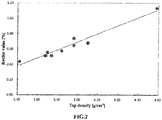
- Fig. 2 shows a relation between the tap densities of the samples No. 1 to No. 9 of the iron powders for powder metallurgy and the rattler values of the compacts thereof.
- both the density and the rattler value of the compact were substantially proportional to the tap density. More specifically, it was able to be confirmed that in order to set the green density to be greater than or equal to 7.20 g/cm 3 , at which sufficient strength could be obtained after sintering, and to set the rattler value of the compact to be less than or equal to 0.75%, at which a degree of a crack and/or a chip fell within a permissible range, the tap density of the iron powder for powder metallurgy should be set to be greater than or equal to 3.90 g/cm 3 and less than or equal to 4.20 g/cm 3 .
- the iron powder for powder metallurgy according to an embodiment of the present invention can be suitably used, for example, for production of mechanical parts such as a gear and the like.
Landscapes
- Chemical & Material Sciences (AREA)
- Engineering & Computer Science (AREA)
- Materials Engineering (AREA)
- Mechanical Engineering (AREA)
- Metallurgy (AREA)
- Organic Chemistry (AREA)
- Powder Metallurgy (AREA)
- Manufacture Of Metal Powder And Suspensions Thereof (AREA)
Abstract
Description
- The present invention relates to an iron powder for powder metallurgy.
- Powder metallurgy, in which a metal powder is compacted and then sintered to form a metal part, has become widely employed. In general powder metallurgy, increasing a green density, i.e., reducing a green porosity, enables a resultant metal sintered body to have higher mechanical strength. Furthermore, in the powder metallurgy, an increase in green strength enables dimensional accuracy of the metal sintered body to be improved and yield to be increased.
- According to Japanese Unexamined Patent Application Publication No.
H04-173901 - When a forming pressure at a time of compacting is increased, the green density and the green strength increase. However, the increase in the forming pressure leads to disadvantages of a shorter lifetime of a die, and the like, degrading production efficiency of metal parts.
- Patent Document 1: Japanese Unexamined Patent Application Publication No.
H04-173901 - In view of the foregoing disadvantages, it is an object of the present invention to provide an iron powder for powder metallurgy from which a sintered body with high strength can be obtained.
- An iron powder for powder metallurgy according to an embodiment of the present invention made to solve the aforementioned problems comprises: C: less than or equal to 0.005% by mass; Si: less than or equal to 0.030% by mass; P: less than or equal to 0.020% by mass; S: less than or equal to 0.020% by mass; O: less than or equal to 0.15% by mass; Mn, Ni, Mo, and Cr: less than or equal to 3.0% by mass in total; and a balance being Fe and inevitable impurities, wherein a tap density of the iron powder for powder metallurgy is greater than or equal to 3.90 g/cm3 and less than or equal to 4.20 g/cm3.
- Due to the tap density of the iron powder for powder metallurgy falling within the above range, iron powder particles can be easily rearranged in a close-packed state; therefore, the iron powder for powder metallurgy has superior compressibility at a time of compacting, and strength of a sintered body finally obtained is high.
- In the iron powder for powder metallurgy, a content of particles which pass through a plain-woven wire mesh with an average opening size of 45 µm is preferably greater than or equal to 10% by mass and less than or equal to 20% by mass. This enables both a compact of the iron powder for powder metallurgy and a sintered body thereof to have sufficient strength.
- "Tap density" as referred to herein means a value measured in accordance with JIS-Z2512 (2012).
- As set forth above, the iron powder for powder metallurgy according to an embodiment of the present invention enables a compact with a high density, and a sintered body with high strength to be obtained.
-
-
Fig. 1 is a graph showing a relation between tap densities and green densities of iron powders for powder metallurgy. -
Fig. 2 is a graph showing a relation between the tap densities of the iron powders for powder metallurgy and rattler values of compacts thereof. - Hereinafter, embodiments of the present invention will be described in detail with reference to the drawings as appropriate.
- The iron powder for powder metallurgy according to an embodiment of the present invention comprises: C: less than or equal to 0.005% by mass; Si: less than or equal to 0.030% by mass; P: less than or equal to 0.020% by mass; S: less than or equal to 0.020% by mass; O: less than or equal to 0.15% by mass; Mn, Ni, Mo, and Cr: less than or equal to 3.0% by mass in total; and a balance being Fe and inevitable impurities, wherein a tap density of the iron powder for powder metallurgy is greater than or equal to 3.90 g/cm3 and less than or equal to 4.20 g/cm3.
- Carbon (C) is an element that hardens particles of the iron powder for powder metallurgy (iron powder particles). Furthermore, C also hardens the iron powder particles by being coupled with another impurity to form a fine carbide. When the iron powder particles harden, deformation is less likely to occur in compacting, which degrades formability and reduces a green density. Hence, the upper limit of a content of C in the iron powder for powder metallurgy is 0.005% by mass, preferably 0.003% by mass, and more preferably 0.002% by mass.
- Silicon (Si) is an element that is likely to be coupled with oxygen and forms an oxide film on a particle surface of the iron powder for powder metallurgy. The oxide film of Si is difficult to reduce, thereby decreasing strength of a sintered body to be obtained. Furthermore, Si has an effect of hardening the iron powder particles, thereby degrading compressibility (the green density and green strength) of the iron powder for powder metallurgy. Hence, the upper limit of a content of Si is 0.030% by mass, preferably 0.020% by mass, and more preferably 0.015% by mass.
- Phosphorus (P) is an element that hardens the iron powder particles and degrades the compressibility. Hence, the upper limit of a content of P is 0.020% by mass, preferably 0.017% by mass, and more preferably 0.015% by mass.
- Sulfur (S) is an element that hardens the iron powder particles and degrades the compressibility. Hence, the upper limit of a content of S is 0.020% by mass, preferably 0.015% by mass, and more preferably 0.010% by mass.
- Oxygen (O) is an element that hardens the iron powder particles and degrades the compressibility. Hence, the upper limit of a content of O is 0.15% by mass, preferably 0.12% by mass, and more preferably 0.10% by mass.
- Manganese (Mn), nickel (Ni), molybdenum (Mo), and chromium (Cr) are elements that are added to increase the strength of the sintered body to be obtained by compacting and sintering the iron powder for powder metallurgy. It is to be noted that when contents of these elements are too high, the iron powder particles may become too hard for sufficient compressibility to be obtained. Hence, the upper limit of a total content of Mn, Ni, Mo, and Cr is 3.0% by mass, preferably 2.5% by mass, and more preferably 2.0% by mass.
- The tap density is an indicator of the ease of rearrangement of the iron powder particles. Assuming that an absolute specific gravity is constant, a larger value of the tap density allows the iron powder particles to be easily rearranged more tightly in a packed state with lower porosity. Accordingly, a higher tap density grants higher compressibility, facilitates compacting, and enables a compact with a higher density (green density) to be obtained with relatively low pressure. Meanwhile, when the tap density is too high, adhesiveness between the iron powder particles may be insufficient, and the strength of the compact (green strength) obtained may be insufficient. Hence, the lower limit of the tap density of the iron powder for powder metallurgy is 3.90 g/cm3, preferably 3.95 g/cm3, and more preferably 3.97 g/cm3. Meanwhile, the upper limit of the tap density of the iron powder for powder metallurgy is 4.20 g/cm3, preferably 4.15 g/cm3, and more preferably 4.10 g/cm3.
- In the iron powder for powder metallurgy, the lower limit of a content of particles which pass through a plain-woven wire mesh with an average opening size of 45 µm is preferably 10% by mass, and more preferably 12% by mass. Meanwhile, in the iron powder for powder metallurgy, the upper limit of the content of the particles which pass through the plain-woven wire mesh with an average opening size of 45 µm is preferably 20% by mass, and more preferably 18% by mass. In a case in which in the iron powder for powder metallurgy, the content of the particles which pass through the plain-woven wire mesh with an average opening size of 45 µm is less than the lower limit, the strength of the sintered body of the iron powder for powder metallurgy may be insufficient. Conversely, in a case in which in the iron powder for powder metallurgy, the content of the particles which pass through the plain-woven wire mesh with an average opening size of 45 µm is greater than the upper limit, strength of a compact (green strength) finally obtained may be insufficient.
- The lower limit of a density of a compact (green density) obtained by adding 0.75% by mass zinc stearate to the iron powder for powder metallurgy and forming at a forming pressure of 7 tf/cm2 is preferably 7.20 g/cm3, and more preferably 7.22 g/cm3. In a case in which the green density is less than the lower limit, strength of a sintered body finally obtained may be insufficient.
- The upper limit of a rattler value, which is an indicator of the strength of the compact (green strength), obtained by adding 0.75% by mass zinc stearate to the iron powder for powder metallurgy and forming at a forming pressure of 7 tf/cm2 is preferably 0.75%, and more preferably 0.70%. In a case in which the rattler value of the compact is greater than the upper limit, the green strength may be insufficient, and dimensional accuracy and/or yield of the sintered body may be insufficient. It is to be noted that "rattler value" as referred to herein means a value measured in accordance with JSPM Standard 4-69.
- The iron powder for powder metallurgy can be produced by a method comprising: atomizing molten iron by spraying water, the molten iron having been prepared to have the above composition (a water-atomizing step); reducing a powder obtained in the water-atomizing step by heating in a reducing gas atmosphere (a reducing step); and pulverizing an iron powder solidified in the reducing step (a pulverizing step).
- In the water-atomizing step, a fine iron powder is obtained by spraying water onto the molten iron flowing from a furnace. In the water-atomizing step, by controlling a water pressure of the water sprayed, the tap density of the iron powder for powder metallurgy to be obtained is controlled so as to fall within the above range. Specifically, the higher the water pressure is, the lower the tap density of the iron powder for powder metallurgy to be obtained.
- In the reducing step, the iron powder oxidized in the water-atomizing step is reduced by heating in a reducing gas environment.
- As the reducing gas, for example, a hydrogen gas, an ammonia gas, or a butane gas may be used.
- In the pulverizing step, the iron powder solidified into a cake shape by a reducing treatment described above is pulverized using a mill. By sufficiently pulverizing the iron powder, a particle diameter distribution of the iron powder for powder metallurgy to be obtained is made to conform with a particle diameter distribution of the iron powder obtained in the water-atomizing step, ensuring a desired tap density.
- As the mill used in the pulverizing step, for example, a hammer mill, a feather mill, or the like may be used.
- Furthermore, in the pulverizing step, it is preferable that the iron powder after the pulverizing is sorted through a wire mesh, and large particles are put into the mill again.
- Due to the tap density of the iron powder for powder metallurgy falling within the above range, the iron powder particles can be easily rearranged to result in a high apparent density; thus, the iron powder for powder metallurgy is superior in compressibility at a time of compacting, and a compact with sufficient strength (green strength) can be obtained. Accordingly, by using the iron powder for powder metallurgy, a sintered body with high strength can be efficiently produced.
- The above-described embodiment does not limit the configuration of the present invention. Therefore, in the above-described embodiment, the components of each part of the above-described embodiment can be omitted, replaced, or added based on the description in the present specification and general technical knowledge, and such omission, replacement, or addition should be construed as falling within the scope of the present invention.
- Hereinafter, the present invention will be described in detail by way of Examples; the present invention should not be construed as being limited to description in the Examples.
- Molten iron was prepared using an electric furnace, and the molten iron allowed to flow from the electric furnace was atomized by a water atomization method in which water was sprayed onto the molten iron. At this time, a pressure of the water sprayed was selected from within three types of ranges: a low pressure of 30 kgf/cm2 to 60 kgf/cm2, a middle pressure of 60 kgf/cm2 to 90 kgf/cm2, and a high pressure of 90 kgf/cm2 to 120 kgf/cm2. Next, an iron powder obtained was dehydrated and dried, a coarse powder was removed using a wire mesh with an opening size of 425 µm, and then a reducing treatment was performed in a decomposed ammonia gas atmosphere within a temperature range of 880 °C to 980 °C for 30 min to 60 min. Then, the iron powder solidified into a cake shape by the reducing treatment was pulverized using a hammer mill and a feather mill, and sieving was performed using wire meshes with respective opening sizes of 425 µm, 250 µm, and 180 µm; thus, samples No. 1 to No. 9 of iron powders for powder metallurgy were obtained.
- Compositions of the samples No. 1 to No. 9 of the iron powders for powder metallurgy thus obtained were analyzed. Contents of C and S were measured with "CS-244", a carbon/sulfur analyzer available from LECO. A content of O was measured with "TC-400", an oxygen/nitrogen analyzer available from LECO. Contents of elements other than C, S, and O were measured with "ICPV-5500", an ICP emission spectrometer available from SHIMADZU CORPORATION. Analysis results of the compositions of the samples No. 1 to No. 9 are shown in Table 1.
Table 1 Sample No. Composition (% by mass) C Si P S Mn Ni Mo Cr O 1 0.001 0.007 0.014 0.006 0.19 0.03 0.01 0.04 0.13 2 0.001 0.009 0.017 0.006 0.18 0.02 0.01 0.03 0.13 3 0.001 0.013 0.006 0.004 0.08 0.01 0.01 0.03 0.07 4 0.001 0.007 0.007 0.005 0.09 0.02 0.01 0.03 0.05 5 0.002 0.014 0.007 0.007 0.10 0.01 0.01 0.02 0.05 6 0.001 0.014 0.010 0.004 0.17 0.58 0.64 0.04 0.09 7 0.001 0.010 0.009 0.004 0.19 0.58 0.60 0.04 0.08 8 0.001 0.008 0.016 0.006 0.17 0.56 1.08 0.03 0.07 9 0.001 0.011 0.015 0.005 0.12 0.54 1.04 0.03 0.07 - In addition, particle diameter distributions and tap densities of the samples No. 1 to No. 9 of the iron powders for powder metallurgy were measured. It is to be noted that the particle diameter distributions were measured by a sieving test in accordance with JIS-Z8815 (1994). The tap densities were measured in accordance with JIS-Z2512 (2012).
- Powders obtained by adding and mixing as a lubricant 0.75% by mass zinc stearate to each of the samples No. 1 to No. 9 of the iron powders for powder metallurgy were compacted at a forming pressure of 7 tf/cm2, whereby compacts each having a cylindrical shape with a diameter of 11.28 mm and a height of 10 mm were formed. Green densities and rattler values of the compacts obtained were measured. The green densities were measured in accordance with JIS-Z2501 (2000). Furthermore, the rattler values of the compacts were measured in accordance with JSPM Standard 4-69.
- The particle diameter distributions and the tap densities of the samples No. 1 to No. 9 of the iron powders for powder metallurgy as well as the green densities and the rattler values of the compacts of the samples No. 1 to No. 9 of the iron powders for powder metallurgy are shown together in Table 2.
Table 2 Sample No. Water pressure Particle size distribution (% by mass) Tap density (g/cm3) Green density (g/cm3) Rattler value (%) +250 µm +180 µm +150 µm +106 µm +75 µm +63 µm +45 µm -45 µm 1 High 1.9 6.0 4.2 12.8 16.0 12.2 17.4 29.5 3.71 7.13 0.44 2 High 0.0 0.0 2.7 15.0 23.2 12.7 20.6 25.8 3.85 7.18 0.56 3 Middle 0.0 0.0 2.6 19.8 27.3 15.6 18.3 16.4 3.98 7.29 0.74 4 Middle 0.0 4.4 8.6 18.4 22.7 11.3 16.8 17.8 4.05 7.28 0.68 5 Low 17.1 21.8 11.2 21.1 14.8 4.6 5.5 3.9 4.39 7.31 1.13 6 High 0.0 0.0 3.7 17.9 20.4 12.7 18.0 27.3 3.84 7.18 0.51 7 Middle 0.0 5.2 6.7 21.4 22.2 11.7 16.0 16.8 3.92 7.23 0.58 8 High 0.0 5.5 5.8 18.5 21.0 10.7 17.1 21.4 3.87 7.19 0.51 9 Middle 0.0 6.2 8.8 24.3 21.9 10.9 13.9 14.0 3.98 7.24 0.65 - In addition,
Fig. 1 shows a relation between the tap densities and green densities of the samples No. 1 to No. 9 of the iron powders for powder metallurgy, andFig. 2 shows a relation between the tap densities of the samples No. 1 to No. 9 of the iron powders for powder metallurgy and the rattler values of the compacts thereof. - As shown in the drawings, it was confirmed that both the density and the rattler value of the compact were substantially proportional to the tap density. More specifically, it was able to be confirmed that in order to set the green density to be greater than or equal to 7.20 g/cm3, at which sufficient strength could be obtained after sintering, and to set the rattler value of the compact to be less than or equal to 0.75%, at which a degree of a crack and/or a chip fell within a permissible range, the tap density of the iron powder for powder metallurgy should be set to be greater than or equal to 3.90 g/cm3 and less than or equal to 4.20 g/cm3.
- The iron powder for powder metallurgy according to an embodiment of the present invention can be suitably used, for example, for production of mechanical parts such as a gear and the like.
Claims (2)
- An iron powder for powder metallurgy comprising:C: less than or equal to 0.005% by mass;Si: less than or equal to 0.030% by mass;P: less than or equal to 0.020% by mass;S: less than or equal to 0.020% by mass;O: less than or equal to 0.15% by mass;Mn, Ni, Mo, and Cr: less than or equal to 3.0% by mass in total; anda balance being Fe and inevitable impurities,wherein a tap density of the iron powder for powder metallurgy is greater than or equal to 3.90 g/cm3 and less than or equal to 4.20 g/cm3.
- The iron powder for powder metallurgy according to claim 1, wherein a content of particles which pass through a plain-woven wire mesh with an average opening size of 45 µm is greater than or equal to 10% by mass and less than or equal to 20% by mass.
Applications Claiming Priority (2)
| Application Number | Priority Date | Filing Date | Title |
|---|---|---|---|
| JP2018034209A JP7057156B2 (en) | 2018-02-28 | 2018-02-28 | Iron powder for powder metallurgy |
| PCT/JP2019/006090 WO2019167722A1 (en) | 2018-02-28 | 2019-02-19 | Iron powder for powder metallurgy |
Publications (3)
| Publication Number | Publication Date |
|---|---|
| EP3760343A1 true EP3760343A1 (en) | 2021-01-06 |
| EP3760343A4 EP3760343A4 (en) | 2021-11-24 |
| EP3760343B1 EP3760343B1 (en) | 2025-07-23 |
Family
ID=67808900
Family Applications (1)
| Application Number | Title | Priority Date | Filing Date |
|---|---|---|---|
| EP19761704.6A Active EP3760343B1 (en) | 2018-02-28 | 2019-02-19 | Iron powder for powder metallurgy |
Country Status (5)
| Country | Link |
|---|---|
| EP (1) | EP3760343B1 (en) |
| JP (1) | JP7057156B2 (en) |
| KR (1) | KR102507938B1 (en) |
| CN (1) | CN111741822B (en) |
| WO (1) | WO2019167722A1 (en) |
Family Cites Families (15)
| Publication number | Priority date | Publication date | Assignee | Title |
|---|---|---|---|---|
| JPS5410935B2 (en) * | 1972-12-06 | 1979-05-10 | ||
| JPS5959810A (en) * | 1982-09-30 | 1984-04-05 | Kobe Steel Ltd | Steel powder for powder metallurgy and its manufacture |
| JP2608178B2 (en) | 1990-11-07 | 1997-05-07 | 川崎製鉄株式会社 | Iron powder for powder metallurgy |
| JPH06256802A (en) * | 1993-03-02 | 1994-09-13 | Kawasaki Steel Corp | Atomization method of molten metal by iron and steel powder for powder metallurgy and liquid jet |
| CN1104570A (en) * | 1993-05-18 | 1995-07-05 | 川崎制铁株式会社 | Atomised iron powder for powder metallurgy |
| JP3957331B2 (en) * | 1993-05-18 | 2007-08-15 | Jfeスチール株式会社 | Method for producing water atomized iron powder for powder metallurgy |
| JP3938944B2 (en) * | 1993-11-04 | 2007-06-27 | Jfeスチール株式会社 | Method for producing water atomized iron powder for powder metallurgy |
| US5501747A (en) * | 1995-05-12 | 1996-03-26 | Crs Holdings, Inc. | High strength iron-cobalt-vanadium alloy article |
| US7217328B2 (en) * | 2000-11-13 | 2007-05-15 | Neomax Co., Ltd. | Compound for rare-earth bonded magnet and bonded magnet using the compound |
| JP4069727B2 (en) | 2001-11-20 | 2008-04-02 | 日立金属株式会社 | Rare earth based bonded magnet compound and bonded magnet using the same |
| CN1410208B (en) * | 2002-11-25 | 2011-01-19 | 莱芜钢铁集团粉末冶金有限公司 | Manufacturing method of alloy steel powder by spraying |
| JP2007092162A (en) | 2005-02-03 | 2007-04-12 | Jfe Steel Kk | Highly compressible iron powder, and iron powder and dust core for dust core using the same |
| JP5617529B2 (en) * | 2010-10-28 | 2014-11-05 | Jfeスチール株式会社 | Iron-based mixed powder for powder metallurgy |
| JP5926011B2 (en) | 2011-07-19 | 2016-05-25 | 太陽誘電株式会社 | Magnetic material and coil component using the same |
| JP2013204075A (en) | 2012-03-28 | 2013-10-07 | Taiwan Powder Technologies Co Ltd | Method for producing fine reduced iron powder |
-
2018
- 2018-02-28 JP JP2018034209A patent/JP7057156B2/en active Active
-
2019
- 2019-02-19 EP EP19761704.6A patent/EP3760343B1/en active Active
- 2019-02-19 KR KR1020207026943A patent/KR102507938B1/en active Active
- 2019-02-19 WO PCT/JP2019/006090 patent/WO2019167722A1/en not_active Ceased
- 2019-02-19 CN CN201980014359.5A patent/CN111741822B/en active Active
Also Published As
| Publication number | Publication date |
|---|---|
| EP3760343B1 (en) | 2025-07-23 |
| JP7057156B2 (en) | 2022-04-19 |
| EP3760343A4 (en) | 2021-11-24 |
| CN111741822B (en) | 2022-06-03 |
| CN111741822A (en) | 2020-10-02 |
| WO2019167722A1 (en) | 2019-09-06 |
| KR102507938B1 (en) | 2023-03-08 |
| JP2019147997A (en) | 2019-09-05 |
| KR20200121858A (en) | 2020-10-26 |
Similar Documents
| Publication | Publication Date | Title |
|---|---|---|
| EP2947670B1 (en) | Method for manufacturing powder magnetic core, powder magnetic core, and coil component | |
| EP2108472A1 (en) | High-compressibility iron powder, iron powder comprising the same for dust core, and dust core | |
| KR20160006769A (en) | Alloy steel powder for powder metallurgy and method of producing iron-based sintered body | |
| KR20160045825A (en) | Alloy steel powder for powder metallurgy and method of producing iron-based sintered body | |
| JP5999285B1 (en) | Iron-base alloy powder for powder metallurgy and sintered forged parts | |
| EP3505493B1 (en) | Tungsten carbide powder | |
| EP3760343B1 (en) | Iron powder for powder metallurgy | |
| CN118103158A (en) | Molybdenum powder | |
| KR102316651B1 (en) | Alloyed steel powder | |
| CN111432958B (en) | Partially diffused alloyed steel powder | |
| JPH08921B2 (en) | Pure iron powder for powder metallurgy with excellent compressibility and magnetic properties | |
| JP2003193160A (en) | Ni-Fe alloy powder | |
| JP2005325373A (en) | Casting method of iron powder for magnetic materials | |
| JP4715358B2 (en) | Alloy steel powder for powder metallurgy | |
| JPH04173901A (en) | Iron powder for powder metallurgy | |
| CN115704076B (en) | Hard granular powder for sintered bodies | |
| JP2579171B2 (en) | Manufacturing method of sintered material | |
| JP2007169736A (en) | Alloy steel powder for powder metallurgy | |
| CN101163809A (en) | Iron-based sintered alloy | |
| JPS5950154A (en) | Manufacture of high-density iron-base sintered member | |
| JPH075921B2 (en) | Method for producing composite alloy steel powder with excellent compressibility | |
| CN116844813A (en) | Neodymium iron boron magnetic material design method based on magnetic expansion rate, magnetic material and bonded magnet | |
| JPH0790301A (en) | Iron-based granulated powder for powder metallurgy and method for producing the same | |
| JP2007100115A (en) | Alloy steel powder for powder metallurgy | |
| JP2021001381A (en) | Alloy steel powder for sintered member, iron based mixed powder for sintered member, and sintered member |
Legal Events
| Date | Code | Title | Description |
|---|---|---|---|
| STAA | Information on the status of an ep patent application or granted ep patent |
Free format text: STATUS: THE INTERNATIONAL PUBLICATION HAS BEEN MADE |
|
| PUAI | Public reference made under article 153(3) epc to a published international application that has entered the european phase |
Free format text: ORIGINAL CODE: 0009012 |
|
| STAA | Information on the status of an ep patent application or granted ep patent |
Free format text: STATUS: REQUEST FOR EXAMINATION WAS MADE |
|
| 17P | Request for examination filed |
Effective date: 20200903 |
|
| AK | Designated contracting states |
Kind code of ref document: A1 Designated state(s): AL AT BE BG CH CY CZ DE DK EE ES FI FR GB GR HR HU IE IS IT LI LT LU LV MC MK MT NL NO PL PT RO RS SE SI SK SM TR |
|
| AX | Request for extension of the european patent |
Extension state: BA ME |
|
| DAV | Request for validation of the european patent (deleted) | ||
| DAX | Request for extension of the european patent (deleted) | ||
| A4 | Supplementary search report drawn up and despatched |
Effective date: 20211025 |
|
| RIC1 | Information provided on ipc code assigned before grant |
Ipc: C22C 38/44 20060101ALI20211019BHEP Ipc: C22C 38/18 20060101ALI20211019BHEP Ipc: C22C 38/12 20060101ALI20211019BHEP Ipc: C22C 38/08 20060101ALI20211019BHEP Ipc: C22C 38/04 20060101ALI20211019BHEP Ipc: C22C 38/02 20060101ALI20211019BHEP Ipc: C22C 33/02 20060101ALI20211019BHEP Ipc: C22C 38/58 20060101ALI20211019BHEP Ipc: C22C 38/00 20060101ALI20211019BHEP Ipc: B22F 9/08 20060101ALI20211019BHEP Ipc: B22F 1/00 20060101AFI20211019BHEP |
|
| GRAP | Despatch of communication of intention to grant a patent |
Free format text: ORIGINAL CODE: EPIDOSNIGR1 |
|
| STAA | Information on the status of an ep patent application or granted ep patent |
Free format text: STATUS: GRANT OF PATENT IS INTENDED |
|
| RIC1 | Information provided on ipc code assigned before grant |
Ipc: C22C 38/44 20060101ALI20250318BHEP Ipc: C22C 38/18 20060101ALI20250318BHEP Ipc: C22C 38/12 20060101ALI20250318BHEP Ipc: C22C 38/08 20060101ALI20250318BHEP Ipc: C22C 38/04 20060101ALI20250318BHEP Ipc: C22C 38/02 20060101ALI20250318BHEP Ipc: C22C 33/02 20060101ALI20250318BHEP Ipc: C22C 38/58 20060101ALI20250318BHEP Ipc: C22C 38/00 20060101ALI20250318BHEP Ipc: B22F 9/08 20060101ALI20250318BHEP Ipc: B22F 1/05 20220101ALI20250318BHEP Ipc: B22F 1/00 20060101AFI20250318BHEP |
|
| INTG | Intention to grant announced |
Effective date: 20250402 |
|
| RIN1 | Information on inventor provided before grant (corrected) |
Inventor name: NISHIDA, SATOSHI Inventor name: HOJO, HIROFUMI Inventor name: TANIGUCHI, YUJI |
|
| GRAS | Grant fee paid |
Free format text: ORIGINAL CODE: EPIDOSNIGR3 |
|
| GRAA | (expected) grant |
Free format text: ORIGINAL CODE: 0009210 |
|
| STAA | Information on the status of an ep patent application or granted ep patent |
Free format text: STATUS: THE PATENT HAS BEEN GRANTED |
|
| P01 | Opt-out of the competence of the unified patent court (upc) registered |
Free format text: CASE NUMBER: APP_25147/2025 Effective date: 20250527 |
|
| AK | Designated contracting states |
Kind code of ref document: B1 Designated state(s): AL AT BE BG CH CY CZ DE DK EE ES FI FR GB GR HR HU IE IS IT LI LT LU LV MC MK MT NL NO PL PT RO RS SE SI SK SM TR |
|
| REG | Reference to a national code |
Ref country code: GB Ref legal event code: FG4D |
|
| REG | Reference to a national code |
Ref country code: CH Ref legal event code: EP |
|
| REG | Reference to a national code |
Ref country code: IE Ref legal event code: FG4D |
|
| REG | Reference to a national code |
Ref country code: DE Ref legal event code: R096 Ref document number: 602019072920 Country of ref document: DE |
|
| REG | Reference to a national code |
Ref country code: SE Ref legal event code: TRGR |
|
| REG | Reference to a national code |
Ref country code: NL Ref legal event code: MP Effective date: 20250723 |
|
| PG25 | Lapsed in a contracting state [announced via postgrant information from national office to epo] |
Ref country code: PT Free format text: LAPSE BECAUSE OF FAILURE TO SUBMIT A TRANSLATION OF THE DESCRIPTION OR TO PAY THE FEE WITHIN THE PRESCRIBED TIME-LIMIT Effective date: 20251124 |
|
| PG25 | Lapsed in a contracting state [announced via postgrant information from national office to epo] |
Ref country code: NL Free format text: LAPSE BECAUSE OF FAILURE TO SUBMIT A TRANSLATION OF THE DESCRIPTION OR TO PAY THE FEE WITHIN THE PRESCRIBED TIME-LIMIT Effective date: 20250723 |
|
| REG | Reference to a national code |
Ref country code: AT Ref legal event code: MK05 Ref document number: 1815920 Country of ref document: AT Kind code of ref document: T Effective date: 20250723 |
|
| PG25 | Lapsed in a contracting state [announced via postgrant information from national office to epo] |
Ref country code: IS Free format text: LAPSE BECAUSE OF FAILURE TO SUBMIT A TRANSLATION OF THE DESCRIPTION OR TO PAY THE FEE WITHIN THE PRESCRIBED TIME-LIMIT Effective date: 20251123 |
|
| PG25 | Lapsed in a contracting state [announced via postgrant information from national office to epo] |
Ref country code: NO Free format text: LAPSE BECAUSE OF FAILURE TO SUBMIT A TRANSLATION OF THE DESCRIPTION OR TO PAY THE FEE WITHIN THE PRESCRIBED TIME-LIMIT Effective date: 20251023 |
|
| REG | Reference to a national code |
Ref country code: LT Ref legal event code: MG9D |
|
| PG25 | Lapsed in a contracting state [announced via postgrant information from national office to epo] |
Ref country code: AT Free format text: LAPSE BECAUSE OF FAILURE TO SUBMIT A TRANSLATION OF THE DESCRIPTION OR TO PAY THE FEE WITHIN THE PRESCRIBED TIME-LIMIT Effective date: 20250723 |
|
| PG25 | Lapsed in a contracting state [announced via postgrant information from national office to epo] |
Ref country code: FI Free format text: LAPSE BECAUSE OF FAILURE TO SUBMIT A TRANSLATION OF THE DESCRIPTION OR TO PAY THE FEE WITHIN THE PRESCRIBED TIME-LIMIT Effective date: 20250723 |
|
| PG25 | Lapsed in a contracting state [announced via postgrant information from national office to epo] |
Ref country code: HR Free format text: LAPSE BECAUSE OF FAILURE TO SUBMIT A TRANSLATION OF THE DESCRIPTION OR TO PAY THE FEE WITHIN THE PRESCRIBED TIME-LIMIT Effective date: 20250723 |
|
| PG25 | Lapsed in a contracting state [announced via postgrant information from national office to epo] |
Ref country code: GR Free format text: LAPSE BECAUSE OF FAILURE TO SUBMIT A TRANSLATION OF THE DESCRIPTION OR TO PAY THE FEE WITHIN THE PRESCRIBED TIME-LIMIT Effective date: 20251024 |
|
| PG25 | Lapsed in a contracting state [announced via postgrant information from national office to epo] |
Ref country code: LV Free format text: LAPSE BECAUSE OF FAILURE TO SUBMIT A TRANSLATION OF THE DESCRIPTION OR TO PAY THE FEE WITHIN THE PRESCRIBED TIME-LIMIT Effective date: 20250723 |
|
| PG25 | Lapsed in a contracting state [announced via postgrant information from national office to epo] |
Ref country code: PL Free format text: LAPSE BECAUSE OF FAILURE TO SUBMIT A TRANSLATION OF THE DESCRIPTION OR TO PAY THE FEE WITHIN THE PRESCRIBED TIME-LIMIT Effective date: 20250723 Ref country code: BG Free format text: LAPSE BECAUSE OF FAILURE TO SUBMIT A TRANSLATION OF THE DESCRIPTION OR TO PAY THE FEE WITHIN THE PRESCRIBED TIME-LIMIT Effective date: 20250723 |
|
| PG25 | Lapsed in a contracting state [announced via postgrant information from national office to epo] |
Ref country code: RS Free format text: LAPSE BECAUSE OF FAILURE TO SUBMIT A TRANSLATION OF THE DESCRIPTION OR TO PAY THE FEE WITHIN THE PRESCRIBED TIME-LIMIT Effective date: 20251023 |
|
| PG25 | Lapsed in a contracting state [announced via postgrant information from national office to epo] |
Ref country code: ES Free format text: LAPSE BECAUSE OF FAILURE TO SUBMIT A TRANSLATION OF THE DESCRIPTION OR TO PAY THE FEE WITHIN THE PRESCRIBED TIME-LIMIT Effective date: 20250723 |
|
| PG25 | Lapsed in a contracting state [announced via postgrant information from national office to epo] |
Ref country code: SM Free format text: LAPSE BECAUSE OF FAILURE TO SUBMIT A TRANSLATION OF THE DESCRIPTION OR TO PAY THE FEE WITHIN THE PRESCRIBED TIME-LIMIT Effective date: 20250723 |
|
| PGFP | Annual fee paid to national office [announced via postgrant information from national office to epo] |
Ref country code: SE Payment date: 20260203 Year of fee payment: 8 |
|
| PG25 | Lapsed in a contracting state [announced via postgrant information from national office to epo] |
Ref country code: DK Free format text: LAPSE BECAUSE OF FAILURE TO SUBMIT A TRANSLATION OF THE DESCRIPTION OR TO PAY THE FEE WITHIN THE PRESCRIBED TIME-LIMIT Effective date: 20250723 |
|
| PG25 | Lapsed in a contracting state [announced via postgrant information from national office to epo] |
Ref country code: IT Free format text: LAPSE BECAUSE OF FAILURE TO SUBMIT A TRANSLATION OF THE DESCRIPTION OR TO PAY THE FEE WITHIN THE PRESCRIBED TIME-LIMIT Effective date: 20250723 |
|
| PG25 | Lapsed in a contracting state [announced via postgrant information from national office to epo] |
Ref country code: CZ Free format text: LAPSE BECAUSE OF FAILURE TO SUBMIT A TRANSLATION OF THE DESCRIPTION OR TO PAY THE FEE WITHIN THE PRESCRIBED TIME-LIMIT Effective date: 20250723 |
|
| REG | Reference to a national code |
Ref country code: DE Ref legal event code: R097 Ref document number: 602019072920 Country of ref document: DE |
|
| PG25 | Lapsed in a contracting state [announced via postgrant information from national office to epo] |
Ref country code: SK Free format text: LAPSE BECAUSE OF FAILURE TO SUBMIT A TRANSLATION OF THE DESCRIPTION OR TO PAY THE FEE WITHIN THE PRESCRIBED TIME-LIMIT Effective date: 20250723 Ref country code: EE Free format text: LAPSE BECAUSE OF FAILURE TO SUBMIT A TRANSLATION OF THE DESCRIPTION OR TO PAY THE FEE WITHIN THE PRESCRIBED TIME-LIMIT Effective date: 20250723 |
|
| PLBE | No opposition filed within time limit |
Free format text: ORIGINAL CODE: 0009261 |
|
| STAA | Information on the status of an ep patent application or granted ep patent |
Free format text: STATUS: NO OPPOSITION FILED WITHIN TIME LIMIT |
|
| REG | Reference to a national code |
Ref country code: CH Ref legal event code: L10 Free format text: ST27 STATUS EVENT CODE: U-0-0-L10-L00 (AS PROVIDED BY THE NATIONAL OFFICE) Effective date: 20260604 |
|
| PG25 | Lapsed in a contracting state [announced via postgrant information from national office to epo] |
Ref country code: LT Free format text: LAPSE BECAUSE OF FAILURE TO SUBMIT A TRANSLATION OF THE DESCRIPTION OR TO PAY THE FEE WITHIN THE PRESCRIBED TIME-LIMIT Effective date: 20250723 |
|
| 26N | No opposition filed |
Effective date: 20260424 |